Immigration policy and emissions targets

I’ve written a few posts in recent months about the connections between our immigration policy – materially boosting our population growth rate – and New Zealand greenhouse gas emissions (eg here and here).  New Zealand is unusual because, as the Ministry for the Environment (MfE) has highlighted:

• we have a fairly high rate of trend population growth,
• a large chunk of our emissions are from animals, and
• much of our power has long been generated from renewable sources.

I’ve also written here about Official Information Act requests to MfE (responsible for climate change policy advice) and MBIE (responsible for immigration policy advice). It turned out that neither ministry had given any thought at all, or done any work on, possible connections between immigration policy and the economic challenges of emissions reductions target (the MfE response is discussed here).  Perhaps one wouldn’t really expect MBIE to have thought so much about emissions issues, but in MfE the omission looks less excusable, and probably deliberate.

A few months ago, the government asked the Productivity Commission to hold an inquiry into making the transition to a low-emissions economy. In August the Commission published an issues paper, trying to frame the inquiry. That document was notable for almost completely ignoring the possible population/immigration dimension. But they were inviting submissions, and so this morning I lodged mine.

Rather than attempt to excerpt, or summarise, the relatively short submission I’ve reproduced the whole thing below. It does have the feel of the sort of issue where there should be some common ground discoverable between New Zealand First (with concerns about immigration) and Labour and the Greens (proposing more ambitious emissions targets). But, equally, for the National Party it should also be something they take seriously. After all, as I note in the submission, in pursuing an emissions reduction target the goal should not be to don a hair-shirt and deliberately “feel the pain”, but to make the adjustment in a way that has as little cost to the future material living standards of New Zealanders as possible.

Submission to the Productivity Commission inquiry on a possible transition to a low emissions economy

Michael Reddell

29 September 2017 

1.      This submission is in response to the Commission’s issues paper on a possible transition to a low emissions economy, released on 9 August 2017.  

2.      My concern is that the issues paper does not touch on at all the role that immigration policy has played in driving up total emissions in New Zealand nor, relatedly, on the role that potential changes in immigration policy could play in offering a lower cost (to New Zealanders, the appropriate standard against which to measure these things) transition to the proposed low emissions economy. 

3.      As the Ministry for the Environment has noted in its most recent annual document on New Zealand’s Greenhouse Gas Inventory, a growing population represents a significant challenge for New Zealand in meeting the emissions targets the government has set (let alone those proposed in the recent election campaign by other political parties).  In fact, the Ministry included population as the first in its list of challenges. 

4.      New Zealand’s population growth has been well above that of the typical advanced country, even though for some decades now our birth rate has been below replacement level, and even though for some decades the net emigration outflow of New Zealanders (at around 0.5 per cent of the population per annum on average) has been very high by international standards.  The difference is accounted for by immigration policy.   Because of our distance from other countries we have near-complete control over who comes to New Zealand and stays.   And we have chosen to bring in numbers of non-citizens each year that, as a proportion of the existing population, are far in excess of what happens in typical advanced economies. 

5.      As is also widely recognised, the marginal abatement costs for reducing emissions are generally quite high in New Zealand.  First, unlike most advanced countries, animal emissions make up almost half our total emissions and, as yet and as I understand it, science does not offer methods to reduce substantially the emissions while keeping the animals (which, in turn, generate much of the export earnings of New Zealand).  In addition, as I understand it, other countries do not yet include agricultural emissions in their regimes to charge for or tax emissions.  And, secondly, much of our power generation already uses renewable (mostly hydro) sources.  

6.      An increasing population has resulted in additional emissions, all else equal, through at least two channels: 

a.      The direct effects of more people needing more transport, more heating, more energy in their workplaces etc, and

b.      The indirect effects, in which a rapidly growing population and a generally lagging export sector has accentuated pressures for increased intensification in agriculture, with associated pushback against attempts to internalise the effects of environmental externalities (whether water pollution or methane emissions).  With fewer people, it seems quite plausible that we’d have had fewer cows. 

7.      Because the marginal abatement costs of conventional approaches are generally accepted to be particularly high in New Zealand, it is even more important that in undertaking its inquiry, the Commission should be willing to examine the role of immigration policy.  As Official Information Act requests to MfE (responsible for climate change policy advice) MBIE (responsible for immigration policy advice) have shown, core government departments appear to have done nothing at all to look at the possible connections.  There may have been ministerial political constraints on the freedom of either ministry to do so.   Those sensitivities should not hold back the Commission –  a more independent agency – from seriously considering the connection. (In that light, I found it disconcerting that there was no material reference to the topic in your issues paper). 

8.       The argument for using immigration policy as a potential instrument in meeting emissions reduction objectives would not be strong if there were clear and material economic benefits to New Zealanders from the high target rate of non-citizen immigration (the centrepiece of which is the 45000 per annum residence approvals “target”).    But those possible gains –  most notably perhaps a lift in labour or multi-factor productivity – cannot simply be taken for granted in New Zealand.     Despite claims from various lobby groups that the economic gains (to natives) of immigration are clear in the economics literature, little empirical research specific to New Zealand has been undertaken, and there is good reason –  notably our remoteness –  to leave open the possibility that any gains from immigration may be much smaller here than they might be in, say, a country closer to the global centres of economic activity, whether in Europe, Asia, or North America.    Even many of those who are broadly supportive of New Zealand’s past approach to immigration policy will now acknowledge (a) that the New Zealand specific literature is quite limited, and (b) that any gains to New Zealanders may be quite small.  Your staff are, I know, well aware of my alternative approach which interprets modern New Zealand economic history as suggesting that high rates of non-citizen immigration have held back our productivity performance (i.e. come at a net economic cost to New Zealanders).  I would be happy to discuss those issues with you further. 

9.      The overlay of an official emissions reduction target –  a new factor –  adds a new dimension to how best to think about immigration policy.  Even if immigration policy, on its own, was slightly beneficial, in economic terms, to New Zealanders, those assessments need to be redone in the light of the constraints posed by the emissions reduction targets.  In an economy with low marginal abatement costs through conventional price/tax instruments, the effect of any such reconsideration might be small. But in New Zealand, where all informed observers recognise that the marginal abatement costs are large through conventional means, it might well be that a lower immigration target would represent one of the most cost-effective ways to reduce total New Zealand emissions.  And as our emissions reduction target is quite similar to those of a number of other countries that have much lower population growth rates, there would be no serious basis for others to suggest that pulling back our immigration targets, to something more conventional among advanced countries, was in some sense free-riding or engaging in a “beggar thy neighbour” approach to the emissions issue.  New Zealand simply isn’t a cost-effective location to reduce emissions, but having taken on the commitment to a reduction, it doesn’t make much sense to create a rod for our own back by continuing to use policy to drive up the population, thus forcing reliance on even more costly alternative abatement instruments.   

10.   All else equal, lowering expected annual population growth rates by, say, half a percentage point (by, for example, lowering the residence approvals target from 45000 to around 15000 per annum –  in per capita terms, still about as liberal as the current US approach) would make a material difference to the projected path of greenhouse gas emissions.  Over 20 years, all else equal, the population would be 10.5 per cent lower than otherwise.  Direct emissions would, accordingly be considerably lower than otherwise projected, and the inevitable pressures to do little or nothing about agricultural emissions would be eased.   The national benefit/cost ratios look likely to be considerable higher if a lower immigration target was added into the mix of instrument used to meet the commitments the government has made.  At very least, I would urge you to think hard about, and undertake modelling as appropriate, to evaluate that possibility.  Doing so might not be easy.  There probably won’t be off-the-shelf modelling exercises from other countries you can simply look to. But in a sense that is the point of this submission.  The issues facing New Zealand in meeting emissions reduction objectives are different from those facing many other countries and we need analysis that takes specific accounts of the issues, options, and constraints that New Zealand itself faces. 

11.   In conclusion, I would urge the Commission to take much more seriously (than was evident in the issues paper) the role that rapid immigration policy led population growth has played in explaining the growth in New Zealand emissions since 1990, and the possible role that modifications to our immigration policy could play in facilitating a reduction in emissions, consistent with current or possible alternative official targets.   No doubt technological advances will offer options for relatively painlessly reducing emissions to some extent.  But those options will be available to all countries.  As official agencies already recognise, New Zealand faces some specific challenges that are quite different to those other advanced countries will be dealing with.  We make it much harder for ourselves to meet the emissions targets our governments have committed to if we persist with such an unusually large non-citizen immigration programme.    The aim of a successful adjustment to a low-emissions economy is not to don a hair shirt and “feel the pain”.  The aim should be to make the adjustment with as small a net economic cost to New Zealanders – as small a drain on our future material living standards – as possible.  Lowering the immigration target looks like an instrument that needs to be seriously considered if that goal is to be successfully pursued.


A first unlawful act?

Earlier in the week, Graeme Wheeler completed his term as Governor and left office.  Even in a week with little real news to report, his departure didn’t seem to receive any notice in the media.  Not even the Herald managed an enconium.   Surely his departure must go unlamented almost everywhere, even if, no doubt, the Bank’s Board –  supposedly guardians of the public interest, but in fact guardians of the Governor –  gave him a good dinner on the occasion of their meeting last week?

And now Grant Spencer – erstwhile deputy chief executive – purports to be in charge, as “acting Governor” until a permanent appointment can be made by the incoming Minister of Finance.  I like Grant.  He was my boss in two separate stints spread over many years, and –  in the late 80s –  was a voice of reason and moderation in an age when young hotheads didn’t always welcome such perspectives.   Now that he purports to wield so much untrammelled power –  not just monetary policy, but all the Bank’s regulatory functions –  I’m sure his management skills must also have improved further.  I like to tell the story of the two years, very early in my management career, without any structured performance feedback from him: the only way I could really be confident I must have been doing ok was through the annual pay round, but when he came to deliver that news I was on the phone, so Grant scribbled the number on a piece of paper, dropped it on my desk, and left.  But I’m sure he would be a safe pair of hands, minding the store.

Unfortunately, his purported appointment –  probably sensible in intention if Graeme Wheeler couldn’t have been persuaded to take a temporary extension – is, as I’ve been pointing out for months, probably unlawful.  (If, as a new reader, you are puzzled by that claim, you can read for yourself my thoughts on the summary of Crown Law’s legal advice on the issue.  I still have with the Ombudsman a request for (a summary of) the Reserve Bank’s own lawyer’s advice.)

And if his appointment is unlawful then so, presumably, are all the acts the Bank takes –  or purports to undertake –  under his authority over the next few months.  Including setting the OCR.

Again, that proposition might puzzle you.  Surely even if there was some question over the lawfulness of the appointment of an acting Governor in these circumstances, there would be no question of the lawfulness of the Bank’s actions?  I had a look at the legislation a few months ago.

Does it all matter?    Sometimes laws contain provisions stating that any problems in the appointment of an officeholder, or doubts about the validity of the appointment, don’t affect the validity of enforceability of the actions/decisions taken by that person.

In fact, the Reserve Bank Act has one of those provisions.    For the Board.  Under section 54(4)

The validity of any act of the Board is not affected by—

(a) any vacancy in its membership; or
(b) any defect in the appointment of a director; or
(c) the fact that any non-executive director is disqualified from appointment under section 58

But there is simply nothing comparable for the Governor.    Curiously, there is protection for the Deputy Chief Executive when exercising delegated authority from the Governor.   Under section 51 

The fact that the Deputy Chief Executive exercises any powers or functions of the Governor shall be conclusive proof of the authority to do so, and no person shall be concerned to inquire whether the occasion for doing so has arisen or has ceased.

But there is nothing like it for the Governor, or any acting Governor.  There is simply a requirement on the Board and the Minister to make a proper appointment, and to have that person in place once the previous Governor’s term ends (and presumably an expectation that Governor appointments are sufficiently high profile, and as all powers of the Bank rest with the Governor, no questions should ever arise about the authority of the Governor him or her self to make decisions.

(Again, it is perhaps worth noting that there are also no such protections in the 1964 Act – the one in place when the 1989 Act was being drafted.  The drafters presumably made conscious choices about what to add and what not to.)

If the appointment of Spencer as acting Governor is unlawful, it looks as though any actions taken by him –  or under his (purported) delegations during his term –  would also be unlawful.

Perhaps it won’t matter very much.  Few people expect the OCR to be changed in the next six months, and if so perhaps they could argue that successive OCR decisions aren’t actions but inactions –  just leaving things as Wheeler left them.

But the Reserve Bank does lots of other stuff.   They commit to commercial contracts, they deal in New Zealand in international markets.  They take enforcement actions against financial institutions that fall foul of the law, or of the Bank’s rules.  And so on.  In a crises, they (the Governor) has substantial regulatory powers.

The situation should never have been allowed to arise.  As I’ve noted for months, it was easily avoidable, with a simple temporary change to the Reserve Bank Act (which there is no obvious reason for the Opposition parties to have opposed –  either on the substance, or as regards Spencer personally, whom everyone regards as a decent and honourable person).   But now we have an unlawful appointment, and Spencer purporting to exercise the powers of (acting) Governor.

But what of the OCR press release –  which, as pure commentary, I suppose Spencer is free to issue?  It probably isn’t that sensible to make much of minor differences in wording: in some areas Spencer may just use slightly different hobbyhorse phrasing than Wheeler would have.  But no one sees it as a material departure from last Wheeler statement, even if (perhaps) the confidence in the growth outlook might be fading.  As for what it might mean for actual (or purported) OCR setting, not much.  After all, it is quite plausible that a new Minister of Finance and coalition could mean modifications to the Policy Targets Agreement almost straightaway (happened in 1993, 1996, and 1999).  And even if that doesn’t happen, Spencer won’t be there to offer his opinion by the end of March, and no one knows who the new Governor will be, or what mandate he or she will be working towards.

The growth outlook was one of the issues I touched on in my comments on the last Monetary Policy Statement.  Those comments still seem largely valid now –  the June quarter GDP numbers were flattered by big one-off boosts to services exports from the World Masters Games and the Lions tour, and yet still showed growth of only 0.8 per cent.

But perhaps my biggest puzzle is where all the forecast growth is coming from.

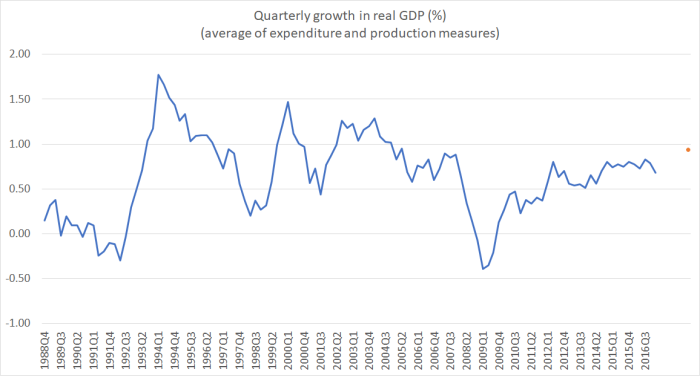
Over the next six quarters, the Bank projects that quarterly GDP growth will average just over 0.9 per cent. This chart shows six-quarter moving average of GDP growth (in turn, averaging the production and expenditure measures).

GDP growth qtrly

The orange dot shows the forecast for the next six quarters.  Their projections suggest that the economy will grow more rapidly over the next 18 months than it has managed on a sustained basis at any time in the current recovery.   You might not think that the difference looks large, but:

  • the Bank already recognises that monetary conditions are tighter than they were last year,
  • the Bank is forecasting a substantial reduction in the net migration inflow, and no one seriously doubts that unexpectedly rapid population growth has been the biggest single driver of headline GDP growth in recent years.  However much immigration adds to supply, it adds a lot to demand.

So why are we to expect a sustained growth acceleration from here?   Although it isn’t stated in the document, I hear that the Bank is invoking the expected fiscal stimulus (from promised measures announced in the Budget).  In isolation that might make some sense, but against the projected halving in the net migration inflow and the actual tightening in monetary conditions, it doesn’t really ring true.     If anything, the risk now has to be that over the next 18 months, headline GDP growth averages lower than we’ve seen in the last couple of years.

Whichever parties form the next government, and as I noted last week, it seems likely that government expenditure will be higher than projected.  But it is still difficult to see a growth outlook as relatively buoyant as the Bank projected –  and requires if inflation is to get back to target –  as the most likely outcome.

And the Bank –  and government –  still seem grossly underprepared for the next recession, whenever it comes.


Things busy bureaucrats do all day

When I was very young one of the picture books I enjoyed –  favourably reviewed, so I see now, even by the New Yorker – was Richard Scarry’s What do people do all day?  Set in Busytown, there was a pervasive sense of activity and, well, busyness.  I don’t think the book had a separate entry for government policy advisers, but the book came to mind as I reflected on a Treasury guest lecture I went to yesterday.

A recently-retired MBIE official had been invited by Treasury to share her experiences of 10 years in the regional economic development wing of MBIE (or its predecessor the Ministry of Economic Development (MED)), and the title of the lecture was “The Great Cat Muster”.     At the start of the lecture she asked us to observe Chatham House rules, by which she meant that anything she said could be reported, but that she shouldn’t be identified.  I’m not sure why, when the flyer for the presentation is easily accessible on Treasury’s website, but for my purposes the presenter’s name probably isn’t very important.  The worry is that her content epitomised a cast of mind that can too easily pervade official bureaucracies.   As I summed it up last night to another attendee “all that energy and good intention, with so little of an analytical framework and even less evidence”.

We weren’t off to a good start when she briefly ran through her various roles in regional development.  In the first of them she had, apparently, been responsible for the West Coast timber settlement. But, as she noted –  and full marks for candour I suppose –  when the NZIER later rated the policy paper on this issue (as they do for a bunch of participating ministries), it scored the worst rating MED had ever achieved.

But most of her time had been spent on more pro-active government initiatives.  There was something called the Food Innovation Network, work on Maori economic development, and then for the last few years work as part of the flagship Regional Growth Programme.  The presenter was clearly pretty passionate about what she’d been doing and the relationships she’d been building.  There was no shortage of energy or ambition.  And no shortage of central Wellington perspectives either.  There were countless working groups, and charts to illustrate complex networks across central government and between arms of central and regional governments.  Meetings abounded, briefing papers multiplied, Air New Zealand profited from frequent flights, relationships were built, and sometimes the recalcitrant were called into line, or simply bypassed.   At one point, she even celebrated the “fact” that regional governments had mostly simply chosen to ignore an act of Parliament –  for the greater good no doubt.  And as for the private sector, well……..the government had simply had to be involved in the Food Innovation Network because we had to develop our food industries, and add value to our exports, and they had found that the private sector was “terribly unsophisticated”.

We learned about the regional studies that have been conducted in several areas under the auspices of the Regional Growth Programme, itself initially sponsored by three ministers (and their agencies).  Now there are “action plans” sponsored by even more minister and agencies.   One mayor had apparently finally been convinced by wise officials that one particular product did not represent his district’s economic future.

It was all remarkably busy.   I had to sympathise with the senior manager who, she recounted, had asked her of one programme “can you be sure we can contain this?”.  To which her response had been along the lines of “well, no, I can’t.  You’ll just have to trust me”.

But, since this presentation was being held at The Treasury, and MBIE is purportedly an economic agency, a few simple things struck me as missing.    There was little or no sense of any of the myriad ways in which governments and official agencies fail, and sometimes leave things even worse than when they started.  There was nothing at all, even in passing, on what the market failures might have been to justify all this busyness in pursuit of regional economic development.     Hadn’t we been this way before, numerous times (one of my earliest political memories is of Matai)?   And, for all the busyness, what difference had all this regional development promotion activity actually made.   After all, there had been no national productivity growth for the last five years, and although she several times highlighted the idea of boosting export industries, exports as a share of GDP have been falling.

So when question time came I stuck up my hand and asked what the market failures were, and how different things would have been if none of this activity had gone on.

Her response was that the market failure was “information asymmetries”.  It wasn’t at all clear what she thought she meant by that phrase, but she seemed to have in mind some sense that central government knew stuff people in the regions (private sector or government) didn’t.  Public servants had needed to “explain to regions where they fit in the system”.    That just isn’t what any economist means by the sort of information asymmetry that might –  just possibly, under some circumstances –  warrant government intervention.  But then it got even worse.  She declared that she’d come from a family that didn’t rank public servants very highly, but “I’ve come to realise that public servants see things no one else sees”, and can offer a “strategic perspective”.

She overlooked answering the second part of my question, so when other people had asked their questions, I asked again what difference all this regional development promotion activity had actually made.  And there was a brief moment of dawning unease: “I sometimes ask myself that”.  She went on to claim that the effects can’t necessarily be quantified by statistics, and that the gains might take more than a few years to realise, but that if we didn’t “do something” we’d see the eventual effects of that.

What stunned me, in someone invited to give such a public lecture at Treasury, was the lack of any rigour, the lack of any robust framework, around all this effort.  Not that many years ago, we’d have counted on The Treasury to be particular intolerant of such, apparently, woolly enthusiasm (at the taxpayer’s expense).  But no longer?  I’d like to think that somewhere in MBIE or Treasury there is a somewhat more hard-headed assessment and evaluation going on, but….it wasn’t on display yesterday.

(And, as one other sceptical attendee described it to me, most of the other attendees –  I suspect mostly public servants –  appeared to be “lapping it up”. I really hope that assessment is wrong, but there were no other sceptical questions from the floor.)

In a way, perhaps, one of the MBIE staff in the audience summed up, unwittingly, the problem with much of this.  He noted that they have “been focused on the levers we can pull easily”, while ignoring others.  And with, it seems, no hard-headed analysis as to whether levers MBIE can’t pull might be considerably more important than those they can –  I think, most notably, of the real exchange rate.

And what of the regional economies?  How have they been doing?  To have listened to the presentation one might have supposed they were wastelands of poverty and economic failure, remarkably different from the urban centres of Auckland, Wellington and Christchurch.

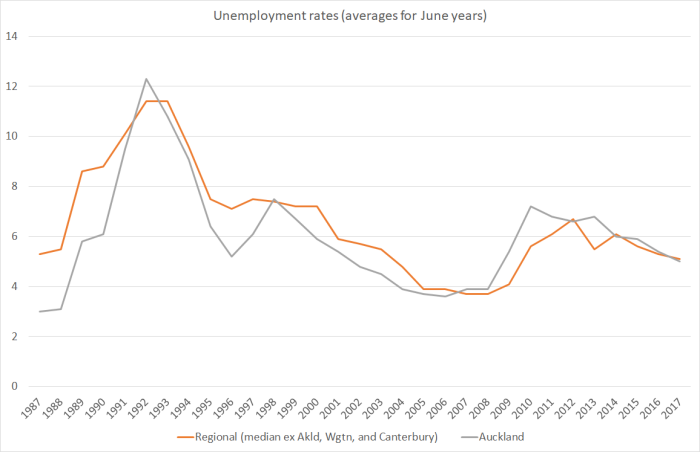
But the data don’t really seem to back up that sort of story.  Take the unemployment rate for example.  Here is a chart showing the median unemployment rate for the regional council areas other than Auckland, Wellington and Christchurch against the unemployment rate for Auckland.

regional U

For most of the last decade, Auckland’s unemployment rate has been a bit above that in the median non-urban region (even though theory typically predicts that a big urban area will typically have a slightly lower unemployment rate –  skill matching is a bit easier in a deeper market).

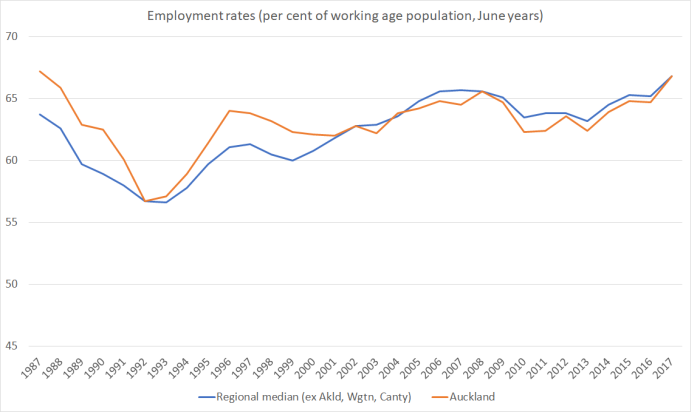
Or the same chart for the employment rate.

employment rate regions

For the last 15 years, the employment rate in the median region has typically been a touch higher than that in Auckland.

What about regional GDP? In earlier posts, I’ve pointed out that Auckland has been seriously underperforming relative to the rest of New Zealand: not only is GDP per capita relative to the rest of the country low compared to what we see for big cities in typical advanced countries, but that margin has been shrinking since 2000.    The flipside of that, of course, is that the non-Auckland bits of the country have been doing okay on this measure (not absolutely –  New Zealand’s overall productivity record is poor –  but better than Auckland).

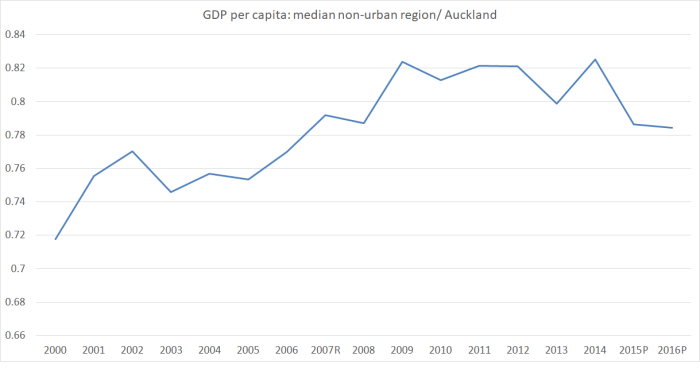
This chart shows the GDP per capita of the median non-urban region relative to GDP per capita in Auckland (I could have used the median of the three big urban areas, but in every single year Auckland was the median).

regional GDP regions vs akld.png

In the last couple of years –  for which SNZ still label the data provisional –  the median region has lost a bit of ground relative to Auckland (big building booms to accommodate population surges tend to do that), but (a) over the last decade the regions have lost no ground, and (b) over the full period since 2000 they’ve made quite a bit of ground on Auckland.

There just doesn’t seem to be much in the data to warrant government regional economic development programmes, even if one believed –  as I don’t – that such programmes might make any material useful difference to economic outcomes.   Markets work when governments let them, and governments are better advised to focus on getting the overall parameters of economic policy set right –  tax rates, regulation, even immigration policy –  and let activity then occur where it will.  The private sector won’t typically or consistently be slow to seize opportunities, and when they get things wrong mostly they are the ones who live with the consequences.  When officials and ministers spend lots of our money on busy programmes signifying much and accomplishing little, then not so much.

Looking through the glossy document MBIE put out (they do those really well), under the auspices of three ministers, it was hard not to conclude that the whole programme had probably been more about being seen to be busy, and shoring up the National vote in the provinces, than about making a material difference to economic performance.


On the China connections and our democracy

On Saturday, New Zealand voters elected as a member of Parliament Jian Yang, a man who:

  • by his own acknowledgement
    • was formerly a member of the Chinese Communist Party (many experts claim that the way the party works, no one is ever regarded as having left unless they are expelled),
    • was formerly part of the Chinese intelligence services,
    • in seeking New Zealand citizenship did not disclose to New Zealand authorities his past with the intelligence services and their training schools, and apparently regards as an acceptable justification for that omission the wishes of the authorities of the People’s Republic of China (PRC), a country he had left a decade earlier.
  • has apparently never denounced the PRC (party or state) for the manifest evils for which it is responsible domestically, or for its increasingly expansionist and aggressive stance internationally.  He has never indicated any regret at having previously chosen to make himself part of that brutal and repressive system.
  • clear documentary evidence, including photographs, indicates that he clearly remains in the good graces of the PRC authorities, and participates in many PRC- sponsored functions in New Zealand.

Perhaps it was bad enough that Yang was first elected to Parliament in 2011, and again in 2014.   At the time, voters knew none of this.

Perhaps the National Party did?  If so –  and they didn’t care, or think it relevant to voters –  that seems even worse than if they never bothered to do the checking and (as this 2011 article suggests) were simply playing identity politics and wanting an ethnic-Chinese candidate who would, among other things tap the potential donor base.  On that latter note, last week a National Party member and conference delegate recounted to me a past conversation with Peter Goodfellow, National Party president

The President once told me the Chinese are more important than the farms – they don’t complain and they pay up.

But if Jian Yang’s election to Parliament was quite bad enough in 2011 and 2014 –  when voters didn’t know and the National Party either didn’t know either, or knew but didn’t care or think it any concern of ours – it is astonishing this time round.    Of course, he was already on the party list, in a fairly secure spot, when the Financial Times/Newsroom stories broke.   But if he couldn’t by then have been removed from the party list, the National Party leadership could have disowned him and, for example, made clear that they would not accept the vote in Parliament of someone with such a tainted past and apparently close associations with the government/party of an alien power.   If they cared.

As it is, there is no evidence that they do care.   The leader of the National Party seemed to say nothing beyond the simple descriptive statement that Yang was reviewing his citizenship application papers (some of which were released under the Official Information Act late last week).  Yang himself seems to have said little beyond things like “people don’t understand the Chinese system” –  when in fact the problem is that they do (no former public servant in New Zealand, a decade after leaving New Zealand, is going to misrepresent his or her past to the government of another country “because that is what the New Zealand government told us to do”).  And then, of course, we had the Attorney-General, Chris Finlayson –  holder of an office with responsibility for upholding some of the fundamental values of our democratic system –  who, when asked in the closing days of the campaign about the appropriateness of someone with Yang’s track record being a New Zealand member of Parliament, had only the despicable “its all racism, and targeting the entire Chinese community” attempt at distraction to offer in response.   Whatever the faults of the impeccably liberal Financial Times, “racism” isn’t among them.

If you were of a charitable inclination, you might leave open the possibility that there really is some disquiet in the upper reaches of the National Party but….well……it was a close election, and better perhaps just to deal with these things quietly afterwards.  It is pretty openly acknowledged that the government has a policy of never upsetting the PRC government in public.  Perhaps in time Yang will find that “family commitments” or somesuch will mean he regrettably has to leave Parliament, by when the National Party will have smoothed the waters with Beijing and their representatives in New Zealand.   One can but hope, and even if there was some truth to this – wishful – hypothesis, it would still be telling about the enfeebled and compromised state of New Zealand democracy.

(One also sees various comments from smart people along the lines of “why is this an issue. If he was a spy, wouldn’t it be rather too obvious, and in any case there is no evidence that during his time in the intelligence services he, say, committed crimes against humanity?”   To my mind, neither is a remotely relevant issue.  And I’ve not heard anyone suggest Yang is a spy.  But as we’d have regarded it as incredible –  simply not believable or acceptable – to have had an unrepentant former member of the KGB or the GRU, still liaising closely with the Soviet Embassy, as an MP 40 years ago whatever specific role the person had played in that evil empire, so we should regard former Chinese foreign intelligence officials now.  No matter how pleasant they might be individually, or how good an academic they might have been.  Parliament is different.

And if the National Party is particularly culpable here, the Labour Party (as principal opposition party) emerges barely better.  Over the last six years, Yang has sat opposite them in Parliament?.  Didn’t they seek to learn more about the background of MPs of the opposite party, looking to identify points of vulnerability in the governing party?  Isn’t that part of what we should expect from opposition parties.  And since the Financial Times/Newsroom stories broke, the Labour Party leadership have been almost silent –  a week out from an election.  Professor Brady’s paper suggests that the Labour Party has also been somewhat compromised by too close associations with PRC interests, but whatever the reason robust democracy depends on serious scrutiny and challenge from the opposition.  It is –  supposed to be –  an intrinsic part of the system, even if it is not an approach that commands much favour in Beijing.

And then there is the press. Financial Times/Newsroom broke the story.   The local media gave it coverage for one day’s news cycle –  TVNZ even broadcast a call from Beijing-based New Zealand economist, Rodney Jones, calling for Yang to resign.  And both Stuff and the Herald OIA’ed Yang’s citizenship application.  But that was about it.  I’m pretty sure there wasn’t a single editorial about the issue, and no sign of relentless questioning of political party leaders about the issues on the campaign trail.  And the Finlayson attack was neither reported nor followed up.

I’m not sure what to make of the silence?   Some talk about the possible commercial interests of the newspaper owners –  Fairfax signed a deal a year or two back to distribute an occasional China Watch supplement –  but that doesn’t seem terribly persuasive as an explanation.  Among other things, Fairfax papers in Australia have been writing recent stories about PRC attempts at influence in Australia, and their Asia-Pacific editor has highlighted a number of these issues, including the Brady paper and comment on it, on his Twitter feed.  And, of course, it wouldn’t explain the near-complete silence of non-commercial media like Radio New Zealand.   Perhaps there is something in the story that PRC-funded entities assist media outlets with travel to China, and one needs to be careful not to bite the hands that feed?   If so, so compromised, and worse.  So we must hope that isn’t the story either.

Our major media outlets don’t usually seem afraid of taking on the government.  Agree with them or not –  and I didn’t follow the issue closely –  Stuff recently devoted large amounts of resources to serious investigative work around New Zealand involvement’s in Afghanistan.  Health system problems, child poverty, housing, multi-national tax issues have alll seen extensive investigations, and in some cases what amount to “campaigns”.  But not, it seems, either the specific issue of the presence in our Parliament of an Chinese-government affiliated MP, and former member of the Chinese intelligence services.  Or the wider issue Professor Brady has highlighted –  and attracted plenty of positive coverage abroad for –  of the systematic PRC (state/party) efforts to exert influence, both directly and through the Chinese diaspora, in democratic societies.   It seems extraordinary that I can find correspondents from the New York Times, the Financial Times, or Fairfax Australia drawing attention to the Brady paper and the Yang issue, but not most New Zealand media.  Or international China scholars and writers, but few other local academics.   Frankly I’m a bit incredulous.

I also don’t really buy the line that the near-complete silence is explained by fear of being called “racist” –  the initial Stephen Franks interpretation – even if a senior Cabinet minister did go straight to that line of attempted defence.    No serious person thinks that this issue is about Chinese people per se, whether native-born citizens of New Zealand, more recent citizens or residents, or whatever.   China is a big and emerging power.  As the China Daily put it just yesterday, a “lion awakening”, sparking this reaction from one wit.

There have been other emergent big powers previously – the Soviet Union and Germany in just the last 100 years –  whose interests and values were antithetical to our own.  They pursued their interests, and their attempts to do so were threats to us and our interests and values.  China isn’t really any different –  it is just even bigger.

So I can only assume that the silence of the New Zealand media, and most of the political parties, and of the current and former business elites, must reflect something like them having bought into a New Zealand government narrative (established over a long period of time) that we simply mustn’t say anything critical of China, and certainly not openly.  That New Zealand’s best interests are somehow served by accommodating China’s interests and preferences wherever necessary.   In that world, perhaps, someone like Jian Yang is seen as a useful “friend at court”?      It would be a curious stance for the media at least –  after all, their self-image is often one of fearless challenge, speaking the truth to power, asking hard questions other won’t.  But what other explanation makes much sense?

You have to wonder quite what New Zealanders have to fear.   And here perhaps the double-edged sword of trade becomes relevant.  I went and dug out the numbers yesterday for New Zealand’s trade with the Soviet Union in the 1970s.  Our exports to the Soviet Union then made up around 2-3 per cent of our total exports.  By contrast, our exports to China are now around 20 per cent of total exports.

Trade is generally good and mutually beneficial. I’m a free trader, who would prefer to see all our remaining tariffs and trade restrictions removed (they harm us, not other people) and am somewhat sceptical of the various preferential trade agreements our governments have been signing.  But I suspect trade between New Zealand firms and firms in countries where governments have a pretty hands-off approach are rather different than when the trade involves firms (often effectively government/party controlled anyway –  as, say, Sanlu was ) in state with a fairly totalitarian approach to the use of trade as an instrument of heavy-handed foreign policy.

I’m sure New Zealanders benefit from trade with China, and Chinese do too.  That is, in general, the nature of trade.    But if trade access for particular firms –  and their directors and owners –  depends on making nice to a government of a state with values and practices antithetical to those of most New Zealanders then there is an unpriced externality involved.     With the Soviet Union, maintaining moral clarity around the nature of the regime was relatively easy: not that many people in New Zealand, or similar countries, had a strong economic interest in making nice to the Soviet Union.  With China it is different.  We have Fonterra and the milk powder companies.  We have university vice-chancellors and their counterparts in other educational establishments.  And we have tourism industry leaders all looking to their own economic interests –  which aren’t necessarily the same as the interests in New Zealand –  in encouraging people to look the other away, to ignore Chinese abuses, and to aim to ensure that the public never gets too bothered about the actions of the PRC in New Zealand, including among our own fellow citizens who are ethnic Chinese.

There is a view abroad – propounded for example by people at the Contemporary China Research Centre, based at Victoria University – that somehow China is critical to whether or not New Zealand succeeds economically. I found this quote in a recent major report (the bulk of which I want to come back to)

New Zealand’s future is increasingly bound with China’s continued growth and prosperity. Perhaps not inextricably, but certainly the way that China tracks over the next decade and beyond will have a profound impact on whether New Zealand prospers as a nation. Most public and political commentary in New Zealand focusses on the state of the economic relationship. It is hard to overstate its importance
for New Zealand’s prosperity.

That is simply wrong. Nations largely make their own prosperity – or their own failures. Individual firms (and tertiary institutions – several of which take direct funding from the PRC) might be deeply affected by things China’s government could do, but over the medium to longer-term, New Zealand’s fortunes won’t be. As I’ve noted previously, the exports of New Zealand firms to China are (directly) around 5 per cent of our GDP. By contrast, say, Canada’s exports to the US are more than 20 per cent of Canada’s GDP.

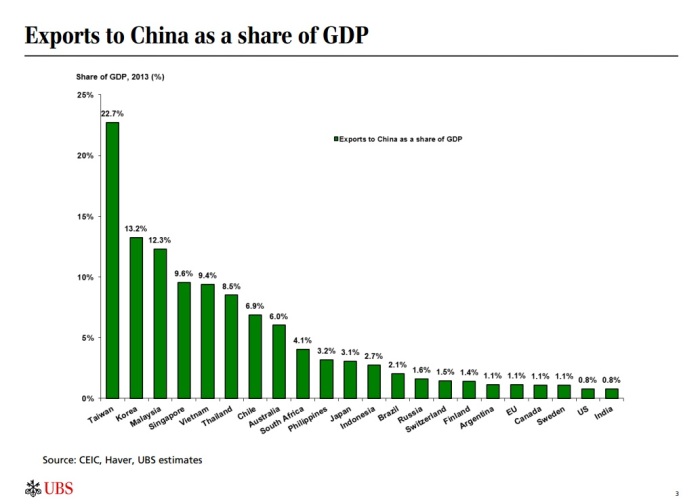
There are plenty of countries with much larger direct exposure to China (this chart I found yesterday uses data a few years old, but the general point holds).

ExportstoChinaShareofGDP

South Korea is an interesting example, with a much larger direct trade exposure to China than we do. But that trade exposure is now smaller than it was, because in recent months China has been expressing its extreme displeasure with South Korea, imposing what are in effect economic sanctions in response to South Korea allowing the installation of the THAAD missile defence system. You can read some of the details here.

As it happens, there was a New Zealand column about just this issue on interest.co.nz yesterday, from Victoria University’s professor of business in Asia (a chair sponsored by BNZ, but also by a clutch of government agencies. After discussing the Korea situation he concludes

The THAAD case shows that it is critical to keep an eye on the political alignment between a business’ home country and the host country where it seeks to do business.

Which sort of makes my point. The interests of businesses wanting to trade in a particular country won’t always align well with the interests and values of the home country. That isn’t likely to be much of a problem in trade with the UK or Australia, or Singapore for that matter. It is, as the Koreans have found, with China. The very fact that China operates in the way it is doing with Korea suggests it isn’t the sort of regime our governments and media should be deferring to.

Some people might look at it the other way and say “if they can do it to Korea they can do it to us”. First, South Korea will survive economically, and is proceeding with the THAAD deployment. But, second, South Korea – and the entire situation on the peninsula – is likely to matter a great deal more to China than New Zealand does. It is difficult to imagine severe trade sanctions because New Zealand was willing to have an open and honest debate about whether it is appropriate for someone like Jian Yang to serve in our Parliament, let alone about the way in which the PRC seeks to exert influence and neutralise potential criticism in countries like our own. There is more of that sort of debate already in Australia and Canada. But if, just suppose, they did – to “make an example” perhaps – wouldn’t that be a moment of moral clarity, that brought into sharp relief how a state we constantly defer to operates. There was highflown talk – John Key and Xi Jinping – of a Comprehensive Strategic Partnership with China. We’d never have considered one with the Soviet Union. The PRC is today’s Soviet Union, with many more routes into our system directly than the Soviet Union ever had.

What have we come to?

I was exchanging notes the other day with a very senior journalist in Asia who observed of this state of affairs that “I have found that the more expert in China a person is the more troubling they find all of this”.

On which note, I had an email out of the blue the other day from someone with an unfamiliar name, and when I opened the link he sent me I found it was for something called “The Wairarapa Academy for New Sinology”. I wasn’t quite sure what to make of it, being instinctively sceptical of (yes, prejudiced about) the Wairarapa. But it turns out that an eminent Australian expert on China, Geremie Barme, formerly Director, Australian Centre on China in the World and Chair Professor of Chinese History at Australian National University has retired to the Wairarapa, where he contines to research and write on related issues, and is establishing the (mostly virtual) academy. He has a good new piece out on these issues, which appears to have been quite widely disseminated among China observers abroad. He might be someone New Zealand media could consider talking to. Can any good thing come out of Featherston? Apparently so.

UPDATE (Thurs)
There is a new short commentary by Professor Brady on the PRC-influence issues, and a Newsroom story suggesting that Winston Peters may continue to regard the Jian Yang issues as worth pursuing.

Immigration: numbers and options

On the off chance that anyone thinking about negotiations with New Zealand First might also be considering immigration policy options, I thought it might be time for a refresher on the numbers (as well as yet another dig at MBIE for not making accessible data readily available on a timely basis).  Since much of the accessible data MBIE do release is for June years, for this post I’ll mostly use data for the year to June 2017.

Recall that the headline writers focus on net permanent and long-term migration, calculated from the declared intentions of those (New Zealanders and foreigners) crossing the border.  If you are leaving and expect to be away for at least 12 months, or are a non-resident arriving and expect to be here for at least 12 months, you are in the PLT statistics.   Plans do change, but the new 12/16 data I wrote about a few weeks ago suggests that during the current cycle the PLT numbers have been capturing pretty well not just declared intentions but what actually happened.    In the year to June 2017, a net 72,305 people arrived as PLT migrants.   Just slightly more than that number of non-New Zealand citizens arrived, and 1284 New Zealanders (net) left.

PLT sept 17

As people often stress, a lot of the variance in the net PLT series is typically accounted for by changes in the choices of New Zealanders (net outflows have fluctuated between around 0 and around 40000, and there have been quite big fluctuations –  hard to predict –  every few years).  The choices of New Zealanders are not a matter of immigration policy.

But policy has pretty full control over the number of non-citizens arriving (Australians are allowed in without advance specific approval, although the numbers typically aren’t large).   And sometimes you will see this chart, which uses PLT arrivals data (gross, not net) to show what sort of visa people were on when they crossed the border as PLT arrivals (the “not applicables” are New Zealand and Australian citizens).

PLT arrivals by visa

But this chart doesn’t tell us anything much about immigration policy.  In the year to June 2017, 16711 people arrived on residence visas.  But during that year, MBIE granted 47331 residence visas, the overwhelming proportion to people who were already here (and who typically will have entered first on a student or work visa).  Perhaps it is worth noting, for all the talk of the success of the export education sector, by far the biggest increase in arrivals in recent years (absolute and percentage) has been in people with various types of work visas: around 24000 in the year to June 2012, and around 45000 in the year to June 2017.

If we want to look at immigration itself, it is much better to turn to the administrative data on the numbers of people approved for various classes of visas.  Unfortunately, unless you like playing with spreadsheets with half a million lines, MBIE only produce data annually, for June years, and the data for the year to June 2017 hasn’t yet been released.   Having said that, it doesn’t look as though there will have been big changes when the data do finally emerge.

Here are the numbers for visas granted to new workers under various policies (ie excluding renewals etc).

Number of new workers by policy
2011/12 2012/13 2013/14 2014/15 2015/16
Study to work 9,319 9,131 6,259 9,610 16,097
Essential skills 6,197 6,247 7,885 7,709 8,334
Work to residence 1,653 1,558 1,426 1,483 1,717

and there has been a big increase in the numbers granted working holiday visas

2011/12 2012/13 2013/14 2014/15 2015/16
Working holidays 41,561 47,168 53,131 59,742 63,230

Fortunately, Education New Zealand don’t seem to mind the half million line spreadsheets, and produce a nice monthly product on student visas.   Here is the chart of outstanding valid student visas by class of institution for the last few years.

vsv

Numbers are growing, but in the last year or two there has been quite a switch from private training enterprises (which will have included some of the more questionable institutions/courses) towards universities in particular).

What of residence approvals?  I did download the huge spreadsheet for that subset of the data to get an overview of the 2016/17 numbers.  Here are residence approvals in the last few years.

Number of residence visas approved
2011/12 2012/13 2013/14 2014/15 2015/16 2016/17
40,448 38,961 44,008 43,085 52,052 47331

Recall that (a) there is a “planning range” (in effect, a target) for the number of residence approvals granted. That range was 45000 to 50000 per annum, but was cut to 42500 to 47500 late last year.  Actual approvals fluctuate around the target, rather than being mechanically managed to meet it month by month or year by year.  The 2015/16 approvals were high, but the numbers have been cut somewhat in the most recent year.

Recall that most of those getting residence visas were already living here (on work, study, or related visas).

In terms of nationality, in 2015/16 these were the top source countries

China 9,360
India 8,498
United Kingdom 4,934
Philippines 4,614
South Africa 2,970
Fiji 2,230
Samoa 2,156
United States 1,288
South Korea 1,125

I didn’t calculate all the numbers for 2016/17, but the patterns looked pretty similar.

I hadn’t seen this data in the published MBIE summaries, but I was a little surprised to find that among the residence approvals 1937 were for people in a category of

Uncapped Family Sponsored Stream Dependant Child

These aren’t the children of principal applicants who are themselves getting residence visas (as those children are approved with the parents).   Around half of all these “dependent children” were Samoan, and of them 242 were aged 20-29, not typically what one thinks of when one hears of “dependent children”.   I’m not sure how or why such a policy exists, but when I get time I might have a dig around.

So that is the numbers.  Perhaps the key thing to keep in mind is that the residence approvals planning range –  the centrepiece of the immigration programme –  has been pretty stable for a long time (modest cut last year).  Much of the variability in the headline PLT numbers is New Zealanders, and most of the variability in the non-NZ net inflow relates to policy streams other than the residence approvals programme.

Of course, variability is only part of the picture.  The striking thing about the residence approvals programme is its sheer size: equivalent to almost 1 per cent of the population each year, and in per capita terms three times the size of the US “green card” issuance (under both recent administrations).   We have a very large number of legal temporary foreign workers here by international standards, but most of them will eventually go home.  What really marks us out is the size of the residence approvals programme –  bigger per capita than in almost any OECD country, and far bigger than most.   I’ve argued for cutting programme back to, say, 10000 to 15000 per annum (a similar size, per capita, to the US programme.)

As I’ve noted here previously, if one looks at the New Zealand First website there isn’t much specific on immigration policy.   Winston Peters has sometimes talked of lowering the annual inflow to something like 10000 to 15000, but quite what is meant by that hasn’t been clear.  Most naturally he may have wished to suggest a net PLT inflow of around those numbers.  If so, it would have to be treated as an average over time, since annual PLT flows are almost wholly unpredictable (given the variability in the net flow of New Zealanders).

Having said that, one could make some estimates of a trend net outflow of New Zealanders, likely to resume as the Australian labour market improves.   Assume that outflow is 20000 on average over the cycle (a bit less than in the past), and you might lower the residence approvals target to 30000 to 35000 per annum (the net of the two flows on average producing something like a 10000 to 15000 inflow per annum).  That doesn’t sound terribly radical, and frankly there looks to be plenty of room to (a) drop off the lower-skilled portion of the current approvals, while (b) removing the sort of absurd bureaucratic hassles really skilled people (eg the teachers profiled in the Herald the other day) can face.

One of the other, rather general, strands of New Zealand First’s immigration policy is

Ensure that there is effective labour market testing to ensure New Zealanders have first call on New Zealand jobs.

I’m sceptical of the practical means to do this, even if I’m somewhat sympathetic to the concerns that motivate it.  I don’t think bureaucrats should be trying to decide which job is really in excess demand, let alone try to reach Soviet-type judgements on which regions should be favoured, or whether wages for those particular skills should just be left to rise.  But in various recent presentations, I have included an option for reforming the work visas system (in addition to substantially tightening up on student work visas and post-study visas, for those with lower level qualifications)

Institute work visa provisions that are:

a) Capped in length of time (a single maximum term of three years, with at least a year overseas before any return on a subsequent work visa), and

b) Subject to a fee, of perhaps $20000 per annum or 20 per cent of the employee’s annual income (whichever is greater).   [To limit risks of exploitation, require the employer to prove that the employee has been paid at least $10000 above the mimimum wage, with no “fees”  allowed to be paid back to the employer or related entities.]

The key element is the second one.  If your firm really needs a highly-skilled person (surgeon, lawyer, CEO or whatever, earning say $200000 or more), and can’t find one on market in New Zealand, the annual fee is unlikely to be prohibitive given the key short-term such a person is like to be playing.   But, equally, there aren’t many of those sorts of people/roles, and many won’t want to stay here forever.  So I’d make it easy to recruit them, but with a strong emphasis (because the visa is non-renewable) on the need to identify a local permanent person.   At the bottom end of the labour market, if the business your firm is doing is really so valuable you can afford the $20000 annual fee on top of the annual salary, that might be a reasonable pointer to serious scarcity.  But it seems unlikely that we’d be granting many visas to lower-end chefs, or dairy workers, or aides in rest homes.  And that would, over time, be a good outcome for New Zealanders.


(And MBIE could you please please make the monthly data more easily available in an accessible format, as Statistics New Zealand and other agencies do.)


A problem awaiting the new government

Whichever party, or group of parties, gets to form the next government will face the same facts about our disappointing economic performance.  As I noted a few weeks ago, based on the recent PREFU projections, not even Treasury seemed to rate very highly the chances of meeting the National-led government’s export objective.

Here is the share of exports in GDP, showing actuals for the last decade or so, and Treasury’s projections for the next few years.

x to gdp

By the end of that forecast period, there will only be four more years until the goal of a much-increased export share of GDP was to be met.  On these numbers, exports as a share of GDP would by then be at their lowest since 1989, 32 years earlier.  So much for a more open globalising economy.

One of the indicators I like to use is a rather rough and ready decomposition of real GDP into its tradable and non-tradable components, first developed by an IMF staffer looking at New Zealand a decade or so ago.    It assigns the primary sector and the manufacturing sector components of real production GDP, and the exports of services component of expenditure GDP, to the tradables sector –  the bits where New Zealand firms are competing with the rest of the world.  The rest of GDP is classed as non-tradable.    It isn’t a precise delineation by any means: some local manufacturing isn’t really tradable (due to high weight and low value, and thus transport costs) and, for example, the electricity generated for Comalco is, in effect, tradable.   But, broadly speaking, it seems to capture something meaningful about the New Zealand economy.  In the early days of the National government, then Minister of Finance Bill English was quite keen on it.

All economies need firms in both tradables and non-tradables sectors.  So one sector isn’t inherently better or worse than the other.  But countries that are catching up with the world-leading economies tend to be ones in which the tradables sector (exports and import-competers) lead the way.  In such economies, firms are finding more and better, more lucrative, ways to tap the much larger global market.  Of course, we also gain when the non-tradables sector is becoming more productive –  both directly as consumers, and as a reduction in the input costs of tradables sector firms.    But there is a limit to how many cafe meals we can serve each other.  There isn’t really a technical limit on, say, how many smart ideas, translated into appealing products, that firms in a small country could sell to the rest of the big world.

As well as dividing real GDP into tradables and non-tradables components, I’ve also expressed both components in per capita terms.    Over long periods of time, most real economic series trend upwards, and actually it is something like per capita production or value-added that matters most in looking at gains in material well-being.   Here is the latest version of my chart, updated for last week’s GDP release.

t and nt components to jun 17

The series do bob around a bit.  The tradables sector, for example, had a very good June quarter on the back of a couple of tourism one-offs (the World Masters’ Games and the Lions tour) but then it had had a poor year last year.   But what I try to draw attention to is that (a) the peak in the tradables series was as long ago as 2004, and (b) real per capita tradables sector output is now no higher than it was at the end of 2000, almost 17 years ago.  Across the whole terms of two governments, one National-led and one Labour-led, there has been almost no growth at all in the real per capita GDP of the tradables sector. None.

Some economists really don’t like the chart.  So lets look instead at each of the components that make up the tradables sector measure.

tradables components 2

Services exports, in real per capita terms, did very well in the 1990s, growing quite strongly until around 2002.  But, overall, almost no growth since.   The mining sector briefly did very well around 2007/08 when a new oil well came on stream.   And, in per capita terms, the agriculture, forestry and fishing component of production GDP, and the manufacturing component, have gone almost nowhere over 25 years, again in real per capita terms.

What changed 15 years ago?  Well, one of the things that has changed a great deal is the real exchange rate.  Here is a chart of the Reserve Bank’s index, showing an average for the last 15 years (as well as one for the previous few years).

rer to july 17

It is unlikely –  all but inconceivable in fact –  that if we keep on doing what we’ve been doing for the last 15 years or more, in terms of economic policy settings, that we’ll see any sustained per capita growth in our tradables sectors.  It is that old line about a definition of insanity being doing the same stuff over again and expecting a different result.

Even to sustain those sectors at the sort of flat levels –  no growth at all – we’ve had over the last 15 years or more has involved the significant subsidies of (a) unpriced pollution externalities especially around water, (b) significant direct subsidies (to, most notably, the film industry) and (c) significant effective subsidies to the export education industry (by offering a bundled product where students can pay for an education –  in some cases an “education” –  and get preferred access to work and residence visa entitlements too –  that benefit being provided free to the providers by the New Zealand government).

I’d be very happy for a new government, of whatever stripe, to deal directly to any or all of those distortions.  But they, and their advisers, need to bear in mind that exchange rate chart.   Unless the real exchange rate falls quite materially, it is difficult to envisage much growth in other tradables industries to replace the shrinkage in the subsidised industries.  (It was exactly the same issues policy advisers faced when we started liberalising, and stripping away earlier subsidies, in 1984.)   Real exchange rates can’t be managed directly, but they can be materially influenced by removing the sorts of other policy distortions that put intense pressure on domestic resources, and drive up the prices of non-tradables relative to tradables, skewing the economy away from the tradables sector.

I’m not optimistic about prospects, but the good thing about pessimism is that one can, just occasionally, be pleasantly surprised.


Productivity and employment

With 30 seconds thought it is pretty obvious that if the least productive 10 per cent of our workforce simply dropped out and stayed home, then across the whole economy average GDP per hour worked would increase, all else equal.   All else equal, the productivity of any particular individual still employed wouldn’t change –  in practice it might well, as someone would still have to do the filing or the cleaning –  but the average would.

So far, so uncontroversial.  No one thinks it would be a sensible policy approach to lifting productivity to, say, bar such low productivity people from working.  Doing so would not only be inhumane, but it would make us, on average, poorer (output is still output, even if productivity of the marginal worker is below average).    In practice, of course, high minimum wages (relative to the market median), as in New Zealand, have exactly that effect –  pricing some low-productivity people (who couldn’t, at present, command a wage in the market at least equal to the statutory minimum.

But every so often in the last 20 years, as people have tried to grapple with New Zealand’s continuing poor average levels of GDP per hour worked, and the failure to achieve any convergence to the (now) richer members of the OECD, someone pops up with line “ah, but we are more effective than most in drawing in the low productivity members of our community, which will bias our measured average productivity (and productivity growth) downwards.

The latest example was in the Sunday Star-Times business section yesterday.

New Zealand’s track record on labour productivity may look worse than it is because a growing number of Kiwis are in work, the Productivity Commission says.

In fact, this wasn’t reporting any new Productivity Commission work.  Rather, one of the Productivity Commission’s senior staff had pointed the journalist in the direction of some interesting work done by able researchers at Motu a couple of years ago.  And, despite the implication readers (like me) may have taken from the headlines and the lead sentence (above), the research work related to a period 2000 to 2012, not to the period of nil productivity growth over the last five years.

It suggested annual productivity growth would have been about 70 per cent higher, averaging 0.24 per cent, between 2001 and 2012, instead of 0.14 per cent, were it not for a decline in skills associated with higher employment.   Motu estimated last year that the skill level of the average Kiwi worker fell by 1.8 per cent over the period as more people joined the workforce.

Again, despite the hyped lead-in (“70 per cent higher”) do note that the difference in these two (multi-factor) productivity growth rates cumulates over 11 years to a total difference of around 1.1 per cent.  Welcome, but not exactly game-changing.

Motu provided a nice non-technical summary  (page 3f) on what they’d actually done, using detailed data from the Longitudinal Business Database (LBD).

Productivity estimates are typically based on the quantity of labour used by firms to produce output. However, the characteristics of a firm’s workers also have an important influence on productivity, with different types of labour impacting differently on the technologies that firms adopt and their performance more generally. Because data on individual workers are linked to the data on firms in the LBD, it is possible to construct a measure of the quality of a firm’s labour force and measure the impact of this on productivity.

The measure of worker quality – which is derived from earnings data – reflects the bundle of skills, qualifications and experience of individual workers. As such, it picks up a broader range of worker attributes beyond qualifications.

Based on this measure, the average quality of the New Zealand work force declined slightly by 1.8% from 2001-2012…..

This somewhat surprising decline in the average quality of New Zealand workers reflects the net result of two opposing forces. First, average skills increased due to ageing (ie, greater experience) and rising qualifications. For example, the share of tertiary qualified workers grew from 15% to 25% while the share of workers with no qualifications fell from 19% to 14% between 2001 and 2013. At the same time, full-time equivalent employment increased strongly by around 15% (Figure 1). The large number of new workers who came into the labour market had, on average, lower skills than existing workers. This lead to a dilution in worker quality that more than offset the improvement in qualifications and experience.

They look like nice results.

But since many of the concerns around productivity growth in New Zealand relate to cross-country comparisons –  how have we done relative to the rest of the advanced world, and relative to common underyling global trends –  it might be worth looking at what has happened in other countries.    It would take a pretty big study to replicate the Motu project across, say, the OECD.   But we do have readily accessible data on employment to population ratios across the OECD, and we have that data for a longer period of time than just 2001 to 2012.

Our HLFS goes back to 1986.  Here is how New Zealand’s employment to population ratio has behaved since 1986.

employment to popn 25 Sep

Over the entire 30 year period, our employment to population ratio increased by 2.4 percentage points, which isn’t a lot.  It seems quite plausible that the effect Motu identified was present in the data as the employment to population ratio increases, from the trough in 1992 through to 2007.  But most of that effect will have been reversing the opposite effects resulting from the really sharp fall in the employment to population ratio (disproportionately low productivity workers, almost by construction) from 1986 to 1992.

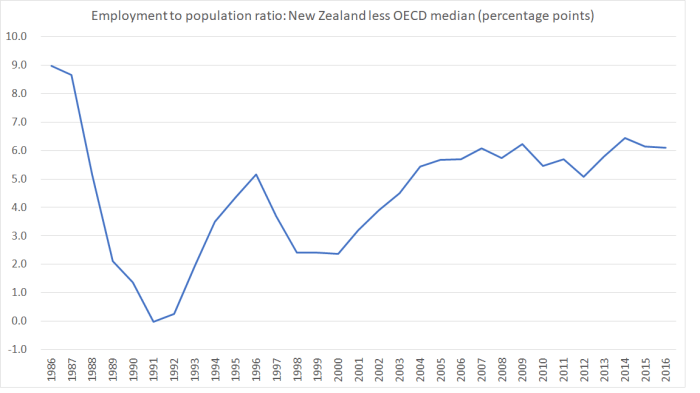
And what about the international comparison?  Here is the gap between New Zealand’s employment to population rate and that in the median of the 22 OECD countries for which there is data for the whole period (almost all the “old” advanced OECD countries, and not the former Soviet bloc countries).

employment 2

In all but one year, our employment to population ratio has been above that of the median OECD country.    That doesn’t automatically mean we have been employing more low productivity people –  some systems make labour force participation of both parents of small children easier than others, and some systems penalise older people staying in workforce less than others –  but lets grant that some part of the difference may be that we manage to employ more of the less productive groups.   At the margin, that might explain a small part of the levels difference between our average productivity and that of these, mostly richer, OECD countries.

But two things to note:

  • the gap is smaller now than it was thirty years ago.  In other words, even if this “employing the less productive classes” story is some part of the levels explanation, it is almost certainly less of an explanation than it was 30 years ago.  And yet the real puzzle people have been grappling with is why, after all the reforms, we haven’t made any progress in closing the gaps over the last 30 years.   These compositioneffects don’t look as though they can help over the post-1984 period as a whole (useful as they might be for interpreting data for some individual sub-periods).
  • there has been no material change in the gap at all over the last decade, suggesting that this compositional story doesn’t offer any explanation for why from 2008 to 2015 we did no better than middling relative to other OECD countries (not closing the gaps), and since 2012 we’ve been among the very worst productivity performers, with no labour productivity growth at all.

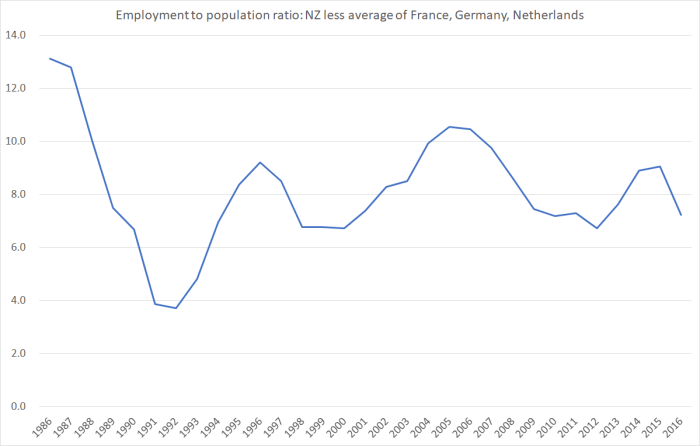
As I’ve pointed out in several posts recently, average real GDP per hour worked in Germany, Netherlands and France is now around 60 per cent higher than that in New Zealand (even though historically all were poorer and less productive than New Zealand).  In 2016, employment to population ratios in New Zealand and Germany were identical (while those in Netherlands and France were lower).  But here is the chart showing New Zealand’s employment to population ratio less the average of the ratios of each of those three countries.

employment 3.png

Over the period for which observers have been struggling for an explanation of our poor productivity growth, our employment to population ratios have been falling relative to those in several of the leading, and most productive, European economies.

Compositional effects (around the skill levels of the labour force) just don’t look like a credible part of an explanation for why the level of productivity here is now so much below that in the leading OECD economies, or why no progress has been made in closing the gap, over the last 30 years or the last five.


Investment data again highlight fundamental weaknesses

After an early morning with some boisterous visiting nieces and nephews, there is a certain calm retreat in getting back to some of the details of yesterday’s national accounts release.

I’ve written previously here about the investment numbers.  The state of investment spending is a useful, if never foolproof, indicator of the state of the economy.  Not so much in a mechanical adding-up sense –  a quarter of weak investment probably translates into a weaker quarter for GDP – as in the questions the data can pose about just what is going on more broadly, and the viable opportunities that businesses are finding, and taking up (or not), in New Zealand.

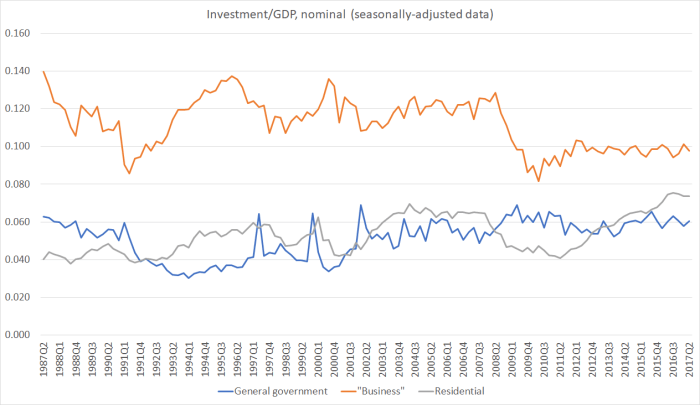
My typical starting point is a chart like this, breaking out investment spending into residential, government, and “business”.  (I put “business” in quote marks because, as the OECD does, it is calculated residually –  subtracting the other two components from total fixed capital formation.)

I shares of GDP june 17

Using quarterly data means living with a bit of “noise”, but not that much, and doing so enables us to see if there are any material changes emerging at the very end of the series.

I don’t want to say much about general government investment spending.   In recent years, that share has been averaging a bit higher than what we saw in, say, the five years before the last recession.  Then again, government (central and local) has faced significant post-earthquakes repair and rebuild expenditure, and the population growth on average over recent years has been a bit faster than that in the previous decade.  If anything, one might have expected the government investment share would have needed to be a bit higher still, at least given the range of functions governments currently take on,

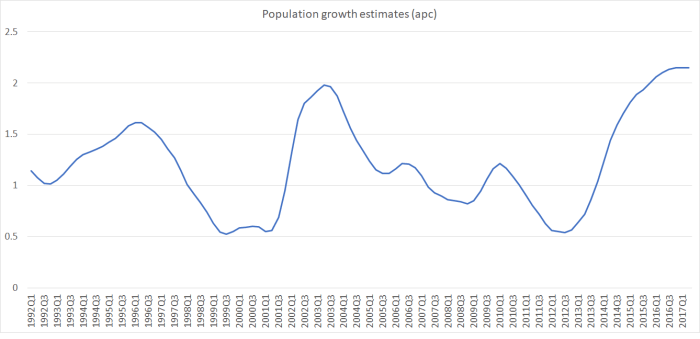
What of residential?   In nominal terms, residential investment spending (new builds and renovations etc) as a share of GDP is now just below the highest levels seen in the history of this series (and actually in the annual series which goes all the way back to the year to March 1972, thus capturing the peak of the building boom in the early 1970s).    Given the rapid rate of population growth –  a little higher, but lasting longer, than the growth rates 15 years ago –  one would expect to see a pretty high share of GDP being devoted to housebuilding and associated activities.   But you will notice that the residential line has fallen a bit in recent quarters, and consistent with that the volume of residential investment spending undertaken in the June quarter this year was about 1.4 per cent lower than such spending in the June quarter of last year.

popn growth apc

In this post, my main interest is in the business investment component (the orange line in the chart).  Strip out the modest quarter-to-quarter fluctuations up and down, and there has been no real change in the share of (nominal) GDP devoted to business investment for almost six years now.   Over the six years, business investment as a share of GDP has been materially lower (around 2 percentage points of GDP) than the average for the 15 years or so prior to the 2008/09 recession.    That is a big change.    And doubly so because of the sustained acceleration in the population growth rate in the last few years (and with it growth in the number of jobs).  Workers typically need capital equipment, even if it is nothing more than a laptop (and associated software) and a place to work.

Ratios of nominal investment spending to nominal GDP aren’t the only sensible way to look at things. In particular, in New Zealand a lot of capital equipment is imported (eg vehicles and most machinery, but not buildings themselves).  A high exchange rate –  such as we’ve had in recent years, but also had to a lesser extent in the last few years of the 2000s boom –  tends to lower the price (in NZD terms) of capital equipment.  The volume of business investment might still be growing quite rapidly, even if the nominal investment spending share of GDP is pretty weak  (of course, for tradables sector firms the high exchange rate is no gain –  capital equipment might be cheap, but the expected returns to any investment are also dampened).

So here is a chart of the annual percentage change in real business investment.

bus i 2

The volume of business investment has been growing, but at a quite modest rate.  In the last five years of the previous previous boom, the annual growth rate was around 10 per cent per annum.  Over the last five years, the annual growth rate in the volume of busines investment has averaged only about 4 per cent (which also happens to have been the growth rate for the last year).

These pictures don’t really surprise me.  They are what one would have expected once one knew of (a) the magnitude of the damage caused by the earthquakes (from day one  at the Reserve Bank we knew this was a large non-tradables shock, which would skew activity away from business investment, especially in the tradables sector, for several years), and (b) the scale of the population increase.   Those pressures have helped hold our real exchange rate up so much and for so long, and reinforced the persistent large margin between our real interest rates and those abroad.  In that sort of environment, total business investment (share of GDP) is less than it otherwise would be, and –  although it isn’t able to be illustrated here –  what business investment does occur will be skewed away from tradables sectors.   Not even very high terms of trade levels were enough to counter-act the downward pressure on business investment growth, and monetary policy held tighter than it needed to be didn’t help either.

Looking back at that first chart, the weak and almost dead-flat business investment line was reminiscent of the productivity chart I showed yesterday.  It is also consistent with the weak export performance I wrote about last week.  The three indicators are causally related: business operating in, or which might have contemplated entering, the tradables sector, and thus taking on the world, simply haven’t been able to find sufficient attractive and remunerative opportunities.

The pressures associated with post-earthquake rebuild expenditure will wane, and probably already are.  But meanwhile, policy continues, year in and year out, to supercharge our rate of population growth, bringing in huge numbers of modestly skilled people, to a location where the successful opportunities for firms to take on the world with great products and services seem to be growing much more slowly than the number of people living here.  The flawed policy –  shared across both main parties and several of the minor ones –  just keeps making it harder than it needs to be for New Zealanders as a whole to get ahead.   Our immigration policy was crazy when lots of New Zealanders were leaving each year, but it is even more deeply problematic when the travails of Australia’s labour market mean that the outflow has (probably temporarily) largely ceased.


Immigration, the election, and shelf-stackers

Back in February I had coffee with a senior journalist, who was convinced that immigration was going to be a central issue in this year’s election campaign.  The journalist cited the Trump and Brexit phenomena, and I suppose at the time Geert Wilders and Marine le Pen were in the wind.   I was a bit sceptical.  I’d, mostly, have welcomed such a central place in the election campaign for what I regard as one of the key long-term failings in our economic policy settings.   But I didn’t really see any sign of a Trumpian insurgent – or a mood that was just waiting for such a person – or of the fascinating mix of motivations (immigration was only one) that had driven the Brexit vote.  But my interlocutor told me that political party focus groups were picking immigration up as a key issue, and suggested that the media need to attract readers would help fuel an intense focus on immigration.  I think there was a sense back then that National was in such a strong position in the polls that an issue like immigration would, as much as anything, be hyped to help keep things interesting.

As I say, I was sceptical –  although interested in the focus group snippet (which I later had confirmed by one MP).   We had dreadfully high house prices, and a dismal productivity (and exports) performance. High immigration has played a part in both those outcomes.  But those weren’t, it seemed to me, the sort of visceral dimensions that seemed to have played such a part in other countries: our last experience of terrorism was state-sponsored, by France; we don’t have problems with illegal immigration (some upsides to being a remote island), and we haven’t had problems with substantial Muslim immigration.  And for all my concerns about the mediocre quality of the skills of the median migrant, we’ve done less badly on that count that many other OECD countries (again, land borders and an explicit economic focus to the programme both help).

But now we are two days out from the election, and it is clear that immigration hasn’t played a particularly important role in the campaign at all.  New Zealand First –  which might have been a natural recipient of votes if there had been an upsurge in serious concerns –  looks as if it might end up with a smaller vote share than it had in 2014.   The government made some minor tweaks to immigration policy this year, on top of some other minor tweaks last year.   And Labour’s immigration policy didn’t involve much change –  outside the overseas student sector –  and hasn’t (at least that I’ve seen) had any pro-active place in their campaigning.   Oh, and the Greens’ leader ended up abjectly apologising to his base, casting slurs all round, for even having suggested last year a rational debate on the appropriate rate of immigration.

It is interesting to ponder why immigration hasn’t been a key issue.  After all, if one focuses (inappropriately, but as the headline writers do) on the PLT numbers there has been no abatement in the net inflow (whether of non-citizens –  the bit policy bears on –  or the reduced outflow of citizens).  And the “true” net inflow is almost as high, as a per cent of the population, as the previous peak 15 years ago, and it has run on for longer.

One reason is, presumably, the change in the political personalities.  At the start of the year, many thought the campaign might see Labour at or below the vote share it got in 2014, and New Zealand First and Greens perhaps both polling in the teens, and scrapping for second place in a possible left-led government.  Perhaps that might have been a climate in which Labour and New Zealand First in particular might have more prominently battled to capture those who were concerned about immigration-related issues.  But the “Jacinda effect” transformed that outlook and the campaign has mostly been like something from the old days: two big parties, with some minor players struggling for attention and coverage.    And although Labour has stuck with the immigration policy announced under Andrew Little, it is clear that Ardern has made a conscious choice to de-emphasise that policy, even though the focus of the proposed changes was on the deeply-flawed student market.

But I wonder whether some other factors aren’t at least as relevant among voters (and for all the talk of “leadership” a great deal of what politicians do is “followership”).   For one, house price inflation has abated in much of the country, and although house prices in Auckland remain sky-high they’ve gone roughly sideways for a year or so.    Quite why that has happened is still debated, but it isn’t because (a) the rate of growth of the number of people needing a roof over their head has slowed, or (b) because housebuilding in Auckland is now proceeding so rapidly that it has got ahead of population growth, or (c) because regulatory reforms have freed up land use sufficiently that peripheral section prices are now plummeting.     More plausibly, it is some mix of (a) rising domestic interest rates, (b) the tighter LVR controls the Reserve Bank put on last year, (c) tighter credit standards the banks themselves have established, under the influence of parents and of APRA, and (d) reduced capital outflows from China as the regime has tightened-up its controls.  But whatever the precise reason, it has taken much of intense heat out of the house price issue –  imagine if the opposition has still been able to repeat endlessly “house prices in Auckland are up another [x] per cent in just the last six months.   And with it, much of the heat around the immigration issue?

And the other reason –  one of the reasons I was sceptical of the political salience of the issue at present –  is the point I have been arguing for (and that previous generations of NZ economists recognised ) for years.  In the short-term, high and unexpected immigration adds more to demand in the economy than it does to supply.  In other words, it tends to boost economic activity –  measured or headline GDP for example –  and put more pressure on scarce resources.  Migrants don’t take jobs from locals, or add to unemployment; if anything, in the short to medium term, they add more to the demand for labour (all that capital stock that needs to be built) than to supply, and thus migration inflows tend to reduce unemployment.   The sugar-high is a real thing.  The effects might not last long, but when the dose is repeated each year for several in a row, it does have an effect.

There might have been no productivity growth at all for five years, but that sort of concept or measure doesn’t easily get much public resonance.  Exports might be shrinking as a share of GDP, as the need to build to cope with a rapidly-rising population crowds out the tradables sector……but it is a geeky macro statistic, and not one that anyone has successfully built a narrative around.  And perhaps people aren’t feeling good about their wages, but as I’ve noted recently, real wages have been rising consistently faster than productivity for some years now.  It is an unsustainable, unbalanced, mix, but it isn’t one that was ever going to capture the public imagination in any sort of “build a wall” way.  In the short-term, for those (most) with jobs things don’t seem too bad.  And even the Leader of Opposition has repeated on numerous occasions that the economy is doing fine.

And, of course, few of us want to be nasty about individual migrants (and of course, as I argue, the issue is New Zealand policy, not the rational choices of individuals), and no one wants to be subject to the dread “r-word” slur.

In many respects, I’ve long thought that the best environment for a serious public pushback against the out-of-step, failing, immigration policy we have run for a long time, is in the next severe downturn.  I wouldn’t welcome recessions – and remain concerned that the government and the Reserve Bank aren’t doing enough to prepare for the next one – but in a sense it is in periods when things are manifestly not going well that one is perhaps more likely to find a willingness to contemplate serious change in policy.  That’s a shame –  the best time (easiest adjustment) to make changes would be now, when the economic environment globally isn’t too bad –  but perhaps it is unavoidable, especially when (as above) we –  fortunately – don’t have the visceral issues around immigration that some other countries do.

Immigration policy did come up at the local candidates’ meeting last night.   The minor party representatives were predictable –  the Greens candidate was adamant that we “knew” that migrants benefited us economically, while on the other side the most entertaining TOP candidate –  whose opening speech was done in iambic pentameter – made the case for easier access for really skilled migrants, but for fewer migrants overall to ease the (claimed) downward pressure on wages.

Chris Finlayson repeated some of the serious misrepresentations that seem to characterise his party’s view.  We were told of the lots of New Zealanders who were coming back from Australia (when in the year to June 2017, a net 4678 New Zealanders left for Australia) and about how the immigration policy was bringing in the tradespeople wiuth the skills needed for, for example, the housebuilding.  I heard the PM repeat that line –  who will build the houses if we cut immigration – on Radio New Zealand yesterday: I would draw his attention, and that of his minister and local candidate to the data suggesting that the net immigration of building trades people is very small relative to (a) the actual increase in the construction workforce in recent years, and (b) to the total increase in the need for new housebuilding occasioned by the rapid increase in the population.   High immigration is worsening, not easing, those pressures.

But it was Labour candidate –  and near-certain winner –  Deputy Mayor, Paul Eagle whose comments on immigration really caught my attention.  He was obviously feeling on the defensive about the issue, and thus even though Labour’s actual policy proposals focus (numerically) mostly on fixing up some of the rorts around the student visa sector, he never mentioned that issue at all.  Instead, he wanted to stress that Labour welcomed immigration, and that we need immigration in some sectors.  It sounded fine, more or less, until he went on:  “Island Bay New World needs people”.   So can we take it that official Labour policy, enunciated by a candidate likely to be an MP for many years to come, is that we need immigration –  perhaps even more immigration –  so that the supermarket shelves get stacked?  What, I wondered, had we come to?  Once –  in MBIE”s words – a “critical economic enabler”, and now shelf stackers?

(And for anyone interested in some more observations from our Attorney-General, someone asked from the floor about Jim Bolger’s recent denunciation of “neo-liberalism”.  This senior minister got up and indicated he had talked to Bolger about what he had said, clarifying that he had meant the policies adopted by Labour and National governments between 1984 and 1993.  Finlayson himself went on to characterise that period as one of “extremist economic policies” concluding that “that ideology does not work, and we are not that sort of party”.  One brave member of the audience –  Island Bay is a pretty left-liberal sort of place –  called out “but none of it has been repealed has it?”        Was it floating the exchange rate, removing farm subsidies, removing trade protection, making credit available to ordinary people, lowering maximum marginal tax rates, ending fiscal deficits as a norm, putting in place a good GST, removing union monopolies, privatising state-owned business operating in competitive markets, or what……that the Attorney-General of an allegedly centre-right pro-market government regarded as “extremist”? )

The political cone of silence, with slurs

I’m furious.

Local democracy came to Island Bay this evening, and I –  an undecided voter – joined the crowd at the local candidates’ meeting, in the Rongotai electorate.   Candidates congratulated themselves on a well-fought campaign –  as the National Party’s candidate put it, not a cross word had been spoken between any of them through all the various meetings they’ve attended together.  Most of tonight’s meeting was like that.  Most.

Over the years, I’ve heard nothing to suggest that the National Party’s candidate was other than an honourable and decent man.  The Hon. Chris Finlayson is the 8th ranked Cabinet minister, minister responsible for the intelligence services, and Attorney-General.  He appoints our judges.  And as he described himself tonight, he is “the first law officer in the land”.  You’d imagine he’d be at the forefront of defending the integrity of our democratic system and its institutions.  But not based on his performance tonight.

The format of the meeting allowed questions from the floor.  Each question had to be addressed to one particular candidate, but each other candidate also had a chance to answer.  On almost all the questions, almost all the candidates took the opportunity to answer.  But not on one question.

I got up and asked a question of Chris Finlayson, explicitly noting that I was not asking him as a minister responsible for the intelligence services (where I would have expected a fob-off) but as a senior National Party figure.   My question ran roughly as follows:

“Mr Finlayson, last week one of the world’s leading newspapers, the Financial Times gave considerable prominence to a story about a New Zealand MP.  That MP had been a member of the Chinese communist party, and part of the Chinese intelligence services.  He never disclosed that past to the public when he stood for Parliament, and has never taken the opportunity to denounce the evils of the Chinese regime.  Can you comment on why it is appropriate for such a person to be in our Parliament?  And could you also comment on the new paper by Professor Anne-Marie Brady raising concerns about the extent of China’s attempts to exert political influence in New Zealand, and about the close ties of various senior National Party figures with Chinese interests?”

The question was greeted not with embarrassed silence, but with pretty vigorous applause from the floor.

Finlayson –  our Attorney-General, first law officer of the land, senior National Party minister  – got up, briefly.   His answer ran roughly as follows:

“That was a Newsroom article, timed to damage the man politically.  I’m not going to respond to any of the allegations that have been made about/against him. I think it is disgraceful that a whole class of people have been singled out for racial abuse.  As for Professor Brady, I don’t think she likes any foreigners at all.”

And as I shouted back “the claim was about one man”, our Attorney-General sat down.  He’d simply refused to answer, or even address, the question, at any level other than suggesting that anyone raising these quite serious issues was a racist or a xenophobe.  Starting, presumably, with the Asia editor of the Financial Times, Jamil Anderlini a Kuwaiti-born Italian-American New Zealander who has spent almost 20 years in China, including more than a decade reporting from Beijing (and now is based in Hong Kong) through to Professor Brady, with all the other serious media outlets and China-focused commentators overseas who have reported the concerns somewhere in-between?   It was preposterous.  Plus, one couldn’t help thinking that he knew he was on weak ground.  After all, if there was a clear, simple, authoritative and compelling explanation, presumably he’d have given it.

I hold the Attorney-General –  first law officer of the land –  to a considerably higher standard than other local candidates.   And the specific question was actually about a National Party MP, National Party selection choices, and the ties of National Party figures to Chinese business and political interests.

And, as I said, on every other question this evening, all the other candidates rushed to the microphone to have their say, on everything from apprentices to housing to guidance counsellors.  But not one of the others said a word on the Chinese government’s politicial influence seeking in New Zealand, or specifically on Jian Yang’s position.   Not the Labour candidate –  deputy mayor of Wellington, and sure to become a member of Parliament on Saturday.  Not the quite highly ranked, and apparently very able, Greens candidate.  Not the TOP candidate, or the Conservative candidate.  Strangely, not even the New Zealand First candidate, who was presumably unaware that his party had taken a stand, both on Yang, and on the more general issues Professor Brady has raised about the activities in New Zealand of the Chinese government.     Not a word, from a single one of them.  It left me wondering about what our democracy was coming to.

As it happens, there was someone in the room who knew Professor Brady; in fact, this woman had done her masters thesis under Brady’s guidance.    Noting that Finlayson had tried to claim that Professor Brady didn’t like any foreigners, she proceeded to point out that not only was Brady fluent in Mandarin, but that her husband was Chinese.    Cue to guffaws and applause, and a rather grudging apology by the Attorney-General for his specific claims about one of our leading experts on China and its international activities.

It was a shameful performance all round.  The candidates can congratulate themselves all they like on the bonhomie of the campaign, but when not one of them will even address a serious question, raising concerns themselves raised by serious international publications and respected experts –  and Brady’s paper has been linked to and report quite widely –  it rather gives the game away.   As Professor Brady put it in her paper, the fear of giving any offence to the government of the People’s Republic of China –  a brutal  and aggressive dictatorship –  seems to have been raised to a defining feature of New Zealand politics, and not just by National.

We saw it on display tonight, nowhere more so than in the despicable performance by our Attorney-General and first law officer.   How safe is our democracy, our values and freedoms, our laws, in such hands?