Active monetary policy exists because unemployment matters

Monetary policy as we know it today –  discretionary choices made by central banks (or Ministers) –  is a relatively new thing.    Of course, money has been around for a very long time, and the state has often had a role in specifying the metal content of various units of money, and (not unrelatedly) what money was acceptable in settlement of tax obligations.  But there was no such thing as “monetary policy” in, say, the 16th century –  when prices rose across Europe, it was because the additional gold and silver being mined in South America, adding to purchasing power of (first) Spaniards and then more generally.     The gold rushes of the mid 19th century –  in which New Zealand had a small part –  had qualitatively similar effects.

Even in the heyday of the classical Gold Standard –  the few decades prior to World War One –  when central banks did exist in a growing number of countries (although not, for example, the US, Australia, Canada or New Zealand, there wasn’t much to monetary policy.  Convertibility into gold, at a fixed (government-set) parity, was at the heart of the regime, and variations in official interest rates –  eg by the Bank of England or the Banque de France – were largely about managing pressures on gold reserves.   If there was a net loss of reserves from the UK, the Bank of England would typically raise its interest rates.  It wasn’t a mechanical process, and central banks would at times borrow from each other to tide themselves over what were thought to be purely temporary pressures.   In places without central banks –  New Zealand was an example –  banks were obliged by law to convert their notes into gold on demand.  Banks themselves had to manage pressures on their own reserves –  whether gold, or balances held with banks in London –  by altering the interest rates they offered, and varying their credit standards (tightening credit would reduce demand for imports).

Across much of the world, World War One disrupted these arrangements.  New Zealand suspended gold convertibility on the outbreak of the war, and never restored it.  Much of the world attempted to go back onto gold in the 1920s – the UK famously restoring convertibility in 1925 –  as part of trying to restore normalcy and monetary stability.  But the restoration didn’t last.  Many authors see the attempt to return to gold, in a somewhat hybridized manner, as a key cause of the Great Depression, and by the mid 1930s the Gold Standard had been largely abandoned.  The imperatives of short to medium-term macroeconomic stabilisation displaced the belief in fixed parities.  Voters –  this was the new age of universal suffrage –  demanded that governments “do something”.  And the evidence is pretty clear that countries that went off gold earliest –  or devalued earliest –  recovered soonest from the Depression.  The imperative of doing something about really severe cyclical unemployment drove monetary actions and monetary regime choices, including the establishment in 1934 of the Reserve Bank of New Zealand.

There was an attempt after World War Two to re-establish something that looked like a system based on gold (the US offered governments –  only –  convertibility into gold, while other countries had fixed exchange rates to the US dollar), but it was a much different beast.  Most countries had quite tight controls on cross-border capital flows –  of the sort that had not previously existed in peacetime in democratic societies –  which allowed countries to use counter-cyclical domestic fiscal and monetary policy to do more to promote something akin to full employment, without too readily putting the exchange rate pegs in jeopardy.   It didn’t end the business cycle (of course), and didn’t avoid periodic exchange rate crises but for a time –  a couple of decades –  it more or less worked.  But pushed too far, under pressure of various political and demographic shocks, it broke down into the era of the Great Inflation –  loosely, from around the mid 1960s to the mid 1980s.

And thus monetary policy as we recognise it today really only dates back a few decades.  The major Western economies floated their exchange rates in the early 1970s, New Zealand and Australia did in the mid 1980s, and some advanced OECD countries (eg Sweden and Norway) only did so in the 1990s.  Tiny Iceland only floated in 2001.  Inflation targeting –  whether formally (as pioneered by New Zealand) or less formally –  makes sense only in the context of a pretty flexible (probably floating) exchange rate.  It is a regime that exist with twin goals in mind, whether or not they are written down in statute book somewhere or not.

Floating your currency allows a country to choose its own inflation rate.   That was a big consideration in the 70s and 80s: if, like Switzerland, you wanted to maintain low inflation, you couldn’t do so with a fixed exchange rate to the rest of the world that was running an inflation rate of 10 per cent.  But it also allows your country to cope better with severe adverse real economic shocks; in particular shocks specific (or more intense than typical) to your particular country.    I wrote last week about the Finnish situation in the late 80s and early 90s.    We had it pretty tough here during that period, but it was nothing like as bad as the Finnish experience – despite big structural reforms going on at the same time –  because we had our own monetary policy and could allow interest rates to fall, and the exchange rate, when times turned tough.   We didn’t give up on inflation – in fact this was the period we were getting inflation to target for the first time –  but we had an institutional arrangement that provided a better mix of low inflation and somewhat-mitigated real economic downturns.    (In fact, it wasn’t so different back in the 1960s when, faced with a big fall in the terms of trade, New Zealand chose to devalue its nominal exchange rate –  an active monetary choice –  rather than attempt to force the adjustment through lower domestic prices and wages.  Most observers –  then and now –  would have thought that alternative would have been much more costly, in unemployment and lost output.)

All of this so far is really a rather long prelude to articulating a disagreement with an eminent former colleague.

Last week, Reuters ran an article under the heading “New government in New Zealand could spell changes for pioneering central bank”, with a particular focus on what a Labour-led government might mean.   The article quoted various people (including me –  my own thoughts were elaborated here) but the comments that caught my eye were those by Arthur Grimes.  These days Arthur is a researcher at Motu –  mostly focused on issues other than macroeconomics –  a professor (of wellbeing and public policy), and generally one of the “great and the good” of New Zealand economics (president of the Association of Economists etc).  But in his younger days he spent 15 years or so at the Reserve Bank, rising to Head of Economics and then Head of Financial Markets before leaving for the private sector and academe.  In that time, he was one of those closely involved from the Bank’s side in the design of the Reserve Bank Act, and was also involved in the practical development of inflation targeting (the two developed in parallel).    Later, he ended up on the Reserve Bank’s Board, serving as chair of the Board until about four years ago.   As chair of the Board, he probably should be seen as having had prime responsibility for the appointment of Graeme Wheeler as Governor.    In many respects, were he to be interested, Grimes could have been the best of the status quo candidates to replace Wheeler permanently.

Grimes is pretty deeply committed to the status quo on monetary policy (I’m not sure what his views now would be on single decisionmaker vs a committee, although interestingly he has been a longserving Board member of the Financial Markets Authority,  where decisionmaking responsibility rests with the Board not the chief executive).

And that commitment to the status quo was on display in the Reuters article.

“It’s a huge change. We’ve had over 25 years of an extraordinarily successful monetary policy that has been copied around the world,” said Arthur Grimes, RBNZ’s chief economist in the early 1990s and Board Chair between 2003 and 2013. Any change without careful consideration and analysis would be “extraordinary”, he added.

For 28 years, New Zealand’s central bank has had the single aim of keeping inflation between a set range. But Labour wants to add employment to the bank‘s mandate, a goal shared by NZ First which also wants to broaden the Reserve Bank of New Zealand’s (RBNZ) focus to include greater management of the local dollar’s value against other currencies.

Grimes, however, argues that history proves monetary policy cannot have a sustained impact on employment.

“It would be like having someone who is running for health minister argue for a cancer drug to be used for heart issues,” said Grimes

I’m not sure what benchmarks Grimes is using to describe New Zealand’s monetary policy as “extraordinarily successful”.  There is no doubt that inflation has been much lower and more stable than it was in the 1970s and 1980s –  although not much different than it was in the 15 years prior to 1967 –  but that is true almost everywhere.  So if one is going to argue that the specifics of the way the New Zealand target/Act are specified have been “extraordinarily successful”, and need protecting, one would need to show that that particular specification has led us to have better outcomes than, say, other advanced countries that did inflation targeting differently, that specified things (formally) less tightly, than put less emphasis on formalised accountability mechanisms, or which even kept “dual mandate” types of language in their statutes and official communications/rhetoric.    The United States and Australia might be obvious cases to look at.  But it would be impossible, as far as I can see, to demonstrate such superior New Zealand performance.

Now it is no doubt true that the New Zealand (and near-parallel Canadian) early experiences with inflation targeting did influence other countries’ choices to some extent.  But it would be flattering (and fooling) ourselves to suppose that the specifics of the New Zealand model have been widely copied at all.    Indeed, in several important areas –  including governance/accountability –  what is striking is how few countries have gone the same way we did.   We remain, I think, the only inflation targeting country to have (a) twice changed its target, and (b) where monetary policy has been an election issue for some parliamentary parties or other every single election since the 1989 Act was passed.  Even on the specification of the mandate, a Reserve Bank Bulletin article a few years ago highlighted just how a wide a range of ways mandates and overarching goal for monetary policy are specified even among advanced country inflation targeters.    It is not, after all, as if what the Labour Party has proposed involves tossing out inflation targeting.  That would indeed be extraordinarily bold – not necessarily wrong, as there are plausible alternatives bruited about internationally – without a lot more work.  But simply adding a formal statutory recognition that we have active discretionary monetary policy because of concerns about shocks that can take unemployment well away from its full employment (non-inflationary) level isn’t radical or extraordinary at all.

Analogies can be powerful rhetorical devices, so it is always worth testing analogies that people propose to see if they capture a useful and valid point or not.  And it was Grimes’s analogy that really prompted this post.  He suggests that adding something –  and recall that all of us are reacting to a general point not specific proposed wording –  about unemployment to the Reserve Bank’s statutory monetary policy mandate

“It would be like having someone who is running for health minister argue for a cancer drug to be used for heart issues,” said Grimes

And that is simply an invalid analogy (assuming, as I imagine both Grimes and I do as non-medical laymen, that there is no connection between cancer drugs and heart issues).  It is generally recognised that monetary choices can have output and employment consequences and that, at times, those effects can be large, and persistent enough to be troubling for individuals and (voting) populations.     Of course, no one argues (I think) that monetary policy choices today will affect the unemployment rate 15 years hence.  If there are problems there, you need a different set of tools (labour market reforms, welfare reforms etc).  But a succession of monetary policy choices today can, if mistaken, leave the unemployment rate away from a long-term sustainable rate for some considerable time.   One could mount a plausible argument –  for example –  that the fact that the New Zealand unemployment rate has been above all official estimates of the NAIRU for some years now, while at the same time core inflation has been below target, might be one of those examples.  Choices –  risks taken, or not, under uncertainty –  have consequences.

And that sort of example (demand shocks, or surprises) is the easy case –  after all, getting inflation back to target and getting unemployment down work in the same direction.  For plenty of shocks it works the other way.  A big boost to oil prices tends to raise CPI inflation.  Attempting to prevent, or reverse, those inflation effects can only be done by monetary policy actions that would raise unemployment.   The Reserve Bank –  and those setting its specific goals –  have always considered that would (normally) be an inappropriate response.  In those circumstances, we allow a bit more inflation temporarily –  and a permanently higher price level –  to avoid unnecessary departures of the unemployment rate from its sustainable level.   We articulated that logic in public right from the very first days of inflation targeting (it is explicit in the first Monetary Policy Statements –  which I wrote and Grimes commented on).

Don’t get me wrong. There are some arguments for not including the unemployment references in the Reserve Bank Act. I was persuaded by them for a long time, even if I no longer am.    But they are fine judgements at the margin, nothing remotely like the suggestion of snake-oil peddling implicit in Arthur Grimes’ medical analogy.    Price and wage rigidities –  that exist for rational and efficient reasons –  mean that in the short to medium term, targeting inflation and targeting unemployment are inextricably linked (not mechancially, but inextricably).

Other people recognise this.   I’ve linked previously to the writings of leading academic in the field, Lars Svensson (also former monetary policy board member in Sweden, and former independent reviewer of New Zealand monetary policy), who favours explicit statutory recognition of the role that deviations of unemployment from a long-run sustainable rate play in monetary policy.    The Reuters article quotes Phil Lowe, current RBA Governor, in defence of such language in the RBA Act (although I’d argue that the RBA experience illustrates that words make less difference than people).  Janet Yellen and Ben Bernanke have similarly been comfortable in the United States, and although Alan Greenspan was a well-known hard money man (favouring, at least in principle, a “true zero” inflation average), (a) he was never that keen on inflation targeting itself, preferring to keep a considerable measure of discretion to himself, and (b) he was not averse to talking about unemployment (“we are keenly interested in what we can do to maximise sustainable employment growth and to reduce unemployment” as his biographer records him noting at a Jackson Hole conference at which Don Brash was one of the speakers).

So, of course, the specific wording a Labour-led government might seek to introduce  –  should things go their way –  should be carefully scrutinised.  But it wouldn’t be extraordinary at all to make such a change, rather it would be a pretty straightforward translation into statute of the reasons why we have a discretionary and active monetary policy in the first place.   If we didn’t care about the output and employment consequences of adjusting to shocks, we might as well just go back to the Gold Standard, or a fixed exchange rate.

Not a word of this would be particularly surprising to Arthur Grimes.  A few years ago, on leaving the Reserve Bank Board, he gave a series of lectures in the UK on central banking.   They were a pretty robust defence of the status quo, broadly defined.  In some places, I thought he claimed too much, but the underlying economics wasn’t much different than anything I’ve articulated here.   There was, for example, a nice piece on the exchange rate system headed “A floating exchange rate is the worst exchange rate regime (except for all the others that have been tried)”.  I’d agree with him entirely.  And what reasons does he give?  This is from his conclusion

Third, dynamics do matter. The evidence shows that countries that adopt a hard peg may experience greater persistence in economic cycles than those with a floating currency. If domestic prices and costs can adjust easily, a hard peg may not be problematic. But in a country with sluggish domestic price adjustment, the hard peg can result in persistent real sector imbalances as we have seen both in the upward and downward direction for several Euro-zone countries.

If we rule out a soft peg as being the worst of all worlds, how should a country decide whether to adopt a hard peg or a floating rate? The trade-offs are complex: How flexible is domestic price adjustment? How diverse are the country’s trading partners, and hence what are the effective currency impacts of pegging to a specific country or bloc? How likely is it that a government will adopt sensible economic reforms under one or other regime?

In the end, a floating rate appears to have advantages, especially in relation to persistence of real sector variables, over a hard peg. However, if the political economy is such that a country with weak policies is more likely to adopt reforms under a hard peg than under a float, then it may be better for it to retain a hard peg and be forced to reform its other policy settings.

Ultimately, in terms of long run economic performance, the choice of regime does not matter much, so we cannot expect substantive changes in long term outcomes through a change in the exchange rate regime. But while the long term destination may not change, the quality of the ride does differ depending on the chosen vehicle.

Ignoring unemployment in choosing monetary policy regimes, and conducting monetary policy, might be more like caring only about the speed at which one drove from Auckland to Wellington, not the comfort or the safety of the journey.    No one does.  In practice, no one ignores unemployment in monetary policy design either.  The question is whether explicit recognition of that fact, in statute or even in the Policy Targets Agreement, in conjuction with the appointment of a good Governor, might (a) assist communications, around what the Reserve Bank really exists for, and (b) at times, produce better outcomes, and better accountability for performance against the unemployment dimension of what we care about in monetary policy management.   Reasonable people can reach different conclusions on that point, but whichever side one lands it simply isn’t a terribly radical choice.  And, on the other hand, the status quo –  whether around the Bank itself, or short to medium term, economic outcomes, or the ongoing political debate around these issues-  isn’t so obviously superior that we should not explore alternatives.

Property prices gone crazy: Island Bay edition

Much of the media coverage of the housing market in recent months has been on prices having levelled off, or even fallen back a bit in some places.   Such things happen –  regulatory interventions have an affect for a time, elections create risks of new regulatory interventions, credit standards ebb and flow, as do restrictions on Chinese capital flows –  without necessarily signalling any more fundamental change in the market.    I noticed a Canadian article just the other day highlighting that in Vancouver house prices are already back up to the levels they were before the substantial tax on non-resident foreign buyers was imposed.  That shouldn’t be surprising.  The big trends in house prices are mostly about land use restrictions.  Neither in Vancouver nor in New Zealand have those restrictions been materially liberalised in ways that might foreshadow a significant structural fall in house prices.     And with the leaders of both our major political parties unwilling to suggest that lower house prices would be a good thing, it is difficult to be optimistic that that situation will change here, no matter which group of parties finally gets to form a government.

The situation in Auckland is, of course, far more serious than in the rest of the country.   Million dollar houses are two a penny there.   But the other day, I heard of a house sale in my own suburb, Island Bay, that left me pretty gobsmacked about the extent of the unjust redistributions of wealth that central and local governments have continued to enable and exact.

It was this house, 34 Derwent St

34 derwent st

It looks to have been very nicely restored (see the photos) but:

  • it is 113 sq metres only, with a single bathroom,
  • it is only 429 sq metres of land,
  • it has no views, and
  • as you see from the photo, it is in under a hill (on the west side, from whence would come the afternoon sun) and is very close to the house on the north.

And yet two months ago it sold for $1,047,000.

If you don’t value sun, it is quite conveniently located: there is a supermarket just around one corner, and a cinema just around another.  The bus stop is perhaps 100 metres away, and the primary school perhaps 200 metres away.

But it isn’t the most salubrious part of the street (nothing wrong with it, but they are mostly smaller workers’ cottages dating from around 1910), and did I mention the hill and the lack of sun?    Island Bay is a pleasant family spot, with a safe and swimmable beach (even if the water is not much above freezing even in February), but it is a typically a degree or two cooler than the inner city, let alone than seaside places a bit further north in greater Wellington.   It isn’t exactly Grey Lynn, even in proximity to the central city.

As a teenager, I lived a bit further down the same street, albeit in a somewhat sunnier spot (having come from Auckland, we bemoaned the lack of sun even there).  And my own first house was couple of hundred metres away.  That house was much the same size as 34 Derwent St –  although nowhere as nice as the newly-renovated interior – on a section that was almost 50 per cent larger.  It had limited morning sun, but at least got good afternon sun, and had a modicum of a view.  I sold that house in January 1995 for (in today’s dollars) $235000.    There has been some productivity (and real income) growth since then –  but real GDP per hour worked is up only 26 per cent.

How have we allowed the market to become so rigged and dysfunctional that 34 Derwent St now sells for $1,047,000?   Why do none of the main political parties appear to have the courage and vision to want to change this?    What, in their plans, would prevent the situation continuing to get worse –  wealth transferred from the young to the old, from those without to those with?


Exchange rate volatility: the New Zealand story

When Winston Peters talks about the exchange rate two things tend to be emphasised: the average level of the exchange rate (too high –  relative to some benchmark presumably based something like on tradables sector performance or external indebtedness), and the volatility of the exchange rate (too volatile).

Not everyone would agree with him on the first point, but many would.  Graeme Wheeler, former Governor, certainly did, often highlighting structural concerns about the real exchange rate.   With slightly different emphases than Wheeler, I also agree, and have been highlighting for years how our real exchange rate has diverged markedly from the sort of path that differences in productivity growth between us and other advanced economies might have predicted.  But the other common ground between Wheeler and I would be that these imbalances aren’t ones monetary policy can do anything much to fix.

By contrast, I think pretty much everyone would accept that monetary policy choices and regimes make a difference to the volatility of the exchange rate.   New Zealand’s exchange rate –  against the currency of by far its largest trading partner, the UK –  changed only once in the first 30 years of the Reserve Bank’s history.   There was some variability in the real exchange rate –  adjusting for inflation differences –  but not much.

Countries make choices about their exchange rate regimes –  and thus about their monetary policy regimes.   Some choose to fix their exchange rate, some to float, some to form common currency areas, and some to manage a non-fixed exchange rate (eg Singapore).  Of course, choices about exchange rate regimes are influenced by real structural features: it might make a lot of sense to fix to a major trading partner if your two economies are very similar, but it probably wouldn’t if your two economies were regularly exposed to very different shocks, or if there was no dominant trading partner at all.  Exchange rate regimes may change trade patterns a little, but they won’t change the underlying structural differences in two economies.

And there is a difference between short-to-medium term perspectives and longer-term ones.  In the short-to-medium term, all else equal, floating exchange rate countries will tend to have more variable real exchange rates than other countries.  In the longer-term, real structural forces will out.  We had some pretty large adjustments in the last two decades of our fixed exchange rate era.   Often it was good that we did.  When the terms of trade fall (rise) sharply, a substantial drop (increase) in the exchange rate can be a useful part of how the economy adjusts to that change in fortunes.

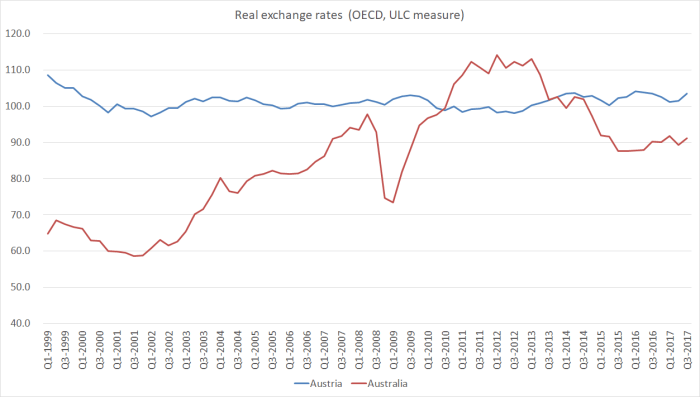
As a simple illustration of differences in real exchange rate volatility, I took the first two countries on an OECD table (Australia and Austria) and showed their real exchange rate since the start of 1999 when the euro began.

aus and aus rers

The point isn’t that Australia had Austria’s options –  it didn’t (most of its trading partners weren’t simultaneously forming a common currency area) –  or even that it would have wanted that option (in the face of very big terms of trade swings), just that there are huge differences.

And what about New Zealand?  The Reserve Bank did a useful paper a few years ago looking at the volatility issue.   In that paper, they looked back as far as the 1960s.  That had the advantage of looking through specific choices about how the exchange rate is managed –  over that period, we’ve had almost all the types of exchange rate regimes known to man, other than a common currency.     The results suggested that the volatility of the New Zealand exchange rate had been relatively high –  less so for short to medium term horizons, but more so if one focuses on longer-term exchange rate cycles.

But since Winston Peters has been talking about the potential for monetary policy regime changes to affect exchange rate volaility, here I wanted to look at a couple of shorter periods.    The current monetary policy implementation system –  the OCR –  has only been in place since the start of 1999, and as late as 1996/97 we were still using exchange rate “comfort zones” to manage the very short-term variability in the TWI exchange rate.

And who to compare us to?    The BIS has monthly broad real exchange rate indexes dating back to the start of 1994 for 60+ advanced and emerging countries.  The OECD has a couple of quarterly real exchange rate series for its 35 member countries, with complete data for all countries since 1996.  Of course, many of these countries are part of the euro, and I’ve shown results below for both all the individual countries and excluding the individual euro-area countries and including just the euro area as a whole.

There are more sophisticated ways of looking at volatility, but here I’ve just used two measures: the standard deviation of each country’s exchange rate index, and the range (high to low) expressed as percentage of the average value of the respective country’s real exchange rate index.

Here is how we’ve done relative to other countries on the BIS index.  (I’ve shown both the full period of data since 1994 and also just the last 10 years –  in case something is materially different about the most recent decade, but bearing in mind that 10 years is typically only about one exchange rate cycle).

BIS real exchange rate
standard deviation high-low range as % of average
Since Jan 1994
NZ 10.5 46.5
Australia 12.3 54.5
Canada 9.4 40.3
Japan 17.9 54.3
Israel 8.3 32.3
USA 9.2 33.1
Median of all countries 10.4 42.2
Median excluding individual euro countries 11.9 52
Last 10 years
NZ 7.1 36.8
Australia 8.5 41.5
Canada 8.1 34.3
Japan 12 40.8
Israel 4.8 23.9
USA 7.1 23.7
Median of all countries 5.5 23.2
Median excluding individual euro countries 7 28.5

Overall?   Well, our experience looks a lot like that of the median country and a little less variable than Australia’s real exchange rate over this period.   Since I first noticed the phenomenon almost a decade ago now, I’ve also been struck by the fact that exchange rate variability in New Zealand has been less than that in Japan and quite similar to that in the United States.     Over just the last decade, the amplitude of the exchange rate cycle has been larger for New Zealand and Australia than for most of these countries, but that just reflects the fact that both exchange rates fell so far in the 2008/09 crisis/recession –  surely a welcome, buffering, development.  Officials certainly thought so at the time.

I didn’t show Singapore separately, but the variability of its exchange rate over this period was similar to that for the euro-area as a whole, but materially larger than that for most individual euro-area countries.

What about the OECD measure?

OECD real exchange rate (ULC)
standard deviation high-low range as % of average
Since Dec 1996
NZ 14.6 56.7
Australia 16.3 66.4
Canada 12.4 44.5
Japan 18.8 75.1
Israel 11.2 42.6
USA 12.0 36.7
Median of all countries 10.1 40.5
Median excluding individual euro countries 12.1 48.0
Last 10 years
NZ 8.4 33.8
Australia 10.4 41.8
Canada 7.3 23.9
Japan 12.6 48.0
Israel 6.9 26.7
USA 8.6 26.7
Median of all countries 6.8 23.5
Median excluding individual euro countries 7.6 31.7

Still less variable than the exchange rates of Australia or Japan.  And at least over the last decade, little to mark us out from the median of the floating exchange rate countries (ie the series excluding the individual euro-area countries).

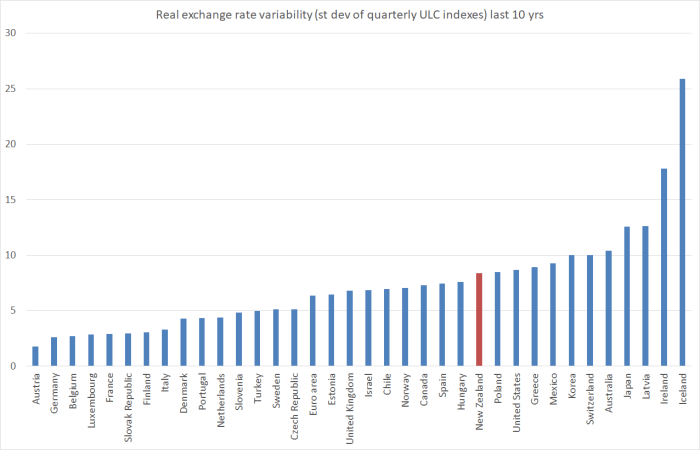
This chart is just one index for just one period, but it helps illustrate a few points.

oced rer variability

Notably:

  • all the countries to the far left of the chart are in the euro (or pegged to it –  Denmark),
  • among the floating exchange rate countries, the variance of our real exchange rate hasn’t stood out over the last decade,
  • even being in the euro is no protection from considerable real exchange rate variability if the fundamentals of your economy aren’t closely aligned to those of the large country(or countries) you are pegged too –  see Ireland and Greece.

I wouldn’t want anyone to go away from this post with a sense that I’m indifferent to real exchange rate volatility.  I’m not.  The extent of the variability in many real exchange rates is something of a puzzle, even when dressed up in “the exchange rate is an asset price” language.  On the other hand, not all real exchange rate variability is a bad thing –  many of the biggest moves see the exchange rate acting as a helpful buffer.   Exchange rate variability may also be more of an issue in a small country, where firms probably have to take their products international at an earlier stage than might be the case in a larger country.

But, equally, New Zealand’s realistic options are quite limited.  We don’t have a single dominant trading partner, with whom our economic fundamentals are well-aligned.    And with structural demand pressures so different from most of the advanced world (ie interest rates that average persistently higher), attempting to solve the problems by simply choosing a big currency to peg to would, most likely, have been a recipe for an Irish mess.

The biggest constraints on growth in the New Zealand tradables sector are the relative scarcity of good opportunities in such a remote location, compounded by the persistently high level of the real exchange rate.  Considered against that backdrop, the volatility of the exchange rate –  real or nominal –  which isn’t that unusual by the standards of countries in our sort of position is likely to be (a) a second or third order issue, and (b) one where attempted fixes could easily leave us worse off than we are now.

Implications of a new government for monetary policy

Whichever way New Zealand First decides to go, we’ll have a different government than we’ve had for the last few years.   Whatever form that government takes –  coalition, confidence and supply agreements, or just sitting on the cross-benches – New Zealand First’s votes will typically be vital for passing any legislation, and whichever party leads the government will constantly be needing to consult with New Zealand First to avoid inadvertently getting offside with them.

As issues around the Reserve Bank and the exchange rate have been a significant part of Winston Peters’ stated concerns over the years (including attempts to amend the Act through a private members’ bill, and repeated references to a Singaporean style of monetary policy), it is interesting to speculate on what difference his bloc of votes in Parliament might make to these issues over the next few years.  A journalist asked for my thoughts the other day, and this post fleshes out what I said in response to those questions.

There are probably at least three –  separable – areas worth touching on (simply as regards the Bank’s monetary policy roles):

  • the specification of the target for monetary policy, whether in the Act or the Policy Targets Agreement,
  • any changes to the legislated decisionmaking and accountability provisions for monetary policy, and
  • the type of person appointed as Governor.

I find it worthwhile to recall that Winston Peters has history in this area.  In 1996, New Zealand First was campaigning vigorously on bringing about change at the Reserve Bank.  At the time, the particular concern was that in focusing on price stability (0 to 2 per cent inflation at the time) we were encouraging/causing an overvalued exchange rate.  The proposed remedy was that we should instead target inflation around the average of our main trading partners (then a bit higher than New Zealand).    What actually happened was that as part of the horse-trading for the coalition agreement with National, Don Brash agreed to an amended Policy Targets Agreement, in which the target was raised from 0 to 2 per cent annual inflation, to 0 to 3 per cent annual inflation.  Actual inflation had been averaging about 1.5 per  cent anyway, so although the change made a small difference to policy for a short period, the difference was pretty minimal.  After that, Winston Peters –  as Treasurer – displayed little real interest in monetary policy and never bothered the Bank again.

So my starting point, in thinking about New Zealand First influence on Reserve Bank matters now, is that although I’m quite sure that the concerns Peters expresses –  including around overvalued real exchange rates –  are quite real (and in many respects valid –  shared as they’ve been by people spanning the range from Graeme Wheeler to me), in the end not much about the conduct of monetary policy is likely to change at his insistence.  And that is probably as it should be –  our real exchange rate problems are not primarily grounded in monetary policy problems.

We also know that although Peters has repeatedly talked of preferring a Singaporean model of monetary policy (a guided exchange rate, without an officially-set OCR), both Steven Joyce and Grant Robertson during the campaign flatly ruled out such a change.  They were right to do so.  I’ve explained why in a post earlier this year.    Even if such a system was desirable, it isn’t workable (at all) for New Zealand unless and until the structural demand factors behind our interest rates being persistently higher than those abroad are tackled –  and that isn’t a matter for monetary policy.

And the Singaporean model is not one of an absolutely fixed exchange rate.  It is a managed regime (historically, “managed” in all sorts of ways, including direct controls and strong moral suasion).  It produces a fairly high degree of short-term stability in the basket measure of the Singapore dollar.      But it works, to the extent it does, mostly because the SGD interest rates consistent with domestic medium-term price stability in Singapore are typically a bit lower than those in other advanced countries (in turn a reflection of the large current account surpluses Singapore now runs –  national savings rates far outstripping desired domestic investment).  As the Reserve Bank paper I linked to earlier noted

“From 1990 to 2011, the average short term Singapore government borrowing rate was 1.8 percent p.a. below returns on the US Treasury bill.”

Those are big differences (materially larger than the difference between the two countries’ average inflation rates).  And they mean that Singapore dollar fixed income assets are not particularly attractive to foreign investment funds.  By contrast, New Zealand’s short-term real and nominal interest rates are almost always materially higher than those in other advanced countries.   Partly as a result, even though Singapore’s economy is now materially larger than New Zealand’s, there is less international trade in the Singapore dollar than in the New Zealand dollar.

So a Singaporean model just is not going to be launched in New Zealand any time soon.

If Peters sides with National, what then might he secure in this area?

An obvious possibility would be a change to the Policy Targets Agreement.  There has to be a new one when a Governor is appointed, and (if they think the current interim one is lawful and binding –  which I don’t) they could also seek an immediate change.  Such changes immediately upon a change of government have been the norm rather than the exception (having happened, to a greater ot lesser extent, in 1990, 1996, 1999, and 2008).

At the start of each Policy Targets Agreement it has become customary (Peters began the pattern in 1996) to have a preamble about what the government is hoping to achieve.  The current government’s preamble reads this way:

The Government’s economic objective is to promote a growing, open and competitive economy as the best means of delivering permanently higher incomes and living standards for New Zealanders. Price stability plays an important part in supporting this objective.

It would be easy enough to craft a form of words that talked about avoiding an overvalued and excessively volatile exchange rate and promoting the tradables sector of the New Zealand economy.

But it won’t make any difference –  one iota of difference –  to the way monetary policy is conducted.  It is a statement of political aspiration –  and can perhaps be sold to the base as such –  not a mandate for the Governor.

Recall too that the Policy Targets Agreements since 1999 have required the Bank, while pursuing price stability to” seek to avoid unnecessary instability in output, interest rates and the exchange rate”.  On occasion, that provision has (modestly) influenced monetary policy choices at the margin (one reason I’ve favoured removing it), at least with a Governor who was that way inclined anyway.  In principle, the exchange rate element could be singled out and given more prominence further up the document.

Winston Peters’ private members bill sought to amend the statutory goal of monetary policy (section 8 of the Act) this way (adding the bolded words)

The primary function of the Bank is to formulate and implement monetary policy directed to the economic objective of maintaining stability in the general level of prices while maintaining an exchange rate that is conducive to real export growth and job creation.

I simply cannot see the National Party agreeing to that specific formulation. I hope they wouldn’t.  It goes too far and asks the Reserve Bank to do something that is impossible (real exchange rates are real phenomena, not monetary ones).   But could they consider a formulation like this one?

The primary function of the Bank is to formulate and implement monetary policy directed to the economic objective of maintaining stability in the general level of prices while promoting the highest levels of production, trade and employment that can be achieved by monetary policy.

It is very similar to the legislative provisions introduced by the National government in 1950, in providing a greater degree of (formal) independence for the Reserve Bank and a new focus on price stability.  But in that framing the caveat “the highest levels…that can be achieved by monetary policy” is vital.   Beyond the short to medium term, monetary policy can’t do much other than maintain stable prices.

Perhaps they could find, and agree on, some clever wording.   It would be a rhetorical victory for Peters, and since rhetoric and symbolism do matter not necessarily an insignificant one.

But, so I would argue, not one that would, on its own, make any practical difference to the conduct of monetary policy.  Reflecting back on the 25 years of advice I gave to successive Governors on the appropriate OCR, I can’t think of a single occasion when the advice would have been likely to be different under this formulation than under the current wording.

What about possible governance changes –  to the formal statutory provisions around monetary policy decisionmaking?  At present, all power is vested in the Governor personally, the Governor’s appointment is largely controlled by the Bank’s Board (unlike most countries where the Minister of Finance has the main power).

I can’t imagine that the National Party would be averse to some changes in this area.  After all, Steven Joyce commissioned the Rennie review and in doing so was presumably open to at least some modest changes (perhaps legislating something like the current internal advisory committee).   But equally, it is difficult to see why New Zealand First would regard it as any sort of win to hand power to more internal technocrats.  To the extent New Zealand First favours governance changes they probably prefer a decisionmaking Board dominated by outsiders, with a strong export sector orientation.  Perhaps it isn’t a die in the ditch issue for National, but it is harder to see the two parties reaching agreement on that sort of change, even if it did produce something that looked rather like the (generally highly-regarded) Reserve Bank of Australia.

But if Peters and New Zealand First care about making a difference to the actual conduct of monetary policy over the next few years, or even to how the Bank talks about monetary policy, the key consideration is who becomes Governor.   Whatever the formal specification of the target, whatever flowery words exist around goals, the personality, instincts, “models”, and preferences of whoever is appointed Governor matters a great deal.  Partly because it is a single decisionmaker system, and partly because as chief executive the Governor (inevitably and appropriately) has a big influence on how the institution evolves, where it focuses its analytical energies and advice etc.

But the Governor selection process has been underway for months, and the Bank’s Board – all appointed by the National government –  must be getting close to delivering an initial recommendation to whoever is appointed as Minister of Finance.   No doubt the Minister of Finance would consult New Zealand First –  whether through the Cabinet appointments process, or outside it –  and the Minister can reject a Board nomination.  But the Minister can’t impose his or her own candidate, they just have to consider the next person the Board puts forward.  Since the Board were (a) appointed under the current system, and (b) have had no concerns at all about the conduct of monetary policy or the leadership of the Bank in recent years, it seems reasonable to assume they’ll be putting forward a status quo candidate (there are no known exceptional candidates).  If so, my money is on Deputy Governor Geoff Bascand who –  as I’ve written about recently –  might be a safe pair of hands, but is unlikely to be more than that, and about whom there are some concerns (especially if, as Peters appears to, one cares about the interests of bank depositors.)

In short, if National leads the next government I wouldn’t expect any material differences on the monetary policy front, even if there are some symbolic wins for New Zealand First.  Even governance reform –  which most people think desirable –  might be hard to actually deliver (the status quo will avoid any conflicts).

And what if Labour leads the next government, requiring support of the Greens and New Zealand First for legislation?

In that case, legislative reforms are more certain, but somewhat similar questions remain about what difference they might make.

Thus, the Labour Party campaigned on amending section 8 of the Act to include some sort of full employment objective.   They haven’t provided specific suggested wording, and would no doubt want official advice on that.  The Greens have endorsed that proposal and there is no obvious reason why New Zealand First would oppose it. But they might want to try to get some reference to the exchange rate or the tradables sector included, whether in the Act itself or in the Policy Targets Agreement.  The sort of wording I floated earlier in this post might provide a basis for something workable.

I’ve also previously suggested that if Labour is serious about the full employment concern, it might make sense to amend section 15 of the Act (governing monetary policy statements) to require the Bank to periodically publish its estimates of a non-inflationary unemployment rate (a NAIRU), and explain deviations of the actual unemployment rate from that (moving) estimate.  In principle, something similar could be done for the real exchange rate, but the (theoretical) grounds for doing so are rather weaker.  Perhaps the political grounds are stronger, and such a change might encourage the Bank to devote more of its research efforts to real exchange rate and economic performance issues.

But –  and I deliberately use the same words I used above –  such legislative changes are not ones that would, on their own, make any practical difference to the conduct of monetary policy.  Reflecting back on the 25 years of advice I gave to successive Governors on the appropriate OCR, I can’t think of a single occasion when the advice would have been likely to be different under this formulation than under the current wording.

The Labour Party and the Greens also campaigned on legislative reforms to the monetary policy governance model (including a decisionmaking committee with a mix of insiders and relatively expert outsiders, and the timely publication of the minutes of such a committee.)   Although those proposals would represent a step in the right direction, they are rather weak. In particular, since Labour proposed that all the committee members would be appointed by the Governor, the change would largely just cement-in the undue dominance of the Governor.    But I’d be surprised if they were wedded to those details, and it shouldn’t be too hard to reach a tri-party agreement on a decisionmaking structure for monetary policy –  probably one that put more of the appointment powers in the hands of the Minister of Finance (as elsewhere) and allowed for non-expert members (as is quite common on Crown boards –  or, indeed, in Cabinet).

So legislative change in that area –  probably quite significant change –  seems like something we could count on under a Labour-led government.

But whether it would make much difference to the actual conduct of policy over the next few years still depends considerably on who is appointed as Governor.   Not only will whoever is appointed as Governor going to be the sole decisionmaker until new legislation is passed and implemented –  which could easily be 12 to 18 months away –  but that individual will be an important part of the design of the new legislation and the sort of culture that is built (or rebuilt) at the Reserve Bank.

As I noted earlier, the appointment process for the Governor has been underway for months.  Applications closed at a time –  early July –  when few people would have given the left much chance of forming a government.  And the Board, all appointed by the current government and strong public backers of the conduct of policy in recent years, have the lead role in the appointment.   Perhaps a new Labour-led government would reject a Bascand nomination.  But even if they did so, they have no idea which name would be wheeled up next.

There are alternatives, if the parties to a left-led government actually wanted things done differently at the Bank.   First, they could insist that the Bank’s Board reopen the selection process, working within the sorts of priorities such a new government would be legislating for.  Or they could simply pass a very simple and short amending Act to give the appointment power to the Minister of Finance (which is how things work almost everywhere else).  Of course, there is still the question of who would be the right candidate, but at least they would establish alignment of vision from the start –  a reasonable aspiration, given that the Reserve Bank Governor has more influence on short-term macro outcomes than the Minister of Finance, and yet the Minister of Finance has to live with the electoral consequences.

Over time, governance changes are important as part of putting things at the Reserve Bank on a more conventional footing (relative to other central banks, and to the rest of the New Zealand public sector).   I think some legislative respecification of the statutory goal for monetary policy  –  along the lines Labour has suggested –  is probably appropriate: if nothing else, it reminds people why we do active monetary policy at all.   But on their own, those changes won’t make any material difference to the conduct of monetary policy  –  or even to the way the Bank communicates –  in the shorter-term (next couple of years) unless the right person is chosen as Governor.  Perhaps so much shouldn’t hang on one unelected individual, but in our system at present it does.

Symbols matter, but so does substance.  It will be interesting to see which turns out to matter more to a new government with New Zealand First support.

In closing, there is a long and interesting article in today’s Financial Times on some of the challenges – technical and political –  facing central bankers.  As the author notes, in many countries authorities are grappling with a mix that includes very low unemployment and little wage inflation.  In appointing a Governor for the Reserve Bank of New Zealand, it would be highly desirable to find someone who recognises, and internalises, that the challenges here are rather different.  Unlike the US, UK, or Japan (for example) New Zealand’s unemployment rate is still well above pre-recessionary levels –  when demographic factors are probably lowering the NAIRU –  and real wage inflation, while quite low in absolute terms, is running well ahead of (non-existent) productivity growth.    There are some other countries – the UK and Finland notably –  that also have non-existent productivity growth, but it is far from a universal story.  Productivity growth carries on in the US and Australia and (according to a commentary I read last night) in Japan real output per hour worked is up 8.5 per cent in the last five years (comparable number for New Zealand, zero).

Some of these issues are relevant to monetary policy (eg unemployment gaps) and some are relevant to medium-term competitiveness (wages rising ahead of productivity growth).  We should expect a Governor who can recognise the similarities between New Zealand’s experiences and those abroad, but also the significant differences, and who can talk authoritatively about what monetary policy can, and cannot, do to help.  Perhaps even, as a bonus, one who might even be able to provide some research and advice to governments on the nature of the economic issues that only governments can act to fix.


Remoteness….occasionally a benefit

I’ve been a little unclear what to make of the Rocket Lab story.   Don’t get me wrong, I liked the idea that our regulatory systems can, on occasion, be sufficiently adaptive to cope with new and innovative industries –  even if it is far from generally true.  And I wish all the best to any New Zealander with innovations they succeed in taking to the world market, and if that includes rocket launches that’s fine.

But there was the nagging question of why such an activity would be taking place in New Zealand at all.  We aren’t exactly close to anywhere, let alone home to great centres of expertise.  But there were those government subsidies –  up to $25 million of taxpayers’ money to Rocket Lab, as well as the cost of the regulatory regime (15 to 20 bureaucrats in the “New Zealand Space Agency”).  And I recalled that the French launch their satellites from French Guiana without –  as far as I’m aware –  much else happening in French Guiana.

But there was an interesting article on Newsroom built around an interview with head of the agency, a mid-senior level MBIE official.   It answered some questions, and not in a terribly encouraging way.

There was the disarmingly frank acknowledgement of how little expertise MBIE has

The biggest challenge, Crabtree says, has been the “classic small government thing” of lacking expertise.

“We didn’t have the experience or technological depth, but the focus is on picking things up quickly but also working with international partners who can bring that to you…

“I set the challenge which was, can we move as fast as Rocket Lab?”

Where are the incentives to get things right, when the hype is all around accommodating –  and keeping pace with – Rocket Lab?  You can pick up lots of things quickly, but often you don’t know what you don’t know.    (And, to be clear, I’m not asserting a need for regulation for its own sake, and have no idea what specific regulation might –  or might not – be needed in this industry, but the general point holds.)

And then there was the answer to what New Zealand had going for it, aside from the cheque book of the put-upon taxpayer.

New Zealand has what Crabtree deems “a natural resource endowment” when it comes to space-related activities, such as a range of launch angles.

“You want to launch a rocket to the east, and you want to launch a rocket over the ocean, and you want that ocean to be relatively clear of ships, and you want the sky to be relatively clear of planes…

“There are very few places in the world that tick all the boxes.”

So that would be New Zealand, Madagascar, the Falkland Islands, and maybe Uruguay/Argentina?  Those great centres of economic activity, innovation and so on.   We have political stability going for us over each of those other places, but it scarcely sounds like the makings of  –  or even a marker of – a transformed economy, when the business has to operate in a place where nothing much else is.

Ah, but then there are the kids

Beyond the economic calculations, Crabtree hopes a booming space industry can encourage children to develop an interest in space and technology.

“Kids get interested in science either through dinosaurs or space, and we’ve had lots of dinosaur kids, but space hasn’t really had a fair go.”

The agency has been providing educational materials for schools to use, while universities also want to attract those keen on making a future contribution to the space race.

I guess at least the government is symmetrical –  we also subsidise the film industry which provides the most-frequent encounters with dinosaurs these days.

In my day, the Apollo programme, moon landings and all, was great for exciting interest in space, around the world.  Count me just a little sceptical that some rockets launching from remote sites on our east coast are going to make a material difference to the career choices of many New Zealand kids. Or that, if they did, many of the resulting –  higher value – jobs would end up in New Zealand for long.

Perhaps the industry can succeed here, standing on its own feet.  If so, I wish it well. But I’m a little uneasy about politicians and officials talking up, and then being pursued by, the hype.  Corporate welfare dollars all add up after a while.

Australia does better than us

I’m old-fashioned.  Key bureaucrats should mostly be seen and not heard.  Officials advise, ministers decide.  And ministers are the ones we get to hold to account, weakly or otherwise, through the political and electoral process.

The chief executive of New Zealand’s Ministry of Foreign Affairs and Trade doesn’t appear to give many speeches, at least not on-the-record.  That is, mostly, as it should be.  But the Secretary of the Australian Department of Foreign Affairs and Trade, Frances Adamson, gave a very interesting address in Adelaide the other day on Australia and China.  It was sufficiently clear and forthright that one can only assume she had the full endorsement of the Australian government.

The speech was given in a slightly odd context.  It was the annual lecture of the Confucius Institute at the University of Adelaide.    There are hundreds of these Confucius Institutes in universities around the world (several in New Zealand),  funded by the government of the People’s Republic of China to promote the interests of China. A couple of years back

The American Association of University Professors (AAUP) called for agreements between Confucius Institutes and nearly 100 universities to be either cancelled or renegotiated so that they properly reflected Western values of free speech.

“Confucius Institutes function as an arm of the Chinese state and are allowed to ignore academic freedom,” the AAUP said in a statement, urging US universities to “cease their involvement” with the institutes unless major reforms are instituted.

China’s network of 300 Confucius Institutes – including 11 branches in on British university campuses – can be a lucrative source of funds for universities but are exempt from many of the basic rules governing academic discourse.

They are designed to project a favourable image of China’s ruling Communist Party around the world through language and cultural programmes, but are allowed to restrict discussions of topics unpalatable to China’s ruling Communist Party such as the occupation of Tibet.

The University of Chicago has shut their Confucius Institute over related concerns.

But if Frances Adamson didn’t tackle that specific issue head-on (and had some polite remarks to her hosts), what she did say was pretty blunt, even if none of it should have been controversial in a free, open and democratic society reflecting on its relationship with an expansionist repressive authoritarian state that is moving further away from, not nearer to, the sort of values that have shaped the West.

While we are complementary economies, there is no getting around the fact that Australia and China are very different places, with different political and legal systems, values and world views.

A pretty simple statement, but I’m not sure I’ve seen its like from our own leading ministers and officials.

Partly this is because the closer we get, and the more we interact, the more we need to account for and manage the differences between us – differences that cannot be wished away but that should not prevent the further development of relations between us.
This emphasises the need for a healthy dose of tolerance, for mutual respect and for openness to the patterns of give and take that underpin any successful relationship.
We understand the hesitation in China to ‘air the laundry’ so to speak.

Australians are happy – perhaps too happy sometimes – to tell each other exactly what we think.

This of course reflects different cultural attitudes:

In China, the thinking is that proper friends will not say things that offend;

Whereas in Australia, a willingness to be frank is proof of a genuine friendship.

These characteristics apply as well to our government-level interactions, something that both sides have come to recognise (though not necessarily always accept!).

Each of our approaches has utility, and we will need large measures of both respect and candour as we conduct the far-sighted diplomacy necessary to bridge our differences and progress our common interests.

Both approaches, the saving of face and the preference for frankness, also have shortcomings.

For our part, Australians should, and I am sure will, be authentic and true to our own selves, while respecting the practice of others.

Australia is a pluralistic society: a place where open debate, individual rights and freedoms are the foundation upon which we have built our political and economic systems. We are a society that thrives on the competition of ideas.

The health and vibrancy of Australia’s democracy is fundamental to our national success – it helps explain why migrants come to our shores and why they can succeed based on their talents and hard work.

And to students, in the context of various recent reports in Australia of a minority of PRC students, and PRC-dominated Chinese students associations, trying to suppress discussion

And here I want to address my remarks to those of you who are international students:
We want you to experience our contest of ideas and participate fully in it, as it is part of what constitutes an authentic Australian education.

You have paid your money; you are surely entitled to the full experience.

No doubt there will be times when you encounter things which to you are unusual, unsettling, or perhaps seem plain wrong. And can I tell you, as someone who has studied overseas in three different continents, if you aren’t encountering strange and challenging things you aren’t getting out enough! So when you do, let me encourage you not to silently withdraw, or blindly condemn, but to respectfully engage.

The silencing of anyone in our society – from students to lecturers to politicians – is an affront to our values.

Enforced silence runs counter to academic freedom. It is only by discussion, and of course discussion which is courteous, that falsehoods can be corrected.

Respectful and patient discourse with those with whom you disagree is a fundamental skill for our ever-more-connected contemporary world.

and to a wider audience

There has been much attention in recent months to the quality and reliability of news and information available to us.

We have seen accusations of ‘fake news’ and we have seen attempts at untoward influence and interference.

This is worrying and is being taken seriously in a number of countries. In our case, the Prime Minister has said: “The sovereignty of Australia, the sovereignty of our democratic processes, free from foreign interference is a matter of the highest concern.”

The Australian Government takes seriously its responsibility to ensure a robust legal framework within which free and open debate is protected and can flourish. That work is proceeding.

As well, Governments themselves must expect, and invite, scrutiny of their actions and their policy positions.

As China becomes more important to Australia’s future and to that of the world, it follows that there will be more scrutiny of China, including the ways in which it seeks to exercise influence internationally.

All of us here, as participants in a free society, have responsibilities as well.

It is our responsibility to challenge and question ‘fake news’. We can readily reduce the risk of being manipulated by seeking out collateral and confirmatory information, by testing through a second opinion.

And when confronted with awkward choices, it is up to us to choose our response, whether to make an uncomfortable compromise or decide instead to remain true to our values, “immune from intolerance or external influence” as Adelaide University’s founders envisaged.

The prospect of public scrutiny is an excellent discipline, and a vital corrective for our political culture and our institutions, including our universities.

We want to ensure these institutions remain secure and resilient.

Our success depends in part on the legal framework, but also on the attitudes and responses of all of us when exposed to unexpected pressure.

And in contrast, what do we have in New Zealand?   Almost none of our political party leaders has been willing to comment in any substantive way on the concerns raised in the recent paper by Professor Anne-Marie Brady.    The leaders of the National Party, the Labour Party, and the Green Party seem totally unbothered about –  and unwilling to substantively discuss – having as a member of Parliament a (now) acknowledged member of the Chinese Communist Party and former member of the Chinese intelligence services, who is now widely credited as one of the National Party’s chief fundraisers.  Speeches on China topics by our own Ministers of Foreign Affairs seem mostly to take on a fawning and deferential tone, as if they are afraid of asserting, or embarrassed by, our own values.  And the Attorney-General was just reduced to making stuff up (lies) and personal attacks on institutions raising concerns.

The speech by the Australian Secretary of the Department of Foreign Affairs and Trade has been widely reported in the Australian media – and she’s just a (very senior) bureaucrat.   And what of New Zealand?

It remains striking, puzzling, and more than a little disturbing, just how little media attention either the general or the specific issues have received in the New Zealand media.    There is a column in this morning’s Herald by Bryan Gould, former Vice-Chancellor of Waikato University and former UK Labour MP prompted by the Brady paper (I’m told the column is on line but I couldn’t find it UPDATE:  here).   In it Gould opens thus:

The Herald’s readiness to report the important conclusions of University of Canterbury research into links between China and past and present New Zealand politicians and their family members is to be commended.

Surely in a serious country with media doing the job of providing searching scrutiny, it wouldn’t be cause for self-congratulation, but something just taken for granted?  A leading academic raises serious concerns about the extent of a powerful country’s influence in New Zealand and he seriously suggests that it might not be reported by the country’s largest newspaper?

It would be interesting to know whether the issues have been reported in the Chinese Herald (I gather not), but even if we stick to the English language media, just how much reporting has there in fact been?  I found a total of two stories in the Herald, one (on a quite specific element) on Stuff, nothing on Radio New Zealand (a non-commercial broadcaster with an extensive news and current affairs operation), a single story of Newsroom, nothing on TVNZ and nothing on Newshub.  Perhaps I missed the odd story, but what is striking is not the New Zealand coverage of the issues and concerns, but the lack of coverage and lack (apparently, thus far) of any sustained follow-up.    (And has the New Zealand media ever looked searchingly at those Confucius Institutes?)

The contrast with Australia is striking, worrying, and sad.  I don’t really buy the stories of extreme economic vulnerability to China, but if anything Australia’s direct economic exposure is a bit larger than ours.  And yet officials, ministers, and media in Australia are willing to speak up, and have an open and vigorous debate on the issues.  Reasonable people might differ on appropriate policy responses, but who is seriously going to defend the deafening silence as the way in which a free and open society should handle such issues?


Fourth term government votes

After the provisional election results were announced a couple of weeks ago I ran a post looking at how National and the other right or centre-right parties had done in this election compared to the experiences of the other two times (since National and Labour first dominated the scene) that a party had won a fourth term (1935 to 1949 under Labour, and 1960 to 1972 under National).   In both those cases, the winning party actually increased its vote share in the election that secured the fourth term (1946 and 1969).

MMP muddies the waters somewhat.  But here is a chart showing, using the final results this afternoon, the combined vote share for National, ACT, and the Conservative Party for the last four elections (numbered along the bottom) and comparing it with National’s experience in the four 1960s elections.  I’ve argued previously that most Conservative Party voters would (a) otherwise have voted National or stayed at home, and (b) had the Conservative Party won seats they’d have sided with National as surely as the Greens side with Labour.

centre-right vote share

The centre-right parties did impressively well to increase their total vote share in 2011 and again in 2014.  But the fall-off in this election – 6.6 percentage points –  is pretty stark.

It may still be enough to lead the next government –  time and New Zealand First will tell –  but, if so, it is hardly a ringing endorsement.    Here is some contextual material around National’s 1969 victory that I included in the earlier post.

Now that looks more like a genuinely impressive performance – the governing party lifting its vote share in the election in which it gained a fourth term.   There had been industrial action at the time of the election which had hurt the Labour Party, but the previous three years had been a very tough time to govern.   Wool prices had collapsed (and with them the overall terms of trade), the New Zealand government had been forced into a devaluation in late 1967, and had borrowed from the IMF under a pretty stringent domestic austerity programme.  Things here had been tough enough that over the three calendar years 1967 to 1969 there was a small overall net migration outflow (the first such outflows since the end of World War Two).

On wages: expectations and reality

Last week, when I was tied up with other stuff, I heard a few media reports that a new Westpac survey was showing that public expectations of wage increases were slipping away.  At the time, I didn’t look at the details, but made a note to come back to it.

This was the key chart included in Westpac’s report of the survey results.

wage expectations

Introduced with this text:

Although workers may be feeling more confident about job opportunities, when it comes to the outlook for earnings, sentiment is really in the dumps. Increasing numbers of workers are telling us that they don’t expect any change in their earnings from work over the coming year. In fact, the number of workers who expect to receive a pay increase over the coming year is languishing at the sort of lows we saw during the financial crisis.

Concluding with this

And while nominal wage growth has remained muted, consumer price inflation has picked up. After lingering below 1% for much of the past few years, consumer price
inflation is now running at 1.7% per annum. This means that the limited pay rises many workers have received have only just been keeping pace with changes in the cost of living. And for those workers who didn’t receive a pay rise (and even for some that did), their spending power may be going backwards.

I’m not really convinced.

I’m not doubting that respondents did answer the question the way Westpac reports. I wouldn’t even be surprised if the recent reversal of wage expectations was the real thing: there was all sorts of talk not long away about wage inflation being just about to “take off”, which so far hasn’t come to anything much.   But even with the recent reversal, expectations are still just back to around where they were for a fair part of 2015 and 2016.

My concern is more about how to interpret the longer-run of data in the chart and, in fact, how to make sense of wage data themselves.

For a start, surely respondents to this survey are inclined to bias their answers downwards?  After all, look at the results for the 2005 to 2007 period, when the labour market was unquestionably tight (including the fact that the unemployment rate was below 4 per cent), and general wage inflation –  on any of the measures –  was quite high.  And yet only around 50 per cent of respondents expected a wage increase.  Many more than that must have been achieving a wage increase.  As I’ve noted previously, the labour share of total income has actually been increasing in New Zealand.

Second, it is worth remembering that inflation expectations now are materially lower than they were a decade ago.

household expecs 2017

The numbers bounce around a bit, but at the end of the previous boom the average year-ahead expectation was around 4.5 per cent, whereas now it around 3 per cent.  (One shouldn’t put much weight on the absolute numbers, but the pattern is consistent with others surveys of inflation expectations.)   If inflation expectations have fallen materially, surely it is reasonable that fewer survey respondents will now be expecting nominal wage increases, even if everything else (labour market tightness, productivity growth or whatever) was unchanged?

Westpac also uses as a reference point a 1.7 per cent rise in annual wages.  That number appears to come from the LCI, a series that purports to adjust for what firms’ report were productivity changes.  It is better to use the “analytical unadjusted” measure from the LCI, which is closer to a stratified raw measure of wage increases –  which is, after all, more like what the respondents in the Westpac survey are being asked about.

Many commentator also focus on the even lower wage inflation numbers from the Quarterly Employment Survey (QES) –  a wage measure that is notoriously volatile (and not really representative of how anyone thinks the labour market is actually working).  It is quite prone to compositional changes, and thus doesn’t reflect – or really try to reflect –  an individual’s own experience in the labour market.

I’ve covered this issue in an earlier post.

I’m not sure why people put so much weight on the QES measure of hourly wage inflation.  It has well-known problems (for these purposes) and is hugely volatile.   Here is a chart showing wage inflation for the private sector according to (a) the QES, and (b) the Labour Cost Index, analytical unadjusted series.

wages debate  No economic analyst thinks wage inflation is anything like as volatile as the blue line –  in fact, wage stickiness, and persistence in wage-setting patterns is one of the features of modern market economies.

And here is the chart I ran last week, comparing real private sector wage inflation (the orange line above, adjusted for the sectoral core measure of CPI inflation) with productivity growth.

Real wage inflation now is lower than it was in the pre-2008 boom years, but it is running well ahead of productivity growth (however one lags or transforms it).

As I noted in that earlier post, real wage inflation in New Zealand has been surprisingly strong in recent years, given the complete absence of any (actual or trend) growth in labour productivity (real GDP per hour worked).  Of course, low inflation and low inflation expectations hold down the nominal rates of wage increases (relative to what we were experiencing a decade ago), but the real measures are largely what matter.   Real household purchasing power from labour income in New Zealand has been increasing –  from increased employment, but also from real wage increases that are more than it is likely that the economy can support in the longer-term.

Perhaps then people are right to expect more modest wage increases ahead.  But if so, it will likely be because the non-tradables led pseudo-boom of the last few years comes to an end, and market processes across the economy force an adjustment in wage-setting to something more consistent with our alarmingly poor productivity growth record (in this particular bad phase now five years and counting).


A national day for lament, not celebration

Eamon de Valera, Prime Minister of Ireland, visited the German Embassy in Dublin on 3 May 1945, to pay his condolences to the Ambassador on the death of Hitler. He apparently justified it afterwards on grounds of diplomatic protocol, but it reinforced ever afterwards impressions that de Valera had been sympathetic to the Nazis.

Yesterday was the national day of the People’s Republic of China, marking the formation in 1949 of the Chinese Communist Party government. Various people have been highlighting photographs that have appeared in the Chinese-language media show National MP Jian Yang at the Chinese Embassy’s celebratory function, posing with Ambassador, the embassy counsellor, and the military attache.

and

(the latter tweet including a link to some further offshore commentary on the New Zealand situation).

Perhaps protocol more or less requires that, for example, the Minister of Foreign Affairs and assorted MFAT staffers attend national day celebrations. It is a part of normal state-to-state relationships. But there is no such obligation on obscure government backbenchers, and certainly no reason for such people to allow themselves to be photographed happily with the leading representatives in New Zealand of such a vile regime. A not unreasonable conclusion might be that Dr Yang is really rather sympathetic to, and supportive of, the PRC regime. Perhaps he just takes the view that what is in Beijing’s interests is, somehow, also in the interests of New Zealanders? Either way, with a (belatedly) self-acknowledged background like his, he shouldn’t be in our Parliament. The National Party should be ashamed to have him in its parliamentary caucus. Should be, but presumably isn’t. There is, after all, no sign that the whips have told him to lie low (and not, for example, be photographed with representatives of the PRC regime).

But, convinced as I am that Yang shouldn’t be in our Parliament – even if, as may well be the case, he has done nothing illegal – in a way, his conduct doesn’t seem out-of-step with that of our professional diplomats; neutral public servants one might hope.

The government-sponsored China Council was out openly celebrating 69 years since the Communist revolutionary victory.

And they were retweeting the enthusiasm of the New Zealand consulate in Chengdu

(note the exclamation mark. Is 68 years of a brutal murderous regime something to celebrate?)

And then somehow I stumbled on the Twitter account of the New Zealand Consul-General in Shanghai. Her tweet managed two exclamation marks.

She describes herself as “Addicted to China. From the government (MFAT) and here to help.”

I guess I can understand a passion of things Chinese, for the culture and history, but “addicted to China” doesn’t exactly suggest the sort of calm dispassion we might hope for from our senior diplomats – in dealing with a friendly country with whom we share values, let alone a brutal regime that appears to directly interfere in the New Zealand political process, and in entities and media outlets serving New Zealand (ethnic Chinese) citizens.

It is as if our entire establishment can’t bring itself to acknowledge the nature of a regime which has gone from one horror to another over the decades, barely regretting or apologising for any of them, and which now – richer and stronger than it was before, if a distinct economic laggard even in the region – poses real and new threats to its own people – the ramping up of surveillance for example – to regional stability, and to countries (including New Zealand) with a significant population of Chinese-born people. Are MFAT and the New Zealand China Council – and the New Zealand government – untroubled by any of this? Perhaps in 1938 their predecessors would have been celebrating the anniversary of the Nazi accession to power, all the while playing up the “trade opportunities”, and quietly observing that it wouldn’t do to upset the party-state?

It is a regime that is evil epitomised for this generation. Not, to be sure, North Korea and yet (a) chief protector of that evil regime, and (b) much more of threat to many more people and countries than North Korea is ever likely to be. And yet National MPs happily celebrate another anniversary of the evil. And quite probably Labour MPs do too, and would were they to form a government.

But it does prompt the question, where is the Green Party in all this?. I’m not a natural Green Party supporter and could not ever imagine voting for them. But over the years I’ve had a certain respect for them, and some of their MPs, when they’ve stood up against oppression, against surveillance, against threats to civil liberties. I was, perhaps a little strangely, an admirer of Keith Locke on this score. But on these issue – whether the specifics of Jian Yang, or the wider issues of PRC meddling- just total silence from the Greens. I’m not sure I really understand why. They don’t represent big and established business interests, and they don’t – as I understand it – have any track record of being heavily reliant on questionable fundraising. If there was ever a time to act as some sort of moral conscience, surely this is one of those?

I’ve found it a little hard to take too seriously earnest calls in the US for inquiries into Russian attempted interference in the US election last year (and am well aware of plenty of instances where the US has interfered in the elections of other countries). But if there is a case for such investigations in the US – and I think there probably is, even though Russia is a much inferior power to the US – how much stronger is the case here for a serious inquiry into the sorts of claims, and evidence, Professor Brady has outlined in her paper.

And there are simpler questions still that should be put to Dr Yang, whether by the National Party itself, or by the media. For example, can you name – say – three occasions on which, since you were elected to Parliament, you have disagreed with a policy stance taken by the PRC, and where you have spoken out clearly in defence of New Zealand interests and values? Shouldn’t be that hard. After all, South China Sea adventurism is in flagrant breach of international law. And the growth of the surveillance state in China under Xi Jinping isn’t exactly consistent with the sort of values the National Party proclaims. Or the increasing uses of “big data” highlighted in this article in the Financial Times today. Or one might ask how differently he sees the PRC being from, say, the Soviet Union or (the much shorter-lived) Nazi Germany – the latter being particularly active among the ethnic German populations in neighbouring countries in the 1930s. Does he look forward to a day when freedom of speech, freedom of religion and multi-party democracy prevails on the mainland – as it does, say, in Taiwan? As I say, it shouldn’t be hard to get clear and straightforward answers from someone who has genuinely abandoned his party (and military/intelligence) past.

Finally, while Dr Yang, MFAT, and assorted official China-promoters in New Zealand are celebrating 68 years of evil, there is this alternative perspective from Hong Kong, where people more readily appreciate the evil, the threat, that the PRC now represents.

I’m not suggesting that our government should deliberately go out of its way to upset the regime. And normal state-to-state relations (as we had in later years with the Soviet Union) are to be expected. But our governments – our diplomats – are supposed to be there to serve the interests, and values of New Zealanders. And that means, among other things, recognising and acknowledging the dreadful character of the regime they are dealing with. Hermann Goering was known to throw a good party too. Nuremberg rallies were, reportedly, spectacular.

Two faces

In the few weeks since the Financial Times/Newsroom story about Jian Yang broke and, independently, Professor Anne-Marie Brady’s conference paper on the extent of People’s Republic of China influence-seeking activities in New Zealand became available I’ve been doing a bit of reading around the issues. As far as I can tell, overseas experts appear to see Professor Brady’s paper as portraying a situation in New Zealand that is more extreme than (and more successful?), but consistent with the direction of, PRC activities in a range of other countries. Her paper seems to have attracted quite a lot of interest abroad, even as our own politicians (in particular) and media have largely overlooked the apparently serious issues she raises. The approach of successive governments, but perhaps particularly the most recent one, appears to closely resemble “never, ever, say anything to offend Beijing”.

In the course of reading around the issue, I found a couple of interesting papers on the MFAT website. The first, Opening doors to China: New Zealand’s 2015 Vision, was released in 2012. It is currently described as

The NZ Inc China Strategy maps the possibilities for the relationship on a 10-15 year horizon.

The document is totally consistent with the relentlessly upbeat and deferential tone that seems to characterise the New Zealand government’s approach to China. It begins with a Foreword from the then Prime Minister John Key.

With its talk of “centralised plans” it seems strangely apt for China.

The NZ Inc China Strategy is the second in the Government’s series of centralised plans – developed to strengthen our economic, political and security relationships with countries and regions, and to encourage people-to-people links and two-way investment.

He continues, in a paragraph that rather gives the game away.

Our strategy for China starts from an explicit recognition that an excellent political relationship is the foundation upon which everything else must be built. We can’t engage with China just on the trading front – we need to work across all sectors to build the range of links that will enhance our understanding and familiarity with one another.

That isn’t how normal countries, and firms in them, typically operate. Trade is, largely, a firm to firm matter, and governments set overarching standards and (largely) stand back. But not with China: that compliant political relationship really seems to matter.

Even the economics seem shonky, or (deliberately?) naïve.

Knowledge is in fact set to be a key driver of our rapidly growing relationship. Clearly it is a two-way street – we want to work with China to drive forward science and technology linkages, and we want to exploit the fruits of that collaboration to the commercial advantage of both countries.

But China isn’t at the leading-edge of technological innovation – thus, it is still a relatively poor middle income country – and while it has had a strong interest in acquiring western technology, by legal means or otherwise (so much so that research agreements between western universities and Chinese interests are raising increasing concerns), there is considerably less evidence of a “two-way street”.

Key concludes

The New Zealand Inc China strategy articulates the vision of a relationship with China that stimulates New Zealand’s innovation, learning and economic growth.

I won’t blame the New Zealand-China relationship for the lack of any productivity growth at all in New Zealand for the last five years. But perhaps we could just say that the claimed benefits to the wider New Zealand economy are still somewhat hard to identify.

I’m not going to comment on the detail of the rest of the 40-page document, which is full is pretty upbeat stories, and some (no doubt) useful advice to firms considering China. But this snippet did grab my attention, as I suspect it captures the flawed mindset that lies behind so much of our government’s approach to China.

China’s increasing economic success has given it greater influence in regional and international politics. Its prosperity has driven prosperity and stability throughout the Asia-Pacific region.

But that simply isn’t true on either count. Singapore, Taiwan, South Korea and Japan – the advanced countries of east Asia – aren’t rich because of the People’s Republic of China, but because they had their own policies, institutions, and people that equipped them to catch up with the leading economies of the West (something China is still failing to do). As for “stability” well it isn’t my field, but I doubt it is an impression shared by China’s neighbours dealing with its South China Sea expansionism. (I’ll try to do a separate post on the fallaciousness of the proposition that New Zealand’s economic prosperity, wellbeing, or stability depends to any large extent on China, hopefully drawing from some possible historical parallels.)

As is perhaps so often the case, what is missing from the document – the shop-front of the government’s China strategy, whether for firms looking to operate in China, or for citizens interested in evaluating government policy – is as interesting as what is there. There is no mention of how deeply corrupt much of China is, there is no mention of the pervasive controlling role of the Chinese Communist Party (generally regarded as more important than the state itself), and nothing on the absence of the rule of law (which means not the presence of courts, but the willingness to have independent judges apply laws impartially even when it doesn’t suit the authorities). You have to wonder whose interests those omissions serve. Beijing is no doubt happy. Established businesses trying to protect their interests in China may be too. Big China-associated donors to major parties might be.  But this is supposed to be a government of 4.8 million New Zealanders.

The other document I found on the MFAT website suggested that, in fact, at least among some officials there is a rather greater degree of realism about China than politicians seem ever willing to allow. In conjunction with MFAT, the Victoria University Contemporary China Research Centre is conducting five-day “master classes” for public servants. The purpose is described as

To develop a pipeline of China-savvy public sector professionals with global perspective and deep insight into the political, economic, security and cultural dimensions of the New Zealand government’s relationship with China.

It looks like a really interesting course. Among the speakers they have the retired ANU China expert, Geremie Barme, now resident in the Wairarapa, whose post on Professor Brady’s paper I linked to the other day.

Among the themes course participants will be considering are:

• The three Chinas: through the eyes of the Party, its history, and a leading global Sinophile
• What it means to be China savvy – developing a political, economic, security and perspective
• The peculiarities of media in China and the roles that Party and government play in controlling media
• The role the Chinese government takes in the threat of commercial failure to safety of Chinese. people in China and for Chinese outside of China.
• The nuances of building and protecting a brand in China, the Chinese legal system and the cultural nuances when doing business in China
• The profile of the modern Chinese in New Zealand and media influence on Chinese youth abroad.

But if this shows signs of a greater degree of realism, there are clearly limits. In the brochure for next month’s course it states of Day 1.

Scenarios throughout the day cover visiting delegations, the Māori-Chinese relationship, and navigating authorities.

But I also happened to find on-line a brochure for a version of the course run earlier this year. In that brochure it says of day 1.

Scenarios throughout the day cover visiting delegations, being Chinese in New Zealand, corruption issues, and the party-state structure.

Perhaps that was getting just a bit too close for comfort?

Last night I finished re-reading Richard McGregor’s excellent 2010 book The Party. On his final page, there were a couple of telling quotes.

The Chinese communist system is, in many way, rotten, costly, corrupt and often dysfunctional.

And

China has long known something that many in developed countries are only now beginning to grasp, that the Chinese Communist Party and its leaders have never wanted to be the West when they grow up. For the foreseeable future, it looks as though their wish, to bestride the world as a colossus on their own implacable terms, will come true.

That was, of course, written before the ascendancy of Xi Jinping.

Somewhat more immediately, a couple of people last night sent me a link to a new article by Charles Finny, former senior diplomat, and now a partner in the government relations firm Saunders Unsworth (where he describes himself as “making the impossible possible”). For someone who knows a great deal about China, and must surely be well aware of the sort of regime it is, and the nature of its activities, it did remind me of Lewis Carroll.

“Alice laughed. ‘There’s no use trying,’ she said. ‘One can’t believe impossible things.’

I daresay you haven’t had much practice,’ said the Queen. ‘When I was your age, I always did it for half-an-hour a day. Why, sometimes I’ve believed as many as six impossible things before breakfast.

Finny’s article is headed “Time for NZ political parties to take the migrant vote seriously” (actually I was pretty sure Labour had been doing just that in South Auckland for decades), but his focus is on the ethnic Chinese vote, and Jian Yang.

On the last day of the Westie experience [some years ago] I was introduced to a National Party candidate, Dr Jian Yang. He was teaching in the political science department at the University of Auckland. We talked about his academic background, about what he had done in China before leaving for Australia (where he completed his PhD at ANU), about the China-New Zealand relationship and about the Chinese Embassy and Consulate network in New Zealand.

It was clear Dr Yang was very well-connected to the leadership of the Chinese communities in New Zealand, as well as to the Embassy of the People’s Republic of China and its Auckland Consulate. He also had significant connections in China, both to government figures, and to the business community. This was the first of many meetings I have had with Dr Yang. We have met in his context as a MP, as a member of select committees and at social functions. We have travelled together to China and elsewhere as part of official delegations. It is my understanding that Dr Yang has become one of National’s most successful fundraisers, in much the same way Raymond Huo is important for the Labour Party’s fundraising efforts.

Did they, one wonders, back in 2010/11 discuss Yang’s background in the Communist Party and his teaching role in the Chinese foreign intelligence services?

What is astonishing is that one of New Zealand’s most-experienced China experts is, at least in public, untroubled by any of this: the close connections to a foreign government’s embassy, even as he serves as a member of the New Zealand Parliament, or the key role he describes both Yang, and Labour’s Raymond Huo playing in party fundraising?  Not that many decades ago, the convention – perhaps not always rigorously observed – was that elected politicians stayed well clear of party fundraising efforts, for good reasons to help maintain the integrity of the parliamentary system.

Finny is in full defence mode for Yang (and presumably Huo).

But it was a strange campaign period, with political players employing various strategies. Among the twists and turns, a rather strange and well-coordinated analysis/investigation was undertaken and then reported by Newsroom and the Financial Times about the past of Dr Yang. Subsequent coverage has led to calls for Dr Yang’s resignation.

Now, I have been involved in politics long enough to know that there are few stories of substance to emerge in the middle of an election campaign by coincidence (particularly ones that are so thoroughly researched). This was a story suggested by someone who had an agenda of some sort – and the timing was intentional.

If 10 days before an election isn’t a reasonable time to ask questions about a candidate’s background. I’m not sure when is? And it isn’t as if, to date, anything those media outlets reported has been disproved or refuted?

And Finny has nothing at all to say about Professor Brady’s paper, the timing of which was determined by the dates of an international conference she was presenting at. As he talks up – no doubt correctly – the importance of the migrant vote, surely suggestions that a major foreign power might be actively engaged in attempting to control most of the local Chinese-language media, and Chinese cultural associations, might have been worthy of some mention? These people are, after all, voters in our system, and our system allows new arrivals to vote much sooner than any other democracy.

I’m sure Finny is well aware of all this stuff, and is probably well able to distinguish the stronger bits of Professor Brady’s case from any that might be more questionable, or which might require more evidence to confirm. But nothing, not even a word. Would saying more have queered the pitch in terms of his future professional dealings?

Of course, if so, he isn’t the only one. Those master-classes MFAT is promoting had a number of eminent speakers. Some are current public servants and they, of course, must serve the government of the day. But most weren’t. And, of them all, the only one I’ve seen engage openly on the issues, and potential/actual threats Professor Brady raises, is Geremie Barme. And he’s Australian.

I’ve been critical of much our mainstream media for their lack of ongoing or substantive coverage of either the Jian Yang issue, or the more general influence-seeking activities Professor Brady describes. But you might have supposed that the Chinese-language media would be agog with the stories. In fact, I asked a fluent Chinese speaker about that. That person found that other than in Epoch Times (an anti-communist network of papers – including a NZ version – based in the US, apparently with some Falun Gong connections) there has been little about the Jian Yang story, and nothing at all about Professor Brady’s paper.

As Brady notes

New Zealand’s local Chinese language media platforms (with the exception of the pro-Falungong paper 大纪元/The Epoch Times) now have content cooperation agreements with Xinhua News Service, get their China-related news from Xinhua, and participate in annual media training conferences in China. Some media outlets have also employed senior staff members who are closely connected to the CCP. As part of Xi era efforts to “integrate” the overseas Chinese media with the domestic Chinese media, New Zealand Chinese media organizations are now also under the ‘guidance” of CCP propaganda officials.

The (lack of any) coverage of her paper and its claim would appear to consistent with her story.

And lest there is any doubt about the sort of regime the rest of the world faces in the People’s Republic of China, I thought this Reuters story on internal censorship in the modern age was a good place to end. It tells of a flash private company in China, full of eager young “auditors”, scouring the web for material to delete, anticipating/implementing the Chinese government-Party edicts.  Here, it seems, all too many of our government and opposition politicians, our academic and business elites, and too much of our media seem all too ready to do the same.  Whether it happens through naivete, a misreading of New Zealand’s economic exposure to China, the influence of private business interests, political fundraising opportunities, post-political opportunities, sponsorship deals, access, some combination of these, or whatever, it isn’t what we should accept in a free and democratic society.