Consistently dismal relative productivity growth

Having done Saturday’s post unpicking some of Steven Joyce’s claims about New Zealand’s productivity performance, I thought it might be worth using the data for a few more charts illustrating something of our performance relative to other advanced countries going back a few decades.

Of the official SNZ data I used in my nine measures of real GDP per hour worked:

  • real GDP measures go back to 1987,
  • the HLFS goes back to 1986, and
  • the Quarterly Employment Survey goes back to the start of 1989.

Thus, using official SNZ data, we can really only do the international comparisons back to full year 1989.   The OECD and the Conference Board produce numbers of New Zealand going rather further back (using earlier SNZ data for much of that), and those estimates usefully illustrate our longer-term relative decline.  But in these particular posts, I just want to use the official New Zealand sources for New Zealand (and the OECD-reported data for other advanced countries).

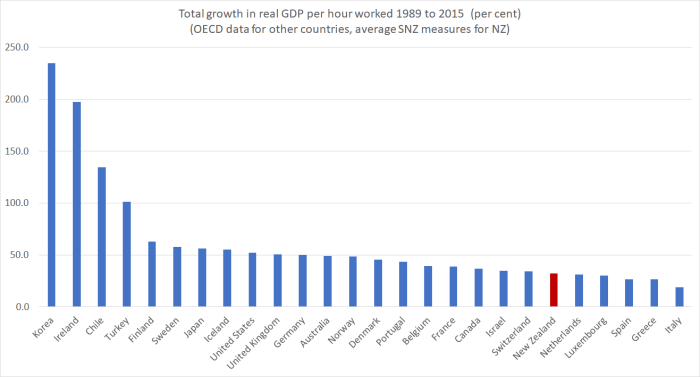
Many of the current OECD countries (largely the former eastern bloc ones) don’t have useable data going that far back.  So in these charts I’m comparing New Zealand against the 25 OECD countries that have such data all the way back to 1989.    That includes all the more “traditional” advanced OECD countries except Austria.  But the OECD only has data for all these countries to 2015, so this chart compares total productivity growth across countries from 1989 to 2015.

productivity joyce 3

“Pretty dismal” would be my summary of New Zealand’s performance over that entire period.  There is a handful of countries that have done even worse.  Two are much richer and more productive than us anyway; the others some of the basket cases of the euro-area.  And recall that at the start of the period we were in the midst of an economic restructuring programme sold, in part, as designed to reverse the decades-long deterioriation in New Zealand’s economic performance.    As a comparisons, in 1989 Ireland is estimated to have had around the same level of real GDP per hour worked as New Zealand.

As I noted in Saturday’s post, there are nine simple ways to combine the various GDP and hours series to produce estimates of GDP per hour worked. In the chart above, I used the average of those nine measures –  a 32.4 per cent increase.   The range of the nine measures was from 29.0 per cent to 35.7 per cent.   At best, we also beat out Switzerland and Israel.  At worst, Netherlands and Luxembourg beat us.  Over that long period, data uncertainty just doesn’t change the picture much.

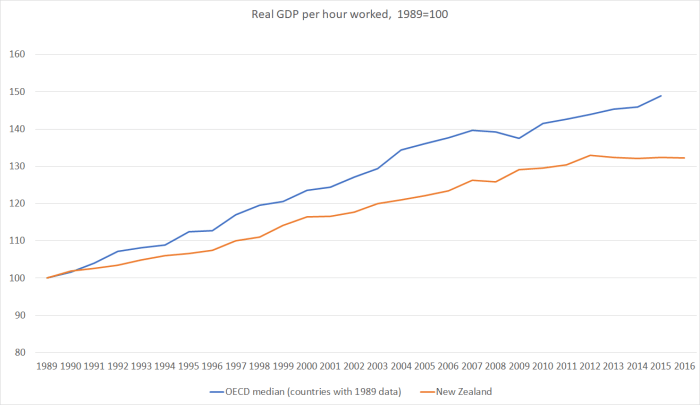
In the next chart, I’ve shown the annual path of real GDP per hour worked for New Zealand (again using the average measure) and for the median OECD country for which there is data throughout the period.  In all cases, countries were indexed to 100 in 1989, and so the chart is showing cumulative growth over the period in the two series.  The OECD does not yet have data for all countries for 2016.

productivity joyce 2

And here is the same data transformed into a ratio: the New Zealand line divided by the median OECD line, again indexed to equal 100 in 1989.

productivity joyce 1

On this chart, I have included an estimate for 2016, by taking the median productivity growth rate for those OECD countries (most of them) that have 2016 data.  I’ve also marked the final year of each of the three governments that changed during this period (1990, when Labour lost office; 1999 when National lost office; and 2008 when Labout lost office).

Over the course of these 27 years,  the trend has been downwards –  we’ve done (cumulatively) a lot worse than these other advanced countries (and the decline relative to those former eastern bloc countries is materially worse).

I don’t regard the dates around changes of government as being particularly meaningful for these economic comparisons: structural policy changes affect outcomes with a lag, and anyway, at least for the last two changes of government (1999 and 2008) there has been a lot more continuity than differences between the economic policies of the outgoing and incoming governments.  But in each of the different governments’ terms there have been years when our productivity growth was faster than that of the median OECD country.  Under the current government that year was 2009.  And so, as I noted the other day, in their first few years in office we actually made up a little ground relative to these other advanced countries.   But since then, the picture has been downhill again. Over the last four to five years all those gains have been lost, and more.

It is what happens when your country manages no productivity growth at all for five years or more (illustrated here using the average of the nine measures).

productivity joyce 4

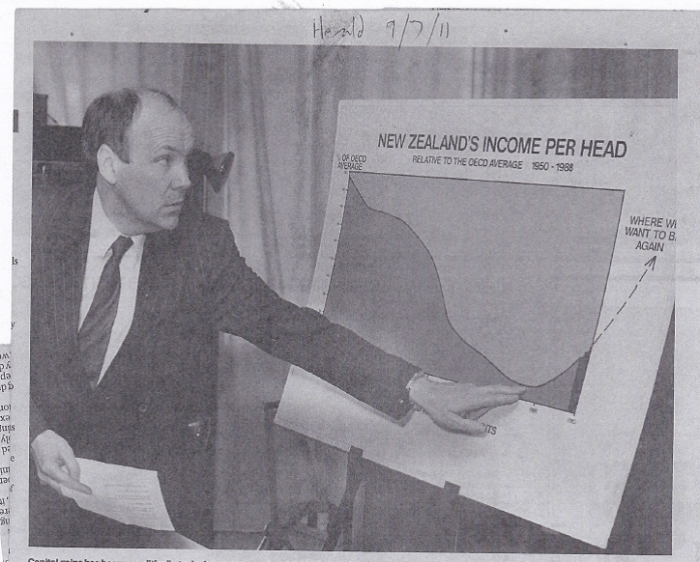
I chose 1989 for the cross-country comparisons for the practical reason that 1989 is when the consistently-compiled New Zealand data go back to. But it was also David Caygill’s first year in office as Minister of Finance.     I’ve shown previously this photo in which he was illustrating his aspirations.

caygill 1989 expectations

But like his predecessors for several decades before him, and all his successors – including those in the last Labour government and the current National government – he failed. Terms of trade windfalls have help our incomes, but over the longer-term improved living standards – catching up with other countries – depends on improved productivity performance.  Our governments have consistently failed that test, and I can’t see anything in the current electoral offerings that seems likely to change the picture in, say, the next decade.

Productivity growth in perspective

Someone sent me a copy of a press release put out today by the Minister of Finance, Steven Joyce, is his capacity as the chair of National’s campaign.    In it he claims that productivity growth over National’s term of government has exceeded that when Labour was last in office, and has exceeded that of many other OECD countries.

On the latter claim, over the whole of government’s term in office, my view is that it is a broadly fair description.  I’ve put out posts noting that we’ve been no better than middling over the whole period since just prior to the recession and financial crisis.  That didn’t seem to me to be a particularly good performance, in view of the fact that (a) we had a big lift in the terms of trade, (b) we didn’t have a domestic financial crisis, (c) weren’t in the euro and (d) we didn’t run out of room to use conventional monetary policy.  Oh, and we had a big levels gap –  we were a lot poorer –  and were supposed to be about catching up.

But my comments, and those of J B Were economist Bernard Doyle, have focused on the last five years or so.   Since then, on New Zealand official numbers, our productivity has gone slightly backwards –  ie the level now is slightly less than it was five years ago.    That is sufficiently stark, and has now gone on for long enough, that it seems worth singling out.   What, one might wonder, would be likely to turn that around?  (Frankly, I’ve seen nothing from either main party  –  or, for the avoidance of doubt, minor parties – that seems very promising.)   It is difficult to get very up-to-date useful data for many other countries, but over that five years we have certainly done less well than the US and Australia.

What about comparisons across terms of government?  We can only calculate the GDP per hours work series back to 1987, so I’ve shown  productivity growth in the term of the 1990s National government (1990q4 to 1999q4), the Labour government of the 2000s (1999q4 to 2008q4), and the current government (from 2008q4 with GDP data only available to 2017q1). I’ve also shown the last five years.

For each of those periods I’ve also shown the exactly comparable data for Australia.   Australia is one of the few countries for which exactly comparable (real, quarterly, national currency) data are available.  They are shown on the ABS website.  Australia is also a relevant comparator because (a) it didn’t have a domestic financial crisis, or (b) run out of monetary policy room, and (c) because it is the easiest alternative option for New Zealanders (migrating) and a standard historical comparator.  The aspiration of catching Australia was one the current government articulated when it came into office.

As a reminder, for New Zealand I have:

  • averaged the two real GDP series (expenditure and production).  Using one or the other alone will produce slightly different numbers, but there is no obvious reason to prefer one over the other, and
  • divided the resulting series by the HLFS hours worked series, and
  • corrected for a series break in the HLFS hours worked series in June 2016, when the survey question was changed.  Not correcting for that would lower productivity growth estimates over the last few years by a further 2 per cent.

And this is the resulting table [UPDATE: with some very minor corrections]

Cumulative growth in real GDP per hour worked (per cent)
NZ Australia
National (90q4 to 99q4) 8.5 20.7
Labour (99q4 to 08 q4) 12.1 12.4
National (08q4 to 17q4) 6.7 13.7
Last five years (to 17q1) -0.2 7.5

As it happens, in not a single one of these particular periods did productivity growth in New Zealand exceed that in Australia  (although there will be shorter periods where we did).

There are other measures of course, but real GDP per hour worked is a pretty standard basis for comparison.  And to make such comparisons of growth rates sensibly (as distinct from levels comparisons) one shouldn’t use PPP-converted data but rather real national currency data as I have done here.

As a caveat, governments can’t take all the credit or all the blame for productivity trends in their time in office.  International trends matter, and even policies work with a lag.  Recessions affect comparisons – and I don’t suppose anyone is going to suggest the 2008/09 recession was either New Zealand party’s fault.      Partly for that reason I’ve suggested focusing on the distinctive, and disconcerting, New Zealand productivity performance over the last five years.  The relevant growth number is zero (or marginally worse).

Productivity, wages, and other debate thoughts

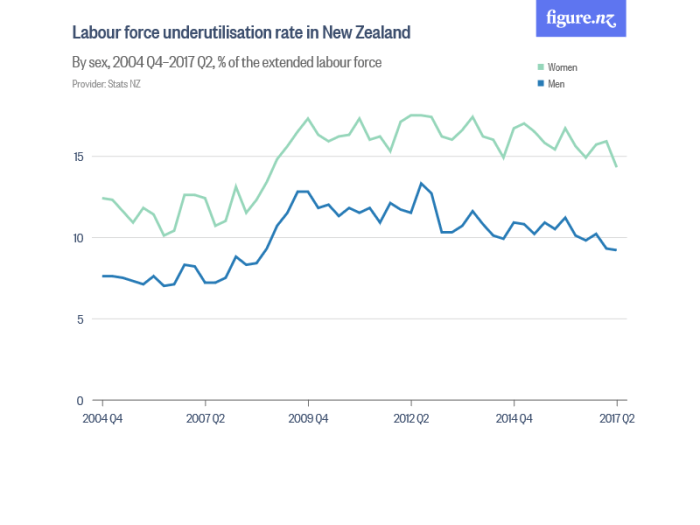
Like many, I watched the major party leaders’ debate last night.   It was civil and courteous, playing the issues rather than the person.  So far, so good.  But sadly neither leader seemed to offer anything very substantial on fixing our pressing economic challenges, or even show any real sign of understanding the issues.     At a time when the unemployment is still well above what it was a decade ago, when the underutilisation rate for women is still almost 15 per cent…..

underutilisation

…when there has been no productivity growth for five years, and when the export share of GDP has been shrinking, the Leader of the Opposition seemed content to concede that the economy was in good shape.  “Relentlessly positive”  I suppose.

Not that the Prime Minister was having a bar of any concerns about productivity.   As Newsroom put it

English dismissed outright a report from sharebroker J B Were which concluded the country had a productivity recession. They were wrong. “They are way over-stating the case. Productivity in New Zealand has been growing pretty well….

Well, you can read the J B Were piece for yourself.  I did when it came out, and did again this morning.   It made many of the points I’ve been making here for some time.    There isn’t anything in the economic side of the report I’d materially disagree with.  The data –  as officially reported by Statistics New Zealand –  speak for themselves on the productivity underperformance, particularly over the last five years.

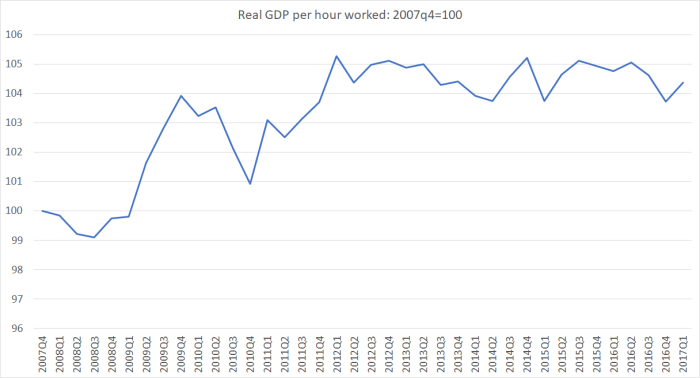
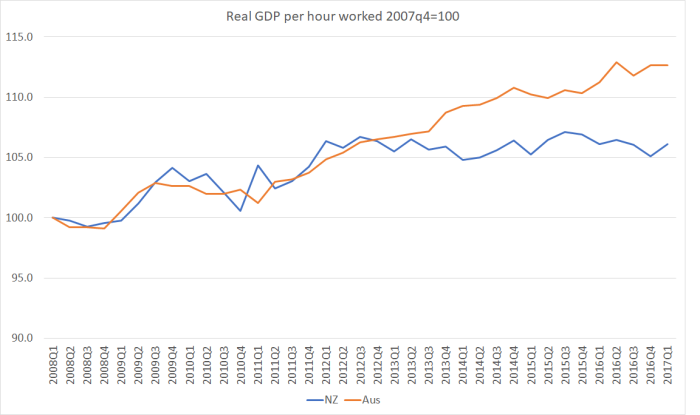
I’ve run this chart numerous times before.

real GDP phw july 17 Not only have we had no labour productivity growth for five years, but our near-neighbour Australia –  which the government was once willing to talk about catching up to – has gone on generating continuing labour productivity gains.    Yes, there has been a productivity growth slowdown in much of the advanced world, dating back to around 2005.    But our additional and more recent slowdown –  well, dead stop really – looks like something different, and probably directly attributable to New Zealand specific factors.   Things New Zealand governments have responsibility for responding to.

I’ve also shown this chart before –  labour productivity for the better-measured parts of the economy, with SNZ’s attempt to adjust for changing labour quality. It is annual data, and only available with a bit of lag.

market sector LP

Again, no labour productivity growth at all in the last few years.

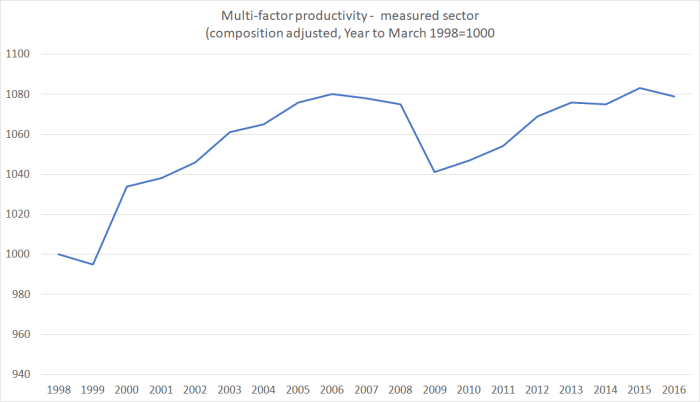
And what about multi-factor productivity growth?  It doesn’t get as much attention, partly because the data are only annual, and the construction of these estimates involves quite a few assumptions.   Nonetheless, here is the SNZ estimate for the (better) measured bulk of the economy.

mfp to 2016

The series is cyclical –  if machines are idle in a recesson estimated MFP falls and then recovers as utilisation picks up –  but looking through the recession, the estimated index level of MFP is the same now as it was 10 years previously.  No growth.

But somehow the Prime Minister thinks “productivity in New Zealand has been growing pretty well”.    One for the Tui billboards I’d have thought.

And all that is without even getting into the lamentable failure of governments led by both main parties to do anything about reversing the precipitous decline in levels of productivity in New Zealand relative to those in other advanced economies.    Lifts in the terms of trade –  experienced under both this government and its predecessor –  are of course welcome, but they can’t be a credible medium-term substitute for productivity growth.

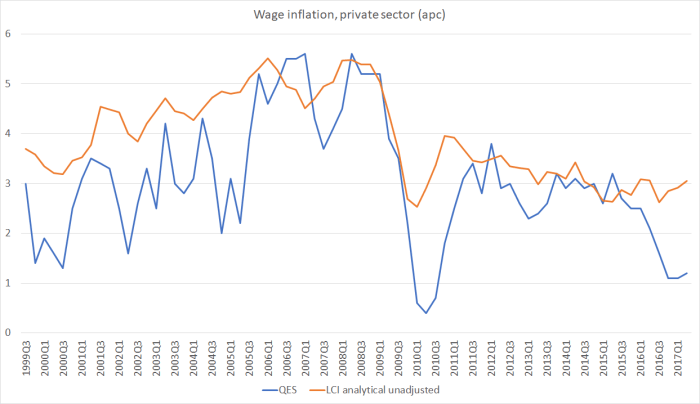
From the other side, the Leader of the Opposition’s suggestion that data on real wage growth didn’t matter, and what really mattered was how people felt, seemed almost equally risible.  In terms of attracting votes, perhaps she is right.   But when the Prime Minister pointed out that real wages have been rising, he was of course correct.  I’m not sure why people put so much weight on the QES measure of hourly wage inflation.  It has well-known problems (for these purposes) and is hugely volatile.   Here is a chart showing wage inflation for the private sector according to (a) the QES, and (b) the Labour Cost Index, analytical unadjusted series.

wages debate  No economic analyst thinks wage inflation is anything like as volatile as the blue line –  in fact, wage stickiness, and persistence in wage-setting patterns is one of the features of modern market economies.

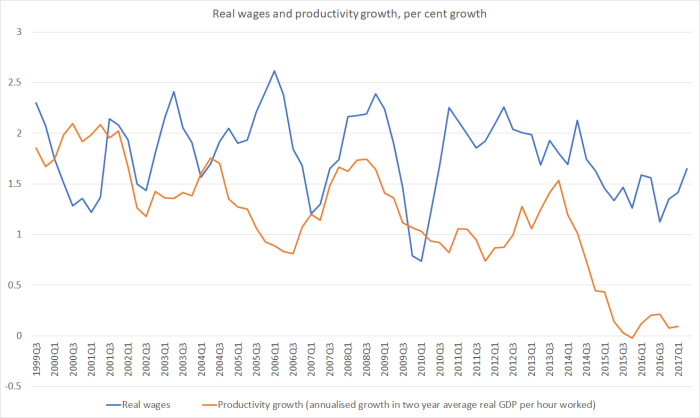
And here is the chart I ran last week, comparing real private sector wage inflation (the orange line above, adjusted for the sectoral core measure of CPI inflation) with productivity growth.

Real wage inflation now is lower than it was in the pre-2008 boom years, but it is running well ahead of productivity growth (however one lags or transforms it).    From here, lifting productivity growth is the only way real wage inflation is going to increase, and such increases in economywide productivity really should be recognised for what they are –  a well overdue imperative.

Sadly, the Prime Minister seems to want to bluff his way through, simply pretending there isn’t an issue, with no real answers as to how to  (for example) lift the outward-orientation (exports and imports) of the New Zealand economy, and refusing to face the fact that productivity growth has vanished since the latest new large net migration inflow began in 2013.  It won’t be the only reason why productivity growth has been vanished, but it is unlikely that there is no connection at all (and certainly the much-vaunted official and political claims that high non-citizen immigration flows are helping lift productivity look emptier than ever).

And the Opposition leader is no better.    When Ardern was asked last night who was going to build the houses if immigration was cut back, my 14 year old son turned to me and asked “why doesn’t she just say that if there are fewer migrants fewer houses would need to be built”.   Sadly, I could only point out that Labour’s approach to immigration actually isn’t materially different to the National Party’s.  The net inflow might be a lower in the first year, but in the essentials they are two sides of the same coin.  Here is what I wrote when Labour released their policy in June.

Overall, some interesting steps, some of which are genuinely in the right direction.  But, like the government, Labour is still in the thrall of the “big New Zealand” mentality, and its immigration policy –  like the government’s – remain this generation’s version of Think Big.  And it is just as damaging.    The policy doesn’t face up to the symptoms of our longer-term economic underperformance –  the feeble productivity growth, the persistently high real interest and exchange rates, the failure to see market-led exports growing as a share of GDP, and the constraints of extreme distance.  None of those suggest it makes any sense to keep running one here of the large non-citizen immigration programmes anywhere in the world, pulling in lots of new people year after year, even as decade after decade we drift slowly further behind other advanced countries, and se the opportunities for our own very able people deteriorate.

And what is Labour’s solution to the economic challenges?   There is lots of talk about more skills training, even though the OECD surveys suggest that our people are already among the most skilled in any OECD country.       Beyond that, Jacinda Ardern was invoking the OECD –  “they’ve told us what we need to do” to lift productivity and economic performance.

Well, this table is from the latest OECD Economic Survey of New Zealand, released a few months ago.  On the left hand side are the “main findings” and on the right the “key recommendations”

OECD recs

I don’t wildly disagree with most of those recommendations –  sceptical as I am of R&D subsidies.     But (a) with the exception of R&D subsidies, does this look at all like Labour Party economic policy  (has there been talk of the tax working group possibly proposing lower capital taxes?), and (b) more importantly, does anyone really think that these items, even taken together, are remotely enough to materially reverse the decades long decline in our relative productivity performance, that the OECD themselves highlighted?

Sadly, there was all too much of “let’s pretend” to the debate, and nothing to suggest that either side is really serious about engaging with, and delivering solutions to, the decades of underperformance, presenting now in five years of no productivity growth at all, and an economy increasingly skewed inwards rather than outwards.


Wages and profits

There was a story buried deep in the Dominion-Post this morning that caught my eye.   The heading was “Profits up as wages stand still“,  and the article was prompted by the release yesterday by Statistics New Zealand of some summary results from the Annual Enterprise Survey.

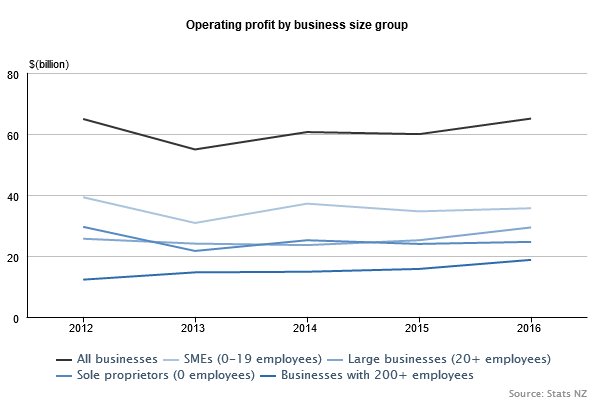
In their media release yesterday, SNZ –  true to their apparent policy of accentuating the positive – was at pains to highlight the increase in profits over the 2015/16 year.   Overall, operating profits in the business sector had risen by 8.6 per cent –  rather faster than the increase in nominal GDP.

But it was this chart in the SNZ release that caught my eye

profits AES

Profits had certainly increased quite a bit  in 2015/16, but look at that top line.  Total profits in 2015/16 were no higher ($bn) than they had been in 2011/12, and yet over that period nominal GDP had increased by just over 17 per cent.  On this measure, profits as a share of GDP would have fallen quite a bit over those four years.

In the Dom-Post article,  the journalist had juxtaposed the increase in profits over the last year with the very weak increase in wages, at least according to the Quarterly Employment survey.  Lobby group representatives were quoted in a fairly predictable way.

Council of Trade Unions economist Bill Rosenberg said the statistics were more evidence that the share of income going to wages and salaries was falling.
“That indicates wages are not keeping up with what the economy’s income could actually afford.”
The share of income going to wages in New Zealand was low internationally, he said. “To see it fall further is very disturbing. It is an indication we are a low-wage economy.”

and

Kirk Hope, chief executive of BusinessNZ, said the increase in company profits meant jobs were more secure.
It was also positive for “the many thousands of New Zealanders”, including Kiwisaver investors, who now owned shares and who would be receiving increased dividends, he said.
“Wage growth is not the only responsibility companies must address.
“A proportion of company profits must be reinvested to safeguard the future existence of the company; without that investment there will be no ability to maintain or grow jobs.”
Business profits can jump around significantly from year to year, but even taking a longer-term view, Statistics NZ figures show they appear to be greatly outstripping pay rises.

And when the journalist did take a long-term perspective, he looked at profit increases since 2009, and compared them to wage increases since then, even though 2009 was the worst of the severe recession, and profits are typically much more cyclically variable than wages.

But, as I noted in a post the other day, if one uses the more-stable and better-constructed Labour Cost Index measures, it looks as though real wages in recent years have been materially outstripping the (non-existent) productivity growth.    Real wage inflation hasn’t been high in absolute terms, but it has been a lot faster than any gains in productivity.

real wages and productivity growth

In the wake of that post, I’d also gone back and dug out from the national accounts the data on the wages and salaries (“compensation of employees”) share of GDP.    The data go all the way back to 1972.

COE

Broadly speaking, the national accounts suggest that the labour share of GDP has been increasing for almost 15 years now (the latest data are the year to March 2016).    Even from the peak of the last boom (year to March 2008) to now, the labour share of GDP has increased a bit further.

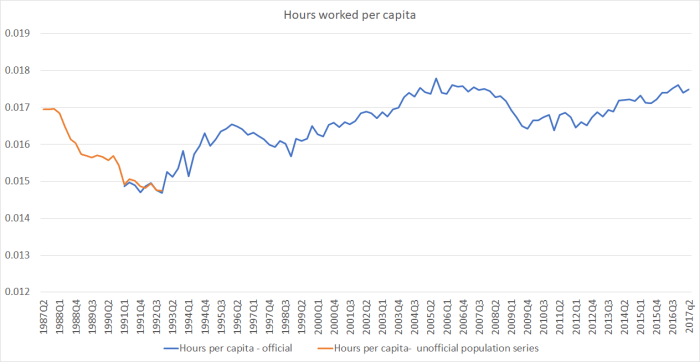
And it isn’t because more people are working more hours.   Here is a chart of hours worked per capita.

hours per capita

Total hours worked per capita are still slightly below the previous cyclical peak.   To the extent that the labour share of GDP has been increasing, it looks to have been a result of relatively good (relative to productivity) increases in wages.

As for profits, they are (more or less) the inverse of the labour share of income: they’ve been falling over the last 15 years.

Overall economic performance remains dismal, redeemed only by the strength of the terms of trade.  But relative to that disappointing performance –  weak productivity growth, growth skewed to the non-tradables sector –  labour (as a whole) doesn’t seem to have been missing out.

Wage inflation: surprisingly high

There is plenty of talk about weak wage inflation, here and abroad.

Mostly, I have tried not to put too much weight on New Zealand wages data.  I’m not always consistent, and higher nominal wage inflation is probably one of things we should normally be expecting to see if core inflation was really heading back to 2 per cent.    But, one can’t really bang on about how there has been no labour productivity growth (reported by SNZ) for almost five years now, and expect much in the way of wage inflation.   And I’m not one of those who thinks that immigration surprises tend to dampen wages (relative to GDP per capita, or productivity, that is): they may do so in certain specific occupational areas where there is a particular large presence of migrants, but generally –  as New Zealand economists have believed for decades –  immigration surprises add more to demand (including demand for labour) than they do to supply, at least over the first few years following a migration influx.    With the unemployment rate still somewhat above most estimates of the NAIRU, one probably shouldn’t really expect much acceleration of wage inflation, but there isn’t any obvious reason why workers should be doing particularly poorly relative to the rest of the economy.   Overall, of course, the economy isn’t doing that well; weak per capita GDP growth, and no productivity growth.

But listening to Steven Joyce talking about wages on Morning Report this morning  prompted me to dig out and play with some relevant data.

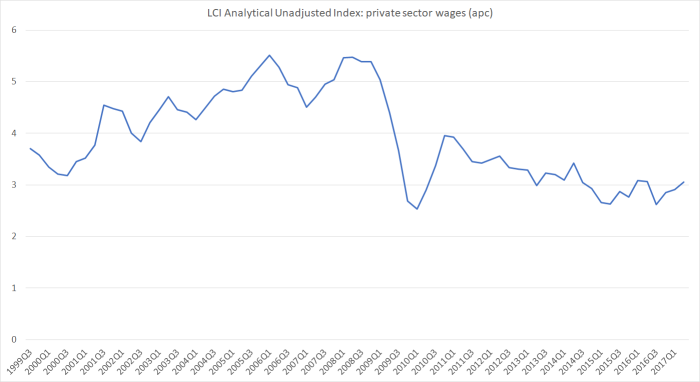
My preferred measure of wage inflation is taken from the Labour Cost Index.  The LCI series that get lots of coverage purport to adjust for changes in productivity etc.  I don’t have a great deal of confidence in the adjustment (mostly because it is a bit of a black box to outsiders), and so I prefer to use the Analytical Unadjusted Index of private sector wages (ie the data before the productivity adjustments).

analy unadj wages

It is a relatively smooth series.  Wage inflation picked up a lot during the 2000s boom, slumped in the recession and after an initial recovery seems to have been tailing off somewhat since then.

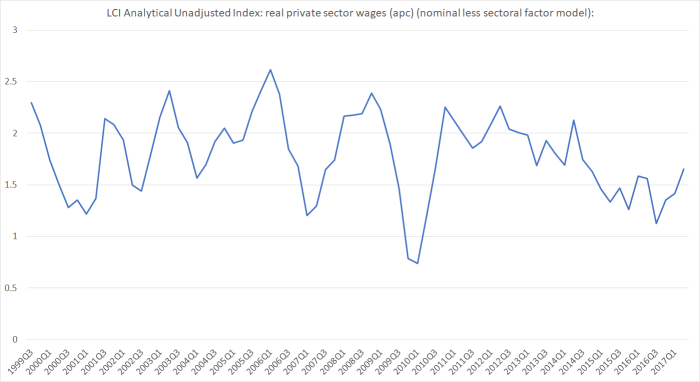
But this is a measure of nominal wages.  And inflation is a lot lower than it was.  Here is the same series adjusted for the Reserve Bank’s sectoral core factor model measure of inflation.

real wages

It is a noisier series (suggesting that perhaps parties bargain in nominal terms, rather than having reals in mind), although it is pretty unmistakeable that the average rate of real wage increases has been lower in recent years than in most of the earlier period.   I could have done that chart with some smoothed moving average of CPI inflation but (a) lots of the short-term fluctuations in the CPI aren’t things that should affect wages (eg changes in ACC levies or tobacco taxes) and (b) doing so would actually only make the gap shown in the next chart larger and more striking.

Over time, one might expect real wage inflation to roughly equal the rate of growth in labour productivity.   Productivity growth is, by and large, the way living standards improve, and for most people real wages rates are an important element in their potential living standards.

One wouldn’t expect those relationships to hold in the very short-term. There are measurement problems in each of the series (wages, inflation, and productivity).  There is also a great of short-term volat5ility in the published series that are used to generate the productivity estimates.   And if labour is particularly scarce, or abundant, bargaining outcomes can easily differ for a time from what a productivity growth benchmark might suggest.  Finally, a sustained lift in the terms of trade can also lead to real wages rising faster than real productivity measures.

In this chart I’ve shown real wages (same measure as above) and smoothed growth in labour productivity (real GDP per hour worked).  I’ve taken the quarterly observations for the last two years, compared them to the quarterly observations for the previous two years (and so on) and then converted the result back into an annualised growth rate.  There are plenty of other ways of smoothing the series, but none is going to change the fact that we have had no (reported) productivity growth for a number of years now.   My particular measure provides a reasonably smooth series for productivity growth, consistent with my prior that to the extent inflation and productivity affect wage bargaining they are likely to do so in a smoothed or trend sense.   Anyway, here is the resulting chart.

real wages and productivity growth

It hasn’t been a particularly close relationship over the (relatively short) history of the data.  On average, real wage inflation (on this measure, although it is also true using a smoothed CPI measure of inflation) has grown faster than measured productivity over much of the period, perhaps consistent with the step up in the terms of trade from around 2004. (The remaining small upward biases in the CPI work in the other direction, understating real wage growth).

But the gap between the two lines at the end of the period is strikingly large and seems to have become quite persistent.  Real wage inflation –  although quite a bit slower than it was – still appears to be running much faster than productivity growth in recent years looks able to have supported.

If so, that represents a real exchange rate appreciation, representing a deterioration in the competitiveness of many of our producers.  Looking ahead, and since we can’t count on the terms of trade appreciating for ever (for all their ups and downs, over 100 years they’ve been basically flat)  we need to see some material acceleration in productivity growth or we are likely to see real wage growth falling away further still.   For all the talk of moderate wage inflation in countries such as the US, not many countries (and certainly not the US and Australia) have had no productivity growth at all in the last five years.  The puzzle in other countries may be why real wage inflation is so low, but here the focus should probably be on why it is still so high.


Economic performance

The second half of the Grant Robertson/Steven Joyce debate on Sunday was around things to do with overall economic performance and management.

On one thing they agreed: Winston Peters’ proposal that New Zealand should adopt a Singapore-style approach to monetary policy and the exchange rate isn’t an option for New Zealand.  I agree with them, and explained why in a post a few months ago.

Grant Robertson reminded viewers that John Key had promised to close the gaps between New Zealand incomes and productivity and those in Australia, noting that no progress has actually been made.   Steven Joyce likes to push-back by citing numbers that suggest that after-tax real wages have been rising faster here than in Australia.    When I’ve looked at that claim previously, a lot appeared to depend on which exchange rate one used to convert wages in the two countries into a common currency.  Using PPP exchange rates, the gap has actually widened a bit further.    Comparing wage series across countries isn’t that easy –  countries measure things differently, and things that are effectively part of remuneration (eg employer superannuation contributions) often aren’t included.

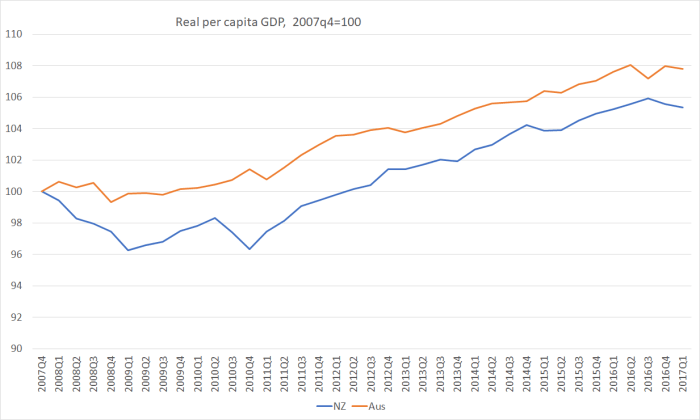
Personally, I prefer to focus on economywide measures, which are compiled in a consistent manner across countries.   Here is real GDP per capita for the two countries, indexed to 2007q4, just before the global downturn/recession began.

real gdp pc nz and aus

I could have started the chart a few quarters later, to coincide with the change of government.  Either way, no progress at all has been made in closing the gap to Australia.

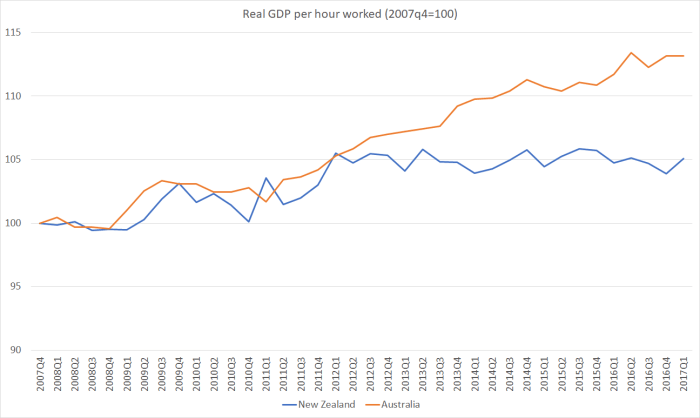
Things look worse if we focus on labour productivity (real GDP per hour worked).

real gdp phw nz and aus aug 16

Best summary?  We haven’t lost much ground against Australia when we focus on GDP per capita, but since relative productivity has dropped away badly we’ve only maintained even that mediocre real GDP per capita record by working even longer hours on average.

But if the government’s record is pretty poor, it isn’t clear that the Labour Party is offering anything much different.   It is all very well to criticise the current government for making no progress in closing the gaps, but Labour doesn’t even seem to be talking about doing so.    Robertson did highlight the four or five years now of zero productivity growth, and talked of needing a plan for something different.  But it wasn’t obvious from anything he said, or anything I’ve read, quite what the plan is, that might be equal to the challenge.   There is plenty of talk of lifting skills –  but the OECD data already suggest New Zealand skills levels are among the very highest among advanced countries.    There is talk of a tax working group, with an apparent presumption that that is likely to lead to a capital gains tax.  And there is talk of R&D tax credits.  But I doubt anyone –  even those who support such measures – believes that they are remotely enough to make the sort of difference closing the gaps to Australia might involve.

Of course, the National Party’s position seems no better.  The Minister’s rhetoric is that people are voting with their feet and realising that the jobs and incomes are now here.  Sure, the annual outflow of New Zealanders to Australia has dropped, but it is still an outflow each and every year.   And no one seriously thinks other than that average incomes in Australia remain much higher than those here.  But it is tougher to get established in Australia at present –  that’s a bad thing for New Zealanders, not a good one.

Steven Joyce was touting the success of certain subsets of firms exporting from New Zealand.  It is perhaps easy to forget that the government has long had a goal of substantially increasing the export share of GDP (and, presumably, the import share, since we export to import –  sell stuff to other people so that we can consume ourselves).

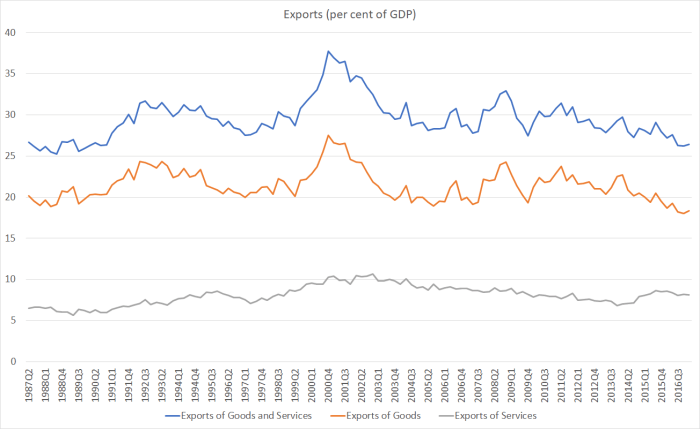
Here are exports as a share of GDP.

exports joyce It is easy for one’s eye to go to those peaks in 2000 –  at a time when the exchange rate had fallen sharply – but even much more recently the trends haven’t been favourable.  Even the vaunted services exports are lower now as a share of GDP than they were 10 years ago, or than when the government came to power.   The Minister talked of “high-tech value-added manufacturing” as the future, but then overall goods exports are lower as a share of GDP now than at any time in the last 30 years.

Mr Joyce talked of a slump in global trade, as if our experience was just something like everyone else had experienced.  But even that isn’t true.     The share of exports in GDP for the median OECD country has increased by around 5 percentage points in the last decade.  In that decade before that, it increased by about 6 percentage points.

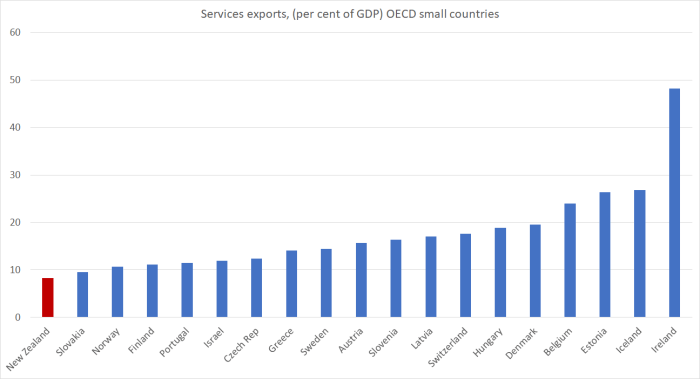
And for all the talk of services exports, here are exports of services as a per cent of GDP for New Zealand and the other small OECD countries.

services x small countries

Grant Robertson was prepared to go as far as to say that the exchange rate is “too high”.  Artificially lowering it wasn’t, we were told, the answer (and I’d agree, if by that he meant eg a Singapore-style monetary policy).  But there was no hint of how Labour thought a lower exchange rate might be brought about in a more sustainable manner.

New Zealand has faced some obstacles to growing the tradables sector of our economy in the last decade.  The earthquakes meant that real resources had to be used for other things –  repair and rebuild –  and other activities had to make room.  Policymakers have known this since the very days after the earthquakes occurrred.  The substantial amount of offshore reinsurance just reinforced the way in which the earthquakes represented a large shock skewing the economy for a time more towards the non-tradables sectors.

But what was extraordinary is that the same policymakers allowed, and cheered on, another even bigger non-tradables-skewing shock.

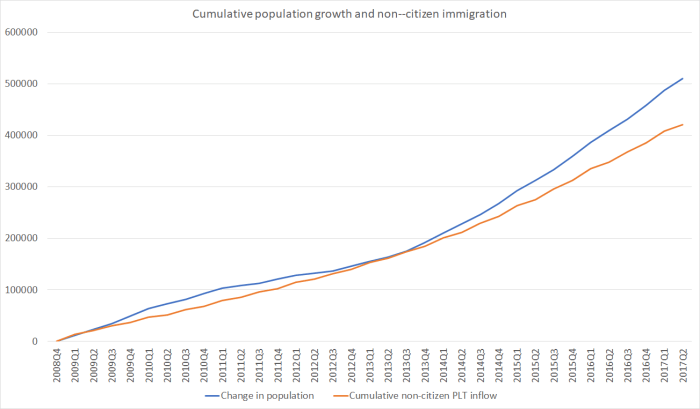
Here is a chart showing cumulative population growth since National took office, and the cumulative inflow of non-citizens (the PLT data, with all their pitfalls).

popn and immigration

We’ve had a 510000 increase in population over the term of this government, 421000 of which is accounted for by the net inflow of non-citizens.    The fertility and migration choices of New Zealanders would, all else equal, have given us only around 2 per cent population growth over the eight and half years, putting a great deal less pressure on

  • housing markets
  • other infrastructure
  • the physical environment, and
  • the tradables sector as a whole.

Remember that each new arrival need a lot more physical capital stock than is accounted for by the labour those people supply early on.   Policy has been deliberately skewing our economy away from the tradables sector.    We’ve had a net non-citizen migration inflow of almost exactly 300000 people in just the last five years.   With no productivity growth at all in that time, and an export (and import) sector shrinking as a share of GDP, and business investment pretty subdued too, one might reasonably ask ‘to what end?’ for New Zealanders.

We should be left wondering why, if we vote for them, either main party expects anything different than the mediocre economic performance of the last few years.   Gareth Morgan criticised Labour’s apparent lack of much policy substance  as “putting lipstick on a pig”.  It isn’t obvious that the National Party is even offering the lipstick.

And all this is without even repeating for the umpteenth time that the unemployment rate now is still higher than it was at any time in the last five years of the previous Labour government, at a time when demographics appear to be lowering the natural rate of unemployment.  Or the underutilisation rate of almost 12 per cent.      We should be able to do a great deal better for New Zealanders.


Doomed to repeat history…..or not

Last week marked 10 years since the pressures that were to culminate in the so-called “global financial crisis” burst into the headlines .

Local economist Shamubeel Eaqub marked the anniversary in his Sunday Star-Times column yesterday.  It grabbed my attention with the headlines Ten years on from the GFC” and “We appear dooomed to repeat history” .  

Frankly, it all seemed a bit overwrought.

It seems inevitable that there will be yet another crisis in the global financial system in the coming decade.

There have been few lessons from the GFC. There is more debt now than ever before and asset prices are super expensive. The next crisis will hopefully lead to much tighter regulation of the financial sector, that will force it to change from its current cancerous form, to one that does what it’s meant to.

The first half of the column is about the rest of the world.  But what really caught my attention was the second half, where he excoriates both the Reserve Bank and the government for their handling of the last decade or so.    This time, I’m defending both institutions.

There are some weird claims.

We were well into a recession when the GFC hit. So, when global money supplies dried up, it didn’t matter too much, because there was so little demand to borrow money in New Zealand anyway.

Here he can’t make his mind as to whether he wants to date the crisis to, say, August 2007 (10 years ago, when liquidity pressures started to flare up) or to the really intense phase from, say, September 2008 to early 2009.

Our recession dates from the March quarter of 2008 (while the US recession is dated from December 2007), but quite where he gets the idea that when funding markets froze it didn’t matter here, I do not know.  Banks had big balance sheets that needed to be continuously funded, whether or not they were still expecting any growth in those balance sheets. And they had a great deal of short-term foreign funding.  Frozen foreign funding markets, which made it difficult for banks to rollover any such funding for more than extremely short terms, made a huge impression on local banks.  For months I was in the thick of our (Treasury and Reserve Bank) efforts to use Crown guarantees to enable banks to re-enter term wholesale funding markets.  Banks were telling us that their boards wouldn’t allow them to maintain outstanding credit if they were simply reliant on temporary Reserve Bank liquidity as a form of life support.

Despite what he says I doubt Eaqub really believes the global liquidity crunch was irrelevant to New Zealand, because his next argument is that the Reserve Bank mishandled the crisis.

The GFC highlighted that our central bank is slow to recognise big international challenges. They were too slow to cut rates aggressively. They were not part of the large economies that clubbed together to co-ordinate rate cuts and share understanding of the crisis.

I have a little bit of sympathy here –  but only a little.  I well remember through late 2007 and the first half of 2008 our international economics people patting me on the head and telling me to go away whenever I suggested that perhaps events in the US might lead to something very bad (and I’m not claiming any great foresight into just how bad things would actually get).  And I still have a copy of an email from (incoming acting Governor) Grant Spencer in August 2007 suggesting that it was very unlikely the international events would come to much and that contingency planning wasn’t worth investing in.

And, with hindsight, of course every central bank should have cut harder and earlier.  I recall going to an international central banking meeting in June 2007 when a very senior Fed official commented along the lines of “some in the market are talking about the prospect of rate cuts, but if anything we are thinking we might have to tighten again”.

As for international coordination, well the Reserve Bank was part of the BIS –  something initiated in Alan Bollard’s term.  Then again, we were tiny.   So it was hardly likely than when various central banks did coordinate a cut in October 2008 they would invite New Zealand to join in.  Of its own accord, the Reserve Bank of New Zealand cut by 100 basis points only two weeks later (having already cut a few weeks earlier).

But what did the Reserve Bank of New Zealand actually do, and how did it compare with other advanced country central banks?

The OECD has data on (a proxy for) policy rates for 19 OECD countries/regions with their own currencies, and a few other major emerging markets.   Here is the change in the policy rates between August 2007 (when the liquidity pressures first became very evident) and August 2008, just before the Lehmans/AIG/ agencies dramatic intensification of the crisis.
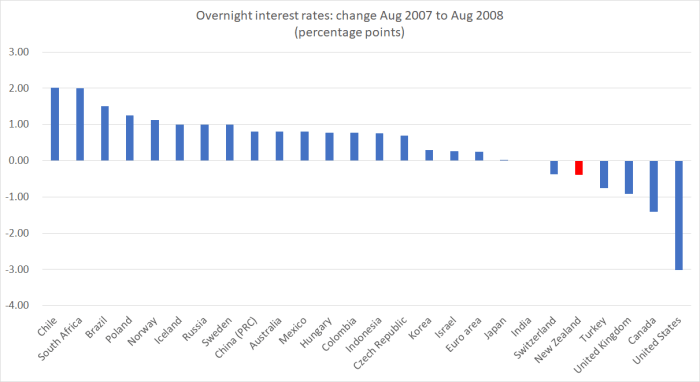
policy rate to aug 08

The Reserve Bank had cut only once by this time.  But most of these countries had done nothing to ease monetary policy.  It wasn’t enough, but it wasn’t exactly at the back of the field, especially when one recalls that at the time core inflation was outside the top of the target range, and oil prices had recently been hitting new record highs.

That was the record to the brink of the intense phase of the crisis.  Here is the same chart showing the total interest rate adjustment between August 2007 and August 2009 –  a few months after the crisis phase had ended.
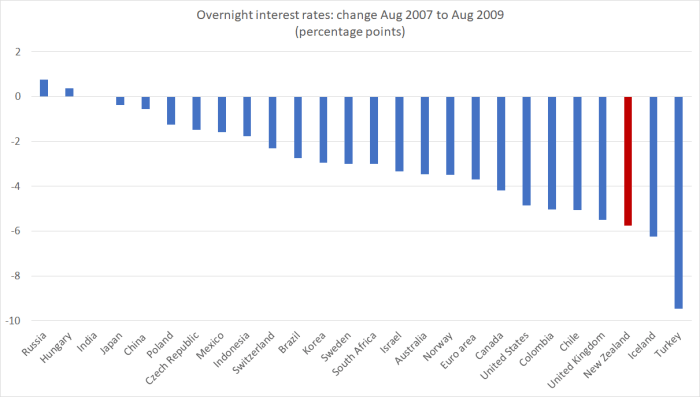
policy rate to aug 09

Only Iceland (having had its own crisis, and increased interest rates, in the midst of this all) and Turkey cut policy rates more than our Reserve Bank did.   In many cases, the other central banks might like to have cut by more but they got to around the zero bound.  Nonetheless, the Reserve Bank cut very aggressively, to the credit of the then Governor.  It was hardly as if by then the Reserve Bank was sitting to one side oblivious.

Obviously I’m not going to defend the Reserve Bank when, as Eaqub does, he criticises them for the mistaken 2010 and 2014 tightening cycles.  And the overall Reserve Bank record over several decades isn’t that good (as I touched on in a post on Friday), but their monetary policy performance during the crisis itself doesn’t look out of the international mainstream.   Neither, for that matter, did their handling of domestic liquidity issues during that period.

Eaqub also takes the government to task

The government bizarrely embarked on two terms of fiscal contraction. This contraction was at a time of historically low cost of money, and a long list of worthy infrastructure projects in housing and transport.

Projects that would have created long term economic growth and made our future economy much more productive, tax revenue higher, and debt position better.

Our fiscal policy is economically illiterate: choosing fiscal tightening at a time when the economy needed spending and that spending made financially made sense.

To which I’d make several points in response:

  • our interest rates, while historically low, remain very high relative to those in other countries,
  • in fact, our real interest rates remain materially higher than our rate of productivity growth (ie no productivity growth in the last four or five years),
  • we had a very large fiscal stimulus in place at the time the 2008/09 recession hit, and
  • we had another material fiscal stimulus resulting from the Canterbury earthquakes.

Actually, I’d agree with Eaqub that the economy needed more spending (per capita) over most of the last decade –  the best indicator of that is the lingering high unemployment rate – but monetary policy is the natural, and typical, tool for cyclical management.

And, in any case, here is what has happened to gross government debt as a share of GDP over the last 20 years.
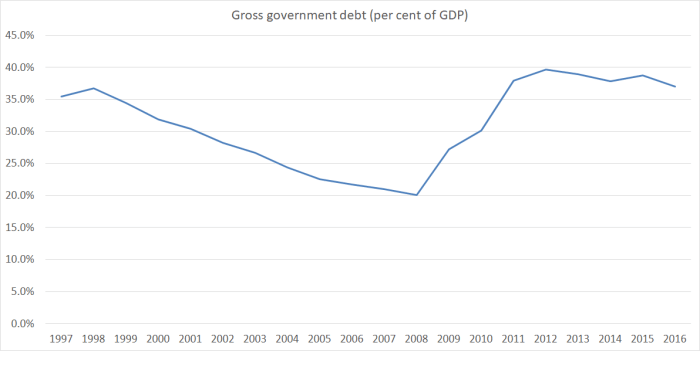
gross govt debt

Not a trivial increase in the government’s debt.   Not necessarily an inappropriate response either, given the combination of shocks, but it is a bit hard to see why it counts as “economically illiterate”.  Much appears to rest on Eaqub’s confidence that there are lots of thing governments could have spent money on that would have returned more than the cost of government capital.  In some respects I’d like to share his confidence.  But I don’t.   Not far from here, for example, one of the bigger infrastructure projects is being built –  Transmission Gully –  for which the expected returns are very poor.

Eaqub isn’t just concerned about how the Reserve Bank handled the crisis period.

Our central bank needs to own up to regulate our banks much better: they have allowed mortgage borrowing to reach new and more dangerous highs.

I’d certainly agree they could do better –  taking off LVR controls for a start.  But bank capital requirements, and liquidity requirements, are materially more onerous than they were a decade ago.  And our banking system came through the last global crisis largely unscathed –  a serious liquidity scare, but no material or system-threatening credit losses.  Their own stress tests suggest the system is resilient today.  If Eaqub disagrees, that is fine but surely there is some onus on him to advance some arguments or evidence as to why our system is now in such a perilous position.

Macro-based crisis prediction models seem to have gone rather out of fashion since the last crisis.  In a way, that isn’t so surprising as those models didn’t do very well.     Countries with big increases in credit (as a share of GDP), big increases in asset prices, and big increases in the real exchange rate were supposed to be particularly vulnerable.  Countries like New Zealand.   The intuitive logic behind those models remained sound, but many countries had those sorts of experiences and had banks that proved able to make decent credit decisions.  And we know that historically loan losses on housing mortgage books have rarely been a key part in any subsequent crisis.     Thus, the domestic loan books of countries like New Zealand, Australia, Canada, the UK, Norway and Sweden all came through the last boom, and subsequent recession, pretty much unscathed.

One of the key indicators that used to worry people (it was the centrepiece of BIS concerns) was the ratio of credit to GDP.  Here is private sector credit as a per cent of GDP, annually, back to when the Reserve Bank data start in 1988.
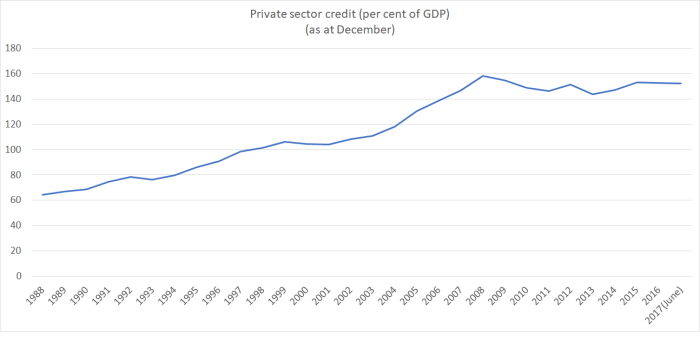
psc to gdp

Private sector credit to GDP was trending up over the two decades leading up to the 2008/09 recession.   There was a particularly sharp increase from around 2002 to 2008 –  I recall once getting someone to dig out the numbers suggesting that over this period credit to GDP had increased more in New Zealand than it had increased in the late 1980s in Japan.  It wasn’t just housing credit.  Dairy debt was increasing even more rapidly, and business credit was also growing strongly.   There was good reason for analysts and central bankers to be a bit concerned during that period.  But what actually happened?  Loan losses picked up, especially in dairy, but despite this huge increase in credit –  to levels not seen as a share of GDP since the 1920s and 30s – there was nothing that represented a systemic threat.

And what has happened since?  Private sector credit to GDP has barely changed from the 2008 peak.  In other words, overall credit to the private sector has increased at around the same rate as nominal GDP itself.  It doesn’t look very concerning on the face of it.  Of course, total credit in the economy has increased as a share of GDP, but that reflects the growth in government debt (see earlier chart), and Eaqub apparently thinks that debt stock should have been increased even more rapidly.

It is certainly true that household debt, taken in isolation, has increased a little relative to household income.  But even there (a) the increase has been mild compared to the run-up in the years prior to 2008, and (b) higher house prices –  driven by the interaction of population pressure and regulatory land scarcity – typically require more gross credit (if “young” people are to purchase houses from “old” people).

If anything, what is striking is how little new net indebtedness there has been in the New Zealand economy in recent years.  Despite unexpectedly rapid population growth and despite big earthquake shocks, our net indebtedness to the rest of the world has been shrinking (as a share of GDP) not increasing.  Again, big increases in the adverse NIIP position has often been associated with the build up of risks that culminated in a crisis –  see Spain, Ireland, Greece, and to some extent even the US.   I can’t readily think of cases where crisis risk has been associated with flat or falling net indebtedness to the rest of the world.

There is plenty wrong with the performance of the New Zealand economy, issues that warrant debate and intense scrutiny leading up to next month’s election.  In his previous week’s column, Eaqub foreshadowed the possibility of a domestic recession here in the next year or two: that seems a real possibility and our policymakers don’t seem remotely well-positioned to cope with such a downturn.     But there seems little basis for “GFC redux” concerns, especially here:

  • for a start, we didn’t have a domestic financial crisis last time round, even at the culmination of two decades of rapid credit expansion,
  • private sector credit as a share of GDP has been roughly flat for a decade,
  • our net indebtedness to the rest of the world has been flat or falling for a decade,
  • there is little sign of much domestic financial innovation such that risks are ending up in strange and unrecognised places, and
  • whereas misplaced and over-optimistic investment plans are often at the heart of brutal economic and financial adjustments, investment here has been pretty subdued (especially once one looks at capital stock growth per capita).

In other words, we have almost none of the makings of any sort of financial crisis, “GFC” like, or otherwise.

House prices are a disgrace. We seem to have no politicians willing to call for, or commit to, seeking lower house prices.  But markets distorted by flawed regulation can stay out of line with more structural fundamentals for decades.  If house prices are distorted that way, it means a need for lots of gross credit.  But it tells you nothing about the risks of financial crisis, or the ability of banks to manage and price the associated risks.
A fresher approach for ordinary New Zealanders

I’m as fascinated by the rise of Jacinda Ardern as any other political junkie.  I’ve always been a bit puzzled, struggling to see what issue she has led or what blows she had managed to land on the government.    Then again, she seems to have something different –  perhaps even more electorally important.   I’ve been dipping into accounts of Bob Hawke’s rise –  the last case I’m aware of that where major opposition party changed leaders close to an election (in that case only four weeks out) and won.     It isn’t clear that Bob Hawke was a better Prime Minister than Bill Hayden might have been, or that David Lange was a better Prime Minister than Bill Rowling would have been, but in both cases the new leaders had something –  a degree of connection, engagement etc –  that the deposed leaders didn’t.     Reading the accounts of the last weeks of Bill Hayden’s leadership of the ALP, the party had become as disheartened and lacking belief in its own ability to win (despite still leading in the polls), as some suggest the New Zealand Labour Party had become.    Quite what the Ardern phenomenon amounts to I guess we’ll see over the next few weeks.  From her comments so far, I could imagine her campaigning as Hawke did –  both the upbeat theme of “reconciliation”, and the more cynical description in (sympathetic) leading Australian journalist Paul Kelly’s book “no avenue of vote-buying or economic expansion was left untouched”.

For now, we are told that the “Fresh Approach” slogan is apparently out, and a new slogan and some new policies are soon to be launched.  Since no party really seemed to be campaigning on policies that might make a real and decisive for ordinary New Zealanders’ prospects, in many respect a fresher approach should be welcome.  Of course, it rather depends what is in that policy mix.

My interests here are primarily economic.  In an interview with the Dominion-Post this morning, the journalist put it to Ardern that “National will campaign on its economic record. Is that where Labour is weak?”.     Perhaps it is Labour’s weak point.  But what sort of “record” is the government to campaign on?  An unemployment rate that, while inching down, has been above the level it was when they took office –  already almost a year into a recession –  every single quarter of their entire term?  An economy that has had no productivity growth for almost five years?     House prices that, in our largest city, have gone through the roof?  Exports that are shrinking as a share of GDP?    And, at best, anaemic per capita real GDP growth?   If it is a weakness for Labour, it must be in large part because (a) their messaging has been terrible, and (b) nothing they offer seems likely to make any very decisive difference to the mass of ordinary New Zealanders.

What might?   Here’s my list of three main sets of proposals.    An effective confident radical Labour Party could offer the public these sorts of measures –  in fact, on some points arguably only a left-wing party could effectively do so (Nixon to China, and all that).

  1. A serious commitment to cheap urban land and much lower construction costs.
    • In a country with abundant land, urban land prices are simply scandalous.   The system is rigged, intentionally or not, against the young and the poor, those just starting out.  Too many of Jacinda Ardern’s own generation simply cannot afford to buy a house.
    • To the extent that there are poverty and inequality issues in New Zealand, many of them increasingly trace back to the shocking unaffordability of decent housing.   With interest rates at record lows, housing should never have been cheaper or easier to put in place.
    • And yet instead of committing to get land and house prices down again, the Labour Party has been reluctant to go beyond talk of stabilising at current levels.  Talk about entrenching disadvantage……(and advantage).
    • It is fine to talk about the government building lots of houses, but the bigger –  and more fundamental –  issue is land prices.  It is outrageous, and should be shameful, for people to be talking of “affordable” houses of $500000, $600000 or even more, in a country of such modest incomes.  International experience shows one can have, sustainably, quite different –  much better –  outcomes, but only if the land market is substantially deregulated.
    • I don’t have any problem if people want to live in denser cities –  I suspect mostly they don’t –  but it is much easier and quicker to remove the boundaries on physical expansion of cities (while putting in place measure for the associated infrastructure).   Labour’s policy documents have talked of moves in this direction –  as National’s used to do –  but it is never a line that has been heard from the party leader.     If –  as I propose –  population growth is cut right back, there won’t be much more rapid expansion of cities, but make the legislative and regulatory changes, and choice and competition will quickly collapse the price of much urban, and potentially developable, land.
    • It is clear that there is also something deeply amiss with our construction products market –  no one seriously disputes that basic building products are much more expensive here than in Australia or the US.  Make a firm commitment to fix this.  Perhaps it involves Commerce Commission interventions (supported by new legislation?)?  Perhaps it might even involve –  somewhat heretically –  a government entity entering the market directly.     But commit to change, to producing something far better for New Zealanders.
    • The vision should be one in which house+land prices are quickly –  not over 20 years –  headed back to something around three times income.  A much better prospect for the next generation.
    • No one will much care about rental property owners who might lose in this transition –  they bought a business, took a risk, and it didn’t pay off.  That is what happens when regulated industries are reformed and freed up.    It isn’t credible –  and arguably isn’t fair –  that existing owner-occupiers (especially those who just happened to buy in the last five years) should bear all the losses.   Compensation isn’t ideal but even the libertarians at the New Zealand Initiative recognise that sometimes it can be the path to enabling vital reforms to occur.  So promise a scheme in which, say, owner-occupiers selling within 10 years of purchase at less than, say, 75 per cent of what they paid for a house, could claim half of any additional losses back from the government (up to a maximum of say $100000).  It would be expensive but (a) the costs would spread over multiple years, and (b) who wants to pretend that the current disastrous housing market isn’t costly in all sorts of fiscal (accommodation supplements) and non-fiscal ways.
  2. Deep cuts in taxes on business and capital income
    • the political tide is running the other way on this one –  calls for increased taxes on foreign multi-nationals and so on –   but it remains straightforwardly true that taxes on business activity are borne primarily not by “the rich”, but by workers, in the form of lower incomes than otherwise.  So if you really care about New Zealand workers’ prospects, cut those taxes, deeply.
    • and one of the bigger presenting symptoms of New Zealand’s economic problems is relatively low levels of business investment.   Taxes aren’t the only thing businesses  –  and owners of capital  –  think about, but they are almost pure cost.   Tax a discretionary activity and you’ll get a lot less of it.   That is especially true as regard foreign investment –  those owners of foreign capital have no need to be here if the after-tax returns aren’t great.  For all the (mostly misplaced) concerns about sovereignty, foreign investment benefits New Zealanders –  ordinary working New Zealanders.     Cut the tax rates on such activity  –  they are already higher than in most advanced countries –  and you’ll see more of it taking place.    More investment, and higher labour productivity, translates into meaningful prospects of much higher on-market wages –  the sorts of wages they have in the advanced countries we were once richer than.
    • simply cutting the company tax rate will make a material difference to potential foreign investors.   It won’t make much difference for New Zealanders’ looking to build or expand businesses here, because of our imputation system    That’s why I’ve argued previously for adopting a Nordic system of income taxation  –  in which capital income is taxed at a lower rate than labour income.  Note the description –  it is a system not run in some non-existent libertarian “paradise” but in those bastions of social democracy, the Nordic countries.  Not because they want to advantage owners of capital over providers of labour, but because the recognise the well-established economic proposition that taxes on capital are mostly borne in the former of lower returns to labour.
    • some argue against cuts to business taxes on the grounds that it will provide a windfall to firms (especially foreign firms) already operating here.  Mostly, that is false.  It might be true if foreign firms dominated our tradables sector –  where product selling prices are set internationally.  But in New Zealand, foreign investment is much more important in the non-tradables sectors.  Cut taxes on, say, the banks, and you’ll find the gains being competed away, flowing back to New Zealand firms and households in lower fees and interest margins.  If for some reason it doesn’t happen, feel free to invoke the Commerce Commission (and/or expand its powers).
    • much lower business taxes should be a no-brainer for an intellectually self-confident centre-left party serious about doing something about long-term economic underperformance and lifting medium-term returns to labour.     I’m not really a fan of capital gains taxes, but if you need political cover promise a well-designed CGT –  it probably won’t do much harm, especially if you take seriously the goal of delivering much cheaper houses and urban land (see above –  there won’t be many housing capital gains for a long time).
  3. Deep cuts to target levels of non-citizen immigration
    • This item might be entirely predictable from me, but it is no less important for that.    Labour started out with some rhetoric along these lines, but as I’ve noted previously what they actually came out with was a damp squib, that would change very little beyond a year or so.   So
      • Cut the number of annual residence approvals to 10000 to 15000 per annum –  the same rate, per capita, as in Barack Obama’s (or George Bush’s) United States,
      • Remove the existing rights of foreign students to work in New Zealand while studying here.
      • Institute work visa provisions that are  (a) capped in length of time (a single maximum term of three years, with at least a year overseas before any return on a subsequent work visa) and (b) subject to a fee, of perhaps $20000 per annum or 20 per cent of the employee’s annual income (whichever is greater).
    • In substance, you will be putting the interests of New Zealanders first, but you will also strongly give that impression –  a good feature if you are serious about lifting sustained economic performance, while being relentlessly positive about it, and about your aspirations for New Zealanders.
    • Change in this area would immediately take a fair degree of pressure off house prices, working together with the structural housing/land market reforms (see above) to quickly produce much much more affordable houses and land.  Markets trade on expectations –  land markets too.
    • You’ll also very quickly alter the trajectory of urban congestion –  those big numbers NZIER produced in a report earlier this week.
    • But much more importantly in the longer-term, you’ll be markedly reducing the pressures that give us persistently the highest real interest rates in the advanced world, and
    • In doing so you’ll remove a lot of pressure from the exchange rate.  Lets say the OCR was able to be reduced to around typical advanced country levels (say 0.25 per cent at present).  In that world, the NZD offers no great attraction to foreign (or NZ institutional) holders – it is just one of many reasonably well-governed countries, offering rather low interest rates.  In that world, why won’t the exchange rate be averaging 20 per cent (or more) lower than it is now?
    • And that should be an adjustment to be embraced.  Sure, it will make overseas holidays and Amazon books etc more expensive, but in sense that is part of the point.  We need a rebalanced economy, better-positioned for firms to take on the world from here.  Combine a lower exchange rate, lower interest rates, and lower business tax rates, and you’ll see a lot more investment occurring –  and firms successfully selling more stuff internationally.  And with more investment will come the opportunities for sustainably higher wages –  and all the good stuff the centre-left parties like to do with the fiscal fruits of growth.

I don’t suppose anything like this will actually be part of the fresher approach.  But if it were……we could really look forward to a better, more prosperous, and a fairer New Zealand.

Some productivity snippets

I’ve shown previously various iterations of this chart, real GDP per hour worked for New Zealand and Australia.

real GDP phw july 17

It isn’t exactly an encouraging picture for New Zealand.   Then again, it is also a bit surprising.  For all of New Zealand’s underperformance over the decades, we haven’t usually diverged that badly from Australia over such a short period (the last four years or so).

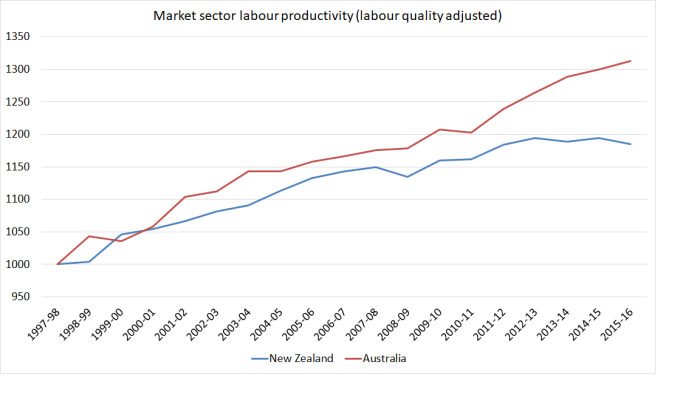
That chart is for the whole of each economy, and just uses a crude measure of total hours worked.  The ABS and SNZ also produce annual data –  with quite a lag – in which they look only at the more readily measureable market sector of the economy (from memory around 85 per cent of the economy) and also attempt to adjust for changing labour quality over time (eg improvements in education and thus, in principle, human capital).

Here is that chart for labour productivity, indexed to 1000 in 1997/98, the first year for which the data are available for both countries.

market sector LP

The picture is much the same –  a new large gap has opened, in Australia’s favour, in the last few years.

Presumably part of those measured productivity gains in Australia reflects the massive private sector investment boom in the minerals and energy sectors that peaked back in 2011/12.

But out of curiosity I wondered how Australia had done recently relative to other advanced economies.    Using annual data from the OECD, percentage total growth in real GDP per hour worked over the five years 2011 to 2016 had been as follows:

Australia                                  5.3%

OECD Total                              6.3%   (and OECD median country, 5.7%)

G7                                              5.5%

EU                                              4.3%

Even the euro-area as a whole (2.5 per cent) just beat out New Zealand (2.3 per cent).     In that light, Australia’s relatively strong productivity performance didn’t look so anomalous at all.

Over that five year period, these are the OECD countries that managed more than 10 per cent productivity growth:   Estonia, Hungary, Korea, Latvia, Poland, Slovakia, and Turkey.    In fact every single one of the emerging OECD countries (the former eastern bloc countries and Korea) –  all with lower initial levels of productivity than New Zealand – managed stronger productivity growth than New Zealand did.   All but Slovenia had faster productivity growth than Australia.    That is what convergence –  supposedly the goal for New Zealand –  is supposed to look like.

Of course, several of these emerging countries had had a much worse experience –  even on productivity, which often isn’t very cyclical –  than New Zealand over the crisis/recession period around 2008/09.   But even if one looks at, say, the last decade as a whole, they are mostly catching up (often quite rapidly) and we are not.  In fact, relative to Australia –  typical closest comparator, and the place where so much of the New Zealand diaspora dwells –  we are getting further behind.

I ran a chart a few weeks ago about how low investment has been in New Zealand.  As I noted of business investment it “is now smaller as a share of GDP than in every single quarter from 1992 to 2008.   And this even though our population growth rate has accelerated strongly, to the fastest rate experienced since the early 1970s.”

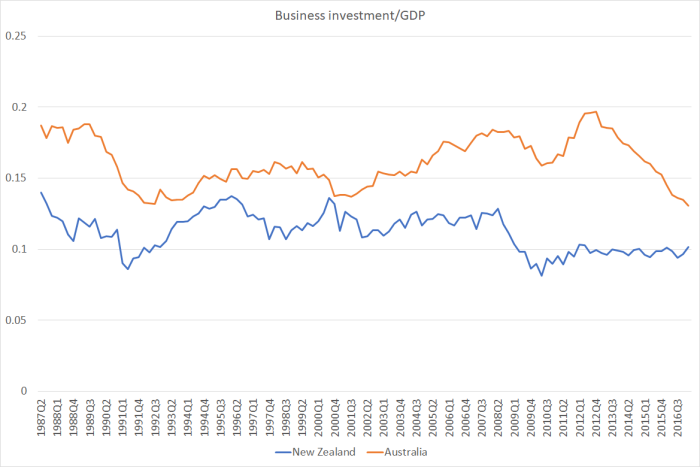
Of course, an important story out of Australia is how business investment has fallen back since the peak of the mining investment boom.   Here is the business investment proxy (total investment less general government investment less residential investment) for the two countries.

bus investment aus and NZ

Business investment in Australia, as a share of GDP, has fallen very dramatically over the last few years.   But it was a very big boom –  we had nothing of the sort in New Zealand.  And even at current levels, Australia’s busines investment still materially exceeds the share of GDP devoted to business investment in New Zealand.  In fact, the gap between the two lines isn’t that dissimilar to the typical gaps that prevailed before the mining investment boom got underway in the mid 2000s.

Then again, over the last 25 years Australia’s population growth has averaged a little faster than New Zealand’s.   All else equal, faster population would generally require a larger share of current GDP to be devoted to business investment just to maintain the average quantity of capital per worker.

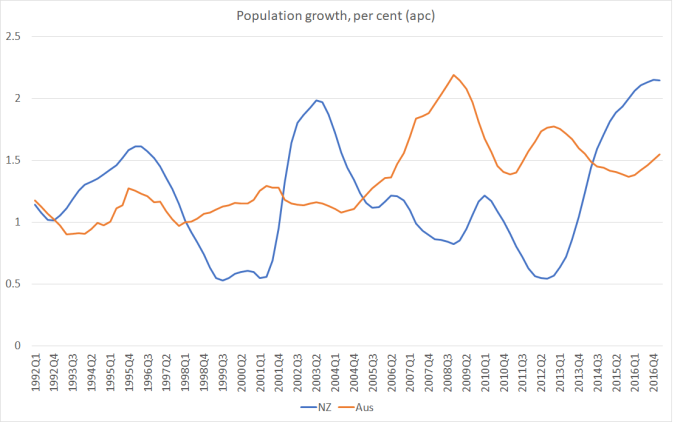
But here is the chart of the two countries’ population growth rates

popn growth aus and nz

Australia’s current population growth rate (1.5 per cent) isn’t much above the 25 year average (1.3 per cent). In New Zealand, the average population growth rate over the last 25 years has been 1.2 per cent, but in the last 12 months the population has increased by 2.1 per cent.     We have lots (and lots) more people, but firms presumably have not been finding it profitable to increase investment (on average across the whole economy), in ways that might suggest some possibility of the sort of productivity growth that might finally allow New Zealand to join the club of fast-growing countries, catching up to the wealthier countries in the OECD.

Not that our politicians give any sense of being worried.  An ill-governed place like Turkey –  not richer or more productive than New Zealand in our entire modern history –  might shortly go past us.   Countries that labour under communist regimes thirty years ago might go past us.  But none of our leaders seems to care. None of our parties has a platform that suggests they care, let alone offering a programme that might make a real difference.

Nonsense repeated endlessly is still nonsense

For decades –  in fact going back to the 19th century –  business groups in New Zealand have claimed that we need lots of immigration (often even more immigration) to relieve pressing skill shortages.   No one ever seems to ask them how other countries –  which typically have nowhere near as much immigration as we do –  manage to survive and prosper, but set that to one side for now.

Sometimes the alleged skill shortages relate to really highly-skilled positions.  I don’t suppose anyone is going to have a problem if DHBs manage to recruit the odd paediatric oncologist from abroad.   But more commonly the calls relate to the sorts of jobs that require considerably less advanced skills.  In generations past the call was for more domestic servants –  colonial girls were apparently reluctant to take on such roles, at least at the sorts of wages that middle New Zealand wanted to offer.     These days…….well, we all know the sorts of role firms claim they simply have to have immigrants for.  Without them, the more florid suggest, the economy will topple over.

For an individual employer, those calls make a lot of sense.  Each firm has to operate with the rest of the economy as it is.    Faced with two potential employees of exactly the same quality, of course an employer will prefer the one who will work for less.  And they’ll be keen to have the competition among potential employees, to keep down any pressure for higher wages.  And if your firm couldn’t hire immigrants while your competitor could, your business might well be in some considerable strife.     Moreover, if the whole pattern of the economy has adjusted to using large amounts of modestly-skilled immigrant labour, so that some sectors rely mainly on that labour, of course it will look to employers in those sectors as if the continuation of current policy is absolutely vital.   Who, we are asked, will staff the rest homes otherwise?  Or milk the cows?

Deprive an individual employer of the ability to hire modestly-skilled migrant labour, and the argument will stack up.   But if we are thinking about immigration policy as a whole we need to take a macroeconomic, whole of economy, perspective.  And then the perspective, or experience, of an individual employer is largely irrelevant.    With a materially different immigration policy, much about the economy will be different, not just the ability of that individual firm to hire a particular immigrant.

This isn’t some striking new perspective.  New Zealand economists were saying it decades ago, responding to exactly the same sort of business sector claims.   Mostly the response consisted of pointing out two things, both of which really should be obvious but seem to repeatedly get lost in the “our business needs more migrants” rhetoric:

  • migrants aren’t just producers (sources of labour supply) but consumers, and someone else has to produce the stuff they want to consume, and
  • in a modern economy each new person generates a need for quite a lot of additional capital (a place to live, roads, schools, hospitals, shops etc) and someone else has to produce and put in place that capital.

In other words, whatever beneficial impact an individual migrant may seem to have at the level of the individual firm, there is little reason to suppose that in aggregate high rates of immigration will do anything at all to ease so-called “skill shortages” or “labour constraints”.    In fact, mostly the claim was rather the reverse: big migration inflows temporarily exacerbate those pressures across the economy as a whole.

I’ve written previously about Professor Horace Belshaw’s contribution to the immigration debate as long ago as 1952, as the post-war immigration wave was getting into full swing.   Belshaw was, at a time, one of our leading macroeconomists.  He noted

At the time when there are more vacancies than workers, it is natural to assume that immigration will relieve the labour shortage. This however, is a superficial view.  The immigrants are not only producers but also consumers. To relieve the shortage of labour it would be necessary for more to be contributed to the production of consumer goods or of export commodities used to buy imported goods than the increased numbers withdraw in consumption.  That is unlikely….[and] there will be some temporary net additional pressure on consumption.

and

Of much greater importance is the fact that each immigrant requires substantial additional capital investment, not in money but in real things.  Houses and additional accommodation in schools and hospitals will be needed. In order to maintain existing production and services, and even more to maximize production per head, there must be more investment in manufacturing and farming, transport, hydro-electric power, municipal amenities and so on.

To anticipate a little, immigration is not likely to ease the labour shortage while it is occurring, and is more likely to increase it because although additional consumers are brought in, more labour than they provide must be diverted to creating capital if the ratio of capital to production is to be maintained.

A few years later, the Reserve Bank published an article in its Bulletin (April 1961) on “Economic Policy for New Zealand” by a visiting British academic, who noted

It is an illusion to assume that inflationary pressure and labour shortage can be relieved by increased immigration….the main immediate effect of increased immigration is to add to the shortage of capital goods. Even single men need to be housed, and they need capital equipment with which to work in industry…..Resources have to be devoted to providing this capital that could otherwise have been devoted to increasing and modernising capital equipment per man employed.

A few years later, another leading New Zealand economist, Frank (later Sir Frank) Holmes – Belshaw’s successor as McCarthy Professor of Economics at Victoria – published a series of articles on immigration for the NZIER.  I could quote from him at length, but suffice to say he was convinced that in the short-term the demand effects (including for additional labour) from increased immigration outweighed, by some considerable margin, the supply effects.   And here “short-term” didn’t mean a month or two.  In fact, he quoted from some recent estimates by the Monetary and Economic Council –  the Productivity Commission of its time – suggesting the additional excess demand would last for up to five years.

Or, a few years on, a quote from economic historian Professor Gary Hawke

Ironically, the success with which full employment was pursued until the late 1960s led to frequent claims that labour was in short supply so that more immigrants were desirable. The output of an individual industrialist might indeed have been constrained by the unavailability of labour so that more migrants would have been beneficial to the firm, especially if the costs of migration could be shifted to taxpayers generally through government subsidies. But migrants also demanded goods and services, especially if they arrived in family groups or formed households soon after arrival and so required housing and social services such as schools and health services. The economy as a whole then remained just as “short of labour” after their arrival.”

This sort of conclusion wasn’t even very controversial among economists.   Whatever the possible longer-term merits of high immigration –  and on that point views did differ –  no serious analyst saw it as a way to relieve labour market pressures or deal with other excess demand pressures.   It simply didn’t.

For 15 years there wasn’t very much immigration to New Zealand and in the process this knowledge seemed to have been largely lost.      But the character of the economy didn’t really change, let alone the basic propositions that (a) migrants are consumers too, and (b) more people requires the accumulation of materially more physical capital.    At the Reserve Bank it took us a while to wake up to this, in the face of first big post-liberalisation surge in immigration in the mid 1990s, but thereafter it became established wisdom for us.     Consistent with this was a piece of research the Bank published just a few years ago.  In that paper Chris McDonald looked at the impact of a one per cent lift in the population from net migration on, in this chart, the output gap (the estimated difference between actual GDP and the economy’s productive potential).

output gap mcdonald

On this estimate, unexpected changes in migration increase the excess demand pressures on the New Zealand economy.    The dark blue line is the central estimate, while the lighter lines represent confidence intervals around that central estimate.   Coincidentally –  see the Monetary and Economic Council estimates from earlier decades – on this model it takes five years (60 months) for the excess demand effects to fully dissipate.   Over  that time, on this model, immigration will be exacerbating aggregate labour market pressures, not relieving them.

I don’t want to put too much weight on any particular model estimates, and the Reserve Bank itself has tried to back away from this particular one.   What causes the change in immigration matters to some extent.     But the general conclusion –  immigration does not ease resource pressures –  shouldn’t be controversial.  Indeed, only a few months ago some IMF modelling on New Zealand’s experience again produced similar results.

None of this should be a surprise (including to economically literate officials advising ministers).  As I noted earlier there are two strands through which immigrants add to demand.  The first is consumption.  The household savings rate in New Zealand is roughly zero: on average, people consume what they earn.   Perhaps the typical (or marginal) migrant is different –  some will be sending remittances back to their homelands –  but even if we assume that new immigrants have hugely different behaviour than New Zealanders, perhaps consuming equal to only 80 per cent of income, it is still a significant boost to demand.  In effect, much of what the immigrants produce will be consumed by them (not exactly the same stuff, but across the economy as a whole).  That is no criticism of them –  people do what people do –  but it is the first leg in the story about why claims that immigration eases labour shortages are typically simply false.

But the much more important part of the story is the capital requirements that new people (migrants or natives) generate.     Here Statistics New Zealand’s capital stock data can help us.     The latest estimates of the net capital stock (ie net, as in depreciated, and excluding land) are around $750 billion.   Total GDP is around $250 billion.   That ratio of net capital stock to GDP has been pretty stable around 3 for decades.

cap stock to GDP

Each dollar of additional GDP seems to require three dollars of new capital.    And this ratio understates the issue for two reasons:

  • the first is that the capital stock is a net (depreciated) figure and the GDP is gross (it includes capital spending to cover depreciation  –  around 15 per cent of GDP), and
  • the second is that our focus is here on the contribution of labour.    The ratio of the net capital stock to compensation of employees (the national accounts measure of total labour earnings) is almost 7.

These are average numbers of course, and in discussing immigration the focus should be on the margin.    It might be reasonable to point out that the typical migrant won’t need much more government capital in the short-term (eg schools and hospitals)  –  but then central government makes up only around a sixth of the total capital stock.  Perhaps the typical migrant, at least their early years, will settle for less good quality housing than the typical native?   But on the other hand, the productivity of the typical migrant is also likely to be lower than the national average, again at least in the early years (MBIE’s own labour market research highlights how long it takes many migrants to reach the earnings of similarly qualified locals).   So I’m not here to give you a definitive number for how much new capital spending is typically going to be associated with each new migrant, but it will be large.  It will be a significant multiple of the first year’s labour supply of the typical new migrant.  It will, in other words, for several years exacerbate any aggregate shortages of labour, not relieve them.

Of course, quite a bit of physical capital is imported.  All those earlier estimates already, explicitly or implicitly, take those imports into account.  SNZ’s input-output tables suggest that across capital formation as a whole the import component isn’t high –  around 21 per cent in 2013.  That shouldn’t be surprising.  Buildings make more than half the physical capital stock, and although they have some imported components, there is a great deal of domestic labour (and domestically produced timber and concrete).  Accommodating more people simply adds greatly to the demand for employment over the first few years after they arrive.

Commentators and politicians who argue that migrants don’t take jobs away from New Zealanders are largely correct  (again, past modelling exercises confirm that sort of intuition).  They don’t do so –  and they don’t succeed in lowering aggregate wages –  precisely because influxes of immigration (or unexpected reductions in the net outflow of New Zealanders) add to demand –  for goods and services, but thus for labour –  more than they add to supply.    There are probably some sector-specific adverse wage effects –  in sectors where immigrant labour has been made particularly readily available –  but much the bigger determinant of overall real wage prospects in New Zealand is productivity growth.  Sadly, our record on that score over many decades has been poor. Over the last five years it has been shocking –  no labour productivity growth at all.    That, in turn, may be in part because of the effects of rapid population growth –  all that spending associated with more people crowding out (notably through a high exchange rate) activities that might have offered more productivity growth prospects.    Despite the political rhetoric to the contrary, there is no surprise that more people create more jobs –  always have, probably always will.  But there is also no surprise that as it was decades ago, is now, and probably ever will be, increased immigration doesn’t ease overall labour market pressures.

So too much of the New Zealand debate is simply misplaced.  If we want to deal with domestic unemployment, as we should, look to monetary policy (it was a point Frank Holmes made 50 years ago). In the current context, hire a Governor who will take seriously the ambition of non-inflationary full employment.  If there are sectoral market pressures, let wages in those sectors adjust –  that is what happens to tomato prices when tomatoes are in short supply.   And if we were serious about wanting sustained productivity growth –  as we should be –  it increasingly looks as though much lower levels of non-citizen migration would be the way to go.

On our woeful productivity performance, even the Reserve Bank is starting to openly recognise the issue.  This chart (using their estimate of TFP) was in the chief economist’s speech this morning

Figure 3: Potential GDP Growth

Figure 3: Potential GDP Growth

Source: RBNZ estimates.

Little investment –  as the Deputy Governor noted in his speech last week –  and almost no productivity growth, and simply lots and lots more people.  To what end –  beneficial to the average New Zealander –  one might reasonably wonder?