The new government and the Reserve Bank

But first a correction. As I noted on Twitter and very briefly on the post itself on Saturday, it seems that the gist of my post on Friday was wrong. The repeal of Labour’s tobacco de-nicotinisation legislation – whatever motivated the parties that championed the change – will leave the flow of tobacco excise revenue largely as it was, providing the government an extra flow of revenue – relative to what was allowed for in PREFU – that will, if anything, more than compensate for what National had told us they expected the foreign buyers’ tax would have raised. With the various other bits in the various coalition agreements they are probably back to being in roughly the – very demanding – fiscal situation National thought it would be facing before the election: large deficits, very demanding indicative operating allowances, and an aversion to cutting programmes/”entitlements”,

As for the impact of fiscal policy on aggregate demand, and thus the pressure on monetary policy, they’ve ended up – without really consciously trying, or so it seems, with a somewhat helpful policy switch; dumping the foreign buyers’ tax which was supposed to raise money from wealthy foreigners who mostly would not have been earning or otherwise spending that money in New Zealand (which revenue therefore would not have dampened demand) and replacing it with the reinstatement of the tobacco tax revenue scheme, mostly raising money from relatively low income New Zealanders who will, on average, have a very high marginal propensity to consume in New Zealand. Whatever the substantive merits (or otherwise) of either policy, all else equal the switch is slightly helpful for monetary policy.

A few days after the election I wrote a post “What should be done about the Reserve Bank?” itself if (as I put it in that post) a new government is at all serious about a much better, and better governed and run, institution in future. Perhaps unsurprisingly I stand by all the points in that post, around both individuals (Orr, Quigley, external MPC members, and so on) and the institution.

That post ended this way
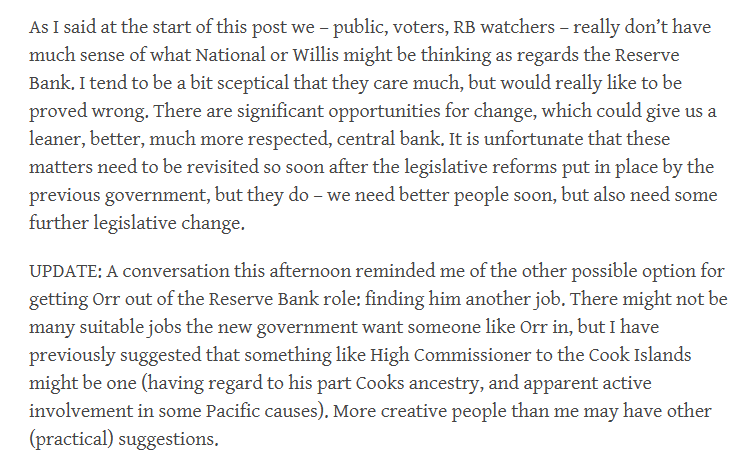
That final paragraph was about the fact that unless he leaves more or less voluntarily it would be hard to get rid of Orr (judicial review risks etc and attendant market uncertainty) and yet it would be highly beneficial were he to be replaced well before March 2028.

Anyway, with the release on Friday of the two coalition agreements we know a little more re the options for the monetary policy functions of the Bank.

At a high level, both agreements commit the parties to make decisions that are “focused” to “drive meaningful improvements in core areas including

One might have briefly hoped that this might have resulted in the government lowering the inflation target to something actually consistent with price stability – eg, allowing for index biases, 0 to 2 per cent annual inflation – but it probably only means the abolition of the so-called dual mandate (something both National and ACT had campaigned). The specific material on monetary policy is from the ACT agreement
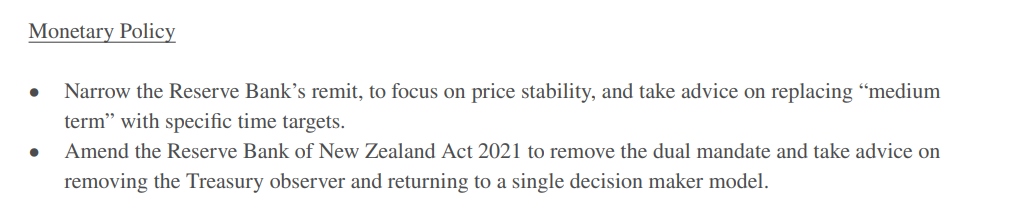
In National’s own 100 day plan the legislation to amend the statutory goal of monetary policy was to have been introduced – not passed – within the first 100 days, but in the coalition agreement there is no indication of the legislative priority. However, the Act makes it clear that the Minister of Finance could issue a new Remit – the actual targets the MPC is supposed to work to – at any time
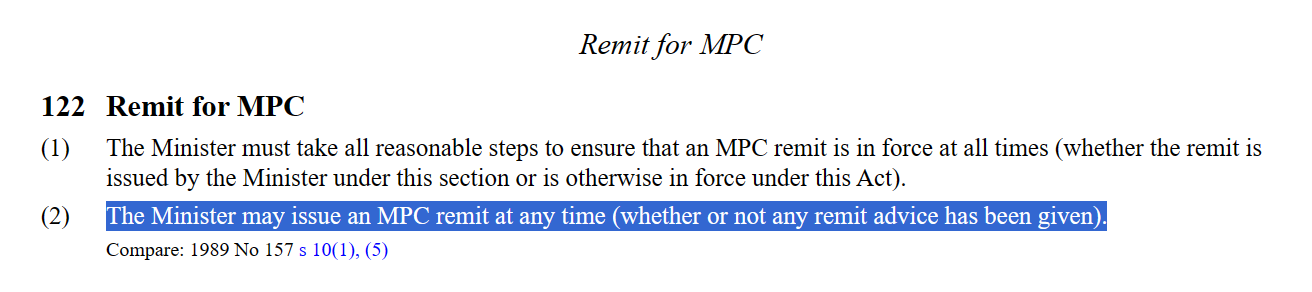
It would be a simple matter of deleting one short paragraph from the Remit, which would then also have the appeal (to the government) of being clear that the MPC was working to this government’s Remit not the last government’s one. That doesn’t need to await the other advice, it could be done today or tomorrow (perhaps after the first Cabinet of the new government), and before the MPS on Wednesday. If the Minister moved that fast it would no doubt prompt specific questions at the MPS press conference, but…..they are going to be asked anyway. (UPDATE: The Minister is required to consult (but not necessarily have regard to the views of) the MPC before issuing a new Remit, so the next day or two probably isn’t an option, but it need not be an elongated process when the government has a clear electoral mandate for change.)

(To be clear, I am not a big fan of this change. I largely supported the 2018 legislative change. But……from the then-government’s perspective the change then was mostly about political product differentiation (essentially cosmetic) and so will the reversal be. Few serious observers think either change has made, or will make, any material difference to monetary policy decisions (and the Governor has repeatedly stated that it has not done so to now), but the change is – I guess – a way of signalling that the government recognises the public’s visceral distaste of high inflation and that it expects the Reserve Bank MPC to do so too (for the last two years there has been no sign of that).)

What about those other points on which advice is to be sought (presumably things ACT championed that National refused to agree to upfront, and may be disinclined to support at all)?

There are three of them:

  • replacing the “over the medium-term” time horizon for meeting the inflation target with some specific time targets (eg “over a rolling 18-24 month horizon” or somesuch),
  • removing the Secretary to the Treasury as an non-voting member of the MPC, and
  • returning to a single decisionmaker model for model (given the heading and context, presumably only for monetary policy, but perhaps more broadly).

I would not favour any of those changes.

The most marginal call – which wouldn’t excite me if it went the other way – is the position of the Secretary to the Treasury. I favoured the non-voting member provision in 2018 (it is a not-uncommon arrangement in other countries, and in Australia the Secretary to the Treasury is still a voting member), but there is no evidence from the four years of the MPC’s existence that the Secretary to the Treasury (or her alternate) has added any value (most often one of her deputies attends), whether around substance or process. The evidence we have also suggests a risk that the Bank and the Treasury are too close to each other, undermining the likelihood that the Treasury does its job – as the Minister’s adviser monitoring and holding to account the Bank – at all rigorously or well. How likely was it, for example, that there would be any serious accountability around the LSAP losses when the Secretary to the Treasury sat through all the meetings and there is no record of any ex ante concern being expressed? We also now know – from a recent OIA – that Treasury did nothing at all about the way they were lied to by the Reserve Bank Board chair as regards the earlier blackball on experts serving as external MPC members.

(More generally, if the new government is serious about a much better public sector they should be looking to replace the Secretary when her term expires next year, but this post is about the RB not the Treasury per se.)

I would not favour specific time targets for monetary policy. These were used in the early days of inflation targeting (when the first target was 0 to 2 per cent inflation by 1992), but once the target was achieved things reverted (sensibly in my view) to a model in which it was expected that inflation should (a) be kept within the target range, and (b) if there were deviations (headline or core), the Bank was expected to explain the deviation and explain how quickly it expected to get inflation back to target (either inside the band, or the target midpoint the MPC has been required to focus on since 2012).

It would not be advisable to put ex ante specific imposed timeframes on the MPC, mostly because shocks and deviations from target will differ. They may include, on the one hand, essentially mechanical things like GST changes (or other indirect tax or subsidy changes) which will appear in annual CPI inflation and, all else equal, automatically drop out 12 months later. But they will also include things like big – and perhaps sustained – supply shocks. You could think of a sequence of years in which – unexpectedly – the price of oil kept moving sharply higher (this happened in the 00s). A surge in petrol prices might take inflation above target. It is fine to require the MPC to bring inflation back 12 or 18 months hence, but if there is another surge six months on, you’ll end up with another overlapping target (the first having been deemed essentially redundant). And nine months later there might be a third surge.

Or we could – although let us fervently hope not – have a repeat of the last few years in which most everyone – RB, Treasury, outside forecasters – misunderstand and misjudges the severity of the pressures giving rise to the inflation, and thus the seriousness of the inflation problem. Back in November 2021 the Reserve Bank’s best professional opinion (presumably) reflected in their published forecasts was that inflation would have been back within the target range by March 2023 (a mere 18 months), with the OCR never having gone above about 2.5 per cent. Given a target to get inflation back in 12-18 months they’d have thought they were on course. That was wrong, of course, but the addition of a time-bound target wouldn’t have helped greatly with what was mainly a forecasting/understanding problem by then.

I do think there is reason to amend the remit. At present it does not really deal with mistakes like the last few years at all, stating just

which tends to treat all deviations are much like those resulting from GST or indirect tax changes, and never really envisages the need to correct serious policy failures (of the sort we’ve seen in the last few years). A provision that read something like “when the inflation rate moves outside the target range, or persistently well away from the target midpoint, the MPC shall explain (a) the reasons for these actual/forecasts deviations, and (b) the timeframe over which they expect inflation to return to around the target midpoint, and the reasons for that timeframe.” would be a useful addition. If the government was unwise to go down the “specific set time targets” path it would then need to allow for resetting/renegotiating such time targets when, as is inevitable, sustained shocks/mistakes happen. It was a model used in the very first (low-trust) Policy Targets Agreement, and was sensibly dropped a few months later in favour of the emphasis on transparent accounting.

The case for moving to a Monetary Policy Committee has been pretty compelling for decades (at least since Lars Svensson first recommended the shift in his 2001 review commissioned by the then-new Labour government) and it is to the credit of the 2017 to 2020 government that they finally made a change to a committee system. Not only is there no other area of public life (or politics) in New Zealand in which we delegate so much power – without appeal or review scope – to a single individual (Luxon himself can be ousted by his caucus with no notice), but hardly any other central bank anywhere operates a single decisionmaker system (the Bank of Canada is an exception in law – a legacy of old legislation – but they are at pains to stress that their senior management Governing Council functions as a collective decisionmaking body for monetary policy).

The right path now is not to strengthen the hand of the Governor – perhaps especially the current one if they are stuck with him – but to strengthen the Committee around whoever is Governor. It was quite disquieting to see ACT pushing for a return to the pre-2019 system. The old arguments about “we can sack one person not a whole board or committee” not only aren’t right generally (look at council, hospital boards, boards of trustees who’ve been replaced) but aren’t right in the specific context of monetary policy, and not only because in the face of the biggest monetary policy failure in decades no one lost their job, not even the person who was clearly most responsible (for the outcomes and the spin and misrepresentations around them). In practical terms, even if Orr could be removed shortly, it would be quite a punt in the dark to return to a single decisionmaker model, the more so when there is no single ideal candidate around whom people have united as “the” person to replace Orr.

Much better to focus on (a) replacing Orr as and when you can, b) reopening urgently the application process for the appointment of external MPC members to ensure that really strong candidates are appointed early next year (not those who got through the Robertson/Orr/Quigley RB winnowing process, selecting for people who won’t rock the boat, and have not rocked the boat in the last 3-4 years when things went so badly wrong at the Reserve Bank), and (c) amend the MPC charter etc to (a) require individual MPC members to record votes at each meeting, b) to require those votes to be published, c) to encourage external MPC members to give speeches/interviews, and d) to require FEC hearings for all MPC members before they take up their appointments. None of that requires statutory changes. It could usefully be backed

(There is course no guarantee that a better more-open MPC would have produced a less-bad set of inflation and LSAP outcomes this time – many other countries with better central banks have done pretty much as badly – but that is not a reason to simply settle for an inadequate status quo, one in which we never hear from most of these powerful officials, there seems to be no effective accountability, all supported by little or no serious research, analysis or insight.)

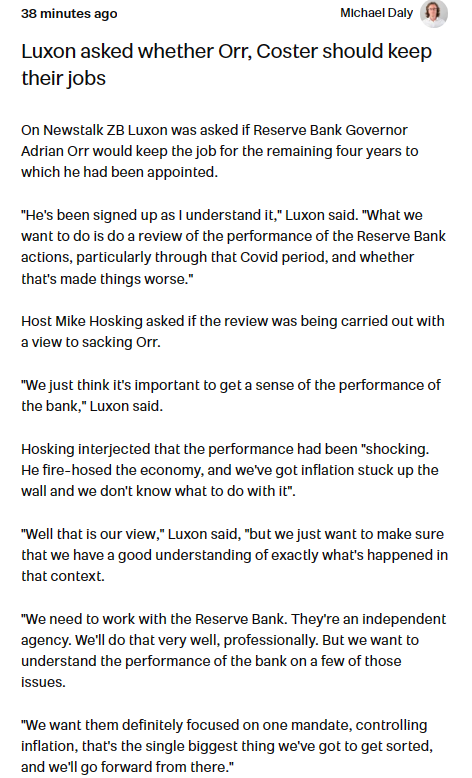
UPDATE: I meant to include this (from Stuff this morning), and now include it mostly for the record. As I said in my earlier post, there is no great harm in the independent review (of monetary policy under Covid) that they are talking of, but it also isn’t clear what is to be gained (and much will depend on who is appointed to do it). The failings of the RB in recent years are pretty well-understood, and the institution commands little respect now. If change is to be made, just get on and start now.

Perhaps unsurprisingly, there was nothing there

I’ve written a few posts in the last few months about the strange approach that the Reserve Bank has been taking to thinking and talking about the impact of fiscal policy on demand since May’s Budget. Background to the material in this post is here (second half, from July), here (mid-section, commenting on the August MPS), and here (September, in the wake of PREFU.

Up to and including the February MPS the Reserve Bank’s approach to fiscal issues was pretty much entirely conventional. What mattered mostly for them – and for the outlook for pressure on demand and inflation – was not the level of spending or the level of revenue or the makeup of either spending or revenue, but discretionary changes in the overall fiscal balance. Adjust the headline numbers for purely cyclical effects (eg tax revenue falls in economic downturns) and from the change in the resulting cyclically-adjusted surplus/deficit from one year to the next you get a “fiscal impulse”. That is/was an estimate of the pressure discretionary fiscal choices were putting on demand and inflation. For a long time, The Treasury routinely reported fiscal impulse estimates – and estimates they always are – along these lines, and had developed the indicator specifically for Reserve Bank purposes twenty years ago.

If the cyclically-adjusted deficit (surplus) is much the same from year to year the fiscal impulse will be roughly zero. A central bank typically isn’t interested that much in whether the budget is in surplus or deficit, simply in those discretionary changes. Back in the day, for example, we upset Michael Cullen late in his term when he was still running surpluses, but shrinking ones, when we pointed out that the resulting fiscal impulse (from discretionarily reducing the surplus) was putting additional pressure on demand and inflation, at a time when inflation was at or above the top of the target range. Whether or not what he was doing made sense as fiscal policy, it nonetheless had implications for the extent of monetary policy pressure required, and it was natural for us to point this out (as with any other major source of demand pressure).

Among mainstream economists none of this is or was contentious. International agencies, for example, routinely produce estimates of cyclically-adjusted fiscal balances, partly to help readers see the direction of discretionary fiscal policy choices. Plenty of past Reserve Bank documents will have enunciated this sort of approach.

It was also this sort of thinking that led to an amendment to the Public Finance Act in 2013

(NB: The Treasury has made analysis of this sort harder in recent years, as in 2021 they changed the way they calculate and report the fiscal impulse, in ways that make little sense and reduce (but don’t eliminate) the usefulness of the measure as they report it. These changes further undermined the usefulness of New Zealand official fiscal indicators – already generally not internationally comparable – but do not change the fundamental economics, which is the focus in this post.)

But suddenly, in the May Monetary Policy Statement – a document released just a few days after the government’s election-year Budget – there was a really major change in the approach the Bank and the MPC were taking to fiscal policy.

No one much doubts that the Budget was expansionary. Here, for example, was the IMF’s take in their Article IV review of New Zealand, published in August but finalised just 6-8 weeks after the Budget

There also wasn’t much doubt that the Budget (and thus demand pressures over the following 12-18 months – typically the focus of monetary policy interest) was more expansionary than had been flagged in the HYEFU at the end of last year. As I’d noted in the first post linked to above

For the key year – the one for which this Budget directly related – the estimated fiscal impulse had shifted from something moderately negative [in HYEFU] to something reasonably materially positive [in the Budget]. The difference is exactly 2.5 percentage points of GDP. That is a big shift in an important influence on the inflation outlook – which in turn should influence the monetary policy outlook – concentrated right in the policy window.

But how did the Reserve Bank treat the issue?

They were at it again in the August MPS, and in the next day’s appearance at FEC.

These sorts of lines – including one of the Governor’s favourites that fiscal policy was being “more friend than foe” – helped provide cover for the Minister of Finance, who was fond of suggesting to reporters that after all the Reserve Bank wasn’t raising any issues.

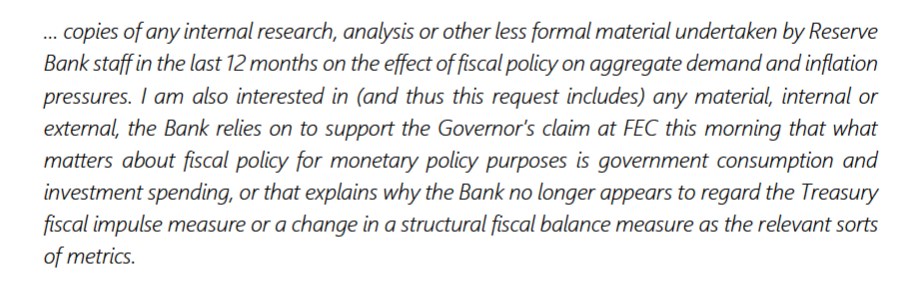
Some mix mystified and frustrated, I lodged an OIA request with the Bank seeking

If they really did have a thoughtful and well-researched new approach to thinking about fiscal policy and the impact on demand pressures, surely they’d be keen to get it out there. It didn’t seem likely there was anything – there were no footnoted references to forthcoming research papers etc – but….you never know.

But we do now. The Bank responded last month (I was away, and then distracted by election things so only came back to it last week). Their full response is here
RBNZ Sept 23 response to OIA re fiscal policy impact on demand and inflation

They withheld in full the relevant sections of the forecast papers that go to the MPC prior to each OCR review. This is a point of principle with the Bank whereby they assert that to release any forecast papers from recent history would “prejudice the substantial economic interests of New Zealand” (I did once get them to release to me 10 year old papers, from my side as point of principle too). It is a preposterous claim – and needs to be fought again with the Ombudsman (or perhaps a Minister of Finance seriously committed to an open and accountable central bank) – in respect of documents that are many months old, but for now it is what it is.

That said, it would be very surprising if there was anything at all enlightening on the Governor’s change of tack in those withheld papers. The Bank’s economic forecasters rarely did fiscal analysis very well and those sections of the forecast papers were often fairly perfunctory (recall that the Bank takes fiscal policy as conveyed to them by the Treasury, just adjusting the bottom line deficit/surplus numbers for differences in macroeconomic forecasts (eg affecting expected revenue for any given set of tax rates)). More importantly, in the documents released there is nothing else from prior to this change of official approach in May – no internal discussion papers, no draft research papers, no market commentaries circulated approvingly, no overseas academic pieces, just nothing.

In fact, the first document dates from 31 July this year, a 14 page note from analysts from a couple of teams in the Economics Department with the heading “Fiscal policy – seeking a common understanding”. Had there been a serious analytically-grounded push for a new approach, you might have expected such a paper to have been prepared and presented to internal groups and to the MPC well before such a change featured in the MPS. But that change was in May…..and the document dates from the end of July (may have been prepared with the then-forthcoming August MPS in mind). It has a distinct back-filling feel to it.

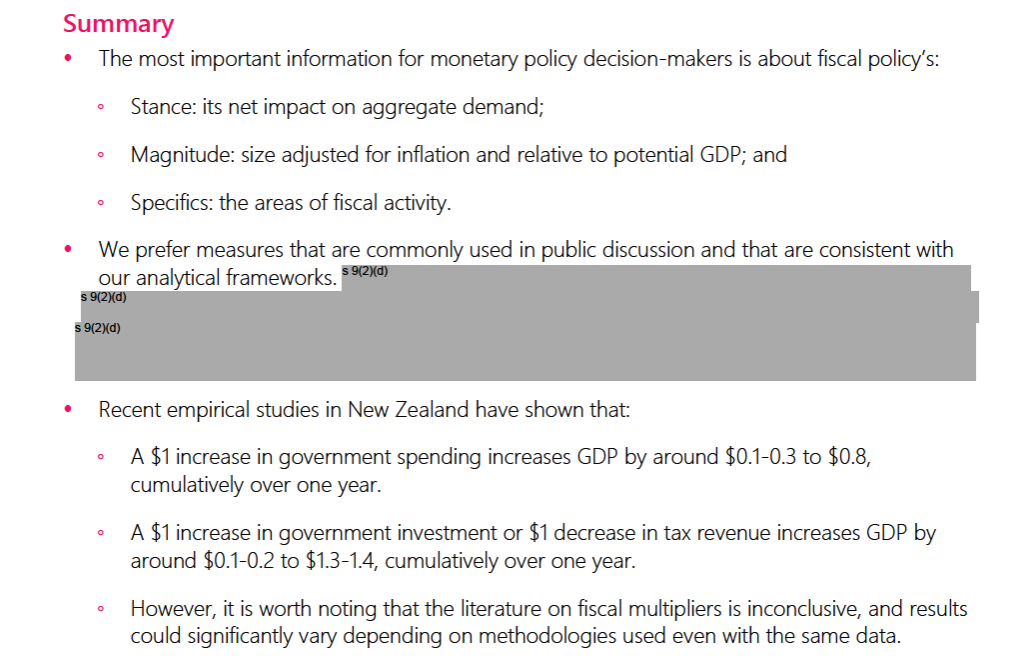
Here is the paper’s summary

You notice that again they are invoking alleged potential jeopardy to New Zealand “substantial economic interests” to tell us which fiscal indicators these two analysts favour – rather weirdly given that the Governor has already told us (in MPSs) and told Parliament’s FEC which ones he thinks matter most.

But that withholding quibble aside, there isn’t anything really to argue about in that summary. I’m not entirely convinced that a fiscal multipliers approach is the best way of tackling the issue, but having done so they report nothing – not a thing – suggesting that what matters for monetary policy is primarily government consumption and investment spending (as distinct from transfers, taxes, or overall fiscal balances). It is an entirely orthodox position, but quite at odds with the line the Governor and the MPSs had been spinning.

(The paper does have a short box noting in the Bank’s economic model – NZSIM – government consumption and investment are identified separately, while the model itself does not have explicit components for tax rates or transfers but – sensibly enough – this gets no further comment in the paper, and does not mean that changes in tax or transfer policy make no difference to the projections the MPC is considering).

There isn’t very much in the paper on the interaction with monetary policy, but there is this

which is all fine and shouldn’t be at all contentious, but none of its suggest that changes in fiscal deficits don’t matter for the extent of monetary policy pressure and that – as the Governor took to claiming in the wake of the expansionary Budget – that all that mattered was government consumption and investment.

At the back of the paper there is a five page Appendix on all the Treasury measures of fiscal policy. Each appears to have been scored for “usefulness for monetary policy purposes” and while the comments have been released they appear to have withheld – jeopardising those substantial economic interests again apparently – scores or rankings of each item.

They do have items for Government Consumption and Government Investment. Under “usefulness for monetary policy purposes” the comment – on both – is simply “Government consumption [investment] provides information about the type and size of government activity”. Quite so, but…..not really about monetary policy.

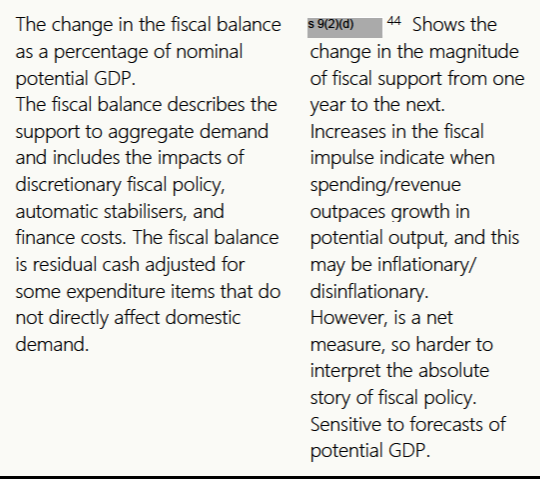
But then we come to the item “Total Fiscal Impulse”. Here is what they say

These analysts from the Bank’s Economics Department are entirely orthodox. I would qualify their comments slightly because – as alluded to above – this new “Total Fiscal Impulse” measure is clearly inferior for purpose than the previous Fiscal Impulse, but they are clearly on the right track. They recognise that changes in fiscal balances can affect the outlook for demand and inflation (and hence monetary policy pressure). They go on to briefly note that the impulse was estimated to be strongly positive in the 2023/24 fiscal year (the primary focus for monetary policy at the time).

It isn’t a startlingly insightful paper, but that is fine. It is largely rehearsing long-established conventional perspectives, and if it was at odds with anyone……well, it was only with the Governor and the MPC. And I guess one can’t really expect junior analysts to take on the powers that be. But it is still just a little surprising perhaps that this 31 July paper contains no reference – not one – to the strange new Orr model that had suddenly overtaken the MPS. One might, for example, have hoped that the Chief Economist might have provided a lead, and even perhaps affixed his name to the paper…..but then he is an Orr-appointee and must have signed up to the weird MPS approach too.

There is one more document in what the Bank has released to me. It is undated, has no identified author, and is headed “Fiscal policy in the August 2023 MPS”, suggesting that there is a reasonable chance it was written specifically for the purposes of responding to my OIA.

There are two parts to this 1.5 page document. The first page lists four statements on matters fiscal from the August MPS and outlines “supporting evidence”. Of those, three are simply irrelevant: there has never been any dispute about the fact that in the 2023 Budget real government consumption and investment was expected to fall as a share of GDP over the next few years (although note that for setting monetary policy in mid 2023, what might or might not happen to some components of the budget in 2026 is simply irrelevant – monetary policy lags are shorter than that).

The fourth is “interesting”

You might have supposed that this statement had appeared in the August MPS. It doesn’t. “Fiscal policy” hardly appears at all (and nothing about what it will be doing over the period monetary policy is focused on) and “discretionary fiscal policy” doesn’t appear at all.

But beyond that it is still just spin. What happens by 2027 is (again) irrelevant to today’s monetary policy, and even if the cyclically-adjusted deficit is still forecast to narrow in the shorter-term the extent of that narrowing by Budget 2023 was materially less than what had been envisaged – and included in the RB forecasts – at HYEFU 2022. Fiscal policy is putting more pressure on inflation and demand than had been envisaged at the end of last year, exacerbating pressures on monetary policy. That was – and apparently is – the point the Governor still prefers to avoid acknowledging…..something Robertson was probably grateful for.

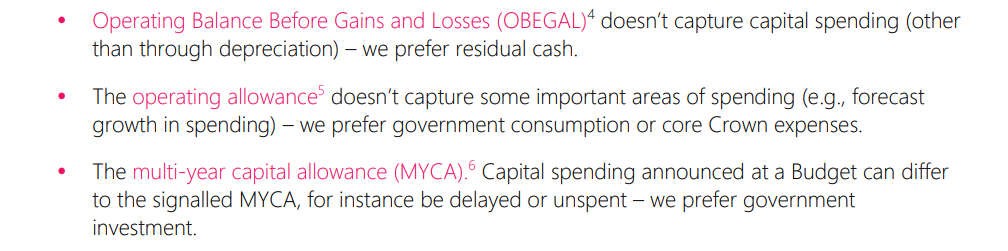
The second half of this little note is headed “Why haven’t we referred to other measures of fiscal policy?”

Of the four bullets, again there is no real argument with three of them

To which one can mostly only say “indeed”, but then no one suggested the central bank should look at either of the allowances – which in any case are only on the spending side of the balance. As for the operating balance, I’m not going to disagree, but……mentioning it would be typically less bad than the highly political mention of only one bit of the overall fiscal balance (direct government consumption and investment).

What of the fourth?

That is just weird. Take that penultimate sentence: it is a change measure that you want when it is monetary policy and inflation you are responsible for. The change is what changes the outlook for demand and inflation. But then there is the rank dishonesty of the final sentence. They prefer to “supplement the total fiscal impulse” do they? But there was no reference to it – or to words/idea cognate to it – in either the May or August MPS. And the claim that they can somehow sensibly supplement as fiscal balance based measure – which already includes taxes, transfers, and real spending – with “real government spending” is, it seems, simply plucked from thin air. It doesn’t describe what they’ve actually done these last two MPSs, it isn’t an approach even mentioned in the Economics Department’s July note (see above), and as far as I can see it has no theoretical or practical basis whatever.

It is just making stuff up.

We’ve had several previous attempts by Orr to actively mislead (Parliament or public) or make claims that prove to have no factual analytical foundations. There was the claim to FEC that the Bank had done its own research on climate change threats to financial stability, claims trying to minimise the extent of turnover of senior managers, claims regarding the impact of this year’s storms on inflation, claims that inflation was mostly other people’s fault (notably Vladimir Putin). Each of these has been unpicked in one way or another – the first via the OIA, the second via a leak, the third via one of his own staff piping up to correct things in FEC, the fourth simply be patiently setting down the numbers and timing. There have also been entirely tendentious claims around the LSAP, including his attempt – repeated in the recent Annual Report – to assert that the LSAP made money for taxpayers, despite the simplest review of the exercise he used in support of this claim showing that it simply didn’t provide any serious support for his view.

Every single one of those was bad, and should have been considered unacceptable, by both the Minister of Finance and the Bank’s Board. A decent and honourable Governor would simply never have done them. But bad as they were, those were self-serving misrepresentations.

What has gone on around fiscal policy this election year seems materially worse. We make central banks operationally independent in the hope that they will do their job without fear or favour, and without even hint of partisan interest. But faced with a Budget that complicated the task of getting inflation down, that was materially more expansionary than had been envisaged just a few months previously, Orr (and his MPC colleagues, reluctantly or otherwise) chose to completely upend the traditional approach to thinking about fiscal impacts on demand and inflation pressures, and tell a story – and a story it was – that tried to gloss over what the Minister of Finance had done, ignoring what mattered in favour of what was at best peripheral. Whether that was for overt partisan purposes is probably unknowable from any documents likely to exist, but it is hard to think of any other good explanation for what was done, espeically when – as this release shows – it was all based on no supporting analysis or research whatever.

The Official Information Act plays a vital role in helping expose events like this. It was never likely there was anything of substance behind Orr’s fiscal spin. But now we know.
(As to the attitudes of other MPC members, who clearly all went along since not a hint of a conventional perspective is in the minutes of the meetings around either MPS, there is a tantalising bit that was also withheld

Only one of the three relevant MPC meetings during this period, but the most recent.  Was there some gentle unease from perhaps one member?  We may never know, but at least this withholding appears to confirm that there are fuller minutes of MPC meeting, not just the bland summary published with each OCR announcement.)

PS.  It is perhaps no surprise that the Reserve Bank has chosen not to put this OIA release out on their  OIA releases page, even though that page was updated just a couple of weeks ago.  It does not put the Bank in a good light.  

What should be done about the Reserve Bank?

Monday’s post was on the important place effective accountability must have when government agencies are given great discretionary power which – as is in the nature of any human institutions – they will at times exercise poorly. My particular focus is on the Reserve Bank, both because it is what I know best, because it exercises a great deal of discretionary power affecting us all, and because in recent times it has done very poorly in multiple dimensions (be it bloated staffing, demonstrated loss of focus, massive financial losses, barefaced lies, or – most obvious to the public – core inflation persistently well above target).

What has happened under the current (outgoing) government is now an unfortunate series of bygones. What has happened, happened, and some combination of Orr, Robertson, Quigley (and lesser lights including MPC members and the Secretary to the Treasury) bear responsibility. Not one of them emerges with any credit as regards their Reserve Bank roles and responsibilities.

But in a couple of weeks we will have a new government, and almost certainly Nicola Willis will be Minister of Finance. The focus of this post is on what I think she and the new government should do, if they are at all serious about a much better, and better governed and run, institution in future. It builds on a post I wrote in mid 2022 after someone had sought some advice on a couple of specific points.

Thus far, we have heard very little from National on what plans they might have for the Reserve Bank. When they were consulted, as the law now requires, they opposed Orr’s reappointment (although on process grounds – wanting to make a permanent appointment after the election, something the legislation precluded – rather than explicitly substantive ones). And anyone who has watched FEC hearings over the past 18 months will have seen the somewhat testy relationship between Orr and Willis (responsibility for which clearly rests with Orr, the public servant, who in addition to his tone – dismissive and clearly uninterested in scrutiny – has at least once just lied or actively and deliberately misled in answer to one of Willis’s perfectly reasonable questions). In the Stuff finance debate last week I noticed that when invited to do so Willis avoided stating that she had confidence in Orr, but she has on a couple of occasions said that she will not seek to sack him, stating that she and he are both “professionals” (a description that, given Orr’s record, seems generous to say the least).

Even if she had wanted to, it would not be easy to sack Orr.

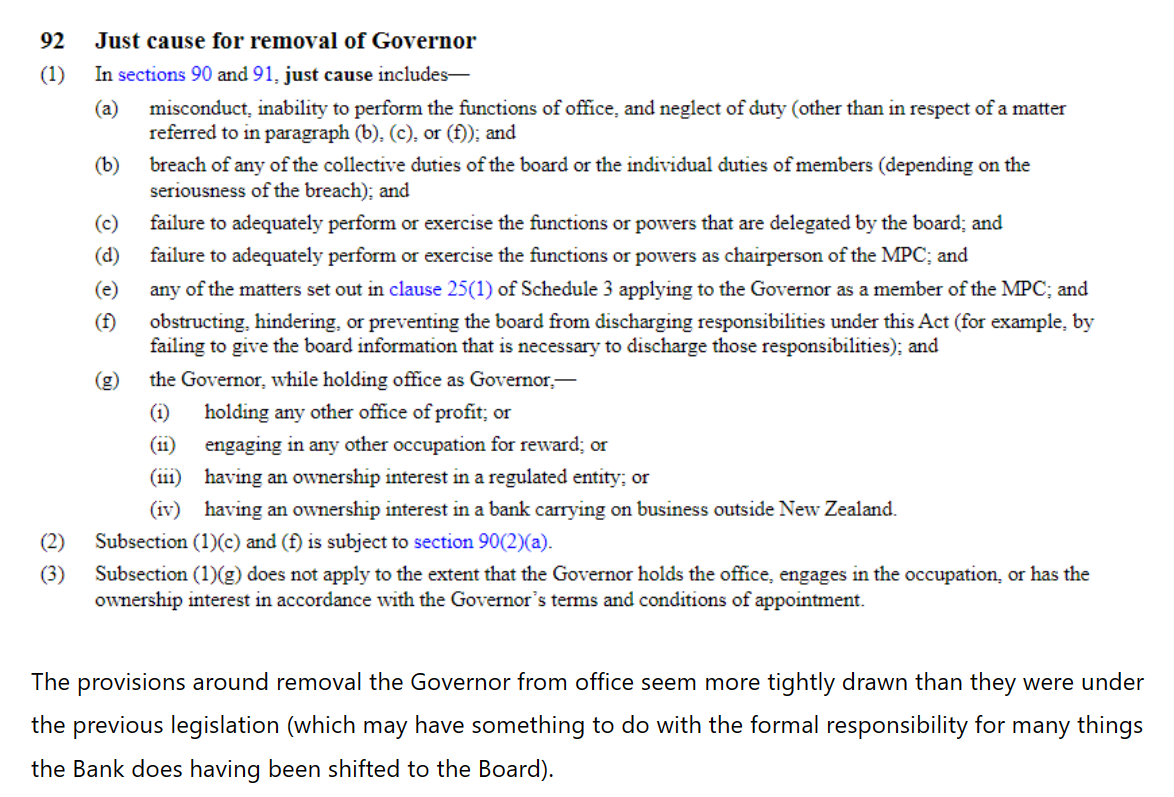
From last year’s post, these are the statutory grounds for removal

Note too that his current term in office started only in March this year, and the more egregious policy failures occurred in the previous term (and thus probably not grounds for removal now). I have my own list of clear failures even since March – no serious speeches, no serious scrutiny, no serious research, actively misleading Parliament, and so on – such that it would be much better if Orr were gone but seeking to remove him using these provisions would not be seriously viable, including because any attempt to remove him could result in judicial review proceedings, leaving huge market uncertainty for weeks or months.

Were the Governor an honourable figure he would now give six months notice, recognising that the incoming parties do not have confidence in him and that – whatever his own view of his own merits – it actually matters that the head of an agency wielding so much discretionary power should have cross-party confidence and respect (which does NOT mean agreeing with absolutely everything someone does in office).

Historically (and even when I wrote that post 18 months ago) I would have defended fairly staunchly the idea that incoming governments should not simply be able to replace the central bank Governor. The basic idea behind long terms for central bank Governors was so that governments couldn’t put their hand on the scales and influence monetary policy by threat of dismissal. But many of those conceptions date from the days before the modern conception of the government itself setting an inflation target and the central bank being primarily an agency implementing policy in pursuit of that objective. Even when the Reserve Bank of New Zealand legislation was first overhauled in 1989 the conception was that Policy Targets Agreements should be set and unchanged for five year terms, beyond any single electoral term. That (legislated) conception never survived the first election after the Act was passed, but these days the legislation is quite clear that the Minister of Finance can reset the inflation target any time s/he chooses (there are some consultation requirements). If the government can reset the target any time they choose, then it isn’t obvious that they shouldn’t be able to replace the key decision-makers easily (when the key decisionmakers – specifically the Governor – have influence, for good and ill, much more broadly than just around pursuit of the inflation target).

(There is a parallel issue around the question of whether we should move to the Australian system where heads of government departments can be replaced more easily, but here I’m focused only on the Reserve Bank, which exercises a great deal of discretionary policy power, and isn’t just an advice or implementation entity.)

By law they can’t make such changes at present. They could, of course, amend the law, but to do so in a way narrowly focused on Orr (ie an amendment deeming the appointment of the current Governor as at the passage of this amendment to be terminated with effect six months from the date of the Royal Assent) would smack rather of a bill of attainder. Governors have been ousted this way in other countries, but I don’t think it is a path we should go down.

Some will also argue that Orr should simply be bought out. If the government was seriously willing to do that – and pay the headline price of having written a multi-million-dollar cheque to (as it would be put) “reward failure” – I wouldn’t object, but it isn’t an option I’d champion either. (Apart from anything else, a stubborn incumbent could always refuse an offer, and once this option was opened up there really is no going back.)

So the starting point – which Willis has probably recognised – is that unless Orr offers to go they are stuck with him for the time being.

The same probably goes for the MPC members and the members of the Bank’s Board. The incoming Minister of Finance could, however, remove the chair of the Board from his chairmanship (this is not subject to a “just cause” test). The current chair’s Board term expires on 30 June next year, and it might not be thought worth doing anything about him now, except that he is on record as having actively misled Treasury (and through them the public) about the Board’s previous ban on experts being appointed to the MPC, and he has been responsible for (not) holding the Governor to account for the Bank’s failures in recent years. Removing Quigley would be one possible mark of seriousness by a new government, and a clear signal to management and Board that a new government wanted things to be different in future.

The current Reserve Bank Board was appointed entirely by Grant Robertson when the new legislation came into effect last year. It was clearly appointed more with diversity considerations in mind than with a focus on central banking excellence, and several members were caught up in conflict of interest issues. The appointments were for staggered terms but – Quigley aside – the first set of vacancies don’t arise until mid 2025. It would seem not unreasonable for a new Minister to invite at least some of the hacks and token appointees to resign.

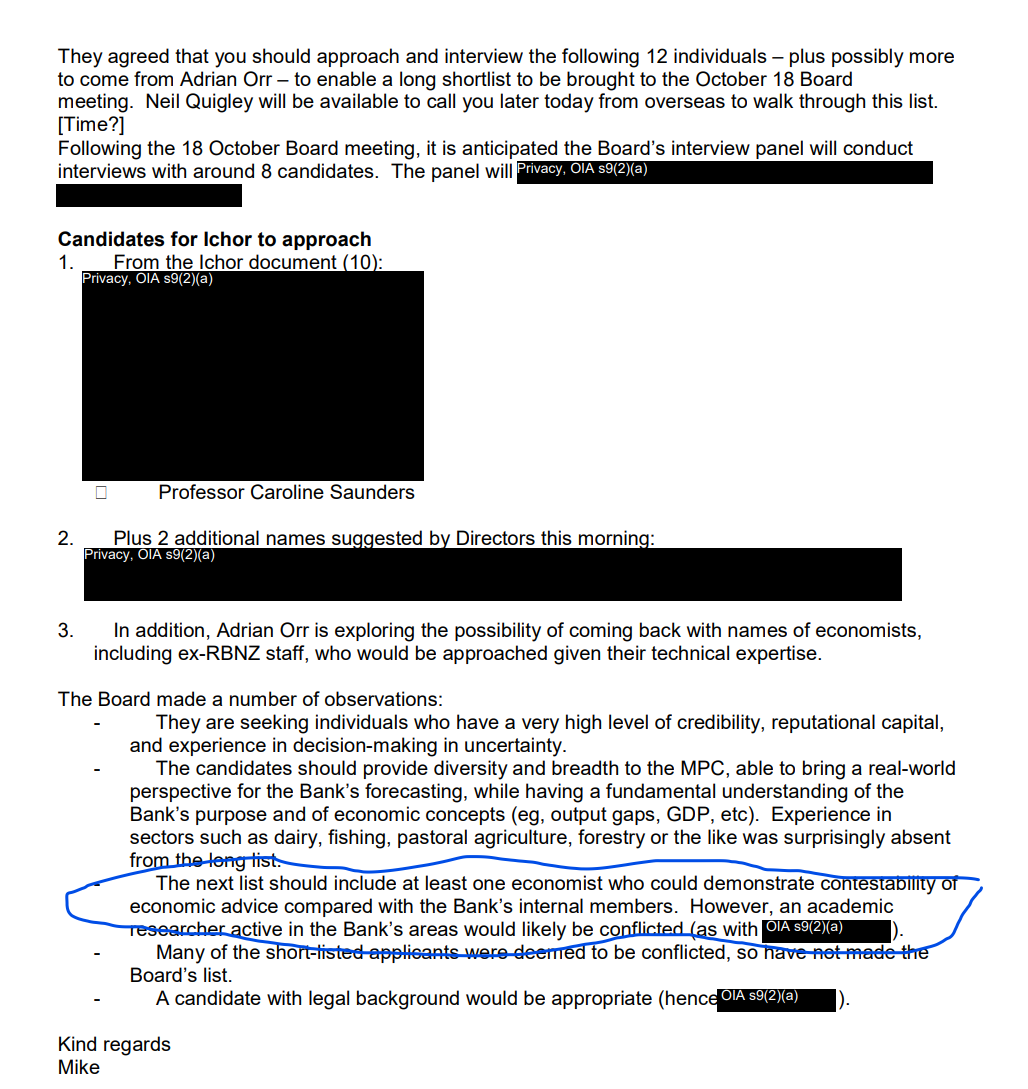
There are three external appointees to the Monetary Policy Committee. None has covered themselves in any glory or represented an adornment to the Committee or monetary policymaking in New Zealand. All three have (final) terms that expire in the next 18 months, two (Harris and Saunders) in the first half of next year. This is perhaps the easiest opportunity open to a new Minister to begin to reshape the institution, at least on the monetary policy side, because appointments simply have to be made in the next few months. As I noted in a post a couple of weeks ago, OIAed documents show that the current Board’s process for recommending replacements is already largely completed, with the intention that once a new government is sworn in they will wheel up a list of recommendations. If the new government is at all serious about change, this should be treated as unacceptable, and the new Minister should tell the Board to rip up the work done so far and start from scratch, having outlined her priorities for the sort of people she would want on the MPC (eg expert, open, willing and able to challenge Orr etc). It would also be an opportunity for her to revisit the MPC charter, ideally to make it clear that individual MPC members are expected to be accountable for, and to explain, their individual views and analysis. Were she interested in change, it is likely that the pool of potentially suitable applicants might be rather different than those who might have applied – perhaps to be rejected as uncomfortable for Orr at the pre-screening – under the previous regime.

The Reserve Bank operates under a (flawed) statutory model where a Funding Agreement with the Minister governs their spending for, in principle, five years at a time. The current Agreement – recently amended (generously) with no serious scrutiny, including none at all by Parliament – runs to June 2025. The incoming government parties have been strong on the need to cut public spending by public agencies on things that do not face the public. They need to be signalling to the Reserve Bank that they are not exempt from that approach, and if the current Funding Agreement cannot be changed it should be made clear to the Board and management that there will be much lower levels of funding from July 2025. Indulging the Governor’s personal ideological whims or inclinations to corporate bloat are not legitimate uses of public money.

If she is serious about change, the incoming Minister also shouldn’t lose the opportunity to deploy weaker but symbolic tools at her disposal. Letters of expectation to the Governor/MPC and the Board can make clear the direction a new government is looking for, as can the Minister’s comments on the Bank’s proposed Statement of Intent. Treasury now has a more-formal role in monitoring the Bank’s performance, and the Minister should make clear to Treasury that she expects serious, vigorous and rigorous, review.

All this assumes the incoming Minister is serious about a leaner, better, more-excellent and focused Reserve Bank. If she is, and is willing to use the tools and appointments at her disposal, she can put a lot of pressure on Orr. If that were to lead to him concluding that it wasn’t really worth sticking around for another 4.5 years that would be a good outcome. But at worst, he would be somewhat more tightly constrained.

I haven’t so far touched on the two specific promises National have made. The first is to revise the legislation (and Remit) to revert to a single statutory focus for monetary policy on price stability. I don’t really support this change – the reason we have discretionary monetary policy is for macro stabilisation subject to keeping inflation in check – but I’m not going to strongly oppose it either. The 2019 change made no material difference to policy – mistakes were ones of forecasting (and perhaps limited interest and inattention thrown in) – and neither would reversing it. Both are matters of product differentiation in the political market rather than a point of policy substance. The proposed change back risks being a substitute for focusing on the things that might make for an excellent central bank – as it was with Robertson. I hope not.

The other specific promise has been of an independent expert review of the Bank’s Covid-era policymaking. It isn’t that I’m opposed to it – and there is no doubt the Bank’s own self-review last year was pretty once-over-lightly and self-exonerating – but I’m also not quite sure what the point is, other than being seen to have done it. Action, and a reorientation of the institution and people, needs to start now, not months down the track when some independent reviewer might have reported (and everyone recognises that who is chosen to do the review will largely pre-determine the thrust of the resulting report). It isn’t impossible that some useful suggestions might come out of such a report, but it doesn’t seem as though it should be a top priority, unless appearance of action/interest is more important than actual change. I hope that isn’t so either.

What of the longer term, including things that might require more-complex legislative change?

I think there are number worth considering, including:

  • how the MPC itself is configured.   I strongly favour a model –  as in the UK, the US, and Sweden –  in which all MPC members are expected to be individually accountable for their views, and should be expected routinely to record votes (and from time to time make speeches, give interviews, appear before FEC).  I’m less convinced now than I once was that the part-time externals model can work excellently in the long haul, even with a different – much more open, much more analytically-leading – Governor.  One problem is the time commitment, which falls betwixt and between. External MPC members have been being paid for about 50 days a year, which works just fine for people who are retired or semi-retired, but doesn’t really encourage excellent people in the prime of life to put themselves forward (I’m not sure how even university academics – with a fulltime job –  can devote 50 days to the role).  In the US and Sweden all MPC members are fulltime appointments, and in the UK while the appointments are half-time they seem to be paid at a rate that would enable, say, an academic to live on the appointment, perhaps supplemented with some other part-time (non-conflicted roles).    I also used to put more weight on the idea of a majority of externals, which I now think is a less tenable option than I once did.  External members can and should act as something of a check on and challenge to management, but it will always be even more important to have the core institution functioning excellently (at senior and junior levels).  We should not have a central bank deputy chief executive responsible for matters macroeconomic who simply has no expertise and experience, and is unsuited to be on any professional MPC.
  • I would also favour (and long have favoured) moving away from the current model in which the Board controls which names go to the Minister of Finance for MPC and Governor appointments.  It is a fundamentally anti-democratic system (in a way with no redeeming merits), and out of step with the way things are done in most countries.  We don’t want partisan hacks appointed to these roles, but the Board – itself appointed by (past) ministers –  is little or no protection, and Board members in our system have mostly had little or no relevant expertise.  Appointments should be made by the Minister –  in the case of the Governor, perhaps with Opposition consultation – and public/political scrutiny should be the protection we look to.  I would also favour all appointees to key central bank roles have FEC scrutiny – NOT confirmation- hearings before taking up their roles (as is done in the UK).
  • I would also favour (as I argued here a few years ago [UPDATE eg in this post]) looking again at splitting the Reserve Bank, along Australian lines, such that we would have a central bank with responsibility for monetary policy and macro matters and a prudential regulatory agency responsible for the (now extensive) supervisory functions.  They are two very different roles, requiring different sets of skills from key senior managers and governance and decision-making bodies.  Accountability would also be a little clearer if each institution was responsible for exercising discretion in a narrower range of area.  Quite obviously, the two institutions would need to work closely together in some (limited) areas, but that is no different than (say) the expectation that the Reserve Bank and Treasury work effectively together in some areas.  (Reform in this area might also have the incidental advantage of disestabishing the current Governor’s job).  Reform along these lines would leave two institutions with two boards each responsible for policymaking (and everything else) the institutions had statutory responsibility for.  The current vogue globally has been for something like having a Board and an MPC in a single institution, the former monitoring the latter.  But the New Zealand experience in recent years is illustrative of just how flawed such a model is in practice: not only is the Board still within the same institution (thus all the incentives are against tough challenge and scrutiny) but typically Reserve Bank Board members have no relevant expertise to evaluate macro policy performance or key appointments in that area).  Monitoring and review matter but if they are to be done well they will rarely be done within the same institution with (as here) the chair of the MPC (Orr) sitting on the monitoring board.  The new Board’s first Annual Report last week illustrates just how lacking the current system is in practice, and although a new minister might appoint better people, we should be looking to a more resilient structure.

As I said at the start of this post we – public, voters, RB watchers – really don’t have much sense of what National or Willis might be thinking as regards the Reserve Bank. I tend to be a bit sceptical that they care much, but would really like to be proved wrong. There are significant opportunities for change, which could give us a leaner, better, much more respected, central bank. It is unfortunate that these matters need to be revisited so soon after the legislative reforms put in place by the previous government, but they do – we need better people soon, but also need some further legislative change.

UPDATE: A conversation this afternoon reminded me of the other possible option for getting Orr out of the Reserve Bank role: finding him another job. There might not be many suitable jobs the new government would want someone like Orr in, but I have previously suggested that something like High Commissioner to the Cook Islands might be one (having regard to his part Cooks ancestry, and apparent active involvement in some Pacific causes). More creative people than me may have other (practical) suggestions.

Accountability

On Saturday dozens of candidates for the governing Labour Party stood for election to Parliament. The aim was to form (at least a big part of) the next government. They didn’t succeed. People will debate for decades precisely what motivated the public as a whole to vote as we did, but having governed for the last three years, they (Labour) lost. It is perhaps the key feature of our democratic system, perhaps especially in New Zealand with so few other checks and balances. You (and your party) wield great power, and if we the public aren’t satisfied – think you’ve done poorly, think another lot might be better, or simply wake up grumpy on election day – you are out. It is your (and your party’s) job to convince us to give you another go. If you don’t convince us you are out (and typically when a party loses power a satisfying number of individuals – even if rarely Cabinet ministers – actually lose their job (as MP) altogether). And if you are a disappointed Labour voter this morning, the beauty of the system is that no doubt your turn will come again. It is accountability – sometimes crude, rough and ready, perhaps even (by some standards) unfair or wrong – but the threat and risk is real, and the job holders keep it constantly in mind.

Many other people in the public employ also wield considerable amounts of power. In some cases, that power is quite tightly constrained and often (for example) there are appeal authorities. If a benefit clerk denies you a benefit you are clearly legally entitled to you will probably end up getting it, and if the clerk’s mistake is severe or repeated often enough they might lose their job. Less so at more exalted levels. When, for example, the wrong person is put in prison for decades typically no one responsible pays a price. When the Public Service Commissioner engages in repeated blatant attempts to mislead to protect one of his own, it seems that no pays a price.

And then there are central banks.

Every few months I do a book review for the house journal of central bankers, Central Banking magazine. They are often fairly obscure books that I otherwise wouldn’t come across or wouldn’t spend my own money on (at academic publishing prices). A few months back I reviewed Inflation Targeting and Central Banks: Institutional Set-ups and Monetary Policy Effectiveness (hardback yours from Amazon at a mere US$170 – yes, there is a cheaper paperback if anyone is really interested), by a mid-career economist at the Polish central bank, in turn based on her fairly recent PhD thesis. The focus isn’t on the question of what difference inflation targeting makes but on what institutional details, which differ across inflation-targeting central banks, seem to make a difference. Sadly for the author – these things happen – her thesis was finished before the outbreak of inflation in much of the advanced world in the last 2-3 years.

At the core of the book is a set of painstakingly-compiled indexes on various aspects of inflation-targeting central banks which might be thought to be relevant to how those central banks might perform in managing inflation. There are ones for independence, ones for transparency, and so on, but the one that stuck with me months on was the one for accountability. Accountability used to be thought of as an absolutely critical element – the quid pro quo – for the operational independence that so many countries have given to central banks in the last few decades. With great power goes great responsibility, and ideas like that. The Reserve Bank itself was very fond on that sort of rhetoric. In fact, there used to be a substantive article on that topic by me on their website, in which I waxed eloquent on the topic (after it was toned down when my original version upset the Bank’s then Board by suggesting that for all the importance of accountability it was more difficult in practice than in theory). At a more casual level my favourite example has always been a radio interview then-Governor Don Brash did in 2003, the transcript of which the Bank chose to publish, in which there is a snippet that runs as follows:

Brash: ….we were concerned……we were running risk of inflation coming in above 2 per cent which is the top of our target

Interviewer: And then you’d lose your job?

Brash: Exactly right.

I was working overseas at the time, and can only assume my colleagues gulped when they saw it put so unequivocally. But it wasn’t inconsistent with a meeting the handful of senior monetary policy advisers had with Don in one of his first days in office. He eyed us up – chief economist, deputy chief economist, and manager responsible for monetary policy advice – and said (words to the effect of) “you know we are going to introduce a new law in which if inflation is away from target I can lose my job. Just be sure to realise gentlemen that if I go, you are going too.” Not ever taken – at least by me – as a threat, but as a simple statement of the then-prevalent idea (crucial in the public sector reforms being done at the time) that operational independence and authority went hand in hand with serious personal responsibility and potential personal consequences. It was part of the logic of having a single decision-maker system (an element of the New Zealand system that no one chose to follow and – in one of Labour’s better reforms in recent years – was finally replaced here_.

But that was then.

By contrast, these are the components of the Accountability sub-index in the recent book I mentioned

There is nothing very idiosyncratic about the book or the work in it; indeed, she seeks to be guided by the literature and current conventional understanding. And if you look down that list of items – which is the sort of stuff central bankers often now seem to have in mind when they ever mention “accountability – you’ll quickly realise that there is really a heavy emphasis on transparency (a good thing in itself of course) and almost none of them on any sort of accountability that involves real consequences for individuals, anyone paying any sort of price. The only one of these items that represents anything like that sort of accountability is item 6.7 but even there the provision is about whether Governors/MPC members can be dismissed for neglecting their work (not turning up to meetings etc), not for actual performance in the job.

But if there are no personal consequences for failure and inadequate performance, why would we hand over all this power? I’ve written here before about former Bank of England Deputy Governor Paul Tucker’s book Unelected Power – which ranges much wider than just central banks – where his first criterion for whether a function should be delegated to people voters can’t themselves toss out (eg central bankers) is whether the goal – what is expecting from the delegatees – can be sufficiently specified that we know whether outcomes are in line with what was sought. If there is no such clear advance specification either there will be no effective accountability or such accountability will at best be rather arbitrary.

As it happens, almost no one believes the over-simplified accountability expressed in that 1993 Brash quote above makes sense, even if expressed in core inflation terms (I don’t think most people involved really did even in 1993 – although there was a brief period of hubris where it all seemed surprisingly easy – and certainly as soon as inflation went above the target range in 1995 there was some hasty rearticulation of that sense).

But if we have handed over all this power – and central bank monetary policy decisions, good ones and bad, have huge ramifications for the economy as a whole and for many individuals – we should be able to point to behaviours or outcomes that would result in dismissal, non-reappointment, or other serious sanctions. Or otherwise in practical terms central banker inhabit a gilded sphere of huge power and no effective responsibility at all. And central banks aren’t like a Supreme Court, where we look at judges to be non-corrupt (including conflicts of interest) and able……but the desired products are about process – judging without fear or favour – not about particular outcomes, or decisions in a particular direction. It is right that it should be hard to remove a Supreme Court judge. It is less clear it should be so for central bank Governors, MPC members etc. The jobs are at times difficult to do excellently, but no one is forced to take the job, with its associated pay, power, prestige and post-office opportunities.

The problem – power has been handed over, but with no commensurate real accountability – isn’t just a New Zealand phenomenon, but one evident across the entire advanced world (the ECB at the most extreme, an institution existing by international treaty rather than domestic statute).

When I wrote my review I noted that “it isn’t clear that any central bank policymaker has paid any price at all for the recent stark departures of core inflation from target. It tends not to be that way for corporate CEOs or their senior managers when things go wrong in their bailiwicks.” It is possible there is now one exception to that story – the decision by the Australian government not to reappoint Phil Lowe on the completion of his seven year term – but even there it isn’t clear how much is about specific policy failures and how much about a more general discontents with the organisation and a desire for a modernised etc RBA structure, and the desire for a fresh face atop it. The promotion of a senior insider – not known to have sharply dissented from what policy mistakes there were – is at least a clue.

It increasingly looks to me as though delegation of discretionary monetary policy to central bankers should be rethought. I have long been fairly ambivalent but when the system is faced with its biggest test in decades – in all the years globally of delegating operational independence – central banks fail (the only possible to read recent core inflation outcomes relative to the targets given them) and no one pays a price (with just possibly a solo Australian exception) it begins to look as though we should leave the decisions with those whom we can toss out – Grant Robertson’s fate on Saturday – and keep central banks on as researchers, expert advisers, and as implementation agencies, but not themselves being unaccountable wielders of great powers.

The outgoing New Zealand government has made numerous bad economic choices in the last couple of years. Prominent among them were the decisions to reappoint MPC members, to allow the appointment to the MPC of someone with no relevant professional background or expertise, to reappoint the chair of the RB Board (while surrounding him with a bunch of non-entities, none of whom had any relevant expertise) and (above all on this front) the decision to reappoint the Governor. The latter decision was most especially egregious because it was Robertson himself who had amended the law to require parliamentary parties to be consulted before a Governor was (re)appointed, and when the two main Opposition parties both objected, Robertson went ahead anyway. If the operational independence of a Governor, appointed to a term not aligned with parliamentary terms, means anything, it surely should at least mean that the person appointed commands respect – for their capability, integrity etc – across political party lines. By simply ignoring dissent – that his own reforms formally invited – Robertson made Orr’s reappointment a purely opportunistic partisan call. At the time – 11 months ago – I outlined a list of 22 reasons Orr should not have been reappointed (and at that I wasn’t convinced simply missing the inflation target was one)

I’ll come back – probably tomorrow – to a post on what I think the incoming government and its Minister of Finance (presumably Willis) should do about Orr and the Reserve Bank now.
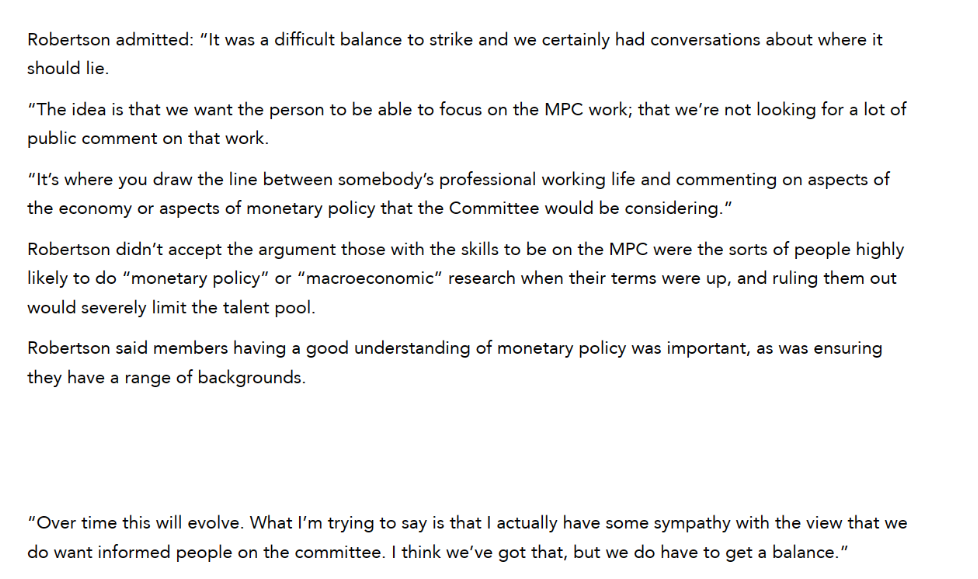
But this rest of this post is to illustrate that not even the rituals Parliament forces them to go through – in this case the production of an Annual Report – amount to any sort of accountability at all. (One day. perhaps next year now, they will have to front up on it to the new FEC, but sadly select committee scrutiny – committees being seriously under-resourced – is hit and miss at best, the more so in this case if Grant Robertson is the key Opposition figure on the new FEC reviewing the performance of the man he appointed and reappointed.)

It is difficult to know where to start on the Annual Report that was released last week.

It might be quite useful if you care about the Bank’s emissions, as there is several pages of material, but you shouldn’t (since we have an ETS for that). It is almost utterly useless for anything much that the Bank is responsible for. There are administrative things like why the Bank has 22 senior managers earning more than $300000 a year, or why it has 36 people shown in the senior management group (in a total of 510 FTE), or why staff numbers have risen sharply yet again, or why – having signed up to a very generous five year funding agreement in 2020 – they were coming cap in hand for lots more funding (much of which they got) this year. Or why the part-time chair of the Board – who has a fulltime job running a university, and where many of the key powers are statutorily delegated to the MPC – is pulling in $170000 a year; this the same chair who has been shown to have actively misrepresented – and led Treasury to make false statements about – the past ban on expertise on the MPC (issues he has never addressed). Or why the Governor gets away with actively misleading FEC. Or how seriously (or not) conflicts of interest are taken (even how the Board sees itself relative to the recent lofty words in the RB/FMA review of financial institutions’ governance).

But on policy matters it is arguably even worse. In a year when core inflation has – again – been miles away from the Bank’s target, the Board chair’s statement is reduced to 1.5 emollient pages uttering no concerns at all (recall that the Board does not do monetary policy, but it is charged by statute with reviewing monetary policy and the MPC and making recommendations on appointments of MPC members and the Governor). We learn nothing at all from the highly-paid chair as to why he and his Board of unqualified non-entities considered, in the circumstances, that reappointments had been warranted (nothing in Board minutes has provided anything more).

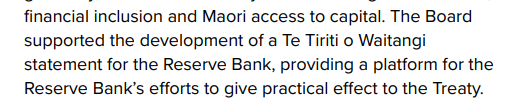
We do however learn of the Board’s effort to indulge the political whims of the Governor and Board members, the Treaty of Waitangi (a) not being mentioned in the acts supposedly governing the Bank, and b) not itself mentioning anything even remotely connected to monetary policy or financial stability.

There is a couple of page section on monetary policy in the body of the report. But in itself this is a reminder that the MPC – which wields the power – publishes no Annual Report, and exposes itself to no serious scrutiny. In this central bank not only does the deputy chief executive responsible for economics and monetary policy never give a serious speech on the subject, she is never seriously exposed to either media or parliamentary scrutiny. External members are so sheltered we have on idea what any of them think, what contribution they make, and so on. They never front FEC or any serious media. Perhaps it isn’t surprising that the total remuneration of these three ornamental figures isn’t much more than what the chair of the Board himself is paid.

But then surely the Board would be doing a rigorous review (it is after all the Board’s job, by law)? That would be difficult when most of the Board has no relevant expertise (the Governor is the main exception, and he chairs the MPC….).

But what we actually get in no sign of any serious thought, challenge or questioning, no attempt to frame the MPC’s achievements and failings. Instead we get this process-heavy but substantively-empty little box

It might be interesting to OIA that “self-review” MPC members are said to have carried out, but you’d just have no idea from any of this that the biggest monetary policy failure in decades had happened on the MPC members’ watch – even as all expiring terms were renewed. It is Potemkin-like “accountability”, with barely even that level of pretence. (Note here that the weak internal review last year wasn’t even an MPC document but rather a management one.)

If that is all rather weak it gets worse when the LSAP comes into view. This, you will recall, was the bondbuying programme in which the MPC’s choices cost taxpayers now just over $12 billion, a simply staggering sum of money, swamping all those “fiscal holes” of the recent election campaign. There are lot of LSAP references – it is the Annual Accounts after all – but none from the Board chair, and here is the one substantive bit.
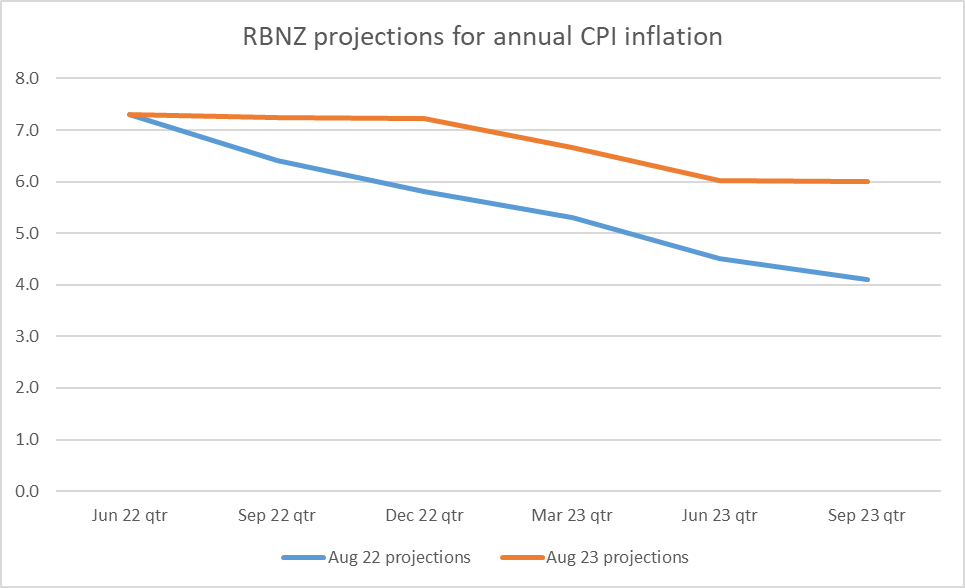
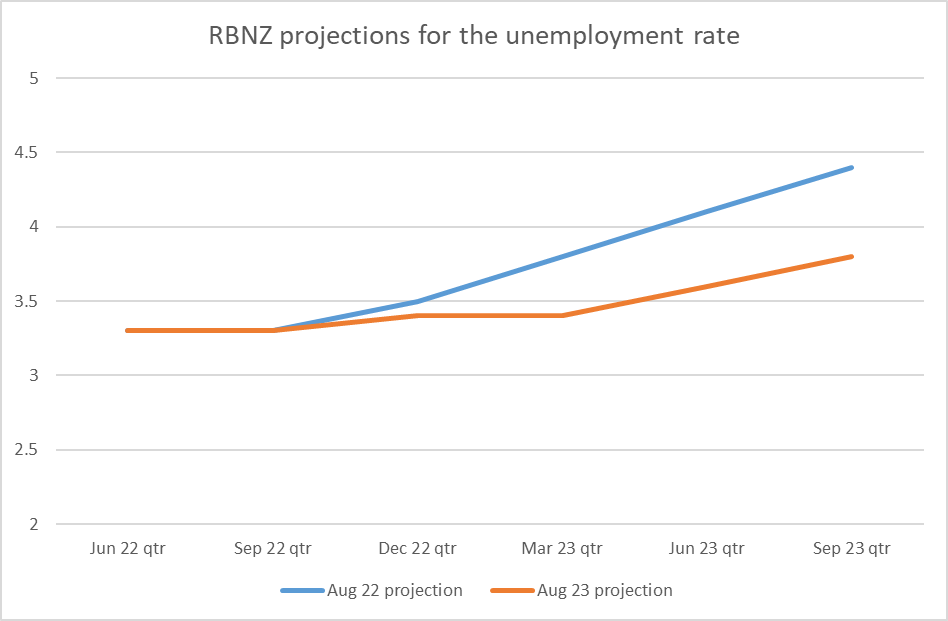
I’ve highlighted the utterly egregious bit. As they say, IMF staff did put out a little modelling exercise. but it has no credibility whatever, as the scenario described in the exercise bore no relationship to what actually happened in the New Zealand economy in 2020 and 2021. It was a scenario under which, even with the LSAP, the New Zealand economy languished underemployed for three years (but a bit less so because of LSAP) rather than an overheated economy with very high inflation and – in the Governor’s own words – employment running above maximum sustainable employment. I critiqued the piece in a post here, and I know of no economists who read the IMF piece and concluded “ah yes, of course, notwithstanding that the LSAP had a direct loss of $12bn, in fact the taxpayer was really made better off by that intervention after all”. I’m sure no serious economist at the Reserve Bank – there still are some – believes it either. But there seems to be a premium on keeping quiet, and keeping your head down, in the Orr central bank. It was dishonest when the Governor first ran this line in an interview with the Herald but perhaps then he’d seen no critiques (or asked for one); it is materially worse when the Board chair (and the Governor’s 35 senior colleagues) let him get away with it and repeat it, without any scrutiny or further attempt to make a case, in what is supposed to be a powerful public institution’s premier accountability document.

Any serious accountability for the Bank seemed to be dead, at least under the outgoing government. Whether it will be any less bad under the new government it is far too soon to tell. But if it isn’t, serious questions needed to be asked about whether the model is any longer fit for purpose in the sort of democracy New Zealanders typically aspire to have – we’ll delegate power, but if you take up that power and stuff things up then you should personally pay some price. In this document not only in there is serious scrutiny, no personal consequences, but not even a glimpse of contrition from any of them. Never mind the huge losses, never mind the arbitrary deeply disruptive inflation, never mind the lies……after all, the government hasn’t seemed to mind.

Almost any private sector CEO, committee or Board that had stuffed up as badly as the Reserve Bank – with corporate excess and loss of focus thrown in – would have been sent packing some time ago. The stock price would have been falling, investors demanding change, and the business press all over the situation. But not here, not our central bank………

MPC appointments, past and future

A few weeks ago, just before I went away for 10 days holiday, the latest in the saga of the Reserve Bank MPC, and the blackball on external experts when the first MPC appointments were made, appeared in the Herald.

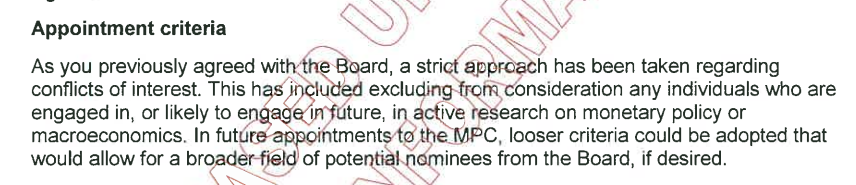
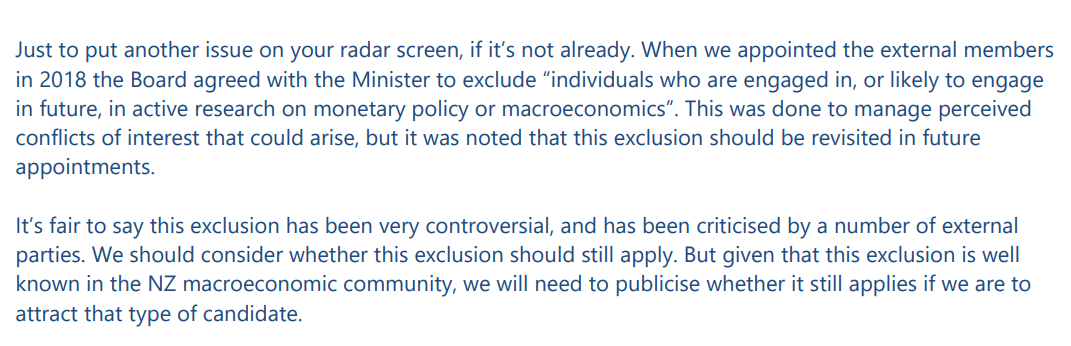
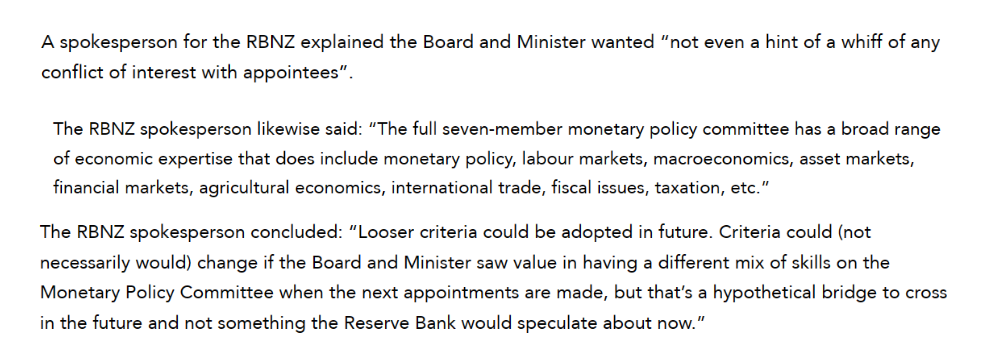
You’ll recall that it was widely understood that there had been such a blackball, put in place by the Bank’s Board and agreed by the Minister of Finance. It was widely understood by pretty much everyone – the Minister, Treasury and Reserve Bank staff, former senior Reserve Bank figures, (quite probably even MPC members themselves), a former senior adviser to the Minister, and Bank spokespeople – and was widely reported, and not denied, once the news got out formally with an OIA release from the Minister to me back in 2019, which had included a procedural papers from Treasury’s appointments and governance manager, handling the formal side of the appointment process, which described the blackball. Lines in that paper – that they were being particularly cautious but that a more relaxed approach might be adopted in future appointments – had been echoed in later comments by people speaking for the Bank. All this had come on top of the person, with macro-specific expertise, who back in 2018 had enquired about the MPC roles and been told by the Board’s recruitment firm that there was a blackball on research expertise, and who had then gone to the Board chair (Neil Quigley) himself to check, and had been told face to face that indeed there was such a ban. I wrote about it all here.

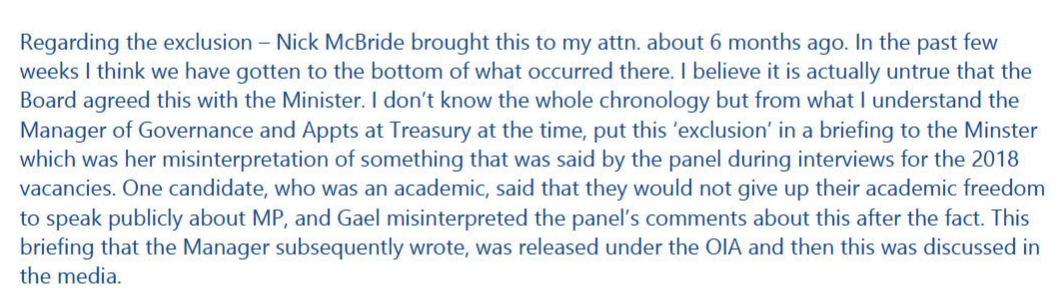
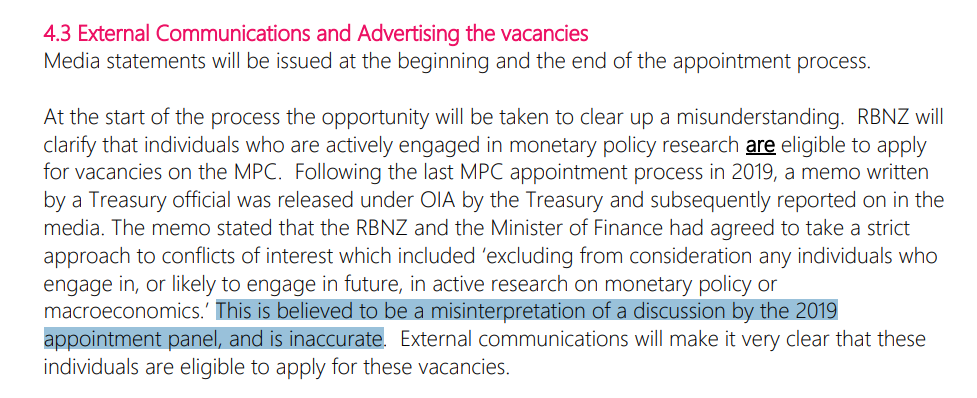
The reason I (and others) were still writing about it was that a few months ago, when forthcoming MPC vacancies were first advertised, it became apparent that the blackball had been lifted, and in this round people with research expertise and possible future research activity in areas of macroeconomics and monetary policy would not be barred from consideration by the Bank’s Board. That was, and is, good news (cynics might suggest that the Board is simply likely to fall back on adopting a slightly different test, barring anyone who might prove awkward for the Governor, but leave that issue for later). But then Treasury, backed by the Minister, issued a statement to the Herald claiming there had never been a blackball, it had all been a sad misunderstanding, and tossed one of their own former mid-level staffers under a bus by suggesting that when she’d written that memo to the Minister, she’d simply got the wrong end of the stick. And, so OIAs revealed, they made this comment – without any serious scrutiny or testing (including asking the person concerned) – because Neil Quigley had, on two occasions, this year told them so. The Treasury official had simply got things wrong, and all that had happened is that some academic who was interviewed for the role had refused to commit to not commenting publicly if appointed, and so that person had not been taken any further. Or so Quigley said.

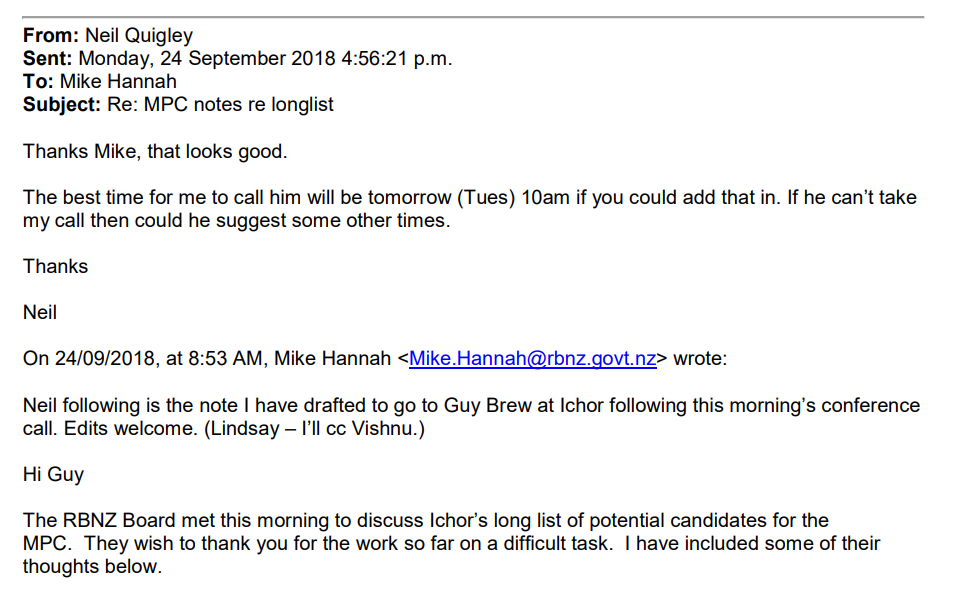
In that post last month I outlined why this simply wasn’t a credible story, and that either Quigley was simply and deliberately misrepresenting things, or – years on – was suffering from a faulty memory, and had conflated two quite different things. Either way, his claim now that there had never been a blackball simply did not stack up, and Treasury should not have been uncritically making statements based on it, perhaps particularly when it involved throwing one of their own former managers (and managers at Treasury aren’t junior people) under a bus. Treasury should now be rather annoyed at Quigley, for putting them in a situation where taking him at his word – a senior government appointee – had left them with egg on their face (I have an OIA in on how, if at all, they have dealt with this subsequently).

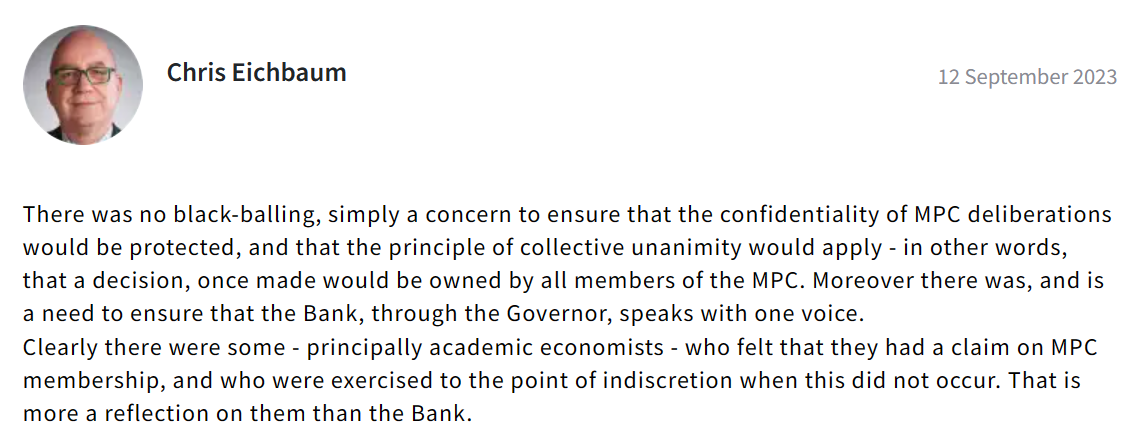
Anyway, that is all prelude to the Herald’s story on 12 September. In my posts I had noted that among the many reasons for scepticism about the Quigley story was former Board member Chris Eichbaum. I knew he used to read my stuff (he told me so one day when I ran into him) and had not been backward in coming forward, commenting in replies on Twitter when he thought I’d got it wrong or been unfair about the Board and its role/performance. Not once had he objected to my characterisations of the existence of a blackball (this back before he left Twitter).

The Herald’s Jenee Tibshraeny got in touch with Eichbaum to see if he had anything to say now. He did. In fact, her story opens with an Eichbaum expletive.

Asked specifically about the 2023 Treasury denial, which had channelled Quigley, this was Eichbaum’s response

Well indeed.

He’d added

noting that today’s Board might not be as “risk-averse” as the old Board was.

Here it is worth noting that Eichbaum was not just any Board member, but was one of the small interview panel (him, Orr, and Quigley) for these MPC roles back then.

I also understand that Eichbaum regards the Herald article as having fairly and accurately represented his views/comments.

That might have seemed fairly open and shut. There are suggestions there is no love lost between Eichbaum and Quigley (one of the left, one of the right, and Quigley had been a former senior manager at Victoria University where Eichbaum taught – and comments on Quigley from people at Vic then often seem to have quite an edge to them), but it all seemed pretty clear. There was an expertise blackball, as everyone else had believed until Quigley belatedly sought to deny it.

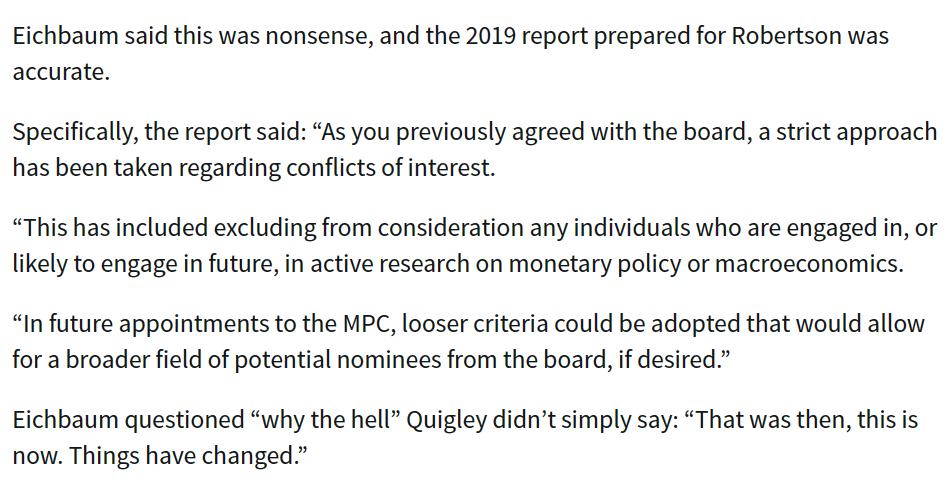
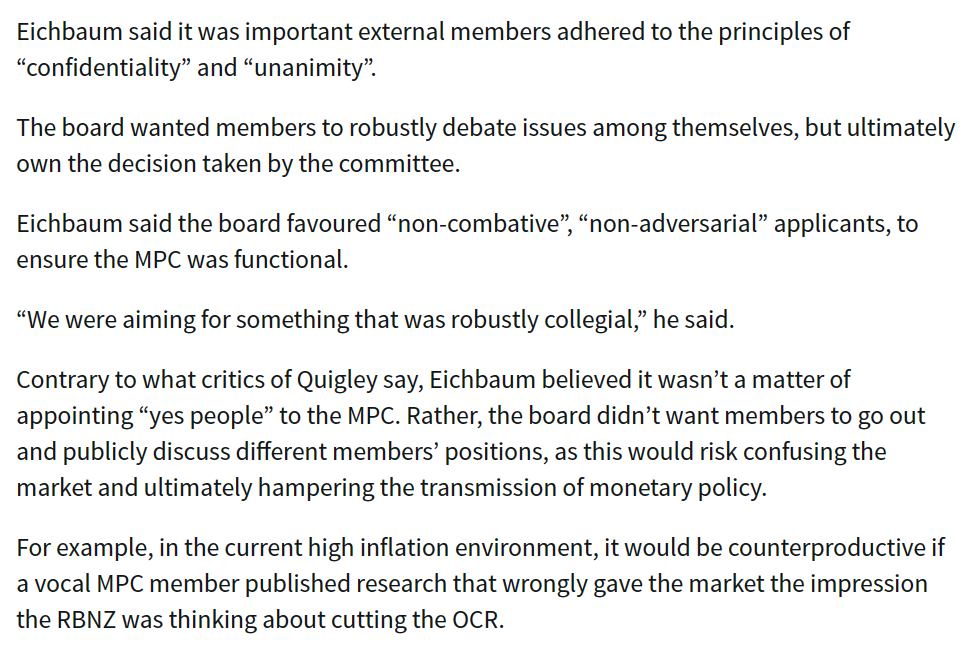
But there were some more Eichbaum comments in the post, on a slightly different strand of what seems to have gone in 2018/19.

Which seems to give support to what outsiders have supposed all along (anyone awkward for management, especially the Governor, wasn’t going to be welcome), but is also consistent with that “consensus collegial” model of MPC decisionmaking which the Minister went along with (but which is not practiced in the best practice MPCs globally). The Bank had actually wanted to ban external MPC members from giving speeches or interviews at all, but the Minister didn’t go along with that…..and the practical solution seems to have been to appoint people who had neither the interest, inclination or ability to give speeches or serious interviews (despite being responsible, supposedly actually accountable, statutory appointees and decisionmakers).

But it also points to what Quigley may have been remembering when he falsely claimed there had never been a general blackball. There clearly was – as Eichbaum says – but it looks as though they may have also turned down one person who got as far as an interview because he/she wanted to be freer to speak. That wasn’t a wider general ban, but specific to an individual and the limitations of the model the Bank wanted around MPC. There was still a wider ban on people with actual/future macro research expertise etc.

But focus on that final para of Eichbaum. In open and transparent central banks – Bank of England, Fed, Riksbank – individual MPC members often give speeches or interviews, sometimes based on their own research, often drawing on their own analysis, outlining their thinking on issues, risks, and outlooks, including policy outlooks. It is quite normal, not at all problematic, and quite consistent with the inevitable huge uncertainty around any view on the outlook and likely required future stance of monetary policy. But we don’t want any of that sort of openness in the Robertson/Orr/Quigley Reserve Bank……and they’ve delivered. We’ve heard nothing of substance – research or not – from any of them.

And that might have been that, but on the same morning the Herald article Newsroom published a column on the MPC blackball issue by Eric Crampton, who has had many of the same views as me on the issue.

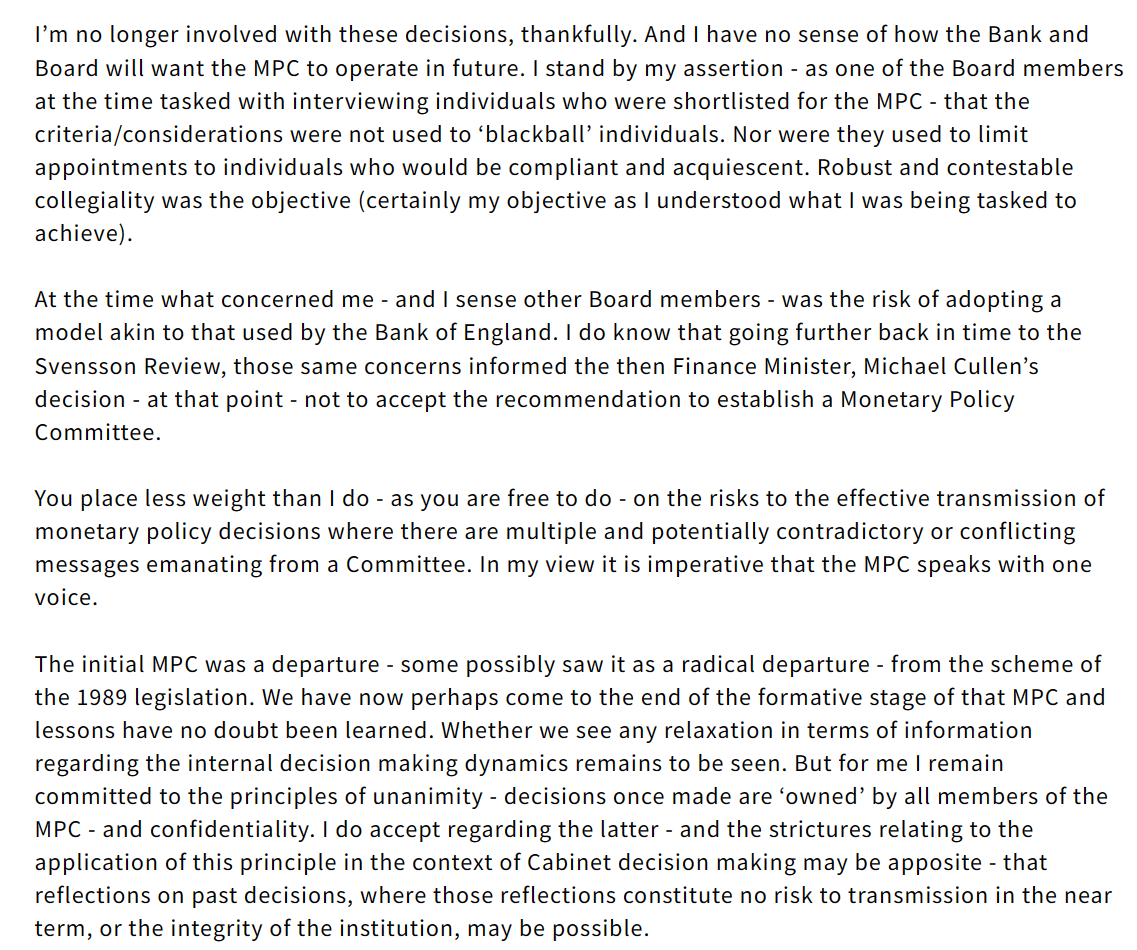
And one Chris Eichbaum left a comment.

This is the same person quoted in the Herald saying Treasury’s description of the blackball had been quite right, and it was only a shame Quigley hadn’t just said so and said they’d now moved on.

But this comment, if it is to be interpreted consistently with this comments to the Herald, must also be about that desire to ensure that no external MPC members were speaking in public at all, at least never articulating any views of their own. That is a different issues than the macro research expertise blackball – not much more defensible in substance, but at least with some precedents (notably in the RBA model that the Bank wanted to model its committee on – more ornamental than substantive).

What of that second paragraph? I am not aware of anyone who thought they had a “claim on MPC membership” – and Eichbaum seems to have no evidence for his claim – but a really large number of people, economists and not, many of whom would not have wanted to touch an Orr RB MPC with a barge pole, were nonetheless seriously disconcerted that our MPC was to be the only one in the world where formal expertise in the subject was a disqualifying factor. As it clearly was, as Eichbaum acknowledged to the Herald. And recall that the story did not break in the first place because some aggrieved academic went to the press but because a citizen used the OIA and the Minister of Finance complied with the law and released the relevant material.

In the Newsroom comments column Eric Crampton responded to Eichbaum. Here were some relevant bits of Eichbaum’s reply.

It is interesting in its way, but what it seems to confirm is the conflation of two quite separate events by Quigley. The block put on an individual at the interview stage seems to have been specific to one person’s desire to be free to communicate publically while in office.

But that is very different from the message conveyed by the Board’s recruitment firm – confirmed face to face by Quigley – that no one with active or future research interests in and around monetary policy would be considered (would even be longlisted), let alone interviewed or appointed.

There is no real doubt that happened. The person who recounted their experience to me is someone whose integrity and honesty I have never had any reason to doubt. The fact of that blackball also squares with what the record of a Board meeting discussion in 2018 suggested (copy in earlier posts).

But I realised that when the Bank had responded to my OIA request in 2019 re MPC appointments it had left out a lot of material that as clearly covered by the wording of my request. So I lodged a few weeks ago a further request – noting the prior omission – asking for all dealings with the recruitment firm around that first round of appointments. The Bank is slowwalking that request too – citing the need for “consultations”, about events 4-5 years ago – but before long we should have those answers too.

(Interestingly, I had another OIA back from the Minister of Finance last week re any discussions/advice this year re the blackball and its removal. It appears he was not involved at all (which I have no particular problem with, although one might perhaps have hoped for a more proactive approach).

Some of you will be wondering why any of this matters. To me it is a matter of two things. First, a really bad decision was made in 2018/19, which got the MPC off to a very poor start. But at least as importantly, because honesty and integity matters, or should do, in public life, and particularly in and around powerful independent agencies. We’ve simply not seen that from Neil Quigley (and here I am clear that his responsibility is personal: the Governor and management have not weighed in to support his, clearly wrong, story).

But it does bring us to today. In the papers I got from the Bank a month or so back there was a lot of material about the process that is underway to fill the two MPC external vacancies next year. It is a quite unsatisfactory situation. The Board – appointed entirely by the current Minister of Finance, few of whom have any relevat expertise – have not only advertised to fill the MPC vacancies, have had their recruitment firm tell at least one qualified person that they simply won’t be considered, but were on schedule to have conducted final interviews last month, positioned to deliver recommendations to the Minister of Finance once a new government is formed.

Perhaps that would be no great problem if a Labour-led government were to be returned – his friends and appointees on the Board will be delivering names consistent with the last few years’ model of the Reserve Bank. But it is highly unsatisfactory if there is a new government, especially in light of the concerns both National and ACT have expressed about the Governor and the Bank’s stewardship. If Nicola Willis is appointed Minister of Finance, she should start the process from scratch, making clear to the Board the sort of people, and sort of model (hopefully both more expert and more open) that she wants, opening the process to people who might be more interested in serving under such a model, even if Orr is still in place. The first vacancy is not until 1 April next year. It is very difficult to get rid of the Governor himself – and thus Willis has made a virtue of necessity in ruling it out – but if a new government is at all serious about change it has to start with a keen focus on all vacancies, MPC and Board, as they arise. Whether they are really serious – I’m sceptical – I guess only time will tell.

Just making stuff up: the chair of the RB Board and the blackball on expertise

The government-appointed (and reappointed) chair of the Reserve Bank Board has been in the news today, after the reports earlier this week that in his role as Vice-Chancellor of Waikato University he’d been negotiating policy around a future new medical school at Waikato with National’s health spokesman Shane Reti. I don’t have any particular problem with such talks per se but what caught attention was this spectacularly inappropriate line

Reti seems to be a person of decency and integrity and one can half imagine him wincing when he read those words. Who, he might have asked himself, is the senior person who not only runs a public university but also chairs a major government board, who actually says such things, let alone writes them down.

There is also a (paywalled) Newsroom article this morning [paywall now lifted here] on Quigley, explicitly questioning his ability to keep holding the Reserve Bank job. I don’t think Quigley is a political partisan (National or Labour) – and he has had roles from both National and Labour governments – but he again displays a serious lack of judgement and tone-deafness (of the sort that was on display when he finally got one of his RB Board members to step down from an insurance company directorship, not because having such a role was a terrible look but because the OIA might lead to some scrutiny, or had never raised a concern at the government appointing the chair of Kiwibank’s then owner to the board of the bank regulatory agency). He can’t match the Governor for lowering the standing and reputation of the Bank – but then for the Governor it is a fulltime job – but it is a pretty consistently poor and damaging record.

And then there was the question of the ban put in place in 2019 on appointing people with active or likely future macroeconomic research expertise to the initial round of Monetary Policy Committee vacancies. It is clear that there was such a ban (now removed for the round of vacancies coming up next year) and that the Minister of Finance and the Bank’s Board (chaired by Quigley, with Orr a member who had to be formally consulted as well) had agreed on the ban.

Quigley claims otherwise. That there never was such a ban, that it all a castle built in the air on a paper written to the Minister of Finance (released to me in 2019) by a Treasury manager responsible for governance and appointments. He had had, he claims, no idea until last year where such curious, incorrect, ideas (of the sort people like me and Eric Crampton, and fulltime journalists, notably Jenee Tibshraeny, now of the Herald) had been writing about had come from. This was the extract in question.

Quigley even got Treasury and the Minister to say in public that it had all been a misunderstanding, and that there had never been such a ban.

About a month ago I wrote a long post based around an OIA response from The Treasury in which I had asked for background relevant to that Treasury statement. I outlined what Quigley had told Treasury twice, months apart, earlier this year, and compared it carefully to what had been revealed in (a) past OIAs from the Bank and Minister, (b) things I knew from first hand accounts, and c) comments from the Minister, the Bank, former Reserve Bank Assistant Governor John McDermott, and former ministerial adviser Craig Renney. I pointed out that the ban had been commonly and widely understood, not just among Reserve Bank watchers in New Zealand but in markets overseas (a Treasury manager reported having been challenged on it in Australia), and not in ways that were welcoming – more along the lines of derisive comments that the Reserve Bank of New Zealand was the only central bank in the world where actual research expertise would have been a formal disqualifying factor. As I had noted in one post, not even Trump’s Fed appointment standards had dropped that low. There had been plenty of opportunity for Quigley and the Bank (or the Minister) to have corrected the story at any time over several years, and Orr in particular has not been backward in coming forward when he thinks people aren’t representing him or the Bank in a way he likes. I’d encourage you to read that post as I don’t want to repeat it all here.

At about the same time as the Treasury OIA had been lodged back in June Eric Crampton and I independently lodged (somewhat overlapping) OIAs with the Bank re aspects of the blackball and its removal. Being the Bank, they were very slow to respond but we both finally got responses on Tuesday. There is a couple of hundred pages of material, although bulked out by releasing back to us both the 42 page response the Minister had given me in 2019, which they had probably in turn just got from my website (it was in the mix because last year a senior Bank official sent it to Quigley, who then started on his “no, no, that wasn’t so at all” line.) Both responses are linked to below (Eric’s first – with his permission- then mine which came in two separate big documents).

RBNZ OIA release to Crampton Sept 23 re MPC expertise blackball

RBNZ OIA release to MHR Sept 23 re MPC expertise blackball Part 1

RBNZ OIA release to MHR Sept 23 re MPC expertise blackball Part 2

The documents make interesting, and slightly depressing even incredible (literally almost unbelievable), reading in places.

The document set starts on 18 May last year when the Governor (Board member) sends an email to Nick McBride (the Bank’s in-house lawyer) cc’ed to his boss (one of Orr’s DCEs) asking about whole situation re ”criteria and expectations” for external MPC members, noting 

McBride says he doesn’t really know what went on (“as far as I know it was worked out between MoF and the RBNZ Board”) while noting (quite correctly) that there was nothing in the Act or the MPC charter or code of conduct that required or reflected a blackball on expertise. (Among outside critics I think this has been common ground all along. It would have been even more absurd had the law somehow enforced the ridiculous ban.) McBride comes back later that day with the extract (above) from the 2019 Treasury paper, pointing out that it had been released to me and had been what had sparked the coverage. McBride disavowed any knowledge of what had happened beyond that account. Neither he nor Orr seem to be in any doubt that there was such a restriction put in place for the 2019 appointments.

Nor had there been any doubt earlier in 2022, when Tibshraeny had been asking about the blackball in the context of the approaching expiry of the terms of two external MPC members. The Bank knew then, but outsiders did not, that the plan was simply to reappoint the incumbents so inside the Bank it appears the issue hadn’t arisen until Tibshraeny got what was probably a throwaway line from the Minister in a press gaggle, that he wasn’t aware of any change of criteria, and she then sought comment from the Bank. No one in any of the emails seems to have doubted that there was a ban – no one seems to have known much – but they just wanted to put Tibshraeny off (‘best not to throw any chum in the water’) so they agreed also just to line up with the Minister and say “no change”. So relative to what we previously knew, it is probably safe now to say there was actually no new information in those 2022 comments from MoF or the Bank. There is no record of them having consulted either Orr or Quigley at that point.

The final bit in the response to Eric Crampton was this from February 2023, when work was going on on the process and criteria for the next set of MPC expiries/vacancies. McBride and one of Bank’s governance people explicitly draw Quigley’s attention to the 2019 paper (Gael is Gael Webster, the Treasury governance and appointments manager who had signed out the paper). Note that section 9(2)(a) is a withholding ground around personal privacy: we might wonder whose.

It is pretty extraordinary, if this were an honest account, that the Board chair had never once in the previous 3.5 years asked someone why this view – that there was an expertise blackball, which he says he was aware of – was abroad. Extraordinary and not at all plausible, given that until last year the appointment of MPC members and of the Governor was the single most important powers the Board had.

My OIA had covered only material from this year and picks up in mid-February (just prior to that exchange with Quigley) as staff are reviewing processes etc for advertising for MPC vacancies. (Interestingly, the Comms manager suggests this would be a good case for pro-active release of relevant material, not a concept the Bank displays any practical sympathy with ever). The draft document they are commenting on includes among the things to be done

and in comments McBride recognises the ban, commenting that “the board needs to be clear about its attitude to including MP [monetary policy] subject experts on the MPC and this should be resolved at the outset.

The Economics Department is a bit slow with its comments, and didn’t comment until the next draft in early March. Chris Bloor, one of their experienced and respected managers, observed

to which the person leading the process responds

But they really weren’t very sure. In early April a paper went to the Reserve Bank Board on the MPC appointment process and it included this

And that was all that was new in the papers relevant to the issue. Note that there is no suggestion that anyone made any effort to contact Treasury or Gael Webster specifically, they simply went along with a story Quigley had given them years after the event. It seems not to have occurred to anyone (or perhaps it would be lese-majeste in today’s RB to have done so) to ask “but what about all those statements that have been made in defence of the ban previously?”, or “but if so many people had got the wrong end of the stick outside and abroad, why did we never clear up the confusion?”

I’m quite prepared to believe that there was an interview with an academic applicant (recall that academics themselves weren’t barred, and (non-macro) Prof Caroline Saunders was appointed), who told them “they would not give up their academic freedom to speak publicly about MP” [as MPC members in many other countries do speak] but on the most charitable interpretation Quigley must have been conflating two quite different events and sets of circumstances.

As I discussed in the earlier post, all those years ago a qualified academic told me that they had contacted the recruitment firm the Board was using and been told that they would not be considered because they did and might do in future macroeconomic research on matters relating to monetary policy, and that this was a criterion choice adopted by the Board. The same academic then saw Quigley at a function and asked him about this apparent ban, including if it was really the Board’s view. As recounted to me, and repeated recently, Quigley’s response was along the lines that they wanted to be very cautious and risk-averse for the first set of appointments and that the criteria might be relaxed in future rounds. That was well before anyone was longlisted, let alone shortlisted or interviewed. My interlocutor couldn’t even get on the page to be asked about how they would operate in practice if appointed. And you will note that that conditional statement about future appointments is very similar to the wording used in that 2019 Treasury memo that Quigley now seeks to disavow, throwing the author under a bus.

And how about some of the evidence I cited in the previous post? Here Quigley raises no objections to the Board Secretary’s account of a Board discussion of individuals and (see highlighted bit) criteria.

Here was how the Bank’s spokesperson was defending the blackball in 2019. Note the explicit use (their own words) of the line that “looser criteria could be adopted in future”.

And here was the Minister of Finance’s defence of the blackball in 2019; he also explicitly stated “over time this will evolve”.

There is simply no evidence for the (contemporary) Quigley version of events – the one he got Treasury to embarrass itself by making a statement defending (having asked no questions themselves, but happily tossing a former staff member under the bus).

(Having read the latest OIA releases I went back this morning and read the Bank’s 2019 release to me on matters around the MPC selection and appointment process. On rereading it I noticed that they had not disclosed any communications to or from the recruitment firm (nor identified such material with statutory grounds for withholding). A new OIA has been lodged this morning which may yet shed some new light.)

It is quite clear that there was a blackball on expertise (which has now, formally, been removed) and when Quigley told Bank staff and Treasury (twice) that it was not so, at best he was confused, and at worst deliberately trying to lay a false trail to cover later embarrassment at such a bizarre rule, all while deflecting blame onto an experienced professional who had been working for another government agency. Neither option reflects any credit on Quigley or the Bank whose performance he is supposed to oversee and hold to account. Once again it brings the institution into disrepute (though more so him as an individual and statutory officeholder).

One is always suspicious of what isn’t in these releases. There is relevant material that has been in other releases, including from Treasury, but not released in this set, and there is no record of any discussion (written or oral) between the Governor and his Board chair about any of these issues. That simply doesn’t ring true. But whether true or not, there is quite enough material in what we do know to conclude that, wilfully and deliberately or not, Quigley was simply not telling an accurate story when he has tried to convince staff and Treasury that there never was a blackball. He should be held to account for that. He should not – for this and a variety of other reasons – be the chair of our central bank and banking regulator, from whom we should expect openness. transparency, integrity, accountability….and the humility to acknowledge honestly when mistakes have been made (in this case both the blackball itself and the spin, attempting to rewrite history at the expense of others).

UPDATE: Eric Crampton has a follow-up post in which he bends very very far over backwards to find a charitable explanation. I don’t find it persuasive, and he doesn’t take account of several important items above, but it is worth reading as an alternative take.

At it again

Senior figures at the Reserve Bank have an alarming record of just making stuff up (and getting away with it). Just last week, documents showed that the Board chair had told entirely made-up stories to Treasury, apparently trying to rewrite history, in turn leading an incurious Treasury to lie to the media. And on several occasions the Governor has been found actively misleading Parliament’s Finance and Expenditure Committee (eg here, here, and here).

He (and, sadly, his chief economist) were at it again this morning at FEC. Asked why it was taking so long for inflation to come down we got a long list of supply shocks (ie things they weren’t responsible for) and little or no acknowledgment at all that excess demand (reflected in things like the unsustainably tight labour market), the thing monetary policy influences, might have played even part of a role.

But then this conversation ensued (not word for word)

Nicola Willis: A year ago your forecasts said inflation by now [September quarter 2023] would be 4.1 per cent, and now you are picking it will be 6.0 per cent. What explains that magnitude of error?

Orr: [after some burble] supply shocks and in particular the storms and cyclone Gabrielle

Nicola Willis: How much difference did the cyclone make?

Orr: I don’t know.

[a minute or two later]

Anna Lorck (Labour backbencher): Governor, how much difference has the cyclone made to inflation?

At this point, the Bank’s forecasting manager, sitting in the back row, pipes up and is invited forward and she explains that they think the cyclone might explain 0.1 or 0.2 per cent, (the effect through fresh fruit and vegetable prices)….. [and it seems very unlikely that the Governor did not already know this, having just sat through days of MPC deliberations].

As I say, they just make stuff up. Here it is worth remembering that a) fruit and vegetable prices, and especially extreme moves in them, will be out of all/most core inflation measures, and b) that as the Bank’s own MPS yesterday noted, several times, core inflation – the bit shaped by excess demand and expectations pressures – was hanging up and had not yet shown signs of falling.

These are the RB inflation projections Willis was referring to

And here are their unemployment rate projections from the same two sets of forecasts

Slack simply has not re-emerged in the economy as early or to the extent the Reserve Bank expected a year ago. That isn’t about adverse supply shocks. It is just a(nother) forecasting error re excess demand from the well-paid committee (and their large supporting staff) charged with delivering annual inflation near 2 per cent.

Despite the chief economist’s claims (again, at FEC this morning) that the Bank is pretty good at forecasting, in this episode (last few years) they’ve been consistently worse than respondents to the Bank’s own expectations survey (who’ve been bad enough).

All that was just about a few minutes in the MPC hearing, where (as so often) that Bank treats parliamentary scrutiny and accountability as some sort of game where anything goes. The post was actually going to be about the MPS itself.

It was a pretty thin and disappointing document, even with the modest nudge in the direction of possible further OCR increases. I read it more slowly and carefully than I sometimes do, and came away if anything more convinced that the combination of their own persistent mistakes and their own read of the data support a higher OCR now, to be confident that we will really get inflation back to 2 per cent fairly promptly from the current still elevated core levels. And astonished that, with no supporting analysis for the claim, the MPC continues with the bold claim – not paralleled as far as I’m aware in any other advanced country central bank – that they are “confident” they have done enough. “Confident” here seems most likely to be empty bluster, with the risk that it is also intended to keep the natives quiet for the weeks remaining before the election.

I have been, and still am, hesitant about suggesting that the Governor and the MPC are operating in a deliberately partisan way. But it gets harder to believe such a pro-incumbent bias is playing no part (consciously or unconsciously) in their words and actions. I’ve documented previously the skewed, highly unconventional, and very favourable to Labour, way the Bank treated fiscal policy in May following the more expansionary Budget. In this MPS, the word “deficit” appears 44 times, but it appears that every single one of those references is to the current account deficit, and not one to the budget deficit (altho there is a single reference to “the Government’s plan to return the Budget to surplus”). The same weird framing of fiscal issues was there not only in the rest of the document but explicitly from the Governor this morning. He claimed that what mattered for the Bank from fiscal policy was only/mostly government consumption and investment spending, not taxes (or apparently transfers), let alone changes in structural deficits (the usual model). Having provided no supporting analysis or rationale whatever – speech, research paper, analytical note, just nothing – the Governor appears to have simply tossed the conventional fiscal impulse approach out the window, at just a time when doing so suits his political masters. Perhaps it is all coincidence, but either way it is troubling.

More generally, relevant supporting analysis was remarkably thin on the ground. There was no analysis at all of past reductions in inflation in New Zealand, no analysis of the forecasting mistakes of the last year (see above), no serious analysis of what has gone on in the US, Canada, or Australia where core inflation has turned down (and what, if any, comparative insights those experiences might offer). (At FEC this morning, they were asked about the US case, and it was clear they’d not even thought hard as the chief economist was reduced to lines like “it is a very different economy”, “very flexible”, and that was it…….) And there seemed to be considerably more discussion of the current account deficit – which the Bank has no direct responsibility for – than of inflation for which it does. Even with a four page special topic on the current account and a five page one on immigration it is hard to think of any useful analytical insight one comes away from the document with. And remember that this is it: there is no stream of thoughtful speeches likely to emerge from MPC members over the coming weeks elaborating on bits of research or analysis there was no space for in the MPS itself.

And, revealing the poor quality of the MPC itself, even though core inflation lingers high, miles above target, there is no sign in the minutes of any serious thoughtful alternative approaches. We are left to assume that in a highly uncertain environment all these senior public officials just went with the flow. They are “confident” we are told again, but with no hint of why, or no hint of anything like the normal degree of divergence one might reasonably expect if seven able people were debating such challenging issues at the best of times.

Even allowing for signs that things are slowing – and remember we had two negative quarters of GDP growth late last year and early this year already – there seems to be more wishful thinking and hopefulness than serious supporting analysis (and, of course, any contrition – these people wreaked this inflationary havoc and the expected rise in unemployment – is totally absent). Not even the MPC hides the fact that “domestically-generated inflation” is not only hanging up but is also “marginally higher” than they’d expected as recently as May.

Among the straws they attempt to clutch at is a claim that “private sector wage inflation appears to have peaked and has started to ease” and “most measures of annual wage inflation have begun to ease”. But of all the series they seek to draw on, the only one that actually attempts to measure wage rates (rather than hourly or weekly earnings, or something approximating unit labour costs) is the LCI Analytical Unadjusted series. As I showed earlier in the week, at best this series seems close to peaking, but there is no sign yet of any slowdown.

Perhaps as to the point, even when some series have started slowing – and neither core inflation nor wage rates yet have – there is a long way to go to get core inflation from 6 per cent to 2 per cent, and the Bank’s forecasts and policy have been repeatedly wrong in the same direction over recent years.

Then there is the fact that the Bank has revised up its view of the neutral nominal interest rate by 25 basis points. That may well be sensible (respondents to their expectations survey have raised their view of neutral by 60 basis points in the last 18 months), but what it means is that the Bank now thinks the current OCR is less contractionary, all else equal, than it has assumed previously. It is as simple and mechanical as that. With core inflation still holding up, the labour market still tight (in their words), the output gap still positive, and other excess demand indicators still pointing to imbalances, it might then have seemed natural to have moved to raise the OCR, or at least to move the near-term forward track up by 25 basis points, putting October and November firmly into view. Instead, the track is ever so slightly higher in the near-term and the 25 points increase only really becomes apparent in the far (and largely irrelevant) reaches of the years-ahead OCR projections. The MPC was keen on a so-called “least regrets” framework when they were (unintentionally) giving rise to the current mess, but seem to prefer just to punt and hope now.

One of the (many) disappointments around the Reserve Bank’s analysis in recent years – a period when not only do we have a shiny new MPC but the biggest monetary policy failures in decades – is the lack of any really systematic and overarching view of the excess demand pressures that have built up in the economy. They show up, of course, most evidently in the high inflation (which then the Bank too often – see above – tries to minimise with handwaving rhetoric about supply shocks), and it shows (more abstractly) in the Bank’s output gap estimates and (more concretely) in the unsustainably low unemployment rates. But it also shows up in the labour force participation rate, which has stepped up a long way in this boom, tends to be pro-cyclical, and yet the Bank assumes the increase is permanent. Is that likely, and if so why?

And then there is the sharp widening in the current account deficit, which does not get the attention it deserves as an indicator of macro imbalances and excess demand. As noted already, there is a four page special chapter (and I agree with the bottom line re the NIIP position), but it is rather light on macroeconomic analysis (a basic savings-investment lens) and longer, earlier, on accounting (the absence of Chinese students and tourists). There is a nice sectoral balances chart

and this is where even the Bank has to acknowledge the government contribution to the demand imbalances.

But in playing around with the data yesterday, I came up with this chart

The extent of the domestic pressure on available resources relative to domestic output is quite unprecedented in recent decades (both the consumption and investment lines individually are also around record highs, but it is the combination that is striking). Since GDP is what it is (already stretched beyond potential – that is what a positive output gap is) the excess demand pressures are reflected in a current account deficit. This is annual data. Using the quarterly seasonally adjusted data, the most recent quarterly observation was slightly higher than the last four quarter average. There is a lot of excess demand adjustment that seems likely to have to occur (if, for example, this ratio is to get back to the 98-100 per cent range observed most of the time in the last 35 years).

Central banks are well-positioned to make such points and present data in telling ways. Our mostly does not.

Any new government will face a lot of challenges, and a lot of areas of the public sector that really need sorting out. Given the great power handed to the Reserve Bank, their glaring failures in recent years, and their apparent indifference to matters of integrity, the combination of considerations mean they should be high on the priority list for a new Minister of Finance.

What should the MPC do?

There is a full Monetary Policy Statement from the Reserve Bank and its Monetary Policy Committee tomorrow. No one expects them to do anything much, but I’m less interested in what they will do than in what they should do. It is hard to be optimistic that the Committee will do the right thing at first opportunity – it mostly hasn’t for the last 3.5 years – but whatever is required will, presumably, eventually get done, perhaps after a prolonged dalliance with the alternative approach (if you think that cryptic, think $10-11bn of LSAP losses, entirely the responsibility of the MPC, and core inflation persistently some multiple of the target that had been set for them).

I wrote a post a couple of weeks ago looking at what had been happening to monetary policy and inflation across a bunch of advanced economies in the light of the complete suite of June inflation data. I’m not going to repeat all the analysis and discussion from there, and nothing very much has changed in the published data (for real nerds, still disconcertingly high Norwegian core inflation has come back down again after rising the previous month or two). But some key relevant points were:

  • as yet, there is no sign that core inflation in New Zealand is falling (and even if one measure it might be lower than the early 2022 peak there is no sign it is still falling now).  That is a quite different picture from some other advanced countries (notably the US and Canada, but also Australia).
  • employment appeared to continue to be growing strongly (and even confidence measures were stabilising),
  • New Zealand is one of a small handful of advanced countries where the policy rate now (5.5 per cent) is still well below the pre-2008 peak (8.25 per cent)
  • The MPC asserted at their last review that they were “confident” that they had done enough.  Neither those words, nor the idea, appear in the recent statements of any other central banks, and our MPC offered no reasons for their confidence.

Bear in mind that with core inflation around 6 per cent and the Bank’s target requiring them to focus on the 2 per cent target midpoint, there is a very long way to go.   It isn’t a matter of getting core inflation down by 0.5 or 1 per cent, but of a four percentage point drop.

Bear in mind too that whereas past New Zealand tightening cycles have typically seen total interest rates rises similar to what we’ve seen to date (a) the scale of the required reduction in core inflation is greater than anything we’ve needed to achieve for 30+ year, and b) unlike typical New Zealand tightening cycles there has been no support from a higher exchange rate.

What local data there have been in the last couple of weeks hasn’t given us any more reason for comfort.  Late last week, there were the monthly rentals and food price data.   The food price data did look genuinely encouraging, although it was a single month’s data in a part of the CPI that had seen inflation far faster than the core measures until now.  Rents, on the other hand, appeared to be continuing to rise quite strongly, with no sign of a (seasonally adjusted) slowing at all.

The suite of labour market data (HLFS, QES, LCI) was not really any more encouraging.  Labour market data do tend to be lagging indicators, but we have to use what we have.   4 per cent annual growth in numbers employed (comprised of four individual quarters each showing material growth) is absolutely and historically strong, by standards of past cycles the unemployment rate has barely lifted off the (extremely low) floor, and there is no sign of any slowing in wage inflation (remember that much of services inflation is, in effect, wage inflation).  There is seasonality in the wages data and SNZ don’t publish seasonally adjusted series but as this chart illustrates at best wage inflation might be levelling out, not much higher than the same quarter in the previous year.

To the extent the mortgage borrowers/refinancers tend to go for the lowest shortish-term fixed rate on offer, current two year fixed rates are barely higher than they were at the end of last year, and all the reports from the property market suggest a bottom has already been found and prices are already rising (still modestly) again.

And then there was the latest RB survey of expectations. Medium-term expectations of inflation actually rose a touch (one could discount the small rise, but we should have been hoping for a fall, especially as the relevant horizon date moves out each quarter). This group of respondents has consistently and badly underestimated inflation in recent years. The Reserve Bank has too, but it has done even worse than these survey respondents.

The survey responses regarding the inflation outlook don’t seem anomalous. The same respondents revised up their GDP growth forecasts, revised up their wage forecasts, revised up their house price inflation expectations, and revised down their medium-term unemployment expectations. They might be wrong – and often are – but are there good grounds for thinking the Reserve Bank is any better at present (in a period when no one really has a compelling model of what has happened with inflation – if they had, they’d have forecast it better).

You may have noticed that a couple of local banks think the Reserve Bank will raise the OCR later in the year (presumably a view that the Bank will eventually be mugged by reality). One presumes this predictions are best seen as a view that “more will need to be done”, rather than a specific confident prediction of 25 basis points being specifically what is needed. No one can be that confident (with 25 basis points). It may be that the MPC has already done enough (as they thought) or that it needs to do quite a bit more, but even in hindsight it will be very difficult to distinguish between the effects of a 5.5 vs 5.75% peak choice.

In the NZIER Shadow Board exercise, where respondents are asked what they think should be done, Westpac’s Kelly Eckhold thought that an increase in the OCR to 5.75 per cent at tomorrow’s MPS would be warranted (as does one other economist in the survey).

When I tweeted yesterday about the Shadow Board results yesterday I was still hedging my own position. I noted that I thought a least regrets approach – remember the MPC’s enthusiasm for such a model on the downside – suggested that it would have been better if the OCR had been raised more already.

That was deliberately an answer to a slightly different question than what I would do tomorrow if I were suddenly in their shoes, or (separate question again) what I think they should do. The actual MPC is somewhat boxed in by its own past choices (not just the “confident” rhetoric, but the absence of any speeches etc giving any hint of how they, individually or collectively, have seen the swathe of data that has come out since they last reviewed the OCR). To move the OCR tomorrow would bring a deluge of criticism on their heads, from markets and economists, but it would then be amplified greatly by politicians as we descend into the depressingly populist election campaign.

Since I think making the right policy adjustment (even amid all the uncertainty) is more important than communications, and since there is already reason to think the MPC has been playing party political games (its treatment of the Budget in the last MPS), I think they should raise the OCR anyway, by 25 basis points, and shift their forward-looking approach back to a totally data-dependent model, rather than trying to offer reassurances. Were I suddenly in their shoes, shaped to some extent by past choices, I would probably be wanting to indicate concern that core inflation was not yet falling, emphasising how far there was to go, and making clear that the real possibility of OCR increases would be on the table for both the October and November reviews (the latter the last before the MPC moves into its very long summer holiday).

To me, the issue now is not whether core inflation is going to fall. It seems most likely that it will finally begin to (and although overseas experience in by no means general, perhaps the US, Canadian, and Australia recent experiences offer grounds for hope) but rather how far and how slow the reduction will be. We need large reductions in core inflation, not just the beginnings of a decline, and two years into the tightening cycle we need to see large reductions soon. Perhaps it will happen with what has been done already, but that seems more like a hopeful punt than a secure outlook. One thing we should be looking for tomorrow, especially if the MPC does nothing, is some serious analysis illustrating their thinking as to why it is that core inflation here has not yet fallen (whereas, for example, it has in the US, Canada, and Australia). I don’t know the answer myself, but with all the resource at their disposal we should expect the MPC to make a good fist of a compelling story.

The world economy, and the travails of China, have got some attention recently. That global uncertainty will no doubt be cited by some, including around the MPC table, as reason for waiting. I’m not convinced, partly because over the decades I’ve seen too many occasions when such potential global slowdowns have been cited as an argument, only for them to come to not much. Relatedly, over the years one of the most important ways global events affect New Zealand has been through the terms of trade. A serious global slowdown might be expected to dampen the terms of trade (and thus real incomes and demand relative to the volume of domestic output) but…..

….New Zealand’s terms of trade have been trending down since Covid began, and quite sharply so since the start of last year. We’ve been grappling with an adverse terms of trade shock and have still had persistently high core inflation (and super-tight labour markets etc). There isn’t any obvious reason why the terms of trade couldn’t fall another 10 per cent (dairy prices have already weakened further in recent months, this chart only being to March), but if so it won’t be against a backdrop of recent surges of optimism (unlike the reversal in the recession in 2008/09). In short, there is plenty of time to react to really bad world events if and when they actually happen.

Finally, the immigration situation has materially changed the New Zealand macro position in the last year. In the June quarter last year, there was a net migration outflow of 2600 people. In the June quarter this year (June month data out only yesterday), the estimated net inflow was 20000 people (consistent with an annual rate of 80000 or so). The Reserve Bank is on record as saying it doesn’t know whether the short-term demand or supply effects are stronger (which is quite an admission from the cyclical macro managers) but all New Zealand history is pretty clear that – whatever the longer-term effects might be – in the short term demand effects, particularly from shocks to migration, outweigh supply effects. Without that effect, it might have been safe to assume enough had been done with monetary policy months ago. But not now, not against the backdrop of high and not falling wage and price inflation, strong employment growth, recovering housing market and so on.

Note too that the net inflow numbers are held down by the high and rising number of New Zealanders leaving. Outward migration of New Zealanders tends to be particularly strong when the Australian labour market is very tight (see 2011 and 2012), and if that market were to ease – as seems to be generally expected and thought to be required – the overall net inflow to New Zealand could surge again

Bottom line: I think the MPC should raise the OCR tomorrow, and certainly should flag October (once the Q2 GDP numbers are in) as live.

But all these views have to be held somewhat lightly. Doing that Shadow Board exercise (see above) myself, and it is something the Governor’s advisers at the RB used to have to do, I might distribute my probabilities as to what OCR is appropriate now something like this (none of those individual probabilities is higher than 20 per cent)

UPDATE:

In the comments Bryce Wilkinson points us to this. Having been in the weeds in 2007 I’m not convinced that on the information we had at the time an OCR of 10% was needed in Dec 2007. That said, an OCR of 4.3% in February 2022 would have been much better than policy as actually delivered. And note that an 8% OCR now would be close to the 2007/08 actual peak (as many other countries’ policy rates now are). Food for thought.

There was a blackball on expertise

(This is a long post. The Executive Summary is that there was a bar on any active or future researcher on macro or monetary issues serving on the Reserve Bank MPC when it was established. Everyone accepted that this was so, and both the Minister and the Bank had defended the bar. Recently, the Reserve Bank Board chair Neil Quigley persuaded Treasury to state publicly that it had all been a misunderstanding and there had never been such a ban. None of the extensive documentation supports Quigley’s belated claims or explains Treasury’s willingness to champion his rewrite of history.)

About six weeks ago the ban that had been placed on anyone with current or likely future research expertise or interest in macroeconomics and monetary policy serving as external members on the Monetary Policy Committee was once again in the headlines. The Reserve Bank Board had just advertised to fill the two vacancies that will arise next year (yes, you might wonder why they were advertising now when it isn’t clear who will form the next government or what their expectations for the Reserve Bank might be, but leave that for another day). In the advertisement it was pretty clear that the former ban had now been lifted. If so, that was a really welcome step forward. The proof would still be in the sort of appointments eventually made, and the strong suspicion is that the more important (but unwritten) blackball is still in place – no one seriously likely to challenge the Governor or known for thinking independently was likely to be appointed. But it was a start. And would at least mean the Board and Minister were no longer open to the charge of having the only central bank in the advanced world (or most of the rest) where relevant expertise was a formal disqualifying factor from membership of a monetary policy decision making body. The list of former leading central bank figures internationally who would have been disqualified under such a rule is very long indeed.

I idly wondered what had led to the change.

The Herald’s Jenée Tibshraeny has done sterling work in giving this issue some of the coverage it deserved (where, one often wondered, were the Opposition parties), initially at interest.co.nz and now at the Herald. She asked what had gone on and got a surprising answer from The Treasury and the Minister of Finance. It had all, we were asked to believe, been a misunderstanding, and there never was such a restriction. Tibshraeny’s 21 June story is here. I wrote about the story, documenting how improbable these revisionist claims were, here. And then I lodged an OIA request with The Treasury.

To step back for a moment, the existence of this restriction was first confirmed in a response to an OIA I lodged with the Minister of Finance after the first MPC appointments were made in March 2019. The Minister’s response is here. A short Treasury report to the Minister, dated 29 January 2019 and signed out by the Manager, Governance and Appointments contained the following paragraph on the first (of two) pages (it was a covering memo relating to getting the Minister to send a paper to Cabinet’s Appointments and Honours Committee to make the MPC appointments)

It didn’t leave much room for doubt, and came as no surprise to me because what was written there was what I had been told some months earlier by a well-qualified academic who’d expressed interest in the possibility of an MPC role. Here is how I described in a post when the papers were first released by Robertson

I couldn’t use that information when the person first told me – and had to wonder if somehow they’d got the wrong end of the stick- but it informed the framing of my OIA. The person concerned was told of this bar as it applied to people like him by both the recruitment consultants the Board was using and by the Board chair himself.

Tibshraeny gave the issue coverage. Here was her 1 August 2019 story. There were scathing comments from former Reserve Bank Governor Don Brash, critical comments from Eric Crampton (and some of my post’s critical lines), as well as some comments from former Reserve Bank Governor Alan Bollard suggesting that perhaps all that had really been meant was not having people with “market interests”. But what really mattered were comments from the Minister of Finance himself and an official “Reserve Bank spokesperson”.

Here was Robertson

which sounds defensive and unenthusiastic, but certainly not suggesting that there was not a restriction, let alone suggesting that a Treasury official had simply made a mistake in that January 2019 report.

And from the Bank’s side

To the first paragraph one goes “of course” (as in, we don’t want MPC members also selling their wares to hedge funds etc at the same time), the second para is beside the point (the issue with the blackball was about research), and as for the third……..doesn’t that first phrase (“looser criteria…..”) read almost exactly like the words of the initial Treasury report. There was no suggestion at all that some Treasury official had just got the wrong end of the stick. Rather, as was their right (and job), they defended the stance that had apparently been adopted by the Board and the Minister. And while it was an anonymous spokesperson, there is absolutely no way those lines would not have been cleared with the Governor, and probably cleared with – but certainly advised to – the chair of the Board, Neil Quigley. Had Quigley then thought the Treasury report had misrepresented him or his Board, it would have been easy to have issued a clarifying statement.

And there the issue lay for a couple of years – there were no external MPC vacancies, and Covid overran everything. But in early 2022 the first terms of two MPC members were coming to an end. And in the margins questions were getting raised as to whether the blackball restriction was still going to be in place. Tibshraeny – who had talked to at least a couple of us – was on the ball again and went and asked both the Minister and the Bank about the specific restriction. Her story appeared on 19 February 2022.

There are no quotes from either Robertson or the Bank (presumably she just got responses along the lines of “no, there has been no change” rather than anything more enlightening).

Tibshraeny went further, seeking comment from others. This time she sought comment first from John McDermott former Chief Economist and Assistant Governor at the Reserve Bank.

And he wasn’t just speculating about the nature of restrictions. He had still been Chief Economist and Assistant Governor in the second half of 2018 when these policies and restrictions were being formulated, and is an active participant in email exchanges among RB senior managers on the sort of people who might be appointed (that were contained in the Reserve Bank’s OIA release to me in 2019 around MPC appointments). He disagrees with the blackball restrictions, but doesn’t suggest anyone misunderstood, because he will have known that it did represent the agreed stance of the Board and the Minister.

She also got comment from Craig Renney

Renney also knew the restriction was for real, and never suggests – even though it might have suited his former boss if it really had been so – that it had all just been an unfortunate misunderstanding by a Treasury official.

(As it happens, in that Reserve Bank OIA there is a copy of the questions for the interviews the Board sub-committee (Quigley, Orr, and Chris Eichbaum) conducted for short-listed candidates for the MPC. It is interesting, although not conclusive on its own, that none of them invite candidates to offer any serious thoughts on monetary policy, frameworks etc. Note also that Chris Eichbaum – a VUW academic with Labour connections – used to be quite active on Twitter, and was not shy of disagreeing with comments I made about the Board or monetary policy, and never once suggested that the blackball didn’t exist, that it was all just a mistake by a Treasury official. Nor, of course, has Orr – not usually a shrinking violet when he thinks other people have the wrong end of the stick.)

Anyway, all that was the public record until 21 June when the new Tibshraeny article appeared. These were the key lines

From Robertson

and from The Treasury

I’d lodged an OIA with Treasury (maybe should have lodged one with the Minister too, but didn’t so) seeking to understand why they had said what they were quoted as saying. I got the entire 111 pages back on Friday afternoon.

Treasury OIA reply Aug 2023 re the MPC research blackball

Perhaps it amused Treasury to let me know they read my blog since the very first document released (but probably out of scope) was this advice from the manager of the macro team to colleagues in the media and governance bits of Treasury.

The Treasury comments were prompted by this request from Tibshraeny

Note that her request was cc’ed to media people in the Minister’s office and at the Reserve Bank.

I’m not entirely sure where she got the idea from that the 2019 line had been an error, although she illustrates her point by reference to Bob Buckle. I dealt with that point in my June post

Since then Buckle has finally delivered a conference paper (which I wrote about here) but that is 2023 and there seems to be no doubt that the blackball, if it once existed, does no more.

And this was the official Treasury reply

And this was not something just cooked up at a working level by junior staff. Two Treasury DCEs appear on the relevant email chains, as does the comment that the draft would be cleared by the Secretary’s office and sent to the Minister’s office before it was finally released to the Herald.

All the claims here about the 2018/19 process are simply false. Senior Treasury officials seem to have allowed themselves to be gulled into taking at face value an attempt by Neil Quigley, chair of the Reserve Bank’s Board (and Vice-Chancellor of Waikato University) to rewrite history, all the easier for them to do as it seemed to involve simply tossing under a bus the former Treasury manager (who signed out that 2019 paper) who no longer works there.

There is bit more context in the first draft response prepared by the current Manager, Governance and Appointments and the Treasury manager who was responsible for macro policy in 2019 (Renee Philip)

Later in the release we learn that in March this year Philip had had a meeting with Neil Quigley

This is a strikingly uncurious email (from an experienced manager to the Secretary to the Treasury and to the Deputy Secretary, Macro), in which it appears not to have occurred to her that the Bank and the Minister had defended the restriction in public (more than once), or that people who had been in a position to know – McDermott and Renney – while disagreeing with the policy had never once suggested it was all a misunderstanding. Or that the Bank’s defence of the restriction had used very much the same words – re future appointments – as were in the now-contested 2019 Treasury report. (And although she had apparently read my posts on the subject had not internalised the report of a qualified person who had explicitly been debarred from consideration.)

Quigley also cleared the Treasury June 2023 statement. Here is what he had to say then

(Nick McBride is the Bank’s in-house lawyer)

So we are supposed to believe that a fairly hands-on Board chair (there are lots of emails from him in various OIAs) simply wasn’t aware until this year of lines Bank spokespeople had explicitly addressed in 2019 (and again apparently in 2022) about a process he had been one of the key players in. The Tui ad springs to mind.

But none of it rings true. Perhaps no one at the Bank saw the initial Treasury report when it was written in January 2019 (although it seems not very likely given that the paper trail shows active engagement with the Bank and Quigley re MPC appointments issues in late January 2019) but it is beyond belief that Renee Philip hadn’t seen it (even though her comments suggest the macro team only really became aware of the issue after the OIA release in July 2019) as not only does the paper trail show that the request from the Minister’s office for the paper came first to the macro team but there is an extensive trail of emails from that time (Jan/Feb 2019) on MPC appointment issues which typically have both the manager, macro and the manager, governance and appointments on them. It seems very unlikely the macro team did not see the final (short) report. And there is also no sign – in the paper trail or his later comments – that the Minister or his senior staff read the Jan 2019 report and said “no, no, you’ve misunderstood, I never agreed to any bar like that”.

But, as it happens, we have contemporary lines from Quigley from the OIA the Bank released to me in 2019.

Mike Hannah was at the time the Board Secretary. He records the Board’s discussion the previous day, in a summary to be sent on to the recruitment consultants, in which the observations from the Board included “an academic researcher active in the Bank’s areas would likely be conflicted”. And Quigley welcomes the summary with no cavils or suggested amendments. It isn’t exactly the same words as turn up months later in the Treasury report but it is strikingly similar to those words (which Bank spokespeople later defended). It also aligns with the report from such an academic who had engaged with the recruitment consultants and with Quigley himself at the time.

The snippet is also interesting because it illustrates that at this stage of the process neither Buckle nor Harris were in frame, and casts further doubt on Quigley’s 2023 claim that in 2018 the Board had actively considered active macro researchers. Buckle comes into the frame a little later in this email from Hannah to Board members suggesting names proposed by Bank senior management. Note that Buckle is treated as a “former academic with an interest in policy”, not as an active (macro) researcher.

Now, 2023 Treasury officials cannot necessarily be expected to have had all this at their fingertips (although the relevant OIA was sitting on the Bank’s website, and Treasury does have a heightened monitoring role re the Bank), but what staggers me is the lack of critical assessment of the Quigley story.

Now, as it happens that is not universally true. In the latest Treasury OIA we find

Leilani Frew is the DCE responsible now for the governance and appointments function (and Stella Kotrotsos’s senior manager). Her instincts look to have been quite right…..but there is nothing else in the pack suggesting she did anything with them.

There was also this

James Beard is the Deputy Secretary, Macro. His instincts, while more limited, also seem to have been right, but again there is no sign his unease went anywhere either.

If either Frew or Beard were junior figures perhaps you might not be surprised they were ignored, but these are two of the most senior figures in the Treasury. It doesn’t reflect very well on them or on the Secretary or her office (whoever finally signed the statement out). Or, for that matter, on the managers past and present involved in responding to Tibshraeny’s request. You hope the standards they bring to their economic and financial policy advice are rather higher.

But if senior Treasury figures showed themselves gullible and too willing to go along, they weren’t the ones who perpetrated this exercise in mendacity.

I’d really prefer there to be a charitable explanation of Quigley’s comments. Perhaps if it was the June ones alone one might put it down to being caught on the hop on a busy day – he has a fulltime job and universities seem to be in some strife – but those comments are substantially similar to ones he is reported as making to a Treasury official in a scheduled meeting months earlier. It is hard to see any credible explanation other than an embarrassed attempt to rewrite history (would you want to be remembered as the academic economist who was responsible for banning active or future researchers from your country’s MPC?). In Orwell’s 1984 the bureaucrats literally rewrote the old papers. Thankfully – and for all their limitations – we have the private media and the Official Information Act.

If I was Treasury I would be fairly deeply unimpressed (as well as somewhat embarrassed myself), and if I were Tibshraeny the idea that I had simply been lied to by senior officials (directly and indirectly) wouldn’t have gone over terribly well either.

Inflation outlooks

I was filling in the latest Reserve Bank Survey of Expectations form the other day. If one ever needed to be reminded that macroeconomic forecasting is a mug’s game, or wanted a lesson in humility, all one needs do is keep a file of one’s successive entries to that survey. Coming on the back of the latest annual inflation rate of 6 per cent, it was sobering to look back at the two-year ahead expectations I’d written down in 2021 (as I happened, I missed the July 2021 survey so can’t give you my exact number, but suffice to say it would have borne no relation to 6 per cent).

I wasn’t alone. This is what two-year ahead expectations were each quarter from March 2019 (done around the end of January) to September 2021 (done around the end of July). With something of a scare in the June quarter of 2020, the average respondent generally saw medium-term inflation sticking pretty comfortably in the target range the government had set for the Reserve Bank MPC.

As the Reserve Bank often likes to point out, these expectations measures haven’t historically had a great record as forecasts. In fact, here are the outcomes for the dates at which these two year ahead expectations were sought (so the Sept 2021 quarter survey asked about inflation for the year to June 2023). I’ve shown both the headline CPI and the Bank’s sectoral factor model measure of core inflation. Although the question asks about CPI inflation, in some ways core outcomes are a better comparator since no one is going to forecast out-of-the-blue changes in government charges or taxes, or oil prices, two years hence.

The average private commentator/forecaster who completed the surveys has been pretty hopeless.

Unfortunately for us, since it is the Reserve Bank MPC that not only makes monetary policy but is, notionally at least, accountable for stewardship and outcomes, the Reserve Bank was a little worse still

The Reserve Bank’s projections were consistently lower than those of the average surveyed respondents over the period relevant to the inflation outcomes of the last couple of years, and by margins that (by the standards of surveys like this) are really quite large. But the underlying story is even worse, because the Reserve Bank runs the Survey of Expectations so as to have the data available when making their own projections. Thus, the Survey of Expectations is open to respondents from late last week until Wednesday, but the August MPS is not until 17 August, with forecasts finalised perhaps on the 12th. The Reserve Bank has consistently more information than the survey respondents, including both the survey responses themselves and the full quarterly suite of labour market data (and other bits and pieces of extra data from here and abroad). All else equal, the Reserve Bank projections should be at least a bit closer to outcomes than the average respondents’ expectations, even if both lots of people were making the same misjudgements about the underlying story. Time has value.

The picture would be more stark again if I could effectively illustrate respective OCR expectations over the period. Both the Bank and survey respondents are, in principle, providing endogenous policy forecasts (ie both allow the OCR, and any other policy levers at the MPC’s disposal, to change), but the survey respondents are only asked about the OCR out to a year ahead (and, more recently, 10 years ahead, but that is less relevant here). And during the worst of the Covid period, the Bank wasn’t publishing OCR projections, but rather an “unconstrained OCR” path, which went quite deeply negative, even though the actual OCR couldn’t go that low. But it looks as though not only were the Bank’s inflation outlooks more wrong than the private survey respondents (answering several weeks earlier), but they were probably based on looser monetary conditions than private respondents were assuming.

We don’t know where annual inflation is going from here, or when and how quickly it will get back to around the 2 per cent the MPC is supposed to have been focused on. But if we add a couple more surveys and sets of MPS projections to the chart (bringing us up to numbers done in early 2022) it seems pretty likely that the Reserve Bank MPC projections will still have been more wrong than the private survey respondents were (after all two of the four quarterly numbers that will make up December 2023’s annual inflation have already been published). All this in the period of the biggest inflation outbreak, and monetary policy error, in decades.

I was on record last year as opposing the reappointment of the Governor (and, for what it is worth, the external MPC members). In a post back in November I included a list of 20+ reasons why Orr should not have been reappointed. None of them were the actual inflation outcomes.

I’ve tended to emphasise that both central banks (here and abroad), and markets and private forecasters, to a greater or lesser extent really badly misjudged inflation. And that is true. But central banks, and specifically their monetary policy committees, were charged with the job of keeping inflation near target, and given a lot of resource to do the supporting analysis and research. If they had done only as badly as the average private sector person over that critical period, perhaps there might be reason to make allowance (but these people voluntarily put themselves forward as best placed to do the price stability job, and are amply rewarded for it (financially and in terms of prestige). And in New Zealand at least, they did worse.

What is more, and this gets me closer to my list of reasons why none of the decisionmakers should have been reappointed, not once have we had from them (individually or collectively) an apology – for the massive economic dislocations and redistributions their mistakes led to (unwittingly no doubt, but they purport to be experts) – or even a serious attempt at robust self-examination and review, with signs that they now understand why they got things so wrong. Not a serious speech, not a serious research paper (or whole series), really not much at all (yes, there was their five-year self review late last year, but as I noted at the time there really wasn’t much openness there either). Not even an acknowledgement that they – the experts who took on the job – did worse than the respondents to their own surveys through an utterly critical period.