A near-complete cone of silence

I’d been planning to write a post today about the near-complete cone of silence that seems to have descended over elite New Zealand around the Jian Yang scandal.   That a former member of the Chinese intelligence service, former (perhaps present, if passive) member of the Chinese Communist Party, still in the very good graces of the Chinese authorities –  never, for example, having denounced the oppressive expansionist regime he served –  sits in New Zealand’s Parliament, nominated to again win a seat in Parliament on Saturday, is both astonishing –  at least to those like me who haven’t been close observers of such things –  and reprehensible.   That it seems not to bother anyone in, or close to, power (at least enough to do or say anything) is perhaps even more alarming.  There was a wave of stories in the first 24 hours after the Financial Times/Newsroom stories broke, and then……well, almost nothing.

There has been a lame excuse offered up:  Jane Bowron in the Dominion-Post noted that it was election time and there is lots else to write about.  And actually I more or less buy the line that there aren’t the journalistic resources to do much new digging right now.  But (a) it is election week, when we make choices about the sort of people and parties we want governing us, and (b) how hard can it be to ask, and keep on asking, political leaders of whatever stripe about this story, on the basis of what has already been published, and on what Yang has already acknowledged (years later)?     Report, again and again if necessary, that a key political figure refused to comment, but don’t simply ignore the story.

But then Newsroom this morning had another important story, putting the Yang story in the much wider context of the systematic efforts of the Chinese authorities (state and party), and drawing on a new paper by University of Canterbury politics professor, and expert on China and its ambitions, Anne-Marie Brady.   Her paper Magic Weapons: China’s political influence activities under Xi Jinping  was presented at a conference in the United States a few days ago: the conference title “The corrosion of democracy under China’s global influence”.    What makes it so compelling is that it is a detailed case study of China’s efforts in New Zealand.  It isn’t heavy analysis, but simply nugget after nugget that builds a deeply disquieting picture, and perhaps makes disturbing sense of the cone of silence around Jian Yang.   Every thinking New Zealand should read Brady’s paper.

As she notes early in the paper

New Zealand’s relationship with China is of interest, because the Chinese government regards New Zealand as an exemplar of how it would like its relations to be with other states. In 2013, China’s New Zealand ambassador described the two countries’ relationship as “a model to other Western countries”.

With, one hopes, a degree of hyperbole, she goes on to note (quoting an anonymous source)

And after Premier Li Keqiang visited New Zealand in 2017, a Chinese diplomat favourably compared New Zealand-China relations to the level of closeness China had with Albania in the early 1960s.

She goes on to outline the huge effort China puts in to attempting to manage the Chinese diaspora, whether in New Zealand or other countries.

After more than 30 years of this work, there are few overseas Chinese associations able to completely evade “guidance”—other than those affiliated with the religious group Falungong, Taiwan independence, pro-independence Tibetans and Uighurs, independent Chinese religious groups outside party-state controlled religions, and the democracy movement—and even these are subject to being infiltrated by informers and a target for united front work.

She records that these efforts have greatly intensified under Xi Jinping – as internal repression in China has as well.

Even more than his predecessors, Xi Jinping has led a massive expansion of efforts to shape foreign public opinion in order to influence the decision-making of foreign governments and societies

This includes seeking, largely successfully, to gain effective control over Chinese-language media (with exceptions as above) and encouraging political involvement of overseas Chinese.

This policy encourages overseas Chinese who are acceptable to the PRC government to become involved in politics in their host countries as candidates who, if elected, will be able to act to promote China’s interests abroad; and encourages China’s allies to build relations with non-Chinese pro-CCP government foreign political figures, to offer donations to foreign political parties, and to mobilize public opinion via Chinese language social media; so as to promote the PRC’s economic and political agenda abroad.42 Of course it is completely normal and to be encouraged that the ethnic Chinese communities in each country seek political representation; however this initiative is separate from that spontaneous and natural development.

And neutralising, or even coopting,  members of local media and academe.

Coopt foreign academics, entrepreneurs, and politicians to promote China’s perspective in the media and academia. Build up positive relations with susceptible individuals via shows of generous political hospitality in China. The explosion in numbers of all-expenses-paid quasi-scholarly and quasi-official conferences in China (and some which are held overseas) is a notable feature of the Xi era, on an unprecedented scale.

As she notes, New Zealand hasn’t been immune to that strand of influence.   In part we do it to ourselves –  there are, for example, the New Zealand government sponsored New Zealand China Council media awards.  Or sponsored trips for selected journalists to China, paid for the New Zealand China Friendship Society (didn’t the Soviets used to sponsor such bodies?).    It becomes harder to ask awkward questions when awards and sponsored travel opportunities might depend on not doing so.   I don’t suppose the New Zealand China Council  –  chaired by Don McKinnon, including the chief executive of the Ministry of Foreign Affairs and Trade – would be at all pleased by open scrutiny and debate about Jian Yang’s background, his ongoing relationship with the Chinese authorities, and his presence in our Parliament.   It might –  no doubt would –  upset China, not a country known for its tolerance of robust scrutiny and challenge.  These days, one has to wonder whether we still are, at least when it comes to China.

One of the most interesting bits of the paper is Brady’s discussion of why New Zealand interests China.    Here is some of her text

But New Zealand is of interest to China for a number of significant reasons. First of all, the New Zealand government is responsible for the defence and foreign affairs of three other territories in the South Pacific: the Cook Islands, Niue, and Tokelau—which potentially means four votes for China at international organisations. New Zealand is a claimant state in Antarctica and one of the closest access points there; China has a long-term strategic agenda in Antarctica that will require the cooperation of established Antarctic states such as New Zealand. New Zealand has cheap arable land and a sparse population and China is seeking to access foreign arable land to improve its food safety.  ……

New Zealand is also a member of the UKUSA intelligence agreement, the Five Power Defense Arrangement, and the unofficial ABCA grouping of militaries, as well as a NATO partner state. Breaking New Zealand out of these military groupings and away from its traditional partners, or at the very least, getting New Zealand to agree to stop spying on China for the Five Eyes, would be a major coup for China’s strategic goal of becoming a global great power. New Zealand’s ever closer economic, political, and military relationship with China, is seen by Beijing as an exemplar to Australia, the small island nations in the South Pacific, as well as more broadly, other Western states.

Not all of it is wholly compelling –  Tokelau isn’t independent, and the Cooks and Niue aren’t members of many international organisations. But the overall story makes a lot of sense.   If you wonder about the Antarctic bit, Brady is an expert on China’s Antarctic policies and aspirations.

On the other hand, you have to wonder quite why New Zealand governments should pay so much court to China.  Exports from New Zealand firms to China account directly for only about 5 per cent of our GDP (exports from Canadian firms to the US are, by contrast, 23 per cent of Canada’s GDP). And many of those exports –  notably dairy products and lamb –  are for relatively homogeneous products that would end up sold elsewhere, perhaps at lower prices, if somehow China restricted the ability of New Zealand firms to export.    There is, of course, the Chinese student market –  almost half the total student visas issued last year were to Chinese students –  but, as is now well-recognised the export education industry is a pretty troubled and distorted one, often as much about immigration aspirations as about the quality of the education product on offer.   So university vice-chancellors, and their colleagues in lesser institutions, might have a strong private interest in not upsetting China but it isn’t obvious that the citizenry of New Zealand share that interest, when it comes to defending our values and our system.

Brady argues that the emphasis on the China relationship appears to have greatly intensified under the current government

the current prominence afforded the China relationship has accelerated dramatically under the government that won the election in 2008, the New Zealand National Party. The National Party government (2008-), follows two main principles on China: 1. The “no surprises” policy,72 which appears to mean avoiding the New Zealand government or its officials or anyone affiliated with government activities saying or doing anything that might offend the PRC government; and 2. a long-standing emphasis on “getting the political relationship right”, which under this National government has come to mean developing extensive and intimate political links with CCP local and national leaders and their representatives and affiliated actors in New Zealand.

She provides a concrete example of this desperate desire not to offend.

This cautiousness to not rock the boat over New Zealand-China relations lay behind New Zealand’s reluctance to join the USA and Australia to criticize China’s military base building activities in the South China Sea. Following massive pressure from Australia and the US, New Zealand Prime Minister John Key (2008-2016) and other ministers made a series of muted remarks in 2015 and 2016, but it was far from what  New Zealand’s allies had hoped for, who have frequently accused the National government of being soft on China. The New Zealand National government’s reticence to speak out on this issue, despite the fact New Zealand has the fourth largest maritime territory in the world and relies on respect for international norms for the protection of its rights, is one telling example of the effectiveness of China’s soft power efforts in New Zealand in recent years.

Brady highlights concerns around a number of local Chinese politicians –  not just Yang, but also Labour’s Raymond Huo and former ACT MP (and until recently, deputy leader) Kenneth Wang.   You can read some of those concerns, and apparently serious questions, for yourself.

Through much of the rest of her article, Brady writes in some detail about the various webs of connection that help create an economic interest among many leading New Zealand figures in not rocking the boat.  As I’ve noted previously, the Chinese banks operating in New Zealand have four former senior National Party figures on their various boards (Jenny Shipley, Ruth Richardson, Don Brash and former minister Chirs Tremain).  Jenny Shipley served for a number of years on the main parent board of one of the Chinese banks (all effectively still controlled by the Party) and has a number of senior appointments on boards sponsored by the Chinese government.    Senior National figures are closely tied into companies exporting dairy products to China.

As Brady notes, for the time being the issue is mostly around National Party figures, but surely only because their party is currently in government.  It seems unlikely that the Chinese would not be similarly keen on aligning Labour figures should the government change here.   She repeats the story of the fundraising for Phil Goff’s mayoral campaign: at a charity auction in Auckland, a bidder from China paid $150000 for the Selected Works of Xi Jinping.

Brady concludes with a big picture

SELRES_424b093c-5aa4-4648-8116-11850f67a020New Zealand’s needs to face up to some of the political differences and challenges in the New Zealand-China relationship and to investigate the extent and impact of Chinese political influence activities on our democracy. This study is a preliminary one, highlighting representative concerns. New Zealand would be wise to follow Australia’s example and take seriously the issue of China’s big push to increase its political influence activities, whether it be through a Special Commission or a closeddoor investigation. It may be time to seek a re-adjustment in the relationship, one which ensures New Zealand’s interests are foremost. Like Australia, we may also need to pass new legislation which better reflects the heightened scale of foreign influence attempts in our times. New Zealand can find a way to better manage its economic and political relationship with China, and thereby, truly be an exemplar to other Western states in their relations with China.SELRES_424b093c-5aa4-4648-8116-11850f67a020

That rings true to me. But for now, my interest is in the specifics of the Yang case.   It is extraordinary that a man with such a past –  and no interest in denouncing the tyrants he worked for –  is in our Parliament, and seems likely to be in it again next week.   But more alarming is the total silence of our elites.

I can’t believe that most of them –  media, politicians, past politicians –  are really comfortable with the situation.  But if they put their personal economic interests ahead of the interests, and values, of the people of our nation, by just keeping quiet, it makes no difference that they might be a little uncomfortable.  They have, in effect, sold their own country, and its values, for a mess of potage.

The media, and the academic community (the ones who still want to get to China anyway) are just as culpable –  most of the media not even now doing their most basic job and asking the questions – but I jotted down a list of senior politicians –  past and present –  that we should be able to look to for leadership.

We could look to current and past National Party leaders.   But Key and English have led the charge to strengthen the “vassal” relationship with the Chinese (and Brady reports that Key is now working for Comcast on its projects in China), and were the National Party leaders when Yang was recruited.    What about their predecessors?   Well, Brash chairs a Chinese bank , and Shipley has multiple Chinese directorships etc.  It would be costly to speak out.  But what about Jim Bolger –  certainly willing to speak out recently about “neoliberalism”, but what about submission to China’s interests?

What about former National ministers of finance.   Well, there is English, and Ruth Richardson (various Chinese directorships) –  and Bill Birch, but he is now quite elderly.   Or former Foreign Ministers?   Well, McCully should probably be asked about Saudi sheep deals…..and led the strategy to cosy up to China.  And Don McKinnon, but then he chairs the government’s China Council.    Any of these people could speak up –  sometimes principles cost –  but, sad as it is, perhaps it is no surprise they don’t.

And normally, a week out from an election you might expect strident comment from the Opposition.  But this time? Nothing?    And if it would disrupt the “relentlessly positive” narrative, what about former eminent Labour figures –  Cullen, Moore, Palmer, Goff, Clark?  Not a word though.

What of ACT’s leader?  Is this the sort of standard he accepts in the party he depends on?  What of the leaders of the Greens or the Maori Party?   Not a word from any of them.

The pattern of silence should leave us wondering just whose interests our leaders have been serving.     There is something to be said for politicians leaving office late in life and settling quietly into a dignified retirement.   It would be quite deeply disturbing if any of them are shaping their in-office approach to (eg) China with a view to their after-office economic opportunities –  consciously or otherwise.   A submssive approach to the Chinese government and party isn’t in our interests –  even if it might be in the personal interests of some present and former politicians and some business owners.

There are other people the media could –  if they were so minded –  seek comment from.  Mai Chen, for example, chairs something called New Zealand Asian Leaders.  Surely Jian Yang-  with such a disturbing past, so much hidden from the public, and a quite disturbing alignement with Xi Jinping’s Beijing now –  can’t be the sort of Antipodean Asian leadership they envisaged?

We aren’t, of course, a 1960s Albania to China.    But what the Yang episode highlights, as one example of the more general pattern Brady draws our attention to, is that we seem to have gone some considerable way down a slippery slope and need to pull back.  Some hard questions from the media, and some honest answers from politicians, would be a start.  And perhaps some courage on behalf of at least one of those decent people who has got too close to Chinese interests –  initially with the best will in the world – to say “enough”?

Before we (well, the rest of us) vote perhaps?

UPDATE (Wednesday pm).  This Herald article is at least in start in terms of the mainstream media addressing the issues and approaching some of the people concerned.

As bad as having a former KGB officer in Parliament?

When Newsroom picked up and ran my post on National MP Jian Yang, they highlighted the analogy I drew

Imagine a former KGB officer serving in the New Zealand Parliament in the 1970s, advocating the interests and views of the Soviet Union

(to which I had added “and hob-nobbing with representatives of the Soviet Embassy”.

I noticed that, in response, one prominent commentator on the right suggested that the comparison (with Yang and China) was overblown, and that today’s China was nothing like the Soviet Union of the 1970s.  I’ve reflected on that and frankly I’m at a bit of a loss to see the differences that put modern China in a better light than the 1970s Soviet Union.  Unless perhaps it is the current Chinese dictators wear better suits?

Of course, there are some significant economic differences between the two regimes.  Chinese firms trade with and invest in the wider world, while the Soviet Union traded mostly (but not solely) with other communist countries.   China allows the market considerable play in matters economic, and the Soviet Union didn’t.    So long, that is, as a notionally private company concerned doesn’t step out of line (see Richard McGregor’s excellent The Party).  And some of the key dimensions of a market economy are the rule of law, a market-led allocation of credit, and the ability to fail. On none of those does China score well.

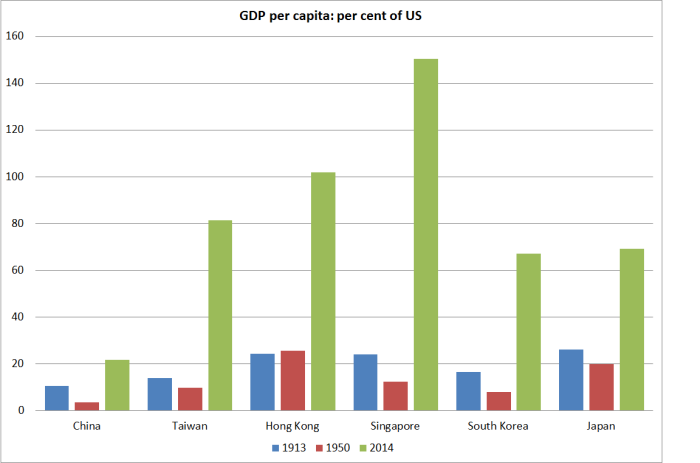
And it isn’t as if China is some startling economic success story either.    Here is a chart from a post I ran last year on China’s continuing economic failure (relative to both the US –  as representative of a leading advanced economy –  and to other east Asian countries).

asia gdp pc cf US

China today is richer (per capita GDP) than the Soviet Union was in the 1970s, but almost every country has got a lot richer since then.  As a proportion of US (or New Zealand) GDP per capita, China’s current GDP per capita is estimated to be a bit lower today than the Soviet Union’s was in the 1970s.

Quite probably, China will close the gap to some extent over the next decade or two, even if they persist with the current credit-driven, absence of supply-side reforms, economic model.    But embedded within the system are huge misallocations of credit, and thus of real resources.   They can avoid a financial crisis, but they can’t avoid that waste.

But this isn’t primarily a post about matters economic.  A strong economy can support foreign policy ambitions, and a weak one can eventually undermine those ambitions.  So even if China were to achieve greater economic success, it shouldn’t be particularly reassuring to the rest of the world.  On checking I noticed, for example, that in 1938 German manufacturing exports were 20 per cent of the world total –  a large proportion of which will presumably have been to countries that only a year or two later were the subject of Hitler’s aggressive intentions.    There will have been plenty of people in each of those countries with a strong economic interest in making a case for Germany.

To me, there are two aspects of China –  and thus about Jian Yang’s past active service in that regime (and Party’s) cause –  that should be of concern.   There are the values the Chinese authorities apply internally, and the approach they adopt and encourage externally.   Neither should be encouraging to anyone who values the free and liberal democracy –  with all its faults –  that countries like our own built and maintained over the last few hundred years.     It is a regime that murders protestors –  what Jian Yang refers to just as “student demonstrations” –  that imprisons dissenters, that denies freedom of worship, the bans internet access to sites critical of the regime (or indeed, to services that won’t act as agents of the regime in suppressing dissent).  For decades, they forced abortions on couples who wanted more than one child.  And today they are at the forefront of using surveillance technology – much more advanced than anything the Soviet Union could use 40 years –  to keep the citizenry in check.    The obscene inequalities of wealth, flowing in the direction of the political elite and those close to them, are just another aspect of the evil.   Prada handbags and smartphones tell us nothing about the character of the regime.   (And I don’t see anything in the character of the sort of regime in this paragraph that marks it out from the Soviet Union.)

I’m not one who favours interfering in the internal governance of other countries, large or small, and no matter how unsavoury they are.     But if someone who was an active part of such a vile regime –  voluntarily a Party member –  comes to New Zealand and wants to be part of governing our country, one might reasonably expect he would (a) acknowledge his part in, and (b) denounce the evils of, the system.    As a member of the Chinese language media put it to me, the language Yang used in his maiden speech about Tianamen Square was the sort of language one would only use if one supported the brutual suppression of those demonstrations by the government and Communist Party of China –  in whose cause Jang had then been working.

But it is the foreign policy of China that should be even more disconcerting.  In the 1970s, the West and the Soviet Union and its allies were fighting the odd proxy war (eg Angola –  with Cuba on one side and South Africa on the other), and there was the invasion of Afghanistan.  I’m not about to trivialise the Soviet Union, but it was the also the era of great power detente.  Both sides were suspicious of the other –  and the risks of misinterpretations leading to nuclear conflict –  but by the 1970s few people saw the Soviet Union’s intentions as primarily expansionist or aggressive.    And the UN apart, the Soviet Union wasn’t part of most international agencies (eg IMF, World Bank, WTO/GATT).

And these days?  China remains the leading protector of North Korea.  China propounds values, and standards of international governance, through international organisations, that are inimical to those of the West.  China is an actively expansionist power –  most visibly in the South China Sea, where it has been in flagrant breach of international law.  China is a key player in cyber-espionage.  China is widely-recognised as attempting to suborn regional political leaders –  apparently successful for now in the Philippines.  And China’s strategy of attempting to exert influence in a wide range of countries through the deployment of its (current or former) citizens in other countries is pretty well-documented.   China still lays claim over a democratic state (Taiwan) and has never renounced the possibility of using force to take Taiwan.  In short, China represents a considerable threat to the sort of regional and world order that New Zealand has been a part of, and which (historically at least) its leaders were willing to champion.

(I’m not really interested in “what-aboutism”.  “Our side” does questionable things in the international sphere at times too, and as I noted the other day I’d be concerned –  albeit less so – if a former member (especially an unacknowledged one) of US intelligence services were in our Parliament.  But our values are not those of the current Chinese regime, and that regime is not content to apply its standards only in its territory.)

And then, frankly, there are two other differences: numbers and location.  The Soviet Union in the 1970s had a population similar to that of the United States, and much smaller than that of all the NATO (and associated) countries.    China –  still relatively poor in per capita income terms, as the Soviet Union was, now has (or shortly will) have the largest economy in the world.   Such a large economy buys a lot of weapons systems, and potentially a lot of clout.  And location?   The Soviet Union’s prime focus wasn’t south and east Asia. China’s is.  New Zealand is a long way from either country, but the threat to our values, and our systems, is real nonetheless –  and, compared with the 1970s, New Zealand stands more alone than it did then.

I don’t suppose China has any intention of invading New Zealand, any more than the Soviet Union did.  Something akin to vassal status will do just fine –  countries that are reluctant to stick up for what they once believed, that are reluctant to stick up for countries with similar values in east Asia, that are reluctant to call out China’s territorial expansionism or its internal abuses.  Yes, I’d say the China is at least as serious a threat to us today as the Soviet Union once way –  perhaps more so, because the threat is less well-recognised, and more insidious.  Better suits, and good hospitality.   And our own ministers –  probably of either main party –  all too eager to please.

And what of our media?  Credit goes to Newsroom (and the Financial Times) for breaking the Yian Jang story.  But what of our mainstream media?  They seem to have given the story some initial coverage, but then been keen for it to die.  I hope that is an incorrect interpretation, but a week out from an election it was striking that there was nothing at all about the story in the Dominion-Post yesterday or today, or –  as far as I could see –  in the Herald yesterday or today.  And yet this is a story about a government MP, actively recruited by senior National Party figures to in some sense “represent” the Chinese community (identity politics rule, as Stephen Franks notes), who appears to have hidden –  from the public at very least –  his active membership in the Chinese Communist Party and his service in the Chinese intelligence services, and who appears to remain close to the Chinese Embassy.   At very least, there are allegations of SIS investigations –  paralleling similar investigations around Chinese-born politicians in Canada and Australia.  And there also seem to be suggestions of incomplete, or misleading, disclosures when Yang sought New Zealand residency and/or citizenship.  It seems as though it should be a major ongoing story –  with tough questions for the Prime Minister, the National Party, John Key, the Minister of Internal Affairs, and (for that matter) the leaders of other political parties?  Does ACT regard this as acceptable in a governing party they support?  Do Labour, or the Greens?

After all, Yang appears to have more or less acknowledged his own deceptions.  There was a story on the Herald website yesterday in which he is said to be reviewing his citizenship application form.  The article ends this way

Jian Yang told the Herald on Tuesday he didn’t name the Air Force Engineering University or Luoyang People’s Liberation Army University of Foreign Languages when making the applications that led to New Zealand citizenship, which he was granted in 2004.

He instead gave the names of two Chinese universities for civilians that had “partnership” status with the military institutions where he taught intelligence agency cadets as an English lecturer.

Asked if he made a false declaration on his citizenship application, Yang said giving the name of “partnership” universities instead of the institutes he actually worked and studied at was not a false declaration and was required if he was to leave China.

But in 2004, when he was applying for New Zealand citizenship, he was living in New Zealand.  There was no obstacle to telling the truth.  Unless he counted perceived obligations to the Communist Party of China, and the military and intelligence system of China, as more important than legal obligations to complete truthfully his citizenship application form.

In truth, his citizenship doesn’t worry me overly much.  From reports I’ve seen, he seems to have been a capable academic at Auckland University.  But membership of our Parliament and, perhaps in time our executive, is a different matter.  And with two minutes research, I found the Herald profile of him from 2011 when he was first running for Parliament.    If I’d read it at the time –  and I probably did, being a junkie –  I’d have been quite impressed by the tale of triumphing over adversity and poverty, and perhaps even a little inspired (he even expresses support for some social conservative causes I put a priority on).    But that’s because of all the stuff he didn’t tell the Herald  – or voters.    Perhaps there was a clue in this line

He said the effective dictatorship in China had provided a stable platform for long-term economic policy, while a surge in international trade had improved human rights and the flow of information.

Hmmmm…….

But not a word of his membership of the Communist Party (remember only about 5 per cent of Chinese belong; it isn’t some automatic part of living in China), or of his education in a military intelligence university, or subsequent service in that intelligence system.  Not a word about it, then or since.  And not a word of criticism of this system which is inimical to the values that built and sustain this country.

As I noted the other day, perhaps he hid it from the National Party too, which would speak very poorly of their candidate vetting. Or he told them, and they didn’t care, (and perhaps even told him to keep his past quiet) which speaks even more poorly of them, their values, and their priorities.    Either way, it should be unacceptable.

So, yes, it would have been regarded as quite inconceivable in the 1970s to have had a former serving KGB officer (whatever his specific role in that establishment) as a member of the New Zealand Parliament.  If that person had grossly misrepresented their past, and continued to associate closely with the Soviet Embassy, the scandal would have been all the greater.  It should be just an unacceptable today for a former serving member of the Chinese Communist Party, and the Chinese intelligence services, having consciously misrepresented his past and never denounced the system, to be in –  and put forward again as a candidate for –  our Parliament today.

China’s continuing economic failure

In my post on Saturday on the 80th anniversary of the formation of the National Party, I noted that New Zealand’s main political parties haven’t got much to be proud of in their conduct of New Zealand’s economic affairs.  But our problems need to be kept in perspective.

Today is another anniversary.  It is the 50th anniversary of the launch of the Cultural Revolution in China by the Communist Party government led by Chairman Mao.

Newspapers and magazines around the world have been drawing attention to the fact that the Chinese Communist Party government will not be marking the occasion: “China deploys amnesia” was the FT‘s headline, “China buries memories” was USA Today‘s and “Cultural revolution anniversary now ‘taboo'” was The Australian‘s headline.   For whatever reason, New Zealand newspapers seem to be sharing in the burying of memories –  no mention at all in today’s Dominion-Post, and as far as I can see nothing on the Herald website.  MFAT will, no doubt, be pleased.

The horrors of the Cultural Revolution – coming only a few years after the mass starvation of the Great Leap Forward –  are well-summarized in the Guardian article I linked to above.   Any Party responsible for those sorts of  systematic abuses would normally be shunned by the rest of the world.   And –  which is the point of this post –  it is not even as if the Communist Party of China can claim economic successes to, in some sense, mitigate its guilt.  Eggs (and worse) have certainly been broken, but the subsequent omelette is pretty underwhelming.

Here is a chart showing GDP per capita for China, and a range of now-advanced Asian countries/economies.  I’ve shown each country’s GDP per capita as a percentage of that for the United States for each of 1913, 1950, and 2014, using the Maddison database for the 1913 observation and the Conference Board (which built on Maddison’s work) for the more recent observations.  Data are a bit patchy in those earlier decades, but 1913 was before China descended into civil  and external wars (from the late 1920s), and 1950 was the year after the Communist Party took control of the mainland.

asia gdp pc cf US

What stands out is just how badly communist-ruled China has done economically, and especially relative to the three other ethnic-Chinese countries/territories.  Substantial re-convergence has happened in all the other countries on the chart, but that in China has been excruciatingly slow.  A few buoyant decades (the aftermath of which we have still to see) struggle to make up for the earlier decades of even worse Communist mis-rule.

And, actually, the GDP per capita numbers somewhat flatter China (even if we take them at face value, which few would now do).

Here are the Conference Board’s estimate of hours worked per capita for the countries in the chart relative to the US.

Hours worked per capita: ratio to the US
China 1.94
Singapore 1.70
Hong Kong 1.41
South Korea 1.35
Taiwan 1.23
Japan 1.08

The average Chinese is estimated to work almost twice as many hours per annum as the average American.   One expects people in poorer countries to work longer hours  (and, for example, New Zealanders also work more hours than people in most Western advanced countries), but the difference is particularly stark for China.

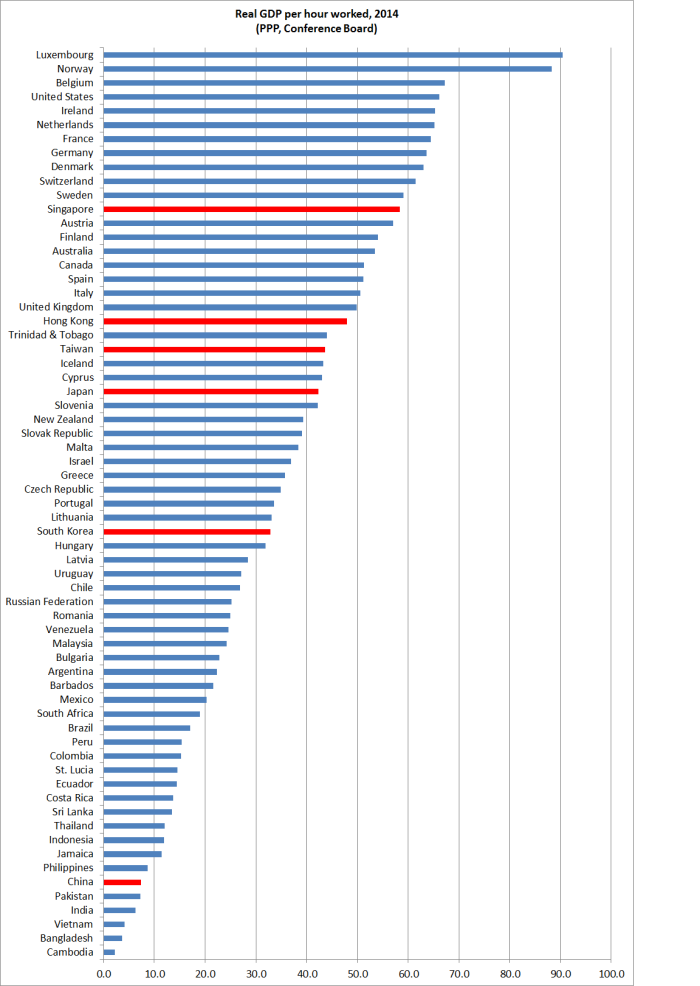
There isn’t a good long time series for GDP per hour worked in China, but here is a cross-country chart showing the 2014 Conference Board numbers, with the Asian countries I’ve looked at here highlighted in red.   Not even Singapore is in the really top tier of countries on this measure, but it is striking just how far down one has to go to find China.

gdp phw asia

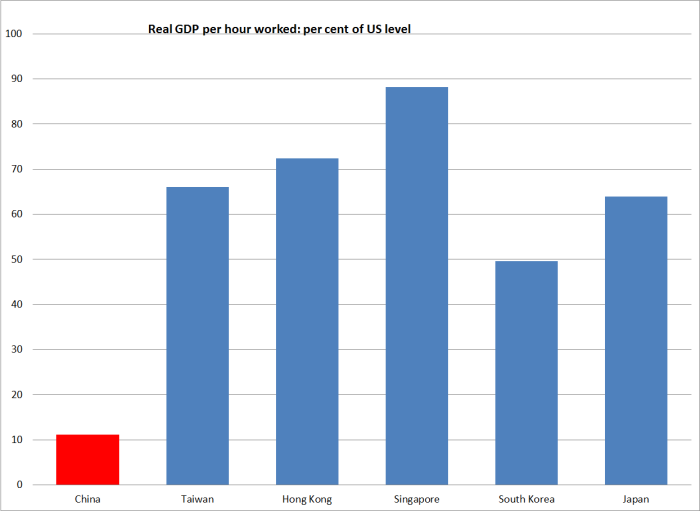
Real GDP per hour worked in China – even using official data –  is still only about 11 per cent of that in the United States.  It is, among other things, such an enormous waste of potential.

china gdp phw


China and New Zealand

The Prime Minister, a large flock of New Zealand business people, and various media representatives are in China.  It is not a particularly attractive sight, perhaps one of many reminders of why bilateral or regional preferential trade agreements are such an unfortunate policy option (as leading trade experts, and entities like the Australia Productivity Commission often remind us).  Allow for some trade diversion risks, and the ever-more-entangled rules of origin, and such deals are often bad enough.  And then there is the matter of making repeated obeisance before the leaders of a tyrannical regime, begging for their favour; the crumbs off their table.   Perhaps worst of all, our elected leaders don’t even seem to find it distasteful.

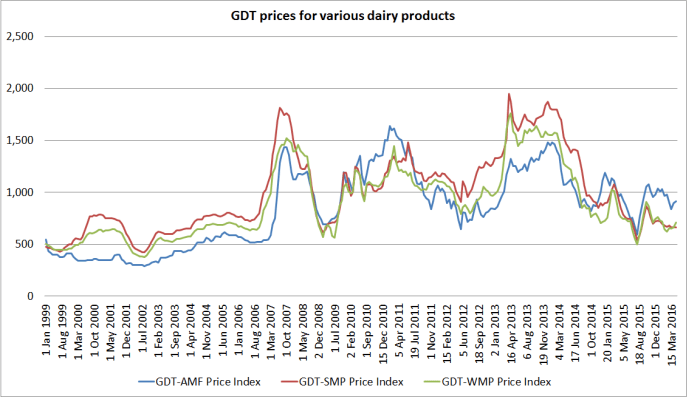
New Zealand firms do a fair amount of trade with Chinese firms, and that trade has increased considerably in the last decade. Despite some breathless commentary, China was never our largest “trading partner”,  but New Zealand firms do more trade with the Chinese than with firms and individuals in any other country than Australia.  But then our trade is quite widely spread across many countries, and much of it is in products which are pretty homogeneous (it isn’t clear that it much matters whether New Zealand firms export dairy products to Venezuela, Saudi Arabia, or China: New Zealand producers sell somewhere whatever is produced, and what matters most is the global prices for dairy products).  There is a great deal of talk about the benefits (or risks) of being concentrated on whole milk powder (WMP), but the prices of the various different dairy products all seem to cycle together, and idiosyncratic patterns for individual products don’t seem to last for long.   (GDT only has a long run of data for these three, but over the last five years one can also see it in a chart from a wider range of dairy products).

dairy prices components

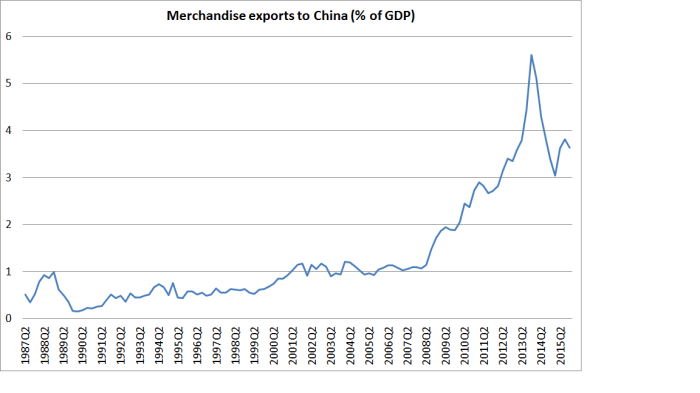
Here are our merchandise (goods) exports to China as a share of GDP.

exports to china % of GDP

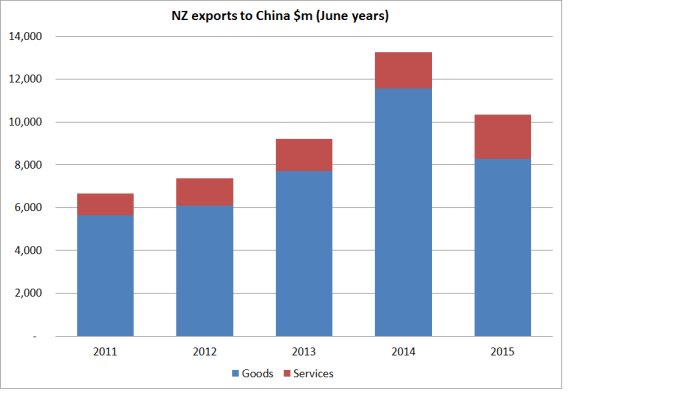
Services exports data by country is only available annually.  Here are total New Zealand exports to China for the last four (June) years.

total exports to china

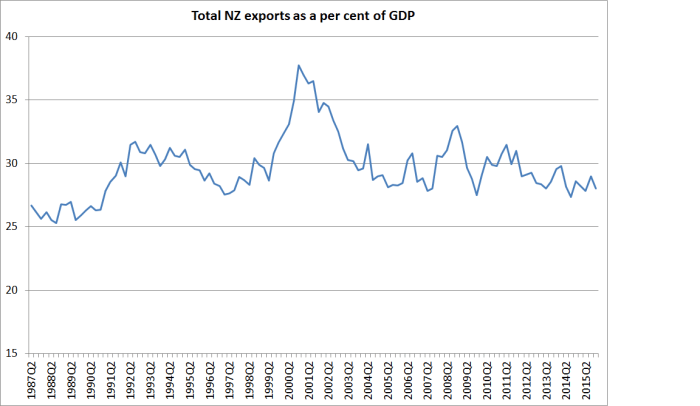
But how much difference has it all made?  The government has made much of trying to lift the export share of GDP, but here is a chart of that series.

total exports as % of GDP

Which has, as I’ve noted previously, been going nowhere for 25 years now.

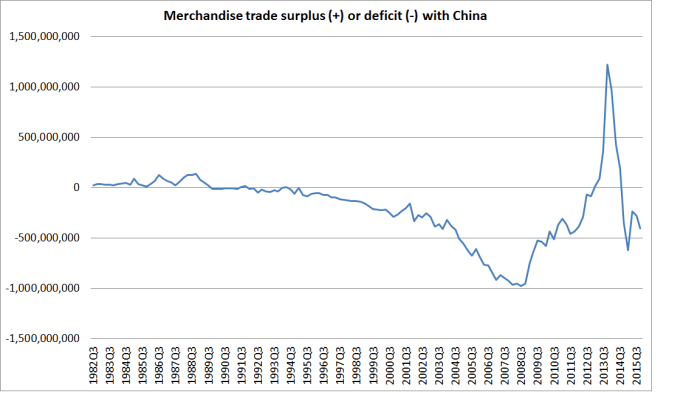
Of course, New Zealand firms import a lot from China as well.  Here is the merchandise trade balance between New Zealand and China since 1981.

merch trade balance with china

But once services trade is included, for the last three years New Zealand has run a goods and services surplus with China.

It was a little surprising to hear the Prime Minister in pursuit of investment from China

“But we in New Zealand will take that view from a Government perspective, that we’re a fast-growing economy, we want to to develop great international relationship and we also want to have a higher standard of living. We fundamentally don’t have enough private-sector capital of our own to fund that growth.”

Set aside the “fast-growing” economy claim for now – I guess the total economy has been growing quite a bit by OECD standards, even as per capita growth has been pretty dismal –  but what really struck me was the observation that “we fundamentally don’t have enough private-sector capital of our own to fund that growth”.  If the Prime Minister simply means that we run current account deficits (in which total domestic investment exceeds total national savings) that is, of course, true.    But it is not as if we have any trouble financing that current account deficit on world markets –  apart from any other indicators, that is evident in the persistently high level of the exchange rate.  Countries that have trouble financing themselves tend to have persistently weak real exchange rates.  We don’t.

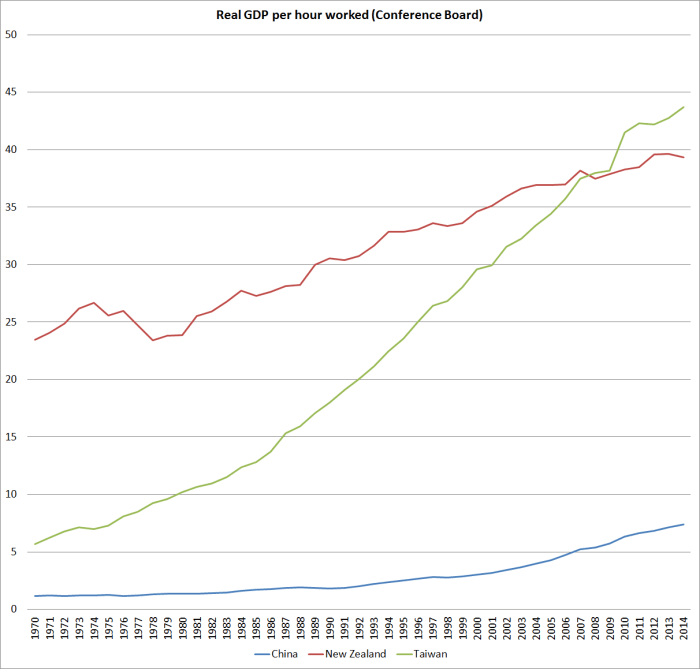
To be clear, I have no particular problem with foreign direct investment, and in general I think we should have fewer restrictions on it.   China is a slightly different issue, but mostly because all major businesses are ultimately state-controlled. I’m not suggesting any specific restrictions on Chinese FDI (except perhaps where national security considerations warrant it) but we need to remember just how badly distorted and underperforming China’s economy is.  It isn’t exactly one of the success stories of market capitalism, unlike say Taiwan.  New Zealand hasn’t done well in recent decades, but for all its fast growth (much real, some probably illusory), China’s overall levels of productivity are still astonishingly poor.

gdp phw nz china taiwan

The better of China’s firms may be very good at managing the twisted eddys of Chinese politics.  That is very different from thriving in a proper market economy, where the rule of law prevails, and connections to the powerful don’t (or are not meant to) matter much.  If FDI from China happens, so be it and some it may add wider value, but it isn’t the most obvious place to be pursuing FDI from (if politicians should be doing such marketing at all).  The real gains from FDI aren’t dollars of foreign capital but rather the ideas, technologies etc that really successful global firms can bring with them, with spillovers into the New Zealand business sector and the wider New Zealand economy.

And all this is without devoting space to our apparent studied indifference on the South China Sea issue (“we aren’t taking sides, we just want a resolution”, as if there is no difference between tyrannies and democracies –  Philippines and Japan for example), or talk of extradition treaties with China.  If people can be shown to have lied on their immigration applications, no doubt we should revoke their approval to be here, but are we seriously comparing the so-called “justice” system of China to that of countries like our own?   For all the talk of “fugitives” in New Zealand, we need to remember that much of the so-called anti-corruption programme of the last few years has been about purging those who got offside with the winners in the latest Party realignments.  Some of those now abroad might well be “bad guys”, but it isn’t clear that any people who matter in China’s government are, in any sense, “good guys”.

Finally, in all our enthusiasm for trade with emerging China, I amused myself yesterday by downloading the 1939 New Zealand Official Yearbook to see what trade we were doing with Germany and Japan in the 1930s.  Not much with Germany, but I’m imagining there must have been some breathless enthusiasm, at least in some circles, about our rising trade with large and emerging Japan, by then our third largest export market.

japan exports

,


Two unrelated comments

The New Zealand tourism industry has been having a good year.  One particular source of strong growth has been visitors from China, but I’d noticed reference to something similar in the Australian visitor data.  That got me curious about how the two countries’ industries had done in attracting Chinese visitors, not just over the last year or so, but over the decades.  This was the resulting chart.

china visitors

It simply takes rolling annual totals of short-term visitors from China to each country back to 1991, when the easily accessible Australian data start.

New Zealand has enjoyed a good year or two relative to Australia.  It is just a shame about the poor decade –  really the story of New Zealand’s tourism sector more generally.  Visitor numbers from China to both countries have been trending strongly upwards over the whole period (Chinese visitor numbers to New Zealand last year were more than 100 times those for 1991), but for at least the last 15 years New Zealand has done worse than Australia in attracting new Chinese visitors.  Yes, there has been quite a recovery in the last year or two, but that just takes New Zealand’s share of the market, relative to Australia’s, about back to where it was in 2007, and still a long way below our peak relative performance in 2003.

Tourism plays a larger share in New Zealand’s economy than it does in Australia’s, so success in tapping new markets looks like it should matter a bit more to us than to them.

On a totally unrelated matter, while I was playing around with the visitor data a reader kindly sent me a copy of, veteran political columnist and commentator, Colin James’s column yesterday from the Otago Daily Times.  Headed “Are English and Wheeler drifting out of date?”, it is another rehearsal of lines as to why the OCR should not be cut further.  It would bore me, and probably bore you, to go through all the weak points in the argument.  On the domestic side, suffice it to point out that per capita GDP growth has been weak not strong, a 5.3 per cent unemployment rate is disconcertingly low not a sign of an overheating labour market, and how 7.5 per cent credit growth qualifies as particularly “strong” in a economy that has 2 per cent population growth, a 2 per cent inflation target, and aspirations to some reasonable productivity growth is a bit beyond me.

But my main reason for commenting was that James also advances the line that somehow the world is a great deal better off than the statistics suggest, that technological revolutions are driving upwards our living standards and pushing prices inexorably downwards, and there really isn’t that much to worry about.

The problem with the story is that there just isn’t much evidence for it.  In the aggregate data, as I’ve highlighted before, it is clear that productivity growth has slowed, not accelerated, and that that slowdown was already underway before the ructions around the financial crises and international recessions of 2008/09.  This was a chart I showed a week or two back –  the blue line is the median TFP performance for the old advanced countries (in Europe, North America, and Oceania).

tfp conf board

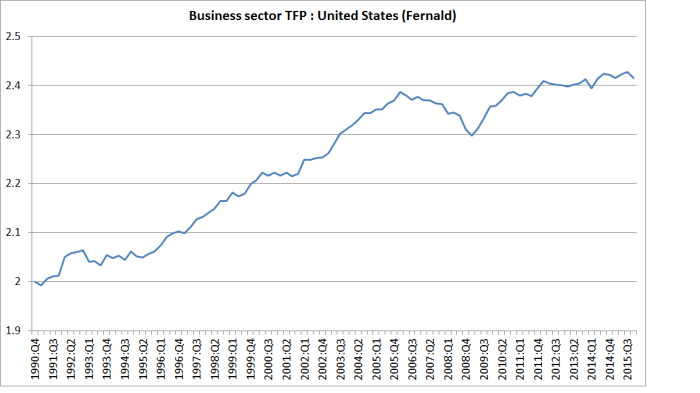
And here was the data specifically for the US business sector

fernald

But don’t just take it from suggestive top-down charts. Various experts have been looking at whether any material mis-measurement issues, especially around the tech sector and tech products, can explain away the productivity slowdown.  The short answer is that they can’t.  Many readers will already have seen Tyler Cowen’s summary of these papers, and for those who haven’t I’d encourage you to check it out.   As he notes

…the countries with smaller tech sectors still have comparably sized productivity slowdowns, and that is not what we would expect if a lot of unmeasured productivity were hiding in the tech industry

John Fernald, at the San Francisco Fed, does the business sector TFP data in the chart above, and is one of the acknowledged experts in this area. In a new paper, out just a few days ago, Fernald and co-authors conclude

After 2004, measured growth in labor productivity and total-factor productivity (TFP) slowed. We find little evidence that the slowdown arises from growing mismeasurement of the gains from innovation in IT-related goods and services. First, mismeasurement of IT hardware is significant prior to the slowdown. Because the domestic production of these products has fallen, the quantitative effect on productivity was larger in the 1995-2004 period than since, despite mismeasurement worsening for some types of IT—so our adjustments make the slowdown in labor productivity worse. The effect on TFP is more muted.

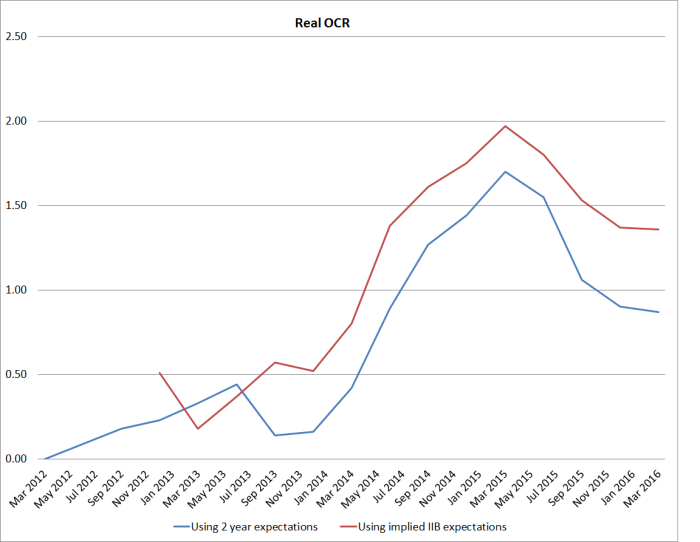
It seems pretty clear that there has been a real and material slowdown in productivity growth, and hence in the rate of improvement in underlying living standards.  The Fernald paper suggest that may partly be a return to more normal growth patterns, after exceptional gains in the 1990s, but whether that is so or not, it is no reason for complacency about inflation that undershoots targets.  Weak population growth and weak productivity growth both argue for low interest rates….and as a reminder, in New Zealander real interest rates (already high by international standards) have been rising not falling over the last couple of years.

real ocr

When contemplating tomorrow’s Monetary Policy Statement  don’t fall for the lines Colin James runs, channelling Graeme Wheeler, that monetary policy is “very accommodative”


China’s fertility rate in an Asian perspective

The media are full of stories of the Chinese government/party decision to abandon the evil one-child policy and replace it with a marginally less evil two-child policy.  It is interesting to see the change presented by the authorities as a response to an ageing population, and I’ve seen various commentaries over the last few years suggesting that this easing could make a difference to the economic prospects of China, even perhaps only over the shorter-term as some couples took advantage of the slightly less repressive regime.

As a rank outsider, I’ve been more than a little sceptical since I started paying attention a few years ago to birth rates in the rest of Asia, and especially in the wealthier bits of Asia, to which China has been making some progress in converging.  As far as I know, in none of these countries have there been direct attempts by governments to suppress, by regulation, the birth rates (indeed, Singapore has been actively trying to encourage a higher birth rate).

Here is the time series (from the World Bank database) for China, Japan, and the four other predominantly ethnic Chinese countries/territories (Taiwan, Singapore, Hong Kong and Macao).

tfr time series

And here, from the CIA Factbook are the countries/territories with the lowest total fertility rates in the world, plus China and Thailand.  (The levels are slightly different in the two different sources –  the CIA numbers are 2015 estimates –  but the broad picture is the same).

tfr

The countries with the greatest cultural similarity to China have the lowest fertility rates in the entire world –  only around one child per woman.  The other advanced Asian economies (Japan and Korea) are only a little higher, and one of the other emerging middle income Asian countries (Thailand) already has a TFR below that of China (although, on the other hand, Malaysia’s is higher).

Perhaps the policy change will materially boost China’s birth rate, but it would really stand out relative to the rest of advanced and emerging Asia if that were to happen.

Some snippets from the annual trade data, with a China tinge

Statistics New Zealand released yesterday the annual data on New Zealand’s overall foreign trade (goods and services) by country.  It is a nice summary set of tables for people who don’t spend lots of time looking at trade data, and the services data are only available annually.

Since the end of last year, these have also been the data the Reserve Bank now uses to calculate the weights in its trade-weighted index measure of the exchange rate.  Those weights are calculated on a total trade basis (imports and exports, goods and services) for 17 currencies, covering countries that currently account for a bit over 80 per cent of New Zealand’s foreign trade.  The weights are updated annually, and when they are updated in December there will be a few changes.  After much noise about China becoming our largest trading partner (which it has not yet been on a total trade, or even total exports, basis), China’s share in New Zealand’s foreign trade dropped back quite a bit over the last year.  By contrast, the United States’ share rose.  Whereas this year, the weight on the Australian dollar was only 2 percentage points more than that on the Chinese yuan, both well ahead of the US dollar, next year the weight on the yuan will be around halfway between those on the Australian and US dollars.

twi weights

There is no easy right answer as to how to weight an exchange rate index.  My own sense is that the current weighting structures overstates the importance of Australia, and understates the importance of the United States and the euro area (or the EU more broadly).  These latter two economies/regions are a huge share of total world production/consumption, and are major competitors in our largest (net) export products, particularly dairy.  Neither element is captured in the current weighting scheme.  And while Australia is our largest export market, those numbers are flattered by the fact that still more than 12 per cent of our exports to Australia are crude oil and precious metals (presumably mostly newly-mined gold), which have nothing to do with wider economic conditions in Australia, or movements in the Australian dollar.

It is interesting how much of our trade with Australia is now dominated by travel.  Excluding oil and precious metals, 28 per cent of our exports to Australia are travel and transport.  No other single category exceeded 7 per cent of our exports to Australia last year.   The picture is similar on the import side, where travel and transportation account for 27 per cent of our Australian imports.

And, finally, I was interested in the dairy export data.  The media has been full of discussions around dairy exports to China, which had surged in 2013/14.

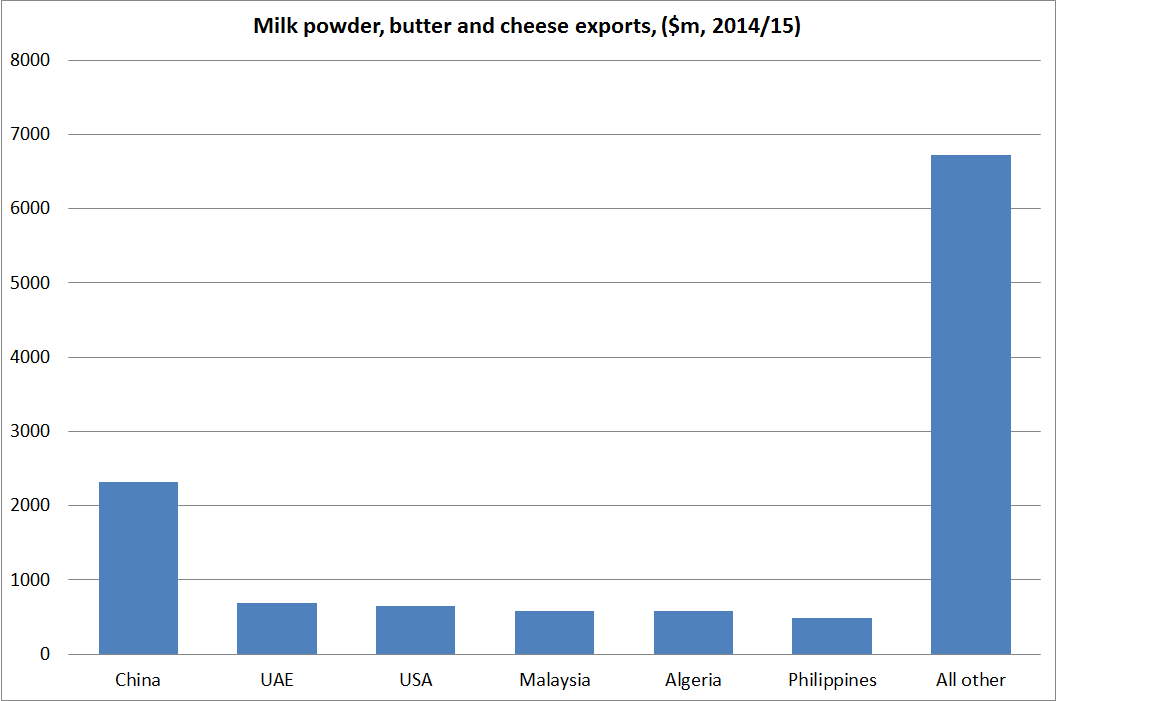
Here are our milk powder, butter and cheese exports for the last five years to China on the one hand, and the ASEAN countries on the other.

dairy exports china and asean

It highlights both how unusual last year was, but also how important those other countries are in New Zealand’s dairy trade.   In a typical year, New Zealand firms export as much milk powder, butter and cheese to these countries as to China, and yet these countries in total have annual GDP not much more than 20 per cent of China’s.  Actually, the data also illustrate just how diversified dairy exports are in a typical year.

dairy exports 2014 15

By contrast, in the 1950s almost all our dairy exports went to the United Kingdom, and there were few other export markets anywhere for dairy products.

None of this is to suggest that China is unimportant.  China is now the world’s second largest economy, with a very large foreign trade for a country of its size.  And is a badly-managed, highly non-transparent, economy, at the tail end of one of the bigger, least-disciplined, credit booms in history.  What happens in China matters a great deal to most countries, but there is no reason to think it matters abnormally more to New Zealand.

(As one perspective on the lack of transparency –  and, worse, outright misrepresentation –  that plagues the rest of world making sense of China, I’d recommend the latest from Christopher Balding, who takes on those who want to defend China’s data as providing a broadly accurate and representative picture of what has been going on).

On peripheral share markets, and the mess that can still lie behind them

As the wild gyrations around the sharp decline in Chinese share prices dominate the business news headlines,  the chart of the Shanghai share price index was reminding me of another chart, from our own history.

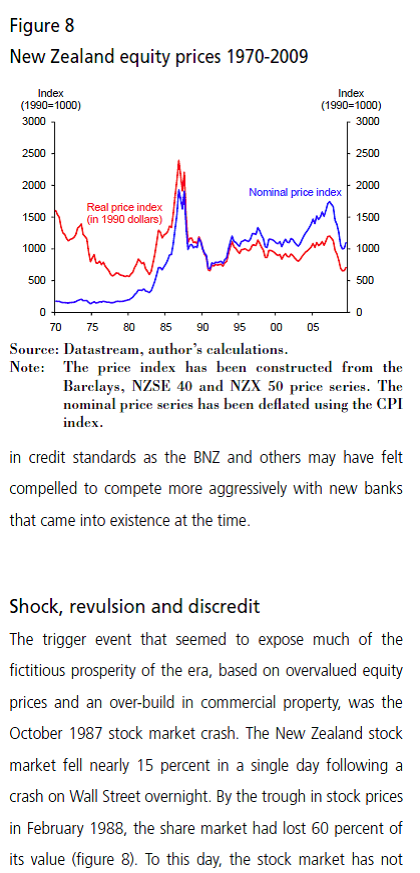
The historical data are hard to come by so I’ve had to use this chart, which covers a rather long period, from a good Reserve Bank Bulletin article about past New Zealand financial crises (mostly, the 1890s and the 1980s). In China’s case, a 150 per cent increase in share prices in a year or so, most of which has now been given back in only a few months (of course, it is perhaps worth remembering that there was an even bigger boom, to even higher peaks, in 2006/07).   In New Zealand’s case, the boom in real prices was even larger – if it took a slightly longer period of time – and the bust was complete.

NZ share prices 80s

There is lots of discussion at present – often from US-centric people – about how the Chinese share market is somewhat peripheral to the economy. And, in some senses, no doubt it is. The share market has always been relatively peripheral to the New Zealand economy too, and market capitalisation as a share of GDP has typically been low. Between farms, farmer co-ops, wholly foreign-owned companies, and state-owned companies, most economic activity simply wasn’t represented by listed companies. Take state-owned companies as an example. In 1986/87, the government still owned several banks, insurance companies, the post and telephone system, the one TV company, the railways, the airlines, the largest petroleum company, and the steel mill. There were no New Zealand listed banks, and no vehicles for direct equity exposures to our largest export industries (sheep and dairy products).  Forestry was probably the only major export industry with material listed exposure.

And yet the market went crazy, and when it burst it was the start of some very tough years for New Zealand. The whole post-liberalisation mania has not been adequately documented (unlike, say, the Nordics booms and busts of much the same time), but it was characterised by much more than just crazy share prices for the minority of people with any material direct exposure to the market. These things rarely happen in isolation. We had a massive credit boom – private sector credit growing at 30 per cent per annum – and a massive commercial property boom, skewing real resources into places that proved not really to offer economic returns. The absurdity of some of what went on during that period was captured in the suggestion of one (brief) high flyer, that New Zealand had a comparative advantage in takeovers. Few bankers had any experience in disciplined credit risk analysis in a liberalised market economy – and nor did their shareholders (whether government or Australian private). And, in any case, bonuses weren’t being paid to people who stayed clear of the boom for long. Highly leveraged investment companies were all the rage – often the principal asset was overvalued shares in other investment companies.

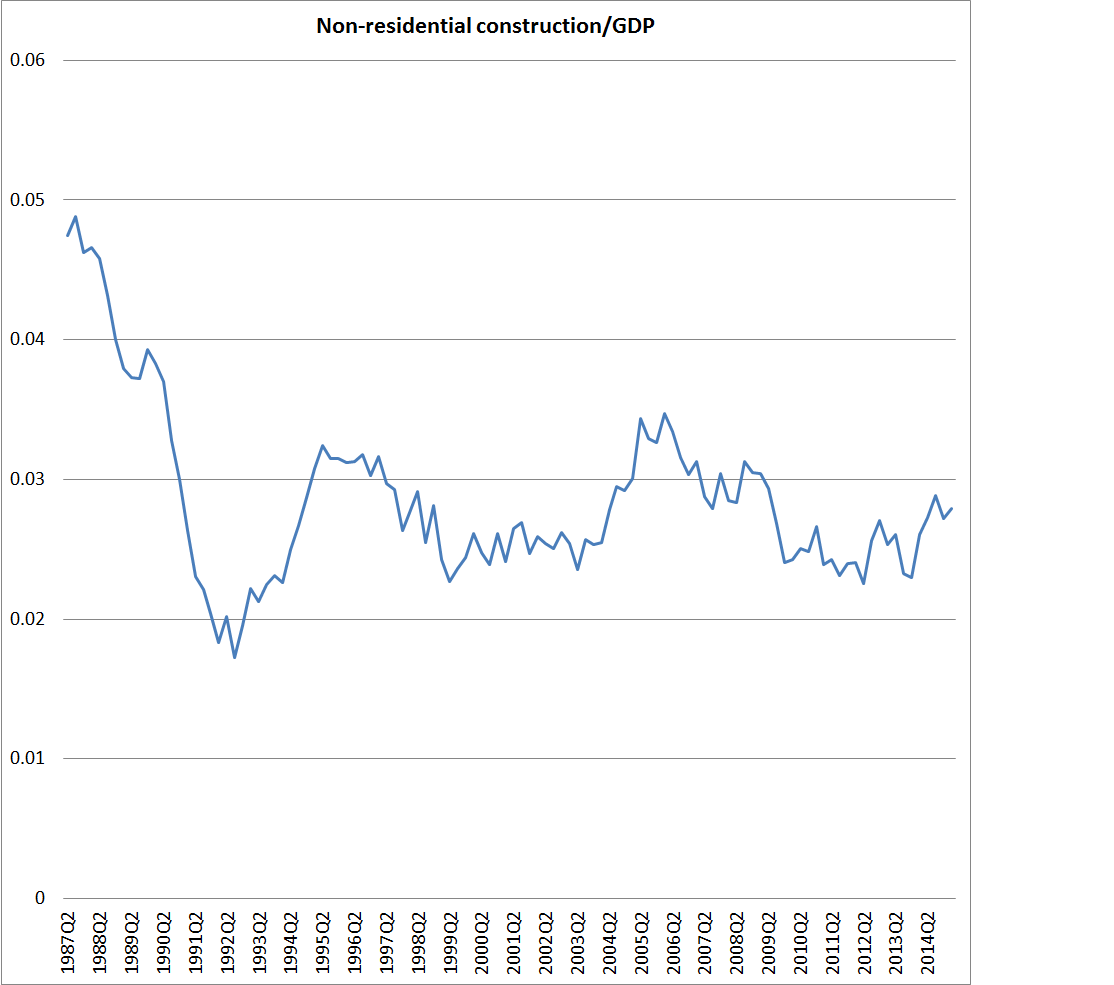
As one illustration of what went on, here is the commercial property picture.  A 3 percentage point of GDP fall is huge, and of course the boom-times share of GDP has never been regained, suggestive of how overblown that market had become.

non-res 80s

As they often are, central bankers were slow to recognise what was going on. The section I managed wrote a paper to the Minister of Finance a few weeks before the crash arguing (as I recall) that the strength of the share market was a pointer to the underlying strength of the economy (and hence a reason to tighten monetary policy). A week or two after the crash, my boss and I were visited by a firm of economists we were often dismissive of – they urged us to recognise that a savage commercial property and banking shake-out was about to get underway. We were polite but pretty dismissive.

Those are the sorts of episodes that leave financial crises in their wake, and which often have nasty and prolonged real economic consequences. Some of us at the Reserve Bank might have initially been a little sceptical, but the liquidity stresses soon became very apparent. Within weeks we had acquiesced in a sharp fall in short-term interest rates (we didn’t directly set them then), which eventually totalled 400-500 basis points.  The exchange rate came down as well. And it still took years for the economy to really recover.

No two situations are ever quite the same. New Zealand was trying to vanquish double-digit inflation, a situation few countries these days find themselves in. But ill-disciplined credit booms, of the sort we had in the 1980s, and of the sort the Chinese have had – on a far larger scale and with fewer market disciplines – are often enormously damaging. Often there is an equity market mania dimension to these things, but the mania is often the epiphenomenon rather than the main event; symptoms of something deeper going on. And the timing will never be quite precise – we had a mania in 1986 around a company (investment and finance) whose shareholders, in their private capacity, were backing what appeared for a time likely to be a successful tilt at the yachting America’s Cup. Of itself, it probably did little or no real economic harm, but it was symptom of the excesses, and of the undisciplined nature of the times.

So count me as a little sceptical of the notion that because not many Chinese hold shares, we don’t need to worry about what is going on there. As here, it is a matter of looking to the phenomena behind the headlines – in their case, several years of one the largest, least-disciplined domestic credit and investment booms in history.

Oh, and there are simply no parallels between the 1987 New Zealand position – which brought down several major financial institutions, including our largest bank – and the New Zealand position now. I wrote about that (lack of) parallel a few months ago.

China, currency adjustments, etc

[For those keen on my skills-based migration series, more posts are coming.  For government officials, and any others, going “yes, yes, you’ve made your point”, I will clearly label them and feel free not to read them]

There is a column in the Dominion-Post this morning, from a well-regarded journalist, Pattrick Smellie, running under the confident heading of “Beijing not starting a currency war”.  I’m sure the Chinese Embassy will have been pretty happy with the coverage.

Making sense of our own central bank is often hard enough, let alone the intentions and motivations of the Chinese state authorities. Early in World War Two Winston Churchill described Russia, newly signed-up to a non-aggression pact with Germany as “a riddle wrapped in a mystery inside an enigma”.  It seems to be a phrase that could readily be adapted to the Chinese authorities.  But as Churchill put it in the same speech, the key to Russia was “national interest”, or perceptions of it.

And, no doubt, no one is setting out to start a “currency war”.  If one actively devalues one’s currency one prefers that no one else follows.  That  is how the competitiveness gains are secured.  Then again, so-called currency wars in the past have sometimes been rather a good thing.  In the Great Depression  the countries that freed their currencies from gold first, and devalued, recovered soonest, and the laggards (big or small) themselves recovered when they too devalued.  In that period, so-called competitive devaluations were a path to a much-needed easing in global monetary policy, and a recovery in global demand.  It wasn’t coordinated and each country acted in its own perceived self-interest, subject to the constraints each faced.  Facing a very severe adverse terms of trade shock, and the temporary closure of UK funding markets, New Zealand was fortunate that it allowed its currency to depreciate against sterling quite early, then benefited from the UK’s own early departure from gold, and then actively devalued again in early 1933.

What, then, of China?  As Smellie ends up acknowledging in his article, in a weakening economy a depreciating currency might be thought of as normal or natural, and China’s economy has been weakening fast –  almost certainly much faster than is officially acknowledged.

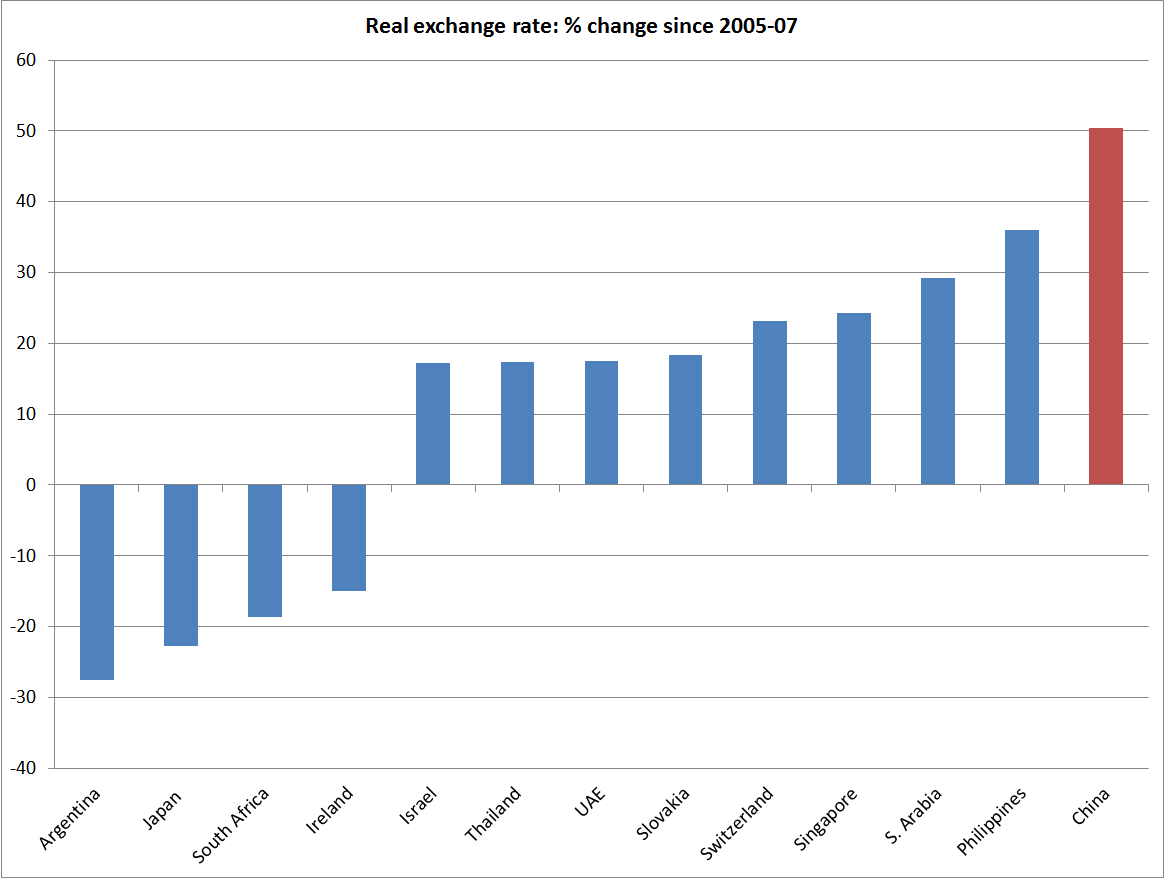
The BIS compiles real exchange rate indexes for about 60 countries.  I had a quick look at which countries had seen large real exchange rate changes since the pre-recession period.  Here I compared the average for the last six months with the average for 2005 to 2007.   13 countries have seen changes of more than 15 per cent[1].  China’s has been, by far, the largest change, and the largest increase –  up around 50 per cent.

china rer

It was pretty widely accepted a decade ago that the yuan was undervalued in real terms.  During this period, China was running huge current account surpluses –  something unprecedented in a fast-growing developing country  (Singapore or Korea, at similar stages of development, ran large deficits).  Hand in hand with the undervaluation, gross exports as share of China’s GDP had doubled from the early 1990s to reach almost 36 per cent in 2006.    Getting a good handle on true Chinese productivity growth isn’t easy, but there was pretty good reason, whether from the trade data or from productivity differentials, to have looked for a real yuan appreciation.

But a 50 per cent appreciation  – a considerable proportion of it in the last 12-18 months as the US dollar has strengthened –  is a very large move.  And, in conjunction with the much lower growth in global demand following the 2008/09 recession, the whole basis of China’s growth model has changed.  From a substantially export-driven model, China moved to relying on one of the biggest credit-led investment booms in history –  and, given the absence of market disciplines in China, perhaps the riskiest.  Credit to GDP soared.  Most of it has been domestic credit, but in the last few years there has also been a great deal of foreign debt taken on by Chinese borrowers.   Investment also soared –  from under 42 per cent of GDP in 2006 to more than 48 per cent by 2011.  Those are huge shifts.  And exports shrank back, from 36 per cent of GDP in 2006 to 23 per cent last year.  Again, a huge shift.  GDP was still growing, but much more slowly than it had previously, and with much less evidence of sustained productivity growth.

Against that backdrop, from a purely macroeconomic perspective, the idea of a depreciation of the real exchange rate must look quite attractive to some in Beijing.  Pursuing its own perceived national interests  no doubt, the Chinese credit boom of recent years has provided a lot of support to global demand, at a time when it was very weak, but the aftermath isn’t pretty.  It rarely is after credit booms –  see Spain or Ireland, or New Zealand post-1987.  With weakening domestic activity, and global growth that is still pretty subdued (at best), the Chinese authorities seem to have two broad short-term options.  Stimulate demand by gearing-up for one last government-inspired credit—based splurge, further exacerbating their own problems, or look towards tapping a bit more of the potential global demand for the benefit of their own producers.   (Of course, the third option would be a domestic cost- deflation, but the Greek model doesn’t seem to have much to commend it.)

People often point out that China’s consumption share of GDP is very low, and suggest a reorientation towards a more consumer-led economy.  But on the one hand those changes are likely to be slow –  and as Shang-jin Wei has pointed out , for example, things like the male-female population imbalance may be structurally driving up savings rate.  Perhaps as importantly, people are typically only willing to spend more if they are confident of their own future incomes.  At the end of a credit boom, with Chinese firms no longer securing the export growth they once were, that security isn’t unquestioned.

In a normal country, weakening demand at the end of a credit boom would naturally be followed by easing domestic monetary policy and a falling real exchange rate.  It is what happened in much of the West in 2008.   China has room to ease domestic monetary policy, but easier domestic policy almost inevitably puts more pressure on the exchange rate.  China has fairly large levels of foreign reserves (as a share of GDP) but expectations can change rapidly, and as many previous countries have found reserves can dissipate rapidly.  Plenty of capital is already flowing out of China.

I’m not suggesting any great insight into what the Chinese authorities were thinking earlier this week. In many ways, a lower real exchange rate would normally make a great deal of sense.   But these aren’t normal times.  As I noted earlier, the depreciations in the 1930s led to looser monetary policy globally.  There was no “beggar thy neighbour” dimensions to them, and everyone benefited.  And if the rest of the world still had materially positive interest rates, it could be the same now.  Easier Chinese monetary policy, lowering the real RMB might have been followed by some cuts in interest rates in other major economies, to offset the impact on them of the increases in their own real exchange rate.  But few large economies –  and none of the advanced ones –  has any material domestic monetary policy room (although the US can hold off  –  or reverse –  the widely-expected unnecessary initial tightening in its own monetary policy). Even in high-interest rate New Zealand, the policy room is dissipating.  Against that backdrop, any substantial depreciation of the yuan, even if it would be in China’s own macro-stabilisation interests, as its economy has slowed markedly, really could be a threat to the rest of the world.  A stimulus to demand in China risks being substantially at the expense of weaker demand elsewhere, at a time when overall global demand growth (China included) is at best modest, and probably weakening.  More competitive Chinese producers would be in a position to cut prices further –  in an economy where producer price inflation has been negative for a long time already –  posing new global deflationary risks.

Much of the media commentary this week has been about what the Chinese authorities intended.  And understanding that better would be good.  But, in the end, policymakers’ intentions matter only so far, once authorities have set out on a path, however halting, towards liberalisation.  There has been a widespread view until recently that the Chinese would not be willing to devalue the RMB –  whether for reasons for international relations, prestige or simply having bought the upbeat stories about China’s growth prospects.  Meanwhile, Chinese investors have been taking a different view.

This week’s action must have increased the perceived risk of some larger adjustment, whether willingly or not.  Many people have pointed out the size of past substantial devaluations –  I especially liked this piece –  but often enough those large devaluations (or float) were late adjustments, forced reluctantly on authorities who held on, and held on, until they could do so no longer.  No two countries’ situations are ever quite alike, but we shouldn’t assume that even if the Beijing authorities don’t want a large exchange rate adjustment that it won’t happen.

Much of the most recent real appreciation in the yuan reflected the material appreciation in the USD.  Some will recall that the continued appreciation of the USD, to which the Argentine peso was pegged, was one of the final straws that broke the Argentine currency board in 1991.

[1] In addition, Venezuela – which now has extreme currency rationing to defend an official peg – is recorded with a 251 per cent increase in its real exchange rate.

Offshore demand for houses – some further thoughts

Rodney Jones has a nice piece on the Herald website about the non-resident property issue, perhaps slightly oversold by the sub-editors as “How he’d solve the property crisis”.  Before non-resident purchases were a material issue, house prices (especially in Auckland) were still hugely distorted by poor domestic policy.

Rodney’s approach to understanding the issue is very similar to that in my post yesterday, emphasising how historically unusual the situation is in which a large economic power has such weak domestic institutions that its citizens are looking to buy individual houses in other countries.  As he notes “to express concern about the potential impact of these flows is not racism”.

Rodney goes further than I would yet do.  He proposes a 20 per cent stamp duty on non-resident purchases of Auckland [residential?] property.  Turnover taxes generally make me feel queasy, and I’m always reluctant to endorse a regional approach to tax policy in a unitary state – which creates its own new distortions.  Since there is probably relatively little offshore demand for property outside Auckland there would be no harm in extending such a tax, if it were adopted, to the entire country.   But I suspect that the terms of our various free trade agreements might be more of a constraint.  Some FTAs might allow such restrictions, and some might not, but the China agreement for example does not allow us to adopt measures that discriminate against China relative to other countries (and we have a strong commitment to an open market between New Zealand and Australia).  And I doubt that such a tax could credibly be sold as a “macro-prudential” measure.  But Treasury and MFAT should be carefully exploring the legal options,  and the implications of our interacting web of FTAs, if they have not already done so.   It is not impossible that there is nothing that could legally be done that would not cause more distortions and costs than they would be worth

Rodney’s is a much more substantive contribution to the debate than the lofty op-ed penned by former Foreign Minister (and head of something called the New Zealand China Council) Don McKinnon.  In this surveillance age, the article is somewhat ominously titled “China listening to our housing debate”.  Then again, perhaps we should celebrate the fact.  We are open society, and have our debates openly.  China doesn’t, and its people are the poorer for that.

Or what of the reported comments of Pat English, executive director of the New Zealand China Council.  He claims that “New Zealand has a superb relationship with China. But Labour has done immeasurable damage to that relationship, due to where the debate has ended up”.   Really?  Where is the evidence?  Of course, he may be literally correct – since any damage is unable to be measured.  But any relationship that can’t stand the strain of open public debate is one of rather questionable value.   And these issues are being debated in many other countries too.

In open societies sometimes mixed messages might be heard.  And actually sometimes ambivalence is real and appropriate.  I suspect we’d be happier, and China’s citizens would be happier and better off, if they had the ability to, for example, buy secure freehold title to property in China. Or a system with the sort of economic governance, and rule of law, that the US or the UK had as they rose to dominant positions in the world economy, that made “capital flight” simply unnecessary.  China would probably be better off if, as an emerging economy, it were running current account deficits (drawing capital in from the rest of the world) rather than current account surpluses.  Of course, China’s brutal authoritarian leaders might be less happy and less secure, but that is scarcely a priority for New Zealanders.