I noted the other day that I had disagreed with a fair amount of what was in Arthur Grimes’s recent piece on fixing the housing market (both the Spinoff piece, and the earlier Herald account of his remarks). Arthur is quite clear in his value judgements, and mine differ: I don’t think there are good grounds for riding roughshod over the rights and interests of existing residents, in pursuit of some bureaucratic-political vision of a bigger Auckland.
But where I strongly agreed with him was that making home ownership affordable again means that house prices have to fall. And they have to fall a long way. If price to income ratios are around 10 in Auckland today and are around 3 in places with well-functioning housing markets, it might be desirable if house prices today were as much as 70 per cent lower than they are now. Allow for some growth in nominal incomes over the next decade – perhaps 3 per cent per annum (2 per cent inflation and 1 per cent productivity – both ambitious assumptions by the standards of the last few years) and even a 50 per cent fall in nominal house prices over that time would only get Auckland house prices back to a price to income ratio a little under 4.
So when Arthur Grimes suggested that politicians should think in terms of actions that would bring about a 40 per cent fall in house price, in some ways he was being quite moderate. Perhaps he shouldn’t have used the word “collapse” as his goal, but that sort of fall is what making home ownership affordable actually means. Alternatively, I suppose, nominal house prices could hold at current levels and in 35 to 40 years time price to income ratios might be back to respectable levels. And another whole generation would be doomed to barely affordable houses..
Perhaps fortunately, the Grimes remark prompted the Prime Minister to reveal what appear to be his true colours on housing. He simply dismissed the Grimes suggestion of a 40 per cent fall in house prices as “crazy”. He could have said “well, I don’t want to get bogged down in precise numbers, and one has to remember that some people will be adversely affected if house prices fall”. But no, the Grimes suggestion was “crazy”.
It betrayed a fundamental lack of seriousness on the part of the Prime Minister and the government about making housing affordable, and in fixing the dysfunctional market that they – and their Labour predecessors – have presided over. Since the Prime Minister is often quoted as suggesting that high Auckland prices are a sign of success, a “quality problem”, or just the sort of outcome big cities everywhere have, why would we be surprised? Grimes notes that no politician has been willing to give a a straight answer on how much they wish house prices to fall. Perhaps there is some role for “constructive ambiguity” in such areas but I had a lot of sympathy for Arthur’s line:
I suggest that this simple question should be asked every time a politician (of any stripe) talks on the subject. One can then see if they are really serious about making house prices in Auckland affordable for ordinary people.
And one only has to look at the “policy solutions” the government has proferred over recent years. This time two years ago, the Prime Minister launched National’s election campaign with increased subsidies for first-home buyers – a scheme opposed by officials who recognized, as everyone knows, that those sorts of subsidies flow straight into house prices.
Last year, the clever wheeze was altering the points scheme to encourage more of those gaining residence approvals in New Zealand to move somewhere other than Auckland – thus perhaps very marginally easing house price pressures there, while guaranteeing a slight worsening in the average quality of the migrants who get residence approval.
And this year it was the infrastructure fund – the $1 billion headline, with seemingly no details behind it, and involving interest-free loans from the rest of us to councils in places with fast population growth (and rapid future income growth). Wasn’t this the party that, not that long ago, (rightly) thought that interest-free loans to students with good income prospects was simply bad policy.
We also now have talk of the government seizing private property. David Seymour was quoted suggesting it sounded like a Venezuelan solution – although, in actual fact, the idea came from the (admittedly rather statist) Productivity Commission, one of ACT’s earlier policy wins. Whatever the source of the idea, it is another example of the vision, the dream, of the “big Auckland” potentially trumping the rights of private citizens. Or perhaps just wanting to sound as if something might be done. Populist bashing of “land bankers” keeps ignoring the fact that land scarcity, of the sort that makes “land banking” expected to be profitable, is the result of regulatory restrictions presided over by central and local government. From what I’ve read of the draft National Policy Statement, there is nothing in the works that will fundamentally change that.
Would 40 per cent lower house prices be a problem for some people? Well, yes, of course. Big relative price changes often are. But it becomes a bigger, and more constraining, problem the longer any correction is deferred. Most people in Auckland didn’t enter the property market for the first time in the last five years or so. Those existing home owners are no better off as a result of the extraordinary increase in house prices, and would be no worse off if structural reforms (whether increased supply or reduced population growth) reversed the increases of the last five years. Those who have bought in the last year or two could be in some difficulty, but even then everyone’s situation is different. For someone who bought three years ago with an 85 per cent LVR loan, a 40 per cent in house prices now might leave them with little or no equity. But they didn’t have that much equity to start with. There isn’t much risk of them losing their home – the ability to service the debt is what counts and that depends more on unemployment than house prices.
We are often reminded that a large proportion of purchases in the last few years have been made by the much-maligned “investors” (no doubt the Deputy Governor will indulge in that populist game again tomorrow night). That isn’t really surprising, given how high prices have got, making it very difficult for young people to get on the home ownership ladder. But for those “investors” (residential rental business owners) what is the worst that can happen? Perhaps their highly-leveraged business operation fails, and their lenders take some losses. That is what happens in a market-economy. Many businesses fail. People take risks, and sometimes they get things wrong, or circumstances change. Their businesses fail and in most cases they pick themselves up and start again. Is it tough for them? I’m sure. In the same way, it is tough for ordinary workers who lose their jobs and incomes in a recession and often take quite some time to get established again.
And if some people will suffer in house prices fall, that is only the quid pro quo for relieving the pressures (“suffering”) on whole classes of people who find it desperately difficult to afford a house at all, especially in Auckland – the younger, the less well-established, the newer arrivals, those without wealthy parents to fall back on. If one puts together all the Prime Minister’s comments, it seems that he would be content if only the rate of increase in house prices from here slows down – even just for a few months at a time – and he has little or no fundamental interest in getting real or nominal prices back down again. He seems to have no real interest in doing what might be necessary to make housing affordable again.
How else to interpret him playing distraction yesterday by urging the Reserve Bank to impose yet more controls. Perhaps there is a case – in the soundness and efficiency of the financial system, the only statutory grounds the Reserve Bank has to work with – for more controls. The cases made for the successive waves of controls to date haven’t been very convincing, but perhaps Spencer and Wheeler have some persuasive new analysis up their sleeves. But everyone recognizes – the Reserve Bank foremost among them – that such controls aren’t the answer to the housing problem. Perhaps such controls can reduce banking system risk a little – the evidence isn’t clear even on that point – at the cost of undermining the efficiency of the financial system, but to the extent such measures have an impact on house prices and house price inflation it is for a matter of months only.
After that initial relief – which simply provides cheaper entry levels for people not directly affected by the controls – the underlying forces shaping supply and demand for housing reassert themselves: a “rigged” land supply market running head-on into the effects of policy-fuelled rapid population growth. Without fixing one or both of those factors, there is little prospect of houses being much more affordable for long. Tax changes are not the issue – we know that from cross-country experiences. But, implicit in his dismissal of Arthur Grimes’s proposition, the Prime Minister and his government don’t really seem to care. They seem happy to cement in something like the current woefully awful market outcomes – where fewer people than ever can buy a home, at ever older ages – just so long as the headlines about high rates of increase abate for a few months. It is pretty disheartening. Frankly, I think it is worse that that; it is pretty disgraceful.
Of course, the other reason people might be uneasy about large falls in house prices is if such falls resulted in serious banking system problems. But we – and the PM – know the results of successive waves of Reserve Bank stress tests: faced with a savage fall in Auckland house prices, and an increase in the unemployment rate unprecedented in modern times in countries with floating exchange rates, the banking system comes through pretty much unscathed. A reader recently reminded me of a good 2009 speech on stress tests etc by a senior Bank of England official. In that speech, Andrew Haldane identified a five point plan that would enable us – following the 2008/09 financial crisis – to be more comfortable with stress test results in future. On my reading of that list, the Reserve Bank’s tests score well on all counts. Perhaps as importantly is a point Haldane didn’t include in his list: at times it suits supervisors to not be too demanding in their stress tests, so that they don’t face pressure to force banks to act. In the Wheeler years, the Reserve Bank has been dead keen to act, imposing ever more controls. It would clearly be in the Reserve Bank’s interests – in making the case for controls – if the stress test results were worse than they actually are.
Perhaps as importantly, the stress tests are premised on a scenario in which the unemployment rate rises hugely – a very severe recession, worse even than New Zealand experienced in the early 1990s. But if house prices fall because there is the potential for much more supply on the market, that isn’t a recessionary force, but if anything an expansionary one. The banking system would cope just fine with a liberalization of the land and housing supply market.
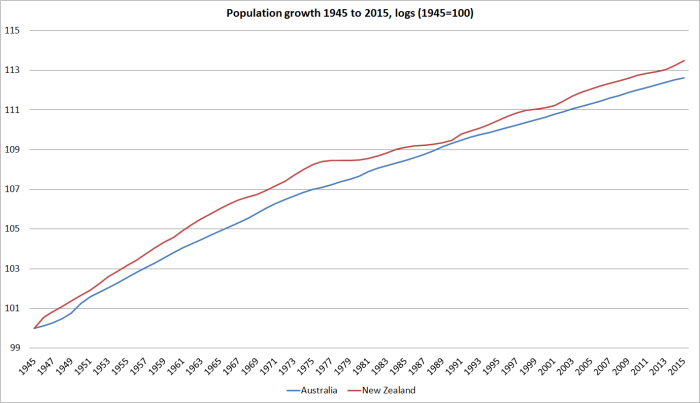
I’ve always refused to call the Auckland (or wider New Zealand) housing market a bubble. The disastrous results seem to be a predictable outcome given the combination of land use restrictions and extraordinarily rapid population growth – structural features of the policy regime, not signs of irrational exuberance (perhaps especially not in an economy generating such weak per capita income growth). Sometimes circumstances can take care of these problems – perhaps we’ll have an unexpected annual outflow of 40000 people for a few years – but the structural imbalances that have skewed the housing market so strongly against ordinary people starting out is largely a policy problem. and one that needs p0licymakers to fix. Based on his comments in the last few days – and his actions in the last few years – the Prime Minister doesn’t seem to care, if only the headlines would abate.
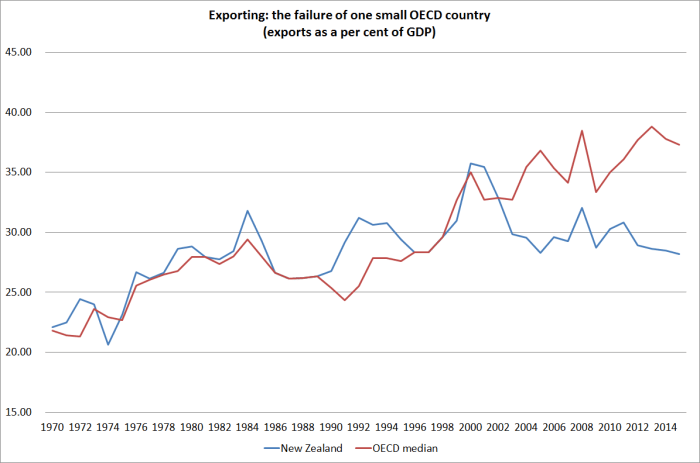
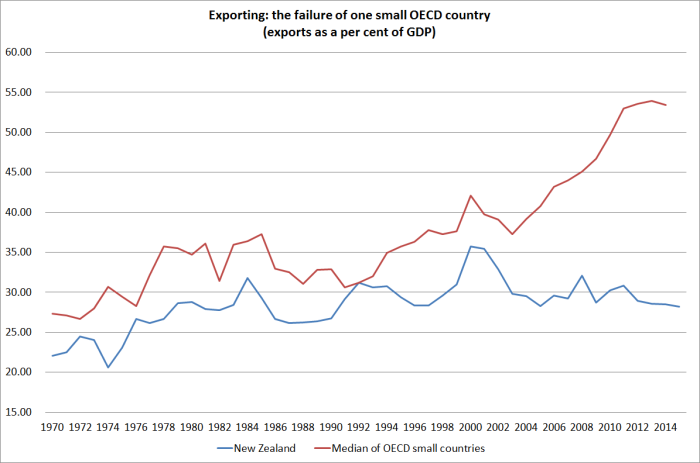
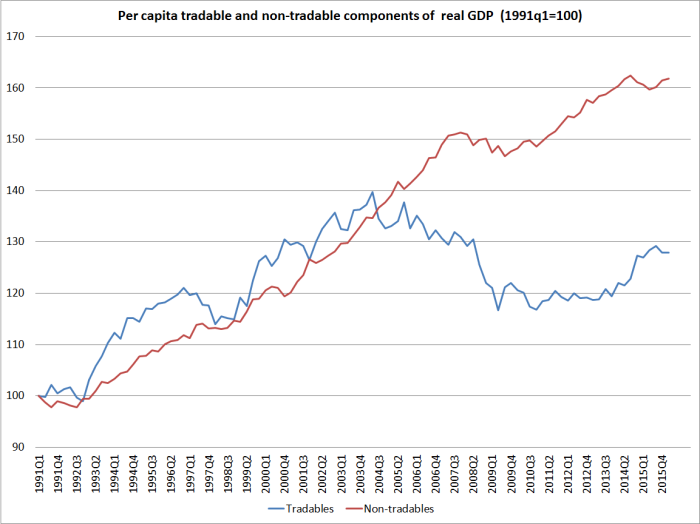

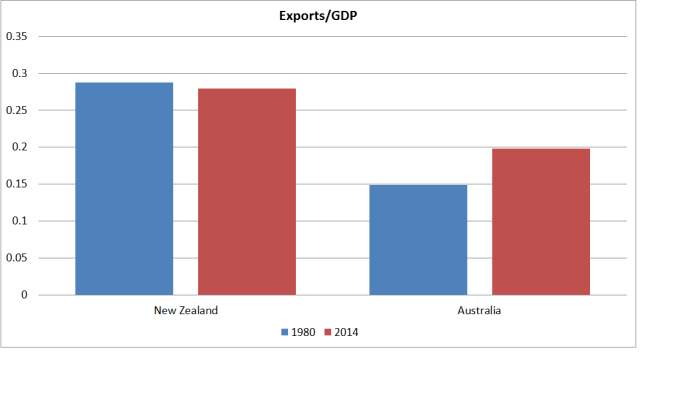 New Zealand’s export share of GDP hasn’t changed in 35 years.