What’s happening with immigration?

It is a serious question.  MBIE’s immigration data are pretty hopelessly poor –  not published in readily usable formats, not seasonally adjusted etc.   The Migration Trends and Outlook publication for 2017/18 is still not available.  I know they have plans afoot to improve things, but it is past time they did: immigration, after all, being one of the major instruments of economic (and social) policy in New Zealand.

But from time to time, I have a look at what they do publish –  huge tables in small fonts, from which one has to transcribe numbers if you want to do anything with them.  And the other day I had a look at the latest residence approvals data, and was quite surprised by what I found.

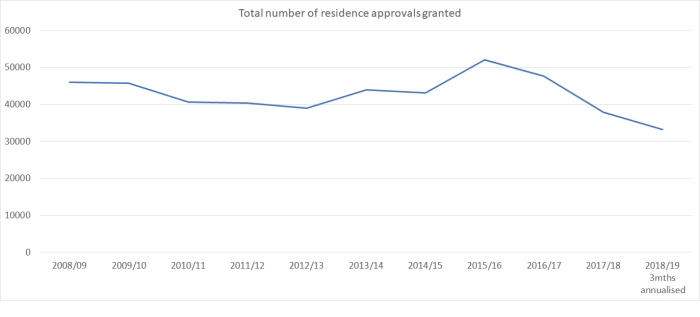
This chart shows the number of people approved for residence in each June year.  The 2018/18 number is the annualised number based on September quarter actual data.

residence 1

The “target” rate of approvals was around 47500 per annum for a long time, lowered slightly to something centred on 45000 per annum late in the previous government’s term.  As you can see, give or take 5000 or so people, they more or less meet that target. And so last year’s drop took me by surprise.  I didn’t make anything much of it then, when the numbers finally came to light: after all, announced policy hadn’t changed much, and perhaps it was just noise.

But the early data for the current year suggest something more than noise.  If the September quarter rate of approvals was kept up only about 33000 residence approvals would be granted in 2018/19.  Perhaps there is some seasonality in the series –  did I mention that MBIE don’t publish seasonally adjusted data, or make the raw data available in a form in which I could see for myself? –  but if not, it would represent quite an undershoot relative to the official target.

I don’t usually pay much attention to the nationality of those getting residence –  my arguments about immigration are mostly macroeconomic in nature, indifferent as to whether the migrants come from Bangalore, Birmingham, Brisbane or Beijing.  But as I’d been writing about the PRC and our political parties, out of curiosity I checked the residence approvals granted to people from the People’s Republic.  And finding those interesting, I looked a bit further.

residence 2

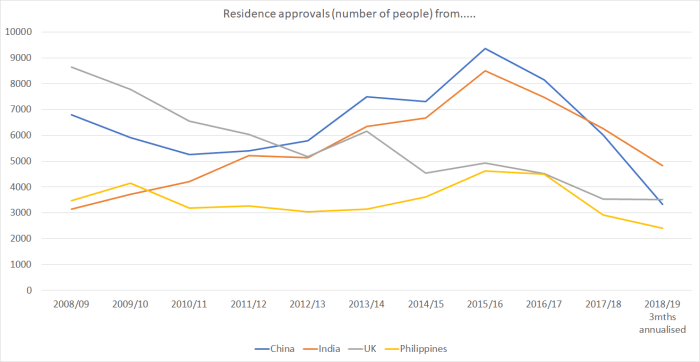
That (the blue line) is a staggering drop-off in approvals from China.   Again, perhaps there is some seasonality –  but it isn’t obvious why there should be, given that most residence visas are granted to people already in New Zealand, initially on other visas.

The falls in approvals from India and the Philippines are also pretty large.  And yet clearly the fall isn’t across the board. So far this year approvals from the UK are running at about the same (annualised) rate as last year (as were, more or less, when I checked, those from South Africa another significant source country, and those –  much fewer –  from Singapore and Taiwan).

I’m puzzled by what is going on.  I’d taken the new government at its word when it swore that it wasn’t changing the residence approvals target, but if not it looks as if something is going on that is markedly reducing the number of eligible people (especially from China and India) applying. (In another of the huge, not user-friendly, documents MBIE puts out, it looks as though there are also fewer applications in hand now than usual.) Perhaps it has something to do with the earlier wave of foreign students studying here, but although there has been a significant drop in numbers from India those from China haven’t changed much.  Perhaps there is something in the publicity around foreign investment restrictions –  which don’t of course apply to those who have residence?

I’m puzzled.  And, of course, I’ve spent years calling for a reduction in the residence approvals target, so in one sense I’m not unhappy to see the reduced numbers.  But I also strongly favour open and transparent policy, and there has been nothing announced suggesting that we should have been expecting –  or that the government was seeking –  such a large reduction in the number of residence approvals being granted.

If any officials or industry experts have informed insights on what is going on the comments section is open.


Thoughts prompted by the tape

What to take from Jami-Lee Ross’s tape of his conversation with his (then) boss?  I’m not interested in Bridges’s vulgar and insulting talk about his own MPs (although being, like him, a child of a Baptist manse, I can only surmise that he wasn’t raised to use that sort of language) or even that interested in the minutiae of whether and how donations are recorded and disclosed, including to the party hierarchy itself (significant as those issues probably are generally).

As compared to the situation a few days ago, we know that there was a $100000 donation to the National Party, initiated apparently (whatever final form the lesser components took) by Auckland businessman Yikun Zhang who (despite apparently coming here as a poor former PLA soldier 18 years ago) doesn’t speak English.   The first person I asked the other day about Yikun Zhang responded along the lines of “bad news”, and the more I read around the various sources which various Chinese speaking commentators have highlighted, the truer that summary description appears to be.

Several things struck me about the Bridges-Ross conversation:

  • the first was about how normal both of them  (one the leader, one the 8th ranked front bench MP) seemed to regard this sort of tawdry business.  Sure, fundraising is a vital function of a political party, but it is a far cry from Barry Gustafson’s description in his 50th anniversary history of the National Party: “an unwritten but scrupulously observed rule has always been that no MP should be placed in the position of seeking, receiving, or even being made aware of money collected on behalf of the party” (p201).   Perhaps (although I don’t know) National is no worse on this score than other parties, but it is a pretty bad situation that has been allowed to develop –  or, more to the point, actively fostered.
  • the second was about how utterly unbothered they were (leader and no. 8) about the Jian Yang situation.  Sitting in your caucus is a former PLA intelligence official, Communist Party member, close asociate of the PRC Embassy, someone who acknowledges misrepresenting his background when he came to New Zealand, and someone who even a former diplomat –  who knows him well – says he is careful about what he says in front of the man.  As leader, perhaps you are under pressure to defend the man publicly.  But perhaps, a very generous –  naive – observer might have thought, after last year’s fuss had died down, and some face saved, the party would be looking for a way to quietly retire, and replace, Jian Yang going into the next election.    But when Simon Bridges is caught talking about his colleagues, we hear about the unfortunate Maureen Pugh, about those (Finlayson, Wagner and Carter) everyone assumes would go before long,  but the only reference to “Chinese MPs” is to adding another one.  Jian Yang’s continued presence seems just taken for granted: none of that background stuff apparently bothering either of them in the slightest.  Lacking any decency themselves –  and not facing any uproar from other parties –  Jian Yang is presumably much too valuable in tapping the potential donors.
  • third was the utterly transactional way in which they approached the donation Yikun Zhang proferred (and presumably arranged) and the bid for another ethnic Chinese National MP.

    Ross: Yeah they’re good people. Now there’s no catch or anything to it. You may recall at the dinner they did discuss candidacy, and another Chinese candidate.

    Bridges: Two MPs, yeah.

    Ross: Colin Zhang? The younger one, he’s put his name in for Candidates’ College and so I assume he’ll get through and we’ll make some decisions as a Party further down the track as to what we want to do with candidates.

    Bridges: I mean, it’s like all these things, it’s bloody hard. You’ve only got so much space. Depends where we’re polling, you know? All that sort of thing…two Chinese would be nice, but would it be one Chinese or one Filipino? What do we do?

    Ross: Two Chinese would be more valuable than two Indians, I have to say.

    It was fine for Ross to say “there’s no catch or anything to it”, but everyone involved knows  how reciprocity works.  It is about an exchange of favours over time.  When, in the same conversation a wealthy businessman talks of a big donation and proposes that one of his staff might get a winnable place on National’s list, and they take the donation anyway, there is a quid pro quo, in expectancy, if not in some written contract.  No sense presumably, either at the earlier function or in this phone call of anything improper or unethical.  It is clearly just the way the National Party now does things.

But bad –  really bad –  as all this is, I think what disgusts me is the utter indifference of either Bridges or Ross (and to the extent there is ongoing silence from elsewhere in the party, or anywhere else in the political spectrum, the rest of our political class) to the character and interests of the man they were dealing with.  Not at a basic interpersonal level –  frankly it sounds hard not to be a nicer person than, say, Jami-Lee Ross –  but as someone actively and on an ongoing basis fully involved with the PRC government and its activities, in China and abroad.   And this seems to be the bit that most of our mainstream media is either missing or downplaying.

If we are going to have private funding of political parties (which I happen still to favour), the issue isn’t whether immigrants of whatever ethnicity or natives (of whatever ethnicity) should be able to donate to political parties.  It is much more specific than that, about whether political parties (openly or secretly) should be taking substantial sums of money –  indeed, actively pursuing it –  from people who they either know, or really should know, are in league with or in active support of hostile or egregiously awful foreign powers.  From people over whom the hostile foreign power has leverage, direct or indirect.  And when the egregiously awful foreign power has a track record of using threats, and economic leverage, to buy silence (or worse).    And with the question in the background: in what ways are we tailoring what we do or say –  party presidents, for example, praising the egregiously awful regime and its leader – to keep that donor flow going.

The issues could arise from somone in league with any egregiously awful foreign power but – not having many North Korean migrants –  the PRC is the one we in New Zealand need to be most worried about right now.  At some other time, it might have been the Soviet Union, Nazi Germany, or maybe even apartheid South Africa.  In the 1980s, emigre French business people, with close links to the DSGE, donating large amounts to our politicians, would rightly have attracted extreme disapproval.  There never were such donations, but today both main parties enrich themselves from donors with close ties to Beijing.

I noticed that Stephen Jacobi, the (NZ) taxpayer-funded lobbyist for keeping New Zealanders in line on things Beijing, was out today suggesting that perhaps state funding of political parties might be desirable after all.  His argument was a bit different from most though.

I haven’t seen anyone suggest that Yikun Zhang shouldn’t allowed to donate, or even to talk to politicians.  I have seen, and made, suggestions that our political parties shouldn’t touch his money –  or that channelled through bodies he runs or influences –  with a barge pole.   The suggestion is that the man is being “vilified”, but all I’ve seen so far is straight reportage –  often drawn directly from bodies he is involved on, or the Chinese language media – about his involvements and associations.  At least in Chinese –  he not speaking English –  he seems rather proud of and unapologetic for those involvements.

For those with Financial Times access, there is a nice article here which captures some of his close ongoing official involvement with the PRC government.  In a formal sense, he seems to have much stronger ongoing ties to the regime than (for example) Jian Yang does.   For others, and anyone interested, I suggest keeping an eye on these two Twitter accounts (both have been posting copious snippets of Yikun Zhang’s associations here and in the PRC): @geoff_p-wade and @jichanglulu.    As Wade (an Australian) urges

Reading the local media coverage, it strikes me that most of the local media is still reluctant to engage with the nature of the PRC United Front programme/agenda.   These aren’t just people who happen to have a few incidental ties to the homeland. Their organisations aren’t just neutral bodies.    The PRC is widely recognised as having an active agenda of influence –  and to say so isn’t vilification, but analysis, description, and reading.  As I noted, many of the links aren’t hard to find, at least for those with the language skills (to whom the rest of us can be grateful).   Some of it is even just pictures

This afternoon, for the first time in a while, I went back and read the whole of Anne-Marie Brady’s Magic Weapons paper, which has had so much attention (arguably more abroad than here, given the studied disinterest of our political leadership) since it was released last September.

Here are a few relevant snippets

United Front Work Department personnel often operate under diplomatic cover as members of the Ministry of Foreign Affairs, using this role to guide united front activities outside China, working with politicians and other high profile individuals, Chinese community associations, and student associations, and sponsoring Chinese language, media, and cultural activities. The Party has a long tradition of party and government personnel “double-hatting”; holding roles within multiple agencies. 17 Chinese consulates and embassies relay instructions to Chinese community groups and the Chinese language media and they host visits of high-level CCP delegations coming to meet with local overseas Chinese groups. The leaders of the various China-connected overseas Chinese associations in each country are regularly invited to China to update them on current government policies.

Yikun Zhang appears to have been on such missions regularly, and he (and the acolyte he wants to put into Parliament) are apparently in the PRC now (hosting the mayor of Southland).

And this longer piece

1. “Bring together the hearts and the power of the overseas Chinese”  Xi Jinping’s ambitious strategy to harness the overseas Chinese population for the CCP’s current economic and political agenda, builds on existing practices and then takes it to a new level of ambition.

Agencies: State Council Overseas Chinese Affairs Office, CCP United Front Work Department, Ministry of Foreign Affairs, Ministry of State Security, PLA Joint Staff Headquarters’ Third Department, and other relevant organs.

Policies:

• Monitor the local long term Chinese community via community organizations (侨务社团工作); establish Overseas Chinese Service Centres (海外华侨华人互助中 心) to coordinate this work, cherry pick which groups to work with.

• Sponsor and support the emergence of new united front organizations to represent the overseas Chinese, recognizing that they are a diverse group and flexibility is required to establish a positive working relationship with them. Avoid directly interfering in overseas Chinese community affairs unless there is a situation that directly affects China’s political interests,….

• Unite the ethnic Chinese communities through nurturing and subsidizing authorized Chinese cultural activities.

• Supervise Chinese students and visiting scholars through the united front organization the Chinese Student and Scholars Association (中国学生学者联合会).

• Encourage influential figures within the overseas Chinese community who are acceptable to the PRC government to become proactive in helping shape ethnic Chinese public opinion on political matters.

• Encourage wealthy overseas Chinese who are politically acceptable to the PRC government to subsidize activities which support China’s political agenda.

• Draw on China’s agents and informers abroad to enhance China’s political influence.

• Encourage political engagement of the overseas Chinese community (华人参 政). This policy encourages overseas Chinese who are acceptable to the PRC government to become involved in politics in their host countries as candidates who, if elected, will be able to act to promote China’s interests abroad; and encourages China’s allies to build relations with non-Chinese pro-CCP government foreign political figures, to offer donations to foreign political parties, and to mobilize public opinion via Chinese language social media; so as to promote the PRC’s economic and political agenda abroad.

It doesn’t seem unreasonable to wonder whether the Chao Shan General Association –  so much in the media in recent days as one of Yikun Zhang’s key involvements –  is not one of those “new United Front organisations”; able to attract many key figures of the New Zealand political establishment to its functions.

Political donations aren’t the whole story by any means.  They are simply the bit brought into focus, almost incidentally, in Jami-Lee Ross’s revelations of the questionable activities he was, apparently, a leading figure in.  The other half of the story is, of course, trade.  The PRC has a now-established track record of using economic coercion to attempt to silence any government that ever takes a stand or utters more than the meekest and mildest concerns.  As I’ve noted here before, most of what New Zealand firms export to the PRC is fairly homogenous commodities which if not sold to China would be sold somewhere else (someone else in turn selling to China).  In other areas –  notably tourism and export education –  there are greatly vulnerabilities. But no doubt representatives of all these industries also bend the ears of our political leaders, providing them another excuse for staying silent –  or worse, gushing in praise –  of one of the more heinous (and getting worse) regimes on the planet.   Perhaps it is really true that even without the donations, the politicians (all of them) would still lack any willingness to speak out, but the donor flow –  whether direct or through charity auctions – seems likely to reinforce the supine shameful state of New Zealand political leaders as regards the PRC.

The situation needs to change, but not one person on the New Zealand political scene offers any hope of making it happen.  Jami-Lee Ross probably only wanted to be at the top table making the “sellout” of New Zealand longer-term interests and values happen his way.  I did a media interview yesterday about some of these issues, and was asked about the potential cost of making a stand –  even just separating ourselves from Beijing-affiliated ethnic Chinese money.  As I noted to the interviewer, the only real test of what you value is what you are willing to sacrifice  –  pay a price –  for.  On the evidence to date, the integrity of our political system –  let alone the freedoms of other democratic states in east Asia –  clearly isn’t one of those things for the current crop of politicians, from any party.

Bernard Hickey has a nice article on some of these issues at Newsroom.  I agree with most of what he says, and commend it to your attention.   Of the Prime Minister’s responsibility he writes

Prime Minister Jacinda Ardern has been conspicuous in her lack of comment on Jian Yang and on the role of Chinese influence in New Zealand politics. She has also not criticised China directly over its South China Sea incursions or the persecution of minorities in China.

She should draw a line under New Zealand’s acquiescence to China and review the transparency of the Electoral Finance Act in relation to overseas influence. She should call for Jian Yang to resign from Parliament at the least, and follow the example of her Australian counterparts by asking for an official inquiry into China’s influence in politics here.

The Prime Minister talked a good game about human rights and sovereignty at the United Nations recently. How serious is she when her own party’s finances may be affected by pushing back against China?

Not talking, as the PRC Embassy reported her recently, of strengthening ties between the Labour Party and Communist Party of China.

And, finally, Anne-Marie Brady has re-linked to a couple of pieces she wrote late last year (here and here) on what can and should be done, including by the new government.  I will always defer to her expertise on the nature of the PRC programmes and interventions, although in thinking about policy responses, she probably put relatively more emphasis on national security issues, (while –  charitably? – presuming governments will want to do something serious), while I tend to emphasise the problems that lie within our own political processes.  In my view, it isn’t that people don’t know what could be done, rather that our politicians simply don’t want to do anything, or be seen to express serious concerns.    In that sense, the bigger problem –  the one we could control but refuse to –  lies here, not in Beijing (evil states will do what evil states do, including suborning the locals, encouraging the mindset of a tributary. Our political processes –  in a state far away from Beijing, and simply not that reliant on them for anything much –  make choices whether to fall into line, or whether to stand up.   Of course, one test may loom quite soon: what, if anything, will our government be prepared to do if is found that PRC agents were responsible for the break-ins at Anne-Marie Brady’s house and office.  Will we even be told?


What to make of the inflation data

The CPI data were released a couple of days ago.   There was, inevitably, a lot of commentary around higher petrol prices, although most commentators noted that the Reserve Bank was likely to “look through” what we are seeing, and not adjust monetary policy just because of higher petrol prices.  That would, indeed, be consistent with the Bank’s mandate –  and practice –  over almost thirty years of inflation targeting.

One can have all sorts of debates about what sorts of effects should be “looked through”.  We used to have lengthy discussions attempting to distinguish between petrol price effects themselves, indirect effects (eg higher airfares or courier costs directly resulting from higher fuel prices) and second-round effects –  the real worry, if changes in oil/petrol prices came to affect the entire inflation process, including medium-term expectations of inflation.   Those risks were real, and realised, back in the 1970s oil shocks, and that set the scene for much of the subsequent discussion and precautionary debate.

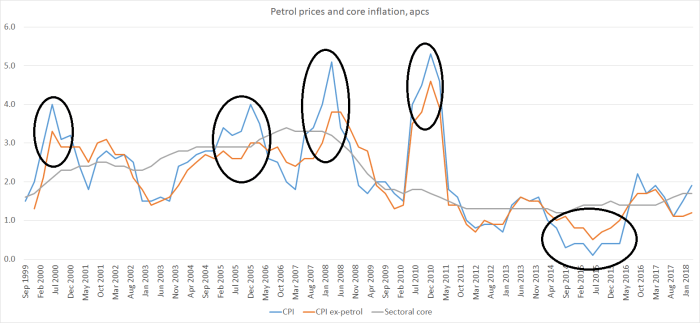
SNZ only has a CPI ex-petrol series back to 1999.  In this chart, I’ve shown the headline CPI inflation rate, the CPI inflation rate ex-petrol, and the Reserve Bank’s preferred core inflation measure, the sectoral factor model.

petrol price inflation

I’ve highlighted four episodes in which petrol price inflation was much higher than overall CPI inflation, and one (quite recent) when it was much lower.

In the first of those episodes –  around 2000 –  the surge in petrol prices coincided with quite a lift in core inflation.  Bear in mind that the economy was recovering from the brief 1998 recession, and the exchange rate had fallen sharply.

In the second episode –  2004 and 05 – the surge in petrol price inflation coincided with no change in core inflation.

In the next episodes –  2008 and 2010 –  the surge in petrol price inflation coincided with a fall in core inflation.  In the 2008, the Reserve Bank explicitly recognised some of this at the time, and talked of scope to cut the OCR soon, despite the high headline inflation.

And in the recent episode when petrol price inflation was very low, there was no fall in core inflation –  if you look hard enough, it may actually have increased very slightly.

There is talk that, if oil prices persist, headline inflation could get as high as 2.5 per cent before too long.  The experience of the last couple of decades suggests that will tell us nothing useful about underlying/core inflation trends, or about the appropriate stance of monetary policy.  And the preferred core inflation measure remains below the target midpoint, as it has been for almost a decade now.

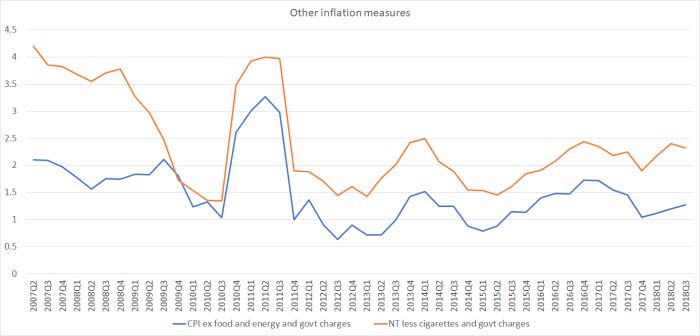
Here are a couple of other series worth looking at.

other infl measures

The blue line is a fairly traditional sort of exclusions-based core inflation measure: excluding volatile items (food and fuel) and (administered) government charges (altho not tobacco taxes), and the orange line is non-tradables inflation excluding government charges and cigarette and tobacco taxes (which, you will recall, have been raised relentlessly each year, in a political non-market process).  There is no sign in either of these series of underlying inflation moving higher in the last year or two.  Core non-tradables inflation of under 2.5 per cent is not consistent, typically, with core (overall) inflation being at 2 per cent.

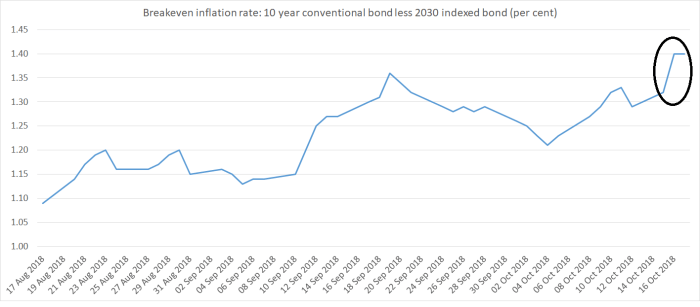
Having said all that the financial markets appear to have taken a slightly different view of this week’s inflation data.  Here is a chart of the breakeven inflation rate from the government bond market –  the difference, in this case, between the 10 year conventional bond rate and the 2030 indexed bond (real) rate.  I’ve highlighted the change since the inflation data were released.

IIBs oct 18 2018

At 1.4 per cent, the gap is still miles off the 2 per cent target midpoint (or than the comparable numbers in the US), but the latest change does look as if it is worth paying at least a bit of heed to.  Perhaps it will dissipate over the next few weeks, but if not it wouldn’t be a cause for concern, but some mild consolation that –  after all these years –  there was some sign of market implied inflation expectations edging a little closer to target.

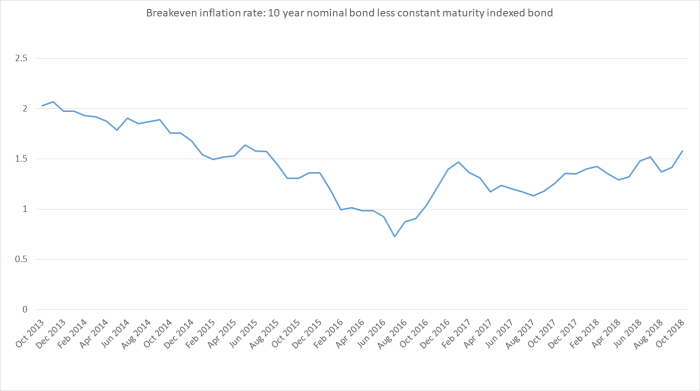
What about a longer run of data?   We only have a scattering of inflation indexed bonds, in this case one maturing in September 2025 and one maturing in September 2030.  The 2030 bond was first introduced five years ago this month.    Creating a rough constant maturity 12 year indexed bond series –  the 2025 bond had 12 years to run in 2013, and the 2030 one has 12 years to run now –  and subtracting the result from the Reserve Bank’s 10 year conventional bond series produces this (rough and ready) chart.

iib constant maturity breakeve

A clear rebound from the lows of 2016, but implied breakeven inflation rates still much lower than they were five years ago.

There still seems to be quite a long way to go for the Reserve Bank to really convince investors that, over the decade ahead, they will do a better job of keeping inflation averaging near target than they have done this year to date.

Continuing to talk down the risks of the next serious recession, and the limitations of policy here and abroad to act decisively to counter such a recession and the likely deflationary risks, is cavalier and irresponsible.  It might (seem to) help confidence in the short-run, but if those risks crystallise –  and central banks should focus on tail risks in crisis preparedness –  the Bank will bear a lot of the responsibility if the economy performs poorly, and inflation ends up so low as to vindicate (and more) the evident lack of confidence among people putting real money on a view about the average future inflation rate.


The swamp

What has New Zealand politics come to when someone who was (until a few days ago) a senior frontbench member of our largest political party claims that he was active –  as recently as a few months ago – in collecting very large donations from an open and avowed supporter of one of the most egregious regimes on the planet.   And goes further to suggest that his party leader was not only active in soliciting such donations –  and whether the words are used or not, when senior politicians turn up for dinner at the house of a wealthy person who doesn’t speak English, there isn’t much doubt what the visit is really about  –  but may, illegally so the MP claims, have sought to enable the fact of such donations to be masked from public scrutiny. (Those latter claims are the issue in law, but in many ways they should be less of a political issue than the wider environment this episode sheds fresh light on.)

And when no other member of that political party, or any other political party, is willing to speak out about the culture that our politicians and political parties –  all of them it appears –  have fostered.  Why?  Because the other side is quite as heavily involved in this “donations for acquiescence (or worse)” business.

After all, the Herald reveals this morning that although the Labour/New Zealand First government was directly responsible for the honour recently bestowed on Yikun Zhang, the nomination was a joint effort of National MP –  former PLA intelligence official, Communist Party member, and active fundraiser – Jian Yang, former National Party MP Eric Roy, and former Labour leader and Mayor of Auckland –  recipient of a very large anonymous donation from mainland China to his campaign, in an event organised by Labour MP Raymond Huo –  Phil Goff.    Yikun Zhang is photographed posing earlier this year with the Prime Minister, and in Labour Party group including party president Nigel Haworth –  on record, in the last year as more and more is learned of the new and egregious evils of the PRC regime, praising Xi Jinping and celebrating the PRC regime.

And, of course, not a word is heard from any of them –  Jacinda Ardern, Winston Peters, Nigel Haworth, Peter Goodfellow, Simon Bridges, Gerry Brownlee, Todd McClay (or Jian Yang or Raymond Huo) – about:

  • the mass imprisonments in Xinjiang,
  • the continued illegal PRC militarisation of the South China Sea,
  • the increased repression of religions (and Falun Gong) across China,
  • the rollout of the “social credit” system of repression and control,
  • the growing threat to free and democratic Taiwan, or
  • the increasing erosion of freedoms in Hong Kong.

In fact, as a government minister only last year, Simon Bridges was signing official agreements with the PRC regime committing to an aspirational goal of a “fusion of civilisations”.

What of Yikun Zhang?  He is a leading figure in PRC United Front activities in New Zealand.  That’s not my interpretation, it is the view of the most prominent New Zeland expert on these matters.

Consistent with this, he was among the United Front people invited to Beijing to participate in the 90th anniversary celebrations for the People’s Liberation Army.

On 30 July 2017, Zhang Yikun, a former military servant was invited to participate the military parade in Beijing for the celebration of the 90th anniversary of PLA establishment.

Zhang said to Chinese media, “ As a veteran, now a overseas Chinese community leaders, I felt deeply excited for the tremendous achievements in the national defense  of my homeland. “

Perhaps someone could ask him, no doubt through a translator, about the South China Sea militarisation.

Only late last year, he was leading a delegation –  that included Eric Roy and Southland mayor (see yesterday’s post) Gary Tong  –  to the Overseas Chinese Affairs Office of the State Council –  then one of the key institutional entities in the PRC influence activities in and through ethnic Chinese communities abroad.

I could go on –  I’ve been sent numerous links to Chinese language articles, which one can run through Google Translate –  but the character of the man is pretty clear.  After 15+ years in New Zealand he hasn’t learned English, he remains close to various PRC bodies including the embassy/consulate in New Zealand, is actively involved in various United Front entities and activities (including the cultural associations, which aren’t simply the equivalent of the Cornwall or Sussex associations, but vehicles through which the PRC seeks to exert control over ethnic Chinese in other countries)…..and he seems to assiduously cultivate connections to key figures in both our main parties (at least) –  and, in turn (and this is the real shame) to be courted by them.    And they give him official honours, for what seem –  in effect –  to be primarily services to the PRC.  Did I mention that it was one of the most egregiously evil, and outwardly aggressive, regimes on the planet?

It is pretty bad that we have allowed people like this to achieve such prominence in our society.   We should, and generally do, welcome people who want to come from China to escape the evils of the regime, and embrace freedom, democracy, transparency and a (until relatively recently) uncorrupt society.   Rather like people escaping to the West from Germany in the 1930s.   But what we seem to be doing is facilitating the functional equivalent of Nazi Party front organisations in Britain or France in the 1930s, and not just accommodating them but embracing them…..for the money.

But evil regimes will do what they do.  What we can, or should control, is what we tolerate –  whether as politicians and political party figures, or as voters.  Our political leaders seem to have no appetite for anything much other than keeping the donations flowing –  and maybe worse if the full extent of Ross’s allegations happen to be true.  They don’t seem to value what made New Zealand one of the world’s best and finest democracies –  part of what made good people want to come here –  or, if they still tell themselves they do, they seem to attempt to compartmentalise in ways that are simply untenable.  Our parties and politicians need to learn to say no.  And we need to demand that they do so.

It is well past time to drain the swamp of New Zealand politics.  If only there were any real hope of that happening.

(For those interested there is a useful background article on Yikun Zhang on Newsroom and interesting – non-controversial –  account of his own life here.)

The corruption of New Zealand politics

Who knows whether Jami-Lee Ross’s allegation around the handling, and disclosure, of a donation to the National Party from one Yikun Zhang are correct or not.  One hopes time, and evidence, will tell.   Frankly, one hopes Ross is wrong, or overstating things.  But at least one observer notes that Jami-Lee Ross has previously been actively involved in such fundraising.

Him again…..the former PLA intelligence official, Chinese Communist Party member, and National MP, who admits he misrepresented his past to immigration/citizenship officials, but who is stoutly defended by successive National Party leaders, and whose prime role in the National Party appears to be (highly effectively it is reported) tapping the ethnic Chinese community for donations.

It seems highly likely, to the point of being almost certain that there was at least one such substantial donation from Yikun Zhang.  After all, the man’s wife told Stuff that Simon Bridges had been to their house for dinner, while from the same story we learn

A receptionist at KCC said Zhang could not be emailed as he did not speak English.

We can assume Bridges didn’t go for dinner for the sake of the witty repartee, stimulating conversation, or on account of a personal friendship.  It is a far cry from the days  – not that many decades ago –  when party leaders and senior ministers stayed well clear of party fundraising, to avoid giving the impression of opportunities for influence.

Incidentally, I’d been under the impression that immigration to New Zealand had long involved some English language tests.

In case one wonders if the receptionist was telling a convenient tale, there is an OIA request  – to the Southland District Council of all places –  available on line about Yikun Zhang and one of his legal advisers.  The Mayor had made Yikun Zhang some sort of semi-official Businss Adviser.   Among the June 2018 OIA responses, the mayor is reported this way

The Mayor wishes to acknowledge the work of Yikun Zhang and Ping Chen and he has no emails that relate to any business matters that can be released as discussions occur between Ping Chen and the Mayor as Mr Zhang gains confidence in English. To date communication has been verbal and translated either on conference call or Wee Chat.

Very little, or no, English.

The Mayor and his wife seem to have benefited considerably from the largesse of Yikun Zhang

The Southland District has received no gifts from either party, and the Mayor has received two bottles of wine prior to a dinner (2016) in Auckland, a sponsored trip to China (2017) for he and his partner to attend business and local government introductions in Beijing and Guangzhou and return again.

The Council was obviously a bit defensive about the Mayor’s ties to Yikun Zhang and the OIA response twice highlights Yikun Zhang’s national political connections

There is an informal relationship to see how things progress. Both  [Yikun Zhang and Ping Chen] are well known in central government and both have close links to high level Ministers and MPs.

Perhaps Simon Bridges was one those “high level Ministers”, but whether he was or not we can safely assume that OIA response is referring primarily to National Party ministers, since this relationship with the Southland District Council developed over the last few years.  And as the Stuff story notes (complete with photos)

In July National Party deputy leader Paula Bennett posted photos on her Facebook page of her and Jami-Lee Ross sitting at the same table as Zhang for the opening of the Chao Shan General Association’s new function centre.

What else is there about Yikun Zhang?

Well, we know that the current government –  Labour/New Zealand First coalition –  gave him an honour in this year’s Queen’s Birthday honours –  for various things including, apparently advancing the People’s Republic of China Belt and Road Initiative (the “maritime Silk Road” bit).   There is a photo of him with the Governor-General receiving the award.  Presumably, given his inability to speak English, the conversation was rather limited.  A Cabinet minister praised him

“Mr Yikun Zhang, has been made a Member of the New Zealand Order of Merit, for services to New Zealand-China relations and the Chinese community. Mr Zhang has facilitated economic and trade conferences and Expos between New Zealand and China and is an effective and tireless community organiser.

Various other commentators have highlighted some of Yikun Zhang’s other activities.  Thus, it appears that Yikun Zhang is actively involved in various United Front organisations, used by Beijing to influence ethnic Chinese in other countries, and influence politics and society in those countries.

Rather like, as Anne-Marie Brady has pointed out, Labour MP Raymond Huo.

It is a little hard to believe that someone who established himself here, clearly has considerable resources at his disposal, but can’t even be bothered learning English (he isn’t some struggling 80 year old on a parent visa, say), has the interests of New Zealand primarily at heart, when liaising with or donating to, political parties.  Do you really not  have to know even conversational English nowadays to become a citizen?  Perhaps when he returns to Auckland someone could ask him, through a translator, about whether he has anything negative to say about the brutal regime whose diplomats he hangs out with, and whose foreign policy initiatives he seems to have helped advance?

And, of course, if this particular case puts the spotlight on National, it was Labour/New Zealand First who awarded the man’s honour, and when Labour was last in government there was the infamous case of the award of citizenship to a donor, against the strong recommendation of officials.  And, look, the minister involved is a Cabinet minister today.

National seems to have been particularly effective at tapping the ethnic Chinese donor “market” in recent years.  They were in government.  One can only imagine how the Labour fundraisers are now looking at the possibilities, and that any such approaches are likely to fall on receptive ears.  Is Labour willing to resist the temptation?  Probably not judging by the willingness of the party hierarchy to praise the CCP and Xi Jinping.  Oh, and there was the large donation to Phil Goff’s mayoral campaign from the mainland.

A few months ago, I reported this from a (Chatham House rules) seminar I was invited to

There was clear unease, from people in a good position to know, about the role of large donations to political parties from ethnic minority populations –  often from cultures without the political tradition here (in theory, if not always observed in practice in recent decades) that donations are not about purchasing influence.  One person observed that we had very much the same issues Australia was grappling with (although our formal laws are tighter than the Australian ones).  Of ethnic Chinese donations in particular, the description “truckloads” was used, with a sense that the situation is almost “inherently unhealthy”.   With membership numbers in political parties dropping, and political campaigning getting no less expensive, this ethnic contribution (and associated influence seeking) issue led several participants to note that they had come round to favouring serious consideration of state funding of political parties.   I remain sceptical of that approach –  especially the risk of locking in the position of the established parties, or locking out parties the establishment doesn’t like – but it was sobering to hear.

What is the issue?  It isn’t that New Zealand citizens, of whatever ethnic background, shouldn’t be able to donate to political parties.  The concern in the PRC context is that (a) the donors themselves are often dependent (their own businesses) on continued access to the PRC, and often have families back there exposed to the (not very) tender mercies of the party-State, (b) the extent of PRC Embassy and related United Front organisation influence on the local ethnic Chinese community, and (c) the not-unrelated risk of the flow of donations drying up should the recipient party ever do or say anything upsetting to Beijing.  The PRC regime is of a character, and determination, not like the home countries of most of our other migrants.

Yikun Zhang himself seems almost peripheral to Jami-Lee Ross’s concerns/allegations, as reported so far. But I hope that the incidential disclosure of his name, and apparent close relations with the National Party (in particular) will help to spark a more honest conversation about the flow of Chinese money to political parties, in the context of a more realistic assessment of the nature of the regime, its methods, its interest.  And, on the other hand, a renewed demand for a much greater degree of integrity –  a willingness to say no, just occasionally, to stand for the values the underpinned our political system for a long time –  among our politicians and political processes.   It wasn’t that hard, in the end, to get rid of Jami-Lee Ross.  What about Jian Yang?

Sadly, we can expect more silence, more complicity, and not just from the National Party, but from every single one of our parties and their leaders.

UPDATE: Part of a thread on Yikun Zhang and the United Front/CCP connections.

Interest rates: US and New Zealand

There is a bit of a story afoot that, somehow, the days of low interest rates are almost over.  There was even an editorial to that effect in the Herald yesterday, which seemed to hanker for higher interest rates here (without, for example, linking that preference to any good things –  much faster productivity growth –  that might make rather higher interest rates a welcome complement to greater economic success).

The idea that interest rates will soon be rising has been something of a constant (across much of the world) this decade.  Like the stopped clock, that line will no doubt eventually be proved correct.  But so far this decade, it seems to have been right (about policy rates) mostly when either:

  • there is some sort of crisis, in which domestic authorities are fighting a lower exchange rate (eg Turkey and Argentina), or
  • temporarily, when over-enthusiastic central banks misjudge inflationary pressures (eg New Zealand (twice) and a couple of other countries (eg Sweden and the ECB), or
  • on the back of massive, unsustainable, late-cycle fiscal stimulus (the US at present).

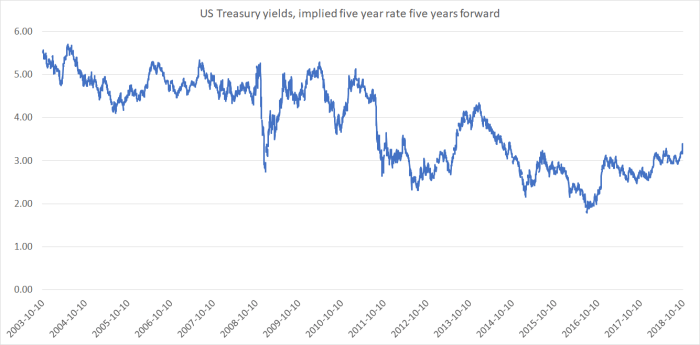
The Federal Reserve has now raised its short-term interest rate target quite considerably.  Then again, the US 10 year bond rate –  3.16 per cent as I type – is barely above the levels it reached at the end of 2013, five years ago.   And here is a chart that decomposes a 10 year yield into two parts, and using a 5 year yield, calculates the implied second half of that 10 year bond: a five year implied rate in five years time.

US 5x5

That rate has edged up a little recently, but is still a long way below where it was five years ago.   Markets recognise that short rates have risen, but seem to have no greater confidence that they are going to stay very high for very long.

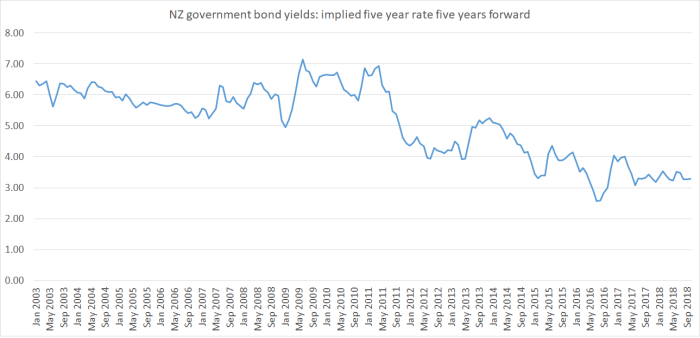
What about New Zealand?  Here is much the same chart for New Zealand, drawn from the data on the Reserve Bank website.

NZ 5x5

No sign of any rebound at all.    The series isn’t at its (2016) low but –  as has been the case all decade –  each peak is lower than the one before.  Five years ago when the markets and the Reserve Bank were convinced the OCR was going up a long way, this implied forward rate was in excess of 5 per cent.  Yesterday it was 3.27 per cent.

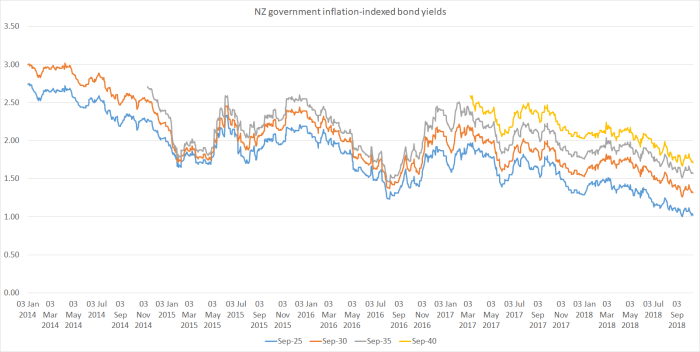
Both charts so far have been of nominal interest rates?  What about real, inflation-indexed yields?   The New Zealand government now has a variety of maturities on issue, and this is how the yields have performed since the start of 2014.

IIBs oct 18

There is some volatility in the series, but the trend is pretty clearly downwards, even if one focuses just on the last 18 months or so.   With the passage of time each specific maturity has a shorter remaining time to run (in 2014 the 2025 maturity was an 11 year bond, and now it is just under a 7 year bond), but even adjusting for that the trend is still downwards.

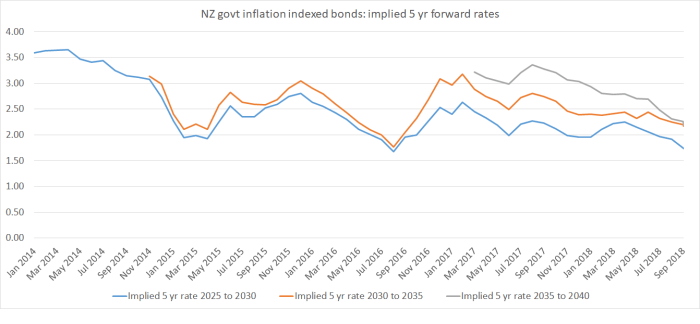
Here is a chart showing the implied five year forward real rates from those indexed bond maturities.

implied forwards NZ IIBs

The continued downward trend evident in the previous chart isn’t so clear in this one.  But there is no sign of any trend rise in real long-term New Zealand yields at all.   And if we take the very longest of these series –  the grey line, which represents and implied five year real rate roughly 20 years from now (and which thus shouldn’t be much influenced by very short-term expectations of the OCR or the state of the economy) the implied forward yield has dropped by around a full percentage point in little more than a year.  Those are big moves for a very long-term security.

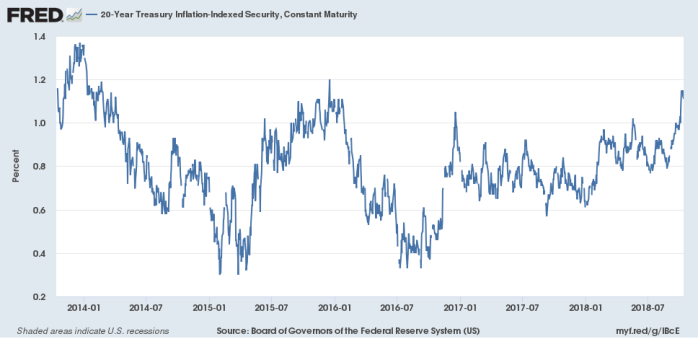
What about the US?  Here is the yield on a US government 20 year inflation-indexed bond, calculated as a constant maturity (ie always 20 years ahead, not fixed maturity dates as in my first NZ indexed bond chart above).

constant maturity 20 year iib

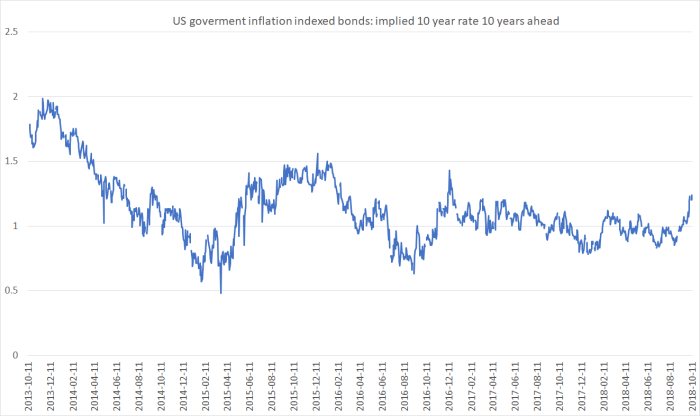
And here is the implied yield on a 10 year US indexed bond 10 years ahead (using the 10 and 20 year constant maturity series).

US 10 year implied

There is some sign of these very long-term implied US yields rising.  But even they aren’t setting new highs, or even surprising local highs of just the last few years.  Even with all that new government debt being taken on now, and projected into the future.

Perhaps the end of low interest rates really is nigh.  But there isn’t much sign of it in market prices at present –  none at all in New Zealand where, if anything, long-term and implied forward rates have just been keeping on falling.

Personally, my hunch is that yields (nominal and real) over the next decade could average lower –  not higher-  than those at present.   Mostly because when the next serious recession comes –  and there are plenty of things which could cause or compound it –  most advanced countries (and many emerging ones now) will have little capability, and perhaps even little willingness for some time, to do what it might take to get economies back on a firmer footing.   Look at how long it took last time round, even though going into that serious recession almost all countries had much more policy capacity –  and perhaps even political cohesion – at their disposal.

Later this morning, we’ll have the CPI data which may, at the margin, colour expectations about the near-term outlook.  But whatever those details, they want materially alter the picture of medium-term vulnerability, here and abroad.


Sluggish productivity growth and financial crises

There has been some interesting material around recently on how many advanced economies (in particular) have undershot over the last decade or so the trends they appeared to be on previously.  Paul Krugman had an interesting column a couple of weeks back, and then the IMF had a whole chapter in their  latest World Economic Outlook on “The Global Economic Recovery 10 Years After The 2008 Financial Meltdown”.   Martin Wolf summarised and illustrated some of that chapter in his FT column last week.  Much of this work attempts to associate (causally) subsequent disappointing economic performance with the financial crises of 2008/09, something I’ve long been a little sceptical of.    The IMF also highlights that countries that didn’t have a financial crisis have shared in the underperformance.

I might come back to the IMF material (in particular) later but reading it prompted me to check out some New Zealand data.

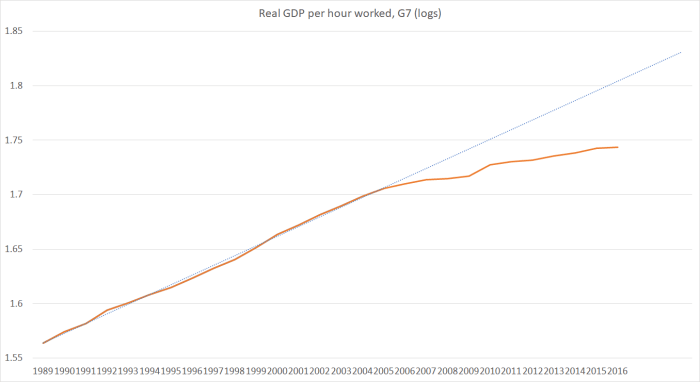
As context, here is some OECD data for labour productivity (real GDP per hour worked) for the G7 countries as a group.

G7 productivity

The trendline shows what might have happened if the trend growth to 2005 had continued.  The gap at the end of the period is equivalent to a productivity shortfall of around 15 per cent.    Note that this productivity slowdown was clearly underway well before the financial crises.

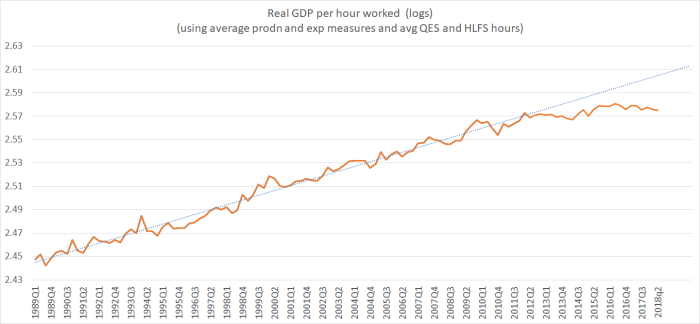
And here is the New Zealand data.  Here I’ve used quarterly data, all the way up to 2018q2.

nz productivity

But this time the trendline extrapolates the trend in the actual data up to early 2012.  Because up to about that time there was no particular sign of a change in the trend. (And thus between 2005 and 2012 we actually did a little better than the G7 as a whole).

Over the six years since 2012, the gap between the actual data and the trendline translates back to a shortfall of about 8 per cent.  Real GDP per hour worked now would be around 8 per cent higher than it actually is –  with all the attendant implications for wages, consumption possibilities, and even government revenue – if that pre-2012 trend had been sustained.  And the pre-2012 trend had been pretty weak –  mostly we’d still been falling behind the rest of the advanced world.

It is always possible that much of the recent productivity shortfall will be revised away –  SNZ have, over the years, delivered some significant changes in history at times.  But I’m not aware of any particular reason to expect significant revisions (in any particular direction), so we simply have to work with the data we have.

As the G7 countries didn’t have a financial crisis in 2005, we didn’t have one in 2012.  In fact, we hadn’t had a systemic financial crisis at all since the late 1980s, and the localised (severe in the sector, but small economywide) finance companies crisis had been centred back in 2007 and 2008.  For New Zealand, there simply isn’t a plausible story in which financial crises –  domestic or foreign –  can explain our dismal productivity performance over the last half decade or more.    Neither the timing, nor the stylised facts around the New Zealand financial system, fit.

There are reasons why for countries at the productivity frontier a major financial crisis could impair domestic productivity growth even in a country that did not itself have a domestic financial crisis, but that isn’t a very relevant story here, New Zealand average productivity being so far below that in the leading group of countries (where productivity is about two-thirds higher than in New Zealand).

I’m not sure I have a fully compelling explanation for why New Zealand has done so poorly since around 2012 (my standard story encompasses several decades of persistent gradual  –  cumulatively stark  – underperformance, and period since 2012 looks –  on current data –  to have been unusually bad).   Perhaps the earthquakes, and the subsequent diversion of resources to a lot of vital, but low productivity, repair and reconstruction work is part of the story (as we knew from day one, in economic terms it was a nasty non-tradables shock that wasn’t going to be helpful).  Then again, the peaks of that work are now well behind us, and productivity growth has yet shown signs of improving.  Perhaps the strong terms of trade have been part of the story –  not stimulating business investment, which has been persistently weak, but boosting incomes and perhaps crowding out other stuff.  The real exchange rate –  not an exogenous influence –  got back to pre-recession levels from about mid-2011.   And, of course, the very sharp and substantial turnaround in the net immigration numbers –  also mostly not an exogenous development –  was getting underway from later in 2012.

Whatever the full explanation, the symptoms (eg weak business investment, shrinking exports and imports as a share of GDP) should be worrying, the outcomes (productivity, and thus potential incomes) are dreadful –  building on earlier decades of underperformance –  and the explanation can’t credibly lie in financial crises, domestic or foreign.

And nothing serious is being done about addressing this failure, by the last government, by the present one.  And The Treasury –  principal adviser to the government on such matters –  seems much more interesting in its Living Standards Framework and esoteric (and sometimes convenient) concepts of “wellbeing” than in actually advising on remedying the New Zealand productivity failure.

nnn

Confucius Institutes, the PRC, and NZ authorities

Some commenters here are, at times, a bit critical of the New Zealand media for not being more active in pursuing questions around the New Zealand government and its supine attitude to the People’s Republic of China (Party and government), and its penetration of New Zealand.  I’m less willing to criticise –  it was, after all, the media that broke the Jian Yang story and pursued it for a time, only yesterday Newsroom had a story about MBIE’s continued use of surveillance equipment supplied by a Chinese government-owned company against which there has been a substantial pushback in the US and Australia, and the Herald’s Matt Nippert has drawn attention to his longstanding request for an interview with the Prime Minister on these issues.  No doubt more could be done –  including, for example, hard questions of the Prime Minister in her press conferences – but resources are limited, the traditional media is in decline, and by the standards of our business and political leaders, and even much of academe, the media are veritable paragons of virtue in this area.

Stuff’s journalist Harrison Christian has also done a couple of interesting and useful articles in recent months.    There was this article about PRC Embassy sponsored rent-a-mobs harrassing peaceful Falun Gong exiles and protestors in New Zealand, and the more general attempts by the PRC to exert control over ethnic Chinese in New Zealand and Australia.  In that article Christian even managed to get an exceptionally-rare comment –  even if not much more than a no-comment –  from former PLA intelligence official, Communist Party member, and National MP Jian Yang.    As a reminder of the nature of the regime, there was this early on in the article.

It was the end of Daisy Lee’s loyalty to the Chinese Communist Party: a black and white photograph her partner had kept hidden for years.

In their apartment in the northern city of Qingdao, Lee was talking to her husband about the Tiananmen Square protests. In 1989, troops with tanks and machine guns opened fire on pro-democracy demonstrators in the Beijing square, killing at least several hundred people; perhaps as many as 10,000.

Steve Ma had been a student in Beijing at the time, and Lee was scolding him for it.

“You students in Beijing did crazy things,” she said. “You smashed cars, set them on fire, made trouble and were violent towards the Beijing people!”

In response, Ma showed his wife an old photo taken with a miniature camera by one of his roommates at university. The picture was little more than an inch wide, but Lee could still make out the blood on Tiananmen Square, and a young person’s severed head.

The 1989 incident has always been a highly censored political topic. But Ma had kept that photo, if only for himself; a grim reminder of the day many of his classmates lost their lives.

“He’d been hiding it even though we’d known each other for several years,” says Lee. “The fear of Government was such that he couldn’t even trust me, his wife.”

I found it exceptionally moving, perhaps partly because I’ve come to know Daisy –  who now lives in Auckland – a little over the last year.

Do such articles make a difference?   Even if it is only person by person, raising consciousness, I suspect they do.  Just after that article appeared, with its photos of the silent protestors outside the PRC consulate, I happened to be in Auckland for a meeting nearby.  With a bit of time to spare before the meeting I walked up the road to briefly say thanks to the protestors for their efforts and wish them all the best.

Harrison Christian has another substantial article out today, this time on the Chinese government-sponsored Confucius Institutes in New Zealand, located as part of Auckland, Victoria, and Canterbury universities.  I’ve written about these institutes previously (recently here, but also here)  –  seeing them partly as PRC subsidies to university marketing budgets –  and I’m among those quoted in the Stuff article.

There are quotes from China experts

Duncan Campbell, adjunct teaching fellow at Victoria University’s School of Language and Cultures, said “huge amounts of money” were flooding in for Confucius Institutes, “whereas the university should be putting that or more into the proper study of China”.

“Six hundred-odd thousand into a university system that is strapped for cash is inappropriate,” Campbell said.

He said it amounted to “outsourcing” our understanding of China to the Chinese Communist Party.

All countries were engaged in extending their “soft power” offshore to some degree, Campbell said, but no country had an equivalent programme to CIs, which were embedded in their host universities.

“Everyone does it, but it is understood to be that – L’Alliance Française, the Goethe Institute – it’s removed, separate and autonomous. It doesn’t interfere within the framework of an existing academic institution.

“The issues with China and CIs is that we are dealing with a party state. We’re not actually dealing with a nation state.”

Campbell said he was concerned about “vast taboo areas” within the CI programme: topics politically sensitive to Beijing. Under president Xi Jinping, China had entered a new era of political censorship.

including Anne-Marie Brady

As public funds were also given to CIs, New Zealand was effectively assisting China in furthering its offshore agenda, Brady said.

“The New Zealand Government is subsidising the promotion of China’s foreign policy agenda through the Confucius Institutes,” Brady said.

“New Zealand needs to develop better China knowledge and language skills, but we should do so through New Zealand-based programmes which are free of the censorship constraints that come from Chinese-government funded programmes.”

Brady added that staff employed by CIs may not be followers of Falun Gong, Tibetan Buddhism, or pro-Taiwan independence – movements seen as a threat to the Chinese Communist Party.

The constitution for all CIs states they shall not contravene the laws and regulations of China, where movements like Falun Gong are banned.

The article also draws attention to seminars sponsored by the Confucius Institutes which –  perhaps unlike straight language teaching –  are more explicitly about advancing Chinese government agendas, under the logo of a New Zealand university.    There was one in Auckland on the Belt and Road Initiative, and another in Wellington last year at Victoria University to mark 45 years of diplomatic ties with the PRC, at which not a single sceptical or critical voice was heard.

My comments were as follows

Economist and commentator on NZ-China links, Michael Reddell, said he believed the bulk of the institutes’ work was genuinely teaching language in our schools, but “one could, and should, challenge whether the New Zealand Government should be taking foreign aid from a middle-income country”.

Reddell was also concerned about the “overly close connections between the Confucius Institutes, the foreign policy establishment and other university work”.

For example, the chair of Victoria University’s Confucius Institute, Tony Browne, is also the chair of that university’s New Zealand Contemporary China Research Centre (CCRC).

Stuff understands Browne’s dual roles have caused tensions within the leadership of the research centre since it was established.

“I don’t suppose [Browne] actively suppresses any negative research on China, but his presence is likely to condition the sorts of people who get appointed to such roles, for example the director of the CCRC,” said Reddell.

Campbell described Browne’s dual roles as an “impossible situation”.

“It is hard to understand how it works. Certainly I don’t think it can be justified,” he said.

And from the fuller comments I provided the journalist

I’m probably more concerned about the overly close connections between the CIs, the foreign policy establishment and other university work.  Thus, as I’ve highlighted Tony Browne (former NZ Ambassador to the PRC) is both chair of the Vic CI, a senior advisor to Hanban, chair of the Contemporary China Reseearch Centre, and programme co-director for the Aus-NZ School of Govt annual training programme for Chinese Communist Party rising officials.  I don’t suppose he actively suppresses any negative research on China, but his presence is likely to condition the sorts of people who get appointed to such roles (eg director of the CCRC).   Rebecca Needham, ex MFAT, is both director of the CI and still on MFAT’s list of public sector China experts.  The CIs are involved in running courses for public servants (again, mostly language) and the CCRC (Browne-chaired) helps run the public sector China courses.

Harrison Christian went to the Minister of Education for comment.

Education Minister Chris Hipkins said it wasn’t his role to instruct universities on whether they establish or fund particular teaching and research centres.

“The autonomy of New Zealand’s universities is a prized, and internationally respected, feature of our education system,” Hipkins said.

Nothing seems to be a matter for the Minister of Education, in publicly-funded universities.  He was all-but silent recently on the Massey Vice-Chancellor and her refusal to accommodate speech she disagreed with.

I don’t suppose anyone thinks the government should be able to compel public universities to close Confucius Institutes, but that alone doesn’t absolve the Minister –  or his government colleages, including the Minister of Foreign Affairs –  from having a view on the activities of (heinous) foreign governments in our schools and universities, and whether such activities are appropriate.  In other countries, after all, there has been some measure of a re-think, and some Confucius Institutes have been closed.

Harrison Christian also got Tony Browne on record

However, Browne said he did not believe his roles were a potential conflict. His position as chair of the CCRC was a “management job, not a policy job”, he said.

“There’s a very fundamental and longstanding principle of academic freedom – that academics determine their areas of research.

“I don’t work for China. I’m not paid a cent by China.”

Browne pointed to an August report from the CCRC that presented a critical assessment of the potential benefits of China’s Belt and Road Initiative (BRI) for New Zealand.

“My whole life has been guided by the promotion of New Zealand’s interests, not China’s interests.”

Which is fine as far as it goes but:

  • “management” and governance includes the resourcing and staffing issues.   With Browne in the chair, it seems highly unlikely that anyone very openly sceptical of the PRC would end up in the director’s role,
  • his role as senior adviser to Hanban –  the Chinese government agency that funds the Confucius Institutes, and recruits (selectively, for political and religious reliability) the Mandarin language assistants (whom Beijing provides, on top of the cash contributions in Christian’s article) – is unpaid, but that doesn’t mean he isn’t “working for China” in that role, which provides access, trips to the PRC, and benefits which enhance his other activities,
  • in a sense, much of the issue is captured by that last sentence.  I’m sure it is an accurate description of how he sees things: that apparent very close alignment (in his view) of the interests of the PRC and the interests of New Zealand, in a way that means he never ever says anything critical about the PRC, one of the most evil regimes on the planet today.  It may be no different for Jian Yang.

It is worth recalling that these aren’t Tony Browne’s only involvements.  From an earlier post

Tony Browne, the former New Zealand Ambassador to Beijing, must be a busy man.   I remembered that I had met him once.   Among his many hats is that he is co-director of the China Advanced Leadership Programme, run by the Australia-New Zealand School of Government (itself a partnership involving various Australian universities and Victoria University).

The China Advanced Leadership Program (CALP) is an annual three-week program for Chinese officials, delivered in Australia and New Zealand. The aim of the program is to develop productive relationships between high level public officials of Australia, New Zealand and China.  The program has been operational since 2011 and is delivered across multiple Australian and New Zealand cities.  The program is made possible due to ANZSOG’s relationship with the Organization Department of the Chinese Communist Party.   

It must be a quite a revenue-generator for the universities concerned.

Who attends

Who are our participants?

Senior and emerging Chinese public officials from central and provincial governments – Up 25 senior officials in China are carefully selected by ANZSOG’s program partner, the Organization Department of the Central Committee of the Communist Party of China. The Organization Department occupies a unique role in the hierarchy of the Chinese government – it oversees appointments of all key positions within the administration. Previous delegations have included Vice-Ministers from the Central Government, Party Secretaries, City Mayors, and Directors-General.

All, quite explicitly, CCP members.

You might suppose that being a partnership between numerous Australian universities and Victoria University, ANZSOG wasn’t of much moment in New Zealand.  In fact, the state and national governments are members.  And of the Board, three are New Zealanders –  in the chair is Peter Hughes, the current State Services Commissioner.  And what of ANZSOG’s ties with the PRC?  It isn’t just a commercial relationship involved in running that course.    Instead, ANZSOG lists as “affiliate partners” a small number of agencies including

Affiliate partners

It is all terribly cosy.  The presence of the Chinese Communist Party speaks for itself.  But CELAP describes itself as

China Executive Leadership Academy Pudong (CELAP), a Shanghai-based national institution, is funded by the central government and supervised by Organization Department of the CPC Central Committee.

Which brings me to a more general point.    Much as I disapprove of the Confucius Institutes, the (much) bigger issue is the approach of successful New Zealand governments and their bureaucracies.  Here is another quote from the comments I gave to Harrison Christian

But, take the CIs out of the picture completely and I doubt anything would be very much different.  The official cast of mind –  don’t ever say anything to rock the boat –  doesn’t arise from the CIs but from a hard-headed (probably misguided and amoral) assessment of NZ interests by NZ politicians and officials.   You note the OBOR seminar the Akld CI was involved in.  Another example, from the Vic CI, is this https://www.victoria.ac.nz/ci/courses-and-programmes/programmes/45th-anniversary-symposium-new-zealands-relationship-with-china   at which no remotely sceptical voice was on the programme.  But if it hadn’t been the CI hosting the workshop, the CCRC –  or the university politics dept –  might have done so itself, and it isn’t clear that the format would have been much different.  [MFAT itself –  represented with MBIE and NZTE on the board –  may have been involved in blocking] awkward appointments to the CCRC director role.  But again, it isn’t China doing that, but NZers acting in their (misguided in my view) assessment of NZ best interests –  given the heavy handed approach China takes at times.

It was, after all, the NZ govt which willingly and enthusiastically signed up to the OBOR MOU last year. [“fusion of civilisations” and all that].
Nature abhors a vacuum, and the extent of PRC involvement in New Zealand is perhaps what you’d expect when an evil regime finds successive local governments scared of their own shadow, in the thrall of particular business interests (and the post-politics opportunities for them and their colleagues) and all too ready to turn over and let the PRC tickle their tummy.
Confucius Institutes are an issue, and it is good that Harrison Christian is giving the issues and risks wider public coverage.  But they aren’t the main event.   That is about attitudes, self-respect, integrity, values (and the lack of them) among our elected and bureaucratic “elite”.   Active mindsets and choices of New Zealand leaders.
(On my long list of possible things to write about had been this recent article from the Australia New Zealand School of Government, chaired by our own most senior public servant, State Services Commissioner Peter Hughes.   It is about an education/”indoctrination” programme for senior Australian and New Zealand public servants in China.     Perhaps the worst of it is that way it normalises the PRC regime

The group also had discussions with Chinese officials about reforms to the education system aimed at building problem-solving capabilities and improving student welfare and school/life balance.

Participants said that the CRP had given them a better understanding of Chinese thinking and would enable them to engage better with Chinese businesses. They also gained a sense of the tension in China “between government’s role as a controller, and its reliance on social capital and community spirit to implement effective programs”.

Just another bunch of well-intentioned public servants on both sides.   Probably the rotations of the PRC counterparts through Xinjiang were carefully avoided, as trips to 1938 Berlin might have stepped around the local unpleasantness of Kristallnacht.

The CRP was initiated by ANZSOG in conjunction with the Organisation Department of the Central Committee of the Communist Party of China.

The Organisation Department occupies a unique role in the hierarchy of the Chinese government – it oversees appointments of all key positions within the administration.

The CRP – the first and only initiative of its kind undertaken by the Chinese Government – and works in conjunction with the reciprocal Chinese Advanced Leadership Program, which sees senior Chinese officials visit Australia and New Zealand.

The special relationship of the our public service hierarchy with China’s Communist Party……   It should defy belief, but sadly it is all too real.  All part of the same (successful) effort by the PRC to neutralise the New Zealand government (in particular) and to relativise the perspectives of the officials who advise them. )
Looking back to the deposit guarantee

12 October 2008 was a frantic day.  It was a Sunday, and I never work Sundays (well, two financial crises, one in Zambia, one in New Zealand, in 30+ years).  There was a call in the middle of our church service summoning all hands to the pump, to put in place a retail deposit guarantee scheme that day.   We did it.  My diary later that night records that we’d “delivered a brand spanking new not very good deposit guarantee scheme”, announced a few hours earlier.   It was a joint effort of the Reserve Bank and The Treasury.

I had recently taken up a secondment at The Treasury.  I’d been becoming increasingly uneasy about the New Zealand financial situation for some months (flicking through my copy of Alan Bollard’s book on the crisis I found wedged inside a copy of an email exchange he and I had had a month or so earlier about Lender of Last Resort options for sound finance companies, potentially caught up in contagious runs) but I hadn’t had any material involvement in the unfolding sequence of finance company failures.   But it was the escalating international financial crisis – this was four weeks after Lehmans, 3.5 weeks after the AIG bailout, two weeks after the US House of Representatives initially voted down TARP, and two weeks after the Irish government surprised everyone by announcing comprehensive deposit guarantees –  that really accelerated interest in the question of what, if anything, New Zealand should do, or might eventually be more or less compelled to do.    The initiative for some more pro-active planning came from The Treasury, but with some parallel impetus  –  including around guarantees – from the then Minister of Finance, Michael Cullen (who, a few days out from Labour’s campaign launch, was also looking for pre-election fiscal stimulus measures).

On Tuesday 7 October, there was a long meeting at the Reserve Bank, attended by both the Secretary to the Treasury, John Whitehead, and the Governor of the Reserve Bank.  My memory – and my contemporary diary impression – is that the Governor was considerably more focused on the managing the Minister’s political concerns than on any sort of first-best response.    But the outcome of that meeting was agreement to quickly work up a joint paper for the Minister which would not, at that stage, recommend introducing a deposit guarantee scheme, but which would outline the relevant issues and operational parameters, giving us something to work from if the situation worsened.

Which it quickly did, both on international markets, and with the political pressure, with the Prime Minister signalling that she wanted to be able to announce something about guarantees in her campaign launch that coming Sunday afternoon.

I and a handful of others on both sides of The Terrace scurried round for the next few days.  I see that in my diary I wondered what the best approach was: do nothing, allow some risk of the crisis engulfing us, and then pick up the pieces afterwards, or be more pro-active and take the guarantee route.  My conclusion –  and even today I wince at the parallel (but this was a late-at-night comment) – “I suspect that if the pressures really come on, the Irish approach is best”.   As relevant context, although much of the finance company sector was in solvency trouble (many had already failed) there were no serious concerns about the solvency of the banking system.   (Liquidity was, potentially, another issue.)

At Treasury we had recognised the importance of the Australian connection –  most of our banks being Australian-owned.     I’m not sure of the date, but we had taken the initiative –  at Deputy Secretary level –  of approaching the Australian Treasury to see if they were interested in doing some joint contigency planning around deposit guarantees, and had been told that the Treasurer had no interest in such guarantees and so our suggestion/offer was declined.

But even Australian authorities could look out the window and see that the global situation was deteriorating rapidly, and by late in the week that recognition was being passed back to authorities on this side of the Tasman.  Alan Bollard always kept in close contact with his RBA counterpart Glenn Stevens, and on the Friday my diary records (presumably told by some RBNZ person I was working with) “apparently Glenn S[tevens[ told Alan this afternoon that the RBA/authorities might fairly soon have to consider a blanket guarantee”.     In the flurry and uncertainty, one other senior RBNZ person –  still holding a senior position there –  told me that in his view nothing should be done here unless there were queues outside New Zealand banks.

Between a handful of people on the two sides of the street, we got a paper on deposit guarantee scheme possibilities out to the Minister of Finance on the Friday afternoon.  It was a mad rush, with some uneasy negotiated compromises (and everyone’s particular hobbyhorse concern got its own mention). I was probably too close to it to tell, and noted I wasn’t that comfortable with it, but when I got Alan Bollard’s signature he indicated he was happy with it.  I noted “lots of small details to sort out next week –  we hope only that, not implementation”.     To this point, we were focused mostly  on retail deposits, but I see in my diary that in The Australian on the Saturday there was talk from bank CEOs of a possible need for a wholesale guarantee scheme.

The full, unredacted, paper we wrote is available on The Treasury’s website.   The thrust of the advice was that (a) action was not necessary immediately, but (b) that should conditions worsen a scheme could be put in place at quite short notice.  The rest of the paper outlined the relevant issues, and the recommended features of any such scheme, and we advised against announcing a scheme until the remaining operational details had been sorted out, something we suggested could be done in the folllowing week.

These were the key features we suggested, largely accepted by the Minister.

dgs 1

One thing that puzzles me looking back now is why we were focused on guarantee options, rather than lender of last resort options.  The latter would have involved lending on acceptable collateral to institutions that we judged to be solvent, perhaps at a penal rate.  It was the classic response to the idea of a contagious run –  troubles elsewhere in the financial system spark concerns about other institutions, and people “run” –  cashing in deposits, retail or wholesale –  just in case.  A sound institution could, in principle, be brought down very quickly by such a run (empirically there are few such examples –  most actual runs end up being on institutions that prove to be at-best borderline solvent).

In the paper we sent to the Minister on 10 October we don’t seem to address that option at all.  I presume the reason we didn’t was twofold.  First, guarantees were beginning to proliferate globally.  And second, there probably is a pretty strong argument that if (a) you are convinced your banking system is sound, and (b) there are nonetheless doubts in the wider environment (in this case, a full scale global crisis, and a domestic recession), a guarantee is likely to be considerably more effective in underpinning confidence.  Not so much depositor confidence, as the confidence of bankers (and their boards).    Even if lender of last resort funding, on decent collateral, had been available without question, few bankers would have been happy to rely on that, and many would have been very keen to cut exposures, pull in loans, and reduce their dependence on the good nature of the Reserve Bank Governor.   A guarantee –  where the Crown’s money is at stake –  is a much stronger signal than a loan secured on the institution’s very best assets.   On the other hand, as the paper does note, once given a guarantee may not leave one with much leverage over the guaranteed institution.

Almost all of the subsequent controversy around the deposit guarantee scheme related in one form or another to one key choice.

All the systemically significant financial institutions in New Zealand were banks (not that all banks were systemically significant).  But they were not, by any means, the only deposit-taking institutions, and we were in the midst at the time of a finance company in which many companies were proving to be insolvent and failing.  Other finance companies appeared –  not just to the Reserve Bank, but to the market, and to ratings agencies – just fine.

Treasury and the Reserve Bank jointly recommended to the Minister that any deposit guarantee scheme include finance companies.  Why did we do that?

The simple reason was one of both fairness and efficiency.  Had we proposed to offer a guarantee only to banks (let alone only the big banks) then in a climate of uncertainty and heightened risk, there would have been an extremely high risk that such an action would have been a near-immediate death sentence for the other deposit-taking institutions, including ones with investment grade ratings, and in full compliance with their trust deeds.    We knew that finance companies (while small in aggregate) were riskier than our banks, but that was no good reason to recommend to the government a model that would have killed off apparently viable private businesses.  It still seeems, with the information we had at the time, an unimpeachable argument.  Classic lender of last resort models, for example, don’t differentiate by the size of the borrowing institution.

We weren’t naive about the risks –  including that there was still no prudential supervision of finance companies and the like –  and we explicitly recommended that risk-based fees (tied to ratings) be adopted, and the maximum coverage per depositor be much lower for unrated entities.   We included in the table an indicative fee scale, based credit default swap pricing for AA-rated banks in normal times, scaling up (quite dramatically) based on the much higher default probabilities of lower-rated entities.

We even included a indicative, totally back of the envelope, guess as to potential fiscal losses –  drawing on the experience of the US S&L crisis.  As it happens, actual losses were to be less than that number, even though the scheme as adopted by the Minister of Finance was less good than the one we recommended.  (Treasury provided some other –  but lower – loss estimates a few days after the actual announcement, but I can’t see those on the Treasury website and can’t now recall the approximate numbers.)

But all that was just warm up.   We’d been under the impression that the Prime Minister was going to announce, in her campaign launch speech, that preparatory work was underway on a deposit guarantee scheme.  That was probably her intention.  But that didn’t allow for the Rudd effect.  The Australian Prime Minister decided that he was going to announce an actual retail guarantee scheme for Australia that day –  the Sunday.  And so it was concluded that New Zealand had little choice but to follow suit.   As a matter of economics, there probably was little real choice but to follow the Australian lead.  But the timing was all about politics.  Neither economic nor financial stability would have been jeopardised if we hadn’t had a deposit guarantee scheme announced before the banks opened on Monday morning.  We’d have been much better to have taken a bit more time and hashed out some of the details with the Minister in his office in Wellington, not at campaign launches and then, as the day went on, airport lounges (at one point late that afternoon I –  who’d talked to the Minister perhaps twice in my life previously –  was deputed to ring Dr Cullen and get his approval or some detail or other of the scheme).   But I guess it might have left open a brief window in which critics might have suggested that New Zealand politicians were doing less for their citizens and their economy than their Australian counterparts.

The main, and important, area in which Dr Cullen departed from official advice was around the matter of fees.   We’d recommended that the risk-based fees would apply from the first dollar of covered deposits (as in any other sort of insurance).     The Minister’s approach was transparently political –  he was happy to charge fees to big Australian banks (who represented the lowest risks) but not to New Zealand institutions (including Kiwibank).  And so an arbitrary line was drawn that fees would be charged only on deposits in excess of $5 billion.   Apart from any other considerations, that gave up a lot of the potential revenue that would have partly offset expected losses.  The initial decision was insane, and a few days later we got him to agree to a regime where really lowly-rated (or unrated) institutions would have to pay a (too low) fee on any material increases in their deposits. A few days later again an attenuated pricing schedule was applied to deposit-growth in all covered entities.   But the seeds of the subsequent problems were sown in that initial set of decisions.

The weeks after the initial announcement were intense.  We rushed to get appropriate deed documents drawn up, dealt with endless request from institutional vehicles not covered who sought inclusion (property trust, money market funds etc), and set up a monitoring regime.  In parallel, we quickly realised that the way wholesale funding markets were freezing up suggested that a wholesale guarantee scheme was appropriate, and got something announced in a matter of weeks –  a much more tightly-designed, better priced scheme, operating only on new borrowing (but I’m biased as that scheme was mostly my baby).  As it happens, that scheme provided the leverage to actually get the big banks into the deposit guarantee scheme.  Once the government had announced the retail scheme the big banks had little incentive to get in –  they probably thought of themselves (no doubt rightly) as sound and as too big to fail –  and the scheme was an opt-in one (we couldn’t just by decree compel banks to pay large fees).   But the Minister of Finance –  probably reasonably enough –  insisted that if banks wanted a wholesale scheme (which they really did) it would be a condition that they first sign up to (and pay for) the retail scheme.  Perhaps less defensible was the Minister’s insistence that any bank signing up to the guarantee scheme indicate that it would avoid mortgagee sales of home owners in negative equity but still servicing their debt (the ability of banks to do so is a standard provision of mortgage documentation).

After the first few weeks of the retail scheme I had only relatively limited ongoing involvement, and so I’m not going to get into litigating or relitigating the South Canterbury Finance failure, and whether –  even the constraints the Minister put on –  and how that could by then have been avoided (the Auditor-General report some years ago looked at some of those issues).   The outcome was highly unfortunate, and expensive.  Nonetheless, it is worth remembering that the total cost of all the guarantee schemes – retail and wholesale – was considerably less than officials had warned was possible.  And it is simply not possible to know the counterfactual –  how things might have unfolded here had either no guarantees been offered, or if the finance companies and building societies had been excluded from day one.  Personally, I think neither would have provided politically tenable, but we’ll never know that, or how that alternative world played out.

But with the information we had at the time –  including, for example, the investment grade credit rating for SCF (which had outstanding wholesale debt issues abroad –  and actually my only meeting with SCF was about their interest, eventually not pursued, to try to use the wholesale guarantee scheme) –  the recommendation made on 10 October seem more or less right. Given the same information I’m not sure I’d advise something different now.  And once Australia had made the decision to guarantee retail deposits, there was little effective economic or political choice for New Zealand.   Had they not done so –  and there was real data, regarding increasing demand for physical cash in Australia, supporting Rudd’s action (rushed as timing was) – perhaps we could have got away with a well-designed wholesale guarantee only.   That would have been a first-best preferable world, but it wasn’t the set of facts we actually had to work with.


Ever-extending regulation

In the rush to regulate –  that seems to characterise all our governments these days – it was announced yesterday that government plans to legislate to give the force of statute law (complete with penalties) to “do not knock” signs on someone’s front door.       What next?  Statutory penalties for, say, people who dawdle down Lambton Quay at lunchtime trying to text as they walk, or any of the many other minor social irritants?

But the initiative that particularly caught my eye was a proposal to legislate to fix the maximum cost of “high cost” credit at no more than 100 per cent of the value of the loan.  Borrow $500 and the total interest and fees you will ever pay will be capped at $500.   Apparently (judging from the high level material the minister published) regardless of how long the term of the loan is.  That seems more than a little incoherent, even granted the inevitable good intentions of the minister and his officials.

When I first bought a house, floating first mortgage interest rates were (according to the RB website) 15.5 per cent.   Admittedly, there was still a fair amount of inflation in the system at that stage.  But when I bought my current house in 1995, the inflation target was 1 per cent and the average floating first mortgage interest rate was 10.64 per cent.   On a 25 year table mortgage (from memory what was typical term back then), at that interest rate a mortgage calculator tells me that I’d have paid $373000 in interest alone on a $200000 mortgage over the life of the loan.    Mortgage rates of 10.64 per cent probably seem quite foreign and implausible today, but if it happened before –  with an inflation target lower than today’s –  it can happen again.  In fact, ANZ’s Visa interest rate –  over which they have full security of your home if you happen to have a mortgage with the same bank –  is currently 20.95 per cent.   If it took you eight years to steadily pay off a debt at that interest rate you’d also have paid more than 100 per cent of the initial loan in interest.

As I understand it, the government’s proposal won’t apply to mortgages –  even though the lender has much better security than is typical for one of the target loans.  Perhaps it won’t even apply to credit cards, although if so the logic of any such distinction escapes me.

I’m not unsympathetic to the concerns that probably motivate these reforms. I come from a tradition that for centuries (even millennia) looked askance –  as I still do –  on charging any interest rate to those in need.

Exodus 22:25       “If you lend money to My people, to the poor among you, you are not to act as a creditor to him; you shall not charge him interest.

I hugely admire the work of people like the Kingdom Resources Trust (among its services are some interest-free loans).

But it is hard to see how the government’s proposed cap, imposed quite without regard to how long the loan is outstanding for, is either just or efficient.

There looks to be quite a bit of discussion in the Regulatory Impact Statement of the possibility that some restrictions would severely reduce the availability of credit (they cite one particular UK intervention which it is estimated to have reduced the number of people using “high cost” credit by 40 per cent over 18 months).  And yet, absent any robust analysis suggesting that lenders in these sectors are making consistent excess risk-adjusted profits, it is hard to see how the effect of any binding restrictions is not going to be to restrict access to credit.   And restricting by total interest cost –  regardless of the term of the loan –  seems to have little going for it.  The impact on a two-day payday loan (which the document seems concerned to protect) will be less severe than that on someone who might –  rationally – need a loan for a year to cover a new fridge or a new set of tires for the car, or even the expenses of some culturally significant festival.

The government’s proposals (summarised here) aren’t just about capping the total interest expense, but about adding numerous layers of other regulation, including yet further extension of “fit and proper person” tests in which bureaucrats get to decide, subjectively, who is a suitable person to run a business.

To repeat, I’m not suggesting there are no issues here, or that some individuals don’t find themselves in exploited situations.   And yet, for example, we know that housing costs are one of the major contributors to financial pressure on lower income households, and after a year in office the government has done absolutely nothing substantive to fix the rort that governments themselves impose/facilitate, that render urban land so outrageously unaffordable to large portions of our people.  And there is no strategy to lift productivity growth, the only sustainable basis for higher incomes.    Imposing ever more regulations –  that will bear heavily on small entities and probably won’t much bother the large operators – is a headline-grabbing response, but it does little about the underlying problem.

It is also hard not to conclude that the ever more pervasive net of regulation is partly a reaction to the decline of the numerous intermediate institutions of society –  trade unions, extended families, friendly societies, churches, lodges etc –  which once helped people get through tough times, and helped vulnerable people cope with life generally, without the ever-expanding panoply of intrusive, inflexible, and costly government regulation.