Avoiding upset to Beijing: the Wellington establishment

A week or so ago I wrote here about some comments made by Jason Young, the (then) acting director of the Contemporary China Research Centre, which is based at Victoria University.   Dr Young’s contribution appeared to be to claim that any New Zealand debate around the People’s Republic of China, including its activities in New Zealand, was some sort of “fact-free zone” –  while ignoring all the facts in plain sight –  and to lament the absence of better quality debate, while not himself seeking to add much to it.  It seemed like an attempt to play distraction.

As I noted in that post

The chair of CCRC is Tony Browne, former New Zealand Ambassador to the PRC, who also just happens to be the chair of the PRC-funded (and controlled) Confucius Institute at Victoria University (CCRC and the Confucius Institute seem to share an administrator as well).  The CCRC itself seeems to work hand-in-glove with MFAT……and its advisory board is largely made up of public servants (MFAT, MBIE, Treasury, NZTE, Asia New Zealand Foundation) plus the chair of Education NZ and the former chair of the New Zealand China Trade Association.

It didn’t seem like an organisation that was ever likely to say anything critical…..and in the unlikely event it did, there would be repercussions all round.

A day or two later, Stuff had an article on the Contemporary China Research Centre, prompted (it appeared) by some mix of those Jason Young comments I’d been writing about and the announcement that Jason Young had been confirmed as director of the CCRC.  Young was, as one might expect, championing his institution

Young said the debate around the role China played in New Zealand, and the wider region, was more complex than had been discussed in the recent media reports and academic articles in New Zealand.

“Sensationalist claims about extensive Chinese influence in New Zealand highlight the importance of the knowledge and understanding the Victoria University of Wellington-led New Zealand Contemporary China Research Centre (NZCCRC) brings to public debate,” he said.

“It is crucially important we have a New Zealand institute that can think about New Zealand interests and New Zealand needs and New Zealand values and New Zealand problems.

“Obviously, we can draw on what American, Australian and other scholars are saying, but there are unique elements that need to be addressed from a New Zealand perspective.”

The new head said the centre’s advantage was its independence, and ability to speak with “a New Zealand voice”.

At that point I began wondering how he could say all this with a straight face.   He doesn’t appear to have been misquoted or misrepresented either (I kept an eye on his Twitter feed and on the CCRC website and there were no corrections or clarifications) –  what Stuff quote him as saying appears to be what he believes.  Remarkable what one can come to believe when one’s job (and recent promotion) requires it.

To their credit, Stuff picked up the point about the close ties betwen the PRC-funded Confucius Institute at Victoria and the CCRC.

The centre shares a location, chairman, and administrator with the Confucius Institute, which is funded by the Chinese Government.

Chair Tony Browne told Stuff the institutes operated independently.

Rebecca Needham, director of the Confucius Institute at Victoria, said she wouldn’t stand for any political influence from the Chinese Government.

So let’s try to unpick this a bit, including the web that ties together MFAT, the CCRC, Tony Browne personally, the Confucius Institute and so on, in ways that make it exceedingly unlikely that the CCRC will ever be able to (or interested in) providing detached critical commentary on any threat posed by the PRC.   When he speaks, Dr Young is likely to be expressing his real views, but he’ll have been chosen for the role in no small part based on the inoffensiveness (to his patrons and sponsors, and their funders –  in Beijing and the Beehive) of his views.

Take the connection between the CCRC and the Victoria University Confucius Institute.  It isn’t just that they share a:

  • location
  • administrator
  • chairman

which seems quite a close tie, all things considered.  I went back the other day and read the Annual Reports of the CCRC, and this is what I found.

From the first report in 2009

12. Confucius Institutes. The Centre has supported and facilitated the working on the establishment of a Confucius Institute at Victoria University. Canterbury University is also establishing a Confucius Institute in Christchurch.

and from the 2010 Annual Report

confucius

That was Xi Jinping himself.

The two bodies seem to operate hand-in-glove.  It is hardly likely that the NZ CCRC –  chaired by Tony Browne –  will ever be publishing critical material on the PRC, which would make difficulty for, say, the Confucius Institute, chaired by the same Tony Browne, and funded by the government of the PRC to propadandise for the regime in our universities and schools.   Presumably not even Dr Young or Mr Browne would pretend that the CCRC could ever be a source of critical scrutiny of the Confucius Institute programme itself  (which has raised serious concerns in other countries, to the extent of a number of universities discontinuing the programme).    NZ CCRC and the PRC are partners in all but name (in addition to the various formal partnership arrangements CCRC has with PRC universities and government agencies).

What else do we learn about the CCRC?    From the 2017 Annual Report

The Centre has continued the successful partnership with the China Capable Public Sector Programme, managed and funded by the Ministry of Foreign Affairs and Trade for officials from across the public sector.

The Masterclass is an intensive five-day course on China designed and taught by the China Centre. It is exclusively for public sector workers and is delivered through a series of introductory talks and roundtables, followed by scenario-based activities. This year the Centre has put on two Masterclass events with excellent feedback.

It looks like a worthwhile programme, but it is also a significant business arrangement and financial arrangement with MFAT, who will be most unlikely to welcome anything that rocks the boat (and I’ve heard that MFAT/CCRC have been quite selective in which perspectives get presented at these courses). I don’t suppose CCRC would be running MFAT’s course for them had they ever openly made life difficult by casting doubt on the “never ever upset Beijing” line that seems to guide officials and ministers.

From that same annual report we also find

The Centre’s Executive Chair [Tony Browne] has continued in his role as a member of the Executive Board of the New Zealand China Council. He has also been appointed to the International Steering Committee of the Silk Road NGO Cooperation Network.

The China Council?  The (largely taxpayer-funded) advocacy group, on the board of which sit the chief executives of MFAT and NZTE, to champion the relationship with the PRC, apparently by never ever saying anything critical, and pooh-poohing anyone else who does.

As for the Silk Road NGO Cooperation Network, it appears to be another PRC government facilitated body.

Tony Browne, the former New Zealand Ambassador to Beijing, must be a busy man.   I remembered that I had met him once.   Among his many hats is that he is co-director of the China Advanced Leadership Programme, run by the Australia-New Zealand School of Government (itself a partnership involving various Australian universities and Victoria University).

The China Advanced Leadership Program (CALP) is an annual three-week program for Chinese officials, delivered in Australia and New Zealand. The aim of the program is to develop productive relationships between high level public officials of Australia, New Zealand and China.  The program has been operational since 2011 and is delivered across multiple Australian and New Zealand cities.  The program is made possible due to ANZSOG’s relationship with the Organization Department of the Chinese Communist Party.   

It must be a quite a revenue-generator for the universities concerned.

Who attends

Who are our participants?

Senior and emerging Chinese public officials from central and provincial governments – Up 25 senior officials in China are carefully selected by ANZSOG’s program partner, the Organization Department of the Central Committee of the Communist Party of China. The Organization Department occupies a unique role in the hierarchy of the Chinese government – it oversees appointments of all key positions within the administration. Previous delegations have included Vice-Ministers from the Central Government, Party Secretaries, City Mayors, and Directors-General.

All, quite explicitly, CCP members.

Who speaks?

Contributors

ANZSOG brings together the highest levels within government, business and academia in Australia. Previous contributors have included Prime Ministers and Deputy Prime Ministers of Australia, the Australian Minister for Foreign Affairs, the Governor-General of Australia, state Premiers, the Treasurer, former Prime Ministers, Chief Justice of Australia and other top political leadership, CEOs of federal and state government agencies, business and industry bodies. The program provides a world-class learning opportunity in Australia and New Zealand for senior Chinese officials. Past contributors include The Hon Susan Kiefel AC, The Rt Hon Jacinda Ardern, The Hon John Howard OM, AC, The Hon Bob Carr and The Hon John Brumby AO.

And me.  I don’t think Graeme Wheeler ever quite got the message about the PRC.  The organisers were keen to have him speak, and twice the job got passed down the line, ending up with me.    The day I last spoke, they’d also had John Key, Gerry Brownlee, Phil Goff and Iain Rennie speaking.  It is all taken very seriously.   (If anyone is interested, I got the Reserve Bank to release the text of my 2014 address, on the evolution of economic management in New Zealand over almost 200 years.  I think I avoided upsetting the visitors or being nauseatingly obsequious.)

You might suppose that being a partnership between numerous Australian universities and Victoria University, ANZSOG wasn’t of much moment in New Zealand.  In fact, the state and national governments are members.  And of the Board, three are New Zealanders –  in the chair is Peter Hughes, the current State Services Commissioner.  And what of ANZSOG’s ties with the PRC?  It isn’t just a commercial relationship involved in running that course.    Instead, ANZSOG lists as “affiliate partners” a small number of agencies including

Affiliate partners

It is all terribly cosy.  The presence of the Chinese Communist Party speaks for itself.  But CELAP describes itself as

China Executive Leadership Academy Pudong (CELAP), a Shanghai-based national institution, is funded by the central government and supervised by Organization Department of the CPC Central Committee.

Does it amount to much?  Probably not, but it is hardly a sign of governments ready to take a detached, and perhaps critical, approach to the PRC, or to foster such free and frank perspectives among their own public servants.

Reverting to the Victoria University Confucius Institute, the director Rebecca Needham was quoted in that Stuff article as saying that

she wouldn’t stand for any political influence from the Chinese Government.

And no doubt that is quite true as written.  But presumably she doesn’t count as “political influence” the sorts of prohibitions in these arrangements that, for example, screen the Mandarin language teaching assistants for their own political and religious soundness (Falun Gong need not apply)?   Perhaps, since she is a skilled and experienced bureaucrat, the “Chinese government” in that quote does not include the entity in the PRC that funds the Confucius Institute?  The Office of Chinese Language Council International (colloquially Hanban) apparently describes itself as a “non-government and non-profit organization”, but is chaired by a PRC vice-premier and reports to the PRC Ministry of Education.

Apparently, the directors of these Confucius Institutes are typically appointed by the host institution, not by anyone in the PRC.    And yet, when your institution is launched, here in Wellington, by Xi Jinping, when your institution depends on ongoing PRC funding, lets not be cute and suppose that anyone slightly risky –  or ever needing “political interference” to do the “right thing” –  would be appointed to the job.

And what of Ms Needham?  When I looked her up, it turns out that she was a long serving MFAT staffer, including a stint as New Zealand Consul-General in Guangzhou, leaving MFAT only a year or so ago.   Remarkably, despite serving now as the director of a PRC funded entity, devoted to the advancement of PRC interests in New Zealand, she is listed on the MFAT website as part of the “China Capable Public Sector Community of Practice”   which

brings together a core group of China experts from across the public sector who provide input and advice to the CCPS programme and connect people to share knowledge, learn, and collaborate around common concerns, problems, opportunities, or interests regarding New Zealand’s engagement with China.

The rest of the list is made up exclusively of current New Zealand public servants.   It looks like a good initiative, and the role of this “community of practice” is described as

The role of the CoP is to:

  • Act as a trusted advisor to agencies to inform strategic thinking, broad policy direction, and operational issues on China matters when invited
  • Provide advice and guidance on the New Zealand perspective and China context in the development and delivery of CCPS curriculum initiatives
  • Share knowledge and experience through participation in CCPS curriculum activities
  • Foster networks with China experts across the sector
  • Model a collaborative approach to develop a cross-sector mindset on China capability.

But Rebecca Needham works for an organisation funded by the government of the PRC, devoted to the advancement of various PRC interests in New Zealand.  Did MFAT not even recognise the potential for conflict, for differences of interest or views?

And, of course, Needham shares a location, an administrator, and a chairman with the Contemporary China Research Centre.

To repeat, no one should look to the New Zealand Contemporary China Research Centre for any independent perspectives on the PRC, or its relationship with New Zealand.   That will, presumably, serve the government and MFAT (and perhaps Beijing) well, but sadly it will also mean that even when the CCRC does put out good material, or host worthwhile workshops, that might offer some (fair) perspectives on Beijing, its contribution will be tainted by the knowledge that it would be most unlikely to ever offer anything on the other side.  The CCRC is neutralised by construction, and by appointments (chair, director, board members), by business dealings, and by association.

And thus we’ve heard nothing from it on, say, the presence in our Parliament of a former member of the Chinese military intelligence establishment, former (?) member of the CCP, close associate of the PRC Embassy and various United Front organisations, who misrepresented his past to voters, who acknowledges that he misrepresented his past to New Zealand immigration authorities at the encouragement of his former PRC masters.   None of those facts is in dispute.  And the silence, or attempts to play distraction, by the CCRC, the China Council, and so on is deafening, and sadly telling.

A puzzling government economic target

An occasional reader pointed out to me a government economic target that I wasn’t aware of.   Late last year, Communications Minister Clare Curran announced that

“The Chief Technology Officer will be responsible for preparing and overseeing a national digital architecture, or roadmap, for the next five to ten years,” Ms Curran says.

“This Government intends to close the digital divides by 2020, and to make ICT the second largest contributor to GDP by 2025.

At least one tech firm seems to think that goal is in the coalition agreement, although I couldn’t see it there.

There doesn’t seem to be much around on this goal, which is perhaps not surprising as it doesn’t seem a particularly realistic or well thought-through goal.  There are no obvious definitions or compators.    Would such an outcome even be desirable?  How would we know?

But I did find this chart in an MBIE report from last year, using data that isn’t readily available to the public.

ICT mbie

Which looks like a reasonable aount of activity, except of course that GDP in 2015 was $230 billion. so these ICT sectors in total account for about 4 per cent of GDP.

The OECD doesn’t seem to have data for all member countries, but I found this chart.

OECD ICT

New Zealand’s ICT share doesn’t seem out of line with (although perhaps a bit less than) the median OECD country.

But then I went to Infoshare to look at the breakdown of GDP by production sector.  These are the sectors that were bigger than MBIE’s ICT number in the year to March 2016 (which presumably aligns most closely with the 2015 data they quote).

GDP in year ending March 2016
Construction 15,290
Wholesale Trade 12,691
Retail Trade 11,057
Transport, Postal and Warehousing 12,377
Financial and Insurance Services 14,604
Rental, Hiring and Real Estate Services 18,021
Owner-Occupied Property Operation (National Accounts Only) 16,429
Professional, Scientific and Technical Services 19,935
Education and Training 11,436
Health Care and Social Assistance 15,095

Which industries, I wondered, did the government envisage being displaced by the ICT sector?  For example, the government also seemed to be aiming to build a lot more houses, and encouraging more people into education and training.   Which industry do you expect will still be ahead of ICT by 2025 (only seven years away now)?

And how realistic is any of this anyway?   That MBIE chart above looks quite impressive at first glance.  But as a share of total GDP, those ICT subsectors in total did not change from 2007 to 2015.   What policy changes, already announced or in the works, are likely to transform the prospects of these sub-sectors in just a few years?

In a post last year, I pointed to some other indicators of how these technology sectors just haven’t been growing to anything like the extent the boosters would like us to believe (although of course there are individual firm success stories).   Sadly, of course, that is really the story of our tradables sector as a whole –  which has managed no per capita growth at all this century.

UPDATE: From some digging around it appears that the government’s target, championed by Clare Curran is even flakier than I imagined.  Apparently at a recent select committee hearing she claimed that the technology sector was New Zealand’s third largest exporter and that she hoped it would become the “second largest contributor to the economy”.   This “third largest exporter” claim appears to come from last year’s TIN report (critiqued here), where the total foreign sales of NZ-owned tech firms are treated as New Zealand exports (for comparisons with official export data of other sectors).  As I noted in my critique, this is a nonsense claim: much of the value in many of these foreign sales is generated abroad (eg both F&P companies have large manufacturing operations abroad).  In their 2017 ICT report, MBIE talk of ICT exports of around $1 billion per annum (about 0.3 per cent of GDP).    As I showed in my earlier post, tech-like services exports as a share of GDP has barely changed this century (and the profitability of New Zealand firms operating abroad also seemed pretty weak).

To put the numbers in perspective, here is an extract from a recent SNZ table

Total exports
By top 30 categories
Year ended March
Commodity / service Exports (fob)
2017 2018
NZ$(million) % of total NZ$(million) % of total
Milk powder, butter, and cheese  11,547  16.5  14,174  18.2
Business and other personal travel  10,012  14.3  10,879  14.0
Meat and edible offal  5,983  8.5  6,797  8.7
Logs, wood, and wood articles  4,133  5.9  4,828  6.2
Education travel  3,547  5.1  4,025  5.2
Fruit  2,758  3.9  2,648  3.4
Air transport  2,158  3.1  2,451  3.1
Wine  1,627  2.3  1,723  2.2
Mechanical machinery and equipment  1,596  2.3  1,683  2.2
Fish, crustaceans, and molluscs  1,586  2.3  1,619  2.1
Preparations of milk, cereals, flour, and starch  1,213  1.7  1,558  2.0
Miscellaneous edible preparations  1,162  1.7  1,305  1.7
Aluminium and aluminium articles  982  1.4  1,152  1.5
Electrical machinery and equipment  999  1.4  1,071  1.4
Casein and caseinates  826  1.2  904  1.2
Optical, medical, and measuring equipment  829  1.2  873  1.1
Wood pulp and waste paper  721  1.0  858  1.1
Telecommunications, computer, and information services  875  1.2  848  1.1

A new reform for Wellington’s mayor

Wellington residents –  at least those still buying a hardcopy newspaper –  woke on Thursday to find that the shrunken Dominion-Post newspaper had given itself a temporary Maori masthead, and an apparently permanent change of name, to something that looks as though it might be the longest newspaper name anywhere in world.

I guess private businesses can do whatever they want to try to boost sales –  or in the case of newspapers, temporarily stem the decline.  And given that pundits offer odds on how much longer daily hardcopy newspapers will survive, I don’t suppose this particular marketing effort will be with us for long.  In today’s paper, they claim to have been flooded with messages of support, but in the letters to the editor, the only letter in favour was an over-long (and thus abridged) effort from the head of the Maori language commission.

What was perhaps considerably more questionable is the way the newspaper and its proprietors launched their new name to coincide with, and explicitly to celebrate, Wellington City Council’s own new Maori language policy.   Since one role of newspapers used to be to provide scrutiny and criticism of those in power, I guess we can’t expect any such scrutiny of this particular act of culture war and virtue-signalling.

Wellington City Council is a beacon of awfulness, pursuing political visions and cultural agendas that (a) aren’t really any business of local councils, and (b) seem to be a substitute for doing the basics well.    As I’ve noted here before, there are smallish things like the Island Bay cycleway –  millions and millions of dollars on something ugly, and largely useless, which the residents (a clear majority) have indicated strongly that they don’t want.  There are staggering sums wasted on convention centres, film museums, and saving an old Town Hall, and rather smaller sums (so far) devoted to plans to tip tens of millions in to help pay to extend Wellington airport runway.  And then there is a scandal of house and urban land prices.  Perhaps Wellington City Council is no worse than most other councils on this score (all are reprehensible) –  in a city with abundant land, the council is determined it won’t be used, and instead want to compel future generations to live on top of each other (often literally), while delivering house and land prices that are simply unaffordable to most.     It is like some San Francisco model (on a smaller and poorer scale), pricing out ordinary people, and in a city with some big captive businesses (central government).   Life might be sweet for the middle-aged liberal elite; shame about anyone else.

The Council’s latest initiative –  approved unanimously on Thursday –  was the new Maori language policy, aiming to make Wellington “a te reo Maori city” by 2040.   Which is puzzling –  except for the culture war/virtue-signalling angle –  given how scarce people of Maori descent/identity actually are in Wellington city (and likely to remain so, given the housing/land use policies which increasingly crowd-out lower income people –  a group Maori are overrepresented in).

If one ranks all the territorial local authorities by the percentage of the population identifying as Maori in the 2013 census, the top 10 TLAs (mostly central North Island, plus Far North and the Chatham Islands) averaged 46.3 per cent Maori.  The bottom 10 TLAs in 2013  –  all in the South Island –  averaged 6.6 per cent Maori.  Wellington City was 7.6 per cent Maori, just a touch ahead of Dunedin.

What compounds the oddity is that Wellington is one of only two TLAs in the entire country with a far larger Asian population (“Asian” of course encompassing a whole range of quite different ethnicities) than the Maori population.

Per cent of population identifying as…. (2013 Census)
Maori Asian
Auckland 10.1 21.7
Wellington city 7.6 14.9

It seems likely that the relative share of the different Asian ethnicities will have increased further in this year’s Census.

The Council claims that their goal is that the city should become a “bilingual capital”, with the aim of “making te reo a core part of Wellington’s identity by ensuring it is widely seen, heard, and spokem in the capital”.

All of which, frankly, seems highly unlikely, given the demographics, aided and abetted by the Council’s own housing and land use policies.    It isn’t, say, like Wales where efforts to save the language actually involve a language that was the heritage of most of the current residents.

Not that it stops Justin Lester and his crew of councillors.   In future, new streets will preferentially be given Maori names and (whatever this means) they plan on  “incorporating te reo in its decisionmaking processes and functions” (when roughly one in 14 residents identifies as Maori).     Some place names in the council precinct are being given Maori names now –  there was talk of the heart of the city being renamed, but the stark windswept Civic Square is barely used most of the year.   Already, the annual civic fireworks display has been shifted from Guy Fawkes to Matariki –  a “festival” barely anyone had heard of even 20 years ago.  Fortunately, councils don’t get to decide public holidays, but Mr Lester is also calling for Queen’s Birthday to be scrapped as a public holiday in favour of the same pseudo-festival Matariki (an occasion which appears to be observed mostly by taxpayer and ratepayer funded entities –  my in-box is awash with newsletters from schools proposing that I attend such events).

These people seem to be embarrassed by their own heritage (almost all the councillors appear to be of predominantly Anglo or Celtic descent).   I’m pretty sure that even in secular Wellington the churchgoing share of the population is roughly equal to the Maori share (with some overlap of course), but I can’t recall the last time the council was championing Easter celebrations to anything like the extent they champion Matariki (and nor would I want them to –  it simply isn’t the role of a council (roads and drains and rubbish –  oh, and land use)).  And while the Mayor is no doubt embarrassed that New Zealand is a constitutional monarchy, it is –  with clear public support at present.   Even civic heritage is for the chop: the lagoon down on the waterfront was named for decades for an eminent former mayor (not one of my particular political sympathies) but now the councillors –  but probably no one one much else –  want to call it Whairepo Lagoon.  But no doubt Mr Lester and his team will feel better for it, having (as he puts it) provided a lead for New Zealand –  including most of the rest of New Zealand where Maori actually largely live.

I’ve another idea for Mr Lester and his bunch of culture warriors.  Guess who Wellington is named for?  The dreadful old Tory, the Duke of Wellington –  former soldier and Prime Minister of Britain and its empire of which we are now apparently supposed to be ashamed.  He might have beaten Napoleon, but what’s that to anyone now, here?   The Wellington City Council’s buildings are on Victoria Street (yes, she the Queen-Empress) and Wakefield St  (Edward Gibbon, master colonial expansionist –  who spent time in prison for abducting an heiress).   Lambton Quay is named for chairman of the New Zealand Company, Cuba and Tory streets for two of the first ships carrying settlers and the bacillus of western culture to Wellington.  And so on.

I hesitate to mention it lest I give someone an idea, but this particular virus is already afoot elsewhere, with a story recently about people calling for name changes in Levin, Hamilton, and Gisborne (although, to be honest, and notwithstanding the history, I have some sympathy in respect of Poverty Bay).  But why stop there?  Surely the culture warrior left must be embarrassed to live in a country with places named for

Lord Auckland

Lord Nelson  (with streets named for Hardy, Victory and Trafalgar)

Sir Charles Napier  (“The best way to quiet a country is a good thrashing, followed by great kindness afterwards. Even the wildest chaps are thus tamed”)

Lord Palmerston (twice over)

and when our third largest city is named for an Oxford college, itself named (with such uncomfortable particularity) for the Messiah, when a southern city’s name celebrates Scotland and its leading role in the empire, and when Hastings surely evokes memories of militarism and conquest,

then surely it is past time for reform.  Lets just junk our heritage –  the roots that built one of the better societies on earth (amid all its flaws) –  for some expensive feel-good campaign.

Or perhaps the Council could refocus and actually make Wellington an affordable city, for Europeans, Maori, Pacific people, Asians and whoever else chooses to live here.  It really isn’t so hard –  except of course that it runs head on into the planners’ mentality that pervades our local government.  They know best…..and we’ll suffer it.


Economic coercion PRC-style

The great fear that seems to pervade official circles in New Zealand (bureaucratic and political) is “what could China do to us if ever our government upset Beijing”, whether that involved speaking out forcefully against PRC military expansionism, doing something about Jian Yang, meeting highly-respected pro-democracy leaders from Hong Kong, pushing back against PRC control over local Chinese-language media, or whatever.

No one supposes any threat is military in nature.  What seems to worry people is the possible economic cost.      Governments led by both major parties have retailed (and perhaps believe) the nonsense that somehow New Zealand was “saved” by the PRC in the last recession, or that our alleged prosperity (no productivity growth in the last five years, and the shrinking relative size of our export sector) owes much to the good graces of the butchers of Beijing  If Xi Jinping should once avert his glance, our economy would be imperilled.   It is never openly stated quite that explicitly, and perhaps even the more thoughtful believers would use more-moderate language, but you get the gist.

All self-respect is long gone by this point.  Generally, if you find yourself over-exposed to someone else (some person, some business, some country), and especially one of questionable character, the prudent thing to do is to gradually reduce your exposure, diversify your risks, and regain your (perceived) freedom to act in accord with your values.    But when it comes to the PRC, prevailing opinion –  ministerial speeches, taxpayer-funded lobby groups, and so on –  seems to be that we should double-down, increasing our exposure to a country that they know to be an international thug and bully.  Thus, for example, our commitment to the geopolitical vision represented in the PRC Belt and Road Initiative, a scheme now being actively promoted with your own taxpayer dollars.

This mental model ignores a whole bunch of relevant points:

  • mostly, individual countries make their own success and their medium-term prosperity does not depend on the fortunes or favours of a single other country, no matter how large.   We (and Australia for that matter) were rich –  further up international league tables –  when China was mired in its own self-destructive behaviours,
  • the share of New Zealand GDP represented by trade with the PRC isn’t especially large by international standards, and
  • much of what we do sell is relatively homogeneous products traded on world markets.

(None of which is to downplay the risks to the world economy and New Zealand if something were to go seriously wrong in the PRC economy –  something I wrote about several years ago when still at the Reserve Bank ( Discussion note 2014 what if China slowed sharply ) most of which still seems valid – but that is a different issue, where the New Zealand government’s political stance towards the PRC is largely irrelevant.)

I’m also not attempting to minimise the PRC’s willingness or ability to play the bully-boy and attempt to exert coercion over New Zealand should our government ever find within itself a modicum of courage and self-respect.   These are people who play rough: with tens of millions of their own people dead at the regime’s hands, a whole province these days functioning much as an open air concentration camp, why stop at the odd sovereign independent country?  They haven’t.

Earlier this week, a US think-tank, the Centre for a New American Security, released a fascinating study on China’s Use of Coercive Economic Measures. The think-tank appears to be quite well-regarded, and has among its senior figures various people who served in the Obama administration.   The study appears to be a pretty careful description and assessment of the way the PRC has attempted to use economic coercion on a serious of democracies over the last decade, and to draw some lessons from those experiences.

They looked at seven such episodes:

  • a 2010-2012 episode in which the PRC halted rare earth exports to Japan (at the time, China accounted for 97 per cent of world production) over a specific incident related to the Japan/PRC dispute over the Senkaku islands,
  • the PRC’s measures against Norway (concentrated on salmon exports) over 2010-2016 after the (private) Nobel Committee awarded the Peace Prize to dissident Liu Xiaobo,
  • the PRC’s use of additional quarantine controls on the Philippines from 2012 to 2016, throttling agricultural exports (especially bananas), over the Philippines defence of its South China Seas claims, including those later upheld under the Law of the Sea by an international tribunal,
  • PRC attempts to coerce South Korea in 2016/17, with the intent of encouraging South Korea to reverse permission for deployment of the THAAD anti-missile system,
  • the PRC’s attempt to punish Mongolia for hosting a 2016 visit by the Dalai Lama,
  • pressure around the 2016 Taiwan elections, in which the PRC objected to the winning party and acted to cut back tourist numbers, and
  • the current pressure being exerted on Australia, via warnings to overseas students (and, although this study doesn’t mention them, delays in clearance of eg wine imports from Australia).

This isn’t the sort of thing normal countries do.

(The study also touches on the PRC pressure on Iran and North Korea, episodes which, while interesting, are a bit different from those involving democracies.)


There are other examples, including direct coercion on companies, and some telling snippets about the general approach

During the Hu Jintao era [when, as a whole, the PRC was less assertive than it has become under Xi Jinping], meetings between a head of state or head of government and the Dalai Lama led, on average, to a reduction of exports to China of between 8.1 percent and 16.9 percent. Trade subsequently recovered during the second year after the visit.

I haven’t got space to go into all these episodes in detail (all the material is there on pages 42 to 49 of the report), but there are a number of interesting points that emerge:

  • the clever targeting of politically salient sectors.  The coercive measures were rarely applied to sectors directly related to the issue that was directly bothering the PRC, but rather where they thought they could get leverage  (the Norwegian example was an extreme case, given that the initial “offence” wasn’t even done by the government,
  • coercive measures are rarely officially announced, allowing plausible deniability, and also calibration of any escalation and de-escalation,
  • measures are rarely applied in sectors where coercion could directly hurt PRC entities themselves.   As the authors note of the Korea example, there were 43 retaliatory measures taken by the PRC, estimated to have knocked 0.4 per cent off Korean GDP last year, but “Beijing made sure not to target Korean sectors where economic retaliation might harm China’s own supply chain” (thus, China still imports 65 per cent of its semiconductors),
  • where possible, the coercive measures involve restrictions not amenable to complaints to the WTO (where the PRC loses such complaints it has altered its behaviour to comply).  Tourism has been an obvious example, and perhaps the foreign students case in Australia.  More generally, “China typically imposes
    economic costs through informal measures such as selective implementation of domestic regulations, including stepped-up customs inspections or sanitary checks,
    and uses extralegal measures such as employing state media to encourage popular boycotts and having government officials directly put informal pressure on specific
    companies.”
  • in many cases –  but not always –  China wins (at least in the short-term) and the targeted countries adjust, often in a rather craven way.   Those that yielded did so in the face of rather limited overall economic costs (but large concentrated costs in a few sectors).

As an example of the victories, here is the report on Norway

Finally, China has achieved symbolic victories even when the practical impacts of coercive economic measures appear to be limited. For example, after the Norwegian Nobel Committee awarded Chinese dissident Liu Xiaobo the Nobel Peace Prize in 2010, China retaliated by banning imports of Norwegian salmon. The import ban appears to have had little real-world impact, as Norway found alternative markets and appears to have routed fish to China via third countries.  Yet, as part of restoring normal relations with Beijing in 2016, Norway nonetheless issued a public statement acknowledging China’s “sovereignty” and “core interests” while Beijing hoped that Oslo had “deeply reflected” on how it had harmed mutual trust.

There were limits even then

Initially, China also requested a secret “nonpaper” with a more strongly worded apology, but then-Prime Minister Jens Stoltenberg denied the request as at odds with Norwegian foreign policy.

But reality was craven enough

In its rapprochement with Norway, China achieved both its deterrent and public apology objectives. In 2014, Norwegian officials declined to meet the Dalai Lama. When the two countries normalized relations in 2016, China obtained a formal, public apology. Norway acknowledged China’s “sovereignty” and “core interests,” while Beijing hoped that Oslo had “deeply reflected” on how it had harmed mutual trust.  The salmon trade resumed. Upon Liu’s death in July 2017, Norway’s more muted statement compared to its European neighbors’, could be viewed as a sign of the continuing deterrent value of the Chinese policy A few weeks later, the countries revealed progress in their free-trade agreement negotiations.

Between coercion and inducements (stick and carrot), the Philippines government greatly softened its stance around the South China Sea.

Of Mongolia –  84 per cent of whose exports went to the PRC –  the authors note

After initially standing up to Chinese coercive measures, Mongolian leaders eventually relented. As part of the rapprochement between Ulaanbaatar and Beijing, Mongolian leaders, like Norway, offered a public apology.  They expressed regret for the invitation and emphasized that they would no longer host the Dalai Lama during the government’s term. Chinese leaders said they hoped that Mongolia had taken the lesson of not interfering in China’s “core interests” to heart.

South Korea went ahead with the THAAD deployment, and any concessions seem to have been modest and face-saving more than substantive.

South Korea eventually relented to Chinese pressure in October 2017 by issuing a list of assurances, the “three no’s,” on further missile deployment and military alliance with the United States. Korea officials argued that these assurances were a reiteration of long-standing policy, suggesting the advantages China can gain from informal measures that give it flexible off-ramps from economic pressure rather than tying it to specific—and falsifiable— results.  Additionally, though China did welcome the development, it still urged Korea to “follow through” on its statement and did not lift the pressure as quickly as it has in other cases of coercion. As of February 2018, more than four months after the rapprochement, tourism was still 42 percent lower than the previous year and Lotte still had not received relief from the regulatory pressure.

In the Japanese case, strong international support (EU and US) combined with WTO remedies meant the PRC didn’t win –  although domestic political imperatives may well have been served by stirring up anti-Japanese popular sentiment.

The specific pressure on Taiwan around the 2016 election doesn’t appear to have “worked” but is presumably still just part of the long-term PRC goal to isolate and weaken Taiwan, and exert pressure on firms (Taiwanese and international).

As for Australia, it is probably still early days (the article I linked to above appeared only yesterday).  Whatever the PRC has yet done –  plausible deniability and all –  is only a token of what they could yet do, if the Australian government continues to push back against PRC influence activities in Australia, and against PRC military expansionism.  For the moment there is no sign of the Australian government backing down, and bipartisan concern about PRC influence activities assists their position (as, presumably, does the coming election) but, equally, pressure from the sectors that are, or could yet be, targeted must be building.

The authors of the CNAS report are not optimistic that the PRC will become any less willing to use these coercive techniques; if anything, the continuing relative rise of China’s economic fortunes could increase the willingness, and perhaps ability, to exert pressure on individual firms, business and political leaders, and countries, blended perhaps with inducements (trade agreements) and other blandishments.

They offer a series of recommendations, many of which are quite US focused (and, as they note, for various reasons the US has not yet been subject to PRC coercive efforts yet).  Many of the recommendations focus on better understanding the issues and risks, at a detailed levels, raising awareness, and encouraging a forceful and supportive response to the PRC when other countries are targeted.  The advice for private sector companies is to take steps to ensure that they are not unduly reliant on PRC suppliers or the PRC market.   In the end, other countries (especially small countries) can’t stop the PRC attempting to act the bully-boy, but success (giving in) will only encourage the thug, and so there is something important about building resilience, reducing exposure, and being willing to take a stand alongside whoever the PRC picks off, rather than cowering in a corner, thankful that the bully has chosen someone else this time, and determining to be even more submissive next time the government engages with the PRC.

What does it all mean for New Zealand?

I hope our Ministry of Foreign Affairs and Trade has already been thinking hard about these case studies and about the lessons for New Zealand, and that in doing so their response is to advise the government on reducing exposure, not doubling down and living in the sort of fear of the battered wife –  too scared to leave, unable to resist.

But we don’t see any sign of that sort of approach, at least when our ministers and Prime Ministers (advised by officials) speak.  This is, after all, the regime that our government last year signed an agreement with, supposedly working towards a “fusion of civilisations”.

There is no point pretending there are no areas of vulnerability, if our government ever took a stand, even rather politely.  Quarantine and other related rules could be enforced rather more tightly.  I don’t suppose milk powder is a big risk –  the Chinese need it, and would only have to buy it from somewhere else if somehow trade with New Zealand was disrupted.  But higher-end lamb exports might be –  fresh product, not consumed by the mass Chinese market.  But I still reckon that the biggest, and most obvious, area of vulnerability is around export education and tourism, exports actually delivered here, rather than in China.  There are plenty of other places in the world for Chinese tourists to visit for a year or two, and other places –  often with better-rated universities –  for PRC students to study.   Put a ban on group tourism to New Zealand, or issue official warnings about safety here etc, or raise difficulties about landing rights and the numbers coming would be disrupted quite materially.  Being a small country –  and selling nothing critical to Chinese supply chains –  we might be a good case to try to “make an example of”

These sorts of threats aren’t some existential threat to our economic health and wellbeing –  recall the central bank estimate of a 0.4 per cent of GDP effect in Korea last year –  but they could be a big issue for some operators in the industries concerned.  As the Taiwanese example illustrates, tourism source markets can change, and can even do so relatively quickly (although perhaps as a long-haul destination the challenges are a bit greater here), especially if public money were put behind marketing campaigns.

In a way, the export education industry worries me more, especially the universities.  Last year, half all student visas were issued to Chinese students, and foreign students make up a huge share of university (and PTE, and some schools) income, in a system in which domestic fees are capped at (typically) below long-run average cost.   Universities and polytechs are government agencies, but ones with their own agendas to serve, and empires to preserve (Waikato, for example, has a degree-granting arrangements in China itself, presumably at risk of regulatory enforcement changes quietly implemented by the PRC, and several have Confucius Institute where they receive direct PRC funding).

A prudent industry would not have so many eggs in one basket, particular a basket controlled by a regime that has shown willing to act the international bully (one might have a quite different view if half the student visas were going to German students, Korea students, or Canadian students).  A prudent industry would be stress-testing itself (and its prime domestic funders and regulators would be insisting on such stress-testing) and adjusting its marketing accordingly.   But a rent-seeking one, knowing the feebleness of our governments, will continue to pull in the revenue from Chinese students knowing that (a) they can put a lot of pressure on governments to go along, and never upset Beijing about anything, and (b) even if things go wrong on that score, the financial risk will really lie with the government itself, not those who now run the universities (who would no doubt run an effective marketing and political campaign about how NZ students would suffer without a government bailout.

We might be small, and thus vulnerable on that count.  On the other hand, we are a long way away –  New Zealand is just a great deal less important to China than, say, the issues around Korea, Mongolia, Japan, Taiwan, and the Philippines.   And in aggregate we just aren’t that exposed to specific Chinese markets (even allowing for the fact that the PRC is a large part of the world economy now).  Even a bad year or two is just that –  not the abandonment of all future prosperity.

But we’ve allowed a couple of industries –  one highly-subsidised, through the immigration connection –  to flourish, and politically salient sector risks to develop, which now depend on the New Zealand government cowering in the corner and never upsetting Beijing.    Neither industry is at the leading edge of productivity growth –  indeed, our services exports in total are smaller now as a share of GDP than they were 15 years ago – but the probable political clout is undeniable.  It should be a matter of priority for any self-respecting government to look to reduce those specific exposures, encouraging greater resilience in the respective industries, so that one day we could have the courage to stand for what we believe –  assuming that among the political classes, belief is still about something more than the last trade dollar, and the next political donation.   In time –  one hopes, in a day (decades hence) when freedom comes to China –  we should aim for a relationship of trust and mutual respect, not one of the battered wife cowering in the corner.

(But as I reflected on this issue, my admiration increases for successive New Zealand governments decades ago –  most notably that led the Prime Minister’s predecessor Norman Kirk –  who were willing to openly take on France over atmospheric nuclear tests in the Pacific.)

A modestly indebted advanced economy

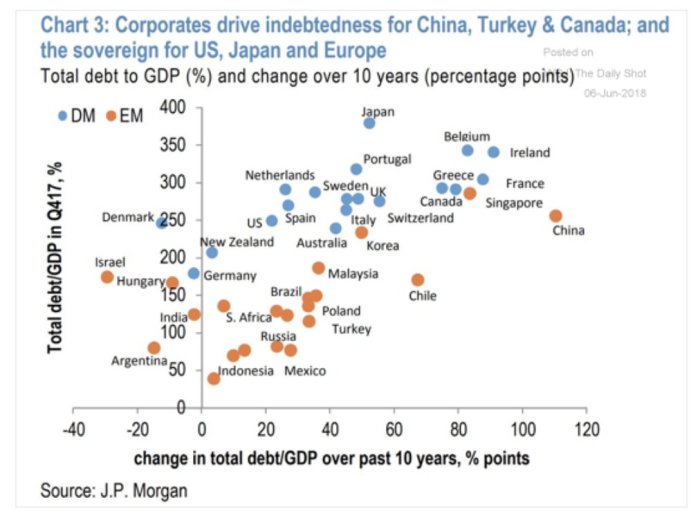
Sometimes people like to give the impression that New Zealanders are highly indebted.   And so this summary chart, which I stumbled on this afternoon, is some helpful context.

total debt

Among advanced economies, only in Israel and Germany is total debt/GDP lower than in New Zealand.

And also among advanced economies, only Denmark, Israel, and Germany had less of an increase in economywide debt/GDP over the 10 years to the end of 2017 (encompassing the recession and aftermath and subsequent recovery).

A decade ago, a comparable chart would have looked quite different.  I recall getting someone to dig out the data in about 2008 or 2009 which showed that our total debt/GDP ratio had increased in the previous few years about as much as the increase in Japan in the late 1980s (and all the increase was business and household).   And with most other advanced countries having materially increased their debt/GDP ratios over the last decade, New Zealand a decade ago would have been nearer the middle of the pack for the stock of debt than it is now.

Total debt to GDP calculations include household, corporate, and government debt.    As I showed in a post a couple of weeks ago, household debt to GDP hasn’t changed much here.  Government debt to GDP has increased a bit, and corporate debt to GDP also won’t have changed much.

Of course, those who want to remain worried about the New Zealand situation –  if I recall rightly the Governor said he was `scared’ –  will point out the role that big increases in government debt played in many other advanced countries.  Household debt to GDP has not changed very much in some of those other countries either.   But who is government but a collection of households?  We are the ones who have to service government debt.  And in many of these other countries, the total debt/GDP numbers will be understated because public service pension liabilities (contractural obligations) are not typically included in the debt numbers.  In New Zealand, there are almost no such liabilities, and those there are are properly accounted for.

Add in the reduction in the ratio of the net international investment position (net liabilities) to GDP over the last decade, and the picture is one in which debt should be much less of a concern here than in almost all advanced economies, and than in many – perhaps most –  emerging markets economies.  In a better world –  more business investment, on a path to more productivity –  we might perhaps have hoped there would have been more business debt being taken on.


Relative poverty: old and young

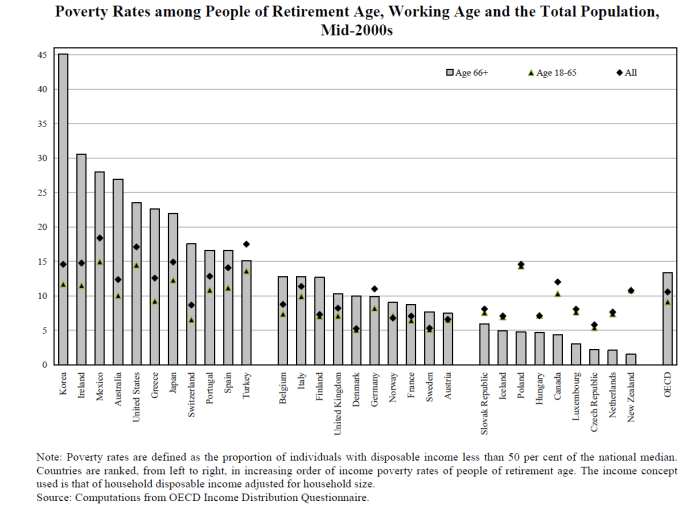
When I was working on my lecture last month on productivity as the best sure basis for dealing with poverty across a society as whole, I did take the opportunity to read around some of the literature on child poverty in New Zealand.   A line that used to be quite common in the New Zealand debate was that we had high rates of child poverty but low rates of poverty among old people, and that this represented some mix of a misplaced sense of priorities and some imbalance in political clout.  On checking, I see that I previously used the “low poverty rate among the elderly” argument myself in a published report.  On further checking, this was the sort of chart we used to see.

oecd elderly poverty chart 2000s

I’m fairly sceptical of these measures of poverty or deprivation.   They are mostly measures of (in)equality rather than of poverty, being calculated as the percentage of people in any particular group with incomes less than some threshold percentage (typically 50 or 60 per cent) of the (equivilised) median.     Real incomes for everyone could be doubled over time – by some mix of economic good fortune, innovation, and fine management –  and yet if the distribution of income didn’t change, we’d be told that exactly the same share of the population was still in “poverty”.  Sure, the detailed reports will specify that what they are measuring is relative “poverty”, but (a) that is almost a meaningless concept (whereas income or consumption inequality is not), and (b) the “relative” qualifier is usually too readily lost sight of once we shift from detailed technical reports to political debate and the like.     And so, a few months ago we had a  (very capable and well-regarded) visiting economist and politician noting in his lecture that child poverty rates (on these measures) were very similar in New Zealand and Australia, while failing to mention that average or median incomes in Australia are much higher in Australia than in New Zealand   People will be classified as “poor” in Australian who would be close to the median income in New Zealand.

Of course, there is a place for redistributive policies, but over time lifting overall rates of productivity make much more difference: the difference between the “poverty” most New Zealanders lived with (by today’s standards) when we were the richest country in the world a century ago, and the living standards of today.

But the specific point of this post, was this OECD chart I stumbled when I was thinking about poverty issues.  The differences in the differences between male and female rates look as though they could be interesting, but my focus is on the blue bars –  the number for the entire population aged over 65.

elderly poverty

OECD data used to (see first chart) suggest that New Zealand had some of the very lowest rates of elderly “poverty” anywhere.  But, apparently, that is no longer so.  On this measure –  using the 50th percentile –  New Zealand elderly “poverty” rates are still a little below the OECD total, and are actually a little above the OECD median (the countries labelled in italics are not OECD members).

And even in the days when numbers like those in the first chart were widely cited, people used to point out that it made quite a difference whether one looked at the 50th percentile, or (say) the 60th.  The widely-quoted child “poverty” measures in New Zealand typically use the 60th percentile.

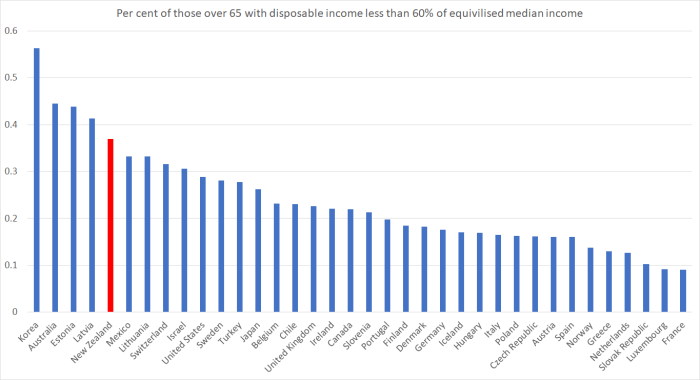
Somehow I managed to find the underlying data for the elderly on the OECD website.  The tables say that there is a new measure being used since 2012 (and thus the difference between the first two charts).   Here is an aggregate chart showing the share of the population aged over 65 with income below 60 per cent of median equivilised disposable income (ie the same measure as in the OECD chart above, just using a different percentile threshold).  Here are the data for 2015 (or most recent).

elderly poverty 60%

I was quite taken aback when I saw those numbers.   The results of this new methodology are so different from those under the old methodology (at least for New Zealand) that one would need to dig into the new and old methodologies to be at all comfortable with the results.  After all, it is not as if NZS policy has changed materially over the last 15 years or so, and we know that a relatively high share of New Zealand over-65s are still in the workforce.    And given the universal coverage of NZS, I find it a little difficult to believe that our elderly (relative) “poverty” rates are so much higher than those in, say, the United States.   Then again, it is interesting to see the Australian numbers – especially when we hear occasional calls to adopt something more like the Australian system (compulsory private savings and a means-tested age pension) here.

But if the OECD numbers are to be taken seriously at all, it looks as if  –  relative to the rest of the OECD –  our child poverty scores might be not much different than those for our elderly.   This is the OECD data on child “poverty” using the same 50th percentile benchmark as in the fancy OECD chart above.

child poverty 2014

New Zealand almost identical to the OECD average.

There will, unfortunately always be pockets of extreme deprivation and perhaps even absolute poverty (often perhaps not well-captured in these sorts of aggregate charts).  Some of that –  even after welfare system redistribution – will be about culture, some about personal poor choices, and some about misfortune.  Some of it will even be about atrocious policies –  for example, land use law in New Zealand.

But what we do know, with a very high degree of confidence, is that overall average material living standards –  for children, the old, and everyone in between –  in New Zealand are well below those in most of the “old” OECD countries, that we used to far exceed.  Remember the statistic I’ve quoted previously: it would take a two-thirds lift in average productivity in New Zealand to match that on average in Germany, France, Netherlands, Denmark, Belgium, and the United States.   The best way to sustainably –  including politically sustainably – and substantially lift the living standards of those at the bottom is to lift productivity across the economy as a whole.  And there is little sign that the government or the Opposition have any ideas as to how to turn the decades of underperformance on that score around,


Off the top of the Governor’s head

From a post a couple of weeks ago, just after the release of the Reserve Bank’s Financial Stability Report.

In a similar vein, I noted a story on Newsroom this morning, reporting the Governor’s appearance at the Finance and Expenditure Committee yesterday.  He was reported thus

But he told the select committee he would much rather the Reserve Bank, as banking regulator, could trust banks and borrowers to be prudent.

“I would love to not have to be active in that space. If banks had true long-term horizons, if the consumers were fully aware and myopia didn’t exist across borrowers, all the different foibles that people have, then you wouldn’t need the regulatory imposts.”

Talk about “nanny state” –  the Governor wishes he could trust us.  I wish we could trust him and his colleagues.

But, more specifically, the Governor here asserts again that banks are too short-term in their operations, that borrowers are myopic, and we need Reserve Bank intervention (he was talking of LVR and DTI restrictions) to save us from ourselves.  Par for the course, the Governor offered no evidence for his proposition (and there was none advanced in the FSR), it just seems to be some sort of new gubernatorial whim (as Graeme Wheeler came with the scarring experience of living through the US crisis, in this case Orr comes with an NZSF perspective –  neither grounded in specific  analysis of the New Zealand banking system).  I’ve lodged an OIA request this morning for any Reserve Bank analysis in support of these propositions.

To the credit of the Reserve Bank, they seem to have started responding to OIA requests more promptly.  I got the Bank’s response this morning.  Here is what it says:

On 10 May you made an Official Information request seeking: 

copies of any research, analysis or related material generated by, or for, the Reserve Bank suggesting that New Zealand banks had inappropriately short lending horizons, and New Zealand borrowers suffered from “myopia”. 

Under the provisions of OIA section 18(e), which allows refusal of a request where the information is not held, the Reserve Bank is refusing your request.

The Governor’s view as expressed in the reported comment was formed without recourse to specific material produced by, or for, the Reserve Bank.

So there was no analysis in the FSR supporting his claim, and nothing the Bank had done –  not even apparently in the previous five years – that supported his claim about the need for Reserve Bank interventions (LVRs, DTIs etc) constraining New Zealand banks’ lending, and New Zealand households’ access to credit.

He appears to have just made it up.  It was a whim, a prejudice, a line that sounded good as he said it…….and this is the basis on which the Governor makes policy (singlehandedly) and testifies to Parliament.  In a way, it isn’t that surprising, given the criticisms people like Ian Harrison and I have levelled at the quality of the analysis used to support their actual and proposed regulatory interventions, but to hear it direct from the Bank is still pretty telling.


Getting prepared for the next serious recession

Not infrequently over the last few years, I’ve criticised the Reserve Bank (and The Treasury and the Minister of Finance, both at least equally responsible) for the lack of any real sign that they were taking seriously the potentially severe limitations on the use of stabilisation policy (monetary policy in particular) in the next serious recession.  The topic never featured in speeches from the Governor, there was no published research on related issues, and getting ready never featured as a priority in the Bank’s annual Statements of Intent.

The potential problem, of course, is that – as things stand – the OCR can probably be lowered another couple of hundred basis points (to around -0.75 per cent) but for anything beyond that conventional monetary policy will quickly become quite ineffective, as large depositors (I’m thinking financial institutions and investment funds mostly) would exercise their option to switch into large holdings of (zero interest) physical cash.   People will still use bank accounts (negative interest rates and all) for most day to day transactions, but most financial assets aren’t held for immediate transactions purposes.

In typical past downturns OCR cuts of 500 basis points or more have been judged necesssary (the Reserve Bank cut by 575 basis points in 2008/09).   Similar magnitudes of adjustment have been made in, for example, the United States.

It is now almost 10 years since the Reserve Bank first cut the OCR to 2.5 per cent.  In the early years after that, the assumption was that (a) the 2008/09 recession had been unusually large, and (b) interest rates would soon need to be raised quite considerably, and so that whenever –  perhaps a decade hence –  the next recession happened New Zealand wasn’t likely to face a problem.  That was then.  As late as 2014 the then Governor was loudly talking up his plans to raise interest rates a lot, to –  as he saw it –  ‘normalise’ monetary policy.

But now it is 2018, and nominal interest rates are even lower than they were in 2008/09, and no serious observer thinks the Reserve Bank will have 500 basis points of policy leeway if another recession were to strike in the next few years (many doubt that the OCR will be raised much, if it all, in the intervening period, and a few –  including me –  think cuts would be more appropriate).  Most likely, the New Zealand economy will go into the next recession –  whenever it comes –  with the OCR 50 basis points either side of the current 1.75 per cent.  That just isn’t enough.   And the problem will be (greatly) compounded by the fact that central banks in almost all other advanced countries will be in much the same situation of worse (several already have their policy interest rates at -0.75 per cent.

If your central bank can’t cut policy rates (very much), and markets and firms/households know it, any incipient recession is likely to be worse than otherwise, and worse than we are used to (when downturns happen, central banks cut policy rates, often quite aggressively (if also often a bit belatedly), and people know/expect it).  Expectations of inflation may also drop away more sharply than we are used to, compounding the problems (real interest rates could raise, with nominal rates already on the floor).  Monetary policy has been the key stabilisation tool for decades, and (at best) it will be hobbled in any recession in the next few years.   For those who argue that interest rates don’t affect anything much domestically (a) I think you are wrong, but (b) the connection to the exchange rate is vital.   In monetary policy easing cycles in New Zealand, we also typically see big exchange rate adjustments, and that is part of how the economy stabilises and the next recovery begins.

Which is all a fairly long introduction to welcoming a new issue of the Bulletin published a few weeks ago by the Reserve Bank under the heading Aspects of implementing unconventional monetary policy in New Zealand.   As the introduction puts it

This article provides an overview of the experience with unconventional monetary policies since the global financial crisis of 2007/8, and assesses the scope for unconventional monetary policy in New Zealand. While there is no need to introduce unconventional monetary policies in New Zealand at this time, it is prudent to learn from other countries’ experiences and examine how such polices might work in New Zealand if the need arises.

It is, unambiguously, good to see such an article being published by the Bank.  Unfortunately, there is a degree of complacency about the content –  echoing remarks the Governor made at a recent press conference suggesting there was nothing to worry about – that should be quite disconcerting.  Complacency on such matters might be expected from politicians, with a tendency to live from one news cycle to the next.  We should not expect it from our central bankers.

As a brief survey of what other countries have done, the article is not bad.  There is some discussion of the experience with negiative policy rates, which comes to the pretty standard conclusion that policy rates probably can not usefully be taken below about -0.75 per cent.  There is a fairly long discussion of large scale asset purchases (mostly the government bond purchasing programmes) and some discussion of targeted term lending programmes operated in a few countries in the wake of the 2008/09 crisis.

Of large scale asset programmes, the Reserve Bank authors cautiously conclude

A large body of evidence shows that LSAPs were successful in easing financial conditions, through lower bond yields, higher asset prices and weaker exchange rates.11 The forward looking nature of financial markets means that most of the impact occurred on announcement, rather than when purchases were executed. As highlighted by Gagnon (2016), LSAPs can be especially powerful during times of financial stress, although the signalling and portfolio balance channels should still have a significant effect in normal times. There may, however, be diminishing returns through these channels. In particular, given the lower bound on short-term interest rates, there will be a limit to how far interest rates can be reduced via the signalling channel. Similarly, there is likely to be a lower bound on long-term interest rates (as investors have the option of holding paper currency with a fixed yield of zero) meaning additional purchases might not drive yields much below zero.

What really matters for central banks is whether LSAPs helped central banks achieve their mandates, related to achieving inflation, output and employment goals. While most studies into the effect of LSAPs in the post 2007/8 global financial crisis period find positive effects, they must be treated with caution. In part this is because of measurement issues: LSAPs have been implemented over a relatively short period since the 2007/8 global financial crisis, and previous historical relationships can have been expected to have changed. Overall, early work suggests LSAPs can be a beneficial monetary policy tool in exceptional circumstances. However the nature and extent of the transmission of these polices to inflation and activity is still being established.

Cautious as that is, I suspect it is not cautious enough.  For example, if one takes a cross-country approach there is little sign that long-term interest rates have fallen further relative to short-term interest rates in countries that did large scale asset purchases than in those which did not (for example, New Zealand and Australia).   Whatever the headline or announcement effects –  and some probably real effects in the midst of the crisis itself – without those longer-term effect on real bond rates, it is difficult to believe that the asset purchase programmes really made much difference to stabilisation and recovery.

Relatedly, as the authors note, the real test is surely progress towards meeting inflation targets and getting unemployment rates back down again quickly.  Against that standard, with the best unconventional tools central banks could deploy, on top of large reductions in policy rates, the experience has been very troubling –  the weakest recovery in many decades.  With that set of tools, the outlook the next time a serious recession hits has to be, almost by construction, worse than over the last decade.

But in many respects, the most interesting part of the article is the second half, exploring options for New Zealand.   Unfortunately, they do not seem to have moved very far at all from past work.  Just based on things I personally was involved in, in the late stages of the last recession I spent quite a bit of time at Treasury looking at options that might be deployed in things worsened further, and when the euro crisis was at its height in 2012 I led a Reserve Bank working group looking at some of the issues around how far we could go with conventional monetary policy, and what other instruments were then at our disposal.     The sorts of options we looked at then were helpful (and even then we reckoned the OCR could be cut to perhaps -0.75 per cent) but pretty limited.  The Bank seems no further ahead now and –  disconcertingly –  seems unbothered by that situation.

What tools do they have in mind?

The first is a negative OCR.

Overall, it appears that the Reserve Bank could implement negative interest rates, with the potential leakage into cash relatively small in value terms at modestly negative rates.

That seems right to me.  It would not be expected to involve, say, negative mortgage interest rates, but there have been some examples even of those in Scandinavia.

But it is the limits to the negative OCR which are the issue.

The second possible instrument they cover in the option of large-scale asset purchases.

As they note, there are not many (liquid) bond issues in New Zealand other than government bonds, and even the stock of government bonds is (generally fortunately) smaller than in many other advanced countries (including the US, UK, Japan and the more troubled parts of the euro-area).    And many passive holders of government bonds –  having made long-term asset allocation choices –  will not be that interested in selling.

In a New Zealand specific severe recession, these constraints might not matter very much.   Many of our government bonds are held by foreign investment funds, who have no natural (benchmark) reason to be in New Zealand.  Shake them loose by offering a high enough price and not only might bond yields fall quite a bit – at least initially –  but the exchange rate could be expected to fall too.  That latter channel would probably be much the most important one (since few New Zealand borrowers issue long-term debt, and those that do will typically swap it back into a floating rate exposure).

But if the downturn is pretty synchronised across a range of countries (as it was in 2008/09), that is a less compelling story.  Everyone will be trying to cut policy rates, and pretty everyone will be coming up against practical lower bounds.   Everyone can try to depreciate their currency, but in aggregate that ends up with not much expected change.  I’ve argued previously that if our OCR is ever around that of other advanced countries, our exchange rate should fall quite a lot, but at present the margins between our OCR and those of other countries is already smaller than we often find going into past recessions.

The Reserve Bank authors also note that the Bank could engage in (unlimited) unsterilised exchange rate intervention, buying assets in other countries’ currencies, and selling (‘printing’) New Zealand dollars, which the Bank can do without technical limit.   All else equal, that should tend to lower the exchange rate.

This might be more of an option for a small and inobtrusive country like New Zealand –  among the majors ‘currency war’ rhetoric would soon be flying. But even then, it isn’t likely to be a terribly effective policy.  The Reserve Bank notes some of the reasons (other countries trying to do the same thing – eg Australia our largest trade/investment partner).  But the other reason involves thinking about transmissions mechanisms: printing lots more New Zealand dollars creates more interest-bearing assets in New Zealand.  In normal circumstances, unsterilised intervention will drive down domestic interests rates, setting in train a mechanism that will lower the exchange rate, raise inflation etc etc.  But in this scenario, by construction, short-term interest rates can’t fall any further.    And there is no compelling reason to suppose that the holders of those new New Zealand dollars will want to spend more on goods and services (a channel which really might raise inflation).

The Reserve Bank briefly discusses the option of transacting the derivatives market, via interest rate swaps (larger and more liquid than the bond market).  This idea has been around for years.  There is no doubt it would enable the Reserve Bank to, say, cap the long-term (synthetic) interest rate, but it isn’t clear what good that would do, and there is no sign in the article of any new thinking in that regard.  The Bank talks of signalling gains –  communicating a commitment to keep the OCR low for a long period –  but I doubt that does much good beyond the short-term announcement effect.  For one, central banks can’t pre-commit, and markets and other observers will make their own judgements based on their read of the emerging economic data.

The final option they discuss is targeted term lending.   What they have mind here isn’t replacing market credit when funding markets seize up (as happened in 2008/09) but direct intervention in which the government and the Reserve Bank try to target credit to particular sectors.

This type of facility would provide collateralised term lending to banks at a subsidised rate if banks met specified lending objectives. These criteria would ensure that the low policy rate was being passed on to households and businesses. Holding collateral against the loans would mitigate the risks to the Reserve Bank’s balance sheet. Since a targeted lending scheme could see banks taking on more credit risk than they might otherwise choose, it would need to be carefully managed.

That final sentence is an understatement to say the very least.  Policies of this sort are really fiscal policy and, if done at all (which they should not be) should be done by the government itself, not the autonomous central bank.   Government involvement in encouraging credit provision to particular sectors has a poor track record, here or abroad (see US crisis ca 2008/09).   And when the Reserve Bank takes collateral to try to encourage/coerce banks into providing credit they would not otherwise provide, it is directly preferencing itself relative to other creditors (including depositors) if things later go wrong.

In an article about monetary policy, it is not surprising that the Bank gives little space to discretionary fiscal policy. But it is disconcerting that when they do touch on it, they get their basic facts wrong.

And in New Zealand, fiscal policy played an important role in the response to the 2007/08 global financial crisis.

Discretionary fiscal policy played no role at all in responding to the recession of 2008/09 (if anything, it was marginally contractionary given the cancellation of promised tax cuts in 2009).  Yes, the overal fiscal position slid into deficit but that was wholly because of (a) policy choices made before the government or Treasury realised there was a recession, and (b) automatic stabilisers, which are weaker in New Zealand than in most advanced countries.

As I said earlier on, the degree of complacency –  and refusal to confront options that really could make a significant difference –  is disconcerting.    The Bank argues

The Reserve Bank would look to communicate well in advance of any of unconventional policies being implemented, so as to enable financial markets and the government to prepare.

A nice sentiment, but as they note a few sentences later

we are rarely given the luxury of time when financial crises [or other recessions] hit

including because central banks are usually slow to recognise what is happening.  When you only have 200 basis points of conventional policy leeway –  and everyone knows that (a point not touched on in the article at all) –  they will need to be willing to signal a credible strategy very early.  And, on the evidence of this article, they do not have one (that would be likely to make any very material difference).

I suspect the authors really know that too, but prefer not (or are institutionally prevented from) saying so.  After all, they each smart people, and they know how poorly the world economy coped with, and recovered from, the last downturn, even deploying all sorts of unconventional policies  (fiscal and monetary) on top of the considerable conventional monetary policy leeway that existed going into that recession.  Even here –  where we never reached the limits of conventional policy –  the output gap remained negative, and the unemployment rate above official estimates of the NAIRU for eight or nine years.   Eight or nine years……..  That is just a huge amount of lost capacity, and of lives that are permanently blighted (prolonged involuntary spells of unemployment do that to people).

Perhaps the implicit argument is that we, and other countries, will do even more next time round.   But that isn’t likely.   Perhaps fiscal policy is, or should be, an option, at least in modestly-indebted countries like New Zealand, but any sober observer will recognise the real world political constraints other countries faced in using active fiscal policy to any great extent, for long, in the last recession.  Why is New Zealand likely to be different?

For much of the last decade, one has had the feeling –  in gubernatorial speeches and other commentary –  that, when it comes to it, the Reserve Bank really isn’t that bothered by lingering unemployment, excess capacity, or undershooting inflation.  One would like to think –  given his new mandate –  that the new Governor is different.  But this article isn’t really evidence for the defence on that score.

It is striking that the article does not engage at all with either of the two more radical options debated in other places and other countries:

  • reconfiguring the target for monetary policy.   This could take the form of a higher inflation target or, for example, the use of a price level or nominal GDP level target.  Each approach has its weaknesses, but either –  done in advance of the next serious downturn, not in midst when much of the opportunity is lost –  could help raise, and hold up, expectations about the path of the nominal economy, including inflation.
  • taking steps to material reduce the extent of the effective lower bound on nominal interest rates.

The latter remains my preference, for a number of reasons (including that the existing problem arises largely because central banks have  –  by law – monopolised note issue, and then not proved responsive to changing circumstances and technologies. Problems are usually best fixed at source.

If there is still a useful role for physical currency (I discussed some of these issues here), the ability to convert huge amounts of financial assets into physical currency, on demand, without pushing the price against you, is now a material obstacle to monetary policy doing its job in the next recession.    There is a good case for looking seriously at a variety of reform options, such as:

  • phasing out large denomination Reserve Bank notes (while perhaps again allowing private banks to offer them, on their own terms, conditions and technologies),
  • capping the physical Reserve Bank note issue, scaled to growth in, say, nominal GDP (perhaps with provision for overrides in the case of financial crisis runs),
  • putting a spread (between buy and sell prices) on Reserve Bank dealing in bank notes, or
  • auctioning a fixed quota of bank notes, and thus allowing the price to adjust semi-automatically  (when currency demand rises, as when the OCR goes materially negative) the cost of conversion rises.

These sorts of ideas are not new.  They do not get rid of the entire issue –  at an OCR of, say, -10 per cent, even transaction demand for bank deposits might dry up –  but they would go an awfully long way to ensuring that the next recession can be dealt with more effectively than the last.

If, for example, you thought the OCR was going to be set at -3 per cent for two years, then once storage and insurance costs are taken into account (the things that allow the OCR to be cut to around -0.75 per cent now), even a lump sum conversion cost (deposits into physical cash) of 5 per cent would be enough to keep almost everyone in deposits and bonds (even at negative yields) rather than physical cash.  That is a great deal leeway than the Reserve Bank has now.   Having that leeway –  and being willing to use it – helps ensure nominal rates don’t need to stay extremely low for too long.

In principle, many of these sorts of initiatives probably could be done in short order in the midst of the next serious downturn.  But we shouldn’t have to count on unknown crisis responses, the tenor of which have not been consulted on, socialised, and tested in advance.  It may even be that some legislative amendments might be required.

In summary, I welcome the fact that the Reserve Bank has begun to talk more openly about the potential limitations in its response to the next recession, but it is disconcerting that they still seem to be trying to minimise the potential severity of the issue.   In that, they aren’t alone.  I’m not aware of any central bank that has yet laid out credible plans to minimise the damage (although senior officials of the Federal Reserve have been more willing to talk about the issues openly).  In that, they are doing the public a serious dis-service, and risking worse outcomes than we need to face –  repeating the sort of reluctance to address issues that saw the world drift into crisis in the early 1930s.  Fortunately for the central bankers perhaps, it won’t be central bankers personally who pay the price.  That won’t be much consolation for the many ordinary people who do.

Since politicians, and not central bankers, are accountable to the voters, the Minister of Finance should be taking the lead in requiring a more pro-active (and open) set of preparations to be undertaken by the Reserve Bank and The Treasury.

UPDATE (6 July):   I have only just discovered that one of the authors of this article, whom I had known –  although not been close to  – for 35 years, had died shortly before publication.    Rereading this post, I don’t particularly resile from any of the content, but had I known I’d have written differently.


Gift receiving at the Reserve Bank

I was following up something this afternoon, and noticed that the Reserve Bank had posted an OIA response to someone inquiring about gifts accepted by staff.

There is almost two years of data, and the overall list isn’t that long.   I’ve been the recipient of all sorts of, mostly small, things over the years –  often from visiting central bankers or the like, but including the odd corporate box invite, dinners, and so on.   If anything, I’m a little surprised the Reserve Bank’s list isn’t longer –  in my days in the Financial Markets Department, corporate hospitality was part of relationship management, particular for our dealers.   The Bank must have tightened up: there is a surprisingly small number of cases of financial markets staff accepting hospitality etc.

But one element of the list really did catch my eye.  The Reserve Bank supervises banks, non-bank deposit-takers, and insurers: in doing so, it can have a big influence on the businesss of those institutions.    So one of the things that is very important is that the Reserve Bank’s supervisory staff keep a suitable distance from the institutions they are regulating.

On the gifts list, three banks operating in New Zealand showed up.  The first was BNZ, offering hospitality (twice) to Mark Perry, the Reserve Bank head of financial markets (and a former BNZ employee).   Mark won’t be involved in the supervisory or regulatory side of things.  The second was Bank Baroda, which presented a couple of books, which were passed on to the Reserve Bank library.

The bank that showed up most was ICBC.  It showed up seven times, on each occasion offering gifts to people with a direct involvement in bank regulation.   These ranged from a wall-hanging presented to the Governor by the bank chairman from China (not kept personally by the Governor), through to a box of food, cheese boards given to four staff, three note pads and a wireless mouse, a mobile power pack (again not kept by the individual) at the end of a supervisory meeting, and another wall-hanging presented to the Deputy Governor (not kept by him personally) by “ICBC Mr Wang Lin, Secretary of Party Discipline Committee”.

There was also another gift, accepted by the relevant staff, from a foreign bank at a meeting to discuss a possible application for bank registration.

I am not, repeat not, suggesting that any Reserve Bank official will have directly changed their stance on any matter to do with ICBC because of these fairly small gifts.  But appearances matter, and so does substance.   It is simply inappropriate for Reserve Bank staff to be accepting gifts from banks they regulate, no matter how small those gifts are.  Taken together such small gifts can foster an atmosphere that makes the regulator a little less willing to ask hard questions, or to confront problems, than they might need to be.

The Reserve Bank’s rules need to be tightened up and the banks concerned need to be reminded –  in the Governor’s words –  that these are New Zealand registered banks, no matter which country the bank concerned’s shareholders and owners happen to be based in.   Regulators simply shouldn’t be taking gifts from the regulated, not even as a matter of “courtesy”.


(Lack of) transparency at the Orr Reserve Bank

Since I have to spend a large chunk of the day at the Reserve Bank –  among other things, checking out how serious the Governor is about customer focus and about remediation when customers have problems (among the things he claims the right to demand from banks and insurers) in the case of the superannuation fund the Bank (=Governor) sponsors –  it seemed fitting to have a brief post focused on a Reserve Bank issue.

Long-term readers will recall that the previous Governor was notoriously secretive, except when it suited him.   Among the things he always refused to release were any minutes of any meetings of the Governing Committee (him and his two or three most senior staff).  The Governing Committee had been set up by Graeme Wheeler, and was sold to the world as the forum in which major decisions were made –  whether monetary policy, regulatory policy or whatever.   You might suppose that the records of such meetings would be of considerable public interest, and it is common internationally for the minutes of the meetings of any body responsible for monetary policy to be published, with a (typically) quite short lag.  But Graeme Wheeler seemed to think there was no legitimate case for such material to be released –  his model was that he should be obliged to tell us only what he wanted to tell us, how he wanted to tell it, and when he wanted to tell it.  That isn’t how the Official Information Act works, but that consideration never seemed to much bother the then-Governor.

But that was then.  Wheeler has left, bearing his CNZM, and we have a new Governor.  He talks a good talk about communicating more or better with outside audiences.  We’ve even had cartoons to help illustrate official documents, and at one press conference I think the assembled journalists were greeted in four languages.

So he seeks to build an impression of a more open Governor –  including by his (ill-judged)  willingness to talk freely about all manner of things that aren’t his responsibility.  And almost simultaneously with the Governor taking office, the Minister of Finance announced reforms he plans to legislate later in the year.  Under those (inadequate) reform proposals, there will be a statutory committee to make monetary policy decisions and –  fulfilling a Labour Party campaign pledge –  the minutes of the meetings of that new Monetary Policy Committee are to be published.  I’m sure that, if the Minister sticks to plan, they will be fairly anodyne minutes, but the indication has been that the minutes will outline any differences of view (even while not putting names to views or votes).  It will be a step forward when it happens.

And so, going into last month’s Monetary Policy Statement I noted that the new Governor could perhaps show his seriousness about being different from his predecessor, and get ahead of the forthcoming legislative provisions, by beginning to publish now the minutes of the Governing Committee (for meetings relevant to that MPS).   Ideally, as I noted, he would also pledge to publish the background papers for each MPS with a suitable lag (perhaps six weeks).

Nothing was forthcoming with the release of the Monetary Policy Statement –  just the cartoons, multi-lingual greetings (and a document itself that seemed to go down well with market economists).  So I lodged a request for the minutes of the Governing Committee meetings relating to the May MPS.

And last week I got my response.

…the Reserve Bank is withholding the information for the following reasons, and under the following provisions, of the Official Information Act (the OIA):

  • section 9(2)(d) – to avoid prejudice to the substantial economic interests of New Zealand; and
  • section 9(2)(g)(i) – to maintain the effective conduct of public affairs through the free and frank expression of opinions by or between officers and employees of the Reserve Bank in the course of their duty.

As advised previously, the Reserve Bank recognises the tension between disclosure and confidentiality and has considered your request in light of that tension. Public disclosure, in summary form, is essentially what happens with monetary policy decisions in a carefully considered media release and the full text of the Monetary Policy Statement. The process of deciding what to publish in these documents recognises and balances the tension between disclosure and confidentiality.

In other words, exactly the same approach adopted by the secretive and defensive Graeme Wheeler, and nothing is released at all.  Thus:

  • the date of the meeting,
  • the place the meeting was held,
  • the attendees at the meeting,
  • confirmation of the minutes of the previous meeting,
  • any subheadings outlining the nature of material discussed at the meeting,
  • and the final OCR (itself already published in the MPS)

all, in the Governor’s view, had to be withheld to protect the “substantial economic interests of New Zealand” or to protect “free and frank expression”.  I wonder if the Governor was worried there might one day be a debate about what day of the week it was.    The claim is so absurd it is hard to believe that serious people –  required to operate according to the principles of the Official Information Act –  could make the claim.  But the Governor does.

I can barely imagine a circumstance in which disclosure of material in such minutes could undermine the “substantial economic interests of New Zealand” (NB these aren’t the same as the “economic interests” of the Bank), especially when released several weeks after the MPS to which the discussion relates.  We aren’t talking about imminent bank failures here.  But perhaps there are such circumstances, in which case specific deletions  could be made and justified under this subsection.  Officials make such specific deletions every day (although not commonly, I gather, under this particular provision of the OIA).

The same goes for “free and frank”.  In the (extremely unlikely event) that the minutes ever recorded that the Deputy Governor (say) thought the Governor’s ideas about the OCR were barking mad, there might be a case for withholding that particular detail.  But no official writes minutes like that.    And recall that the Minister of Finance has already committed to the publication of minutes of the MPC a few months hence, once the legislation is in place.  Differences of view are supposed to be highlighted (even if not attributed by name).  It will be a small step forward, and the Minister has already decided that “free and frank” isn’t a good reason to withhold such material.

But the Governor clearly disagrees.  Perhaps he just wants to enjoy his last few months as the single decisionmaker.   But then –  it suiting him to do so –  he has already told us that all his advisers were unanimous last month that the OCR shouldn’t be changed.  So what can he possibly have to hide in those Governing Committee minutes?  The short answer is likely to be “nothing at all”, but he has quickly imbibed the traditional Reserve Bank resistance to Official Information Act scrutiny.

It is not a good sign.  I’ve been concerned that the reforms the Minister announced will be too weak to make any material difference, and suspicious that they will allow a Governor so inclined to dominate the new committee, suppressing debate and the serious examination of alternative interpretations or policy approaches.  Since Orr has never been one to encourage challenge or debate, that seemed a quite real and specific risk.  Which is why I thought I’d test the waters.  Had the Governor agreed to the release of MPS Governing Committee minutes (even with odd specific deletion) I’d have lauded him, and revised up my probabilities on his governorship, and the new MPC, proceeding well.

By simply refusing to release anything, it looks as though he has once again confirmed some of the fears people held (mostly quietly) about his appointment.  If so, that is a shame.   And however many languages he greets journalists in, however many cartoons he adds, serious scrutiny of powerful independent public agencies –  particularly as at present when all power is vested in one individual –  requires access to official information that won’t always suit the Governor.  Minutes of his policy committees are a good example, one most other Governors in advanced countries have come to live with, or even champion.

I’ve appealed this decision to the Ombudsman –  I might have a response by the end of next year –  but in a sense the point has already been made.  When it comes to things he is responsible for, Adrian Orr is no more open and transparent than his predecessor, who set the benchmark in quite the wrong places.  A government committed to more-open government (as the current one says it is) would have a quiet word to the Bank’s Board, and to the Governor, encouraging the Bank to think again.