Preparing for the next serious recession

There have been three New Zealand recessions since inflation targeting was introduced.  That, in turn, wasn’t long after interest rates were liberalised and the exchange rate was floated in 1984/85.   Of those recessions, two were severe and one (the 1997/98 episode) was more moderate.    Here is how 90 day bank bill interest rates –  the benchmark indicator before the OCR was introduced –  fell (and were allowed to fall by monetary policy) in those episodes.

Mid-late 1990 to mid-late 1992                   780 basis points

Mid-1997 to end 1998                                   340 basis points

Late 2007 to mid 2009                                  590 basis points (OCR cut 575 basis points)

Over the first of those periods, medium-term inflation expectations fell by about 2 percentage points (from about 4.3 to 2.3 per cent) –  that was in the midst of the major drive to lower the inflation rate.  In the other two episodes there was no material change in surveyed inflation expectations.    So in the two severe recessions, short-term real interest rates fell (or were cut) by about 580 basis points, and in the less serious recession they fell by 340 basis ponts.

At present, the OCR is 1.75 per cent (and 90 day bank bill rates are about 1.9 per cent).    As things stand today (current laws, rules, and central bank practices), no one is confident that the OCR could be cut further than around -0.75 per cent.   Below that, it seems likely that it would become economic for large scale moves into physical cash (which earns zero less storage and insurance costs) to occur –  mostly not by households, but by market participants with large holdings of New Zealand dollars.  To the extent such shifts happen, market interest rates wouldn’t fall much even if the OCR was cut further.  That would dramatically undermine the effectiveness of conventional monetary policy (which works mostly either through direct interest rate effects, or through the influence of interest rates on the exchange rate).

There isn’t anything very controversial about that story.  At the Reserve Bank it was a conclusion we got to in a project I led back in about 2012 when the euro-crisis seemed to foreshadow risks of new externally-sourced crisis/recession.   It is consistent with the revealed practices of other central banks (no one has cut below -0.75 per cent), and is just pretty standard analysis.

So if the next recession hit today, the Reserve Bank could count on having around 250 basis points of policy adjustment capacity (the OCR could be cut that much).   But it has needed more than that in each of the (small sample of) recessions in recent decades.

And it isn’t that the New Zealand numbers are unusual.  In the US recessions going back to the 1960s, the median cut in the (nominal) Fed funds rate has been just over 500 basis points.

If the OCR can’t be cut as much as normal, monetary policy cannot do its job.  We have active discretionary monetary policy to minimise the output and employment losses in downturns (adverse economic shocks come along every so often, like it or not).    And if markets, and businesses, know that monetary policy is thus hamstrung, they will factor that into their expectations and the actual downturn will probably end up even worse (the monetary policy cavalry aren’t expected to ride to the rescue).

And so, every so often since I started writing this blog, I’ve been highlighting the potential problem the next time a serious recession comes along, and lamenting the apparent (certainly in public) indifference of our Reserve Bank, Treasury, and Ministers of Finance to the issue.  Other countries ran into the limits of conventional policy in the last recession.  They couldn’t do much about it then, and paid the price in a very sluggish recovery (slow closing of output and employment gaps). But no country needed to find itself in this position if it prepared the ground well before the next recession.

In raising these concerns, I’ve been in good company.    Since shortly after the last recession various prominent economists –  of pretty impeccable orthodoxy –  have been raising the possible need to think about an increase in inflation targets.  Two of the most prominent were former IMF chief economists, Ken Rogoff and Olivier Blanchard.  Their logic is simple.  Inflation targets were set on the assumption (implict or explicit –  in our case, we actually wrote it down at times) that the near-zero lower bound on nominal interest rates was only a theoretical curiosity, and of little or no practical relevance.  Experience in various countries proved that assumption wrong.   And in the medium to long term, the most reliable way to raise nominal interest rates –  and thus leave room for substantial cuts in future recessions – is to raise actual and expected trend inflation.  (One counter to this argument for some countries a few years ago was that since most central banks were having trouble meeting existing inflation targets, and had already exhausted conventional capacity, how could they hope to credibly target still higher inflation.)

Other economists –  Miles Kimball, Willem Buiter, and more recently Ken Rogoff –  have focused on the other side of the issue: can changes in currency laws or practices be put in place which would mean that nominal interest rates could be cut more deeply.  As various observers have noted, some estimates of a conventional Taylor rule suggest that ideally the Fed funds rate would have been cut –  for a short time perhaps –  as low as -3 or even -5 per cent at the height of the 2008/09 recession.

In practice, nothing much has changed yet.  No one has changed their inflation target –  or adopted, say, price level of nominal GDP level targeting which some (including the head of the San Francisco Fed) believe could provide more resilence –  or taken steps to deal directly with the practical lower bound.   We are drifting towards the next severe recession, with the toolkit severely depleted.

In New Zealand, it has been harder than in most places to get any serious debate going at all.   I suspect a variety of factors contributes to that, including:

  • the fact that we didn’t get particularly close to the near-zero lower bound ourselves in the last recession,
  • the persistent belief that before long interest rates will again be much higher,
  • the belief that New Zealand has lots of fiscal headroom such that even if monetary policy is constrained in some future recession it won’t matter,
  • given the perpetual discontent in some quarters in New Zealand around monetary policy (it has been an election issue for some or other party every election since 1990) a desire, among the orthodox, not to be seen as “giving aid and comfort to the enemy”.

There is also a bit of handwaving around the possibilities of QE (direct asset purchases), but this is mostly handwaving and attempting to play distraction as no one in other countries –  that have actually used QE –  believe it is an effective substitute, on feasible scales, for the conventional interest rate instruments.

I would not, myself, regard a higher inflation target as any sort of first-best option.  Indeed, in an ideal world, I’d be more comfortable with a regime that delivered average inflation near-zero over time (allowing for the modest measurement biases in the CPI).  Inflation has costs, although economists have struggled to find convincing estimates of large adverse effects at relatively low inflation rates.  And many of the costs that do exist arise from the fact that the tax system is designed for a zero inflation rate.  Inflation-indexing the tax system (mostly around the treatment of interest and depreciation) could tackle that issue quite directly (and there are official reports from decades ago, here and abroad) identifying how it could be done.   (It would treat savers, and borrowers, more fairly, even with a 2 per cent inflation target: perhaps I point I might make in my submission to the Tax Working Group.)

But if there are modest –  largely avoidable –  costs of a slightly higher inflation target, they quite quickly pale in comparison with the output and welfare losses if monetary policy isn’t able to operate as effectively in leaning against recessions.  Drifting towards imposing that cost on ordinary New Zealanders –  and it won’t be the Treasury or Reserve Bank officials who face those cyclical costs – should be pretty inexcusable.

And so I was encouraged when, the other day, Radio New Zealand’s Patrick O’Meara rang up.  He’d been reading my post which had noted, in passing, the IGM survey of US economists in which 86 per cent of those senior US academics agreed that

Raising the inflation target to 4% would make it possible for the Fed to lower rates by a greater amount in a future recession.

and was interested in how one might think about these issues, and do something about them (immediately and in the medium-term), in a New Zealand context.   We talked at some length, and then he talked to some other people, and the result was this story.

I was quoted this way

While uneasy about higher inflation, economic commentator and former Reserve Bank official Michael Reddell said increasing the Reserve Bank’s inflation target band of one to three percent was worth discussing.

“It’s really important to start planning, having the discussions about how we’re going to cope with the next downturn.”

“The next recession could be relatively minor,” he said.

“We could just get away with needing to cut the OCR by 50 or 100 basis points [0.5 to one percent].”

“But the typical severe recession, whether it’s in the US or New Zealand needs, typically, [400-600] basis points of interest rate cuts, and we’re just not positioned for that,” Mr Reddell said.

What surprised me was the comments from others that O’Meara talked to –  not so much the conclusion, but the argumentation.    In fairness to the individuals, I don’t know exactly what they were asked, or how much of their response was used, so what follows is a response to the Radio New Zealand reporting.

There was Kirk Hope, head of Business New Zealand, who (frankly) seemed an odd person to ask about details of macroeconomic policy and contigency planning for future recessions.

Business would also suffer, Business New Zealand chief executive Kirk Hope said.

“If the target is too high and there’s too much inflation and interest rates are too high, then it reduces investment in the economy … and that in the end costs jobs.”

As quoted, those proposition are simply wrong.  They don’t, for example, distinguish  –  quite importantly – between real and nominal interest rates.  All else equal, higher real interest rates might reduce investment.  Unchanged real interest rates –  actually perhaps a bit lower in a transition period – are unlikely to affect investment or jobs adversely.

And there is no sign that Hope had even engaged with the “how do we handle the next severe recession” –  when investment and jobs really will be adversely affected if monetary policy is hamstrung –  question.  Perhaps it wasn’t put to him?

The other person asked specifically was Arthur Grimes, these days a researcher on all manner of interesting things, but formerly a senior manager at the Reserve Bank (and, for a time, chair of the Reserve Bank Board).  Arthur has long been a vocal, and articulate, defender of the status quo.

Here was what RNZ reported of his views

Victoria University School of Government professor Arthur Grimes was adamant New Zealand’s existing inflation target band was more than adequate.

Professor Grimes said raising inflation to four percent, for example, would do nothing but hit households in the wallet.

“Why would we want the cost of living to be rising any faster than that? Don’t forget the cost of living makes it harder for people to live. It’s wonderful that inflation expectations are low and that inflation is pretty low.”

His response was more surprising, given his background.  Not that he didn’t favour raising the target (I don’t either) but the quoted thrust of his argumentation.  Higher (expected) inflation  –  and inflation expectations are at the heart of the story about nominal interest rates –  don’t “hit households in the wallet”; they see both wages and prices (and welfare benefits) rising a bit faster than otherwise.  If there are real adverse costs of higher inflation they come from things like the tax system effects (see above).  The confusion of reals and nominals in these quoted remarks seems pretty extraordinary.  If wages and price are both rising at 2 per cent per annum, and then subsequently – well foreshadowed –  they are both rising at 4 per cent, there simply isn’t a “cost of living” problem which “makes it harder for people to live”.

And again –  and perhaps he wasn’t asked –  there is simply no engagement with the case that people like Blanchard and Rogoff used in raising the option of a higher inflation target: how do we cope with the next severe recession when the OCR can’t be cut as much as we are used to?

My own position remains much as I outlined it the other day.  The first priority needs to be some serious engagement on the issue, and recognition, of the likely threat –  the constraint on the ability of monetary policy to do the job we’ve asked of it since the end of the Great Depression.   In my view, the second priority should be serious work on removing or greatly attenuating the near-zero lower bound, by taking steps (and being open about them) to limit the scope for large scale conversions to cash.  Far better to deal with the issues, and risks, now, than to attempt to grapple with them in the middle of the next serious recession (especially given recognition lags).

And for the immediate future, in the context of the PTA that has to be agreed in the next few days, and any associated letter of expectation to the new Governor, as I suggested the other day

  • In conducting monetary policy, and without derogating from its obligation to act to keep inflation within the target, the Reserve Bank should be required to have regard to the desirability of there being as much effective policy capacity (or at least rather more than at present) as possible to respond to the next serious recession, and

  • consistent with that, the Minister could indicate that he would be more comfortable if core inflation over the next few years fluctuated in, say, the 2.0 to 2.5 per cent part of the target range, than if core inflation continued to fluctuate around 1.4 per cent as it has now for a number of years.

Raising the inflation target itself should only be a fallback option.  I deliberately don’t use the words “last resort” –  that way nothing will happen until well into the next severe recession when it will be too late  – but if, after careful and open considerations, officials come to the conclusion that whatever can feasibly be done around easing or removing the near-zero lower bound won’t produce (with certainty) the desirable degree of policy flexibility, than we should be seriously considering a higher target. It might not be ideal, but we don’t live in a first-best world.  If one of the key assumptions that underpinned the current targets has been invalidated, and can’t be dealt with directly, the target would need to be revisited.

And finally, as much to anticipate commenters as anything, a couple of quick thoughts on the exchange rate and fiscal policy:

  • as I’ve pointed out here more than once, in such an adverse scenario –  with our OCR at the floor –  the exchange rate is likely to be very much lower.  Which is consoling, but unlikely of itself to be adequate.  After all, in typical New Zealand recessions we have both large OCR cuts and large falls in the exchange rate,
  • our net public debt is quite low, and clearly there is more room for fiscal expansion than in many countries.   Nonetheless, experience suggests that that room will prove smaller than it might appear (not so much technically but politically).  And since few other advanced countries will regard themselves as having much fiscal room, the advanced world as a whole will be short of offsetting stimulus.  Moreover, typically monetary policy can be deployed much more quickly than fiscal policy, suggesting that at best fiscal headroom is a poor substitute for fixing the monetary policy constraints.

And for anyone interested in another analysis of the option of raising the inflation target, this recent piece from the Bruegel thinktank in Europe, emphasising the importance of robustness, covers some of the ground quite nicely.


 

The Reserve Bank’s Board

I’m not an NBR subscriber but I’d been told that last Friday’s edition was quoting me on various aspects of Reserve Bank reform, so when I was in town yesterday I picked up a copy.  I’ll come back later in the post to that article by Jenny Ruth.

But, as it happened, there was another substantial piece in the same issue of NBR also calling for an overhaul of the Reserve Bank governance model.  This one was from Roger Partridge, chairman of the New Zealand Initiative.

The New Zealand Initiative will, no doubt fairly, tell you that they don’t represent any particular interests.  Nonetheless, in Australian parlance, their membership makes up the “big end of town”.  In particular, all four main banks (and a couple of the smaller one) are members, and the Board includes the chair of the Financial Markets Authority and a (until recently) CEO of one of the banks  (CBL Insurance is also shown as one of the members, but I guess not for much longer).

The Initiative appears to be quite unhappy with the governance of the Reserve Bank, especially around its prudential regulatory functions.  All the Bank’s powers are “directly vested in the Governor” and thus, they argue, “the Governor is not accountable to the board in the way any other chief executive would be and the Board has no power to override regulatory decisions”.  Partridge goes on to note that, in his view,

“None of this would matter if the Reserve Bank’s exercise of regulatory power were consistently exemplary. But, as the New Zealand Initiative will disclose in a report to be published next month, there are reasons to believe the bank’s conduct is far from exemplary.”

(Disclosure: I was one of the many people they talked to in putting this report together, and have seen and commented on a draft.  Here I restrict my comments to what is in Partridge’s NBR article.)

Partridge expresses concerns about both “the standards of behaviour of those responsible for the bank’s regulatory decisionmaking, and with the quality of analysis informing its policymaking”.    He notes that the current model is unusual, and (a) lacks the checks and balances that arise from multi-member decisionmaking bodies, (b) the Board has limited effective ability to hold the Governor to account, and (c) the Bank isn’t subject to “the same level of departmental or parliamentary scrutiny as other regulators”.

It is hard to disagree, and I’m certainly not about to.

But in thinking about alternative models, I’m not convinced –  on the basis of what is on display here –  that the New Zealand Initiative has yet thought hard enough.  For example, they seem to take for granted that the Reserve Bank (a single organisation) should be responsible for both monetary policy and the regulatory functions, and yet focus only on the governance of one of those functions, not that of the organisation as a whole.  They also seem to take for granted the existing powers the Reserve Bank has on the regulatory side –  in which the Bank has much more policymaking powers, not just powers around the implementation and enforcement of policy, than most other regulators do.

Partridge appears to approach the issue primarily with a corporate model in mind.  In a corporation, the Board is elected by shareholders and has overall responsibility for the business.  The Board in turn appoints a chief executive –  who might, or might not, be appointed as a Board member –  and delegates certain responsibilities (day to day management) to the chief executive.    And what the Board giveth the Board can take away  – if it can hire, it can fire, and it can alter or withdraw delegations, or even override specific decisions.  Key strategic decisions will be taken by the Board.  There is, at least in principle, a clear goal in mind: maximising value for the shareholders.   And the business either operates in a competitive environment or if not, that is a problem for the competition authorities.  Hardly ever are commercial businesses handed monopoly powers.  That is a quite different situation from a regulatory agency – prudential or otherwise.

Partridge cites the Financial Markets Authority as a better model.  In many respects, the FMA is structured like a corporate: the Minister appoints (and can dismiss) part-time Board members, and the Board hires a chief executive.  But it is worth remembering that the FMA has quite limited policymaking powers: most policy is made by the Minister, whose primary advisers on those matters are MBIE.   The FMA is largely an implementation and enforcement agency.  That is a quite different assignment of powers than currently exists for the Reserve Bank’s regulatory functions (especially around banks).  Also unaddressed are the potentially serious conflict of interest issues around the FMA Board, in its decisionmaking role. More than half the Board members appear to be actively involved in financial markets type activities (directly or as advisers), and even if (as I’m sure happens) individuals recuse themselves from individual cases in which they may have direct associations) it is, nonetheless, a governance body made up largely of those with direct interests that won’t necessarily always align well with the public interest.

Reasonable people can reach different views on the performance of the FMA. I gather many people are currently quite pleased with it, although my own limited exposure –  as a superannuation fund trustee dealing with some egregious historical abuses of power and breaches of trust deeds – leaves me underwhelmed.  It is certainly a model that should be looked at in reforming Reserve Bank governance –  it is, after all, the other key financial system regulator –  but I’m less sure that it is a readily workable model for the prudential functions, even with big changes in the overall structure of the Reserve Bank, and some reassignment of powers.  It certainly couldn’t operate well if both monetary policy and the regulatory functions are left in the same institution.  It doesn’t seem to be a model followed in any other country.  And it isn’t necessary to deal with the core problem in the current system: too much power is concentrated in a single person’s hands.  In a standalone regulatory agency, I suspect an executive board –  akin to the APRA model –  is likely to be an (inevitably imperfect) better model.  In an monetary policy agency, the Governor and any committee/Board members should all be appointed by the Minister (as is standard international practice).

Having said that, I welcome the fact that the New Zealand Initiative is now championing the cause for reform of the governance of the Bank’s prudential regulatory functions, and hope that adds to the impetus for putting those issues front and centre in Stage 2 of the review of the Reserve Bank Act.

Jenny Ruth’s article in the same issue of NBR picked up two of the issues I’ve been calling for reform on.  The first relates to fixing up the current weak provisions around Reserve Bank five-yearly funding agreements: they are (formally) voluntary, not remotely transparent, and out of step with the way we fund numerous other important government agencies, including ones that can make life difficult for sitting governments deciding on annual budgets.   Current provisions are simply out of step, and should be fixed.  If not now, we could wait another 30 years until the next major review of the legislation.

The other issue relates to the future of the Reserve Bank Board

“Another of Mr Reddell’s views is that the Reserve Bank’s board is essentially useless and should be scrapped and Shoeshine can’t help but agree.”

She goes on to recount my own bad experience with the Board –  the Board chair’s active cheerleading for the then-Governor tarring me as irresponsible, after I highlighted evidence suggesting (correctly as it happens) a leak of the March 2016 OCR decision –  and the way the Board was similarly supine in the face of the former Governor’s attempt to silence BNZ chief economist Stephen Toplis.  By statute, the Board exists to hold the Governor to account.  By revealed preference, they seem to exist to have the Governor’s back and never ever express even the slightest open unease.  They aren’t decision-makers (Parliament hasn’t given them that power), and instead they’ve chosen to turn themselves into cheerleaders.

My unease here isn’t personal.  I know several of the directors and have worked quite closely with a couple of them.  One even attends the same church as me and was MC at our wedding.  But they are serving no useful role and in some areas simply aren’t even following the law.

Jenny Ruth highlights the quiesence around the misplaced and ill-judged 2014 tightening cycle, referring to Board annual reports.

Shoeshine knows what a wonderful thing hindsight is, but Mr Wheeler was never able to bring himself to acknowledge that hindsight did indeed show the 2014 hikes were a mistake. Clearly the board couldn’t bring itself to disagree with him.  Shoeshine’s all for this cheerleading role to end.

As it happens, the Board was cheerleading right to the end of Graeme Wheeler’s term.  Quite recently I lodged a request for the minutes of Board meetings from the second half of last year.  One of those meetings was Wheeler’s final one as Governor.   I guess it is customary to say only nice things to those who are leaving, and to step delicately around any points of unease.  But whatever they may have said in private they didn’t need to record anything much for posterity (which is what minute of this sort really are).    And yet they did.  This (with emphasis added]  is from the minutes of the Board meeting held on 21 September 2017.

The Board noted that Governor Wheeler had successfully led a substantial amount of change in Bank policies and in internal Bank management. Policy initiatives included the development of macroprudential tools to address financial stability concerns, changes to the regulatory regime for regulated financial institutions, a review of payments system infrastructure, the new currency, and an expansion in the Bank’s communication and external engagement. Within the Bank Governor Wheeler has promoted a focus on efficient use of resources, understanding risk in the Bank’s operations, the development of management and leadership capability and the formalization of the Governing Committee framework for decision-making within the Bank. On monetary policy and inflation, Governor Wheeler faced global economic and financial conditions that produced a sustained deflationary impulse through tradable goods prices despite moderately strong economic growth in New Zealand and non-tradable inflation within the target range. Governor Wheeler led a substantial new research programme within the Bank analysing the drivers of low inflation outcomes, including the reasons why the record levels of migration have produced less inflationary pressure than in earlier business cycles. The Board has enjoyed an open and collegial relationship with the Governor, including in the implementation of a range of new processes following from the receipt of Minister English’s “Letter of Expectations” to the Board.

The Governor thanked the Board for its constructive advice and support for him
throughout his term.

How terribly chummy.   It is carefully worded, but there is no mention of the persistent failure to keep inflation near the target midpoint (despite all the “substantial new research programme”), and none of the fact that surely no one other than Bank –  and the cheerleading Board? – regarded external communcations during the Wheeler years as any sort of positive.  In a way it is all encapsulated in the final remark recorded from the Governor –  this Board exists almost entirely as the agent of the public and the Minister to hold the Governor to account, not to “support” him.

It really time for this Board to be disbanded.   Perhaps a Board has a role in either an ongoing Reserve Bank (as monetary authority) or in a new Prudential Regulatory Authority, but if so it should be nothing like the sort of board we’ve wasted public money on for almost 30 years now.

Finally, the release of those Board minutes confirms that the Board still does not meet even some of its most basic statutory obligations, those under the Public Records Act.   There is nothing at all in the minutes about the process leading to the recommendation to the Minister of Finance of a name of a person to be appointed as the new Governor.  To be clear, if there had been I’d have expected much of the material to have been withheld –  on privacy grounds –  but the minutes are quite clear that there is no such record.   As an example, at the meeting of 16 November –  presumably the one at which the final recommentation was made –  there is just this

8.2 Non-Executive Directors-only Session

No minutes follow, no records, no indications of anything being withheld.  Simply a flagrant breach of a simple statutory obligation.

I noticed that earlier this week the government appointed Dr Chris Eichbaum to the Reserve Bank Board (a role he held previously, being appointed by Michael Cullen for a term from 2008 to 2013).   Eichbaum is an academic, working in the School of Government at Victoria University, and so presumably has a professional interest in good process etc. Whatever else Eichbaum brings, perhaps he could remind his colleagues of their basic statutory recordkeeping obligations?


Towards a new Policy Targets Agreement

In 20 days time, 27 March, Adrian Orr is scheduled to take office as Governor of the Reserve Bank.  I say “scheduled” because he can’t be appointed until he and the Minister of Finance have signed a Policy Targets Agreement consistent with the statutory objective for monetary policy set out in section 8 of the Reserve Bank Act.

We can assume there will such a Policy Targets Agreement.  After all, the current (unlawful) acting appointment of Grant Spencer ends on 26 March, and all the powers of the Reserve Bank are vested in the Governor personally.

But given that (a) Orr’s appointment was announced three months ago, and (b) the changes in focus for monetary policy that the new government has foreshadowed, it isn’t very satisfactory that we still have no Policy Targets Agreement, and that whatever is being cooked up is being done in secret.   Perhaps I get repetitive in making the point, but as I’ve noted previously the Policy Targets Agreement is the main instrument of macroeconomic management, signed up for five years at a time, and then with all the powers delegated to a single individual (who hasn’t even been inside the Reserve Bank before signing up to his new mandate). against whose decisions there are no rights of appeal.

There is also a review of the Reserve Bank Act underway at present.  When the Terms of Reference were announced  –  four months ago today – we were told that as regards the first part of the review, dealing with monetary policy goals and governance,

A Bill to progress the policy elements of the review, including on the details necessary to introduce a potential committee for monetary policy decisions, will be introduced as soon as possible in 2018. This will give greater certainty on the direction of reform in advance of the appointment of the next Reserve Bank Governor, currently scheduled in March 2018.

The clear suggestion was not just that a report might have been provided to the Minister of Finance, but that a bill would have been introduced to Parliament before the new Governor took office.   The decisions in that legislation would, it was implied, inform PTA negotiations.   That phrasing was repeated when the Independent Expert Advisory Panel was appointed in December.

At the time we were also told that

The Panel will also be responsible for a report to the Minister that sets out their views on the Treasury’s policy conclusions and recommendations for phase 1. This will be delivered to the Minister at the same time as the Treasury’s recommendations for phase 1, which is planned for the second half of February.

Treasury’s dates seem to have been slipping.  The web page for the review now says

For Phase 1, please provide any submission to us by 19 February 2018 if you would like your input to be considered before initial advice is provided to the Minister.

If submissions were only due by 19 February, it didn’t give much time for (a) Treasury to reach its conclusions, and (b) for the independent panel to reach and write up their views on the conclusions, all by “the second half of February”.

When this review was initially announced the dates seemed tight but, if observed, ones that might allow some external discussion before the new Policy Targets Agreement was set, especially around the proposed wording of any change to the statutory objective of monetary policy.   As things stand now, we seem most likely to be shortly presented with some sort of fait accompli.

It isn’t a good way to make policy.  The details of the legislation will, in time, be subject to select committee review (and the publication of associated submissions) but the Policy Targets Agreement itself –  including the extent to which it aligns with the proposed new legislation – will have legal force almost right away.   There is no good reason why a more open process could not have been adopted.  At very least, I hope that the Minister of Finance will instruct the Reserve Bank and Treasury to pro-actively release all the papers relating to the forthcoming PTA (it took several years after the event to extract those relating to the 2012 PTA).

And when the Minister sits down to decide what he wants in the Policy Targets Agreement, I would urge him to take much more seriously –  than there is any sign his predecessors, or officials, did over the last few years –  the next serious recession.  As a reminder, in typical recessions short-term interest rates fall (or are cut)  by 500 basis points or more, and at present –  with inflation below target midpoint –  the OCR is at only 1.75 per cent.   I talked yesterday to a journalist who asked how this might be done.   I don’t think it is a matter of changing the inflation target itself at present – that might be appropriate at some point but should be a last resort –  but there are at least three items which could be included either in the Policy Targets Agreement (preferably, since it is an agreement) or in the Minister’s non-binding letter of expectation to the Governor.

  • The Reserve Bank should be required to prepare and provide to the Minister (preferably disclosing the bulk of such a report) a report on practical options that could be put in place early to alleviate or remove the near-zero lower bound on nominal interest rates.  The Reserve Bank’s forthcoming Bulletin article on digital money –  now apparently delayed –  (which they told me about when they refused to release any of their work in this area) may be one input to such work,
  • In conducting monetary policy, and without derogating from its obligation to act to keep inflation within the target, the Reserve Bank should be required to have regard to the desirability of there being as much effective policy capacity (or at least rather more than at present) as possible to respond to the next serious recession, and
  • consistent with that, the Minister could indicate that he would be more comfortable if core inflation over the next few years fluctuated in, say, the 2.0 to 2.5 per cent part of the target range, than if core inflation continued to fluctuate around 1.4 per cent as it has now for a number of years.

It might also be desirable to require the Governor to publish a substantive statement, perhaps within a month of taking office (or at the next MPS), outlining his interpretation of the new Policy Targets Agreement.  We should not have to rely on discovering the meaning of a major instrument of macro policy  solely by revealed preference.

Our Reserve Bank isn’t the only one facing a change in the way its objective is specified.  Just recently, a new objective was set down for the Norwegian central bank, the Norges Bank.   It was the culmination of a two-year process, of which the Ministry of Finance observed

The Ministry has placed emphasis on ensuring a transparent process

The new specification lowers the inflation target –  from 2.5 per cent to 2 per cent.  The initial 2.5 per cent target, adopted in 2001, had been justified on the basis of Balassa-Samuelson types of effects –  as the oil wealth flowed, Norway might have expected to see high non-tradables inflation rates.  Norway is now, on their own reckoning, past that phase.

Here is the bulk of the (notably short) new mandate

Section 1 Monetary policy shall maintain monetary stability by keeping inflation low and stable.

Section 2 Norges Bank is responsible for the implementation of monetary policy.

Section 3 The operational target of monetary policy shall be annual consumer price inflation of close to 2 percent over time. Inflation targeting shall be forward-looking and flexible so that it can contribute to high and stable output and employment and to counteracting the build-up of financial imbalances.

Section 4 Norges Bank shall regularly publish the assessments that form the basis of the implementation of monetary policy.

The second sentence of section 3 is new –  explicit references to “high and stable output and employment” and also to ‘counteracting the build-up of financial imbalances’.  The latter provision is completely new, while the output and employment reference replaces the current objective of “contributing to stable developments in output and employment”.

What I liked was two things:

  • firstly, the deliberate and transparent process used to make the change, and
  • secondly, the public exchange of letters betweeen the Ministry of Finance and the Norges Bank explaining the change and (from the central bank’s side) explaining how the Bank envisages implementing the mandate.  Thus, on the financial imbalances point they note:

The regulation and supervision of financial institutions are the primary means of addressing shocks to the financial system. To some extent, monetary policy can contribute to counteracting the build-up of financial imbalances and thereby reduce the risk of sharp economic downturns further ahead. How much weight this consideration will be given in the conduct of monetary policy will be situation-dependent and must be based on an overall assessment of the outlook for inflation, output and employment.

I don’t think the Norges Bank specification is the appropriate one for New Zealand.  If it were adopted it would be a sign that the government wasn’t really serious about a greater focus on employment outcomes and minimising deviations of unemployment from an (unobservable) NAIRU.   But the open and deliberate process looks like a good example to follow.

In the New Zealand context, one legislative change that should be made is that future Policy Targets Agreements (or mandates from the government, if that were the chosen model) shouldn’t be developed before a new Governor takes office.  (Among other reasons, because no new Governor appointed since the early 1980s has had any recent practical experience with monetary policy).  The target should instead be set, say, every five years (with potential for changes more frequently than that  – eg in the event of a change of government), with a requirement that prior to any new PTA there should be a period of public consultation.  The Reserve Bank has to do that when, eg, it wants to impose new LVR limits.  Governments typically have to do that when they want to legislate (select committees).  For such a major instrument of macroeconomic policy, it seems fitting that a similar sort of process should apply.


Census day

It is census day.  I’d probably be filling in my census forms now, except that they haven’t yet arrived.  We wanted paper forms, and I rang to request them within minutes of the initial SNZ letter arriving, with the access codes.  That was 10 days ago now.  So I’m less than impressed.  Doubly so as one of my kids is off at a school camp, and whereas I’d planned to fill out most of her form for her and send it along with her, since the forms haven’t arrived some teacher will presumably be overseeing her completion of the form, including a bunch of quite sensitive information that is simply none of the teacher’s business.

There is an article in the Dominion-Post this morning (“An intrusive, insulting exercise”)  from a journalist attacking the very existence of the census.  I’m torn.  I’m a keen user of some census data.  But I can’t help wondering what business it is of the state to coerce –  under direct threat of prosecution –  much of this information out of people.  As the journalist notes, threats to government data security have become more real.  And I also wonder whether Statistics New Zealand is not increasingly an instrument of a socio-political agenda (note the several pages of defensiveness about the absence of “gender identity” questions – this time).    Glancing through the questions, I’m also struck by the imprecision of several of them (eg under “Which country were you born in?” the third option is “England”, which is barely more of a country than, say, Canterbury or Otago are –  the latter two had their own parliaments rather more recently (1876) than England did (1707?).

The ethnicity question has been in the media in the last few days, with some  people bothered that “Pakeha” isn’t an option.  I guess they have a point.  But what bothered me was something else. Here is the question.

ethnicity.png

How many Niueans are there in the entire world?   Apparently about 25000.  At the last census there were more than 200000 people in New Zealand born in “England” –  plus others who probably identify as English.   And yet SNZ don’t even list it as one their top 8 options.  It would be interesting to understand why.  I’d probably normally tick the form as “NZ European”, but I think that (when the forms finally arrive) this time I might write down English, Scottish, Northern Irish, and perhaps British as well.  Since SNZ tell us ethnicity is, on their reckoning, self-perceived, the answers won’t (can’t really?) be wrong –  and those places are where my ancestors come from.

There are questions that leave one wondering about the reliability of the results of the census.  Here is a language question

language

On a form in English, they feel the need to remind us to remember to mark English if we can have a conversation in English?.  Quite how thick do they think respondents are that they need to talk down to us thus?   (And why is it any business of the government whether someone can hold a conversation in, say, Pukapukan or Polish? –  English, Maori, and Sign Language might, arguably, be a different matter.)

Then there is the religion question.

religion

I consistently refuse to answer this question, not because I’m ashamed of my faith – Christian – but because it is the one question I’m lawfully allowed to refuse to answer.   The government and SNZ attempt to market the census on the basis of all the important public policy/spending choices it will inform, but it isn’t clear what decisions they think they will be making on the basis of individual’s declared religion (or lack of it).   And then there is the picky point: few Presbyterians will think of “Presbyterian” as a religion, but as a denomination within Christianity.

And then there is the question that probably bothers me most.

disability

Quite what business is any of this to the government?  Frankly, if I had difficulty washing or dressing, I’d rather take the risk of being prosecuted (or perhaps even lie) than face the humiliation/embarrassment (as many will regard it) of writing that down on some government official’s form.

There are the questions that look like some activist’s request

tobacco

What marks out cigarettes, in the minds of the bureaucrats who put this together, from pipes or cigars?  What business is it of the government’s.    And if cigarettes, what about alcohol, drugs, or other things people might think of as social vices –  “have you ever requested a single-use plastic bag?” for example.  Then again, perhaps I shouldn’t encourage them.

And, to the very end, the worthy social agenda continues.  The form ends –  the sample on-line firm, not yet having got my forms –  thus.

recycling

Actually, if there are blank unused forms, I’d prefer to rip them up, drop in the rubbish bin and see them off to the landfill.  But quite what I do with my rubbish shouldn’t really be any concern of Statistics New Zealand.

For much of the sort of information in the questions I’ve highlighted, it is hard to see a legitimate public policy interest in the information (coerced as you’ll recall) and also hard not to think that to the extent that there is interest in the issues in some quarters, reasonable steers could not be obtained much more cheaply, and non-coercively, through the use of well-designed voluntary surveys, undertaken at the expense of those interested in the data, and without the privacy concerns regarding the provision of so much joined-up data in one place to public servants.


Bad economics from the China Council

For several years, Donald Trump has made much of the bilateral trade deficits between the US and Mexico, and between the US and China.   That rhetoric was to the fore again last week when Trump announced the imposition of steel tariffs.  This was from one of Trump’s tweets on Friday

Example, when we are down $100 billion with a certain country and they get cute, don’t trade anymore-we win big. It’s easy!

I’m not aware of a single economist –  with the possible exception of Trump adviser Peter Navarro –  who regards this focus as meaningful or as sensible economic analysis. At an aggregate level, a country’s overall current account balance is a reflection of the savings and investment choices of its own residents.  Thus, if for some reason one were concerned about a US current account (or trade) deficit, one thing that might make a difference could be a cut in the US fiscal deficit (lowering public dis-saving).

The mercantilist mentality, revived by Trump, sees trade deficits as, in some sense, a loss to the country, perhaps by analogy to the situation of a company running deficits (losses).  But the parallel is simply wrong.  Trade deficits are no more presumptively bad than trade surpluses are presumptively good.   Both can be reflections of bad policies, or indeed of good policies.  To the extent that the purpose of economic activity is to consume, trade deficits typically mean that of what your country produces not much is sold abroad, relative to what is purchased from abroad.  If product isn’t sold abroad it is available for domestic consumption.  And trade surpluses can be indicative of a deflationary impulse emanating from your country –  you are selling stuff abroad (absorbing demand from other people), but not matching that with an equivalent demand for the stuff others have produced.

I don’t want to be read as taking these arguments too far.  There have been plenty of trade imbalances (current account imbalances) that proved to be quite unsustainable, and the subsequent adjustment process was often quite messy and costly.  In the very long-term, and roughly speaking, people consume what they earn.  So sometimes, large aggregate imbalances can be a prompt to review policies.  Large surpluses in a fixed exchange rate country, for example, might finally trigger an upward exchange rate adjustment (as in China a decade ago).

But the argument is even more than usually flawed when focused on individual bilateral surpluses/deficits, which have almost no economic meaning.  That, in turn, is so for a variety of reasons.   At a statistical level, in an age of global value chains, any finished product (especially manufactured products) is likely to have been added in a number of countries, but the country where the finished product is exported from will record all the value in its gross exports.   An Airbus aircraft, for example, might have its final assembly in France.  If the plane is sold to, say, a Turkish airline, the full value of the plane will be included in the Turkey-France trade balance, even though much of the value might have been added by firms in, say, Germany or the UK.

And at an economic level, since money is fungible –  and we aren’t in a world of 1930s bilateral clearing agreements – why should anyone in the United States care whether there is a trade deficit with Canada and a surplus with France, or vice versa?   What is earned in one place can be spent in another.   Almost all of us, as individuals, have a goods deficit with the local supermarket, offset by the primary income surplus derived from selling our labour to some other firm.

At a country level, a country exporting mostly, say, diamonds might have a huge trade surplus with Belgium and Israel (places with specialist diamond-cutting industries), and large deficits with most other countries (spreading consumption more broadly).  What of it?  New Zealand won’t export many dairy products to, say, Ireland or Denmark, but might to desert places with not much of a dairy industry.  And what of it?

None of this is to suggest that there aren’t bad policies, or policies which distort the trade numbers.  But if the policies are bad –  eg China’s restrictions on access to its markets for service sector firms, or lack of market disciplines on firms in some sectors with major overcapacity, large US fiscal deficits when the economy is back near full-employment, or New Zealand policies which, in effect, subsidise export education by bundling immigration access with the commercial product –  they are bad on their own terms, regardless of any impact on particular bilateral trade balances.

But this isn’t a post about Trump and his take on economics. It was prompted by a rather similar outbreak of Trumpian economics from someone local who really should know a lot better.    I wrote last week about the speech from Stephen Jacobi, the Executive Director, of the New Zealand China Council attempting to push back against concerns raised in various quarters about the influence activities in New Zealand of the People’s Republic of China and the Chinese Communist Party.  Jacobi doesn’t have any specialist background on China –  he’s a paid advocate –  but he does apparently have a strong background in trade issues, from his time at MFAT, and subsequently as a lobbyist for trade liberalisation.

But his latest statement, released on Friday, left me thinking he must have put any economics to one side.    We were told that

China trade surplus shows relationship working in our favour

March 2, 2018

New figures out today showing a $3.6 billion trade surplus with China demonstrate the value of our growing economic connections with China, according to the New Zealand China Council.

It does no such thing.   Bilateral trade surpluses aren’t “a good thing” (or a “bad thing”) and bilateral trade deficits aren’t “a bad thing” (or “a good thing”).  They just are.

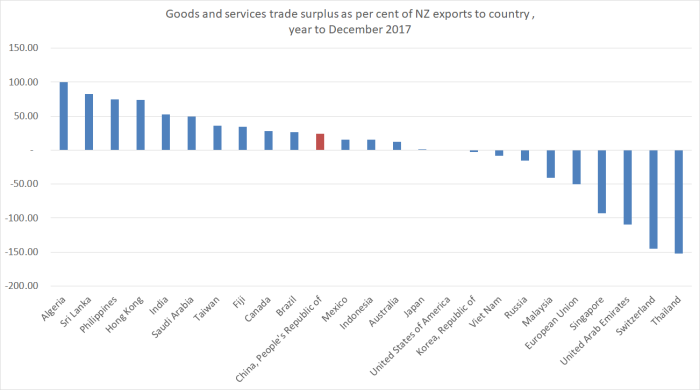
Here is a chart showing the bilateral goods and services trade surpluses/deficits for the top 25 “trading partners”, taken straight from an SNZ table.

bilateral trade surpluses

It is a mildly interesting chart, but I’m not sure it tells us much about anything, and certainly not about trade or economic policy.   Should we think better of Algeria and Sri Lanka  (which presumably have a taste for milk powder) than of Switzerland and Thailand?  I can’t think why we should.  And I suspect that if the bilateral balance with China ever swung into deficit –  and it does move around quite a bit with milk powder prices –  Mr Jacobi would be the first to (rightly) push back against true local mercantilists suggesting that such a deficit was reason for concern.

It isn’t even as if the trade by New Zealand firms with Chinese firms is extraordinarily large.  It is about the same size as our trade with Australia –  a country with about 2 per cent of China’s population.  Overall exports/imports as a share of GDP aren’t large at all for a country our size.  And here is quick table New Zealand China-based economist Rodeny Jones put out last week

NZ has only middling trade exposure to China by regional standards:

% of exports to China/HK 2017

Taiwan 41%
Australia 37%
Korea 32%
Singapore 27%
Philippines 25%
NZ 25%
Japan 24%
Malaysia 19%
Thailand 18%
Indonesia 15%

Mr Jacobi’s argument has the feel of rank opportunism.   Perhaps that might be acceptable in a corporate lobbyist (although I doubt it in the longer run) but Jacobi’s salary as Executive Director of the New Zealand China Council is largely paid by the New Zealand taxpayers.  We deserve better.

As it is, Mr Jacobi’s questionable economics is just the basis for another bid for New Zealand to maintain its subservient, deferential, attitude towards Beijing, and not get bothered about an expansionist hostile power seeking to exert influence in New Zealand politics.

“We need to see China as more than just a market. In New Zealand, China is looking for a long term, reliable partner which means working hard to build cooperation, trust and mutual respect even despite our obvious differences.

Indeed, the PRC is more than “a market”.  It is the government of a repressive dictatorial state, unable to produce for its own people the sorts of living standards places like Taiwan and South Korea have achieved, with an active agenda –  hardly masked –  of projecting its powerful and fundamentally different values [Jacobi’s own term from his recent speech] into countries and regions around the world, defying international law, and attempting to cow any country that makes a stand for its own values and its own self-respect.  It isn’t a regime worthy of trust, or respect.  Perhaps there are some trade opportunities for individuals, but it should be a clear case of “seller (or buyer –  but the sellers tend to have more concentrated interests) beware”,  in which it is more recognised that every time you defer to the regime, you advance an evil cause.

A bit like our politicians really.  Just occasionally, there is reason to think that perhaps our Minister of Foreign Affairs might take a different view.   There were the very delicately-phrased words in his speech the other day about Chinese activity in the Pacific.  There was the response, in after-speech questions, about the memorandum of understanding the previous government signed with the PRC on the Belt and Road Initiative (“I do regret the speed with which the previous government signed up”).

But what does it amount to?  Here is Winston Peters on Q&A yesterday, from the transcript

CORIN You know full well that the Chinese will be watching every word you’re saying right now. Are you worried that there could be—? They don’t like public declarations about the South China Sea from New Zealand. I know that. Are you concerned?

WINSTON No one has been more respectful of the place of modern China in the world than New Zealand First and Winston Peters.

Or

CORIN So do think there is too much? Because, I mean, we’ve got Anne-Marie Brady’s report. We’ve got Rodney Jones, Michael Reddell, others raising concerns and wanting a debate about Chinese influence in New Zealand – politics, but wider life. Do you think there is too much influence?

WINSTON Look, if you’re concerned about too much Aussie influence when it comes to banking you should say so upfront, and I have. If you think there’s been too much untoward American influence in this country in some ways then we should be upfront and say so, and I have. It doesn’t matter where it emanates from.

And thus our Foreign Minister, in his own inimitable style, but in much the same patterns as decades of his predecessors, trivialises the issue.  Just like Mr Jacobi in that speech a week or so back,

Of course, the other side of politics is no better.   Simon Bridges was also on Q&A.  Here he is on the Belt and Road initiative, a mechanism for Chinese power projection in many countries, partly (but not exclusively) by loading pliant recipient countries up with debt they have little prospect of servicing.

[UPDATE: Just after completing this post I noticed this new report on the debt aspects of OBOR.]

CORIN Give me an example of what the Belt and Road means?

SIMON Well, it means economic opportunity, and what do I mean by that? Infrastructure. You’re seeing China invest significantly in infrastructure around the world–

Never mind the strategic foreign policy perspectives, but there might be some consultancy opportunities for New Zealand firms.  It is reminiscent of Lenin’s line about the capitalists selling the rope they will, in time, be hung by.

I also heard Bridges on Morning Report this morning. It was straight out of the John Key playbook.  We will “engage positively”, and might even (quietly) mention the rule of law, democracy etc, all while avoiding the issues that should matter rather more to other countries, including New Zealand –  the expansionist efforts of the PRC beyond its own borders, and the influence activities in an increasing range of other countries, including our own.  I haven’t yet heard Bridges grilled about his MP Jian Yang, but on what we’ve heard so far there seems no reason to believe that he has departed from the Key/English approach (largely shared by the Labour Party) –  selling out our birthright, little by little, for the proverbial mess of potage.   Keep the deals flowing for the selected business elites, keep the party donations flowing and never mind any self-respect, or frank discussion of the nature of the regime, and the nature of the threats it poses.


Please improve immigration data, not undermine it

On her visit to Australia, the Prime Minister has been quoted as suggesting that departure cards might soon be discontinued, and that she will be pursuing her Customs and Statistics ministers on the matter.

I’m sure airlines and airport operators hate the cards.  There have been prevous efforts to get rid of them.  They are, nonetheless, a core element of the data collections (in conjunction with arrivals cards) that give us some of the very best immigration data anywhere.  In a country with –  year in, year out – some of the very largest immigration, and emigration, flows anywhere in the advanced world.

I wrote about this a few months ago when, under the previous government, Statistics New Zealand publicised the possibility/likelihood of departure cards being discontinued.  At the time, SNZ suggested that

“In the near future, the outcomes-based ‘12/16-month rule’ is expected to become a key component in how we determine the number of migrants in New Zealand.”

The “12/16 data” are the new series of permanent and long-term movements derived by lining up, using passport details, people coming and going, and waiting until more than a year after the initial movement to see if the movement loooks permanent or long-term.    It is all very interesting – I’ve praised SNZ for putting the collection in place –  and provides a more accurate measure of actual long-term comings and goings than the (stated intentions based) arrival and departure card.   But it is only available with a very long lag  (ie more than 16 months), whereas the existing PLT data are available monthly, with a few weeks lag (and in principle could be produced even more frequently).

I’m reproducing here the concerns I expressed in September

I’ve explained here previously why the resulting PLT data has its limitations.   It isn’t a good basis to use to look at immigration policy itself.  Approvals data from MBIE is better for those purposes –  and would be better still if they made the information available in an accessible format on a more timely basis.     And the PLT data are based on self-reported intentions, and intentions aren’t always what people end up doing.  Some people think they are leaving permanently, and are back six months later, and vice versa..   But intentions data isn’t nothing either  (just as business surveys capture intentions/expectations and things don’t always turn out as they expect).    The patterns –  and especially the cyclical patterns, the turning points –  in the PLT data tend to match those in the (lagged) 12/16 data quite closely.

There are quite enough gaps (and long lags) in New Zealand economic data as it is –  monthly CPIs, monthly manufacturing data, quarterly income measure of GDP just for starters –  that I’m just stagggered that key economic agencies are apparently willing to let SNZ/Customs go ahead and consider dropping departure (and arrival?) cards.  Where are Treasury and the Reserve Bank on this?

How, specifically, does it matter?   Without departure or arrival cards we would, of course, still have immigration approvals data for most non-citizens (other than Australians).  In principle, they could be published weekly or monthly with just a day or two’s lag, and be available in quite accessible formats.  Since approvals lead actual arrivals, there is certainly useful information in those approvals numbers (it is just that they aren’t made easily available now).

We could presumably also have data on the total number of people crossing the border (gross and net) from passport scanning.   I’m not aware that those numbers are published at present, but they could be.  And presumably they could be broken down by nationality (or at least by the passport the person happened to be travelling on).    That would be useful –  relative to having no arrivals or departures data –  but not very.   If you look at total net arrivals or departures (or net) data it is enormously volatile, and thrown around things like Lions tours –  in other words, holidaymaker and other short-term visitor numbers swamp movements of migrants.   Using that data alone, we’d have no ability to pick turning points for some considerable time after the turn had already happened.

The gaps would be particularly serious for the movement of New Zealanders, and more than half the variability in the 12/16 measure of net migration has arisen from fluctuations in the movements of New Zealanders.  We would have no secure way of knowing if someone leaving was planning to be off for a week’s holiday, or intending to stay away for ever.  The 12/16 method would eventually tell us what they did –  but there is a lag of almost 18 months on the availability of that information.    And even if the new plan involves keeping arrival cards and only getting rid of departure cards, most of the variability in New Zealanders’ migration movements is in the numbers leaving, not the numbers arriving.

Less importantly, without the departure cards we would seem likely to lose the ability to analyse migration (including reflows outwards by migrants who become NZ citizens) by the birthplace of the migrant.

Perhaps someone has done a robust cost-benefit analysis on getting rid of departure (and arrival?) cards.  If so, I would be keen to see it, and particularly keen to see how the relevant officials have factored in the loss of some of world’s best migration data to macroeconomic monitoring and forecasting, in a country with some of the most volatile immigration flows in the advanced world (and not a great track record of getting monetary policy, or housing markets, right as it is).  And even if one sets aside the macroeconomic analysts interests, it is not as if net migration numbers are one of those issues of no political salience at all.  Put an 18 month lag on decent data, and you risk not silencing debate – which some might wish for – but allowing all sorts of misconceptions and concerns to flourish, which no one will be in a position to allay.  It would, frankly, seem crazy.    Immigration has a economic and political salience here which it might not have in a country with land borders and small permanent inflows/outflows.

Frankly, it looks like a pretty irresponsible proposal.   The departure cards provide the only information on what New Zealanders are doing, and the comings and goings of New Zealanders are a big part of the PLT migration story (and aren’t, of course, under government control).

And in case anyone thought the PLT numbers were simply flaky measures, with no information

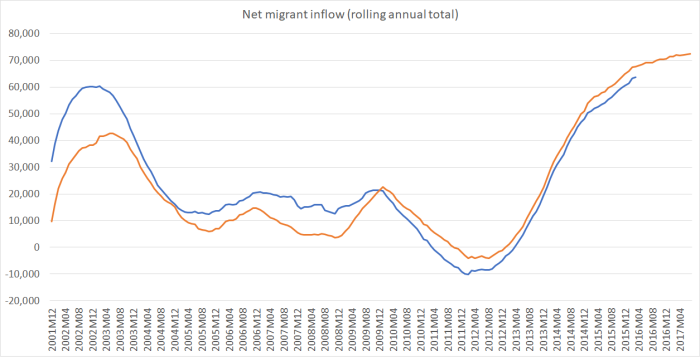
…here are the total net flows on the two measures [12/16 in blue, PLT in orange]

overall

They don’t match up perfectly –  one wouldn’t expect them to, and there is information even in the differences (eg what led people to change their plans) –  but no analyst would happily give up a series that provided a 17 month lead this (relatively) good on the 12/16 series.

Turning points matter a lot for macroeconomic analysis and monitoring, and the turning points in the two series are very similar.

The claim from Statistics New Zealand is that they can fill the gap with estimates that

will be generated through a probabilistic predictive model of traveller type (ie short-term traveller, or long-term migrant), based on available characteristics of travellers. Such a model will provide a provisional estimate of migration, which we can then revise (if required) as sufficient time passes for us to apply the outcomes-based measure.

I hope that they plan to rigorously evaluate the accuracy of such models, including when they’ve worked well and when they haven’t, and how well they capture the effects of policy changes, and that they expose their models and evaluation to external scrutiny before scrapping such a valuable source of hard data as the departure card.

And talking of data gaps, I’ve also written here before about the very long lags in MBIE making available, in readily usable form, the summary administrative data on actual immigration approvals (and estimates of the stock of migrants).   Some of the data you can get yourself, if you don’t mind manipulating spreadsheets that are hundreds of thousands of lines long, but for most people, for practical purposes, the data are really only available annually, and typically with quite a long lag.    That is really inexcusable.  Like it or not, immigration policy is a major instrument of government economic and social policy, and approvals data (and associated stock estimates) are a valuable part of informing the public debate.  Information is almost always better than no information.

[UPDATE: A reader highlights that not even the spreadsheets are currently available.]

MBIE publishes the summary results, and accessible tabular data, in their annual Migration Trends and Outlook publication. In many respects, it is a very useful publication, even if (a) the data are only annual (whereas, say, building approvals data are available monthly), and (b) the publication has a minimum lag of 4 to 5 months (in other words, data for the full year to June 2016 was only published in late November 2016).  That isn’t remotely good enough, especially for administrative data.  Neither MBIE nor SNZ has to collect the data –  it all sits in MBIE’s own systems, generated every single working day.  There is no obvious reason why the data  – all the summary data (number of approvals in each category, occupation, age, sex, country of origin etc) –  couldn’t be made accessibly available monthly within a few days of the end of each month.

I’ve made these criticisms previously.  And that was when Migration Trends and Outlook  was coming out on its normal slow timetable (a 5 to 17 month lag).   But go to the MBIE website looking for the 2016/17 publication –  in March 2018 –  and it still hasn’t been published, more than eight months after the end of the year in question, 20 months after the start of the period to which the data would releate.

Some readers might be inclined to suspect MBIE of some deliberate strategy to keep the information from the public.  I’m not.  That is not only because I’m not naturally a conspiracy theorist, and have had plenty experience of the failures of bureaucracy. It is also because a few months ago I was invited to a meeting by an MBIE official who was part of a team working on improving the Migration Trends and Outlook publication, looking for my comments/ideas on data, immigration research etc  The official seemed quite genuine, and enthusiastically told me of the efforts MBIE was putting in to improving the publications, and (if I recall rightly) the timeliness of the data (even while stressing that it was quite hard and there were “systemss issues”.  That meeting last year would have been before the usual publication data of the Migration Trends and Outlook publication, so I came away from the meeting quite encouraged.   I’m still quite willing to believe that MBIE has the project in hand, but in the meantime……where is the 2016/17 data?  It is now March 2018.

Adrian Orr as RB Governor

An offshore bank asked a while ago if I’d do a conference call for some of their financial markets clients with an interest in New Zealand, about what the appointment of Adrian Orr as Governor might mean for the Reserve Bank and monetary policy.  I did a 20 minute spiel for them yesterday afternoon, and while I won’t bore readers with all that material this post will reflect the gist of what I told them.  It builds on the post I wrote at the time Orr’s appointment was announced in December.

Adrian Orr takes office as Governor on 27 March.  But what is striking is just how little of the uncertainty that has pervaded monetary policy, ever since it was confirmed last February that Graeme Wheeler was going, has been resolved.   The Bank has at times run lines about the certainty the regime provides, but not at present –  and perhaps not for some time, even in the best of worlds.  What do I have in mind?

  • a Policy Targets Agreement has to be signed between the Minister and Orr before the latter can be formally appointed.  Whatever process of deliberation is going on –  around the key instrument of macro-stabilisation policy –  is occurring in secret.
  • this secrecy matters more than it usually might, given the government’s commitment to changing the statutory objective for monetary policy and the expectation that they will want to fit as much of that shift into the PTA itself as possible (as I’ve illustrated previously, that wouldn’t be too hard, but precise wording can still matter).
  • not only will we have new words, but a new (single) decisionmaker –  one who has had no involvement in macro policy for 11 years now.  We don’t know his “reaction function” or how we will interpret the (as yet unknown) rules.  Quite possibly, neither does he.  Typically, when the PTA changes there is quite a bit of jockeying even inside the Bank to bend the ear of the new Governor to one interpretation or the other.
  • if the PTA were the only issue, things might settle down quite quickly.  But it isn’t.
  • instead, we have the two stage review of the Reserve Bank Act, none of which will be finalised (some not even started) before the new Governor takes office.  They will be a large number of issues in play including:
    • details of the new statutory objective, and any associated reporting requirements,
    • the design of the proposed new statutory monetary policy committee including
      • the balance of internals and externals,
      • who appoints the members,
      • the names of these future monetary policy decisionmakers,
      • accountability arrangements for the members (including the future of the Bank’s Board).
    • issues around transparency including
      • the character of any published minutes,
      • the freedom of MPC members to articulate their own views in public
  • who future PTAs will be between, what form they will take, and whether there will need to be yet another PTA when the new committee is set up (perhaps 9 to 12 months away), and
  • even if there isn’t another PTA next year, whether a new MPC  (in particular the external members) will interpret the PTA the same way Governor Orr may do while he is the single decisionmaker.

And all that is just about the monetary policy side of the Bank.

Stage 2 of the review of the Reserve Bank Act –  which Orr will no doubt be weighing in on what it should even cover –  is likely to look at the prudential powers of the Bank, where there is lots of potential for change (or for battles to prevent change?).  For example

  • should the supervisory and regulatory functions be moved into a separate agency altogether,
  • even if not, should the Governor continue to retain single decisionmaker powers, and
  • either way, should the Bank have quite such extensive policymaking power (as distinct from the implementation and administration of those policies) as it does, especially over banks.

And there are lot of other issues that could usefully be looked at (eg, the legislative arrangements for funding the Reserve Bank, which are relatively unconstraining and not very transparent at all, or whether the Bank should have policy control over the currency issue, or whether there should be any limits on the extent of the Bank’s financial risk-taking).  Quite possibly, the Act –  now 30 years old, and having grown like topsy –  should be rewritten from scratch.

That is a very long list of battles to fight.  The current Reserve Bank senior management appears to have been fighting pretty hard for minimal change: someone last week characterised them to me as favouring any change so long as it leaves things pretty much as they are now.  We don’t know what Adrian Orr’s perspectives will be on any of these specific issues (he has said nothing at all since his appointment was announced), which only adds to the uncertainty.  But it is no secret that over the course of his career, he has vigorously fought for his patch, and has never –  to my knowledge –  been keen on giving up power, resources, or flexibility.  Many of the possible reforms would tend to do exactly that –  part of the reason why the current Reserve Bank management have also resisted them.  With Treasury known to favour change, and parties that make up the government favouring change (or at least the appearance of change), there is a lot to fight for.

On things the government is absolutely adamant about there is probably no point fighting –  why spend political capital for no expected gain.   But on most of these issues, it isn’t clear that the Minister of Finance has any very strong views, or even cares much.   My suspicion has long been that he has been mostly interested in something that looks and sounds a bit different –  enabling the party base (his, and that of his partners) to see and hear something that sounds not like a Roger Douglas creation.

How will the Bank (and the Governor) win as many of these issues as possible?   No doubt, good quality analysis will help a bit –  and the Bank probably has more resources at its disposal than The Treasury or private commentators.    But part of it is about confidence-building, and that will include how the Governor is seen and heard to handle policy in the coming months.

There has been quite a lot of interest in the (rather sterile) question of whether Adrian will be a “hawk” or a “dove”  –  more or less inclined to tighten (or loosen) monetary policy.    Mostly it is sterile because for most people it depends on the data  (I’ve been what most would call “dovish” for the last four years or so, but was at the “hawkish” end of the spectrum on the Bank’s OCR Advisory Group for much of the 2005 to 2008 period: I don’t think I’ve changed.)

We don’t have anything much to go as to how Adrian will be reading the data at present, or what (if any) distinctive analytical model he might bring to bear.  It isn’t stuff he has needed to think about – much more than any other public sector CEO might have –  for 11 years now.  That is a large chunk of anyone’s career.

I sat on the same OCRAG as him for perhaps five years, in two separate stints.  It was a long time ago now, but I don’t recall any particular “hawkish” stances or moments.  But he didn’t typically mark out the other extreme either (although when he left the Bank in 2000 there was some –  probably badly misplaced – market speculation that he couldn’t abide the hawkish stance of his colleagues).  He was an operator, a communicator, a manager, rather than someone with a strong view on the data.  It is hard to see why that would have changed now, having moved further away from “doing economics” as his day to day job.

There isn’t much sign in anything he’s said –  eg speeches he gave as NZSF head – that his view of the world is much different from a conventional mainstream stance.  And he’ll come into a Bank which has been convinced for years (and wrong) that core inflation is not far from beginning to pick up.  Again, a conventional view – even at the time of the 2014 policy mistake.

The data might shift on us (and the Bank) and justify a quite different stance in time, but even then it looks a lot as if Orr’s incentive will be to do little to step outside a mainstream market consensus, while putting a great deal of effort into communicating an emphasis on the government’s new employment objective (and the limited –  but not zero –  amount monetary policy can do).  Actual OCR setting needn’t be observably very different for people to recognise a difference of tone.  And that difference of tone is part of what will help secure confidence in their new Governor among the Minister and his Cabinet colleagues.  You are more likely to entrust more too –  take less away from –  a Governor who is perceived as “sound”.    Perhaps, as I’ve argued in recent posts, the data might even justify an OCR cut later in the year.  But what the Governor really won’t want are mis-steps: new Governors (all from outside for decades) have each been prone to them, and with so much else unsettled –  in play –  the stakes are higher than usual.

This isn’t to suggest Adrian is likely to be operating outside the Act –  old or new –  or that he’ll jeopardise our record of low and stable inflation. But there is –  deliberately –  a lot of flexibility in any inflation targeting regime.   And Adrian is a shrewd political operator.  And there are a lots of political battles to win.  It is always a mistake to assume that senior officials don’t have private and institutional interests to pursue, as well as public interest (eg core inflation) ones.

As I noted in my earlier post, the contrast between Adrian Orr and Graeme Wheeler as public communicators is likely to be refreshing (mostly).  Wheeler simply wasn’t comfortable in the public spotlight –  and had never had any prior exposure to it –  and so largely avoided it, and acted excessively defensively when he couldn’t avoid it.

It seems unlikely anyone will be making that criticism of Adrian Orr.  He’s had two stints as a commercial bank chief economist, and even in his most recent role –  head of the super fund –  he has been pretty open with the media.   The younger Orr could be shockingly frank, and at times quite vulgar in public –  unacceptably so in a central bank Governor.  No doubt in the intervening years, he’ll have gone some way to rein in his language, but his press conferences – and off the cuff remarks in speeches –  are likely to attract a great deal of interest.  An openness and sense of humour go a fair way in winning people over.  In a way, the communications side of things –  from Bank to public/markets –  may be easier in the near-term, while Adrian is the sole legal decisionmaker, and his advisers are internal.  It will be more challenging if we adopt – as we should –  a Swedish, UK or US system where, when the Governor speaks, he is simply one vote, and no more than primus inter pares.

Incidentally, the advent of someone who isn’t (or hasn’t been) the buttoned-up bureaucrat  will –  or should –  greatly increase the pressure on the Reserve Bank to follow the RBA and make available livestreams, or at very least audio recordings, of Q&A sessions the Governor engages in following speeches (on or off the record).

Adrian is pretty outgoing himself (to the extent of trespassing on personal space). And he has been pretty willing to challenge other people’s ideas (or disagree vigorously) –  the story is famously told of Alan Bollard letting Adrian loose, and he then taking on Peter Costello pretty directly, at the time the Australian authorities were bidding to take over bank supervision.    His track record also suggests that he has become an effective corporate manager –  not an unimportant skill as Reserve Bank Governor – but he doesn’t have a history of fostering open debate and challenge.  That was my observation at the Reserve Bank, and things don’t seem to have been that different more recently.  There is a distinct impression that he works well with those who don’t challenge him, and not so well with those who do; with those who fit his style and not with those who don’t.  Many of the abler people don’t seem to have lasted long.  He has successfully built strong teams of loyalists.   Perhaps it is a management model that might have a place in some contexts – private fiefdoms.  It is hard to see that it is the sort of model of leadership for the public sector.

Even less that it is what is needed for the Reserve Bank, heading into a new era, when many are looking for greater openness and less groupthink, in a environment where extreme uncertainty characterises almost everything (perhaps especially about monetary policy).     The Bank’s Board and the Minister –  the people who hired him –  will need to keep an eye out for these tendencies (although whether the Board –  in particular –  would care much is another question).   Otherwise there is a risk that anyone who challenges him –  statutory MPC member or not – could find themselves frozen out.

A former central banker observed to me the other day about one of the highly-regarded RBNZ Governors of the past: “he was a wonderful man, understated and wise, marvellous to work for, wrote beautifully, encouraged a great openness of thinking among the staff…..he wanted good economics practiced”

No one can be good at everything.  But in my view, a critical quality in a Governor should be a degree of depth and seriousness, that looks for the truth – or at least our best approximations to it – not the arguments that sound superficially appealing, or which fend off a particular critic for the day.  We might hope to learn something –  not just the latest hint about the OCR –  when we read the speeches of a really good senior central banker.  But there has never been much sign that Adrian is a deep thinker –  more the capable operative.  And I’m uneasy that he has repeatedly proved himself too ready to grab, and run with, someone’s superficially appealing idea, or a politically opportune story.

It was an approach on display at the Bank in the past, but it has also been generally visible much more recently.   There was the politically-opportune, but analytically not very persuasive, decision last year to unload carbon exposures from the NZSF, and then bury this major choice in his reset benchmark so that it is very hard to keep track of whether it will prove to have been a good call.  Even more starkly, there were his appearances in the media last year to defend the Fund.   I dealt with some of this stuff in eg this post.  There was plenty of playing politics –  even though his role, as a public servant, was to run the Fund not to champion the policy choice to have it.   There were rather strained attempts to champion the Fund’s investment returns  – even though the Fund’s own official documents stress that one really needs a 20 year horizon to evaluate the value added in such a high risk fund.  There were strained attempts to present as a sovereign wealth fund –  similar to Norway or Abu Dhabi –  what is actually a speculative investment vehicle for a country that still has net debt outstanding.   Investment performance was defended with not a Sharpe ratio, or a Crown cost of capital, in sight, and no engagement with the international literature on the limits of active management.  And despite weighing into the political debates, no attempts to frame the role of NZSF in the context of overall Crown finances (including the ability to absorb large adverse shocks), let alone those of citizens themselves.

In many of the areas he has touched on, there are perhaps quite reasonable serious perspectives to be brought to the table.  But they take a bit longer to develop and articulate.  My point here isn’t that there is necessarily anything wrong with the NZSF, or even its management under Adrian for the last decade. But rather that he sometimes seems unable to resist grabbing the superficially appealing soundbite, or playing to a political audience, or loathe (or unable) to engage at a more serious level.

Adrian has grown into new roles in past.  When he was first appointed chief economist of the Reserve Bank there was a fair amount of scepticism in some quarters.  The economics department was fairly dysfunctional and Adrian had little management experience.  In fact, he did a pretty good managerial job –  even if, on his own confession, it was a deliberately divisive approach, involving playing off one part the Bank off against another.

Perhaps he’ll do so again, stepping up to this much bigger job, in the spotlight not as a commentator, but as a policymaker.  I hope so, but the risks seem quite large, and the uncertainties quite real.  Better communications seem assured –  even with the constant uncertainty as to whether he can hold his tongue –  and I’m sure we’ll see lots of more or less deft political maneouvring. There are, after all, , lots of turf fights looming.   But whether he provides much impetus for better analysis, better policy, better thought leadership, or is interested in inaugurating of a new open, engaged, and accountable era for the Reserve Bank is another question.   They won’t be the direction –  the priority anyway – that Adrian’s natural inclinations seem to run.  Winning political and turf fights is more likely to be a priority.

And I really hope that not all the stories I’ve heard – including that one about Adrian on top of a bar in Courtenay Place –  are true.  Being Governor of the central bank –  bearing, for now, an enormous amount of individual power –  should bring with it an expectation (matched by reality) of gravitas and decorum.  I’m sure he’ll be at hit at the Reserve Bank’s annual financial markets function, but I’m not sure that is quite the relevant standard.

New Zealand and the PRC: links and questions

Anne-Marie Brady has been at the forefront of identifying, and highlighting, the ways in which the People’s Republic of China, through the Communist Party’s United Front work programme, appears to have been attempting to influence, and interfere with, public life in New Zealand –  both among the local ethnic Chinese community, and more generally.  Her Magic Weapons paper remains required reading, and for all that apologists have attempted to brush aside the issues raised in the paper, no one has made any serious efffort to engage with, and refute, the concerns she has raised.

Most other New Zealand academics, with familiarity with the Chinese language, have stayed silent.  But another person –  with Chinese language –  who has written, quite extensively, about the New Zealand situation is the author of the pseudonymous blog Jichang Lulu.    He has a new and substantial piece (if characterised by an idiosyncratic style) on the United Front activities in New Zealand, which is likely to repay reading for anyone interested in these issues.  Whoever the author is, his usual focus is regions far from New Zealand (Nordics) but has been paying a lot of attention to the New Zealand situation in the last year or so and appears to be quite well-connected.   I linked the other day to his detailed piece on PRC efforts to attempt to bring Norway and Mongolia to heel.

Much focus in recent months has been on National Party list MP Jian Yang.  But, of course, National is in Opposition at present. Jichang Lulu has raised specific concerns about senior Labour backbencher Raymond Huo, who also appears to have close connection to the PRC regime.   From his latest post

According to a source with knowledge of the matter, recent requests from a CCP-unfriendly NZ Chinese organisation to have ministers send Chinese New Year greetings were reportedly redirected to Raymond Huo, effectively making the ruling party’s leading United Frontling, whose PRC-consonant views are wellknown, the government’s gatekeeper to contacts with the Chinese community. In contrast, ministers and other politicians didn’t hesitate to attend celebrations with PRC diplomats. In other words, the Party-state, through its local advocates, can vicariously veto official support for something as apolitical as a calendrical festivity, at least when the persons seeking such support happen to have Chinese surnames.

Huo currently chairs Parliament’s justice committee –  responsible for the triennial review of the election, and for handling new electoral legislation more generally.  And the way governments typically turnover their members, there has to be a pretty significant chance that he’ll be a member of the executive before this parliamentary term is out.  Much focus in recent times has been on past and present ties of senior National Party figures to PRC interests.  But with Labour in government –  and their party president an effusive public supporter of Xi Jinping –  it is about time harder questions were asked of the new government.

Another thing worth reading (although behind a paywall) is an article in The Australian today under the heading Cold War: Freeze on China Ties.  It builds on reports last week that

university leaders were concerned about Chinese government attempts to dissuade ­students from coming to Australia to study. In an escalation of the pressure on universities, school visits have been cancelled, senior educational meetings in Beijing have been “postponed” and messages warning of the dangers of studying in Australia have been posted on the website of the ­Chinese embassy in Canberra.

claiming that

China is putting Australia into a diplomatic deep freeze, stalling on ministerial visits, deferring a trip by our top diplomat and putting off a broad range of lower-level ­exchanges to pressure Malcolm Turnbull over the new foreign ­interference laws and naval challenges to disputed Chinese claims in the South China Sea.

Government sources are reported as conceding that “there is a diplomatic and ­bureaucratic stalling over a range of visits, as Beijing voices its ­displeasure at foreign-­interference laws”.

I guess this is the sort of thing that the subservient apologists in our own political, bureaucratic and business establishment worry about.  But perhaps it should prompt them to think again about the nature of the regime they want to cosy up to.    The PRC might have some capacity to hurt individual New Zealand economic sectors –  as, say, the Mafia or organised crime might in other countries – but our prosperity as a nation is simply not based on those firms’ trade with China.   And sometimes, just occasionally, there are advantages to distance: Korea, Vietnam, or the Philippines (let alone Taiwan) have to live with the PRC on their doorstep.  We don’t, and it is surely time to reflect on what manner of regime they abet, whether actively or by silence.

The other day, New Zealand Prime Minister gave her first major foreign policy speech.  As far as I could tell, it was better than it could have been on the PRC.

China’s global influence has grown along with its economic weight.  Its leadership on issues like climate change and trade liberalisation could add momentum to our collective efforts in those areas.

Naturally, there are areas where we do not see eye to eye with China.  My government will speak honestly and openly with our friends in Beijing.  Whether it is about human rights, pursuing our trade interests, or the security and stability of our region.

Taking that approach isn’t about singling countries out, , but about taking a consistent approach on the issues and principles that matter to us.

It wasn’t very grovelly –  none of the nonsense Murray McCully was using just a few months ago about China saving us through the financial crisis of 2008/09 –  although anyone who thinks China is somehow at the forefront of global trade liberalisation hasn’t looked very closely (or doesn’t wish to).

By contrast, here is Julie Bishop quoted in that same Australian article

After Mr Trump said he would “love” Australia to join the US in military passages through Chinese disputed territorial waters, Mr Turnbull refused to say in advance when an operation would take place. Such an operation, which the US has conducted in the past, would contradict ­Beijing’s claims of sovereignty in the South China Sea and assert the right of free passage for international shipping.

In Australia, Ms Bishop said: “We have been traversing the South China Sea for many years in accordance with international law and we will continue to do that. Australia is an upholder and defender of the international rules-based order. We believe strongly in the principle of freedom of navigation and freedom of overflight, and we will continue to traverse the South China Sea as we have in the past”.

I’m no great fan of the current Australian government more generally, but there is a degree of realism about the nature of the regime, and its external threats, that seems deliberately absent from the utterances of our own leaders, of whatever party.

Prompted by the events of the last few days, I wonder whether journalists might consider asking a few questions of some of our political leaders:

  • what do the Prime Minister, the Minister of Foreign Affairs think of the PRC actions in recent days to remove the term limit on how long Xi Jinping can serve as President?  One might hope that any answers would be somewhat more serious –  more engaged with the level of international unease – than suggesting, say, that, after all, we have no term limits, and our head of state reigns for life.
  • since National Party president Peter Goodfellow and Labour Party president Nigel Haworth (and former Prime Minister Jenny Shipley) have quite recently been effusive in their praise of Xi Jinping and his approach (links in the Jichang Lulu piece), how do they view this latest step?  It is no good attempting to say “oh, we are just party functionaries we do the organising”: if you are willing to praise the foreign leader of an aggressive dictatorial state, that increasingly threatens not only the human rights of its own people but other nations, you owe us your take on this latest step.
  • and since Bill English refused ever to engage seriously on the issue of Jian Yang –  the former PLA intelligence official, who now concedes he misrepresented his past to enter New Zealand, and who maintains very close ties to the PRC authorities –  perhaps they could ask Simon Bridges, the new National Party leader.  Is he comfortable having such a person in his caucus, and (reportedly) as one of the party’s leading fundraisers.   Most likely, Bridges would fob journalists off as English did whenever anyone asked, or fall back on the slurs his shadow Attorney-General has relied on.  But even if he did, at least we would have a clearer steer on the character of the man, and the nature of the new generation of New Zealand’s political leadership.


Causes of financial crises

Earlier in the week I wrote about a couple of the surveys, of US academic economists, conducted out of the University of Chicago by the IGM economic experts panel.

But another of their 2017 surveys caught my eye.  It was about the financial crisis of 2008/09.

Panellists (US ones, and those of the sister European panel) were asked (with detailed wording of each item at the link)

Please rate the importance (0=none; 5= highest) of each item below (presented to panelists in randomized order) in contributing to the 2008 global financial crisis.

And this was how the results came back (using the version where respondents indicated how confident they were of their views).

2007 IGM weighted-graph

For the most part, the European and American responses were pretty similar (not that surprising given (a) that they were asked about the same events, and (b) that quite a few of the US panel were academics who’d migrated from Europe).  Perhaps the only material differences are on the questions around the role of savings and investment imbalances, and around the role of direct government involvement in the housing finance market.  In neither case do the (weighted) average respondents think these issues were top-tier factors but in Europe extremely large current account deficits (savings/investment imbalances) were much more salient (Ireland, Greece, Spain, as well as various eastern European countries) –  as were the “reinvestment” pressures on eg German banks.  And on other other hand, in the United States, between the role of the agencies (Fannie Mae et al), the FHA, and direct federal pressure on banks to lend to support home ownership, the government has a far larger role in housing finance than in most countries.  And US housing finace was the epicentre of the crisis.

In some ways, it is a funny mix of questions/options.  Even if all these factors contributed in one sense or another to the 2008 crisis, they must have done so in quite different ways.  Take, for example, funding runs, resulting from maturity mismatches (short-term liabilities funding long-term assets).  Clearly they were a phenomenon observed in the crisis –  whether at Bear Stearns or Northern Rock or…. –  but since every banking system in the world, strong or otherwise, operates that way, it isn’t clear that the funding structures (or the runs) were a material cause of the crisis.

And one can criticise the rating agencies all one likes –  and I’m sure most of the criticism is well-warranted – but few people were compelled to use credit ratings to guide their asset allocation choices.  And, for all their faults, the rating agencies were generally only responding to much the same incentives that drove other active participants in the system.

And what might lament that regulators and supervisors didn’t catch the building risks before the crisis broke, but (a) they rarely do, and (b) generally, prudential regulators did not compel or coerce willing borrowers and willing lenders to undertake the transactions that ended badly.

It is interesting to see that the “too big to fail beliefs” item is ranked a fair way down the scale (the specific question is about the beliefs of bankers that their own bank was too big to fail).     That sounds about right.  In boom times, most participants are focused on maximising the upside, with little focus on the possibility of things going very badly.  And for the management and Boards of banks, even if their own bank does prove “too big to fail” it is probably little solace to the people involved –  they will still be ousted (RBS, for example, still trades but Fred Godwin –  knighthood and over-generous pension too –  is long gone).

I’m not quite sure what two or three factors I would rate most important.  But one that would rank fairly highly isn’t even directly on the IGM panel’s list: the creation of the euro and the inclusion of so many peripheral states in it.  That choice –  giving German interest rates to Ireland, Greece, Spain, and associated flows of capital –  greatly accentuated imbalances that might already have been there.   Again, it caused no bad loans directly, but fostered an environment in which they became more likely.

And I still find quite persuasive –  more so than the panels clearly –  the story around the importance in a US context (and the US crisis contributed greatly to crises in the UK, Germany and several other European countries)  of government efforts to promote easier access to housing credit.  As I summarised the story former US official Peter Wallinson told

It is that without repeated, sustained and frighteningly successful US government efforts – under both Clinton and Bush administrations – to promote easier access to housing credit, particularly through the agencies (Freddie Mac and Fannie Mae), there would most likely have been no serious US financial crisis.  Wallinson documents how government mandates compelled the agencies to drive down their lending standards, and how because of the dominant role of the agencies in the market, this contributed to a sustained deterioration in the quality of new housing loans being made across the United States.  As late as 2004, new mandates were imposed, forcing the agencies to meet higher low income lending targets with loans for new purchases, excluding any refinancing or equity withdrawal loans.

Finally, it is interesting to note that household debt (specifically “Elevated levels of US household debt as of 2007”) also doesn’t rank that highly as an explanation.  That has long seemed right to me –  apart from anything else, debt to income ratios at the time were higher in New Zealand and Australia (which had no crisis at all) and in the UK (which had no domestic housing finance crisis) than in the US.   But the Reserve Bank has tended to put (in my view) too much weight on the debt stock.

I noticed this week that credit growth in New Zealand (household or total) has now again dropped a little below the rate of growth of nominal GDP.  I don’t supppose it portends anything very much, but if our debt levels in 2007 didn’t cause a local crisis, the current debt levels don’t seem likely to either.

(with an estimate of Dec quarter 2017 GDP)debt to GDP NZ

It is striking just how little has changed in aggregate.   Debt stocks that, as a per cent of GDP, have barely changed over a decade, are very rarely the stuff of which crises are made.  Big increases in those ratios can sometimes be associated with subsequent crises –  that was what New Zealand had in the 00s, and thus we were worried in 2007 – but very bad banking seems to be what really matters, and in a well-disciplined market economy, “very bad banking” and “more debt” aren’t synonymous.