Risk-sharing mortgages: Mian and Sufi

Last week I wrote

In their recent book House of Debt, the US academics Atif Mian and Amir Sufi, argued that equity-sharing contracts should become the norm for housing finance.  They argue that such contracts would materially reduce the risk of financial crises, and that the main reason such contracts aren’t common is because of the tax system and the role of US government agencies.  I’m very sceptical of both claims

And here is why.

In the final chapter of their book (so it isn’t the focus of their analysis) Mian and Sufi advocate the introduction of what they label “shared-responsibility mortgages”.  Under these contracts, when house prices in the borrowers’ locality fall the borrower gets an automatic reduction in the principal amount of the mortgage.   The cost of this (what is, in effect, a) put option is covered by providing that five per cent of any nominal capital gain would go the lender (either when the house is sold, or when the loan is refinanced).  In some cases, that payment would go to the lender in just a year or two, but in other cases it might take many decades.

If such residential mortgages were widespread, no mortgage borrower would ever have negative equity in their house as a result of movements in the general level of houses  (severe neglect of maintenance, or specific issues in, say, the street your house was located in could still result in a small number of cases of negative equity).  Whenever general house prices (in your part of the city) fall, the loss is shared with the mortgage lender, and your equity share in the house does not change.

Mian and Sufi argue that this feature would have greatly reduced the severity of the 2008/09 Great Recession in the United States.  In their story –  the thrust of their book –  the severity of the recession was mostly due to the negative equity so many borrowers had once house prices fell, and the impact of those wealth losses on consumption.  I find that story unconvincing.  I’ll skip the detail here, but the paths taken by the New Zealand and the United States economies have been so similar since the mid 2000s, and yet New Zealand had very little sustained fall in nominal house prices, and few cases of material negative equity.  Given that, it is difficult to be confident that falling house prices, and associated wealth losses, are a key causal factor explaining why economies are still lagging so far behind pre-recession trend GDP levels.   For example, fluctuations in house-building activity –  booms and busts –  are much more important than Mian and Sufi recognise.

But I wanted to focus on the suggestions that shared-responsibility mortgages (SRMs) would materially reduce the risk of financial crises, and that the main reason they don’t exist is the role of various government interventions.

Why might the risk of future financial crises be reduced?   They argue that

the downside protection in SRMs would lead lenders to worry about future movements in house prices.  If house prices plummet in the near future, then more recently issued mortgages would generate the greatest loss for the lender.  The lender would have to be very mindful about potential “froth” in local housing markets, especially for newly-originated mortgages.  If lenders fear that the market might be in a bubble, they would raise interest rates for new mortgages in order to cover the cost of the increased likelihood of loss.  SRMs would therefore provide an automatic market-based “lean against the wind”.

To which I would make a few points in response:

  • Newly-issued mortgages have always been the ones at most risk of loss to the lender (borrowers borrow to the hilt, especially to get into a first house, and then typically see their economic position improve over time, through rising nominal wages and house prices, and gradual principal repayments).
  • The nature of very frothy markets is that no one pays much attention to downside risk (or at least, they pay rather less attention to it than in more normal times).  Recall Ben Bernanke’s pre-recession scepticism about the idea of any widespread house price overshooting in the United States.   In periods of extreme optimism and persistent rises in house prices, there may be at least as much lender focus on booking the 5 per cent capital gain as on the possibility of a future loss.
  • Risk isn’t changed by the introduction of an SRM, it is just reallocated.  In principal, lenders should be somewhat more wary about the downside risk, but borrowers have less reason to be concerned about things going wrong.  If house prices fall, their equity will be impaired but- by design – by nowhere near as much as under a conventional mortgage.  There is at least an arguable case that lenders are better placed to bear risk than borrowers, since they can diversify across individual borrowers and geographically.  Mian and Sufi offer no reason to think that the net effect of the reallocation of risk would be to reduce overall risk-taking in the house finance market in boom times.

Mian and Sufi outline one other argument that might act as a modest dragging anchor.  Any  refinancing would trigger the need to make the 5 per cent capital gain payment to the lender, so any cash-out refinancing (drawing more on the mortgages to buy a boat or finance a fancy holiday) would involve meeting the 5 per cent payment.  I suspect that (a) any benefits would be small, and (b) that if such SRMs ever came to market the option premium would probably end up built into the initial value of the loan (you need $300000 to purchase your house, but the loan is booked as $304200[1], and serviced over time on that basis).

The second element of the Mian-Sufi argument is that such  products have not emerged mainly because of mortgage interest deductibility for owner-occupied houses, and because of the dominant role of the agencies in influencing the structure of US mortgage contracts.  The authors report that interest deductibility is available in the US only when the home owner bears the first losses when house prices fall.

These may well be factors that impede the emergence of such contracts in the United States, and no doubt the tax laws could be revised in ways that would bear less heavily on the prospects for SRMs.  But Mian and Sufi’s argument is a very US-centric perspective.  We do not see such contracts having emerged in other advanced economies in which the state has little or no direct role in the housing finance market, and where interest on mortgages on owner-occupied properties is not tax deductible.  New Zealand (in particular) and Australia and the United Kingdom spring to mind.  Bank regulators might not like such products greatly, but capital adequacy frameworks cope with options in other markets, and products like SRMs did not exist either in the decades before risk-weighting and capital adequacy frameworks assumed a key place in the bank regulatory framework.

Robert Shiller has long argued for the emergence of a fuller range economic derivative contracts (house price futures, nominal GDP indexed bonds, and so on), but few of them have emerged.  Revealed preference is a powerful insight.

The Mian and Sufi  SRM is in this tradition – an interesting idea, which seems to have some appeal for some borrowers, few or no regulatory/tax obstacles in many countries, and yet they just have not emerged.  It is interesting to think about why?  Personally, I suspect SRMs have not emerged because conventional mortgages are not “horrible instruments” (Mian’s and Sufi’s term) at all but very attractive and effective instruments.     They have proved to be only moderately risky over many decades, at least  in systems (unlike the US in the 90s and 00s) where government mandates don’t try to override market judgements on credit quality.  In market system the risk around conventional mortgages is managed through lender decisions around initial LVRs and servicing capacity (and, of course, overall capital holdings.  Conventional mortgages also require limited amounts of ongoing monitoring.    Borrowers typically have the most to lose: on any individual loan a new borrower may have only 10% equity in the house so the lender can lose more dollars, but the potential loss for a borrower (in New Zealand or other with-recourse markets) is everything (all their assets).  The system has worked well for many decades, so what would be the impetus for change?  In some ways this comes back to Calomiris and Haber, and the suggestion that the US financial system was made fragile by design.  As they document, the situation in other countries is rather different.

Revealed preference is a powerful insight, but….as an analyst I’m still a bit puzzled why inflation-indexed mortgages haven’t emerged (in countries like New Zealand or Australia).   That might be a topic for another day.

Finally, and harking back to Islamic banking, I presume that SRMs would not be sharia-compliant.  They add some additional uncertainty regarding the future value of the loan but an interest rate is still a key feature of the structure.   Proper equity-finance structures for residential properties still look expensive to establish and monitor, and unlikely to emerge on any scale.

[1] Mian and Sufi estimate that the upfront option premium for the protection the SRM offers would cost 1.4 per cent of the initial value of the loan, on historical US house price performance
“Disciplining” the Reserve Bank

Vernon Small’s politics column in today’s Dominion-Post had this paragraph:

English has not overtly disciplined the central bank over its persistent failure to keep inflation close to the 2 per cent target, though he noted yesterday there was a mechanism in his policy targets agreement with the bank governor to address that.  There had been “ongoing discussions” over the bank’s performance and it was a question of how long it went on  –  currently more than two years (or “a wee while” as English archly put it).

It isn’t entirely clear how much of this is accurately reported, and how much is Small’s interpretation/translation of what he thought English said.  That isn’t my concern here. I want to focus on what options are open to the Minister of Finance if he was concerned.

The first is that there is no such procedure in the Policy Targets Agreement.  The PTA sets out the target, and how the Bank is supposed to respond, and report to the public, when inflation moves materially away from target.  The agreement also notes that

The Bank shall be fully accountable for its judgements and actions in implementing monetary policy.

but this adds nothing to the provisions of the Reserve Bank of New Zealand Act, which contain both the accountability provisions and remedies open to the government.

The Act is quite an elegant structure. The Minister takes the lead in setting the [inflation] target and the Governor has sole personal responsibility for implementing monetary policy in pursuit of the target.  The Minister also appoints the Bank’s Board, whose primary responsibility is to act as monitoring agents for the Minister – and, to a lesser extent, the public.  The Minister also has The Treasury, who have no formal institutional role in the monetary policy governance process, but act as the Minister’s own professional advisers and these (and many other) issues.

The Board can recommend that the Minister dismiss the Governor, and the Minister can seek the removal of the Governor with or without a recommendation from the Board.  The Governor can’t, of course, be dismissed on a whim, but only on the grounds laid out in the Act.  The essence of the framework is that the Minister appointed the Governor to do a job –  in respect of monetary policy, as specified in the Policy Targets Agreement –  and if the Governor isn’t doing his job satisfactorily he can be dismissed.  That was one of the ideas at the heart of New Zealand’s far-reaching public sector reforms in the 1980s –  operational independence for chief executives, but the loss of the sort of “tenure until retirement” such chief executives had previously had.  It was why, unlike the situation in most other countries, our Governor is the sole decision-maker on monetary policy: Ministers responsible for the legislation in the 1980s thought it wasn’t credible to fire a whole committee, but it was quite credible to dismiss a single individual[1].

But dismissal is an extreme option.  I’ve long argued that it is not a particularly credible threat either.   A Governor’s failure would probably never be black and white, and he has large institutional resources to defend his position, as well as the threat of seeking judicial remedies (interim injunctions, and/or overturning the decision).  Given how disruptive (including in international financial markets) and uncertain all that would be, all but the very worst Governors have effective tenure to the end of their terms. And that is probably how it should be.   The option of non-reappointment at the end of a five year term is another matter.

If perhaps there is some buyer’s remorse, I’m sure no one is talking of such options at present.

But what other options does the Minister of Finance have?

He could simply pick up the phone or arrange a meeting with the Governor.  No doubt the two of them talk about various things.  But while the Minister of Finance is quite within his rights to want to be sure that the Governor is operating monetary policy consistent with the Policy Targets Agreement, he wouldn’t (or shouldn’t) want to be seen to be putting pressure on the Governor in respect of a particular OCR decision.  Operational decisions around the OCR are the Governor’s alone (with plenty of advice of course).  Maintaining that distance, and respecting appearances, is one reason why it was most unfortunate that the Governor recently appointed the Minister’s brother as one of his monetary policy advisers.

The Minister could seek a report from The Treasury on their view of how well the Governor was doing consistent with the Policy Targets Agreement, could let it be known such work was underway, and could arrange for such a report to be published.  The New Zealand Treasury offers independent professional advice to the Minister of Finance and would have to take seriously such an exercise.  It might be expected to consult externally (but confidentially) to canvass opinion.   At present, for example, most financial market economists –  not the only relevant observers but not unimportant either –  in New Zealand seem quite comfortable with the Governor’s handling of monetary policy.

The Minister could also seek formal advice from the Bank’s Board, and let it be known that he was doing so.  This would be a totally orthodox approach – the Board exists as a monitoring agent for the Minister – and it was, for example, the approach taken in the mid-1990s when inflation first went outside the target range.   The Board has a number of able people on it, but as an effective agent for accountability risks being too close to management.   The Governor sits on the Board, the Board meets on Bank premises, it has no independent resources, and it has been chaired exclusively by former senior managers of the Reserve Bank.    It was striking that last year’s Board Annual Report (which is just embedded in the Bank’s Annual Report document) had nothing substantive on the deviation of inflation from the policy target.

Although it has no formal status, the practice has grown up of Ministers writing to chief executives, in this case the Governor, in an annual “letter of expectation”.  If the Minister has had concerns one assumes that he has used his letter to pose questions to the Governor around the deviation of inflation trends from the midpoint of the inflation target.  under the Official Information Act I have requested copies of such letters (I requested them  from the Reserve Bank, who have now transferred my request to the Minister of Finance).

The Minister also has reserve powers to act directly.  Section 12 of the Act allows the Minister, transparently and for a fixed term, to impose another “economic objective” than the “stability in the general level of prices”.  These powers have never been used, although the previous Minister of Finance talked openly of the possibility of doing so (at that time, discontent with the Reserve Bank resulted in a select committee inquiry into the future of monetary policy).  Using the section 12 powers does not technically alter the governance structure.  A new Policy Targets Agreement needs to be put in place, and the Governor then has responsibility for operating with that.  I’ve previously argued that the section 12 powers might be able to be used to direct the Bank to put short-term rates at a particular level, but there are other ways of skinning the cat that could, in effect, require the Bank to cut the OCR if the government were really concerned that the Bank was not operating consistently with the current Policy Targets Agreement.

I’ve been quite open that I don’t think the Reserve Bank –  the Governor –  has been making the right calls on monetary policy.    Interest rates have been too high now for some considerable time, and it is beginning to get beyond the point where reasonable people just see things differently.  I do think there is an onus on the Board to be asking some particularly searching questions, and to be letting the Minister –  and the public –  know the conclusions they reach, and any reasoning behind those conclusions. The Board is required to satisfy itself that each Monetary Policy Statement is consistent with the Policy Targets Agreement, and there is another Statement coming out next month.    There must now be some question as to whether they could do so if the current policy stance is maintained.

I don’t think it is time for the Minister of Finance to act, but he probably doesn’t need to.  Even garbled newspaper stories that talk of the Minister of Finance disciplining the Governor will no doubt have caught the Bank’s attention.

[1] Experience suggests that dismissing whole committees is perhaps less difficult than was then thought.  The Hawkes Bay DHB and Environment Canterbury examples spring to mind.

Housing loans: big buffers and moderate risks

Paul Glass, of Devon Funds, had an article in the Herald yesterday, containing his agenda for action for New Zealand economic policymakers.   I was sympathetic to quite a bit of his analysis, but this section caught my eye:

It’s a technical area, but the amount of regulatory capital held against residential mortgages should be increased substantially, not just tinkered with around the edges as is currently happening. This would limit the amount of debt available for mortgages.

It is a common view, but I think it is wrong.  I’m not sure what reasoning Glass has behind his recommendation, but Gareth Morgan has argued along similar lines for years.  Morgan argues that  the bank regulatory capital regime (whether Basle I, II, or III) artificially favours lending secured on housing, because the risk weights used in calculating the amount of capital that needs to held in respect of such loans are less than those used in many other types of commercial bank assets.

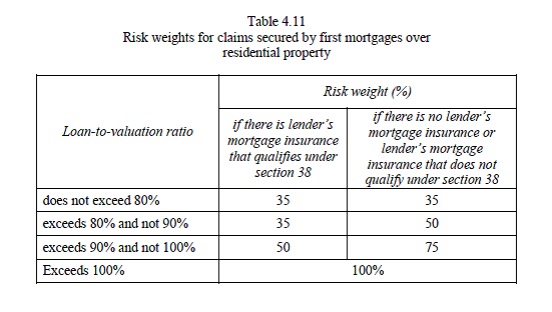
Calculation of risk weights for banks using internal ratings based model (the big 4 banks) is far from transparent, but the easiest way to see the difference is in the rules for other (“standardised”) banks.  Risk weights for residential mortgages are as follows:

riskweights

For loans with an LVR of less than 80 per cent, the risk weight is 35 per cent

By contrast, exposures to unrated corporate borrowers generally have a risk weight of 100 per cent.

But that is because the risks to banks from typical housing loans have been found to be less than those on many other bank assets.  This is not just an observation about boom times, or about New Zealand and Australia in recent decades, it is a result across many countries and many different circumstances.  Housing mortgages initiated by banks themselves, not under regulatory mandates to take on dubious risks, have rarely if ever played a major role in financial crises.  A recent Reserve Bank Bulletin reported on some of the international literature in this area.  A good example was Finland in the 1990s, where after a major credit boom and rapid growth in asset prices in the late 1980s, house prices fell by about 50 per cent in nominal terms, real GDP fell away sharply and unemployment rose substantially.  Banks took losses on their mortgage portfolios, but those losses were modest and not remotely enough to have threatened the health of banks.  The experience in the US since 2007 superficially looks like a counter-example, but binding federal government and congressional mandates played a key role in driving down the quality of new mortgage originations (and hence driving up subsequent loan losses).

It is not surprising that housing loan portfolios are not overly risky.  Lenders have a lot at stake, but they also have solid collateral.  Borrowers also have a lot at stake, especially in countries (like New Zealand and Australia with with-recourse mortgages).  You can escape your debts if you go bankrupt but fortunately (in my view) we don’t have a culture that is overly welcoming to bankruptcy.    And a owner-occupied home is not just a roof over the head, it is often also about a place in a community –  the local school, or sports club, or church.  So most residential mortgage borrowers do everything they can to avoid defaulting on their mortgage, and losing their house, even in very tough times.  There will always be a minority of bad borrowers, and other people who are just overwhelmed by events and the size of a shock.  Recent loans tend to be riskier than older loans –  most of us probably borrowed about as much as we could afford to get into a first house,  but mortgage portfolios age and typically get safer as they do.  And it portfolios of loans –  not individual loans –  that need to be evaluated in thinking about the risk to banks.

By contrast, the typical unrated business loans will have no collateral, revenue streams that depend quite strongly on the economic cycle (profits are more volatile than wages) and limited liability.   The nature of business is taking risk, and sometimes risks pay off and other times they go spectacularly wrong.  Empirical evidence is that a portfolio of unrated business loans is materially risker than a portfolio of unrated residential mortgages.  To be more specific, even in respect of property-based exposures, the evidence is that commercial property, and especially property development exposures, are far riskier (and more likely to lead threaten the health of banks and the financial system) than residential loan books.  Markets will, and regulators should, reflect that in their expectations around capital.

Actual risk-weighting for our big banks is more sophisticated than this description and, as mentioned, much less transparent.  Reasonable people can differ on whether anything is gained by having the IRB approach, or whether it would be better to simply use the standardised approach for all our banks –  all of which are relatively simple.

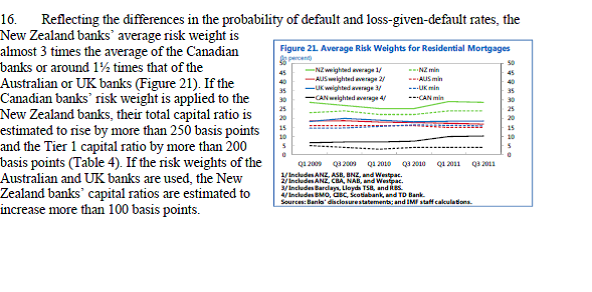
But not only is there good reason for residential mortgage risk weights to be lower than those on many/most commercial exposures, but New Zealand’s risk weights on residential loans are high by international standards.  This IMF piece, done a couple of years ago, contrasted effective risk weights on residential mortgages with those then in the UK, Australia and Canada

riskweights2

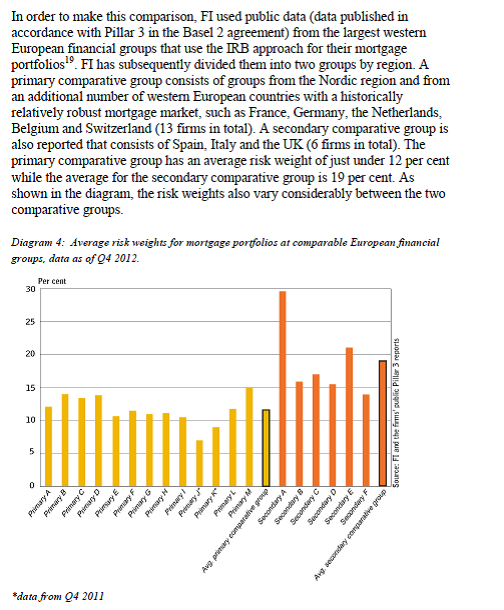
Sweden recently raised the minimum risk weights used by their banks on residential mortgages.  As part of the preparation for that move they produced this document, which includes this chart.  Again New Zealand risk weights on residential mortgage loans are higher than any of the banks in this chart – and are higher than the newly increased Swedish risk weights.

riskweights3

Residential risk weights, or overall required capital ratios, might still in some sense be too low in New Zealand.  But the onus should be on those calling for such increases to make the case that the threat to financial stability is greater than what is already allowed for in the bank capital framework.  The Reserve Bank did stress tests last year looking at the impact of a really quite severe adverse shock, in which nominal house prices fell a long way and unemployment rose substantially (it usually takes both to cause real trouble).  Not one of the banks, let alone the system as a whole, had its capital materially impaired in that scenario.  Those tests may well have been flawed, they may have missed something important, and they certainly won’t have captured everything that mattered, but on the information we have actually available the New Zealand banking system currently looks pretty well-placed to cope with a severe shock affecting the residential mortgage book.  With the stock of credit growing at only around 5 per cent per annum, that also should not be a great surprise.

And since housing seems to be one of those areas where to cast doubt on one possible explanation/solution is to risk being accused of thinking there is no issue or problem at all, I refer anyone inclined to react that way back to my take on housing.

Islamic banking and equity-based mortgages

Media reported yesterday on a local Muslim woman who had sought to interest New Zealand banks in offering mortgage products that met Islamic restrictions on the payment of interest.  The article suggested that a Kiwisaver provider was interested in offering such products.  There were some small lenders offering such products prior to the 2008/09 recession but they did not seem to survive.

I’ve long been intrigued by the ideas and practice of interest-free finance.  My own Christian tradition for centuries banned, or regarded with intense disfavour, lending at interest.  That drew first on Old Testament provisions, which prohibited Israelites from lending to fellow Israelites in need at interest (while allowing loans at interest to outsiders).  The stance was reinforced by perspectives from Aristotle, rediscovered in the Middle Ages, arguing for the inherent sterility of money.  Prohibitions on lending at interest were eventually removed but  it remains a powerful vision for some (for me).   Within the Christian community, outfits like the Kingdom Resources Trust in Christchurch try to put it into practice.

The injunctions against interest are apparently much stronger and more pervasive in the Koran. In his recent book, Beggar Thy Neighbour, Charles Geisst reports that “of all the prohibitions against undesirable activities in the Koran, usury is mentioned the most.  Interest, or riba, is considered usury and no distinction is made between them”.   This was a distinctly counter-cultural stance, as compound interest had apparently been common among Arabs before the coming of Islam.

If interest is prohibited, profit-sharing arrangements –  equity finance, in effect – are not frowned on at all.  They have a element of uncertain return – economic risk –  for which some reward is appropriate. Predominantly-Muslim countries, and individual Muslims. have grappled with how to apply the prohibitions on interest in today’s world.  The large Muslim minority in the UK and the large financial sector with global connections has led to considerable interest there.  In his pre-crisis heyday, Gordon Brown wanted London to become the global centre of Islamic banking.

My interest in interest-free finance once got me a trip to Iran, as a member of an IMF technical assistance mission. This was shortly after the Iran-Iraq War and the death of the Ayatollah Khomeini, in an earlier phase of opening to the West.  I got on the mission because of my (innocuous, non-US, non-UK) New Zealand passport.  From my perspective, two weeks in Iran was made easier by the fact that I didn’t then drink alcohol at all.

I was (am?) a bit of an idealist, and went in fascinated to learn more about trying to apply the interest-free teaching in practice.  And I like to think we offered them some helpful advice –  monetary policy without interest isn’t particularly intellectually or practically difficult.  But I came away somewhat disillusioned.  We met a variety of people – bureaucrats, bankers, and even some theologians (we wanted to better understand what the permissible limits were).  Some were more earnest than others, but the overwhelming impression I came away with was of people trying to devise instruments to the limits of the letter of the law (Koran), with little regard for the spirit.   I’m not, for a moment, suggesting that that was the approach of individual devout Muslims across the country, but among the groups we engaged with the focus was on products that had the economic substance of interest, but not the legal or exegetical label of interest.

I’m not sure that that was, or is, unrepresentative of many Islamic banking products.  Take mortgages as an example.  A widely-used UK website , Islamic Mortgages, covers a wide range of sharia-compliant mortgage products.

In a nut shell how does an Islamic mortgage work for different types of purchases?

Buying/selling:

  • you choose property, agree price, undertake survey
  • bank enters into contract to buy the property from vendor
  • bank sells property to you at higher price
  • the higher price is paid by you in equal instalments over a fixed term, irrespective of what happens to Bank of England base rate
  • Leasing:
  • choose property, agree price
  • bank undertakes survey, buys property and sells it to you for the same price, in return for payments spread over fixed period up to 25 years
  • in addition to monthly payments, you pay a sum for ‘rent’ – assessed annually in line with market trends
  • you can overpay (as with a conventional flexible mortgage) to buy the house more rapidly

These are interesting products in their own right, but the first is simply economically equivalent to a mortgage with a fixed interest rate for the entire life of the loan.    Neither the purchaser nor the lender will necessarily regard themselves as paying or receiving interest, but the payment streams over the life of the contract (“fixed term”) will be the same as those on a conventional table mortgage with a fixed interest rate for the same term.  And the risks  – credit, market, counterparty –  seem very much the same.

An alternative type of product might be an equity-based housing finance product.  In conventional housing finance markets, the purchaser puts up some equity, and a lender provides the balance.  The lender receives an interest-rate and is exposed to the (hopefully small) risk that the borrower defaults and that the house can’t be sold for enough to cover all the outstanding debt.  Any increases in the value of the house – whether changes in market prices generally, or as a result of improvements/extensions – accrue to the owner.

But it would be technically quite feasible to envisage a model in which the person wanting a house to live in, and the financier, became equity partners in a joint business venture to own the house.  You, the, resident would presumably pay rent to the joint venture, some portion of which would be passed to the equity finance partner, and when the house was eventually sold gains and losses would be shared, proportionately, between you and the equity partner.  You have risk, the equity financier has risk, and no one is paying or receiving interest –  in form or in substance.  It would be simple enough, technically, to structure the contract to allow the resident’s equity share to rise over time (instead of “principal repayments”, one uses the funds for equity repurchases from the JV partner).

I’m not sure if such contracts exist anywhere in the Islamic world.  In the West, without the theological concerns about interest, there is good reason why they don’t exist.

If I’m a young person in the West buying a first house, a bank might lend me 90 per cent of the value of the house.  Most mortgages are table mortgages and are repaid gradually, so that in time the owner’s equity share is large, heading for 100 per cent.  All the Bank cares about after that is my ability to service the debt.  And that depends largely on avoiding prolonged periods of unemployment.  If house prices fall that poses a risk –  banks can call in a mortgage if the value of the collateral drops below the value of the mortgage –  but it typically only crystallises if the flow debt service isn’t being met, and if house prices fall so far that not all the debt can be repaid when the house is sold up.   Within limits – quite wide limits – banks don’t care about or monitor the maintenance you do on your house.  If you don’t do the maintenance, mostly it is your loss.  And they don’t care at all about changes in market rentals in your neighbourhood, or for your specific type of house.  Conventional mortgages are simple, easy, and cheap to monitor.

But equity-sharing contracts would be enormously costly to monitor and manage, especially in a country with such a variegated housing stock (rather than lots of high-rise uniform apartments).  If you are only an equity partner in a house, your incentive to do maintenance is attenuated –  and likely to weaken especially in periods of personal financial stress.  So a financier providing a large equity stake would probably want to pre-specify maintenance obligations and standards (and would then need to monitor compliance).  You’d need to negotiate all alterations and extensions.  Rental rates vary, as do market values.  Perhaps a real rental yield could be pre-specified in the initial contract, but any arrangement for the resident to gradually buy out the outside equity partner requires an agreement on market value at the time of the transaction.  Transactions costs rapidly start to mount.  They might work within a relatively closed community – say, a local church community where effective monitoring costs might be reduced, or a small mosque-based credit union  –  but it is difficult to see them being effective, and economic, more generally.

In their recent book House of Debt, the US academics Atif Mian and Amir Sufi, argued that equity-sharing contracts should become the norm for housing finance.  They argue that such contracts would materially reduce the risk of financial crises, and that the main reason such contracts aren’t common is because of the tax system and the role of US government agencies.  I’m very sceptical of both claims, and would post the note I wrote on why –  but it would take 20 working days to get OIA clearance.  This post is quite long enough, but if anyone is interested I can explain my scepticism in a later post.

UPDATE: The later post on equity-sharing mortgages.