St George’s Day

Being something of an Anglophile I had been thinking about some lighter material inspired by St George’s Day for this afternoon, but I see that John McDermott has beaten me to it.

My only brief comment  for now on John’s speech is on this paragraph:

We remain vigilant in watching wage bargaining and price-setting outcomes. Should these settle at levels lower than our target range for inflation, it would be appropriate to ease policy.

Perhaps I’m misreading this, but surely the Policy Targets Agreement now emphasises the midpoint of the target range.  If the Bank had suggested, in the mid 2000s, that it would tighten only when wage bargaining and trend price-setting outcomes got to levels consistent with inflation  above the top of the range then I think quite serious questions would have been asked (and rightly so).   And in those days there was no reference to the midpoint in the PTA.

And, rather than post this just on my other blog, I’ll leave you with the link to the fuller story of St George, and the faith and courage that inspired the dragon story.

In many ways, I’d rather not write this

This morning a Reserve Bank press release came out, announcing the appointment of two new external monetary policy advisers.  Mr Google suggests that these appointments have not been publically announced since 2003.  If so, the Governor is to be commended for the increased transparency (which I assume had nothing to do with my OIA request on 6 April for the names).

External advisers were introduced following the Svensson inquiry into monetary policy, which reported in 2001.  Svensson recommended a voting committee to make monetary policy decisions (but a committee of senior insiders).  The Bank wasn’t keen and Michael Cullen had no interest in further entrenching the influence of Reserve Bank staff.  If anything, there had been talk of an external committee.  The Bank’s initiative was to appoint a couple of part-time external advisers.

Over the years, probably 10-15 people have held these roles.  In my observation some have made very good contributions, and others less so.  That is partly inevitable.  They come in to the Bank four times a year, and participate in the several days of fairly intense meetings leading up to the OCR decisions for each monetary policy statement.  Some have offered very useful information from their contacts and sectors, but I think almost all have struggled to come to terms with –  and make satisfying and effective contributions to – the internal, quite technical, process.  Hard questions or nagging doubts expressed in a different language aren’t always taken as seriously as perhaps they should be. It must be a fascinating opportunity for them for the first few times round, but it wasn’t clear to me why anyone would want the part-time role much beyond that.

My concern is about the appointment of Conor English. I have not met him, and have heard him speak only once.  But from everything I have read and heard of and about him, I have no doubt that he would be likely to make a useful contribution as an external adviser.  Good information on the agricultural sector is very valuable to the Bank in its monetary policy deliberations.  But his brother is the Minister of Finance, and is likely to be so for most of the next three years.

The New Zealand system is different from those of many other countries.  In many countries, a central bank Governor can be dismissed only in the most grave circumstances (criminal convictions, mental incapacity etc).  But in New Zealand, by statute, the Governor is responsible for implementing monetary policy in pursuit of an agreement with the Minister of Finance and he can be dismissed if his performance is not up to scratch.  The Minister of Finance has the power to dismiss the Governor (through the Governor General, by Order in Council) on policy grounds:

Sections 49 and 53 provide that the Minister may seek the removal of the Governor (or the Board may recommend that the Minister do so) if he is satisfied on any of several counts. These include, inter alia, the following which bear directly on monetary policy:

  • That the Bank is not adequately carrying out its functions (the primary function being monetary policy); or
  • That the performance of the Governor in ensuring the Bank achieves the policy targets has been inadequate; or
  • That a Monetary Policy Statement is inconsistent in a material respect with the Bank’s primary function, or with any policy target fixed in the Policy Targets Agreement.

For the Governor to appoint the Minister of Finance’s brother as one of his principal monetary policy advisers could put the Minister in quite an invidious position if serious concerns about the Governor’s performance are ever raised. And these would be issues of complex judgement – it isn’t a mechanical exercise. If the Governor were to be dismissed would the Minister be reflecting adversely on his own brother? And if, despite a case for dismissal being made, perhaps by the Board, the Minister decided not to dismiss the Governor, he would open himself to claims that he didn’t want to be acting negatively towards his own brother.

Everyone hopes these sorts of powers never have to be invoked.  But laws, and governance frameworks in particular, are there primarily for tough times, not ordinary ones.  And I don’t question the integrity of either the Minister or his brother (or of the Governor for that matter), but it is important not just that people act with integrity, but that they are not put in a position where reasonable questions about that integrity might be posed in future.

Sometimes this sort of potential conflict of appearance might be unavoidable.  A person gets appointed to a ministerial portfolio, and a sibling just happens to work for an agency in that portfolio.  But this is not one of those cases. An external monetary adviser is a part-time responsibility, an interesting opportunity, but out of the mainstream of anyone’s career.  Bill English won’t be Minister of Finance for ever, and his brother could, quite appropriately, have been appointed at a later date.

The Governor is one of the most powerful people in New Zealand, and the conduct of monetary policy is his primary statutory role.   This is not the most serious conflict ever, but it is simply unnecessary.

Fit and proper people

Media reported the other day that the new local subsidiary of the large Chinese bank ICBC had been issued a notice for breaching one of the Reserve Bank’s regulatory requirements.  It looks like a fair call.  Registered banks have to comply with the rules (the “conditions of registration”) from the start.  And it is prudent that the Reserve Bank should keep a particularly sharp eye on state-dominated banks – whether from New Zealand, China (and, as is well-recognised, whatever the legal form, the Party ultimately calls the shots in each of the major banks), or elsewhere.  Government banks around the world have a pretty poor track record, misallocating capital and too often ending badly, whether because of weak market disciplines, or because the pursuit of other public policy objectives over time undermines the soundness of the bank. As I noted the other day, that happened to the US agencies.

This episode must be a bit embarrassing for ICBC itself, and for its chair, the former Reserve Bank Governor, Don Brash.  Rules are rules.  But sometimes rules are silly rules, with no very obvious public policy foundation.  Then it is time for those who hold regulatory agencies to account to ask questions about whether those rules should be in place at all.

What exactly did ICBC do?  They did not obtain prior approval from the Reserve Bank before appointing a compliance officer, one of the CEO’s direct reports.

Under Reserve Bank rules (outlined here):

no appointment of any director, chief executive officer, or executive who reports to, or is accountable directly to, the chief executive officer, may be made in respect of the registered bank, and no person may be appointed as chairperson of the board of the bank, unless the Reserve Bank has been supplied with a copy of the curriculum vitae of the proposed appointee and has advised that it has no objection to that appointment.

Under the current Reserve Bank Act, the Bank must have regard to the suitability of directors and senior managers in determining whether to register a bank in the first place.  If we are going to have a bank registration regime that seems a sensible enough provision, on entry.  But the ongoing conditions of registration for established banks are a matter of choice for the Bank.

“Fit and proper” requirements are pretty common internationally.  But citizens should reasonably ask “to what end, and with what evidence that the requirements make a useful difference?”

The Reserve Bank’s prudential regulatory powers have to be used to promote the soundness and efficiency of the financial system (sec 68 of the Act).  The focus of the suitability (“fit and proper”) tests is presumably on the soundness limb of that provision.  Prior Reserve Bank “non-approval” must be expected to reduce the threat to the soundness of the financial system (not just the individual institution, but the system itself).  How might it do that?  The Reserve Bank says it focuses on integrity, skills and experience.

At the (deliberately absurd) extreme, if the Reserve Bank were blessed with the divine quality of omniscience, they could see into the soul of each potential appointee, and discern accurately how those individuals would respond to the sorts of threats, risks, shocks ,and opportunities they would face while serving with a New Zealand registered bank.  No one prone to deceive under stress, to breach internal risk limits, or to take “excessive” risk would get appointed.  That sort of insight would be very helpful.  But it isn’t on offer.

Instead, the Reserve Bank’s document suggests a backward-looking focus – checking out past appointments, past criminal convictions, and the like.  All of which is fine, but all of that information is known (or knowable) to those at registered bank concerned who are making the appointment.  And most of the stuff that is really interesting, and telling, is likely to be about character.  That isn’t knowable in advance, and certainly not by Reserve Bank officials.  What expertise do Bank economists and lawyers –  many very able people – have in second-guessing the judgement of the banks themselves in making such appointments?  And what incentive do they have to get it right?  The model looks like one that favours the appointment of grey colourless accountants and lawyers, who have not yet blotted their copybooks – perhaps never having taken any risk – with a bias against anyone who has learned banking, and what it is to lose shareholders’ money, the hard way.

Banking regulators worry about the risks to depositors and taxpayers if widespread or large banking failures occur.  But the first people to lose money as a result of mistakes, misjudgements, or worse are usually the shareholders in the bank concerned.  They might reasonably be assumed to have more at stake from bad appointments of directors or senior managers than central bank regulatory officials do.  New Zealand has in place pretty demanding bank capital requirements.

No doubt there will be people (and perhaps there already have been) who were employed by failed finance companies coming up for Reserve Bank approval in the next few years.  In some cases, those people will have had no responsibility for the failure, and in others there may have been some culpability.  But business failures happen, and they aren’t always a bad thing (indeed, unlike some systems, our banking regulatory system is explicitly designed not to avoid all failures).  Why is the Reserve Bank better placed than the registered bank concerned to reach a judgement on whether any previous involvement with a failed finance company should disqualify someone from a future senior position in a bank (or other regulated financial institution)?

In a similar vein, I wonder if the Reserve Bank has done a retrospective exercise and asked itself how likely it is that, with the information available at the time, it would have rejected any (or any reasonable number) of those responsible for the 1980s failures of the DFC and the BNZ.  Done in a suitably sceptical way, it would be an interesting exercise

I’m not suggesting there be no rules at all.  Perhaps conviction for an offence involving dishonesty in the previous [10] years should be an automatic basis for disqualification from such senior positions?  It wouldn’t be a perfect test, but it is certain and predictable, and probably better than a “we don’t like the cut of your jib” sort of discretionary judgement exercised by regulatory officials.  It doesn’t hold the false promise of regulators being able to sift out in advance people who might, in the wrong circumstances, later be partly responsible for a bank failure.

Perhaps too there might be a requirement that a summary CV for each director and key officer be shown on the registered bank’s website.  Those summary CVs might be required to list all previous employers or directorships.

But the current fit and proper tests seem to be an additional compliance cost, for no obvious public policy benefit.  It has the feel of something they feel the need to be seen to be doing, to be a “proper supervisor”, and get ticks in the right boxes when the next IMF FSAP comes through, rather than something where there is evidence that the rules have advanced financial system soundness in New Zealand.

The Reserve Bank is currently undertaking a “regulatory stocktake”. But that stocktake ruled out from the start reviewing almost anything very interesting and fundamental in the supervisory regime.  It seems to be a tidying-up exercise, not bad in itself, but not focused on the real issues.

One of features of the New Zealand banking regulatory system is that the Bank is both operational regulator/supervisor, and responsible for the policy framework and legislation around banking supervision.  But those with responsibility for monitoring the Bank – its Board, the Treasury, the Minister of Finance, and Parliament’s Finance and Expenditure Committee – might want to ask just what value is being added by these fit and proper requirements.  Perhaps the Minister of Finance could raise it in one of his “letters of expectation” to the Governor?

Provisions of this sort cost money, both to banks to comply with and to taxpayers to administer the provisions, and impede business flexibility.  Individually, the amounts involved and the degrees of inconvenience, are probably not large, but the old line remains true “take care of the pennies and the pounds will take care of themselves”.     There should be a general presumption against regulatory burdens – particularly where they impinge directly on the lives and professional careers of individuals – and an onus on the regulators to show that their provisions are making a material net difference to worthwhile public policy objectives.

Welfare benefit numbers

The other day David Farrar highlighted MSD’s release of the number of people receiving (non NZS) welfare benefits.  MSD released data for the last five years and, while interesting, any interpretation of that data was inevitably going to be affected by the subsequent economic recovery.  2010 was the year of New Zealand’s double-dip recession, after the initial 2008/09 recession.  Anyway, I was intrigued and wanted to put the more recent data in some context.

It was easy enough to find comparable data on MSD’s website back to 2003.  These data are for the number of people 18-64 (“working age” as they describe it) receiving “main benefits”.  On Infoshare I found a series going back to the early 1990s, which is clearly similar to, but not the same as, the MSD numbers.  I think the difference is probably just that the Infoshare number capture the relatively small number of people outside 18-64 receiving (non-NZS) benefits.

The chart below shows these beneficiary numbers as a percentage of the population aged 18-64.  It is encouraging that the number of beneficiaries has dropped in recent years, although eyeball analysis suggests that much of the drop is likely to be the economic cycle.  But as the HLFS unemployment rate is still nowhere near as low as it was in 2007/08 that can’t be the full story.  Presumably the government’s welfare reforms have made some contribution.

benefits1

But in many ways, the more striking bit of the picture is the decline over the 2000s, from around 16 per cent of the working age population in much of the 1990s (even as the unemployment rate had fallen away) to around 12 per cent by the mid 2000s.  Even on the MSD data around 10 per cent of the working age population is now receiving a welfare benefit.

That seems staggeringly high.  Working age population doesn’t just include beneficiaries and the employed.  It includes people like me (and plenty of new parents), happily out of the labour force for a time and supported by a spouse.  One in ten of all those people –  employed, unemployed, other beneficiaries, and those otherwise not interested in paid employment – is primarily reliant on a welfare benefit.

For a longer-term perspective, I pulled the 1984 New Zealand Official Yearbook off my shelf, and transcribed benefit numbers (ex National Superannuation and Family Benefit) for 1979 to 1983. It looks comparable to the Infoshare data.  I’m not sure if there is data on the working age population back then, but all the second chart does is graph  these series (of beneficiary numbers) as a percentage of the total population.  The proportion of the total population on working age welfare benefits is still 50% larger than it was around 1980.    (I deliberately didn’t want to skew the comparisons too far, given the relentless excess demand in New Zealand in the 1950s and 1960s, but for what it is worth, in 1970 the total number of beneficiaries was only around half the level in 1980.)

benefits2

What is the “right” number?  Well, to a large extent that is a political choice, but one that should be actively debated.

I’ve sometimes pointed out that if everyone in the workforce spent one year in a 45 year working life unemployed, that would generate an unemployment rate of under 2.5 per cent.  And there will always be those who, through no fault of their own, through debilitating disease or illness, are unable to work much or support themselves at all.  And perhaps a small number of, for example, spouses/partners fleeing abusive relationships and temporarily needing society’s support.  But is there any obvious reason why society could not once again have benefit dependence ratios back where they were in, say, 1980, while treating generously (perhaps more generously) the few unable over the longer-term to provide for themselves at all?

Perhaps a (cycle-adjusted) maximum of 5 per cent of the working age population on welfare should be considered as a target.  That still allows for 1 in every 20 working age people to be primarily dependent on a welfare benefit.   A target like that can’t humanely or fairly be achieved overnight, but over 10-20 years it could be.  In fact, it might be inhumane (in a larger sense) not to.

(It isn’t my usual field, but this was never intended to a blog just about macro policy and/or the Reserve Bank.  Others will know the data, and the research, better than I do, and I welcome thoughtful comments.)

The OECD reviews New Zealand today

This morning in Paris, in one of the many well-equipped but characterless conference rooms, that seem to host dozens of international meetings each week, members of the OECD’s Economic and Development Review Committee (EDRC) will sit down to consider New Zealand.

The Committee’s role is “to examine economic trends and policies in individual OECD … countries, assess the broad performance of each economy and make policy recommendations”.   Every two years each of the 34 OECD member countries’ economies are reviewed. The work of the EDRC is outlined more fully here.

The committee comprises representatives of each member country (and the European Commission) – usually mid-level officials from national finance ministries serving with their country’s permanent delegation to the OECD.  In New Zealand’s case, Treasury seconds one of their more well-regarded staff to our delegation (based at our embassy in Paris).  For some years in the 1980s, Graeme Wheeler held the role.

OECD staff visit member countries (twice in New Zealand’s case) and prepare a draft of what becomes the published Economic Survey.   The draft is circulated a few weeks in advance.   But the centrepiece is the EDRC discussion, a (not overly long) day’s meeting chaired by the very stimulating and somewhat iconoclastic Bill White, former chief economist of the Bank for International Settlements (BIS).   The country being examined will typically send a delegation from home – in New Zealand case, usually two or three people from Treasury, led by a Deputy Secretary, and one person from the Reserve Bank – supported by the (small) team at the permanent delegation.  The New Zealand Ambassador usually hosts a thoroughly excellent lunch.

To assist the examination, two member countries are designated as lead examiners, and often they too will send people from national capitals.  Chile and Korea are the examiners for New Zealand (New Zealand has often been one of the examiners for the US).

These days the Surveys review recent economic developments and have, typically, two special chapters.  Topics are negotiated with the authorities, but also reflect the OECD’s own agendas and wider work programmes. This year, for New Zealand, the topics are “managing the next upswing” and “making growth more inclusive” –  the first has the feel of something New Zealand specific, and the second looks more OECD-wide (see the topics for forthcoming surveys).

The draft Surveys often have errors – simple factual ones or points of misunderstanding.  Those are usually rectified easily enough. But what gets much more interesting are the differences of emphasis – about proposed policy, or about narrative (how the story of, say, New Zealand is told).  I was first involved in one of these examinations in Paris in December 1990 – at that time, one of our top priorities was to get all references to “experiments” (and especially “bold experiments”) out of the document.

Sometimes the discussion can raise interesting issues, and sometimes there can be a rather desultory feel to it.  The national authorities have their agenda of things they want changed in the report –  some of them points of material analytical disagreement, but sometimes more along the lines of “it would not assist the policy process and debate –  or the political position of the government –  in New Zealand to make this point at this time”.  Some other delegations will have favourite issues they raise in EDRC discussions of other countries.  Sometimes those points will be relevant to New Zealand, sometimes not.

The point of the day is to influence the chair’s summing up, because although the EDRC discussion is the higher profile centrepiece, the real action takes place the next day (or days, in the case of some countries).

The draft report is 100 or more pages long.   The national delegation and the staff team work through it line by, often painstaking, line.   However, the focus is on the one page Executive Summary, and the 20 or so pages of Assessment and Recommendations.  Only specialists read much beyond that point, and in any case the remainder of the text has to be consistent with the Assessment and Recommendations.  The chair’s summing up from the previous day provides guidance and constraints – staff have to walk away from a point if the chair has given clear guidance that the sense of the committee is not to make a particular point or recommendation.  On the other hand, the national delegation has little chance of making material change on important points if there was no mention in the previous day’s summation.  But the devil is still in the detail – emphases can be shifted, or balanced, with small wording changes, or complementary clarifying sentences.  New people in the process were often optimistic that the drafting session would be all done in a few hours, but it always took all day – sometimes well into the evening.  And New Zealand wasn’t especially argumentative – I’ve heard stories of some countries who sat negotiating wording for days, and then sometimes invoked their own finance ministers to put additional pressure on staff.

The staff team directly involved in putting these reports together, from the OECD’s Country Studies Division of the Economics Department, is quite small –  again some mid-level and junior economists..  At present, New Zealand is bracketed with Canada –  over two years, the team does reports on both countries.  There is plenty of leeway for those staff to put their own emphases on the report –  for good and ill –  but there is a moderation process and involvement from the senior management of the Division.  Indeed, sometimes the head or deputy head of the Division will participate in one of the missions to New Zealand.

It is a peer review process.  In the end, as the OECD notes, the Surveys are signed off by all 34 countries.  The final report is not that of the Staff, but it is something to which all 34 countries –  including the country being reviewed –  have assented.  The reviewed country won’t agree to everything in the Survey, but will probably have got the things it really both strongly disagrees with, and cares strongly about, either removed or hedged around with numerous qualifications and caveats.  It is a club, and there is a degree of reciprocity –  balancing analytical integrity with not making too much difficulty for each other.

It is, in other words, quite a political process. And that, of course, is also how these OECD Surveys are used.  Opposition parties have liked calls for, say, capital gains taxes.  The Reserve Bank likes references to overvalued exchange rates.  The government likes positive comments on fiscal consolidation.  And so on.  The Reserve Bank doesn’t much like references to leverage ratios, or the Treasury references to fiscal councils, but then no one much cares either.

What is the quality of the Surveys like?  I’m somewhat sceptical.  The OECD does have some fairly unparalleled databases, and quite a knack for compiling and presenting interesting charts.  I’m a data junkie, and I find those cross-country data comparisons fascinating, and labour-saving.  But the quality of the policy analysis and recommendations is rather more questionable.  I’ve looked at draft reports for New Zealand and for other countries over the years, and often found the argumentation quite unpersuasive, even in areas where I lay no claim to being a specialist or an expert.  These days there is a strong tendency to favour what I’d call “smart active government” solutions, and a disinclination to put much weight on markets and market processes.  That isn’t the image the OECD has often had in New Zealand – the late Roger Kerr often used to cite “OECD orthodoxy” to back his own arguments about what should be done in New Zealand.  But a few years back, I pointed out to the head of the Country Studies Division that the OECD could probably be best characterised as the technocratic wing of the more market-oriented strands of European social democratic movement.   He looked askance, and then somewhat reluctantly acknowledged my point.    Reasonable people will differ on how to read the evidence on the appropriate role of government, but OECD papers aren’t inclined to put much weight on questions of why governments fail so often and how policy should be shaped in the light of that.

All of which is by way of saying that no one should put too much weight on anything in any particular OECD survey.  Sometimes they will be right on the mark –  out of interest I went back last night and read the 1983 Survey and thought that they had done a very good job of highlighting the microeconomic and macroeconomic challenges then facing New Zealand, without any sense of imminent crisis.  At other times, they will be missing the mark, or adopting a particular recommendation based on not much more than institutional priors and the preferences of a few staffers.  As the OECD acknowledges, they have consistently failed to come to grips with why the New Zealand economy has not performed better over the last 25 years.  Without a good story about that it is hard to nest their individual recommendations in an overall narrative of what needs to be done.

It will be interesting to see the final version of the Survey being discussed in Paris today.  On normal timing, it should be out in late May or June.  The topic “managing the next upswing” does sound a little ominous, since the optimists still think the current upswing –  now four or five years old –  is still gathering pace.  But when you hear one or other side of the New Zealand political/commentator debate asserting that “the OECD says x or y” just remember the process.

Investor property consultation revisited

Last week I posted the brief submission I had made to the Reserve Bank on its consultation document on residential mortgage loans for investment purposes.  I suggested that the case for a separate risk class for investor property loans had not yet been convincingly made.

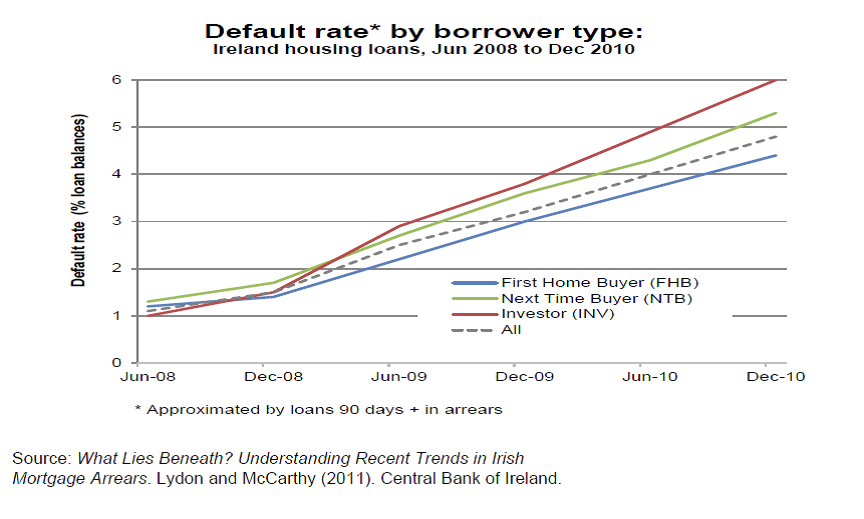
I noted then that the Reserve Bank had not set out convincing evidence on the loan loss experience on investment property loans.  In particular, although investor property default rates in the UK and Ireland had been higher than those on owner occupier loans, the Reserve Bank had made no attempt to show whether this difference reflected the purpose for which the loan was being take (ie investor property vs owner-occupier), or the characteristics of the respective borrowers.  I hypothesised, for example, that many of the UK and Irish buy-to-let loans may have been taken out very late in the boom, and –  if so –  the typical borrower was likely to have had a higher loan-to-value ratio and more stressed income servicing requirements than the average owner-occupier borrower. If so, actual loan losses on investor property loans would be higher than those on owner occupier loans.  But the factors behind those differences (higher LVRs, higher debt service requirements) should already be picked up in the risk-modelling and they would not warrant separate capital requirements for investment property loans.

The Reserve Bank included this chart, from a 2011 Irish research paper, in their consultation document.

ireland

A reader has pointed out that the conclusions of this paper explicitly state that differences between the arrears rates for buy-to-let borrowers and owner-occupiers is reduced once allowance is made for these characteristics.  And the remaining increase in buy to let default rates seems to have been largely due to the buy-to let loans being disproportionately made towards the very end of the boom when (among other things) lending standards were at their most lax).  That particular paper is several years old now, no doubt there is now more data on actual loan loss experiences (not just arrears) and one should be hesitant to put too much weight on any single paper.  But this was a paper the Bank itself cited.  Surely the Bank needs to document more fully their claim that investment property loans, per se, are typically more risky than other types of residential mortgage loans.    It is an empirical issue, and only really resolvable with good empirical evidence.

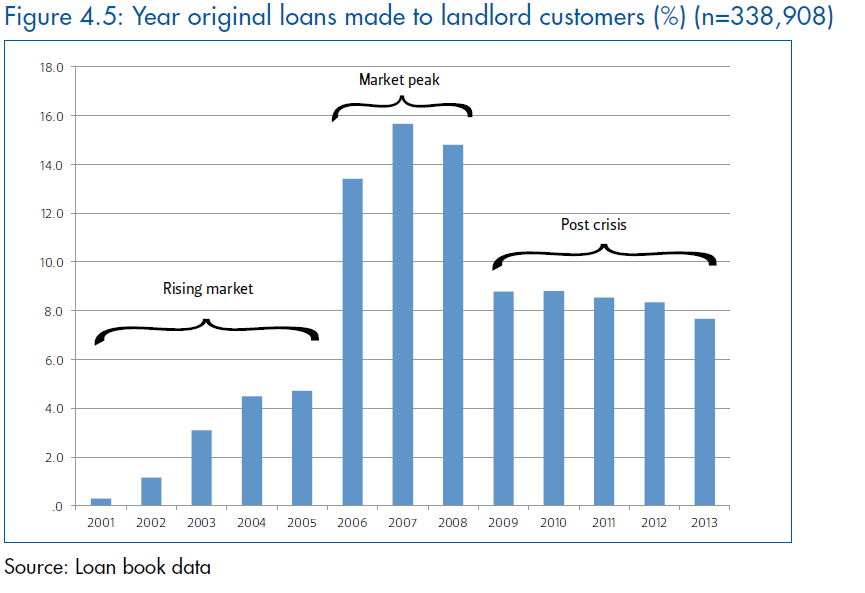
This chart, from another paper on the UK experience, illustrates how late in the cycle most British buy-to-let loans were made.  Newly-minted loans tend to have higher default rates than older loans, no matter who they are made to or for what purpose

landlords

It has also been pointed out that the Reserve Bank has been a little selective in how it quoted from the Basle definitions and guidelines.  As I noted, I don’t think the New Zealand authorities should be guided too much by international guidelines, but it was the Reserve Bank who cited this material in support of their position.

In paragraph 21 of their consultation document we find the following from the Basle IRB material.

Residential mortgage loans (including first and subsequent liens, term loans and revolving home equity lines of credit) are eligible for retail treatment regardless of exposure size so long as the credit is extended to an individual that is an owner occupier of the property

But they omit the rest of the paragraph (paragraph 231 of this document)

…with the understanding that supervisors exercise reasonable flexibility regarding buildings containing only a few rental units ─otherwise they are treated as corporate). Loans secured by a single or small number of condominium or co-operative residential housing units in a single building or complex also fall within the scope of the residential mortgage category. National supervisors may set limits on the maximum number of housing units per exposure.

Not only is it clear that the Basle guidelines have in mind apartment buildings (rather than the typical New Zealand rental properties) but that the Basle guidelines envisage that small investors will be treated as retail borrowers (“with the understanding that supervisors exercise reasonable flexibility regardin g buildings containing only a few rental units”).

Presumably there was no intention to mislead in putting together the consultation document, but that is likely to have been the effect.    No doubt the Reserve Bank would have stern words to any bank whose disclosure documents were inadvertently misleading. Perhaps it might even require the document to be reissued.

Whatever the Basle guidelines might say, in full or in part, what matters is the evidence on the riskiness of investment property loans.  At present, it remains “case not proven”.    As I noted in another post the other day, it would be interesting to know what the loan loss experience has been in those regions of New Zealand where nominal house prices have fallen since 2007.  Is there evidence that losses on investment property loans have been higher, all else equal (ie similar vintage, similar LVR, similar debt service ratios), than those on owner-occupier loans?  If so, that would certainly make the Bank’s case for the separate classification of all investor property loans more persuasive.  If not, it might reasonably lead to a rethink.  If the Bank has not yet gathered such data from the registered banks (or if the banks have not supplied it with their own submissions) it might be wise to do so before implementing policy on what appears, at present, to be a rather thin base of evidence.

On looking into the European abyss

Wolfgang Munchau writes a very stimulating weekly column for the Financial Times, on aspects of the euro crisis.  Yesterday’s column was no exception.  It is behind the FT’s paywall, so not everyone will be able to read it, but the gist of his argument is that Greece’s public debt is unsustainable and hence that far-reaching default is necessary and desirable, but that Greek exit from the euro is not. I’m not sure that he expects Greece to stay in, but he clearly wishes that it would.  And I think that is the nub of the issue:  Greek exit is now likely to be in the medium-term best interests of Greece, but is also likely to be the first step towards the total dissolution of the euro area, and perhaps the EU itself.  For many, that would be the end of a dream.   The words hubris and nemesis spring to mind.

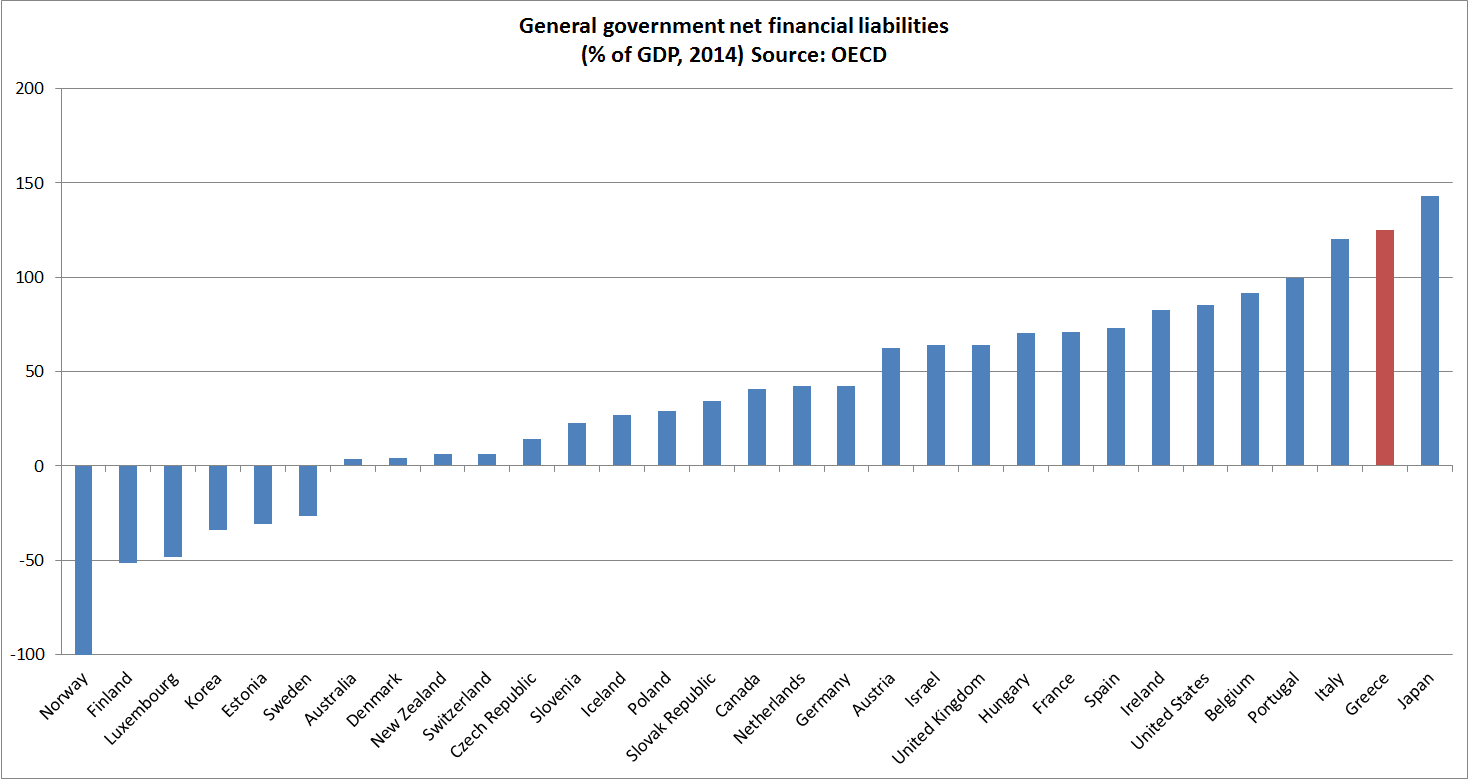
What about the Greek debt?  Yes, it is certainly high.  On the broadest measure I could find – the OECD’s series of general government net financial liabilities – Greece had debt of around 125 per cent of (vastly reduced, and surely not permanently lower) GDP last year.  That was less debt than Japan had, and only slightly more than Italy.   Portugal is not that far behind, with net financial liabilities of around 100 per cent of GDP.  Belgium had a debt level similar to Greece’s for much of the 1990s, when world real interest rates were much higher than they are now.  Historically, the UK and the US emerged from wars with much higher debt levels.  But, nearer to home, New Zealand and Australia spent the 50 years prior to World War Two with far higher levels of public (and external) debt.  There were modest defaults and creditor remissions during the Great Depression, but the bulk of the debt was successfully serviced by the citizens of our two countries.
greece

And Greece has already achieved substantial reductions, and deferrals, in its debt servicing burden.  Interest payments on its government debt (mostly non-market debt now) are less than those facing Italy and Portugal, and not much above those of Ireland.  Sovereign debt service is largely a sovereign choice.  Markets haven’t been willing to lend much, and for term, to Greece for the last five years, no doubt taking a view on the choices Greece was likely (again) to make.

I’m not suggesting that Greece shouldn’t default[1], but the much more important issue is competitiveness – the ability to achieve growth in the real and nominal economy.  With nominal GDP at 2008 levels, all else equal, Greece, would have debt ratios not much higher than those of the United States.  For decades, the ability to devalue one’s currency has been seen as the least costly (there are no no-cost options) way to put an economy back on a path to export-oriented growth in demand.  That option was given up by countries adopting the euro, without seriously considering their ability to cope with severe shocks.  The political imperatives of European unity –  and in Greece’s case of being fully part of modern democratic Europe, only 25 years on from a brutal military dictatorship –  seemed to override all other considerations, and the little-considered tail risks.

But now, contemplate the horror of Greece.  Output losses match those seen in the worst-performing countries of the Great Depression.  The unemployment rate is ruinous.  And even before the election of SYRIZA, there was little or no sign of any sort of rapid recovery.  Some competitiveness indicators were looking better, but the bottom line was the willingness of firms to invest and there was  little sign last year of the private sector champing at the bit to invest heavily in tradable sectors.  Greece’s difficulties were only compounded by the troubles (and falling currency) of its largest trading partner, Russia.  No doubt many of the micro reforms being proposed by the Troika were sensible, and even necessary, but they didn’t address the more immediate issue, of a catastrophic failure of demand.  Greece cannot adjust its nominal exchange rate, and it cannot adjust its nominal interest rate, even though much lower real interest rates and real exchange rates would have been a standard prescription for any other country in such a difficult position.  Further debt relief –  even if it were politically feasible for the rest of Europe –  doesn’t materially improve Greece’s competitiveness position or ability to materially boost demand.

Exit from the euro area will be difficult for Greece.  Greek public opinion has wanted to stay in the euro.  But Greek public opinion also recoils at the output and employment losses.  The latter are only worsening as the degree of confidence around Greece’s position in the euro deteriorates.  Only a very brave person would invest in Greece now, with such extreme uncertainty about the transitions over the next year or two.  But experience suggests that after a rocky period over the first year or so out of the euro, and perhaps many long-running law suits, a substantial real depreciation would be likely to put Greece on a much stronger path.

What of the rest of the euro area?  Relative to 2010, Europe is much better placed to deal with the short-term ramifications of a Greek default and exit.  Very little of the Greek debt is held by private banking institutions in the rest of Europe, and the connections between the Greek banking system and the private banking systems and those of the rest of Europe are also much weaker.

But that is about the very short-term.  What seems somewhat underplayed is the risk –  the likelihood in my view –  that a Greek exit would be like punching the first hole in the dike.  Before long, the pressures that would build up – political pressures and then market pressures would become increasingly irresistible.  The poorer members of the EU are the ones most resisting concessions to Greece.  Why?  Because concessions to Greece will only feed domestic sentiment along the lines of “and why not us too”.    Tyler Cowen highlighted little Slovenia yesterday.  But what of Spain, where the radical Podemos party has already been leading the polls.  Or France, where Martine Le Pen’s Eurosceptic National Front looms.  And that is before anyone has broken out.  What if, a year down the track, signs of recovery were becoming apparent in Greece?  Why not us, populist movements in countries with severe unemployment such as Spain or Portugal might ask?  And what of German citizens, many of whom never regarded the euro as offering anything much to them.  A comprehensive Greek default will mean default on Greece’s huge debts to the ECB, through the TARGET clearing and settlement system.  Germany is the largest European economy, and holds the largest claims on the ECB, and will face very large losses.    The backlash is unlikely to be pretty, or easy for the government to manage.

There was a strong “end of history” sense to narratives around the creation of the euro:   time’s winged arrow going only in one direction, to a union indissoluble and irrevocable.  Despite the rhetoric, that was never very likely. The euro has been in place for 16 years – a reasonable run by the standards of modern currency regimes.  Bretton Woods didn’t last much longer, in its various forms.  Successor regimes – and those in the decades prior to World War Two – lasted for much shorter periods.  The euro was an ambitious vision, but time has proved it to be deeply flawed.  The growth record been almost inconceivably bad –  far worse in the euro area than in the rest of the advanced world.  Of course, not all of those poor outcomes can be put down to the euro, but in many countries the chaos of the last decade is a direct result of that choice.  The increasing risk is that the backlash to this grand experiment will jeopardise much that was relatively good in the wider EU project  –  opening and integrating (even if over-regulating) goods and services and factor markets.  No wonder the euro-area and EU elites are so desperate now.  They are looking into the abyss.

UPDATE: I largely agree with this piece by Ashoka Mody, who suggests the IMF should write off its Greek debt.  Perhaps, but it won’t happen.  Preferred creditor status doesn’t exist in law, but in practice it is very strong.  Perhaps France and Germany should pay the IMF debt for Greece –  since they were the main beneficiaries of the 2010 package –  but that is not going to happen either.  Outcomes would be very difficult if there were some deus ex machina. pulling strings and coordinating all the moving pieces.  But God doesn’t typically do macroeconomic management/

[1] Although my prediction is that in the end the debt to the IMF will be paid in full, even if arrears build up for a time.

Past time to start reversing OCR increases

Today’s CPI numbers must surely kick one of the last few remaining supports out from under the Reserve Bank’s view of inflation and monetary policy.  Yes, the headline number was slightly less low than they had forecast. But the real issue here isn’t about actual inflation vs the projections of a few weeks ago, but about the underlying picture of inflation.

Ever since the end of the 2008/09 recession, the Bank has been telling us that inflation was going to pick up again.  And it did briefly, as in quite a few other advanced countries.  New Zealand’s non-tradables inflation (ex GST) got up to around 3 per cent in 2011.  Like New Zealand, a wide range of other OECD countries (although not the US or UK) actually raised policy interest rates in 2010/11.  With hindsight it was unnecessary, but on the evidence to hand they were probably reasonable calls at the time.

But our Reserve Bank has gone on picking that inflation would rise.  For a time it still seemed plausible, as the scale of the repair process in Christchurch after the 2010/11 earthquakes became apparent.  In fairness to the Reserve Bank, most of the local market economists have been even more convinced that inflation would rise (and more “hawkish” on policy).

But it just has not happened.   There have been isolated pockets of inflation.  Some of it was just taxes – Tariana Turia’s gift to closing the deficit in the form of repeated increases in tobacco taxes.  And construction costs did rise, especially in Christchurch.  Big real shocks typically induce relative price changes.   And there was no widespread spillover of Christchurch construction cost inflation to the rest of the economy.

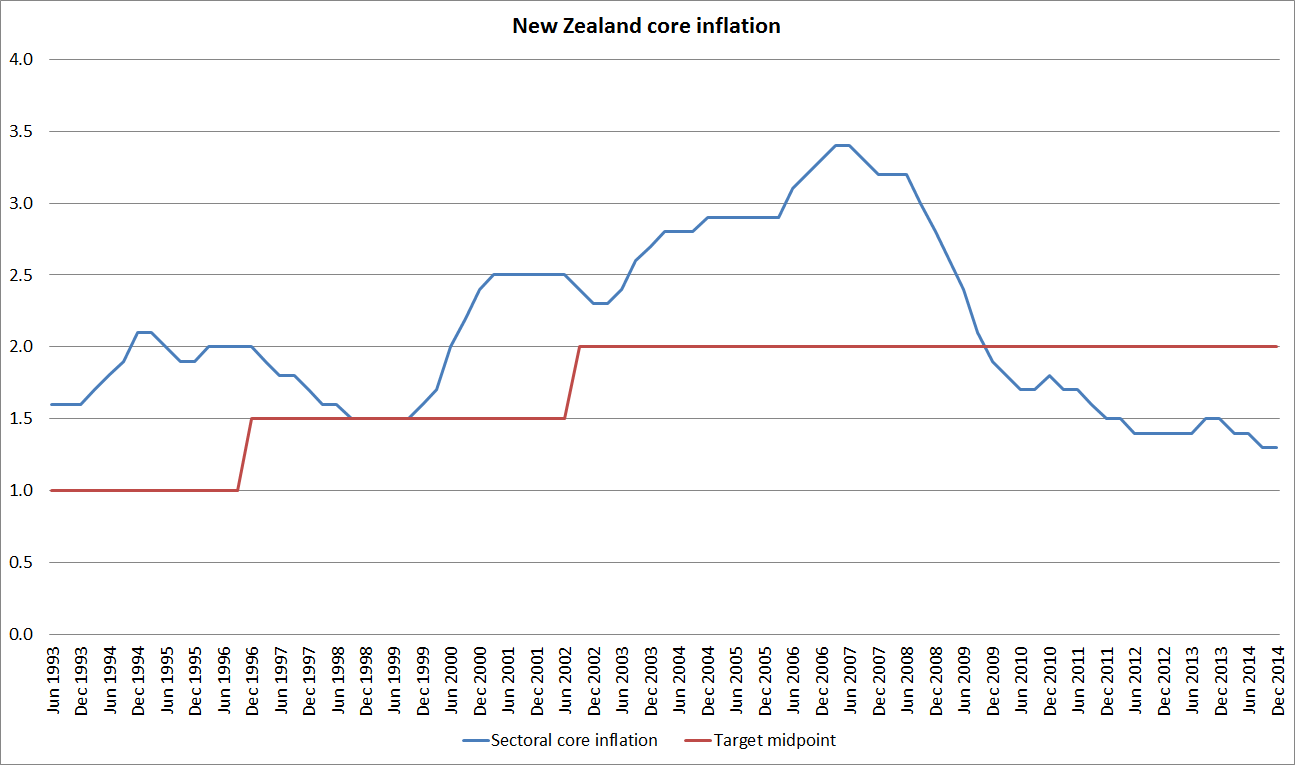
Where do we stand now?  I’m not mentioning headline inflation –  it didn’t matter much when it was nearly 5 per cent, and it doesn’t matter that much that it is currently nearly zero.  But the Reserve Bank’s best estimate of core inflation –  the sectoral factor model –  was last above 2 per cent in the year to December 2009.  It hung around 1.5 per cent for some time, and in the last couple of quarters has fallen again, and it is now around 1.3 per cent.  This is a very slow-moving series, and being that close to the bottom of the target range should be of serious concern to the Reserve Bank.

core cpi

Concern should be mounting because other core measures, while perhaps less informative (noisier), are at least as weak.  Trimmed mean inflation –  the best of the rest in my view –  was 0.6 per cent in the year to March.  That measure is constructed in a way that will have given no weight to falling petrol prices or rising cigarette prices.  I could go on.  Non-tradables should probably be around 3 per cent when overall CPI inflation is on target at 2 per cent. Non-tradables inflation got as high as 3 per cent in the year to last March as construction cost inflation picked up, but was only 2.3 per cent in the year to March 2015 –  barely above the lows reached in the depths of the recession.

Is there comfort anywhere else?  I don’t think so.  Wage inflation is showing no sign of picking up, inflation expectations are likely to keep falling, and a high exchange rate can’t even really be blamed for low headline inflation –  the exchange rate in recent months has been lower than (certainly no higher than) it was early last year.

Inflation globally is weak.    Commodity prices are falling.  Growth in China –  the largest component in global growth in recent years –  is weakening.  And although there is still a lot of building activity going on in Christchurch there is little sign of pressure on resources (or inflation) getting more intense  there.  It is very difficult to see core inflation rising from here, on anything like current policy.

The case for OCR increases last year was always weak, but it was within a range of plausible outcomes.  But time showed that those increases were unnecessary, and the Bank has gradually abandoned the plans the Governor had talked about of raising the OCR by 200 basis points.   What isn’t clear is why the Bank won’t now reverse the unnecessary OCR increases.  Inflation is well below target, and has repeatedly surprised on the low side.  Unemployment is still above any reasonable sense of a NAIRU,  the recovery has not been strong by historical standards, and the Bank repeatedly anguishes in its policy statements about an overvalued exchange rate.

No one knows the future, and even forecasts of the near-future should be held rather lightly.  But when (Bank and market economist) forecasts have been consistently wrong, there is a strong case for looking out the window and reacting to what we see now.  And what we see is low and falling inflation, subdued credit growth, quite-high unemployment, and a troublingly high exchange rate.  House price inflation is certainly higher than most would like, but the Governor told us at the March Monetary Policy Statement that house prices were not a particular factor in his recent interest rate decisions.

Most other advanced and emerging countries have been cutting policy rates in the last year.  Today’s inflation number is further evidence that New Zealand should join them.     A strict inflation targeter would (if there were any such) but a flexible one certainly now should be.

The Herald on housing and history

First, welcome to those readers who’ve come here today as a result of Tyler Cowen’s brief mention on Marginal Revolution.  I’ve set out something of my background, and what I’m trying to do, here.  My focus tends to be on New Zealand issues – macro and micro – but I’ll also be offering some perspectives on international issues, especially around inflation targeting, financial regulation, and the euro.

Last week, my old boss Grant Spencer, Deputy Governor of the Reserve Bank, gave a speech outlining his view of what needed to be done about the New Zealand housing market.  National house prices are high, and rising, but the house price inflation is now mostly a phenomenon of our largest city, Auckland . I was quite critical of a number of aspects of the speech, and commented here, here, and outlined my own perspective on New Zealand policy here.  My main criticism of the speech was the absence of any serious analysis on the scale and nature of the financial stability risks it is asserted that New Zealand faces.

New Zealand’s biggest-circulation daily newspaper, the Auckland-based New Zealand Herald has given Spencer’s speech considerable, and almost entirely favourable, coverage, with both an editorial and political and business columnists weighing in in support.   The Reserve Bank might be a little embarrassed by some of the support.

The Herald’s political correspondent John Armstrong began his Saturday column asserting that “the overheated Auckland property market makes the South Seas Bubble of the 1700s look like an exercise in financial probity”.  As Charles Kindleberger wrote in his classic account of Manias, Panics, and Crashes, “Some bubbles are swindles, some are not. … The South Seas Bubble was a swindle”.  In a more litigious society, the local banks might this morning be consulting their lawyers on this preposterous claim, and the associated slur on the banks’ lending practices and standards.  As a reminder, the stock of loans to households is growing at around 5 per cent per annum (as it total Private Sector Credit), while nominal GDP can be expected to grow at around 4.5 per cent.  There has been no growth in household debt/disposable income, or in private sector credit/GDP since 2007.  There is simply no evidence of widespread poor quality lending practices – and neither Armstrong, nor the Reserve Bank, has provided evidence to the contrary.  That is a very different  than the US position towards the end of its housing boom, which I discussed last week.

Fran O’Sullivan has been writing about New Zealand business, economics and politics for decades.  In her weekend column on Spencer’s speech (under the sub-heading “Failure to heed Reserve Bank’s words on possible crisis plain irresponsible”) she reaches back into New Zealand history, and the lead-up to the large exchange rate devaluation in 1984, which acted as the trigger for the wave of reforms adopted in New Zealand over the following decade.  O’Sullivan adopts unquestioningly  the Bank’s talk of potential crisis and threats to financial and economic stability, and draws parallels with the advice provided by the Reserve Bank and Treasury to the then Minister of Finance in the early 1980s to devalue the exchange rate.

The Bank’s then Deputy Governor, Rod Deane, had been at the forefront of the analysis and advice provided to Robert Muldoon, then Minister of Finance and Prime Minister.  Deane was probably the greatest figure in the history of the Reserve Bank of New Zealand, building up its policy and research capabilities and giving it voice and influence within Wellington official circles.  His legacy at the Bank lasted for many years.

In the early 1980s Deane paid a high price for the courageous analysis and advice that he was primarily responsible for:  Muldoon refused to appoint him as Governor.  The Bank at the time generated a lot of practically-oriented research and analysis, and had done a lot of work not just about how to end New Zealand’s lamentable inflation record, but also about how to restructure and reform the New Zealand economy, with a focus on the macroeconomic dimensions of those issues.    There was a generally shared view among the economic elites at the time that a much lower real exchange rate was likely to be an essential part of rebalancing the New Zealand economy, and putting it on a path in which the growing external debt and the decline in New Zealand’s relative living standards could begin to be reversed.

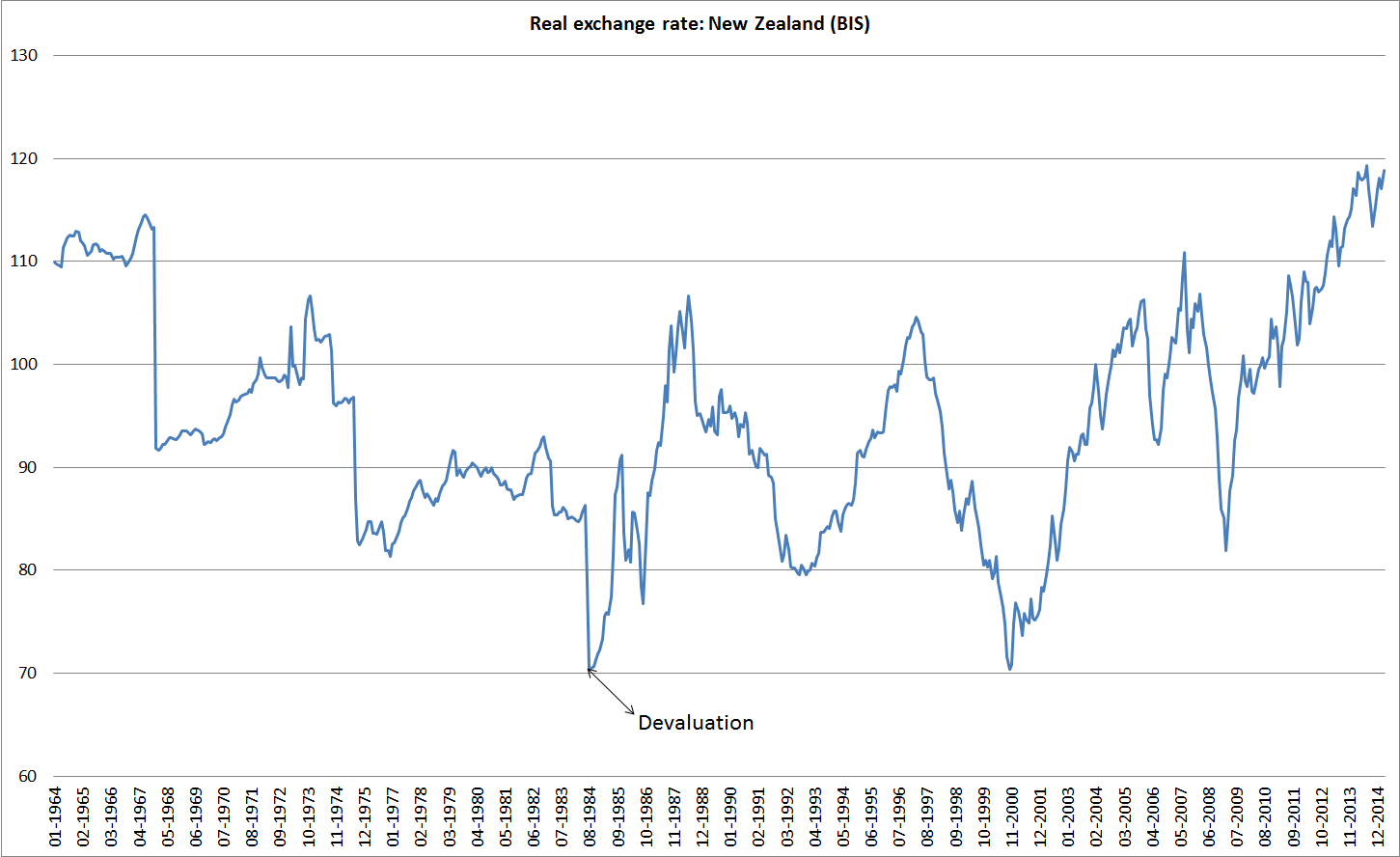
As New Zealand readers know, New Zealand was forced into a 20 per cent devaluation in July 1984 – the timing was “forced” by a combination of interest rate controls and a growing conviction that the likely new government wanted to devalue anyway.  Among elite bureaucratic circles there was a strong sense that the devaluation was a first step to rebalancing the economy and re-stimulating the tradables sectors.  I was a first year graduate at the time, sent along on occasion to take minutes of meetings of key figures in the Reserve Bank and Treasury: there was a very strong sense that the biggest macroeconomic policy challenge was to “cement in” the new lower real exchange rate.  There was no discussion around the possibility that the new lower real exchange rate might not prove to be sustainable.

And yet here is the chart of the New Zealand’s real exchange rate (using the BIS measure, as the RB has not yet backdated their measure far enough).  The 1984 devaluation certainly stands out, but not as some turning point in New Zealand’s competitiveness.   Rather it stands out as a level only once reached  again –  and then very briefly – in the subsequent 30 years.

1984

In short, they were wrong.  Not wrong, in my view, about the longer-term challenges. I’ve argued that the failure of the real exchange rate to move sustainably lower, to reflect long-term adverse productivity growth differentials, is a key proximate marker (please note that I did not use “cause”) of what has gone wrong with New Zealand’s economy over the long term.  But real exchange rate can’t be adjusted, by ministers and senior officials, in a vacuum.  I have the utmost regard for people like Rod Deane, and some of his Treasury counterparts.  But on this issue – where Fran O’Sullivan lauds them as heroically correct – they were simply wrong, or incomplete in their analysis of what achieving a sustainably lower real exchange rate would require.  And that despite a lot of expert analysis and research, laid out in books, and discussion papers, and Bulletin articles.  The limitations of knowledge we all face – great figures like Rod Deane not much less than the rest of us – seems to get continually swept under the carpet.

As I pointed out the other day, I’m not remotely relaxed about Auckland property prices. They are a social and political scandal.  But they look like the rational outcome of a misguided set of central and local government policies (supply and land use restrictions, combined with high trend target levels of non-citizen immigration).  No one knows when, or even if, such policies will be changed.

But the weight that should be given to the Reserve Bank’s arguments around housing depends on its claim that financial stability is being materially jeopardised.   New Zealand banks have high levels of capital, and are subject to high minimum risk weights on housing loans.  The Reserve Bank’s own stress tests suggest a high degree of resilience at present, even if house prices were to fall sharply in Auckland (they have been falling in various  other places in the country).  If the Reserve Bank really believes there is a growing risk of financial crisis, they should set out their analysis and evidence.  A good start might be to answer the question as to whether there has ever been a systemic financial crisis in a system where the stock of credit has been growing at only around 5 per cent per annum, and at growth rates than haven’t exceeded average nominal GDP growth for a number of years.  Perhaps there are such cases – the Reserve Bank has more resources than I do, and should be able to lay them out for us.     In the meantime, John Key and Bill English might usefully set the Bank’s warnings to one side (while still thinking hard about housing supply and immigration issues) and perhaps have a quiet word with the Bank’s Board about their performance monitoring of the Governor and his team.

UPDATE: A nice piece from Oliver Hartwich on the importance of expectations.  Of course, this is true not just of possible housing supply responsiveness reforms such as those he (and I for that matter) would favour, but of any changes in migration targets, or (indeed) complex tax regime changes as well.

Spring time at the IMF, and Greece

This weekend is the Spring Meetings for the IMF and the World Bank (just “Springs” to the insiders, to match “Annuals”, the October Annual Meetings of the Governors of the Fund and the Bank.  The Spring Meetings are always held in Washington, the location (for the time being) of the headquarters of the two Bretton Woods institutions, whereas every three years the Annual Meetings venture abroad at great expense (and presumably perceived prestige) to the host city, and great expense and inconvenience to the institutions themselves.   For anyone who wants a flavour of the Annual Meetings, Liaquat Ahamed (author of Lords of Finance) captured them rather well in a chapter in his recent book-length portraits of the IMF, Money and Tough Love.  My memories of the Dubai Annual Meetings included potential protestors being allocated a bare paddock where no one could see or hear them, and security forces who reproved me sternly for daring to get some fresh air by walking between the convention centre and the (next door) hotel.

The main formal events at the Spring Meetings are the meetings of the International Monetary and Financial Committee (IMFC), which the IMF website describes as follows:

The IMFC advises and reports to the IMF Board of Governors on the supervision and management of the international monetary and financial system, including on responses to unfolding events that may disrupt the system.

and its development-focused counterpart, the Development Committee.

Membership of these committees largely mirrors the respective Executive Boards that govern the IMF and World Bank on a day-to-day basis.  New Zealand is part of a multi-country constituency, and is “represented” by either the Australian Treasurer or the Korean Minister of Finance.   Representation is a bit notional, both because whichever Minister is in the chair is mainly concerned about his or her own domestic political interests, and New Zealand’s leverage is typically very small.  And these are ritualised, largely formulaic, meetings anyway.  Communiques emerge from them, which – while hard fought at times – rarely have anything of substance to them.  Real decisions are made in other fora –  e.g. G7 Finance Ministers meetings, and in bilateral negotiations among key countries.

So why do people bother with Springs?  A bit like the Annual Meetings, the formal meetings are much less important than the informal ones –  the networking opportunities (especially at the Annuals), the meetings of smaller groups of similar countries, and the opportunities for one-on-one meetings with other countries’ ministers or senior officials, or with IMF/World Bank senior staff themselves.  Constituency countries get together, often over a drink. Personal contacts and relationships matter.  New Zealand has been rather spasmodic in its attendance at Spring Meetings, (although the Minister of Finance usually attends Annuals) –  in my two years as an alternate Executive Director on the IMF Board, New Zealand sent an Acting Deputy Secretary of the Treasury one year, and no one the other year.  That seemed a wise use of resources, although when John Whitehead held the Executive Director role on the World Bank – probably the last time New Zealand will ever hold the top position – attendance was stepped up considerably.

No doubt over the weekend there will be lots of discussion of the faltering world economy.  I suspect Greece will get a lot of mention in the corridors, but rather less at the top table.  The overdue Greek exit from the euro is looking increasingly certain – I’m even beginning to think I might win a modest wager entered into 3 years ago with someone rather closer to the process, that at least one country will have left the euro by June 2015.

But I suspect what won’t be discussed –  at the top table, or in corridors –  is the failure of the IMF around Greece and the euro more generally.  Not that the IMF can be blamed for the choices the Greeks and other Europeans made to let Greece into the euro, let alone for the choices that the Greeks have made over the years.  But one of the key roles of the IMF is “surveillance” –  free and frank analysis and advice on the risks and pressure points in system, as they affect individual countries, and the world economy as a whole.  If there is a global public good to the IMF (and I’ve questioned that), it has to be in its willingness to ask hard questions, to push analysis where current politicians don’t want to pushed, to prod and probe even when no one else in much interested in doing so.  And in bringing to bear the perspectives of experience – past economic and financial history, and the ongoing experiences of its large membership.

But the IMF was for too long largely supine around the euro, and about what has become its key pressure point/vulnerability.  The institution was both uniquely well-placed, and uniquely compromised, when it came to dealing with Europe.  Managing Directors of the Fund have always been from European countries – most recently, former politicians from those countries.  Compared to the emerging and developing countries the Fund often had to deal with, the data in European countries are pretty good, and many of the Fund’s own staff are European – and others have trained in European universities.  And yet the Fund said almost nothing seriously critical of the great euro experiment.  Oh, don’t get me wrong, they devoted acres of text to technocratic issues around the fiscal provisions of Maastricht.  But so strong did the institutional belief appear to be in the end being pursued that serious questioning and stress-testing was discouraged and silence was the order of the decade.   I’m not aware of anything that the Fund produced in the decade prior to the crisis that pointed to the sorts of stresses the system has experienced, stresses that have had catastrophic consequences already for ordinary Europeans, and the potential to get worse.  No doubt euro-area ministers of finance didn’t want the IMF – in which they had a pretty dominant place (both voting shares, and seats on the Executive Board) – asking awkward questions.  Managing Directors came from that same environment, and often wanted to get back to it.  In the short-term no one had an interest in asking the hard questions, and so no one did.  I’m sure some of the very able staff were uneasy and may have profound insights to offer, but they had careers to pursue, and the more able ones on systemic risk probably didn’t relish the prospect of an assignment as Resident Representative in Monrovia (or some less stark shuffle sideways at HQ).

And so the question needs to be asked, what value did the IMF add in the process?  Come 2010, the IMF then put itself at the disposal of European governments, who wanted to kick the crisis down the track (“a crisis might still happen tomorrow, but at least we avoid the certainty of one today”), compromising and relaxing yet again its own rules, to put more money into a country where the prospects of success, on the strategy adopted, were always modest.  Of course, one can’t just blame the Europeans.  The US was as keen as anyone to avoid immediate stresses, and even countries and constituencies like our own were unwilling to go out on a limb and openly question what was being done with our citizens’ money, and whether the emperor had any clothes at all.

I don’t lay claim to having been overly prescient about how the European situation would play out.  I was always a bit of a sceptic, as many Anglos were.  But while I sat on the Fund Board – with, to be honest, not that much to do –  I did take the chance to ask a few questions, and make a few observations, at the Board, about both Greece, and the euro-area itself.  I discovered recently that all these statements are available on the IMF’s archives website.  I think what disconcerted me most at the time (around 2003) was the way the euro was presented as something akin to the end of history, rather than being a new and rather bold experiment – a large scale currency union among advanced democracies, with no fiscal union or political union.   Bold experiments inevitably involve risks and stress points.   Staff, no doubt acting in their own perceived interests and as they often did, mostly ignored my questions.  European directors loudly harrumphed and suggested that it was simply wrong and inappropriate to raise such questions.

To his credit, one (a hugely impressive former academic) came to me afterwards and observed something along the lines of “well, of course you are quite right, but we can’t be seen to be saying that.”    Today he is Finance Minister of a struggling euro-area economy.  I’d wager that there won’t be a euro-area for his country to be a member of five years from now.

The IMF, its Board, its Governors, and the IMFC, are likely to pass over the failures around the euro in silence.  Perhaps in time the Fund’s Independent Evaluation Office will produce a good report on the subject, but when so many entrenched interests have so much at stake it is difficult to be optimistic even on that score.