Productivity failure: Treasury clearly has the wrong model

In various commentaries on yesterday’s GDP data, I saw suggestions that the revisions to recent years’ data suggested that the New Zealand economy had been growing “strongly” in recent years.

As context for that observation, and perhaps shedding a bit of light on the sadly diminished expectations that appear to have taken hold in New Zealand, consider this chart, of real GDP per capita growth.

real GDP aapc 18

After a deep and quite long recession, the peaks in growth in per capita real GDP were a pale shadow of what had been achieved in the previous two economic cycles.   2 per cent annual per capita growth over the long-term would be a reasonably impressive result, but when the growth rate peaks at 2 per cent, and recessions come along every decade or so, it is no more than mediocre at best.  For the last couple of years  (these are annual average numbers) per capita growth has been at levels only previously experienced –  last 25 years –  on the eve of a recession.

But my main interest in yesterday’s numbers was the productivity estimates derived from them.  As I’ve been pointing out for a couple of years now, there has been next to no productivity growth at all in New Zealand for some years.  But in making that observation one is always somewhat at the mercy of the major annual SNZ data revisions.  Sometimes what looked to be in the data gets revised away completely.

How about labour productivity?  Recall that SNZ does not publish economywide productivity estimates –  there is no obvious reason why, when their Australian and British peers do –  so I’ve calculated one, using an average of the two measures of GDP (production and expenditure) and the two measures of hours (QES and HLFS).   And this is the resulting chart.

real GDP phw dec 18

No labour productivity growth at all for the last three years, and a total of 1 per cent productivity growth in the past six years.  Productivity growth under the previous Labour government wasn’t spectacular, but in the six years to the end of 2007 (just prior to the recession) we managed 8 per cent productivity growth.  But only 1 per cent this time round.    It is dreadfully bad, and there are no acceptable excuses.  You’ll hear people talk about global productivity growth slowdowns, and that is true to some extent, but it is largely irrelevant here, given that we start so far behind the leading OECD countries –  those at or near the productivity frontiers.   We have so much room to catch-up, and yet if anything again we’ve been drifting further behind.

Sadly there is little prospect of much change for the better.    Neither the previous government nor the current one appear to take New Zealand’s appalling productivity record seriously, in the sense of doing anything much about it, or even commissioning expert analysis and advice (reluctant as I’d be to suggest another “working group”).   And in a sense they’ve been accommodated in that stance by their self-proclaimed lead economic advisers, The Treasury.   Treasury publishes their HYEFU forecasts each December and buried in the supporting tables are forecasts for labour productivity growth (on an hours basis).    I could only find those tables back for the last five years, but here is what they have been forecasting (I’ve shown the four complete forecast years for each set of projections).

HYEFU forecasts for labour productivity growth published in Dec
Forecasts for June yrs 2014 2015 2016 2017 2018
2016 2.2
2017 1.6 1.6
2018 1.1 2.1 2
2019 1.2 0.8 1.5 2
2020 0.7 1.3 1.7 1.1
2021 1.4 1.5 1.2
2022 1.3 1.2
2023 1.2

They seem to have become quite a bit more pessimistic about the medium-term outlook in their latest forecast, but they are still picking almost 5 per cent labour productivity growth in the next four years, when over the last four years we’ve had almost none.   Look at the first column in the table done at the end of 2014: Treasury was actually expecting quite strong productivity growth over that period.  It is pretty clear that they simply do not understand what is going on, and do not have even roughly the right model.  Their productivity projections are wrong, in material ways, year after year.   And if they might be getting a little less unrealistic in the latest set of forecasts, that is small consolation because there is no sign they are offering advice to the government that might turn around the disastrous underperformance.   Too busy with the feel-good “wellbeing Budget” perhaps?

It has been another poor year for New Zealanders at the hands of our policymakers and their lead advisors:

  • no serious action to address and reverse the house price disaster that successive governments have been inflicting on us now for 25+ years (house and land prices up again),
  • no action at all to address the decades-long productivity growth underperformance (particularly bad over the last few years) that now sees a country once among the most productive in the world languishing in the league tables among former eastern bloc states, far far behind our former peers among the leading group of OECD countries,
  • and no sign that either the government or the Opposition really care,
  • or that our Treasury really understands at all the factors that explain the utter (and ongoing) productivity failure.

Governments, of course, don’t create productivity.  But they can and do put roadblocks in the path, often initially unwittingly.    But over time every such roadblock comes with own vested interests.    There is the old line from Upton Sinclair about

“It is difficult to get a man to understand something, when his salary depends on his not understanding it.”

Perhaps that explains the resistance of many in the business community to the changes that are needed.   It can’t explain Treasury’s failure.  I suspect that for them, and perhaps for many of our politicians, it is more a matter of ideological commitments, and an unwillingness to shine the light on the issues and policies that really matter if we care at all about lifting economic performance for our fellow New Zealanders.

Whatever the explanation, it is well past time for a change of heart, and for beginning again to take seriously finally reversing the decades of (relative) failure.


The PRC, the Pacific, and New Zealand

Our Minister of Foreign Affairs and Deputy Prime Minister gave an interesting speech in Washington last weekend.  It was a bit saccharine and ahistorical (past rivalries over various Pacific island and atolls anyone?) for my tastes, but the overall thrust –  urging the United States to be more active in the (south?) Pacific  – wasn’t something I much disagreed with.

The People’s Republic of China wasn’t named as a threat, but it didn’t take a genius to see the connection.  I remain somewhat sceptical that simply offering bigger “bribes” (call it development assistance if you want) is any way to build a more resilient Pacific in the medium-term.  That has to come down to values, domestic accountability (hardly likely to be fostered when lots of money is in play) and a recognition of the fundamentally evil, and corrosive, nature of the PRC regime –  whose values are as antithetical to most ordinary Pacific people, just as much as they are to most ordinary New Zealanders.   The short-sightedness (and greed?) of too many officeholders in Pacific countries is a formidable obstacle, their vanity flattered (for example) by invites to Beijing, even to meet Xi Jinping himself, whether or not their own pockets are lined.  These are mostly Christian countries, and yet when the Foreign Minister talked about the Pacific the other day there was nothing about values, nothing (for example) about freedom of religion, at time when the Beijing regime is intensifying its repression and persecution of Muslims and of Christians.   The sort of thing that would horrify most decent people (here or in the Pacific) if they knew –  as, for example, Kristallnacht did 80 years ago.  Values, not competitive aid bidding, drive societal choices in the longer term.

To the extent the speech had much attention at all locally –  which is hardly at all (has there been any thoughtful commentary from international affairs or Pacific specialists?) –  it has been on the extraordinary statement by the Prime Minister that she had not seen the speech before it was given.    It looked a lot like a significant foreign policy initiative, and yet it appeared not to have been discussed by the Cabinet. If anyone wanted evidence for Chris Trotter’s suggestion that the Prime Minister was in office but not in power, more decorative than substantive, it was hard to imagine a better example.  It looks like yet another example where there is a New Zealand First policy in some foreign affairs matter, but not necessarily a stance shared by the biggest party in government Labour.   After all, in her post-Cabinet press conference (link above) the Prime Minister was hardly offering a ringing endorsement of her Foreign Minister’s stance.   For practical purposes, they can probably both agree on flinging a bit of money around, with not much accountability, but perhaps not much beyond that.

And even if they happened to (more or less) agree on the Pacific –  and what will it come to anyway, in a US led by an inconstant troubled President, and with increasingly serious fiscal problems of its own? –  one area where Labour and New Zealand First must agree in practice is on doing and saying quite as little as possible about the PRC influence activities in New Zealand.  Some months ago, Winston Peters did make some cryptic remarks about how “something would be done” about Jian Yang, but it wasn’t clear if he meant anything then and (of course) it has come to nothing since (the Minister of Foreign Affairs doesn’t have much say over an Opposition MP).     Both seem more embarrassed by, than admiring of, Anne-Marie Brady –  in her case, it is hard not to reach the conclusion that the government (Parliament as a whole in fact) would much prefer that she went away and shut up, and stopped raising awkward questions.   Neither has been willing to call out the PRC over the Xinjiang internment camps –  not even joining with many of old friends when they got together to make representations.  They wouldn’t even speak up when National’s Todd McClay was parroting Beijing’s talking points about “vocational training centres” or –  in a country with still more self-identified Christians than any other faith –  about the renewed persecutions of the Chinese churches.  They seem quite unbothered about allowing such a heinous regime to put (safely vetted for political and religous “soundness”) agents of the PRC –  nice and friendly as they may be individually –  in our kids’ schools.  And has a word been heard from the Prime Minister or the Minister of Foreign Affairs about the PRC’s abductions of Canadians in China?  Do we stand with our friends, our values?  Or do we just cower before the PRC?  Peters and Ardern (and Bridges and Shaw) show all the signs of the latter approach.

So they fling all the money they like around the Pacific.  Perhaps if they do so Mike Pence and Mike Pompeo will take them a bit more seriously.  But unless they are willing to start taking seriously the issues here at home –  and there is not a shred of evidence for any such change of heart –  it isn’t clear why any of us should take them as seriously worthy of the offices they hold.  Through some mix of fear, delusion, mendicancy (all those party donations) they’ve taken our values, our traditions, and prostituted them on some CCP altar.  Egged on –  if anything more enthusiastically –  by the National Party.

If they were ever interested in beginning to get serious, political donations might be a place to start.   And on that score, I was interested to listen to outgoing National MP Chris Finalyson’s valedictory address.   I’ve never been a great fan of Finlayson – a classic example of what is wrong with MMP, never having had to actually win an election or persuade people to vote for him –  but my view of him took a steep dive at the Rongotai candidates’ meeting last year (Finlayson was the token National Party candidate).   From the floor I asked him

“Mr Finlayson, last week one of the world’s leading newspapers, the Financial Times gave considerable prominence to a story about a New Zealand MP.  That MP had been a member of the Chinese communist party, and part of the Chinese intelligence services.  He never disclosed that past to the public when he stood for Parliament, and has never taken the opportunity to denounce the evils of the Chinese regime.  Can you comment on why it is appropriate for such a person to be in our Parliament?  And could you also comment on the new paper by Professor Anne-Marie Brady raising concerns about the extent of China’s attempts to exert political influence in New Zealand, and about the close ties of various senior National Party figures with Chinese interests?”

The question was greeted not with embarrassed silence, but with pretty vigorous applause from the floor.

Finlayson –  our Attorney-General, first law officer of the land, senior National Party minister  – got up, briefly.   His answer ran roughly as follows:

“That was a Newsroom article, timed to damage the man politically.  I’m not going to respond to any of the allegations that have been made about/against him. I think it is disgraceful that a whole class of people have been singled out for racial abuse.  As for Professor Brady, I don’t think she likes any foreigners at all.”

The man dishonoured the high offices he held.   But, somewhat to my surprise, in his valedictory address, Finlayson included these remarks.

That’s why I think both major parties need to work together to review the rules relating to funding. I have a personal view that it should be illegal for non-nationals to donate to our political parties. Our political system belongs to New Zealanders, and I don’t like the idea of foreigners funding it. Similar concerns are now starting to be raised in other jurisdictions, and we need to work together, without recrimination, to ensure that our democracy remains our democracy”.

It is, mostly, illegal for non-nationals to donate material sums to our political parties.  I’d be happy to ban such donations completely, including those anonymous donations from abroad through the guise of charity auctions, of the sort Phil Goff funded his mayoral campaign with.    But, of course, many of the concerns serious people have about political donations –  in Australia, as well as in New Zealand –  do not relate to donations by non-nationals, but to donations by people born abroad who have become citizens, and yet retain close associations with reprehensible regimes in their country of birth (bluntly, the PRC).  I’m sceptical much can be done by law about that particular issue.  It requires political party leaders –  individually or together – to decide that there are some people they simply won’t take donations from at all.    There was a considerable fuss some years ago about the Exclusive Brethren.  No respectable party would take donations from known gang leaders or those strongly suspected of involvement in organised crime.  It shouldn’t be hard –  in a decent leader –  to make the moral choice that your party will take no donations from people with known (or strongly suspected) United Front associations.  It is what decent people would do, recognising the character of the PRC regime.

So, interesting as it was that Finlayson chose to raise the issue at all, his interjection barely scratched the surface of the issue.   But it was a (small) start from a figure who has enjoyed credibility in many circles.   Perhaps he could consider urging candidates in this year’s local body elections to commit to (a) take no donations (including through anonymous charity auctions) from non-New Zealand citizens, and (b) to take no donations even from citizens if those citizens have, or are strongly suspected to have, close ties with entities supporting highly repressive regimes in other countries.   Would it make any difference?  Probably not –  money can still be channelled less directly –  but it would be a signal to New Zealanders that their officeholders (and those bidding to take their place) took seriously the issue, the concern.    At worst, it would be interesting to hear how Phil Goff would defend refusing to make such a commitment to voters.

On another aspect of the PRC influence issue, a few weeks ago I was sent a copy of a book called “In the Jaws of the Dragon: How China is Taking Over New Zealand and Australia”, by one Ron Asher.   It is a 350 page book, apparently fairly well-documented and footnoted, now on its 5th edition (and so I’m told selling quite well) making a case that…….well, it is there in the title.   From the author’s note

This book…seeks to expose the sinister goals of the Communist government of China, which has murdered tens of millions of Chinese people since it shot its way to power in 1949, denies them basic rights and is now threatening the peace of the Pacific –  and the world –  by its excessive armaments programme and its expansionist activities in the South China Sea.  Through economic domination, aggressive immigration, bullying and other means it is trying to exert a control over Australia and New Zealand that is harmful to our sovereignty, democracy, heritage and economic prospects for the future.

There was plenty of interesting material in the book, and it was useful to have it gathered in one place.  It was interesting to learn of (former National) MP Jami-Lee Ross’s paid trips to the PRC –  which left me wondering (a) how many other MPs have had such trips, and (b) why we don’t just follow the US example and ban MPs taking any material hospitality from foreign governments, friendly or potentially hostile/threatening.   There was plenty of material –  including around Confucius Institutes (this week yet another US university decided to close theirs down), Huawei, and “aid” to various Pacific countries.

And yet much of the material had me pushing back to some extent at least.   The author is much more wary of foreign investment from the PRC than I am.  To be fair, the global tide of opinion on risks around PRC corporate investment abroad is shifting –  reinforced by the PRC laws which make it clear that even private PRC companies must follow directions of the PRC authorities (party/State).   And weak capital markets disciplines in China –  especially around SOEs –  have long left me a little nervous about any material expansion in the role of PRC banks.  It would seem crazy  –  simply an unnecessary risk, given the character of the regime – to allow, for example, our electricity or telecoms network companies to be owned or controlled by PRC-friendly interest.  I hope that when a stake in the Port of Napier is sold no one will even consider a sale to PRC interests –  port acquisitions have been a significant aspect of PRC strategy abroad in recent years, perhaps benefiting the sellers but leave societies to repent at leisure.

But I’m still not persuaded the sale of dairy farms to PRC interests, or the establishment of PRC-owned milk processing plants in New Zealand represents any material sort of threat to New Zealand, or New Zealanders.    The author notes that the (PRC) buyer will reap the profits in future, including from the ability to construct integrated supply and distribution chains.  But in a land market that is even moderately competitive, much of those gains should be captured in the value of the land at the point of sale.  Within limits, it makes sense for assets to be owned by parties best able to utilise them.  That ability is likely to be reflected in a willingness to pay.   Perhaps I’m a touch naive, but some arguments still seem to go too far for my comfort and conviction.  The growing entanglement of our universities with PRC interests –  consciously making themselves exposed to PRC political pressure –  represents more of a risk, and pressure point –  the more so  when we once looked to universities to champion the sorts of values that underpinned our society (but not the PRC).

This isn’t an attempt at a full review.  For those interested in the issue though, there is plenty to chew on, whether one ends up going quite as far as the author (or not).   Perhaps the thing I came away with most was a sense of how careless of our values our political leaders have been, how indifferent to the character of the Beijing regime, and how utterly shortsighted their approach has been for decades –  whether pursuing personal gain (which I suspect mostly isn’t the reason –  it may be different for business and academic figures), party donations, or just lemming-like prioritising trade and short-term opportunities over all.

Whatever the motive, in many respects they’ve blithely, unconcernedly, sold out New Zealand and New Zealanders, dishonouring both our own freedoms and values, and those (denied) of hundreds of millions of Chinese.   But even at this point, it isn’t clear that the PRC has clout in New Zealand beyond the deference our political officeholders –  cowering –  keep choosing (and it is wholly a matter of choice, especially at this physical distance) to pay them.   Evil people –  Xi Jinping and his party and regime – will do what they will do, as Hitler or Stalin before them did.  We can’t do much about them –  hoping against hope for regime change –  but we can choose what responses we tolerate in our officeholders.    If we care at all about PRC influence in the Pacific, our officeholders might start by demonstrating that they take the issue –  the regime and its threat – seriously at home.  What matters to someone is best demonstrated by the price they are willing to pay for it.


Productivity: no relief in the hours data

What I actually wanted to write about briefly today was prompted by this story in the Financial Times a couple of weeks ago which reported on the results of OECD work suggesting that harmonising the measurement of hours worked would reduce by about half the (rather puzzling) large gap in estimated labour productivity (real GDP per hour worked) between the UK on the one hand and France (and Germany) on the other hand.

The UK’s statistical agency makes very few adjustments to self-reported estimates of people’s usual hours, but French number crunchers adjust survey responses to include holidays, sick leave, strikes and work done in the “illegal economy”.

If the figures were produced on a comparable basis it would reduce the productivity gap between the UK and France to about 10 per cent, the OECD estimates.

The OECD paper is here.  It is a pretty dry account of a worthy exercise in trying to get greater standardisation of the hours worked estimates.   For the European countries they produce indicative overall labour productivity estimates using the proposed harmonised methodology.  This is the summary chart.

oecd hours chart

The blue bars are the current official estimates, while the white dots show the OECD estimates based on the new methodology for the countries where there were material differences.   There are some pretty substantial differences: Austria and Sweden move up to join the group of countries (US, France, Belgium, Netherlands, Germany, Denmark) which I’ve characterised as the OECD top-tier (setting Norway –  with abundant oil and gas –  tax-distorted Ireland, and tiny Luxembourg to one side).   But there are non-trivial differences for a number of countries further down the scale.   These revised estimates will be used in future OECD releases of productivity (levels) statistics.

When the FT article first appeared someone got in touch and asked if this could be part of the answer in New Zealand too.  My initial response was that the productivity gaps between New Zealand and the top-tier were so large there was no credible way any issue around hours measurement was going to explain much of it.   But it nagged in the back of my mind, so earlier this week I asked Statistics New Zealand about whether the OECD work had any implications for New Zealand productivity numbers.  SNZ don’t publish economywide productivity numbers, but their data is used by the OECD, who do.

I had a prompt and very helpful reply from Statistics New Zealand (kudos on this, if not on the Census).   They had apparently been fully consulted by the OECD researchers.  They had identified a handful of issues (which look quite minor in the scheme of things) around the New Zealand data, but the bottom line was

Recent correspondence by the authors  also noted: “As mentioned previously, but worth reiterating at this juncture, the paper currently only proposes changes to the estimates in a handful of countries (not including yourselves), based on available data.” In that regard, we consider ourselves to have fared better than some other countries reviewed in the publication.

Summary: our hours worked numbers look pretty much okay by international standards.  Unlike the Brits, our very large reported labour productivity gaps aren’t going to suddenly be revised downwards from this work.

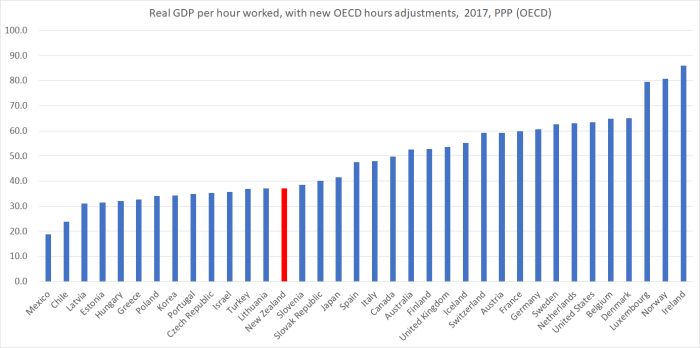
That’s a shame  (substance is what it is, but reported numbers do matter).  But perhaps more sobering is that if our labour productivity estimates aren’t changing, and those of 10 other OECD countries (more than a quarter of the OECD membership) are, then our position relative to the rest of the OECD, mostly the advanced countries, now looks worse than it was previously.   In this chart, I’ve taken the latest official OECD numbers and made adjustments to the extent indicated in the OECD paper for Lithuania, Latvia,Poland, Portugal, Greece, the UK, Austria, and Sweden.

OECD GDP phw hours adj

On these estimates Lithuania – a part of the USSR as recently as 1991 –  is now only slightly behind New Zealand, likely to shortly be the third former eastern bloc country to overtake us.   And Poland –  whose experience I wrote about here last month –  is a lot less further behind that had been thought.    Even Greece and Portugal now look less bad relative to New Zealand, while the UK, Austria and Sweden are further ahead than we’d thought.  (Australia’s relative position also deteriorates of course.)

This isn’t a competition.  It is great news that Poland and Lithuania are doing even better than we thought.  But benchmarks are useful, and our performance relative to other advanced countries is –  and now has been for decades –  lousy.   And yet our political officeholders –  I refuse to call them leaders –  do nothing, and try to either spin the data or change the subject.

As I’ve noted previously, Turkey has now also almost reached New Zealand productivity levels –  something inconceivable just a few decades ago.  It was perhaps salutary to note news reports out of the climate talkfest in Poland last week that Turkey was objecting to being grouped as a “developed country”.   Their bid failed, but that they made it all should perhaps be a prompt to think that our own self-identification as an advanced economy is no longer as secure as it was –  a product more of history, than of current economic performance.  We really aren’t now much more than an upper middle income country, and that has consequences.


Bank capital: (not) consulting with APRA

After I’d posted yesterday, a reader made this comment about an article which apparently appeared in the Australian Financial Review yesterday

I see the AFR reporting today that APRA say they were “consulted” about the RBNZ release last Friday which was the document’s release date.

That account seemed consistent with a comment I’d seen in The Australian the previous day in which APRA indicated that they would be consulting with the Reserve Bank on its proposals, but with no indication that there had been any prior consultation.  If so, that seems extraordinary.

My reader went on to ask

Is there any protocol for consultation between APRA and RBNZ on these types of regulatory issues? It seems surprising to me that the RBNZ could propose something so radical without a genuine prior discussion with the regulator of the banks who dominate the NZ financial system.

I can only endorse that second sentence.  If anything, it seems like an understatement.

There are reciprocal provisions in the New Zealand and Australian legislation (the New Zealand provision is here), but they are mostly about doing whatever possible to avoid damage to the other country’s financial system (especially in crisis resolution).  There is also an RBNZ/APRA MOU, but it is mostly about ongoing supervision of trans-Tasman banks.   There is this brief, rather minimalistic, section

Regulatory Policy Development
25. The Authorities expect to respond to requests for information on their respective national regulatory systems and inform each other about major changes, including those that have a significant bearing on the activities of Cross-border Establishments.

But not every expectation of reasonable and appropriate behaviour should need to be written down.

Searching the Reserve Bank’s consultative document for references to APRA, it seemed telling that the Bank referred a couple of times to the possibility of aligning with APRA standards around the idea (questionable) of introducing a leverage ratio, but has no discussion at all about the merits (or otherwise) of introducing new capital requirements so far in excess of those APRA imposes (requirements called “radical” by one of the ratings agencies).

And yet the risks the two countries’ banking systems are exposed to seem very similar, and much the same banking groups are involved.   And when the senior management of our Reserve Bank is pretty new to these sorts of issues, and when the Bank consciously chose to dis-establish its own risk modelling capability several years ago, it is hard not to think that the Reserve Bank would have benefited from serious consultations with APRA (at various levels of the respective organisations) even as the Governor retained the right to come to his own decision.   There is a suggestion that the Governor has a bit of chip on his shoulder about Australia and Australian banks.  Whether that is true or not, if the indications of lack of prior consultation are correct, it isn’t good enough.  But I suppose it parallels the apparent lack of any systematic advance consultation –  technical papers, seminars etc –  with people outside the Bank in New Zealand either.     It might be interesting for someone to ask them who they actually did consult with (other than (apparently) Professors Admati and Hellwig).  Even within government, how much prior consultation was there with The Treasury or the Minister of Finance?

The New Zealand legislation may, misguidedly and for the time being, give the Governor the barely-trammelled power to make these decisions, but it is important to recognise that the Reserve Bank (the Governor) neither bears the costs of these decisions (whether they work out well or not) nor gets any benefits from them.  Great power –  in a single person’s hands – and yet not much incentive to get things right.  That is a worrying combination.

After yesterday’s post, another reader sent me this line from Adam Smith

The statesman who should attempt to direct private people in what manner they ought to employ their capitals, would not only load himself with a most unnecessary attention, but assume an authority which could safely be trusted, not only to no single person, but to no council or senate whatever, and which would nowhere be so dangerous as in the hands of a man who had folly and presumption enough to fancy himself fit to exercise it.

The Wealth of Nations, , Book IV, Chapter II

The full quote is mostly about a slightly different point, but as my reader noted the final couple of lines seemed particularly apposite.


The tree god again

Some months ago the Governor of the Reserve Bank inaugurated his audacious bid to have his institution –  seen by most as a official agency created by, and accountable to, Parliament –  seen as some sort of local pagan tree god, with him (I assume) as the high priest in the cult of Tane Mahuta.  We’ve been told, by the Governor, that a people –  New Zealanders –  walked in economic darkness until finally the light dawned with the creation of the Reserve Bank.  It is pretty absurd stuff, not even backed by decent history or analysis, and one might be inclined just to ignore it, but the Governor seems serious.  In particular, he keeps returning to his claim. In fact, he was at it again –  claiming the mantle of Tane Mahuta –  yesterday with another little release that poses more questions than it offers answers (and which presumably means we’ll end the year still with no substantive speech from the Governor on anything he actually has statutory responsibility for).

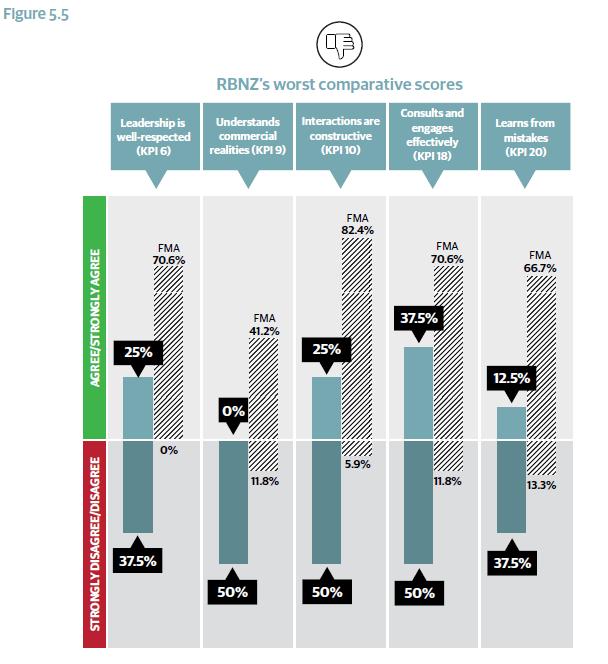
Readers might recall that there was a damning report on the Reserve Bank as financial regulator, drawing on survey results of regulated institutions, released in April by the New Zealand Initiative.    This chart summed it up quite well

partridge 1

It has, presumably, been a priority for the Governor to improve the situation.   After all, even the Bank’s Board –  always reluctant to ever suggest any weaknesses at the Bank, even though their sole role is monitoring and accountability –  was moved to comment on this report, and the issues it raises, in their Annual Report this year.

And thus the Governor begins

In a step toward achieving the best “regulator-regulated” relationships possible, the Reserve Bank (Te Pūtea Matua) has established a Relationship Charter for working effectively with banks. The Charter will also be discussed with insurers and non-bank deposit takers in the near future.

One might question just how “best” is to be defined here –  after all, the public interest is not the same as that of either the Reserve Bank or of the banks, and there have been many examples globally of all too-comfortable relationships between regulators and the regulated.

But it was the next paragraph that started to get interesting.

Reserve Bank Governor Adrian Orr said the Relationship Charter commits the Bank and the financial sector to a mutual understanding of appropriate conduct and culture. “This is underpinned by the principle ‘te hunga tiaki’, the combined stewardship of an efficient system for the benefit of all,” Mr Orr said.

I’m not sure that understanding is necesssarily advanced when an institution operating in English introduces little-known phrases from another language to their press releases.  Here is how Te Ara explains “te hunga tiaki”

Te hunga tiaki

The Te Arawa tribes use the term ‘te hunga tiaki’ instead of kaitiaki, explains Huhana Mihinui.

The prefix ‘hunga’ is more common than ‘kai’ amongst Te Arawa, hence te hunga tiaki rather than kaitiaki. The essence of hunga is a group with common purpose. Hunga may also link with the sense of communal responsibilities. The same meaning is not conveyed with ‘kai’ … te hunga tiaki likewise invokes ideas of obligations to offer hospitality, but also to manage and protect, with the implicit recognition of the group’s mana whenua [customary authority over a traditional territory] role in this respect. 1

Which sounds pretty problematic frankly.  Banks and the Reserve Bank do not have a common purpose or a common set of responsibilities.  The Reserve Bank has legal responsibilities to the people of New Zealand, and the banks have legal responsibilities to their shareholders.  The two won’t always be inconsistent, but at times they will and there is little gained (and some things risked) from trying to pretend otherwise.  In both cases –  but particularly in that of the Reserve Bank –  there are limits on the ability of the principals (citizens and shareholders) to ensure that the boards and/or managers are actually operating according to those responsibilities.   Shareholders can sell.  Citizens are stuck with the Governor.

The statement goes on

“Writing it was the easy part. Operating consistently with the conduct principles is the challenge. We will regularly mutually review behaviours with the industry. Appropriate conduct is critical to the trust and wellbeing of New Zealand’s financial system, and the Reserve Bank – the ‘Tane Mahuta’ of the financial garden,” Mr Orr said. 

It is the tree god again –  a tree god that has some considerable way to go in improving its own conduct, be it around attempting to silence critics or whatever.

But this is also where I started to get puzzled.   In both those last two paragraphs from the statement, there is a suggestion that this document is some sort of agreed position between the banks and the Reserve Bank.   It is there in the charter document itself –  a one pager, complete with cartoonish tree god characters.

RBNZ-Relationships-Charter

(What I didn’t see was, for example, “we will avoid abusing our office and putting pressure on regulated bank CEOs to silence their economists when those economists write things we don’t like”.)

The word “mutual” is there twice, clearly suggesting that the banks have signed on to this.

But, if so, isn’t it a little strange that there are no quotes from any bankers, or the Bankers’ Association, in the press release, just the Governor’s own spin?   And when I checked the Bankers’ Association website, there was no statement from them. In fact, I checked the websites of all the big four banks and there was not a comment or statement from any of them.   Frankly, it doesn’t seem very “mutual”.   It looks a lot like gubernatorial spin.

And, to be frank, I don’t really see any good reason why there should be such mutual commitments.   Regulated entities don’t owe anything to the regulators.  They may often be intimidated by them, (privately) derisive of them, or even respect them.  But the regulated entities are just private bodies trying to go about their business in a competitive market.  By contrast, the Reserve Bank  –  the Governor personally –  carries a great deal of power over those entities, and they have few formal remedies against the abuse of that power.   What might reasonably be expected is unilateral commitments by the Governor as to how his organisations will operate in its dealings with regulated entities, standards (ideally measurable ones) that they and we can use to hold the regulator to account.      But that is different from what purports to be on offer in yesterday’s statement.

Of the brief specifics in the list of commitments, I don’t have too much to say.  There is a big element of “motherhood and apple pie” to them, and a few notable elements missing.  There is nothing about analytical rigour, nothing about transparency, nothing about remembering that the Bank’s responsibility is primarily to the New Zealand public, nothing about maintaining appropriate distance between the regulator and the regulated.  But I guess those would have been inconsistent with the fallacious claims about all being in it together and working for common goals.

It is at about this point that the Bank’s press release changes tone quite noticeably (not quite sure what happened to “one organisation, one message, one tone”).   Deputy Governor Geoff Bascand takes over and claims

Deputy Governor Geoff Bascand said the Reserve Bank’s recent announcement of a consultation with banks about the appropriate level of bank capital highlights the usefulness of the Relationship Charter.

And even in that one sentence he captures some of the mindset risks.  As I read the announcement the other day, it was a public consultation about the appropriate level of bank capital, and yet the Deputy Governor presents it as a “consultation with banks”.  If the Bank is going to run with this “Relationship Charter” notion, perhaps they could consider one for their relationship with the only people who give them legitimacy, Parliament and the public (having said that, perhaps I should be careful what I wish for).

And then weirdly –  in a press release supposed to highlight a new era of comity, open-mindedness etc –  the Deputy Governor launches into an argumentative spiel about the proposed new capital requirements.

“There is a natural conflict of interest. Banks will want to hold lower levels of capital to maximise returns for their shareholders. However, customers and society wear the full economic and social cost of a bank failure. We represent society’s interests and will naturally insist on higher capital holdings than any one individual shareholder,” Mr Bascand said.

Strange use of the phrase “conflict of interest”, which usually relates to a person or an organisation having two competing loyalties (perhaps personal and institutional), but even if one sets that point to one side for now, the rest is all rather one-dimensional and not terribly compelling.  He seems unaware, for example, that banks often hold capital well above regulatory minima –  creditors and rating agencies have perspectives too –  or that in most industries firms happily determine their own levels of capital, and somehow society manages (and prospers).  And, of course, there is not an iota of recognition of the way in which bureaucrats all too often serve bureaucratic interests (rather than societal ones), of the distinction between loan losses and bank failures, or of how the interventions of official and ministers often create the problems in the first place.

And then there is the final paragraph

“Following our Relationship Charter, we long signalled the purpose of our work and shared our analysis and consultation timetable. We have also committed significant time to engage with banks and provide a sensible transition period to make any changes we decide on. The Charter means what we are looking to achieve can be discussed professionally, while we continue to build appropriate working relationships. Outcomes will be superior and better understood and owned by society,” Mr Bascand said.

Of course, for example, whether the proposed transition period is “sensible” is itself a matter for consultation (one would hope –  and not just with banks).  Given the high probability of a recession in the next five years –  and the limited firepower here and abroad to deal with a severe recession –  some might reasonably wonder at just how wise it would be to compel big increases in capital ratios over that five year period, at a time when the Bank’s own analysis repeatedly suggests the banks are sound with current capital levels.   Credit availability might well be more than usually constrained.

One might go on to note that the level of disclosure in the consultative document is seriously inadequate for such a substantial intervention –  one that would take New Zealand further away from the international mainstream not closer to it.   As I noted in a post a few days ago, back in 2012 the Bank published a fuller cost-benefit analysis of the sorts of capital requirements that were then in place.  There is nothing similar in the consultative document issued last week, not even (I gather) any engagement with the previous cost-benefit analysis.  Given the amounts of money involved, that is simply unacceptable.  I’ve lodged an Official Information Act request for the (any) modelling and analysis they’ve done, but I (and others) shouldn’t have needed to; it should have been released as a matter of course.  In fact, even better they should have published a series of technical background papers over the year, held discussions with a range of interested parties (not just banks) before coming to the decisions they chose to formally consult on.      That is what good regulatory process might have looked like.

And then there is that bold final claim

Outcomes will be superior and better understood and owned by society

I’m all for effective and professional relationships between the Reserve Bank and the banks it regulates.  Perhaps that may even lead to better policy outcomes, but there is no guaranteee of that (after all, at the end of it all the law allows the Governor to make policy pretty much on a personal whim –  which is a lot like what the proposed higher capital ratios feel like).  But quite how a better relationship between the Reserve Bank and the banks will make outcomes “better understood and owned by society” is a complete mystery to me.   There are plenty of examples of regulators and the regulated ganging up against the public interest, and others of the regulators ramming through changes that might –  or might not –  be in society’s interest.  There is simply no easy mapping from a better relationship between the Bank and the banks, and good outcomes for society, let alone ones that –  whatever it means –  are “owned by society”.   Good outcomes rely heavily on very good and searching analysis.  And nothing in the Charter commits the Bank to that.

When one reads the argumentative second half of the press release it is little wonder the banks themselves wanted nothing to do with the statement.   I guess there isn’t much chance of the banks and the Reserve Bank getting too close to each other in the coming months as they (and the bank parents and APRA no doubt too) fight over the billions of additional capital Adrian Orr thinks they should have.

Meanwhile, the Governor can play at tree gods.  But it would be much better for everyone, including most notably citizens, if he were to engage openly and (in particular) more substantively on the issues he has legal responsibility for.   Cartoons and glib statements don’t build confidence where it counts.


Immigration data: some questions

For several years now I’ve been complaining about the inadequacies of MBIE’s administrative immigration approvals data.   It really should have been easy to have this data readily available (including in SNZ’s Infoshare platform) very quickly: we manage it, for example, for building approvals.   But it hasn’t been.

For a long time, the public was supposed to be content with the annual Migration Trends and Outlook publication.  It had a lot of interesting and useful data but (a) it was only available on an annual basis and (b) the lags were quite long.  They also made available gigantic spreadsheets which might have been readily useable for those with programming skills or the right software, but for humbler analysts required a significant investment of time to extract the simplest numbers.  And then those spreadsheets themselves were withdrawn –  they discovered, belatedly, some privacy issues.  They in turn were replaced with big PDF documents in small fonts where you could find some of the data updated each month, but still with an annual focus (thus they report year to date data, rather than monthly data).

There is progress afoot.  MBIE has spent a lot of time and resource developing a Migration Trends Dashboard which will, when it finished, finally get us to the point of having timely, useable, monthly data, seasonally adjusted where appropriate.  The sort of standard we’ve long expected for other major statistical series.   I’ve been invited to a couple of consultation sessions with them as the product has been developed and although the dashboard has not yet been formally launched they’ve told me they have no problem if I run some graphs here from the dashboard. (Because it isn’t yet officially launched, and it doesn’t yet work with all browsers, I won’t link to the dashboard here, but if anyone really wants the link to have a play with the data, email me –  address in the “About Michael Reddell’s blog” tab.)

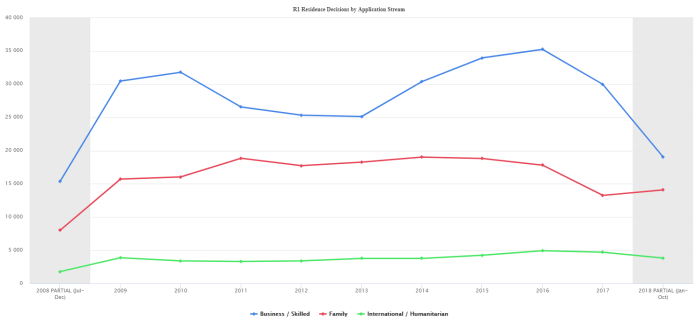
This is the sort of thing that will be readily available: residence approvals by application stream.

R1 Residence Decisions by Application Stream (1)

This is calendar year data, so note that the final observations are only for 10 months.  But even if you scale those numbers up (by 6/5) what is unmistakeable is how sharp the reduction in the number of residence approvals granted in the business/skilled streams –  centrepiece of our economics-focused immigration programme –  has been.    I wrote first about this development a couple of months ago, somewhat puzzled by quite what is going on –  given that there was a small reduction in the residence approvals target last year, but nothing subsequently.

Unfortunately –  I guess it is still a prototype –  the November numbers haven’t yet been loaded in the Dashboard, so I had to go back to the more timely –  if less wieldy –  big PDFs, where the data is in financial year (to June) format.

residence approvals 2018.png

I’ve annualised the five months of data we have for 2018/19 to date.  At present approval rates we are on course for a slightly lower rate of approvals in 2018/19 than we had in 2017/18 –  both below official announced target (centred on 45000 approvals per annum).    Those would be the lowest number of approvals this century to date.

I remain a bit puzzled quite what is going on, and I’d have thought someone should be grilling the Minister of Immigration for answers.  There is an official target and it is not even close to being met.

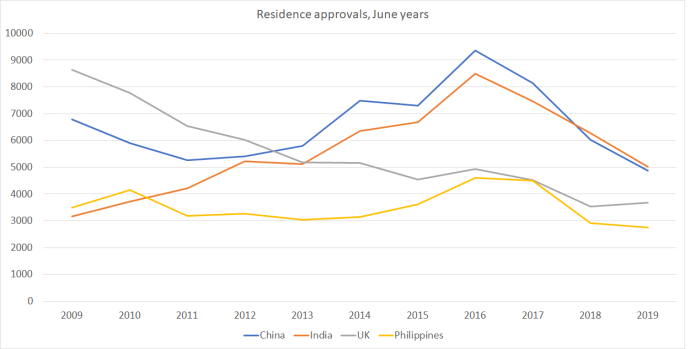
Here is an update of a chart I ran a couple of months ago of the nationalities of those granted residence approvals (again the 2018/19 numbers are annualised).

residence approvals by nationality

What is striking is the reduction in the number of Indian and (even more so) Chinese approvals.

As I noted in the earlier post

I’m puzzled.  And, of course, I’ve spent years calling for a reduction in the residence approvals target, so in one sense I’m not unhappy to see the reduced numbers.  But I also strongly favour open and transparent policy, and there has been nothing announced suggesting that we should have been expecting –  or that the government was seeking –  such a large reduction in the number of residence approvals being granted.

And the number of points required to get residence is supposed to operate as a quasi-price: if too many “good” applicants are applying, the logic is supposed to be that the points threshold is raised, and if not many applications are coming in, the points threshold is supposed to be lowered.  But I’m not aware of any steps having been taken –  lowering the threshold –  this year.

One possibility is that although the government was not willing to openly take steps to reduce the inflow of (permanent) migrants, they (or at least parts of the government) were not unhappy if the inflow declined anyway.   And even among those champing at the bit for lots of migrants –  one might think of the Prime Minister –  perhaps there is some unease that announcing a reduction in the points threshold might reawaken a debate about the relatively low-skilled nature of many of our (notionally) skilled migrants.   These, after all, were the top occupations for the skilled migrant principal applicants from the most recent Migration Trends and Outlook.

Main occupations for Skilled Migrant Category principal applicants, 2016/17  
   
Occupation 2016/17
Number %
Chef 684 5.7%
Registered Nurse (Aged Care) 559 4.6%
Retail Manager (General) 503 4.2%
Cafe or Restaurant Manager 452 3.7%

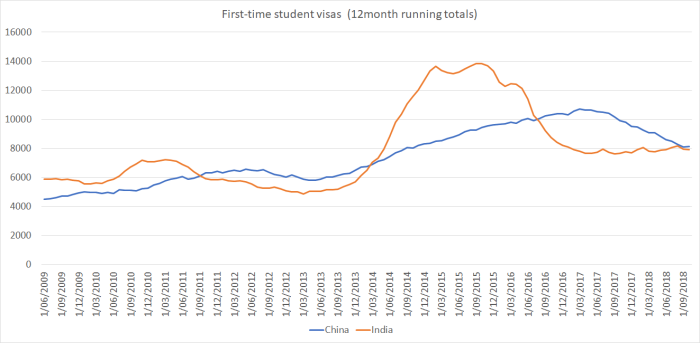
And finally, a couple of other snippets of what we are better able to see with the new Dashboard.   This chart shows the number of first-time student visas granted to people from each of the two largest markets, China and India.

student visas FSV

I’d been aware that Indian student numbers had fallen sharply, although the numbers there appear to have stabilised.     The China market, however, is much more important for our universities and I hadn’t been aware that the number of first-time visas for PRC students had also been falling away for a couple of years now; so much so in fact that almost the whole of the boom has reversed.    No doubt the Vice-Chancellors will be even more concerned to keep pressure on the government not to say or do anything that might upset the regime in Beijing, no matter how egregious it is.

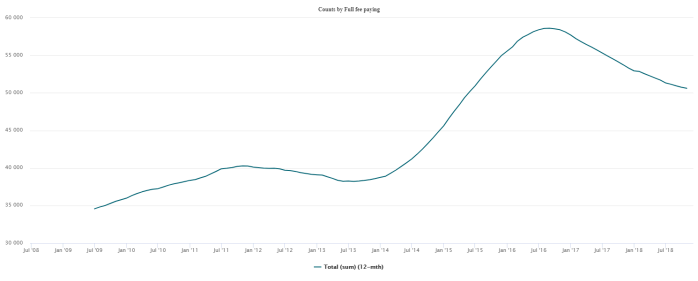
That chart is about flows –  first time arrivals.  The stock of foreign students takes longer to adjust, but here from the Dashboard is a chart of the stock of full fee paying student visa holders in New Zealand.

Counts by Full fee paying

And last of all, this is the stock of people in New Zealand with current work visas.  Whatever is going on around residence approvals, the number of people with short-term work visas continues rise pretty strongly (although, interestingly, when I dug down a little, the number of people here on working holiday visas has fallen back a bit from peak).

Counts by Total (Work)

When it is finished, MBIE’s new dashboard will be a significant step forward.  Even now we are beginning to get more information, on a more timely and accessible basis.  That is welcome.  But the better data unables us to pose some as-yet-unanswered questions including (particularly) just what is going on with the centrepiece of our immigration policy, the residence approvals programme.

(And while I’m awarding ticks –  well half-ticks anyway –  for this data, we shouldn’t lose sight of the loss of the data about the comings and goings of New Zealanders.)

HYEFU bits and pieces

This is getting to be a bit of a half-yearly ritual, but politicians’ words are one thing, and the best professional judgements of our Treasury forecasters are another.   The latter aren’t necessarily very accurate at all, but as their website blares

The Treasury is New Zealand’s lead advisor to the Government on economic and financial policy

Heaven help New Zealand you might think, given that both Treasury and the government seem lost in the nebulous alternative reality of the living standards framework, wellbeing budgets, and a grab bag of alternative indicators that may –  or may not –  matter to anyone much other than them.

But they are the official advisors, charged by law with producing independent forecasts twice a year.   And the forecasts I’ve been particularly interested in for a while have been those for the export (and import) share of GDP.  The previous government, somewhat unwisely set themselves numerical targets for the export share of GDP –  reality bore no relationship to the targets.  The current government avoided that particular mistake, but senior ministers –  all the way up to the Minister of Finance and the Prime Minister –  talk regularly about rebalancing the economy and gettings the signals right in ways that lead to more exports and higher productivity.

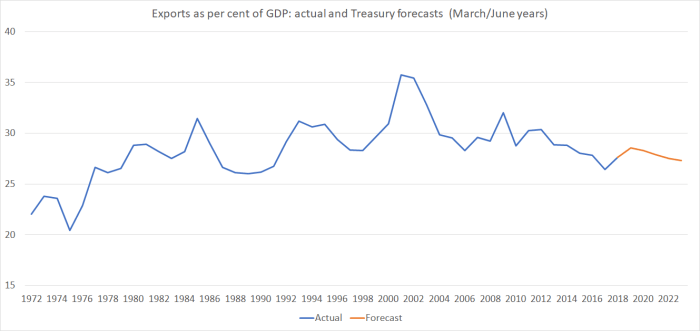
But here are the numbers, for exports as a share of GDP, from last week’s economic and fiscal update.

exports hyefu 18

You can read the earlier decades in various ways.   If you wanted to be particularly negative you could note that we got to an export share of GDP in 1980 which we haven’t sustainably exceeded since then.  But if you were of a more charitable disposition you might suggest that, broadly speaking, things were still getting better until about 2001 (although you shouldn’t put much weight on that peak –  it was an unusual combination of a year of a very weak exchange rate and very high dairy prices).  But this century hasn’t been good, and this decade has been bad.

As a reminder it isn’t that exports are in some sense special, but that successful economies typically have plenty of growing firms that are producing goods and services that are making inroads in the very big market of the rest of world.  That, in turn, enables us to enjoy for of what the rest of the world produces.   For small economies in particular, exports are typically a very important marker.

If you were of a generous disposition you might note that a temporary dip in the export share of GDP might not have been unexpected, or even inappropriate, for much of this decade.  After all, the Canterbury earthquakes meant that resources had to be diverted to repairs and rebuilding, and resources used for one thing can’t be used for other things.  The exchange rate is part of the reallocative mechanism.  And the unexpected surge in the population, as a result of high net immigration (a good chunk of it changing behaviour of New Zealanders), arguably had the same sort of effect.

But the largest effects of the earthquake are now well behind us, and even net immigration inflows are also dropping back.   And yet the Treasury forecasts –  the orange line in the chart –  show no sustained rebound in forecast export performance at all.   In fact, by the final forecast year (to June 2023) the export share of GDP will be so low than only one year in the previous thirty will have been lower.  Not only is there no sign of a structural improvement –  a step change that might one day see New Zealand exports matching or exceeding turn of the century levels –  there isn’t even a reversal of the decline this decade, which might plausibly be attributable to unavoidable pressures (eg the earthquakes).

For anyone concerned about the long-term performance of the New Zealand economy –  which appears to exclude our political officeholders, who could actually do something about it, but choose not to –  it is a pretty dismal picture.  Something like the current level of the real exchange rate seems to be Treasury’s “new normal”, and absent huge positive productivity shocks that is a recipe for continued structural underperformance.

Still on the HYEFU, I’ve long been intrigued by the Labour-Greens pre-election budget responsibility commitment around government spending (which continues to guide fiscal policy).

Rule 4: The Government will take a prudent approach to ensure expenditure is phased, controlled, and directed to maximise its benefits. The Government will maintain its expenditure to within the recent historical range of spending to GDP ratio.

During the global financial crisis Core Crown spending rose to 34% of GDP. However, for the last 20 years, Core Crown spending has been around 30% of GDP and we will manage our expenditure carefully to continue this trend.

As someone who thinks that there is plenty the government spends money on that just isn’t needed (and eliminating which would, in turn, leave room for some of the areas where more spending probably is needed), this commitment has never really worried me. But then I’m not a typical Labour/Greens voter.

But if it didn’t bother me, it did puzzle me.  Why would the parties of the left, evincing (otherwise) no conversion to the cause of smaller governments, (a) commit themselves to such a relatively moderate share of GDP in govermment spending, and then (b) aim to undershoot that?

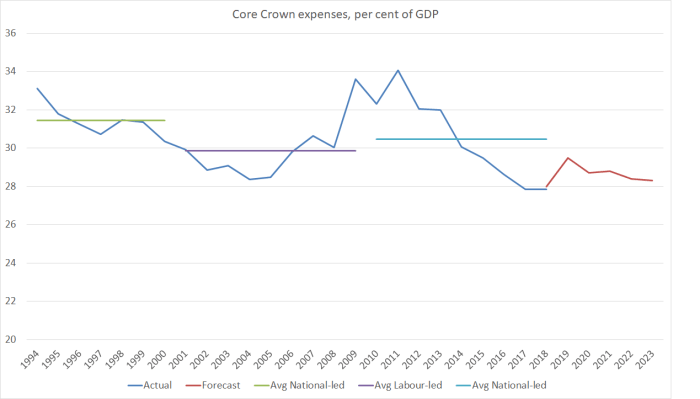
Here is what I mean.  In the chart I’ve shown Treasury’s core Crown expenses series as a share of GDP, including the projections from last week’s HYEFU.  I’ve also shown averages for the periods each of the previous three governments were responsible for (thus the former National-led government mainly determined fiscal outcomes for the year to June 2018).

core crown expenses hyefu 18

On the government;s own numbers (and these are pure choices, made by ministers), core Crown spending in the coming five fiscal years (including 2018/19) will be lower every single year than the average in each of the three previous governments, two of which were led by National.   Sure, there was a severe recession in 2008/09 –  not that fault of either main party here –  and then a severe and costly sequence of earthquakes (ditto), but on these numbers government operating expenditure as a share of GDP in 2022/23 will be so moderate that in only two years of the previous fifty (Treasury has some not 100% comparable numbers back to the early 70s) was spending even slightly lower (those were the last two years of the previous government).

It seems extraordinary.

It isn’t as if the economy is grossly overheated (which might suggest a need for considerable caution, since GDP might soon go pop).  Treasury estimates that the output gap is barely positive over the entire projection perion (the numbers so small we might as well just call them zero).   Of course, Treasury (and other forecasters) never forecast recessions, and it seems quite likely that some time in the next five years we will have one.  All else equal, a recession would raise government spending as a share of GDP, but even a 4 per cent loss of GDP in a recession –  which would be pretty severe, similar to 2008/09 –  would only raise the share of spending to GDP by little over one percentage point.   Spending, at the trough of a severe recession, would still be under 30 per cent of GDP –  which was presented in the budget responsibility rules as something they want to fluctuate around, not as an untouchable electric fence.

The only plausible explanation I can see –  after all, the government show no “small government” inclinations when it comes to, eg, regulation –  is the weight they ended up placing on the net debt target.  But that was even more arbitrary than the spending rule.

In isolation, they could spend $5 billion more in 2022/23 and still only have spending as a share of GDP at around the average level of the previous Labour-led government.   Given the low quality of many of the things they are already spending on (fee-free tertiary education, regardless of means or ability, or the Provincial Growth Fund, to take just two examples), I’m reluctant to encourage them.  But it still looks odd.

The Treasury is New Zealand’s lead advisor to the Government on economic and financial policy.The Treasury is New Zealand’s lead advisor to the Government on economic and financial policy.The Treasury is New Zealand’s lead advisor to the Government on economic and financial policy.The Treasury is New Zealand’s lead advisor to the Government on economic and financial policy.

Bank capital proposals: a few initial comments

I wasn’t planning to write today about the Reserve Bank’s proposed new bank capital requirements, announced yesterday.  I’ll save a substantive treatment of their consultative document until (after I’ve read it and in) the New Year.   But I found myself quoted in an article on the proposals in today’s Dominion-Post, in a way that doesn’t really reflect my views.  Perhaps that is what happens when a journalist rings while you are out Christmas shopping and didn’t even know the document had been released. But I repeatedly pointed out to him that, despite some scepticism upfront, I’d have to look at documents in full and (for example) critically review any cost-benefit analysis the Bank was providing before reaching a firm view.

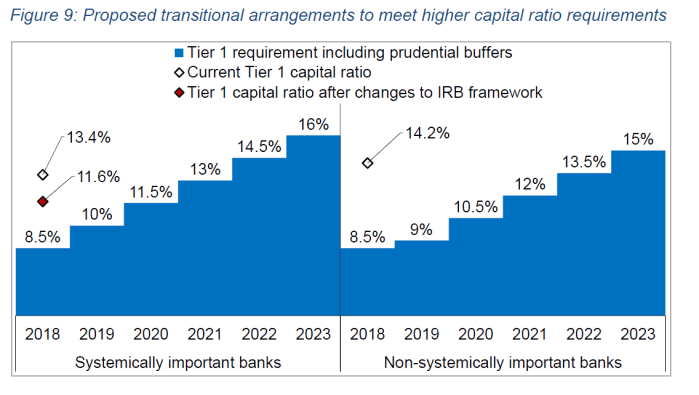
The gist of the proposal was captured in this quote from Deputy Governor Geoff Bascand

“We are proposing to almost double the required amount of high quality capital that banks will have to hold,” Bascand said.

Or in this chart I found on a quick skim through the document.

capital requirements

These are very big changes the Governor is proposing.   As I understand it, and as reflected in my comments in the article, they would leave capital requirements (capital as a share of risk-weighted assets) in New Zealand higher than almost anywhere else in the advanced world.

These were the other comments I was reported as making

The magnitude of the new capital required by banks surprised former Reserve Bank head of financial markets, Michael Reddell, who now blogs on the central bank.

A policy move of this scale would have an impact on the value of New Zealand banks, though ASB, BNZ, Westpac and ANZ are all owned by Australian companies listed on the ASX sharemarket.

“If these were domestically listed companies, you would see the impact immediately,” Reddell said.

That would be through a fall in the price of their shares.

Many KiwiSaver funds own shares in the Australian banks.

I think the journalist got a bit the wrong end of the stick re the first comments –  perhaps what happens discussing such things, sight unseen, in a carpark.  In many respects the magnitude of the increase isn’t that surprising given that the Governor had already indicated –  a week or so before –  his desire to have banks able to resist sufficiently large shocks that, on specific assumptions, systemic crises would occur no more than once in 200 years.  That is much more demanding than what previous capital requirements have been based on –  the same ones the Reserve Bank produced a cost-benefit analysis in support of only five or so years ago, and which have had them ever since declaring at every FSR  how robust the New Zealand banking system is.

As for the second half of the comments, they were a hypothetical in response to the journalist’s question about whether higher bank capital requirements would be felt in wealth losses by (for example) people with Kiwisaver accounts who might hold bank shares.  He was uneasy about the line the Bank used that the increased capital requirements were equivalent to 70 per cent of estimated/forecast bank profits over the five year transitional period (of itself, this isn’t an additional cost or loss of wealth).  My point was that if the New Zealand banks (subsidiaries of the Australian banks or Kiwibank) were listed companies, such an effect would be visible directly, because (rightly or wrongly) markets tend to treat higher equity capital requirements as an additional cost on the business, and thus we could have expected the share price of the New Zealand companies to fall, at least initially.    As it is, I’d have thought it would be near-impossible to see any material impact on the share price of the parents (or thus on the value of any shares held in Kiwisaver accounts).

My bottom-line view remains the one I expressed here a couple of weeks ago

Time will tell how persuasive their case is, but given the robustness of the banking system in the face of previous demanding stress tests, the marginal benefits (in terms of crisis probability reduction) for an additional dollar of required capital must now be pretty small.

And, thus, I’m looking forward to critically reviewing their analysis, including in the light of that previous cost-benefit analysis.   Is it really worth compelling banks to hold much more capital than the market seems to require (even from institutions small enough no one thinks a government will bail them out)?

In thinking through this issue, there are some other relevant considerations to bear in mind.  The first is to reflect on just how unsatisfactory it is that decisions of this magnitude are left to a single unelected individual who, in this particular case, does not even have any particular specialist expertise in the subject.  And his most senior manager responsible for financial stability only took up his job a year ago, having previously had no professional background in banking, financial stability or financial regulation.   The legislation is crying out for an overhaul –  big policy decisions like these really should be made by those we can hold to account (elected politicians).    And note that banks have no substantive appeal rights in these matters, even though the Governor is, in effect, prosecutor, judge and jury, and (in effect) accountable to no one much.

The other is to note that there is likely to be very considerable pushback from Australia on these proposals –  both the parent banks of the subsidiaries operating here and, quite probably, from the Australian regulator (APRA) itself.   The proposed new capital requirements here are far higher than those required in Australia (and for the banking groups as a whole).  APRA has adopted a standard that Australian banks should be capitalised so that the system is “unquestionably strong”, but their Tier 1 capital requirement is apparently “only” 10.5 per cent.       Of course, subsidiaries operating in New Zealand are New Zealand registered and regulated banks, and our authorities should be expected to regulate primarily in the interests of New Zealand.   We won’t look after Australia, and they are unlikely to look after us, in a crisis (and coping with crises are really what bank capital is about).  But you have to wonder why we should be inclined to place such confidence in our Reserve Bank’s analysis, relative to that of APRA –  an organisation with (especially now) much greater institutional depth and expertise.  Given the legislated trans-Tasman banking commitments, and the common interests of the two sets of authorities in the health of the banking groups, one can’t help thinking that it would have been more reassuring to have seen the two regulators (and the two governments for that matter – limiting fiscal risks in the event of bank failure) reach a rather more in-common view on the appropriate capitalisation of banks in Australasia.

But perhaps the Governor really is leading the way, supported by compelling analysis.  More on that (superficially unlikely) possibility in the New Year.   In the meantime, for anyone interested, there is a non-technical summary of their proposal (although not of any supporting analysis) here.

The China Council takes the stage

I have good memories of a young Don McKinnon.  It was early 1980, my first year at Victoria University, and Don McKinnon was a first-term National MP.  It was just a few months after the Soviet occupation/invasion of Afghanistan, and there was a strong push from many governments in the West against competing in that (northern) summer’s Olympic Games, to be held in Moscow.   Don McKinnon was invited along to articulate and defend the government’s stance. It was a pretty hostile audience as I recall –  the median student (or perhaps just the median of those who would turn up to lunchtime political meetings) was pretty left-wing (and of those who weren’t so left-wing not many had much time for the then Prime Minister, Rob Muldoon).  I no longer remember many of the details of the event, but I do recall McKinnon vigorously fighting his corner, and making the case that New Zealand athletes shouldn’t be part of one of tyranny’s great celebrations –  first Olympics in a Communist country) in the wake of such egregious aggression.   Those were days of considerably greater moral clarity about such regimes –  no doubt helped by the fact that there was not much trade with the Soviet Union, and our universities weren’t reliant on the Soviet market.

That was then.  Today’s Don McKinnon is full of years, knighted no less.  And any moral clarity on these sorts of issues appears to have been lost long ago.  For these days, Don McKinnon is chair of the (largely) taxpayer-funded New Zealand China Council, set up by the previous government to run propaganda around the People’s Republic of China, and help ensure that public discontent around supping with the devil never becomes too problematic.   Those aren’t their words of course, but the gist of the actual words they do use isn’t that different.     They don’t exist to do foreign diplomacy (that is what we have MFAT for), they don’t exist to do business (individual firms and universities for that, they exist to propagandise New Zealanders –  with our own money.

Mostly, the part-time Executive Director (of whom more below) speaks for the China Council.  But every so often –  perhaps whenever it seems as if a nerve has been touched – they wheel out the chair Don McKinnon.  There was an op-ed in the Herald this time last year, ably responded to by Simon Chapple of Victoria University –  a rare New Zealand academic willing to express scepticism.   Sir Don wanted us to “respect” the People’s Republic of China –  it was never made clear why, given the nature of the regime –  and if there were ever any issues well the great unwashed could trust the “relevant agencies” to deal with them (conveniently ignoring that fact that many of the issues raised by Anne-Marie Brady a few months earlier were not illegal –  they were questions of instead of right and wrong, surely matters for open debate.

Earlier this week Don McKinnon was back in the pages of the Herald.   Straw men abounded.    McKinnon opened with the Hauwei provisional decision taken by the GCSB.  You’ll recall that when decision was announced the China Council put out a statement lamenting the proposed ban.  I’m still a bit puzzled by that statement given that the chief executives of MFAT and NZTE sit on the Council’s Board and were presumably party to this public criticism of one of our intelligence agencies.

In his article this week, Don McKinnon has moved on a bit.

The substance of the decision is not for me to debate, but the risk is that it complicates the already complex management of the trade and economic relationship at a time of geopolitical tension.

but it really isn’t a much better stance from a former Foreign Minister, in a body largely funded by the taxpayer (not Huawei).   Shouldn’t he be lamenting the fact –  unquestioned –  that the PRC is engaged in far-reaching cyber-intrusions and intellectual property theft in much of the world, the sort of approach that might leave anyone cautious about letting a PRC regime-controlled company (as they all are) loose on a 5G network?

But what of those straw men?  This was the opening line of the article

The recent GCSB ruling in respect of Huawei must surely be a body blow for those who allege the Chinese Government and the Chinese Communist Party are influencing New Zealand’s policy-making.

A “body blow”?  Well, perhaps if anyone were claiming that New Zealand governments always and everywhere do what the PRC would prefer.  But I’m not aware of any serious participant in these debates who says that. Beijing probably wasn’t too keen on New Zealand purchasing the P8 aircraft, and would presumably prefer we opted out of Five Eyes too.  But they must be absolutely delighted that former PLA intelligence official, Communist Party member, Jian Yang still sits in our Parliament – even after all that background, and the active misrepresentations to the authorities, is in the public domain.  Or that when new defence policy documents include a few mild but honest words, the only criticism in the political sphere is from an Opposition leader –  himself having signed us up to an aspiration to fusion of civilisations – concerned that the government might upset Beijing.  Or that the government refuses to participate in joint Western efforts to protest the gross abuses in Xinjiang (which the Opposition describe, PRC style, as vocational training camps).  Or that Yikun Zhang, with clear and strong ties to the regime and Party can manage to be awarded –  with bipartisan support –  royal honours for services to New Zealand.  How they must have chortled when they heard that.  Or that both Ardern and Bridges are apparently so scared of a Beijing reaction that neither can manage a forthright defence of Anne-Marie Brady, or of ethnic Chinese New Zealanders being intimidated –  here in New Zealand –  by Beijing.

Don McKinnon purports to believe that none of this is an issue at all.  Apparently we once –  years ago –  mentioned the South China Sea, and that was quite enough.  As for political donations, there are plenty of serious people around –  even people with ties to his own organisation –  who evince unease about that situation –  about, for example, another former Foreign Minister financing his mayoral campaign substantially with anonymous donations from the mainland.   McKinnon isn’t stupid, and will know all this, so one can only conclude he doesn’t care a jot – about the integrity of the political system of his own country.   The 1980 version of Don McKinnon wouldn’t have tolerated a KGB/GRU officer –  never once heard to criticise any aspect of the USSR –  in our Parliament.  2018 Don McKinnon thinks Jian Yang’s presence in Parliament is just fine –  apparently any concerns are “unsubstantiated” (you mean the ones he himself belatedly acknowledged?) –  and has the man sitting on the China Council’s advisory board.

The whole thing is suffused with that determination never ever to upset Beijing –  and whenever anything might (eg Huawei) the emphasis is on the PRC perspective, not the New Zealand one.   This reaches egregious extremes in this observation

National security is important but so too is our increasingly multi-faceted relationship with China.

National security isn’t everything.  Civil liberties and our democracy matter a great deal too.  But for a former longserving Foreign Minister to suggest, in writing (presumably carefuly drafted) that national security is something we should compromise on to keep the regime in Beijing happy is…….extraordinary (and that is probably too mild a word).

And this is one of the problems with the China Council.  They do now often include a ritual line about our “very different values”.  It is there in this week’s article too.  But, strangely –  conveniently for them –  they never ever spell out the nature of those differences.  Doing so might require them to speak or write in a way that suggested disapproval of aspects of the PRC –  or, and I hope this isn’t so, a genuine belief that the PRC system is just as good as our own, only different, and simply nothing to worry about.  So we never hear about (say) the imprisonment of a million or more people in Xinjiang, about fresh attacks on Christians in China, about the widespread theft of intellectual property, about a regime so insecure images of Winnie-the-Pooh are being banned, about the absence of the rule of law, about real military threats to free and democractic Taiwan, about the absence of freedom of speech, or even about the lawless  revenge abductions of a couple of Canadians this week.  Nothing.  And why?  Because there are deals and donations to keep flowing, and none of these things matter a jot –  in the only sense that reveals importance, a willingness to pay a price (probably quite a modest one, if at all).

McKinnon ends with two more incredible comments.  The first was

The risk of overreaction in New Zealand is all too real, however.

Really?  With our supine political and business class, desperate as ever to play the issues down, and no doubt grateful to Sir Don for putting pen to paper.   Some sign of any reaction among our purported leaders would be worthy of note.  But then the China Council’s view of “overreaction” seems to be any reaction whatever –  just let us get on with the deals and donations.  Trust us…..

And at the very end

The short step from rational debate to panic can come at a heavy cost.

So never ever upset Beijing, or the thugs with the baseball bats will extort a price.  But,trust us……they really are good guys, we are better for dealing with them, they’re good guys.  Really.

The thing that really staggers me about the China Council is that with all those senior figures and all that taxpayers’ money the quality and depth of their propaganda and advocacy is so limited.  They might have good practical arguments to make on some points, but making them should involve engaging substantively with the sort of detailed concerns being raised.  The China Council has never made any attempt to substantively engage with Anne_Marie Brady’s paper –  and, shamefully, has been totally silent on the apparent attempts to physically intimidate her (and thus to scare others).  And they are fellow New Zealanders.

As it happens, there was another good example yesterday of our cowering “leaders”.  Newsroom has an account of MFAT’s appearance at a parliamentary select committee, where much of the discussion seems to have been around the PRC, the “FTA”- upgrade, and so on.  I’m not going to excerpt the story, but read it and all you sense is fearfulness from both sides –  if the Opposition is critical it is that the government might have upset Beijing.  There is no sense of self-respect, no sense of values that matter, just a backdrop of deals and donations –  and that weirdly misplaced view about the significance of the PRC to New Zealand’s economic fortunes so actively fostered by yet another former Foreign Minister, Murray McCully.

And, finally, I must have hit a bit of nerve somewhere near the China Council.  After a post the other day, this tweet appeared on the Executive Director, Stephen Jacobi’s feed.

Which was a bit odd really.  I went back and looked at the post in question.   And I couldn’t find any examples of me calling him names.  I did note that “he appears to be Christian” but as on his Twitter page he calls himself an Anglican, and was tweeting a photo of an Advent service, that didn’t seem an unreasonable deduction.  And as one Christian to another, it can hardly count as name-calling.

So I had a look back at any of my other past posts I could find when I’d written about Jacobi (here, here, here, here and here were the ones I could find).   And yet anything resembling name-calling seemed thin on the ground (which was relief, because it is something I try hard to avoid –  perhaps not always successfully).   In one of those early posts I introduced Jacobi this way

The Council employs a part-time Executive Director, Stephen Jacobi.  He spent considerable time at MFAT, but from his own account his focus was Europe and North America (including as our deputy high commissioner in Canada) and in trade negotiations.  Since leaving MFAT in 2005 he has run his own consulting firm, and been employed as the public face of various trade-related bodies, including serving as Executive Director of the NZ US Council from 2005 to 2014.  He is articulate and readily available to the media, but has no specialist expertise in China or (indeed) on the workings of New Zealand democracy.   That isn’t a criticism –  after all, neither do I –  just to note that his arguments, and evidence, need to be reflected on and carefully examined, perhaps having regard to the interests that are paying him, not as coming from an expert authority in the area.

And that still seems right, and fair.  He is a paid lobbyist and advocate –  propagandist wouldn’t be too strong a word.  Those are, more or less, job descriptions.  I’m sure he believes most or all of what the job requires him to say.  It is just a shame that the institution for which he works seems to have abandoned all sense of good and evil when it comes to the PRC.

But in the search for anything that might resemble name-calling, I did across lots of arguments, analysis, and some evidence. I don’t particularly expect Jacobi or the China Council to engage with me –  although I’d be happy for them to do so – but the thing is that they don’t engage with China experts (notably Anne-Marie Brady) either.  Instead, they play distraction, suggest racism is at work, call debates “unedifying” rather than engage in them, or  –  as in this case –  suggest that all there is is name-calling.  With so many resources at their disposal, that approach doesn’t exactly redound to their credit.  With the politicians on side perhaps it doesn’t matter for now, but such large disconnnects between the values of a people, and the attitudes and practices of their “leaders”, are unlikely to last forever.  It was Scott Morrison who only a few weeks ago observed that we –  citizens of free and democratic countries –  have to be more than just the sum of our deals.  Or, as I added, of our political party donations.

Funding the Reserve Bank: focus on your statutory mandate

The Reserve Bank has been joining the ranks of the public sector agencies bidding for more money –  not just doing so in the conventional manner, behind closed doors in private discussions with relevant ministers, but in public.

There were some initial comments a few weeks ago, which I didn’t notice at the time, using this totally spurious argument

we are a net contributor to Crown revenue rather than a cost, and we’ve asked if we can hang on to a little more of what we make in order to fund extra work,” the Reserve Bank spokesman said.

The Reserve Bank generates a lot of money (mainly) by issuing zero interest bank notes (a statutory monopoly) and investing the proceeds in interest-bearing assets.  It takes little skill to collect this (what is in effect a) tax.     That income should have no bearing, formal or rhetorical, on how much of our resources the Reserve Bank is permitted to spend on other stuff –  mostly more bureaucrats to do regulation, analysis, and (see below) political positioning, of the sort many other cash-constrained bureaucracies in Wellington do.   Those activities do not generate even an iota of revenue for the Crown.

They were back with the begging bowl this week at the annual financial review undertaken by Parliament’s Finance and Expenditure Committee.  I saw two accounts –  one from Newsroom, and one from interest.co.nz.      There were a couple of strange claims, including the Governor appearing to suggest that the CBL failure might have occurred because the Reserve Bank didn’t have enough staff.  I don’t regard that as a totally implausible story  –  then again, the system is not supposed to prevent all failures, and at least some concerns relate to what the Bank did do (suppression orders) rather than what it didn’t do.  But if staffing was a concern, and the Bank thought it didn’t have the resources to do the job Parliament had given it, surely the previous year’s Annual Reports would have said so.  And I’m pretty sure they didn’t.

Orr is also reported as claiming that

….now was the time to resource-up and ready the bank for a crisis.

“The time when under-resourcing most shows up is generally during a time of crisis and we aren’t in one of those times,” Orr said.

I doubt that is so. In a crisis it is all hands to the pump, and institutions pull through.  If there is under-resourcing (and that is an open question) it is more likely to affect progressing work programmes in more-normal times.

Perhaps it is why, 8.5 months into his governorship, we still haven’t had a substantive speech from the Governor on either monetary policy or financial stability/regulation?  But that can’t really be the explanation either –  after all, we’ve always only had one Governor, and his predecessors somehow managed.

The Reserve Bank’s finances are not very tightly managed (externally, by the minister or Parliament).  Under the current Act there is provision for (but not a necessity for) a five-yearly funding agreement, outlining how much the Bank can spend.   It isn’t a great model, for various reasons, even if it was a step forward on the total lack of formal controls that existed prior to the 1989 Act.

But my experience was that almost every year, the Reserve Bank’s actual spending undershot what was provided for in the Funding Agreement.  I knew they had had the odd tighter year this decade, but other than that it isn’t something I follow closely.  But here is interest.co.nz’s account of what the Bank said in its latest Annual Report released in October.

The Reserve Bank’s annual report, issued last month, showed it had undershot spending allowed through its funding agreement by $26.7 million over three years and paid a $430 million annual dividend. By June 30 the Reserve Bank had spent $173.1 million of a possible $199.8 million allowed by its 2015-2020 Funding Agreement, signed with the previous National-led government. Net operating expenses in the June 2018 year were $4.1 million below the funding agreement, despite rising $8 million year-on-year to $76 million.

“The $26.7 million cumulative underspending is expected to partially reverse in the last two years of the funding agreement, as capitalised expenditure on systems improvements is amortised to operating expenses, and the issuance of new banknotes continues. The Bank expects to be within the five-year aggregate expenditure provided for in the funding agreement,” the annual report said.

Bottom line?  They’ve been underspending again, and even though that is “expected to partially reverse” over the next two years, the forecast reversal is only partial and, once again, they expect to underspending the Funding Agreement allowance.  And, under the current statutory model there are no adverse consequences for the Bank if it were to have spent a little more than the Funding Agreement number anyway.  But the issue is moot –  they seem to have managed in a way that will actually underspend (again).

Which leaves another of Orr’s comments ringing a bit hollow

Orr in the select committee again pointed out the limitations of the five-yearly model, saying a “phenomenal” number of “unanticipated” events had happened in the last five years, and the same would be the case in the next five years.

And probably every five years since 1990, and yet the Bank still almost always underspends.

Having said that, this may be one of the areas in which there is some convergence of views between me and the Governor.  The five-year funding agreement model is crazy and should be scrapped.   No corporate – no government agency for that matter –  sets operating expenditure budgets five years in advance, and it is simply silly to expect to do so for the Reserve Bank.  It is fine to do rough medium-term plans to help ensure that foreseeable expenditure pressures are identified well in advance, but that is different from a binding five-year budget.

Where we may well diverge again is that I think the Reserve Bank’s policy, regulatory and related activities should be funded –  as most government agencies are – by means of detailed annual appropriations by Parliament (and will be forthrightly making that case when the current review of the Reserve Bank Act gets round to looking at funding issues).  I wrote about the issue in a post earlier in the year.   Here were some of my points:

A common argument –  at least among central bankers –  is that somehow central banks are different.  There is only one important respect in which they are: they earn far more than they spend.  But even that isn’t very important here.  Central banks make money largely through the statutory monopoly on currency issue, which is just (in effect) another form of taxation.  And spending and revenue are two quite different bits of government finance: IRD might collect lots of money, but it can only spend what Parliament appropriates.

And what of those arguments about avoiding back-door pressure?  Even they don’t mark out central banks.  After all, we don’t want ministers interfering in Police decisions either (a rather more important issue than a central bank), but Police are funded by parliamentary appropriation.  So is the Independent Police Complaints Authority.   There are plenty of regulatory agencies where policy might be set by politicians, but the implementation of that policy is set by an independent Board, and where backdoor pressure could –  in principle be applied.  Other bodies publish awkward reports that make life difficult for politicians.  But those bodies too are typically funded each year by parliamentary appropriation.  It is just how our system of government works.

When I wrote about this issue in 2015 (having only recently emerged from the Bank), I was hesitant about calling for radical change.   The funding agreement system itself could be tightened up in various ways, which might represent an improvement on what we have now.   But there isn’t any very obvious reason not to start with a clean sheet of paper, and build a new system –  aligned with how we manage public spending in the rest of government –  starting from the principle of annual appropriations, with a clear delineation by functions (monetary policy, financial system regulation, physical currency etc), and standard restrictions on the ability of ministers to reallocate funds across votes).

I’m not aware of any country that funds it central bank by annual appropriation.  But historically, central bank spending all round the world was subject to weak parliamentary control.  This is one of those areas where the international models aren’t attractive, and the standard should instead be the way in which we authorise spending across the rest of government.   This is a policy and regulatory agency ….  and should be funded, and held to account, accordingly.

But if the Governor really thinks he doesn’t have enough resources to do aspects of the job Parliament has given, perhaps he could look rather hard at how he prioritises.  In his FEC appearance the other day, he claimed to have been doing so, but in my observation his sense of priorities appears personal, idiosyncratic and even political, not at all well-aligned with the Bank’s statutory mandate.

Recall that the Governor has only been in office for just over eight months, but already we’ve had things like:

  • speeches on climate change, helping out his buddies in the government and in the liberal wing of the business community,
  • the “Reserve Bank as tree god” exercise, which surely didn’t just flow off the end of the Governor’s pen in an idle hour one Saturday afternoon. It will have consumed real resources, at an opportunity cost,
  • cartoon versions of the Monetary Policy Statements and Financial Stability Reviews,  and
  • swamping those individually modest items by several orders of magnitude there was the conduct inquiry of which I noted upon its release

Despite highlighting several times in the report that this was really none of their business (of course they phrased it more bureaucratically: “neither regulator has a direct legislative mandate for regulating the conduct of providers of core banking services”), they’d spent an estimated $2 million of public money to mount their bully pulpit, lecture the banks, lobby for more powers for themselves.  

It simply wasn’t their job, but it suited the Governor’s ambitions to sweep in and spend large amounts of public money –  for modest-sized agencies –  on a personal campaign, to discover what?

The waste goes on.  There is an advert out at the moment for a Manager, Performance and Corporate Relations.  There appears to be some real work associated with the role (some of the bureaucratic hoop-jumping all government agencies have to do) but part of the role is this

Leading a mid-sized team of specialists, the person appointed will provide leadership to organisation-wide initiatives such as the Bank’s Climate Change Strategy and Te Ao Maori framework.

There can be no possible need for whatever a “Te Ao Maori framework” actually turns out to be.   The Reserve Bank isn’t some social agency dealing with troubled individual families, where quite possibly individual cultural backgrounds matter.  It doesn’t really deal with ordinary people much at all –  that is not a criticism, it doesn’t need to.    It runs monetary policy –  which affects and benefits people quite regardless of ethnicity-  and it regulates banks (and other financial institutions) again –  one would hope –  regardless of the ethnicity of individual managers or shareholders.  Fortunately, the “principles of the Treaty of Waitangi” are not part of the Reserve Bank Act.     I don’t suppose the Bank will be spending a vast amount of money in this area, but every little bit reallocated to financial regulation would surely help, at least if you believe the Governor and his Deputy.  It has the feel of the Governor pursuing another personal political agenda at the expense of the taxpayer.

And then there is “the Bank’s Climate Change Strategy”.    I’ve touched on this before, but as a reminder the Reserve Bank is an office-bound organisation, with precisely two offices (main one and a small one –  probably unnecessary –  in Auckland).  For practical reasons (to do with specialist vaults) the Bank –  unlike most central government agencies –  owns a building in central Wellington, and if they own any vehicles at all it might be just one car.  They are a wholesaler of one physical product –  bank notes –  but they import that product from overseas producers, for whom the Reserve Bank is no more than a modest-sized customer (thus with little market power).  But they do, I suppose, travel to lots of overseas meetings (but last I looked, international air travel still isn’t captured in the agreed international carbon reporting framework or our own current government’s incipient net-zero goal).

There is just no obvious reason –  at least not one that isn’t ultra vires –  for the Reserve Bank to be spending public money on a “climate change strategy” at all.  It is a feel-good piece of political positioning, perhaps helping the Governor is his turf fights around the Reserve Bank Act, and assisting him in a cause that he clearly feels strongly about personally –  even if there is little sign of him thinking about it deeply.

I’ve written prevously about the sheer vacuity of much of this, especially in the New Zealand context –  our banking system hardly being heavily exposed to, say, oil producers.  There was a vapid box in the FSR a few weeks ago, and as I noted of it

The text burbles on about possible risks, but it all adds up to very little.     There are numerous risks banks and borrowers face every decade, every century.  Relative prices change, trade protection changes, external markets change, exchange rates change, technology changes, economies cycle, land use law changes.  Oh, and the climate changes.

If one looks at the structure of New Zealand bank (or insurer balance sheets) it just isn’t credible that climate change poses a significant risk to the soundness of the New Zealand financial system (that pesky law again).   Some individuals are likely to face losses from actual and prospective sea-level rises, but banks (and insurers) typically have diversified national portfolios.   People can’t have mortgage debt without insurance, and so the insurers are likely to be constraining people first.   Much the same surely goes for the rural sector?   Sure, adding agriculture into the ETS at the sort of carbon price some zealots have called for would be pretty detrimental to the economics of a dairy debt portfolio, but then freeing up the urban land market probably wouldn’t be great for residential mortgage portfolios, and we don’t see double-page spreads from the Reserve Bank on that issue, or the Governor trying to play himself into some more central role in that area.     It smacks of politics –  signalling the Governor’s green credentials –  more than anything legitimately tied to financial system soundness.

As it happens, the Bank yesterday released its “Climate Change Strategy“, a 10 point statement which seems almost equally devoid of content relevant to the statutory responsibilities of the Bank.  Instead, the Governor is offering political support to the government (that is the gist of the first paragraph) and bidding to be a player.  Here are two of their 10 points.

8.No single institution working alone can achieve meaningful progress on a global challenge such as climate change. Furthermore, it is not for financial policymakers to drive the transition to a low-carbon economy, nor is it the role of the Bank to advocate one policy response over another. That is the role of government.

9. However, appropriate action on a national or global level can only be achieved if individuals and entities are able to take action on a micro level. For this to occur, two conditions need to be met. First, there has to be proactive and effective leadership to drive our collective understanding of climate risks and to establish robust strategies to respond to those risks. Second, there has to be effective and timely dissemination of those assessments and strategies. Appropriate information will be vital in enabling entities and individuals to price and manage risks, facilitating the transition to a low-carbon economy, and ultimately contributing to both the soundness and efficiency of the financial system.

You might agree, disagree, or simply yawn, but when did this become an issue for a central bank, with important, powerful, but quite limited, statutory responsibilities?  And a central bank crying poor, claiming it doesn’t have enough money for its day jobs.   It is more like a creed than something one might reasonably expect from a central bank.

As part of the Bank’s statement we learn that

The Bank has also been welcomed as member of the Network of Central Banks and Supervisors for Greening the Financial System (NGFS). The Network was set up in December 2017 at the Paris ‘One Planet Summit’ to strengthen the global response required to meet the goals of the Paris agreement.

Head of Department Financial System Policy and Analysis Toby Fiennes says the Reserve Bank is very proud to have been accepted as a member of the NGFS.

“Playing our part globally, and as a leader in the Pacific region, is important both in terms of reinforcing New Zealand’s reputation as a ‘good global citizen’, and in providing us access to the latest thinking around the globe,” Mr Fiennes says.

(Among this small group of (excessively funded?) central banks and regulators is the central banking arm of the Chinese Communist Party. )

I guess it is the sort of feel-good, but empty, rhetoric one now expects from public servants.  And I guess when you see yourself as a tree god, the fit with an organisation devoted to “greening the financial system” must be almost complete?   But it is all empty.  “Playing our part globally” seems likely to involve little more than another round of international meetings to attend –  all those extra emissions – at the taxpayers’ expense, to advance Orr’s personal agenda at a time when he suggests the institution has insufficient money to do the job the taxpayer instructed them to do.  On an issue where there are no material financial system implications at all.

I’m open to the idea that the Bank might in fact need more financial resources, given the various jobs that (wisely or not) Parliament has instructed them to do.   There are other agencies and causes that might have a stronger case  and (on the other hand) some that should simply be wound up altogether.  But the Bank’s case would be that much more compelling if there weren’t repeated signs that the Governor was using the institution and public resources to advance personal, often quite political, agendas that reach beyond his statutory responsibilities.  He should be ensuring –  and the Board insisting –  that resources are rigorously prioritised to focus on the statutory mandate.