“Immigration Policy: Economics and Evidence”

That was the title of the presentation at yesterday’s lunchtime seminar hosted by Motu, the economics consultancy/research group. Motu has started up this series of public policy seminars – a laudable initiative, even if the costs mostly seem to be being met a group of sponsoring government agencies. The first such session was a month ago on minimum wages – I never got round to writing about it, but the summary is probably “not as useful or as damaging as is often claimed”. Perhaps it is going to be a theme, since a one line summary of yesterday’s immigration session could be quite similar.

A session on immigration policy is obviously timely, given that the government says it is cooking up changes to various aspects of policy (for which, despite a speech from the minister, there is still no supporting analysis or any details), and in view of the inquiry the government has directed the Productivity Commission to undertake. (On that note, the Productivity Commission recently released an Issues Paper, outlining some of the issues and posing some questions they particularly want submissions on.)

So I went along to the seminar yesterday expecting to be challenged and stimulated by the speaker, David Card from Berkeley (by Zoom). Card has written a lot over the years on immigration, and some of his studies are widely cited. My impression was that he was generally positive about immigration, but then he was mainly writing with the US in mind, and based in greater San Francisco. But clearly a very able guy.

In fact, the seminar was a bit disappointing. I suspect most of that was the fault of the organisers rather than of Card. They’d scheduled the session for 90 minutes, allowing time for some discussion from local panellists and some audience questions, but Card only spoke for at most 30 minutes and was evidently operating to a time slot he’d been given. And although he had made some effort to dig out some New Zealand numbers, none of those numbers would have been news to the New Zealand audience, and he (unsurprisingly) didn’t have much in-depth knowledge of New Zealand or its challenges. But that meant that what he had time to say more generally won’t (I suspect) have added much to anyone’s understanding, whatever one’s view on New Zealand immigration policy. That was a shame.

There were familiar snippets. The stock of foreign born people in New Zealand is high, among OECD countries. There is a lot of variability in net immigration to/from New Zealand (although, oddly, he never touched on the distinction between New Zealanders (not the subject of immigration policy) and others (who are). There were various high-level outcome numbers (employment, incomes) that often don’t look too bad – at least for non-Pacific migrants – but – not stratified by age – often don’t reveal much either.

There was the useful reminder that while there might be a ready (“potentially infinite”) supply of people from poor countries who would move to rich countries if they could, the potential supply of people from rich countries is much more limited. He noted that in the US context – which is quite different from New Zealand – policy settings tend to mean that immigrants are either very lowly skilled (illegals and family reunification) or very highly skilled (“doctors and janitors” – a large proportion of US migrants are apparently in the healthcare sector).

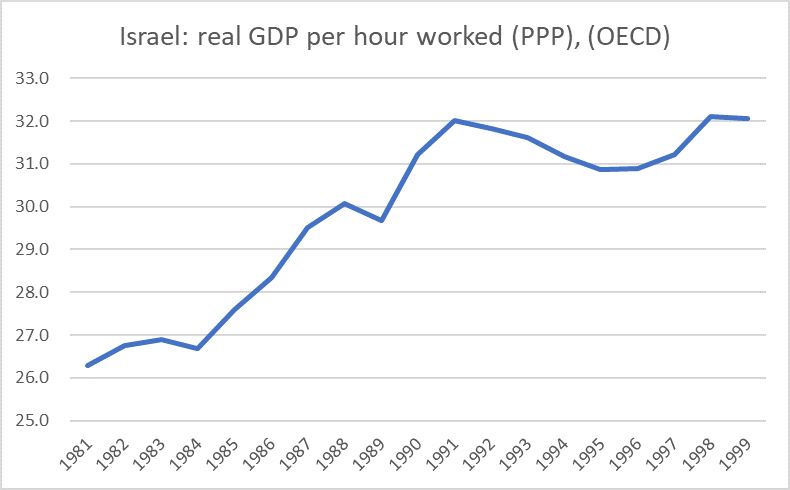
He touched on the perennial question of whether growth in the capital stock keeps up with migrant inflows, and while suggesting that it generally does – especially in the US – he noted that these things needed to be looked at on a case-by-case basis. There is a series of studies in the literature on large shocks to migration – eg French returnees from Algeria, Portugese from Mozambique and Angola, and the influx of Soviet Jews to Israel in the early 1990s. Card talked briefly about the latter case, presenting a chart showing the big surge in investment in Israel in the wake of the influx of people. That is what one would expect – and hope for – but as one of the discussants pointed out, actually it hadn’t tended to happen here (business investment as a share of GDP has been low by OECD standards for decades).

More generally, Israel’s productivity performance has been poor, especially in the 1990s.
israel productivity

But I’m not going to disagree with Card: careful case-by-case analysis really does matter.

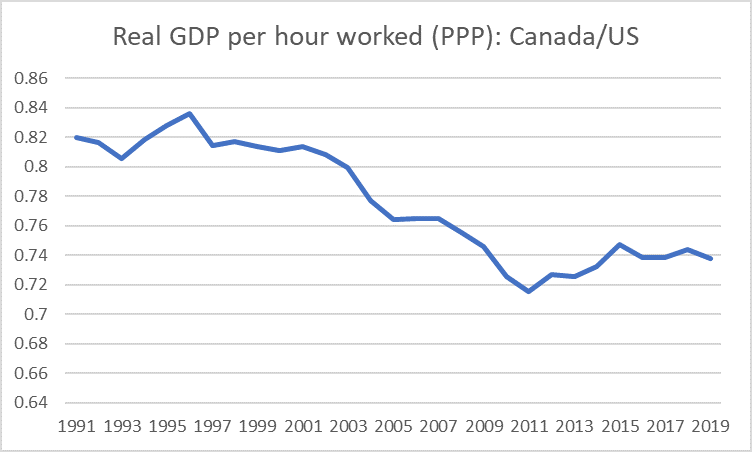
I hadn’t known that Card was Canadian, and he did offer some interesting comments on the Canadian experience – they now target about as many non-citizen migrants per capita as we do. As he noted, in the US there is often (correct) talk of the number of Nobel prize winner or entrepreneurs who had been migrants, but experiences different considerably by country, and he noted that Canada had had nothing of that sort of experience, suggesting that Canada’s shift to a skills-based migration approach had, on that sort of metric, been a “failure”. Canada has never been an OECD productivity star – not even 100 years ago when New Zealand and Australia matched the US as richest countries in the world – and the last 30 years have seen their gap to the US widen, despite an immigration policy (a) very similar to New Zealand’s and (b) widely admired.
canada us

And that with all the advantages of proximity (Toronto is closer to New York than Wellington is to Auckland).

(Incidentally, one of Card’s points was about the benefit to migrants themselves, and the question of what weight should be placed on that benefit in national policymaking. Both are fair points/questions. But he noted that his own English ancestors had been dirt-poor when they migrated to Canada in the early 19th century, as an illustration of the gains. I’m sure many of us have similar stories – I like to talk of one particular set of my ancestors who were poor Yorkshire farm labourers when they left in 1860 – but it does rather overlook two things: first, most ancestors of present day English people were also very poor 150-200 years ago, and – at least on the OECD numbers – average productivity in New Zealand, Canada, and even Australia – is now below that in the UK, and that is before getting onto the better of the Latin American countries (Chile, Uruguay and Argentina) in comparison to Spain and Italy.)

He touched on a couple of other aspects that some times pop up in debates around immigration. On fiscal effects, his read of the (limited) literature tended to be that “immigrants contribute a little more than they take out”, but even that result depends on (a) the types of immigrants, and (b) how one allows for the implications of migrants having children, and how well those children do. The fiscal effects of immigration are never an issue I’ve focused on (I don’t think it is a big issue, one way or the other, with the type of migration we’ve mainly had) but did offer some thoughts here on some earlier (too positive) New Zealand estimates (which were done by the firm run by the now chair of the Productivity Commission)

And then there was housing. For me, he got off to a bad start by suggestion that in Wellington “like San Francisco” there was really no more land for building houses – he seemed quite unaware of just how much low value land the Wellington region (and city) has. Card really wanted to play down this issue, and presented some back of the envelope guesstimates suggesting that if our cities allowed development as readily as, say, Houston does, it really wouldn’t make much difference at all to house price inflation in the presence of population growth. It was clear he really didn’t like Houston – even as individuals self-select towards affordable housing in Texas. Believe that if you want, but I suspect it is a guesstimate from a model that takes into account house-building but not land restrictions. (And to repeat, in a first best world the housing market should not be a consideration one way or the other in setting immigration policy, since fresh land would readily and continuously be brought into development at a price not much different to the value of that land in alternative uses.)

Oh, and he observed that across the variety of types of models, the effects of immigration on the labour market (positive or negative) tended to be pretty small.

And that was the end of the presentation.

There were three panellists: Dave Maré from Motu itself who has done various micro studies over the years on immigration in New Zealand, Julie Fry who has written quite a bit in the last 7 or 8 years and was recently co-author of a contentious piece for the Productivity Commission, and Nik Green the director of the Productivity Commission’s immigration inquiry. There were a few interesting snippets in their remarks:

  • Maré noted that for all the research that had been done it was hard to find strong evidence of much good or bad stuff resulting from New Zealand’s immigration. He noted that ideally you really want people who are different from natives – to complement us – but that a qualifications-based approach wasn’t necessarily the way to achieve that. And, on that note, he seemed very sceptical of the “literal and engineering approach” taken to granting visas, with the heavy focus on immediate short-term gaps.
  • Fry noted that she had first worked on immigration at Treasury 30 years ago when the new immigration policy looked like a one-way bet, really only offering upside. Her conclusion was that reality was a lot less clear, noting that although we had attracted “lots of nice people” there had been no dramatic economic gains. But she was at pains to stay on the liberal side of the debate, noting that naysayers needed to be confronted, and wasn’t it a good thing that Covid had shown we could have crazy house price inflation without immigration.
  • Green didn’t say much, but did note questions around the increasing reliance on temporary migrants, as well as explicitly referencing my points around the macroeconomic imbalances New Zealand immigration may have contributed to over many years.

Card’s response was brief, and centred on a chart of GDP per employee for the Anglo countries over the last 10 years or so, indexed to a common starting point. His point seemed to be that immigration hadn’t made much obvious difference to any country’s productivity story – which might possibly be so, but it seemed an odd basis on which to rest such a claim (being poor relative to the other Anglos, we’d have hoped to be catching up, growing faster).

And then he presented a chart of population densities by OECD country, in which – of course – the three OECD countries most focused on targeting high immigration have among the lowest population densities. I’m pretty sure there are good reasons why people don’t live in most of Canada or Australia…….and there seemed to be no reference to economic geography in any of this anecdote.

Then there were questions from the floor.

Eric Crampton tried to get a ringing endorsement of high migration by asking if we shouldn’t just believe overseas research, noting that water flows downhill everywhere. Card – having previously explicitly noted the need to look at experiences case by case – noted that such a question was “a little above my pay grade”. But then he went on to make the weird claim that New Zealand was an “extraordinarily open economy” – when our trade shares are very low for a small advanced country – and that in such an economy wages should simply be set globally (labour supply not making much difference). Nonetheless, actual New Zealand wages are low by OECD standards, commensurate with low rates of labour productivity here.

There was the useful note that – in New Zealand, and the Anglo countries, but often not in Europe – kids of migrants educated in the host country tend to do pretty well.

There was another question from the floor – from a fairly eminent figure – about regional effects, in which it appeared to be suggested that actually rising house prices in Auckland, even if driven by migration, might be a good thing as they allowed natives to sell up and move to nicer places elsewhere in the country (the questioner, raised in Auckland, deemed most places nicer). It seemed a really bizarre question, especially if – as the consensus tends to be – big cities are the cutting edge of innovation and income growth. Card avoided that specific question, but actually seemed quite cautious on the cities point, noting that although incomes in big cities tend to be higher it wasn’t clear how much of that was causal, and suggesting that the true effects might be quite modest (globally, I was a bit puzzled by that given the huge differences – especially in Europe – in GDP per capita in big cities vs the rest of the respective countries.)

That question prompted Julie Fry to throw in the observation – with which I totally agree – that the policy (adopted by the NZ government) of trying to steer migrants regionally does not work and should be stopped. (It also tends to lower the quality of the average accepted migrant, by selecting for willingness to go to the provinces rather than ability.)

The final question was about crime and migration. Here again, Card was cautious and noted that different places had different experiences (noting challenges especially in Sweden and Denmark). He noted that in the US per capita crime rates of migrants were lower than for natives – while noting, in effect, that per capita might not count for much if you are the victim of an individual – with (as in so many other variables) regression towards the mean in the second generation. Eric Crampton added the similar New Zealand experience, noting correctly that it isn’t that surprising since one needs a criminal record check etc to be a migrant to New Zealand.

It was an odd session. Perhaps some people in the audience got something out of it, but I’d be surprised if anyone got much. It was interesting to see the near-complete absence of much enthusiasm – whether from Card or the local panel – for large scale immigration as something economically transformative (recall that not many years ago MBIE was telling us – and ministers – immigration to New Zealand was a “critical economic enabler”). One was left wondering why then the New Zealand government should be running one of the very largest per capita immigration programmes in the world – perhaps the more so when the natives are leaving and governments refuse to fix the housing/land market – when the programme has long largely been economic in motivation.

But – as with the Commission’s Issues Paper – there was a lot missing from the discussion, including a lack of any engagement with the possibility that even though wages in New Zealand have done well relative to producttivity, large scale immigration, in our specific circumstances, may have contributed to the deeply underwhelming productivity and foreign trade performance.

(It was a seminar day. I went on from the Motu event to a presentation at Treasury of the BERL work done for the Reserve Bank on “the Maori economy”. Even the speaker noted that “the Maori economy” is not a “separate, distinct, and clearly identifiable segment” of the New Zealand economy, and so one was still left wondering why they’d spent the money. I won’t extend this post with a lengthy account of a fairly underwhelming session, but will leave you with the data that simply staggered me. According to the report, in 2018 35 per cent of the total income of Maori households came from welfare benefits and other state direct assistance, up from 21 per cent in 2013. For the rest of the population BERL reported that the share was 9 per cent in 2018, down from 13 per cent in 2013. I’d have been reluctant to believe it, but so it appeared to be.)
Public opinion on Covid policy

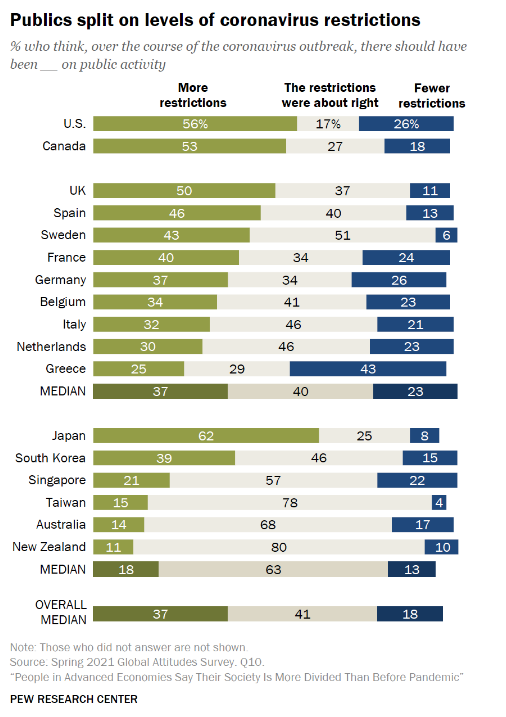
I noticed over the weekend that the highly-regarded Pew Research Center had released the results of public opinion surveys undertaken in a range of advanced countries on various questions around Covid and Covid policy, and that New Zealand was included among the countries surveyed. Some of the results were totally unsurprising, some interesting even if unsurprising, and for a couple of questions I wasn’t quite sure what to make of the questions or answers.

This was the first set of results reported

New Zealand (closely followed by Taiwan) was the country in which the largest share of respondents reckoned that over the full course of the coronavirus outbreak the level of restrictions on public activity were “about right”. Of the remainder of the New Zealand respondents, opinion was fairly evenly split between those who say they’d have favoured fewer restrictions and those who claimed they’d have favoured more. That split was pretty even in Australia too. But I found a few things interesting: first that for all that one’s eye is first taken to the US results – the 26 per cent favouring fewer restrictions – and one thinks of the political polarisation in the US, actually the percentage favouring fewer restrictions was very similar not just in much of continental Europe but in Singapore. I don’t know anything about Greece, but Greek respondents are the only ones where a net balance favoured fewer restrictions over the course of the outbreak.

New Zealand wasn’t in previous surveys, but Pew also reports results for 10 countries where respondents rate their own country’s handling of Covid. The public has become less satisfied, but only in Japan, Spain and (by a narrow margin) France do more people now rate the handling “bad” than “good”. For what it is worth, in the current survey New Zealand respondents give a higher “good” rating to the New Zealand government’s handling than those in other countries, except Singapore.

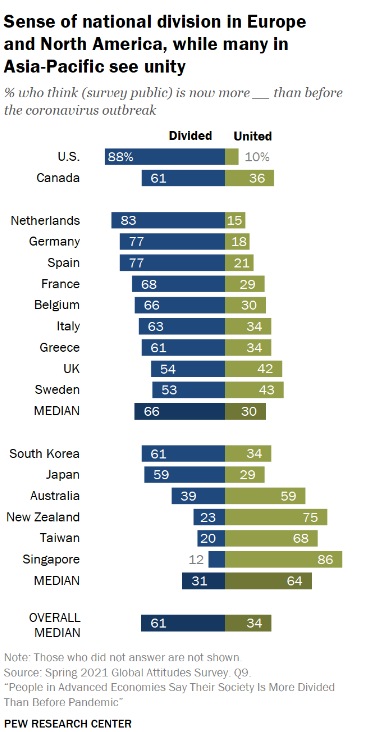
The next question was about national unity/division

Of course, other things have happened in the last 17 months, and the greater division reported in the US is unlikely to be mostly about Covid itself. More generally I found the range of responses across countries quite surprising, and the New Zealand specific ones surprised me too. It is easy to see that the results are loosely correlated with how bad the Covid experience has been, and perhaps there is nothing more to it than that. But had I been one of those surveyed I’d either have said “not much difference” (it is astonishing how small those numbers are almost everywhere – Japan and Taiwan are exceptions to some extent) or “more divided” (there have been lots of conflicting interests, governments have spent billions and billions of public money, restrictions (still in place) affect some not others, and so on).

As it happens, there is quite a correlation between those who think their country is more divided and those who think the economy is in a bad way (and that gap is quite wide in New Zealand too).

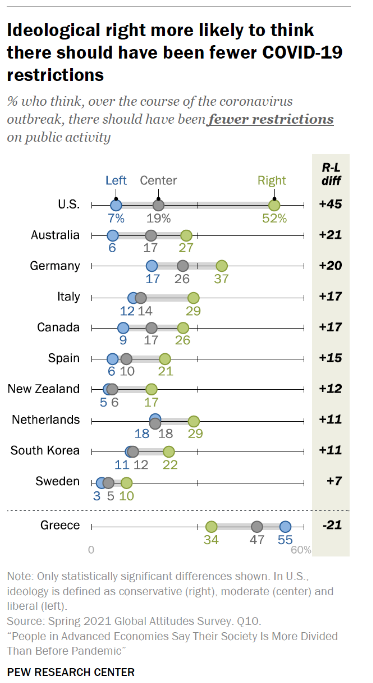
And what of underlying political ideology (not sure whether this is self-identified or derived from answers to other questions)?

In quite a few countries there is no statistically significant difference, but (with Greece and the US as outliers) the responses for New Zealand seem fairly consistent with those for a range of other countries (and not just an anti-government reaction because there is a mix of left and right wing governments in the countries shown).

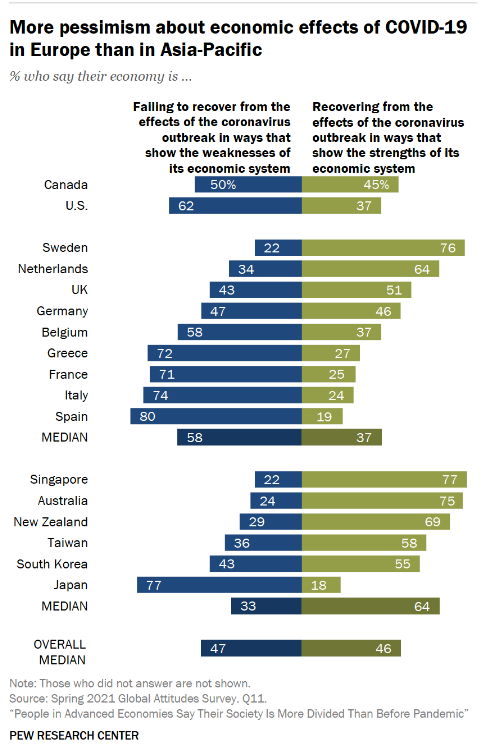
This was the question that really puzzled me. I simply can’t work out what I’d have answered.

Our economy is doing relatively well at present, but I don’t see that as reflecting anything about the strengths of our “economic system” – more a reflection of the elimination strategy (which caused deep initial losses, and then a bounceback) and of huge and continuing macro policy support, and that is a discretionary policy intervention not a feature of our economic system. And, of course, as you know I’m deeply negative on our economic policy and performance more broadly. That said, it was somewhat interesting that Australians were a bit more optimistic on this question than New Zealanders – and that the Japanese were quite so bleak on their responses.

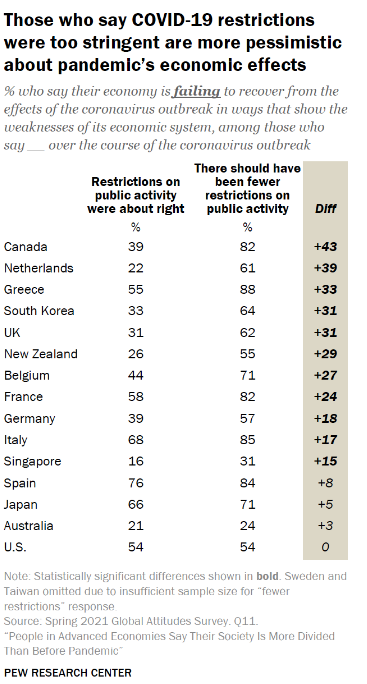
At least in New Zealand’s case, there is probably some hint of what is going on in these responses. Those who think there should have been fewer restrictions are a lot more likely to answer negatively on the economic recovery, suggesting that those people may be emphasising ongoing border restrictions.

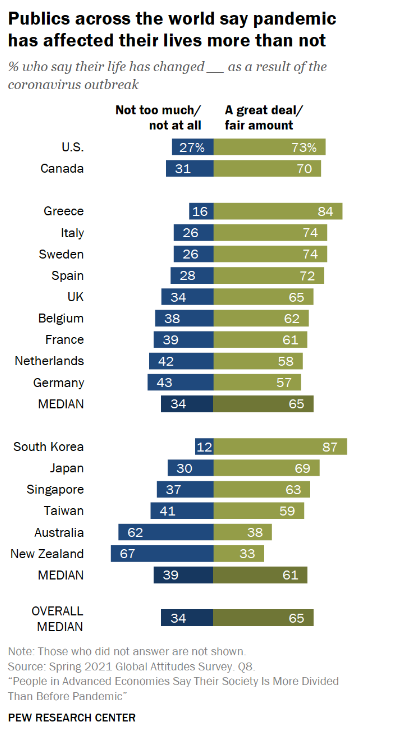
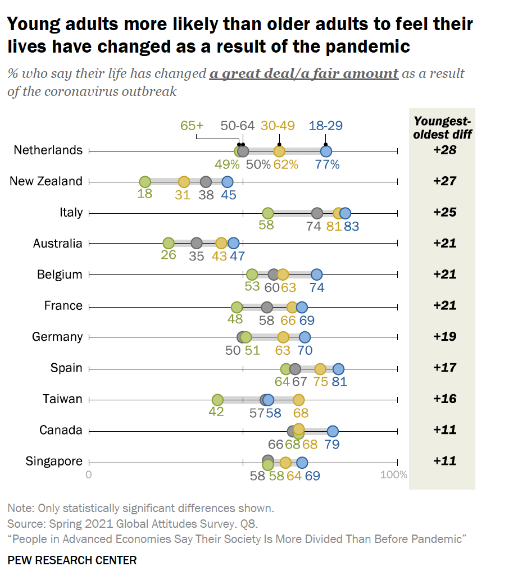
And how do respondents in the various countries say their life has changed as a result of Covid?

New Zealand respondents are mostly likely to say “not too much/not at all” – although a third still answer the other way (presumably some mix of people who would have travelled, people in directly affected industries, those who had hoped to buy a house, and harried public servants in places like the Ministry of Health and DPMC). On days when New World refuses to pack my groceries I might be tempted towards answering that way too. Even in New Zealand and Australia, the young are most likely to say that there has been quite an effect on their lives.

In some countries – but not New Zealand – those who are more pessimistic on the economy are more likely to say their lives have changed.

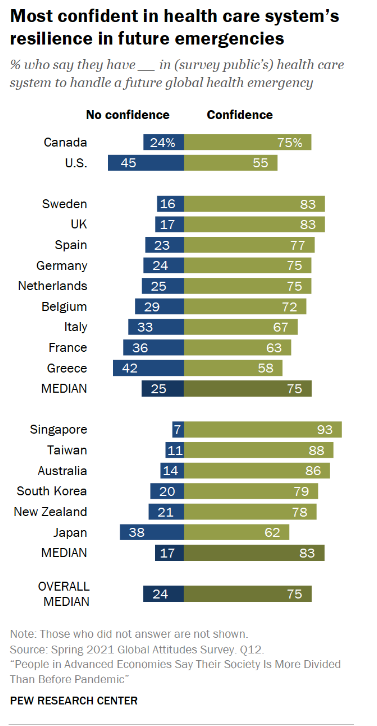
This was the final chart in the summary report. The New Zealand responses had me spluttering with incomprehension and astonishment.

As it happens, the New Zealand results do not stand out in response to this question, but these answers – globally and for New Zealand – seem like an extreme example of recency biases. Because – with extreme interventions and restrictions – health care systems in advanced countries did not get totally overrun this time, the public is confident that responses to any future pandemic – potentially with quite different characteristics – would also be just fine.

In the New Zealand case, for example, we went into the pandemic with a small number of ICU beds (per capita). It isn’t obvious that much has changed on that front. I’d have had no hesitation in answering “no confidence” on this question, whether for New Zealand or any other advanced country I’ve read about.

Anyway, it was an interesting set of results and nice to have New Zealand included in a consistently-compiled survey. And – as was my goal – I got through the post without offering any hint of my views on what New Zealand governments should be (or have been) doing this year or this week.

Fiscal policy in the wake of Covid

When the Reserve Bank and Treasury advertised a full-day workshop with the title “Fiscal and Monetary Policy in the wake of COVID”, I immediately signed up to attend. It sounded like a good idea for an event. After all, lots of tools were deployed, some new, some old, some deployed less than usual, some much more. And we’ve had a Budget, and projections from both agencies suggesting that the economy is now getting pretty close to operating at full capacity (albeit a capacity a little diminished by Covid restrictions).

It was just a shame about the execution. Notably, even though monetary policy has been the principal tool for macroeconomic cyclical stabilisation for decades – and not just since 1989 – here and abroad, there was not a single paper looking at the role of monetary policy, past, present or future. The Governor didn’t attend – which is fine – but nothing of substance was heard from any senior Bank figure. Orr’s deputy for macro policy, Christian (“The Future is Maori”) Hawkesby contented himself with opening remarks that had just some bonhomie and his recitation of a Treasury prayer (which, to add to the strangeness, seemed to appreciate “skilled workers” but not the rest of the public), but not a word of substance. There were a couple of technical papers from Reserve Bank researchers in the afternoon session, but one was little more than an early-stage in a research agenda on the distributional aspects of monetary policy (the paper itself couldn’t shed much light when the only asset in the model was bonds), and the other – on dual mandates – didn’t seem to offer any fresh insight.

So the stage was largely left to The Treasury, and particularly a series of three papers (complemented by a presentation from a US academic) that seemed dead-set on making the case for a bigger and more expansive role for fiscal policy and government debt in the new post-Covid world. Bureaucrats making the case for a bigger and more powerful bureau.

First up – and clearly most important – was the Secretary to the Treasury. She spoke for 40 minutes, but then took no questions (and, in an amateur-hour effort, the text of her speech was then not available until more than a day later). The Secretary is still quite new to the country, to the job, and to national economic policy matters. Probably most non-government attendees (of whom there were many, in a well-attended event) had seen and heard little or nothing of her before. So it didn’t speak well of her that she wasn’t willing to engage, despite having made a barely-disguised (“I would stress that we are not making policy recommendations”) bid for quite an upending of the way macro management is done her, in ways that would just happen to favour her agency.

But what of the substance? It was a workmanlike effort (NB with a minor mistake in footnote 2) but hardly persuasive to anyone not already champing at the bit for fiscal policy to do well. For example, there was no serious discussion about the effectiveness of monetary policy. The Governor has previously told us he thinks monetary policy has been as effective as ever. The Secretary seems to disagree, but we can’t be sure – perhaps she just thinks fiscal policy is even better, but she doesn’t make that case either. Much in her case seems to rest on the effective lower bound on nominal interest rates but (a) as the next Treasury speaker acknowledged that is not some immoveable barrier, and (b) she offers no thoughts on the effectiveness or otherwise of things like the LSAP programme. Surely one starting point for thinking about the future might involve some careful diagnostic work reaching a thoughtful view on what roles the various elements of fiscal and monetary policy played in economic outcomes over the last 15 months. But neither she, nor anyone else on the day, attempted anything of that sort. Remarkably no one – from the Bank or Treasury – looked at the options and merits for removing – or greatly easing – the ELB so that at least ministers have effective choices in future severe downturns,

Quite a bit of Treasury’s thinking – or at least their marketing – seems to have been shaped by the success of the wage subsidy scheme. And it was a success – getting money out the door quickly, at a time when the government had just done the unprecedented and (a) shut the borders, and (b) simply compelled most people not to go to work, or do anything much else. It provided immediate income support, and probably had some beneficial effects beyond that (some smart person might attempt to model what difference it has made to outcomes not just last March/April but now). But it isn’t exactly a conventional event of the sort we can expect to see every cycle. And the primary consideration wasn’t really macroeconomic stabilisation at all – the whole point of the lockdowns was to aggressively (but temporarily) reduce activity, including economic activity – but income relief/support (as unemployment benefits have an incidental automatic stabiliser benefit, but aren’t primarily about macroeconomics). There are always going to be one-off events when the the government’s spending capabilities need to come into play – one can think of earthquakes (where fiscal measures and monetary policy will often tend to work in opposite directions, since earthquakes cause real disruptions and significant wealth losses, and but also generate a lot of fresh (reconstruction demand), plagues, wars, and so on. But it is seems like a category error to use such episodes as the basis for some sort of generalised play for more routine use of discretionary fiscal policy with cyclical stabilisation in view, when most recessions are quite different in character.

And even just thinking about the last 15 months or so, neither the Secretary nor her colleagues seemed to make any effort to unpick the effects of the wage subsidy scheme from the rest of the fiscal policy initiatives of the last year. One could easily imagine an alternative world in which the wage subsidy was used much as it was, but otherwise fiscal policy was kept much on the path it had been on at the start of last year, and at the same time the OCR was used more aggressively. How different would the outcomes for the economy have been, in aggregate and sectorally? The fiscal option involves the coercive use of state power, and politicians making discretionary choices playing favourites, while monetary policy adjusts relative prices and then let individuals make choices about how they (personally and individually) are placed to respond. And one thing that was striking about both the Secretary’s speech and the more technical discussion that followed from her colleague Oscar Parkyn is that in all their new enthusiasm for using fiscal policy more aggressively in downturns (and monetary policy less so) is that neither mentioned, even once, the exchange rate – typically a significant element in the adjustment mechanism in New Zealand recessions. New Zealand recessions often see sharp falls in international commodity prices (fortunately not this time) and the lower exchange rate acts as a buffer. But a much heavier routine reliance on fiscal policy will tend, all else equal, to hold up the exchange rate relatively more in downturns. It isn’t obvious – without a lot more analysis – that that would be a good thing.

The Secretary included this chart in her speech

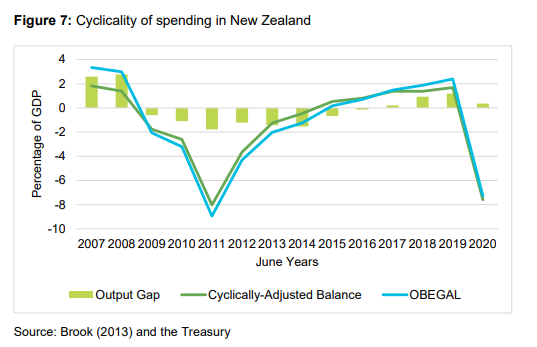
It was apparently designed to show that fiscal policy in New Zealand has generally done sensible things. That might be generally true (although if so why change?), even setting aside the huge pressure loosening fiscal policy put on monetary conditions over 2005-2008, but it conveniently ignores where we are right now. This chart, which I’ve shown before, is from the recent Budget documents.

So with the output gap almost closed, the cyclically-adjusted primary balance (deficit) in 2021/22 year is expected to be almost as large as it was in 2019/20 (when the – sensible – big wage subsidy spending was concentrated. Extraordinarily, in a speech bidding for a more active role for fiscal policy in cyclical stabilisation she never mentioned this situation once – let alone engaged with why, from a macro policy perspective, such big deficits make sense now. As sceptic might suggest that this is the real world outcome when the Secretary’s textbook ideas get given some rope.

One could go on. The Treasury is clearly tantalised by the lower interest rates – although not now lower than pre-Covid – and the “appeal” of taking on more debt. But never once did we hear any serious examination of the typical real-world quality of the marginal additional public spending they had in mind (it wasn’t until the panel discussion late in the day that I heard a Treasury official – a temporary one, so perhaps not well-socialised – refer to the Auckland cycleway bridge). There was a paper reporting some model results suggesting, sensibly enough, that fiscal consolidation is most costly to GDP if done via taxes on capital income, but (symmetrically) there wasn’t a sense in the rest of the day that (say) Treasury was champing at the bit to lower company taxes. Rather they seem keen on public infrastructure – which often sounds good on paper, until we get to the concrete ideas. As it was, a discussant cast considerable doubt on one Treasury paper suggesting high payoffs to more government infrastructure spending.

We also never really heard any serious political economy discussion, or even a discussion of how we should think of the government balance sheet – is it a plaything for politicians or should it be best thought of as operating on behalf of citizens, each of whom have to make their own spending and borrowing choices. There wasn’t much about using coercion and compulsion rather than the indirect instruments of monetary policy. And, on the other hand, it was a little surprising that there wasn’t even a mention of MMT – so that in a floating exchange rate, the level of government debt isn’t really likely to be materially constrained by the market, which doesn’t mean that just any level of government debt is a socially good thing.

It was all a bit unsatisfactory really. Perhaps one could say it was just exploratory, and they are wanting to open the issues but (a) the speech was from the Secretary herself and (b) was making a case more than deeply and thoughtfully exploring the issues. We will have to see what more is in the papers they plan to release next week (a draft long-term fiscal statement and a draft insights briefing) but if the energy is with The Treasury at present, it isn’t really clear that they yet have the depth of analysis and engagement to support their enthusiasm.

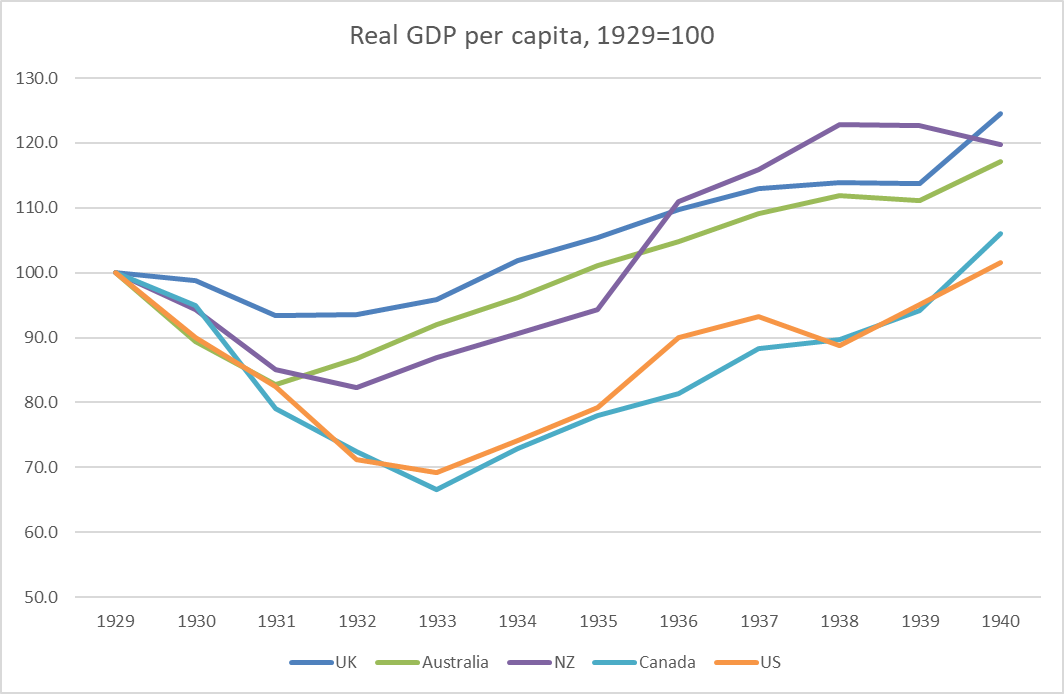
And just finally, they arranged for an American professor, Eric Leeper, to speak, via Zoom, on monetary and fiscal issues. Leeper is pretty highly-regarded and has visited New Zealand previously. He is also very keen on a much greater use of fiscal policy and, it would appear, more debt (for various reasons including, he said. “the rise of the right” which didn’t seem quite relevant to New Zealand, let alone a good basis for official advice). Anyway, after the geeky bits of the presentation, he tried to make his case by reference to the Great Depression. He is clearly a big fan of Franklin Roosevelt, and was talking up the fiscal aspects of Roosevelt’s approach (while barely really mentioning the substantial monetary bits). But it was odd. Here he was talking to a New Zealand audience, championing the use of fiscal policy in the US Great Depression, but seemed quite oblivious to the fact that the US was one of the very last countries to get back to pre-Depression levels of output and unemployment. Here is the experience of the Anglo countries.

Those aren’t small differences. And as anyone who knows New Zealand economic history – or have read my past posts on it – New Zealand’s recovery from the Depression (back to pre-Depression levels by the time Labour took office) was barely at all about fiscal policy. The excellent quote from Keynes that our Minister of Finance of the time recorded in his diary, along the lines of: “if I were you I would no doubt seek to borrow, but if were your bankers I should be very reluctant to lend to you”.

When a half-baked loaf is finished cooking it can be a fine thing, but this loaf seems to need a lot more work before New Zealanders should be rushing to embrace a much more active role for fiscal policy or a lot more public debt. That includes a lot more work on what we reasonably can, and can’t, do with monetary policy.

UPDATE: A former RB colleague, now a lecturer at Sydney University, sent me a link to a paper he and a Reserve Bank researcher have written attempting to evaluate the impact of the New Zealand wage subsidy scheme. I haven’t yet read it, but it looks very interesting. Here is the end of their abstract

We then study the impact of a large-scale wage subsidy scheme implemented during the lockdown. The policy prevents job losses equivalent to 6.8% of steady state employment. Moreover, we find significant heterogeneity in its impact. The subsidy saves 17% of jobs for workers under the age of 30, but just 3% of jobs for those over 50. Nevertheless, our welfare analysis of fiscal alternatives shows that the young prefer increases in unemployment transfers as this enables greater consumption smoothing across employment states

Making sense of the national accounts

Doing so is more than usually challenging right now. We had the huge disruption of the draconian national lockdown last year, and some more limited sets of restrictions since then. Some of the economic aspects of that were impossible to measure accurately, although no doubt in many areas SNZ will continue to try valiantly to refine their estimates. Largely-closed borders continue and thanks to the ill-judged decision of politicians and bureaucrats to scrap departure cards a few years ago we are now flying quite blind around recent net migration estimates (SNZ use a model, but – like any model – their model struggles to cope with a dramatic regime shift). Some of the difficulties are amplified by New Zealand’s long-term underinvestment in good economic statistics – a choice of successive governments, sometimes aided and abetted by SNZ management.

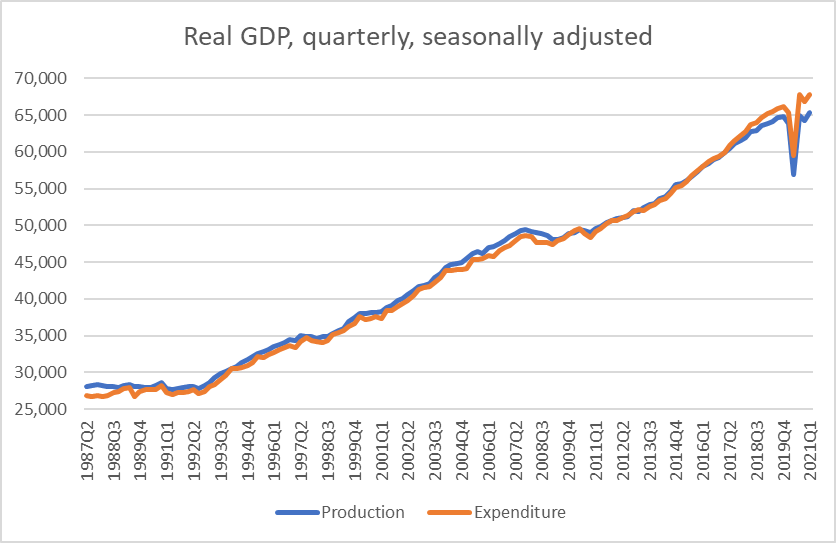
New Zealand has two measures of quarterly GDP. The expenditure and production-based approaches are both trying to estimate the same thing (as will the forthcoming income measure) but data collection challenges mean that it isn’t for several years that the two series are more or less reconciled (and even then not always that well).

GDP long term

But if the two series are, eventually, more or less reconciled that isn’t much consolation now.

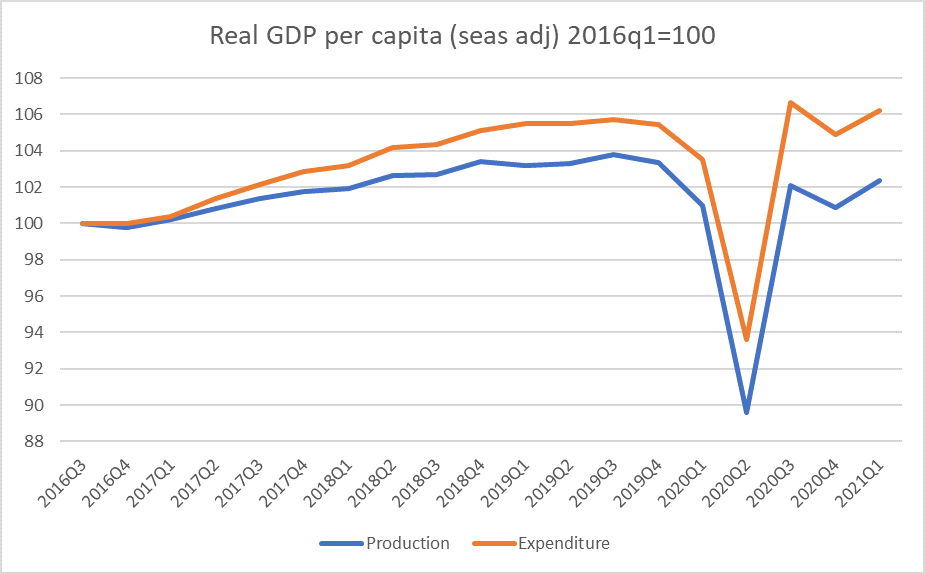
Here is the more recent period, this time per capita and indexed to 100 in 2016q3, the last date for which the current estimates of the two approaches are almost identical.

nz per capita

Over 4.5 years a gap of 3.7 per cent has opened up between the two series. And there is no good ex ante reason to prefer one estimate over the other.

In per capita terms – using the current SNZ official population estimate – that is the difference between 2.4 per cent and 6.2 per cent growth in real per capita GDP over the period shown. One of those numbers is not too bad, the other is pretty dire. For the Covid period – so since the last pre-Covid quarter in 2019q4 – it is the difference between a 0.9 per cent fall in real per capita GDP and a 0.7 per cent increase. I usually simply average the two approaches, so a best stab in the dark is probably that we are back to around pre-Covid levels, but really who knows.

And it is complicated by the fact that the population estimates themselves are a moveable feast. SNZ’s official estimate – using their 12/16 model-based rule. They estimate that the resident population has increased by 6500 over the year to March on account of immigration. But one of the few hard numbers we know is the number of people coming and going from New Zealand (in total, for whatever reason) and those numbers show a net outflow of 56446 people between 1 April 2020 and 31 March 2021. It is at least possible that as the 12/16 estimate converges to hard numbers (SNZ know with confidence what happened 16 months later) that we end up with a rather low contribution from net migration in the last 12 months or so?

A revision along those lines might sound like a good thing – if the resident population was smaller then given GDP average per capita real GDP was higher. But I doubt it is as simple as that because many of the components of the GDP estimates themselves will have been estimated, from sample surveys, that have behind them a view on the population. Revise down the population and it is likely that the subsequently-reported GDP estimates will also be a bit lower.

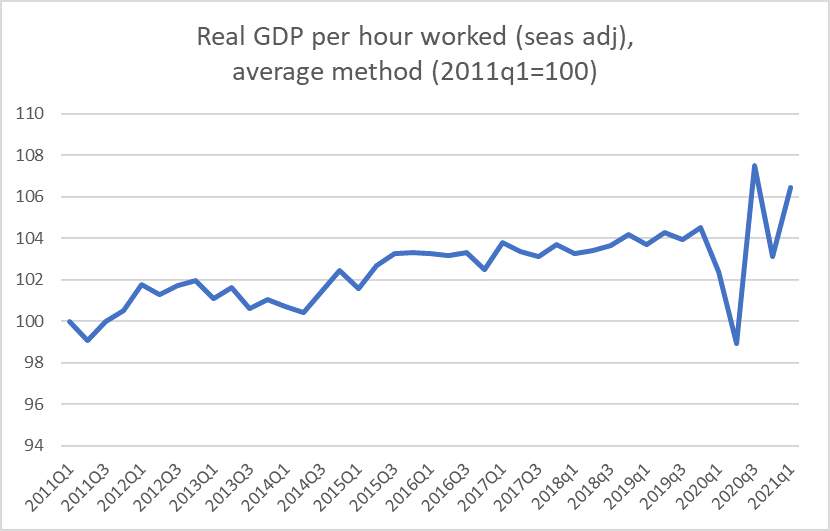
One of my favourite charts over the years has been on real GDP per hour worked. My normal approach is to use the two GDP estimate and the two estimates of hours (QES and HLFS), index all the series and simply use the average that results. Here is the chart for the last 10 years

real GDP phw June 21

The decade was mostly pretty bad, but who knows what has gone on in the last 12 months. Some of the apparent noise reflects differences in the two hours series: the HLFS estimates hours worked and the QES hours paid. Usually they are much the same thing, but not in the midst of a lockdown with a wage subsidy. But that was mostly a problem for the June and September quarters last year.

No one is going seriously argue that Covid has been good for productivity, so even if the latest estimate looks quite appealing it is unlikely to endure. Now, of course, you’ll recall the divergence in the two GDP measures, so I could show you are a chart with really big differences in the productivity estimates depending which GDP measure one uses.

Perhaps you think that the lift in productivity shown in the chart is mostly a compositional effect. When hours worked dropped it is often the lowest paid, lowest productivity hours that drop off first. But even there our two surveys report quite different things: QES hours in March were (seasonally adjusted) 1.8 per cent lower than they had been in December 2019, but HLFS hours were 1.4 per cent higher. There is, inevitably, noise in these series, but it does leave analysts somewhat at sea at present. And not even sure where the errors, and future revisions, might be. I’m pretty confident that labour productivity has not really increased by 2 per cent in the last 15-18 months, but what that means for the component estimates I don’t know.

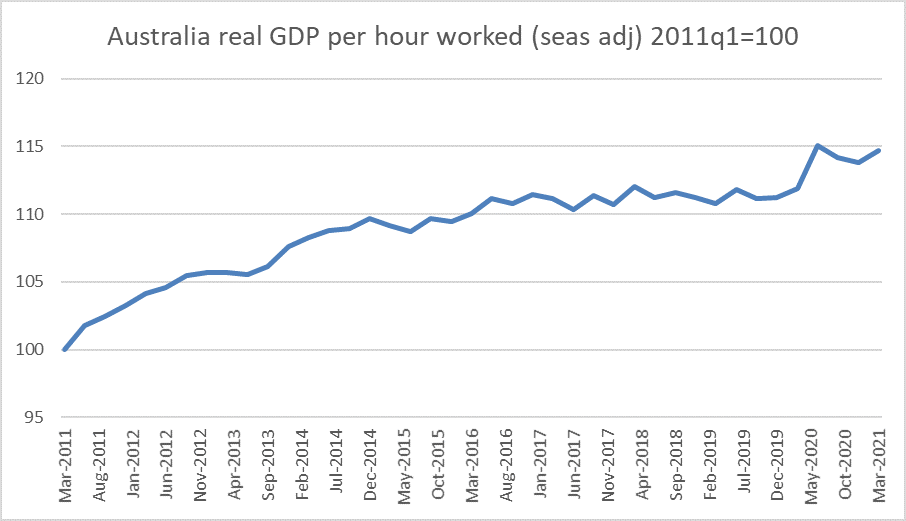
I’ve sometimes shown comparison with Australia, especially for real GDP per hour worked.

Aus GDP 2

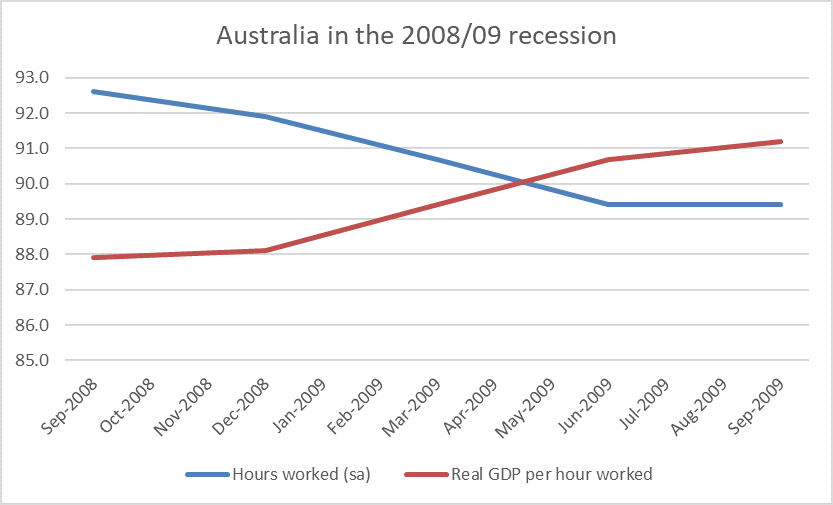
There is much, much less volatility than in the New Zealand estimates. Of course, it also seems unlikely that underlying productivity per (stratified) worker has stepped up through Covid, but…..hours worked in Australia are estimated to have been 3.4 per cent lower in the March quarter than in the December 2019 quarter, so there is a a somewhat plausible composition story there. In fact this is what happened in Australia in the 2008/09 recession.

aus 08

And as the labour market recovered, productivity fell back to trend.

Some of the measurement challenges are unavoidable, but it does look as if the (highly regarded) ABS is making a better fist of things than SNZ.

We can be confident that the economy is in much better heart than it was last June, but – per official statistics anyway – that really is about all. Fortunately, we have business opinion surveys because perhaps more than usually we really rest on them for anything much of a sense of where the economy is right now. And for some things that matter longer-term, notably productivity, we really are just flying blind at present, backed perhaps by basic theory that whatever good shutting borders has done for public health (a real gain) it is almost certainly at least somewhat bad for productivity.

Immigration policy for New Zealand post-Covid

It must be quite a challenge for Rotary clubs to maintain a regular roster of speakers. Four years ago someone at the Wellington North Rotary Club had heard about my ideas on immigration policy and New Zealand’s lamentable economic performance and they invited me along to tell my story. The text I used then is here. A little while ago they invited me back and when we discussed what I might talk about I agreed to pick up where I’d left off in 2017 – at the very peak of the then immigration surge – and reflect on a better immigration policy for New Zealand as and when the borders eventually reopen (in the year to April, SNZ estimates a net outflow of about 9500 non-New Zealanders who’d been here for some substantial period of time.

So I spoke to them yesterday. One can’t cover everything – or even anything much in the depth the subject warrants – in 20-25 minutes, but for those interested my text is here.

Sadly, of course, the stylised facts of New Zealand’s economic underperformance haven’t changed for the better over the intervening four years. Productivity levels remain low and growth weak. Business investment has been pretty sluggish around low rates, and if anything the export/imports shares of GDP have probably fallen a bit more (even before Covid at least temporarily cut both further). Our real exchange rate stayed high, and if long-term real interest rates have fallen they were/are still well above those in almost all other advanced countries.

What has changed, for now anyway, is the substantially closed borders, which mean that it is very hard for most non-New Zealanders (Australians aside) to get in. No one envisages, or wants, current arrangements – or anything like them – to be permanent, but it does mean the conversation and debate starts from a rather different place than it might have a few years ago.

Perhaps what hasn’t changed so much is that much of the media debate – and apparently the political interest – seems to be on short-term visa holders. And almost every day now we hear stories from employers complaining about how hard it is to get staff, holding the border restrictions responsible.

It isn’t surprising that there has been some dislocation, disruption, and difficulty for some firms. After all, the borders were basically closed overnight, for public health reasons, and that disrupted a lot. That included typical sources of labour firms had become used to tapping, but it also included changes in the patterns of consumption demand (and the derived demand for labour). Add to the story, of course, the surprising pace of the overall economic rebound – spurred by huge fiscal deficits (not just last year when they were needed, but now when they aren’t) – which has led some economists to conclude that the economy and labour market are now operating at very close to full capacity. At full capacity you would hope it wasn’t always easy, or cheap, to find staff (on the other hand, it might be relatively easier for people to find jobs).

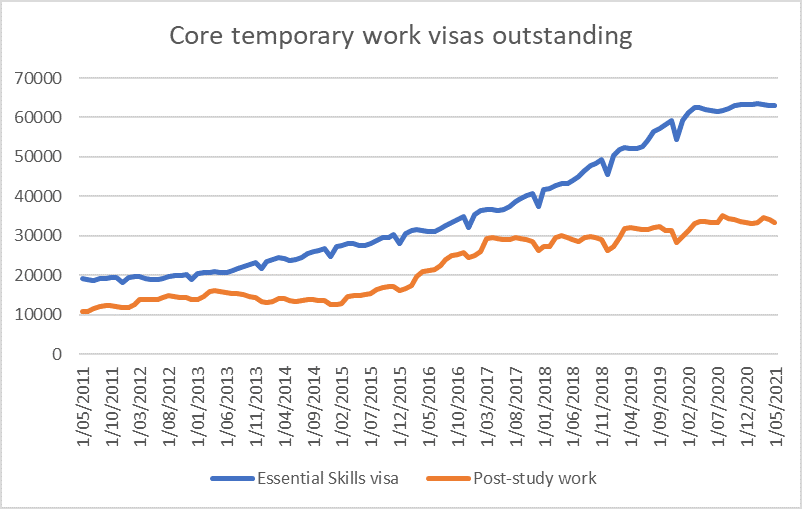
I don’t intend to make this a long post, but before running some quotes from my speech, I thought I’d include a couple of charts with some data that surprised me a bit when I dug it out. The first is the number people here on two of our main short-term work visa programmes – Essential Skills visas (a label that really should be in quote marks, or prefaced by “the so-called”) and Post Study Work visas.

visa 1

I knew the government had offered visa extensions in many cases, but if you’d asked I’d have guessed that total numbers would have dropped anyway as a reasonable number of people went back home. But, in fact, the numbers here – in these two most skills-focused categories – are almost the same as they were at the start of last year. And numbers on both visas are a lot higher than they were even five or six years ago.

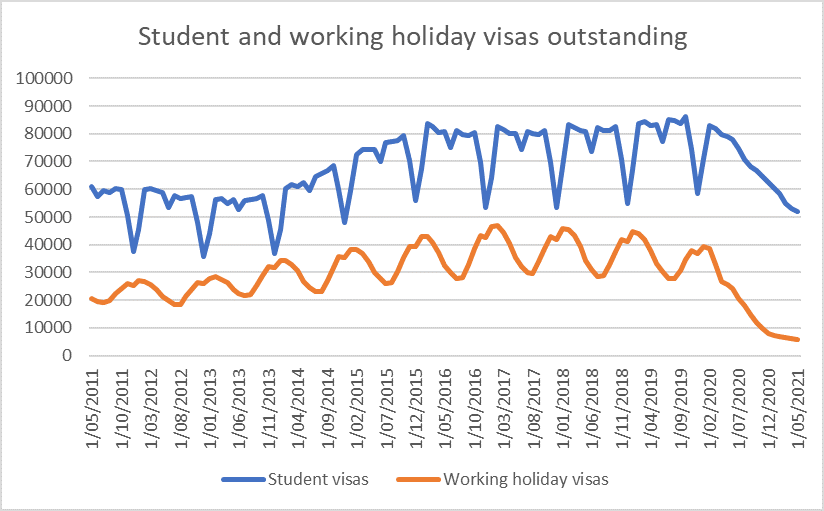
Now, there have been material drops in the numbers here in a couple of other categories (both series quite seasonal).

visa 2

And those patterns are pretty much what I’d have expected. People have gone home as they’ve finished courses of study, or working holidays, and few/no new people have arrived. But on the working holiday front remember the counterpart – not too many New Zealand young people will have been heading off on their OEs over the last 15 months or so. The types of jobs (here) the two groups might have been looking for may have been a bit different – so some real mismatch issues in some places/roles – but it isn’t as if there are fewer potential workers overall.

As I noted in my speech – bearing in mind the rapid growth in short-term visa numbers in the run-up to Covid.

No doubt some firms have specific difficulties from the sudden dislocation. But there is something wrong with the story when it is seriously claimed – and this is the implication of what so many of these businesses are saying – that a low productivity economy, achieving underwhelming productivity growth, needs more and more immigrant workers each year just to function effectively.   Such a story might – just might – have a modicum of plausibility if this was a dynamic fast-growing economy where more and more firms were finding more and more opportunities to successfully compete on a world-stage.  But that is nothing like New Zealand’s story.  

And, as I’ve noted previously, most OECD countries are not only more productive than New Zealand they are also less reliant on migrant labour. Many business concerns reflect – understandably so – the (sometimes quite legitimate) perspective of a company, but economic policy management is about a country, and the two are quite different.

All that said, one of the points of my speech was to argue that the longer-term immigration settings, around residency approvals, matters far more to economic performance than the rules around limited period work visas. At 45000 residency grants a year, in 22 years the population will be heading for a million more than otherwise (by contrast, at peak there are about 100000 people here on Essential Skills and Post-Study work visas). If you believe in the enabling economic power of immigration, or think that in New Zealand’s case large-scale non-citizen immigration has been quite damaging economically, that is really where one should focus. Open borders people do – in principle, they’d allow (almost) anyone in, to stay. And so do I.

Here is the text from the last couple of pages of my speech on the way ahead

A couple of weeks ago the Minister of Immigration gave a speech foreshadowing changes to policy settings around immigration, apparently with a focus on the limited period visas.  There were no specifics, and there was no supporting analysis.   There are probably some sensible changes that could be made, but like their predecessors, this government seems all too fond of having officials and ministers decide who should be able to use migrant labour, where and when.  I’d rather go in the opposite direction and get officials out of things as much as possible. 

I would favour two main changes.  First, I would reverse the decision a few years ago to allow students to work while here. If you are here to study, study, don’t compete at the low end of the labour market.   And I would get governments out of approved lists, or even salary thresholds, and replace it all with a model in which any employer could hire a person on a temporary work visa but that visa would be

  • Subject to a fee, payable to the government (perhaps $20000 per annum or 20 per cent of the employee’s annual income, whichever is greater). That sets a clear and predictable test for whether non-New Zealand recruits are really required, and a genuine incentive on employers to search for and develop New Zealanders (especially for less well-paid positions).
  • Subject to a term limit (no individual could be here on one of these visas for more than three years, without at least a one year return home)

But despite the headlines these short-term work visas are still the second order issue.  Much more important is whether the government is willing to make any significant changes to the residency programme, or whether business as usual will shortly be resumed.

Neither the government nor the Opposition seen willing to engage on that issue.  And if the government deserves a little credit for very belatedly asking the Productivity Commission to report on the New Zealand immigration model, strangely they seem to be proposing to make policy before the Commission reports.

What should they be doing?

First, we need to explicitly recognise that the residency programme (the driver of medium-term policy-led population growth) itself comprises several different types of people. 

It includes people we are never going to restrict.  If your daughter does an OE in London and finds a British man to marry, he’ll be entitled to move here permanently.  No one would want to restrict those numbers, and there is no quantitative limit. 

It includes those we take in as refugees.  There is no economic motive for the refugee quota, it is all about humanitarianism.  

But the bulk of the programme is purely discretionary.  And the numbers involved have borne no relationship to the rather limited (highly productive) economic opportunities here.

There are all sorts of myths about migrants to New Zealand.  By international standards the skill levels mostly aren’t too bad – being a distant island means you really only get in legally, and it is an economics (rather than family) driven programme.  But the skill levels aren’t spectacular.  And why would they be?  Much as New Zealand is a pleasant enough, and peaceful, place to live it is (a) remote, and (b) now not very prosperous, and (c) small.   The smartest and most ambitious and most driven of the potential migrants are much more likely to go to other migration-welcoming countries if they can get in.  A country whose own people leave en masse isn’t a great advert for abundant economic opportunities.

And we aren’t even ruthless about demanding highly-skilled people.  We run specific programmes for people from Pacific countries who don’t have the skills/education to qualify as skilled migrants.  And we give extra points to people who are willing to live outside the main centres, even though the main centres are where most of the economic opportunities and higher paying jobs are.  We structure the system to subsidise NZ universities, by favouring applicants with NZ degrees and work experience even though NZ universities are nowhere near best in the world, and NZ’s economy is a low productivity beast.   And so on.  There is talk from time to time about attracting the best tech people, but why would they come here – small, remote, not very wealthy, no great universities, no relevant centres of expertise or funding, and so on? 

And so we bring in lots of pretty-average people, adding nothing systematically to NZers’ prospects   There is nothing wrong with being “pretty average” – that’s most people – but it isn’t going to do anything to transform our productivity performance.  Hasn’t so far, and no reason to suppose it will any decade soon.

New Zealand’s economy could do such much better.  But all the signs are that it probably can’t match the best with a population that is growing rapidly – much more rapidly than the productivity frontier countries.  Distance hasn’t been defeated and if anything may have become more important.  There is lots of wishful thinking around the New Zealand debate, but any serious confrontation with the stylised facts of New Zealand’s experience, augmented with the experience of other former settler societies, is that large-scale immigration just hasn’t helped for a long time.  You might think the US is an exception, but it isn’t really.  It was – like us – one of the handful of richest countries in the world 100 years ago, and despite having had much more rapid population growth than European countries (and no ravages of war or communism) the gaps have narrowed.     Denmark is probably the standout performer today.  

If political parties were serious about reversing the decades of relative productivity decline – and there is no sign of it – there is a variety of things mutually reinforcing things that should be done, which together would prompt much more business investment and a more outward-oriented economy: 

  • We should take a much more open approach to foreign investment – I’d remove all controls in respect of investors from OECD countries.
  • We should be lowering the tax rate on business investment – our company tax rate (which matters a lot for foreign investors) is in the upper part of the OECD range, and what you tax you get less of.
  • We need to free up land use, within our cities and across the country.

One could list other things (GE issues for example).

But most importantly, we need to end the delusion – for that is what it is – that a very remote country, which lots of its own people leave, which has fallen steadily behind an increasing number of other countries, and where foreign trade is shrinking as a share of GDP, is a sensible place for government policy to promote large scale immigration.  It wouldn’t make sense for Taihape; it doesn’t make sense for New Zealand.    Immigration policy is one of the largest structural policy interventions in our economy.    And now – before we reopen the borders – is the time to act.

So let’s not go back to granting huge numbers of residency permits.  Cut out the Pacific quotas – no reason to favour people from those countries any more than those from (say) Britain and Ireland (that we once favoured), and cut back the total approvals to, say, 5000 to 10000 really highly-skilled people (if we can find them) with no preferences given to NZ qualifications and experience, simply looking for the best and most energetic.  Add in refugees and the spouses/partners of New Zealanders, and you’d be looking at an overall number of residency approvals each year of 10000 to 15000.  In per capita terms that would be a similar rate to the US. 

Successful countries make their economic success primarily with and for their own people.  We can again do it here. We have talented and fairly well-educated people, we have reasonably open markets, we have a history of innovation, but distance really works against us and we will mostly prosper by doing better and smarter with (and investing more heavily in) the natural resources we have – things that really are location-specific.  Lots of other bright ideas are, and will be, dreamed up by people here.  But if those ideas work well, they’ll typically be much more valuable abroad.   You may not like it – neither do I really – but it is what experience shows.  We’d be foolish to simply start up the same old model and expect better results in future.

Colonial constructs

A couple of weeks ago the Sunday Star Times had a full page article – in a Money supplement, self-described as offering “Intelligent Money News, Tips and Insight – by Jade Kake headed Debt as we know it is a colonial construct (the online version runs under the title “Maori have colonisers to blame for concept of individual debt”.) The column ends even more starkly: “Debt is a colonial construct”, observing that “the implications of which continue to be felt in the colonies”.

As it happens, Ms Kake herself could probably be described – without animus – as something of a “colonial construct”. When I looked her up it turned out she was Australian (born, bred, and educated), of parents who themselves had been born in New Zealand and the Netherlands respectively. Lots to celebrate there one might have thought, and certainly it would have been inconceivable – impossible really – prior to, say, 1769. These islands and the descendants of their first settlers had been almost entirely cut off from the rest of the world- whether people-to-people movements, trade or technologies. And one of those missing “technologies” was credit – or debt.

There doesn’t seem to be any real debate about that. Ms Kake states it herself, and when I looked up some books on the pre-contact Maori economy they all made more or less the same point. There was some gift-exchange elements, but nothing at all resembling credit/debt as it had been known for some time – rather a long time in some places – in much of the rest of the world. A few years ago there was a book by the American sociologist David Graeber called Debt: The First 5000 Years. and I’ve written here about debt jubilees from thousands of years ago But that innovation, and evolution, had completely passed this part of the world by. Consistent with the absence of so many technologies and trade here, material living standards were very low.

“Colonial” is one those ill-defined words. Sometimes it means lots of permanent settlers from abroad, and sometimes just a period of control and government by a foreign power. In New Zealand, of course, it involved both, although the control by the foreign power was very short-lived. But, as people sometimes point out, even if these islands had never fallen to any foreign power, or if there had been little or no foreign settlement, many of the technologies would still have found their way here. Credit/debt is surely one of those sets of technologies. And that is a good thing.

Ms Kake is, of course, less sure (to put it mildly). But even she doesn’t really seem able to make up her mind. On the one hand she laments the arrival of the first bank in New Zealand (an ANZ forerunner) – but interestingly doesn’t mention our first very early quasi central bank, the Colonial Bank of Issue – but by the end of her column she is lamenting what she sees as evidence that it can be a bit harder to get credit if you are “visibly Maori”. If the latter is true it is, of course, unfortunate, but then we are left thinking that really credit/debt isn’t so bad after all. It depends – on what is used for, the reasons it is taken on, the conditions applied etc etc. Hitler’s regime borrowed in World War Two, but so did our side to defeat him. But when private parties take on debt, and do so not under duress, it is generally enabling and empowering.

Could one envisage a modern technologically-advanced world without debt? One could (and I briefly did here, in a debate a couple of decades ago with a visiting monetary reformer), but they’ve tended to go hand in hand. And no doubt Ms Kake would tar arms-length equity investment – also unknown here in centuries gone by – as another “colonial construct”. One might – as I do – wish there was much less household debt (because governments fixed the land supply regulatory disaster and got house/land prices a long way down), without having any particular qualms at all about young couples being able to borrow to buy a first house (rather than, say, generally wait until they were 50+ to buy a house outright). Much the same goes for business credit. Credit/debt is a sophisticated device enabling risk-taking, enabling smoothing of consumption, and so on. Financial development tends to go hand in hand with more intensive economic development and much higher material standards of living – not necessarily causally, although there are probably causal aspects (long-distance trade tends to rely on credit, on trust).

It is simply silly to say the debt is a “colonial construct” – it was simply one of the many things (institutions, cultures, technologies) that residents of these islands got access to when these remote islands finally opened, so late, to the wider world. There was – and is – nothing particular British – or even Dutch or northern European – about debt, technology itself transferred to, refined in etc, those parts of the world from elsewhere well before anyone settled here.

There has been a bit of debate over the weekend about the legacy of colonisation in New Zealand, prompted by some remarks by National’s education spokesman suggesting that in his view colonisation had, “on balance” been beneficial for Maori. One might debate aspects of his framing, and I don’t want to launch into an extensive debate here (a couple of pieces of mine that might be relevant are here and here). But, equally, the state of economic development and material living standards tend to speak for themselves about at least some aspects of such a question.

There is a big academic literature on the influence on imperial government, colonial settlement etc on the level of (say) real GDP per capita of different countries, and I’m not going to attempt to summarise it here. My own take is that the effects of imperial rule are not that large, but those associated with colonial settlement often have been. British settlers to (say) New Zealand and Australia in the 19th century brought with them many of the aspects – legal systems, culture, education or whatever – that had then made Britain the country with the most advanced economy and highest incomes.

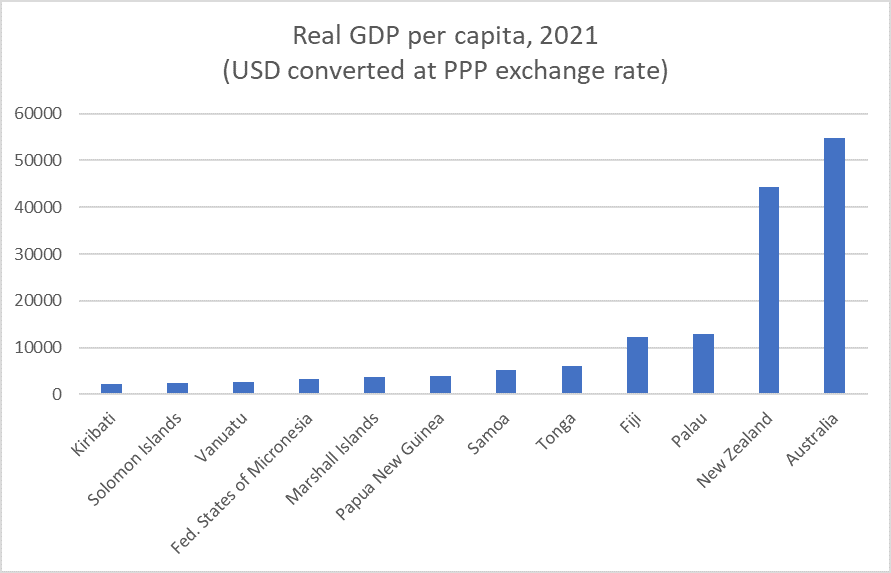
Here is the IMF’s estimates of real GDP per capita this year for a variety of Pacific countries.

IMF real GDP

All of these lands were governed for a time in the 19th or 20th centuries by countries from outside. Two had large scale settlement – complete with the attendant, often embodied, “institutions” broadly defined – from places that were among the very richest and most productive on earth. It shouldn’t really be a surprise that the inhabitants of those two countries now – and not just the descendants of the settlers but the descendants of the earlier inhabitants (categories now often quite mixed) – have by far the highest material living standards of any of the countries in this region (all of which had previously been largely cut-off from the technologies of the rest of the world). Of the other countries on the chart it probably isn’t a coincidence that Palau and Fiji had the largest degree of settlement of peoples from outside the region. (As far as I can see the French territories – French Polynesia and New Caledonia – would come between Palau and New Zealand on the chart, but their stories are complicated by the ongoing ties to – and subsidies from – France.)

My best guess is that if, somehow, these islands had not been settled by outsiders but had simply been governed from outside for 100 years or so – as with most of these other Pacific states – real GDP per capita here might be similar to that in Samoa. They have computers, they have phones, they have credit. But they do not have an advanced economy offering high material living standards for their people (many of whom prefer to migrate to New Zealand). There might be reasons to debate this view, but even if these islands somehow generated per capita incomes twice those of Samoa they’d still be very low by advanced country (or modern New Zealand/Australia) standards.

Material living standards aren’t everything by any means. But they do seem to count for quite a lot.

Participating in the labour market

Yesterday morning I was skimming through the online database for the OECD’s recently-released latest Economic Outlook when I noticed that their table for the labour force participation rate was for ages 15-74. Often tables and charts for the “working age population” are done for ages 15-64 but as a growing proportion of those 65 and over have continued working the 15-64 numbers have become increasingly unrepresentative. So I downloaded the data and had a quick look, resulting in this tweet. (2019 because last year’s numbers were thrown around for every country and aren’t necessarily that representative.)

I was a little surprised – not that we were towards the right-hand end of the chart, but that New Zealand was now highest.

But there I might have left it, except that Stuff’s Susan Edmunds got in touch. We had a bit of a chat, and she produced this article. The headline suggests that high house prices might be the explanation (but as I’d noted to the journalist a variety of factors will have affected a range of different demographics).

It is worth stressing here that a high participation rate is neither good nor bad in its own right. It depends. I’m not in the labour force these days, and since I’m fine with that and I’m not a burden on the taxpayer it isn’t really a matter for anyone other than me and my family. My mother was in the labour force for perhaps only two or three years of the 60 years between her wedding and her death. On the other hand, if people are deterred from working by very high effective marginal tax rates or by “overly-generous” welfare provision or highly inflexible labour markets that might be more of an issue. And in wars, states sometimes compel people into the labour force – there might be reasons of state for that, but it is hardly a first-best state of affairs.

But I was still a bit puzzled so dug about a bit more data. First, this chart showing (since 1986 when our HLFS began) the 15-74 participation rate for New Zealand relative to (a) the median OECD country, and (b) the highest participation rate of any country in each year.

OECD partic rates since 86

(Technical note: it is only since 2002 that there is complete data for all today’s OECD countries. Using a fixed sample of the countries for which there is data for the entire period takes out much of the dip in the median after 1990, but converges back to the orange line in the last half dozen years.)

So we now have the highest 15-74 participation rate of any OECD country, but that is quite a new thing. Over the entire period our participation rate has been at or above the median (which was probably my impression), but the closing of the gap is striking. Note that back in 1986, the universal age pension (NZS) was paid from age 60, so from that change alone it is not surprising that our participation rate is now materially higher than it was 35 years ago (in 1986 32 per cent of 60-64 year olds were in the labour force, while about 74 per cent are now).

But where does this highest participation rate show up once we dig a bit deeper, by age and by sex?

It turns out that it is nowhere in particular. For not one of the age/sex breakdowns I looked at did New Zealand score highest in 2019.

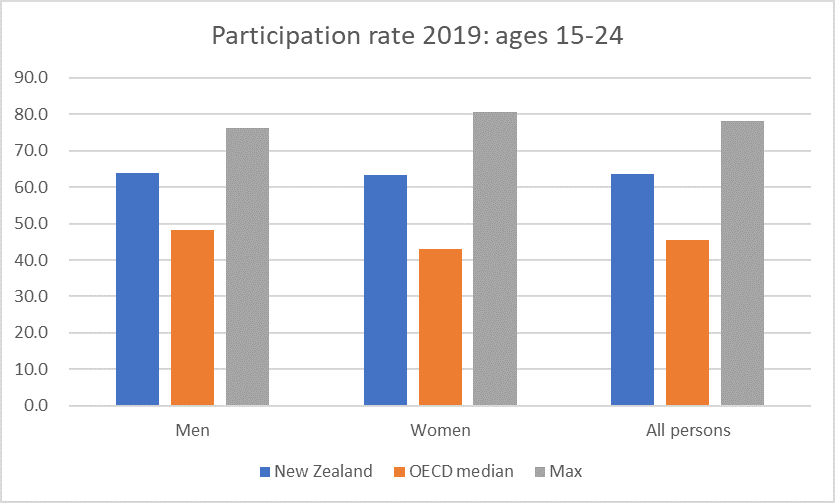
Here are the young people, aged 15-24

15-24

Well above the medians but also quite a bit below the highest participation rates, whether for men or women.

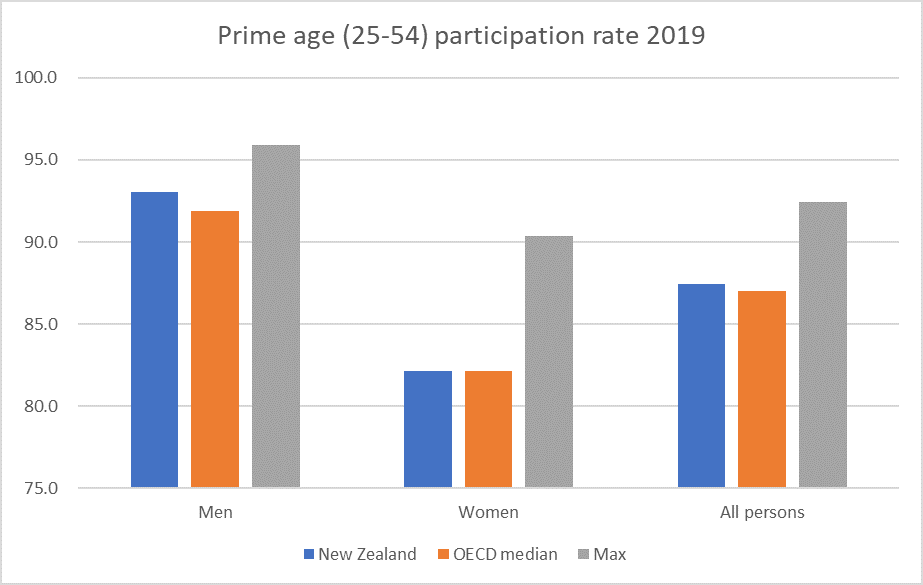
This chart, for what is often referred to as “prime [working] age” people (25-54) took me a bit by surprise.

prime age

Not only are the New Zealand numbers not that near the maximum but for women of this age New Zealand was the median country in 2019. So much – it would appear – for the high house price story (at least as it is often applied, with both parents “having” to work even though they might prefer one to take more time out). Of course, house prices are high in some other OECD countries as well, but hardly any have quite the price/income ratios of New Zealand.

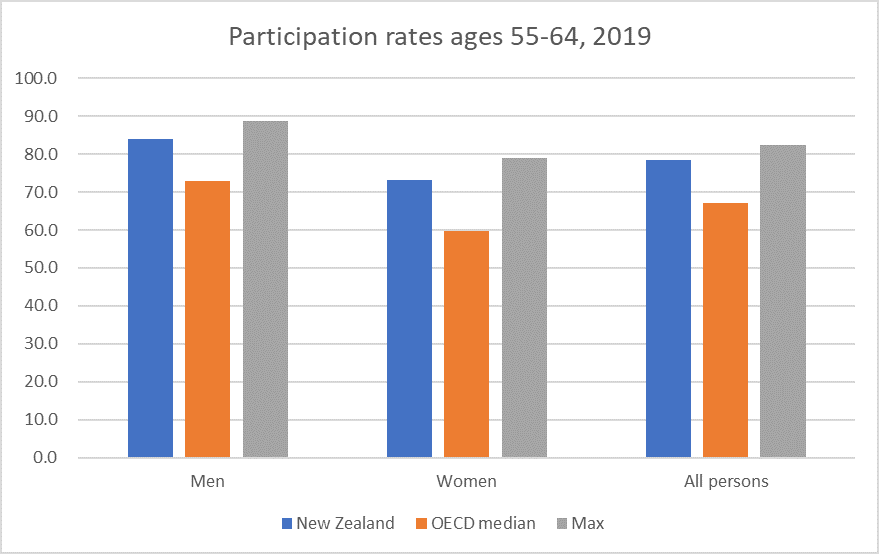
The next age group is the last before NZS eligibility now kicks in.

55-64

Here both male and female participation rates are well in excess of OECD medians, and not far off the highest rates (Japan for men, Sweden for women).

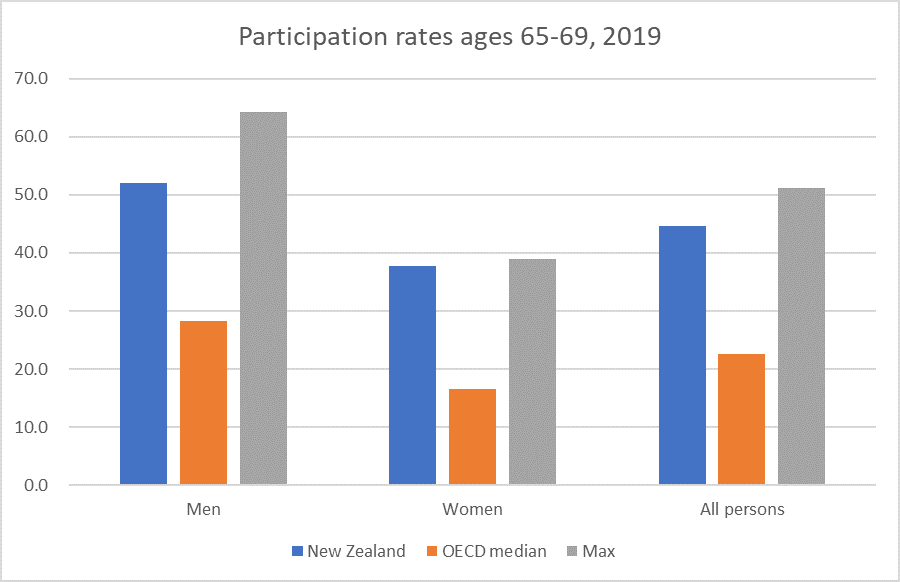
What about the 65-69 age group?

65-69

Again, well above the OECD medians for both men and women. but with a few countries higher than us especially for men.

And finally, the entire 65+ age group.

65+ partic

With much the same picture.

So standing back (and assuming the OECD did the 15-74 calculations correctly) we end up with the highest overall labour force participation rate for this working age band not by having spectacularly high participation rates for any particular age or sex sub-category, but from being well above the median in almost all categories, and at the median in a single sub-category (women 25-54).

(Note too that these are participation rates rather than employment rates – simply because that was the OECD table I started with – but note that New Zealand unemployment rates are typically below average among OECD countries.)

What should we take from all this? There are no doubt people who have dug into some of this stuff in more depth than I have here, but a few things strike me:

  • There is no single cause, factor or policy that explains New Zealand’s current participation rate being the highest in the OECD,
  • The high house price story seems unlikely to be that compelling, at least yet. For example, our working age participation rates are not particularly high (especially not for women), and today’s 65+ generation were already at least in their mid-30s 30 years ago (which is when real house prices really began to take off),
  • Our NZS regime is relatively supportive to labour force participation (since there is no income-testing or abatement), but as other countries raise their state pension ages, the income effect will tend to dampen labour force participation here among the 65+ age group, relative to some other OECD countries,
  • Much as I am not a fan of our high (absolute) rate of people receiving working age welfare benefits, or of the fact that our minimum wage is now high relative to median wages in New Zealand, it is only fair to note that our labour force participation rates are at or (mostly) above those in most OECD countries for every demographic shown here.

In the original tweet (above) I contrasted the high rate of labour force participation in New Zealand with the dreadful record on average labour productivity. In 2019 it would have taken a 68 per cent lift in average New Zealand real GDP per hour worked to have matched the leading bunch in the OECD (the US and some northern European countries). But by putting in more labour inputs (some mix of being employed and hours per job) we keep rather closer to the first world on average per capita incomes. The comparisons with the UK – not one of the highest productivity countries – is illustrative. UK average labour productivity is about 40 per cent higher than that of New Zealand, but UK real GDP per capita is only about 10 per cent higher than that here (both on OECD estimates). The UK does not have a low participation rate, but their participation rate (see first chart) is far lower than New Zealand’s (as are average hours worked per capita).

Sometimes the story is portrayed as one of employed New Zealanders working long hours. There is something to that story – working hours per worker in New Zealand tend to be in the upper quartile for advanced countries (only Lithuania was higher in 2019 among OECD countries – although Singapore, Korea and Taiwan are all materially higher). Some of that, in turn, doesn’t reflect long hours each week, but shorter annual leave entitlements than in many European countries. But equally important is long hours over a lifetime – our young people and our old people are simply more likely to be in the labour force than in the rest of the OECD, for a mix of reasons that can’t simply be dismissed as “good” or “bad”.

To the extent those reasons are “good” just think of the per capita incomes that could be sustained here if policies were ever adopted that once again delivered average productivity getting even close to the leading bunch in the OECD.

The PRC and all that

In recent days, there has been quite a bit of coverage of issues around the New Zealand’s government’s approach to the PRC.

There was, for example, last week’s trailer for the Australian 60 Minutes piece on New Zealand and China, which excited a great deal of scorn (and coverage) for what was, after all, a teaser to get people to watch a longer programme. It wasn’t clear what riled people more – the (not new but) clever play on words suggestion about “New Xi-land”, quotes from Mike Hosking, or what but the “elite” reaction was quite remarkably hostile.

As it turned out the actual 60 Minutes programme (you can watch it here) as something of a damp squib. Sure there was the nauseating spectacle of Michael Barnett, Executive Director of the Auckland Chamber of Commerce, talking of being “friends with benefits” with the PRC (complete with the “nudge, nudge, wink, wink” nuance), and openly asserting that whatever the PRC did on the human rights was really its concern only, and not something for anyone else to worry about. Presumably he believes what he is saying, but not the harshest critic of the Jacinda Ardern or Judith Collins would suggest they held that view. And from the Australian perspective, the programme makers seemed to start with the line that the Australian economy was paying a high price for their government’s stand, while New Zealand was prospering…..but with not a shred of evidence examined for those claims. At a macro level, the two economies look very similar right now, with unemployment rates post-Covid now back down not too far from late 2019 levels (Australia possibly a touch closer than New Zealand). And some of the programme even seemed quite sympathetic to the common, but fallacious, view that somehow New Zealand is less able to take a stand, due to size or other unpersuasive reasons. There was, of course, the clip of the 60 Minutes journalist asking Ardern whether she ever held back in making comments on China because of fears about trade. She again claimed that she never did – and surely no one serious in Australia, New Zealand, or China believes her – but 60 Minutes made no effort to unpick that claim either (which, as I noted in a post recently, if true must then mean she is really almost entirely indifferent to, and has feel no serious moral unease about, what China does – and I don’t believe that either). There was nothing about the New Zealand government’s reluctance to call out PRC attempted economic coercion of Australia, nothing about its refusal to criticise the PRC for the arbitrary detention and recent secret trial of an Australian citizen. And, of course, nothing about how weak both main parties here are on issues like political donations or CCP-connected political figures.

Of somewhat more importance was the political theatre in Queenstown yesterday, culminating in a long and wordy communique, in which Scott Morrison and Jacinda Ardern were falling over themselves to suggest that there was no real difference between them when it came to China. Both had their reasons no doubt.

Here is what they had to say.

First, on “coercion”

37. The Prime Ministers affirmed their strong support for open rules-based trade that is based on market principles. They expressed concern over harmful economic coercion and agreed to work with partners to tackle security and economic challenges.

39. The Prime Ministers reiterated their shared commitment to support an Indo-Pacific region of sovereign, resilient and prosperous states, with robust regional institutions and strong respect for international rules and norms, and where sovereign states can pursue their interests free from coercion.

Those references to coercion were new (weren’t in last year’s communique) but notice how weak they are. The first reference (para 37) is not even in the “Indo-Pacific and Global security” section, and neither reference explicitly names the range of steps the PRC has taken against Australia. Since we can reasonably expect that Australia would have welcomed strong and explicit support, we can only assume that New Zealand wasn’t up for it. That reflects very poorly on the New Zealand government – most especially in a joint communique with the Australians. Senior figures in the US Adminstration have made (much) stronger statements than that, specifically about the Australian situation.

Then there was the South China Sea

42. The Prime Ministers expressed serious concern over developments in the South China Sea, including the continued militarisation of disputed features and an intensification of destabilising activities at sea. The Prime Ministers further underscored the importance of freedom of navigation and overflight. They emphasised that maritime zones must accord with the United Nations Convention on the Law of the Sea (UNCLOS) and called on all parties to respect and implement decisions rendered through UNCLOS dispute settlement mechanisms. The Prime Ministers reiterated the importance of the South China Sea Code of Conduct being consistent with international law, particularly UNCLOS; not prejudicing the rights and interests of third parties; and supporting existing, inclusive regional architecture.

Which seemed quite good. I hadn’t heard Ardern or Mahuta say anything at all about the South China Sea – it certainly wasn’t in the list of issues they mentioned in their respective recent China speeches – but it turns out most of this language was also in the previous communique from 15 months ago, with just a couple of (useful) modifications. And – read it again – note that the PRC is not even named. It is good to see, but you get the impression that it was one of those issues that mattered to the Australians and in putting together communiques there has to be some given and take (I’m assuming Ardern’s side is the one keen on the strange “circular economy” paragraph that also survives from one year to another).

Then we got a paragraph that was not there at all last year

43. The Prime Ministers expressed deep concern over developments that limit the rights and freedoms of the people of Hong Kong and undermine the high degree of autonomy China guaranteed Hong Kong until 2047 under the Sino-British Joint Declaration. The Prime Ministers also expressed grave concerns about the human rights situation in the Xinjiang Uyghur Autonomous Region and called upon China to respect the human rights of the Uyghur people and other Muslim minorities and to grant the United Nations and other independent observers meaningful and unfettered access to the region.

I suppose it is good stuff as far as it goes, which is not very far. On Hong Kong, for example, there is no denunciation of the growing number of political prisoners or – in this week of Tiananmen Square remembrance – of the heavy punishments people of Hong Kong are threatened with if they seek to participate in (long-established) vigils). And as for the Uighur comments, they are less pointed that the recent resolution of the New Zealand Parliament which – if it did not name China – did refer to “severe human rights abuses”.

It is also interesting that in the next two paragraphs the two leaders could call out Myanmar much more directly

They condemned the violence being perpetrated against the people of Myanmar and called on the military regime to exercise restraint, refrain from further violence, release all those arbitrarily detained, and engage in dialogue.

Which is good stuff, but might almost equally be said of China….except the thought would never cross Ardern’s mind (perhaps the Australians would not have been keen either).

And what is missing completely is also interesting – no mention of PRC threats to Taiwan, military incursions etc, and not even (that I could see) a mention of the desirability of Taiwan participating in the WHO.

Oh, and there was also this

41. The Prime Ministers agreed to continue working collaboratively, bilaterally, and with our partners in the Indo-Pacific region, to uphold sovereignty in an era of increasing strategic competition. The Prime Ministers reaffirmed their resolve and shared respective approaches to countering foreign interference and agreed the importance of building resilience across all sectors of society, including in education, infrastructure, research, electoral processes, media and communities.

But that is just boilerplate communique-speak, with no substance whatever. It covers over the fact that the New Zealand government has been reluctant to even speak of foreign interference/influence risks – seen most recently in the belated emergence of news of the secret National/Labour deal to clear about the headline risks around Jian Yang and Raymond Huo, while neither party leader will even front with the public on the issue.

The different stance between New Zealand and the 13 western countries (not the Five Eyes) on the WHO study on Covid origins was also quietly swept under the carpet.

So for all the bonhomie and smooth words, it didn’t really amount to much. As I noted earlier, it suited both sides now to paper over the cracks and pretend to a commonality of view. There is a line afoot that only the PRC itself benefits from divergence between western countries (or specifically New Zealand and Australia) on these issues, but that is an argument for more substantive alignment, not for pretending to a commonality that just doesn’t exist. Read the speeches (Ardern, Mahuta), watch the interviews (eg O’Connor): this is a government that simply has no stomach to seriously call out the PRC. Perhaps Damien O’Connor’s respect was “a mistake” – as he now concedes – but it was a slip of the tongue only in that he shouldn’t have said it publicly, not that the idea had never previously occurred to him and a word he’d never previously thought of slipped out. Or repeated references from senior ministers to “respecting” the PRC. Decent people don’t treat with respect regimes responsible for (at least) “severe human rights abuses”.

The appropriate benchmark here is not what Australia says or does (although the consensus across Australian politics is clearly in a quite different place to that in New Zealand – see the recent speech from the ALP’s Penny Wong) but on what is right and proper. There are areas where Australia itself isn’t as strong as it could be – one could think of parliamentary resolutions, autonomous sanctions regimes, the Winter Olympics, and so on.

But the New Zealand government’s stance continues to fall a long way short. Why will the Prime Minister not explain why her government scrapped the Autonomous Sanctions bill that had sat on Parliament’s order paper for several years, with no replacement? Why does her government continue to claim that she will be guided by the UN on “genocide” declarations re the Uighurs, when she knows that China is a veto-carrying permanent member of the UN Security Council. Why does she never speak openly about the South China Sea (an evolving and worsening situation, currently directly threatening the Philippines)? Why is she never willing to highlight threats to Taiwan? Why will she not front up about the Jian Yang/Raymond Huo deal? Why does her party keep recruiting ethnic Chinese candidates with strong United Front ties? Why will she do nothing serious about reforming electoral donations laws (even as multiple court cases and SFO investigations are underway)? Why was she so loathe to comment at the time of the break-ins to Anne-Marie Brady’s house and office (let alone when other NZ universities sought to have Brady silenced)? Why is she not willing to speak out about the Winter Olympics – does she really think the Olympics should be held in a country responsible for “severe human rights abuses”? Why is she not taking any lead to get PRC/CCP-funded and recruited/screened people out of our schools, instead funding Chinese language learning properly ourselves? And so on.

I was going to include in this post some thoughts on, and responses to, a new article in the Victoria University publications Policy Quarterly by Anne-Marie Brady on the New Zealand government’s approach to the PRC. It is a very generous treatment, about the “significant progress” she claims has been made under the Ardern governments of the last four years. I didn’t find it very convincing at all, but I guess it must have been welcomed in the Beehive and in MFAT.

Teaching New Zealand history

A couple of year ago I wrote a post here about the idea of teaching more New Zealand history in state schools. In principle I was, and am, strongly supportive of doing so, and have always been conscious that almost all the New Zealand history I learned has been acquired since leaving school. But I was uneasy about what was likely to be taught, which left me in practical terms ambivalent.

Incidentally, in that post I included a quote – from a newspaper article that day – in which the Deputy Leader of the Labour Party (and then Associate Minister of Education) denied there was any intention to make such teaching compulsory. But from next year it will be, at least for kids from 5 to Year 10.

A few months ago the government put out a consultative document with a draft curriculum for the teaching of New Zealand history to these children (bear in mind that the median age of the students will be 10). Submissions close today.

I wasn’t going to make a submission – what is the point, the government and the bureaucrats have ideological agendas they are unlikely to be deflected from – but after reading someone else’s submission the other day, which I was sympathetic to but disagreed with quite a bit of, I decided to make a short submission, if nothing else for the record.

My full submission is here.

I outlined several concerns that mean I think the proposed curriculum is highly unsatisfactory. Here is the body of my text

First, and although the focus is on young children (from age 5 to those at the end of year 10 just turning 15) there is no sense in the curriculum of any continuous narrative.    Providing such a basic outline of our history should be a basic in any history curriculum of this sort, which (sadly) represents almost all the formal history study most students will ever do.  No one, taught solely using this curriculum, will emerge with a rough sense of, for example, (a) the migration of Maori to these islands, (b) their settlement, their impact on the land, and their society, religion, economics, (c) the interface with more advanced technologies that connected these islands with the rest of the world, (d) the evangelisation of New Zealand and the key role of the Church Missionary Society, (e) key figures in early modern New Zealand history, (f) the economic development –  including large-scale immigration – that by the early 20th century had New Zealand as one of the highest income countries on earth, (g) the gradual process that led to New Zealand political independence. (h) the high rates of Maori-European intermarriage, and (i) key political figures (good and ill) of the 20th century.  Names and dates may be out of fashion – and they can be over-emphasised in the inevitable limited teaching time available – but they help provide a structure for beginning to organise thinking about historical events and times.  

Second, there is no sense of the wider world of which the New Zealand story (particularly since 1642/1769 or whichever date one focuses on) has been a part.    A significant element of pre-European New Zealand was its remarkable isolation – Maori having settled here some centuries earlier there was no evidence of ongoing contact with other societies in the Pacific (themselves typically small and isolated) and with no international trade at all.  It was an astonishing degree of isolation.    The European age of exploration and discovery opened these islands to the world, and the world to these islands – and had begun to do well before 1840.  Whether or not large-scale European settlement ever became a feature of New Zealand, that opening was inevitable and would always have been transformational.  And yet there is no hint of it.    Similarly, there is no sense of the similarities (and differences, for good and ill) of experiences in Australia, Canada, Newfoundland, Southern Africa, the United States and (beyond the English-speaking world) in southern Latin America or North Africa.  None of this can be taught in depth to young kids in a limited time, but it badly distorts the New Zealand story not to refer to them at all.   The people of these islands were isolated for several hundred years, but modern New Zealand is not – and for a least a century in the emergence of modern New Zealand what went on it was in parallel with, often interacting with, experiences in these other places.

Third, there is a strong sense running through the document that a primary purpose of studying history is to judge the past (and those in it) rather than to understand it.   Particularly when such young children are the focus, and when the curriculum is designed for use in schools across the country (attended by people of all manner of races, religions, political and ideological views), that focus is misplaced.    Understanding needs to precede attempts at judgement/evaluation, but there is no sign – in this document, or elsewhere in the curriculum – of children being equipped with the tools that, as they move into mature adulthood, will allow them to make thoughtful judgements or (indeed, and often) simply to take the past as it was, and understand how it may influence the country we inhabit today.    There is little or no sense, for example, that one reasonably be ambivalent about some aspects of the past or that some people might, quite reasonably, evaluate the same facts differently.

Fourth, not only does the document seem to operate in a mode more focused on evaluation and judgement than on understanding, it seems to champion a particular set of judgements, and a particular frame for looking at the history of these islands (evident, as just a small example, in its repeated use of the term “Aotearoa New Zealand”, a name with neither historical nor legal standing, even if championed at present by certain parts of the New Zealand public sector).     This includes what themes the authors choose to ignore – religion, for example, is not mentioned at all, whether in a Maori context or that of later arrivals, even though religions always (at least) encapsulate key aspects of any culture’s understanding of itself, and of its taboos).   Economic history hardly gets a mention, even though the exposure to trade, technology, and the economic institutions of leading economies helped dramatically lift average material living standards here, for all groups of inhabitants.   Instead, what is presented in one specific story heavily focused on one particular (arguably ahistorical) interpretation and significance of the Treaty of Waitangi.  These are contested political issues, on which reasonable people differ, and yet the curriculum document has about it something very much of a single truth.   In truth there a few things about which there is a high measure of agreement today – perhaps the ending of slavery and cannibalism here, under the influence of the gospel and (quite separately) colonial government – and thus a curriculum of this sort will be seen by many (including many parents) as little more than attempts to use the platform of compulsory public schooling as politicised indoctrination.   That is both inappropriate, unwise, and unnecessary.   And probably not helped by the very limited education in New Zealand education that most teachers have had, increasing the likelihood that what will be conveyed to children will be something more akin to a heavily politicised, nuance-free, (but in the case of most individuals well-meaning) “indoctrination”.

If a New Zealand history curriculum is to be anything more than an effort of indoctrination by a group who temporarily hold the commanding heights in the system, this draft should simply be scrapped and the whole process begun again with a clean sheet of paper.   Think, for example, about teaching the history of the last 1000 years, and the two primary strands (Maori, and Anglo/European) that have come together to form the modern New Zealand that we – today’s citizens – inherit, including confronting the fact (awkward for some) that modern New Zealand is primarily a Western-influenced society and people.   Teach about both Maori and European society, strengths, warts, and all, including recognising the ideas and events that made – for example – Britain and north-western Europe (and then its offshoots) not only the wealthiest but the most stable democratic societies.  Teach about the challenges, conflicts and opportunities created as those two societies have interacted over the last 250 years.  Highlights the key individuals, the events, the similarities and differences with other settler societies (including the huge exodus of New Zealanders, of all ethnicities, to Australia – more economically successful – in the last 50 years).  Teach about secularisation and social change, about the similarities and differences between New Zealand and other advanced countries.  But, for the most part, teach facts, teach narrative, teach verifiable stuff, and leave the evaluation for parents, religions, political parties, and for the young people themselves as they emerge into adulthood and – for those interested – more advanced study.

Any such course is inevitably going to emphasise some things rather than others – only by selection and systemisation can things be reduced to manageable scale – and some evaluation is probably unavoidable too. But the government’s document is a heavy-handed unrepresentative piece that has the feel of being dreamed up by some black-armband Social Studies teachers who have studied little history and have little interest in history for its own sake – for understanding our past, rather than (as appears in this document) primarily to judge it.

On a related theme – including how differently people see the same events (different people, different times, different whatever) – in a secondhand bookshop recently I picked up a copy of the Official Souvenir Programme of the 1950 Canterbury Centennial Celebrations. I bought it mostly because all my family were then in Christchurch, and almost all my New Zealand ancestors had lived mostly in Canterbury. But what really caught my eye were the messages at the front of the document from the Governor-General (Freyberg) and the Prime Minister (Sid Holland). Here is Freyberg’s

freyberg

And here is Holland’s

Holland

It is a very different view of (modern) New Zealand and its history than that of today’s Cabinet or the Ministry of Education’s curriculum writers, and yet I sense not a view that the curriculum writers would even recognise or regard as acceptable.

(I read the Holland contribution with particular poignancy, remembering the long journey, on a ship wracked with scarlet fever, that Holland’s father and my great-grandfather – young sons of a poor Yorkshire farm labourer – had made to Christchurch back in the early 1860s).

Monetary policy

My teaser for today’s post was this tweet

If I remember correctly, the last time was probably in mid-2011 when the then OCR Advisory Group was debating when to reverse the emergency cut we’d put in place after the February 2011 earthquake. As it happens that was all overtaken by the intensifying euro crisis.

Yesterday’s Monetary Policy Statement has been described, colloquially, as “hawkish” or at least having taken a “hawkish tilt”. I’m not really sure that is warranted, but it is hard to tell.

The MPC reintroduced a projection track for the OCR for the first time since this time last year, and in that track the OCR starts to be lifted gradually from the September quarter of next year. I have never been a fan – going back to the introduction in 1997 – of the OCR projection track, since it is little more than castles in the air make believe to suppose that anyone knows now what OCR will be appropriate a couple of years hence, in turn driven by the outlook a couple of years beyond that. What we need – and what central banks can tell us sensibly – is where they think things might head by the time of the next review. But, like it or not, we have a forward track. That track was always going to show OCR increases at some point, if only for two reasons (a) the Bank’s model will always have interest rates heading back towards neutral as inflation settles around target, and (b) the LSAP programme – which the Bank claims to believe is highly effective – runs out next June.

And when the Governor was asked at the press conference how much the forward track had changed from what it would have been (unpublished) in March he simply refused to say.

But we do know, because the Committee told us, that “our medium-term outlook for growth remains similar to the scenario” in the February MPS. And their numbers support that: GDP growth over the two years to March 2022 is exactly the same (2.9% in total) as they’d shown in February, and for the following two years projected growth is just a touch lower than in February. On the other hand, they seem to have revised down their potential output growth assumptions a bit, and as a result the output gap estimates have been revised to something less negative/more positive.

RB Output gap projections, average for full year to March
2021202220232024
Feb MPS-1.0-0.60.91.4
May MPS-0.4-0.21.31.3

And although they claim to believe that the economy is still below “maximum sustainable employment” I don’t think their hard numbers really back up that view. The unemployment rate is currently 4.7 per cent, they expect to be still 4.7 per cent next March, and then over the following couple of years when the output gap is projected to go materially positive they only expect the unemployment rate to drop to 4.4 per cent. On their numbers, unemployment must now be very close to the NAIRU (functional full employment, given the regulatory environment and labour market institutions etc).

What else do they tell us about the near-term? Well, there is core inflation. They include this chart

core inflation RB

That is much the same suite of indicators that led me to conclude last month

I think it is is probably safe to say that core inflation in New Zealand is now back at about 2 per cent. That is very welcome, even if somewhat accidental (given the forecasts that drove RB policy). 

Same goes for the (somewhat selective) range of inflation expectations measures the Bank summarises here

infl expecs may 21

That’s good too. Quite a lift in the last few months and now about as close as you are going to see to 2 per cent right across the horizon,

And then the Bank tells us their decision rule

The Committee agreed to maintain its current stimulatory monetary settings until it is confident that consumer price inflation will be sustained near the 2 percent per annum target midpoint, and that employment is at its maximum
sustainable level.

But on their own numbers, that seems to be (a) pretty much the current situation, and (b) the outlook. Now, to be sure, that statement isn’t entirely coherent because logically you have to be confident of those outcomes even after you start tightening monetary policy a bit, but set that to one side for moment.

And so I guess that is why I’m left wondering whether it is even remotely fair to characterise yesterday’s statement as having a hawkish tilt. They have rising (to record) terms of trade, significant fiscal stimulus from a big fiscal deficit, they think the output gap is all but closed, and any unemployment gap must be close to being closed, core inflation (and expectations at target) and yet they think that precisely the same monetary policy settings are warranted as was the case six months ago, more aggressive than those in place a year ago (given that the Funding for Lending Programme, which is effective, is a more recent addition). As a reminder, as recently as November they had inflation averaging 1 per cent for 2021 and 2022 (on exactly the current monetary policy).

Perhaps the operative word in that decision statement is “confident”, but realistically (a) when is macro forecasting ever confident? and (b) they must have greatly reduced uncertainty/error-margins now than was the case a few quarters ago. It isn’t as if actual core inflation is 1.5 per cent but the forecasts show it getting to 2 per cent, or actual unemployment is 6 per cent but forecasts show it getting to 4.5 per cent.

I guess the other thing I found striking about the document is that although the Bank has a couple of pages on how to think about short-term price shocks (the sort of boilerplate stuff that has appeared in MPSs every year or two for 30 years) – and I suspect they are quite right on that narrow point (eg that headline inflation of 2.6 per cent for the year to June is not, of itself, something to worry about – any more than similar spikes in, say, 2008) – there is no discussion at all of the increase in market-based measures of inflation expectations here and abroad.

In the New Zealand case those inflation breakevens from the indexed bond market are still sitting a little under (but “near”) 2 per cent, but that is a great deal higher (and thus much more reassuring) than the situation for the last few years. In the US – easiest market to get the data for if you don’t have a Bloomberg terminal – we see something like this

US inflation breakevens 5yr may 21

These breakeven numbers move around a bit but when we look, for example, at the rise in implied expectations after then 2008/09 recession it didn’t overshoot to some ridiculous, unsustained level, but settled back in a fairly orderly way (even amid some political hyper-ventiliation about inflation risks of QE) to something a bit lower than in the pre-recession period. Perhaps this time is different. Perhaps nothing will deliver average inflation anywhere near that high in the next five years. But you might expect an inflation-targeting central bank to at least discuss the point, and the possibility that the combined weight of fiscal and monetary policy will mean a drift (in some ways welcome) to higher inflation as the world emerges from Covid – especially when, at least in economic terms, the Bank’s own chart shows New Zealand to be ahead of most on that score.

And yet there is no any sign from the minutes that the Committee even robustly discussed these issues – even though, for example, just a couple of weeks earlier the Bank of England’s Monetary Policy Committee (known not just for a better class of member, but – as importantly – for more transparency) voted only by a margin of 7:2 to keep on with their bond-buying programme (a programme smaller than New Zealand’s as a share of GDP, in an economy that has been further behind New Zealand’s recovery).

So what is appropriate New Zealand policy now? I find it simply extraordinary that the Bank is continuing on with its huge bond-buying programme as if nothing has changed at all. Not only that we are told that

The Committee agreed that the OCR is the preferred tool to respond to future economic developments in either direction.

They offer no rationale for this statement. It might make some sense if things were suddenly to get a lot worse, but it makes no sense at all from here – inflation at target, expectations consistent with that, unemployment below 5 per cent – either substantively, or in view of all the criticism (often misplaced) the Bank has taken of the LSAP (“money printing”, “blowing bubbles” and so on). As I noted on Twitter yesterday, in the Budget documents there is stable suggesting that the stock of settlement cash balances is expected to rise by tens of billions of dollars over coming year (presumably as bond buying goes on and Crown issuance is pulled back). That just invites more (reputational) problems as well as complicating the eventual unwind of the huge bond portfolio. So had it been me, I’d have been cutting the LSAP now, perhaps terminating it completely within the next three months (all going according to plan). But since I do not believe that the LSAP is making any material difference to anything that matters much in New Zealand – where long-term government bond rates mostly only affect government borrowing costs – I wouldn’t have seen that as any material tightening of monetary conditions. The Bank would of course, but on their numbers there is a good case now for beginning to wind back purchases (as a policy lever).

I wouldn’t favour winding back the FLP or raising the OCR yet, but the FLP should be the next in line (after the LSAP). It is a extraordinary intervention, inconsistent with the general preference for indirect competitively neutral tools. It had a place late last year, but the current macro data suggest it should not be too long for this world (and should not be needed in future downturns now that the RB is confident they can do negative OCRs).

Lest I appear too hawkish, I should add that my decision rule would not be the one the MPC outlined. After a decade or below-target core inflation I think we probably should welcome at least some overshoot, for some period, of the 2 per cent midpoint (in core terms), if only to help cement in the public mind that 2 per cent is a target midpoint and not a ceiling.

Perhaps too the Bank is wrong about the macro situation. Perhaps there is more spare capacity than they think, in the labour market and more generally. I don’t have a strong view on that, but see no reason to think them very wrong (and I noted with interest there was no mention of the potential impact of higher minimum wages and higher benefits on either labour demand or supply, or the NAIRU – but any such effect is likely to be for the worse.)

Everyone tends to fight the last war. The decade after 2008/09 was one when too often central bankers (often egged on by markets) kept over-estimating how much inflation there was in the system, and kept getting it wrong. Perhaps that is still where central banks should err, but I would feel more confident about it in the New Zealand context if there was more evidence of careful thought/analysis, or sustained and searching debate around the MPC table, and of serious public engagement by thoughtful MPC members open to exploring differences. As it is, there is a strong sense of “trust us, we know what we are doing”, with little real evidence that they do.

Am I really more hawkish (less dovish) than the Bank. It is still hard to be sure, but there are things about their numbers on the one hand, and their policy stance on the other, that really don’t seem to add up. These include small points like the difference (a few paragraphs apart in the minutes) about how long it make take for them to be confident: first there was this

They agreed this would require considerable time and patience.

and then just a little later this

The Committee agreed it will take time before these conditions are met.

Those seem to me rather different emphases – the latter perhaps plausible, the former distinctly (probably too) dovish.

(To the Bank’s credit – and not that it greatly matters to them or their deliberations – they do not share the unreasonably over-optimistic productivity growth assumptions built into The Treasury’s Budget numbers).

Finally, I was reading last week The Great Demographic Reversal: Ageing Societies, Waning Inequality, and an Inflation Revival published last year (mostly written pre-Covid) and written by Charles Goodhart and Manoj Pradhan. There is a summary version of the story here. I’m still not quite sure what to make of the story, but I’m less unpersuaded than I had expected to be. Perhaps they are wrong, but it would be good to see some thoughtful central bankers and policymakers engaging on the possibilities and risks.)