Costs, benefits, etc

Any sort of serious cost-benefit analysis undertaken by officials to advise ministers and inform the public has been notably absent over the 19 months now since Covid has been an issue for New Zealand. You may hazily recall last year that neither Treasury nor the Ministry of Health ever attempted any such disciplined analysis – presumably in the spirit of the senior minister in the previous government who responded to a question I once asked about some expensive initiative he was implementing observing that a cost-benefit analysis wasn’t needed because he already knew the correct answer. There were, of course, a few outsiders who made the effort – from the sceptical side consultant and former academic Martin Lally, and also an analyst at the Productivity Commission (whose efforts seemed to rile up those who already knew the right answer). Earlier in the year when the government extended its regulatory Covid reach, I OIA’ed the Ministry of Health for any cost-benefit analysis undertaken in conjunction with this new restriction. I was quite surprised to get a very prompt response, making it clear that none had been undertaken. Only later did it become clear that the Ministry of Health itself had opposed the initiative.

Of course, for any remotely-complex issue the best cost-benefit analysis in the world won’t produce a single definitive answer that everyone agrees on. But it forces proponents of a course of action (or inaction) to identify and write down their assumptions, think in a disciplined way about how people are likely to behave, think about a wide range of costs, and so on. It should sharpen the thinking of decisionmakers and those advising them, and aid the public scrutiny of ministers and officials,

The thinking that results in this post was initially sparked by seeing a comment in an interview earlier in the week by the Reserve Bank’s deputy chief executive responsible for economics and monetary policy where he claimed that

“Lockdowns have been about delaying the timing of spending rather than taking away spending in total”

and then yesterday I noticed the government’s adviser, and eminent epidemiologist, David Skegg suggest that we might as well push on with the elimination strategy as (words to the effect of) there was no real cost to doing so.

I don’t suppose the Reserve Bank has any real input into Covid policy – and his comment was mostly in the context of output gaps and inflation outlooks perhaps a year out – but Hawkesby is a smart guy, and it was a weird comment, tending to minimise the costs of restrictions.

This chart is an illustration of what I have in mind.

covid GDP losses

Quite clearly what happened was that spending/production returned to more or less normal levels relatively quickly, but “the hole” was never filled in. Real GDP per capita was about 12 per cent lower than otherwise in the June quarter of last year, and 2 per cent lower than normal in March quarter. GDP just prior to Covid had been about $80 billion a quarter, so almost $12 billion of GDP (value-added) we would normally have expected to have occurred in the first half of last year never happened. And there is no sign it was ever made up for later (not surprisingly, since few of the people who couldn’t work at all in April would have gone on to work twice the hours in June). These are really big losses – rather swamping the most recent derided example of planned government waste, the proposed walking/cycling bridge across Waitemata harbour. And those GDP outcomes were held up – to an extent not yet clear – by really huge fiscal outlays, which represents a future burden on New Zealand taxpayers.

Note that I am not citing these numbers to get into a debate about last year’s lockdown, and in thinking about the regulatory restrictions in that period it is vital to recall that many of those losses would have happened anyway (at least given the rest of policy up to mid-March), as individuals were already beginning to take their own precautions. But that was then when – if one wanted to be charitable – one could note that the government and officials were to some extent flying blind.

My concern is more about this year. Ministers and officials now had a good basis for knowing that lockdowns (of the draconian New Zealand sort) did not come cheap. There are all sorts of costs other than the ones captured in GDP – read the heartrending example in Matthew Hooton’s column this morning – but the GDP ones are real enough. I’ve seen mentions that The Treasury is working on an assumption of 25 per cent of GDP lost under “Level 4”, so we’ll use that assumption. Applied to last quarter’s GDP that represents a loss – unlikely ever to be recovered (see above) – of $1.6 billion dollars a week. After 10 days of nationwide level 4 that is already about $2.3 billion – and on a best-case scenario there is probably the best part of another couple of billion to come. $4bn might do as a rough estimate (five cycling bridges) in economic costs alone (and preservation of basic freedoms should itself be valued highly).

Again, I cite these numbers not to question the current lockdown (callously and deliberately cruel and inhumane as parts of it are), but to highlight that officials and ministers have known the cost of this sort of scenario all year. So you’d have supposed they’d have done absolutely everything possible, including spending lots of money if necessary, to make sure it didn’t happen. After all, Parliament had appropriated lots of money in the Covid fund.

Now people might push back and say that it was only in the last few months that the enhanced threat of the Delta variant became apparent, and no doubt that is true. But our politicians and officials are entrusted – paid – with the responsibility to prepare against a wide range of contingencies (just as, say, in a defence and foreign policy context). Similarly, we heard for months public health people bemoaning the alleged “complacency” of the public, but the public aren’t charged with preparing against all such contingencies and the government (politicians and officials) is. And the idea that a more troublesome variant might arise was hardly a new one no one had ever contemplated before Delta.

The only reasonable conclusion is that this draconian lockdown – and the extreme intrusions/restrictions should be priced quite highly – was preventable and the government objectively chose not to prevent it. I don’t suppose they wished it, but – having decided firmly on elimination (and quite probably sensibly so) – with all the resources of the public sector – and the wider base of expertise beyond it – they chose not to do the things that would have made it unnecessary (whether by preventing Delta arriving in the first place, or having the population and systems in a position where much less onerous and costly restrictions might have been appropriate). And I don’t suppose anyone anywhere in the public sector stopped and did some serious cost-benefit type of thinking. Frittering away the Covid fund on wider Labour political preferences must have been so much easier and more fun for the politicians. And as for the officials, who can say, but presumably the quiet and comfortable life suited them. It wasn’t as if they did nothing ever, but that is hardly the test when faced with such a threat.

What might the government have done (and been reasonably expected to have done, not just with the benefit of hindsight)?

There is a pretty standard list by now of things that could have been put in place over months, some of which would have made a difference with certainty, some just probabilistically (but this is a game of probabilities):

  • the astonishing lack of urgency the government displayed in securing vaccines (whether that is about when orders were placed, whether anything could have accelerated Pfizer deliveries, or the choice  – pure choice – to put themselves in the hands of a single supplier),
  •  the neglect of saliva-test options (now widely used abroad, and cheap –  to individuals and governments),
  • the now-apparent failure to put in place systems to prioritise testing (and processing of test of) close contacts),
  • the clear failure to have stress-tested and war-gamed the contact tracing system to ensure that it could really cope with what was being promised.

There were, of course, small things even last week.   Knowing by then, with utter confidence, of how threatening Delta was, when a community case was discovered in Auckland first the Prime Minister and her Covid minister hightailed it out of Auckland (how could they then know whether or not they had been contacts?) but more generally people were allowed to leave Auckland –  with no isolation requirements at all –  for almost 2.5 days after the first Auckland community case was known about.  Now, sure, there would have been contacts outside Auckland anyway, but the government’s choice knowingly added to the problem (some of the Wellington cases were people who left after the initial case was known) –  the numbers, the testing, the processing, the risks (that lockdowns are now designed to contain).

And then there is the border.  They knew the border was not totally secure –  after all, there had been several breaches here over the months.   And it probably could not be made 100 per cent secure –  for every person arriving (by air, or as crew on ships) there was some chance, however individually small, of a breach.  If it wasn’t obvious to them, the Skegg report was telling them a breach was inevitable at some point.   

And yet the government did nothing to reduce to an absolute minimum the number of people arriving.  If anything, it seemed to be constantly giving in to pressures to allow more in (not even compassionate cases, but discretionary sports, business and entertainment priorities of the government).  Just a few days before this lockdown there was the extraordinary proposal to allow home isolation for some (big end of town) vaccinated people, even as the government quite openly told us that any Delta breach would be likely to have an immediate Level 4 lockdown (with attendant cost).  Perhaps there was a case at the time for allowing quarantine-free travel from Australia, but even there they were astonishingly slow –  given what they knew of the cost of lockdowns –  to close down that travel when community cases arose in one or other of the Australian states (they seemed to rely on advice from Australian officials rather than taking the pro-active precautionary approach), and then kept allowing New Zealanders to leave Australia for a time even when the QFT was finally suspended altogether (sure, there was pre-departure testing, but that was more theatre than anything, given that the test could be taken up to three days prior to departure –  and many of them weren’t checked anyway).

(Of course, in any cost-benefit analysis you would want to include the costs to the individuals left unable to travel by a tighter approach at the border at the margin. It is likely to be a small number, relative to the costs imposed on five million of us.)

Given the commitment to elimination (which I am not questioning), it is simply inexcusable that ministers and officials were not doing this sort of cost-benefit calculation/analysis, and routinely updating it in the light of new information (including about Delta). One might not a year ago have put a 100 per cent chance of a new Level 4 lockdown a year ago, but perhaps it would have been prudent even then to have planned for a 30 per cent chance, with that probability clearly rise (to near inevitable in the Skegg report) as the year went on, and planned and prepared accordingly. Perhaps by mid this year it really was too late to do anything much to fix the vaccine problem, but – knowing the likely extreme costs of a lockdown (output never recovered, really high non-economic costs too – it should have led to even more of a focused drive to do everything to stop Delta getting in, and having foolproof, tested and robust, plans to immediately contain the spread (including beyond whatever area the first case was found in), Instead, it is if the lives, fortunes and freedoms of New Zealanders are just playthings for the government and officials – “it doesn’t really matter if we didn’t do our job well, after all, we can simply keep everyone shut up for days longer”. Hundreds of millions of dollars (and equivalent) lost/wasted? Never mind, we are well practised at that. After all, look at where the Covid fund went.

None of this bears on what choices Cabinet should make today, but it has real implications for the path ahead. If the government is committed to elimination for the time being, and holds over us constantly the Damoclean sword of Level 4 lockdowns, they need to take much more seriously minimising to the utmost the risks of future breaches.

$4 billion really is a lot of money – $800 per man, woman, and child – simply gone, and that on relatively optimistic estimates (and many of the costs not dollar-valued at all).

UPDATE 28/8: This Matt Nippert piece from today’s Herald, on the dawning awareness of the Delta variant, despite drawing on authorised officials in the Prime Minister’s own office presumably keen to provide cover for the government/officialdom, really makes my point. Even though the variant (then known as the Indian variant) was first identified late last year, was ravaging India in February, there is no hint in the article that ministers or officials were planning for really bad scenarios, and taking aggressive steps to prevent them being realised, until very late in the piece. It is one thing to hope for the best, but in officials/ministers charged with crisis management – and having themselves deliberately and consciously adopted the elimination strategy – it is no basis for planning. One wonders if there is any dedicated group anywhere in the official system charged with championing alternative (bad) scenarios, with a direct line to ministers.

MPC members speaking

When I finished yesterday’s post I realised there was plenty else that could have been said.

First, of course, is the way that the Reserve Bank’s housing graphic feeds a narrative that a fall in house prices would itself be a bad thing, at an economywide level. After all, presumably their mental model is symmetrical.

As I noted yesterday, their framing totally ignores the context in which house prices change. Were a government ever to summon up the intestinal fortitude to free up land use, we would expect to see house/land prices fall, and fall a long way. This would, of course, be tough for some individuals, but their losses would be largely offset by gains to others (the young, the poor, the renters), and for many people – owner-occupiers with modest or no mortgages – it would really make no difference at all. Speaking personally, I would cheer the day nationwide policy reforms meant real house/land prices dropped back, say, to where they were when I first entered the market in 1988. It would make no difference to my consumption, but would make the prospects of my children a great deal better.

It is just possible that such a reform might even spark a whole new wave of housebuilding, and perhaps even help lift economywide productivity (since land is better able to be used for things people – not governments – value most). But, of course, none of this appears in the Reserve Bank’s spin.

Wealth effects (at an economywide level) are generally thought of as much more powerful re non-housing assets. There was a nice piece yesterday by Michael Pettis, who writes mainly about China, headed Why the Bezzle Matters for the Economy. The “bezzle” is a phrase dreamed up by J K Galbraith to capture the notion that if someone has defrauded you and you don’t yet know it, both you and he think you have the wealth, and collectively society thinks it is wealthier than it really is. Until the fraud is discovered. Pettis generalises the point to apply to grossly-overvalued equity markets, or to physical investments that might have been put in place – by firms or governments – that in the course of time will just never pay off. One could think too of housing booms in which far too many physical houses end up getting built. The waste has already happened but it can take a considerable time, sometimes a specific shock, for societies to wake up, and adjust. Anyway, it is a good read – although quite unrelated to things RB.

But what I was really planning to write about today was the round of media interviews granted to various media outlets by the Reserve Bank senior management following last week’s MPS. The round of interviews seems to have become something of a ritual. FIrst there was the Governor (in Stuff). He seemed typically loose, not very rigorous, but also not very controversial.

Then the Deputy Governor popped up in an interview at Business Desk. You’ll recall that in a post late last week I took the Governor to task for having suggested to FEC that somehow the Bank was contractually bound to keep offering the Funding for Lending scheme for the next year plus, even as the MPC was saying it wanted to tighten monetary conditions quite a bit. It looked as though Bascand had been sent out in part to tidy up after the Governor (a job that, as a safer pair of hands who’d have made a less bad Governor, he seems to do a bit of). In that interview we learned that – at least in Bascand’s view – actually it wasn’t a matter of contract at all, but of “keeping our word”. He went on to add that

“I do place quite a lot of weight on RBNZ’s words being listened to and us being true to what we say. That’s where our credibility comes from,”

The same daft argument they adopted for sticking to their odd pledge in March 2020 not to change the OCR, either way and come what may, for a year. And on the other hand, the one they obviously discounted when (sensibly if belatedly) choosing to stop LSAP purchases. If you want to be credible, stick to making few (and sensible) pledges, and only ones that respect the extreme uncertainty every monetary policy maker faces when contemplating future policy moves.

Bascand went on to try to articulate a substantive case for keeping offering the Funding for Lending scheme (although never actually engaged with the distortions that accompany it), arguing about the FfL scheme that “one doesn’t really know” what impact changes in the scheme would have. But that is hardly a satisfactory answer both because (a) it is an implied admission that they are running a crisis-intervention instrument that they don’t really understand the effects of (but is having those effects now), and (b) because on their own telling the scheme will end next year, policy now is set on forecasts, so those forecasts must already be building in some view on what impact the end of the FfL scheme will have. But even if there was anything much to the Bank’s concern about precision – and there isn’t, since exchange rate reactions to OCR changes are never that predictable – nothing would stop them phasing the scheme out over a few months, enabling any observed effects to be taken account of as the OCR itself was being set.

So, to recap. To this point, we’d had the Governor suggest a contract and the Deputy Governor disavow that notion (and word). But then the Bank’s Chief Economist – who has not been let loose to do a single speech on-the-record in the 3+ years he has been a statutory officeholder – was interviewed by interest.co.nz. And up popped the idea of a contractual obligation again

Furthermore, Yuong confirmed the RBNZ would keep its Funding for Lending Programme (FLP) in place until the end of 2022 to uphold the “contractual arrangement” it made with retail banks last year.

His words, no paraphrasing.

Ha’s interview seemed to focus on the future of the LSAP, and here he seemed back on-message with all this talk about unpredictability and lack of precision.

Hesitation over going down an untrodden path

As for the LSAP, Ha said the RBNZ’s initial thinking is that it isn’t keen to actively sell the $54 billion of New Zealand Government Bonds it has bought from banks, fund managers, etc since March 2020.

By buying these bonds it put downward pressure on interest rates. Actively selling them before they mature would tighten monetary conditions.  

Ha said, “We know a lot more about how to calibrate tightening policy through an OCR. We know less about how you would do that through selling down government bonds.”

He was also wary of the RBNZ not flooding the market with bonds at a time Treasury’s bond issuance remains elevated ($30 billion of issuance is planned for the 2021/22 year).

“The key thing to remember is, on the way down, you sort of made a big splash about the LSAP. Markets are dysfunctional, you want to keep interest rates low,” Ha said.

“On the way out, you want to be quite methodical and want to be operational in the background. We’re not intending to send massive policy signals through the withdrawal of the LSAP programme.

“We largely see it now as just managing… the holdings of those assets on our balance sheet.”

So last year they were all gung-ho on how much they were achieving by buying bonds, but now it is all too hard, and they propose to simply sit on their hands (and risk more large losses to the taxpayer). And if the bond market was a bit dysfunctional briefly last March, it wasn’t through most of the period the Bank was buying heavily and it isn’t now. It simply defies belief that they can seriously believe that a pre-announced sales programme of, say, $2billion a month would create any difficulties for the market at all. What is more likely is that, in their heart of hearts, they know that LSAP bond sales wouldn’t make any material macro difference it all. They wouldn’t tighten conditions any more than the purchases – heavily focused at long maturities of little relevance to anyone much in the New Zealand market – themselves did. But it would a bit awkward to concede that, after all the spin last year.

The fourth policymaker interview (at least of those I noticed) was by the Assistant Governor (the deputy CE responsible for monetary policy) Christian Hawkesby with Bloomberg. Bloomberg seemed more interested in getting comment on the likely stance of policy, rather than details of which instrument. I was encouraged that Hawkesby told his interviewers that the MPC that a 50 point OCR increases was “definitely on the table” last week and “actively considered”, even as I wondered why we learned this from an interview with a specific paywalled proprietary outlet and not from, say, the minutes of the MPC meeting (or even, at a pinch, the Governor’s press conference). In an update to their story, Bloomberg reports that their story – and a sense that Hawkesby was still hawkish – moved both the exchange rate and the market pricing on an October OCR increase.

I’m left with a number of concerns:

  • on the specific of communications around the FfL scheme, three top managers over three days couldn’t even keep their lines consistent (“contract” or not),
  • the poor quality of what argumentation these highly-paid supposedly expert monetary policymakers are putting up about getting out of the crisis programmes, and
  • none of this (whether crisis programme arguments or the possibility of a 50bps OCR increase) was in the MPS or the minutes of the MPC meeting, which are supposed to be at the heart of the transparency and accountability around monetary policy, including because everyone has equal access to those public documents and knows when they will be released.

It really isn’t good enough.

One could go on to note that we’ve (again) heard nothing from the three “independent” non-executive members of the MPC. Of course, in a way that isn’t surprising: one has no relevant expertise at all (and never been heard from once) and all three were clearly carefully selected to not make waves and to provide reputational cover for the Governor’s continued control, despite the formal Committee structure, and formal commitments to greater transparency.

And, to be clear, if I am criticising the different lines Orr, Bascand, and Ha are running it is simply because they are supposed to be representing a decision already made, presumably with justifications agreed at the time. I’m all in favour of much more openness and diversity of view – both what should be captured in serious minutes, and that which serious speeches and lectures can provide. There is (always) real uncertainty about how the economy is working, and we should be able to see evidence of a serious contest of ideas and evidence. That sort of openness actually helps stimulate debate (internal and external) and scrutiny ex ante, as well as ex post accountability. Thus, you can see why the MPC members, perhaps the Governor most of all, just prefer to keep things the half-baked way they are.

Rising house prices do not make New Zealanders better off

I didn’t really read the housing section of last week’s Reserve Bank MPS – housing isn’t their responsibility and their analysis of it has rarely been up to much, often lurching unpredictably from one story to another. And their new material on house prices in each MPS only stems from the Remit change Grant Robertson foisted on them early in the year, knowing it would make no substantive difference to anything, but designed to look as though the government cared.

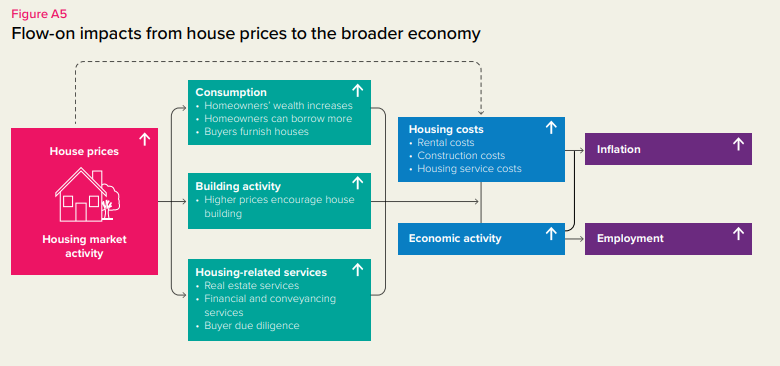
So it was only when the Herald’s Thomas Coughlan tweeted this chart yesterday that I noticed it.

RB house prices

The chart is prefaced with this text

The MPC sets monetary policy to achieve its inflation and employment objectives in the Remit. It considers the outlook for the housing market because house prices can influence broader economic activity, employment, and consumer price inflation (figure A5).

So we are presumably supposed to take this as the best professional view of the seven members of the Monetary Policy Committee. After all, it isn’t a throwaway line from a single member in an ill-considered press conference or interview comment. There is a bunch of different channels identified (and no obvious space constraints – they could easily have added more if they thought others were important), and nothing of substance gets into a Monetary Policy Statement without a fair degree of senior management scrutiny and review.

There are so many problems with this graphic it is difficult to know where to start. But perhaps first with the clear impression a casual reader would take away from this that the seven Robertson-appointed members of the MPC think that higher house prices are “a good thing”. After all, for most of the last decade inflation undershot the Bank’s target (unemployment lingered disconcertingly high for a disconcerting period of time too). More would have been better on both counts. Perhaps a charitable reader might wonder if the MPC really only had some short-term effects in view, but there is nothing in the substance of the chart or its title to suggest that.

And then there is the problem of the left-hand box: they start from “house prices” and “housing market activity” but these things never occur in a vacuum (as, for example, they would no doubt – and rightly – point out if they were talking about any other price (say, the exchange rate). Most often, surges in house prices (at least in New Zealand) have been associated in time with surges in economic activity driven by a range of different (policy and non-policy) factors.

But perhaps the biggest problem is with the claim – almost explicit in the top box of the second column – that higher house prices leave New Zealanders as a whole (remember, this is a whole-economy macroeconomic agency) better off. They don’t.

That they don’t, in principle, is easy enough to see. Everyone in the country needs a roof over his or her head. If I need a roof over my head for the rest of my life, ownership of one house meets my housing consumption needs. What matters is the shelter services the house priovides not the notional value the house might be sold at. Whether my house is valued today as $0.5m (roughly what I paid for it years ago), $1.75m (roughly what an e-valuer site tells me it is worth today) or $3.5m makes not the slightest difference to me. I still want to consume the bundle of services (location, size, sun etc) that this particular house provides.

Now, I might feel differently if I had a large mortgage: after all, negative equity gives the bank the right to foreclose (which can be both expensive and inconvenient), and even if the bank didn’t foreclose (mostly they don’t) it might also make it impossible for me to buy a similar house elsewhere if job opportunities suggested a move.

But this is where one needs to step back and think about the population as a whole. To a first approximation, for every apparent winner from higher (national) house prices there is a loser and for most – perhaps especially middle-aged owner occupiers – it makes no difference at all. There is no more economywide purchasing power created. And real gains that accrue to some people are offset by real losses to others. Owners of rental properties really are better off when real house prices go up. After all, they don’t own houses to live in them, but mostly for the profit they expect to make and the future consumption opportunities for themselves and their families. They can realise their gains and move on, or simply borrow against them.

But on the other hand, there are a lot of people made materially worse off by higher house prices – the people who don’t own a house now who either want to buy one in future or who are, and expect to, keep on renting. Consider someone just graduating from university who, a few decades ago, might have expected to buy a house after a couple of years working. But with real house prices in New Zealand as they are now not only does the deposit requirement push back any feasible purchase date, but the total amount of the lifetime income of the young graduate will have to devote to house purchase costs is so much greater. (Of course, real interest rates are lower than they were decades ago but recall that in the Bank’s scenario we are just thinking about house prices.) Earnings that are (eventually) used for the acquisition of a house can’t be used for other things. Earnings saved now to accumulate a deposit are not spent.

The story isn’t so different for long-term renters since in the medium-term (the adjustment isn’t instantaneous) if house prices are higher one can expect rents to be higher (than otherwise). In latter day New Zealand that has taken the form of rents holding up, or rising a bit, even as real interest rates have fallen a lot, which would otherwise have been expected to lower rents. Earnings spent (and expected to be spent) on rents can’t be spent on other things.

What (mostly) happens when house prices rise is that purchasing power is redistributed – usually towards those who have (houses) and away from those who have not (houses). Of course, it is further muddled by things like the Accommodation Supplement which shifts some of the losses onto the Crown……but that only means that taxes will be higher than otherwise in future. There is no net new purchasing power for society as a whole. (Were one inclined to an inequality story one might note that wealthier people tend to have lower marginal propensities to consume than poorer people.)

Are there possible caveats to this in-principle story? The story I used to tell was that, in principle, we might be better off from higher house prices if we all sold our houses to foreigners (at over the odds prices) and rented for the rest of our lives. But it was a story to illustrate the absurdity (and marginal relevance) of the point, and that was before the current government made such foreign house-buying illegal.

I’ve told you an in-principle story. The Bank likes to claim that the data don’t back this sort of story, And it is certainly true that there will often be a correlation between increases in house prices and increases in consumer spending. But that is mostly because – as I noted earlier – in the real world something triggers house price increases, and that something is often strong lift in economic activity and employment (in turn with triggers behind those developments). When the economy is running hot – and especially when land supply is restricted – buoyant demand, buoyant employment, rising wage inflation, increased turnover of the housing stock, and surges in house inflation are often happening at the same time. And in recessions vice versa. It isn’t easy to unpick chains of causation in the data.

Since higher house prices do not add to the lifetime purchasing power of New Zealanders as a whole, the Bank’s wealth effect story has to rest largely on some sort of view that households are systematically fooled by the house price changes. It is possible I suppose, at least the first time prices surge, but it doesn’t seem very likely. It isn’t as if surges in house prices – nominal and/or real have been uncommon in modern New Zealand.

The Bank also sometimes likes to highlight a story (it is there in that graphic) that even if the population doesn’t feel any wealthier, rising house prices might also boost consumption – at least bring it forward, without boosting lifetime consumption – by easing collateral constraints. In principle, a bank would lend even more to me secured on the value of my house than they might have done a couple of years ago. But again my ability to borrow a bit more has to be set against the reduced ability to borrow of the young graduate who now has to save even more in a deposit to get on the (residential mortgage) borrowing ladder at all. Sadly, in today’s bizarrely distorted housing market, we often find parents with freehold or lightly-indebted houses gifting or lending money to children, net effect on consumption probably roughly zero. With real house prices surging to fresh highs each cycle for decades now, it doesn’t seem that likely that many people are very collateral constrained.

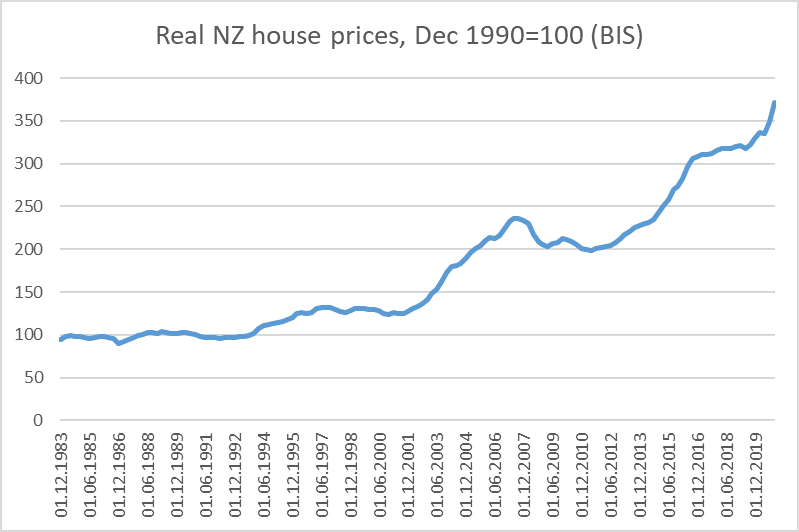
For years I’ve been running a commonsense test over the Bank’s claims. This chart is of New Zealand real house prices

house prices aug 21

This series ends in December last year, so as of now we can probably think of real New Zealand house prices being four times what they were in December 1990 (I chose the starting point because that quarter was just prior to the 1991 recession getting underway, but you can see that real house prices hadn’t moved much for several years).

These are huge increases in real house prices, some of the very largest (for a whole country) seen anywhere over a comparable period (notably a period in which productivity growth was underwhelming). Were there to be much to the Reserve Bank’s wealth effects story (or its collateral constraints story) at the whole economy level mightn’t one have expected to see consumption as a share of national income rising, savings as a share of national income falling?

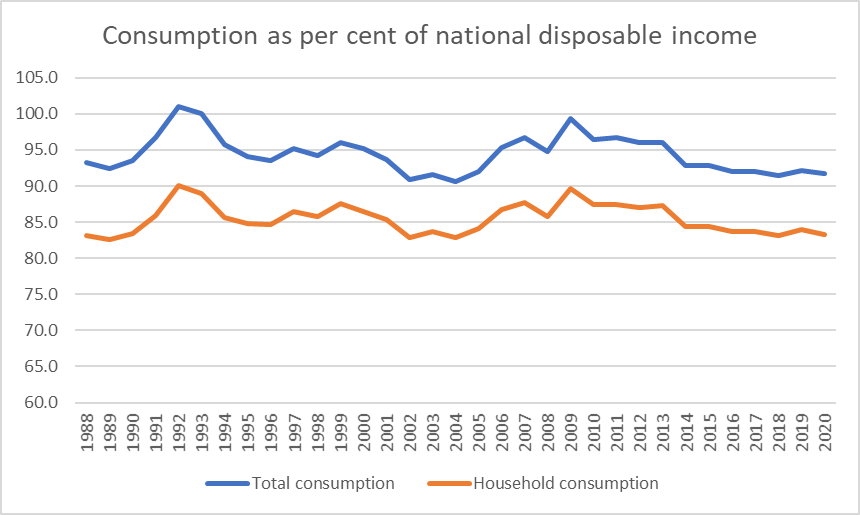
Of course there is all sorts of other stuff going on, but this is a really big – unprecedented in New Zealand – change in real (and nominal) house prices. But here is consumption as a share of national disposable income, back to the late 80s, just before house prices began to surge. The data are for March years.

consumption and NDI

The orange line is private sector (households and non-profits) consumption, while the blue line adds in public (government) consumption spending.

Of course, there are cycles in the series. There are two peaks, during the two big recessions (1991/92 and 2008/09): consumption tends (quite rationally) to be smoother than income. There is quite a dip in the early-mid 2000s, which can readily be shown to line up with the really big surpluses the government was running at the time – the country was earning a lot of income, but the Crown was temporarily sitting on a disproportionate share of that income.

And what of the house price booms. There were three during the period in the data (so not including the last year) – the few years running up to 1996, the period from 2003 to 2007 (particularly the early part of that period), and the period from about 2013 to about 2016. There is nothing in the consumption/savings data over those periods that would surprise someone who didn’t know about the house price surges.

And across the period as a whole, at best consumption has been flat as a share of income over 30 years of unprecedented house price increases. Looked at in the right light perhaps it has even been trending down a bit (private consumption as a share of income was as low in the March 2020 year as it was 16-17 years early when not only was the Crown running huge surpluses but real house prices were much lower.

I’m not suggesting any of this is definitive but when there is (a) no reason to think that New Zealanders as a whole are any wealthier when real house prices rise, and (b) no sign over decades in the macroeconomic data of the sort of effect the Bank likes to talk up, it might be safer to conclude that the effect just isn’t there to any meaningful macroeconomically significant effect.

Of course, as noted earlier there are all sorts of short-term correlations, typically resulting from common third factors at work, but the story the Bank seemed to be trying to tell in that graphic was neither representative of the economy as a whole, nor helpful.

The line I’ve run in this post is not new. In fact, 10 years ago now the Reserve Bank itself published an article in its then Bulletin discussing many of the same issues, and suggesting very similar sorts of conclusions (with, of course, 10 years less data). I was one of the authors of the article but – as was the norm – Bulletin articles carried the imprimatur of the Bank, and were not just disclaimed as the views of the authors.

Funding for lending

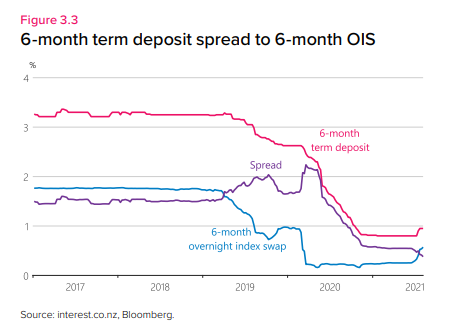
I was, conditionally, sympathetic to the Funding for Lending programme the Reserve Bank put in place late last year. At the time they thought (and it seemed plausible they were right) that more monetary stimulus was needed, and – through their own neglect and incompetence over several years – they asserted that a negative OCR could not yet be implemented. The announcement of the scheme clearly narrowed the gap between wholesale and retail interest rates, lowering the latter. This chart from this week’s MPS is one way of illustrating the point.

FFL

The effect was achieved by making it known the scheme was coming, and then available. Relatively little was actually borrowed, especially early in the piece.

The scheme works by offering funding to banks (only) at an interest rate equal to the OCR (floating rate, so the rate changes as the OCR does) for terms of three years. The loans are secured, but that isn’t much of a burden to the banks as (eg) they are allowed to simply bundle up their own residential mortgages into bonds the Reserve Bank will take as security (with a significant haircut – ie the value of the bonds has to exceed the value of the FfL loan).

It was a jerry-built scheme, but one could mount a reasonable third-best argument for having announced and deployed it last year. Among the problems with the scheme from the start:

  • it was offered only to registered banks, and not to any other (regulated) deposit-takers  (at odds with any notion of competitive neutrality, a principle that for a long time was important to the Bank),
  • by focusing on driving down retail rates (rather than both retail and wholesale) then it may have meant the exchange rate staying higher than otherwise,
  • lending for a three-year term at a floating OCR rate was, most likely, subsidised funding (it is highly unlikely any bank would have borrowed that cheaply on floating rate terms on market).

But perhaps one could tolerate those problems for a few months, while the negative OCR option was (so they said) not available.  And consistent with that I had not been particularly critical of it (even though by the time the scheme was officially deployed –  as distinct from announced, and announcement effects mattered –  the Bank was also telling us that the negative OCR obstacles had all been sorted out).

All that, of course, was many months ago, back when monetary policy tightenings looked a long way away, and the focus was still more on the risk of unemployment lingering high and core inflation staying very low.   The data moves, but the Bank doesn’t –  or is very slow to.

Where we stand now –  or at least earlier in the week –  was that core inflation was (a bit) above the midpoint of the target range, and the unemployment rate was so low even the Bank suggested (by implication) it was now at or below the NAIRU.   Tightening monetary conditions is clearly called for, and the Bank’s own numbers suggest they envisage quite a lot of tightening over quite an extended period.

So you might suppose that jerry-built interventions cobbled together late in a crisis would be among the very first things withdrawn.  As the Bank’s own document states

The FLP offers secured term central bank funding to registered banks, with the aim of lowering funding costs to stimulate lending growth across the economy and help reduce interest rates for borrowers.

Is the aim of monetary policy any longer to lower funding costs, stimulate lending growth or reduce interest rates? It certainly shouldn’t be, judging by the Bank’s own forecasts and statements.

And yet they insist they are going to keep right on offering the FfL scheme for the next 16 months. It makes no sense.

I was prompted to write this post after reading a Business Desk story this morning by Jenny Ruth. In it we were told that some banks had been borrowing more money this week, including on Wednesday. The amounts involved – $1.5 billion – aren’t huge but (a) the amounts haven’t usually been the issue, and (b) monetary policy works at the margin. But there was also this report of some comments the Governor had apparently made at FEC yesterday in which he ‘described the FLP as “a contract” that the RBNZ won’t break. “We have a clear contract. We thought it was best to honour that. We’re comfortable with honouring that contract,”

This was a new line.  When Jenny Ruth had asked the Governor at the press conference on Wednesday about FfL (and selling back LSAP bonds) we were simply given a line about preferring to use understood and predictable tools.  And so it prompted me to look up the Reserve Bank’s page on the Funding for Lending scheme.

On my way there I had to pass through a “Tools to support the economy” page, which –  still – is full of talk about what the Bank is doing to boost spending, boost jobs, encourage borrowing etc etc.  At very least the page needs updating – things have moved on from last year. 

The Funding for Lending programme page is here, with operational details here.  

And sure enough I found this

Participants may access the funding over a 2-year transaction period. The Bank reserves the right to extend (but not shorten) the transaction period.

Presumably this is what the Governor had in mind when he talked about a “contract”, but it is of course nothing of the sort (unless there are further signed documents the Bank isn’t disclosing, which I doubt).  It is a policy programme, much like the LSAP.  Recall that the LSAP was originally going to be kept going much longer, but circumstances changed and even the MPC concluded it was time to change policy and stop the bond-buying.  It didn’t betray anyone, no one regarded it as a breach of trust or anything of the sort.  If the Governor really regards himself (and his Committee) as somehow bound by that two-year period, it is even sillier than that pledge they made last March –  when they had no idea what was going on – not to change the OCR for a year come what may.

Now, just to be clear.  I am not suggesting that three year loans once made could or should be revoked.  The issue here is access to new loans, from a crisis programme, long after the crisis has past, and in a climate when the Bank itself says it expect to tighten steadily over a couple of years.

Does any of this matter?   I think it does, for a several reasons:

  • the MPC should not be making commitments it regards itself as bound by to periods well ahead where it has no idea what the economic circumstances will be.  Perhaps an initial six-month commitment might have been pardonable at launch, but another 16 months from here is simply indefensible.
  • since the MPC itself expects to raise the OCR steadily over the next couple of years (conditional of course on the economy) short-term market rates will tend to be above the OCR over that period.  Continuing to offer the FfL lending at OCR is not only cheap (subsidised) funding for banks (and recall only banks, not their competitors), but directly tends to undermine the effect of the market-led tightening that is going on.  Overnight rates really should apply to overnight money (or least money that reprices overnight not every 6-8 weeks).
  • and the longer the scheme runs the more it is likely to conflict with the MPC broader policy intentions.  This is so because under the rules from June next year banks can only borrow from the FfL to the extent that they are increasing their lending.  Perhaps there was an (arguable at best) policy goal to have banks increase lending this time last year, but on their own numbers and plans there is no such goal next year when (on their numbers) inflation will be near target and unemployment very low.  If the scheme continues to have any effect at all it will mean the OCR itself having to be pushed a little higher than otherwise.

The macroeconomic implications are probably pretty small, but it is simply bad policy by the Governor and Committee, grossly inadequately explained (if he really thought they were bound by honour or contract he should have developed the case in the MPS). The FfL scheme served a purpose – although given how the economy recovered more in prospect (from when first flagged) than by the time it became operational. But that time has long past now. The window should be closed, retail rates left to find their own level relative to wholesale rate, and the OCR should be deployed only after this abnormal crisis tool has been suspended.

On the MPS

In the end, of course, the bottom line of yesterday’s Reserve Bank announcement was unsurprising and perhaps inevitable – action deferred on account of Covid. It wasn’t as if they were on some statutory schedule, so they could easily have postponed the decision for a couple of weeks, but in the scheme of things the difference between that and waiting for the next scheduled review (6 October) isn’t great. It is clear from the Bank’s forecast numbers they had not been minded to raise the OCR by 50 basis points this time, so if need be they can always catch up by acting a bit more firmly in October.

There was even something to praise. The Bank had revamped the look of the document and – bad-wig new logo aside – it was a definite improvement, even if it is hard to be sure what (if anything) the front cover art might be supposed to represent. And there were, perhaps, a couple of more-interesting graphs than usual. Quite a bit of the media coverage seemed more focused on things the Bank isn’t responsible for – house prices – than on the things it is responsible for.

I guess I had two concerns about the document.

The first was about the analysis. Three months ago the Bank – with more macroeconomic resource than any other agency in the country – thought that well into next year the unemployment rate would be 4.7 per cent and seemed to see core inflation only converging very slowly on the target midpoint (from below). Instead, the unemployment rate is now 4 per cent and core inflation is above the target midpoint, but unless I missed something I saw hardly a mention of this forecasting error and no serious discussion or analysis of it.

Why does it matter? After all, the best of people make mistakes – even in recognising where the economy is at the time you were writing (the May forecasts weren’t finalised until 21 May, and both the CPI and HLFS are centred on the middle of each quarter (in this case 15 May). It isn’t so much the mistake itself I hold against them – although they should have done quite a bit better – but that if there is no analysis of how they made that mistake, and what the fact of the mistake has taught them about how the economy is working at present, how can we have any more confidence in the latest forecasts than in the last (wildly wrong) ones? And the MPS is supposedly an accountable document, not just an opportunity to brush the last set of numbers under the carpet and have another go at the dartboard to generate some new numbers. In particular, why when the momentum of the recovery in demand and activity (and inflation) took the Bank by (considerable) surprise do they think it has suddenly come to an end – implicit, for example, in unemployment rate projections that are 3.9 per cent for next March and 3.9 per cent for the following March (from 4 per cent at present). Or why, with core inflation having picked up quite strongly do they think it will settle as easily and quickly as implied in their numbers (bearing in mind that monetary policy has its greatest effect on inflation with a 12-18 month lag)? It was also a little surprising that there was no serious analysis of the role fiscal policy is, and is expected to, play in supporting (or dampening, as deficits are closed) demand and activity.

I am not running a strong alternative view here. They may prove to be right (and even by more than just chance, so for the right reasons) but there is no supporting analysis – no sign they understand the last 18 months or the last quarter – that should give anyone any more reason for confidence that in an amateur’s shot at a dartboard.

And, of course, if there is nothing in the body of the MPS, there are no speeches, no (searching) interviews, and the so-called minutes are as bland as ever, offering nothing even hinting at hard questioning, challenge, debate, or openness to alternative perspectives. No insight, no understanding, no challenge, no research, no scrutiny, all adds up to no authority. There is no sense that these people are any more than bureaucratic administrators.

The second concern was about policy, although perhaps in practice that boils down to absence of any serious analysis as well. The MPC has chosen to keep going with its jerry-built crisis funding programme, the Funding for Lending programme and to not do anything about reducing the stock of bonds it bought when it was trying to ease monetary conditions (ie until a few weeks ago, although mainly last year), decreeing that the OCR is its “preferred instrument”. Perhaps there is a case for leaving these crisis interventions on the books and jumping straight to the OCR, but if there is a serious case neither the Committee nor the Governor (as, supposedly, their spokesman) made it. Rather belatedly the Committee has now asked staff to prepare a paper on what to do about the LSAP, but why wasn’t that commissioned – and consulted on or published – months ago. When a journalist asked the Governor why MPC wasn’t acting first on the FFL and LSAP schemes, she was fobbed off with a spurious answer about the MPC preferring to operate with tools that were widely understood and which they themselves had a better, more precise, sense of how they would work.

Neither excuse seemed adequate. First, they are already having to factor into their forecasts now their views (implicit or explicit) on what impact the FFL and LSAP are having (and remember that most of the literature says that if there are material effects from schemes like the LSAP they are stock effects not flow effects). Second, the FFL is an explicit crisis intervention, when there is now no crisis, designed for an inability to use negative OCRs which no longer exists. Third, the FFL is explicitly discriminatory (only banks can access it). Fourth, you’ll recall how confident the Governor was last year about the power of the LSAP to influence monetary conditions – rhetoric that now seems to have disappeared completely. And fifth, there was no mention of the large losses (to the taxpayer) that the LSAP scheme has run up, and the substantial market risk the taxpayer is exposed to each day the scheme is left in place (by contrast conventional monetary policy instruments pose little or no financial risk to taxpayers ever).

Perhaps there is a case for their stance (although I doubt it) but it wasn’t made yesterday. The public should expect better from its highly-paid powerful officials.

And finally, two charts. I don’t have any confidence in the Bank’s analysis of house prices, or the new requirement the Minister foisted on them to talk about “sustainable prices”, but amid the breathless talk of the Bank picking a 5 per cent fall in house prices, it is perhaps useful just to focus on this MPS chart.

house prices MPS

Their scenario C is one in which nominal house prices hold steady. Their actual projections (line B) are less hopeful than that. Is it perhaps telling that the MPC shows line A – further strong price growth – out indefinitely – but line D (modest falls) only for a couple of years. Whatever the immediate cyclical situation – and some fall in the next 12-18 momths doesn’t seem that unlikely to be – nothing the government has done even begins to fix the structural failure (which the truncated y-axis in the chart minimises) and all the RB activity in this area is simply papering over cracks and running defence for the government.

The other chart doesn’t show anything new, but it is just nice to see it from a government agency.

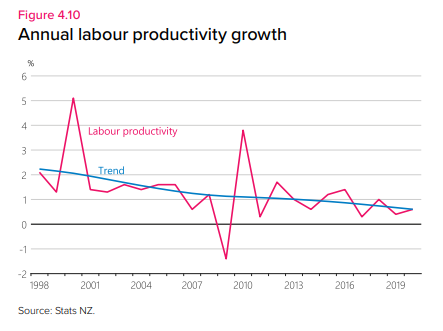
MPS productivity

It is a dismal portrayal of the utter failure of successive governments (both National and Labour led). They simply use it as one part of a story as to why New Zealand neutral interest rates might have been falling – inadequate a story as it is, since our long-term real interest rates remain well above those elsewhere, even as productivity growth is worse than in most places. As it is, between things the government has little or no control over (Covid, abroad and here) and those things that are pure policy choice, it is more likely that the next few years will show even worse productivity growth outcomes than the last couple of a decades. The Bank itself – like a true believer – nonetheless projects that trend productivity growth in each of the next three years (ie including the one we are in) will be stronger than in any of the previous six years. That Tui ad springs to mind.

Looking towards the MPS

The Reserve Bank’s Monetary Policy Committee will release its Monetary Policy Statement tomorrow afternoon. We can expect substantial changes from the rather complacent, perhaps even dovish, statement/forecasts they released in May. The hard data have moved quite a lot and the Bank – with phalanxes of macroeconomic analytical resource – was far too slow to recognise what was going on.

Of course, it is anyone’s guess what the MPC will do. Unlike serious countries, or serious central banks, we’ve had no speeches from MPC members, and no position papers outlining how (and why) the MPC was likely to respond if and when the data indicated that tightening in monetary conditions was warranted. Normally, it isn’t much of an issue, since there is usually only a single moving part (the OCR) but we are now still living in the wake of last year’s extraordinary interventions. My focus here isn’t on what the Bank will, or won’t, do, but on what they should do, given the Remit the Minister of Finance has given the MPC.

NZIER run their Shadow Board exercise, in which a mix of (mostly) economists and (a few) people working in business or lobby groups offer their view on what the MPC should do. It is an interesting exercise, if only because respondents are asked to assign probabilities to their view (eg 25% chance the OCR should be 0.25 per cent, 50% it should be 0.5 per cent, and 25% it should be 0.75 per cent – an exercise the Governor used to ask his internal advisers to do, accompanying each of our specific recommendations). They’ve also this time asked not just about tomorrow’s OCR decision but about appropriate policy over the next year. Here are the last assessments.

shadow board aug 21

I’ve always struggled with the idea of 100 per cent certainty about any macro view, especially one about periods a year ahead. If I learned anything in decades of working on monetary policy it was how pervasive uncertainty (and unforecastability) is. If I were answering this particular survey I’d probably run with something like an 80-90 per cent view that the OCR should be higher now, but not much more than a 50 per cent view that it should be higher over 12 months. We just don’t know, and can’t know.

And that would be my first recommendation to the MPC: do not act as if you know more than you possibly can. The Bank insists on publishing economic projections several years ahead, but they rarely contain any useful information about what will happen over the following few years. But the key thing is not to become wedded to your own numbers, or desire to offer more certain than is sensibly possible. The last OCR tightening cycle the Bank undertook in 2014 was a mistake – the case for it was very weak at the time (as I and a couple of others argued internally, a few externally) and even more so with hindsight – but part of what led them astray was that the Governor had become entranced by his own numbers (projections and trend assumptions) and went round openly talking of a programme of OCR increases that would raise rates by a couple of hundred basis points. It creates something of a self-fulfilling momentum, complete with a feeling of needing to follow through.

So whatever the MPC decides on actual policy adjustments tomorrow, the words should emphasise how uncertain and changeable the environment (here and abroad) is, and that the Committee will be guided primarily by hard data (on core inflation and excess labour market capaciity) rather than by castles-in-the-air projections or programmes of tightening. We just do not know what is happening to natural/neutral interest rates – the belief that people did led central bankers, and markets for a time, astray last decade. And when data change there is no harm or shame in changing course; rather than is what central bankers doing their job are supposed to do. The job of the MPC is not to give a clear steer about the future, but (in a stylised way) to adjust short-term interest rates consistent with overall incipient savings/investment imbalances (normally, doing what the market would do if we didn’t have central banks).

The situation at present is complicated because the Bank last year deployed three distinct tools:

  • the OCR,
  • the Large-scale Asset Purchase programme (LSAP), and
  • the funding for lending programme, designed to narrow the wedge between wholesale and retail funding rates.

On the Bank’s own stated logic, I think an OCR adjustment should be the final step chosen if –  as seems to be the case – policy tightening is warranted.

Take the LSAP as an example.  The Bank has repeatedly claimed that the LSAP was highly effective in loosening overall monetary conditions, lowering both wholesale interest rates and the exchange rate.  If so, surely an obvious response now would be to start selling the bonds back to the market, at scale if need be?  After all, every day the Bank holds the bonds the taxpayer is exposed to unnecessary market risk (remember that they have lost us $3 billion or so to date), and there is no obvious good reason for the central bank’s balance sheet to be as bloated as it is for any longer than is strictly necessary. 

Now it is true that other central banks have been reluctant –  after the bond-buying of the last decade – to start actively offloading their bond holdings (although the Fed was doing so), but that was surely was mostly because economies and (in particular) inflation never recovered sufficiently robustly to warrant/require tighter monetary conditions.  By contrast, in New Zealand right now there is a pretty strong case for such a tightening.

Of course, if the Bank really doesn’t believe its own rhetoric (about the efficacy of the LSAP) it would still make sense for them to be getting a sales programme in place, but then they couldn’t claim that bond sales were a substitute for other actions.  As I’ve outlined in previous posts etc, my own view is that the New Zealand LSAP did little or nothing of any macroeconomic significance, but that isn’t what the Governor keeps telling us. 

The next step the Bank should be taking is to end the Funding for Lending programme.  It was a jerry-built crisis intervention that worked –  at a time when the MPC reckoned it could not take the OCR negative –  but we aren’t in a crisis now.     It isn’t a competitively neutral instrument –  only banks have access to it –  and if an efficiency mandate is disappearing out of the Reserve Bank legislation, the concern with economic efficiency and minimising favourable treatment for particular types of counterparties shouldn’t.   It should be discontinued now and the market left to settle the relationship between the OCR and retail and wholesale funding rates. 

What isn’t clear is quite how much impact ending the Funding for Lending programme would have on deposit rates.    The large positive margin between term deposit rates and either the OCR or bank bill rates that has prevailed over the last decade –  often 150 basis points –  is hard to make full sense of (and is larger than the comparable margin in Australia).   But the best guess has to be that removing new Funding for Lending might see that margin widen out from the 50 basis points it got down to back to something at least somewhat wider (perhaps another 50 basis points).

I don’t think I’ve seen mention of selling down the LSAP bonds or ending the Funding for Lending programme in any of the commentaries I’ve seen. I presume that is a sign the Bank has either suggested to banks no change is coming there any time soon or (at least) by silence left that impression.  But these crisis interventions really should be dealt with, and incorporated into the forecasts, before the Committee moves to consider OCR increases.

My read of the economic data is that there is a reasonable case for the MPC to validate quite a significant tightening in monetary conditions (I express it that way because both wholesale and, to some extent, retail rates have begun to move in anticipation).  I don’t think that is even a particularly difficult call.  I don’t base it on forecasts, but on where things stand right now (including, but again not to over-emphasise forecasts, how different things clearly are now from how most thought they would be late last year).     

What are the key variables in that story?  First, of course, is inflation itself –  but core inflation, not the (currently high) headline CPI numbers. On the Bank’s sectoral core factor model – a pretty smooth and persistent series – core inflation is now above the target midpoint for the first time in a decade.    That is a good thing –  (core) inflation should fluctuate around the target midpoint, and not have the midpoint treated as either a ceiling (as it seemed at times in the last decade) or a floor (as it sometimes seemed the previous decade).  But since the general sense was that it would take longer to get inflation back up, and we know policy works with a lag, it is a prima facie case itself for underpinning real interest rates at a higher level. 

And then there is the unemployment rate, at 4 per cent (for the June quarter, centred in May) down to pre-Covid levels.  I’m not going to run a strong independent view on what the NAIRU is for New Zealand but whatever it was a few years ago it is likely to be somewhat higher now, between things like higher benefit levels, higher minimum wages, higher statutory holiday provisions, reduced emphasis on getting people off benefits, and the disruption to labour-market matching from closed borders (both reductions in demand for certain roles and disruption in access to migrant labour).  To be clear, I’m not taking a view here on the wider merits of any of these policies, just noting as a macroeconomist that they are, taken together, likely to raise the unemployment rate consistent with stable inflation.

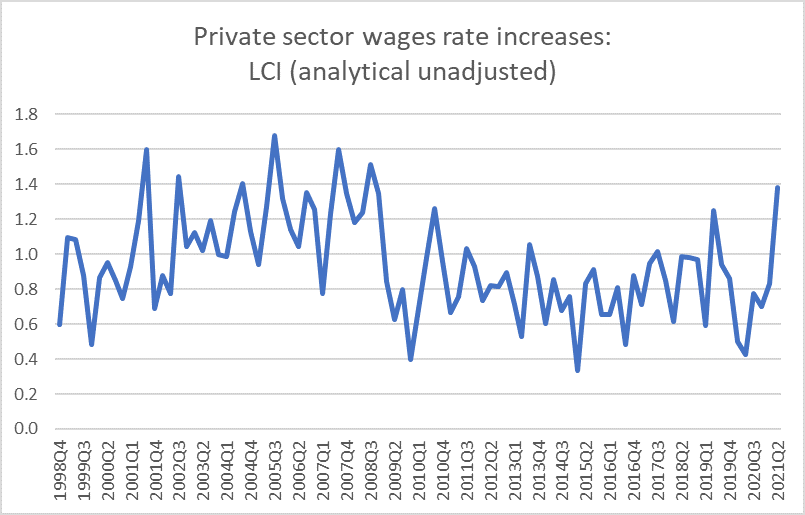
As it happens, in that same June quarter data we’ve already seen quite an acceleration in private sector wage inflation.  It could, I suppose, be random noise, but it doesn’t seem sensible now to assume so (given that it isn’t out of line with anecdotes, surveys or the unemployment rate itself).LCI private

Even if there is a bit of seasonality in the series, it is the highest quarterly increase since the peak of the labour market boom in the 00s –  when core inflation was definitely accelerating, and when there was still a bit more productivity growth to underpin wage increases than is likely to be evident right now (borders closed and all that).

June quarter data is centred on the month of May (SNZ survey throughout the quarter), but we also have the SNZ new monthly employment indicator that they take from hard (tax) data.  The number of filled jobs is reported to have risen by a further 1.1 per cent in the month of June. and in a series that goes back to 1999 there have been only a handful of months with faster growth in this series.  And over the last 22 years inward migration has mostly been quite strongly, adding to both demand for and supply of labour.  Since Covid, we’ve had consistent modest net outflows of people.    And yet according to SNZ there are now 2.1 per cent more jobs than there were at the end of 2019 (when the unemployment rate was also 4 per cent).  With fewer people here now than then (despite some natural increase), it all points to the unemployment rate heading lower again this quarter. 

Then, of course, there is inflation expectations.  In the Bank’s latest survey of semi-experts (I’m usually included, but somehow the survey email ended up in my Spam folder) , two year ahead expectations rose quite a bit to 2.27 per cent –  the highest the survey has recorded since June 2014.   Since shocks happen, these expectations measures aren’t great forecasts (nothing is) but as a read of how people are feeling and seeing things now they are what we have.

The Bank also does a survey of household expectations, which gets very little coverage. Again, there is no information in the survey on what future inflation will be, but what people think about inflation affects how they think about any specific level of nominal interest rates.  In the latest survey, a larger percentage of respondents expect higher inflation over the next year than at any time in the survey’s history.

household expecs 21

Point estimates –  which are harder for household respondents –  have also moved up quite a bit, for both 12 month and five year horizons.

It is a fairly elementary part of thinking about monetary policy that, all else equal, if inflation expectations move up and you don’t want inflation itself to go much higher, you want interest rates to move up at least as much as the expectations themselves have risen.

If I wanted to mount a counter-argument to my own case, I might cite –  as I often have over the years –  the breakeven inflation rates calculated using nominal and indexed government bond yields.   Very long-term breakevens are still well below 2 per cent (but have moved up) but using the 2025 indexed bond, implied inflation expectations for the next four years are now almost exactly 2 per cent –  not troublesome in a level sense, but far far higher than we were seeing pre-Covid.

The case for not acting now seems, frankly, threadbare.  Will the Australian economy be weaker this quarter and perhaps next?  To be sure, but it isn’t obvious there is a substantial impact on New Zealand (especially as travel flows were already very modest).  Sometimes there is a case for seeing how low the unemployment rate can be driven –  there was a good case for that for much of the pre-Covid –  but not when (core) inflation is already at or a bit above target, and most of the demand indicators suggest that core inflation would –  all else equal – rise further from here.

That doesn’t mean it is time to panic either.  Full employment and inflation near-target are good outcomes in themselves –  especially against the backdrop of the previous decade.  It isn’t time to over-react, or for whippings about how policy settings were too loose for too long, but simply for calmly and deliberately getting on with the job.

For me –  and given the rapid easing last year – that would mean a policy package tomorrow of (a) a programme of bond sales back to the market of $2 billion a month (which over two years would clean out the holdings), (b) a discontinuation now of the Funding for Lending programme, and (c) a 25 basis points OCR increase.

But if they don’t do either (a) or (b)  –  the former more symbolic on my telling than substantive, but wouldn’t be on their own –  the case for a 50 basis point OCR increase tomorrow looks pretty strong.  Not to foreshadow a string of future increases, but simply because we are at full employment, perhaps going beyond, and inflation is at or a bit above target, and perhaps looking to go beyond.  It would simply be a good solid sensible response to some good cyclical economic data (note that the structural fundamentals of the economy are as poor as ever, but that matters to the Reserve Bank only in, eg, interpreting wage inflation data).


Perspectives on New Zealand immigration policy

Several years ago the Law and Economics Association hosted an event in Wellington in which the New Zealand Initiative’s Eric Crampton and I each told our stories about New Zealand immigration policy. My account is here, and a link to the talk I gave is here.

A few months ago a couple of Victoria University of Wellington academics responsible for a Masters class (in a programme I didn’t even know existed (Masters in Philosophy, Politics and Economics)) invited us to do something similar for their class. We did that today.

My text (a bit fuller than what I actually used) is here (if Eric chooses to link to his slides on his blog I will include a link) (UPDATE: link here). My focus was solely on the economic dimensions of immigration policy, and in particular on the implications for economywide productivity (as the best proxy for whether large-scale policy-led non-citizen immigration has been beneficial for New Zealanders). My focus was primarily on the long-term programme, and entirely on the situation in normal times (ie I was not addressing the current Covid mess, which reflects poorly on the government but has no necessary connection to the appropriate medium-term approach).

My approach tends to start from a series of stylised facts about New Zealand’s economics performance in recent decades. This was the list I used this time.

But first, the gist of my story, which starts from a set of stylised facts about our economy.  Most of them are not in contention, even if the meaning and implications are debated:

  • New Zealand’s productivity growth has continued to languish, and even after the reforms of the 80s and early 90s (including a return to large-scale immigration) there has been no narrowing of the gaps. We’ve fallen further behind Australia, and increasingly behind central and eastern European OECD countries.  It would now take a two-thirds lift in the level of productivity to catch the OECD leading bunch,
  • Foreign trade as a share of GDP has stagnated, and this century has gone backwards. This in the new great age of globalisation,
  • New Zealand’s exports have remained overwhelmingly reliant on natural resources (whether agriculture, tourism or whatever).
  • Consistent with this, the rapid growth areas in our economy have been the non-tradable, not internationally competitive, sectors,
  • Also consistent with this, our real exchange rate has remained high, even as productivity has declined relative to other countries over decades,
  • Even as real interest rates have fallen, they have remained persistently higher than those in other advanced economies,
  • Business investment as a share of GDP has been weak (OECD lower quartile),
  • Indications are, globally, that if anything distance has become more important not less, with high value economic activity increasingly clustered in big cities near the major markets of the world,
  • Unlike what we see in the US and Europe, GDP per capita in by far our biggest city isn’t much better than that for the country as whole – if anything the gap has been narrowing.
  • Over the last few decades, no country has aimed to bring more migrants (% of population) than New Zealand did – although Canada and Australia have come close to matching us, and Israel too.   
  • OECD data show the NZ migrants also have the highest average skills levels (but still a bit behind natives) of migrants to any OECD countries.

Not one of the expected economywide benefits of a large-scale immigration promotion policy has shown up. Not one.   And we aren’t five years into this experiment, by 25 to 30.

I stepped through my standard arguments for why large scale immigration here may have been damaging to our medium-term economic performance. I noted that of the handful of OECD countries that have tried anything on the scale of New Zealand’s experiment (Canada and Australia and – in a slightly different context – Israel) none stands out as a productivity leader, and yet very little of the literature on the economics of immigration looks specifically at this group of countries. What isn’t always appreciated is that New Zealand has much more experience of large scale immigration and emigration (the latter, of nationals) than almost any other country – the sustained outflow of natives has been a thing since at least the mid 1970s, while our governments have actively promoted large-scale non-citizen immigration for all but about 15 years since World War Two.

When we’ve considered the economic performance over recent decades of the active immigration-promoting countries, and the countries experiencing outflows of their own people, the ball should really be in the court of the pro-immigration economists to show us, concretely, where and how large-scale immigration is lifting the productivity and incomes of the natives.   That is particularly so in New Zealand, given the disadvantages we can enumerate in advance – distance and continued natural resource reliance – and the signal implicit in the decades-long outflow of natives.

I talked about a number of other problems, and (in particular) gaps, in the existing literature before ending with this conclusion.

There might be all sorts of reasons for favouring high immigration – better ethnic restaurants[1], defence, a liking of big cities, or trains. If your country has prospered greatly, you might be happy to share the gains widely.  But the economic case for large scale immigration, as a way of boosting the productivity outcomes for natives in already advanced economies[2], looks thin at best.  Not many countries have run the experiment in modern times, notwithstanding the models that are claimed to support such an approach.  New Zealand has been at the forefront – actively promoting large scale immigration for all but 15 years since World War Two.  Unfortunately, New Zealand has had the worst relative economic performance of any advanced economy over those decades – we haven’t just come back to the pack, but now languish well down the rankings, have led the GDP per capita tables just 100 years ago (when abundant land, small population, and asymmetrically favourable technology shocks combined in our favour).

As I review the experience of advanced countries, if one wanted to take a punt on policy promoting large scale immigration (and few have) the best places to try look to be countries:

  • Close to the centres of global economic activity (whether Europe, North America, or East Asia),
  • Having experienced an asymmetric productivity shock – whether from the market or other policy reforms – favouring longer-term economic prospects in your country,
  • With economies with substantial reliance primarily on sophisticated manufactured products and high-tech services,
  • With their own people coming back home

And it looks like a highly risky strategy if your country is

  • Very far from anywhere,
  • Heavily dependent on (fixed) natural resources,
  • And has seen little sign of asymmetric favourable productivity shocks for your industries in a quite a long time,
  • Somewhere your own people have been leaving in large numbers

These look to be quite general insights.  And yet few if any of the countries that have three or four of the first characteristics have gone in heavily for policy-led immigration (perhaps Ireland or the UK might have been the closest- but UK immigration per capita was also about a third of New Zealand’s (per capita), and the UK is no productivity star).   Of the countries that went heavily for policy-led immigration, even Canada and Israel each meet only one of the three criteria – and neither can readily show the economic gains from large-scale migration. Australia and New Zealand meet none.

As for New Zealand, we can (sadly) tick all four items in that second class of conditions.  This was – and is – perhaps the least propitious advanced economy on earth to experiment with a large-scale immigration strategy.  And yet we did. If it was perhaps defensible in 1946, and optimistic in 1990, persisting now it just stubbornly wrongheaded, defying experience and evidence.    It isn’t quite as wrongheaded as a strategy to promote mass migration – however able the people – to Kerguelen, the Chathams or the Falklands, but not far short of it.  Australia has coped better with its experiment only because they were able to bring to market lots of natural resources previously lying idle.

It isn’t that people are any different here – locals or migrants.  And water still flows downhill.   But the opportunities just aren’t very good at all.  It is an old line but no less true for that: a definition of insanity is doing the same thing again and again and expecting a different result.  We’ve tried this one far too many times for our own good.

[1] I recall Eric Crampton once suggesting an Ethiopian quota

[2] The contrast, say, to the economic gains New Zealand Maori may have received from 19th C immigration.

Should have done better

A couple of months ago the Institute of Directors approached me about doing a talk to their members in Wellington on monetary policy as it had been conducted by the Reserve Bank over recent times. Somewhat to my surprise, my name had apparently been suggested to them by Alan Bollard.

I gave the talk this morning, and although the date was set ages ago it could hardly have been more timely given the labour market data yesterday, which in a way finally marks the completion of not just the last 18 months’ of monetary policy, but in some ways the last 14 years (for the first time since the 2008/09 recession we have core inflation a little above the Bank’s target midpoint and the unemployment rate back to something that must be close to the NAIRU.

The full text of my remarks, and a few more points I didn’t have time to deliver, are here

Monetary Policy in Covid Times IoD address 5 Aug 2021

What I set out to do was to review how the Bank had done, and what monetary policy had (and hadn’t) contributed over the last 18 months or so.  While I was quite critical in places, and headed the overall talk “Should have done better”, I was also willing to defend them, noting that the surge in house prices had little predictably to do with monetary policy, and was neither sought nor desired.

I’m not going to reproduce the full text in this piece, but here are a couple of sections from towards the end

The unemployment rate is now 4 per cent and the inflation rate – the sectoral core measure the Bank tends (rightly) to focus on – is 2.2 per cent.  Those are really good outcomes – first time in 10 years that core inflation had crept above the target midpoint.  After the last recession it took 10 years to get unemployment back down, not 10 months.

But those outcomes to celebrate aren’t much credit to monetary policy, since when the MPC was setting the policy that was having an effect now they thought their policy was consistent with much worse outcomes. 

But where to from here?  The MPC has belatedly terminated the LSAP.  They really should be ending the Funding for Lending programme, which was explicitly a crisis programme, a stop-gap for when they couldn’t cut the OCR further, and which was not operated on a competitively neutral basis.   But more likely the next step is the OCR.

One possible reason for caution is that coming out of the 2008/09 recession, central banks (and markets) were too keen to start getting interest rates back to what was thought of as “normal”.  The RBNZ made that mistake twice, and quickly had to reverse themselves.  But both times there was no sign of core inflation rising and the unemployment rates were still quite high, so quite different circumstances than we have now. 

[Figures 7 and 8]IOD2

IOD1

Some will doubt whether 4.0 per cent is the lowest sustainable rate of unemployment but it is getting pretty close to the cyclical lows of the last two cycles (and some measures may have raised the NAIRU a bit).  Wage inflation is rising faster than at any time since 2008, at a time when there is no productivity growth.    But the real guide – especially amid considerable ongoing uncertainty – is core inflation itself.  If it is above 2 per cent, and no one thinks it is about to drop back, then it is time to start tightening – not necessarily aggressively (there is no harm if core inflation goes a bit higher for a while, as it is likely to do), not part of some predetermined programme, but step by step, review by review, keeping a close eye on fresh data.   They need to be tightening at least a bit faster than inflation expectations are rising (on which new data next week).  And since the world economy could be derailed again, and fiscal policy (here and abroad) may start tightening, and very long-term interest rates are still at or near multi-decade lows, be ready to stop or reverse course if the data warrant that.  The great thing about monetary policy is that when the data change, policy can be altered quickly and easily.

The same can’t be said for fiscal policy.  There are plenty of things only government spending can do.  For example, income support to those rendered unable to earn because of pandemic restrictions.  There are plenty of other programmes for which one might make a careful well-analysed and debated medium-term case for spending taxpayers’ money on.  But cyclical stabilisation policy is a quite different matter.    Many fiscal programmes are – rightly or wrongly – hard to get underway, and slow to start (many of those “shovel ready” projects), some are easy to start but hard to stop.  And almost all involve playing favourites, rewarding one group or another – with other people’s money – according to the political preferences of the particular party in power.   Fiscal announceables, once announced, are very hard to take back off the table. 

By contrast, the MPC can and does act overnight, it can reverse itself, and it coerces no one, and picks no winners. Market prices shift and people and firms make their own choices whether or not more or less spending is now prudent for them.  There has rarely been a better illustration of how much more suited monetary policy is to short-term cyclical stabilisation than the surprises of the last year.  

And an overall assessment

How then should we evaluate the MPC’s performance?

It is clear they were poorly prepared.  There is really no excuse for that. It was always only a matter of time until the next severe shock came along.

When they finally began to appreciate the severity of the Covid shock their actions were in the right direction. 

But they can’t be credited with the good outcomes we are now experiencing – inflation and unemployment – because when policy was being set last year they expected their policy to deliver much worse outcomes, and did nothing about it.  We can’t blame them for the economic uncertainty, but they should be accountable for their own official forecasts and what they did with them[1].

The overall contribution of monetary policy to how things have turned out was pretty small.  Mostly what has happened was down to private demand reorganising itself and holding up much more than expected – notably by the Bank – greatly reinforced by the really big swing into structural fiscal deficits. 

As for monetary policy, the OCR cut was modest, and the exchange rate barely moved. The Bank claimed far too much for the LSAP, which was more noise than substance, and in the process they fed a narrative (“money-printing”) that made trouble for them and the government.  If they really believe the LSAP is as potent as they’ve claimed, perhaps they could make a start on tightening by first selling ten billion of bonds back to market.

And if they accomplished little buying lots of long-term bonds at the very peak of the market in the process they have run up big losses.  They dramatically shortened the duration of the overall public sector portfolio and then rates went back up.  These are real losses – at about $3 billion currently, four times the cost of the Auckland cycling bridge, without even the sightseeing bonuses.

We can’t realistically expect policy perfection but we can and should expect authoritative, open, and insightful communications. But MPC’s communications have been poor:

  • They never published the background papers they promised.
  • They never explained their weird ‘no OCR change for a year’ pledge.
  • There has been no pro-active release of relevant papers (unlike the wider central government approach to Covid).
  • They refuse to publish proper minutes – that actually capture the genuine uncertainties and inevitable, appropriate, differences of view, and which would allow individual members to be held to account.
  • Little serious research is published, and insightful analytical perspectives are rare.
  • From not one of them have we had a single serious and thoughtful speech on how the economy and policy are evolving.

In its first major test, the best grade we could give the MPC “could try harder, needs to avoid other shiny distractions, can’t continue to count on good luck”. Oh, and just as well for them that the individuals aren’t on the hook for those huge losses.

As with so many of our public institutions now, we deserve better.

[1] Note that just under three months ago, in the May Monetary Policy Statement, the MPC unanimously concluded that “medium-term inflation and employment would likely remain below its Remit targets in the absence of prolonged monetary stimulus” going on to note that “it will take time before these conditions are met”.

Those huge losses they have incurred for the taxpayer in running the LSAP – which by their own lights would have been unnecessary if the Bank had been better prepared – have not had much attention. They should. Some are inclined to downplay them on grounds of “think of all the macro good that was done”, but as I argue there is little evidence the LSAP made any useful macroeconomic difference to anything. Others downplay them on the feeble grounds that if the bonds are held to maturity the bond portfolio itself will not realise any losses (bonds are paid out at face value). But we can already see the cash cost to the taxpayer beginning to loom rather directly. The LSAP was simply an asset swap – the Bank bought long-term fixed rate bonds, and issued in exchange variable rate settlement cash deposits, on which it pays the OCR. The strong consensus now is that the OCR is about to rise quite a lot. Even if the OCR rises by 1 per cent and settles there indefinitely, the Bank (taxpayers) will be paying out hundreds of millions a year in additional interest. Of course, it could avoid those payments by selling the bonds back to the market – which it should be doing – but that would simply crystallise the losses on the bonds themselves. The taxpayer is materially poorer for the poor policy and operational choices of the Bank – they could have focused on short-term bonds (which are the maturities that matter in New Zealand), they could have had the banking system ready for negative rates, but instead they choice the flamboyant performative signalling routine of buying huge volumes of long-term bonds at what was (reasonably predictably) close to the very peak of the market. All while accomplishing little or nothing macroeconomically.

In a couple of months we’ll see the last Annual Report from the Bank’s old-style board (to be replaced next year). The Board has spent 31 years providing public cover for management. It is hard to envisage them changing approach at this later date. They really should, but the fact that they almost certainly won’t tells you why it was such a poor governance approach (even if the government’s replacement model if something of, at best, a curate’s egg sort of improvement).

(Circumstances, data, and perspectives do change. Some, but not all, of my views have shifted over the 18 months – as I’m sure everyone else’s has. The text of another lecture on monetary policy and Covid, from last December, is here.)

Checking the gap

Back in the very early days of this blog, in a post about the gap between New Zealand interest rates and those in other advanced countries, I ran this chart constructed from OECD data.

int diffs to 2014

There had been no sign of the large gap between our long-term interest rates and those abroad systematically narrowing. These were nominal interest rates, but as another chart in the same post illustrated the gap between our inflation rate and those in other advanced countries had also been quite stable, suggesting that the story held for real interest rates as well. Unless your economy is recording stellar productivity growth year after year, large positive gaps between your real interest rates and those in other countries are usually not thought to be “a good thing”.

In recent months all the focus locally has been on the low absolute level of interest rates. In fact, globally there were stories in just the last few days of some key international real interest rates reaching new long-term lows.

But what has been happening to the gap between our interest rates and those abroad?

The gap between our policy rate (the OCR) and those in other advanced countries has certainly narrowed – New Zealand is just a touch higher than policy rates in the US, UK, and Australia, and even among the countries with negative policy rates the gap to Switzerland (-0.75 per cent) is now only 100 basis points. When I wrote the 2015 post, our OCR was 300+ basis points higher than policy rates in most of these countries.

Of course, if you believe the market economists, those gaps are about to start widening again. New Zealand won’t be the first OECD country to raise policy rates (Iceland and Mexico have already done so this year) but most don’t seem likely to move for some time yet.

But what about longer-term interest rates, which typically embody expectations about future short-term rates?

In this chart, I’ve updated the red line from the previous chart (New Zealand 10 year rates relative to G7 ones) up to June

int rate diffs to 2021

The gap is now a lot smaller than it was for most of this century (albeit quite a bit larger than it was at last year’s lows, when the OCR was expected to stay very low, or be taken lower, for quite a few years to come). At current levels, the gap is a bit higher than it was at the end of 2019 before anyone had heard of Covid.

But what are markets saying about the very long term, beyond Covid and the immediate economic challenges, and focusing on real yields from the inflation-indexed bond markets?

Without a Bloomberg terminal, time-series data aren’t readily available for lots of countries, but here are the yields for New Zealand and the United States (we have two specific bonds, while the US publishes a constant maturity 20 year series). The first chart shows the levels of respective rates, and the second the gap between the yield on the New Zealand 2040 bond and the US 20 year.

real 2021 1

real 2021 2

The absolute levels of all these rates are very low (in the US near record lows), but the gap between New Zealand and US long-term real rates has opened right back up again, and is now around where it was at the start of 2018.

That is just the US of course. But the thing is that, in OECD terms, the US these days is a relatively high interest rate country- highest 10 year bond rates of any of the G7 countries.

Here is a chart of the yields on the German government’s 2046 maturity inflation-indexed bond.

german indexed bond

Even allowing for the fact that the New Zealand government bond matures in 2040 and the German one in 2046, there is gap in yields of something a bit over 200 basis points.

These are really big differences. And they have nothing to do with the policy stances for the time being of respective central banks – which can affect expected real interest rates over the first few years of an indexed bond. but are lost in the wash over 20 years (when people, institutional structures, and central bank mandates change anyway). These differences are about real economy phenomena.

There are, of course, conventional suspects. These are government bonds so what about the respective levels of government debt. But, of course, New Zealand has lower government debt (as a share of GDP) than most OECD countries, including both Germany and the United States. Most probably, we are expected to continue to keep government debt well in hand. If the market were pricing much sovereign credit risk across these economies, the real risk-free gap would be even larger than the numbers I’ve shown here.

Perhaps the real interest rate gaps are now a bit narrower than they were five or six years ago. Even then, however, we should be cautious about welcoming the change without understanding it better. It could, for example, represent (implicitly) a reduction in long-term expectations about relative economic growth and the demand for real resources that business investment gives rise to – and if so we might interpret differently an implicit reduction in expectations about relative productivity growth and an implicit reductions in expectations of relative population growth. As it is, it is simply too early to tell.

Markets tend not to leave free lunches on the table though. And if New Zealand government bonds are offering unusually high local currency yields for a stable low-debt country, the counterpoint is likely to be in the exchange rate. Economists have a model known as Uncovered Interest Parity (UIP) in which the difference in two countries’ risk-free interest rates is equal to the expected change in the exchange rate between those two countries over the period in question. It isn’t a proposition that actual exchange rates (ex post) reflect those initial interest rate differences – all sorts of shocks intervene almost every day – but something like an equilibrium condition ex ante.

If, for example, New Zealand real interest rates for a 20 year maturity are 150 basis points higher than those in other economies, that would be consistent with an implied expectation of a 35 per cent reduction in the real exchange rate over that 20 year period.

Of course, as I’ve shown here, New Zealand interest rates have averaged quite a lot higher than those abroad (even in real terms) for a long time, and although the exchange rate has at times been volatile (less so in the last decade than in the previous couple) we have not seen that sort of sustained fall in the real exchange rate, so there have (ex post) been windfall gains to those who bought and held New Zealand bonds. But that doesn’t change the indications that serious imbalances are still present in our economy (not just this year, not just about Covid, but something deeper and more persistent): persistently higher real interest rates than those abroad, a real exchange rate that has not adjusted structurally lower, weak business investment, low productivity growth, and feeble external trade performance (exports and imports flat or falling as a share of GDP.

(But, to anticipate comments, it has nothing whatever to do with house prices. Repeat after me, over the decades we have built fewer houses – and freed up much less land – than our population growth would have suggested was warranted. It is the commitment of real resources – physical building of houses, subdividisions etc, that (all else equal) puts pressure on real interest rates, not house price developments – lamentable outcomes of other policy choices that they are.)

Thinking about monetary policy

I’m less interested in what the Reserve Bank will be doing at next week’s OCR review, or the one after that (or the one after that) than in what they should be doing. The Bank’s MPC do few/no thoughtful speeches (or really any at all on economic developments and monetary policy), publish little research, and have something of a record at times of lurching unpredictably from one review to the next. Banks employ people who will try to wheedle morsels of information out of Reserve Bank staff and MPC members and read those tea leaves. My interest is mainly in what the Bank should be doing, both absolutely (what is first best policy) and consistent with the mandate they’ve been given by the government of the day. I used to run the line that eventually policymakers will do the right thing (and we will all grope towards knowing what that is, no matter how fervently we champion our individual views), and I guess that is probably still true if avoiding serious outright deflation or runaway inflation is the test. But my confidence has taken a bit of a knock in the last 18 months.

The Reserve Bank went into Covid manifestly ill-prepared. They’d talked up the perfectly normal tool of a negative OCR – used in a variety of advanced countries in the last cycle, regarded as effective by no less than the IMF – only to find just a month or two before the crisis hit that actually banks had technical obstacles (systems issues) that, the Bank concluded, meant they couldn’t use their preferred instrument. It was truly astonishing – not only had they had 10 years’ notice from the rest of the world, and an internal working group that had highlighted to the Governor that specific (work with banks to be ready) issue 7-8 years earlier, but they’d been publishing work and giving interviews on their thinking about the next downturn. And yet they simply hadn’t done the basic operational work to be ready. It was an extraordinary failure, on their own terms – a failure of management (Wheeler, Spencer, Orr, Bascand et al), of the MPC, and of the Board paid to hold the Bank to account on our behalf, as citizens and taxpayers.

Taxpayers? Well, yes, because one of the great things about conventional monetary policy – official short-term interest rate adjustment – is that it costs (and makes) the taxpayer nothing. A key overnight interest rate is adjusted, nothing much about the public sector balance sheet changes, and no material financial risks are assumed on behalf of the taxpayer. The private sector, subject to all the appropriate self and market disciplines, does the substantive adjustments, to spending, investing, saving etc choices. It is one of several reasons to prefer monetary policy as a stabilisation tool – at the other extreme, expansionary fiscal policy just involves writing large cheques with other people’s money.

But unable (so they judged) to take the OCR negative, and unwilling (for reasons they’ve never attempted to explain) to even take the OCR quite to zero, the Bank lurched into the Large Scale Asset Purchase programme (LSAP), in which they have been buying up huge quantities of (mostly) government bonds, heavily concentrated at the highest risk long-end of the bond market where if they affect rates at all they aren’t rates that anyone much in the private sector pays. Short-term rates (out to perhaps a couple of years) are what matter in this market, and the Bank could very easily have managed those rates without (a) many asset purchases at all (market rates respond to expectations of future monetary policy) and (b) without anywhere near as much financial risk (short-term bond prices don’t fluctuate much).

I’ve been running an argument for the last year or more that the LSAP was really little more than performative display (“see we are doing lots, really”), in substance no more than a large-scale asset swap (Bank buys back long-term bonds and issues in exchange short-term liabilities with exactly the same credit risk), in turn exposing the taxpayer to a lot of market/refinancing risk. Of course, the Bank claims otherwise – they claim significant effects on bond rates (but if so, so what) and the exchange rate – but have never provided much supporting analysis. And they have their defenders in the markets – you could read this interesting piece from the ANZ, although you may come away thinking that the ANZ bank thought LSAPs were a good idea as (financial) industry assistance. At best, if there was a case for the LSAP it had long since passed by the end of last year (by when even the Bank recognised that it could have used a negative OCR). And yet they went on – albeit staff (but not the MPC) have been reducing the scale of purchases more recently, partly because there are fewer bonds to buy.

What about that financial risk? The Reserve Bank has about $3 billion of capital, and although capital isn’t a technical constraint on a central bank – it can still run with negative equity – Governors and MPC tend to be reluctant to take on lots of risk for their own institution relative to the amount of capital the institution has. So the Bank persuaded the government to provide an indemnity, covering any losses the Bank ended up making on the LSAP programme. And now there is a line item on the Reserve Bank balance sheet representing those losses, and the claim the Bank now has on the government.

indemnity

The published data are only to 31 May, and as rates fluctuate (down and up) the market value of the losses changes (as of today probably a bit lower than 31 May), and the Bank also continues to buy bonds. But a $3 billion loss looks like a reasonable point estimate. That is about 0.8 per cent of GDP gone and most probably – since there is no reason to suppose rates are more likely to fall than to rise from here over the years ahead – not coming back. Transferred from you and me, to those lucky enough to offload their bonds to the Crown near the highest prices ever experienced. The pedestrian/cycling bridge in Auckland has been a recent benchmark for reckless public spending, but this has cost four bridges – without even the consolation of somewhere to go sightseeing on a holiday to Auckland.

It is almost certainly the most costly (to the taxpayer) Reserve Bank intervention since the devaluation crisis of 1984 – and at least in that case the Bank’s losses resulted from a refusal of the government to follow Treasury/Reserve Bank advice. It swamps the cost of the 2008 deposit guarantee scheme, which some continue to inveigh against to this day. The public sector as a whole could have locked in the long-term debt funding it needed at last year’s low rates. Instead, the MPC, the Governor and the government acted to prevent it, at great and preventable cost to the taxpayer.

Preventable? Recall, they should have been able to deploy negative rates (their preferred option) which would have cost nothing. They could have focused what purchases they did much more heavily on short-dated bonds (on which losses would have been very limited). And they could have stopped the programme eight or nine months ago, once the negative OCR tool was back on the table. (None of this requires second-guessing purely with the benefit of hindsight the Bank’s macro forecasts – this would have been sound advice on their own contemporary numbers.)

Instead, even as recently as the last Monetary Policy Statement they were on record as suggesting

The Committee agreed that the OCR is the preferred tool to respond to future economic developments in either direction.

In other words, they planned to keep on buying up bonds per the ongoing programme even if economic developments meant overall conditions needed tightening. They’d keep on running up financial risk to the taxpayer and raise the OCR at the same time.

We might hope for a rethink next week, but who knows whether it will happen – there is a often a preference for making significant moves at full MPSs – but what they should be doing is discontinuing the LSAP now (not just letting staff run down new purchases, but winding up the programme completely, and publishing plans to manage – ideally relatively aggressively – the unwinding of their huge bond position). An apology for the losses would be nice too, but instead no doubt we’ll have claims repeated about the great gains the programme has offered with – as is now customary – no attempt to a cost-benefit analysis of this or of alternative approaches.

But, expensive as it has been, no one is probably now arguing that continuing – or discontinuing – the LSAP at current purchase rates is now making any macroeconomically significant difference. So whether or not it is ended isn’t really relevant to the macroeconomic question of what to do about the emerging economic data and the inflation outlook. What should be being done about that?

On balance, I think it is now hard to make a compelling case for the status quo on monetary policy (of things that make a difference, the OCR and the Funding for Lending programme). I’m very conscious of the mistakes the Reserve Bank made in prematurely tightening in the 2010s (on two separate occasions), and the way markets here and abroad often got ahead of themselves in looking to tightenings in that decade. And there is always a risk in using as a reference point rates as they were pre-recession – recall how Graeme Wheeler in particular always used to talk about getting rates “back to normal”.

But there are some important differences this time. Take two (quite important ones): inflation and unemployment.

When Alan Bollard started raising the OCR in 2010 core inflation has been falling sharply , the unemployment rate was about 6 per cent, and the employment rate was well below pre-recession levels.

And when Graeme Wheeler started raising the OCR in 2014, talking confidently on his plans to raise it by 200 basis points, the Bank’s preferred (slow-moving) core inflation measure was around 1.2 per cent, the unemployment rate was about 5.7 per cent, and the employment was still well below (although a bit less below) pre-recession levels. Perhaps the strongest elements in his case for tightening then were the strong terms of trade and the ongoing demand effects of the Christchurch repair and rebuild process.

What about now? Well, core inflation just did not fall during last year’s recession, and the best read now is that it is about 2 per cent (the Bank’s slow-moving preferred measure is up to 1.9 per cent). As for the labour market, the latest official unemployment rate was still a bit above (4.7 per cent) where it was at the start of last year, and the employment rate was a bit below (both gaps being much smaller than in 2010 and 2014). Meanwhile the new monthly jobs indicator tells us that the number of filled jobs is now above levels at the start of last year, even as the number of people in the country has shrunk, suggesting the official unemployment rate now (early Sept quarter) is probably not much different than it had been pre-recession.

Those indicators alone – absent any good reason to think neutral interest rates have fallen a lot since the start of last year – would make a reasonably good, entirely conventional, case for getting some monetary policy tightening underway, all reinforced by stories about the high (possibly record) terms of trade, and the very large government deficit (underpinning demand). And if business confidence surveys don’t often have much pure predictive power there is certainly nothing in them to suggest it would be reckless or irresponsible to see official actions sanctioning the rise already seen in market rates. There is nothing good or bad intrinsically in lower or higher interest rates – they are simply the balancing price, reconciling all the other evident pressures in the economy.

What would be unwise would be for the Reserve Bank – or anyone else – to be uttering views about the economic outlook with any great confidence. There are more than a few big uncertainties out there, and it is always rash – as Wheeler was – for central banks to talk grandly about multi-year interest rate adjustment plans. Events have a way of overwhelming such hubris. The MPC needs to be led by the data, and for now – and given the stance of fiscal policy, which MPC has to take as given – the data probably do sensibly point in the direction of higher interest rates. It might not six months hence, but the MPC simply needs to be led by the data as it emerges.

That shouldn’t mean aggressive moves. Recall that core inflation has been below the target midpoint for a decade or more, and for the entire time (since 2012) when 2 per cent midpoint has been a formal focal point in the target document. Against that backdrop, there is no harm in core inflation going a bit beyond 2 per cent for a while – doing so might help cement in longer-term inflation expectations near 2 per cent (market price indications are still below that, although higher than they were a couple of years back). But a modest tightening now might well see core inflation rise above 2 per cent if the more inflationary/expansionist indicators are for real, while preventing it dropping below 2 per cent if they don’t. “Least regrets” was the mantra the Bank liked to chant.

That also doesn’t mean the OCR should be raised. The first step (other than the performative signalling LSAP) should be to end the Funding for Lending programme. It was an extraordinary intervention that, while second best, worked, lowering retail rates relative to the OCR. But it was a non-neutral operation – only banks had access to it – and runs against the principles of competitively neutral interventions. There isn’t that much FFL lending outstanding – $3 billion or so at the end of May – and of course those who’ve already borrowed get to keep their loans to maturity – but there is no evident need for the facility to still be in place now. For those who worry that early Reserve Bank action might drive the exchange rate higher, using the FFL rather than the OCR is (a) quite a bit less high profile, and (b) retail rather than wholesale focused. Frankly, exchange rate concerns would be better addressed with a tighter fiscal policy.

And, almost finally, if there is a case for higher interest rates now, it is entirely cyclical and says nothing at all about the fundamental strengths (or travails) of the New Zealand economy. Border closures are likely to have reduced potential output a bit, and so have a whole raft of other government interventions (some of which may also have raised the minimum sustainable unemployment rate) . But monetary policy isn’t about potential output; all it can (and should do) is influence things around potential, however good or bad potential may be. As it was in the 1970s – when potential growth slowed but interest rates needed to be raised to deal with inflation – perhaps to some extent it is now.

Should the stances of other central banks be a constraint? I don’t think so. We’ve already seen a couple of OECD central banks move to raise official interest rates this year, and if institutions like the Fed, the ECB, and the Bank of England are more cautious, well the recoveries in each of those places lag a bit behind that here. As for the RBA, they seem an odd mix – their Governor almost seems to be running some sort of 1980s cost-push wage-targeting mental model – but bear in mind that core inflation in Australia was well below their target midpoint going in to Covid, and still is today. Circumstances differ, even if end goals are fairly similar.

School holidays loom and we are heading away so no more posts here for a couple of weeks.