Monetary policy miscellany

I did an interview with Mike Hosking this morning on monetary policy and inflation, against the backdrop of this afternoon’s Reserve Bank Monetary Policy Statement. Where we differed seemed to be around wages. Hosking asked how did wage inflation get so high, contributing to the ongoing inflation problem, and suggested that wage earners should now hold back in order to help bring inflation down.

Such lines aren’t unknown, even from central bankers (the Governor and other senior Bank of England people have run such lines recently, and not emerged well from the experience). I think they are almost entirely misplaced. Inflation (well, core inflation anyway) is a monetary policy failing, a symptom of persistent excess demand across the economy (for goods, services, labour, and whatever). One symptom of that excess demand was the incredibly tight labour market – record low rates of unemployment (not supported by microeconomic structural liberalisations) and firms crying out for workers, reporting extreme difficulty in finding them etc. All those pressures appear to be beginning to ease now, but employment growth has been very strong even recently, the unemployment rate is still well below most serious NAIRU estimates, and the participation rate is far higher than it was pre-Covid.

If anything, it is surprising we have not seen stronger growth in wage rates. Here is a simple chart showing wages (the stratified LCI Analytical Unadjusted index of private sector wage rates) and prices (the CPI) since just prior to Covid.
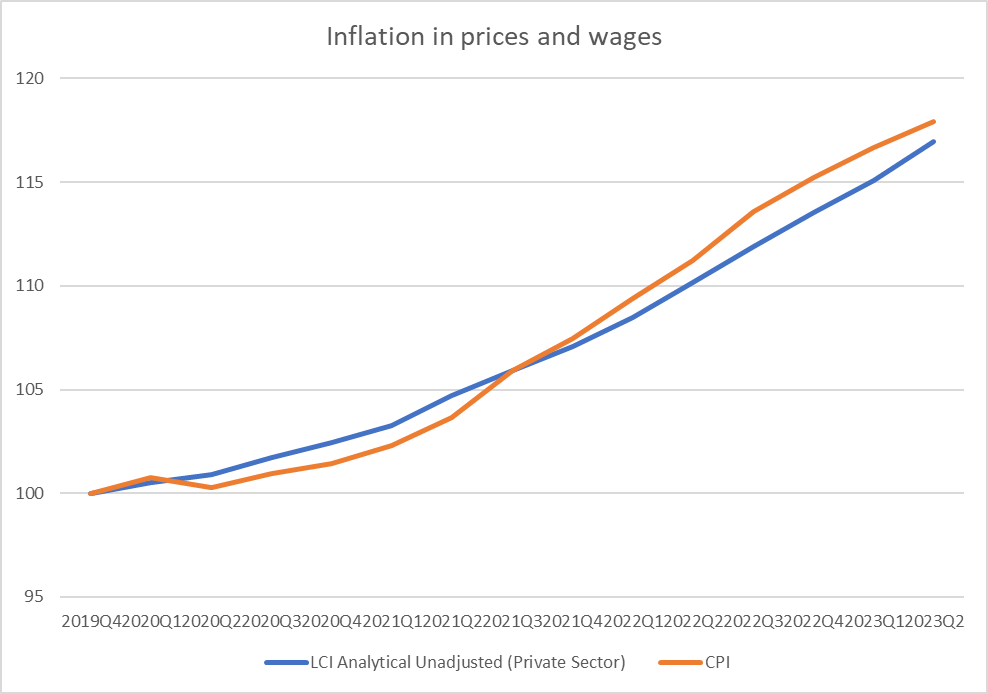
Over that 3.5 year period real wages have hardly changed (in fact they are slightly down, but the difference at the end of the period is less than 1 per cent). Even allowing for the fact that the inflation took everyone by surprise – most notably the central bank and its MPC – it isn’t really what I’d have expected this far into an inflation shock. Note that over time you’d normally expect real wages to rise as trend productivity improves, but the best estimates so far suggest little or no economywide productivity growth in New Zealand over the Covid period.

Now, as I noted in yesterday’s post the terms of trade for the New Zealand economy as a whole have been falling, reducing purchasing power relative to the real output of the economy. Perhaps wage rates have been doing something unusual relative to overall capacity of the economy to pay?

In this chart, when the line is rising (falling) private sector wage rates have been rising faster (slower) than nominal GDP per hour worked.
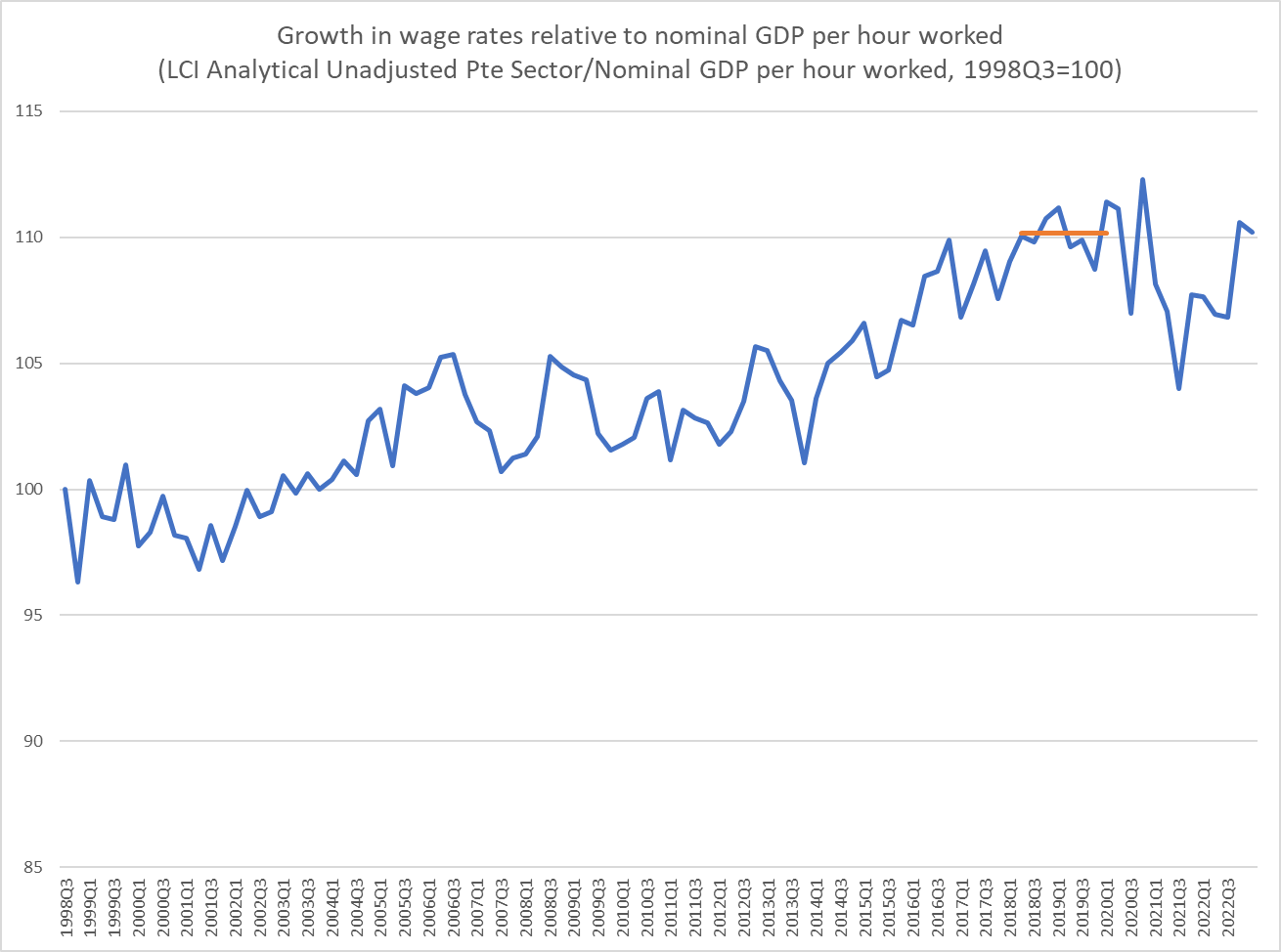
The orange line is the average for the couple of years immediately prior to Covid. As you see, the final observation (Q1 this year, as we don’t yet have Q2 GDP) is almost exactly at that pre-Covid level. Wage rates have not risen in any extraordinary way relative to the either prices or overall economic performance in the last year or two.

The gist of Hosking’s question was that if only workers now took lower wage increases the adjustment back to low inflation might be easier. At one level, I guess it just might, but only in the same way as if firms decided to increase their prices less (the CPI is, after all, ultimately just a weighted average of firms’ selling prices). But things don’t work like that, and it isn’t even clear that they should (there is a lot to be said for decentralised processes for both price and wage setting). As I noted in response, the labour market these days mostly isn’t a union leviathan confronting a combined employers’ leviathan, but a decentralised process in which individual firms and their workers make the best of the situations they find themselves in. Firms want/need to attract and retain staff and have to pay accordingly, and when employees have other options they can either pursue them or suggest they need to be paid more to stay where they are.

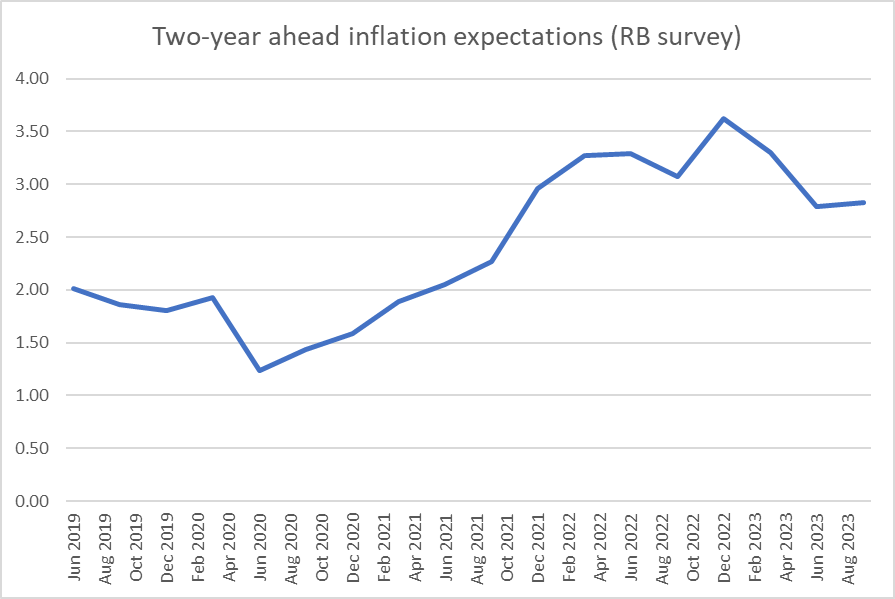
Core inflation is an excess demand phenomenon, which can be reinforced to the extent that people (firms, households, whoever) have come to fear/expect that inflation in future will be higher than it has been in the past (and whatever weight one puts on them that is what inflation expectations surveys are now showing). What we need isn’t firms or workers to be showing artificial “restraint” but the central bank to do its job, to adjust overall demand imbalances in ways that once again delivers core inflation sustainably near 2 per cent. Unfortunately, that can’t just mean heading back to things as they were at the end of 2019 when inflation was low, on the back of years of low inflation, but rising: achieving the reduction from 6 per cent to 2 per cent is the dislocative challenge.

Changing tack, as I mentioned yesterday one of the key things I will be looking for in the MPS today (more or less regardless of what immediate policy stance the Bank takes) is evidence of engagement with the question of why (core) inflation has come down so much in some (by no means all) other advanced economies and not in New Zealand.

To illustrate, here is the US trimmed mean CPI (monthly annualised)
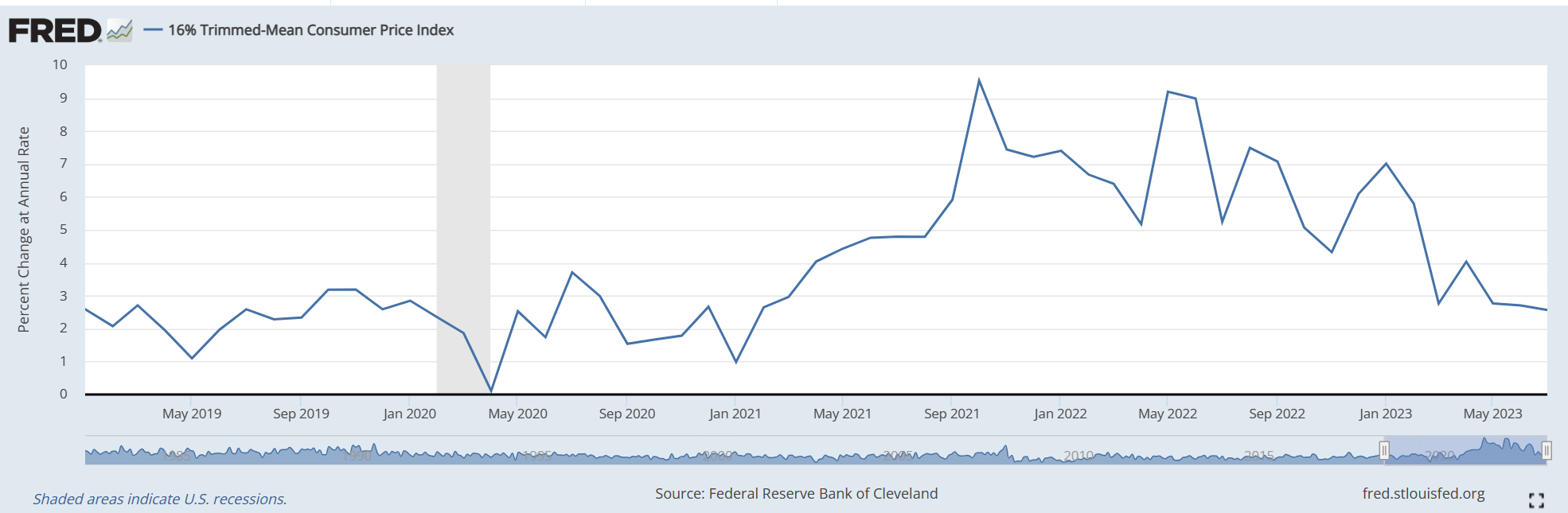
The weighted median series looks much the same.

And here are the Bank of Canada’s annual core inflation measures
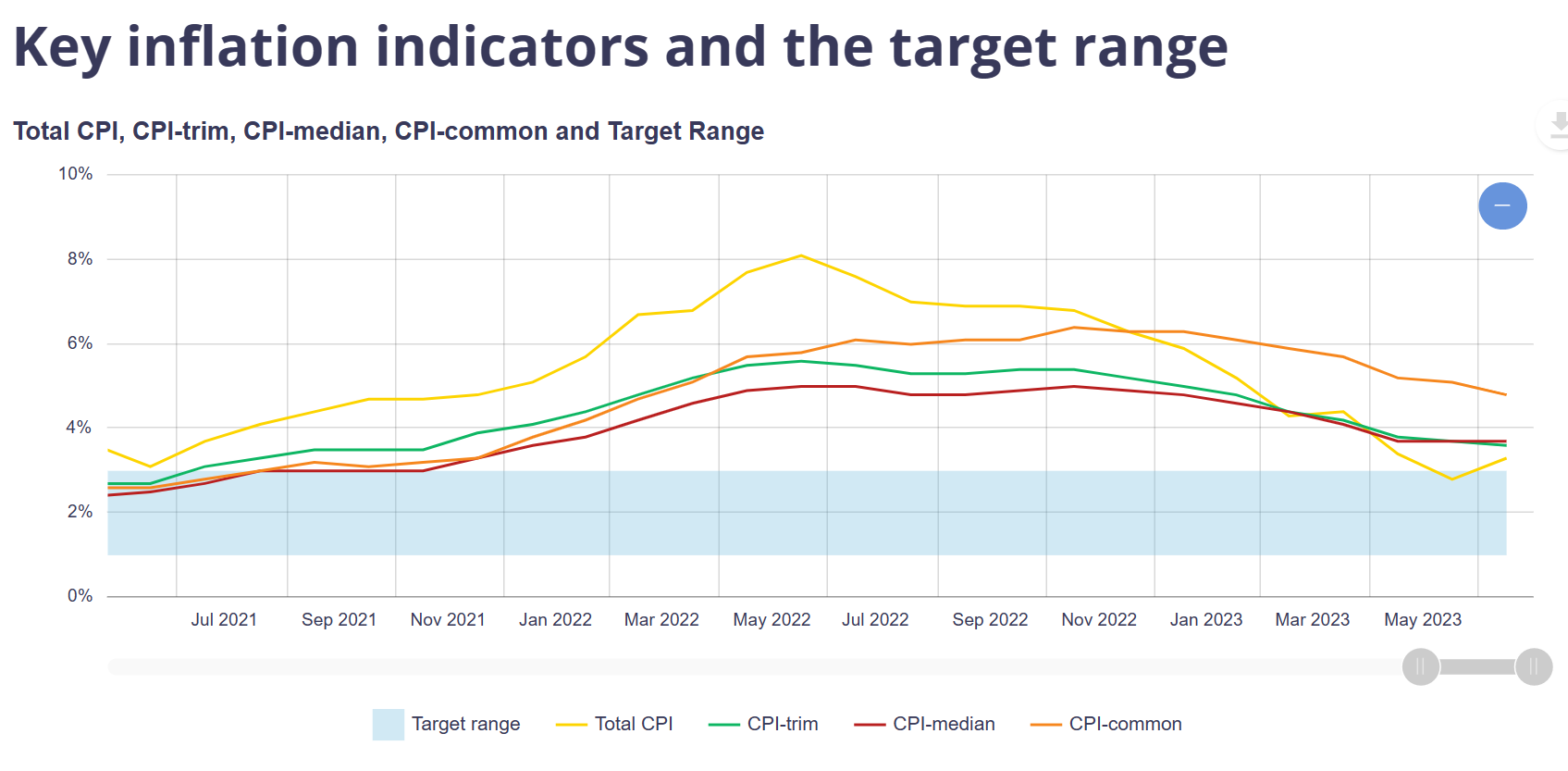
But it isn’t only in North America. Here are the Australian core measures (both now showing much the same story)
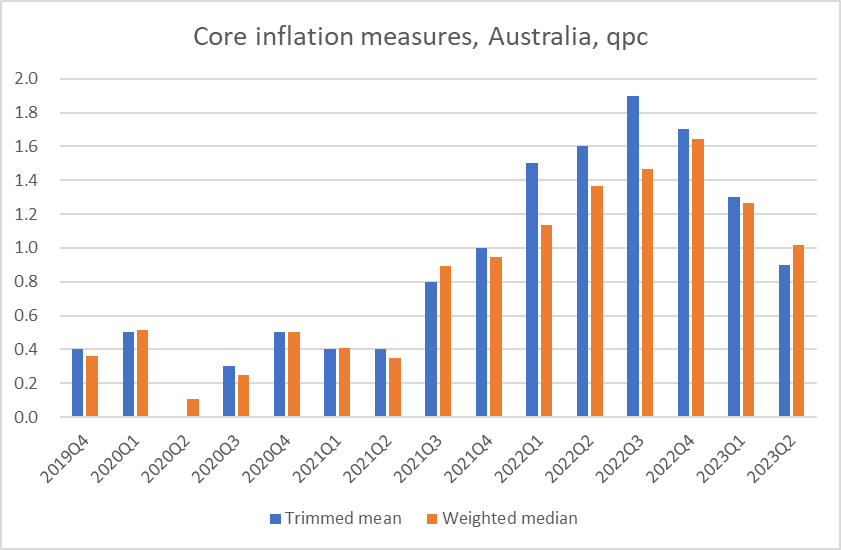
And yet here are the NZ measures
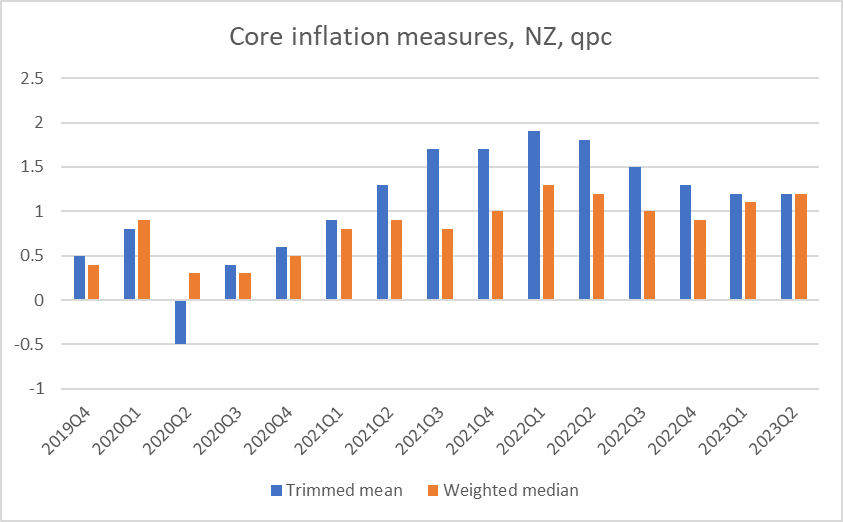
The trimmed mean appears to have fallen from a peak 18 months ago, but is hardly falling at all in the last couple of quarters, while with the weighted median it is not clear that there has been any reduction at all. Both are at levels a long way from the target midpoint.

At one level, perhaps the US and Canadian inflation reductions are less surprising. Their central bank policy rates are now at or above the pre 2008 peaks. By 21st century standards these are now high interest rates for those countries
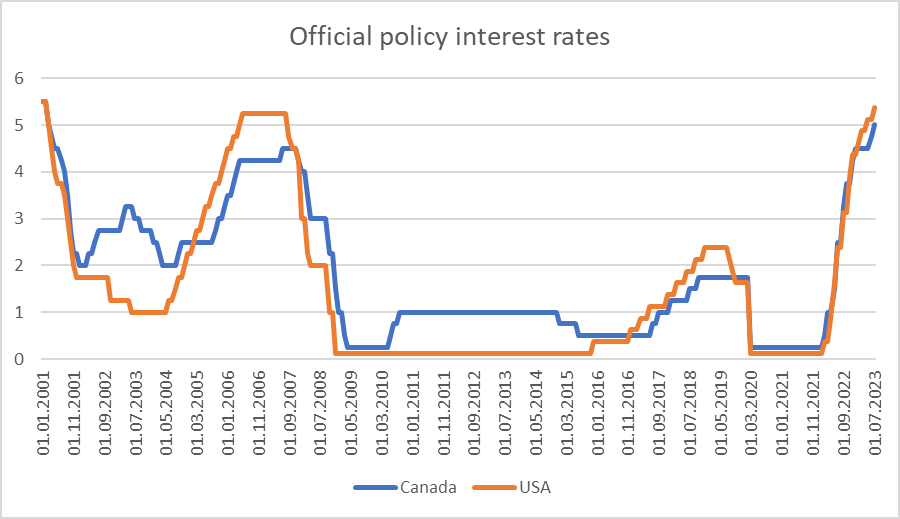
New Zealand makes quite a contrast……but Australia even more so.
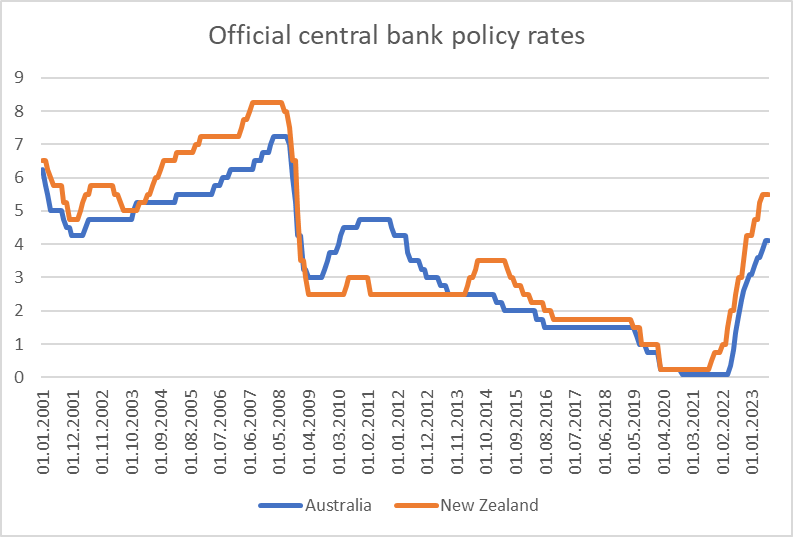
I don’t understand quite why core inflation has already clearly come down in Australia at what seem to be quite modest interest rates. If you look carefully at those core inflation charts you will notice that core inflation started rising two quarters later than in New Zealand, and now seems to be clearly falling more and sooner.

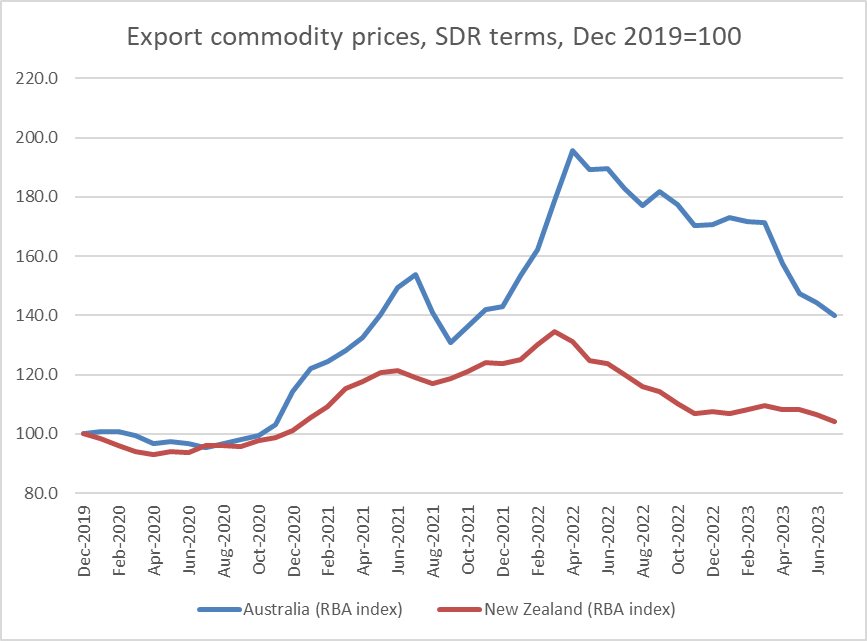
Relative to New Zealand, Australia has had a better run with commodity prices
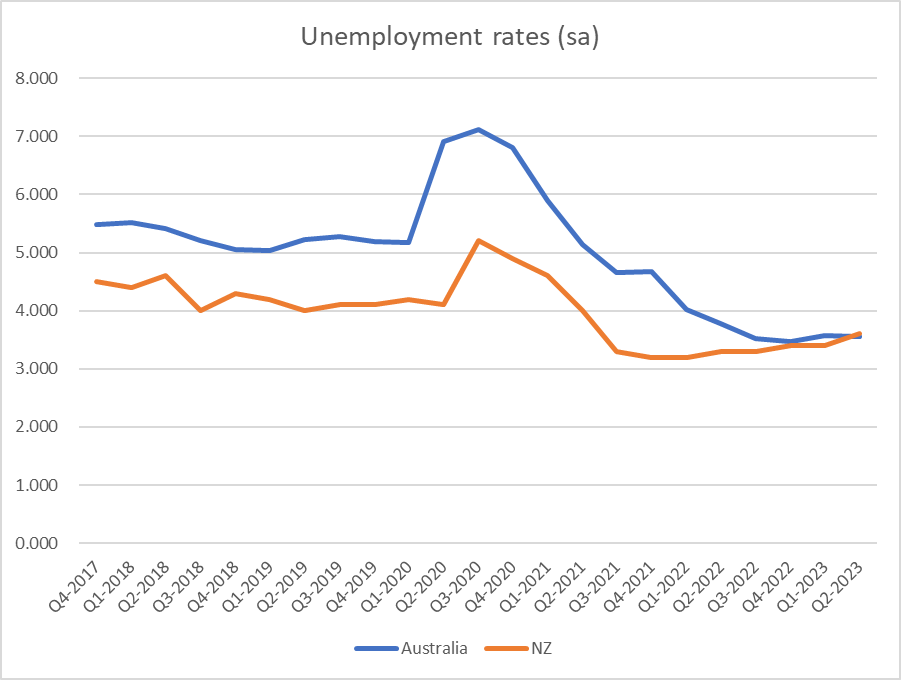
And whereas Australia usually has a higher unemployment rate than New Zealand, at present they are roughly the same, suggesting that if anything Australia may have an unemployment rate further below NAIRU estimates than New Zealand does.
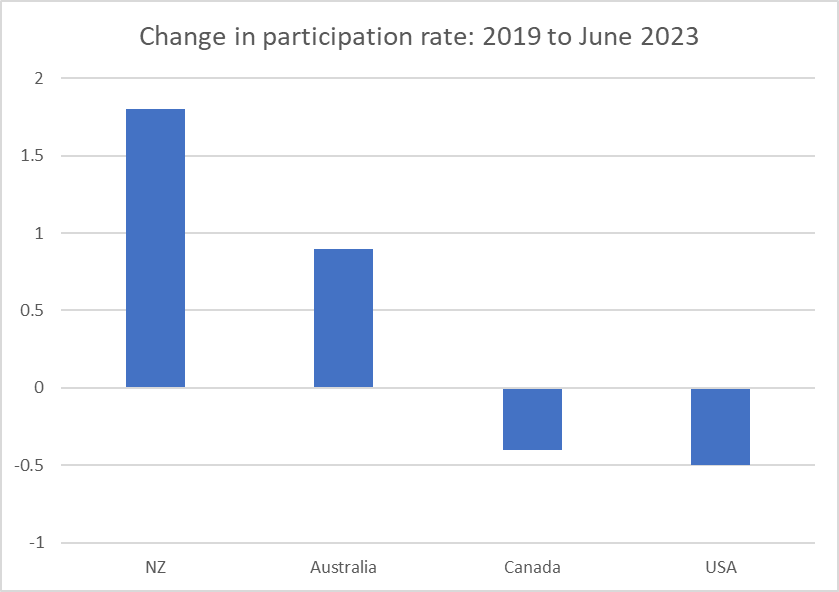
There must be good explanation for what is going on, for why core inflation has not yet fallen (as it has not in some other advanced countries) but to be persuasive such explanations need to be able to encompass credible explanations for why things have gone better (inflation fallen earlier and faster) in the US, Canada, and Australia. Those stories matters: on the face of it, the US and Canadian comparisons might suggest that the RBNZ has simply not done enough, but the Australian comparison (in an economy with a very similar Covid experience, and also a more similar labour market experience) might reasonably suggest the opposite. One sees stories from the UK and North America ascribing inflation to the low post-Covid participation rates, and (in the US) some easing in inflation perhaps being down to a recovery more recently in participation. But of these four countries NZ stands out as having the largest rise in participation (true even if some might discount the latest quarterly rise) and apparently (thus far anyway) the stickiest core inflation.
Perhaps the explanation will eventually be shown to have been some mix of “the cheque was in the mail” and “New Zealand data were published more slowly and infrequently than many other countries” – plenty of places already have July inflation data, in some cases July unemployment data, while we have only mid-May inflation and unemployment data, and have a two month wait for more.

Or perhaps there is more of an economic story. I hope the Reserve Bank can offer some serious analysis this afternoon.
The $11bn men and women of the MPC

Three months ago I wrote a short post here using some new data the Reserve Bank had started to publish on the monthly payments Treasury was making to the Reserve Bank as the losses were gradually realised on the huge portfolio of bonds the Bank and MPC had run up in 2020 and 2021 (the LSAP). It was to the Bank’s credit that they have started making the data available, and although there have been a few glitches since then, when I have got in touch they have been very helpful.

I can remember the days when I and a few others used to jeer at them for having lost $7 billion (and these numbers are a proxy – albeit an imperfect one – for big and very real losses for the taxpayer from the asset swap programme, executed at probably the single most inopportune time since interest rates were liberalised 40 years ago). Last year, the Taxpayers’ Union gave the Governor a lifetime achievement award for waste, citing then estimates of $8.5 billion of losses.

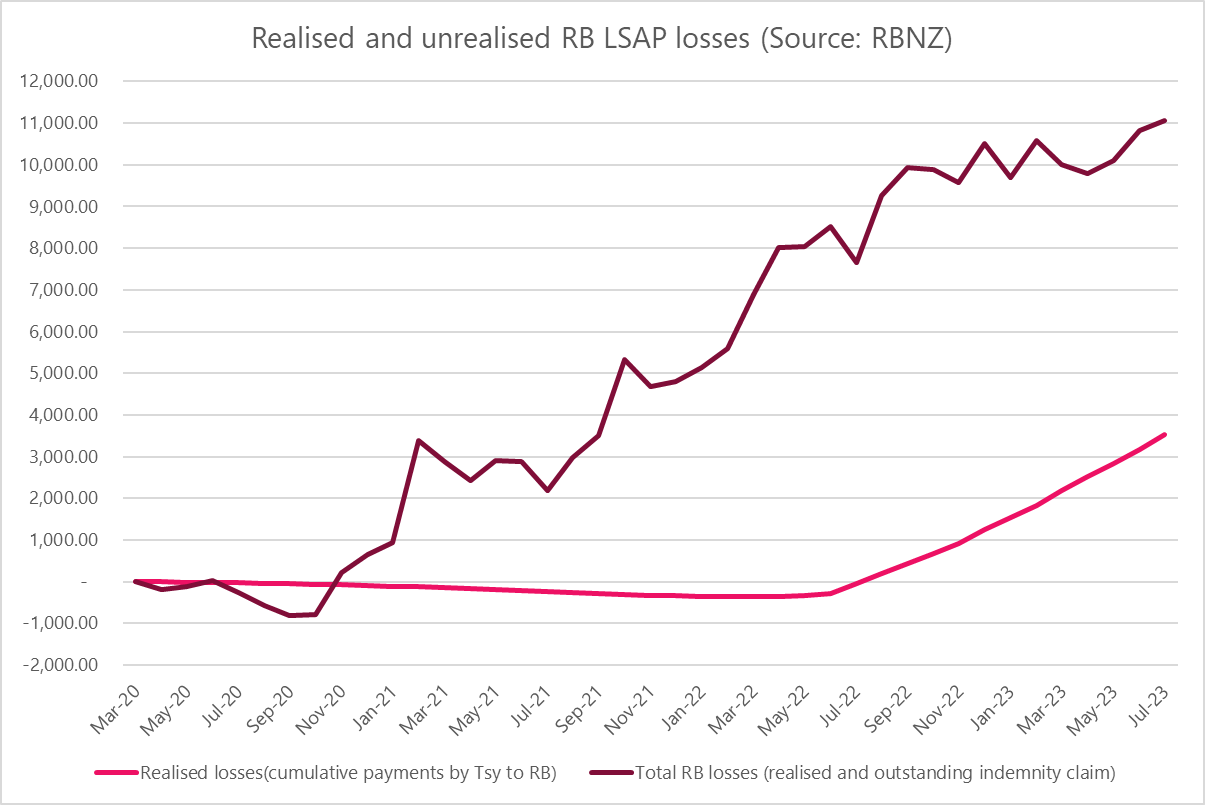
That was then. When I ran the first post in May total RB losses (now properly measured, with the indemnity payment data) had been bobbling just either side of $10 billion. With today’s update by the Bank of the relevant spreadsheet, here is the position to the end of July.

Yes, total RB losses from this grossly overblown under-analysed programme have now reached $11 billion (which was also the last total estimate from The Treasury I’d seen).

But, again, that was then, and in August to date bond yields appear to have risen another 20 basis points or so. As the portfolio slowly shrinks and the longest bonds are sold off first, the extent of further losses should diminish, but there is no sign we’ve yet reached the limit.

I’ve tended to focus in on the Governor as responsible, and there is little doubt that he is the dominant figure on the MPC.

But we shouldn’t forget the other internal MPC members who shared in the decisions to accumulate the risk:

Then Deputy Governor, Geoff Bascand

Then Assistant (now Deputy) Governor, Christian Hawkesby

Then Chief Economist, Yuong Ha

One has since been promoted and two have moved on, although with no hint that sharing responsibility for absolutely huge taxpayer losses was a part of either move.

More recently, Karen Silk and Paul Conway have joined the MPC. They weren’t there when the risk was taken on, but they have been part of the decision not to close it out quickly, and thus to continue to expose taxpayers to further losses.

And then of course, there are the three externals, all reappointed since the LSAP folly: Bob Buckle, Peter Harris, and Caroline Saunders.

And who reappointed them and Orr? Well, that would be the Minister of Finance and the Bank’s Board, the latter chaired by Neil Quigley, who has just proved you can apparently just make up stuff to Treasury, lead Treasury to lie to the press, and still carry right on as chair of a government board. In this country new depths of poor governance seem to be plumbed almost every week.

Finally, we shouldn’t completely exclude the Secretary to the Treasury from responsibility. She sits as a non-voting member of the MPC and she advises the Minister on things like indemnities and Bank performance. There is not even a hint (eg in the MPC minutes or OIAed papers) that she has ever dissented from the highly risky and costly LSAP intervention.

That is quite a list of people who share responsibility for losses that have now reached $2000 per man, woman and child in this country. Readers will reflect on just what nice-to-haves that politicians are now competing to bribe us with (with borrowed money) might have been considerably more affordable had the Bank stuck to the OCR which, boring as it may be, tends not to make or lose taxpayers much money at all.

I suppose one way of looking at that list of the responsible men and women is that if we averaged it out, the loss was a bit under $1 billion per responsible public figure. There wasn’t even a good party (as Mr Leauanae enjoyed on leaving MPP) just reckless waste and losses on a scale not seen in New Zealand public finances for a very long time.

And no one paid any personal price. There was no personal accountability at all. Most of these people still hold their high, and highly paid, offices. While you and I are covering the losses they so carelessly racked up. It is some slim consolation that one of them is up for election in a few weeks.

What should the MPC do?

There is a full Monetary Policy Statement from the Reserve Bank and its Monetary Policy Committee tomorrow. No one expects them to do anything much, but I’m less interested in what they will do than in what they should do. It is hard to be optimistic that the Committee will do the right thing at first opportunity – it mostly hasn’t for the last 3.5 years – but whatever is required will, presumably, eventually get done, perhaps after a prolonged dalliance with the alternative approach (if you think that cryptic, think $10-11bn of LSAP losses, entirely the responsibility of the MPC, and core inflation persistently some multiple of the target that had been set for them).

I wrote a post a couple of weeks ago looking at what had been happening to monetary policy and inflation across a bunch of advanced economies in the light of the complete suite of June inflation data. I’m not going to repeat all the analysis and discussion from there, and nothing very much has changed in the published data (for real nerds, still disconcertingly high Norwegian core inflation has come back down again after rising the previous month or two). But some key relevant points were:

  • as yet, there is no sign that core inflation in New Zealand is falling (and even if one measure it might be lower than the early 2022 peak there is no sign it is still falling now).  That is a quite different picture from some other advanced countries (notably the US and Canada, but also Australia).
  • employment appeared to continue to be growing strongly (and even confidence measures were stabilising),
  • New Zealand is one of a small handful of advanced countries where the policy rate now (5.5 per cent) is still well below the pre-2008 peak (8.25 per cent)
  • The MPC asserted at their last review that they were “confident” that they had done enough.  Neither those words, nor the idea, appear in the recent statements of any other central banks, and our MPC offered no reasons for their confidence.

Bear in mind that with core inflation around 6 per cent and the Bank’s target requiring them to focus on the 2 per cent target midpoint, there is a very long way to go.   It isn’t a matter of getting core inflation down by 0.5 or 1 per cent, but of a four percentage point drop.

Bear in mind too that whereas past New Zealand tightening cycles have typically seen total interest rates rises similar to what we’ve seen to date (a) the scale of the required reduction in core inflation is greater than anything we’ve needed to achieve for 30+ year, and b) unlike typical New Zealand tightening cycles there has been no support from a higher exchange rate.

What local data there have been in the last couple of weeks hasn’t given us any more reason for comfort.  Late last week, there were the monthly rentals and food price data.   The food price data did look genuinely encouraging, although it was a single month’s data in a part of the CPI that had seen inflation far faster than the core measures until now.  Rents, on the other hand, appeared to be continuing to rise quite strongly, with no sign of a (seasonally adjusted) slowing at all.

The suite of labour market data (HLFS, QES, LCI) was not really any more encouraging.  Labour market data do tend to be lagging indicators, but we have to use what we have.   4 per cent annual growth in numbers employed (comprised of four individual quarters each showing material growth) is absolutely and historically strong, by standards of past cycles the unemployment rate has barely lifted off the (extremely low) floor, and there is no sign of any slowing in wage inflation (remember that much of services inflation is, in effect, wage inflation).  There is seasonality in the wages data and SNZ don’t publish seasonally adjusted series but as this chart illustrates at best wage inflation might be levelling out, not much higher than the same quarter in the previous year.

To the extent the mortgage borrowers/refinancers tend to go for the lowest shortish-term fixed rate on offer, current two year fixed rates are barely higher than they were at the end of last year, and all the reports from the property market suggest a bottom has already been found and prices are already rising (still modestly) again.

And then there was the latest RB survey of expectations. Medium-term expectations of inflation actually rose a touch (one could discount the small rise, but we should have been hoping for a fall, especially as the relevant horizon date moves out each quarter). This group of respondents has consistently and badly underestimated inflation in recent years. The Reserve Bank has too, but it has done even worse than these survey respondents.

The survey responses regarding the inflation outlook don’t seem anomalous. The same respondents revised up their GDP growth forecasts, revised up their wage forecasts, revised up their house price inflation expectations, and revised down their medium-term unemployment expectations. They might be wrong – and often are – but are there good grounds for thinking the Reserve Bank is any better at present (in a period when no one really has a compelling model of what has happened with inflation – if they had, they’d have forecast it better).

You may have noticed that a couple of local banks think the Reserve Bank will raise the OCR later in the year (presumably a view that the Bank will eventually be mugged by reality). One presumes this predictions are best seen as a view that “more will need to be done”, rather than a specific confident prediction of 25 basis points being specifically what is needed. No one can be that confident (with 25 basis points). It may be that the MPC has already done enough (as they thought) or that it needs to do quite a bit more, but even in hindsight it will be very difficult to distinguish between the effects of a 5.5 vs 5.75% peak choice.

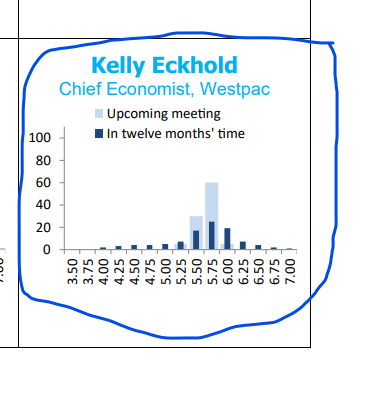
In the NZIER Shadow Board exercise, where respondents are asked what they think should be done, Westpac’s Kelly Eckhold thought that an increase in the OCR to 5.75 per cent at tomorrow’s MPS would be warranted (as does one other economist in the survey).

When I tweeted yesterday about the Shadow Board results yesterday I was still hedging my own position. I noted that I thought a least regrets approach – remember the MPC’s enthusiasm for such a model on the downside – suggested that it would have been better if the OCR had been raised more already.

That was deliberately an answer to a slightly different question than what I would do tomorrow if I were suddenly in their shoes, or (separate question again) what I think they should do. The actual MPC is somewhat boxed in by its own past choices (not just the “confident” rhetoric, but the absence of any speeches etc giving any hint of how they, individually or collectively, have seen the swathe of data that has come out since they last reviewed the OCR). To move the OCR tomorrow would bring a deluge of criticism on their heads, from markets and economists, but it would then be amplified greatly by politicians as we descend into the depressingly populist election campaign.

Since I think making the right policy adjustment (even amid all the uncertainty) is more important than communications, and since there is already reason to think the MPC has been playing party political games (its treatment of the Budget in the last MPS), I think they should raise the OCR anyway, by 25 basis points, and shift their forward-looking approach back to a totally data-dependent model, rather than trying to offer reassurances. Were I suddenly in their shoes, shaped to some extent by past choices, I would probably be wanting to indicate concern that core inflation was not yet falling, emphasising how far there was to go, and making clear that the real possibility of OCR increases would be on the table for both the October and November reviews (the latter the last before the MPC moves into its very long summer holiday).

To me, the issue now is not whether core inflation is going to fall. It seems most likely that it will finally begin to (and although overseas experience in by no means general, perhaps the US, Canadian, and Australia recent experiences offer grounds for hope) but rather how far and how slow the reduction will be. We need large reductions in core inflation, not just the beginnings of a decline, and two years into the tightening cycle we need to see large reductions soon. Perhaps it will happen with what has been done already, but that seems more like a hopeful punt than a secure outlook. One thing we should be looking for tomorrow, especially if the MPC does nothing, is some serious analysis illustrating their thinking as to why it is that core inflation here has not yet fallen (whereas, for example, it has in the US, Canada, and Australia). I don’t know the answer myself, but with all the resource at their disposal we should expect the MPC to make a good fist of a compelling story.

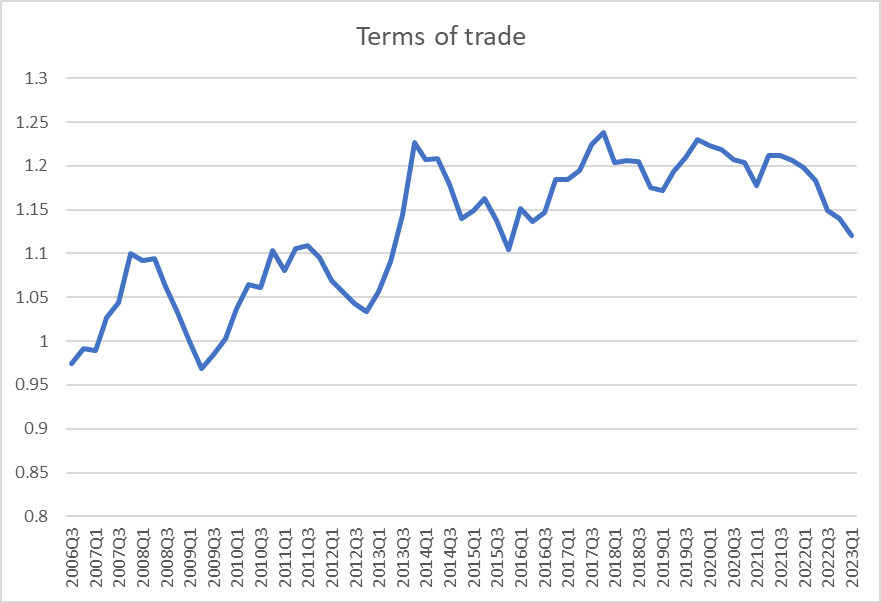
The world economy, and the travails of China, have got some attention recently. That global uncertainty will no doubt be cited by some, including around the MPC table, as reason for waiting. I’m not convinced, partly because over the decades I’ve seen too many occasions when such potential global slowdowns have been cited as an argument, only for them to come to not much. Relatedly, over the years one of the most important ways global events affect New Zealand has been through the terms of trade. A serious global slowdown might be expected to dampen the terms of trade (and thus real incomes and demand relative to the volume of domestic output) but…..

….New Zealand’s terms of trade have been trending down since Covid began, and quite sharply so since the start of last year. We’ve been grappling with an adverse terms of trade shock and have still had persistently high core inflation (and super-tight labour markets etc). There isn’t any obvious reason why the terms of trade couldn’t fall another 10 per cent (dairy prices have already weakened further in recent months, this chart only being to March), but if so it won’t be against a backdrop of recent surges of optimism (unlike the reversal in the recession in 2008/09). In short, there is plenty of time to react to really bad world events if and when they actually happen.

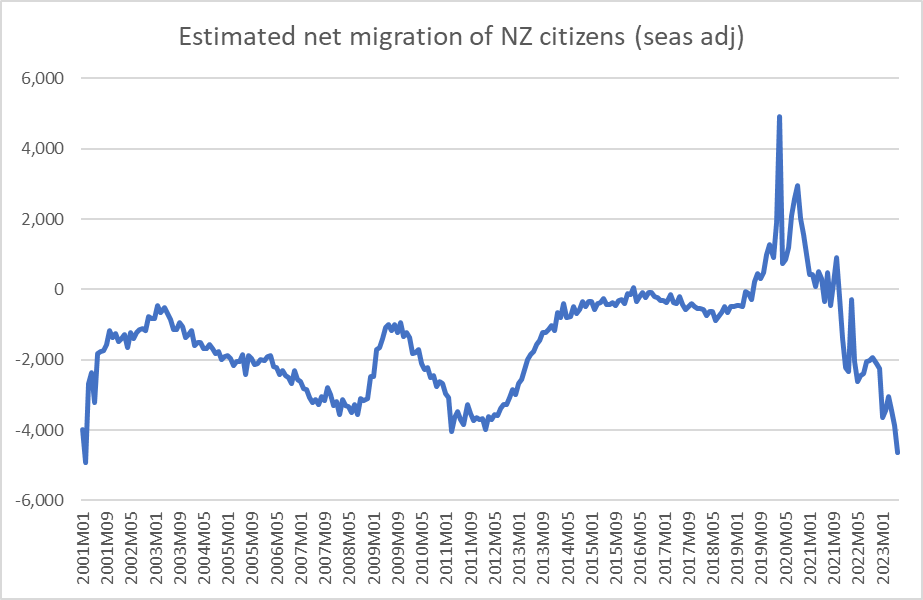
Finally, the immigration situation has materially changed the New Zealand macro position in the last year. In the June quarter last year, there was a net migration outflow of 2600 people. In the June quarter this year (June month data out only yesterday), the estimated net inflow was 20000 people (consistent with an annual rate of 80000 or so). The Reserve Bank is on record as saying it doesn’t know whether the short-term demand or supply effects are stronger (which is quite an admission from the cyclical macro managers) but all New Zealand history is pretty clear that – whatever the longer-term effects might be – in the short term demand effects, particularly from shocks to migration, outweigh supply effects. Without that effect, it might have been safe to assume enough had been done with monetary policy months ago. But not now, not against the backdrop of high and not falling wage and price inflation, strong employment growth, recovering housing market and so on.

Note too that the net inflow numbers are held down by the high and rising number of New Zealanders leaving. Outward migration of New Zealanders tends to be particularly strong when the Australian labour market is very tight (see 2011 and 2012), and if that market were to ease – as seems to be generally expected and thought to be required – the overall net inflow to New Zealand could surge again

Bottom line: I think the MPC should raise the OCR tomorrow, and certainly should flag October (once the Q2 GDP numbers are in) as live.

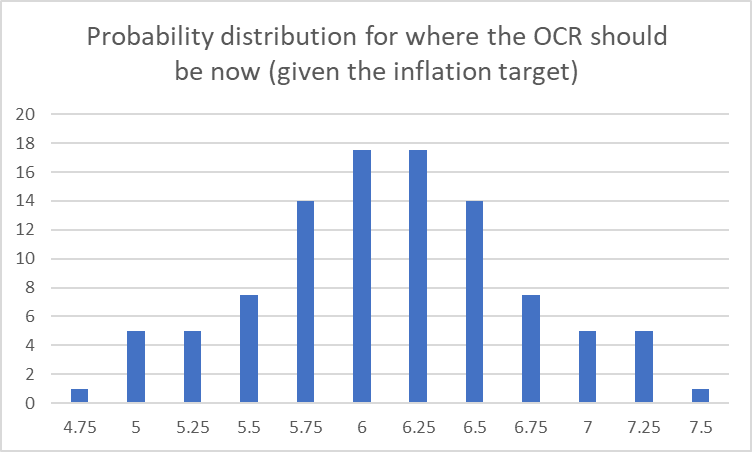
But all these views have to be held somewhat lightly. Doing that Shadow Board exercise (see above) myself, and it is something the Governor’s advisers at the RB used to have to do, I might distribute my probabilities as to what OCR is appropriate now something like this (none of those individual probabilities is higher than 20 per cent)

UPDATE:

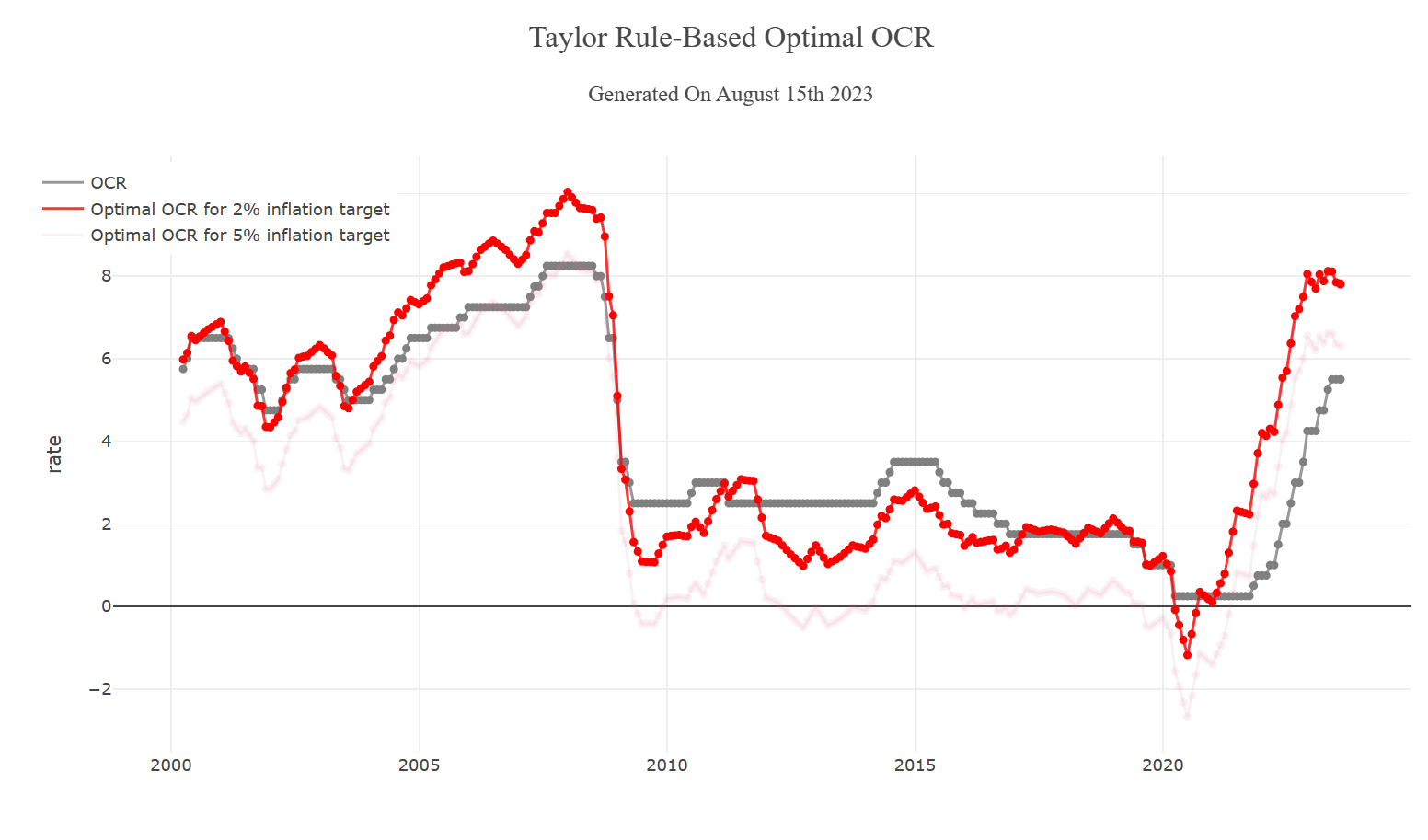
In the comments Bryce Wilkinson points us to this. Having been in the weeds in 2007 I’m not convinced that on the information we had at the time an OCR of 10% was needed in Dec 2007. That said, an OCR of 4.3% in February 2022 would have been much better than policy as actually delivered. And note that an 8% OCR now would be close to the 2007/08 actual peak (as many other countries’ policy rates now are). Food for thought.

Laxity, or worse

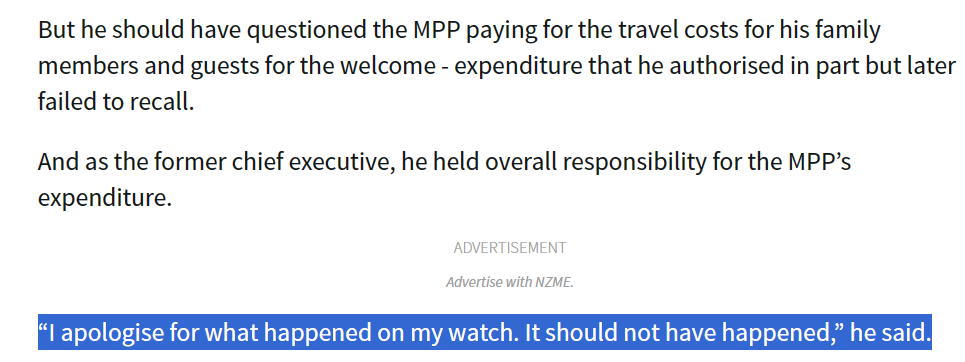
Reading the hardcopy Herald over lunch I spotted an article under the heading “Ministry boss apologises over spend-up”, referring to Mr Leauanae, the chief executive of the Ministry of Culture and Heritage (MCH) as regards the events surrounding his farewell from his previous role as head of the Ministry of Pacific Peoples (MPP) and his welcome to MCH. This was the key bit

“on my watch”? He seemed to be trying to minimise what PSC had found had actually happened (written up in my post yesterday) and suggest that he himself hadn’t done much, but had after all just been the CE (so, in some sense, formally responsible but not really to blame). It was as if his wayward former underlings had done stuff that didn’t relate to him at all. What the PSC report actually described was Leauanae having accepted $7500 of taxpayer gifts himself at the farewell and then accepting $4000+ of travel for family members and friends for his welcome to MPP. (In addition of course to the rest of the extravagant $40000 spent in total on his farewell, as he moved from one small Wellington government department to another.)

As I noted on Twitter, one of the things the PSC report carefully never directly stated was quite when (a) the gifts were returned, and b) when the travel was reimbursed. It would have been easy for either the PSC report or Mr Leauanae to have given us specific dates, but they (obviously deliberately) chose not to. I have now lodged a couple of OIA requests to find out. Was it the day after the relevant events (say) or only after PSC started digging into the matter? The difference is likely to be quite important. If the former, one might take a more charitable view.

But the comments reported in the Herald prompted me to read the statement from Peter Hughes again more carefully. The lines Hughes will have been keen to see reported were

I thank Mr Leauanae for putting the matter right at the first opportunity.”

The “first opportunity” might suggest the day of the events or perhaps the day after. After all, as the full PSC reports note (carefully, without either evidence or further comment)

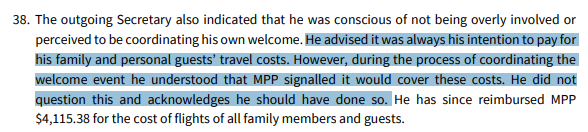
He advised it was always his intention to pay for his family and personal guests’ travel costs.

So on a casual reading you might have assumed it was all an oversight and was put right within a day or two.

But, from the Commissioner’s own statement, that can’t have been the case.

Perhaps the gifts really were returned very promptly (eg the night of the farewell function or at worst the day after), although the report/statement carefully does not give dates or times. (There is also that strange comment that he returned both the gifts and the money spent on them, which leaves questions as to whether the gifts had been able to be returned to the vendors for full refunds or not).

But that clearly wasn’t the case with the travel, because the second paragraph above says that it was the PSC review which uncovered the fact of this spending on Mr Leauanae’s family and friend’s travel, and that it was only in light of the review finding that he reimbursed MPP. And we know from the documents PSC released that they did not formally decide to look into the spending regarding the welcome to MCH until 19 June. That was eight months after the personal benefit to Mr Leauanae. That doesn’t seem even close to putting things right at the “first opportunity”, casts further doubt on Leauanae’s claim that he had always intended to pay for the travel himself, and strongly suggests someone with no strong sense of what is right and wrong when public money is being spent. Someone who still sits in a highly paid job as head of a New Zealand government department.

Peter Hughes was obviously somewhat constrained by the facts, but he consciously chose not to explicitly point out this timing, but to spin a story that would lead quick readers to think Leauanae had fixed things up straight away, not many months later only after the inquirers from his boss came calling.

Nothing in this story reflects at all well on Leauanae, and it really should be staggering that he goes on as a government department CE with, as far as the report suggests, no adverse consequences (he just repaid things when he finally got caught). Of course, it isn’t just the personal benefit, but the modelling and leadership (or lack of it) that will have led his former MPP underlings to think the lavish expenditure was ever acceptable, and the undisciplined processes etc reported last night in the Newshub story after they got hundreds of pages of documents from MPP. What gets you dismissed, or strongly encouraged to resign, when you hold a New Zealand government department CE role? Clearly not this record.

I’m also a bit surprised no one seems to have asked relevant ministers whether they have any confidence in Leauanae. In one of the weird bits of our legislation, they can’t sack him themselves, no matter (apparently) what he did, but the position of a CE would surely be untenable if the Prime Minister and the Minister of Culture and Heritage (as it happens the Deputy PM) indicated that they had no confidence in Leauanae. The PM has been reported as saying that the expenditure was unacceptable, but what of it? What is he going to do about it? He is, after all, the Prime Minister, and it is hard to believe that the Opposition parties will be leaping to the defence of Mr Leauanae.

Of course, it is always possible Hipkins and Sepuloni do still have confidence in Leauanae, even after what is already revealed about him (personal entitlement, weak and undisciplined financial management and people leadership etc). If so, that would be sadly telling. But you might have thought media outlets would at least ask whether they still have confidence in him, and if so why.

Laxity

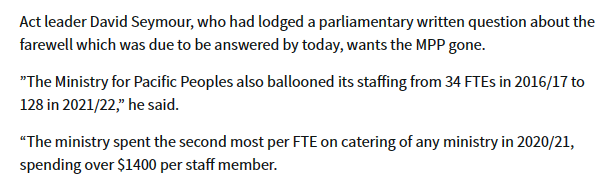
Yesterday the news broke of the extravagant spending at the Ministry for Pacific Peoples (MPP), and to a lesser extent at the Ministry of Culture and Heritage, centred on the transfer from one division to another of the core public service of MPP’s then chief executive Laulu Mac Leauanae. In the spirit of the unified public service (all that stuff that Peter Hughes and Chris Hipkins touted), shifting from running one smallish unimportant department to running another one seems about on par with someone moving from one modest division of an indebted private company to another.

As the Herald reports MPP has already been a bit of an example of the extravagance with the public purse over recent year. A quadrupling in staff numbers for an agency with no clear or legitimate purposes….

In this example, staggering amounts ($40000) were spent on a farewell (for a person who’d worked for the Ministry for only five years), including extravagant personal gifts to the outgoing chief executive. Probably there was a case for a morning tea in the office (a cake and a few sausage rolls etc) or a drink after work for staff and a handful of outsiders. But it is hard to see a case for having spent more than a couple of thousand dollars in total. And impossible to see any case for (anything more than token) taxpayer-funded personal gifts…..the more so when the outgoing CE was just transferring to another wing of the same organisation.

And thousands of dollars spent by MCH on a welcome? What happened to simply turning up – at your new division of the same (government) enterprise – and starting work, with perhaps a staff morning tea or all-staff meeting at some early getting-to-know-you point? MCH has under 200 staff. Supermarket sausage rolls come quite cheaply. Four Governors started at the Reserve Bank in my decades there, and I don’t recall anything more extravagant for any of them (and in the earlier years the Reserve Bank was not a notably austere organisation).

You can read the Public Service Commission’s report and statement here. But what isn’t said there is at least as interesting as what is.

Starting with, how did PSC come to be so asleep on watch?

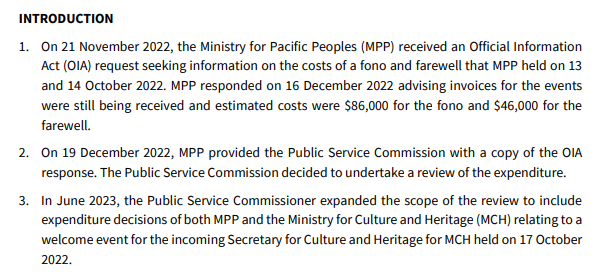
The farewell (and welcome) occurred in October. But this is the introduction to the PSC report

So either PSC didn’t even know about the event(s) – which frankly seems unlikely, unless they are even more slack than it seems – or no one there stopped to wonder just how much public money was being spent….until someone in the public asked. It is also pretty remarkable that MPP – by then under an acting CE – never thought of mentioning the OIA request to PSC until after the response had already gone to the respondent. As regards the costs of a farewell for one of the Public Service Commissioner’s CEs. And even when in mid January PSC decided to look into the farewell spending, it wasn’t for another five months that they thought to look at what had gone on as regards the welcome.

And that Herald extract above leaves one wondering just how much of all this we might have heard of the waste if it had not been for the written parliamentary question. Perhaps that is unfair, but the Commission’s approach was on display in a letter sent by the Deputy Public Service Commissioner on 17 January to the acting CE of MPP.

In that letter she states

my expectation is that the entire review process will be completed by mid to late February 2023. The final report will be published on the Commission’s website, but it will not identify any individuals by name and your agency will have the opportunity to comment on the draft report before it is finalised.

Not sure how she envisaged a report on a farewell for a CE naming no names but…. And it is August now.

Perhaps more concerning was this later in the letter

Which feels a lot like an attempt by PSC to stymie uses of key instruments of scrutiny and democracy (OIAs and PQs). It isn’t clear what OIA grounds they might have tried to withhold using……but with the OIA that rarely seems to stop agencies…..and PQs are questions from MPs to ministers, not matters that should be within the ambit of the PSC. The same text is in a letter dated 19 June from Peter Hughes to the MCH chief executive.

The PSC report has no reflections at all on PSC’s role or approach (or on any briefings they might have provided to their minister – at the time all this kicked off that was Chris Hipkins). In addition to the matters already touched on there was nothing at all about their own approach to agency oversight or to key appointments, that meant a culture developed in one or two of their agencies where spending of this sort happened. But of course to have done so might have been embarrassing for them, including because they had just promoted the CE, lauding him as a “sophisticated organisational leader” and not missing the opportunity to mention that expensive senior management course he’d recently done at Oxford. And yet his MPP senior management team not only thought it was okay to spend up big on his farewell (transfer) but (as the report documents) did so with no decent systems or budgets. The values and priorities of top leaders are well known by those beneath them. Nothing about this report suggests this CE preached or lived any sort of public sector frugality. But, never mind, he got the promotion……and holds the bigger job to this day.

Quite a lot else is glided over too. This is from the Peter Hughes statement

But neither here nor in the report are there any relevant dates. Mr Leauanae should simply never have accepted government departments paying for travel for his family members (tickets don’t just turn up), so reimbursing the cost when found out just doesn’t cut it.

Hard to see that sort of lackadaisical attitude being acceptable in anyone, at any level of the organisation. but……he was CE, displaying no sign of appropriate leadership at all. At best careless, at worst entitled (and note that the PSC report cites no evidence for his claim that “he always intended” to cover those expenses himself). And when did these refunds happen? A few days after the event, or only after PSC started digging? If it were the former it is highly likely PSC would have said so. Hughes refers to “the first opportunity” but the report itself does not.

And what of the gifts?

Many of the same questions arise? Surely on the day of the farewell, any public service leader should have expressed immediate extreme discomfort and returned all the gifts the same day? But there is no sign of any of that, and no indication that anything was returned before PSC started digging.

One could go on to note the sort of expenditure Hughes and the PSC seem to have no problem with. Recall that the welcome was to a transferring CE in a New Zealand public service department. As I said, a few sausage rolls and a welcome speech might seem reasonable. But not to PSC, which deemed all of this “moderate and conservative”

Sausage rolls and cup of coffee just don’t present the same challenges (or sheer waste). There was also this weird claim that somehow lavish expenditure was appropriate because

“In addition, the incoming Secretary was a Matai or chief, community leader as well as a public service leader.”

What he is or does in his private life is really neither here nor there (or shouldn’t be). You could be a hereditary peer, a billionaire, a generous philanthropist or whatever, and the fact remains that public money is being spent on a transfer of a public servant from one small agency to another.

In the end, the report seems to be largely a whitewash, at best slapping Mr Leauanae over the hands not even with a wet bus ticket but with a feather. He was found out, paid the money back after the event, and goes on to hold a CE position, in which if he ever utters words along the lines that public money should be used sparingly, rules adhered to in spirit as well as letter, staff probably scoff and go “one rule for you, and Peter Hughes’s favourites, another for the rest of us”.

But why should we be surprised? The twin cultures of entitlement and corruption, all accompanied by public sector bloat, are creeping ever onward. It is rare that any culprit ever pays a price – another Hughes CE took hospitality from an agency lobbying him to exercise discretion in their favour, and he went on to get a knighthood – and by their indifference we have to conclude that the government itself is unbothered.

As for the Opposition parties, they do part of their job in bringing some of this stuff to light and making a fuss now. But is there any sign of a robust open commitment to specific and much higher standards when their turn in government eventually comes? A CE who did what Mr Leauanae did (and allowed to happen) simply should not be still holding a government department CE job. That he is says that the standard now is not even “don’t get caught”. What standard is that for either other public servants? What sort of accountability to citizens and taxpayers?

There was a blackball on expertise

(This is a long post. The Executive Summary is that there was a bar on any active or future researcher on macro or monetary issues serving on the Reserve Bank MPC when it was established. Everyone accepted that this was so, and both the Minister and the Bank had defended the bar. Recently, the Reserve Bank Board chair Neil Quigley persuaded Treasury to state publicly that it had all been a misunderstanding and there had never been such a ban. None of the extensive documentation supports Quigley’s belated claims or explains Treasury’s willingness to champion his rewrite of history.)

About six weeks ago the ban that had been placed on anyone with current or likely future research expertise or interest in macroeconomics and monetary policy serving as external members on the Monetary Policy Committee was once again in the headlines. The Reserve Bank Board had just advertised to fill the two vacancies that will arise next year (yes, you might wonder why they were advertising now when it isn’t clear who will form the next government or what their expectations for the Reserve Bank might be, but leave that for another day). In the advertisement it was pretty clear that the former ban had now been lifted. If so, that was a really welcome step forward. The proof would still be in the sort of appointments eventually made, and the strong suspicion is that the more important (but unwritten) blackball is still in place – no one seriously likely to challenge the Governor or known for thinking independently was likely to be appointed. But it was a start. And would at least mean the Board and Minister were no longer open to the charge of having the only central bank in the advanced world (or most of the rest) where relevant expertise was a formal disqualifying factor from membership of a monetary policy decision making body. The list of former leading central bank figures internationally who would have been disqualified under such a rule is very long indeed.

I idly wondered what had led to the change.

The Herald’s Jenée Tibshraeny has done sterling work in giving this issue some of the coverage it deserved (where, one often wondered, were the Opposition parties), initially at interest.co.nz and now at the Herald. She asked what had gone on and got a surprising answer from The Treasury and the Minister of Finance. It had all, we were asked to believe, been a misunderstanding, and there never was such a restriction. Tibshraeny’s 21 June story is here. I wrote about the story, documenting how improbable these revisionist claims were, here. And then I lodged an OIA request with The Treasury.

To step back for a moment, the existence of this restriction was first confirmed in a response to an OIA I lodged with the Minister of Finance after the first MPC appointments were made in March 2019. The Minister’s response is here. A short Treasury report to the Minister, dated 29 January 2019 and signed out by the Manager, Governance and Appointments contained the following paragraph on the first (of two) pages (it was a covering memo relating to getting the Minister to send a paper to Cabinet’s Appointments and Honours Committee to make the MPC appointments)

It didn’t leave much room for doubt, and came as no surprise to me because what was written there was what I had been told some months earlier by a well-qualified academic who’d expressed interest in the possibility of an MPC role. Here is how I described in a post when the papers were first released by Robertson

I couldn’t use that information when the person first told me – and had to wonder if somehow they’d got the wrong end of the stick- but it informed the framing of my OIA. The person concerned was told of this bar as it applied to people like him by both the recruitment consultants the Board was using and by the Board chair himself.

Tibshraeny gave the issue coverage. Here was her 1 August 2019 story. There were scathing comments from former Reserve Bank Governor Don Brash, critical comments from Eric Crampton (and some of my post’s critical lines), as well as some comments from former Reserve Bank Governor Alan Bollard suggesting that perhaps all that had really been meant was not having people with “market interests”. But what really mattered were comments from the Minister of Finance himself and an official “Reserve Bank spokesperson”.

Here was Robertson

which sounds defensive and unenthusiastic, but certainly not suggesting that there was not a restriction, let alone suggesting that a Treasury official had simply made a mistake in that January 2019 report.

And from the Bank’s side

To the first paragraph one goes “of course” (as in, we don’t want MPC members also selling their wares to hedge funds etc at the same time), the second para is beside the point (the issue with the blackball was about research), and as for the third……..doesn’t that first phrase (“looser criteria…..”) read almost exactly like the words of the initial Treasury report. There was no suggestion at all that some Treasury official had just got the wrong end of the stick. Rather, as was their right (and job), they defended the stance that had apparently been adopted by the Board and the Minister. And while it was an anonymous spokesperson, there is absolutely no way those lines would not have been cleared with the Governor, and probably cleared with – but certainly advised to – the chair of the Board, Neil Quigley. Had Quigley then thought the Treasury report had misrepresented him or his Board, it would have been easy to have issued a clarifying statement.

And there the issue lay for a couple of years – there were no external MPC vacancies, and Covid overran everything. But in early 2022 the first terms of two MPC members were coming to an end. And in the margins questions were getting raised as to whether the blackball restriction was still going to be in place. Tibshraeny – who had talked to at least a couple of us – was on the ball again and went and asked both the Minister and the Bank about the specific restriction. Her story appeared on 19 February 2022.

There are no quotes from either Robertson or the Bank (presumably she just got responses along the lines of “no, there has been no change” rather than anything more enlightening).

Tibshraeny went further, seeking comment from others. This time she sought comment first from John McDermott former Chief Economist and Assistant Governor at the Reserve Bank.

And he wasn’t just speculating about the nature of restrictions. He had still been Chief Economist and Assistant Governor in the second half of 2018 when these policies and restrictions were being formulated, and is an active participant in email exchanges among RB senior managers on the sort of people who might be appointed (that were contained in the Reserve Bank’s OIA release to me in 2019 around MPC appointments). He disagrees with the blackball restrictions, but doesn’t suggest anyone misunderstood, because he will have known that it did represent the agreed stance of the Board and the Minister.

She also got comment from Craig Renney

Renney also knew the restriction was for real, and never suggests – even though it might have suited his former boss if it really had been so – that it had all just been an unfortunate misunderstanding by a Treasury official.

(As it happens, in that Reserve Bank OIA there is a copy of the questions for the interviews the Board sub-committee (Quigley, Orr, and Chris Eichbaum) conducted for short-listed candidates for the MPC. It is interesting, although not conclusive on its own, that none of them invite candidates to offer any serious thoughts on monetary policy, frameworks etc. Note also that Chris Eichbaum – a VUW academic with Labour connections – used to be quite active on Twitter, and was not shy of disagreeing with comments I made about the Board or monetary policy, and never once suggested that the blackball didn’t exist, that it was all just a mistake by a Treasury official. Nor, of course, has Orr – not usually a shrinking violet when he thinks other people have the wrong end of the stick.)

Anyway, all that was the public record until 21 June when the new Tibshraeny article appeared. These were the key lines

From Robertson

and from The Treasury

I’d lodged an OIA with Treasury (maybe should have lodged one with the Minister too, but didn’t so) seeking to understand why they had said what they were quoted as saying. I got the entire 111 pages back on Friday afternoon.

Treasury OIA reply Aug 2023 re the MPC research blackball

Perhaps it amused Treasury to let me know they read my blog since the very first document released (but probably out of scope) was this advice from the manager of the macro team to colleagues in the media and governance bits of Treasury.

The Treasury comments were prompted by this request from Tibshraeny

Note that her request was cc’ed to media people in the Minister’s office and at the Reserve Bank.

I’m not entirely sure where she got the idea from that the 2019 line had been an error, although she illustrates her point by reference to Bob Buckle. I dealt with that point in my June post

Since then Buckle has finally delivered a conference paper (which I wrote about here) but that is 2023 and there seems to be no doubt that the blackball, if it once existed, does no more.

And this was the official Treasury reply

And this was not something just cooked up at a working level by junior staff. Two Treasury DCEs appear on the relevant email chains, as does the comment that the draft would be cleared by the Secretary’s office and sent to the Minister’s office before it was finally released to the Herald.

All the claims here about the 2018/19 process are simply false. Senior Treasury officials seem to have allowed themselves to be gulled into taking at face value an attempt by Neil Quigley, chair of the Reserve Bank’s Board (and Vice-Chancellor of Waikato University) to rewrite history, all the easier for them to do as it seemed to involve simply tossing under a bus the former Treasury manager (who signed out that 2019 paper) who no longer works there.

There is bit more context in the first draft response prepared by the current Manager, Governance and Appointments and the Treasury manager who was responsible for macro policy in 2019 (Renee Philip)

Later in the release we learn that in March this year Philip had had a meeting with Neil Quigley

This is a strikingly uncurious email (from an experienced manager to the Secretary to the Treasury and to the Deputy Secretary, Macro), in which it appears not to have occurred to her that the Bank and the Minister had defended the restriction in public (more than once), or that people who had been in a position to know – McDermott and Renney – while disagreeing with the policy had never once suggested it was all a misunderstanding. Or that the Bank’s defence of the restriction had used very much the same words – re future appointments – as were in the now-contested 2019 Treasury report. (And although she had apparently read my posts on the subject had not internalised the report of a qualified person who had explicitly been debarred from consideration.)

Quigley also cleared the Treasury June 2023 statement. Here is what he had to say then

(Nick McBride is the Bank’s in-house lawyer)

So we are supposed to believe that a fairly hands-on Board chair (there are lots of emails from him in various OIAs) simply wasn’t aware until this year of lines Bank spokespeople had explicitly addressed in 2019 (and again apparently in 2022) about a process he had been one of the key players in. The Tui ad springs to mind.

But none of it rings true. Perhaps no one at the Bank saw the initial Treasury report when it was written in January 2019 (although it seems not very likely given that the paper trail shows active engagement with the Bank and Quigley re MPC appointments issues in late January 2019) but it is beyond belief that Renee Philip hadn’t seen it (even though her comments suggest the macro team only really became aware of the issue after the OIA release in July 2019) as not only does the paper trail show that the request from the Minister’s office for the paper came first to the macro team but there is an extensive trail of emails from that time (Jan/Feb 2019) on MPC appointment issues which typically have both the manager, macro and the manager, governance and appointments on them. It seems very unlikely the macro team did not see the final (short) report. And there is also no sign – in the paper trail or his later comments – that the Minister or his senior staff read the Jan 2019 report and said “no, no, you’ve misunderstood, I never agreed to any bar like that”.

But, as it happens, we have contemporary lines from Quigley from the OIA the Bank released to me in 2019.

Mike Hannah was at the time the Board Secretary. He records the Board’s discussion the previous day, in a summary to be sent on to the recruitment consultants, in which the observations from the Board included “an academic researcher active in the Bank’s areas would likely be conflicted”. And Quigley welcomes the summary with no cavils or suggested amendments. It isn’t exactly the same words as turn up months later in the Treasury report but it is strikingly similar to those words (which Bank spokespeople later defended). It also aligns with the report from such an academic who had engaged with the recruitment consultants and with Quigley himself at the time.

The snippet is also interesting because it illustrates that at this stage of the process neither Buckle nor Harris were in frame, and casts further doubt on Quigley’s 2023 claim that in 2018 the Board had actively considered active macro researchers. Buckle comes into the frame a little later in this email from Hannah to Board members suggesting names proposed by Bank senior management. Note that Buckle is treated as a “former academic with an interest in policy”, not as an active (macro) researcher.

Now, 2023 Treasury officials cannot necessarily be expected to have had all this at their fingertips (although the relevant OIA was sitting on the Bank’s website, and Treasury does have a heightened monitoring role re the Bank), but what staggers me is the lack of critical assessment of the Quigley story.

Now, as it happens that is not universally true. In the latest Treasury OIA we find

Leilani Frew is the DCE responsible now for the governance and appointments function (and Stella Kotrotsos’s senior manager). Her instincts look to have been quite right…..but there is nothing else in the pack suggesting she did anything with them.

There was also this

James Beard is the Deputy Secretary, Macro. His instincts, while more limited, also seem to have been right, but again there is no sign his unease went anywhere either.

If either Frew or Beard were junior figures perhaps you might not be surprised they were ignored, but these are two of the most senior figures in the Treasury. It doesn’t reflect very well on them or on the Secretary or her office (whoever finally signed the statement out). Or, for that matter, on the managers past and present involved in responding to Tibshraeny’s request. You hope the standards they bring to their economic and financial policy advice are rather higher.

But if senior Treasury figures showed themselves gullible and too willing to go along, they weren’t the ones who perpetrated this exercise in mendacity.

I’d really prefer there to be a charitable explanation of Quigley’s comments. Perhaps if it was the June ones alone one might put it down to being caught on the hop on a busy day – he has a fulltime job and universities seem to be in some strife – but those comments are substantially similar to ones he is reported as making to a Treasury official in a scheduled meeting months earlier. It is hard to see any credible explanation other than an embarrassed attempt to rewrite history (would you want to be remembered as the academic economist who was responsible for banning active or future researchers from your country’s MPC?). In Orwell’s 1984 the bureaucrats literally rewrote the old papers. Thankfully – and for all their limitations – we have the private media and the Official Information Act.

If I was Treasury I would be fairly deeply unimpressed (as well as somewhat embarrassed myself), and if I were Tibshraeny the idea that I had simply been lied to by senior officials (directly and indirectly) wouldn’t have gone over terribly well either.

Secondary teachers’ pay and the Arbitration Panel

Having finished yesterday’s post I wasn’t going to give any more thought to the secondary teachers’ pay offer, but for some reason I was curious about the terms of reference the Arbitration Panel had been given, and found myself in the final report of the Panel.

The salary bits of it (the bits I read) were fairly underwhelming to say the least. I’m left assuming that by the time the two parties agreed to arbitration (not really arbitration, but a panel by that name) they both really needed a deal (grumpy parents, election looming etc), and the panel was really just a fig-leaf to enable everyone to save face. If it led to a settlement, both sides could point grumpy stakeholders (eg teachers or Treasury/PSC officials) to the panel and blame them for whatever was not to like.

(When you think of arbitration, one usually thinks of an arbitrator making a final decision. In this case however, the Ministry of Education simply agreed to recommend to Cabinet whatever the panel came up with and the PPTA agreed to recommend it to their members. The decisionmakers were still free to decide, settle, or continue in dispute. As it is, Cabinet has gone along, and the decision now rests with the PPTA members.)

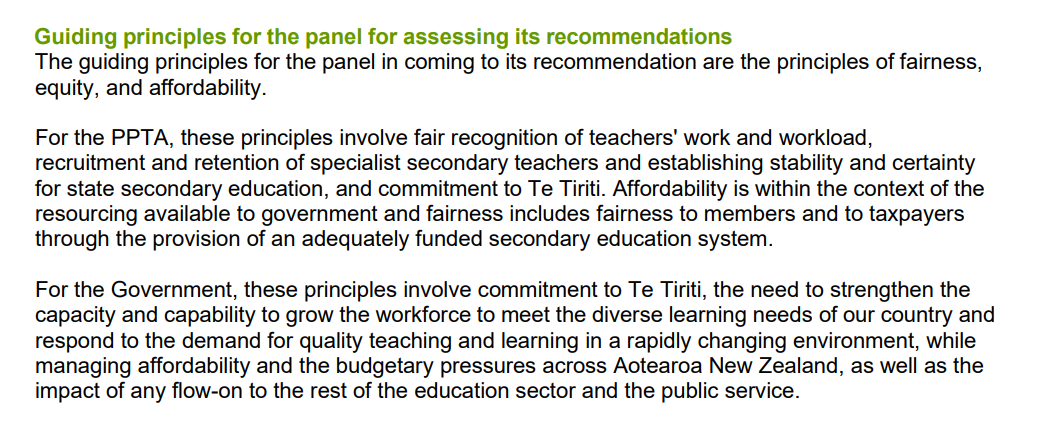
The panel was, in principle, free to recommend whatever it liked. But…..there were the “guiding principles” of the two sides included in the terms of reference

Two mentions of “Te Tiriti” and none of educational excellence, and nothing at all from the government side about recruitment and retention of an able group of secondary teachers (had the government really thought the union bid was out of line with labour market conditions it would have been natural for it to have included recruitment and retention as a key consideration – ideally perhaps the key consideration).

And then there were the panel members. The chair was a retired High Court judge, but the other two were real insiders. On the one hand (presumably from the government’s side), Tracey Martin their former Cabinet colleague now chair of NZQA, and board member of NZTA. Safe for the Ministry/government side you would suppose. And then there was Craig Renney, economist for the CTU but also former economic adviser to Grant Robertson, reputed to be keen on a political career himself, and (as we saw earlier this week) active partisan player in the election campaign that was just about to get underway. He didn’t seem like someone who was going to make life at all difficult for the Ministry/government.

Both sides had to agree to the make-up of the panel, but if you were an ordinary teacher there might have been hints there that things were unlikely to go your way, no matter what the substance of the teachers’ case (which, when all is boiled down really should come down to the question of whether pay and conditions are sufficient to attract and retain the desired quality of teachers).

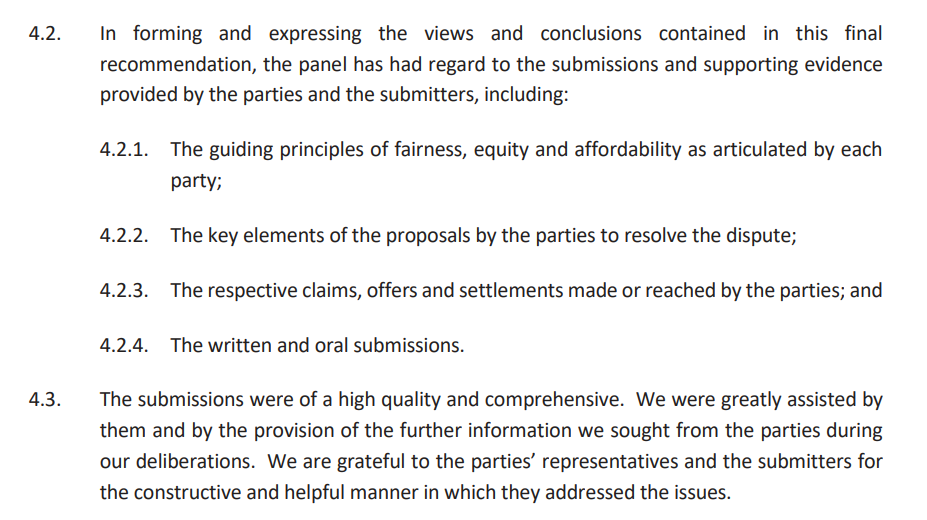
That wasn’t really how the panel went about things though: instead the nebulous “fairness, equity and affordability” were to the fore.

Note too those comments in para 4.3. We don’t have the submissions (presumably an OIA could eventually winkle out the Ministry’s) but what follows will suggest the submissions were probably anything but……but the parties will no doubt have been glad to read this soft-soap stuff.

The report goes on to note that the PPTA sought increases, partly backdated, sufficient to match the increase in the CPI (actual and forecast) over the proposed 3 year life of the deal (from the expiry of the old agreement in July 2022), while the government proposed something substantially less (a cut in real salaries). The union is reported to have cited the following considerations

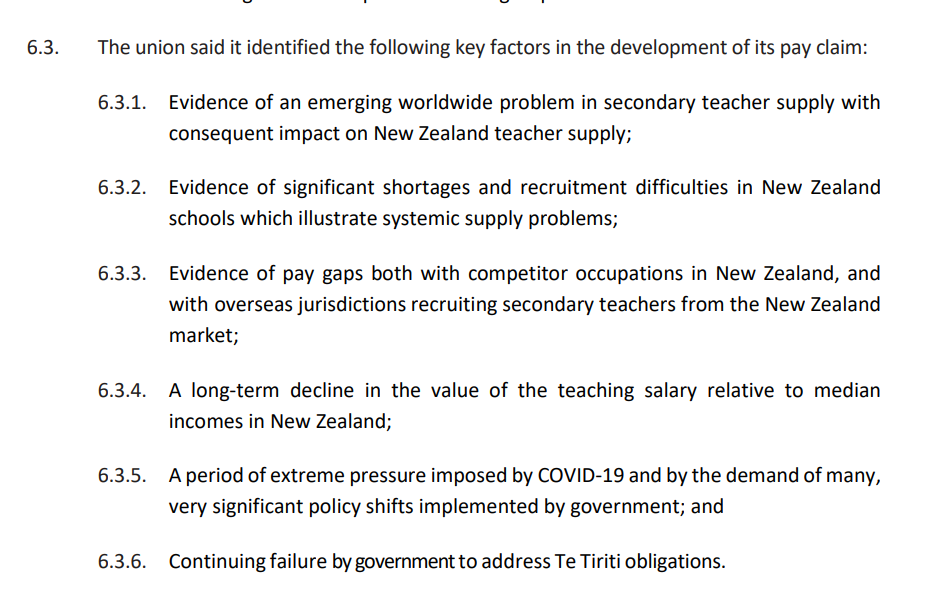
Some of which are (much) more convincing than others, but several of which seem like very relevant considerations worth testing.

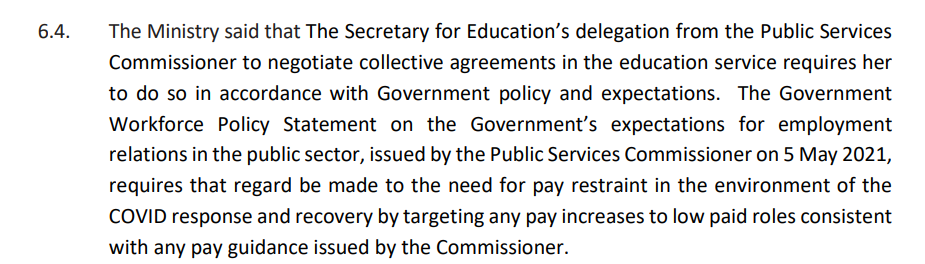
But instead, the panel reports that the Crown’s response was along these lines

Nothing at all about the relevant labour markets but, basically, “the government doesn’t want big wage settlements” (no matter how much inflation their central bank had generated).

I’m not completely averse to affordability arguments. If your business is in deep trouble and it is a question of whether or not you will even be able to stay in business lines like “I know inflation has been high and other wages are rising a lot, but I simply can’t afford it” make sense and may resonate. Rather less so when the employer is firmly committed to remaining in the business (running high schools and paying their teachers). If you are going to be in the business come what may, and care at all about offering a quality product, you simply need to match the market, and debate should centre on how best to make sense of the relevant market data, details of implementation etc.

Centralised wage-setting may be a far less than ideal model generally, but….it is what both the government and the union seem to like.

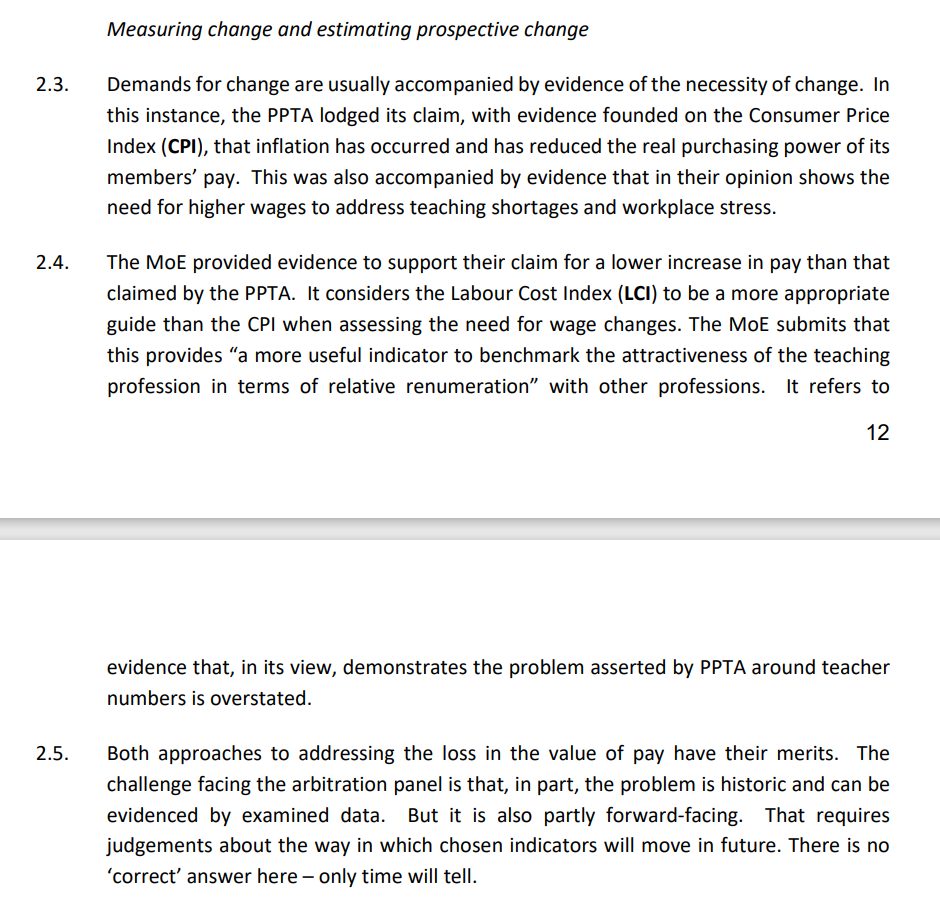
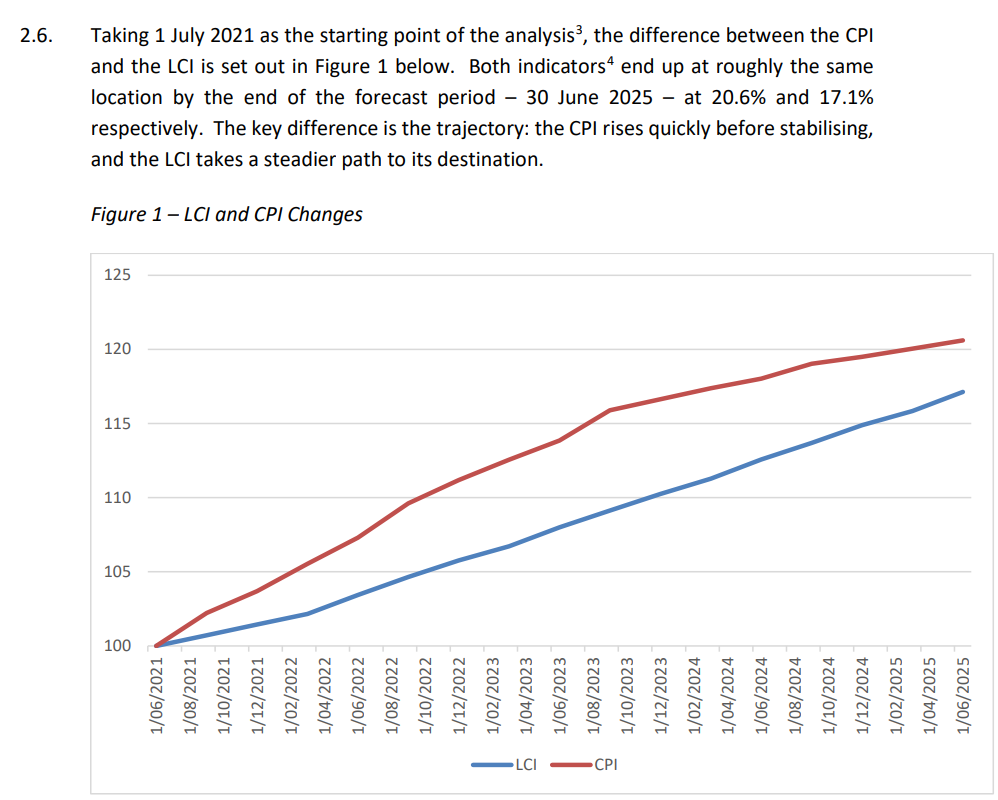
When it got to numbers, the report tells us this

I would usually have fallen off my chair when I read the Ministry’s LCI try-on, except that…..just yesterday chatting about this issue to someone I said “I don’t suppose they were dumb enough to have used the LCI as a comparator. Surely not?” And that was before I knew there was an economist on the panel.

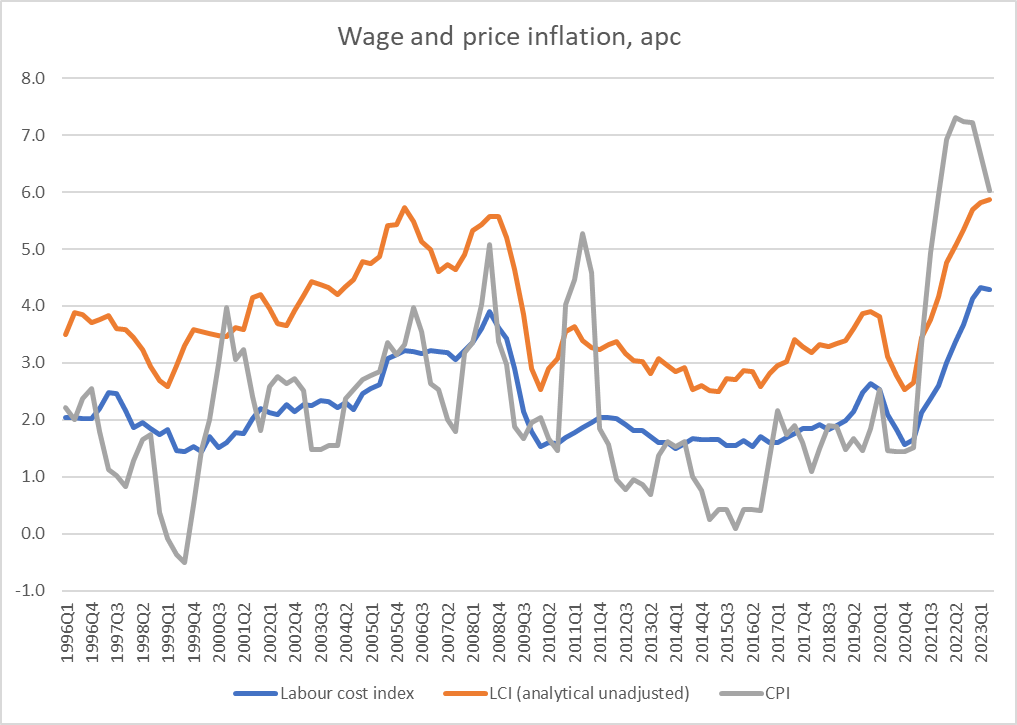
The Labour Cost Index is a stratified measure (good) so not affected by compositional changes, but it is not a measure of wage and salary rates. It is, by design, much closer to a measure of unit labour costs (respondents are supposed to adjust their responses for things like productivity gains). Unit labour cost measure can be very useful in their own right – for insights on competitiveness – but not for benchmarking wage increases.

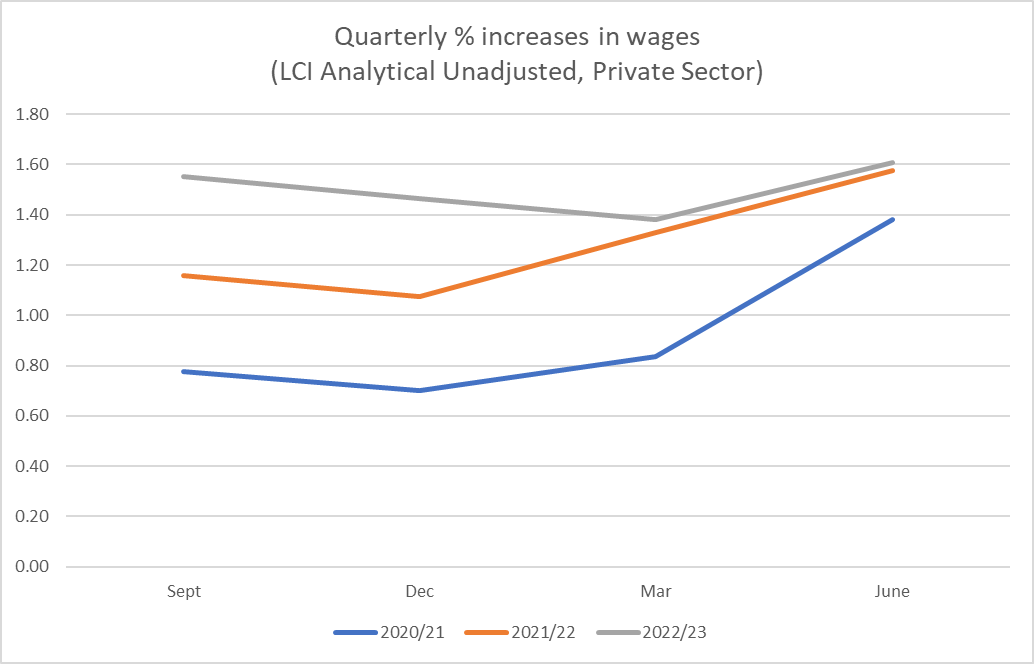
SNZ publish a (stratified) raw measure of wage increases, the LCI Analytical Unadjusted series, which is a stratified measure of wage rates. You can see the difference in this chart.

I’m quite sure the CTU’s economist knows all about this data (probably the Ministry does too, but they had an incentive to spin).

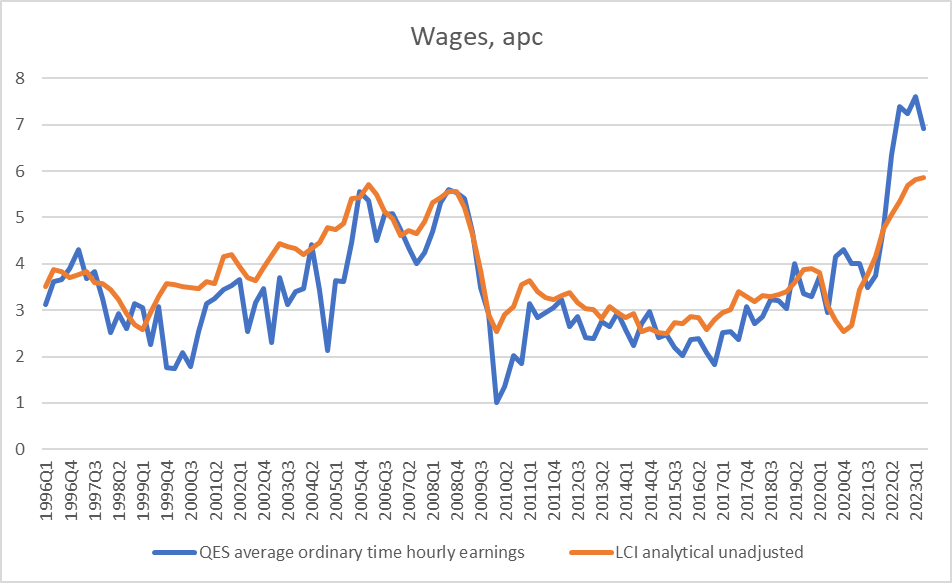
And if you are doubtful of my point, here is a chart of the QES measure of average ordinary time hourly earnings (which has all sorts of compositional issues and so is a lot more volatile) and the LCI analytical unadjusted series.

The LCI analytical unadjusted measure might be a mouthful of a label but it is the measure to use for purposes like this. I used the private sector component of it in yesterday’s post, because private sector wages are more responsive to market forces, less constrained by political imperatives and rhetorical stances. The panel itself is just wrong: there is no merit to using the plain LCI in exercises like this.

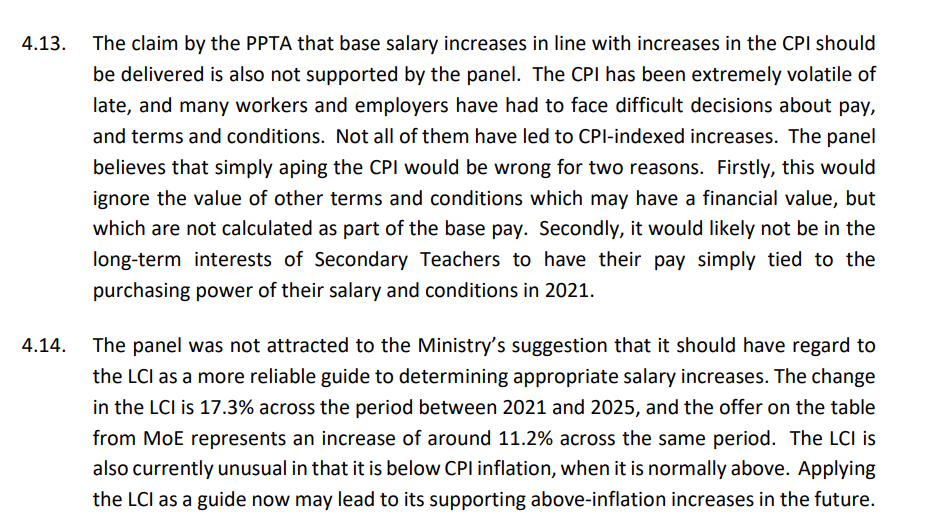
But nothing deterred here is the panel

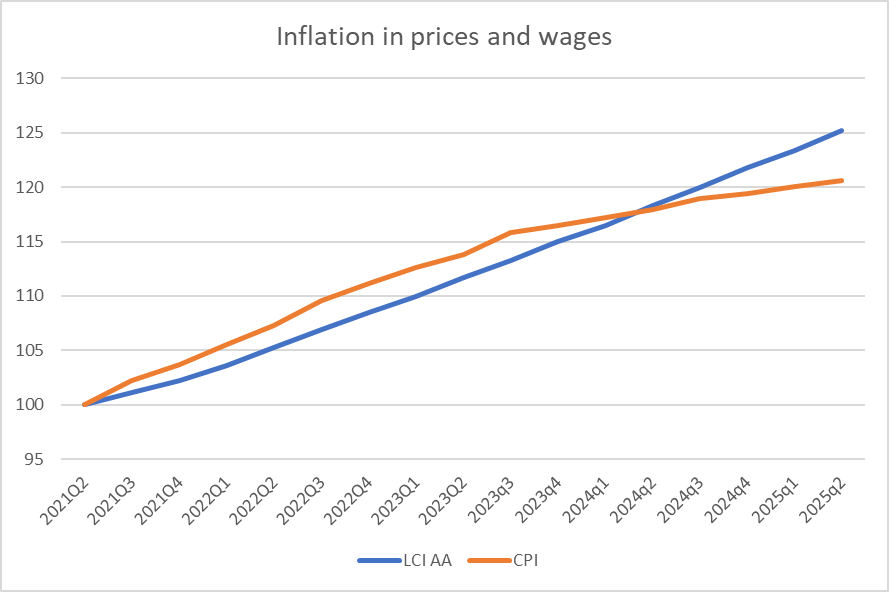
Like me yesterday, they use Reserve Bank May MPS forecasts. They extend the analysis to June 2025, which is sensible as that seems to be the end of the proposed contract period. This is what the chart looks like using the LCI Analytical Unadjusted series (note that both charts use private sector wages, because that is what the Reserve Bank forecasts).

If you happen to prefer the (noisier but better known) QES measure, on RB forecasts it will have increased 27.7 per cent over this period, a bit more again. (The panel does show a chart of the QES, LCI, and CPI, but because the LCI itself undershoots inflation – see above – this seems to be an exercise in distraction, compounded by their repeated attempt to call the LCI a measure of “wage rates”, which it simply is not.

(Set aside here the absurdity of negotiating future wage increases in a climate where no one has any very robust idea what will happen to inflation in wages or prices over the next couple of years, having all gotten the last couple of years so wrong. But…..the Panel was stuck with that model.)

Anyway, the panel continues

Both are garbled messes really worth nothing. For example, few workers will have had wage increases formally indexed to the CPI (then again few workers have mass multi-year collective contracts) but as the chart above shows, over the period both sides want to look at, and using the forecasts both sides seem happy using, private sector wage rates are expected to have risen more than the CPI. The Panel pats the teachers on the head and suggests it wouldn’t be good for teachers to have their pay increased with inflation – even though future contracts will be negotiated in future years – and instead it proposes to give them even less…..

The following paragraph is made worse by the fact that the panel fails to recognise that it is using the wrong wage measure, and that it is quite normal for wages over time to rise faster than prices (that, ultimately is what productivity growth does).

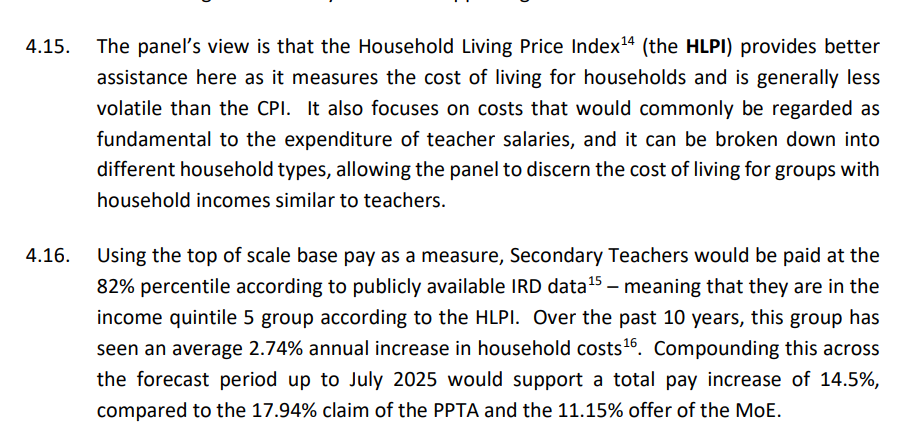
Then the panel does another exercise in distraction. Eschewing the CPI they drag up the Household Living Price Index.

As it says, there are price indices by income quintile. What it doesn’t say is that the increase in the HLPI for the income quintile 5 from June 2021 to now was 15.9 per cent, while the CPI rose “only” 13.8 per cent. It isn’t clear what the last 10 years average increase in the HLPI has to do with anything and of course, there are no forecasts for the HLPI – so the Panel just plucks out of the air a number that suits the bottom line they are trying to produce.

All of this might seem tediously mechanical. What, you might be asking, did they make of recruitment and retention arguments? The short answer is that they never even tried. Here are their own words.

Remember how early on the Panel praised the submissions as “high quality and comprehensive”. But on this core issue they seem now to be saying they weren’t even in a position to know whether the submissions were of high quality. And they simply chose not to engage on the substantive issue. If there is, was, or will be a recruitment and retention issue, or it goes away when this offer is accepted, that will be all by chance because the panel had nothing even to say, and didn’t even try.

So, the bottom line of all this was:

Panel wage increase recommendation to June 2025: 14.5 per cent

CPI increase over same period: 20.7 per cent

LCI (private sector) Analytical Unadjusted increase: 25.2 per cent

QES private sector ordinary time average hourly earnings increases 27.7 per cent

Those last three use (as the panel did) Reserve Bank forecasts to June 2025.

So the Arbitration Panel proposed not only a material cut in real wages of teachers, but an even more substantial cut in real teacher pay relative to pay in rest of the economy (private sector). The logic of their position must be that there was an abundance of able teachers, easily retained, and now (real) pay rates should be cut to bring the market more into balance. But, of course, they never engaged on the substance of that issue and show no sign of having thought about it at all.

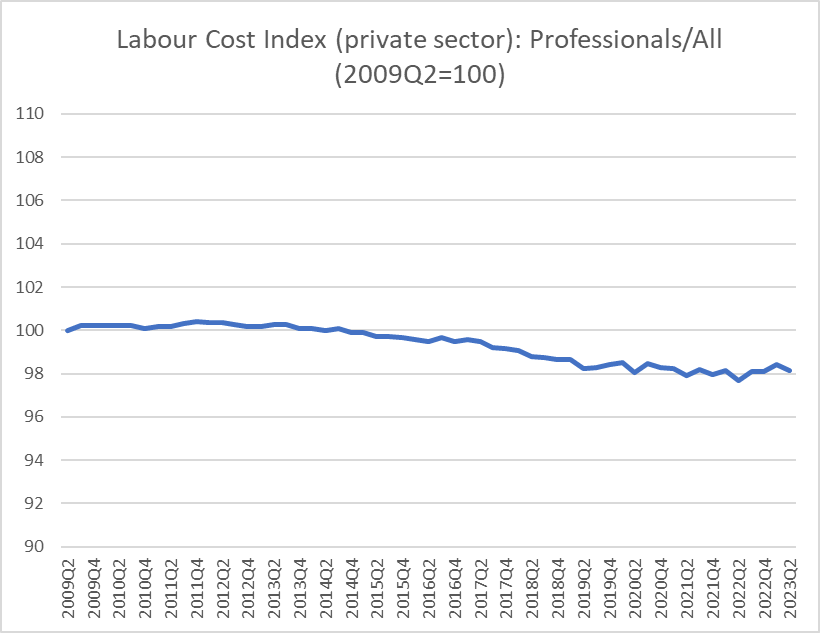
And just in case you were thinking, well maybe professional pay has increased less than that of all private sector workers in recent years, well…I checked that too

There was a bit of a dip in the second half of last decade, but the Arbitration Panel was focused on the period since mid 2021, and there is nothing of interest in that relationship over that specific period.

This Panel report was simply a shoddy piece of work, clearly much more about politics (face-saving settlement) rather than serious in-depth analysis and thought. I’m not usually a champion of teachers, and the standard of education has clearly been slipping, but on the government’s own terms – they deny the decline – it just seems extraordinary that over a period in which private sector wages are expected to have at least matched inflation, their panel proposes a material cut in teacher real wages, without a jot of evidence (or apparent thought) that recruitment and retention for (capable) secondary teachers has become materially easier than for the labour market as a whole.

Presumably the teachers will end up accepting the recommendation. Maybe at this point they should (election, new fiscal stringency etc), but it hardly seems a robust long-term basis, and we can only look forward to whole new disputes two years hence (especially if, as is far from impossible, the Reserve Bank inflation forecasts they all relied on prove to have been too optimistic (low)). What will attendance, achievement, and recruitment/retention look like by then?

(Some longer-term charts are in yesterday’s post.)

UPDATE: Saturday

I found secondary teacher salary scales back to July 2009, and had a closer look at matching the various entry and maximum salaries for different levels of qualifications. These don’t matter for the current proposal, since it lifts all rates by a common 14.5 per cent, but it does over longer period.

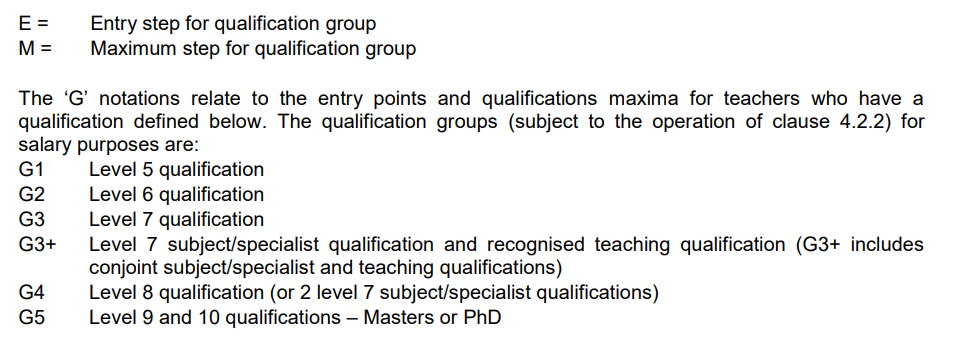
G3 is essentially a teacher with a general bachelor’s degree

G4 is a teacher with an honours degree or subject qualifications in two subjects

G5 is, as it says, a teacher with a masters or PhD

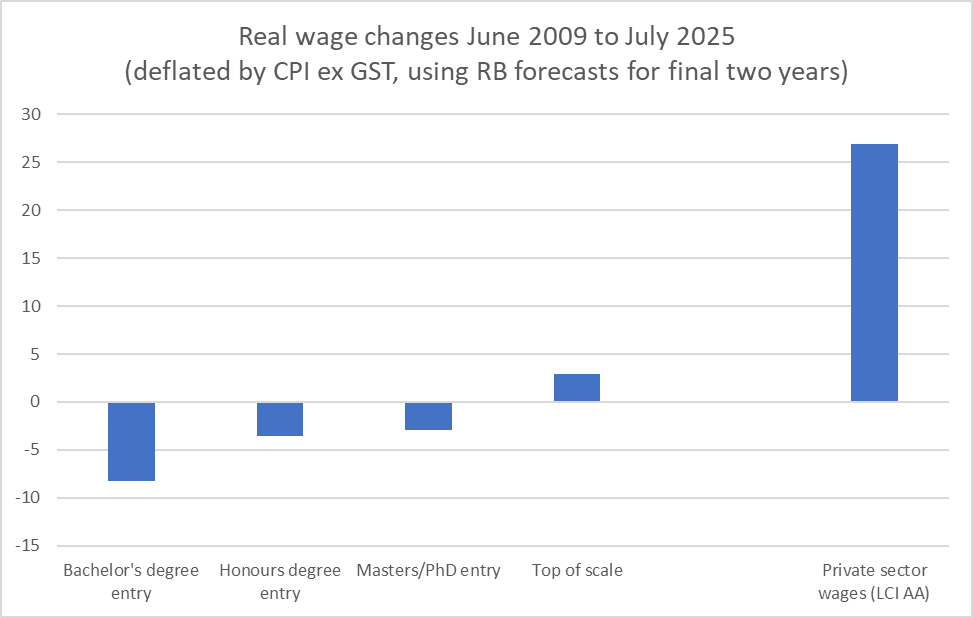
Maximum pay rates for all 3 levels have increased by much the same extent (49.4%) since July 2009 so I’ve shown only the common increase in maxima. Here are real wages changes for secondary teacher entry level salaries and maxima, alongside the real increase in private sector wages (all, as above, using RB May 2025 forecasts for the final two years of the proposed teacher agreement).

If only there was a supportive government

I picked up The Post this morning and in an article about some of the fiscal challenges governing parties may face came across this line about the latest pay offer to secondary teachers. The journalist might have been channelling the Beehive with his line that “it’s a very good offer”, “the union would be mad to turn it down”, and (most striking to an economist) “remarkably the pay hike is more than double that of the rate of inflation”.

Knowing it was a multi-year settlement, well after the expiry of another multi-year collective, that was really a bit much: apples for oranges comparisons sprang to mind. So I went and tracked down some numbers, and then some more numbers. The first round were in a Twitter thread here.

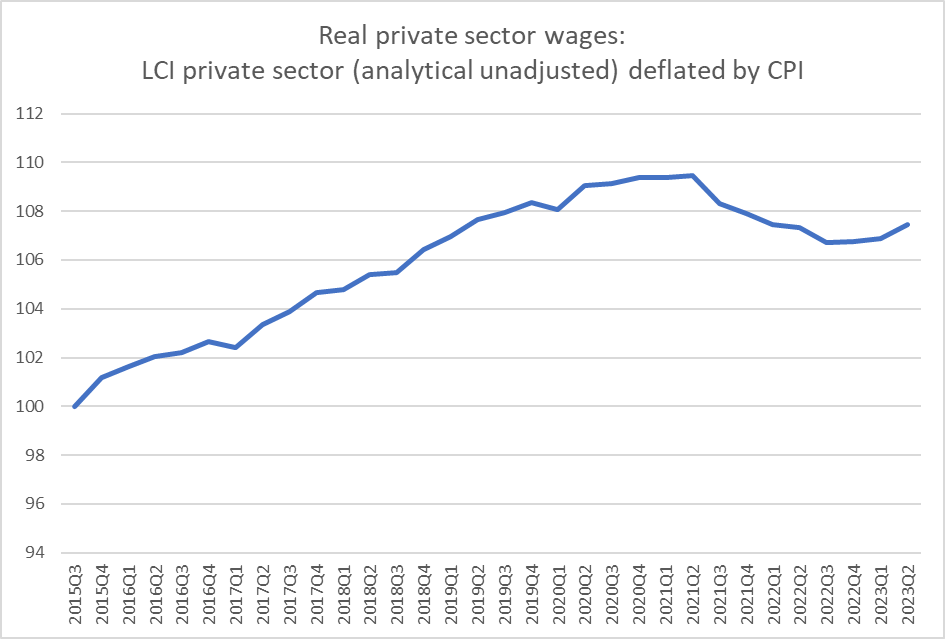
Over time one normally expects to see real (inflation-adjusted) wages rising. In New Zealand, as in most places, they were last decade. But times have been tough since. In this chart I’ve used the best (stratified) measure of private sector wages rates, deflated by the CPI.

In the last couple of years there has been a significant setback. On this measure of real wages, as at Q2 this year real wages were no higher than they had been four years earlier. There are probably several factors at play: prices (inflation) often adjust faster than wages, especially when there is an inflation shock out of blue, forecast by almost no one. But – despite the record low unemployment rate – there are also other dragging factors; notably the fact that there seems to have been very little economywide productivity growth over the last several years, and the terms of trade have also fallen quite a bit. There are no mechanical linkages from any of these influences to wage rates, but in many ways the recent poor performance of real wages might not be considered too surprising.

But even so, on average, New Zealand real wages rates last quarter were still about 7.5 per cent above where they’d been at the start of the period shown.

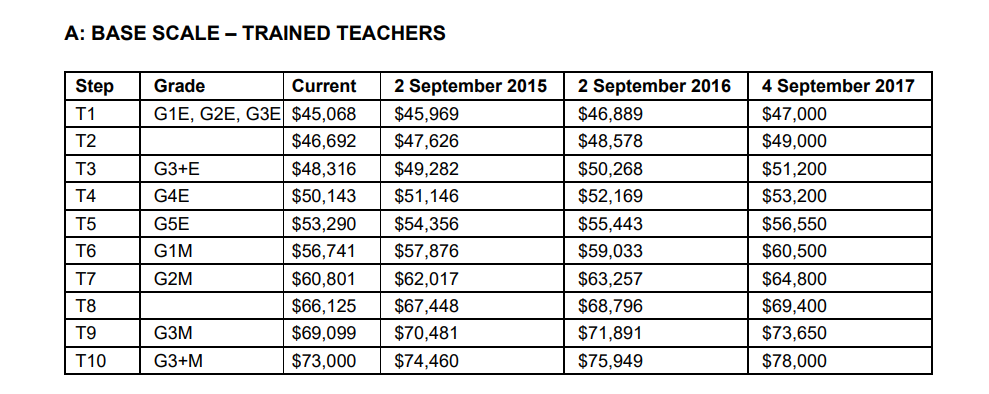
Why did I choose that period? Because back in the dark woebegone (or so the left and the teacher unions would have it) days of the Key government the second most recent secondary teachers’ collective employment was signed (October 2015). Backdated a few weeks, the teachers got a payrise, and an agreement to a couple more pay rises over the following couple of years. Multi-year nominal agreements make some sense (keeping down negotiating costs etc) when inflation is low and stable.

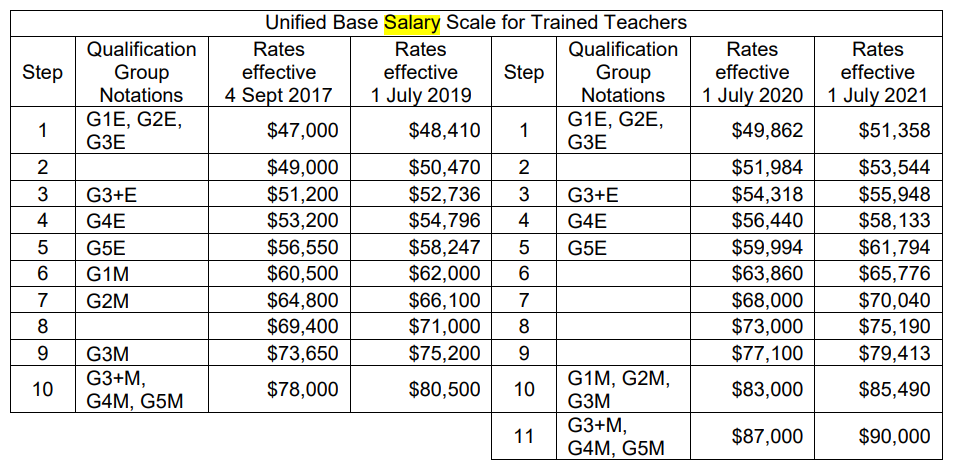
In July 2019 another three year agreement was signed, this time by the Labour government.

You can see the first column of that table is the final column of the previous table. You can also see the new top of scale step added to the table.

The latest offer by the government is for increase of 6 per cent backdated a few week to 3 July, another 4 per cent next April, and a final 3.9 per cent on 1 December next year. I’m not clear whether the proposed agreement would be for two or three years, but these are the wage increases offered. The July 2023 increase appears to represent the first salary increase since July 2021, in which period inflation has run far away that earlier negotiators will have expected. As it happens, the labour market has also been very tight in that time.

What I was curious about was how teachers were doing (a) relative to the CPI, and b) relative to private sector wages (why private sector? Because they tend to move a bit more flexibly in response to economic conditions rather than political imperatives.)

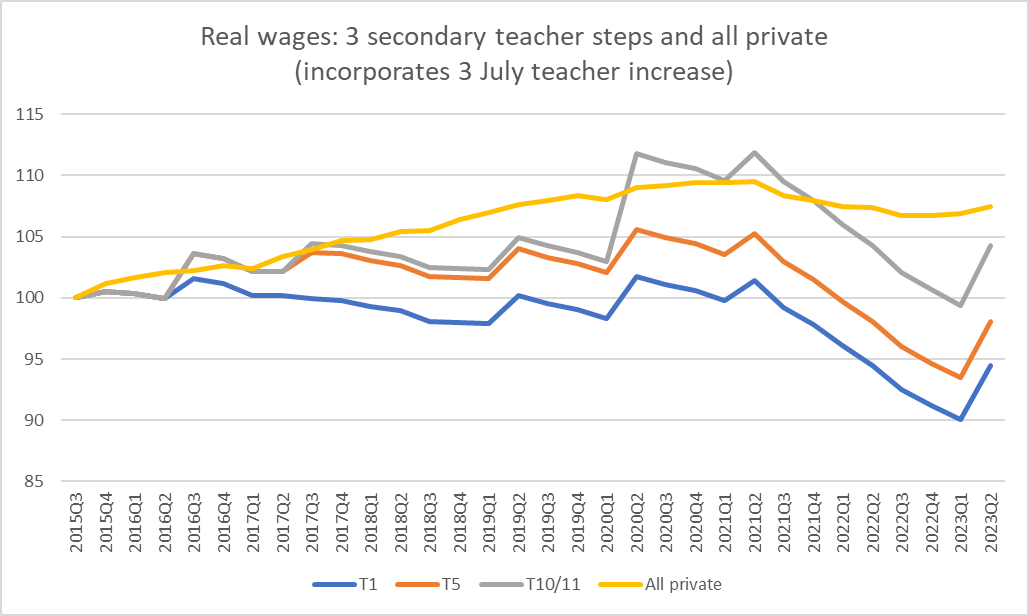
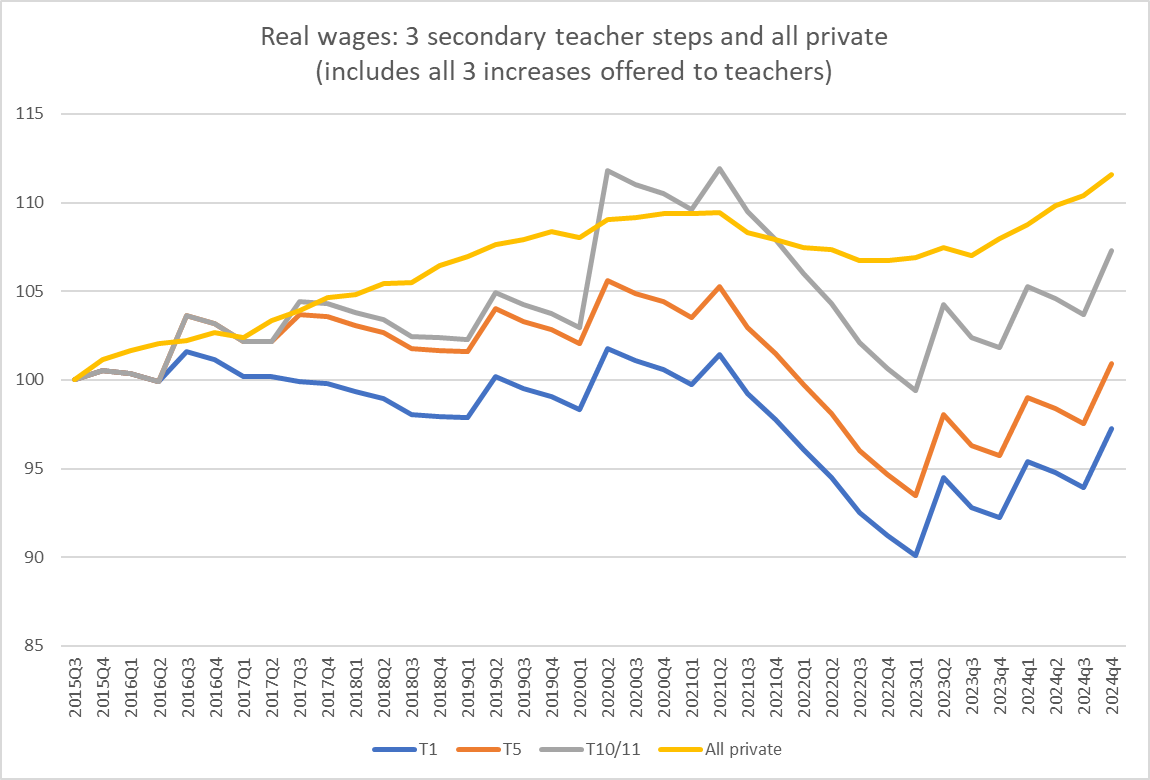
The secondary teachers’ scale now has 11 steps. For simplicity, I looked at just bottom one (T1), step 5 (T5), and the top step (was T10, now 11). Incorporating the 3 July increase teachers are being offered this is how real teacher salaries from 2015 to now compare with the movement in private sector real wages over the same period.

All three steps leave teachers right now behind the private sector as a whole, with only the effect of that new top step added in 2019 bringing that group of teachers somewhere close to the average private sector movement over those eight years.

But, of course, the offer includes two more pay increases for secondary teachers. Those are known, and if the offer is accepted, guaranteed. We don’t know what the inflation rate will be over that period (or what inflation rate either the teachers or the government had in mind) but the Reserve Bank is responsible for inflation and they publish quarterly forecasts. The most recent ones were published in the May Monetary Policy Statement, and my sense is that they may be a little low. But in the next chart I’ve used them to deflate the teacher pay rises.

We also don’t know what will happen to private wages, but again the Reserve Bank publishes forecasts (they publish forecasts for the private sector LCI, but I’ve adjusted them to a private sector LCI (analytical unadjusted) using the recent gap between the two series. The Bank expects quite a bit of growth in private sector real wages in the next 18 months.

Over 9 years, on these forecasts, private sector real wages would have risen by 11.6 per cent, but the real wage rate for starting teachers will have fallen, and that for the middle step hardly have changed at all. Even that new top step included in 2019 doesn’t bring the real increase close to that for the average private sector job.

(There is a one-off lump sum payment as part of the offer, but that is best seen as “compensation” for teachers having been caught under a multi-year agreement with hugely high unexpected inflation – the direct responsibility after all of a government agency. It doesn’t affect real wages looking ahead, or thus recruitment/retention choices/challenges.)

Of course, it is up to the teachers whether or not to accept the offer. Perhaps on average it replicates what a market process would eventually have thrown up, and recruitment and retention will no longer be a challenge for schools once this agreement is in place. Or not.

But it is a little curious to contemplate the sight of a left-wing government, of a party long quite closely aligned with teacher unions, asking teachers to agree to significant real wage cuts relative to what was envisaged when the previous agreement was signed in 2019. Critics of the declining quality of the education system might suggest that such an outcome as only fair and reasonable, but I rather doubt that is the message the former and current Labour Ministers of Education have in mind.

And in a high-performing education system you probably wouldn’t expect to see secondary teaching real wages falling, and falling behind those of the private sector as a whole.

But with only one child left in school, if the offer ends the strikes for the last 18 months of our direct exposure to the system I guess that will count as some small mercy.

PS: One slight consolation of the current outbreak of inflation is the reminder for a new generation of just why high and unpredictable inflation is a bad thing. Not only do multi-year agreements become a lottery, but there is all that money illusion that leads people to see a 14 per cent one-off increase as large or generous,

Policy costings offices in Australia

After my post yesterday I remembered that I had also written a post in 2019 based around the excellent talk Jenny Wilkinson, then the Australian federal Parliamentary Budget Officer had given at Treasury in 2019. I ended that post this way

….it was a very useful presentation (I hope Treasury makes her slides available) from a technocrat’s technocrat.  I’m left sceptical on two main counts:

  • first, whether elections ever much do, or really should, turn much on precise fiscal costings. Perhaps it appeals to inside-the-Beltway technocrats to conceive of that model, but I see elections as mostly about things like competing visions, competing personalities, competing diagnoses, and competing claims to competence.  If so, why spend so much on highly-detailed and expensive state-funded costings, that the parties themselves don’t think it worth spending their own money on?
  • second, we should think harder about the whole panoply of support and information etc we provide to political parties and the public, preferably without further reinforcing the favoured position of established large parties.  Thus, it is interesting to note that written parliamentary questions are much much less used in Australia, as a way of garnering information, than is the case in New Zealand. (“In the years 2008–2014 only about 8 questions in writing were being asked each sitting day, but this number increased to 19 in 2015, and was 14 in 2016.”).   What about better resourcing select committees (to me a better use of money)?  And if we threw in a free PBO service, should we reduce existing money parliamentary parties are funded with?  If not, why not?  And would resistance to that idea suggest the costings were some epicurean nice-to-have rather than a central element of a well-functioning democracy?  And then, of course, there is the OIA.  Mightn’t it be better to require agencies to release documented costings models themselves, in ways that would allow political parties and their consultancy firms to use them to the extent they judge appropriate (and not otherwise).

And if I had the analytical resource implied by 40-45 more staff and had to deploy it somewhere in the public sector, it is far from obvious that a policy costing operation (with supporting analysis and research as the PBO) would offer the highest benefit-cost ratio.

Rereading that got me thinking again about the resource requirements for such an agency in New Zealand, that both Grant Robertson and Nicola Willis now seem keen on (despite apparently straitened fiscal circumstances). As I noted in yesterday’s post, no small advanced economy I’m aware of runs one of these costings offices (Australia, you will recall, has five times our population and rather more than that multiple of real GDP, the real resources used for this luxury product). And policy issues aren’t really less complex or less numerous just because your country is smaller (Australia has some federal/state interaction issues, but they aren’t likely to material affect the potential demand for policy costing work).

As far I can see there are three such costing offices in Australia. I will focus on the federal and Victorian versions, but the first such entity was the New South Wales one.

The NSW entity is a bit of an odd beast, and I don’t think anyone has championed anything like it in New Zealand. It is set up only for the 9 months prior to each state election (not sure if snap elections are allowed in NSW), and can be used only by the leaders of the two main parties, who in turn are required to submit all their policies to the PBO 10 days before the election, and the PBO is required to publish costings for them at least 5 days before the election. It seems to be staffed largely by temporary secondees from existing public service departments, overseen by an academic. From the report on the 2019 election, it seems to have had about 20 staff at peak

In practice, it seems that parties work with the PBO behind the scenes in advance getting their policies costed, and either modifying or dumping ones that come in too expensive etc, with only the final policies and the costings of them seeing the light of public day.

If you believe in these sorts of things, I guess one can see the logic of the NSW approach, as it tries to put the main Opposition party on something like the same footing as the governing party. It isn’t a small financial or resource commitment (about the total staff numbers of, say, our Productivity Commission), for what is after all only a state government, but it is only for 9 months every three years.

What of the federal Parliamentary Budget Office? There is quite a lot of material in that earlier post. One other extract that might be worth bringing forward is

…in answer to a question from me, Wilkinson observed that what the PBO can best do is cost programmes that represents small deviations from the status quo (they have good tools to estimate direct and immediate fiscal costs/gains) while wider economic second round effects, and the associated fiscal impacts, are likely to be small.  But, and using her own (deliberately extreme) example, if some party were to campaign on getting rid of the welfare state, her office could do the direct fiscal costs, but could offer little or nothing on the wider economic (or social) effects of such a policy, including the possibility that it might have large long-term indirect fiscal implications.    They will only offer qualitative statements about those wider effects.  Which left me thinking that the the PBO probably does very well on things that don’t matter that much, and can’t offer much on the bigger issues that elections probably should really be about (whether about the welfare state, climate change, productivity or whatever).   

They do a lot of costings

Another aspect of the presentation that surprised me was (a) the number of costings the PBO does, and (b) the extent to which demand is not concentrated just in the pre-election period.  In fairness, she noted that the latter had surprised them too.  In the most recent year (an election year) they’d done 2970 costings, while in the previous two non-election years they had averaged about 1700 costings. Only MPs can request costings, and there are 227 MPs (across House and Senate).     Those numbers don’t mean 2970 separate items of policy, as many of the costings will be, in effect, rework as members or parties iterate towards a policy that meets their ends and will be scored by the PBO as not costing too much.

but note (see above) how much less extensively written parliamentary questions are used in Australia.

At the time of that 2019 presentation, Wilkinson told us her office normally had about 45 staff, scaling up to around 55 at elections (and recall that this is a federal government, in a system where a lot of policies are state responsibilities). The table in the latest Annual Report suggests that is still about right

What of the Victorian state Parliamentary Budget Office? Here is what they say they do

All MPs have access (unlike in NSW).

This doesn’t come cheap. Their documents say that for last year’s election they peaked at 26 FTEs, and they appear to have a permanent staff of about 16.

For a system of unitary government it seems reasonable to think in terms of the combined Victoria plus federal offices (which thus cover all the policy areas that affect Victoria, whether via federal or state policy). That seems to involve a base level of 60 staff, scaling up to perhaps 80 in the run-up to elections.

Now, of course, Australia is a fairly big country. But as already noted, neither the number of policy issues nor the design complexity of those policies is really scalable with the size of the country. And it seems most unlikely that one could do a worthwhile job – across the multiplicity of areas of policy – with 12-16 staff in New Zealand. In fact, I find it difficult to see how it could be done well – and there is really no point if it is not done well – with fewer than perhaps 30-40 staff.

That would be bigger (much bigger) than either the Productivity Commission or the Parliamentary Commissioner for the Environment (21 staff). Would it be a priority use of scarce resources for taxpayers to be putting this additional financial assistance towards political parties and MPs? I continue to think that better-resourcing select committees would have a much larger payoff for citizens and good governance. There is likely to be a good reason why no other small advanced countries run state-funded policy costing offices (while parties themselves are of course free to use economics and other consultancy firms to the extent they find useful – in a political market).

Issues of scale are very real for small countries’ central government policy functions. I’ve already mentioned that the Productivity Commission has 15-20 people in total. To the extent there was an inspiration behind our Commission (as distinct from a bauble for the Key government to throw ACT’s way), it was the Australian Productivity Commission, which has over the years produced a lot of useful reports. The latest Annual Report suggests that Commission has 165 staff and 12 commissioners. The sorts of issues facing Australia are not likely to be any less numerous or complex than those facing New Zealand, and even if the staff of our Commission walked on water they simply could not match the value that could be added by the Australian Productivity Commission.

I would have thought there was no credible way we would devote 180 people to the Productivity Commission – nor do I think we should – but I guess if the Ministry for the Environment now has more than 1000 staff really who knows anymore. But with 15-20 people it was always going to be vulnerable to going the way it has, and was always going to struggle to maintain depth and critical mass.

The pool of really able people is small, and fiscal resources are limited (in a smallish underperforming economy). It just doesn’t make a lot of sense to be thinking of putting dozens of people into helping political parties cost their specific policies. On the track record of their performance, nor does having 15-20 people in a Productivity Commission that now seems, in practice, to perform a more general role in support of political parties of the left. A new government should rebuild Treasury, and if there is resource it would be better spent strengthening select committees to scrutinise actual legislation and actual government agencies, rather than (further) funding the bids of the parties competing for the keys to the Beehive.

Policy costing

Yesterday one of the Labour’s surrogates – Craig Renney, economist at the CTU, but also former adviser to the Minister of Finance (and reputed to be interested in being a Labour MP himself) – came out with a short document attempting to put a fiscal frame around National’s election promises. (One might have thought that if you’d been a part of enabling an $11bn hole in the government finances – the LSAP losses – you might have been a bit more modest in your rhetorical tone, but I guess he was only a (very senior) adviser).

It is explicitly partisan political in nature, and heavy on rhetoric. The flavour is perhaps conveyed by the front cover

As anything other than partisan spin though, it was a strange document. I’m as keen as anyone to see National’s programme (with numbers), but then in a week when the PM has been going round distinguishing between Labour Party policy and government policy, the same could be said of Labour’s (as yet largely unannounced) programme.

Renney’s document is built around an attempt to show that what National has announced so far does not fit within the operating allowances for the next three Budgets set down by the Minister of Finance in this year’s Budget. I have no reason to doubt that his numbers are approximately right. But (not only is it not clear that National has yet announced all its policies) there is no obvious reason why National would regard itself as bound by the operating allowances the Labour Minister of Finance had put in his pre-election budget. After all, Labour hasn’t in the past, and is highly unlikely to do so next year were it to be re-elected. (The operating allowance framework is in any case quite badly flawed as any sort of future signal, but especially when inflation is jumping around.)

I’m not championing what we know of either side’s fiscal policy. From both sides, there seems to be a disconcerting falling away from a commitment to budget surpluses, except in that vague distant future sense of the early St Augustine (“Lord, give me continence and chastity, but not yet”).

But Labour’s own (official government) numbers already have about them a considerable air of unrealism. In this year’s Budget, the only hard numbers – those planned for 23/24 – showed a slight increase in core Crown primary spending (ie excluding finance costs) as a share of GDP, but then the vapourware numbers – the ones relying on those operating allowances – show a fall from 31.2 per cent of GDP this year to 29.7 per cent in 2026/27. Another way of looking at those same numbers is to calculate – all from Budget numbers – real per capita core Crown primary spending over those three years Renney focuses on. On Labour government numbers, real per capita expenditure is projected/planned to show no growth at all in the next three years. Does that seem like a prospect that would align with what we’ve seen of this government’s approach to spending in recent years (in an era of ageing populations, public sector wage pressures etc)? Not to me. And the last three years have seen a single party government, and on all the polls if Labour were to get back in it would be dependent on the even less fiscally disciplined, less inclined to expenditure restraint, Green and Maori parties. With a Labour leader who has already ruled out the wealth taxes those two parties favour to help pay for their fiscal ambitions.

There is also the small matter of scale. Renney’s claims are that there is a gap of $3.3-$5.2 billion over the three fiscal years in questions. Since core Crown primary spending over those years is estimated at in excess of $400 billion any such gap is 1 per cent spending (or about 0.3 per cent of GDP). Seems a slim basis for such florid headlines.

But it will be good to see National’s numbers. In a better world, they would be credibly showing a commitment to a structural fiscal surplus next year. But given that Labour’s vapourware tiny surplus the following year was looking shaky from day 1 (once Eric Crampton pointed out the tobacco excise tax losses they and Treasury had accidentally left out) I don’t suppose it is likely.

But no doubt Renney’s report achieved its political end and put National and Willis on the back foot for a news cycle. National’s response didn’t seem much better. It seemed to consist first of suggesting that the economist of the CTU shouldn’t be commenting in public, which was a bit odd to say the least. And then we had the attempt to reclaim the news cycle by suggesting that it all (what?) was down to Grant Robertson not having followed through on the earlier plan to set up a budget-costing unit. National had (rightly in my view, see below) opposed the idea of such a unit when Labour and the Greens were championing it, but apparently when Willis had become finance spokesperson she had written to Robertson to express National now being in favour. Nothing had happened in the intervening year or so.

I wrote a lot about the idea of a policy costing unit here pre-Covid when the idea was being worked up by the government and The Treasury (there was a formal consultation process at one point). My most recent post on the issue was here. I ended that post with this thought

It won’t improve policymaking, it won’t change the character of elections, but it might –  at the margin –  create a few more jobs for economists.

I remain staunchly opposed. This was an extract from a submission to the Treasury consultation

Parties have adequate incentives already to make the case for their policies, in whatever level of detail the political (voter) market demands, and… already have access to the Parliamentary Library resources, parliamentary questions, and Official Information Act requests.  A policy costing office –  not found in any small OECD country –  would be, in effect, just a backdoor route to more state funding of parties (and not necessarily an efficient route – bulk funding would be preferable if state funded was to be more extensively adopted).  It also reflects a “inside the Beltway” conceit that specific costings are highly important, and that use of a single “model” or set of analysts somehow puts everyone on equal footing  (it doesn’t –  public service analysts having their own embedded assumptions about what is important, what behaviours are sensitive to what levers etc.)   With the possible exception of the Netherlands, I’m not aware of any country where a political costings office products plays any material or sustained role in election campaigns and outcomes.

Here was the list of other reasons from that 2019 post

I’ve listed most of my objections previously, but just quickly:

  • there isn’t an obvious gap in the market.   At present, political parties produce costings (sometimes reviewed by independent experts) to the extent they judge it to be in their own interests to do so.  Voters, in turn, can judge whether the presence or absence of any costings, or any debate around them, matters much.  Existing parliamentary parties have access to considerable taxpayer resources which they can draw on to develop and test policy proposals,
  • it isn’t obvious when, if ever, a New Zealand election in at least the last fifty years has turned on the presence, absence, quality (or otherwise) of election costings.  It is a technocratic conceit to suppose otherwise: people vote for parties for all sorts of reasons (values, mood affiliation, fear/hope, being sick of the incumbent, trust (or otherwise)) which have little or nothing to do with specific policy costings,
  • the relevance of specific policy costings (and indeed overall fiscal plans) is even less under MMP than it was in years gone by.  Party promises are now little more than opening bids, as coalitions of support are put together after the election to govern (and on almost every specific piece of legislation).  We simply aren’t in a world where a few dominant ministers dominate a Cabinet which in turn has a majority (or near so) in the government caucus, which in turn has an unchallenged majority in Parliament,
  • the “fiscal hole” argument (from the 2017 campaign) remains an utter straw man in this context.   First, when Steven Joyce made his claims in 2017 lots of people, including experienced ex-Treasury officials, weighed in voluntarily, and debate ensued about whether, and in what sense, Joyce was saying something important.  The system –  open scrutiny and debate –  worked.  And, secondly, a policy costings unit –  of the sort the government apparently envisages – would not have made any useful contribution to such a debate, which was about the overall implications of Labour’s fiscal plans, not about the costs of specific proposals Labour was putting forward.     Elections are messy things –  always were and probably always will be, and that isn’t even necessarily a bad thing.
  • some of the arguments made for a policy costings unit might have more traction if, somehow, every political party and candidate could be forced to use it (say, submit all campaign promises to the costings unit at least three months prior to an election, with the costings unit issuing a report on all of them say at least one month prior to an election).  But even if you thought that might be a good model, it isn’t going to happen (and there is no credible way that such a model could be enforced).  Instead, the proposed costings unit will be used when it suits parties, and not when it doesn’t, and will probably be most heavily used by parties that are (a) small, (b) cash-strapped, and (c) like to present themselves as policy-geeky.  The Greens, for example.  One might add that the unit would most likely be used by parties that believe their own mindset is most akin to that of those staffing the unit –  likely to be a bunch of active-government instinctively centre-left public servants.  Embedded assumptions can matter a lot –  The Treasury used to generate wildly over-optimistic revenue estimates for a capital gains tax, and it was probably no coincidence that as an agency they supported such a tax. 
  • the policy costings unit seems, in effect, to largely represent more state-funding for (established) political parties.  That might appeal to some, but even if you thought more state funding was a good idea (and I don’t) it isn’t obvious why this particular form of delivery is likely to be the best or the most efficient.  Money might be better spent on research and policy development (say) rather than “scoring” at the end of the process, for detailed plans that will almost inevitable change before they are ever legislated.  And if we want to spend more on policy scrutiny, I reckon a (much) stronger case could be made for better-resourcing parliamentary select committees.
  • the interim proposal for next year’s election would enable only parties already in Parliament to utilise the facility.  Again, this has the effect of further entrenching the advantage established parties have in our system (I hope it will be re-thought when the legislation itself is considered).
  • practicalities matter: there probably won’t be much demand on a policy costings unit in the year after an election, and could be quite a bit in the year prior to one.  How then will be unit be staffed and a critical mass of expertise maintained?  If people are seconded in from government agencies, would we really have an independence (including of mindset and model) at all?  And costings skills aren’t readily substitutable with bigger-picture fiscal policy (or macro policy) analysis skills.
  • the lack of transparency around the proposed institution should be deeply concerning.  As far as I’m aware there has not yet been any indication as to whether the policy costings unit would be subject to the OIA (as the Auditor-General and Ombudsman are not, and nor is Parliament more generally).   The Minister of Finance has indicated that any costings the unit did would only be released with the consent of the political party seeking the costings.  That should be a major red flag.  In my view, any new unit should be (a) explicitly under the OIA, and (b) the enabling legislation should require that any costings done for political parties should automatically be released 20 working days after being delivered to the relevant political party (or more quickly if the costing is delivered within 20 days of an election).  A policy costings unit should not be a research resource for political parties – the only possible basis for confidentiality – but a body that at the end of the process provides estimates based on the details the relevant party has submitted. (As I understand the system in Australia, costings provided during the immediate pre-election period are automatically released, but others are not.)

The fourth bullet there – re the 2017 “fiscal hole” debates – is germane to Willis’s claims in the last 24 hours. The sort of policy costings unit that has been proposed costs specific policy proposals, but does not provide reports on the coherence or otherwise of overall fiscal strategies. The presence of such a unit would have made no obvious difference to anything about the furore around the CTU report.

From a more narrowly political perspective, one might also note that if National is really championing this new source of employment opportunities for economists, and (which is what it is) additional state funding for political parties, it isn’t a great signal of the seriousness of their commitment to fiscal restraint. Renney might, after all, have the beginnings of a point.

Incidentally, in this rather silly political debate, Grant Robertson emerges no better than anyone else. He is reported as having said that National’s change of heart on a policy costings unit had meant it was too late to have done anything for the 2023 election. Except that he himself in 2019, announcing the new policy costings unit policy Cabinet had just agreed to about a year out from the 2020 election, explicitly announced a transitional non-statutory arrangement for the 2020 election, pending full establishment in 2021. If Willis’s change of heart was a year or more back, presumably the same could have been done this year. (I’m glad he didn’t of course.)

Finally, I have seen this morning at least one commentary suggesting that independent fiscal institutions are now the way of the world, the OECD champions them etc. A policy costing unit is not really what most countries – or international agencies – have in mind in advocating such institutions, which are typically more about independent monitoring and reporting on government fiscal strategy and policy (ie macro in focus). Very few countries have state-funded policy costings units, none of them small and (by advanced country standards) relatively poor.