Further thoughts on Wellington airport – Part 1

Shortly after the release of the cost-benefit analysis of the proposed Wellington airport runway extension, prepared by Sapere for Wellington International Airport Limited (WIAL) I wrote a post in which I posed the question “If they build it, what if no one comes?”

Since that post, I’ve been to one of the open day/public consultation meetings, have read and thought about the documents more thoroughly, and have read various pieces written by others, including the new one by Ian Harrison that I linked to yesterday.  I have also had some engagement with Sapere and WIAL, which has helped to sharpen my sense of what the issues really are.

The cost-benefit analysis is not a business case document.  It has been prepared in support of a resource consent application.  What I hadn’t known when I wrote earlier (and was advised of by Sapere) is that  under the RMA the applicants will need to be able to demonstrate national benefits to get permission to fill in some more of Lyall Bay, to extend the runway.

I’m sure that the cost-benefit analysis is not serving as a business case for Infratil, the major shareholder in WIAL.  But since this project is generally accepted to be viable only if there is significant public funding, and any such funding can only be defended if there would be material net public benefits , the Sapere cost-benefit analysis is by default serving as something of a business case at present.  If the numbers don’t stack up, neither the Wellington region councils nor central government should be putting any money into the project (beyond WIAL’s resources, and of course Wellington City Council is a 34 per cent shareholder in WIAL).

In this post, I will offer a few thoughts on the plausibility of the assumed increase in international passenger traffic to/from New Zealand as a result of the extension

Extending the runway at Wellington airport could materially reduce the cost of some forms of international travel in and out of Wellington. If long-haul flights were offered,  lower costs could result by reducing the time taken (eg. by eliminating the one hour flight to Auckland and the stopover time in Auckland, it might reduce the total time for a trip to Singapore (and onward points) by perhaps 2.5 hours).  For those travelling anyway, those gains could be material –  time has an opportunity cost.  In addition, by allowing long-haul aircraft to fly into Wellington, the direct cost of international airfares in and out of Wellington could also be expected to fall –  quite materially, if the numbers Sapere quotes are correct.  Those gains apply not just to long haul routes themselves –  a Wellington-Singapore direct fare should be materially cheaper than the current options via Auckland, Christchurch or Sydney –  but also to trans-Tasman flights, as the longer runway would also facilitate used of wide-bodied aircraft on trans-Tasman routes (as for examples, the Emirates flights between Christchurch and Australia).

Of course, simply building the runway extension does not bring about any of these savings.  They depend on airlines finding it profitable to run additional services.  And although international air travel has increased enormously to and from New Zealand in recent decades, provincial New Zealand is littered with the dreams of local authorities (airport owners) with aspirations to have an international airport.  New Zealand has plenty of attractive places, but one main international airport.

Wellington, of course, has a significant business market, and business travel is typically much more profitable for airlines than leisure travel. And unlike the predominantly leisure travel into Christchurch, the Wellington business travel probably isn’t very seasonal.  So the idea the long haul flights into Wellington could be viable isn’t self-evidently absurd.  But, on the other hand, the economic cost of making such flights technically feasible – lengthening the runway –  is far higher than in many other places.  At $1m a metre, it is considerably more costly than putting some asphalt on some more grassy fields in Christchurch.  Wellington isn’t a natural place for a long-haul international airport.

The WIAL proposal uses modelling by international consultants to estimate likely growth in traffic and passenger numbers with and without the extension.  There are some questions about the baseline forecast, including for example around the potential future impact of climate change mitigation policies.  But my main interest is the difference between these two –  the increase in traffic that would result from the runway extension itself.

It is hard to pick one’s way through all the numbers, but the bottom line appears to be that the cost-benefit analysis is done on the basis that by 2060 there will be an additional 400000 foreign international passengers per annum arriving in Wellington, and an additional 200000 New Zealand international departures per annum through Wellington[1].  Many of these are people who would otherwise have travelled via Auckland or Christchurch, so that the net gain in international travel numbers to New Zealand is around 200000, with an additional 100000 or so New Zealanders travelling abroad.    Many of the gains are forecast to occur early in the period.  Thus, by 2035, the analysis assumes an annual net gain to New Zealand of around 125000 international visitors (relative to the no-extension baseline).

How plausible is this?    The various reports highlight the phenomenon of “market stimulation” –  putting on new air services tends to stimulate total passenger numbers.  That shouldn’t be surprising.  Not only do point-to-point services lower the cost of visiting a particular place, but marketing expenditure raises awareness of the destinations concerned.

On the other hand, one can’t just take for granted that such market stimulation will render long haul flights into and out of Wellington viable.  After all, there are plenty of cities around the world with few or no long haul flights.  Closer to home, Rotorua is an attractive tourist destination and can’t sustain direct flights even to Sydney.

What of Wellington?  The modelling exercise involves lowering the cost of foreigners visiting Wellington –  to some extent artificially, because the costs of providing the longer runway are not passed back in additional charges to those using long haul flights –  but not the cost of them visiting New Zealand (since Auckland and Christchurch fares would stay largely unchanged).   Any long-haul flights into Wellington will almost certainly be from cities that already have flights to Auckland (and possibly to Christchurch).  Is it really plausible that an additional 200000 people per annum (or even 125000 by 2035) will visit New Zealand simply because they can fly direct to Wellington, or (in respect of trans-Tasman traffic) fly into Wellington more cheaply than previously?

Perhaps I’m excessively negative on Wellington.    I reckon it is a nice place for a weekend, but not a destination that many long haul leisure travellers would choose.  What is there to do after the first two days?  And there is little or nothing else in the rest of the bottom of the North Island.   So it is plausible that lower fares resulting from additional competition would attract more weekend visitors from Australia. But no one is going to come for a weekend in Wellington all the way from China or Los Angeles.  And since the principal attractions of New Zealand are either in the upper North Island or the South Island, how many  more people are likely to come to New Zealand just because they can choose Wellington as the gateway for their New Zealand holiday?

And what of New Zealanders travelling abroad?  Since the costs of Wellingtonians (and others in the nearby areas) getting to desirable destinations abroad would be cheaper if there were direct flights from Wellington, it is credible that the total number of New Zealand overseas travellers would increase.  In fact, whereas the modelling suggests twice as many new foreign visitors as new New Zealand international travellers (and in total there are twice as many international visitors to New Zealand as travelling New Zealanders), in this case I wonder if the putative new  routes would not be more attractive to New Zealanders than to foreigners?  One can illustrate the point with a deliberately absurd example: put on long haul international flights to Palmerston North, and they would be quite attractive to people in Manawatu (much easier/cheaper to get to desirable places like New York or London) but not very attractive at all to foreigners (for whom Manawatu has few attractions).

But even if wide-bodied aircraft flights from Wellington did make overseas travel more attractive to New Zealanders, is the effect really large enough to be equivalent to one more trip every year for every 10 people in Wellington and its hinterland?  And would the effect still be remotely that large if passengers (users) had to cover the cost of providing the longer runway (which should really be the default option)?

Reasonable people can differ on these issues. In my discussions, a lot seems to turn on just how attractive people think Wellington is.  I’m pretty sceptical that long haul tourists will ever come to New Zealand to see cities.  Perhaps if one is thinking of visiting New Zealand cities, Wellington is more attractive than our other cities, but even if so Wellington still has the feel of being a logical gateway to nowhere much.  It isn’t an obvious starting point for a “whole of New Zealand” trip, or a North Island one (given that most of the attractions are further north), or a South Island one.   So I’m left (a) sceptical that the net addition to visitor numbers to New Zealand will be as large as the analysis assumes even if the users don’t bear the costs, and (b) suspecting that the boost to the demand for New Zealanders to travel abroad might be greater than the boost to the demand for foreigners to visit New Zealand.

On that latter point, the experts point out that they assume that the new long haul services will be provided by foreign airlines, and that the evidence of recent new air services to New Zealand provided  by foreign airlines is that they disproportionately boost the number of foreigners travelling.  I have no reason to doubt the numbers, but I still wonder if the same result would apply to routes into Wellington.  New flights into Auckland are often the first direct flights offered into New Zealand (as a whole) from that city or country.   My impression is that “New Zealand” is the destination marketed to long haul passengers.  But direct flights to/from Wellington do more to open up the world (more cheaply) to Wellingtonians than they do to open New Zealand to foreigners.   And if so, would the foreign airlines be keen to offer the Wellington services at all?

This post has been about the sort of increased passenger numbers that might be expected if the runway was extended.  In some sense, that should be largely an issue for WIAL.  If they can extend their capacity and attract sufficient users at a price that covers the cost of capital of WIAL and its shareholders, the rest of us might not care much (I’m not much bothered about environmental issues, although my family enjoys the waves at Lyall Bay beach).    But the cost-benefit analysis being used to lure ratepayers and taxpayers into funding much of the proposed expansion suggests that there are very large economic benefits to New Zealand which cannot be captured directly by airlines or airports.  I think they are wrong, and my next post will explain why.

[1] From tables 5.11 and 5.12 in the InterVISTAS report.
The OIA: a rather egregious abuse

The outgoing Ombudsman’s report reviewing OIA practices in the public sector is to be released this week.  The Dominion-Post this morning has a scathing editorial about her tenure, and her approach to the Official Information Act.  As it notes

Her retirement is welcome.  We don’t expect much from her review.

The Ombudsman’s office is badly under-resourced, limiting the extent to which she can do her job properly, even if the inclination was there to do so.  Funding choices are made by politicians, who should be – but clearly aren’t – embarrassed by the backlog of complaints and the way in which that backlog deters others from even bothering lodging complaints.  But the cast of mind the current Ombudsman has brought to the job is something she has control over.  Her approach seems not to be what the country needs from an Ombudsman –  welcome as it might be to some state officials and ministers.  Not long ago, Justice Collins highlighted the way that the Ombudsman appears to misunderstand, and misapply, the provisions and principles of the Official Information Act.

Over the last few months, I’ve highlighted various examples of the Reserve Bank’s abuse of the Official Information Act.  Blanket refusals to release whole classes of documents, deliberate time-wasting, secrecy for the sake of secrecy all seem to have become par for the course.

But today I wanted to highlight a particularly egregious example of abuse from another agency, the Ministry of Business, Innovation and Employment (MBIE).  I’ve only ever lodged one OIA request with MBIE, and apart from the unconscionably long time taken to deal with it, my impression was that they were playing straight.  That certainly wasn’t the case in what follows.

My former colleague Ian Harrison is chair of a group called EBSS (Evidence-based Seismic Strengthening), which among other things has been scrutinising the government’s proposals for seismic strengthening standards.

When Nick Smith, the Minister of Building and Housing, announced his new seismic strengthening policy proposals on 10 May 2015 he said that it would save 330 lives over the next 100 years. This contrasted starkly with the estimate of 24 lives saved in MBIE’s cost benefit analysis that was prepared as part of the 2012 review of seismic strengthening policy.

To get to the bottom of the difference EBSS asked, under the Official Information Act, for the documents that explained how the number was calculated.

And

In May EBSS asked MBIE, under the OIA, for the documents that would explain how the Minister’s number was calculated. The request was initially refused because it would be a  “contempt of the House of Representatives” (presumably  because it had something to do with the Select Committee’s proceedings), and after three months only some partially  relevant documents were provided. The key document  was missing.

We only obtained the document with the analysis by asking the Minister for it under the OIA. His response shows that the analysis paper was received by his Office from MBIE.  It is clear that MBIE did have the document, and we do not believe that MBIE forgot it existed, or misunderstood the request. They simply hid it.

So EBSS asked MBIE why the relevant document, a consultancy reported commissioned by MBIE from Martin Jenkins, had not been released to them in response to the earlier request.

We received a letter with the following response.

 “As detailed in our response dated 2 October, this document was not released to you in our response of OIA 1614 of 12 August 2015 as the information was contained in an e-mail. On 17 July 2015 we wrote to you about the substantial collation your request involved, and proposed refining the scope to exclude e-mails. We received no response, so proceeded on the basis of the refined scope, supplying the substantive material, briefing and aide memoire, but refusing, on substantial collation grounds, the e-mail correspondence”

 This explanation is absurd. MBIE knew exactly what we wanted, e-mails are documents, and it does not provide ‘substantial collation’ to provide a single e-mail trail with a document attached.

The offer to refine the scope of the request (two months after the OIA request was made) was an obvious trap. We did not know that the key document was attached to an e-mail, and were being induced to exclude e-mails from the request to address the ‘substantial collation’ issue. That would have put MBIE off the hook with respect to providing the document.

We did not fall for the trap.  But no matter, MBIE took it upon themselves to ‘refine’ the scope of the request for us. There is no provision in the OIA for them to do so.

I’m not sure why EBSS didn’t respond to MBIE and simply decline to accept the narrowing.  But agencies can’t just refine the scope of a request themselves.  If they could, the Act would be totally undermined –  any request would be only what the responding agency wanted it to be.

MBIE’s explanation was not a botched response from a junior staffer. The letter was signed by Derek Baxter, Acting General Manager, Building System Performance.

What MBIE has not explained was why the Martin Jenkins report on the number of deaths was only available in an e-mail to the Minister. MBIE directed the authors of the report on the methodology, and presumably managed the contract.  Was MBIE so embarrassed by the document that they didn’t want a copy in their files? Or did they deliberately not keep a copy to defeat a possible OIA request?

This looks like pretty egregious behaviour from state officials, working under an Act explicitly designed

to increase progressively the availability of official information to the people of New Zealand in order

(i) to enable their more effective participation in the making and administration of laws and policies; and

ii) to promote the accountability of Ministers of the Crown and officials

What, if any, consequences are there for senior officials at MBIE who allowed this sort of abuse of the OIA to occur?

Of course, this is just one example.  Ian notes the Ombudsman’s imminent review, and argues

We think she should consider the incentives on agencies to comply with spirit and letter of the law.

…..

We think there should be criminal penalties for serious non-compliance with the OIA, which would apply to the chief executive. If there was a risk that a chief executive could be prosecuted for egregious breaches of the OIA, the incentive structure alters radically, and agency cultures would quickly change. This not an outlandish suggestion. The Securities Act provides for criminal penalties for directors and certain other company officers when untrue statements are made in prospectuses and other documents. This risk has a material impact on compliance with that act.

We think that the Securities Act comparison is apposite. Honest compliance with disclosure requirements is part of the fabric that makes markets work more efficiently. The OIA is part of New Zealand’s constitutional fabric and similarly needs to have criminal sanctions in reserve to work well.

It is an interesting suggestion.  To make such a change would require a government with a serious commitment to advancing the cause of open government.  But any such government would presumably already have

  • issued written instructions to all government agencies restating the expectation of the Prime Minister that each of them will comply with the letter and spirit of the Official Information Act
  • asked the State Services Commissioner to ensure that compliance with the letter and spirit of the OIA formed a material part of the annual performance assessment of department chief executives
  • appointed as Ombudsman a person with a strongly independent cast of mind, who did not believe that the requester’s relationship with the relevant chief executive should influence what information they received.
  • adequately funded the Ombudsman’s office to ensure that complaints are consistently dealt with expeditiously, to substantially the incentive to buy time by denying a request and forcing the requester to turn to the Ombudsman.

Criminal penalties would be largely irrelevant under such an administration.  But, of course, most governance provisions are designed to cope with bad circumstances or bad/obstructive ministers and agencies.  Personally, I’d rather that the political culture and conventions underpinned a strong culture of open government –  including a stronger emphasis on pro-active release of papers and reports –  rather than new criminal sanctions on department or agency chief executives.  But sometimes laws are necessary. The Official Information Act itself was.

On another matter, Ian also has a new report out having a careful look at some aspects of the cost-benefit analysis of the Wellington airport runway extension.   He concludes

Impact on cost benefit outcomes

All of the issues raised here go the same way and cumulatively  would reduce the net present value to a number that is much lower then the $2,090 million mid-point. There is a material risk that there could be no net benefits.

The report is available here. I had some initial comments on the cost-benefit analysis here, and will have some further observations and comments in a post tomorrow.


National savings

The annual national accounts data were released a few weeks ago by Statistics New Zealand. They got little media attention, which isn’t surprising, but I like fossicking in the spreadsheets. Apart from anything else, they provide an annual update on some of the longest official time series data we have. Australia has full national accounts data back to 1959, and the United States provides official data back to 1929, all on current methodologies. By contrast, we have real quarterly data only back to 1987, and annual nominal national accounts data back to 1972.

The (flow) national savings rate has had a lot of focus in the New Zealand debate over the years. Indeed, early in the term of the current government, there was even an official Savings Working Group. A lot of discussion focuses on household savings, but I prefer to focus on national savings (ie the savings of New Zealanders, New Zealand-owned companies, and the New Zealand government). It provides a good basis for international comparisons, and isn’t messed up by the somewhat-artificial boundaries between households, corporates, and governments.

I also prefer to use net savings data rather than gross savings (the difference is the estimate of depreciation, or “consumption of fixed capital”).  Net savings is the real resources added to wealth.  And if I’m using net savings data I need to use net national income data.

As I highlighted a few weeks ago, our national savings rate has been relatively low by the standards of the typical OECD country. And it is really quite low when compared with the net national savings rate in Australia – but it has been for decades, including the period well before Australia introduced compulsory private superannuation savings. On the other hand, our net savings rate has been strikingly similar to median of the other Anglo countries.

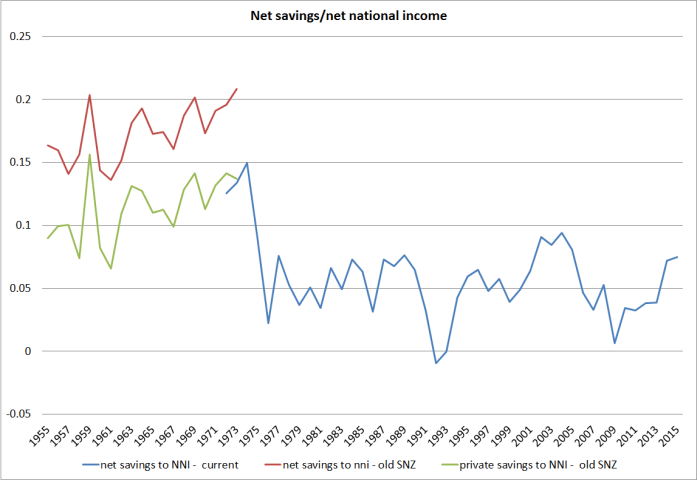
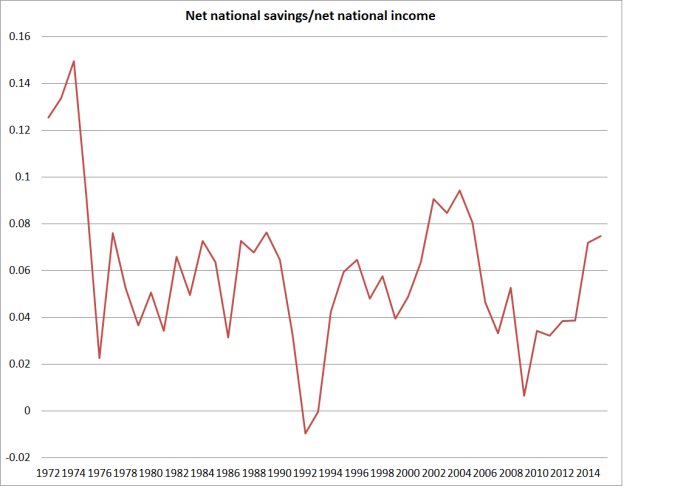
This is what the chart looks like, starting in the year to March 1972, and end in the year to March 2015.

net savings to nni nz
Of course, the sharp fall in the series at the start of the period really catches the eye. But the other thing that strikes me is just how stable average the savings rate has been over the subsequent 40 years, fluctuating around 5 per cent. As you’d expect, it falls quite sharply in recession (see 1991 and 2008/09) – corporate profits tend to fall in recessions, and fiscal deficits widen – but since 1975 there has been no trend in the series at all [1] .

Which creates difficulties for those looking for explanations for our relatively modest national savings rate:
• Some reckon tax incentives might help. But actually we had a very generous tax treatment of superannuation and life insurance until the late 1980s, and a rather ungenerous one (defenders would say “neutral”) since. But the difference isn’t visible in the aggregate data.
• Some reckon a liberal approach to New Zealand Superannuation might explain something. But in the years to March 1975 and 1976 we had a compulsory private scheme, then we had very liberal universal NZS at 60, then we had means-testing and a fairly rapid increase in the age of eligibility. None of it is very evident in the data.
• Some talk about “wealth effects” from rising house prices dampening savings. But the biggest house price bust in modern New Zealand history was after 1974, and the biggest boom was over 2003 to 2007. None of it is very evident in the data.
• The (non-superannuation) welfare state has got bigger over the period, while tertiary education went from being largely “free” for a small group of people, to really rather expensive for a huge number of people. None of it is very evident in the data.
• Some reckon financial liberalisation will have dampened savings, enabling people to bring forward consumption in ways they couldn’t previously. The real freeing-up of the system didn’t start until the mid 1980s. But the difference isn’t obvious in the aggregate data.

• Kiwisaver hasn’t been compulsory, but the take up was sufficiently large that if advocates had been told in advance that it would be that high most would have thought it would have boosted national savings rates. But neither in the more formal research nor in a simple chart like this is it particularly evident.

I’m not suggesting none of these factors made any difference. I’m sure in many cases they did, and (for example) the increase in the NZS eligibility age helped put the government in the position of running large surpluses in the years leading up to the 2008 recession (which was also the peak in the national savings rate). But it isn’t easy to point to a single factor, or even an identifiable set of factors, to explain New Zealanders’ savings choices. An alternative way of saying that is that it is not easy to point to what one might change if one were convinced (which I’m not) that the national savings rate is a policy problem. 40 years of a constant mean is really quite a long time.  More-formal modelling might shed some light, but I wouldn’t be optimistic.

Discussions of savings often focus on households, and then secondarily on the government’s own finances. But they tend to ignore the role of business savings. I’ve wondered whether the modest rate of national savings partly reflects the perceived lack of profitable opportunities in New Zealand. As I’ve pointed out before, business investment as a share of GDP has been quite low in New Zealand for decades, and less than one might expect in a country with quite a fast-growing population (Austria or Belgium need to devote a smaller share of their income each year to adding new shops and offices etc than, say, New Zealand or Australia do). Firms might save more if the growth prospects were better – if, say, real interest rates were nearer those in the rest of the world, and if the real exchange rate had been lower. But in that case, savings rate wouldn’t be the cause of any problems, but just another symptom.

It is one of those areas where better data might help shed a little further light. What was going on with that fall in the national savings rate in 1974/75? It looks a lot like the impact of the collapse in the terms of trade.  But the savings rate has never recovered, and we don’t even know if it was exceptionally high in the early 1970s.  Contemporary estimates suggest that business savings were almost half of private savings – from perhaps a third a decade earlier. Unfortunately, the earlier estimates aren’t compiled on the same basis as the modern national accounts. For what it is worth, here is a chart for the full period since 1954/55, using data published in the New Zealand Official Yearbooks (in this case the 1975 one). There is a hint of national savings rates rising in the late 1960s and early 1970s, but it is hard to know, and hard to know whether the average savings rate for the last 40 years is really lower than it was in the earlier post-war decades.

net savings to nni 2
Surely we should be funding Statistics New Zealand – or at a pinch some good academic researcher – to produce longer backdated series of our national accounts. Better data on its own probably wouldn’t answer all our questions about New Zealand’s longer-term economic performance, but it surely couldn’t hurt. Would it provide value to the plumber from Masterton? Hard to tell, but good data at least opens the possibility of better policy.

NB: Before anyone comments, this post is dealing entirely with the flow rates of savings from current income.  It is not dealing, at all, with stock measures of wealth, or how they might aggregate to some sort of national balance sheet.

[1]  In the years of high inflation and high public debt, the story is a little complicated because much of what is recorded as interest is in effect a principal repayment.  Grant Scobie (and co-authors) looked at that effect here.

The wealth of nations, and democracy

Yesterday I went to a fascinating guest lecture at The Treasury, by Stephen Haber, a professor at Stanford, who is currently visiting New Zealand as the Reserve Bank and Victoria University professorial fellow in monetary and financial economics.  Haber was the co-author of the very stimulating recent book Fragile by Design: The Political Origins of Banking Crises and Scarce Credit, a comparative study of banking systems. I’ve been meaning to blog about this book for months.  To the extent that Calomiris and Haber are correct (and I’m not sure how far that is) the case for intrusive banking supervision and regulatory restrictions – of the sort the Reserve Bank is increasingly adopting  – in countries like New Zealand is materially undermined.

But yesterday’s lecture was on something quite different.  His topic was “Climate, geography, and the origin of political and economic institutions”.  It is continuing work, building on the earlier observation that stable democracies –  of which there have not been many – cluster in regions of moderate rainfall.  In the words of the abstract of a 2012 working paper:

Why are some societies characterized by enduring democracy, while other societies are either persistently autocratic or experiment with democracy but then quickly fall back into autocracy?  I find that there is a systematic, non-linear relationship between rainfall levels and regime types such that such that stable democracies overwhelmingly cluster in a band of moderate rainfall (540 to 1200 mm of precipitation per year), while the world’s most persistent autocracies cluster in arid environments and rain-forests. This relationship is robust to controls for the resource curse, as well as to controls for ethno-linguistic fractionalization, the percent of the population that is Muslim, disease environment, and colonial heritage. I advance a theory to explain this relationship, focusing on differences in the biological and technological characteristics of the crops that can be grown in different precipitation environments. Variance in the biological and technological characteristics of crops generated variance in producers’ strategies to solve problems of scarcity, giving rise to variance in the distribution of human capital and institutions associated with the protection of property rights. Democracy was more likely to thrive in environments in with a high level and broad distribution of human capital, and with institutions that protected property rights. I test the theory against a unique cross-country dataset, a comparison of democracies and autocracies in antiquity, and a series of natural experiments.

The current work takes these ideas further and builds on the work of plenty of other scholars trying to better understand what accounts for the widely divergent, and apparently deeply-rooted differences in outcomes across countries.   Haber’s claim is that climate and geography explain between a third and a half of the variance across countries in GDP per capita and in where countries stand in democracy rankings.  Here geography is not the ideas of remoteness from the rest of the world I was toying with last week, but something more about the ability to grow, store, and transport (and thus trade) food.  Places with flat land and navigable rivers or coastlines score well.  Rocky valleys don’t.

In Haber’s story, certain climates and geographies pre-condition societies to developing market-based institutions and effective but limited governments that eventually lead to greater prosperity, innovation, and democracy.  In his story, for example,  England is a place where grains can be both grown and readily stored, and transported, and where there are few extreme climate shocks that might historically have threatened whole societies. Trade requires effective enforcement of private property rights.

Others places are more naturally favourable to the development of strong central governments, which can discourage innovation.  Haber here cites both Egypt and China, and argues that the propensity to flooding naturally lead to strong central governments as a risk-management device (the biblical story of Joseph, central managing grain reserves, featured as an example of the “insurance state”). Such societies discourage any innovation that might threaten the perceived self-interest of the state.  Others places again  –  think of Pacific islands –  are prone to severe adverse climatic events, but also have climatic/geographic conditions that don’t allow the production of storable foods (eg grains), and so there are no incentives to develop the institutions that protect property rights and the development of markets.  Stealing vast quantities of grain in northern Europe would have been very valuable – it lasts a long time –  but stealing bananas in Fiji would not.

I don’t lay claim to any great expertise in this area, but for what it is worth much of what Haber had to say rang true in understanding some of the differences across some countries –  England vs Egypt/China vs Vanuatu for example.  But then again, it is not so many centuries since China was the richest (per capita) economy in the world.  Plenty of scholars try to explain the subsequent great divergence.

But I was uneasy about two things.  First, democracy is really rather a new thing, at least in its current forms.  Perhaps in a  hundred years from now it will be the established and standard form of governance everywhere, in which case Haber’s work might be useful only in explaining in which countries democracy developed first.  Then again, perhaps democracy will prove to have been a short-lived fragile flower, and the pool of countries with democratic systems could look much smaller than it does today.  After all, 80 years ago many of the countries of Europe were far from democratic, and if anything democracy might have looked to be in reverse.  Who is to say it couldn’t happen again?  Perhaps it just reflects my economics training, but differences in wealth look more persistent that differences in how much democracy there is, and is probably a better focus.  Apparently, Taiwan is less prone to adverse climatic shocks than mainland China, but the contrast –  for now at least –  between a rowdy democracy on one side of the strait, and the Communist Party’s rule on the other side, cautions against too much geographical or climatic determinism.

But closer to home,, I was uneasy was about whether his story –  whether about democracy or prosperity – could usefully explain much about a country like New Zealand (or Australia, Canada, the United States, Uruguay, Chile, Argentina).   By world standards, each of these countries is pretty well-off –  the last three less so than the others.  The first four have been among the world’s most democratic countries, and even the Latin American countries haven’t exactly been China –  Uruguay and Chile had some well-established democracies, with some brief unfortunate interruptions.

The climate and geography of these countries is much the same as it was 200 years ago, or 500 years ago –  ie in Haber’s terms well-suited to the emergence of democracy and prosperity.  And yet I don’t think there is anything in the pre-history of the territories of those modern countries to suggest that the indigenous societies in any of them had the nascent qualities that were about to lead to the emergence of societies that were among the most democratic and prosperous on earth.

Of course, it isn’t that climate is irrelevant. But the channel is different than Haber seems to recognise.   British settlers were willing to settle en masse in New Zealand or Canada because the climate and geography were conducive (by contrast, when British missionaries went to west Africa in the 19th century it was not uncommon for them to take coffins with them, so high was the mortality rate).  But what would modern day New Zealand or the United States look like if, for some reason, there had been no international migration?  Haber’s hypothesis seems to suggest that they should have been rich and free.  I rather doubt it.  Unfortunately, there are no natural experiments –  countries with good geography and climate that remained largely unsettled by Europeans.  Perhaps South Africa is the nearest example, and I wouldn’t have thought it was particularly supportive of Haber’s case.

There were opportunities in New Zealand, Australia, Canada and the United States which people from rich and successful countries (mostly the UK, but not exclusively – see Quebec, or the Spanish influence in the US) forcefully took advantage of.  The riches and success provided Britain with the military and political strength to enable new societies to “invade” and largely replace the cultures and institutions that had been in those societies previously, but which had not developed technologies that enabled them either to flourish, or to fend off the influx from Europe.  There probably wasn’t too much unique about Britain –  had the Napoleonic Wars gone the other way, more of the colonies of settlement might have been French rather than British –  but the influxes at the time when lowering transport costs made mass seaborne migration feasible were inevitably Northern European. It isn’t a particularly attractive picture, but that is what it was –  those who had developed wealth and power (and the associated successful institutions) displaced those who had not utilised the potential of those climatically and geographically favoured lands themselves.

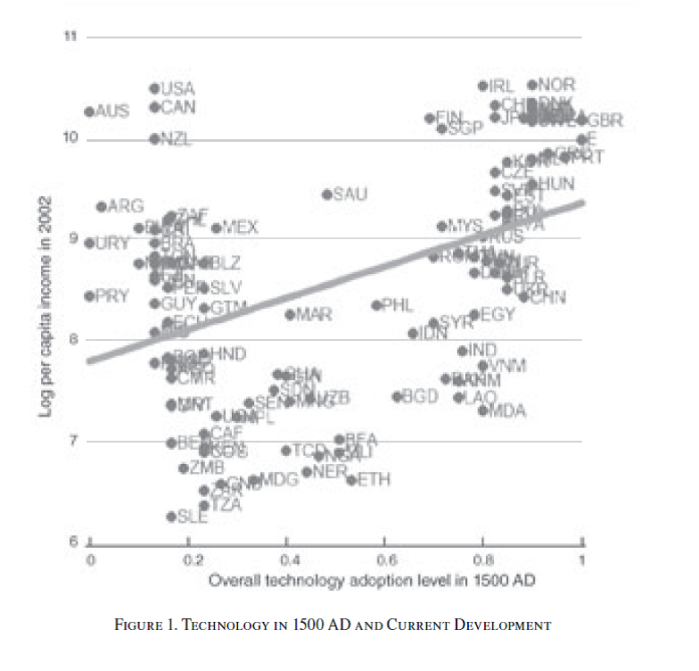
I’ve been attracted to work of Bill Easterly in this field, who has asked “Was the wealth of nations determined in 1000 BC?” He found that differences in technology levels across countries were remarkably persistent over time, even going back as far as 1000 BC (although his focus was on differences in 1500AD).  But as his work developed, he took explicit account of the role that large scale immigration played in transplanting technology and institutions from one geographical location to another.  People make a difference.

Here is his scatter plot of the relationship between the technology levels in each country and current GDP per capita.  New Zealand, Australia, Canada and the US are in the top left hand corner: poor technology in 1500, but high incomes now.

easterly1

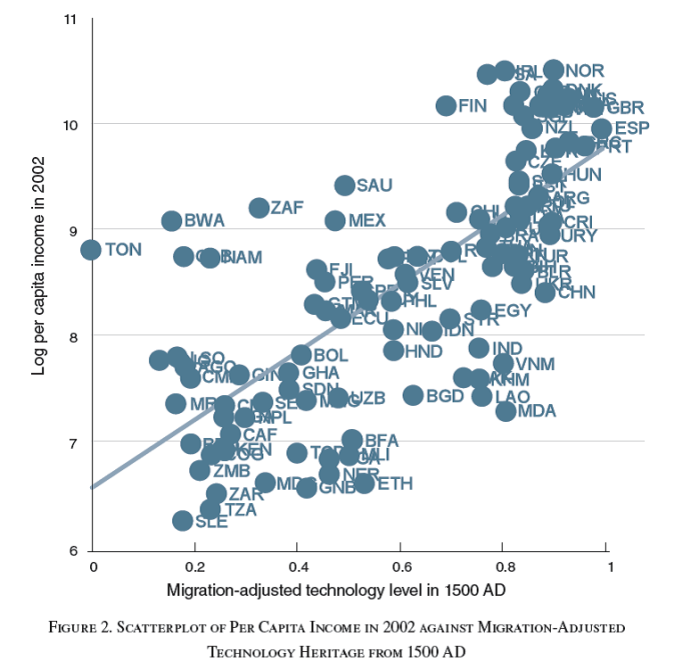
And here is the follow-up chart, incorporating the technologies in 1500 of the peoples who now live in those countries.  Mass migration wasn’t an issue for most countries, but it certainly was for New Zealand, Australia, Canada and the United States.  If you look carefully, you’ll spot a NZL towards the top right hand corner of the chart  (the other colonies of settlement are buried in that cluster too).

easterly

I’ve often been critical of the Reserve Bank and even The Treasury on this blog. But credit should go to them for hosting a fascinating visitor such as Haber, and to The Treasury for yesterday’s open seminar.

Nominal GDP targets for New Zealand?

I urged again the other day that there should be an open process of research and debate leading towards the negotiation of the next Policy Targets Agreement in 2017.  These documents matter.  Monetary policy is the main tool for short-term macroeconomic stabilisation, so the PTA sets the “rule” (well, loose guide) for how the short-term fluctuations in the economy will be managed.  The Reserve Bank –  and the Treasury and Minister –  has often had a tendency to treat deliberations around the PTA as technocratic in nature (which in some ways they are), and hence not something with which to trouble the natives.  The standard Reserve Bank response to any suggestion of greater openness was “but we already tell them what we want them to know”.  But open government is not just about releasing finished products, after the event, in bureaucratically-approved formats.

Two other former Reserve Bank staff, Kirdan Lees and Christina Leung, both now at NZIER, have made a useful contribution to a debate about the future of New Zealand’s monetary policy.  They put out a note the other day headed Time to reassess inflation targeting, which concludes with a pretty strong leaning towards adopting nominal income targeting instead.  I don’t think they will get far with the current Governor on that one – he used to bristle and react very frostily whenever anyone so much as mentioned nominal income targeting  – but he won’t be Governor for ever, in the end the Minister of Finance calls the shots, and whether the Governor likes debate or not, it is an important part of good public policy processes.

However, I’m not convinced by the Lees/Leung argument.  In particular, I’m not persuaded that the form of the rule makes a great deal of difference to assessing the appropriate stance of monetary policy now.  Nor am I convinced it would have made a great deal of practical difference over the pre-recession years.  And if we were going to move away from inflation targeting, I’m not convinced that nominal income targeting is the alternative I would adopt.

Lees/Leung have a number of strands to their argument.

First, they argue that “supply shocks” have become more important relative to “demand shocks”.  Perhaps, but where is the evidence for that proposition in New Zealand or in other countries?  They seem, in part, to be arguing from the presence of a number of phenomena (fracking, the internet etc) which are improving productivity.  All of them are real, but in aggregate productivity growth has been materially slower in the last half dozen or so years than in the previous decade.  And, in any case, the issue for monetary policy would not normally be the trend rate of productivity growth, but shocks –  surprises, which can go either way.   There is, of course, one area where supply shocks have become more important for New Zealand –  terms of trade volatility has been much greater in the last decade than in the previous 15-20 years (apparently driven mostly by the fairly extreme dairy price volatility).  We’ll come back to terms of trade shocks.

Second, they point out that many advanced countries have seen inflation undershoot respective targets.  That is, of course, true, but most of the countries on their chart have largely exhausted the potential of conventional monetary policy.  Interest rates are basically at zero, and have typically been so for quite a few years.  There are reasonable arguments that a different target might make it a little easier to get out of the current “trap”, but they aren’t relevant to New Zealand at present.  Our Reserve Bank has undershot the inflation target not because it couldn’t cut interest rates enough, but because it chose not to.  That failure probably wasn’t wilful –  largely it was because they misread the data.  They (and other central banks) misread the data on the other side during the boom years.  Forecasting is difficult, but it is a problem that bedevils any of the rules under discussion.

Third, they point out the well-known proposition that, in principle, nominal GDP targeting can generate better short-term macroeconomic performance (eg less output variability) in the presence of supply shocks.  In the example they cite, faced with drought, an inflation targeting central bank will tend not to adjust policy (since inflation, and especially core inflation, won’t change much) while a nominal GDP targeting central bank will tend to ease policy to lean against the drought-induced fall in GDP.  But, in fact, whichever rule was adopted, the central bank would almost certainly be reacting to forecasts (whether of inflation or nominal GDP), since monetary policy only works with a lag.  Droughts typically aren’t recognised by central banks until we are in the midst of them, and when they are recognised they are typically assumed to be shortlived.  Faced with the prospect of a drought this summer, the Reserve Bank will typically (and reasonably) assume that next summer will be normal, and since monetary works with a lag they wouldn’t change policy under either regime.

Fourth, they argue that the difference between inflation targeting and nominal GDP targeting is quite material for where the OCR should be set right now.    It is certainly feasible that in some circumstances there could be quite a difference, but they don’t make a persuasive case that this is one of those times.

They compare inflation rate targeting with nominal GDP level targeting.    Either prices or nominal GDP can be targeted in rate of change terms (inflation rates) or in levels terms.  No country in modern times has adopted levels targets for either prices or nominal GDP.  The Bank of Canada looked quite carefully at the option of price level targeting a few years ago, and concluded that it would not represent an improvement over inflation targeting.  One reason levels target don’t appeal to practical policymakers is that if one makes a mistake and prices or nominal GDP rise unexpectedly strongly, one can’t just treat bygones as bygones –  one has to tighten to drive the level of prices (or nominal income) back down again.    Whatever the theoretical appeal of such an approach, it seems unlikely to command much public enthusiasm or support –  and hence seems unlikely to prove durable.

Much of the older literature around nominal GDP targeting was done in terms of rates of change (nominal GDP growth rates).  But since the 2008/09 recession there has been renewed interest in the idea of a level target for nominal GDP.  The argument made, most prominently by US economist Scott Sumner, has been that a target for the level of nominal GDP would have (a) prompted an earlier easing in monetary policy, and (b) would underpin expectations (especially in the US and Europe) that interest rates would stay low for a long time.

Lees/Leung acknowledge that the current inflation targeting framework invites further cuts in the OCR  (we’ll see next week whether the Governor agrees, although recall that it is a forecast-based framework, so OCR cuts aren’t warranted if the Bank can convincingly show that core inflation is heading back to 2 per cent reasonably soon on current policy).  But then they suggest that using nominal GDP levels targeting “interest rates are about right”.

They appear to base that observation on this “illustrative example”.

ngdp

In this chart, they appear to have simply drawn a trend line through actual nominal GDP since 1998 and then calculated the difference between the trend line and actual. That difference is small.

But to adopt a nominal GDP levels target, one would need to define an appropriate trend period first.  And it isn’t clear to me why this is the right one.  Most advocates of nominal income targeting at present argue for using something like the pre-recession trend (since the arguments are about whether policy has been sufficiently loose in the year since 2008).  In a New Zealand context, in both 1996 and 2002 policymakers decided that New Zealand should have a faster trend rate of nominal GDP growth (since they revised up the inflation target).  Alternatively, a common approach in New Zealand has been to look at the entire period since low inflation (and lowish nominal income growth) was established, around 1992.

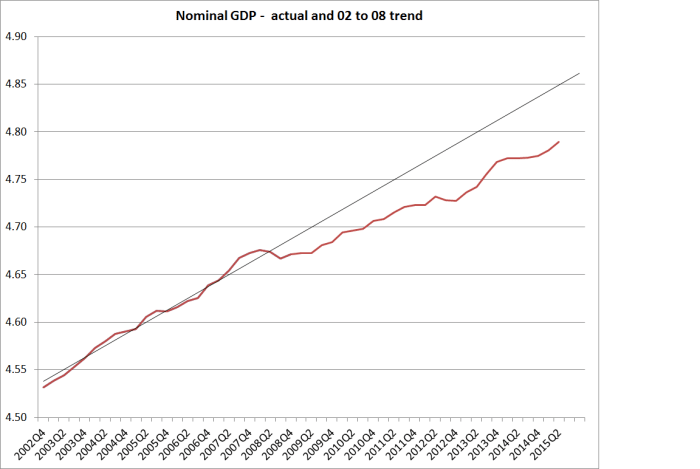
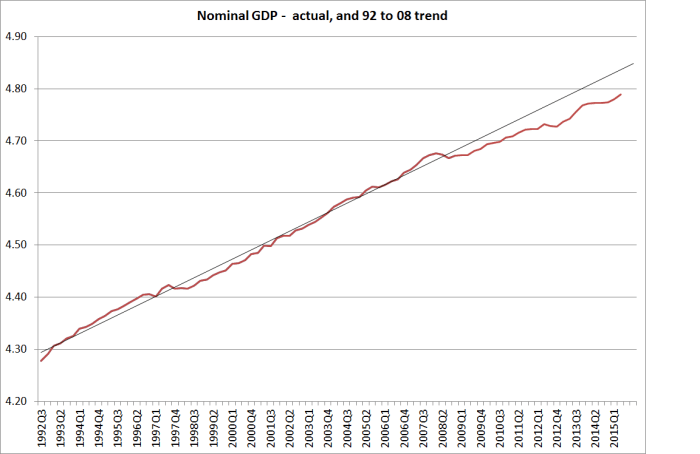
I’m not sure that a trend starting from 2002 to, say, 2008, is that enlightening.  After all, there was a common view that monetary policy was too loose over at least several years of that period (Alan Bollard has openly acknowledged as much).  But if we used that as the trend, this is what the picture looks like (using logged data).

ngdp 02 to 08 trend

Nominal GDP is well below that pre-recession trend (as it is in most countries), arguing for looser monetary policy now as well.

Or we could use a trend done over 1992 to 2008 and one ends with a similar gap.

ngdp 92 to 08 trend

Levels targeting does require identifying a starting level (which is neither easy nor uncontentious).  But what if we just look at nominal GDP growth rates?

ngdp apcs since 92

Not only has nominal GDP growth averaged far lower since 2008 than it did over the previous 17 years, but the most recent observation (annual growth of 3.9 per cent) is right on the average for the post-2008 period.    If we are happy with something like 2 per cent inflation (few have argued for lowering the target) and have a population growth rate of almost 2 per cent per annum, then 5 per cent nominal GDP growth might be a reasonable benchmark.  Current nominal GDP growth is well below that, just as current inflation (headline or core) is well below the 2 per cent inflation target.

So, shifting between CPI or nominal GDP based rules, levels or rates of change, looks as though it would not make much difference to how one thinks about appropriate monetary policy at present, at least on the current data.

But as I noted earlier, central banks aim to base policy on forecasts, so the issue is not so much where inflation or nominal GDP is right now, but where the central bank thinks it will be in a year or two’s time.  My proposition is that most of the mistakes central banks have made in the last decade or two have been forecasting mistakes rather than policy rule mistakes.  Monetary policy wasn’t tightened soon enough during the boom years partly because Alan Bollard was a dove, but partly because the Bank –  and most other forecasters even more so –  recognised the immediate inflation pressures, but forecast that they would soon dissipate.  They were wrong, and as a result inflation and nominal GDP growth were higher than forecast.  Similarly in the last few years, central banks have underestimated how weak both inflation and nominal GDP growth have been.  If one could forecast nominal GDP more reliably than inflation, perhaps the case for change would be stronger, but outside recessions the big source of fluctuations in New Zealand’s nominal GDP is international commodity prices.  They are highly volatile, and the volatility dominates any trend movements over the sorts of period relevant to monetary policy.

An international conference was held in Wellington a year ago this week to mark 25 years of inflation targeting, and the papers have recently been published.  Several academics presented a paper looking at how inflation targeting compared with nominal GDP targeting for New Zealand.  They looked at a variety of different time periods, including the pre-liberalisation period, the transition to a more liberalised economy, and the current period.  The authors were sympathetic to the case for nominal GDP targeting.  I was asked to be the discussant, bringing a practical policy perspective to bear on the issues raised in the paper.  In my remarks, I set out some of the reasons why I’m not convinced that a practical nominal GDP rule would represent a material advance over (practical) inflation targeting.

One of the attractions of nominal GDP targeting is that it prompts a monetary policy tightening when export commodity prices rise, even if there is no immediate rise in consumer prices. But as I noted one needs to think specifically about the characteristics of the particular economy.

In thinking about an export price shock, it might also be important to understand the transmission of the shock across the rest of the economy. A highly open economy, in which a generalized export price shock affected firms across an employment-rich wide-ranging export sector, might look considerably different than a sector-specific shock in a moderately open economy where the commodity production sectors employ relatively little labor (the story in New Zealand dairy, and much more so in Australian minerals and gas extraction). If New Zealand experiences a surge in dairy prices, and much of the proceeds are saved by farmers—perhaps because they are very conscious of the volatility of prices—why would one want to tighten monetary policy against that lift, if there was little or no apparent spillover to domestic (wage or price) inflation? Perhaps if the shock destabilized wage expectations there could be a basis, but there has been little sign of that sort of wage-setting behavior in response to recent export price shocks. The issues are even more stark in Australia, where most of the profit variability in the face of export price shocks accrues to non-Australian owners of capital (whose consumption choices are likely to put few pressures on domestic resources in Australia).

Partly for this reason, over several years I have been drifting towards the conclusion that if one were to replace inflation targeting with another rule, in New Zealand’s case nominal wage targeting might have rather more appeal.   I noted

Much of the academic discussion of inflation targeting focuses on the idea of stabilizing the stickier prices in order to minimize the real costs of adjustment to shocks. Since, as this paper agrees, wages are typically among the stickier prices, perhaps we should be more seriously considering the merits of nominal wage targeting, as Earl Thompson argued decades ago. I have noted elsewhere (Reddell 2014) that such a rule could even have financial stability advantages. Nominal wages are the prime basis for servicing the nominal household debt that dominates the balance sheets of our banks. Faced with adverse shocks, and especially deflationary ones, nominal debt is arguably the biggest rigidity of them all. It would be interesting to see such a rule evaluated in a suitable model.

But…..

If productivity shocks were the dominant source of dislocations in New Zealand, such a wage rule could also have considerable appeal— shifting the variability into the price level rather than into (sticky) nominal wage inflation. As it is, over the last twenty years, wage inflation has followed a rather similar path to core CPI inflation— and does not look much like fluctuations in the path of nominal GDP (or in NGDP per capita, or NGDP per hour worked). So perhaps, at least over that period, policy should have looked very little different under a wage rule than under the CPI inflation targets that successive ministers and governors have agreed upon.

Of course there might be considerable political/communications difficulties with wages-targeting.  But this would be nominal wage targeting: actual real wages and the labour share of income would still emerge from the market process.   But given these communications difficulties, the case for change would have to be stronger than it is right now (although for what it is worth, current wage inflation also probably argues for looser monetary policy –  just like the CPI or nominal GDP).

I have little doubt that inflation targeting is not the “end of history” for monetary policy.  But the choice between inflation, nominal GDP, or wage targets –  in levels or growth rate terms –  doesn’t seem to be the biggest issue we face in designing monetary policy and the related institutions.  In practical terms, each would rely on forecasts, and our forecasts simply aren’t very good.  And each still faces the issue of the near-zero lower bound.  There are arguments that levels targets might help alleviate the ZLB, but only zealots think that in isolation it would make a huge (or sufficient) difference.  We need much more energy being applied to either removing the ZLB constraints (which are essentially regulatory in nature) or raising the target for inflation (or nominal GDP or wages growth) sufficiently so that the zero bound is no longer likely to be binding.  The Bank of Canada is right to be looking at this issue.  Other central banks and finance ministries need to be doing so.

And I still think the other issue is one of just how much accountability there can actually be for autonomous central banks implementing monetary policy.  As I have noted recently in both the New Zealand and US contexts, in practical terms there is very little.    In the United States, John Taylor has argued for legislating something like a Taylor rule as a benchmark against which the Federal Reserve’s judgments can be formally evaluated, requiring the Fed to explain deviations from the recommendations of that rule.  Some on the political right argue for a return to the Gold Standard.  I don’t think either would be desirable, but in a sense both are reactions against the delegation of too much unchecked power to central banks.  The original conception in New Zealand was of a high degree of effective accountability –  an easy test as to whether or not the Governor has done his job. Money base target ideas had a similar conception –  plenty of delegation, but plenty of effective accountability.  It turned out not to be so easy.  But if we cannot meaningfully hold these powerful independent agencies to account –  in ways that mean real consequences for real people –  I suspect the debate will begin to turn again as to whether the power should be delegated to unelected officials at all.  Citizens can vote governments out of office, and that has real consequences for real decisionmakers.

The Joint (TPP) Declaration – another Reserve Bank OIA abuse

On 6 November I posted about the joint declaration of the macroeconomic policy authorities of the trans-pacific partnership countries.  This non-binding declaration dealt with issues around exchange rate management etc.  It was, apparently, a price set by the US Congress for being willing to consider legislation to implement the TPP agreement.

The declaration was announced in a joint press release from the Governor of the Reserve Bank and the Secretary to the Treasury.  As they noted in their Q&A accompanying the press release:

This is an understanding among our macroeconomic agencies. It is not a treaty among TPP governments.

My conclusion, which seemed reasonable at the time, was that both the Reserve Bank and the Treasury were parties to this declaration.  Everything in their documents suggested so, and if we are going to have such declarations at all then it makes sense for the operationally autonomous central bank to be a party to it.

I was, however,  struck by one sentence in the declaration, which stated

We, the macroeconomic policy authorities for countries that are party to the Trans-Pacific Partnership…welcome the ambitious, comprehensive, and high-standard agreement reached by our respective governments in Atlanta.

I wondered (a) whether such judgements were really appropriate for non-partisan public servants to be making, and (b) what basis the Governor and Secretary had had for reaching their judgement.  In truth, I was more interested in the Reserve Bank’s response, since I knew that Treasury would have been reasonably actively involved in the whole process.  Accordingly, I lodged an OIA request with each agency.

Today I received this response from the Reserve Bank.

On 6 November 2015, you made a request under the provisions of Section 12 of the Official Information Act (the Act), seeking: 

Copies of any analysis and position papers etc undertaken by those two agencies (RBNZ and Treasury) which provided the basis for their judgement that TPP was an “ambitious, comprehensive, and high-standard” agreement.

The phrase you’ve quoted comes from the Joint Declaration of the Macro-economic policy authorities of Trans-Pacific Partnership Countries published on the United States Treasury website. That document was agreed between the signatories to the TPPA (Australia, Brunei Darussalam, Canada, Chile, Japan, Malaysia, Mexico, Peru, Singapore, the United States and Viet Nam).

Work to analyse the TPPA, and to advise the Government about the TPPA, was performed by the Treasury, the Ministry of Foreign Affairs and Trade, and possibly other agencies too. The Reserve Bank did not undertake its own specific analysis and so does not hold information within the scope of your request. The Bank is refusing your request under the grounds allowed by section 18(e) of the Act – the document alleged to contain the information requested does not exist.

A number of things are puzzling about this response:

  • The Bank refers to the declaration being on the US Treasury website.  But the RB/Treasury press release had a link to a copy of the declaration on the New Zealand Treasury’s website.
  • The response states that the declaration “was agreed between the signatories to the TPPA” but, as noted above, in their release the Governor and Secretary said that it was an agreement between macroeconomic policy authorities.  Is the Reserve Bank one of these authorities or not?  And if not, why was the Governor party to the press release?
  • It is also stated that the Reserve Bank neither undertook any analysis of the TPP agreement itself, and nor does it hold information prepared by other agencies.    They state that the information I  requested simply does not exist.  In other words, despite apparently being party to a declaration that lauds TPP as an “ambitious, comprehensive and high standard” agreement, that specific judgement –  really quite political in effect –  is apparently based on nothing on at.  No documents, no file notes, no analysis, no emails.  Is this  the standard of policymaking we should expect from the Reserve Bank?

Finally, if there is really nothing at all, how come it took 17 or 18 working days to respond?  As a reminder, the Official Information Act requires agencies to respond “as soon as reasonably practicable”.  I can understand it taking two or three days, but this response looks like yet another highly questionable abuse of the Act.

I’ve now lodged a further request for any material the Bank did consider prior to issuing the joint press release on 6 November.  Perhaps that will help finally confirm whether the Reserve Bank really is a party to this or not.


Is promoting R&D New Zealand’s path to prosperity?

The Productivity Hub is a partnership of agencies which aims to improve how policy can contribute to the productivity performance of the New Zealand economy and the wellbeing of New Zealanders. The Hub Board is made up of representatives from the Productivity Commission, the Ministry of Business, Innovation and Employment, Statistics New Zealand and the Treasury

The Productivity Hub yesterday hosted a symposium in Wellington with the title “Growing more innovative and productive Kiwi firms”. “Growing” things is usually something gardeners do – people doing stuff to things. So the title perhaps carried somewhat unfortunate connotations of successful firms being the products of government action. That probably wasn’t their intention, at least not wholly, but then again it wasn’t entirely out of line with the list of attendees – 161 names, of whom at least 150 would have been bureaucrats, academics, and the like. There appeared to be only a very small handful of people from the (non-consultancy) private sector.

I had to leave early (schools finish at 3pm) and I gather I might have missed the two best papers of the day, from a couple of overseas academics. But what I did see was pretty disappointing. It confirmed a sense that our leading government agencies still have no real sense of what explains New Zealand’s persistently disappointing productivity performance, or of what – if anything – might be done to remedy that. But there is a hankering to “do stuff” in the innovation/research area.

The day didn’t start particularly convincingly when, in his introductory remarks, a senior member of the Productivity Hub remarked that they had been along to see the Minister of Statistics to tell him about the value of the research that was being undertaken under the auspices of the Hub. The Minister had, apparently, asked what was in it for the plumber from Masterton. The bureaucrats replied that research showed that good human resource management was good for productivity, so the plumber might get value from knowing that treating his staff well, and asking about their weekends on Monday morning, might be good for business.   I could only imagine the reaction of the plumber to learning that his taxes had paid for this stunning insight.

Of course, there is more to the research than that. But official agencies still don’t seem to be getting to the bottom of the issues, and are mostly identifying symptoms (perhaps understanding them in a better and richer way) rather than causes.

In some circles – perhaps especially in MBIE – there is considerable enthusiasm for additional activity encouraging businesses to do more research and development. But again it mostly seems to be tackling symptoms rather than getting to a deeper understanding of why New Zealand firms rationally make the choices they do.

Consistent with that, we heard from Sarah Holden at the quango Callaghan Innovation. Their government-mandated aim is to increase business enterprise spending on research and development (“BERD”) from around 0.6 per cent of GDP to 1 per cent of GDP.  To do so, apparently they have already spent $403 million in R&D grants in their first two years. It is early days, so I might have expected just upbeat rhetoric. But to her credit, Holden told us that the experience to date was that “big companies do fine without us – but like the grants – while small companies don’t use Callaghan’s R&D facilities as much as Callaghan would like. The grants don’t seem to be making much difference.”   It was tempting to ask “so why are we spending all this money so freely?”   No one did so, at least openly.

We also heard an interesting presentation from Shaun Hendy, from the University of Auckland.  He had some fascinating data on the importance of networks etc, and the way in which the number of patents per capita increases as the size of the city increases.  But it wasn’t clear that he was aware that there is no real evidence that big countries, or countries with big cities, have been achieving faster productivity growth than small countries.

Perhaps the weakest part of the day was the keynote address from Gabs Makhlouf, the Secretary to the Treasury,  headed “Innovation, diffusion, and markets”.  At such conferences, agency heads usually content themselves with some brief introductory or concluding remarks.  But this was billed as a keynote address.  Gabs apparently thought he had something enlightening to say on the issues of innovation, productivity, and economic performance.  He didn’t.  There was a lot of “all hands to the pump” rhetoric –  which seemed like a convenient substitute for hard analysis.  What evidence, for example, does the Secretary have that the private sector is responding inappropriately, given the policy framework set by successive governments?

He was, however, adamant that the answer to the disappointing productivity performance is not a lower exchange rate.  I was quite taken aback by that –  especially when he went on to assert that to believe that a lower exchange rate was important was to put oneself on “the road to doom”.   When I checked the Treasury’s most recent Briefing to the Incoming Minister, they didn’t seem to share that perspective –  although they rightly pointed out that a different monetary policy regime is not a path to a sustained lower real exchange rate.    As ever, it would be interesting to know what lies behind some of the Secretary’s assertions.

He also noted that New Zealand was not able to get the agglomeration advantages of some of the small European countries, in close proximity to large and wealthy markets.   But then he argued that we had the good fortune to be part of Asia, and the challenge was how to deepen our integration.  Perhaps he needed reminding that (a) most of Asia is still no better than middle income, and (b) all of Asia is a very long way away.  In the line Treasury often used to run, draw a circle with a 1000 km radius around Wellington and you get an awfully large number of seagulls and not much else.  Draw such a circle around Vienna, Stockholm, or Amsterdam and you capture several hundred million people in wealthy, highly productive, economies.

I also heard a presentation from an Australian academic, Beth Webster, who seemed to see a case for government spending on R&D in principle –  since the expected social returns from innovation will typically exceed the private returns.  But as her discussion of different types of support schemes proceeded, it wasn’t particularly persuasive that such support actually serves useful ends in practice.  And she seemed particularly critical of the competitive grants-based approach the current government has chosen to focus on, noting that heavy reliance on the expertise of evaluation panels (hard in a small country) and the difficulty of ensuring that the grants are actually inducing activity that would not otherwise take place.  The incentive on the part of recipients to misrepresent the situation is strong.

The context for all this is that not only is productivity (eg real GDP per hour worked) low in New Zealand, but so is research and development spending (as a share of GDP).  No doubt some of the difference is measurement – R&D tax incentives create an incentive to classify more spending as “research and development”, whereas in the absence of such schemes there is not the same reason to bother with isolating out every last dollar.    I suspect no one really doubts that business R&D spending in particular is quite low by international standards.  But as Adam Jaffe, from Motu, put it, the question is whether that is because the returns to R&D are low in New Zealand, or because there are obstacles to firms undertaking, or commissioning, valuable R&D.    Far too little effort seems to have gone into answering that question, even though the different possible answers might have quite different policy implications.

Enthusiasts for governments “doing something” direct on R&D tend to cite “spillover” arguments.  Many of the gains from any innovation are not captured by the innovators but by consumers.  That reduces the incentive to innovate (at least relative to some unrealistic benchmark). Webster noted we all gain from the wheel, and the descendants of the inventor do not (uniquely).  But then look around us, at the enormously sophisticated and advanced society in which we live, and wonder how it all happened, mostly without government R&D grants or tax credits.  And then ponder the quality of many, perhaps most, actual  – rather than textbook –  government expenditure programmes over the years.  I’m not persuaded of the case for government support for R&D  –  at least outside the areas of the government’s own operations (eg defence).

Here is the chart of business R&D spending as a share of GDP, for OECD countries.

BERD

New Zealand is towards the lower end, and all the countries to the right of us on the chart are also poorer than us.  But I don’t think it is that simple.  Formal research work done previously suggests that the rate of business R&D spending in New Zealand partly reflects the sort of stuff we produce.  One way to see that is to look the OECD’s commodity exporting countries, and compare them with seven economies at the heart of advanced Europe.  These are simply different types of economies.

BERD (% of GDP) BERD ( % of GDP)
Australia 1.23 Austria  2.03
Canada 0.93 Belgium  1.58
Chile 0.14 France  1.44
Mexico 0.17 Germany  1.96
New Zealand 0.57 Netherlands   1.10
Norway 0.87 Switzerland   2.05
Denmark   2.oo
Median 0.72 Median 1.96

In passing, it is also perhaps worth highlighting Israel –  an economy with very high business spending on R&D, and yet not only an economy with GDP per capita around that of New Zealand, but with a similarly poor longer-term productivity record.  They make and sell different stuff –  some of which clearly needs lots of R&D –  but not, overall, any more successfully than we do.

The 2025 Taskforce addressed some of these issues in their 2009 Report (around p 70).  They argued that more attention should be given to the possibility that high levels of business R&D spending might reflect more about where particularly economies are at (near the frontier or not, differences in product mix) rather than being some independent factor explaining the success or failure of nations.  In their view, a highly successful New Zealand was likely to be one in which more business research and development spending was taking place, but as a consequence of that transformation rather than an independent cause of it.  That still seems like a pretty plausible story to me –  although New Zealand is long likely to be primarily an exporter of commodities, and richer commodity exporters (Norway, Australia and Canada) don’t have particularly high levels of business R&D spending.

(And, at the extreme, I checked out the richer Middle Eastern oil exporting countries. Saudi Arabia, Oman, and Kuwait, for example, all have materially higher GDP per capita than New Zealand.  World Bank data for total R&D spending have the six OECD commodity exporters spending an average of 1.4 per cent of GDP on R&D, while those three wealthy Middle Eastern countries spend an average of 0.1 per cent of GDP.  The point is not that a successful New Zealand will spend at those levels, but that one needs to understand the distinctive features of our own economy.)

And that sort of perspective was largely lacking from yesterday’s Symposium.    I’ve argued for several years that if we want to remedy our economic underperformance, we need to focusing on addressing whatever aspects of policy account for our persistently high level of real interest rates.  Real risk-free interest rates are a component of the cost of capital.  Ours are higher than those almost anywhere, and that deters investment (and investment-like spending, such as R&D).  It has also helped skew our real exchange rate, holding it persistently up, on average, even as the large adverse productivity gap opened.  That skews investment (including associated R&D) away from the tradables sector, even though the rest of the world is where most the opportunities would otherwise be.  Oh, and we now have a relatively high company tax rate (and tax on capital income) –  even though plenty of good economic analysis suggests that capital income should be taxed more lightly than labour income.      And yet in the course of yesterday, we heard the Secretary to the Treasury vehemently deny the importance of the real exchange rate, and no one mentioned either the cost of capital or the tax treatment of capital income.  Address those issues, and I’m sure we would have an economy much more strongly oriented towards the tradable sector, would have a faster-growing business capital stock per person.  And I suspect that we would probably have rather more business R&D spending occurring –  the returns to doing it would probably be more attractive.

In a similar vein, I’d commend to readers Terence Kealey’s 2009 book Sex, Science and Profits.  Kealey is a professor of biochemistry, and former vice-chancellor of the (private) University of Buckingham.  This book builds on his less accessible The Economic Laws of Scientific Research  to make the case that science is not typically a public good, and governments do not need to fund scientific research (or, by, implication business R&D).  It is a very stimulating read, both on the history of innovation and on the scientific process.  I’m sure the bureaucratic tinkerers will have their quibbles with it, but it is an argument that should be engaged with much more seriously by New Zealand official agencies –  who need to shift their focus to getting broad government policy frameworks right, and then let businesses take care of themselves.  History suggests that when they do so, ingenuity flourishes and societies prosper.  Government interventions –  mostly well-intentioned, and however cleverly designed –  not so much.

The Productivity Hub was an excellent initiative, but they really need to be directing more of their efforts in the direction of the economywide/macroeconomic types of issues.  New Zealand is blessed with excellent microeconomic databases –  even if they are not always as accessible as they should be – but sometimes data availability determines the direction research takes.  I don’t think the case has been made that the real issues that are holding back New Zealand are microeconomic in nature.

Weak inflation expectations – again

A couple of weeks ago I wrote about the results of the Reserve Bank’s Survey of Expectations  –  the quarterly survey of relatively well-informed participants and commentators.     Those expectations were still very subdued, with little sign of any expectation that (for example) core inflation would soon return to the 2 per cent target midpoint, which the Governor has undertaken to focus on.

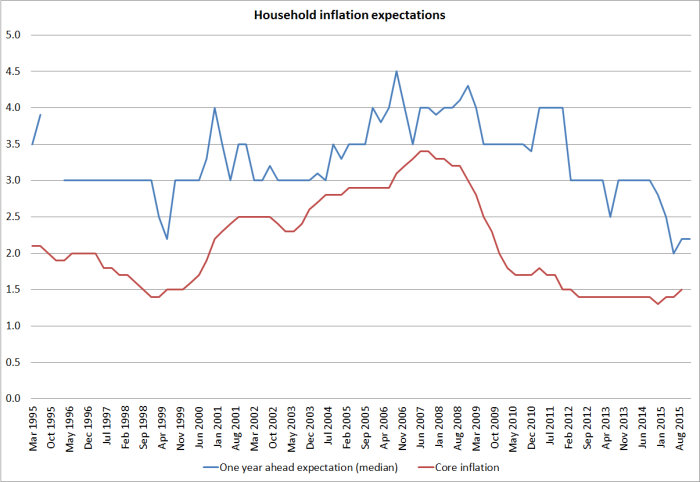
Since then a couple of other inflation expectations surveys have come out.  Both the ANZBO business survey and the Reserve Bank’s household expectations survey question on inflation have had an upward bias for many years.  Reported expectations are, on average, well above both actual inflation at the time the survey was taken, and above the actual inflation rate for the period to which the expectations related.  Both are measures of year-ahead expectations.

The Reserve Bank’s household expectations measures remain very subdued.   In the 20 year history of the survey median year ahead expectations have never been lower than they have been over the last few quarters.  And when the survey started, the inflation target midpoint was 1 per cent inflation not 2 per cent.    Unless the relationship between core inflation (ie excluding the “noisy” bits like swings in oil prices) has suddenly changed, if inflation actually picks up materially over the coming year –  as the Reserve Bank keeps telling us it will –  these respondents will be surprised.

household expecs

The survey also asks respondents directly whether they think inflation over the next year will go up, down, or stay the same.   Again, there is a systematic bias in the survey –  net, respondents have always expected inflation to rise.  But outside the depths of the 2008/09 recession –  the inflation effects of which people then thought would be short-lived –  expectations for headline inflation rising have never been weaker.  And, as a reminder, the most recent headline annual inflation rate was a mere 0.3 per cent

household expecs 2

The survey now also asks about five year ahead expectations.  We only have data since December 2008, but for what it is worth these longer-term expectations have never been lower than they are now.

The latest ANZBO survey came out yesterday.  Inflation expectations dropped slightly, and looking at the chart that also seems to be a record low for the series.  The Reserve Bank might claim to take comfort from the fact that expectations are still 1.6 per cent, not too far from the target midpoint.  They shouldn’t.  Again there has been a persistent bias in this series, and no obvious reason to think that that relationship has changed.

ANZBO inflation expectations

At the other end of the range of measures, New Zealand has a 10 year conventional government bond and a 10 year inflation indexed government bond.  The gap between the two isn’t a pure measure of inflation expectations, but in normal circumstances it won’t be too far from what investors are implicitly thinking that inflation will be.   The monthly average difference for November, as reported on the Reserve Bank website, was 1.40 per cent.

There is talk today of business confidence being a little stronger than it was.  Perhaps, but the Reserve Bank’s job is to target inflation, near 2 per cent.  It hasn’t done that successfully for some years now, through the ebbs and flows of business confidence, commodity prices, and the Christchurch repair process.  And there is no sign in any of the recent surveys and related measures that that failure is about to remedied any time soon.

As the Governor contemplates his final OCR decision for the year, he should be thinking very carefully about these rather disconcertingly low expectations.  The Governor often tells us that he wants to stabilise the business cycle.  But if inflation expectations do become, in effect, entrenched at levels inconsistent with the inflation target, it can be very difficult –  and potentionally quite destabilising –  to get them up back again.

On a slightly different topic, I noticed the other day that the Bank of Canada has a page on its website about the extensive research programme it is planning in advance of next year’s quinquennial review of the Canadian inflation target (a non-binding agreement reached with the Minister of Finance).  The Bank of Canada has a strong track record of undertaking serious research in advance of these reviews.  They plan to undertake significant work on each of the following three topics:

  • The level of the inflation target
  • Measuring core inflation, and
  • Financial stability considerations in the formulation of monetary policy.

The first of these topics particularly caught my eye.  As they note:

 Canada targets 2 per cent inflation, the midpoint of a 1 to 3 per cent inflation-control target range. Since the last renewal of the agreement in 2011, the experience of advanced economies with interest rates near the zero lower bound has put the 2 per cent target under increased scrutiny. After taking all factors into consideration, the Bank will undertake a careful analysis of the costs and benefits of adjusting the target.

The process is an admirable one.  I have previously urged that, with the next (legally binding) PTA due to be negotiated in New Zealand in not much more than 18 months that a similar, open, process should be getting underway here –  commissioned jointly by the Minister of Finance, the current Governor, and the Secretary to the Treasury.  That would be quite a contrast to the very secretive way these things are typically done in New Zealand –  in the case of the 2012 PTA, secretive even after the event.

Doing the work is vitally important, but so is getting it out into the public domain and ensuring open scrutiny and debate of material that will influence the key document in short-term macroeconomic management for the next five years.   It would be valuable at any time, but should be particularly so now, after years of undershooting the target, and as the near-zero lower bound moves uncomfortably close again.  For example, with the benefit of hindsight was the move to a focus on the midpoint a mistake for New Zealand?  I don’t think so, but in view of his track record the Governor may, and there could be reasonable arguments on either side of the issue –  particularly in view of the potential interaction with financial stability considerations.

But what I thought was particularly praiseworthy was the Bank of Canada’s willingness to openly acknowledge that questions should be asked, in the light of changed circumstances, as to whether the 2 per cent target midpoint is still appropriate.  The issues are a little more pressing for them than for us, since Canadian interest rates are much near zero than ours are, but we cannot afford to be complacent.  And if it was decided that a higher inflation target was appropriate, the time to make that call is when there is still conventional monetary policy leverage available.  I’d probably still prefer authorities to take serious legislative steps to remove the zero lower bound, but the questions and issues should be asked and examined.  In New Zealand to date  –  including in the Bank’s Statement of Intent –  the issues and risks are not even acknowledged.

On reading “Migration Trends and Outlook”

It is a glorious day in Wellington, suggesting that summer might really be with us soon.  Tempting as it is to just get outside, I had been reading MBIE’s flagship annual report Migration Trends and Outlook 2014/15 and wanted to note (again) a few concerns about the apparent quality of the immigration policy analysis being undertaken by the government’s chief advisory agency in this area.

Recall that, in New Zealand, immigration policy is no minor matter –  it is one of the largest discretionary structural economic policy interventions undertaken by governments.  Each year, on average, we drift a little further behind Australia and the rest of the advanced world.  And yet each year we target bringing (permanently) another pool of people equivalent to 1 per cent of the existing population.

Migration Trends and Outlook is not a heavily analytical piece.   But it tells the story MBIE wants us to hear about New Zealand’s immigration.  And it simply isn’t very convincing.

The report saying that it is aimed at “policy-makers concerned with migration flows and their impacts”  and “the wider public with an interest in immigration policy and outcomes”.

So we should take seriously what it says.  It begins with this statement:

1.2 Why immigration is important

Immigration helps grow a stronger economy, creates jobs and builds diverse communities. Skilled workers address skill shortages and bring skills and talent that help a wide variety of local firms. Business migrants bring their networks, experience and capital to boost the economy. Visitors and international students bring in significant revenue, with international education and tourism being two of New Zealand’s biggest export-earning sectors.

Internationally, migrants are increasingly mobile, and competition for skilled people in the global labour market is strong. In 2014/15, as in other recent years, the focus of immigration policies continued to be on attracting skilled temporary and permanent migrants to help resolve New Zealand’s labour and skill shortages and to contribute to New Zealand economically.

The “skill shortages” line pervades the entire 66 page document, in a way redolent of a manpower planning exercise from the 1960s.  In fact, it reaches a peak in the Conclusion to the entire report where it is asserted that

Like many countries with declining birth rates, an aging population and high emigration of local-born people, New Zealand relies on migrants to fill labour shortages.

I’ve been trying to work out which countries MBIE has in mind here.  For a start, there aren’t that many relatively advanced countries that have an average annual net outflow of their own citizens in excess of 0.5 per cent of the population.  And of the countries with large average outflows of their own citizens (various eastern European countries for example), few have large scale inward migration programmes at all.  And of countries with large scale inward migration programmes  – Canada or Australia for example – I’m not aware of any others that also have large net outflows of their own people.

So the statement seems to be factually false.  But perhaps more concerning is the apparent sense that somehow the number of jobs in an economy is independent of the number of people, or the price of the services of those people, and that if it weren’t for the wise actions of a prescient government, the economy really couldn’t cope with (a) New Zealanders pursuing better opportunities abroad, and (b) New Zealanders choosing to have only modest numbers of children.

What I find remarkable in this document, as in other MBIE immigration work I’ve seen, is the absence of any sense of market processes, and how the market might sort these things out.  For example, if there are excellent opportunities here which New Zealanders are simply ignoring in their rush to get to Australia, surely we’d expect real wages to increase here?    If that happened, some of the opportunities might disappear.  Some New Zealanders might change their minds about going to Australia.  Some people might regard more training as worthwhile, to better equip themselves for those higher-paying opportunities.  Some will switch jobs from less rewarding ones, to the ones where the returns are now higher.  Some people might work harder or stay in the workforce longer.  But not one of these market mechanisms is even discussed.  And this from a key economic agency, implementing the policy of a vaguely centre-right government?  Does it not occur to them that “shortages” don’t happen in most markets, and when they do they are usually just a sign that the price has not adjusted.  Why does MBIE think that labour is different?

Although MBIE and the government seem to see immigration largely as a labour market phenomenon (“a critical economic enabler”), the price of labour  “wages”  appears only once in the entire document (purely descriptively).  “Price” does not appear at all.  In fact, “productivity” and “competition” each appear only once, in neither case in the context of an analytical sentence.  “Labour market” does appear repeatedly, but almost always only descriptively.  There is simply no sense, anywhere in the document, of a competitive market process at work.  If one were being unkind, one might think MBIE saw the role of government as being to ensure that the right pegs were in the right holes.

The “skill shortages” argument has been with us for many decades.  I was wryly amused to dip into a book over the weekend which reported the claims of New Zealand employers’ bodies in the 1920s urging high rates of immigration on exactly the same sort of “skill shortage” arguments.  You really wonder how countries without large scale immigration programmes managed to survive –  let alone to consistently economically outperform New Zealand over many decades.

Immigration advocates have sometimes argued that if only we can attract the cream of the global crop –  talent, initiative, ideas – we can lift the productivity of New Zealand as a whole, and that of the pre-existing population as well.  It was never very plausible –  short of some of global catastrophe, it was never obvious why the cream would now want to come to New Zealand –  a pleasant spot to be sure, but small and very remote, and not at the leading edge of very much.  There is periodic talk of the transformative powers of immigrants in Silicon Valley, but even if it were true there, why would it be likely (on the balance of probabilities) to work here?   We are small and distant.  San Francisco is neither.  And we have universities that, in most fields, are mediocre at best.  We are fooling ourselves –  or rather our governments seem to keep trying to fool us – if we believe that plausible immigration (volume, type of people, or whatever) is the answer to New Zealand’s economic challenges.  There is no sign it has been in the last 100 years, and the boosters –  MBIE chief among them –  offer no reason to think that is about to change.  We have to make our own future –  as most successful countries in the past have done.  If we do, perhaps able people will be clamouring to join us and we can (or not) take the pick of the crop.  For the present, it still seems more likely that rational New Zealanders will choose to leave for Australia whenever they can, although it is harder to do so than it was previously.

I’ve written previously about the relatively low-skilled nature of even most of those being granted residence as Skilled Migrants over recent years.  The table below (from the MBIE report) updates that for 2014/15. And recall that these are the principal applicants in the Skilled Migrant category –  ie the most skilled of our migrants.  They make up only around a quarter of our annual residence approvals.  Not all of the others will be less skilled, but on average they will be.  I don’t know about you, but this list does not suggest that our immigration programme is functioning as any sort of medium-term “critical economic enabler” (to use one of MBIE’s own phrases).


Main occupations for Skilled Migrant Category principal applicants, 2014/15  
   
Occupation 2014/15
Number %
Chef 699 7.2%
Registered Nurse (Aged Care) 607 6.2%
Retail Manager (General) 462 4.7%
Cafe or Restaurant Manager 389 4.0%
ICT Customer Support Officer 282 2.9%
Developer Programmer 209 2.1%
ICT Support Technicians nec 205 2.1%
Software Engineer 147 1.5%
Accountant (General) 138 1.4%
Early Childhood (Pre-primary School) Teacher 127 1.3%
Marketing Specialist 124 1.3%
Dairy Cattle Farmer 123 1.3%
Carpenter 122 1.3%
Electrician (General) 111 1.1%
Office Manager 106 1.1%
Baker 105 1.1%
Program or Project Administrator 97 1.0%
Software Tester 95 1.0%
Sales and Marketing Manager 94 1.0%

I noted the other day, that the residence approvals target has not been met for the last five years (the target is 45000 to 50000 per annum, and approvals have lagged a bit below 45000 each year).  That raises some questions about even the design of our immigration programme.  I’ve always tended to work on the assumption that since most of the world is much poorer than we are, it should never be a problem finding enough immigrants if we wanted them –  even notionally “skilled” ones.  Returns to labour in New Zealand are higher than anywhere in Africa, Latin America, the Pacific, or most of Asia.  There are plenty of English speakers who could pass health and security tests.  So how come we can’t fill our targets with suitably “skilled” people –  especially as the skills threshold seems depressingly low?

I wonder if it is partly because most residence approvals are now granted to people already living in New Zealand (around 70 per cent) –  that is typically people here on a work visa, or a study visa.   The logic is apparently that people adjust more easily if they are already familiar with New Zealand.   So in applying under the skilled migrant category you get points for having a job or confirmed job offer.  92 per cent of successful applicants got points that way.  You also get points for a job outside Auckland, even though Auckland is the fastest-growing part of our economy –  just over half of all those with jobs/offers claimed points for jobs out of Auckland.

But it is expensive to come to New Zealand –  particularly for people relocating a family here.  And it is hard to effectively job-search from abroad.    And we impose an additional cost by rewarding people who get job offers in the less productive parts of the country (with fewer alternative future opportunities).   Personally, I think our immigration policy is pretty deeply flawed, but if our governments are serious about wanting lots of skilled migrants shouldn’t we think about putting fewer roadblocks in the path of any able person who wants to come?  There seems to be something wrong with the fact that a country with still relatively high returns to labour can’t manage to fill its immigration target (despite alleged “skill shortages”), even by taking such a pool of rather dubiously “skilled”people.    10000 a year (the number of skilled migrant principal applicant granted approval) simply isn’t that many in world terms –  we really should be able to do better than having the four most common occupations of our skilled migrants being chefs, aged care nurses, retail managers and café and restaurant managers.

Perhaps the continued emphasis on skill shortages is a sign that MBIE has largely given up on the other channels by which immigration might boost “the prosperity and wellbeing of New Zealanders” [the phrase from MBIE’s own mission statement]?  But even if so, the “skill shortages” argument –  for the sorts of people New Zealand is mostly importing –  is pretty intellectually slipshod.  In addition to the points I noted earlier, the MBIE document is also devoid of any macroeconomics.  It has long been pretty common ground among New Zealand macroeconomists that, whatever the possible long-term effect of immigration, in the short-term immigrants add more to demand than they do to supply.  The Reserve Bank’s own research shows it.  But what that means is that even though an individual immigrant might relieve an individual employer’s “skill shortage”, in aggregate an increase in immigration increases the pressure on the labour market as a whole. Resource pressures are intensified and not eased.  If the knowledge transfer and productivity stories carried much weight now for New Zealand –  as perhaps they may have in the 19th century – that might be fine.  But there is no evidence of that channel having worked, and no real sign of that changing soon.  And yet if our immigration policy is supposed to ease skill shortages it is almost doomed to fail by construction.

We deserve rather a better quality of analysis from a large public agency paid to provide high quality economic advice on immigration and economic performance issues.  I hope that when the Cabinet has been reviewing the residence approvals target recently they have been more willing to ask some hard questions about just what is being achieved by our immigration programme than has been evident to date.

Founding the Fed

It has been at least a week since I mentioned central banks on this blog  – probably a first.   There are many areas of economics and public policy that interest me more, and which matter more.  But I have just finished reading Roger Lowenstein’s new book, America’s Bank: The Epic Struggle to Create the Federal Reserve.  The Federal Reserve opened for business on 16 November 1914, amidst  the global liquidity crisis, affecting the United States as much as the combatants, created by the outbreak of World War One.   There was, of course, little hint of what was to come when Woodrow Wilson had signed into law the new Federal Reserve Act into law on 23 December the previous year, one of the landmark pieces of legislation in Wilson’s first year in office.

(For anyone wanting to know more about the 1914 crisis, there are two worthwhile modern books; Saving the City  is a British-focused global story and When Washington Shut Down Wall Street is the American story.)

Lowenstein is a financial journalist (rather than an economic historian), with a number of books to his credit.  He is perhaps best-known for When Genius Failed: The Rise and Fall of LTCM.  His tale of the political and banking background to the passage of the Federal Reserve Act is a very readable account for anyone interested in the topic.   In places, it felt like an account of 1912 presidential election campaign – a particularly torrid affair as the Republican incumbent, Taft, was challenged at the general election both by the Democrat Wilson, and by Theodore Roosevelt, Taft’s predecessor and former friend and mentor.  I hadn’t realised how important William Jennings Bryan –  1896 Democratic nominee, and author of the famous Cross of Gold speech –  still was in the Democratic party’s own debates on a central bank.

By the early 20th century, the United States was relatively unusual , but hardly unique, in not having a central bank.  Britain, France, Japan, Germany and Italy all did, but then Canada, Australia, South Africa and New Zealand did not.  The US had had central banks previously –  the most recent had lost its position when Andrew Jackson vetoed the renewal of its charter in the 1830s.   But what marked out the United States in the 1900s was not the absence of a central bank but the presence of repeated severe financial crises –  the most recent in 1907, the effects of which –  while relatively short-lived-  were felt around the world.  As I’ve noted here previously, it is not as if the repeated financial crises seemed in any way to be derailing the longer-term  progress of the United States or the sustained lift in living standards.  At the time, the United States competed with places like New Zealand and Australia for having the highest material living standards in the world.

But in the short-run, the crises were enormously disruptive,  and even the seasonal pressures  – in an economy where farming still played a large role –  were large.  There were plenty of signs that something was broken, and some fix was needed.

The fix chosen turned out to be a central bank –  or rather, a system of regional central banks, loosely overseen and bound together by the Federal Reserve Board in Washington.

It needn’t have been.  Lowenstein tells the story as if the only sensible outcome was the founding of a central bank –  an outcome towards which all history was tending.  He tells his story vividly, and draws on a wide range of primary and secondary sources –  and the cover includes plaudits from former central bankers Ben Bernanke, Alan Blinder, and Paul Volcker.  But the book is weakened because the author shows no sign of having engaged with the alternative hypotheses about what had left the American system so prone to crises.    Many –  most recently Calomiris and Haber – have noted the contrast between the US system and that of Canada, which has been largely free of serious financial stresses before and after the founding of the central bank in 1935.  On a much smaller scale, but also in a heavily agricultural economy, one could include among the relative stable systems that of New Zealand.

If what rendered the US prone to crisis was the absence of a lender of last resort –  or even of external seasonal finance –  then the case for a central bank was much stronger. But a plausible case can be made that what left the US system prone to crises was the regulatory structure put in place over the previous few decades.  The United States system pre 1914 is often loosely characterised as “free banking”.  In fact, it was a highly regulated system.  The two most important regulations were the restrictions on branch banking and interstate banking, which made it very difficult for banks to effectively diversify risks, including liquidity risks, and the restrictions on the issuance of notes.  Physical currency was still a hugely important medium, and demand was highly seasonal.  State banks could not issues notes, and national banks were able to issue their own notes only to the extent that they held US government bonds to back them.  Bonds were relatively scarce, and expensive and, as noted, the demand for notes was highly seasonal.  The conversion of a deposit into a note did not change the nature of the credit risk the holder of the claim faced, but the ability of banks to do that readily, when customers wanted it, was constrained by law.  Perhaps the political economy would have made dealing with the restrictions on the geographic scope of banks impossible  at the time (it took many decades), but Lowenstein does not even deal with the question of whether, for example, amending the restrictions on the note issue might have largely dealt with the pressures –  for an ‘elastic currency’ – that, at the time, gave rise to the creation of the Fed.

Not doing so perhaps make the construction of his narrative easier, and more powerful.   But by not treating seriously those opposed to the creation of a central bank it does limit the insights he can offer.  Some perspectives from, say, the archives of the Bank of England of the Banque de France on what they made of the whole long process might also have been interesting.   Of course, the beauty of being a big country is that there are many other books and papers that deal with some of these issues.

I notice that George Selgin, from whom I’ve learned a great deal over the years, expresses similar views in his own comments on Lowenstein’s book and offers some richer comments on the weaknesses of the pre-1914 regulatory structures.  To repeat, Lowenstein’s book  is a good read, especially for anyone interested in the politics of it all, but just bear in mind the limitations

Our own central bank was not founded for another 20 years, opening for business on 1 August 1934.  There is a line commonly heard these days that central banks were largely created to deal with financial system stresses.  That was true in the United States –  although the most severe crises in US history have come since 1914 –  but it certainly wasn’t true here (or in Australia or Canada).  The Reserve Bank of New Zealand was created to allow independent macroeconomic management for New Zealand, especially to be distinct from Australia.    No one envisaged anything quite like modern discretionary central banking, with data reviews and potential policy adjustments ever six or eight weeks.  But it was about ensuring that New Zealand conditions –  export earnings and access to credit in London –  drove the behaviour of domestic credit in New Zealand, not those of the larger Australasian area.   New Zealand’s sovereign debt was extremely high around the time of the Great Depression, but nothing like as concerning to lenders as that of Australia.

Gary Hawke’s 1973 history of the Reserve Bank, Between Governments and Banks, remains the best account of the background to the founding of our central bank.    A more easily accessible perspective, by Matthew Wright –  a New Zealand historian on the Reserve Bank’s staff – is here.