If they build it, what if no one comes?

A throwaway line of mine a couple of weeks ago about the Wellington City Council’s enthusiasm for the proposed airport runway extension prompted a couple of comments here from Tim Brown, chair of Wellington International Airport Limited (WIAL) –  owned 66 per cent by Infratil and 34 per cent by the Wellington City Council.  As I noted in response to Tim, I was predisposed to be sceptical about the proposal, but would be keen to see the analysis when it was published.

This week a swathe of reports was released, including a cost-benefit analysis prepared for WIAL by Sapere Research Group.  The Dominion-Post led with talk of $2000 million of benefits for an investment of $300 million or so, suggesting that there really shouldn’t need to be much further debate about the economic merits of the proposal.

But, of course, any cost-benefit anaIysis is only a reflection of the assumptions fed into it.   So I spent some time yesterday reading the report.  I had a few questions and observations, and was left unpersuaded that this was a proposal that either my rates or my taxes should be used to fund.  Quite possibly, this proposal could offer even worse value than Transmission Gully –  as the WIAL report notes, the benefit to cost ratio  for that project is only 0.8.

The report proceeds by analysing three options:

  • Option 1:  Build the extension now, to be open from 2020.
  • Option 2:  Build it in 10 years time, to open from 2030,
  • Option 3:  Using the equivalent of the capital cost of the extension instead to promote Wellington airport as a “tourist and airfreight hub” for the next 40 years (the estimated economic life of the extended runway).

The alternative options seem designed to deal with the irreversibility involved in committing now to build now.  I’m not convinced that the delay option does that to any useful extent.  Will it be any clearer 10 years hence whether a material number of long haul flights from Wellington will be viable?  It doesn’t seem quite like a decision on whether to invest in a new technology now, or wait a few years until it is more apparent what the potential of that technology is.

In any case, the bottom line is the estimated benefit-cost ratio for each of the three options.

Option 1                               1.7

Option 2                               1.6

Option 3                               1.4

Even just reading that far into the summary, my eye was drawn to Option 3, and then Option 2, and only finally to Option 1, WIAL’s preference.  Why?  Well, if a heavy promotional programme could really boost passenger numbers etc as much as extending the runway (as the scenario assumes), why not just go for that.  If it works, most of the benefits accrue anyway.  And if it doesn’t, the programme is not irreversible and could be canned five or ten years hence.  As for Option 2, it delivers almost all the benefits of Option 1, without having to do anything for 10 years.

The report had quite a lot of interesting material about how a longer runway will allow airlines to use aircraft more efficiently than they do now.  Load factors will, apparently, be able to be increased on the trans-Tasman flights and a longer runway will also apparently allow landings and take-offs to be done in ways that put less pressure on engines and tires than is the case now.   That all sounded plausible enough, but they also sounded like gains that should be able to be captured by WIAL in, for example, its landing charges.

It was a little hard for me to tell – I might have missed something in the tables – but main factor in the success or failure of the airport extension if it went ahead seems to be whether and, if so, how many long haul international flights and passengers would be added.   The sceptics’ worry is that if they build it, perhaps no one will come.

The cost-benefit analysis does not look at that scenario at all.  It uses traffic volume forecasts and scenarios prepared by another set of consultants.  Using Monte Carlo simulation techniques they generate scenarios that are supposed to represent 5th and 95th percentiles around the central forecasts.

Even in the low scenario, international passenger numbers are forecast to grow by 2.5 per cent per annum over the next 45 years in the business-as-usual baseline.  Add in the runway extension –  and recall that this is the low scenario (the 5th percentile) –  they are forecast to grow by 3 per cent per annum.  Over 45 years, those cumulate to really big differences:  204 per cent growth vs 278 per cent growth .   The consultants estimate that there is only a 5 per cent chance that passenger numbers will fall below these levels.  But how credible is that?   Shouldn’t we at least see a scenario in which no long haul services use Wellington airport, and the only gains result from the ability of existing operators to use aircraft more efficiently?

One of the puzzling – or perhaps not so puzzling –  aspects of the report is the complete absence of any analysis of Christchurch airport’s experience with long haul flights.

The traffic forecasts, prepared by InterVISTAS, involve a central scenario in which in thirty years time there would be 56 long haul departures a week from Wellington (eight per day on average).   This is defended with the observation that “Wellington in 30 years time. (FY 2045) will have less than half the number of average weekly frequencies on long haul services as Auckland has now.”  And this was supposed to reassure me?  In addition to having almost four times the population of slowly-growing Wellington (and a larger hinterland), Auckland is inevitably a more natural gateway to New Zealand than Wellington is.  The authors go on to defend their assumptions with the observation that Adelaide has 44 weekly long haul departures (their forecast for Wellington in 2035).  But Adelaide is a city of 1.3 million people.

And still no mention of Christchurch.  Christchurch has about the same population as Wellington.  And if Auckland is one natural gateway to New Zealand, Christchurch is the other, given the much greater tourist appeal of the South Island (and the impossibility of long haul flights into Queenstown).  I couldn’t find an easy reference to how many direct long haul flights there are out of Christchurch at present, but there seem to five weekly flights to Singapore.  A new service to Guangzhou is also starting this month, so perhaps that is another five flights a week.  Other wide-bodied aircraft use Christchurch airport, but to get beyond Australia you still have to stop in Australia.

And it is not as if long haul international flights from Christchurch are relentlessly increasing.  I have distant memories of flying direct into Christchurch from Los Angeles, but that was 10 years ago, and the service is long gone.  AirAsia’s direct flights from Malaysia to Christchurch didn’t last long either.

Surely it is such an obvious comparator that the Christchurch experience really should have been addressed directly?  I can think of a couple of areas where demand for flights in and out of Wellington might be greater than those to and from Christchurch –  business and government, and they are probably more lucrative than leisure travellers –  but we should have seen the analysis?  At the moment, it looks as though the Christchurch story might be a little uncomfortable and so has been quietly ignored.  (Canberra comparisons might also have been interesting.)

For a long-lived asset one would normally expect the discount rate used to make quite a difference to the viability of the project.  Cash flows far into the future aren’t worth very much if the providers of the capital have a high cost of capital, and thus need a high discount rate to be used.

The main analysis in this report uses a real discount rate of 7 per cent.  I am a bit puzzled by that.  The authors defend it by reference to the Treasury’s guidance on evaluating infrastructure and single-use building projects (eg hospitals and prisons).

Frankly, I’m sceptical that that is an appropriate discount rate for this project.  And I would be astonished if Infratil –  the dominant shareholders in WIAL – treated their own marginal cost of capital for a project like this as being as low as 7 per cent real.  Perhaps a case might be made for something that low in respect of projects that depend simply on existing traffic (growth) patterns –  eg the current extension to the domestic terminal at Wellington –  but at the margin this runway extension has the feel of a much higher risk project.  After all, they could build it and no one might come.  I’ve written previously about government discount rates, and also linked to a recent Reserve Bank of Australia article suggesting that private sector firms are typically using hurdle rates of at least 10-13 per cent nominal (almost as many in the 13-16 per cent range).

However, the report does include some sensitivity analysis.  For the central scenario of Option 1 (build the runway extension now), recall that a 7 per cent real discount rate produced a benefit-cost ratio of 1.7.  Using a 10 per cent real discount rate only reduces that to 1.6.    I don’t understand why that is.  Perhaps it is because the capital costs are quite small compared to the additional operational costs airlines would face in putting on the new services (thus many of the costs and benefits are matched in time) but it still doesn’t seem quite right –  especially from the perspective of the ratepayers/taxpayers asked to put up the capital cost now.

The report included in its calculation of the benefits to New Zealand the GST paid by the additional foreign visitors.  I was a bit puzzled by this, but perhaps I’m missing something.  If we assume that the economy is on average fully employed, isn’t it likely that one additional form of exports will be, in part at least, at the expense of some other form of exports?   Discovering huge oil deposits, say, will crowd out manufacturing or tourism exports.  New Zealand as a whole might be better off, but not to the extent determined just by the increase in one form of exports.  Same goes for even high value airport extensions surely?

Many of the gains in the report seem to flow from the additional competition that it is assumed that the longer-runway will make possible.  They cite some impressive numbers for how much lower fares are for international routes out of Christchurch or Auckland relative to Wellington.  But if we grant that that is a plausible story, again surely this aspect of the extension should be able to be self-financing?  For example, if having a longer-runway in Wellington lowered airfares for people from the lower half of the North Island by 10 per cent (the report talks of 20-30 per cent premia at present), surely the airport departure charge for those sorts of flights could be adjusted accordingly?  The report spent surprisingly little time discussing such issues/options.  Perhaps there are Commerce Commission obstacles to such charging?  But if so, surely they should be identified in the report?

While WIAL is a commercial operation, it seems pretty clear that the runway extension does not really stack up on commercial grounds.  We aren’t told on what basis Infratil would be happy to proceed with this project –  if they really are at all –  but the report is clearly written with a political (and voter) audience in mind, rather than a commercial one.  Section 2.9 devotes several pages to various sets of central planner objectives –  the current Wellington City Council’s 25 year vision, international air transport policy, current central government tourism targets, national infrastructure plan goals, and something chillingly called the “Leadership Statement for International Education”.  Not much about the market, or risk and return there.  Just the whims of a current set of bureaucrats and politicians, who might be beguiled into using other peoples’ money to proceed with this project.

Perhaps this is too glib, but there does seem to be a relatively straightforward solution.  It isn’t obvious why Wellington City Council still holds 34 per cent of the airport.  If the project really stacks up for Infratil, it should be a good time for Wellington City to sell its stake[1], and let the private sector go for it.  It looks like a pretty risky proposition, but (I’m a bureaucrat by background not a business person and ) if private shareholders want to put their capital behind it then I’m fairly happy for it to proceed (assuming the environmental issues etc can be adequately addressed).

Of course, a common response might be that the putative benefits are national or regional and the costs would fall to the operators of the airport.  I’m not persuaded.  As I’ve noted, many of the gains documented in the report seem as though they should be able to be appropriated by the airport operator, at least to the extent required to cover its own cost of capital.  If airlines can use planes more efficiently, presumably landing rights at Wellington would be more valuable than they are at present?  That should be charged for.   And if investing in a runway extension really would markedly lower flight prices for Wellingtonians, surely those of us who fly can be charged for the saving?  Great projects taken to market by the private sector hardly ever see all the gains captured by the promoters/investors. Bill Gates and Steve Jobs got rich from Microsoft and Apple, but the rest of us did even better as a result and by rather more than we paid for the product.

As it is, the Christchurch experience should be a salutary warning to the citizens and ratepayers, especially  those in Wellington.  If the initial comments from government ministers seem mildly encouraging (ie discouraging to WIAL), the track record suggests reason for caution even there (this is the government now amenable to funding the Auckland inner city rail loop, and which has been right behind the Christchurch convention centre).  As for Wellington City Council, the sceptical comments from Greens councillor David Lee notwithstanding, I wonder what will stop these planners pursuing their vision, egged on by the Chamber of Commerce?  What lessons have they taken, for example, from the disaster of  the Dunedin stadium?  I hope that, at very least, no binding commitments are made by the council until after next year’s local body election.

To their credit, WIAL is holding a series of lengthy public sessions in the next couple of weeks at which apparently their experts will be available to answer questions.  If I have time I will try to go along, and if any of my concerns are materially assuaged I might come back to the issue later.

[1] To which my only caveat would be a concern about what even lower-value projects they might use the resulting cash for instead.
These remote islands are different?

I was having a discussion the other night in the margins of the Goethe Institute event about the extent to which we should think about New Zealand’s economic advantages and opportunities as natural resource based.  I’ve been running a proposition that the only thing really going for us is the land, its attendant resources (fish, wind, geothermal, as well as pasture, forests, and –  at the low value end –  tourism opportunities), and the technologies and management skills that enable us to sustain reasonably good incomes from them.  Those resources can support really good incomes, but I’m sceptical as to how many people they can support such incomes for.

The person I was talking to posed an interesting angle which I hadn’t thought of before.  What if the North Island and South Island disappeared and New Zealand just consisted of Stewart Island (or the Chatham Islands).  What would 4.5 million people do in such a country?

As I’ve thought about it over the last few days, I’ve increasingly concluded that most of them would leave.  The opportunities would be just so much better elsewhere.

4.5 million people on an area the size of Stewart Island or the Chathams isn’t implausible.  Both are bigger than Singapore or Hong Kong –  Stewart Island (1680 sq kms) has more than twice the land area of Singapore (718 sq kms).

My nine year old daughter recently got fascinated by a book on our shelves about remote islands, so we’ve spent quite a bit of time together learning about some small, remote and very obscure places, such as.

Kerguelen                                                                                 7215 sq kms

Falkland Islands                                                                     12173 sq kms

St Helena                                                                                     420 sq kms

Seychelles                                                                                    455 sq kms

Reunion                                                                                       2512 sq kms

Azores                                                                                          2346 sq kms

And less obscure perhaps, but still relatively remote islands

Fiji                                                                                                 18270 sq kms

Hawaii                                                                                            28311 sq kms

Tasmania                                                                                      90758 sq kms

Iceland                                                                                          103001 sq kms

For reference, the South Island has 151,215 square kms of land.

But the total population of all those ten countries and territories is about 4.4 million.  Distance really seems to matter.  It is not that one can’t sustain good incomes in these places, but that not many do. History, revealed preferences, and revealed opportunities seem to have seen to that.

In the Stewart Island thought experiment my interlocutor posed, Stewart Island would be about as remote as the median of my 10 territories above.

Really smart people could choose to live there and with strong pro-market institutions perhaps they could build First World living standards there.  But it wouldn’t be Singapore or Hong Kong, even if it were populated by people from those places.  Geography doesn’t doom a country or territory to poverty, but it can make it a great deal harder.

Nothing in the global distribution of population or economic activity suggests that a Stewart Island New Zealand would have anything like 4.5 million people –  unless some social engineer, defying logic and history, kept shipping people in  (there are always some places poorer).  If, by some chance, 4.5 million people had ended up on Stewart Island, and governments didn’t interfere, I reckon many or most of them would have subsequently left –  to Australia, back to Britain if they could, perhaps even to South America.  The Falklands Islands does now support quite a high level of GDP per capita, for its 3000 people.   But the fishing and hydrocarbons wouldn’t go far across, say, three million.

Of course, New Zealand is not Stewart Island.  Our total land area puts us the middle of the list of countries of the world.  But we are still incredibly remote.  Last bus stop before Antarctica is unfair  (the Falklands and Kerguelen are closer), but not so very far wrong.  It just is not the sort of place, around the globe, that seems to be able to support First World opportunities for many people[1].

Of course, we have some advantages.  A temperate climate appeals as a place to live.  And northern European, specifically British, institutions and the rule of law have enabled people to secure pretty good livings wherever they have settled.  For perhaps 75 years, after all, New Zealanders had some of the very highest material living standards anywhere in the world.  But it was on the back of land-based industries.  And the overwhelming bulk of our exports still are, but with many more people than we once had.

So long as we don’t completely mess things up, New Zealand will never be what Uruguay is today (not much more than half New Zealand’s GDP per capita, the fruit of decades of really bad economic management last century).  But if, as a matter of policy,  New Zealand continues to  drive up its population quite rapidly, Uruguay might even have  better per capita possibilities in the very long run than New Zealand.   The same could probably be said, with even more force, of Romania (similar incomes today to those in Uruguay –  legacy of decades of even worse economic and political management last century).  They are just nearer where the people are. Locations still seem to matter.

New Zealand just isn’t a great place for many people to do terribly well.  Implicitly, New Zealanders have recognised that in the exodus to Australia that has occurred over the last 40 to 50 years.  The conventional wisdom on the right for a long time was that that was just a reflection of our mad policy regimes from the late 1930s onwards (heavy protection etc).  But it looks to have been more than that.  Decades on from the economic reforms, the average net outflow over time remains large (although it ebbs and flow with the Australian labour market), even as it has become more difficult for New Zealanders to make a smooth and secure transition to Australia.

One of my commenters is adamant that New Zealand’s immigration policy is “just” a replacement policy.  He is wrong on that .  (Over the last 15 years there has been an average annual net outflow of New Zealand citizens of around 25000 and an average net inflow of non-citizens of around 40000.  And our official target for residence approvals for non-citizens has been 45000-50000 per annum –  although not all who come stay).

But even if he were correct, there is no “just” about it.  What the government is doing is intervening to stymie a self-correcting mechanism that is going on in the private sector.   New Zealanders have seen, and responded to, the better opportunities (as they judge them) for themselves and their families in Australia.  They are moving to a place that –  with similar institutions –  is proving better able to generate high advanced-country incomes for more people.  What possible reason can the government have for interposing its own judgement, deciding that the resulting population and labour market outcomes are unacceptable, and actively seeking to bring in many more from abroad?

Perhaps as a policy approach it was more understandable in the 1950s and early 1960s.  After all, at that time our relative incomes were still high, and New Zealanders weren’t leaving in any appreciable numbers (the total outflow of New Zealand citizens in the 15 years to 1964 was 8283). And in the population discussion in New Zealand post-war, the idea of building up the population for national security reasons was also present.

But this is 2015 not 1950, and the economic signals have been pretty clear for a long time now –  and the central planners keep on ignoring the message.  Perhaps they believe the opportunities here are great.  But where is the evidence?  Remote places tend not to support very many people, and certainly not at the level of incomes New Zealanders aspire to.  Perhaps that won’t always be the case, but the onus should be on the planners to demonstrate that this island is different.

I’ve occasionally suggested that if “optimum population” meant anything,  New Zealand’s might be two million or 200 million.  With 200 million people, New Zealand would be a very different place, but it seems unlikely that in a world our size 200 million people would ever regard these remote islands as the best place possible to live and generate economic activities with an expectation of advanced country incomes. Peripheries seem, naturally, to be lightly populated places.

(To anticipate comments, I’m not arguing for a “population policy”  –  the idea seems absurd, but that is what we now have de facto –  but for leaving New Zealanders to determine these things for themselves.  In recent decades, the birth rate has been slowing and many New Zealanders see better opportunities abroad (most years), suggesting that their choices would leave us a fairly flat population.  But still one more than ten times that of Iceland –  which has 40 per cent of our land area, and is a great deal closer to prosperous population centres and markets.

[1] Australia faces somewhat similar issues, of course, but just has more natural resources.

An interesting approach to urban land use property rights

Last week I put out a post on possible mechanisms to enable groups of neighbours to protect their interests in their own and each others’ properties, while allowing the flexibility for them, rather than councils, to determine what, if any, and when changes in the land use rules affecting that group of properties would be put in place.  It was prompted by a combination of the Productivity Commission’s recent discussion of the private covenants that reportedly apply to most new developments, and  the conflict in various Wellington suburbs around the council’s desire to determine which suburbs should be more intensively built and which should not.  Neither the Commission’s apparent distaste for private covenants, nor the situation where councils can somewhat arbitrarily –  and without any compensation for the regulatory taking –  alter private property rights, seemed very appealing.

This afternoon, I stumbled on this post from the Not PC blog.  It is several years old, but still seems very relevant.    The gist of his proposal is as follows:

FIRST, ENACT A CODIFICATION of basic common law principles such as the Coming to the Nuisance Doctrine and rights to light and air and the like.

Second, register on all land titles (as voluntary restrictive covenants) the basic “no bullshit” provisions of District Plans (stuff like height-to-boundary rules, density requirements and the like).

Next, and this will take a little more time, insist that councils set up a ‘Small Consents Tribunals’ for projects of a value less than $300,000 to consider issues presently covered by the RMA and by their District Plans. These Consents Tribunal should function in a similarly informal fashion as Small Claims Tribunals do now, with the power to make instant decisions.

This would mean that instead of talking to a planner about your carport, about which he couldn’t give a rat’s fat backside, you decide for yourself.  And, if your carport would violate one of the covenants, you then talk about it to your neighbour—with whom you and he would have plenty of negotiating room.  And once you (and your neighbour if necessary) have made your mind up, The Consents Tribunals would consider your small project on the basis of the codified common law principles, the voluntary restrictive covenants on your title, and the agreements (if necessary) you’ve negotiated with your neighbour(s). Simple really.

You should be able to reach agreement in an afternoon, and have your title amended the next day.

No doubt there are pitfalls in this scheme that I don’t see. But I thought it was worth drawing attention to.  Finding mechanisms that allow both greater flexibility and protection of property rights, but on a basis that puts more weight on mutual consent, and rather less on rather arbitrary administrative or political fiat, should have considerable appeal.

A cause for great celebration?

Hamish Rutherford had an article in the Dominion-Post yesterday in which he quotes the Prime Minister as claiming, on the one hand, that the recent high net migration inflows are a “time of great celebration” and, on the other hand, that most of the arrivals are something the country “can do nothing about”.    Rutherford had a follow-up piece yesterday with some comments from me and from a couple of other economists –  a nicely balanced group; one relatively negative, one relatively positive, and one “it depends”.

Actually, I suspect nobody much shares the Prime Minister’s glib “time to celebrate” sentiment.    You can be as much a believer in more liberal immigration, or even open borders, as you like, but it still repays stopping to look at just why things are as they are.  Ours isn’t that positive a story.

Of course, contrary to the headlines, the net inflows we’ve been seeing recently are not “record migration” in any meaningful sense.  Yes, the net PLT inflow is at a record level, and perhaps even as a share of the population at any time in the last 100 years or more.  But the limitations of the PLT numbers are well-known.  If one looks instead at the total arrivals less total departures, the inflow over the last year has been around 60000.  By contrast, in 2003 the annual inflow peaked at 80000.  New Zealand’s population is now around 15 per cent larger than it was in 2003, so the per capita inflow over the last year or so has only been about two-thirds the size of what we experienced in 2003.  So the current inflow is large, but not really at record levels.

And although the target number of residence approvals for non New Zealand (and non-Australia) has been 45000 to 50000 per annum for years (despite the growing population), only 43000 approvals were granted in 2014/15, compared with almost 53000 in 2001/02.   I think MBIE even objects to the use of the word “target”, but however one characterises the number that Cabinet set, it isn’t met precisely each year.  In fact, perhaps reflecting the relatively weak domestic labour market since the recession, 2009/10 was the last year in which residence approvals were above 45000.

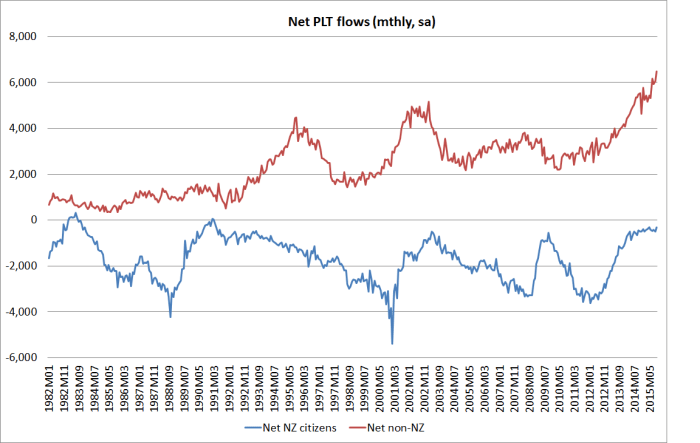
And can we control the total net flow numbers?  Well, not really since New Zealanders are free to come and go, and of course any foreigners who has come here (needing advance approval) can also leave any time they like.    Since the trough in 2011/12, the increase in the net PLT flow has been roughly evenly split between New Zealand citizens and other citizens, but over the last 18 months the decline in the net NZ outflow has levelled off, and all the further increase has been down to increased net inflows of non New Zealand citizens.  At around 6500 in the last month, that net inflow probably is a record, even in per capita terms (SNZ don’t report the total migration data by citizenship).  Every non-New Zealand citizen coming to New Zealand needs the approval of New Zealand authorities.

net plt by citizenship.png

It is worth bearing in mind that there is still a net outflow of New Zealanders each month.   The last times there were even modest inflows were 1983 and 1991, both occasions when Australia’s economy was in recession.  Given that the stock of New Zealanders living abroad is now much larger than it was in either 1983 or 1991, it would have been easier to envisage a larger net inflow of New Zealanders this time if our economy and labour market were really performing well.  But they aren’t.  We can’t rule out a small net inflow of New Zealanders at some point, but it hasn’t happened yet.

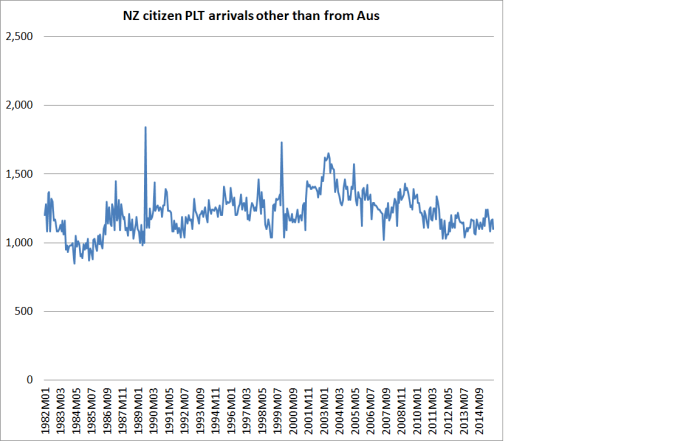
We can see the role that Australian conditions are playing by looking at the flows of New Zealand citizens to and from Australia, and the flows of New Zealand citizens to and from other countries. If the story were one of a strongly-performing New Zealand, I’d have thought we might expect to see New Zealanders flocking home from all corners of the globe (and not leaving for the rest of the world).    New Zealand citizen arrivals for the rest of world (other than Australia) are at quite a low ebb –  well below, for example, what we saw in 2003 when our unemployment rate was dropping sharply.

citizen arrivals row 2

And New Zealand citizen departures to the rest of the world, while quite notably lower than they were in earlier decades (tighter restrictions in place like the UK?) have been pretty stable for the last six years.

Instead, all the action in the New Zealand citizen flows is in those between New Zealand and Australia, suggesting that it is conditions in Australia that are at the heart of the story.

The unemployment rate in Australia is around 6 per cent, and there is now a much greater awareness than previously that the rules in Australia have changed for New Zealanders.  Any one going now, and who has gone in the last 15 years, is largely on their own if, for example, they can’t find a job, or they lose their job.  And their kids are often in some limbo, not really New Zealanders and unable to become proper Australians either.  Without that sort of welfare backstop if things go wrong, it is much more attractive than it was for anyone remotely risk averse to stay at home until the Australian labour market is much more robust.  It may be less attractive to try even then than it once was.  And that is so even though average incomes and real living standards in Australia are higher than those here, and that gap has shown no sign of narrowing.   But it is not that to any material extent there is a net outflow of New Zealanders from Australia (although the uptick in New Zealanders coming home isn’t something we’ve seen before), it is simply that for the time being the outflow to Australia has dried up.

Given that the adverse income gap has not narrowed and that our unemployment rate is high, nothing in that is a cause for celebration in New Zealand.  If anything, rather than reverse.  The more highly productive Australian economy has been an attractive option for New Zealanders for decades – enabling New Zealanders to improve their lot (and taking downward pressure off factor returns in New Zealand).  If that alternative outlet is less easy or safe to take advantage of, New Zealanders as a whole are a little worse off.  If, for example, people relocating from Invercargill to Auckland were made ineligible for welfare benefits,  Invercargill as a whole would be worse off economically –  even though some of the parents in Invercargill might be pleased to have their kids and grandkids a bit closer to home.

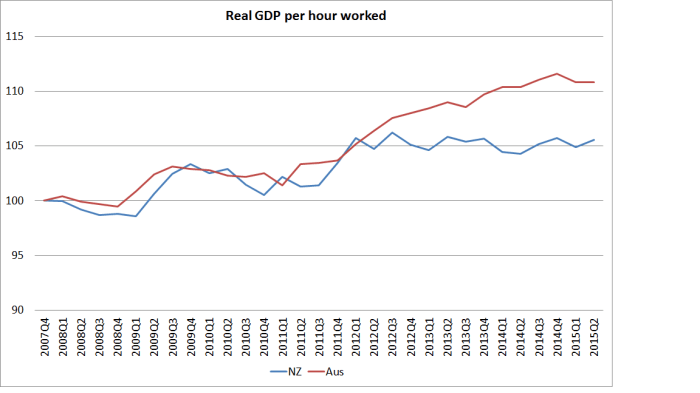
And what of New Zealand’s economic performance relative to Australia?  Real GDP per hour worked is a pretty good timely measure of relative productivity performance .  As the statistics stand at present –  who knows what revisions will eventually show –  the New Zealand performance in the last few years has been really bad by comparison with Australia’s.  Data suggesting no productivity growth for four years, while Australia has gone on achieving productivity growth, just reinforces a sense that the reduced outflow of New Zealanders to Australia –  partly temporary and probably partly permanent  –  is something bad for New Zealanders, not something to celebrate.

real gdp phw

It needn’t always be so.  I wish we had the sort of strong sustained economic performance, built on rapid productivity growth, that was putting us a path to income convergence (once again) with Australia.  If so, I reckon we’d see the net outflow turn into a material sustained inflow.  That would be cause for celebration.  This is not.

And all that with barely any discussion of the non-New Zealander flows.  But just briefly.  The Prime Minister correctly notes that foreign students are an export industry.  But I’d be more reassured by that if it were not explicit government policy to encourage foreign students, not on the intrinsic strength and quality of our own (middling at best) universities, but as a pathway to residence here.  Since there is no evidence that such permanent immigration to New Zealand has represented a net economic benefit to New Zealanders –  neither MBIE nor Treasury nor relevant ministers have been able to cite anything remotely convincing –  it seems that we are really just back in the export incentives business.  Instead of writing cheques, we write (the possibility of) a visa.  Export incentives “worked” in the pre-liberalisation period to –  people do what they are incentivised to do so we got more subsidised exports –  but it still wasn’t good policy.  It wasn’t under Muldoon and Rowling, and being done by Steven Joyce and John Key doesn’t change the proposition.  I’m not, at all, suggesting we should discourage export education, but let it stand on its own merits if the current numerical success is really to be a cause for celebration.

The Prime Minister also reckoned that “many of the arrivals fell into either highly skilled or investor categories”.   In the last year, just 1353 residence visas were issued under the investor and entrepreneur categories  (about a third as many as were being granted in the early 2000s) and as I noted in an earlier post MBIE’s research has highlighted just how questionable the net economic benefit of these migrants has been.

 One of the MBIE papers is on the web.  It discusses some work on investor migrants –  who already, in effect, buy their way into New Zealand.  The aim of the programme is to import people with business expertise and entrepreneurial skills, presumably to boost productivity in New Zealand.  And yet in these surveys of people at various stages of the investor migrant process  (and  in which respondents must have been at least partly motivated to give the answers MBIE wanted to hear, even if results were anonymised), 50 per cent of the money investor migrants were bringing in was just going into bonds, and only 20 per cent was going into active investments.  We aren’t short of money, but may be of actual entrepreneurial business activity.  And 70 per cent were investing only the bare minimum required or just “a bit more”.  And these people aren’t attracted by the great business opportunities in New Zealand, but rather by our climate/landscape and lifestyle.  It doesn’t have the sense of being a basis for transformative growth.

Set alongside the 1353 investor and entrepreneur visas were 4477 parent visas last year.

As for the highly skilled, I have covered previously and, in a succession of posts, at somewhat tedious length the question of just how highly skilled our skills-based immigration programme is.   Here, from the tables in MBIE’s excellent resource, Migration Trends and Outlook, are the numbers for 2014/15 –the top few occupations for the principal applicants for residence applications under the skilled migrant stream.

Chef 699
Registered Nurse (Aged Care) 607
Retail Manager (General) 462
Cafe or Restaurant Manager 389

It doesn’t have a strong sense of something to celebrate – the highly skilled of the world flocking to New Zealand and in the process strengthening our own skills levels and productivity.

And finally, the Prime Minister is quoted as saying

“Show me a country which is booming around the world where more people leave it than come to it”

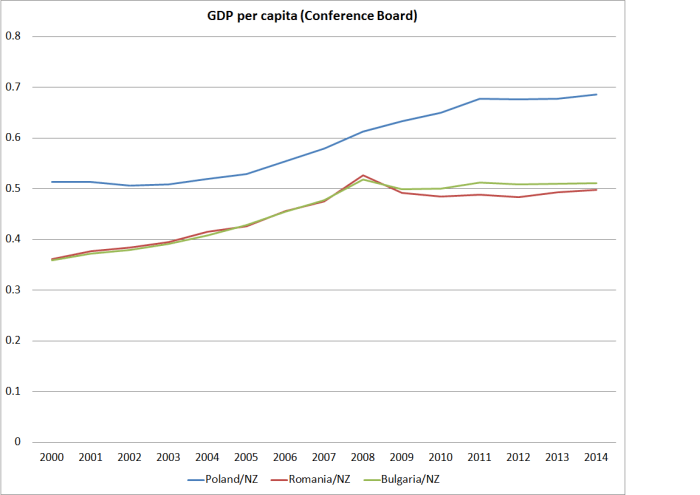
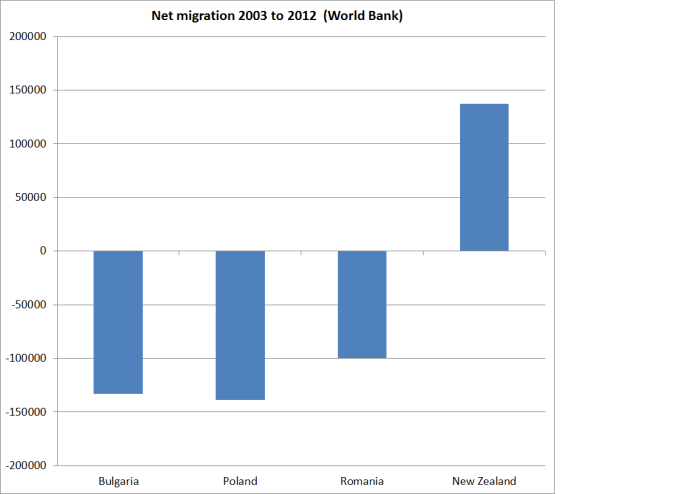
Glad to Prime Minister.  Consider Poland, which has been one of the strongest performing OECD countries in the last decade, and which has had steady net migration outflows.  Poland is gradually catching up to the living standards in Western Europe, but it has a long way to go.  In the meantime, the opportunities for many Poles are still better abroad.  Perhaps it is easy to dismiss Poland as just an ex-communist country, but it has done what New Zealand has failed to do –  make substantial progress towards converging with living standards elsewhere in the advanced world.  In 1989, Polish incomes were estimated to be less than a third of those in the United States.  Now they are almost half.

Bulgaria and Romania are less striking stories, but they are also countries with substantial net migration outflows –  again, the opportunities abroad are better than those at home.  But both countries have managed to grow materially faster than New Zealand since 2000, and have matched New Zealand’s per capita income growth in the years since John Key has been in office.

gdp pc nz vs poland etc

net migration nz and poland etc

Immigration policy is not, by any means, the whole story.  It probably isn’t even the bulk of the story in these countries.  But net inflows of people aren’t always good and net outflows aren’t always bad.  It depends.    There is no real reason to believe that the current net inflows to New Zealand –  or even the reduction in net outflows to Australia –  are cause to celebrate.  I suspect that, if anything, the inflow is compounding the underlying productivity problem.  But there is certainly no sign that it is either a response to us having solved those problems  ourselves (and thus being on some convergence path back to the rest of the advanced world) nor that the inflow will be any more likely to bring about a transformative lift in productivity than the previous inflows over the last 25 (or 75) years have.

Immigration, society, and the limits of knowledge

Last night the Goethe Institute and the New Zealand Initiative hosted a panel discussion on aspects of immigration.  The focus was not on the economic aspects  –  my arguments that our immigration policy has acted as a drag on economic performance got a mention only in the question time –  and I found it something of a challenge to pull together some moderately coherent thoughts around the implications of large scale movements of people, and what that means for cultures and societies –  indeed, whether those concepts themselves have much meaning or instrumental value.

Two of the speakers were themselves immigrants –  one had first come as a student in the late 1980s, and the other as a refugee from Rwanda after the mass murder of 1994.  They spoke from their experiences, and both offered interesting, if somewhat contrasting, perspectives.

Rob McLeod, former chair of the Business Roundtable (and countless other boards and committees) made what is probably best described as an in-principle case for open borders, although he pulls back from that in practice.  We had only a relatively short time each to present our own perspective, so I hope I’m characterising him fairly.  His principles for shaping immigration policy were

  1. Diversity is good; prejudice is bad. Exclusion and restriction are costly.
  2. A high premium on liberty and freedom to choose
  3. An obligation on everyone to obey the law.

His proposition was that the scope of the market should be extended as far as possible, and that those countries that had been open to immigration had generally benefited from it.  In the cases of possible exceptions, such as South Africa and Fiji, the roots of the problem had rested in coercion.

McLeod went on to note that more liberal immigration would generally enhance world welfare, and that world welfare should count for something in domestic policy setting.  He briefly made a case for immigration as one tool to counter terrorism, which he observed had (some of) its roots in poverty.  (My mind kept running towards Baader Meinhof, the Red Army Faction, and the IRA –  and that scion of a wealthy Saudi family, Osama bin Laden.)     I wasn’t quite sure how much more liberal McLeod would be in practice if he were in charge of immigration policy, but he did suggest that perhaps immigration quotas and targets might be something that should be negotiated multilaterally.

I was more sceptical.

My approach over recent years has been shaped by increasing doubts as to whether large-scale immigration has ever done very much economically for those who were in the country before the immigration began.   There is an arguable case in respect of the European migration to the United States, Canada, Australia and New Zealand.  Average incomes of the indigenous populations of those four countries are plausibly higher than they would have been if the colonies of large scale settlement had never been established.  But, even to the extent that is so, it is mostly because a new and more economically productive set of institutions  and people came in and largely displaced or replaced what was already there.  That might be the historical basis for modern New Zealand, but it isn’t a particularly attractive model to shape immigration policy debates today.  It was, essentially, a phenomenon of imperialism.    Mass migration generally was.

In my own remarks last night, I put a lot more emphasis on the part that cohesive cultures play in enabling societies –  state, clubs, churches or whatever –  to function effectively.  Cultures  –  broadly defined – develop, and are sustained, for a reason –  they encapsulate the tacit knowledge and understanding that help societies to work better.  They capture the things that unite people, in ways that strengthen the ability of those societies to manage the inevitable differences and difficult choices.

It isn’t clear to me that democratic societies can function very well in the longer-term without a reasonably strong common culture, or as a fall-back a single very dominant one.  Authoritarian ones might –  one could think of the Ottoman Empire.  Of course, we haven’t many strong and stable democracies at all (so the sample is small) but they seem particularly uncommon in the minority of states where there are major divides along racial or religious grounds.  Perhaps the only example I can think of at present is Israel –  and who would really be surprised if for one reason or another that experiment did not last many more decades.

The issue here is not about denying the gains from trade or the benefits of difference.  And since are no human clones, we all interact with (marry, work with, play sport with) people who are different than us.  And we gain in the process.  The question is more one about human nature, and the way in which strong well-functioning communities tend to form among those with whom we have important things in common.    And those strong common bonds enable communities to better do the things they exist for.  In the case of the state, we might think of that is mutual protection (external defence, law and order), mutual support (whatever form a society’s welfare system takes), and all the decisions states and communities take that affect the allocation of property rights.

In small communities –  eg families    the commonality might result from blood ties.  I might disagree forcefully with my brother but nothing changes the fact that he is my brother.  At the level of large communities, blood ties don’t bind us together.  It has to be about shared values (eg religions, including secularism) and, at very least, shared experiences and shared historical reference points.  Maintaining that commonality is perhaps never easy, but it is likely to be relatively easier with a relatively stable and homogeneous population, not one constantly displaced by large inflows of people from often quite different backgrounds (not better or worse, but different).  The challenge seems likely to be particularly great for free and democratic societies.

I argued that large scale immigration programmes are best seen as social engineering (and about as likely to prove useful as most such large scale government interventions).    Rather than allowing societies to evolve organically, negotiating their conflicts from a base of shared experience and mutual common destiny, immigration programmes put the government hand on the scales and tilt things, often rather sharply, one way or the other.   Our history was like that –  every Anglo immigrant who arrived in the years when Britons had fairly open access, tilted the scales, and the balance of power in society, further away from Maori.  The same went for Canada and Australia.   That may have suited the majority, but what of the minority that had once been the majority?   The limits of knowledge should forcefully confront all putative social engineers, who all almost always well-intentioned but (being human)  rarely recognise the long-term consequences of the choices they foist on us.

I’ve argued that we would be better off economically if we cut back quite severely our immigration programme.  But I think that if we did so, we’d also be better positioned as a society to build and sustain a degree of cohesion, drawn from shared experience and commitment, that would enable us to confront future challenges more effectively, and to deal with the permanent tension between the interests of Maori in New Zealand and those of the rest of the population.

Here is a fuller version (only five pages or so) of what I said last night.

The Sharing Game

And, yes, I did see the Prime Minister’s comment that recent record migration was “a reason to celebrate”.  I (mostly) disagree with him, but am out of time today, so will offer some rather narrower economic observations on his claim tomorrow.

What has been happening to private rents?

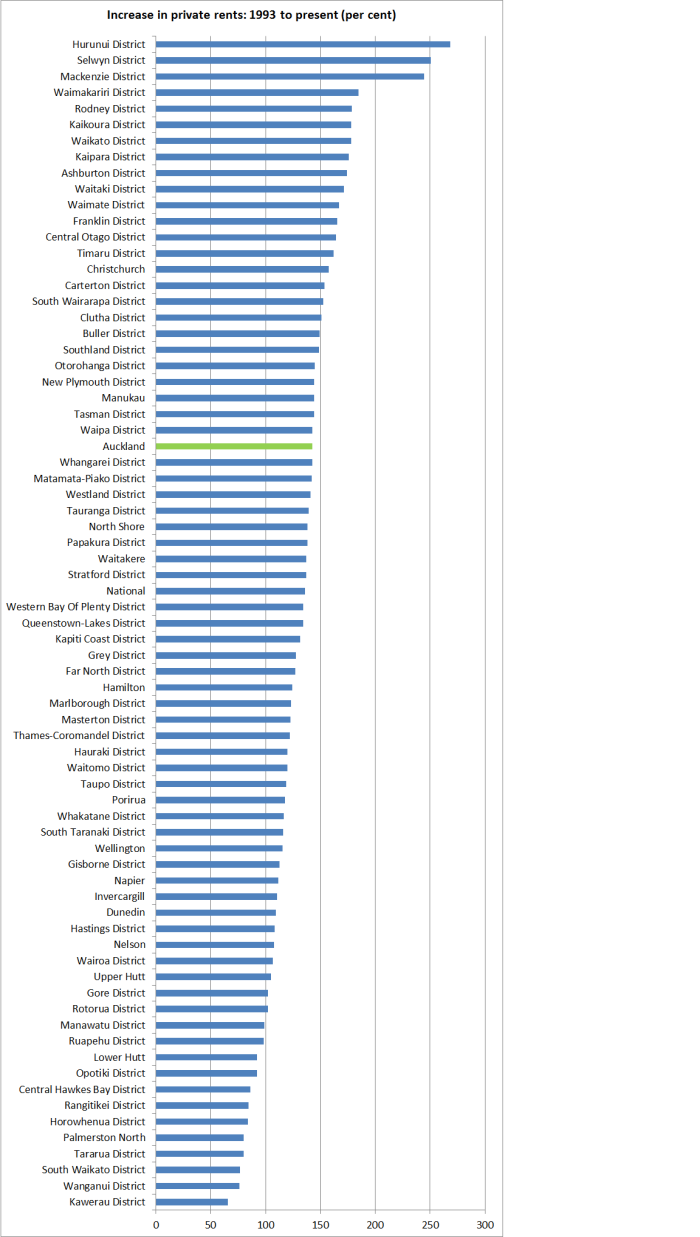
I don’t usually look at Sunday’s Herald but I was filling in time in an airport yesterday and noticed an article on private residential rents, drawing on MBIE’s tenancy bond database.  I don’t think I had previously realised that the data were easily available, at both a TLA and regional level.

One of the striking aspects of the house price boom has been the way rents have lagged well behind house prices.  House price to rent ratios have increased substantially.  Of course, in many ways that should be no surprise.  After all, real interest rates have fallen very substantially over the last 25 years or so  (having risen sharply over the previous decade).  Even in New Zealand – with the highest real interest rates in the advanced world –  real interest rates are lower than at any time in modern history (the heavily regulated period of the 1970s and early 1980s excepted).  Falling rental yields might reasonably have been expected, and that is what we have seen.

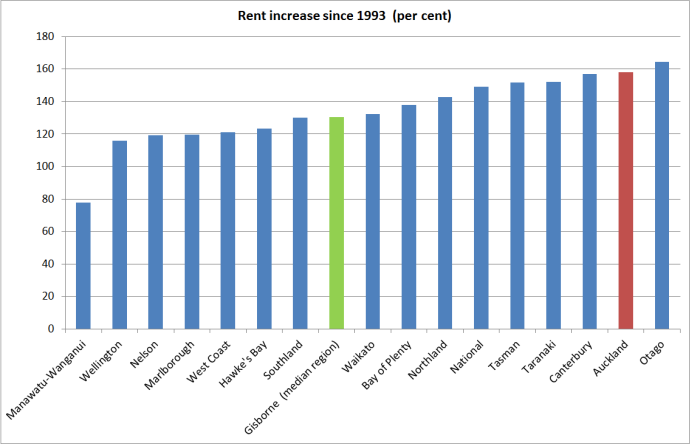
The MBIE data go back to the start of 1993. Since then, consumer prices (the CPI) have risen by around 60 per cent.   Average private rents on this measure have risen by about 150 per cent in that period.  The QV measure of house prices has risen by just over 300 per cent in that time.

Perhaps what is most striking, and something the Herald article didn’t bring out, is how similar Auckland’s experience has been to that of much of the rest of the country.    Since the start of 1991, Auckland rents, on this measure, have risen by 158 per cent.  Those in Gisborne –  the median regional council – have risen by 130 per cent.  Auckland rents have risen faster than those in most of the country, but they just don’t stand out the way that the increases in Auckland house prices do.

rents since 93

And if we restrict the analysis simply to the period since, say, 2007, the picture is not materially different.

And what of incomes?  Nominal GDP per capita increased by 144 per cent from 1992q4 to 2015q2.  Even in Auckland, rents have not increased much relative to (national) average per capita GDP.  Purchasing a house might have become “unaffordable” for many, but accommodation doesn’t appear to have.

And that conclusion is reinforced when one recognises that these MBIE data do not purport to be like for like measures.  The average house today is larger than the average house in 1993.  The average house is better appointed now than in 1993 (more likely to have double-glazing, heat pumps, or central heating).  And as the home ownership rate has dropped in the intervening years, it is likely that the median rental property in 2015 is further up the 2015 spectrum of New Zealand houses than the median rental property in 1993 would have been along the spectrum of New Zealand houses in 1993.

In the CPI, Statistics New Zealand attempts to adjust for the quality and compositional issues.  However, they only appear to report, in Infoshare, rental prices since 1999.  And even that series, which includes both public rentals and private rentals, is made harder to read by the abandonment of market-related rents for state houses in 2000/01.  But since 2001 (ie after the levels adjustment from the policy change), the CPI rentals component has risen by 37 per cent (very similar to the change in the CPI over that period), whereas the MBIE private rents series has risen by 87 per cent.  Per capita nominal incomes have risen by 71 per cent over that same period.    Even over the period of the biggest house price boom in modern history, a constant-quality house looks to have become more affordable to rent, not less.  And, of course, that is what one would normally expect.  Stable long-term ratios of house prices to incomes, for example, tend to reflect the fact that as incomes rise, the size and quality of houses tends to increase.

Of course, if land use restrictions –  in conjunction with policy-driven population pressures –  had not driven urban land (and house) prices sky high, we might perhaps have expected to see real rents falling.    All else equal –  which it never is –  sustained lower real interest rate lower the real cost of providing rental accommodation services.  But the fact that Auckland rents have not increased enormously relative to those in the rest of the country tends to reinforce the idea that it is not so much an issue of an extreme shortage of accommodation in Auckland, as of the regulatory restrictions on land use.  Such restrictions, which “bite” more in Auckland because of the population pressures, offer returns to landlords through actual/expected capital gains.

And for anyone interested in the rental increases at the TLA level, here is that chart.  (To deal with a few missing observations at the start of the period, this chart uses the percentage increases from the first 12 months of the series  to the most recent 12 months).

rents since 93 by TLA

Converging on the US: trends in government spending

I was dipping into the latest update of the OECD Outlook database, and landed on the tables for government current spending and revenue as a share of GDP.

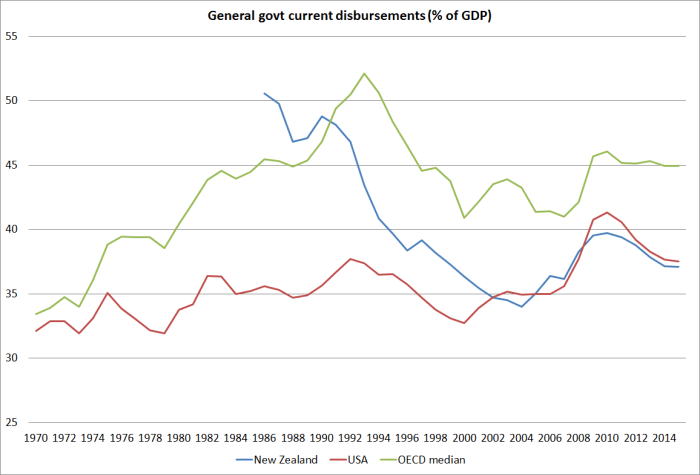
Spending first. I’ve shown here the shares for the US, New Zealand, and for a median of the OECD countries for which the OECD has data all the way back to 1970. Unfortunately, the New Zealand data aren’t available before 1986 – which was probably about the time government spending as a share of GDP peaked here.

gen govt disbursements.png

What I found interesting was how general government spending as a share of GDP in New Zealand has converged with that of the United States. Back in 1970, the United States was only just below the median for the other member countries for which there is data all the way back.  Now, both New Zealand and the United States are well below the median (whether for this sample, or for the whole OECD – for which group the median is now 42.6 per cent). The role of the US government in its economy may, in effect, be even larger than that in New Zealand, since there are so many “tax expenditures” in their system. Mandated private spending, such as that under Obamacare, would also add to the effective US total.

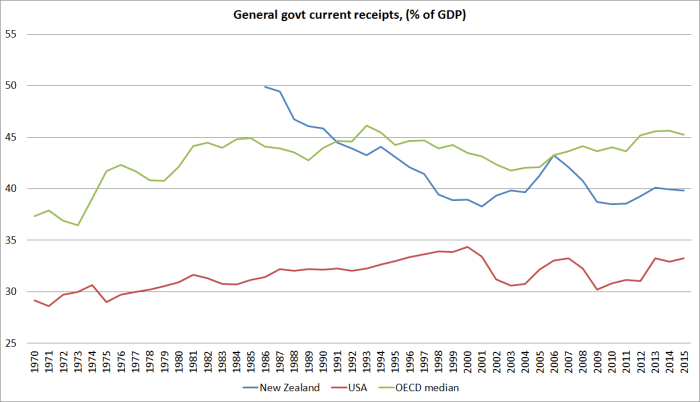
Of course, our government accounts are close to balanced, and those of the United States are not. When we look at current government receipts we are about half way between the US and the OECD median.

gen govt receipts.png

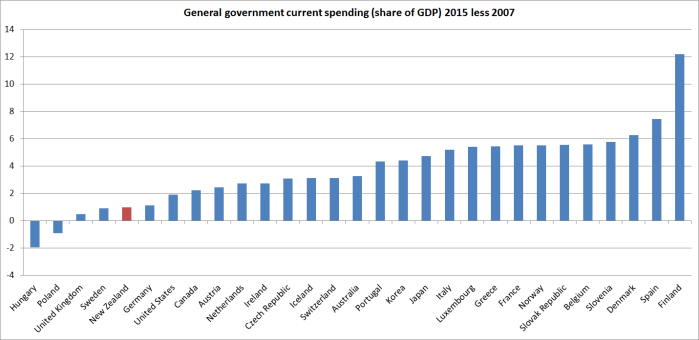
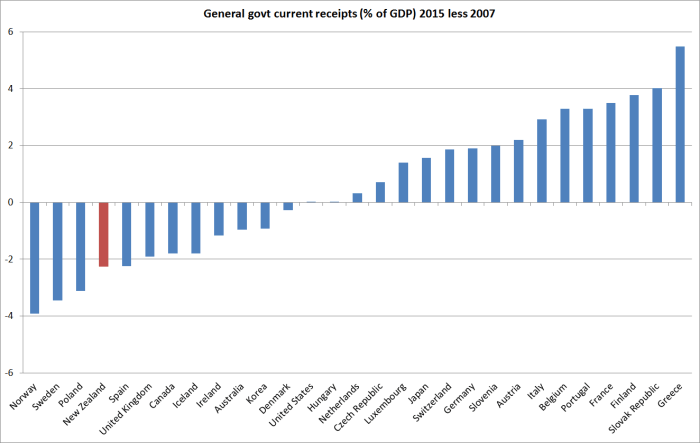
What about changes over the last few years? For all the talk of austerity, in only two OECD countries – Hungary and Poland – is current government spending as a share of GDP lower this year than it was in 2007, the last pre-recessionary year. In New Zealand, for example, general government spending this year is estimated to be almost a full percentage point of GDP higher than it was in 2007. At the other end of the chart, 11 of these 29 countries have government current spending five percentage points or more higher than it was in 2007. Check out Finland – an increase that almost defies belief over such a short period, at least outside wartime.

spending 07 to 15.png

And what of taxes? The median country is estimated to have seen almost no change in the government revenue share of GDP since 2007. New Zealand is among the countries with the largest reductions, but then we were running surpluses prior to the recession. Greece has, quite remarkably, managed a very large increase in the revenue share of a falling GDP.

receipts 07 to 15.png

Most of the countries with large increases in the government spending shares are still estimated to have material negative output gaps. In principle, an eventual recovery might help shrink the relative size of government. But, for most, it is not remotely clear where the sustained recovery is going to come from, and when.

On which note, for a bit of gloomy weekend reading, I suggest Ambrose Evans-Pritchard’s piece on Finland. The tragedy of the euro, compounding what would in any case have been a difficult economic adjustment.

Housing: what would the market do?

My post last week about the Wellington City Council’s consultation meeting, on its proposals to amend the district plan to allow more medium-density housing in Island Bay, attracted some attention and a range of interesting and thoughtful comments.  Readers seem to have taken from the post what they wanted (those opposed to more density focused on the critical comments about the Council’s case, those in favour on the critical comments on the residents and the planner mentality that dominates the Council).   Perhaps that reflects my own ambivalence.  In general, I favour allowing greater flexibility to property owners, but I don’t think we  would see much pressure for the sorts of development that concerns many residents, at least beyond the immediate fringes of the central city (Thorndon, Mt Victoria, Kelburn etc) if councils did not continually and actively resist the expansion of the physical footprint of cities.

It perhaps also reflected the fact that I’m not overly affected personally.  We are probably 12 minutes walk from the “town centre”, not the rather arbitrarily-chosen 5 or 10 that the Council focused on.  If a slightly largely population increased the chances of the convenient neighbourhood supermarket surviving into the years of my dotage, so much the better.   And it would be almost impossible for any conceivable development to materially impair either our sun or our views.

However, there is no point pretending that the sentiments of residents are just illegitimate or misguided.  Or that what happens elsewhere in their neighbourhood cannot impinge on their wellbeing. Nor do I favour riding roughshod over the concerns –  in fact, on a city or countrywide basis it is just not going to happen.  As I’ve pointed out previously, I’m not aware of any examples anywhere where tight land use restrictions, once put in place, have been substantially unwound.

Perhaps as importantly, the  private marketplace itself has mechanisms to deal with the sort of issues and concerns that drive the vocal residents of Island Bay or Khandallah, at least in respect of new developments.

As the Productivity Commission’s recent land supply report noted

Restrictive covenants in new subdivisions are a very common feature of property developments in New Zealand.  The mayor of one fast-growing New Zealand city told the Commission that all subdivisions in their area were subject to detailed covenants.

And according to one source I looked at, around 55 million Americans now live in “homeowner association” complexes –  some mix of apartment blocks and suburban developments/gated communities etc.    These arrangements  presumably exist because they meet a demand, and hence enable developments to occur more profitably than otherwise.  They add value to the people’s homes.    They are not just a legacy of centuries gone by, but have become much much more popular in the last few decades (at a time when local authority planning restrictions have also become more onerous).

I’m no expert in these sorts of arrangements.  As the Commission notes, in some cases they just last until all the homes in a particular development have been built (ie they govern what is first put on the section, and nothing subsequent to that), but many others are permanent.  The rules are often very detailed –  the example the Commission cites particularly caught my eye when it specified the details of the size and construction of the letterbox.  The focus is clearly intended to be on collective action provisions that limit the possibility that some future action of a neighbour might impair the value of my property.

I wouldn’t want to live in such a tightly restricted subdivision myself.  As one succinct summary put it, they aren’t the place for people who don’t like being told what to do.

The Productivity Commission seemed rather ambivalent about these covenants.  They had three “findings” and one “recommendation”.  One was arguably just a factual statement

Covenants established in new subdivisions are increasingly common and impose detailed restrictions on purchasers.

although that could easily have been reworded to include the phrase “provide considerable protections, and impose detailed restrictions on, purchasers”.  That is, after all, what contracts do in all areas of life.

The Commission finds that

regulatory controls on covenants should reflect both the costs and benefits of covenants

which is fair enough perhaps, but fails to recognise that these are already a market solution to a revealed demand.  Market contracts might reasonably be assumed to have internalised the costs and benefits already.  The case for regulation isn’t really made.

The Commission also notes that

Covenants reduce the flexibility of land use now and in the future, and increase the cost of constructing dwellings.

Of course, the first part of the sentence is true, but really the point of these voluntary contracts.  Voluntary contracts exist to enhance welfare.  Flexibility is not an unalloyed good.  The second point is unsupported in the report –  all it seems to amount to is that buyer and sellers have voluntarily agreed that, as a condition of buying in that development, they will not use certain lower end building materials. Why is that a public policy issue?  It does not detract from the ability of other people to build using those materials and technologies.  And each covenanted development presumably has to survive the market test, in competition with other covenanted developments, and standalone dwellings (new or existing).

Consistent with the uneasiness that pervades the discussion, the Commission then recommends (page 118) that

The Ministries of Justice and of Business, Innovation, and Employment should review the legislative provisions governing covenants with a view to:

  • reducing the proportion of landowners required to agree to covenant changes from all to a super-majority; and
  • introducing a statutory sunset period on restrictive covenants of 25-30 years.
I don’t have a particular problem with super-majorities (they are not uncommon in other collective action areas, eg bondholders dealing with distressed debtor).  But, equally, nothing stops such contracts developing voluntarily, and it isn’t clear what the Commission sees the problem as being.  Nor is it clear how the Commission would minimise the risk of abuses of minorities.  Perhaps, at minimum, any super-majority would have to be prepared to offer to purchase the property of an aggrieved minority at a price which reflected the assessed benefit of the changed provisions to the majority.
More egregious is the suggestion of mandatory sunset clauses, effectively banning private property owners from voluntary collective action solutions for more than, say, 25 or 30 years (and as property will trade on the basis of expected future use, even the value of a 25 year covenant will start to decay pretty quickly after, say, 15 years or so).  Again, what is the public policy interest that should override the freedom of homeowners to enter voluntarily into contracts?   The Commission cites one jurisdiction in which the term of covenants is statutorily limited (Ontario, at 40 years), and one example (Massachusetts) where after 30 years covenants can be renewed for 20 years at a time.  But it appears that the rest of the 55 million Americans living in such developments are free to establish permanent covenants, which can generally only be dissolved by unanimous agreement.

The Productivity Commission is uneasy about these increasingly widespread private contracts.  But I wonder if we shouldn’t think about moving in the opposite direction.  Why not facilitate covenants of a sort in existing neighbourhoods?  Is there any obvious reason why, say 1000 households in Island Bay or Khandallah should not be able to  mutually agree that only, say, the current planning rules will apply to their sections in perpetuity, with perhaps a 75 per cent majority required to change those rules in future?  I can’t think of one.  I guess one can argue that the developers, and purchasers, in 1890 should have envisaged these issues and established the covenants then.  But, actually, the then borough had only 600 rateable properties, and if they have given the matter any thought the residents might reasonably have assumed they had effective control through the ballot box.    When Councils pick off one suburb at a time –  as opposed, say, to amending the district plan to allow more medium-density housing everywhere in the city –  effective control through the ballot box is much attenuated.  Which suburb has the “misfortune” (from the aggrieved residents’ perspective) to be chosen for medium-density housing, is no longer a matter of collective agreement among affected residents, but of who can lobby the most effectively and  shift the issue onto some other suburb.  That isn’t the market at work.

I’m not sure what the current legal position is.  Perhaps local property owners could already put in place such restrictive covenants now, with the consent of every one of those involved?    But why not consider amending the relevant legislation to provide for a standard set of rules that a group of homeowners could voluntarily adopt, by say, a 90 per cent initial majority of those in the area concerned?    That would empower homeowners (you would presumably vote for change when the increased value of your land, under rules allowing more intensification outweighs the risks of loss of sun, views or the “changing character of the neighbourhood”).  And it would remove the arbitrariness that exists in the current law.  I’m not suggesting giving legal force to an ability to force your number to mow his or her lawns, or get rid of the gaudy letterbox, but it would enable communities to “protect” themselves (mutually agreeing to entrench existing planning laws for their own properties)  –  or to remove those protections themselves to take advantage of new opportunities –  at a level that existing planning legislation often attempts to do, until it doesn’t (ie until some distant planner or councillor suddenly decides it is time for change).

Perhaps the grand houses that once filled The Terrace might once have been subject to such covenants.  Such houses are probably not the best used of that land today.  Owners would be free to recognise that opportunity, but to do so collectively.

Half of me thinks this is a second-best suggestion, but so widespread are such covenants in private developments here and abroad that I’m not even sure that is true.

Of course, the quid pro quo for such an amendment –  which would, at the margin, probably slow any process of intensification of a particular neighbourhood that might otherwise take place –  would have to be legislative provisions that removed the  ability of councils to restrict the physical expansion of cities and towns.  If, say, all land was automatically zoned residential (in addition to any other approved uses it might have)  and, as a default, was able to be built on to a height of two storeys, there would be ample scope for population pressures –  themselves largely now the consequence of policy choices – to be met with new building on new sites.

From voters’ perspectives, such a bundle of changes look as though it ticks most boxes.  It allows much more new peripheral development more cheaply than occurs now [1].  That, in turn, would remove some of the artificial pressure for intensification  –  arising from councils directly, and from the market because councils restrict the physical expansion of cities.  And, at the same time, it recognises a right for local communities, at a much lower level than whole cities (or even whole wards), to collectively make decisions about the nature of future potential land use changes for their properties.  Since such contracts are increasingly widespread in new developments here and abroad, they seem to reflect real pressures that have real economic value to citizens as property owners.

There is no real, or necessary, tension between keeping housing affordable and allowing property owners to act collectively, in response to opportunities (costs and benefits) to make decisions as to how their land is able to be used.

[1] And, yes, pricing the infrastructure and transport connection issues still has to be resolved.

Weak expectations and accountability

The Reserve Bank released the results of its Survey of Expectations yesterday afternoon  – aggregated responses from 60 or so relatively informed participants.  For some reason, this quarter they have separated the release of the survey of household inflation expectations, which is now apparently not due until next week.

After the release of the previous results in August I wrote a post that provided a fairly downbeat assessment of the information in the two surveys, a little in contrast to the commentaries I saw at the time from market economists.

I’m a participant in the survey, and had actually revised many of my responses up a little from those I provided in August.  But my reading of the results suggests that the respondents as a group are about as downbeat as they were in August.  In particular, there is little sign of any sustained pick-up in inflation expected over the next year, despite the repeated Reserve Bank rhetoric.

This isn’t going to be a long post, but just a few highlights:

First, respondents expect the economy to do no more than limp along, beneath capacity, for the next two years.  The unemployment rate is expected to stay at or above 6 per cent throughout, and GDP growth of 2.2 per cent and 2.4 per cent is expected in next two years.  Those would be fine growth rates for Japan, with a slightly falling population, but New Zealand’s population growth was estimated at 1.9 per cent in the year to June 2015.   There doesn’t look to be much per capita growth envisaged by respondents, even with the lagged effects of monetary policy easing, unless respondents are expecting quite a sharp reduction in the net migration inflow.

Second, inflation expectations remain very subdued. Fortunately for the Reserve Bank, two-year ahead expectations have done no more than reverse last quarter’s slight bounce, and are still at 1.85 per cent.  But one year ahead expectations are only 1.5 per cent, and expectations for the second six months of the one year period (beyond the immediate “noise” of oil price fluctuations) are no higher than those for the first half.  In the whole period since the recession started in 2008 only once have those second six month expectations been materially lower than they are now,     Respondents still appear to loosely believe that the Reserve Bank is aiming for 2 per cent, but they aren’t seeing any signs that suggest the Reserve Bank will get it there soon.  Since the various core inflation measures are 1.5 per cent at most, at best they seem to envisage a continuing undershoot.

inflation expecs

Third, respondents don’t appear to expect much more of an OCR cut.  Even a year ahead, respondents expect the 90 day bill rate to be 2.79 per cent, probably not even consistent with a full expectation of the OCR being cut to 2.5 per cent.

However, the survey also asks respondents about their expectations for monetary conditions, both currently and a quarter ahead and a year ahead.  Each respondent can decide for themselves what counts for assessing monetary conditions –  the exchange rate, the OCR, equity prices, retail lending rates, LVR restrictions, or whatever.  Since the survey began in 1987 there have only been two quarters when respondents thought conditions were easier than they are now.  But typically when respondents think conditions are easier than neutral they don’t expect that state to last for long –  looking a year ahead they typically expect things to tighten.  For the last year or so that hasn’t been the case.  The extent of the extra easing isn’t large, but the fact that is expected at all in unusual.  It is not a sign of confidence that the Reserve Bank has yet got on top of things.   Expectations a year ahead are for looser conditions than they’ve expected at any time since this question was first asked in 1999.

expected mon con.png

The OCR is still 25 basis points higher than it was at the start of last year (as are the floating retail rates the Bank reports).  Over that period, inflation expectations (at least measured by this survey) have fallen by about half a percentage point.  Inflation expectations implied by the spread between indexed and conventional government bonds appear to have fallen a bit further (to only around 1.3 to 1.4 per cent).  So real short-term interest rates are at least 75 basis points higher than they were at the start of last year.  Why? For what?

Since that time, we’ve seen little or income growth, little real per capita GDP growth, the unemployment rate stop falling and start climbing, and inflation continue (on a core basis) to be well below the 2 per cent target midpoint (focal point) that the Governor explicitly signed up to only three years ago.

As I noted in my post yesterday about Stan Fischer’s speech, effective accountability in any area of life isn’t just about talk: it  has to imply that there is potential for adverse consequences for the independent decision-makers themselves. As in any area of life, a single mistake is usually not a safe signal of anything much.  But established patterns of error must raise more serious questions if the much-vaunted accountability is to have any real meaning.   This is looking quite like a repeated pattern of errors, compounded by a reluctance to acknowledge errors or to learn from past mistakes.

Stan Fischer on central bank independence

Stan Fischer is one of the global elite of macroeconomic policy. Born in what is now Zambia, he has spent most of his adult life in the United States. He was Chief Economist of the World Bank, First Deputy Managing Director of the IMF, Governor of the (central) Bank of Israel, and is now Vice Chairman of the Board of Governors of the Federal Reserve.   He spent several years making a great deal of money at Citigroup in one of those door-opening roles senior officials and politicians often gravitate to.  Fortunately for his reputation, the next big job came up before Citi ran into its latest crisis over 2008/09.

In his time as an academic, Fischer, together with Guy Debelle, came up with the nice delineation between “instrument independence” and “goal independence” in analysing monetary policy arrangements.  In practice, the distinction is never as clean as all that, but one can think of our Reserve Bank having “instrument independence” in monetary policy (it can set the OCR wherever it likes from day to day) but as having relatively little “goal independence”.  The Minister of Finance takes the lead in setting the policy targets and although the Governor is a party to the PTA, the PTA has to be agreed before the Governor is formally appointed.  The Minister does not need to appoint someone who will not agree with his proposed policy targets. And, in principle, the Minister can have the Governor dismissed if the Minister is satisfied that “the performance of the Governor in ensuring that the Bank achieves the policy targets …has been inadequate”.

In many other modern central banks, there is no counterpart to the Policy Targets Agreement, and the statutory objectives for monetary policy are written sufficiently loosely that the central bank has a fairly high degree of goal independence too.   The Federal Reserve  –  where key policymakers rarely even quote the relevant section of the Federal Reserve Act[1] –  is a good example of the latter.

Stan Fischer gave a speech on central bank independence a couple of weeks ago, in which he discussed independence in respect of both monetary policy and (some aspects of) financial stability and regulatory policy.   I thought it was a slightly disappointing, rather complacent, speech.

Part of the context presumably is the simmering discontent with the Fed.  The 2016 Presidential race is getting underway and demand for changes to the Federal Reserve  legislation governing the Fed are being heard –  something that used to be common in New Zealand, but rarely seen elsewhere.

Two issues in particular have prompted legislative initiatives in the United States. One is to limit the Federal Reserve’s operational flexibility in response to financial crises, and the second is the ‘audit the Fed” movement.   I wanted to focus on the audit side.

At present, although the Federal Reserve is subject to regular financial audits, it is exempt from GAO reviews of “deliberations, decisions or actions on monetary policy matters”.   The purpose of the exemption is, supposedly, to protect the day-to-day operational independence of the Federal Reserve  –  the fear, in the words of a Wall St Journal piece, is “that aggressive members of Congress unhappy with a Fed interest-rate decision could dispatch the GAO repeatedly to investigate, essentially using the GAO as a way to pressure the Fed to change its policies.”

I don’t find this resistance overly persuasive.  After all, as Fischer points out, there is lots of external scrutiny and debate around the actions of the Federal Reserve.  Members of the FOMC need to have the fortitude and integrity to make the decisions they think are needed, in accordance with the law, regardless of the weight of external pressure.  If they can’t take the heat, there is always the option of finding another job.  It isn’t clear to me why GAO inquiries, no matter who prompts them, represent a more serious threat.  Either Congress can or can’t overrule the FOMC on specific decisions.  It can’t now, and wouldn’t be able to under any of the legislative initiatives that are around.  Anything else is scrutiny and steps towards effective accountability.

A similar fight is going on in the UK at present, where the Bank of England is fighting back (successfully it appears) against government plans to allow the National Audit Office to undertake value-for-money audits of Bank of England activities (the Court –  the equivalent of our Board –  will be able to block such audits).

Consider, by contrast, the situation in New Zealand.  Not only is the Reserve Bank Board paid to scrutinise and hold to account the Governor, in respect of all his responsibilities (including, quite explicitly, monetary policy), but in New Zealand the Auditor General is (in the Reserve Bank’s own words) “able to commission quite extensive investigations into the activities of the Bank”

And then there is section 167 of the Reserve Bank Act, which explicitly provides the Minister of Finance with powers to commission a performance audit of any or all aspects of the Bank’s responsibilities under the Reserve Bank Act [but not, it appears, those under the other Acts the Reserve Bank is responsible for?]

167 Performance audit

  • (1) The Minister may, from time to time, appoint 1 or more persons (whether as individuals or as members from time to time of any firm or firms) to carry out an assessment of the performance by the Bank of its functions and of the exercise by the Bank of its powers under this Act.

    (2) As soon as practicable after completing an assessment the person appointed shall submit a report to the Minister setting out the results of that assessment.

    (3) The report stands referred, by virtue of this section, to the House of Representatives.

    (4) A person appointed to conduct an assessment under this section, for the purpose of conducting that assessment,—

    • (a) shall have full access to all books and documents that are the property of or that are under the control of any person relating to the Bank or its affairs:

    • (b) may require any director, officer or employee of the Bank or any other person to answer any question relating to the Bank or its affairs:

    • (c) may, by notice in writing to any person, require that person to deliver any books or documents relating to the Bank or its affairs in the possession or under the control of that person and may take copies of them or extracts from them.

    (5) Nothing in subsection (4) limits or affects section 105.

    (6) The fees of the person appointed to carry out an assessment under this section shall be paid out of the funds of the Bank.


Of course, the section 167 powers have not been used in the 26 years since the Act was passed (although Lars Svensson’s inquiry into New Zealand monetary policy, commissioned by Michael Cullen, might be seen in that light)

And yet the best argument that Fischer can put up in response is that if such further audit or review powers were established

“the Fed would be subjected to the very sort of political pressure from which experience suggests central banks should be independent. Instead, a modern governance framework calls for the political system to give the central bank a mandate along with the operational freedom to pursue that mandate, supported by transparency and accountability”

Central banks are very keen to conflate the ideas of transparency and accountability – the Reserve Bank did it recently in their Bulletin on monetary policy accountability – but apply the parallel to an employee. Effective accountabiity for an employee rests on the simple fact that, after all the discussion and debate, if the employee does not work to the required standard he or she can be dismissed.

Members of the Federal Reserve Board cannot be removed from office for their policy choices, no matter how bad they might be. That is not uncommon for central bankers internationally, but it severely compromises the meaning of accountability. Central bankers don’t face re-election either. Reappointment is certainly one opportunity for effective discipline, but in principle members of the Federal Reserve Board of Governors are appointed for 14 year terms.

If Fischer is serious about maintaining a distinction between instrument independence and goal independence in the United States it is not clear why he would not support a move more towards a New Zealand system, where policymakers can be removed if they make bad policy. But if that can’t be practically be done – and perhaps it can’t in a US system, and perhaps it isn’t a practical option even here – it is far from clear why he (and his colleagues would continue to push back against measures that would provide for more official scrutiny of the choices and actions of the Federal Reserve. It is all very well to say that markets, the media, and think tanks scrutinise the Fed, but statutory provisions bring with them statutory powers, including access to relevant papers and information. I’m not suggesting that the Rand Paul “audit the Fed” bill has things precisely right,   But as Vincent Reinhart, a former very senior Fed monetary policy official, has argued, what possible threat could a twice-yearly “GAO audit of monetary policy:, a week before the Fed’s own semi-annual monetary policy report to Congress”, be?

Of course, one could reasonably counter “what good would it do”? But that is surely a matter for Congress, as the people’s representative, not for those who are being reviewed. Central banks are given very great power and it is up to us, as citizens, to find ways to effectively hold them to account. That has to include the ability to put pressure on them, even if the day to day decisions are finally theirs.

The New Zealand model has not worked particularly well in that regard – the Board is just too close to the Governor, and Parliament’s Finance and Expenditure Committee has too few resources and incentives. But equally, one can hardly say that the powers that do exist – which go well beyond those in the US – have threatened the operational independence of the Reserve Bank, on monetary policy or any of its other functions.

But surely the practical problem for citizens is the difficulty of securing effective accountability. There is plenty of debate about what central banks do – at least in the US – but accountability is more than debate, and has to include the ability to make a practical difference.

There is a price for operational independence. If legislatures do not think that those wielding the operationally independent powers are doing so appropriately, on  average over time, and yet cannot effectively hold decision-makers to account for their choices, operational independence itself will come under threat.  In a sense, that is what the Warren-Vitter legislative initiative (which the Fed is also fighting) seeks to do in the United States, in further restricting the Fed’s freedom of action in a crisis.   As I’ve noted previously, the US authorities (Treasury and the Fed) already have far less operational autonomy in a crisis that the New Zealand authorities do. In some respects, the New Zealand powers are disconcertingly wide –  the Public Finance Act appears to allow the Minister of Finance to bankrupt New Zealand with no parliamentary vote, and the Reserve Bank also has uncomfortably unconstrained powers in these areas. I suspect that something between the two models provides a better balance, but at least we have formal powers to review, and potentially dismiss, the Governor if he acts unwisely or inconsistently with his statutory mandate.  The US system has no such power.    If anything, it looks to me as though the Fed –  were it operating consistently with the goal vs operational independence model –  should be embracing as many reviews, and as much official scrutiny, as possible.

But perhaps that is the problem with global elites, in macro policy or other areas.  They often don’t really believe in effective accountability to citiznes, or in their potential for making mistakes.  They believe, too readily, in the rightness of their own judgements.  Institutional design has to operate with the limits of human knowledge and incentives. Humans –  even very able ones – and human institutions make mistakes.  And yet in the whole of Fischer’s speech, the words “error”, “mistake” and “misjudgement” don’t appear once.  Good models for governing powerful institutions have to built, and refined, starting from the proposition that people like Stanley Fischer, Ben Bernanke , and even Graeme Wheeler, will actually make mistakes.

[1] “The Board of Governors of the Federal Reserve System and the Federal Open Market Committee shall maintain long run growth of the monetary and credit aggregates commensurate with the economy’s long run potential to increase production, so as to promote effectively the goals of maximum employment, stable prices, and moderate long-term interest rates.”