Debating immigration

Someone yesterday sent me a link to a column from a Canadian newspaper in which a prominent Canadia academic was calling for a five-year pause in Canada’s high target rate of non-citizen immigration, to let housing (and other infrastructure) catch up to the population-driven increase in demand.  I can see the case when it comes to infrastructure, but I suspect that in Vancouver as in New Zealand the housing issues are mostly about land.  If the land use regulations aren’t fixed then a temporary pause in immigration for just a few years won’t make more than a temporary difference.   And in New Zealand, at least, the real economic problems associated with rapid immigration –  plenty of jobs, but few good economic opportunities to enable us all to really prosper –  have to do with the average level of immigration we target over time, not with the peaks and troughs in individual years.

But in reading that column, my eye lit on another article on the same site, “How to debate immigration without distorting facts and foes” .  It began

Canada is one of the few advanced countries that can’t seem to hold an authentic public discussion about immigration policy.

Canadian boosters of high immigration and those who oppose it are mutually contemptuous. Their verbal boxing matches are dominated by sloganeering and name-calling.

If Ottawa is ever going to take seriously public opinion to fine-tune its immigration policies, the combatants need to follow a few rules. They may need a referee, who acts fairly when others are losing their heads.

I’m not so sure that Canada is that different than other countries, including New Zealand and Australia.  But the article was about a new column by Andrew Griffith, a former senior official in Canada’s immigration bureacracy, who took early retirement, to undergo cancer treatment, and now has a interesting-looking blog Multicultural Meanderings  which touches on issues of culture, immigration, identity and so on.  I get the impression that he is generally rather sympathetic to Canada’s fairly liberal approach to immigration.   But what interested the journalist, and me, was the piece Griffith had written recently for a public policy forum on “How to debate immigration issues in Canada” .

Griffith begins

Given the polarization between those who advocate for more immigration and those who advocate for less, we need guidelines to facilitate more respectful and informative debates. I also suggest some alternative language for both viewpoints, to provoke reflection.

And he summarises his suggestions in two tables, one for those favouring more immigration –  apparently a live option in Canada at present –  but presumably also applicable to those defending the quite high rates of non-citizen immigration Canada already promotes.

and one for immigration critics

Not all of it is directly relevant to New Zealand debates, but much of it probably is.  I’d add, for both sides, “focus on the specifics of your own country’s experiences and constraints, even when informed –  as you should be –  by overseas experiences”.  These are important issues –  about economic performance, but also about culture and society –  and if all sorts of important issues often excite emotion (on both sides of any issue), it is likely to be more productive if the emotions and the analysis can be separated, to allow civil reflection on the arguments and evidence various people bring to the debates.  On the other hand, of course, political discourse and popular debate are never likely to proceed like some idealised academic seminar (and I stress the word “idealised” here).

On a more immediate note, Newsroom has a piece this morning on concerns in some industries about how they will/would cope if immigration to New Zealand was to be cut back.     The focus is particularly on a few industries that have made themselves very heavily reliant on immigrant labour.    If the rules make it relatively easy to recruit labour to particular occupations, and such labour is available from relatively poor countries, it is hardly surprising that the industry concerned will gravitate to a production model in which (a) wages in that sector are pretty low by New Zealand standards, and (b) a large proportion of the workforce is foreign.  New Zealanders become reluctant to seek work in the sector because there are better opportunities in other sectors.  It isn’t a state of nature, or something inevitable, just a product of the regulatory environment –  the rules.

The aged care/rest-home sector seems to be a prime example of this sort of phenomenon.  It is a growing sector –  ageing population and all that –  heavily reliant on government subsidies (and thus cost-restraint pressures), and is a totally domestically-focused sector.

As I’ve noted here previously, if overall immigration flows were sharply cut back, there would be short-term adverse effects on some sectors that have become particularly reliant on immigrant labour.  But there would also be a reallocation of labour within the economy: demand for labour would fall markedly in sectors (often not particularly reliant on immigrant labour, like construction) that depend heavily on population growth, and those workers would need to find work elsewhere.   In sectors like dairy farming and tourism –  previously heavy employers of immigrant labour – employers would be looking for locals to replace the immigrant labour they could no longer hire.   People might be reluctant to take those jobs, in which case employers might have to offer higher wages.  But because the exchange rate would fall –  probably quite a lot –  if immigration was cut back substantially, those employers could afford to pay higher wages.  Business activities in the tradables sector would be more profitable, and in relatively short-order the labour market would adjust (it would take time, and I’ve never suggested changing the rules overnight).

But the rest-home sector is different.  Cut back their access to immigrant labour, and they might have to offer more to attract New Zealanders to do the jobs.   New Zealanders will do the jobs, at a price.  30 or 40 years ago when my grandmothers were in aged-care homes, the bulk of the employers will have been New Zealanders.  The question is likely to be largely one of price (ie wage rates).

But rest homes may not have a lot of pricing power.  They are typically heavily reliant on fixed government subsidies, and if immigration is cut back they can’t suddenly turn themselves into an export industry.  There is no more income to support higher costs.

The industry pushes back in the Newsroom article

“It’s a big issue for us because we are facing over the next 10 years a real spike in the ageing demographic and estimations from the work that we’ve done … is that we’ll need 1000 extra workers a year between now and 2027.”

The notion that the industry could just hire New Zealanders to fill the positions was unrealistic, as caregiving was now a much more highly-skilled position and there were simply not enough locals willing to do the work.

1000 new workers a year –  in an industry that apparently employs 22000 people –  just doesn’t seem that much (there will always be fast-growing and slow-growing industries) and people will do jobs for a price.  In fact, whatever one makes of the recent pay-equity settlement – which seems to have loaded additional net costs on the rest-home sector –  it is likely to increase the number of people willing to do the work.

(And while I won’t rely on anecdotes, as Griffith notes they do sometimes contain insights.  And so the suggestion that care-giving was now “much more highly-skilled” rang a bit hollow when a staff member in a home a relative of mine lives in was trying recently to encourage a room full of dementia patients to vote.)

New Zealand is in rather desperate need of a lower long-term real exchange rate.  That means raising the prices of tradables relative to those of non-tradables, increasing the relative attractiveness of investing in tradables sector firms.  A much lower immigration target is one way to bring about such an adjustment.  For many non-tradable firms, such an adjustment would mean a much lower level – or path of growth for –  demand.   Those sorts of firms would become relatively smaller.   But there are some areas within the non-tradables part of the economy –  and the aged-care sector is a prime example –  where demand wouldn’t be materially affected, and costs might well rise somewhat (and, of course, the value of their extensive land holdings might fall).   There is no point pretending such pressure points won’t exist, but we shouldn’t be orienting a key strand of economic policy around the needs of a highly-regulated heavily subsidised industry, even if it is one that cares for many New Zealanders (our parents or grandparents) in their declining years.   An appropriate rebalancing probably would involve some increased costs for residents and families and some increased costs for the government.   But over time, the stronger productivity path that would be likely to ensue from abandoning the “big New Zealand” strategy, would enable New Zealanders as a whole to be made (considerably) better off.

As Andrew Griffith noted in his tables, sometimes opponents of the status quo feel free to attack what is happening at present without advancing specific alternative approaches that can themselves be scrutinised and challenged.   I’ve previously tried to meet that challenge and be relatively specific in what I’m putting forward as an alternative to our current (package of rules that make up) immigration policy.

Some specifics of how I would overhaul New Zealand’s immigration policy:

1. Cut the residence approvals planning range to an annual 10000 to 15000, perhaps phased in over two or three years.

2. Discontinue the various Pacific access categories that provide preferential access to residence approvals to people who would not otherwise qualify.

3. Allow residence approvals for parents only where the New Zealand citizen children have purchased an insurance policy from a robust insurance company that will cover future superannuation, health and rest home costs.

4. Amend the points system to:

a. Remove the additional points offered for jobs outside Auckland

b. Remove the additional points allowed for New Zealand academic qualifications

5. Remove the existing rights of foreign students to work in New Zealand while studying here. An exception might be made for Masters or PhD students doing tutoring.

6. Institute work visa provisions that are:

a. Capped in length of time (a single maximum term of three years, with at least a year overseas before any return on a subsequent work visa).

b. Subject to a fee, of perhaps $20000 per annum or 20 per cent of the employee’s annual income (whichever is greater).

More of the associated story for why such changes are needed is in this recent address.

(And as I quoted from a Newsroom story in this post, this is probably the point to disclose that I have recently entered an arrangement with Newsroom in which they will be paying me for occasional columns.  Those pieces will usually be variants of material that has appeared here first.  It will not change my willingness to disagree with other material they run, but in the interests of transparency, I thought I should disclose it.)
The Rennie review: still secret

Hamish Rutherford has a new story up at Stuff on the review of aspects of the governance of the Reserve Bank undertaken earlier this year by former State Services Commissioner (and former Treasury Deputy Secretary for macro matters) Iain Rennie.  The report was undertaken for Treasury, at the request of the Minister of Finance.  The final report was, we’ve been told, delivered in mid-April.

I’ve written about this a review a few times:

But still the review report has not been released, and nor is Treasury willing to release either earlier drafts of the report, or the comments made by reviewers.

Today’s article appears to be prompted by some observations from ANZ chief economist Cameron Bagrie,

Cameron Bagrie, chief economist for ANZ, said without the terms of reference he was “flying a bit blind”, but it was possible the review was headed towards recommending a model used across the Tasman, where powers are split between the Reserve Bank of Australia and the Australian Prudential Regulatory Authority (APRA).
“The consensus seems to be that the review is about monetary policy,” Bagrie said.
“I suspect it’s broader and maybe they are looking at whether we have an Australian model where they have the RBA for monetary policy, financial stability, markets, payments et al and APRA for the prudential/regulatory side.”

I’m quoted in Rutherford’s article.  As I’ve said previously, I’d be really surprised if Rennie was recommending a structural separation (along the lines of Australia).  There are all sorts of models internationally, but I haven’t heard anyone in New Zealand for some years seriously propose structural separation (I may at times have advocated such a split in the past), especially since the British government a few years brought the regulatory functions back under the same roof as monetary policy.   There are separate statutory committees for each main function, but they are all conducted out of the Bank of England.  If anything, the global trend in recent years has been to emphasise the important overlaps or crossovers between monetary policy and financial stability, if only in respect of the underlying information flows.

Although Bagrie noted that “the consensus seems to be that the review is about monetary policy”, it has surely been clear for some time that the review could not have been that narrow in scope?  After all, Steven Joyce told us in April that he asked the reviewer to look at whether the Reserve Bank should continue to be responsible for its own legislation –  an issue that is almost entirely about the Bank’s regulatory responsibilities.  And the terms of engagement document did note explicitly that

The Treasury is contracting Iain Rennie to provide a report assessing governance and decision-making at the Reserve Bank.

Nothing there suggesting monetary policy only.  And, in any case, no reviewer could really do a serious job looking only at monetary policy, given that it occurs within an institution, and both functional and (whole of) institutional governance would be likely to be affected by any decisions regarding monetary policy.  And Treasury has been known to be unhappy about the governance of the financial regulatory functions –  including the Bank’s responsibility for its own legislation –  and Rennie was contracted by The Treasury.

On which note, Rutherford includes this

Top officials within the Reserve Bank are said to believe Rennie’s report is something of a power grab by Treasury.

Michael Reddell, the former special advisor to the Reserve Bank, said even the details about the report already released , around which organisation was responsible for the central bank’s governing legislation, amounted to a power play.

Far be from me to agree with the Bank on this.  If I said there was a “power play” involved, it was simply to note that the Treasury has long been uncomfortable about governance, accountability and information flows around the financial regulation powers of the Reserve Bank.  I happen to agree with them   There is too much power vested in one individual, and in one agency.  Those powers should be trimmed, and stronger accountability established.  The Treasury should probably be made responsible as the primary advisers on the various pieces of legislation the Bank operates under.

In a post a couple of weeks ago, I referred to the Bagrie thesis, the Rennie review, and Reserve Bank reform prospects more generally, noting

On the National Party side, you’ll recall that the Minister of Finance had Treasury hire former State Services Commissioner (and former Treasury deputy secretary) Iain Rennie to provide some analysis and advice on possible changes to the governance of the Reserve Bank.  Having had drafts reviewed by various experts, the report was completed months ago, but hasn’t yet seen the light of day.  Treasury has been blocking the release of even drafts of the report, or comments on the draft by reviewers, and nothing is heard from the Minister of Finance.    Presumably Rennie didn’t conclude that everything was just fine and no changes were required.  Had he done so, there would have been no reason not to publish, and it might even have been a small piece of useful ammunition against the sorts of reforms opposition parties are campaigning on.

The interesting question is (a) how far has Rennie gone in his recommendations, and (b) whether a re-elected National government (perhaps reliant on New Zealand First –  long critical of the Reserve Bank) would implement them?   I heard the other day a hypothesis that the report isn’t being released because it calls for reform so radical that the Reserve Bank would be split in two (a monetary policy and macro agency, like the Reserve Bank of Australia, and a prudential regulatory agency (like APRA).   There are pros and cons to such a structural split, but I haven’t for a long time heard anyone here seriously propose it as an option (and particularly not since the UK government brought all those functions back under one roof).    Time will tell, but I would hope Rennie would recommend things like (ideas previously proposed here, and practices in the UK):

  • moving (in law) to committee-based decisionmaking,
  • having external members appointed directly by the Minister,
  • separate committees for monetary policy and the prudential regulatory functions,
  • a mandated greater degree of transparency, and
  • (something Joyce asked for advice on) making Treasury primarily responsible for the legislation under which the Reserve Bank operates.

As I say, time will tell.  But if National is back in office, they will presumably want to move quite quickly on appointing a permanent Governor (the Board, which is driving the process, meets again later this week), and whoever takes the role would presumably want to know what legislative arrangements they would be operating under.

It is well past time for the Rennie report, and associated documents to be released.  Doing so can’t have suited the current government, but this is an official document, paid for with taxpayers’ money.   And there can’t really be any credible grounds under the Official Information Act for withholding a months’-old consultants report to The Treasury on matters of organisation design.  In fact, in the current hiatus –  between Governors –  I would argue that there is a significant public interest in the release of the report now.


Reserve Bank Annual Reports

Last Friday, the Reserve Bank’s Annual Reports were published.  There were two of them, both required by law.   But most people wouldn’t know that.

There was the outgoing Governor’s own report on the Bank’s performance, the annual accounts etc.  That warranted a press release, and some modest media coverage.  But buried inside the Bank’s annual report was the, quite separate, statutory Annual Report of the Reserve Bank’s Board.    It has no separate place on the Bank’s website, it wasn’t accompanied by a press release from the chairman, although this year it did actually get passing mention in the “acting Governor”‘s press release.

The Reserve Bank Board isn’t a real board, in the sense known either in the private business sector, or in the government sector.  As the Board itself notes “the Board is a unique governance body in the public sector”.  The Board largely controls the appointment of the Governor, and has some say over the recommended dividend.  But otherwise, its powers are all supposed to be about providing a level of scrutiny and monitoring of the Bank –  and in particular the Governor personally – on behalf of the Minister of Finance and the public.  In practice, at least with a public face on, the Board tends to be emollience personified –  nothing to worry about here chaps –  that has very effectively served the interests of successive Governors.

A post about the Board’s Annual Report has become a bit of an annual ritual (2015 and 2016).  But before turning to the substance of the Board’s 2017 report, I wanted to pick up just a few points in the (now former) Governor’s report.

In his final speech as Governor (which I wrote about here), Graeme Wheeler sought to (a) tell a pretty positive story about New Zealand’s economic performance over his five years in office, and (b) claim significant credit for the Bank for that (supposed) good performance.   He returns to the theme in the Annual Report

With our own economy about to enter its ninth year of expansion, it’s useful to put a longer-term focus on New Zealand’s progress. Compared to the period 1990-2012
(i.e., the 22-year period since flexible inflation targeting was first introduced), New Zealand’s economy has experienced slightly stronger GDP growth and much faster employment growth over the last five years. Headline inflation has, however, been weaker and our current account deficit has been smaller as a share of GDP, while the unemployment rate has been around its average for the period since the mid-1990s. Labour productivity growth has been disappointing, a challenge we share with many other advanced economies. While some of these economic outcomes since 2012 lie beyond the influence of Reserve Bank policy levers, the Bank’s monetary policy has been a significant driver behind the growth in output and employment.

Setting aside the minor point that there was a double-dip recession in 2010, and thus any expansion has been running for only around seven years, there is so much wrong or misleading with these claims that it is hard to believe that a serious public figure –  a public servant not a politician –  would repeat them.

Where to begin?

Perhaps with the five years in which there has been no labour productivity growth at all.  Yes, global productivity growth is weaker than it was in the 1990s and early 2000s, but few other advanced economies have experienced anything as bad as New Zealand’s productivity record in the last five years.

Or with the fact that headline GDP growth has been reasonable only because of very rapid population growth.  Growth in real per capita GDP has been pretty poor, largely reflecting the complete absence of productivity growth.  Similarly, rapid employment growth mostly reflects rapid population growth, and unemployment has been above any reasonable estimates of a NAIRU throughout the Governor’s term.

Or with the shrinkage of the export sector as a share of GDP.

Or with house prices.

Or with the fact that, over this particular five years I’m pretty sure that the Reserve Bank was the only advanced country central bank to boldly set off on what it envisaged as a large tightening phase, only to have to (grudgingly) more than complete unwind the tightenings they actually did implement.

With no global crises, no domestic crises, no domestic concerns about conventional monetary policy exhausting its capacity (unlike many other advanced countries), Wheeler should have had a fairly easy five years.   As it is, there isn’t much credit he can claim for the Bank and its monetary policy.

It is the sort of self-serving nonsense the Bank’s Board –  if it was doing its job –  should have been calling out.   Apart from being simply wrong, it isn’t even helpful.  If the Bank had really had the huge influence on medium-term economic performance that the Governor seems to be claiming, it rather undermines the case for having so much power – so many choices-  at such a remove from elected politicians.  The normal case for an independent central bank is that such an agency will keep inflation down and won’t make much difference to economic performance at all.

But there is –  again – little sign in the Board’s Report of serious scrutiny or accountability.  Even honesty seems to be at a premium.

The Board’s Reports have certainly lengthened.  Only three years ago, the Board’s report was only two pages long.    Last year’s report was four pages long.  This year’s report is six pages long, and the first four of them are quite densely-packed text.

But apparently the Reserve Bank does no wrong, ever.  So not only is the Reserve Bank Board “a unique governance body” in the public sector, but the Reserve Bank must be a unique organisation, public or private.   One wonders if it was immaculately conceived, or acquired such perfection itself?

There is two solid pages of text on monetary policy and (as far as I can see) not a word that management would feel even slightly uncomfortable with.  No areas that the Board thinks the Bank might have put greater emphasis on, no disagreement, nothing.

There is another one and a half pages on the Bank’s regulatory functions, but again apparently nothing where the Board thought the Bank might have done better, or areas where a different emphasis might have been helpful. It could all have been written by management (and may well have been).  Management will have been particularly pleased to read this

“The Board has also observed that the Bank carefully considers the feedback it receives on regulatory initiatives, bearing in mind that regulated institutions will not always agree with the regulator’s approach and the eventual regulatory outcomes.”

No doubt, although there is little evidence open to the rest of us to suggest that the Bank pays any heed to substantive feedback in its formal consultation processes.  And one might reasonably wonder whether in a moment of introspection the Board might perhaps think that “monitored institutions will not always agree with the monitor’s approach or the eventual conclusions of the monitor”, and wonder if that description has ever characterised the Board’s Annual Reports on the bank.

And so we labour on through lots of descriptive text about the activities of the Board –  with nothing on the evaluative frameworks they use, or the external advice they draw on.  As we do, we come to the odd interesting snippet such as this

“Monitoring the Bank’s relationships is a continuous process.  During the year the Board availed itself of a number of opportunities to observe how these were operating in practice, paying particular regard to any feedback on the messaging, transparency and accountability of the Bank.”

It looks as though this sentence is supposed to be meaningful, but quite what the meaning is supposed to be isn’t clear at all.    Does it mean that perhaps they were just ever so slightly uncomfortable with the heavyhanded pressure Graeme Wheeler and his senior managers brought to bear on Stephen Toplis and the BNZ (the latter an institution the Bank regulates) when Toplis criticised the Governor’s communications, even if they can’t bring themselves to say so?    One might hope so, but if people who are paid to hold a powerful agency to account won’t even criticise, even diplomatically, such egregious abuse of office, we might wonder again what use they are to citizens.   (And I did lodge an OIA request, the results of which suggests no serious concerns in private either.)

Towards the end of the Board’s report, they write about the change of Governor.  To read this report, one wouldn’t know that the Board had been well down the track towards recruiting a new permanent Governor, oblivious to the election, when the Minister of Finance forced them to stop.  You have to wonder what they gain by the omission, when the relevant material is already public.   They explicitly note that they and Treasury sought advice from Crown Law on the approach to be followed.   Despite that advice, the purported “acting Governor” appointment still appears to be unlawful.  Remarkably, the report contains nothing on the steps the Board had already taken, before the end of 2016/17 to find a new Governor, even though that appointment is one of their principal responsibilities.

Finally, as it does every year, the Board’s Report notes the Board’s relationship to the Reserve Bank’s superannuation scheme (the Board appoints half the trustees including the chair).   This is a deeply troubled fund, grappling with some pretty serious historical errors –  including some made by the Board itself, which must approve rule changes.   I’ve written previously about the role of the Bank’s (now) deputy chief executive –  who attends all Board meetings –  in these matters.   But the Board’s Annual Report simply records the heart-warming fact that the new superannuation fund chair “kept the Board informed of the work associated with the development of a new Deed for the Trust”.  On the principle that when you things you know about are wrong, it leaves one worried about the other material that one doesn’t know in detail.  On this occasion, there was no “new deed”, but some amendments to the rules (largely) to allow the superannuation fund to comply with the new Financial Markets Conduct Act.   As part of those changes, trustees were about to left in the lurch by the Bank –  unremunerated and yet with no liability insurance.    Only threats that the new rules would not be executed (requires all trustees to sign) and a written protest to the Board helped secure a backdown.  And the more serious issues, of past rules breaches, and mistakes in past rule changes, still look set to head to the courts next year.  Millions of dollars are potentially in dispute.

As I’ve written (repeatedly) before, the Reserve Bank’s Board doesn’t really serve much of a useful function.  A thoroughgoing reform of the goverance of the Reserve Bank (including the role of the Board) is well overdue, and there are signs now that whoever forms the next government it may well happen (although I am less optimstic of that if National leads the next government as even if they favour some change, they may not favour changes New Zealand First –  or the Greens if you must –  would support).   If the Board is to retain a role as an accountability and monitoring body, it too will need a shake-up.  Independent resourcing would help, but much of what is really needed is a different mindset, in which the Board finally serves the public, not acting as guardians of the Governor.  My own preference would be for the monitoring and accoutability functions to be undertaken by a Macroeconomic Advisory Council, established formally at arms-length from the Bank, the Treasury and the Minister of Finance.


Poor returns to tertiary education

Tertiary education was quite a theme in the recent election campaign. In my household – with three kids likely to go to university in the next decade – promises to reduce the direct costs of tertiary education were tempting.  But resisting temptation remains a virtue.

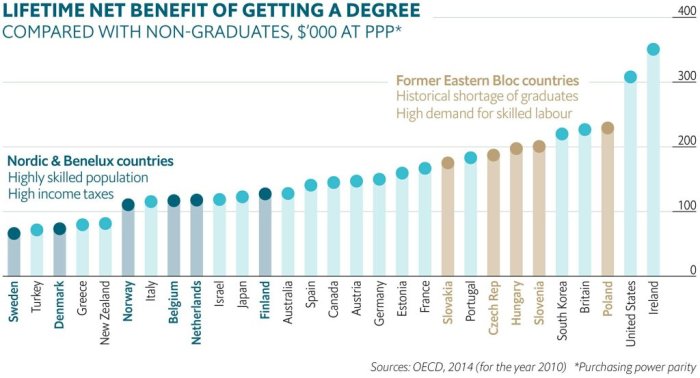
A few days ago I noticed (thanks to Jim Rose) this chart

lifetime benefit of a degree

It isn’t a new result. These OECD data have shown for some time that the economic returns in New Zealand to getting a degree are pretty low relative to those in other advanced countries.   Such results even prompted Treasury to commission some external research on the gap in private returns.

In the chart – from a few years ago – whoever put it together has highlighted two groups of countries: the Nordic and Benelux countries on the one hand, where there are already lots of skilled people, and high income taxes, and former eastern-bloc countries which are now catching up to the rest of the advanced world, and where skills are in high demand, and able to command high returns. I’m, of course, more interested in the contrast between New Zealand and those central European countries.  As I’ve written recently, 25 years ago both we and they were looking to reverse decades of poor performance and catch-up with the other advanced countries. They’ve made progress in that direction. We haven’t.

Since the net benefits are shown in dollar terms (rather than, say, as a per cent of GDP per capita or of lifetime earnings), it is probably reasonable to expect that poorer countries will be bunched towards the left of the chart. And there one finds Turkey, Greece, New Zealand and Italy. But that clearly isn’t the bulk of the story. After all, even though they are now catching up, all six of the former eastern bloc countries shown still have levels of GDP per hour worked and/or GDP per capita similar to or (generally) below, those of New Zealand.

I had a look at a few background documents from the OECD. If anything, as we shall see, the New Zealand numbers may be even worse than what is shown in this chart.

It is important to recognise the distinction the OECD draws between private and public costs and benefits. Some of these things can be easily measured (eg upfront private fees, or direct public grants to institutions or individuals). Others are more approximate. (The other aspect, which I’m not sure any of these particular indicators attempts to account for is the selection bias, in which the typical person who undertakes tertiary study has other traits – eg intelligence – that mean that they would probably earn more in the labour force than the average person who does not undertake tertiary study.)

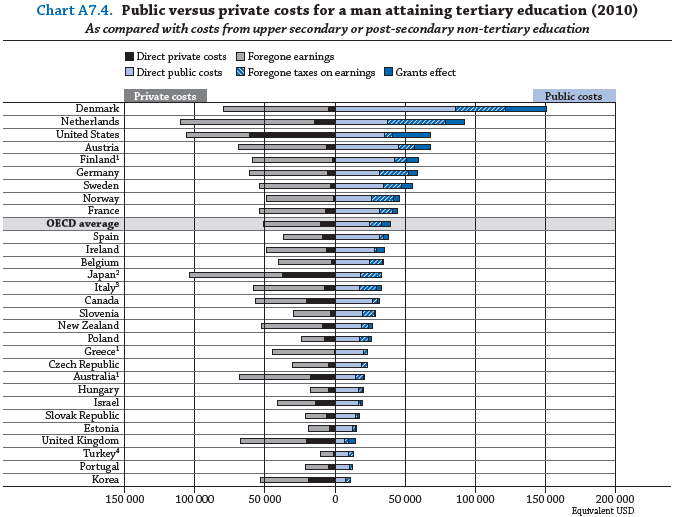
This chart is from a few years ago, and tries to break down the costs of tertiary education (in this case for a man). In New Zealand, as in most countries, the largest private cost by a considerable margin, is the foregone earnings of the student themselves.

tertiary costs

These OECD indicators assume that students do not work while studying.  In the latest OECD Education at a Glance they show estimates for 15 countries as to how much difference it would make to include reasonable estimates of actual student earnings. For New Zealand, doing so would lift the estimated returns to tertiary education by around 15 per cent, more than for most of the other countries shown. However, as you can see from the first chart above, a 15 per cent lift in returns to tertiary study in New Zealand would not alter our relative position on the chart.

The other aspect of the calculations which often doesn’t get much attention is the appropriate discount rate to use in making these calculations. It matters a lot – the costs are mostly incurred between, say, ages 18 and 22, and the economic benefits accrue over decades. A decision by an individual is a very long-lasting investment project, with significant irreversibilities (the years spent on education can’t be reclaimed).

The OECD at present adopts a very low discount rate.

The NPV results presented in the tables and figures of this indicator are calculated using a discount rate of 2%, based on the average real interest on government bonds across OECD countries. However, it can be argued that education is not a risk-free investment, and that therefore a higher discount rate should be used.

I’d say there was no ‘it can be argued” about it. No sensible government would do a cost-benefit analysis of building more schools or universities using a discount rate of 2 per cent. The New Zealand Treasury, for example, uses a default discount rate of 6 per cent real. And as an economic proposition, an individual’s tertiary education is a pretty risky proposition, with few effective diversification options for most people.

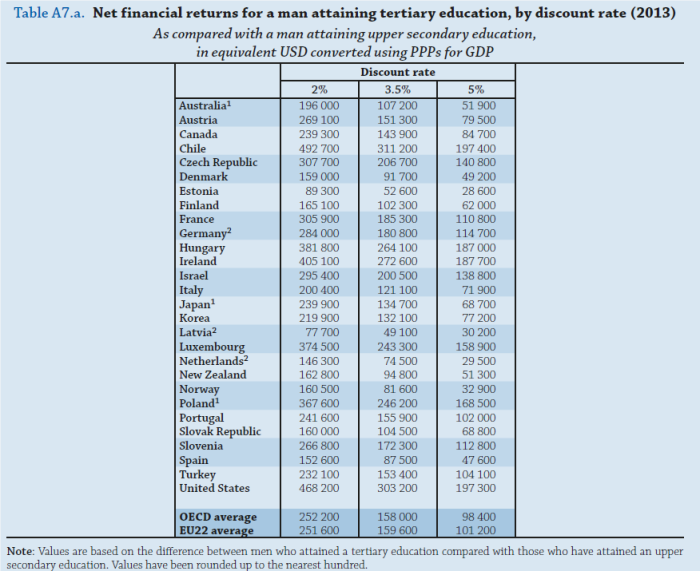
As it happens, in the latest Education at a Glance the OECD presents a table illustrating, to some extent, what difference it makes to use a higher discount rate.

discount rates.png

Using a discount rate of 5 per cent (real) reduces the estimated benefits by around 60 per cent (relative to the 2 per cent baseline) – and these numbers are for a man, and in most countries the net benefits to tertiary education for a woman are (on average) lower than for a man.

This issue matters particularly for New Zealand which has a higher risk-free interest rate on average than any of the other countries in the table. The gap is large. On Friday, the real interest rate on the New Zealand government’s longest (23 year) inflation-indexed bond was 2.39 per cent, while that for the US government’s 20 year indexed bond was 0.77 per cent (and US yields are far from the lowest in the world). A margin of 1.5 percentage points above “world” rates hasn’t been a bad guide for New Zealand interest rates over recent decades.

Even a 5 per cent real discount rate appears too low to evaluate a personal decision to invest in a tertiary education in New Zealand. But if one takes the results for New Zealand in the table above when evaluated at a 5 per cent discount rate, and then compares them against the results evaluated at 3.5 per cent for other countries (to capture that persistent difference in real interest rates), only Latvia would offer lower returns to tertiary education than New Zealand does.

And bump up the discount rate a little more and the estimated net returns to tertiary study will soon be approaching zero or going negative.  And, remember, those estimates are for a man. The average female returns are even lower.

People will have a range of reactions to these sorts of numbers. Some will take them as supporting proposals to reduce tertiary fees or increase student allowances. Such changes might increase the net private returns to tertiary education, but they won’t (of course) change the all-up net returns (someone still has to pay).  Others seem to see tertiary education as some sort of “merit good” that people should have the opportunity to undertake, at moderate expense, whether there is an economic return – to them, or the public more generally – or not.  And, of course, for some people and some courses, a tertiary education is more akin to consumption than investment (which is not intended as a criticism).

For me, I see them as yet another marker of the failure of the economic strategy pursued by successive governments over recent decades.  Our remoteness means it is very difficult to generate consistently high returns to anything much in New Zealand for very many people. The determination of our governments to quite rapidly increase the population here, despite those apparently limited opportunities, just compounds the problem. It does so directly – the limited natural resources (our one distinctive advantage) are spread over ever more people – and indirectly, through a persistently overvalued real exchange rate and high real interest rates.

Returns to tertiary education in New Zealand are probably quite reasonable for those New Zealanders who get an education here, and then leave (but that is probably a poor investment for the taxpayer). For many of those who stay, it looks like a distinctly marginal proposition. Attempting to bring in lots more skilled people from abroad – most of whom aren’t that skilled anyway – just compounds the economic problem, even if the New Zealand taxpayer doesn’t have to pay anything for their tertiary education. There just aren’t the good economic opportunities here for a rapidly growing population, and increasing subsidies to tertiary education would seem likely to further exaggerate the evident imbalances.

In an economy that was making progress towards reversing decades of relative economic decline, there is good reason to expect that returns to investment in tertiary education (like other prospective investment returns) should be consistently high relative to those in other countries. Sadly, those returns appear to be consistently low in New Zealand – especially when evaluated at an appropriate discount rate. And, of course, we are making no progress at all in closing those productivity gaps.

Splashing the cash at the Reserve Bank?

When the Reserve Bank’s Annual Report turns up in my in-box, the table on remuneration isn’t the first place I turn.  In fact, executive pay more generally isn’t one of those issues I can get terribly excited about.  I thought Jim Rose’s column in the Herald the other day made some good points, although (a) I’m not sure that whether the share price goes up or down when the CEO leaves is really a good indicator of whether the individual was appropriately remunerated or not, (b) none of the defences he deploys really apply with any great force to senior public sector positions.  And there is no market discipline on top public sector salaries, so critical scrutiny  and open questioning actually matters.

But someone emailed me suggesting that the Reserve Bank Annual Report implied that the (now former) Governor, Graeme Wheeler had had a big pay rise.  And that did interest me, because outside the halls of the Reserve Bank Board it isn’t clear who would have thought that Wheeler had done something even approaching a stellar job as Governor.

Wheeler started at the Bank in September 2012, so we can’t get a read on his initial salary in the (June year) 2012/13 accounts.   But there are four years of annual reports when he will clearly have been the top earner in the Bank.    The relevant tables show the top earner received as follows during these financial years:

2013/14 620000 to 629999
2014/15 640000 to 649999
2015/16 660000 to 669999
2016/17 850000 to 859999

That is some jump.  But there is a footnote on this year’s numbers, stating that “the highest remuneration band includes a payment of $101000 for accrued annual leave, which was paid out in cash rather than taking leave”.  (That must be about two months of unused leave, for someone in the job  – at a time of no crises – less than five years, which itself doesn’t suggest particularly good management.)

But even if we subtract the $101000, we are left with figures suggesting that Graeme Wheeler got a payrise of around $90000 between 2015/2016 and 2016/17.  In fact, it was quite possibly more than that, because he personally may well have been reviewed on the anniversary of his appointment, in September (and if so the 2016/17 numbers may include only around three-quarters of his big annual increase).

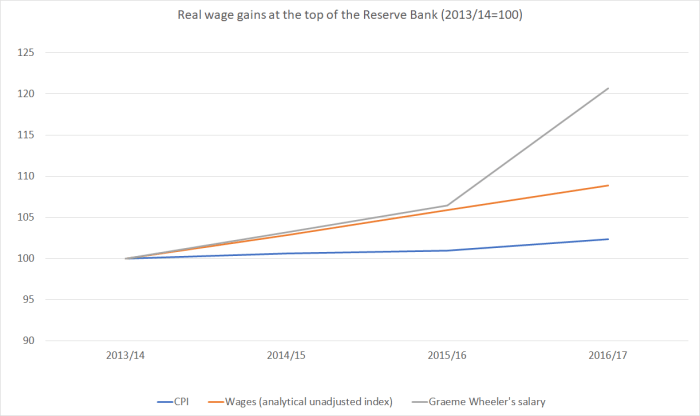
So how do his cumulative pay increases compare against either CPI inflation or general wage inflation (I use the analytical unadjusted series, which is materially higher than the QES recently)?  There has, of course, been no productivity growth in New Zealand over the term Wheeler was in office.

wheeler salaries

It is a pretty astonishing boost.  Perhaps not a great problem for somone doing a stellar job but this was someone who:

  • had consistently seen inflation undershoot the target midpoint, that he’d specifically agreed to focus on, for five years,
  • who never, ever, admitted a mistake (surely not his advice to his own young managers?)
  • had repeated communications problems with financial markets,
  • whose speeches rarely offered much in-depth insight, and whose defences of successive waves of new regulatory interventions never seemed robustly grounded.
  • whose embattled relationship with the media was epitomised in his refusal to ever expose himself to a serious  and searching one-on-one interview (or indeed any interviews with outlets not already supportive of the Governor).

Oh, and then late in the 2015/16 year, there was the OCR leak debacle which among other serious failings, involved the Governor publicly tarring as irresponsible the person (yes that was me) who drew to the Bank’s attention evidence of the apparent leak.

This year, of course, (but no doubt well after Wheeler got his last pay rise) there was the still-more-shameful episode, in which Wheeler sought personally (and used his senior managers to reinforce his efforts) to silence a pesky critic, who happened to work for an organisation the Reserve Bank regulates.  And on that note his tenure ended badly, and largely unlamented.

So what were they thinking when they gave such a big pay rise to someone with such a mediocre (at best) track record, who was hardly like to walk out on them if he didn’t get the increase?  And who was “they”?

Well, on this occasion, it wasn’t the Bank’s Board.  The Reserve Bank Act is quite clear that

The conditions of employment of the Governor, including remuneration, shall be determined by agreement between the Minister and the Governor after consultation with the Board

In practice, the Board may well have put a recommendation to the Minister.   But however this idea first got traction –  whether Wheeler pushed for a pay rise, or the Board really did initiate it –  the Minister approved it. That was last year’s Minister of Finance, Bill English.   This was the same minister who went on record pushing back against a big pay rise for another public sector chief executive, Adrian Orr –  but couldn’t actually stop the New Zealand Superannuation Fund’s board putting through the pay rise.    Sceptical as I am of the NZSF, and of its long-term performance, Orr’s case for a big pay rise looks to have been considerably stronger than Wheeler’s.

I can’t imagine why the Minister of Finance approved such an increase, especially against the backdrop of his own evident discontent with the Bank.   I guess he isn’t too busy governing this week, so perhaps some journalist could ask him?

(But it was fortunate for Grant Spencer that Bill English did approve that pay increase.  When the (unlawful) “acting Governor” appointment was announced we were told that Spencer would be paid to mind the store on the same terms and conditions as Wheeler had been receiving.)

PS.  Someone who attended a post-election lunchtime seminar at Victoria University today informs me that Colin James (usually well-connected) stated there that he understood that The Treasury is undertaking a “root and branch” review of the Reserve Bank Act.  If so, that would be most welcome.


Fossicking in election statistics

Well, that was a fascinating election outcome.

Listening to the coverage on Saturday night, I was interested in comments about how strong National’s performance was vying for a fourth term in government.  There didn’t seem to be many statistics behind the talk.

But it is worth bearing in mind that since 1935 –  when the domination of New Zealand politics by our  current two main parties really began – we’ve had 10 governments.  Two have lasted a single term, one two terms, four completed governments last three terms, and two governments lasted four terms. It seems to be an open question whether National will now be able to lead a fourth term government.  That means there really isn’t much data.  And, to some extent, MMP changes things –  minor parties are more important, and MMP governments have so far always involved multiple parties.

There has been talk that National’s (provisional) vote share this time (46.0 per cent) is higher than it was when they first took office in 2008 (44.93 per cent).   But ACT has never had anywhere to go but National, and never had any desire to go elsewhere anyway.  So at very least one should aggregate the National and ACT votes to look at the centre-right performance.

But I’d argue one should really go a bit beyond that.  The Conservative Party has come, came close in 2014 to entering Parliament, and then has largely gone again.  Not only did the Conservative Party campaign in 2014 as another potential support party for National, but realistically most of their voters in 2011 and 2014 are people (in many case conservative Christians) who would have otherwise, naturally or reluctantly, have voted for one of the other centre-right parties.

In this chart, I’ve shown three different ways of looking at how the centre-right vote has changed:

  • National + ACT party votes as a share of the total vote,
  • National+ ACT party votes as a share of the “used” vote (ie excluding the “wasted” party votes for parties that didn’t get into Parliament), and
  • National + ACT + Conservative party votes as a share of the total vote.

centre right 2

On each of those lines, the centre-right vote share has fallen quite a bit.  If anything, what the chart highlights is how well the centre-right did (and, I guess, how disastrously the left did) at the 2014 election.  In this election, the centre-right vote share –  the grey line –  has (on the provisional results) fallen by a full 5 percentage points.

And then I wondered how it had been in the 1960s.  The 1969 election was the last time a a party secured a fourth term.

national 60s

Now that looks more like a genuinely impressive performance – the governing party lifting its vote share in the election in which it gained a fourth term.   There had been industrial action at the time of the election which had hurt the Labour Party, but the previous three years had been a very tough time to govern.   Wool prices had collapsed (and with them the overall terms of trade), the New Zealand government had been forced into a devaluation in late 1967, and had borrowed from the IMF under a pretty stringent domestic austerity programme.  Things here had been tough enough that over the three calendar years 1967 to 1969 there was a small overall net migration outflow (the first such outflows since the end of World War Two). People can counter that the third party – Social Credit –  saw its vote share fall away, and both National and Labour gained. But in a sense that is the point: tough times like that are often when third parties, and main Opposition parties do well.  But National increased its vote share.

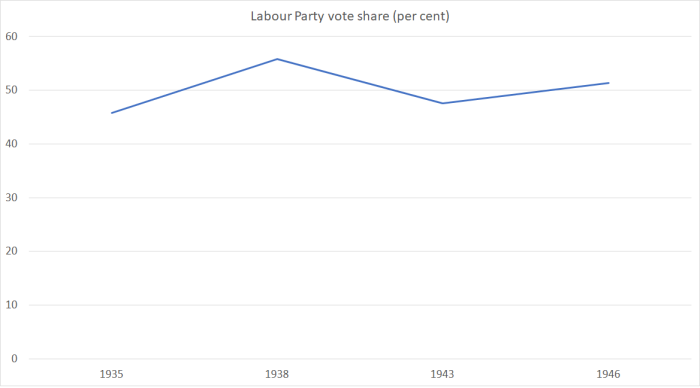
The other fourth term victory since 1935 was in 1946, when Labour secured a fourth term.  And here is how Labour’s vote share changed over its time in government.

Labour 1946

Again, going for a fourth term Labour managed to increase its vote share.   They’d seen off John A Lee’s rebel party in the 1943 election, and no doubt won back most of that vote, but again…that is the point.  Going for a fourth term after crises, war, and post-war controls and inflation, Labour increased it vote share (to 51.3 per cent).

I was also playing around with some other of the provisional results.  For all that the Greens have done pretty badly nationwide, it was striking how strongly they poll in the neighbourhoods I live and move in.    In (booths in) Island Bay itself 16 per cent, and in next door Berhampore 26 per cent (no wonder the new local Labour MP, and current Wellington deputy mayor, avoided answering questions about his approach to the cycleway).   In the whole Rongotai electorate  the Greens scored 17 per cent, and in next door Wellington Central (where James Shaw ran) 20.8 per cent.    Both those percentages are lower than in 2014 ( 26.2 in Rongotai and 29.5 in Wellington Central) but are still huge –  and conventional wisdom seems to be that the Green vote share will rise on special votes.  No wonder that, despite the fact that 70-80 per cent of submissions from residents favour scrapping the dreaded Island Bay cycleway (and certainly don’t want to spend millions more on it), the Wellington City Council seems set to pursue its green agenda anyway.

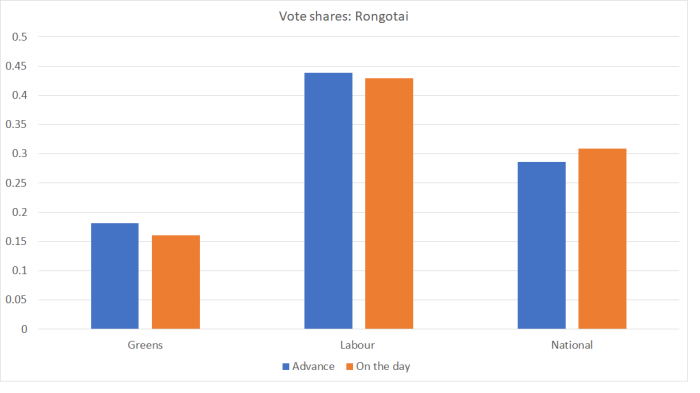
Finally, I was interested in whether there were any material differences in the party vote shares between advanced votes and those on the day.  I only looked at two electorates (again, Rongotai and Wellington Central) but this is what I found.

Rongotai

Rongotai

And Wellington Central

wgtn central

The differences aren’t huge, but they are there – at least in these two electorates, and in particular between the Greens and National shares. Given that advanced votes of those who enrolled at the same time as they voted still haven’t been counted, it would presumably offer some encouragement to the Greens.

Various views on Reserve Bank reform

Undecided to the end, earlier this afternoon I went out for a walk resolved that I wouldn’t come home until I’d voted.  With guests to cook dinner for, it was an effective constraint.

The other day, the Herald ran a Bloomberg column by journalist Tracy Withers headed “RBNZ could be in for a shake-up”.  Much of the column is familiar ground, and complements my own post the other day on the coming reform of the Reserve Bank –  whichever party forms the next government.    But there were a couple of interesting snippets, one of which wasn’t in the version the Herald used but is now in the updated column the link will take you to.

The first is an explicit comment from the Secretary to the Treasury, Gabs Makhlouf.  It seems quite unusual for a neutral public servant to be commenting in public –  in another country as it happens – on any matter of possible new policy just a few days out from an election.   Save it for the post-election briefing to the incoming Minister of Finance, would surely have been the stance of most senior public servants (all the more so when it is an issue on which at several parties have explicit public policies).

Anyway, what does Makhlouf think about Reserve Bank reform?

Gabriel Makhlouf, head of New Zealand’s Treasury Department, said he favors formalizing committee-based decision making at the central bank but doesn’t have a view on whether the committee should include external members.
“I can see why people may be concerned about that, and I can also see the value of having externals, and the different perspective they bring,” he said in an interview in Singapore Friday. “It’s something we are definitely going to study quite carefully before we decide what to recommend to the government.”

Treasury has long-favoured a move to formalise a committee-based decisionmaking structure.  They unsuccessfully attempted to interest the then Minister of Finance, Bill English, back in 2012 before Graeme Wheeler was appointed.  But it is surely a little surprising that, after all these years, and five months after Iain Rennie’s report on such issues was finalised, that Treasury still doesn’t have a view on a key aspect of possible reform.  Or are they simply waiting for the election results to come in, and will then tailor their advice to the proferences of their new masters?  I’d like to think not, but is there good reason to do so?

The other interesting snippet –  and maybe it wasn’t new but I hadn’t seen the specific quote previously –  was about the views of the current Minister of Finance.

If a National-led government is returned to power, Finance Minister Steven Joyce has said he’s open to formalizing the existing committee structure but doesn’t favor outside members.
“We should have a look at it,” Joyce said in a July interview. “I wouldn’t see radical change. I think the Reserve Bank model serves us very well.”

I’d certainly disagree with his final sentence, but of course he is welcome to his view. But it does tend to confirm the suggestion I made in the post earlier in the week that the Rennie report must have proposed quite far-reaching reforms.  After all, if Rennie had concluded that the current governance model “serves us very well” and that no change was required, or only some minor changes such as formalising the current Governing Committee, surely the Minister of Finance would have released the report by now.  Rennie may not command enormous respect beyond, say, the current occupants of the Beehive, but had a former State Services Commissioner and former Treasury deputy secretary for macroeconomics concluded that no material change was appropriate –  and certainly nothing like the changes (still modest themselves) that Labour and the Greens have campaigned on – it would have been modestly useful to the National Party, who have attempted to argue that Labour and the Greens simply don’t have what it takes to be economic managers.

Given that the Rennie report to Treasury was paid for with public money, was finished five months ago, and is official information, it is pretty inexcusable that it has not yet seen the light of day.

(I should note that neither the Joyce comments nor those of Makhlouf comments seem to address the Reserve Bank functions other than monetary policy.   In those regulatory areas, reform is even more vital, given the relative lack of constraints on the Governor’s personal freedom of action –  nothing like the Policy Targets Agreement exists.)

The other thing that prompted this post was the Herald’s editorial on Thursday, prompted by the Bloomberg column, and headed “Meddling with OCR carries risks”.  The text doesn’t appear to be online.

Over recent years, the Herald has been a useful mouthpiece for the Reserve Bank, and for outgoing Governor Graeme Wheeler in particular.  By not asking any awkward questions, they’ve been given preferential access to soft interviews and profiles, and have reliably backed up the Governor’s choices –  even when hindsight proves those choices weren’t always the best.

The editorial is somewhat overblown, and lacking in any serious supporting analysis. It asserts

This country has no need to copy any country’s conduct of monetary policy.  New Zealand pioneered inflation targeting by an independent central bank and it served this country will through the global financial crisis whatever mistakes were others may have made.   The divergent targets of the US Federal Reserve possibly contributed to the crisis.

We certainly pioneered formal inflation targeting, although independent central banks had been around in several other countries for decades –  on that count we followed an international lead.  Actually, I’d agree that inflation targeting served us reasonable well through the crisis, as it served well a bunch of other countries.  The US only formally adopted inflation targeting after the crisis was over.  Some would argue that different rules (nominal GDP, price level targeting, wage targeting) might have led to even better responses, although I’m a bit sceptical of that claim.  And any suggestion that the “divergent targets” of the Federal Reserve may have contributed to the crisis probably rests on claims by US economist John Taylor that interest rates were held too low –  below the Taylor rule prescription –  in the early 2000s.  There may be something to that specific point, but…..the Reserve Bank’s own published analysis shows that we did much the same thing during that period.  It is one thing to argue that New Zealand’s monetary policy isn’t much different than that in countries with differently expressed statutory goals (including the US and Australia), but another to argue that our monetary policy is somehow superior to that of those countries.   There is just no evidence for that latter proposition.

Then there is a weird paragraph about the Labour Party’s proposal to add an employment/unemployment dimension to the monetary policy goal.  There are certainly some questions Labour needs to answer if they do happen to form the next government, but to conclude (rhetorically), “could a Labour Party bear a target of 0-4 per cent unemployment”?  one can only suppose the answer must be “yes, but they probably wouldn’t suggest being that prescriptive”.   Only a few people –  some able ones among them –  think full employment in New Zealand at present is lower than 4 per cent.

In the end, the editorial writers seem to conclude that adding an unemployment dimension might not do much harm after all (although they can’t conceive of it doing any good), and what really worries them is the governance proposals.

Labour’s proposed changes to the way the Bank operates may be more damaging.  The Governor would no longer be solely answerable for the key interest rate, the official cash rate (OCR) set eight times a year [isn’t it seven now?].  Labour would give the decision to a committee with some appointees from outside the bank.  Already the Governor consults widely. But sole accountability can produce better decisions. A committee allows blame to be dispersed.

I was pretty gobsmacked. As I noted in my post the other day, I criticize Labour`s proposals as excessively timid, and leaving too much effective power in the Governor.  But quite what is the Herald concerned about?  That we might have a decision-making structure for monetary policy a little more like those in

  • Australia,
  • the United States,
  • the United Kingdom,
  • Norway,
  • Sweden,
  • the euro-area
  • Israel (which had a single decisionmaker until a few years ago, but changed)

They are correct that we don’t need to follow what other countries do.  But there is often wisdom in the choices those other countries make, and when the current Reserve Bank Act was written few countries had reformed their practices in recent decades.  We were (so we thought) pathbreakers, but no country has followed us along this particular path.

Or perhaps the Herald is concerned that monetary policy might be governed the way the rest of the country is?  For example,

  • the Cabinet (actually a committee of people who aren`t technical experts),
  • most companies, while final decision-making power typically rests with a Board,
  • the governance of most or all other Crown entities, from the Board of Trustees of the local primary school, to that of powerful regulatory agencies like the Financial Markets Authority, or
  • our higher courts –  both the Court of Appeal and the Supreme Court decide each case with a panel of judges.

But perhaps New Zealand monetary policy is uniquely suited to single (formal) decision-making? It is possible I suppose, but frankly it seems unlikely.

And do notice the careful wording “sole accountability can produce better decisions”.  In theory perhaps it can, if we have as Governor someone uniquely talented and gifted with insight and judgements far beyond those of mere mortals.  But this is a real world.  If such people existed, it would be very hard to identify them in advance –  or perhaps even persuade them to serve.   And if those responsible for appointing a Governor thought they`d found such a superstar, only for reality to turn out a bit differently, that would be a recipe for worse outcomes than under a (much more robust) formal committee-based decision-making model. It is why in most areas of life we choose governance models of that sort, rather than beating on supermen (or women).

And today, I`m not even getting into questions of the actual judgements or track record of accountability of Graeme Wheeler.     That can wait for next week.

The editorial concludes that

our system of monetary management is working well. Labour should hesitate to meddle with it.

Actually, not many people would really agree.  Even Steven Joyce says he is open to some change. It is a risky system, out of step with international practice and New Zealand practice in other areas of public life.  It has gone hand in hand with a progressive weakening in the quality of the institution, and if one does wants to talk about relatively uncontroversial specific failures, bear in mind that the Reserve Bank of New Zealand is the only central bank in the world to have launched two tightening cycles since the 2008/09 recession, only to have to quickly reverse both of them.  Those were choices made by individuals given too much power by Parliament. Whoever forms the next government, it is time for a change at the Reserve Bank.

A story of two Attorneys-General

On Wednesday evening I wrote about the despicable conduct of our Attorney-General, senior National Party Cabinet minister, and minister for various intelligence agencies, Chris Finlayson.

Asked why it was appropriate for a (past and –  experts say –  probably present) member of the Chinese Communist Party and former member of the Chinese intelligence services (both acknowledged facts, neither of which was disclosed to voters when he was elected) to be a member of Parliament in New Zealand, Finlayson simply refused to engage or answer, other than to suggest the journalists raising the issue –  journalists from serious outlets including the Financial Times – were simply attempting to destroy the man’s political career and in the process were engaged in singling out a whole class of people for “racial abuse”.

Asked about the claims in an important new paper by Professor Anne-Marie Brady (of Canterbury University and the Woodrow Wilson Centre in Washington DC) on the efforts of the People’s Republic of China (state and party) to influence politics in New Zealand and about the close ties of various past and present National Party members to interests of the People’s Republic of China, our Attorney-General’s only response was to simply make stuff up.  He asserted that Professor Brady didn’t like any foreigners, only to have an audience member –  a former student of the professor’s –  point out that not only was Brady fluent in Mandarin, but that her husband was Chinese.

That account has received a bit of coverage –  although not, of course, that there was any sign of the New Zealand media following the issue up with, say, Mr  Finlayson, or his boss the Prime Minister, let alone with the Leader of the Opposition.  It might have been awkward all round I guess.

My own readership numbers yesterday were more than twice the normal level.

Senior Wellington lawyer and former MP, Stephen Franks wrote about the story on his blog,   He’d predicted this sort of response only a week or so earlier on Radio New Zealand.

Rarely, if ever in politics, does one get explicit, irrefutable proof of a risky and unpopular hypothesis within a week of venturing it.

But Attorney General Hon Christopher Francis Finlayson provided such proof last night.

Last week, after discussing on Radio NZ the Newsroom suspicions that NZ MP Jian Yang may be a spy for mainland China I blogged my explanation that time did not permit with Jim Mora. I predicted that the Communist government could expect their spies who have penetrated New Zealand leading circles to be sheltered by our  elite’s PC terror of being accused of racism.

Last night at an election candidate’s meeting Finlayson showed just how the accusing is done. The other  candidates then showed how effective it is in cowing them.

Others tweeted the story.  There was Rodney Jones, for example: Beijing-based New Zealand economist, who had himself last week called for Jian Yang’s resignation.

Numerous commentators offshore focused on China have been drawing attention to, and stressing the importance of, Professor’s Brady’s paper –  the one New Zealand’s Attorney-General could deal with only be attempting to smear the author.

Professor Brady herself tweeted a link to Stephen Franks’ post.

And then flicking round the web over lunch, I stumbled on a new story on the Sydney Morning Herald website.  The authors begin thus

Attorney General George Brandis is planning a once-in-a-generation shake-up of the legal framework governing who can lawfully influence Australian politicians, amid fears of clandestine Chinese Communist Party influence over politics in this country.

Having seen Professor Brady’s tweet drawing attention to Finlayson’s despicable comments, Fairfax’s Asia-Pacific editor, John Garnaut,  a former lawyer who had previously spent many years in Beijing as the Fairfax China correspondent was moved to tweet thus:

What a disgrace. How have things in New Zealand been allowed to sink this low so quickly?

For those interested in reading in more depth about the sorts of issues Professor Brady has raised, I would recommend an article on the Brady paper by an independent researcher on China who blogs at a site called Jichang Lulu (and who has also tweeted a link to the Franks account).  It is a substantial post on the issues in the (quite long) Brady paper.  The author knows China, but comes fresh to New Zealand.   As the author notes

New Zealand provides an example of successful United Front domination of a diaspora community. As of this election, the top ethnic Chinese candidates are linked to CCP organisations and support PRC policies. In New Zealand, the Chinese community can only realistically aspire to political representation by its own members through individuals approved by Beijing. This situation, enabled by the leaders of the top parties, effectively allows the extraterritorial implementation of PRC policy.

(This incidentally makes a nonsense of Chris Finlayson’s absurd allegation that anyone raising these issues is “racist”.   The alleged PRC interference in New Zealand affairs directly affects the freedoms in New Zealand of the many Chinese-origin New Zealand citizens – whether recent migrants or descendants  of those who came generations ago – who abhor the Beijing regime and its repression. State-sponsored actors are the focus of the story, and the paper.)

As he notes of Jian Yang

In the same Chinese-language interview quoted above, Yang says he used to be a Communist Party member, but he isn’t one any more. That presumably means ‘not an active member’; as Brady notes, you don’t just ‘leave’ the CCP. You are considered a member unless expelled. Considering Yang’s excellent relations with Chinese state entities and the praise state media award him, it would be ridiculous to assume he was expelled. In all likelihood, Yang is in fact a CCP member. Chen Yonglin 陈用林, a former PRC diplomat who defected to Australia in 2005, cast further doubt on Yang’s claims he was a PLA ‘civilian officer’. Based on his knowledge of military institutions before reforms in the late aughts, Chen estimates Yang was in fact a ‘soldier’ and probably reached the rank of  captain.

And

Perhaps even more remarkably, despite what an external observer would see as devastating evidence compromising a candidate before a tight election, his direct political adversaries in the Labour party produced absolutely no criticism of Yang. I’m not terribly knowledgeable about NZ politics, so perhaps I’m being naive, but is it normal to have such a major security revelation on a senior political figure days before an election and hear nothing from his rivals?

Noting that these are issues for the Labour Party as well.

In theory, Yang Jian’s direct adversary should be Raymond Huo (Huo Jianqiang 霍建强), a Labour Party MP. Yang and Huo compete for the Chinese-community electorate; Yang has been found to have a background in military intelligence, which he had declined to disclose in the past; Huo, whatever his sympathies, isn’t tainted by work for a foreign military. Recent polls have put Huo’s party a few points short of unseating the Nationals, or even able to lead a coalition. How can he not use this?

The only explanation that makes sense (and that is consistent with reactions from other senior politicians) is that he wouldn’t like to speak up against United Front interests.

Again it, as well as the original paper, is an analysis well worth reading.

We seem to have come to an extraordinary, and shameful, pass.  The very fact of the silence of most of the local media (the Herald’s recent article a welcome exception) and the refusal to engage seriously of any of our senior political figures (and responses by people like Jenny Shipley and Don Brash that could be seen to trivialise the issue) is surely worth a story in itself.

Fairfax’s local media have been very quiet on both the Yang story and on the arguments and evidence at the heart of the Brady paper – in the very week of a general election. Perhaps John Garnaut – recall, he is Fairfax’s Asia-Pacfic editor – would consider writing such an article? Perhaps the local papers might even publish it?   As he notes, the episode is  “a case study on how important it is to repel foreign interference before it gets to the political centre”.

But the primary responsibility for dealing with these issues can’t rest with foreign journalists, but with our own leaders.    I’m not sure that leaves me with much (any) reason for optimism.

(Due to New Zealand’s somewhat absurd electoral laws, I will remove any comments put up between midnight tonight and 7pm tomorrow that have any sort of party political tinge, so please refrain from making them.)

Productivity growth still missing in action

It was Paul Krugman, winner of the economics pseudo-Nobel Prize who famously captured one of the fairly basic insights of economics.  When it comes to material living standards in the medium to longer-term, if productivity isn’t everything, it is almost everything.   The terms of trade bob around, but probably won’t do much (harm or good) over the longer term, as they haven’t in New Zealand over 100 years.  But productivity growth –  managing to produce more per unit of inputs – is the basis for improved material living standards.   The best timely and accessible measure of productivity, widely used in international comparisons, is real GDP per hour worked.

Productivity growth in New Zealand has been pretty lousy in New Zealand for many decades, really since around the end of World War Two. We’ve had the odd decent run, but over the decades we’ve had one of the lowest rates of productivity growth of any advanced country.  We’ve slipped down the OECD league tables, and now part of the way we maintain reasonable living standards is by putting many more hours, over a lifetime, than the typical person in an advanced country.

Across the advanced world, productivity growth seems to have slowed from around 2005 (before the financial crisis).  We didn’t need to share in that slowdown, because productivity levels in New Zealand were so far below those of the OECD leaders.  Countries like the Netherlands, France, and Germany –  which historically we were richer and more productive than – now have labour productivity levels around 60 per cent higher than those of New Zealand.  We should have been able to close some of the gap in the last decade or so, utilising existing technologies, even if advances at the technological and managerial frontiers were slowing.  Various other poorer OECD countries –  notably the former Soviet bloc countries that are now part of the OECD – have done so.  We haven’t.

Several weeks ago the Prime Minister and the Minister of Finance were repeatedly claiming that New Zealand’s productivity performance in recent years had really been pretty good.  In fact, they suggested that under their watch we’d managed faster productivity growth than in other advanced economies and that the gaps were beginning to close.

I went to some lengths to unpick those claims.    New Zealand doesn’t have an official measure of real GDP per hour worked (unlike Australia, where the ABS routinely reports numbers as part of their national accounts release).  Instead, we have two measures of real GDP (expenditure and production), and two measures of hours (HLFS and QES).  Instead of just picking on one combination, I calculated all the possible methods, and looked at them individually and on average (nine in total).

For broad-ranging international comparisons, it often makes sense to use annual data, because not all countries have easily accessible quarterly data.  Unfortunately, the annual data are often only available with a lag, and the OECD doesn’t yet have annual data on real GDP per hour worked for all countries for calendar 2016.   But in the years from 2008 to 2015, on not one of the possible New Zealand productivity measures did New Zealand quite manage productivity growth as fast as that of the median OECD country.

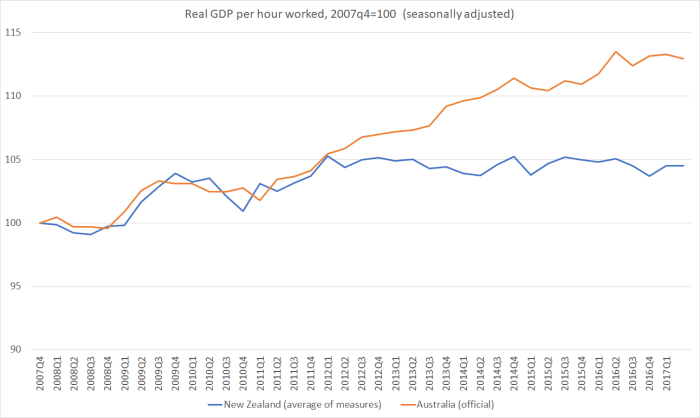
This morning Statistics New Zealand released the latest quarterly national accounts, which enabled me to update the various quarterly productivity series.   In this chart I’ve shown the average of the various possible measures, and compared the performance of New Zealand relative to that of Australia (using the official Australian data).  I’ve started the chart in the last quarter of 2007, just before the 2008/09 recession began.

aus vs nz ral gdp phw 2

Over the first few years, through the recession period and in the year or two beyond, productivity growth in New Zealand and Australia was modest, but we more or less kept pace.   But what is striking is how increasingly large and persistent the deviation has been since around the start of 2012.  Over the five years, we’ve had no productivity growth at all, and Australia has managed quite reasonable growth.   And over the last five years, using the average measure for New Zealand doesn’t mask anything: from the second quarter of 2012 to the second quarter of 2017, the strongest of the nine series recorded productivity growth of 0.8 per cent (that is, in total over five years) and on the weakest, the level of productivity fell by 0.6 per cent (in total over five years).  Best guess: zero.

Recall that at the start of the period the average of level of productivity in Australia was already well above that in New Zealand.  That gap has widened still further.  In the early days of this government readers will recall that there was a goal to close those gaps to Australia by 2025, only eight years away now.

It has been a dismal performance.  Productivity isn’t mostly about how hard people work, but is much more about the ability of firms to find opportunities here that generate high incomes, and in particular high wages.  That is very difficult when the real exchange rate is as persistently high as it has been here.  Particularly over the last few years, very rapid population growth has underpinned the strength of the real exchange rate, driving up the prices of non-tradables relative to those of tradables.

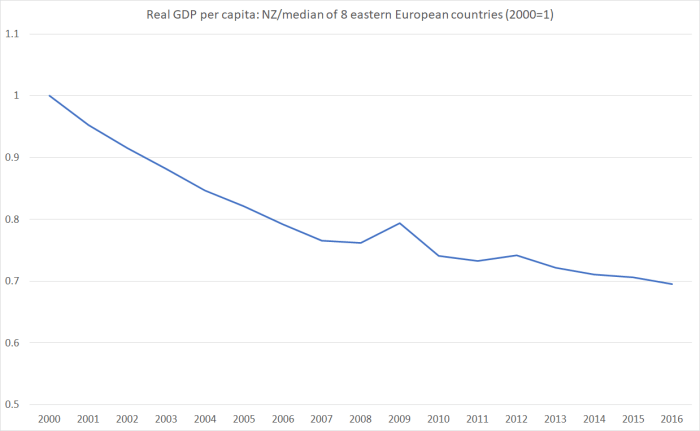
And what of the comparison I mentioned earlier with the former Soviet-bloc central and eastern European countries (Slovenia and Slovakia, Poland and Hungary, the Czech Republic, and Latvia, Lithuania and Estonia)?  Thirty years ago, all of them were in a much worse state than New Zealand, but like New Zealand they had an aspiration to reverse decades of economic underperformance and catch-up with the richer countries in the OECD –   in their case, particularly those in western Europe.     But here is how we have done relative to them over the period since 2000, when there is consistent data available for all the countries (and by then all the other countries had got well through the nasty shakeouts immediately after the fall of communism).

eastern europe 3.png

It is a steady and substantial decline in our productivity levels relative to those of these central and east European countries.   The data are only annual, of course, but as you can see in earlier chart, we’ve had no productivity growth at all recently so not incorporating the last couple of quarters won’t help the picture.   Some of these countries –  communist-era basket cases 30 years ago –  now have levels of productivity very similar to New Zealand’s.  Most are on a path that may well take them past us in the next decade or so.  Most, as it happens, have little or no population growth.  They make the most of their opportunities –  which are considerable, being close to western Europe –  with their own people.

To sum up, New Zealand has lagged a bit behind the median advanced country since 2007/08, and has had no productivity growth at all for the last five years.  We continue to drift further behind our closest neighbour, Australia, and now face the likelihood that before too long we’ll be overtaken by countries that, throughout modern history, were never previously as productive as New Zealand was, and which 30 years ago we’d have looked on as pretty hopeless cases.   We could do much better, but there is absolutely nothing to suggest that we will manage to do so pursuing current economic policies.  Sadly, there isn’t much sign that any of the parties competing for your vote on Saturday are offering anything materially different, that might finally begin to reverse almost 70 years of continuing relative decline.   The apparent refusal of our leaders to face the reality, and make steps to change, won’t alter the fact of our continuing relative economic decline.


Operating allowances don’t cover inescapable cost pressures

I didn’t have any intention of writing again about the Labour Party’s fiscal plans.  I’d already done so, prompted by the infamous Steven Joyce “fiscal hole” here and here.

But on Monday evening I was sent some analysis of the fiscal outlook prepared by a group of former senior Treasury officials, who were keen that I should give it some coverage.  They are keen to retain anonymity, but I know all those involved, and have a considerable regard for most of them.   Most, in my observation, would also seem considerably more likely to vote for ACT than for, say, Labour or parties to its left.  But  what they sent me wasn’t particularly value-laden; it was an attempt at a technocratic assessment of some of the basic pressures on government finances over the next few years.

I’m not going to swamp you with numbers  And trying to unpick and explain here the differences between core Crown and total Crown expense items, and which is relevant where, is sure to have your eyes glaze over, and (frankly) on a couple of points I couldn’t get clear answers myself.

But their main point is a simple one.  Budget projections of government tax revenue, including the PREFU ones that both Labour and National are relying on, include the effects of forecast wage and price inflation, and forecasts of a rising population.  On the other hand, most line items for government expenditure, as presented in the PREFU, do not do so.

But things governments purchase, and people governments employ, will become more expensive over time (that’s inflation).  And a rising population will also, over time and all else equal, require more public employees –  perhaps no more Treasury officials, but certainly more nurses and teachers, police and perhaps even Corrections officers.    Given the outlook for inflation and population growth, those cost pressures are largely inescapable –  at least without specific decisions to cut real per capita spending in some or other areas.   (When I say “inescapable”, of course governments can change inflation and non-citizen immigration targets, but given the targets they choose, there are future –  largely inevitable or inescapable –  spending consequences.

In fact, the PREFU documents would be much more useful –  as I noted a couple of weeks ago, picking up a comment on an earlier post – if they included some analytical tables showing expenditure numbers that adjusted for these all-but-inescapable inflation and population pressures.  If political parties presented their alternative plans relative to that sort of baseline we would all be much better off.

Instead, at present, we are given a table like this (or its total Crown equivalent)

PREFU extract

In this table, some specific line items show considerable increases over the four year period.  In particular, where there is a statutory requirement to make expenditures in a particular way, explicit allowance is made in the PREFU line item numbers.  New Zealand Superannuation expenditure for example –  eligibility and formula in statute –  is explicitly shown as increasing from $13043 million in 2016/17 to $16085 million in 2020/21 (included in the first line above).

But most government spending isn’t like that.  It is simply subject to appropriations after each year’s budget, and each government agency must make an explicit bid for any new spending, even that which (in effect) simply results from inflation or population increases.  So those –  largely inescapable –  prospective spending increases aren’t identified in specific line items in the table above.  Instead, it is all lumped together in the line labelled “Forecast new operating spending”, which –  in PREFU –  captures the cumulative total of the annual “operating allowances” the current government has identified for the next few years  (cumulative because the decision to spend $1000 million extra next year, and another $1000 million extra the following year means that in the second year, total spending would be $2000 million higher than what has been appropriated this year).

In other words, that new operating spending line can deceive.  From a Treasury budget management perspective it is all new money available to spend –  you don’t want government departments counting on what ministers and Parliament haven’t approved.  From a bigger picture perspective though it is a mix of money available for genuinely new initiatives, and money that will end up having to be spent to keep up with wage and price inflation and population.     Quite how much governments want to have available for genuinely new stuff is up to them –  and political and market tolerance for debt and taxes.  But in recent years, that proportion hasn’t been much.  Government spending has been falling as a share of GDP.    In fact, as I’ve noted previously, both parties tell us they expect to reduce government spending as a share of GDP further over the next few years.

core crown spending 17 election

Labour less so than National, but it is still a reduction.

And the other half of the point the former senior Treasury officials are making is that Labour seems to have promised to do quite a lot of new stuff over the next few years.  Specifically, in 2020/21 –  the final PREFU year, although not the last year of Labour’s plan –  they have announced specific policy promises that,  on their numbers, would have total spending $6058 million higher than under PREFU.

Of course, they are partly doing this through revenue measures –  primarily not proceeding with National’s promised tax cuts. On their numbers –  and the same economic assumptions – revenue will be $2341 million higher in 2020/21 than is provided for in the PREFU.    Since the projected surplus in 2020/21 is almost identical to that in PREFU, they have precommitted a net additional $3700 million to fund the (net) new policy promises.

And how much as-yet-unallocated spending provision is there in PREFU for 2020/21?  Well, we can see that number in the table above: $5495 million.   But if around $3700 million is already committed to meet policy promises, that leaves only around $1800 million.

Again, the question the former senior Treasury officials are raising in whether that is enough to cover the inescapable cost pressures.

Over the three years (from the current Budget numbers for 2017/18) to 2020/21, those “inescapable” pressures include projected:

  • Population growth of 4.6 per cent
  • Cumulative increases in the CPI of 6.2 per cent, and
  • Cumulative wage increases (QES measure) of 8.5 per cent.

Across core Crown agencies and Crown entities (the latter includes schools and DHBs) the government expects to spend $20142 million this year on “personnel expenses”.     Using those cost pressures:

  • forecast wage inflation alone would lift annual spending by around $1700 million by 2020/21, and
  • if the number of public employees kept pace with population growth that alone would add another $900 million to the wage and salary bill.
  • for an overall increase (the new workers will also get the higher salaries) of around $2700 million

But there was only about $1800 million left after the specific policy promises Labour has made.

Another item we could look at is Other Operating Expenses.   These are around $39000 million this year (2017/18 Budget).   Assume that the cost of whatever the government is purchasing increases at the rate of CPI inflation, and that the volume of purchases will increase with the forecast increase in population, and that would raise government spending on this item (simply to deliver the same volume of real services per capita) by about $4200 million by 2020/21.

Across just those two (large) items, the “inescapable” cost pressures would add $6900 million by 2020/21 to annual spending.    And yet, the government’s operating allowance –  passed to Treasury as current policy to use in PREFU – is for only $5495 million more spending by 2020/21.

We know the policy promises the Labour Party has made:  they’ve committed about $3700 million to meet specific policy promises.  We don’t have any decent estimate (that I’m aware of) of the cost of the National Party’s promises, although they seem almost certain to be less –  for now anyway –  than those the Labour Party has put out.

But the bottom line is that, on the macroeconomic assumptions both parties are using, the existing operating allowances (and revenue projections) are not sufficient to cover even what former senior Treasury officials would regard as “inescapable” cost pressures on the Budget over the next few years.  (In the spreadsheets they sent me, they didn’t explicitly allow for the population growth, but in my subsequent exchanges with their representative, they accepted that the population pressures on spending are just as real as the inflation ones.)   The gap  –  hole if you like –  appears likely to be materially larger for Labour than for National, but it is there for both sides of the political divide.

Of course, there are ways through that.  A government led by either main party could decide to make material cuts to services or other spending.     Labour seems to have talked of the Defence budget and perhaps Corrections.  National –  probably faced with a smaller gap –  has given us no clues.  And none of those possible cuts –  from either party –  has been outlined in any detail and debated in this election campaign.   Perhaps public service salaries could be held below general wage inflation.   Perhaps no more teachers or nurses could be hired even as the population increased?  Perhaps some extraneous (but mostly rather small) government agencies could be closed?

Then again, perhaps the spending as a share of GDP tracks just aren’t very credible, probably for either party (but probably more so for Labour).  As I’ve said before, it is a little hard to understand how, for example, a party can campaign on the idea of years of underfunding of core services, and yet suggest that government spending will fall as a share of GDP over the next few years if they are elected.

And when (properly measured) net core Crown debt is about 9 per cent of GDP, and the macro outlook suggests rising surpluses from here, it isn’t entirely clear why it would be sensible to do so, given the stuff that a left-wing party says that it wants to deliver.

The future is uncertain.  We could have a recession in the next few years, or a period of really strong growth.  But if we take the Treasury PREFU macro outlook as given, it is hard not to conclude that under whichever party we elect there will be more total spending (than in either PREFU or the Labour plan) as a share of GDP and somewhat higher public debt.   And before anyone starts hyperventilating about higher interest rates, a reminder of the Orr/Conway results I linked to on Monday: on those estimates, even a 10 percentage point increase in net debt to GDP might be worth about 6.5 basis points on long-term bond yields.   Realistic differences over the next three years would not be worth anything like an additional 10 percentage points on the debt to GDP ratio.

And finally, my suggestion –  indeed plea –  to The Treasury, and to possible new Fiscal Council (which Labour is proposing if elected)  –  is that for the next PREFU we should have analytical tables that take explicit identifiable account of the likely –  largely “inescapable” (in the words of the senior Treasury officials) cost pressures resulting from inflation and population growth.  There are real debates to be had on what level of real per capita services/spending governments should provide –  that is the stuff of politics –  but for these sorts of purposes a much more sensible baseline –  and a more enlightening one for voters –  is one that explicitly takes account of those pressures, and thus more clearly identifies how much is “left over” for genuinely new initiatives.  Anything beyond that amount has to be funded by either cuts in other spending, or lower surpluses.    But inflation means things cost more, and more people means more government spending (all else equal), and it doesn’t help to bury those pressures, as current practice –  led by Treasury, which decides what to publish –  tends to do.