Choices: New Zealand and the PRC

There was an article on interest.co.nz the other day from the New Zealand resident American geopolitical and strategic affairs consultant, Paul Buchanan.  In his column –  well actually even in the headline –  he argues that

New Zealand is facing a very tough choice between our security interests and our economic interests, and that choice may have to be made very soon.

This is, as he sees it, a choice between the PRC and that of the United States (and our traditional allies).

Perhaps, but I reckon Buchanan misunderstands the nature of New Zealand’s economic exposure to the PRC.  The economic interests involved aren’t those of the country as whole –  countries make their own prosperity – but rather of a relative handful of, perhaps politically influential, businesses (and universities)  And if there is a choice it is more likely to be between the sort of values and friendships that have guided this country for the last 100 years and more, and those of one of the most brutal aggressive regimes on the planet; a regime which, as this article highlights, is becoming worse –  more threatening to its own and others –  not better.  It should be no choice at all, unless our politicians are now quite without shame.  Values and beliefs –  the things that unite people, communities, countries, beyond just common material interests –  don’t appear in Buchanan’s story.

Buchanan sets up his article noting that New Zealand`s trade and security relationships had diverged.   He seems to present it as a matter of active choice, whereas I would see it –  at least on the trade side –  as a natural evolution.  There was no conceivable world in which the bulk of our firms` overseas trade (and it is firms that trade, not governments) would continue to be with UK counterparts, or even with Australian or US firms.   That is true in respect of both imports and exports.   Our previous position –  buying and selling from firms in a single dominant country –  was historically not the norm.   These days –  though you wouldn’t know it from Buchanan’s article –  our foreign trade is relatively unusually widely spread.  No single country’s firms –  not even the very largest or the very closest –  take or provides more than a quarter of our foreign trade.  And, unfortunately, our foreign trade is rather smaller, as a share of GDP, than it would be if our economy were more successful.   To the extent that one worries about trade with the PRC –  and some individual firms clearly should, having chosen to sup so large with the “devil – a much larger share of Australia’s trade is with PRC counterparts than New Zealand’s.

Buchanan presents New Zealand as caught on the horns of a dilemma, or as he puts it

…that makes the New Zealand’s stance more akin to straddling a barbed wire fence while standing on ice blocks rather than balancing between competing great power interests.

It seems he sees it as a choice because he has bought into the narrative, often promoted by the previous government, that somehow our (so-called) prosperity (weak productivity, shrinking tradables sector etc) owes much to the PRC.

On the one hand, the Chinese presence in New Zealand has been materially beneficial. But that has come with strings attached that are believed to compromise the integrity of New Zealand institutions. For its part, New Zealand’s Anglophone orientation has not recently paid similar material dividends even though it gives it a seat at the table in security meetings with our traditional partners.

But where is the evidence that, in anything other than a willing buyer/willing seller sense, New Zealanders as a whole have particularly profited from the relationship with the PRC?   Is there reason to suppose that more milk powder would have been produced, if PRC buyers hadn`t purchased it from New Zealand sellers?  It is a globally-traded product, and what isn`t sold in one place is sold in another. In that respect, it is a little like oil.   The same goes for many of our exports, which aren`t specifically designed from the Chinese market.  And no one supposes that the PRC is about to impose export bans on the sort of stuff New Zealand firms purchase from the PRC.

Trade is, generally, mutually beneficial, and so things that disrupt trade patterns are generally costly.  But the cost of any particular disruption can easily be overstated, especially in a bilateral relationship where total exports to a particular country (in this case, New Zealand to the PRC) total only around 5 per cent of GDP.   Dairy prices fluctuate from week to week and, quite a lot, from season to season.  On the other side, so do oil prices.  But economies have a lot of capacity to adapt, and instruments like monetary policy and a flexible exchange rate that help smooth the adjustment.  It isn’t always easy for particular firms –  but they’ve made choices about their exposures, and the failure to manage them effectively – but the focus of policymakers needs to be on the economy, and country, as a whole.

Buchanan sets up a looming almost inevitable choice, about rising US/PRC tensions (economic, but even more so strategic)

The question is therefore not a matter of if but of when and for/against who?

He offers this scenario of “going with” the PRC (although it isn’t entirely clear what specifically he thinks this choice would involve doing, or not).

Should New Zealand choose China, it will lose the security umbrella and suffer the diplomatic wrath of our most traditional and closest international partners. The consequences will be felt in a loss of trade and diplomatic ostracism, but most acutely in damaged security relations with other Western democracies. The Five Eyes listening posts in New Zealand will be dismantled and all of the highly sensitive equipment, to say nothing of archived records and stored data, will be removed under duress. This could prompt a revolt within the New Zealand intelligence community given its Anglophone orientation, and when coupled with “dark” influence operations by former allies could cause civil unrest amongst those disinclined to cast their lot with the Chinese. It could even lead to covert and overt hostile responses from jilted partners, who will likely discontinue military relations with New Zealand, including sale and supply of equipment. There will be a moment of national reckoning.

I`d certainly join any protests against such a choice – utterly morally reprehensible as it would be.  It would be akin to Marshall Petain treating with Hitler, with less excuse. It isn`t entirely clear why Buchanan thinks this opting for the PRC option is a realistic possibility though.   All he offers is economic coercion initiated by the PRC.

Should New Zealand opt to side with the US and its security allies, it will suffer serious economic losses as a result of Chinese retaliation. This has already been presaged by the PRC response to New Zealand’s support for the International Court of Arbitration’s ruling in favour of the Philippines in its dispute with China over island-building in contested waters, where state-controlled media editorials warned New Zealand over the consequences of siding against China (including in trade). More broadly, there is ample record of Chinese economic retaliation against countries that do not toe its preferred line on a number of issues, so New Zealand has both immediate and contextual reasons to see the writing on the wall.

This is all rather overwrought.   I’ve written previously about PRC attempts at economic coercion.   In a case that will have bothered the PRC far more than anything New Zealand could do, and where the PRC authorities had far more effective leverage, –  missile defence system being installed very close to the PRC – the central bank of Korea estimated an effect from PRC coercive measures of perhaps 0.4 per cent of GDP.

As I noted in that earlier post, a couple of industries –  one government-owned anyway (the universities) – have made themselves overly-dependent on the PRC.  A sudden stop on PRC students or tourists coming to New Zealand (the option that would hurt here and do least harm to PRC people themselves), would be very disruptive to those industries.  But those are risks they need to be managing –  and not just by persuading governments never to see anything upsetting to Beijing.     No matter what the PRC did, there is no sense in which the “writing is on the wall” for the New Zealand economy.   The next international recession –  whatever its cause – is more of an issue to worry about (especially as our authorities aren’t that well prepared).

So we can choose to abandon traditional allies, and abandon any interest in supporting democratic countries in the east Asia region, and in doing so abandon any sort of self-respect as a nation.  Or we could summon some self-respect, and perhaps give some lead (moral if not military) in pushing back against PRC intrusions abroad (including here specifically), and abuses at home.  But whichever choice our leaders ended up making –  and it should be no choice at all –  it isn’t one that seriously threatens our (rather attenuated) economic prosperity (let alone our physical security).

On which note, it was interesting to see that in a week the government had moved from being unwilling to name the villain in the South China Sea, to being a bit more explicit in the Strategic Defence Policy Statement released on Friday.  Even then, they can barely bring themselves to disapprove, and cloak there concerns in all sorts of rather laughable diplospeak such as the suggestion that “China is deeply integrated into the rules-based order”.  When it suits perhaps, but that is not at all the same thing –  what matters is the choices made when it doesn’t suit.  And those aren’t encouraging.

Also interesting to note the contrasts in the comments of two senior officials, one from New Zealand and one from Australia.  Our outgoing ambassador to the PRC, John McKinnon, was profiled in the Dominion-Post on Saturday.

Some have expressed unease over China’s expanding influence in the Asia-Pacific region. Canada’s Security Intelligence Service has claimed China is busy “co-opting political and economic elites” in New Zealand.

McKinnon makes it clear it is not a topic he will comment on; nor will he discuss current government policy towards China or the policies of the ministers he has served while in Beijing.

He also does not want to venture an opinion on whether China will move towards a more Western-style democracy.

“To understand the dynamic of what’s driving China now you have to understand where they’re coming from. It’s something they have to make their own decisions about and I can’t foreshadow what will happen.”

I’m enough of a bureaucrat to not encourage officials to speak out-of-turn openly. But clearly his masters also had no interest in him ruffling any feathers at all, even as the defence strategy document was being released.

And on the other hand, in his final days in his role, the outgoing head of the Australian defence forces comments thus

Defence chief Mark Binskin says Beijing’s broken promise not to militarise the South China Sea means it has squandered the trust of its neighbours and undermined its aspirations to regional leadership.

and

Asked about China’s trajectory since he took over in 2014, Air Chief Marshal Binskin agreed “it has changed” and cited the “very, very concerning” militarisation of features as well as “the influence of some nations starting to come down into the south west Pacific”.

Chinese President Xi Jinping said during a 2015 visit to Washington that his country had “no intention to militarise” the artificial islands it had built in the strategically important South China Sea.

Air Chief Marshal Binskin dismissed Beijing’s claims that its placement of weapons on built-up features in the Paracel and Spratly archipelagoes were purely defensive and said other countries around those waters were entitled to stand up for their legal and territorial rights.

 “I don’t think there is trust there … because [according to] all the reports that you see, they are militarising,” he said. “They’ll put a spin on that and say it’s only for defensive reasons. But … if you didn’t build an island, you wouldn’t need to defend it. If there are weapons on those islands, they are militarised.”

Asked what the militarisation was for, he said: “I think that they are looking to expand into there and I think it is quite obvious what their approach is.”

Not, sadly, the sort of thing one hears from New Zealand ministers or their senior officials.  But then, why would they, when they seem unbothered by Jian Yang as a member of Parliament, and where the parties seem to compete over which president can offer the most laudatory praise of Xi Jinping and the PRC.

Do our leaders –  National, Labour, New Zealand First, or Green –  care any longer about anything but the quiet life, and the next trade transaction? Do they feel no shame at all about associating with such a heinous regime?  If so, how would we know?  Thank goodness that wasn’t the approach of people like Michael Joseph Savage, Peter Fraser or their then Opposition counterparts.

Are things better or worse than 50 years ago?

I saw reference the other day to a new(ish) multi-country survey conducted by the Pew Research Center last year, asking people in 38 countries whether life in their country was better, worse, or not much different for people like them than it had been 50 years previously.  Among the people I saw tweeting a link to the survey results, there seemed to be general incredulity that anyone could not think things were better now than they had been 50 years previously.  The focus of those comments was particularly on the US results, where 41 per cent of respondents thought things were worse, and 37 per cent though things were better.

But, as it happens, the US results were close to the middle of the field.

pew

At the extremes, the results are not remotely surprising. In 1967 Vietnam had been in the midst of a longrunning war, and now is relatively prosperous and stable, even if not free.  And in 1967 Venezuela was pretty prosperous, whereas now it is poor and chaotic.

And if it is mostly rich countries above the median line, and mostly poor countries below it, that picture isn’t uniform.

New Zealand wasn’t covered by the survey, but Australia, the UK, and the US were.  Australian and British respondents were net positive, while US respondents were slightly net negative.   To the extent that overall economic performance is a material part of what shapes respondents’ answers to such a question, I suspect that New Zealand answers would be less positive than those for the US and the UK.  After all, over that half century almost a million New Zealanders net left the country in pursuit of better opportunities abroad, mostly in Australia.

In a bit over half the countries covered in the survey (but not, for example, in Australia), there was a statistically significant difference in which those with a higher education were more likely than the less educated to say that things had improved.

pew 2

Without being aware of this survey, I wrote about the 2017 vs 1967 question on another blog a few months ago.   I came to the conclusion that, taken as a whole, I’d answer “worse” if asked this particular survey question about New Zealand (even though transplanted 50 years back, this blog would have been impossible, and I’d have been grinding out an existence in some public sector job, probably longing for retirement).

Here is how, in that earlier post, I described some of the things I would put on the positive side of any such assessment.

For sure, there are things to be thankful for –  that favour 2017 over 1967.   Real per capita GDP, for example, is around twice what it was 50 years ago –  that is the ability to consume more stuff.  “More stuff” encompasses “better stuff” –  cars that are better-built, that are air-conditioned; TVs that offer (in NZ) more than a single channel; a rich array of eating-out options; much more affordable overseas travel, and smartphones with the resources of the internet in our pocket.   And yet in 1967 New Zealand most people had fridges, ovens, washing machines, TVs and radios, cars, and it is far from obvious how much real gain new and better gadgets have brought.  Some no doubt, but much?   People like to talk, for example, of the immediacy of news via the internet.  But how many of us really need that immediacy that much?  I look at some copies of Time magazine on my shelves from the late 1960s –  sure it was only weekly, but the content was generally far superior to that in today’s newspapers or news magazines.  I’m not suggesting I’d prefer the 1967 model in this respect, but how large is the gain?  (In some ways, this is  economist Robert Gordon’s point)  After all, in 1969 I heard the broadcast of the moon landing live, played out into our school playground.

Life expectancy is quite a bit longer than it was too –  infant mortality has dropped further, and life expectancy among the old has also improved considerably.    And there are more work options for women in particular –  if most discriminatory laws had gone by 1967, old models in which married women were typically out of the workforce either permanently or for long periods while children were around still prevailed.  In many more-formal ways, options for Maori have considerably improved –  witness the number of Maori MPs as just one small example.  In 1967 people like me couldn’t find an audience with something like a blog.

And on the other hand, specific to New Zealand:

  • so many New Zealanders have left (a regrettable thing in itself, for community and family relationships/networks etc),
  • the house price disaster.  Just prior to 1967, my parents bought a (new) first house on a single (not especially high) income.  Few have that opportunity now,
  • rates of imprisonment are so much higher now than then,
  • rates of welfare dependency are so much higher now than then,
  • a far smaller percentage of children are growing up in two-parent families,
  • the normalisation of drug use (my 13 year old niece told me the other day of recently being offered marijuana in the playground in a nice middle class New Zealand high school),
  • pervasive access to, and use of, pornography,
  • more social isolation and higher rates of mental illness,
  • the growth of the regulatory (and surveillance) state,
  • the deference paid by our elites to one of the most brutal states on earth, in contrast say to New Zealand attitudes to the Soviet Union in 1967.

I could go on to include things more specific to the decline of Christianity in the west, and in New Zealand specifically, but I won’t belabour that point here.  As a parent, my impression is that it is harder to raise children well now than then.

In the Pew results, there was not a statistically significant difference between attitudes of young and old respondents in most countries, but among those where the young were more upbeat were the UK, the US, and Australisa.  Most probably, one would find such a difference in New Zealand.

When we discussed these results around the dinner table, it was suggested that woman might be more inclined to answer positively than men.  I am not sure I share that prior, but unfortunately no results were reported by gender (perhaps suggesting that there were not any consistent or interesting differences, given the typically fairly comprehensive nature of Pew analysis).   Sadly, there also was not any analysis of differences by political inclination (liberal vs conservative), which one would expect to explain some of the differences in responses within, and perhaps between, countries.

I can see how some people would answer that things were better now (many liberals –  depending on the components of the liberal agenda emphasised – would be expected to), and economists seem often to weight most heavily income measures (undoubtedly higher than half a century ago), available technology, and life expectancy.   But these results suggest that to people around the world the answer is not clear cut.  Perhaps in some cases those negative answers involve people just looking at the past with nostalgic rose-tinted glasses, but the diversity of results across countries suggests something more is at work than that.

The debate on PRC influence on Q&A

Late last week I posted as a standalone item the comments that Peter Jennings, director of the Australian Strategic Policy Institute (and former senior Australian defence strategy official), had made in response to my post about last week’s Asia New Zealand foundation roundtable on People’s Republic of China (PRC) influence/interference in New Zealand.   Jennings was pretty critical of successive New Zealand governments’ attempts to pretend there is no issue.

This morning someone pointed out to me that Jennings had been interviewed on TVNZ’s Q&A programme on Sunday, so I took a look.  His comments were pretty moderate (especially about New Zealand), and largely focused on the Australian situation, and the new foreign interference laws passed with support from both the Liberal-National coalition and the Labor Party.   He highlighted issues around political donations, the Sam Dastyari affair (Labor senator forced to resign over inappropriate activities in this area), and noted that, between Federal and state Parliaments, there was concern that Dastyari’s wasn’t the only worrying case.

Re New Zealand, he noted that New Zealand seemed to face similar pressures as Australia, and that things weren’t that different in Canada, in the UK, and in many EU countries, and that in his view it would be smart if New Zealand and Australia tried to align their approaches.   While noting that New Zealand and Australia had different geographies and different strategic imperatives, he noted some risk to the bilateral relationship (important to both sides) if our governments don’t take the PRC intrusions seriously.

Corin Dann, the interviewer, pushed back, suggesting for example that Sir Don McKinnon would see things differently.  McKinnon is, of course, head of the government-sponsored China Council, designed never to see anything concerning, never to say anything upsetting, about Beijing and its activities.   As Jennings noted, there is an interest in having an effective relationship with the PRC, but that all countries needed to recognise that there were downsides as well as upsides in relationships with such a massive power, in the process of being more dictatorial.   He argued that even if officials were confident they had things under control –  something he was explicitly sceptical of in his comments here –  it was important for governments to take publics with them, and engage in open dialogue on the issues, risks, and responses.

Dann again attempted “what-aboutism” – every country spies, there is no military threat etc.  Tell that to Taiwan –  or countries with lawful claims in the South China Seas –  was my reaction, but Jennings was a bit more emollient, simply pointing out that countries like ours did not engage in large scale intellectual property theft by cyber-hacking etc.

And finally, asked about the PRC backlash to the new Australian laws, Jennings noted that the PRC (and some its populist media) didn’t like the new approach, but that the relationship goes on.  He argued that there was a mutual interest in a “steady relationship”, and that the PRC would come to recognise that Australia couldn’t do less than say “thus far and no further”.   Given past PRC attempts at economic coercion (which I wrote about here) that seemed optimistic.

All in all, it was pretty emollient stuff, and there wasn’t even any material bad-mouthing of New Zealand governments –  an approach which, fair and accurate or not, tends to get the backs of New Zealanders up.

But it was still all too much for two members of the Q&A panel, political scientist Bryce Edwards and former Minister of Defence, Wayne Mapp.  The word “overwrought” appeared so often that one could almost use it to describe their reaction.

Edwards began claiming that there “no compelling evidence of a problem” in New Zealand, and asserted that the new laws continued Australia’s journey down a path towards being an authoritarian illiberal state, where people could no longer participate freely in political debate and protests.  To be honest, I wasn’t really sure what he was on about – and I hold no brief for the specifics of Australian legislation.  The BBC –  no right-wing authoritarian outlet – summarised the law thus

The laws criminalise covert, deceptive or threatening actions that are intended to interfere with democratic processes or provide intelligence to overseas governments.

They are designed to include actions that may have fallen short of previous definitions of espionage.

Industrial espionage – the theft of trade secrets – is among new criminal offences, while people who leak classified information will face tougher penalties.

The government also plans to ban foreign political donations through a separate bill later this year.

But I presume that what Edwards is on about is material in this Guardian article.   But even if the specific points the critics make were sound  –  and both government and opposition disagree with them – they are details, perhaps even important ones, not a challenge to the basic proposition about PRC activities and agendas in Australia and similar countries.

Former Defence Minister Wayne Mapp then joined in, claiming that Australia would not put any pressure on us to follow suit, because our political donations laws were very tight.  That would, presumably explain how former Foreign Minister Phil Goff was able to get a very large donation to his mayoral campaign from a PRC-based donor, through a charity auction organised by, among others, Raymond Huo?  I’m not disputing that the New Zealand laws are tigher than Australia’s, but here is the relevant section from my post on the Asia NZ roundtable last week.

There was clear unease, from people in a good position to know, about the role of large donations to political parties from ethnic minority populations –  often from cultures without the political tradition here (in theory, if not always observed in practice in recent decades) that donations are not about purchasing influence.  One person observed that we had very much the same issues Australia was grappling with (although our formal laws are tighter than the Australian ones).  Of ethnic Chinese donations in particular, the description “truckloads” was used, with a sense that the situation is almost “inherently unhealthy”.

Dr Mapp went on to claim that there was no need at all for new laws in New Zealand, lauded New Zealand’s role as a pioneer in relations with the PRC, and highlighted favourably the New Zealand government’s choice to eschew the term “Indo-Pacific” in favour of “Asia-Pacific”.   I can’t excited about that latter point –   New Zealand has no exposure to the Indian Ocean, and on the other hand Asia is a big place, including Israel and Syria as well as the east Asian bit.  But Mapp went on to declare that concerns about New Zealand were ‘overwrought” and that he would put his trust in his former National Party colleague Don McKinnon, over the perspectives of Peter Jennings.   The McKinnon approach, like that of the China Council more generally, has been to consistently pooh-pooh any concerns, and in the article I linked to a few lines back even asserted that

To suggest we are too scared or cautious to ever rock the boat with China is simply incorrect.

I think most of us –  agreeing or disagreeing with the stance –  will take the evidence of our senses over Don McKinnon’s make-believe.

At this point, Anne-Marie Brady’s work, and her Magic Weapons paper, finally came up.  Bryce Edwards volunteered that she had raised some points, especially about particular MPs (Jian Yang and Raymond Huo) and their closeness to PRC interests, that hadn’t really been debated, and which needed to be debated.  But this was all too much for Wayne Mapp, who asserted that we hadn’t had the debate because we didn’t need to –  the claims were all overwrought.  Weirdly he then went on to assert that we wouldn’t go down the Australian path because we don’t have overwrought debates like the Australians do.  One can only assume he was determined to keep it that way, and keep on avoiding debate and serious scrutiny of the issues.

So, for example, one can only assume that Dr Wayne Mapp, former Cabinet minister, former military intelligence officer, former law professor, and current Law Commissioner, is quite unbothered about such facts as:

  • his own party putting Jian Yang on its list and, through successive elections, never disclosing his past.
  • that past included study and work as part of the PRC military intelligence system, and
  • membership of the Communist Party
  • (experts point out that no one voluntarily leaves the Chinese Communist Party, and that given his military intelligence background he would only have been allowed to go abroad if was regarded as politically sound)
  • Jian Yang himself now acknowledges, after the media exposed his past, that he had withheld key details from the New Zealand immigration authorities, and that the PRC authorities had encouraged him to do so,
  • that in seven years in Parliament he has never once said anything critical about the PRC regime, whether about Tianammen Square or more recent abuses (domestic and foreign),
  • that a prominent former diplomat and lobbyist has gone on record of Jian Yang (and Raymond Huo) that both are close to the PRC embassy, and that he is careful what he says in front of either man.
  • or about the efforts of his own former Cabinet colleague, Chris Finlayson, to tar Anne-Marie Brady as some sort of xenophohic racist –  one of the more despicable events of the last election campaign.

No, according to Dr Mapp, there is no problem here, just a few “overwrought” claims.

But, as I’ve pointed out previously, calling things “overwrought” or “sensational” is no substitute for dealing with the specifics of Brady’s paper.  I’m not aware that anyone has rebutted anything much in her paper, despite plenty of opportunities over almost 10 months now.  They aren’t just about Jian Yang, or even Raymond Huo.  There are the party presidents grovelling to the regime, whether for fundraising or trade purposes.  There are things like a former MP trying to block out from local Council minutes any record of listening to citizens with an alternative view on the regime.  And it isn’t as if the issues and threats are all in past either –  I was told just this morning about a university which has, under pressure, withdrawn, permission to screen a documentary on campus about aspects of the PRC regime.  And much of it is about pressure on New Zealand citizens of ethnic Chinese orientation, unseen to most of us, but no less real for that.

It was a pretty extraordinary performance from Dr Mapp in particular.  As Jennings had usefully pointed out, it is not as if these issues are unique to New Zealand  But the sustained denial –  whether wishful thinking or a deliberate choice to look the other way –  of any issue, any risk, any problem, does seem to be something rather more specific to successive New Zealand governments and the Wellington establishment.  They seem willing to sacrifice self-respect, and any interest in our friends and allies in other democratic countries including in east Asia, for the mess of pottage –  some mix of trade for a few firms, and keeping the flow of political donations flowing.

Eaqub on nationalism

I guess one views, and experiences, a country differently when one is an immigrant, even one who came involuntarily as a child.   And since all of us are either immigrants or –  mostly –  not (with perhaps a few shades of grey for people who think they have come somewhere temporarily, but year succeeds year and they never actually go/come home) it can be hard for any of us to see the perspective of the other person.

That was my initial reaction when I read Shamubeel Eaqub’s latest column, headed (online, although not in the hard copy version),  Forces of nationalism a spoke in the wheels of trade.   It was, probably, a slightly unfair reaction, as there are staunch globalists (from strands of both the left and the right), almost embarrassed by the particularities and heritage of our own culture, among those whose ancestors have been here for generations.  But it is probably an easier stance to adopt when you have few or no roots in a particular country.   And many of the staunchest opponents of anything resembling nationalism seem to be immigrants themselves.  For them it seems to mean no more to move from one country to another than to move from, say, Hamilton to Tauranga.    Most people, across most pairs of countries, simply don’t see it that way.   Many, perhaps, feel an attachment even more specific: to a town or region where they may have spent all, or most, of their lives.   It is how most people live.  And the pride they often take in place, and the people of that place, is often what helps build strong functioning communities.   There is a sense of identity, shared destiny, and shared assumptions about how things are done.   It isn’t that, at least in any serious sense, one’s own community is in some objective sense “better” than the others, but it is mine, and a bit different (for good and ill) from other places.

Eaqub begins his column lamenting the rise of “nationalistic fervour”.  It isn’t abundantly clear what he means by that phrase, but in his book whatever it is counts as a bad thing.   It isn’t, he says, “just” Donald Trump or Brexit –  as if the two phenomena (two narrow victories) really have much in common.   But it isn’t clear what it is.  And he seems to have no sense that people tend to become more vocal, and intense, in defence of what they value when they perceive that someone is threatening to take it away.   There is nothing in the column that suggests he sees any value in communities (town, regions, countries –  perhaps even families) nurturing their own heritage, and what it is that makes them what they are.  Perhaps he hasn’t noticed the trend, over perhaps 100 years now, for a greater number of independent states to emerge.   It seems unlikely that that trend has exhausted itself.  And the world seems a better place for the Czechs and Slovaks to be able to have their own countries, or the Slovenes and the Croats, or the Poles – unhappily suppressed for 120 years –  or the Dutch, the Finns, the Estonians, Lithuanians or Latvians. Or at least the inhabitants of those countries seem to think so.

Instead, we get this sort of empty stuff.

Nationalism by definition prizes nationhood and pits nations against each other. It makes cooperation between countries harder, and tensions more likely. Nationalists have much in common, but even they cannot get on with each other.

Of the first half of that paragraph, he seems to have things almost completely the wrong way round.  It is no more true than to claim that because I prioritise my own house and family over those in the rest of the street that I either think badly of, or wish ill to, the rest of residents.  I don’t, I imagine Eaqub doesn’t, and I suppose only a very few people do.   At a national level, England/Britain and France both have strong national traditions, and it has been more than 200 years since those two countries were at war with each other.  Do New Zealanders resent Australians because they are a different country/nation?  It seems unlikely.

And “makes cooperation harder”?   Well, again I doubt it, except perhaps in some trivial sense that were there a single world government, its regulatory reach would cover the entire world, and none of us would have any choice, any exit options.  It doesn’t sound remotely appealing to me (and in my culture, has resonances of the Tower of Babel, which didn’t end well).   We managed to fight World War Two, beating such aggressive determined powers as Germany and Japan, without losing sight of the fact that the United Kingdom, the United States, the Soviet Union, South Africa, the Netherlands, New Zealand, Australia, and Canada were all independent states, with a shared commitment to a common goal, as well as individual national interests.

And what of “nationalists have much in common, but even they cannot get on with each other”, well since the phrase is used so broadly, in such an ill-defined sense, no doubt is true –  I doubt Michael Gove and Vladimir Zhirinovsky have almost anything in common, but one could define another side almost as broadly, and meaninglessly, and make almost exactly the same observation.  Close to home, for example, and within a single professional discipline, I doubt Eric Cramption and Shamubeel Eaqub – who would probably both accept a non-pejorative descriptions of “globalist” – have a great deal in common.

Eaqub goes on

The nationalist agenda seems to converge across three main areas: anti-immigration; protectionist economic policies; and a distrust of global institutions.   Anti-immigration and nationalism go hand in hand. At the core of nationalism is the nation state and the right to belong to it.

I’m not sure that this is necessarily true, but it is particularly unhelpful because Eaqub makes no effort to distinguish between legal and illegal migration.  Most of the debate in the United States, for example, seems to stem from the substantial stock of illegal migrants, and the renewed salience of the issue in much of Europe also seems to substantially reflect the wave of illegal migration.   That –  not the high legal numbers –  was also what has given the issue salience at times in Australia as well.

But then we are straight back to casting nonsensical aspersions, with little or no historical foundation

Being a citizen is the critical element, and easily leads to demands for tougher controls on who can come in.

It is then a small step to conflate citizens’ culture and racial makeup as different and better than those looking to come in. Language we have seen previously in precursors to discrimination, war and genocide become easier: like pests, lock-em-up and exterminate.

He simply seems to have no concept that in the same way that I don’t think badly about my neighbour, but I don’t wanting them occupying my house, people might simply value what they have, and the culture – in all its dimensions (about trust, and the way things are done, as well as arts, cuisine, religion, literature, language and so on) –  they and their ancestors have built and fostered, and be uneasy about things which threaten it. I suspect many citizens of Invercargill would be uneasy if 100000 Aucklanders moved south, and they are citizens of one country.   Arguably, it is those mass movements of people –  especially those of quite different cultures –  which sow the seeds of future tensions, and perhaps worse.    Whatever economic gains there may have been to Maori from large scale immigration since 1840, it sowed seeds of tensions that are likely to be with us for generations.  It wouldn’t have been unreasonable –  although it might have been infeasible, given the technological imbalances –  for Maori in 1840 to have said, “no, we prefer to kept these islands predominantly Maori –  we don’t think poorly of you English, and indeed we are happy to trade with you –  but we think we’ll be better, our heritage will better sustained, if we stay here and you stay there (or just in Australia)”.   By what criteria does Eaqub say they would have been wrong to have done so?

I’m not sure if I really qualify as a “nationalist”.  Even though my ancestors have been here since 1850, I feel a strong affinity for the UK and for Australia –  in many respects shared cultures, and common histories – and I count myself fortunate that the interests of those three countries haven’t collided very much, very materially, in my lifetime (let alone the century prior to that).   There are things we do differently and distinctively here,  and memories/experiences/reference points that are specific to individual countries (or regions, or cities) but I suspect I share considerably more in common with middle-aged co-religionists in Australia and the UK (perhaps even the US to some extent) than with my own mayor or Prime Minister.  My views about New Zealand immigration policy –  too many migrants, but it doesn’t much matter for those purposes whether they come from Birmingham, Banglalore, Brisbane, Beijing, or Buenos Aires –  are about the economic interests of a group called New Zealanders, and thus “nationalistic” to that extent.  If that is “nationalism”, then I’d happily sign up.

And that should be uncontroversial (even if views differs as to how best to advance the economic interests of New Zealanders).   In raising my kids, I look primarily to their interest  –  not exclusively so, not seeking harm or wishing ill on anyone else’s kids, and even feeling some attentuated responsibility (through the political system among other avenues) for those of others.  I’d lay my life on the line for my kids. I can’t automatically say the same for others, and probably no one can.   And those rare people who perhaps profess an equal interest in everyone, often in practice end up neglecting those for whom they have a particular responsibility.  Dickens treated such people in the form of Mrs Jellyby.

So I do think policy should be made at as low a level as it feasibly can, primarily with the end in view of benefiting the group those governing are responsible for.   Had I been British I’d almost certainly have voted for Brexit, and been among the many who did so (so the exit polls tell us) simply on the grounds of wanting to make our own laws.  In that vein, I think it was right that New Zealand should have its own government –  not still be part of an empire administered from London (as it was for a very short period).

And I am “suspicious” (well, more like generally disapproving, and favouring the winding of many of them) of global institutions, regarding many of them as primarily serving the interests of those who staff them (I sat on the board of one of them for a couple of years).  And if some of the more prominent ones are ever effective, it is often in constraining the future (legitimate) choices of individual countries’ citizens, in ways we simply wouldn’t accept within a single country.  So probably in Eaqub’s terms I count as a nationalist.  If so, I’ll wear the badge happily –  I even found a Guardian columnist a few weeks ago noting, perhaps reluctantly, the possibilities of a good nationalism, based around the things –  in many cases the very considerable achievements –  we’ve built together.

And, if I count as a “nationalist”, I’m a free trade and open markets one. Nationalism isn’t and never was, at least in our Anglo tradition, primarily mercantilist  The bit I liked best –  perhaps the only bit –  in Eaqub’s column was his praise of trade (his focus is external but I presume he means internal as well) –  not exports, but trade, exchange, specialisation and so on.  But for all his attempts to write about some very broad-brush “nationalism”, it isn’t obvious that he is even generally right about economic protectionism.  Perhaps I’ve missed something, but last time I looked Michael Gove was pretty keen on something approaching free trade, and whatever the concerns of governments or prominent parties in the Netherlands, Germany, Austria, Poland or Slovakia, there doesn’t seem to be much of those parties wanting to take a protectionist path.  No doubt, the gains from international trade are too little appreciated –  and thus New Zealand still has tariffs in place, disadvantaging New Zealanders –  but the push for increased use of tariffs seems to be a distinctly Trumpian theme, rather than one appearing more generally.  What, perhaps, there will be –  and rightly so in my view –  is resistance to preferential trade deals (often at best orthogonal to free trade) attempting to tie the hands of future national governments on domestic regulatory issues.  Our own government –  and its predecessor –  seem too keen on such deals (even if now, no longer on removing disputes from the jurisdiction of domestic courts).

Eaqub, by contrast, seems rather keen on such deals, and rules, and structures, and institutions.

This is why global rules on trade, travel, finance and standards have developed over time. To make it easier to connect with each other and to also use a rules-based system to deal with bad behaviour by countries.  As nationalists pull away from these global institutions, there seems little realisation that these greased the wheels of global trade, which helped their exporters and domestic producers too.

To the extent, he is specifically referring to the Trump administration approach to the WTO, I share his view.     But mostly trade has grown because of the opportunities it offered (both parties), and those opportunities aren’t going away.

Eaqub has long been a fan of immigration in New Zealand, and he returns to that theme in his columm

The global environment for migration is becoming more hostile. New Zealand can follow on a similar path, or be more organised in nabbing the best and brightest.

Being open in a closed world can be a boon. We need to actively consider our inward migration policy.

New Zealanders who have long been used to leaving for other countries, mainly for economic opportunities, will find their choices becoming more limited.

We should think about what to do with the many bright and hard working locals who will no longer leave.

It could delay the provincial decay of recent decades, which has been hastened by young people leaving.

Which seems wrong on every count.  There is no –  repeat, no –  evidence that our large scale immigration policy has been of economic benefit to New Zealanders as a whole.  There is little reason to believe that we could attract many of the “best and brightest” even if we set out to –  short of the early days of some Neville Shute On the Beach scenario, we are remote and not that wealthy, and it isn’t obvious why anyone (well, many of them) with the sort of drive, creativity and determination that might really make a difference somewhere would choose this “where”.   And as for New Zealanders leaving, perhaps the Australians will make it even harder for New Zealanders (and Australia is overwhelmingly the destination of New Zealanders that leave), but if they can’t go to Australia, I doubt it makes them much more likely to stay in Taihape.   People will flow to where the best opportunities are, whether elsewhere in New Zealand or abroad (and contra Eaqub, I’m not that worried about individual towns rising or –  in most cases –  modestly falling).

Eaqub ends with a call for New Zealand to join some group of countries with liberal views.

As nationalistic tendencies rise in many countries, we can expect a grouping of countries with liberal political and economic views.

New Zealand has an opportunity to be a strong player in this grouping. We have a strong track record in leading multilateral trade negotiations and championing liberal ideals.

We should get our house in order on migration and imports, then lead a charm offensive to place ourselves firmly in the liberal team in a divided world.

I’m not quite sure where he expects to find these countries, given how broadly he cast his “nationalistic” aspersions.  Nor is it likely to be, consistently, in the interests of New Zealanders to do align with them if they are found.  People will, perhaps annoyingly, insist on governing themselves, and form and maintain distinctive communities, and those who attempt to trade away that freedom risk creating in time backlashes, which are typically more unsavoury than a realistic regard for human nature, and the sense of place, or community, and culture that most people value in some form or other.

You’ll have noticed the sly attempt in Eaqub’s article to suggest that any scepticism about immigration is “racist”.  Perhaps because I’m still annoyed at the way Eaqub attacked me as “racist” several years ago for my arguments around immigration and New Zealand economic performance (remember, doesn’t matter: Birmingham, Bangalore or Buenos Aires) I thought I’d draw attention to a chart I saw over the weekend that perhaps captured quite starkly the differences on such issues, at least in the US context.   It was from a New York Times article, in turn reporting some work done a year or so ago by a leading UK-based political scientist Eric Kaufmann

Kaufman chart

I was stunned by the differences.  I’d not have been a Trump or a Clinton voter, and my views on New Zealand immigration (as economic instrument) apply as much to British immigrants as any others, but it reinforced a sense that the word is one that should be retired, as all but useless for any purpose other than abuse.  Debate the substance of the policy by all means –  in a New Zealand context, for Maori to oppose all further immigration to safeguard their position in New Zealand seems a reasonable option (not necessarily one I –  non-Maori –  would welcome) and not in any meaningful, ie pejorative, sense “racist” –  but drop the descriptor.

The PRC and New Zealand: an Australian perspective

In response to my post yesterday about the Asia NZ Foundation roundtable on foreign interference/influence in New Zealand, I received this comment, which I’m elevating into a post of its own because of its source, and because otherwise only a small number of readers would now see it.

When officials are assuring you everything is under control, that’s the moment you know that everything is not under control. As a long-term New Zealand watcher I am deeply disturbed to see how the political and bureaucratic establishment in Wellington wants the problem of Chinese interference in domestic politics to be swept under the carpet.

The idea that the Australian debate on this topic is ‘unhelpful’ is simply ridiculous. Successive Australian governments have ignored the problem but now it has become so painfully obvious that Canberra has had no choice other than to take a stand and set some limits on Chinese Communist Party interference. I believe that a substantial reason why Canberra acted was because of the public focus on the problem.

China will continue to suborn the NZ political system unless your Government is prepared to push back. If the problem is not addressed in time this will become a serious problem for the NZ-Australia bilateral relationship.

My suggestion is that the Australian and NZ Prime Ministers should meet with their intelligence agency heads and have a frank, closed-door discussion about the extent of the problem of Chinese interference in both our countries. We can actually help each other here.

Pretending there is no problem, or failing even to utter Beijing’s name isn’t sophisticated statecraft, its just a failure to come to grips with a major problem for both our countries.

The comment is from Peter Jennings, who has been Executive Director of the Australian Strategic Policy Institute since 2012.

Peter has worked at senior levels in the Australian Public Service on defence and national security. Career highlights include being Deputy Secretary for Strategy in the Defence Department (2009-12); Chief of Staff to the Minister for Defence (1996-98) and Senior Adviser for Strategic Policy to the Prime Minister (2002-03).

I’ll leave his much-more-informed comment as it stands, just observing of his suggestion of a meeting of our two Prime Ministers etc, that for such an event to occur there would have to be a willingness and desire among political leaders on this side of the Tasman to acknowledge and confront the issue.  In fact, what we see in public is a desire to minimise, or to deny that there are, any serious issues, and to refuse to deal even with issues in plain sight.

Regressivity, petrol taxes, and ministerial PR

Someone around home mentioned this morning that there was a confused article on the Herald website about the progressivity (or otherwise) of the fuel tax increase.   I didn’t pay much attention until I read the paper over lunch, when I was a bit staggered by what I found.

This was the centrepiece chart

fuel tax

The line of argument from opponents has been that the fuel tax increase will fall more heavily on low income people.   But according to the Herald’s journalist, channelling Phil Twyford.

 in a startling revelation, the ministers claim that the wealthier a household is, the more it is likely to pay for petrol. They say the wealthiest 10 per cent of households will pay $7.71 per week more for petrol. Those with the lowest incomes will pay $3.64 a week more.

I still don’t understand what the journalist finds startling.  It is hardly surprising that higher income households spend more on petrol than lower income households do.  They spend more on most things.

But he goes on to claim

This is a complete reversal of the most common complaint about fuel taxes, which is that they are “regressive”. That means, the critics say, they affect poor people more than wealthy people.

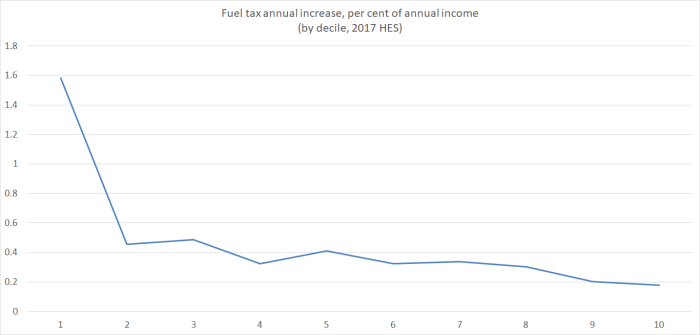
The suggestion that these data are some sort of “complete reversal” of the claim the tax is regressive is itself just nonsense.  One would need to look at the impact of the fuel tax increase as a proportion of income.  And households in the top decile earn about ten times as much as households in the bottom decline, according to the same Household Expenditure Survey.

So I went and got the income by decline data for the June 2017 year from the Household Expenditure Survey.  The income data is presented in range form, so for each decile I used the average of the high and low incomes for that decile.  And then I took the Auckland fuel tax increases numbers in the right hand column of the table above, and calculated them as a annual percentage of annual household income by decline.  (The income numbers are for 2017, and the fuel tax increases phase in to 2020, so the absolute percentages will be different –  incomes will have risen – but what won’t change materially is that high income households earn a lot more than low income ones.)

fuel tax by decile

On the numbers the Herald themselves used, apparently supplied by the Ministry of Transport, the  direct burden of the fuel tax increase will fall much more heavily on low income people than on those further up the income scale.   The extremely high number for the lowest decile masks how significant these effects are even for other groups: the second and third deciles of household income will see an increase twice as large, as a percentage of income, as those in the 9th decile.

I’m driving to Auckland later this afternoon for a wedding, and planning to get out again on Sunday without having paid the increased Auckland fuel levy.

What the Bank tells you ten times, still isn’t true

“Just the place for a Snark! I have said it twice:
That alone should encourage the crew.
Just the place for a Snark! I have said it thrice:
What I tell you three times is true.”

(Lewis Carroll, The Hunting of the Snark)

This was only the new Governor’s second OCR announcement, but the pattern seems to be getting quickly re-established.

This was the Governor in May

The emerging capacity constraints are projected to see New Zealand’s consumer price inflation gradually rise to our 2 percent annual target.

And this was the Governor today

inflation is expected to gradually rise to our 2 percent annual target, resulting from capacity pressures.

But this was the former (but unlawful) “acting Governor” in March

Over the medium term, CPI inflation is forecast to trend upwards towards the midpoint of the target range

And this was Spencer in his first pronouncement last September

Non-tradables inflation remains moderate but is expected to increase gradually as capacity pressure increases, bringing headline inflation to the midpoint of the target range over the medium term.

And this was the former Governor a year ago

Non-tradables and wage inflation remain moderate but are expected to increase gradually.  This will bring future headline inflation to the midpoint of the target band over the medium term

In one form or another, in fact, it was the story he told throughout his five year term.

And yet it just hasn’t happened.  And, as I illustrated the other day, market prices still don’t suggest it is expected to happen.

In the real world, saying it over and over again doesn’t make it any more likely to happen.   It might happen nonetheless –  there is a great deal of uncertainty about macroeconomics – but the Reserve Bank still isn’t giving us a compelling story as to why, having been wrong for years, we should now believe they have it right.  As I noted at the time of the May MPS, those doubts were only increased by his enthusiastic endorsement of his predecessors’ record

Perhaps even more startling, was his response when asked a question in which it was noted that Graeme Wheeler had failed to hit the inflation target midpoint, and Orr was asked whether he would be happy to be judged on his performance against that metric.  That seemed to set the Governor off in defence of his predecessors, claiming that the economy was in near-ideal cyclical sweet spot, and that he could not imagine a better place to start from as Governor.  A bit later he chipped in that he thought the Bank had been doing a ‘remarkable” job in forecasting core inflation –  a variable that hasn’t been anywhere near the explicit 2 per cent target since that target was put in place by Bill English almost six years ago. 

One can’t expect a full story in a one page OCR announcement such as today’s, but there wasn’t anything much more compelling in the MPS either.  And three months into his term we have not had a single on-the-record speech from the Governor about monetary policy, which is still his prime statutory function.     Lots of chatty greetings, but not a great deal of substance.

And all in a global climate that seems to be getting much more hostile, and risky.

But it isn’t inconsistent with the Bank’s Statement of Intent the other day.  In it, we are told that

 we will promote a deeper understanding at the Bank of tikanga Māori and te Reo Māori.

with no obvious connection drawn, that I could see, with anything in the Bank’s statutory mandate.  It will no doubt win the Governor feel-good points with his political masters, as he fights turf battles in the months to come.  But there was still nothing at all on ensuring that the Bank, and New Zealand policymakers more generally, are ready when the next serious recesssion hits –  stuff at the heart of what we have a monetary policy and central bank for.

In his statement today, the Governor included this, largely meaningless, line

The Official Cash Rate (OCR) will remain at 1.75 percent for now. However, we are well positioned to manage change in either direction – up or down – as necessary.

Of course he can move the OCR up or down 50 basis points (to me, the data –  as distinct from the vapourware masquerading as economic forecasts – suggest down).  But the big problem is that if circumstances ever require him to cut the OCR more than say 250 basis points –  and something in excess of 500 basis points has been more normal in serious downturns, here and abroad –  he can’t do it.  He knows it, and the markets know it.       Failure to do anything meaningful to reduce or mitigate those risks, and to communicate those plans to the public and markets, risks accentuating any downturn when it comes.

(I’ll be away for the next few days, but will come back next week to write about the Bank’s speech earlier this week on digital currency, perhaps best summarised as “how best to serve the banks, rather than the public”.)


Foreign government influence, the PRC, and the Wellington establishment

Somewhat to my surprise, a few weeks ago an invitation dropped into my email inbox.   It was from the Asia New Zealand Foundation – a (almost entirely) government-funded entity, staffed at senior levels by former MFAT people, with a mission

to build New Zealanders’ knowledge and understanding of Asia. 

These are the people who occasionally run public surveys, the results of which are marketed to bewail how little people know about Asia.  I managed to get all the latest questions right –  including which (of 4) Asian countries the Mekong river didn’t flow through –  and did surprisingly well on one of their harder quizzes.  But I still can’t name which English counties the Severn river runs through, all the countries the Rhine flows through, or all the states the Mississippi runs through or between.  I don’t feel  particularly disqualified as a result.

The invitation?

You are invited to attend a roundtable discussion being hosted at the Asia New Zealand Foundation on the conversation around foreign influence in New Zealand.

It went on

After observing the unhelpful polarity in the discussion in Australia, the Foundation has given some thought to how it could support a constructive conversation in New Zealand, namely one which:

– encourages expert voices to speak freely;
– sets a constructive tone for challenging these assessments and perspectives, without acrimony.

It was to be what they described as a “Track 1.5” event (in this world, Track 1 apparently involves official to official dialogue, and Track 2 involves non-government people talking to counterparts, but this forum would involve both).   Senior officials would attend, and speak, while as for the others

this event will involve up to 20 members of the business, media and academic community who are thinking strategically about this issue.

We were told that “the Government is keen to hear participants’  views” on issues such as

How can government and others talk about foreign interference, and its response, in a way that is constructive and sends coherent messages to a wide range of stakeholders (ie government agencies, public, business, international partners and state actors)?

I was a bit surprised to be invited.  I don’t lay claim to any particular China expertise, but I am interested in New Zealand policy and politics, and I suppose I had been a little dogged (perhaps even annoying, including to some others who were on the invite list).  So, with a little trepidation and low expectations, I accepted the invitation.  Expectations were low because in the entire document that accompanied the invitation the People’s Republic of China didn’t rate an explicit mention, and because if anything the focus seemed to designed to be about all being nice to each other.

the purpose is to bring different voices to the table on what is a challenging but important issue for New Zealand – and to discuss how we would like to engage with each other moving forward.

The event was held under Chatham House rules.  And since they were rather sensitive on the point (even sending out a later reminder about letter and spirit), this is the explicit rule this post is written under

The Chatham House Rule will apply to this roundtable. This means that participants are free to use the information received, but neither the identity nor the affiliation of the speaker(s), nor that of any other participant, may be revealed. There will be no note or output of the discussions.

Of the attendees, perhaps all I can say is that it was a very Wellington audience –  a description, and a flavour, rather than a criticism.

Every though everyone in the room knew that meeting wouldn’t have been held were it not for the issues around the People’s Republic of China, there was a rather desperate desire apparent to avoid singling out the PRC.   Indeed, the meeting opened with a statement about wanting to “talk as much about the risk as about any risk actor”, and that together with a statement near the end about not talking about the “who” but the “what” tended to bracket the discussion.

We heard that the Prime Minister had said publicly that New Zealand had experienced Russian cyber-attacks, we heard reference to Russian use of chemical weapons, about “fake news” and RT, we heard about the US pulling out of the Paris climate agreement (which, last time I looked, was their perfect right) and about questionable new US tariffs.   On the other hand, National MP Jian Yang –  former member of the Chinese intelligence system, Communist Party member, someone who admits that he misrepresented his past to New Zealand immigration authorities because Beijing told him to –  would have been mentioned not at all, except that I mentioned him (to note the omission) late in the discussion.   Trade ties –  and the heightened exposure some New Zealand entities have created for themselves, knowing the risks, and in turn putting increased pressure on the New Zealand government to keep quiet –  also barely got a mention.   Specifics quickly get awkward and personal.

Speakers were keen to convince us that officialdom was right up with the play (the issue being “owned” overall by DPMC), and working hand in hand with our Five Eyes partners,  They weren’t, we were told, “naive and unprepared” but rather actively engaged in “detecting and countering interference” –  apparently some overseas partners are even envious of some of the telecommunications legislation implemented here a few years ago (an observation that should probably leave New Zealanders a bit nervous).  Any suggestion of a threat to our membership of Five Eyes is, we were told, “spurious”.  I presume that means “false”.

I guess I came away with the impression that officials think they are more or less on top of the outright illegal stuff.   One hopes they are correct.

My own concerns tend to be with stuff that is legal, or just overlooked.   And where political cravenness, fear, and good dose of pursuing short-term opportunities as if oblivious to the character of those being dealt with, seem to matter as much as any active direct PRC intervention here.  Stuff like, for example, the way our major political party presidents laud Xi Jinping or the CCP, or the way a major party campaigns with a Xi Jinping slogan, or the refusal of anyone prominent to ever say anything critical of the PRC in public.  Or the willingness of our public universities to take PRC funding for culture/language learning, with PRC controls over the sort of people allowed to teach (Falun Gong adherents need not apply, nor those pro-democracy, those favouring respect for Taiwan’s independence etc).  Or the way our trans-Tasman school of government is in partnership with the Chinese Communist Party.  Last week our political leaders went back and forward over what to say about the US border/illegal immigrant issues.  The political editor of our largest paper called for our leaders to show we had an “independent foreign policy”.  I’d have thought the treatment of the PRC was more of a test of that one.   South China Sea anyone?  Taiwan –  a prosperous democratic state increasingly menaced by a power we’ve signed up with in some “fusion of civilisations” vision –  anyone?

Or one might look for any sense of real concern for our own ethnic Chinese citizens –  especially those who despise the regime, or have few/no modern ties to the PRC –  whose media, whose cultural associations etc are increasingly in the thrall of regime-friendly United Front entities.  Or concern for the New Zealanders of Chinese ethnicity who face threats to families back in the PRC if they do make a stand, or speak out, on anything.

I’m not suggesting there were no direct references to the PRC at the roundtable, but it seemed awkward, rather than any sort of open or really honest conversation.  I’m sure everyone there knows the character of the PRC regime –  at home, abroad, and here.  But…it was clearly awkward to talk about, and no one wanted to name the PRC as one of the most awful regimes now on the planet –  between its external expansionism, defiance of international law, attempts to rewrite history, attempts to use diasporas to serve its purposes, domestic concentration camps (much of the province of Xinjiang), political and religious repression, organ harvesting, and so on, the Nazi Germany equivalent of our day.  If you won’t name the character of the bad actor, you are unlikely to be serious about resisting or responding.   It is hardly as if the goals of the PRC/CCP, including through the United Front organisations in (various) countries like ours, is any great secret.

Having said that, I was pleasantly surprised in a couple of areas.  There was clear unease, from people in a good position to know, about the role of large donations to political parties from ethnic minority populations –  often from cultures without the political tradition here (in theory, if not always observed in practice in recent decades) that donations are not about purchasing influence.  One person observed that we had very much the same issues Australia was grappling with (although our formal laws are tighter than the Australian ones).  Of ethnic Chinese donations in particular, the description “truckloads” was used, with a sense that the situation is almost “inherently unhealthy”.   With membership numbers in political parties dropping, and political campaigning getting no less expensive, this ethnic contribution (and associated influence seeking) issue led several participants to note that they had come round to favouring serious consideration of state funding of political parties.   I remain sceptical of that approach –  especially the risk of locking in the position of the established parties, or locking out parties the establishment doesn’t like – but it was sobering to hear.

There was also unease about the suborning of former politicians (jobs after politics), and the suggestion of a need for stand-down periods.  And there was something of a call for more open government engagement on these issues (not, obviously, direct intelligence matters).  One person contrasted the speech a few months ago by the Australian head of the Department of Foreign Affairs and Trade, highlighting some of the issues and risks, and the near-silence by our own senior officials and ministers.    But here I suspect there was a bifurcation between those who felt the government should be on the front foot playing down the issues, and those who felt it should be more open in recognising them and engaging in debate with New Zealanders about how best we should respond.  Of the taxpayer-funded China Council’s efforts in this area –  attempting to minimise or trivialise the issue – one participant observed that they had been “unsophisticated and unhelpful”.

I guess my sense was that few of the people at the roundtable were at all comfortable participating in wider public or political debate: many were or are bureaucrats, not accustomed to visibility or audibility.  And many of the non-government people had business or similar interests that would make speaking out difficult, and potentially threatening to finances and professional opportunities.  There wasn’t even much sign of robust debate around the table of the meeting itself –  occasional awkward observations typically being left to stand, with no response or debate (although this may partly have reflected time constraints).

Many seemed to feel a real distaste for the nature of the debate in Australia over the last 12 to 18 months.   One discussant pushed back, arguing that what was needed was a robust public debate, not just involving subject experts, but citizens, and that –  moreover –  some heat was often an inseparable part of shedding light, and that arguably the Australians had done the debate better.  I’m in that latter camp.   On the other side, someone plaintively quoted one of the participants in the Australian debate as accepting that he had occasionally overdone things on Twitter, but surely that is almost in the nature of the medium?   Civility is a considerable virtue, but it isn’t the only one, and sometimes civility and politeness can be a cover for avoiding really confronting issues.  It is fine to quote –  as someone did – the old line about playing the ball not the man, but people are the actors here:

  • Jian Yang, personally, is in our Parliament, is a former member of Chinese military intelligence, did misrepresent his past, is closely associated with the PRC Embassy,
  • Bill English and Simon Bridges (on the one hand) and Jacinda Ardern and Winston Peters on the other sit silently by,
  • Chris Finlayson did openly attack Anne-Marie Brady (none of whose significant claims has been overturned or substantively challenged) as some sort of racist xenophobe,
  • Raymond Huo is closely associated with United Front bodies, and did adopt a Xi Jinping slogan for Labour’s campaign among the Chinese community,
  • Peter Goodfellow and Nigel Haworth do laud and magnify Xi Jinping and the PRC,
  • successive foreign and trade ministers make up stuff about our economic reliance on the PRC, and keep very very quiet whenever any awkward issues arise.

No one makes these people do any of these things. They choose to.   There are explanations perhaps, but not justifications.

In the end, I appreciated the invitation to the roundtable, and I did learn a few things.  But it didn’t leave me really any more confident than I had gone in that the establishment was at all keen or willing to have New Zealand stand up and do things differently, not just safeguarding our formal institutions (which probably aren’t that threatened), but with some self-respect, standing up for the sort of the values countries like our own have long stood for, and which the PRC/CCP is –  in many cases –  the antithesis.   Roosevelt’s four freedoms, and things like that –  on all of which the PRC either falls well short, or seems to simply regard them as “not applicable here”.

Then again, the real issue isn’t advisers per se, but the reluctance of successive elected governments to do or say anything that might prove awkward with Beijing.  Implied threats  – to individuals or to the economy (economic coercion and the like) –  are interference, even if there is nothing direct for intelligence agencies and the like to pick up on, and even if –  as in the case of economic coercion –  politicians are often excessively fearful.  Political donations may be part of that story, I don’t think they are anything like the entire picture.  And yet none of that was discussed.


Some more real exchange rates

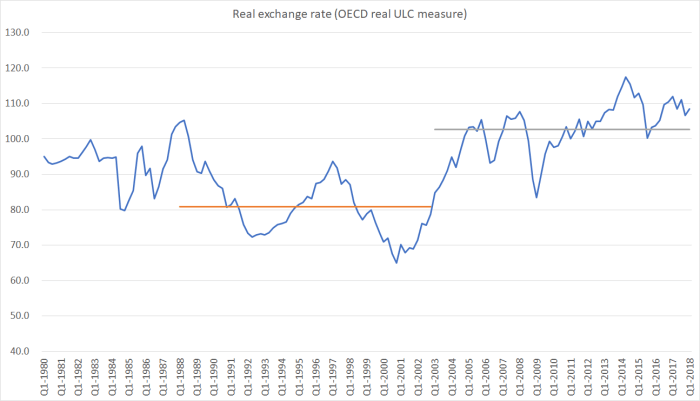
A couple of recent posts have highlighted the really significant sustained increase in New Zealand’s real exchange rate.  I illustrated that with this chart

ULC jun 18

which shows the OECD’s relative unit labour costs measure.

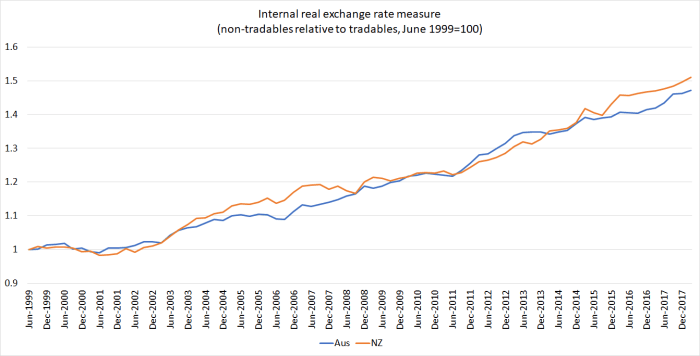
Measures such as this, working back from a nominal exchange rate index, tend to be quite cyclical (around whatever longer-term trends are underway).  But there is another approach to the real exchange rate, an internal measure that looks at developments in the prices of non-tradables relative to the prices of tradables.    A rise in the ratio of those two sets of prices suggests, all else equal, that the tradables sector of the economy is becoming relatively less competitive.

Unfortunately, good long-term series of tradables and non-tradables prices are pretty few and far between.  The official series in New Zealand only date back to 1999 (and the Reserve Bank doesn’t publish the earlier versions that we calculated ourselves using highly disaggregated SNZ data).    Here is the chart of that measure of the real exchange rate, and the same derived series for Australia.

internal RER 1

To look at that chart, one might suppose that non-tradables almost always increased in price faster than tradables (although even at the start of the series –  when both countries’ nominal exchange rates were very weak –  there are hints otherwise).

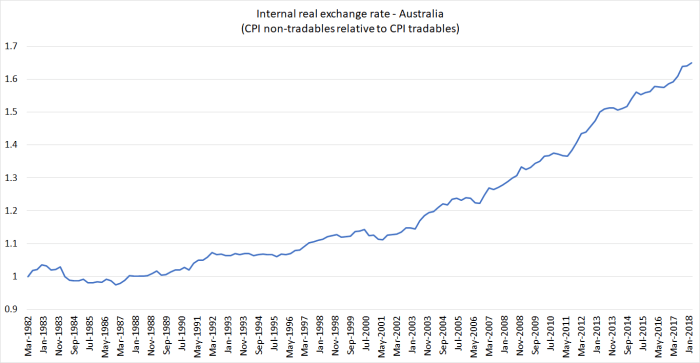
Fortunately, Australia has these data back to 1982.

internal RER 2

For the first 20 years of the series it was fairly flat –  the difference between tradables and non-tradables inflation rates was only around 0.5 per cent per annum.   Since around 2001, the annual difference has been more like 2.5 per cent per annum.   Such differences have come to be taken for granted, but it isn’t a normal state of affairs.

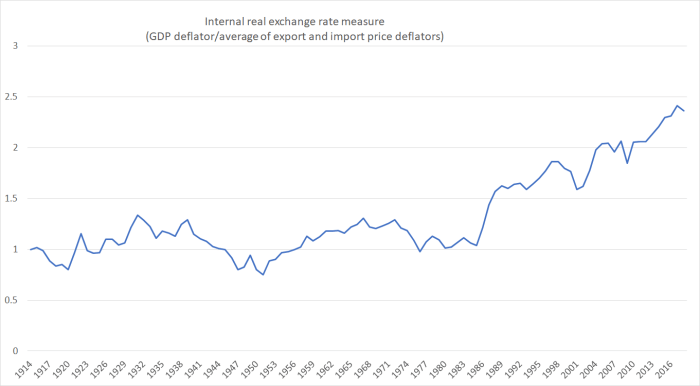
Another way of getting a fix on the internal real exchange rate was suggested a few years ago by former Victoria University academic Geoff Bertram, in his chapter on the modern economy for the New Oxford History of New Zealand.  His measures calculates the real exchange rate as the ratio of the GDP deflator (prices of all the stuff produced in New Zealand) relative to the average of export and import prices.   Stuff that is exported is captured in both the numerator and the denominator, but all the non-tradables are in the numerator only, so that this measure will rise (fall) when non-tradables prices rise faster (slower) than tradables prices.   For New Zealand there are estimates of all the relevant deflators back to 1914.   Here is the resulting chart.

internal RER 3

For 70 years, there was no trend in the series. On average, over that full period tradables prices and non-tradables prices seem to have increased by about the same amount.  The cycles were quite prolonged, but no trend was apparent.   And then everything changed, and the sort of appreciation we’ve seen on this measure over the last 30 years is unlike anything seen before.

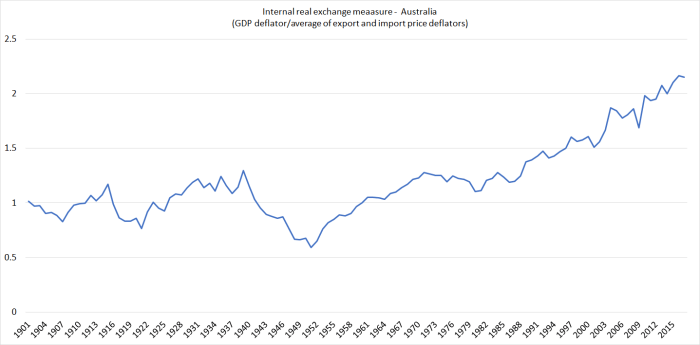
What about Australia?  Here is the same chart, going back to 1900.

internal RER 4

Much the same sort of picture –  a flat trend for 80 years, and then a sharp sustained move upwards (although not quite as large a move as that for New Zealand).

(It isn’t a universal pattern: the official US data go back to 1929, and although there has been an increase late in the period, the current level is not even 10 per cent above the previous peak.)

To be honest, I’m not sure quite what is going on in New Zealand and Australia, although the numbers would be consistent with both countries having experienced very weak productivity growth in their non-tradables sector (thus economywide cost increases spill into prices).  In New Zealand, weak productivity growth translated into weak overall economic performance, while in Australia the windfall of huge newly-tapped mineral resources has kept their overall economic performance looking better.  It is, after all, a real income gain.

Export volume growth in the last 30 years as a whole has outstripped the growth in real GDP in both countries, but that margin has been far larger in Australia than in New Zealand.  In Australia, export volume growth over that period was almost twice as fast as real GDP growth.

I noted that even on those internal real exchange rate measures, the increase in New Zealand has been larger than in Australia.     The same thing shows up, much more starkly, with a simple calculation of a New Zealand/Australia real exchange rate, taking the nominal exchange rate and adjusting for inflation differentials.    This chart shows that measure going back to 1914.

rer nzd aud

Again, a reasonably flat trend for 70 years, and then the move up to the new much higher level from the late 1980s.   And this, even though our productivity growth has continued to drift further behind Australia’s.

And for those keen to fall back on terms of trade stories, they don’t help.  This chart shows the terms of trade for New Zealand and for Australia back to the early 20th century.

TOT aus and NZ jun 18

Over 100 years, the two countries’ terms of trade have done much the same thing, ending up almost in an almost identical place.

So Australia was able to bring to market huge new mineral resources, and managed much faster productivity growth than New Zealand, and yet New Zealand has had much the larger real exchange rate appreciation.

Beginning to make inroads on New Zealand’s dismal productivity performance seems almost certain to require getting to the bottom of what has given rise to such an appreciation –  on almost any measure one cares to look at, internal or external.

(Meanwhile our bureaucrats avoid the real issues, while looking busy.  Yesterday I stumbled on this on an MBIE website, touting a new panel of experts –  half academics, a third public service economists –  to help fix businesses.

It’s common for small businesses in New Zealand to be passionate about what they do, but pressed for time. So working “on” the business instead of “in” the business often stays at the bottom of a long to-do list.

Business owners and operators tell us they would love to improve their systems and processes to get better results, and to save time and money. But getting these up and running takes time they just can’t spare.

This lack of time to work “on” the business is one reason why New Zealand’s productivity is comparatively poor. This poor productivity is a problem, whether you want happier workers, bigger profits or a better work/life balance — or a combination of these goals.

To help Kiwi businesses find practical ways to improve their performance, we’ve brought together a panel of experts from New Zealand and around the world, and combined their insights with our own research with small businesses.

I suspect small business owners are often rather busy whichever country they are operating in (high productivity or low), that we are better off assuming that private sector people make the best of their opportunities, and that the answers to the question of why New Zealand now lags so badly behind lie rather more with the politicians and their public service advisers than with the private sector.  Skew the playing field, and it is hard to get a good game.  Perhaps –  as in areas of financial conduct –  the (self-proclaimed) physicians should “heal themselves” (fix things they are directly responsible for) rather than touting their alleged skills in fixing private businesses.  Apart from anything else, there are professionals running their own businesses offering advisory services, and they actually face a market test.)


Exports of services: a dismal picture

In my post yesterday, I highlighted the pretty stark divergence in the performance of the tradables and non-tradables parts of the economy.  As the key chart in yesterday’s post illustrated, in the 1990s and into the early 2000s both the tradables and non-tradables sectors were growing strongly, even in per capita terms.   Since then, the non-tradables sector has continued to grow pretty strongly, but there has been no growth at all in per capita tradables sector GDP –  in fact, the current level is almost 10 per cent below the 2004 peak.

One element of the tradables sector that is commonly supposed to be doing well is exports of services: tourism, export education, and the rest.   The government has indicated that it hoped the ICT component would surge ahead and, on some definition or other, be the “second largest contributor to our economy by 2025”.

But how have services exports  actually being doing, as a share of the economy?  Here is the New Zealand chart.

services X june 18

There was really strong growth over the 15 years or so to the peak (marked) in around 2002.  Services exports lifted from less than 7 per cent of GDP to in excess of 10 per cent.  Since then, the trend has been back downwards again –  the current level only a touch above 8 per cent.  And, at that, one of the largest components –  export education – is, in effect, quite subsidised, by being bundled together with the ability to get work rights and residency points.

How have other advanced countries done?

Here is a chart, using annual OECD data, showing (a) New Zealand, (b) the median for those small OECD countries with complete data since 1986, and (c) the median for six small former Communist eastern and central European OECD countries, countries engaged in the sort of catch-up that New Zealand was supposed to experience.

services X 2 june 18

I don’t fully understand what was going in the former Communist countries in the first few years of the century, although since in many there was a big boom in domestic demand and credit, the export sectors (especially the bits not involving FDI) were probably under pressure.   Whatever the story for those countries then, both lots of small advanced countries have seen rising shares of their economies accounted for by services exports over the past decade.  We haven’t.

Here is another way of looking at our experience, looking at the percentage point change in the services exports share of GDP since our peak in 2002.

services x 3 june 18

There were two –  of 34 – OECD countries that saw a slightly larger fall in the GDP share of services exports.  In one case, the growth in goods exports more than offset the fall.  In the other –  Chile –  both goods and services exports shrank as a share of GDP, as happened in New Zealand.

As ever, foreign trade isn’t everything.  But when your per capita incomes and productivity are so far behind the leading countries in the OECD, the typical way in which a country would undergo a sustainable lift would involve a larger share of the economy accounted for by both exports and imports  That just hasn’t happened in New Zealand –  and, of course, neither has there been any catch-up.   Which isn’t surprising when, on the measure I illustrated yesterday, the real exchange rate over the last 15 years has averaged 27 per cent higher than the average level in the previous 15 years.

That higher real exchange rate didn’t get there by chance.  It was the consequence –  mostly unwitting – of deliberate government choices.

On which note, it is nine months today since the election.  In other words, a quarter of the government’s term has gone.  And, as far as I can see, there is nothing in policy announced, or foreshadowed, likely to do anything to close the productivity gaps,  materially alter the real exchange rate, narrow the large average interest differentials, or sustainably increase the export share of our economy so that in turn we can support a larger import share.  Oh, and market prices suggest no confidence that the manifest evil that is the housing market is on the way to being fixed either.