What does the Governor say to the unemployed?

Graeme Wheeler yesterday gave a speech on current monetary policy issues and challenges. It was accompanied by an unusually long press release, and is probably best seen as a commentary, and elaboration, on the brief OCR statement released last week. I commented on that statement here.

I thought it was a very disappointing speech.

There is still no sign that the Governor recognises that he made a mistake in raising the OCR 100 basis points last year, in talking of further rate hikes as late as last December, and only beginning to cut rates in June. The fact that a mistake was made really should be blindingly obvious, even to him, by now. It should have been acknowledged and serious steps made to reverse it, and then we could move on. Instead, reluctance to acknowledge the mistake seems to have locked him into a mind-set in which he is now willing to cut the OCR as new weak data emerge, probably 25 points at a time, but is unwilling to unwind the excessively tight conditions he put in place last year. He repeatedly talks of GDP growth rates around 2.5 per cent as if these are good outcomes, but New Zealand’s population is estimated to have grown by 1.8 per cent in the last year. After an anaemic recovery, New Zealand is already experiencing weak per capita growth, before the full impact of the sharp fall in international dairy prices (let alone any threat from a weakening Asia) has been felt. And it is idle to talk repeatedly of the “need” for a lower exchange rate when he is personally deciding to hold the OCR at levels higher than the inflation target would appear to require.

Far too much weight in the speech is given to headline CPI inflation. As the Policy Targets Agreement has put it for years:

For a variety of reasons, the actual annual rate of CPI inflation will vary around the medium-term trend of inflation, which is the focus of the policy target.

The Governor has stated very explicitly in this speech that the Bank’s preferred measure of core inflation is the sectoral factor model measure. That measure it has its weaknesses, but it has the longest time series of any of the measures the Bank publishes, and it tends to be the measure I use most often too. As it happens, estimated sectoral core inflation over recent years has been being progressively revised downwards. And at 1.3 per cent now (and having been below 2 per cent for five years now) it is not just a “bit” (the Governor’s word) below the midpoint. For a very persistent slow-moving series, this is a huge deviation. “The medium-term trend of inflation” is nowhere near the 2 per cent target midpoint the Bank is required to focus on.

sectoral core

The Governor downplays this in two ways.

First, he explains away current low headline inflation mainly by reference to the fall in international oil prices and the rise in the exchange rate last year. Which is fine, and no serious observer is focused on headline inflation. But the Governor doesn’t mention tobacco tax increases, which have “artificially” and substantially boosted headline inflation in recent years. The Governor quotes the PTA to the effect that headline CPI inflation might deviate from the medium-term trend because of “shifts in the aggregate price level as a result of exceptional movements in the prices of commodities traded in world markets” [ie oil prices], but doesn’t mention that the next reason listed in the PTA is “changes in indirect taxes”. As I noted last week:

• Even with the rebound in petrol prices, CPI inflation ex tobacco was -0.1 over the last year – this at the peak of a building boom.
• CPI ex petrol inflation has never been lower (than the current 0.7 per cent) in the 15 years for which SNZ report the data.

We develop core inflation measures to adjust for these sorts of effects. Five and a half years with core inflation (on their own preferred measure) below the target midpoint, by slowly increasing margins, is a sign of a Bank that has got monetary policy repeatedly wrong. And that matters more under Graeme Wheeler, because he explicitly signed up to the focus on the target midpoint. Alan Bollard, by contrast, could (and did) point out that the midpoint had no special status in his PTAs.

And then the Governor tells us that he expects inflation to be back to target midpoint by the middle of next year. But here he is not talking about the “medium-term trend of inflation”, but about headline inflation. All else equal, if oil prices and the exchange rate stay around current levels, headline inflation is likely to pick up somewhat over the next 12 months. But the speech says nothing at all about the expected path of core inflation, or medium-term inflation measures more generally. A lower exchange rate provides a boost to the domestic price level, all else equal, but that just means the headline inflation rate rises for a year or so. What happens after that? As the Governor acknowledges, the Bank has overestimated medium-term or core inflation in recent years, but he offers us nothing, at all, to give us reason to believe that that situation has changed.   There is no sign of any correction to what has led them astray for the last few years.

For the last 15 years or so, the Bank has generally sought to “look through” the direct price effects of exchange rate changes, precisely because they usually tell us little about the underlying state of inflation pressures. Doing anything else – putting much weight on those direct effects in setting policy – risks the Bank holding the OCR higher than the medium-term trend in inflation would warrant. Not just the PTA, but plenty of good economic theory also, encourages the Bank to focus on the stickier prices, captured in (for example, and imperfectly) non-tradables or core measures.

In fact, some of the Bank’s own quite recent research suggests that we might not see even much of an increase in headline inflation. Here is one of their researchers, Miles Parker, in a paper published last year:

The net impact of a fall in the international prices of the commodities New Zealand exports  on the consumers price index (CPI) has been to lower New Zealand consumer prices, even  though the exchange rate has tended to fall when export commodity prices fall. Falls in  export commodity prices leave New Zealanders as a whole poorer and so domestic  spending, and pressure on domestic labour and capital, tends to ease. For exchange rate depreciations caused by other factors there appears to have been little net effect on  aggregate consumer prices, since a rise in tradable CPI inflation has been broadly offset by  a fall in non-tradable CPI. For each of these classes of exchange rate changes, the inflation  outcomes implicitly include the average response of monetary policy to such exchange rate movements over the period.

In other words, falls in the exchange rate happen for a reason, and have often been accompanied by such a significant weakening in economic conditions that they have often been associated with further falls in non-tradables and core inflation measures. That has to be a real risk now, as falling real (terms of trade) incomes and slowing growth in construction activity take hold.

What else is there to say? A few scattered observations:
• The Governor rightly observes that “in most advanced economies, policy interest rates are at historic lows”, but one could go further. In all OECD countries, except New Zealand, policy interest rates are lower (or no higher) than they were at the start of last year. New Zealand has seen no sign of the sort of medium-term inflation pressures that would have warranted – or warrant now – such a stance. The Bank thought such pressures would emerge, but they were wrong. Mistakes happen, but they need to be acknowledged and corrected for.
• I find it extraordinary that the Governor continues to articulate a view that high immigration has eased inflation pressures (outside the Auckland house market presumably). Until the last 12 months or so, the Reserve Bank has for decades consistently operated on the assumption, well-supported by data, that (whatever the possible long-term benefits) the short-term demand effects of immigration dominate the supply effects. Indeed, that result is apparent in the Bank’s own quite recent published research. Here is a picture from a 2013 Analytical Note

chris mcdonald
• It is puzzling that there is no mention of unemployment in the speech at all. It isn’t a fool-proof indicator by any means, but is probably better estimated and more easily interpreted that output gap estimates which the Bank continues to rely on (despite the inability of the Bank’s existing models to explain inflation). At 5.8 per cent, New Zealand’s unemployment rate is still disconcertingly high. It is all very well to laud rises in the participation rate, but there is no evidence that New Zealand’s NAIRU is anywhere near as high as 5.8 per cent. Many real people – with lives currently blighted by unemployment – would have been back in jobs if the Reserve Bank had not set the OCR so high over the last 18 months. What, I wonder, does the Governor have to say to these people when he meets them?

• This passage in the speech seemed particularly ill-judged:

Central bankers have found the post Global Financial Crisis (GFC) years to be a very challenging time for conducting monetary policy. High expectations have been placed upon central banks at a time when the economic, financial and political interlinkages in the global economy seem more complex, and where monetary policy has become the fall-back policy to promote a strong global recovery.

Few people will have much sympathy with highly-paid powerful officials bemoaning how difficult their job has been in recent years, as the Governor seems to.  He has options.

Many of the problems central banks in other countries have faced relate to running into the near-zero lower bound on nominal interest rates. New Zealand (and Australia) have not yet got anywhere near that floor. There is no evidence of “high expectations” having been placed on the Reserve Bank of New Zealand – indeed, the dismal inflation track record, with no obvious adverse consequences for the Bank, might suggest a central banking equivalent of the “soft bigotry of low expectations”. The Governor complains that “monetary policy has become the fall-back policy to promote a strong global recovery”. Most New Zealanders would have settled for a strong domestic recovery, but we just have not had one. It has been the weakest domestic recovery for many decades, despite the record terms of trade, and the boost to demand from a Christchurch-led building boom.

In a sense, the whole point of discretionary monetary policy is to allow monetary policy to promote strong bounce-backs when demand falls away and recessions happen. With hindsight it is clear that lower policy interest rates over the last five years would have given us both a stronger recovery, and a medium-term trend in inflation nearer the inflation target. There were no policy obstacles to doing so. I’m not suggesting there are no puzzles in the global events of the last few years, but if you have trouble reading the future, just look out the window and respond to the best estimates of the medium-term trend in inflation. Core inflation has been below target midpoint since December2009, and not once – not for a single quarter – has the OCR been cut below the level that prevailed back then.

• The Governor repeats a claim that “our economy has generated better growth…than many other advanced economies”. As I have documented on several occasions, and in several ways, while our total GDP growth has been relatively high, that is only because our population growth has been much faster than most. Growth in GDP per capita, or in any of the productivity measures, has been no better than mediocre, even relative to other countries’ weak performances. Quite why we have done so badly is still a bit of a puzzle, but endless repetition of an alternative wished-for story does not make it true.

• Somewhat puzzlingly the Governor claims that “some local commentators have predicted large declines in interest rates over coming months that could only be consistent with the economy moving into recession”. Actually, it isn’t only local commentators, but set that to one side. With core inflation measures so low, and no evidence adduced that core inflation measures are about to rise materially, it would be quite easy to make the case for a 2 per cent OCR right now. There was never any need for the OCR to have been raised at the start of last year (from 2.5 per cent) and core inflation pressures and measures are weaker now than they were then.  At present, with the threat from a weakening Chinese economy increasing, the risk is that having held the OCR too high for too long materially increases the chances of a couple of quarters, or more, of negative GDP growth. And the Governor needs to get some perspective on the scale of short-term interest rate falls that tend to happen in real recessions: 700 basis points over the 1991 recession, 550 basis points in the mild 1997/98 recession, and 575 basis point OCR cuts in 2008/09.  Against that background, arguments as to whether the OCR gets to 2.5 per cent or 2 per cent, from a recent (ill-judged) peak of 3.5 per cent, are interesting but bear no relationship to what any serious recessionary threat might require.

There are many more points I could make. There are puzzling sentences like “having the scope to amend policy settings, however, is a key strength of the monetary policy regime”. I’m not sure when anyone last suggested a regime in which policy settings could not be amended, but perhaps I missed something.  But I’ve probably taxed readers’ endurance enough already.

New Zealand deserves a lot better than this: better policymaking and better quality analysis and communication of the issues. And, of course, it is increasingly past time for reform of the governance of the Reserve Bank, to put considerably less power in the hands of one imperfect individual, the Governor (any Governor).

Meanwhile, what does the Governor say to any of those 146000 unemployed people he meets?
House of cards?

The Reserve Bank announced last month its decision to require banks to classify all loans secured on residential investment properties separately from other residential mortgage loans. This applies not just to large commercial operators, but to borrowers with just a handful of investment properties. The Reserve Bank will now require banks to use higher risk weights (ie have more capital) in respect of the former than in respect of the latter.

This has been quite a saga. The Bank went through a couple of rounds of consultation on earlier proposals last year (then focused on larger operators), and then came back earlier this year with a revised proposal. I made a brief submission on that consultative document, as no doubt did a variety of other people (although we don’t know who, as the Reserve Bank – unlike parliamentary select committees – does not routinely publish the submissions it received). The Reserve Bank’s summary response to the submissions can be found half way down the page here (various specific links on the RB website don’t appear to be working today),

The proposal that the Reserve Bank consulted on in March/April, and which it recently adopted, had a strong feel of being reverse-engineered. The Governor had apparently decided that he wanted to be able to impose additional direct controls on lending for residential property investment, and to do that he needed banks to have systems in place which would clearly delineate between investment property loans and owner-occupied loans. To support that prior policy conclusion, the Bank has sought to argue that loans on residential investment property are, all else equal, riskier than other residential mortgage loans.   To be clear, the Reserve Bank is asserting that a loan is riskier because it is secured on an investment property, even if the initial LVR, the initial date at which the loan was taken out, the nature of the house itself, the borrowers’ income etc were all exactly the same as those for an owner-occupied loan.

What has always been a bit surprising is how little in-depth effort the Bank has put into demonstrating that its argument is correct. It has run a variety of arguments in principle about why investment property loans might be riskier than those to owner-occupiers. Most of those have never seemed overly compelling, especially not in a New Zealand context.   Indeed, there are some reasons why the result could be reversed (for example, unemployment is probably the largest single risk, all else equal, in respect of an owner-occupier mortgage, but rental income flows – which help service investment property loans – tend to be less discontinuous).

But the issue should ultimately, be an empirical one. All else equal, have investor property loans proved to be riskier than owner-occupier loans? Getting good comparable data isn’t always easy.  Material loan losses tend to arise only when nominal house prices fall, and although real house prices fell sharply in the late 1970s, large nationwide falls in nominal house prices haven’t happened in New Zealand since the 1930s. Data from that period aren’t available – although perhaps it is an opportunity for an economic history PhD project working in bank archives. But even more recently, nominal house prices have fallen materially in a number of regions, and I have encouraged the Bank to ask banks for data on the loan loss experience (investor vs owner-occupier) in places like Gisborne, Wanganui, or Invercargill.

In fact, the Bank has tended to rely on a handful of overseas studies, about a handful of overseas experiences. This isn’t one of those areas where there are dozens of studies about dozens of episodes. That makes it all the more important that what studies exist are read carefully and applied and interpreted to New Zealand very carefully. That appears not to have been done. Worse, even when some weaknesses in the way the Bank interpreted and applied such papers were pointed out to them (in submissions on the consultative document), they largely just repeated their assertions and interpretations.

I’ve worked my way through some of the papers, and had had concerns about how the Bank had interpreted and applied the results. My former colleague, Ian Harrison, who consults as Tailrisk Economics, and is much more expert in the specialist risk aspects than I am, has worked his way carefully through each of the empirical papers the Bank has cited, and several that they should have cited, but did not. He has sent me a forthcoming paper “A House of Cards”, in which he has worked his way carefully through each of the Bank’s arguments and pieces of evidence. Cumulatively, it is a pretty damning read. Ian has given me permission to run some excerpts here, and I hope that when his paper is published it will get the attention it deserves.

On the international experience, Ian summarises as follows:

The international literature does not provide support  for the Bank’s contention that investor loans are riskier and owner-occupier loans. Four of the four studies that controlled for other loan attributes found that investor status had no impact, or only a trivial impact, on default rates. A European Banking Authority survey of 41 advanced modelling banks found that none identified investor status as a risk driver in their retail housing mortgage lending models.

A good example of what appears to have gone on is how the Bank has represented an important paper on the Irish experience

Lydon and McCarthy 2011 “What lies beneath? Understanding recent trends in Irish Mortgage arrears”

The graph presented in paragraph 11 of the March 2015 Consultation document presents data from the Lydon and McCarthy paper, which addressed the question of whether BTL [buy to let] status was, in itself, a default driver, or whether the higher default experience could be explained by differences in other loan characteristics.

It was found that after controlling for differences in LVR and servicing costs, BTL status had no impact on default rates.  The higher increase in observed BTL default rates was due to the fact that a larger share of BTL loans were made in the lead up to the GFC when underwriting standards were at their lowest point and house prices at a peak.

Naturally subsequent default rates were higher for investors who bought at the wrong time and who offered scant protection to the lender, but default rates would also have been higher than average for owner occupiers with the same characteristics.

The results of their analysis are presented in table 7 of the paper which shows that the coefficient  for the marginal impact of BTL status is 0.00.  This estimate is significant at the 1% level.

In a subsequent presentation (“The Irish Mortgage market in Context – Central Bank of Ireland 2011) the authors said:

“Controlling for LTV & MRTI…

Relative to next-time-buyers (NTB), FTB borrowers are 2% less likely to be in arrears

–whereas, no relative difference for BTL”(our emphasis)

The data presented in the Consultation document does not provide evidence that Irish BTL loans are a riskier asset class. It is misleading to represent the paper, as the Bank does in several documents, that it provides evidence that BTL loans are riskier.’

Or, in respect of a US study:

Palmer C. (2014) ‘Why do so many subprime borrowers default during the crisis: Loose credit or plummeting prices’

The Bank made the following statement:

“Palmer (2014) reports that default rates increased in a multivariate regression with loan to value ratio and for loans that were declared non-owner occupiers.”

In his paper Palmer uses comprehensive loan-level data to decompose sub-prime loan loss defaults amongst three default drivers. His conclusion is as follows.

Decomposing the observed deterioration in subprime loan performance, I find that the differential impact of the price cycle on later cohorts explains 60% of the rapid rise in default rates across subprime borrower cohorts. Loan characteristics, especially whether the mortgage had an interest-only period or was not fully amortizing, are important as well and explain 30% of the observed default rate differences across cohorts. Changing borrower characteristics, on the other hand, had little detectable effect on cohort outcomes. While quite predictive of individual default, borrower characteristics simply did not change enough across cohorts to explain the increase in defaults.”

There is no marker for investment property as such in the study, just a marker for whether the dwelling was  to be owner occupied or not. It is not clear whether holiday or other second homes would fall. Regardless, the non-occupier marker fell into the borrower characteristic category, which in total provided little independent explanation of deliquency. There was no result that investor status increased defaults. The Bank’s statement was false.

I suggest that you read the entire document when it is available. As far as I can tell, none of the studies the Bank cites appears to have been fairly represented, or applied to New Zealand.

If Ian’s reading of the papers is accurate (and I have no reason to doubt it) it is a very disconcerting commentary on the processes in the Reserve Bank.   The Bank has plenty of able people, who would have been well able to pick up on each of the weaknesses Ian Harrison has identified.  And yet not just once, but again in the response to submissions, and in the new consultative documents, after the Bank had had time to consider the criticisms that submitters have made, the studies have continued to be explained or applied in ways that are, at best, misleading.

Reasonable people can reach different views on appropriate policy measures. I think the Governor of the Reserve Bank has far too much power in this area, and I disagree with the proposed restrictions.   But if citizens cannot trust the Bank to cite evidence in a balanced and accurate way, confidence in the entire policymaking process is likely to be severely eroded.

As I have noted, in such areas the Governor is effectively prosecutor, judge, and jury in his own case. Worse, he is also responsible for the investigative work that is presented in support of the case that he will himself decide. Of course, he has staff to do the work for him, but the staff (and their managers) are hired, rewarded, and potentially fired, by the Governor. A strong Governor will want to know the weakest points in his own case, and to ensure that those weaknesses are appropriately aired, balanced presumably by other strong evidence or arguments for the sorts of regulatory initiatives he is proposing. But the Wheeler Reserve Bank appears to be one in which either no one is willing to stand up and point out the weaknesses or, if someone did point them out, where the Governor and his senior managers said, in effect, “oh just ignore that, continue to repeat the same lines”. One would hope there is a better explanation, but it isn’t obvious. The Bank’s Deputy Governor, Grant Spencer, for example, has spent decades in senior roles in the Bank, and many thought he was a strong candidate to become Governor in 2012. He has direct line responsibility for the two departments dealing with these banking regulatory issues. How did he let documents this weak go out, not just once, but repeatedly? Anyone can make a mistake citing a single paper, but the breadth and repeated nature of what Ian highlights has the feel of something more deliberate.

Even if the Bank could show, with some degree of confidence, that investor property loans were riskier than those to owner-occupiers, other characteristics held equal, the case for the proposed ban on lending in excess of a 70 per cent LVR for residential investment properties in Auckland has serious weaknesses. I elaborated on those in my recent submission (and have also requested copies of all the submissions the Bank has received).

I’ve been critical of the Governor’s conduct of monetary policy over the last couple of years. But reasonable people will, at times, reach quite different views on what monetary policy stance is required. His turned out to be wrong although, as I noted this morning, he had plenty of company for too long.   But repeated misrepresentation of data to support a controversial regulatory initiative strikes me as much more serious. It might do less damage to the economy, but it strikes at the heart of the integrity of the institution, and raises serious questions about the extent to which the public can have confidence in the (unelected) Governor’s ability and willingness to carry out his statutory duties in the public interest, in an objective and dispassionate manner. Cynics might expect such standards from politicians. We certainly shouldn’t tolerate them from officials.

I hope that when Ian Harrison’s full paper is published, the Bank’s Board will start asking some pretty searching questions.  The Board is charged to, inter alia,

    • keep under constant review the performance of the Bank in carrying out—
      • (i) its primary function; and
      • (ii) its functions relating to promoting the maintenance of a sound and efficient financial system; and
      • (iii) its other functions under this Act or any other enactment:
    • (b) keep under constant review the performance of the Governor in discharging the responsibilities of that office:

Perhaps the Minister of Finance might refer the issue to Rod Carr, chair of the Board, for his views.

The Shadow Board on tomorrow’s OCR

The NZIER this morning released the results of its Shadow Board exercise. They survey nine people (currently three market economists, three business people, and three with academic affiliations) and ask them to assign probabilities for the “most appropriate level of the OCR for the economy”. In principle, I suppose “the most appropriate level for the economy” could be different from “the most appropriate level to be consistent with the requirements of the Policy Targets Agreement”, although I suspect that respondents will typically be treating the two as the same. Note that, in principle, the information in the Shadow Board responses is different from the information in financial market prices (which are close to a direct view on what the Reserve Bank will do – as distinct from what people think it should do) or from ipredict, which runs direct contracts allowing people to bet anonymously on what they think the Reserve Bank will do. When I looked just now, the prices reflected an 84 per cent chance of a 25 basis point cut tomorrow

Launching the Shadow Board was a modest but useful initiative by NZIER. It helps spark a little more debate, and a little more scrutiny, about what the Reserve Bank is doing, and puts the results in a useable (and reportable) format. It was inspired by a similar exercise in Australia (which is slightly more (too?) ambitious in that it also asks respondents for probabilities for the right rate six and twelve months ahead).

But what the Shadow Board doesn’t really do is provide any additional information on what the Reserve Bank should do. As everyone recognises, there is a great deal of uncertainty around monetary policy. Central banks talk of trying to target inflation a couple of years out, and yet have no great certainty even as to what is going on right now, let alone what will be going on 12-18 months hence.

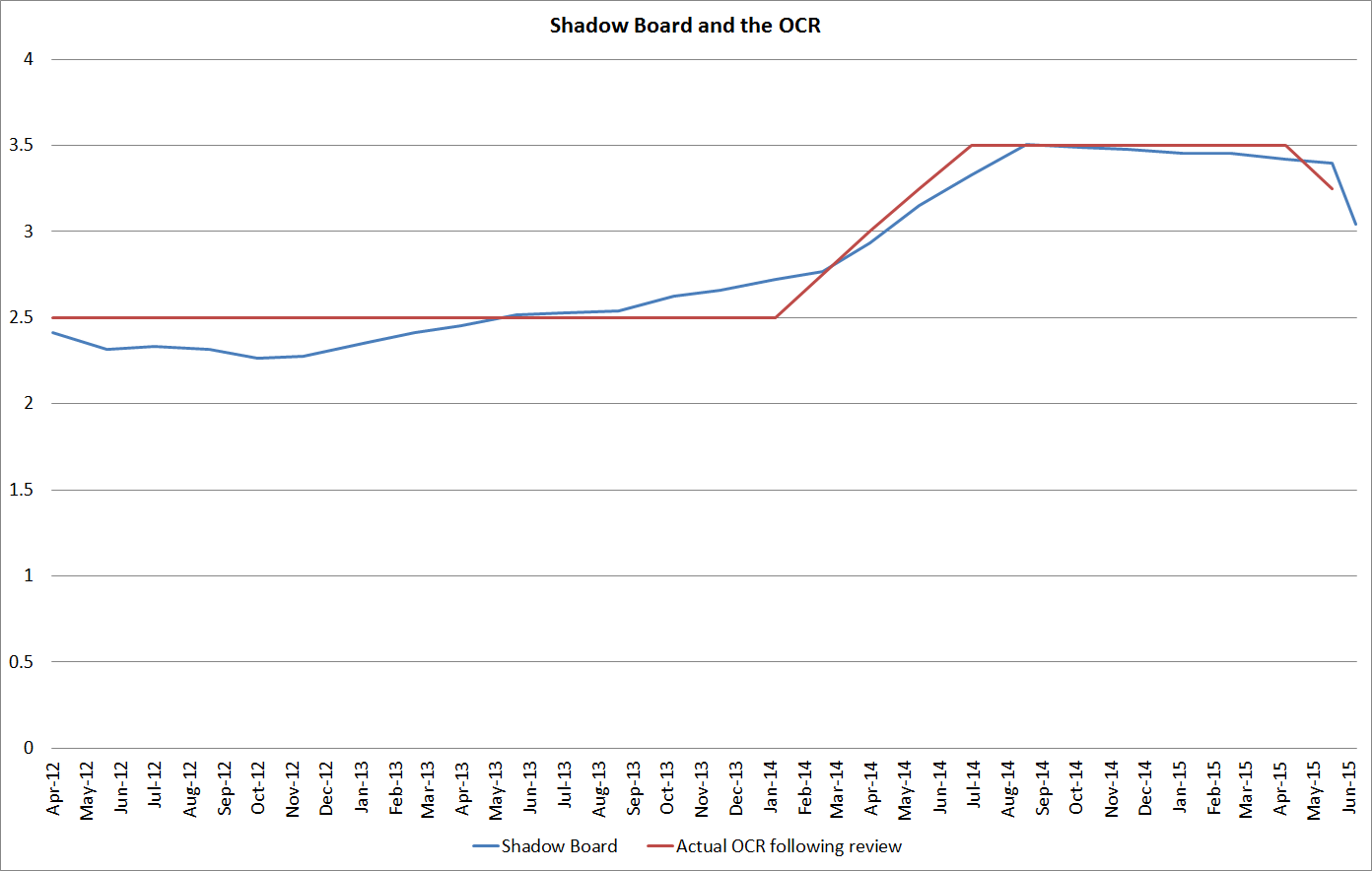
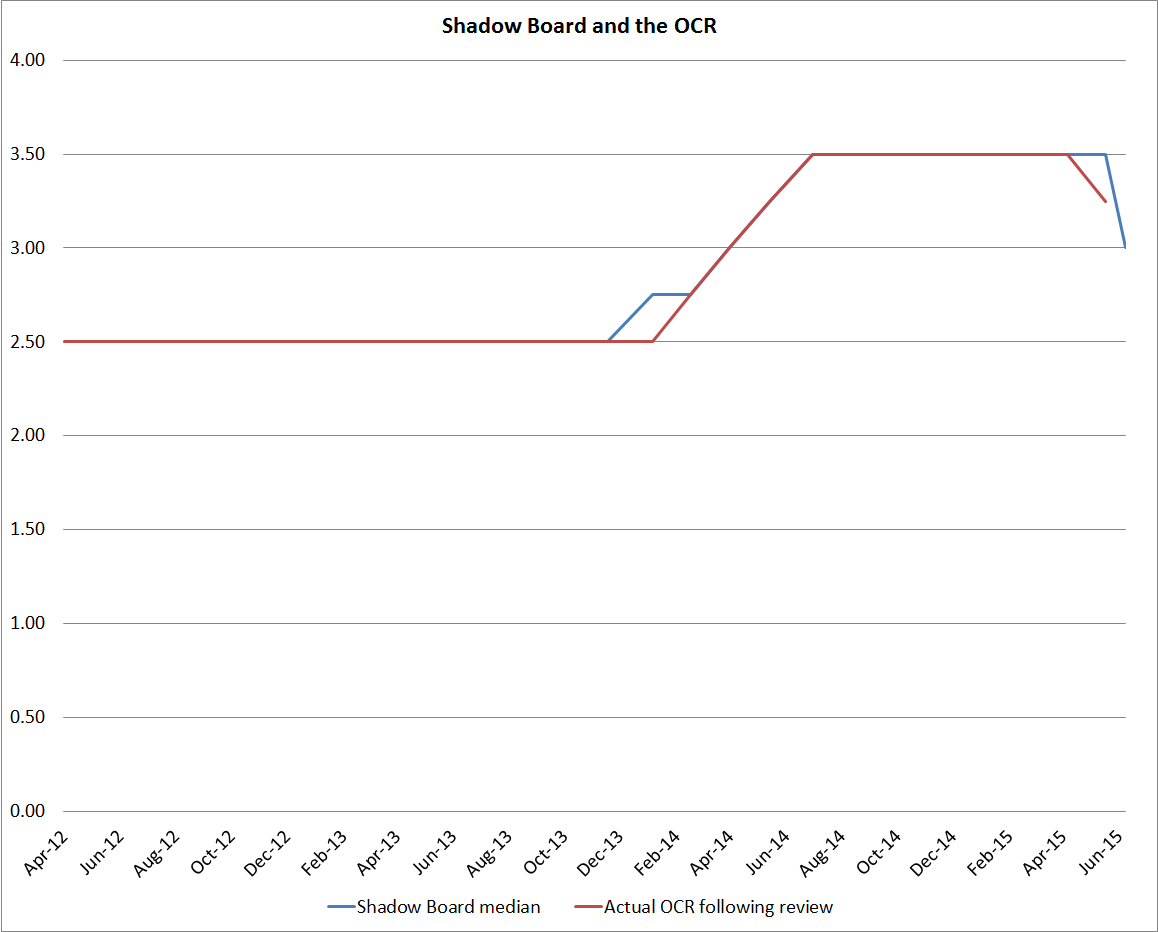
Here is a chart showing the actual OCR following the relevant review and the median view of the Shadow Board (thanks to Kirdan Lees at NZIER for sending me the historical data).

shadow board 1

They are all but identical, at least over this relatively short period. And yet the Reserve Bank has subsequently acknowledged that, with the benefit of hindsight they would have had the OCR lower in 2011 and 2012.   And most observers would now agree that the OCR did not need to have been as high as it was over the last year.

Perhaps the information is in the distribution of probabilities rather than in the median view?  Here is the mean of the views of the Shadow Board members. It does deviate a little from the actual OCR, and perhaps during last year the Shadow Board’s views were a little more cautious than the Reserve Bank was. The Shadow Board’s mean view was a little below the actual OCR, while the Reserve Bank itself was still stressing upside risks and the probable need for further rate increases.

shadow board 2

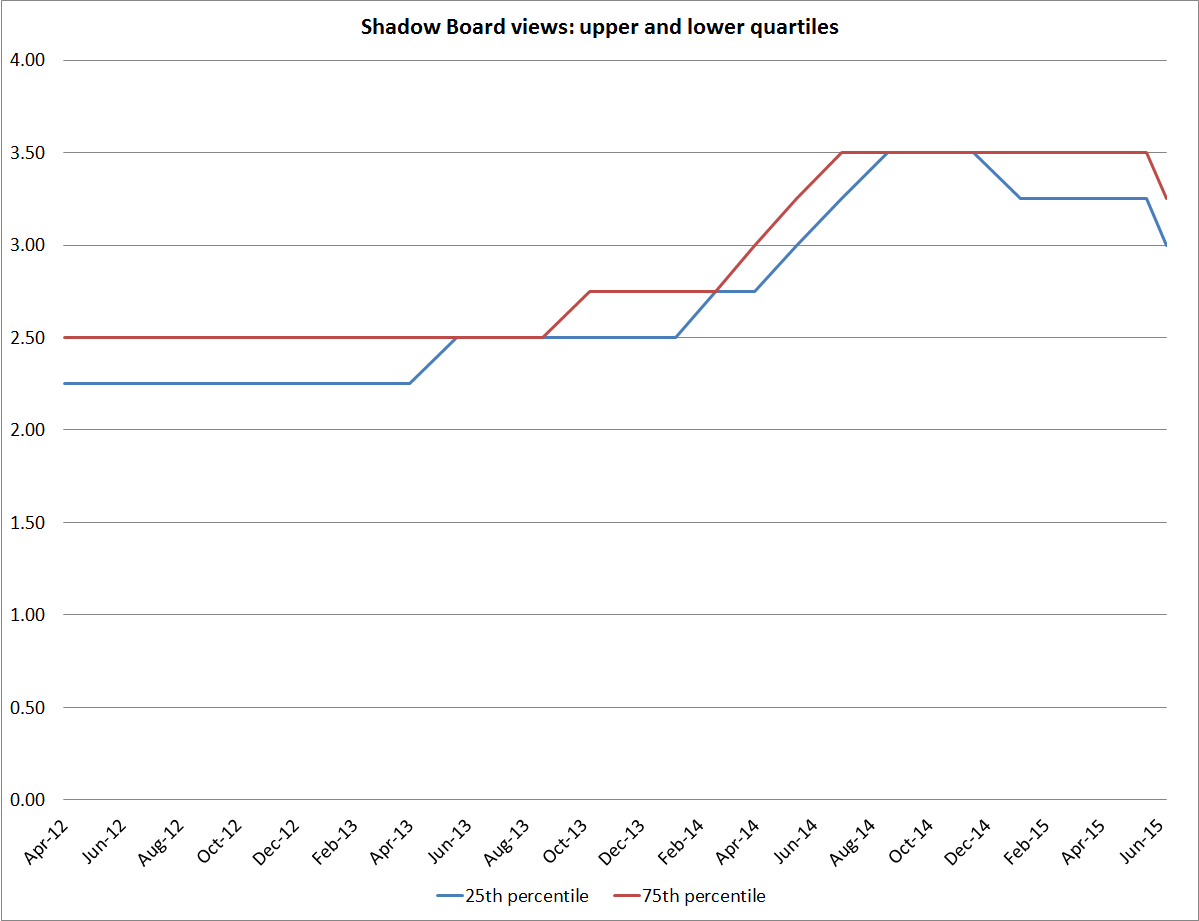
And here are the 25th and 75th percentiles. Respondents collectively put at least a 25 per cent chance on something at or below the 25th percentile being appropriate, and at least a 25 per cent chance on something at or above the 75th percentile.

shadow board 3

It is striking just how tight these ranges are. I noted back in June that most individual respondents’ views seemed excessively tightly bunched, given the huge historical uncertainty about the appropriate OCR. This time around there is a little more dispersion. The Shadow Board exercise has now been running for 27 reviews, and this is one of only three in which respondents collectively put a less than 50 per cent weight on one particular OCR (the other two were January last year, when the Reserve Bank was just about to commence raising the OCR, July last year which proved to be the last of the OCR increases).  I doubt, if I’d been assigning my own probabilities, if I would ever have put even a 40 per cent weight on any particular OCR in any particular review.

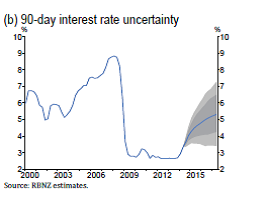
One other way of looking at the scale of the uncertainty around the OCR is the fan charts that the Reserve Bank published in the June MPS last year.  These were somewhat controversial, and are hedged around with lots of caveats in the technical notes, but the Governor presumably regarded them as a sufficiently useful device to run prominently in the main policy analysis chapter of a Monetary Policy Statement.   On the subset of shocks and uncertainties considered in that exercise, the 90 per cent confidence interval for the 90 day rate (proxy for the OCR) two years ahead was some 400 points wide. Perhaps a little embarrassingly for the Bank, that range did not even encompass an OCR of 3 per cent or less by July 2015.

fan chart

What do I take from all this?   I’d probably make only two points:

  • There is a huge amount of uncertainty in running discretionary monetary policy.  Some would argue that it is a mug’s game and only likely to introduce additional volatility.  That isn’t my view, but the uncertainty (across a range of different dimensions) is large enough that in general everyone should be a little cautious in taking a stand on a particular OCR (of course, under the current regime, the Reserve Bank must take a view, in actually setting the OCR). Mistakes won’t be uncommon –  whether by commentators or central banks – and that should be recognised, with appropriate humility, by all involved.  Of course, Reserve Bank mistakes matter more because they are charged with the power to take decisions that affects all of us in one way or another.
  • That very uncertainty highlights just how important it is that there is robust debate around a range of perspectives.  In this post, I haven’t looked at the diversity in the individual respondents’ views (partly because the panel of respondents has kept changing, and the sample is quite short), but looking through that data there hasn’t been much diversity of view across respondents either (with the creditable exception earlier in the period of Shamubeel Eaqub).    It is very easy for consensus views to form – both within the Reserve Bank – and in the wider New Zealand debate more generally.  And yet those consensus views will often be wrong.  Sometimes those looking at New Zealand from the outside have had a better take on things, but I doubt that has been consistently true (in the last year, HSBC in Sydney has been running the “rockstar economy” story, while other offshore players were rather more sceptical of the Reserve Bank’s continuing tightening cycle).  Encouraging that diversity of perspective is particularly important within the Reserve Bank, and yet it can be hard to maintain.  That is probably true in all central banks, but is a particular risk in our system, in which the Bank’s chief executive controls resources and rewards and is also single monetary policy decision-maker.  A very good single decision-maker would probably want as much debate and challenge as possible, recognising just how uncertain the game is.  A less-good one would find it too easy to discourage debate and challenge –  while never explicitly saying so, or perhaps even meaning to – preferring material that supports the decision-maker’s own priors and predilections.

Fiscal and monetary policy interactions: some New Zealand history

The role of fiscal policy has been much-debated in recent years. I think the consensus view now is that discretionary adjustments to fiscal policy make little difference to GDP in normal times, because monetary policy typically acts to offset any demand effects. By contrast, if interest rates can’t go any lower (or central banks for whatever reason are reluctant to take them lower) then discretionary fiscal policy adjustments can have quite material impacts on near-term GDP behaviour.

These debates focus on demand effects. If the government spends less, without changing tax policy, spending across the economy as a whole is likely to be dampened to some extent, all else equal. But there are also stories about confidence effects. If the overall economic and fiscal situation is sufficiently fragile, then in principle tough and credible new fiscal initiatives could lift confidence sufficiently that the confidence effects overwhelm the demand effects.  This was the vaunted “expansionary fiscal contraction”. I’m not sure I could point to any examples in advanced countries, but others read the evidence and case studies a little differently. I’m not wanting to buy into debates about Greece here – but “credible” was perhaps the operative word in the previous sentence.

Before 2008, there was a variety of historical episodes that people often turned to when looking at the effects of fiscal contractions.  The UK experience in the early 1980s and the Canadian experience in the mid-1990s got a lot of attention.  I think the best read on the Canadian episode (with more extensive treatment here) was that substantial fiscal contraction did not have adverse effects on the Canadian economy because interest rates fell sharply,the Canadian exchange rate fell in response, and the United States – Canada’s largest trading partner – was growing strongly.

And then there was New Zealand’s experience around 1990/91. After several years of significant fiscal consolidation (which had been sufficient to generate material primary surpluses), new fiscal imbalances had become apparent by late 1990. In a major package of measures in December 1990, and in the 1991 Budget, substantial cuts to government spending were made. In combination with the earlier efforts (which were probably more important), these cuts helped lay the foundation for the subsequent decade or more of surpluses.

Former director of the Business Roundtable, the late Roger Kerr, was prone to argue that it was an example of an expansionary fiscal contraction. I’ve repeatedly argued that it wasn’t. Certainly, the recession troughed at much the same time as the 1991 Budget and the subsequent recovery was pretty strong. And, as Kerr noted, the academic economists who publicly argued that the fiscal contraction could only depress the economy further and would prove largely self-defeating ended up looking a little silly.     But the recovery had much more to do with the very substantial fall in real interest rates – as inflation was finally beaten – a substantial fall in the exchange rate, and with the recoveries in other advanced economies than with any confidence effects resulting from the tough fiscal policy measures.   By mid-1991, the new National government’s political position was so fragile that no one could have any great confidence that the fiscal stringency that was announced would be sustained (and, indeed, several of the higher profile measures were subsequently reversed). The rest of the macroeconomic policy framework, including the Reserve Bank Act, were in jeopardy. Elected in October 1990 with a record majority, the National party was 15-20 points behind in the polls only a year later, and only scraped narrowly back into government in 1993.

A few years ago, there was renewed debate here around the appropriate pace of fiscal consolidation. At the time, the government had large deficits, and the exchange rate had risen uncomfortably strongly from the 2009 lows. Some argued for a faster pace of fiscal consolidation, arguing that to do so would ease pressure on interest rates and the exchange rate. It had been the thrust of Treasury advice, and some outsiders were also making the case. Among them was then private citizen Graeme Wheeler, who had had a meeting with John Key and Bill English and had reportedly cited the experience on 1991, noting that monetary policy could offset any demand effects of faster fiscal consolidation.   Reports of this conversation had been passed back to the Reserve Bank.

Not many people at the Reserve Bank knew much about that earlier period. Newly-returned to the Reserve Bank from a secondment to Treasury, I wrote an internal paper discussing the interplay between fiscal and monetary policy over 1990 and 1991, including addressing some of the “expansionary fiscal contraction” arguments. It drew extensively on previously published material, on the now-archived files I had maintained during the late 1980s and early 1990s (as manager responsible for the Bank’s Monetary Policy (analysis and advice) section, and from my private diaries.

The Reserve Bank finally released this paper yesterday, with a limited number of deletions (I have appealed these deletions to the Ombudsman, given that they relate to events of 25 years ago, and in some cases involve deleting quotes from my own private diaries). The Bank is obviously uncomfortable about the paper. Despite the fact that the paper draws extensively from contemporary records – most of which are in the Bank’s archives – and was run past (in draft) several of senior people from the Reserve Bank in the early 1990s, the Bank has included a disclaimer on each page suggesting that the paper is primarily based on my memories, which it can’t vouch for. But, to be clear, it draws primarily on contemporary records, trying to document and explain historical events, and then to interpret them to an audience used to different ways of conducting monetary policy. Different people may read the same evidence in different ways, and access to a fuller range of records could alter some perspectives. As an example, while my files had copies of many Treasury papers, and records of many meetings with Treasury officials, I did not have access to a full set of Treasury papers comparable to the collection of Bank papers I used. As background, Graeme Wheeler was the Treasury’s Director of Macroeconomics in 1991.

A copy of the paper is here (two separate links, as that is how I got it from them).

Memo to MPC – Fiscal policy, monetary policy and monetary conditions part 1

Memo to MPC – Fiscal policy, monetary policy and monetary conditions part 2

This was an extremely tense period. The Reserve Bank Act had come into effect on 1 February 1990, and although both main parties officially supported it, it was contentious in both caucuses. In the National Party caucus, Sir Robert Muldoon and Winston Peters had been the leading sceptics. The Labour Party was almost equally split, and Jim Anderton had left the party over the direction of economic policy. Going into the 1990 election, no one knew which wing would dominate the (probable) new National government, nor which tack the Labour Party would take once it was in Opposition. Economic times were tough, and patience with the Reserve Bank was wearing rather thin as the disinflationary years dragged on. It wasn’t helped by the system for implementing monetary policy that we were using (documented here) which at one point led to our efforts being described by Ruth Richardson in Parliament as comparable to those of Basil Fawlty in the comedy classic. (Treasury and the Bank were actively at odds over the implementation arrangements – they variously hankered after money base targets or, on occasion, exchange rate rules[1]).

Last night I reread some of my diaries from the period, and dipped into Ruth Richardson’s book, and Paul Goldsmith’s biography of Don Brash, and was reminded just how fraught the period was. We spent most of 1991 not knowing whether, or how long, the monetary policy framework would last, and whether the senior management would survive. Ruth Richardson records that even at the end of 1991 when the worst of the pressures were beginning to ease, the Prime Minister Jim Bolger, in a meeting of senior ministers, canvassed the possibility of changing the Reserve Bank Act to provide an impetus to growth.

The Bank had for some time publicly argued that there was no problem with the exchange rate. As a result the Bank’s position with the new government was not helped by a change of stance quite late in the piece: the new view was that a lower real exchange rate was likely to be required to rebalance the New Zealand economy. This was an important theme in the Reserve Bank’s 1990 post-election briefing, and took the incoming Minister of Finance quite by surprise. The Reserve Bank openly making the case for a lower exchange rate seemed to provide ammunition for some of her caucus and Cabinet colleagues who were less convinced of the overriding importance of macroeconomic stabilisation.

She would have been more aghast had she realised that until the very eve of the election the Reserve Bank had been planning to recommend stepping back from the 0-2 per cent inflation target itself. This had been the outcome of some mix of unease over how (excessively) mechanical the first Policy Targets Agreement had been, and a wish to allow room for the desired depreciation in the exchange rate. The suggestion had been to keep a medium to longer-term focus on a 0-2 target, or perhaps redefine it to 1-2 per cent, but to add a 0-4 per cent “accountability range”, within which inflation could fluctuate without triggering severe accountability consequences. We stepped back from that recommendation at the last minute, in large part because of the view that to have recommended that sort of change would have left Ruth Richardson out to dry, as the only defender of a 0-2 per cent target, exposing her to (in the words of my diary two days before the election) “Peters’ and Muldoon’s ridicule and Bolger’s incomprehension”.

In terms of the fiscal policy dimensions, one of the Reserve Bank’s deletions in from this extract from my diary a couple of days after the election:

We had a marathon session in Don’s office (from 8-11) going thru para by para agreeing on a text with DTB finally showing his impatience with the last minute chaos. Changed fiscal tack in favour of a tough stance now, to help cement-in any exchange rate depn and, as important as anything it seemed, to help the Richardson faction in Cabinet.

What this captures is the somewhat uncomfortable extent to which the Reserve Bank (and Treasury, as we shall see) in this period were focused on supporting, or at least not undermining, those political players supporting the sorts of frameworks and reforms that the Bank and Treasury favoured. In the Bank, senior management came to a view in 1991 that saving the framework (the Act) was, for now, more important than price stability itself (as least in the short-term). Sceptics of this stategy – I was one – caricatured it as “the Reserve Bank Act is more important than price stability”.

Even with the benefit of long hindsight, I’m not sure what to make of the approach taken at the time. On the one hand, it is somewhat distasteful – neither the Governor nor the rest of us were elected – but on the other hand, perhaps it is just what inevitably happens in any fraught and controversial period. As it happens, we probably gave quite unnecessary ammunition to the opponents of reform through this period. In small part this was because we communicated badly and ran an implementation system that – with hindsight – was pretty bizarre. But more importantly, we held monetary policy too tight for too long – not to make any points, or reinforce any positions, but simply because we misread how strong the disinflationary forces were by then. In a serious recession, that was black mark against the Bank (and I was one of the more hawkish people on the Reserve Bank side).

During 1991, the Treasury became very focused on supporting the political position of Ruth Richardson as Minister of Finance. Some of this is captured in the paper. But much of I didn’t include, since the focus of the paper had been on the fiscal/monetary interplay. On page 15 of the paper, the Bank seems to have deleted some of this extract from my 4 September diary”

David [Archer] and I had lunch with Graeme Wheeler and Howard [Fancy][2] and were treated to a litany of gloom, of how we needed to be supporting the macro policy mix and helping get the recovery going and being very concerned about the political risks. As GW said “I wouldn’t want history to look back on me as a policymaker and say that in my confidence about the framework I hadn’t taken adequate precautions” – referring to the Bank. He was going on about how we had a “near-perfect” mon pol framework for the medium-term but that at the moment we needed to be more flexible. Both were concerned to play down 0-2, with vacuous waffle about “best endeavours” but taking the view that, in effect, 2-4% inflation wouldn’t worry them. ….. Apparently Bolger is getting worried about 1981/1932 re-runs: mass demonstrations, violence in the streets etc.

Only a few months previously the Treasury had been openly sceptical that macro policy was sufficiently tight.  It wasn’t always clear how well Treasury was reading the politics either – I had a very good relationship with Ruth Richardson’s own economic adviser, Martin Hames, and on the evening of the deleted extract above I recorded a long conversation with Martin in which “he still claims there are no real threats: says things were a lot worse at times in Oppn”.

This has been become rather a long post. It is partly about providing some context for those who think about reading the whole paper. Here are a few of my bottom lines:

  • Had we been running a now-conventional system of monetary policy implementation, many of the less important of these tensions and ructions would not have arisen.  When demand and inflation ease –  whatever the source –  the OCR is generally  cut.
  • While, with the benefit of hindsight, New Zealand was probably always going to settle at a low inflation rate (all other advanced economies did) that wasn’t remotely clear at the time.  In particular, the initial passage, and the survival, of the Reserve Bank Act was a much closer-run thing than is generally recognised. Infant mortality was a real threat
  • Neither the Reserve Bank nor the Treasury covered themselves with glory through this period in their macroeconomic analysis and policy advice.

[1] Murray Sherwin presciently argued that we should adopt an OCR. I’m still embarrassed by the note I wrote in response to that suggestion.

[2] David was the Bank’s deputy chief economist, and Howard was Treasury’s macro deputy secretary.

A severe commentary

Plenty of commentaries have remarked on the very low inflation numbers out this morning.

None (that I have seen) has highlighted what a severe commentary these numbers are on the Reserve Bank’s conduct of monetary policy over the last few years.

Reciting the history in numbers gets a little repetitive, but:
• December 2009 was the last time the sectoral factor model measure of core inflation was at or above the target midpoint (2 per cent)
• Annual non-tradables inflation has been lower than at present only briefly, in 2001, when the inflation target itself was 0.5 percentage points lower than it is now.
• Non-tradables inflation is only as high as it is because of the large contribution being made by tobacco tax increases (which aren’t “inflation” in any meaningful sense).
• Even with the rebound in petrol prices, CPI inflation ex tobacco was -0.1 over the last year – this at the peak of a building boom.
• CPI ex petrol inflation has never been lower (than the current 0.7 per cent) in the 15 years for which SNZ report the data.
• Both trimmed mean and weighted median measures of inflation have reached new lows, and appear to be as low as they’ve ever been.

This wasn’t the way the Bank told us it was going to be. And more importantly, it wasn’t the basis on which they held interest rates up through 2012 and 2013, and then raised them last year. As late as December last year, they were still talking of raising the OCR further. Real interest rates never needed to rise, and as a result of the misjudgement they rose even further than the Bank intended (inflation expectations fell away).

It has been a sequence of cumulatively severe misjudgements. The word “mistake” keeps springing to mind, although of course the Governor rejected that characterisation at the time of last month’s MPS. Perhaps he is rethinking now? As I’ve pointed out previously, inflation outcomes so far weren’t mostly the result of unforeseeable external economic shocks. And if core inflation measures are this weak now, we have to start worrying what will happen to them as economic growth slows further, construction pressures ease, and the deepening loss of income from the declining terms of trade bites. Wage inflation has been very low, and more recently wage inflation expectations have been falling.

The Reserve Bank has belatedly recognised the need to modestly change direction. The Governor cut the OCR by 25 basis points last month, and foreshadowed that at least one more cut was likely. But the problem is that they are still well behind the game. The data are weakening faster than they are cutting, and the OCR was already too high right through last year. Difficult as it might be to make a large move at an intra-quarter review next week, the substantive case for a 50 point move is certainly strong. If not next week, then at the latest it should happen at the September MPS. There also needs to be a recognition that there is nothing wrong or inappropriate even if the OCR goes to new lows. The OCR simply needs to be set consistent with a realistic appraisal of the inflation outlook (not the upwardly biased one that has guided too many central banks in recent years). An apology, and a heartfelt mea culpa, from the (single decision-maker) Governor would also be appropriate.

As inflation expectations measures are likely to keep falling, this mistake is also increasing the risk that the zero lower bound will end up being binding in New Zealand. But, if we take the Reserve Bank’s Statement of Intent seriously, this is not something they worry about. They should.

But questions also need to be asked about the role of the Bank’s Board as agent for the public and the Minister of Finance. Inflation outcomes now are reflecting policy choices made last year. But here is all the Reserve Bank Board has to say about monetary policy in their latest Annual Report, published only nine months or so ago. In introducing the document, they note that:

Our formal review of the Bank’s performance is included in the Bank’s Annual Report.

And when they get to monetary policy

In the last year, we have considered the Bank’s decisions to hold the OCR at a record low of 2.5 percent for an unprecedented three-year period, and to increase the OCR four times from March to July 2014.

The level of disclosure in monetary policy was very high. We considered that the Bank’s policy decisions were appropriate, initially taking into account the need to provide support for the economic recovery after the disruptions of recession and earthquakes, and lately the need to ensure that the recovery is sustainable, by restraining emerging inflationary pressure.

This was a “formal review”? I still find it astounding that, less than a year ago, the Bank’s Board – the independent agency responsible for scrutinising the Bank – made no mention at all of the continued undershooting of the inflation target. I’m not suggesting they should have read the data better than the Governor – they are paid as ex-post monitors, not as monetary policy decision makers – but there is little sign of any serious scrutiny at all. It reinforces my view that the governance model is inappropriate in a wide variety of dimensions, and that the Board in particular plays little useful or effective role as agent for either the Minister or the public. By construction, it is simply too close to the Bank, and thus is more prone to act as defensive cover for the Governor, than as a source of serious scrutiny and challenge in the public interest. At very least, we should expect something much more substantive from the Board in its next Annual Report.

The Minister of Finance has commented a couple of times recently about the Bank undershooting the inflation target midpoint (which was added explicitly to the PTA by him in 2012). Such “shots across the bow” seem both understandable, and quite appropriate. The Minister initiates the inflation target, but has no say in individual OCR decisions. But he is responsible to the public (and Parliament) for having the target met by the Governor. Whether with hindsight or foresight, monetary policy has been too tight for probably five years. Partly as a result, New Zealand’s economic recovery has been anaemic – much more muted than in a usual recovery, despite the huge boost to demand provided by the Canterbury repair and rebuild process. The unemployed pay a particularly severe price for that, but they aren’t the only ones.

The real question is whether the Minister is willing to do more than talk. My impression is that his instincts are often in the right direction, but there is often a reluctance to follow through (one could think of housing supply issues as a prime example).

I’ve touched previously on some of the options the Minister has to show that he takes these issues seriously. In May I noted:

The Minister could seek a report from The Treasury on their view of how well the Governor was doing consistent with the Policy Targets Agreement, could let it be known such work was underway, and could arrange for such a report to be published. The New Zealand Treasury offers independent professional advice to the Minister of Finance and would have to take seriously such an exercise. It might be expected to consult externally (but confidentially) to canvass opinion. At present, for example, most financial market economists – not the only relevant observers but not unimportant either – in New Zealand seem quite comfortable with the Governor’s handling of monetary policy.
The Minister could also seek formal advice from the Bank’s Board, and let it be known that he was doing so. This would be a totally orthodox approach – the Board exists as a monitoring agent for the Minister – and it was, for example, the approach taken in the mid-1990s when inflation first went outside the target range. The Board has a number of able people on it, but as an effective agent for accountability risks being too close to management. The Governor sits on the Board, the Board meets on Bank premises, it has no independent resources, and it has been chaired exclusively by former senior managers of the Reserve Bank. It was striking that last year’s Board Annual Report (which is just embedded in the Bank’s Annual Report document) had nothing substantive on the deviation of inflation from the policy target.

Those are both still serious options. I suspect that it might be timely to exercise both of them.

Longer-term, it is now only just over two years until the Governor’s term expires. There must be real questions as to whether Graeme Wheeler could credibly be reappointed (recommended by the Board or accepted by the Minister) after his succession of overconfident monetary policy misjudgements, and in light of the poor quality analysis he has used to support his over-reaching policy initiatives in the regulatory areas. Perhaps Graeme will make it easy and conclude that, at his age, one term is enough?

The mistakes of the last few years don’t result primarily from the governance model, but the governance model – with too few checks on the Governor, as decision-maker and chief executive responsible for all the supporting analysis – is likely to have contributed. The mistakes –  an exaggerated version of those made in various other countries – highlight the material weaknesses in our most unusual system. The start of a new gubernatorial term is a good opportunity for the Minister to take the lead in reforming the Reserve Bank Act to bring governance of this powerful agency more into line with international practice and with governance standards in the rest of the New Zealand public sector. Treasury recommended doing something in 2012, and the Minister refused. He should take the lead this time. If he did, I suspect he would find pretty widespread support – from other political parties and from market economists. Perhaps even from the Reserve Bank itself.

PS.  Following on from earlier commentary, SNZ has altered how it is doing seasonal adjustment of the non-tradables inflation series.  The cost of doing so, is quite a short series, but for what it is worth, seasonally adjusted quarterly non-tradables inflation last quarter (0.3 per cent) was about half what it had been each quarter for the last 2-3 years.

Towards a new Policy Targets Agreement

The Reserve Bank continues to obstruct, at least as far as they legally can, Official Information Act requests. Some time ago, I recounted my experience with a request I lodged for older papers I had written while at the Bank. To cut the story short, I eventually did get the handful of papers I had written in the second half of 2010, with the exception of one which they had missed going through their document management system. So I put in a specific request for that paper. It was a paper, for the Bank’s internal Monetary Policy Committee, which I had written on fiscal and monetary policy interactions in 1990/91. To be clear, this is a five year old paper, about events that are now almost 25 years old. As it happened, the paper had been prompted by a meeting Graeme Wheeler, then still a private citizen working at the World Bank, had had with the Prime Minister and the Minister of Finance, but my paper was about the historical events and interactions. It drew from public documents, my contemporary Bank files, and my personal diaries. Doing the paper was an interesting reminder of the tensions in that period, and of just how difficult the political environment was, both for reforming ministers and for the Bank. Treasury officials on occasion exerted pressure on the Bank to ease policy specifically to assist the political position of the Minister of Finance.

It was no real surprise that this week the Bank once again extended the time for dealing with my request, citing the need for consultations to occur that could not – it asserted – take place within the statutory 20 working days. About a single document that is five years old, about events quarter of a century ago.

But a couple of weeks ago I did get a response to my request for background papers to the 2012 PTA. Having been threatened with a large bill in response to my first request, I took the Bank’s suggestion as to how to narrow the request, and they did subsequently release that handful of papers. As it happened, the papers covered by the revised request proved not to be very interesting. The one paper of interest was a six page letter to the Minister of Finance on 2 May 2012 outlining the outgoing Governor’s thinking on PTA issues. This was well before Graeme Wheeler’s appointment was announced (or probably confirmed). For the record, a copy of that advice is here:
2012 PTA Papers Bollard advice

The revised OIA request captured nothing of any interactions between the Bank and the Treasury, or between Graeme Wheeler and either Bank staff (including Alan Bollard) or the Minister. Given my experience with the Bank’s document management system, it does not greatly surprise me that this material did not get into the folder for issues relating to the new PTA. I might, in time, lodge some further requests. But the original background to this request had been a point about the relative lack of transparency around many aspects of the Reserve Bank and monetary policy. A genuinely transparent Reserve Bank, or a Minister committed to open government, would have pro-actively released the papers around the new PTA at the time it was released. Had that slipped their mind, a request like mine might have prompted a fuller release now. As it is, we still know little about the considerations that were taken into account in settling on the new PTA – even though it is the major instrument governing macroeconomic stabilisation policy, for five years at a time. Was there any discussion, for example, of the possible relevance of the zero lower bound for New Zealand? What pros and cons of adding the explicit reference to the target midpoint were considered? What debates happened around so-called macro-prudential policy,  And so on.

In some respects, this material is now of mostly historical interest. The PTA is what it is. The Governor is responsible for implementing policy consistent with the PTA, and the Minister is responsible, on behalf of citizens, for holding the Governor to account for doing so. But the background papers would help provide insights on what the parties thought they were signing up to, and why. And they would also shed some light on just how satisfactory (or otherwise) the current process is – in which a nominee as Governor must agree a PTA before he or she is even appointed, or necessarily has any exposure to (for example) staff advice.

But the lack of openness around the historical documents also reminds us that, without process changes, that is how the next PTA is likely to be handled. The clock is ticking on the Governor’s term, and it is only two years now until a new Policy Targets Agreement will need to be agreed – before a Governor is appointed or reappointed. Issues and risks around the zero lower bound have not gone away. If anything they have come into sharper focus since 2012, as countries have been cutting interest rates again. In New Zealand, the prospect of the OCR falling below the previous low of 2.5 per cent, even on the macro data as they stand today, reminds us that zero interest rates are far from impossible here either, if events turn nasty at some point.

Discussions around these issues should not just be occurring behind closed doors. It would be preferable if the Minister – the initiating agent in things around the PTA – and the Treasury would commit to a more open process of consultation and debate. For example, by the middle of next year perhaps some issues papers could be released for discussion, and a consultative workshop held to discuss and debate the issues and risks, as they affect New Zealand. Perhaps there would not be support for a higher inflation target, even if nothing is done about the ZLB, but at least we should understand the costs, benefits and risks of eschewing that option. Given that 2017 is election year, it would be good to have those discussions relatively early

When the key parameters of a major arm of macroeconomic policy are set only every five years, and implementation power (and associated wide discretion) is then handed over to a single unelected official, it becomes particularly important that there are opportunities for adequate scrutiny and debate at that five year review point. I noted recently that when the Bank’s five year funding agreement is put through Parliament there is no more transparency around expenditure plans than there is for the SIS. The situation is not really much better for the PTA, which probably matters rather more. Yes, outside parties can debate and analyse the issues themselves, but none of them have the analytical and research resources that the Treasury and the Reserve Bank have.

Brian Fallow covers my criticisms of the proposed new controls

In his weekly column in today’s Herald, Brian Fallow outlines and reviews some of the criticisms I have made of the Reserve Bank’s proposed Auckland investor property finance controls.   The accompanying cartoon (only part of which is online) shows pygmies attacking the giant Wheeler, secure in his moated castle.

Fallow’s piece is a very fair presentation of some of the arguments I have made, particularly in my LEANZ address last week (and he also notes the Treasury’s evident disquiet about the proposed controls).  I’m not going to repeat old material here, but will just highlight a couple of the points that arose in subsequent discussion.

Brian noted that Grant Spencer, the Bank’s Deputy Governor, has often argued that even though the stock of debt is not currently growing rapidly, there are a lot of new loans occurring and hence the risks are rising.  My response to that point is that, in normal times, there will always be lots of new loans, and lots of repayments going on.  It is great that the Bank is now collecting more detailed flow data that enables us to better see that breakdown.  But because we have no historical time series, we don’t have any good basis for interpreting it, and knowing what it might mean about risk.  In particular, as I noted, we don’t know what the pattern of new loans vs repayments was in the credit and housing boom of 2003 to 2007 when, for example, housing turnover was much higher (and from which episode, as a reminder, banks emerged unscathed).   That drives me back to the international empirical literature on crises, which suggests that big increases in the stock of debt (relative to GDP) over short periods of time has been one of the best indicators of building crisis risks.  Of course, historical empirical work is also limited by data availability, but at this stage with no material increase in debt to GDP ratios, and no sign of any material deterioration in lending standards, there doesn’t seem a basis for great concern about financial stability in New Zealand.

I have also suggested that the Bank should be doing more careful comparative research and analysis on the similarities and differences between New Zealand’s situation and those of countries that have had nasty housing busts (US, Spain ,and Ireland) and those that did not (UK, Canada, and Australia for example).  Brian posed the reasonable question as to whether people won’t just focus on the superficial similarities and differences, cherry-picking points of similarity or difference that suit their own argument.  That is a risk, but in a sense that is the point of doing research and analysis (for which the Bank has far more resources than any else in New Zealand), and making it available.  It enables informed debate to occur, and each piece of data or analysis is open to scrutiny and challenge.  The contest of ideas and evidence is a big part of  how we learn.

Fallow concludes his article thus:

A financial crisis is a low probability but high-cost event, as the Treasury says.  If you focus on the low probability, like Reddell, the conclusion is that the bank should pull its head in.  If you focus on the high potential cost, like Wheeler, you would want to do whatever you can to slow the growth in house prices and buy time to get more built and for the net inflow of migrants to return to more normal levels.

Maybe, but actually I suspect that misrepresents both Graeme and me.  Graeme Wheeler probably thinks the probability of something nasty happening in the New Zealand financial system in the next few years is higher than I do.  And I’m not just focused on the low probability of serious financial stresses.  That is the importance of stress tests.  They aren’t probability-based.  Instead, they take an extreme scenario (in the Bank’s stress tests, a tough but appropriate extreme scenario) and examines what happens to banks if the scenario happens.  On the evidence the Bank has presented so far, the soundness of the financial system is not jeopardised in such an extreme scenario.  Whatever Graeme Wheeler’s personal inclinations or feelings, a threat of that sort is the only statutory basis on which the Reserve Bank should be acting.

What the government does is, of course, another matter. I reckon it should be doing more about liberalising land use restrictions and, since large scale change in these restrictions seems unlikely, should probably reduce the very high target level of non-citizen immigration.

China: the composition of the RB TWI really doesn’t matter for monetary policy

The BNZ’s Raiko Shareef has a research note out looking at the impact of including the Chinese yuan in the Reserve Bank’s trade-weighted index measure of the exchange rate. He argues that the inclusion of the CNY will increase the sensitivity of New Zealand’s monetary policy to developments in China.

I think he is incorrect about that. China has, of course, become a much more important share of the world economy in the last couple of decades. It has also become a much more important trading partner for New Zealand. Both of those developments, but particularly the former, mean that economic developments in China, including changes in the value of China’s currency, have more important implications for New Zealand, and other countries, than they would have done earlier. The Reserve Bank recognised the importance of the rise of China in setting monetary policy, and assessing developments in the exchange rate. But the Bank was quite slow to include the CNY in the official TWI measure. There was a variety of reasons for that, some more persuasive than others. But as far back as 2007 the Bank started publishing supplementary indices that included the CNY. If the Reserve Bank had used the old TWI in some mechanical way, then perhaps it would have been misled, and perhaps there would have been policy implications from the change in weighting schemes, But not even in the brief bad old days of the Monetary Conditions Index was the TWI used mechanically for more than a few weeks at a time. Every forecast round, the Bank comes back and goes through all the data, not just a reduced-form equation feeding off a particular TWI.

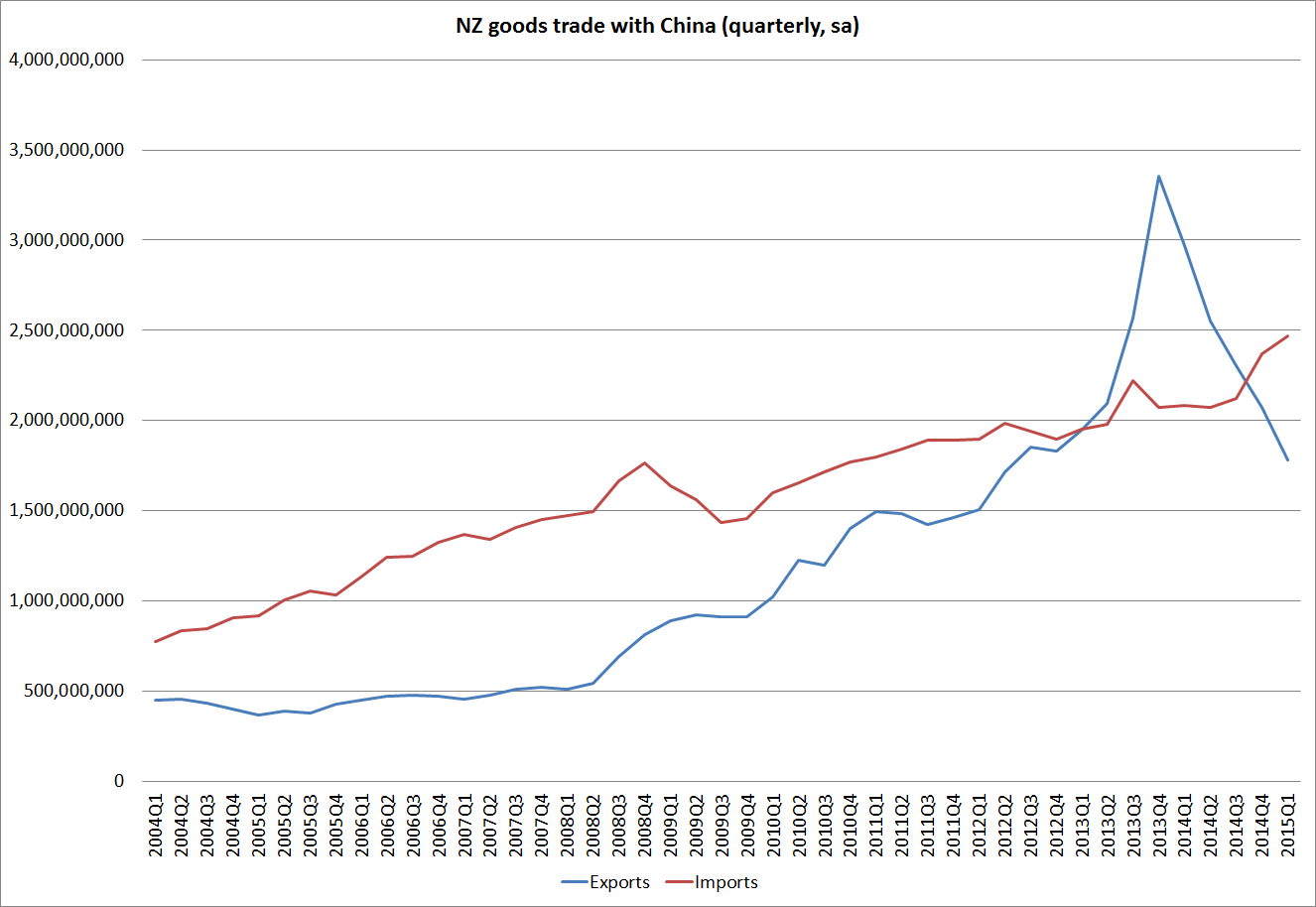
In the new TWI, the CNY has the second largest weight (20 per cent), just behind that on the Australian dollar.(22 per cent). But for the time being, that is likely to be high tide mark for the weight on China’s currency. Here is what has happened to goods trade – imports from China have kept on rising, but export values have plummeted (mostly on the fall in dairy prices).

chinatrade
A bigger question is one about what the appropriate weight on the CNY (and other currencies) is. I’ve argued that the CNY is important to New Zealand not because in a particular year we happen to sell lots of milk powder there, rather than in some other market, but because China is a large chunk of the world economy.  If we had no direct trade with China, it would still matter quite a bit.  In that sense, I reckon the new TWI understates the economic importance of the USD and the EUR, and overstates the importance of the AUD. We trade a lot with Australia, but Australia has very little impact on the overall external trading conditions our tradables sector producers face.

There are no easy answers to these issues. In a sense, that was why the Bank settled last year on a simple trade-weighted index. It wasn’t necessarily “right”, it wasn’t what everyone else did, but it was easy to compile and easy for outside users to comprehend. And without spending a huge amount of resources, on what was (probably appropriately) not a strategic priority, it wasn’t clear that any more sophisticated index would provide a better steer on the overall competitiveness of the New Zealand economy.

An issue of the Bulletin, written by Daan Steenkamp, covered some of this ground last December.

As already discussed, the new TWI has appreciated much less than the old TWI over the past decade or so. It is natural to ask whether the difference has, or should, affect how the Reserve Bank interprets or assesses the exchange rate. For example, are recent judgements about the ‘unsustainability’ of the exchange rate around recent levels affected? The exchange rate, however measured, is never considered in isolation from everything else that is going on in the economy. The Reserve Bank has, for example, recognised the rising importance of Asia in New Zealand’s trade and has taken that into account in its analysis and forecasting over the past decade or more. Exporters and importers deal with individual bilateral exchange rates, not summary indices. And New Zealand’s longstanding economic imbalances have built up with the actual bilateral exchange rates that firms and households have faced over time. How those individual bilateral exchange rates are weighted into a summary index therefore does not materially alter the Reserve Bank’s assessments around competitiveness and sustainability. Applying the macro-balance model (Steenkamp and Graham 2012) or the indicator model of the exchange rate (McDonald 2012) to the new TWI there are inevitably some changes, but the conclusions of those models, about how much of the exchange rate fluctuations are warranted or explainable over the past decade or so, are not materially altered.

There is no single ideal measure of an effective exchange rate index. Different TWI measures are useful for different purposes. In trying to understand changes in competitiveness it is likely to be prudent to keep an eye on them all. Developments in specific bilateral exchange rates will also have different relationships with economic variables and will be useful for different types of analysis. The focus of the Reserve Bank’s approach is on assessing the impact of the exchange rate on the competitiveness of New Zealand’s international trade, and the implications for future inflation pressures. Developing a full indicator of competitiveness, that reflected the specific nature of New Zealand’s international trade, and in particular the importance of commodity markets would require a very substantial research programme. It is difficult to be confident that the results would offer a materially better summary exchange rate measure than the simpler approaches the Reserve Bank has customarily adopted.

Of course, if China continues to grow in significance in the world economy, and if its currency becomes more convertible and is floated, it will become increasingly important to New Zealand. At the moment, the risks around China look somewhat the other way round – the influence of China may be more about the nasty aftermath of one of the biggest, least-disciplined credit booms in history. Growth looks to have fallen away much more than many (including the Reserve Bank) seem to have yet recognised.  But whatever the correct China story, the influence on New Zealand has little or nothing to do with how the Reserve Bank’s trade-weighted index is constructed.

The Governor states his medium-term plans

The Reserve Bank published its annual Statement of Intent on Friday.  I hesitated to write about the document, because to write about it I have to read it.   I always avoided doing so when I worked at the Bank.

The requirement to publish an SOI was added to the Act about 10 years ago.  And dry as they typically are, the SOIs were presumably intended by Parliament to help us understand what the Governor plans that the Bank will be doing over the next few years, and to help us –  and the Board and Parliament – hold the Governor to account.    It should give us a sense of where he sees the bigger looming issues.

Here is what the Act says:

162A Obligation to provide statement of intent

162B Content of statement of intent

162C Process for providing statement of intent to Minister

There is a reasonable amount of material in the document, and tempting as it is to comment on “the Bank’s aspirational goal of being the Best Small Central Bank” (the first time I’ve noticed this in a public document) I’ll save that for another day.  Instead, I want to look at what the Governor does, and apparently does not, see as the priorities for the Bank in the next few years,  in the three broad areas of the Bank’s main statutory responsibilities:

  • Currency
  • Monetary policy
  • Banking supervision

Currency

Two of the Bank’s 10 strategic priorities relate to physical currency

  1. Delivering New Zealand’s new banknotes

The release of Series 7 banknotes (Brighter Money) is scheduled for

the end of 2015 and in 2016. A successful release will require continued

extensive interaction with the Canadian Banknote Company, and

increased engagement with the public, the financial services industry,

and other key stakeholders.

  1. Developing a plan for future custody and

distribution arrangements for currency

The Bank will review its currency operating model and supporting

infrastructure to ensure that the currency needs of New Zealanders will

be met in the future. The review will assess the current operating model,

and identify options for the custody and distribution of currency. The

Bank will consult and collaborate with key stakeholders during 2015-

16 to ensure that the review’s recommendations are understood and

supported.

Those look fine as far as they go, even if the first now seems more operational than strategic.  But neither in this list, nor in the “functional initiatives” section, is there any sense of the significance of the zero lower bound, and the role that central bank physical currency monopolies play in exacerbating periods of economic weakness when policy interest rates get to (just below) zero.  New Zealand has been fortunate not yet to have the zero lower bound (ZLB) issue, but with a policy rate at 3.25 per cent and which is widely expected to fall quite a bit further it is not that far away.  We went into the last downturn with policy rates of 8.25 per cent.

Issues around the central bank physical currency monopoly, and whether (for example) retail electronic outside money might help alleviate the ZLB problems cannot be dealt with or resolved overnight.  But that is why it is so disappointing that nowhere in this medium-term document is there any sense that the Bank is taking the issue, and associated risks, seriously.  It looks as though they will be quite content to just run the risk that one day we get to an OCR of zero, unbothered that nothing was done to get ready for (and mitigate the risk of) that day. For countries that got to zero in 2008/09 it was a pardonable surprise perhaps, but the rest of the advanced world has now put us on notice.  This was a chance to be pro-active, and mitigate future risks, but the Governor does not seem interested in even commissioning work to look in more depth at the issues and options.   There aren’t straightforward “right or wrong” solutions, but the issues and options need serious analytical work now.

Monetary policy 

Not one of the Reserve Bank’s strategic priorities for the next few years relates to monetary policy, which remains (by statute) the Bank’s primary function.  This is so despite:

  • several years in which inflation has consistently undershot the targets agreed between Ministers of Finance and successive Governors
  • the salience of the zero lower bound issues to the ability of monetary policy to adequately deal with possible future serious shocks.  In view of the Governor’s worries about the potential threats to financial stability, it is all the more surprising that nothing major appears to be on the work programme to deal with these issues.
  • A new Policy Targets Agreement is due in just over two years (so inside the period covered by this SOI.

I have some sympathy with the argument that normal year-to-year issues in monetary policy don’t easily fit a “strategic priorities” framework, so perhaps the persistent forecast errors (and associated monetary policy mistakes) might not be expected to appear, even though they are now quite persistent, and have come at quite some cost to the unemployed.

But the ZLB issues certainly aren’t just routine issues.  They have represented a major constraint on the ability of central banks in other countries to do the sort of macroeconomic stabilisation expected of them.  Should we be doing something about removing the technical ZLB constraint?  If not, should we thinking harder about raising the inflation target midpoint?  What are the costs and benefits of the various options, and what might the implications be for other areas of policy (eg the tax system).

But the “functional initiatives” list offers nothing either. Here is what it says:

The Bank’s Economics Department has four key work streams for 2015.

  1. Macroprudential and monetary policy interface: undertake analysis and develop frameworks to better understand the interaction between macroprudential and monetary policy.
  1. Support the formulation of monetary policy: understand how events such as a construction and housing boom, fiscal consolidation, and international developments will shape the next business cycle.
  1. Monetary policy research: undertake analysis to improve the Bank’s understanding of the New Zealand economy and key monetary policy issues.
  1. Exchange rate analysis: reviewing the Bank’s frameworks for assessing the long-term sustainable level of the exchange rate and analysis of the cyclical impact of the exchange rate on New Zealand economic activity and inflation.

Nothing particularly objectionable there, perhaps, but nothing that seriously engages with the sorts of issues I listed above either.

Banking supervision

The Bank has three strategic priorities related to banking supervision:


  1. Exploring macro-prudential policy options to manage the financial stability implications of housing cycles

The Bank will explore macro-prudential policy options for managing the financial stability implications of housing market cycles. It will continue to investigate the interactions between monetary policy, prudential policy and the objectives of price and financial stability. The Macro-Financial department will lead work through the Macro-Financial Committee and

Governing Committee, with support from the Economics and Prudential Supervision departments.


  1. Updating the prudential policy and supervision frameworks.

The Bank will implement changes arising from the regulatory stocktake and will review other key policy settings. These will include outsourcing requirements on banks, and capital and liquidity settings in light of the revised Basel standards.


  1. Developing a comprehensive stress-testing framework for the New Zealand banking system

The Macro-Financial and Prudential Supervision departments are developing a comprehensive stress-testing framework to gauge the resilience of the banking system to adverse shocks. The Reserve Bank will work with the banks to identify and implement improvements to the banks’ technical stress-testing frameworks and processes. In addition,

the Bank will ensure that stress tests become a centerpiece of banks’ internal risk management, and are regularly scrutinised by senior management and boards.

One might question just how “strategic” 5 and 6 are – presumably here the Governor just means “we will put a lot of time into”?  I noticed that the Governor says he will “ensure that stress tests become a centrepiece of banks’ internal risk management”.   But banks might reasonably ask the same of the Reserve Bank.  The Bank is currently trying to further restrict banks’ business operations, even though the latest stress test results suggest there is no threat to the health of individual banks, or to that of the financial system as a whole.

There is also a long list of “Initiatives and strategies” in this area:

Initiatives and strategies

To address these issues, the Bank will:

  • explore additional macro-prudential policy options for managing the financial stability implications of housing market cycles;
  • work with the banks to ensure that stress-testing models and processes are robust and a core centrepiece of the banks’ internal risk management

continue to assess the linkages between monetary and macroprudential policy to ensure that complementary or opposing effects between the two policy areas are properly taken into account;

  • continue to enhance the reporting of financial system stability and efficiency, and policy assessments, contained in the FSR and other reports;
  • publish a stress-testing guide with a view to improving the stresstesting practices of New Zealand banks, and continue to develop a comprehensive stress-testing framework for New Zealand banks, a joint initiative with the Macro-Financial department;
  • complete the regulatory stocktake by consulting on and implementing initial enhancements to improve the efficiency, clarity and targeting of prudential standards for banks and NBDTs, and identifying separate areas for further work;
  • maintain supervisory engagement with executives and directors of regulated banks;
  • complete a review of, and consult on, the outsourcing arrangements that currently apply to ‘large banks’;
  • work closely with banks to ensure timely compliance with new outsourcing requirements;
  • review the Bank’s existing liquidity policy against finalised international liquidity standards;
  • review the Bank’s broad suite of capital requirements;
  • consult on a range of amendments to the statutory management powers in the Reserve Bank of New Zealand Act 1989 to clarify aspects of the legislative framework for the Open Bank Resolution policy;
  • promote legislative changes recommended by the review of the prudential regime for NBDTs that was completed in 2013;
  • finalise policy to strengthen the Bank’s oversight of financial market infrastructures; and
  • implement the business-as-usual supervisory framework for licensed insurers.

Again, what is there is not objectionable, but I think some questions should be asked about what is not there.    For example:

  • There is no sign of any proposed rigorous (let alone independent) ex-post evaluation of the Bank’s LVR regulations, even though they have been a major innovation in New Zealand policy.
  • There is no sign of any particular work on the efficiency of the financial system, even though any (arguable) soundness benefits from measures like the actual and proposed LVR controls come with undoubted efficiency costs.
  • There is no sign of any initiatives to lift either the quantity of quality of the Bank’s research and policy analysis in prudential regulatory and financial stability areas.  For example, there is no sign of any work programme on how to best interpret the lessons of other countries which have, and have not, experienced financial crises in the last decade or so.

More generally, there is no sign of an organisation that recognises the importance of, and wants to foster,  the robust contest of ideas, internally and externally.

In a sense, none of this should be very surprising.  As I have been highlighting, too many of the Reserve Bank’s powers (ie all of them) rest with the Governor alone.  But the draft of this SOI will have been seen by the Minister, and it might be interesting to ask the Bank or the Minister for a copy of any comments the Minister provided. Probably a draft went to the Reserve Bank’s own Board –  but the Board exists to review the Governor’s performance after the event, not to set strategic priorities, approve functional initiatives, or even set Budgets.   The SOI is a reflection of the single decision-maker’s preferences and priorities –  a model which has both strengths, and some significant weaknesses and risks

There is no suggestion of any further work on possible improvements in, or changes to, the statutory governance of the Bank.  I have just lodged an OIA request with the Bank asking for copies of any work done in this area over the last couple of years.  Of course, decisions on governance and statutory changes are a matter ultimately for the Minister and Parliament, but in his early months the Governor did appear to recognise some weaknesses in the current model, prompting him to establish the Governing Committtee (him, and the three deputy/assistant governors), as a forum in which the Governor would make major decisions, to help mitigate some of the internal risks in the current statutory system.

The Reserve Bank’s Statement of Intent stands referred to Parliament.  It might be interesting for the Finance and Expenditure Committee to ask the Governor about the some of the issues raised here.  Other departments have an estimates hearing before their funding is appropriated.  There is nothing similar for the Bank’s five year funding, but the SOI does provide a basis for some scrutiny and challenge.

The Reserve Bank’s releases on proposed investor finance controls

I noted yesterday that the Reserve Bank had also released some papers on the proposed new LVR restrictions on Thursday.  When that release was pointed out to me yesterday, the Bank’s website suggested that the papers had been released in response to an OIA request.  The papers still appear in the obscure corner of the Bank’s website where (in a welcome development) they have started publishing some of the responses they make to OIA requests.

But when I checked again this morning, the table now says of the latest release:

Date of Response Subject matter
25 June 2015 Loan-to-value ratio (LVR) restrictions, proactively released, jointly with the Treasury

Go through to the detailed page, and it suggests that the release is partly pro-active and partly a response to an OIA request.

This is information relating to loan-to-value ratio (LVR) restrictions that has been released proactively and in response to requests for information under the Official Information Act 1982 (the Act).

I’m a little confused.  But if there genuinely is a pro-active component to the Bank’s release then I welcome it, even if (say) they may just have released one additional paper to provide context for a few that were covered by the OIA.

It still leaves a little bit of a puzzle about the Treasury’s (entirely pro-active) choice to release.  Sometimes documents requested of one organisation cross-reference material generated in other organisations, but that does not appear to be the case here.  Perhaps the OIA request to the Reserve Bank included material the Bank held, even if it did not generate it.  If so, no doubt the Bank held copies of at least some of the Treasury papers?    But having been on the receiving end of numerous OIA extensions from the Bank (and recently one from Treasury), when documents written little more than 20 working days ago are pro-actively released, it has the feel of a genuinely deliberate timing choice.

But enough of the bureaucratic process stuff.  What I had intended to write about was the content of the Bank documents.  They released six, one of which (the 17 Feb one) I had previously seen.

Date Released on 25 June 2015
19/5/2015 Memo to Minister on draft consultation paper on LVR policy (PDF 818KB)
30/4/2015 Memo to Minister on estimated impact of changes to LVR policy (PDF 1.36MB)
24/4/2015 Memo to Minister on potential adjustments to LVR ratio policy (PDF 2.67MB)
21/4/2015 Memo to MFC on Proposed changes to the LVR policy (PDF 350KB)
2/4/2015 Memo to MFC on revisiting the case for regional targeting of marco-prudential policy (PDF 134KB)
17/2/2015 Memo to MFC on effectiveness of a tighter investor LVR limit (PDF 99KB)

We don’t have much context for this release.  In particular, we don’t know the scope of any OIA request the Bank may have been responding to, but if these papers are intended to reflect the analysis the Bank undertook in developing the proposed control on investor lending (and the Auckland-specific nature of the new policy), they are surprisingly short and weak.  Recall that the Bank is,  implicitly, saying the banks and borrowers are so risky and irresponsible that not one single (practical) cent can safely be lent by banks to Auckland residential property investors on LVRs over 70 per cent without jeopardising the soundness of the financial system.  That is a pretty ambitious claim.  It is not supported.

I have been critical of the Bank for not making a stronger case for its proposed controls.  The one comfort I suppose that we can take from these papers is that they are not hiding anything from us.  But if this is all there is – the extent of their engagement with the law, the economics, the stress tests, the uncertainty –  it is even less surprising that The Treasury was also not convinced that a compelling case had been made for the new controls.  Unfortunately, the Reserve Bank also continues to repeat to the Minister of Finance its claims that lending to investors is generally materially riskier than other housing lending.  An attendee at the LEANZ seminar the other night told the audience that he had gone through all the references the Bank has previously invoked in support of its claim, and had found that they simply did not say what the Bank claimed they were saying.  If that assessment is correct, it is pretty concerning, and should be so to the Board and the Minister –  charged with holding the Governor to account on our behalf.

A process issue struck me in reading the papers.  In discussing the possible new policy, the 21 April paper lists a possible timeline.  It suggests that a consultation period should end in “late June” and “Release final policy position and revised conditions of registration” in “mid-July”.  Allowing perhaps 10 working days to read, analyse, and reflect on submissions, write up recommendations to the Governor, write-up a response to submissions, and finalise the new conditions of registration themselves does not suggest that the Bank had in mind a very open process of consultation.  Actual timing slipped somewhat, as the consultative document was not released until early June, but we should hope that they take a little more than 10 working days to work through all the issues likely to be raised in submissions.

As I noted yesterday, the cause of serious scrutiny of the Governor’s proposals (and of open government more generally) would be advanced if the Bank were to publish on its website, as they are received or at least on the closing date, all the submissions they receive.  They are, after all, public, official, information.