Immigration and New Zealand’s economic performance

That was the subject of last night’s Law and Economics Association seminar.    Eric Crampton (from the New Zealand Initiative) and I each spoke, and a good discussion followed.    The LEANZ flyer captured the essence of our own different approaches

Our speakers have differing views on the subject:

According to Michael Reddell, for most of the last 70 years successive governments have promoted large scale inflows of non-New Zealand citizens. Through various channels, this helps explain why New Zealand has been the worst performing advanced country economy in the world over that time – before and after the 1980s economic reforms. Located on remote islands, in an age when personal connections are more important than ever, that performance is unlikely to improve much, whatever else we do, until the government gets out of the business of trying to drive up our population, against the revealed preferences and insights of New Zealanders. We can provide top-notch incomes here – as we did in the decades up to World War Two – but probably only for a modest number of people.

Eric Crampton on the other hand says: It’s easy to scapegoat immigrants for all of the world’s problems – and many do. Proving immigrants do any harm at all is substantially more difficult. The New Zealand Initiative’s 2017 report on immigration looked to the data on immigration and found it difficult to reconcile popular fears about immigration with the data. As best we are able to tell, immigrants have lower crime rates than native-born New Zealanders; the children of immigrants are more likely than Kiwis to pursue higher education; and, immigrants integrate remarkably well into New Zealand society. Arguments that immigrants are to blame for slow productivity growth in New Zealand are inconsistent with either the international evidence of the effects of immigration on wages, and with what New Zealand evidence exists. And where the benefits of agglomeration seem to be increasing, restricting immigration against the revealed preferences of migrants, of those selling or renting them houses, and of those employing them, is likely to do rather more harm than good.

Eric’s presentation (here) was largely based around the Initiative’s advocacy piece on immigration published earlier in the year, which I responded to in a series of posts (collected here).    The text that I spoke from was under the title Distance still matters hugely: an economist’s case for much-reduced non-citizen immigration to New Zealand.  We engage pretty amicably, and I’m still grateful for Eric’s post about this blog in its early days, in which he noted

Michael believes that too high[a rate] of immigration has been substantially detrimental for New Zealand, where I’m rather pro-immigration. But his is the anti-immigration case worth taking seriously.

But in many respects, we were probably talking about different aspects of the issues.   When he focused on New Zealand, the points Eric made mostly weren’t ones I disagreed with.  We have been relatively successful in integrating large numbers of migrants, and migrants to New Zealand have been more skilled than those to most other advanced OECD countries.  Migrants don’t commit crimes at higher rates than natives: if anything, given the prior screening, probably at lower rates.   We both agree that housing supply and land use laws need fixing – although I’m more pessimistic than he is, because I’ve not been able to find a single example of a place that has successfully unwound such a regulatory morass.  But much of his story seemed to be on the one hand an acknowledgement that there isn’t much specific New Zealand research on the economic impact of our immigration, and on the other an empassioned call for us therefore to simply follow the “international consensus” and international evidence on the issue, because he could see no reason why our situation would be different than that of other advanced countries.

By contrast, my presentation was really devoted to making the case –  grounded in New Zealand’s economic history and experience – that New Zealand’s situation (and Australia’s for that matter) really is different than that of most advanced countries.    Along the way, I suggested that the overseas evidence is less persuasive than it is often made out to be.   After discussing the 19th century migration experiences, where the economic literature is pretty clear that migration contributed to “factor price equalisation”  –  lowering wage growth in the land-rich settlement countries, and raising it in the European countries the migrants left –  I turned to the literature on the more recent experience.

There are two broad classes of empirical literature on the more-recent experience (in addition to the model-based papers in which the models in practice generate the results researchers calibrate them to produce):

  • Studies of how wages behave in different places within a country depending on the differing migration experiences of those places, and
  • Studies that attempt to estimate real GDP per capita (or productivity) effects from a multi-country sample.

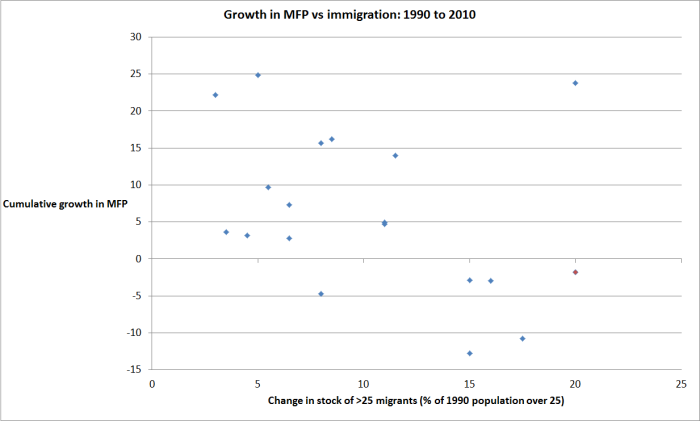
There are lots of studies in the first category, and not many in the second.   And almost all are bedevilled by problems including the difficulty of attempting to identify genuinely independent changes in immigration (if a region is booming and that attracts lots of migrants, higher wages may be associated with higher immigration without being caused by it, and vice versa).

I’ve never found the wage studies very useful for the sorts of overall economic performance questions I’m mainly interested in.  Precisely because they are focused on different regions within a country, they take as given wider economic conditions in that country (including its interest rates and real exchange rates).  They can’t shed any very direct light on what happens at the level of an entire country – the level at which immigration policy is typically set –  at least if a country has its own interest rates.  I’ve argued, in a New Zealand context, that repeated large migration inflows tend to drive up real interest rates and exchange rates, crowding out business investment especially that in tradables sectors.    In the short-term, it is quite plausible that immigration will boost wages –  the short-term demand effects (building etc) exceed the supply effects –  but in the longer-term that same immigration may well hold back the overall rate of productivity growth for the country as a whole.

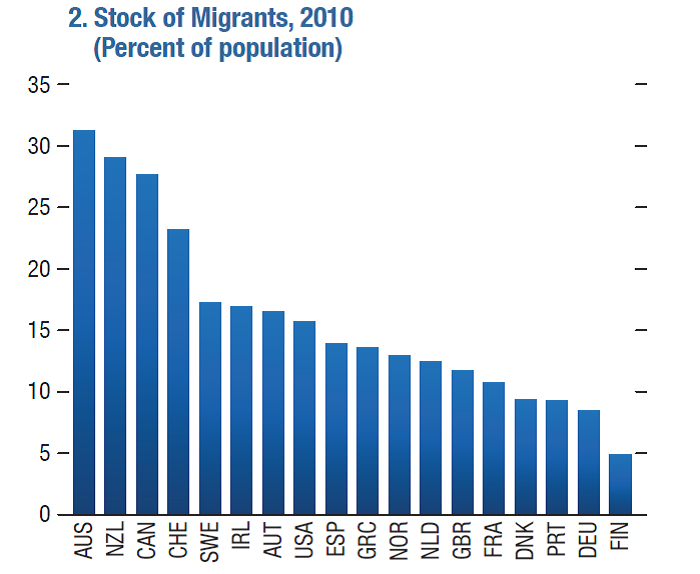
There really aren’t many cross-country empirical studies looking at the effects on real GDP per capita (let alone attempting to break out the effects on natives vs those on the immigrants themselves, or looking at superior measures such as NNI per capita).   Those that exist tend to produce what look like large positive effects.  So large in fact that they simply aren’t very plausible, at least if you come from a country that has actually experienced large scale migration.   In one recent IMF paper, discussed in their flagship World Economic Outlook last year, an increase in the migrant share of the population of around 1 percentage point appeared to boost per capita GDP by around 2 percentage points.   As I noted, if that were so it suggested that if 10 per cent of the French and British populations swapped countries – in which case the migrant share in each country would still be lower than those in NZ and Australia –  both countries could expect a huge lift in per capita GDP (perhaps 20 per cent).   Nordic countries could catch up with Norway in GDP per capita simply by swapping populations between, say, Denmark and Sweden.

And countries that were seeking to reverse decades of relative economic decline could reverse that performance by bringing in lots of migrants.  Except, of course, that that more or less described New Zealand.  Over the last 25 years we’ve had lots of policy-induced non-citizen immigration (and many of the migrants aren’t that lowly-skilled by international standards).  And we’ve made no progress catching up with the other advanced countries; in fact we’ve gone on having some of the lowest productivity growth anywhere.  As it happens, Israel –  with more migrants again than we had –  had similarly dismal productivity growth.

I could go on.  For example, a country like Ireland certainly experienced a huge surge in productivity, but it was half a decade before the real surge in immigration started.    And, the way the model is specified, the per capita GDP gains are sustained only if the migrant share of the population remains permanently high –  if the migrant share dropped back so would the level of GDP per capita.  None of it rings true.  It speaks of models that, with the best will in the world, are simply mis-specified, and haven’t at all captured the role of exogenous policy choices around immigration.

But the thrust of my story was that New Zealand (and Australia) were different because their prosperity has, since first settlement, rested substantially on the ability of smart people, with good institutions, to make the most of fixed natural resources.   And our prosperity still rests on those fixed natural resources –  whereas that is no longer the case in most advanced economies – because it seems to still be very hard for many successful international businesses to develop and mature based in New Zealand (or Australia) when based on other than location-specific natural resources.  Our services exports, for example, are still lower as a share of GDP than they were 15 years ago, and represent a small share of GDP by advanced country standards (even with subsidies to the film industry (direct) or the export education industry (indirect)).

Of course, really energetic and smart people –  NZers and immigrants –  will start businesses here that seek to tap global markets (often going straight to the world, not starting with the domestic market).  But experience suggests that for all those talents and ideas, it is (a) harder to base and build such businesses here than in many other places, and (b) even among those that succeed, in time most will be even more valuable and more successful based somewhere nearer the markets, supplier, knowledge networks etc.   Mostly, it looks as though remote places will successfully specialise in production of things that are location-specific.   Gold or oil are where they are.  They aren’t in London or San Francisco.  Or Auckland.   Much the same could no doubt be said for hydro power, or good dairy or sheep land.

Heavy reliance on fixed factors (land and associated resources) doesn’t doom a country to underperformance.  But it does mean that if your country’s population is going to grow faster than that in other countries that are much less reliant on fixed natural resources, one needs a faster rate of underlying productivity growth just to keep up with the income growth in other countries.  Either that, or new mineral discoveries (always there but not previously recognised).   We’ve managed neither.

Against this backdrop, I concluded

Specifically, now we need deep sustained cuts in our immigration programme.  I’ve argued for 10000 to 15000 residence approvals a year.  Doing that wouldn’t be terribly radical – we’d actually be putting ourselves more in the mainstream of international experience with immigration policy.  Doing so would allow a rebalancing of our economy, and help us to meet pressing environmental challenges,  in ways that would offer a credible promise of materially higher living standards for, say, 4.5 million New Zealanders.     After 25 years –  perhaps even 70  –  when things have just gotten worse for New Zealanders relative to their peers in other advanced countries,  it is past time to abandon the failed experiment  –  and radical experiment, not mainstream orthodoxy, it is –  of large scale non-citizen immigration.     A population growing as fast as ours is, driven up by government fiat when private choices are mostly running the other way (birth rates below replacements, net outflows of New Zealanders), in a location so remote, just doesn’t make a lot of sense.

In the discussion that followed, there was quite a lot of what seemed to me like wishful thinking, and a reluctance to accept the apparent limitations of our location.  I can understand that reluctance.  In the past I’ve been there myself – I’ve just this morning re-read the text I wrote some years ago for the 2025 Taskforce’s report on why distance was overstated as a constraint.   I think Eric and I both accept that, if anything, personal connections are becoming ever more important (certainly than say 100 years ago, and perhaps even than 30 years ago).  Perhaps one day, technology really will markedly ease those constraints  –  eg the possibilities that might arise from mooted six hour flights to San Francisco instead of twelve.   As I responded to a questioner, if those ideas about the death of distance were being articulated in 1990, when New Zealand was just opening up, I’d probably have found them plausible.  But we’ve seen no evidence of it being enough –  no acceleration in (relative) productivity growth, no surge in city-based exports, really no nothing.

Eric also suggested that reliance on natural resources was a dangerous strategy, because of the potential over future decades for things like meat-substitutes to develop.  They may well.  And perhaps Ukraine (say) will get its act together, and a remote agricultural producer will be at even more of a disadvantage.  I don’t have any expertise in those areas, but even if they are a possibility that we may have to face, so what?  If the advantages/industries that have made New Zealand relatively prosperous were to go into further decline, it would be even more worrisome (for future living standards) if our policymakers had gone out on a limb and imported even more people.    Because there is simply no evidence, despite all the hopes, and all the high-flown bureaucratic words, that an Auckland-based alternative economic future is coming to anything very promising.  Auckland’s GDP per capita isn’t much above the New Zealand average –  unlike the situation in places (think London or New York) where service-based international industries now predominate –  and that margin has been shrinking further.   When the economic opportunities in places go into relative decline people rationally leave those places.  It is the way things work within countries.  There is no particular reason for it to be any different between countries (see for example, the huge outflow of New Zealanders to Australia in the last 40 years or so).

I have sought to advance a narrative to explain as many as possible of the stylised facts of New Zealand’s underperformance, including

·        There is still no sign of any labour productivity convergence (if anything, on average, real GDP per hour worked is falling slowly further behind),

·        Total factor productivity is hard to measure, but on the measure there are we’ve kept on doing very badly there too,

·        We’ve had 25 years of the highest average real interest rates in the OECD  (which could be a good thing if we had lots of productivity growth, but we haven’t)

·        Not unrelatedly, even though our productivity has slipped behind over decades, our real exchange rate hasn’t adjusted downwards in the way that standard theory would teach,

·        We’ve had weak business investment (bottom quartile of OECD countries, even though population growth has been in the top quartile), even though we started with low levels of capital, and

·        We are still experiencing weak growth in exports (unlike most countries, we’ve seen no growth in exports/GDP for 25 years or more) and weak growth in the tradables sector of the economy (in per capita terms, no growth at all this century.

·        Among those exports, there is little sign of any sustained move beyond reliance on natural resource based exports.

·        Oh, and our one half-decent sized city, Auckland, has experienced declining GDP per capita, relative to the national average, over the 16 years for which we have the data.

Eric’s response last night was that there were many alternative narratives to explain our dismal long-term productivity performance.  But, in fact, whether in their full report earlier in the year, or in discussion last night, the Initiative hasn’t really sought to outline a credible alternative story.   In practice, any alternative seems to amount to “well, it would, or could well have been, worse without the large-scale immigration”.  Perhaps it could have been. but surely it would be helpful to offer a story about the channels through which those worse outcomes could have come about, and how those channels are consistent with the indicators we’ve actually seen?

I ended the text I spoke from with an appendix setting out the key elements of how I’d change our immigration policy.  Much of it will be more or less familiar to regular readers, but for the record here is the list.

Appendix

Some specifics of how I would overhaul New Zealand’s immigration policy:

  1. Cut the residence approvals planning range to an annual 10000 to 15000, perhaps phased in over two or three years
  2. Discontinue the various Pacific access categories that provide preferential access to residence approvals to people who would not otherwise qualify.
  3. Allow residence approvals for parents only where the New Zealand citizen children have purchased an insurance policy from a robust insurance company that will cover future superannuation, health and rest home costs.
  4. Amend the points system to:
    • Remove the additional points offered for jobs outside Auckland
    • Remove the additional points allowed for New Zealand academic qualifications
  5. Remove the existing rights of foreign students to work in New Zealand while studying here. An exception might be made for Masters or PhD students doing tutoring.
  6. Institute work visa provisions that are:
    • Capped in length of time (a single maximum term of three years, with at least a year overseas before any return on a subsequent work visa).
    • Subject to a fee, of perhaps $20000 per annum or 20 per cent of the employee’s annual income (whichever is greater).

I argue that this sort of approach would take more seriously the constraints of location, and offer much better prospects for lifting the productivity and living standards of something like the existing population of New Zealanders.  Much of modern economics doesn’t pay much attention to fixed natural resources, and economics of location (at least in a cross-country sense).  That is understandable –  they aren’t the big issues for most other advanced countries (UK, USA, Belgium, Switzerland and so on).  What is less readily pardonable is the willingness of our own political leaders, and supporting bureaucrats, to give so little attention to those factors and what they mean for our prospects.  Firms, families, and societies all manage within constraints.  Our governments do so when it comes to managing their own financial accounts.  But otherwise, they seem free to just pretend that we are in a different situation than we are actually are, to persist with a modern Think Big that, decades on, still shows no sign of working out well for New Zealanders as a whole.   Quite why New Zealanders allow ourselves to be carried along, when the evidence is against it, is something of a mystery.
Answers from Switzerland?

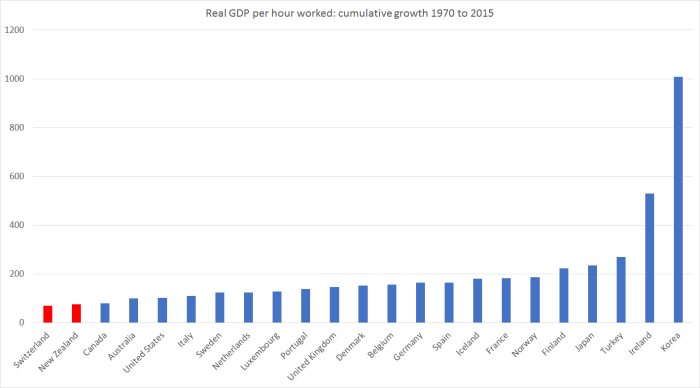
A month or so ago, prompted by a Herald news article talking up a New Zealand Initiative study tour to Switzerland to learn “the secrets of their success”,  I pointed out that Switzerland wasn’t such an obvious place to look for lessons on lifting New Zealand’s continuing disappointing economic performance.  After all, since 1970 they were the only OECD country to have had slower productivity growth than New Zealand

switz 70 to 15

and although the average productivity level in Switzerland is still much higher than that in New Zealand, it is no longer among the very best in the OECD.   Denmark, Belgium, and the United States are among the countries doing much better than Switzerland, and even they don’t top the rankings.

A few days later it turned out that the author of the article, veteran journalist Fran O’Sullivan, was actually participating in the study tour, not just talking it up.  At the time, I noted that it would be interesting to hear, in due course, what she learned from Switzerland, while being a little sceptical as to how detached from a New Zealand Initiative perspective she would prove able to be.

In Saturday’s Herald, O’Sullivan devoted a substantial article to reporting back on what was learned on the tour (this time with all the appropriate disclosures, including her partial sponsorship from one of the Initiative’s member companies).   Much of the article is quotes from New Zealand Initiative people.  And the answer it seems, at least on O’Sullivan’s summary take, is in the headline: Education key to Swiss success.

Near the start she observes of her own past trips to Switzerland

Other times I have been to Switzerland, it has been straight to Geneva to the World Trade Organisation’s HQ for trade discussions, or to observe the World Economic Forum in Davos. Not to look at what underpins Switzerland’s own resounding economic success.

I’m still quite genuinely puzzled at where she –  or the Initiative –  get this idea of “resounding economic success”.  I’m sure there are many things to like about  Switzerland but –  despite a very strong starting point a few decades ago –  it just isn’t one of the great economic success stories of modern times.  Productivity growth has been underwhelming –  to say the least –  and although GDP per capita in Switzerland is higher than in, say, France or Germany, it is so mostly because the Swiss put in a lot of hours.  Average productivity is higher in France and Germany, while Switzerland is like New Zealand in that total bours worked per capita are very high in both countries.

I quite like the sound of the Swiss political system –  highly decentralised, lots of quite small, and competitive local authorities.  It is the antithesis of something like the Auckland “supercity” put in place a few years ago by our government.     But one has to wonder quite what economic gains it might have produced.    The New Zealand Initiative seems dead keen on the highly decentralised system

“Private and central bankers, economists and journalists, federal and local politicians alike – in fact everyone we talked to – agreed that this was the most crucial component to the Swiss success formula,” says NZ Initiative executive director Oliver Hartwich.

But when your country has had the weakest productivity growth in the OECD over 45 years, you have to wonder whether the alleged contribution to “economic success” is not mostly one of those myths that all countries have, that don’t necessarily line up that well with the evidence.  I’m sure the decentralised system is cherished, but in modern times it has seen (although not necessarily caused) Switzerland drifting backwards.

But the political system isn’t the thrust of O’Sullivan’s article.  Rather, the education and vocational training systems seem to be.  In fact, even Hartwich seems to agree

Concludes Hartwich: “The most important insight was the fact that a solid vocational apprenticeship is just as respected as a university degree (and sometimes leads to better salaries, too). New Zealand businesses should not only co-operate with institutions but lead the debate on the required reforms.”

And a couple of quotes to give you the flavour of the rest

It may seem ruthless to stream students at an early level into academic and vocational education training (VET) streams. But Switzerland does just that.

About 20 per cent go into the university stream and the rest into the upper secondary school vocational education training stream, where students combine school learning with skills developed in the workplace.

This system serves 70 to 80 per cent of Swiss young people, preparing them for careers ranging from high-tech jobs to health sector roles and traditional trades. Both white collar and blue collar roles are appreciated. There are about 230 vocational categories.

and

The upshot is that Switzerland enjoys virtually full employment, the youth unemployment rate is among the lowest in developed countries and the Swiss enjoy a very high standard of living. Those doing the VET stream are not locked out from university education, which they can do at a later stage.

….

Asked if they could import one feature of Switzerland to New Zealand, the consensus of the visiting business leaders was that it would be the vocational training system.

ASB chief executive Chapman says any growing economy relies on a pipeline of skilled and motivated workers for momentum, and “in that context I think there is a lot to learn from the Swiss”.

“The Swiss have an enviable record of high youth employment.

I don’t know anything specific about the Swiss vocational training programmes, so there may well be some specific aspects that New Zealand firms, or New Zealand governments, could learn from.     But as I reflected on O’Sullivan’s article, the story about education etc didn’t seem terribly convincing as an explanation of Swiss “economic success”.

Overall employment rates in New Zealand and Switzerland are very similar (on OECD data 66.2 per cent in both countries last year).  But on youth employment, Switzerland does appear to have had a consistently higher employment rate.  Among those aged 15 to 24,  62 per cent of Swiss were employed last year, and 54 per cent of New Zealanders.

Employment among young people is a bit of an ambiguous indicator.  After all, if young people are in full-time study (school or tertiary) they often won’t be in employment at all.  Youth employment rates were probably higher in both countries 100 years ago.

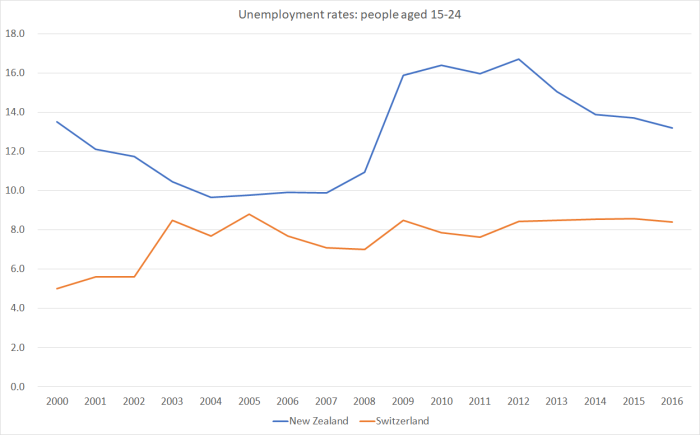
But what about youth unemployment: people who want a job, are looking for a job, but can’t find a job?   Here, Switzerland seems unambiguously to do better than New Zealand.

U rates Switz and NZ

And what are some of the things that affects the ability of young people to get into work?  Minimum wage laws are likely to be one of them.  I recall the New Zealand Initiative’s Eric Crampton, when he was at Canterbury University, making some very useful contributions  (eg here) to the debate about the impact of the much more stringent minimum wage provisions, especially as they affect young people, that were put in place here about 10 years ago.

Readers may recall that, relatively low as New Zealand wages are, our minimum wage relative to median wages –  the sort of metric relevant when thinking about whether minimum wage provisions exclude some people from employment –  are very high by OECD standards (fourth highest in fact).

And what about Switzerland?   Well, in Switzerland there is no minimum wage law at all.   And not that long ago, Swiss voters overwhelmingly rejected an attempt to establish one.     Perhaps in the course of the Initiative’s study tour no one thought to ask the question about minimum wages.  But whatever the reason, it looks as though it could be a rather important omission.  It isn’t the really skilled young people who typically have difficulty getting jobs, but the less skilled and more troubled ones.  Our systems works against them getting established in the labour force, while the Swiss one seems not to.   As the ASB chief executive put it:

“You can’t underestimate the power this has on the optimism and confidence of their youth as they look to their own future.”

But I was also a little puzzled about the story that seemed to downplay the role of universities in Switzerland.  I’m as willing as next person (including New Zealand Initiative members) to think that perhaps New Zealand went through a phase where too many people went to university.   And a good builder or plumber will certainly earn more than many of the occupations our more-marginal university students end up in.

But what did the data show?  As it happens, the OECD Economic Survey on New Zealand came out on Thursday, and they had a whole chapter on the labour market, skills etc.   So I flicked through it looking for relevant charts.  Like this one.

skills young

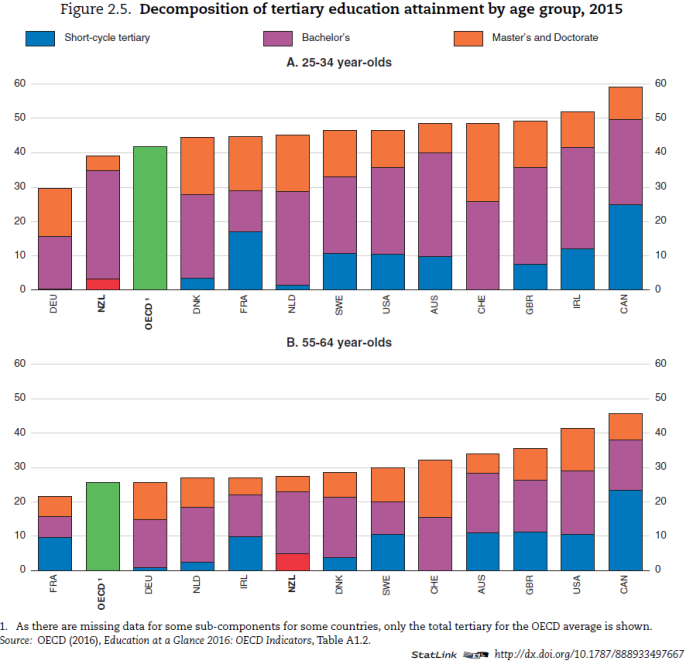
Switzerland is “CHE”.   Relative to New Zealand –  and to the OECD as a whole –  Swiss young workers (25 to 34 year olds) now have a far higher rate of completed tertiary qualifications than New Zealand ones do.

And there was also this chart

skills swiss

Whether for younger people or older ones, Switzerland is ahead of New Zealand, particularly in the proportions with masters or doctorates.

And yet

Tertiary Education Commissioner Sir Christopher Mace says, “to be highly qualified technically rather than academically was totally acceptable in Switzerland.”

No doubt that is true –  or rather I have no reason to doubt it.  But a huge proportion of Swiss young people are getting strong academic qualifications.

Oh, and the OECD also makes much in their reports of the adult skills data I’ve written about here previously. Switzerland didn’t participate in that survey, but New Zealand workers came up with some of the very highest skills (notably problem-solving skills) of any of the many countries that did participate.

Still flicking through the OECD chapter, I found another interesting chart on employment.  Ideally it would be a chart of all sole parents, not just mothers, but it was part of another chart focused on maternal employment.

Swiss sole parents

Switzerland is at the far right end of the chart.

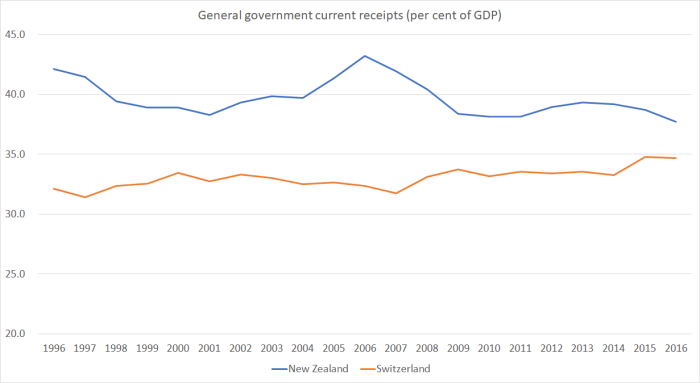
Which is by way of leading into another difference between Switzerland and New Zealand –  the overall size of government is a bit smaller there.  Here is the OECD data on current government receipts (mostly taxes) as a per cent of GDP.

govt size nz and swiss

The Swiss tax take is smaller than ours, as a share of GDP, but (a) the gap seems to have been closing, and (b) at least as much of that is coming from the Swiss raising average taxes as from us lowering them.   Again, if one is concerned about productivity, it isn’t obvious that the Swiss experience has a great deal that is positive to teach us, even if the reasons for their weak productivity growth might well be different from the reasons for our own.

The Swiss track record with weak productivity growth isn’t something new that no one had noticed before  –  the OECD, for example, has been offering thoughts on it for some time (eg here).  So it is still a bit of a mystery why the New Zealand Initiative is touting Switzerland as a success story to emulate, or why a senior journalist is channelling those lines.   Perhaps it would have offended New Zealand business leaders’ sense of amour propre to have gone further east, but if there are many lesssons to be learned for us in Europe about lifting overall economic performance, it seems more likely they might be found in countries like Slovakia or Slovenia, Estonia or Latvia (all now fellow members of the OECD) where productivity is fast catching up (in some cases already has) average levels in New Zealand –  and that in countries that for the whole of modern New Zealand history (ie since say 1840) have been much much poorer and less productive than New Zealand.

Travel generally broadens the mind, and almost any country can probably offers some experiences (good and bad) that visitors could learn from.  I’ve no doubt Switzerland does too (eg about minimum wages and company tax rates perhaps) .    But Switzerland’s overall economic growth performance has been poor for decades, and that even with the advantages that come from being a relatively-small government place in the heart of one of the most prosperous places on the planet (northern Europe).  It seems unlikely there is very much to learn from them, at least in a positive sense, about how to markedly lift the performance of another struggling country almost as far from anywhere (and from suppliers, markets, clusters of knowledge)  as it is possible to be.

One could wonder whether this group of leading business people, (having gone off to learn from Switzerland, where they would have found a system with no minimum wages and much lower company tax rates, but nonetheless want to tell a story about training and education as the secrets of what they see as Swiss success) are not perhaps preparing against the chance of a change of government later in the year.   All that talk in the article would, no doubt, have seemed like music to Grant Robertson’s ears.  Perhaps not, but I’m struggling to formulate a better hypothesis.   Because the data don’t really seem to fit their story.


Budgets, journalists, Switzerland and all that

Last week I wrote about the New Zealand Initiative’s study tour to Switzerland, where (so we were told) a large and high-powered group of CEOs and chairs were seeking to learn from Switzerland’s success.  As I noted, it seemed odd to look for inspiration from the one OECD country that has managed to achieve less productivity growth than New Zealand since 1970.   Even since 1990, Swiss productivity growth has underperformed New Zealand’s own poor record.

I learned about this tour in an article in the Herald, written by veteran journalist (and apparently “Head of Business at NZME”) Fran O’Sullivan.  It was presented as a straight news story, with no suggestion of any Herald involvement with the trip.

But in today’s Herald O’Sullivan devotes her column to Five elements of a good first Budget.  I’ll come back to the substance of the column in a moment.  But in the middle of the column was this

From a distance (in Switzerland travelling with the NZ Initiative to look at how New Zealand can once again become a “rich country”) it is easy to overlook that for some nations – like the Swiss – posting surpluses is mandatory.

So a leading journalist writes about a business lobby-group’s study tour to Switzerland without disclosing that she herself is participating in the tour?   One presumes NZME is paying for her to undertake the tour, but even so.   Wouldn’t it normally be elementary to let readers know of your involvement when you write up the story?  Isn’t it just possible that, in what looked like a straight news story, the fact that the author herself was participating in the tour might colour the angles put on trip, and reports of what it might reasonably hope to achieve?      It will be interesting to hear, in due course, what O’Sullivan makes of the Swiss experience, but how likely is that we will get a balanced and rigorous account when she has gone in with the New Zealand Initiative to do this trip, running their advance lines about “lessons to be learned” etc  (and presumably NZI organised everything, arranged the programme of meetings etc)?      Presumably at a distance, she still hadn’t noticed that while Switzerland is pretty rich, its productivity performance has been shocking, and it has slowly but steadily been dropping down the league tables.

That quote come from item 2 in O’Sullivan’s list of five elements she wants to see in Steven Joyce’s Budget tomorrow.     And yes, the Swiss have changed their constitutional rules to require budget surpluses, but as the chart in my post this morning showed, on net government debt (as a share of GDP), they are virtually identical to New Zealand, and both of us have a bit more debt than Australia.     Perhaps a formal binding surplus rule might make some sense –  although when you don’t have a formal constitution it would be hard – but the case doesn’t seem that compelling in a country that successfully maintains low public debt itself, and yet is exposed to very nasty (and very costly) natural disasters.

What are the five items O’Sullivan looks for?

First –  for G*d’s sake, be bold

Second: Post a surplus?

Third: Budget is the plan

Fourth:  Get economic growth up on a per capita income level

Fifth:  Strip out the smoke and mirrors

Item 1 is the sort of item that helps reinforce conservatives in their conservatism.  Being bold might sound good, but her lead proposal is simultaneously bold and daft.

A bold Budget would unveil a significant long-term investment in the country’s infrastructure. For example, a high-speed railway network to service Auckland from elsewhere in the Golden Triangle (Hamilton, Whangarei, Tauranga).

This generation’s Think Big, if I hadn’t already applied that label to our immigration policy.

The British government is envisaging spending 55 billion pounds –  stop and take in the number –  on their HS2 high speed rail route.   There is plenty of scepticism about that proposal –  and this is country with many many more people, at either end of the proposed routes, than anything we are ever (or even just in our lifetimes) likely to have in northern New Zealand.    If the costs in New Zealand were similar, that would be $100 billion (or around 40 per cent of current GDP).     We do lots of government capital spending badly in this country –  check out the Transmission Gully project –  but an HS2 equivalent would surely take the cake?

Urging boldness on politicians is fine, if there is a strong and well-grounded agreement on what they should be bold about.  Otherwise, it feels a lot like random action because “something must be done” and anything is something.

She poses a question mark around the second item –  post a surplus.  This seems to be because she is tantalised by the idea of using surpluses to fund “major infrastructure to support growth”.  As I noted this morning, government infrastructure may involve ongoing maintenance and depreciation costs, but straight government capital expenditure doesn’t show up in the operating balance.

What of the third item –  the plan.

Does the Government have a plan? New Zealand is at a choke point. There needs to be a credible five-year plan to capitalise on the major influx of immigrants. Ensure New Zealanders can be housed; clean up our waterways … the list goes on.

Joyce has had a lengthy eight-year period as English’s understudy.

That’s more than enough time to come up with a plan.

Hard to disagree that a credible plan would be nice.  After eight years it doesn’t seem likely that one will suddenly be granted us.   And, given the Minister’s penchant for interventions all over the place (universities, student visas, tech schemes etc), it isn’t likely that any such plan now would offer us a credible way forward.  He was, after all, the Minister primarily responsible for the exports target.    Over recent years, we’ve been moving away from that target rather than towards it.

The fourth item –  lifting per capita growth –  is really the same as the third.  It would be nice –  rather more than that actually.    But there isn’t much sign of doing differently things that have given us such weak per capita GDP and productivity growth for the last eight years.

On the fifth item –  smoke and mirrors –  one can only agree.

Joyce – like previous Finance Ministers – will be a fail on this score. He is unlikely to strip out the “smoke and mirrors” which politicians use to overstate government expenditure; particularly on social programmes such as housing.

He’s already been caught out by Labour’s Grant Robertson when it comes to massaging the numbers on an $11 billion investment in infrastructure.

Robertson labelled the $11b figure as “just playing with numbers”.

“When you peel it all back, what you have is National only promising to spend an extra $300 million a year from the promise made in the half-year Budget update.”

Finance Ministers really shouldn’t play this game and Treasury should issue tables which keep a running track of “re-announcements” of spending promises.

It is the sort of reason why Treasury forecasts and fiscal reporting are supposed to be done at arms-length from the Minister of Finance.  Each time ministers do this stuff it erodes, just a little further, what remaining confidence the public might have in our elected leaders.  A cheap (brief) win, and a long-term cost.

In the end, it is a pretty bleak column.  Plenty of stuff to wish for –  much of it quite sensible, provided you forget about the high speed train –  and little prospect of any of it happening.

But I still can’t help thinking that we deserve a lot better from a leading journalist in the country’s largest circulation newspaper than a story writing up and promoting the activities of a lobby group, only to find out 10 days later that the journalist in question is herself a participant in that same (apparently rather misguided) study tour.


If NZ was like Switzerland…productivity growth might be even slower

Reading the Herald over lunch, I was interested to learn that the New Zealand Initiative is leading a study tour (of 40 chief executives and chairs) to Switzerland to see what we have to learn from them.  According to the Herald’s account,

At the heart of a one-week study tour organised by leading think tank the New Zealand Initiative is a quest to examine the role “localism” plays in the Swiss economic success story.

The online version of the story even had a graphic,

Switzerland

Many of those items seem quite attractive.   Nonetheless, when the story was framed around Switzerland’s economic success, I couldn’t help wondering if the Initiative’s members might not be heading to the wrong place.

Once upon a time, Switzerland had either the highest or second highest measured productivity (real GDP per hour worked) in the advanced world.  The Conference Board has estimates back to 1950 – when Switzerland was just behind Luxembourg.  But in this post, I’ll use OECD data, which goes back to 1970.

As recently as 1970, Switzerland still held that sort of rank (as it did for nominal GDP per hour worked –  in some ways a superior measure, but good timely estimates for the current situation aren’t available).    These are the OECD countries for which there is 1970 data.

switz 1970

We weren’t doing too badly either –  just slightly below the median for example, and in the middle of the big European countries (Spain, UK, France, Germany and Italy).

But here is the cumulative growth in this measure of labour productivity for the full period 1970 to 2015.

switz 70 to 15

Beaten even by New Zealand.  It is a pretty woeful Swiss productivity performance.    Even over the last 25 years when both countries have done a little better relatively (we beat six of the OECD countries), Switzerland still came in behind New Zealand.        Over the decades, they don’t even have the excuse of agricultural protectionism, or being remote in an age when personal connections have become more important.

And what about the present?  Here are the levels of real GDP per hour worked in 2015, for the now much larger OECD.

switz 2015

Switzerland is, of course, still a productive and prosperous economy.  But over the last 45 years, it has slipped a long way down the league tables.    As for us, of the countries on the first chart who had lower productivity than New Zealand in 1970, only Turkey, Portugal and Korea still do.    (I hadn’t really noticed previously that if they don’t shoot themselves in the foot, even Turkey will soon go past us if these numbers are to be believed.)

I’m sure there are many good things about Switzerland.  It is a much richer, and in many ways more successful, country than New Zealand.  But I’m not sure I’d be looking to them, or their governance models (fascinating as they are in many respects), for lessons on what New Zealand should do to lift its relative economic and productivity performance.

The New Zealand Initiative’s manifesto

I mentioned yesterday that the New Zealand Initiative had released its Manifesto 2017: What the next New Zealand government should do.   When I sat down and read it I came away with mixed feelings.   There are quite of lot of specifics I agree with, which shouldn’t be a surprise: the Initiative is variously described as pro-business, neo-liberal (both, for different reasons, unhelpful descriptions –  they are generally pro-market rather than pro-business) or just plain “right wing”.  And I was summed up a few weeks ago by one journalist as being on the ‘dryish right of the spectrum’, which sounded roughly correct.   We have our (large) differences over New Zealand immigration policy, and I’m a conservative while they often tend towards a libertarian view of the world, but there is often a lot of overlap in the sorts of policies we would favour.   In fact in some areas I think they are far too trusting of central and local government.

I said I had mixed feelings.  That is mostly because of the elephant in the room which in the Manifesto they almost entirely ignore –  our long-term economic underperformance.  The author  –  Initiative director Oliver Hartwich –  is a recent migrant, clearly enraptured by New Zealand.   That’s nice, but it rather ignores the things – the underperformance –  that has led to such a large exodus of New Zealanders over the last 40 years or so.   The relentlessly upbeat tone often comes across as almost delusional –  which isn’t a good start to what he claims is “more than a collection of randomly assembled policies –  it is an intellectual guide for imminent challenges”.

But what do they propose –  drawing on many of the studies they have put out over their first five years of operation?   As another (interesting – left wing) commentary on the Manifesto noted it is all “divided handily into six different sections and 28 different proposals”.

The first set are about housing

• abolish all rural-urban boundaries;
• abolish all height and density controls;
• strengthen property rights by introducing a presumption in
favour of development into the Resource Management Act;
• incentivise councils for development by letting them capture
the GST component of new buildings; and
• introduce MUDs but ideally give them a more appealing name
(maybe Community Development Districts).

I’m sympathetic to the broad direction of what they propose, but

  • I don’t agree with abolishing all height and density controls on existing urban land (as distinct from newly developed land).    Were it not for council rules, private landowners would in many cases have negotiated such restrictions themselves (as we see in the covenants in many new subdivisions) –  waiving or trading them as and when mutually beneficial opportunities arose.   My preference would be to devolve  most existing restrictions to groups of existing landowners, and allow them to transact among themselves to permit (or not) greater height and density.
  • I’m very sceptical of the Initiative’s support for disbursing GST revenue to local authorities.  It seems like an opportunistic response to current pressures, which would quite dramatically overturn the sort of fiscal arrangements we’ve had since 1876 (and the end of provincial governments).    Local authorites have their own revenue base –  one generally favoured by economists as, in principle, less distortionary than most –  and I’m not aware of provisions preventing differential rates.

The second set of recommendations is around education

• create an attractive career structure for teachers;
• provide tailored professional development for teachers;
• monitor teacher performance and introduce performance based
appraisals;
• evaluate systematically the impact of interventions on
school performance; and
• expand school clusters as a means of sharing best practice.

I haven’t read all their material on education, so perhaps I’ve missed something.   The general direction seems fine, but this is one of those areas where they seem to be too ready to trust governments to get things right.    I imagine that in the Business Roundtable days there would have been a lot more talk about genuine school choice –  not just a few charter schools for targeted groups at the bottom, but much more genuine choice (public vs private, religious vs secular, non-profit vs for-profit etc) of provider for all parents, including greater choice about what is taught  I probably shouldn’t be surprised, but as I’ve listened to my children over the years I’ve been surprised at just how much ‘indoctrination’ –  of conventional left-wing/’progressive’ causes –  goes on in our state schools; some of it conscious, much of it no doubt unconscious.   The Initiative seems more focused on making the state behemoth work better –  not necessarily a poor goal in its own limited way –  rather than backing what I’d have thought would be a belief in markets, civil society etc.

Then they move on to foreign direct investment (where Bryce Wilkinson did some really useful work over several reports).  Here they recommend

• Abolish the Overseas Investment Act. There should be no
FDI regime.
• Subject all investors, domestic and foreign, to the same rules.
• Protect New Zealanders’ property rights, including the
freedom to sell to whoever they wish. In cases of public
interest, appropriate compensation must be made.

I’d mostly agree with them, with four caveats:

  • having gone to great lengths over the years to put in place good governance arrangements for our own SOEs, and in many cases to privatise them, I’m much less relaxed than the Initiative seems to be about allowing foreign SOEs –  particular those from countries with, shall we say, weak governance traditions –  to take on substantial roles in New Zealand.  We might not suffer the poor returns to capital, but we still face potential efficiency losses.  I have a strong prior that genuine private sector entities investing here will, on average, be mutually beneficial.  One can’t extend the same presumption to organs of foreign states.
  • in certain extreme circumstances – but they are extreme and rare – I’d be uneasy about allowing concentrated foreign ownership of New Zealand land.  Had the Soviet Union during the Cold War wanted to buy up, say, most of Northland, it would have been dangerous and reckless to agree.  It is fine to counter with “but the land is still New Zealand, subject to New Zealand law”.  But one has to have the capacity to enforce that law.  Geopolitical threats are, at times, real.   My own halfway house would be to abolish controls on any investments from OECD member countries, and add to that list on a case-by-case basis.
  • while I largely agree with the Initiative on FDI, I suspect it is a less important issue (in terms of potential economic gains) than they do.  Why?  Because the restrictions seem to bear most heavily on land purchases (not the sort of high-tech industries often touted as the way of the future –  or even banks or oil explorers), and we already put so many other restrictions on land use (eg restrictions on GE products) that I’m sceptical that there is currently much in the economic case for liberalising foreign land purchases.
  • I’m not totally averse to restrictions on non-resident foreigners purchasing residential properties in New Zealand –  at least as some sort of third best, if governments can’t/won’t fix up land supply issues or the (aggravating) population pressures.

The next section is about better regulation (or better law).  They propose

• No new law or regulation shall be introduced without a
cost-benefit assessment that demonstrates real gains for the
public and costs fairly shared.
• Regulatory reform cannot be delegated to a junior minister
but needs real commitment from the prime minister down.
• The regulatory culture should shift from one of ticking
boxes and managing risk to encouraging greater flexibility
and innovation.

and they repeat a line from a previous report

Over-reliance on primary legislation: New Zealand’s overreliance
on primary legislation is unusual by international
standards. Other countries use more secondary and
tertiary legislation to amend outdated rules. Most
regulatory changes in New Zealand require amendments
only Parliament can make.

In general, I’m sympathetic to the direction they propose, but

  • I’m all for good cost-benefit assessments, but am less convinced of the argument that it should have to be demonstrated that “costs are fairly shared”.  After all, it is rare legislation (primary or otherwise) that affects most people equally, and part of politics is differences in views of what is “fair”,
  • Is anyone in favour of “tick boxes” approaches?  I doubt it, although actual regulation often drifts towards that sort of outcome.  Flexibility and innovation are laudable goals, but so is predictability and certainty when citizens are dealing with the state,
  • I strongly disagree with them when they want to reduce reliance on primary legislation. For too much law-making power is already delegated by Parliament to ministers and official agencies.  It is a technocrat’s dream, but a citizen’s nightmare.

They then move on to social policy

• Social policy is not a silo and should be regarded as a whole-of-
government task.
• Fixing New Zealand’s housing affordability crisis is crucial
to addressing both income-related poverty measures and
inequality concerns.
• To provide all New Zealanders with good life opportunities,
special attention needs to be paid to education. More
targeted support for students from lower deciles should take
precedence over untargeted programmes such as interest-free
student loans.
• Taxes and regulations should not choke off employers’
incentive to create jobs for the available skills or deprive
those with those skills of the incentive to work.
• The government’s plan to trial new ways of delivering social
services such as social bonds is laudable.

My thoughts?

  • I’m rather sceptical –  but open to persuasion –  on the merits of “social bonds”.
  • I’m more than sceptical of the big-government first bullet.   The logic sounds compelling at first blush –  and if fiscal savings were the only focus it might be persuasive –  but it is a path that undermines privacy and autonomy, delivering more and more information to an overweening state.
  • It is striking how the Initiative –  like the government, and no doubt the Opposition –  are reluctant to ever go near the role public policies have played in corroding cultures and giving rise to the welfare-dependency and other social problems joined-up government is now supposed to be trusted to deal with.

And then they turn to local government

• Local communities should share the benefits that accrue
to central government from extractive industries and
growth. Local government should receive financial benefits
for creating economic growth (and suffer a loss when it
does not).
• Central and local government need to better define their
responsibilities to preclude cost-shifting and blame games,
and enhance accountability.
• Special economic zones would increase flexibility and
regional variability of economic policy.

Here I largely disagree with them (and probably side more with the former Business Roundtable, which favoured restricting more tightly the activities of local government).

  • the second bullet is vacuous.  It is what politics is.
  • I documented my scepticism about their special economic zones idea in a post in 2015.
  • For all their talk of how many local authorities France or Germany have, it is worth remembering that this country has a total population not much different from that of a typical US state.  Do we really think we have the policy capability for dozens of different economic policies?  And what do we make of the demonstrated capability of local bodies?  I know the Wellington City Council is one of the members of the Initiative, so perhaps they have to be polite, but it is a local body that hankers after uneconomic runway extensions, expensive convention centres and film museums, extraordinarily expensive town hall refurbishments, all while then going to cap in hand to government to sort out the water supply risks in an earthquake (a fairly basic function I’d have thought) I simply don’t understand why the Initiative wants to give more scope to local bodies.  Perhaps it worked in Germany, but there is little sign it does here.
  • I was also a bit flabbergasted when the Initiative seemed to lament local council reliance of property taxes.  Local body rates aren’t a pure land tax, but they are probably further towards the non-distortionary end of the spectrum than most other possible taxes.

Their final section is about economic growth.  There is plenty to agree with them on there.

Imagine if we could achieve an annual productivity
growth of 2% per year from now until 2060 instead of, say,
1.5%. Half a percent may not sound much. But through the
power of compound growth, it makes a substantial difference
to economic output.

By 2060, GDP per capita would be 22% higher (or about
$22,000 per person in today’s dollars) if we achieved 2%
productivity growth instead of 1.5%.    ……

Creating a dynamic, growing economy is essential if we do
not want to end up like some European countries that have not
generated enough growth over the past decades, and are now
paying a heavy social and economic price for it.

All good stuff, but…….there is not a single policy recommendation in this section of the Manifesto. Not one.

I suppose their defence will be that the earlier report they were drawing from was about making the case for economic growth, as against those who doubt it is something worth focusing on.   But this is a policy manifesto, you are an (economics-based) think tank, and you have nothing specific to offer on diagnosing the causes of New Zealand’s disappointing long-term economic performance, and nothing on remedying it.    It seems quite a large gap in the manifesto.    No doubt, the Initiative would argue –  and fairly –  that some of their other proposals would lift productivity and per capita GDP, but I doubt any serious observer would think that list –  even if all the items on it were adopted –  would be more than modestly helpful in reversing our decline.  After all, we did much more ambitious reforms –  in the same general spirit –  in the 1980s and early 1990s and they didn’t.  (And for those about to comment  “so what would you do”, I dealt with a list of things I’d favour in a post last year.)

Various omissions from the Manifesto struck me.  Having just launched a major report on immigration, it was surprising to see almost nothing on that topic, not even on ways to improve the current system.  Writing about the Manifesto at Spinoff, Simon Wilson noted

Still, I’ll give them this: they don’t believe cutting taxes is the cure for all ills and they don’t bang that old privatisation drum much either. For neoliberals, both those things are revolutionary. Credit where it’s due.

In fact, as far I could see there was nothing about lowering taxes at all, even though our company tax rate is towards the upper end of those in OECD countries.  I guess the Initiative hasn’t done a report about the tax system –  perhaps it will be a topic if there is a change of government, given that the Opposition parties propose a tax working group.  Perhaps too there are no votes in arguing for lower company tax rates –  in an overheated climate of angst about multinationals and tax –  but, as the Initiative note, the role of a think tank shouldn’t be to be popular.

And now to revert to my earlier comments about the tone of the scene-setting introductory chapter.  It is relentlessly upbeat.  Apparently

New Zealand is not just doing well but doing spectacularly well on many measures.

And

Instead of taking this performance for granted, we need to celebrate it.

Ending on tones that could have been taken from Land of Hope and Glory

Land of Hope and Glory, Mother of the Free,
How shall we extol thee, who are born of thee?
Wider still and wider shall thy bounds be set;
God, who made thee mighty, make thee mightier yet,
God, who made thee mighty, make thee mightier yet.

Or, as the Initiative puts it

the Initiative takes great pride and satisfaction in helping make our great country greater still.

Of course there is a lot to like about New Zealand.  Most countries in the world have far lower material living standards, however one wants to assess them.

But what the Initiative seems to want its readers to forget – and perhaps it is just because many of their staff are so new to New Zealand that that history hasn’t yet made much impression –  is that not long ago,  New Zealand wasn’t just better than most countries, it was a better place to live than almost all of them.  Norway was somewhere well down the scale, as were France and Germany, let alone Singapore and Japan.  One can’t put too much weight on single estimates for single years, but 100 years ago we vied only with the US, Australia and perhaps the UK and Switzerland for top ranking.  My grandparents were just starting out in the workforce then.  Even in early 1950s –  when my parents were starting out –  we were still in the top handful, helped a bit by escaping the direct ravages of war.      And now?     Now, whether you look at GDP per capita or GDP per hour worked, or dig down and look at NNI (net national income) measures, we don’t score well.  Of the OECD countries, we are perhaps 23rd, and showing no signs of improving.  In the league tables, and depending on your precise measure, we vie with places like Slovenia and Slovakia (still regions of communist countries when we were doing our liberalising reforms in the 1980s) and Greece, Israel, Korea and Spain.   In our European history, New Zealand has never before been as poor and relatively unproductive as these countries.   And as the Initiative rightly stresses, economic growth –  and surely even they mean it in per capita terms –  matters.    We haven’t delivered it, and there is no point pretending otherwise.

Is GDP everything? No, of course not.   But if you want a balanced assessment of New Zealand –  and such hardheaded asssessments are the only sensible starting point for good diagnosis and prescription –  one could also point to things like:

  • a homicide rate that is around the middle of OECD countries,
  • an incarceration rate (a “fiscal and moral failure” as the Prime Minister put it) far higher than most,
  • shocking domestic violence rates,
  • wide disparities between Maori and Maori economic and life outcomes,
  • as well as more mundane, but ubiquitous, scandals like the housing market.

Oliver Hartwich is glad to have come to New Zealand.  He’s found a good niche here and I wish him all the best.  Life is comfortable for upper income people in central Wellington.     But what have New Zealanders been doing?

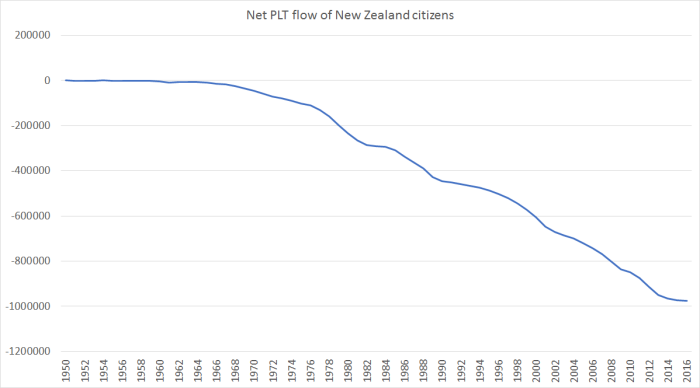
Here is the chart, since 1950, of the cumulative net immigration flow of New Zealand citizens.

net plt flow of nz citizens

In the 50 years to 2016 that was a net outflow of 963000 New Zealanders.   The average population over that 50 years was about 3.7 million.  Roughly a quarter of all New Zealanders have left (net) and not come back.  It is a staggering symptom of failure and underperformance here, that so many people –  in a relatively rich country –  saw what they regarded as  better opportunities abroad and went after them.      Well-performing countries just don’t experience that sort of exodus.  Most of us don’t want a repeat, or a resumption of larger scale outflows once the Australian labour market picks up.  But to read the New Zealand Initiative’s report, one wouldn’t even know it was an issue.

Nearing the end of his rhapsodic introduction Hartwich observes

For policy experts such as my colleagues at the Initiative, New Zealand does not provide the same challenges one faces in solving the Greek debt crisis, organising Brexit, or fighting home-grown extremism.

It should.  After all, that sort of outflow of our own people, that sort of sustained economic underperformance, is unknown in reasonably well-governed countries in modern times.  If I can end on my own modestly upbeat note, we aren’t Argentina, Venezuela or Cuba……and yet we’ve experienced the staggering slippage that shows no sign of reversing itself.    There are plenty of challenges for the next manifesto, if they interested in actually engaging with the specifics of New Zealand’s experience.

New Zealand Initiative on immigration: Part 10 Recommendations and Conclusion

At last we get to the end of the New Zealand Initiative’s report on New Zealand’s immigration policy.

I don’t want to spend much time on the Conclusion page or so.  Even in a short section, there is lots I could challenge or disagree with, but much of it is ground already covered.  But I did want to highlight briefly the tone they adopt.  It is not one that, say, respects the very wide differences in immigration polices found across time and across the countries of the world (even just among the relatively advanced countries).    Or one that recognises that in some area men and women of goodwill and decency might have different preferences as to how best to organise or govern societies.  It isn’t even one open to the possibility that not all state-facilitated immigration –  to any place, at any time –  will necessarily benefit the natives of the place.  Rather, the only things that can possibly lead to different conclusions than the Initiative are fear, confusion, racism and so on.

This is what I mean.

Such is the intensity of the fear and confusion among the public that many opposition parties have seized on this narrative, some naively and some opportunistically. The pro-immigration Key government too has tightened policy settings to appease the public.

No one, presumably, has engaged in a thoughtful or considered reassessment?

Radical changes to policy settings simply to appease populist fears is misguided and even harmful.

The only reason anyone might apparently consider change is “to appease populist fears”.

Which is all a bit odd because a couple of paragraphs on they come to the economic aspects of immigration –  economics being the core expertise of Initiative people.  And there, writing about New Zealand, they say (emphases added)

Economic worries about immigration are overblown. There is no compelling reason to believe migrants are causing major detrimental impacts to the labour market. Although the empirical evidence is less than conclusive, there are good reasons to believe, as most economists do, immigration can make a positive contribution to economic growth.

Note how weak the actual claims are.  It isn’t exactly a ringing endorsement of the contribution of New Zealand’s immigration policy to the economic wellbeing of New Zealanders.  After all, I’m happy to sign up to the proposition that immigration “can” make a positive contribution to per capita economic growth, productivity, NNI per capita or whatever. Pretty clearly it did in New Zealand in the 19th century.   It is just that the Initiative, at the end of a major report, can point to no evidence that it actually has done so in recent decades, or is doing so now, in New Zealand.

But what of their specific policy recommendations?  For practical purposes, they endorse roughly the current scale and structure of our immigration policy (with no attempt to assess whether New Zealanders would be better off if, say, the programme were 50 per cent larger, or smaller, than it is).  There are, broadly, four areas of reform they suggest.  As they argue –  noting again the loaded language

Most of the low-hanging fruit have been picked, but policy can still be improved. And there are less harmful ways to placate those who demand an exclusionist policy.

The first is “giving business more of a say”.  In some areas, I agree with them.  For example

Rather than let government decide what types of skills the market needs, let the market reveal it through the price system. A market-driven approach could be to adjust the points system to assign points to the salary ranges of job offers rather than the specific industries migrants are qualified in.

I would favour something similar for our short-term work visa rules.  Set age-related salary thresholds, and set them quite high, and use that as the main tool to decide whether or not to approve a work visa.  I’d have no real problem in offering work visas fairly freely for any position (genuinely) paying, say, $100,000 per annum or more, subject to a limit of, say, three years.   After all, in the Initiative’s words –  and ones I could have written myself

Skills ‘shortages’ can be rectified through higher pay rather than lobbying
government to add the skill requirement to the list.

Where I depart from the Initiative is when they fall back on comparing people with pineapples.

The free market is a much better decision-maker on how many imported pineapples or cars New Zealand needs. Likewise, the number and types of skilled workers New
Zealand requires is for businesses to decide without the strong hand of government.

What is being decided, in our medium-term immigration programme, is how many people, of what sort, will be able to come and join the polity that is New Zealand.  Pineapples don’t vote, pineapples don’t come with cultures.  People do.    The Initiative seems largely indifferent to any notion of the state as agent of the collective preferences of its citizens, but most voters probably see it differently.   I’d put their sentence the other way round:

“It is for the government, on behalf of the public, to make choices as to how many, and what type of, people to invite from abroad to become New Zealanders.    Firms and employers will choose optimal production structures, remuneration patterns etc, in light of all the resources and constraints they face.”

The Initiative also explores the option of imposing a levy, “to limit the effects of migration on infrastructure costs”.    One of the authors, Rachel Hodder, followed up this idea in an article on interest.co.nz.    As she puts it

Our recommendation then also stands as a challenge to political parties that have been using infrastructure burden as justification for cutting immigration. If that is the genuine reason you believe immigration policy needs to be adjusted, then why not explore this option first?

It is an interesting idea, and I don’t think I’d have any objection in principle.  It would increase the chances –  although certainly not ensure – that large scale immigration would actually be benefiting New Zealanders in aggregate, although on its own it would do nothing to allay the distributional concerns (that relatively unskilled New Zealanders are losing out).

The Initiative proposes the idea of a levy without, as far as I can see, giving any sense of the possible size.    One angle might be to look at the public sector capital stock, which presumably needs to be augmented, in much the same per capita amounts, for each addition to the population.   As at last March, Statistics New Zealand estimated that the current value of the general government sector’s capital stock was around $41500 per person.  But that is a depreciated value.  Assume that all the capital was halfway through its life, and one could easily be looking at a per capita cost of putting in place the new public sector capital that new migrants require of $80000.    Some of the public sector capital is already financed by user-fees, but most of it isn’t.   I wonder if anyone is seriously willing to propose an $80000 levy for successful applicants for a residence visa in New Zealand  – even if, say, it could be paid as an income tax surcharge over the following 10 years?  In principle, it should raise the average skill level of the successful applicants to some extent.  It would certainly deter migrants with children.

I don’t have a huge problem in principle with such a scheme but, rightly or wrongly, I suspect most people would judge that it was almost a “repugnant transaction” –  they would prefer not to sell the right to become one of us.  Is it different in character from inviting migrants in on the hypothesis that doing so will enrich us all (the current philosophy)?  Perhaps not –  and definitely not to the economist in me –  but I can’t see it finding a great deal of public favour, among supporters or sceptics of the immigration programme.

The Initiative also seems to endorse proposals for New Zealand to sign reciprocal free movement agreements with any willing coountries, citing favourably ACT leader David Seymour’s suggestion to promote such agreements with Canada and the United Kingdom, complementing the arrangements we currently have with Australia.

Doing so with the UK in particular would, of course, restore the system that operated for more than a century after New Zealand was first settled.  It was only in the 1960s and 70s that free movement between the UK and New Zealand was no longer legally permitted.  At a political level, I find the idea quite appealing (but politicians in the two countries are unlikely to).  At an economic one, I don’t.  This simply harks back to my longstanding argument that the most important issue for New Zealand is the sheer number of immigrants we’ve been taking, not primarily what shills they’ve had or where they’ve come from.  Most of our migrants in the early post-war decades came from the United Kingdom.  At the time, material living standards here were better than those in the UK.  But even now, decades on, no one has been able to produce studies –  whether econometric ones or analytical narratives – demonstrating the productivity gains to New Zealanders from that large scale immigration.  Economists at the time was pretty sceptical.  Those now just seem uninterested in New Zealand economic and economic policy history, and the possible lessons it should offer.

These days, of course, New Zealand is poorer than the UK, but the UK is so much the larger country that even a small outflow from the UK to NZ  (as a share of the UK population) would be materially disruptive to New Zealand, and would further set back the chances of lifting productivity and living standards here back to those in, say, the top half of the OECD.  There is, additionally, the adverse selection problem, that the people most willing to migrate from a rich hub to a poorer, but perhaps more relaxed and spacious, country are hardly likely, on average, to be those with the greatest desire to succeed, and the strongest likelihood of offering the vaunted productivity spillovers.

The Initiative’s final suggestion for policy improvement is in the area of sponsorship for migrants.

A separate visa category could allow committed people to sponsor and support migrants in adverse circumstances, provided adequate checks and balances are in place. Canada allows community groups to sponsor refugees above the quota if they agree to be responsible for the basic care and support of the refugees, and New Zealand is laudably trialling this system for refugees here.

In principle, I’d have no particular problem with this suggestion.   As they note

Requiring bonds from sponsors could ensure the sponsors are held to their commitment.

But I think it is an approach mostly best operated on a relatively small scale.  Immigration policy is a collective decision about the number, and sort, of people we welcome to become future New Zealanders. I’m not sure we want motivated minorities  –  whether libertarians, evangelical Christians, Wahhabi Muslims or whatever –  trying to skew the population balance over time by fundraising to bring in lots more of their own.  Each group is, of course, welcome to evangelise and persuade, and perhaps if the libertarians ever persuaded enough of us we’d have open borders after all.  But make it a contest of ideas, not of the power to buy more imported supporters.

In the end, it is a pretty modest list of suggested reforms.  Much as they seem driven by a vision of open borders, in the end the Initiative is worried that New Zealanders might be getting uncomfortable with the grand Think Big experiment of New Zealand existing immigration policy over the last 25 or so years.  It has delivered us a large increase in the population, and a lot more ethnic restaurants and higher house prices (to take the most obvious gains and downsides), but with little or no evidence that it has done anything to lift our overall economic performance.  As the OECD noted again only the other day, for the last quarter century our productivity –  already low –  has just drifted a little further behind other advanced countries.  Perhaps it is past time to rethink this key dimension of economic policy.

My own preferrred model would probably have these elements:

  1.  Reducing the residence approvals target from around the current 45000 per annum to, say, 10000 to 15000 per annum.  In per capita terms, that would be about the rate of legal immigration the US has, and would be similar to the rate we had in the 1980s.  Not exactly closing the door, but certainly pulling it over to some extent.
  2. Within that reduced target I would look to focus much more strongly on demonstrably highly skilled people (who offer the best chance of fiscal and productivity gains) and thus would
    • revisit, reduce and potentially eliminate the current Pacific access categories,
    • permanently eliminate parent visas, except (and even then capped) where there is an enforceable, insured, commitment to full financial support from the parent, or their New Zealand citizen child.
    • leave the refugee quota as it is
    • eliminate the additional points provided for job offers in regional areas (a measure that is tending to lower the average quality of the accepted migrants)
    • eliminate additional points for New Zealand specific qualifications,
    • eliminate additional points for jobs in areas of “future growth” or “absolute skill shortage”
    • more strongly differentiate points in favour of higher level qualifications,
    • perhaps establish a category akin to the US visa for those with extraordinary ability
  3. Eliminate the provision allowing foreign students studying here to work 20 hours a week.  If New Zealand tertiary institutions really have a product worth buying –  and some probably do –  they should stand on their own feet, as other exporters are required to.
  4. Reshape the work visa system with a view to (a) reduce the scope for lobbying and influence peddling, (b) reducing the total number of people here on work visas at any one time, and (c) provide much greater flexibility for employers to utilise work visa people for short specific periods in highly-skilled and well-remunerated roles.    Since there would be many fewer residence approvals place open (see above) this path would in any case be much less popular with prospective migrants.   Specific features might include:
    • no one could have a work visa for more than two three year stints
    • use an age-based matrix in which in normal circumstances no work visas might be issued to anyone under 30 for a role paying less than, say, (an inflation-indexed) $75000 per annum, increasing by (say) $25000 in each five year age window up to a cap so that for a person over 50 to get a work visas they would need to be in a role paying $200000 per annum or more.
    • no doubt there would need to be some exceptions to this, and it would not apply to say approvals for roles of less than perhaps three months, but the point is to get the focus not on official judgements of “skill shortages” but on attracting people, if we do, who are capable of commanding high salaries (loose proxy for skill) on market.

Is it a perfect scheme?  No, of course not.  That isn’t a meaningful test for any human institution.  Is it a scheme for other countries.  No.  Some might find it useful, but for others –  where there might be clear evidence of gains to natives from large scale immigration –  it might be quite inappropriate.   But for the specifics of where New Zealand finds itself now, it would be a huge step in the right direction.   For a very remote place, in an age when personal connections seem to matter more than ever, it would give us a much better chance of finally beginning to close the income and productivity gaps, and offer New Zealanders –  the inevitably fewer number of future New Zealanders than under current policy – the chance of achieving world class productivity and living standard here in their own place.


New Zealand Initiative on immigration: Part 9 The case for open arms

I’m getting a little tired of writing about the New Zealand Initiative’s immigration report, and readers may be getting a little tired of reading about it.   But when the best-funded pro-immigration advocacy group in New Zealand –  Treasury and MBIE aside –  produces a major report on the subject, then as a sceptic of New Zealand’s modern immigration programmes I feel a certain obligation to keep on to the end.  But I’m now down to the last five pages of the report.

Chapter 5 is headed “The Case for Open Arms”, which sounded a lot as if it was going to be making the case for open borders –  that libertarian idyll, not adopted anywhere, in which anyone who wants to can come, in any numbers.   Because the Initiative seems torn between the practical  (simply defending current policy –  which, liberal as it is, is not remotely “open borders”), and the idealistic  (let them come, let them come, in whatever numbers they choose, a policy that they know will never be adopted), the rhetoric and arguments often also aren’t that consistent in tone.

They start by making a fair point

To the original tribes that inhabited New Zealand, European settlers would have seemed more foreign than today’s migrants are to modern New Zealanders.

Different religion, different technologies, different governing institutions, and immensely richer and more productive.    As the Maori did, apparently, so should we, for in the next sentence we are asked

Can New Zealand keep on accepting people who want to make this country their home?

Which seems to have rather lost sight of the hugely expensive wars, and mass (subsidised) migration, that were required to secure the European position in New Zealand.  It was a power grab.   I’m not sure it is a precedent I’d be wanting to invoke.   And, as I keep pointing out, it isn’t as if there are cultures that are (a) immensely more economically productive than the existing New Zealand culture/institutions, and (b) people from those (largely non-existent) countries/cultures clamouring to come to New Zealand.  Recall that paper I mentioned last week suggesting that if there are economic gains from increased diversity, they mostly arise when people come to your country from richer countries.

I’d be inclined to simply dismiss much of this as content-free rhetoric, but so much of the case for large scale non-citizen immigration policy seems to be made at that level.  It certainly doesn’t seem to engage with the actual specifics of New Zealand’s economic underperformance, despite our fairly good institutions and talented skilled people.

The next piece of rhetoric is that “we are all immigrants anyway” line, as if it offers any insights on the current policy choices.

No matter how you slice it, few New Zealanders can trace their lineage to many generations before counting someone foreign-born. We are part of the New World. And we are a nation of migrants.

I presume the aggregate numbers are right, but my ancestors came in the 1850s and 1860s.  It might be a different relationship with “New Zealand” than some Maori may have, but it is also very different than that of people who have come in the last five or ten years.  This is “our place”, and it is a matter for the voters of New Zealand to decide whether, and to what extent, we continue to take lots more immigrants.  And there is nothing historically inevitable about it.  Thus  the observation that “we are part of the New World” is true enough, but meaningless for these purposes.  Australia and Canada also have pretty liberal immigration policies – although even Canada is bit less open than we are.  But the United States takes only about as third as many legal migrants (per capita) as we do.   And the countries of colonial settlement in Latin America are not now known for their extensive immigration inflows.  Perhaps the less said about South Africa – once often grouped with New Zealand, Australia, and Canada –  the better.    Newfoundland, once independent, was one of the first British colonies of settlement: these days, something less than 2 per cent of the population is foreign-born.  It is a choice.

The rhetoric then gets stranger still –  indeed, they invoke the Golden Rule (“do unto others as you would have them do unto you”).

It doesn’t often get brought up in debate but the golden rule applies well to immigration.  Treating immigrants the same way we would like New Zealand emigrants to be treated overseas is fair and sensible. Many New Zealanders benefit from travelling overseas to live and work. Some end up staying but many return, and there is value to New Zealand from both.

Which is a really strange argument to run when New Zealand has among the more open approaches to immigration of any country in the world.  We all know how difficult it can be for New Zealanders to get migration access to, say, the United Kingdom.   The number of permanent resident foreigners in China –  now a middle income country –  is staggeringly small.  And even relative to Australia –  where we have loosely reciprocal arrangements involving the ability of citizens of each country to live and work in the other –  we treat Auatralians moving here far more generously than they treat the (many more) New Zealanders moving there.    And OECD data cited by people like the Productivity Commission tell us that we have more short-term foreign workers living here than any other OECD country.

More generally, it has never occurrred to me that I should have pretty free immigration access to any country I choose.  There are plenty of fine countries out there, but I’ve never assumed I should have a right to live in them.  So how is this argument remotely relevant to discussions of immigration policy in New Zealand?   We could choose to be even more liberal than we are, or we can wind back immigration access quite a bit, and we would still be no less open than most other advanced countries –  and much more open than most middle income and poorer countries.

The Initiative then devotes half a page to what we might call non-GDP benefits from “diversity”.  I’ve made the point before that we don’t need lots of immigration to enjoy Danish butter, French wine, Iranian dates, British books, American i-phones or movies, or Bangladesh or Vietnam-made clothes.  We just don’t.  There are some products that are probably sold here only because immigrant communities are here, but if the rest of us had a taste for those products, New Zealanders could import and distribute them too.   I’m not going to quibble with the taste for ethnic food New Zealanders have developed –  especially as even the Initiative concedes that chefs (one of the more common skilled migrants categories) aren’t exactly “critical economic enablers” (MBIE’s description of our immigration programme).  And perhaps the number of foreign-born players in the All Blacks is a gain to New Zealand, at least for some.  Of their other sports stories, I don’t begrudge Lydia Ko her success, but in what way is it a gain to (native) New Zealanders?  And at least one of the other star cases they cite –  Scott Dixon – was born overseas to New Zealand parents who returned to New Zealand when Dixon was very young.  Two of my kids were also born abroad and came back very young –  but whatever they might one day achieve, I won’t be ascribing that to our immigration programme.

But about this point, they change tack again, with a sub-section headed “A Radical Idea”.

And what is their “radical idea”?

Often forgotten in the immigration debate is a consideration of the migrant as a human being. To borrow a phrase from the feminist movement, the strongest case for a liberal immigration regime is the radical notion that migrants are people.

I’m not sure who ever doubted it.  The Initiative don’t tell us. Rather there is the implied superior tone “only we care about the people”.

No one ever doubted (or at least not that I’m aware of) that immigration usually benefits the immigrant.  After all, they make a voluntary choice to move, and presumably do so because they think doing so will benefit themselves and their descendants.  The hundreds of thousands of New Zealanders who have moved to Australia made that sort of assessment.  (Of course, it doesn’t always work out as planned  –  100 years ago or more Latin America used to offer much higher living standards than Spain or Italy, and migrants flocked to South America.  They might, with hindsight, have been better to have stayed.   For that matter, GDP per capita in New Zealand is now less than that in the UK.)

And I’m also quite comfortable with the proposition that immigration is more effective than foreign aid as a way of raising living standards of people in poor countries.  Since, foreign aid is almost totally useless in that regard, it isn’t much of a comparison.  Immigration can help people in poor countries in two main ways.  The first is transplanting people into richer countries in which their skills can earn more than they would at home.  And the second is remittances –  migrants sending money back to families at home.    The Initiative seems quite keen on remittance flows (a big issue in some small countries).  I’m not.  They help individual families in the short-run, but they also tend to overvalue real exchange rates in recipient countries, and make it harder for those countries to develop themselves, including developing internationally competitive industries.

The Initiative quote one libertarian economist as saying

“Immigration is the greatest anti-poverty programme ever devised”.

I think that is a distinctly questionable claim.   In the short-term, and for relatively small numbers of people, it is probably the quickest such way.

In fact, that greatest anti-poverty programme ever devised is (a) for governments to stop doing stupid and evil stuff (one could think of the self-destruction of Chinese living standards for much of the 20th century), or the current Yemen war, and (b) developing market-friendly institutions and cultures that enable prosperity to take hold for the many, not just the lucky few.  It isn’t easy, it isn’t quick.  But it works.  If the pro-immigration advocates want to argue that these countries/cultures can’t do it for themselves, it is like some sort of 19th century case for enlightened imperialism/colonalism.  I lived and worked in two such countries for a while.  There is little real doubt that British control and administration did raise living standards, and improve prospects for future economic development, in Zambia.    It wasn’t a perfect regime by any means, but the story was often told that in the early 1960s GDP per capita in Zambia was around (or ahead) of that in South Korea or Taiwan.  But most Zambians chose independence, and never showed any signs of regretting that choice, even through 20 pretty disastrous years from the 1970s to the 1990s.    Very little about the prosperity of a society as a whole is down to luck, most of it is down to choices (conscious and unconscious) about how to organise society, what to value, what is taboo and so on.

Decades ago, while he was at the Reserve Bank, Don Brash used to get frustrated at various church leaders’ comments on economics, many of which seemed to reduce to (sometimes quite explicitly) “the rich are rich because the poor are poor”.  We ended up setting up a dialogue with a group from some of the churches to at least better understand where each other were coming from.   I’m not sure it ever achieved much, but it came to mind recently in thinking about immigration.  From pro-immigration people we often hear the suggestion that the relative wealth of our society and the relative poverty of, say, India is down to good luck.  It was a line run in The Economist just the other day

Americans and Europeans are not more deserving of high incomes than Ethiopians or Haitians.

But no one “deserves” a high income.  Rather societies develop in ways which enable many of their citizens/residents to generate high incomes.   European societies have achieved that to a remarkable extent over the last few hundred years, joined so far by a relatively small number of countries from other cultures.  It is a precious achievement, that needs to be nurtured and safeguarded (and no doubt evangelised too).   There is no suggestion that it is somehow genetic –  other cultures held the technological (and material living standards) lead in earlier millenia.  Does nature play a role?  Well, no doubt.  It seems unlikely that Saudi Arabia, Kuwait and Oman would have their current living standards without the good fortune of abundant oil.  Navigable rivers, animals that can be domesticated, and so on all helped in the past.  But Haiti’s problems aren’t rooted in natural resources, but in Haitian society.  The comparisons are particularly obvious in those pairs of countries that started not long ago with very similar backgrounds: China (no better than middle income) and Taiwan, or North and South Korea.  Again, a common line is that individuals are “lucky” to be born in New Zealand rather than (say) China.  But luck doesn’t come into it.  People are born into a culture and society, and fostered and nurtured in the values, institutions of that society.  That is how successful societies maintain themselves.  Sadly, it is how unsuccessful societies (at least judged in material terms) replicate themselves.   There is little random, or “lucky”, about it.

As they come to the conclusion of the chapter, the Initiative observes

If one accepts the notion that birth circumstance should not impose limitations on where people are  allowed to live, then the burden of proof should fall on those arguing against immigration to show a detrimental effect.

That is a very big “if”.  Very few people ever have.  Very few do today.  Humans are born within societies –  small, but vital, ones like families, but also neighbourhoods, religious communities, cities, nations and so on.  Often people can leave, but in view few cases is there any automatic right to join.   Some of the boundaries are quintessentially natural and others somewhat arbitrary.  My kids aren’t your kids and vice versa.  Each face advantages and disadvantages in their particular birth and upbringing.  But except in rare circumstances your kids can’t become mine, or mine yours.  In older or more primitive communities much the same limitations applied to tribal or village groupings.  No one thought that outsiders had an automatic right to make themselves part of that established grouping.  Boundaries of countries are perhaps somewhat arbitrary, but even if at times they are drawn in somewhat arbitrary places –  which isn’t the case for New Zealand –  groups of people within those borders tend to develop (or have had for centuries) a sense of a common identity, shared interests, and a willingness to undertake mutual support and protection.  We might choose to invite people in, but it is a choice.  We recognise that, for the most part, being born in New Zealand gives you the right to be here and move about here, and being born somewhere else does not give you that right.

In that world –  the real world –  where people do think that birth circumstances can, and should, influence where one can choose to live, when governments are thinking of running large scale immigration programmes, the burden of proof should really be on our governments (and those who advocate) such programmes to show that natives will be better off if the outsiders come in.  “Better off” doesn’t just have to mean in “economic” terms. It might be something as simple as responding to the compassion of natives, in the face of a natural or political disaster elsewhere.     But for an economics-focused programme, as the New Zealand immigration programme has been for decades, the case made is that natives are made better off by large-scale non-citizen immigration.   Sadly, in their report, the Initiative made little effort to show that, asa  group, we are indeed made better off or even that, if there are such gains, they are maximised at around the sort of current scale and composition of inflows.  If they really believe the story –  as distinct from just the ideology of something like “open borders” – applies to New Zealand here and now surely that is a missed opportunity?


New Zealand Initiative on immigration: Part 8 Labour market

The New Zealand Initiative’s chapter four, on economic issues, includes most of their treatment of the labour market.   This isn’t going to be a long post, and in a number of key areas we agree.

In particular, they are quite right to push back against the suggestion that immigration “takes jobs” from natives: there is no fixed pool of jobs, and if anything in the short-run immigration has tended to boost demand more than supply, so that in the shorter-term, it acts as a boost to (net) demand, and something that lowers the unemployment rate a bit.  That is why, typically, the Reserve Bank is raising interest rates –  or lowering them less than otherwise – when immigration surprises on the upside.  In the medium-term, there is likely to be little or no impact on the unemployment rate, one way or the other.    Labour market and welfare system regulatory rules play a key role in influencing the normal, sustainable, rate of unemployment.

And the Initiative doesn’t seem to have signed on to the silly nonsense that we need lots of immigrants to ease “skill shortages” – a line touted by Business New Zealand and their affiliates, and by their predecessor organisations for many decades.   I’ve dealt with this issue in various posts (including here and here).  You have to wonder how other countries manage –  including the many richer and more productive countries than New Zealand that haven’t had anywhere near as much immigration over the years.  Here is some of how I responded to that argument in one of those earlier posts

Business sector advocates often try to have us believe that key sectors just couldn’t survive without reliance on large scale immigration.  Set aside the inherent implausibility of the argument –  how do firms in the rest of the world manage –  and think about some specifics.  Sure, it is probably hard to get New Zealanders with alternative options to work in rest homes at present.  So, absent the immigration channel, wage rates in that sector would have to rise.  Were they to do so, I can see no reason why in time plenty of New Zealanders would not gravitate to the sector.  It was New Zealanders who staffed the old people’s home my grandparents and great aunts were in 30 years ago.  Same goes for the dairy sector, or the tourism sector.

…..

Of course, none of this is obvious to an individual employer.  They probably can’t raise their wages to attract New Zealand workers instead, even if they wanted to.  To do so would undermine that particular firm’s competitive position.  But again, this is the difference between an individual firm’s perspective, and a whole of economy perspective –  and the latter should be what shapes national policy.  Cut back the immigration target, along the lines I’ve suggested, and we’d see materially fewer resources needing to be spent on simply building to keep up with the infrastructure needs of a rising population.   We’d see materially low real interest rates, and with them a materially lower exchange rate.  The lower exchange rate would enable New Zealand dairy farmers, and tourism operators, to pay the higher wages that might be needed to recruit New Zealanders into their industries, and probably still be more competitive than they are now.  And plenty of New Zealanders now working in sectors totally reliant on an ever-growing population would, in any case, be looking for opportunities in other sectors.

The Initiative mostly stays away from this line of argument, and they are right to do so.  Markets take care of incipient “shortages”, whether of labour, tomatoes or whatever –  prices adjust and, if necessary, over time production and/or structures and patterns adjust.  The Initiative are generally supportive of letting markets work.

A lot of the empirical literature focuses on wages, and in particular on wages for those relatively more lowly-skilled natives who are, to some extent or other, in competition with relatively lowly-skilled migrants.  As even the Initiative notes, a big influx of migrants looking for work in one particular sector will probably lower wages in that sector in New Zealand.  They use “fruit pickers” as an example in their report.  But one could probably use aged-care workers as another concrete example.

The Initiative’s reaction to this, reasonably self-evident, proposition is to be (perhaps unconsciously) in two minds.  On the one hand, they like to cite what is probably the consensus of the international literature, that if there are adverse effects of immigration on lower-skilled natives they are, in aggregate, relatively small.  Perhaps that is true, although it probably isn’t much comfort to someone at the bottom end for whom every dollar in the weekly pay packet really counts.  And recall that survey of US academic economists I mentioned the other day.  Quite a few respondents were uncertain, but there wasn’t much dissent from the proposition that in the US context (one of the strongest and most productive economies around).

Question B: Unless they were compensated by others, many low-skilled American workers would be substantially worse off if a larger number of low-skilled foreign workers were legally allowed to enter the US each year.

But on the other hand, the Initiative seems to want to celebrate how helpful even low-skilled immigration can be, even though almost the only way –  even in theory – it can be helpful is by lowering domestic wages, at least for those who are near-substitutes for the migrants.

Here is what they say

Arguing for immigration restrictions to protect the incomes of New Zealand fruit pickers is as misguided as arguing for tariffs on fruit to serve the same purpose.

We cannot manipulate wages by distorting the market in the long run. Virtually anything can be imported today if there’s the will. Cheap foreign labour already competes with New Zealand labour even if workers don’t land on our shores. If wages in New Zealand for similar output rise much higher than foreign wages, we can only expect more outsourcing and exit of New Zealand firms.

Ultimately, wages are determined by the value of a worker’s production at the margin and the willingness of the worker to forgo leisure for consumption. Bringing in productive migrants more willing to work than New Zealanders may lower wages for some in the short run, but it also means New Zealand can produce more goods and services cheaper.

For a start, it is simply incorrect that “virtually anything can be imported today” –  try it for a hair cut, a cafe meal or coffee, aged care for your mother, or the bus trip home tonight.  The boundaries between tradables and non-tradables are fuzzy, but it doesn’t make the distinction economically irrelevant.

But what really staggered me was the starkness of the way they put it –  we should be competing internationally on the basis of lots of migrants lowering wage costs.     They really can’t have it both ways: lower-skilled immigration might be largely harmless (if it doesn’t have any obvious effects on wages for natives), or there might be gains from trade from bringing lots of these people in, but if so only through a mechanism that involves lower wages (than otherwise) for the natives they are competing with.  It surely has to be one or the other?  No one pretends these people are where all the ideas and productivity spillovers are coming from.

Despite the literature they cite, the Initiative seems to be in the latter camp.  Here was another comment on lower-skilled migrants, and why we shouldn’t just focus on highly-skilled migrants.

Hiring migrant workers in the service industry, especially home production (childcare, cleaning, gardening), can free up time for workers in other sectors of the economy. This way, they can be an important complement to highly skilled workers.

It does that by lowering the relative cost of that type of work.

Earlier in the year, I wrote about an op-ed by a British economics academic that had run in the local papers, where she argued that low-skilled immigrants had been a great boon for professional women and their husbands.  I summed up my reaction to that this way

Perhaps this wouldn’t be (as) morally offensive if there was an entirely separable class of temporary guest workers, who didn’t substitute at all for low-skilled domestic workers.   The temporary workers would gain from the trade, and so would those employing them. But that (separability) isn’t how labour markets operate.  What Bateman is in fact arguing for is a policy designed to explicitly help people like her, at the expense of poorer less highly-skilled Britons (in fact, in the roles she talks of typically poorer relatively unskilled British women).  No one person is ever an exact substitute for another, but there is a great deal of overlap.    Even though she never says it, what Bateman is arguing for is a policy designed to increase the differences in incomes between the highly-skilled and the less-skilled –  for the comfort of the highly-skilled (women and their spouses).

I don’t see any gap between Bateman’s stance and that of the Initiative.

In their conclusion to their economics chapter, the Initiative try to sum up.  They begin

The overall impact of immigration on the labour market is small, but with a multitude of individual effects. Some individuals may experience wage reduction, some wage growth, and some may remain unaffected. The effect for each individual will depend on their own skills, the skills of the migrants, and the demands from the migrants.

I suspect that isn’t too far wrong, especially when we recognise that much of the immigration to New Zealand isn’t very skilled at all, and that those at the lower end of skill spectrum are those mostly likely to be losing.

But here’s the thing.  That summary really gives the game away.  If even the key advocates of large-scale immigration can only end up arguing that the impact on the labour market is small, what happened to those large gains they were citing a few pages earlier in their report.  Recall the recent IMF study they cited

The study finds that a 1 percentage point increase in the share of migrants in the adult population can raise GDP per capita by up to 2% in the longer run

If that was even remotely true, we’d have seen a massive increase in productivity, GDP per capita, and almost certainly wages as a result of the scale of immigration New Zealand has had over the last 25 years.    Perhaps the lower-skilled would still have done relatively less well, but  pretty much everyone’s incomes should have lifted, and by quite a lot.  The differences really should be quite easily discernible.  As it is, even the advocates haven’t been able to show those sorts of gains.  In New Zealand’s case –  and recall that that is my focus –  they just don’t seem to be there, and there is a plausible case –  weak productivity growth, high interest and exchange rates, weak business investment, weak exports, and a remote island location as personal connections have become more important –  that we might mostly be worse off.   Some people  –  some natives –  are better off (anyone, for example, holding regulatorily-restricted land in Auckland 25 years ago), but a best guess –  a best read of the New Zealand experience –  is that the country as a whole isn’t better off, and quite probably is worse off.

The economics chapter of the report ends with a line I quoted in one of the earlier of this series of posts

Free movement of labour is a fundamental driver of the creative destruction
process, just like free movement of goods and capital. It can be painful for some but it improves outcomes for many. And if managed well, the pain can be short-lived and the benefits perpetual.

It is a statement of faith at best.    We haven’t had “free movement of labour” but we’ve had a lot more of an inflow of non-citizens –  all policy controlled –  than almost any other advanced country.   And the perpetual benefits still seem, to put it mildly, very hard to spot.  Perhaps they are there in theory, in particular specifications (models), of how economies work generally, but the challenge for the Initiative should surely to have been to demonstrate that those gains are actually there for New Zealanders, amid the specifics  of how this economy has actually worked in recent decades.


New Zealand Initiative on immigration: Part 7 Productivity and all that

Today I’m continuing on with the New Zealand Initiative’s chapter four, on the (claimed) economic benefits to New Zealanders of large scale non-citizen immigration. I don’t have the appetite to try to comment on every questionable claim in the report, so I start with a section headed “Agglomeration –  Bigger is Better?” in which (despite the question mark) the Initiative appears to position itself firmly behind not just the proposition that immigration is good for us, but also the proposition that a bigger population is good for us.

There is no good evidence I’m aware of for the latter proposition.  At a more informal level, I illustrated in this post that large countries (by population) haven’t grown faster (per capita income or productivity) than small countries.  And, of course, consistent with this impression, we have seen many more small countries emerge in the last few decades.

What there is little doubt about is that within countries people and economic activity tend to organise themselves in ways in which the higher productivity activities are increasingly more often found in larger cities.  Cities exist in substantial part because it was found economically advantageous for them to do so.  But it isn’t all that way, by any means.  Natural resource based production tends to occur where the natural resources are –  be it farming, oil and gas extraction, mining, or whatever.   And the observation that within countries an increasing share of high value economic activity is undertaken in cities, tells us little or nothing useful about comparative national economic performance, given the successful co-existence of highly productive large and small countries.

The Initiative seems keen to take the other view

Places, cities in particular, with large, dense populations face lower transport costs in goods, people and ideas. It is cheaper to supply capital or consumer goods and find good workers; there is a better network for knowledge exchange across people.  All vital components of economic growth. The existence of ‘agglomeration economies’ has been established in a number of studies. A meta-analysis of 34 studies found that the positive effects of spatial concentration on productivity remain even after controlling for reverse causality.  Another meta-analysis highlights the importance of considering the various mechanisms through which agglomeration can produce benefits.  New Zealand’s low economic productivity is partly explained by our small population, says Phillip McCann based on economic geography and urban economics.

But, as they acknowledge, I’ve pointed out what appears to be a pitfall in the argument in the New Zealand context, at least when it is used to back encouraging large numbers of new people into Auckland –  what I’ve termed, the 21st century Think Big strategy.

Reddell contends that Auckland’s failure to produce significantly higher growth
compared to the rest of the country contradicts this explanation.

Recall that Auckland’s GDP per capita has been falling relative to that of the rest of the country for the last 15 years, and is quite low relative to that in the rest of the country when compared with other main cities in other advanced countries.  Not only hasn’t Auckland outperformed, it appears to have quite badly underperformed.  One could throw into the mix another point I’ve made previously: there is no major outward-oriented industry (exporting or import-competing) based in Auckland.  It has the feel of a disproportionately non-tradables economy, servicing (a) the rest of the country, and (b) the physical needs of its own policy-driven growth.

How does the Initiative respond to this point?

However, a recent report highlights how standard measures can understate urban productivity differentials and estimates that Auckland’s firms have labour productivity 13.5% higher than firms in other urban areas.

This is, frankly, rather naughty.  The Motu study in question produces revised estimates of labour productivity in Auckland relative to the rest of the country that are not dissimilar to the estimates of the ratio of nominal GDP per capita in Auckland relative to the rest of the country.  No one has questioned that GDP per capita in Auckland is higher than that, on average, in the rest of New Zealand.  But, by international standards, the margin is quite small.  And, more importantly for this debate, the margin has been shrinking, even though the theoretical literature the Initiative seeks to rely on suggests it should have been widening.  More people, from increasingly diverse places, generating more ideas, and as a result selling more stuff here and abroad, and investing to support those sales prospects.  But it just hasn’t been happening.  Instead, immigration policy has been putting more and more people in a place that doesn’t seem to have been producing the expected returns.  And we know that New Zealanders, who presumably are best-placed to assess opportunities and prospects here, have (net) been leaving Auckland.

Frankly I was a bit surprised the Initiative didn’t have a more effective response to these indicators of Auckland’s underperformance and the troubling questions they appear to raise about the economics of New Zealand’s immigration programme.

The next section in the chapter is headed “Macro impact and how we measure it”.  As they note

As a measure of living standards, GDP is not without its faults, but it does indicate how much a nation can produce and, ultimately, consume.  The effect of immigration on GDP can be difficult to disentangle. There is little contention GDP increases with more immigration – that countries produce more with more people is a no-brainer.
Of more interest to economists is GDP per capita – how much the pie is growing relative to the number of people taking slices.

I’d add that the impact on the GDP per capita of natives is, or should be, of particular interest when it comes to considering immigration policy.

There is a surprisingly limited empirical literature on this point.  There is a variety of papers which set up (calibrate) models for how the authors think the economy works, add an immigration shock, and then  –  surprise surprise –  find that the model produces much the answer one expects.    Papers in this class cover the range of results.  Some are set up in ways that produce gains to natives of recipient countries, through some of the sorts of channels Initiative authors cite.  But others, allowing for say fixed natural resources or sluggishly adjusting capital stocks, find that emigration tends to benefit the natives left behind, and slightly dampen the prospects of those in the recipient countries (the modelling the Australian and New Zealand Productivity Commissions used a few years ago in their review of the trans-Tasman relationship worked that way).  In the recent Australian Productivity Commission report on immigration, the modelling work assumed that productivity growth in Australia would be mildly adversely affected by continuing relatively large immigration inflows (there is a somewhat jaundiced, but not inaccurate, summary here).

But in terms of straightforward empirical analysis of effects on GDP per capita or productivity, there isn’t a large pool of relevant papers (and none at all focused on New Zealand, even though we’ve had one of the largest planned immigration programmes anywhere, over a long period of time).

The Initiative authors refers to two papers.   The first they summarise thus

A study of 22 OECD countries from 1987 to 2009 found migrants are not just attracted to countries with higher prosperity, they also help bring it about.

That sounds promising.    The actual results don’t quite match the promise.

The authors estimates four different version of their model. In each case, they show results for how GDP per capita respond to net migration, net migration responds to GDP per capita, and how the unemployment rate and net migration respond to each other.

Here is the impulse response function chart from the first version of the model

boubtane etc model 1

The solid line is the central estimate, and the dotted lines are the confidence bands.

There is a statistically significant response of GDP per capita to a change in the migration rate in the first year after the shock, but everything beyond that is (a) statistically insignificant, and (b) slightly negative –  ie below the zero line.   No one would be surprised by a positive effect in the first period, since in the short-term demand effects from unexpected immigration inflows will typically exceed the supply effects.  But over the medium-term, there is no evidence here of a sustained boost to per capita income.  The pictures from the other three versions of the model all look much the same.

Before moving on, I should briefly highlight two other points about this paper:

  • it uses net migration, whereas most of the theoretical arguments for possible gains from immigration relate to inflows of non-natives (new ideas, new skills etc).  For most countries, the difference isn’t that important, but for New Zealand it is very important.
  • one of the key things the paper sets out to show is that immigration does not materially affect the unemployment rate.  This is a point that the Initiative and I are at one on, and  –  for what it is worth –  the results of the paper suggest, as we would expect, no statistically significant effect.

The Initiative then moves on to some recent empirical work (Number 8, October 2016) by several IMF staff researchers, which built on another recent paper, by Ortega and Peri, but focused only on advanced countries.

The study finds that a 1 percentage point increase in the share of migrants
in the adult population can raise GDP per capita by up to 2% in the longer run and that the benefits from immigration are broadly shared across the income distribution.

As it happens, I wrote about this paper , somewhat sceptically, when it was first released, in conjunction with the IMF’s World Economic Outlook, late last year.

Here is the summary version of why the results simply don’t ring true.

This chart is from the paper (here “migrants” is the foreign-born share of the adult population)
stock-of-migrants

And this was my comment last year.

Think about France and Britain for a moment.  Both of them in 2010 had migrant populations of just over 10 per cent of the (over 25) population.  If this model was truly well-specified and catching something structural it seems to be saying that if 20 per cent of France’s population moved to Britain and 20 per cent of Britain’s population moved to France (which would give both countries migrant population shares similar to Australia’s), real GDP per capita in both countries would rise by around 40 per cent in the long term.  Denmark and Finland could close most of the GDP per capita gap to oil-rich Norway simply by making the same sort of swap.    It simply doesn’t ring true –  and these for hypothetical migrations involving populations that are more educated, and more attuned to market economies and their institutions, than the typical migrant to advanced countries.

Or, we could turn it around, and think about New Zealand’s actual experience.  Let’s say that the foreign-born share of New Zealand’s adult population increased by 10 percentage points since 1990 –  I can’t quickly find the exact numbers, but it is likely to have been in that order of magnitude.  If this model is correctly specificied – and recall that New Zealand is included in its sample –  that should have given us a huge lift in productivity and GDP per capita, say by around 20 percentage points.  In fact, of course, despite having had probably the largest non-citizen immigration programme of any of these countries in that period (Israel, for example, isn’t in their sample), our productivity (GDP per hour worked –  the metric the IMF authors use) has slipped further behind that of other advanced countries.   Yes, perhaps there were lots of other particularly bad offsetting policies undermining New Zealand’s prospects –  but over this period international agencies, including both the IMF and OECD, repeatedly stated that they thought we had pretty good policies in place.

Of course, as I noted on Friday, my main interest is New Zealand.  If immigration to and among other countries has been productivity-positive, that is something to celebrate, but there is little evidence that it has been so for New Zealand.

One could take the critique and questions a bit broader.  For example, note how the gains arise in this study.  It is from having a large (increased) share of foreign-born people in one’s population.  But immigrants age, have children etc.  Without a continuing inflow of non-citizen migrants, any initial boost to the foreign-born share will erode quite steadily over time.

The US offers an interesting case study.  Around the time of World War One, about 15 per cent of the US population was foreign-born.  Immigration restrictions imposed in the 1920s, and in place for the following forty years, saw the foreign-born share of the US population fall to around 5 per cent by around 1970.  There was nothing comparable in other large migrant recipient countries (eg Australia, New Zealand, Canada).  All else equal, if the IMF model was correctly-specificied, this huge reduction in the foreign-born share should have resulted in a substantial deterioration in the absolute and relative producitivity position of the United States.  There is simply no evidence I’m aware of to support such a proposition (and, in fact, historical estimates suggest that the US had some of its strongest productivity growth in history during these decades).

In my earlier write-up of the IMF paper I noted that

There are other reasons to be skeptical of the results in this IMF paper.  Among them is  that there is a fairly strong relationship between the economic performance of countries today and the performance of those countries a long time ago.  GDP per capita in 1910 was a pretty good predictor of a country’s relative GDP per capita ranking in 2010, suggesting reason to doubt that the current migrant share of population can be a big part of explaining the current level of GDP per capita (and some of the bigger outliers over the last 100 years have been low immigration Korea and Japan and high immigration New Zealand).    In fact, I’ve pointed readers previously to robust papers suggesting that much about a country’s economic performance today can be explained by its relative performance 3000 year ago.  How plausible is it that so much of today’s differences in level of GDP per capita among advanced countries can be explained simply by the current migrant share of the population?

If this is the strongest empirical support advocates of New Zealand’s approach to immigration can adduce, those who have been inclined simply to go along should surely be rethinking their unquestioning support for the policy approach –  whatever merits it may or may not have for some other countries.  I’m aware of a tendency for New Zealand Initiative people to think that the onus of proof isn’t, or shouldn’t, be on them, so obvious and “morally right” is the case for immigration.  Quite where the burden of proof lies is probably more a political one than an economic one, but one might hope that the advocates could produce more evidence, or sustained analysis of the New Zealand case, than is evident in the New Zealand Initiative’s economics chapter.  Especially when the policy approach they support has been tried for more than 25 years, and when even they concede some puzzles about New Zealand’s economic performance in that time.

The authors of the IMF paper, and the earlier Ortega and Peri, paper, hypothesise that the gains from immigration come largely through a total factor productivity (TFP) channel.  Although they never explicitly say so, The Initiative seem to share this perspective, with all their talk of ideas, innovation, alternative perspectives etc.  The IMF researchers didn’t test the connection between immigration and TFP.     But in my earlier post I included this chart, using the same foreign-born population share data the IMF did.

imf-mfp

If anything, over the period they looked at, the relationship was negative –  a larger increase in the foreign-born population share was associated with weaker TFP/MFP growth.  New Zealand is the red dot in the chart.  The outlier –  in the top right hand corner –  was Ireland, which looks more positive for the IMF/Initiative story, except that as I also showed in that earlier post, it is quite clear that the surge of migrants into Ireland came several years after the surge in TFP growth.

And, on the topic of TFP growth, in a post last week I illustrated again just how weak New Zealand’s TFP growth has been relative to that in other advanced economies.    Surely, serious think-tank advocates of New Zealand’s large scale non-citizen immigration policy would want to engage with this sort of record, and the apparent inconsistency with the connections they have hypothesised?

Sadly, simply ignoring the actual record in New Zealand seems to be par for course in the economic chapter of the Initiative’s report.

To their credit, they devote a couple of pages of the report to my hypothesis around the contribution of immigration policy to New Zealand’s longer-term economic underperformance (pp 39 and 40 for anyone interested).  As they note, I have argued that

  • “given New Zealand’s continued heavy dependence on natural resource based exports, New Zealand might not be a natural place to locate many more people, while still generating really high incomes for them all”, and that
  • high levels of non-citizen immigration have helpd explain persistently high real interest and exchange rates, in turn deterring business investment, especially that in the tradables sector, and thus tending to undermine productivity growth.

But they don’t really know what to do with these ideas, and so end up largely ignoring them.  There is simply nothing more, in this section or in the rest of the report, on the issues around a natural resource based economy, that is very distant for major markets/suppliers/networks etc.   New Zealand may have many things in common with other advanced economies, but this is one probably very important difference.

And when it comes to New Zealand’s dismal long-term productivity record, the limit of their comment is this

New Zealand productivity has been less than stellar for a long time – a concern to many economists and policymakers.

And that’s it.  There is no attempt at all to engage with the data, or to tell some alternative story of economic management and prospects over the last 25 years or so, in which for example, non-citizen immigration has played a more favourable role.

There is a little bit more on real interest rates –  why they’ve been so persistently high relative to the rest of the world.

The hypothesis also cannot fully explain why the real interest rate has not converged to the rest of the world. Reddell says competing theories explaining the high real interest rate, such as a risk premium associated with New Zealand investment, do not fit with the evidence either, in particular with the persistent strength of the real exchange rate. He contends that the only explanation currently on offer is that the repeated shocks to domestic demand – not fully recognised in advance by market participants – must have been a big part of the story.

Clearly, the Initiative don’t find my story persuasive, but there is simply no attempt to explain why, or to pose a credible alternative hypothesis for one of the most striking features of New Zealand macro data in recent decades.

The best they seem able to come up with is to point out that any sustained demand pressures will tend to put upward pressure on real interest rates.  And that is quite correct of course.  An economy with very strong productivity growth, and the associated investment in support of it and consumption in anticipation of the future income gains, will tend to have high real interest rates (relative to those abroad).    And no one much will regard that as problematic –  rather it is a mark of the success of the economy.

But that hasn’t been the New Zealand story. Business investment has been quite low as a share of GDP (especially given our population growth) and productivity growth (labour or total factor) has been low.  There is little, or nothing, to suggest that the high relative interest rates we’ve experienced in New Zealand over the last 25 years have been a desirable market-led phenomenon.  They look anomalous not just relative to other countries, but also relative to our own underwhelming economic performance.

Here is the Initiative’s attempt to fend off my analysis

The concerns raised by Reddell would apply more broadly than just on immigration. For example, tourists are foreigners who come to New Zealand, purchase our currency and goods, and use infrastructure (they require accommodation, drive on the roads, may require police assistance, add waste to landfills. etc.). Hence, tourism also puts pressure on the real interest rate and real exchange rate.

As I’ve already noted, any persistent demand pressure –  whether from exports or the domestic economy – will, all else equal, tend to put upward pressure on local interest rates.

But except for population-driven pressures (in a country with a modest savings rate) we just haven’t had such pressures.  As I noted just before, business investment has been lower than we might have hoped, exports as a share of GDP have been sideways or backwards, and the consumption share of GDP has been flat for decades.  What hasn’t been flat has been the population, and particularly the foreign-born population, the direct consequence of government immigration policy.    Take their tourism example.  SNZ has data on the average daily stock of foreign travellers in New Zealand(boosting domestic demand) and the average stock of New Zealand travellers abroad (easing domestic demand), going back to 1999.     There are more foreign travellers here than New Zealanders abroad, on average, but the numbers aren’t large.  In 1999, there were on  the average day  16000 more foreign travellers here than New Zealanders abroad.  Last year, that number was 54000.    38000 (net) more travellers here is a helpful addition to net exports, and some pressure on demand.   But

  • the overall export share of GDP is less now than it was in 1999
  • from 1999 to 2016, there was a net inflow of 759000 non-citizen migrants to New Zealand.

That is both a very large number, and a direct government economic policy choice.  It has had consequences, and there seems a reasonable prima facie case, which the New Zealand Initiative has not attempted to seriously rebut, that that government-controlled influx has not been economically beneficial to New Zealanders as a whole.

This post has already got rather long, so just two final thoughts.

First, it is striking how little attention the Initiative gives to the large sustained outflow of New Zealanders over recent decades.  That outflow is certainly at a low ebb at the moment, but there seems little reason to assume that the exodus has come to any sort of permanent end –  as even the Initiative recognises, our productivity performance languishes.   Whatever one thinks of immigration policy in the abstract, surely it is a somewhat relevant consideration to look at what New Zealanders themselves are doing –  people best placed to assess opportunities and prospects here?   There is, among some policymakers, a weird approach to this issue, in which immigration policy is substantially about replacing those who leave.  I don’t think the Initiative subscribes to that silliness, but neither does it call it out.  When individuals are making rational choices to move – to leave New Zealand –  the burden of proof should really be on those who want the government to try to second-guess those judgements and choices.  When people left Ireland, Italy, Sweden or wherever for the US in the 19th century, it benefited those who left and those who stayed.  It would have daft for the authorities in those places to have responded “woe is me, we need to find some poorer people from other places to bring in to replace those who’ve left”.  A quite different approach would be to respect and respond to the market signals – movements of their own people –  and try to fix up their own economies in ways that might make it no longer attractive for  their own people to leave.  It would have been a much better lesson for the New Zealand authorities to take.  Residents of Taihape and Invercargill should be grateful governments didn’t/couldn’t respond to outflows of people from those towns by suggesting a presssing need to get other people from elsewhere in the world to move to Taihape and Invercargill, even though the economic opportunities had moved on from those places.

And second, in the IMF paper that the Initiative cite there are references to a new paper by various Harvard researchers on the economic effects of diversity (so recent that the references have been added since the version of the IMF piece that I commented on last year).  The authors note that typically in studies to date “the negative effects of diversity seem to dominate empirically”.  In this paper, they find more positive results, but they also look at what sort of diversity might produce benefits (p 26)

 we extend our index of birthplace diversity and account for cultural and economic distance between immigrants and natives. The productive effects of birthplace diversity appear to be largest for immigrants originating from richer countries and from countries at intermediate levels of cultural proximity.

and

This suggests that a combination of culturally closer immigrants and richer origins (potentially a proxy for higher skills) can be particularly valuable.

If this model is robust, then it is perhaps unfortunate for the economic case for the immigration programme that very little of New Zealand’s immigration is from countries richer than our own, and most of it isn’t from countries with close or intermediate levels of “cultural proximity”.  By contrast –  and uncomfortable as it is to point it out again –  all New Zealand’s immigration in the mid 19th century was from countries richer than us.  As such, there is little doubt that if lifted economic performance and productivity for all New Zealanders.    Whether the results are robust is something for others to look at, but it is the sort of specific results, that recognise that some immigration can be beneficial, but not all needs to be –  it depends on various things, including time, place, and people –  that the New Zealand Initiative should be engaging with rather than merrily asserting, with no New Zealand specific evidence –  that the gains to natives are there simply because people have come among us from another country, any country.

New Zealand Initiative on immigration: Part 6 The economists

Chapter 4 of the New Zealand Initiative’s immigration advocacy report is headed “It’s the Economy, Stupid”.   In opening it, they note

While the effects of immigration are broad, the economic impacts often receive the most focus.

That is certainly true of economists, although I’m less sure it is generally true.  But my background is in economics, and I came to thinking about immigration, and immigration policy, in the context of thinking about New Zealand’s disappointing long-term economic performance.

In my previous couple of posts I’ve touched on the Initiative’s treatment of the impact of immigration on government finances and house prices.  But chapter 4 gets to what many economists will think of as the most important economic dimensions of immigration: what it does for productivity and for material living standards.  Economists often get queasy about distributional questions, but since we are talking about policies made by national policymakers I have no problem in narrowing down these questions mostly to the impact on the people already in the country (“natives”), rather than to the latest/next wave of migrants.    As an economic matter,in any particular country policy-controlled immigration of non-citizens should benefit “natives” as a group.  If it doesn’t, the policy should be reconsidered. But answering that question, in any specific country or even more generally, isn’t easy.  There aren’t that many countries that have had significant inward non-citizen immigration, and of course some of the most successful emergent economies of the last century have had very little immigration at all – Taiwan, Japan, and South Korea.   Sample sizes get very small very quickly.  Time and place probably matter quite a bit too.  Most economic research suggests that emigration from Ireland in the 19th century materially benefited those left behind.  But the dominant economists’ argument today would assert that the Irish are now benefiting from substantial inward migration.

As the Initiative notes

By and large, economists favour immigration….

The Initiative’s interpretation on this is that

…as migrants benefit the countries they move to through knowledge spill-overs and global connectedness. Growing the population through immigration also produces ‘economies of agglomeration’ (i.e. the abilities of larger, denser populations to support more commerce and knowledge exchange).

Their prior seems to be not only that non-citizen immigration will benefit natives, but that a growing population –  whether from immigration or natural increase – will also raise productivity.  And the impression I’ve taken is that they seem to believe this is necessarily (or at least almost certainly) true wherever the immigration occurs.

As a descriptive statement, I think there is little doubt that economists generally do favour a fairly open approach to immigration.  But not all the evidence the Initiative adduces even on this point is quite as persuasive as it might first appear.  For example,

An open letter emphasising the benefits of immigration to the US president and Congress in 2006 had no difficulty amassing more than 500 signatures, the majority from practising economists.

Which sounds quite a lot, but the US is a country of around 320 million people.  In New Zealand –  with 4.7 million people –  the equivalent of that 500 signature open letter would be one signed by seven people.    In the New Zealand Initiative’s own offices they just about muster that number, “the majority from practising economists”.   I could probably find seven people, mostly practising economists, in New Zealand to sign letters for or  against free trade, for or against capital gains taxes, for or against almost anything.

But there is better data than that.

The IGM Economics Experts Panel regularly surveys economists on policy questions. Almost all experts agree that high-skilled immigration benefits existing residents, and the majority agree unskilled immigration would benefit existing residents.

It is worth remembering that these surveys are of economists at US universities, answering in a US context.  Looking through the list, many of the respondents are themselves immigrants, likely predisposed to believe their own migration was mutually-beneficial.    And, in the US, of course the overall rate of legal non-citizen immigration is much smaller than that in New Zealand, and the selection criteria are strongly skewed towards family reunification, rather than emphasising skills.

I’ve seen three IGM questions about immigration.

The average US citizen would be better off if a larger number of highly educated foreign workers were legally allowed to immigrate to the US each year.

Of the respondents, 89 per cent agreed, and none disagreed.  Of course, even sceptics of immigration might be inclined to favour more highly educated immigrants, if it were at the expense of the current family focus.

In asking about low-skilled immigrants, there were two questions.  The first was

Question A: The average US citizen would be better off if a larger number of low-skilled foreign workers were legally allowed to enter the US each year.

52 per cent of respondents agreed (and most of the other responses were “uncertain”)

Question B: Unless they were compensated by others, many low-skilled American workers would be substantially worse off if a larger number of low-skilled foreign workers were legally allowed to enter the US each year.

Note that the phrasing is “substantially worse”, not just “slightly” worse.   50 per cent respondents agreed with this proposition, and against most of the other responses were “uncertain”.

There was a more recent poll specifically about the immigration of people with advanced degrees in science and engineering, again a two-parter.

Question A: Allowing US-based employers to hire many more immigrants with advanced degrees in science or engineering would lower (at least temporarily) the premium earned by current American workers with similar degrees.

71 per cent agreed with that proposition.

Question B: Allowing US-based employers to hire many more immigrants with advanced degrees in science or engineering would raise per capita income in the US over time.

86 per cent agreed with that proposition.

So that even among this panel of economists, who believe that US natives generally benefit from immigration to the US, there is quite clear recognition that low-skilled immigration would be likely to disadvantage substantially many low-skilled American workers.   Consistent with this, they also appear to believe that importing lots of any particular type of worker will lower the relative returns of Americans working in that field (if it is true of people with advanced degrees in engineering and science, it is no doubt true to a greater or lesser extent in other specialities –  including perhaps chefs and aged care workers?)

My point here is not to dispute that most economists are quite sympathetic to immigration.  And even most sceptics of immigration won’t have much problem with genuinely highly-skilled migrants.  But when the reality is that the average migrants (and perhaps more importantly the marginal migrant) isn’t that skilled at all, then even in the US context, the views of economists suggest that distributional considerations matter.  As Professor George Borgas, a leading researcher on the economics of immigration, at Harvard University’s Kennedy School, put it in a recent New York Times op-ed, in thinking about immigration policy a key  question for policymakers is “who are you rooting for?”  Borgas reckons there are small overall gains to natives as a whole from immigration to the US, but that the distribution of those gains is such that people at the bottom of the skill distribution are clearly worse off.

In typically flamboyant style, the Initiative talk of economists “loving” immigration, and pose the question “Why do they love it so much?”.      New Zealand doesn’t get much specific attention in the Initiative’s report, but it is as well to remember that in this country there was a long tradition of leading economists being really quite sceptical of the economic gains from immigration to New Zealand –  I wrote about one prominent example here.

But lets stick with the current overseas perspective for now.  The Initiative seek to explain:

To understand why economists generally favour immigration, think of the opposite. If immigration was not generally beneficial, why stop at the national level? Migration flows occur far more significantly within than across nations. Would stemming these domestic flows improve outcomes? Would Wellington’s economy improve if we prevent Christchurchians and Aucklanders flooding in?

And, of course, there is an important element of truth in this argument.  The ability of people to leave Taihape or Invercargill as the economic opportunities declined in those places, relative to other places in New Zealand, has been an important part of internal adjustment.    There is no actual evidence that natives of Wellington or Christchurch benefited from people migrating from Taihape or Invercargill, but we can be pretty sure the migrants themselves benefited (or they wouldn’t have moved), and there are reasonable grounds to suppose that the people who stayed behind in those declining towns also benefited.  One of the other basic insights of economics –  not, I think, mentioned in the Initiative report at all, but strongly backed by empirical research on, say, pre World War One migration –  is that mobility of resources encourages what economists call “factor price equalisation”.   In other words, wages in Wellington or Christchurch might actually be a bit lower than otherwise as a result of the internal migration.

Of course, we don’t stop internal migration, because that is what being a country (or at least a free country) means.  We share some sense of common identity across Auckland, Dunedin, Kawerau and Westport, that we mostly don’t share with people in other countries.  It is the similarities that matter –  we are ‘New Zealanders’, whatever that means when one digs down –  and in particular it is the right to dwell in this land that is common to us all.    It is an arbitrary line to some extent, but little different in concept to the notion, practised by us all, surely, in which we treat family differently than we do outsiders.

As the Initiative notes, economists (rightly) emphasise the potential gains from trade.   Winding up the rhetoric they argue

Larger and more diverse markets of potential traders have more opportunity for specialisation and greater advantages from trade.  These insights lead economists to broadly favour free movement of goods, capital and money – so why not labour, too?

Indeed, the arguments are similar – immigration improves economic performance for much the same reason international trade improves economic performance. Individuals vary in their capabilities, and freedom of movement allows people to move to where their skills are needed most. The fewer the constraints on labour mobility, the more countries prosper. So large is the potential prosperity gain that open borders are estimated to double world GDP.  The implications of economic theory are clear: New Zealand can benefit from those who are like us and those who are not. Those  who have skills similar to those of New Zealanders can help sectors that hold comparative advantage to reach efficient scale. Those with different skills can improve the market at the micro level by creating new industries or rejuvenating old ones with new ideas.

New Zealand benefits by embracing those who can offer new and challenging ideas and perspectives.  Simply by being from another country, migrants help bridge the gap between New Zealand and the rest of the world. Global connectedness is vital for
prosperity, and welcoming migrants can help New Zealand improve those connections.

There is a lot one could unpick here.  Even if they won’t actually call for it as policy, the New Zealand Initiative want us to think of “open borders” as the natural default, which only fear, racism, selfishness or whatever holds us back from.

But note that the exercise in which open borders –  no immigration restrictions anywhere –  could double world GDP assumes that massive numbers of people (hundreds and hundreds of million) migrate, and yet in doing so they do not change what it was  –  the culture/institutions etc –  that made the country they migrate to rich and successful.  No one takes that very seriously.  People bring their cultures with them –  which isn’t just tastes in food, but views about how things are and should be done.  That the ancestors of today’s European citizens of New Zealand did so is a big part of why New Zealand is a fairly wealthy country today.  But that migration involved people moving from the then-richest, and most economically successful, culture/country to lightly-populated temperate New Zealand.   In small numbers, there is little doubt that migrants from poor countries to rich countries benefit, often very considerably, and in doing so they don’t change the recipient country/culture much.  In large numbers, one simply can’t make the assumptions the authors of that exercise did.

Note too that there is no sense in any of this that fixed factors of production might matter.  Land and natural resources are the most obvious example.    They may not be overly important in some places –  one might think of Singapore or Hong Kong as examples, or at a city level somewhere like London.  On the other hand, no one doubts that natural resources are hugely important to the prosperity of Norway or Australia –  not the only factor of course (the human capital to exploit the resources matters a lot), but hugely important nonetheless.  From memory, Norway had about twice as much North Sea oil and gas reserves as the United Kingdom, but with less than a tenth of the population of the UK, that natural resource might much more difference to the living standards of the average Norwegian, than it did to the average Briton.   The economics of adding lots more people to a particular place depend a lot on what that place has going for it.    And yet the New Zealand Initiative pay no attention to this consideration at all –  barely mentioning that New Zealand is the most remote significant economy in the world, and demonstrably still heavily dependent on fixed natural resources.  There is simply no obvious reason why the economics of immigration should look quite the same for the United Kingdom or the Netherlands as for Kuwait or New Zealand.

Perhaps large-scale immigration to New Zealand –  of the sort the Initiative champions – has been, and will be, beneficial to New Zealanders, but you can’t just get away with asserting it, while largely ignoring key facets of the New Zealand economy.

Should alternative perspectives be welcome?   Well, mostly yes.  And so to that extent I’ll agree with the Initiative when they claim that

New Zealand benefits by embracing those who can offer new and challenging ideas and perspectives

But the proportion of migrants who will actually offer “new and challenging ideas and perspectives” is inevitably pretty small –  as no doubt it is for natives –  and most ideas and knowledge simply aren’t transmitted primarily by immigration.  I’d be happy to see us welcome leading researchers as migrants, but mostly you’d have to ask yourself –  what no doubt they’ve already asked themselves –  why would they come (to a small, remote, not-overly-prosperous corner of the world), rather than staying nearer global centres of knowledge-generation and dissemination.  Typically they won’t.

The Initiative goes on

Simply by being from another country, migrants help bridge the gap between New Zealand and the rest of the world. Global connectedness is vital for prosperity, and welcoming migrants can help New Zealand improve those connections.

Silly extreme examples illustrate how empty this rhetoric is.  Half a million Syrian immigrants or Turkmen, Bolivian or Zambian immigrants would be exceptionally unlikely to strengthen our “global connections” in ways that enhance our national prosperity (they’d happily come, to a much richer country).   In considering national policy, you simply can’t –  or shouldn’t –  operate at this sort of high level of generality.  Evidence abour New Zealand, and analysis of New Zealand, illuminated by perspectives from other similar countries is surely critical to reaching robust policy perspectives on what immigration policy we should adopt.

I should stress, as I have noted for many years, that my main interest is New Zealand (as I hope the New Zealand Initiative’s is).  So my main interest is not whether immigration is sometimes good for natives, or even generally good for natives, in some or most other countries. My interests is in whether modern (say, post-war) immigration to New Zealand has been, and is likely to be, good for New Zealanders.  Since places differ, and location oftenr matters in economics, one cannot simply assume that what is good in some places (even most places) is good in all places.  As I noted, the number of countries with large scale immigration programmes (and hence the effective sample size in any study) is small.   In an age when personal connections seem to matter more than ever, particular on the production of things other than natural resources,  and when more and more production is done through global supply chains, there is at least a reasonable prima facie case for why conclusions one might reach about immigration to the Netherlands or Singapore might be different from those for New Zealand.

And all that is even before considering New Zealand’s actual economic experiences over the decades of high non-citizen immigration, including the (barely mentioned in the Initiative report) huge exodus of our own citizens over recent decades.  In my next post, I’ll look at some of the papers the Initiative cites in their report, and look at their response to my own arguments,  but it is worth remembering that in no other country I’m aware of has there been both a huge exodus of natives, and a huge policy-controlled influx of non-citizens.  A diagnostician would usually pay some attention to the voluntary market-driven outflow of natives in considering the prospect that government-led large inflows would benefit the natives who remained.