Reappointing Orr

Yesterday’s announcement from the Minister of Finance that he was reappointing Adrian Orr as Governor of the Reserve Bank was not unexpected but was most unfortunate. I was inclined to think another commentator (can’t remember who, so as to link to) who reckoned that it may have been Robertson’s worst decision in his five years in office was pretty much on the mark.

When Orr was first appointed, emerging out of a selection process kicked off by the Reserve Bank’s Board while National had still been in office, it seemed to me it was the sort of appointment that could have gone either way. I captured some of that in the post I wrote the day after that first appointment was announced, and rereading that post last night it seemed to at least hint at many of the issues that might arise and come to render the appointment problematic at best. Some things – a good example is $9.5 billion of losses to the taxpayer – weren’t so easy to foresee.

The timing of the reappointment announcement itself was something of a kick in the face for (a) critics, and (b) any sense that the better features of the new Reserve Bank legislation were ever intended as anything more than cosmetic. The Reserve Bank is tomorrow publishing its own review (with comments from a couple of carefully selected overseas people) of monetary policy over the past five years. Adding the statutory requirement for such a review made a certain amount of sense, but if there is value in a review conducted by the agency itself of its own performance, it was only going to be in the subsequent scrutiny and dialogue, as outsiders tested the analysis and conclusions the Bank itself has reached. But never mind that says Robertson, I’ll just reappoint Adrian anyway. Perhaps the Bank has a really compelling case around its stewardship of monetary policy – and just the right mix of contrition and context etc – but we don’t know (and frankly neither does Robertson – who has no expertise in these matters, and who appointed a Reserve Bank Board -the people who formally recommend the reappointment – full of people with almost no subject expertise).

But, as I say, the reappointment was hardly a surprise.

It could have been different. I’ve seen a few people say it would have been hard to sack Orr, but I don’t think that is so at all. No one has a right to reappointment (not even a presumptive right) and Robertson could quite easily have taken Orr aside a few months ago and told him that he (Orr) would not be reappointed, allowing Orr in turn the dignity of announcing that he wouldn’t be seeking a second term and would be pursuing fresh opportunities (perhaps Mark Carney would like an offsider for his climate change crusades?) Often enough – last week’s FEC appearance was just the latest example – Orr’s heart doesn’t really seem to be in the core bits of the job.

There are many reasons why Orr should not have been reappointed. The recent inflation record is not foremost among them, although it certainly doesn’t act as any sort of mitigant (in a way that an unexpectedly superlative inflation record in a troubled and uncertain world might – hypothetically – have).

There is nothing good, admirable, or even “less bad than most” about the inflation record. This chart is from my post last week
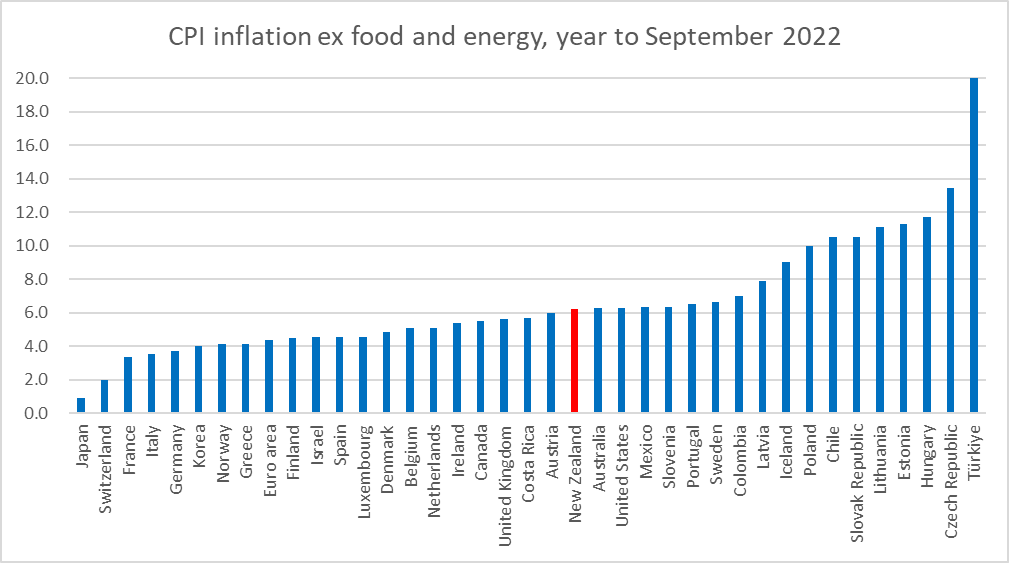
A whole bunch of central banks made pretty similar mistakes (and the nature of floating exchange rates is that each central bank is responsible for its country’s own inflation rate). Among the Anglo countries, we are a bit worse than the UK and Canada and slightly less bad than the US and Australia. Among the small advanced inflation targeters – a group the RB sometimes identified with – we have done worse than Switzerland, Norway, and Israel, and better than Sweden and Iceland. In a couple of years (2021 and 2022) in which the world’s central bankers have – in the jargon – stuffed up badly, Orr and his MPC have been about as bad on inflation as their typical peers.

You could mount an argument – akin to Voltaire on the execution of Admiral Byng – that all the world’s monetary policymakers (at least those without a clear record of dissent – for the right reasons – on key policy calls) should be dismissed, or not reappointed when their terms end, to establish that accountability is something serious and to encourage future policymakers to do better. You take (voluntarily) responsibility for inflation outcomes, and when you fail you pay the price, or something of the sort. Inflation failures – including the massive unexpected wealth redistributions – matter.

Maybe, but it was never likely to happen, and it isn’t really clear it should. As I’ve noted here in earlier posts until well into 2021 the Reserve Bank’s forecasts weren’t very different from those of other forecasters, and I’m pretty sure that was also the case in other countries. Inflation outcomes now (year to September 2022) are the result of policy choices 12-18 months earlier. With hindsight it is clear that monetary policy should have been tightened a lot earlier and more aggressively last year, but last February or even May there was hardly anyone calling for that. Absent big policy tightenings then, it is now clear it was inevitable that core inflation would move well outside the target range. There are plenty of things to criticise the Bank for – including Orr’s repeated “I have no regrets” line – but if one wants to make a serious case for dismissing Orr for his conduct of monetary policy it is probably going to have to centre on (in)actions from say August 2021 to February 2022 (whereafter they finally stepped up the pace) but on its own – it was only six months – it would just not be enough to have got rid of the Governor (even just by non-reappointment). The limitations of knowledge and understanding are very real (and perhaps undersold by central bankers in the past), and even if Orr and the MPC chose entirely voluntarily to take the job (and all its perks and pay) those limitations simply have to be grappled with. Were New Zealand an outlier it might be different. Had the Bank run views very much at odds with private forecasters etc it might be different. But it wasn’t.

I am, however, 100 per cent convinced that Orr should not have been reappointed. I jotted down a list of 20 reasons last night, and at that I’m sure I’ve forgotten some things.

I’m not going to bore you with a comprehensive elaboration of each of them, most of which have been discussed in other posts. but here is a summary list in no particular order:

  • the extremely rapid of turnover of senior managers (in several case, first promoted by Orr and then ousted) and associated loss of experience and institutional knowledge
  • the block placed –  almost certainly at Orr’s behest –  on anyone with current and ongoing expertise in monetary policy nad macroeconomic analysis from serving as an external member of the MPC
  • the appointment as deputy chief executive responsible for macroeconomics and monetary policy (with a place on the MPC) of someone with no subject expertise or relevant background
  • $9.5 billion of losses on the LSAP – warranting a lifetime achievement award for reckless use of public resources – with almost nothing positive to show for the risk/loss  
  • the failure to ensure that the Bank was positioned for possible negative OCRs (having had a decade’s advance warning of the issue), in turn prompting the ill-considered rush to the LSAP
  • the failure to do any serious advance risk analysis on the LSAP instrument, as being applied to NZ in 2020
  • the sharp decline in the volume of research being published by the Reserve Bank, and the associated decline in research capabilities
  • the way the Funding for Lending programme, a crisis measure, has been kept functioning, pumping attractively-priced loans out to banks two years after the crisis itself had passed (and negative OCR capability had been established)
  • lack of any serious and robust cost-benefit analysis for the new capital requirements Orr imposed on banks (even as he repeatedly tells us how robust the system is at current capital levels)
  • repeatedly misleading Parliament’s Finance and Expenditure Committee (most recently, his claim last week that the war was to blame for inflation being outside the target range), in ways that cast severe doubts on his commitment to integrity and transparency
  • his refusal to ever admit a mistake about anything (notwithstanding eg the biggest inflation failure in decades) 
  • the fact that four and a half years in there has never been a serious and thoughtful speech on monetary policy and economic developments from the Governor (through one of the most turbulent times in many decades)
  • Orr’s active involvement in supporting and facilitating the appointment of Board members with clear conflicts of interest (Rodger Finlay especially, but also Byron Pepper)
  • his testiness and intolerance of disagreement/dissent/alternative views
  • his often disdainful approach to MPs
  • his polarising style, internally and externally
  • all indications are that he is much more interested in, and intellectually engaged by, things he isn’t responsible for than for the things Parliament has charged him with
  • organisational bloat (think of the 17-20 people in the Communications team or the large number of senior managers now earning more than $400000 pa)
  • the distraction of his focus on climate change, but much more so the rank dishonesty of so much of it – claims to have done modelling that doesn’t exist, attempts to suppress release of information on what little had been done, and sheer spin like last week’s flood stress test. It might be one thing for a bloated overfunded bureaucracy to do work on things it isn’t really responsible for if it were first-rate in-depth work. It hasn’t been under Orr.
  • much the same could be said of Orr’s evident passion for all things Maori –  in an organisation with a wholesale macroeconomic focus, where the same instruments apply to people of all ethnicities, religions, handedness, political affiliation or whatever.  What “analysis” they have attempted or offered has been threadbare, at times verging on the dishonest.
  • the failure to use the opportunity of an overhaul of the RB Act to establish a highly credible open and transparent MPC (instead we have a committee where Orr dominates selection, expertise is barred, and nothing at all is heard from most members)

And, no doubt, so on.  He is simply unfit to hold the office, and all indications are that he would have been so (if less visibly in some ways) had Covid, and all that followed (including inflation), never happened.   

But the crowning reason why Orr should not have been reappointed is that doing so has further politicised the position, in a most unfortunate way.

In the course of the overhaul of the Reserve Bank Act, Grant Robertson introduced a legislative requirement that before appointing someone as Governor the Minister of Finance needed to consult with other parties in Parliament (parallel provision for RB Board members).  It was a curious provision, that no one was particularly pushing for (in most countries the Minister of Finance or President can simply appoint the Governor, without even the formal interposition of something like the RB Board), but Robertson himself chose to put it in.  The clear message it looked to be sending was that these were not only very important positions but ones where there should be a certain measure of cross-party acceptance of whoever was appointed, recogising (especially in the Governor’s case) just how much power the appointee would wield.  That provision never meant that governments could not appoint someone who happened to share their general view of the world and economy, but there was a clear expectation that whoever was appointed would be sufficient to command cross-party respect for the person’s technical expertise, non-partisan nature, dispassionate judgement and so on.  Robertson simply ignored Opposition dissents on a couple of the Board appointees.  That was of second order significance, but it is really significant in the case of the Governor.  It isn’t easy to dismiss a Governor (and rightly so) so for a Minister of Finance to simply ignore the explicit unease and opposition of the two main Opposition parties in Parliament is to make a mockery of the legislation Robertson himself had put in place so recently.   The Opposition parties are being criticised in some places (eg RNZ this morning) for “politicising the position/appointment” but they seem to have been simply doing their job –  it was Parliament/Robertson who established the consultation provision –  and the consultation provisions, if they meant anything, never meant giving a blank slate for whomever the Minister wanted to offer up, no matter the widely-recognised concerns about such a nominee.   No one has a right to reappointment and when it was clear that the main Opposition parties would not support reappointment, Robertson should have taken a step back, called Adrian in and told him the reappointment could not go ahead, in the longer-term interests of the institution and the system.  If you were an Orr sympathiser, you might think that was tough, but….no one has right to reappointment, and the institution matters.

And, of course, now the position of the Governor has inevitably been put into play, with huge uncertainty as to what might happen if/when National/ACT form a government after the election next year.    (And here is where I depart from National’s stance –  I never liked the idea of a one year appointment, made well before the traditional pre-election bar on new permanent appointments.  We want able non-partisan respected figures appointed for long terms (it is the way these things work in most places), not for each incoming PM to be able to appoint his or her own Governor.)

A few months ago, anticipating that Orr would probably be reappointed, I wrote a post on what an incoming government next year could do about the Bank.    The key point to emphasise is that a new government cannot simply dismiss a Governor they don’t like (or nor should they be able to).  I saw a comment on a key political commentary site this morning noting that the process for dismissal isn’t technically challenging, which is true, but the substantive standards are quite demanding (the Governor can be dismissed only for specific statutory causes, and for (in)actions that occurred in his new term (which doesn’t start until March)).  Generally, we do not want Governors to be able to be easily dismissed (in most countries it is even harder than in New Zealand).   More to the realpolitik point, any dismissal could be challenged in the courts, and no one would (or should) want the prolonged uncertainty (political and market) such actions might entail.   Moreover, senior public figures cannot just be bought out of contracts.   

We still don’t know –  and perhaps they don’t either –  how exercised National and ACT would be about any of this were they to form a government next year, but unless Orr was himself minded to resign (as the Herald’s columnist suggests might happen) things would have to be handled carefully and indirectly (perhaps along lines in that earlier post of mine) to change the environment and the incentives around the institution.   Most of those changes should be pursued anyway, to begin to fix what has been done over the last few years    And if Orr were to be inclined not to stick around for long, perhaps an offer of appointment as High Commissioner to the Cooks Islands might smooth his way? 
Money supply

In my post last Friday I highlighted how the Governor of the Reserve Bank had just been making up stuff, and apparently knowingly misleading Parliament, to distract from the Bank’s own responsibility for New Zealand’s current very high core inflation. There may well be a case to be made that central banks did about as well as could reasonably be expected over the last couple of years – “reasonably be expected” here set by reference to the general views at the time of other expert observers (none of whom, admittedly, had chosen to take on statutory responsibility for inflation) but simply making stuff up blaming the Moscow bogeyman helps no one, and detracts from any serious conversation about what went on with inflation – core and headline – and why. To put my own cards on the table, there are many reasons why Adrian Orr should not be reappointed, but the poor inflation outcomes are not the most important of those reasons (of course, a superlative performance on inflation might have covered over a multitude of other sins and shortcomings).

After Friday’s post, someone got in touch to point out that I had not mentioned one other episode in that FEC appearance which could also reasonably be described as “making stuff up” and misleading Parliament. Opposition members were asking questions that included that rather loaded phrase “printing money”, to which Orr responded – apparently in reference to the LSAP – that the Reserve Bank did not create money, that all they did was to lower bond yields, and that banks etc were the people who increased the money supply.

In normal circumstances, the Governor’s comment would not be far wrong. The “money supply” – deposits with financial intermediaries (those included in the Bank’s survey) held by “the public” (ie people and firms not themselves included in the survey) – mostly increases in the process of private sector credit creation. For example, each new mortgage to purchase a house results simultaneously in the creation of either a deposit or a reduction in another mortgage as the house seller deals with the proceeds of the sale. Monetary policy operates typically by adjusting interest rates to influence, among other things, the demand for credit.

Some of the Reserve Bank’s emergency crisis tools don’t have any direct effect on the money supply measures the Reserve Bank compiles and reports. The Funding for Lending programme – a crisis programme that bizarrely is still injecting cheap liquidity now – simply lends money to banks (against collateral). That transaction boosts settlement cash balances held by banks at the Reserve Bank, but those balances aren’t part of “money supply” measures (they are deposits held by one lot of surveyed institutions – banks – at another surveyed institution – the Reserve Bank).

The LSAP is different. If, for example, a pension fund had been holding government bonds and had then sold those bonds to the Reserve Bank. the pension fund would receive payment from the Reserve Bank in a form that adds to that pension fund’s deposits at a bank. Settlement cash balances increase in the process, but so does the money supply (the pension fund’s deposits count in the money supply just the same way that your deposits do). Had the Reserve Bank bought all those tens of billions of dollars of bonds from local banks, the transaction would have boosted only settlement cash and not the money supply measures. But it didn’t. There were plenty of sellers – the Reserve Bank was eagerly buying at the top of the market – and some were local banks, and others were not. And so when the Governor suggested to Parliament that the Bank’s bond-buying did not increase the money supply, he wasn’t really being strictly accurate.

If you are now drumming your fingers are thinking this is all very technical and not really to the point, then in some respects you are correct. We’ve heard a lot about “the money supply” in the last couple of years. Most of it isn’t very accurate, but in many respects the difference doesn’t matter very much. “Money supply” measures (the formal ones referred to above) have not mattered very much to central bankers for decades, and that has been so whether inflation was falling sharply and undershooting inflation targets, or (as at present) proving very troublesome on the high side. The general view has been that money supply measures have not contained consistently useful information about the outlook for inflation, over and above what is in other indicators.

That does not mean – to be clear – that inflation is anything other than a monetary phenomenon for which central banks (and their masters) are responsible. It also does not mean that in extreme circumstances, in which say the government/central bank is flinging huge amounts of money at households without any intention of paying for those handouts now or later through higher taxes, that straight-out government money creation will not be a problem, paving the way for something that could end in hyperinflation. It is simply that specific official measures of the money supply have not proved very useful as inflation forecasters. Decades ago we hoped they did – and money supply growth targets were the rage for a decade or more in some central banks – but they didn’t.

And perhaps you can begin to see why if we go back a couple of paragraphs to the LSAP purchases. If the Reserve Bank purchases bonds from you and me (or our Kiwisaver fund) that will add to the money suply measures the Reserve Bank compiles and reports. If the Reserve Bank instead buy bonds from banks who bank with the Reserve Bank, it won’t add to the money supply measures. Does anyone really suppose there are materially different macroeconomic implications from those two different scenarios? The Reserve Bank doesn’t (from all they have said and written about how they think the LSAP works) and – for what it may be worth – I agree with them. You could add a third scenario, in which the Bank buys a bond from a non-bank entity that itself had bought the bond on credit. In that case, even RB purchasing from a non-bank won’t add to the money supply measures, but will (presumably) reduce any credit aggregates that captured the initial loan.

It might all have been different decades ago when, for example, central banks paid no interest on settlement cash balances, sometimes (as in New Zealand) banks were forbidden from paying interest on short-term or transactions deposits, and where banks were subject to variable reserve asset ratios. That was the world I started work in, but none of that is true today. Money supply measures usually aren’t very enlightening about inflation prospects, and these days neither even is the level of settlement cash balances (since the Reserve Bank pays the full OCR on whatever balances have accumulated). Thus, the LSAP may have been a dumb idea (and a very expensive one so it proved), but not because it may or may not have boosted official measures of the money supply to some extent. The pension fund that sold a government bond and now has bank CD in its books instead is no better or worse off because one asset wasn’t in the money supply official measures and the other one is. Neither are its members.

What matters is (mostly) two things: first, level and structure of interest rates, and second whether or not more purchasing power is put in the hands of public. The LSAP purports to change the former – which it seems was probably what the Governor was trying to claim at FEC the other day – but does not, and does not purport to, change the latter directly.

(By contrast, when for example the government sharply ran down its cash balances at the Reserve Bank and paid out at short notice a huge level of wage subsidy payments, not only did those payments boost the money supply measures (in most cases) but they put more purchasing power in the hands of the private sector (households supported by those payments). That isn’t a comment about the merits or otherwise of the wage subsidy scheme – I thought it was mostly great, directly counteracting what would otherwise have been a huge loss of purchasing power – just a description of how things work technically).

What about some numbers and charts?

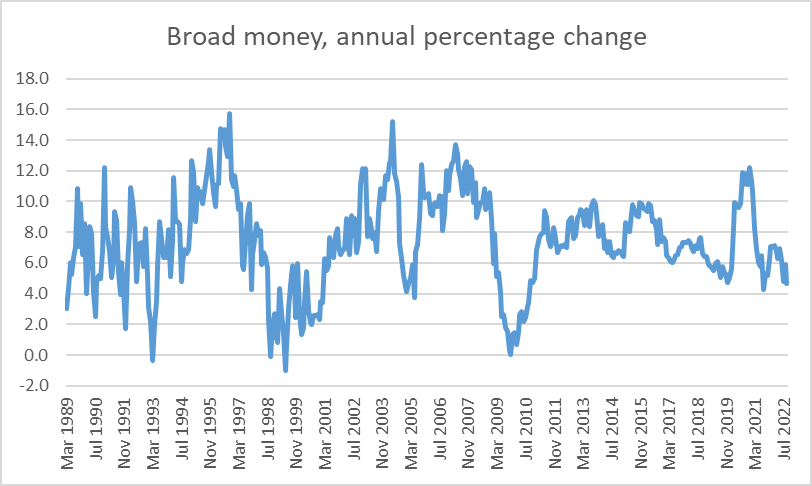
This is a chart of annual growth in the Reserve Bank broad money measure

Annual growth rates have fluctuated a lot. There was a surge in the annual growth rate in 2020 (and a 3.5 per cent lift in the month of March 2020 alone, presumably largely reflecting the wage subsidy payments) but (a) it proved shortlived, (b) the peak was still materially below peaks in the 90s and 00s, and c) core inflation in the mid 90s and mid-late 00s did not get near the current core inflation rates (depending on your measure somewhere between 5 and 7 per cent).

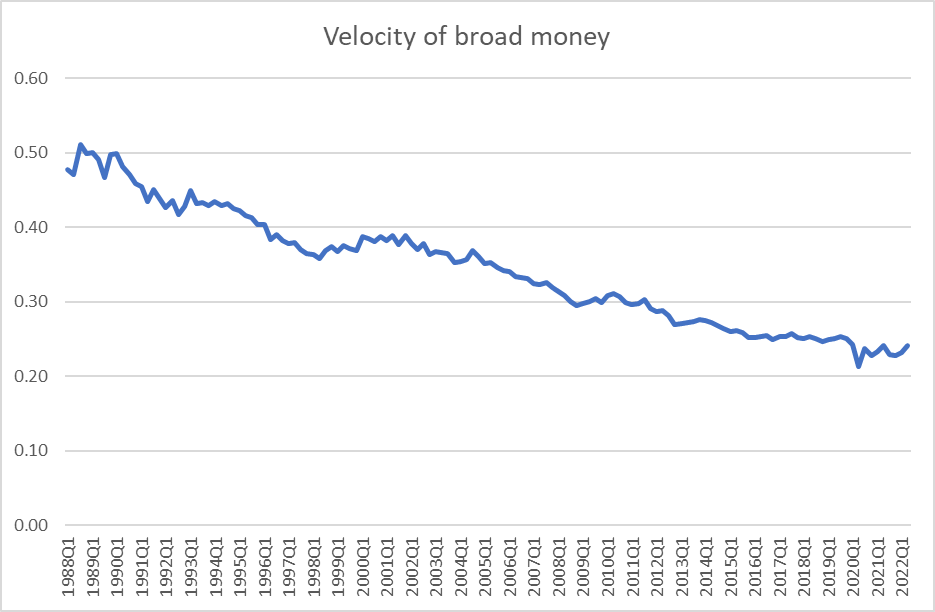
For those of you who remember studying money in your economics courses, here is a measure of the velocity of money (in this case, quarterly nominal GDP divided by the broad money stock at the end of each quarter.

This measure of the money supply has been been growing faster than nominal GDP pretty much every year since 1988 (mostly just reflecting the fact that regulatory restrictions on land use have inflated house prices to absurd levels, driving up both money and credit as shares of GDP). You can see a bit of noise in 2020 – the big initial increase in the money supply I mentioned earlier and the temporary sharp reduction in GDP – but two years on there is nothing now that looks unusual.

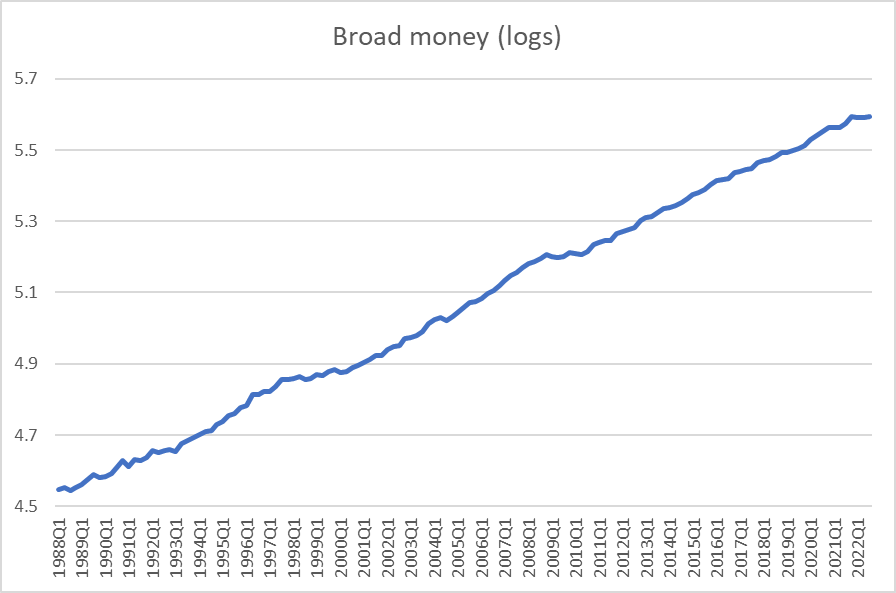
Here is a chart of the level of broad money, expressed in logs (which means that if the slope of the line is unchanged so is the percentage rate of growth in the underlying series).

Nothing particularly out of the ordinary in money supply developments (on this formal measure) over the last few years.

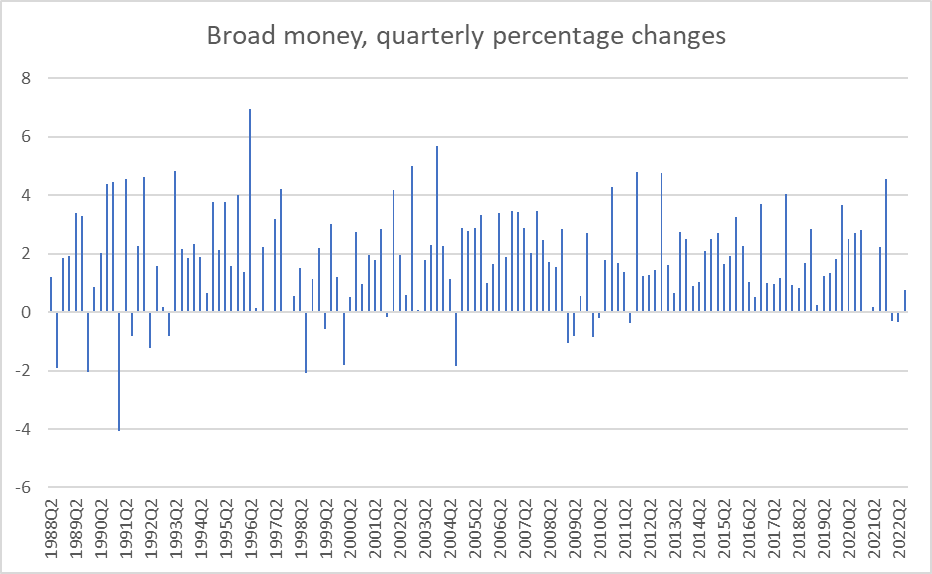
But for anyone out there who still wants to put some weight on this official measure of the broad money supply, here is the chart of quarterly percentage changes.

Eyeballing it, the most recent three quarters (to September this year) appear to have had the weakest growth since 2009. a period when nominal GDP growth and core inflation falling away sharply. Since I don’t put much weight on money supply measures, as offering anything much about the inflation outlook, I wouldn’t emphasise the comparison myself.

Inflation is primarily a monetary phenomenon, and a national phenomenon (that was why the exchange rate was floated, to make it so), and something for which central banks are responsible and should be accountable. Core inflation has been – and still is – at unacceptably high rates, as a result of choices and misunderstandings by our central bank (their misunderstandings were widely shared, among private sector economists and in other countries, but that does not change the responsibility even if it might mitigate the appropriate consequences for those central bank decision makers). Monetary policy choices matter, a lot. But official measures of the money supply don’t usually shed much additional light, and have not done so over the last couple of years.

A bad idea

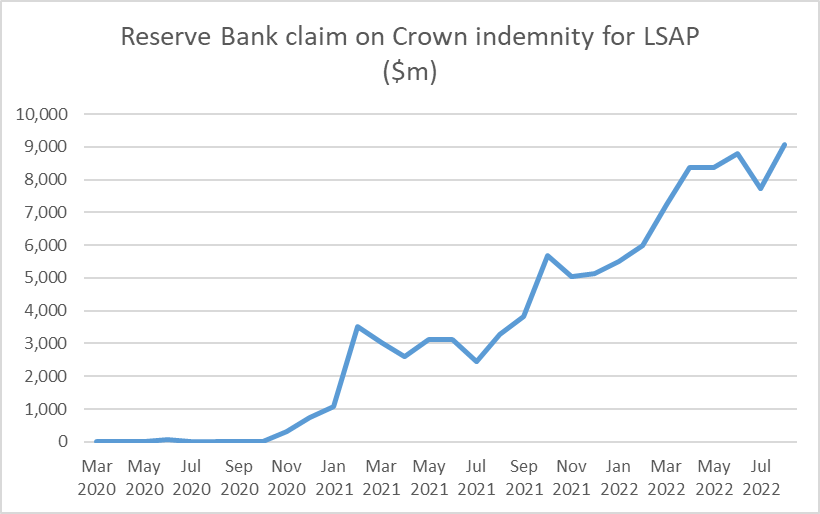
There is increasing attention being paid (among a certain class of nerdy central bank watcher) to the scale of the losses to the taxpayer central banks have run up as a result of their large-scale bond purchases (particularly those) over the time since Covid broke upon us in early 2020. In New Zealand, the best estimate of those losses was about $9.5 billion as at the end of September (to its credit, the Reserve Bank of New Zealand marks to market its bond holdings – and thus its claim on the Crown indemnity – something many other central banks don’t do).

A particularly interesting paper in that vein turned up a couple of days ago, published by the UK Institute for Fiscal Studies and written by (Sir) Paul Tucker, formerly Deputy Governor of the Bank of England and now a research fellow at Harvard. The 50+ page paper has the title Quantitative easing, monetary policy implementation and the public finances. (Public finances are quite the topic of the month in the UK, but although many of the numbers in the paper are very up to date, I suspect the paper itself was conceived before the fiscal/markets chaos of recent weeks.)

Tucker is particularly clear on what QE actually was: it was a large-scale asset swap in which the Crown (specifically its Bank of England branch) bought back from the private sector lots of long-term fixed rate government bonds, and in exchange issued in payment lots of (in our parlance) settlement cash balances held by banks and on which the (frequently reviewed) policy interest rate (here the OCR) is paid in full. When such an operation is undertaken, the entities undertaking the swap (and the taxpayer more generally) will lose money if policy rates rise by materially more than was expected/implicit when the swap was done. It is not a new insight – and I’ve been running the asset swap framing here since 2020 -but Tucker puts its very clearly, and in a context (UK) where the focus is less on the mark to market value of the bond position, and more on the annual cash flow implications (over time they are two ways – with different emphases – of putting much the same thing).

Tucker seems, at best, a bit ambivalent about the 2020 QE, illustrating nicely that whereas the early UK QE was done when actual and implied forward bond yields were still quite high, that was by no means the case by the start of 2020. But as he notes, that is water under the bridge now. Big bond purchases did happen, partly because few central banks have really got rid of the effective lower bound (although here he is too generous to many central banks, including the BoE, since few sought to reach the practical limits of negative rates (on current technologies) when they could have in 2020). But whether or not QE could have been avoided, given the macro outlook as it stood in March 2020, (whether by more reliance on fiscal policy or deeper policy rate cuts) it wasn’t. Central banks now have large bond positions, purchased at exceedingly low yields, being financed at increasingly high short-term rates.

In New Zealand, for example, total settlement cash balances have just been hitting new highs, in excess of $50 billion

Not all of this is on account of the LSAP (New Zealand’s QE). Weirdly, the Reserve Bank is still making concessional funding available to banks under the crisis Funding for Lending programme, but at least they are paying on the resulting settlement cash balances what they are earning from the loans. And fluctuations in government spending, revenue, and borrowing also affect the level of settlement cash balances.

But you can think of the approximately $50 billion of LSAP bond purchases (over 2020 and the first half of 2021) as having a counterpart in the level of settlement cash balances. On $50 billion of settlement cash, the Reserve Bank pays out interest at a current annual rate (OCR of 3.5 per cent) of $1750 million per annum. All the conventional bonds were bought at much much lower yields than that (unlike the Bank of England, our Reserve Bank did buy some inflation indexed bond, but they were less than 5 per cent of the total purchases.) This is a large net cost to the taxpayer.

The policy thrust of Tucker’s paper is to explore the idea of cutting those costs by changing policy and not paying interest on the bulk of settlement balances (or paying a materially below-market rate). Central banks did not always pay market rates on settlement cash balances, but it has become the practice over the last 20-25 years (in the Fed’s case being rushed in in late 2008 to hold up short-term market rates, consistent with the Fed funds target, when large scale bond purchases began). New Zealand followed a similar path.

Paying different rates on different components of settlement cash balances is quite viable. For some years until early 2020, for example, the Reserve Bank paid full market rates on balances it estimated each bank needed to hold (to facilitate interbank payments etc), while paying a below market rate on any excess balances (which were typically small or nil). The ECB and the Bank of Japan introduced negative policy interest rates some years ago, but protected the banks by paying an above-market rate on most of their settlement cash holdings, only applying the negative rate at the margin.

As a technical matter there would be no obstacle to the Bank of England (or the Reserve Bank of New Zealand) announcing that henceforth they would pay zero interest on 80 per cent of balances – some fixed dollar amount per bank – while only paying the policy rate (the OCR) on the remaining balances. Since the OCR would still apply at the margin, that part of the wholesale monetary policy transmission mechanism should continue to function (compete for additional deposits and you would still receive the OCR on any inflows to your settlement account). The amounts involved are not small: in the UK context (they did QE a lot earlier) Tucker talks of “the implied savings would be between 30 billion and 40 billion pounds over each of the next two financial years” – perhaps 1.5 per cent of GDP. In New Zealand, if we assume the OCR will be 4 per cent for the next couple of years, applying a zero interest rate to $40 billion of settlement cash would result in a saving of $1.6 billion a year (almost half a per cent of GDP). You could pay for quite a few election bribes with that sort of money.

It is an interesting idea but it seems to me one that should be dismissed pretty quickly, even in the more fiscally-challenged UK (where they already impose extra taxes on banks). It would be an arbitrary tax on banks, imposed on them because it could be (no vote in Parliament needed), by a central bank that would be doing so for essentially fiscal reasons (for which it has no mandate). Tucker rightly makes the point that central bankers should not seek to do their operations in ways that are costly to the taxpayer when there are cheaper (less financially risky) options available, but the time to have had those conversations was in March 2020 (preferably earlier, in crisis preparedness) not after you’ve taken a punt on a particular instrument and the punt has turned out badly (and costly).

It might be one thing to decide not to remunerate settlement cash balances, and thus “tax” banks, when those balances are tiny (for a long time we ran the New Zealand system on a total of $20 million – yes, million – of settlement balances) and quite another when those balances are at sky-high levels not because of any choices or fundamental demands by banks, but solely as a side-effect of a monetary policy operation chosen by the central bank (and in both countries indemnified by the Crown). Even central banks have no particular interest in there being high levels of settlement balances (it isn’t how they believe QE works); it is just a side effect of wanting to intervene at scale in the bond markets. But central banks have a choice, while the banking system as a whole does not (banks themselves can’t change the aggregate level of settlement cash, which is totally under the control of the central bank). The Tucker scheme – which to be fair, it isn’t entirely clear he would implement were he in charge – forces banks to hold huge amount of settlement cash, and then refuses to remunerate them on those balances.

To implement it would be a fairly significant breach of trust. Here, the Reserve Bank has kept on (daftly) offering Funding for Lending loans arguing that it needs to keep faith with some moral commitment it claims to have made, despite the crisis being long past. I don’t buy the “anything else would be a betrayal” line there – where in any case the amounts involved are small (this funding might be 25 basis points cheaper than they could get elsewhere) – but it would much more likely to be an issue if the Bank (or overseas peers) suddenly recanted on the practice of paying market interest on all or almost all settlement balances. $1.6 billion a year, even divided across half a dozen banks, would attract attention.

I’ve heard a couple of suggestions as to why an additional impost on banks might be fair. One was that QE may have helped set fire to the housing market, boost bank lending and bank profits, and thus an additional tax now might be equivalent to a windfall profits tax. I don’t buy either strand of that argument – I don’t think the LSAP made that much difference, but if it did it was supposed to do so (transmission mechanism working) – but even if I did in 2020, we are now seeing the reverse side of that process: house prices are falling, housing turnover is falling, new loan demand is falling, and there will be loan losses to come. Most probably any effects will end up washing out.

The second was the bond market trading profits the banks may have made in and around the LSAP. Perhaps there were some additional gains, but it is hard to believe they were either large or systematic (and won’t have come close to $1.6 billion per annum).

And the third was the Funding for Lending programme. No one can pretend that was not concessional finance for banks (were it otherwise banks would not have used the facility at scale), but the amounts involved don’t compare: $15 billion of FfL loans might have a concessional element over three years of $100m or so, not really defensible, but not $1.6 billion per annum either.

The taxpayer is poorer as a result of the LSAP and how market rates turned out (as Tucker rightly notes, it needn’t have turned out that way, although by 2020 the odds were against them – and as I’ve pointed out often there is no sign in NZ at least that a proper ex ante risk analysis was done). Those costs have to be paid for and will mean, all else equal, that taxes are higher over time. But conventional fiscal practice is not to pick on one sector and put the entire additional tax burden on them (“broad base, low rate” tends to be the New Zealand mantra). And that is so even if some in the New Zealand political space – sometimes including the Governor – seem to have a thing about (evil and rapacious) “Australian banks”.

Tucker devotes some space to the question of how banks would react (other than heavy lobbying on both sides of the Tasman and fresh pressure for the Governor to be ousted). Even if short-term wholesale rates – the policy lever – aren’t likely to be changed, banks are unlikely to just sit back and take the hit: they may not be able to recoup all or even most of it, but it isn’t hard to envisage higher fees, higher lending margins, tighter credit conditions across the board, including as boards become more wary about New Zealand exposures. Non-bank lenders – who hold no settlement balances – would be at a fresh competitive advantage (akin to what we saw with financial repression of banks decades ago)

But unfortunate as it would be if a change of this sort of made now – essentially an ex post tax grab so focused it would come close to being a bill of attainder – I might almost be more worried about the future. One might have hoped that the episode of the last couple of years would have made central banks more cautious about using large-scale bond buying instruments (and finance ministries more cautious about underwriting them), with a fresh focus on removing the effective lower bound on nominal interest rates (or if they won’t do that then looking again at the level of the inflation target). But knowing that big bond purchases could be done freely, with the taxpayer capturing all of any financial upside, and banks (and customers) wearing all/most of any downside, skews the playing field dramatically (and also further reduces the financial incentive on governments to keep inflation down – since the real fiscal savings on offer rise the higher nominal interest rates are. And what of banks? If there really is a place for future QE – I’m sceptical but I’m probably a minority – up to now banks have had no really significant financial stake one way or the other, but adopt the Tucker scheme once and banks will know it could be used on them again, and they will become staunch opponents (in public and in private) of any future large scale bond buying operations for purely their own financial reasons. And that is no way to make sensible policy.

Tucker has produced a 50 page paper which will repay reading (for a select class of geeky reader – although it is pretty clearly expressed). Since it is 50 pages there is plenty there I couldn’t engage with in depth in this post, but in the end my bottom line was initially “count me unpersuaded”, and then the more I thought about it the more I hoped that no one here would seriously consider the option (ideally not in the UK other). Far better to accept that losses have been made, that those costs will have to be paid for by taxpayers’ generally, and to redouble the efforts to ensure that in future crises there is less felt need for central banks to engage in such risky operations. Central banking, well done, really should involve neither large risk nor large cost to the taxpayer, and there are credible alternatives, even if neutral real interest rates stay very low (as Sir Paul assumes, and as still seems most likely to me).

UPDATE: Thanks to the reader whose query made me realise that in my haste to produce some stylised numbers, I forgot that the LSAP bonds had been purchased at price well above face value. The actual settlement cash influence from all LSAP purchases (central and local government bonds) was $63.9 billion. The rest of the analysis is unchanged, but the numbers (floating rate financing cost) are larger.

Inflation and monetary policy

In a post a couple of weeks ago I outlined some reasons for scepticism about the case for increasing the OCR by 50 basis points specifically at the then-forthcoming OCR review. My point was mostly about the data hiatus – the OCR decision would be taking place almost 3 months after the most recent CPI data and more than 2 months since the last main labour market data. It seemed (and seems) foolish for the MPC to stick to its schedule of review dates, including the long summer holiday it will give itself after next month’s MPS. It remains highly problematic that New Zealand governments have penny-pinched on core statistics and as a result we have such slow and infrequent macro data (we got the September quarter CPI inflation data yesterday, Switzerland by contrast released September month data on 3 October).

But there were also some considerations in the macroeconomics

  • the reasonably long lags in monetary policy (the OCR really only having been aggressively tightened fairly recently)
  • weakening commodity prices,
  • relatively subdued nominal GDP growth, among the very lowest in the OECD,
  • and some indications in core inflation measures that at least things had not been getting worse (continuing to spiral upwards)

All the inflation rates were, of course, unacceptably high.

Of course, as was universally expected the MPC did raise the OCR by 50 basis points in their October review. And yesterday we got the September quarter CPI data, which took by surprise all those who’d published forecasts (and, I guess, almost any of us who’d heard their headline forecasts). The outcome was higher than the Reserve Bank’s last published forecast, but since that forecast was more than two months old and anyway isn’t broken down into headline and core components – and they’d given us no sense of an update in the October review – not too much weight should now be put on that particular aspect of the surprise.

I don’t do short-term components forecasting, so what follows isn’t about the extent of the surprise (immediate prior expectations vs outcomes) but about what to make of the actual outcomes and current inflation. First, I’ll step through and update the charts from the earlier post.

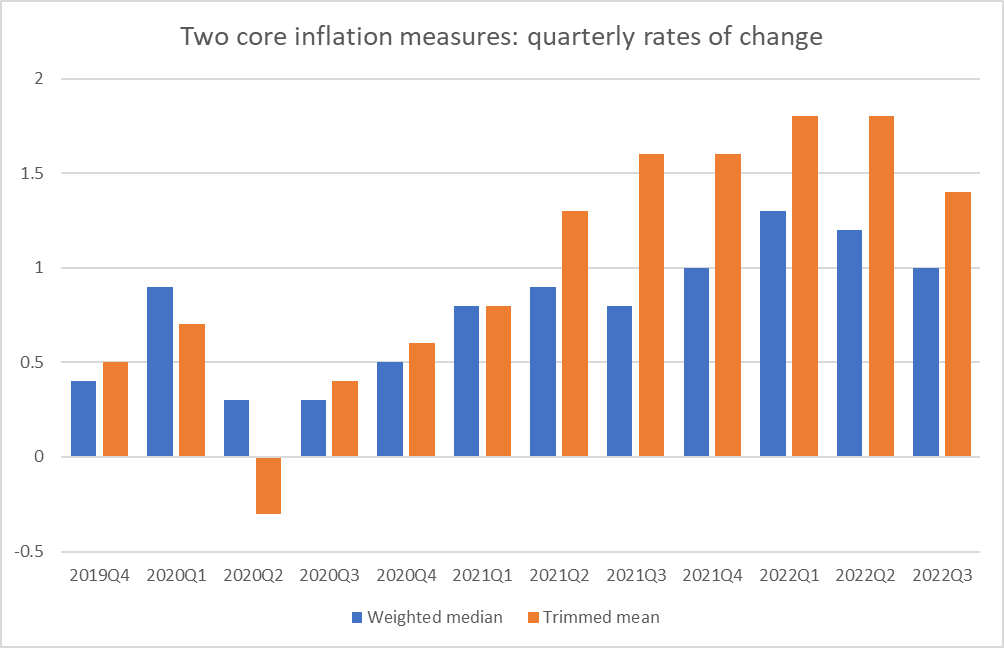
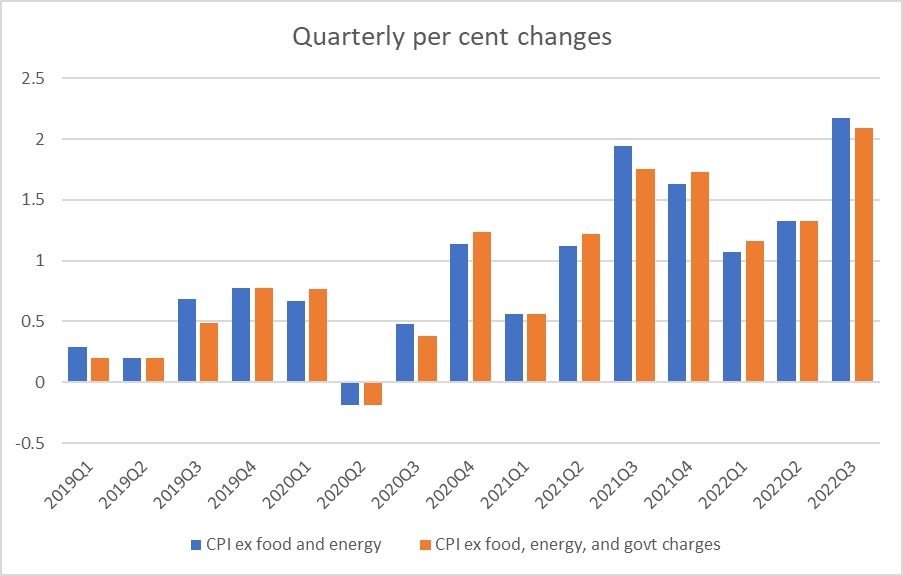
These two – commonly used abroad – core inflation measures might suggest a little room for encouragement. Both quarterly changes are still high (far too high), and the gap between them is unprecedented, but they both look as though they could be past their respective peaks.

Monetary policy always takes time to work, and as this Reserve Bank chart reminds us it was only late last year that new mortgage rates really started rising.

But then there are these two exclusion measures

neither of which offers any reassurance.

And the picture here is similar

and from these monthly food price components, a bit of a mixed bag, but at least nowhere near as bad now as a few months ago.

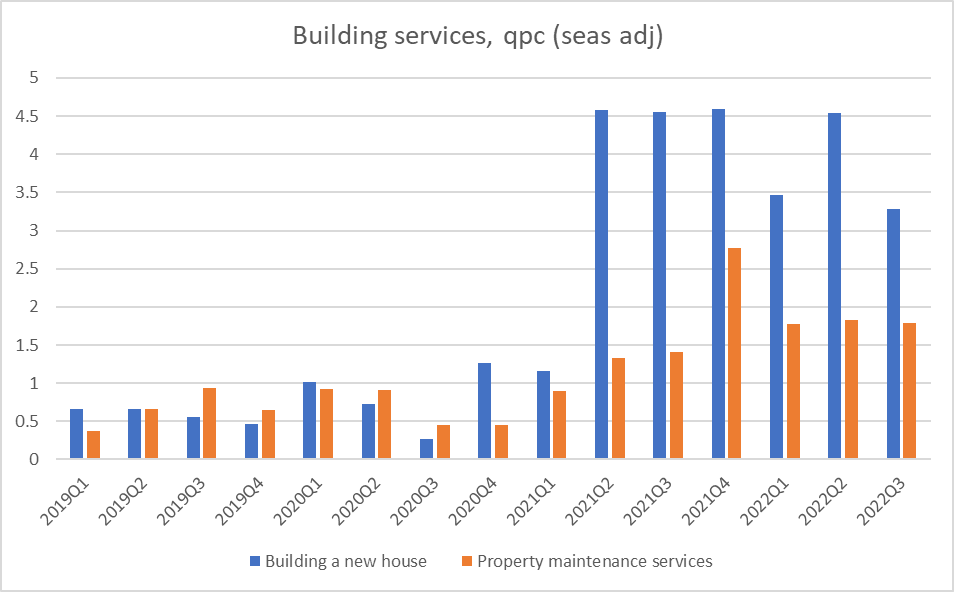
The building market has been one of “hottest” areas of the economy and the labour market, with staggering rates of increases

Those numbers are still high but seem to be beginning to move in the right direction.

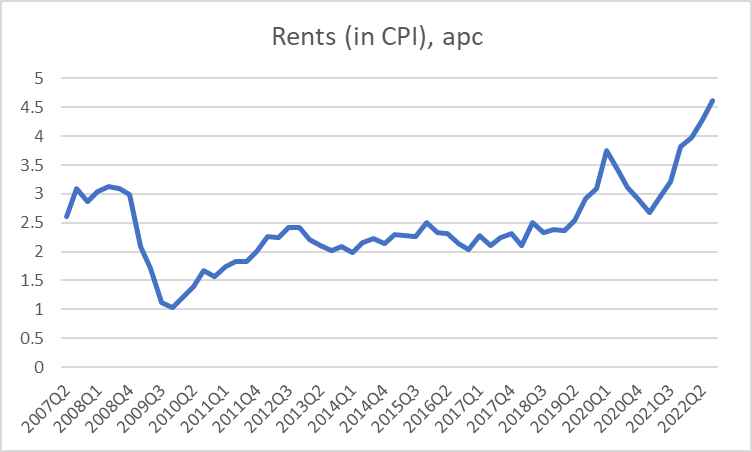
And then there are rents. Rents now make up just over 10 per cent of the CPI. On a quarterly basis the rents item in the CPI increased by 1.2 per cent in the September quarter, as high (equally high) as it has been this cycle. On an annual basis, this is the picture

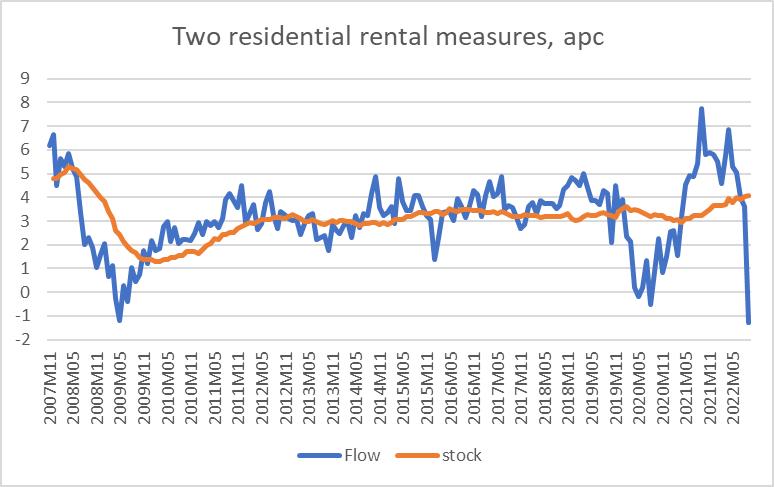
In the CPI rents are included using a stock measure – the rate of increase in the average rents being paid by all tenants. And there is a certain logic to that, but we also know that new rents are falling (not just the growth rate slowing, but the level of rents dropping)

The flow measure – new rents – is (naturally) noisier but it (also naturally) leads the stock measure. There is a lag from monetary policy to the CPI for numerous reasons, but one is the choice to include average prices rather than marginal prices for rents. New rents – the ones policy and market developments affect most immediately – have now been falling for several months.

For completeness, I’m including this chart of the Reserve Bank’s sectoral factor model measure of core inflation.

It used to be the Reserve Bank’s preferred measure (and mine too – I championed it when I was still at the Bank), and it is probably still the single best guide to historical core inflation, but (in the nature of the technique) it is prone to big and lagging revisions when inflation is moving a lot. When the September 2021 CPI came out last October the model estimated core inflation then to have been 2.7 per cent (high, but still inside the target range), but the model – learning from what has happened since – now reckons core inflation last September was already up to 3.8 per cent. At this point, there really isn’t any information (good or ill) in the latest quarterly observations (which in any case use annual rather than quarterly data).

Moving beyond the specific inflation data series, there are a few other considerations that seem relevant to me. The first is to remember the lags (something notably absent from any of the media coverage I heard or read). There are at least two that are relevant. First, the September quarter CPI is really a mid-August measure: there are some noisy components – notably petrol – sampled weekly, and food is captured monthly but the whole thing is centred on 15 August, which is now a bit more than two months ago. So we (and the RB) aren’t exactly using real-time data. And second, the OCR takes time to work – this isn’t in dispute and shows up in all the modelling work – and on 15 August the OCR was 2.5 per cent (it was raised at the MPS a couple of days later). In fact – and it is easy to forget this now – until 12 April, the OCR was no higher than 1 per cent, the level (designed to be somewhat stimulatory) it had been at immediately prior to Covid. Now, of course markets and market pricing anticipated OCR increases to come to some extent, but the market (let alone firms and households) have been repeatedly surprised, constantly revising up their view of what OCR would be required.

I’m also not about to take a view on what the Reserve Bank could or should do in November. Market economists have to, I don’t. There is another round of really important labour market data due out in a couple of weeks (of which the most important bits should be the employment and unemployment numbers rather than wages). Of course, it lags too – centred on mid-August (and I really don’t understand why a household survey collected by phone within a quarter can’t be processed much more quickly than SNZ manages) – but it will still represent an addition to our knowledge. If, for example, the unemployment rate were to have dropped further, the argument for a big OCR increase would inevitably strengthen, all else equal – people will cut central banks less slack now than they might have if we were dealing with core inflation at, say, 3.5 per cent.

But is always going to tempting to just ignore the lags, even after increases in the OCR of unprecedented pace this year. And the lags are real, the lags matter. Robert MacCulloch, macroeconomics professor at Auckland, yesterday reminded us of Milton Friedman’s take on that issue almost 55 years ago.

There was a time for 75 or even perhaps 100 basis point OCR increases – last November or February perhaps – but for now it is much less clear that now is one of those times (and few if any of those now calling for such large increases now were calling for them then).

Of course, it doesn’t help that the MPC chooses to take a long summer holiday. That really should be revisited now.

And just one last graph, since air travel prices were a non-trivial influence in yesterday’s headline (and exclusion) measures. More than a little noise in those series.

Accountability document with no accountability

Decades ago when I was young Reserve Bank annual reports were – uninteresting accounts aside – mostly a bit of an essay on the economy (I got to write some of 1984’s and if I recall correctly one sentence survived to publication). Since the Bank had no independent authority over anything – power rested with the Minister of Finance – that model of Annual Report made a certain amount of sense. If there was any “accountability” involved, it was mostly about judging the fine line involved in offering some analysis without at the same time unduly upsetting the Minister of Finance. (The Bank was, at least in principle, accountable for analysis and advice offered to the Minister, but nothing much of that ever saw the light of day, the then recent innovation of the OIA notwithstanding).

These days, of course, the Reserve Bank is a power in the land, conducting monetary policy (with considerable discretion, but within the broad Remit set by the Minister of Finance), setting much of prudential regulatory policy (and implementing it all, with non-trivial discretion), and so on.

In recent years, both the size of the institution (staff numbers) and the size of the Annual Reports have both been growing rapidly.

The 2017 Annual Report was the last one pre-Orr.

But with all the people and all the pages, any serious sense of accountability and accounting for performance, seems to have diminished almost to the point of invisibility.

Over the years of this blog, I’ve written a series of posts about how the Reserve Bank Board – existing, per statute, primarily, to hold the Governor and Bank to account – had almost completely abdicated that responsibility. Twenty years ago Parliament required them to publish an Annual Report, and the hope had been that it might help, just a little, to sharpen accountability. Instead, the reports proved to be little more than show, mostly apparently designed to provide cover for management, rather than scrutiny and accountability for the public, the Minister, and MPs. Occasionally they showed signs of doing a slightly less bad job, but this year in their final report (the old Board and the old governance model were disbanded from 1 July) they slumped to new levels of quiescent inactivity. Perhaps – being about to head out the door – they no longer cared much, but since the chair (and one other member) were being carried over onto the new Board that shouldn’t have been an acceptable excuse for the contempt for the public that their silence and passivity display.

The full Annual Report is here. The Board’s report is on pages 6-9.

Over the last year, inflation has blown badly beyond the target range set for the Bank and the MPC. On the Governor’s own telling, that is so even if one focuses on the range of core measures. The deviation from target is by far the largest seen in the now 30+ year history of inflation targeting (and as a forecasting error would have been large even by the standards of earlier decades).

At the same time, the Bank’s speculative punt on the government bond market – the LSAP – turned very sour, and cumulative mark-to-market losses on the position are now in excess of $9 billion. The losses don’t fall to the Reserve Bank’s account – the government provided an indemnity upfront – but the losses (2.5% of GDP or so) were directly resulting from choices made by the Reserve Bank, the body the Board was responsible for monitoring and holding to account.

Oh, and during the year, two of the external MPC members were reappointed (by the Minister, on the recommendation of the Board). Given developments on the watch of those members (see above), you’d have hoped that some searching questions were asked, and some serious analysis and review undertaken by the Board. The Board might even have explained why they recommended one member’s renewed term should expire in the (likely) middle of next year’s election campaign.

As it is, not one of those issues was mentioned in the Board’s Annual Report. There is a full page devoted to monetary policy, and not once is inflation (or price stability, or the target band, or any cognate words) even mentioned. Just this

We learn that they looked at lots of papers, but nothing at all as to how they reached a conclusion that the MPC had adequately done its job (there might be a reasonable case to make, but they don’t even try).

The massive losses to the taxpayer get not a mention (again, perhaps there is a case to be made that – as the Governor claims – the benefits mean the costs were worth it), nor the reappointment of the external MPC members.

So no sign of scrutiny, no accountability. But if we heard nothing at all from the Board on such matters of substance, where the Bank has legal responsibilities, the Board was apparently keen to have us know of its other interests

But even then, no sign of evaluation, no sign of challenge? Not even (say) a suggestion that if there is going to a Central Bank Network for Indigenous Inclusion – the case for which is very far from obvious – perhaps the central banks of places like Iceland, Ireland, Poland, the UK, and France might be invited to join.

Reading this bumpf brought to mind this extract I spotted in a recent OIA release of Board minutes from a few months ago

So notwithstanding the limited tasks that Parliament has actually assigned to the Bank, the Board (which includes the Governor) thought it important that they shbould be free to used taxpayers’ time and money to decide their own priorities on things they have no statutory responsibility for. A platform for the interests and ideologies of management and board members (and recall that hardly any of the new and more powerful Board have any relevant expertise on subjects the Bank is actually responsible for).

Of course, it has long been easy to scoff at the old Board. Perhaps they were in an awkward position – most had little relevant expertise, they had no independent resources, and management controlled the papers they saw – but they still took the job (and the modest emoluments) without actually doing the job.

What of management who were, in effect, responsible for the remaining 150 pages of the report (of which much is the accounts)? (“In effect” since the new Board had legal responsibility, but hadn’t been around during the year under review).

The Governor never wastes an opportunity to claim that the Bank is very transparent (it is anything but) and so of course you’d suppose that in his Annual Report, in a year when monetary policy outcomes were so poor (inflation) and expensive (LSAP) there would be an extensive and nuanced treatment of the issues, making the best case no doubt for the Bank but at least engaging on the record. Well, no one who had ever watched Orr would actually expect that, but it is what one might have hoped for if accountability in the New Zealand public sector meant anything at all. It isn’t as if the Bank (or the MPC) has yet published much else serious on these issues, and the Annual Report is actually mandated by Parliament as a principal accountability document.

There are several sections where one might look for substance. This is the “year in review” bit on monetary policy (throughout the document you have fight your way through the tree gods imagery)

Under neither “key outcomes” or “key achievements” do actual inflation outcomes even get a mention.

There was this introductory section, about the environment they faced

It devotes one sentence to the biggest deviation from target in the history of NZ inflation targeting, but even then simply notes the fact.

And then right upfront there is the Governor’s own two-page statement, where this is all there is on monetary policy and inflation. You’d barely know from this that inflation was an outcome for which central banks were responsible, and that New Zealand inflation was an outcome Orr and the MPC had been responsible for.

No analysis, no reflection, no accountability.

Things aren’t much better on the LSAP losses, and the large bet on the bond market that is still open now. The losses do get a mention deep in the Financial Overview (they are a legal financial claim on the government) but there is nothing of substance in the policy sections, and they have the gall to run a “Balance Sheet Optimisation” section near the front of the report, which doesn’t even mention the scale of the bet ($50bn or so) they are continuing to take on future New Zealand bond rates.

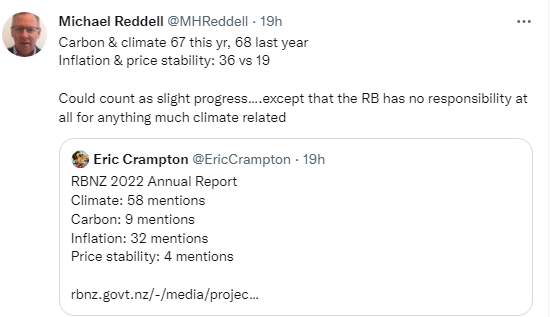
By contrast, there are two pages on matters Maori (bear in mind that the Bank’s instruments – monetary policy and banking regulation – are whole economy ones, not differentiating between Catholics, Greens, lefthanders, stamp collectors, or….or…or Maori). And endless references to climate change. Eric Crampton did the comparison

Accountability – in the face, this time, of huge deviations from desired outcomes (whether the inflation or the losses) – is non-existent. The Bank is presumably confident it can get away with all this because there is no sign that the government cares either. Neither party is doing its job.

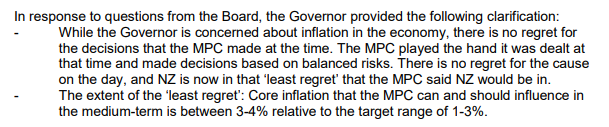
We’ve heard previously Orr boldly claim that he regrets nothing about the last couple of years. There is an arrogance to it that is almost breathtaking. Here, on which note I’ll stop, is the Reserve Bank Board minutetaker’s record of Orr articulating the same story to the Board itself in May

(Even that latter claim has now been overtaken by events as they now recognise that core inflation is even higher than they thought then).

No regrets…..not for the arbitrary redistributions of wealth (which is what unexpected inflation does), not for the grossly overheated labour market which itself has collapsed businesses and livelihoods, and not for the coming (and most likely) recession required to squeeze core inflation back out of the system.

Nothing.

Where will the OCR be in 10 years?

I don’t want to comment extensively on yesterday’s Reserve Bank announcement. It may prove to be the right call (or not), but in the data hiatus – 2.5 months since the last CPI, two months since the latest HLFS – they are to some extent flying blind (New Zealand really needs more frequent and timely key official macro data), and it would have been better to have rescheduled the announcements (adding one) as suggested in my post the other day. And the very brief, almost passing, mention of having considered a 75 basis point increase – which would have made a lot of sense this time last year – highlights again just how non-transparent and non-accountable New Zealand’s MPC is, We don’t know whether, in the end, any of the members actually favoured a 75 basis point increase, or did the Committee just toy with the idea briefly so that they could put a hawkish reference in the minutes? In places like the UK, Sweden, and the US we would have much greater clarity, and potential accountability – and potential accountability focuses the minds of decisionmakers who can, under the New Zealand system, collect their fee, turn up for lunch, and never have to do or say anything.

But looking for some other data I remembered an email from the Reserve Bank statistics group a few weeks ago indicating that they were finally going to publish some of the new data from the Survey of Expectations that they have been collecting for the last couple of years.

The survey has long asked about expected near-term policy rates (previously the 90-day bill rate as proxy, more recently the OCR) but in 2020 they added two new questions, asking respondents where they thought the OCR would be in 10 years’ time (describing that as a proxy for a neutral rate), and what they thought the average OCR would be over the next 10 years. I thought they – and especially the first question – were good additions to the survey (if we could get individual MPC members to give us their numbers, akin to the Fed’s dot-plot it would be even better).

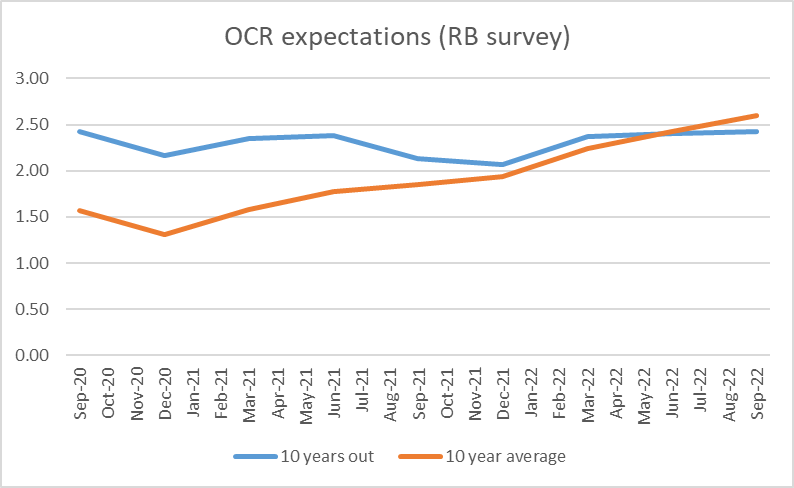
Anyway, here are the results (despite the extraneous labels Excel added in these are quarterly data, beginning with the Sept 2020 quarter)

The blue line (expectations for the neutral nominal rate) really took me by surprise. The first observation would have been captured around the end of July 2020 (I filled mine in on 20 July), and the second three months later, about the time long-term bond yields reached their all-time lows (and talk was of a possible negative OCR in 2021). And yet responses in the last couple of surveys aren’t much different – 2.42 per cent in the September 2022 quarter and 2.43 per cent in the September 2022 quarter. If you’d asked me to guess before the question was instituted, I’d have expected a much more cyclical series of responses (consistent with the variability we see in implied forward bond yields). And since the question is about nominal rates I wouldn’t have been very surprised now to have seen expected future nominal rates rising even if the real rates respondents had in mind weren’t changing much (core inflation undershot the target midpoint for the last decade, but perhaps it won’t in future).

The orange line is much less surprising. Back in 2020 there was a general expectation that the OCR would be very low for several years. As it became apparent that wouldn’t be the case, naturally the average expected over the subsequent 10 years tend to rise (and the intense pandemic period passes out of the 10-year window too).

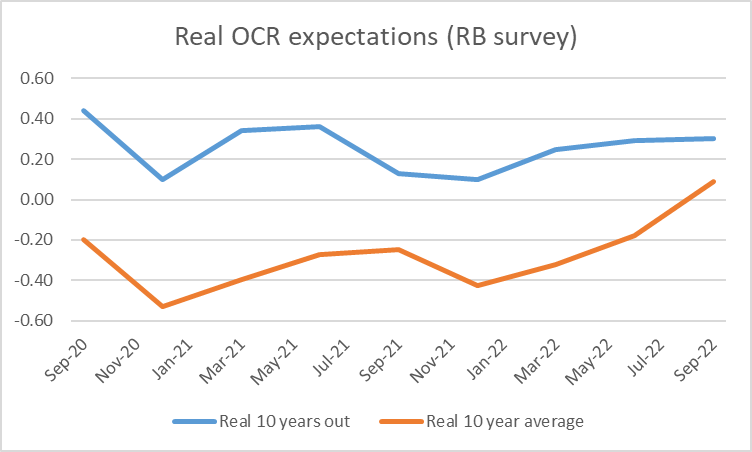
Both questions are about nominal rates. But the same respondents are also asked about their inflation expectations for periods one, two, five and ten years ahead. In this chart, I’ve taken the nominal responses (previous chart) and adjusted them for respondents’ inflation expectations: the 10 year ahead expectation for the blue line, and the average of the two, five, and 10 year ahead expectations for the orange line.

For what it is worth, this group of respondents still think the longer-term neutral real OCR is just barely positive, and their view has hardly changed since near the worst of the Covid shock (first observation), despite the recent huge upsurge in (core) inflation. Average expected real OCRs have increased this year as the OCR has been raised much more rapidly than was expected a year ago.

I don’t have a strong view on whether respondents are right or not (and, on checking, my own responses to the survey questions haven’t been consistently different from the average).

But…..these survey respondents seem to have very different views from the future rates implied by market prices.

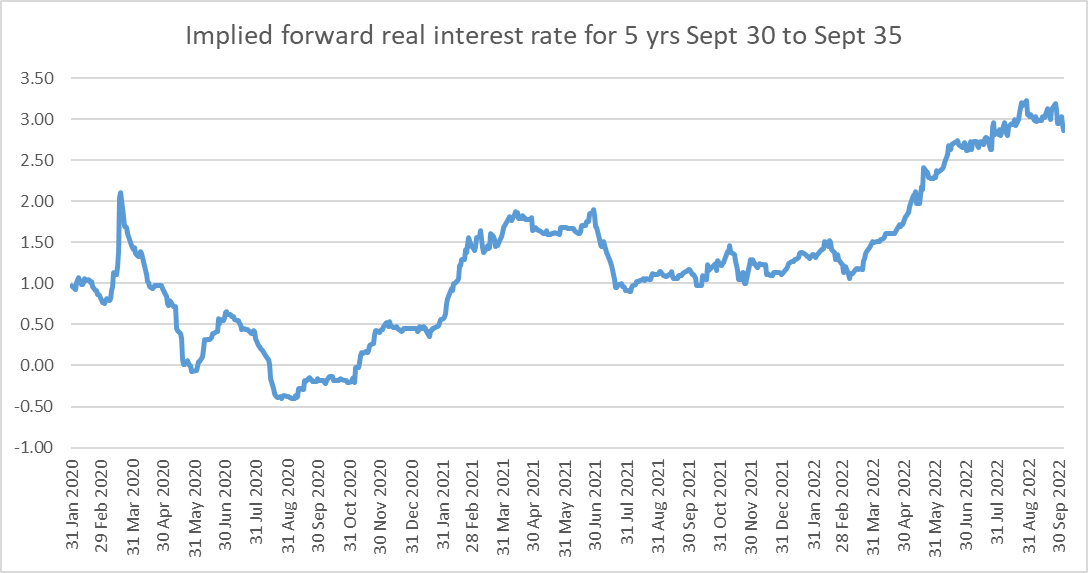
In this chart I’ve taken the yields on the Sept 2030 and Sept 2035 government indexed bonds and backed out the implied real rate for the five year period between Sept 30 and Sept 35 – a period which encompasses the 10 years ahead OCR question for the period the Bank has been running the survey.

At the time of the most recent survey, respondents thought the real OCR 10 years hence would be about 0.3 per cent. At around the same time, the market prices suggested an implied future five year real bond rate of around 2.75 per cent. Sure there would usually be a term premium between OCR and a five year rate, but it wouldn’t typically be anywhere near that large. And our indexed bond markets aren’t the most liquid in the world, but the implied future rates in the chart don’t seem particularly out of line with (for example) implied future nominal government bond rates (using the May 2031, May 32, and Apr 33 bonds all currently yielding a little above 4 per cent), suggesting implied future nominal rates much higher than the 2.4 per cent (or thereabouts) survey respondents expect for the OCR 10 years hence.

I don’t have any answers to offer as to who is going to be proved right – most probably neither (there will be cycles next decade too, as well as whatever structural shocks might unfold) – but it is interesting to see such large gaps between survey responses and market prices. And kudos to the Reserve Bank for collecting (and belatedly publishing) the survey data.

Towards this week’s OCR review

The Reserve Bank’s MPC will deliver their next OCR decision on Wednesday. The consensus seems to be (quite strongly, and I have no particular reason to differ) that the Bank will raise the OCR by another 50 basis points. At 3.5 per cent, the OCR would then be at the peak level it was (inappropriately) raised to in 2014, at a time when core inflation was well below the target midpoint and the unemployment rate was lingering high.

I’m less interested in what the MPC will do than in what they should do, and on that count I’m less convinced that the consensus call would be the appropriate one. In times like the last 2-3 years, no one should feel overly confident about any particular assessment of what monetary policy stance will prove to be needed: there is inevitably an aspect of feeling your way, knowing that when all the relevant data are available there is a fair chance you will be wrong one way or the other.

It isn’t the easiest situation in which to be making an OCR decision. We aren’t at the very start of a tightening cycle, rather the OCR has already been raised by 275 basis points since last October, and if that cumulative increase isn’t overly large by historical standards, the cuts in 2020 were also much smaller in total than in most prior easing phases (that would be so even if one included the 2019 cuts in a calculation). And most of the OCR increases have been really quite recent – it was only in mid April that the OCR was raised above the 1 per cent it had been when Covid hit, and we all know that monetary policy works with lags, often quite considerable ones.

But here, in some respects, the MPC has made a rod for its own back. At present, the most recent inflation data we have are for the June quarter. The midpoint of the June quarter (where the CPI is centred) was mid-May, a point at which (although more was expected over time) the OCR had only just been raised beyond 1 per cent. We’ll have the next release of the CPI on 18 October, and it would seem a great deal more sensible to have held off making the next OCR decision until then.

The annual cycle of OCR/MPS review dates was set a long time ago, and there used to be a view that the latest CPI didn’t often matter much so there wasn’t a particular problem with setting review dates just before the CPI release. But that was back in the days when the inflation rate was pretty stable (and low), not when it was well outside the target range, having been rising strongly (at least in annual terms for some time). It was even worse in July when the OCR review took place less than a week before the CPI was released.

Policymaking is suffering too from decades of underinvestment in macroeconomic data. Even when we get the September quarter CPI, that will have been centred in mid-August, and by then (eg) the United States will have had their September monthly data. I gather the Reserve Bank has now come round to wishing there was a monthly CPI – belatedly, since this was the same institution that frowned upon the idea 20 years ago when the then independent review of monetary policy, undertaken for the then government, by a leading overseas economist, highlighted the omission and recommended remedying it. Same goes for most of the labour market data: the June quarter data (latest we have) is centred (again) on mid May (although the new monthly employment indicator does represent some improvement in the New Zealand data in this area). We really need to be spending a bit more to get good quality monthly CPI and HLFS data, as almost all other OECD countries have. As it is, combining poor data with a weak MPC is not a recipe for good, robust, and trustworthy monetary policymaking.

And not too far down the track we will face again the MPC’s extended summer holiday, with no review of the OCR at all in the three months from 23 November to 22 February. That long holiday last summer almost certainly contributed to the OCR being increased more slowly than it should have been.

If it were me, I would have been postponing next week’s OCR review until a few days after the OCR review, delaying the next MPS until early December, and scheduling an additional OCR review at the end of January (after the December CPI data are available).

As it is, on the data we actually have to hand, I’m sceptical of the case for a 50 basis point OCR increase right now.

Some of the straws in the winds?

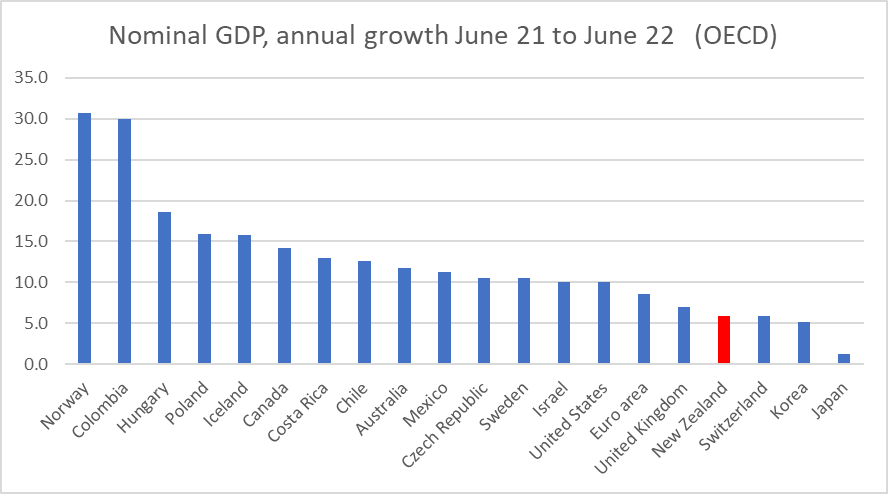
First, there was the relatively weak nominal GDP growth for the year to June (most recent we will have for quite a while yet) – the June quarter was 5.9 per cent higher than the June 2021 quarter, among the very lowest growth rates facing advanced country central banks. Nominal GDP is considerably easier to measure than real GDP, and is a relevant consideration in thinking about appropriate monetary policy.

Second, asset prices have been falling quite considerably. I’m not a great believer in wealth effects from house prices, but materially lower house prices will blunt the incentives for developers to continue to put in place new houses, and residential investment is one of the most cyclical components of the economy. There is a stronger argument for wealth effects from share prices, and share prices have also fallen back (eg the NZSE50 is below immediately pre-Covid levels), also dampening incentives for firms to undertake new business investment.

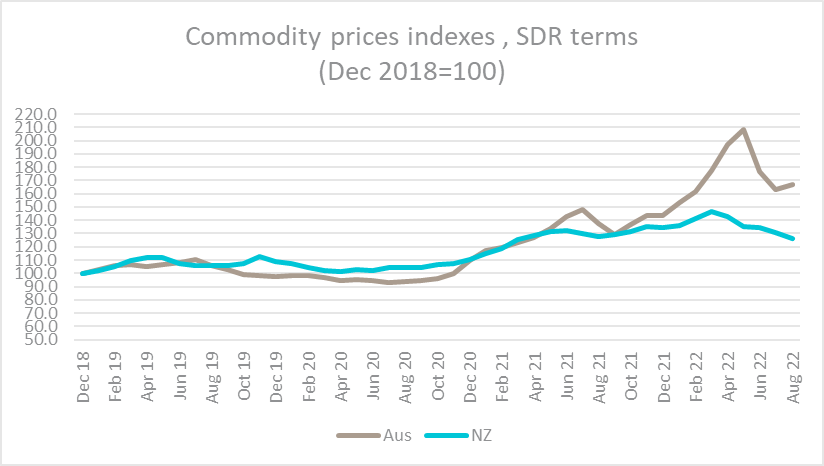
Third, if international New Zealand export commodity prices aren’t exactly weak, they are nothing like as strong as those in Australia (ANZ and RBA series respectively in the chart).

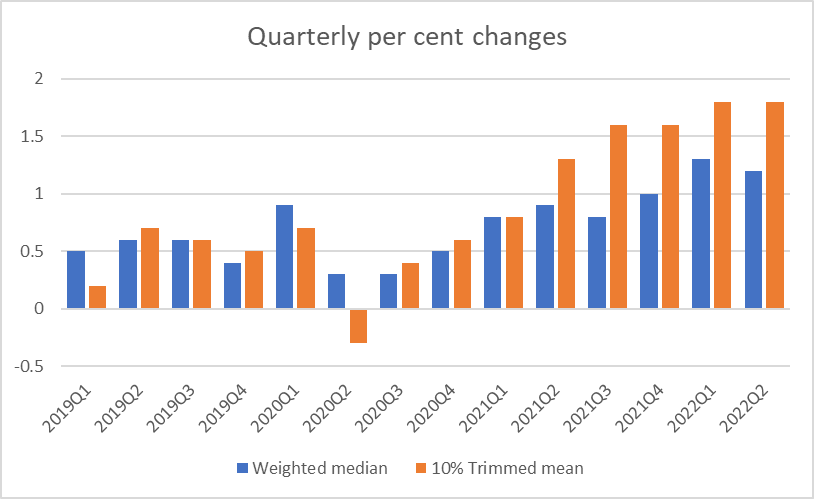
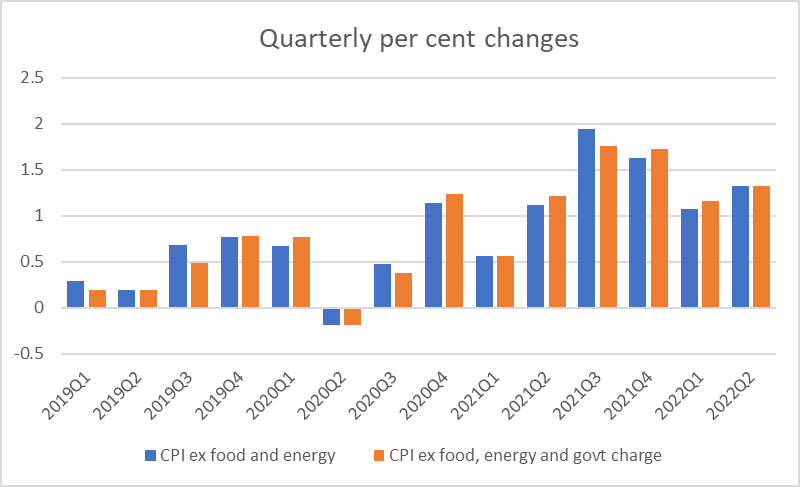
And then there are the core inflation measures. Much of the media and political attention has been (perhaps understandably) on the annual rate of inflation (complete with petrol tax cut distortions). That annual rate may well have fallen back a bit in September (petrol prices and all that), but it shouldn’t really be the focus. Ideally, we want to look at quarterly core meaaures – indicators of what is happening behind the headline “noise”. (And here the Reserve Bank’s factor model measures aren’t very useful, since they work on annual change data and thus often in effect function as lagging indicators in the face of big changes, even if they probably often provide the best medium-term and historical view.)

Here are the trimmed mean and weighted median measures (note that you cannot just multiply these by four to get an annualised rate)

and here are a couple of SNZ exclusion measures (CPI ex food and energy is most often used for international comparisons, simply because of data availability)

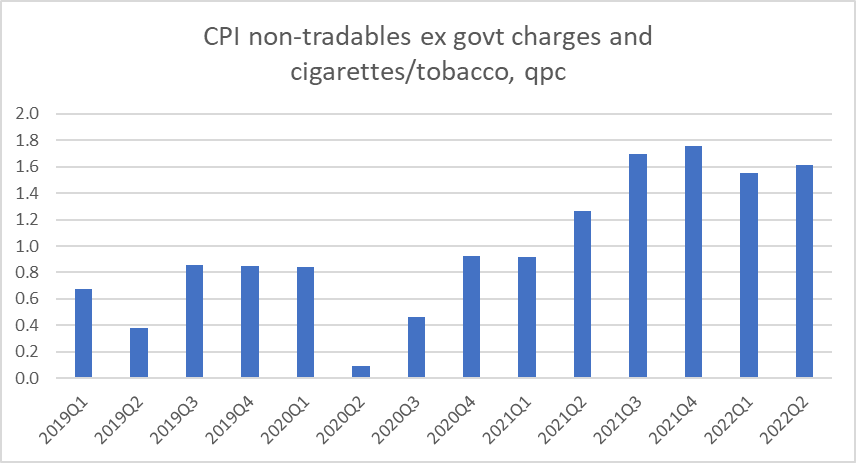
and here is one I’ve quoted a few times over the years, focused more (at least in principle) on the more domestically-generated bit of underlying inflation

Remember that all of these series are capturing prices as they were in mid-April, just short of six months ago.

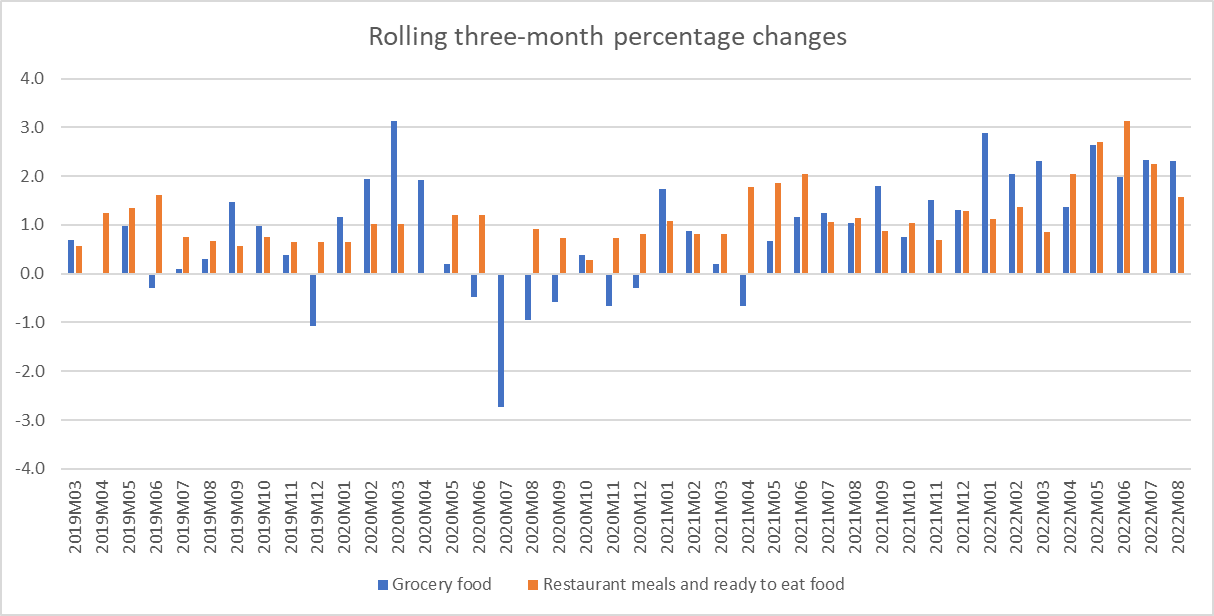
There are a few potentially useful official monthly series. I’ve long kept an eye on these two from the Food Price Index

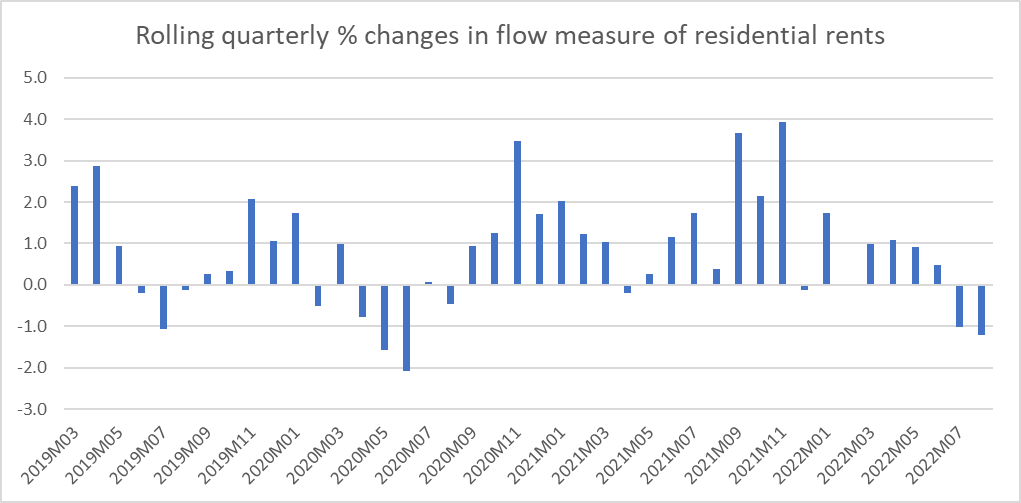
and there is the monthly rental data

Every single one of these series show a (not unexpected) trough in quarterly inflation in the June quarter of 2020 (the first, out-of-the-blue, “lockdown”). But more than a few also suggest that the sharpest increases in the inflation rate were occurring a year ago (perhaps 12-18 months on from the biggest fiscal and monetary stimulus), and that since then the quarterly inflation rates have been (high but) fairly stable or, on some measures have already fallen back a bit. And most of the most recent observations date from a time when the OCR was only just getting past 1 per cent.

If any hawkish readers are wanting to jump down my throat, can I take the chance now to stress that none of these inflation rates – from months ago – should be considered remotely acceptable. They are miles above the 2 per cent annual inflation the Reserve Bank is supposed to focus on delivering. We want inflation much lower than is evident in the most recent data.

But, again, monetary policy works with lags. And those lags may be particularly important to keep in mind when, as this year (and of necessity given how slow all central banks were to start) policy rates have been raised so sharply and quickly. Perhaps also relevant was the point in this nice post from a few days ago by Maurice Obstfeld, formerly chief economist of the IMF, highlighting that many advanced countries have (belatedly) been doing much the same thing, and those effects are likely to be mutually reinforcing. Recessions now seem unavoidable in a wide range of countries, and it isn’t clear that most central banks are taking other countries’ pending recessions into account in their own domestic policysetting.

As I said at the start of this post, only a fool would be overly confident about what monetary policy will prove to have been required over the coming year. And successful policy at this point will probably prove to have involved tightening at least a little more than, with hindsight, was strictly necessary. But on the data as they stand in New Zealand – long collection/publication lags and all – and if forced to make a decision this Wednesday (and the MPC is not forced to, the date is their choosing), I reckon there is a better case for a 25 basis point increase than for a 50 point increase. The key thing, of course, is to convey a sense that the MPC will do what it takes to deliver something near 2 per cent inflation before too long. But at this point it isn’t obvious that aggressive further OCR increases are really needed in New Zealand (Australia, the UK, or perhaps even the US may be in different positions, between even more belated starts to tightening cycles and positive shocks to demand from (eg) commodity prices or fiscal policy).

A canary in the coalmine?

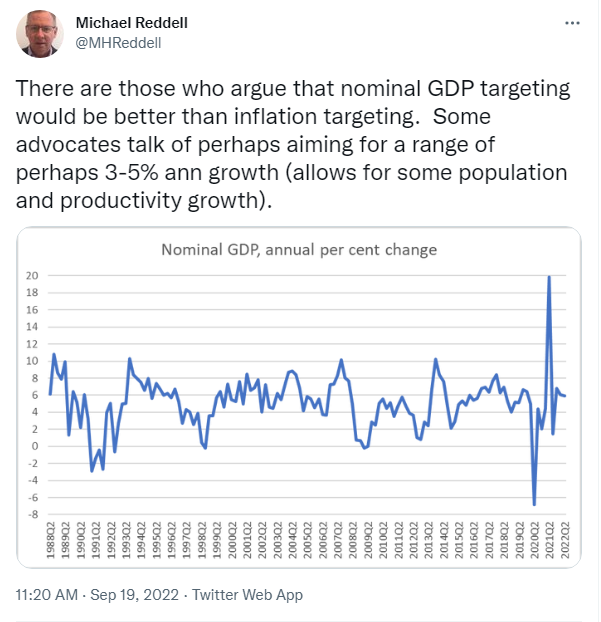
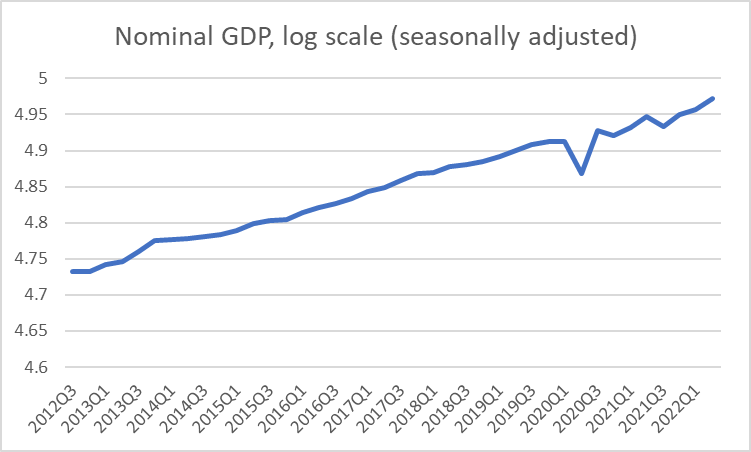
A couple of days ago, I put this chart and brief comment on Twitter

I added “I do not think nom GDP targeting is generally superior to inflation targeting for NZ, but recent outcomes (latest annual 5.9%) are at least one reason for a little caution about further aggressive OCR increases”.

There is a long history of people writing about nominal GDP targeting (it was being championed in some of the literature before inflation targeting was even a thing). I’ve written about it a few times (including here and here) and just this morning I noticed a new commentary from Don Kohn, former vice-chair of the Federal Reserve looking (sceptically) at some of the issues. No central bank has shifted to nominal GDP targeting (whether in levels or growth rates) but a fair number of people (including Kohn) will suggest that there may still be useful information in developments in nominal GDP – something to keep at least one eye on.

Almost every piece of economic data has been made harder to interpret over the last couple of years by Covid. In my chart, the eye immediately tends to go to the unprecedented fall (in 2020) and unprecedented rebound following that. But my eye next went to what wasn’t there: the most recent rate of increase (nominal GDP in the June 2022 quarter is estimated to have been 5.9 per cent higher than that in the June 2021 quarter) wasn’t at all out of line with typical experience in the last few decades. It is quite a different picture than we see with headline and core inflation measures. And although Covid has continued to affect economic numbers, last June quarter seemed relatively little affected by Covid here (the Delta outbreak was mid-August), and by the June quarter we were through the worst of the restrictions. Perhaps as importantly for what follows, the June quarter was pretty normal for most other countries too (and the June 2020 quarter was pre-Omicron disruptions).

One upside of New Zealand’s slow publication of macroeconomic data is that when our GDP numbers are finally published, pretty much everyone else’s are available for comparison. And although people often note (fairly) that nominal GDP numbers are published with a longer lag than inflation numbers, we are also now in the long New Zealand hiatus where it is two months since we last saw an inflation number, and another month until we get another one. The MPC makes its next OCR decision before that.

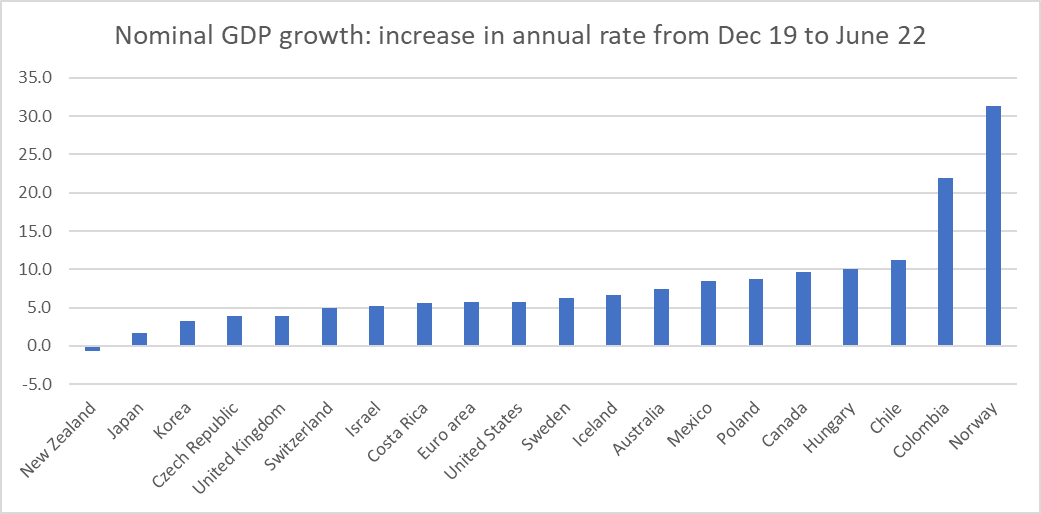
So how did New Zealand’s estimated nominal GDP growth for the year from the June quarter last year to the June quarter compare with the experience of other OECD economies? Here I’m focused on places having their own monetary policies, and so show the euro-area rather than the individual countries in that area. I’m also going to leave Turkey off my charts – mostly to keep them more readable, in a context where they are running a crazy monetary experiment and have recorded nominal GDP growth of 115 per cent in the last year.

Nominal GDP growth in (fairly low inflation) Norway went sky-high because the invasion of Ukraine etc has sent oil and (especially) gas prices very high.

But look at New Zealand: we had the fourth lowest rate of nominal GDP growth in that year among all the OECD countries (monetary areas). And two of those below us – Switzerland and Japan – had not only not eased monetary policy in 2020, but had spent years grappling with such low inflation they’d needed persistently negative policy interest rates.

Absolute comparisons like this can mislead a bit. Some countries have higher inflation targets than others – Chile, Costa Rica, Mexico, and Colombia for example target 3 per cent inflation, and have historically had somewhat higher nominal GDP growth rates consistent with those higher targets. But I could take the Latin American countries (poor enough that they are really OECD diversity hires) off the chart and it wouldn’t much change the picture as it affects New Zealand and the countries we often compare ourselves to. In Australia, for example, nominal GDP increased by almost 12 per cent in the year to June.

The last quarter before Covid was December 2019. Across the OECD as a whole (and in New Zealand) core inflation at the time was generally a bit under the respective (core) inflation targets, and many central banks had been cutting policy rates that year.

Here is nominal GDP growth (as now recorded – GDP revisions are a thing) for the same group of countries for the last pre-Covid year.

New Zealand’s rate of nominal GDP growth then was a bit higher than the median OECD country, perhaps consistent with the fact that our population growth rate was faster than those for most advanced countries. But our nominal GDP growth rate that year was also a bit higher than the average rate New Zealand had experienced in the previous decade or more. (Note Norway again; not even the staunchest advocates of nominal GDP targeting recommend it for countries with terms of trade shocks on that scale.)

The next chart shows annual growth in nominal GDP for the latest period less annual growth to the end of 2019. The idea is to see how much acceleration there has been (with the sort of lift in core inflation we’ve seen across most of the world all else equal one might expect to have seen quite a lift in nominal GDP growth).

Fair to say that New Zealand stands out somewhat. In the year to June 2022 New Zealand was the only OECD country to have had nominal GDP growth lower than in the immediate pre-Covid period. And if our terms of trade have fallen a bit in the last year, that was still in a context where (NZD) export prices were up 17 per cent in the most recent year, with import prices up even more.

I am genuinely not sure what to make of these pictures and the New Zealand comparisons specifically. If you look across that last chart you would have little hesitation in suggesting that a lot of monetary policy tightening (interest rate rises) has been warranted in the advanced economy world. For the median country, nominal GDP growth has accelerated by 6 percentage points. But in New Zealand, nominal GDP growth has slowed.

And if one were a champion of nominal GDP levels targeting, here is New Zealand’s nominal GDP over the last decade

Things have (inevitably) been bumpier in the Covid period, but there is nothing there suggesting things have gone off track in recent times (although the mix has changed, with less population growth and more inflation).

The usual fallback position when anyone invokes nominal GDP numbers is to note (entirely fairly) that revisions to GDP are very much to be expected. Perhaps we will find, five years hence, that nominal GDP growth in the year to June 2022 was really a couple of percentage points higher than SNZ currently estimate. That would be a pretty large change for a single year (as distinct from historical levels revisions as data collections and methodologies change). But – if every other country’s estimates didn’t change – one could revise up New Zealand’s rate of nominal GDP growth by 2 percentage points and we would still be equal lowest (with Japan – where they are still running avowedly expansionary monetary policy) on that chart showing the acceleration in the rate of nominal GDP growth.

Two other considerations are worth noting. It isn’t true that our Reserve Bank was particularly early in raising the OCR again – about six of these countries were ahead of them – but market interest rates had already risen quite a bit last year in anticipation and we had had one of the frothiest housing market during the Covid period, and are now somewhat ahead of the pack in seeing house prices and house turnover falling away. Even if – as I am – one is sceptical of house price wealth effects, housing turnover itself is one (modest) component of GDP. Either way, our subdued nominal GDP growth may be foreshadowing what could be about to happen elsewhere.

Monetary policy is avowedly run on forecasts – that would be true (or the rhetoric) even if one were targeting nominal GDP growth rather than inflation – and I guess it is always possible that we might see an acceleration of nominal GDP growth from here, that might support further Reserve Bank tightening from here. Perhaps, but it is difficult to see quite where this acceleration might come from.

I have been a little more sceptical than some in recent months of quite how much further the OCR is really likely to need to be raised, but I am not drawing strong policy conclusions from these data just yet. But they do seem like a straw in the wind that (a) warrants further investigation and (b) might make one somewhat cautious about championing further tightenings, especially in the absence of timely fresh inflation data. Subdued growth in nominal GDP is more or less exactly what one might expect to see if, with a lag, core inflation was already on track to slow, perhaps quite a bit.

The $9 billion dollar man

The Listener magazine this week reported the results of a caption contest they’d run for a photo of Reserve Bank Governor Adrian Orr.

I’d suggested what seemed to me a rather more apt caption.

One good thing about the Reserve Bank is that they do report their balance sheet in some detail every month, and yesterday they released the numbers for the end of August. August was not a good month for the government bond market: yields rose further and the market value of anyone’s bond holdings fell. And thus the Reserve Bank’s claim on the government, under the indemnity the Minister of Finance provided them in respect of the LSAP programme, mounted.

This is the line item from the balance sheet

A new record high at just over $9bn.

And that doesn’t seem to be quite the full extent of the losses the Governor and the MPC have caused. A while ago the Herald reported on an OIAed document from The Treasury.

I wasn’t sure quite what to make of that, but we know that from July the Bank has begun selling its bonds back to The Treasury. Over July and August they had sold back $830m of the longest-dated bonds (ie the ones on which the losses will have been largest) and presumably collected on the indemnity when the Bank realised the losses on those bonds at point of sale.

Presumably all the numbers will eventually turn up in the Crown accounts, but for now it seems safe to assume that Orr and his colleagues (facilitated by the Minister of Finance) have cost taxpayers around $9.5 billion dollars – getting on for 2.5% of New Zealand’s annual GDP (or about 7 per cent of this year’s government spending).

These are really huge losses, and to now the Governor’s defence seems to amount to little more than “trust us, we knew what we were doing”, accompanied by vague claims that he is confident that the economic benefits were “multiples” of the costs. But there is no contemporary documentation in support of the former claim (eg a proper risk analysis rigorously examined and reviewed before they launched into this huge punt with our money), and nothing at all yet in support of the latter claim.

Central banks should be (modest) profit centres for the Crown. Between their positions as monopoly issuers of zero-interest notes and coins and as residual liquidity supplier to the financial system there is never a good excuse for a central bank to lose money, and certainly not on the scale we’ve seen here (and in other countries) in the last couple of years – punting massively on an implicit view that bond yields would never go up much or for long (as they hadn’t much in the previous decade when other central banks were engaging in QE).

There are plenty of things governments waste money on, and plenty of big programmes that (rightly) command widespread support (through Covid you could think of the wage subsidy scheme). But this was just little more than a coin toss – low expected value, but with at least as high a chance of big losses as of any substantial gains. And seemingly with no accountability whatever. Orr has not apologised for the losses, nor have the other MPC members. No one has lost their job – but then this is the New Zealand public sector where hardly anyone ever does – and not a word has been heard from those charged with holding the Bank to account (the Board or the Minister of Finance).

Back when I was young the Bank ran up big (indemnified) foreign exchange losses in the 1984 devaluation episode. Searching through old papers I can’t find the precise number the Crown had to pay out, but between what I could find and my memory it may well have been of a similar order (share of GDP) as the LSAP losses. But the responsibility then rested directly with the Minister of Finance – the Bank was not operationally independent, and defending the fixed exchange rate under pressure was government policy. It was a rash policy – the Bank advised the government not to do it – and the large losses added to the obloquy heaped on Muldoon for his stewardship in his last couple of years on office. But the public got to vote Muldoon out, while there still appears to be a serious possibility that Orr – having cost New Zealanders perhaps $1800 each – will be reappointed (with just six months of his term to go if he is not going to be reappointed it will need to be announced soon to enable a proper search process for a replacement to occur). The LSAP losses may not even be the Governor’s worst failing, but no one directly responsible for that scale of taxpayer losses – on risks he simply did not have to take – should even be considered for reappointment, at least if accountability is to mean anything ever.

Of course, there have been bigger losses in New Zealand government history. I’ve just been reading John Boshier’s Power Surge on the Think Big debacle of the 1980s. As a share of GDP, total economic losses to the taxpayer from that series of projects were far greater than the LSAP losses, but I’m not sure that losing less in one punt than the worst series of discretionary public sector projects ever in New Zealand history should be any consolation or mitigation. And, for what it is worth, Boshier’s book suggests there was typically more advance risk analysis undertaken for the Think Big projects than we have yet seen evidence of for the LSAP.

I’m sure gambling appeals to some people, and I wouldn’t want to stop those minded punting on the bond market, the fx market, Bitcoin, equities or whatever. But if that is the sort of thing that takes Orr’s fancy – and it probably isn’t judging by his past financial disclosures – he could at least do it with his own money, not ours. And having rashly done it with our money, and lost heavily, have the decency to apologise.

Orr defending the LSAP

The Governor of the Reserve Bank must have been feeling under a bit of pressure recently about the LSAP programme. Losses have mounted and some more questions have started to be asked – by more than just annoying former staff – about value for money.

And thus on Thursday morning “Monetary Policy Tools and the RBNZ Balance Sheet” dropped into inboxes. It was an 10 page note setting out to defend the Bank and the MPC over the bond-buying LSAP programme and the inaptly-named Funding for Lending programme, the crisis facility under which the Bank is still – amid an overheated economy and very high core inflation – lending new money to banks.

Of course, the Monetary Policy Statement had been out the previous day. Had the Governor been serious about scrutiny and engagement, he’d have released his note a day or two before the MPS (or even simultaneous to the MPS). Then journalists could have read the paper and asked questions about it in the openly-viewed press conference. The Bank’s choice not to do so revealed their preferences. Oh, and then the note was released less than an hour before the Finance and Expenditure Committee’s hearing on the MPS, and since FEC no doubt had other things to consider it is unlikely any of the members had read the note before the hearing. That too must have been a conscious choice by the Bank (one that didn’t go down well with the Opposition members).

I noted earlier that the paper was 10 pages long, but there wasn’t a lot of substance. We still have nothing but the Bank’s assertions for their claims that the LSAP programme was worthwhile, and while we are told that they hope to provide some more analysis in a review document at the end of the year, attempting to kick for touch for another four months frankly really isn’t good enough. And, of course, we’ve heard nothing at all from the three non-executive MPC members who share responsibility for the programme. As it is, the 10 page note does not even provide a serious attempt at a rigorous framework for evaluating costs, benefits, and risks – there is more handwaving, and attempts to blur any analysis, than serious reasoning.

There are two separable strands. I am going to focus on the LSAP rather than the Funding for Lending programme (FLP), but it is worth making a few points on the latter:

  • the Bank claims that the FLP was necessary because banks were not yet operationally capable of managing a negative OCR, but the FLP was only finally launched in December 2020, and the Bank has separately told us that by that time banks’ system were in fact capable of coping with a negative OCR.   Sure, the FLP had been foreshadowed over the previous few months and probably had some impact on retail rates then, but then the possibility of a negative OCR had also been foreshadowed,
  • the FLP was misnamed from the start (creating of lot of unnecessary controversy at the time about housing finance), with the name feeding an entirely fallacious mentality that shortages of settlement cash were somehow a constraint on bank lending.  I am pleased to see that in this document the Bank (now that it suits) explicitly states “there is little evidence that higher settlement cash balances resulting from these programmes have directly impacted bank lending”.  Paying the full OCR on all settlement cash balances – a Covid novelty that continues – will also have that effect.
  • it remains extraordinary that the Bank is still undertaking new lending under the FLP until the end of this year.  It was a crisis programme, launched belatedly when crisis conditions had all but passed anyway, and there has been no clear justification for continuing new loans for at least the last year (recall the Bank wanted to raise the OCR last August).   Arguments about predictable funding streams just fall flat, when the entire economic and financial climate was so uncertain, and when banks like everyone else recognise that circumstances have moved on from where they were two years ago.  The Bank’s claim –  that somehow banks would not future bank commitments seriously if they terminated early – deserve little more than to be scoffed at.  And although the Bank will tend to play this down, we can tell that the FLP is relatively cheap funding –  if it were not, banks would not still be tapping the facility.  Similarly, arguing (as they do) that the OCR can offset the FLP is to concede the point: increases in the OCR should be leaning against real inflation pressures, not counteracting other lingering stimulatory crisis interventions.

But enough of the FLP, daft as it is still to be running it, the costs and risks are fairly small.

Not so the LSAP, where costs and risks are demonstrably high (now conceded by the Bank) while the alleged benefits are hard to pin down (not helped by the Bank making no serious public effort so far), and the water is being deliberately muddied by the Governor’s bluster and absence of careful delineation of the issues and arguments.

On financial costs, this from the Bank’s document is clear and straightforward (and I would hope might finally silence those who keep trying to claim they aren’t “real” costs, are all “within the Crown” or whatever).  The Bank is clear that the financial losses themselves are real.

The best estimate of the net cost of LSAP is measured by the value of the Crown’s indemnity – unrealised losses based on current market valuation, reflecting a higher OCR – and losses realised by RBNZ upon the sale of the Bonds.  

As to quantum, the claim under the indemnity fluctuates each day, and some of the Bank’s claim has now been paid by Treasury, but the Bank’s Assistant Governor was happy at FEC to use a ballpark $8bn figure. $8bn is roughly $1600 per man, woman, and child in New Zealand.

In the rest of this post, I am drawing on three sources of Bank comment: the 10 page document itself, the Bank’s appearance at FEC on Thursday (comments from Orr, Silk, and Conway, the chief economist), and the Governor’s full interview with the Herald (linked to in this article). Orr has made stronger claims orally than what is in the formal document, asserting twice that the wider economic gains of the LSAP programme were “some multiple” of the financial losses, following up to add that in his view it wasn’t even close. “Some multiple” must mean at least two, so at minimum the Governor is asserting (and recall there is no evidence advanced and not much argument) that the LSAP resulted in real economic gains of at least $16bn. At minimum, he is claiming a benefit of about 5 per cent of GDP at the time the LSAP was first launched. These are really huge claims, and you’d think he’d have at least some disciplined framework to demonstrate their plausibility (even just as ballpark estimates).

Instead, we are offering not much more than handwaving, and lines that at best veer close to outright dishonesty.

There seem to be three broad strands to whatever case Orr is trying to make:

  • there is the “least regrets” rhetoric,
  • there is talk (especially in the Herald interview) of the gains from bond market stabilisation back in March 2020, and
  • there is lots of talk (even the chief economist went down this line at FEC) about how much stronger than forecast the economy has been than was being forecast in 2020.

As Orr now tells it, “least regrets” meant the Bank would run monetary policy in such a way that it would prefer to see a grossly overheated high inflation situation (actual outcome) than a deep depression and entrenched deflation. Perhaps many people might share that preference if it was the only choice. But it wasn’t, and we’d be better off sacking and replacing all involved if they really want us to believe it was. Go back to 2020 and then when they were first talking about “least regrets” it was the much more reasonable framing (eg here) that, at the margin, and given that inflation had undershot the target for 10 years, they might be content with (core) inflation being a little above the target midpoint for a while rather than jump on things too early and risk keeping the unemployment rate higher than necessary for longer than necessary. Not everyone would necessarily have agreed with them on that, but it would have commanded pretty widespread assent (I wasn’t unhappy myself)….and in any case was entirely hypothetical at the time since, as I’ve documented in recent posts, actual inflation forecasts (Bank and private) were well below the target midpoint even as the Bank added no more stimulus beyond that (from OCR, LSAP, FLP or whatever) already embedded in the economic and inflation forecasts. So don’t be fooled by Orr rhetoric suggesting we should smile benignly on their handling of things because “the alternative was some Armageddon”. We pay him and his offsiders a lot of money to help ensure that those aren’t the choices.

Back when the LSAP programme was first announced – 23 March 2020 – there was a twin (related) motivation: generally to ease monetary conditions, and specifically to underpin the functioning of the government bond market. Global government bond markets were then in a mess, reflecting primarily US-sourced extreme illiquidity and flight to cash (at the time stock markets had been falling very sharply too). For those interested, here are a couple of links to what was going on at the time (here and here). Government bond rates were rising (even as policy rates had been cut): the disruption was real enough and it was getting very difficult to place paper. I’ve even gone on record here in the past stating that, even allowing for the moral hazard risks, I had no particular objection to some stabilising interventions, especially in the Covid context.

But here is a chart of US and NZ 10 year government bond rates for the month of March 2020 (with the US rates lagged a day to line with the NZ ones – changes in NZ bond rates in the morning are usually mostly a reflection of what has happened in the US overnight (the previous day for them).

You can see yields rising in that third week of the month even though both central banks had cut policy rates sharply that week (and the Fed had announced restarting of bond purchases). The NZ market is less liquid at the best of times than the US one. But yields in both countries peaked on 19 March (NZ).

As did the gap between New Zealand and US rates. Days before the Reserve Bank did anything or even announced their own LSAP (although they had foreshadowed that one might be coming).

And if the Reserve Bank announced its LSAP on 23 March, on the same day (but remember the time difference) the Fed greatly expanded its own bond-buying programme. Almost immediately New Zealand long-term bond yields were back down to around 1 per cent.

Simple charts of yields – of the most liquid part of each market – don’t directly get to the illiquidity in other markets, but all indications are that the worst (globally) was already over by the time the Reserve Bank made its announcement, and given the US-sourced nature of the shock, it seems far more likely that the US actions were the more decisive policy contribution to stabilising markets. I don’t want to begrudge the Bank its small part in domestic market stabilisation (and they had some other interventions, including thru the fxs swaps market – but remember it is the LSAP they are defending), but even if we run through to 10 April, total bond purchases by the RBNZ to that point was only $3.6bn. Sure, a willingness to go on intervening offered a bit of cheap insurance to market participants, but if Orr wants to make much of what those earlier operations contributed (and it really can’t be much, given lockdowns, extreme economic and policy uncertainty etc) it relates to less than a 10th of the risk the Bank eventually exposed the taxpayer to through the LSAP.

(And if you want to note that over the month New Zealand bond yields did not fall as much as those in the US, recall that at the start of much US policy rates had much more room to fall than NZ ones did – and expectations of future short rates are the main medium-term influence on bond yields).

The third broad strand of Orr’s defence now appears to rest on how unexpectedly strong the economy (and inflation) proved to be.

From the 10 page report

His new chief economist tried the same line at FEC, with less nuance, and Orr himself when asked by Nicola Willis what evidence there was of the net benefits of the LSAP responded succinctly “the economy we live in today”.

It really is borderline dishonest. After all, all those dismal 2020 sets of forecasts – the Bank’s, the Treasury’s, and the myriad private sector ones – all included the effects of the policy stimulus (including the LSAP), and views on the path of the virus itself, so the resulting massive forecast error (for which I am not particularly blaming anyone) logically cannot be proof – or even evidence – of the effectiveness of a single strand of monetary policy (LSAP), or even of macro policy taken together. Since Orr and Conway are smart people, and know this point very well, it must be a deliberate choice to continue to muddy the waters as they do. They never even address the probability – high likelihood in my view – that most economists simply got wrong the extent of the adverse demand shock. At very least any serious analysis would have to unpick the various elements.

Instead, in none of their written material, or the comments of Orr and his offsiders, has there been any attempt (even conceptually) to think about the marginal effects of the LSAP programme itself. It was a discretionary (and last minute) addition to the toolkit. And even if we granted them a free pass for the first $3.6 billion or so of purchases (see above) all the rest was their choice. We know the financial costs (that $8bn or so of losses) but the alleged huge gains (Orr’s “multiples”) are unidentified – no effort has even been made. As just one small example, when the Herald’s journalist asked Orr whether, for example, they could have done less LSAP and instead cut the OCR to zero (which as even the Bank notes has no material market risk), Orr simply avoided answering the question.

I’ve run through previously the various reasons to be sceptical that the LSAP had much useful macro effect (those vaunted $16bn of gains Orr would need to show). In particular, even if the impact on longer-term bond rates was as large as Orr has claimed (again numbers that have never been documented), it isn’t at all obvious how that would have translated to large useful macro gains. It is commonly understood that the most important element in the interest rate bit of the New Zealand transmission mechanism is the short-end. Short rates (1-2 year bond rates) shape most retail lending rates, and are themselves largely influenced by expectations of the future OCR. Had the Bank been interested, say, in managing down a 3 year bond rate – as the RBA was – it could have done that directly, at very little financial risk. But instead they focused their bond buying at the longer end of the yield curve. Government borrowing costs may have been a bit less than otherwise as a result, but monetary policy isn’t supposed to be about getting cheap finance for the government but about macro stabilisation. Few private borrowers take borrowing at long-term fixed rates.

The Bank also claims that the exchange rate may have been lower than otherwise as a result of the LSAP. Perhaps, but (a) it depends on the counterfactual (they could have lowered that OCR further instead but chose not to) and (b) in most models the real economic effects of exchange rate moves take quite a long time to be felt, and even the Reserve Bank argues (contrary to quite a lot of literature) that the impact of the LSAP was decaying over time.

And it is worth pointing out that, as their document notes, they used the LSAP because of issues around operational readiness of banks for negative OCRs, but whose responsibility over the previous decade had it been to have ensured that banks were operationally ready? The taxpayer was exposed to the massive financial risk from the LSAP – without, it appears, any robust prior risk analysis – because of the Bank’s own failures. Just maybe there were some macro gains, but in a better world we’d have got those without the huge financial risk (and $8bn of losses). (A former colleague noted to me the other day that if we’d wanted to throw around an extra $8bn we’d almost certainly have gotten more macro bang for the buck by just giving $1600 to every man, woman and child and setting them free to spend – probably would have seemed a bit more equitable too.)
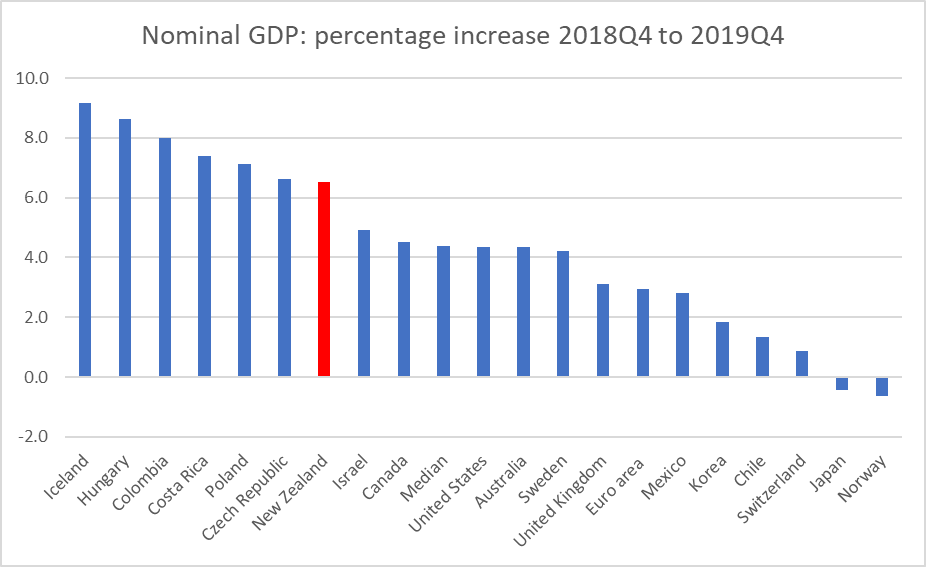
Oh, and did I add that if the last big macro policy tool deployed – the LSAP – was really as potent as the Governor seems to claim, then given how overheated the economy has been and the fresh ravages of high core inflation, it might have been much better (and lower risk) if the keys to the ill-prepared drawer marked LSAP had never been found and the instrument left untouched. We pay central bankers to do (materially) less badly than this, even (especially?) in difficult and uncertain times.

Bottom line: there has so far been no serious attempt by the Reserve Bank to frame an analysis that looks at the marginal impact of the LSAP programme, whether numerically or conceptually. Until there is, everything else they utter on the subject is really just defensive bluster. The public deserves better from senior officials of such a powerful institution. But as so often with the Bank, the question again arises as to why those paid to hold the Governor and MPC to account seem utterly uninterested in doing so.