Monetary policy, the Governor etc

In a post a couple of weeks ago I highlighted the extent to which monetary conditions appeared to have been tightening over the last few months, even as the OCR has been kept steady at 1.75 per cent.  Specifically, retail interest rates (lending and deposits) have increased, and the exchange rate has risen.  In addition, but less amenable to easy statistical representation, credit conditions have tightened, through some mix of Australian and New Zealand regulatory interventions and banks’ own reassessments of their willingness to lend.    Over this period there has been no acceleration in economic growth and inflation (whether goods or labour) hasn’t been increasing.  If anything, core measures of inflation –  already persistently below target –  have been falling away.

Yesterday the Reserve Bank released the results of the latest Survey of (business and economists’) Expectations.    The Reserve Bank has recently changed the survey, dropping a number of useful questions altogether, and missing the opportunity to plug some key gaps (eg there are no surveys in New Zealand of expected net migration).  They’ve also added some useful new questions, but for the time being are refusing to release the results of those questions –  including those around OCR expectations, house price expectations, and longer-term inflation expectations.

But one set of questions I was a little surprised that they left unchanged were those around monetary conditions.  I like the questions but it is a long time since I’ve seen anyone else write about the results.   Respondents are asked to indicate what their perception of current monetary conditions is (on a seven point scale, where four is neutral).  And then they are asked the same sort of question about expectations for the end of the following quarter and a year hence.

Broadly speaking, respondents tend to describe monetary conditions –  or at least changes in them –  as one might expect.   Here is the perception of current monetary conditions, dating back to the start of 1999 when the OCR was introduced.

mon condtions current

The peak in the series was right at the peak of the last OCR cycle, where the OCR was raised to 8.25 per cent.   Since then, although the Governor likes to describe monetary policy as extraordinarily accommodative, respondents have never thought that monetary conditions have been (or are) anywhere as easy as they were tight in 2007/08.  (When I completed the latest survey, I described current conditions as just a bit tighter than neutral.)

Note that latest observation.  Respondents reckon that monetary conditions have tightened.   The increase doesn’t look that large, and does come after a fall in the previous quarter.    But, the larger increases tend to occur either when the OCR is actually being raised, or when the Reserve Bank is talking hawkishly about the probable need for further OCR increases (thus, you can see the two big increases in 2014, when the Bank was in the midst of what it was talking of as 200 basis points of OCR increases).

But perhaps more interesting is that respondents also expect conditions to be quite a bit tighter by the end of the year, and again by the middle of next year –  and all that with no Reserve Bank encouragement at all.    And –  I would argue –  none from the underlying economic data either.

mon conditions ahead.png

The scale of the increase in the last few quarters is comparable in magnitude to the increase in 2013/14 when the Reserve Bank was talking up, and delivering, significant OCR increases.

Quite why respondents –  completing the survey in late July –  are expecting so much tighter is a bit of a puzzle.  But if it isn’t down to the Reserve Bank itself, or to the underlying economic/inflation data, perhaps it is reflecting trends respondents are observing –  the rising retail interest rates, high exchange rate and tightening credit conditions –  and that they are assuming that those things won’t reverse themselves, and may even intensify.

Personally, I think the case for somewhat easier monetary conditions is relatively clear at present: weak inflation, unemployment still above NAIRU, weak wage inflation, and a housing market that seems weaker than the toxic mix of land use restrictions and continued rapid population growth would warrant.  (To be clear, I’m not making a positive case for higher house prices inflation – though more housebuilding would be welcome –  just noting that the housing market is where, if overall conditions were about right (for the economy as a whole), we should be seeing continuing high inflation.)

Against that backdrop, I think it would be highly desirable for the Reserve Bank to make the point explicitly on Thursday that the economy has not needed, and does not now appear to need, tighter monetary conditions, and that some easing would be welcome and appropriate.    As I noted in the earlier post, I’m not sure it would really be appropriate for the Governor to cut the OCR –  given that (a) he hasn’t foreshadowed such a move, and (b) that this is his last OCR decision.    In a well-governed central bank –  such as almost every other advanced country has –  a change of Governor is less important: however influential the Governor’s views are, in the end he or she has only one vote in a largish committee.  All the other voters will still be there the next time an interest rate decision is made.

The problems here are compounded by the (a) the forthcoming election, so that no one knows what regime (what PTA) monetary policy will be being made under in future, (b) by the fact that we only have an acting Governor –  an illegal appointment at that – for the next six months, and people in acting roles are often loath to do anything they don’t strictly have to, and (c) by the lack of transparency in the Reserve Bank’s systems and processes.  When, say, Janet Yellen or Phil Lowe took up their roles as head of the respective central banks we knew a lot about how they thought about monetary policy.  Same goes for Mark Carney –  even though what we knew about him was from another country.    There is almost nothing on record as to how Grant Spencer these days thinks about monetary policy.  Even if he is to operate –  illegally –  under a (purported) PTA that is the same as at present, the PTA captures only a small amount of what is important to know: what matters as least as much is how the individual thinks about and reacts to incoming data.  With no speeches, no published minutes, no published record of the advice he has given the Governor on the OCR we know very little at all.

It is a model that badly needs fixing.  We simply shouldn’t be in a position where one person holds so much power, and hence their departure leaves such a vacuum (especially when, as will inevitably happen from time to time, such changes occur around election time).    We know that the Opposition parties are promising change –  roughly speaking in the right direction, although the details need a lot of work –  but what the National Party has in mind remains a mystery.   Treasury is refusing to release any of the versions of Iain Rennie’s report on central bank governance, claiming that the matter is under active consideration by the Minister of Finance.  That is a dodgy argument anyway –  since Rennie’s report to The Treasury is not the same as Treasury’s advice to the Minister (something I haven’t requested) –  but since they’ve had the final report for months now,  it shouldn’t be unreasonable to expect some steer from the Minister as to what his response might be.  As I’ve noted before, with the process of choosing a new Governor underway, at present neither candidates nor the Board have any real idea what a key aspect of the job might be.

The problems around “one man governance” aren’t restricted to monetary policy.   The Deputy Governor, Grant Spencer, gave a thoughtful speech the other day on “Banking Regulation: Where to from here?”.  But in a sense, the problem was in the title.  The Governor personally makes the policy decisions, and the Governor is leaving office next month.  Spencer will be minding the store –  illegally –  for a few months, and then retires early next year.  As we’ve seen in the past, the particular person who holds the role of Governor can make a big difference to the character and specific direction of regulatory policy –  LVR restrictions, for example, were (for good or ill) a legacy of Graeme Wheeler personally (and the earlier hands-off disclosure driven model, a legacy of Don Brash personally).  So in many respects it makes no more sense for Grant Spencer to be giving speeches on “where to from here” for bank regulation than it does for Steven Joyce to give such a speech on where to from here with tax policy.  In Joyce’s case, at least it is a campaign speech –  he hopes to still be in place next year, whereas Wheeler and Spencer will both be gone.  Neither they nor we know what their successors’ inclinations might be.

Again, that isn’t good enough.  We’ve personalised control of a major area of policy, when the general practice, here and abroad, is that when technocratic agencies exercise regulatory power they do so through boards that provide considerable continuity through time.  Individuals come and go, but they do so one at a time, and in a way that doesn’t dramatically change the balance of the board in the short-term.  That provides stability and predictability for both the institution itself, for those we are regulated (or indirectly but materially affected by regulation) and for those –  citizens –  with a stake in the agency.     We are well overdue for significant governance reforms to the Reserve Bank legislation.  And to say that is not to criticise the individuals –  Wheeler, or Spencer – who have to operate with the law as it stands it present, inadequate as it is.   The responsibility for the inadequate legislation  –  the iunadequacies of which have been brought into sharper relief in the last few years –  rests with ministers and with Parliament.

In closing, I do hope that when journalists get to question the Governor, and when later in the day FEC members get the same opportunity, they will not overlook the egregious and inexusable behaviour –  not sanctioned by any legislation –  by the Governor, his deputies, Geoff Bascand and Grant Spencer, and his assistant John McDermott –  in attempting to silence Stephen Toplis when they disagreed with some mix of the tone or content of his commentaries on them.     The intolerance of dissent, and the abuse of office, on display then aren’t things that can simply be let go silently by.   I’m as appalled as anyone by the lack of contrition Metiria Turei has displayed over her acknowledged past benefit fraud.  But bad as that is, abuse of high office by senior incumbents is, in many respects, a rather more serious threat.  Our elites seem to have become all too ready to do hardly even the bare minimum to call out, and expose, unacceptable behaviour by the powerful.  Here, we’ve seen no contrition, we’ve seen a Treasury advising the Minister to ignore the behavour, and a Minister of Finance –  legally responsible for the Governor –  happy to walk by on the other side, saying it is nothing to do with him.

(It was nonetheless interesting to read the BNZ’s preview pieces for this week’s MPS.  Perhaps they were just chastened by the data having not gone their way, or perhaps the heavy-handed pressure from the Governor really did work, because the tone (and spirit) of these latest commentaries is very different from what we saw –  and what so riled the Governor  –  in May.   Personally, I thought –  and think –  that the Governor’s May monetary policy stance was more appropriate than the BNZ’s, but that isn’t the point.  Our system is supposed to thrive on vigorous debate, and one isn’t supposed to lose the right to challenge the powerful just because in this case the Governor happens to regulate the organisation employing the critic.)


A radical alternative to macro policy?

Last Friday, an outfit called Strategy2040 New Zealand, together with Victoria University’s School of Government, hosted a lunchtime address by an Australian academic, Professor Bill Mitchell of the University of Newcastle.   He is a proponent of something calling itself Modern Monetary Theory, but which is perhaps better thought of as old-school fiscal practice, with rhetoric and work schemes thrown into the mix.

Mitchell attracted some interest on his trip to New Zealand.  He apparently did two substantial interviews on Radio New Zealand and attracted perhaps 150 people to the lunchtime address –  a pretty left-liberal crowd mostly, to judge from the murmurs of approval each time he inveighed against the “neo-liberals”.    In fact, the presence of former Prime Minister Jim Bolger was noted –  he who, without apparently recanting any specific reforms his government had put in place, now believes that “neo-liberalism has failed New Zealand”.     Following the open lecture, 20 or so invitees (academics, journalists and economists –  mostly of a fairly leftish persuasion) joined Mitchell for a roundtable discussion of his ideas.   Perhaps a little surprisingly, I didn’t recognise anyone from The Treasury or the Reserve Bank at either event.

Mitchell has it in for mainstream academic economics.   Quite probably there is something in what he says about that.  Between the sort of internal incentives (“groupthink”) that shape any discipline, and the inevitable simplifications that teaching and textbooks require, it seems highly likely there is room for improvement.   If textbooks are, for example, really still teaching the money multiplier as the dominant approach to money, so much the worse for them.   But as I pointed out to him, that was his problem (as an academic working among academics): I wasn’t aware of any floating exchange rate central banks that worked on any basis other than that, for the banking system as a whole, credit and deposits are created simultaneously.  He quoted the Bank of England to that effect: I matched him with the Reserve Bank of New Zealand.    And if very few people correctly diagnosed what was going on just prior to the financial crises in some countries in 2008/09, that should be a little troubling.  But it doesn’t shed much (any, I would argue) light on the best regular approach to macroeconomic management and cyclical stabilisation.  Perhaps especially so as (to us) he was talking about policy in Australia and New Zealand, and neither country had a US-style financial crisis.

He seemed to regard his key insight as being that in an economy with a fiat currency, there is no technical limit to how much governments can spend.  They can simply print (or –  since he doesn’t like that word – create) the money, by spending funded from Reserve Bank credit.     But he isn’t as crazy as that might sound. He isn’t, for example, a Social Crediter.    First, he is obviously technically correct –  it is simply the flipside of the line you hear all the time from conventional economists, that a government with a fiat currency need never default on its domestic currency debt.     And he isn’t arguing for a world of no taxes and all money-creating spending.  In fact, with his political cards on the table, I’m pretty sure he’d be arguing for higher taxes than New Zealand or Australia currently have (but quite a lot more spending).  Taxes make space for the spending priorities (claims over real resources) of politicians.  And he isn ‘t even arguing for a much higher inflation rate –  although I doubt he ever have signed up for a 2 per cent inflation target in the first place.

In listening to him, and challenging him in the course of the roundtable discussion, it seemed that what his argument boiled down to was two things:

  • monetary policy isn’t a very effective tool, and fiscal policy should be favoured as a stabilisation policy lever,
  • that involuntary unemployment (or indeed underemployment) is a societal scandal, that can quite readily be fixed through some combination of the general (increased aggregate demand), and the specific (a government job guarantee programme).

Views about monetary policy come and go.   As he notes, in much academic thinking for much of the post-war period, a big role was seen for fiscal policy in cyclical stabilisation.  It was never anywhere near that dominant in practice –  check out the use of credit restrictions or (in New Zealand) playing around with exchange controls or import licenses –  but in the literature it was once very important, and then passed almost completely out of fashion.  For the last 30+ years, monetary policy has been seen as most appropriate, and effective, cyclical stabilisation tool.  And one could, and did, note that in the Great Depression it was monetary action –  devaluing or going off gold, often rather belatedly – that was critical to various countries’ economic revivals.

In many countries, the 2008/09 recession challenged the exclusive assignment of stabilisation responsibilities to monetary policy.  It did so for a simple reason –  conventional monetary policy largely ran out of room in most countries when policy interest rates got to around zero.   Some see a big role for quantitative easing in such a world.  Like Mitchell – although for different reasons –  I doubt that.    Standard theory allows for a possible, perhaps quite large, role for stimulatory fiscal policy when interest rates can’t be cut any further.

But, of course, in neither New Zealand nor Australia did interest rates get anywhere near zero in the 2008/09 period, and they haven’t done so since.    Monetary policy could have been  –  could be –  used more aggressively, but wasn’t.

As exhibit A in his argument for a much more aggresive use of fiscal policy was the Kevin Rudd stimulus packages put in place in Australia in 2008/09.   According to Mitchell, this was why New Zealand had a nasty damaging recession and Australia didn’t.  Perhaps he just didn’t have time to elaborate, but citing the Australian Treasury as evidence of the vital importance of fiscal policy –  when they were the key advocates of the policy –  isn’t very convincing.   And I’ve illustrated previously how, by chance more than anything else, New Zealand and Australian fiscal policies were reamrkably similar during that period.   And although unemployment is one of his key concerns –  in many respects rightly I think –  he never mentioned that Australia’s unemployment rate rose quite considerably during the 2008/09 episode (in which Australian national income fell quite considerably, even if the volume of stuff produced –  GDP –  didn’t).

On the basis of what he presented on Friday, it is difficult to tell how different macro policy would look in either country if he was given charge.   He didn’t say so, but the logic of what he said would be to remove operational autonomy from the Reserve Bank, and have macroeconomic stabilisation policy conducted by the Minister of Finance, using whichever tools looked best at the time.  As a model it isn’t without precedent –  it is more or less how New Zealand, Australia, the UK (and various other countries) operated in the 1950s and 1960s.  It isn’t necessarily disastrous either.  But in many ways, it also isn’t terribly radical either.

Mitchell claimed to be committed to keeping inflation in check, and only wanting to use fiscal policy to boost demand where there are underemployed resources.    And he was quite explicit that the full employment he was talking about wasn’t necessarily a world of zero (private) unemployment  –  he said it might be 2 per cent unemployment, or even 4 per cent unemployment.     He sees a tight nexus between unemployment and inflation, at least under the current system  (at one point he argued that monetary policy had played little or no role in getting inflation down in the 1980s and 1990s, it was all down the unemployment.  I bit my tongue and forebore from asking “and who do you think it was that generated the unemployment?” –  sure some of it was about microeconomic resource reallocation and restructuring, but much it was about monetary policy).   But as I noted, in the both the 1990s growth phase and the 2000s growth phase, inflation had begun to pick up quite a bit, and by late in the 2000s boom, fiscal policy was being run in a quite expansionary way.

I came away from his presentation with a sense that he has a burning passion for people to have jobs when they want them, and a recognition that involuntary unemployment can be a searing and soul-destroying experience (as well as corroding human capital).  And, as he sees things, all too many of the political and elites don’t share  that view –  perhaps don’t even care much.

In that respect, I largely share his view.

Nonetheless, it was all a bit puzzling.  On the one hand, he stressed how important it was that people have the dignity of work, and that children grow up seeing parents getting up and going out to work.   But then, when he talked about New Zealand and Australia, he talked about labour underutilisation rates (unemployment rate plus people wanting more work, or people wanting a job but not quite meeting the narrow definition of actively seeking and available now to start work).   That rate for New Zealand at present is apparently 12.7 per cent –  Australia’s is higher again.     Those should be, constantly, sobering numbers: one in eight people.      But some of them are people who are already working –  part-time –  but would like more hours.  That isn’t a great situation, but it is very different from having no role, no job, at all.  And many of the unemployed haven’t been unemployed for very long.  As even Mitchell noted, in a market economy, some people will always be between jobs, and not too bothered by the fact.  Others will have been out of work for months, or even years.   But in New Zealand those numbers are relatively small: only around a quarter of the people captured as unemployed in the HLFS have been out of work for more than six months (that is around 1.5 per cent of the labour force).       We should never trivialise the difficulties of someone on a modest income being out of work for even a few months, but it is a very different thing from someone who has simply never had paid employment.  In our sort of country, if that was one’s worry one might look first to problems with the design of the welfare system.

Mitchell’s solution seemed to have two (related) strands:

  • more real purchases of good and services by government, increasing demand more generally.  He argues that fiscal policy offers a much more certain demand effect than monetary policy, and to the extent that is true it applies only when the government is purchasing directly (the effects of transfers or tax changes are no more certain than the effects of changing interest rates), and
  • a job guarantee.    Under the job guarantee, every working age adult would be entitled to full-time work, at a minimum wage (or sometimes, a living wage) doing “work of public benefit”.     I want to focus on this aspect of what he is talking about.

It might sound good, but the more one thinks about it the more deeply wrongheaded it seems.

One senior official present in the discussions attempted to argue that New Zealand was so close to full employment that there would be almost no takers for such an offer.   That seems simply seriously wrong.    Not only do we have 5 per cent of the labour force officially unemployed, but we have many others in the “underutilisation category”, all of whom would presumably welcome more money.     Perhaps there are a few malingerers among them, but the minimum wage –  let alone “the living wage” – is well above standard welfare benefit rates.   There would be plenty of takers.   (In fact, under some conceptions of the job guarantee, the guaranteed work would apparently replace income support from the current welfare system.)

But what was a bit puzzling was the nature of this work of public benefit.    It all risked sounding dangerously like the New Zealand approach to unemployment in the 1930s, in which support was available for people, but only if they would take up public works jobs.  Or the PEP schemes of the late 1970s.   Mitchell responded that it couldn’t just be “digging holes and filling them in again”.  But if it is to be “meaningful” work, it presumably also won’t all be able to involve picking up litter, or carving out roadways with nothing more advanced than shovels.  Modern jobs typically involve capital (machines, buildings, computers etc) –  it accompanies labour to enable us to earn reasonable incomes –  and putting in place the capital for all these workers will relatively quickly put pressure on real resources (ie boosting inflation).   If the work isn’t “meaningful”, where is the alleged “dignity of work”  –  people know artificial job creation schemes when they see them –  and if the work is meaningful, why would people want to come off these government jobs to take existing low wage jobs in the prviate market?

The motivation seems good, perhaps even noble.  I find quite deeply troubling the apparent indifference of policymakers to the inability of too many people to get work.   The idea of the dignity of work is real, and so too is the way in which people use starting jobs to establish a track record in the labour market, enabling them to move onto better jobs.

But do we really need all the infrastructure of a job guarantee scheme?  In countries where interest rates are still well above zero, give monetary policy more of a chance, and use it more aggressively.   For all his scepticism about monetary policy, it was noticeable that in Mitchell’s talks he gave very little (or no) weight to the expansionary possibilities of exchange rate.    But in a small open economy, a lower exchange rate is, over time, a significant source of boost to demand, activity, and employment.    And winding back high minimum wage rates for people starting out might also be a step in the right direction.

And curiously, when he was pushed Mitchell talked in terms of fiscal deficits averaging around 2 per cent of GDP.  I don’t see the case in New Zealand –  where monetary policy still has capacity –  but equally I couldn’t get too excited about average deficits at that level (in an economy with nominal GDP growth averaging perhaps 4 per cent).  Then again, it simply can’t be the answer either.    Most OECD countries –  including the UK, US and Australia –  have been running deficits at least that large for some time.

It is interesting to ponder why there has been such reluctance to use fiscal policy more aggressively in countries near the zero bound.   Some of it probably is the point Mitchell touches on –  a false belief that somehow countries were near to exhausting technical limits of what they could spend/borrow.      But much of it was probably also some mix of bad forecasts –  advisers who kept believing demand would rebound more strongly than it would –  and questionable assertions from central bankers about eg the potency of QE.

But I suspect it is rather more than that –  issues that Mitchell simply didn’t grapple with.  For example, even if there is a place for more government spending on goods and services in some severe recessions, how do we (citizens) rein in that enthusiasm once the tough times pass?  And perhaps I might support the government spending on my projects, but not on yours.  And perhaps confidence in Western governments has drifted so low that big fiscal programmes are just seen to open up avenues for corruption and incompetent execution, corporate welfare and more opportunities for politicians once they leave public life.  Perhaps too, publics just don’t believe the story, and would (a) vote to reverse such policies, and (b) would save themselves, in a way that might largely offset the effects of increased spending.      They are all real world considerations that reform advocates need to grapple with –  it isn’t enough to simply assert (correctly) that a government with its own currency can never run out of money.

I don’t have much doubt that in the right circumstances expansionary fiscal policy can make a real difference: see, for example, the experience of countries like ours during World War Two.    A shared enemy, a fight for survival, and a willingness to subsume differences for a time makes a great deal of difference –  even if, in many respects, it comes at longer term costs.

But unlike Mitchell, I still think monetary policy is, and should be, better placed to do the cyclical stabilisation role.    That makes it vital that policymakers finally take steps to deal with the near-zero lower bound soon, or we will be left in the next recession with (a) no real options but fiscal policy, and (b) lots of real world constraints on the use of fiscal policy.  Like Mitchell, I think involuntary unemployment (or underemployment for that matter) is something that gets too little attention –  commands too little empathy –  from those holding the commanding heights of our system.  But I suspect that some mix of a more aggressive use of monetary policy, and welfare and labour market reforms that make it easier for people to get into work in the private economy,  are the rather better way to start tackling the issue.   How we can, or why we would, be content with one in twenty of our fellow citizens being unable to get work, despite actively looking –  or why we are relaxed that so many more, not meeting those narrow definitions, can’t get the volume of work they’d like  –  is beyond me.   Work is the path to a whole bunch of better family and social outcomes –  one reason I’m so opposed to UBI schemes –  and against that backdrop the indifference to the plight of the unemployed (or underemployed), largely across the political spectrum, is pretty deeply troubling.

But, whatever the rightness of his passion, I’m pretty sure Mitchell’s prescription isn’t the answer.


Uncle Philip comes to visit

I wasn’t really planning a post today.  I’m in the middle of preparing a speech/presentation on the Reserve Bank and the housing market (working title “Intervening without understanding”).     But the Reserve Bank yesterday released some (a) comments on their forecasting review process and some aspects of monetary policy, prepared by a former BIS economist, and (b) the Bank’s spin on those comments.  Various people got in touch to say that they were looking forward to my reaction.

When an old uncle or family friend is in town and comes for dinner, the visitor will usually compliment the cook, praise the kids’ efforts on the piano, the sportsfield, or in dinner table conversation, and pass over in silence any tensions or problems –  even burnt meals –  he or she happens to observe.    Mostly, it is the way society works.  No one takes the specific words too seriously –  they are social conventions as much as anything.  One certainly wouldn’t want to cite them as evidence of anything much else than an ongoing, mutually beneficial relationship.

Philip Turner is a British economist who has recently retired from a reasonably senior position at the Bank for International Settlements.  The BIS is a club for central banks, and a body that has been champing at the bit for much of the last decade, encouraging central banks to get on and raise interest rates again.    Turner himself spent his working life in international organisations –  before the BIS he spent years at the OECD, where he developed a relationship with Graeme Wheeler (who was The Treasury’s representative at the OECD for six years or so).  He has never actually been a central banker, or involved in national policymaking.

Back in 2014, Graeme asked Turner to review the Reserve Bank’s formal structural model of the economy (NZSIM).   I didn’t have much to do with him on his visit then, but my impression (perhaps wrongly) was of someone now more avuncular than incisive (albeit with the odd interesting angle).   Having left the BIS last year, the Governor invited him back to New Zealand earlier this year, during which he sat through, and offered some thoughts on, the three-day series of forecast review meetings the Bank undertakes in the lead-up to each Monetary Policy Statement.  

There is nothing particularly unusual about that.  Perhaps twice a year the Bank has someone in who does something similar –  often a visiting academic or foreign central banker who was going to be in Wellington anyway.  It is an interesting experience for the visitor –  I will always remember the time Glenn Stevens (subsequently the RBA Governor) participated, and came out declaring that he now realised we were much less mechanistic than we seemed –  and usually there is the warm fuzzy feeling of mutual regard.  The visitors – friends of the Reserve Bank to start with –  get closer to the monetary policy process than is typically permitted in other central banks, and they are usually suitably appreciative.   Their reports, typically passed on to the Board, typically convey the sense of how good the process is, but sometimes there are even quite useful specific suggestions.    I’m not aware that such reports have ever previously been made public –  and I suspect that had someone asked for them under the Official Information Act, the Bank would have been as obstructive as ever.   Perhaps Turner’s report was particularly generous, perhaps the Governor was feeling particularly beleagured –  eg after the Toplis censorship attempts – but for whatever reason they have both released his report, and attempted to spin it well beyond what it warrants.

Actually, for those not familiar with the Reserve Bank’s internal process, the report may be of mild interest.   The description of the three days of meetings Turner sat through rang true –  and was interesting to me because it suggested things are still much as they were when I was last involved 2.5 years ago.  It will complement some of the other material the Bank itself has released on its processes.

In its press release, the Reserve Bank claims that Turner “commended the Reserve Bank’s forecasting and monetary policy decision-making processes”.  In fact, he did nothing of the sort.   He had no involvement in observing the preparation of the draft forecasts (the background work undertaken by the staff economists), he was not apparently invited to observe the Governing Committee discussions where the Governor makes his final OCR decision, and he engaged in no attempt to assess the Bank’s track record in forecasting or policy.  That isn’t a criticism of Turner.  He wasn’t asked to do those things.  Instead, he will have been handed a binder of background papers, and sat through perhaps 8 to 10 hours of meetings where those papers are discussed and issues around them identified.

That said, there is no doubt he is effusively positive about that process.

This process, which takes advantage of the small size of the central bank, avoids a problem that affects many other institutions. This is that unpopular or unorthodox opinions can get filtered out by successive levels in the hierarchy, as it is only more senior staff who make the presentations to Governors……

The open working-level culture is a credit to the RBNZ. Junior staff are given their voice. Views or arguments expressed by colleagues are challenged in a constructive and professional way. This is essential if the policy blind spots of a few individuals are to be avoided.

In my (rather long) experience there was an element of truth to all this.  The Bank is unusual in having very junior staff presenting directly to Governors.  That is generally good for them, and sometimes works well.  Then again, the Bank is a small organisation.  But it often involves people with quite limited experience or perspectives who can be quickly at sea when taken just slightly off their own safe ground or the established “model”.   It is an operational model that has some strengths, in staff development, but strongly prioritises (by default –  it is usually what 22 year old economists can do) fluent updates on the status quo.

There was also typically plenty of opportunity for people to chip in with unthreatening questions or clarifications.

But as for unpopular or unorthodox views being welcomed and heard……..

Perhaps things have changed a lot for the better in the last 2.5 years,  but it hadn’t been my impression of the Bank’s processes for quite some considerable time.   I largely stay clear of Reserve Bank people these days  (for their sake as much as anything) but nothing I hear through others suggests that the institutional culture has improved.  And how likely is it when the Governor is so outraged by external critical comments that he enlists each of his top managers to try to shut Stephen Toplis up, and when that fails he tries heavy-handed approaches to the CEO of the BNZ, a body the Governor himself regulates?  Whatever Turner’s (no-doubt genuine impressions) of the meetings he sat through, I suspect he saw what he wanted to see.      He formed a good impression of the Bank decades ago, his friend Graeme is now the boss and invites him over for a spot of post-retirement consulting, and when everything is presented as rosy, everyone is happy.

As a reminder, the Governor is so scared of diversity of view that he refuses to release –  even years after the event –  background papers, the balance of the advice he receives on particular OCR decisions, or the minutes of Governing Committee meetings.  But apparently Uncle Philip says all is good, and that should really be enough for us.

Turner saw what he thought he saw in the meetings he sat through.  Then again, he will have little or no familiarity with the New Zealand data, issues, or context.

And on that count what was perhaps more surprising was the rather strongly-worded declarations he offered on monetary policy (substance not decisionmaking process) in New Zealand in recent years.    One might suppose that such conclusions –  not just offered in passing over a drink, but now as an officially-authorised publication of the Reserve Bank – might require engaging with the data, with the details of the Bank’s mandate, with alternative perspectives, and so on.  But there is no evidence of any of that.

What specifically bothers me?  Well, for a start there is no mention of the fact that the Reserve Bank of New Zealand is unique in having run two quickly-aborted tightening cycles since the end of the 2008/09 recessions.  Then again, as I noted earlier, the BIS has long looked rather askance at low global interest rates, and has been keen –  with no mandate whatever –  to have advanced country interest rates raised again.  So was the Governor –  who keeps talking about how extraordinarily stimulatory monetary policy is.  But as an experiment, raising interest rates didn’t work out that well here.  And, at bottom, however good the process looked, the substance of the forecasts was repeatedly wrong.

Turner also gets into selective quotation of the Policy Targets Agrement.  He argues that

Clause 4(b) adds further that “the Bank shall implement monetary policy in a sustainable, consistent and transparent manner, have regard to the efficiency and soundness of the financial system, and seek to avoid unnecessary instability in output, interest rates and the exchange rate”. I have italicised these words because they describe a mandate that is realistic about what monetary policy can achieve. This mandate would not have been fulfilled in recent years, given the large shocks to international prices, by trying to keep the year-on-year inflation rate in New Zealand at close to 2 percent. To have achieved this, interest rates would have had to move by more than they have in recent years, and this would have created the unnecessary instability in output and the exchange rate that the RBNZ is enjoined to avoid.

Of course, no one has ever argued that headline CPI inflation should be kept at 2 per cent each and every year, so to that extent he is addressing a straw man.   Perhaps, charitably, he means keeping core inflation near target, something the Bank has failed to do for years.    But even then Turner omits a key phrase: the Bank is asked to avoid ‘unnecessary instability”, but only “in pursuing its price stability objective”.  The inflation target is paramount, and “unnecessary” variability here is clearly intended to  be distinguished from the necessary variability required to achieve the inflation target.    It isn’t an independent goal in its own right.

In fact, the whole of Turner’s quotation is pretty extraordinary once one remembers that this was the same Bank that marched the OCR  up the hill in 2014, only to have to smartly march it back down again in 2015 and 2016.  If that wasn’t “unnecessary variability” it is hard to know what would have been.  And quite what leads Turner to think that a stronger economy, getting inflation back to target, would have led to “unnecessary variability” in output –  when per capita growth (and even total GDP growth) has been anaemic by the standards of past cycles – is beyond me.  But no doubt Graeme and his acolytes told Philip so.

In his conclusion, Turner observes

The main conclusion is that the monetary policy process at the Reserve Bank of New Zealand works well. This is hardly a surprise given the RBNZ’s distinction as a pioneer in much of modern central banking (e.g. the inflation-targeting framework, the careful attention given to an accountability regime for the central bank that actually works) and given its high standing today among its central banking peers.

As I said, he seems to have formed a favourable impression of the Reserve Bank 25 years ago, and at this late stage isn’t minded to reassess.    If the Reserve Bank of New Zealand is still highly regarded among its “central banking peers” –  which frankly I doubt –  it can only mostly be because of that historical memory, of the pioneering days when –  for better and worse –  the Reserve Bank was genuinely innovative in monetary policy institutional design and banking regulation reform.  Frankly, I doubt many overseas central bankers pay much attention to New Zealand economic data, or to the publications and speeches of our central bank.  Why would they?  And no doubt Graeme is fluent enough when he turns up at BIS meetings.      Perhaps the biggest clue to what is wrong with that paragraph is the idea that we have “an accountability regime that actually works”.  No one close to it thinks so (however good it looked on paper 25 years ago).

Turner’s final paragraph is as follows

A final remark, in conclusion. Results over the past few years speak for themselves. The RBNZ has helped steer its economy through several large external shocks. Because it has done so without becoming trapped at a zero policy rate and without multiplying the size of its balance sheet by buying domestic assets, it has retained more room to pursue, if needed, a more expansionary monetary policy than is available at present to many central banks of other advanced economies.

This is simply almost incomprehensibly bad.     Inflation has been well below target, even in a climate of no productivity growth and lingering high unemployment.  If New Zealand isn’t “trapped” by the zero bound, it is entirely because we’ve persistently had neutral interest rates so much higher than those almost anywhere else –  which is neither to the credit nor the blame of the Reserve Bank –  and so were able (belatedly) to cut interest rates more than almost anyone else.  Because neutral interest rates are still, apparently, materially higher than those elsewhere, the Reserve Bank does have a bit more policy leeway than most other central banks when the next recession hits.  But, contra Turner, it is no cause for complacency –  no advanced country has enough room now –  and no credit to the Reserve Bank.

It is a shame the Reserve Bank is reduced to publishing, and touting, a report like this in its own defence.  When good old Uncle Philip, a fan of yours for years, swings by, it must be mutally affirming to chat and exchange warm reassuring thoughts.  But as evidence for the defence his rather thin thoughts, reflecting the favourable prejudices of years gone by, and institutional biases against doing much about inflation deviating from target, isn’t exactly compelling evidence for the defence.    Sadly, getting too close to Graeme Wheeler as Governor seems to diminish anyone’s reputation.  It is a shame Turner has allowed himself to join that exclusive club.


Keep an eye on the earth, not the stars

So far this year, there has been only a single on-the-record speech from the Reserve Bank Governor, and none at all [UPDATE: actually one] from his Deputy Chief Executive (and incoming –  although unlawful – acting Governor) Grant Spencer.   But there have been quite a few speeches from the next tier or two down –  in some cases probably as part of Wheeler-backed bids for the governorship.   Geoff Bascand –  currently, in effect, chief operating officer –  is probably the only really serious internal contender, and I still intend a post on the  speech he gave last week on matters  –  New Zealand’s external indebtedness – well outside the range of his day job.

But yesterday there was another speech from Assistant Governor and Head of Economics, John McDermott, delivered to an Auckland corporate/fx audience.  The speech was put out under the rather groan-inducing heading Looking at the Stars.   In formal economic models, the equilibrium values of variables are often denoted with an *.    Thus, r* –  or “r star”  –  is the equilibrium, or neutral, interest rate.  McDermott’s speech was an attempt to explain how the Bank uses some of these equilibrium variables  (“the” output gap, “the” neutral interest rate, and “the” equilibrium exchange rate) in setting monetary policy.

I had various picky concerns about the speech, but I won’t bore you with those.

The speech was pretty consistent with the sort of speeches McDermott has given over the years.   In his role, he is (among other things) the Governor’s chief adviser on the New Zealand economy and monetary policy.  He’s had the job for 10 years now, and yet there is still a pervasive tone of the textbook about his speeches.   Models –  disciplined ways of thinking through issues –  have a role to play, probably in all areas of policy.  But in his speeches McDermott never seems to have found a way of successfully conveying a nuanced understanding of the economy and policy issues, in a way that doesn’t leave too much of the formal architecture on display.    It is quite a contrast to successful senior policymakers in central banks in other countries.

At times, it is as if he doesn’t feel comfortable without the formal apparatus, even when he knows the rather severe limitations of those tools and techniques.  Here is an example of what I mean.  In the conclusion to his speech, McDermott states that

To set monetary policy we need to know [emphasis added] where the key macroeconomic factors (such as interest rates, output, and the exchange rate) are tracking relative to their equilibrium levels, denoted by our ‘stars’. These stars are unobservable and complex to estimate, so we use a range of techniques to help form our view of their values over time. Like the night sky, our stars keep moving.

Earlier in his speech he had noted that these equilibrium values “are the anchors around which we aim to stabilise the economy”.

Such in a world –  in which the Reserve Bank, and others, knew where these equilibrium levels are, and how they are changing – might well be great.    (Although even then a single instrument –  the OCR –  just can’t manage three other variables, in addition to inflation.)     But it isn’t the world we live in.

In fact, McDermott more or less acknowledges that.  Take the output gap  –  the difference between actual GDP and estimates of potential GDP –  as an example.    There have been huge revisions to the Bank’s estimates of the output gap over time (I’ve illustrated this previously, but it isn’t contentious –  everyone recognises the point), and McDermott himself states in the speech that “we have a range of uncertainty with respect to the output gap; around 2 per cent of potential output.”.    In a series which the Bank estimates has only flucuated in a range of -3 to +3 in the last 25 years or so, those margins of error are large enough that only rarely can the Bank even be confident which sign the output gap has.    If knowing potential output and the output gap is as essential to monetary policy making as McDermott claims in this speech, we might as well give up completely.  They don’t know, and neither does anyone else with any great confidence.

The conceptual framework might well be useful –  you are more likely to need to tighten if the economy is running above capacity –  but real-time empirical representations of this sort often aren’t very much use at all.  In fact, one of the more obvious gaps in the speech is there are no observations, or charts, illustrating how the Bank’s view of these equilibrium values goes on changing.   It isn’t so much that 2017’s neutral interest rate might be different from 2007’s, but that the 2017 estimates of the 2007 neutral interest rate may be very different to what the Bank thought the 2007 neutral rate was when it was making policy in 2007.    For some research purposes –  making sense of economic history etc- that doesn’t matter, in fact it is how knowledge advances.  But actual policymakers have to operate in the knowledge that they are highly likely to be wrong in their contemporaneous estimates of these equilibrium relationships.    And there is simply nothing of that in this speech.

If the errors was just randomly distributed it might matter less.  But some of them are rather more systematic.  Neutral interest rates are a good example.   Most people now accept that neutral interest rates are lower than they were, but most –  including most policymakers –  have been slow to adjust those estimates.    That is a natural human tendency, but it also means that any policymaker who puts a great deal of weight on their current estimates of neutral interest rates will think any particular level of market interest rates is further from the “true” neutral rate than will actually turn out to have been the case.  Monetary policy will then have been run too tight.    One could mount a reasonable argument that that is a material part of the story of what has gone on at our Reserve Bank.   Recall that the Governor keeps asserting that monetary conditions are extremely stimulatory –  suggesting he has in mind quite a strong view about what “the” neutral interest rate is.    Recall too McDermott’s comment that the Bank seeks to use these equilibrium relationships as “anchors around which we aim to stabilise the economy”.  There has been a strong sense over the years of the Reserve Bank constantly wanting to get the OCR back much closer to its estimate of the neutral rate.

Actual policymaking isn’t always that bad.   How could it be when on the one hand they think the economy is running at full capacity (one equilibrium concept they tell us they rely on), while the OCR is a whole 175 basis points below neutral (the other main equilibrium concept they tell us they rely on knowing).   But it hasn’t been very good either.  And the policy communications –  examples like this speech –  are pretty consistently poor.

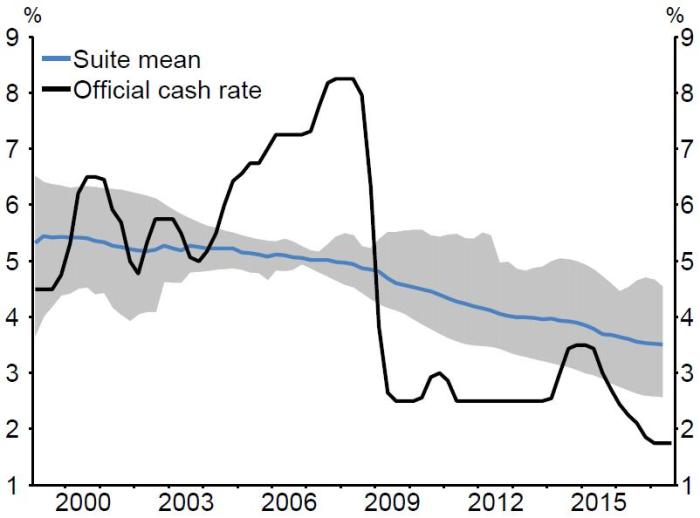
Sometimes I even worry about basic levels of apparent competence.   McDermott includes this chart in his speech

Figure 1: Nominal Neutral OCR and Actual OCR

figure1

Source: RBNZ estimates


This is their current estimate of how the neutral OCR has tracked over the history of the series (the OCR was only introduced in 1999).    They have a suite of tools and models that produce a range of estimates –  the grey band –  and the blue line is the mean of those estimates.    In the text, McDermott says the Bank is now using 3.5 per cent as the neutral OCR in their modelling and forecasting, which is about where the blue line is at present.

There is some economic discussion around the chart

Over time, the neutral interest rate has been slowly falling; a trend that has been seen in many countries around the world. Economic theory tells us that changes in neutral real interest rates reflect changes in real economic factors such as population growth, productivity growth, preferences for savings, and world conditions. A combination of these factors appears to have been contributing to the fall in neutral, both in New Zealand and abroad.

Which all sounds fine, and sounds consistent.   But then you remember that the neutral interest rate the Reserve Bank is using is the OCR, and the OCR is an interest rate that isn’t paid by any borrower, or received  by any saver, in the wider economy.    For those one has to look at data on, say, term deposit rates or floating mortgage rates.

Start with the chart above.   The Bank says its estimate of the neutral OCR is now 3.5 per cent.  But go back a decade –  July 2007 was just before the financial crisis stresses really started to infest funding markets globally –  and the blue line looks as though it would be almost bang on 5 per cent.    If I recall rightly, at the time we thought the neutral OCR was much higher than that –  perhaps as high as 6.5 per cent –  but as things stand now the Reserve Bank is telling us it thinks the neutral OCR has fallen by 1.5 percentage points over the last decade.

That might sound like a lot.   In fact, it is nothing at all.  Here’s why.  In July 2007, the OCR was 8.25 per cent.   At the same time, the Reserve Bank’s measure of six month term deposit rates was 7.98 per cent, and the Bank’s measure of new floating first mortgage rates was 10.35 per cent.  Term deposit rates were 27 basis points below the OCR, and first mortgage rates were 210 basis points above the OCR.

Right now, the OCR is 1.75 per cent and has been all year.  Last month (latest data), the term deposit rate indicator was 3.31 per cent (156 basis points above the OCR) and the indicative new first mortgage rate was 5.84 per cent (409 basis points above the OCR).

In other words, the margins between the rates people are actually paying/receiving and the OCR have blown out enormously –  in fact by around 190 basis points.    Implicitly, the Reserve Bank has revised upwards its estimates of neutral retail interest rates.

Those spreads between the OCR and retail rates can and do move around, so I’m not suggesting you focus on the difference between the 150 point cut in the neutral OCR, and the 190 point increase in spreads between the OCR and retail rates.   The real point is that, despite the fine words in the chief economist’s speech about reasons why neutral interest rates here and abroad have probably fallen –  perhaps quite considerably –  the Reserve Bank has made practically no adjustment of substance at all.  As they’ve always said, it is retail interest rates –  not the OCR –  that affects spending and investment choices.

I can’t believe McDermott doesn’t know all this –  we used to have charts presented with each set of forecasts illustrating how the spreads had changed since before the crisis –  but if that is right, what is the explanation for how the speech is written?    And is this the sort of presentation that has the Governor still asserting that monetary policy is highly stimulatory, even as inflation continues to track “broadly sideways”?

In a way, these things shouldn’t matter.  A prudent central bank would simply treat current interest rates as a starting point, and look for actual data –  new developments –  suggesting a case for change.  But at our central bank it does seem to matter to some extent, because we have key policymakers out asserting that they “know” what the equlibrium values are, and can/should use them to make monetary policy.   What say instead the Reserve Bank had assumed a 150 basis point fall in neutral mortgage rate?  That would translate to a neutral OCR of around 2 per cent at present.  It seems at least as plausible as the Bank’s own number –  with inflation persistently below target, an output gap they think is near zero, and unemployment persistently above the NAIRU.  Then presumably we would be hearing quite different rhetoric from the Governor about just how stimulatory, or otherwise, monetary policy is.

Changing tack, the other thing that is striking about the speech is the reminder of just how little focus the Reserve Bank puts on the labour market.   Labour is by far the biggest input to the economy, and also the market in which the rigidities and slow price adjustments –  a key concern for monetary policy – are most prevalent.  And yet it hardly rates a mention in McDermott’s speech.   Many other central banks –  and forecasters –  find the concept of the NAIRU (the non-accelerating inflation rate of unemployment), and the gap between actual unemployment and the NAIRU, as a useful (even central) part of their forecasting and analysis framework.  That is partly because the unemployment itself is a directly observed and, in principle, is a direct measure of excess capacity (more so, certainly, than the output gap).   But it is also because policy is supposed to be about people, and ability of people to get a job when they want a job is one of the key markers of a successfully functioning economy.   We have active discretionary monetary policy because the judgement has been made that without it the inevitable shocks that hit the economy would leave countries too prone to prolonged periods of unnecessary unemployment (Greece is the extreme contemporaneous example).   Voters don’t greatly care about unemployed machines, but they do care about unemployed people.

Contrast the Reserve Bank of New Zealand’s approach to that of the Reserve Bank of Australia –  with a very similar inflation target.   Yesterday, the RBA Governor was out with a thoughtful nuanced speech on labour market issues, in which he observed that “the unemployment rate is still around 1/2 a percentage point above estimates of full employment in Australia”.   He referenced a clear and useful recent Bulletin article on “Estimating the NAIRU and the unemployment gap”  which opens with this clear and simple statement

Labour underutilisation is an important consideration for monetary policy. Spare capacity in the labour market affects wage growth and thus inflation (Graph 1). Reducing it is also an end in itself, given the Bank’s legislated mandate to pursue full employment. The NAIRU – or non-accelerating inflation rate of unemployment – is a benchmark for assessing the degree of spare capacity and inflationary pressures in the labour market. When the observed unemployment rate is below the NAIRU, conditions in the labour market are tight and there will be upward pressure on wage growth and inflation. When the observed unemployment rate is above the NAIRU, there is spare capacity in the labour market and downward pressure on wage growth and inflation. The difference between the unemployment rate and the NAIRU – or the ‘unemployment gap’ – is therefore an important input into the forecasts for wage growth and inflation.

You’ll see nothing of the sort from the Reserve Bank of New Zealand.      It is as if they fear that somehow talking about ordinary people, and the overall balance in the labour market, will somehow be betraying their mission.    But their mission is about people’s lives, jobs, and opportunitites.

I’m not suggesting that at present the RBA is running policy any better than the RBNZ is –  in both countries there looks to me a case for thinking about possible further rate cuts –  but the RBA certainly communicates much better, and in a way that suggests both a grounded story about what is happening in Australia and the world, and an identification with the interests of ordinary Australians.

That is part of the reason why, somewhat reluctantly, I’ve come to the view that the Labour Party is right to campaign on amending the Reserve Bank Act to add a focus on unemployment to the goals of monetary policy.   It should be implicit in the current way the Act is currently written, but in practice it seems to have become something the Bank is uncomfortable with, rather than something central to their reason for being.  Phil Lowe and Janet Yellen  –  or their respective decisionmaking boards –  aren’t some rampant wet inflationistas, and yet they manage to talk openly and sensibly about these issues, and find it a useful framework for analysis and communication, in a way that seems beyond our Reserve Bank.    We’ve got to the point where far-reaching is needed at the Bank –  in its legislation, its ethos, and in its senior people.

I’ve always been a bit hesitant about suggestions that the Reserve Bank operates primarily in the interests of one group of New Zealanders over another –  that hesitancy shouldn’t be surprise; after all, I sat round the monetary policy decisionmaking table for a couple of decades and we all want to believe that we serve the public interest.  But, with the benefit of a bit more detachment, I increasingly worry that the Bank –  unconsciously rather than deliberately – reflects more the perspectives and interests of what the Australians talk of as “the big end of town”, than of ordinary New Zealanders.

There are just a couple of illustration of what bothers me.  After each MPS the Reserve Bank runs (or at least did when I was there) a series of presentations around the country to explain its thinking.  In some ways they worked quite well –  we spread out across the country (usually the three main centres plus one provincial centre a quarter) the morning after the MPS.  I enjoyed participating.   But all these functions were hosted by the banks, and the invited attendees were the banks’ business, corporate and financial customers –  in smaller provincial areas, they were often hosted in a bank’s business customer lounge.   Never once did we do those talks to union-organised gatherings of interested employees, to church or community groups, to students, to meetings of beneficiaries or the like.  Don’t get me wrong –  the Bank does, or did, accept some invitations in the course of the year to talk to other groups, but the big events are about corporate audiences.

It struck me again yesterday when I picked up John McDermott’s speech. It was delivered to HiFX (presumably staff and invited clients), a “a UK-based foreign exchange broker and payments provider that has been owned by Euronet Worldwide since 2014”.  Out of interest, I looked back through the other on-the-record speeches McDermott has done during Graeme Wheeler’s term of office.  They were to audiences at:

  • Federated Farmers
  • FINSIA (a financial sector training group)
  • NZICA CFOs and Financial Controllers
  • Goldman Sachs Australia
  • Macroeconomic Policy Meetings, Melbourne
  • Bay of Plenty Employers and Manufacturers
  • Wellington Chamber of Commerce
  • Waikato Chamber of Commerce/Institute of Directors

Each a perfectly worthy audience in its own right no doubt.  But there is something of a pattern –  it is an employers and financial sector focus, rather than (m)any groups broadly representative of the citizenry.    When the people you talk to are mostly rather comfortable, it must to an extent influence the way in which you as an organisation end up thinking.    Few if any of those audiences would be much bothered if the unemployment rate had been above the NAIRU for, say, eight years and counting.

McDermott told us about how he was looking at “the stars”.  In fact he knows almost nothing particularly useful about them –  and if there is a criticism it isn’t that he doesn’t know the unknowable, but that he keeps asserting against all the evidence that he can.  Perhaps he and his colleagues would be better off keeping a cold hard eye on the ground, on the things we know rather better –  a (core) inflation rate still well below target, wage inflation still very subdued, and an unemployment rate still persistently high.   And talk to us in language that suggests a care about the interests of ordinary New Zealanders.


Tightening conditions impede inflation getting back to target

Five years ago, the then incoming Governor, Graeme Wheeler, signed a Policy Targets Agreement with the then Minister of Finance.  In that document, he committed to run monetary policy with a

focus on keeping future average inflation near the 2 per cent target midpoint.

Earlier this week the CPI  was published.  It was the last such release that will appear while the Governor is still in office.

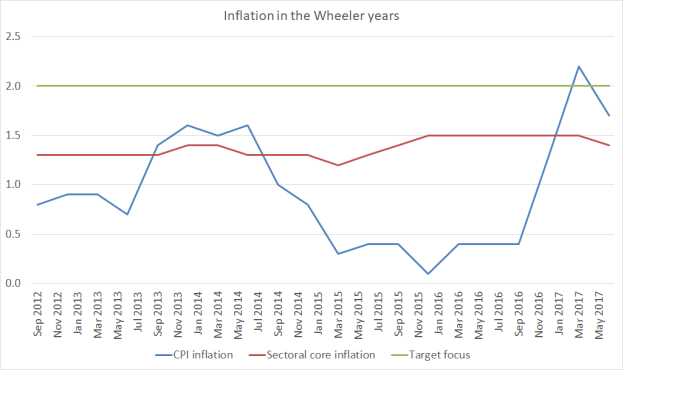
On a chart showing the 2 per cent focal point the Governor willingly committed himself and the Bank to, here are (a) the actual CPI inflation rates and (b) the Governor’s preferred measure of core inflation (the sectoral factor model measure) for the last five years.

Wheeler inflation 17

Not once in five years has core inflation (on this measure) even come close to 2 per cent.  In only a single quarter –  one of 20 – did headline CPI inflation get to 2 per cent.

Of course, the Governor can’t really be held to account for inflation outcomes in the first year or so of his term –  those outcomes were determined by choices made by Alan Bollard.  And for the next year or so, it will be Graeme Wheeler’s policy choices that have the biggest policy influence.  Nonetheless, to be so consistently far away from the newly-adopted target isn’t a great legacy.  Perhaps (but probably not) the Bank’s Board will reflect on those outcomes in their forthcoming Annual Report?

The sectoral factor model is only one measure of core inflation, albeit the most stable of them (and so the dip down in the latest release should be a bit disconcerting).  Here is the table I’ve run previously, of six measures of core inflation.

Core inflation: year to June 2017
CPI ex petrol 1.7
Trimmed mean 1.8
Weighted median 2.0
Factor model 1.7
Sectoral factor model 1.4
CPI ex food and energy 1.6
Median 1.70

The poor track record on inflation might have been more tolerable if:

  • productivity growth was really strong, driving down costs and prices.  But it hasn’t been.  In fact, there has been no labour productivity growth at all in the Wheeler years (not the Bank’s fault), or
  • if the unemployment rate was exceptionally low.   But it hasn’t been.   The current unemployment rate (4.9 per cent) is still materially above most estimates of the NAIRU, and well above pre-recessionary levels.  For what it is worth, it is also now above the unemployment rates in a couple of Anglo countries with pretty flexible labour markets (the US and the UK), which had to grapple with having reached the limits of conventional monetary policy during the post-recessionary years.
  • core inflation was still rising now (mistakes happen, but fixing them promptly makes up for quite a lot).  But, for example, the sectoral core measure is back to the same level it was in September 2015, when the Bank was just beginning to unwind its ill-judged 2014 tightenings.

Mostly, monetary policy in the Wheeler years hasn’t been well run.    When Graeme Wheeler took office core inflation had fallen quite a bit over the previous year.  A sensible response would have been to have cut the OCR.   The OCR increases in 2014 were never necessary (I choose the word advisedly –  there was plenty of time to wait and see if core inflation was in fact just about to pick up strongly).  Those increases were then unwound only rather grudgingly.

Of course, in fairness to the Bank, it did rather less badly for most of the period than most of the market economists whose views are covered in the local media.    For most of the time, most (almost all) of them were forecasting higher inflation, and a higher OCR, than the Reserve Bank was delivering.   But it isn’t much consolation, since (a) the Reserve Bank has far more analytical resources at its disposal than the private banks, and (b) the Reserve Bank is paid to conduct monetary policy, and market economists aren’t.

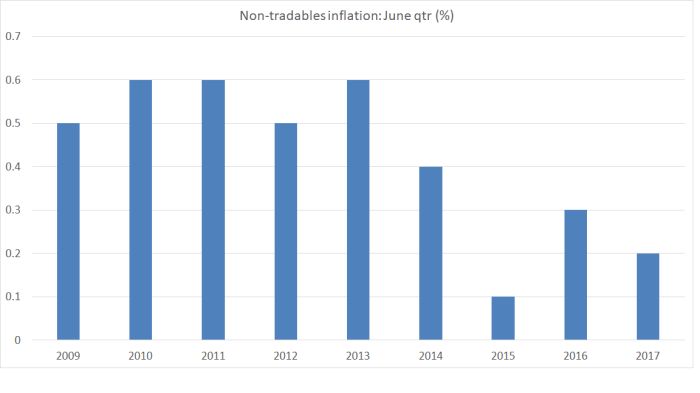
We’ll see next month what the Reserve Bank makes of the latest inflation outcomes.   But the data must be quite disconcerting.     There are some specific pockets of inflationary pressure –  building costs notably (and not that surprisingly, given the population pressures).   But here is non-tradables inflation (quarterly) for the June quarters of the last nine years.  Non-tradables inflation is what the Reserve Bank has most influence over in the medium-term.

NT june quarters

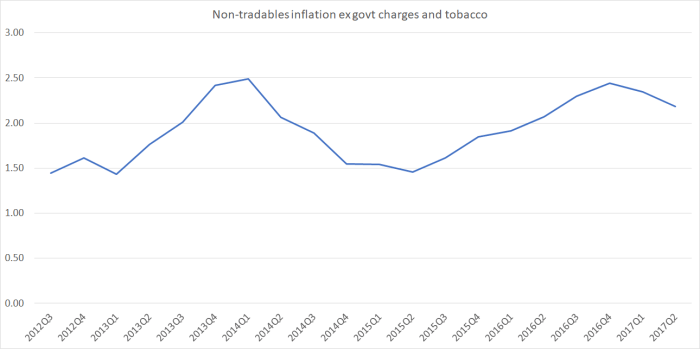
Only in 2015 was June quarter non-tradables inflation lower than it has been this year. Annual non-tradables inflation has dipped slightly to 2.4 per cent.  That might not seem too bad –  after all the target midpoint is 2 per cent – but as even the typically-hawkish BNZ noted in their commentary the other day one would really expect non-tradables inflation to be quite a lot higher to be consistent with delivering overall CPI inflation near the target midpoint.    A simple approach to a core non-tradables inflation rate is the SNZ series that excludes government charges and the cigarettes and tobacco subgroup (where taxes are being raised substantially each year).

NT ex jun 17

An annual inflation rate in this series nearer 3 per cent would be more consistent with core CPI inflation settling around 2 per cent.  At present, it is nowhere near 3 per cent, and moving in the wrong direction.

So why is inflation still (a) quite a way from target, and (b) looking to be falling again?  Broadly speaking, I reckon the answer is about (a) an economy that continues to run below capacity, and (b) tightening monetary and financial conditions.   The Reserve Bank’s latest published estimate was that the output gap is around zero (roughly, a fully-employed economy).   I noticed one local bank published an estimate the other day suggesting they thought the output gap was more like +1 per cent of GDP.     With the unemployment hovering around 5 per cent –  and best estimates of the NAIRU somewhere around 4 per cent, and demographic reasons to think the NAIRU might be falling, that simply seems unlikely.  It is much more likely there is still some excess capacity in the system, and demand growth simply hasn’t been strong enough.     The job of monetary policy is to manage interest rates in ways that deliver enough demand to keep inflation near target.

The current state of excess capacity is a long-running difference of opinion.  But what isn’t really in much doubt is that monetary and financial conditions have been tightening quite substantially in the last few quarters.

The OCR was cut to the current level of 1.75 per cent last November.   We might have expected inflation to pick up a little further since.    But retail interest rates have been rising:

  • the Bank’s measure of SME overdraft rates troughed in January 2017, and had risen by 19 basis points by June,
  • the Bank’s measure of floating mortgage rates for new borrowers troughed in October 2016, and has risen 25 basis points since then,
  • the Bank’s six month term deposit rate measure troughed in July last year and has risen 15 basis points since then,
  • one and two year fixed mortgage interest rates are also up by around 20 basis points

These aren’t large moves, but with inflation having been consistently below target (and the Bank having been repeatedly surprised) there was no good reason for the Reserve Bank to have accommodated such tightenings.

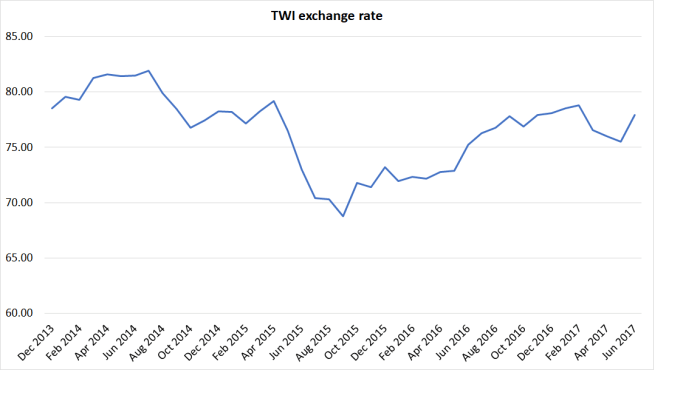
It isn’t just retail interest rates.   Here is the trade-weighted exchange rate measure

TWI july 17

The exchange rate fell quite a long way in 2015, as dairy prices fell, and the Reserve Bank began cutting the OCR.  At the time, the Governor spun tales about how this would help get inflation back to 2 per cent.  Exchange rates are somewhat variable, but broadly speaking the trend has been upwards since then.    Yes, dairy prices and the terms of trade have improved, but it all adds up to another tightening of monetary conditions when inflation has been persistently below target.

And, of course, credit conditions have also tightened.  Some of that is the Reserve Bank’s own doing –  last year’s latest iteration of the LVR controls –  but much of it isn’t: it is lenders reassessing their own willingness to lend.  We don’t have good statistical indicators of credit conditions, but there is little doubt they’ve been tightening.

It all adds up to a picture in which shouldn’t really be very surprising at all: inflation isn’t rising and may well have begun falling again.  Of course, some surprises reinforce the more systematic elements.  Weaker oil prices (for example) probably will spill over to some extent into core measures of inflation.  And unlike the situation in 2010 and 2014, this isn’t a case where the Reserve Bank has gone out actively seeking to tighten monetary conditions –  indeed, the Governor has been commendably moderate, especially relative to most local market commentators.  But it does look a lot like another case where the Bank (and the Governor personally, as single legal decisionmaker) has been too invested in a story that the economy was strong, inflation was picking up, and would continue to pick up, that it missed the way in which monetary conditions were tightening, and continued to largely (and deliberately) ignore the signals coming from the labour market.  Instead of repeatedly talking –  as the Governor does –  about how accommodative (or even “highly accommodative”) monetary policy is, the Bank would be much better advised to treat the low level of interest rates as normal, for the time being (it has after all been more than 8 years now since they were sustainably higher), and put much more weight on seeing hard evidence that (a) inflation is settling back at around 2 per cent, and (b) unemployment is nearer credible estimates of the NAIRU, before acquiescing in any material tightening in monetary conditions.   After getting it so wrong for so long, they should be willing to run the risk of core inflation heading a bit above 2 per cent for a time –  after so many years of undershoots, no one is suddenly going to think the Bank is soft on inflation if core inflation is 2.2 or 2.3 per cent for a couple of years.

Looser monetary conditions now would, most likely, be more consistent with the Bank’s mandate.  I’m not sure it is good form for the Governor to take the market by surprise with a cut from the blue as he heads out the door. But the case for establishing an easing bias in next month’s Monetary Policy Statement is beginning to strengthen.    Hawks will, of course, cite the various business and consumer confidence measures.  None is any stronger now than they’ve been over the last couple of years, and over that period inflation simply failed to pick up anything like enough to get back to target.   Expecting something different now, when the background conditions haven’t changed, is either just wishful thinking, or something worse –  including an inexcusable indifference to the lingering high number of people unemployed.


Monetary policy: towards the next recession

Tomorrow Graeme Wheeler will announce his second-to-last OCR decision.  Assuming, as everyone seems to expect, that the Governor largely restates the policy stance he adopted six weeks ago, I expect to agree with him.  Within the huge, and inevitable, bounds of uncertainty, the current OCR seems plausibly consistent with core inflation getting back to around 2 per cent, and there is no strong impetus that should be pushing the Reserve Bank to either raise or lower the OCR any time soon.

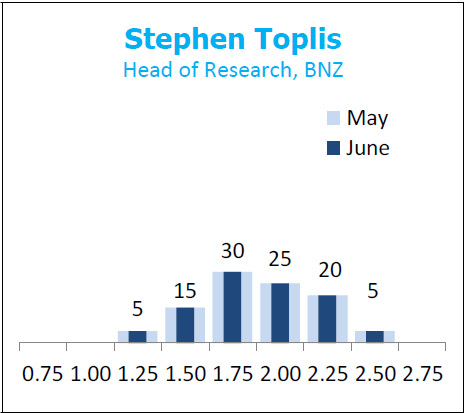
If anything, one could probably more readily argue for another cut, rather than any increase, just because core inflation has remained so low for so long and it has proved harder to get it back up than most had expected.  The unemployment rate – an indicator that the Labour Party is rightly calling for the Bank to give more weight to – points in the same direction.   In that respect, I disagree with the collective view of the NZIER’s Shadow Board, who have a clear upward bias.  As an aside, it is interesting  to note that the BNZ’s chief economist, Stephen Toplis, shares the upside bias, but is the only one of the panel to put a substantial weight on the possibility that further cuts might prove, as things stand, to be appropriate.   Here is the probability distribution (percentages) of his recommendations.

toplis shadow board

But in this post, I really wanted to focus on some longer-term issues where I think there is rather more serious reason to doubt that the Governor is adequately discharging the responsibilities of his office and reason to worry that, in fact, some of his duties have been neglected.     And these aren’t just issues about economic forecasting, something that no one is very good at, and where anyone who pretends otherwise is a fool.

My concern is the next recession.   No one knows when it will be, but it has been seven or eight years since the last one ended.    People will chip in to point out that there is nothing inevitable about another recession just because a few years have passed since the last one, and no doubt that is true.  Nonetheless, downturns and recessions do happen, and discretionary monetary policy exists mostly to help cope with them.  (And to anyone who wants to argue that Australia hasn’t had a recession for 26 years, the simple response is (a) check out the fluctuations in the unemployment rate, and (b) check out the fluctuations in the RBA’s policy cash rate.)

Perhaps others will want to point out that the Reserve Bank still seems to think that the neutral interest rate is perhaps 200 basis points higher than the current OCR.   Perhaps they are right, and perhaps not.    But even if, in some sense, they are right, it will be no comfort –  and provide no buffer – if the next recession were to occur in the next couple of years (and if you think that unlikely –  as probably I do too –  recall that the track record of forecasting recessions, globally or domestically, is even worse than the usual economists’ dismal record of macro forecasting).

If anything, of course, these issues are even more pressing in most other advanced countries.  The only upside to having, on average over very long periods of time, the highest interest rates in the advanced world is that the practical lower bound on nominal interest rates is a bit further away here.    But it is quite close enough.  In New Zealand recessions, cuts in short-term interest rates of 500 basis points or more haven’t been exceptional.  After the last recession, the OCR has been cut by a total of 650 basis points, and (core) inflation still hasn’t got back to target.   So when you are starting with an OCR of around 1.75 per cent, and the practical lower bound on nominal interest rates is probably around -0.75 per cent, the leeway that is left is much less than one would typically like.      People can put on brave faces and pretend otherwise, or simply try to ignore the issue (the latter seems mostly the New Zealand approach), but burying your head under the pillow doesn’t make the problem go away.

And it is not as if this is some flaky Reddellian issue that no one else in the world cares about.    In Canada, for example, there is formal process for reviewing their inflation target every five years.   At the last review, they left the target unchanged, but only after doing a huge amount of work looking at some of the alternatives.   That work was openly foreshadowed (eg in a speech here ), and a great deal of it was published, and is available here.

Over recent years, two former IMF chief economists –  Ken Rogoff and Olivier Blanchard –  have called for inflation targets to be raised to provide additional scope for discretionary monetary policy in the next downturn. [UPDATE: I had meant to include this link to a recent post from Simon Wren-Lewis, an Oxford professor of macroeconomics, which also touches on the fiscal options.]

In the US context, I linked a couple of weeks ago to a speech by John  Williams, head of the San Francisco Fed, openly exploring whether the Fed should move away from inflation targeting to price-level targeting, again with a view to increasing resilience in the next downturn.    As I observed then

I’m not persuaded by Williams’ case, but what struck me is how open the system is when such a senior figure can openly make such a case.  The markets didn’t melt down. The political system didn’t grind to a halt.  Rather an able senior official made his case, and people individually assessed the argument on its merits.

And then a couple of weeks ago there was an open letter to the Board of Governors of  the Federal Reserve from 22 economists calling for serious consideration to be given to an increase in the inflation target, and specifically that

the Fed should appoint a diverse and representative blue ribbon commission with expertise, integrity, and transparency to evaluate and expeditiously recommend a path forward on these questions.

As they noted, other senior Fed people had openly acknowledged the importance of the issues.

And was the letter  –  mostly from a group of fairly left-leaning economists, but including one former FOMC member, and one former member of the Bank of England’s Monetary Policy Committee –  just ignored?   Time will tell, but Janet Yellen was asked about it at her press conference.  Her response?

Ms Yellen stressed in her news conference last week that there were both costs and benefits to a higher inflation target, but she added that the Fed would be reconsidering the issue in the future. “We very much look forward to seeing research by economists that will help inform our future decisions on this.”

There are pros and cons to making changes, whether simply to raise the inflation target, or to look at options such as levels targets for the price level, nominal GDP, or wages.    Personally, I would prefer that central banks (and finance ministries) focused on options that eased or removed the effective lower bound on nominal interest rates  (issues on which, again, very able people internationally have written).   As I noted in an earlier post on these issues

At the extreme, central bank physical currency could be withdrawn and completely replaced with electronic central bank liabilities, on which (say) negative interest rates could be paid.  But that would take legislation and considerable organisation, and would be an unnecessary over-reaction, while there is still a considerable revealed demand to transact (in the mainstream economy) in cash.  Better options might be to, say, cap the total issuance of Reserve Bank physical currency and allow an auction mechanism to set a variable exchange rate between physical and electronic Reserve Bank liabilities.  Banks themselves could be allowed to issue currency again –  on whatever terms they chose.  Or the Reserve Bank could simply put in place an administered premium price on access to new physical currency (eg a 2 per cent lump sum fee would be likely to introduce considerable additional conventional monetary policy leeway).  Each of these possibilities has potential pitfalls and possible legal issues.

But now is the time to be doing the research and analysis.  Now is the time to be working through the technical obstacles and logistical constraints.  And now is the time to be (a) canvassing the issues in public, and drawing on the perspectives of outside experts as well as public servants, (b) to be making the informed decisions as to whether (reluctantly) inflation targets need to be raised, and (c) to be able to lay out in public a confident articulation of how the authorities envisage that they would handle the next significant recession, given the evident limitations at present.

Why does it matter now?     There are at least two reasons.  The first is that if a higher inflation target is part of the answer, now is the time to do it.  It can’t meaningfully or usefully be done in the middle of the next recession, because by then there will very serious doubts that the authorities can get inflation up to even the current target rate.  And the second reason is because when the next recession is upon us (whenever it is) commentators will very quickly realise the limitations of conventional monetary policy.  We’ve been used to a world in which central banks could act decisively to lean against recessions – not prevent them, but limit the damage that is done, and prompt a rebound.   If people realise that is no longer possible to anything like the usual extent, they will –  entirely rational –  adjust their expectations in light of that knowledge.   Expectations quickly become reality in that sort of climate, deepening (perhaps quite materially) the recession.     It would be almost inexcusable to simply let that happen –  with all the real adverse consequences on individuals and families from unemployment –  when there has been years to prepare against the possibility.

The third consideration is a bureaucratic one.  There will be a new Policy Targets Agreement negotiated before the new Governor takes office next March.  In the normal cycle of our law, that is the time to make any significant changes in the regime.    And now is time to be doing the work on these issues, and canvassing them in public.  There aren’t automatically obvious right answers to these questions, and answering them –  what are the best guidelines to govern macroeconomic management – isn’t just a matter where those inside the bureaucracy are blessed with a monopoly on wisdom.      (It is an  unusual and undesirable feature of our law that the Policy Targets Agreement is formulated before the Governor takes office –  when he or she may have little specific expertise, and little access to staff (or outside) advice –  but that is just one of the many aspects of the Reserve Bank Act that is overdue for reform.)

There are at least two countervailing arguments that I want to address briefly.     The first is one that I take some comfort from myself.    Foreign trade is more important to the New Zealand economy than it is, say, to the United States.    Should our OCR ever have to be cut to the effective lower limit (even if it was then no lower than those of most other advanced countries) it seems highly likely that our exchange rate would fall very substantially.    We’ve seen that in the past when the gap between our interest rates and those abroad has closed (most obviously in 2000).  That would make some material difference in buffering our economy.  Against that, however, it is important to recall that in each past New Zealand recession the exchange rate has also fallen a long way.  We seem to have needed both large interest rate cuts and large falls in the exchange rate.

The second countervailing argument is the potential role of fiscal policy.    But although New Zealand’s government debt position isn’t bad:

  • it is not as good as it was going into the last recession,
  • since then we’ve been reminded repeatedly of the potential fiscal pressures from natural disasters,
  • there is no coordination framework between fiscal and monetary policy and the Reserve Bank (rightly) has no control over the use of fiscal policy,
  • it isn’t clear that in any of the countries that actively used fiscal policy in the last severe recession it was done on a scale that was enough to make a decisive difference,
  • while politicians in other countries were often willing to actively use fiscal policy to boost demand for a year (or perhaps two), the imperatives –  political, economic or market –  for tightening up again seemed to take hold pretty quickly,
  • fiscal policy is simply less well-suited to the cyclical stabilisation role than monetary policy.

But if fiscal policy is to be a big part of New Zealand’s answer to the limitations on monetary policy in the next recession, again the issues need to be openly canvassed and debated now.

These are issues that should be worrying the Reserve Bank, the Treasury, and the Minister of Finance.  But there is not a hint of such concern in any of their publications or public statements.  This isn’t one of those issues –  is a bank on the brink of failure eg –  where secrecy is required.  If anything, it is one that would benefit (perhaps greatly) from open discussion, and a sharing of perspectives, research insights, and other analysis.

Each year the Reserve Bank (for example) is required to publish a Statement of Intent.  In many ways it is a bureaucratic hoop-jumping exercise, but it does require the Governor to set out the Bank’s priorites and areas of focus for the coming three years.  I’ve written here previously about how these issues –  really important medium-term considerations –  have had no mention in past Statements of Intent.   There will be a new SOI out in the next week or so –  they have to publish before 1 July.    Of course, at this stage with only three months left in office, what the Governor thinks of as the priorities for the next three years may not matter much in practice.  But it will be interesting to see if he has given these “next recession” issues any space in this year’s document.   I hope so, but fear not.

It is a shame that he hasn’t used the opportunity of his last year in office, when he could have acted as an honest broker and champion of opening up issues for his successors, to have openly put these issues on the agenda –  in public and for the Bank’s own research.  To do so would have been fully consistent with his responsibilities under the Act.  It would, almost certainly, have been a more appropriate use of his energies than corralling his senior managers into efforts to censor a market economist who disagrees with him in tones the Governor finds uncomfortable.  Leadership is about looking beyond the trivial, restraining your own irritations, and focusing attention on important issues that may be just beyond the horizon (and the immediate concerns of officials and market economists) right now, but are no less important for that.

One would hope that when the Board is interviewing candidates for the next Governor (recall that applications close in a couple of weeks) these are among the sorts of substantive issues they are conscious of.  But you have to wonder how they would do so.  The Board has no role in the formulation of the Policy Targets Agreement, and among its members there is very little expertise in the sorts of issues that need to be grappled with.  As a group that has collectively defended the status quo, it isn’t obvious that it would be in the personal interests of any applicants to seriously challenge in front of the Board whether things are quite right.  That would be a shame.  (And again, it is reason for reforming the Reserve Bank Act –  both to shift the setting of the policy target away from the appointment of a Governor, and to shift responsibility for appointing a Governor more squarely to the Minister of Finance.)

As a marker of just how untransparent the New Zealand system is, the Reserve Bank proved highly obstructive a couple of years ago when I sought papers relating to the 2012 Policy Targets Agreement.   To the credit of Treasury, while I’ve been typing this post I’ve just received a 90 page release of papers relating to the negotiation of the 2012 PTA.  People shouldn’t be having to dig this stuff out years after the event.    Setting the rules, and institutions, for New Zealand macroeconomic management should be one of those areas where government agencies are open and pro-active, before and after decisions are made.


Some puzzles about the Monetary Policy Statement

After the last OCR review I noted that if I was going to go on agreeing with the Governor, there might not be much point in writing about the OCR decisions.  I agree with him again today.

Writing earlier in the week about what the Bank should do I concluded

So where does it all leave me?  Mostly content that an OCR around 1.75 per cent now is broadly consistent with core inflation not falling further, and perhaps continuing to settle back where it should be –  around 2 per cent.   Of course, there is a huge range of imponderables, domestic and foreign, so no one should be very confident of anything much beyond that.

And I was pleased to see how much emphasis the Governor placed today on the inevitable uncertainties around the (any) forecasts and projections.   Trying to project where the OCR might appropriately be a year or two from now is mostly a mug’s game.  Getting the current decision roughly right is towards the limit of what the Bank can actually usefully do.  I think they have today, although only time will tell.

I also liked the continuing emphasis on how low core inflation is globally.  This is my chart making that point, taking the median of the core inflation rates of the places in the OECD with their own monetary policy (so that the euro-area counts as one observation, and individual euro-area countries don’t count at all).

OECD core inflation

But there were some puzzles and some unsatisfactory aspects in both the statement itself and in the press conference the Governor and his chief economist just hosted.

First, it is quite remarkable that there is no mention at all in the document of the forthcoming hiatus.  After 25 September, we’ll only have an acting Governor for six months (itself a questionably lawful appointment), and we won’t have a permanent Governor until next March.   The Policy Targets Agreement expires with the Governor, and there won’t be a formal Policy Targets Agreement in place during the interregnum.   The Reserve Bank Act requires that the Monetary Policy Statement address how the Bank will conduct monetary policy over the following five years.  Given that we also have an election approaching in which most of the opposition parties are promising some changes to monetary policy, there is more than usual uncertainty about the path ahead –  the people and the law/PTA to which they will be working.    It isn’t the Bank’s place to take partisan stances, but it would be only reasonable –  in a genuinely transparent organisation, complying with the law –  to touch on these issues, if only briefly.     At a trivial level, the PTA has been reproduced in the MPS for decades, reflecting the central role PTAs have in New Zealand short-term macroeconomic management.  What will be done in the November and February MPSs?   

Rather more importantly, although I agree with the Governor’s current stance, I’m not sure I’d be taking the same view as him about the outlook for monetary policy if I shared his economic forecasts.

Here is my puzzle.   This is the Reserve Bank’s chart of their estimate of the output gap.

output gap may 2017

They now reckon it has been pretty flat around zero for the last two to three years.  I’d be surprised if there has been quite so little excess capacity –  and in fairness, they do explicitly highlight the quite wide range of estimates they have  –  but it is their current central view.   But then look what happens starting now.  They expect quite a material positive output gap to emerge.     And they think that will translate into quite a lift in wage inflation.

wage inflation may 17

Now, it is quite true that they need to see a lift in wage inflation if core inflation, across the economy, is to settle near 2 per cent, the target the Governor has committed to.    But if I really believed that things in the wage-setting markets were likely to turn around that much that quickly, I’m not sure I’d be running with such an “aggressively neutral” (ANZ’s words) stance right now.  Perhaps it doesn’t really matter to the Governor –  the sole decisionmaker –  because he won’t be there?

I’m a bit puzzled as to why they expect such a material increase in capacity, and wage, pressures.   They expect to see real GDP growth accelerate a bit.  Over the 18 months to the middle of next year, they expect quarterly growth to average 0.9 per cent.  By contrast, in the last couple of years, on their preferred production measure, real GDP has grown by only 0.6 per cent a quarter on average.

It isn’t that clear why they expect such an acceleration (which we’ve seen forecast before).  Perhaps it is partly the lagged effect of last year’s fall in the OCR?  But then, as they note, bank lending standards appear to have tightening, and funding margins risen, which will offset some of the effects of the OCR cut.   Dairy prices have certainly increased, which will provide some support to spending.  The exchange rate has come down a bit recently (more so this morning) but the level the Bank assumes –  a TWI above 75 for the next year or so – isn’t much below the average for the last couple of years.

And then there is immigration.    Here are the Bank’s projections.

immigration may 17

They expect the net immigration numbers to start falling over very sharply, starting now.    As the Governor noted, they (and other people) always get their immigration forecasts wrong.   But any significant reduction in immigration –  and this is a halving in the next couple of years –  is a material reduction in both demand and supply for the whole economy.   It is more than a little surprising that the Bank believes we will see both an acceleration in total real GDP growth and a sharp slowdown in net immigration.

The Bank appears to still believe the story that, at least this time round, high net immigration has eased overall capacity pressures.  If they are sticking to that story –  and they appeared to in the press conference –  then perhaps that is why they think we should be expecting a sharp pick-up in wage inflation starting now.    It doesn’t ring true to me –  and it has never been how New Zealand immigration cycles have worked in the past –  but if that is part of their story, something they genuinely believe, then –  as I already noted – I’m a bit surprised by the “aggressively neutral” policy stance.  On my own reading of course, any material slowdown in net immigration (unless it is accompanied by a big Australian economic rebound) will weaken near-term demand more than supply, as it has typically done in the past.

Two other points that came up in the press conference seemed worth commenting on.

Bernard Hickey asked the Governor what the Bank’s definition of full employment was.  The Governor was quite open, if a little tentative, in suggesting something around 4.5 per cent.  That is lower than the actual unemployment rate has been since the first quarter of 2009 –  eight years ago.     But, as Hickey noted, it is still above the Treasury’s published estimate of near 4 per cent.     The actual unemployment rate now still stands at 4.9 per cent.

The Bank’s chief economist and Assistant Governor, John McDermott, then picked up the question.   The gist of his response was that it was a silly question.   At some length he tried to explain how the Bank relies on the output gap for its assessment of overall capacity pressures in the economy.  He went to argue that labour market variables were so slow to respond that if one waited to evidence from them before moving it would almost certainly be “too late”.    Doubling down, he argued that in a New Zealand context it was “almost impossible” to estimate any sort of NAIRU, and that any attempt to do so was just ‘guessing”.

In a way, I wasn’t surprised by these arguments.  He used to run the same lines to me when I worked for him.   But familiarity doesn’t make the arguments any more convincing.  For a start, everyone recognises that inflation targeting is supposed to work by focusing on the forecast outlook, perhaps 12-24 months ahead.  Monetary policy works with a lag.  In principle, waiting to see actual outcomes –  on whatever measures –  will typically mean acting too late.

But, on the one hand, this is the very same central bank which set a new world record this cycle, by twice beginning to increase interest rates (in 2010 and 2014) only to have to quickly reverse themselves.  It is quite a while since they were too late to tighten (and McDermott was the Bank’s chief economist in both instances).

And what of the output gap the Bank wants us to put our faith in?  Here was one of the leading international experts  (and a former practitioner) on inflation targeting, Prof Lars Svensson writing on measures of excess capacity (LSRU is the long-term sustainable rate of unemployment, the bit not influenced by monetary policy)

What does economic analysis say about the output gap as a measure of resource utilization? Estimates of potential output actually have severe problems. Estimates of potential output requires estimates or assumptions not only of the potential labor force but also of potential worked hours, potential total factor productivity, and the potential capital stock. Furthermore, potential output is not stationary but grows over time, whereas the LSRU is stationary and changes slowly. Output data is measured less frequently, is subject to substantial revisions, and has larger measurement errors compared to employment and unemployment data. This makes estimates of potential output not only very uncertain and unreliable but more or less impossible to verify and also possible to manipulate for various purposes, for instance, to give better target achievement and rationalizing a particular policy choice. This problem is clearly larger for potential output than for the LSRU.

He summed it up recently even more succinctly

My experience of practical policymaking made me very suspicious of potential output, essentially an unverifiable black box, and consequently of output gaps. Instead, it made me emphasize the (minimum) long-run sustainable unemployment rate and consequently the unemployment gap.

And it is not even as if McDermott’s point about lagging labour market data has much obvious validity relative to measures of the output gap.  I had a look at the peak of the last (pre 2008) boom.

The unemployment rate troughed in the September and December quarters of 2007.

The output gap –  as estimated today – peaked in the September quarter of 2007.

But that caveat (“as estimated today”) matters hugely.  At the time, there was huge uncertainty about, and significant revisions to, estimates of the level of the output gap.   In the December 2007 MPS, for example, there isn’t a chart of the quarterly estimated output gap.  But the estimate for the average output gap for the year to March 2008 was 0.6 per cent.  At the time, they (we) thought the output gap had peaked in 2005.    The Bank’s current estimate is that the output gap in late 2007 was around 2.5 per cent.    Those aren’t small differences.   And they are pretty inevitable.      By contrast, there has never been any doubt that the labour market was at its tightest in late 2007.

No one is going to disagree that it is hard to estimate a NAIRU –  or Svensson’s LSRU – with hugely great confidence.  But much the same –  typically only more so –  can be said of almost any of the concepts the Bank uses in its modelling, forecasting and policy assessments (eg neutral interest rates, potential output, and equilibrium exchange rate).  And, relative to output gap measures, the unemployment rate is a directly observable measure of excess capacity, easily comprehended and prone to few revisions.   And unemployment is something that citizens care directly about.

In McDermott’s shoes, I’d have said something like “we really don’t know, but we are pretty confident it is lower than the current 4.9 per cent unemployment rate.  Treasury’s estimate of around 4 per cent might not be far from the mark, but we won’t really know until we get nearer.  The fact that the unemployment rate is, with quite a high degree of confidence, above the NAIRU is consistent with wage and price inflation having been pretty subdued for a long time, and is consistent with the Bank’s stance, of keeping interest rates below our estimates of neutral for the time being”.    It wouldn’t have been hard to have run that line.

Perhaps people (eg FEC) might like to ask the Bank why it appears to put so much less weight on direct measures of unemployment than, say, their peers in the United States (or most other central banks) appear to.  None takes a mechanical approach, none assumes the NAIRU never changes, none assumes they know it with certainty.  But they seem to think it matters –  and might matter to citizens and politicians to whom they are responsible –  in a way that simply eludes the Reserve Bank.  It is partly why I’ve come to the conclusion that some form of what the Labour Party is promising –  a more explicit statutory focus on unemployment in the documents governing the Reserve Bank and monetary policy –  is the right way ahead for New Zealand.   Concretely, I’ve suggested that the Bank be required by law to publish periodic answers to Bernard Hickey’s question –  what is full employment, what is the (estimate) NAIRU?

Finally, I was interested in the Governor’s evasiveness when asked about possible statutory changes to the provisions in the Reserve Bank Act that currently make the Governor the sole legal decisionmaker.    It is fine to emphasise that in practice monetary policy decisions have always been made in a collective environment –  whether the Official Cash Rate Advisory Group in the past, or the current mix of the Governing Committee and the Monetary Policy Committee.   But we don’t have rules and laws for good times and when things are working well.   And, as it happens the Bank and Governor haven’t covered themselves with glory in the last seven or eight years.

The Governor simply avoided answering the question of whether the law should be changed, even if only to cement in the collegial practice.  Since (a) the Governor is leaving shortly, and (b) the Minister of Finance has commissioned advice on the issue and Labour (and the Greens) are campaigning for change in this area, it is hardly as if letting us know his views would tread on taboo territory.   Perhaps to do so would have been to acknowledge that in no other central bank does one unelected person –  a person selected other unelected people –  have so much power, not just in monetary policy but in financial regulatory matters.  It is something where change is well overdue.

Challenged as to whether legislative reform in this area might not enhance transparency (eg publication of minutes, or even the airing of alternative views), the Governor fell back on his old claim that the Reserve Bank is one of the most transparent central banks in the world.  That simply isn’t so. It scores well, as I’ve put it previously, when it publishes material on stuff which it knows little or nothing about (the outlook for the next few years, where its guess is as good as mine, and none of the guesses are very good).  But it is highly non-transparent when it comes to the stuff they do know about.  Thus, we don’t see any of the background papers that go into the OCR deliberations (although I did once use the OIA to get them to release 10 year old papers), we see no minutes of the deliberations, no record of the balance of the advice the Governor receives.  And competing views (on the inevitably uncertain outlook, and the right policy stance) are not aired at all.    That is a quite different situation from what prevails in many other advanced country central banks (although of course there is a spectrum, but we are at one end of it).

As another telling example of how untransparent thiings are in New Zealand, I was reading the other day a piece by John Williams, the very able head of the San Francisco Fed, and a member of the FOMC.    In the US system he is a pretty senior guy –  not Janet Yellen, but not just a Reserve Bank chief economist ever.   His widely-distributed article was devoted to advocate a material change in how US monetary policy is done –  abandoning inflation targeting in favour of price-level targeting –  to provide greater policy resilience in the next serious downturn.   I’m not persuaded by Williams’ case, but what struck me is how open the system is when such a senior figure can openly make such a case.  The markets didn’t melt down. The political system didn’t grind to a halt.  Rather an able senior official made his case, and people individually assessed the argument on its merits.

The other bit of the paper that struck me was this

Now that we’ve gotten the monkey of the recession off our backs, we have the luxury of being able to look to the future. This presents us with the opportunity to ask ourselves whether the monetary policy framework and strategy that worked well in the past remains well suited for the road ahead.

Such introspection is healthy and constitutes best practice for any organization. In fact, the Bank of Canada has already shown us the way. Every five years, they conduct a thorough review of whether their policy framework remains most appropriate in a changing world. This is an exercise all central banks should undertake, including the Fed.

I’ve made this point myself previously.  The Bank of Canada is very open about these reviews they conduct.   By contrast, in New Zealand, it is still a struggle to get from the Reserve Bank and Treasury papers relating to the lead-up to the 2012 PTA, and all the (limited) deliberations then took place behind closed doors.   We will have a new PTA early next year, and we know –  from other documents Treasury has released –  that Treasury had some sort of review underway and almost completed before the Minister decided to delay the appointment of a permanent Governor. But given that PTA is the guide to the management of the key instrument in New Zealand short to medium term macro policy, it would be both appropriate, and more truly transparent, for much of the background thinking and research to occur openly.  It is too near the election now, but a jointly hosted conference every five years reviewing the experience with the PTA and looking at alternative options (even if none ends up adopted) would be one feature, in our system, of meaningful transparency.  We have very little of that at present.

(And, sadly, we’ve never seen anything from our Reserve Bank on the possible challenges if the practical limits of conventional monetary policy are exhausted in a future severe downturn).

It will be a challenge for the new government to lift the performance of the Reserve Bank in future.  It would be easier to make a strong start in that direction by legislating first to make the appointment of the Governor a matter for the Minister of Finance (and Cabinet)  –  as it is in most other places –  not something largely in the hands of the unelected faceless Reserve Bank Board (which doesn’t even seem to manage well basic record keeping).

Reflecting on the macro data

The Reserve Bank’s Monetary Policy Statement (Graeme Wheeler’s second to last) will be out on Thursday.  I’m not in the market economists’ game of trying to tell you what the Bank will do and say (although no one expects they will do anything concrete with the OCR this time).  I’m more interested in questions around what they should do.  In time, what they should do, they usually will do.  But sometimes not until they’ve tried the alternatives.

I wrote about last month’s CPI data a few weeks ago, concluding that there had been a welcome, and expected, increase in core inflation (it is what typically happens if inflation is below target and the OCR is cut fairly substantially) but that

With the unemployment rate still above estimates of the NAIRU, and most indicators of inflation suggesting that core is probably (a) still below target, and (b) not picking up very rapidly, it certainly isn’t time for hawkish talk about near-term OCR increases.

Not everyone agrees of course.  I noticed the BNZ’s economic commentary yesterday which opened with this confident assertion

There is no excuse for the cash rate to be just 1.75% in New Zealand.

I don’t think I’m unduly caricaturing their record to say that, for at least the last decade, the BNZ economics team has never seen an OCR increase they didn’t like, even –  or perhaps especially –  those which had to be quickly reversed.  But mindful that in the story of the boy who cried wolf, the wolf eventually did come, I thought it was worth having a look at the latest wave of data.  Last week, we got the full quarterly set of labour market data (HLFS, QES, and LCI), and the Reserve Bank’s quarterly expectations survey.  To cut a long story short, it doesn’t alter my view.

Take the expectations survey first.   The headline story was one in which the two year ahead expectations of the inflation rate (of a sample of moderately informed observers –  including me) rose quite materially, and now stand at 2.17 per cent (up from around 1.65 per cent in each quarter last year).

infl and expecs

This measure of expectations isn’t typically very volatile, but it is typically somewhat responsive to changes in headline CPI inflation.  We’ve just had quite a large change in headline inflation, so some increase in the expectations measure shouldn’t be surprising. It certainly shouldn’t be concerning.  After all, ideally, the Reserve Bank wants people to believe, and act as if they believe, that on average over time CPI inflation will average around 2 per cent –  the mid-point of the target range, and the explicit focus of the current (but about to expire) PTA.

In fact, no one really knows whether this survey measure captures how people actually think and behave in real transactions in the goods, labour and financial markets.   It might be as good a proxy as we have, but (a) we don’t know, and (b) it still might not be good at all.  Glancing at the time series, there is a tendency for falls and rise to be at least partly reversed quite quickly.

But if inflation expectations are really in some sort of 2 to 2.2 per cent range, I’d welcome that.  With repeated increase in tobacco excises –  not some underlying economic process –  there is a reasonable case, in terms of the PTA, that headline inflation should average a little higher than the mid-point, and than “true” core inflation.  Only if inflation expectations were to rise further from here might I start to get a little disquieted.

In trying to make sense of the inflation expectations numbers, one thing I haven’t seen mentioned is the Labour Party’s monetary policy release.   There was a quite a bit of focus last month on their pledge to add some sort of employment objective to the Reserve Bank Act, and concerned expressed in some quarters that that could lead to higher inflation over time.   If it was a factor, you’d presumably have to take the probability of Labour leading a new government (call it a coin toss at present?) and multiply that by the probability that the change in regime (and perhaps the sort of people a new government might appoint) would make a material difference over time.  I have no evidence one way or the other, but it wouldn’t surprise me if there was a small effect of this sort.   (My own two year ahead expectation in the survey was 1.5 per cent –  around the current rate of inflation in the Bank’s preferred sectoral factor model).

Not many commentators seem to pay much attention to the rest of the expectations survey, even though its strength is partly the range of macro questions that are asked (although I’ve suggested some modifications to the Bank in their review of the survey).

Take GDP for example. There is no sign of respondents expecting real growth to accelerate.  Two years out they expect annual real GDP growth of 2.6 per cent – down on the previous quarter, but not far from the average response over the last couple of years.    But the survey also asks for quarterly GDP predictions for the next couple of quarters, and year-ahead predictions.   That enables one to derive an implied six monthly growth rate for the second half of the coming year.  Here is the gap between the expected growth rates for the first six months and the second six months, going back to just prior to the 2008/09 recession.

expec GDP growthAs we headed into the recession there was a lot of expectation of a strong rebound.  Even up to around 2012, respondents expected growth to accelerate.   For the last few years they haven’t expected any acceleration, and now the expect it to slow.  To be specific, respondents expect 1.6 per cent total growth in the first half of this year, slowing to 1.2 per cent in the second half of this year.     We don’t know quite why –  perhaps they expect immigration numbers to slow –  but it doesn’t speak of a sense that things are getting away on the Reserve Bank.   Similarly, two years out respondents expected that the unemployment rate would still be 4.9 per cent.

Perhaps these respondents will be proved wrong –  they often are, forecasting is like that –  but at the moment it doesn’t look like an imminent risk of core inflation rising much further, or to levels that might prove problematic for a flexible inflation targeter focused on medium-term inflation outcomes around 2 per cent.

What of the actual labour market data?   We have some problems at present because of the breaks in various HLFS series that occurred when the revised survey questions were put in place last year.  I’m still staggered they could have made these changes without running the two sets of questions in parallel for perhaps a year, to allow robust adjustments to be made for the discontinuities.   HLFS hours worked measures, employment measures, and probably participation rate measures all seem to have been affected to some extent.   We are pretty safe in saying that the number of people employed in New Zealand did not grow by 5.7 per cent last year (as the HLFS suggests).

What of the simplest headline number, the unemployment rate?   There isn’t much doubt that the unemployment rate has been falling over the last few years.  It is what one should expect after a serious recession, and with the stimulus to demand provided by low interest rates and large migration inflows (given that immigration typically adds more to demand in the short-term than it does to supply, thus tending to lower unemployment and use up spare resources in the whole economy).

But what should be somewhat disconcerting is that the unemployment rate has (a) gone largely nowhere in the last year, and (b) is still well above pre-recession levels (unlike the situation in many other advanced countries with their own monetary policies).   In the prevous boom, the unemployment rate got down to around 4.9 per cent as early as the start of 2003.     The picture isn’t much different if one looks at the broader (not seasonally adjusted) SNZ underutilisation measure.

U and under U

There still appears to be some progress in using up spare capacity in the labour market, but not very much at all.

What about the rate of job growth.  Fortunately, we have two measures: the (currently hard-to-read) HLFS household survey measure of numbers of people employed, and the QES (partial) survey of employers asking how many jobs are filled.   Unsurprisingly, the trend in the two series are usually pretty similar, even if there is a fair bit of quarter to quarter volatility.

employment

Since we know there are problems in the HLFS, and the QES doesn’t look to be doing something odd, perhaps we are safest in assuming that the number of jobs has been growing at an annual rate of around 2.5 to 3 per cent.   That isn’t bad at all. But SNZ also estimates that the working age population has been growing at around 2.7 per cent per annum.  No wonder the unemployment rate is only inching down.

One can do a similar picture for the annual growth rates in the two (HLFS and QES) hours worked series.

hours qes and hlfs

It was pretty clear that there was around a 2 per cent lift in HLFS hours worked from last June, just on account of the new survey questions.  It seems safer to assume that total hours worked across the economy might have grown by around 3 per cent in the last year.   That is faster than the growth in the working age population, pointing to some increase in effective utilisation, but not a dramatic one.  For what it is worth, in the latest releases, the two hours measures were both quite weak in the March quarter.

(And remember that nothing in the expectations survey data suggested pressures were likely to intensify from here.)

And what of wages?    There is a variety of measures.  The QES measure is quite volatile –  there are issues of changing composition –  and I don’t put much weight on it.  But for what it is worth, average hourly earnings rose 1.6 per cent in the last year on this measure, around the lowest rate of increase seen for decades.    The Labour Cost Index measures should get more focus (but have some challenges of their own).

lci inflation 2Perhaps there is some sign of a possible pick-up in the analytical unadjusted series (which doesn’t try to correct – inadequately –  for productivity changes) but it is a moderately volatile series, and the most recent rate of increase is still below the peak in the last little apparent pick-up a year or two back.
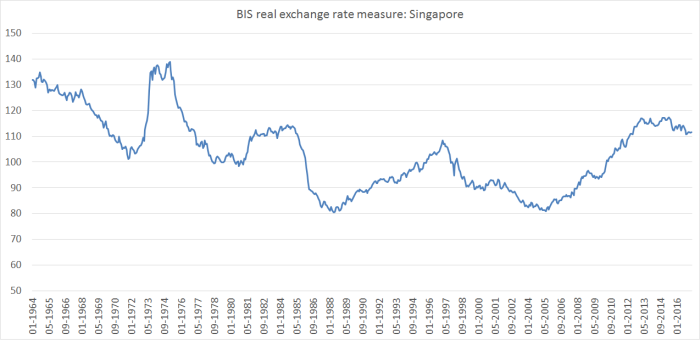
A common response is “ah, but what about the lags?”.  But as we’ve shown, there is little sign of any material tightening occurring in the overall labour market, no sign of expectations that that is about to change, and so little reason to expect much different wage inflation outcomes over the next couple of years from what we’ve seen in the last couple.  At best, there might be some slight pick-up in wage inflation (especially if the increase in inflation expectations is real), but any pick-up is going to be from rates of increase that have, over the last couple of years, been consistent with disconcertingly low rates of core inflation.

So where does it all leave me?  Mostly content that an OCR around 1.75 per cent now is broadly consistent with core inflation not falling further, and perhaps continuing to settle back where it should be –  around 2 per cent.   Of course, there is a huge range of imponderables, domestic and foreign, so no one should be very confident of anything much beyond that.   But it is worth bearing in mind that the unexpectedly strong net migration over the last few years has been a significant source of stimulus to overall domestic demand (including demand for labour).  In the face of typically too-tight monetary policy, it is part of why the unemployment rate finally started gradually coming down again after 2012.

Whatever happens to the cyclical state of the Australian economy, the National government is already putting in place immigration policy changes that should be expected to lead to some reduction in the net inflow of non-citizens, and two of the main opposition parties are campaigning on promises of much sharper reductions than that.   If such policy changes come to pass then, all else equal, the OCR will need to be set lower than otherwise.  It isn’t something that Graeme Wheeler can or should actively factor into this week’s OCR decision, but it may well be something the acting Governor needs to think hard about (if any decisions he makes are in fact lawful) after the election.

Is there a Singaporean idyll?

Winston Peters was interviewed on the weekend TV current affairs shows.  Any sense of specifics on his party’s immigration policy seemed lacking – perhaps apart from something on work rights for foreign students.  But I rather liked his line that while ministers and officials have been telling us for years that we have a highly-skilled immigration policy, all we hear now is all manner of industries employing mostly quite low-skilled people telling us how difficult any cut back in non-citizen immigration would be.

But what really caught my attention was when, in his TVNZ interview, Peters reiterated his view that what New Zealand really needs, in reforming monetary policy and the Reserve Bank, is a Singapore-style system of exchange rate management.    It was also highlighted in his speech on economic policy last week.  It is clear, specific, unmistakeable….and deeply flawed.   It seems to be a response to an intuition that there is something wrong about the New Zealand exchange rate.    In that, he is in good company.   The IMF and OECD have raised concerns over the years.  And so have successive Reserve Bank Governors.   I share the concern, and I devoted an entire paper to the issue at a conference on exchange rate issues that was hosted by the Reserve Bank and Treasury a few years ago, and which was pitched at the level of the intelligent layperson interested in these issues.   Another paper looked at a variety of alternative possible regimes, including (briefly, from p 45) that of Singapore.

What is the Singaporean system?  In addition to the brief summary in the RBNZ paper I linked to in the previous paragraph, there is a good and quite recent summary of the system in a paper published by the BIS written by the Deputy Managing Director of the Monetary Authority of Singapore MAS).

The key feature of the system is the MAS does not set an official interest rate (something like the OCR).  Rather, they set a target path (with bands) for the trade-weighted value of the Singaporean dollar, and intervene directly in the foreign exchange market to manage fluctuations around that path.   There is a degree of ambiguity about the precise parameters, but the system is pretty well understood by market participants.    Interest rates of Singapore dollar instruments are then set in the market, in response to domestic demand and supply forces, and market expectations of the future path of the Singapore dollar.    It has some loose similarities with the sort of approach to monetary policy operations the Reserve Bank of New Zealand adopted for almost 10 years in the late 1980s and early 1990s, and which we finally abandoned in 1997 (actually while Winston Peters was Treasurer).   It is also not dissimilar to the approach –  the crawling peg –  used in New Zealand from 1979 to 1982 (at a time when international capital flows were much more restricted).

There is no particular reason why a country cannot peg its exchange rate, provided it is willing to subordinate all other instruments of macro policy (and short-term outcomes) to the maintenance of the peg.  It is what Denmark does, pegging to the euro.  Singapore’s isn’t a fixed peg, but the macroeconomics around the choice are much the same.

It is a model that can work just fine when the economies whose currencies one is pegging to are very similar to one’s own.  Denmark probably qualifies. In fact, Denmark could usually be thought of as, in effect, having the euro, but without a seat around the decisionmakers’ table.

It doesn’t work well at all when the interest rates you own economy needs are materially higher than those needed in the economies one is pegging too.    Ireland and Spain, in the years up to 2007, are my favourite example.  Both countries probably needed interest rates more like those New Zealand had.  In fact, what they got was the much lower German interest rates.  That had some advantages for some firms.  But the bigger story was a massive asset and credit boom, materially higher inflation than in the core countries, and eventually a very very nasty and costly bust.  Oh, in the process of the boom the real exchange rates of Spain and Ireland rose substantially anyway.    Because although nominal exchange rate choices –  the things that involve central banks –  can affect the real exchange rate in the short-term, the real exchange rate is normally much more heavily influenced by things that central banks have no control over at all.

One can, in part, understand the allure of Singapore. It is, in many respects, one of the most successful economic development stories of the post-war era.   Productivity levels (real GDP per hour worked) are now similar to those of the United States, and places like France, Germany and the Netherlands, and real GDP per capita is higher still.   You might value democracy and freedom of speech (I certainly do), but if Singapore’s achievement is a flawed one, it is still a quite considerable one.  And if Singapore is todaya big lender to the rest of the world, it wasn’t always so. Like New Zealand (or Australia or the US) net foreign capital inflows played a big part for a long time.  As recently as the early 1980s, Singapore was running annual current account deficits of around 10 per cent of GDP.

And the Singaporean model is not one of an absolutely fixed exchange rate.  It is a managed regime (historically, “managed” in all sorts of ways, including direct controls and strong moral suasion).  It produces a fairly high degree of short-term stability in the basket measure of the Singapore dollar.      But it works, to the extent it does, mostly because the SGD interest rates consistent with domestic medium-term price stability in Singapore are typically a bit lower than those in other advanced countries (in turn a reflection of the large current account surpluses Singapore now runs –  national savings rates far outstripping desired domestic investment).  As the Reserve Bank paper I linked to earlier noted

From 1990 to 2011, the average short term Singapore government borrowing rate was 1.8 percent p.a. below returns on the US Treasury bill.

Those are big differences (materially larger than the difference between the two countries’ average inflation rates).  And they mean that Singapore dollar fixed income assets are not particularly attractive to foreign investment funds.  By contrast, New Zealand’s short-term real and nominal interest rates are almost always materially higher than those in other advanced countries.   Partly as a result, even though Singapore’s economy is now materially larger than New Zealand’s, there is less international trade in the Singapore dollar than in the New Zealand dollar.

Winston Peters has talked about wanting a lower and less volatile exchange rate.  He has given no numbers, but lets do a thought experiment with some illustrative numbers.  The Reserve Bank’s TWI this afternoon is just above 75.  Suppose one thought that was, in some sense, 20 per cent too high, and so wanted to target the TWI in a band centred on 60, allowing fluctuations perhaps 5 per cent either side of the midpoint (so a range of 57 to 63).    What would happen?

The Minister of Finance might instruct the Reserve Bank to stand in the market to cap the exchange rate (TWI) at 63.   If our interest rates didn’t change, the Reserve Bank would be overwhelmed with sellers (of foreign exchange) wanting to buy the cheap New Zealand dollar.  After all, you could now earn New Zealand interest rates –  much higher than those abroad –  with very little downside risk (certainly much less than there is now).  In the jargon, people talk about “cheap entry levels”.   There is no technical obstacle to all this.  The Reserve Bank has a limitless supply of New Zealand dollars, but in exchange would receive a huge pool of foreign exchange reserves (it is quite conceivable that that pool could be several multiples of the size of New Zealand’s GDP, so large are the markets and so small is New Zealand).

Ah, but the Singaporean option doesn’t involve interest rates remaining at current levels.  Rather, they are now set in the market.  And so, presumably, our interest rates would fall, probably very considerably.  In the current environment, they might even go a little negative.   That would deal with the short-term funding cost problem associated with the huge pool of reserves.  But what would happen in New Zealand with (a) a much lower exchange rate, (b) much lower interest rates, and (c) all other characteristics of the economy unchanged?   The answer isn’t that different to what we saw in Spain and Ireland.  Asset prices would soar, credit growth would soar, general goods and services inflation would pick up quite considerably.  Of course, there would be more real business investment and more exports, at least in the short term.  And that would look appealing, but as time went by –  and it wouldn’t take many years –  the real exchange rate would be rising quite quickly and substantially (as domestic inflation exceeded that abroad).  Export firms would be squeezed again.   If anything, the higher domestic inflation would lower domestic real interest rates even more, so the credit and asset boom would continue.  And before too long it would end very badly.

That might sound over-dramatic.  And if the ambition was simply to stabilise the exchange rate around current levels, things probably wouldn’t go too badly for a while.  But Peters has been pretty clear that his aim is a lower exchange rate, not just a less volatile one.

The lesson?  You simply cannot ignore the structural features of the economy that give rise to persistently high real interest rates, and a high real exchange rate.  And those features have nothing whatever to do with the Reserve Bank or monetary policy.    They are about forces, incentives etc that influence the supply of national savings, and the demand for domestic investment (at any given interest rate).   All that ground is covered in my earlier paper linked to above.

Of course, the Singaporeans also increasingly can’t ignore those forces.  Decades ago, global financial markets weren’t that well-integrated, and the Singaporean web of controls was pretty extensive.  For some decades, even as Singaporean productivity growth far-outstripped that of other advanced countries, Singapore’s real exchange rate was not only pretty stable, it was falling.  Here is a chart of the BIS measure of Singapore’s real exchange rate all the way back to 1964.   The current system of exchange rate management didn’t start until about 1980.

Sing RER

It was, in many ways, an extraordinary transfer from Singaporean consumers to Singapore-operating exporters.  The international purchasing power the economic success should have afforded consumers and citizens kept getting pushed into the future.

But even in Singapore, these things don’t last forever.  Look at that last 10 years or so, when the real exchange rate has appreciated by around 35 per cent.   The real value of the SGD is still miles lower than where long-term economic fundamentals suggest they should be –  consistent that, the current surplus is still around 18 per cent of GDP –  but there has been a lot of change in its value over that time.  For many firms even in Singapore that must have been a challenge.  With US interest rates near-zero for much of that time, historically low Singaporean rates will have afforded the authorites fewer degrees of freedom than they had had previously.

(The Singapore authorities impose all sorts of other controls, including their compulsory private savings scheme and increasingly onerous direct controls on private credit.  I’m not going there in this post, partly because it will already be long enough, and partly because what I’ve heard from NZ First is about the exchange rate system in isolation).

Singapore is a (hugely-distorted) economic success story in many respects.  Some mix of the people, the policies and institutions, and the favourable geographical location all helped.   Nonetheless, it some ways it is an odd example for New Zealand First to favour.

For example, Singapore has had an extremely rapid population growth, mostly immigration-fuelled, in recent decades.  Here is a chart of Singapore’s population growth and that of Australia and New Zealand.

sing popn

(On my telling, Singapore has had opportunities, and lots of savings, and thus rapid population growth made sense, enabling more of those opportunities to be captured, even while real interest rates stayed lower than elsewhere –  although not, presumably, as low as they would otherwise have been.)

And Singapore’s economy is pretty volatile.  Sadly, the IMF doesn’t publish output gap estimates for Singapore, but the MAS estimates (in that document I linked to earlier) suggest much more volatility than we see in New Zealand or most other advanced economies.  And here is annual growth in real per capita GDP for New Zealand, Australia and Singapore.

sing real gdp

Hugely more volatile than anything we are accustomed to (and in recent years, interestingly, not even materially higher).

And for all that the MAS likes to emphasise the close connection between the exchange rate and inflation, here are the inflation rates of the three countries.

sing inflation

On average, the differences aren’t that large, but even in the last 15 years or so Singapore’s inflation rate has been more volatile than those of Australia and New Zealand.

It isn’t really clear that Singapore’s system is even serving them that well these days.

But what of exchange rate comparisons?  You might have supposed that Singapore’s exchange rate was a lot less volatile than New Zealand’s.  But here, from the RB website, is the monthly data for the SGD and the NZD, in terms of the USD since 1999.

SGD

And, yes, the New Zealand dollar is more volatile in the short-term, but even there over the last seven years or so the differences are pretty small.   And if hedging isn’t always easy, particularly for firms without large physical assets, it is a lot easier to hedge those sorts of short-term fluctuations than it is the longer-term real exchange rate uncertainty.  (And, of course, given Singapore’s faster productivity growth, you might still be troubled that our exchange rate has more or less kept pace with theirs, but that is a real and structural issues, not one that can be fixed by fiddling with the exchange rate system.)

As it happens, Australia is our largest trade and investment partner.   Here is how our exchange rate, relative to the Australian dollar, compares with the Singapore dollar relative to the US dollar.

SGD and NZDAUD

It is an impressive degree of stability.  Again, in the very short term the New Zealand exchange rate is a bit more volatile, but it isn’t obvious that for longer-term planning purposes New Zealand exporters have had it tougher –  on the volatility front at least –  than those operating from Singapore.

And, as a final chart, this one uses the BIS’s broad real exchange rate indices to illustrate movements in the real exchange rates of Singapore, New Zealand, and (another export-oriented development success story) Korea.

SGD NZD and KRW

Singapore’s real exchange rate has certainly been the most stable of the three, but if anything Korea’s has been more volatile than New Zealand’s.   It would clutter the gaph to have added it, but Japan’s real exchange rate has also been more volatile than New Zealand’s.

There are real exchange rate issues for New Zealand.  The fact that our real exchange rate hasn’t fallen, even as relative productivity performance has fallen away badly, is a crucial symptom in our overall long-term disappointing economic performance.  It has meant we’ve been less open to the world (lower exports, lower imports) than one would have expected, or hoped.   But the issue isn’t primarily one of volatility –  which is mostly what the Singaporean system now tries to address –  but of longer-term average levels.   This real exchange rate symptom appears to be linked to whatever pressures (NB, not superior economic performance) have given us persistently higher real interest rates than the rest of the world.   New Zealand First, and other parties, would be much better advised to focus their analysis, and proposed policy solutions, on measures that might directly address these real (as distinct from monetary) issues.    As it happens, a much lower trend rate of immigration seems likely to be a strong contender for such a policy –  taking pressure off domestic demand for resources, and freeing up resources to compete internationally.     Singapore simply isn’t the answer.


Svensson and Labour’s monetary policy

In 1999, having been out of office for nine years, the Labour Party campaign platform included promises about monetary policy.  They undertook to change the Policy Targets Agreement –  and they did, adding the words (still) requiring the Bank to “seek to avoid unnecessary instability in output, interest rates and the exchange rate”.

But they also promised an independent inquiry into the operation of monetary policy.    It was then 10 years since the Reserve Bank Act had been passed, and we’d gone through both a wrenching but successful disinflation, and through one full business cycle since something like price stability had been established.    Some of elements of the management of that cycle hadn’t been the Reserve Bank at its finest:  use of the Monetary Conditions Index to guide short-term policy management had given us a (relatively short) period of quite astonishing interest rate volatility, not helped by being slow to appreciate the significance of the Asian financial crisis.

I don’t suppose Michael Cullen was ever a great fan of Don Brash’s.  But Brash had already been reappointed for a third term in 1998 (arguably fortunate that the reappointment was done before the nature of the MCI debacle was fully appreciated).   And Cullen was clearly uneasy about the volatility in New Zealand interest rates, and about the big cycles in the exchange rate.   There were also suggestions that he was a bit uneasy about the rule of a single unelected technocrat at the Reserve Bank of New Zealand, and Labour at times seemed to look longingly across the water at the Reserve Bank of Australia (with a higher target, more flexible rhetoric, and a reputation for being a steady hand).    And, of course, Labour was coming into government with Jim Anderton as Deputy Prime Minister.  Anderton had still not been reconciled to the Reserve Bank Act framework at all.   So it was, all round, opportune to have an inquiry.

But of course whenever one sets up an independent inquiry, the name of the person appointed to conduct the inquiry tells one a lot about what the appointer is looking for.    There were all sorts of names bandied about at the time, including (for example) Bernie Fraser who had until recently been Governor of the Reserve Bank of Australia, and whose centre-left sympathies were not exactly unknown.  But the government settled on Swedish academic Lars Svensson.  Perhaps being Swedish  –  home of centre-left big government – lulled some on the left of New Zealand politics.  But, more importantly, Svensson was also a leading academic author on aspects of the (then still relatively new) theory and practice of inflation targeting.  He’d also spent some time in New Zealand a couple of years earlier, as the Reserve Bank professorial fellow.    In other words, it was never likely to be a terribly radical report.

And it wasn’t.    Which is not to say that it wasn’t a useful exercise, or that Svensson did not make some useful recommendations.  He did.  Some of the less important recommendations –  eg around the make-up of the Bank’s Board, and the publication of a Board Annual Report –  were even adopted.    Some others that should have been adopted –  for example, the introduction of a monthly CPI –  still, unfortunately, haven’t been.  Svensson also proposed legislating for committee decision-making for monetary policy, but his proposal of a committee of insiders (including the role I then held) went nowhere: among other reasons no doubt, Michael Cullen hadn’t come into politics to give statutory power to more Reserve Bank pointy-heads.

I was quite heavily involved in the review, both in contributing to the Reserve Bank’s own substantial submission to the inquiry and –  along with a couple of Treasury economists –  as part of the secretariat to the inquiry itself.  For an inquiry into the Bank, it was a bit of an odd arrangement  –  shortly after the inquiry began I was promoted into one of the half dozen top policy/management roles in the Bank and did the two roles in tandem –  but I guess it is a small country, and there was never much doubt about the overall favourable stance Svensson was likely to take.  He was a big fan of Don Brash, and the conclusions were his not those of the secretariat (in fact, flicking through notes stapled in my copy of the report yesterday I noticed that in some places we –  and the Bank –  urged Svensson to toughen up his comments, lest the report look in places a bit like a whitewash.)

But the main point of this post isn’t about history.  It was initially prompted by an observation in a column in the Sunday Star-Times the other day, in which their resident right-wing columnist was quoting Svensson from 2001.  Damien Grant, in commenting sceptically on Grant Robertson’s proposals,

Robertson might find it useful to know that when Cullen became finance minister he commissioned a review of the Reserve Act by Swedish economist Lars Svensson who concluded:

“It is beyond the capacity of any central bank to increase the average level or the growth rate of real variables such as GDP and employment.”

The understanding that monetary policy can only influence the value of money and nothing else is one of the few untarnished successes of modern economic thought. It is deeply disturbing that Grant Robertson does not seem to appreciate this.

As a commenter observed yesterday, no mainstream economist believes that monetary policy can change the long-term level of employment/unemployment/real GDP or whatever.  In the long-term monetary policy can only affect nominal variables.   Svensson certainly believed that then and believes it now.   I don’t know whether Grant Robertson does, but I expect so.

But equally, not many mainstream economists believe that active monetary policy typically has no effect (short to medium term) on real variables.   There is pretty general acceptance, I think, that the depth and severity of the Great Depression was in substantial part a matter of monetary mismanagement.  That’s a deliberately extreme example, but it both illustrates the point and (historically) provides some of the backdrop to modern more active discretionary monetary policy.  In earlier decades, adjustments in central bank interest rates (where central banks existed at all) were mostly about maintaining the gold (or silver) convertibility of the currency.  Domestic economic conditions didn’t play much of a role.    Really bad experiences like the Depression, along perhaps with the rise of universal suffrage (the more marginal got a say in politics), helped change that focus.

Writing in 2001, reviewing New Zealand policy, Lars Svensson had no doubt about the importance of real variables in the management of monetary policy.   He didn’t question section 8 of the Reserve Bank Act –  the focus on price stability.  But his articulation of flexible inflation targeting –  what the Reserve Bank saw itself practising – involved short-term trade-offs between pursuit of the inflation target, and the variability of the real economy.  At the time, as an academic, he focused explicitly on the trade-off with variability in the output gap (the gap between actual and potential output), and devoted several pages of the report to a discussion of the issue, describing it not just as a very short-term matter, but as a “short and medium term” issue.    (For anyone interested, the full report and associated documents are here.)     What he was talking about wasn’t at all inconsistent with the 1999 addition to the PTA, quoted above, about seeking to “avoid unnecessary instability in output”).    And there was only one tool –  the OCR.

Standing back from his more theoretical perspective, there was good reason why one might want explicit consideration of real variables in the official articulation of what an independent central bank was asked to do.   One doesn’t need active monetary policy if all one is concerned about is long-term stability in the general level of prices –  something passive like the Gold Standard would do it.    But the Reserve Bank Act –  and other comparable legislation abroad –  was about a regime for governing the discretionary active use of monetary policy.   We had –  and have –  such a policy because it was believed that discretionary monetary policy could make a difference, over meaningful horizons, to real economic outcomes (GDP, unemployment or the like) even if not to the trend or potential levels of those variables.

Some years later Lars Svensson himself became a policymaker, as a fulltime member of the executive board of Sweden’s Riksbank.  The Executive Board makes the monetary policy decisions in Sweden.    Many of my old Reserve Bank colleagues don’t agree, but I think Svensson proved to be an ideal person to have on a monetary policy decisionmaking committee.   He had strong expertise in the subject – albeit initially at a rather abstract level –  and a cast of mind which meant that he wasn’t just going to fall into line with the preferences of the Governor and the long-term staff advisers.  He strongly and opened argued against the Riksbank’s strategy, adopted several years back in the wake of the global recession of 2008/09, of trying to use monetary policy to lean against the accumulation of household debt, even at the expense of inflation undershooting the target (and unemployment remaining very high).   It was a costly failed experiment, which the Riksbank eventually abandoned.

His experience as a policymaker led Svensson to recraft how he thinks about the objective of the central bank and explicit role that unemployment should have in that thinking.   He hasn’t, of course, changed by one iota his belief that in the long-term the level of real variables is determined by a whole bunch of regulatory, demographic etc factors, but not by monetary policy.    He reflected on these issues a couple of years ago in a lengthy lecture, Some Lessons from Six Years of Practical Inflation Targeting (of which only the first 10 pages are directly relevant to this post), and in another article How to weigh unemployment relative to inflation in monetary policy?

He notes

Flexible inflation targeting involves both stabilizing inflation around an inflation target and stabilizing the real economy.  A clear objective for monetary policy contributes to monetary policy being systematic and not arbitrary. Furthermore, for central-bank independence to be consistent with a democratic society, it must be possible to evaluate monetary policy and hold the central bank accountable for achieving its objective. This requires that the degree of achieving the objective can be measured. A numerical inflation target allows target achievement with regard to inflation to be measured and the central bank to be held accountable for its performance regarding inflation stabilization. But if monetary policy also has the objective of stabilizing the real economy, that part of the objective must also be measurable, in order for monetary policy to be evaluated and the central bank be held accountable. Given this, how should stabilization of the real economy be measured?

and

Stabilization of the real economy can be specified as the stabilization of resource utilization around an estimated sustainable rate of resource utilization, accepting the conventional wisdom that the sustainable rate of resource utilization is determined by nonmonetary factors and not monetary policy and therefore has to be estimated. But how should resource utilization be measured? More precisely, besides inflation, what target variable (or variables) should enter the monetary-policy loss function? One can answer this question by interpreting the legislated mandate for monetary policy and by examining what economic analysis suggests about a suitable measure of resource utilization.

In Sweden, the Riksbank’s own act mentions only price stability.  But

 The Riksbank’s mandate for monetary policy follows from the Sveriges Riksbank Act 1988:1385 and the preparatory works of the Act, the Government Bill 1997/98:4 to the Riksdag (Swedish Government 1997) that contained the proposal for this legislation. In Sweden, the preparatory works of laws carry legal weight, since they contain guidance on how the laws should be interpreted. According to the Riksbank Act, the objective of monetary policy is “to maintain price stability.” The Bill further states (p. 1): “As an authority under the Riksdag, the Riksbank should, without prejudice to the objective of price stability, support the objectives of the general economic policy with the aim to achieve sustainable growth and high employment.”

(I didn’t know this when in 2014 we wrote a Reserve Bank Bulletin article on the statutory goals for monetary policy in a range of countries, the Swedish entry in which thus should thus be discounted, or read in the light of these Svensson comments.)

Svensson continues

The idea in the Bill is hardly that there is any conflict or tradeoff between sustainable growth and high employment. Furthermore, for many years Swedish governments have emphasized full employment as the main objective for general economic policy.  Also, in this context, high employment should be interpreted as the highest sustainable rate of employment, if we accept that monetary policy cannot achieve any level of unemployment and that the sustainable rate of employment is determined by nonmonetary factors. According to this line of reasoning, the Riksbank’s mandate for monetary policy is price stability and the highest sustainable rate of employment.

In practice, he argues that the unemployment rate –  and in particular the gap between the actual unemployment rate and the long run sustainable rate of unemployment (LSRU, determined by those non-monetary factors) should be the focus.   15 years ago his focus was on the output gap but

What does economic analysis say about the output gap as a measure of resource utilization? Estimates of potential output actually have severe problems. Estimates of potential output requires estimates or assumptions not only of the potential labor force but also of potential worked hours, potential total factor productivity, and the potential capital stock. Furthermore, potential output is not stationary but grows over time, whereas the LSRU is stationary and changes slowly. Output data is measured less frequently, is subject to substantial revisions, and has larger measurement errors compared to employment and unemployment data. This makes estimates of potential output not only very uncertain and unreliable but more or less impossible to verify and also possible to manipulate for various purposes, for instance, to give better target achievement and rationalizing a particular policy choice. This problem is clearly larger for potential output than for the LSRU.

and

Compared to potential-output estimates, estimates of the LSRU are much easier to verify, more difficult to manipulate and can be publicly debated. Independent academic labor economists can and do provide estimates of the LSRU and can verify or dispute central-bank estimates. Several government agencies have labor-market expertise and provide verifiable estimates of the LSRU. One could even think of an arrangement where an independent committee rather than the central bank provides an estimate of the LSRU that the central bank should use as its estimate, to minimize the risk of manipulation by the central bank. Furthermore, unemployment is better known and understood by the general public than output and GDP.

He concludes

Most importantly, it has much more drastic effects on welfare. As expressed by [academic labour economist, and former Bank of England Monetary Policy Committee member]   Blanchflower (2009):

Unemployment hurts. Unemployment has undeniably adverse effects on those unfortunate enough to experience it. A range of evidence indicates that unemployment tends to be associated with malnutrition, illness, mental stress, depression, increases in the suicide rate, poor physical health in later life and reductions in life expectancy. However, there is also a wider social aspect. Many studies find a strong relationship between crime rates and unemployment, particularly for property crime. Sustained unemployment while young is especially damaging. By preventing labour market entrants from gaining a foothold in employment, sustained youth unemployment may reduce their productivity. Those that suffer youth unemployment tend to have lower incomes and poorer labour market experiences in later life. Unemployment while young creates permanent scars rather than temporary blemishes. 

When unemployment rises, the happiness of both workers and non-workers falls. Unemployment affects not only the mental wellbeing of those concerned but also that of their families, colleagues, neighbours and others who are in direct or indirect contact with them.

Thus, I think there are strong reasons to use the gap between unemployment and an estimated LSRU as the measure of resource utilization that the central bank should stabilize in addition to stabilizing inflation around the inflation target.

Svensson proposes reduces all this to a “loss function”, to which, in principle at least, central bank monetary policy decisionmakers can be held to account, with formal weights attached to each of the inflation gap (from target) and the unemployment gap (from the LSRU).

Personally, I think he is rather unrealistic in supposing such a formulation is possible, at least as the basis for formalised accountability.    But if it is practically challenging (or even impossible), the sort of analysis he advances here isn’t unorthodox or out of the mainstream.  It is simply one plausible extension of the conventional economics of modern monetary policy, from one of the leading contributors to the academic literature (and someone who has himself been exposed to the real world challenges of policymaking).

I don’t know specifically what Svensson would make of the current debate in New Zealand, or of what the Labour Party (at quite a high level of generality) is proposing.    What we do know is that Labour is proposing nothing nearly as specific or formal as Svensson argues for: there would be no numerical unemployment target or an official external assessment of the NAIRU (or LSRU).  My impression would be that his reaction would be along the lines of “well, of course the unemployment rate –  and short to medium term deviations from the long-run level, determined by non-monetary factors – should be a key consideration for monetary policymakers; in fact it is more or less intrinsic to what flexible inflation targeting is”.   He might suggest there are already elements of that in the PTA, but that making it a little more high profile, with an explicit reference to unemployment, might be helpful.     I might be wrong about, but it could be worth Robertson or his advisers getting in touch with Svensson –  who retains an interest in New Zealand, and gave a paper here only a couple of years ago –  and asking.