Looking at some fiscal data

With the US partial government shutdown dragging on, I was digging around in the OECD’s fiscal data, with a particular emphasis on the US.  Of course, the shutdown itself has nothing to do with disquiet at the US fiscal position, or competing visions of the pace of adjustment back to budget balance.  There were once US politicians –  probably on both sides of the aisle –  who cared about balancing the budget, but if there are any such people left they are either inconsequential or keeping very quiet.   To the extent that fiscal issues play any role in next year’s presidential election –  probably unlikely –  they seem set to be conflicting visions of recklessness.

Here is a chart from the OECD comparing the core fiscal balances of the United States and New Zealand.   This measure is cyclically-adjusted, covers all levels of government, and is for the primary balance (ie excluding servicing costs).    There are various reasons for focusing on the primary balance, including the fact that interest costs can be heavily influenced by the rate of inflation (high in the 80s, low now), without telling one very much about the sustainability of the overall position.

us and nz fiscal

It is a striking chart.  Over 30 years there have only been two years when the US primary balance was higher (more positive) than New Zealand’s.   All else equal, New Zealand cannot run primary deficits quite as large as those of the US, as our real interest rates are typically higher than those in the United States.

But what of public debt?  In the early 1990s, when this particular debt series starts, the net government debts (per cent of GDP) in New Zealand and the United States were very similar.  But not now.

us and nz debt

And the US situation is seriously understated in this chart, because of the large unfunded public service pension liabilities that aren’t included in the debt numbers.   There is nothing remotely similar (small GSF liabilities only) in New Zealand.

The US isn’t alone (and one could mount an argument that the US is better placed to cope with higher public debt than many advanced countries as it still has a faster population growth rate than most).  Here are some of the G7 countries for the same period

g7 debt

Germany is little changed (point to point) and Canada has managed a large reduction.

I don’t take much comfort from the current low level of interest rates –  either they are low for a reason (eg lower productivity growth, lower population growth) or they will eventually “return to normal”, resulting in a heavy servicing burden.

Perhaps the thing I found most interesting was this chart, using OECD data for net government liabilities as a per cent of GDP and the OECD cyclically-adjusted primary balances.  One might have hoped that there would be some relationship between the two –  countries with very high debts, now running decent primary surpluses, and perhaps countries with very low debts running modest deficits.

net debt and primary bal

But, in fact, on this simple bivariate chart there is no relationship at all  (the US is the dot at the very bottom of the chart, while Greece –  surpluses – and Japan –  deficits –  are the two countries furthest to the right).

I wouldn’t read too much into the relationship.   What is captured in the debt numbers does vary across countries (see, eg, the pension point I noted earlier), as do the demographics (eg Japan now has a falling population), and the external constraints (eg Greece), but I found it a little sobering nonetheless.   There is a sense that, at least in some countries, the old self-correcting disciplines appear to have weakened considerably.

But they probably haven’t disappeared altogether, which brings us to what should be the biggest area of concern in the next few years.   When the next serious recession comes, there is little conventional monetary policy leeway in most countries (even in the US, 300 basis points less than going into the last recession), and not one of those G7 countries in the chart above has made any significant progress in rebuilding the public sector balance sheet. In fact, the two largest OECD economies – the US and Japan –  not only have high debt, but are also running some of the largest structural deficits, at a time when in both countries the unemployment rate is near record lows.


HYEFU bits and pieces

This is getting to be a bit of a half-yearly ritual, but politicians’ words are one thing, and the best professional judgements of our Treasury forecasters are another.   The latter aren’t necessarily very accurate at all, but as their website blares

The Treasury is New Zealand’s lead advisor to the Government on economic and financial policy

Heaven help New Zealand you might think, given that both Treasury and the government seem lost in the nebulous alternative reality of the living standards framework, wellbeing budgets, and a grab bag of alternative indicators that may –  or may not –  matter to anyone much other than them.

But they are the official advisors, charged by law with producing independent forecasts twice a year.   And the forecasts I’ve been particularly interested in for a while have been those for the export (and import) share of GDP.  The previous government, somewhat unwisely set themselves numerical targets for the export share of GDP –  reality bore no relationship to the targets.  The current government avoided that particular mistake, but senior ministers –  all the way up to the Minister of Finance and the Prime Minister –  talk regularly about rebalancing the economy and gettings the signals right in ways that lead to more exports and higher productivity.

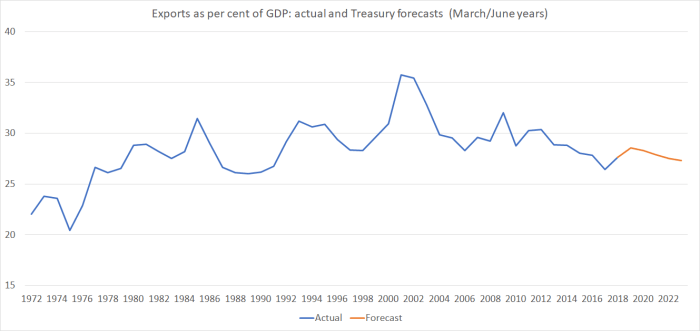
But here are the numbers, for exports as a share of GDP, from last week’s economic and fiscal update.

exports hyefu 18

You can read the earlier decades in various ways.   If you wanted to be particularly negative you could note that we got to an export share of GDP in 1980 which we haven’t sustainably exceeded since then.  But if you were of a more charitable disposition you might suggest that, broadly speaking, things were still getting better until about 2001 (although you shouldn’t put much weight on that peak –  it was an unusual combination of a year of a very weak exchange rate and very high dairy prices).  But this century hasn’t been good, and this decade has been bad.

As a reminder it isn’t that exports are in some sense special, but that successful economies typically have plenty of growing firms that are producing goods and services that are making inroads in the very big market of the rest of world.  That, in turn, enables us to enjoy for of what the rest of the world produces.   For small economies in particular, exports are typically a very important marker.

If you were of a generous disposition you might note that a temporary dip in the export share of GDP might not have been unexpected, or even inappropriate, for much of this decade.  After all, the Canterbury earthquakes meant that resources had to be diverted to repairs and rebuilding, and resources used for one thing can’t be used for other things.  The exchange rate is part of the reallocative mechanism.  And the unexpected surge in the population, as a result of high net immigration (a good chunk of it changing behaviour of New Zealanders), arguably had the same sort of effect.

But the largest effects of the earthquake are now well behind us, and even net immigration inflows are also dropping back.   And yet the Treasury forecasts –  the orange line in the chart –  show no sustained rebound in forecast export performance at all.   In fact, by the final forecast year (to June 2023) the export share of GDP will be so low than only one year in the previous thirty will have been lower.  Not only is there no sign of a structural improvement –  a step change that might one day see New Zealand exports matching or exceeding turn of the century levels –  there isn’t even a reversal of the decline this decade, which might plausibly be attributable to unavoidable pressures (eg the earthquakes).

For anyone concerned about the long-term performance of the New Zealand economy –  which appears to exclude our political officeholders, who could actually do something about it, but choose not to –  it is a pretty dismal picture.  Something like the current level of the real exchange rate seems to be Treasury’s “new normal”, and absent huge positive productivity shocks that is a recipe for continued structural underperformance.

Still on the HYEFU, I’ve long been intrigued by the Labour-Greens pre-election budget responsibility commitment around government spending (which continues to guide fiscal policy).

Rule 4: The Government will take a prudent approach to ensure expenditure is phased, controlled, and directed to maximise its benefits. The Government will maintain its expenditure to within the recent historical range of spending to GDP ratio.

During the global financial crisis Core Crown spending rose to 34% of GDP. However, for the last 20 years, Core Crown spending has been around 30% of GDP and we will manage our expenditure carefully to continue this trend.

As someone who thinks that there is plenty the government spends money on that just isn’t needed (and eliminating which would, in turn, leave room for some of the areas where more spending probably is needed), this commitment has never really worried me. But then I’m not a typical Labour/Greens voter.

But if it didn’t bother me, it did puzzle me.  Why would the parties of the left, evincing (otherwise) no conversion to the cause of smaller governments, (a) commit themselves to such a relatively moderate share of GDP in govermment spending, and then (b) aim to undershoot that?

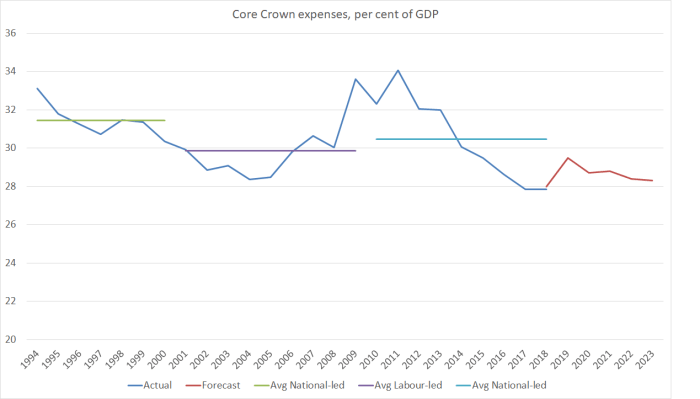
Here is what I mean.  In the chart I’ve shown Treasury’s core Crown expenses series as a share of GDP, including the projections from last week’s HYEFU.  I’ve also shown averages for the periods each of the previous three governments were responsible for (thus the former National-led government mainly determined fiscal outcomes for the year to June 2018).

core crown expenses hyefu 18

On the government;s own numbers (and these are pure choices, made by ministers), core Crown spending in the coming five fiscal years (including 2018/19) will be lower every single year than the average in each of the three previous governments, two of which were led by National.   Sure, there was a severe recession in 2008/09 –  not that fault of either main party here –  and then a severe and costly sequence of earthquakes (ditto), but on these numbers government operating expenditure as a share of GDP in 2022/23 will be so moderate that in only two years of the previous fifty (Treasury has some not 100% comparable numbers back to the early 70s) was spending even slightly lower (those were the last two years of the previous government).

It seems extraordinary.

It isn’t as if the economy is grossly overheated (which might suggest a need for considerable caution, since GDP might soon go pop).  Treasury estimates that the output gap is barely positive over the entire projection perion (the numbers so small we might as well just call them zero).   Of course, Treasury (and other forecasters) never forecast recessions, and it seems quite likely that some time in the next five years we will have one.  All else equal, a recession would raise government spending as a share of GDP, but even a 4 per cent loss of GDP in a recession –  which would be pretty severe, similar to 2008/09 –  would only raise the share of spending to GDP by little over one percentage point.   Spending, at the trough of a severe recession, would still be under 30 per cent of GDP –  which was presented in the budget responsibility rules as something they want to fluctuate around, not as an untouchable electric fence.

The only plausible explanation I can see –  after all, the government show no “small government” inclinations when it comes to, eg, regulation –  is the weight they ended up placing on the net debt target.  But that was even more arbitrary than the spending rule.

In isolation, they could spend $5 billion more in 2022/23 and still only have spending as a share of GDP at around the average level of the previous Labour-led government.   Given the low quality of many of the things they are already spending on (fee-free tertiary education, regardless of means or ability, or the Provincial Growth Fund, to take just two examples), I’m reluctant to encourage them.  But it still looks odd.

The Treasury is New Zealand’s lead advisor to the Government on economic and financial policy.The Treasury is New Zealand’s lead advisor to the Government on economic and financial policy.The Treasury is New Zealand’s lead advisor to the Government on economic and financial policy.The Treasury is New Zealand’s lead advisor to the Government on economic and financial policy.

Three central bankers

Three heads of central banks feature in this (perhaps rather bitsy) post.

The first is one of the heroes of modern central banking, Paul Volcker.  Now aged 91, and clearly ailing, he has a new (co-authored) book out tomorrow, part memoir and part (apparently) his perspectives on various public policy challenges now facing the US.  (His successor Alan Greenspan, now aged 92, also had a new book out a couple of weeks ago.   At this rate, Don Brash –  a mere stripling at 78  –  could be just getting going.)

There are various articles and interviews around (I liked this one with the FT’s Gillian Tett) but what I wanted to write about was an extract from the Volcker book, published last week by Bloomberg (and which a reader drew to my attention), under the heading “What’s wrong with the 2 per cent inflation target”.     Volcker was, of course, the person who as head of the Federal Reserve from 1979 to 1987 took the lead role in ensuring that monetary policy was finally run sufficiently tightly, for long enough, to get US inflation enduring down.   One can debate how much was the man, and how much was an idea whose time had come, but it was on his watch that the hard choices were made.

This was, of course, before the days of formal inflation targeting.  Volcker has never been a supporter, citing approvingly in his article Alan Greenspan’s famous response to a mid -1990s challenge from Janet Yellen.

Yellen asked Greenspan: “How do you define price stability?” He gave what I see as the only sensible answer: “That state in which expected changes in the general price level do not effectively alter business or household decisions.” Yellen persisted: “Could you please put a number on that?”

The Fed finally came to do so, now adopting its own numerical target (2 per cent annual increases in the private consumption deflator.

Volcker takes the opportunity to blame us, writing of his visit to New Zealand in 1988 (when I recall meeting him).

The changes included narrowing the central bank’s focus to a single goal: bringing the inflation rate down to a predetermined target. The new government set an annual inflation rate of zero to 2 percent as the central bank’s key objective. The simplicity of the target was seen as part of its appeal — no excuses, no hedging about, one policy, one instrument. Within a year or so the inflation rate fell to about 2 percent.

The central bank head, Donald Brash, became a kind of traveling salesman. He had a lot of customers. After all, those regression models calculated by staff trained in econometrics have to be fed numbers, not principles.

He is probably a little unfair.  Rightly or wrongly, the rest of the world would have got there anyway (eg Canada adopted an independent inflation target very shortly after we did), and in time it was the New Zealand inflation target that was revised up to fall more into line with an international consensus centred on something around 2 per cent. His bigger point is that he doen’t like tight numerical targets: some of his reasons are defensible, but it is also worth recalling the Volcker was in his prime in an age when there was much less transparency and accountability more generally.

But my bigger concern with the article, and argument, is about what comes across as complacency about the risks the US (and many other countries) face when the next serious recession hits.  He is opposed to any steps to push inflation up to, or even a bit above, 2 per cent, and he also  doesn’t propose doing anything to remove, or even ease, the constraint posed by the near-zero lower bound on nominal interest rates.

Deflation, or even a period when monetary policy is constrained in its ability to bring the economy back to normal levels of utilisation following a serious recession, just doesn’t seem to be a risk that bothers him, provided financial system risks are kept in check.

The lesson, to me, is crystal clear. Deflation is a threat posed by a critical breakdown of the financial system. Slow growth and recurrent recessions without systemic financial disturbances, even the big recessions of 1975 and 1982, have not posed such a risk.

I found that a fairly breathtaking claim.  After all, the effective Fed funds interest rate in 1974 had peaked at around 13 per cent, and in 1981 it had peaked at around 19 per cent.  There was a huge amount of room for real and nominal interest rates to fall.  Right now, the Fed funds target rate is 2.0 to 2.25 per cent.

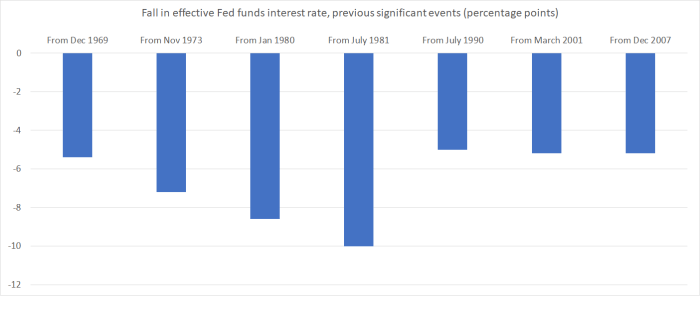
For most of history the Federal Reserve didn’t announce an interest rate target, but in this chart I’ve shown the change in the actual effective Fed funds rate (as traded) for each of the significant policy easing cycles since the late 1960s.

fed funds cuts

The median cut was 5.4 percentage points (not inconsistent with the typical scale of interest rate cuts in other countries, including New Zealand, faced with serious downturns).  Some of those falls were probably falls in inflation expectations, but even in the last three events –  when inflation expectations have been more stable –  cuts of 5 percentage points have been observed. (I was going to use the word “required” there, but there seems little doubt that policy rates would have been cut further after 2007 –  consistent, for example, with standard Taylor rule prescriptions –  if it had not been for the lower bound on nominal rates.)

And what of the current situation?  With a Fed funds target rate of about 2 per cent, if a serious recession hit today the Federal Reserve has conventional policy leeway of perhaps 2 percentage points (if they treat 0 to 0.25 per cent as the floor next time as they did last time) or perhaps as much as 2.75-3 percentage points (if they treat the effective floor as more like the -0.75 per cent a couple of European countries have operated with).  The Fed has given no public hint that they would actually be prepared to take policy rates negative in the next recession, so for now markets can only guess –  and perhaps hope.   But either way, the conventional monetary policy leeway is much less than was used in any of the significant US downturns of the previous 50 years.   That should be worrying someone like Paul Volcker more than it seems to, especially when three other considerations are taken into acount:

  • when markets know those limitations –  and firms and households will quickly learn them when the recession comes –  inflation expectations are likely to drop away more quickly than usual, because no one will be able to count on the Fed being able to keep inflation near target,
  • US fiscal policy has been so badly debauched that there is going to be little (political) leeway for material discretionary fiscal stimulus in the next recession, and
  • most other advanced countries have even less conventional monetary policy capacity now than the US does (and even less than usual relative to past history).

Reasonable people can quibble about the place of formal inflation targeting, but there needs to be much more urgency in planning to cope with the next serious recession, whatever its source or precise timing.

As readers know, I was not one of the biggest fans of former Reserve Bank Governor Graeme Wheeler.  But in Herald economics columnist Brian Fallow’s article last Friday there was some quotes from a recent speech Wheeler had given in Washington that had me nodding fairly approvingly as I read.

If the advanced economies face a recession in the next few years, much of the burden for stimulus will fall on fiscal policy, Wheeler says. The scope to cut interest rates is limited as policy rates in several countries remain at or near historic lows. Countries accounting for a quarter of global GDP have policy rates at or below 0.5 per cent, whereas policy cuts in recessions have often been of the order of 5 percentage points.

“In such a situation central banks would rely on additional quantitative easing and governments would face considerable pressure to expand their budget deficits through spending increases and/or tax cuts.”

They are words that need more attention even in a New Zealand context, where the OCR is only 1.75 per cent.  It was 8.25 per cent going into the last serious downturn.

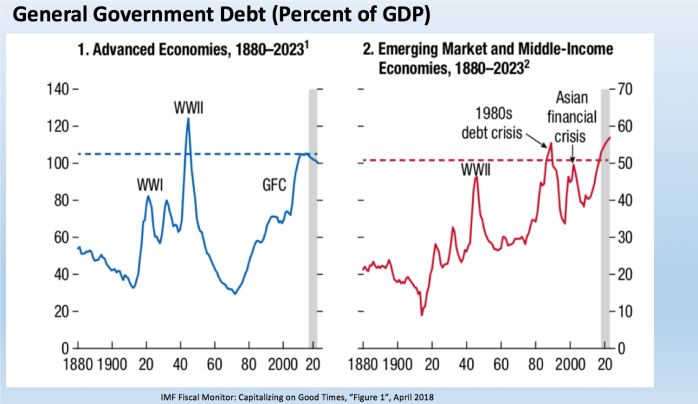
Wheeler’s speech (a copy of which Brian Fallow kindly, and with permission, passed on) – to a conference on sovereign debt management –  is mostly about debt management issues.  It has a number of interesting charts from various publications, including this sobering one.

wheeler chart

Perhaps what interested me was that in his discussion of the issues and risks, Wheeler seemed not to touch at all on the two approaches often used in very heavily indebted countries –  even advanced countries – facing serious new stresses: default and/or surprise sustained inflation.   To the credit of successive New Zealand governments, fiscal policy here is in pretty good shape, and debt is low, but looking around the world it would perhaps be a surprise if Greece is the only advanced country to default on its sovereign debt (or actively seek to inflate it away) in the first half of this century.

And finally, our own current Governor.  He has just brought up seven months in office without a substantive public speech on the main policy areas he has responsibility for; monetary policy and financial stability.   It is quite extraordinary. He has been free with his thoughts on climate change, infrastructure financing, tree gods, and so on and so forth, while batting away questions about the next serious recession and its risks in a rather glib, excessively complacent, way (hint: QE and its variants is not –  based on international experience – an adequate answer).

Anyway, the Governor has repeatedly told us about his commitment to greater openness and communications.  I’ve been a sceptical of that claim –  both because every Governor says it in his or her own way, but also because of the track record that is already building.  There have been, as I said, no substantive speeches from Orr on his main areas of legal responsibility.  Speeches that are published apparently bear little or no relationship to what the Governor actually says to the specific audience.  There have been no steps taken to, say, match the RBA in making generally available the answers senior central bankers give in Q&A sessions after speeches, and we heard not long ago of a speech Orr gave to a private organisation, commenting loosely on matters of considerable interest to markets and those monitoring the organisation, but with no external record of what was said.

And it seems that there is likely to be another example today.  The next Monetary Policy Statement is due next week, as is the joint FMA-RB statement on bank conduct and culture (FMA responsibility that the Governor has barged into), both surely rather sensitive matters.  And yet the Governor is giving a significant speech this evening at the annual meeting of the lobby group Transparency International.

Guest Speaker: Adrian Orr

Adrian’s speech will encourage discussion about the relevance of transparency, accountability and integrity in the New Zealand financial sector.

Adrian Orr will be introduced by State Services Commissioner, Peter Hughes, and thanked by new Justice Secretary, Andrew Kibblewhite.

And yet his speech –  to Transparency International, introduced by the State Services Commissioner, thanked by the head of the Prime Minister’s department –  on transparency, is to be, well, totally non-transparent.  From the Reserve Bank’s page for published speeches

Upcoming speeches
There is nothing scheduled.
It seems like a bad look all round: for Transparency International (admittedly a private body) and its senior public service people doing the introductions, and for the Bank itself.   This isn’t some mid-level central banker doing a routine talk to the Taihape Lions Club, but the Governor himself on a topic of a great deal of interest –  to a body itself reportedly committed to more transparency and better governance.
I’d encourage the Bank to rethink, and to make available a script (or preferably a recording, given the Governor’s style) of his speech, and of the subsequent Q&A session.  It should be standard practice, and Transparency International would be a good place to start.

Should Grant Robertson be able to bankrupt New Zealand?

Of course not.  And nor should have Michael Cullen, Bill English or Steven Joyce, the other people who have held the office of Minister of Finance this century.

And yet, by law, he can.  Anyone who holds the office of Minister of Finance can.   Without any further involvement in the matter by Parliament.

A basic principle of our form of government has long been that public spending can only occur if there is an appropriation voted by Parliament to authorise such spending.  Without that basic protection, Parliament loses much of its protection over the executive –  and protecting citizens against the executive was a significant part of the rise of democratic systems over government over hundreds of years.

There are some exceptions to that rule (eg  –  and at the sensible end – permanent legislative authorities for judicial salaries), some of which should be a little worrying, but the one I want to focus on here is section 65ZD of the Public Finance Act.

65ZD Minister may give guarantee or indemnity if in public interest

(1) The Minister, on behalf of the Crown, may give, in writing, a guarantee or indemnity to a person, organisation, or government if it appears to the Minister to be necessary or expedient in the public interest to do so.

(2)  The Minister may—

(a) give the guarantee or indemnity on any terms and conditions that the Minister thinks fit; and

(b) in the case of a guarantee, give the guarantee in respect of the performance or non-performance of any duties or obligations by a person, organisation, or government.

(3) If the contingent liability of the Crown under a guarantee or an indemnity given by the Minister under subsection (1) exceeds $10 million, the Minister must, as soon as practicable after giving the guarantee or indemnity, present a statement to the House of Representatives that the guarantee or indemnity has been given.

(4) The statement may contain any details about the guarantee or indemnity that the Minister considers appropriate.

Under this provision, a Minister of Finance can guarantee anything.   He doesn’t need the approval of Cabinet to do so, he doesn’t need the approval of Parliament, there are no specific criteria he is required to take account of (only his own assessment of “the public interest”), there are no limits on how large the guarantee can be, and even the reporting requirements –  added in recent years –  are weak in the extreme (the Minister must tell Parliament, after the event, that a guarantee has been given, but there is no mandated disclosure of the terms of any guarantee, the case for the guarantee, or documents related to the giving of the guarantee).

It is a shockingly broad power.  It isn’t clear that –  to take a deliberately overstated extreme example –  there is anything to stop a New Zealand Minister of Finance guaranteeing, say, the entire public debt of the United States –  or all the liabilities of Lehmans – provided the Minister concluded that, in his sole view, doing so was in the public interest of New Zealand (“I was worried the world financial system might fail, and New Zealanders would have suffered in the backwash”).   There are no effective ex ante checks and balances.  The Prime Minister might be able to sack the Minister of Finance, or the public might toss the governing party out at the next election, but that would small comfort if trillions of dollars of guarantees had been given out in respect of shonky activities.   A corrupt minister – and fortunately we haven’t had much of a problem with them so far –  could vastly enrich favoured people and entities in the process.  We supposedly build institutions around the realities of human fallibility, not an assumption that humans are angels.

As for settling the obligations taken on under a ministerial guarantee –  committing the full faith and credit of the New Zealand government –  there is an explicit statutory provision governing that too

65ZG Payments in respect of guarantees or indemnities
Any money paid by the Crown under a guarantee or indemnity given under section 65ZD and any expenses incurred by the Crown in relation to the guarantee or indemnity may be incurred without further appropriation, and must be paid without further authority, than this section.

Parliament gets no say at this point either (which makes sense –  a guarantee is worthless, and non-credible, if the person giving it doesn’t have the ability to ensure the obligation is honoured.

Perhaps a government could choose to default on its guarantee obligations, and so long as the guarantees were not given as part of any contract under some foreign jurisdiction there might be nothing anyone could do about it.  Defaults do happen, even in advanced countries, and perhaps markets would excuse default on the guarantee given by a corrupt minister for a huge and shonky deal, but it isn’t a situation we should ever risk finding our country in.

I’m not sure how other countries handle this issue, or constrain the ability of the executive to issue guarantees (I looked and couldn’t readily find a suitable reference source or comparative study).  But whatever they do –  and I’d be astonished if, for example, there was such flexibility in US legislation (where they have statutory debt ceilings, and all the perceived constraints around TARP or bailing out Lehmans) –  these provisions of New Zealand legislation seem far too broad, and should be reined in.

I don’t have a particular problem with some guarantee powers, but if they exist they should be tightly constrained.  The amounts the Minister can authorise himself should be capped (perhaps $100 million –  anything more requiring the approval of Cabinet (up to perhaps $10 billion) or of Parliament itself.  And the terms of such guarantees should be disclosed, as should the supporting documentation.

The counter-argument is probably about the ability to act swiftly.  And yet we know from bitter experience that governments can, when necessary (or when it simply suits them) ram legislation through Parliament in a day.   That doesn’t provide much scrutiny, but it is much more than we have at present, and Parliament is ultimately protection, and source of legitimisation of executive actions and commitments.

I’m pretty sure the guarantee sections  of the Public Finance Act aren’t the only way in which unconstrained individuals –  sometimes even unelected ones –  could gut the public finances, with little effective comeback, and no protections for citizens.  The hypothetical one that used to bother me –  and not because of any distrust of particular individuals, but because I had run the financial markets side of the Bank and was conscious of our powers –  was the Reserve Bank, which has almost totally unconstrained powers to enter into financial contracts, and which will be regarded by counterparties as highly creditworthy precisely because it is the central bank (too central to fail).  It trades on the underlying fiscal position of the Crown, and yet the Crown and Parliament have very little effective control over transactions initiated by the Bank.  In principle, a corrupt or seriously incompetent Reserve Bank Governor –  one unelected individual –  could enter highly leveraged large scale derivatives contracts and, if things went wrong leave the New Zealand taxpayer on the hook of tens of billions of dollars of losses.

Why am I writing about this issue now?  Because it is 10 years this week since I first really became conscious of section 65ZD of the Public Finance Act –  10 years since we were working on preparations for the Deposit Guarantee Scheme, in which  –  with Parliament dissolved for the election –  the Minister of Finance, on his sole authority, offered to guarantee hundreds of billions of dollar of financial institution liabilities.    I’ll write more about that specific intervention later in the week, but for now I wanted to shine a light on these statutory powers –  and their frightening extent in the wrong hands.    We need better protections, with less discretion for a single minister.  We can’t simply rely on the integrity and good judgement of those who hold office, in this or any other area.

Fiscal councils and state-funding of parties

I’ve been engrossed in the Kavanaugh hearings, so just something short today.

A few weeks ago the government released a consultative document prepared by The Treasury on the possibility of establishing an independent fiscal institution.   There is quite a lot of useful background information in the document, although what is lacking at this stage is a clear specific proposal.

The creation of such an institution was part of the Labour-Greens budget responsibility pact announced before the election.  Broadly speaking, I thought it had the makings of a step in the right direction, but whether it would be so or not would depend greatly on the specifics of how the institution was set up, what it was made responsible for, and (to a considerable extent) the early key appointees.

I was generally in favour of a small institution that could provide some independent analysis and commentary on fiscal policy, fiscal rules, and so on.  Many OECD countries have such institutions.  I’d go a little further and suggest that in a New Zealand context such a body could be made more useful, and with a bit more critical mass, if the responsibilities were broadened to include independent analysis and commentary on other aspects of macroeconomic policy, notably monetary policy and financial system regulation.

My unease was the about the push, initiated by the Green Party, for the independent fiscal institution to take on a taxpayer-funded role of costing political parties’ proposed policies and promises.    That aspect appears quite prominently in the consultative document.  I remain unconvinced that there is a gap in the market.   I’m also unconvinced that a small body would be able to maintain a critical mass of the sort of detailed expertise required to credibly cost and evaluate policies proposed by political parties, across the entire spectrum of policy, on the off chance that one particular party might want some, perhaps quite detailed, policy evaluated.  And I’m also uneasy about the policy and political (not necessarily partisan ones) biases of the sort of bureaucrats who would inhabit such agencies (check out past Treasury advice around capital gains taxes for example), and the creation of any sort of expectation that these people should be charged with costing and evaluating party promises.

But there is also an issue of mindsets.  Technocrats put a great deal of focus on precise costings and details, but elections are rarely about those details, and it isn’t obvious that they should be.  Elections are contests of ideology, personality, competence or otherwise, and only at the margins are precise numbers likely to be particularly important.  That is even more so in an MMP environment, where campaign promises and policies are no more than opening bids, and governments typically have to be cobbled together –  and policy details haggled over –  after the votes are in.    Sometimes parties find it in their interests to hire expert advisers to evaluate or cost their policies, and the political and commentary process evaluates and challenges what they produce in response.  Other times parties don’t.  People make their choices, and it isn’t clear they put that much weight on specific costings, no matter who they are done by.  Politics is a competitive and adversarial process, and I’m not sure there is much role for taxpayer-funded technocrats.

The idea of a policy costings unit looks like some mix of (a) trying to intrude technocrats into the process, and more concerningly (b), a backdoor route to have the state fund political parties.   Resources that would be spent by the costings unit, at the request of an individual political party, would be resources that party would not have to find for itself.  if that isn’t backdoor partial state funding of political parties –  potentially on quite a large scale –  I’m not sure what is.

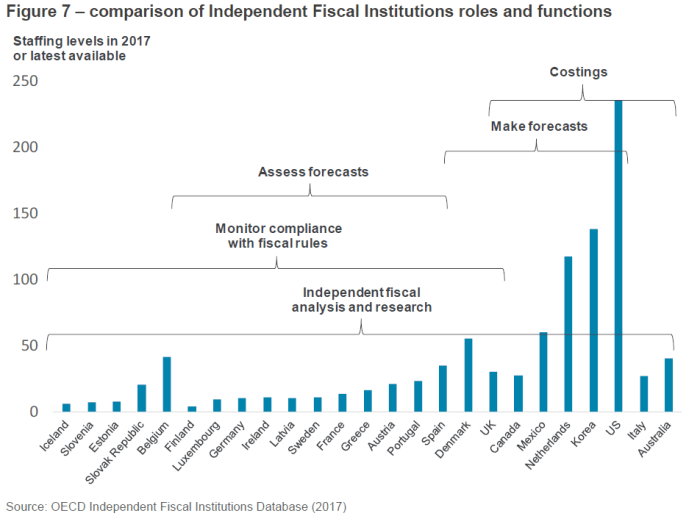
Among the interesting charts in the report is this one, drawing on OECD databases.

fisc council chart

It is a very useful chart, outlining what various independent fiscal agencies do. But what I found most interesting was the eight countries to the right of the chart where the fiscal institution does policy costings, and the countries that aren’t in that grouping.

Every one of the countries where the fiscal entity does policy costing of some sort (in the US case, not for political parties in the run-up to a campaign, but the US system is very different overall) is that all of them are large by our standards.  Even the Netherlands has more than three times our population and Australia has five times our population (and more than that multiple of our GDP).  Some of those countries have quite large staffs for their fiscal institutions –  and they can afford it.

By contrast, not one of the small OECD countries with an independent fiscal institution is described by The Treasury as doing policy costings for political parties.  That seems pretty telling, and is unlikely –  across a variety of different political systems –  to be just a matter of chance.

The consultative document doesn’t give us a sense of resource requirements, but there aren’t likely to be big economies of scale in this game.  A Council of, say, 3 and perhaps 10 staff could do the fiscal (and macro) monitoring.  That looks to be the sort of scale quite common in the rest of the OECD.  Making a serious job of policy costing looks as though it could take multiples of that level of resources.   For what?

I might come back to the document if/when I make a submission next month, but in the meantime I’d urge a rethink, and encourage opposition parties not to fall for the siren song of more resources potentially becoming available to them.

Options for the next serious recession: fiscal policy

I’ve run various posts over the last few years urging the authorities (Reserve Bank, Treasury, and the Minister of Finance) to get better prepared for the next serious recession (and lamenting the relative inaction on this front in other countries too, many of whom are worse-positioned than New Zealand is).

As a reminder, we went into the last recession with the OCR at 8.25 per cent, while the OCR now –  years into a growth phase, with resources (on official assessments) fairly full-employed –  is 1.75 per cent.  In that last recession, the Reserve Bank cut interest rates a long way, the exchange rate fell a long way, there was really large fiscal stimulus cutting in as the recession deepened, and there were lots of other interventions (guarantee scheme, special liquidity provisions) and it was still as severe as any New Zealand recession for decades, and took years to fully recover from (on official output and unemployment gap estimates perhaps seven or eight years).   Lives were blighted, in some cases permanently, in an event where there were no material constraints on the freedom of action of the New Zealand authorities.  In fact, our Reserve Bank cut the OCR (over 2008/09) by more than any other advanced country central bank.

Next time, whenever it is, it seems very unlikely that the Reserve Bank will have that degree of freedom, particularly around monetary policy.  On current policies and practices around bank notes, it seems unlikely that the OCR could be usefully cut below about -0.75 per cent.  Beyond that point, most of the action would be in the form of people shifting from bank deposits etc to physical currency, rather than buffering the economic downturn.

Our Reserve Bank has long appeared disconcertingly complacent about this issue/risk.  The latest example was comments by the new Governor and his longserving chief economist following the latest Monetary Policy Statement.    They talk blithely about the unconventional policy options other countries have used, but never confront the fact that almost no advanced country could have been comfortable with the speed of the bounceback from the last recession.   Output and unemployment gaps of eight or nine years (the OECD’s estimate for advanced countries as a whole) aren’t normal and shouldn’t be acceptable.

Quite why the Reserve Bank is so complacent is something one can debate.   My hypothesis is that it is some mix of assuming we will never face the problem (recall that they have spent years hankering to get the OCR back up again) and of noting that other people/countries will most likely face the problem before New Zealand does.   They also like to remind us that New Zealand has a floating exchange rate as if this somehow differentiates us (as a reminder so do Australia, Canada, Norway, Sweden, the US, the UK, Japan, Korea, Israel, and even the euro-area as a whole).  Whatever the explanation,  robust contingency planning, and building resilience into the system, is what we should be expecting from the Reserve Bank (and Treasury).  There is no sign of it happening.  Meanwhile, the Governor plays politics in areas (eg here and here) that really aren’t his responsibility.

In my post on Saturday, I touched again on the desirability of doing something –  specific and early, consulted on and well-signalled –  about removing the effective lower bound on nominal interest rates.   That would tackle the issue at source.    Monetary policy has been the primary stabilisation tool for decades for good reasons.  Among other things, it is well-understood and there is a fair degree of (political and economic) consensus around the use of the tool.  And confidence that the tool is at hand in turn proves (somewhat) self-stabilising, because people expect –  and typically get – a strong monetary policy response.

Perhaps the other reason why authorities –  perhaps especially in New Zealand – have been so complacent is the view that “never mind, if monetary policy is hamstrung there is always fiscal policy”.  After all, by international standards, public debt here is low (on an internationally comparable measure from the OECD, general government net financial liabilities, about 1 per cent of GDP, which puts us in the lower quartile –  less indebted – among OECD countries.)

The implicit view appears to be that, with such modest levels of debt, if and when there is another serious recession, New Zealand governments can simply spend (or cut taxes) “whatever it takes” to get economic activity back on course again.   After all, the upper quartile of OECD countries have net general government liabilities in excess of 80 per cent of GDP.

I’m sceptical for a variety of reasons.

One of them is the experience of the last recession.  For this, I had a look at the OECD data on the underlying general government primary balance as a per cent of potential GDP:

  • general government = all levels of government
  • underlying = cyclically-adjusted (ie removing the impact of the fluctuating business cycle on revenue (mostly), and adjusted for identified one-offs (eg recapitalisations of banking systems)
  • primary balance =  excluding financing costs, so that comparisons aren’t affected by changes in interest rates themselves
  • as a per cent of potential GDP =  so that a temporary collapse in actual GDP doesn’t muddy the comparison

The numbers aren’t perfect, and there are inevitable approximations, but they are the best cross-country data we have.  Changes in this balance measure are a reasonable measure of discretionary fiscal policy.

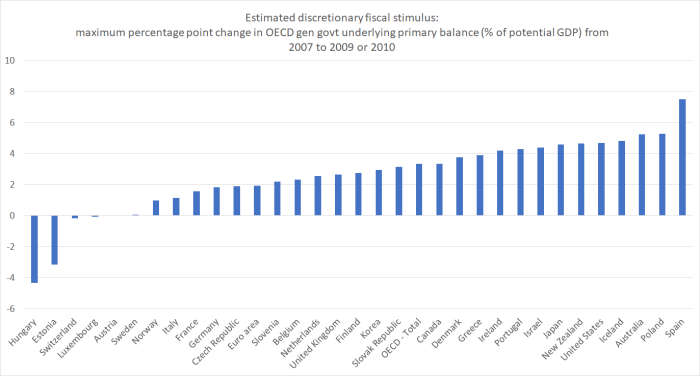
Here is how those underlying primary balances changed from 2007 (just prior to the recession) over the following two or three years.  I’ve taken the largest change I could find, and in every case that was over either two years to 2009, or over three years to 2010.

fisc stimulus

Some countries (Hungary, Estonia) were engaged in severe fiscal consolidation from the start.  Several others experienced almost no change in their structural fiscal balances.

Quite a few countries saw 5 percentage point shifts in their underlying fiscal balances.   Spain –  a country with no control over its domestic interest rates –  is recorded as having gone well beyond that.  I don’t know much about the specifics of Spain, but for those who are upbeat about the potential scope of discretionary fiscal policy I’d take it with at least a pinch of salt – on the OECD numbers, the Spanish primary deficit dropped again quite sharply the next year (and Spanish unemployment didn’t peak until several years later).

Note that both Australia and New Zealand are towards the right-hand end of that chart.  In Australia’s case, most of the movement resulted from deliberate counter-cyclical use of fiscal policy (the Kevin Rudd stimulus plans).  In New Zealand, by contrast, the change in the underlying fiscal position was almost entirely the result of discretionary fiscal commitments made by Labour government at a time when Treasury official forecasts did not envisage a recession at all.  From a narrow counter-cyclical perspective, those measure might have been fortuitous, but they were not deliberate discretionary counter-cyclical fiscal policy measures.  In fact, at the time they were seen in some quarters as exacerbating pressure on the exchange rate, and limiting the scope of any interest rate reductions.

Perhaps it is worth stressing again that in not one of the OECD countries did the reduction in structural fiscal surpluses (expansion in deficits) last more than two years.  In every single country, by 2011 structural fiscal policy (on this measure) had moved –  sometimes modestly, sometimes quite sharply –  into consolidation phase.  In most countries, either conventional monetary policy limits had been reached or (as in individual euro area countries) there was no scope for conventional monetary policy.  And it was to be years before output and unemployment gaps closed in most of these countries.

What is my point?   Simply, that it looks as though the political limits of discretionary fiscal stimulus were reached quite quickly, even in countries where there was no market pressure (any of the established floating exchange rate countries other than Iceland), and even though the economic rebound in most was anaemic at best.   That is why so many countries needed more conventional monetary capacity than in fact they had (and QE in various forms was not much of a substitute).

The OECD table on underlying primary balances only has data going back a few decades.  No doubt experiences in wartime were rather different –  in those circumstances huge shares of the nation’s resources can be marshalled and deployed in ways which (incidentially) stimuluate demand and activity.  But looking across the OECD countries over several decades, I couldn’t any examples of discretionary fiscal policy being used as a counter-cyclical tool materially more aggressively than happened over 2008 to 2010.  In Japan, for example, the structural fiscal balance worsened by about 6 percentage points over seven years after 1989.

So from revealed behaviour patterns, I’m sceptical as to just how much practical capacity there is for fiscal policy to do much, and for long, in the next serious recession, even in modestly-indebted New Zealand.    The limits aren’t technical –  they mostly weren’t last time –  but political.   Perhaps people will push back and run some argument along the lines of “oh, but we’ve learnt the lessons of unnecessary premature austerity last time round”.     To which my response would be along the lines of “show me some evidence, or reason to believe that things would, or even should, be much different next time”.   When – outside wartime –  has it ever happened?  And what about our political systems makes you comfortable that it is likely to happen next time?     We could probably run large structural deficits for a year or two, but pretty quickly the pressure is likely to mount to begin reining things back in again (especially if, for example, the next recession is accompanied by heavy mark-to-market losses on government investments –  eg NZSF).

And recall that here in New Zealand we had almost as much fiscal stimulus last time as any country, and even supported by huge cuts in interest rates (and without a home-grown financial crisis), we had a nasty recession (even a double-dip in 2010) from which it took ages to recover.

And all of this is without even examining how effective realistic fiscal policy is likely to be.    The easiest fiscal stimulus is a tax cut (or even a lump sum cash handout).   You can do clever ones, like the UK temporary cut in GST, which not only put more money in people’s pockets, but actively encouraged them to shift consumption forward –  only to then create problems as the deadline for raising the value-added tax rate loomed.   But putting money in people’s pocket –  in a recession, and often explicitly temporarily –  doesn’t guarantee they spend much of it.  The most effective demand-stimulating fiscal policy (supply side measures are another issue –  but lets just agree that deep cuts in company tax and related rates will not happen in the depths of a recession) is direct government purchases of goods and services.  Most talked of is government capital expenditure, infrastructure and all that.

But, approve or otherwise, no government has a reserve list of projects, designed and consented, just waiting to get starting the moment it is apparent the next deep recession in upon us (that moment usually being several months after the recession has begun).  It is almost certainly politically untenable for them to do so –  if the project is so good, so the argument will run, why not do it when times are good?  And so realistic government fiscal stimulus through the capital expenditure side will take months and years (more probably the latter) to even begin to get underway.   Faced with the actual physical destruction in Christchurch, look how long it took for major reconstruction to get underway.

What of income tax cuts?   Either the cuts are focused on those who pay the most taxes (in which case there is quickly one form of political pushback) or perhaps they take the form of a tax credit paid as a lump sum to everyone (in which case there is likely to be pushback of another political type –  ideas around “everyone becoming a welfare beneficiary).  I’m not attempting to defend either type of response, just to anticipate the risks.

By contrast, monetary policy –  the OCR –  can be adjusted almost immediately, and often begins to have an effect before the central bank even announces its formal decision (market expectations and all that).  And if monetary policy changes don’t affect everyone equally, they affect the entire country –  a borrower/saver/exporter in Invercargill just as their counterparts in Auckland.  In the line from a US Fed governor, monetary policy gets in “all the cracks” (although he was contrasting it with regulatory interventions).  Government capital expenditure is, by its nature, very specific in location.  There probably isn’t a natural backlog of major (useful) capital projects in Invercargill or Dunedin.

I’m not saying fiscal policy has no useful place in the stabilisation toolkit –  although my prior is that it is better-oriented towards the medium-term, with the automatic stabilisers allowed to work fully –  but that we should be very cautious about expecting that it is any sort of adequate substitute for monetary policy in the real world of politics, distrust of governments and so on, in which we actually dwell.    It is well past time for the Reserve Bank and the Treasury, led by the Minister of Finance, to be taking open steps towards ensuring that New Zealand has the conventional monetary policy capacity it would need in any new serious recession.


Scattered thoughts on Budget 2018

The possible new fiscal institution first, and them some comments on some of the numbers.

It was interesting to see the joint statement from James Shaw and Grant Robertson that the government is looking to move ahead with some sort of independent fiscal institution.   This had been a Greens cause more than a Labour one –  former leader Metiria Turei had openly called for a new body –  and although the pledge had formed part of the pre-election Budget Responsibility Rules, I’d been beginning to wonder whether the government would follow through.  After all, Treasury has never been keen on a potential alternative source of fiscal advice/analysis, even though the independent review of their fiscal advice and analysis a few years ago by the former head of the IMF Fiscal Affairs Department had been positive on the idea that New Zealand establish a Fiscal Council (and the OECD had also recommended it).

There were few specifics in yesterday’s statement

Public consultation will be launched in August on establishing an independent body to better inform public debate in our democracy, Associate Finance Minister James Shaw announced today.

“We are pleased to take forward a Green Party idea developed before the last election to see a body formed which could provide all political parties with independent, non-partisan costings on their policies,” says James Shaw.

“That way we can reduce political point-scoring and attempts to create unreasonable doubt about a party’s policy figures. That will mean better debate about the ideas being put forward.

“We are proposing a new institution independent of Ministers that would provide the public with an assessment of government forecasts and cost political parties’ policies,” says Grant Robertson.

“This independent fiscal institution (IFI) would crunch the numbers on political parties’ election policies in a credible and consistent way,” says James Shaw.

Indeed, the statement is a reminder that there are two very different roles being discussed here:

  • costing political parties’ election promises, and
  • monitoring and assessing government (Treasury surely?) fiscal forecasts, and perhaps government fiscal strategy.

As I’ve written previously, I am generally positive on the second of those roles, but am sceptical of the former.  Notwithstanding last year’s debates about “fiscal holes”, I don’t see a gap in the market (after all, surely “pointscoring” is part of the point of election campaigns?), and I suspect any such costings office would tend to become an additional research service for small parties (the Australian office seems to have been used mainly by the Greens), and not much used either by the main parties (with more resources, including in the form of supporters’ own expertise), or by any right-wing parties (given the social democratic leanings of those likely to be doing this sort of work, probably on rotation or secondment from The Treasury).

Of the second leg, these were some of my earlier comments

A Fiscal Council seems more likely to add value if it is positioned (normally) at one remove from the detailed forecasting business, offering advice and analysis on the fiscal rules themselves (design and implementation) and how best to think about the appropriate fiscal policy rules.  The Council might also, for example, be able to provide some useful advice on what material might usefully be included in the PREFU  (before the election, I noted that routine publication of a baseline scenario that projected expenditure using the inflation and population pressures used in the Treasury economic forecasts would be a helpful step forward).

There is unlikely to be a simple-to-replicate off-the-shelf model that can quickly be adopted here, and some work will be needed on devising a cost-effective sustainable model, relevant to New Zealand’s specific circumstances.  That is partly about the details of the legislation (mandate, resourcing etc), but also partly about identifying the right sort of mix of people –  some mix of specific professional expertise, an independent cast of mind, communications skills, and so on.  A useful Fiscal Council won’t be constantly disagreeing with Treasury or the Minister of Finance (but won’t be afraid to do so when required), but will be bringing different perspectives to bear on the issues, to inform a better quality independent debate on fiscal issues.

I hope to offer some more-detailed thoughts when the public consultation phase of the policy development occurs.  In the meantime, I’d continue to urge ministers (and Treasury) to think about broadening the ambit of any new council, to include external monitoring analysis of monetary policy and perhaps the other responsibilities of the Reserve Bank.

…it wouldn’t be about second-guessing individual OCR decisions or specific sets of forecasts, but offering perspectives on the framework and rules, and some periodic ex-post assessment.    In a small country, it would also have the appeal of offering some critical mass to any new Council.

What of this year’s numbers?

I’m not someone who champions big government.  In fact, I think we could do the things the state should be doing, and do them well –  better than they are being done now – with a smaller share of GDP devoted to government spending.

But as outside observer of left-wing politics in government, I continue to find charts like this a bit surprising.

core crown expensese 2018 budget

Not only is government spending over the next four fiscal years planned/projected to be a smaller share of GDP than in the last four years under the previous government, but that government spending share averages less than in every single year of the Clark/Cullen government.   In the interim, nothing has been done to raise the NZS eligibility age, so that that particular fiscal outlay is becoming more burdensome every year.  And all the campaign rhetoric –  and actually the rhetoric in government –  is about rebuilds, past underfunding etc etc.   Something doesn’t seem to add up.  I suspect, as I’ve argued previously, that the aggregate spending line can’t, and won’t, be held over the next few years.

And you will recall that the Labour-Greens pledge around government spending was (as it first appeared last May)

4. The Government will take a prudent approach to ensure expenditure is phased, controlled, and directed to maximise its benefits. The Government will maintain its expenditure to within the recent historical range of spending to GDP ratio.

During the global financial crisis Core Crown spending rose to 34% of GDP. However, for the last 20 years, Core Crown spending has been around 30% of GDP and we will manage our expenditure carefully to continue this trend.

In the separate release on the rules yesterday, that second paragraph now reads

Core Crown spending has averaged around 30% of GDP for the past 20 years. The Treasury forecasts show we are staying below this – peaking at 28.5% of GDP in 2018/19.

It is as if 30 per cent has become a ceiling –  staying below it a badge of honour for the government –  rather than something to fluctuate around.

Perhaps the Minister would defend himself by noting that over the forecast period the economy is running at capacity, and he needs to allow for the inevitable next recession at some point.   But with planned spending averaging 28.5 per cent of forecast GDP, it would take an unexpected 8 per cent fall in nominal GDP (relative to the current forecast path), with no change at all in government spending (say, wage settlements being lower etc) for government spending to equal 31 per cent of GDP, even in a single year in the depths of such a recession.  And even 31 per cent wouldn’t be out of the recent historical range of the spending to GDP ratio.   Again, relative to the political rhetoric, something doesn’t compute.

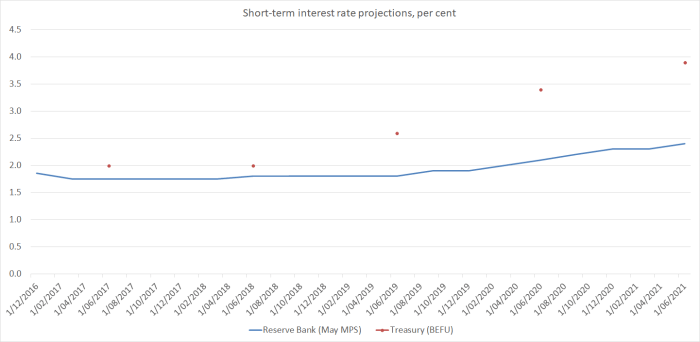
There are also some puzzling things in the Treasury macro forecasts –  which are Treasury’s responsibility, not that of the Minister of Finance.    Here is the difference in the interest rate projections of the Reserve Bank and The Treasury.  The Bank forecasts the OCR directly, while The Treasury forecasts the 90 day bill rate, but you can easily see the difference.

rb and tsy int rates

Only last week, the new Governor (over)confidently told us that official interest rates “will” remain on hold for some time to come.  The Treasury clearly doesn’t believe him, reckoning that by this time next year we’ll already have had 50 to 75 basis points on OCR increases, with lots more increases in the following two years.

Even though I think the Governor was expressing himself too strongly, I just don’t believe the Treasury numbers at all.    They imply a lot of pent-up inflation pressures building up now that can only be nipped in the bud if the Bank gets on with the job and tightens policy.    And yet, on Treasury’s own numbers, the output gap has increased from around -1.5 per cent of GDP (for several years) to around zero now, and there has been only a very modest increase in core inflation.  It is hard to see how the quite small projected increase in capacity pressures will now finally get core inflation back to 2 per cent –  requiring quite a lift in the inflation rate from here –  and how those pressures are likely to appear if people really thought such a significant tightening of the OCR was in prospect.   As it is, on these Treasury numbers, it is another three years until inflation gts back to 2 per cent.  That is even slower than in the Reserve Bank projections.

Also a bit sobering were the Treasury export forecasts.  From time to time the government talks –  as its predecessor did – about lifting exports (and imports presumably) as part of a successful reorientation of the economy.  Treasury clearly doesn’t believe that any such reorientation is underway.

exports to gdp budget 2018

Just some more of the same dismal picture.  But I guess that is what one would expect when the two parties just keep on with much the same policies that got us where we are today, with the economy less open (as measured by trade shares) than it was averaging 25 years ago).

I mentioned earlier the uncertain timing of the next recession.  If the Treasury projections come to pass we’ll have gone 12 years (since the 2010 double-dip recession) without a recession.  That is possible, but it probably isn’t an outcome people should be planning on.  I noticed last night this chart from a recent survey of US fund managers.

next recession

Quite possibly, like economists, fund managers picked six of the last three recessions.  Nonetheless, it is a salutary reminder of where things can go wrong.  For example:

  • The Fed could end up overtightening (often a contributor to past downturns),
  • Emerging market stresses (eg Turkey and Argentina) could foreshadow something more widespreads,
  • Economic data in the euro-area seems to be weakening, and the likely new Italian government doesn’t look like a force to increase confidence and resilience in the euro,
  • and of the course there are risks around China, and in the Middle East –  trade wars and other aspects of geopolitics.

Nearer to home, some straws in the wind are also starting to pile up.

I don’t do medium-term economic forecasts –  nor does any wise person – but with the terms of trade assumed to hold at near-record highs, there is a sense that the macro picture the government is using, and selling, is a little too good to last.  In that respect –  but probably only –  it is eerily reminiscent of the start of 2008 when The Treasury revised its advice and confirmed to the then government of the day that it thought the higher revenue levels were likely to be permanent. Little did they realise…….

Of course, our government debt levels are very low –  net debt is only 7.3 per cent of GDP –  so these risks aren’t some sort of existential threat (although any new global downturn will greatly exacerbate fiscal problems elsewhere, and further constrain policy freedom of action and limit the ability of the advanced world to bounce back quickly).  But our authorities do need to be more actively planning for the next downturn: it will come, and when it does it appears that the government and the Reserve Bank have not yet done anything much to assure that they have anything the freedom of monetary policy action we can usually count on.  (Perhaps instead of offering his unsolicited thoughts on all and sundry political issues, the Governor could substantively address that issue, which is core to his remit.)


Debt: dodgy analysis from the IMF

I should really be doing something else, but I just read Brian Fallow’s column in today’s Herald outlining his views on why the government shouldn’t relax its own fiscal rules.   Reasonable people can differ on that –  and as per my post yesterday I’m certainly not arguing for the government to raise debt levels (per cent of GDP) from here.  But what caught my eye was some IMF “analysis” Brian quoted.

He introduced his article noting that on IMF data (or any other measure you like) New Zealand’s net or gross government debt is quite low as a share of GDP.  On my preferred measure, net debt is about 8 per cent of GDP.    But he goes on

A third reason for being cautious about ramping up government debt is that not all of its obligations are on the balance sheet.

In particular, there is the future additional cost of superannuation and health spending as the population ages.

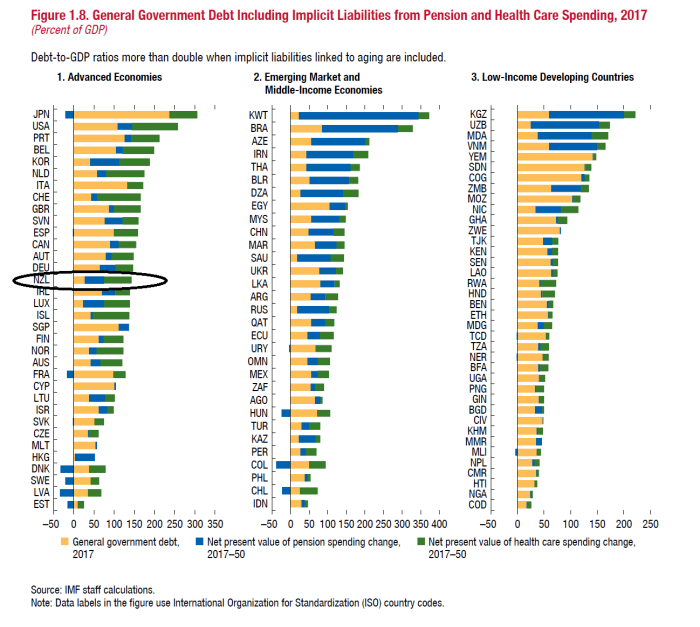
The IMF has had a stab at calculating the net present value (NPV) of those increased costs out to 2050. We can think of that as how big a pot of money we would need to have set aside, earning compound interest, if those liabilities were fully funded.

It reckons the NPV of the pension spending increase out to 2050 is 54 per cent of GDP. That is $150b in today’s dollars, only partially offset by $38b in the New Zealand Superannuation Fund. The NPV of the expectable health spending increase is even larger, at 66 per cent of GDP.

When those two factors are accounted for, New Zealand is no longer a fiscal outlier, but sits in the middle of the range for advanced economies, between Germany (with its challenging demographics) and Ireland (with its debt crisis legacy).

That sounded interesting, so I dug out the chart Brian appears to be referring to from the latest IMF Fiscal Monitor publication.

IMF fiscal monitor implied debt chart

I don’t know quite how the IMF did their health and public pension numbers, or how comparable their estimates are across countries.  But just take them as what they are (our pension numbers are high because, unlike many countries, we haven’t done anything to raise the NZS age).   Allegedly, New Zealand is now in the upper half of the indebted advanced countries.

But this is a nonsense chart, adding apples and oranges.    It might make some sense if every country had the same starting deficit/surplus, in which case future differences in discretionary spending associated with ageing might be the only difference in the projected future debt paths across countries.

In fact, some countries are in (cyclically-adjusted) surplus, and some are in (cyclically-adjusted) deficits.     Israel, for example, is estimated to have structural deficits of 3.5 per cent of GDP, and the US is now estimated to have structural estimates of about 6 per cent of GDP.   Israel is much further down that IMF chart than we are, but annual deficits of 3.5 per cent of GDP  (before the effects of additional ageing) soon compound into very large numbers.

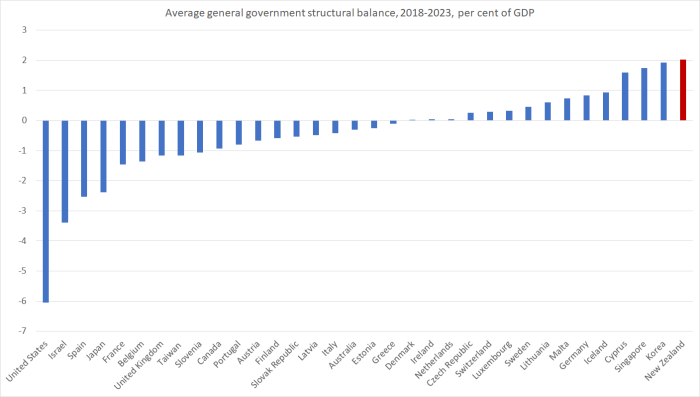
And New Zealand?   Here are the IMF’s own estimates of the average cyclically-adjusted fiscal balance for 2018-2023 (their forecast period).

fisc balances IMF

On the IMF’s own numbers we have the largest (structural) surpluses projected over the next few years of any advanced economy.  Structural surpluses of 2 per cent per annum, in a country with high real interest rates, compounds to a very big (positive) NPV really quite quickly.

As it happens, Germany is also projected to be running quite large surpluses. No wonder markets aren’t remotely worried about fiscal/debt risks in either Germany or New Zealand.     You simply can’t sensibly start with today’s debt, add one bit of additional future spending, and not take account of the baseline fiscal parameters that, in countries like New Zealand, mean we already have material fiscal surpluses (on the books, and in prospect).   Fiscal people at the IMF sometimes liked to quip that IMF stood for “It’s mostly fiscal” (the problems, and macro solutions, that is).  But they really should be producing better fiscal analysis than this (even if, perhaps, their main interest is big countries with both high debt and ongoing deficits).

None of which means I think NZS shouldn’t be changed. To my mind –  as voter –  failure to do so is both a fiscal and moral failure.  But, despite those future pressures, by international standards our fiscal position remains very strong, and there is –  objectively –  plenty of time to adjust (even if I personally might prefer the adjustment had already begun years ago).


The government’s debt target

I’d seen various news stories suggesting that in a speech on Tuesday the Minister of Finance had made the case for sticking with the Budget Responsibility Rules agreed with the Green Party this time last year.  So I thought I should read the speech.    There wasn’t much there.  The rules were restated, including the debt commitment, but there was no case made for following those particular rules, rather than some others.  The furthest the Minister got was the standard fallback line

We must be fiscally responsible. We must ensure that New Zealand is well-placed to handle any natural disasters or economic shocks.

Which doesn’t help, because it doesn’t differentiate the Minister’s rules from those of any other reasonably conceivable alternative.  Resilience to natural disasters or economic shocks is the fiscal equivalent of a motherhood and apple pie standard.

In terms of the government’s self-imposed fiscal rules, the only one that really troubles me is the debt one.    There are also these two

We will deliver a sustainable operating surplus across an economic cycle.

and

We will maintain Government expenditure within the recent historical range of spending to GDP, which has averaged around 30 percent over the last 20 years.

But what of debt

We will reduce the level of net core Crown debt to 20 percent of GDP within five years of taking office. 

In general, debt targets –  with relatively short time horizons to achieve them –  aren’t very sensible as operational rules.   Such a rule can mean that a few fairly small, essentially random, forecasting errors in the same direction can cumulate to produce a need for quite a bit of (perhaps unnecessary) adjustments to spending or revenue.  More seriously, recessions can throw things badly off course for a while, and risk pushing a government into a corner –  either abandon the target just as debt is rising, or fallback on pro-cyclical (recession exacerbating) fiscal adjustments –  even though, in across-the-cycle terms, the government’s finances might be just fine.  No one looks forward to a recession, but governments (and central banks) need to work on the likelihood that another will be along before too long.   Natural disasters –  the other shock the Minister mentioned –  can have the same effect.

Personally, I would be much more comfortable with only two key quantitative fiscal rules:

  • a commitment to maintaining the operating balance in modest surplus, once allowance is made for the state of the economic cycle (cyclical adjustment in other words) and for extraordinary one-off items (eg serious natural disasters), and
  • something about size of government.    Simply as an economist I don’t have a strong view on what the number should be, although as I’ve noted previously it is curious that the current left-wing government, arguing all sorts of past underspends, was elected on a fiscal plan that promised spending as a share of GDP that undershot their own medium-term benchmark (that around 30 per cent of GDP).

The suggested fiscal surplus rule isn’t an ironclad protection (any more than a real-world inflation target in a Policy Targets Agreement is).  There are uncertainties about the state of the cycle and how best to do the cyclical adjustment, and incentives to try to game what might be counted as an “extraordinary one-off”.   That is why the fiscal numbers and Budget plans will always need scrutinising and challenging.  But if followed, more or less, such a rule would be sufficient to see debt/GDP ratios typically falling in normal times, and to avoid things going badly wrong over a period of several decades.  That is probably about as much as one can realistically hope for.

There are those arguing for the government to increase its debt levels at present.    I’m a bit sceptical of that notion, for several reasons.  The quality of a lot of government capital spending –  whether it is cycleways, trains, or roads, just to take the transport area –  often leaves a great deal to be desired.  Advocates of more debt often talk up the relatively low interest rates at present, and suggest those low rates offer great opportunities.  Except that when interest rates have been low –  and if anything still falling –  for a decade, they probably need to be treated as semi-permanent, and thus as revealing something about the perceived economic opportunities advanced economies are offering.  And –  a point I’ve made often –  low as our interest rates are by historical standards, they are still high by the standards of most other advanced economies.

One consideration that might suggest it would be sensible for New Zealand to run higher debt than most other advanced countries is that our population (boosted by immigration policy) is growing much more rapidly than those of most other advanced countries.  All else equal, that should lead to faster growth in future GDP (not GDP per capita, just the total) and future tax revenue, suggesting more capacity to carry debt now.    There is certainly something to that argument at the local level, and hence I hope the government’s talk of facilitating local authority SPVs, which will enable debt to be taken on, serviced by specific property owners’ future rates commitments but outside existing core local authority debt limits, comes to something.     I’m much more sceptical of the story at the national level since on the one hand champions of immigration will stress the idea of immigration providing immediate fiscal gains (a claim there is probably something to, even if –  as Fry and Wilson suggest –  those effects die away over time).   If there is really an upfront windfall, there shouldn’t need to be more debt taken on.  And, on the other hand, for whatever reason, New Zealand’s trend productivity growth rate has been lousy for a long time, suggesting that even if our numbers (of people) are growing faster than in other countries, our (total) GDP won’t be that much faster.  It would be a different story if, say, more people was transforming (lifting sharply) our productivity performance, and future incomes, but there isn’t much sign of that.

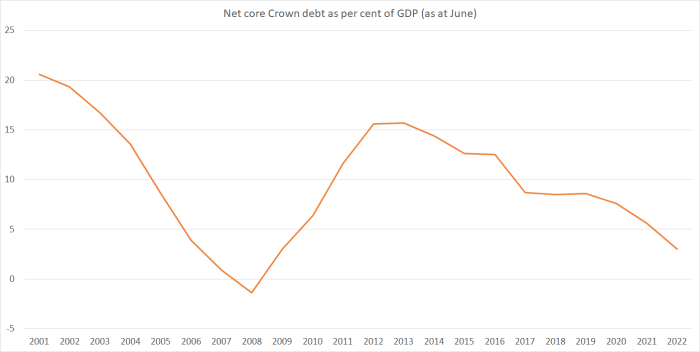
What about some numbers/pictures.  Here is a chart (including Treasury forecasts) of core Crown net debt as a per cent of GDP.  This isn’t the variable the government (and its predecessor) choose to target, since it excludes assets held in the New Zealand Superannuation Fund.  But it is all just money, and NZSF assets could be liquidated in quite short order if necessary.  (Even this variables excludes some government on-lending (“advances” in Treasury parlance) which seem to be about 5 per cent of GDP).

net debt 2018

After a serious recession and a weak recovery, and a series of pretty costly natural disasters, this measure of net debt peaked at a level lower than we’d had a decade earlier.   The estimate for June 2018 (from HYEFU numbers) is debt of 8.5 per cent of GDP.  On current plans –  as communicated by the government to Treasury – debt would drop away to 3 per cent of GDP by 2022.  At that point, it wouldn’t be quite as low as the 2007 or 2008 levels –  reached after a sequence of huge, unexpectedly large, and economically unnecessary surpluses, and partly reflecting a prolonged expansion in which the economt ran ahead of medium-term capacity –  but it  would be pretty close.

There is no easy metric for what an appropriate level of government debt is.  And the agency issues around government debt are much more severe than those for private debt –  governments aren’t spending their own money.  The parallels here aren’t exact either, but a typical middle-aged household is likely to have debt materially higher than 3 per cent –  or even 8 per cent –  of their GDP.

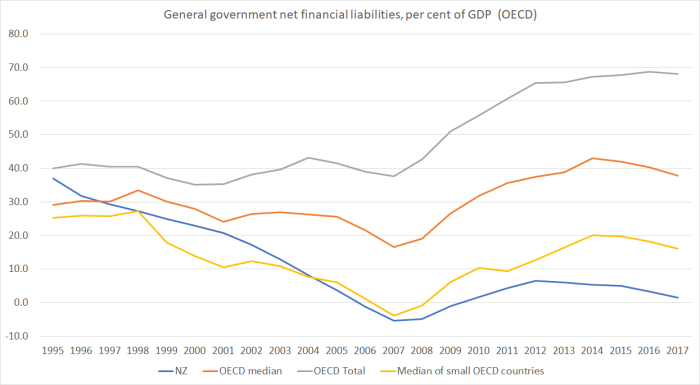
What about some cross-country comparisons?  Here I turn to the OECD and, in particular, their series on general government (ie not just central) net financial liabilities.  I start from 1995, because that is when the OECD has data for almost all countries.

net debt OECD

I thought there were a couple of interesting points here:

  • for all the talk of governments piling on debt since the 2008/09 recession, net debt in the median OECD country (orange line) last year wasn’t materially higher than it had been 20 years previously,
  • but total net debt over all the OECD countries (the grey line) has increased very substantially.  Of the big OECD economies –  US, Japan, Germany, France, Italy, UK –  only Germany doesn’t have a much higher debt ratio now than in 1995.
  • small OECD countries seem to have been much more conservative in managing their public debt (yellow line).  That group includes – at one extreme –  Greece and –  at the other – Norway.  The median net debt of those countries is materially above where it was in 2007, but it isn’t much different than it was in, say, 2002 (15 years earlier).

New Zealand doesn’t have the lowest net debt by any means (Norway has net financial assets of 280 per cent of GDP). In fact, we mark out something around the lower quartile.  We’ve had some disadvantages the other small countries didn’t –  earthquakes –  but on the other hand we’ve had an unusually strong terms of trade and weren’t constrained (as many of them were) by being in the euro.  But it looks hard to make a strong case for actively pursuing lower net debt from here.  It isn’t as if, for example, there is any sign of the economy overheating.

(Things not shown are often as important as those shown.  Unlike many of the more indebted countries, we do not have a large unfunded pension liability for public servants in New Zealand.  Those liabilities are not included in these debt numbers.)

Feckless governments in other countries don’t necessarily make for much of a benchmark. And, as above, I’m not actively calling for New Zealand governments to take on more debt.   But simply producing a sequence of modest cyclically-adjusted operating surpluses  (NOT several per cent of GDP) over the next few budgets would seem to be about as much as it would be sensible –  from a macroeconomic perspective –  to ask from a government.

And, on a final note, I am increasingly uneasy about one aspect of the Labour-Greens budget responsibility pledges that seems to have disappeared almost totally.

This was the promise

  • The credibility of our Budget Responsibility Rules requires a mechanism that makes the government accountable. Independent oversight will provide the public with confidence that the government is sticking to the rules.

  • We will establish a body independent of Ministers of the Crown who will be responsible for determining if these rules are being met. The body will also have oversight of government economic and fiscal forecasts, shall provide an independent assessment of government forecasts to the public, and will cost policies of opposition parties.

But nothing more has been heard.   I wrote about it here, and suggested that the idea should be broadened to become a Macroeconomic Advisory Council.  That still seems sensible to me, especially as the Reserve Bank reforms the Minister has announced to date do nothing to strengthen effective scrutiny of the Reserve Bank. But for now, it would be good if the Minister could update us on what has happened to the Fiscal Council promise.


Labour’s fiscal commitments

There has been plenty of talk in the last few days about the fiscal pressures the government finds itself facing.   There are echoes of the great “fiscal hole” controversy from last year’s election campaign.   And so it seemed like a good time to revisit a post I did back then on these issues.

In that post I first explained what Labour had done

Labour has laid out their numbers in a series of summary tables.  They have explicitly identified numbers for each of their (revenue and expenditure) major policy initiatives, and made explicit summary provision for the cost of a group of less expensive policies.  And they identified how much (or little) still unallocated money they would plan to have available.   The resulting operating surplus numbers are almost identical to those in PREFU, but where they do take on a bit more debt –  to fund NZSF contributions and the Kiwibuild programme – they also allow for additional financing costs.

And then they had BERL go through the numbers.    People on the right are inclined to scoff at BERL and note that they are ideologically inclined to the left.  No doubt.  But all they’ve done on this occasion is a fairly narrow technical exercise.  They haven’t taken a view on the merits of any specific policy promises or even (as far I can see) on the line item costings Labour uses.  And they haven’t taken a view on the ability of a Labour-led government to control spending more broadly.   They’ve taken the Labour numbers, and the PREFU economic assumptions and spending/revenue baselines, and checked that when Labour’s spending and revenue assumptions are added into that mix that the bottom line numbers are

“consistent with their stated Budget Responsibility Rules and, in particular

  • The OBEGAL remains in surplus throughout the period to 2022
  • Net Core Crown debt is reduced to 20% of GDP by June 2022
  • Core Crown expenses remain comfortably under 30% throughout the period to 2022.”

An economics consultancy with a right wing orientation would have happily signed off on the same conclusion.

But, so I argued, that wasn’t the real issue.   I won’t blockquote all this, but what follows is just lifted from the earlier post.

But where there is more of an issue is that Labour’s spending plans on the things they are [explicitly] promising mean that to meet these surplus and debt objectives, on these [PREFU] macro numbers, there is very little new money left over in the next few years.     That might not sound like a problem –  after all, why do they need much “new money” in the next few years when the things they want to do are already specifically identified and included in the allocated money in the Labour fiscal plan?      The answer to that reflects the specifics of how the fiscal numbers are laid out, and how fiscal management is done.   Government departments do not get routine adjustments to their future spending allowances to cope with, say, the rising demands for a rising population, or the increased costs from ongoing inflation (recall that the target is 2 per cent inflation annually).   Rather, they are given a number to manage to, and only when the pips really start squeaking might a discretionary adjustment to the department’s baseline spending be made.  Any such discretionary adjustments comes from the “operating allowance” –  which thus isn’t just available for new policies.

You can see in the PREFU numbers.   Health spending rose around $600 million last year, and is budgeted to rise by around $700 million this year (2017/18).  And then….

$m
2017/18 16432
2018/19 16449
2019/20 16481
2020/21 16396

No one expects health spending to remain constant in nominal terms for the next three fiscal years.  But there will need to be conscious decisions made in each successive Budget to allocate some of the operating allowance to health –  some presumably to cover new policies, and much to cover cost increases (wages, drugs, property etc, and more people), all offset by whatever productivity gains the sector can generate.

And here is why I think there are questions about Labour’s numbers.  By 2021, they expect to be spending $2361 million more on health than is reflected in these PREFU numbers.     About 10 per cent of that increase is described as “Paying back National’s underfunding” and the rest is labelled as “Delivering a Modern Health System”.

This is how they describe their first term health policies

Reverse National’s health cuts and begin the process of making up for the years of underfunding that have occurred. This extra funding will allow us to invest in mental health services, reduce the cost of going to the doctor, carry out more operations, provide the latest medicines, invest in Māori health initiatives including supporting Whānau Ora, and start the rebuild of Dunedin Hospital.

That sounds like an intention to deliver materially more health outputs/outcomes (ie volume gains, or reduced prices to users).

In response to Steven Joyce’s attack, Grant Robertson is reported as having told several journalists that Labour’s health (and education) numbers include allowances for increased costs (eg rising population and inflation  –  and inflation in the PREFU is forecast to pick up) as well as the costs of the new initiatives.   Perhaps, and if so perhaps a pardonable effort to put a favourable gloss on the proposed health (and education) spends –  ie sell as new initiatives what are in significant part really just keeping with cost and population pressures.  I say “pardonable” because governments do it all the time.

In this chart, I’ve shown core Crown health expenditure as a share of GDP since 2000, and including Labour’s plans for the next three budgets.  (Labour show total Crown numbers, but I’ve taken their policy initiative numbers –  ie changes from PREFU –  and applied them to the core Crown data, which Treasury has a readily accessible time series for.  The differences between core and total Crown in this sector are small.)
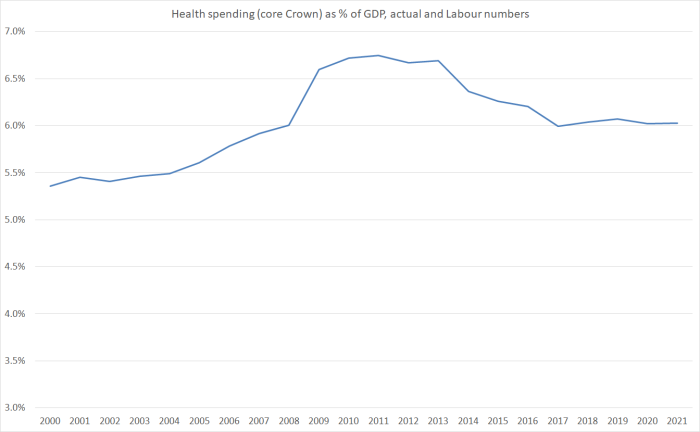
Labour health

In other words, on these numbers health as a share of GDP over the next three years would be less than it was for most of the current government’s term, and virtually identical to what it was in Labour’s last full year in government, 2007/08.    Some of the peaks a few years ago were understandable –  the economy was weak, and recessions don’t reduce health spending demands.  But even so, we know that there are strong pressures for the health share of GDP to increase, as a result of improving technology (more options) and an ageing population.  Treasury’s “historical spending patterns” analysis in their Long-term Fiscal Statement last year had health spending rising from 6.2 per cent of GDP in 2015 to 6.8 per cent in 2030.

Without seeing more detail than Labour has released there really only seem to be two possible interpretations.  Either Labour hasn’t allowed for the ongoing (ie from here) population and cost increases in their health sector spending numbers, or there must be much less in the way of increases in health outputs than the documents seem to want to have us believe (eg “reversing years of underfunding”).  One has potential fiscal implications.  The other perhaps political ones.    Glancing through Labour’s health policy, which seems quite specific, I’m more inclined to the former possibility (ie not allowing for population and cost pressures), but I’d be happy to shown otherwise.

Eyeballing that chart –  and as someone with no expertise in health –  it would look more reasonable to expect that health spending might be more like 6.5 per cent of GDP by the end of the decade, in a climate where a party is promising more stuff not less, and with no strategy to (say) shift more of the burden back onto upper income citizens.

2018 commentary resumes here:  in other words, despite all the talk in their own campaign documents and rhetoric about systematic underfunding of health, Labour’s proposed spending on health –  carefully laid out numbers – as a share of GDP just wasn’t consistent with the rhetoric.   They – and perhaps even the previous government –  may not have been specifically aware of, say, the Middlemore problems, and perhaps more generally things really are worse than they could have realised in Opposition.   But it seems implausible to think that a party talking up underfunding –  and well aware, for example, of the constant pressure on DHBs to produce surpluses come what may –  could have supposed that, on their proposed delivery models and views on entitlements, operating spending on health of only 6 per cent of GDP could have been enough.     That was stuff they should have recognised and acknowledged going into the election.

As I noted in last year’s post, one could do the same exercise for education.  This is another quote from that post:

One could do much the same exercise for education.  Labour has seven line items in its “new investments” table.  Most of them are very specific (including increased student allowances and the transitions towards zero-fees tertiary education).     There is a general (large) item labelled “Delivering a Modern Education System” but in the manifesto there are a lot of things that look like they are covered by that.    There isn’t any suggestion that general inflation and population cost increases are included, but perhaps they are.  But again, here is the chart of education spending as a share of GDP, including Labour’s numbers for the next three years.
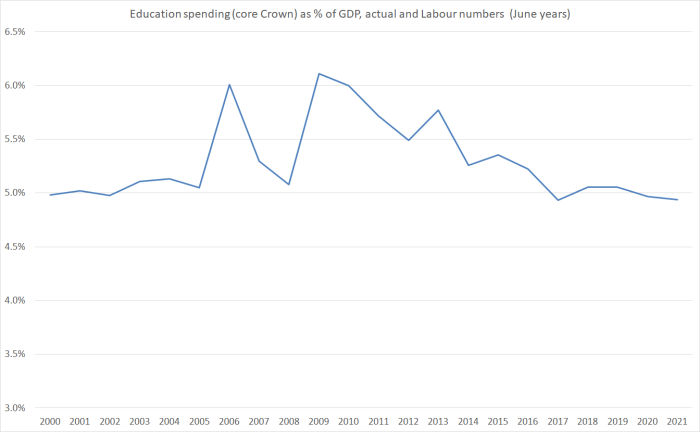
labour education.png

I’m not altogether sure what some of those earlier spikes were (perhaps something to do with interest-free student loans), but again what is striking is that Labour’s plans appear to involve spending slightly less on education as a share of GDP than when they were last in government.  And that more or less flat track from here doesn’t suggest a party responding to this stuff

National has chosen to undermine quality as a cost-saving measure. After nine years of being under resourced and overstretched, our education sector is under immense pressure and the quality of education is suffering. The result is a narrowing of the curriculum, more burnt out teachers, and falling tertiary education participation.

and at the same time committing to flagship policies around things like student allowances and fee-free tertiary study.

Again, it begins to look as though Labour has included in its education numbers the ongoing multi-year costs of its own new policies, but not the ongoing cost increases resulting from wage and price inflation and population increases.  Again, I’d happily be shown otherwise.

Of course, there is some unallocated spending in Labour’s numbers, but the amounts are very small for the next few years, and some of these sectors are very large.  And although population growth pressures are forecast to ease a little in the next few years, inflation is forecast to pick up and settle around the middle of the target range, so there are likely to be increased general cost pressures (including, for example, wage pressures if as Labour state in the fiscal plan document “by the end of our first term, we expect to see unemployment in New Zealand among the lowest in the OECD, from the current position of 13th”).

How much does it matter?  After all, we don’t know many specifics on the policy initiatives National (and/or its support partners) might fund in the next term, and there was the strong suggestion the other night of a new “families package” in 2020 (which would come from any operating allowance).  Quite probably the next few years will be tough, in budget terms, for whoever forms the government.  After all, the terms of trade isn’t expected to increase further, and inflation is.  And there is a sense that in a number of areas of government spending things have been run a bit too tight in recent years.      On the other hand, Labour participated in this ritual exercise and it looks as though they may have implied rather more fiscal degrees of freedom than were actually there, if –  critical point –  they happened to want to produce a surplus track very like National’s.

2018 commentary resumes again. But all that led me to wonder quite why Labour had made the commitments it had.  Here is a final, slightly shorter, quote

……perhaps the bigger question one might reasonably put to both sides is why the focus on (almost identical) rising surpluses?   These are the numbers.
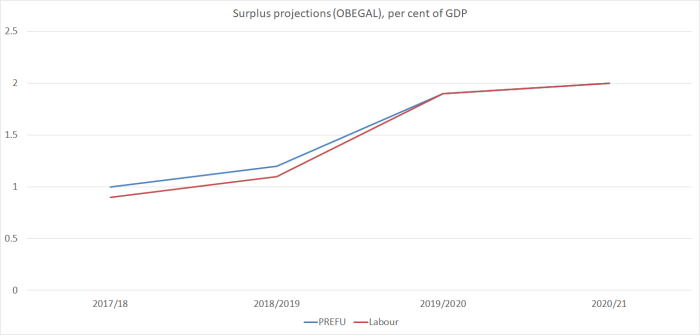
labour surplusWhen net core Crown debt is already as low as 9.2 per cent of GDP –  not on the measure Treasury, the government and Labour all prefer, but the simple straightforward metric –  what is the economic case for material operating surpluses at all?   With the output gap around zero and unemployment above the NAIRU, it is not as if the economy is overheating (the other usual case for running surpluses).   Even just a balanced budget would slowly further lower the debt to GDP ratios.   One could mount quite a reasonable argument for somewhat lower taxes (if you were a party of the right) or somewhat higher targeted spending (if you were a party of the left, campaigning on structural underfunding of various key government spending areas).

Labour is promising to spend (and tax –  thus the surpluses are the same) more than National.  But their commitment (rule 4) was to keep core Crown expenditure “around 30% of GDP”, not “comfortably below 30 per cent”.

labour spending

28.5 per cent is quite a lot lower than 30 per cent (almost $5 billion in 2020/21 – not cumulatively, as GDP is forecast to to be about $323 billion). And 30 per cent wasn’t described as a ceiling. And in the last two years of the previous Labour government, core Crown spending was 30.6 per cent of GDP (06/07) and 30 per cent of GDP (07/08).

It is a curious spectacle to see a party campaigning on serious structural underfunding of various public services and yet proposing to cut government spending as a share of GDP.  It would be difficult to achieve –  given the various specific policy promises –  but you have to wonder, at least a little, why one would set out to try.     We simply aren’t in some highly-indebted extremely vulnerable place.

Here endeth the quotes from last year

I’m not one of those persuaded by the siren calls that the government should be borrowing heavily because interest rates are low.   For a start, our interest rates are still among the very highest in the OECD.   And interest rate outcomes aren’t the result of some random-number lottery: they are low for a reason (having to do in no small part with future expected rates of growth).   I’m also cautious about the lack of “policy space” to cope with the next serious recession.   But in the debate around this year’s Budget, or the next couple, most aren’t suggesting the government should rush out and adopt fiscal parameters that might deliver net debt of 50 or 70 per cent of GDP a decade hence.   Instead, Labour simply bound itself to the same, arbitrary, net debt target as National had run with, just achieved a couple of years later than National planned to do so.

I don’t agree with everything in this extract from Matthew Hooton’s Herald column the other day, but the gist seems about right.

Robertson has convinced himself that sticking to his commitment is essential to maintain the confidence of the business community and financial markets.

He remembers the Winter of Discontent of 2000 and is determined to avoid at all costs investors and business becoming actively hostile to the new regime.

But this just shows Robertson’s naivety about the business and finance communities and woeful ignorance of what drives confidence in either.

At a net 22 per cent of GDP, New Zealand’s debt is already low compared with the rest of the world. If carefully signalled and communicated by Robertson and his Treasury officials, it is implausible that a further extension of the 20 per cent debt target to, say, 2025, would provoke a materially adverse reaction from the business community or financial markets, especially if emphasis was placed on investments in infrastructure and human capital.

Moreover, the business and financial communities well understand and accept that the fundamental difference between Labour and National governments — at least theoretically — is that the former believes in bigger government than the latter.

And yet –  see the graph immediately above- Labour campaigned on continued reductions in government operating expenditure as a share of GDP, all the time claiming that core services were underfunded.   And in her press conference yesterday, the Prime Minister indicated that Labour would be sticking to its self-imposed Budget Responsibility Rules.  As I illustrated above, under the operating spending limb of those Rules there is plenty of slack, but the binding rule on this occasion is the net debt goal they have committed to.  And net debt isn’t just affected by any increase in operating spending, but also in any action the government takes to address claims of (previously unrecognised) backlogs in capital investment.

Labour seem to have first got themselves into this hole from (a) a desperate desire not to leave room to be painted as irresponsible potential economic managers, and (b) an inability to persuasively make an alternative case.  And all of this was laid down at a time when, perhaps, it seemed that the chances of having to actually deliver, in government, were slim.     But, in the old line, the first rule of holes is “stop digging”.  At present, Labour –  while claiming things are much worse than even they realised –  seem to be setting out to dig themselves even deeper in.   In a way, perhaps, it is admirable that they seem to want to follow through on a pre-election commitment.  But that narrative about fixing public services, and reversing what they regarded as severe underfunding in many areas (now worse, they claim, than they previously recognised) seemed quite like a pre-election commitment as well, even if it didn’t have precise numbers and dates on it.

(And yes, my natural inclinations are towards smaller government.  There are plenty of things I would cut back on, notably addressing NZS issues.  This post isn’t an unconditional advocacy for bigger government, or any sort of statement of faith in the likely quality of much government spending, just pointing to the tortured, almost indefensible, logic of the government’s own position.   And for those who worry about the interest rate consequences of higher net debt, I tackled that in another post last year.)