NZ’s company tax rate: enforcement and investment

Last week I wrote briefly about a short presentation, at a Victoria University event, by tax blogger (and former Treasury/IRD official, former adviser to the Tax Working Group) Andrea Black on what should be done with the company tax rate.  Andrea argued that it should be raised, both to collect more tax from the “rich” and to reduce the evident opportunities for avoiding or deferring tax that differential rates for company, personal, and trust income creates.

Since what I wrote about that was buried in the middle of a long post, I reproduce the relevant section here

I wasn’t really persuaded.  With dividend imputation, the company tax rate in New Zealand bears much more heavily on foreign investors (none of whom needs to be here) than it does on domestic shareholders.  In a country with low rates of business investment and now relatively low rates of foreign investment, it seems cavalier to be calling for increases in company tax rates which the global trend is clearly downwards (at 33 per cent the company tax rate would be the second highest in the OECD).   In defence of her position, Andrea invoked some old IRD analysis that company tax cuts haven’t made much difference to investment –    IRD has a strong institutional bias towards a simple tax system and little real focus on productivity, economic performance or anything of the sort – while noting that “if you did care about foreign investors” –  there were various technical tweaks (I didn’t catch them, but perhaps thin capital rules?) that could be adjusted to compensate them at least in part.

As if to forestall a question, Andrea alluded to this chart I’ve used several times –  a version of which appeared in the TWG’s own background document last year.

corp tax 2017

Prima facie, it didn’t look as though – by international standards – we were undertaxing business income.

Now, of course, there are some well-recognised caveats to this data.  First, it doesn’t take account of dividend imputation in New Zealand (and Australia, but not elsewhere), and the TWG suggested there were some issues around consistency of treatment of government-owned businesses.  On the other hand, in many countries lots of shares are owned by long-term savings vehicles with much less onerous tax provisions than their peers in New Zealand would have, and our tax system (mercifully) has fewer deductions and “holes” in it.     In yesterday’s presentation Andrea suggested that in many other countries various classes of business income that would be incorporated –  and thus captured in the chart – here wouldn’t be treated the same way in other countries.

All that said, if anyone is seriously suggesting that the chart of OECD data is substantially misleading about the New Zealand position –  say that in truth we might be in the lower half of the chart on an apples-for-apples comparison, the onus is probably on them to demonstrate that more specifically.    The OECD data itself suggests we have taxed businesses quite heavily going back 50 years, to (for example) well before imputation was ever on the scene (chart in this post).  Perhaps it is just coincidence – and I’m certainly not suggesting it is the only factor –  that business investment as a share of GDP has been low by OECD standards throughout almost all that period.

In a comment on my post, Andrea clarified that it was changes to the thin-capitalisation rules she had in mind to mitigate adverse effects on foreign investors.

I’m sympathetic to the idea that New Zealand shareholders shouldn’t be able to shelter income in companies in a way that means that some forms of flow capital income are taxed more lightly than others.  For small closely-held companies, for example, I can see a certain logic to a mandatory distribution of profits (which could then be simultaneously reinvested).

When I heard Andrea’s brief presentation last week, I hadn’t seen her initial post on the issue.   It is worth reading and she presents what looks like persuasive indications that there is more of an issue here than (for example) some people who commented on my post or got in touch privately might have suggested.   For example

Except that overdrawn current account balances – loans from the company to the shareholders- have been similarly growing too. Now sitting at about $25 billion.

And yes this all started from about 2010. And what happened in 2010? Why dear readers the company tax rate was cut to 28% while the trust rate remained at 33%.

Last night Andrea put out a further post on the issue, prompted (it appeared) by my post last week.    It is also worth reading, repeating some of the earlier material but also extending her argument.   For example, in dealing with the foreign investment issues she now suggests another possible response

If the focus was New Zealanders owning closely held New Zealand businesses, an adjustment could be made either by increasing the thin capitalisation debt percentage or making a portion – most likely 5/33 – of the imputation credit refundable on distribution.

I’ll leave you to read Andrea’s case. On its own terms, it makes a fair amount of sense on her terms (and she is much more expert on tax detail than I am) but I want to focus on the issue through a different lens.

Thus, take for example the line –  which apparently originates with IRD –  that we’ve had no more foreign investment since the company tax rate was cut.   Well, here is a chart of New Zealand company tax rate relative to the median OECD country’s company tax rate (OECD data that take account of sub-national taxes as well).
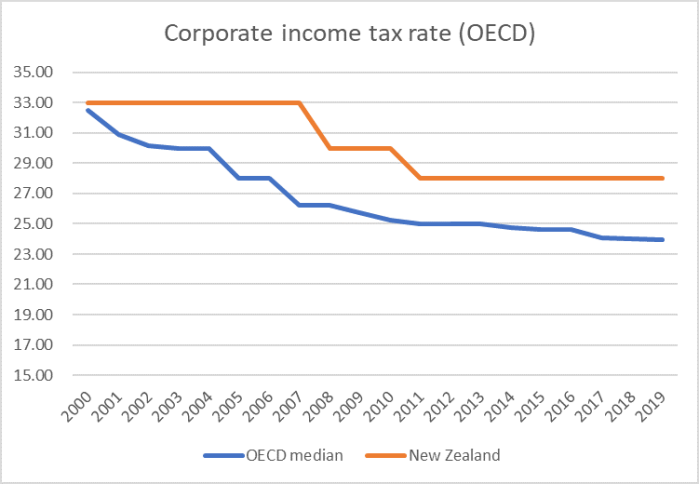
coy tax oecd

The story of the century, around company tax, is that the gap has been widening between our company tax and those in other advanced countries (with the two local cuts just temporarily closing the gap a bit). At the start of the century, our company tax rate was around the median for the OECD countries, and in 2019 it is just over 4 percentage points higher.  (One could add that the global environment for business investment seems to have been pretty poor over the last decade, not least in New Zealand.)

At present, our company tax rate –  the one that counts for foreign investors –  is just above the upper quartile.

coy tax 2

Andrea’s proposal would give us the highest company tax rate in the OECD.   One could adopt the clever wheezes she suggests to limit any adverse effect on foreign investors of raising the rate but (a) our statutory rate is already (now) at the upper end of the scale, and (b) our company tax regime is generally regarded as fewer holes and deduction possibilities etc than many of those in other countries.

And it isn’t as if business investment has been present in abundance in New Zealand.   This chart is from an OECD review of New Zealand from a few years ago.bus I oecd 2011.png
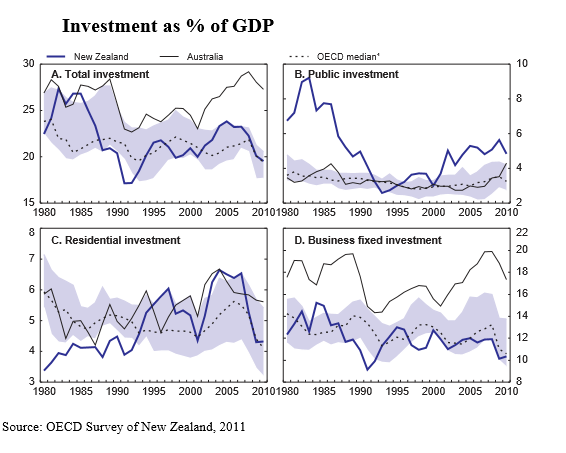
Focus on that bottom right panel.  The only time business investment as a share of GDP was above that for the median OECD country for a few years was during Think Big – the spectacular government-led misallocation of capital.  And recall that for at least the last 25 years, our population growth has been well above that of the median OECD country, so that all else equal one might have expected more of current GDP to be devoted to investment.

I’ve seen –  but can’t now find –  the OECD data for these graphs back to the 1960s and the picture is similar,  What about the more recent period?

“Business investment” is calculated as a residual. Take gross fixed capital formation and subtract investment spending on new housing and general government investment spending.  When I use OECD data for cross-country tables, I usually take care to check their New Zealand data against what is on the SNZ website.  In this case, GDP, GFCF, and dwellings investment are all identical in the two places, but the general government investment numbers are somewhat different.  So in this chart, comparing business investment as a share of GDP for New Zealand with that for the median OECD country, I’ve shown the New Zealand numbers estimated both ways (ie using OECD and SNZ gen govt investment data).
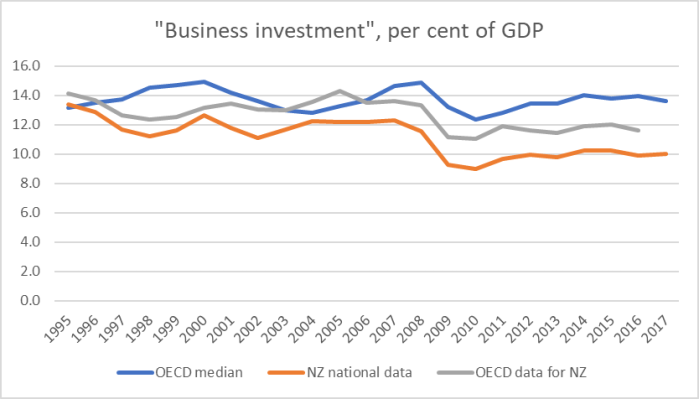
bus I NZ

Whichever line you use, business investment in New Zealand (per cent of GDP) has been materially below that of the median OECD country in most/all years, despite having had population/employment growth far faster than that of the median OECD country.

I am not, repeat not, suggesting that our company tax rate –  or the broader tax regime for capital income –  is the only factor, or even necesssarily the most important factor, in our weak business investment (and terrible productivity growth) record.   Simply that if any government were ever seriously concerned about those failures –  and wouldn’t that be a novelty –  raising the company tax rate looks as though it would be a step in the wrong direction.     If anything, in my view we should be taxing capital income less heavily.  No business has to invest – and no foreign investor has to invest here –  and if you want more of something it isn’t usually a good place to start to tax it more heavily.

And to end on a note that seems to me to –  at least on paper – better balance fairness and efficiency/opportunity, here is my final paragraph about that seminar last week at which Andrea spoke.

I remain tantalised by the idea of a progressive consumption tax. In the abstract, it gets around all the debates on capital gains taxes, realisations (or not), company taxes, gift or inheritance taxes or whatever, and has the appealing the feature of taxing people on what they consume not on what they produce.  Of course, no country runs such a system –  which does have formidable practical issues.   And if one wants to align company and personal rates – which has some appeal (although the Nordic model questions that), better to lower the personal income tax rates by 5 percentage points (max rate to 28 per cent) and add a Social Security Tax of 5 percentage points on labour income up to a certain threshold.  New Zealand and Australia are, as I understand it, the only OECD countries not to adopt some such model (we do it on a very small scale with ACC).
 

Recalling Jian Yang’s past: questions for him and his leader

It was two years ago last Friday that Newsroom and the Financial Times jointly broke the story of National list MP Jian Yang’s past, as a Chinese Communist Party member and fifteen years spent as a trainer in the PLA military intelligence system.   There was a strong suggestion that he had been removed from Parliament’s foreign affairs committee after the New Zealand security services discovered his past and had drawn it to the attention of the then Prime Minister.    Anne-Marie Brady’s Magic Weapons working paper was released at about the same time, highlighting the extent of PRC attempts to influence, or interfere in, affairs in New Zealand.

A bit more of Jian Yang’s story seeped out over the following few months, including his residency application documents for New Zealand, in which –  so he later acknowledged –  he had actively chosen to misrepresent his past, (so he also told us) on the instructions of Beijing.      There was also rather more confirmation of just how close to the PRC Embassy in New Zealand Jian Yang is and was –  leading one serious government relations type, with a diplomatic background, to go on record stating that he was always very careful what he said around Jian Yang (and Raymond Huo, once again a Labour MP).   The implication –  never stated directly –  was that whatever was said around him might well end up in the hands of the PRC Embassy.  At the time, of course, Jian Yang was full member of the government caucus, and although Cabinets often keeps their own caucuses in the dark about some things, caucus members generally know more than you or I do about what the government is up to, or is thinking.

But after that brief flurry the issue died down.    Labour and the Greens showed no interest in questioning whether someone of that background, never once heard to utter a word of criticism of the PRC, should really be serving in our Parliament.  National closed ranks behind Jian Yang –  not once in the subsequent two years has a single past or present National MP expressed as much as an iota of concern.   And Jian Yang went quiet, simply refusing to talk at all to any English-language media (despite English being the first language of most of National’s voters), but only too happy to talk to quiescent regime-complicit Chinese language outlets.   If you can get away with it –  and have all the morals that must have accompanied CCP membership and service with PLA military intelligence –  I suppose why would you do anything else?  People –  all of us – respond to incentives and –  given his actual background –  simply going to ground and staying there must have looked quite the most attractive option.

Optimists –  naive ones perhaps –  wondered if perhaps National, embarrassed to have been caught out, would gradually sideline Jian Yang and he’d eventually quietly step aside by the next election, perhaps to be replaced with another regime-sympathetic,  well-connected, good-with-the-donors recent migrant, but one without such an uncomfortable back story.

Silly them (well, in my optimistic moments perhaps I was one of them).

For Jian Yang is still with us.  Still not talking to the English-language media (except a few comments in his rather ineffectual service as National’s spokesman on Statistics), still sharing an office in Auckland with fellow list MP (and now National’s Finance spokesman) Paul Goldsmith, recently promoted to chair the (not overly important) Governance and Administration Committee of Parliament, still in business with National Party president (and regime cheerleader) Peter Goodfellow), and……most recently, accompanying Simon Bridges on his trip to the PRC, including that gruesomely awful fawning interview with CGTN (saying what so much of the rest of the New Zealand establishment only support in practice by their silence) and his meeting with Guo Shengkun, the Politburo member responsible for the entire apparatus of repression (“law and order”) in the PRC, including the concentration camps in Xinjiang.   Yes, it was a big week for Jian Yang.  If Simon Bridges wasn’t just regurgitating briefing notes from Jian Yang, he might as well have been.  The Embassy will have been pleased.   Perhaps unsurprisingly, Jian Yang was out in the media (Chinese language only) praising his leader for his praise of the CCP  (Raymond Huo was also out praising Bridges, at least until he deleted the relevant tweet).

And not a peep out of any other political party expressing any concern about Jian Yang (or Bridges).

That tawdry episode –  Bridges abasing himself before the PRC, aided and abetted by their own (former) man now sitting in his caucus –  was a bit much for Daisy Lee, an independent researcher born and raised in the PRC, and now living in Auckland.  (There was some background on Daisy and her husband –  he’d been a Tiananmen Square protestor in 1989 –  in this Sunday Star-Times article.)  Daisy has written an article on Jian Yang and his place in the National Party, and asked if I would run it here.  I helped her with some of the English, but it is her text, her stories, and her challenges to Jian Yang (and, at least by implication) to the National Party.

Of his residency application, she reminds us

In this nine-page document, Jian Yang declared that the whole period from 1978 until 1993, the year he departed for Australia was spent solely at one school, Luoyang University.

But the facts reveal, and Jian Yang later acknowledged, that the relevant certificates are falsely made to cover up his total 15 years with the two military universities, the PLA Air Force Engineering Institute and Luoyang PLA University of Foreign Language. The notarised document in both Chinese and English declares that Jian Yang enrolled in Luoyang University in 1978. But a simple search – Wikipedia or the Chinese Baidu – indicates that that university wasn’t even founded until 1980.

Jian Yang eventually told us that Beijing instructed him to misrepresent his past, but never explained the notarised certificate. It won’t be just anyone who has the authority to instruct a state-owned university to issue a series of false documents just to satisfy a request from an ordinary Chinese citizen. Chinese intelligence authorities perhaps?

It is commonly understood among the Chinese community that an active serviceman in China is not allowed to emigrate overseas, and does not even have an ordinary citizen’s passport.

The sort of thing that should bother the National Party, you’d once have hoped.

Jian Yang seems to spend a great deal of time with regime-sympathetic Chinese in New Zealand.  Daisy asks about others from the PRC.

In the past two years I have seen Jian Yang’s smiling face on his sign displayed on Auckland’s Great South Road. The same smile I have seen in pictures of a number of occasions including him meeting Politburo member Guo Shengkun on his recent trip to China with Simon Bridges, and his visit to the new PRC consul general in Auckland with the National Party’s president Peter Goodfellow in July.

I hope that one day Jian Yang will smile on some other groups from China. Among the Chinese diaspora they include Falun Gong practitioners and human rights activists. They also include the Xinjiang Uyghurs, exiled Tibetans, and members of house churches in China. Most of them fled to New Zealand to escape persecution. Many don’t speak much English and so aren’t easily about to tell their stories to National’s leaders.

Meanwhile, these same people see Simon Bridges and Jian Yang meeting with Guo Shengkun. From a regime keen to suggest to Chinese diasporas that they are not beyond Beijing’s reach, what sort of chilling message must that send?

Even among those with less immediate reason to fear

I could have chosen not to write this article, but the embarrassment of Simon Bridges’ performance in the staged interview with CGTN, the CCP’s English-language mouthpiece, has led me to decide to give Jian Yang a chance.

A chance to stop encouraging and assisting New Zealand politicians like Simon Bridges to worship the brutal regime and people like its representative Guo Shengkun, one of the most powerful figures in the CCP who is responsible for all of the religious and political repression apparatus. To stop praising the CCP. And to stop hiding from the local English-language media, or anyone who might ask awkward questions.

Over the last two to three decades, there have been significantly increasing numbers of Chinese who have moved overseas and the majority of these immigrants are well educated middle class and business people. The main reason for them to leave China is that they hated the corruption, pollution, and suppression which are all the problems caused by the CCP’s 70 years in power.

It is naive to believe pro-CCP politicians can receive more votes from their Chinese constituents for praising Xi and Guo, or for being silent about a brutal regime that continues to corrupt and repress their families and relatives in China.

(Daisy might be right about that, although evidence to date suggests it is a rather good values-free fundraising strategy.)

She ends

The next election is approaching and the public deserve better answers from Jian Yang.

The full article is here.

One can only agree that there are hard questions that Jian Yang should answer.

But personally I reckon Peter Goodfellow and successive National Party leaders (Key, English, and Bridges) are now –  fixed with knowledge – just as culpable, if not more so and shouldn’t be allowed off the hook.  For the earlier leaders, the questions should be along the lines of “what did you know and when did you know it?” and “what steps did you take to ensure that as an MP Jian Yang is operating only in the interests of New Zealand, not those of the PRC?”   For Bridges, why do regard it as appropriate to have a (former?) CCP member, former longserving member of the PLA military intelligence system, who has never said a word of criticism of the PRC or the CCP, and who remains very close to the PRC Embassy as a serving member of your caucus?  Would you be willing to have Jian Yang serving as a minister in a future National government (and if not, why not)?  And so on.    The questions could usefully be extended to all current National MPs, every single one of whom was elected in 2017 (or came in on the list since) knowing they would serve with Jian Yang, and not one of whom has been willing to express even a scintilla of public concern or unease  (perhaps someone has had private concerns, but after this amount of time private concerns count for little or nothing –  as members of Parliament you have a higher duty than to mere “caucus discipline”).

And then, of course, we could extend the questions to the Prime Minister and to the leaders of the Green Party.  Why, for example, have you expressed precisely no concern about this individual –  with such a questionable background –  serving in New Zealand’s Parliament?  And, of course, Winston Peters who did once express some concern, but no longer does so.  Beijing probably wouldn’t like it if he did –  nor, probably, would the Prime Minister.

And, of course, there are the agencies –  MBIE and DIA –  that gave Jian Yang residency and citizenship on the basis of false documents.  Is anything ever going to be done.  If not, why not?

Are there any values that guide our political class around the PRC?   Fear and opportunism don’t count.

There has been a very robust debate in Australia over the last week or so about the regime affiliations of new Liberal backbencher Gladys Liu (lots of extracts from various perspectives here).     Seems to me that although there are legitimate and important questions to ask about Gladys Liu, what has emerged to date raises far fewer questions than Jian Yang’s position should.  And yet the media and the political classes passed over in silence the two-year anniversary of learning of Jian Yang’s background, serving one of the most dreadful regimes on the planet, none of it recanted, even as he himself chose to join his leader in print praising the Party.   They will be happy in Beijing.   Could they have imagined on 1 October 1949 having such a quiescent and compromised dependency in the South Pacific only 70 years later?

The rest of us –  ethnic Chinese and otherwise – should be alarmed, by Jian Yang himself and by those who continue to make space for him to serve in New Zealand’s Parliament consciously choosing to ignore (or even embrace) how compromised he appears to be.


Monetary policy and the yield curve slope

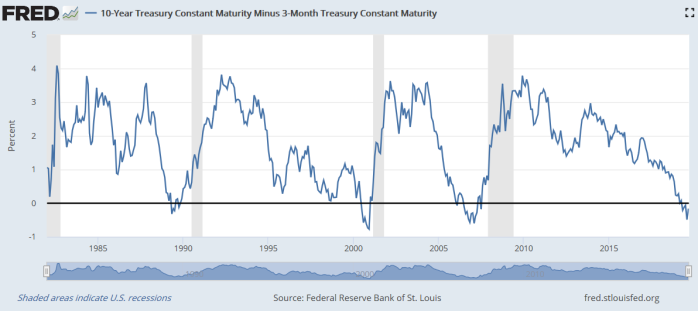
A month or so ago there was a great flurry of media coverage when the US interest rate yield curve “inverted”.  In this case, long-term government security interest rates (10-year government bond yield) moved below short-term government security interest rates (three month Treasury bill yield).   This was the sort of chart that sparked all the interest.

US yield curve

The grey bars are US recessions, and each time the long rate has been less than the short-term rate a recession has followed.   This chart only goes back to 1982 but it works back to at least the end of the 1960s.    There haven’t been any recessions not foreshadowed by this indicator, and there haven’t been times when the yield curve inverted and a recession did not come along subsequently (sometimes 12-18 months later).   Who knows what will happen this time.  It is, after all, a small sample (seven recessions, seven inversions since the late 1960s), and there is nothing sacrosanct (or theoretically-grounded) in using a 10 year bond rate.  Use the US 20 or 30 year government bond yields and right now the curve wouldn’t even be (quite) inverted.

But there are good reasons why changes in the slope of the yield curve might offer some information.  A long-term bond rate isn’t (usually) controlled by the central bank or government and might have a fair amount of information about what normal or neutral interest rates are in the economy in question. By contrast, short-term rates are either set directly or very heavily influenced by the authorities.    When the short-term rate is unusually far away from the long-term rate one might expect things to be happening to the economy, whether by accident or design.

Back in the day, when we were trying to get inflation down in New Zealand (late 80s, early 90s), the slope of the yield curve was for several years, off and on, a fairly important indicator for the Reserve Bank.  At times we even set internal indicative ranges for the slope of the yield curve (at the time, the relationship between 90 day commercial bill yields and five year government bond yields), and for a while even rashly set a line in the sand of not allowing the short-term rate to fall below the long-term rate.      We used this indicator because neither we nor anyone else had any idea what a neutral rate (nominal or real) would prove to be for New Zealand, newly liberalised and then post-crash, money supply and credit indicators didn’t seem to have much content, and we didn’t want to take a view on the level of the exchange rate either.  But whatever the longer-term interest rate was, if we ensured that short-term rates stayed well above that long-term rate, we seemed likely to be heading in the right direction –  exerting downward pressure on inflation and, over time, lowering future short-term rates as well.

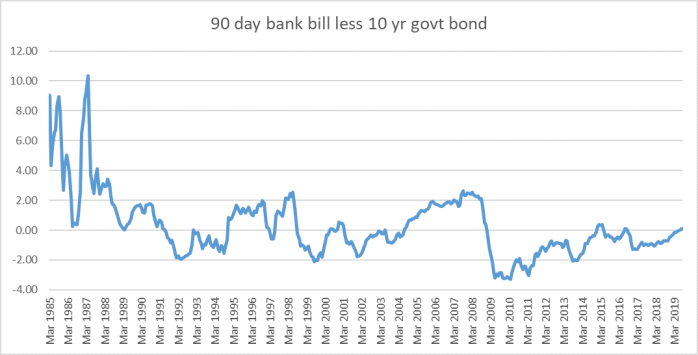
But what about the New Zealand yield curve slope now?     Here is the closest New Zealand approximation to the US chart above, using 90 day bank bill yields and the 10 year (nominal) government bond yield.  I’ve shown it the other way around – 90 days less 10 years –  because that is the way we did it here (partly because of the long period, until 2008/09, when short-term interest rates were normally higher than long-term ones, rather different to the US situation).

nz yield curve 1

I can’t easily mark NZ recessions on the chart, but there were recessions beginning in 1987, 1991, 1998, and 2009, and each of them was preceded by this measure of the yield curve slope being positive,  But, for example, the slope was positive for four years in the 00s before there was a recession.    Against this backdrop, there isn’t really much to say about where we are right now (just slightly positive).   And take out whatever credit risk margin there is a bank bill yield (20 basis points perhaps?) and the slope of the curve would be dead flat.

But what about a couple of other possibilities.  Unlike the 90 day bill rate, term deposit rates  and bank lending rates directly affect economic agents in the wider economy, and as I’ve shown previously the relationship between the 90 day bill rate and term deposit (and floating mortgage) rates has changed a lot since 2008/09. margins

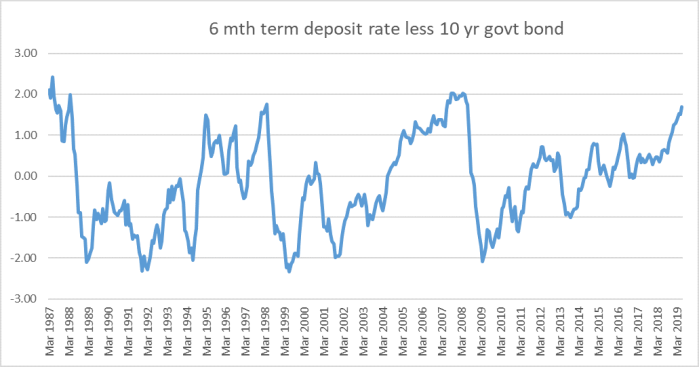
In this chart (constrained by data availability to start in 1987), I’ve taken the six month term deposit rate (from the RB website) and subtracted the 10 year government bond yield).

nz yield curve 2.png

That starts looking a bit more interesting.  The level of this variable –  even after the recent Reserve Bank OCR cuts –  is close to a level which has always been followed by a recession.   (It is a small sample of course; even smaller than in the original US chart).

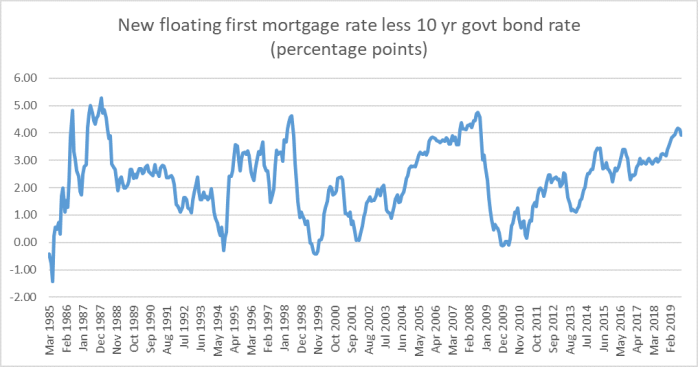
What about the relationship between the floating residential first mortgage interest rate and the 10 year bond rate?  Here is the chart.

nz yield curve 3

The only times this indicator has been higher than the current level –  even after the recent OCR cuts are factored in, as they are in the last observation on the chart – have been followed by pretty unwelcome economic events (the 1991 recession wasn’t strongly foreshadowed by either this indicator or the previous one).

It is a small sample, of course, and there are no foolproof advance indicators.   But if I were in the Reserve Bank’s shoes right now, I would take these charts as yet further warning indicators.

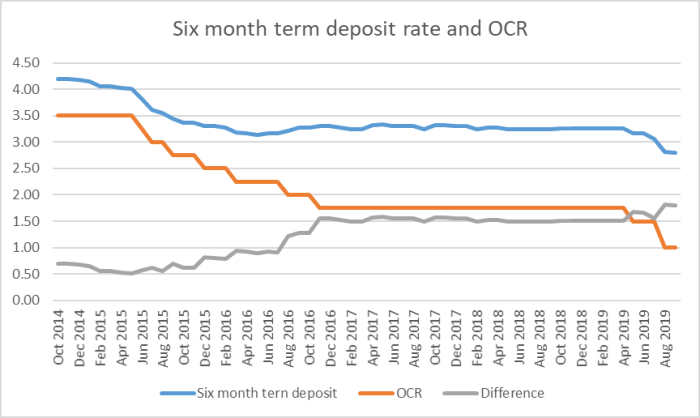
On which count, it is perhaps worth keeping a chart like this in mind.

NZ yield curve 4

We’ve had 75 basis points of OCR cuts this year but only about 45 basis points of cuts in the indicative term deposit rate (latest observations from interest.co.nz).  It is not as if these retail interest rates are at some irreducible floor –  retail deposit rates in countries with much lower policy rates are also much lower than those now in New Zealand.  It is a reminder that, against a backdrop of a very sharp fall in New Zealand long-term interest rates (real and nominal) –  even after the recent rebound the current 10 year rate is still more than 100 basis points lower than it was in December –  monetary policy adjustments have been lagging behind.   Long-term risk-free rates have fallen, say, 110 basis points (almost all real), and short-term rates facing actual firms and households are down perhaps 40-60 points (floating mortgage rates nearer 60).

The Reserve Bank cannot (especially after a decade of persistent forecast errors) have any great confidence in any particular view of neutral interest rates for New Zealand.  With inflation still persistently below target and (as the Governor and Assistant Governor have recently highlighted) falling survey measures of inflation expectations, there isn’t a compelling case for the Bank to have lagged so far behind the market, allowing short-term rates to rise further relative to long-term rates.   The Governor has appeared to suggest that the Bank will only seriously look again at further OCR cuts at the next Monetary Policy Statement in November.  I reckon there is a much stronger case than is perhaps generally recognised for a cut at the next OCR review next week.


Hush, don’t be so explicit

I had a phone call yesterday from someone I respect suggesting that I was going a bit lightly on Simon Bridges over China.  After my post last week, just prior to the Bridges trip to the PRC, I should generally have been immunised against that charge.  But what my caller had in mind was a few tweets where I had suggested that bad –  even despicable –  as Bridges was, especially this week in his interview with the Communist Party-controlled CGTN, actually there was little or no functional difference between Bridges and Labour (in particular) when it came to the PRC.   Tweets like this were what my caller seemed to have in mind

Anyone who hasn’t watched the interview really should do so.   From a PRC/CCP perspective, it must have seemed almost too good to be true.  It came across like one of those staged interviews normal political parties sometimes do with a sympathetic “interviewer” designed to put leader and party in a good light, except that this was the leader of New Zealand’s National Party –  a party that purports to espouse values (freedom, democracy, limited government etc) that mostly look quite good on paper, that once had a clear moral sense of the evils of Communism –  being interviewed by a CCP interviewer who feeds up soft questions (“hasn’t the Party done a wonderful job?”, “isn’t Xi Jinping a great leader?” sort of thing), and Bridges gives back pandering answers better (from the CCP perspective) than even she must have hoped (even recognising the typically obsequious and deferential – craven really – form of NZ political leaders on the PRC).

One could unpick it line by line:  for example, where he seemed even keener than the interviewer to celebrate even the first 30 years of the PRC (perhaps Jian Yang never told him about the Cultural Revolution, the Great Leap Forward, and all the other horrors), his treatment of the CCP as a normal political party, or (only noticed on a second viewing) the sickening way he invoked Winston Churchill –  who actually led the fight against tyranny, and called people to recognise it for what it was –  to pander to his hosts.  But I don’t think any serious observer disagrees that it was extraordinarily bad –  the only competition is how best to describe the spectacle.

The rest of the visit doesn’t seem to have been much better.  He looks to have been desperate to impress his hosts (but they probably already had him marked as a “useful idiot”, after his pandering to Yikun Zhang, protection and promotion of Jian Yang, and his part in signing the previous government up to the vision of a “fusion of civilisations”) and perhaps to look as if he was taken seriously abroad.  How else to explain him agreeing to meet, in the Great Hall of the People, with Guo Shengkun, the member of the Politburo responsible for all PRC law enforcement activities (that includes Xinjiang), former Minister of Public Security?

He must have been briefed on Guo Shengkun’s background – even if Jian Yang thought not to mention it, MFAT surely would have.  But if it bothered anyone around him at all, clearly not enough to say no.   Perhaps the choice of Politburo member was carefully planned by the PRC to see whether Bridges had any limits, any scruples, at all.  They seem to have got their answer.

That all should be good for a few more donations, large and small, to National –  which has shown no interest in higher standards or tighter laws in this area.  Perhaps another dinner at Yikun Zhang’s house?

Bridges has, rightly, been on the receiving end of a fair amount of flak over the interview in particular.  Grant Robertson has been reported as suggesting that in the interview comes across as more devoted than most paid-up members of the Communist Party itself.  Perhaps he too has spent many hours studying Xi Jinping Thought to get his lines right, or perhaps that was just Jian Yang?   It isn’t quite clear how much he is sold-out, value-free vs being simply out of his depth, and not fully realising the significance of what he was doing, who he was talking to, and what he was saying.

And from some academics there was quite a lot of surprised pearl-clutching too.  The director of Victoria University’s Centre of Strategic Studies, David Capie, gasped that it was

Alarming to have such a big gap between govt & opposition views/language concerning such a critical relationship.

And Jason Young –  director of the taxpayer-funded Contemporary China Research Centre – was among those critical of Bridges for his talking up the CCP when the New Zealand practice has typically been to talk about the state (PRC) –  as if the Party didn’t control the state, which works to Party supremacy ends.   Another local academic, never himself otherwise on the record as critical of the regime was moved to observe that “Bridges’ comments re Xi’s China are bonkers”.

(The China Council –  funded by the taxpayer, with eminent former senior Nats (and Jian Yang) on their councils –  ever pretty obsequious themselves, but ever so smoothly, has been uncharacteristically silent.)

I don’t buy it.    And you’ll note that –  search as you like –  none of these academics has been critical of National for its general policy stance towards the PRC, none has criticised Bridges for not speaking up on Xinjiang, on Hong Kong, on the increasingly repression of religion (doesn’t Bridges claim to have a Christian faith?), on the abduction of Canadians, on state-sponsored intellectual property theft, on the South China Sea.  Near-complete silence on the continued presence of Jian Yang –  15 years in Chinese military intelligence, misrepresenting his past on Beijing’s instructions –  in the caucus, and at the right hand of the leader on his PRC tributary mission.

No, what really seems to bother them is that Bridges seems to have let the side down by his over-enthusiastic gush.  Not the done thing old boy.   Created uncomfortable headlines.  Really Simon, don’t you know better by now?   They are embarrassed by this rather amateurish schoolboy effort to pander, rather than having any problem with the underlying policy approach.    That is as true of most of these academic commentators –  Anne-Marie Brady excepted of course –  as it is of the rest of political spectrum, as it is (apparently) of most of the media.  It should count as extraordinary that neither of our main daily newspapers –   Herald or Dominion-Post – has given the story any coverage at all, despite all the questions it should be raising about national security, foreign policy, the place of values in New Zealand policy, and fitness to govern of the leader of the main opposition political party.   Should.  But this is New Zealand.  And we don’t want the peasants getting uneasy about the way the establishment –  all of it –  panders to the PRC now do we.

If there are differences between National and Labour on the PRC they are so tiny, and largely opportunistic, as to be barely discernible to anyone else.  Perhaps National is “better” at tapping the money-tree, but that probably only makes those who run the Labour organisation a bit envious –  after all, there no sign of any leadership from the Prime Minister on the electoral donations issue, whether reforming the law or taking National to task over large donations from PRC/CCP affiliated donors, whether citizens or not.

Both sides like to run the ridiculous line about the great transformation managed in the PRC over the last 70 years –  never once pausing to recognise how poor the PRC economic performance is relative to east Asian peers (Japan, Taiwan, South Korea, Singapore).  Both sides like to pander, suggesting that somehow New Zealand’s prosperity depends on the PRC –  whether cyclically (“saved by China in the GFC”) or structurally.     Both sides like to treat the PRC as a normal state.  Both sides happily hobnob with CCP figures –  only last year, the PM was meeting a senior CCP figure here and talking up better “party to party exchanges”).   National and Labour figures got together to honour Yikun Zhang, for what were really services to Beijing.     Neither side will say a word in public about any concerns about PRC gross human rights abuses –  a term which really diminishes the outrages perpetrated daily in Xinjiang –  or an expansionist unilateralist foreign policy.  Neither side seems to have a problem with NZ Police having friendship and exchange agreements with the Guangzhou police, or with an Assistant Commissioner of Police serving as a visiting professor at the Ministry of Public Security training university.

Is it even imaginable that either side would willingly meet Joshua Wong – one of the leading faces of the Hong Kong protest movement –  as German Foreign Minister did earlier this week?   Will either side call out the excess dependence our universities have come to have on the politically-vulnerable PRC market (of course not –  both sides encourage it)?   Such is the party discipline that not even a single backbencher on either side will ever speak up on anything to do with the PRC.   Both sides are happy to have Chinese language teaching in our schools subsidised by the PRC, through Confucius Institutes which vet for political and religious soundness (toe the Party line or else).  Both sides turn up to PRC Embassy and consulate functions as honoured guests, and both sides apparently support the propaganda efforts of the China Council.   Watch and see if you put a tissue’s difference between them when in a couple of  weeks the CCP celebrates the 70th anniversary of taking power in China.   Tens of millions of dead Chinese –  and decades, right through to today, of extreme repression –  will be quietly ignored as the champagne glasses clink.

And, of course, was there a difference in the – embarrassed, please go away –  way both sides tried to ignore that attempts to physically intimidate Anne-Marie Brady?

Meanwhile Jian Yang remains an, apparently valued (recently promoted) member of National’s caucus.  It is two years tomorrow since the FT and Newsroom broke the story of Jian Yang’s past.  And nothing has happened.  The National Party defends and protects him, never even insists that he front the English language media (all National Party voters elected him, not just some minority of CCP-affiliates).  And the Labour Party leadership has never once expressed even a word of concern.  That makes them just as complicit in having this close-to-the-PRC-Embassy, CCP members, former PLA military intelligence official, who accepts he misrepresented his past on Beijing’s instructions, not just sitting in our Parliament, but advising and accompanying the Leader of the Opposition to the PRC.

But you won’t hear any concerns from Labour (or the Greens or –  these days – NZ First) about that.  Nor, as far as I can see, words from Messrs Capie, Young, or Noakes, the academics quoted earlier.    There has been quite a furore this week in Australia about the new Liberal backbencher, Gladys Liu, and her past ties to CCP-affiliated bodies, and reluctance to express any criticism of the regime.   Bad as her case might be, it seems mild by comparison with that of Jian Yang, where both National and Labour really really just want the issue to go away, and people to keep quiet.

In my first tweet on the Bridges interview, I noted that if he’d had a gun at his head, or the CCP were holding his wife and children hostage, he could hardly have given a more appalling interview.  It really was bad.  But all it really did was lift the lid on the way in which so much of the New Zealand political, business, and media establishment treat the PRC –  ever-deferential, and quite value-free (other, that is, than those “values” of deals, donations, and meetings in Beijing).  Bad as the interview and visit was, in a sense it did us a service, briefly highlighting just how sold-out the establishment (all sides) really are.  But with little media coverage and lots of rugby in the next few weeks, they probably needn’t worry: the Bridges embarrassment will soon be tidied away and forgotten.  And that will suit Labour –  and the business community –  quite as much as it will National.


Wellington seminars

I spent yesterday afternoon at a couple of policy-focused seminars in Wellington.

The first of them –  “Tax on Tuesdays: Time to Even it Up” – was hosted by Victoria University’s Institute for Governance and Policy Studies, in conjunction with (if I heard correctly) the PSA and something called the Tax Justice Network Aotearoa NZ.  So the orientation was fairly left-wing, and explicitly focused more on fairness than, say, efficiency or prosperity.  But there were some interesting speakers, even if they didn’t have much time each so couldn’t dot all the i’s, cross all the t’s etc.

The first was Andrea Black, former Treasury/IRD official, former independent expert adviser to the recent Tax Working Group, tax blogger (and occasional commenter here), who focused on taxation of capital income.  After repeating her support for a capital gains tax, her distinctive argument was for an increase in the company tax rate to match the maximum personal income tax rate.   The main arguments appeared to be that (a) the most assured way of being able to tax the incomes of rich people in New Zealand was to tax companies (since in closely-held companies much of profits are distributed by way of loans –  not taxable in the hands of recipients –  rather than as dividends), and (b) the old argument about cleanness, minimising avoidance etc in having the company tax rate, the trust rate, and the maximum personal tax rate aligned (there being plenty of evidence that people will do what they can to defer tax by being paid through companies etc where possible).

I wasn’t really persuaded.  With dividend imputation, the company tax rate in New Zealand bears much more heavily on foreign investors (none of whom needs to be here) than it does on domestic shareholders.  In a country with low rates of business investment and now relatively low rates of foreign investment, it seems cavalier to be calling for increases in company tax rates which the global trend is clearly downwards (at 33 per cent the company tax rate would be the second highest in the OECD).   In defence of her position, Andrea invoked some old IRD analysis that company tax cuts haven’t made much difference to investment –    IRD has a strong institutional bias towards a simple tax system and little real focus on productivity, economic performance or anything of the sort – while noting that “if you did care about foreign investors” –  there were various technical tweaks (I didn’t catch them, but perhaps thin capital rules?) that could be adjusted to compensate them at least in part.

As if to forestall a question, Andrea alluded to this chart I’ve used several times –  a version of which appeared in the TWG’s own background document last year.

corp tax 2017

Prima facie, it didn’t as though – by international standards – we were undertaxing business income.

Now, of course, there are some well-recognised caveats to this data.  First, it doesn’t take account of dividend imputation in New Zealand (and Australia, but not elsewhere), and the TWG suggested there were some issues around consistency of treatment of government-owned businesses.  On the other hand, in many countries lots of stocks are owned by long-term savings vehicles with much less onerous tax provisions than their peers in New Zealand would have, and our tax system (mercifully) has fewer deductions and “holes” in it.     In yesterday’s presentation Andrea suggested that in many other countries various classes of business income that would be incorporated –  and thus captured in the chart – here wouldn’t be treated the same way in other countries.

All that said, if anyone is seriously suggesting that the chart of OECD data is substantially misleading about the New Zealand position –  say that in truth we might be in the lower half of the chart on an apples-for-apples comparison, the onus is probably on them to demonstrate that more specifically.    The OECD data itself suggests we have taxed businesses quite heavily going back 50 years, to (for example) well before imputation was ever on the scene (chart in this post).  Perhaps it is just coincidence – and I’m certainly not suggesting it is the only factor –  that business investment as a share of GDP has been low by OECD standards throughout almost all that period.

The second speaker was inequality researcher Max Rashbrooke.  His focus was on taxing wealth.  He doesn’t like the idea of a land tax (partly because land is held more widely than most assets, partly because Maori land would have to be “omitted for justice”) or the risk-free rate of return deemed income method that has been proposed by various groups (including the McLeod tax report, and TOP) because he doesn’t believe it is right or politically feasible to include the family home.    His argument was for a wealth tax, levied at (say) 1 per cent per annum on net wealth, but applying only to those with net wealth in excess of (say) $1 million.  This was sold as something of a moneypot, with revenue estimates of $6 billion a year.

Based on what he told us yesterday, the ideas didn’t seem to have been advanced in much detail yet, including the question of how one might get annual valuations of unlisted companies.   I asked about what proportion of his estimated $6 billion of revenue would come from ordinary middle-aged and elderly Auckland homeowners (given his unease about taxing the family home), but he didn’t know.   Personally, I couldn’t help thinking that a better approach would be to fix the urban land market at source – kill off the regulatorily-induced artifical land values, and (a) the cause of justice and fairness more generally would be served, and (b) there would be nothing like $6 billion per annum of revenue on offer.

The third speaker was someone called Michael Fletcher, of IGPS, who was apparently an advisor to the Welfare Working Group.  He was mostly talking about the welfare system –  in lots of detail, but with a view of the place of the welfare system that was so different to my own that I’m not going to spend much time here on what he said.  There was the odd striking statistic, notably his suggestion that perhaps 100000 people may be entitled to the Accomodation Supplement but not getting it (and he highlighted how easy the Australian comparable entitlement is to access, if you are entitled to it, relative to New Zealand), but I was left unchanged in my view that so much could be done for the better, for those at the bottom, if only the urban land market were freed-up.  Rents, after all, should have dropped very substantially in real terms over the last decade –  in a functioning market that would be an expected corollary of steep falls in long-term real interest rates – and haven’t because central and local government rig the system against renters and new purchasers of dwellings.

For myself, on tax I remain tantalised by the idea of a progressive consumption tax. In the abstract, it gets around all the debates on capital gains taxes, realisations (or not), company taxes, gift or inheritance taxes or whatever, and has the appealing the feature of taxing people on what they consume not on what they produce.  Of course, no country runs such a system –  which does have formidable practical issues.   And if one wants to align company and personal rates – which has some appeal (although the Nordic model questions that), better to lower the personal income tax rates by 5 percentage points (max rate to 28 per cent) and add a Social Security Tax of 5 percentage points on labour income up to a certain threshold.  New Zealand and Australia are, as I understand it, the only OECD countries not to adopt some such model (we do it on a very small scale with ACC).

From Victoria University, it was up the street to The Treasury where Alan Bollard was billed as speaking on

“New Zealand as a Leaky Economy: Are We Responding to Changes in Globalisation?”

As Alan is a smart guy, has been one of the “great and the good” of the New Zealand establishment for decades –  chief executive of one body after another for more than 30 years – even as New Zealand’s economic performance has continued to languish, and has recently finished a stint as Executive Director of the APEC Secretariat, it should have been interesting and stimulating.  It wasn’t.

Here was the summary that drew me along

For the last few decades New Zealand’s general policy approach has been to pursue economic openness (with some protections), in order to get the benefit of international growth drivers. Some of the political and economic developments around globalisation today are challenging that traditional approach.

Traditionally we think of external economic balance as the current account. Dr Bollard’s approach would go much wider, exploring our patterns of merchandise trade flows, services trade, short term capital movements, outward direct investment, labour movements, economic migration, data movements, business mobility and other less tangible flows (e.g. intellectual property, human capital) across borders.

Much of the debate centres on our inflows. This seminar turns the spotlight on outflows. It questions whether we are leaking value internationally: losing talent, falling off the value chain, undervaluing services, losing businesses (including their ideas and their taxes) to overseas interests. Questions abound: do we really leak value, do we have any alternatives, and what might “sticky policies” look like?

But there just wasn’t very much there.

He talked under various headings.

On goods market trade, what he had to say seemed to boil down to the fact that distance really matters for New Zealand and that two-thirds of our exports are still commodities, noting the failure of the Fonterra value-added dream.    We draw on tangible and inflexible resources (natural resources) whereas places like Hong Kong or Singapore (or, one could add, major European or North American cities) don’t.

On services trade, there also wasn’t much there.  He noted that New Zealand had long been a net services importer, but beyond noting –  rather misleadingly – that tourism and export education had been doing well, there wasn’t much beyond noting various global trends and technologies.

On international capital markets, there also wasn’t much.  As he noted, we typically have current account deficits, have modest savings rates, and have a banking system mainly run by Australian banks.  The claim that markets internationally are “increasingly globalised” seemed odd, both against the backdrop of smaller global imbalances than were apparent last decade, and the rising tide of restrictions in various places on foreign investment (whether US restrictions on China, or New Zealand restrictions on purchases of houses or farm land –  both of which he noted).

Of the market in labour, there was (surprisingly) little or no mention of immigration policy, but quite a focus on the outward flow of New Zealanders (and the high skill levels of many New Zealanders).  His assertion is that “talent is increasingly mobile”, and yet across the board for New Zealand that also looks not really true –  it is harder for New Zealanders now to go to Australia than it was and, as a result, that net outflows of NZ citizens) are much smaller (share of population) than they were several decades ago, even as the productivity and income gaps have widened further.

In discussing the market for corporate control, Alan listed various facts and factoids, including the suggestion that one of the biggest assets now owned by foreign companies was “our data”, and the notion that New Zealand ideas leaked abroad (but then, as he had noted earlier, this is hardly new –  Glaxo having been founded in the 19th century New Zealand).

And then as he got to the end and turned to policy, he could only conclude that there were – in his view – ‘no easy answers’, including noting that we were constrained by various international agreements (he didn’t tell us what interventions he’d propose if we weren’t).  There was favourable mention of the student loans policy that bears more heavily on people if they leave than if they stay, repetition of an old (misleading) line that houses have become international financial assets, and really not much more.  And there was the old question of who do we make New Zealand policy for: New Zealand or New Zealanders, and who counts as New Zealanders in this context, but few or no attempts at answers.    The fact that New Zealanders would be crewing many of the America’s Cup yachts of other countries, and that some New Zealanders would be playing for other countries’ RWC teams was mentioned, but not in a way that left me any close to sensing that he was doing more than lamenting New Zealand’s continuing economic decline –  without, in the hallowed halls of Treasury, being so upfront as to mention it –  which sees able New Zealanders looking abroad for better returns to their talent (as able people from many middle income and poor countries do –  see African or Latin American players in European soccer leagues).

To his credit, Alan took a lot of questions.  In many cases, the questioners seemed to be attempting to get Alan to endorse their preferred line of argument or policy option.  Actually, that included his wife –  Jenny Morel –  who suggested that Alan was underplaying the success of our high-tech firms (citing the repeatedly spun and highly misleading TIN report), to which Alan returned to his theme that such companies can and do leave very quickly, and noting again the loss of able people (explicitly highlighting that the two Bollard children are now living and working abroad, apparently permanently).

A Treasury official asked Alan about the real exchange rate, noting that many conventional analyses (and, perhaps, unconventional ones like my own) stress the role of a persistently overvalued real exchange rate.  Alan was pretty dismissive of the issue, suggesting if there was an issue it was nothing more than cyclical.

Perhaps, but when the gap between productivity and income levels in New Zealand and the rest of advanced world has kept widening for decades, and yet the real exchange rate has been high and rising this century and the foreign trade shares (imports and exports) have been falling, it looks like an issue that might repay rather more attention.  In my experience, Alan always tended to treat the real exchange rate as a financial variable, whereas is generally better seen as a real phenomenon, the outcome of various domestic pressures and imbalances (the price of non-tradables –  driven by domestic forces –  relative to the global price of tradables).

Alan Bollard wasn’t purporting to offer some fully-developed story of New Zealand’s economic decline, so I won’t fault him for not doing so, but it ended up as a rather strange talk.  The subtext was of the failures –  and yet those declining trade shares were never mentioned, nor (for that matter) the productivity story –  and there was the mixed pride and regret of older parents whose children have joined, perhaps permanently, the diaspora.  It was as if he knew there were problems, perhaps even rather serious ones, but wasn’t able or willing to think hard, or talk openly, about causes and what aspects New Zealand authorities could so something about.  That’s a shame.


China and Japan

I’ve been reading a wave of books in the last few weeks about modern Japan –  the rapid economic rise from the mid 19th century, the out of control militarism that led to the war from 1937 to 1945, and the post-war revival (rather than the last few decades).   And as I read, it left me pondering the relative economic fortunes of Japan and China.

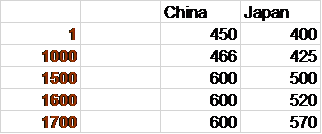
According to the standard reference source for such things – Angus Maddison’s collection of estimates of GDP per capita since the year 1 AD –  in earlier centuries Japan and China were more or less level-pegging for centuries, with China a bit ahead of Japan (a thousand years ago, China is generally accepted as having the highest material living standards anywhere).  Here are the estimates (in 1990 international dollars) through to the 18th century.

maddison chjp

There was, of course, a great divergence between economic progress and living standards in the leading European (and offshoots) economies and those of east Asia, but today I’m more interested in the less-highlighted, but scarcely less dramatic, divergence between economic performance in Japan and that in China.

Maddison’s estimates report that –  despite having turned its back on the world –  Japan had moved ahead of China over the 18th century and the first half of the 19th century: for 1850 the reported estimates are Japan $679 and China $650.   There are only scattered estimates for China for the following few decades, but here is the reported estimate of average per capita real GDP per capita, China as a per cent of Japan.

China GDP pc as % of Japan
1850 88
1870 72
1890 53
1900 46
1913 40

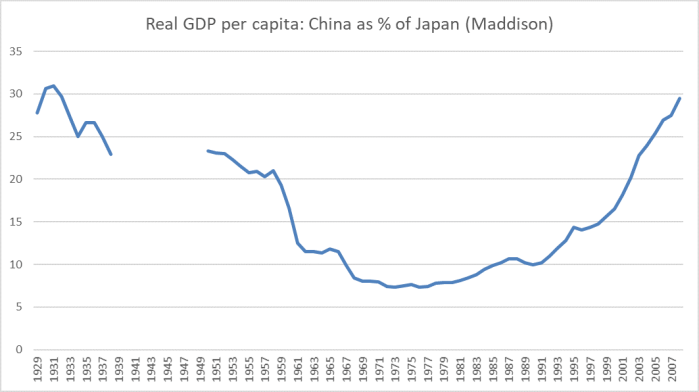
A bit later, the annual estimates start –  with a break when Japan was attempting to conquer China.  Here is the chart to 2008 when Maddison’s estimates end.

chinajp

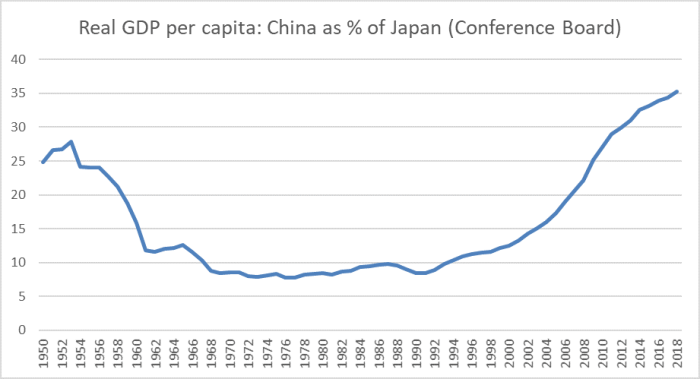
The Conference Board has estimates through to the present day, but they only start from 1950.   Here is the PRC’s real GDP per capita as a percentage of Japan’s.

chjp conf board

Productivity estimates are available only for even more recent periods, but on Conference Board numbers they show a pretty similar picture: as at last year, average productivity in the PRC just over 30 per cent of that in Japan.   And that is still probably worse than the situation at the turn of the last century (when –  see above –  China’s real GDP per capita was about 45 per cent of Japan’s).

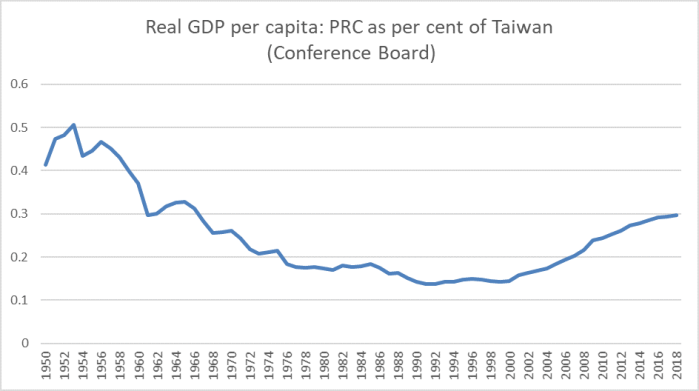
Of course, it isn’t only Japan that China has fallen so far behind.  Taiwan was a Japanese territory for 50 years after the Sino-Japanese War in the 1890s, and Korea was a Japanese colony/conquest for 40 years.  On the Maddison estimates, 150 years ago both Korea and Taiwan had GDP per capita (estimated at) not much different from that of China.    These days, South Korea (historically less well-developed than the north) has real GDP per capita about 10 per cent less than that of Japan, while Taiwan has real GDP per capita about 15 per cent more than that of Japan.    Both, in other words, are far ahead of the PRC.

taichi conf bd

Relative to Taiwan, the PRC has just now managed to get back up to the relative living standards just prior to the Cultural Revolution.  (And yet this is the regime whose “successes” Simon Bridges lauds.)

There isn’t really much debate about why the PRC has over recent decades still been the disastrous laggard among the historically more advanced east Asian economies (North Korea of course marking out an even worse extreme) –  absence of the rule of law, absence of the sorts of incentives that make for the efficient allocation of capital, primacy of the Party etc etc will do that to a country (the Soviet Union in the 80s was closer in living standards to Japan then than the PRC is to Japan now).

But in some ways I’m more interested in how the gaps opened up in the first place –  before 1950, or even before the overthrow of the Manchu emperors in 1911.  It is easy to say that Japan embraced greater openness, Western technology etc –  initially under external pressure –  but what was it that meant Japan (having, if anything, been more isolated than China for the previous few centuries) made that choice and China did not?   In looking around, I’ve found a couple of relevant journal articles, but if any readers happen to have suggestions of good treatments of the issue (book or article) I would really welcome them.

Services exports – another NZ weak spot

Various people in my Twitter feed were highlighting what appears to have been a quite interesting conference in Auckland over the weekend on external-trade related issues. I haven’t seen the papers, but at least from the various tweets I saw I was struck by an apparent air of unrealism, that doesn’t take much account of just how poorly New Zealand has been doing on the foreign trade front.  It is a bit like when MFAT and Cabinet ministers talk up this, that or the other new preferential trade agreement –  there have been a lot of them over the years – and yet we find ourselves now with foreign trade shares of GDP no higher than they were in (say) the early 1980s.   For younger readers, those were widely perceived at the time as dark days –  lots of import protectionism, terms of trade very low, CER not yet signed, and so on.

Services in one of those areas that trade experts seem to like to talk about, a lot.  Here was an MFAT tweet from the weekend conference.

In a way that isn’t surprising.  In the median OECD country, services exports are almost 13 per cent of GDP, and the median increase in that share over the last couple of decades is about 4 percentage points.

But not in New Zealand.

Among the full group of 35 OECD countries, New Zealand has the 10th lowest share of services exports as a share of GDP.   But every single one of the other nine are countries that are far bigger than New Zealand: Australia, with almost five times our population is the next smallest.  For good and fairly obvious reasons, foreign trade tends to make up a smaller share of GDP in larger countries.

But what about the smaller OECD countries?  Almost two-thirds of OECD countries have populations of 11 million or less, and we are by no means the smallest of those countries.   Here are services exports as a share of GDP for the smaller OECD countries, truncating the vertical axis because Ireland and Luxembourg are so much higher than all the other countries on the chart.

services exports small OECD

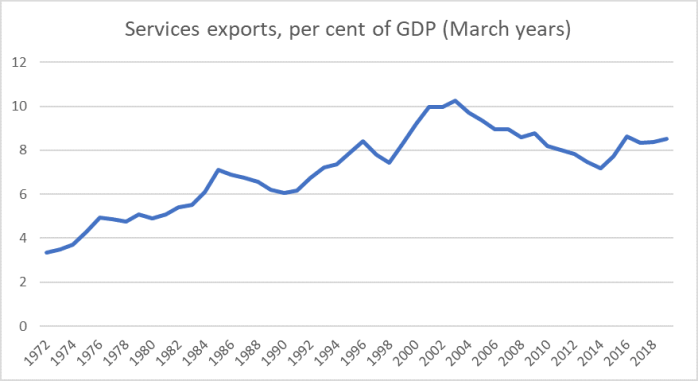
New Zealand has the smallest share of services exports in GDP of all these smallish OECD countries –  and by quite a margin.       And it isn’t as if we are closing the gap.   Over the last 20 years, services exports as a share of GDP have barely changed in New Zealand (with some ups and downs) while for the median of the other smallish OECD countries, the increase was 6.7 percentage points of GDP.

NZ services exports

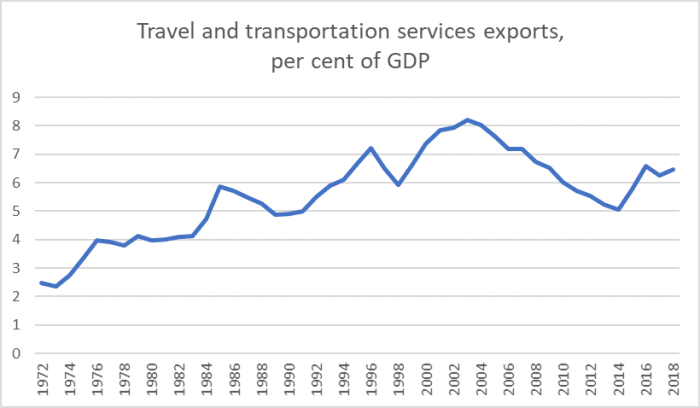
Now, of course, distance materially and fairly obviously affects quite a lot of what counts as services exports –  notably, our two largest classes of services exports, tourism and export education.

Here is a long-term chart showing all our travel and transportation exports (which includes freight and export education).

T&T services X

The picture looked quite promising 20 years ago.  Much less so now.

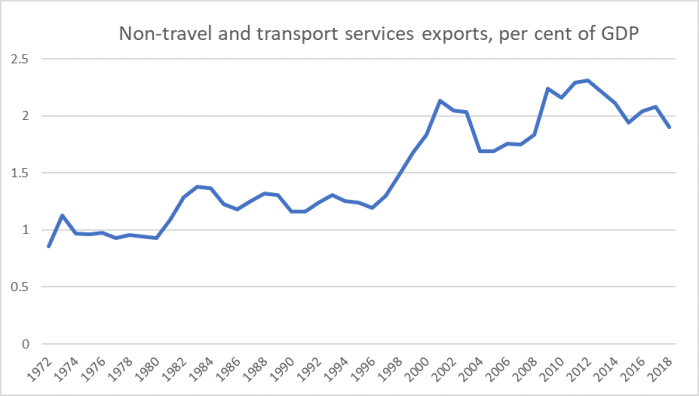
And, on the other hand, here are all the non-travel and transport services exports.   These, in principle, should have been where much hope was reposed.

non T&T services X

It is, perhaps, a more positive story, but not very much so.   After all, despite all the technological advances, and cheaper and better communications etc, this group of services exports is still (in gross terms) less than 2 per cent of GDP, and no higher as a share of GDP than was the case at the turn of the century.    As a share of total exports these (non travel and transport) services exports have risen a bit more, but even that increase isn’t particularly impressive, as there has been no growth in these services exports as a share of total exports this decade.

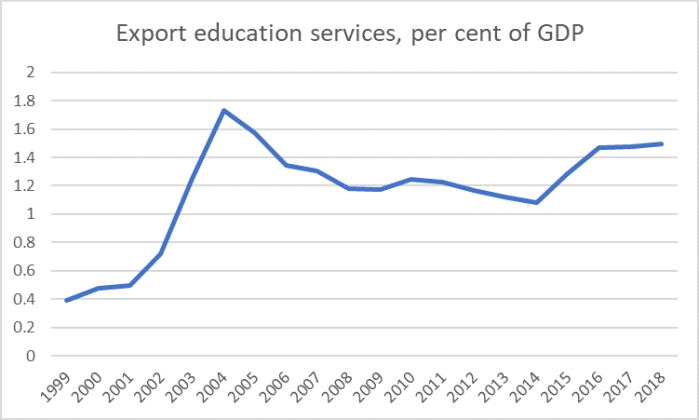
Out of interest, here is the export education component of services exports as a share of GDP.

X education

Ups and downs but –  even with all the subsidies to this sector (mainly through the immigration system) –  still now below the levels reached in 2004.    And it isn’t as if our universities are relentlessly climbing the global ladder, suggesting that fresh waves of new exports –  attracted by the quality of the product – are likely from this source.

Now, as experts like to point out, there is a services component in all or most goods exports too.  But (a) it isn’t as if New Zealand has been doing well with goods exports and (b) the overall character of our goods exports hasn’t been changing much either (eg lots of fancy manufactured products with a huge design or IP component).

For all the talk, services exports –  including the higher-tech ones people like to talk about in such seminars –  just haven’t done particularly well in New Zealand.

That doesn’t surprise me.   The combination of a persistently high real exchange rate –  direct consequence of other policy choices –  and the continuing constraints of distance (even for many of what may look like “push a button and it is done” services) seem to me to pretty much explain the story.  New Zealand is just not a great location to base many outward-oriented businesses, even as our governments pursue more and more people to live here.   It shouldn’t be surprising that the relative size of the tradables sector in New Zealand has been shrinking.

On such matters, I saw that in advance of the weekend workshop/conference, the Herald the other day had a full page profile of MFAT’s leading trade official, deputy secretary Vangelis Vitalis.     Rereading that piece, and exchanging notes with someone over the weekend about public sector senior appointments and our new Secretary to the Treasury, I was left wondering why Vangelis Vitalis wasn’t appointed to fill the role.  His is an enormously impressive and energetic guy, he knows New Zealand (and is a New Zealander), is open-minded and engaging, and thinks about economic issues and risks.    Perhaps he didn’t apply.  Or perhaps he just doesn’t fit the Peter Hughes model of safe generic public sector managers.  But it does seem extraordinary that the powers that be would pass over –  rather than, say, shoulder-tap –  such a significant economic and policy talent right here among us, already in officialdom.  You can negotiate all the preferential trade agreements in the world, and it won’t matter much for economic performance –  lacklustre for decades –  unless you get to the heart of the underlying problem.


The bank capital insurance policy: update

In my post yesterday I played around with some illustrative scenarios on the costs and benefits of the “insurance policy” the Reserve Bank Governor is proposing to impose on us: higher capital requirements for locally-incorporated banks will, on the Bank’s own estimates, impose an annual cost in the form of a modestly lower level of GDP each and every year, while in exchange there is the hope of averting some GDP costs from a rare but fairly severe financial crisis (perhaps in the form of several failures of large banks).

I used the Bank’s own estimate of the GDP cost (“up to 0.3 per cent per annum” –  so used 0.25 per cent) and as a discount rate used either the current Treasury recommendation for regulatory proposals, or one a bit lower to take account of the sharp further fall in long-term interest rates this year.   And to simplify things, I looked at various scenarios for the GDP cost of a financial crisis 75 years hence (the policy is supposed to ensure that New Zealand isn’t exposed to a crisis more than once in 200 years, so I used a 150 year time horizon to think about what benefits we might secure if the policy is adopted).

On those scenarios, the Bank’s proposal simply did not stack up.  The costs far outweighed the benefits.  If so, the insurance premium was not worth purchasing.

Last night a commenter pointed out, correctly, that my simplification (focusing on a single date –  a crisis in 75 years time, halfway through the 150 years) probably wasn’t warranted, because the discount factor is non-linear.  As it happens, so is the GDP cost (since real GDP itself is assumed to rise by –  middle assumption –  2 per cent per annum.

There are two simple ways to overcome this.   The simplest to illustrate is this one.

The Reserve Bank tells us it thinks the annual costs (to GDP) are around 0.25 per cent.  And if, say, the GDP cost of the a crisis (three scenarios below, the third really as an illustrative extreme) once every 150 years is divided by 150, we get an estimated average annual GDP saving.

GDP effects per annum)
Costs (RB assumption) 0.25
Benefits: GDP saved
Equal annual probability of crisis over 150 years
10% 0.067
20% 0.133
30% 0.200

It would take averted crisis costs –  simply from the bank failures, not from the prior misallocation of resources in the poor lending/investing – well in excess of 30 per cent of  for the expected benefits to equal the expected costs.  Alternatively, the Bank’s estimate of the costs –  itself conservative in some respects –  would have to be revised down quite materially.

That particular approach isn’t dependent on an assumption about discount rates at all.  But to continue the approach in my post yesterday, here was the table (from that post) of the estimated present value of the costs of the policy (the 0.25 per cent per annum capitalised) on various trend growth and discount rate assumptions.

Present value cost ($bn), 150 years of 0.25% annual GDP loss
Real GDP growth
1.5 2.0 2.5
Real discount rate 5% 21.60 25.20 29.90
6% 16.90 19.10 21.80

The middle column is my baseline scenario (perhaps 1 per cent annual population growth and 1 per cent annual productivity growth).

So what if, instead of focusing on a crisis in 75 years time, we assign an equal probability of a crisis to each of the next 150 years, using that baseline scenario (2 per cent per annum real GDP growth)?

scenario 1

Or if we simply focus on the offical Treasury discount rate guidance (6 per cent) here is table of the savings under various trend growth and crisis loss assumptions.

Present value of GDP benefits of averting a crisis (probability spread evenly over 150 years) 6% disc rate
Trend GDP growth 10 20 30
1.5 4.5 9 13.5
2 5.1 10.2 15.3
2.5 5.8 11.6 17.5

In none of these scenarios do the savings equal the cost of the policy.  My own central scenario would be 2 per cent trend GDP growth and a 10 per cent GDP loss (perhaps 2 per cent a year over five years) purely from a financial crisis.  With a 6 per cent discount rate, the costs over 150 years are around $19 billion amd the benefits perhaps $5 billion.

And, as I noted yesterday, all this assumes the policy can be committed to for 150 years.   Realistically, the current Governor can’t commit much beyond his term, and the probability of severe crisis in the next decade or so looks –  on the Bank’s own analysis and stress tests –  very very low.

Of course, all of this is only illustrative, but in a sense that is the point.  We need the Reserve Bank to do what it has not yet done –  and tells us it won’t do until the final decision is made –  and lay out their assumptions, how sensitive their results are to various different assumptions, and some assessment of the reasonableness or otherwise of those assumptions.

One could play around with all sorts of additional assumptions (including weighting the savings –  in the midst of a period of difficult economic times) –  more highly than the costs.  But unless the Bank itself is materially overestimating the expected “insurance premium” it is hard to see how the benefits of what they propose are likely to exceed the costs.

And that, of course, was the gist of a recent paper, taking a quite different (and more high tech) approach and not focused on New Zealand, done by a group of experts at the BIS.

Revisiting an incredibly expensive insurance policy

The Reserve Bank’s radical bank capital proposals –  markedly increasing required capital for locally-incorporated banks, in a country with (a) a low demonstrated risk of financial crisis and (b) high effective capital ratios by international standards anyway –  hasn’t been much in the news lately.  The Governor –  unelected, but sole decisionmaker on this –  his own –  proposal has presumably retreated to his high tower to contemplate.   He hired some carefully selected overseas academics to review bits of the Bank’s analysis, and we might expect to see their reports shortly (but recall the tight constraints on what they were allowed to look at, who they were allowed to talk to etc).

I was doing an interview yesterday on various aspects of the proposal, including making the point that what the Governor is proposing can be seen as –  on the Bank’s own numbers – an incredibly expensive insurance policy, paid not by the Governor and his colleagues of course, but foisted on the people of New Zealand.      But I used a number in the course of the interview and when I got home I realised it didn’t sound quite right, so thought I should review the estimates.   I’d written a post on this some months ago.

There are various estimates around as to how much difference the proposed new capital requirements might make to real GDP.  I gather the ANZ has suggested anything up to a steady-state levels loss of 1 per cent (ie each and every year GDP is lower than otherwise by that amount).    Channels could include higher costs of credit and possible reductions in the availability of credit.

I wouldn’t completely rule out such numbers, but for my purposes I’m content to use the Reserve Bank’s own estimates.  In a speech in February the Deputy Governor told us the Bank thought the cost could be “up to 0.3 per cent per annum”.   So lets use 0.25 per cent  (if they really thought the effect would be no higher than 0.2 per cent, they’d have said “up to 0.2 per cent per annum”).

That might sound like quite a small number.  In fact is something like $750 million this year, and that cost is repeated each year.  And since the real economy is growing over time, the dollar value of the cost –  the annual insurance premium  –   only increases with time.

We can discount back to the present the value of all those annual insurance premia.  The answer, of course, depends in part on other assumptions.   Over the longer-term, real GDP growth will be largely a reflection of population growth and productivity growth.  In a New Zealand context, 1 per cent per annum each might seem a reasonable central estimate.   And then there is the discount rate: current Treasury guidance suggests using a real discount rate of 6 per cent for regulatory proposals, but of course long-term rates have fallen quite a long way since that guidance was issued, so I’ve also shown the numbers for a 5 per cent per annum real discount rate.

I’ve done the calculations for 150 years (recall that the Bank’s proposal is about having resilience to cope with a 1 in 200 year shock), but of course the bulk of the present value costs are borne in the first few decades.

Present value cost over 150 years ($bn)
Real GDP growth
1.5 2.0 2.5
Real discount rate 5% 21.60 25.20 29.90
6% 16.90 19.10 21.80

Recall that the output cost was the Bank’s own number, the discount rates are based off Treasury numbers, and that these are probably low-end estimates since (a) they take no account of transitional disruptions, which are front-loaded, and (b) being GDP focused they take no account of the additional income transferred to foreign shareholders in domestic banks (a very substantial sum on the estimates done by my former colleague Ian Harrison).

And what are we getting for our insurance premia?

You might recall that, waving his finger in the air, the Governor decreed that his proposals were conceived with the goal of ensuring that New Zealand didn’t have a financial crisis (probably, a succession of bank failures) more than once in 200 years.

So lets assume, just for the sake of argument, that the Bank’s proposals are implemented and they are sufficient to prevent one serious financial crisis that would otherwise have occurred every 150 years.  (Existing, quite high, capital ratios are assumed to prevent other smaller, more frequent crises).

We don’t know when in the 150 years that crisis might occur, so lets just assume it happens 75 years from now.

But then the key variable is what scale of output losses is saved.    The Bank likes to assumes very large losses, sometimes permanent ones (ie a financial crisis now itself reduces the level of GDP even 100 years hence).     I’ve argued that much of the analysis and discussion in this area is wrong and (when undertaken by regulatory agencies) self-serving.      Many of the output losses associated with (word chosen carefully) financial crises do not arise from the crisis itself (bank failure etc) but from the poor quality lending and investment decisions that happened in the years prior to the crisis, and which –  most likely –  would have happened anyway, regardless of the level of capital.   The segment of any apparent output losses than might be saved by higher capital requirements is some fraction –  probably a fairly small fraction –  of the total economic underperformance in the wake of the crisis.   As I’ve noted before, in my own analysis and that undertaken by William Cline at the Peterson Institute, actual differences in output growth between crisis and non-crisis countries (eg post 2007) are much smaller than the numbers the Reserve Bank and foreign regulators like to wave around.    And as I noted in my own submission to the Reserve Bank

Note also that the Cline methodology still overstates the amount that higher capital ratios alone might save, since his output path comparisons include (for the crisis countries) both kinds of losses – from the initial misallocation of resources, and the pure crises effects.   Only the latter should be relevant in assessing the costs and benefits of higher minimum capital ratios.

I reckon the most one might allow for a saving might be 10 per cent of GDP (eg annual GDP 2 per cent lower than otherwise for five years, purely as a result of the crisis, and despite best stabilisation estimates of macro policy).   But, for illustrative purposes, lets say the number is 20 per cent (something like the Cline estimates) or even –  heroically 30 per cent.    Remember that the crisis is happening 75 years from now, so that even though GDP then will be much bigger than it is now, we need to discount that saving back to today’s dollars, to compare against the present value of the insurance premium.

In this table I’m assuming real (potential) per capita GDP grows by 2 per cent per annum (the middle scenario above)

Present value of GDP benefits ($bn) of averting a crisis 75 years hence
Size of saving (% of GDP)
10 20 30
Real discount rate 5% 3.2 7.2 9.5
6% 1.5 3.5 4.5

My view of the likely savings would be represented by the first column: it doesn’t really matter which discount rate one uses and the present value of the benefits is derisory relative to the present value of the annual insurance premia  (in fact the benefit/cost ratio would look almost as bad as for –  say –  light rail in Wellington).   But even if you use the Cline numbers, even if you go beyond that and assume really huge savings 75 years hence from this one regulatory intervention, in no scenario do the benefits (this table) come even close to matching the cost (first table).

And all this on the Bank’s own view of the annual insurance premium.

To all of which one could add the reminder that while the Governor talks today of implementing policies which made generate a real saving decades hence, he has no commitment mechanism.  His own term is only five years.  He’ll probably get reappointed for another term, but even then the government is consulting on proposals that would mean he would no longer be the sole decisionmaker.  Regulatory tastes, fashions, and judgements change and there is almost no chance that a regime inaugurated today would last 50 or 100 years (long enough to generate real benefits, since no one thinks the New Zealand banking system is at serious risk of crisis right now).   If the regime only lasts 10 years, until some other decisionmakers change tack, we’ll have paid a present value of perhaps $6 billion (plus all the transitional costs and disruption) for no benefits at all.  Another way of looking at it is to put a 50 per cent chance on any regime being persisted with for multiple decades: the expected present value of benefits halve, but the present value of the annual costs is frontloaded.  The equation looks even worse for the Bank’s case.

Not all risks are worth insuring against (try introspection on the risks to your own life or finances, or that of any business).  On the Bank’s own estimates of the premium costs, the policy they are offering (well, planning to impose) simply isn’t worth it.

Of course, if we had a decent policy process in the first place, we’d have had cost-benefit analyses –  perhaps various approaches –  laid out by the Bank months and months ago.   Don’t get me wrong.  No cost-benefit analysis is ever perfect, or the definitive “right” answer, but laying out the assumptions and the sensitivites helps enable more critical scrutiny of what the regulator is proposing, and (if done well) may even enhance confidence in what they are proposing.  The Governor’s approach remains one of not showing us any serious cost-benefit analysis –  and not engaging with the perspectives others offer –  until he has made his final decision.  At that point, any cost-benefit analysis –  done by his own staff to support his own decision –  serves only decorative (or PR) purposes, not functional ones.

It isn’t good enough.

UPDATE: A commenter points out, correctly, that non-linearities mean that the simplification of just focusing on a shock halfway through the 150 year horizon isn’t really valid (skews the results against the proposal).    I extended the analysis, and checked that the conclusion didn’t change, in a separate post here.


The NZIER Economics Award: creative writing

An Eric Crampton tweet earlier this week brought the news that former Reserve Bank chief economist John McDermott had been awarded the NZIER Economics Award.

John was my boss for six years or so.  We sat across from each other and exchanged notes on all sorts of things, including our (then) young families, which has always left me a bit hesitant about writing about him.  But when you hold a high profile, influential, public position you have to be open to challenge and scrutiny.  My summary: nice guy, wrong job (notwithstanding the Yale PhD).

The NZIER award, typically offered annually, used to be a high profile, and quite lucrative, thing –  Qantas were sponsors and, from memory, there used to be a decent airfare on offer.   It has been awarded for 25 years now, and the list of past recipients is, in many respects, a moderately impressive one, at least by New Zealand standards. It isn’t clear what the selection criteria are, but winners have been drawn both from academe and from “the great and good” officeholders more generally.   There is, perhaps, a hint of the establishment looking after its own  (it isn’t obvious for example what Paula Rebstock has done for or with economics), but perhaps that isn’t very surprising from such an establishment body as the NZIER, and when the Governor of the Reserve Bank and the Secretary to the Treasury have representatives who make up two of the six person selection panel.  There are a few surprising omissions, even among establishment figures.

Since the selection criteria are unknown, it is hard to tell whether the McDermott award is really justified.  Of those who weren’t primarily academics up to when they received the award, all of them seem to have run something (Suzi Kerr founded Motu and Brian Easton was head of NZIER for a time), while McDermott only ever held a second-tier position, albeit as manager in charge of one of the larger groups of economists in the country.   He has published some research –  I recall him telling me a few years ago that some work he’d done in his youth at the IMF meant he was still the most-cited economist in New Zealand –  but most of it was a long time ago.

Having said that, the reason for this post isn’t really to question whether McDermott should have received the award, although with two of his former staff (including his successor) on the selection panel there is the risk it could be seen as something of a consolation prize, McDermott having been somewhat sidelined and demoted by Adrian Orr last year, prompting his departure from the Bank.    But if the establishment want to give each other baubles –  even as the New Zealand economy continues its long-term underperformance –  I’m not really going to quarrel much.

My problem is with the citation which seems to be an almost entirely imaginary recreation of history.  Whoever wrote it doesn’t know what they are talking about –  or, just possibly (since the Bank’s chief economist is on the committee) did but made stuff up anyway.  It starts this way

Dr John McDermott has been the foremost macro-economist in New Zealand policy circles for at least the past decade.

Perhaps, but there are slim pickings.   And one might reasonably expect the chief economist of the Reserve Bank –  in its monetary policy responsibilities, a macro institution –  to be counted thus, at least if (as in this case) successive Governors and Deputy Governors didn’t qualify.    After all, “foremost” doesn’t mean “best” or “most productive”, “most insightful” or “most challenging” but

“most prominent in rank, importance, or position”

Thus far, the award seems to be for turning up to his well-remunerated job.   But it goes on

He was Chief Economist and Assistant Governor at the Reserve Bank of New Zealand from 2007 to 2019. Over this period, John has been a beacon in ensuring that economic rigour is brought to bear on policy formulation.

I just cannot believe that anyone around the Reserve Bank over that period could say that stuff (“beacon” etc)  with a straight face.   It just wasn’t so, whether on monetary policy or in the other areas of Bank policy (where, as Assistant Governor, he sat on the key advisory committees).   On monetary policy, in particular, I’m not wanting to suggest that he was opposed to rigour or anything of the sort, but there was simply nothing very distinctive about the voice he brought to the monetary policy table, or to the analysis/advice that staff provided.  A few years ago, a former colleague noted to me that –  now outside the Bank –  he’d been digging into old Monetary Policy Statements and that what was noticeable was how mechanical they had become (this over John’s time).

On the other areas of Bank policy, John might as well not have been there.  Perhaps things changed in his last few years, but for years we both sat on key internal committees responsible for financial system oversight, macro-financial policy, and the Bank’s own balance sheet.   John might as well not have been at them –  and frequently bemoaned having to attend (some of the FSO papers were really pretty dull).  When LVRs were first in the wind, for a while he refused to believe the Governor was serious, and then was more interested in closing down any criticism or attempts to improve the supporting analysis (probably more as His Master’s Voice more than from his own preferences) than in leading the charge for rigour.    Sure, he had a busy management role in his own department………but contributions beyond that are largely imagined.

Then we get the GFC puffery

John began his senior role at the Reserve Bank of New Zealand just prior to the onset of the Global Financial Crisis. It is difficult at times such as this to draw on experience of prior crises because, by nature, crises are rare and each differs from the one before. It is at times such as this when a combination of a deep understanding of economic forces plus common sense is required. The team at the Reserve Bank, led by Dr Alan Bollard and supported by the macroeconomic expertise of John McDermott and his colleagues, ensured that the GFC impinged only marginally on New Zealand (relative to most other countries).

Um….there wasn’t a financial crisis in New Zealand, we had a fairly deep recession and a slow recovery, and on the monetary policy side the Bank –  a little belatedly –  did what it had to do, and cut the OCR dramatically.  It is what inflation targeters do.   Liquidity support measures weren’t led from the Economics Department –  former chief economist and then Deputy Governor Grant Spencer led those functions – other interventions were led from The Trasury, and if anything John’s Economics Department was slow to recognise the seriousness of what was unfolding abroad (in late 07 and early 08). John himself in mid-2008 was still more worried about rising inflation expectations.   I think Alan Bollard deserves a fair degree of recognition for that period-  but he has already received the NZIER award.

Then we get onto research

John’s contributions have shone through not just in his direct contributions to policy-making (such as during the GFC) but also through his championing of economic rigour amongst his colleagues within the department that he led at the Bank. Policy-relevant research from experienced colleagues such as Ozer Karagedikli and Christie Smith are relevant examples.

I hope Ozer won’t mind me saying so, but this is pretty extraordinary stuff as mostly he and John didn’t get on that well, and I recall plenty of management meetings with John bemoaning Ozer’s contribution (which personally I thought was pretty significant, and his departure abroad recently is a significant loss).

More generally, the Bank’s research function has constantly struggled for viability and regard from the Bank’s senior management, even though the chief economist himself had a strong interest, and past experience, in research.    John should have been able to shape the flow of research product, and shape the interests of the senior management customers, in a way that made a more secure, and central, place for good quality research, whether on macro or financial regulatory issues.    But he didn’t.

More specifically, if one looks back over the 12 years McDermott was chief economist it is hard to spot any really influential New Zealand specific research generated by the Bank.  I’m not saying there was not some good stuff done –  some overseas awards were even won – but there is no distinctive and insightful Reserve Bank take on, for example, inflation processes over the last 10 or 15 years, the conduct of monetary policy, or really anything or the sort.

And is there a single compelling insight –  whether from speeches, press conferences  comments or whatever –  that one associates with McDermott?    An Andy Haldane or Ben Broadbent he hasn’t been.

As we get towards the end of the citation, the gush only flows more freely

John’s academic credentials are undisputed. What sets him apart from many of his highly trained academic colleagues is his ability to bring those academic credentials to play in shedding light on real world problems facing central bankers and other macroeconomic policy-makers.

John has set an example to colleagues and institutions alike: top class economists can make very important contributions to real world policy-making, while good economic policy requires the input of rigorous thinking from excellent economists. John has set a very high standard over an extended period showing how this match can work for all concerned.

They are almost unrecognisable descriptions, better suited perhaps to the creative fiction department, or a volume of hagiography.

I could go on.   I think John had a degree of genuine intellectual curiousity, and he read fairly widely.  But too often –  apparently under pressure from above – he became an agent for shutting down debate or discussion (internally) rather than opening it up.   And, as I’ve noted here previously, his speeches tended towards the ponderous, rarely offering any particular insight.  If his instincts were sometimes sound –  if perhaps not when he was championing a 50 basis point OCR hike in late 2011 –  he too often found himself not shaping the organisational view but forced to parrot the gubernatorial line.

And for all the talk of insight and rigour, wasn’t John responsible for the forecasting function of the Bank that provided the underpinnings that led the Reserve Bank into two post-crisis tightening cycles, both of which had to be fairly quickly unwound?   Was there any evidence that this was going against John’s best insights or endeavours?  Not that I observed?   Even late in his term, did anyone reading Bank material have a real sense that the Bank –  with John supposed to be at the intellectual forefront –  was breaking new ground, was ahead of the pack in understanding quite what was going on with the economy?

Oh, and when it comes to shutting down debate/discussion/criticism, I was being reminded yesterday of John’s part in the Toplis affair.    You might recall that in 2017, Graeme Wheeler took offence at some critical commentary on the Bank’s monetary policy by BNZ economist Stephen Toplis.  All sorts of things bother chief executives, but in the circumstances, the role of the Bank’s chief economist (and the rest of the senior management) should have been to get the Governor to see sense, to calm down, and to recognise that debate and strongly-held differences of view are part of being in public office.  Instead, McDermott allowed himself to be actively used by Wheeler in attempts to put pressure on Toplis, both directly and through pressure on the BNZ itself, to shut him down, and get him to stop being so critical.   I’m told that McDermott’s managers were all cheering on this effort, so there is no sign that he was even a reluctant participant.  In someone who had themselves been a trading bank chief economist, it was particular disappointing and inappropriate performance.    But across his entire term, he functioned more as His Master’s Voice (really why he’d been hired –  as safe) rather than as the sort of intellectual or policy leader the NZIER citation makes out.  He wasn’t even a champion of greater openness or transparency –  and I will always remember the complaints about independent voices on Monetary Policy Committees (he had a particular aversion to Lars Svensson’s –  correct –  opposition to the premature Swedish tightenings).

If there really was a heyday for Reserve Bank research, intellectual ferment, and policy leadership it probably dates back several decades now to the time of Roderick Deane (an early recipient of the NZIER award).   The last decade wasn’t disastrous – at times there were good initiatives, at times good people –  but the legacy of McDermott’s term (whether in people, policy outcomes, policy analysis, or Bank reputation) isn’t one that looks as though it warrrants anything like the creative puffery in this citation.

The award seems like a rather sad reflection on the diminished state of the New Zealand economic policy institutions.

As for Eric, with a bit of feedback from a correspondent (not me) he has now revised his view (the last sentence of that tweet at the start of this post).