A near-complete cone of silence

I’d been planning to write a post today about the near-complete cone of silence that seems to have descended over elite New Zealand around the Jian Yang scandal.   That a former member of the Chinese intelligence service, former (perhaps present, if passive) member of the Chinese Communist Party, still in the very good graces of the Chinese authorities –  never, for example, having denounced the oppressive expansionist regime he served –  sits in New Zealand’s Parliament, nominated to again win a seat in Parliament on Saturday, is both astonishing –  at least to those like me who haven’t been close observers of such things –  and reprehensible.   That it seems not to bother anyone in, or close to, power (at least enough to do or say anything) is perhaps even more alarming.  There was a wave of stories in the first 24 hours after the Financial Times/Newsroom stories broke, and then……well, almost nothing.

There has been a lame excuse offered up:  Jane Bowron in the Dominion-Post noted that it was election time and there is lots else to write about.  And actually I more or less buy the line that there aren’t the journalistic resources to do much new digging right now.  But (a) it is election week, when we make choices about the sort of people and parties we want governing us, and (b) how hard can it be to ask, and keep on asking, political leaders of whatever stripe about this story, on the basis of what has already been published, and on what Yang has already acknowledged (years later)?     Report, again and again if necessary, that a key political figure refused to comment, but don’t simply ignore the story.

But then Newsroom this morning had another important story, putting the Yang story in the much wider context of the systematic efforts of the Chinese authorities (state and party), and drawing on a new paper by University of Canterbury politics professor, and expert on China and its ambitions, Anne-Marie Brady.   Her paper Magic Weapons: China’s political influence activities under Xi Jinping  was presented at a conference in the United States a few days ago: the conference title “The corrosion of democracy under China’s global influence”.    What makes it so compelling is that it is a detailed case study of China’s efforts in New Zealand.  It isn’t heavy analysis, but simply nugget after nugget that builds a deeply disquieting picture, and perhaps makes disturbing sense of the cone of silence around Jian Yang.   Every thinking New Zealand should read Brady’s paper.

As she notes early in the paper

New Zealand’s relationship with China is of interest, because the Chinese government regards New Zealand as an exemplar of how it would like its relations to be with other states. In 2013, China’s New Zealand ambassador described the two countries’ relationship as “a model to other Western countries”.

With, one hopes, a degree of hyperbole, she goes on to note (quoting an anonymous source)

And after Premier Li Keqiang visited New Zealand in 2017, a Chinese diplomat favourably compared New Zealand-China relations to the level of closeness China had with Albania in the early 1960s.

She goes on to outline the huge effort China puts in to attempting to manage the Chinese diaspora, whether in New Zealand or other countries.

After more than 30 years of this work, there are few overseas Chinese associations able to completely evade “guidance”—other than those affiliated with the religious group Falungong, Taiwan independence, pro-independence Tibetans and Uighurs, independent Chinese religious groups outside party-state controlled religions, and the democracy movement—and even these are subject to being infiltrated by informers and a target for united front work.

She records that these efforts have greatly intensified under Xi Jinping – as internal repression in China has as well.

Even more than his predecessors, Xi Jinping has led a massive expansion of efforts to shape foreign public opinion in order to influence the decision-making of foreign governments and societies

This includes seeking, largely successfully, to gain effective control over Chinese-language media (with exceptions as above) and encouraging political involvement of overseas Chinese.

This policy encourages overseas Chinese who are acceptable to the PRC government to become involved in politics in their host countries as candidates who, if elected, will be able to act to promote China’s interests abroad; and encourages China’s allies to build relations with non-Chinese pro-CCP government foreign political figures, to offer donations to foreign political parties, and to mobilize public opinion via Chinese language social media; so as to promote the PRC’s economic and political agenda abroad.42 Of course it is completely normal and to be encouraged that the ethnic Chinese communities in each country seek political representation; however this initiative is separate from that spontaneous and natural development.

And neutralising, or even coopting,  members of local media and academe.

Coopt foreign academics, entrepreneurs, and politicians to promote China’s perspective in the media and academia. Build up positive relations with susceptible individuals via shows of generous political hospitality in China. The explosion in numbers of all-expenses-paid quasi-scholarly and quasi-official conferences in China (and some which are held overseas) is a notable feature of the Xi era, on an unprecedented scale.

As she notes, New Zealand hasn’t been immune to that strand of influence.   In part we do it to ourselves –  there are, for example, the New Zealand government sponsored New Zealand China Council media awards.  Or sponsored trips for selected journalists to China, paid for the New Zealand China Friendship Society (didn’t the Soviets used to sponsor such bodies?).    It becomes harder to ask awkward questions when awards and sponsored travel opportunities might depend on not doing so.   I don’t suppose the New Zealand China Council  –  chaired by Don McKinnon, including the chief executive of the Ministry of Foreign Affairs and Trade – would be at all pleased by open scrutiny and debate about Jian Yang’s background, his ongoing relationship with the Chinese authorities, and his presence in our Parliament.   It might –  no doubt would –  upset China, not a country known for its tolerance of robust scrutiny and challenge.  These days, one has to wonder whether we still are, at least when it comes to China.

One of the most interesting bits of the paper is Brady’s discussion of why New Zealand interests China.    Here is some of her text

But New Zealand is of interest to China for a number of significant reasons. First of all, the New Zealand government is responsible for the defence and foreign affairs of three other territories in the South Pacific: the Cook Islands, Niue, and Tokelau—which potentially means four votes for China at international organisations. New Zealand is a claimant state in Antarctica and one of the closest access points there; China has a long-term strategic agenda in Antarctica that will require the cooperation of established Antarctic states such as New Zealand. New Zealand has cheap arable land and a sparse population and China is seeking to access foreign arable land to improve its food safety.  ……

New Zealand is also a member of the UKUSA intelligence agreement, the Five Power Defense Arrangement, and the unofficial ABCA grouping of militaries, as well as a NATO partner state. Breaking New Zealand out of these military groupings and away from its traditional partners, or at the very least, getting New Zealand to agree to stop spying on China for the Five Eyes, would be a major coup for China’s strategic goal of becoming a global great power. New Zealand’s ever closer economic, political, and military relationship with China, is seen by Beijing as an exemplar to Australia, the small island nations in the South Pacific, as well as more broadly, other Western states.

Not all of it is wholly compelling –  Tokelau isn’t independent, and the Cooks and Niue aren’t members of many international organisations. But the overall story makes a lot of sense.   If you wonder about the Antarctic bit, Brady is an expert on China’s Antarctic policies and aspirations.

On the other hand, you have to wonder quite why New Zealand governments should pay so much court to China.  Exports from New Zealand firms to China account directly for only about 5 per cent of our GDP (exports from Canadian firms to the US are, by contrast, 23 per cent of Canada’s GDP). And many of those exports –  notably dairy products and lamb –  are for relatively homogeneous products that would end up sold elsewhere, perhaps at lower prices, if somehow China restricted the ability of New Zealand firms to export.    There is, of course, the Chinese student market –  almost half the total student visas issued last year were to Chinese students –  but, as is now well-recognised the export education industry is a pretty troubled and distorted one, often as much about immigration aspirations as about the quality of the education product on offer.   So university vice-chancellors, and their colleagues in lesser institutions, might have a strong private interest in not upsetting China but it isn’t obvious that the citizenry of New Zealand share that interest, when it comes to defending our values and our system.

Brady argues that the emphasis on the China relationship appears to have greatly intensified under the current government

the current prominence afforded the China relationship has accelerated dramatically under the government that won the election in 2008, the New Zealand National Party. The National Party government (2008-), follows two main principles on China: 1. The “no surprises” policy,72 which appears to mean avoiding the New Zealand government or its officials or anyone affiliated with government activities saying or doing anything that might offend the PRC government; and 2. a long-standing emphasis on “getting the political relationship right”, which under this National government has come to mean developing extensive and intimate political links with CCP local and national leaders and their representatives and affiliated actors in New Zealand.

She provides a concrete example of this desperate desire not to offend.

This cautiousness to not rock the boat over New Zealand-China relations lay behind New Zealand’s reluctance to join the USA and Australia to criticize China’s military base building activities in the South China Sea. Following massive pressure from Australia and the US, New Zealand Prime Minister John Key (2008-2016) and other ministers made a series of muted remarks in 2015 and 2016, but it was far from what  New Zealand’s allies had hoped for, who have frequently accused the National government of being soft on China. The New Zealand National government’s reticence to speak out on this issue, despite the fact New Zealand has the fourth largest maritime territory in the world and relies on respect for international norms for the protection of its rights, is one telling example of the effectiveness of China’s soft power efforts in New Zealand in recent years.

Brady highlights concerns around a number of local Chinese politicians –  not just Yang, but also Labour’s Raymond Huo and former ACT MP (and until recently, deputy leader) Kenneth Wang.   You can read some of those concerns, and apparently serious questions, for yourself.

Through much of the rest of her article, Brady writes in some detail about the various webs of connection that help create an economic interest among many leading New Zealand figures in not rocking the boat.  As I’ve noted previously, the Chinese banks operating in New Zealand have four former senior National Party figures on their various boards (Jenny Shipley, Ruth Richardson, Don Brash and former minister Chirs Tremain).  Jenny Shipley served for a number of years on the main parent board of one of the Chinese banks (all effectively still controlled by the Party) and has a number of senior appointments on boards sponsored by the Chinese government.    Senior National figures are closely tied into companies exporting dairy products to China.

As Brady notes, for the time being the issue is mostly around National Party figures, but surely only because their party is currently in government.  It seems unlikely that the Chinese would not be similarly keen on aligning Labour figures should the government change here.   She repeats the story of the fundraising for Phil Goff’s mayoral campaign: at a charity auction in Auckland, a bidder from China paid $150000 for the Selected Works of Xi Jinping.

Brady concludes with a big picture

SELRES_424b093c-5aa4-4648-8116-11850f67a020New Zealand’s needs to face up to some of the political differences and challenges in the New Zealand-China relationship and to investigate the extent and impact of Chinese political influence activities on our democracy. This study is a preliminary one, highlighting representative concerns. New Zealand would be wise to follow Australia’s example and take seriously the issue of China’s big push to increase its political influence activities, whether it be through a Special Commission or a closeddoor investigation. It may be time to seek a re-adjustment in the relationship, one which ensures New Zealand’s interests are foremost. Like Australia, we may also need to pass new legislation which better reflects the heightened scale of foreign influence attempts in our times. New Zealand can find a way to better manage its economic and political relationship with China, and thereby, truly be an exemplar to other Western states in their relations with China.SELRES_424b093c-5aa4-4648-8116-11850f67a020

That rings true to me. But for now, my interest is in the specifics of the Yang case.   It is extraordinary that a man with such a past –  and no interest in denouncing the tyrants he worked for –  is in our Parliament, and seems likely to be in it again next week.   But more alarming is the total silence of our elites.

I can’t believe that most of them –  media, politicians, past politicians –  are really comfortable with the situation.  But if they put their personal economic interests ahead of the interests, and values, of the people of our nation, by just keeping quiet, it makes no difference that they might be a little uncomfortable.  They have, in effect, sold their own country, and its values, for a mess of potage.

The media, and the academic community (the ones who still want to get to China anyway) are just as culpable –  most of the media not even now doing their most basic job and asking the questions – but I jotted down a list of senior politicians –  past and present –  that we should be able to look to for leadership.

We could look to current and past National Party leaders.   But Key and English have led the charge to strengthen the “vassal” relationship with the Chinese (and Brady reports that Key is now working for Comcast on its projects in China), and were the National Party leaders when Yang was recruited.    What about their predecessors?   Well, Brash chairs a Chinese bank , and Shipley has multiple Chinese directorships etc.  It would be costly to speak out.  But what about Jim Bolger –  certainly willing to speak out recently about “neoliberalism”, but what about submission to China’s interests?

What about former National ministers of finance.   Well, there is English, and Ruth Richardson (various Chinese directorships) –  and Bill Birch, but he is now quite elderly.   Or former Foreign Ministers?   Well, McCully should probably be asked about Saudi sheep deals…..and led the strategy to cosy up to China.  And Don McKinnon, but then he chairs the government’s China Council.    Any of these people could speak up –  sometimes principles cost –  but, sad as it is, perhaps it is no surprise they don’t.

And normally, a week out from an election you might expect strident comment from the Opposition.  But this time? Nothing?    And if it would disrupt the “relentlessly positive” narrative, what about former eminent Labour figures –  Cullen, Moore, Palmer, Goff, Clark?  Not a word though.

What of ACT’s leader?  Is this the sort of standard he accepts in the party he depends on?  What of the leaders of the Greens or the Maori Party?   Not a word from any of them.

The pattern of silence should leave us wondering just whose interests our leaders have been serving.     There is something to be said for politicians leaving office late in life and settling quietly into a dignified retirement.   It would be quite deeply disturbing if any of them are shaping their in-office approach to (eg) China with a view to their after-office economic opportunities –  consciously or otherwise.   A submssive approach to the Chinese government and party isn’t in our interests –  even if it might be in the personal interests of some present and former politicians and some business owners.

There are other people the media could –  if they were so minded –  seek comment from.  Mai Chen, for example, chairs something called New Zealand Asian Leaders.  Surely Jian Yang-  with such a disturbing past, so much hidden from the public, and a quite disturbing alignement with Xi Jinping’s Beijing now –  can’t be the sort of Antipodean Asian leadership they envisaged?

We aren’t, of course, a 1960s Albania to China.    But what the Yang episode highlights, as one example of the more general pattern Brady draws our attention to, is that we seem to have gone some considerable way down a slippery slope and need to pull back.  Some hard questions from the media, and some honest answers from politicians, would be a start.  And perhaps some courage on behalf of at least one of those decent people who has got too close to Chinese interests –  initially with the best will in the world – to say “enough”?

Before we (well, the rest of us) vote perhaps?

UPDATE (Wednesday pm).  This Herald article is at least in start in terms of the mainstream media addressing the issues and approaching some of the people concerned.
Reforming the Reserve Bank?

A week from now Graeme Wheeler will be clearing his desk on his last day as Governor of the Reserve Bank.  I’ll have some more to say about his stewardship of the role, either on that last day or perhaps when the Reserve Bank’s Annual Report and the Board’s Annual Report are published –  on past practice they should be released any day now, and I suspect Wheeler will want to publish before he leaves office.

But by next Tuesday also, most of the votes in this year’s election will have been counted.  Who knows how quickly, or slowly, but we’ll be on course for the formation of a government for the next three years.  Either way, change seems likely for the Reserve Bank –  and not just the unlawful term of an “acting Governor” , and in time the appointment of a new substantive Governor.

On the National Party side, you’ll recall that the Minister of Finance had Treasury hire former State Services Commissioner (and former Treasury deputy secretary) Iain Rennie to provide some analysis and advice on possible changes to the governance of the Reserve Bank.  Having had drafts reviewed by various experts, the report was completed months ago, but hasn’t yet seen the light of day.  Treasury has been blocking the release of even drafts of the report, or comments on the draft by reviewers, and nothing is heard from the Minister of Finance.    Presumably Rennie didn’t conclude that everything was just fine and no changes were required.  Had he done so, there would have been no reason not to publish, and it might even have been a small piece of useful ammunition against the sorts of reforms opposition parties are campaigning on.

The interesting question is (a) how far has Rennie gone in his recommendations, and (b) whether a re-elected National government (perhaps reliant on New Zealand First –  long critical of the Reserve Bank) would implement them?   I heard the other day a hypothesis that the report isn’t being released because it calls for reform so radical that the Reserve Bank would be split in two (a monetary policy and macro agency, like the Reserve Bank of Australia, and a prudential regulatory agency (like APRA).   There are pros and cons to such a structural split, but I haven’t for a long time heard anyone here seriously propose it as an option (and particularly not since the UK government brought all those functions back under one roof).    Time will tell, but I would hope Rennie would recommend things like (ideas previously proposed here, and practices in the UK):

  • moving (in law) to committee-based decisionmaking,
  • having external members appointed directly by the Minister,
  • separate committees for monetary policy and the prudential regulatory functions,
  • a mandated greater degree of transparency, and
  • (something Joyce asked for advice on) making Treasury primarily responsible for the legislation under which the Reserve Bank operates.

As I say, time will tell.  But if National is back in office, they will presumably want to move quite quickly on appointing a permanent Governor (the Board, which is driving the process, meets again later this week), and whoever takes the role would presumably want to know what legislative arrangements they would be operating under.

But what if Labour leads the next government?  They will have access to the Rennie report, although I had heard that Grant Robertson was quite dismissive when that report was initially commissioned.  Perhaps more importantly, they have campaigned on some quite significant changes to the monetary policy side of the Reserve Bank, notably:

  • a statutory Monetary Policy Committee, comprising insiders and outsiders, but with all the other members appointed by the Governor himself (and a non-voting Treasury representative),
  • adding a goal of full employment to the Bank’s monetary policy objectives, and
  • requiring publication of the minutes of the Monetary Policy Committee fairly shortly after any particular interest rate decision.

I’ve written about those proposals on various occasions previously (including here and, more recently, here).  In general, I’m sympathetic, but think the governance reforms are excessively timid (and haven’t yet tackled some important issues).

Unsurprisingly, Reserve Bank reform hasn’t a big part of the election campaign. But they were a big part of Alex Tarrant’s interview with Grant Robertson last week.  In fact, Robertson’s comments in that interview are by far the fullest I’ve seen since the day the policy was released some months ago.  In summary, they only increase my unease and concerns about possible lost opportunities.

Tarrant asked first about the pool of possible people to serve on such a committee

One concern is whether we’d have the depth of talent of candidates for such an outfit not connected to the large banks or businesses.

I’ve never found that a particularly persuasive concern.  We manage to run a country with a huge number of public sector board and committees, some on very technical manners and others not.  We have a Cabinet after all.   And will fill all those posts: the appointees aren’t always exceptional, but then again neither (in this case) are the Governors.

Robertson put his response this way

Robertson reckons we do. “We’ll be looking towards people with monetary policy expertise, in academia. We know that there are people who have served boards before, who have a strength and a knowledge and an understanding of monetary policy,” he says.
“The two ideas we’ve got [for Monetary Policy] are linked, in the sense that we do want to broaden the objectives of the Bank, and so therefore we’ll be looking for people who can bring some knowledge and expertise in the wider macro economy – the way in which employment is going.

Here is, I think, one of the areas in which he is risking making a mistake.  Perhaps he could find a decent academic with professional strengths in monetary policy, but there aren’t many of them here, and it isn’t the skill-set that is really most needed.  The technical expertise will always reside primarily inside the Bank.  What they should be looking for in outsiders to serve on a Monetary Policy Committee is a range of skills, but most of all a cast of mind that will mean those externals don’t just become a front for management.  The role needs people who will ask hard questions –  some of them technical perhaps, but many no more technical than one would might expect from a good Board director.

Tarrant didn’t raise the issue of who appoints the external members.   Robertson’s announced policy had been that the Governor himself would appoint the externals, and control when/if they could speak externally.  That would be a serious mistake, and is not a model followed by any of the central banks I’m aware of.   Monetary policy is a major aspect of short-term stabilisation policy (ie economic policy), and the decisionmakers should be appointed directly by the Minister of Finance (who is, after all, the only person we voters can hold to account).   When I raised this issue with him, he expressed concern that it wouldn’t be a “good look” for him to be grabbing the appointment powers to himself.  Frankly, I disagree; it would simply be moving towards standard international practice.   As I’ve noted previously, if he wants a Labour precedent, when Tony Blair and Gordon Brown took office in 1997 they reformed the Bank of England, made it operationally independent, established a (statutory) Monetary Policy Committe, and to this day most of the members are appointed directly by the Chancellor of Exchequer.    Allowing the Governor to appoint his or her own externals (and a minority of voters at that) is a recipe for maintaining the status quo, not changing it.  (After all, the Governor already appoints a couple of external advisers to help him on monetary policy, including (somewhat inappropriately) at present the Prime Minister’s brother.)

Tarrant moves on to the proposed addition of an employment/unemployment objective for monetary policy.  We still don’t have many specifics from Labour on how they propose to operationalise this change –  a change I generally support.  Robertson has talked of getting unemployment down to 4 per cent, but the state of knowledge isn’t such that it would make sense to add a numerical target to a new Policy Targets Agreement.    We don’t know what the long-run sustainable rate of unemployment (given eg deographics, labour market institutions, welfare provisions is) but we should want the Reserve Bank to be finding out.  By “finding out” I don’t just mean doing a lot of formal research –  although that would no doubt be part of the process –  but running policy in such a way that reveals, through developments in inflation, when we’ve got unemployment as low as it can sustainably go (ie without other micro reforms).

It looks as though there is quite a bit of work still to do to get this part of the package right.  My tuppenceworth is that appointing the right person/people is probably the most important element of the proposed reorientation: you want people making these decisions who realise that the whole point of discretionary monetary policy has always been to get and keep unemployment as low as possible consistent with maintaining price stability.    And I’ve previously suggested some specific statutory amendments that would help shift the orientation of the Bank:

  • require the Bank to publish updated estimates of the long-run sustainable rate of unemployment (or the NAIRU) at least once a year in the Monetary Policy Statement,  and
  • require that in each statutorily-required Monetary Policy Statement, the Bank explain the reasons why, in its view, actual unemployment deviates (or is projected to deviate) from the NAIRU, and the steps (if any) the Bank proposes to take to close the gap.

If appointing the right people is critical, what does Robertson have to say about that?

He expresses a modicum of concern that the new [not legally binding] Policy Targets Agreement between the Minister of Finance and Grant Spencer, notionally to come into effect next week, was done without any consultation with him.  But his concern comes to not much

Robertson was concerned that he wasn’t consulted when Steven Joyce signed the Policy Targets Agreement with interim governor Grant Spencer for the six-month period following the election. As it happens, he agrees with six months of the status quo. But, “when you’re in that period, immediately before the election, I do believe that it would have been better to have had some input from the Opposition in that.”

And, actually, in normal circumstances under the current law an incoming government would inherit a Policy Targets Agreement (and a Governor) with no automatic right to change that PTA (although new Ministers often ask nicely, and Governors have usually agreed).

Robertson should have been more concerned about the permanent appointments that have been made at the Reserve Bank in recent months, by the outgoing Governor, that risk boxing in a new Governor (and a new government).    Robertson’s governance model envisages that the members of the internal Governing Committee would become voting members of the Monetary Policy Committee.  But instead of making just an acting appointment to the (Deputy Governor level) role of Head of Financial Stability –  to cover the period while the current incumbent serves as “acting Governor –  a permanent appointment has already been made.   That role was filled by shifting Deputy Governor Geoff Bascand into the role, but then a permanent appointment has also been made –  of someone with no obvious value to add to things monetary policy or prudential –  as Bascand’s successor as Head of Operations.  Surely these permanent appointments should have been left to the new Governor, especially with the prospect of legislative change in the wind whoever leads the next government?   Allowing a new CEO to apppoint his own top team, when vacancies exist around the changeover, would seem at very least a common courtesy.   And people will exercise the monetary policy votes, not algorithms, so appointing the right people matters.

Strangely, Robertson doesn’t even seem that interested in the appointment of the new Governor, which the (current government appointed) Board has had underway for months.   Applications for the job closed weeks before the Labour Party started its dramatic rise in the polls.  And yet

So, is he happy with the current set-up where the Finance Minister can veto a board recommendation, but has no other power over the process?
“I’m not proposing any change to that,” he says. “I respect the independence, it’s a very important relationship.” One reason he has been talking about Labour’s designs is to give a heads up to anyone that applies for the job about where he’s coming from.

He keeps going on about “respecting” Reserve Bank independence, but that operational independence –  the responsibility to set the OCR independently of direct political involvement –  is a totally different matter from appointing the individual who, on current law, will have by far the largest policy influence on the short-term direction of the New Zealand economy.  He/she will determine what weight the Bank gives, for example, to the proposed employment objective.  And in almost every other advanced economy, the Minister of Finance or head of government has a key role initiating the appointment of the central bank Governor.  It is the way normal countries do things (perhaps with some role for non-binding parliamentary confirmation hearings).  It is what Philip Hammond or Scott Morrison do.  It is what Barack Obama did and (okay…) what Donald Trump shortly will do.    Our law should be changed.  Perhaps require the Minister to consult the Board –  although few if any of them have expertise in public policy or economic management –  but put the power, and the responsibility, squarely with the Minister of Finance.

I’m frankly not sure why Labour is so reluctant.  They are presented with the ideal opportunity here.  When, for example, Gordon Brown reformed the Bank of England he was faced with an experienced incumbent Governor, and a very strong internal deputy –  and yet they went ahead with reforms that markedly reduced the power of the Bank, and introduced powerful externals not under the thumb of the Governor.  Here, if Labour takes office they will do with a vacancy in the role of Governor.  Changing the law regarding the appojntment wouldn’t be a slap in the face to anyone (other than perhaps the Board, who are mostly a pretty faceless and unaccountable lot).  I’ve argued that, given the vacancy, one of the first steps of a new government should be a short amending bill to put the appointment power back in the hands of the Minister.  At present, he is on track for being presented with a status quo candidate (the Board has pretty consistently defended the status quo) when Labour (and the Greens and New Zealand First) are campaigning on changing the status quo.

What makes me say that?  Well, Robertson actually.    Because in the interview he says

How about the job description for the next Governor – is he OK with that? “Yes, but, as I say, the reason we gave the speech was to make sure that people were aware that, should we be elected, this is the direction we’re going in. The job description is what it is, as it stands today.”

It is frankly incredible.  The job description –  which I wrote about here –  was decided by the Board, all of whom were appointed by the National government.  The members aren’t openly partisan, but they were people National was comfortable with (when Labour was in power, they also had competent people on the Board, but the complexion was a bit different).   And the job description is framed under the Act as it stands (and quite rightly so –  it is all the Board can do).  But Labour is campaigning on material changes to the Reserve Bank Act, to its policy responsibilities, and to the personal powers of the Governor.  Surely it would seem likely that a subtly different set of skills would be appropriate under the current Act/PTA, than under whatever Labour and its allies are proposing?   Surely, at least to some extent, different sorts of people would be interested in the role (there are, for example, some people who would be resolutely opposed to any suggestion of adding an unemployment target, and might find it very hard to work under such a regime).   Even if Labour wasn’t going to adopt my suggestion of amending the Act to take the appointment into the Minister’s hands directly, they should be thinking of sitting down with the Board as soon as they take office, outlining their plans and visions, and inviting the Board to re-open the selection process, now that potential candidates are better placed to know what might be expected of them?

I was also interested in this comment from Robertson

Grant Spencer’s 1-3% target with a 2% mid-point will remain in place over the six months post-election. “We’ve got to take some time to get ourselves in and then have the discussions we want.”

I can understand where he is coming from, but…..parliamentary terms are only three years, and what he is effectively saying here is although he wants the Bank to focus on unemployment as well as inflation he is not going to anything about it until one-sixth of his first term is already over.   It wasn’t what Ruth Richardson did in 1990, Winston Peters in 1996, or Michael Cullen in 1999.  And even if he can’t amend the Act immediately to establish the employment objective –  and getting the details right does matter –  it would be quite within his powers to seek an amendment to the Policy Targets Agreement (which, in this case is non-binding anyway) to capture those unemployment concerns straightaway.  Given Labour’s clearly stated intention to legislate in this area, it also might not be unreasonable to at least consider use of a section 12 override (although this would probably run head-on into the concerns about the legality of the Spencer term and the supposed PTA).

And, then, finally, there is the large gap in all these reform proposals.  Tarrant didn’t ask about it and Robertson has never substantively addressed it.  The Reserve Bank has huge discretionary policymaking powers, especially over banks, which are (in law) exercised personally by the Governor, with no adequate accountability framework (nothing like the Policy Targets Agreement for example).  Any exercise that opens up the governance of the Reserve Bank –  as is likely under any government emerging after the election –  has to find a solution to those issues as well.  There are questions around which powers should be with the Minister and which with the Bank, and for those exercised by the Bank whether a committee (and if so of what sort) or an individual should (in law) wield them.   There are, probably second-order, issues around whether (so-called) macro-prudential analysis and regulation should be governed differently than the day-to-day regulatory regimes applying to banks, insurers, and deposit-takers.  I gather Labour recognises that the issues exist, but has as yet not really given any thought to how to resolve the issues.  I’m sure Treasury has some advice waiting for whoever does take office.

Robertson has been at pains to stress that the core of the Reserve Bank Act was passed almost 30 years ago (and previous core Reserve Bank Acts didn’t last that long).  There are enough issues outstanding –  lots not touched on in this post –  that doing the reform well really should be quite a major piece of legislation.  That will take time, but if he wants to embed change, reorient and lift the overall performance of the institution, he really should be thinking a lot harder (than he appears to be, based on this interview) about ensuring that he acts early to ensure that any government he is a leading figure in can choose as central bank Governor someone they are confident in, both as regards the conduct of policy, and about making effective the sort of structural and cultural changes they talk of.


Employment growth: simply not that spectacular

There was another post on Kiwiblog this morning, attempting to cast New Zealand’s recent economic performance in a particularly good light.   Here was the bit that really caught my eye:

this is not just exceptional job growth locally, but internationally. Here’s the percentage increase in in major OECD countries in 2016:

  1. NZ 5.7%
  2. Germany 2.9%
  3. Ireland 2.9%
  4. US 1.8%
  5. OECD 1.6%
  6. Australia 1.6%
  7. Sweden 1.5%
  8. UK 1.4%
  9. Canada 0.7%
  10. France 0.6%
  11. Finland 0.5%

Now there are at least three problems with this comparison:

  • it makes no allowance for the much more rapid rate of population growth in New Zealand than in almost any other OECD country,
  • it cherry-picks the OECD countries it compares us with (I’m not sure when Ireland and Finland became “major” OECD countries), and
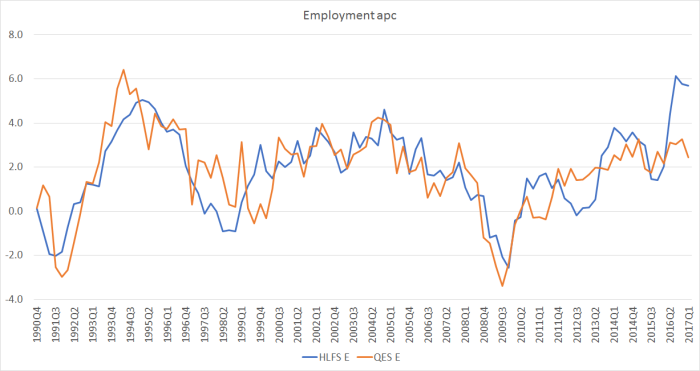
  • it ignores the break in the HLFS hours worked and employment series in 2016q2.  In fairness, the author might not have been aware of the break, but serious economic analysts (including the Treasury) are.

I illustrated the break in the series in a post several months ago.

What about the rate of job growth.  Fortunately, we have two measures: the (currently hard-to-read) HLFS household survey measure of numbers of people employed, and the QES (partial) survey of employers asking how many jobs are filled.   Unsurprisingly, the trend in the two series are usually pretty similar, even if there is a fair bit of quarter to quarter volatility.

employment

Since we know there are problems in the HLFS, and the QES doesn’t look to be doing something odd, perhaps we are safest in assuming that the number of jobs has been growing at an annual rate of around 2.5 to 3 per cent.   That isn’t bad at all. But SNZ also estimates that the working age population has been growing at around 2.7 per cent per annum.  No wonder the unemployment rate is only inching down.

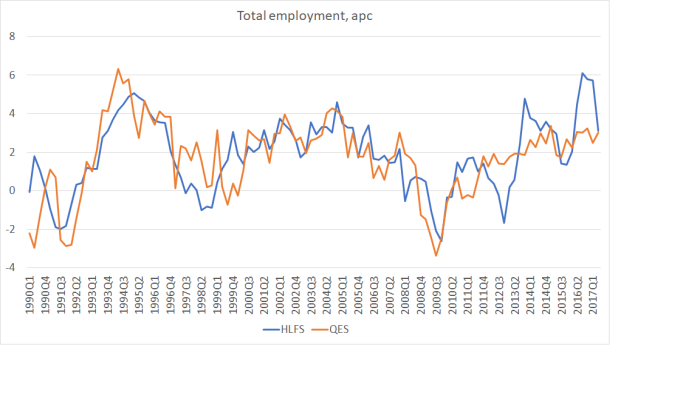
Now that we have 2017q2 data, so a full year on the new HLFS questions, the annual percentage growth rates of the two employment series have indeed converged again.

hlfs and qes E

In other words, one can’t take as meaningful any annual percentage growth in the HLFS employment (or hours) numbers for calendar 2016.

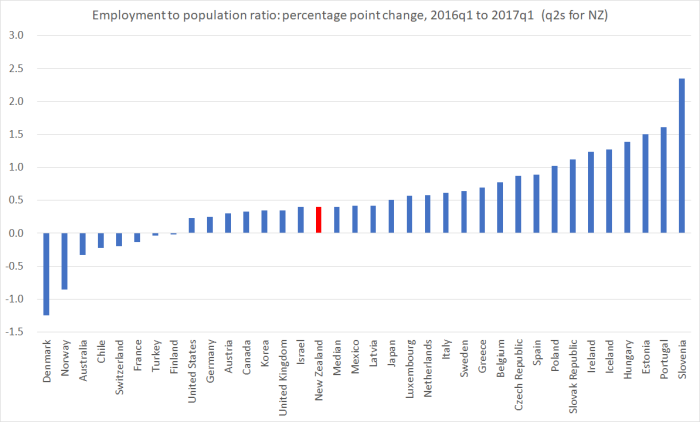
A better way to deal with all three issues is to look at the percentage point change in the employment to population ratio for the whole OECD group.   The most recent period for which we have full data for all countries is 2017q1.  For New Zealand, using growth in employment over the year to 2017q1 would still be distorted by the break in the series, so for New Zealand only I’ve shown the change in the employment to population ratio from 2016q2 to 2017q2.

E to popn last year

And on this – much more useful – comparison, New Zealand ends up as a middling performer, the median country.   There is no stellar New Zealand “job creating machine”, just a huge increase in working age population.     Job growth isn’t to be gainsaid, but it is productivity growth (or the absence of it) that is the key determinant of gains in medium-term living standards.  And did I mention that there had been no productivity growth, at all, for the last five years now?

(To be clear, I would not put much –  if any –  weight on a single year comparison.  After all, all labour force surveys have some sampling error.  But if people want to make sense of employment growth, in international comparison, over just the most recent year, this is really the only sensible way to do it.  As it happens, over that year, our change in the employment to population ratio was the same as that for the OECD as a whole.  It was just a bit less than that for the EU as a whole and for the euro-area –  who, of course, generally had a deeper unemployment hole to climb out of.)

Interest rates: all the fuss for 1 basis point?

I watched the TVNZ Q&A interview with the Prime Minister yesterday.  Apparently, the National Party has a widely-distributed brochure suggesting that interest rates are set to rise if the Labour Party takes office after the election.   I haven’t seen the brochure, but the Prime Minister seemed determined to defend the claim, even as he had to concede that –  of course –  he couldn’t guarantee that interest rates would not rise over the next three years if his own party was re-elected.     When pushed, his claim seemed to reduce to the proposition that interest rates were more likely to rise, and perhaps might rise more, if Labour was in office.

I know that a lot of people now have a lot of debt, and most New Zealand loans reprice pretty frequently (floating rate or short-term fix).  But no serious person will argue that interest rates are quite low at present because the economy is doing well.  Market interest rates around the advanced world (and central bank policy rates) have been very low for some years now, despite all the public and private debt, because demand (real economic demand) at any given interest rate isn’t what it was.  Population growth has slowed in most countries (not New Zealand of course), productivity growth has slowed, and there just don’t seem to be the number of profitable investment opportunities there were. Globally, higher interest rates would, most likely, result from some improvement in the medium-term health of the economy.      That would be true here as well  (with the caveat that ideally one day some government would make the sorts of policy changes that would allow the persistent gap between New Zealand and “world” interest rates to close.)

But the Prime Minister’s claims about interest rates were also odd because:

  • actual retail interest rates (those ordinary people pay and receive) have been rising over the last year, and
  • both the Reserve Bank and The Treasury have official published projections showing policy interest rates rising over the next three years.

The increases in actual interest rates over the last year havn’t been large (about 25 basis points for floating rates, and something less for deposit and business overdraft rates).  But as we’ll see, those are large changes compared to the sorts of effect the Prime Minister seemed to be talking about.

And what about the next few years, on current policies (monetary and fiscal)?  These are the projections from the latest Reserve Bank Monetary Policy Statement and from The Treasury’s PREFU.

int rate projections

The Reserve Bank doesn’t expect much of an increase in the OCR over the next three years, but it is an increase nonetheless.  The Treasury seems quite gung-ho –  by the time of the next election, they expect we’ll have seen 150 basis points of interest rate increases.   I suspect that Treasury’s numbers are too high, but both sets of projections are (a) upwards, and (b) well within the historical margins of uncertainty.    Neither agency gives enough weight, at least in what they are saying in public, to the possibility – again well within historical bands of uncertainty – of materially lower interest rates.  It seems unlikely that the Prime Minister would welcome a world in which such interest rate cuts were required.

The Prime Minister’s specific claim seemed to be that the Labour Party’s fiscal policy would result in higher interest rates than the fiscal policy adopted by the National Party.  He attempted to muddy the water with talk of what any Labour coalition parties might demand, but of course on current polling it seems likely that any National-led government would also have to face coalition party demands.  So, for now, lets just focus on actual main party plans –  National’s as per the PREFU, and Labour’s as per their published fiscal plan.

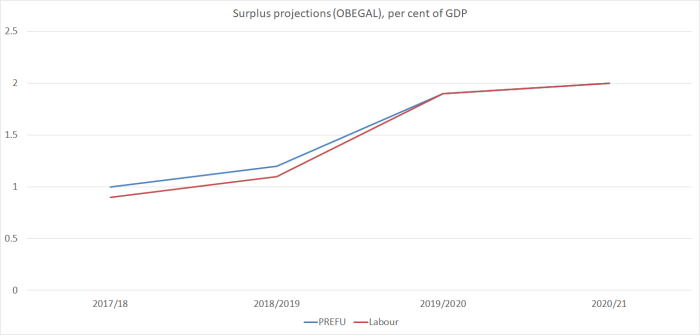
There would seem to be two plausible channels through which fiscal differences might mean different interest rates.   The first would be if Labour was to run materially lower surpluses, or even deficits.  The increased demand that would flow from those annual spending or revenue choices might, all else equal, lead the Reserve Bank to raise the OCR.  But here (as I’ve shown before) are the two surplus tracks.

labour surplus

They are all but identical, especially when one bears in mind that the Reserve Bank is typically looking a couple of years ahead in setting interest rates.   If Labour does take office, no Reserve Bank Governor –  acting or otherwise –  is going to be looking at that track, with a slight difference in 2018/19 and none beyond that –  and altering his or her interest rate projections.

The other channel is through a stock effect; the effect of a higher accumulated stock of debt.   The Minister of Finance has attempted to highlight that Labour’s plans involve around $7 billion more of net core Crown debt in 2020/21.    Sounds like a lot of money.   In fact, the difference is 2.2 per cent of GDP.  And around half that difference doesn’t show up in a true net debt series (such as that reported by the OECD) at all:  it is the additional $3 billion of contributions to the NZ Superannuation Fund.  I don’t happen to think that resuming those contributions is particularly sensible, but both main parties do –  their only difference is timing –  and if contributions to the NZSF add a bit more risk (variability) to the Crown balance sheet, they don’t make us poorer.  It is very very unlikely that raising a little more gross debt to put money in an investment fund like the NZSF will have any effect at all on New Zealand retail interest rates.

But what does the research show?   Disentangling the determinants of New Zealand interest rates isn’t easy, and I’m not aware of (m)any new studies over the last decade or so.  But a couple of prominent New Zealand economists did some interesting modelling work on the issue back in 2002, for Westpac.  Adrian Orr is now head of the NZSF –  and perhaps a contender for being the next Governor –  and Paul Conway is head of research for the Productivity Commission.     They looked at the impact of net government debt (not idiosyncratic national definitions, but drawing from international databases), and this is what they found

Table 2 shows the marginal and total impact of government debt on real bond rates. Moving from a net debt level of 10% of GDP to 20% of GDP adds only 3bps to real rates and the total contribution of debt to the risk premium is only 6.5bps.

As one might expect, the effects were quite a bit larger when debt levels were a lot higher than they are in New Zealand.

On these internationally comparable net debt measures, current net government debt in New Zealand is about 9 per cent of GDP, and on both National’s plans and Labour’s will fall from here.   Labour reduces public debt a bit less than National does over the next few years, but recall that by 2020 even on the Treasury measure of net debt the difference was 2.2 per cent of GDP.  Applying the Orr/Conway model results (that 6.5bps for 10 percentage point change in debt), and even that increase will produce only around a 1 basis point change in interest rates (with significant margins of uncertainty around those estimates).   And these are long-term government bond rates they were modelling.  Any effect on short-term retail rates –  probably zero –  would be indiscernible.

Are they other possible differences in interest rates that might show up depending on who wins the election?  These ones occurred to me:

  • both parties, but perhaps particularly Labour, look likely to have some difficulty keeping to their announced spending plans in the next few years, given baseline cost and population pressures and the recent electoral auction.  Whether that would result in smaller surpluses depends on what other offsetting actions respective governments might take (and, of course, what happens to revenue flows).
  • one reason why Labour’s net debt numbers are a bit higher than National’s is Kiwibuild.  In the Labour fiscal plan, they allow $2 billion of new and additional debt to get the Kiwibuild programme going (intending to roll that forward as new houses are built and sold).  I suspect that much of the Kiwibuild activity will displace private sector construction, but if it doesn’t –  and it actually adds to total construction activity –  that would put more pressure on available resources and –  all else equal –  increase the chances of OCR increases in the next few years.   But since both sides agree that more houses need to be built, it is hard to see how either could describe any such increase in the OCR as a bad thing –  if anything, in their own terms, it would be a mark of success.
  • Labour is talking about reducing net immigration inflows.  I’m a bit sceptical as to whether they would carrry through on that, given the evident decision to downplay the issue since Ardern took over. But if they do follow through, there would be a reasonably material reduction in overall demand and resource pressures over the next 12-18 months (especially as their proposed cuts are focused on the student sector).  All else equal, that would reduce the chances of OCR increases in the next couple of years.
  • Labour is promising Reserve Bank reforms.  Much is likely to depend on the key individuals they appoint, but –  all else equal –  their proposal to add an unemployment objective would be likely to reduce the chances of near-term OCR increases.  (In the longer-term there is a risk, that would have to be managed, that such a reform could slightly increase longer-term inflation expectations, and thus the level of nominal interest rates.)

In the end, this is fairly silly debate.  The differences in fiscal policy are small, and the track record of the two main parties over 30 years now is of pretty responsible fiscal management.  Debt levels are low and, absent a severe crisis, near-certain to remain so.

And interest rates do move around.  In well-managed countries they most often rise when economies have been doing pretty well, and they fall when something bad happens.   What will determine what happens to interest rates –  market and official –  over the next three years?  It won’t (overwhelmingly) be our choice of Prime Minister, but –  in the famous phrase of Harold MacMillan, former British Prime Minister –  “events, dear boy, events”.

And we, they (politicians) and the Reserve Bank should fear the sort of events that could yet take our interest rates quite a bit lower than they already are.

As bad as having a former KGB officer in Parliament?

When Newsroom picked up and ran my post on National MP Jian Yang, they highlighted the analogy I drew

Imagine a former KGB officer serving in the New Zealand Parliament in the 1970s, advocating the interests and views of the Soviet Union

(to which I had added “and hob-nobbing with representatives of the Soviet Embassy”.

I noticed that, in response, one prominent commentator on the right suggested that the comparison (with Yang and China) was overblown, and that today’s China was nothing like the Soviet Union of the 1970s.  I’ve reflected on that and frankly I’m at a bit of a loss to see the differences that put modern China in a better light than the 1970s Soviet Union.  Unless perhaps it is the current Chinese dictators wear better suits?

Of course, there are some significant economic differences between the two regimes.  Chinese firms trade with and invest in the wider world, while the Soviet Union traded mostly (but not solely) with other communist countries.   China allows the market considerable play in matters economic, and the Soviet Union didn’t.    So long, that is, as a notionally private company concerned doesn’t step out of line (see Richard McGregor’s excellent The Party).  And some of the key dimensions of a market economy are the rule of law, a market-led allocation of credit, and the ability to fail. On none of those does China score well.

And it isn’t as if China is some startling economic success story either.    Here is a chart from a post I ran last year on China’s continuing economic failure (relative to both the US –  as representative of a leading advanced economy –  and to other east Asian countries).

asia gdp pc cf US

China today is richer (per capita GDP) than the Soviet Union was in the 1970s, but almost every country has got a lot richer since then.  As a proportion of US (or New Zealand) GDP per capita, China’s current GDP per capita is estimated to be a bit lower today than the Soviet Union’s was in the 1970s.

Quite probably, China will close the gap to some extent over the next decade or two, even if they persist with the current credit-driven, absence of supply-side reforms, economic model.    But embedded within the system are huge misallocations of credit, and thus of real resources.   They can avoid a financial crisis, but they can’t avoid that waste.

But this isn’t primarily a post about matters economic.  A strong economy can support foreign policy ambitions, and a weak one can eventually undermine those ambitions.  So even if China were to achieve greater economic success, it shouldn’t be particularly reassuring to the rest of the world.  On checking I noticed, for example, that in 1938 German manufacturing exports were 20 per cent of the world total –  a large proportion of which will presumably have been to countries that only a year or two later were the subject of Hitler’s aggressive intentions.    There will have been plenty of people in each of those countries with a strong economic interest in making a case for Germany.

To me, there are two aspects of China –  and thus about Jian Yang’s past active service in that regime (and Party’s) cause –  that should be of concern.   There are the values the Chinese authorities apply internally, and the approach they adopt and encourage externally.   Neither should be encouraging to anyone who values the free and liberal democracy –  with all its faults –  that countries like our own built and maintained over the last few hundred years.     It is a regime that murders protestors –  what Jian Yang refers to just as “student demonstrations” –  that imprisons dissenters, that denies freedom of worship, the bans internet access to sites critical of the regime (or indeed, to services that won’t act as agents of the regime in suppressing dissent).  For decades, they forced abortions on couples who wanted more than one child.  And today they are at the forefront of using surveillance technology – much more advanced than anything the Soviet Union could use 40 years –  to keep the citizenry in check.    The obscene inequalities of wealth, flowing in the direction of the political elite and those close to them, are just another aspect of the evil.   Prada handbags and smartphones tell us nothing about the character of the regime.   (And I don’t see anything in the character of the sort of regime in this paragraph that marks it out from the Soviet Union.)

I’m not one who favours interfering in the internal governance of other countries, large or small, and no matter how unsavoury they are.     But if someone who was an active part of such a vile regime –  voluntarily a Party member –  comes to New Zealand and wants to be part of governing our country, one might reasonably expect he would (a) acknowledge his part in, and (b) denounce the evils of, the system.    As a member of the Chinese language media put it to me, the language Yang used in his maiden speech about Tianamen Square was the sort of language one would only use if one supported the brutual suppression of those demonstrations by the government and Communist Party of China –  in whose cause Jang had then been working.

But it is the foreign policy of China that should be even more disconcerting.  In the 1970s, the West and the Soviet Union and its allies were fighting the odd proxy war (eg Angola –  with Cuba on one side and South Africa on the other), and there was the invasion of Afghanistan.  I’m not about to trivialise the Soviet Union, but it was the also the era of great power detente.  Both sides were suspicious of the other –  and the risks of misinterpretations leading to nuclear conflict –  but by the 1970s few people saw the Soviet Union’s intentions as primarily expansionist or aggressive.    And the UN apart, the Soviet Union wasn’t part of most international agencies (eg IMF, World Bank, WTO/GATT).

And these days?  China remains the leading protector of North Korea.  China propounds values, and standards of international governance, through international organisations, that are inimical to those of the West.  China is an actively expansionist power –  most visibly in the South China Sea, where it has been in flagrant breach of international law.  China is a key player in cyber-espionage.  China is widely-recognised as attempting to suborn regional political leaders –  apparently successful for now in the Philippines.  And China’s strategy of attempting to exert influence in a wide range of countries through the deployment of its (current or former) citizens in other countries is pretty well-documented.   China still lays claim over a democratic state (Taiwan) and has never renounced the possibility of using force to take Taiwan.  In short, China represents a considerable threat to the sort of regional and world order that New Zealand has been a part of, and which (historically at least) its leaders were willing to champion.

(I’m not really interested in “what-aboutism”.  “Our side” does questionable things in the international sphere at times too, and as I noted the other day I’d be concerned –  albeit less so – if a former member (especially an unacknowledged one) of US intelligence services were in our Parliament.  But our values are not those of the current Chinese regime, and that regime is not content to apply its standards only in its territory.)

And then, frankly, there are two other differences: numbers and location.  The Soviet Union in the 1970s had a population similar to that of the United States, and much smaller than that of all the NATO (and associated) countries.    China –  still relatively poor in per capita income terms, as the Soviet Union was, now has (or shortly will) have the largest economy in the world.   Such a large economy buys a lot of weapons systems, and potentially a lot of clout.  And location?   The Soviet Union’s prime focus wasn’t south and east Asia. China’s is.  New Zealand is a long way from either country, but the threat to our values, and our systems, is real nonetheless –  and, compared with the 1970s, New Zealand stands more alone than it did then.

I don’t suppose China has any intention of invading New Zealand, any more than the Soviet Union did.  Something akin to vassal status will do just fine –  countries that are reluctant to stick up for what they once believed, that are reluctant to stick up for countries with similar values in east Asia, that are reluctant to call out China’s territorial expansionism or its internal abuses.  Yes, I’d say the China is at least as serious a threat to us today as the Soviet Union once way –  perhaps more so, because the threat is less well-recognised, and more insidious.  Better suits, and good hospitality.   And our own ministers –  probably of either main party –  all too eager to please.

And what of our media?  Credit goes to Newsroom (and the Financial Times) for breaking the Yian Jang story.  But what of our mainstream media?  They seem to have given the story some initial coverage, but then been keen for it to die.  I hope that is an incorrect interpretation, but a week out from an election it was striking that there was nothing at all about the story in the Dominion-Post yesterday or today, or –  as far as I could see –  in the Herald yesterday or today.  And yet this is a story about a government MP, actively recruited by senior National Party figures to in some sense “represent” the Chinese community (identity politics rule, as Stephen Franks notes), who appears to have hidden –  from the public at very least –  his active membership in the Chinese Communist Party and his service in the Chinese intelligence services, and who appears to remain close to the Chinese Embassy.   At very least, there are allegations of SIS investigations –  paralleling similar investigations around Chinese-born politicians in Canada and Australia.  And there also seem to be suggestions of incomplete, or misleading, disclosures when Yang sought New Zealand residency and/or citizenship.  It seems as though it should be a major ongoing story –  with tough questions for the Prime Minister, the National Party, John Key, the Minister of Internal Affairs, and (for that matter) the leaders of other political parties?  Does ACT regard this as acceptable in a governing party they support?  Do Labour, or the Greens?

After all, Yang appears to have more or less acknowledged his own deceptions.  There was a story on the Herald website yesterday in which he is said to be reviewing his citizenship application form.  The article ends this way

Jian Yang told the Herald on Tuesday he didn’t name the Air Force Engineering University or Luoyang People’s Liberation Army University of Foreign Languages when making the applications that led to New Zealand citizenship, which he was granted in 2004.

He instead gave the names of two Chinese universities for civilians that had “partnership” status with the military institutions where he taught intelligence agency cadets as an English lecturer.

Asked if he made a false declaration on his citizenship application, Yang said giving the name of “partnership” universities instead of the institutes he actually worked and studied at was not a false declaration and was required if he was to leave China.

But in 2004, when he was applying for New Zealand citizenship, he was living in New Zealand.  There was no obstacle to telling the truth.  Unless he counted perceived obligations to the Communist Party of China, and the military and intelligence system of China, as more important than legal obligations to complete truthfully his citizenship application form.

In truth, his citizenship doesn’t worry me overly much.  From reports I’ve seen, he seems to have been a capable academic at Auckland University.  But membership of our Parliament and, perhaps in time our executive, is a different matter.  And with two minutes research, I found the Herald profile of him from 2011 when he was first running for Parliament.    If I’d read it at the time –  and I probably did, being a junkie –  I’d have been quite impressed by the tale of triumphing over adversity and poverty, and perhaps even a little inspired (he even expresses support for some social conservative causes I put a priority on).    But that’s because of all the stuff he didn’t tell the Herald  – or voters.    Perhaps there was a clue in this line

He said the effective dictatorship in China had provided a stable platform for long-term economic policy, while a surge in international trade had improved human rights and the flow of information.

Hmmmm…….

But not a word of his membership of the Communist Party (remember only about 5 per cent of Chinese belong; it isn’t some automatic part of living in China), or of his education in a military intelligence university, or subsequent service in that intelligence system.  Not a word about it, then or since.  And not a word of criticism of this system which is inimical to the values that built and sustain this country.

As I noted the other day, perhaps he hid it from the National Party too, which would speak very poorly of their candidate vetting. Or he told them, and they didn’t care, (and perhaps even told him to keep his past quiet) which speaks even more poorly of them, their values, and their priorities.    Either way, it should be unacceptable.

So, yes, it would have been regarded as quite inconceivable in the 1970s to have had a former serving KGB officer (whatever his specific role in that establishment) as a member of the New Zealand Parliament.  If that person had grossly misrepresented their past, and continued to associate closely with the Soviet Embassy, the scandal would have been all the greater.  It should be just an unacceptable today for a former serving member of the Chinese Communist Party, and the Chinese intelligence services, having consciously misrepresented his past and never denounced the system, to be in –  and put forward again as a candidate for –  our Parliament today.

Working more, not getting more productive

Over on Kiwiblog I noticed a chart showing that average real GDP growth in New Zealand over the three years 2014, 2015 and 2016 had been faster (quite a bit faster) than any of the selected small group of other countries shown.  In fairness, the chart shows some of the larger OECD economies –  all of whom are richer than us already.

But, of course, it makes no allowance for the fact that our population growth rate has been far higher than those of almost all other OECD countries.   Per capita income is what counts –  for almost any serious purpose.  Here is how we have done over those three years (I’ve taken total growth from  the level in 2013 to the level in 2016, thus capturing the three years the Kiwiblog chart does).

real GDP pc last 3 years

You can discount the Irish number (which goes off the chart –  they’ve had a strong recovery, but some tax-driven factors have also distorted their national accounts numbers).  We and the Netherlands have been the median countries.   Nothing spectacular.  Nothing disastrous either.  Just middling.  And so making no progess at all in closing the gaps to the rest of the OECD.

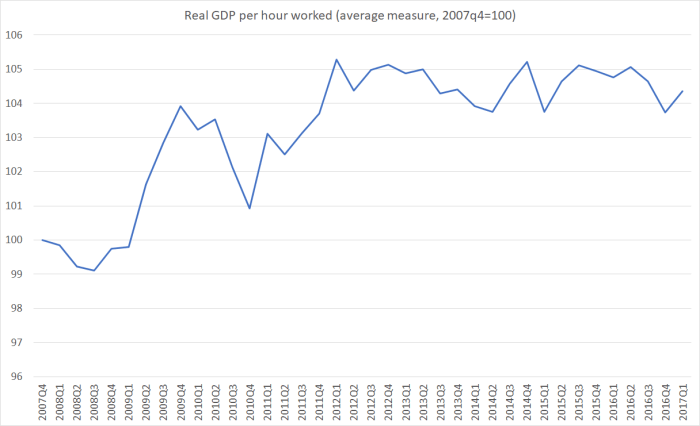
And then, of course, how one grows matters.  One can work longer hours, or one can capture the benefits of productivity gains (doing things smarter, doing things with more capital).    Regular readers here know the New Zealand story.  We’ve had no productivity growth at all –  not just for three years, but for five years.  Let it sink in…….none at all for five years.

real GDP phw farrar

Even the Minister of Finance seemed prepared to concede the other day that, just possibly, it might be a bit of an issue.

UPDATE:  Take this chart with a pinch of salt.  The OECD doesn’t have productivity numbers for all its member countries for 2016 yet, and revisions are always possible.  And three years is, any case, only just getting long enough to look through some of the noise in the data.  But for what it is worth here is labour productivity growth for the same period as the GDP per capita chart above, for the countries for whom the OECD reports the data.

growth in real GDP pc

We don’t score well –  absolutely (previous chart of NZ data only) or relative to our advanced country peers.


Scattered thoughts on tax and fiscal policy

It has been a quite remarkable rookie error by the Labour Party that allowed the mere possibility of specific tax increases to become such a major part of the election campaign, in a climate where the government’s debt is very low, and where official forecasts show surpluses projected for years to come.   If government finances were showing large deficits, and there was a desperate need to close them, that political pressure might have been unavoidable.  Closing big deficits involves governments taking money off people who currently have it –  by whatever mix of spending cuts or tax increases – and doing so in large amounts.   But the PREFU had growing surpluses, and Labour’s fiscal plan had almost identical surpluses for the next few years –  without relying on any further tax changes that might have flowed from the recommendations of the proposed Tax Working Group.

These are the surplus projections

labour surplus

Of course, Treasury GDP forecasts can’t always be counted on – and it is seven years now since the last recession – but there is quite a large buffer in those numbers even if the economic outlook changes.  But the other side of politics wasn’t disputing the (Treasury) GDP assumptions.  And it seems to have been lost sight of that in a growing economy, with low and stable debt levels, modest deficits (on average) are the steady-state outcome (consistent with low stable debt).     That might involve decent surpluses in boom years, and perhaps quite big deficits in recession years (as the automatic stabilisers work on both sides) –  but again the Treasury numbers, which both sides are basing their numbers on, say that at present we are in the middle (estimated output gap around zero, unemployment still a bit above a NAIRU, and on the other hand the terms of trade above average).

I guess it was always the sort of risk Labour faced in changing their leader so close to the election (things move fast and something –  who knew what specifically –  was almost bound to not work out well), but it was all so easily avoidable.  They could have:

  • stuck with the Andrew Little policy (now reverted to) of no changes flowing out of the TWG process to come into effect before the 2020 election,
  • they could have reverted to the 2014 policy (a specific detailed capital gains tax proposal, perhaps including revenue estimates), or
  • they could have committed to any package of TWG-inspired changes implemented before the next election being at least revenue neutral (if not revenue negative).   This latter sort of commitment would have been easy to make precisely because of the large surpluses in the projections both sides are using (see chart above).

After weeks of contention and uncertainty –  some reasonable, some just fear-mongering – they’ve finally adopted the first option.

But you have to wonder what the proposed Tax Working Group will be left to do?  In practice, it looks as though it might most usefully be described as a capital gains tax advisory group –  to advise on the practical options and details on how to make a capital gains tax work, as well perhaps as to review the evidence and arguments for (and against) such an extension to our tax system (my reflections on the CGT option are here).

They’ve ruled out increases in personal or company tax rates, they’ve ruled out GST increases, and they’ve ruled out a land tax affecting the land under “the family home” (which is most of the value of land in New Zealand).    They apparently haven’t ruled out revenue-neutral packages that involve a reduction in income tax rates, but this looks like a pretty empty suggestion.  Why?

The first reason is that they claim that their suite of policies are going to solve the housing crisis.   I’m a bit sceptical about their claims (and those of the government), but if they are right, how much revenue do they suppose there is likely to be from a capital gains tax anytime in (say) the next 20 years?  Treasury once produced some rather large revenue estimates, but (from memory) they involved some sort of muted extrapolation of the experience of the previous 20 years.       Both sides of politics seem to think they can stabilise nominal house prices, and then let income growth and inflation reduce real prices and price to income ratios.   If so, there are no systematic capital gains on housing  –  and idiosyncratic ones (particular cities or specific locations that do well) won’t add to much revenue at all.    Of course, it might be different if the housing measures fail, but Grant Robertson yesterday seemed pretty adamant.

“What we are signalling is, the Labour Party’s policy is that our focus is on fixing the housing crisis. That is our focus.

A capital gains tax might (or might not) be a sensible addition to the tax system, but it shouldn’t raise much money.

What else is there?  I’m sure tax experts have various small things they’d like the working group to look at, but it is hard to believe there is anything that could raise much revenue.    For some, a land tax looked promising –  my own scepticism is here.  But Labour has now ruled out a tax on the land under “the family home”, which effectively nullifies any possibility of a sensible, credible, and enduring land tax.

It is one thing to rule the family home out of a capital gains tax net.  Even for most of those left liable for capital gains tax (CGT), the effective liability can be deferred for many years (reducing the present value) simply by not realising the gain (not selling the asset).  That is even more true with the sort of institutional holders than many seem keen to encourage into the rental market.  And, of course, there is only a liability if prices actually go up.    Those are among the reasons why the overseas literature tends to find little evidence that a CGT would make much useful difference to the housing market.

A land tax would be different.  It is a liability year in, year out.  Owner-occupiers (and associated trusts etc) wouldn’t pay it, but everyone else would.  It would be a huge change in the effective cost of (say) providing rental services.

New Zealand real interest rates are the highest in the advanced world.   A very long-term real government bond rate is around 2.5 per cent at present (the real OCR is currently zero or slightly negative).  So suppose a government imposed a 1 per cent per annum land tax on land not under owner-occupied dwellings.     Relative to a risk-free rate of, at most, 2.5 per cent that would be a huge impost (40 per cent of the implied safe earnings of the asset –  the appropriate benchmark since the tax itself isn’t risk-dependent.)   It would dramatically lower how much any bidder who wasn’t planning to live on the land could afford to pay for the land –  by perhaps as much as 40 per cent.

That might sound quite appealing.   Rental property owners (actual and potential) drop out of the market and land (and house+land) prices plummet.    But wait.   Wasn’t the political promise that they weren’t trying to cut existing house prices?    And what about the people who –  because of youth, or desire for mobility –  don’t want to own a house and positively prefer, for time being at least, to rent.    And what about farmers?  Lifestyle blocks (presumably exempt from the land tax) instantly become much more affordable than farming (which presumably does face the tax).    To what social or economic end?

Attempt to impose such a land tax and my prediction would be (a) that it would never pass, since it would represent such a heavy impost on a large number of people (and yet on not enough to raise enough revenue to allow meaningful income tax cuts to offset the effect), and (b) if it did pass, exemptions and carve-outs would quite quickly reduce it to the sort of land tax we actually had in New Zealand only 30 years ago –  which only affected city commercial property.

Now perhaps there is a limited middle ground.  There is a plausible case that can be made for use of land value rating by local councils rather than the capital value rating system that most councils now use.  I’m not aware that we have good studies suggesting better (empirical) outcomes in places that still use land value rating, but the theory is good.  The problem, of course, is that by ruling out a land tax on the family home, Labour would appear to have ruled out (say) using legislation to encourage or compel councils to rely more heavily on land value rating.   Perhaps that might leave undeveloped land within existing urban areas as potentially subject to land value rating?  There might be some merit in that, but the potential seems quite limited.

So, as I say, it looks as though the proposed tax working group should really just be a CGT advisory group.

And that would be a shame because, whatever you think of the merits of a CGT, it isn’t the only issue that would have been worth addressing in a proper review of the design of our tax system.  For 30 years now –  since what was a fairly cynical revenue grab (recognised at the time by those involved) in 1988/89 –  our tax system has systematically penalised returns to savings  (both relative to how we treated those returns previously, and relative to how other countries typically treat such returns).    The prevailing mantra –  broad base low rate –  which holds the commanding heights in Wellington sounds good, until one stops to think about it.     We have modest rates of national savings, and consistently low rates of business investment –  and our productivity languishes –  and yet the relevant elites continue to think it makes sense to tax capital income as heavily as labour income.  It doesn’t, whether in theory or in practice.   They don’t, for example, in social democratic Scandinavia.  They don’t –  when it comes to returns to financial savings –  almost anywhere else in the advanced world.    We should be looking carefully at options like a Nordic system, a progressive consumption tax, at inflation-indexing the tax treatment of interest, and at whether interest should be taxed (or deductible) at all.

Plenty of people are worrying about the potentially radical nature of some aspects of a possible new left-wing government.  I come from the market-oriented right on matters economic, but I worry that in these areas they won’t be radical enough –  won’t even be willing to open up the serious issues that might be contributing to our sustained economic underperformance.  And frankly, when the debt levels are as low as they now, and sustained surpluses appear to be in prospect, if ever there is a time to look at more serious structural reforms it is now.   It is a great deal easier to do tax reform when any changes can be revenue-negative (actually the approach taken by the current government in 2010 –  see table of static estimates here) or (depending on your orientation) used to increase public spending.  But it looks as though another opportunity is going to be let go by.    That would be a shame.

(Having mentioned the 2010 package in passing, I am a little surprised that the increase in the effective rate of business taxation in that package doesn’t get more attention.     It often passes unnoticed because the headline company tax rate was reduced, but as the published Treasury assessment at the time put it

While the tax package lowers the company tax rate, changes to thin capitalisation rules and depreciation allowances mean that, on average, firms will pay more tax as the reduction in the company tax rate does not fully offset the impact of higher taxable income owing to the base-broadening measures. As a result combined company and dividend tax revenues are estimated to be about 3-4% higher than in the absence of the package. In the case where all investment is financed by equity, this could increase the user cost of capital by about 0.6%.
Using the New Zealand Treasury Model (NZTM) we estimate that the increase in the user cost of capital leads to the private business capital stock reducing by 0.45% compared to what would have been the case in the absence of the package.

Not obviously a desirable outcome for an economy that had, for decades, had low levels of business investment.)

And finally, a chart showing in just what good shape New Zealand public finances are relative to those in the rest of the advanced world.   New Zealand government debt has increased relative to GDP under the term of the current government (mostly some mix of a recession and earthquakes), but government debt as a share of GDP has increased in most other countries too.   Here is the gap between New Zealand and the median OECD country, using the OECD’s series of general government net financial liabilities.   Our net financial liabilities last year were around 5 per cent of GDP on this measure  (seven OECD countries have less net debt, or have net assets).  The median OECD country has net financial liabilities of 40 per cent of GDP.  But here is the gap, going back to 1993 when the data commence for New Zealand.

gen govt net liabs nz less oecd median

It is quite a striking chart –  and took me a little by surprise frankly.   If you didn’t know when the two changes of government had occurred, there would be no hint in this chart.  For almost 25 years now we’ve kept on lowering our net debt relative to that of other OECD countries, through good times (for them and us) and for tougher times, under National governments and Labour ones.  There just isn’t any obvious break in the series.  And as we have a lot fewer off-balance sheet liabilities (eg public service pension commitments) the actual position is even more favourable than suggested here.

I’m not a big fan of increasing government debt as a share of GDP –  and low as current interest rates are (a) productivity growth is lower still, and (b) our interest rates are still the highest around.  But you do have to wonder quite what analysis backs up the drive for still lower rates of government debt to GDP, absolutely and relative to the rest of the advanced world.   And persisting with the “big New Zealand” strategy of rapid population growth makes the emphasis on very low levels of government debt even more difficult to make much rational sense of.

On standards in public life, and Jian Yang

My honeymoon was paid for by a week or so helping an arm of the expansionist and repressive Chinese government  (the IMF was paying, and it involved helping run a course in some obscure provincial city on liquidity management and the implementation of monetary policy).  In more recent times, I’ve also done a couple of lectures on New Zealand economic management, under the auspices of the Australia New Zealand School of Government, for groups of up-and-coming Communist Party officials –  ANZSOG had wanted Graeme Wheeler, and they got me instead.   Indeed, to my own bemusement, for a time I even held a security clearance that (I was advised) meant that if, for example, I wanted to take a holiday in China, I needed to give advance notice to, maybe even seek approval from, our intelligence agencies.

These days it is hard for many people in the public sector to avoid sullying themselves with contact with Chinese government/Party representatives.   Some of that, no doubt, is just an inevitable part of state to state diplomacy.   But when the opportunities arise, there is also the fascination with an ancient culture, and its modern manifestations, and with a country that is home to perhaps a fifth of the human race.   Perhaps it was like that for the Soviet Union in earlier decades?  Or Germany in the 1930s?  It is easy to say now, but with hindsight I now regret the (very small) assistance I provided to the Chinese government and their officials.  However amiable and intelligent individuals might be –  and there were many such in Soviet Russia and Nazi Germany –  they worked for, and advanced the cause of, a state which is the enemy of freedom, and the enemy of the values that made this country, and countries like it, what we are.   A state with an active aggressive agenda, propounding internationally an alternative authoritarian vision of governance, and brutally suppressing those who disagree with them.   A state ruled by a Party which actively connived in the murder and starvation of tens of millions of its own people.

Which is why those people (including the man himself) attempting to dismiss the concerns raised in the Financial Times/Newsroom stories about National MP Jian Yang as somehow “racist” are just playing distraction and trying to avoid the real issues, and real questions.

Would I be worried if, say, the National Party (or any other party for that matter) had made as one of its MPs someone with an equivalent background in the former ruling parties and military intelligence institutions of former authoritarian states like, say, Paraguay, Zambia, or Serbia?  Well, yes I would to some extent.   Such a background would speak of the values of the individual concerned –  and there has been no suggestion Jian Yang was forced to work for military intelligence or join the Communist Party; instead he will have been judged “reliable” to have been allowed to do so.  It would also say something about the values of a New Zealand political party which treated so lightly our own historical values and freedoms as to recruit someone like this.  Perhaps prioritising party fundraising over the values and freedoms of New Zealanders?

But in those cases, (a) the authoritarian states are now democracies, and (b) they are countries (chosen deliberately) with no particular interest in, or wish to exert influence on, New Zealand.

What about people with backgrounds in the intelligence services of the United States, the United Kingdom or (to use the example an FT columnist cites) Italy?  Frankly, I would have some concerns about the ability of someone who has ever worked in the military and intelligence establishment of another country to ever completely relinquish those loyalties and put the interests of New Zealand first.   Then again, such countries –  whatever their faults –  have been our allies over many decades.  The potential for serious conflicts of interest are much less than they are for some other regimes.

In other words, these things are points along a spectrum.    I’m not sure that former members of foreign intelligence services ever have a place in our Parliament, but those of Australia or the UK worry me less than those of the US, which worry me less than those of Singapore, Paraguay or Serbia, which worry me less than those of Russia or China.      The latter two are (a) large, and (b) aggressive powers.  Of the two, China is much more of threat in this part of the world than Russia.   But in the 1970s, the order might have been reversed.  Imagine a former KGB officer serving in the New Zealand Parliament in the 1970s, advocating the interests and view of the Soviet Union, and hob-nobbing with representatives of the Soviet Embassy.

Some people come out of the establishment of brutal aggressive authoritarian states and recant completely their former loyalties.  Their eyes have been opened to the evil that state represented, and often such people become leaders in the cause of urging people in the West to recognise the threat.  Sometimes, even, with the zeal of a convert their opposition to the state of their birth can be uncomfortable or even a little embarrassing.  And I don’t suppose that after his defection Oleg Gordievsky spent much time with the Soviet Embassy in London.

But what of Jian Yang?  I had a look yesterday at his maiden speech in Parliament, delivered in February 2012.  Maiden speeches are often an occasion for a new member to outline their personal philosophy, and the things that made them who they are, and led them to seek to enter politics.  A few are classics –  I recall being taught from Sir John Marshall’s in my first year politics course decades ago.  But what of Yang’s?

Read without knowing he’d been a member of the Communist Party (well under 10 per cent of China’s citizens are), or had been a serving participant in the intelligence establishment, it might seem inoffensive enough, although still a little surprising.       To serious champions of liberty, the Tianamen Square protests, and subsequent government massacres, stand as a continuing charge against the Chinese state and Party.  How does Yang deal with them (they disrupted his plans for graduate study abroad)?  They are nothing more than “student demonstrations”.

He can safely be mildly critical of the Cultural Revolution –  his parents were apparently sent to the countryside for “re-education” –  but never mentions the dreadful evil of the Great Famine, one of the worst man-made (Chinese government made) disasters ever.  There are boilerplate references to his support for opportunity and choice, but no attacks on the evil of the one-child policy, still in place at the time Yang gave his speech. Nothing about the lack of freedom of expression, the lack of freedom of religion, the lack of any free alternative to the Communist Party in China.      Instead, we get paeans to the “success” of the Chinese government in “lifting millions of people out of poverty”, as if the same government hadn’t driven them unnecessarily further into poverty in the first place –  and he has the gall to suggest that “reflecting on the way in which China has achieved its positive change and development gives me a firm belief that the policies of the National Party are in the best interests of New Zealand.”     And for someone with an academic background in international relations and an expressed interest in contributing on foreign affairs matters in Parliament, nothing at all about Chinese expansionism in the South China Sea, or its advocacy internationally of alternative visions of governance antithetical to liberal democracy.

It is one thing to be proud of your ethnic background –  and China has an ancient culture that once led the world –  but Yang showed absolutely no sign of having turned his back on, or a desire to call out, the evils of a repressive authoritarian party and government that has never recanted its mistakes, that has failed economically (compare Taiwan and China for example) and which represents a threat to us, and to countries (and believers in freedom) throughout east Asia.

And it wasn’t just the maiden speech.  As the Financial Times notes, since entering Parliament

He has consistently pushed for closer ties with Beijing and for international policies and positions echoing those of China’s Communist party.

In one of the FT articles on this story, there is photo of Yang posing with the Chinese defence attache at a celebration a year or two ago of the anniversary of the founding of the Chinese army.  Perhaps a Minister of Foreign Affairs more or less has to attend such functions.  Backbenchers don’t, and they certainly don’t need to be posing with military representatives of aggressive foreign governments, unless doing so speaks of their ongoing sympathies.  There is simply no sign of Yang having recanted his active involvement in the Chinese intelligence establishment –  indeed, until yesterday that inolvement was not generally known,

If, say, Russel Norman or Julie-Anne Genter (adult migrants who subsequently became NZ MPs) had been as actively involved in advancing Australian or US government causes (respectively) there would also have been considerable grounds for concern, mitigated to some extent by them not having been serving members in the intelligence regimes of the countries of their birth.

Who knows quite what the nature of Yang’s ongoing association with the Chinese authorities is.  But as the FT report notes, China has been increasingly active in placing and cultivating people in Western democracies and helping them gradually reach positions of political influence, and it reports concrete areas of concern in Canada (including from the intelligence authorities) and Australia.    Perhaps Yang doesn’t fit that bill at all, but if so his case would be a lot more convincing if he’d had a track record of being consistently and openly critical of the Chinese government and the Communist Party.  Instead, as the FT notes, in an interview recently he repeatedly requested the journalists not to include information about his intelligence background in articles about him.  You’d think it might have been an opportunity to openly criticise the authoritarian regime (being able to use the insider’s perspective he’d gained in his misguided youth) that he had turned his back on in choosing to come to New Zealand.  But apparently not.

It really is a quite extraordinary story.  On the one hand, quite remarkable that it has taken six years in Parliament for the media to look into the background of this MP –  one has to wonder why these stories weren’t being written in 2011 when the National Party first put him on the list. Perhaps there would have been more scrutiny if he’d been attempting to become a constituency MP?

But more concerning is the seeming indifference of the National Party to Mr Yang’s background.  He was/is (we are told) a very effective fundraiser for the National Party, and politics isn’t cheap.  Once upon a time the National Party could be counted on for a fairly hardline on defence and security. But these days, if this story is illustrative, do they just no longer care, so long as they can maintain a cosy relationship with the Chinese establishment and host visits from Chinese leaders and Chinese warships?  It is easy to downplay geopolitics when one is as physically remote as New Zealand.  But the issues and threats to us, and to like-minded countries, are real nonetheless.

On a similar note, shouldn’t it be somewhat concerning that the largest donor to the National Party is an entity called the Inner Mongolian Rider Horse Industry (NZ) Ltd.  I suppose we should be grateful the donation was made in a way that it was disclosed, but this is a company which has a small New Zealand operation, subsidiary of quite a large Chinese parent owned by a Chinese billionaire.

I have no way of knowing if the National Party is worse on such matters than the Labour Party would be (or for that matter, New Zealand First, which now has a prominent candidate Shane Jones of Bill Liu citizenship shame.)  But Jian Yang is a member of the National Party, and the National Party has now led the government for nine years.  For now, the hard questions seem to need to be asked of them.   If they didn’t know Yang’s background before recruiting him, that was slipshod or deliberately indifferent, and if they did know but just didn’t care –  and stuck him on the Foreign Affairs committee nonetheless – it risks looking like just another form of depraved indifference, whether through blindness to the threat China poses to things we (and people like us, from Taiwan, from Canada, from the UK or wherever) have held dear, or just a focus on keeping the donor money and votes flowing in.

I’m no New Zealand First fan, but the slogan on their campaign billboards “Had enough?” sums it up for me.  After the housing disaster, the economic failures (and worse, the near lies about them), and episode after episode that speaks of the degradation of standards of public life in New Zealand, for me it is just another nail in the coffin.  More nails than timber now.


Mr Joyce tries to defend New Zealand’s export record

Alex Tarrant, at interest.co.nz, has done a couple of interesting interviews, one each with the current Minister of Finance, Steven Joyce, and with the man who would replace him, Labour’s Grant Robertson.     There are various things in each interview that I might comment on in the next few days –  including in particular Robertson’s comments on his plans re the Reserve Bank.

In the interview with Joyce, this blog even got a mention, as the Minister was forced to concede that five years of no productivity growth (at least as measured at present) might perhaps be something that should be taken seriously.

“Productivity has been a struggle everywhere. If you look across the eight years – and let’s be clear, these people that talk about productivity measures over a year, they’re really…”
I cut in: former Reserve Bank economist, and Croaking Cassandra blogger Michael Reddell’s talking about the last five years, when productivity growth has been negative by most measures.
“Five years is getting more like it,” he accepts. “The thing about measuring productivity is it’s generally measured more effectively a couple of years after the fact, which is very frustrating for those us who are focussed on it,” he said.

So now, apparently, we are reduced to just hoping that the last few years’ data end up revised away?  Maybe……

But today I wanted to focus on Joyce’s comments around the New Zealand export performance and the government’s export target, partly because on this occasion he has articulated his perspective more fully than I’ve seen previously.     Here is the heart of that section of the interview

I ended by putting a couple of numbers to Joyce – one was on the goal to increase exports as a proportion of GDP from 30% to 40% by 2025. It hasn’t shifted from 29% since 2008. Is he disappointed?
“I’d like to see more growth in that.” He couldn’t really have said much else. “But you have to go and look at what’s been happening under the hood. And under the hood, world trade intensity has dropped.
“So, if you look at New Zealand relative to say, your Singapores, your Denmarks or so on, which are the big traders, they’ve gone back a bit, because we’ve had an extended period of a decline in world trade,” he says.
“We’ve held our own. Again, it’s nothing to write home about necessarily, except that we haven’t slipped back the way other countries have.”
Another thing New Zealand had been dealing with was our biggest export had been “down a bit of a hole over the last two or three years,” Joyce said (about dairy).

Actually, Tarrant’s introduction is a bit generous.   Exports as a share of GDP in New Zealand were 29.2 per cent in the year to March 2008, rose quite a bit when the exchange rate plummeted in the following year, but were down to 26.7 per cent in the year to March 2017.  The last time the export share was lower than that was 1990.

exports 1

What of the Minister’s claim about what’s gone on in the rest of the world?   It isn’t entirely clear how relevant it is to New Zealand anyway, given that the government has set, and regularly updated, the New Zealand target, including in the Business Growth Agenda refreshes as recently as this year.  But set that to one side for the moment.  What do the data show, and how do we compare?

For the whole world, the best source of data is the World Bank.  Often it is only available with a bit of a lag.

exports 2.png

For the world as a whole, exports as a share of GDP have indeed dropped slightly since 2007 or 2008.  But that is very largely a China story –  after a couple of decades of very strong export-led growth, the story of China in the years since the 2008/09 recession has been a domestic credit and infrastructure phase.  The foreign trade share of GDP has fallen back a long way –  and is probably still above what would expect in the long-term for a country the size of China.    For high income countries (a World Bank category) exports haven’t grown markedly as a share of GDP, but they have grown.  Of the Minister’s other examples, Singapore’s export share is very high and quite volatile, and has fallen back somewhat  –  as I illustrated in a post a few months ago, they’ve had a huge increase in their real exchange rate –  but Denmark’s hasn’t.

The usual group we compare New Zealand against is the other advanced economies in the OECD.   Here is how New Zealand has done relative to the median OECD country.

exports 3.png

The shifts aren’t dramatic but (a) we’ve done less well than them, and (b) we were the country whose government set a target for a dramatic change.

If we use calendar year 2007 as a reference point (the last full year before the recession), there are a few countries whose (nominal) export share of GDP has dropped by materially more than New Zealand’s.  They are Chile, Israel, and Norway.   Of them, Chile and Norway have experienced very substantial falls in their terms of trade –  sustained falls in copper and oil prices.    By contrast, New Zealand(despite the ups and downs in dairy prices) and Israel have had the largest increases in the terms of trade of any OECD country over that (almost) decade.  All else equal, a rising terms of trade should have tended to lift a country’s export share of GDP relative to those in other countries (matched, in time, by a higher import share of GDP, as the proceeds of the better prices are spent).

All of these numbers to date have been measures of the nominal value of exports relative to nominal GDP.  The government has expressed its export target in terms of volumes.  As I’ve noted before, ratios of real variables don’t make a lot of sense, and Statistics New Zealand advises against using them.   But one way of looking at volumes that does make some sense is to compare the volume growth of exports to the volume growth of GDP over a reasonable period.  In this case, I’ll look at the most recent year (to March 2017) relative to that last pre-recession year, calendar 2007.

In this chart I have calculated the total percentage growth in the volume of exports since 2007 and substracted from that the total percentage growth in real GDP over that same period.  (It might be more proper to do this multiplicatively, but I’ve checked and it doesn’t change the rankings.)

exports 4

There are OECD countries that have had a weaker relative export volume performance than New Zealand over this period, but not many.  And the median country’s experience is very different than ours has been.  And that is even with all those subsidised additional education exports and (as the Opposition parties might note) additional unpriced water pollution and methane emissions associated with the growth in agricultural exports.

Recall too that the whole logic behind the government’s export target was about closing some of those income and productivity gaps to the rest of the advanced world.  As Mr Joyce noted elsewhere in that same interview “productivity has been a 30 to 40-year issue for New Zealand” (longer than that actually).    One of the ways in which sustainable success of an economy tends to manifest is in the ability of firms based in a country to sell more stuff successfully abroad, enabling us to purchase more stuff from them.

In a post the other day, I highlighted our experience relative to a bunch of other countries that had been setting out to catch up, eight (now) fairly-advanced central and eastern European former communist countries.

Here is how (nominal) exports as a share of GDP have done in New Zealand and in those countries since 2007.

exports 5

and here is a chart showing the gap between the growth rate of export volumes and the growth rate of real GDP (again, latest 12 months compared to calendar 2007).

exports 6

And, drawing this towards a close, in case anyone was hoping (against hope) that the services sector might provide a more encouraging export story (death of distance as technology advances etc) here is the chart of how services exports as a share of GDP have done.

exports 7.png

But no.

Were I trying to make a case for the defence, I would highlight two relevant considerations that Steven Joyce didn’t mention:

  • first, the impact of the Canterbury earthquakes.  Real resources have had to be used for the repair and rebuild process that simply couldn’t be used elsewhere (eg to build export industries), particularly as much of the cost was covered by offshore reinsurance (which gave people cash, but not more real resources to do the rebuilding with).  As that phase passes, resources will be freed up and we might expect them to flow back towards the tradable sectors of the economy,
  • second, the unexpected sharp and persistent reduction in interest rates which (for a country with a large private external debt) represented a considerable windfall.  We have been able to consume more without having to produce (or export) more.  It is a windfall, but in the longer-run it is no substitute for a policy climate that supports productivity growth and the growth in both the export and import share of our economy.

And, on the other hand, you might have noticed that I mentioned earlier that Israel had been somewhat like us.  Exports as a share of GDP had fallen further than in New Zealand, and the terms of trade had increased over the last decade by about as much as New Zealand’s had.   The other thing that constantly marks out Israel is the rate of population growth, from a mix of high (but falling) birth rates and high rates of immigration.    Israel’s population has increased by just over 20 per cent since 2007  (New Zealand’s population has increased quite rapidly by international standard, but “only” by about 12 per cent).

Just like the earthquake story, real resources required to build the considerable infrastructure (houses, road, offices, factories, schools etc) associated with a rapidly growing population aren’t available for growing other industries.  In New Zealand’s case that rationing process works through a persistently high real exchange rate and real interest rates persistently high relative to other advanced countries.   I’ve written previously about Israel’s underwhelming long-term productivity performance, and suggest that, as with New Zealand, rapid population growth in an unpropitious location, has made it hard for firms based in either country to take on the world (economicially) and succeed.   The experience of recent years –  remember, no productivity growth at all in New Zealand for five years now – looks like another straw in the wind in support of that suggestion.

Relative to the government’s target, export performance in New Zealand has been poor.  Relative to other advanced countries, it has also been poor.  And all that notwithstanding very favourable terms of trade.   Exports aren’t everything by any means, but the only OECD country in the last decade that has had a worse overall export performance than New Zealand and had a good terms of trade has been the one advanced country with a consistently faster rate of population growth.   Export volumes have grown quite a lot in the last decade – just over 20 per cent –  but they’ve barely kept up with overall GDP growth (in most countries, there has been much more export volume growth), and even then only through new subsidies (export education) and unpriced environmental externalities.  It is a flawed strategy.  And it is an unsustainable one.


Who will build the houses?

One of the Prime Minister’s campaign lines has been “who will build the houses?” if immigration numbers are cut back.   It is a curious line of argument, for a variety of reasons.

But it takes on a particular air of unreality when used –  as I heard in a debate last week –  to attack the Labour Party.    After all, Labour is campaigning on a policy that will (a) leave the current 45000 per annum residence approvals target unchanged, and (b) reduce students visa numbers quite substantially (resulting in a one-year reduction in the net PLT migration inflow).  On their own numbers, the changes they are proposing won’t make that much difference to the number of work visas issued, and where those numbers do change, the intention is to focus reductions at the lower-end of the skill spectrum.  (Their document is here, and my post on it is here.)   For what it is worth, Labour even proposes a Kiwibuild visa, designed to ensure that any reductions in work visa numbers don’t interrupt a flow of construction workers.

The student aspect aside (and even that isn’t part of the 100 day plan, although it isn’t that long until the new academic year starts), one might reasonably doubt whether Labour is serious at all about reducing ongoing immigration pressures.   Their policy, if implemented, won’t materially alter the net inflow over time. And I heard this morning an extended interview with Jacinda Ardern on Radio New Zealand in which she declared that she would have no problem at all with a net 70000 migration inflow per annum if only the houses were there, and actively endorsed some recent strongly pro-immigration comments made by Helen Clark.    Labour, like National, is still a “big New Zealand” party –  despite the economic damage that strategy has been doing over decades (remember how bad our productivity record has been) and will continue to do (ever more people and a heightened priority on improving water quality and meeting climate change targets is a recipe for severely undermining our productivity prospects.)

But this post isn’t about Labour’s proposals, but about (a) what has actually been happening over the last few years in the construction sector and related migrant inflows, and (b) more briefly, how the economy might adjust if there was to be a sustained material cut to target levels of non-citizen immigration.

In his weekly column in last Friday’s Herald, Brian Fallow touched on some of the first of those topics.  He went to the latest annual MBIE Migration Trends and Outlook publication (for the year to June 2016 –   MBIE could you please make data easily accessible on a more timely basis), looked at the data on who had been granted Essential Skills work visas in recent years, and concluded thus:

The conclusion has to be that the impact of net migration flows on the housing market and the construction industry is overwhelmingly on the demand, not the supply, side.

There has been a big increase in construction activity in New Zealand in the last few years.  Some of that is driven by the Christchurch repair and rebuild process, but increasingly the key influence has been the unexpectedly rapid growth in the population.  Each of those people needs a roof over their head.

And so employment in the construction sector has increased rapidly.    Here is the data from the HLFS, showing the percentage increase in people employed from calendar 2013 to calendar 2016 for each of the sectors employing more than 100000 people.

HLFS by sector

The construction sector has had by far the biggest increase in employment over the last three years.  Around 56000 more people were employed in construction in 2016 (on average) than in 2013 (the current total number of people employed in the sector is around 240000).

What contribution has non-citizen immigration (the bits our policy controls) made to this employment?

As Brian Fallow noted, on MBIE’s own numbers, this is how many Essential Skills visas were granted for construction trades and construction labouring roles in the year to June 2016.

And a startlingly low proportion – 7 per cent, or 2233 to be precise – were classified as construction trades workers like carpenters, plumbers, plasterers, tilers and painters. If you include scaffolders and builders’ labourers, the proportion rises to nearly 10 per cent.

And here are the corresponding figures for the previous couple of years.

Essential skills visas granted
2013/14 2014/15 2015/16
Construction trades workers 2090 2123 2233
Construction and mining labourers 399 546 831
Construction sub-total  2489  2669  

3064


Total 26502 28548 31766
Construction as % of total 9.4 9.3 9.6

Those might look like quite large numbers but:

  • at last report, construction jobs made up 9.3 per cent of all employment (and yet in this really rapidly growing sector only around that share of Essential Skills visas –  suggesting that immigration was hardly easing sector-specific pressures), and
  • as Brian Fallow also pointed out, most of these Essential Skills visas were being granted to people who were already in New Zealand (eg renewals).  Of 31766 Essential Skills visas granted in the year to 2016, only 8334 (or 26 per cent) were new workers (the proportions are similar in the earlier years).
  • people arriving and taking up first-time work visas need to be offset against people leaving.    In the three years I’m looking at here, MBIE tells us that the total stock of people here on essential skills visas increased by only 10062.   If the patterns were similar for construction jobs as for other roles, construction would account for about 1000 of that increase.

Of course, some people will have moved from work visas and obtained residence visas.  Based on the 2015/16 residence visa approvals numbers, that might have been around 450 people working in construction roles per annum.  Over three years, perhaps as much as 1500 people.

In other words, in a construction sector where total employment has increased by 56000 in three years, perhaps only 2500 (or less than 5 per cent) of that increase will have been met by the immigration of non-citizens.

So in that sense the answer to the Prime Minister’s question is easy.  Who will build the houses if immigration is cut back?  The same people who always overwhelmingly have, people who were already here.

But perhaps more importantly, if immigration were to be sharply cut back, the number of people needing accommodation would fall.  At one extreme, if the population is growing by 100000 per annum (as it has in the last couple of years), that suggests a “need” for around another 35000 houses each year (on top of the small number that would need replacing each year with a static population).  With net non-citizen migration at present in excess of 70000, the non-citizen immigrant flows alone create a “need” for perhaps 23000 additional houses each year.     Even if we go back to Brian Fallow’s original numbers of gross approvals of Essentials Skills visas, 3000 construction workers cannot build 23000 houses a year.   So the way immigration policy is actually being conducted it is exacerbating pressure on the construction industry, not relieving it.  That additional pressure is substantial.

(It needn’t be that way of course.  In the short-term immigration will almost always in increase economywide demand more than it increases supply.  But composition of the immigrants afffects where the pressures are most felt.  At the extreme, if all the migrants were builders (and related occupations), they’d probably just about keep up with the additional demand for housing (building, in effect, to house themselves).  Then the demand pressures would show up more severely in other sectors.    But when there is a big increase in the population, and hence in construction activity, immigration policy certainly isn’t relieving construction sector constraints when only around 10 per cent work visas are going to construction workers, when almost a quarter of the new jobs are in construction.)

So what would happen if, say, the 45000 residence approvals target was cut to, say, the 10000 to 15000 per annum I’ve been advocating (still, in per capita terms, around the rate of permanent approvals in the United States), and issuance of work visas was also tightened up, so that the stock of people on temporary work visas was no longer growing?

Overall, growth in domestic demand would weaken, and with it the pressure on domestic resources.  The notion that the short-run demand effects of immigration outweigh the supply effects shouldn’t really be controversial.  It has been that way in New Zealand for many decades.  But, given the huge scale of the pressures that new people put on the construction sector (not just houses, but roads, schools, offices, shops etc), and the fact that immigration policy as actually run has not seen us bring in many construction workers (10 per cent of the visas, when 25 per cent of the new jobs have been in construction), such a policy change would greatly ease resource pressures in the construction sector specifically.  In some other sectors it is quite conceivable that resource pressures could increase (one could think of export-oriented sectors such as tourism or dairying) if such an immigration policy change was made.  But on the construction side of things –  one of the most politically and economically pressing areas of our economy – the gains (the relief of pressure) would be substantial and almost immediate.  Not only would construction sector resource pressure ease, but land prices could also be expected to fall back to some extent (due to a reduction in expected future demand).

More generally, across the economy one would expect to see  interest rates falling (both market interest rates and the OCR) and with them the real exchange rate.    A lower real exchange rate would help secure the overdue resource-switching towards the tradable sectors. It would also provide the additional margin that would enable employers in those sectors to bid up wages to the extent required to attract existing residents to take up jobs in those sectors.    Plenty of people would be freed up from the construction sector –  a country with a modestly growing population wouldn’t have 10 per cent of total employment in construction –  and they’d be looking for jobs elsewhere.  Most of them would be long-term residents or citizens –  something we know with a high degree of confidence because the government’s own data tell us not many visas have been issued in recent years to people in construction, whether skilled workers or labourers.

But I guess the Labour Party can’t really use these arguments to push back against the Prime Minister because they aren’t actually planning a material and sustained reduction in non-citizen immigration at all.  That’s a shame.

(And if you wonder why all this discussion has used visa numbers up to June 2016, that is because MBIE only release more recent numbers in massive (600000 line) unwieldly spreadsheets.  It is possible that patterns in the last year have been a little different, but it seems unlikely –  given the similarity in each of the previous three years.  But debate would be better-informed, and more timely, if MBIE would make  timely data available in more readily accessible formats, as happens for almost all other important economic data released by Statistics New Zealand, the Reserve Bank or whoever.)