Did it make a difference?

I’ll get back to some extensive original material next week, but I have been reflecting a bit on the attack on the Reserve Bank by Arthur Grimes, former chief economist of the Bank (and later chair of the Bank’s monitoring board). The most recent version ran on Radio New Zealand yesterday morning. As I noted on Twitter, there was a fair amount there I agreed with (notably the observations on the poor quality make-up of the MPC) and a fair amount I disagreed with.

Grimes has been critical of the Bank (and the government) for some considerable time, going back to the amendment to the statutory objective (adding a secondary element of “supporting maximum sustainable employment). Since the pandemic descended on us, his criticism has centred not on CPI inflation (actual or prospective) but on house prices.

Almost a year ago, he had an impassioned piece on these themes published in the Listener. I responded to it in a post, the relevant bits of which I reproduce below.

At which point in this post, I’m going to turn on a dime and come to the defence of both the Bank and the government. A couple of weeks ago the Listener magazine ran an impassioned piece by Arthur Grimes arguing that the amendment to the Reserve Bank Act in 2018 was a – perhaps even “the” – main factor in what had gone crazily wrong with house prices in the last few years. Conveniently, the article is now available on the Herald website where it sits under the heading “Government has caused housing crisis to become a catastrophe”.

Grimes was closely involved in the design of the 1989 Reserve Bank Act, and for a couple of years in the early 1990s was the Bank’s chief economist (and my boss). He left the Bank for some mix of private sector, research, and academic employment, but also spent some years on the Reserve Bank’s board – the largely toothless monitoring body that spent decades mostly providing cover for whoever was Governor. These days he is a professor of “wellbeing and public policy” at Victoria University.

However, whatever his credentials, his argument simply does not stack up, and given some of the valuable work he has done in the past, on land prices, it is remarkable that he is even making it.

There is quite a bit in the first half of the article that I totally agree with. High house prices are a public policy disaster and one which hurts most severely those at the bottom of the economic ladder, the young, the poor, the outsiders (including, disproportionately, Maori and Pacific populations). But then we get a story that house prices have been the outcome of the interaction between high net migration and housebuilding. As Arthur notes, immigration has hardly been a factor in the last 18 months (actually it has been negative, even if the SNZ 12/16 model has not yet caught up) and there has been quite a lot of housebuilding going on.

And yet in the entire article there is nothing – not a word – about the continuing pervasive land use restrictions (and only passing mention about the past). If new land on the fringes of our cities – often with very limited value in alternative uses – cannot easily be brought into development (if owners of such land are not competing with each other to be able to do so) there is no reason to suppose that even a temporary surge in building activity will make much difference to a sustainable price for house+land. Instead, any boost to demand will still just flow into higher prices.

Remarkably, in discussing the events of the last year there is also no mention of fiscal policy – the boost to demand that stems from a shift from a balanced budget just prior to Covid to one that, on Treasury’s own numbers, is a very large structural deficit this year.

Instead, on the Grimes telling the problem is a reversion to “Muldoonism” – not, note, the fiscal deficits, but the amendment to the statutory goal for the Reserve Bank’s monetary policy enacted almost three years ago now. Recall the new wording

The Bank, acting through the MPC, has the function of formulating a monetary policy directed to the economic objectives of—

(a) achieving and maintaining stability in the general level of prices over the medium term; and

(b) supporting maximum sustainable employment.

The main change being the addition of b).

Grimes has been staunchly opposed to that amendment from the start, but his assertion that it makes much difference to anything has never really stood up to close scrutiny. It has long had more of a sense about it of being aggrieved that a formulation he had been closely associated with had been changed.

He has never (at least that I’ve seen) engaged with (a) the Governor’s claim (which rings true to me) that the changed mandate had made no difference to how the Bank had set monetary policy during the Covid period, (b) the more generalised proposition (that the Governor is drawing on) that in the face of demand shocks a pure price stability mandate (and the RB’s was never pure) and an employment objective (or constraint) prompt exactly the same sort of policy response, or (c) the extent to which the New Zealand statutory goals remains (i) cleaner than those of many other advanced countries and yet (ii) substantially similar (as the respective central banks describe what they are doing) to the models in, notably, the United States and Australia. Similarly, he never engages with the straight inflation forecasts the Bank was publishing this time last year: if they believed those numbers, the purest of simple inflation targeting central banks would have been doing just what the RB did (and arguably more, given that the forecasts remained at/below the bottom of the target range for a protracted period).

Grimes seems to be running a line that the LSAP was the problem

The central culprit has been monetary policy that has flooded the economy with liquidity. This liquidity in turn has found its way into the housing market.

But there is just no credible story or data that backs up those claims. Banks simply weren’t (and aren’t) constrained by “liquidity”. The LSAP was financially risky performative display, but it made no material difference to any macro outcomes that matter, including house prices.

There is quite a lot of this sort of stuff.

Grimes ends on a better note, lamenting the refusal of governments – past and present – to contemplate substantially lower house prices, let alone take the steps that would bring them about (his final line “And no politician seems to care enough to do anything about it” is one I totally endorse). But in trying to argue a case that a change to the Reserve Bank Act – that had no impact on anything discernible as it went through Parliament or in its first year on the books – somehow explains our house price outcomes (especially in a world where many similar price rises are occurring, and where there was no change in central bank legislation), seems unsupported, and ends up largely serving the interests of the government, by distracting attention from the thing – land use deregulation – that really would make a marked difference and which the government absolutely refuses to do anything much about.

There is nothing much in that I would change today. In particular, in continuing to attack the change in the wording of the mandate (a matter on which reasonable people might differ, but which most economists would argue largely served to reflect how the Bank had been – and had been expected to be – running policy for the previous 25 years), he has not (that I’ve seen) been willing to engage with the points I’ve noted above which the Bank might reasonably be expected to mount in its defence.

Similarly, he never engages with the straight inflation forecasts the Bank was publishing this time last year: if they believed those numbers, the purest of simple inflation targeting central banks would have been doing just what the RB did (and arguably more, given that the forecasts remained at/below the bottom of the target range for a protracted period)

As Arthur correctly noted in his RNZ interview yesterday, monetary policy lags are quite long. The Bank has to be looking ahead in setting policy. Many estimates are that the lags for the main effects of monetary policy might be 18-24 months. Thus, June quarter 2022 inflation might be most affected by monetary policy choices in late 2020. Here is a summary of the key variables in the Bank’s November 2020 MPS projections (“baseline scenario” as they were calling it at the time)
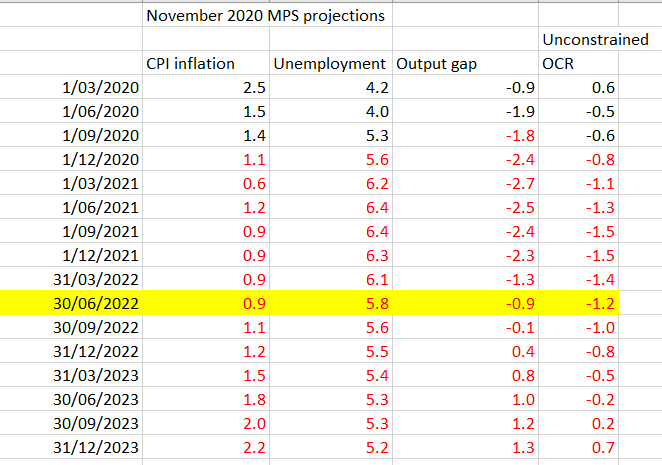
If this was genuinely their best view at the time (and there is no obvious reason to doubt that) then a textbook pure inflation-targeter (which has never described the Reserve Bank under any of its inflation-targeting Governors) would have looked at these forecasts – inflation at about 1 per cent in mid 2022 – and might reasonably have concluded that more monetary policy stimulus was required.

It all just goes to my argument that the big problem (with hindsight) in the first year or more after Covid hit was a forecasting mistake – the Bank (and most other forecasters) proved to be using the wrong models for thinking about how Covid would affect key economic variables. For much of that time, the thrust of the Bank’s forecasts were not so different from those of other forecasters. Where, in my view, they become much more culpable is from the middle of last year when, with core inflation evidently rising beyond the target midpoint, they were slow to start tightening, and sluggish in the adjustments they did make. But, again, by then both inflation and unemployment numbers (actual and indications of the future) were pointing in the same direction.

A tidal wave of cash?

One thing in the National Party’s call for a public inquiry into monetary policy that I didn’t comment on yesterday was the framing. The press release is headed “Inquiry needed into impact of tidal wave of cash”. It is a framing I have never liked, whether coming from critics on the left or the right.

My point here isn’t to bag National. They ran with a catchy headline, but the body of their release talks more generally about the overall conduct of monetary policy. But it is a framing that isn’t uncommon (loose talk of “money printing”) so it is an opportunity to restate my view – probably a minority view, but I stand by it – of the macroeconomic irrelevance (to a first approximation) of the Reserve Bank’s LSAP programme.

Rather than write something fresh, here I’ve reproduced the relevant sections of a lecture I gave to some Victoria University masters students in December 2020. Probably no more than any other commentator, I won’t stand by everything I’ve written on monetary policy since the pandemic began. but this 20-month-old view (typos and all) is largely still my view today.

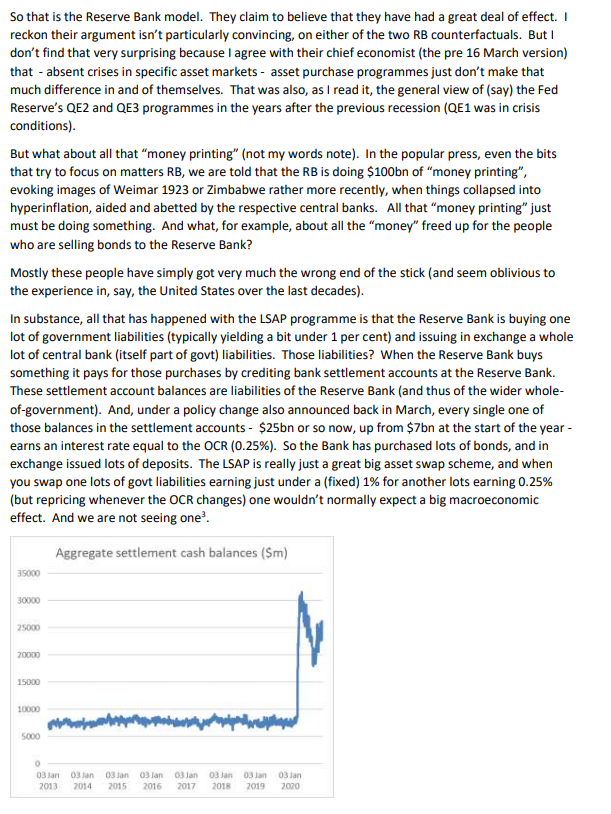
It was an asset swap that involved the central bank taking on a huge amount of risk, and there is little credible basis for supposing there was any material macroeconomic effects (lower short-term interest rates and fiscal policy did the stimulus). Banks are not, in aggregate, settlement cash constrained. Shorter-term rates are what mostly matter in New Zealand, and so even if the Reserve Bank’s purchases managed to have some sustained impact on long-term rates they just don’t matter much in the New Zealand transmission mechanism.

Oh, and that risk was taken on without any sign that any robust financial risk analysis was ever undertaken by the Bank, by the MPC, or by The Treasury. There is no sign the Minister of Finance ever asked for one. And so in something of a panic (LSAP hadn’t previously been their preferred instrument), wanting to be seen to be “doing something” they rushed into purchases, no doubt thinking they were doing good, but actually with little sustained prospect of doing so. And as the Minister of Finance put it in Parliament yesterday, in a set of answers that suggested some distancing from the Bank.

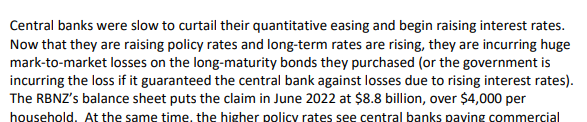
Interest rates have shifted since that time and, as with our fiscal response, there are costs associated with the measures that the Reserve Bank took. The latest estimates from Treasury of this cost is around $8.46 billion.

Or about $8000 per family of five.

The final couple of sentences in the extracts above might have raised some eyebrows. Here is what I went on to say about housing later in the lecture.

People today are quite free in attacking the Bank for lifting LVR restrictions in March 2020. I continue to believe that, in the context of other policies being adopted at the time, and the generally prevailing view at the time that a Covid economic downturn would be associated with falling house prices, lifting those restrictions was both right and inevitable. From the time LVR restrictions were first put in place in 2013 it had never been envisaged that they would be left on if house prices started falling: the original conception of LVRs was to lean against excessively liberal lending standards, not usually a problem when the underlying asset value is falling. The big change came later when the Orr Reserve Bank moved, wrongly in my view, to make LVR restrictions a permanent feature of the landscape – whether or not there was any sign of lots of poor quality lending, whether or not there were evident financial stability risks. Financial repression always sows seeds of future problems.

Not to start a lengthy new discussion, but for much of 2020 and early 2021 the problem proved to be a forecasting problem. The Reserve Bank and The Treasury, and most private forecasters, had the wrong model of pandemic economics. They (we) assumed there would be a larger element of an adverse demand shock than there proved to be. That was certainly a mistake I made: as just one example, my approach from March 2020 had been that the inevitable uncertainty (virus and policy) would act as a considerable damper on (highly cyclical) investment spending, all aggravated by the population shock wrought by the closed border. One can trace forecasts – official and private – from early 2020, and it is clear that until perhaps May/June last year the problems were forecasting failures. It was only from then, perhaps until about March this year, that the Reserve Bank’s failings were in how it responded to contemporaneous data and its own forecasts.

A public inquiry isn’t necessary

A few weeks ago in a post about what a new government might do about the Reserve Bank, I noted with some concern that the National Party had been very quiet on the issue.

I noted then that the process for reappointing (or not) Orr was likely to be getting underway very soon, and that if the Opposition thought it was inappropriate for him to be reappointed they needed to be raising concerns now (helping create a climate in which it would be more difficult for the government to push ahead) and not wait until (as required by law) the Minister has to consult other parties on the person he proposes to appoint as Governor (by when there would be considerable momentum behind any particular name).

So it was interesting and encouraging to see a press release yesterday from Luxon which appeared to raise serious concerns about Orr’s stewardship of monetary policy., apparently prompted at least in part by the Wheeler-Wilkinson (WW) note out yesterday morning, which has had considerably coverage. The centrepiece was a call for an independent public inquiry

tied to the issue of whether or not Orr is reappointed thus

Count me sceptical.

There have been a couple of earlier strands to calls for inquiries. The Green Party has for some time been calling for the Finance and Expenditure Committee to inquire into the conduct of both fiscal and monetary policy over the pandemic period. They have had support in that call from both ACT and National but the Labour majority (no doubt on instructions from above) simply refuses. It seems to me a natural topic for a serious select committee to look into, and even allowing for the partisan priors of all participants, it isn’t impossible such a review could shed some light.

The second, and more recent, strand is that inquiry into the RBA that the incoming Labor government in Australia has established (terms of reference here). But this inquiry isn’t really relevant to the issue here, and while pandemic responses aren’t out of scope the focus of the inquiry seems likely to be on policy frameworks more broadly and the governance model. On the latter, the current New Zealand government has only recently legislated for new models, for monetary policy specifically and the Bank more generally. As I’ve highlighted in various posts on this blog, there are a lot of problems with the new arrangements, but this government is hardly likely to revisit its own creations so quickly. That (I hope) will be a matter for a new government one day.

Note also that the RBA review, with reviewers already appointed, has to report by March next year. The question of the (re)appointment of a Governor here has to proceed on a much faster track than that, since Orr’s term expires in late March. As I noted in my earlier post, I expect that the question of the (re)appointment will be on the Board’s agenda very shortly, with a goal (Minister, Board, Bank – and probably markets) of having everything more or less settled by Christmas. Consistent with that, I saw this in Bernard Hickey’s newsletter this morning

Finance Minister Grant Robertson immediately refused yesterday to agree to a review and said he was in discussions with the Reserve Bank’s board about the re-appointment process. 

Robertson has ruled out a review, but even if he hadn’t I don’t think it would be a particularly good use of public money to have one. Apart from anything else, it is hard to think of anyone in New Zealand who knows the territory who is not conflicted or who has not already declared their hand (often in quite strong terms).

In other comments, the Minister has pointed out that the Bank’s Board is responsible for reporting and reviewing the Bank’s performance. Of course, there he is just playing distraction since he appointed both the old and new boards (and their chairs) and knows that the Board is on record (minutes released under the OIA) as having done no serious scrutiny or evaluation of the Bank’s monetary policy performance. Nor is there any sign that the Minister has ever asked for more. And, most recently, he has appointed a new Board that is manifestly underqualified for the statutory roles of holding the Governor and MPC to account, or recommending the appointment of a future Governor. Other OIAs show that the Minister just reappointed two of the MPC members – in the midst of a really troubling period for monetary policy – with no serious attempt to evaluate their performance at all.

In addition, The Treasury is now formally charged with a role monitoring the Bank’s performance. It is hard to be optimistic that will deliver much (the institutions are typically too close) but there is no sign Robertson has any serious interest in enhanced scrutiny or analysis. (In addition, of course, Treasury is more than a little compromised by their closeness to the Bank – including the Secretary as non-voting MPC member – and the advice they provided at the time, including recommending the Minister enable the LSAP programme.)

Finally, it is true that the Reserve Bank is working on its own evaluation of its handling of policy over recent years. We can expect this to largely be a self-serving self-congratulatory piece being done by staff (not even by the MPC) but even so when they eventually publish it it will still provide a basis for discussion and critique. The Bank tells us it has taken some independent overseas advice, but if that sounds reassuring it probably shouldn’t: they haven’t told us who they have sought advice from, and it is hardly a novel insight to suggest that the choice of overseas person is quite likely to be influenced by what the Governor already knows of that person’s views. One can always find a sympathetic commenter.

The real reason I don’t think an independent inquiry is warranted is that we already know pretty much all there is usefully to know. Defenders of the Bank/Governor will interpret the set of data one way, and others will contest a range of alternative interpretations. It is, and should be, a process of contest and debate. And the issues relevant to the question of whether Orr should be reappointed by not even close to limited to those around the pandemic response (in fact, I would argue that these later points should not be given too much weight at all). We know about things like:

  • Orr’s bullying style,
  • his lack of receptiveness to scrutiny, challenge, and criticism (most evident in the bank capital review process),
  • the high rate of turnover of staff, particularly senior staff,
  • the top-heavy management structure he has put in place, in which very few have much evident subject expertise (eg the deputy chief executive responsible for macroeconomics, monetary policy and markets, who has no background in economics at all),
  • the really big increase in the size of the Bank (with no material change in responsibilities), in many cases in non-core areas (notably the very large communications staff),
  • the distracted focus and politicisation of the Bank as Orr has pursued his climate change, indigenous network, tree god, and similar interests, for which he has no statutory responsibilities,
  • the absence of serious speeches from the Governor shedding light on his thinking or analytical frameworks around areas of his core responsibility,
  • the degrading of the Bank’s research and analysis capabilities (despite the massive increase in total staff) that has seen very few serious research papers published in recent years,
  • the insular monolith the Governor has helped create in the MPC, where outsiders with relevant ongoing expertise are banned from being appointed to the Committee, and challenge and dissent (let alone public accountability) appears to be actively discouraged.

All these speak of someone not fit for the job, someone who isn’t even that interested in developing a world-class small central bank or doing the core functions of the Bank excellently.   We don’t need an inquiry for any of that.

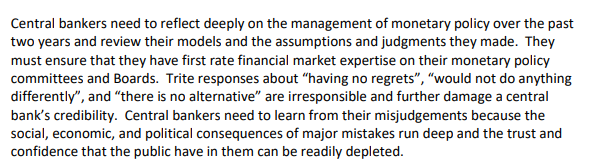
What of the pandemic response?    Perhaps there is case that could be made that any time core inflation gets so far outside the target range, the Governor and most of the MPC should lose their jobs almost automatically.   Such a regime might be better than one in which leading central bankers (globally) rarely pay much (if any) personal price for their mistakes, no matter what cost they impose on the public in the process.  $8 billion plus in losses on the LSAP speculative punt (with not even any evidence of a robust risk analysis before launching the scheme) isn’t nothing, and neither is the recession likely to be required for getting core inflation back down again.  They are serious failures.  Honourable people responsible might well choose to resign, or not seek reappointment.  They took the job, and the pay and prestige, and accept that there is a price to be paid when things go badly, if only to encourage others.

But what makes me hesitant is that these choices were not made in a vacuum.  Others, with incentives to get things right, had views at much the same time as the Orr-led Reserve Bank was making its call, and the middle-ground of expert opinion at the time was not, I assert, wildly different to the policy choices Orr and the MPC (and their peers abroad) were making.  I take seriously the idea that when central banks are targeting inflation, their forecasts matter hugely (given the lags, perhaps almost as importantly as outcomes).   At the times the Reserve Bank was making key choices, their forecasts –  which I will treat as their honest best effort –  either showed (core) inflation undershooting the target range (the case for most of 2020), or staying in the range based on policies similar to those they adopted.

I would accept that there was a good case for not reappointing Orr (and the MPC) if:

  • New Zealand’s Reserve Bank was the only one to have made the same mistake (thus, they ignored relevant perspectives from peers), and/or
  • the Reserve Bank’s forecasts and policy actions at the time they were made were seriously out of step (in what proved to be the wrong direction) with those of most serious observers, forecasters, commentators, and/or market prices

But as far as I can see that was not the case, on either count.   Sure, there were always people critical of some or other aspect of what the Bank was doing (I was an early critic/sceptic of the LSAP policy, although did not anticipate how large the losses they would run might be), and (of yesterday’s authors) Bryce Wilkinson was among them.  But often, at least I would argue, those who disagreed with some or other aspect of what the Bank was doing may have been right for the wrong reasons, and right analysis counts in making judgements about key policymakers.

People will, reasonably enough, point out that there are several advanced countries that have not seen the extent of the rise in core inflation New Zealand (and most others) have.  Thus, they suggest, there was wisdom our Reserve Bank could have followed and did not.  I’m not convinced.  The countries that have not seen much of a rise in inflation seem mostly to have been those that were already at the effective lower bound in early 2020.  They did not materially ease monetary policy because they could not.  It is unknowable at this point what they would have done if they’d had the capacity (and New Zealand and Australia and the US did have that capacity –  starting with policy rates still materially above zero).

It isn’t a common position for me to be defending the Bank, and in many respects I don’t (to me, there is a strong case for not reappointing Orr on things it is quite appropriate to directly hold him to account for –  his choices, his information).   But there is an element of the last 2.5 years that may have been simply unknowable with any great conviction or certainty.   Sadly, no one I’m aware of was (18 months ago) forecasting that New Zealand would soon see record low unemployment (similar outcomes in many other countries).  With hindsight, perhaps they should have, but it was an idiosyncratic shock –  pandemics, lockdowns, virus and policy uncertainty –  for which we (and central banks) had no real precedents.    I’m still happy to argue that the LSAP should have been stopped in the second half of 2020 when it was clear the world wasn’t ending, but….at the time the Bank still had very low inflation forecasts (and if others differed, no one I’m aware of differed to a huge extent).  I’m quite content to argue that the Bank –  and peers abroad –  should have started raising the OCR earlier and more aggressively last year but……given the lags it isn’t likely that any credible tightening started mid last year, even done at some pace, would have made a lot of difference to the inflation we have seen in the latest June quarter numbers (but would have brought it down sooner and faster). But again, who was openly calling for tightenings last May or June (for myself, the May MPC was the first time in almost a decade I’d been more “hawkish” than the Bank, but I wasn’t then calling for immediate OCR increases). 

Perhaps societies need scapegoats, but it isn’t self-evidently obvious that a reasonable human set of central bankers at the RBNZ would have been likely to have done better than Orr did in that particular set of circumstances.  The Bank is wrong to allow the suggestion to continue that they moved earlier by international standards (they were nearer the median of OECD central banks), but they were a bit earlier than the Anglo central banks we often default to comparing against.

Perhaps I’m just playing devil’s advocate here, but I don’t think so.  There is a real point about the limitations of human knowledge, and of what we might realistically expect from a typical (not exceptional –  you’ll rarely find them) central banker.    And a quickfire inquiry wouldn’t really help resolve that one.

It is encouraging that National is beginning to get down off the fence again (after Luxon initially shut down Bridges saying National had no confidence in Orr late last year).    But they probably need more confidence in their convictions (assuming they have found some) and be willing to back a case that the Governor should not be reappointed, and the external MPC members should be replaced as their terms expire.   Much of what Orr has done, and failed to do, has been done with the apparent approval, or even endorsement of the Minister of Finance (who thus shares some responsibility).  But in the end, Robertson has the choice to jettison Orr if he becomes a liability for the government.  An honourable Governor would probably walk away, expressing his regrets for the outcomes he has presided over.  So far, (per past select committee appearances and yesterday’s statement) Orr appears to regret nothing about policy, even with hindsight, and if he has regrets at all it is the empty and meaningless regret that Covid itself has intruded.

I regret that the Committee – and society at large – has been confronted with the COVID-19 pandemic, and other recent events that have caused food and energy price spikes. 

We should regret that Robertson appointed a Governor who has done so poorly, who has cost New Zealanders so much, and regret that Robertson has gone along with the Governor in barring the appointment of an open and excellent MPC, following that up with the appointment of a weak and inadequate board.

A voice from the past

Various media this morning have given quite a lot of coverage to the new paper released by the NZ Initiative, headed How Central Bank Mistakes After 2019 Led to Inflation. The authors are Bryce Wilkinson of the Initiative and former Reserve Bank Governor (2012-17) Graeme Wheeler – the coverage probably mostly because of the trenchant words from the former Governor, I think the first we have heard from him since he moved back to corporate board land in late 2017.

I’m not one of those who has any particular problem with former Governors and Deputy Governors commenting on what is going on with monetary policy. If it isn’t always common, well we have a fairly thin pool of commentators in New Zealand, and these are hardly ordinary times. The quality of the debate is only likely to be improved by hearing, and challenging/scrutinising, alternative perspectives. We can only hope that one day the Reserve Bank’s own Monetary Policy Committee will learn from that sort of example, instead of continuing to act as some impenetrable monolith, even faced with the inevitable huge uncertainties of macroeconomics and monetary policy. And if Graeme Wheeler was not, to put it mildly, known during his term as Governor for welcoming debate and dissent – internally or externally – I guess we can only say better late than never.

In some ways the Wilkinson/Wheeler collaboration is a curious one. They go back 45 years to when Wilkinson was Wheeler’s boss in the macro area of The Treasury, and have apparently been friends since. But whereas Bryce Wilkinson has long been sceptical of any sort of active monetary policy (I have various emails on file challenging me as to what evidence there is that central bank policy activism has accomplished anything much useful over the years), Wheeler chose to take on the job of central bank Governor under an entirely-standard policy target, put into sharper relief than previously with the addition that the Governor was to be required to focus explicitly on keeping future inflation close to the 2 per cent midpoint of the target range. And there was nothing very unusual or distinctive about the way monetary policy was run on his watch – conventional models, conventional judgements, and in many ways conventional errors. If there were distinctives, they were mostly that Wheeler proved more thin-skinned than your typical central bank Governor or Monetary Policy Committee members (the young or those with short memories may have forgotten Wheeler deploying his entire senior management group to attempt to silence criticisms from BNZ’s Stephen Toplis – several relevant posts here).

The (quite short) paper isn’t specifically focused on New Zealand and our central bank, and consistent with that the authors have secured a Foreword from Bill White, former deputy governor of the Bank of Canada, and then long-serving Chief Economist of the Bank for International Settlements, from which perch he irritated many with his warnings about system fragility in the years leading up to 2008. He is a really smart guy and what he writes is usually worth thinking about, and I’ve enjoyed various stimulating discussions/debates with him over the years. His views today, reflected in the Foreword, still stand out of the mainstream (rightly or wrongly). If he is keen on fiscal consolidation etc across the advanced world, he champions “significant tax increases, particularly on the wealthy”, and while suggesting this would be desirable but politically impossible then suggests that a heavy reliance on monetary policy may pose a threat to democracy itself. White appears to believe that we are on the cusp of a very substantial adjustment, as the public and private debt built-up over the last few decades is sorted out (“we must review carefully our judicial and administrative procedures to ensure the necessary debt restructuring, and there will be a lot of it, will be orderly rather than disorderly”. Perhaps, but it is a long way from debates about how monetary policy has been run in the last 2.5 years or so. (And, for what it is worth, New Zealand has low public debt, and (for ill) its housing debt remains underpinned by governments and councils that refuse to free up land use on the margins of our cities.)

But enough introductory discussion. What should we make of the substance of the note? There is 13 pages of it, but about half is itself scene-setting or largely descriptive stuff. There are bits I might quibble with, bits I strongly agree with (unexpectedly high core inflation is the responsibility of central banks and the results of mistake choices by them – given inflation targets that is close to being a tautology), five big charts. Oh, and this was good to see.

Wheeler and Wilkinson seem to think QE-type operations (including our LSAP) are more effective macroeconomically (for good and ill) than I reckon, but the sheer scale of the losses is a reminder that even if there are some potential benefits, those would need to be weighed against the potential downside risks.

But the heart of the note is in the six points under this introduction

The first is “Central banks became over-confident in their inflation targeting frameworks”.

Much of the discussion of this point could have been written 15 years ago, although even then if there was much to the story it wasn’t so in New Zealand. We grappled with needing interest rates higher than the rest of the world to keep inflation near target, as well as repeated political assaults on whether we had the right target or the right tools.

But the story of the decade prior to Covid, in New Zealand and most other advanced countries, was of central banks struggling to keep inflation UP to the respective targets. New Zealand went for a decade with core inflation never once getting up to the 2 per cent midpoint that Wheeler himself had signed up to target. Now, I think it is probably true that in 2020 and early 2021, many central banks and central bank observers were more focused on the previous decade and its (very real) downside surprises, and not perhaps alert enough to the possibility of (core) inflation rising sharply. But that seems to me to be an importantly different thing to what Wheeler and Wilkinson are arguing.

They end this discussion with this point

But for now I think the evidence is against them. With headline inflation as high as it is, what is striking is how low market-based measures of inflation expectations still are (around 2 per cent here and in the US). The Bank’s own survey of 2 year ahead expectations, at 3.3 per cent in May, is higher than it should be, but probably not disastrously so at this point (and I reckon there is a good chance that the next survey, just being finished now, will show slightly lower numbers). Central banks were slow to act last year, but for now evidence suggests some confidence that they have, and will, acted decisively to keep medium-term inflation in check.

I also reckon that Wheeler and Wilkinson don’t adequately grapple with complexities and uncertainties of the Covid shock. It doesn’t really excuse the slow unwind last year – as, for example, the unemployment rate was falling rapidly – but it certainly makes much more sense of the initial monetary policy easing in 2020. Wheeler faced nothing of the sort during this term.

I had to splutter when I read the second item in their list: “Central banks were over-confident in the models they use to base monetary policy decisions”. Several paragraphs follow making the widely-accepted point that it is hard to work out the size of the output gap at any particular time, or to know with confidence the neutral interest rate. All very true, but who is going to disagree with them on that?

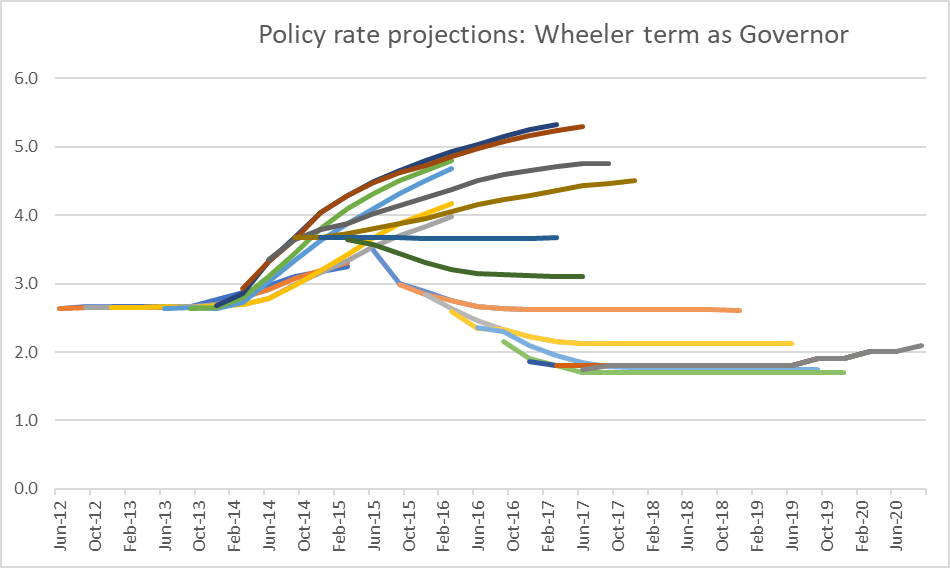
Well, one person who might was Governor Graeme Wheeler over the period from about 2013. He was convinced – quite convinced – that the OCR was a long way below its neutral level, and that large increases would be appropriate to get things back in check. So much so that in late 2013 he was openly asserting (in public) that 200 basis points of OCR increases were coming (any conditionality was very muted). These were the 90 day/OCR forecasts the Bank published while Wheeler was Governor

He was convinced that inflation pressure were building and rate rises would be required. Overconfidently, he started out on his tightening cycle in 2014, got 100 basis points in, and then finally was confronted with the data. The rate increases had to be reversed in pretty short order (and later in his term, the Bank was much more modest in its assertions). Note that although there were a number of central bankers globally who were keen on eventually getting policy rates higher, Wheeler was one of the few to back his model with ill-fated policy rate increases.

And to be fair to today’s central bankers, I haven’t detected an enormous amount of confidence in comments over the last couple of years, but rather (a) a huge amount of uncertainty, and then (b) some really big (but widely-shared) forecasting mistakes.

In the podcast interview that accompanies the research note, Wheeler does show some signs of (belatedly) accepting that he made a mistake. But even then he continues to claim it wasn’t really his fault, that the domestic economy really had been overheating, and that it was all the fault of the inscrutable foreigner (ok, he calls it “tradable inflation”, from the rest of the world.

Very little of this stacks up:

  • core inflation (whether something like the sectoral core model that the Bank claimed to favour during the Wheeler years or the simple CPI ex food and fuel) was well below the midpoint of the target range throughout the Wheeler term.
  • Wheeler claims that non-tradables inflation was high but (a) non-tradables inflation always runs higher than tradables, and (b) if one looks at core non-tradables inflation it was at a cyclical low when Wheeler took office, was not much higher when he left office, and was never high enough to be consistent with 2 per cent economywide core inflation, and
  • Whatever the vagaries of output gap estimates, the unemployment rate lingered high (even at the end above most NAIRU estimates) throughout his term.

But read his press statement from early 2014 and you’ll see someone in the thrall of their model (at the time many people supported the broad direction of policy, but not all – whether outside or inside the Bank).

The third item on the Wheeler/Wilkinson list is “Central banks were excessively optimistic that they could successfully “fine tune” economic activity”. This is a longstanding Wilkinson theme, but is a curious one for Wheeler to have signed up to, given that he signed up to a tighter inflation target (focus on the midpoint) and after 2015 was more focused on getting inflation back up towards target. And, in fairness to our RB, their “least regrets” framework exploicitly recognises the huge amount of uncertainty that was abroad in the Covid era/

The fourth item is “Central banks took their eye of their core responsibilities and focused on issues that were much less central to their roles”. Of course, I agree with them that the Orr Reserve Bank has chased after all sorts of non-core hares (to the list WW provide one might add the “indigenous economies” central bank network), and I’ve been quite critical of that. But I just don’t think the case has compellingly been made that these fripperies really made that much difference to the conduct of policy. Take it all out and in the NZ context, Orr was still as he was, the MPC was weak and muzzled, and the Bank’s forecasts often weren’t that different from those in the private sector. Perhaps the (chosen) distractions made a substantive difference, but there needs to be a stronger case made than WW yet have (and central banks with much more talented Governors and MPC often seem to have made similar monetary policy mistakes to those of the RBNZ).

The fifth item in the list is “Dual mandates for monetary policy create conflicts”. In principle they can, in practice the case simply is not made as regards the last 12-18 months, when both inflation and employment limbs pointed the same way (here and abroad). Arguably they did so in 2020 too, at least on the forecasts/scenarios central banks, including our own, were working with. Forecasting was the biggest failure…….faced with a shock for which there was simply no modern precedent.

The final item on the list is “Did some central banks try too hard to support government political objectives in making judgements about monetary policy?”

The short answer is that WW offer no evidence whatever of anything of the sort, either in New Zealand or other advanced economies. They make this claim

which is probably true in some less developed countries, but do they have any examples in mind in advanced economies or New Zealand? I think not. In New Zealand, MPC members have been reappointed with no scrutiny, and politicians – government or Opposition – seem reluctant to focus on the central bank’s part on the inflation outcomes. There is no sign of any serious pressure on the Bank – not even much sign Grant Robertson cares much. Look at the underwhelming crew he just appointed to the Reserve Bank board – not evidently partisan, just deeply inadequate to the task (including holding the Bank and MPC to account).

And that is it.

In the end there simply isn’t a great deal there. It is good to have more voices sheeting home responsibility for high core inflation to the central banks. If you accept the assignment of responsibility for achieving an objective, you are responsible when things fall short (even if, as Wheeler argues was true of his own stewardship) you’ve done the best job possible with the information to hand at the time. How much that sort of explanation is sufficient to the current situation can and should be debated, but it probably needs much more engagement with data, and forecasts etc, than WW have room for in their piece.

Wheeler and Wilkinson end this way

I largely agree (although would put much more weight on top notch macro and monetary policy expertise, relative to financial markets). But what is noticeable throughout the paper is how little weight they appear to put on transparency or accountability. There is no call for diverse views and perspectives on the MPC, openly testing alternative perspectives, and individually accountable. But I guess – given his onw track record re dissent – such a suggestion would be too much for Graeme Wheeler even now five years safely out of office. It might after all have required more openness to stringent criticisms from people with a view different than the Governor’s

Incidentally I am pleased to see that his attitude to external scrutiny and challenge from former central bankers has moved on a little from his approach just a few years back when he claimed to believe that former staff – surely even more former Governors – owed some vow of omerta to the Bank and its mistakes, whether operational or policy.

Consulting on the Remit

The Reserve Bank Monetary Policy Committee works to a “Remit” set down for them from time to time by the Minister of Finance (the current one is here). It is a different (and better) system than the previous approach of Policy Targets Agreements between the Governor and the Minister, and in particular makes it clear (as is appropriate in our system of government) that the (elected) Minister and government set the targets for monetary policy, while the MPC is the accountable (at least on paper) body responsible for setting monetary policy to deliver the government’s goal.

Under the Reserve Bank Act the law now reads

And several weeks ago the Bank kicked off the first stage in a consultative process designed to inform the advice they will eventually provide to the Minister of Finance. If you want to have a say, submissions close next Friday (15th).

Consultation with the public (of some sort or other) is required by law.

The idea of this sort of five-yearly review appears to have been drawn from the Canadian process, where in the lead-up to the five-yearly review of their inflation target the Bank of Canada has done a huge amount of analytical work reviewing the issues and options. Now, Canada is a much bigger country than New Zealand – but it is still one country, with its own set of specific experiences and issues – but the range of material they have put out, and research they have undertaken, is typically very impressive. Here is the link to the most recent review, and here specifically the link to the 24 formal research papers.

By contrast, what we have seen so far from the Reserve Bank of New Zealand is a pale shadow. There is a 60 page document, but lots of graphics, but there is no fresh analysis or research at all. It is possible that this first round consultation is designed simply to draw out the questions people think should be looked at more closely, but even if so that doesn’t leave much time before the second stage of the consultation is due (I think they said October or November). It really doesn’t look as though they have in mind doing much, if any, fresh research, whether commissioned or by their own staff. Against the backdrop of some of the biggest disruptions to monetary policy in the 30+ year history of inflation targeting, that suggests a lack of real seriousness about the review. Perhaps the Minister has already suggested (see 5(2)(c) above that he isn’t interested in much, but there is no hint in the document of such an external constraint. It has the feel more of the diminished Reserve Bank we’ve seen over and over again in the last few years – little published research, weak senior appointments (remember the marketing executive now responsible for macroeconomics, monetary policy and markets), and resources spent on (eg) comms staff, “stakeholder liaison”, and climate change, rather than on core areas of Bank responsibility.

As the review of the Reserve Bank legislation has proceeded I’ve observed on a number of occasions, including in submissions to FEC, that there are aspects of the new legislation that are a mess. The Remit review process, especially coming against the backdrop of the new Board announced last week, helps illustrate some of the problems.

Who is responsible for this Remit review advice? Why, “the Bank”. And “the Bank” here clearly does not include the Monetary Policy Committee, since (as you can see in the extract above) “the Bank” is required to consult the MPC before the advice is given to the Minister. And “consult” (standing alone) is about as weak as legislation gets: you can see by contrast that ‘the Bank’ is required to “consult and have regard to” (a materially stronger standard) the views of the public.

It is simply weird. We have a dedicated Monetary Policy Committee responsible for the formulation of monetary policy and working to carry out the current Remit, but they are treated (by the legislation) as distinctly marginal to the entire review process. There is no obligation on them to provide analysis and advice to the Minister, and “the Bank” is not even required – although it may choose to – to have regard to comments the MPC members might have on “the Bank’s” proposed advice or analysis.

Now, of course, the MPC is dominated by management anyway (the law requires a majority of executive members, each of whom owe their position. departmental resources etc to the Governor) but there are the three external members, and on a good day the Minister and The Treasury will try to tell us they have a valuable contribution to make to the monetary policy formulation process (on other days, the Minister will repeat the blackball he and Orr and Quigley put in place whereby anyone with current or future expertise and research agendas in areas relevant to monetary policy is automatically disqualified from serving on the MPC).

By construction, management always has the numbers so long as they stick together, but wouldn’t a much more sensible approach to have been to have made the MPC responsible for the Remit advice to the Minister, drawing on expertise and perspectives from both staff and outsiders?

The current structure seems especially problematic when one remembers who “the Bank” is. Until last week, unless otherwise stated (ie around the MPC) it was the Governor. But now it is the Board – the same Board of ill-qualified, in some cases conflicted, people I wrote about last week. Not one of the non-executive members of the Board has any experience or demonstrated expertise in monetary policy or macroeconomics. I guess in reality they will delegate it all to the Governor….but delegating such a major issue (or just putting it through the Board with no serious scrutiny or discussion) makes a mockery of the new governance structure.

(Amazingly, if the Minister – this one or a new one – wishes to change the Remit, the law requires consultation (but not “have regard to”) with “the Bank” but not at all with the MPC, who really do seem to be there mainly to make up numbers and eat their lunch (creating in 2018 the illusion of reform over the substance).)

As I noted earlier, there was no fresh analysis or research in the consultative document. What particularly caught my eye was that there was no attempt at a rigorous or systematic review of how monetary policy has been conducted, under the current Remit, in the last 2.5 turbulent years, in which the Bank has run up massive losses and seen (core) inflation blow out. I attended an online consultation session a few weeks ago and I raised this with staff. They told me that there is such a review underway, and they will even have it externally reviewed, but observed that they could not promise it would even be available before the next round of consultation on the Remit advice. That seems far short of adequate, even if your prior is (as mine currently is) that the specification of the Remit probably doesn’t explain a lot about what went wrong.

The Act requires that a review of monetary policy be undertaken (by “the Bank”) every five years or so, and perhaps the current exercise they have underway is the first of these reviews.

But again note how marginal the MPC is (must be consulted – apparently late in the process (“on a draft”) – but no obligation to have regard to their comments). And meanwhile responsibility for the review rests not with the MPC, but with that generic ill-qualified Board. There might be a certain logic in an independent review (done by proper external reviewers) but it is just a weird model – explicable only by a desire to preserve the Governor’s absolute dominance – to marginalise the MPC (who actually had responsibility, and so some self-scrutiny and reflection could be of value), while leaving the power with the Board but ensuring that no one appointed to the Board has the expertise to add much value at all.

This is the Board, you may recall, that Grant Robertson tried to tell us last week had no responsibility for monetary policy.

The legislation is a mess, and I hope that if there is a change of government next year that the new government makes some legislative time available to tidy up some of these provisions, and completing a transition to a model in which a proper MPC has the core responsibility, collectively and individually.

As for the substance of the consultation, I have made a short submission, the text of which is here

Comments on first-round MPC Remit review

Some of my points are already dealt with above, and several are fairly minor in nature. I am broadly happy with the basic shape of the Remit, and it would ot be the end of the world were it simply to be rolled over as is.

I continue to favour a reduction in the inflation target, returning to the 0-2 per cent formulation we had in the 1990s, which is much closer to “a stable general level of prices” (the statutory formulation – and note that the Act is not up for grabs in this review). To make that feasible the effective lower bound on the nominal OCR (perhaps around -0.75 basis points) has to be addressed and either removed or substantially eased (doing so is not a difficult technical matter, but no central bank has yet done so). But even if the target is kept at a range of 1-3 per cent with a focus on the midpoint of 2 per cent it is important that the lower bound issues are addressed. We are in some respects fortunate that the 2020 downturn proved not to be primarily an adverse demand shock, but demand-led recessions will be back, and central banks are not adequately prepared for them. Meanwhile, the consultative document treats the lower bound issues as a given, even though as a technical matter they are entirely under the control of “the Bank” (how well equipped do you suppose that Board is to deal with these conceptual, legal, and monetary economics issues?)

Here are the last few paragraphs of my short submission

What might be done about the Reserve Bank

(And other economics agencies of government, but the Reserve Bank should be the highest priority given the extent of the decline and the substantive importance/powers of the institution.)

On Friday my post focused on the (severe) limitations of the members of the new Reserve Bank Board. Together, they look as though they would be a well-qualified (perhaps a touch over-qualified) group for the board of trustees at a high-decile high school……but this is the central bank and prudential regulator.

I had a couple of responses suggesting that, if anything, I was pulling my punches, understating the severity of the situation, when it came to the Reserve Bank. One person, who preferred to remain nameless (having high level associations with entities the Bank regulates), indicated that I was free to use their comments provided it was without attribution. These were the comments:

The situation is parlous: inept, multi-focussed but wrong focus, terrible judgement, appalling hires, complete absence of appropriate governance, woeful expertise, [backside]-covering of the regulator rather than interaction. I have zero confidence in their leadership, judgement, processes, balance of hires, and particularly governance which has been enabling of dross.  

I guess the Governor could, in response, point to the recent NZ Initiative survey (of the regulated) suggesting the Bank’s standing among that community had improved in recent year (it was never clear to me why, other than the decision to move one key individual who had had significant responsibility for prudential policy).

So views will differ, and if – based mostly on what we all see – my views are a bit less harsh than those of some, it seems clear to me that there is a significant problem, and that with the new Board appointments the situation is worsening. The entire new governance and decisionmaking structure – overhauled over several years – is now in place with an MPC where serious expertise is explicitly a disqualifying factor for appointment as an external member (the people who are supposed to represent a check on management), and a Board where in practice serious subject matter expertise (financial stability and regulation or macro) also seems to have been treated by the minister as a disqualifying factor. And all this with a senior management team that is inexperienced (3 of the 4 internal members) or in the case of the Governor mediocre on a good day and more interested in other things (“patently inadequate” for the job was the stronger description of my commenter). Oh, and a Minister of Finance who doesn’t seem to have much interest in building excellent institutions or achieving excellent policy outcomes, who falls short of the standard citizens should be entitled to expect.

What we don’t know is how the National Party Opposition see things. They and their partner now lead in the polls and seem to have a pretty good chance of forming a government after the next election. Since Simon Bridges late last year, just after becoming the Finance spokesperson, said that National would not back reappointing Orr and was shut down within hours by his new leader, we’ve heard nothing much at all from National. You get the sense that the Governor is not exactly their cup of tea, but what (if anything) do they propose to do and say. They (and the other parties) were required to be consulted on the Board appointments. But whether they were happy, or pushed back vigorously, we have heard not a word from the new Finance spokesperson. Silence risks counting as (perhaps resigned) assent.

The Governor’s current five-year term expires in late March next year (ie less than 9 months from now). The process for filling the slot is likely to be getting underway very soon, and it would surprise me if the government (and the Bank) did not want to have everything resolved before Christmas. Under the Act, the Minister can turn down any candidate the Board nominates, but the Minister cannot impose his or her own candidate – ultimately whoever is appointed must be nominated by the Board. There is, of course, nothing to stop the Minister telling the Board in advance that he would not accept a nomination of a particular person or class of persons. In practical terms, there is also nothing to stop the Minister telling the Board who he might like them to nominate – although with a capable and independent Board that approach would risk backfiring.

Most RB-watchers treat the reappointment of Orr as pretty much a foregone conclusion (assuming the Governor has not found greener pastures in which to labour). At present, I agree. But that is partly because of the silence where one might have hoped there was an effective political Opposition. If National is content to resign itself to another five years of Orr – using his platform as head of a technocratic non-partisan institution to champion personal left-wing causes, operating with his bullying and divisive style, presiding over a sharp downgrading of the Bank’s research and analysis capability, losing billions of dollars for the taxpayer and then (together with the surge in core inflation) brushing it all off with a “I have no regrets” – they should just keep right on as they are.
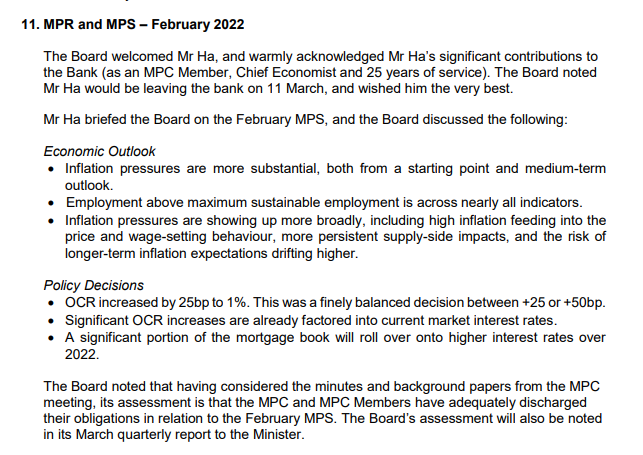
But if they aren’t content, they should be saying so, forcefully and often, now. If Labour really insists on reappointing Orr, there is not much formally that can be done to stop it – a brand-new board, selected in part by Orr, is simply not going to decline to recommend reappointment. The only chance of him not being reappointed (assuming he still wants the job) is for Labour (Robertson) to decide it isn’t worth it for Labour to continue to back Orr. We should hope for Governors who are broadly acceptable across the spectrum (not necessarily the ideal candidate for the other side, but broadly tolerable nonetheless) – after all, they wield a great deal of power, can’t easily be dismissed, and Labour itself inserted the new clause in the law requiring the Minister to consult other political parties in Parliament before appointing a person as Governor. “Consult” does not mean “obtain consent or support”, but in a context like this it should mean “take seriously very strong opposition, especially from a range of parties, or perhaps from the largest other party”. It was, after all, Labour that just introduced the provision. But waiting until December to privately express concern is a pathway towards just being ignored – by then the reappointment process would have a lot of momentum behind it already. Now is the time to start speaking out, carefully but forcefully. If they care.
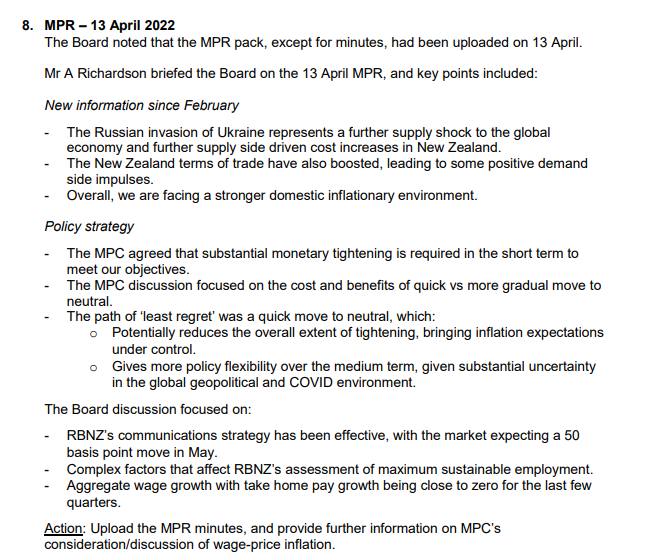
In the New Zealand system, most official appointees have fixed terms and cannot simply be dismissed and replaced immediately by a new government. Mostly, that is a good thing. The position of Governor of the Reserve Bank is one of those positions. So, it seems, are appointees to the MPC and the Board.

Each of these individuals or classes of people can be replaced at any time, but only “for (just) cause”, and what counts as “just cause” is defined in the Act. In the case of the Governor

The provisions around removal the Governor from office seem more tightly drawn than they were under the previous legislation (which may have something to do with the formal responsibility for many things the Bank does having been shifted to the Board).

Much as I am critical of a lot of what has happened at the Bank during Orr’s tenure, none of it (individually or collectively) adds up to enough to represent a credible basis for removing him. Are $8bn of LSAP losses dreadful and without excuse? Sure, but it was the Minister of Finance who agreed to the policy and the risks. Is it bad that inflation is at about 7 per cent? Sure. Could the Bank have prevented core inflation getting above 4 per cent? Most probably, and I think there should be searching criticism of the Bank’s failure, and lack of transparency/accountability. But it just isn’t enough to sack a Governor mid-term, especially when (a) so many other countries are seeing something similar, and (b) the median market economist/commentator wasn’t much better when it mattered (last year). One might reasonably lament the decline in the analytical and research output, some poor appointments and massive losses of senior staff. One might lament the diversion of focus onto non-central banking things like the tree gods and climate change. But no one is ever going to sack an incumbent Governor mid-term over such failings (and the Minister often seems to have welcomed the diffusion of effort), bearing in mind the risk of being judicially reviewed, and the attendant lengthy period of (market) uncertainty. It just won’t happen (and probably shouldn’t).

Which is why, if National were to be seriously bothered about Orr they need to be speaking out now and focusing on the looming reappointment.

Fortunately, even if reappointment is the key, there are other levers for promoting change. The Monetary Policy Committee’s Remit can be altered (and, no doubt, the forthcoming financial policy one), including to take out the woolly and irrelevant (to monetary policy) references to sustainable and low carbon economies. National is proposing to delete the employment limb of the target (on this, I agree with the Governor, that the amendment adding it hasn’t made more than cosmetic difference, and nor would reversing it). Ministerial letters of expectations aren’t binding, but they are one more lever, and a new government could make clear from the start that it expects the Bank to focus on its core responsibilities, expects a lift in the quality and range of research outputs etc. The Minister could also amend the rules around the MPC to, for example, require individual votes and reasons for those votes to be disclosed, and to create an expectation that individual MPC members could be expected to make speeches, give interviews, front FEC, and generally be accountable for their view. Small legislative changes to move the responsibility for MPC appointments purely to the Minister (not mediated by the Board) would also be a step in the right direction, weakening what is now a heavy degree of gubernatorial control over monetary policy and the committee.

And then there are the appointees themselves. By the time a possible National government takes office, Orr may be just 6-8 months into a second five year term. But quite a few of the new Board members have been appointed for terms that expire in mid-2025. A new government should begin looking early for high quality people, with strong subject expertise, to replace them. And what of the MPC? There are three external members. One has a term that expires next April, and will have either been reappointed or replaced by the current government. But one member – Peter Harris, who has had close Labour Party associations – has an extended term expiring next October. That should be a date that disqualifies a permanent appointment being made prior to the election (it still puzzles me why Labour chose that date – he could easily have been extended for 2 years rather than 18 months). And the final member has a term expiring in April 2025. It should be made clear to all involved that there will no longer be a bar on appointing people of demonstrated ongoing excellence and capability in macroeconomics and monetary policy, and that the Minister would have a strong preference to appoint at least one such person at the earliest opportunity.

And then there is the budget. The Bank is an unusual government agency, in that it is not funded by annual appropriations (in the way many important – with aspects of independence – agencies are) but through a five-yearly funding agreement, governing how much of its own earnings can be used as operational spending. There are a number of flaws in this procedure but it is what it is, for now at least.

The Bank was given a massive increase in funding in the agreement approved in 2020. But one of the interesting (broadly incentive-compatible) aspects of the arrangement is that permitted spending is specficied in nominal terms for five years. Above target or unexpectedly high inflation makes nasty inroads on the Bank’s real capacity to spend. As wages and salaries rise faster than originally allowed for, that bite is likely to be coming on soon. Moreover, although the agreement wasn’t signed until late Feb 2020, by the time a possible new government takes office (say next November) the Bank will be very conscious that the next round of negotiations will be looming before too long. The final year covered by the current funding agreement is 2024/25, but if you were the Bank (management and Board) you would be wanting some clear signals from the Crown fairly early as to how much the Bank might have available to spend in the following five years. An early signal (say by the time of the 2024 government Budget) from an incoming Minister of Finance that s/he was minded to materially reduce real Reserve Bank spending in the future funding agreement would affect choices the Bank was making from them. National seems to be struggling to identify expenditure savings, and while the Reserve Bank is not that big in the scheme of things, it is much bigger and more expensive that it was five years ago, and ripe for trimming down. The basic functions of the Bank haven’t changed, but the size of Orr’s empire has blown out. It should be pulled back. Ideally, the legislation should be amended to allow the Minister to better specify what money is spent on, but it should be made clear to the Governor and the Board that the Minister expects a ruthless focus on core functions (not, eg, a proliferation of comms or climate change people). The office of Governor might be much less appealing to someone like Orr if he was compelled to manage in that way. That, on this scenario, would not be a bad thing.

And all this without even touching on those mind-numbing documents like the Statement of Intent. The Minister can require a new Statement of Intent at any time, and the Bank must take seriously (“consider”) the Minister’s comments on a draft.

All this is by way of saying that while, if National cares about the Bank, it should focus now on building a climate where it is not worthwhile for Labour to stick by Orr (or where if they do it just looks like a poor and partisan appointment), there are plenty of avenues open to a new Minister to put pressure on to constrain the Governor’s behaviour, his dominance of the MPC process, his empire, his focus, his style and so on. But a new Minister has to want change, and be prepared to follow through consistently.

Finally on the Bank, it is fair to note that it is one thing to argue that Orr should not be reappointed, but quite another to identify an excellent potential replacement. There are no immediately obvious potential nominees of the stature required to begin credibly rebuilding the institution (Bank and MPC). That itself is a poor reflection on the way the Bank has been run for at least the last decade (contrast say the RBA or the Bank of Canada), and perhaps symptomatic of wider weaknesses now at the upper levels of the New Zealand public sector more generally. But just because there is no obvious single name now, isn’t a reason to stick with such a poor incumbent (and if there isn’t an obvious replacement, I can think of several who could, at least as part of a new team, do the job, and we should at least be open to the possibility of a foreign Governor (even if such an appointment might be less easy than it sounds)).

This post has been focused on the Reserve Bank. But there are other agencies a new Minister of Finance will have to pay attention to. There is little point expecting different outcomes if you leave the same people (and sorts of people) in place (and there is a wider question there about what sort of person a new government will replace Peter Hughes, the Public Service Commissioner) with in mid 2024). But the open question still is whether National really cares much about different outcomes, or is primarily interested just in gaining and holding office. Voters might like some idea of the answer.

The new Reserve Bank Board

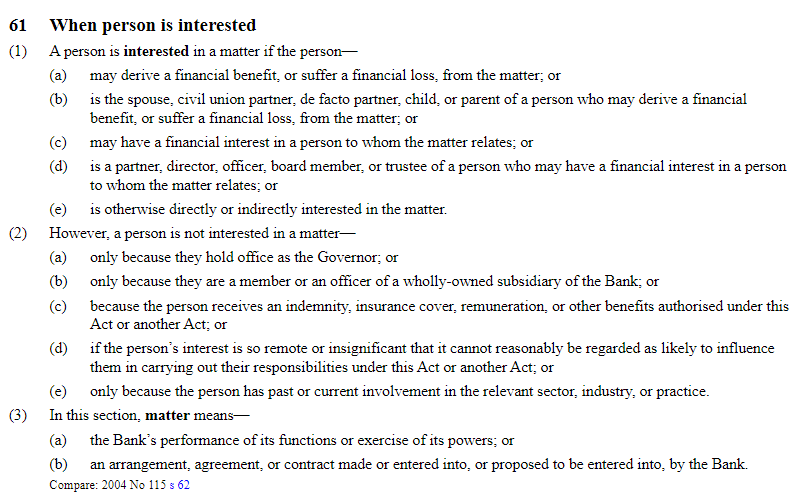
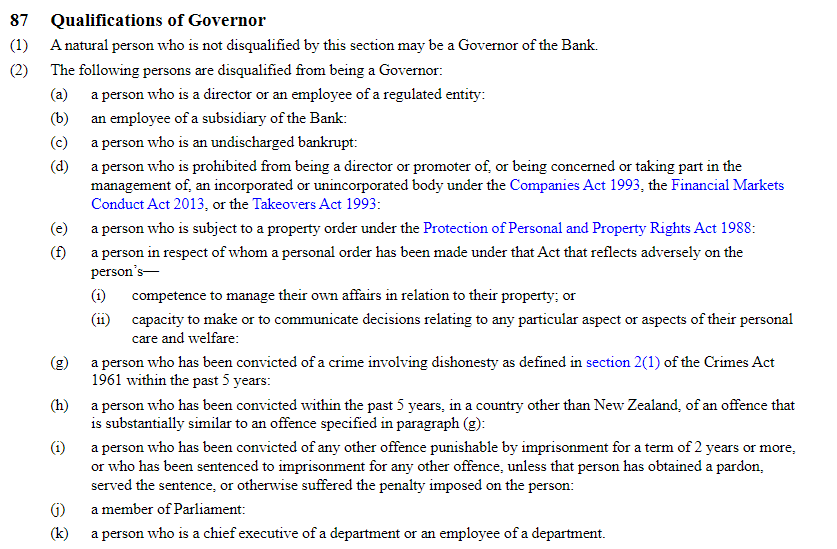
The Minister of Finance yesterday afternoon finally announced the rest of the members of the new Reserve Bank Board that takes office, under its new authorising legislation, today. In my post earlier this week, I highlighted a number of weaknesses in the legislation around the (dis) qualifications of the Governor and other Board members. None of the appointments to the Board appear to be in breach of the Act, but several are questionable on various counts, and taken together (and one should think about the composition of the Board as a whole) the new Board represents a poor, and grossly inadequate, start to the new regime. It could have been a great opportunity for a really impressive fresh start for the governance of the Bank. Instead, the Orr-Robertson degrading of the Bank continues.

As one gets older, rose-tinted glasses about aspects of the past are a risk. I do recall a time when the Reserve Bank Board had some really impressive people on it (mostly credit to Roger Douglas). But the dominant story over the almost 90 years the Bank has existed hasn’t been of impressive people being appointed to non-executive roles on the Board. In making appointments, at least since the government took full ownership of the Bank in 1936, political debts have always been paid or political loyalties rewarded – at times, past, present, and future overtly political figures have been appointed (and I even found one member who’d been a Communist Party donor), and the general quality has ebbed and flowed. One member I’m aware of – whom I gather turned out to make a reasonable contribution – was appointed mostly to spite a then Governor who vehemently objected to an economist the Minister wanted to appoint. There have been a handful of people with relevant subject expertise, some people good at asking (awkward) questions, and the time-servers and middling sorts who populate the myriad of boards and committees governments have to fill.

But – and it is an important but – none of them ever mattered very much. From the late 30s to 1990 it was clear that if the Board was the governing authority of the Bank as an entity (“the Board was the Bank” was used to say), most everything that really mattered about what the Bank did was decided – quite properly under the then-legislation – by the Minister of Finance and/or the Cabinet. That included policy, implementation, and key personnel (Governor and Deputy Governor). No doubt there were plenty of things for the board to do in that era – administration, buildings, staff etc – but it wasn’t the stuff we set up the central bank for. And from 1990 to yesterday, the Board had little say over anything much (not even the pay and rations stuff) but established as an monitoring and accountability body almost exclusively. It wasn’t quite that narrow, in that a person could only be appointed or reappointed as Governor if recommended by the Board.

As the overhaul of the legislation got underway, more recently people could only be appointed to the MPC on the recommendation of the Board, but OIA documents show that when the MPC was established they did not recommend names to the Minister but presented a list and said to Robertson “you pick”. This was the same Board that had got together with the Governor and Minister and put in place a blackball on the appointment to non-executive positions of anyone with actual hard expertise in monetary policy.

What of the new legislation. There have already been attempts at spin.

Thus, we have this from the Minister of Finance

The Board’s remit does not cover monetary policy, which remains solely the role of the Monetary Policy Committee.

And it is certainly true that the Board members do not get to set the OCR or publish projections. But as the Bank now points out on its website. “collective duties of the Board” now include

  • reviewing the performance of the Monetary Policy Committee and its members.

And it is the Board that has to recommend a person to be appointed (or reappointed) as Governor, and has to recommend appointees for the Monetary Policy Committee. It also has the responsibility to recommend removal of these people if they are not adequately doing their jobs.

In the Bank’s Annual Report (sec 240) they are specifically required to include

(m) a statement as to whether, in the board’s opinion, the MPC and the members of the MPC have adequately discharged their respective responsibilities during the financial year (see section 99); and
(n) a description of how the board has assessed the matter under paragraph (m)

And that is just monetary policy. The Board also now has all the powers the Governor previously had on prudential regulatory matters (mostly banks, but including non-bank deposit-takers, insurers, payment system infrastructures), New Zealand’s physical currency, a large balance sheet. And there are a number of grey areas in the Act of matters which in my view really should be matters for the MPC, but seem to be matters for the Board. You will recall the big disputes a few years ago about the Governor’s ambitions to dramatically increase capital ratios: such things are now the responsibility of the Board. And recall that the whole point of the new Board model was to reduce the single-person risks inherent in the previous legislation (so don’t anyone think about running a “oh, none of this matters as the Governor runs things” response).

So lets look at the make-up of the Board.

Take the Governor first (and note the oddity of the new legislation where on paper the Governor is a totally dominant figure on monetary policy, but just another board member on the Bank’s other major policy/regulatory functions). With the best will in the world, no one would argue that Adrian Orr is a leading figure in either monetary policy or financial stability functions. With a really really impressive chief executive, the rest of the Board can matter a little less – but the best people need hard and informed questioning. All the signs suggest an undisciplined and petulant figure who just isn’t overly interested in the core responsibilities of the Bank – and that would be consistent with his record of speeches over his four years in office.

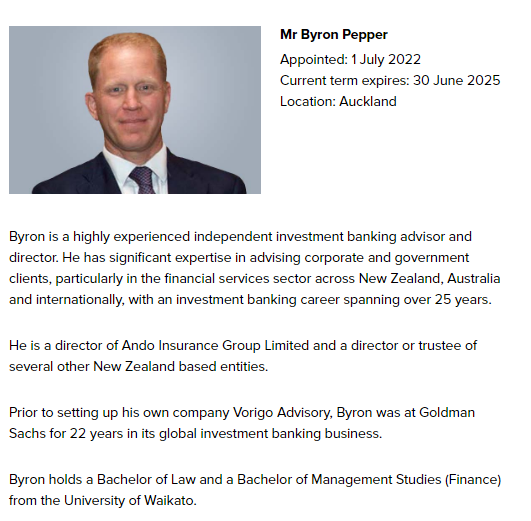
Then we have the chair, Neil Quigley, who was an economics academic and is now Vice-Chancellor of Waikato University. Quigley has been on the Board for more than a decade, has been chair since 2016 (and thus presumably bears the greatest responsibility for Orr, and what followed). But as I discussed yesterday in all those years on the Board there has been little sign of serious and hard challenge and scrutiny, and despite Quigley’s academic background there isn’t much sign these days of someone devoting a lot of time to keeping abreast of the literature on financial stability and regulation. How could he? Most would have thought a university vice-chancellor role in these difficult times would itself be at least a fulltime job. Quigley’s appointment appears to be a transitional one (to 30 June 2024), and his replacement would be a key opportunity for any new government taking office after next year’s election that was serious about restoring the authority, reputation etc of the Bank.

It is downhill from there with the rest of the Board. Taking them in alphabetical order

All laudable no doubt, but not a shred of a sign of suitability to be a board member of New Zealand’s prudential regulator or to be choosing appointees to the MPC and evaluating the performance of the MPC.

I’ve discussed Finlay previously. We can be relieved that his terms as NZ Post chair (owning Kiwibank and Kiwi Wealth) ended yesterday. He should never have been actively involved in Reserve Bank affairs while chairing the owner of a major bank. But that is now over, and we are left with someone who looks like a pretty generic professional director and accountant. Perhaps, and despite his past (what ethics does he display in having accepted the RB/NZ Post conflict), he could be a perfectly adequate director of yet another government body. But it isn’t evident there is any expertise or experience in monetary policy, prudential regulation, financial stability etc.

Higgins appears to be wholly and solely a diversity hire. Her background is all very interesting, perhaps even laudable, but…..this is the central bank and prudential regulatory agency, and there is not a shred of relevant background or qualifications – any more than a professor of Latin and university bureaucrat would typically have.

Paterson is another carryover from the old board. Perhaps she is just excellent (but remember all those questions we didn’t find in the Board minutes to now) but she is a pharmacist turned generic company director. There is a place for such people, perhaps even a couple on a central bank board, but subject matter expertise and energy on such matters seems less than evident.

Pepper seems to be the only appointee with recent practical exposure to financial markets. On paper he looks like he could be quite a reasonable appointment to the FMA Board (perhaps a swap with Professor Prasanna Gai who is on the FMA but has expertise and experience that would be very valuable on the Bank’s Board or MPC). But the Bank’s Board is more about financial institutions than about wholesale markets and it isn’t evident he has much knowledge about institutions, the sort of risks that threaten them, or about financial regulatory policy – let alone being particularly fit for evaluating MPC members.

And then there is that insurance company he recently became a director of. According to the Minister

Mr Pepper is a director at Ando Insurance Group Ltd, but that role is not expected to create a conflict of interest as Ando is a non-regulated company.

The problem is that when you look up that company it is described as almost 40 per cent owned by a foreign insurer which is regulated by the Reserve Bank, and Ando describes itself as writing its insurance business for that regulated company. I don’t know either the business or the law enough to know why Ando itself is not regulated by the Reserve Bank, but on what we do know the appointment, while lawful, seems pretty questionable, and not (especially after Finlay) a great way to start a shiny new Board and governance model. One wonders what Treasury made of it when they provided advice to the Minister on appointees. (Or, indeed, the other political parties when, as the law now requires, they were consulted.)

Raumati-Tu’ua (who seems to be a qualified accountant) is another of those generic professional directors. As I said earlier, there is a place for a couple of them on the Board, but there is no relevant subject matter expertise at all.

For the most part I am not suggesting that as individuals these people are unsuited to being on a mixed Board (although Higgins appears utterly unqualified, and Pepper questionable on ethical grounds), but what you end up with is a Board that is deeply unimpressive and really unfit for anything like the role the legislation envisages for the Board of the Reserve Bank. There is no one with any real expertise or authority in banking, no one with any real expertise on financial regulatory matters, no one who really seems fit (or ready) to be holding the MPC to account or making good choices about who should go on the MPC in future. And, perhaps a little surprisingly given the limited pool of expertise locally and the risks of too inward loking an approach, there is no one from abroad. As a group – however nice, and perhaps able they each are in their own fields – they simply aren’t up to what the job should entail, and that against the background on an inexperienced and underqualified senior management team. One can only imagine the Australian Prudential Regulatory Authority people reading of these appointments with some mix of despair and bewilderment while – condescendingly, but as they are prone to – suggesting that fortunately it doesn’t matter too much as APRA does the prudential supervision that really counts for New Zealand. That model – wind up and turn things over to APRA – was rejected (and rightly) by Michael Cullen almost 20 years ago, but his successor seems to be going for the worst of all worlds -a a bloated and expensive central bank of our own, led by people who do not warrant any great level of confidence in their individual or collective capabilities in the role they have taken up.

If there is a National/ACT government after the election it will have to make it a matter of priority to begin a far-reaching overhaul of the Reserve Bank (management and governance) to reverse the increasingly embarrassing spectacle of sustained institutional decline.

Meanwhile, of course, under the new law, the Minister of Finance was required to consult with other political parties on proposed appointees. It is a relatively unusual provision which Labour chose to put in the law, presumably intended to single their seriousness about a high quality Board that was broadly not too unacceptable across party lines (consistent with that, these appointees do not serve at will and can be removed only for cause – not including being ill-qualified in the first place). One wonders what National and ACT (in particular) said when the Minister consulted? Perhaps there were worse names on an original list. Perhaps the parties never bothered objecting, or perhaps they did object and Robertson just pushed on through anyway. Perhaps the relevant spokespeople could tell us?

I have lodged a series of OIA requests with the Minister, The Treasury, and the Reserve Bank to get a better insight on the process leading to those appointments, including the consultation with other parties.

End of an era

Today marks the end of an era at the Reserve Bank, as the last of the “Governor as single decisionmaker” model is dismantled, and tomorrow the new Board takes over the primary responsibility for the Bank’s affairs. The single decisionmaker model was an experiment, but with time it was increasingly apparent that it was a poor one, increasingly unfit for purpose. No other country reforming its central banking and bank etc regulatory arrangements followed us. It is to the government’s credit that they have moved the governance model for the Reserve Bank back towards the international mainstream (even if the specifics of the 2018 and 2021 are less than ideal, and in some respect a dog’s breakfast).

(NB note that most of the new Board, to take up office tomorrow, has not yet been appointed – or at least announced. With the new Board reportedly supposed to be meeting tomorrow, perhaps there is some launch announcement planned, but it is all a bit strange and not really that satisfactory.)

In this post I wanted to focus, perhaps for the last time (although they still apparently have an Annual Report to come), on the old Board. This should be the last day we see this graphic topping the Bank’s “Our Board of Directors” page

For 32+ years, taxpayers have paid a Board to (come for lunch and the cocktail do and) monitor and hold to account the Governor (and more latterly the MPC). They controlled who could be appointed as Governor and to the MPC, and – consistent with those accountability responsibilities – could recommend dismissal. The rules and responsibilities have changed a bit over time. For the first decade or more, the Governor chaired the Board, and even though there was a non-executive directors committee that was supposed to do the holding to account, the messaging implied by the structure wasn’t exactly crystal clear. And it wasn’t until about 20 years ago that the Board was required to make its own (public) Annual Report, but even then not very much changed – and consistent with that general observation, the Board’s report was buried in the midst of the (Governor-controlled) Bank Annual Report and was given no publicity when the Bank released its Annual Report.

There have been some able people on the Board at various times over the years. And some awkward people (the two may even have overlapped), but the institutional incentives very quickly developed into a model that meant few hard questions really got asked, little serious scrutiny happened, and the public never got any serious insight from the Board’s activities on their behalf (the Board, after all, had access to papers the Bank jealously guards for years and years after they were relevant, and can engage and challenge the Governor and other decisionmakers). I say “very quickly developed” because in the earliest years of the regime there was a view – shared by the Governor – that the inflation targeting governance regime was relatively mechanical and that a Governor might reasonably expect to lose his/her job if inflation overshot the target range. The first (apparent) breaches in about 1995 prompted some hard questions, some letters to the Minister, but eventually a recognition that the whole thing involved a lot more judgement and discretion if sensible policy was to ensue. There was a recognition that the target was something to be “constantly aiming at”.

Unfortunately for the Board, had they ever aspired to do the job really well they didn’t have the resources to do so. It became customary to have one professional economist on the Board (first Viv Hall, then Arthur Grimes, more recently Neil Quigley), but Board members didn’t get paid much themselves, had no direct access to staff resources, had no budget to commission independent professional advice, and their own Secretary was for the most of time a senior staffer of the Governor. Board meetings occurred on Bank premises, and one entered the Board room past the row of oil paintings of former Governors. And once the Board got its own chair – chosen by them, not the Minister – for 13 years they opted to have as their chair former RB staffers, first Arthur Grimes, and second Rod Carr. Most of the Board members knew about being on corporate boards – where they had decision-making powers – and so there seemed to be a tendency to default towards the sorts of issues they might have dealt with as corporate board members. Monetary policy and financial stability/regulation were not high among them. Arms-length challenge and scrutiny also weren’t really among those functions – on a corporate board, the board has far more ownership of the firm’s strategy (something the Act never envisaged for the RB – the Board had no say, for example, in Policy Targets Agreements or the conduct of monetary policy).

And so acting as cover for management seems to have become the default mode – most especially externally but, as far as we can tell, often internally as well. Some Board members had their own agendas – some more laudable than others – but there was never much sign of a sustained effort to hold the Governor and Bank to account, to act as if they represented the government and people of New Zealand rather than the Bank management (notably whoever was the Governor at the time). At times, their Annual Reports even talked about helping with the Bank’s external relations (for example, at the functions held around Board meetings outside Wellington).

I could develop some anecdotes at length, including for example, the board member who used to ring me up (while I was still on staff) for inside angles on monetary policy and the Governor, at a time when that member was attempting to mark out an independent position (oops, he is now the Board chair). But I’ll largely leave it at that. I don’t think anyone – perhaps with the exception of some individual Board members – thinks the Board ever really did the job it was designed for. You could be attacked in public by the Governor – for exposing an OCR leak, resulting from weak management systems – and an approach to the Board still resulted only in them gathering in behind the Governor. Are we to suppose it was any different when Orr was attacking his critics around the bank capital plans in ways that few regarded as represented expected conduct from a Governor?

But what interested me was how they had handled the events of the last year or so. The Bank has run up massive losses on the LSAP. Inflation – headline and core – has shot through the top of the target range. All in all it is has been one of most interesting – and surely questionworthy – periods in the 30 years the Board had the monitoring and accountability responsibility. You might think the outgoing Board would want to end well.

A while ago I lodged an OIA requesting the Board minutes for the period November 2021 to April 2022. About the time those results came back I found on the Bank’s website the results of someone else’s OIA for the minutes for September to November 2021. So we have a run of several months of minutes, over a period when things moved a lot on monetary policy (actual inflation, the OCR, forecast inflation – oh, and those LSAP losses). We might have hoped for a lot of evidence of hard questioning, challenge, and serious scrutiny.

Well, might have if we had known nothing of the previous 30 years.

The Bank – or Board – is relatively open in what they release, so we get a good sense of the complete minutes. There are some questions about what they write down, but even there they seem to have improved (relative to earlier concerns that in some areas they were in flagrant breach of the Public Records Act).

What do we learn?

The first meeting was in early September, not long after the August MPS (which itself came the day after the lockdown was announced). The minutes are seven pages long, and we learn a fair bit about the People and Culture report, the Enterprise Risk Management report, the Governor’s activities, and even the RB superannuation scheme (which the Board had some particular non-statutory responsibilities for). Monetary policy gets half a page

Only one Board member is reported as saying anything (“noted” not exactly being a strong form of questioning) and none seems to have challenged the (soon to be restructured out) Chief Economist’s view that the Bank had plenty of time and didn’t need to act (much/) until it had a seen a full 12 months of data. The Governor – the most influential MPC member – is not reported as having said anything.

The late-October meeting minutes took eight pages. We learned quite a lot of various administrative and/or extraneous matters, including the Bank’s climate change strategy. There was quite a discussion on the forthcoming FInancial Stability Report, but no sign of any serious challenge or scrutiny from Board members, on requests for follow-up papers etc. And then we got to monetary policy, the OCR having just been raised for the first time.

I’m sure it was all very pleasant, but there is no sign of any hard questioning about immediately relevant issues (or perhaps the Public Records Act is being ignored again). No one seems to have challenged them as to whether, just possibly, if inflation was already above the midpoint and employment at or above midpoint, and forecasters had been taken considerably by surprise, whether a more aggressive stance might be warranted. No one seems to have challenged Ha on his complacent comment the previous month, despite (presumably) just having confirmed those minutes.

At the November meeting there appears to have been no discussion of monetary policy at all (although the Board was at pains to stress the importance of the outgoing Board having time to prepare their final Annual Report). Not a word. And, of course, still no mention at all of those mounting LSAP losses – and the Board is supposed to have been agents of the minister and the public, not of the Governor.

For the December meeting this is what the minutes record

All of which may have made for quite an interesting discussion, but as the Governor is recorded pointing out, monetary policy has to act given what is happening to fiscal policy (fiscal policy is not something the Governor or Board are responsible for). But there is no sign of any unease, of even a single Board member challenging the Bank to show that it was on the right track or that inflation would come out something like forecast. There is just no sense of holding powerful decisionmakers to account in particularly troubling times. Just a chat, with one’s friends and colleagues.

At the February meeting, this is all there was about monetary policy

Again interesting (if brief) but with not the slightest sense of unease or challenge, no pressure on the Governor or his colleagues.

In March

Were some future historian to stumble across these minutes, but not the relevant parts of the Act, they might have assumed that the Board had just a right to be briefed, but no responsibility for ensuring the Governor and the MPC are held to account.

And finally in this sequence, the April meeting

It is, I’m sure, interesting enough, but it scarcely counts as evidence of accountability.

Now, it is always possible that there are secret unrecorded discussions (in breach of the Public Records Act). The other OIA requester asked for a copy of one of the Board’s reports to the Minister, which the Board/Bank adamantly refused to release

That should be unacceptable: the Governor and MPC are statutorily accountable via the Board, and the idea that management might refuse to supply information to the Board because the Board’s report – even with some redactions – to the Minister might be released (with some lag) should have been unacceptable. But we needn’t worry that there might be anything very revealing in such a report: take a look at the March Board extract above, and you’ll see they record there that they were going to tell the Minister all was fine.

At one level, knowing what we do as to how the Board has operated over 30 years, none of this should be too surprising. But it doesn’t reflect well on them (any of them). We have a chair presumably focused mostly on working with the Governor to see in the new act (questionable appointments and all), and so hardly likely to make himself awkward on current monetary policy, and other Board members with neither the expertise, inclination, nor institutional culture to ask hard questions. But still….across all those months

  • no record of a single hard question,
  • no sign of any sustained engagement at all with the external MPC members (whom they are supposed to individually hold to account)
  • no requests for supplementary papers,
  • no suggestions of commissioning independent analysis,
  • not a single mention  of the huge (and mounting over this period) LSAP losses,
  • no suggestion of any regrets about anything.

It is easy to be inured to flawed frameworks and the weaknesses they generate, but this really isn’t good enough.  These people took the taxpayers’ money (no much admittedly, but they each took the deal) and seem barely to have been focused at all on their monetary policy accountability duties, through one of the biggest monetary policy disruptions for decades.   Perhaps I should ask for the minutes of meetings of the previous 20 months, but it would be a real surprise if anything had been different then.

The Bank itself appears little better, since there is no evidence in any of these minutes of robust or independent analyses and reviews of what had gone well, and what badly, why for examples forecasts had been so wrong, and what lessons staff and management had taken.  And so we are in the weird position  that the Bank has a consultation paper out at present on the future Monetary Policy Remit, and yet tells us that the review they are finally doing of the last couple of years stewardship may not even be released before the second round of consultation closes.

The Board has proved useless. It was always likely given the incentives and flawed structures, but that is no excuse for any of the members.  The job was there to be done, and they have not been doing it (most notably over the dramatic times of the last 12 months).

The end of the era will be no loss.  We can only wait and watch and see how the new Board does –  when the Minister finally manages to dredge up enough people willing to do the job to get a full complement on board.  

Questionable provisions in the new RB Act

On Friday (1 July) the new Reserve Bank legislation comes fully into effect. The new Reserve Bank Board takes over from the Governor personally as the key governing body of the Bank, on all matters other than the conduct of monetary policy (but even there they have a big influence on the composition of the MPC). A member of the outgoing (advisory) Board told us – he sits on the RB pension fund trustees as, for my sins, do I – that the new Board is having its first meeting on Friday. And yet today is Tuesday and we still don’t know who is being appointed to this (on paper) powerful government board. Every Tuesday for the last couple of months I’ve checked Grant Robertson’s Beehive page, and still there is no announcement.

The Governor is a Board member ex officio. And several months the Bank slid onto their website the information that two members of the existing Board (including the chair) and one new person had been appointed to a “transition board” and would be appointed formally to the new Board. But the same web page still says

Neither the government nor the Bank seem to have been entirely straight on the matter, since an OIA release of Board minutes says that Suzanne Snively has also been appointed to the transition board, and has been attending meetings of the outgoing board. It is a curious appointment, both for her age (I’m not keen on a trend towards US-style gerontocracies) and for the fact that it is almost 40 years since Roger Douglas first appointed her to the Reserve Bank Board (back in the previous era when the Board held the formal powers). Media reports suggest she fell out with Douglas, and is much more ideologically aligned with the current version of the Labour Party and its not-Douglas Minister of Finance.

The other newbie we know about is Rodger Finlay. I wrote about his appointment a few weeks ago and there has since been some media coverage. Recall that the Bank was quite open in advertising that Finlay had been appointed to the transition board and was being appointed to the full Board even though he is chair of NZ Post, majority-owner of a New Zealand bank (Kiwibank) that just happens to be the weakest of the large banks in the system. The unadorned label “He is currently Chair of New Zealand Post” is still there this morning.

It was a highly inappropriate appointment, even though in response to questioning from a journalist the Minister of Finance’s office eventually advised that Finlay was ending his term with NZ Post on 30 June. [UPDATE: I’m advised this was actually passed on to the journalist quite readily by NZ Post itself.] If his appointment to the Reserve Bank early was really vital to the success of the new regime, he should have stepped down from the NZ Post role immediately, and neither Orr, Quigley nor Robertson should ever have countenanced anything different. Quigley told media that Finlay had been developing “new governance systems” for the Board, but if he had any real suitability for such a role – where ethics count hugely – he should have known from the start how inappropriate it was, and would look, for him to be serving the Reserve Bank in such a role while chairing the company that majority-owned a bank regulated by the Reserve Bank. For all that Quigley says they were aware of the issue all along, everything about how they operated suggests they took the narrowest legal interpretation, in a way they would no doubt look on askance if a regulated entity tried it on. (It doesn’t strengthen their case that NZ Post is also majority owner of Kiwi Wealth, a significant funds management operation even though that body is not regulated by the Reserve Bank.) As it is, documents released under the Official Information Act confirm that Finlay has been regularly attending meetings of the existing Reserve Bank Board and thus been party to all the information that board has had before it.

It is a poor look and reflects poorly on everyone involved – Minister, Governor, chair, Finlay, and (less severely) the other members of the outgoing board. Among other things, it raises doubts about the approach that these players might take in future. And also leaves us with the question as to how the consultation with other political parties – now required for Board appointees – went down as regards the Finlay appointment. I guess one day the OIA may shed some further light. It is all rather suggestive of a cavalier Wellington approach to conflicts of interest (and both actual and apparent matter).

In my earlier post I included this section of the new legislation on the sort of people who can’t be Board members.

I have no problem with the provisions that are there. The problem is with what is not there. As I noted in the earlier post it is astonishing that a director or senior employee of a company that has a majority holding in a regulated entity (bank, insurer, deposit-taker etc) can be appointed to the Board, and can hold those two positions simultaneously. It is almost as concerning that someone who derived most of their income from work for one or more regulated entities (eg a partner of a law or accounting firm) can simultaneously be a director of the prudential regulatory agency.

But what I hadn’t noticed then (I guess my focus was elsewhere) was that there is no restriction at all on Reserve Bank board members holding ownership interests in regulated entities. According to this brand new law, I can’t be a director of a bank, insurer or finance company and simultaneously serve on the Reserve Bank Board (tick) but…..I could own a whole entity and do so. It is astonishing that Parliament has not protected us against the risk of such an appointment – so much so that one almost has to start asking why. Reserve Bank staff aren’t (or weren’t) allowed any such holdings, but it is the Board that makes the rules, sets priorities etc..

Before going further I should clarify two things: first, I’m sure no one wants to stop Board members (or staff) having totally passive interests through, say, a widely-offered Kiwisaver fund, or a passive NZ equities index fund. A caveat that no holding could be large enough it could credibly be regarded by a reasonable observer as likely to influence decisionmaking would seem sufficient to cover that. But that does not cover a 40 per cent stake in a finance company (say). And, second, the issue here is not a director might be engaging in deliberations specifically on a company s/he held a major stake in: I’m still willing to believe conflict of interest policies would require such a director to recuse him/herself from that specific discussion. But the Reserve Bank Board makes policy, applies policy, for broad classes of institutions, and no director with an ownership (or major income) interest in a regulated institution should be making policy for that class of institution, or contributing to internal discussion on the direction policy should go.

The new Act has a long list of provisions regarding conflicts of interest (from section 61). It starts reasonably enough

Any such conflict has to be disclosed to the chairperson – but not to the Board more generally, let alone the public.

And although the general provision is that a person cannot participate in a matter in which they have a conflict, there is explicit provision in the Act for the chair to waive that prohibition

Any such waiver has to be disclosed, but only in the Bank’s Annual Report, which may not be out for more than a year after such a waiver has been granted.

And one might have more confidence in the current chair, were he not complicit in the appointment of Rodger Finlay, while the latter was chair of the owner of a majority stake in a large bank.

More generally, there is a sense that these conflict of interest rules are written to cope with episodic events and conflicts that might arise, not really specifically foreseeably, in the course of a term on the Board. If the Board is looking to hire a consultant who is the husband or child of a Board member most probably that Board member would stand aside for that discussion/decision. But a Board member who owned half a finance company might reasonably claim that, having known of such an interest, the Minister had nonetheless lawfully appointed him/her, and that the conflict of interest rules would not apply to the Board’s general deliberations on policy for finance companies. Perhaps it would hold up, or perhaps not, but the government and Parliament should never have left such scope for uncertainty, the risk of highly inappropriate appointees (however capable), in the legislation. Section 31 (see above) should have been written a lot more restrictively.

My concerns were only heightened when I happened to have a look at the clause in the Act governing the removal/dismissal of a Governor. These are the things that disqualify you from being Governor.

But notice that being a director of an entity that owns a regulated entity isn’t a disqualification. And neither is having a direct ownership interest in a regulated entity.

Was this an oversight? It appears not. These are just causes for which the Governor can be dismissed

1(g) looks like it should be reassuring. But, there is more

Parliament has explicitly written the Act to allow the Minister of Finance to agree with the Governor that the Governor can hold an “ownership interest in a regulated entity” while serving as Governor (all compounded by the fact that no such provision would be public information).

I am not, repeat not, suggesting anything shady between the current incumbents, but why would Parliament put such a provision in the Act (without at least one of those “trivial or incidental holdings arising from passive holdings in broad-based investment funds” type of caveats)? It is just a dreadful look.

Will any of these provisions necessarily be abused? No, not necessarily. But things have not gotten off to a good start with the Finlay appointment, which makes it difficult to have much confidence in the rigorous integrity of the people involved in these appointments etc, now and in the future. Maintaining a honest and uncorrupt system depends in no small part on sweating the small stuff, but Parliament should just never have left these matters in any doubt, apparently entirely reliant on successive ministers, Governors, Board members being interested in bending over backwards, even when it is inconvenient, to avoid the substance or appearance of conflict in our prudential regulator.

Meantime minister, where are the Board members for this shiny new goverance model? And where, in particular, are the members with real and in-depth expertise in banking, financial system regulation and so on?

Productivity Commission, the immigration inquiry etc

There is an extraordinary column in the Herald this morning, by their excellent Kate MacNamara (complete with nice biblical allusions in the online version headlines, which may be lost on a younger generation of readers) on the travails of the Productivity Commission. If you can get access, and you care at all about economic policy and institutions in this country, you really should read it.

The Productivity Commission was set up a decade or so ago by the previous government. Inspired by the Australian Productivity Commission – which has done some good work over several decades – there were both cynical and genuine motivations behind it. On the cynical side, it was a cheap win for ACT (this was during the 2008 to 2011 term), and it offset the premature termination of the 2025 Taskforce. But on the more serious side, there was a recognition of the long-running New Zealand productivity failures, and a genuine recognition of the contribution of the Australian commission. There was, of course, no willingness by either the previous government or the current one to do anything serious about productivity-enhancing reform, but perhaps a small fairly inexpensive Commission might come up with some useful nuggets.

One can debate what value the Commission added in its first decade (a mixed bag on my telling), but this story starts 18 months or so ago when the government appointed Ganesh Nana as the new chair. Things seem to have gone dramatically downhill from there, and article reports several waves of staff departures, as well as reminding us of the departure of two commissioners (so bad has the government’s handling got, that one commissioner has had to agree to stay on a bit just so that the Commission has a quorum). Independent HR consultants had been hired (MacNamara got their report) and she has various staff (former and, quite probably, current) speaking to her. The Productivity Commission (PC) is a small organisation, and must be an even more unhappy place this morning.

Nana was clearly appointed by the Minister of Finance to bring a quite different ideological (charitably, analytical) approach to the Commission, but surely even Robertson must be surprised at how poorly Nana has handled the transition from running his own consultancy, to leading an established public sector agency. Some cynics reckon the intention all along was to gut the Commission. Perhaps, but state-funded commissions producing ideologically sympathetic – but perhaps good quality – reports have value to political parties, and it seems they probably aren’t even getting that. Instead, following on from the systematic degradation of the capability of the Reserve Bank, Robertson now seems to have done it to the Productivity Commission as well. Both have the hallmarks of a man who openly says he went into politics to be not Roger Douglas, and who really cares barely at all for the longer-term capability of our economic agencies, let alone the longer-term performance of the New Zealand economy.

But the main reason for this post was that I got mentioned in the article, in a way that may read a little unfairly to Nana (of whom I have been consistently critical since he was appointed, and whom I do not think is fit to hold that particular office). The context was the recent immigration inquiry.

First, it should be noted that the Productivity Commission, as is usual, invited submissions from anyone on both their issues paper and their draft report. I did not make a submission in the first round (although I did make a fairly short submission on the draft report) and, as far as I can recall, neither Eric nor the New Zealand Initiative made submissions at all. I did not make an initial submission for two reasons: first, that my views had long been on the record (and I knew Commission staff were aware of papers/speeches) but also because I had little trust in the willingness or ability of the Commission to grapple seriously with the analytics of the New Zealand experience with large scale policy-led immigration. Among other things, several years earlier Nana had openly championed a “big New Zealand” model in an RNZ discussion we had both participated in.

However, over the course of last year there were several interactions. In June, Commission staff invited me in to articulate my story (which had been outlined again in a recent speech) and to offer any perspectives on the Issues Paper they had released. I had a session at the Commission on 8 July where I noted (my diary)

…to my slight discomfort [given my past open criticism of him] even Ganesh turned up.   Seemed to go quite well – Bill Rosenberg in particular quite tantalised – and I think I at least got them to the view that some sort of cross-country and historical analysis will be needed to do the job even remotely well.

I followed up the meeting by sending them a series of further observations, links to posts etc.

Several weeks later I had this unprompted email from a senior Commission staffer, cc’ed to the inquiry director

I wasn’t keen, for various reasons

Despite my expressed reluctance, Commission staff pursued the matter, and I had a phone discussion with Geoff Lewis. My diary records

Talked to Geoff Lewis about the paper the PC want me to write. I’m not keen –  don’t think it would work for them or me (or my cause) – but Geoff has gone to sound out Graham Scott [former Commissioner] & might see if they can get parallel papers from Eric and me –  which could work.

I don’t have records of this, but memory suggests it being mentioned at some point that Scott had shared my doubts. I don’t know whether staff ever approached Eric, but as you can see I was never keen, and frankly had I been Ganesh Nana I probably wouldn’t have been keen either. (Note that the views of both Eric and I on New Zealand immigration policy and economic performance were already well-documented in various references, speeches etc, including a couple in which we had shared a platform.)

But that wasn’t the end of my engagement with the Commission (staff or commissioners).

And we had that session on 1 October. From memory all the Commissioners attended, and most of the Commission staff. Arthur Grimes is pretty open about his general sympathy for an open-borders approach, and a big believer in large scale immigration to New Zealand (telling the Commissioners that the big gain from immigration was the higher house prices existing New Zealanders got to sell their houses at). Despite our vast differences on the wider issue, Arthur and I combined to strongly disagree with the suggestion the Commission was floating for trying to calibrate the non-NZ citizen inflow to changes in the net flow of NZ citizens. It was a simply unworkable scheme, even if in principle it had had any substantive merit (which I suspect neither of us thought it did).

I concluded my diary comments observing that

But the real problem is that not really any of the Commission people had a strong macro orientation and so much of the discussion appeared ill-anchored (and often not that aware of other experiences etc etc),

Ganesh Nana’s own comments and observations was particularly superficial. Staff seem to have had good intentions, but not necessarily the capability, and the Commission as a whole seems not to have been willing to hire or contract relevant expertise

Obviously I cannot speak to what was going on inside the Commission’s four walls, but I will give Nana credit for having turned up to both meetings.

The Commission’s draft report was released in November. It was a dog’s breakfast, and thus suggestive of real tensions with the Commission. I wrote about the draft here under the heading “Productivity Commission at sea”.

In a background paper there was a reasonable discussion of aspects of what has become known as “the Reddell hypothesis”, but you would hardly have known it from the main draft report

As for the “Reddell hypothesis” itself , the Commission says

At this stage of its inquiry, the Commission is not taking a definite view on the Reddell story

Which, I suppose, is a legitimate stance for them to take, but there is nothing much in the report even indicating where their key uncertainties are, let alone a provisional overall interpretation that submitters could scrutinise and review. I don’t suppose that will seem very satisfactory to anyone, from any side of the debate, considering making a submission. It speaks of a Commission that just has not exercised the intellectual grunt to critically analyse, assess, research and review conflicting arguments and interpretations.

There seemed to be both weaknesses in analytical grunt, and the likelihood of disagreements within the Commission, and yet there was no sign of any serious effort to get to the bottom of the issues. It might have been an entirely reasonable conclusion, having thought hard about the New Zealand experience (past and present, abstractly and in light of literature of other countries’ experiences), that they could show that large scale immigration had in fact produced substantial economic gains for New Zealanders. Or to have become persuaded by something akin to my story. But they never showed any sustained sign of making the effort, either way.

I did make a submission at this point (link in this post), partly for the record and partly to back up a couple of other submitters (one of whom was running more or less my story).

In many respects, the final report was even worse than the draft. It was more or less devoid of any serious analysis of the economic implications of New Zealand’s experience with large scale policy-led non-citizen immigration. Even for those of a serious analytical bent who basically like something like the pre-Covid status quo, it can’t have been at all satisfactory – making no attempt to do anything more than offering up quite glib lines about there being small economic benefits from the New Zealand policy approach. Understanding was not advanced one jot – fallacious stories (whether mine or the policy-establishments) are not shown to be wrong, true stories (whichever) have no serious evidence advanced, or fresh analysis undertaken to strength our confidence in those stories.

It was, in the words of a former Treasury deputy chief economist (not at all sympathetic to my specific story) on Twitter the other day, the sort of thing one might easily have gotten an MBIE policy team to churn out: a few charts, a few bromides, a few minor bureaucratic recommendations, and no real added value – from an independent Productivity Commission – at all. Whether one is inclined to agree with their prejudices or not.

For me, it was perhaps summed up in a lunchtime seminar a couple of weeks back organised by Motu on the Commission’s report. The speakers/panellists were all pretty keen on large scale immigration to New Zealand, but what really caught my ear was Nana who (a) wanted to take politics out of immigration policy (what planet is he on, for such a significant structural policy choice) and (b) describing any doubts about a large scale policy-led migration to New Zealand could only sneer that any scepticism reflected a concern about “nasty migrants”.

And that sort of summed up a deeply inadequate inquiry from a seriously inadequate Commission.

The Productivity Commission should simply be wound up. It adds no obvious value and can never have the institutional depth and specialisation of the Australian version. It isn’t obvious that either Labour or National want serious rigorous in-depth economic analysis and research, but if they do we might as well concentrate public sector resources at The Treasury, who are supposed to be the government’s main advisers on such things.

In the meantime, you wonder which left-wing economists the government will eventually persuade to take on a Commissioner role, especially under Nana.