Europe’s economic performance

A commenter on yesterday’s Brexit post raised the question of how Europe (EU, euro area or whatever) had done overall relative to the rest of the advanced world.   The question sparked my interest, not just about the last 20 years or so (since the euro was created, and the comparison in yesterday’s post) but about somewhat longer spans of history.

At around the turn of the 20th century no one would have doubted that Europe dominated the world geopolitically, and it no longer does that.  That geopolitical rise was built on technology and associated economics, but just because the geopolitical moment has passed doesn’t necessarily mean the economic one has.

But who to compare Europe with?   Relative to the situation 100 years ago, some east Asian countries (in particular) have caught up considerably.  In most respects that is to be welcomed, and doesn’t tell one anything particularly enlightening about the performance of western Europe.   And some (most?) of the European countries that aren’t in the EU are nonetheless in agreements with the EU that mean that in many respects the policy regimes are similar.

And so here I’ve focused on a comparison with the European “offshoots”, notably the Anglo-shaped ones (the United States, Australia, Canada, and New Zealand), but with some reference also to Argentina, Chile and Uruguay.  Prior to World War One, Europe may have been the geopolitical centre of the world, but individuals in the typical offshoot countries enjoyed a better material standard of living than their peers in western Europe.

europe 1

The first two columns are the group of 11 western European “established” euro area member countries in yesterday’s post, and a subset of those that I’ve got interested recently (France, Germany, Belgium, Netherlands, and Denmark) which today have much the same level of average labour productivity as the United States.

In 1913, the Anglo countries were top of this particular economic heap, and the western European countries weren’t much different than average living standards in Argentina, Chile and Uruguay.  In 1929 and again in 1955 (allowing some time for recovery from the war) the picture still wasn’t so different.  The five top European countries were doing better and the UK a bit worse, but average GDP per capita in the 11 European countries group was only about 10 per cent higher than those in the Uruguay, Argentina or Chile group.

And here is the same chart for 2017, using Conference Board data.

europe 2

It doesn’t take too much study to see where the (relative) decline has been centred: the European offshoots and the UK.  The picture is most vivid for the southern cone countries in Latin America, but isn’t less real for the Anglo countries.  It isn’t that, as a group, they’ve been surpassed by continental western Europe, but that western Europe has caught up. (Since this isn’t a New Zealand-centred post, we will quickly pass over the way those countries now outstrip New Zealand.)

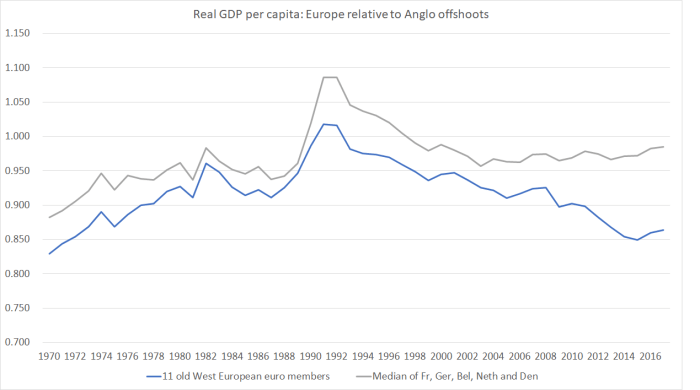
But what about some time series charts for more recent periods?  In this chart I’ve shown the same two European groupings relative to the median for the Anglo offshoot countries (US, Australia, Canada, and NZ) using OECD data which start in 1970.

europe 3.png

(I don’t quite know what was going on around 1990, although I guess it is probably about the recession in many of the Anglo countries).

Over the full period since 1970, Europe has gained ground relative to the Anglo offshoots, on both groupings.  But there is, of course, a big divergence in the two series in the last decade or so.   For the top-5 north European countries, performance has remained pretty strong.  The median of those five countries now has average per capita incomes almost equal to those of median Anglo offshoot country (and, as it happens, the Europeans work fewer hours per capita to achieve that outcome).  But for the wider group, things have gone badly into reverse –  the influence of the poorly performing tail (Greece and Italy in particular, but also Spain and Portugal).

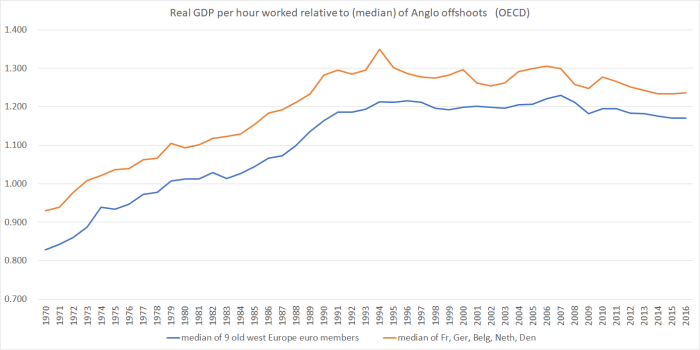
What about a similar chart for productivity?   The OECD doesn’t have labour productivity data for the whole period for Austria and Greece, so in this chart those two countries drop out of the comparison.

europe 4

It is a somewhat different picture.  The cylical effects large drop away, but (not unrelatedly) so does the marked difference between the two groups of euro-area countries over the last decade.   On this measure, Europe’s labour productivty growth has fallen behind that of the Anglo offshoots grouping over the last decade (although not in the first few years of the euro).  But perhaps the bigger story remains just how much average productivity in Europe has improved relative to that in the Anglo offshoots world over the whole period since 1970.  It is a huge relative gain for (western) Europe.

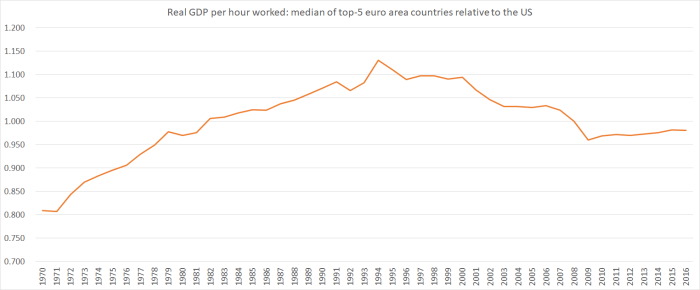
And what of a simple comparison between the leading group of European industrial countries and the US?  After all, if Europe has its laggard, the Anglo world has New Zealand (and Canada).  Here’s that chart.

europe 5

It is interestingly different.  Relative to the US, these leading European countries did poorly last decade.  But the underperformance hasn’t continued into this decade, despite the euro-area crises, even if little of the ground has been made up again.  But again, taking the longer view, surely the bigger story is one of the improvement in Europe’s relative performance since 1970.

And of course, amid all of this there has been no mention of the rest of Europe, the bits that spent decades in the Soviet orbit, and weren’t beacons of prosperity prior to that.    Many of those countries have been making progress in catching up with the Western European leaders even as, over longer runs of time, western Europe has been catching up with the (former) Anglo leaders.

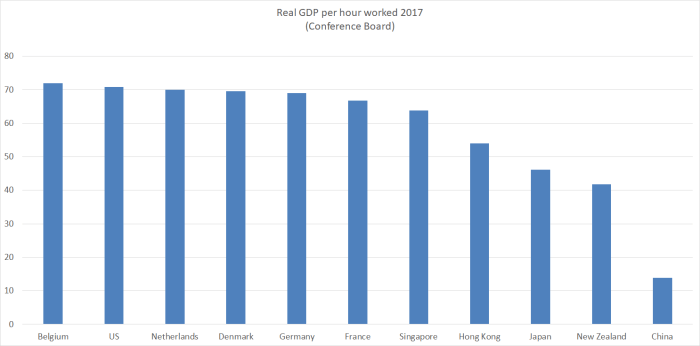
And as one final chart here is snapshot of Conference Board estimates of the levels of labour productivity last year.

europe 6

Five of the top six are European, even if Singapore is almost at the heels of the European leaders.  (Ireland, Luxembourg, and Norway have higher numbers again, each with their own idiosyncrasies.)  Below Singapore, I’ve just put in a few countries out of interest –  China as much because on my walk this morning I listened to a podcast interview with a former European politician convinced that by 2038 China will dominate the world, and that this will mostly be a good thing.

Europe has had its good and its (very) bad times in the last 100 years or so, but when one looks at the data as a whole it is hard not to think that in economic terms Europe’s performance (and especially that of the northern European top tier) relative to the rest of the advanced world has increasingly been as good as it has been at any time since the New World was really opened up to trade and settlement.    By contrast, over the last 100 years or so, of the New World countries only the US has more or less managed to hold its own matching or exceeding the leading group (per capita income and productivity) of European countries.

For New Zealand, Uruguay, Chile and Argentina –  and even Australia –  (the Antarctic Rim countries) it all seems to have proved just too hard.

Blathers away when directly asked

Another week and another Matt Nippert article in the Herald updating us on the Prime Minister’s continued refusal to be interviewed substantively on the government’s approach to the People’s Republic of China.

A Herald request filed in May to discuss the Government’s China policy with Ardern was this week again rejected, with possible windows for an interview now pushed into early next year.

Perhaps it  –  refusal to be interviewed by a serious journalist on a major public policy issue – might not matter as much if our MPs were not, apparently, all in thrall to the PRC, such that there is no questioning in Parliament of the government’s approach on this really important issue.  But Parliament is useless –  and worse –  and the Prime Minister simply avoids (refuses to face) sustained media questioning.  Not, it seems, that many try, but to their credit the Herald has.

Cheap virtue-signalling is apparently fine: the Prime Minister was reported as (to her credit) having refused to travel in a Maserati at APEC.  But that’s only PNG, and hardly anyone here (well, perhaps a few MFAT diplomats) will question her small stand against such excess.

But she is not willing to engage seriously on the activities, including those in our own country and own political system, of a great (if evil) power.

Fortunately, an occasional journalist does still manage to ask the odd question.  But they are typically short interviews, and rarely focus in on things she is directly responsible for, and so she gets away with what can only be described as “blather”.    There was an excellent example on Radio New Zealand’s Morning Report yesterday when she was interviewed by Guyon Espiner.

It was a consistent attempt at minimising any issues, relativising everything, and never ever calling out China on anything.  It was actually pretty fundamentally dishonest to the New Zealand public, in attempting to imply that all that is really going on is a trade dispute.   Then again, I thought she was given a pretty easy run by the interviewer.

Thus, we were told that there was “significant consensus” around the APEC communique and that the issues were only a few words.  But she knows as well as anyone that most such communiques are just bumpf anyway, and the real issues always resolve around a few critical words.  It matters a lot –  tells us a lot – that neither the US nor China decided that it was in their interests to compromise on this specific point, which could almost certainly easily have been drafted around (and the results spun by each side) had there been a will to do so.  (“Unfair trade practices –  of course we disapprove of those, but our country doesn’t have any, just standard national security provisions”.  That sort of thing.)

She stated that both sides should “step back and de-escalate”, without addressing the substance of the issues at all.    But she must know that her consistent refusal to say anything of substance plays into the hands of the People’s Republic.  You might think –  as I do –  that Trump’s initial focus on bilateral trade deficits is pretty flakey, but it doesn’t detract from the wider issues around theft of intellectual property, market access, and so on.  The PRC remains one of the least open markets in the world.  And the US by contrast, for all its many faults, is one of the most open.

The government seems to see itself as having some sort of role as a ‘bridge” between the US and China.  Questioning drew on a comment to that effect over the weekend from the Trade Minister, David Parker.   The Prime Minister attempted to minimise this, talking of some specifics around WTO governance.  But perhaps the interviewer could have pushed her rather more on what it is that the government disagrees with in the recent combined (ie not just the US) EU, Japanese, and US approach

On November 12, the United States, European Union, and Japan will submit a package of proposals to the World Trade Organization’s Council on Trade in Goods that would significantly help curb China’s practices of heavily subsidizing its state-owned enterprises. They are also discussing ways to prevent China from forcing Western companies to transfer technology to Chinese firms.

The Prime Minister was asked why we wanted to be a “bridge”, to which her response was to burble on about a “values-based approach”, an independent foreign policy, and not picking sides.  Surely in any sort of values-based approach –  one where life is more than deal and political donations – you would be found on the side opposing the greater evil?  But, of course, there was none of this from the Prime Minister, just the suggestion that somehow being neutral was better, for its own sake.  To believe her, for example, you’d have to believe that Michael Joseph Savage and Peter Fraser were forced into World War Two against their better judgement, rather than as leaders of an independent country deciding to act together with other countries that shared our values, and the attitude to the presenting evil.

It is the sort of answer that wins praise from the largely taxpayer-funded propagandists for all things PRC.   It shouldn’t be acceptable to decent New Zealanders, not compromised by deals or donations.

The interviewer tried again, asking if she was really saying we (well, she) was as aligned with the PRC as with the United States (with whom, as he pointed out, we are in a longstanding intelligence relationship).  Even there she couldn’t manage a straight answer, burbling on about how “we align ourselves with a set of principles and values. Some of these things are not black and white”.  But even then she seemed to be trying to reduce everything to technical details about a trade dispute.  No sense, for example, that imprisoning a million people in Xinjiang, for being who they are, qualifies as pretty unconditionally “black”.  Or probihiting freedom of speech, scoffing at the rule of law, widespread theft of intellectual property, severe restrictions on freedom of religion, and no capacity of a country’s citizens to change their government –  and all that is mostly just the internal stuff –  are pretty black.  No other country –  let alone our own – is perfect, but in real life you choose to align with real people and real countries, and when you choose to consistently refuse to identify that New Zealand has a lot more in common –  in its values –  with Australia, Canada, the US, Japan, the UK, Taiwan, or EU –  than with the PRC, by default you side with other lot.   You give legitimacy to their evil.

The interviewer moved onto the Belt and Road Initiative, which the previous government signed us up to last year –  some sickening text (“fusion of civilisations”), but mostly a big propaganda win for the PRC.  Because although the Prime Minister tried to spin her listeners suggesting that lots of countries had signed up, we are the only advanced country – and the only Five Eyes partnership country – to have done so.   Of course, given that the deadine in the original agreement for specifics has now passed, one might deduce that the government is not too keen on doing too much under the loose aegis of the Belt and Road Initiative.  Perhaps the pressure from Beijing for some specifics is beginning to mount –  if, for example, New Zealand wants that extension of the preferential trade agreement (or the Prime Minister wants that trip to Beijing).

The interviewer moved onto matters we have full control over: our response to the PRC influence and interference activities in New Zealand.    He quoted Anne-Marie Brady’s line that those activities (“covert, corrupting, coercive”) were now at a “critical level”.   The Prime Minister simply refused to engage with specifics (she was “very cautious about labelling”), talking about the need for good and broad “legislative frameworks” –  as if the real issues were primarily legislative, rather than attitudinal ones being at least as important  – while naming nothing specific there either (although some mention of cyber-security).   We need, we were told, to be “vigilant across the board”, trying to play distraction with references to North Korea and Russia.   She was, she said, comforted that there was no evidence of interference in the election, without being pushed to engage with the fact that the current inquiry into last year’s election is being led by her own MP, Raymond Huo, who is himself associated with various United Front organisations, who adopted a Xi Jinping slogan for Labour’s campaign, and who organised the function at which Phil Goff funded a large chunk of his mayoral campaign with a “donation” (charity auction bid) from mainland China.  I wonder how the intelligence services would feel if they were called to testify to a committee chaired by Mr Huo?

And, finally, the interviewer moved on to the burglaries at Anne-Marie Brady’s home and office, and suggestions of interference with her car.   There was no clarion call in defence of the freedom of New Zealanders (academics or otherwise –  this isn’t largely about academic freedom) to write, advocate and lobby as they like, no observation that while the investigation hadn’t yet been resolved, if there were evidence of involvement of a foreign power it would be a very grave matter, which the government would need to respond to with utmost seriousness.  Instead we got attempts at obfuscation and procrastination.  She told us she didn’t comment on intelligence briefings, only for the interviewer to point out that she was first one to mention intelligence services.  Twice she attempted to point out that she had “been away”, as if she’d been communing with nature alone on top of some high mountain, not travelling on a government plane, accompanied by all manner of senior government officials.

If it wasn’t that surprising –  given what we’ve come to see of her performance –  it was disappointing nonetheless.   I wonder if we will even get a straight answer when the Police finally – next year, the year after  –  finish their investigation.  Effective freedom of speech –  let alone a stand for the core values of New Zealanders – seems to be an inconvenience next to keeping the donations going, and keeping the business interests trading with China (notably Fonterra, the universities, and the tourism sector) on side.  Her only “value” in this area seems to be the dollar.

But, of course, she gets away with it because the Opposition leader is just as bad.   She has Raymond Huo in her caucus (and in a senior select committee role), he has Jian Yang, and both seem to keep the donations flowing, and neither will call out the other.  The parties combine to honour Yikun Zhang for what, it seems, is in effect services to Beijing.

There was an interesting article in the Financial Times yesterday, reporting that the US is considering banning exports to China of a range of advanced technologies

In a document published on the Federal Register, the commerce department listed all the products it might subject to export curbs. These included items from genomics, to computer vision and audio manipulation technology, to microprocessor technology, quantum computing, mind-machine interfaces and flight control algorithms.

It is the sort of thing that illustrates that however silly the initial focus on bilateral trade deficits was, the tensions between the US and China are well beyond that stage now.  At a time when the Chinese economy is in any case looking under more threat as the longrunning credit boom appears to have exhausted itself, and the authorities seem unsure how –  if at all – to respond, surely an honest and decent Prime Minister would be more interested in levelling with the public, about the nature of the regime in Beijing, the nature of its threats here and abroad, than in engaging in some sort of weird amoral “balancing act”.   If she wants to run the “not black and white” line, at least she could honestly recognise the distinction between off-white and something very very deeply dark grey.

But not in New Zealand.  One could almost say she puts herself in something like the same category as Trump over Saudi Arabia –  with obfuscation and avoidance, rather than bluster, her chosen rhetorical style.

In closing, and having praised the Herald for persevering (I guess at near-zero cost) in its quest for a serious interview on these issues, I noticed this earlier in the day

https://twitter.com/niubi/status/1064907102412513281
Translated from Chinese by
Microsoft
New Zealand has fallen.

Bill Bishop is a pretty astute and highly-regarded China analyst (who wears his distaste for Trump pretty visibly).  I clicked the link and sure enough there seemed to be a whole series of sponsored articles (links down the right hand side of this particular article) from the People’s Daily –  main Chinese Communist Party newspaper – on the Herald website.  Quite extraordinary.

Brexit and UK economic performance

Flicking around the web yesterday afternoon I noticed this tweet from Matt Ridley (more formally the 5th Viscount Ridley), the British journalist, businessman and author of various smart books including The Rational Optimist: How Prosperity Evolves.  (Ridley was also formerly  –  from 2004 to 2007 when it hit the rocks –  chairman of Northern Rock.)

Ridley is reportedly strongly pro-Brexit.  In my book, that is to his credit (had I been British, I’d almost certainly have voted Leave too.  Then again, the next recession is likely to shake the euro and the EU itself to its very foundations anyway).

But it was the quote from the paywalled Telegraph article that caught my eye.  Those look like pretty impressive numbers, at least for the first 10 seconds until one realises that they are almost certainly total GDP comparisons and British population growth had been faster than that of most of the other countries of Europe.  And, of course, polling data suggests that was one of the factors that led to the Leave vote in the first place –  in and of itself, higher population growth is hardly a mark of Britain’s economic success, let alone a clear welfare gain for the British.

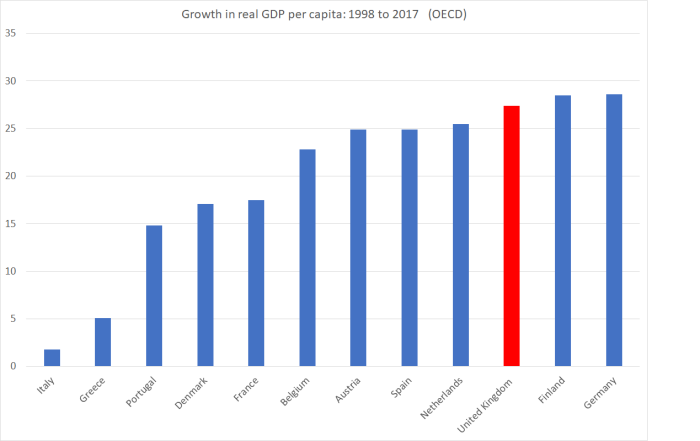
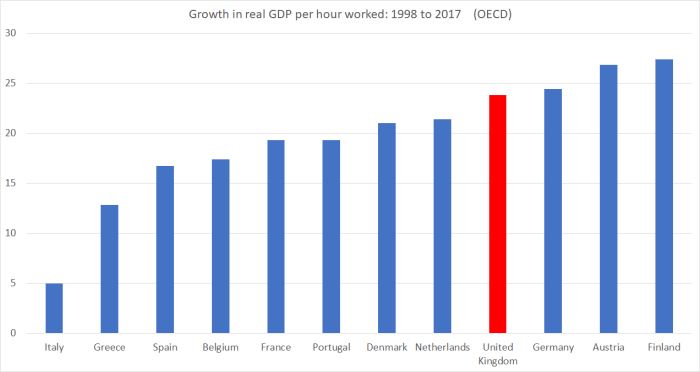
But it left me wondering how the UK had done on other, more relevant, economic comparisons. For example, growth in real GDP per capita and growth in real GDP per hour worked.   The euro was launched on 1 January 1999, so here are a couple of comparisons (using annual OECD data) for growth from 1998 to 2017.  The comparators are  the 10 older western European countries that are in the euro (excluding Ireland whose GDP numbers are messed up by the tax system, and don’t –  to a substantial extent –  reflect gains to the Irish, and Luxembourg) plus Denmark, which isn’t in the euro but whose currency has been firmly pegged to the euro since its creation.  I deliberately didn’t include the former eastern-bloc countries, partly because they joined the euro at various different times over the last 20 years and because something else more important –  post-communist convergence –  is going on there.)

First, real GDP per capita.

UK 1

and then real GDP per hour worked.

UK 2

It isn’t an unimpressive performance over that period as a whole, especially considering (a) all the hoopla at the time the euro was created, including from some trade economists, about the new economic possibilities, and (b) the UK productivity performance since the period encompassing the 2008/09 recession has been really poor (growth in real GDP per hour worked of only 2 per cent in total).   And, I guess, it is now more than two years since the referendum, and the real naysayers would have predicted a further worsening in UK productivty growth since then.

Of course, on the other hand, it is fair to point out that the UK is in the bottom half of these countries for its level of productivity.    On the OECD estimates, in 2017 only Italy, Spain, Portugal and Greece had lower average labour productivity than the UK.   But over the 18 years in the chart those laggard countries underperformed, while the UK did actually manage some convergence.

I don’t think these numbers themselves shed any real light on how the UK will do, in economic terms, relative to the rest of western Europe over the next decade or two (whether or not there is the brief, but perhaps initially quite costly, disruption associated with a “no deal”).  And it is interesting just how widely performance has diverged even among countries in both the commmon currency and the single market.   People make choices about nationhood, and how they want their country run, for a whole variety of reasons, and in most cases a few percentage points of GDP either way doesn’t weigh that heavily –  as I’ve pointed out previously, many post-colonial countries (notably in Africa, but including Ireland) underperformed economically after independence, but probably few really regretted the choice of becoming independent.   Brexit won’t change the twi n facts that the UK is a moderately prosperous country, nor the fact that –  inside or outside the EU –  it has productivity challenges, if it wishes ever again to be in the very front rank of economic performance.

I attended a lecture a couple of weeks ago by the historian and “public intellectual” Niall Ferguson.  He noted that he had supported Remain, for what seemed to be not entirely serious reasons (he is/was friends with David Cameron and George Osborne and thought they were doing a good job, and was himself going through a messy divorce and thought breakups were very hard).  But he had become frustrated by what he described as “the bleating, whining, grumbling of the Remainers” and suggested that he now supported Brexit for two reasons.  The first was that, in his view, the EU could only survive if it became more like a federal state (good luck with that) and the UK could never have been a part of such an entity.  And the second was a hope that Brexit would help the UK confront the fact –  captured in the data above –  that its economic challenges are there whether or not it is in the EU.

I was reading last night an 1882 lecture by French philosopher and historian Ernest Renan, titled “What is a nation?”.   It seemed relevant at present, emphasising as he does that nationhood isn’t about race or language, but about two things

One is the past, the other is the present. One is the possession in common of a rich legacy of memories; the other is present consent, the desire to live together, the desire to continue to invest in the heritage that we have jointly received. Messieurs, man does not improvise. The nation, like the individual, is the outcome of a long past of efforts, sacrifices, and devotions. Of all cults, that of the ancestors is the most legitimate: our ancestors have made us what we are.

A nation is therefore a great solidarity constituted by the feeling of sacrifices made and those that one is still disposed to make.

and

Nations are not eternal. They have a beginning and they will have an end. …..At the present moment, the existence of nations is a good and even necessary thing. Their existence is the guarantee of liberty, a liberty that would be lost if the world had only one law and one master. By their diverse and often opposed faculties, nations serve the common work of civilization. Each carries a note in this great concert of humanity, the highest ideal reality to which we are capable of attaining.

That makes sense to me.  As does, through all its challenges and mismanagement, Brexit.


Aid and economic failure: PNG

Apparently desperate not to upset anyone, the Prime Minister announced on Sunday at the APEC summit that, along with Australia, the United States, and Japan, New Zealand would contribute to a grand electrification scheme in Papua New Guinea.   Presumably she thought not even the bullies in Beijing might object to that –  so deals and donations might be safe (the only “values” evident in her foreign policy) – and she could throw a (pretty modest) bone to the countries we used to be allied with.

But it disconcerts me on two fronts.  The first is the way that, looking across the Pacific, New Zealand and Australia (and perhaps Japan and even the US) seem to be wanting to play the game Beijing’s way.    Beijing flings cash around in a somewhat cavalier way, in some mix of decent and poor quality projects, some mix of the transparently obvious and the less than adequately transparent, and our response is to do much the same thing.    At home we spray money around through, for example, the Provincial Growth Fund, and in the Pacific through beefing up our aid programmes, including last week’s Pacific Enabling Fund.  Our aid programmes don’t necessarily have a bad reputation, but the more they are used for avowedly political ends, the worse the quality will be, and the more we treat relationships as something for sale.  It is a bit like financial incentives for kids to improve reading or pass exams: it might appear to work in the short-run, but it commoditises what needs to be internalised.

Perhaps that is what happens when you have no values?  When the Prime Minister won’t name evil when she sees it, and when she presides over the corruption of New Zealand’s own political processes.    Countries didn’t take a stand against the Soviet Union because, say, the United States paid them to, but because they recognised the character of the regime in Moscow, and the oppression visited on its own people and thus in other Communist-controlled countries.  As various observers have noted, Beijing has no friends and allies, just clients bought and paid for, or intimidated quasi-vassals.   That shouldn’t be the sort of approach New Zealand (or Australia) fosters in response.  There was, for example, the quote I ran here last week from Scott Morrison’s recent speech

Our foreign policy defines what we believe about the world and our place in it.

It must speak of our character, our values.  What we stand for. What we believe in and, if need be, what we’ll defend. This is what guides our national interest.

I fear foreign policy these days is too often being assessed through a narrow transactional lens.   Taking an overly transactional approach to foreign policy and how we define our national interests sells us short.

If we allow such an approach to compromise our beliefs, we let ourselves down, and we stop speaking with an Australian voice.

We are more than the sum of our deals. We are better than that.

It isn’t clear that the New Zealand government could honestly say that.

I imagine the Prime Minister is one of those who believes in the efficacy of foreign aid –  and not just transactionally.   Most politicians and bureaucrats tend to.  I’m much more sceptical (drawing on both observation, and –  for examples –  the writings of scholars like Peter Bauer), and Papua New Guinea is a case in point.

I care quite a bit about Papua New Guinea.   When I was growing up our church supported missionaries there –  one of whom died flying the inhospitable terrain –  and (apart from an overnight in Brisbane to get there) it was the very first overseas place I ever went to.   At the ripe old age of 23, on secondment from the Reserve Bank, I became by default –  a series of “accidents” –  a sort of de facto chief economist and adviser on monetary policy, financial markets, banks, and so on (learning as I went) to their central bank, the Bank of Papua New Guinea. It wasn’t even foreign aid, at least directly –  the Reserve Bank did the recruitment, but I was paid (rather well) by the Papua New Guinea taxpayer.   It was a great experience, personally and professionally, and although I haven’t been back now in almost 30 years, there is a sense in which I left some of my heart in PNG.  One of the memorable moments in my life was the dawn service on ANZAC Day –  a working day in PNG –  at the Bomana war cemetery, not far from where the Japanese advance had been halted in World War Two.

When I went to PNG, it was just coming up to the 10th anniversary of independence from Australia –  I recall then then Minister of Finance telling us we couldn’t tighten monetary policy because it would put a damper on the celebratory mood.    When people worried (there) about foreign influence, it was still about people like us (a former Governor-General had a newspaper column which he not infrequently used to lambast young Australians and New Zealanders who he regarded as still having too much influence in the public sector generally).  But at that point, if PNG wasn’t prospering, it had had a reasonably impressive run of macroeconomic stability: under the tagline of the “hard kina” policy, PNG had had lower average inflation rates than New Zealand or (I think) Australia.

I might not have been paid by foreign aid, and yet the whole of the Papua New Guinea state (established bureaucracies and institutions, very nice new Parliament House etc) wouldn’t have functioned without such aid.  Most of the aid in those days was direct budgetary aid from Australia.  I can’t remember the numbers now, but it was a large share of total government spending.  Direct budgetary aid had, in principle, quite a lot going for it.  Locals got to make the choices about how the money was spent, in line with (their judgement of) national priorities –  as distinct from vanity projects which might have looked good on the glossy brochures of aid agencies.  On the other hand, direct budgetary aid was only ever likely to be acceptable in the longer-term with strong accountability and good governance locally.  And both were fading in PNG.   And all foreign aid, whatever its other pros and cons, tends to contribute to an appreciated real exchange rate –  higher domestic cost structures than otherwise – that make it harder for industries based locally to be internationally competitive and for the economy to prosper longer-term based on its own strengths.   Australia still gives over A$500 million a year in aid to Papua New Guinea.   Here is how Australia talks of the opportunities, challenges, and aspirations.

Despite huge resource potential and close proximity to Asian markets, PNG faces economic challenges and fiscal pressures. Poor law and order, lack of infrastructure, complex governance arrangements, weak public service, inequality between men and women, and rapidly growing population are challenges to its future prosperity. PNG also remains vulnerable to climate change and natural disasters, including earthquakes, volcanoes and tsunamis.

The population is overwhelmingly  poor and face hardship and 80  per cent of Papua New Guinean’s reside in traditional rural communities. The development challenges for children and youth in PNG are stark: an estimated 40 per cent of children are stunted, one in five children are not enrolled in school and nearly half the population is under the age of 20. Family and sexual violence is endemic, with some of the highest rates of violence against women and children in the world. It is also estimated around 15 per cent of the population have some form of disability.

Despite these development challenges, PNG is seeking to achieve upper middle-income country status by 2050 (PNG Vision 2050 [PDF 2.78mb]). Sector priorities, as set out in the PNG Government’s 2017 Alotau Accord II, include education, health, law and justice, infrastructure and sustainable economic growth. PNG’s economic growth agenda focuses upon investments in high impact infrastructure, job skills development and partnering with the private sector.

And yet what is striking is that despite those enormous natural resource opportunities, Papua New Guinea has done so appallingly badly.  It is almost as if Papua New Guinea was one of those countries where natural resources  –  without the institutions and attitudes to change the narratives –  have been a curse more than a blessing.  There was the Bougainville mine, there was Ok Tedi, there is Lihir, there is gas (and an LNG development) and so on.  And yet here, using IMF data, is how PNG’s real per capita GDP has done since 1980 (not long after independence, and when the PPP series starts).

PNG

I’m not showing comparisons with stellar performers like Taiwan, Singapore, or Korea, or even with China.  Instead the comparisons are with three modest developing/emerging market performers – Fiji, Indonesia, and the Philippines –  and with Australia and New Zealand.   Over almost 40 years –  and all that aid – Papua New Guinea’s real per capita GDP has dropped further behind that of each of these countries.   If you can’t grow faster than New Zealand has managed since 1980, starting so far behind, there is something very wrong.    GDP per capita was about 12 per cent of New Zealand’s in 1980, and it is about 9 per cent now.

And yet New Zealand, and Australia, just see fit to throw more money at it.    The feel-good aspect is no doubt strong –   photos of the Prime Minister opening new facilities at the Gordons Market –  and the crass geopolitical positioning too  (whether it was funding to host the APEC meetings themselves, or a few tens of millions for electricity –  which probably ticks both boxes).   But where is the wise domestic prioritisation –  the hard choices made by locals about their own resources –  or the good governance and accountability?

It isn’t as if these are just questions outsiders ask.  One could look, for example, to the website of Sir Mekere Morauta.  These days he is an Opposition MP, but over the years since Independence he has held all manner of top jobs –  first local Secretary of Finance, head of the largest bank, central bank Governor, and Prime Minister.  He can be a prickly character –  when I was there he was head of the largest bank, and consistently refused to come to meetings the Governor held with heads of the banks – but has been a major force for good in PNG over the decades.

From a statement he issued last week

Prime Minister Peter O’Neill must come clean on total APEC spending. It is unacceptable for the Prime Minister to keep hiding the vast amount spent on the meeting,” Sir Mekere Morauta, Member for Moresby North-West, said today.

“Public money is not his to do with as he pleases, wasting it on luxury cars and private parties for his cronies.

According to the Public Finances (Management) Act, Section 47K, the APEC Authority must be audited by the Auditor-General, Sir Mekere said. But there is no record of any audit.

The report of the Auditor-General on the APEC Authority must be tabled in Parliament. This has not happened. Mr O’Neill has been promising for ages to table the APEC budget and expenditure report in Parliament but has never done so.

“These latest irregularities are in addition to likely breaches of the Constitution, the PFMA and other laws I have previously outlined in relation to the APEC vehicle procurement,” Sir Mekere said. “The smell of corruption grows by the day, and only full inquiries by the Ombudsman Commission and the Fraud Squad can ascertain the truth.

And

“Mr O’Neill has been the most extravagant and self-indulgent Prime Minister in our history,” Sir Mekere said. “He and his cronies are living the high life at the expense of ordinary Papua New Guineans who are suffocating, gasping for clean air. Forty per cent of our people earn less than $1.90 a day. The extravaganza of APEC is a grotesque slap in their face.

“The Prime Minister admitted in a recent Post-Courier article that his Government’s corruption, waste and mismanagement mean there is not enough money to pay for essential services such as health, education, transport, infrastructure and law and order.

“Preventable diseases such as polio, leprosy, TB and malaria are surging, and people are dying – 21 children are now known to have contracted polio. Many schools are closing across the nation. Public servants are not being paid properly and other entitlements such as superannuation payments are being withheld. Essential infrastructure outside Port Moresby is crumbling into the dust, and government systems and processes are failing by the day.

“Transparency and accountability demand that the Prime Minister’s secrets be brought out into the open. Over to you, Mr O’Neill.

Not a word, of course, from our Prime Minister.  Just throw some more money in the pot, playing Beijing’s game.

Or for an independent take on a range of such issues, you could try this.

There are no easy fixes to Papua New Guinea’s failure –  other than the wishful thinking of assuming into existence things (“institutions”) that can only be created and sustained by painstaking and persevering effort.  But whatever the path to a better PNG, it is hardly likely to be helped by yet more of a cavalier bidding war among potential official donors.  Is there even any analysis as to how the grand electrification scheme –  good for headlines for a day or two –  is going to avoid falling foul of the same problems, the same poor governance –  that has become endemic?   Or does that simply not matter in the particular game the various governments –  Chinese, or our own –  are pursuing?

Papua New Guineans deserve a lot better –  mostly from their own leaders, but also from our own.

Exchange rate: no rebalancing in view

It doesn’t seem long –  and, in fact, it isn’t long –  since people were squabbling over a bit of a fall in the exchange rate.  The National Party was blaming the Labour-led government, while the government seemed to be taking some credit for the fall and talking about a rebalancing of the economy that they claimed was underway.  To support their claims, they not infrequently invoked the support of the rather left-wing Governor of the Reserve Bank.

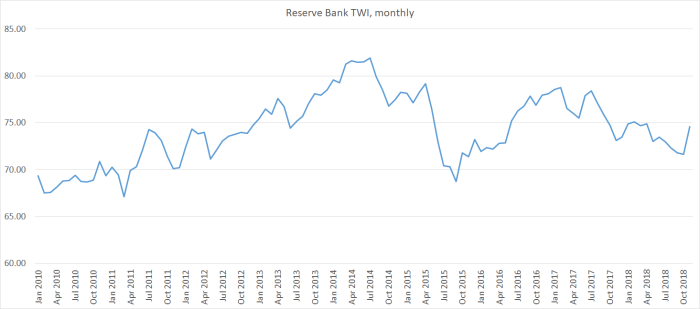
And now they’ve all gone quiet again as the exchange rate has rebounded again.  On the Reserve Bank’s TWI measure, the rebound has been about 6 per cent.   Even by the standards of this decade –  when the exchange rate has been reasonably stable –  it isn’t that big a move.

TWI 18

The level now is about the same as the level at the time the choice of the new goverment was decided in October 2018.  It poses new fresh inflationary threat (which seemed to be the National Party concern when it was falling) and no greater buffering, or signal of rebalancing, as the government and the Governor had liked to claim.

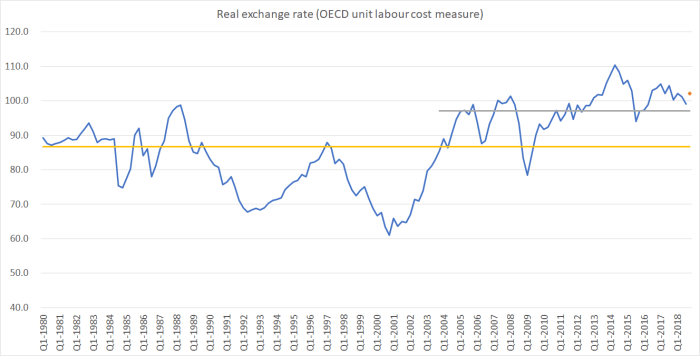
What of longer-term comparisons?  Here I like to use the OECD’s real relative unit labour cost measure –  partly because there is a long run of data.     Here is how the longer-term picture looks (the dot representing today’s estimated level).

TWI 18 2

On average, the real exchange rate has been high since around 2003 (with a sharp but shortlived dip in the 2008/09 recession).   Even the lows the Prime Minister and Governor liked to talk up had still been a bit above the 15-year average (the grey line); current levels even more so.

But I’ve also shown (yellow line) the average for the entire period since 1980.  The current level of the real exchange rate is about 18 per cent above that long-term average.

That would make sense, and be welcome, if – for example – the last 35+ years had been ones in which New Zealand had been chalking up a stellar productivity growth performance, if New Zealand firms had been successfully many more foreign markets lifting the foreign trade share of the New Zealand economy.  But, of course, that hasn’t been the story at all.   There were short periods when it sometimes looked as if these sorts of developments were actually happening, but they’ve never lasted, and none of those periods have been in the last 15 years (when the real exchange rate has consistently averaged high).  Instead, our productivity levels have drifted further behind those in other advanced economies –  including, notably, over the last five years when there has been little productivity growth at all –  and foreign trade shares of our economy have stagnated and then shrunk.  Indicators of the relative size of the tradables sector of our economy have also not been encouraging.

These aren’t developments that should leave anyone very comfortable.  In the shorter-term, there isn’t much obvious impetus for strong domestic growth –  commodity prices are easing, confidence is weak, population growth is ebbing –  and the risks to the global outlook seem to be mounting, and perhaps even crystallising.  Then again, if things go badly wrong in the short-term, the exchange rate can –  and probably will –  move quite quickly.

The bigger concern is that there is no sign of an economy rebalancing towards some better – higher productivity, more outward-oriented, tomorrow.  And the persistently high exchange rate, over decades, seems to have been reflecting deeply misguided policies that have helped produce the last few decades of disappointing economic performance, all combined with a depressing indifference from the leading figures in all our main political parties.  There is little chance of breaking out of the slow spiral of continued relative decline without a quite materially different approach.  Part of making that work would be likely to involve the real exchange rate revisiting –  settling –  the sorts of lows we experienced at times in the first 15 or so years after liberalisation.    Even back then, when senior figures talked of rebalancing, it was mostly wishful thinking –  since the lows were purely the results of short-term cyclical forces.  These days, such talk bears even less relation to reality –  and to the scale of the challege before us.  But perhaps it generates a favourable news story for a day or two.

Voices in support of Anne-Marie Brady

Many, perhaps most, readers will have seen the article by Matt Nippert on the front page of yesterday’s Herald, about Professor Anne-Marie Brady and indications that her car may have been sabotaged.  This, of course, comes in the wake of break-ins to Professor Brady’s home and office, that are still –  months afterwards –  being investigated by the Police.  The strong suspicion has been that agents of the People’s Republic of China were involved in the break-ins, including (inter alia) because of what was, and wasn’t, taken, and letters that Professor Brady had received.  Yesterday’s article included this comment from Brady about the very slow-moving investigation.

She was unwilling to comment on the lengthy and still unfinished Police investigation, but told the New York Times in September the lack of comment or public action from government to date was “starting to look like procrastination”.

Official Wellington might be thought to have a strong interest in the investigation not coming to a conclusion, and it has (sadly) become difficult to have much confidence in the independence and integrity of the Police when it involves issues that matter to governments.

Nippert also included this section

The ongoing investigation …. had raised the temperature of local debate on the issue of China.

Commentary in local Chinese-language media has been an especially heated, with a recent op-ed by Morgan Xiao – published simultaneously by SkyKiwi, the Mandarin Pages and the New Zealand Chinese Daily News – describing Brady and other New Zealand-Chinese democracy activists as “anti-Chinese sons of bitches” who should “get out of New Zealand”.

Freeman Yu, whose New Zealand Values Alliance has started a petition urging the government to follow Australia’s lead and curb China’s local influence, was also called out by Xiao.

Yu said the language used in local debate had recently hardened, with “extreme expressions used in the Cultural Revolution”.

“The language used in their articles expressed intense hatred for different voices and the freedom of speech,” he said.

Comments sections on (for example) Stuff often don’t reveal humanity at its finest, but this is a description of a published op-ed.   New Zealanders should get out of New Zealand?

I know Professor Brady only slightly.  We’ve talked a couple of times and exchanged emails from time to time over the last year.  I’ve found her contribution to the New Zealand debate –  which seems to involve stepping a bit beyond her personal comfort zone (academics are often most comfortable behind the scenes) –  on these issues invaluable.   Such debate as there now is wouldn’t be occurring without her.

But Geremie Barmé and John Minford know Professor Brady very well.     Barmé and Minford are both emeritus professors at the Australian National University where Barmé was formerly Director, Australian Centre on China in the World and Chair Professor of Chinese History at Australian National University College of Asia and the Pacific in Canberra.   They now live near Featherston –  which perhaps accounts for the number of China books I found in a Featherston secondhand bookshop recently –  and host The Wairarapa Academy for the New Sinology.  Their website has a fascinating collection of material, which I’ve linked to occasionally.

They have today put out a statement about Professor Brady, her work, her position and so on.   I’ve reproduced it here (with permission).

17 November 2018

Re: Professor Anne-Marie Brady

To Whom It May Concern,

Professor Anne-Marie Brady is a noted specialist in China’s domestic and foreign politics at the University of Canterbury. Her work on contemporary China, and its increasingly controversial global engagement, contributes directly to the national interest of New Zealand. It is also having a considerable impact internationally, not only in academic circles but also in political debates and policy formulation among the major allies and trading partners of this country.

As teachers and mentors of Professor Brady — John Minford was one of her undergraduate teachers at the University of Auckland; Geremie Barmé was a supervisor of her doctoral work at the Australian National University — we are proud of her achievements and we strongly support her ongoing academic research work and engagement with issues of public, national and international significance.

In February this year, we were profoundly disturbed to read media reports about break-ins at Professor Brady’s workplace and of her home office, resulting in the theft of electronic equipment and research materials. The details of the break-ins, still a subject of police investigation, suggested that Professor Brady was being subjected to intimidation for her internationally recognized work on official Chinese strategies to influence the politics and societies of foreign countries, in particular New Zealand. (See: https://www.pressreader.com/new-zealand/the-dominion-post/20180219/282355450217707) We were shocked by the latest media reports — on 16 November — that, during routine Warrant of Fitness maintenance, it was discovered that her vehicle may well have been purposely tampered with. There are indications that this was done to endanger the occupants of the vehicle: Professor Brady, her husband and their three teenage children. (See: https://www.stuff.co.nz/national/108649435/professor-annemarie-brady-who-warned-about-china-interference-says-car-was-sabotaged )

The freedom from fear was long ago recognized as a basic human right; academics should be able to pursue their work, and their daily lives, without being subjected to intimidation. In any modern democracy worthy of the name, academic freedom and independent research are crucial “public goods”. They are also germane to university life.

As residents of New Zealand and as independent scholars — our main institutional affiliation is with The Australian National University as emeritus professors — we hereby express our deep concern about the on-going threats to Professor Anne-Marie Brady’s research and private life.

We hope that others whose research and teaching involves contemporary China will offer her and her important work collegial encouragement, as well as public support.

Furthermore, we also hope that the New Zealand authorities take the threats against Professor Brady seriously. We appeal to the Prime Minister, Rt. Hon. Jacinda Ardern, and her coalition partner the Foreign Minister, the Rt. Hon. Winston Peters, to address directly the issues raised by her work which she has further articulated in practicable, and succinct, formal advice to the government.

Since September 2017, Professor Anne-Marie Brady’s work has attracted overwhelmingly positive global attention. It has also been subjected to vilification by Chinese officialdom. Regardless, her work continues to influence the debate about China’s “sharp power” on the international stage, and it contributes to practical policy discussions in Europe, North America and in Australia. This work remains ever more pressingly relevant to the public life, and the future, of her homeland.

Yours,

Geremie R. Barmé
Professor Emeritus of History
The Australian National University
Founding Director, Australian Centre on China in the World
Fellow of the Australian Academy of Humanities

John Minford
Professor Emeritus of Chinese
The Australian National University
Sin Wai Kin Distinguished Professor
Hang Seng University of Hong Kong

To me, the most important lines in the statement are those addressed to our political leaders

We appeal to the Prime Minister, Rt. Hon. Jacinda Ardern, and her coalition partner the Foreign Minister, the Rt. Hon. Winston Peters, to address directly the issues raised by her work

(To which I would add “and the leaders of the National Party, so recently in government”.)

They might also speak about, for example, things like that appalling op-ed from various Chinese-language local media.

Shameful as the government’s stance on, say, Xinjiang is –  the refusal to add our voice to the protest by our friends and allies –  we can’t change China.  But we  –  they –  have no such excuse when it comes to New Zealand itself, our political system, the environment facing freedom-loving ethnic Chinese New Zealanders, and the actions of the People’s Republic of China and its agents here.

And yet Matt Nippert’s article reminds us again of the supine, scared of their own shadow, attitude of the government.

Since May the Herald has been seeking to interview Prime Minister Jacinda Ardern about the governments’ China policy in light of Brady’s research and legislative action in Australia.

The Prime Ministers’ Office has regularly put off the request

Simply refusing to engage on such vital issues with a serious journalist from our largest newspaper is astonishing, and a telling commentary on how corrupted our political system appears to have become.  Perhaps as telling is the utter silence from the National Party on the government’s refusal to engage.

UPDATE: I would strongly recommend this new piece, by the commentator on China issues who goes under the label Jichang Lulu, to anyone at all interested in the PRC influence issues as they relate to New Zealand.


The Prime Minister continues to shame us

The Prime Minister has been attempting to defend her handling of the meeting with the Malaysian Prime Minister, following his apparently quite forthright comments on the South China Sea.  She parrots a line about not taking sides in the dispute, but surely she knows that when you don’t take sides between a bully and his (or her) victim you side with the bully.  And when you say

New Zealand’s position on the issue had been “utterly consistent”, and the country had never taken sides, she said, adding all claimants should uphold international law, and the law of the sea.

and yet fail to point out which party –  the PRC –  consistently refuses to uphold international law in this area, you make yourself a party to the abuse, the aggression, aiding the new status quo in which the PRC has taken control.  It really is like not taking sides when Germany takes Czechoslovakia or Poland.

But perhaps journalists could also ask the Prime Minister to explain New Zealand’s absence from this list

Australia, Canada, and the European Union as a whole, but not New Zealand, are part of an approach to Beijing over the abuses in Xinjiang.

Life –  even foreign policy – really has to be more than the sums of the deals, or the sum of the donations.

The Government’s stance is these areas –  much the same as the Opposition’s –  shames us.

UPDATE:  A reader sends me this (I’m not sure from which publication)

“We decided not to sign it because we have raised concerns about the situation in Xinjiang directly with Chinese authorities,” a spokesman for Ardern told Newsroom when asked if New Zealand had joined the protest.

“New Zealand concerns have been registered by the Prime Minister with senior counterparts, including yesterday with Premier Li. Concerns have also been raised at officials’ level, including through New Zealand’s bilateral human rights dialogue with China, and at the UN in Geneva,” the spokesman said.

This is pathetic.     As if none of the other countries has made direct or bilateral comments, and –  as noted here –  other countries (including the US, UK, and Australia) were much more visible and vocal at the recent UN human rights review on China.   There are those old lines about “stronger together”, and people being known by the company they keep.   I don’t think trade agreements and the like should drive our policy stances –  our values should – but you have to wonder what the EU (with whom New Zealand wants to sign of an agreement) makes of a New Zealand government so supine it won’t join its (erstwhile) friends in this process.   Perhaps unilateralism is an option for the US, but it is the same Prime Minister who regularly reminds us, and the world, about the merits of acting together.  Just not when it comes to never ever upsetting Beijing?

More kids means more education spending

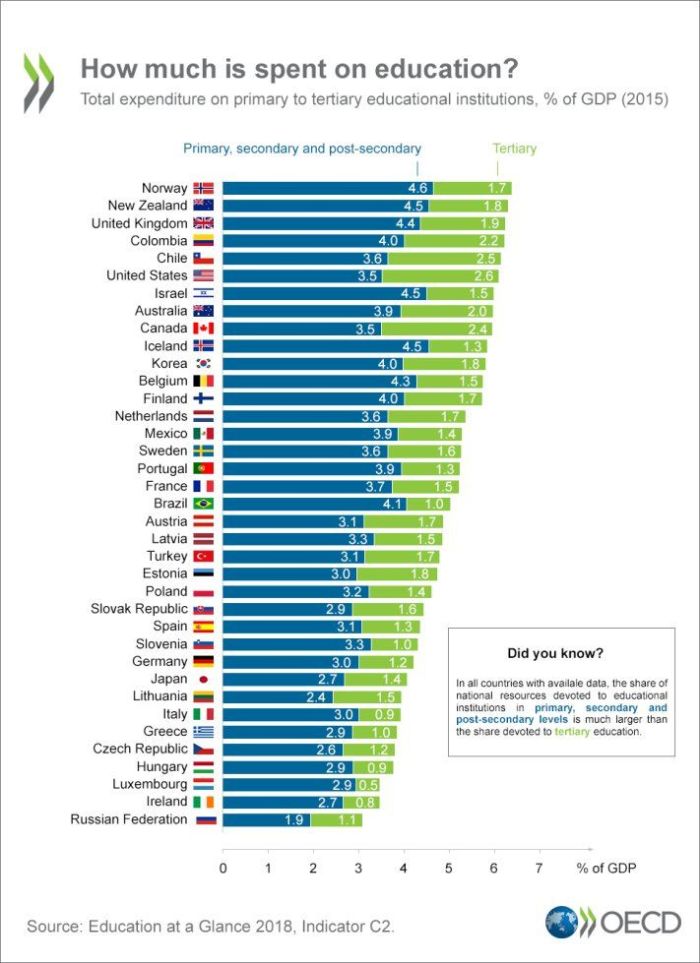
I’m tied up with other commitments today, but I happened to notice this chart from the OECD.

education spending

Since today is also the day the primary/intermediate teachers’ strike hits Wellington, it seemed timely.

In some ways, it is quite a striking chart.  New Zealand devotes the second largest share of GDP to education of any OECD country, exceeded only by super-rich Norway (as far as I can see this is an estimate of total public and private spending).

And yet, once one looks even a bit more closer it is less interesting than it might have seen.  For example, at the other end of the chart both Ireland and Luxembourg have GDPs that are flattered by unusual effects –  in Ireland’s case, the impact of their corporate tax system (which ends up exaggerating the true economic value occurring in Ireland, and does not reflect value accruing to the Irish), and in Luxembourg’s case, the fact that a lot of the GDP arises from people who work in tiny (financial centre) Luxembourg but live across the border in various neighbouring countries (their kids won’t be using Luxembourg’s schools).

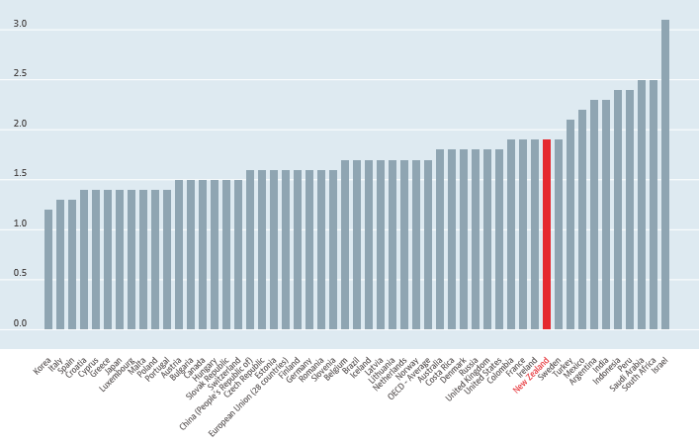
And in our case, who uses schools and universities?  Mostly children and young people, and if you don’t have many children you’ll need to spend less (as a share of GDP) on education.   As this chart shows, of the OECD countries only Turkey, Mexico and Israel have a higher total fertility rate at present than New Zealand does.   Our TFR this particular year was 1.9 (births per woman) while that for, say, Japan was about 1.4.  That makes a big difference to how much needs to be spent on schools (all else equal about a third more).  Iceland spends as much on schools as we do, but with quite a bit smaller a birth rate.

Total fertility rate (2016)
fertility-rates

And the other thing that marks us out relative to most OECD countries, although not all, is a high rate of immigration.  Not all migrants, by any means, have children with them when they move here (temporarily or permanently) but some do.  It all adds to the amount (share of GDP) needing to be spent on education.

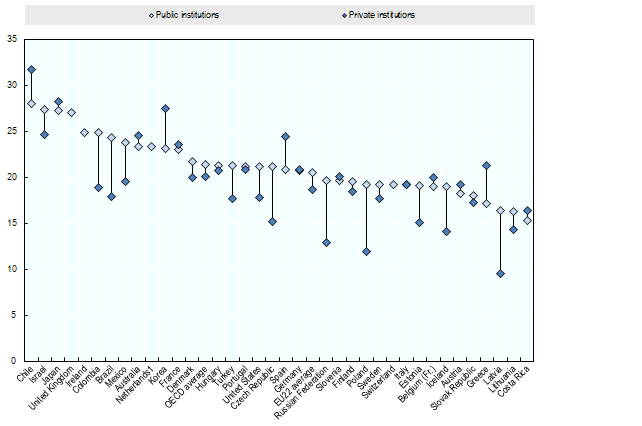
Both birth rates and migration rates are just one of those things that people doing education budgets just have to take as given.    The other thing that you’d expect to influence education spending quite substantially is class sizes –  even at tertiary level the old Oxford/Cambridge tutorial system is a lot more resource intensive than, say, stage 1 lectures with 350 young people with largish tutorials run by honours students. But there tends to be more of a focus on school class sizes.  Unfortunately, the charts in the OECD Education at a Glance publications don’t have New Zealand data for pupil/teacher ratios, but here is the chart.

Average class size in primary education, by type of institutions (2016)

ratios

What I found striking is how wide the range of practices is.  It isn’t just that richer countries have smaller class sizes –  Chile is at one end and Costa Ricas at the other –  even though my understanding of the educational research is that smaller class sizes is mostly just a luxury item, with little or no impact on educational outcomes.   Shifting from one end to the other is likely to have significant implications for the cost of primary school education.  I have no idea where New Zealand would sit on the chart: I’m always a bit surprised how small my children’s class sizes have been, but that probably just marks me out as an old fogey, recalling classes in the mid-high 30s back in the early 1970s.

I don’t have any particular conclusion to this post, other than the caution that a high share of GDP devoted to schooling sheds –  on its own – precisely no light on the reasonableness, or otherwise, of the teachers’ claims, and their strike.  Having said that, I’d have preferred my daughter’s Principal not to have been using public resources to email us all urging parents to support the industrial action, join the protest rally etc.

Making the Trump administration look less bad

I’m no fan of Donald Trump.  He is unworthy of the office he holds, and almost every week there is new data to reinforce that view.   And if his character is unworthy, there is no offset in the way in which he attempts to govern or in the clarity and excellence of his thought or vision.

And yet, when it comes to the People’s Republic of China, our Prime Minister –  probably with the full support of the Leader of the Opposition –  manages, somehow, to leave the US Administration looking as though –  for the moment at least – it is on the side of the angels.   And as if it is our governments that are simply all about “the deal” –  be it an “FTA” upgrade, party political donations. or just students flowing to our public universities that have made themselves so dependent on not upsetting the thugs in Beijing.

Then there is Scott Morrison.  I guess he probably won’t be Australia’s Prime Minister for long, but a couple of weeks ago he gave a pretty good speech under the heading “The Beliefs That Guide Us”.  Sadly, I didn’t see it reported here at all (from the Australian media there is a good commentary on it here) but it comes in stark contrast to the way in which our governments (present and past) behave and talk (or simply refuse to talk).  Rhetoric is, of course, easier than action, but at least the words were good (emphasis added).

Our foreign policy defines what we believe about the world and our place in it.

It must speak of our character, our values.  What we stand for. What we believe in and, if need be, what we’ll defend. This is what guides our national interest.

I fear foreign policy these days is too often being assessed through a narrow transactional lens.   Taking an overly transactional approach to foreign policy and how we define our national interests sells us short.

If we allow such an approach to compromise our beliefs, we let ourselves down, and we stop speaking with an Australian voice.

We are more than the sum of our deals. We are better than that.

And what does Morrison regard as the “beliefs that guide our interests”?

We believe that the path to peace and liberty demands the pursuit of prosperity through private capital, rights to own property, entrepreneurialism and free and open markets. That is what lifts people out of poverty.

We believe that acceptance should not be determined by race or religion. Rather, we accept people by their words and judge them by their actions.

We believe in freedom of speech, thought, association and religion.

We believe in peaceful liberal democracy; the rule of law; separation of powers; racial and gender equality where every citizen has choice and opportunity to follow their own paths and dreams.

A fair go for those who have a go – that is what fairness means in Australia.

We believe in the limits of government – because free peoples are the best foundation to show mutual respect to all.

We believe in standing by our mates, side by side with nations that believe the same things we do.

Few or none of those things would be embraced by the People’s Republic of China, or the Party that controls it.  As he goes on to point out, by omission in listing the sorts of nations which do.

From the United Kingdom and the democracies of Europe to the United States and Canada. From the state of Israel to the city state of Singapore. From Japan and South Korea in North Asia to New Zealand, across the ditch.

He goes on later to observe, of Australia’s participation in various conflicts

We have done this because we believe it is right. Being true to our values and principles [will] always be in our interest.

Whereas, so it seems, in our Prime Minister’s mind (and that of her Opposition counterpart) not only are the two in constant tension, but the values and principles of this nation are constantly sacrificed to some short-sighted, limited, and mercenary conception of “interest”.    It is shameful to watch.

What of the US Administration?  You might think, as I do, that the focus on the US-China bilateral trade deficit is wrongheaded and economically illiterate.  Which isn’t to say that there are no real economic issues that it is right for the US Administration to take the lead in addressing –  with, so it appears, pretty widespread endorsement across the political spectrum in the US.  Even if you think –  as I generally do –  that intellectual property protections generally reach too far, and even if you recall that most rising powers have attempted to gain an edge by purloining the technology or insights of firms/countries nearer the technological frontier, China’s approach is particularly systematic, aggressive, and unacceptable.  It needs to be called out.  China doesn’t offer anything like an open market in many areas (services and investment notably), and if  –  in the longer-run –  those choices will mostly harm the Chinese, I don’t have any problem with a big and powerful country attempting to encourage change.  They are the sort of changes most in the West probably looked towards when China was allowed into the WTO.  It was clearly a sick (if opportunistic) joke when New Zealand agreed to deem China a “market economy”, when it remains far from that –  and, in many respects, getting further from it.

But it isn’t just about trade and investment.  Last month, the Vice-President gave a pretty forceful speech on the Administration’s approach to the People’s Republic of China.    There was a trade dimension

Over the past 17 years, China’s GDP has grown 9-fold; it has become the second-largest economy in the world. Much of this success was driven by American investment in China. And the Chinese Communist Party has also used an arsenal of policies inconsistent with free and fair trade, including tariffs, quotas, currency manipulation, forced technology transfer, intellectual property theft, and industrial subsidies doled out like candy, to name a few.

But there was so much more. The military position for example

And using that stolen technology, the Chinese Communist Party is turning plowshares into swords on a massive scale…

China now spends as much on its military as the rest of Asia combined, and Beijing has prioritized capabilities to erode America’s military advantages – on land, at sea, in the air, and in space. China wants nothing less than to push the United States of America from the Western Pacific and attempt to prevent us from coming to the aid of our allies.

Beijing is also using its power like never before. Chinese ships routinely patrol around the Senkaku Islands, which are administered by Japan. And while China’s leader stood in the Rose Garden of the White House in 2015 and said that his country had “no intention to militarize the South China Sea,” today, Beijing has deployed advanced anti-ship and anti-air missiles atop an archipelago of military bases constructed on artificial islands.

and systematic issues with a more individual impact

Nor, as we hoped, has Beijing moved toward greater freedom for its people. For a time, Beijing inched toward greater liberty and respect for human rights, but in recent years, it has taken a sharp U-turn toward control and oppression.

Today, China has built an unparalleled surveillance state, and it’s growing more expansive and intrusive – often with the help of U.S. technology. The “Great Firewall of China” likewise grows higher, drastically restricting the free flow of information to the Chinese people. And by 2020, China’s rulers aim to implement an Orwellian system premised on controlling virtually every facet of human life – the so-called “social credit score.” In the words of that program’s official blueprint, it will “allow the trustworthy to roam everywhere under heaven, while making it hard for the discredited to take a single step.”

And when it comes to religious freedom, a new wave of persecution is crashing down on Chinese Christians, Buddhists, and Muslims…

Last month, Beijing shut down one of China’s largest underground churches. Across the country, authorities are tearing down crosses, burning bibles, and imprisoning believers. And Beijing has now reached a deal with the Vatican that gives the avowedly atheist Communist Party a direct role in appointing Catholic bishops. For China’s Christians, these are desperate times.

Beijing is also cracking down on Buddhism. Over the past decade, more than 150 Tibetan Buddhist monks have lit themselves on fire to protest China’s repression of their beliefs and culture. And in Xinjiang, the Communist Party has imprisoned as many as one million Muslim Uyghurs in government camps where they endure around-the-clock brainwashing. Survivors of the camps have described their experiences as a deliberate attempt by Beijing to strangle Uyghur culture and stamp out the Muslim faith.

And the sort of influence activities that Anne-Marie Brady has written about here

I want to tell you today what we know about China’s actions – some of which we’ve gleaned from intelligence assessments, some of which are publicly available. But all of which is fact.

As I said before, Beijing is employing a whole-of-government approach to advance its influence and benefit its interests. It’s employing this power in more proactive and coercive ways to interfere in the domestic policies and politics of the United States.

The Chinese Communist Party is rewarding or coercing American businesses, movie studios, universities, think tanks, scholars, journalists, and local, state, and federal officials.

He explicitly championed Taiwan as an example of a better way –  a country, actively threatened by China, and which is not only free and democratic, but more prosperous than China.

As far as I can see a few people in the US quibbled at the margins, but there was no great dissent from the broad thrust of the speech. It characterises the regime, and its threat, in a way that many or most experts seem to regard as pretty descriptively accurate.  The PRC is a threat to its own people of course, but abroad –  to countries in the region who espouse the sorts of values Scott Morrison talked of, and in the internal political processes of countries like our own, Australia, or the US (and many others).

It wasn’t just a one-shot effort from Pence, who is representing the President at this week’s summit meetings.  In the Washington Post yesterday there was a report of new interview with Pence.  With political theatre in mind, the interview took place as Pence’s plane flew across the contested South China Sea.  The report included

The vice president said this is China’s best (if not last) chance to avoid a cold-war scenario with the United States.

In addition to trade, Pence said China must offer concessions on several issues, including but not limited to its rampant intellectual property theft, forced technology transfer, restricted access to Chinese markets, respect for international rules and norms, efforts to limit freedom of navigation in international waters and Chinese Communist Party interference in the politics of Western countries.

and ended thus

I asked him what would happen if Beijing doesn’t agree to act in Asia in a way that can avoid a cold war with the United States.

“Then so be it,” Pence said. “We are here to stay.”

Who knows whether his boss really means it – or will still mean it in six months time –  but at least it was being said.   And there is an interesting article in today’s Financial Times, highlighting the apparent bipartisan support (including among business leaders) for a more robust stance.  There was also an interesting Bloomberg column which observed

Trump usually gets the blame (or credit, depending on where you stand) for souring relations. He’s not the real culprit, though. The man truly responsible is China’s president. Xi has altered the course of Chinese policy in ways that made a showdown with the U.S. almost inevitable, whoever sat in the White House.

Even that interview wasn’t all that can be set to the credit of Mike Pence in this sort of area: speaking out about manifest evil, actions that don’t align with the sorts of values countries like the US, Australia, and (once upon a time at least) New Zealand sought to espouse and –  rather imperfectly to be sure – operate by.  There was Pence’s meeting with Aung San Suu Kyi, where he talked plenty bluntly and openly.

“The violence and persecution by military and vigilantes that resulted in driving 700,000 Rohingya to Bangladesh is without excuse,” Pence said.

And then there is the Rt Hon Jacinda Ardern, our Prime Minister.

On the day the Chinese deputy foreign minister warned other countries not to “obstruct” China’s growing activity in the Pacific, it was as if our Prime Minister was just falling into line when, in an interview yesterday, she refused to even address the issue of China’s activities in the Pacific.

When she met Aung San Suu Kyi –  who, as far as I can see has no New Zealand economic “interests” to threaten –  her language seemed to be much more muted than Pence’s

“We, of course, share the concern of the international community around what has happened in Rakhine State, and the ongoing displacement of the Rohingya,” Ardern said following the meeting.

As the Newsroom report puts it

[Aung San Suu Kyi] has also been stripped of the US Holocaust Museum’s Elie Weisel award and Freedom of the City awards, which were revoked by Edinburgh, Oxford, Glasgow and Newcastle.

While in Singapore, Malaysia Prime Minister Mahathir Mohamad said Suu Kyi was “trying to defend the indefensible”.

But Ardern said she did not detect any defence from Suu Kyi during their meeting.

And US Vice President Mike Pence also had firm words for Suu Kyi during the pair’s meeting in Singapore.

“This is a tragedy that has touched the hearts of millions of Americans. The violence and persecution by military and vigilantes that resulted in driving 700,000 Rohingya to Bangladesh is without excuse.”

Suu Kyi was brief in her remarks, saying each country knew their own situation best. “So we are in a better position to explain to you what is happening and how we see things panning out.”

Sounds pretty defensive to me.   When the Trump Administration and Mahathir Mohamad are more willing to speak out on human rights abuses than a New Zealand Prime Minister, something is very wrong.    “Kindness” and “empathy” might be her watchwords, but I didn’t suppose she meant them for tyrants and those who abet gross and systematic abuses.

And what of the PRC regime.  Here was how the Herald reported her

Ardern said before her meeting with Premier Li that she would be raising human rights issues with him but they were kept to the closed door session.

In her opening remarks she said: “New Zealand’s relationship with China is incredibly important to us. We see that relationship being incredibly important not just from an economic perspective but from a regional perspective.”

Only sweetness and light in public –  this, after all, from someone who only a few months ago pledged stronger ties between Labour and the Chinese Communist Party –  and if she politely indicated in private the odd area of possible difference, who really cares?  I’m sure the Chinese won’t.  After all, her party president is on record –  not behind closed doors – lauding the regime and its leader.

Has she ever said tried to lead ther discussion and debate at home about the character of the regime?   Has she ever said anything openly critical about one of the most dreadful regimes on the planet –  about its activities at home (a couple of weeks ago she said she “might” raise Xinjiang privately) –  and –  more importantly –  about its activities abroad, let alone its activities in New Zealand?  Even “small” things like, for example, the presence in our Parliament of a former PLA intelligence official, close to the PRC Embassy, who acknowledges misrepresenting his past to get into the country, and who has never once said anything critical of the regime.  Decent people shake their heads in disbelief (as I do each I write this), but not the Prime Minister.   Or arranging –  with the National Party –  to award a Queen’s Birthday honour to a non-English speaking Chinese-born businessman, who associates closely with MPs (and mayors) from all sides of politics, seems to arrange party donations (partly with a view to getting additional MPs into Parliament) and who the record shows is very closely associated with the Chinese Communist Party and the regime –  back in China, and here.

The local media seemed taken with the fact that Mike Pence was reported to have asked to be seated next to our Prime Minister at one of the summit dinners.  But strangely, while the local media talked up how the PM might raise such issues as steel and aluminium tariffs, or even speculated on the (manifold) political and personal differences between the two of them,  I didn’t notice anyone speculate on the possibility that China, and New Zealand’s rather shameful and supine attitude to the PRC, might have been among Pence’s list of talking points, amid the pleasantries and fine food.  I’m sure our allies welcomed the P8 purchases, and even the additional money New Zealand and Australia are (for how long?) throwing at the Pacific, but someone who won’t utter an open word of disapproval of such a regime, who won’t even speak out about the disgrace of Opposition MP, Jian Yang, who does nothing –  and refuses to openly take seriously –  the domestic interference issues is hardly someone showing any sign of living by those sorts of values that Scott Morrison enunciated in his speech.  And yet I suspect they represent rather well the values of most individual New Zealanders –  just not our political classes, who seem to act as if “values” are just some nice-to-have for other people, not something integral to how they live and act and speak.

It is pretty shameful when the Trump adminstration –  for now at least –  puts our country in such a poor light, on such a significant (and potentially a defining) issue. I remain sceptical about Trump’s willingness to follow through (on almost anything) or indeed about US administration’s willingness to pay much of a price to, say, defend Taiwan (and, if perchance, the trade strategy puts real pressure on, the temptation to action  – and distraction – there may only increase –  the Falklands weren’t invaded when Argentina was prospering).  The South China Sea is already, in effect, lost.  And no outsider can do much about China’s awful internal record.  But words still matter.  They express what we care about, what we value (more than just a deal).

And on these issues, the Trump administration at least has the words.  Jacinda Ardern –  and Simon Bridges –  sit cravenly silent.  It is as if, to upend Scott Morrison’s words, they think New Zealand is defined solely as the sum of our deals. It is shameful.
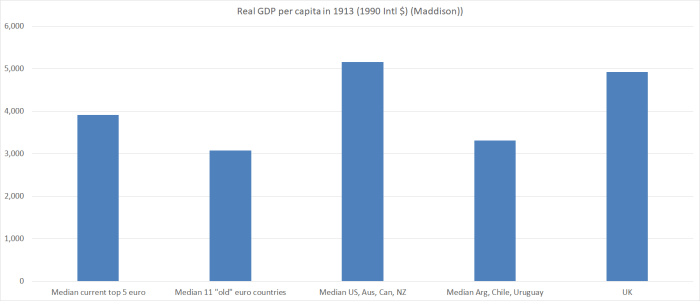
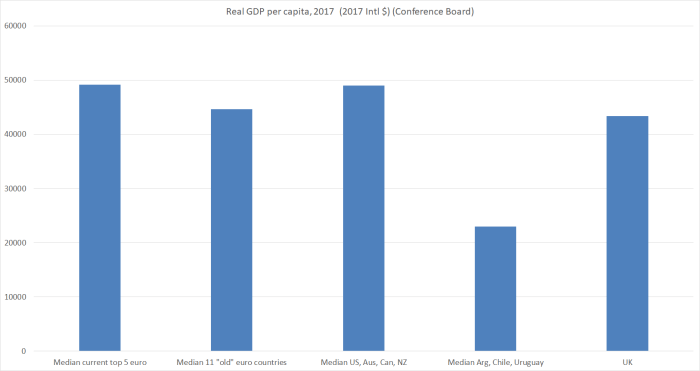
More thoughts on financial crises and economic performance

In my post yesterday, focused specifically on Geoff Bascand’s speech on financial stabilty, financial crises etc, I used this chart

crisis costs

to, again, raise questions about just how much of the poor economic performance over the last decade or so can really be ascribed specifically to the financial crisis (bank failures, large loan losses etc).  After all, the US was the epicentre of the crisis, and my other group of countries (long-established advanced countries, also with floating exchange rates –  Australia, Canada, New Zealand, Norway, Israel, and Japan)  didn’t have domestic financial crises.

I’d been playing around with that data with a view to writing a post about an article in the latest issue of Foreign Affairs, The Crisis Next Time: What We Should Have Learned from 2008″, by Carmen and Vincent Reinhart (she an academic researcher, and he a senior market economist and formerly a senior Fed official).    The Foreign Affairs website is having open access this month, so the link should work for anyone wanting to read the (accessible and not overly long) article itself.

I thought the article was a bit of a mixed bag (and this post ends up only partly being about the article).  Carmen Reinhart, in particular, has been at the forefront of efforts to remind that recessions associated with financial crises are often more severe than other recessions.  That is a useful reminder, but hardly surprising.  Mild recessions tend not to generate many loan losses, and even if the banking system wasn’t rock solid in the first place, nothing too serious is likely to follow.  But if resources have been severely misallocated in the first place, supported by ample new credit, then when the correction occurs –  and views about what is profitable have to be revised –  it isn’t surprising that the associated recession can be deep and the financial system can come under stress.  In New Zealand, for example, it wasn’t the financial system crisis (failure of DFC, repeated near-failures of the BNZ) that made the 1991 recession so serious; rather than pressures on the financial system were part of the same aftermath of excess –  over-inflated expectations – that the entire economy was caught up in, combined with some serious efforts to break the back of high trend rates of inflation.

As the Reinharts point out, the problems can then be particularly severe in a country that has few or no macro policy levers left open too it –  a fixed exchange rate or a common currency, tied to the fortunes of a group that may not share the particular problems you did (thus, for example, Ireland in a euro-area in which Germany is the largest economy).  Adjustment can be a lot slower without the ability to adjust the nominal interest and exchange rates.  Perhaps more than the authors, I’m a sceptic on the euro.

For my purposes, there is a convenient couple of sentences in the Reinhart article

Financial crises do so much economic damage for a simple reason: they destroy a lot of wealth very fast. Typically, crises start when the value of one kind of asset begins to fall and pulls others down with it. The original asset can be almost anything, as long as it plays a large role in the wider economy: tulips in seventeenth-century Holland, stocks in New York in 1929, land in Tokyo in 1989, houses in the United States in 2007. 

It usefully highlights a key difference between, say, the US (or Ireland or Iceland) late last decade, and the experiences of the group of non-crisis floating exchange rate countries whose experience is reflected in that first chart above.   Stock markets in those latter countries took a short-term hit, of course, but there was no sustained loss of (perceived) wealth akin to what happened in the crisis countries.

It isn’t entirely clear from the article how much the authors want to focus mostly on the depth of the initial recession and how much on the disappointing economic outcomes in many countries over the last decade.  But both are mentioned, and there seems to be a tone that conflates the two in a way that I’m not surely is overly helpful (given the goal of learning lessons that can help better prepare us for future severe adverse events).  There also seems to be a very strong focus on the demand side, and none at all on the supply side (no mention at all of productivity growth).

And yet, if we look across the OECD as a whole, the unemployment rate was right back down to where it had been in 2007.  If (and there is) a disappointment about the last decade as a whole, it can’t be now about excess labour supply (unemployed workers) –  slow as the unemployment rate was to come down, it did eventually.  As it happens, the unemployment rate in the US (epicentre of the crisis) is now lower than in the median of my non-crisis floating exchange rate group –  which wasn’t the case in the years running up to 2008.

I have plenty of criticisms for the way many central banks (including our own) handled the years after the 2008/09 crisis and recession.  In some cases, actually tightening when it wasn’t necessary or appropriate, and often a hankering for some sort of return to “normal” interest rates (that may have prevailed in the previous couple of decades) when as has become increasingly apparent something about what is “normal” has changed.  Throw in the lack of any pro-activity in addressing the existence of the near-zero lower bound on nominal interest rates (itself arising from regulatory and legislative choices), and it is clear that more could –  and should –  have been done in many countries.

But even if such changes (in macro policy) had been made, the differences in economic outcomes would probably have been at the margin:  helpful (eg in a New Zealand context, getting core inflation back to 2 per cent, and getting unemployment down to the NAIRU perhaps two or three years earlier), but it is unlikely that it would have made much difference to productivity growth, or indeed to levels of real GDP per capita today.

In yesterday’s post, I showed a chart comparing labour productivity growth trends in the US (epicentre of the financial crisis) and in the group of non-crisis floating exchange rate advanced economies.  But what about multi-factor productivity?

The OECD only has MFP data for a subset of member countries.  Of my sample of non-crisis advanced countries, they don’t have data for Norway and Israel.  But here is the comparison for the US and the group of four non-crisis advanced countries, all normalised to 2007.

MFP crisis.png

In both cases –  although perhaps more starkly so for the non-crisis countries –  it is clear that the slowdown in productivity growth was underway well before the recession (and crisis).  The financial crisis (centred in the US) cannot be to blame for something that is (a) apparent across crisis and non-crisis countries (especially when the non-crisis countries are less productive than the US to start with), and (b) when the phenomenon got underway before the crisis or recession did.

(The Conference Board Total Economy database does have MFP estimates for my full group of non-crisis countries.   They use a different model to estimate MFP, but the same two key observations hold in their data: the slowdown was apparent in both lots of countries well before the crisis/recession, and (if anything) the US has done better than the non-crisis group both before and since its crisis.)

But what about some of the euro-area countries you ask?  And the Reinharts themselves rightly point out how poor the economic performance of Italy (and Greece) has been.  The OECD doesn’t have MFP estimates for Greece, but here are the estimates for three other embattled euro-area countries: Portugal, Spain, and Italy.

MFP crisis 2

All three countries have been in deep trouble for a long time now –  the estimated level of MFP peaking around 2000.   On this score, the trends don’t look materially different over the last decade than over the years leading up to 2007.    Whatever the cause of their problems with productivity, it can’t have been the financial crises these countries went through.

And perhaps nor would you expect it.  Readers might recall a wrenching financial crisis that Korea went through in 1998.   And here is the OECD estimate of multi-factor productivity for Korea.

mfp crisis 3

You can see the 1998 crisis/recession in the data, but as a short-term blip.  In the decade after the crisis, Korea productivity growth kept on at much the same rate experienced in the decade prior to that crisis –  before (presumably) joining in the global slowdown this decade.  (That had also been the experience of the United States in earlier crisis episodes –  estimates suggest that the 1930s, for all its problems (around demand shortfalls) was a period of strong MFP growth.)

There is lots to learn from the searing experience of crisis, recession, and slow growth in the advanced world over the last decade or more.   But I still reckon there needs to be a much more careful unpicking of the different strands of the story than central bankers –  who tend to see the world through money and finance lenses, and who are often keen to champion their future role –  are prone to.  To me, the cross-country evidence just doesn’t square with a hypothesis in which the financial crisis itself plays any large part in the sustained disappointing performance of so many countries over what is now such a long time.

Central bankers meanwhile might be better off rethinking the merits of arrangements like the euro, or of the continued passivity around the near-zero lower bound, both of which look as though they have the potential for causing very major problems the next time there is a serious economic downturn.