Inflation still looks pretty subdued

The latest CPI data were released a couple of days ago.  Perhaps the only real news was that nothing much seemed to have changed, here or abroad, in the last few months’ data.

Here is a chart of OECD core inflation rates

oecd core inflation apr 18

I’ve shown a few different indicators.  Whichever you prefer there isn’t much sign of inflation picking up in the rest of the advanced economies.

Here is the Reserve Bank’s preferred core inflation measure.

sec fac model april 18

If there has been some hint of inflation picking up a little, it remains as excruciatingly slow as ever.   In a series with lots of persistence, the 2 per cent target midpoint seems a long way away.   And although the Reserve Bank and some outside analysts like to suggest this is all about tradables inflation (a) the gap between the core tradables and non-tradables inflation at present is just around the historical average, and (b) tradables inflation, in New Zealand dollar terms, is at least in part an outcome of monetary policy (the exchange rate directly influences it).

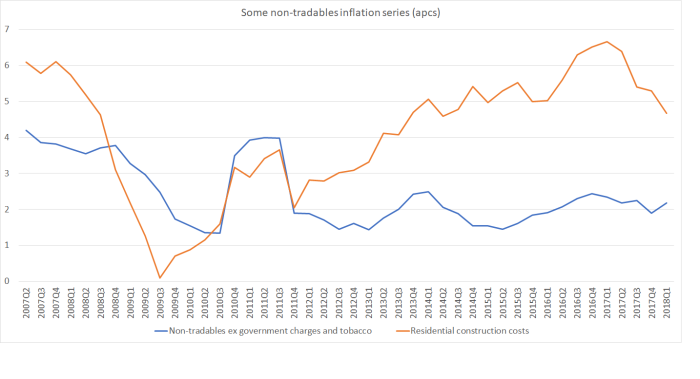
Here are a couple of non-tradables series I’ve shown before.

NT inflation bits

This measure of core non-tradables remains persisently below the rate (somewhere near 3 per cent) that would be consistent with overall core inflation remaining around the 2 per cent target.    The extent to which construction cost inflation has been falling away again is now quite marked: it doesn’t just look like noise.

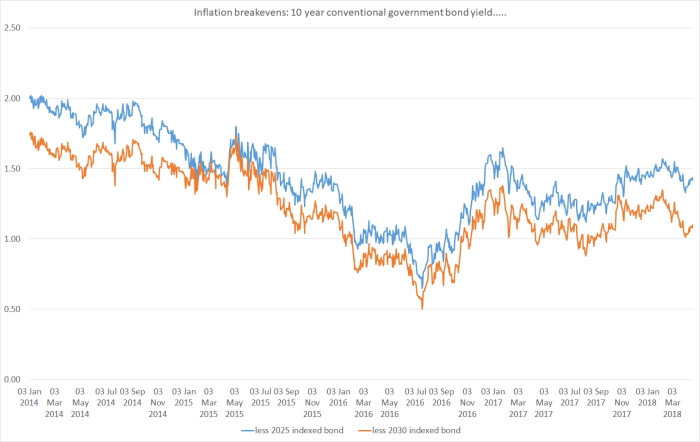
And what of market implied expectations of future inflation from the government bond market?

IIB breakevens Apr 18Nowhere near 2 per cent, and if anything a bit lower than they were three months ago when the last inflation numbers were released.

Pictures like these should be a challenge for the new Governor as he ponders his first OCR decision and associated communications.   After all these years, there still isn’t much sign of (core) inflation getting back to 2 per cent, and there doesn’t seem much impetus from either domestic demand (for which construction cost inflation is often an important straw in the wind) or foreign inflation.

Some who have previously been “dovish” now point to higher oil prices as a reason –  either directly, or just as a straw in the wind – why perhaps core inflation will finally pick up.  Perhaps, but it is hardly been an infallible indicator historically.  Others note that our exchange rate has fallen.  That’s true too, but at present the TWI is about 2-3 per cent lower than the five-yearly average level (not much more than noise), and historically falling exchange rate have often been associated with falling non-tradables inflation (depending what drives the particular exchange rate move).

Time will tell, but in his RNZ interview the other day I heard the Governor praising the “courage” of central banks internationally for having held interest rates so low for so long, despite very strong growth, to help get the inflation rates back up to target.  I wasn’t sure I recognised any element of the description –  in the advanced world, central banks have mostly been reluctant to have interest rates low, and growth has rarely been particularly strong (both caveats seem to describe New Zealand).  But perhaps the Governor needs to consider displaying some of courage he says he has admired and take steps to get New Zealand inflation securely back to target.


A mis-step by the new Governor

Seventeen years ago, in August 2001, then Reserve Bank Governor, Don Brash gave a speech to something called the Knowledge Wave conference, sponsored by Auckland university.  The speech had the title Faster growth? If we want it (at the link  for some reason it says the speech was given by Alan Bollard, who was Secretary to the Treasury at the time, but it was certainly a Brash effort –  here is the link to the version on his website ).   The speech drew a great deal of flak.  It was two years into the term of the Labour-Alliance government, and it had nothing much to do with monetary policy or financial stability (the Bank’s responsibilities), and instead offered the Governor’s views on what could or should be done to lift New Zealand’s economic performance.

According to the Governor, our culture was a big part of the problem

we seem to have some deeply-engrained cultural characteristics which are not conducive to rapid growth – surprisingly widespread disdain for commercial success, no strong passion for education, and a tendency to look for immediate gratification (as reflected in our very low savings rate and strong interest in leisure) – and it usually takes years, and perhaps generations, to change such cultural characteristics.

and the welfare system

does the present welfare system – with largely unrestricted access to benefits of indefinite duration, and with a very high effective marginal tax rate for those moving from dependence on such benefits into paid employment – provide appropriate incentives to acquire education and skills and to find employment?

we will not achieve a radical improvement in our economic growth rate while we have to provide income support to more than 350,000 people of working age – 60,000 more than when unemployment reached its post-World-War-II peak in the early nineties – to say nothing of the 450,000 people who derive most of their income from New Zealand Superannuation.


Could we, for example, drop all benefits to the able-bodied and scrap the statutory minimum wage, so that pay rates could fall to the point where the labour market fully clears, but simultaneously introduce a form of negative income tax to sustain total incomes at a socially-acceptable level? Could we introduce some kind of life-time limit on the period during which an able-bodied individual could claim benefits from the state? Could we, perhaps, gradually raise the age at which people become eligible for New Zealand Superannuation, reflecting the gradual increase in life expectancy and improved health among the elderly? One of my colleagues has suggested the idea of abolishing the unemployment benefit but introducing some kind of “employer of last resort” system, perhaps run by local authorities with support from central government, under which every local authority would be required to offer daily employment to anybody and everybody who asked for it.

and our schools

It must be a source of grave concern that so many of the people coming out of our high schools have only the most rudimentary idea of how to write grammatical English; and that while Singapore, South Korea, Taiwan, and Hong Kong occupied the top four places for mathematics in the Third International Maths and Science Study, New Zealand ranked only 21st (out of the 38 countries in the study). It can not be good for our economic growth, or for the employment prospects of many of our young people, that, according to an OECD report released in April 1998, nearly half of the workforce in New Zealand can not read well enough to work effectively in the modern economy. It must be a matter for particular concern that 70 per cent of Maori New Zealanders, and about three-quarters of Pacific Island New Zealanders, are functioning “below the level of competence in literacy required to effectively meet the demands of everyday life”.

and excessive regulation

Businesses saw the biggest single problem as the way in which the Resource Management Act was being implemented, and described dealing with that legislation as being “cumbersome, costly and complex”. It should not require two years to get all the approvals needed to set up an early child-care facility catering for only 30 children, or ministerial intervention to cut through the red-tape involved in setting up a boat-building yard. Most of us know similar horror stories.

and our tax system

Another matter relevant to how we might encourage more investment in physical capital is the tax regime. Do we need a substantial change in the tax structure to encourage investment in New Zealand by New Zealanders, by immigrants, and by foreign companies? And if so, what might that change look like? This isn’t the place to go into detail, but it would probably involve a significant reduction in the corporate tax rate (it is disturbing that New Zealand’s corporate tax rate is now the highest in the Asian region). The rate of company tax is rarely the only factor determining the location of a new investment, and indeed it is not often even the dominant factor. But it is a relevant factor, and is one of the issues to look at if we are serious about encouraging more investment in New Zealand.

There were some interesting ideas in the speech. I probably agreed with quite a few of them (I was one of those who gave comments on the draft text, which was even more radical and provocative).  It brought to mind comments about ‘save it for your  retirement”, or “stand for Parliament and make your case” –  which of course Don did a few months later.  But whether you agreed with him or not, whether the government of the day agreed with him or not, it just wasn’t appropriate for an incumbent Reserve Bank Governor.

The Governor is entrusted with a great deal of discretionary power in a limited number of areas.  Citizens need to be confident that the Governor is operating in the public interest, and not to come to suspect the Governor or the Bank of using a very powerful position –  and the pulpit it provides –  to advance personal agendas for policy in other areas.  Same goes for all sorts of key officeholders –  the Commissioner of Police, the Chief Justice or whoever.

That isn’t a novel perspective.  A few years ago Willem Buiter –  chief economist of Citibank and formerly an academic and external member of the Bank of England Monetary Policy Committee –  wrote a useful paper in which(from p286) he urged central bankers to “stick to their knitting”.

The notion that central banks should focus exclusively on their mandates and not be active participants in wider public policy debates, let alone be active players in the negotiations and bargaining processes that produce the political compromises that will help shape the economic, social and political evolution of our societies is, I believe, sound. Alan Blinder described this need for modesty and restraint for central bankers as sticking to their knitting.

As Buiter notes, central banks have often not followed that advice, but

Although always inappropriate, central banks straying into policy debates on
matters outside their mandates and competence is less of a concern when there is little central bank independence and the central bank functions mainly as the liquid arm of the Treasury. It becomes a matter of grave concern when central banks have a material degree of operational independence (and sometimes of target independence also).

Of one example of such straying he writes

Chairman Bernanke may be right or wrong about the usefulness of this kind of fiscal policy package at the time (for what it is worth, I believe he was largely right), but it is an indictment of the American political system that we have the head of the central bank telling members of Congress how they ought to conduct fiscal policy. Fiscal policy is not part of the Fed’s mandate. Nor is it part of the core competencies of the Chairman of the Federal Reserve Board to make fiscal policy recommendations for the US federal government.

And of another

Draghi’s recent address at the Jackson Hole Conference organised by the Federal Reserve Bank of Kansas demonstrates how broad the range of economic issues is on which the President of the ECB feels comfortable to lecture, some might say badger, the political leadership of the EA (Draghi (2014)). Regardless of the economic merits of Draghinomics, there is something worrying, from a constitutional/legal/political/legitimacy perspective, if unelected central bank technocrats become key movers and shakers in the design and implementation of reforms and policies in areas well beyond their mandate and competence.

All of which came to mind when I listened this morning to the interview with new Reserve Bank Governor, Adrian Orr, undertaken yesterday by Radio New Zealand’s Kathryn Ryan.   The interview went for half an hour, and had all of Orr’s accustomed fluency (and not terribly searching questions), but probably half of it was on matters that had really no connection at all to the statutory responsibilities of the Reserve Bank.

He talked at length about climate change and what governments and firms did or didn’t (in his view) have to do.  Some of this no doubt built off his former role with the New Zealand Superannuation Fund –  including the (untransparent) shift in the portfolio away from carbon-intensive assets –  but he is now the Governor of the Reserve Bank, which  has no responsibility for, and isn’t particularly affected by, such matters.  And these are all highly politicised issues.  “The transition needs to start today” he insisted: many people might agree, while others will reasonably take a quite different view, valuing the option of waiting.   The developed world had “gorged on fossil fuel” for 300 years, and now we needed to offer resources to the emerging world.  Probably conventional wisdom at a Green Party rally, but this is from the Governor of the Reserve Bank.

The Governor urged everyone – firms, societies, banks and (presumably) governments to “think and act longer-term”, lamenting the failure of society to take heed of his strictures (and offering no evidence to support his case).   When was the Governor gifted foresight beyond that available to mere mortals? Most humans find the future uncertain, and the far future very much so –  just check out prognostications and concerns from 50 years ago –  and have to plan accordingly.

He seemed to lament the fact that Western societies were growing older –  surely one of the great successes of economic development –  and then declared that it was “fair enough” that the “have-nots” should want structural change now.  How can this possibly be appropriate for the Governor of the Reserve Bank?  (Even if the government of the day happened to agree with him, he is (a) an independent actor, and (b) may well still be in office when the other side of politics once again takes over.)

And, putting a stake in the ground in a hugely contentious issue he declared himself a “huge believer that the country has underinvested in infrastructure”, claimed that our mindset around infrastructure finance was 30 years out of date, and lamented our reluctance to embrace PPPs (while addressing none of the risks of downsides of such structures).

Returning to the Green Party type of narrative, the Governor declared that in his travels he found that the world was looking to New Zealand to show leadership in transitioning to “sustainable agriculture”, declaring how “fantastic” it was when individual farmers had made such a shift.

You might agree with him or some, all, or none of that (I’m in the “none” category myself) but that really isn’t the point.   It would have been quite as inappropriate if he’d been making the opposite points, or repeating the sorts of lines Don Brash was running in 2001 –  championing large company tax cuts, or vocally opposing R&D tax credits.   He has simply gone miles off reservation, nailing his colours to political masts that will make it very hard for him to gain respect as someone operating as an non-political powerful regulator (for now, until the Act changes, the single most powerful unelected official in New Zealand). Perhaps it was a rookie error, and recognising his mistake he can pull his head in, and concentrate on the tasks Parliament has given him, and the need –  acknowledged in his Stuff interview yesterday –  to markedly lift the Bank’s own game.  If not –  if it was conscious and deliberate –  it was a dangerous lurch in the direction of politicising one of the more important offices in our system of government.

I’m not suggesting central banks should never comment on other areas of policy, but they need to be very modest and self-effacing in doing so, and need to tie their comments, and the issues, chosen, very carefully to the Bank’s own areas of responsibilities.  It isn’t, for example in my view the Bank’s place to advocate land use liberalisation, but it is quite appropriate for them to highlight the way that policy choices in that area affect house and land prices, and thus influence the risks on bank balance sheets.  It generally isn’t appropriate for the Bank to take a view on the merits, or otherwise, of particular fiscal or structural policies. But at times the Bank will need to point out the implications of such choices for, say, the mix of monetary conditions.   We should value a good independent central bank, but the legitimacy of the institution –  and its ability to withstand threats to that independence –  will be compromised if Governors play politicians or independent policy and economic commentators.

(Of the bits of the interview dealing with Reserve Bank issues, I didn’t have much to disagree with –  although he seemed far too complacent about the ability of monetary policy globally to cope with the next recession.  There was one proposal that sounded eminently sensible, if challenging to operationalise.  Remarkably the interviewer asked him almost nothing about lifting the Bank’s own game, or the results of that New Zealand Initiative survey on the Bank’s conduct as regulator and supervisor.)

R&D tax credits: more ill-considered corporate welfare

In the minds of members of our new government, much of whatever hope they have of transforming New Zealand’s economic performance (productivity, foreign trade and so on) seems to rest on the proposed R&D tax credit.

Don’t just take my word for that.  Yesterday, they released a discussion document on details of the new tax credit, which is scheduled to take effect next year.  The document is headed Fuelling Innovation to Transform our Economy” .  In the Foreword, ministers gush

This Government’s vision is to build a better New Zealand for all our people and we see an incredible opportunity ahead of us to do this.

That means a country with affordable, healthy homes; an environment we can be proud to leave to future generations; and a diverse, sustainable, and productive economy that delivers for our people.

This vision can’t be delivered with the same old approaches. We need new ideas, new innovations, and new ways of looking at the world.

And that is where science, innovation and research can play an important role. That is where we see our innovators, our scientists, our entrepreneurs and our visionaries building a better New Zealand.

In the view of the government, businesses don’t spend enough on research and development.  They need to spend more.   Knowing better than businesses apparently, the government is to fling another subsidy into the mix.  My mind is carried back to bad old days of export incentives, and other patchwork attempts to avoid addressing the real issues (in those days, heavy import protection and a (typically) overvalued real exchange rate).

As far as I can see, the only thing released yesterday was the discussion document.  There was no officials’ advice on the economics of the proposal, no Cabinet paper, no regulatory impact statement. Not really anything at all, other than few assertions and then straight to the details of the proposed scheme –  the only bit they seem actually interested in consulting on.  Not once –  in yesterday’s document, or in anything else the government has published –  have I seen any considered analysis of why profit-maximising firms might have not regarded it as worthwhile to do more R&D spending here.   If you don’t understand that, it is unlikely that any proposed remedy is a serious well-structured response.  Much seems to rest on the fact that most –  but by no means all – OECD countries also offer these subsidies.

There is quite a reasonable argument to suggest that research and development spending is already rather favourably treated by the tax system.   Purchase a physical asset as part of your firm’s production, and you can only deduct it against taxable income through depreciation, over the expected economic life of the asset.  But research and development spending is really just another form of investment –  it is even in the national accounts (GDP numbers) as such.  But most of that spending is immediately deductible for tax purposes.   The R&D spending that Boeing did to come up with the 747 generated sales and profits over decades, but instead of that spending being offset against those profits in the  years they were earned, it would all have been deductible up-front.  The time-value of that favourable treatment is considerable (huge when the R&D leads to a product with a long period in the market).  And since New Zealand has now one of the higher company tax rates in the OECD, the value of that standard ability to deduct is already larger here than in many other OECD countries (and before people start invoking our imputation scheme, it is the company tax rate that matters for foreign investors and in the document the government says “We also want to attract large
international R&D intensive firms to New Zealand”).

In the discussion document there is a full page graphic highlighting gross R&D spends in a variety of advanced countries.  For some reason, even though the R&D credit is aimed at businesses, they don’t quote business R&D expenditure, so in this table I’ve added that column as well, using data from the OECD.

Total R&D Business R&D
% of GDP
United States 2.8 2
United Kingdom 2.9 1.1
Canada 1.7 0.9
Ireland 1.5 1.1
Finland 2.9 1.9
Denmark 3 1.9
Israel 4.3 3.6
Switzerland 3.4 2.4
Australia 2.8 1.2
New Zealand 1.3 0.6

Which is interesting, but it is perhaps worth pointing out that of those countries, Finland, Denmark, and Switzerland (as well as New Zealand) don’t have R&D tax credits.  As I’ve pointed out in other posts Germany doesn’t either –  and business expenditure of R&D there is about 2 per cent of GDP.    On OECD estimates, the value of the US tax credit is also very small.

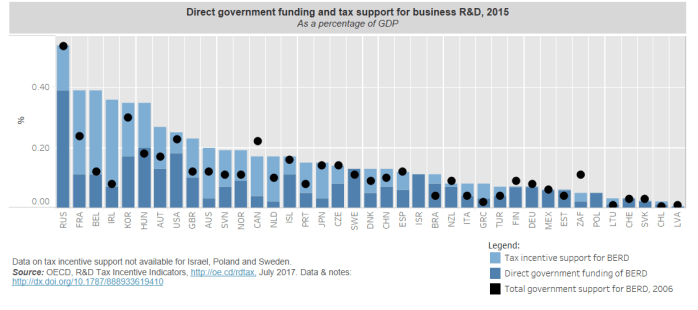
R&D tax credits aren’t the only form of government spending to subsidise business R&D – in fact, the government’s new scheme involves doing away with the current grants.   And as it happens, OECD numbers suggests we already spend more (per cent of GDP) on such subsidies than Germany (DEU), and quite a lot more than Switzerland (CHE).

Direct government funding and tax support for business R&D, 2015

All of which might suggest taking a few steps back and thinking harder about why firms themselves don’t see it as worth undertaking very much R&D spending here.  But given a choice between hard-headed sceptical analysis and being seen to “do something”, all too often it is the latter that seems to win out.

In an earlier post, I pointed out

Formal research work done previously suggests that the rate of business R&D spending in New Zealand partly reflects the sort of stuff we produce.  One way to see that is to look the OECD’s commodity exporting countries, and compare them with seven economies at the heart of advanced Europe.  These are simply different types of economies.

BERD (% of GDP) BERD ( % of GDP)
Australia 1.23 Austria  2.03
Canada 0.93 Belgium  1.58
Chile 0.14 France  1.44
Mexico 0.17 Germany  1.96
New Zealand 0.57 Netherlands   1.10
Norway 0.87 Switzerland   2.05
Denmark   2.oo
Median 0.72 Median 1.96

In passing, it is also perhaps worth highlighting Israel –  an economy with very high business spending on R&D, and yet not only an economy with GDP per capita around that of New Zealand, but with a similarly poor longer-term productivity record.  They make and sell different stuff –  some of which clearly needs lots of R&D –  but not, overall, any more successfully than we do.

A reasonable counter to this sort of line of argument might be “ah yes, but we want to be Denmark –  after all, in some sense they once were New Zealand (agricultural exporter etc)”.     But if the opportunities are really here for such a transformation, has the government and its advisers stopped to think about why firms don’t seem to see investing in more R&D as offering a worthwhile expected return?  Danish firms didn’t seem to need an R&D tax credit to get there.

Personally, the 2025 Taskforce’s approach to the issue seems more persausive

The 2025 Taskforce addressed some of these issues in their 2009 Report (around p 70).  They argued that more attention should be given to the possibility that high levels of business R&D spending might reflect more about where particularly economies are at (near the frontier or not, differences in product mix) rather than being some independent factor explaining the success or failure of nations.  In their view, a highly successful New Zealand was likely to be one in which more business research and development spending was taking place, but as a consequence of that transformation rather than an independent cause of it.  That still seems like a pretty plausible story to me –  although New Zealand is long likely to be primarily an exporter of commodities, and richer commodity exporters (Norway, Australia and Canada) don’t have particularly high levels of business R&D spending.

And part of the transformation in New Zealand seems almost certain to involve a much lower real exchange rate for a prolonged period.  It was an important message in the 1980s –  when officials actually took it seriously –  and remains no less important today, even if ministers and officials now seem to ignore the issue.

I don’t want to spend time on the detailed issues of the design of the new tax credit.   But I did notice this

A business will need to spend a minimum of $100,000 on eligible expenditure,
within one year, to qualify for the Tax Incentive. The rationale for setting the threshold at $100,000 of eligible expenditure is to filter out claims that are not likely to be genuine R&D. $100,000 of expenditure is roughly the cost of one full time employee’s salary and related overhead costs.

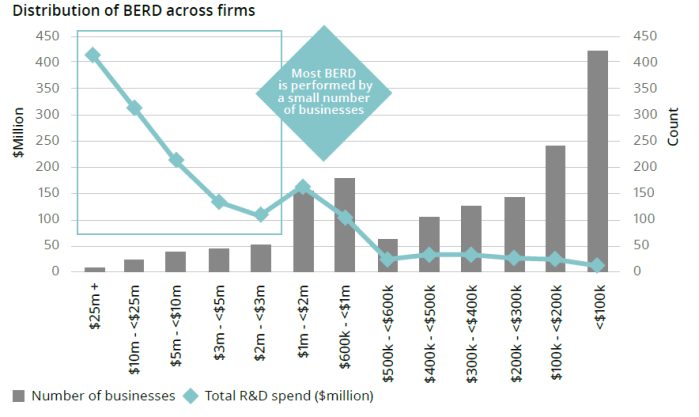
It isn’t clear why small claims should be less likely to be all genuine R&D than large ones. But then juxtapose the planned threshold with this chart

BERD by firms NZ

In other words, a large proportion of the companies doing R&D won’t be eligible for the new subsidy at all, while the “big end of town” can gobble up generous subsidies from the taxpayer.  It is corporate welfare, deliberately skewed to the bigger firms.

An interesting feature of the proposed new tax credit is that there is no attempt to structure it to incentivise increased levels of R&D spend.  The tax credit will apply to the first dollar of R&D expenditure (for firms above the $100000 threshold) –   much of it spending the firm would have done anyway.  No doubt there are arguments for such an arrangement in practicality and minimising compliance costs.  But it also means that the returns to whatever additional R&D spend might take place as a result of the tax credit will have to be very high, to cover the cost of the whole programme.  And yet there is no attempt at any sort of cost-benefit analysis (actually not even an estimate of the fiscal cost) in the discussion document –  or even a hint that one has been done elsewhere.  It is as if the government believes that any increase in recorded deductible gross R&D spending will offer gains in material living standards for New Zealanders.   Perhaps, but it would be nice to see the case rigorously made, and the detailed assumptions exposed to scrutiny.

Full marks to the new Governor

Earlier in the week I wrote about the New Zealand Initiative’s report on economic regulators, and in particular the scathing feedback (in survey results and interviews) for the Reserve Bank’s handling of its extensive financial regulatory and supervisory function.

I noted then

One would hope that the new Governor, the new Minister, and the Treasury and the Board, are taking these results very seriously, and using them to, inter alia inform the shaping of Stage 2 of the review of the Reserve Bank Act.  I’ve not heard any journalist report that they’ve approached the Reserve Bank  –  or the Board or the Minister – for comment on the report and the Bank-specific results.   But such questions need to be asked, and if the Bank simply refuses to respond or engage that in itself would be (sadly) telling.

But a reader drew to my attention that Hamish Rutherford of Stuff has indeed approached the Bank.  And got answers.

Adrian Orr, the new governor of the Reserve Bank, has written to the chief executives and chairs of New Zealand’s banks alerting them to a damning report fed by their anonymised comments.

An improbable star of New Zealand finance, Orr, 55, started in the role on March 27, arriving at a central bank which he acknowledges is under fire.

“This place is a diamond, but it needs significant polishing in places,” Orr said in an interview in the Reserve Bank headquarters.

“We need to think much harder about how we behave, how we roll, how we explain, how we do things. That’s a cultural challenge for the bank.”

and

As well as posting the comments of the report on the Reserve Bank’s internal intranet, Orr had written to bank bosses with the message that: “Hey, this doesn’t print well. We hear you. We need to do something about it.”

He expected that writing the letter and making public statements would elicit “free, unsolicited advice about how this place can do better”.

That is an excellent start: fronting and recognising the issue, to the public, to staff, and to the heads of regulated entities (people who completed the survey).

I’ve been critical enough of the Bank –  and have offered plenty of unsolicited advice as to how the place can be improved (by law and by culture/performance).  I’ve also been a little sceptical of Orr, prior to him taking up the role.   But this is an excellent start.  It is only a start of course, and perhaps he really had no choice but to adopt such an approach in response to feedback so dire.  And actions will need to follow, to change future outcomes. and that will take time and lot of commitment.   But I’m not going to grudge him praise today.

Well done, Governor.


Economic growth within environmental limits

That was the title of a speech David Parker gave a couple of weeks ago.  Parker is, as you will recall, a man wearing many hats: Minister for the Environment, Associate Minister of Finance, Minister for Trade and Export Growth, and Attorney-General.  Since he was speaking to a seminar organised by the Resource Management Law Association, this speech looked like it might touch on all his areas of portfolio responsibility.

In passing, I’ll note that he clearly doesn’t live in Wellington.  He introduces his speech lamenting that New Zealand had just had its hottest summer on record.  Most Wellingtonians –  no matter how liberal (indeed, I recently heard an academic working on climate issues make exactly this point) – revelled in a summer that for once felt almost like those the rest of New Zealand normally enjoys.   The sea water was even enjoyably swimmable not just bracing or “refreshing”.

But the focus of his speech is on economic growth.

First he highlights some of New Zealand’s underperformance.

New Zealand has enjoyed relatively strong nominal economic growth over recent years, bolstered by strong commodity prices, population growth and tourism. More inputs, mostly people, have been added into the economy but, with population growth stripped out, per capita growth has been poor at about 1 per cent per annum.

That underperformance has been the story of decades now.   And poor as the growth in per capita real GDP has been, productivity growth –  real GDP per hour worked –  has been worse.  In one particular bad period, over the last five years or so, labour productivity growth has been close to zero (around 0.2-0.3 per cent per annum on average).

Parker is obviously aware of this, beginning his next paragraph “we also have a productivity problem”, but seems more than a little confused about the nature of the issue.

Capital has been misallocated, including into speculative asset classes such as rental housing, rather than into growing our points of comparative advantage.

But…….your government (rightly) keeps telling us that too few houses have been built, laments increases in rents etc.   If we are going to have anything like the rate of population growth we’ve run over recent decades (let alone the last few years) ideally more real resources would be devoted to house-building, not less.  Simply changing the ownership of existing houses doesn’t divert real resources from anything else, or even use material amount of real resources.

The Minister goes on

We aim to diversify our exports and markets as we move from volume to value. We want to change investment signals so more capital goes towards the productive economy rather than unproductive speculation.  Where we need immigration, it will be more targeted.

That last sentence sounds promising, even tantalising.  But it doesn’t seem consistent with the Prime Minister’s rhetoric, with Labour Party policy on immigration, or with the (in)action of the government on immigration policy to date.     Our large-scale non-citizen immigration programme runs on unchanged, complemented by the big increases in recent years in the numbers here on short-term work visas.    A reduced rate of population growth would reduce the extent to which real resources needed to be devoted to meet the –  real and legitimate –  needs of a fast-growing population.

The Minister also makes a bold claim

I am an experienced CEO and company director. I know from experience that we can achieve economic, export and productivity growth within environmental limits.

No doubt, as absolute statements, those claims are true. But surely the relevant question is “how much?”     After all, the message Labour and the Greens were running in the election campaign was that what apparent economic success there had been in recent years was built on “raping and pillaging” the environment –  water pollution, offshore oil exploration, emissions etc.   And yet, as the Minister notes, even that “economic success” didn’t add up to much: weak per capita GDP growth, almost non-existent productivity growth, no progress in closing the gaps to the rest of the advanced world.  And what of exports?

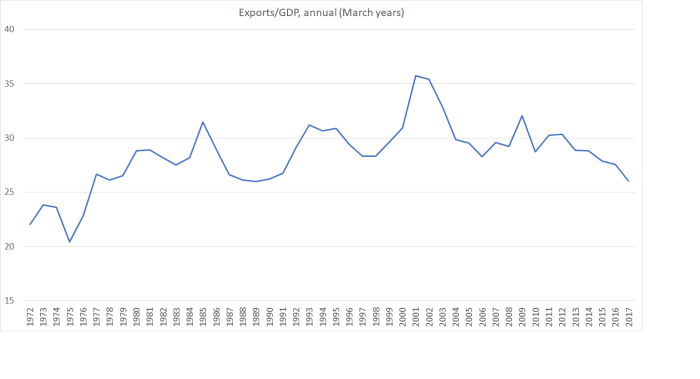
exports 2018The past 15 years have been pretty dreadful, and the last time the export share of the economy was less than it was in the March 2017 year was the year to March 1976 –  back in the days when (a) export prices had plummeted, and (b) the economy was ensnared in import protection, artifically reducing both exports and imports (our openness to the world more generally).

In the Minister’s own words

But economic management over recent years has put pressure on our social wellbeing and our environment. 

So how, we might wonder, is a greater emphasis on environmental protection going to be consistent with the economic growth, and the exports and productivity growth that David Parker says the government aspires to?

As Minister for Economic Development and for Trade and Export Growth, my priorities reflect the reality that our economic success will be underpinned by a more productive, sustainable, competitive and internationally-connected New Zealand.

It is great to see growth in the value of output from our productive sectors. The Government wants to work with them to ensure that the right conditions are in place for firms to thrive and trade, and that we maximise the value of the goods we produce, and encourage high-quality investment in New Zealand. We want our sectors and regions to realise their full potential.

Economic growth and trade helps us create a greater number of sustainable jobs with higher wages and an improved standard of living for all New Zealanders.

However, the Government is clear that economic growth cannot continue to be at the cost of the environment. This is not idealism: it is grounded in common sense. Protecting our environment safeguards our economy in the long term – our country has built its economy and reputation on our natural capital.

I’m not arguing against improving environmental standards, perhaps especially around fresh water.  Improvements in the environment are typically seen as a normal good: as we get richer we want (and typically get) more of it.  But those gains usually come at some (direct) economic cost.    Major change isn’t just wished into existence.

In some places, perhaps, these changes are easier than in others.  If the tradables sector of your economy is, in any case, in a transition  away from heavy industry to, say, financial or business services (perhaps the UK experience), you are naturally moving from industries that might otherwise tend to pollute heavily towards those that don’t.  And farming –  and land-based industries –  might be a small part of the economy anyway.

But this is New Zealand.  And in New Zealand probably 85 per cent of all our exports are natural-resource based, and total services exports (even including tourism) are no higher as a share of GDP than they were 15 or 20 year ago.  Not very many new industries seem to find it economic to both develop here, and then remain here.   We –  and the Minister –  might wish it were otherwise, but up to now it hasn’t been.  Instead, what export growth we’ve had has been in industries where the government is often –  and perhaps rightly –  concerned about the environmental side-effects.

In his speech, the Minister declares that as Minister for the Environment improving the quality of freshwater is his “number one priority”.  I might have hoped that fixing the urban planning laws was at least up there, but lets grant him his priority for now.    How does he envisage bringing about change?

In environmental matters there are only three ways to change the future – education, regulation and price. Of these the most important for water is regulation

And regulation comes at a cost, reducing the competitiveness of firms and industries that are no longer free to do as they previously did.  The best presumption then has to be that future growth in affected sectors will be less than previously, and less than it would otherwise have been.  Sometimes, regulatory and tax initiatives spark brilliant new technologies enabling industries to move to a whole new level.  But you can’t count on that.  You have to work on the assumption that regulation costs.  Those costs might be worth bearing, but you shouldn’t pretend they aren’t there.

The same will, presumably, go for including agriculture in the emissions trading system, however gradually.   Relative to the past, firms facing such a price will no longer be as competitive as they otherwise would have been.    And experts tell us that as yet there are few technologies for effectively reducing animal emissions –  other than having fewer animals.

And then, of course, there are the direct bans.  The ban on new offshore oil exploration permits hadn’t been announced when the Minister gave his speech, but it will –  by explicit design –  reduce output in the exploration sector and, over time, in the domestic production of oil and gas.    It might be –  as some of the government’s acolytes argue – “the thing to do”, “leading the way”, “this generation’s nuclear-free moment” [that one really doesn’t persuade if you thought the Lange government’s gesture was a mistake too], but it must come at an economic cost to New Zealanders.  An economy totally reliant on the ability to skilfully exploit its natural resources, consciously and deliberately chooses to leave some chunk of those –  size unknown –  untapped.

Again, over the course of the last 45 years –  the period of that exports chart –  we’ve had a lot of oil and gas development.  All else equal, our economic performance can only be set back without it – not perhaps this year, or next, but over time.  And it all adds up.

Reading through to the end of the Minister’s speech there is simply no credible story for how he, or the government, expects to be able to do all these things and still see some transformation in the outlook for per capita GDP growth, or growth in productivity or exports.  Indeed, there is nothing there to explain why the outlook won’t be worsened by the sorts of initiatives –  each perhaps worthwhile in their own terms.

It might be different if the government was willing to do something serious about immigration policy, rather than just carrying on with the bipartisan “big New Zealand” strategy.   When natural resources are a crucial part of your economy –  and everyone accepts they still are in New Zealand –  then adding ever more people, by policy initiative, to a fixed quantity of natural resource is a straightforward recipe for depleting the stock of resources per capita, and thus spreading ever more thinly the income that flows from those natural resources.

It is pretty basic stuff: Norway wouldn’t be so much richer per capita than the UK –  both producing oil and gas from the North Sea –  if Norway had 65 million people.  And if Norway decided to get out of the oil and gas business –  leaving underground a big part of their natural resource endowment –  they’d be crazy to drive up their population anyway.    But that is exactly the thrust of what the New Zealand government is doing between:

  • what is aspires to do on water,
  • its ambitious emissions targets, in a country with very high marginal abatement costs, and
  • the ban on new oil and gas exploration permits

even as it keeps on targeting more non-citizen migrants (per capita) than almost any other country on the planet, and as the export share of GDP has been under downward pressure anyway.

It is not as if there is a compelling alternative in which export industries based on other than natural resources are thriving, boosted immensely by the infusion of top-end global talent, in ways that might make us think that natural resource industries could easily be dispensed with and a rapidly rising population was putting us on a path to a more prosperoous, productive, and environmentally-friendly future.  Its been a dream, or an aspiration, of some for decades.  But there is barely a shred of evidence of anything like that happening in this most remote of locations.

It might all be a lot different if the government was willing to step aside from the “big New Zealand” mentality, or put aside for a moment fears of absurd comparisons with Donald Trump –  recall that (a) our immigration is almost all legal, and (b) residence approvals here (per capita) are three times those in the US (under Clinton/Bush/Obama).

If the government were to move to phase in a residence approvals target of 10000 to 15000 per annum (the per capita rate in the US), with supporting changes to work visa policies, we’d pretty quickly see quite a different –  and better –  economic climate.   We’d no longer have to devote so much resource (labour) to simply building to support a growing population –  houses, roads [rail if you must], schools, shops, offices.  All else equal our interest rates –  typically the highest in the advanced world –  would be quite a bit lower, and the real exchange rate could be expected to fall a long way.  I don’t think there is a mention in the whole of David Parker’s speech of the real exchange rate, but it is a key element in coping successfully with the sorts of transitions the Minister says he aspires to.   Farmers, for example, will be able to compete, even with tougher water regulations, even with the inclusion of agriculture in the ETS.  And more industries in other sector will find it remunerative to develop here, and remain based here.  We’d actually have a chance of meeting both environmental and economic objectives instead of –  as the government would see it –  having consistently failed on both counts.

Last year, I ran several posts (including this column) making the point that rapid population growth –  mostly the consequence of immigration policy –  was the single biggest factor behind the continued growth in, and high level of, carbon emissions in New Zealand over recent decades.  In other words, we had made a rod for our own back and then –  through the process of driving up the real exchange rate –  made it even more difficult and costly to abate those emissions without materially undermining our standard of living.  OIA requests established that neither MBIE nor the Ministry for the Environment had even explored the issue.

It wasn’t a popular view, but I stand by the argument.  In a country still very heavily dependent on natural resources, if you care about the environment, and about “doing our bit” on carbon emissions, it is simply crazy to keep on actively driving up the population.  Doubly so, if you think you can do so and still improve productivity, export growth, and overall economic performance.  The Productivity Commission is due to release soon its draft report on making the transition to a low emissions economy.  I hope they have been willing to recognise, and explicitly address, the integral connection to immigration policy in the specific circumstances New Zealand faces.  Not wishing to confront the connection –  an awkward one for the pro-immigration people on the left in particular –  won’t make it go away.

Visiting economists opine on NZ

Lots of people, even abroad, look at New Zealand’s economy.   For example, there are ratings agencies selling a commercial product to clients, and there are investment funds putting their own and clients’ money at risk.   And then there are the government agencies; notably the IMF and the OECD.

Every year or so, a small team of IMF economists come to visit for their Article IV assessment.  New Zealand isn’t very important to the Fund: we aren’t systemically important, we don’t borrow money from the Fund, and we aren’t even part of any of the country groupings with traditional clout at the Fund (eg the EU or euro-area). And the New Zealand story is complicated –  there aren’t other countries much like New Zealand to compare us against and learn from, and especially not in the Asia-Pacific region (the department of the IMF that covers New Zealand).  There isn’t much incentive for the Fund to spend much time on New Zealand, or to devote their best people to New Zealand issues, or to do much other than pay polite deference to the preferences of whoever happens to hold office (bureaucratic and political) at the time, spout some conventional verities favouring smart government intervention, while burying any scepticism in very careful drafting.    We might deserve better than we get –  after all, we are a member just like all the other countries – but to expect better would be to let wishful thinking triumph over (very) long experience.

But because the IMF’s report on New Zealand is published, and because the mission chief makes themselves available to the local media, the IMF team’s views tends to get some local media coverage.  The latest report – in this case the three page concluding remarks from the just-completed mission –  came out yesterday.

As has become traditional, they tend to laud New Zealand’s cyclical economic performance

New Zealand has enjoyed a solid economic expansion in recent years. Construction and historically high net migration have been important growth drivers. Accommodative monetary policy, increasing terms of trade, and strong external demand from Asia have supported activity more broadly.

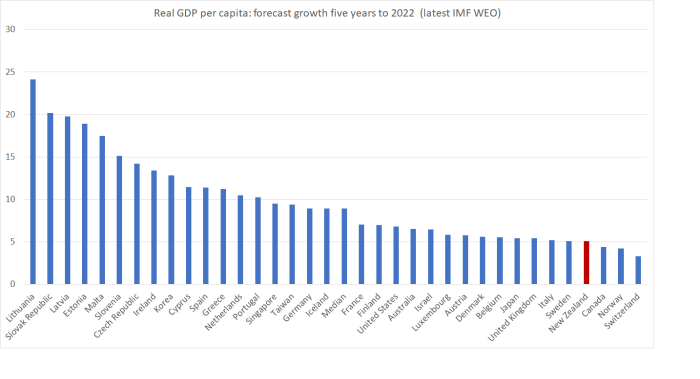
As it happens, on the IMF’s own numbers, growth in real per capita GDP in New Zealand over the last five years has been nothing spectacular –  among advanced countries we’ve been the median country and the advanced world hasn’t done that well.  And nowhere in the report do they even allude to the fact that almost all that New Zealand growth has resulted from more inputs, and that productivity growth has been near-zero for much of the last five years.  From an international organisation that emphasises the importance of open trade etc, there is also no mention at all of the fact that exports and imports have been shrinking as a share of GDP.

They also tell us that “the baseline economic outlook is favourable”.   Perhaps, but their own numbers say something a bit different.  Here is a chart of the IMF’s own forecasts for growth in real per capita GDP for the five years from 2017 to 2022.

IMF forecasts

Not only do they forecast New Zealand’s growth rate to slow (whereas the median country’s growth rate is forecast to accelerate) but on these projections we are expected to have one of the slowest (per capita) growth rates of any advanced country over the next five years.  Perhaps there is some productivity miracle embedded in these numbers –  the IMF doesn’t produce the breakdown of their growth forecasts –  but it looks as though they expect another half decade when we drift a bit further behind.  Strangely, none of that showed up in ysterday’s statement.

What of macro policy (monetary and fiscal)?

Here is what they have to say on monetary policy

Current monetary policy is appropriately expansionary. The policy settings are robust to current uncertainties. A precautionary further easing would raise risks of a steeper tightening if inflationary pressures emerged sooner than expected, given that the economy appears to have been operating close to capacity for some time. On the other hand, a premature tightening could prolong price setting below the mid-point of the target range, given persistently low inflation in recent years.

But this is pretty vacuous.   Getting policy wrong is, rather obviously, a bad thing.   But it is nonsense to suggest that current policy is “robust to current uncertainties”.  After all, if inflation ends up staying persistently low,  then not to have eased earlier would have risked inflation expectations falling away, and more people being unemployed than necessary.  All they are really saying is “we believe –  as we have for years, wrongly –  that inflation is about to start rising back to the target midpoint, and if so current policy will prove to have been appropriate”.   But this was the same organisation that only a few years ago was cheerleading for the ill-fated 2014 Wheeler tightening.

(And one might have hoped that the IMF – in principle able to take a longer-term perspectives –  might have been pointing to the risks, of rather limited monetary policy capacity, in the next recession and encouraging the authorities to be taking steps now.)

What of fiscal policy?

The strong fiscal position provides space to accommodate the needs from strong economic and population growth. Compared to the time of the last Article IV Consultation, the updated baseline expenditure path already incorporates higher infrastructure spending and new growth-friendly measures, as discussed below. The continued political commitment to budget discipline and a medium-term debt anchor in New Zealand is welcome. With the country’s strong fiscal position, there is no need for faster debt reduction beyond that outlined in the 2017 Half Year Economic and Fiscal Update. Stronger structural revenues, such as from higher-than-expected population growth, should be used to increase spending on infrastructure and other measures that would strengthen the economy’s growth potential.

This paragraph just exemplifies how the IMF has  –  at least for tame untroublesome countries –  ended up too often as a mouthpiece rehearsing the preferred lines of whoever holds office at the time.   Contrast the tone with these lines from last year’s statement.

Current budget plans appropriately imply a counter-cyclical fiscal stance going forward. Stronger-than-expected revenue for cyclical reasons should be used to reduce public debt.

With not a hint that anything fundamental has changed to justify the change in advice, except the government……

The Article IV mission still seems as mixed up as ever on housing and associated risks.  They’ve been enthusiastic supporters of LVR controls –  never even alluding to the efficiency or distributional costs – as if the basic issue in the housing market had been inappropriate credit availability.    Thus they can write

Household debt-related vulnerabilities are expected to decrease following recent stabilization. Macroprudential policy intervention contributed to slowing household debt growth, and momentum in house prices moderated last year. While housing demand fundamentals remain robust under the baseline outlook, the soft landing in the housing market should continue, reflecting increasing supply and, in the medium term, gradually rising domestic interest rates.

But then later in the report they talk at some length about the various measures –  some concrete, some (at this stage) still promises – the government is planning to affect the housing market.   Perhaps the IMF doesn’t believe those measures will actually do much, in aggregate, but there is no discussion at all about how fixing the housing market would (desirably) actually lower house and urban land prices.  Stress tests the Reserve Bank has undertaken suggest banks can cope with big price falls, but the possibility of such an adjustment doesn’t even rate a mention in this statement.

The Fund is clearly not enthusiastic about the government’s foreign house buyer ban (emphasis added)

The proposed ban in the draft amendment to the Overseas Investment Act is a capital flow management measure (CFM) under the IMF’s Institutional View on capital flows. The measure is unlikely to be temporary or targeted, and foreign buyers seem to have played a minor role in New Zealand’s residential real estate markets recently. The broad housing policy agenda above, if fully implemented, would address most of the potential problems associated with foreign buyers on a less discriminatory basis.

But, as I noted, in the unlikely event that a broad housing policy agenda was fully implemented, it would be likely to lower house prices considerably, which surely should rate a mention from the IMF?

The IMF doesn’t know a lot about structural policies –  ones that might actually make a difference to productivity (indeed, in New Zealand’s case it is either unaware –  or too polite to mention –  pressing productivity failures).  But that doesn’t stop them devoting a fair chunk of a short report to what they call “Supporting Productivity and Inclusive Growth”.   Here, I think it is fair to say, they aren’t entirely convinced.

Thus

The proposed minimum wage increases out to 2020 could help ease income inequality.

But do notice the “could” in that sentence.   And the Fund certainly doesn’t seem to buy the story sometimes heard here, suggesting that higher minimum wages will raise productivity (beyond any averaging effect of simply pricing out the lowest skilled people).     And

Free tertiary-level education and training for at least one year could boost human capital.

Notice the “could” again.  And

Tax reform could play an important role in shifting incentives toward broader business investment.

Again…not a great of confidence that these things “would” make a difference.  Then again, there is little sign that the IMF team really understands the issues.

There is also a “should” –  highlighting, diplomatically, something that isn’t happening

The new Provincial Growth Fund should ensure project selection that helps regions to benefit from income gains more in line with the major urban centers.

But even that implies that the IMF see the PGF as primarily an income distribution tool, not one  –  as the government would have us believe –  of lifting the underlying economic performance of the regions.  But scarily, the IMF seems signed on to the idea of the PGF

It can also be an appropriate tool to relieve pressures on the major urban areas by encouraging movement of population into the regions.

It would be interesting to see the IMF’s analysis justifying government interventions to try to encourage people out of the cities.  Ideally, people will flow towards economic opportunities……which either haven’t been there in some of the regions the government worries about, or which the government is in the process of taking away (eg oil and gas exploration).

There is just one element of this structural agenda the IMF is sure of, as both the IMF and OECD have been for years.

The agenda appropriately focuses on lifting R&D spending in New Zealand to 2 percent of GDP. An R&D tax credit, if well designed, would be an efficient instrument to support R&D spending in the business sector.

Note that change of wording: “would”.   I guess such a scheme “will” put money in the pockets of some firms.  But whether it encourages more worthwhile R&D –  and surely the most worthwhile R&D must already be being done –  is another matter.   And there is no sign that the IMF has ever considered what structural reasons there might be why firms in New Zealand –  or considering being in New Zealand – haven’t found it profitable to undertake more R&D spending.   Astonishingly, writing about in a country with a real exchange rate persistently out of line with widening productivity differentials, there is no mention of the real exchange rate at all.  And if anything is IMF territory, surely it would be exchange rates?

In the end, these days I wouldn’t think better or worse of a policy position because a visiting IMF team favoured it, or opposed it.  After all, on macro policy quite possibly the position they hold today will be reversed next year (as we’ve seen happen on fiscal policy).  On other things, they show little sign of having thought hard about the New Zealand issues.  That’s a shame, but it seems to be a fact of life now.


Designing monetary policy committees

Last week the Reserve Bank of Australia hosted a conference on Central Bank Frameworks: Evolution or Revolution.  I wrote last week about the paper by Reserve Bank Assistant Governor John McDermott, which was given at the conference.

But when the RBA yesterday released most of the rest of the conference papers, I noticed one that really should be relevant to the current New Zealand work underway reviewing and revising the Reserve Bank Act.  Unfortunately, it isn’t a fully worked-up paper, but the slides on “Robust Design Principles for Monetary Policy Committees” have plenty of content (and no equations, for those wary of what they might offer in such contexts), and should offer food for thought for the Minister of Finance and his Treasury officials as they pull together the new legislation.  Unfortunately, as far as I can see, the proposed New Zealand model is mostly quite inconsistent with the arguments of the conference paper.

The authors of the paper/presentation have plenty of central banking experience.  Andrew Levin is now a professor at Dartmouth, but spent most of his career in research and policy roles on the staff of the Federal Reserve in Washington. And David Archer was formerly head of financial markets and then head of economics at the Reserve Bank of New Zealand, and is now head of central banking studies at the Bank for International Settlements (perhaps somewhat ironic in that David was once known internally for his advocacy –  not entirely in jest –  of staffing the Reserve Bank of New Zealand with no more than 20 people, including (if memory serves) a cook).  David was also one of the peer reviewers for Iain Rennie’s review of monetary policy governance here.

Levin and Archer set out what they are trying to achieve:

  • Formulate a set of robust design principles for monetary policy committees (MPCs), that is, the decision-making body delegated with setting the course of monetary policy. 
  • These principles are intended to mitigate the risk of severe policy errorsarising from two sources: (1) political interference and (2) excessive insularity (“group-think”).

As they note,

  • The operational independence of the MPC fundamentally rests on the degree of public confidence in the legitimacy of the institution. 
  • These considerations provide a crucial rationale for ensuring the transparency and public accountability of the MPC.

As they further note, committee-based decisionmaking for monetary policy is now standard practice around the world, but

However, the benefits of having a committee can be severely undermined by group-think:

  • homogeneity of committee members
  • consensus-based decisions
  • lack of external reviews 

In light of those considerations, the MPC should comprise a diverse group of experts who are individually accountable for their policy decisions.

I’m not totally persuaded by the “experts” line myself –  one needs lots of expert input/advice to policy, but when it comes to decisionmaking, soundness is at least as important as cleverness.  But, for now, I’m mostly telling the Archer/Levin story.

They present some material illustrating the point that legislative independence can (a) be readily taken away if the central bank oversteps badly, or  can (b) be of little effect.  In the latter camp, they include the effective subservience of the Federal Reserve to the US Administration from 1933 to 1951, but –  as they were presenting in Sydney –  they could as readily have used the example of the Reserve Bank of Australia, which had legislative independence from its creation in 1959, but no effective policy operational autonomy.  Since the RBA still operates under the same legislation, perhaps it would have been undiplomatic to the hosts to make that point?

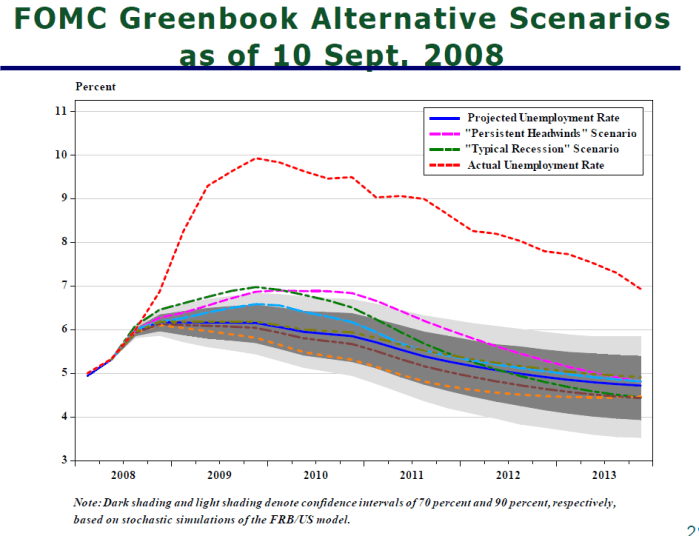
One of their big concerns is “groupthink” –  the risk that people within an institution (MPC or more generally) will all come to see the world the same way and in the process miss something really important.  They use as an example the Federal Reserve heading into the 2008/09 crisis.

  • During 2005-06, officials at the Federal Reserve and other agencies overlooked warning signs regarding the risk of a collapse in house prices. 
  • During autumn 2007 and early 2008, Fed officials misattributed the widening of interbank spreads to liquidity factors rather than counterparty risk. 
  • The FOMC met on Tues. 16 Sept. 2008, two days after Lehman’s failure, but still did not perceive that the U.S. might be heading into a financial crisis and a severe economic downturn.

And they illustrate the point with this chart

archer levin

It is a pretty staggering failure. But, to be honest, I’m not sure it is very enlightening on the question of the best possible design and structuring of monetary policy committees.  For example, I’m not sure there is evidence that central banks with governance and decisionmaking processes more consistent with the Archer/Levin preferences did less badly, in recognising emerging issues and risks, than others.  And, in many (although not all) respects, the US system fits better with their principles and preferences than those of many other countries.

But I’m jumping ahead.  What are the principles Archer and Levin lay out?  First

The MPC should be a fully public institution whose members are accountable to elected officials and the general public.

Quite a few central banks  –  including several in the euro-area, Switzerland, South Africa, and the regional Feds in the US –  still have private shareholders.  That hasn’t been an issue here since 1936. In most countries, the private shareholders have no real influence, but in the US they do still play a role through the appointment of heads of regional Feds, who in turn sit (in rotation) on the FOMC.   That should be fixed, and may even be unlawful –  an issue Peter Conti-Brown covered in his book I wrote about here.

The second principle is

The selection of MPC members should ensure diverse perspectives and forms of expertise. 

  • Earlier studies of MPCs were mostly focused on hetereogeneouspreferences (hawks/doves) or the hetereogeneity of anecdotal information. 
  • In contrast, this principle combats group-think by appointing experts with diverse educational backgrounds and professional experiences. 
  • Geographical diversity may also be crucial for fostering & maintaining public legitimacy.

And the third is

The process of selecting MPC members should be systematic, transparent, and consistent with democratic legitimacy. 

  • The process should have “checks and balances”, i.e., multiple steps involving different sets of decision-makers. 
  • Transparency mitigates the risk of undue influence by special interests. 
  • The process should foster public confidence in the integrity of the institution.

In general I agree with this, but this is an area where the US does reasonably well, at least for the core members of the FOMC, the Fed Board of Governors.  They are nominated by the President, and subject to confirmation by the Senate, one of the most open processes anywhere.   By contrast, the proposed New Zealand system will have the Governor and the Reserve Bank Board –  neither with any direct democratic legitimacy or accountability –  driving the appointment of MPC members, with the Minister of Finance having no ability to interpose his or her own candidates.  And there is no public or parliamentary scrutiny of individual members proposed, either before taking office or afterwards.

The MPC’s size and voting rules should foster genuine engagement among members and diminish the influence of any single individual. 

  • This principle mitigates the risks of autocracy, which has pitfalls like those of group-think. 
  • Previous analysis prescribed a fairly small size as optimal for engagement (e.g., 5 members), but a somewhat larger size may be needed to encompass sufficiently diverse perspectives.

In principle, the US system does well on this score.  No one on the FOMC owes or her appointment to anyone else on the committee, and many of the members are based outside Washington.

And they propose

Terms should be staggered, non-renewable, and last longer than the political cycle, with removal only in cases of malfeasance.

The non-renewability point is about limiting the risk of inappropriate political interference.  I have some sympathy with that point –  Archer elsewhere argues for single seven year terms.  Then again, non-renewability even more severely restricts the possibility of holding MPC members to account for their contribution or performance.  For my tastes, Archer/Levin lean a bit too much on the side of protecting against political interference, and bit too little on the imperative on ensuring that the appointees actually do the job they have a mandate for.

Principle 6 is a very important one in my view, and one which our Minister of Finance appears to have totally discounted.

Each MPC member should be individually accountable to elected officials and the public. 

  • Individual accountability is crucial for mitigating the risk of group-think.
  • Such accountability should occur through MPC communications, speeches & interviews, and hearings before elected officials. 
  • To avoid cacophony, the MPC must clearly explain the rationale for its decisions as well as elucidating the range of individual views.

By contrast, our Minister of Finance has plumped for consensus as far as possible, and no individual identification of the range of views.  That conduces not just to groupthink, but to free-riding (by minority external members).   There is much stronger individual accountability in the Swedish, UK, and US systems.   That said, as the example Levin and Archer used shows, no system of governance guarantees against policy mistakes.

The MPC should be subject to periodic external reviews of its strategy and operations, but not its specific policy decisions. 

  • External reviews can be invaluable in identifying and mitigating group-think.
  • Such reviews should occur on a regular schedule rather than triggered by political motives or idiosyncratic factors. 
  • These reviews should focus on assessing past & prospective performance, not on evaluating individual policy decisions.

It would seem highly desirable to build such external reviews into the system, perhaps every five years.  They should be commissioned by the Minister and Treasury, and should complement any reviews the MPC undertakes, or commissions, of its own performance.

In addition to any statutory goals, they argue

The MPC’s medium-term policy framework should be approved or endorsed by elected officials roughly once every 5 years. 

  • This framework should provide a quantitative description of the MPC’s objectives, priorities, intermediate targets & operating procedures. 
  • The approval or endorsement of elected officials is crucial for the legitimacy and credibility of the policy framework.

In a New Zealand context, it might be desirable to have the document that replaces the Policy Targets Agreement be subject to parliamentary ratification (as the –  much less important –  Funding Agreement is).

I’m less convinced of their next principle

The MPC should formulate a systematic and transparent strategy that guides its specific policy decisions over the coming year or so.

Easy enough to write down, but hard to make it mean anything particularly specific.

And their final principle is

The MPC should regularly publish reports explaining the rationale for its specific decisions in terms of its policy framework and strategy. 

These reports should explain the rationale for the majority’s decision along with concurring and dissenting opinions that clearly convey the range of individual views.

I agree.  A good comparison is with the decisions made by higher courts, which in effect sit as a committee.   Majority and minority opinions are published, and groups of members may come together in support of a particular written opinion, rather than all penning one each.

Perhaps they were running out of time, but the last slide only has headings

Insiders & Outsiders on the MPC 

  • Full-Time vs. Part-Time 
  • Executive vs. Policymaking Roles 
  • Differential Terms of Office

Fortunately, we know from David Archer’s comments on Iain Rennie’s draft report what he thinks on the insiders vs outsiders issue.

Turning first to the balance of internals and externals. The tendency to groupthink, with the most powerful member of the group being the “seed” of the group view, is the biggest impediment to harnessing diversity. The probability of groupthink increases with the presence of hierarchy.

F. The law should restrict the proportion of executive insiders to below half, by a big enough margin that these tendencies have a chance to be offset.

Sadly, our Minister of Finance has chosen a model –  a permanent majority of insiders, the Governor having significant influence on other appointments, and no freedom to speak externally – which will entrench hierarchy, create a strong likelihood of groupthink.

And here, from Archer’s earlier comments, are his thoughts on publication of minutes, and openness about the range of views and perspectives.

Turning now to the public presentation of committee decisions, claimed improvements in policy transmission mechanisms flowing from singular official views about future policy are ephemeral. Apparent unanimity is quickly shown to be untrustworthy spin.

The essential reason is that the future is largely unknowable, and it is foolish to pretend otherwise. Consider the records of the few central banks – including the RBNZ – that publish forward policy interest rate paths. Forecast paths are almost always poor predictors of reality, even in the RBNZ case where unanimity about the outlook exists by construction. Being honest about the limited predictive powers of even highly paid specialists is likely eventually to increase their trustworthiness, at least relative to the results of repeated false marketing of ostensible consensus. With unknowable future shocks, the real predictability problem relates to how policy will react to new events. To predict that, one has to know policy preferences and the mental frameworks used to process new information (as well as forming a view on what new information might arrive). Given clear legal objectives supplemented by PTAs, the range of policy preferences in play should be constrained. The main thing then is to allow people to observe the variety of analytical frameworks being deployed. That is not helped by delaying the publication of minutes. Gains in withholding minutes are thus small, if they exist at all. At the same time, requiring members to withhold from expressing their true views in public, at least for non-trivial periods around policy decisions, may damage their ability or willingness to articulate alternative perspectives.

How can cacophony in communications be avoided without some formal constraint? One approach would be focus members’ attention on agreeing minutes that accurately reflect their individual contributions. Fairly full minutes, with attributed reasoning, can provide a better public platform for dissenters’ subsequent public utterances than can the soundbites of “managed” disclosures about policy decisions. If such minutes will be available soon, members are more likely to refrain from immediate but partial expressions of their views.

As I hope is clear, I don’t agree with everything in the Archer and Levin presentation but there is plenty of material here that really should be thought about by our Minister and Treasury officials, to a much greater extent than was evident in the papers published to date.  It isn’t too late to rethink these details, and doing so would be likely to lead to a better central bank –  better on substance, and more accountable and thus more enduringly legitimate.

As it happens, the Herald this morning has a first “interview” with the new Governor Adrian Orr.   It is a typical Herald piece as regards the Reserve Bank: giving the Governor a platform to speak, rather than showing signs of any searching or awkward questions.  I thought it was interesting for three things:

  • all the focus appeared to be on monetary policy, even though more of the Bank’s staff now work on the financial system regulatory and supervisory roles,
  • there was no mention of the scathing feedback on the Reserve Bank, regarding those same regulatory/supervisory activities, in the New Zealand Initiative report, and
  • while there was plenty of talk about broader perspectives etc, there wasn’t much (any) talk about doing the basics better.

Thus Orr talks grandly of leading the world

“We need a broader view of the what the central bank is really about. We’ve got an enormous amount of grey matter in here — that can be used more effectively,” Orr said.

“So what is global leadership in managing a small, open economy, what is global leadership in ensuring a sound financial system, what is global leadership in the delivery of the means of exchange?”

But not at all of the miles he –  and the Bank –  have to go just to catch up and come closer to doing excellently the basics Parliament has charged them with: keeping inflation near target, and supervising the financial system in a way where the analysis and regulatory actions consistently command confidence.  There was a lot of talk of “leading the world” back in the 1990s, and in some small areas, almost inadvertently, we did.  But I’m not sure it is a goal New Zealand taxpayers should be actively seeking to fund, and especially not when the domestic basics leave quite a bit to be desired.


(It is the school holidays, and my 11 year old daughter wants to tell people that instead of reading “all the boring stuff my Dad writes you should listen to Ed Sheeran instead”.  Personally, I’ll take Mozart or Handel over monetary policy –  let alone Ed Sheeran – any day.)


Immigration policy and wellbeing

Last week BWB Books published Better Lives: Migration, Wellbeing and New Zealand by Peter Wilson and Julie Fry, two consulting economists (as the authors explicitly note, one has lived overseas for a long time now, and the other is an immigrant to New Zealand).    It is an attempt to think about New Zealand immigration policy, and experience, in a framework broader than just economics.  And “wellbeing” is the new flavour of the year –  at the heart of The Treasury’s (questionable) Living Standards Framework, adopted by the government as nice-sounding rhetoric and a lens for next year’s Budget.  And, of course, there are various scholars overseas, and international agencies, doing work in the area.  In fact, the OECD’s Better Life Index provides the list of categories –  other than aggregate economic out-turns –  that Fry and Wilson use to frame their discussion of immigration policy.

Julie Fry has now been writing about New Zealand immigration policy for several years (having initially worked on it as a young Treasury economist 25 years previously).  There was the paper she wrote for Treasury, subsequently published as a Treasury Working Paper.  That paper had an explicitly economic focus (and I was quite involved with her work at that time). Her abstract for that paper concluded

More work is required to assess the potential net benefits of an increase in immigration as part of a strategy to pursue scale and agglomeration effects through increased population, or whether a decrease in immigration could facilitate lower interest rates, a lower exchange rate, and more balanced growth going forward.

At the time, the paper was quite controversial within Treasury because it wasn’t automatically supportive of the “big New Zealand” approach.

A couple of years ago Fry and Hayden Glass published a book (also by BWB) called Going Places: Migration, Economics and the Future of New Zealand .  That book seemed generally positive about the –  modest – economic contribution of immigration, but argued that any such gains could be maximised by focusing on bringing in as far as possible people who could make a real difference (noting that many of those coming under current policies don’t).

Our view is that New Zealand should seek more people who will contribute to economic transformation. By their nature, these are people who do not just fit in: we are looking for those who might disrupt, transform, provoke and cajole, connect New Zealanders with others and change the way this country does things.

Things like the Global Impact visas –  launched a year or two ago – fitted this description.

And then Fry and Wilson teamed up to do this new work, attempting to look at immigration policy through a wellbeing lens, including an attempt to find a way to think better about the potential relevance of the Treaty of Waitangi to the issues (my own early thoughts on some Maori dimensions of this policy issue are here).  As I understand it, the work began with some modest NZIER funding –  from their “public good” programme –  for an article on the issue.  It grew into a 275 page book (admittedly, BWB Texts pages are quite small) –  a big commitment by the authors.

They have had quite a bit of coverage.  There was a nice introduction to it on interest.co.nz, the authors were interviewed on Newshub Nation on Saturday, and The Treasury invited them in for a guest lecture last week (which I attended).

I haven’t read the book yet, and I don’t want to write about it substantively until I have done so.  Nine months ago I gave them extensive comments on a draft of what later became the book, but I expect that much will have changed since then.

Having said that, I’m instinctively sceptical of the wellbeing approach – especially if it is anything more than a relabelling of the economist’s basic tool, utility maximisation.   That doesn’t mean I think non-economic considerations are, or should be, irrelevant, but I’ve not yet seen any convincing sign that these proposed frameworks are generally very enlightening in helping shape policy positions.  Often they seem to provide cover –  sometimes unwittingly – for whatever cause or preferences the particular analyst favours (eg in The Treasury’s recent working paper on social capital I saw the suggestion that cars might perhaps be discouraged as being invidious to this particular analyst’s conception of “social capital”).  In this case, I think some pro-immigration people are sceptical that applying a wellbeing approach to immigration policy is not much more than an attempt to justify less immigration even if there are economic benefits.  Since I don’t believe that in New Zealand’s case in recent decades there have been such benefits, I’m probably more concerned about the (possible lack of) rigour of any attempt to broaden out the range of considerations, and uneasy that one or other component of the framework will be latched onto to make the case for more immigration (when what we’ve had looks to have been economically costly to New Zealanders as a whole).

But, as I say, I want to withhold substantive comment until I’ve finished the book –  so most likely I’ll write about it next week.  This post was prompted by various comments to other posts highlighting the new book, seeking comment, and in some case I thought unfairly criticising the authors.  I’d recommend people read the book –  it is pretty cheap –  or at least the article-length version of the argument published in Policy Quarterly, the Victoria University publication, in its pre-election issue last year.  Here was their conclusion in that article

Migration has been good for New Zealand, but it has not been great. We think using a well-being framework has the potential to make it better. Focusing on smaller numbers of more highly skilled immigrants, and considering important broader issues that a simple focus on per capita GDP allows us to ignore, should lead to more effective and more sustainable immigration policy for New Zealand.

As you imagine, I have mixed feelings about that conclusion, but it is worth reflecting on and engaging with.

Scathing feedback on the Reserve Bank

Late last week the New Zealand Initiative released its report Who Guards the Guards? Regulatory Governance in New Zealand which has a particular focus on the Financial Markets Authoritiy, the Commerce Commission, and (in its financial regulatory/supervisory roles only) the Reserve Bank.  All three are important economic regulators and, if we are going to have such entities, it is important that they are well-governed, and performing excellently (with associated accountability and transparency) the roles Parliament assigned to them.

As part of putting together the report, the New Zealand Initiative undertook a survey

To assess how well our regulators are respected, we surveyed New Zealand’s 200 largest businesses by revenue, together with those members of The New Zealand Initiative not otherwise included as members of the ‘top 200’. In practical terms, this approach allowed adding a sample of New Zealand’s leading professional services firms – accountants, lawyers and investment bankers – into the pool of businesses covered by our survey.   Only one response per organisation was permitted.

And this is what the survey covered

We asked survey respondents both to:
a. rank the regulators they interact with based on their overall respect for them; and
b. rate the performance of the three regulators most important to their respective businesses against a range of KPIs.

The KPIs were based on a combination of the best practice principles identified by the Australian Productivity Commission’s Regulator Audit Framework, and from a similar survey to our own commissioned by the New Zealand Productivity Commission for its 2014 report. The questions were designed to obtain a broad view of regulatory performance, and as such did not enquire into the merits of individual regulatory decisions or the fitness-for-purpose of individual regulators.

Rather, the KPIs cover issues like commerciality, communications, consistency, predictability, accountability, and so on.

For some regulatory agencies –  there were 20+ covered –  there were lots of responses: some regulation is pretty pervasive.  For others with a very sector-specific role, including the Reserve Bank, there were only a relatively small number of responses (8) –  but it seems likely that all the major banks and some other smaller institutions will have responded.

The Initiative is clear that it is a survey of the regulated.  That is not the only, or even the most important, perspective in assessing a regulatory agency.  Regulatory agencies are supposed to work in the public interest, as defined by Parliament, and that means constraining the actions/choices of individuals and firms.  Regulation is intended to prevent people doing stuff they would otherwise choose to do, or compel them to do stuff they would otherwise not choose to do.  In other words, one should worry if a regulator is popular with those it regulates.  Indeed, one of the big risks in any regulatory system is that the regulator and the regulated form too cozy a relationship  –  in which there is some mix of regulators making life easy for the the regulated (eg coming to identify more with the interests and perspectives of the regulators) or regulators in effect working with the bigger and more connected/established of the regulated entities to make new entry and competition less easy than it should be.

The Initiative acknowledges the point to some extent

Of course, we can expect regulators to be unpopular at times with the businesses they regulate. It is, after all, their job to place boundaries on what businesses can and cannot do. But just as we expect communities to respect the police, we should also expect the regulators of commerce to have the respect of the businesses they regulate.

Personally, I’m not sure I’d go that far. I don’t expect “communities to respect the police”, but expect (well, vainly wish) the Police to earn the trust and respect of the community.  But whether or not “respect” is quite the right word, regulated entities should be able to offer some insights that are useful in evaluating regulatory institutions.  And that is perhaps particularly so when, as in this exercise, the survey covers a wide range of regulatory institutions at the same time.   If one institution scores particularly badly relative to others –  particularly others in somewhat similar fields –  it should at least provide the basis for asking some pretty hard questions about the performance of that agency, and of those responsible for it (officials, Boards, Ministers etc).

In this survey, the Reserve Bank’s financial regulatory areas scores astonishingly badly.   I first saw the results months ago when I was asked for comments on the draft report, but even with that memory in mind, rereading the Reserve Bank results (from p 60) over the weekend made pretty shocking reading.

Here is one chart from the report, comparing Reserve Bank and FMA results for the KPIs where the Reserve Bank scores worst.
partridge 1

In summary

In the ratings, the RBNZ’s overall performance across the 23 KPIs was poor. On average, just 28.6% of respondents ‘agreed’ or ‘strongly agreed’ that the RBNZ met the KPIs and 36% ‘disagreed’ or ‘strongly disagreed’. These figures compare very unfavourably with the FMA’s average scores of 60.8% and 10.3%, respectively.  They also compare unfavourably (though less so) with the Commerce Commission’s averages of 39.9% and 25.8%, respectively.

There simply isn’t much positive to say.

One of my consistent themes has been the lack of accountability of the Reserve Bank, across all its functions.  The regulated entities seem to share those concerns.
partridge 2

As part of the survey, interviews were also conducted to fill out the picture the data themselves provided.

Like the survey results, the views of interviewees were also largely [although not exclusively] negative.

The criticisms related both to the RBNZ’s capabilities and processes, and the substance of its regulatory decision-making.
In relation to process and capability, criticisms included the following issues:
a. Lack of consistency in process: One respondent noted that the internal processes of the RBNZ’s prudential supervision department, which is responsible for prudential supervision, can be ‘random’. The respondent referred to long delays between steps in a process involving regulated entities, followed by the imposition of requirements for more-or-less immediate action from them.
b. Lack of relevant financial markets expertise among staff: This was a common
theme. One respondent noted that until the 2000s, there was “regular interchange
of staff between the banks and RBNZ,” meaning RBNZ regulatory staff had firsthand finance industry expertise. But this has changed with the banks moving their head offices to Auckland and the RBNZ based in Wellington. As one respondent said, “They will always struggle to get good people [with financial markets expertise] in Wellington, especially with the banks now in Auckland… this makes interchange impossible.” Another said, “RBNZ [staff are] completely divorced from the reality of how things are done.”  More colourfully, another said, “[RBNZ] is all a little archaic… Entrenched people don’t get challenged.” Another said, “On the insurance side, the level of capability is less than with the banks. There is a potential risk to policyholder protection. RBNZ ends up just focussing on the minutiae.”
c. Lack of commerciality: This concern is allied to both the expertise issue noted above, and the materiality issue noted below. As one respondent said about the RBNZ’s ‘deafness’ to the need for a materiality threshold before a matter becomes a breach of a bank’s conditions of registration, “RBNZ says, ‘If it’s not material just disclose it’. But that’s a regulator way of thinking. They don’t understand the commercial, reputational implications.”
d. Unwillingness to consult or engage: As one respondent said, “I would call them out for not truly consulting.” Another said, “The RBNZ upholds independence to the point that it precludes constructive dialogue.” Several respondents drew a contrast with the FMA, noting that the RBNZ was happy to issue hundreds of pages of “prescriptive, black letter requirements,” but “without much or any guidance” for the banks on their application. One respondent did note, however, that the RBNZ “isn’t resourced to spend time doing this [issuing guidance].”
e. Lack of internal accountability: Several respondents perceived a lack of oversight from the most immediate past Governor, Alan Bollard, in either engaging with the banks over concerns about prudential regulation or trying to resolve them. One respondent noted, “Staff are often running around doing things without serious scrutiny from above.” Another said there is a group “with no accountability within the RBNZ… They favour form over substance and seem to enjoy exercising power.” Another commented it was “unclear how much information flowed up to the RBNZ Board,” but that if the Governor were accountable to the board for prudential regulation, then the board “could be useful in pulling up entrenched behaviour.” Another noted that the RBNZ’s  governance structure meant it did not benefit from outside perspectives: “[t]he value of diverse thinking is to challenge, so you don’t get capture by one person’s view.”

Two main criticisms were made in relation to substance:
a. Materiality thresholds: Several respondents highlighted the lack of a ‘materiality
threshold’ before RBNZ approval is needed either for:
• changes to banks’ internal risk models in the Conditions for Registration of
banks; or
• changes to functions outsourced to related parties.
One respondent noted that without a materiality threshold, the new requirement
for a compendium of outsourced functions – and for approval of any change to
outsourcing arrangements with a related entity – could lead the Australian-owned
banks to cease outsourcing functions to related entities, thereby increasing costs and
harming customers.  Several respondents noted that the lack of a materiality threshold could be attributed to a lack of trust in the banks by the RBNZ staff responsible for prudential regulatory decisions. As one respondent put it, this led the RBNZ to “insist on approving absolutely everything.”

Although this view was not shared by all banks, one respondent noted that even
APRA – long regarded as a more heavyhanded, intrusive regulator than the RBNZ
– was “now more reasonable to deal with than the RBNZ.”

b. Black letter approach: Along with the lack of a materiality threshold in the RBNZ’s
regulatory regime, several respondents commented on the RBNZ’s “black letter”
approach to interpreting its rules: “If RBNZ had two or three public policy experts
who could bring a ‘purposive approach’ to interpretation, that would be hugely positive.”   Another said, “[The RBNZ] has an overly legalistic approach which ignores the purpose of the legislation,” and that “what they’re doing undermines [public] confidence over things that are of no risk.” Several survey recipients noted that this was in stark contrast to APRA’s approach to public disclosure in Australia.

Another respondent put the concern differently, saying the problem was less
about the RBNZ’s ‘black letter’ approach to its rules, and the opaqueness of the rules,
and more about the lack of guidelines from the RBNZ explaining them, an issue the
respondent put down to a lack of resources.

There is more detail there than most readers will be interested in. I include it because the overall effect builds from the relentness of the critical comment.   I’m not even sure I agree with everything in those comments –  but they are clearly perspectives held by regulated entities –  and I suspect that reference to Alan Bollard is really intended to refer to Graeme Wheeler.  But taken as a whole, it is an astonishingly critical set of comments and survey results, that most reflect very poorly on:

  • former Governor, Graeme Wheeler,
  • former Head of Financial Stability (and Deputy Governor and “acting Governor” Grant Spencer),
  • longserving head of prudential supervision, Toby Fiennes
  • the Reserve Bank’s Board, including particularly the past and present chairs, Rod Carr (who had had a commercial and banking background) and Neil Quigley.

And given the enthusiasm of the Bank to emphasis the role of the Governing Committee in recent years, it probably isn’t a great look for the new Head of Financial Stability, and Deputy Governor, Geoff Bascand – he of no banking/markets experience, no commercial perspective, and little regulatory experience – who sat with Wheeler and Spencer on the Governing Committee over the previous four years.

One would hope that the new Governor, the new Minister, and the Treasury and the Board, are taking these results very seriously, and using them to, inter alia inform the shaping of Stage 2 of the review of the Reserve Bank Act.  I’ve not heard any journalist report that they’ve approached the Reserve Bank  –  or the Board or the Minister – for comment on the report and the Bank-specific results.   But such questions need to be asked, and if the Bank simply refuses to respond or engage that in itself would be (sadly)telling.

In the report the New Zealand Initiative authors make much of comparisons with the FMA.  In respect of the survey results, that seems largely fair.  The data are as they are.  But as I’ve noted in commenting a while ago on an op-ed Roger Partridge did foreshadowing this report, I’m not entirely convinced (nor am I fully convinced about the criticisms of the FMA’s predecessor the Securities Commission, which was asked to do a different job).

Partridge cites the Financial Markets Authority as a better model.  In many respects, the FMA is structured like a corporate: the Minister appoints (and can dismiss) part-time Board members, and the Board hires a chief executive.  But it is worth remembering that the FMA has quite limited policymaking powers: most policy is made by the Minister, whose primary advisers on those matters are MBIE.   The FMA is largely an implementation and enforcement agency.  That is a quite different assignment of powers than currently exists for the Reserve Bank’s regulatory functions (especially around banks).  Also unaddressed are the potentially serious conflict of interest issues around the FMA Board, in its decisionmaking role. More than half the Board members appear to be actively involved in financial markets type activities (directly or as advisers), and even if (as I’m sure happens) individuals recuse themselves from individual cases in which they may have direct associations) it is, nonetheless, a governance body made up largely of those with direct interests that won’t necessarily always align well with the public interest.

Reasonable people can reach different views on the performance of the FMA. I gather many people are currently quite pleased with it, although my own limited exposure –  as a superannuation fund trustee dealing with some egregious historical abuses of power and breaches of trust deeds – leaves me underwhelmed.  It is certainly a model that should be looked at in reforming Reserve Bank governance –  it is, after all, the other key financial system regulator –  but I’m less sure that it is a readily workable model for the prudential functions, even with big changes in the overall structure of the Reserve Bank, and some reassignment of powers.  It certainly couldn’t operate well if both monetary policy and the regulatory functions are left in the same institution.  It doesn’t seem to be a model followed in any other country.  And it isn’t necessary to deal with the core problem in the current system: too much power is concentrated in a single person’s hands.  In a standalone regulatory agency, I suspect an executive board –  akin to the APRA model –  is likely to be an (inevitably imperfect) better model.

Whatever the precise model chosen, significant reform is needed at the Reserve Bank.  Some of that is about organisational structure and governance –  I’ve made the case for a standalone new Prudential Regulatory Agency –  but much of it is about organisational culture, and that sort of change is harder to achieve.  I hope Adrian Orr has the mandate, and the desire, to bring about such change.  I hope Grant Robertson insists on it.

Readers will that early last year, Steven Joyce – as Minister of Finance –  had Treasury employ a consultant to review aspects of the governance of the Reserve Bank, particularly around monetary policy.  Extracting details of the review, undertaken by Iain Rennie, from The Treasury proved very difficult.  It took almost a year for the report to be released.  I’ve had various Official Information Act requests in, including for the file notes taken from the (rather limited) group of people outside The Treasury that Iain Rennie engaged with (within New Zealand it turns out that he talked to no one outside the public sector).  That one ended up with the Ombudsman.  A week or so ago I finally got an offer via the Ombudsman’s office –  Treasury would release a document summarising those meetings if I discontinued my request for the full file notes.  Somewhat reluctantly –  balancing the point of principle, against getting something now – I agreed, and last Friday Treasury released that summary to me.  For anyone interested it is here.

Rennie review Summary of discussions with External Stakeholders

There is some interesting material there, including on meetings with the Reserve Bank Board –  where he showed no sign of having grilled the Board on what it accomplishes or adds –  and with some overseas people Rennie talked to.  But what caught my eye was the record of a meeting Rennie (and Treasury) held with the Reserve Bank management (Wheeler, Spencer, McDermott and a couple of others) on 14 March last year.  At the meeting, the Bank seems to have set out to minimise any change and sell Rennie on the virtues of the current informal advisory Governing Committee.

Here are relevant bits of the record (as summarised now by Treasury)

Current Governing Committee (GC)
o The GC reflects public sector reforms, there are checks and balances, which help with accountability.
o It has become important to focus more on the Reserve Bank as an institution, rather than just on the Governor, as the Reserve Bank has taken on more and more responsibilities over time.
o Discussed different overseas models, including strengths and weaknesses of different approaches.
o The approach to decision-making and communications needed to be consistent with the Reserve Bank’s approach (e.g. must be appropriate in the context of forward guidance).

Codification of the Committee Structure
o Codification’s advantage was that it could prevent a future Governor from moving back to a single decision-maker. However, that hasn’t been a problem in Canada, and it would be difficult for a Governor to roll the current committee approach back.

Effectiveness
o The cohesion of the GC and the cooperative nature were identified as the most important factors in its success. The GC was relatively informal with collective responsibility, and that worked well.
o Discussed how the current committee operated, and some strengths and weaknesses of the approach.
o Discussed the effectiveness of different options for decision-making and communications design, such as voting and minutes (neither supported).

Some of this is almost laughable, a try-on that surely they should not have expected anyone to take very seriously (and, to Rennie’s credit, he came out with recommendations that went far further than the Bank liked, earning him soe quite critical comment from the Bank).

Take that very first bullet, the claim that the Governing Committee model “reflects public sector reforms”.  I’m not sure how.  It has no basis in statute, the members are all appointed by and accountable to the Governor, and there is no transparency, and no accountability.  The Bank has, for example, consistently refused to release any minutes of the Governing Committee –  on any topic –  if indeed, substantive minutes are even kept.

Or the fourth bullet, the suggestion that “the approach to decision-making and communications needed to be consistent with the Reserve Bank’s approach”, which is a typical bureaucrat’s attempt to reverse the proper order of things.  The Reserve Bank is a powerful public agency, created by Parliament and publically accountable (well, in principle).  The design of the governance and accountability arrangements should reflect the interests and imperatives of the principal (public and Parliament), not those of the agent (the Bank itself).  Officials work within the constraints Parliament establishes.

Or the third to last bullet, about the cohesion of the Governing Committee, collective responsibility etc.  Again, I’m sure they believed it, but on the one hand, we build public institutions to provide resilience in bad times (or bad people) not so much for good times, and on the other there is no collective responsibility –  the Governor alone has legal responsibility, and there is no documentation at all on the Governing Committee processes.  And legislating to entrench a committee in which the Governor appoints all the members, might be a recipe for cohesion, but it is also a high risk of a lack of challenge, debate and serious scrutiny.

And, finally, just to confirm that consistent opposition to anything approaching serious scrutiny, in that final bullet, the Bank reaffirms its opposition to published minutes –  something most of central banks now manage to live with, in some cases with considerable detail.

At one level, these comments no longer matter much.  Graeme Wheeler and Grant Spencer have moved on, and the new government has made decisisions on the future governance of monetary policy.  But they nonetheless highlight the sort of closed culture fostered at the Reserve Bank over the past decade or more, whether on the monetary policy side or on the regulatory side (the latter vividly illustrated in the NZI report).  Comprehensive reform is overdue.  It would make for a better Reserve Bank internally – and/or a better Prudential Regulatory Agency –  and one more consistently open to scrutiny, challenge, and debate, which in turn will reinforce the impetus towards better policy, better analysis, and better communications.


Population size and GDP per capita: US states

There have been a few posts here (here, here, and here) in the last week or so around the issue of population size and GDP per capita –  not because my prior is that there is any such relationship but (a) because I think there isn’t, and it is worth occasionally illustrating that across countries, and (b) because even some officials in the New Zealand government still appear to believe that our (small) size is a material element in the story of what holds New Zealand back.   There are arguments why, in theory, a larger population might result in better long-term economic performance (higher productivity), but whatever the merits of those arguments they seem to have been outweighed by other factors.  In the world we currently live in, the average big country is no more economically successful than the average small country, and that is so whether one throws all 190 countries into the mix at once, or looks only at advanced countries, only at European countries,  only at moderately-sized countries (eg excluding China and India) or whatever.  And one might imagine a plausible story in which economic success might have led to more population (migration or natural increase) rather than the other way round.

But what does the picture look like for US states?  Across all 50 states (one dot per state) here is the cross-sectional picture.

US states 2

And again, no obvious or statistically significant relationship.   In fact, to make the dots a bit easier to see, I left off the (non-state) District of Columbia which with about 600000 people has per capita GDP of about $160000.

The US case is interesting because –  unlike the situation with comparisons across individual countries –  there is no legal obstacle in the way of US citizens (and residents) moving within the country (across state lines) to pursue opportunities.   In that sense one might have (actually I initially did) expected to see more populous states also being more economically successful, if only because of internal migration.  But the relationship between population size and GDP per capita seems about as weak across US states as it does across countries.

I wouldn’t want to make anything much of these US state comparisons –  I just did them because the data were there, and having dug it out I thought I’d share it.  After all, in various places, big metropolitan areas straddle two or more states (New York is the best known example).   Then again, there is more policy similarity across US states than there is even across member states of the EU –  so a few more things are help constant when one looks at the simple scatter plot this time.

Whatever the theoretical arguments, a bit of history suggests we shouldn’t be surprised at the lack of any sustained relationship between population and economic performance.  After all, at its 14th century peak –  as probably the richest place in Europe – Florence is estimated to have had a population of fewer than 100000 people.