Inching towards greater transparency

Several years ago the then Reserve Bank Governor went public when there was some criticism around an OCR decision (more so about communications surrounding it) telling us that all his advisers had on that occasion supported his decision.   A group of senior staff provide written advice at each OCR decision.

If it was good enough for him to disclose such information when it suited him, I thought it should be fine to have the information disclosed routinely, including for OCR decisions some time in the past.  I lodged an OIA request accordingly.

Not that surprisingly, given the Bank’s approach to the OIA, I didn’t get anywhere.  They refused to release any other information about previous OCR decisions and, a bit more surprisingly, [as I recalled things, but see below] they managed to get the Ombudsman to provide cover for their refusal.

But in this morning’s Monetary Policy Statement we find almost exactly the data I requested 2.5 years ago, in the form of this chart.
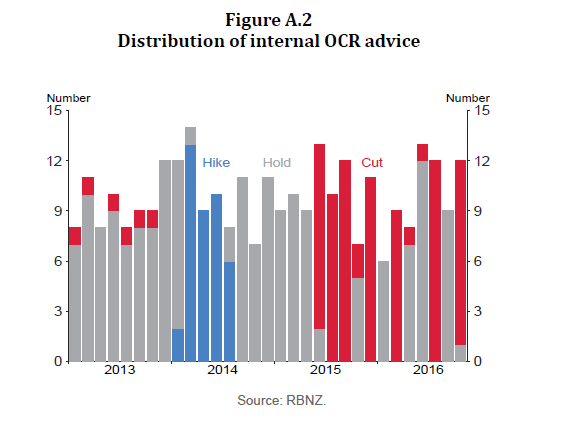
OCR advice

Kudos to the Governor for releasing the information, even (a) this belatedly, and (b) only for the period to the end of 2016, which is now two years ago.  We still have no idea what the balance of advice has been over the last couple of years, most of which wasn’t even in the current Governor’s term.  But it is better than nothing.

I was among this group of advisers up to and including the March 2014 decision –  where I’m pretty sure I was the grey vote (opposed to the OCR increase).

Given that the Governor has now released so much information, I’m tempted to lodge another OIA request for the more recent information –  there cannot possibly be any market sensitivity or other problems (defensible under the Act) in knowing that (say) one advisor out of ten favoured an OCR cut six months ago –  but as the legislation is about to change perhaps I will leave it for now.

The Governor goes on to note that

Generally, there was a clear majority in the balance of advice. Should the current Reserve Bank Amendment Bill become law, our intention would be to publish the formal votes of the Monetary Policy Committee each time a vote is taken. It is envisaged that a vote would not be called for every meeting, but only when needed.

I found this mildly encouraging, Until now that rhetoric has tended to emphasise very heavily the consensus model the previous Reserve Bank management favoured (under which any differences of view –  inevitable in a well-functioning organisation dealing with so much uncertainty –  would be obfuscated and kept secret).  At least now there is a straightforward explicit statement that the formal votes will be published when such votes are taken.   It still isn’t too late for the select committee looking at the bill to amend the legislation to require votes to be taken, and require the number of votes for each position to be published.

There is still a long way to go in getting the Reserve Bank to the point of operating transparently, even reaching (say) the level managed by the Treasury through the Budget process.  I still have an Official Information Act request in, now with the Ombudsman, over the Reserve Bank’s refusal to release background papers underpinning claims it made (including around KiwiBuild) in last year’s November Monetary Policy Statement.   The Bank has long argued that it would be destabilising, undermining the effectiveness of policy, if anyone ever saw any internal background papers.    They claim, citing the OIA itself, that the substantial economic interests of New Zealand would be damaged.

Some months ago the Ombudsman advised a preliminary view that would have continued his office’s longstanding practice of allowing the Bank to keep almost anything associated with monetary policy secret.  I made a submission in response that highlighted what appeared to be a serious inconsistency in the way, for example, budget papers are treated.  This was some of what I wrote

In general, I think Mr Boshier’s provisional decision, if allowed to stand, would seriously detract from effective accountability for the Reserve Bank, and in particular would expose the Bank routinely to less scrutiny and challenge than Cabinet ministers or government departments receive.  That cannot be the intention of the Act.    That parallel doesn’t seem to have been taken into account at all in the draft determination.
Thus, Cabinet papers underpinning key government announcements are frequently released, sometimes in response to OIA requests and at other times pro-actively.  But so too is advice to a Cabinet minister from his or her department.  That is so even when, as is often the case, officials have a different view on some or all of the matters for decision from the stance taken by the minister.   A classic example, of course, is the pro-active release of a great deal of background material, memos, aide-memoires etc compiled and submitted as part of the Budget formulation process.  Many of the working papers in that case may never even have been seen the Secretary to the Treasury but will have been signed out to the office or minister at the level of perhaps a relatively junior manager.  Many will have been done in a rush, and be at least as provisional as analysis the Governor receives in preparing for his OCR decision.  I’ve been personally involved in both processes.
Is it sometimes awkward for the Minister of Finance that his own officials disagreed with some choice the minister made?  No doubt.  Do ministers sometimes feel called upon to justify their decisions, relative to that official alternative advice? No doubt.  But it doesn’t stop either the provision of such dissenting (often quite provisional) analysis and advice, or the release of those background documents.
The sorts of arguments the Reserve Bank makes, and which Mr Boshier appears to have accepted, could well be advanced by Cabinet ministers (eg clear messaging about this or that aspect of budgetary or tax policy –  all of which are substantial economic interests of the NZ government).  If they have advanced such arguments, they have generally not succeeded.  And nor should they.  Doing so would undermine effective accountability or scrutiny, even though the Minister’s formal accountability might be to Parliament (he has to get his Budget passed).
The relationship between the Minister and his or her department officials is closely parallel to that between the Governor of the Reserve Bank –  the sole legal decisionmaker (who doesn’t even have to get parliamentary approval of his decisions) –  and the staff of (in this case) the Economics and Financial Markets departments of the Bank.  One group are advisers, and the other individual is the decisionmaker.  The fact that they happen to both part of the same organisation, doesn’t affect the substantive nature of that relationship.   Manager and senior managers in the relevant departments are responsible for the quality of the advice given to the Governor, in much the same way that the Secretary is responsible for Treasury’s advice to minister (and at his discretion can allow lower level staff to provide analysis/advice directly to the Minister or his office.   I would urge you to substantively reflect on the parallel before reaching your final decision, including reflecting on how (if at all) official advice on input to the OCR is different than official advice (including supporting analysis) on any other aspect of economic policy.
Mr Boshier’s argument about potential damage to substantial economic interests itself seems insubstantial, and displaying little understanding of how financial markets (and the market scrutiny of the Reserve Bank) work.  It also appears to be based wholly on official perspectives; officials who will routinely oppose transparency (except as they control it).    All those who follow, and monitor, the Reserve Bank recognise that there is a huge degree of uncertainty about any of the assumptions the Bank (or other forecasters) make, Indeed, the Bank itself stresses that point.    Markets trade changing perceptions of the outlook all the time, each piece of new data slightly adding to the mix.   Most monitors of the Reserve Bank (many of whom have previously worked for the Bank) recognise the distinction between analysis and advice, provided as input to the Governor, and the Governor’s own final decision and communication thereof.    And since markets –  and the Bank –  know that any projections are done with huge margins of uncertainty, the pretence that economic outcomes could be substantially damaged by people knowing there were a range of views or analysis is almost laughable.  Again, there is also a distinction to be considered between possible institutional interests of the Reserve Bank and the substantial economic interests of New Zealand.   You seem to treat those two sets of interests are the same thing, but they are not.

Given that some more months have now passed I hope the Ombudsman is seriously considering these arguments.   But whether he is or not, I call on the Governor to take seriously his words about greater openness and more transparency, and put in place proactively a new regime (perhaps for the new MPC) in which staff background papers provided to the Governor and MPC are released, with a suitable lag (perhaps four to six weeks) as a matter of course.  Doing so would be a significant step forward, and should help to boost market and public confidence in the Bank.  It wouldn’t be terribly radical; it is pretty much what is done for the government’s Budget each year.  Perhaps the new Treasury observer could explain to his Bank colleagues how it works, and how Treasury continues to function, continues to offer free and frank advice, even knowing that in time the background work will most probably be open to scrutiny.  It is how open democracies, open societies, should work.

I might have some other thoughts tomorrow on more substantive aspects of the Monetary Policy Statement.

UPDATE:  Well, it seems that credit is due to the Ombudsman not to the Governor. A few minutes after putting this post, I received this letter from the Bank

Dear Mr Reddell

At the invitation of the Chief Ombudsman, the Reserve Bank has reconsidered your request for the aggregate numbers of MPC members favouring each rate option for each OCR decision since mid-2013. You made this request on 14 March 2016.

On the basis that the requested information has become sufficiently historic, the Reserve Bank has decided it can now release the information. You can find the information on pages 13-14 of today’s Monetary Policy Statement at the following web address www.rbnz.govt.nz/monetary-policy/monetary-policy-statement.



Perhaps standards are different in Rotorua?

When you think that our politicians can’t sink much lower when it comes to matters related to the dreadful regime in Beijing all one has to do is wait another day or two.

Stuff has a major piece (a double page spread in this morning’s Dominion-Post) about the situation of the Uighur people in Xinjiang province in China, focusing on the stories of some of the Uighurs now living in New Zealand.

But what I wanted to highlight was the reaction of our politicians, National Party foreign affairs spokesman (and MP for Rotorua) Todd McClay in particular (emphasis added).

Ardern’s office didn’t respond to questions. Foreign Affairs Minister Winston Peters is overseas and also couldn’t comment.

“Abuses of human rights are a concern wherever they occur,” says National’s Foreign Affairs spokesperson Todd McClay, “however, the existence and purpose of vocational training centres is a domestic matter for the Chinese Government.”

McClay adds that “if credible evidence of human rights abuses came to light,” National would expect the government to “make representations to China through formal channels”.

The Chinese embassy did not reply to any questions about the issue.

So neither the Prime Minister nor the Foreign Minister would comment (in this era, being overseas is not a justification for saying someone “couldn’t” comment).    We saw the Prime Minister’s own feeble stance on this issue a couple of weeks ago

She said she might raise her concerns at a future meeting with Chinese officials, but made no firm commitment.

But McClay’s stance plumbs whole new depths.   Had he said “look, we know Beijing is an awful regime and often treats its citizens abominably, but we really want an upgraded FTA”, that would be bad enough, but at least it would be honest.  Instead he adopts the chilling language of the regime itself, suggesting that these (forced) internment and indoctrination camps are “vocational training centres”, and that the accompanying intense surveillance and control regime (electronic surveillance, let alone the government spies Uighur families are forced to host in their own houses) is just as nothing.  Does he suppose that the million of so people locked up in these centres are there voluntarily?  What bits of the evidence of systematic abuse and repression does he not believe?  Or, more probably, does he just not care?

All manner of brutal regimes have had Western apologists.  But history tends not to look very kindly on them.   And this man sits in our Parliament –  alongside Jian Yang –  aspiring to again be a senior Cabinet minister.  In my view, anyone that senior who sinks that low should never be allowed anywhere near the reins of government.  He disgraces himself, and disgraces a once-decent and honourable party.  The same party whose current leader last year, as a senior government minister, signed up with Beijing to some sickening aspiration to a “fusion of civilisations”.

To be clear, the current government seems no better, content to sit by as evil happens, even if not quite so sickeningly crass in their wording as Todd McClay.

As the Stuff article notes, more or less in passing, China’s human rights record has been under review in Geneva this week (part of a five-yearly review that all UN members face).   I’m no great fan of the United Nations or its associated bodies, and the Human Rights Council seems to be mostly a sick joke.  Nonetheless, these forums –  the Universal Periodic Reviews –  do pose the opportunity for other countries to ask (openly) searching questions about evident or apparent abuses.    A leading US China scholar wrote about it on his blog

On Nov.6, the People’s Republic of China underwent its third UN Universal Periodic Review (UPR), which is a peer review at the Human Rights Council of China’s human rights record. Each country, ridiculously, only had 45 seconds to speak! All eyes were watching if China’s mass incarceration of Muslims in Xinjiang and related repression outside the detention prisons would be criticized. Many countries did speak out, including the U.S., Canada, Germany and the UK. The only Muslim country that raised this issue is Turkey. It is shameful that Muslim countries and their regional organizations have done so little to date. The PRC cleverly lined up a large number of sycophant states to sing its praises and take time away from states that wanted to be critical. (All UPR-related documents are here at the UN’s website.)  The PRC has moved relentlessly to increase its influence over the Human Rights Council while the U.S. has withdrawn from it. Accordingly, many countries, including developing and authoritarian countries that rely on China’s economic ties, lavished high praise on China’s human rights achievements, instead of treating the session seriously.

But in addition to the 45 seconds, individual countries could lodge written questions.  Many did.    From our traditional allies, there was (a selection in each case)

The UK asking

  • When will the Government implement the recommendations made by the UN Committee for the Elimination of Racial Discrimination regarding Xinjiang Autonomous Uyghur Region, including to: halt the practice of detaining individuals who have not been lawfully charged, tried, and convicted for a criminal offence in any extra-legal detention facilities; immediately release individuals detained under these circumstances; eliminate travel restrictions that disproportionately affect members of ethnic minorities; and provide statistics on the numbers of those held involuntarily in the past 5 years?
  • What steps is the Government taking to ensure that freedom of religion or belief, freedom of movement, and cultural rights are respected and protected for all religious and ethnic groups in China, particularly those in Tibet?
  • What steps is the Government taking to ensure that lawyers, activists, journalists and human rights defenders including Wang Quanzhang, Yu Wensheng, Jiang Tianyong, Li Yuhan, Gao Zhisheng, Tashi Wangchuk, Ilham Tohti, Wu Gan and Huang Qi are protected from harassment, mistreatment and discrimination, and that those detained for merely exercising their constitutional rights are released without delay?

And the US

  • Can China provide the number of people involuntarily held in all detention facilities in Xinjiang during the past five years, along with the duration and location of their detention; the grounds for detention; humanitarian conditions in the centers; the content of any training or political curriculum and activities; the rights detainees have to challenge the illegality of their detention or appeal the detention; and any measures taken to ensure that their families are promptly notified of their detention?
  • Can China clarify the basis for its apparent criminalization of peaceful religious practices as justification to detain people in these political “re-education” camps in Xinjiang, as well as which officials are responsible for this policy?
  • Since the Chinese constitution guarantees religious liberty, what steps is China taking to stop the continued repression of religious freedom, such as increasingly strict regulations being passed or proposed on religious activity China has passed or proposed, the detention and mistreatment of Falun Gong practitioners, and the church closure and demolition campaigns seen in multiple provinces throughout the country?
  • What is China doing to end the unlawful practices of torture, secret detentions, and detention without due process halt the practice of detaining individuals who have not been lawfully charged, tried and convicted for a criminal offense in including Wang Quanzhang, who has been held incommunicado for over three years without an open trial, and Swedish citizen Gui Minhai, who was released in 2017 and redetained in January 2018?

And Australia

·                 Paragraph 4 of China’s 2018 National Report states that “there is no universal road for the development of human rights in the world”, with the relevant section headed “human rights with Chinese characteristics”; in contrast China’s 2013 report stated “China respects the principle of universality of human rights”.

Does China still accept the principle of universal human rights, and if not, can China explain how its conception of human rights fits into the international human rights regime built on the concept of universality? Can China explain how “human rights with Chinese characteristics” differs from universal human rights, and if it does not, why it wishes to introduce this distinction?

 ·                 Australia is concerned about reports regarding the arbitrary detention of Uighurs and other Muslim groups in Xinjiang, and the lack of transparency and access for members of the international community, including monitors from the United Nations Office of the High Commissioner for Human Rights.

What steps is China taking to ensure that the concerns raised by the United Nations Committee for the Elimination of Racial Discrimination (CERD) are being addressed in an open and transparent manner?

And what of New Zealand?   Perhaps our diplomats used their 45 seconds in a courageous and searching intervention?  But there was no sign of any advance written questions.  No sign our government cares even a little.

It isn’t even as if this is some left vs right issue.  Human Rights Watch and the United Nations are alarmed by what is going on, but so (according to a piece in my inbox this morning) is the libertarian think-tank the Cato Institute.     Can we make a difference?  On our own no, although us speaking up (even quietly) would probably lead Beijing to sit up and take a bit of notice – if even their pet Caucasians (a description someone passed on) are willing to speak, perhaps we need some different tactics? – but sometimes you just have to do what is right.

I’m going to end as I ended a post last week

The Churchill quote – from his famous ‘iron curtain” speech – is very apposite, but in the specific New Zealand context, and the way our politicians court the regime and fear doing or saying anything even slightly controversial, the commentator’s own line was a nice place to end.

It comes back to the values, not bank balances, we want to have for ourselves and for our children.

Perhaps ethics, morality and decency mean something different in Rotorua. But I’m pretty sure it isn’t that.  It is just that they seem to mean something different at the top of our two main political parties.

The PRC and New Zealand: bits and pieces

For anyone who hasn’t yet listened to it I recommend Anne-Marie Brady’s interview with Wallace Chapman on Radio New Zealand last weekend.  Half-hour interviews are pretty rare, and this one gives a good flavour of the issues and concerns she has been raising since the publication of her Magic Weapons paper last September.  I’m not going to go over old ground again, but in listening to her I found four points worth noting:

  • she has been surprised by how slow the New Zealand official reaction has been to the material revealed in the Magic Weapons paper,
  • in discussing the Chinese-language media here, she noted that the Chinese Herald had initially reported her paper and also some of Matt Nippert’s Herald articles about Jian Yang.  She heard later that the editor had been called to Beijing to be straightened out, and that fresh people had been sent in.  There been no repeats of such deviations from the Party line (the PRC strategy to “harmonise” foreign Chinese language media with the line from Beijing) since.    She noted in passing how large the Chinese-language media is (in a population of only around 200000) , contrasting that with the straitened circumstances of the mainstream media in New Zealand.   “Who is funding them”, she asked.  The implied – if unstated – answer was pretty clear.   She sees this situation as itself a breach of New Zealand’s sovereignty.
  • she was asked about the description of New Zealand as the “soft underbelly of Five Eyes”.  As she noted, this wasn’t her description but the sort of line she heard repeatedly from the capitals of our traditional allies.  Of all that was in the paper, she suggested that this was the line that had riled official Wellington most.
  • asked about the (as yet unresolved) burglaries of her house and office, she was cautious about how much she said, but was clear that in her view there were unmistakeable indications of Chinese government involvement.

Brady’s paper is essential reading for the specific New Zealand context.  In the last week or so I’ve read a couple of other papers about the international situation, which I’d also recommend for anyone interested.   There is a paper from a researcher for a Canadian think-tank, “Hard Edge of Soft Power”, which I thought was an exceptionally clear description of the issues and challenges for countries like ours (and written for a general intelligent audience, whereas Brady’s paper (as released) was an academic conference paper and draft book chapter).  And then there was the original research from the Australian Strategic Policy Institute on the way in which Chinese military academy researchers have increasingly been using collaboration with Western universities (notably the UK, Australia, and Canada) to tap, and develop, potentially highly sensitive military technologies (summary here, including a link to the full report).

In terms of background resources, I just noticed that the Asia Media Centre here has a timeline of coverage on the PRC influence issues, with links to lots of the articles that have appeared over the last year or so.

Meanwhile the New Zealand government and opposition blithely act as if there is no reason for any concern.  They know what is going on, of course.  But they just don’t care.

Occasionally there are a few suggestion that things might be a little different, at least as far as our foreign and defence policies are concerned.   On the count, I noticed a post on the (relatively new) Point of Order blog (set up by a group of veteran political journalists).    The post (“Peters leading NZ away from trying to balance relations with US and China”), was clearly rather well-informed (probably from the Minister himself).   There we learned that

Led by Foreign Minister Winston Peters, the Coalition government has eased away from the previous National government’s ready accommodation with China and the presumption that NZ could easily balance United States and China relations to a more hard-nosed approach.  Several elements have contributed.

First, a powerful pro-Beijing faction in the Ministry of Foreign Affairs and Trade has lost influence.

Second, the present government is more attuned to current geopolitical shifts in NZ’s immediate north-west. Now there is a new, sharper understanding of the implications of a move by China into contacts with NZ’s immediate Pacific environment such as the Cook Islands.

It went on

Many New Zealanders   who cherish  their  country’s  “independent” foreign policy  have  little   idea   of  how  active   China has been  in  spreading its influence  into  this region.  Even  within  the  Labour and  Green  parliamentary  elements of the  government, where anti-Trump  feeling is dominant,  the  realignment of  NZ towards the stance  of    its  long-time closest  partners  may not  yet be fully understood.

and

But it is clear  Winston Peters   has been  instrumental  in the policy  revision  in Wellington, moving   NZ  in its attitude  to Beijing back towards that of  its closest  partners…….

The intelligence community is relieved by the government’s attitude. Before the general election, the National government seemed unwilling to accept or acknowledge the extent of Chinese penetration despite the growing indications of influence in NZ Chinese media and the apparent interventions of Chinese agents in NZ academic circles.

My reaction at the time was much as it was when the Defence strategy document was released a few months ago “well, that is all very well –  and I welcomed the P8 purchases – but I will believe it means anything much when I hear it from the Prime Minister”.  She, after all, leads the largest party in the government, and – together with National –  her party is deeply complicit in the kowtowing to Beijing, at home and abroad.     The Prime Minister was never heard from on the defence strategic issues.

In a sense, I didn’t have long to wait this time. In her weekly interview on Morning Report on Tuesday the Prime Minister was asked about Chinese overt and covert influence activities in the Pacific and in New Zealand and whether she had any concerns.  Kim Hill –  the interviewer –  explicitly referenced the situation in the Cooks and Nuie (touched on in a Sunday-Star Times story) and Anne-Marie Brady’s work.   It is hardly a secret that China has been very active in the Pacific (both Melanesia and Polynesia) and is widely thought to be sounding out possibilities for future naval bases etc.

And what did our Prime Minister have to say?  She burbled on about the “realm territories”  –  officialese for the unusual constitutional position of the Cooks and Niue – trying to somehow allay any concerns solely with the irrelevant observation that the two countries had had diplomatic relations with China for some years.   She said she didn’t want to single out any individual player –  as if, you know, someone other than Germany was threatening Czechoslovakia in 1938 –  and talked only about how we (New Zealand) needed to up our game in the Pacific regardless of what anyone else was doing.  Of New Zealand and China, she claimed that our relationship was “broad, complex, and vital”, but with no sign that she had any concerns whatsoever.   Of course, she asserted that New Zealand policy would always be made in New Zealand’s interests, and then went on to adopt the juvenile phrase beloved of the New Zealand left “we will always take an independent foreign policy”.  What, even when we face common interests and threats?   She somehow managed to avoid engaging on the domestic issues – be it donations, Jian Yang, collaboration between universities and the PRC, the break-in to Anne-Marie Brady’s house, the attempts to control the local Chinese language media, to suborn or silence ethnic Chinese New Zealanders.  Just nothing.

Winston Peters can talk a good talk to friendly –  but not widely read –  journalists, and even when he meets Mike Pompeo or Marise Payne. Perhaps it will even temporarily ease some of the behind the scenes pressure on the government, to stop lagging behind in taking the PRC influences activities more seriously. But until the Prime Minister is on side, openly engaging with the public we can safely assume nothing much we change about the corruption of our system and society –  National and Labour hand in hand.

(One reader observed to me yesterday that to listen to the Prime Minister on such issues it is rather like a Palmolive ad –  “squeaky clean”, nothing to see here.)

Take, for example, the ongoing disgrace of Jian Yang.   It is pretty bad that our immigration and citizenship officials appear to have done nothing about his acknowledgement a year ago that he misrepresented his past –  in the PLA military university –  when applying to move to New Zealand (not only has he acknowledged misrepresenting his past, but claimed –  as if in defence –  that the Beijing authorities had told him to do so).  It is worse –  frankly extraordinary – that a former PLA intelligence official, member of the Chinese Communist Party, someone never once heard to criticise any aspect of PRC policy (despite its heinous human rights record, expansionist foreign policy etc), sits in our Parliament –  defended by the National Party, and accommodated (left unbothered, not criticised) by the Labour Party (and all the other parties).  When did the party of the decent centre-right middle classes come to be the party that covers for such a person, simply (it appears) for all the donations he manages to pull in, and despite his ongoing close associations with the embassy of Communist China?

As part of the new podcast series by John Campbell, TVNZ yesterday released a podcast on Chinese influence in New Zealand, including the cases of Yikun Zhang (he of no English, very close Communist Party ties, donations and –  nominated by both parties – honours) and Jian Yang.    I was among those Campbell interviewed, along with Tze Ming Mok (an Auckland ethnic Chinese commentator, of Singaporean/Malaysian background) and Clive Hamilton, the Australian academic.   There isn’t a great deal that is new in the podcast, but the detail I thought was telling was Campbell’s effort to give Jian Yang a chance to talk.  He went to the constituency office Jian Yang shares with Paul Goldsmith.  Jian Yang was in the office, but simply refused to come out to talk.  He is apparently still quoted reasonably often in the Chinese-language media but simply refuses to explain himself to his majority English-speaking electors.  It is shameful, but it is also telling.  A decent man would want to front up and tell his story. A decent party would insist on it.  A decent opposition party would repeatedly highlight any failure to do so.  I wonder what Paul Goldsmith –  seemingly an otherwise decent National MP –  makes of his office mate’s refusal to talk?

A reader who is fluent in Chinese sent me a couple of snippets on Jian Yang.

In one of the …. files released last Oct by the immigration office under OIA , Jian Yang declared he entered to Luo Yang University in 1978 and graduated in 1982 where he obtained a bachelor degree of English Study.

When I checked the background of this university in Chinese source, I found this university (Luo Yang university) wasn’t even founded until 1980 which means the university didn’t exist in 1978, the year Mr Yang declared he started his university education.

Here is a brief introduction of the Luo Yang university in Chinese in Wikipedia which I have translated into English.

Luoyang University, is It was a Tertiary institute that existed between 1980 and 2007. The school was funded in September in 1980 through World Bank education loan and Luoyang City council, and was a full-time polytechnic. In 1997, Luoyang University began the construction of a new campus at Luolong District, south bank of Luo River. In 1999, Luoyang University moved to the new campus. The old campus still has the Luoyang University Adult College and some ancillary facilities. 

Before 2006, Luoyang University is a polytechnic level institute. The school had tried to upgrade to university level several times, but not successful. In 2007 Luoyang University merged with another polytechnic Luoyang Industrial Polytechnic, and became a university level institute called Luoyang Institute of Science Technology.

The certificate that Jian YANG submitted to the immigration office seems a official document issued by the university and that has left a question: why the university would take a risk to make a statement which is apparently again the fact?

Either the certificate itself didn’t come from the university but was made up by someone else or Jian Yang was assisted by the university for a purpose to cover up his military background.

Again, in serious and decent countries these matters would be taken at least as seriously as the dodgy Czech currently (and rightly) under investigation.

I was sent a link to a debate hosted by a local Chinese-language TV station during last year’s election among ethnic Chinese candidates from four different parties.   Among them were Jian Yang, and an ethnic Chinese (Malaysian born) candidate for the Maori Party.     I was sent a translation and brief commentary on an exchange between these two (at about 1:03)

Jian Yang was challenged by Maori Party’s Chinese candidate, Wetex Wang (a Malaysian born Chinese), asked if he has done anything about introducing foreign investment to help the local economy in his 6 years sitting in parliament.

Below is a translation of Jian Yang’s answer.

Our Yili Group, built milk powder factory here. Our Mengniu Dairy, that is, Yashili International Holdings. These enterprises came to New Zealand, in fact they have all contacted with me, including our largest waste disposal factory, Waste Management, is invested by Chinese. We all contacted with (them). I went to their companies to introduce New Zealand’s policy, why New Zealand is a good place, why you should come to New Zealand.

My reader notes

(Please note that Jian Yang in the video has kept referring those Chinese companies as  “Our Yili, Our Mengniu, Our Waste Management” which sounds like he is a CCP official.  This is quite strange for me. Even if Jian Yang is an ethnic Chinese, he is a NZ politician. I would not imagine Kiwi politicians would refer those Chinese companies as Our.. Our…Our… instead, they would say Chinese Yili, Chinese Mengniu.  Apparently, Jian Yang still positions himself as a CCP representative but sitting in a foreign political circle.)

Perhaps a small thing in its own right, but put it together with his background, his ongoing close ties to the PRC Embassy, his refusal to talk to the media, his refusal ever to say anything critical of the PRC, it makes my reader’s point that there is little sign that Jian Yang –  despite serving in the New Zealand Parliament –  prioritises New Zealand interests and perspectives.      And our government seems unbothered.

Of course, there is always the alternative perspective. I noticed the China Council –  New Zealand government paid champions of and apologists for the People’s Republic of China –  tweeting a link to this article by a New Zealand living and working, and publishing, in China.   He champions the China Council and concludes

There’s no quick fix, and it will definitely take time and effort, but the sooner the world understands that China and the Chinese people are just like the rest of us, the sooner the world will reap the sweetest fruit that trade liberalization and economic globalization can grow.

Probably many Chinese people do have much the same aspirations, but the Chinese people have no freedom of expression, no freedom of religion, no ability to change their government, often not even freedom of movement, no benefit of the rule of law.   Not just like us at all.  It is the Chinese government we –  and they –  have to worry about.   There were fellow-travellers and sympathisers writing from Berlin in 1938, or from Moscow throughout the Cold War too.  But most New Zealanders  –  and then both the government and the opposition (National and Labour) – knew better.

Our leaders should –  and I hope one day will –  hang their heads in shame at what they brush over, and consciously look past, just not caring, so long as the donations and deal keep flowing.


The Fed and Lehmans

On the day of the US mid-term elections it seems appropriate to have a US topic.

I read a lot of books each year.  Many of them provide a fresh angle on some or other issue I’m interested in, but few lead me directly to change my mind.  Professor Laurence Ball’s The Fed and Lehman Brothers is one of the exceptions.   I wasn’t pre-disposed to expect much from Ball (a professor of economics at Johns Hopkins university): my impressions of him were formed by his visit to New Zealand 20 years ago when, as Reserve Bank professorial fellow at Victoria University, he somewhat embarrassed his hosts by suggesting that the conduct of key elements of fiscal policy should be handed over to independent technocrats.  Interesting idea I suppose, but given that the point of spending public money on the fellowship had been to buttress public support for an independent Reserve Bank, it didn’t really help, especially in an election year with Winston Peters in the ascendant.

But the new book looked intriguing. As it turned out, it was much more than that, and I’d go as far as to call it a “must-read” for any serious student of the 2008/09 financial crisis.

It is a very careful and detailed study focused largely on one question: could the US authorities have lawfully prevented the failure of Lehmans that fateful weekend in September 2008 if they had wanted to?   Key decisionmakers have claimed, at the time and subsequently, that there were no lawful options open to the Fed (Bernanke, for example, is quite explicit in his claim that the authorities could only have intervened in breach of the law).  Ball shows, pretty conclusively, that such claims are simply wrong.  The decision not to provide liquidity support to the Lehmans group was just that, a choice.  And he goes on to illustrate that although in law any decision to have provided liquidity support (or not) rested solely with the Board of Governors of the Federal Reserve, in fact the key player was the US Secretary to the Treasury, Hank Paulson, with the Fed apparently deferring to his preferences.

Under the Federal Reserve Act as it stood in 2008, the Fed could lend to non-banks (as Lehmans then was, and as Bear Stearns had been) only in “unusual and exigent circumstances”.  Most commentators will agree that in September 2008 –  a year into an unfolding financial crisis, shortly after the US government had intervened to support the mortgage agencies –  that particular strand of the legal test could readily have been passed, in respect of a major investment bank closely intertwined with the rest of the wholesale financial system in the US and abroad (Lehmans had major operations in London).  The other strand of the legal test was that any loans had to be “secured to the satisfaction of the Reserve Bank” making the loan.  There apparently wasn’t much (or any) case law on this provision, but it was generally accepted within the Fed that the Federal Reserve shouldn’t be lending if they weren’t pretty sure of getting their money back.

But what wasn’t in the statute was a requirement that the borrower itself still be solvent (positive net equity).   A financial institution’s directors would presumably have quite severe limits on their ability (or willingness to risk doing so) to trade while insolvent, but from the point of view of the Federal Reserve, considering providing lender of last resort liquidity support, the relevant issue wasn’t the solvency of the institution, but the adequacy of the specific collateral the Fed would receive to cover any loan.  Nonetheless, senior policymakers have since claimed that Lehmans was insolvent and that, in any case, there was insufficient good collateral to support a loan of the size that might have been required.    Ball challenges both claims.

He does so using an array of published material, including regulatory filings, bankruptcy examiners’ reports, and the report (and supporting documents) of the Financial Crisis Inquiry Commission.

On the solvency front, one issue Ball has to grapple with is that when Lehmans was placed in bankruptcy there proved to be a considerable shortfall in net assets: not just shareholders (who lost everything) but creditors lost significant sums (and some court cases are still unresolved).   But that is a quite different issue from whether there was positive net value in the business at the point where the decision not to provide liquidity support was being made.  Economists have long recognised the concept of “bankruptcy costs”, and Ball makes a pretty compelling case that the bankruptcy process itself resulted in significant transfers of value to other parties that would be unlikely to have occurred in a more orderly process (the three areas he singles out relate to the termination of derivatives contracts, the fire sale of subsidiaries, and the disruption of various investment projects (mainly in real estate) that Lehmans was party to.  But on a going concern basis Ball concludes his detailed analysis this way

…the best available evidence suggests that Lehman was on the border between solvency and insolvency based on realistic mark-to-market accounting, and it was probably solvent based on its assets’ fundamental values.

As noted earlier, the critical (legal) criterion wasn’t about institutional solvency, but about the specific collateral the Fed could have obtained.

You might have assumed –  in a hazy way I think I did –  that by the end Lehmans wouldn’t have had much decent collateral left.  Perhaps you assumed that if the Fed had lent, it would all have been “secured” on dodgy commercial real estate loans.  But, as Ball demonstrates, that view is quite wrong.    Lehmans had been funding a large proportion of its balance sheet (as was the norm then for investment banks) through repos using fairly high-quality securities (ones that Fed was happy to accept), and the run on Lehmans primarily took the form of counterparties not being willing to roll over this repo finance (itself an interesting phenomenon, given that repo contracts should have left any counterparty with a clean ownership of the collateral security in the event of bankruptcy). But to the extent the repos didn’t roll over –  and it was clear they wouldn’t have on the Monday morning without Fed support – Lehman would still have been left with the (good quality) securities.  It also had long-term funding on its balance sheet, which couldn’t go anywhere in the short-term.  Ball demonstrates that Lehman had sufficient volumes of good quality acceptable collateral that it could have secured a large enough Fed loan to have replaced all its short-term funding if necessary.   The numbers would have been large, but as Ball points out no larger than the amounts injected into AIG a few days later (for a risky equity stake), or lent to Morgan Stanley a short time later.

There is an important distinction to be made here.  The issue Ball is dealing with is not whether the US authorities should have taken over, and recapitalised, Lehmans.  His argument –  nested in the liquidity provisions of the Federal Reserve Act –  is that liquidity support could (lawfully) have been provided, and that had it been provided it would have opened the way to a less costly, less disruptive, resolution over the following months.  Perhaps it would have been possible to inject more private equity to the holding company and enable it to continue as a going concern.  But if not, the prospects for a takeover of the business would have been greater –  for example, a key obstacle to Barclays taking over Lehmans was the need for a shareholder vote which would have taken at least a month –  or it would have been possible to have sold subsidiaries –  including the valuable asset management subsidiary –  in a more orderly and competitive process.  At worst, a more orderly wind-down would have been facilitated.

One of the other things Ball documents is the work that had gone on inside the Fed over several months, right up to the fateful weekend, on possible liquidity support mechanisms for Lehmans.  It seems pretty clear that there was never a presumption inside the Fed that if a private buyer was not be found that Lehmans would simply be left to the tender mercies of the bankruptcy administrator.  (In fact, as he notes even when Lehmans was forced to file for bankruptcy, the Fed provided substantial liquidity support to keep the New York broker-dealer subsidiary open for several days until Barclays committed to purchase it.)

So why didn’t the Fed prove willing to provide liquidity support for the whole group?  Ball argues, pretty conclusively, that the key player here was Secretary to the Treasury, Hank Paulson.  In law, the Secretary to the Treasury (or anyone else in the Administration) had no role in such decisions.   And it is not as if, in the specifics of the time and system, Paulson had any greater political legitimacy than, say, Bernanke.  Both were appointed by (outgoing) President Bush, and both had been confirmed by the Senate.   Presumptively, Paulson was likely to be out of office in January 2009 no matter who won the election, while Bernanke had more of his term to run.  But, of course, the politics around Wall St “bailouts” had been turning increasingly nasty since the Bear Stearns intervention (where the Treasury had got involved, implicitly underwriting the Fed’s credit risk) and Paulson –  a strong personality –  was quite open that he didn’t want to be remembered by history as Mr Bailout.  Perhaps the distinction between well-collateralised liquidity support and (actual or implicit) equity support got bypassed in the heat of the moment.

But the other relevant aspect, given the political aversion to more “bailouts”, seems to have been a sense within the Fed that the pressures on Lehmans had been so well-foreshadowed, over months, that its failure wouldn’t prove that disruptive.  Key players now claim that that wasn’t their view –  Bernanke is on record claiming that he always knew it would be a “catastrophe” –   but Ball demonstrates that such claims are simply inconsistent with what the Fed was saying or doing at the time.  For example, the FOMC met two days after the Lehmans failure.  Had the Fed thought the Lehmans failure would prove “catastrophic”, or even just aggravating the severity of the recession, a cut to the Fed funds rate would surely have been in order.  There wasn’t one.  And the published records of the meeting show no sign of any heightened concern or anxiety about the financial system or spillover effects to the economy.  If that was the prevailing view at the top levels of the Fed, it makes more sense as to why central bankers would defer to political pressure not to have provided (liquidity) support for Lehmans.

Central bankers don’t emerge with much credit from Ball’s book.  Anyone can make mistakes in the heat of the moment –  even a large institution with a deep bench like the Federal Reserve –  but what is perhaps more troubling is the suggestion (which seems pretty convincing to me) that key players (Bernanke, Geithner and Paulson) had been spinning the situation in their memoirs, rather than confronting the specifics of the data and the law.  Perhaps I become a bit more sympathetic than I was to (former BOE Governor) Mervyn King’s choice to avoid memoirs, and a defence of his involvement, in his own post-crisis book.  Thank goodness then for the efforts of a careful, apparently dispassionate, academic like Ball.

Of course, to agree with Ball’s conclusion that the Fed could have provided liquidity support to Lehmans if it had wished to do so is not to immediately jump to the conclusion that they should have done so.   Although it isn’t the focus of his book, it is pretty clear that Ball thinks such support should have been given.

A counter-argument could have a number of strands:

  • first, Lehmans had been under pressure for months to raise additional outside equity, and had failed to do so.  Had they done so, even at deeply discounted prices, it is unlikely that the wholesale run would have developed as it did (and even had it done so, the politics of liquidity support might have been different),
  • second, had Lehmans been a bank supervised by the Fed it would probably not have been allowed to stay open even as long as it did without new capital.  In bankruptcy courts, the relevant test might be whether there are still positive net assets, but bank supervisors who are doing their job should have been intervening pretty strongly –  including using directive powers –  before any question arose as to whether net assets were still (perhaps barely) positive, and
  • third, there is still the unanswered question (which may never be satisfactorily resolved) as to just how much the Lehmans failure exacerbated the recession.  Counterfactual history is hard.   The consensus view at present is that the adverse effects were large, but if much of the disruption would have happened anyway –  even if Lehmans had been left limping for a couple of months on liquidity life-support –  the case for intervention is weaker than many would allow (and, for example, AIG’s plight was largely unrelated to the Lehmans failure).  After all, there is a salutary place for market discipline, including around the urgency of injecting new capital when dark clouds loom.

I was one of those who tended to welcome the decision not to “bail out” Lehmans (better still not to have intervened around Bear Stearns months earlier) but I probably haven’t distinguished clearly enough between liquidity and solvency support.   The latter option –  which wasn’t something the Fed could have done anyway –  isn’t the focus of this book, but Ball does make a pretty persuasive case around liquidity support, including based just on facts that were available at the time (on the aftermath, no one could be certain).

I could still mount a counter-argument based on the first couple of bullet points above.  Providing liquidity support in such circumstances would have sent a signal to boards and managers of other institutions that any urgency to raise new capital, at deep discounted prices, was less than it might have seemed.  On the information availabe at the time, that would have been unfortunate.   Then again, within days that whole argument was tossed out the window as the authorities rushed to respond to a deepening crisis.

But perhaps what finally gets me over the line in thinking the Fed made a mistake, in not lending and in deferring to Paulson (in a politicised time six weeks out from an election), is an assessment of the probabilities.  Perhaps the Lehmans failure really wasn’t that big a deal.  Perhaps the Fed at the time was justified in its view that a failure could be managed without too much spillover downside.  But operating in a world of heightened uncertainty, no one could really know.  There had to be a chance that simply allowing Lehmans to go into bankruptcy –  the largest bankruptcy in US history, all done in rush –  would prove very very disruptive and economically costly.  But if providing strongly-collateralised liquidity support, quite possibly at a high interest rate and with ample haircuts, could have alleviated that risk –  even if it was only a 10 per cent risk – it is hard not to conclude (even without the benefit of hindsight) that the central bank should have acted.  After all, lender of last resort provisions are put in statutes for a purpose –  and not just a decorative one.


That will be $2 million and would you like fries with that?

Yesterday afternoon the Governor of the Reserve Bank and the chief executive of the Financial Markets Authority released their report on bank conduct and culture.  Despite highlighting several times in the report that this was really none of their business (of course they phrased it more bureaucratically: “neither regulator has a direct legislative mandate for regulating the conduct of providers of core banking services”), they’d spent an estimated $2 million of public money to mount their bully pulpit, lecture the banks, lobby for more powers for themselves.    And yet, rather lost among the soundbites –  especially those from the Governor loudly lamenting the apparent risks of “complacency” – was this simple summary (from the second page of the Executive Summary)

…culture and conduct issues do not appear to be widespread in banks in New Zealand at this point in time.

Perhaps these regulatory agencies should stick to their core responsibilities, assigned by law.   Developing a culture of doing excellently what Parliament asked them to do, of being open and accountable to citizens, and avoiding overreaching their mandate (relying on implicit threats) would be good to see from both the Reserve Bank and the FMA.  All government agencies should know their limits and stick within them.  Perhaps their respective boards should be asking some hard questions of management.

Oh, and dealing effectively with complaints made against, or to, the agencies themselves would also represent quite a (welcome) change.  Physician heal thyself.

But getting back to the report itself, the simple truth is that there just wasn’t much there.  Not much economic analysis –  just somewhat ad hoc “sermons” –  no cross-industry comparative analysis, and not even the simple acknowledgement that in institutions run by human beings mistakes will be made from time to time.

Perhaps there is something in the line that it was rather a once-over-lightly review.  Perhaps too neither institution really had a strong interest in finding serious problems –  just enough for the Governor to advance his ambitions with more portentous lectures on how private businesses needed to run themselves better.

But it was well-known for months that the review was underway.  There was plenty of opportunity for any serious systematic issues –  whether in a single bank or across the system –  to be brought to light by those adversely affected.  And, as it happens, as part of the review the FMA and RBNZ commissioned a poll, surveying the experiences people had had with their own banks, and their trust in banks and the banking system.   It isn’t clear from the published report how the (on-line only) sample was selected, but I thought the results were quite reassuring.

There was this summary, for example

culture 1

It often seems as though every second shop I go into has staffed trained to attempt to sell products I don’t want or need (“City Council rubbish bags?” I’m routinely asked –  and never buy –  at the local New World), so if only a quarter of bank customers have had staff offer them financial products they don’t want or need, bank marketing must be a bit better targeted than I’d realised.

There is also a degree of unrealism about some of the questions.  I’m quite sure that when I’ve dealt with my bank they have rarely put my long-term financial interests first.  Why would they?  They are a profit-maximising private business looking to maximise value for shareholders, but through a repeat-game business where alienating the customers is often detrimental to the longer-term interests of shareholders too.  (And for many products the bank may have no idea what my “long-term financial interests” actually are.)

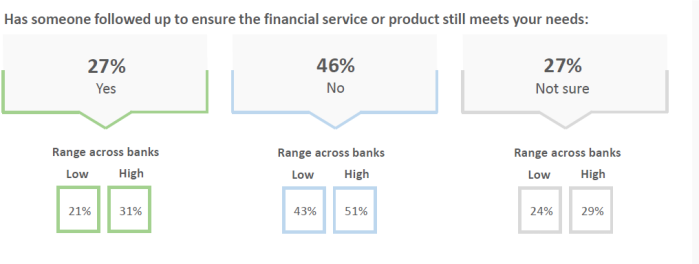
Or there was this question.

Q: ‘After purchasing a financial service or product, such as credit card, insurance, loan, term deposit, KiwiSaver, etc., has someone followed up to ensure the product continues to meet your needs and is still suitable for you?’

culture 2

Surely even at best this is only a nice to have?  Annoying calls from firms “just following up to see that everything is okay” have a cost (to the recipient too).  And there is some (considerable) onus on customers.  If I reflect on this question, I probably have a couple of credit cards I no longer need –  and am paying a small amount to the ANZ for each year – and no one has rung to check whether they are still “meeting my needs”.  But I don’t expect them to.  I’m an adult.

I’m not totally laissez-faire on such matters.  There are dangers that long-term contracts, hard to get out of, could be sold to people who simply don’t understand them. (Occupational pension schemes that people had no choice but to join are another example.)  It is reasonable for society to have (legal) protections built into the system.  But this report highlights precisely no systematic problems.   The report briefly, and reasonably, mentions a class of “vulnerable customers”, but again it was not apparent that there are either systematic problems or easy solutions.

Perhaps the most publicised part of the report is the initiative by the FMA and Reserve Bank to try to get all banks to stop sales-related incentives for frontline staff.   Given that the two institutions acknowledge that their legal mandates are limited it isn’t clear how much this is more than bluff, bravado, and a bit of pushing at an open door (some banks already being in the process of phasing out such incentives).  I hold no brief for specific remuneration practices, but I was struck by how little actual analysis there was in the report, including the role of sales-based incentives in a whole range of other sorts of firms and industries.  I didn’t explicitly check, but when I bought a car a few weeks ago I didn’t assume other than that the salesman would be benefiting personally if I happened to buy a car from him.  No doubt he knew that I knew.  There are risks, and one deals with them by some mix of dealing with reputable firms (invested in their brand), mechanic checks, and so on.  It isn’t clear in what respect the FMA and the Reserve Bank think basic banking products are so different.   There are no perfect ways of resolving agency issues (even within organisations), again something missing from the report.  Then again, rhetoric is cheap and serious analysis is hard (and grabs fewer headlines).

One of the Governor’s consistent themes is that banks –  and indeed private business more generally –  are too short-term in focus. He never produces any evidence to support his claim, or to back his view that he is better placed than private shareholders and managers to appropriately factor in time horizons, conditioned on the huge uncertainty everyone faces.   It shows through again in this report.  There are several claims that banks are too focused on short-term customer value or satisfaction, but no evidence is adduced to support this.   Frankly, I’d find it a little surprising if it were true.  Lifetime customer value is an approach that has been around in the marketing etc literature for 30 years now (and the basic idea won’t been unknown prior to that), and if banks really were just prioritising the short-term presumably they’d run into trouble eventually?  And yet New Zealand (and Australian) banks –  outside the immediate post-liberalisarion period –  have been both stable and profitable over many many decades, and haven’t even been losing customers to newer better providers more willing or able (or something) to meet customers’ long-term needs.

So, overall, I wasn’t impressed.  From the beginning, the review looked like a bit of power and influence grab –  especially by the new Governor, playing politics – bidding for more resources.  It came at a time when the banks –  legitimate private businesses (not, as the Minister of Finance put it this morning, operating as some sort of “privilege”) –  were (and are) in a weak position to stand up for themselves (given the bad stories from Australia).  And so banks, who face a market test every single day –  not just the share market, but customers with the ability to take their business elsewhere –  have to quietly put up with lectures from senior bureaucrats who’ve never faced such tests, never had to put their ideas or products to the market, deferentially swearing to go along and do as Orr and Everett say.   And, of course, if the banks do end up having to put in place more reports, more systems, more compliance checks, well, the burden of regulation always falls less heavily on big established players than on small operators or new entrants.  And so the big players –  more deft at playing the political/bureaucratic games – don’t really have much to worry about.  But customers might.

None of this is to suggest that ethics and morality (two words absent from the report)should be unimportant in business.  Without them, the basis for trust –  central to well- functioning markets and societies –  is corroded and eventually lost.  But it also isn’t clear that yet more mandated reports, yet more boxes to check, yet more rules to get legal sign-off on compliance with, is any sort of real substitute for the sort of personal and institutional integrity many hanker after.  I’m a trustee of a couple of superannuation schemes, which the FMA is responsible for regulating, and I’m struck by the sheer cost and additional complexity new waves of rules add –  even rules specifying the maximum number of words in one specific report –  and the contrast between that and the likely value being added for members.  And the improbability that the thicket of rules will really do much the stop the rogues.  Or even to cultivate a culture of honour and decency –  as distinct from formal compliance –  among the promoters and adminstrators of such schemes.

Deposit insurance, OBR etc

This wasn’t going to be the topic of today’s post, but I see Stuff has a story up based largely on a conversation I had late last week with their journalist Rob Stock.  (NB In the first version I saw a couple of hours ago a rather important ‘not” was omitted from this sentence “But a big bank failure was imminent, he said”).

New Zealand is being tipped to join the rest of the OECD in having a government-backed bank deposit guarantee scheme.

Under the Reserve Bank’s Open Bank Resolution scheme (OBR), depositors at a failing bank might have to take a “haircut” with some of their money being taken to recapitalise their bank, and get it open for business again quickly.

But former Reserve Bank head of financial markets Michael Reddell is tipping an end for OBR following the release of a discussion paper into the future of the Reserve Bank.

The background to this was the release last week of a joint Reserve Bank/Treasury consultative document as part of phase 2 of the review of the Reserve Bank Act.  I haven’t yet read the whole document, although a reader who has tells me it is a fairly substantive (and thus welcome) piece.  But when Rob Stock got in touch to suggest he would like to talk about the reappearance of the OBR (Open Bank Resolution), I read the relevant section (chapter 4) on “Should there be depositor protection in New Zealand?”

Stock is not a fan of the OBR option and was uneasy as to why it was appearing in the consultative document.  My response was along the lines that OBR had played a key role in Reserve Bank thinking about failure management for almost 20 years now.  Any new consultative document (especially a joint RB/Treasury effort) had to build from where policy/rhetoric had been but that, nonetheless, my read of the document suggested a clear framing pointing towards (officials favouring) New Zealand adopting deposit insurance.

Treasury has favoured such a change for some years, while the Reserve Bank had historically been quite resistant –  mostly, on my reading, because they take a rather naive wishful-thinking approach which ignores twin realpolitik pressures that ministers will face if a major bank is at the point of failure.    They believe in the value of market discipline (as, surely, in some sense most people do) and don’t want to do anything that might acknowledge that it isn’t always going to be a feasible (political) option.   In my view, in reaching for something nearer a first-best model in an idealised world, they increase the chances of third or fourth best outcomes.  A well-run deposit insurance scheme isn’t perfect, but offers the prospect of a decent second-best set of outcomes.  And, for what it is worth, would bring New Zealand into line with the rest of the advanced world.  As the consultative document makes clear, of the OECD countries only New Zealand and Israel don’t have deposit insurance, and Israel has already indicated that it is going to introduce a scheme.

As I noted, it was hard to see why any of the parties in the current government would be resistant to introducing deposit insurance (the Greens had been openly calling for such a reform) and there had been signs that although the “old guard” of the Reserve Bank had been resistant to deposit insurance the new Governor was likely to be more receptive. (And in the off-the-record speech Orr gave a few months ago, it was reported that among his comments was “deposit insurance is coming”.)   National had been resistant, but relevant context for that included the way they were landed with the aftermath –  and losses – of the retail deposit guarantee scheme after coming into government late in 2008.  The retail deposit guarantee scheme bore almost no relationship to a proper deposit insurance scheme –  being introduced at the height of a crisis, primarily covering unsupervised institutions and then knowingly undercharging those institutions for the risk being assumed.  But it is relevant (together with National’s bailout of AMI) in revealing how politicians are likely to behave under pressure in a financial crisis.

Why do I favour deposit insurance (as a second best)?   I’ve covered this ground in other posts, but just briefly again.   I see little or no prospect that, in event of the failure of a major bank, politicians will let retail depositors lose their money (reliance on OBR assumes exactly the opposite interpretation).    If so, it is better to force depositors themselves to pay for that protection up-front, in the form of a modest annual insurance premium.

At present, with the four biggest banks all being subsidiaries of Australian bank parents, the failure of a major domestic bank is only seriously likely to occur if the parent is also in serious trouble. (And the 5th biggest bank is government owned –  enough said really.) If the parent isn’t in serious trouble, there would be a strong expectation that the parent would recapitalise any troubled subsidiary and/or perhaps manage a gradual exit from the New Zealand market.

It simply isn’t very credible to suppose that if the ANZ banking group is failing, and the New Zealand subsidiary is also in serious trouble, a New Zealand government will let New Zealand depositors of ANZ lose (perhaps lots of) money while their Australian cousins and siblings (often literally given the size of the diaspora), depositors with the ANZ, are bailed out by (or covered by deposit protection by) the Australian government.   It isn’t as if there is any very credible scenario in which the New Zealand government’s debt position had got so bad that the government could claim “we’d like to help, but just can’t”, and the optics (and substance) would be doubly difficult because it is generally recognised that a concomitant to making OBR work would probably be to extend guarantees to the liabilities of other (non-failing) banks –  otherwise, in an atmosphere of crisis transferring funds to the failing bank will look very attractive to many.

My view on this is reinforced by the practical examples of bailouts we’ve seen.  Sure, the previous Labour government let many small finance companies fail without intervening, but then the deposit guarantee scheme happened. AMI policyholders were bailed out, when there was no good public policy grounds (other than the politics of redistribution etc) for doing so.  And, beyond banking, we had the bail-out of Air New Zealand in 2001. In the account of that episode that Alan Bollard (then Secretary to the Treasury) told, uncertainty about what might happen in the wake of any failure was a big part of the then Prime Minister’s decision.  It would be the same with the failure of any systemic bank.   It isn’t an ideal response, but it is an understandable one, and one has to build institutions around the limitations and constraints of democratic politics.

(The other reason why OBR is never likely to be used for big banks, is that in any failure of a major bank, trans-Tasman politics is likely to be to the fore, with a great deal of pressure from Australia for the failure of the bank group’s operations on both sides of the Tasman to be handled together/similarly.  It was a little curious that nothing of this was mentioned in the chapter of the consultative document.)

If there is no established depositor protection mechanism and if politicians blanch at the point of failure –  as almost inevitably they will –  then in practice what is most likely to happen is that everyone will be bailed out.   And that really would be quite unfortunate  – big wholesale creditors, who really should be on their own (and able to manage risk in diversified portfolios), losing along with granny.   And so one argument is that deposit insurance allows us to ring-fence and protect (and charge for the insurance upfront) retail depositors, while leaving wholesale creditors to their own devices in the event of failure.  In other words, a proper deposit insurance scheme could increase the chances that OBR can actually be used to haircut the sort of people (funders) that most agree should lose in the event of a bank failure.

There were a few things in the Stock article where I’m quoted in a way that at least somewhat misrepresents what I said.

Reddell said he expected the deposit insurance to win out and the scheme to be run by the Government.

An EQC-like fund would be created to collect insurance premiums from all depositors, with no banks allowed to opt out, he said.

The question here had been about which private insurer would be strong enough to provide the deposit insurance.  My response was that it was most unlikely such a scheme would be run through a private insurer –  they too can become stressed in serious crises –  and that what one would expect would be a government-run and underwritten fund, accumulating levies over the decades, and helping to cover any losses in the event of a major failure.

The premium would be about 10 basis points on deposits, so a deposit account paying interest of 3 per cent, would be cut to 2.9 per cent, with the rest funding the deposit guarantee premiums, Reddell said.

Here the question was mostly about who would bear the cost of the insurance. My point was that one would expect the cost to fall primarily on depositors (rather than say, borrowers or shareholders).  The size of any premium (which should be differentiated by the riskiness of the institution) would be a matter to be determined, and varied over time, but I did note to Stock that for an AA rated bank that cost might be quite modest.   I noted that although CDS (credit default swap) premia had increased since, in the half decade or so leading up to the 2008 financial crisis the premia for Australasian banks had typically been only around 10 basis points.

In other guarantee schemes each depositor only has a maximum amount of their money guaranteed. The paper mentions $50,000, but Reddell said the scheme, if introduced, would have a cap of around $100,000.

My point was that a cap of only $50000 (an idea mooted in the paper) didn’t seem particularly credible, and based on the levels of coverage in many overseas schemes (and under the deposit guarantee scheme) I would expect any deposit insurance scheme cap to be at least $100000.   Set the cap too low and it will end up being unilaterally changed at the point of crisis, with no compensating revenue to cover the additional insurance being granted.

And finally

But a big bank failure was not imminent, he said.

“Canada has gone over 100 years without a big bank failure. There’s no reason to think we will get one in the next few decades,” he said.

Of course, failures are always possible, but much of the mindset and literature is too influenced by either US examples (where the state has had far too big a role in banking), or those from emerging markets.   Canada provides a very striking contrast, but even in New Zealand or Australia the only period of systemic stress in the 20th century was in the period (the late 1980s) when a previously over-regulated system was deregulated quite quickly and everyone (lenders, borrowers, regulators) struggled to get to grips with applying sound banking practices in an unfamiliar environment.   A once in a hundred year systemic bank failure is something authorities have to plan for, and given the choice between collecting modest annual insurance premia for a hundred years to cover some (or even all) of the cost of bailing out retail depositors, and doing nothing and (most probably) bailing them out anyway, I know which second-best alternative I’d choose.

I hope the government agrees, and acts to implement a deposit insurance regime for New Zealand.  There are lots of operational details to work out if they do, and those aren’t the focus of this consultation document, but deposit insurance is the way we should be heading.

On Poland and economic performance

Next week we mark the 100th anniversary of the end of World War One.   Whatever else –  good and ill –  the resulting peace process ushered in, it led to the restoration of an independent Poland.   I was reading an article the other day by a British writer, resident in Poland, reflecting on 100 years of (renewed) Polish independence, which in turn prompted me to dig out some economic data.

My own reflection on Poland is that it is hard to think of a place in the western world (say, present day EU, other bits of western Europe, and western European offshoots – eg New Zealand, Australia, Canada, US, Argentina, Chile, Uruguay) that wouldn’t have been preferable to live in over the last 100 years or so, at least as judged by material criteria.   Perhaps if you were German, you have to live with the guilt of World War Two, but most of Germany was free again pretty quickly.   Romanians and Bulgarians might have been poorer on average, but they largely escaped the worst horrors of the German occupation.  To its credit, Bulgaria managed to largely save its Jewish population, while the Polish record was patchy at best.  With borders pushed hither and yon, and not a few abuses of other peoples (notably ethnic German) post-war, sanctioned by the state, the place then settled into 40 years of Communist rule.   There is a lot to admire about Poland, but I wouldn’t have wanted to live there any time in the 20th century.

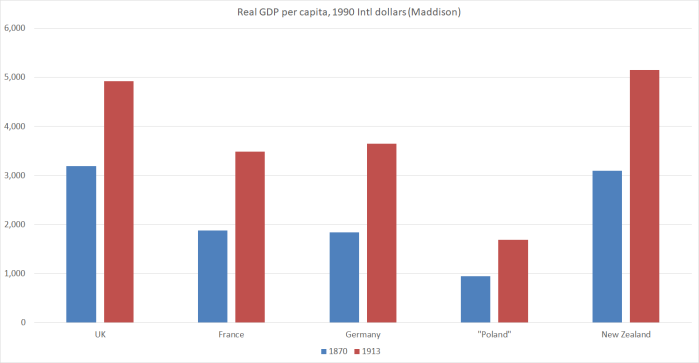
In economic terms it has always been something of a laggard.   Here from Angus Maddison’s collection of data are estimates of real GDP per capita for 1870 and 1913 for the UK, France, Germany, the territory that was Polish, and New Zealand.

poland 1

Real GDP per capita in Polish territory (mostly ruled by Russia) was about a third of that in New Zealand.

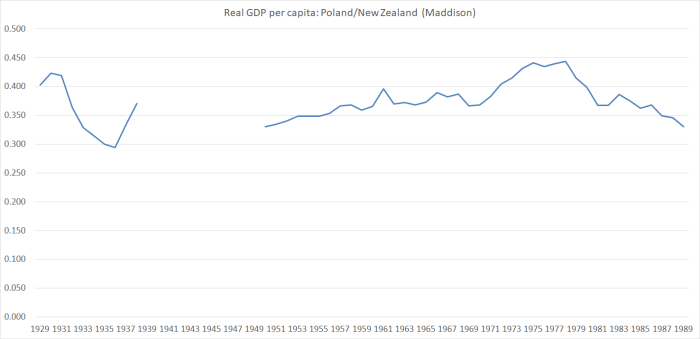
The Maddison database has annual data for Poland from 1929 (excluding the period of the war), and that ratio of Polish GDP to New Zealand GDP seemed to show no real trend whether pre-war or in the communist years, averaging just a bit more than a third.

poland 2

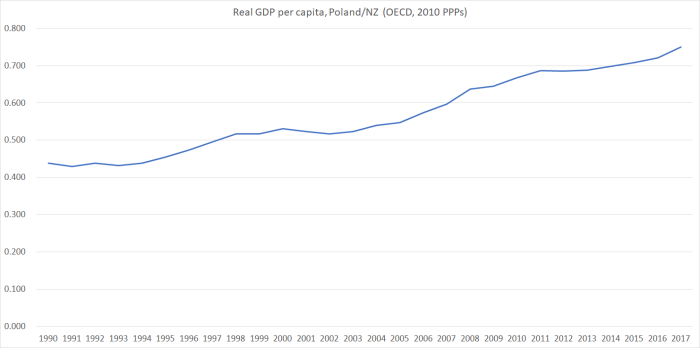
Relative prices – including the purchasing power parity exchange rates used- matter quite a lot in these cross-country comparisons across time.  So not too much should ever be put on any particular levels estimate.  The Maddison database only comes forward to 2008 and the most widely used current numbers are those from the OECD.  On their calculations, at the end of communism Poland was a bit better off (say, relative to New Zealand) than in the Maddison numbers.  Polish GDP per capita in 1990 is estimated to have been about 44 per cent of that in New Zealand.

Here are the OECD estimates for the period since.

poland 3

On OECD estimates, Polish real GDP per capita hit 75 per cent of that in New Zealand.

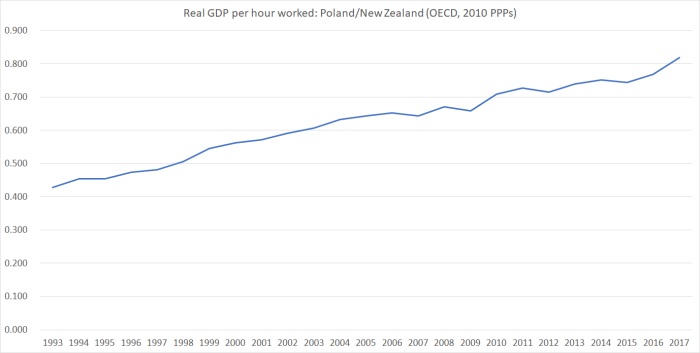
Here is the OECD estimates for real GDP per hour worked (for which there are no longer-term historical estimates, but we can safely assume the ratio was very low on average –  perhaps averaging 35 to 45 per cent –  in the century prior to 1990.  In 1993, when the Polish data start the ratio was 43 per cent –  almost exactly the same as for real GDP per capita.

poland 4

Last year, Poland’s labour productivty reached 82 per cent of that of New Zealand.

All of which is clearly very good for Poland.   And it clearly isn’t just that they’d thrown off the shackles of communism: as the earlier charts show, Poland had been a laggard in the 19th century, and in the first half of the 20th century.

But, of course, part of the good news in these charts is a reflection of New Zealand’s own poor long-term performance.

Here are the latest OECD labour productivity (real GDP per hour worked) estimates for the same group of countries as in my first chart above.

poland 5

Last year, for the first time, Polish real GDP per hour worked passed 50 per cent of that in France and Germany.  100 years ago, of course, both France and Germany would have lagged well behind both the UK and New Zealand.

Perhaps Poland will go on to achieve much greater convergence with the other big European economies in the next few decades – we can only hope so –  and yet one can’t help wondering whether the leaders of a newly independent Poland wouldn’t have been rather disappointed if they’d been told that 100 years on their successors and fellow citizens would still be achieving only half the output per hour of the French and Germans.

Then again, they’d probably have been astonished to learn that 100 years on they’d be managing 82 per cent of average New Zealand productivity (and even 63 per cent of that of the British –  leading global power a century ago).

Hard to think though how disbelieving our own leaders would have been 100 years ago if they were told how far we would have fallen relative to these other countries, notably including Poland.     With none of the excuses –   wars, shifting borders, genocide, or decades of communist rule.

I might have a look at the data for a few of the other post World War One emergent countries later in the month.

Restructuring the Reserve Bank

Seven months (and counting) into his term as Governor, Adrian Orr still hasn’t deigned to deliver an on-the-record speech on either of his main areas of statutory responsibility (monetary policy and financial stability) but he has this morning done what it seems almost all new CEOs –  public sector and private sector –  now do, and restructured his senior management, ousting or demoting several top managers, elevating one or two, and opening up a raft of vacancies.  Public sector senior management restructurings seem to generate most of the Situations Vacant business for the Dominion-Post newspaper these days.

A few people have asked my thoughts on the restructuring, so…..

As a first observation, I give credit to the Governor for resisting the temptation of across the board grade inflation (although there is at least one example, see below).  Every public sector senior management advert one sees –  I pay attention mostly because my wife has been in the market – is full of Deputy Chief Executive roles (not infrequently five or ten of them).  The Bank’s Act constrains the number of Deputy Governor positions (only one, in the bill before the House at present) but if he’d wanted to, all these SLT positions could have been designated Deputy Chief Executive roles.  As it is, having resisted title inflation, the Governor might find some potential applicants a bit more hesistant than otherwise: an Assistant Governor (even for Economics, Financial, and Banking) may sound less glamorous than a Deputy Chief Executive title.

This is the new structure, which looks a lot like those for all manner of public sector organisations.new-leadership-team-structure

Three of those positions are filled straight away.

Appointments to Senior Leadership Team
Geoff Bascand – (Currently Deputy Governor and Head of Financial Stability) has accepted a role on the SLT as Deputy Governor and General Manager of Financial Stability.
Lindsay Jenkin (currently Head of Human Resources) has accepted a role on the SLT as Assistant Governor/General Manager of People and Culture
Mike Wolyncewicz (currently Chief Financial Officer and Head of Financial Services Group) has accepted a role on the SLT as Assistant Governor/ Chief Financial Officer Finance.

Of those two appointments (Bascand and Wolyncewicz) seem sensible and appropriate.  Bascand currently holds a statutory Deputy Governor appointment and would have been hard to shift even if the Governor had wanted him out.  His role is slightly –  though perhaps sensibly – diminished as he will no longer have overall senior management responsibility for financial markets.

To be blunt, the new Assistant Governor for People and Culture has the feel of tokenism on two counts.   The first count relates to the current tendency for HR managers to be given glorified titles and to report directly to the chief executive (the message supposedly being “we value our people”, as if organisations never did when HR was a fairly low-level support role).  Line managers are the people who convey (by their actions mostly) to staff the extent to which they are valued (or otherwise).   And the second relates to the incumbent, who just is not particularly impressive.  As someone put it to me, perhaps she might be okay in some modest commercial operation, but she never showed any sign of being suited for a key leadership role in a significant policy organisation.  But….she is a woman, and in promoting her Adrian Orr manages –  after 84 years –  to have a woman in a top tier role (although still not in a key role in policy or operational areas, the raison d’etre for the organisation).   It will have been an easy win to simply grade-inflate the Manager, Human Resources role.  After all, as he said a few months ago

We will be working actively. We are just going to have to be far more aggressive at getting the gender balance balanced,” Orr said in a recent interview

(And before I get angry emails or anonymous comments from past or present Reserve Bank staff, I will reiterate my view –  and it is only mine –  that there are no conceivable grounds on which Lindsay Jenkin would be in the top tier of a major policy organisation other than her sex.  I wish it were otherwise.)

In the entire restructuring, the person one should probably feel most sorry for is Sean Mills, Assistant Governor and Head of Operations, whose job is dis-established and who is leaving the Bank, having joined under a year ago.  I suppose he knew the risks –  taking on a direct report job in the hiatus between Governors, when no one had any idea who the new Governor would be or what structure he or she would prefer.  I’ve never met Mills, and have heard nothing good or bad about him, but it is always a bit tough to lose your job after less than a year.

Two long-serving key senior managers –  both in their roles for 11 years now –  are demoted as part of the restructuring, one perhaps a bit more obviously than the other.

The first is Toby Fiennes, currently Head of Prudential Supervision.  His role –  a big job –  appears to have been split in two.

Toby Fiennes (currently Head of Prudential Supervision Department) has accepted the role of Head of Department for Financial Stability Policy and Analytics.

with one of his current managers (very able) taking up the role responsible for actual oversight of financial institutions.

Andy Wood has accepted the new role of Head of Department for Financial System Oversight.

I always had some time for Fiennes (although I’ve probably criticised speeches and articles here) and thought him in some respects the best of the main departmental heads.  Perhaps it is just that the job has gotten so big that the Governor no longer wanted one person doing it, but the new role is much-diminished relative to what he has been doing for the last decade.   And Geoff Bascand already had the key overall financial stability role, so there was no possible promotion opportunity.

The bigger, and more obvious, demotion is that of (current) Assistant Governor and Head of Economics, John McDermott.

John McDermott (currently Assistant Governor and Head of Economics) has accepted the role of Chief Economist and Head of Department for Economics in the Economics, Financial Markets and Banking Group.

After 11.5 years as a direct report to the Governor, and almost as long with the Assistant Governor title, McDermott loses both.

I’m always hesitant to write much about McDermott.  He was my boss for six years, and while we had our differences we sat across from each other for years and exchanged views on all manner of work and family things.  I liked him, was looking just the other day at the personal gift he gave me when I left the Bank, and I was genuinely pleased to applaud his daughter’s award the other night at the Wellington East Girls’ College prizegiving.

Unfortunately, I don’t think he was the person for the role he has held for eleven years, and which he never really grew into or made of that position what it should have become.  He has a strong track record as a researcher, and apparently was for quite a while the most widely-cited New Zealand economics researcher, but the key senior manager for monetary policy –  effectively a deputy governor without the title – required more than McDermott had to offer.   In public view, this was apparent in speeches and Monetary Policy Statement press conferences.  And thus, sad as it perhaps is for John, I think the Governor has made the right choice.  Whether McDermott stays for much longer in the diminished position he will now take up perhaps depends a lot on who gets vacant (and crucial) new role of Assistant Governor for Economics, Financial Markets, and Banking).

Two other senior managers in core roles leaving the Bank

Mark Perry (Head of Financial Markets)…..elected to leave the Reserve Bank.

Bernard Hodgetts (Head of Macro-Financial Department, who is currently seconded as Director Reserve Bank Review in the Treasury) has also chosen to leave the Reserve Bank after he finishes his role leading the review.

The Head of Department for Financial Markets won’t be an easy role to fill –  I wouldn’t have thought there were any obvious internal candidates.

Three more comments on the review:

  • even if a role like “Assistant Governor, Governance, Strategy and Corporate Relations” is the sort of title one sees in lots of government agencies, it feels like another example of grade inflation.  Presumably this involves the communications functions, the Board Secretary, and churning out the myriad hoop-jumping documents like the Statement of Intent.  People with “strategy” in their title in public sector organisation are rarely at the heart of what the organisation do.
  • there will be a lot of focus on who gets the role of Assistant Governor, Economics, Financial Markets, and Banking.  This is (slightly) bigger role than Murray Sherwin held 20 years ago, without the benefit of the Deputy Governor title.    We will have to wait until the adverts appear to see whether the Governor is after a policy leader (someone who really knows this stuff) or a generic public service manager.  If –  as I hope –  the former, it has been speculated to me that the Governor may try to attract back to the Bank the current Treasury chief economist Tim Ng (whose talents would be better used doing almost anything than wellbeing budgets).  Another possibility is the current Treasury deputy secretary for macro, Bryan Chapple who has a central banking background and led some of the financial markets reform work at MBIE.  No doubt there will be others applying, especially as the holder of the position is almost certainly to be a statutory appointee to the new Monetary Policy Committee.
  • this restructuring also probably helps clarify who will be the four internal members of the new Monetary Policy Committee.  The Governor and Deputy Governor will be members ex officio, and it is hard to see how the other positions would not be given to the Assistant Governor, Economics, Financial Markets,and Banking) and to John McDermott, as head of the Economics Department.

Overall, the restructuring is quite a mixed bag.   There are some good appointments and some poor ones already, and quite a lot will depend on a handful of the remaining appointments (especially the quality of person they can attract to that Assistant Governor role –  which, notwithstanding my earlier cautions about grade inflation, really should be a deputy chief executive position, both for recruitment reasons and for the stature and standing of the person in international central banking circles).

If I have a caveat about the overall structure, it is probably that the Bank would be better for having at least one senior policy person –  whether as Deputy Governor or so Advisor to the Governor –  who didn’t have a demanding line management role.  Such roles aren’t uncommon in other central banks, but I guess it depends on the Governor’s own preferred operating style.

And since I have the opportunity of a post about the Bank, I should note that I have not abandoned the issue of the Governor’s total non-transparency in respect of his speech about transparency to the Transparency International AGM (at which he was introduced by the State Services Commissioner, who has responsibilities for open government).  I am pleased to see this issue has had a little bit of media attention, including this article which pointed out that 90 per cent of Transparency International’s funding comes from the taxpayer.  I have an Official Information Act request in with the Bank for any briefing notes or text the Governor used, for any recordings that may exist, and if none do for a summary of what was said (memories –  very fresh, since I lodged the request within hours of the Governor delivering his speech – are official information too.   I don’t expect much, but there is a point to be made –  all the more so given the topic, the audience, the introducer, and the funding source for the body to which he was speaking. I can’t imagine Orr said anything very controversial, in which case why the secrecy? And if what he said was controversial –  foreshadowing for example Monday’s forthcoming culture review – it shouldn’t be said only to select private audiences.  It was simply an unnecessary own-goal, some sort of silly reassertion (perhaps Wheeler like) of a Reserve Bank perception that it really should be above such trivial matters as disclosure, transparency and the Official Information Act.


Local listing for banks: a case for one in particular

There was a very strange article in the Herald yesterday from one Duncan Bridgeman claiming that it was, in the words of the hard copy headline Time to force Aussie banks to list in NZ”.

What wasn’t at all clear was why.

Bank profit announcements seemed to be the prompt for the column

Australian banks reaping huge profits from their New Zealand customers is a perennial scab that gets ripped off every time financial results come in.

I’m not persuaded the banks earn excessive profits here, but I know some other serious people take the opposite view.  But even if they are right, surely that is a competition policy issue –  the case for one of the new market studies perhaps, and any resulting recommendations.  There is nothing in the article explaining how forcing the Australian banks to sell down part of their New Zealand operations would affect, for the better, competition in the New Zealand banking services market.

The other prompt appear to be industry developments in Australia

Meanwhile, Australia’s big banks are starting to move away from vertical integration, partly because of conflicts of interest but also because their financial services model is unlikely to sustain the same profits over the longer term.

Suncorp, ANZ, CBA and NAB have all divested their life insurance operations. The latter two have also announced plans to spin off their wealth management operations. Westpac remains wedded to these areas of business but is expected to follow suit at some point.

And just last week financial services firm AMP, also heavily damaged by the banking royal commission, announced the sale of its wealth protection unit to US firm Resolution Life for A$3.3 billion and divulged plans to offload its New Zealand wealth management and advice businesses through a public offer and NZX listing next year.

But not one of those divestments has anything to do with core banking operations, unlike the approach Bridgeman appears to be proposing for the New Zealand bank subsidiaries.

A not unimportant word that one –   subsidiaries.  Presumably Bridgeman is fully aware, even though his article doesn’t mention, that all four Australian banks do the bulk of their New Zealand business not through branches, but through legally separate New Zealand subsidiary companies, with their own boards of directors (and statutory duties). (New Zealand compels them to do so, at least in respect of the retail business).

But when I read this paragraph I had to wonder if he really did appreciate that.

But if ever there was a time to raise the prospect of some form of domestic ownership and oversight of the banks, it is now.

The problem is it will never happen unless the Aussie banks are forced to by our politicians and regulators. After all, the last thing the banks want right now is another regulator to answer to.

Yet, why should it be accepted that four of this country’s five most profitable companies are effectively regulated in Australia?

The New Zealand subsidiaries are fully subject to New Zealand law: competition law, prudential regulation, financial conduct law, health and safety law.  The lot.  (Even the branches are subject to much New Zealand law, but leave them aside for now.)   The Reserve Bank of New Zealand sets minimum capital standards. minimum liquidity standards, disclosure requirements and so on.

Of course, since the New Zealand subsidiaries are part of much larger Australian-based banking groups, APRA’s regulations and requirements for the group can also be binding  –  not on the New Zealand business itself, but on the group as a whole.   APRA can, in effect, hold the local subsidiaries to higher requirements than those set by our Reserve Bank  (in just the same way that shareholders might voluntarily choose –  perhaps under rating agency pressure – higher standards than a regulator might impose), but it can’t undercut New Zealand standards for New Zealand operations.  Daft as they may be, New Zealand LVR restrictions are binding on banks operating in New Zealand.

Bridgeman goes on

Theoretically an Aussie bank could offload 25 per cent of the institution’s New Zealand assets and list the shares here separately. That would bring tax advantages to New Zealand investors who can’t use Australian franking credits, even though they are dual listed.

I presume he means selling off 25 per cent of the shares in the New Zealand subsidiary (rather than 25 per cent of the assets).  It would, no doubt, have tax advantages for New Zealand investors (and thus, in principle, the shares might command a higher price), and yet the banks haven’t regarded it as worth their while (value-maximising) to do so.    Bridgeman doesn’t look at question of why (presumably something about best capturing value for shareholders by holding all of the operations in both countries, and being able to  –  subject to legal restrictions and duties –  manage them together).

And he also doesn’t note that if, say, ANZ sold down 25 per cent of the shares in its New Zealand operation, the subsidiary will still be regarded by APRA as part of the wider banking group, and prudential standards will still apply to the group as a whole.  As they should –  after all, with a 75 per cent stake there would be a high expectation (from market, regulators and governments) of parental support in the event that something went wrong in New Zealand.

There is a suggestion that the article is a bit an advertorial for NZX

If a quarter of these assets were listed that would bring about $12.5b of capital to the local stock exchange – a badly needed injection at a time when the main market is shrinking.

But even then it isn’t clear what is meant.  It isn’t as if there is a new $12.5 billion (I haven’t checked his numbers) of local savings conjured up.   Buying one lot of shares would, presumably, mean selling some other assets.  In a country with quite low levels of foreign investment, the initial effect of any such floats would be to reduce that level further.  (Of course, in practice quite a few of the shares in any newly floated New Zealand subsidiaries would be picked up by foreign investment funds, leaving the alleged benefits of any compulsory selldowns even more elusive.)

Bridgeman ends with a rallying cry

And right now the Aussie banks are distracted with a battle on their home turf.

It’s the perfect time for some Coalition politicians to show some backbone and make a case for a change in this direction.

It might have appealed to Winston Peters once upon a time, but even if it weren’t a daft policy to start with, Bridgeman may have noticed that business confidence is at rather a low ebb right now.  Arbitrarily interfering in the private property rights of owners of private businesses – even if largely Australian ones –  wouldn’t be likely to do much to instill confidence in the soundness of policymaking.

As it is, they could start closer to home.  If governments really did want to focus on getting some more bank representation on the domestic stock exchange –  and it is not obvious why they would –  perhaps they could look at the New Zealand banks first.  After all, only one of them (Heartland) is sharemarket listed.  And the biggest of those New Zealand owned banks –  Kiwibank – is actually owned by the government itself.    In fact,  by three separate goverment agencies (NZ Post, ACC, and NZSF), none bringing obvious expertise to the business of retail banking, none themselves facing any effective market disciplines.  I’d be all in favour of a well-managed float of Kiwibank  (although once floated it might not last long as an independent entity).  There are good reasons (they’ve been there for years) for the government to consider seriously that option.  But there are no good reasons to force well-functioning locally regulated foreign-owned banks to sell down part of their operations in New Zealand.


Did state houses make much difference to housing supply?

I’ve been among those suggesting that the KiwiBuild programme –  even if it involved the government itself directly commissioning the building of new houses that no existing developer already had in prospect –  was unlikely to increase overall housing supply very much, or affect overall average house prices very much.  It was never clear how such a programme could affect overall housing supply very much.  For it to do so, there would have to be large unexploited profits left sitting on the table by private developers (properties selling for far more than it would cost to bring new developments to market).  If that isn’t so –  and we don’t see any obvious signs of such unexploited opportunities – whatever the government itself builds or commissions is just likely to mostly displace and replace houses that the private sector would have built.   (There is another possibility, that the government not only displaces most private building, but goes on building at a loss even beyond that point, but there is nothing in the PR around the programme to suggest that is what they have in mind.)

I also know the line the government and its defenders run that somehow KiwiBuild will “work” –  whatever that means –  by building particular types of houses the market isn’t providing.  But even to the extent that is so, what of it?   If the morass of regulation makes it uneconomic to build many new moderate-sized homes (although do recall that the flagship houses are four bedrooms), demand reallocates.  Decades ago many young couples started out with a brand new (small) house in a remote suburb with few facilities and not even a lawn (I’m just old enough to remember our (new) street in Christchurch where what would become front lawns were planted with potatoes, apparently to get the impurities out of the soil).  These days they don’t.   But is there any sign that the prices of the existing modest-sized houses have increased disproportionately relative to house prices more generally?  I’m not aware of any, and that isn’t really surprising, when by far the biggest issue in high urban house prices is land prices.   And KiwiBuild does nothing at all about them.

In my post earlier in the week, I mentioned the state house building programme initiated by the first Labour government, and often touted as the inspiration for today’s KiwiBuild programme.   In passing, and thinking as I wrote, I wondered if the (substantial) construction programme associated with the state houses programme had made much difference to overall housing supply.  It wasn’t something I’d ever given much thought to previously, but once one begins to think about it, of course it makes sense to doubt that that massive state intervention really made much difference on that specific count.  (It is quite probable that it materially increased availability for some –  small –  class of potential tenants private landlords were reluctant to touch.  It is also clear that it chewed up vast amounts of land, probably rather inefficiently – a couple of weeks ago I was driving through a state house neighbourhood a few blocks from where I grew up in Auckland and marvelled  –  not in a positive way – to see such small state houses on such large sections.)

There isn’t any easy way to compellingly answer my question.  Perhaps some academic researcher could turn their attentions to it at some point.   But out of interest I dug out a few charts.

This one (from Te Ara) shows the stock of state houses.

stock of state houses

(Interesting to see that the stock actually dropped a little during the term of the Kirk-Rowling Labour government).

And this chart shows annual data for both the number of new state houses built and those existing ones sold (something initiated by the 1950s National government).

state-houses-built-and-sold-graph

One way of looking at whether there is prima facie reason to think the state house programme might have made much medium-term differenc is to look at the population to dwellings ratio.

This chart is drawn from census data reproduced (up to the 1970s) in Bloomfield’s collection of New Zealand historical statistics.

person per dwelling.png

The spacing isn’t even –  censuses were skipped in 1931 and 1941 –  but all I really wanted to highlight was the strong downward trend over the 90 years from the mid 1880s to the mid 1970s.  The only interruption to the trend was in the single inter-censal period from 1916 to 1921.  It is more or less what one would expect, as people got wealthier, families got smaller (and, at least late in the period, divorce got more common).    Had the state not been building, there isn’t much reason to suppose that –  over time, and in the absence of building and land use restrictions –  the private sector would not have done so.  After all, they had done so in the decades prior to the state housebuilding programme (I was little surprised to see that even over the period encompassing the Great Depression –   1926 to 1936 –  the population to dwellings ratio fell).

Sadly, what might have been the cleanest test –  the 30000+ state houses built in the first decade or so of the programme –  also happened to mostly coincide with World War Two and the period of tight controls on all manner of things (including existing house sales) in the years following the war.  And government-imposed credit constraints remained an issue for the private sector for much of the post-war decades.

But I’d suggest that the burden of proof is really on the advocates of KiwiBuild to show that even very big government-inspired housebuilding projects really make much difference to the overall housing supply situation in the long-term.  After all, when the government owned many of our banks, most of our power companies, most of our radio and TV, and so on, mostly it didn’t supplement the stock of private businesses, it (rationally, from a private sector perspective) displaced them or crowded them out.  If the government were really serious about fixing the housing market, and making housing once again affordable for working class families, not just helping along well-paid professional couples, they’d free up the urban land market.  Sadly, there is no more sign of that under this government than under its predecessor.

On which note, there is a column today on interest.co.nz by Peter Dunne in which he begins thus

Kiwibuild is beginning to look more and more like no more than one of Edmund Blackadder’s cunning plans.

He has some good lines

It is worth recalling that in its election policy just one year ago Labour promised that it would “build 100,000 high quality affordable homes over 10 years”. The policy went on to talk about curbing homelessness through building affordable homes in the $350-450,000 price range.

The implication was unambiguous – Labour’s approach was going to be far more activist than National, and Kiwibuild would be Its primary policy to deal with homelessness and the housing crisis.

and

So far, just 18 Kiwibuild homes have been built, and another 447 are on track for completion by July 2019, leaving a shortfall of 535 on its first year 1,000 homes target.

Put another way, a first year achievement rate of just under 47%. And there has been a subtle but clear rewrite of the Kiwibuild objective.

According to the Kiwibuild website, the objective is now the much more passive one to “deliver 100,000 homes for first home buyers over the next decade”.

So, no longer will the government build “100,000 high quality affordable homes”. And no longer does “affordable” mean $350-450,000, but $650,000.

Moreover, now the plan is merely to “deliver” 100,000 homes, which, in the best Blackadder fashion, means accumulating all the new homes already being built over the next 10 years by the private sector anyway, and dressing them up as Kiwibuild homes.

But it is perhaps worth recalling here that Peter Dunne was a minister in the previous National-led government, and in particular held the one vote in Parliament that was sufficient to block the reforms (inadequate and insufficient as they would have been) that National was seeking to make.  I hope I don’t need to say again that I’m no defender of National’s record –  and lack of courage –  in this area in government, but it is a little rich for Dunne to snipe from the sidelines (legitimately in substance perhaps) when he personally blocked beginning to tackle some of the root causes of our obscene housing market failure.