MBIE on how emissions reductions targets interact with immigration policy


No, that blank space wasn’t a mistake.  It was the sum total of everything MBIE has written or commissioned (analysis, advice, research, or whatever), in the period since the start of 2014 on how the appropriate or optimal immigration policy for New Zealand might be affected by commitments to reduce greenhouse gas emissions.     At the start of the period the government was considering what commitments to make under the then-forthcoming Paris climate accord.    For the last couple of years, those commitments have been firm policy.     As a reminder. this is how the Ministry for the Environment describes New Zealand’s commitments

New Zealand has recently formalised its first Nationally Determined Contribution under the Paris Agreement to reduce its emissions by 30 percent below 2005 levels by 2030. The Paris Agreement envisages all countries taking progressively ambitious emissions reduction targets beyond 2030. Countries are invited to formulate and communicate long-term low emission development strategies before 2020. The Government has previously notified a target for a 50 per cent reduction in New Zealand greenhouse gas emissions from 1990 levels by 2050.

In their recent annual stocktake, the Ministry for the Environment listed “a growing population” as the first item on their list of three particular challenges New Zealand faces in meeting the emissions reduction target.    It might not have been an issue had New Zealand chosen to specify its reduction target in per unit of GDP terms, as for example Chile did.  But instead we specified the target in terms of total reductions of emissions, and set a target for reductions that was similar to (say) that of the EU, even though our population growth rate is rapid, and the population of the EU isn’t increasing much at all.    As the Ministry for the Environment belatedly recognised, rapid population growth matters.   A large chunk even of New Zealand’s total emissions result directly from human activity (vehicles and power generation), and most of the remainder result from farm animals, with pastoral farming remaining by far the largest chunk of our export industries.

I say that the Ministry for the Environment seemed to recognise the point belatedly because I asked whether they had any analysis, research or advice on the implications of, say, our immigration policy –  which directly boosts the population, all else equal –  either before or since the government set the emissions reduction target.   Their response was on time and in full.  There was nothing at all that fitted the terms of my request.  I also included in my request whether they had raised the issue with MBIE, the government’s prime advisers on immigration policy.  They hadn’t, at all.

In parallel, I lodged a request with MBIE.    Had they perhaps thought, whether when the government was setting the emissions reduction target, or more recently when they were reviewing the residence approvals target, about the connection between  more people, and the adjustment costs of meeting the emissions reduction target.  At least in principle, it looked like one more reason why one might be cautious as to whether immigration policy was in fact likely to make New Zealanders as a whole better off.

MBIE took their time to reply, but they also replied in full.  There was nothing –  no analysis, no research, no advice or briefing to any of their ministers, no sign of any effort to flag the issue with Mfe and perhaps seek their input.  Nothing.

I’m not really sure whether to be surprised or not.   For all the rhetoric about “joined-up government” (one of the arguments for creating mega MBIE in the first place), there has never been much sign of it working well.   And for both departments there were probably sacred cows they didn’t want to touch.   Perhaps many of the MfE people are “true believers” who think the world might be a better place if we quickly moved to a carbon-free economy, regardless of the costs of doing so.  And MBIE seems to have plenty of immigration “true believers” who seem implicitly to believe –  even if they never attempt to demonstrate –  that the benefits from immigtration to New Zealand are so great that any issues around the emissions reduction target must be trivial at best, and not allowed to distract from the great project of a bigger New Zealand.

But, even allowing for all that, I’m enough of a naive and idealistic enough former public servant that in fact I am a little staggered that neither department had anything at all on the issue –  not so much as a discussion note by someone in one department or another willing to think just slightly out of the mainstream.    Perhaps it was just a response to the preferences of respective ministers –  the government after all appears to have a strong commitment to “big New Zealand” regardless of any other costs –  but even if that is the answer, it still looks like a significant failure of officialdom, which has a responsibility to point out uncomfortable tensions and costs, offering free and frank advice even (perhaps especially) when it might be unwelcome.

In earlier posts, various commenters struggled to see why the issue mattered.  It is pretty straightforward.  For all the optimism about new technologies, if they were already economic they’d already be being adopted.   Adjusting to substantially lower emissions is therefore almost certain to come at a real economic cost, and that cost will be greater the more the population pressures drive up the baseline level of emissions.  People will drive and fly, people will need/want electricity, goods need transporting and so on.   And New Zealanders demand for imports needs exports, and there is little sign yet of any systematic strong growth in the non natural resource based sectors.  Impose a heavier burden on those farm sectors –  which might be well-warranted on environmental grounds –  and it will undermine the competitiveness of those industries.  If we can’t keep selling as much stuff abroad, we can’t import as much.  Our living standards will be lower than otherwise.

If our population by 2030 was say 10 per cent lower than current immigration policy will make it, all else equal, we’d be much closer to meeting the emissions reduction commitment, and would need to impose fewer (inevitably costly) restrictions or intensified price signals to achieve the balance of the reduction target.   It is simple as this: when we use policy to import more people that means more intense pressure on all of us, and all emitting industries and activities than is otherwise necessary, to achieve the emissions reduction target the government has set itself.   That cost needs to be properly evaluated, in a robust assessment of whether the possible gains to New Zealanders from the immigration itself are large enough to outweigh the additional costs and burdens imposed via the given emissions reduction target.  At present, neither MBIE or ministers are able to (or even really attempt to) demonstrate such benefits at all.

When, in the privacy of closed seminar rooms (or even in ministerial offices), senior officials and their associates sit down to hardheadedly review immigration policy –  assuming, as I do, that this does happen on occasion –  the implications of our emissions reduction target really needs to begin to be factored into the discussions.  It is quite staggering, in a country with such an unusual immigration policy, that it has not happened until now.   It might be a question for the State Services Commissioner to look into: quite how did such significant departments overlook completely such a significant potential connection between two major areas of policy.


New Zealand First’s immigration policies

I was briefly half-encouraged when I heard that Metiria Turei had been attacking New Zealand First for having “racist” immigration policies.  Mostly it seemed like a further rather depressing attempt to suggest that any serious debate about New Zealand’s unusually large and ambitious immigration policy was illegitimate, all the while trying to look like the Greens were taking the high moral ground, even as their co-leader actually descended into mud-slinging and name-calling herself.   But….there was the hint there that perhaps New Zealand First actually had some distinctive immigration policies.  The last time I’d looked on the NZ First website what was notable mostly was how little material there was on immigration policy, and how few significant policy proposals.

But, no.    When I checked again yesterday, there still wasn’t much there.    From listening to Winston Peters over the years, or even just listening to the reaction to him, you might have supposed New Zealand First had some far-reaching and specific proposals that would change the face of immigration policy in New Zealand.  Instead what you find is this.

New Zealand First is committed to a rigorous and strictly applied immigration policy that serves New Zealand’s interests. Immigration should not be used as a source of cheap labour to undermine New Zealanders’ pay and conditions.

There have been numerous instances of administrative failure to apply immigration rules and standards.

New Zealand First will strengthen Immigration New Zealand to give it the capacity to apply immigration policy effectively.

New Zealand First will:

  • Make sure that Kiwi workers are at the front of the job queue.
  • Ensure that immigration policy is based on New Zealand’s interests and the main focus is on meeting critical skills gaps
  • Ensure family reunion members are strictly controlled and capped and there is fairness across all nationalities.
  • Ensure that there is effective labour market testing to ensure New Zealanders have first call on New Zealand jobs.
  • Introduce a cap on the number of older immigrants because of the impact on health and other services.
  • Make sure effective measures are put in place to stop the exploitation of migrant workers with respect to wages, safety and work conditions.  In Christchurch and elsewhere there is evidence of exploitation of migrant workers.
  • Develop strategies to encourage the regional dispersion of immigration to places other than Auckland. Auckland’s infrastructure is overloaded.
  • Remove the ability to purchase a pre-paid English lesson voucher to bypass the minimum English entry requirements.

And that is it.   I’m guessing that no one (or at least no political party) is going to disagree with anything in the first three mini-paragraphs.    But if no one is going to disagree, those words aren’t saying much either.

What about the specifics?   Everyone is going to sign on for avoiding the exploitation of migrant workers, even if reasonable people might differ on quite where the line would be drawn.  Even the current government took some steps in response to the Christchurch evidence.

The current labour market testing system may, or not, be working well, but on paper there are requirements in place that are supposed to prioritise potential New Zealand workers (three of the eight NZF bullet points).  Again, no one much  –  perhaps not even ACT or the New Zealand Initiative –  is going to disagree with the general goal, and nothing New Zealand First says here is very specific.  It all seems pretty mainstream stuff –  probably putting too much faith in the capabilities of MBIE for my own tastes.

New Zealand First wants to cap family union entry, and also cap the number of older people getting residence visas.  But again, how different is that to current policy, where applications for parent visas are currently suspended altogether?    Perhaps New Zealand First wants to go further in that direction than most, but it hardly has the ring of something very dramatically different.

And in calling for a larger proportion of migrants to be encouraged to places other than Auckland, NZ First seems quite consistent with the government’s policy of offering additional points for people with job offers in the regions.  And Labour want to allow regions to develop their own priority occupation lists.  Personally, I think all three are daft, and simply tend to lower further the average quality of the immigrants we get, but (sadly) there is nothing out of the mainstream in the direction NZ First seems to be proposing.

And that leaves the final bullet about English language requirements.  Without knowing anything much about it, on paper what NZ First is proposing looks reasonable enough (if we are going to have English language requirements, a prepaid voucher for a course one may never bother attending doesn’t look like much of a substitute.    But it is a level of detail that hardly seems likely to divide parties deeply.

And quite what qualifies as “racist” there –  and Turei was explicitly talking about “policies” –  is beyond me.  Except of course that she and her co-leader (the latter in his speech last week) seem determined to insist that no legitimate discussion or debate is possible about New Zealand’s unusually large immigration policy –  unless, of course, they are proposing things, in which case presumably we can all be assured of their virtue and rectitude.

What is more striking is that, for all the speeches and interviews, there is nothing in that New Zealand First list that would make any very material difference to the expected net inflow of non-citizens.   In particular, there is nothing at all about the overall level of residence approvals.  Reading this list, NZ First appears to be comfortable with a residence approvals target of around 45000 per annum (three times, per capita, the US rate of approvals), and it is the number of residence approvals that will, over time, determine the contribution of immigration to population growth, pressure on resources or whatever.     There is also nothing at all on provisions around international students, nothing about working holiday visas, and nothing specific on temporary work visas.

If one took this page of policy seriously, one could vote for NZ First safe in the expectation that nothing very much would change at all about the broad direction, or scale, of our immigration policy.     Of course, there would be precedent for that.  The last times New Zealand First was part of a government, nothing happened about immigration either.

Perhaps there is still some major announcement with some more substantive policy specifics still to come.  I see that the New Zealand First conference is being held this coming weekend.    Perhaps that will be the occasion.   But at present, there is very little there, and most of what there is isn’t a million miles from where the other parties –  including the government –  seem to have been.

Money: past and future

On Monday 10 July 1967 New Zealand adopted decimal currency. Presumably the government chose a Monday because in those days shops in only a few areas were open on Saturdays and almost all shops and other businesses were closed on Sundays.  Nothing else very significant seems to have happened in the world that day, and no one very famous was born on it.    We adopted decimal currency a year after Australia did and four years before the United Kingdom did.

But of course the dollar isn’t what it used to be.   Here is a chart of the purchasing power of $100, based in June quarter of 1967.   By 1975, purchasing power had halved (prices doubled), by 1980 it had halved again, and even since the current Reserve Bank Act was passed in December 1989, mandating the Reserve Bank to achieve and maintain a stable general level of prices, consumer prices have increased by 76 per cent.   $100 today purchases what $5.60 purchased in 1967.

purchasing power

So much for price stability.   As I was typing this I noticed that the Reserve Bank had put out a press release to mark the 50th anniversary.  The Governor notes

“This milestone is a great opportunity to reflect on a point in time and see how our banking has evolved and how our money has changed over the years.

Perhaps also an opportunity to reflect on the declining value of that money?

Of course, shifting to decimal currency itself didn’t materially alter the average inflation rate.  What did that was the establishment of the Reserve Bank itself in 1934 (at which point private issuance of banknotes was also outlawed).

purchasing power 2

Prior to the creation of the Reserve Bank, the price level tended to be quite stable over long periods of time (but rather less so in the short-term).

There are good reasons for having a Reserve Bank (although the case is less overridingly compelling than the advocates sometimes claim), but it is worth being aware of what was lost when central banks and fiat money replaced earlier systems.   We lost, for example, any sense that money today will be worth roughly what it was in your grandparents’ time and what it will be in your grandchildrens’ time.  Does it matter?   On the one hand, we don’t mess around with, say, weights and measures that way.  A metre is what it was generations ago, and what it will be generations hence.   Weights and measures are social conventions too.    A reasonable counter is that very few people, other than governments, enter into long-term nominal contracts, but that might be partly because the future price level is so uncertain, while the future length of a metre isn’t.   In practice, there seem to be wider economic advantages in some circumstances is being able to generate unexpected changes in the price level (and alter the exchange rate), but whether they are worth the costs –  including the mismanagement by governments and central banks at other times –  is worth reflecting on from time to time.

When governments monopolised note issue (through the Reserve Bank) we also lost the opportunities for competitive innovation in hand-to-hand payments media, and left ourselves reliant on monopoly government suppliers.  Those sorts of suppliers usually don’t do a particularly good job in providing high quality goods and services in other areas of commerce, and it isn’t clear why we should expect much different in banking.  The state doesn’t monopolise the issuance of electronic payments media, and look at the innovation we’ve seen there.

Regrettable (and unnecessary, even if you wanted a central bank) as the statutory prohibition of private banknotes is, one might have supposed it was becoming increasingly less relevant.   If it is true in some countries, it isn’t here.  Here is a chart of the value of bank notes held by the public as a per cent of GDP.

bank notes

If bank notes are now being used for a smaller proportion of (licit) transactions, perhaps they are still being heavily used as a store of value (as the opportunity cost of holding cash has fallen, as interest rates have fallen) and for illicit transactions?

I was interested to see the outgoing Governor comment today on future prospects for physical cash.

Despite the growth in electronic payment systems, cash in circulation continues to grow and I expect cash, as a means of exchange, to be around for a long time yet.

The problem is that not only is cash becoming more popular, but we are getting nearer the point where it could either (a) become a great deal more popular indeed (if the Reserve Bank wanted to cut interest rates very much below zero),, or (b) where that option could severely limit the ability of the Reserve Bank to use monetary policy effectively in a severe downturn.  That ability is the main reason for having a Reserve Bank, and discretionary monetary policy, in the first place.

I noticed that the Governor did qualify his observation about the future of cash, noting that he expected it to be around “as a means of exchange” for a long time yet.   Did he mean to suggest it might not be around for long as a store of value?     It is the sort of the issue the Reserve Bank needs to address more extensively and openly.

The 50th anniversary of decimal currency is a good opportunity for some fun, looking back at what the country was like at the time of the changeover.    But after a few hours of looking back, it is probably rather more important for our officials –  in the Treasury and the Reserve Bank –  to be thinking hard about the constraints their statutory monopoly is coming closer to placing on our ability to use monetary policy for what is is designed for.    I’ve long favoured removing the statutory prohibition on private banks issuing bank notes.   Perhaps doing so wouldn’t come to much, but we can’t know if we keep the prohibition in place.  Perhaps they’d develop technologies combining the convenience of hand to hand currency with the potential for a variable rate of return?

But perhaps more immediately pressing now is a clear programme of work to ensure that when the next serious downturn comes we can have both the advantages of our existing physical cash as a payments medium (and even as an anonymous store of value) and the flexibility that discretionary monetary policy is supposed to have given us.  At present, we are drifting towards the rocks –  the next serious recession, whenever it happens –  with no sign that the Reserve Bank (and other relevant agencies/ministers) are taking the risks at all seriously.    It is another issue for the Reserve Bank Board to have in mind in assessing the applicants for Governor.  After all, one dimension of leadership is looking a little further ahead than other people, and charting directions.


Options for a new Governor

Applications for the job of Governor of the Reserve Bank closed this morning.

As I’ve noted before it is a very odd business:

  • applicants don’t really know what job they are applying for (since Labour and Greens are promising material changes in the monetary policy decisionmaking model, and in the Bank’s statutory objectives, and the Rennie review may yet foreshadow changes by the current government),
  • the Board, charged with evaluating and recommending a candidate to the incoming Minister of Finance, also has no real idea what the job is.  The emphases of a Labour/New Zealand First government (say) would probably be rather different than those of a National-ACT government.

And yet, with still 2.5 months until the election, the Board will shortly settle down with their recruitment consultants to winnow down the list of applicants.  And this is a Board entirely appointed by the current government, and although the individual Board members may each be quite capable they are likely to be a different bunch of people, with different inclinations and preferences, than a Board appointed by a Labour-led government would have been.    Of course, elections have consequences –  governments get to appoint sympathetic people to the (too) numerous goverment bodies –  but it isn’t obvious why, if this year’s election leads to a change of government, the last election should so strongly influence the sort of person likely to be presented to the incoming Minister of Finance as the nomineee for Governor.

Board members have neither legitimacy nor expertise.  They aren’t elected, don’t front up to select committees or the media, don’t even maintain proper records (as required by law), and can’t be tossed out by voters if they do a poor job.   In other countries, almost every country I’m aware of, the Governor of the central bank is appointed by the Minister of Finance (or some other elected person –  eg the President in the US).  And in most countries, the Governor of the central bank has much less power than our Governor has.

In our system in particular, the Governor is a really consequential appointment.  The Governor is the sole legal decisionmaker on monetary policy and most aspects of banking regulation (as well as numerous other less important things the Bank is responsible for).  He –  and it most probably will be a he – alone gets to decide how aggressively the Bank should respond to economic downturns, or how closely it adheres to the Policy Targets.  He gets to decide how well-positioned New Zealand is for the next recession. He gets to decide whether banks are even allowed to lend to you by residential mortgage.  He could, if he chose, stake billions of taxpayers’ money on interventions in the foreign exchange markets, and if the bet goes wrong we –  not he –  lives with the consequences.    There is a gaping democratic deficit –  too much power in one person’s hands –  but is made worse by the fact that elected politicians (whom we can hold to account) can’t appoint someone in whom they have confidence to exercise these powers.  They must take a name handed to them by a bunch of company directors and the like appointed by the previous government.  The Minister can knock back any particular Board nominee, but in the end the Minister can only appoint someone that Board nominates.  And he can’t even easily replace the Board at short notice.

So who are these enormously influential members of the Board?   One member’s term expires in a week or so, and apparently he won’t be replaced until after the election.  That leaves six of them.

The chair is now Neil Quigley, vice-chancellor of Waikato University.   These days, Neil is an academic administrator, but earlier in his career he had a research background in banking regulation, financial history etc.

The vice-chair is Kerrin Vautier, a microeconomist by background, who has also been a company director and is a lay member of the High Court (under the Commerce Act).

The other four include two private sector company directors (one of whom is a director of an insurance company, even though the Reserve Bank regulates insurance companies), one lawyer, and one member whose roles seem to be mainly government appointments and not-for-profit positions.

I don’t want to be too critical of them as individuals.  I know, and have worked with, three of them at various times, and they are each able people.  But none of the six individually – or the group collectively – really seem to have the skills for making such a crucial public appointment.   They are not subject experts and have no expert advisers –  and yet they must presumably evaluate applicants’ monetary policy or regulatory inclinations/expertise – nor do they bear the downside if they make a poor recommendation.  They also have no experience in high profile public roles.   Ministers of Finance also typically aren’t experts, but (a) they have an entire Treasury to assist, and (b) they do bear the downside, since the public (reasonably enough) tend to hold elected politicians to account for the failures of public agencies.

The process is so flawed that I’ve argue before, and repeat the point today, that the Opposition parties really should indicate that, if elected, they will change the law to allow the Governor to be appointed simply by the Cabinet on the recommendation of the Minister of Finance, as is done in most other countries (perhaps with advisory quasi-confirmation hearings by a parliamentary committee).  Not only would it make our system more democratically legitimate and internationally comparable, it would also put the Board in a better position to monitor and hold to account whoever is appointed as Governor.  They’d have no incentive to simply back their own appointee, but could simply do the monitoring job  –  on whoever the Minister appointed –  as agent for the Minister and the public.

But for now, the system is as it is, and has its own momentum.  As the Board prepares for its next meeting on 20 July, they really need to start by thinking hard about:

  • what the nature of the job really is, and
  • about the outgoing Governor’s stewardship of the role during the last five years (especially bearing in mind that many of the current Board were responsible for Wheeler’s appointment).

It isn’t obvious the Board has really been doing the second with much energy at all.  I’ve written previously about their Annual Reports, which never seem to have found any cause for concern about anything, functioning more as additional legs in the Bank’s own public communications efforts.   The year just ended is the first in which the new chair, Neil Quigley, has led the Board.   Perhaps this year’s report will be a bit different and a bit more open but it is difficult to be very optimistic.    This is, after all, the same Board who defended the Governor over the OCR leak debacle, expressed no concern even after the event at the ill-fated 2014 tightening cycle, and so far have been totally silent about Graeme Wheeler’s highly inappropriate sustained attempts, including use of his senior managers, to attempt to censor a private sector critic.

When the advert for the Governor’s role first appeared, I wrote a bit about some of the surprising features of what they were asking for in their advert.  If there are governance system changes in the period ahead the Governor’s role may change, but at present it seems that there are three broad aspects to the role:

  • chief executive of an organisation with a large (but typically low risk) balance sheet, and a staff with significant policy, analysis and operational responsibilities,
  • the sole legal decisionmaker on all aspects of monetary policy, most aspects of banking regulation, and personally responsible for the Bank’s policy advice and actions in other areas,
  • a key crisis manager, and
  • the public face of an organisation whose choices at times bear heavily on the short-term performance of the New Zealand economy.

Under current law, those are features of the role at any time.   But in the current situation, there is the additional challenge of rebuilding the Bank’s capability and reputation after the Wheeler years.   Monetary policy hasn’t been well-handled.  Banking regulation appears to frustrate the banks (more than the inevitable tension between regulator and regulated).  No one now seriously looks to the Reserve Bank for “thought leadership” in the areas of its responsibility.  And, for all that the Bank likes to claim to be very open and engaged, it is perhaps akin to (say) a Singapore-government style of openness, that chooses tame interlocutors and just ignores alternative perspectives or, say, journalists who might ask hard questions.   There is a great deal of rebuilding to be done, and a good Governor over the next few years –  particularly with the prospect of legislative change –  needs to have qualities that will enable him or her not just to steward an organisation in good heart, but to lead organisational change and revitalisation.

With so much policymaking power personalised in the Governor’s hands, it is difficult to see how the right appointee won’t need to have a significant amount of directly relevant professional expertise.   Of course, monetary policy is very different from banking and insurance regulation, and quite possibly no serious candidate is particularly strong in both fields.   And on the financial sector side, it is important to recognise that this is a regulatory role –  some of my friends differ on this, but the Reserve Bank (despite the name) isn’t primarily a bank, even though it needs to understand banking to regulate it effectively.

Each of the three Governors under the current law has had an economics background. None was necessarily strong in the key technical dimensions (and of the three, only Don Brash had any prior experience in the public eye).     Ideally, we would find someone better aligned to the role (as, say, the last three Governors of the Reserve Bank of Australia have been), but there may not be such a candidate.    Really successful organisations are usually able to promote from within –  again the Australian experience –  but unfortunately the Reserve Bank here has been quite weak on developing people with the relevant senior experience (Grant Spencer has been both chief economist and head of financial stability, but he is retiring).

But if the appointee needs to have some significant professional expertise in the Bank’s areas of responsibility –  it might be different if the Governor was primarily CEO and just one voting member among five or seven on relevant committees –  technical expertise is far from all that matters.  As I noted in the earlier post, I was surprised the Board made no mention of character and judgement –  qualities that can take someone a long way, especially when times get tough and the Governor is under pressure.    Earlier in the year I wrote

For me, I’d settle for someone with the character, energy and judgement, backed up a solid underpinning of professional expertise, to revitalise the institution, rebuild confidence in it, and provide a steady hand on the policy levers, backed by high quality analysis and an openness to alternative perspectives, through both the mundane periods and the (hopefully rare) crises.  And all that combined with a fit sense of the limitations of what monetary policy and banking regulation/supervision can and should do

That still seems right.

Who might it be?   Back in February, shortly after Graeme Wheeler announced that he would be leaving, I noted

the lists of people talked about as potential candidates as Governor, be it Geoff Bascand or Adrian Orr (probably the names at the top of most lists) or others –  Rod Carr, John McDermott, Murray Sherwin, David Archer, Arthur Grimes, New Zealanders running economic advisory firms, New Zealanders who are past or present bank CEOs here or abroad etc

They still seem the most likely sort of people.  For reasons I’ve outlined before I don’t think it would be at all appropriate, let alone politically feasible, to appoint a foreigner as Governor, wielding all the power that position holds at present.     One foreign member of (say) a five or seven person Monetary Policy Committee or Financial Policy Committee might make sense at times.  But under our current law the Governor wields at least as much power as a typical Cabinet minister, and we require our Cabinet ministers to be New Zealanders.

When people occasionally ask me who I think will get the job, I usually note that Geoff Bascand must have the inside running.   He is a competent economist (albeit not mainly in macro or financial areas), knows his way around the bureaucracy, and has outside chief executive experience.   He has a number of downsides, including lack of any financial sector (or related regulatory experience), but appears to have been actively promoted by the current Governor (which perhaps should be a negative, but may not be).  The Board gets to see him every month.  A competent internal deputy is always likely to have the inside running.

I’ve heard that there is talk around Wellington that one of the CEOs of the Australian banks might be in line for the job, and Ian Narev’s name (head of CBA, parent of ASB) has been specifically mentioned.    At present, three of the group CEOs of the Australia banks are New Zealanders (one was apparently even a bank economist early in his career).   One can’t rule out the possibility completely, but none of these guys has any experience with monetary policy, nor any of being a regulator.  And they are used to running vast organisations, not ones of 250 staff.  You have to wonder whether a left-wing government –  perhaps especially one including Winston Peters –  would really be comfortable handing control of our monetary and banking system to the very wealthy CEO of an Australian bank (Narev for example took home A$12.3 million last year).   And, of course, if one were a shareholder of an Australian bank mightn’t the fact that the chief executive was looking to get out, applying for another job, be information that you might regard as material, warranting disclosure?   It seems a more plausible option if, say, the Minister could just directly appoint someone in whom they had confidence, rather than going through a drawn-out application process.

Of the people on that list, David Archer probably now isn’t widely known in New Zealand.  He holds a senior position at the Bank for International Settlements (club for central banks) but was formerly Assistant Governor and Head of Economics, and prior to that Head of Financial Markets, at the Reserve Bank.  He and Alan Bollard didn’t really get on, and David went overseas in 2004.    David would bring drive, energy, curiosity, openness, and high intellect.   On the other hand, he has been out of New Zealand for a long time now, and that does have hard-to-pin-down disadvantages.   He also doesn’t have any real experience with financial regulation –  in fact, in times past was a champion of a fairly minimalist approach (and whatever the merits of those arguments, they bear no relation to current NZ law).  He also has –  or had –  a style that works very well with some (the intellectually self-confident, perhaps even combative) but not necessarily with others.

Rod Carr remains an interesting possibility.   He was Deputy Governor for five years, and missed out on becoming Governor when Don Brash left.  He has direct banking experience (albeit 20 years ago).  He has also been a Reserve Bank Board member for the last five years, but was apparently ousted as chair by the other Board members last year.  Perhaps he will apply for Governor.  But in the various Board minutes that have been released to me in recent months, there is no sign that Carr absented himself from discussions around the process leading towards advertising for and selecting a new Governor.  Had he been planning to apply, to have absented himself (and documented that absence) would have seemed appropriate conduct.

Time will tell.  My main point is that it is a terrible way to select a person for the most powerful unelected role in New Zealand:

  • the wrong sort of people dominate the process (in principle)
  • in practice, the current Board has done a poor job, and doesn’t look well-placed to find a good replacement Governor, and
  • the timing is weird

At very least, the Board should have left applications open until the election result is clear.  That much was in the Board’s own hands.  Political leaders should have taken back to themselves the power to make (directly) such a vital appointment, as is done in other countries.  There is still time.

(And, of course, far-reaching governance reform is overdue. Ideally, the Minister would be looking for someone to oversee and implement a transition to a new model.)

It is now the school holidays.  Posts over the next couple of weeks will be quite sparse.


(Not much) investment in New Zealand

A few days ago I ran a post on the cross-country relationships between population growth on the one hand, and residential, government, and business investment on the other.   Using OECD data, averaged for each country over a couple of decades, it was apparent that (a) as one would expect, residential investment makes up a larger share of GDP in countries with faster population growth (people want a roof over their head, but (b) business investment as a share of GDP was smaller the faster the population growth a country had experienced.   New Zealand’s experience was quite consistent with these relationships.  That should prompt some introspection on the part of those –  bureaucrats, politicians, and other lobby groups –  who champion our large-scale non-citizen immigration programme, the largest such active migration programme (at least for economic reasons) in per capita terms anywhere in the world.

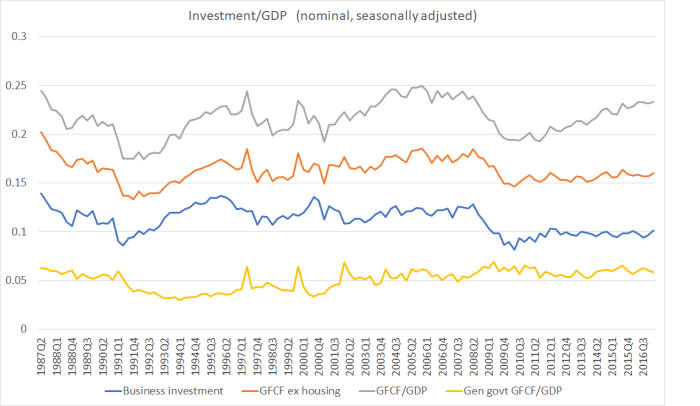
But today, I justed wanted to look at New Zealand’s own data on investment, and particularly the experience in the current cycle.    My starting point is this chart, using the components of gross fixed capital formation (“fixed investment” in the national accounts), as a share of GDP, going back to the 1987 when the official quarterly national accounts begin.

GFCF components to Mar 17

As I noted the other day, “business investment” isn’t an official SNZ category –  it would be great if they actually started publishing one –  but instead follows the OECD practice of subtracting general government investment (schools, roads etc) and residential investment from total investment.     It isn’t fully accurate, to the extent that some residential investment is done directly for the government (so there is some double-counting) but (a) the effect should be small, and (b) it is a consistent treatment through time.

And in case anyone is wondering what the spikes in 1997 and 1999 are, they are navy frigates.

Three things struck me from this chart.

  • First, total investment as a share of GDP (the grey line) has been rising quite strongly from the trough in 2009 and 2010, but
  • Second, total investment ex residential investment (the orange line) has barely recovered at all, and
  • Third, business investment (as proxied by the blue line) has not only barely recovered, but is now smaller as a share of GDP than in every single quarter from 1992 to 2008.   And this even though our population growth rate has accelerated strongly, to the fastest rate experienced since the early 1970s

The difference between the orange and grey line is residential investment.   It has picked up a lot as a share of GDP, but then it would have been extremely worrying if that were not the case.  After all, we had a series of destructive earthquakes in Canterbury, and huge volume of resources had to be devoted to simply restoring the existing housing stock.  And we’ve had a big acceleration in population growth.    Residential investment as a share of GDP is now higher than at any time in thirty years, although house and land price developments suggest that residential land is still being held artificially scarce.

Businesses invest when they see opportunities and can raise the finance (internally or externally to take advantage of the opportunities).     There will always be some financing constraints –  firms that don’t have the retained earnings or can’t persuade someone else to provide additional debt or equity –  but it is a little hard to believe that, as this stage of the cycle, those financing constraints are much different than usual.  It suggests that firms just don’t see the investment opportunities in New Zealand to anything like the extent they once did, even though the population is growing as fast as it ever has in modern times.     It is at least suggestive that the persistently high real exchange rate might be an important part of the explanation.

New Zealand’s quarterly national accounts data go back only to 1987, but the annual national accounts data go back to the year to March 1972.    Here is business investment as a share of GDP right up to the year to March 2017.

business investment to mar 17

Not much above recessionary levels (1991 or 2009), and showing no sign whatever of picking up.   And that is even though the population (and employment) are now much higher than would have been foreseen just a few years ago.    Investment goods do appear to have got (relatively) cheaper over time, but that seems unlikely to adequately explain how firms saw investment opportunities of around 12 per cent of GDP in the two growth phases, but only around 10 per cent now  (especially as we know we’ve now had no productivity growth for five years).

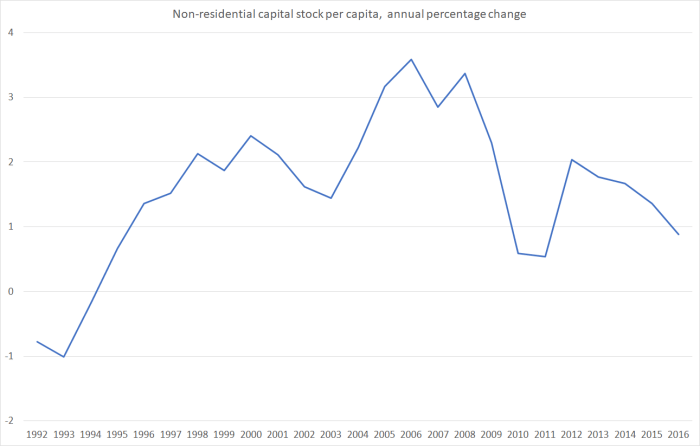
Statistics New Zealand also produces annual estimates of the capital stock.  The latest observation is for the end of March 2016, but the earlier charts suggest there is little reason to think the story for the most recent year will be any more encouraging when the March 2017 data are released later this year.  This chart shows the annual growth rate is the estimated per capita real net capital stock (excluding residential dwellings).

cap stock growth

This indicator uses all the non-residential capital stock (ie including that belonging to the government sector).  As government investment has held up more strongly than business investment (see the first chart above) and as employment has been rising faster than population, the picture for business investment per employee would probably look even more disconcerting.

And, of course, all the official capital stock numbers use reproducible capital only.  In New Zealand, in particular, land is a major input to significant parts of business production.   The quantity of land is fixed (improvements to the land are included in the investment numbers above), and that fixed quantity is spread over ever more people.

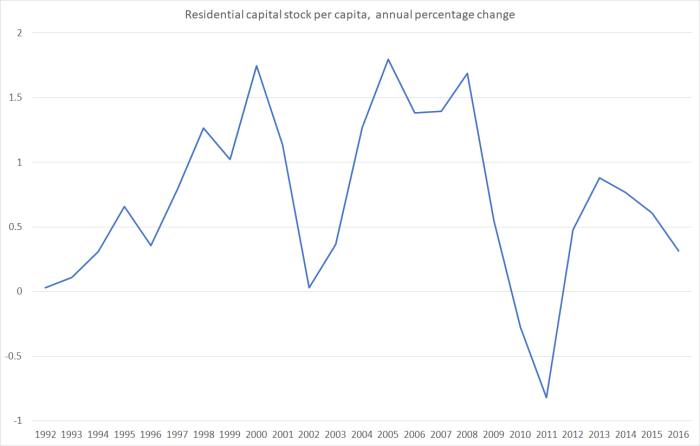
Given our very serious housing situation, with house price to income ratios among the highest anywhere in the advanced world, it should be a bit troubling when really the least poor bit in the investment data is residential investment.   But lest I inadvertently comes across sounding upbeat on that score, here is annual growth in the SNZ real residential capital stock per capita.

res cap stcok

But perhaps this too is some sort of “sign of sucess” or “quality problem”?    Most people, I suspect, would settle for signs that if we are going to have rapid policy-driven population growth, that businesses would then find it remunerative to invest much more heavily, whether in building houses or producing other stuff to sell here or abroad.


Reserve Bank DTIs and the cost of crises

I was late getting round to reading the whole of the Reserve Bank’s consultation document, that backs its bid to persuade the Minister of Finance to agree to authorise them (at some future time) to impose debt to income limits on banks’ mortgage lending.   I’d heard from some people who’d read it that it wasn’t very good, but even so I was surprised how weak the document making the Bank’s case is.  This post isn’t a substantive response to the body of the document, which will probably come in a few posts over the month or so until submissions close.  Today I wanted to focus on just one assumption they make.

The Minister of Finance insisted that the Reserve Bank include a cost-benefit analysis in the consultation document, and one that was a bit more than the usual Reserve Bank effort (an unweighted list of unquantified pros and cons).    It is hard to do so when they aren’t wanting to impose the control right now, but they made a valiant effort.   The value in these things is not in the precise bottom line number (inevitably wrong), but in forcing regulators to spell out their assumptions.

In their cost-benefit analysis, the Reserve Bank assumes that a DTI type instrument can reduce –  by a third –  the risk of a financial crisis.    And they assume that (a) financial crises are really expensive (lost GDP) and (b) that in addition to reducing the probability of a financial crises, a DTI instrument can reduce –  by a quarter –  the severity (again, lost GDP) of such a crisis.      If all three assumptions aren’t correct –  if, say, a DTI instrument could reduce the probability but not the cost, or vice versa, or if a plausible crisis wasn’t as costly as the Bank assumed –  the expected net benefits shown in the paper would simply evaporate.

So how costly are financial crises (especially one concentrated in developments around housing) in moderately well-governed market economies which (a) have their own monetary policy, and (b) haven’t run up against hard fiscal constraints?    The Reserve Bank assumes a cumulative loss of 20 per cent (of a single year’s GDP) –  and they describe that as “conservative”, meaning towards the lower end of a plausible range.

The honest answer is that we don’t really know.   The relevant historical sample (of such crises) is exceptionally small.     And even when a financial crisis happens, it is hard to disentangle the contribution of the financial crisis itself from adjustments that would have happened anyway.

Of course, there is the United States in the last decade –  the case that grabbed everyone’s attention at the time.   Plenty of writers since have described it as ‘the worst financial crisis since the Great Depression” –  in some respects (narrow financial system stresses) one could mount an argument that the recent episode was worse.    The Reserve Bank constantly like to invoke Ireland, but while that case study might be useful for some purposes, it isn’t for this one.   Ireland gave up its own monetary policy when it joined the euro, and so had little or no scope for any stabilising macro policy when the crisis hit.

So lets have a look at how things unfolded in the United States.     They had a nasty recession but they weren’t alone in that.  So one benchmark might be to look at how the US relative to, say, other moderately well-governed floating exchange rate countries, and especially ones that had lots of housing debt and house price inflation but didn’t have a domestic financial crisis.   Australia, New Zealand, Canada, and Norway seemed like a nice subset of such countries.

This chart uses IMF WEO annual data. It shows real GDP per capita for the US normalised to 100 in 2007, the last year before the recession (and before the financial crisis itself intensified).   And it shows the average for the four rising house price non-financial crisis countries on the same basis.

US vs NZ Can etc

Sure enough, the US recession was deeper than that in the average of these other four floating exchange rate countries which –  despite the debt and run-up in house prices –  avoided both housing busts and financial crises.      But the cumulative gap between the two lines (ie adding up the differences across the nine years) is just under 10 per cent, which isn’t even quite half of the “conservative” assumption the Reserve Bank is using.

Of course, even among these four countries there are some quite different experiences: Australia didn’t have a real GDP recession at all, and Norway still hasn’t regained the level of per capita income they had in 2007.  That is why it helps to average across a range of non-crisis countries.

Is it a fair test?   If anything, I think the simple difference between the two lines errs towards overstating the costs of the US financial crisis.  After all, the US ran into the effective lower bound on nominal interest rates.  Standard Taylor-rule prescriptions would have had the Fed cut interest rates a lot more than the 500 basis points they did cut by (a nice chart I have in front of me from the Boston Fed illustrates that in the previous six easing cycles the Fed had cut by an average of more like 800 basis points).    And the US went into the crisis with much less fiscal leeway than our fairly unindebted comparative sample.   And, as it happens, each of the four comparators benefited from average terms of trade in the years since 2007 that were higher than those in the previous half decade or so.    By contrast, the terms of trade for the US have been weaker than they were in the pre-crisis years.

Of course, if I compared Iceland with the four non-crisis countries, I could come out with a number that exceeds the Reserve Bank’s 20 per cent loss estimate.   But the Icelandic crisis (a) wasn’t concentrated on housing, (b) was an order of magnitude more severe (in its own financial system) than the US one, and (c) the Icelandic government ran into severe policy constraints, including exhausting their capacity to borrow.    It is an important case study, but it isn’t the sort of crisis we should be thinking about in contemplating the possible use of DTI controls here.   Arguably, even the US experience is only somewhat enlightening given that an oversupply of houses was a significant element in the US experience.   An oversupply of houses might be fine thing here one day, but it seems unlikely to be an issue here or in other Anglo countries while tight land-use restrictions are in place.  But that is an issue –  not touched on in the Reserve Bank paper – for another day.

If a reasonable “cost of crisis” were, say, a third lower than then Reserve Bank assumes then, on their assumptions about everything else, there are no net benefits from a DTI instrument.

The Greens on immigration: taking the low road

Earlier this week various media outlets were carrying reports of a new speech on immigration from Green Party co-leader James Shaw.  In both Stuff and the Herald articles were headed “Green Party apologises for anti-immigration pandering.   To be fair to Shaw, that wasn’t quite what he said.

A year or so ago, the Greens came out with a new policy on immigration.    The aim was to produce annual population growth of around 1 per cent, and they would adjust immigration policy settings (in light of changes in rates of natural increase or of the comings and goings of New Zealanders) to meet such a target.   At the time they talked a lot about the pressure points that really big net migration inflows caused.   Shaw told Radio New Zealand

“We know that immigration is becoming more of a concern for people and in my experience the vast majority of people aren’t concerned about immigrants, they’re concerned about the impact on house prices, and infrastructure.”

They seemed mostly to be about stabilising population growth pressures, rather than reducing average net immigration very much at all.   After all, average annual population growth in New Zealand in the 20 years prior to the current immigration surge was 1.1 per cent, and rates of natural increase are slowing.

But whatever their intentions, I think everyone who thought about the issue at all seriously, concluded that their policy was unworkable, mostly because of the big –  and not readily forecastable –  fluctuations in the comings and goings of New Zealanders.  I wrote about it at the time

In a sense the fatal conceit in the Greens new policy is the idea that New Zealand’s population growth rate can be held stable from year to year.  While New Zealanders are fairly free to move –  or not –  to the much larger Australian economy in response to changes in relative economic opportunities –  and while New Zealand incomes are so much lower than those in Australia –  we will almost inevitably have the sorts of swings in the net outflow of citizens I showed in the first chart above.  Trying to manage the inflow of non-New Zealanders year by year to offset those fluctuations would be (a) impossible, and (b) something of a fool’s errand even to try.

Others pro-immigration people have made the some point about the unworkability of the scheme.

So in that respect it is good that the specific formulation of a target has been dropped.  If they were serious about a population policy –  and I think they are the only party to have one –  they could have rephrased it to aim to produce average population growth of around 1 per cent per annum on, saying, a five year forward looking basis.    That would have been less unworkable.  But, instead, the numerical target has gone altogether.

From the tone and content of Shaw’s latest speech there must have been a huge backlash in some quarters against the party leadership, and probably Shaw in particular, over last year’s proposed policy.

Last year I made an attempt to try and shift the terms of the debate away from the rhetoric and more towards a more evidence-based approach.
We commissioned some research which indicated that immigration settings would be best if tied to population growth.
Unfortunately, by talking about data and numbers, rather than about values, I made things worse.
Because the background terms of the debate are now so dominated by anti-immigrant rhetoric, when I dived into numbers and data, a lot of people interpreted that as pandering to the rhetoric, rather than trying to elevate the debate and pull it in a different direction.
We were mortified by that

I guess I’m not a Green supporter, but much of this just looks unrecognisable.  Go back and look at the mainstream media coverage, and no one then seemed to think he was “pandering”.   It looked at the time like a serious attempt (apparently backed by some commissioned research) to grapple with some pressing issues –  especially around housing and transport –  and if the solution he came up with wasn’t very workable (and probably should have had a lot more internal stress-testing before it was released for public consumption), it was a serious attempt.  It didn’t blame migrants for New Zealand policy failures, it simply recognised that very rapid population growth can create stresses for us all.   As Shaw noted then

Mr Shaw said the aim of the policy was for better planning, and less hostility towards immigrants.
“The debate around immigration is kind of being captured by those voices who are just simply anti-immigrant, and we really want to make sure that doesn’t happen.

It all seemed pretty calm and rational (even if unworkable).   In fact, at the time so calm and rational that Shaw could even use the (relatively) moderate “anti-immigrant” to describe those who wanted to pull back more significantly on immigration.

There is none of that calm moderation in this week’s speech.    In a speech of only 1350 words, “xenophobia” appears four times, and “scapegoating” three times (admittedly “racism” gets in only once).    People who disagree with the Greens’ stance are, apparently, characterised by such evils.  And on the other hand, the Greens are the party of love

I’m proud to lead a party that stands for the politics of love and inclusion, not hate and fear

and

Openness, inclusiveness and tolerance must win out over racism and scapegoating and xenophobia.   Love and inclusion must win out over hate and fear.

If that isn’t pandering, I’m not sure what is.  And all the while attempting to secure the high moral ground.   Thus

We in the Greens are deeply concerned that the debate about immigration policy in New Zealand has, over the course of time, come to be dominated by populist politicians preaching a xenophobic message in order to gain political advantage.

This ugly strain of political discourse is quieter at times of low net migration into New Zealand, but rises at times of when net migration is high – as it is now, and so, at this election, sadly, the xenophobic drum is beating louder.

“Xenophobia” is one of the favoured words of the groups –  whether from the right or the left –  in our society who favour a continuation of our unusually large-scale immigration policies.

My Oxford dictionary defines xenophobia as a “morbid dread or dislike of foreigners”.   I’d challenge Mr Shaw, or others in the media and lobby groups who like to the fling around the word –  or cognates like “fear” (widely used in this year’s New Zealand Initiative report) – as if the only basis for questioning New Zealand’s immigration policy can be something irrational, to produce some evidence for their claims.    I presume Shaw isn’t wanting to apply this description (“xenophobia”) to his Labour Party allies who recently came out with some proposals designed to reduce the net inflow of migrants (at least temporarily), using much the same sort of arguments Shaw himself was articulating, calmly and reasonably, only last year.  No doubt he intend his comments to apply to Winston Peters –  also the avowed target of the New Zealand Initiative’s report.   I’m no fan of Peters, but I’ve read various of his speeches over the years, and listened to him in interviews, and the “morbid dread of foreigners” seems to bear no relationship at all to what Peters is saying.    Do the Greens recognise any legitimate reasons for being sceptical about the merits of the large scale non-citizen immigration programmes New Zealand runs?

“Scapegoating” is one of Shaw’s other favourite words.   Here, there was a section in Shaw’s speech that I totally agreed with

Migrants are not to blame for the social and economic ills of this country.
Migrants are not to blame for the housing crisis.
Migrants are not to blame for our children who go to school hungry.
Migrants are not to blame for the long hospital waitlists.
Migrants are not to blame for our degraded rivers.
It is the government’s failure

But again, is anyone engaged in the public debate saying anything different?   I was flattered to be described recently by the New Zealand Initiative as “New Zealand’s most articulate critic of immigration”.  I’ve said repeatedly that migrants are just doing what all of us probably seek to do –  pursuing the best opportunities for ourselves and our children.  The problem isn’t the individuals, it is the policy choices governments make.  Again, is anyone who is critical of current immigration policy saying anything different?

Shaw seems to have abandoned what he described as

an attempt to try and shift the terms of the debate away from the rhetoric and more towards a more evidence-based approach.

and tried to cover his own poor specific policy proposal last year, by adopting instead the politics of the slur.   And all while pretending to claim the high moral ground.   Perhaps naively, I’d always thought the Greens –  much as I disagree with them on most things –  were better than that.

As it is, we are now left unclear what the Green Party’s immigration policy really amounts to.  To their credit, there is a 10 page densely-typed immigration policy document on their website, but neither it nor the two page summary give us much clarity at all.

They begin

We support an appropriate and sustainable flow of migrants

Which differentiates them from who how?   “Appropriate” is one of those words bureaucrats use when they don’t want to be specific.

And among their three ‘key principles’

Maintain a sustainable net immigration flow to limit effects on our environment, society and culture.

Surely any possible worries about the impact on “society” or “culture” could only stem from “xenophobia”?  Or is that only when other people make such arguments?

There are strange observations such as

Only make decisions to use immigration as an instrument of economic policy openly by an Act of Parliament

I don’t really disagree, but…..immigration policy operates under the Immigration Act, passed and amended by Parliament.  And among the purposes listed in that Act is

contributing to the New Zealand workforce through facilitating access to skills and labour

The Immigration Act, at least in its modern guises, has always been substantially an instrument of economic policy.

There is lots of detail on various aspects of the policy, but no sense at all as to how many permanent non-citizen migrants we should be seeking to take each year.  We know they are keen to take more refugees, but it isn’t even clear whether that increased intake would be in addition to the total number of non-citizens we take in each year at present, or whether additional refugees would replace some others.

On voluntary migrants they say

an open immigration policy would be unmanageable, and it is the Government’s duty to ensure that voluntary immigration is managed in the national interest. Although ‘national interest’ can mean different things to different people, the definition that has informed our national immigration policy for many years is that we should accept people who will bring skills, capital, or other desirable attributes with them.

And they have a view on the types of skills which should be favoured

Give priority in the skilled migrant category to skills needed for a sustainable society and economy, such as scientists, engineers and other trades with specialised skills applicable to fields including — but not limited to — organic farming, biodegradable materials, recycling, and renewable energy and fuels.

But there is nothing, at all, as to whether current target levels (around 45000 per annum residence approvals) is too high, too low, or about right.

Not even their general stance towards the environment gives much clue.   In discussing “yearly immigration quotas” they say we need

an assessment of the ability of our environment to cope with population increases, taking into account changes in energy use and other behavioural and infrastructural factors;

but they also talk in the same breath of

the need to have spare environmental, social and cultural ecological capacity to accommodate potential returning New Zealanders and people displaced by climate change

But what does it all mean?   You could mount a good argument, on environmental grounds, for a much lower annual target for new residents.   And the likely economic costs of meeting our climate change emissions commitments –  made more difficult by rapid increases in population – would just reinforce that, especially as the Greens are explicit that immigration policy needs to be managed for the interests of New Zealand, not the world.   But that doesn’t seem to be the Greens approach at all.

And then of course, there are the cultural dimensions.  Here is what they have to say

The Taonga of our people, and sites of historical, cultural, environmental, recreational, and general emotional significance for resident New Zealanders, should be protected from adverse impact as a result of immigration, and should not be seen as up for sale to wealthy newcomers. The Green Party will:

1. Take all reasonable steps to prevent immigration numbers, and the sale of land to rich immigrants, from having an adverse impact on Taonga.

But, again, what does it mean?   And why isn’t it what the Greens themselves would refer to as “xenophobia” if anyone else was raising the issues?

Perhaps one can only conclude that answering fairly basic questions like how many non-citizens we should take in each year, or even just what rationing devices we should use to decide which migrants to take, is altogether too hard.  That isn’t promising for a party that wants to be in government only a few months hence.

Reading Shaw’s speech the other day, I did notice this line

in fact, the Greens have the ambition of being the most migrant-friendly party in Parliament.

I did carefully note the potential distinction between “migrant-friendly” and “migration-friendly”, but when I first read the line I was struck by how similar it was to lines one sometimes sees from ACT.   David Seymour obviously thought so too, as he was soon out with a release casting doubt on the Greens’ claims in this area, and suggesting that ACT really was the most pro-immigration party.    Perhaps the Greens just want to be known as nice, while Seymour explicitly eschews niceness

We stand up for productive immigrants and the businesses that employ them, not because it feels nice, but because New Zealand needs immigrants

In fact, I suspect both parties have quite strong globalist leanings –  more so than a concern for the interests of existing New Zealanders –  but neither can quite bring themselves to consistently adopt such an approach.  Curiously, both also seem keen on values statement and the indoctrination of immigrants –  even if they probably couldn’t agree much about what ideas they’d indoctrinate the immigrants with.

If it weren’t for such leanings, it is hard to imagine the Greens –  vocal champions of clean rivers etc –  wouldn’t be much more strongly advancing an agenda that avoided government policy exacerbating population pressures on the environment.    Whether on economic grounds, or environmental grounds, the immigration programme we’ve run for at least the last 25 years (through all sorts of year to year swings in the overall net inflow or outflow) simply doesn’t look to have been working in the interests of New Zealanders as a whole.  If the Greens disagree, it would be good to see the argumentation and evidence.


Squeezing out business investment

I was up early this morning to talk to the breakfast meeting of a Rotary club about immigration and economic performance in a New Zealand context (similar points to my LEANZ address last week, but shorter and a bit simpler).  I hadn’t been to a Rotary meeting for decades, since going to the odd one as a teenager as my father’s guest, and somewhat alien as it was (altogether too extrovert for me, especially at 7am), it was also rather inspiring –  people working together to make a difference in their community; some of George H W Bush’s “thousand points of light”.

In the course of my talk, I’d made my standard point that in New Zealand rapid population growth seems to have contributed to crowding out business investment.   Whatever the reason, over the decades business investment as a share of GDP in New Zealand has averaged around the lower quartile of what has happened in OECD countries as a group.  Driving home I remembered that a couple of months ago I’d downloaded all the data to help illustrate some of the stylised facts that bothered me, but had never gotten round to using the resulting charts.

All else equal –  and it never is –  a country that has faster population growth would normally be expected to devote a higher share of current output to investment than countries with slower population growth.  That observation isn’t exactly rocket science.  More people need more houses, and roads, and shops, and offices, and schools, and hospital, and factories.   A country with no population growth at all could simply maintain its capital stock per person by devoting enough of current output to capital expenditure to cover depreciation.  (To be clear, in all this I am using national accounts measure of investment (“gross fixed capital formation”), which (largely) measures resources devoting to building new stuff.)

Houses make up the largest single component of the reproducible capital stock (and almost half the total in New Zealand at present –  note that this is houses, not the land under them).    And since everyone needs a roof over their head, and almost everyone does, you would expect to find a materially larger share of current output devoted to house-building in countries with faster population growth rates.   There is lots of short-term cyclical volatility in house-building activity, so it makes sense to look at average over a long enough period to look through cycles.

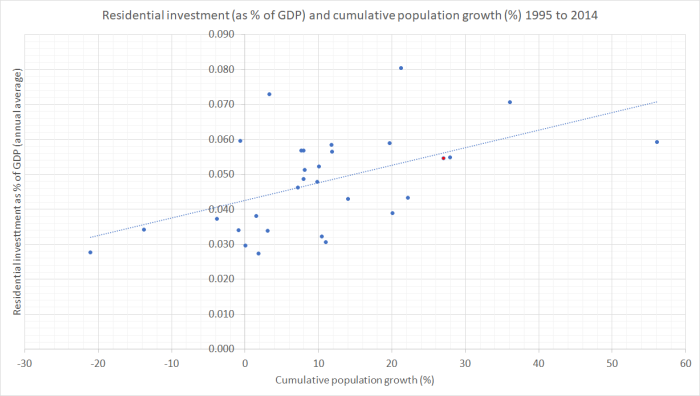
In this chart, I’m looking at the period from 1995 to 2014 and looking across OECD countries.  I chose the period because quite a few OECD countries –  especially former eastern bloc ones –  don’t have data before then, and when I downloaded the data a couple of months ago a few countries didn’t yet have 2015 data.    One year won’t materially alter the picture.

res I % of GDP

New Zealand is the red dot close to the line (above population growth of about 27 per cent).

The slope has the direction you’d expect –  faster population growth has meant a larger share of current GDP devoted to housebuilding –  and New Zealand’s experience, given our population growth, is about average.     But note how relatively flat the slope is.  On average, a country with zero population growth devoted about 4.2 per cent of GDP to housebuilding over this period, and one averaging 1.5 per cent population growth per annum would have devoted about 6 per cent GDP to housebuilding.    But building a typical house costs a lot more than a year’s average GDP (for the 2.7 people in an average dwelling).     In well-functioning house and urban land markets you’d expect a more steeply upward-sloping line –  and less upward pressure on house/land prices.    But that isn’t today’s point, which was simply that more people has indeed meant more residential investment.

But what about the business investment picture?  In the data, business investment is a residual –  calculated by taking total investment and subtracting housing investment and general government investment.  Again, all else equal, you would expect a country with a faster population growth rate to have devoted a larger share of current output to business investment.  Workers need “tools”, and if economies are going to maintain their trajectory of growth in income per capita, then the growth in the capital stock needs to at least keep pace with the number of workers.

(You might wonder why I look across countries, rather than just across time within individual countries.  There are two reasons.  First, in many countries there isn’t much variation in population growth rates.  And second, to the extent there is, reverse causation may well be at work –  a booming economy will tend to draw in more people. )

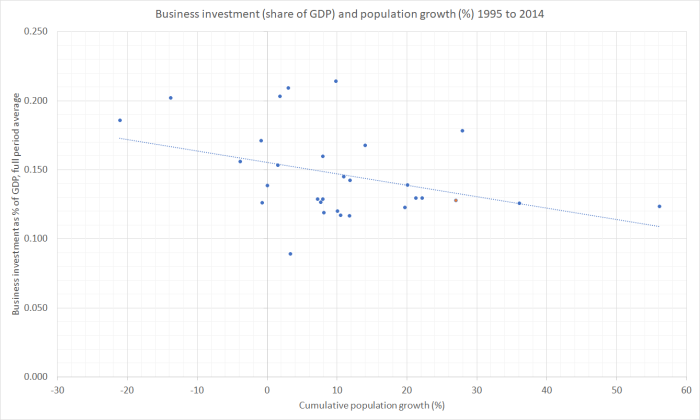
But here is what the cross-country chart looks like.

Bus I % of GDP

Again, New Zealand is the red dot near the line.

There is plenty of variation –  not every observation is close to the line –  but there is no sign at all of the expected upward slope.  If anything, the regression line is downwards –  the faster population growth was across these countries in this period, the smaller the average share of current output devoted to business investment.  The (non-housing) capital stock per person will have been growing materially more slowly in the average high populaton growth country than in the low population growth countries.    The countries with material falls in population were all former eastern-bloc countries, who might be thought to have lots of convergence (and investment) opportunities anyway.  But even if one deleted them from the chart entirely –  and recall that we too were supposed to have lots of convergence opportunities –  the regression line is still very slightly downward sloping (basically dead flat).

It is a chart that should be pretty troubling.    Even a modestly upward-sloping line would still be weaker than ones prior might lead one to expect.

Some readers with more of a background in formal economic research don’t like these scatter plots at all.  They rightly note that it captures just a relationship between two variables, and there is a lot of other stuff inevitably missing.  The relationship may be causal, but it might not be.    One protection against that risk is the use of long period averages for 30+ countries.    But, as importantly, scatter plots of this sort have to be taken together with the wider context –  other stuff we know.

For example, is there a plausible mechanism that might account for such a relationship?  Well, the notion of “crowding out” is a pretty well-established one in the economics literature.  When the government increases its expenditure, the typical result (in a reasonably fully employed economy) is for private sector spending to fall.  Higher interest rates and a higher exchange rate are part of the mechanism by which that happens.   Whether or not there is a full offset is debated, but no one seriously doubts the mechanism or the direction of the effect.    Investment spending tends to be more sensitive than consumption spending, with the exchange rate channel making tradables sector activity (sales and investment) particularly likely to respond.

Increased demands associated with faster population growth may well work in much the same way.   The summary, scatter plot, data certainly isn’t inconsistent with such a story.   In the New Zealand context, one of the stylised facts we have to grapple with is that our real interest rates have been persistently higher than those in other advanced countries, and our real exchange rate has fluctuated around persistently high levels.  (And when I restrict the business investment chart only to countries with floating exchange rates, the downward slope is still apparent.)

So I don’t find the scatter plot in isolation conclusive, but it is troubling nonetheless –  and should be for those who like to invoke the empirical estimates of large per capita income gains from immigration, again in a cross-country context.  How likely are such gains, if countries with relative fast population growth rates (almost all, on account of high immigration inflows) are also the countries that, on average, have relatively modest levels of business investment?  Firms invest to take advantage of the new opportunities that arise.

I’ve asserted that high levels of planned immigration have a disproportionate effect on investment in the tradables sector.  These aggregate data don’t shed any light on that split –  they are just total business investment.   But, at least in a New Zealand context, it makes sense that things will have worked that way.   Higher real interest rates than in other countries –  unmatched by faster productivity growth – will deter all long-lived investment here, regardless of sector.  But when the exchange rate is also boosted, firms considering new investment in the tradables sector are exposed to a double-whammy: highest cost of capital, and a less competitive position relative to foreign firms.   Domestic demand tends to be strong in countries with fast population growth, while international demand is something New Zealand firms just have to take as given.   As our export share of GDP hasn’t been growing –  if anything shrinking –  while those in most other OECD countries have, it seems reasonably likely that investment in theNew Zealand tradables sector has been much weaker than otherwise, and weaker than that in the non-tradables sectors.  That weakness in tradables investment is likely to affect both our natural resource based industries (deterring more capital intensive modes of production) and in the struggling (where unsubsidised) other parts of the tradables sector.

For many countries, population growth isn’t that materially influenced by national policy.   In the former eastern bloc countries, the fall in population is about natives leaving.  In some other countries, illegal immigration can be a big issue.  But in New Zealand –  and Australia –  policy makes a big difference.   We have full control over our borders, and let in lots of legal non-citizen migrants.   In New Zealand, in particular, it looks as though discretionary policy choices have worsened the business environment, and in particular skewing things against the prospects for strong investment by firms that could successfully take on the rest of the world.

(In case anyone is interested, somewhat to my surprise I discovered that there is also a downward-sloping regression line when one plots general government investment and population growth.   I’d expected to find that the government investment just happened anyway –  governments not being subject to market tests.  But over these countries in this period it didn’t.  If, optimistically, you think that government investment is a complement to private investment in improving economic performance, that should be particularly worrying.  Even if the lagging government investment is just about keeping up with the numbers of schools and hospitals (say) a higher population requires, it doesn’t exactly look like a mark of success –  whether in New Zealand, or across the OECD.)


Affordability is in the eye of the beholder

Silly and meaningless as the category “affordable housing” is, perhaps this  –  which my wife spotted last night – must be what Nick Smith had in mind when he claimed that affordability was in the eye of the beholder?

$990,000, and supposedly aiming at first home buyers……

What have our governments brought us to?

http://www.trademe.co.nz/property/residential-property-for-sale/auction-1338386026.htm

Attention First Home Buyers

  • Asking price: $990,000
  • Listed: Thu 1 Jun, 10:20 am
  • Watchlist

Listing #: 1338386026

Location: 12 Quadrant Road
Onehunga
Auckland City
Auckland
Rooms: 3 bedrooms, 1 bathroom
Property type: House
Land area: 663m2
Price: Asking price $990,000
Parking: 2 offstreet carparks
Open home times:
Sat 8 Jul, 1pm – 1:30pm
Sun 9 Jul, 1pm – 1:30pm

Switzerland as our example – again

A month or two back, the New Zealand Initiative arranged a study tour (Go Swiss) for members (and a friendly journalist), “to learn more about their success story”.

I’ve written about this a few times, mostly because I’m genuinely perplexed that the smart people who run the Initiative really seem to think that Switzerland is much of an example for us, or even these days that much of a “success story”.

Sure, Switzerland is richer and more productive than we are.  Most advanced countries are.  But productivity levels in Switzerland now lag behind those of the leading OECD countries.  And over the last 45 years or so, Switzerland has had the lowest rate of productivity growth of any of the OECD countries for which there is a full run of data.  Just a little worse even than New Zealand.

switz 70 to 15

If I were sponsoring a study tour to places that had put in really strong performances in recent times, the Czech Republic, Slovenia or Slovakia look like they might be rather stronger contenders.     They’ve been catching up quite rapidly, not drifting back in the pack.       The Slovakia picture looks particularly impressive.  Here is the Conference Board data on real GDP per hour worked for each of New Zealand, Switzerland and Slovakia, relative to the average for France, Germany, Netherlands, and the United States (four of the higher productivity large OECD countries).

slovakia

Of course, New Zealand Initiative members are free to take their holidays wherever they like.   But it becomes of somewhat wider interest when they return trying to proselytise.

A few weeks ago the Herald’s Fran O’Sullivan provided a vehicle for some of that, relaying some rather questionable stories about the Swiss labour market (which does, among other things, feature a low youth unemployment rate), while ignoring such potentially relevant features as the absence of a generalised minimum wage in Switzerland.   Somewhat surprisingly, from a bunch of leading business people, Switzerland’s much lower company tax rate also wasn’t mentioned.  Then again, neither was its poor long-term productivity growth performance.

Sometimes the Initiative has been directly purveying the material.  Their chairman, Roger Partridge, had a piece in the Initiative’s newsletter recently extolling the contrasts between Italy and the Ticino, the Italian region of Switzerland.  “The secret to Swiss success”, so we are told, is down to “can solve”, reputedly the approach adopted by Swiss officials and politicians.    Now doing better than Italy isn’t such a great boast these days, but actually as the chart above shows, over the last 45 years Switzerland has done worse than Italy –  at least on productivity.  And then there are some of the summary indicators: on the World Bank’s ease of doing business index (not, of course, a perfect indicator of the state of regulation), Switzerland beats Italy by a substantial margin.  But Switzerland comes in at number 31.  New Zealand is number 1.

But what prompted this post was the editorial in the business section of this week’s Sunday Star-Times.   It doesn’t appear to be on the Stuff website, but if you go to this link to one of Initiative director Oliver Hartwich’s tweets, you can read an image of the whole piece.

Do you fancy living your lives more like the Swiss?…..It means entering into a radical experiment which could turn this country into another Switzerland.  A country with a high wage economy that manufactures and exports quality products, welcomes thousands of immigrants without any problems and has a fast and efficient public transport system

And, once again, we are told that

the ‘big picture” answer, according to the NZI, is in Switzerland’s decentralisation, where more than 2000 local councils have their own tax-raising powers.  Their argument is that it leads to greater pro-activity in devising strategies to attract business investment and power growth.

So, again, that would be the OECD country with the worst long-term productivity growth record?

And the other strand of the answer is, it is claimed, the education system.

Education is a dual system, which sees 80 per cent of young people enter vocational training, with only the remainder going to university.  But there is no stigma in that,

Then again, this is the OECD country with the worst productivity growth record over the last 45 years.  And, as OECD data I highlighted in the earlier post showed, actually a larger proportion of Swss 25-34 year olds have completed tertiary qualifications than in (a) most OECD countries, and (b) New Zealand.

One business leader is quoting waxing lyrical

As Fraser Whineray, boss of Mercury, said:  “an aluminium welder can be earning $150000 a year and living in a village like Queenstown”

I had no idea how much aluminium welders earn here, but this website suggests about $22.75 an hour.  That’s a bit under $50000 a year and given that Swiss GDP per capita is not even double New Zealand’s you’d have to be a little sceptical about that $150000 number (and this site offers some Swiss numbers).

But, picturesque as Switzerland is, what about the housing situation?

According to the New Zealand Initiative, as channelled by the Sunday Star-Times

Swiss house prices haven’t changed for three decades (inflation included) –  houses are still affordable compared to salaries.

The first part of that sentence is quite correct.    Real house prices (having had various ups and downs) haven’t changed much in 30 years.    But they were eye-wateringly expensive 30 years ago, and they still are today.   At the level of anecdote, I recall doing a course at the Swiss National Bank in 1990 and being told by our guides that prices in the capital Berne were so high that only senior managers at the central bank owned their own houses.

Good statistical data appears to be harder to come by: Switzerland is not, for example, in Demographia’s annual collection of house prices to median income data.   I stumbled across one website that offers data (of what quality I”m not sure) on rents and house prices in all sorts of cities.   Here is what they suggested for price to income ratios in various Swiss cities.

Zurich                                         9.5

Basle                                            9.2

Geneva                                       10.5

Lucerne                                      9.0

Berne                                        12.3

Whole country                       10.4

From what I could see, actual house prices don’t look any more “affordable” than those here (although, of course, interest rates are lower).  And, consistent with that, residential mortgage debt as a share of GDP is materially higher than that in New Zealand, in fact one of the highest ratios anywhere.

Oh, and how about home ownership rates?  Ours have been slipping, something that makes a lot of people uncomfortable (except a few –  economists mostly? –  who seem to have a vision that we’d be somehow better off if even more of us rented).  This chart is a subset of a table I found.  I’m sure not all the numbers are strictly comparable, and they are all for slightly different years, but I think most people will take New Zealand’s poor outcome over Switzerland’s any day.

home ownership

And, of course, none of this New Zealand Initiative material ever mentions the rather considerable advantages of location Switzerland enjoys –  at the heart of one of the wealthiest and most productive regions on earth, in an age when proximity and location seem to matter more than ever.    Or that, when international agencies look at Switzerland, one of the things they highlight most is the need for reforms to lift productivity growth.  The latest OECD report on Switzerland highlighted how relatively poor Switzerland’s productivity growth had been.  The press release for that report was headed “Focus on lifting productivity to guarantee future prosperity”, and part of the text read

The main objective has to be raising productivity, which will remain the key to boosting growth and maintaining a high quality of life and well-being.  The Survey suggests that Switzerland launch a new reform agenda to boost productivity, including renewed efforts to add flexibility to labour and product markets, improve public-sector efficiency, education and the business environment, and boost competition.  Increasing competition in the telecoms and energy sectors, including the privatisation of Swisscom, will be critical.

As I’ve said repeatedly, in many respects it would be nice to enjoy the material living standards the Swiss do, but……they are slipping backwards, and there is little sign that there is anything very systematic about how Switzerland does things that offers positive lessons for us, whether in beginning to reverse our dreadful productivity performance, or reverse our housing market disaster.

The mystery is why the New Zealand Initiative thinks otherwise.

But on a lighter note, I did find something from Switzerland that New Zealand could emulate.    I know Eric Crampton was one of those a bit upset about the loss of the rugby sevens tournament from Wellington.  Well, how about replacing it with office chair racing?  We spotted this on the BBC news the other night, and there is video footage here.  As the New Zealand capital of office workers, what better place than Wellington for a New Zealand leg of this sport.   Bowen Street looks as though it would offer a nice gradient, ending right in front of Parliament perhaps.  Think of the promotional opportunities.   It probably wouldn’t even take $5m of public money to get it going.