Total factor productivity growth: how have we been doing?

The Conference Board’s Total Economy Database is my favourite source for cross-country comparisons of productivity growth.  I’m not close enough to the respective methodologies to know whether and where to prefer their methodology to that of the OECD, but the Conference Board has data for a lot more countries, and typically  has estimates that go back a bit further in history.

Yesterday, I dug out their estimates of total factor productivity (TFP) growth.  They’ve recently revised their methodology, although for the time being that means they only currently go back 20 years.  I was curious to see how New Zealand had performed, on this metric, relative to other advanced countries.

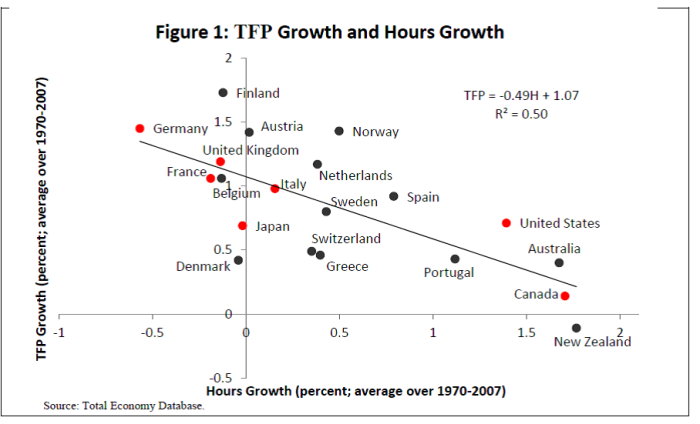
Some readers will recall this IMF chart which I’ve run a few times previously.

imf-hours-and-mfp

It uses an earlier vintage of Conference Board estimates, and on that basis, New Zealand had had the lowest TFP growth of any of these OECD countries for the full period 1970 to 2007.

How about the more recent period, since 1994?   Here I’ve used a larger group of countries –  all the OECD countries, all the EU countries, plus Singapore, Hong Kong, and Taiwan –  very similar to the set of countries I used for a range of posts back in 2015 about New Zealand’s relative performance.

TFP growth 94 ot 15 TEDOver this period on this measure, we weren’t the worst, but we weren’t far off the worst.  A lot of the former eastern-bloc countries, now given the opportunity to catch-up with the West, are bunched towards the left of the chart.

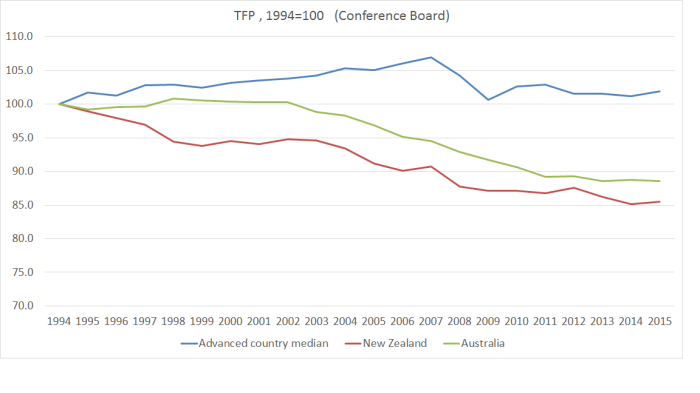
And here are New Zealand and Australia shown relative to the median of these advanced countries.

TFP NZ and AUsAnd New Zealand relative to the median of the G7 countries, and to the median of the former eastern-bloc countries. Recall, after all, that the narrative of economic reform in New Zealand had also been to allow us to catch up again with the richer advanced countries.

TFP NZ g7 east europeNot an altogether pretty picture.

Of course, observant readers have probably noticed that there doesn’t seem to have been much TFP growth anywhere for the last decade or so, and that while New Zealand doesn’t look to have done particularly well during that period, we also don’t look much worse than usual.  But here is how we have done relative to various other countries/sub-groups over that period.

TFP 05 to 15

Plenty of countries did worse than us, but among those that were quite similar to New Zealand and Australia over this period were Italy, Spain and Portugal (Greece was materially worse).

For these purposes, I’m mostly interested in how New Zealand has done relative to other countries.  There is a reasonable question as to how the level of TFP can have fallen so badly in 20 years (almost 15 per cent in New Zealand if one believes this measure).  TFP growth is a residual, after decomposing GDP growth into growth in the capital and labour stocks and –  done properly –  measuring both of those isn’t straightforward (eg it is one thing to measure total hours worked, another to get a good measure of the quality of the labour, or thus total human capital applied to production, especially in an era when tertiary education has become a lot more common).  Different methodologies will produce different estimates, but so long as similar methodologies are applied for all countries we can still use the datasets for cross-country comparative purposes

All of which is a lead in to a perhaps slightly less discouraging picture for New Zealand.  The OECD also produces TFP growth estimates, but for a much smaller range of countries  –  only 20 of their 34 member states, including none of the east European convergence economies.   And there aren’t yet estimates for all the countries for 2015.

But here is the comparison for 1994 to 2014 between New Zealand and this sample of the really advanced OECD countries.

TFP oecd oecd sampleThe gap between New Zealand’s cumulative TFP growth and that of the other advanced economies isn’t as large as that shown on the Conference Board data (second chart above).  Then again, since the OECD data doesn’t include the catching-up eastern Europeans that shouldn’t be a surprise.   But what is more striking is that until 2003 we were more or less matching the other OECD countries in this sample.

Here, for comparison, is the Conference Board data for New Zealand and the OECD’s sample of (20) countries.

TFP OECD TED sampleIn the end, perhaps the pictures aren’t really that dissimilar after all.  We’ve done badly relative to other traditional advanced countries and, if anything, on this measure too, the last decade or so is looking relatively worse.  In other words, if there was some convergence of growth rates, it looks to have been mostly only because TFP growth in the east European countries (in the TED sample but not in the OECD’s) slowed up so very markedly (as you can see in the third chart above).   That might be unfortunate for them –  and some combination of policy limitations, and substantial convergence already having occurred in some countries –  but doesn’t put New Zealand’s underperformance in any better light.

It is the sort of underperformance that should be leading to hard questions about the overall direction of economic policy in New Zealand.   After all, if TFP growth isn’t everything about economic performance and sustained prospects for prosperity, it is typically seen as quite a large part of the picture.  And we’ve just kept on doing badly.

Bias and a possible gender pay gap?

The media this morning is awash with breathless reports of a new study (and slides on the main results here), conducted for the Ministry for Women, on the differences between hourly earnings for men and women.  Not a hint of scepticism has been reported in what I’ve seen and heard, even from the Deputy Prime Minister in our ostensibly centre-right market-oriented government.  On principle, one should probably always be more sceptical of research results that confirm the preferences and priors of the agencies commissioning such research.

It isn’t my area of speciality at all, so this is just a brief note.  To the extent I have a dog in the fight, on the one hand I tend to believe that markets work pretty well most of the time, which makes me instinctively suspicious of the notion of “free lunches” or that somehow huge systematic effects result from conscious or unconscious bias or discrimination.  And on the other hand, I’m not in paid employment myself, while my wife is, and I have more daughters than sons.    If there was a material real gap, it wouldn’t be against our family interest to recognise it.

The authors use a fairly large sample of people, and look at quite a range of variables.  But, having read some summary articles on this issue from the US literature, I was quite struck by what appeared to be missing.  I couldn’t, for example, see any sign of a “time out of the workforce” variable.  I think there is huge value in one parent being at home, especially when children are young, but it isn’t necessarily experience that has a huge value back in the paid workforce (different skills, different roles).   Someone –  male or female, but most are women –  who takes five years out of the workforce to look after their young children is likely to set back their income-earning prospects back in the paid workforce, for any given set of qualifications, or even any particular type of job.   And, as far as I could see, the only proxy for input/effort (and thus, accumulated skill/expertise)  was a distinction between part-time work and full-time work, at a 30 hours a week cut-off.     For some jobs, that might be a perfectly reasonable marker,  but there is a big difference between, say, a lawyer working 32 hours a week and one working 60 hours a week.  More women are more likely to select for working relatively fewer hours, to prioritise family, and this study –  data-rich as it is –  doesn’t seem likely to be able to distinguish that point.

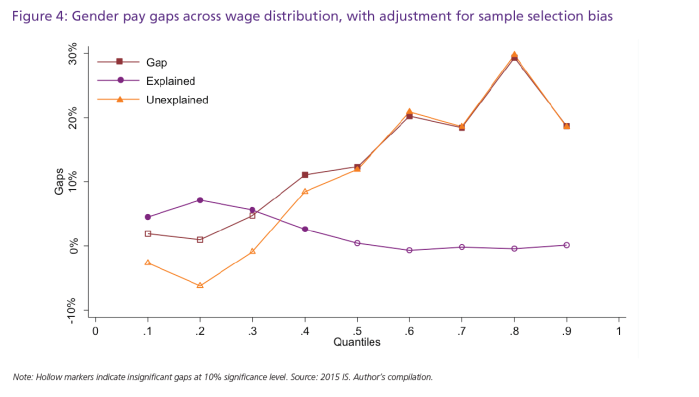
Are there pointers in the paper to these sorts of factors being part of the explanation?  Well, yes, there is, here in this chart.

gender pay gap

Note that there is no statistically significant difference in gender pay for the first three deciles, (and if anything the unexplained component goes the other way –  the purple line is above the “gap” line).  That appears to run contrary to, for example, one of the Ministry for Women’s other “causes” –  eg pay differences between rest home workers and other ostensibly similar occupations.    The big difference show up in the upper part of the income range, where the personal characteristics of the individual employee are likely to be both much more important (than for relatively homogeneous positions at the bottom of the income scale) and much harder for researchers in studies like this to observe.

If such large differences, for people with exactly the same characteristics, existed, it points in the direction of large “free lunches”.  Relatively “enlightened”, or unbiased employers, could profit hugely by replacing expensive male employees with cheap females ones, in relatively senior positions.  Perhaps it was to some extent true 100 years ago, when cultural expectations –  among men and women –  were quite different.  It defies belief now.

UPDATE: In some exchanges in the comments, not only did it became apparent that the AUT researchers had not even cited the leading work in this field, by Claudia Goldin at Harvard, but that the Ministry for Women policy staff, while aware of that work, do not refer to it.   Here is a link to an accessible discussion with Goldin  and an extract from that interview

DUBNER: Talk for a moment about potential categorical differences between men and women that have shown up in some research.  The different appetite for competition, as some have labeled it. Or, in another instance, the willingness to bargain on salary or flexibility.  How much might those contribute to the pay gap?

GOLDIN: I think there’s no doubt that they contribute to some degree. But let me tell you why I don’t think that they go the real distance. Some of the best studies that we have of the gender pay gap, following individuals longitudinally, show that when they show up right out of college, or out of law school, or after they get their M.B.A. — all the studies that we have indicate that wages are pretty similar then. So if men were better bargainers, they would have been better right then. And it doesn’t look as if they’re better bargainers to a degree that shows up as a very large number.  But further down the pike in their lives, by 10-15 years out, we see very large differences in their pay. But we also see large differences in where they are, in their job titles, and a lot of that occurs a year or two after a kid is born, and it occurs for women and not for men. If anything, men tend to work somewhat harder. And I know that there are many who have done many experiments on the fact that women don’t necessarily like competition as much as men do — they value temporal flexibility, men value income growth — that there are various differences. But in terms of bargaining and competition it doesn’t look like it’s showing up that much at the very beginning.

DUBNER: Let me ask you about one more contributory factor. The parent penalty, what’s often called the mommy tax. How significant is that as a contributory factor?

GOLDIN: Well, it seems as if it’s a very large factor.  That anything that leads you to want to have more time is going to be a large factor.


Half a hand clap?

For the leader of the National Party, Bill English, that is, for announcing yesterday that if his party is in government after September’s election it will seek to

(a) lift the residency requirement from 10 years to 20 years, starting some way down the track, and

(b) lift the age of eligibility for New Zealand Superannuation from 65 to 67, but not starting until 2037.

It is a topsy-turvy political world in which at the last election the National Party was campaigning on, in essence, no changes to NZS ever (talk of everything being “affordable” for the next 50 years), while the Labour Party was campaigning on a rather faster move to age 67 than the National Party is proposing now.  But now the Labour Party appears staunchly opposed to any increase in the eligibility age.   Perhaps if Bill English and David Cunliffe had held the reins at the same time, a cross-party accord might have been in prospect?

It is also a bit odd when media start talking as if political promises made today, even if enacted next year, actually make very much difference to what will happens in 2037 and beyond.  For all the talk of “giving people certainty”, it is most unlikely National will be in office for the next 20 years and all-but-certain that Bill English won’t be.  Office-holders change, and so do circumstances.

In 1859, no one really envisaged the Land Wars, gold rushes, or the massive transfomative effects of the Vogel public works and immigration programmes.

In 1879, no one was probably planning on having a state age pension at all  (let alone the economic opportunities of refrigerated shipping etc).  That came in 1898.

In 1899, no one was expecting World War One, and the huge toll of lives and money that took.

In 1919, no one was expecting the Great Depression, or an overhang of debt so severe the New Zealand government defaulted on its domestic debt, and almost had to do so on its foreign debt.

In 1939, even if people anticipated war, they probably neither conceived of one as long and devastating as it was (globally), or that over the following couple of decades New Zealand would enjoy high commodity prices, and end up with very little public debt.

In 1959, few people probably planned on the basis on the “end of the golden weather” –  the severe and sustained fall in our terms of trade over the late 60s and especially in the mid-late 70s, that undermined fiscal prospects and opportunities for improved living standards.

In 1979, probably not many envisaged Think Big as the massive fiscal disaster it was, or the disruption (and loss of revenue) that the (overdue) economic reform and liberalisation process would entail.

In 1999, well…..perhaps there have been fewer disruptions in the last couple of decades (even allowing for earthquakes and a serious recession).  But it seems unlikely that history is ending.

No one knows what the next 20 years hold, for good or ill, and it would be crazy for anyone to plan today based on a political party’s promise of what welfare payments might be available 20 years hence.    My (considerably younger) wife was stunned to learn yesterday that if the new proposed policy carries through she will be eligible for NZS at 65.  Since anything can happen in 20 years, I discouraged the idea of starting planning for an extra overseas holiday

And government plans and policies do change, often considerably.  In the late 80s, the then Labour government announced a very slow increase in the NZS age, only to have that overturned (and rapidly accelerated) by an incoming government only two years later.  And in the 25 years from the early 1970s to the late 1990s, we went through numerous, quite substantial, changes in NZS policy, each no doubt intended by the governments that proposed them as “providing certainty”.

If the National Party really thinks change is needed, they should have promised something that might have involved gradual increases in the eligibility age starting in the next term of Parliament –  age-indexed beyond that.  If not, they should have bequeathed the issue to their successors.

My own view, outlined in a couple of posts late last year, is that the case for changing the NZS eligibility age (and residence requirement) isn’t primarily one about future fiscal balances.  As I noted when the Treasury released their long-term fiscal statement,

Treasury included this chart in the report.

ltfs

As I noted then, one could reasonably run this under a headline “no urgent need for any big fiscal changes for 20 years”.  On these projections, in 2035 the spending share of GDP would be around where it was five years ago.  Actual fiscal policy changes happen all the time, and the base on which revenue is raised changes too.  It wouldn’t take much for spending as a share of GDP in 2035 to be not much different from where it has been on average over the last decade.  One can’t reasonably generate “fiscal crisis” headlines –  or urgent official advice to ministers – out of that sort of scenario.

And perhaps that is the sort of thinking the National Party had in mind.  There just isn’t a pressing near-term fiscal issue  (although, of course, taxes could be lower, or the money spent on other priorities).

My take was different.

To my mind, issues around New Zealand Superannuation are substantially moral in nature, and the debate would be better if centred on those dimensions, rather than on fiscal policy.  Our level of government debt isn’t that low, but by international standards it isn’t high either, and if anything looks likely to drop as a share of GDP over the next few years.  So the issue shouldn’t be “can we afford to pay a universal welfare benefit to an ever-increasing share of the population?” –  ever-increasing, on the assumption that adult life expectancy continues to increase.  We probably could.  But rather “should we?”, or “is it right to do so?”.   Economists quickly get uncomfortable with “is it right” type questions, sidelining them as “political choices”, but almost all the important political choices are about conceptions of what sort of society or government we want –  competing visions of what is “right”.   Of course, there are practical dimensions, and areas where experts can offer technical perspectives  –  eg the implications of particular choices for other things we care about (eg labour force participation, incentives to save etc) –  but the key choices shouldn’t really be seen as technocratic in nature.

For me, there is simply something wrong about offering a universal income to an ever-increasing share of the population.   Governments don’t exist to support us all,

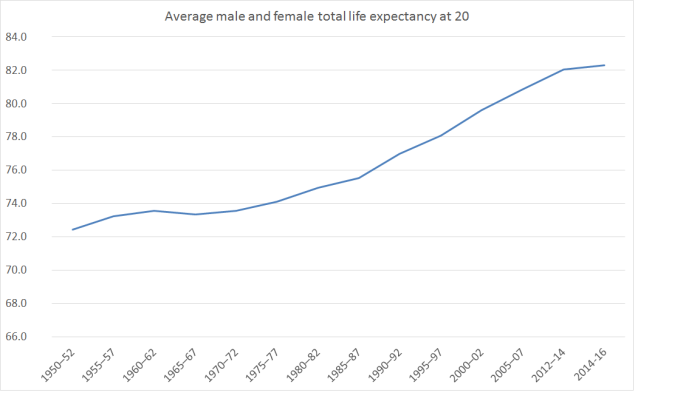
From the SNZ life tables, we can trace changes in life expectancy since 1950.  Here I’ve shown life expectancy for those reaching age 20 (ie old enough to have reached the workforce).

life expectancy

The observations aren’t always evenly spaced (especially towards the end), but over the full period, of 64 years, average (across male and female, Maori and non-Maori) life expectancy for people who get to age 20 has increased by 9.8 years –  about 1.5 years per decade.

At the first observation, centred on 1951, life expectancy at birth for males was only around 67.2 years.  Too many died very young –  in 1948 (the first year with data on Infoshare), just over 10 per cent of all male deaths were of children under 5.     But around 1950 a large chunk of the men who reached adulthood, and the taxpaying years, still died before they were 65 (around a third of all male deaths of those over 20 occurred before age 65.   The female numbers weren’t that much lower.  None of those people lived to collect a state pension payable from age 65.

By contrast, in 2015 only 18 per cent of adult deaths occurred before age 65.

It is quite true that, on SNZ estimates, life expectancy at 65 has not increased as rapidly as overall life expectancy (up 6.6 years over 64 years), or even that at age 20.

life expectancy 3 ages

But the fiscal burden doesn’t just arise from how long people live once they get to 65, but what proportion of adults get to age 65 at all.

Here is a chart showing life expectancy at 20, and the NZS eligibility age.  The final two dots are what might have happened by 2040 if the life expectancy gains continue at the same rate as since 1950, and the NZS eligibility age if yesterday’s National Party policy proposal comes to pass.

life and NZS age

Over that full period, 90 years, the NZS eligibility age would have risen by two years, and adult life expectancy (those getting to 20) would have increased by about 13.5 years.  By 2040 it will be amost 40 years since the NZS age got back to 65.  In that time, adult life expectancy is likely to have risen by 5 to 6 years, and yet the NZS age will have risen only by two years, if the new National Party policy is implemented.

Something seems bad out of whack there, and that is before allowing for the fact that the typical person now enters the fulltime workforce considerably later than they did in earlier decades: many fewer leave school at 15, and now most do tertiary education as well.  The period the typical adult will be receiving NZS for, as a share of their time in the workforce (paid, or raising children) just keeps on rising.  And that seems wrong.   For some, no doubt, working until 67 or beyond would be physically difficult, or impossible.  In the past, for very many, even living to 65 was aspirational.

Overall, National’s proposal yesterday was a pretty feeble one.  Better than Labour’s stance –  which seemed to involve potentially reducing future pensions, but not increasing the age –  but so far in the future it should probably be discounted back to very little.    Perhaps it would have deserved a little more credit, if they had been willing to embrace –  and campaign on- the notion of formally indexing future increases in the eligibility age to future changes in life expectancy.  But they couldn’t even manage that, not even for the hypothetical adjustments that might occur in the decades after 2040.


House prices and population

I wrote the other day about the role that population growth, including that accounted for by immigration policy, plays in influencing house prices, at least in places where regulatory restrictions on land use or construction impair the responsiveness of housing supply.  More demand, in the face of lagging supply, seems fairly ineluctably to put upward pressure on prices.

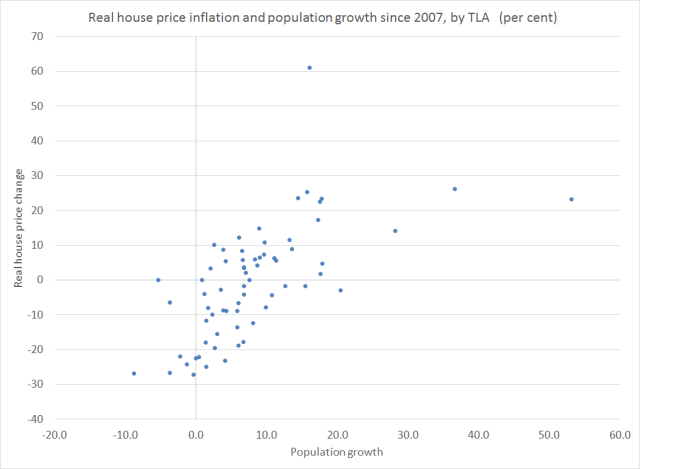
The latest QV house price data, for January 2017, also came out the other day. They produce data at an individual TLA level, which in conjunction with SNZ TLA population estimates, enables us to have a look at whether there has been a relationship (albeit crude and bivariate) between population growth and house price inflation.

In the chart below, I’ve focused on the period since 2007.  2007 was the peak of the last house price boom, and a period for which QV has supplied house price data for each TLA.  The population growth data is the percentage increase in population from June 2007 to June 2016 –  the most recent SNZ estimates.      It is worth remembering that in periods since the last census, population estimates are approximate at best, but these estimates are the best SNZ can do and they presumably use a consistent methodology across the country.

house-prices-and-popn-growth-by-tla-since-2007

Given that we have pretty pervasive land-use restrictions, it isn’t very surprising to find that areas with the greatest (lowest) population growth also tend to be the areas with the largest (smallest) real house price increases over this period.    It isn’t a mechanical, or one-for-one, relationship of course.  One factor is likely to be differences from TLA to TLA in how practically constraining the land-use rules are.  All else equal, a TLA where land use restrictions are less constraining will see less real house price inflation for any given population increase than a TLA with more-binding restrictions.  (I’m not aware of any good land-use restrictions indexes for individual New Zealand TLAs).

The observation on the far right of the chart might be an illustration of this point.  That dot represents Selwyn district, on the outskirts of Christchurch.  It has experienced a huge population increase –  in excess of 50 per cent in nine years –  especially since the earthquakes.    Some observers argue that the local authority has been relatively liberal in facilitating new housing and business development.  Perhaps (I was a little sceptical here), but one other factor is that, at the margin, people considering buying in Selwyn are likely to be considering developments in the rest of greater Christchurch too –  and over this period real prices in Christchurch city and Waimakariri only rose 10 and 14 per cent respectively.

The other obvious outlier is the observation at the top of the chart –  that for Auckland.  Real house prices in Auckland have risen 61 per cent since the 2007 peak.  Auckland has had considerable population growth over that period (16.1 per cent)

But the population growth in these TLAs wasn’t that different from Auckland’s experience

Kaipara
Waikato
Hamilton
Waipa
Tauranga
Hurunui
Ashburton
McKenzie

and they all experienced much less real house price inflation (these are the dots more or less directly below Auckland’s on the chart)

There could have been a variety of factors at work explaining how much Auckland prices have risen (even given population growth):

  • perhaps Auckland’s land use restrictions are just that much tighter than those in other places,
  • perhaps Auckland prices are being influenced by expectations of continuing strong population growth (which isn’t likely in all of those other TLAs),
  • perhaps Auckland prices were being influenced by the non-resident purchasers (of whom we have heard so much, but don’t really have good data on).

On the other hand, factors that aren’t likely to explain the difference include:

  • interest rates, which are the same across the whole country,
  • tax policy, which is the same across the entire country.
  • (and, for that matter, immigration policy which is much the same for the entire country)

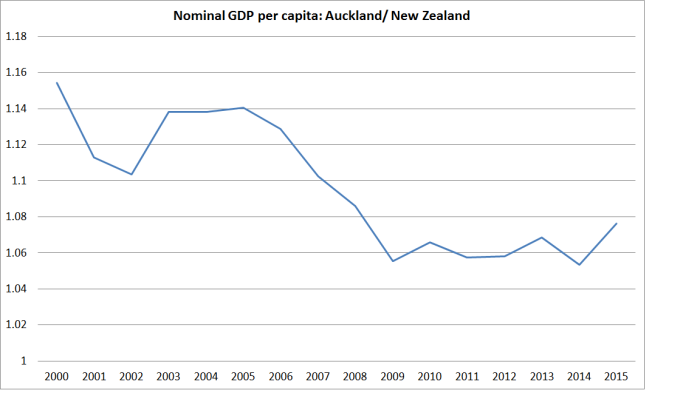
Sometimes people will try to ascribe strongly rising house prices in particular localities to the state of the specific region’s economy.   But since 2007, Auckland’s average GDP per capita has grown no faster than that in the country as a whole.

akld rel to nz gdp pc

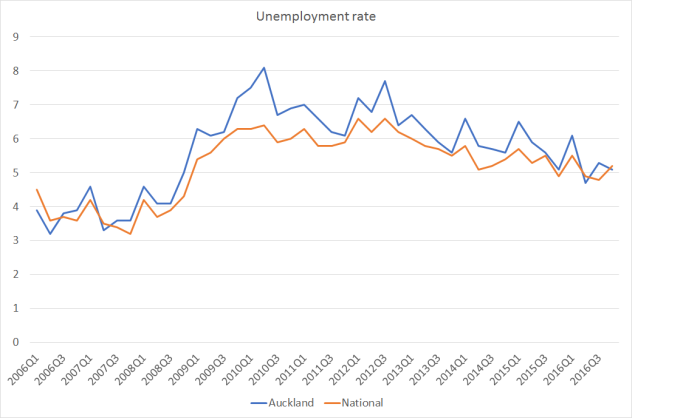
and the unemployment rate in Auckland has mostly been a touch higher than that in the country as a whole.

u-rate-akld-and-national

The other thing that struck me from the scatter plot above was just how many parts of New Zealand still have real house prices lower than those at the peak of the previous boom.   Some have had falling populations, but one or two have actually had faster population growth than Auckland  (eg Carterton, for some reason unknown to me).   These are the places where real house prices are still more than 10 per cent lower in real terms than in 2007.

Clutha
Taupo
Southland
South Taranaki
Westland
Masterton
Central Hawkes Bay
Tararua
Whanganui
Kaikoura
Gisborne
Rangitikei
Buller
Opotiki
Ruapehu
Grey   (-27.2 per cent)

It is easy for people in Auckland and Wellington to be dismissive of some of these places, but as I’ve already illustrated, it isn’t as if Auckland’s economic performance over the last decade has stood out as noticeably better for the average person than that of the country as a whole.

On which note, real house prices across the whole country are now around 6.4 per cent higher than they were in 2007.  With Auckland accounting for a third of the country, and with real prices up 61 per cent there, average real house prices in the rest of the country are still, fortunately, lower than they were at the peak of that previous boom.


What’s wrong with Auckland and Wellington?

Having not lived anywhere else in New Zealand since I was 10, I’m not quite sure.

Yesterday I was filming an interview in which one of the questions the interviewer asked was whether Auckland house prices could be explained, at least in part, by an influx of New Zealanders, whether returning from overseas or moving to Auckland from elsewhere in New Zealand.  I noted that the data actually still showed a net outflow of New Zealanders from Auckland to other countries in 2016 (albeit much smaller than in earlier years), and that Census data had suggested a modest net outflow of Aucklanders to the rest of New Zealand since the mid 1990s, and that that pattern seemed unlikely to have changed in the years since the last census.

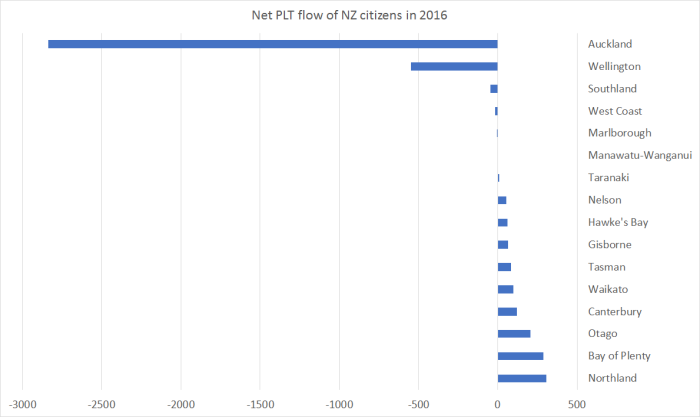
All of which got me curious.  If New Zealanders were still (net) leaving Auckland for abroad, what was happening in other regions of the country.  Were there places where there was a net inflow of returning New Zealanders?   As it happened, the answer proved to be most of them.

plt-by-region

Auckland and Wellington were, in fact, the outliers.

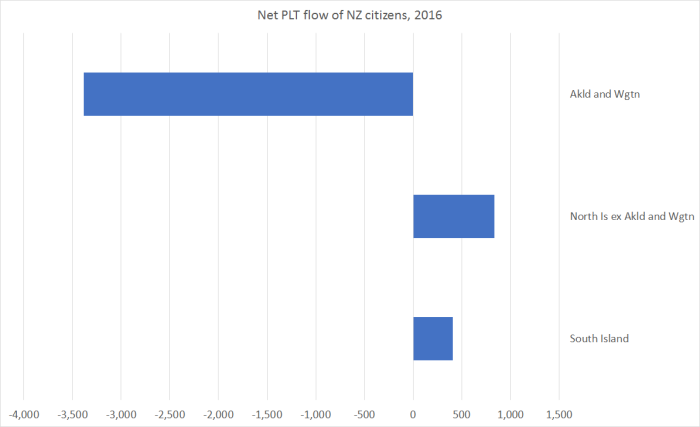
Here is a  more aggregated look at the same data.

plt-by-agg-region

New Zealanders (net) came back last year to the rest of the North Island, and to the South Island, but not to Auckland or Wellington.

I wouldn’t want to make too much of it.  It is, after all, one year’s data, and has all the pitfalls of the PLT data (self-reported intentions and all that).

But it did bring to mind some analysis from The Treasury that I highlighted a couple of weeks ago

As agglomeration and clustering theory predicts, our more urban services-based regional economies (Auckland and Wellington and to a lesser extent Christchurch) are relatively more productive and generate higher incomes than our more resource-based regional economies.

Our Treasury preference is usually to encourage or permit the continued concentration of economic activity in key centres (forces of agglomeration) where returns are expected to be greatest.  Resources and activities should be allowed to flow betwen regions over time.

New Zealanders don’t seem to have been convinced by our officials’ analysis of the prospects and opportunities within New Zealand.

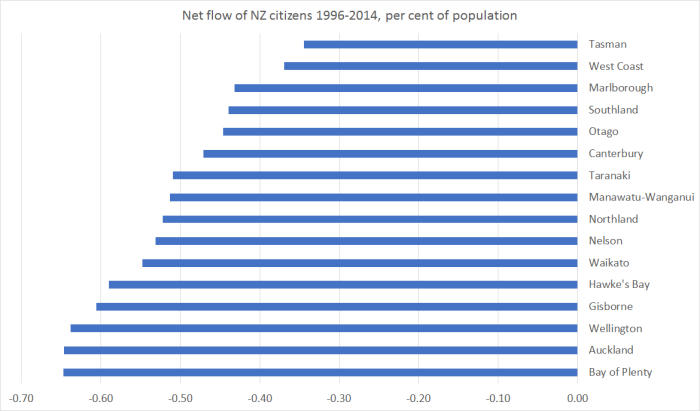
What about over a longer period?   Here is the average annual net outflow of New Zealand citizens from each regional council area, as a per cent of that region’s population each year, for the period 1996 to 2014 (ie from when the data start to just prior to the current sharp reduction in the overall outflow of New Zealanders).

plt-net-flow-96-to-14

Wellington and Auckland were losing just over 0.6 per cent of their population each year as New Zealand citizens left those regions for abroad.  But so were the Bay of Plenty and Gisborne.    (What is, perhaps, more striking is how much lower the net outflow rate abroad was from the South Island).    And in the last year, New Zealanders flowed into Gisborne and the Bay of Plenty, and they still flowed out of Wellington and Auckland.

I can think of various stories why this might be.  Auckland, presumably, has the highest share of naturalised citizens, and perhaps there is more of tendency for those new citizens to leave, than for natives?  But if so, it doesn’t explain the previous 20 years of Wellington, Bay of Plenty or Gisborne.   And while house prices are ruinously high in Auckland, they are nowhere near so bad in Wellington.   Perhaps there is something in a story about Auckland and Wellington people being more “internationally connected” – but again, over almost 20 years, the outflow rates were the same in the Bay of Plenty and Gisborne.   And perhaps, for all the talk of agglomeration opportunities, and a focus on Auckland and Wellington, the economic opportunities, and overall prospective living standards, just aren’t really there in Auckland and Wellington.   The regional per capita GDP data certainly support that story for Auckland.

Perhaps the patterns will change again this year –  and there is quite a bit of year-to-year variation in the regional outflow rates –  but for now, despite all the talk of “problems of success“, or “quality problems“, the migration data suggest New Zealanders when deciding whether to stay or go, and where to come back to if they do, don’t seem to share the sense of Wellington and Auckland as success stories.

Other interpretations/perspectives most welcome.

Wellington rental market: a problem of success?

I’m a bit tied up with other stuff today, so will come back to the New Zealand Initiative’s immigration report next week.  But in the meantime, I was somewhat taken aback to see the Prime Minister quoted as describing the current squeeze on the Wellington private rental market as “a problem of success“.

Sadly, it is like some line lifted directly from the John Key playbook.  I wrote last year about the then Prime Minister’s ludicrous, and frankly insulting to the intelligence of ordinary citizens/voters, attempt to pass off the extraordinary pressures on Auckland house prices and infrastructure, including traffic congestion, as “quality problems”.  In fact, what they were –  and are –  are failures of central and local government to get the land supply market functioning effectively, having over-regulated it in the first place, interacting with central government’s decisions to keep on bringing in lots more non-citizen immigrants.

How does the new Prime Minister justify his insouciance about the Wellington situation?

However, English said the demand for rentals was “a problem of success”, which the Wellington City Council was already trying to address.

“It’s actually a long time since Wellington has felt the pressures of growth – the Government’s investing large amounts of money in the infrastructure…

“The council has shown that it understands for the first time in a number of decades, there is pressure on the housing stock and they are enabling more houses to be built because that’s the only way that they’re going to see a bit less pressurised.”

Damage to Wellington office buildings from last November’s Kaikoura earthquake had also had “a bit of a flow-on effect” to the city’s accommodation, English said.

Although the large lines were “certainly concerning for people who are looking for accommodation”, they did not show a crisis as the housing shortfall was well understood by the council.

Wellington hasn’t experienced pressure in its market for quite some time and as long as they respond quickly, they’ll be able to deal with it.”

I presume not even he is arguing that the earthquake effects were a problem of success.

I was a bit puzzled by the infrastructure spending line.  I’m looking forward to trying out the new Kapiti expressway, but the biggest local infrastructure spend is on Transmission Gully,  the total uneconomic  new motorway on the outskirts of the city.  Perhaps that might, in time, help ease housing pressures in Wellington city, if people could get in more easily from Kapiti, but then I recall a commenter a while ago pointing out how little land Kapiti had actually zoned as residential.

But what really puzzled me about the PM’s comment was that it was a long time since Wellington had felt the pressures of growth, as if this was the dawn of some new renaissance of Wellington.  But here are the population growth data for Wellington city (where the pressures seem to be), greater Wellington (Wellington, Upper and Lower Hutt, Porirua and Kapiti) and New Zealand as a whole.

wellington-popn

Wellington city has had population growth rates very similar to those for the country as a whole –  Wellington city grew faster than the country as a whole in the previous population surge in the early 2000s, and has been just slightly behind in the last few years.  As for the “greater Wellington” region –  a more comparable basis to compare to Christchurch or Auckland –  there has certainly been a rebound in population growth in the last few years, but it continues to lag behind New Zealand’s population growth rate as a whole.  In only two years in the 20 shown here has greater Wellington’s population growth exceeded that of the country as a whole, none of them in this decade.    House prices rose rapidly in Wellington in the 2000s boom, and they are doing so again now.  It just looks like the same old shared central and local government failure.

I’ve written about rents previously.  In a well-functioning urban land supply market, a substantial and sustained fall in real interest rates should be expected to result in rents falling.  Actually, what has happened –  and still appears to be happening in Wellington –  is that real rents have been rising: not as much as house prices have certainly (rental yields have been falling), but they;ve been rising when, if governments hadn’t so badly messed up the housing market, they’d have been falling.

But, says the Prime Minister, not to worry: the Wellington city council is apparently on the case and moving to resolve the problem.    Really?  They didn’t do anything very much in the previous boom, and I haven’t seen much sign of far-reaching reform this time round.  Last week, they announced a plan to build more “social housing” –  which might or might not be a good thing in time –  but I’ve seen little sign of any sort of serious reform of the land supply regulatory situation.

Immediately after the local body election late last year, I wrote about the prospects for housing supply liberalisation in Wellington.

Sadly I don’t expect much.  Here is the housing policy of the new Labour Party mayor of Wellington.

For starters, I’ll be sending a bill through to parliament to make rental WoF a reality in Wellington. If you’re paying rental for a house it’s only fair that house meets basic standards. Living in a warm, dry house that’s free of mould should be a right for every Wellingtonian.

I’ll also invest in social housing, so there’s more available for the people who need it most. This means a long term building program, partnering with third sector housing providers to increase the number of live-to-own dwellings. It also means improving the 2500 existing Wellington council owned social housing units, making them safer and better to live in. 

But that’s not enough. It’s vital that we look after those in need, but we also want Wellington to grow and prosper. That’s why I’m offering a $5000 rates rebate for anyone building their first home in Wellington. Newer homes means better quality homes, and Wellington needs to encourage fresh young talent and new families to move here if we want to keep thriving. 

Plus, I’m committed to establishing Build Wellington, an urban development agency that will utilise existing green-field land holdings for affordable, good quality residential development in the tradition of state and Council housing in years gone by.

Nothing, at all, about freeing-up land supply, just more statist “solutions”, and a local version of the sort of first home buyer grant central government offers –  the sort of tool that has been proved, time and time again, to do precisely nothing to improve housing affordability.

And this is the Council that the Prime Minister thinks is going to quickly resolve the stresses?    Promising to make renting more costly, and offering subsidies to first home buyers to bid up the price of houses

In truth, Wellington’s situation looks a lot like the situation in the country as a whole –  a milder form of Auckland’s stresses, with 2 per cent population growth at present rather than 3 per cent.  There is no sign that housing stresses are a result of some great Wellington renaissance, but rather it looks like the outcome of the same old mess: land use regulations imposed and enabled by central and local government combined with a fresh wave of fairly rapid population growth.  Some of that is about a drop in the number of New Zealanders leaving Wellington –  only about 800 last year – but much of it is, in effect, down to central government’s non-citizen immigration policy.

New Zealand Initiative on immigration: Part 5 House prices

The New Zealand Initiative starts their discussion of the implications of immigration for house prices in a quite reasonable manner.

Rising house prices is an increasingly discussed topic. Fast growing populations, particularly in urban areas, have increased the mean demand for housing. Migration is a major contributor to urban population growth. In an ideal world, the underlying market systems would automatically adjust, such that as demand for accommodation rose and prices increased, developers built more houses. Likewise, cities would invest in infrastructure to accommodate more people.

However, that house prices have not stopped rising for a number of years means New Zealand has not reached this ideal place, and the system is not geared to cope with demographic shifts. The effect is most acute in Auckland, where about a third of the country’s population lives.

Thus far, I imagine everyone is on much the same page.  It was consistent enough with the lines from the Introduction that I quoted earlier in the week

Economists consider housing to be affordable when the median multiple is 3 or lower. In 2013, Auckland’s median multiple was 6.4, and in 2016 Demographia put it at 9.7.  The Initiative’s housing research blames restrictive planning policy and resistance to urban development. However, against a policy-induced, near-fixed supply, additional demand for housing must contribute to rising prices.

It is pretty much ECON101: if the supply of something is largely fixed, at least in the near-term, and there is an increase in  demand (especially an unforecast increase in demand), the price will increase.  Quite how much will depend on the elasticity of demand.   And the immigration contribution to population growth (and demand for accommodation) has been really large over the last 25 years, just as the land-use restrictions enabled by things like the Resource Management Act appear to have become more constraining.  The Initiative regularly, and rightly in my view, inveighs against those restrictions.  Without them, higher demand wouldn’t result in higher (real) prices for houses and urban land.

I also get that the Initiative favours large scale non-citizen immigration, but what I don’t get is why they won’t just be straightforward and say something like, “in the presence of land use restrictions, we recognise that high rates of immigration have been markedly increasing house and land prices, especially in Auckland.  But our best professional judgement is that the longer-term gains to New Zealanders from high immigration are sufficiently large, that we should overlook the distortions and arbitrary wealth redistributions that the high house prices, associated with high immigration have resulted in”

Perhaps there is a case to be made along those lines. It is, mostly, implicitly what the Initiative is saying.  But they won’t come out and say it directly, and instead have tried to shelter behind a short piece from a couple of MBIE-funded academics, Cochrane and Poot, who attempt to interpret the existing evidence to suggest that really immigration isn’t much of a factor in (Auckland) house prices at all.

MBIE is responsible to the ministers for immigration and housing (and, of course, has institutional bureaucratic incentives to maintain a large scale immigration programme).  Both ministers were presumably coming under pressure a year or so ago, and so MBIE commissioned Bill Cochrane and Jacques Poot to do a short review of the existing literature on immigration and house prices, and to draw some conclusions about what might have been going on in the last few years (as distinct, say, from the last 25).  That report was released in April 2016.  Some of it also appears to have been motivated by political concerns around non-resident purchases of New Zealand residential property, but as Cochrane and Poot note, the existing data don’t shed much light on that issue at all.

The New Zealand Initiative summarise the conclusions of the Cochrane and Poot report, with no sign of any caveats or concerns, as follows

Economists Bill Cochrane and Jacques Poot surveyed available evidence on the impact of net migration in New Zealand, and suggest migrants are not to blame for Auckland’s housing woes, rather New Zealanders are.

Personally, I hope no one wants to blame individuals at all –  migrants or New Zealanders. The issues are about policy and big picture forces, not about individuals acting in their best interests given those policies.

What is important to bear in mind is that there is a handful of formal studies that everyone tries to make sense of.   The Reserve Bank –  which historically has no dog in the fight about whether or not immigration is “a good thing”; they just want “the facts” –  has produced several studies over the years, each of which suggested really quite large impacts on house prices as a result of unexpected changes in migration.  And, on the other hand, Stillman and Mare produced a paper suggesting, using quite different techniques, that the effects are quite small.  That is the formal relevant New Zealand literature.   There is also a variety of results across these papers on which flows might have matter more (eg NZ citizens vs foreigners, arrivals vs departures etc).   On my reading the studies aren’t very conclusive: many people who’ve thought the issues through probably think the various RB estimates seem a bit large (up to 10 per cent increases in national house prices for a one per cent change in population) and the Stillman and Mare ones are a bit small.

In her Treasury working paper on macroeconomic performance in 2014, Julie Fry summarised her take as follows:

On balance, the available evidence suggests that migration, in conjunction with sluggish supply of new housing and associated land use restrictions, may have had a significant effect on house prices in New Zealand.

Cochrane and Poot read, or report, things a bit differently.  But it is important to remember that their mandate was to focus on the “last few years” –  whereas the New Zealand Initiative generalise it to apply to our longer-term house price issues.   And it is certainly true, that if we look at the big swing in overall PLT immigration in the last few years, a substantial chunk of that was about New Zealanders (net) not leaving at such a great rate, rather than about a change in immigration policy (ie the bit that governs foreign arrivals).  Their summary is as follows (emphasis added):

Overall we find that the literature and the available data on population change suggest that visa-controlled immigration into New Zealand, and specifically into Auckland, in the recent past has had a relatively small impact on house prices compared to other demand factors, such as the strongly cyclical changes in the emigration of New Zealanders, low interest rates, investor demand and capital gains expectations. Consequently, changes in immigration  policy, which can impact only on visa-controlled immigration, are unlikely to have much impact on the housing market.

There is quite a lot to unpick there.

First, it is a specific observation about the “recent past” –  when immigration policy (affecting foreigners) didn’t change much, and New Zealanders’ behaviour did.

Second, to talk of “investor demand and capital gains expectations” as distinctive factors is rather disingenuous.  Presumably, investor demand was partly a response to increased underlying demand for accommodation, and capital gains expectations partly a response to the actual interaction of increased demand pressures  in the face of restricted supply?

Third, if interest rates –  which aren’t some random variable, but have been low for a reason –  were a major independent factor, we wouldn’t have seen Auckland house prices rising so much more rapidly than those in most of the rest of the country (bits that mostly haven’t seen the same population pressures).

Fourth, the policy sentence is, literally, a non sequitur.  It simply doesn’t follow from what went before.  If immigration policy hadn’t been changed in the period they looked at –  and it mostly hadn’t –  it gives you no empirical basis for concluding that a future change in immigration policy would have no effect on house and land prices.  In fairness to the authors, in their text they elaborate, and highlight the lags in the process, and that short-term variations in immigration policy aren’t a very reliable means of managing overall net PLT flows. I totally agree with them on that, and oppose such short-term immigration management, but it is a quite different issue.

But even over Cochrane and Poot’s own period, it isn’t clear that they have the emphasis right.  Here are net PLT flows with New Zealanders and non New Zealanders shown separately.
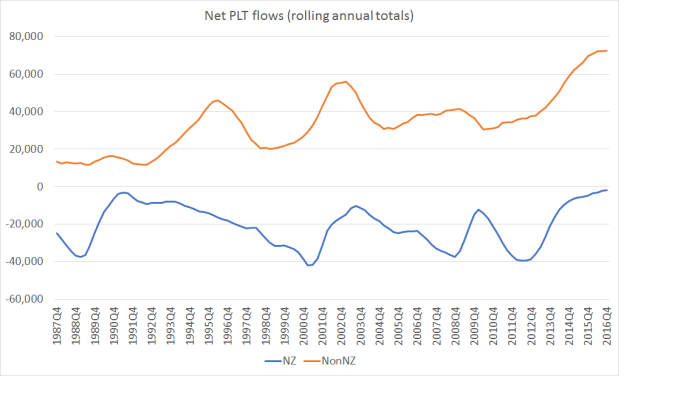
plt-by-citizenship

Over the period from around 2006 to around 2013 most of the variability was in the New Zealand citizen net flows.  And specifically, from around 2012 to 2014 much of the pickup in PLT inflows was the change in New Zealanders’ behaviour –  nothing about immigration policy –  but over the last couple of years, there has also a huge increase in the net inflow of non-citizens, almost all of which is visa-controlled.  It all represents additional demand for accommodation.

Cochrane and Poot note that much of the increase in non-citizen net arrivals has been from people without approval to stay permanently (ie students, and people on work visas).

the growth in inward migration has been particularly in temporary visa-controlled immigration (e.g. international students, temporary workers – including working holiday makers), as could be seen in Figure 9.  The latter types of international migration flows are likely to have had a quantitatively  smaller impact on house prices and to have contributed little to house price increases observed recently. The lesser demand on the housing market of temporary migrants has  been shown with respect to students by BERL (2008).  Generally, research on the differential impact on housing markets between those arriving and staying on temporary visas, compared with those arriving on, or subsequently obtaining, permanent visas still needs to be undertaken.

Most students probably aren’t buying a house.  Most work visa arrivals aren’t either.  But they all need a roof over their head, and add to the overall demand for accommodation, especially in Auckland.    The authors play down this effect, noting that rents have increased much less than house prices have, but as I’ve illustrated previously, this divergence can be explained by the substantial fall in interest rates.  When long-term interest rates fall, rental yields should be expected to fall.  Absent population pressure, and in the presence of a well-functioning housing supply market, nominal yields should probably have fallen.   Presumably expected demand for accommodation from students and short-term workers influences the willingness of investors to bid for properties, in turn pushing house price upwards.   Population pressures don’t affect prices simply dependent on whether or not the new arrivals (or non-departures) choose to buy rather than rent.

One of the big challenges in modelling house prices is the so-called endogenity issue.  A thriving city might see rising wages, and new people being drawn to that city.  In the context, is it the immigration or the general prosperity that is raising house prices (given supply restrictions  –  real house prices tend not to rise for long without them)?   It is an important in the short-term, but I’m less convinced that it is over longer-term horizons –  eg the sort of 25 year period over which our immigration inflows and land-use restrictions have been interacting.  Perhaps prosperity draws additional migrants in, but it simply isn’t likely that house prices would have risen much and for long on prosperity alone, without the additional people.

An ideal test –  for economists anyway –  would probably involve repeated surprise changes in long-term immigration policy.  We could do a clean test if, say, every few years a random number generator decided how many residence approvals to grant to non-citizens each year.  This year it might be 45000 (the actual target), another years 75000, another year 10000, and so on.  We could then study the response of house prices in the wake of that clearly exogenous change in policy.

When it comes to New Zealand immigration policy, there simply haven’t been those sorts of changes researchers could study –  other perhaps than the gradual opening up from the late 1980s to the mid 1990s, a one-time event.  Here is the chart of residence approvals each year that MBIE provides the data for, back to 1997/98.
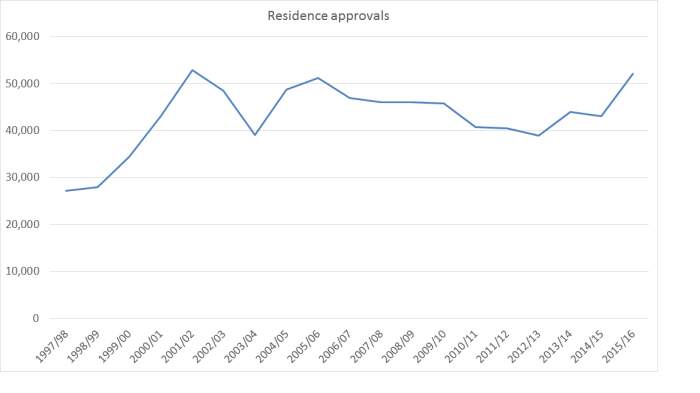
residence-approvals-annual
There hadn’t been a change in the target for 15 years until the very small cut announced late last year.  And the actual variability in the approvals granted from year to year is mostly cyclical, and endogenous –  dipping a bit when our unemployment rate was high, and then recovering lately.   Econometricians use various clever tricks to try to deal with endogeneity, but the fact remains that at a policy level there have been hardly any exogenous changes at all.  Just a very large net inward flow, varying a little from year to year, as a result of substantially unchanged policies.  Trying to correct for endogeneity using recent data in particular might be a fool’s errand

Those residence approvals over 19 years added up to 817231 people.  As I showed yesterday, the data suggest that perhaps 60 per cent of foreign arrivals settle in Auckland –  that would be around 490000 people.  Not all of them stay, of course, but even if only 80 per cent stay in the long term that is still almost 400000 people, adding to the demand for accommodation in Auckland in 19 years, as a direct result of immigration policy.    Yes, there is lots of variability in the NZ citizen flow –  Cochrane and Poot’s point –  but over that 19 years, around 160000 New Zealand citizens (net) left Auckland for overseas.   Again, as Cochrane and Poot point out, there has been considerable natural increase in Auckland’s population too.  But immigration policy –  visa-controlled almost all of it –  will have boosted Auckland’s population in that time by almost 400000 people.  And in a country – and city – which as they acknowledge does not have very responsive housing/land supply, that simply cannot have done other than put considerable pressure on Auckland house and land prices.

I’m still not sure why the New Zealand Initiative wants to avoid simply acknowledging that.

It is not as if this view is some contrarian Reddell-ite view held by no respectable or serious person.      Read the speeches and reports of the Governor of the Reserve Bank and his staff, or those of the Treasury.  Look at the analysis and reports of the IMF and the OECD –  both generally supporters of immigration.  It isn’t even treated as contentious that immigration has played a material role in house price inflation, in places where land use restrictions are in place.  Go across the Tasman, and listen to the Reserve Bank of Australia for example –  a nice recent example is here –  or look at the IMF/OECD reports on Australia too (with a similar mix of rapid population growth and land use restrictions).  When supply is substantially restricted and demand for housing increases, house/land prices will rise.  Population growth is a key source of additional demand, and immigration  –  whether exogenously influenced, or endogenous to the economic cycle –  is a huge component of population growth, especially in Auckland.

Flows of New Zealanders matter just as much as those of foreigners, and are often much more variable in the short-term (because less controlled by policy).  Immigration policy  –  affecting foreigners –  can’t sensibly attempt to stabilise housing market pressures in the short-term, but it can  –  and does – make a huge difference to housing demand over the medium-term.  In a system with quite tight land use controls, that affect over the last couple of decades has been almost entirely deleterious –  driving up house and land prices, and skewing wealth from the young to the old, the have-nots to the haves, and so on.  Yes, we should fix land use regulations, but don’t pretend –  as the Initiative tries to in this report –  that knowing continuation of high rates of non-citizen immigration, in the presence of those land use restrictions, isn’t knowingly allowing urban house and land prices to be driven progressively further upwards, in Auckland especially, but not of course exclusively.
 

New Zealand Initiative on immigration: Part 4 Fiscal implications

The next couple of chapters of the New Zealand Initiative’s immigration advocacy report cover material closer to the core expertise of the Initiative and its staff –  economics.  Chapter 3 is headed “Population Pressures” and looks at the impact of New Zealand immigration on three areas:

  • government finances more broadly,
  • house prices, and
  • the impact of an ageing population (ie improving life expectancy).

I want to focus today on the first two, but first some brief remarks about the ageing population issue.

The New Zealand Initiative tend to mischaracterise this issue.  There are some specific fiscal pressures that arise from changing birth rates through time.  Low birth rates in the 1930s, for example, gave us a considerable fiscal dividend for quite a while in the 1990s and 2000s –  there just weren’t that many people becoming eligible for NZS.  On the other hand, high birth rates from after World War Two to the early 1960s mean that since around 2011 there has been quite a big increase in the numbers claiming NZS.   But those effects tend to wash through over time.   The much bigger issue –  a cause for celebration mostly, even if it should prompt reassessment of some government spending choices –  is the strong trend increase in life expectancy (I had some thoughts on this issue here).  The issue isn’t about baby-boomers, selfish or otherwise, but about the fact that we can expect to live much  longer than our grandparents did (at a rate of improvement of towards two years a decade), and we might reasonably expect our grandchildren to live much longer than we do.    There are technically simple appropriate policy responses to those trends –  notably, it simply doesn’t make sense now to be paying universal retirement benefits to people at 65, and the age of entitlement should probably be indexed to further trend improvements in life expectancy, as various other countries have started to do.      When they aren’t trying to defend immigration policy, the able people at the New Zealand Initiative know all this, and make these sorts of points themselves.  And they (rightly) celebrate things like the gains in life expectancy.    So what are they doing making over the top claims like this

policymakers need it [immigration] as the fiscal implications of baby boomer retirement become more acute

Not even a nice-to-have, but a need.

As it happens,  in their more reflective moments even they are more hesitant

Although replacing the exiting workforce with migrants has merit, the idea should be treated with caution. International competition for skilled workers will increase as
the world becomes more interconnected and the ageing problem worsens in developed countries. New Zealand, while an attractive destination in its own right, will struggle to compete with markets offering higher financial and lifestyle rewards.

If we take lots of migrants we should do so because they increase the productivity and living standards of existing New Zealanders, not because they might temporarily help us avoid taking overdue sensible decisions on what proportion of the human lifespan we pay universal benefits to people for.   We should bring in ever more people (since this isn’t just a one-off issue) from elsewhere simply to ease pressures to change internal policy that almost everyone now knows are overdue for change?  I think not.  And nor, generally, would the Initiative.  They are usually much better than that.

What of government finances more generally?

Here the Initiative is very confident.   In the section headed “Fiscal Discipline”, while acknowledging that in other countries immigration does seem to lead to net fiscal pressures, in writing about New Zealand they begin

Migrants tend to have a positive impact on the fiscal side of the government ledger.

They base this claim on MBIE-funded work carried out by BERL.  In that exercise, BERL take some aspects of government review and spending,  and allocate them –  quite carefully –  across New Zealand-born and foreign born residents of New Zealand.  On this snapshot basis, and on these components of government finances, they estimate that in 2013 the average foreign-born person contributed $2653 to government finances in 2013, and the average New Zealand born person contributed $172 to government finances.  Overall, of course, in 2013 the New Zealand government was running quite a substantial fiscal deficit.

It is quite surprising that an economics-based think tank like the Initiative simply accepts and presents these results at face value.    The BERL report –  one of a series done over the last 15 years –  has its own value (comparable data through time).  But it isn’t state-of-the-art in estimating fiscal impacts of immigration (as the authors note, they weren’t paid for a literature review, but simply to slot new numbers into the existing methodology).  It doesn’t even cover quite a few major areas of government revenue and spending.  And in a technical appendix to the report (obtained from BERL –  it doesn’t appear to be online), the authors explicitly note that

In addition, the estimates do not allow for life-cycle impacts of migrant characteristics. That is, the calculations are of a ‘snap-shot’ single year. Issues such as migrants’ varying contributions and expenditure claims over their lifetime are not captured. Dynamic micro simulation might be used to establish the lifetime contribution of a particular type of migrant, but such a technique is beyond the scope of this project.

Bring in a whole bunch of 25 year olds, and of course they won’t involve much government health, welfare or education spending.  But over time, they’ll have children, and age.  Bring in 50 year olds, and they’ll (soon) be eligible for health and NZS spending, but won’t typically have paid that much New Zealand tax over their lifetimes

I’m not criticising the New Zealand Initiative for not producing state-of-the-art estimates themselves (that is a very substantial project) but for not at least acknowledging some of the limitations of the estimates they choose to rely on.

I’ve commented previously on the BERL estimates, when Nigel Latta made great play of them in his TV documentary last year on immigration.  Here are some of the points I made then.

But even in what it does look at, there are some quite severe limitations:

  • recall that the report estimates that both NZ born and immigrants made a net positive fiscal contribution to the government’s accounts.  Perhaps, but recall that in 2013 (the year studied) the government was still running quite a large fiscal deficit.  In other words, even if the study is roughly accurately capturing the relative contributions of immigrants and the native-born, it isn’t remotely accurately capturing the absolute contribution.
  • The BERL exercise does not appear to recognize at all that much of the demand for increased government capital spending now arises from the immigration programme itself (as it notes, between 2001 and 2013, the New Zealand born population aged 25 to 64 actually fell slightly while the foreign born population of that age increased by 222000 people).  Over those 12 years, 80 per cent of the total population growth has been among the foreign-born.   Assign much of the (above-depreciation) government capex to the immigration programme and suddenly even the fiscal numbers will look quite different.
  • These are snapshot effects rather than inter-generational ones.  It is hardly surprising that an immigration programme that brings in relatively young people involves less government operating spending (per capita) than for natives –  people that age are typically young and fit –  but if we want to think about even the fiscal impact of the immigration programme as a whole it would be important to look at the impact not just of the immigrants in the couple of decades post-arrival, but (for example) at the impact as those people age, and the impact of their own children (many of whom will be New Zealand citizens, but still a consequence of the immigration programme).
  • perhaps most importantly, any sort of exercise like this is only meaningful if it deals with very small changes (when one can keep the rest of the economy held constant).  By contrast, the potential for a large scale immigration programme to affect real interest rates, the real exchange rate, and the underlying structure of the economy, means these fiscal exercises offer no insight at all on the overall impact of immigration even on the fiscal accounts, let alone the wider economy.

In addition, I think there are at least two other points worth making.

First, company tax revenue (and, I think, trust income) isn’t included in the calculations at all.  On the sort of snapshot basis used here, this is likely to skew the results against the native-born, because it is likely that the capital stock is disproportionately owned by natives rather than immigrants.  (This is, in a sense, simply the flipside to the fact that the average migrant is younger than the average native).  Perhaps as importantly, there is a reasonable argument that revenue that results from New Zealand’s natural resources should be assigned to natives, rather than (implicitly spread across both natives and migrants).  Those revenues  –  from farming or fishing or gas extraction etc –  would have arisen regardless of whether we had any material level of immigration in the last few decades, and are unlikely to have been enhanced by the much-increased population (indeed, if my concerns about the real exchange rate are correct, they may have been reduced).

And second, it is important to remember that BERL is comparing the NZ born and foreign born populations in total.  Although they do undertake some decompositions, it isn’t really an attempt at a marginal analysis –  looking at (ideally) the lifetime impact of the next 1 per cent of the population that comes in as migrants.  The foreign-born of New Zealand today includes old people who came in the 1950s, the small numbers who came in the 1980s, as well as the huge numbers who have come in the last couple of decades.  Research evidence –  summarised in Julie Fry’s 2014 Treasury working paper – shows that, for example, migrants for the Pacific and Asia take much longer than, say, migrants from the UK to reach native-born levels of income (and presumably tax contribution) for any given set of qualifications etc.  Moreover, even with the pool of migrants we take each year, there is wide range of skills and capabilities –  some will end up making a big positive (economic and) fiscal contribution, and others –  especially, say, the parent approvals –  will be a substantial fiscal drain.   Since the policy argument now isn’t about the stock of people already here, but about who, and how many, we should let in going forward, a more appropriate analysis –  for current policy purposes – would focus on trying to better understand what level of immigration, of what sort of people, would maximise any fiscal gains, or minimise any fiscal costs.  The BERL report doesn’t attempt that sort of thing, and the New Zealand Initiative don’t even note the relevance of the perspective.

For all these specific points, I’ve never made much of the fiscal issues around immigration in New Zealand.  The comment I made a few months ago still reflects my position.

I’ve never made much of the fiscal issues around immigration.  By international standards our residence programme , if large, isn’t bad  –  if it doesn’t attract many very skilled people, at least it does successfully focus on getting people quickly into the labour market.  But precisely because in the end we are largely bringing lots of people quite like us –  who can readily get jobs –  it is very unlikely that in the long-run there will be much net difference in the fiscal effects between the contributions of those whose ancestors have been here for generations and more recent arrivals.

With an immigration programme like ours, the fiscal impact probably isn’t much of an argument one way or the other.  Although if there are fiscal gains on offer, we could probably maximise them with more demanding entry criteria than those we currently use.

On reflection, this post has got long enough.  I’ll tackle the housing issues in a separate post later in the day.

Another perspective on the New Zealand Initiative report

I will be resuming today my own series of posts on aspects of the New Zealand Initiative’s report on immigration.    However, some readers might also be interested in a new 29 page paper reviewing the New Zealand Initiative’s report by my former colleague Ian Harrison, now of Tail Risk Economics.

Ian focuses his comments on some of more formal research papers the New Zealand Initiative authors cite in support of their case.  There is some overlap with the material I’ll be presenting here, but in some areas Ian takes a more specifically technical approach to his critique.   On the other hand, sometimes his approach is a little more “in your face” than one I might typically adopt.

Here is some of the Introduction to his paper

Recently the New Zealand Initiative has released a report ‘The New Zealanders’ on the immigration issue.  The stated purpose is ‘To give the most up-to-date information to the public. To stack up these social, economic and nationhood fears against the available data and research.  It is claimed that the evidence on the economics is positive and fairly conclusive.

By and large, economists favour immigration as migrants benefit the countries they move to through knowledge spill-overs and global connectedness. Growing the population through immigration also produces ‘economies of agglomeration’ (i.e. the abilities of larger, denser populations to support more commerce and knowledge exchange).
All this is presented as a solid, objective assessment “While we could deduce the objective economic effects ….’

We disagree.  The economic ‘facts’ had a distinct ‘alternative’ whiff to them.  The arguments were at best thin, and the paper did not seriously engage with some of the key issues. It is easy to cherry-pick the (mostly) foreign literature to find an article that supports an assertion. It is much harder to convey a fair overall sense of the state of the economics of immigration, and critically, its relevance to New Zealand. The report does not do this, and the reader is left with the impression that nearly all economists support high levels of immigration, and that there is compelling support for this in the literature.

This paper presents an alternative view. But first let us define the scope of the debate. First, It is not about stopping all immigration or reversing what has happened. Most people are relaxed about genuinely high skilled immigration.  And we can continue to enjoy the ‘soft benefits’ of diversity from the existing stock of migrants.  The debate is about whether we continue the policy of large-scale medium/low skilled immigration. Second, it is not about whether immigration will generate a bigger economy. It will.  The issue is whether it will make current New Zealanders better off. The ‘New Zealanders’ is somewhat ambivalent on this point, but it is the broadly accepted test.

Our alterative economic narrative addresses the major shortcoming in the paper. It did not seriously engage with the critical structural features of the New Zealand economy.   That is, New Zealand economy is, more than any other advanced economy, land based and isolated. Other things being equal we would expect a large influx of immigrant labour to drive down average incomes as a larger labour force has to seek out more labour intensive low income jobs.  Thus the foreign literature, even if robust, may not be a good guide to New Zealand outcomes

And, on the other hand, this from his conclusion

To be fair, we found much in the report that was very useful, in particular the taxonomy of beliefs about migration. The report certainly challenged some of our preconceptions and it provides a good starting point for a debate that has to include what people really feel and believe about some sensitive issues.

The taxonomy of possible beliefs about immigration appears quite late in the report.  I agree that it provides a useful framework for helping to think carefully about the issues, and will be discussing it later in my series.

What proportion of migrants (in and out) reside in Auckland?

Pottering around between children’s orthodontic appointments and the start of the cricket, my eye lit on the Herald’s editorial on a various issues/problems relating to immigration.  These are, we are told, “problems” we are fortunate to have, contrasting favourably with current situation with that a few years ago. Among others things, we were enjoined to remember that:

“This country’s population barely grew during the last quarter of the 20th century”

Actually, our population in 1975 was 3.083 million, and in 2000 it was 3.858 million, an increase of a mere 25 per cent.  Over the same period, the United Nations population database tells us that high income countries in total experienced a population increase of 20 per cent.

One thing led to another and I decided to dig out the data on the regional patterns of net PLT migration.  I’d recently used the (common) line that about half the migrants come to Auckland, while Auckland has about a third of the population, but I’d never looked at the data myself.

The data aren’t ideal.  The PLT numbers are based on self-reported intent at the time of arrival/departure, and we know that at times even in aggregate they can differ from the actual realised experience.  Census numbers might be better for longer-term trends, but we only get that data every five years, and it is now four years since the last census.  So, the PLT data are the one set of numbers we have that allow us to distinguish New Zealand citizens from others (only the latter  are a matter of immigration policy) and provide breakdowns by regions within New Zealand.  And Statistics New Zealand has this breakdown all the way back to 1991, around the time broadly the current approach to immigration policy was adopted.

What do they show?

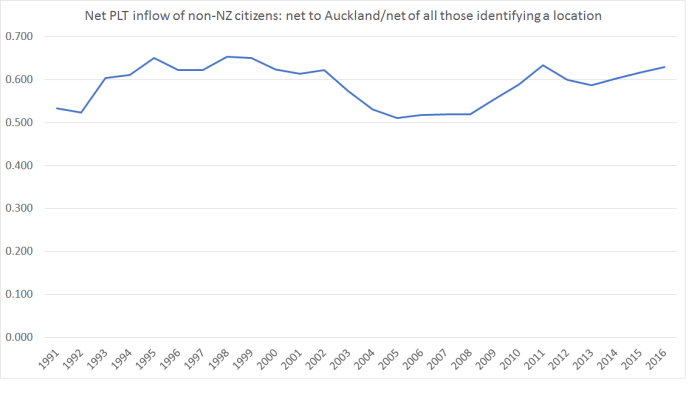
Often people compare the flow into Auckland with the overall net inflow, but within those net inflow figures quite a lot of people don’t state where in New Zealand they have come from or, if arriving, where they are planning to stay.  Among non-citizens, in calendar 2016 there were a net 14000 of those people, of a net inflow of 72406.  It is probably more reasonable to compare the net inflow to any particular region  to the overall inflow of those who stated a place of residence (perhaps a reasonable assumption is that those who didn’t state were representative of those who did, but presumably no one knows).  Here is the net PLT inflow of non NZ citizens to Auckland, for each year since 1991, as a share of the identified net inflow.

akld-inflow-non-nz

Over the full 26 year period, 59.1 per cent of the net inflow of non-citizens was to Auckland.  It dipped for a while during the 2000s but in the last five years or so seems to have returned to around normal.  And before anyone interjects the word “students”, yes we know that students disproportionately come to Auckland, and we know that most of them eventually leave again.  But these are net figures, and there is nothing unusual about where things stand now in terms of the share of the non-NZ flow that has been coming to Auckland.

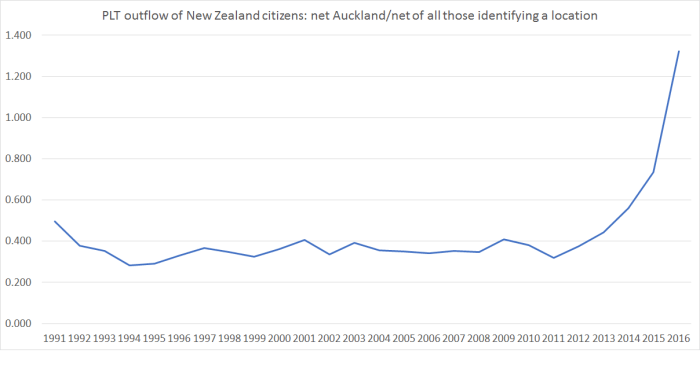
And what about New Zealand citizens?  Every year since 1991 there has been a net PLT outflow of New Zealand citizens from Auckland.  Some years, the net flows of New Zealanders are quite small –  last year only a net 1818 New Zealand citizens left New Zealand –  so the regional shares can swing around quite a lot.   Last year was especially notable –  a net 2836 New Zealand citizens left  Auckland for abroad, more than the outflow of New Zealand citizens for the whole country.

akld-outflow-nz

But over the 26 years as a whole, 37 per cent of the net outflow of New Zealand citizens has been from Auckland.    Last year, Auckland’s population was around 34 per cent of the total New Zealand population.

Broadly speaking then, New Zealanders (net) leave the country pretty evenly across the country.  They are perhaps a little more likely to leave from Auckland (given that Auckland has a larger share of the non-citizen population) than from other places –  and that is consistent with the Census data which has found that net people seem to be moving out of Auckland for other places in New Zealand too – but that difference seems fairly secondary. But the non-New Zealanders who come to New Zealand (net) come overwhelming to Auckland.

Out of curiosity I put the two together.  I was a bit reluctant to do so, since what New Zealanders do isn’t a matter of immigration policy at all.  But for some purposes –  housing is notable example – both matter, because it is the combination that affects demand for accommodation.

From year to year, the share has been hugely variable  (mostly because of the variability in the net outflow of New Zealanders).  But with all the caveats that surround the PLT data noted, and recognising that over 26 years there was a net inflow of 162594 people (NZers and others) who didn’t specify a location, the Auckland share of the net inflow of the people who did specify a location was, on this measure, 98.1 per cent.

I found that pretty staggering.  Perhaps it isn’t surprising that land use restrictions run head on into this net inflow to produce in Auckland some of the highest house price to income ratios anywhere.