Some euro-crisis reading

As the euro crisis has begun to re-intensify, as stresses around Greece’s position increased, I pulled off my bookshelves and read several recent books on the crisis.

Jean Pisani-Ferry is adviser to the Prime Minister of France, and is a former adviser at the European Commission and former director of the Brussels-based think tank Bruugel.  His book The Euro Crisis and its Aftermath comes with blurbs from the great and good of the social democratic economics elite –  Olivier Blanchard, Charles Goodhart, Dani Rodrik, and Larry Summers.  For those without much background in the euro, it is a worthwhile and pretty succinct account of how things came to be, and has some suggestions on the way forward.  But they are all quite technocratic perspectives, that don’t seem to really engage with the political stresses, which reflect the fact –  captured in opinion polls – that most people in euro-area countries see their primary identity as national rather than European.  The elites might wish it was otherwise, but if there is any movement in the data  in the last decade it has been more towards national than supranational identity.  In a mild form, that is what Martin Feldstein warned about long ago.

Vito Tanzi has written Dollars, Euros, and Debt: How We Got into the Fiscal Crisis, and How We Get Out of It, ostensibly about fiscal stresses across the advanced world, but really focused on the euro crisis.  Tanzi was director of the IMF’s Fiscal Affairs Department for almost 20 years, and has(among many other things)  co-authored two fascinating books on the long-term evolution of public spending in advanced economies.   The old joke was that IMF stood for “it’s mostly fiscal”, and that is certainly how Tanzi interprets the euro crisis.  He makes some useful points about how the differences between the euro area and the US, as monetary unions, can be overstated (in particular there is no “transfer union” in the US).  The biggest single difference is that the US Federal government (but was not in, say, the 1930s) while any European central spending is small.  That makes a lot of difference, and Tanzi reasonably notes that no one has ever set up a strong central government to do macro-stabilisation.  I suspect Tanzi overstates the significance of the fiscal institutional issues, and understates the importance of bringing together countries with quite different neutral interest rates.

The last of the three books was The Euro Trap: On Bursting Bubbles, Budgets, and Beliefs, by Hans-Werner Sinn, a leading German academic and economic advisor.  For my money, it is the best of books (and the longest and most richly detailed), but that partly reflects my Eurosceptic biases.  Sinn has been a key contributor to the German debate and played a leading role in highlighting the role of the clearing and settlement system, TARGET. He argues that through it, capital flight from the periphery has been accommodated by the ECB, both delaying adjustment and incurring considerable risk for taxpayers in creditor countries.  A pan-European centralist might, of course, argue that that is exactly what it was supposed to do.   I can’t do justice to the book in a singe paragraph, but if you want to learn more about the crisis –  from an author who wanted (and I think still wants) the euro to succeed – this is the one to read.  As ever, whether one agrees with the author in the end should be incidental.
Integrated markets 1890s style

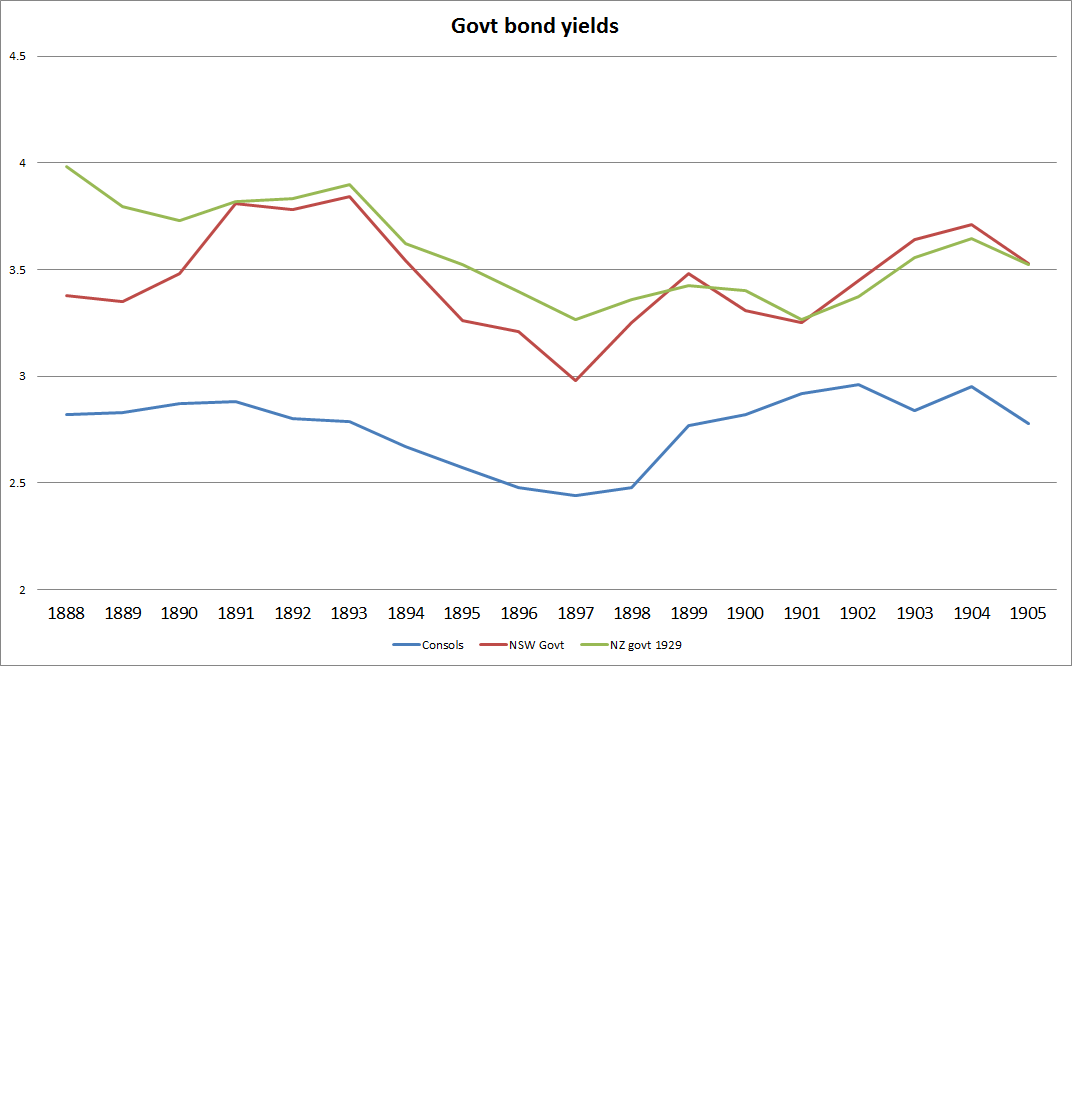
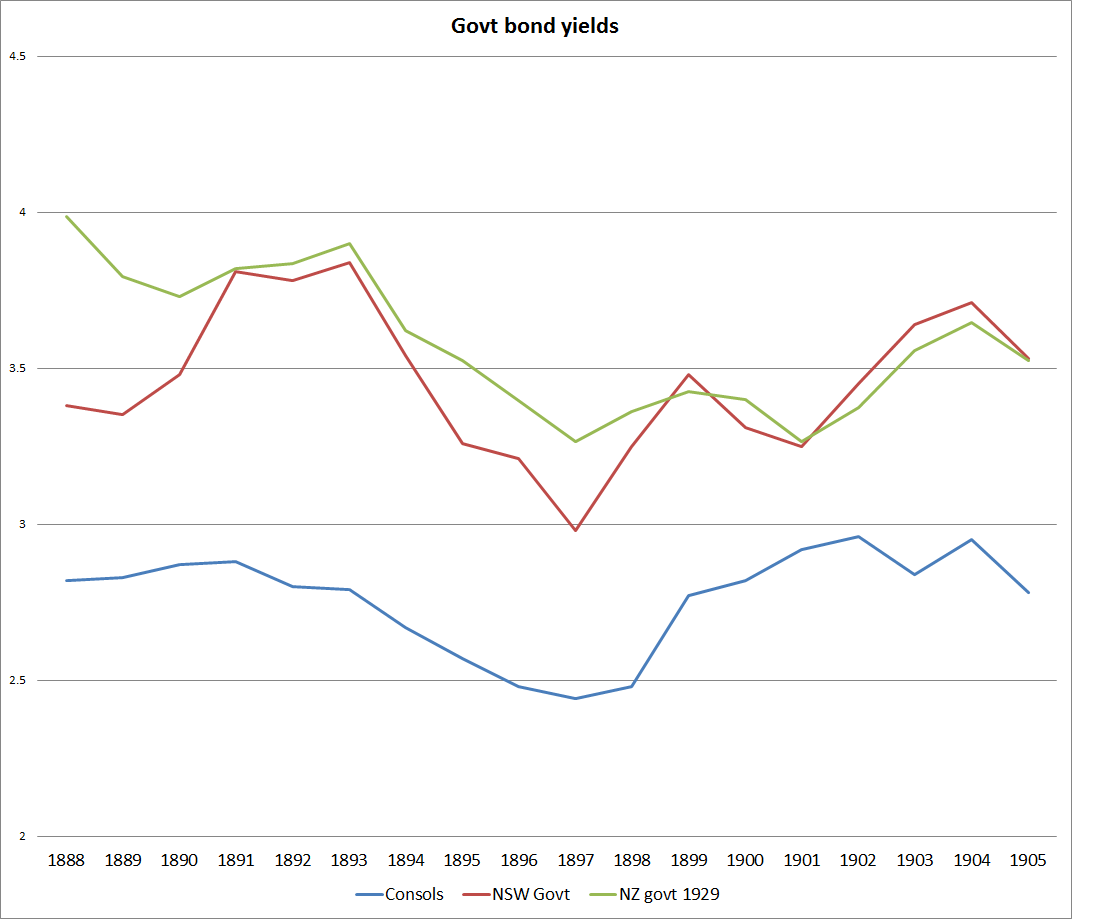
A conversation yesterday about markets in the 1890s prompted me to dig out some data on government bond yields in the period.  The chart below shows a not-entirely-consistent (different maturity dates, period averages vs ends of periods) selection of data on bond yields for the UK, New Zealand, and New South Wales (Australia not existing as a political entity until 1901).  There are spreads between these yields, but recall that they were, on the one hand, the securities of the most powerful country (and a major net lender) and those of two small highly-indebted colonies.   The Australian colonies and NZ both went through episodes of financial crisis in the early 1890s (with severe and long-lasting effects in Australia’s case), and that presumably accounts for the spreads in the chart below widening temporarily in the early 1890s.

Rather more recent yield differentials will feature in a post probably next week (school holiday obligations permitting).

bonds


Makhlouf on migration

The Dominion-Post reports this morning on a speech given yesterday by the Secretary to the Treasury, Gabs Makhlouf.  I might come back to the speech when I’m finally free of institutional constraints but, for now, it was his comments on migration that caught my eye.  An extract:

For New Zealand, many of the benefits from high net migration levels are similar to those that come from offshore investment.

Migration helps to lift our productive capacity – it enables the economy to grow faster by increasing the size of the workforce, in much the same way that foreign capital allows us to grow faster than domestic savings alone would permit.
Right now, at a time when international demand for some commodity products is weak, strong net migration also has the benefit of bolstering demand for goods and services at home.

Like foreign investment, migrants also bring new skills, new ideas and a diversity of perspectives and experiences that help to make our businesses more innovative and productive.

And perhaps most importantly, migrants often retain strong personal and cultural connections to other parts of the world, which opens up, and helps us to pursue, new business opportunities. We are in a pretty incredible position in this regard, with so many New Zealanders – around 1 million people – living overseas, and so many people who live here having been born in another country.

Contra Makhlouf, my proposition, which I will elaborate on over coming months, is that inward migration of non-citizens is rarely, if ever, even part of the answer (whether proximate or more fundamental) to underlying economic problems.  In relatively developed countries, per capita incomes of native populations have very rarely been lifted by immigration.  One way to see that is to look at incomes between pairs of advanced countries over very long periods: over say the last 100 years countries which have received lots of immigrants have not typically done better than those which did not.

And when non-citizen immigration has boosted native incomes it is usually because the immigrant culture takes over and swamps what was there before  (one could think of European migration to New Zealand, Australia, Canada, and the United States in this light relative to the pre-existing indigenous cultures).  Cultures embed a lot of the keys to economic success.  When it works well, large scale inward migration of non-citizens [I labour the description to be clear that I’m not talking about the comings and goings of New Zealanders] is a complement to economic success that was already well underway, not a contributory cause.    Be it late 19th century New Zealand or the United States, Singapore or Dubai today, or 20th century Ireland  (where people rationally left during the dark economic years, and large inflows occurred only after rapid sustained growth in GDP and productivity was already well-established) the longer-term economic benefits are almost all to the migrants,

Immigration allows the benefits of a country’s economic success to be shared more widely.  It might be a path to success  and prosperity for the migrant (if they didn’t expect that they would not migrate) but shouldn’t be seen as a path to lifting the innovation and productivity of New Zealand people and firms.  In Australia, as orthodox a body as the Productivity Commission reached pretty much that conclusion almost a decade ago.

New Zealand is not an economic success story, and has not been so at least since World War Two.  Finding a path that begins sustainably closing the income and productivity gaps to the rest of the advanced world, should come before governments carry on bringing in yet more people, even as our own people are choosing to leave.