The apostle of the tree god

There wasn’t going to be a post today but then someone sent me the link to a super-soft interview the Herald’s Liam Dann had done with Reserve Bank Governor Adrian Orr.   Had the Bank’s own PR consultants been scripting the interview it would scarcely have been softer (in fact, they might have advised a couple of serious questions to give the resulting interview a bit of credibility).

Orr will by next week have been in office for 11 months, wielding vast amounts of policymaking power singlehandedly, and yet we’ve still not had a single speech on either of his main areas of responsibility; monetary policy, and the regulation of much of the financial system.  But there is still time to play the tree god line (that’s the Herald headline: “Orr embraces the forest god”).

I’ve written about this silliness before.  Extracts

The latest example was the release on Monday of a rather curious 36 page document called The Journey of Te Putea Matua: our Tane Mahuta.   Te Putea Matua is the Maori name the Reserve Bank of New Zealand has taken upon itself (such being the way these days with public sector agencies).  It isn’t clear who “our” is in this context, although it seems the Governor  – himself with no apparent Maori ancestry – wants us New Zealanders to identify with some Maori tree god that –  data suggest –  no one believes in, and to think of the Reserve Bank as akin to a localised tree god.  Frankly, it seems weird.  These days, most New Zealanders don’t claim allegiance to any deity, but of those of us who do most –  Christian, Muslim, or Jewish, of European, Maori or any other ancestry – choose to worship a God with rather more all-encompassing claims.

But the Governor seems dead keen on championing Maori belief systems from centuries past.    In an official document of our central bank we read

A core pillar of the evolving Māori belief system is a tale of the earth mother (Papatūānuku) and the sky father (Ranginui) who needed separating to allow the
sun to shine in. Tāne Mahuta – the god of the forest and birds – managed this task after some false starts and help from his family. The sunlight allowed life to flourish in Tāne Mahuta’s garden.

This quote appears twice in the document.

All very interesting perhaps in some cultural studies course, but what does it have to do with macroeconomic management or financial stability?  Well, according to the Governor (in a radio interview on this yesterday) before there was a Reserve Bank “darkness was on our economy”.  The Reserve Bank was the god of the forest, and let the sun shine in.  Perhaps it is just my own culture, but the imagery that sprang to mind was that of people who walked in darkness having seen a great light.   But imagine the uproar if a Governor had been using Judeo-Christian imagery in an official publication.

On the same page we read

Many of these birds feature on the NZ dollar money including the kereru, kaka, and kiwi – core to our belief system and survival.

I’m a bit lost again as to who “our” is here.  I’m pretty sure I’m like most New Zealanders; I never saw a bird as “core” to my “belief system”.  Perhaps the Governor does, although if so we might worry about the quality of his judgements in other areas.

As I say, it is an odd document.  There are pages and pages that have nothing whatever to do with monetary policy or the financial system.  Some of it is even quite interesting, but why are we spending scarce taxpayers’ money recounting stories of New Zealand general history?  …. There is questionable history,….highly questionable and tendentious economic history, and overall a tone (perhaps comforting to today’s liberal political elite) that seems embarrassed by the European settlement of New Zealand.     There is lots on the difficulties and injustices that some Maori faced, and little or nothing on the advantages that western institutions and society brought.  Reasonable people might debate that balance, but it isn’t clear what the central bank –  paid to do monetary policy and financial stability –  is doing weighing in on the matter.

As I noted earlier, in a radio interview yesterday the Governor claimed that prior to the creation of the Reserve Bank ‘darkness was on our economy’, that the Reserve Bank had let the sunshine in, and that Australia and the UK had somehow turned their backs on us at the point the Bank was created.   In fact, here it is – Reserve Bank as tree god –  in the document itself.

The Reserve Bank became the Tāne Mahuta of New Zealand’s financial system, allowing the sun to shine in on the economy.

I think there was a plausible case for the creation of a central bank here, but to listen to or read the Governor you’d have no idea that New Zealand without a Reserve Bank had been among the handful of most prosperous countries in the world.  Here from the publication, writing about the period before the Reserve Bank was created

The infrastructure funding was further hindered by the banks being foreign-owned (British and Australian) and issuing private currency. Credit growth in New Zealand was driven by the economic performance of these foreign economies, unrelated
to the demands of New Zealand. Subsequent recessions in Britain and Australia slowed lending in New Zealand when it was most needed.

Very little of this stands much scrutiny.  You’d have no idea from reading that material that the New Zealand government had made heavy and persistent use of international capital markets, such that by 1929 it –  like its Australian peers –  had among the very highest public debt to GDP ratios (and NIIP ratios) ever recorded in an advanced country.  You’d have no idea that New Zealand was among the most prosperous countries around (like Australia and the United States, neither of which had had central banks in the decades prior to World War One).   You’d have no idea that the economic fortunes of New Zealand, trading heavily with the UK, might reasonably be expected to be affected by the economic fortunes of the UK –  terms of trade and all that.   Or that economic cycles in New Zealand and Australia were naturally quite highly correlated (common shocks and all that).  And of course –  with all the Governor’s talk about how we could “print our own money” – within five years of the creation of the Reserve Bank, itself after recovery from the Great Depression was well underway, that we’d not unrelatedly run into a foreign exchange crisis that led to the imposition of highly inefficient controls that plagued us (administered by the evil twin of the tree god?) for decades.  Or even that persistent inflation dates from the creation of the Reserve Bank

One can’t cover everything in a glossy pamphlet, even one that seems to purport to be aimed at adults (including Reserve Bank staff according to the Governor), but there isn’t much excuse for this sort of misleading and one-dimensional argumentation, aka propaganda.

The propaganda face of the document becomes clearer in the second half.   Among the issues the government’s review of the Reserve Bank Act is looking at is whether the prudential and regulatory functions of the Bank should be split out into a new standalone agency, a New Zealand Prudential Regulatory Authority.  …. There are arguments to be made on both sides of the issue, but you wouldn’t know it from reading about the Governor’s vision of the Bank as a Maori tree god, where one and indivisible seems to be the watchword.      Everything is about “synergies”, and nothing about weaknesses or risks, nothing about how other countries do things, nothing about the full range of criteria one might want to consider in devising, and holding to account,  regulatory institutions for New Zealand.

I don’t have any problem with officials, including from affected agencies, offering careful balanced and rigorous advice on the pros and cons of structural separation. But that is a choice ultimately for ministers and for Parliament.  And among the relevant considerations are issues of accountability and governance.  Neither word appears in Governor’s propaganda piece.   But then tree gods probably aren’t known for accountability.  New Zealand government regulatory institutions should be.   If ministers and Parliament decide to opt for structural separation, I wonder how the Governor will revise his document –  his tree god having been split in two.

Among the tree god’s claims about financial regulation and what the Bank brings to bear was this breathtaking assertion, prominently displayed at the head of a page (p27).

The Reserve Bank is highly incentivised to ‘get it right’ when it comes to prudential regulation. We have a lot at risk

It is an extraordinary claim, that could be made only be someone wilfully blind –  or choosing to ignore –  decades of serious analysis of government failure, and the institutional incentives that face regulators, regulatory agencies, and their masters.

There is nothing on the rest of that page to back the tree god’s claim.   On any reasonable and hardheaded analysis, the Reserve Bank has very weak incentives to “get it right”, or even to know –  and be able to tell us –  what “get it right” might mean.   When banks fail, neither the Reserve Bank Governor nor any of the tree god’s staff have any money at stake (at least in their professional capacity, and as I recall things, Reserve Bank staff – rightly –  aren’t allowed to own shares in banks).  It is all but impossible to get rid of a Reserve Bank Governor, and it is even harder to get rid of staff (for bad policy or bad supervision).  Most senior figures in central bank and regulatory agencies of countries that ran into financial crises 10 years ago, stayed on or in time moved on to comfortable, honoured (a peerage in Mervyn King’s case) retirements, or better-remunerated positions in the private sector.

And when the Reserve Bank uses its powers in ways that reduce the efficiency of the financial system, or stopping willing borrowers and willing lenders writing mortgage contracts, where are incentives on the Reserve Bank to “get things right”.  There are no personal consequences –  the Governor and his senior staff either won’t have, or would have no problem getting, mortgages.  The previous Governor got to exercise the bee in his bonnet about housing crises, and to play politics, with no supporting analysis and no effective accountability.    The current head of the tree god opines that lenders and borrowers can’t be trusted –  but tree gods apparently can –  but when challenged produced no analysis to support his claim.  That sort of system creates incentives for sure, but they aren’t to “get it right”.

End of extracts.  2019 here again.

The Governor was at it again in the interview, including running his bizarre version of economic history in which “sunshine” was let in upon the New Zealand economy in 1934  (there was also the surprising claim that the banks had chosen to graft themselves into the Reserve Bank, apparently oblivious to the fact that the main banks have been around New Zealand a lot longer than the Reserve Bank).

The Governor claims his metaphor is wildly popular –  except among “two bloggers” apparently (although I could give him a rather longer list of sceptics) –  and I’m sure it is in some quarters. It probably sounds cool, accessible, relevant and so on. But metaphors can be used for good and for ill, and the Governor attempting to have us all think of the Bank as akin to a tree god doesn’t serve the public interest well at all, even if it happens to suit his personal campaigns.

There were plenty more questionable claims made by the Governor is the course of the interview.  Some of them literally invite questions –  they might be true, or they might not, we just don’t know.  For example, the Governor claims that his proposed new capital requirements will be “in the pack” by international standards, but they’ve not yet shown any evidence to support this claim (especially once one takes account of their irrational distaste for cheaper Tier 2 capital, and for the high minimum overall risk weights they are planning to impose).  It should be a simple matter to put the evidence and analysis out there for scrutiny, but instead apparently we are simply supposed to trust this apostle of the tree god.

Then there was the claim –  made in the consulative document but not supported with one shred of serious analysis or evidence –  that the Bank’s proposed capital requirements will make the economy not only safer but also more efficient.  I’ve shown this chart previously

something for all

In today’s interview he explicitly asserted that New Zealand –  and all other advanced economies –  are to the “south-west” of that green dot.     Perhaps he’s right, but you’d think there would be some support offered for these “free lunch” claims.  It isn’t in the consultative document, it wasn’t in the Governor’s interview.  Perhaps  (at last) it will be in the Deputy Governor’s speech next week?

The interview ended with a super-soft invitation to the Governor to campaign for more taxpayer’s money, more staff, and more financial resources.   Perhaps there is a case for more  (actually I suspect there is).   But the idea that we should put more of our scarce money in his hands isn’t as persuasive as it should be when we get repeated doses of this tree god silliness, attempts at playing politics, repeated bold claims that just aren’t supported (complete with assertions that people who disagree him haven’t read his documents –  the problem is, they have), diversions onto all manner of things that just aren’t his responsibility, and a lack of serious –  as opposed to superficial –  transparency and accountability.

UPDATE: The interview and accompanying article might have been incredibly soft, but in many respects the sub-editors of the hard-copy Herald say it all with their headline on the front page of Saturday’s business section: “How Maori myth is guiding the Reserve Bank”.    Were it so –  and even I don’t think it really is –  it would explain a lot about the policy and comms mis-steps……

And as a commenter overnight observed

It shows how bad things have gotten in New Zealand – not so much that he makes these examples but because no one else even thinks to challenge it. Imagine the reaction if the Bundesbank president started discussing policy in terms of Odin and Thor…. he’d get locked up…
 

Capital gains taxes: some thoughts

It is a day for repeating some material from old posts. I haven’t yet read any more than a few news reports on the Tax Working Group’s report.  But I have debated capital gains taxes for years.   This was a post on the topic from 2017.  Here was the gist of my comments.   My bottom-line is that capital gains taxes aren’t the worst thing in the world, but mostly are a distraction from what should be the real issues.

Anyway, here are some of the points I make:

  • in a well-functioning efficient market, there are typically no real (ie inflation adjusted) expected capital gains.    An individual participant might expect an asset price to rise for some reason, but that participant will be balanced by others expecting it to fall.  If it were not so then, typically, the price would already have adjusted.  In well-functioning markets, there aren’t free lunches.    It also means that, on average, capital losses will be pretty common too, and thus a tax system that treated capital gains and losses symmetrically wouldn’t raise much money on average over time.   A CGT is no magic money tree.   And there is no strong efficiency argument for taxing windfalls.
  • if you thought, for some reason, that people were inefficiently reluctant to take risk, there might be some argument for a properly symmetrical CGT.  In such a system, the government would take, say, a third of your gains, but would also remit a third of your losses (the overall risks being pooled by the state).    The variance of an individual’s private after-tax returns would be reduced, and they might be more willing to take risk.   But, in fact, no CGT system I’m aware of is properly symmetrical –  there are typically tough restrictions on claiming refunds in respect of capital losses (one might only be able to do so by offsetting them against future gains).  There are some reasonable base-protection arguments for these restrictions, but they undermine the case for a CGT itself.
  • All real world CGTs are based on realised gains (and losses to an extent).   That makes it not a pure CGT, but in significant part a turnover tax –  if you never trade, you never pay (“never” isn’t literal, but tax deferred for decades discounts to a very small present value).    And that creates lock-in problems, where people are very reluctant to sell, even if their circumstances change or if a new potential owner could make much more of the asset, for fear of crystallising a CGT liability.  In other words, introducing a CGT introduces a new inefficiency to asset markets, making it less likely that over time assets will be owned by the parties best able to utilise them.
  • Basing a CGT on realised gains will also, over time, bias the ownership of assets subject to CGT to those most able to avoid realising the gains.  A long-lived pension fund, or even a very wealthy family, will typically be better able to  count on not having to sell than, say, an individual starting out with one or two rental properties, or some other small business, where changed circumstances (eg a recesssion or a divorce) might compel early liquidation.  Large funds are also typically better able to take advantage of loss-offsetting provisions.  The democratisation of finance and asset holding it certainly isn’t.
  • CGTs in many countries exclude “the family home” altogether.  In other countries, they provide “rollover relief”, enabling any tax liability to be deferred.  Most advocates of a CGT here seem to favour the exclusion of the family home, even though unleveraged owners of family homes already have the most favourable tax treatment in our system.  Again, a CGT applied to investment properties but not owner-occupied ones would simply trade one (possible) distortion for another.
  • In practice, most of the arguments made for a CGT in New Zealand have to do with the housing market.   But, on the one hand, all major (and minor?) parties claim that they have the fix for the housing market (various combinations of RMA reform, infrastructure reforms, changes to immigration, restrictions on foreign ownership, state building programmes or whatever).  If they are right, there is no reason to expect significant systematic real capital gains in houses.  If anything, real house prices should be falling –  a long way, for a long time.    Of course, prices in some localities might still rise at some point, if unexpected new opportunities appear.  But “unexpected” is the operative word.   Enthusiasm for a CGT, at least at a political level, seems to involve a concession that the parties don’t believe, or aren’t really serious about their housing reform policies.
  • Oh, and no one I’m aware of anywhere argues that a realisation-based CGT applied to (a minority of) housing has made any very material difference to the level of house prices, or indeed to cycles in house prices.
  • In general, capital gains taxes amount to double-taxation.    Think of a business or a farm.  If the owner makes a success of the business, or product selling prices improve, expected profits will increase.  If and when those profits are achieved, they would, in the normal course of affairs, be subject to income tax.  The value of the business is the discounted value of the expected future profits.  It will rise when the expected profits rise.  Tax that gain and you will be taxing twice the same increase in profits –  only with a CGT you tax it before it has even happened.   Of course, at least in principle, there is a double deduction for losses, but as noted above utilising losses (whether of income, or capital) is a lot more difficult.    If you think that New Zealand has had less business investment than might, in some sense, have been desirable,  you might want to be cautious about applauding a new tax that would fall heavily on those who took business risks and succeeded.
  • Perhaps double taxation of expected business profits doesn’t bother you.  But trying reasoning by analogy with wages.   If the market value of your particular skills has gone up, your wages would be expected to rise.  When they do you will pay taxes on those higher wages.  But by the logic of a CGT, we should capitalise the value of your expected future labour income and tax your on both that “capital gain” and on the later actual earnings.  Fortunately, we abolished slavery long ago, but in principle the two cases aren’t much different: if there is a case for a CGT on the value of a business, it isn’t obvious why one shouldn’t have one on the value of a person’s human capital.
  • (I should note here, for the purists, that there are other concepts of double-taxation often referred to in tax literature, none of which invalidate the point I’m making here.)
  • Real world CGTs also tend to complicate fiscal management?  Why?   Because CGT revenue tends to peak when asset markets and the economy are doing well, and when other government revenue sources are performing well.  CGT revenue doesn’t increase a little as the economy improves and asset markets increase, it increases multiplicatively.  And then dries up almost completely.  Think of a simple example in which real asset prices had been increasing at 1 per cent per annum, and then some shock boost asset prices by 10 per cent.  CGT revenue might easily rise by 100 per cent in that year (setting aside issues around the timing of realisations).  And then in a period of falling asset prices there will be almost no CGT revenue at all.   Strongly pro-cyclical revenue sources create serious fiscal management problems, because in the good times they create a pot of money that invites politicians to (compete to) spend it.  If asset booms run for several years, politicians start to treat the revenue gains as permanent, and increase spending accordingly. And if/when asset markets correct –  often associated with recession and downturns in other revenue sources-  the drying up of CGT revenue increases the pressure on the budget in already tough times.     It is easy to talk about ringfencing such revenue (mentally, if not legally) but such devices rarely seem to work.

None of this means that I think there is no case for changes in elements of our tax system as they affect housing.  The ability for business borrowers to deduct the full amount of nominal interest, even though a significant portion of that interest is simply compensation for inflation (rather than a real cost), is a systematic bias.  It doesn’t really benefit new buyers of investment properties (the benefit is, in principle, already priced into the market) but it is a systematic distortion for which there is no good economic justification   Inflation-indexing key elements of our tax system is highly desirable –  at least if we can’t prudently lower the medium-term inflation target –  and might be a good topic for a tax working group.  In the process, it would also ease the tax burden on people reliant on fixed interest earnings (much of which is also just inflation compensation, not a real income).

Of course, at the same time it would be desirable to look again at a couple of systematic distortions that work against owners of investment properties.  Houses are normal goods and (physically) depreciate.  And yet depreciation is no longer deductible.  Perhaps there was a half-defensible case for that when prices were rising seemingly inexorably –  but even then most of the increase was in land value, not in value of the structures on the land –  but there is no justification if land reform and (eg) new state building is going to fix the housing market.    Similarly, when the PIE system was introduced a decade or so ago, it gave systematic tax advantages to entities with 20 or more unrelated investors.  Most New Zealand rental properties historically haven’t been held in such entities.  There is no good economic justification for this distinction, which in practice both puts residential investment at a relative tax disadvantage as a saving option, and creates a bias towards institutional vehicles for holding such assets.  Institutional vehicles have their own fundamental advantages –  greater opportunities for diversification and liquidity –  but it isn’t obvious why the tax system should be skewing people towards such vehicles rather than self–managed options.  As noted above, any CGT will only reinforce that bias.  Funds managers, and associated lawyers and accountants, would welcome that. It isn’t obvious why New Zealand savers should do so.

And in all this in a country where we systematically over-tax capital income already.  I commend to readers a comment on yesterday’s tax post by Andrew Coleman, of Otago University (and formerly Treasury).  As Andrew noted:

Somehow, New Zealand’s policy advising community decided it would restrict most of its attention to the ways income tax could be perfected rather than question whether income taxes (which are particularly distortionary when applied to capital incomes) should be replaced by other taxes. It is almost as if we have the Stockholm Tax Syndrome – fallen in love with a system that abuses us.

A broad-based capital gains tax would just reinforce that problem.

2019 again. I hope the TWG report has dealt substantively with these sorts of points.  But I’m not optimistic.


Terms and conditions surely?

With various media reports around – and numerous annoyed locals –  about Wellington public transport operators failing to deliver contracted services (cancelling services) because they haven’t (note the choice of word) recruited and retained sufficient drivers, perhaps it is time to haul up from the archives a couple of posts I wrote early last year on these and related issues.  Those posts were focused on bus drivers, while the latest stories feature both buses and commuter trains.  I see that, once again, there is talk of overseas recruitment.

This was my first post, sparked by reports that one company was wanting to recruit abroad to fill its vacancies.

Extracts:

What prompted this post was the story this week about a bus company – Ritchies –  wanting immigration approval to recruit foreign bus drivers.  Bus drivers don’t make the list MBIE released of occupations for which there were more than 100 (so-called) Essential Skills visas issued last year, but these occupations were some that did.

Essential skills visa approvals 2016/17
Truck Driver (General) 400
Winery Cellar Hand 396
Waiter 345
Sales Assistant (General) 320
Personal Care Assistant 289
Massage Therapist 259
Baker 231
Painting Trades Worker 220
Builder’s Labourer 185
Kitchenhand 181
Fast Food Cook 118
Farm, Forestry and Garden Workers nec 116
Bar Attendant 102

On the face of it, such roles don’t seem notably more (or less) taxing than being a bus driver.  It is a responsible role, but not one requiring huge amounts of skills or training (according to the story I linked to above 6 to 8 weeks training suffices).    It isn’t the sort of role one naturally thinks of when officials and ministers talk about skills-focused immigration programmes.

The case Ritchies make is that they can’t find locals –  New Zealanders, or people already here –  to fill new roles.

Auckland Transport awarded Ritchies Coachlines the contract to run buses on the North Shore from September.

But the company said so far it had not been able to find enough drivers locally and had asked Immigration New Zealand if it could bring in 110 of them from overseas to plug the gap.

And I’m sure that is correct.  If you pay low enough wages, it is hardly surprising that people with other New Zealand options aren’t lining up to work for you.

At least on the union’s telling

“The problem with Ritchies is that they pay over a dollar an hour less than the industry so their retention rates are minimal. People get trained up then they’ll go to other bus companies where the rates are better. Again Ritchies brings it upon themselves.

On the face of it, it looks like another case of a service contract won largely on the basis of (assumed) low labour costs.

The company more or less acknowledges the point

Mr Todd said the company would continue trying to recruit locally but only had until late June before it would need to look overseas for drivers including in Fiji, Samoa and the Philippines.

He admitted the $20.20 an hour it paid drivers would be difficult to get by on in Auckland but said this was the budget it had to work with.

“Lets face it, any job in the world, if you pay enough, you’ll get people to do it but…those costs will have to be passed on.”

I don’t really see the specific company as the bogey-man here.  They are operating in an environment –  bidding for public contracts –  where the overall level of funding seems to implicitly rely on access to very cheap labour (in this case, according to the company, from Fiji, Samoa, and the Philippines –  the jobs presumably not being attractive to bus drivers from the advanced world, since New Zealand is now a low income advanced country).

The same goes, more or less, for some other public-funded industries. Rest-homes, for example, rely heavily on immigrant labour from poorer countries: the existing level of rest-home subsidies constrain their options pretty severely.  No individual firm has a great deal of market power.  But the overall market is nonetheless skewed by policy choices successive governments have made about access to immigrant labour to fill what are mostly quite modestly-skilled roles.

It is why we need not small tweaks at the margins –  should or shouldn’t bus drivers (waiters, kitchenhands, or whatever) be on the approved list – but an overhaul of the entire immigration system.

But as part of that we should:

  • establish a strong presumption against use of unskilled immigrant labour (which mostly –  although not entirely –  competes with and tends to drive down returns to domestic unskilled labour), and
  • get ministers and officials out of the game of determining which specific roles people can and can’t hire short-term immigrant workers for.

To that end, I’ve argued previously for a system in which Essential Skills visas are granted on these terms:

a. Capped in length of time (a single maximum term of three years, with at least a year overseas before any return on a subsequent work visa, with this provision to apply regardless of skill level).

b. Subject to a fee, of perhaps $20000 per annum.


And this was the follow-up post from a couple of weeks later.

Extracts

In a typical market, there aren’t sustained physical shortages –  the price adjusts.  If in this case the price (driver wages) wasn’t adjusting –  if anything there was a suggestion Ritchies would be paying less than the previous operator –  it suggested the plan was to close the gaps another way (bringing in more relatively unskilled people from abroad.)    Ritchies has moral agency in that –  they made a choice to bid that way, and should live with the consequences if it doesn’t work (if, for some reason, MBIE turns down their application to bring in relatively unskilled workers from abroad).   But I didn’t want to focus on the individual company, since they are responding to incentives set up by various arms of government –  Auckland Transport offering the contracts, and even more so MBIE (as part of the New Zealand government) in making immigrant labour relatively readily available for what are really quite unskilled roles.    And it isn’t as if Ritchies is the only company operating this way.   Another operator has won most of the bus routes in Wellington, to take over in July, apparently operating on very similar assumptions about access to new immigrant labour.

I had some comments directly from people involved in the industry, on both sides.  In substance they were making quite similar points.  As one observed, demand growth (in this case for bus drivers) can always be met by expanded capacity (immigration) or higher prices (or wages).  They went on to argue that the ability of some companies to import drivers meant they won contracts, and that it was as clear a case of immigration driving down wages as you could find.

Of suburban driver jobs, I observed last week

It is a responsible role, but not one requiring huge amounts of skills or training (according to the story I linked to above 6 to 8 weeks training suffices).    It isn’t the sort of role one naturally thinks of when officials and ministers talk about skills-focused immigration programmes.

One driver confirmed that training story noting that his employer

…took me on with just a car licence. They spent about 8 weeks training me up and paid for the costs of getting a heavy traffic licence and a P endorsement (essentially a “fit and proper” test.)

In terms of (price-based) evidence of labour market pressures, this driver observed that over five years or so his basic hourly rate has increased by only around 1 per cent per annum (if so, that would be less than the average rate of CPI inflation, so a reduction in real wage rates).

There seem to be a variety of ways to spin the story as to how much bus drivers are being paid, and what the new entrants (Auckland and Wellington) are offering or planning to offer.   …..[But] there doesn’t really seen to be much dispute that the new operators –  claiming an inability to find sufficient local labour –  are not offering drivers more than the current operators.  Indeed, the general sense seems to be that pay for equivalent effort would be less than at present.

And in a typical, well-functioning, market, when demand exceeds supply –  and not just for a day or two  –  the price of the product or service in question will rise (not fall).   Quite how much the rise will be will depend on the elasticities of supply and demand –  maybe a lot more potential drivers would emerge for slightly higher wages (or maybe not), and maybe bus patronage would drop away sharply with slightly higher fares (wages are by far the largest component in bus company costs) or maybe not.  But you wouldn’t expect to see the relevant price –  bus driver wages –  under downward pressure when there is incipient excess demand for drivers.

(It is not as if the outgoing operators have had abundant labour.  As one correspondent noted “Go wellington have about 340 drivers for the current contract but even with huge active recruitment and training from scratch they only get 100 new per annum which is as many as they lose”.)

In fact, the way the bus driver labour market exists seems to be possible only because our governments –  present and past –  have opened up a channel through which supply can be increased, at or below the current price.  Open up incipient excess demand at current –  or lower –  than prevailing wages, and then get in workers on a (so-called) Essential Skills visa.

Bus drivers aren’t an occupation that appears on the official “skill shortage list” (if they were there would no further labour market test involved for any firm wanting to hire foreign labour).  Occupations such as bricklayers, plasterers, bakers, and jockeys are on the list.   But not being on the list doesn’t mean bus companies can’t hire foreign drivers.  There are just more hoops to jump through –  which is why employers who think they might have multiple vacancies (like the bus companies) are strongly urged (by MBIE) to seek an “approval in principle”.

MBIE’s employer guide is here.   You’ll see that for unskilled or modestly skilled jobs, part of the required test is to check with WINZ as to whether there are New Zealanders seeking work they can refer to the employer.   Bus drivers are in that category…….

That looks mildly encouraging.  You can’t just offer the minimum wage (for a job in New Zealand typically paying $5 an hour more than that) and expect to get your approval in principle to bring in foreign workers.   But if your wage contract is a little different from other operators (perhaps base rates are a bit higher, but other payments are lower?)  or even if you can find one other company somewhere in the country paying the same overall rate, you have to wonder (based on total numbers approved if nothing else) how rigorous MBIE is in enforcing the test.  And why, for example, it isn’t given more prominence in their guide to employers?

Because, you see, MBIE is really keen that firms hire foreigners.    In fact, they have whole website pages devoting to extolling the virtues of immigrant labour –  so much so that one has to wonder whether they really see themselves working in the interests of New Zealand citizens.    Employers are told

“Hiring migrants is a great way for you to maintain and grow your business”

And then the first item under that “Why hire migrants?” employers are told

Migrant workers can do more than just fill a gap in your staffing. They bring with them an international perspective and connections, provide support to up-skill local employees, add diversity, and generally can help businesses to stay ahead of their competition.

The “international perspective and connections” being oh so important for bus drivers, bricklayers, or even the cafe or retail managers or aged care nurses (occupations topping the work visa approval list).    There is no hint for example that there might be any disadvantages –  eg lower returns to New Zealanders in similar occupations, or the simple fact that, in aggregate, migrants add more to demand pressures (including for labour) than they do to supply in the short-term.

If we are going to have government officials administering something like a mass market Essential Skills visa scheme, and deciding who does and doesn’t get approval, surely a key aspect of any labour market test should be something along these lines?

“has the effective wage or salary rate for this occupation risen materially faster than wages and salaries more generally in New Zealand over the past couple of years?”

If not, how can you seriously use the term “skill shortage”?    Even if wages in a particular occupation have risen faster than the norm, it takes time for locals to respond and shift occupations, so one wouldn’t necessarily want to jump at the first sign of a bit of real wage inflation in a particular occupation, but if after a couple of years the pressures were persistent then some sort of Approval in Principle for temporary migrant labour –  at wages at or above those now prevailing in the domestic market – might make some sense as a shock absorber.  But MBIE seems perennially averse to markets adjusting in ways the generate higher real wages, even though that outcome is one core part of what we look for from a successful economy.  Successive Ministers of Immigration –  from both main parties –  seem to buy in to the story, and believe that central planning by them and MBIE bureaucrats is going to work better than the price system.  It wasn’t a good system in the Soviet Union, and it isn’t here.

I can’t see a reason why we should be giving Essential Skills visas for suburban bus drivers, and we shouldn’t be creating a system where firms are encouraged to bid in the expectation that they can use that system, rather than pay a market-clearing wage for New Zealand resident workers.

More generally, I don’t think there is particular merit in a system in which officials are picking and choosing which firms can and can’t hire short-term workers.   As I noted in my previous post I favour something along these lines

To that end, I’ve argued previously for a system in which Essential Skills visas are granted on these terms:

a. Capped in length of time (a single maximum term of three years, with at least a year overseas before any return on a subsequent work visa, with this provision to apply regardless of skill level).

b. Subject to a fee, of perhaps $20000 per annum.

If an employer really can’t find a local hire for a modestly-skilled (or unskilled) position, they’d be able to get someone from overseas, but only by paying (to the Crown) a minimum annual fee of $20000.  It is pretty powerful incentive then to train someone local, or increase the salary on offer to attract someone local who can already do the job. If you can’t get a local to do a job for $40000 per annum, there might well be plenty of people to do it for $50000 (and still cheaper than paying the ongoing annual fee for a work visa employee).

There are lots of operational details that would need to be refined, but as a starting point it seems like a pretty attractive system.  In the current situation, if bus companies really can’t find New Zealanders to drive, they could hire foreigners, but would have to pay an additional annual fee to the Crown of $20000 for each approval (but also wouldn’t otherwise have to jump through bureaucratic hoops, legal fees etc).  I’d be really surprised if there were any bus drivers then on Essential Skills visas or –  reprising the list from my previous post – kitchenhands, waiters, or massage therapists.  But, you never know.   If the market price adjusted that much that it was still better to hire a foreigner, that price adjustment might be a pretty compelling argument for a rather more genuine “skill shortage” than what we have now.

Perhaps in the end, MBIE won’t allow the bus companies to hire immigrant labour to fill the vacancies.  I’d welcome that, but the bigger issue isn’t any particular role, but how the system as a whole is designed and operated.

That’s the end of the extracts from last year’s posts.  There are lots of words there, but surely the bottom line is that for any modestly-skilled occupation for which there isn’t a sudden totally unexpected change in demand (and the number of people wanting to use public transport just doesn’t fluctuate that much), persistent “shortages” tell you more about the wages and other terms and conditions being offered than they do about any real sense of unavailable labour?  People will typically pursue the best opportunities available to them.  Make bus (or train) driving somewhat more attractive –  which is what the market signals are suggesting should happen –  and some more people will be interested in, perhaps even keen on, driving a bus or a train.

And lets not allow the immigration system to be used to avoid responding to domestic labour market signals, especially in non-tradables parts of the economy.  There is a place for immigration –  a reasonably generous approach to refugees, and an openness to some really highly-skilled people who might want to settle here (probably quite a small modest number given distance, modest income relative to other advanced countries, and the revealed preference experience –  only a small proportion of our actual migrants have been particularly highly-skilled).

(And, to be clear, the overall wage effects of high immigration are ambiguous, in part because in aggregate immigration boosts demand more than supply in the short run, and there are repeated waves of migrants, and thus repeated short-runs.  I am not one of those arguing that immigration policy is driving wages systematically down.  This post is about the impact in specific localised markets, and even more about the rules regarding labour market tests.)

KiwiBuild: the Reserve Bank and crowding out

Last week, in association with the Monetary Policy Statement, the Reserve Bank published a short separate paper outlining how it was treating KiwiBuild for forecasting and monetary policy purposes.   The bottom line was

The Bank has assumed that half to three quarters of what KiwiBuild contributes to residential investment will be offset by crowding out of other private investment over the forecast horizon.

It isn’t that different an assumption than they have been making since the current government first took office.   This was what they wrote in the November 2017 Monetary Policy Statement

The Government has announced an intention to build 100,000 houses in the next decade…..our working assumption is that around half of the proposed increase will be offset by a reduction in private sector activity.

But, of course, then they refused to show us their workings or give us any supporting analysis.

I made brief reference to the new paper in my post last week on the MPS.  My main point then was to commend the Bank for publishing the separate paper, but in passing I noted.

(As it happens I remain rather sceptical of the assumption that KiwiBuild is going to be a significant net addition to total residential investment over the next decade.  Why would it, when the main issues in the housing market are land prices and, to a lesser extent, construction costs, and it isn’t obvious how KiwiBuild deals with either of them?  If it proves to be a net addition, it will probably be because it is a subsidy scheme for the favoured –  lucky – few.)

Today I went to spend a bit of time elaborating on that argument, and unpicking some of economic arguments in the Bank’s paper.

(Note that although the Bank’s paper has been reported as making difficulties for the government – and perhaps it has – in fact some of it is written as if it were a publication from the government.  It (repeatedly) talks of KiwiBuild houses as affordable, with no quote marks around that description/claim let alone any analysis of what affordability might really mean.  And there is the heartwarming talk of how it designed to “increase home ownership among New Zealanders”.)

The most puzzling aspect of the paper is that the Bank focuses wholly (but only partially) on one possible channel for crowding out and totally ignores another.

Their focus is on capacity constraints in the construction sector.   The claim is that there just isn’t enough labour, and that if the Crown insists on building 10000 additional houses each year it just won’t be possible, as there won’t be the workers.   That doesn’t seem a particularly compelling argument to me, at least over a multi-year horizon.

Over the past year, the national accounts records constructions (residential, non-residential, and other) of almost $40 billion in New Zealand.  Add on top of that (this is all hypothetical) say $2-2.5 billion of KiwiBuild spending a year (the government provision was $2 billion, and the Bank is assuming  –  after crowding out two-thirds –  a net total addition of $2.5 billion over three years) and it would represent an increase from the current level of not much more than 5 per cent.   And, sure, the construction workforce in New Zealand is quite large at present (240000 employed, in the HLFS) –  thus, the Bank argues it can’t really increase further –  but it looks to have been about the same size in Ireland at the peak of their construction boom, when their population was 10-15 per cent less than ours is now.    People change jobs, people postpone retirement, people put off going to Australia (as examples) if the price is right, if the good opportunities are there.  And, although the Bank’s analysis doesn’t mention it,  Australian residential construction activity is now tailing off quite sharply so – again, if the price is right –  you might expect some Australian builders, or expat New Zealanders, to try their luck back here.

I mentioned price a couple of times in that paragraph.    The Reserve Bank’s document doesn’t do so at all (aside from a couple of references to price caps on KiwiBuild houses).  Prices are signals and rationing devices.  You’d have thought the Bank’s economists would think to mention them.  In fact, prices (changes therein) are typically how crowding out works (eg in a fully-employed economy an increase in government spending will tend to boost demand, but will drive up interest rates and the exchange rate –  prices –  crowding out other activity and leaving the overall level of economic activity little changed.    But the fact that the multiplier might be zero doesn’t mean a central bank could just ignore a government that talked of a big increase in spending in a fully-employed economy.  Part of the crowding-out process arises from the monetary policy response (otherwise, it would happen through inflation).

And so the oddity of the Bank’s crowding-out analysis is that it seems to (a) focus on resource availability, and yet (b) simply assumes that the crowding out occurs without any associated price signals or inflation pressures.  Markets tend not to work that way.

At least in the abstract you would have thought the Bank would have wanted to treat the entire KiwiBuild programme as an exogenous boost to demand (whether or not they think it will actually happen their standard operating procedure is –  prudently so –  to assume that government policy is as stated), and then trace through the mechanisms whereby any crowding out occurs.  In this case, for example, one might perhaps expect to see higher wages, higher construction costs (a direct component in the CPI), and perhaps even a higher OCR (than otherwise) as part of the freeing-up/crowding-out process.   The bottom line still might have been the equivalent of half to three quarters of other investment crowded out. But how you get there matters.  If it is a resource constraint story, you can’t simply assume resource constraints have no price consequences.  But, as they’ve told the story, the Reserve Bank seems to have.

Of course, “capacity constraints” is a politically convenient story.  It links to government rhetoric on skills, for example, and even (fallaciously) to the government’s enthusiasm for immigration.  And it channels an implicit story –  never backed with evidence –  that there is some unexploited wedge out there in which, given current laws and regulation, construction material costs, and bureaucratic practices, new houses (including land) can be built more cheaply than current house (including land) prices.  It is only “capacity” –  or just possibly finance –  that holds us back.  I doubt any serious analyst really believes such a story.  There is also an implied story about homelessness –  as if there would be 300000 not housed at all (or grossly inadequately housed) if the government didn’t initiate 100000 new dwellings, “affordable” or otherwise.  Again, that just isn’t plausible.

So, although I do want to run a “crowding out” story, it is a quite different one than the Reserve Bank is spruiking.  On my story, there could be as many builders and associated tradesmen and labourers as you like –  resources flowing easily, with high elasticities, into building as required, with barely any change in prices –  and over any reasonable horizon (say, five to ten years) a credible government announcement that it will build 100000 more houses will, to a first approximation, reduce the construction of other houses by 100000 over that period.    It almost has to be that way because:

  • announcing that as a government you are going to build lots of houses doesn’t change land use law or land availability.  It is what it is –  whether in Auckland or elsewhere.  Everyone recognises that (artificially regulated) land scarcity is a huge component in the high cost of New Zealand houses.   Other government policy measures may yet act on the land use issues, but this is a debate about KiwiBuild, in the existing regulatory system,
  • announcing that you are going to build lots of houses isn’t likely to materially alter the price of building materials in New Zealand, and
  • it isn’t going to materially alter regulatory approval timeframes and related things that (for example) affect financing costs.

In other words the marginal supply price of a new residential property –  like for like in its features –  doesn’t change.    Fix those things and there will be more effective demand for houses from the existing (and projected) population: building activity could really step for quite a while (and some of those capacity constraint and resource pricing issues could be relevant for a few years).    But if you don’t change any of those things –  and KiwiBuild doesn’t materially change any of them –  you’ll end up with no more houses, unless (and only to the extent) that the government-sponsored construction doesn’t cover true costs, and effectively offers a subsidised entry to the market for the favoured few.  Even then, the effect will mostly be to drive out more private construction, but there might still – at least for a time –  be a net increase in the housing stock.

Rational owners of developable land (whether on the fringes or where there is scope for intensification) and potential developers will either know all this consciously, or discover it as they explore the economics of projects they have in mind. KiwiBuild isn’t like (say) a large scale government motorway expansion scheme, when the government has a monopoly on motorway supply.  If the government is determined to build more houses under its badge, there would then (prospectively) be more competition and the expected profits margins and the ability of the private developer to get the returns he or she hoped for will be undermined.  There aren’t super-profits in this business, and if projects no longer look as profitable, many just won’t proceed.   It isn’t as if the government can gear up housebuilding faster than they can either wind back their projects, or look to get their projects branded KiwiBuild, or their land and resources used for KiwiBuild.

To be sure, all this is highly-stylised.  Champions of KiwiBuild will tell me that the programme will build a specific type of house that the market isn’t building.  And perhaps that is even true, but there is plenty of substitutability within the housing market.  And my focus is primarily on the entire life of the planned KiwiBuild programme, whereas the Reserve Bank is (rightly) focused on the next two to three years, the period relevant to today’s monetary policy and related economic forecasts.   So I’m not suggesting one should automatically assume full crowding out without any further thought but rather that (a) capacity constraints are unlikely to be the main consideration (and in any case usually involve price/wage adjustments to make them happen) and (b) full crowding out is probably a reasonable starting point for analysts, who should then justify any deviations they believe it is warranted to assume.

Perhaps the designers and champions of KiwiBuild really believed it would boost home-ownership (as the Reserve Bank claims) or boost overall housing supply. It has always had more of the feel of something with a strong sense of “we need to be seen doing something” and “doesn’t the memory of nice M J Savage bring warm fuzzies memories/feelings to mind”.  Charitably, the official policy position of the Labour Party suggested they were actually going to fix the land market – in which case KiwiBuild would just have been an unnecessary (in economic terms) inefficiency.  Sadly, a few weeks short of halfway through the government’s term very little or nothing has been done on things that might make a real difference –  actually render decent housing affordable again –  while KiwiBuild has become a politically troublesome distraction.

Investment,the capital stock and some not-pretty pictures

(For anyone who followed a link looking for my post on the National Party and the PRC, it is here)

A few days ago one of my posts included the chart showing that there has been very little labour productivity growth in New Zealand for most of this decade.  A commenter asked

A question for you on the productivity flat line. Is it reflective of levels of investment? How does the productive capital stock per worker look over the last decade?

And so today I’ll try to step through some of the data that sheds a bit of light on that question.  As background, it is worth bearing in mind that for decades New Zealand business investment as a share of GDP has been relatively low by OECD country standards, especially once one takes account of our relatively fast population growth rate.  The biggest exception was that outbreak of government-inspired wastefulness, Think Big, in early-mid 1980s.  Not all investment captured in the national accounts statistics is “a good thing”.

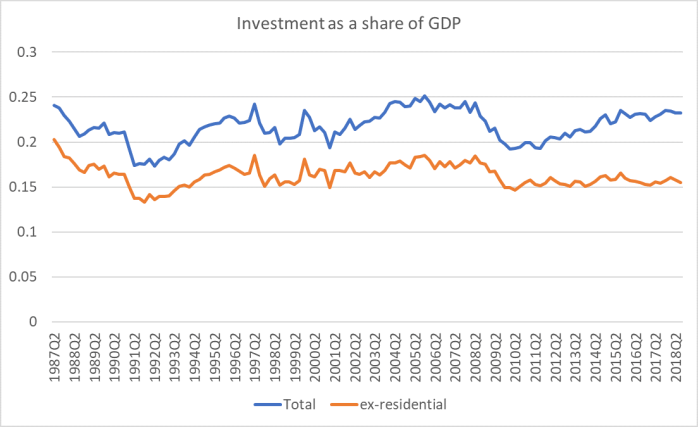
First, some flow data.  Here is investment as a share of GDP (using quarterly seasonally adjusted data).

investment 1

Lots of houses repaired (Canterbury) and built (nationwide) but once you set residential investment spending to one side. the remaining investment as a share of GDP has been very subdued indeed, not really much higher than during the recession at the end of last decade.

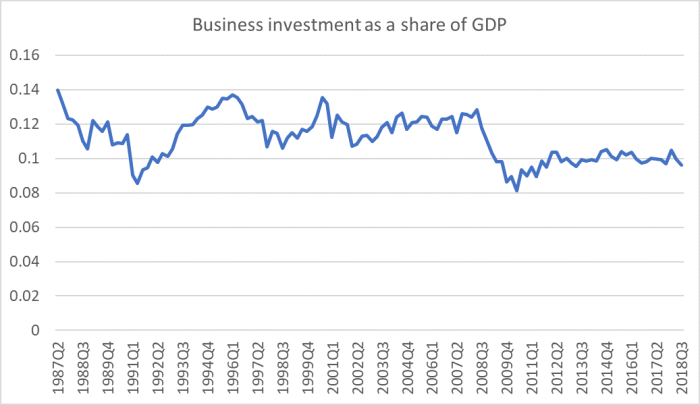
There isn’t an official published series of business investment, so I use the same proxy the OECD does: start from total investment and subtract residential investment and government investment spending.   There is a small overlap there (some government residential investment spending), but with that caveat noted here is the proxy for business investment as a share of GDP.

investment 2

The only times this business investment proxy was lower than at present was in the depths of the two serious recessions (1991 and 2000-10).   And yet over recent years, our population was growing consistently faster than at any time in recent decades.  Businesses tend to invest when there are prospective profitable opportunities –  especially when financing conditions aren’t unduly constraining.  Presumably, those opportunities just haven’t been there in New Zealand in recent years.

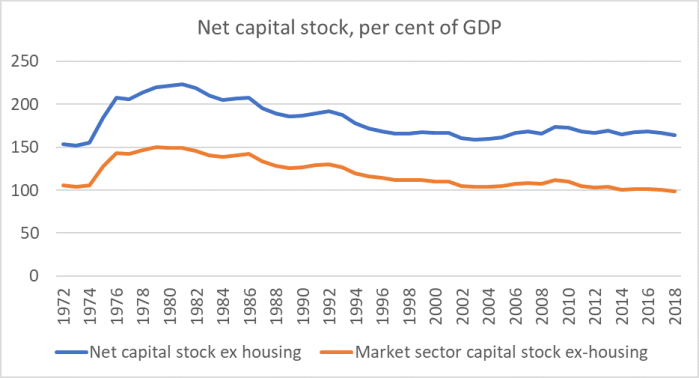
My commenter’s question was about capital stocks.  Statistics New Zealand publishes net (of depreciation) capital stock data.  The upside is that there is a good long time series, but the downside is that it is annual data so that the most recent observation is for the March 2018 year.

Here are a couple of stock series, expressed as percentages of nominal GDP.

investment 3 (I don’t know what accounts for the sharp lift back in mid-70s, but you can see the Think Big effect in the early 80s.)
Those were nominal (current price) series.   If we want to look at the capital stock relative to real variables (eg hours worked) we need to use the constant price data instead.  Here is the real capital stock, ex housing, per hour worked.

investment 5

I’m not quite sure what to make of the entire chart – I’m a little surprised there wasn’t more growth in the 1990s –  but for the more recent period it is certainly consistent with the (very weak) productivity picture.

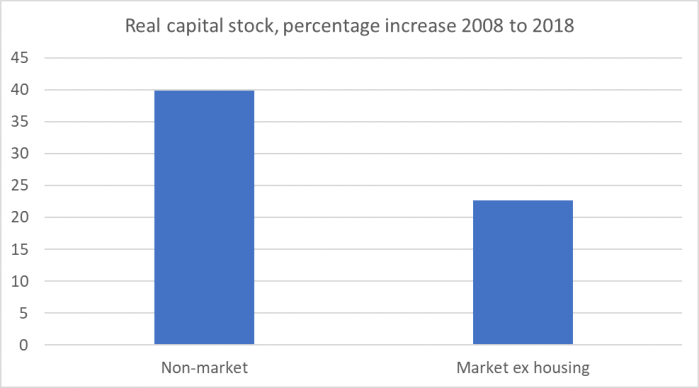
Perhaps as sobering is this simple chart, showing the percentage increase in the real capital stock from the year to March 2008 to the year to March 2018.

investment 7

Pretty significant growth in the non-market component (the bits not subject to market tests, either at the evaluation stage or in operation, and basicially set by government –  central or local) relative to the growth in the market sector non-housing capital stock.  Firms operating in more-or-less competitive markets just don’t seem to have seen the remunerative projects to invest in.   That isn’t in any fundamental sense the “cause” of our really weak productivity growth, but it will be a reflection of the same factors.

On my telling, the persistently high real exchange rate is, in turn, a significant proximate part of that story.

Unfit to govern

I’m probably the sort of person the National Party used to count on voting for them.   National was the only party I was ever a member of, the only party I ever canvassed for. There were family connections, and there were the founding principles, every one of which I identified with (and do still).   Even in Wellington, middle-aged conservatives might reasonably have been assumed to support National, even if (at times) through gritted teeth.  One of those founding principles talked, perhaps slightly quaintly, of “countering Communism”, and it seemed to be something taken fairly seriously throughout the post-war decades.  There was a suggestion of some values; a suggestion of things that mattered beyond just the next business deal.  Friends and allies, people and countries with whom we shared those values, seemed to count too.

But over the last couple of decades, New Zealand political figures, and the National Party ones in particular, seem to have binned any sense of decency, integrity, or values when it comes to Chinese Communist Party ruled China. I don’t suppose that individually most of them have much sympathy for PRC policies and practices, but they just show no sign of caring any longer.  Deals, donations, and indifference seem to be the order of the day.

Over the last couple of years the depths the party, its leaders and MPs, have been plumbing have become more visible.  In 2017, in government, they signed up to a Memorandum of Understanding with the PRC on the Belt and Road Initiative.  In that document they –  Simon Bridges as signatory –  committed to “promote” the “fusion of civilisations”.      Plenty of people will probably dismiss such statements as “meaningless”, the stuff of official communiques.  But decent people –  under no duress whatever –  don’t sign up to things suggesting that today’s equivalent of Nazi-ruled Germany is a normal and decent regime.  Of course, they would probably dispute the parallel, but that’s just willed deliberate blindness.

Later that same year we learned that the National Party had had a former PLA intelligence officer, Communist Party member, sitting in their parliamentary caucus.  It seems to be generally accepted that Jian Yang, of such a questionable background, is one of the party’s largest fundraisers.   Presumably the leaders (Key and Goodfellow) were aware of his past, but lets be generous and assume that most of the caucus was as unaware as the public.    But for the past 18 months, everyone has known.    They also know –  because Jian Yang acknowledged as much –  that he deliberately misrepresented his past to get into New Zealand, telling us that Beijing had told him (and others in his position) to do so.   Breathtakingly, there is no sign that official agencies in New Zealand have done anything about those admissions, but National is now out of office so I guess one can’t blame them for that.

But what the National Party –  leader, president, MPs, and all those holding office in the party –  is responsible for is the fact that Jian Yang still sits in Parliament, still sits in the National caucus, is still a National spokesman (on a couple of minor portfolios), with the express support of successive leaders, and (apparently) in ongoing business relationships with the party president (he who trots of to Beijing to praise the regime and its leader).   And not one MP, not one national councillor, no other officeholder –  not one –  has broken ranks, and been willing to openly question (or deplore) just what has gone on.  Doing so might, I suppose, jeopardise their individual futures.  But values are the things you are willing to risk for, to pay some price for.    Rumour hath it that some people within the party aren’t entirely comfortable, but so what, if you aren’t willing to do, or say, anything?

A few months ago we had the egregious former Minister of Trade, and foreign affairs spokesperson, Todd McClay plumbing new depths.    In an interview with Stuff, he championed the PRC regime interpretation of the mass internment of Uighurs in Xinjiang, noting that

“the existence and purpose of vocational training centres is a domestic matter for the Chinese Government.”

If he’d just kept quiet at least there might have been some doubt about his decency, but he opened his mouth and left no doubt.  He was spinning for the CCP regime in Beijing.

Since then even the regime in Beijing has more or less admitted that, of course, that line isn’t true.  But we’ve heard nothing more –  and certainly no apology –  from Mr McClay or his leaders.

And, of course, every so often the National Party leader Simon Bridges pops up if there is ever the slightest sign that anyone in the current government is expressing even the mildest reservations about the regime in Beijing.  Never mind that the Defence strategy document stated no more (considerably less) than was obvious to blind Freddy, it was too much for Mr Bridges.  Never mind that reservations about Huawei seem to be increasingly widely shared by governments and intelligence agencies across the western world, it might lead to furrowed brows and discontent in Beijing, and we couldn’t have that could we?   Never mind too that, in government and in practice it is hard to conceive that things would have been any different on that particular score under National –  I don’t suppose even National is quite so far gone in Beijing’s thrall that they would simply walk away from Australia, the United States, a growing number of other western countries, and what appears to be assessments of our own intelligence services.    No sense at all in anything Bridges –  or any other National Party figure – says that the PRC itself has changed: bad as the regime always was, it has now become worse.

But it was comments the other day from National’s third-ranked member and finance spokesperson, Amy Adams, that really left me open-mouthed in astonishment.  Both at what she said –  even if it wasn’t far from what had seemed to be the National stance in practice –  but also at the lack of any other coverage of, or follow-up to, those remarks.    In an interview with NBR, (behind a paywall but here) we are told

National’s finance spokeswoman Amy Adams has accused the government of putting the economy at risk by offending China.

“The first thing is you don’t p[…] off your major trading partner and, let’s be really clear about this, China is our single biggest trading partner.”

Quite extraordinary.

One could clear the small things out the way first. For example, governments don’t trade with China, firms in New Zealand trade with firms in the PRC.  Sure, governments set some of the terms on which that trade occurs, but government isn’t a business.

One might also note that if the PRC is the largest “trading partner” for New Zealand firms, it is very similar in size to Australia in terms of total New Zealand trade.  Until about five years ago, the EU in total accounted for more of New Zealand’s trade than the PRC.  Australia remains by far the largest source of foreign investment in New Zealand.     And these days exports to each of our largest “trading partners” –  in an economy (New Zealand) that doesn’t trade much with the rest of world by international standards – account for about 5 per cent of  GDP, in total.  For many decades, a much larger proportion of our GDP was accounted for by trade with the UK.

Oh, and a large proportion of New Zealand exports (not all of course) are commodities, and if not sold in one market they will be sold in some other part of the global market.   PRC babies seem unlikely to stop drinking infant formula.

But what really staggered me was the bald sense in which National’s finance spokesperson appears to think that the interests and priorities of foreign governments are what should matter most to our government. Not our values, not our people.  On her telling, we’d never annoy Australia about anything (apple import cases to the WTO, illegal migrants/asylum-seekers on Nauru, New Zealand citizens being deported from Australia).    We’d never have taken on France over nuclear-testing (at a time when the UK was entering the EU, and trade access to our largest market was substantially in danger).  We’d never have fought for Imperial Preference for our exports to the UK in the 1930s.  We’d never have banned nuclear ships (the US wasn’t our largest trading partner, but the US and EU together were hugely important markets, and we relied on the UK government (Thatcher) to fight our corner for EU market access).  The then Australia government wasn’t best-pleased with that New Zealand policy choice either.   And more generally –  and much more dominant – Canada would never ever stand for itself on anything that involved the United States, or Ireland vis-a-vis the UK.  I suspect Denmark and the Netherlands had had significant trade ties to Germany pre-1940, but they didn’t exactly put out the welcome mat to Hitler.  Southern African countries chose to limit trade with Rhodesia, and confront South Africa, because they considered they had a just cause.  And so on.    (Note that I’m not endorsing all these causes, just noting the willingness of governments to upset their closest “trading partner”.)

Of course, this almost certainly isn’t what Ms Adams believes at all.   Presumably as a senior minister she had no problem at all with the fact that at times we had, and have, open differences with Australia.  In any relationship, no matter how important, there are going to be differences from time to time, and in international relations governments (at least democratic ones) aren’t supposed to act for themselves, or even for small favoured groups, but for the citizenry as a whole.

Instead, the Adams approach –  presumably endorsed by her leader –  is about a particular thuggish regime. It seems to be that we should defer entirely to Beijing’s prickly style and never ever do or say anything that might upset them, never display any self-respect, and simply engage in either anticipatory compliance or abject penitent submission.  Worse, apparently we should even make excuses for them –  or retail their propaganda lines, as per Todd McClay.  It is classic domestic abuse situation, and yet championed by someone who aspires to be a senior minister of a free country, perhaps even aspires to be the Prime Minister.   In fact, someone who was the Minister of Justice, who led legislative attempts to respond to the family violence problems.  I’m quite sure it wasn’t her advice to victims –  “oh, don’t upset him…ever”.    So why does she propose that our foreign policy towards the international abuser par excellence be essentially just that?  Act that way and all you do is encourage the abuser, and lock yourself further into the cycle of abuse, humiliation and loss of any sort of self-respect.

Of course, the difference here is that Adams ask us (citizens) to bear the abuse and humiliation –  leaders who remain silent in the face of evil, leaders who won’t stand up for the integrity of the system, and even spend our money to run PR-front organisations to champion the pro-Beijing perspective –  all to benefit a few specific businesses that have (consciously and knowingly) over-exposed themselves to a thuggish regime, and the substantial flow of donations to their own political parties.    Politicians like Adams simply encourage the over-exposure, and encourage the false subservience of victimhood.   If our businesses were dealing with organised crime, or with shonky people who didn’t pay their bills, we’d either insist or encourage them to cut their exposures.  If you deal with the Mafia you are on your own –  in fact, society will shun you, not tolerate you asking for us to pander to the leaders.  But when it is the PRC –  organised coercive threat if ever there was such –  our leaders simply want us to defer, and complain when their opponents show any sign of not being quite deferential enough to the bully.  And they simply let evil pass by, and in so doing make themselves complicit with –  and thus partly responsible themselves –  for the evil.

In his Beijing-deferential interview on the Herald website the other day, David Mahon tried to frame the current PRC upset with New Zealand as “the Chinese see it as akin to infidelity”.    What a sickening image, but perhaps one that brings us right around to the abused-spouse parallel.  New Zealanders made no vows to Beijing – although perhaps our craven political leaders did –  but when the merest squeaks are heard, the abuser – freshly drunk on newfound power – seems to feel free to attempt to squash and silence, while politicians, lobby groups and business interests cheer on not the abused “spouse” but the abuser.   New Zealand “leaders ” have been among the most sycophantic and compliant anywhere in the western world, so perhaps there is a sense that they can’t afford to let us get away with some renewed self-respect.  That, after all, might encourage others to think and act for themselves, for the values of their peoples.   Better to foster the illusion –  assisted by local politicians and academics –  that the PRC holds our prosperity in its hand.

It simply doesn’t. It never did.

But that’s New Zealand politics, that seems to be today’s National Party. It is sickening.


“This country has prospered over the past decade, while other economies have suffered”

Or not.

The title to this post was taken from the latest column from veteran political journalist Barry Soper.  Apparently he had had some readers get in touch, not entirely convinced by his PRC-related articles earlier in the week.

They all ignore the fact that this country has prospered over the past decade, while other economies have suffered.

The Key Government’s management of the global financial crisis has been lauded but without the free trade agreement, signed in the Chinese capital as the final act of the Clark Government, this country wouldn’t be where it is today.

The puerile keyboard warriors’ bile is too vile to repeat but it seems to be based on envy, that the Chinese, after generations of deprivation, have shown the world they can compete and are a force to be reckoned with.

I’m not sure quite what he bases these assertions on (although it is the sort of line that less well-grounded champions of Beijing, including former Foreign Minister, Murray McCully, have repeatedly tried to run).  “Be grateful, peasants” seems to be the tone, for the CCP in Beijing has graciously bestowed its bounty upon you.

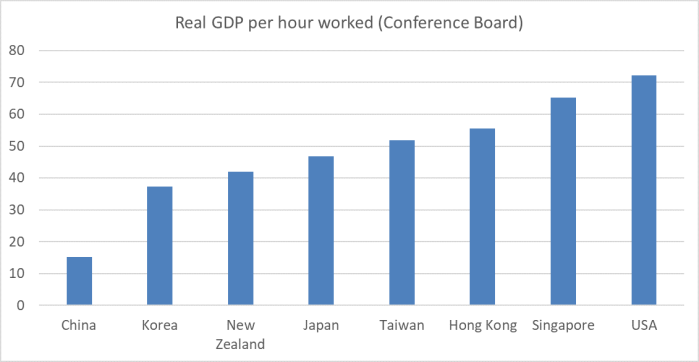
I don’t want to waste much time on the alleged PRC success story.    When you do so much damage to yourself, and then stop the self-destruction, of course you’ve got plenty of ground to make-up, and with half-decent policies you can do some of that quite quickly.   Here are the latest Conference Board productivity estimates.

China GDP phw feb 19

The PRC……not even half the levels of Korea or (decades of underperformance) New Zealand, not a third of Taiwan or a quarter of Singapore.     Who could possibly envy that sort of performance?  There was no obvious reason why China could not have matched the performance of Korea, Japan, or Taiwan.  Except that they chose to adopt, and continue to run, a system that consistently produces poor economic results.

But what I was really interested in was the assertion that New Zealand has had a really good economic performance over the last decade “while other economies have suffered”.  I guess if Greece, or even Italy, is your benchmark it isn’t too far wrong.  But then almost everyone does better than those troubled euro-crippled economies.

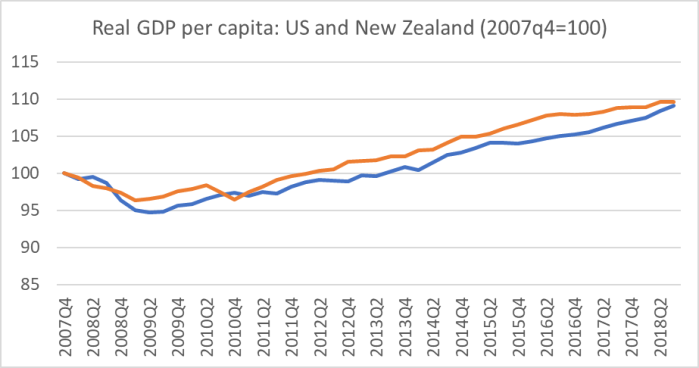
One comparison I like, and which I’ve run before, is between New Zealand and the United States.   Were there anything to the “we owe such a debt to Beijing, and have done so well ourselves” story, an obvious place to look might be a comparison with the United States.  After all, the US was the epicentre of the financial crisis itself, their central bank got to the limits of what it could do, and no one thinks Beijing someone “saved” the US.   And yet here is how real GDP per capita compares across the two countries since late 2007, when the last recession began.

US and NZ comparison GDP

We’ve mostly done very slightly better than the US over the decade or so, but there really isn’t much in it.   Certainly not a case of the US suffering and us “prospering”, whether thanks to Beijing or any other cause.

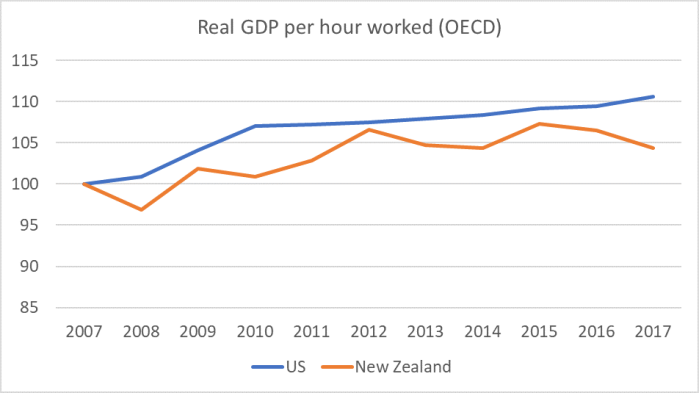
And to the extent we’ve done a touch better, it certainly isn’t reflecting stronger productivity growth.  The data are indexed to 100 in 2007.

US nz productivity

It isn’t just an us versus the US comparison either.  Over that decade, real GDP per hour worked rose by 4.4 per cent, but in the median OECD country productivity growth was 8.9 per cent.

And if Beijing and the (so-called) free trade agreement were the source of any special New Zealand prosperity, exports might be an obvious place to look.  Except that over the previous decade New Zealand exports actually fell a little as a share of GDP.  In the United States, and in all but a handful of other OECD countries, exports became a larger share of the economy.

Even on more purely cyclical measures, New Zealand still doesn’t stand out (at least on the good side).  The unemployment, for example, has come down a long way, but it is still quite a bit above the lows reached before the recession (at a time when demographics will be tending to lower the “natural” rate of unemployment).    In the United States, by contrast, the unemployment rate is below pre-recession levels. That is also true across the G7 as a whole, the EU as a whole, and the OECD as a whole (individual bad euro-area countries notwithstanding).

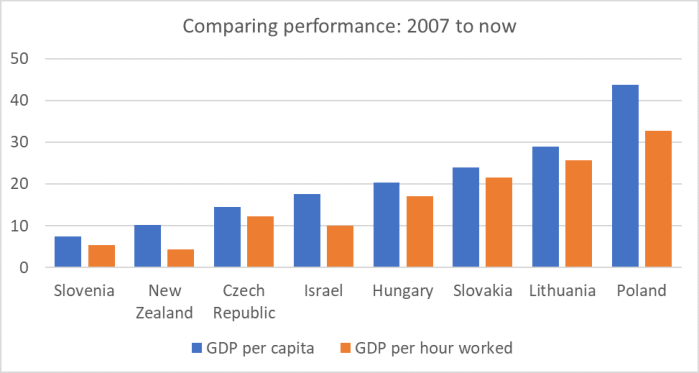
And if you don’t like the idea of comparing against the US –  even though it was the centre of crisis, and doesn’t owe anything in particular to Beijing –  here is how we’ve done against another group of countries, each now with productivity levels similar to those in New Zealand (and few doing much trade with the PRC).   Since all these countries started (in 2007) with productivity well behind global frontiers, all should have been able to do okay even if productivity growth at the frontier (eg US and northwest Europe) slowed.

small countries

Many did pretty well.  As for us – Beijing (alleged) beneficence notwithstanding –  either worst or second worst depending on your preferred measure.

As I noted earlier on, there are countries that have done a great deal worse than us.   But the suggestion that we have “prospered” over the last decade –  in some way materially outstripping the rest of the advanced world –  isn’t just a myth. It is worse than that.   And the people who run the story, whether as senior journalists or senior politicians should know better.

Countries mostly make their own prosperity.  We once did –  those decades when we really did lead the world.    We could again, although that might involve facing facts.  But these days politicians and their acolytes in the media seem more interested in playing distraction; in this case continuing to corrupt our system, supported by motivated fantasy stories about our (alleged) success and our (alleged) debt to Beijing.


MPC remit and charter

The Minister of Finance and the Governor of the Reserve Bank today released the Remit and Charter for the new statutory Monetary Policy Committee, that takes effect from 1 April.  The Remit largely replaces the Policy Targets Agreement structure in place since 1990, and future remits will be set directly by the Minister of Finance, after advice from the Reserve Bank (among others) and associated public consultation.  The Charter is mostly new, governing how the MPC is supposed to operate in some key, outward-facing, dimensions. It complements various detailed statutory provisions.   Even though both documents are this time agreed between the Governor and the Minister, it is clear that the Minister has taken the lead: the press release is issued by the Minister alone, and although it is now reproduced on the Bank’s website, contains various bits of political spin.

The contents of the new Remit are in many respects pretty similar in substance to the current PTA, but there are a couple of changes worth noting.

One looks like an error.  In the Context section the Remit states that

“(the Act) requires that monetary policy promote the prosperity and wellbeing of New Zealanders”

That line took me by surprise so I went back and checked the new legislation.    The relevant provision actually states

The purpose of this Act is to promote the prosperity and well-being of New Zealanders,

Those are two different things.  The Remit –  which the Governor has voluntarily signed on to – can reasonably be read as suggesting that monetary policy should be conducted with “wellbeing” in mind.  The Act sets out statutory objectives for monetary policy (the things the MPC is supposed to pursue and take into account), simply stating that Parliament has put the legislation in place believing that the monetary policy goals (and other powers the Bank has, including regulation and supervision) will conduce to the wellbeing of New Zealanders.  The Remit shouldn’t have been worded that way.

My second observation about the Remit is more positive (and would be more positive still if the document hadn’t been released in a format in which one can’t copy and paste extracts).    It is stated that “monetary policy contributes to public welfare by reducing cyclical variations in employment and economic activity whilst maintaining price stability over the medium-term”.  I like that formulation, which is much closer to what I recommended should be the statutory goal for monetary policy.  Price stability is the constraint, economic stabilisation is the primary purpose.   Whether or not the wording is quite consistent with the actual new legislative goal is something for the MPC, and those paid to hold them to account, to work out.

What of the Charter?

My overarching unease about the MPC is that it will be dominated the Governor.  That is partly through the channel of the inbuilt management majority (and the Governor hires the other managers), and partly because of the heavy say the Governor will have in who gets appointed to the (minority) external positions.

But it is reinforced by the relentless, and explicit, drive for “consensus”.   This is from the Charter

consensus

“Consensus” isn’t a recipe for getting the best answers, but for lowest common denominator answers that everyone can live with.  It isn’t really a recipe for a robust examination of competing arguments and analyses either –  at least unless one has exceptional people (which is always unlikely, almost by definition) –  and especially when management has (a) an inbuilt majority, and (b) control of all the research and analysis resources (and of the pen in drafting MPSs etc).   The risk remain that outsiders, knowing they are inevitably outnumbered, and having ‘consensus’ waved in their faces will simply go along, free-riding.

The formal transparency model chosen is likely, at the margin, to reinforce this risk.  We are told that the record of the meeting will be published at the same time as the OCR announcement (2pm on Wednesday, following an MPC meeting that morning).  Even allowing for various preliminay meetings, the “record” of the meeting will inevitably be heavily pre-drafted by staff who work to the Governor, and the ability of outside MPC members to get any alternative perspectives included is going to be an uphill struggle.  Most central bank MPCs release minutes with something of a lag.   All that said, time will tell how it works out.

One interesting provision in the Charter was this

charter 1

charter 2

It was interesting for two reasons.  First, this provision appears to accept that significant operational decisions around monetary policy are the responsibility of the MPC.  That was not (is not, in my view) clear from the legislation.   If so, it is welcome, especially if it involves an expectation by the Minister that, for example, any future quantitative easing and similar decisions would also be a matter for MPC.  We’ll have to see.

Presumably this provision is supposed to cover the longstanding arrangements for possible foreign exchange intervention.  When I was at the Bank, the OCR Advisory Group (internal forerunner to the MPC) was the forum in which the Governor made in principle decisions on intervention, and specific timing choices etc were then dealt directly between the Governor and the Financial Markets Department.

If so, the specific provisions go much too far.   Perhaps there is a case at times for not announcing foreign exchange intervention immediately in some circumstances.  But there are no grounds for leaving the MPC to decide for itself when, if ever, specific information on intervention will be released (the implied movements in the Bank’s fx position come out more than a month later, and even then without comment of explanation).    At present, there probably is not much practical importance attaching to this point, but the system should be started as we mean to go on.  Much better to have insisted that all market intervention (size and nature, although not counterparties) should be disclosed within 10 days of such intervention.  Apart from anything else, these are big financial risks the taxpayer is (given no choice in) assuming.

My final observation on the charter offers kudos to the Minister.  There has been a great deal of talk about the need to seek consensus (which is still in the charter) and the claim had been made that this meant all MPC members should speak, if at all, with a single voice.  Bank management championed this (self-interestedly no doubt), despite the successful examples of countries like the UK, the US, and Sweden, and a year ago it seemed that they had persuaded the Minister of their view.  It was one reason why good people would probably have been deterred from applying for the external positions –  facing a built-in internal majority, and with no ability to articulate in public alternative perspectives, it wasn’t obvious that the positions offered more than sightseeing (looking at the innards of how the Bank works).  I’ve banged on about the issue for months, and I know others have also raised concerns.

And so imagine the pleasant surprise I got when I  got towards the end of the charter.

charter 3

I don’t have any particular problems with (a) or (b), although I can imagine some future disputes about what does and doesn’t contribute to the “overall effectiveness” of the monetary policy decision etc, since things that might muddy the water a bit in the short-term could easily strengthen the institution, and its accountability, in the medium term.  I also had no problem with (d) which is pretty much how Reserve Bank staff have operated for many years.

What caught my eye was (c), under which it appears that members of the MPC –  internal and external –  will be free to comment in public, expressing their own views on the economic situation, risks, and monetary policy.   On monetary policy itself, they are required to draw on official communications “as appropriate” –  and I’m sure they will, as appropriate.  But it doesn’t bind MPC members to agree with committee decision, or to endorse all the arguments the Governor himself might offer in support of the decision.  On the economy etc, they can say what they like (in substance) provided they do so politely  (as people typically do in transparent foreign central banks) and let their colleagues know in advance what they’ll be saying.  It is a material step forward relative to what we’ve been promised (although time will tell whether anyone, internal or external (and thus vetted for tameness by the Governor) ever utilises these provisions).

What is also interesting is some of the detail.  There is now an explicit written requirement that any off-the-record private remarks about monetary policy or the economic outlook have to be consistent with official MPC communications.  Presumably this also applies to the Governor (there is no suggestion it doesn’t) so if there are off-the-record expletive-laden rants at private commercial functions in future, at least they won’t be offering any insights on the economy and monetary policy.  Perhaps that Rotary Club advertising the Governor as offering candid perspectives on the New Zealand economy –  if you pay – will have to revise its plans?  More probably, the Governor probably won’t regard himself as bound by the rules.

And then there was the final sentence.  Any on-the-record remarks (occasions at which they will be made) will have to (a) notified to the public in advance, and (b) with full text on the Bank’s website in real-time.   In principle, this looks fine and sensible (although it is far from what has been practised by management up til now).  In practice, it will prevent MPC members giving interviews, and appears designed to ensure that the only communications are speeeches with written texts to which MPC members adhere closely.  But, again, there is no suggestion that these rules don’t apply to the Governor –  and his views are inevitably most market-moving.   So can we look forward to an end to off-the-record speeches from the Governor on matters of substance, and to wild departures from the prepared and published text.   After all, as the document says, MPC members shouldn’t provide, or look as though they are providing, new information to private subsets of people.     (Personally, I suspect the document goes a little too far.  It would probably be unfortunate if, say, the Governor cannot (as the document appears to suggest) give an interview to, say, Morning Report or one of the main current affairs programmes, so long as there is adequate public notification as to when and where he will be speaking.)

As I’ve said on various previous occasions, I’m pretty ambivalent about the monetary policy legislative amendments, and particularly about the MPC, which looks set to be a Governor-dominated creature, not too different in effect from what we’ve had for the last 29 years.  But credit where it is due.  There are some welcome aspects in the details of today’s announcement and I, quite honestly, hope the new system works better than I expect it to.    Who knows, the less closed nature of the rule may even help attract a better class of candidate to consider the MPC position.

For now, of course, we are still left guessing who four of the seven MPC members will be.

See, not so hard after all

Back in November 2017, just after the government took office, the Reserve Bank in its Monetary Policy Statement identified various assumptions they had made about the impact of various of the new government’s policies.  Some of these assumptions made quite a difference to the outlook, but no analysis or reasoning was presented to give us any confidence in the assumptions they were (reasonably or unreasonably) making. One of those new policies was KiwiBuild.

Seeing as the Bank is a powerful public agency, it seemed only reasonable to request copies of any analysis undertaken as part of arriving at the assumptions policymakers were using.   The Bank refused and many many months later the Ombudsman backed them up (if ever there was a case for an overhaul of the Official Information Act, this was a good example).  The Ombudsman did point out that he had to rule as at the date the request had been made.  So, a year having passed, I again requested this material.  The Bank again refused (and I haven’t yet gotten round to appealing to the Ombudsman).     Quarter after quarter the Monetary Policy Statements talk about KiwiBuild, but we’ve never seen any supporting analysis.   A state secret apparently.

Until yesterday that is.  In the latest Monetary Policy Statement there was the usual discussion of KiwiBuild –  potentially a big influence on one of the most highly-cylical parts of the whole economy –  but there was also a footnote pointing readers to an obscure corner of the Bank’s website, and a special background note on KiwiBuild, and the assumptions the Bank is making.  All released simultaneous with the statement itself.   See, it just wasn’t that hard.  And has the sky fallen?

(As it happens I remain rather sceptical of the assumption that KiwiBuild is going to be a significant net addition to total residential investment over the next decade.  Why would it, when the main issues in the housing market are land prices and, to a lesser extent, construction costs, and it isn’t obvious how KiwiBuild deals with either of them?  If it proves to be a net addition, it will probably be because it is a subsidy scheme for the favoured –  lucky – few.)

As for the overall tone of the monetary policy conclusions to the statement, count me sceptical.  At one level it is almost always true that the next OCR move could be up or down –  and in that sense most forecasting (especially that a couple of years ahead) is futile: useless and pointless.   But for the Governor to suggest that the risks now are really even balanced, even at some relatively near-term horizon, seems to suggest he is  falling into the same trap that beguiled the Bank for much of the last decade; the belief that somewhere, just around the corner, inflation pressures are finally going to build sufficiently that they will need to raise the OCR.   We’ve come through a cyclical recovery, the reconstruction after a series of highly-destructive earthquakes, strong terms of trade, and a huge unexpected population surge, and none of it has been enough to really support higher interest rates. The OCR now is lower than it was at the end of the last recession, and still core inflation struggles to get anywhere 2 per cent.    There is no lift in imported inflation, no significant new surges in domestic demand in view, and as the Bank notes business investment is pretty subdued.  Instead actual GDP growth has been easing, population growth is easing, employment growth is easing, confidence is pretty subdued, the heat in the housing market (for now at least) is easing.  Oh, and several of the major components of the world economy –  China and the euro-area  –  are weakening, and the Australian economy (important to New Zealand through a host of channels) also appears to be easing, centred in one of the most cyclically-variable parts of the economy, construction.   It was surprising to see no richness or depth to any of the international discussion –  and to see the Bank buying into the highly dubious line that any slowing in China is mostly about the “trade war”.   Few other observers seem to see it that way.

From a starting point with inflation still below target midpoint after all these years, it would seem much more reasonable to suppose that if there is an OCR adjustment in the next year or so, it is (much) more likely to be a cut than an increase.      Time will tell, including about how long the 1.5 per cent lift in the exchange rate will last.

Commendably, the Bank is now talking openly about many other economies have limited capacity to respond to a future serious downturn.  That is welcome acknowledgement, but it would count for more if the Bank were taking seriously the real (if slightly less binding) constraints New Zealand will also face in the next future serious downturn.

A couple of other things in the document caught my eye.  One was this chart

NAIRU 2019

The Bank seems to be trying to tell us that it really has no idea whether the unemployment was above or below the NAIRU at any time in the last 17 years.  I don’t suppose in practice they operate that way, but when they present a chart like this it is a bit hard to take seriously the other bits of their economic analysis.

The other specific was some rather upbeat comments on productivity performance in recent years, which has led the Bank to the view that they now to expect no acceleration in productivity growth in the years ahead.  The Governor always seems to err on the (politically convenient) upbeat side.  I’m not sure quite how the Bank derives their productivity measure –  I’m guessing as some sort of per person employed measure –  but as a reminder to readers here is the chart of real GDP per hour worked, the standard measure of labour productivity.  To deal, to some extent, with the noise in the individual series, I use both measures of quarterly GDP and both (HLFS and QES) measures of hours.

real GDP phw dec 18

There has been no labour productivity growth for the last three or four years, and little for the last six or seven.  I wouldn’t be surprised if the Bank is right to expect no acceleration (on current policies), but if we keep on with near-zero labour productivity growth it is a rather bleak prospect for New Zealanders.

A great deal of the press conference was taken up with questions –  generally not very sympathetic –  about the Governor’s proposals to increase substantially capital requirements for banks.   In the course of the press conference he and Geoff Bascand made some reasonable points –  including about the merits of putting the big 4 banks and the smaller banks on a more equal footing in calculating requirements – and at least fronted up on the other questions.  It is just a shame this was being done reactively now, rather than pro-actively when the proposals were first released in December.

I remain rather sceptical of the Bank’s case –  in which everything is a win-win, in which the economy is safer, more prosperous, and even with lower interest rates.  If you doubt that I’m characterising their bold claims correctly, this is the stylised diagram that leads the consultative document.

something for allIt is a free lunch they are claiming to offer.  I suspect few will be convinced.

In the course of the press conference, the Governor asserted that the Bank’s proposals will, if implemented, mean that future capital ratio requirements would be “well within the range of norms” seen in other countries.  I found that a surprising claim, and there is nothing –  not a word – in the consultative document to back it up.  If true, it would be material in thinking about the appropriateness of the Bank’s proposals.  But where is the evidence (granting that this is something that can’t be answered in a ten second Google search)?  I’ve lodged an Official Information Act request for the analysis the Governor is using to support his claim.  It would, surely, be in his interests to have such analysis out there.

Also at the press conference, there was the hardy perennial claim that inflation expectations are “well-anchored” at 2 per cent, and everyone believes that monetary policy is just fine.  As my hardy perennial response, here are inflation breakevens from the government bond (indexed and conventional) market.  The last observation is today’s data.

IIB breakevens feb 19

People with money at stake don’t seem to believe you Governor.  Last time things got this low a series of OCR cuts only helped, at least partially, rectify the position.

And, finally, who does the Bank suppose gets any value at all from the cartoon version of the statement?  For example

cartoon

Is the Monetary Policy Statement now a set text in intermediate school?  If the kids are especially naughty do they have to read it twice?   Even your average MP, sitting on the Finance and Expenditure Committee and supposedly holding the Bank to account, has to be able to cope with a little more than that.  I’m not expecting much of the new statutory MPC, but perhaps they could prevail on the Governor to drop the cartoons and simply write in reasonably accessible English?

Later this morning we get the Remit (PTA replacement) and Charter for the new Monetary Policy Committee.  I’m sure I’ll have some thoughts about them tomorrow.

Two charts and a speech

A post of two unrelated graphs this morning.

Just before Christmas I wrote a post prompted by an FT story about new OECD work that attempted to standardise estimates of hours worked to improve cross-country comparative productivity (GDP per hour worked) estimates.   Before writing the post, I’d confirmed with Statistics New Zealand that they had been consulted and that there were no material implications re New Zealand data.    Reading numbers, rather roughly, off a chart I’d attempted to illustrate the implied new OECD rankings.

But the OECD has now included the new hours worked estimated in their own official published data, and (thanks to a tweet from the chair of the Productivity Commission) I noticed this chart yesterday.

OECD labour productivity 2017

As I noted in the earlier post, this revision lifts several countries (Austria, Switzerland, and Sweden) into the upper bracket of OECD countries.  It also improves the position of the UK (in yesterday’s post I noted that they were now about 30 per cent of us, but on these revised and improved data the lead is just over 40 per cent).

But it is our position relative to the emerging OECD economies that really interests me.    Not only are Slovakia and Slovenia ahead of us –  they’ve been there or thereabouts on the old measures since about 2014 –  but now so are Lithuania and Turkey.  Go back 20 years and both  – on the old measures, but presumably on the new ones too –  were miles behind us.  Based on their productivity growth performance this decade, the Czech Republic and –  a few years later –  Poland will be beating us before long.

In a way “beating us” isn’t the right word.    It isn’t a competition in the sense that their gains mean we are worse off.  We should celebrate their economic gains.

But it is the right word if we use the experience of other countries to benchmark our own performance.    In modern New Zealand history, not one of those countries in the previous paragraph has ever been richer or productive than New Zealand.  Until now.  30 years ago all but Turkey were just beginning to throw off decades of Communist rule –  with all the misallocations of resources and skewed incentives and degraded institutions that went with that dreadful system.    Lithuania wasn’t just part of the Soviet sphere of influence, it was –  by conquest –  part of the Soviet Union itself.

And 30 years ago we were a stable democratic country, with the rule of law, long-established market institutions (even if they’d been a bit attenuated in the protectionist decades) just about –  although we didn’t know it then – to enjoy decades of a significant trend improvement in our terms of trade.     And yet these are the outcomes we’ve managed, that our policy frameworks applied to available resources have produced.

And for those who’ve liked to believe that large-scale non-citizen immigration, and a larger population, were a material part of what might improve New Zealand’s productivity prospects, here is the percentage change in the population of the former eastern-bloc OECD countries and (at the other end of the spectrum) of the high immigration OECD countries.

Population growth (%) 1990 to 2017
Latvia -27
Lithuania -23.4
Estonia -18
Hungary -5.5
Poland 1
Czech Republic 2.5
Slovakia 2.6
Slovenia 3.5
Canada 32.7
New Zealand 39.3
Australia 44.3
Israel 86.1

I wouldn’t recommend the experience of the Baltics (low birth rates and high emigration).  I don’t envy them a geographic position right now to Russia either.    But the absence of much immigration, and little or no population growth doesn’t seem to have held any of those former eastern-bloc countries back from a pretty impressive resurgence.  They all have a long way to go to match the best-of-class among the OECD countries, but so does New Zealand…..and we’ve been making no progress at all towards that sort of goal.

The Reserve Bank’s Monetary Policy Statement is due out this afternoon.  Yesterday the Bank released its latest Survey of Expectations.  There wasn’t a great deal of interest in the data, but this was the series that caught my eye.

mon cond year ahead 19

The Bank has been running this question for almost 20 years now, asking respondents (on a seven point scale) their expectation of “monetary conditions” a year from now.  They also ask about perceptions of current conditions.  Perceptions of current conditions are quite loose in the latest survey, but what is striking is that almost always when respondents think current conditions are loose they expect a substantial tightening in the next year or so.   That was what the data showed in 1999, 2001, 2003, 2010, and 2013.  It wasn’t what showed up in 2015/16: then relatively easy conditions (probably then mainly a proxy for relatively low interest rates) were expected to be followed by even easier conditions.   A succession of OCR cuts followed.  As of the latest survey, a net 69 per cent of respondents think conditions are easier than neutral (not quite a record), but by the end of the year a record (see chart) 73 per cent of respondents expect things to be easier than neutral.

This result doesn’t yet show up in the OCR expectations themselves –  which are edging downwards but a year out the mean expectation is still above 1.75 per cent (the median is bang on) –  but the expected easing in “monetary conditions” looks a bit more consistent with market pricing, in suggesting the OCR cuts are becoming more likely.

(At the margin, the OCR expectations in the survey would have been a touch lower if I had actually submitted mine.  I filled in the form, printed out a copy for my records, and then must have failed to push the button to submit it.    The lowest official OCR expectation for December 2019 is 1.5 per cent, but the table in front of me says I wrote down 1.25 per cent.  We’ll see.)

And a final suggestion for journalists at the Reserve Bank’s press conference this afternoon.  The other day a reader sent me an invitation they’d received for a function you could pay to attend at which the Governor was going to be speaking next month.

This year it is Dr Adrian Orr, the Governor of the Reserve Bank who will also speak about the bank’s views of the economy in an candid off the record way.

Perhaps the organisers mis-spoke, but I’d have expected the Bank to review carefully how the Governor’s involvement in any such event was described.    When market-sensitive matters are involved –  and Governor’s/Bank’s view on the economy clearly qualifies –  it is highly inappropriate for any Bank officials (even the Governor) to be speaking “candidly” in an off-the-record environment.  Anything other than the most anodyne comment should be done in the Monetary Policy Statement (or associated press conference or testimony to Parliament) or in on-the-record speeches, to which everyone has access at the same time and the same way.   It is even worse when access to the Governor, for potentially market-sensitive material, is sold-off, even if there is a decent charity cause behind it.

I’ve written about this sort of thing previously

I notice that NBR’s Shoeshine column this week also touched on that earlier INFINZ event, describing it as an “expletive-laden speech” on all manner of topics, and observing “unfortunately, this speech was never put on the web (very strange for a Reserve Bank governor’s speech)”.    Not so strange if it were genuinely just rehearsing old ground, but the various accounts suggest it wasn’t.

Asking the Governor about the approach he thinks appropriate to his speeches  – about his commitment to openness and transparency – would aid the cause of accountability.