Last week, in association with the Monetary Policy Statement, the Reserve Bank published a short separate paper outlining how it was treating KiwiBuild for forecasting and monetary policy purposes. The bottom line was
The Bank has assumed that half to three quarters of what KiwiBuild contributes to residential investment will be offset by crowding out of other private investment over the forecast horizon.
It isn’t that different an assumption than they have been making since the current government first took office. This was what they wrote in the November 2017 Monetary Policy Statement
The Government has announced an intention to build 100,000 houses in the next decade…..our working assumption is that around half of the proposed increase will be offset by a reduction in private sector activity.
But, of course, then they refused to show us their workings or give us any supporting analysis.
I made brief reference to the new paper in my post last week on the MPS. My main point then was to commend the Bank for publishing the separate paper, but in passing I noted.
(As it happens I remain rather sceptical of the assumption that KiwiBuild is going to be a significant net addition to total residential investment over the next decade. Why would it, when the main issues in the housing market are land prices and, to a lesser extent, construction costs, and it isn’t obvious how KiwiBuild deals with either of them? If it proves to be a net addition, it will probably be because it is a subsidy scheme for the favoured – lucky – few.)
Today I went to spend a bit of time elaborating on that argument, and unpicking some of economic arguments in the Bank’s paper.
(Note that although the Bank’s paper has been reported as making difficulties for the government – and perhaps it has – in fact some of it is written as if it were a publication from the government. It (repeatedly) talks of KiwiBuild houses as affordable, with no quote marks around that description/claim let alone any analysis of what affordability might really mean. And there is the heartwarming talk of how it designed to “increase home ownership among New Zealanders”.)
The most puzzling aspect of the paper is that the Bank focuses wholly (but only partially) on one possible channel for crowding out and totally ignores another.
Their focus is on capacity constraints in the construction sector. The claim is that there just isn’t enough labour, and that if the Crown insists on building 10000 additional houses each year it just won’t be possible, as there won’t be the workers. That doesn’t seem a particularly compelling argument to me, at least over a multi-year horizon.
Over the past year, the national accounts records constructions (residential, non-residential, and other) of almost $40 billion in New Zealand. Add on top of that (this is all hypothetical) say $2-2.5 billion of KiwiBuild spending a year (the government provision was $2 billion, and the Bank is assuming – after crowding out two-thirds – a net total addition of $2.5 billion over three years) and it would represent an increase from the current level of not much more than 5 per cent. And, sure, the construction workforce in New Zealand is quite large at present (240000 employed, in the HLFS) – thus, the Bank argues it can’t really increase further – but it looks to have been about the same size in Ireland at the peak of their construction boom, when their population was 10-15 per cent less than ours is now. People change jobs, people postpone retirement, people put off going to Australia (as examples) if the price is right, if the good opportunities are there. And, although the Bank’s analysis doesn’t mention it, Australian residential construction activity is now tailing off quite sharply so – again, if the price is right – you might expect some Australian builders, or expat New Zealanders, to try their luck back here.
I mentioned price a couple of times in that paragraph. The Reserve Bank’s document doesn’t do so at all (aside from a couple of references to price caps on KiwiBuild houses). Prices are signals and rationing devices. You’d have thought the Bank’s economists would think to mention them. In fact, prices (changes therein) are typically how crowding out works (eg in a fully-employed economy an increase in government spending will tend to boost demand, but will drive up interest rates and the exchange rate – prices – crowding out other activity and leaving the overall level of economic activity little changed. But the fact that the multiplier might be zero doesn’t mean a central bank could just ignore a government that talked of a big increase in spending in a fully-employed economy. Part of the crowding-out process arises from the monetary policy response (otherwise, it would happen through inflation).
And so the oddity of the Bank’s crowding-out analysis is that it seems to (a) focus on resource availability, and yet (b) simply assumes that the crowding out occurs without any associated price signals or inflation pressures. Markets tend not to work that way.
At least in the abstract you would have thought the Bank would have wanted to treat the entire KiwiBuild programme as an exogenous boost to demand (whether or not they think it will actually happen their standard operating procedure is – prudently so – to assume that government policy is as stated), and then trace through the mechanisms whereby any crowding out occurs. In this case, for example, one might perhaps expect to see higher wages, higher construction costs (a direct component in the CPI), and perhaps even a higher OCR (than otherwise) as part of the freeing-up/crowding-out process. The bottom line still might have been the equivalent of half to three quarters of other investment crowded out. But how you get there matters. If it is a resource constraint story, you can’t simply assume resource constraints have no price consequences. But, as they’ve told the story, the Reserve Bank seems to have.
Of course, “capacity constraints” is a politically convenient story. It links to government rhetoric on skills, for example, and even (fallaciously) to the government’s enthusiasm for immigration. And it channels an implicit story – never backed with evidence – that there is some unexploited wedge out there in which, given current laws and regulation, construction material costs, and bureaucratic practices, new houses (including land) can be built more cheaply than current house (including land) prices. It is only “capacity” – or just possibly finance – that holds us back. I doubt any serious analyst really believes such a story. There is also an implied story about homelessness – as if there would be 300000 not housed at all (or grossly inadequately housed) if the government didn’t initiate 100000 new dwellings, “affordable” or otherwise. Again, that just isn’t plausible.
So, although I do want to run a “crowding out” story, it is a quite different one than the Reserve Bank is spruiking. On my story, there could be as many builders and associated tradesmen and labourers as you like – resources flowing easily, with high elasticities, into building as required, with barely any change in prices – and over any reasonable horizon (say, five to ten years) a credible government announcement that it will build 100000 more houses will, to a first approximation, reduce the construction of other houses by 100000 over that period. It almost has to be that way because:
- announcing that as a government you are going to build lots of houses doesn’t change land use law or land availability. It is what it is – whether in Auckland or elsewhere. Everyone recognises that (artificially regulated) land scarcity is a huge component in the high cost of New Zealand houses. Other government policy measures may yet act on the land use issues, but this is a debate about KiwiBuild, in the existing regulatory system,
- announcing that you are going to build lots of houses isn’t likely to materially alter the price of building materials in New Zealand, and
- it isn’t going to materially alter regulatory approval timeframes and related things that (for example) affect financing costs.
In other words the marginal supply price of a new residential property – like for like in its features – doesn’t change. Fix those things and there will be more effective demand for houses from the existing (and projected) population: building activity could really step for quite a while (and some of those capacity constraint and resource pricing issues could be relevant for a few years). But if you don’t change any of those things – and KiwiBuild doesn’t materially change any of them – you’ll end up with no more houses, unless (and only to the extent) that the government-sponsored construction doesn’t cover true costs, and effectively offers a subsidised entry to the market for the favoured few. Even then, the effect will mostly be to drive out more private construction, but there might still – at least for a time – be a net increase in the housing stock.
Rational owners of developable land (whether on the fringes or where there is scope for intensification) and potential developers will either know all this consciously, or discover it as they explore the economics of projects they have in mind. KiwiBuild isn’t like (say) a large scale government motorway expansion scheme, when the government has a monopoly on motorway supply. If the government is determined to build more houses under its badge, there would then (prospectively) be more competition and the expected profits margins and the ability of the private developer to get the returns he or she hoped for will be undermined. There aren’t super-profits in this business, and if projects no longer look as profitable, many just won’t proceed. It isn’t as if the government can gear up housebuilding faster than they can either wind back their projects, or look to get their projects branded KiwiBuild, or their land and resources used for KiwiBuild.
To be sure, all this is highly-stylised. Champions of KiwiBuild will tell me that the programme will build a specific type of house that the market isn’t building. And perhaps that is even true, but there is plenty of substitutability within the housing market. And my focus is primarily on the entire life of the planned KiwiBuild programme, whereas the Reserve Bank is (rightly) focused on the next two to three years, the period relevant to today’s monetary policy and related economic forecasts. So I’m not suggesting one should automatically assume full crowding out without any further thought but rather that (a) capacity constraints are unlikely to be the main consideration (and in any case usually involve price/wage adjustments to make them happen) and (b) full crowding out is probably a reasonable starting point for analysts, who should then justify any deviations they believe it is warranted to assume.
Perhaps the designers and champions of KiwiBuild really believed it would boost home-ownership (as the Reserve Bank claims) or boost overall housing supply. It has always had more of the feel of something with a strong sense of “we need to be seen doing something” and “doesn’t the memory of nice M J Savage bring warm fuzzies memories/feelings to mind”. Charitably, the official policy position of the Labour Party suggested they were actually going to fix the land market – in which case KiwiBuild would just have been an unnecessary (in economic terms) inefficiency. Sadly, a few weeks short of halfway through the government’s term very little or nothing has been done on things that might make a real difference – actually render decent housing affordable again – while KiwiBuild has become a politically troublesome distraction.
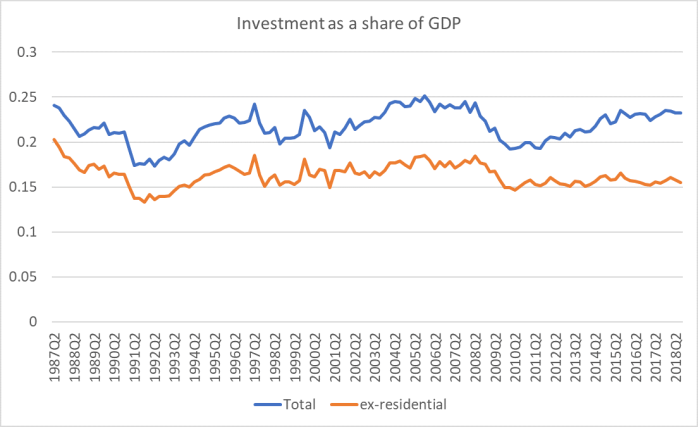
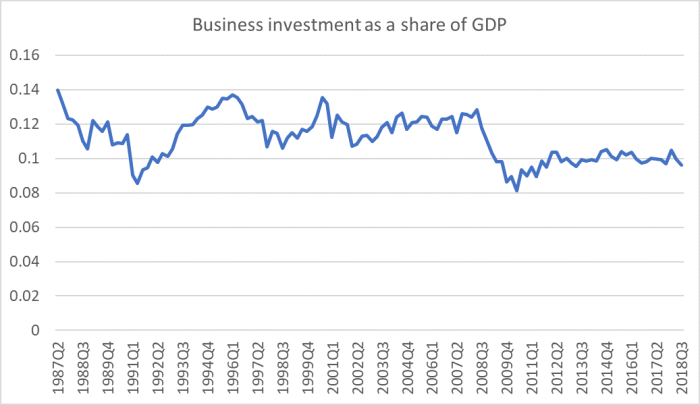
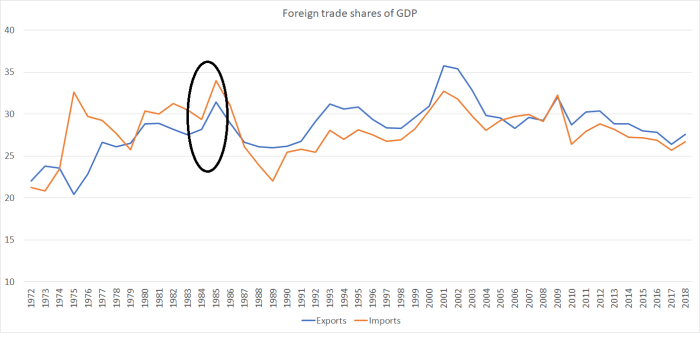
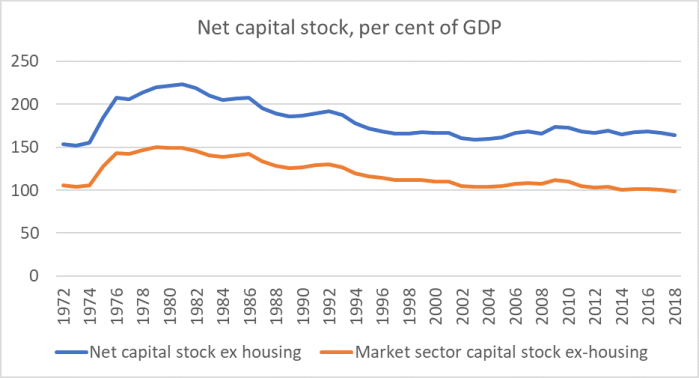 (I don’t know what accounts for the sharp lift back in mid-70s, but you can see the Think Big effect in the early 80s.)





 It is a free lunch they are claiming to offer. I suspect few will be convinced.