Another of the Governor’s whims

I was chatting to someone yesterday about what was behind the undisciplined, highly political, way in which Reserve Bank Governor Adrian Orr has taken to the job.  My interlocutor reckoned Orr might have his eye on a high place on Labour’s 2023 list (“doing a Brash”).  I was a bit sceptical –  he’d be about 60 and Jacinda Ardern about 43 –  but then I guess this is the era where a youngish (only 72) Trump could be facing off against either Bernie Sanders (77) or Joe Biden (76).   I still doubt Orr has a conscious personal party political goal in mind –  and if he did, it would be highly inappropriate for him to be serving as Governor –  and suspect it is mostly about revelling in being a big fish in a small pond, the opportunity to strut his personal ideological commitments using a statutorily provided (and funded) bully-pulpit to do so.    By comparison, the basics of the day job must seem rather technocratic and dull –  hence, no doubt, why we’ve had no public speeches about either monetary policy or financial regulation.   Anyone seen any sign of developed Reserve Bank senior management thinking about, for example, handling the next serious recession –  starting from an OCR of 1.75 per cent or less?  Thought not.   Or, for that matter, robust and honest articulations of the case for much-increased minimum bank capital ratios.

Instead we hear him on all sorts of stuff that is no part of the responsibility of the Reserve Bank.  There is infrastructure, thinking long-term (in the Governor’s view he apparently does, but we don’t, think long-term enough), and lots and lots on climate change, all entirely predictably left-wing (not even interestingly left wing) in nature.  Oh, and of course there is the tree god nonsense.   There are only so many hours in the day, so time spent on this stuff – and time spent getting his staff to do it –  is time not spent on core business.  And this from an institution that claims to be underfunded.

Early last month, I wrote a post, Other People’s Money,  prompted by a newspaper advertisement from the Bank for a “Cultural Capability Adviser Maori”.   I noted then

So what is he up to with his “Te Ao Maori strategy…designed to build a bankwide understanding of the Maori economy”?  Given his statutory responsibilities –  and those in charge of public agencies are supposed to operate constrained by statute – what makes the so-called “Maori economy” any different than the “European New Zealander economy”, the “Asian economy”, the “British immigrant economy”, the “Pacific economy” and so on, for Reserve Bank purposes and policy?

The Bank’s claim is that this new understanding will “enable improved decision making…about monetary policy and financial soundness and efficiency”.   Yeah right.

I lodged an Official Information Act request for material relating to the decision to create this position, including “any material covering the estimated costs and benefits of such a position”.

It took them a while –  more than 20 working days –  to respond but I eventually received 25 pages of material.    There was, of course (this is the Reserve Bank after all), no cost-benefit analysis, and more remarkably there was no mention (explicit or implicit) of any opportunity cost of the resources devoted to the Governor’s latest whim.  It is as if the Bank thought it had more or less unlimited resources and no clear need to prioritise –  I guess that is what using other people’s money, in an institution with very weak external budgetary controls can come to.

The direct financial costs were outlined –  almost a million dollars over three years, and a couple of hundred thousand a year thereafter (about as expensive as slushy machines for prison officers, and at least someone gets some benefit from those).  A million here and a million there and pretty soon you are talking serious money.

And all this for an organisation that, of all those in the entire public sector, must have the least compelling need for a Maori strategy (for this cultural capability adviser is only one bit of the wider strategy).   As a reminder, these are the key Reserve Bank functions

  • the Bank issues bank notes and coins.  That involves purchasing them from overseas producers, and selling them to (repurchasing them from) the head offices of retail banks;
  • it sets monetary policy.  There is one policy interest rate, one New Zealand dollar, affecting economic activity (in the short-term) and prices without distinction by race, religion, or culture.  Making monetary policy happen, at a technical level, involves setting an interest rate on accounts banks hold with the Reserve Bank, and a rate at which the Reserve Bank will lend (secured) to much the same group.  The target – the inflation target, conditioned on employment (a single target for all New Zealand) – is set for them by the Minister of Finance.
  • and it regulates/supervises banks, non-bank deposit-takers, and insurance companies, under various bits of legislation that don’t differentiate by race, religion or culture.

The Bank has chosen to put some decorative Maori motifs on the bank notes it issues, but that is about the limit of it.

Sure, there is a handful of other functions.  They can intervene in the foreign exchange market (one dollar for all), and they operate a wholesale payments system (NZClear), but it doesn’t  alter the picture.  There is just no specific or distinctive European, Maori, Pacific, Chinese, Indian or whatever dimension to what the Bank does (or what Parliament charged it with doing).  I looked up the list of institutions which are members of NZClear, and (unsurprisingly) there was not a single specifically Maori one  (Swiss, German, Indian, American, British, Tongan, Fijian, Sri Lankan  –  those last three other central banks –  and so on).

The Reserve Bank is essentially a “wholesale” institution.  The actions the Bank takes affect all of us to some degree or other, and so they need to open and accountable in communicating what they are doing, but it just isn’t the sort of agency that has a direct client base (or clients with culturally specific issues relevant to its statutory responsibilities) where race, culture, ethnicity, or whatever is an important consideration.  And so the million dollars –  and all the uncosted staff time –  is just money down the drain, advancing the Governor’s personal ideological and social whims, not the statutory responsibilities of the Bank.

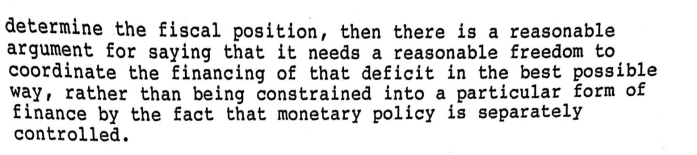
There is a great deal of unsupported nonsense in the document.  But it starts here

TAM 1

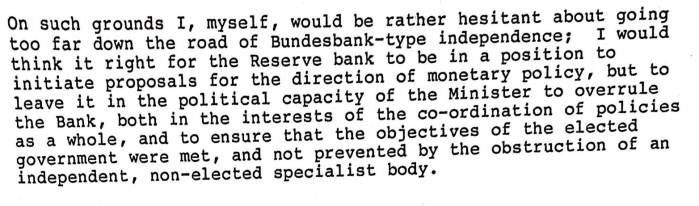
And here is one of the key sets of deliverables

TAM 2

Which is, itself, a grab-bag of unsupported stuff.   “More assured forecasts” would, of course, be great, but from an institution whose inflation forecasts have been wrong (one-sided bias) for eight or nine years now, doing the core job more accurately seems rather more important.  The documents never suggest how their better understanding of “the Maori economy” will improve the forecasts –  as distinct perhaps from making the Governor feel better about them.

Notice too that reference to “the Maori economy”: not only is $50 billion rather less than one-sixth of GDP, but the $50 billion they are talking about is a collection of assets (a tiny portion of total assets of New Zealanders), and GDP is a collection of income flows.   Since Maori are a significant chunk of the population, I’m sure they do make up quite a share of the economy, but most assets owned by Maori people aren’t included in that headline-grabbing number (any more than my house is in some “European New Zealander economy”).

There is a similar degree of vacuousness about the references to the financial system.  It all the feel of someone making stuff up to backfill another of the Governor’s whims.

What of some other stuff. Among the responsibilities of the cultural capability adviser this was listed first

Lead development and implement an institutional language plan for the Reserve
Bank of New Zealand

You do rather get the sense, reading through the documents, that Reserve Bank staff will be under pressure to learn Maori whether they want to or not.  Again, perhaps there might be merit in that if the Bank were a customer-facing body dealing with (say) troubled families in the Ureweras, but this is the (wholesale) central bank.

I don’t suppose anyone (perhaps other than the Governor, and probably not even him –  he’s smarter than that) really believes the nonsense front line rhetoric about better policy.   It all seems much more about these “deliverables”
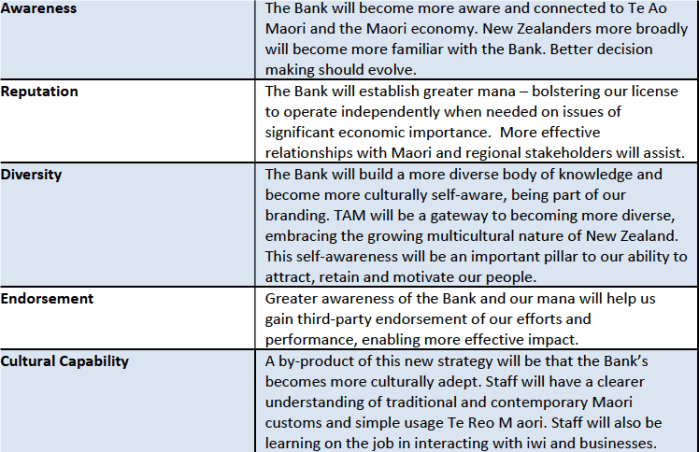
TAM 3

In other words, how “woke” can we be?

It is all pretty incoherent.  For a start, there is that reference to the ‘growing multicultural nature of New Zealand”, and yet this is an explicit Maori strategy, with no hint of comparable ones for Chinese cultures, Indian cultures, South African cultures, Filipino cultures, Samoan cultures…..let alone, Muslim, Christian or atheist cultures.     Another $1m for each perhaps? I thought not (and nor should there be).

Perhaps all this stuff will go down well among some in the Labour Maori caucus, in the further reaches of the Green caucus, and among some of those the Governor will be distributing largesse among.  Perhaps Guyon Espiner will be a bit softer next time he interviews the Governor.  But I find it harder to believe that this sort of strategy is going to, in any way, enhance the Bank’s standing in middle New Zealand.  And nor should it.   As for staff, I suspect there will be a selection process at work (perhaps a bit like the Treasury) – capable people who care more about serious analysis and policy (actually doing the Bank’s statutory job) will select out (or not be hired) and the place will increasingly be filled with cheerleaders for the Governor’s political and social agendas.

I don’t usually like to scoff at overseas travel budgets – there is often real value in building connections and relationships –  but I had to in this set of documents.  $40000 for international travel for a Maori strategy, when Maori culture has no substantial home but New Zealand, seeemed, shall we say, not exactly an abstemious use of public money.

Here is a graphic for the Governor’s Maori strategy
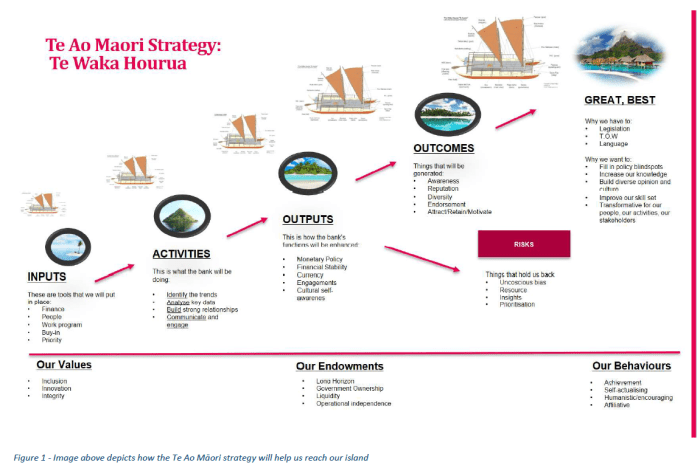
TAM 4.png

The writing is a bit hard to read, but it is just full of earnest trendy, rather unsubstantiated, feel-good stuff.  Unconscious bias holds back the Bank’s policy outputs we are told.  It would be fascinating to see the evidence base for that, including (for example) why it was an issue around Maori dimensions of the economy/financial system and not, say, Chinese, Indian or Fililpino bits.   Fortunately, monetary and banking policy operate  indiscrimately (in the good sense of that terms) –  there is, for example, precisely nothing the Bank can do that will affect long-term unemployment at all, let alone differentially affect that of Maori.  It is all a political front, using your money.   But –  bottom right corner –  no doubt the Governor and has staff will be self-actualising in a humanistic way.

(Oh, and recall that that island –  pictured in the top right hand corner –  isn’t even New Zealand, but Bora Bora –  the Maori strategy moving the Bank towards French Polynesia!)

I could go on, but I’ll leave it to anyone interested to plough through the verbiage (“we will actively seek to operate within the virtuous circle of sustainable economic development”, or references to “Cultural Security” – did this get lost from an MCH document?) and the rather non-questions (“Do Maori use cash differently to other people groups?” –  perhaps Catholics, atheists, Freemasons. Green Party supporters, or lefthanders do as well, but why would we want to spend scarce public money to find out?).

One of the points former Bank of England Deputy Governor Paul Tucker made in his book, Unelected Power, that I wrote about quite a bit last year, is that when central bankers start pursuing issues that range well beyond their narrow areas of specific responsibility, they run a real risk of undermining the willingness of the wider community to let them (fallible individuals, with limited accountability) exercise the discretionary power in their core responsibilities.  Sometimes people will agree with the errant central bankers on individual issues –  I often agreed with the substance of what Don Brash was saying when he strayed off-reservation, even as I thought he was very unwise to do so –  but over time it leaves a growing proportion of the population uneasy about overmighty public officials using platforms and money provided by all of us to pursue personal whims, personal social and political agendas.      If we can’t have a central bank that (a) sticks to its knitting, and (b) does that knitting excellently, we might as well just hand all the powers back to the politicians.  We elected them and can kick them out again.  We just have to put up with the Governor pursuing his whims at our expense, with very few effective constraints.

 

The not-very-serious foreign interference inquiry

At midnight on Friday the deadline passed for public submissions to the Justice Committee’s inquiry into (various issues around) foreign interference in our political system.

The Justice Committee conducts a review after each election of issues around the conduct of the election.   After the opportunity for public submissions to this review had already passed the government asked the committee to add the “foreign interference” issue to its inquiry.

The Justice Committee is chaired by senior Labour backbencher, Raymond Huo.  Professor Anne-Marie Brady, and various other people, have highlighted the fairly close connections Raymond Huo appears to have had to the PRC Embassy in New Zealand, to various regime-affiliated United Front bodies, is on record having talked up the opportunity Parliament gave him to champion PRC perspectives (eg on Tibet), and has never once in his years in Parliament been heard to utter a word critical of the PRC regime –  even though, as an adult migrant, he will be more personally familiar than most with its ways.   It has always been pretty extraordinary that such a person chairs such a significant parliamentary committee, let alone was chairing an inquiry into potential foreign interference risks in the New Zealand political system.   Revealing as to the enfeebled state of the New Zealand political system, the parliamentary Opposition had never expressed any public concerns.

Huo has now, very belatedly, recused himself from the committee for the foreign interference aspects of the election inquiry.  But that recusal came only after the blowback from his (initially successful, initially backed by the Prime Minister’s office) efforts to corral the votes of his Labour colleagues to block Professor Anne-Marie Brady from making a submission on the foreign interference issues.    Huo assured us that officials could tell the committee all that was necessary.  To their credit, National MPs on the committee went public and the government backed down, and presumably forced Huo to stand aside from some aspects of the inquiry.

Eventually, there was a call for public submissions.  It ran as follows

The Justice Committee has resolved to invite further submissions on its Inquiry into the 2017 General Election and 2016 Local Elections. The committee is inviting submissions on the specific issue of how New Zealand can protect its democracy from inappropriate foreign interference, notably on the issues of:

  • the ability of foreign powers to hack the private emails of candidates or parties
  • the risk that political campaigns based through social media can be made to appear as though they are domestic but are in fact created or driven by external entities
  • the risk that donations to political parties are made by foreign governments or entities.

As I noted a few weeks ago, those specifics seemed deliberately designed to avoid the elephant in the room around the People’s Republic of China.  Combine that the competitive obsequiousness towards, and deference to, the PRC from all our political parties (but notably National and Labour who had all the seats on the Justice Committee), and the lack of an independent stance from any individual MP on such issues, I was not at all optimistic that the inquiry was a serious exercise.  When someone suggested I might make a submission I was initially reluctant –  participating in what was probably a charade only lent dignity to a dishonourable project.

But in the end I decided to make a fairly short submission, as a concerned citizen, but also one with some expertise on issues around the (alleged) economic dependence of New Zealand on the PRC.  I did not set out to be diplomatic.  The biggest issue facing New Zealand in this area isn’t inadequate laws, but the consciously-chosen actions, words, attitudes and values of our MPs and political parties.   The inquiry is framed to make MPs look like the solution, when in fact they (and their party machines) are the problem.

I suggested a number of specific legislative amendments.  From my summary

There are some specific legislative initiatives that would be desirable to help (at the margin) safeguard the integrity of our political system:

• All donations of cash or materials to parties or campaigns, whether central or local, should be disclosed in near real-time (within a couple of days of the donation),

• Only natural persons should be able to donate to election campaigns or parties,

• The only people able to donate should be those eligible to be on the relevant electoral roll,

• Consideration should be given to tightening up eligibility to vote in general elections, restricting the franchise solely to New Zealand citizens.

I would also favour tight restrictions on the ability of former politicians to take positions (paid or otherwise) in entities sponsored or controlled, in form or in substance, by foreign governments.

But

…useful as such changes might be, they would be of second or third order importance in dealing with the biggest “foreign interference” issue New Zealand currently faces – the subservience and deference to the interests and preferences of the People’s Republic of China, a regime whose values, interests, and practices and inimical to most New Zealanders. Legislation can’t fix that problem, which is one of attitudes, cast of minds, and priorities among members of Parliament and political parties. Unless you – members of Parliament and your party officials – choose to change, legislative reform is likely to be little more than a distraction, designed to suggest to the public that the issue is being taken seriously, while the elephant in the room is simply ignored. It is your choice.

In the body of the submission I developed the point

…in respect of the People’s Republic of China – a regime whose values, actions, and interests are inimical to those of almost all New Zealanders – these are not just risks, but realised facts. Whether because of false narratives about New Zealand’s “economic dependence” on China, lobbying from specific vested interests (public and private sector, or political party fundraisers), or whatever other consideration, political parties and elected politicians have allowed themselves to arrive in a position where all seemed scared to utter a word critical of the regime in Beijing, and appear to go out of their way to laud the regime and/or to solicit donations from people with close ongoing ties to Beijing. That brings our democratic system into disrepute, undermining the confidence of citizens that the political process is operating in their collective interests, and that those running it have interests and/or values that align well with the values and longer-term interests (including of a robust open political system) that aligns with those of the citizenry.

This isn’t primarily about inappropriate foreign interference itself but about the repeated choices of, it appears, every single member of Parliament, across successive Parliaments, and each of the parties represented in Parliament. Big and evil foreign regimes will attempt to exert pressure where they can, or to identify points of vulnerability. We can’t change that, and we can’t change the character of the Chinese Communist Party controlled People’s Republic of China. But we have choices as to how to react to the regime. The choices made by successive governments, apparently without material dissent from anyone in Parliament, have worked against the longer-term interests of New Zealanders.

and

No doubt most of those involved believe that, at some level, they are serving some version of “New Zealand interests”, but in the process there is no doubt that Beijing’s interests are advanced. What are those interests? Well, they include (without limitation) keeping western nations hitherto known for their regard for political freedom, the rule of law, and human rights, quiescent. When (otherwise) decent countries treat the PRC – a country with few real friends and allies – as normal and decent that (in some small way) helps the regime.

New Zealand governments were once known for a fairly forthright stance in responding to large and evil regimes: the first Labour government was well-known for its opposition to appeasement policies in the 1930s, and successive governments (of both parties) recognised the Soviet Union for what it was. But no longer.

The People’s Republic of China is at least as evil a regime – expansionist abroad, increasingly repressive at home, attempting to coerce diasporas (including in New Zealand) abroad, often with not-very-veiled threats to people at home. And yet our governments and members of Parliament treat the leaders and representatives of this regime as part of some sort of normal state, unashamed to share platforms with them and (apparently) afraid ever to utter any word of criticism. Citizens of a close ally have been abducted by Beijing in recent months, and the New Zealand government utters not a word of support. A free and democratic country in east Asia is constantly threatened and harassed by Beijing, and New Zealand governments say nothing. What message does this send to New Zealanders about whose interests governments are serving, and values they represent? By contrast, party presidents of both main political parties have been in Beijing in the 18 months praising the PRC regime and its leader – and they don’t even have the excuse perhaps open to ministers of maintaining normal diplomatic relations.

No one supposes that our elected MPs or political parties [collectively, or generally as individuals] share the values, or even support the methods, of the People’s Republic of China. And the People’s Republic of China poses no direct physical threat to New Zealand. Thus, the only reasonable deduction is that the deference and subservience, to a regime responsible for so much evil, is about deals and donations: direct two-way trade opportunities, and the flow of political party donations from people (often New Zealand citizens) with affinities to Beijing.

What about those economic risks?

The People’s Republic of China is known to attempt to use “economic coercion” to bend other countries and their politicians to its way (sometimes – as with Norway – just keeping quiet about evil). From an economywide perspective, these are mostly not serious or real threats – more like bogeymen that people in other countries choose to scare themselves with, sometimes egged on by political leaders. A key insight of the economic growth and development literature is that the countries make their own prosperity (not by closing themselves off to the world, but through good institutions, smart people, decent tax and regulatory provisions, which allow them to develop industries than can take on the world). But the threats – usually unspoken, but real nonetheless – are real for individual firms  (including public sector ones like universities) that have made themselves very dependent on the PRC market.

Wise businesses don’t make themselves excessively dependent on markets controlled by capricious brutes, and when they find themselves over-exposed they look to diversify and/or build greater resilience into their own processes. But too many New Zealand exporters – well aware of the character of the regime – have only redoubled their exposures, and then seek to influence the New Zealand state to protect their dealings in those markets. Perhaps among the more shameful are the universities, historically guardians of open debate etc, and yet several now actively partner with arms of the PRC and all have chosen to make themselves dependent on PRC students – in the process handing the thug a baseball bat. Not one university vice-chancellor has been heard from in recent years lamenting the increasingly closed and repressive nature of the regime in Beijing.

There are parallels with people who pay protection money to the Mafia. Such people might garner some sympathy but little respect. But whereas an individual may have few protections against organised crime syndicates, a sovereign state positioned as New Zealand is, has plenty of choices. A generation of politicians has made bad choices around the PRC. Those choices may have boosted two-way trade to some extent (even as our overall economic performance – more influenced by our overall foreign trade, which has been shrinking as a share of GDP – has remained poor), but have also compromised our longer-term interests, values, and the sense of decency and self-respect that most New Zealanders pride themselves on. New Zealanders can have little confidence that the political system is operating for them.

Following some discussion of my specific recommendations (above), I came back to the point

But it would simply be wilful pretence to suggest that they are the main game around foreign interference. As members will be well aware, the United States (for example) has very tight laws on foreign donations (much more so than New Zealand’s) which has not avoided allegations of interference/collusion or whatever roiling the political system for the last few years.

In a New Zealand context, it is generally recognised that many of the problematic donation flows are made by New Zealand citizens. The controversy last year around Auckland businessman Yikun Zhang was once such possible example, but the point generalises and is well-recognised by those close to the major political parties. In the PRC case, in particular, parties have actively sought to tap donations from ethnic Chinese citizens, often people with close associations with, or sympathies for, the regime in Beijing. No law is going to stop most such people donating, but decent political parties would choose not to tap (knowingly) such morally questionable sources of funding. All parties will be well aware of the activities of the regime, and its agents, in attempting to coerce, or incentivise, ethnic Chinese living here who have ongoing business or family connections in China.

But again, the issue isn’t just about PRC-born New Zealand citizen donors. There are not a few domestic entities with a strong interest in the New Zealand government deferring to Beijing whenever possible, and avoiding if at all possible ever upsetting the regime in Beijing. Many of them are people who readily get the ear of ministers or senior officials. Indeed, the government is in league with many of these same people/institutions in promoting and funding the New Zealand China Council, a body that uses taxpayers’ money to attempt to propagandise the relationship the government itself and specific businesses have with the party-State in Beijing.
For the country as a whole this is not some sort of “win-win” situation (in a way that free trade between consenting firms generally is). Rather, to some extent at least (and perhaps less so in substance than in belief), the access of New Zealand firms (a minority of New Zealanders’ financial interests) is held to depend on New Zealand governments and MPs doing as little as humanly possible to upset one of the most heinous regimes on the planet. Those firms then become, in effect, champions locally of the interests and values of Beijing and – to the extent that politicians respond to such pressures (as they seem to, enthusiastically or otherwise) – they themselves become complicit. Since MPs represent the public, we are all tarred to some extent or other by that association. That, in turn, discredits our political system, which comes to seem no longer interested in championing or representing the values that shaped and formed our nation and our political system.

Quite possibly almost all those involved in the New Zealand political system believe they are primarily serving the interests of New Zealand. But until the major parties (in particular) and the governments they form begin to make observable choices in ways that prioritise New Zealand interests and values over those of Beijing, there is a certain observational equivalence between claiming to focus on New Zealand interests and actually serving Beijing’s. That inability to tell the two apart corrodes any confidence in our political system, and any respect for our politicians and parties. The political spat earlier this year, around which party was most willing to defer to Beijing, will only have reinforced public doubts.

Ending on this note.

That cannot be a desirable state of affairs. Modest legislative reforms around foreign donations do not go to the heart of the problem and, welcome as they might be, will not represent any material part in a fix. A real fix requires MPs and parties to start consistently choosing and acting differently; choosing to prioritise the longer-term values and interests of New Zealanders.

It will be interesting to see how many others, and who, have chosen to submit.

I continue to have very low expectations on this inquiry.  The Prime Minister and Leader of the Opposition demonstrate no interest in the issue (except perhaps to pretend there isn’t an issue), and other party leaders and MPs are no better (it appears).   The acting committee chair (for this part of the inquiry) is not one of those MPs one would look to for leadership, and the media have –  thus far –  shown little sustained interest in the inquiry (except when gifted stories –  eg around Huo blocking Brady, and the recent appearance of the GCSB/SIS), with no even any apparent follow-up to the reported claims of Jami-Lee Ross (how did he get on the committee?) at the last public hearing.

But no doubt, after the previous Labour attempts to block her, when Professor Brady is invited to appear before the committee there will be considerable interest, including in how MPs on both sides of the committee attempt to parry, or downplay, the concerns she has been raising (let alone the apparent attempts to intimidate her and her family, that –  again –  excited so little interest or outrage from the Prime Minister or the Leader of the Opposition.)

UPDATE (Tuesday): This Newsroom article has some useful material, including about how Jami-Lee Ross came to be on the committee for a day, and suggestions that Huo still has not properly recused himself.

Bank capital proposals still inadequately supported

When I opened the newspaper this morning and found the headline “The world needs ethical leadership”, above a column written by someone whose own leadership often fell well short of that standard, it was tempting to go chasing hares.

But I’m more interested in the damage the current leadership of the Reserve Bank is doing both to the standing of the Bank as an institution and –  more concerning still – to the New Zealand economy and private firms operating in it, by the Governor’s plans to require banks to raise a great deal more equity capital to support their current levels of business.  This morning I want to comment on a couple of contributions to that debate from two of my former Reserve Bank colleagues.

Before doing so, note that I hardly ever agree with the newspaper columns of Business New Zealand’s head Kirk Hope, but his column today on the bank capital proposals is right on point.  He ends with suggestion that really should be uncontroversial

BusinessNZ recommends that the Reserve Bank should undertake a comprehensive cost/benefit analysis of the proposals before any further steps are taken.

In fact, the Reserve Bank tells us repeatedly it only intends to do such an exercise when it is too late for it to inform any public discussion or submissions –  it will support whatever whim the Governor finally runs with, rather than assisting the development of policy and the contest of evidence and arguments around the proposals the Governor is hawking, and which the Governor himself will get to decide on.

It has been a quiet week in central Wellington, with many people taking the chance to use a few days’ leave to get quite a long autumn break.  Nonetheless, a fairly good crowd turned up at Victoria University at lunchtime on Wednesday to hear Ian Harrison critically review the Reserve Bank’s capital proposals.  Ian spent most of his career at the Reserve Bank, and did much of the modelling work associated with the previous review of capital requirements, undertaken only seven or eight years ago.  Since leaving the Bank he has also consulted for commercial banks on risk modelling and associated capital issues.

I’ve already written here about Ian’s March paper reviewing the Bank’s proposals.  Since that paper was written the Reserve Bank has published another 50 page paper attempting to buttress their case, and Ian’s latest presentation –  also titled “The 30 billion dollar whim” (with no question mark) – attempted to take account of that paper.  He has a further review paper coming; one hopes in time to inform submissions before the Reserve Bank’s deadline on 17 May.

The Bank’s claim all along has been that these proposals are a win-win.  We can have a more stable banking system –  despite never having had a systemic banking crisis (at least outside an immediate post-liberalisation period) –  and higher (expected) GDP as well.  This is one of their charts.

win win

It has never really rung true, and none of what they keep on releasing really buttresses their case.   As I’ve noted previously, in his speech in February the Deputy Governor acknowledged that the proposals could cut the level of GDP by “up to 0.3 per cent” (say, 0.25 per cent then), and to pay that insurance premium each and every year, on a policy which could be cancelled at any time on the whim of some future Governor, it would have to save us from something truly devastating perhaps 75 years hence.   Countries with floating exchange rate, reasonable institutions, and governments that keep out of credit allocation, simply don’t have those sorts of truly devastating events.  As I and others (including a rather more prominent US author) have noted, in the serious recession of 2008/09, the (floating exchange rate) countries that had financial crises didn’t perform materially worse than countries that did not.   Most likely, what the Reserve Bank is proposing won’t move us north-east of the orange dot (as the Bank claims), but more likely south-east.   We’ll be poorer but the banks –  already a stable core of (what the Bank tells us every six months is) a stable financial system –  will be sounder still.  It doesn’t seem like much of a deal…….especially without a robust cost-benefit analysis that we can properly review, or any open engagement with the criticisms various people have advanced.

Ian Harrison also points out that the Bank appears not to have take explicit account of the fact that our main banks are foreign-owned.  As he notes, most of the international modelling on capital works on the assumption that banks are largely domestically-owned.  If higher capital requirements mean higher total equity returns to shareholders that in itself isn’t a loss to the domestic economy –  just a transfer from one lots of nationals to another.   There might still be some cost in the form of lost output, resulting from a higher economywide cost of finance and wider intermediation spreads  (eg the Deputy Governor’s “up to 0.3 per cent”).  But in New Zealand, if we compel banks to have much more capital to support their level of business, and there is no full offset between the cost of debt and the cost of equity (and the Reserve Bank accepts there won’t be), there is an expected net transfer from New Zealanders to (in this case) Australia and Australians.  That is where Ian’s $30 billion number (a present value calculation) comes from.   It doesn’t figure in any of the Reserve Bank documents, which seems on the face of it a rather gaping omission  –  especially from a Governor who appears to have a strong prejudice against Australian banks.

There was a lot of material in Ian’s presentation and I can’t cover it all here.  But a few other highlights:

The Bank likes to claim that their new approach –  specifically identifying how infrequently they think New Zealand should expose itself to a financial crisis (once in 200 years is the Governor’s stab in the dark) –  is a significant step forward, and determines the proposed capital ratios that emerge from the analysis.  Ian notes that, if anything, it appears to be the other way round: they initially used a 1 in 100 year framing, found that produced results they didn’t much like (something like current capital requirements), and with no supporting analysis at all –  there is a single sentence footnote –  switched to the 1 in 200 year framing.   Support rather than illumination springs to mind.  The Governor seems to have wanted high headline minimum capital ratios –  regardless of cost, regardless of the fact that the way ours will be calculated will be more demanding –  and to have cast around for anything to prop up such a case.

In his rather whimsical vein, Ian goes on to suggest that there is so little substance behind the proposal that perhaps the proposed 16 per cent minimum capital ratios (CET1) for big banks might as robustly have been derived from the Governor’s fling with the tree god Tane Mahuta: the kauri tree of that name has a girth of 15.44 metres apparently, and allowing a little for growth we get 16.  In a similar vein, he goes on to note that kauri trees are (apparently) bigger than gum trees, which perhaps accounts for the Governor pushing his requirements well beyond those in Australia.

Ian unpicks the relevance of various of the overseas paper the Bank cites, including noting how dependent any of the results are on specific assumptions, specific sample periods (especially around loan losses –  using a short period centred on 2008/09 will produce different results than, say, using the last 100 years).  In some of the Bank’s New Zealand analysis (including around the late 80s/early 90s) instea of using loan write-offs (recorded just once, when the write off occurs) they’ve used average annual non-performing loan data – even though the same non-performing loan can remain on the books for several years, but can only be written off once.

He noted briefly, as I have at more length here, the important distinction between (a) marginal effects and average effects (we should only focus on what further reduction in crisis probability this further big increase in capital requirements will result in), and (b) between the costs of the bad lending and investment choices that led to loan losses, and the cost of bank failures themselves (the Reserve Bank simply never addresses this latter point).

In passing he notes that references to reducing fiscal costs of bank failures tend to be overstated: the common reference point in 2008/09, and yet bank capital ratios are already materially higher than they were then, and even in 2008/09 the net fiscal costs (after recoveries and sales) were often quite small.  Oh, and OBR here is supposed to further reduce, or eliminate, fiscal costs.

In its latest document, the Bank devoted a lot of space to the alleged social costs (suicides, divorces, mental health problems) etc of financial crises.  Ian looked at all their references, and I don’t think it would be going too far to say that the Bank’s representations were borderline dishonest –  often drawing from countries without a decent social safety net (or countries without the buffer of a floating exchange rate).  Again, the idea that the Bank was looking for support rather than illumination sprang to mind.

Ian ended his presentation with a simple insurance parallel, suggesting (as above) that the Bank was inviting New Zealanders to buy (well, perhaps compelling us to buy) a very expensive insurance policy of the sort no rational agent would ever buy voluntarily.  All backed up with inadequate analysis and no serious engagement.

After Ian’s presentation there were several thoughtful questions from the floor.  Graham Scott, former Secretary to the Treasury  back in the reform era and currently a member of the Productivity Commission –  a “dry” if ever there was one – asked about the assumptions around the Modigliani-Miller proposition.   At the extreme, this proposition asserts that the financing structure of a firm (mix between debt and equity) doesn’t affect the value of a firm.  In this case, for example, requiring banks to hold even a 20 per cent capital ratio wouldn’t affect the economics of banking  (required rates of return on equity, and debt costs) would fall to fully offset the increased equity component.  It would suit the Reserve Bank case to be able to argue that there is such a full offset, but they don’t. Instead, they assume something like a 50 per cent offset (thus, over time required rates of return on banking in New Zealand will fall, but not enough to fully reflect the reduction in the expected future variance of earnings).

Graham Scott’s point – which echoes one I’ve alluded to here on a couple of occasions –  is that the 50 per cent offset assumption may still be too high.  He notes that the big Australian banks’ New Zealand subsidiaries are not listed entities.  From a shareholder (in the parent) perspective the operating subsidiaries here are little more than another operating division of a much bigger company.  Every manager in every operating division will always be looking for excuses to deliver low rates of return (circumstances, regulatory factors or whatever) while still collecting their bonuses and we might be sceptical that the parents will accept low rates of return on bank business here simply because our Reserve Bank says they have to hold more capital.   Correlations also matter –  reduced variance in New Zealand earnings, might do little to reduce the variance of the earnings of the parent.

I suspect that the direction of the effect Graham Scott points to is correct, but that the effects might be seen in a rather disruptive way.  As I’ve noted previously, the Bank’s capital requirements apply only to locally incorporated banks.  Big corporates will have no particular problem getting credit from overseas banks that aren’t incorporated here.  These might include the parent (Australian) banks, all of which also have branches here, or any other significant bank in the world (Fonterra is most unlikely to pay a higher cost of debt because of regulatory stuff our Reserve Bank does).   The bond market also offers a mechanism to take locally-incorporated banks out of the mix –  not just for big corporates, but potentially for securitised home mortgages.  Some credits can’t be easily or quickly securitised and they are likely to be the ones who bear the brunt of the changes.  Overall, credit may be harder to get and more expensive.  The other group who may bear the brunt will be depositors –  borrowers can over time change their credit provider, but retail depositors (in aggregate) have fewer options (eg overseas branch banks can’t take significant retail deposits).

But none of this –  not a single strand of it –  is analysed in any of the material the Reserve Bank has put out.  Nothing about transitions, nothing really about steady states, nothing about how the fact that the requirements will fall on some but not others will affect the future structure of the financial system.  It is really inexcusably poor policy development and communication.  One business figure put it to me recently that there is a risk that the Bank’s proposal will actually reduce the soundness of the financial system –  increasing the soundness of the core banks themselves (perhaps, unless the parents choose to partly liquidate their exposures, and we are left with banks without strong parents), but reducing the significance of those core banks (and leaving many credit exposures less transparent than they are now).  I’m not sure I would yet go that far, but the rather limited and mechanistic approach the Reserve Bank is taking is leading them to overstate even any possible soundness gains, even as they ignore the likely output costs.

It simply isn’t a standard of policymaking we should accept.  The Minister of Finance and The Treasury –  if the latter isn’t distracted playing sun-moon cards and talking about their feelings –  should be demanding better.

And that is more or less the theme of another former Reserve Bank regulator, Geof Mortlock, in his piece on interest.co.nz earlier in the week.  After noting how resilient the Reserve Bank’s own stress tests suggest the New Zealand banking system is, and noting some of the likely costs and disruption, Geof notes

One would think that these costs and other adverse impacts would have received a great deal of attention by the Reserve Bank in undertaking a cost/benefit assessment of the proposals.  But no.  By their own admission, they have not yet undertaken a comprehensive cost/benefit analysis.  (Perhaps Adrian Orr was too busy engaging in god-to-god dialogue with Tane Mahuta and the forest fairies to give serious policy matters his attention! Deities are so busy of course.)

I don’t agree with all Geof has to say –  he is much more optimistic about the value supervisors can bring to the table than I am – but on the lack of proper, searching, evaluation and robust ex ante cost-benefit analysis we are at one.  As Geof says, it just isn’t good enough.

Geof’s bottom line is this

What is needed is an in-depth independent, professional assessment of the Reserve Bank’s capital proposals. Treasury will no doubt review the Reserve Bank’s cost/benefit assessment once the Regulatory Impact Statement has been prepared. However, that is too late in the policy formulation stage. Moreover, with all due respect to Treasury, it lacks the depth of knowledge needed for a rigorous assessment of the different policy options and the costs and benefits of each. What is needed is for Treasury, at the direction of Grant Robertson, to engage a couple of independent professionals (such as an academic specialised in bank regulation and a recently retired foreign senior bank regulator – e.g. John Laker, former Chairman of APRA) to undertake a comprehensive assessment of the Reserve Bank proposals, plus alternative options. The findings of this assessment should be incorporated into the Treasury’s own review and the results be made public. The independent review would considerably assist the quality of the process of assessing the Reserve Bank’s proposals and may assist in reaching a more sensible outcome.
An independent review would sensibly include consideration of:

  • the magnitude of economic shock needed to cause any of the large banks in New Zealand to fail, and the probability of such a shock occurring;
  • the level of capital needed to enable banks to survive a plausible range of severe economic shocks;
  • the composition of capital requirements and other loss absorption facilities that would be suitable to enable banks to survive severe economic shocks, including whether (as in many countries) a substantial proportion could be in the form of debt instruments that convert to equity upon defined breaches of core equity capital ratios;
  • the impact of the proposed increase in capital ratios on bank lending, interest rates, property prices and economic growth (with implications for government revenue);
  • the impact of the proposed increase in capital ratios on banking system contestability, competitiveness and financial inclusion (especially for those on low incomes);
  • the alternative policy options for strengthening the resilience of the banking system, including strengthening Reserve Bank supervision of banks’ governance, risk management practices, lending policies, and recovery planning;
  • the bank failure resolution options that could be applied to maintain financial stability with minimal taxpayer risk (and hence reduce the need for high capital ratios).

The Minister of Finance and Treasury need to give serious attention to these matters. And the sooner the better.

I have a lot of sympathy with that.  If the Reserve Bank’s supine Board had been doing its job they would have strongly urged the Governor to take such a path –  and/or prior open consultation before the Governor himself took a view –  from the start.  It is all the more pressing that things be done properly, evaluated rigorously, contested vigorously, when it is the Governor personally who is championing these (extreme) changes and the Governor personally who will finally make the decision (with no rights of appeal or review).

As a final note, generally I don’t think the banks help themselves. On both sides of the Tasman banks are typically scared of being openly critical of their regulator.  I can understand that to some extent –  regulators exercise a lot (too much) power on a lot of dimensions –  and no doubt the banks will raise significant concerns in their own submissions.  But by the time the submissions are in – and especially by the time the public ever see those submissions –  it will be too late to marshall a wider pool of support for their case.  Sure, banks are not naturally particularly sympathetic entities, but this is one of those cases where what is bad for banks is probably bad for New Zealanders and the New Zealand economy as a whole.   Sadly, banks have made no effort to engage in any public debate on these issues over the 4+ months this Reserve Bank proposal has been in the public domain.


Reforming housing/land, and compensating some losers

There seem to have been more than a few people on the left pretty deeply disillusioned with the Prime Minister after she walked away from the possibility of a capital gains tax, not just now (when the parliamentary votes for it probably couldn’t be found) but at any future time while she is Labour leader.    Some parallels are drawn with John Key ruling out doing anything about raising the age for New Zealand Superannuation while he was leader –  an important difference perhaps being that Key had never evinced any enthusiasm for such a policy, only to recant, let alone been the leader who put the issue back on the table.     Perhaps something closer was Key’s refusal to use whatever “political capital” he had to do anything much useful around economic reform.  But, again, despite occasional encouraging rhetoric while in Opposition, no one ever really thought Key was someone who would rock the boat, or was that bothered about doing useful longer-term stuff, as opposed to holding office and managing events as they arose).  Some, perhaps, thought Ardern was different.

But in the wake of the Prime Minister’s abandonment of the possibility of a CGT –  and whatever (quite diverse apparently) hopes people pinned to that quite slender reed – there is the growing question of what, if anything, the government might actually do. It is, after all, in their phraseology, supposed to be the year of delivery.

In his Political Roundup column yesterday, Bryce Edwards posed the question as “What will Labour do about inequality now?”.   There is a lot of talk about different possible tax reforms –  I might even come back and look at a couple in later post – and some reference to the forthcoming “wellbeing budget” (which can surely only disappoint, given the self-imposed fiscal constraints).   But there was nothing about the option most directly under government control which would probably make the biggest tangible difference to the most people, with clear efficiency gains not losses, and with the possibility of a considerable degree of across-Parliament support: fixing the housing and urban land market at source.

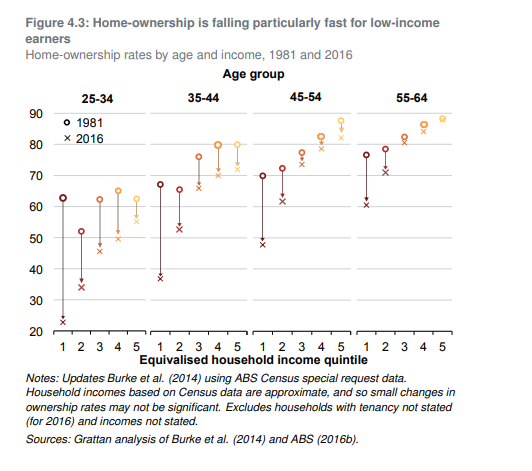
As a reminder of the symptoms of the problem, I ran this chart in my post earlier in the week. It is Australian data, but the picture seems unlikely to be much different in New Zealand.

aus 1

The young and the poor (especially the young poor, and probably especially the Maori and Pacific young poor) are increasingly squeezed out of the possibility of home ownership, for decades or at all.   There is no good economic or social case for tolerating this systematic penalisation of the more marginal groups in our society.

But there are obstacles to reform, including the economic interests of those who could suffer quite seriously –  through no real fault of their own –  if the situation was fixed.

Some elements of the government –  well, really only one, the Minister of Housing –  talks a good talk.  In a recent speech he talked up the prospect of reforms that the “flood the market” with development opportunities and thus lower, presumably quite considerably (when you use a strong word like “flood”), urban land prices.   It warmed the hearts of many (mostly rather geeky) readers, including me.   And yet I’m very sceptical that it will come to much. As I noted in a post shortly after the speech

And yet, I remain sceptical.  Perhaps Phil Twyford’s heart is really in this.

But is the Prime Minister’s?  Even though housing was a significant campaign issue, even though she has been in office for 18 months now, we’ve never heard her putting her authority behind fixing the housing disaster at source, let alone substantially lowering house prices.

And is the Green Party on board?  Quintessentially the party of well-paid inner-city urban liberals, are they really on board with bigger (physical footprint) cities, or with encouraging intense competition among landowners for their land to be developed next.  Some of them seem to believe that it would somehow be morally virtuous –  and “solve” the affordability issues –  if people lived instead in today’s equivalent of shoeboxes.

The approach of the Wellington City Council –  led by one of Labour’s rising figures –  just reinforced my doubts.

There are various practical issues to be worked through in any serious reform effort.  But one consideration that always seems to play on the minds of politicians (understandably enough I guess) is that lower house prices means lower house prices: in other words, people who currently own a house will find their asset worth a lot less than it was.     For those of us without a mortgage on our primary residence or with only a modest remaining mortgage, such a fall wouldn’t matter at all.   Our natural position is to own one house, and we intend to own one house (perhaps a different one) well into our dotage.  The label (the estimated value) attached to that property doesn’t really matter.  And for our kids hoping to enter the market in the next decade or two it is pure gain.

But it, understandably, feels quite different if you are one of the growing number of people who have taken out a very large mortgage (perhaps 80 per cent or more LVR) to get into a house.   If someone talks of halving house prices, that can sound pretty threatening.  As a result, very few politicians ever do (I recall Metiria Turei doing it, but only once, and……).    Banks have the legal right to call in their loan if the value of the collateral (the house) drops below the outstanding value of the loan, and although they probably wouldn’t do so in normal times –  when the labour market was okay –  it leaves people feeling quite vulnerable, and also quite trapped (hard to move cities if selling would immediately crystallise a large loss).

When house prices first shoot up there aren’t many people affected that way.  The longer they stay high –  five or six years now of the latest surge up –  the more people have taken out mortgages based on the high house and land prices.  Most of the owner-occupiers among them aren’t business operators or “speculators”, just people at a stage of life where they want to settle and to be secure in a place of their own.   And they –  and their parents – vote.

Of course, there is a whole other class of people who would lose from house and land prices coming down.  But mostly they are a less sympathetic group.   There are the “landbankers” –  people who responded to government-created incentives –  to sit on potentially developable and let the artificial scarcity push up the price of their asset.   That’s a business operation, and in business you win some and you lose some.   Risk is at the heart of business, and that means the possibility of real and substantial losses.  And there are those in the residential rental business, many of them (especially recent entrants) quite highly leveraged.  Halve the price of city properties –  and that is what re-establishing sensible price/income multiples would imply –  and many of those owners would be either wiped out, or see their real wealth (real purchasing power for things other than houses) very dramatically reduced.  But, again, it is a business, and business implies the possibility of gains and losses (one reason I was always at best ambivalent about a CGT was that no real world CGT really treated gains and losses symmetrically).

Of course, these business owners vote too, and will lobby intensively.  But (a) there are fewer of them than mortgaged owner-occupiers,(let alone unmortgaged renters, hoping to be mortgaged owner occupiers) and (b) they just don’t command the same public sympathy (and rightly so) –  we might sympathise with any business owner whose operation falls in hard times, but we know that is the nature of business.

Back when Jacinda Ardern first became leader of the Labour Party I did a post on what a radical reform package, that might really make a difference to our economic woes (housing and productivity), might look like.   Buried in that post was a suggestion for a partial compensation scheme for mortgaged owner-occupiers that might help smooth the way towards overdue structural reform.  I noted then the desirability of getting house prices down a long way.

No one will much care about rental property owners who might lose in this transition –  they bought a business, took a risk, and it didn’t pay off.  That is what happens when regulated industries are reformed and freed up.    It isn’t credible –  and arguably isn’t fair –  that existing owner-occupiers (especially those who just happened to buy in the last five years) should bear all the losses.   Compensation isn’t ideal but even the libertarians at the New Zealand Initiative recognise that sometimes it can be the path to enabling vital reforms to occur.  So promise a scheme in which, say, owner-occupiers selling within 10 years of purchase at less than, say, 75 per cent of what they paid for a house, could claim half of any additional losses back from the government (up to a maximum of say $100000).  It would be expensive but (a) the costs would spread over multiple years, and (b) who wants to pretend that the current disastrous housing market isn’t costly in all sorts of fiscal (accommodation supplements) and non-fiscal ways.

If I recall rightly, I came up with the rough suggested parameters as I was typing, but a couple of years on it still looks like the sort of thing that might be worth considering, perhaps with a larger cap on the maximum payout and a restriction to a first (owner-occupied) home.   The expected cost will have escalated since 2017, because we have had another couple of years of people taking our large mortgages on properties with values inflated by government-controlled regulation in the face of trend increases in demand), but so has the number of people unable to do what they would otherwise “naturally” do; purchase a first house in their mid to late 20s.

This is a sketch outline of a scheme, and like all such government schemes would need lots of detail to limit abuses.  But what are some of the features of the scheme:

  • you only get to lodge a claim if you sell your house (someone who is going to stay in the same house for 50 years doesn’t need any explicit compensation, even if they are left with a heavier servicing burden than might otherwise have been possible if they’d waited to buy).  Of course, some people will choose to sell and buy somewhere different just to crystallise the right to make a claim, but selling a house – a genuine arms-length transaction –  and moving isn’t cheap.
  • the nominal price has to have fallen more than 25 per cent to be able to make a claim at all.  For the last few years LVR restrictions have meant that most owner-occupiers have been borrowing only 80 per cent of less at purchase, and there will have been some principal repayments since then.      Relatively few people would be in a negative equity position if their house price fell by 25 per cent, and even fewer would be facing immediate pressure from their lender.  Owning an asset has to mean some exposure to reasonable swings in price.
  • beyond a 25 per cent fall, you could claim back up to half of subsequent losses from the government.  Thus, if you had bought an $800000 first house and the price halved, you would be eligible to claim $100000 back from the government (half of the difference between $800000 and $400000.   On reflection, and with such a large deductible (the owner takes the first 25 per cent loss) it might be more appropriate for a compensation scheme to cover 75 per cent of subsequent losses (in this example $150000).
  • any such scheme should have a maximum payout capped.  There is no obvious justice in paying out large amounts to a couple who happened to buy a $4 million house which then halved in price (there was a similar issue when the government bailed out AMI).

I don’t have a good sense of how large the cost might be (but it would be in the billions, spread over at least a decade).  Unfortunately, I’m not one of those who believes that fixing the housing market would produce significant productivity gains for New Zealand –  so it isn’t by any means a free economic lunch –  but the sheer injustice of what successive central and local governments have done to our young and poor cries out for action, and sometimes it is worth offering compensation to help pave the way for the sort of thoroughgoing reform that is desperately needed.

Fixing the housing/land market at source would be a huge step to improving the economic and social wellbeing of so many.  Compensating some of the more sympathetic of the losers from such a reform –  most of whom won’t be in an overly strong financial position themselves –  shouldn’t offend too many canons of justice. In an ideal world, one might seek to finance such a scheme from those who benefited greatly from the previous (well, current) rigged market – but that would be hard to do.  In the real world, we are fortunate that the government has fiscal surpluses and very low net debt (especially including the politically managed money pools in NZSF).

I’m not optimistic the government (Prime Minister) really has much interest in addressing the housing/land problems at source.  But if she is ever is tempted to take seriously Phil Twyford’s rhetoric, a compensation scheme of some sort might be an option to consider, to help dull the inevitable opposition in some quarters (some purely from business interests who would have misjudged, but some from people who through little fault of their own became trapped by these longrunning government policy distortions, that generated the scandal of the New Zealand housing market).


Lack of transparency and the MPC

The statutory Monetary Policy Committee is now responsible for monetary policy and we’ll see the first fruits of their deliberations in a couple of weeks.   It won’t just be the outsiders who are new, with two of the four internals having also taken up their jobs (in one case, joined the Bank) since the last Monetary Policy Statement.

In addition to the questions about how the Committee is going to work, what approach to policy they will take, whether the Governor remains as dominant as I fear, and whether a new era of greater policy transparency is really being ushered in, there are some other outstanding questions about the Committee.

One of them is how much the external members are getting paid.  The government simply refuses to tell us.  The same government that once promised to be the most open and transparent ever.

There was an article about this in the Herald ten days or so ago.  The government’s standard schedule of fees for appointments to public board and committees allows a maximum fee of $800 a day.  Perhaps $800 a day might, just, be reasonable for a role that involved only, say, 10 days work a year.    But the MPC jobs were advertised as involving about 50 days a year –  a fair chunk of anyone’s earnings potential –  and there are some material constraints on what other activities people on the MPC can do.   $800 a day is probably equivalent in annualised terms to around $175000 per annum.

And so, reasonably enough, the Minister of Finance sought approval to offer a higher rate to those appointed to the MPC, arguing that if more money was not on offer they might struggle to get the “right” sort of applicants.   These sorts of exceptions are made from time to time,

A spokesman for [State Services Minister] Hipkins said in 2017/18, the Government approved 43 “exceptional fee” proposals.

That number was 90 in 2016/17 and 42 in 2016/15.

The suggestion in the article is that the government may be paying up to $1500 a day to the MPC appointees

The letter also said the most comparable role within the state sector would be a member of the Commerce Commission, who earns a salary equivalent to a daily fee of $1565.

$1500 a day might be equivalent to an annualised rate of around $330000 per annum.

I don’t too much problem with that level of fee, provided the MPC members are going to do the job well, and not just become free-riders largely deferring to management.

After all, consider what the internals on the committee are getting paid.   Going by the remuneration tables in the Bank’s Annual Report, they probably get something like this:

  • Governor                                                                                    $700000
  • Deputy Governor and Head of Financial Stability,            $500000
  • Assistant Governor (Econ and Financial Markets)             $425000
  • Chief Economist                                                                         $325000

The Deputy and Assistant Governor roles are both second-tier appointments, while the Chief Economist is a third-tier role.

Of course, academics get paid less well than this (and two of the three external MPC appointees have academic backgrounds) but the private financial sector pays able economists well.

Another possible benchmark is the $447000 per annum paid to High Court judges.  We need skilled and capable people performing those roles, but there are potentially two layers of appeal above a High Court judge, and none at all above the (collective) decision of the MPC.

But if I don’t have a problem paying a reasonable price for the job, I do have a problem in not disclosing what these decisionmakers are getting paid.   You can readily see from the Annual Report what each member of the Reserve Bank Board gets paid (not that much, but then they don’t do much), and the mandatory disclosure (without names) of all salaries in excess of $100000 gives one a reasonable sense of what the senior managers involved are being paid.   But the government insists that the external members’ fees should remain confidential.  Their argument?

“This is on the basis that it could weaken the Government’s ability to negotiate fee levels by creating an environment where the exceptional fee becomes the norm.”

I don’t find that persuasive, and the secrecy is inconsistent with the sort of openness and transparency we should expect around public appointments.  Frankly, it suggests the government has its fee schedules in the wrong place, at least for substantive roles.

Perhaps the closest parallel to the external MPC members are the comparable positions in the UK.  In fact, the Minister of Finance cites them in his bid to get higher fees for the New Zealand appointees.  But the terms of conditions of UK MPC members are available for all to see.   As the Minister noted

It also noted MPC members at the Bank of England receive around $1900 in New Zealand dollars.

“Reserve Bank of New Zealand external MPC members will require similar economic and analytical skills, although their role is likely to be less public facing,” Robertson said in the letter.

If it is good enough for the UK, not always known for its public sector transparency, it should be the standard of openness we expect here.

There are also some questions around the transparency of the MPC appointment process itself.

As I noted when the appointments were made

But then I’m a bit troubled by the way in which the Board –  all but one appointed by the previous government – ended up delivering to the Minister for his rubber stamp a person who was formally a political adviser in Michael Cullen’s office when Cullen was Minister of Finance (Peter Harris) and another who appears to be right on with the government’s “wellbeing” programme.     They look a lot like the sort of people that a left-wing Minister of Finance –  one close to Michael Cullen –  might have ended up appointing directly……

I’m left wondering what sort of behind-the-scenes dealings went on to secure these appointments. I hope the answer is none. I’d have no particular problem if, while the applications were open, the Minister had encouraged friends or allies to consider applying. I’d be much less comfortable if he had involvement beyond that, prior to actually receiving recommendations from the Board. It isn’t that I disapprove of politicians making appointments, but by law these particular appointment are not ones the Minister is supposed to be able to influence. So any backroom dealing is something it is then hard to hold him to account for. Perhaps nothing went on, but I have lodged a series of Official Information Act requests with the Minister, Treasury, and the Board of the Bank about any contacts (written or oral) between them on this issue.

Since the Act is written in a way that encourages the public to believe that the first time the Minister would even hear of any potential MPC members would be when the nominations landed on his desk from the Board (which he could accept or reject, but not impose his own candidate), the response from the Minister of Finance to my OIA request should have been quick and simple.

Here was my request to the Minister.

I am writing to request copies of all material (written and oral) held by you or your office relating to the appointment of members of the Reserve Bank Monetary Policy Committee.  Without limiting that request, it includes a request for any information relating to any approaches made by you or on your behalf (a) encouraging specific individuals to apply, (b) encouraging the Bank’s Board to nominate or select any particular individual(s), or (c) discouraging the Bank’s Board from nominating any particular person or type of person.

In subsequent contact, it was agreed I wasn’t looking for purely adminstrative stuff (emails like “does anyone know if Bob Buckle has signed hs contract yet?”).

The request was lodged on 29 March.  I had a letter from the Minister last week extending my request to 11 June (so not just 20 working days, or even a 20 working day extension, but a bit beyond even that).  And the justification?  The claimed need to “search through a large quantity of information”.

That certainly does not suggest a Minister of Finance who had taken the sorts of hands-off approach his own brand-new legislation appeared to envisage.  In that case, there would have been nothing to find, nothing to search.  The Minister would have known there was nothing.

In principle, I’m not averse to the Minister of Finance having an active role in such appointments.  In my submission to FEC last year on the amendment bill, I argued that the Minister should have the power to appoint directly (as is typical with most other public appointments, and most other central banks roles in other countries).  The MPC is a major element in short-term economic management, and we expect to be able to hold the minister to account (we can vote against his party, but have no clout over central bankers).  Try to appoint a party hack and expect blowback in public or Parliament.   But the Minister and the Select Committee chose to reject that proposal, and to use the model –   in place for the appointment of the Governor –  in which, on paper, the Minister has no role other than to accept or reject a final recommendation.

It looks as though what we are left with is the worst of both worlds.  The Minister of Finance isn’t keeping out of the process, until the end when he says yea/nay to formal recommedations, but whatever his active involvement it is behind the scenes in ways which make it hard to hold him to account (if second XI type people, or people with strong ideological affinities to the government end up appointed, he can simply say “it was the Board that handed me these nominations”).    It seems to be neither open nor transparent.

I hope that when the Minister finally gets round to responding to the OIA request, the evidence will suggest these concerns are overstated.  But, on what we have to date, the indications aren’t promising.

Transparency was to have been a key aspect of the Reserve Bank reforms.  To date, that is looking patchy at best, around such basics as remuneration and appointment processes.  We can only hope – against hope –  for better on policy and policy communications.


Reading the RBA FSR on bank capital

One of the frustrating things about the Reserve Bank’s consultation on its proposal to greatly increase the amount of capital (locally incorporated) banks have to have to conduct their current level of business in New Zealand, is its utter refusal to produce any serious analysis comparing and contrasting their proposals to the rules (actual and prospective) in Australia.   The larger New Zealand banks are, after all, quite substantial subsidiaries of the very same Australian banking groups.    If there is a case to be made either that the New Zealand proposals are not more materially demanding than those in Australia, or that, if they are, there is a sound economic case for our regulators to take a materially more demanding stance than their Australian counterparts, surely you would expect that a regulator serious about consultation, allegedly open to persuasion (and working for a government that once boasted that it would be the “most open and transparent”) would make such a case.   But months have gone on and there has been nothing.

It is striking that over the entire period when the consultation has been open we have not had a Financial Stability Report from the Reserve Bank (I guess it is just the way the timing worked, but still…).      With proposals out for consultation that would force banks to have much higher risk-weighted capital ratios, working to the statutory goal focused on the soundness of the financial system, you’d have to assume that any FSR would conclude that the financial system at present was really quite rickety.   Perhaps they will when the next FSR comes out late next month, but (a) it would be a very big change of message from past FSRs, and thus (b) I’m not expecting anything of the sort.

A reader pointed out that the Reserve Bank of Australia released its latest Financial Stability Review last week.   The RBA isn’t the regulator of the financial system, but works closely with APRA, and has some systemic responsibilities (including the analysis and reporting ones reflected in the FSRs).   Capital requirements (on both sides of the Tasman) feature in the chapter on the Australian financial system.

The discussion starts this way (ADI = Australian deposit-taking institution).

RBA 1

You’ll recall that the Reserve Bank of New Zealand’s proposal would (a) require major banks to have a minimum CET1 ratio of 16 per cent of risk-weighted assets, and (b) would measure risk-weighted assets in a more demanding way than Australia does.

Here is graph 3.6 –  a really nice chart with lots of information in a small space.

RBA 2

The first panel is the one of most relevance here, relating as it does to the four banks that have major operations in New Zealand.   The regulatory minima are shown in the two shades of purple, and the additional capital held above those regulatory minima is in blue.   Three of the four banks are already at the “unquestionably strong” benchmark level.

I also found the the second panel (other listed deposit-taking entities) interesting.  In a post earlier in the year, I suggested that too-big-to-fail arguments weren’t a compelling reason for higher minimum regulatory capital requirements, as there wasn’t obvious evidence that entities that no one regarded as too-big-to-fail were required by market pressures to have capital ratios materially above those prevailing at larger institutions.   This chart may suggest this point holds in Australia too (deposit insurance muddies the water, but does not apply to wholesale creditors).

The RBA discussion goes on

rba 3.png

with a footnote elaborating the point

RBA 4

Unlike the Reserve Bank of New Zealand, they don’t just claim it is hard to do international comparisons, and then blame copyright to defend not presenting any analysis.    And APRA has actually published its analysis comparing  the way risk weights etc are applied in Australia and other countries.

So the Reserve Bank of Australia (and, presumably, APRA) claims that the capital ratios applying to the major Australian banking groups are in the upper quartile internationally, based on actual CET1 ratios of “only” around 10.5 per cent.   The Reserve Bank of New Zealand, by contrast, has tried to claim –  with no real analysis, just a bit of gubernatorial arm-waving –  that its proposed CET1 minima of 16 per cent (measured materially more conservatively again) would also be inside the range of requirements in other advanced countries, probably also in the upper quartile.

At a substantive level, the two claims are just not consistent.    Perhaps the Australian authorities are wrong in their claims, but I doubt it.  I could advance several reasons to have more confidence in the Australia regulators’ claims:

  • they have a much deeper pool of expertise than the Reserve Bank of New Zealand, and two agencies (RBA and APRA) able to peer review work in the area before it is published,
  • the Australian parent banking groups are all listed companies and there is considerable broker analytical resource devoted to monitoring and making sense of the performance of those banks and the constraints on them,
  • for what they are worth, the credit ratings of the Australian banking groups are consistent with them having capital ratios and risk profiles in the upper (safer) part of the distribution of advanced country banks,
  • the Reserve Bank of New Zealand has simply avoided the Australian comparisons in all the material it has released (so far).

Whatever the absolute position, we can be totally confident that the Reserve Bank of New Zealand’s CET1 minima are far more demanding than those APRA applies to the Australian banking groups  (16 per cent minimum –  perhaps 17-18 per cent actual –  vs the benchmark actual of 10.5 per cent in Australia, where the New Zealand requirements will be measured in a more conservative way.  Not one shred of argumentation has been advanced by the Reserve Bank of New Zealand to explain why they, in their wisdom, think New Zealand banks need so much higher risk-weighted capital ratios.   There might be a case to be made –  something about risk profiles, or reckless Australian regulators perhaps –  but they just haven’t made it  (and it would have to be a pretty compelling case given that the major New Zealand banks have large parents –  to whom the regulator might expect to look in a crisis –  whereas the Australian banking groups don’t).   That simply isn’t good enough.

The RBA goes on to discuss the Reserve Bank of New Zealand’s proposals.

rba 5

That text correctly notes not suggest that the headline CET1 ratios required here would be much larger than those applying to the Australian banking groups, but would be measured in a more conservative way than has been the case hitherto (and more conservatively than APRA will be allowing Australian banks to do).

The rest of the paragraph interested me, especially that final sentence.  It appears to suggest that the rules would apply differently depending whether the capital of the New Zealand subsidiaries was increased through retained earnings or through a direct subscription of new equity by the parent.  In economic substance the two are the same, and regulatory provisions should be drawn in a way that reflects the substance.  But the paragraph is perhaps a reminder that one possibility open to the Australian parents, if the Reserve Bank persists with its proposals, is a divestment in full or in part.  Comments from the Reserve Bank Governor and Deputy Governor have suggested that they would not be averse to such an outcome, and might even welcome it.  I think a much less cavalier approach is warranted and that the New Zealand generally benefits from having banks which are part of much larger groups.

The RBA discussion also has a chart show bank profits in Australia since 2006 (I truncated a bigger chart so the dates aren’t showing).

rba 6

As they note, return on equity is less than it was in the mid-2000s, not inconsistent with the higher capital ratios (reduced variance of earnings) in place now.     The (simple) chart is perhaps consistent with the Reserve Bank of New Zealand’s story that banks will come to accept lower ROEs on their New Zealand operations over time if higher capital ratios are imposed, but (a) the transition may still be difficult (especially for sectors with few competing lenders), and (b) there is no guarantee, since shareholders will focus on overall group risk/return, not the standalone characteristics of one individual unlisted subsidiary.

Part of the Reserve Bank of New Zealand’s attempt to obfuscate the Australian comparisons is to muddy the waters by suggesting something along the lines of ‘total capital requirements will end up being much the same, but our banks will have much better quality capital’.

As you can see from their own text, the Australian authorities put much more weight on the core (CET1) ratios, where Australia’s (quite demanding by international standards) expectations will be a lot less than those proposed for New Zealand.  But the Reserve Bank of Australia text touches on the additional loss-absorbing capital as well.

RBA 7

RBA 8

Here is the summary of the APRA proposals.  These additional requirements, if confirmed, would be able to be met with ‘any form of capital’, including (for example) the contingent-convertible bonds (typically hold by wholesale investors, and which convert to equity in certain pre-specificed distress conditions) which the Reserve Bank of New Zealand has taken such a dim view of (to disallow for capital purposes).  This additional loss-absorbing capacity is typically regarded as much cheaper than CET1 capital, and (coming on top of upper quartile CET1 funding) serves just as well in protecting the interests of creditors in the event of a failure of a major financial institution.   For any banking regulator interested at all in efficiency that should count strongly in its favour, but even more so in New Zealand where the big banks are subsidiaries of the Australian banking groups, failures will inevitably (and rightly) be handled on a trans-Tasman basis, and where most of what matters is securing a substantial share of residual assets for New Zealand depositors and creditors.

But even allowing for all that, look at the nice summary chart from APRA of their proposals

APRA 1

If fully implemented:

  • the APRA proposal for Australian banking groups would amount to a 16 per cent total capital ratio requirement, with risk-weighted assets measured the Australian way, while
  • by contrast, the Reserve Bank of New Zealand proposal would involve a 16 per cent CET1 capital ratio minimum requirement (8 per cent in Australia – the CET1 and CCB components), with risk-weighted assets measured the New Zealand way, and
  • the Reserve Bank proposal include a plan to raise the minimum risk-weights (in a not unsensible way, considered in isolation) that would mean a 16 per cent CET1 requirement in New Zealand might be equivalent to something like 19 per cent range in Australia.  The proposed floor –  risk-weighted assets calculated using internal models, relative to the standardised approach –  in Australia is, in line with Basle III. 72.5 per cent, and the RBNZ is proposing a 90 per cent floor: apply a ratio of 90/72.5 to give an indication of the scale of the possible effect).

The simple summary is that (even if the Reserve Bank of New Zealand ends up scrapping any Tier 2 capital requirements, and it seems quite ambivalent about them in the consultation document) its capital requirements will be (a) materially higher than those applied to Australia to the parent banking groups, (b) materially more costly, because of a largely-irrational aversion to forms of capital other than CET1, even though we have good reason to take seriously the claims of the Australian authorities (and the sense of the rating agencies) that Australian banks are already among the better-capitalised in the world.

In hundreds of pages of material, slowly released over several months, the Reserve Bank of New Zealand has not provided a shred of evidence, or even argumentation, for why locally-incorporated banks operating here should face such an additional regulatory burden, with the attendant economic risks and costs.  Add in the refusal of the Bank to provide a decent cost-benefit analysis as part of the consultation (they promise only at the end of it all, when there is no further chance for public input, and no appeals), and there are few grounds to have confidence in what the Governor (prosecutor, judge, and jury –  with no appeal court) in his own case is suggesting.   We should expect better. The Minister of Finance (and the supine Board) should be demanding more.

For anyone in Wellington next week and interested, Ian Harrison (who used to do a lot of the Reserve Bank modelling work around bank capital) is doing a lunchtime lecture/seminar on the Reserve Bank proposals next Wednesday.   You might think I’m fairly critical of the Reserve Bank. Ian is more so, and tells me he has chased every reference in every document the Bank has published in support of its case, and still isn’t remotely persuaded of the merits of the Governor’s claims.

“We don’t tax businesses highly” and other misrepresentations

As we wait to learn where the government has setttled on the idea of a capital gains tax, Radio New Zealand had an interview this morning in which their presenter Guyon Espiner talked to a business lobby group opponent (John Milford of the Wellington Chamber of Commerce) of a capital gains tax.   I’m someone who is, at best, sceptical of the merits (and potential revenue gains) of a CGT, but it wasn’t the most effective case made against such a tax.

But what really prompted me to pay attention was when Milford argued that business was already quite highly taxed.  The interviewer responded along the lines of “oh, come on, the company tax rate of 28 per cent isn’t high at all”, and Milford simply let it pass and moved off to a claim that regulatory burdens and other costs were high.

We should not lose sight of the fact that we have one of the highest statutory company tax rates of any OECD country.  Here are the OECD’s own numbers for 2019 (incorporating all levels of government –  some countries, including the US, have state level company taxes as well as national ones).

corporate tax 2019

As almost everyone knows, headline corporate tax rates can mask a multitude of exemptions and deductions.  So here is the data on the tax collected on the “income, profits, and capital gains” of corporates, expressed as a share of GDP.  Data on actual tax collections takes time to compile, so these data are for 2017.

corp tax 2017

In this particular year, we took the second highest share of GDP in corporate tax revenue.      That rank bobs around a bit from year to year (in the year the Tax Working Group used in their discussion document, we ranked number 1) and it appears to matter a bit whether countries collect taxes from central government entities or not (we do), but no one seriously questions that however one looks at things, New Zealand is one of the handful of countries collecting the highest tax (share of GDP) from corporates.

The picture is further complicated by the fact that New Zealand (and Australia, but almost no one else) runs a dividend imputation scheme, such that for domestic resident shareholders (only), corporate tax is really a withholding tax, and tax paid at the corporate level is credited against the shareholder’s personal tax liability. In most other countries there is a double taxation issue (profits and dividends are taxed with no offsetting credits), and partly as a result dividend payout rates tend to be lower.  (This, incidentally, is one reason why there is a stronger case for a CGT in other countries than there is in New Zealand or Australia.)

Incidentally, here is how corporate tax revenue (same measure as in the previous chart) in New Zealand compares with that of the median OECD country over 50+ years.

corp tax hist

If anything, the gap appears to have been widening over the last 25 years or so.

It is worth remembering here that New Zealand is not, by OECD, standards a highly taxed country.  Over that entire 50 year period we’ve been around the median OECD country for total tax revenue as a share of GDP (currently just a bit below).   We also have relatively low levels of capital in our production processes (recall low rates of business investment, relative to population growth, over many decades), and yet we raise among the largest share of GDP from companies of any OECD country.

We also get quite a lot of revenue from taxes on good and services (mostly GST here).

G&S tax

We are also a bit above the median OECD country in the share of GDP taken in property taxes (mostly local authority rates, levied on property).

And, by contrast, the area where New Zealand collects hardly any tax revenue at all, as a share of GDP.

soc security taxes.png

I can’t highlight the New Zealand bar.  There isn’t one.  On this definition, we collect nothing (on other definitions one might include ACC levies, but their equivalent is presumably also excluded in the calculations for other countries).

Most advanced countries fund a significant chunk of their welfare systems (unemployment, disability, age pension) with explicit social security taxes, typically levied only on labour earnings (although some are directly paid by employees, and some directly by employers).  Of course, as the chart indicates there is a wide range in practices, but we (and Australia) are at one extreme, and partly in consequence we are the two OECD countries taking the largest share of total tax revenue in corporate taxes.

Does all this have much bearing on the case for a CGT?  Personally, I don’t think so.   A decent CGT –  that didn’t tax pure inflation and allowed proper loss-offsetting –  would be expected to raise very little revenue over time.   If there is an argument for a CGT it is mostly in some conception of “fairness”, which needs to be weighed up against problems such as lock-in, and of the consequent biasing of asset holdings towards big institutional entities and away from individuals.

But don’t try to use as an argument for a CGT that business activity in New Zealand is lightly taxed.  It isn’t.  In absolute terms, business tax revenue as a share of GDP is currently well above the average for the last 50 years.  In international comparative terms, we tax business activity more heavily than almost OECD country –  and perhaps it isn’t entirely coincidental that we sometimes anguish about why we don’t have more business activity.

I listened to more of Morning Report than usual this morning (kneading hot cross bun dough as I did) and had the misfortune to hear Business New Zealand chief executive commenting on government proposals to crackdown on the “exploitation” of migrant workers.  I haven’t looked into the details, so have no view on the substantive merits of the specific proposals (sympathetic as I am to the cause generally).  But people shouldn’t be able to advance their cause with straight-out lies.  Kirk Hope claimed that what the government was proposing was quite inappropriate in part because we currently have “record low” unemployment.   Perhaps his memory is short, but Business NZ used to have an economist who could have briefed him.  In the absence of that person, here are the data

U historical

Perhaps you might want to discount the first 20 years (although it was a real phenonenon), but current unemployment rates haven’t even reached the lows we managed for several years prior to the last recession.   And these days older workers (aged over 65) are a much larger share of the labour force, and naturally tend to have a materially lower unemployment rate (in other words, what might have been unsustainably low 15 years ago, is probably rather more sustainable now).

Speech, schools, and data

Not many things bother me (get inside me and really churn me up) that much.  But an email yesterday did, and in truth still is.  It demanded $1000 of so in Bitcoin within 48 hours or our “secret” would be revealed, in lurid video detail, to everyone (all contacts from all media, all accounts), sent from our very own family email account.  Our “secret” apparently was some pretty sick pornography that we had allegedly been watching, and had (so it claimed) been recorded watching.   When I consulted some tech people the advice was that it was (probably) pure scam –  demanding money with menace, but with nothing actually (creatively concocted of course) to back it up.   I certainly hope so, but in the unlikely event that people receive such icky emails tomorrow……..well, there are some sick people, capable of evil acts, out there.   Some “speech” should be illegal, and is –  not that I expect the Police to be able to do anything about this extortion attempt.    (Meanwhile, the economist in me couldn’t help reflecting on the pricing strategy –  surely almost anyone who actually had this stuff to hide would be willing to pay a lot more than $1000 to prevent exposure?)

Today I wanted to write about a short piece the New Zealand Initiative published 10 days or so ago as a contribution to the debate around the proposals the government is considering for reform of the governance of our schools.  Their short research note got a lot of media coverage, although to me it posed more questions than it really answered, and I wasn’t entirely sure why the reported results had any particular implications for how best to govern (state) schools.  I’d had the report sitting on my pile of possible things to write about for a few days, but I noticed yesterday that the Initiative’s chief economist, Eric Crampton, had devoted a blog post to the report (mostly pushing back against some criticisms from Brian Easton).   That post provided a bit more detail.

I’m not heavily invested in the debate about school governance.  As I noted to one reader who encouraged me to write about it directly, my kids are now far enough through the system that whatever changes the government finally makes and implements aren’t likely to materially worsen the education system for them.    And if I’ve found little to praise in the schools we’ve had kids at (one has been mediocre –  on good days –  since friends were first “forced” to send their kids there 30+ years ago), nothing persuades me that more centralised control would be for the good (of kids, and of society, as distinct from the officials and politicians who might get to exercise more power).  And my predisposition is to be suspicious of anything Bali Haque is involved in, and that predisposition was provided with some considerable support when I read a commentary on the report of the Tomorrow’s Schools Taskforce, by the economist (with long experience in matters around education policy) Gary Hawke.

But I was still left not entirely persuaded that what the Initiative had published really shed much light where they claimed it did.   Perhaps things will be clearer when the fuller results are published later in the year, but for now we can only work with what we have.

The centrepiece of the Initiative’s research note is this set of charts

initiative schools

They’ve taken various measures of NCEA academic outcomes (one per chart) and shown how school outcomes vary by decile with (red dots) and without (blue dots) correction for the “family background” of the student.     “Family background” is the fruit of the highly-intrusive Statistics New Zealand Integrated Data Infrastructure (IDI) –  which researchers love, but citizens should be very wary of –  and in Eric Crampton’s less formal note this quote captured what they got

For the population of students who completed NCEA from 2008 through 2017, there’s a link through to their parents. From their parents, to their parents’ income. And their education. And their benefit histories. And criminal and prison records. And Child, Youth, and Family notifications. And a pile more. Everything we could think of that might mean one school has a tougher job than another, we threw all of that over onto the right hand side of the regressions.

The results are interesting, of course.  They summarise the result this way

initiative 2

But this does seem to be something of a straw man.   Should we be surprised that kids from tough family backgrounds achieve worse academic results than those that have more favourable family backgrounds?  I doubt anyone is.  And I have no problem with the idea that a decile 1 school might do as good a job “adding value” as a decile 10 school, but these charts don’t show what I would have thought would be the rather more interesting difference (at least if governance is in focus): what is the range of outcomes within each decile.  Quite probably there are excellent decile 6 schools and really rather poor ones, and which school fits which category is likely to change over time (leaders and leadership make a difference).

Take, for example, the school my son now attends, and where I also had the last couple of years of my schooling.  60 years ago it was mediocre at best, then a long-serving  headmaster dramatically lifted the performance on a sustained basis, only for the school under yet new leadership to slip back so badly that when our son was born we were contemplating exceedingly-expensive private school options (an option for us, but not for many).  Fortunately, there has been another revitalisation over the last decade and my impression now is that the school does as well as any in adding value.   But, as far I can see, what was reported so far of the Initiative’s work sheds no light on this divergences within deciles at all.     And yet surely questions of governance are at least potentially relevant here: could a plausible and credible different governance model have prevented some of that across-time variance in outcomes for Rongotai College?  If it could have, it would surely have to be seriously considered.

Having noted that it is hardly surprising that kids from homes with more favourable factors emerge from school with better results than those from less favourable backgrounds, I was intrigued by just how flat those red dots are across deciles in each of the charts above.  The message was simple –  adjust for family background and there is no systematic difference across school deciles in the average academic results the students achieve.  And yet, doesn’t the government put in much more money (per student) to low decile schools than to high decile schools?   Is it all for naught?   It would be uncomfortable if true, but that is what the results appear to say.   Perhaps in the end the answer is that the funding differences, although appearing large when translated to the “donations” higher decile schools expect, really aren’t that large (or large enough?) after all?  Perhaps there is something in the possibility that lower-decile schools struggle to get enough capable parents in governance roles (I know both my father and my father-in-law, both Baptist pastors, ended up serving as coopted board of trustee members in low decile schools) or even to attract the best teachers.  Whatever the answer, I hope the Initiative looks into the question as they write about their fuller results.

The other question I was left wondering about was whether what the New Zealand Initiative has produced is really adding much value over and above the less-intrusive, more rough and ready, approaches to assessing school quality that people have used for years.  Here, I don’t mean that straw man suggestion that people think higher decile schools are better academically –  perhaps there are a few who believe that, but I doubt they are many.  My approach to schools for years has been to take the NCEA results, and compare how an individual school has done relative to others (total, and distinguished by sex) of the same decile.  Plot all the schools in Wellington, and I could get a reasonable sense of which had students achieving better results than one might have expected for their decile.   Add in things like ERO reports, and talking to people who’ve had personal exposure to a school, and one gets quite a bit of information.   And people will, rightly and reasonably, want to consider things other than just academic value-added in making the (rather limited) choices they have about schooling for their children (be it sports, arts, behavioural standards, uniform, single-sex vs coed, ethos or whatever).

In the end, however, my biggest concern remains the IDI itself.  It is curious to see the New Zealand Initiative championing its use in evaluating schools (and they are researchers, and researchers are drawn to data as bees to honey) when the Initiative has historically tended to emphasise the merits of genuine school choice.  It is something I strongly agree with them on.    But decentralised markets, with parents deploying purchasing power, wouldn’t have (at least naturally) the sort of highly-intrusive joined up information that IDI provides.

And nor should government-provided school systems.    I’m not sure how Statistics New Zealand matches my son, enrolled at a local school where we provide only our names, phone numbers, and street addresses, to the education levels of my wife and I, let alone our marital status, (non-existent) benefit histories or criminal records or the like.  It is none of the school’s business, and it is none of the government’s business.  As citizens, we should be free to keep bits of our lives compartmentalised, even if all this joined-up data might be a blessing to researchers.

I touched on some of these issues in a post late last year.

Statistics New Zealand sings the praises of the IDI (as does Treasury –  and any other agency that uses the database).  I gather it is regarded as world-leading, offering more linked data than is available in most (or all) other advanced democracies –  and that that is regarded as a plus.   SNZ (and Treasury) make much of the anonymised nature of the data, and here I take them at their word.  A Treasury researcher (say) cannot use the database to piece together the life of some named individual (and nor would I imagine Treasury would want to).   The system protections seem to be quite robust –  some argue too much so – and if I don’t have much confidence in Statistics New Zealand generally (people who can’t even conduct the latest Census competently), this isn’t one of the areas I have concerns about at present.

But who really wants government agencies to have all this data about them, and for them to be able link it all up?   Perhaps privacy doesn’t count as a value in the Treasury/government Living Standards Framework, but while I don’t mind providing a limited amount of data to the local school when I enrol my child (although even they seem to collect more than they need) but I don’t see why anyone should be free to connect that up to my use of the Auckland City Mission (nil), my parking ticket from the Dunedin City Council (one), or (say) my tiny handful of lifetime claims on ACC.  And I have those objections even if no individual bureaucrat can get to the full details of the Michael Reddell story.

The IDI would not be feasible, at least on anything like its current scale, if the role of central government in our lives were smaller.   Thus, the database doesn’t have life insurance data (private), but it does have ACC data.  It has data on schooling, and medical conditions, but not on (say) food purchases, since supermarkets aren’t a government agency.   I’m not opposed to ACC, or even to state schools (although I would favour full effective choice), but just because in some sense there is a common ultimate “owner”, the state, is no reason to allow this sort of extensive data-sharing and data-linking (even when, for research purposes, the resulting data are anonymised).   There is a mentality being created in which our lives (and the information about our lives) is not our own, and can’t even be stored in carefully segregated silos, but is the joined-up property of the state (and enthusiastic, often idealistic, researchers working for it).   We see it even in things like the Census where we are now required by law to tell the state if we have trouble “washing all over or dressing” or, in the General Social Survey, whether we take reusable bags with us when we go shopping.    And the whole point of the IDI is that it allows all this information to be joined up and used by governments –  they would argue “for us”, but governments’ view of what is in our good and our own are not necessarily or inevitably well-aligned.

In truth my unease is less about where the project has got to so far, but as to the future possibilities it opens up.  What can be done is likely, eventually, to be done.   As I noted, Auckland City Mission is providing detailed data for the IDI.  We had a controversy a couple of years ago in which the then government was putting pressure on NGOs (receiving government funding) to provide detailed personal data on those they were helping –  data which, in time, would presumably have found its way into the IDI.   There was a strong pushback then, but it is not hard to imagine the bureaucrats getting their way in a few years’ time.  After all, evaluation is (in many respects rightly) an important element in what governments are looking for when public money is being spent.

Precisely because the data are anonymised at present, to the extent that policy is based on IDI research results it reflects analysis of population groups (rather than specific individuals).  But that analysis can get quite fine-grained, in ways that represent a double-edged sword: opening the way to more effective targeting, and yet opening the way to more effective targeting.  The repetition is deliberate: governments won’t (and don’t) always target for the good.  It can be a tool for facilitation, and a tool for control, and there doesn’t seem to be much serious discussion about the risks, amid the breathless enunciation of the opportunities.

Where, after all, will it end?   If NGO data can be acquired, semi-voluntarily or by standover tactics (your data or no contract), perhaps it is only a matter of time before the pressure mounts to use statutory powers to compel the inclusion of private sector data? Surely the public health zealots would love to be able to get individualised data on supermarket purchases (eg New World Club Card data), others might want Kiwisaver data, Netflix (or similar) viewing data, library borrowing (and overdue) data, or domestic air travel data, (or road travel data, if and when automated tolling systems are implemented), CCTV camera footage, or even banking data.  All with (initial) promises of anonymisation –  and public benefit – of course.  And all, no doubt, with individually plausible cases about the real “public” benefits that might flow from having such data.  And supported by a “those who’ve done nothing wrong, have nothing to fear” mantra.

After all, here the Treasury author’s concluding vision

Innovative use of a combination of survey and administrative data in the IDI will be a critical contributor to realising the current Government’s wellbeing vision, and to successfully applying the Treasury’s Living Standards Framework to practical investment decisions. Vive la révolution!

Count me rather more nervous and sceptical.  Our lives aren’t, or shouldn’t be, data for government researchers, instruments on which officials –  often with the best of intentions –  can play.

And all this is before one starts to worry about the potential for convergence with the sort of “social credit” monitoring and control system being rolled out in the People’s Republic of China.    Defenders of the PRC system sometimes argue –  probably sometimes even with a straight face –  that the broad direction of their system isn’t so different from where the West is heading (credit scores, travel watchlists and so).   That is still, mostly, rubbish, but the bigger question is whether our societies will be able to (or will even choose to) resist the same trends.  The technological challenge was about collecting and linking all this data,  and in principle that isn’t a great deal different whether at SNZ or party-central in Beijing.   The difference –  and it is a really important difference –  is what is done with the data, but there is a relentless logic that will push erstwhile free societies in a similar direction  –  if perhaps less overtly – to China.  When something can be done, it will be hard to resist eventually being done.    And how will people compellingly object when it is shown –  by robust research –  that those households who feed their kids Cocopops and let them watch two hours of daytime TV, while never ever recycling do all sort of (government defined –  perhaps even real) harm, and thus specialist targeted compulsory state interventions are made, for their sake, for the sake of the kids, and the sake of the nation?

Not everything that can be done ends up being done.  But it is hard to maintain those boundaries, and doing so requires hard conversation, solid shared values etc, not just breathless enthusiasm for the merits of more and more linked data.

As I said earlier in the post, I’m torn.  There is some genuinely useful research emerging, which probably poses no threat to anyone individually, or freedom more generally.   And those of you who are Facebook users might tell me you have already given away all this data (for joining up) anyway –  which, even if true, should be little comfort if we think about the potential uses and abuses down the track.   Others might reasonably note that in old traditional societies (peasant villages) there was little effective privacy anyway –  which might be true, but at least those to whom your life was pretty much an open book were those who shared your experience and destiny (those who lived in the same village).   But when powerful and distant governments get hold of so much data, and can link it up so readily, I’m more uneasy than many researchers (government or private, whose interests are well-aligned with citizens) about the possibilities and risks it opens up.

So while Treasury is cheering the “revolution” on, I hope somewhere people are thinking harder about where all this risks taking us and our societies.

Some thoughts anyway.  Not all that can be done should be done, and the advance of technology (itself largely value-neutral) opens up many more things that can be done that shouldn’t be done.

An expert weighed in on Reserve Bank reform

I was exchanging notes last week with someone who is doing research on New Zealand economic policy, and the development of economic institutions, in the 1980s and 1990s.  In the course of that conversation he sent me a copy of interesting short paper –  presumably obtained from the national archives –  from the period when the thinking and debates that led to the Reserve Bank of New Zealand Act 1989 were underway.

Reform of the Reserve Bank had been in the wind for some time.  Loosely, the Reserve Bank tended to be keen on an independent central bank, and recognised that some accountability procedures would be part of the price of that.  On the other side of the street, the Treasury was keen on an accountable and efficient central bank.  Neither institution –  nor the key ministers at the time –  wanted the Minister of Finance to be determining day-to-day monetary policy. (Ministers determining policy adjustment had been the standard practice, by law, for decades – and it was the practice at the time in most western countries, the exceptions being Switzerland and West Germany and (more or less) the United States.)   Everyone involved wanted a much lower average inflation rate than New Zealand had had in the 1970s and 1980s.

The Treasury was heavily involved in work on reshaping the institutional form of much of what central government did.   Of particular relevance was the new state-owned enterprises (SOE) model, adopted for many/most government trading enterprises (NZ Post, for example, is still with us today).    The Reserve Bank, then as now, was a somewhat anomalous organisation and part of the – at times – acrimonious debate between the Reserve Bank and the Treasury over several years reflected the idiosyncratic nature of the institution, and differing views over what parallels or comparators were relevant.    For example, were banknotes or the retail government banking operations, or the sale of government bonds really just commercial activities really just commercial activities.  And might the (apparent) policy goals be achieved better in an organisation given more commercial incentives.

At one end of the spectrum was a proposal out of The Treasury in late 1986 to turn the Reserve Bank into an SOE (it was never quite a final Treasury proposal, but was written by a senior Treasury adviser and taken seriously as the highest levels of The Treasury.  For anyone interested, you can read more about it in Innovation and Independence, the 2006 history of the Bank (bearing in mind that that history was very much written from a Reserve Bank perspective, one of the authors not only having been an active protagonist in the late 1980s debates but at the time of writing serving as chair of the board of the Reserve Bank).

The proposals were stimulating, far-reaching (including allowing for the Reserve Bank to be declared bankrupt and statutory managers appointed) and –  in the views of probably all Reserve Bankers involved at the time (and in my view now) –  quite unrealistic, and failing to really grapple with the reasons for having a central bank at all.  I am one of those who believes that the economy and financial system could function adequately without a central bank –  although on balance I think a central bank can improve our ability to cope with severe shocks –  and in many respects the logic of the Treasury position might have been better developed into a proposal to explore whether we could do without a central bank altogether.  But they didn’t.  (Had the Bank been abolished, my position –  then and now –  is that New Zealand would fairly quickly have become a de facto part of the Australian dollar area, with monetary conditions influenced by the RBA with Australian perspectives in mind.  That is probably clearer now than it was then –  in 1986/87 only Westpac and ANZ of the larger banks were Australian owned.)

But the point of this post isn’t to rehearse all the old debates. I was overseas on secondment at the time, and only got involved in the debates (which lingered in various forms for several years, even after the Reserve Bank Act was passed) a bit later. But I was intrigued by this one particular paper I was sent last week.

The Reserve Bank has received the “Reserve Bank as SOE” proposal in November 1986.  At the time, the Reserve Bank Board was the decisionmaking body for the Bank itself (although not on monetary policy, which was in law set by the Minister).   The Board asked management to obtain independent expert analysis and advice on the Treasury ideas and for their March 1987 meeting the Board had in front of it a six page commentary from Professor Charles Goodhart.

Goodhart is one of the more significant figures in the last 50 years or so in thinking and writing about central banking.   At the time, he was Professor of Money and Banking at the London School of Economics and had previously served as Adviser to the Governor of the Bank of England.  He had relatively recently published an influential book The Evolution of Central Banks: A Natural Development? (and had been the star guest, and guest lecturer, at the Reserve Bank’s somewhat-extravagant 50th anniversary celebrations in 1984).  Goodhart was very smart and thoughtful, but well-disposed to a traditional (British) view of central banks.

A decade later, Goodhart served as one of the first members of the UK Monetary Policy Committee, after the newly-elected Labour government in 1997 gave the Bank of England operational independence in the conduct of monetary policy.  But in 1987, the Bank of England was, to a considerable extent, the executing agent for the policy choices of the Chancellor of the Exchequer –  the Chancellor being advised by both the Bank and the Treasury, and typically being closer to The Treasury (in the UK ministers have their offices in the department for which they are responsible, not something akin to the Beehive).  It is worth noting that by 1987 the UK had successfully lowered its inflation rate very substantially (the UK inflation record in the 1970s had been, if anything, worse than New Zealand’s).

It is perhaps also worth noting that when the Reserve Bank of New Zealand Bill was finally brought to Parliament in 1989, Goodhart played an important role in providing public support (including FEC testimony) for the chosen model.  Part of that involved providing an academic counterweight to the New Zealand academic (macro)economics community, most of which, at very least, sceptical of the legislation.

But that was 2.5 years later, long after the notes for the Reserve Bank Board had been written.  In those notes, Goodhart’s stance –  while useful to the Bank in countering Treasury – was very different to the legislation he later provided public endorsement to.

The first half of the paper (history and theory) is interesting, but not particularly controversial for these purposes. But the second half is about “policy conclusions”, drawing from an analysis that was generally in favour of (a) discretionary monetary policy, and (b) a central bank not influenced by profit-maximising considerations.

Here is his view on who should do what

goodhart 1

Get the Minister of Finance further away from the conduct of monetary policy and let the Reserve Bank itself decide what rate of inflation to target.  (This was more than year before “inflation targeting” itself became a thing, and was presumably just about setting a broad direction for policy –  in New Zealand at the time there was, for example, beginning to be talk about “low single figure inflation”).

I don’t suppose that idea went down overly well with his Treasury readers (including the Secretary to the Treasury who was then a member of the Board).

One of the later mythologies that developed around the Reserve Bank Act (over the years we spent a lot of time rebutting it) was that the Governor’s salary was tied to the inflation target.  It never was.    But until reading this paper I hadn’t realised where the possibility of making such a link had come from.  Here is Goodhart, talking about accountability.

goodhart 2.png

Wow.  At this stage, there was still no sense of making the Governor the single decision maker, but a leading academic writer on central banking was seriously proposing not just that the Reserve Bank should be able to set a target rate of inflation for itself, but that a range of key executives should be partly paid in the form of options that would pay off if the target was met.    He doesn’t seem to notice, for example, the distinction between a private business (operating in a market it can’t control) and a public agency able to do whatever it takes, at whatever short-run cost, to achieve a target rate of inflation.

At the time, there was still a presumption that decisionmaking at a reformed Reserve Bank would be made (ultimately) by the Board –  as, of course, responsibility in SOEs and many other Crown agencies rested with the respective boards.  The Board was largely non-executive (Governor, Deputy Governor, Secretary to the Treasury plus other members appointed by the Minister) and Goodhart moves on to discuss the issue of whether non-executives could be involved in monetary policy decisions.

good3

good 4

Reasonable points in some respects (how to manage potential and actual conflicts has been an issue even in the recent appointment of members of the new MPC), although note that in Australia the Reserve Bank of Australia Board –  which sets monetary policy –  is very similar in composition to the way the RBNZ Board was in the 1980s.

Perhaps more interesting is about the qualms Goodhart has –  in early 1987 –  about the case for an independent Reserve Bank, in particular around the case for a more active coordination (at least in some circumstances) of fiscal and monetary policy.

good5.png

good7

Goodhart’s paper ends with this paragraph.

good8If you were generous, you could interpret the final Reserve Bank of New Zealand model as looking something like that paragraph.  Unlike the Bundesbank, the Reserve Bank of New Zealand never had the power to set any specific policy objective for itself, and there was explicit override provisions built into the legislation allowing the government to (temporarily) override the agreed (Governor and Minister) policy targets.  But this paragraph sounds a lot more like the Bank of England in the 1980s, than the case made in public for the Reserve Bank of New Zealand Act 1989 (much of which was about having as few residual powers for  Minister as was consistent with getting the legislation through the Labour Party caucus).
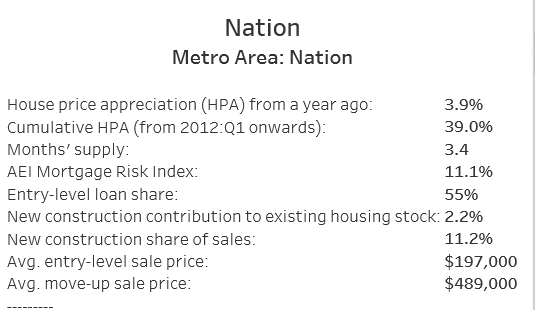
In fairness, the Bank asked for these comments from Professor Goodhart at relatively short notice. On the other hand, he was at the time a leading academic writer in the area, and a former senior practitioner.  And so I am still struck by the conflicting strands of thought that one finds in this short paper –  on the one hand, the idea of options to reward senior central bank staff for meeting a target they might specify themselves, and on the other a real concern about the potential disadvantages in separating fiscal policy too far from monetary policy, and thus some ambivalence about too much operational autonomy for the Reserve Bank at all.

Having said all that, in a way what struck me most about the Goodhart paper is what wasn’t there.    The UK’s disinflation experience in the 1980s had a wrenching one.  Economic historians will still debate the contribution of monetary policy to the peak of three million people unemployed, but no one seriously doubts it played a part.  At the time, there hadn’t been many economywide costs to the degree of disinflation New Zealand had so far managed –  the credit boom and stock market excesses were still in full swing-  and for a time that was to induce a degree of complacency among New Zealand advisers (I recall a meeting I was in perhaps a year or so later at which the then Deputy Secretary to the Treasury was telling the IMF about how modest he expected the costs of disinflation to be –  the head of the IMF mission politely begged to differ).

But in this paper there is no mention of output costs at all  – either those associated with getting inflation down to a much lower average level, or the short-term deviations of output from potential that would come to play such a large role in central bank thinking in subsequent decades.  Just none.  It is quite extraordinary  (and thus when Goodhart talked about tying staff pay to the inflation target, no sense of the political impossibility of giving central bankers financial bonuses for actions that would, at least temporarily, raise unemployment –  even if one could accurately and formally specify a binding target for the life of the options he proposed).

What of Reserve Bank staff ourselves?  From mid-1987 I was Manager of the Monetary Policy (analysis and advice) section at the Bank, and thus quite heavily involved in clarifying what it was we were going to target, how and when.   If memory serves, I think many of us were probably too complacent, perhaps a little blind, around the short-run issues, and tended to work on an over-simplified mental model in which once inflation was lowered to target all we really had to worry about were things like oil price shocks or GST adjustments (we didn’t explicitly – and probably not implicitly –  think much about significant positive or negative output gaps developing).

On the costs of disinflation itself, we were (on the whole) more realistic, but to some extent that depending on the individuals.  There were “battles” between what might loosely be called “the wets” and “the dries”, the former tending to emphasise the transitional costs and the latter the medium-term goal.   Some of the wets (I was mostly of the other persuasion) probably doubted that the 0 to 2 per cent inflation target, adopted in 1988, was really worth pursuing.  Perhaps what united us was a belief that a lot of other reform –  greater fiscal adjustment and more micro reform –  would reduce the costs of getting inflation sustainably down.

Some 20 years ago now I wrote a Bulletin article on the origins and early development of the inflation targeting regime.  In that article, I tried to capture some of competing models that influenced the legislative framework (a funny mix of independence –  not trusting politicians –  and accountability –  not trusting officials and having ministers hold them to account). I also reported some extracts from some of the papers we wrote (I often holding the pen) as the target came together.    From one early and somewhat ambivalent paper (and I can’t recall why shipping got so much attention that month)

Moreover, the Bank noted that “the potential improvements in living standards to be derived from more rapid and complete removal of import protection, and the deregulation of such grossly inefficient sectors as the waterfront (already under
way) and coastal shipping, far outweigh the real economic benefits of slightly faster [emphasis added] reductions in inflation”. In an early echo of what later became a dominant theme in subsequent years, the Bank argued that if price stability was to be pursued over a relatively short time horizon, everything possible needed to be done at least to try to influence expectations and wage and price-setting behaviour.

This post isn’t about having a go at Charles Goodhart, The Treasury, the Bank, or me and my colleagues who were working on some of this stuff at the time.   Mostly, it is just about history, and the sober perspective that history often provides –  things that seemed clear at the time seem less clear with the perspective of time, and some things –  that one later realises are really quite important –  that hardly get attention at all.  If it is an argument for anything, it is probably for more open and deliberative government and policy development processes, perhaps even for incremental and piecemeal (in Popper’s words) reform.   That probably never appeals to reformers –  perhaps especially not young ones  –  and perhaps there are occasions when it can’t be (practically) the chosen path, but blindspots are all too real.

As for the Reserve Bank Act 1989, if there were mistakes and weaknesses in its design (most especially the single decisionmaker model), it did probably serve New Zealand fairly well for several decades.  It was, almost certainly, superior to the Atkinson/Treasury scheme.   And yet one can also overstate the difference legislation really makes –  Australia having made a similar transition to low and stable inflation under legislation still much as it was first passed in 1959.


Entry level house prices in US cities

A few days ago an email turned up from the US think tank, the American Enterprise Institute, touting a new set of data.

Housing markets are inherently local, making them notoriously difficult to analyze due to the lack of reliable data at the local level. A new dataset from the AEI Housing Center, the first in a series of quarterly reports, aims to fill this void by analyzing housing market data for the 60 largest US metropolitan areas, as well as for the nation as a whole. The current dataset looks at housing data from 2018:Q4.

And so I clicked the link.  This was the summary national data

US national housing

US$197000 for an “average entry-level sale price” caught my eye (that is about NZ$292000 at the current market exchange rate, and of course Americans are –  on average – earning more than New Zealanders).  And of course that is a nationwide number, including the fruit of such dreadful housing markets as those in and around San Francisco.

So I started checking out some of the data for some of the cities (metropolitan statistical areas).

Here were the most expensive ones (in USD terms)

San Jose 511000
San Francisco 485000
Los Angeles 427000
San Diego 419000

At current market exchange rates, I guess those might be roughly comparable to prices in Auckland and Wellington.

But here is a chart of a group of cities (non-exhaustive) I found with prices of $NZ300000 or under.

US housing 2

Remember that these aren’t tiny places.  The whole dataset is for the 60 largest metropolitan areas.   Some of these places are smaller than Auckland, but I couldn’t see any smaller than about a million people.   A couple of the places on the chart are among the largest ten US cities.

Now perhaps, like me, you think New Zealand’s exchange rate is materially overvalued.   But even if you thought that a long-term structural fair value exchange rate was more like 0.5 (as distinct from the current market rate of .67) the median of the cities in the chart would still have average entry-level homes (new and existing) selling for not much over NZ$300000.

How do the AEI researchers derive their numbers?

The study tracks housing activity both for the entire market and for entry-level and move-up buyer segments. We only focus on institutionally financed sales (meaning we exclude cash sales or sales with seller financing.) We define entry-level as all sales below the Federal Housing Administration (FHA) 80th percentile price in a metro and quarter. The rational for a dynamic price cut-off at the metro level is that the share of entry-level buyers varies across the country. According to FHA’s Production Report, around 80% of FHA’s purchase loans go to first-time buyers, who mostly compete with other first-time buyers from other agencies for entry-level housing. The 80th percentile price cut-off, therefore, captures this market segment reasonably well. This is confirmed by the data. Across the nation, the entry-level segment consists largely of first-time buyers, while the move-up segment consists mostly of repeat buyers.

That looks plausible.  Perhaps people who know the data better will be able to pick holes in what they’ve done but –  especially given the pervasive role of federal agencies in the US housing finance market – the numbers are unlikely to be off by enough to materially affect the contrast between the government-induced scandal that is the New Zealand housing market.