Justice Collins, the OIA and the Reserve Bank

In the High Court earlier this week,  Justice Collins –  the former Solicitor General  – handed down a significant judgement in an Official Information Act case.  The judgement itself is a fairly easy read, and Otago University law professor Andrew Geddis has a nice summary of the issues and implications here.

Professor Jane Kelsey, of Auckland University, had sought from the Minister of Trade, Tim Groser,  material associated with the TPP negotiations.  The Minister declined Professor Kelsey’s application, prompting her (and several NGOs) to seek a judicial review of the Minister’s decision (which had been upheld by the Ombudsman).

Professor Kelsey’s challenge was largely successful.  It is a decision that does not reflect well on Tim Groser, and perhaps reflects even less well on the Chief Ombudsman.   As Andrew Geddis put it

The third audience for this judgment is the Ombudsman’s office, and the Chief Ombudsman Beverley Wakem in particular. Because it is fair to say that she does not come out of the judgment all that well. Not only does Justice Collins find that she apparently misunderstands how a quite key legal test under the OIA is meant to apply (at para. [139]), but her failure to pick up MFAT/Tim Groser’s ignoring of proper process is quite concerning.

After all, the Ombudsman is meant to be the primary check on those who hold official information failing to abide by their legal obligations. If that office is not noticing those failures – if it is basically waving through decisions that fail to comply with the OIA – then what is a citizen to do? The Courts are always there in theory … but in the real world this is a completely unrealistic avenue of redress because of the time and expense involved.

The judge reminded people of the important place the Official Information Act has in New Zealand’s system of government.  He draws on the 1980 report of the Danks Committee, which laid the foundations for the Official Information Act, highlighting the principles of open government that are reflected in the wording of the Act.  Indeed, the judge describes the Act as “an important component of New Zealand’s constitutional matrix”.  It imposes significant obligations on ministers and public servants (and other government agencies) –  and these are obligations that must be complied with, not simply aspirations to be met when it is convenient to do so..

What was the problem with the way Tim Groser handled the request?  The main issue was the blanket refusal to release any of the material Kelsey sought, without (a)  considering each piece of information individually, and (b) considering whether parts of any of these documents could be released.  Again in Andrew Geddis’s words:

the major flaw in MFAT’s/Tim Groser’s process was their adoption of a blanket approach to deciding whether or not to release any information. Reverse engineering the judgment a bit, it looks like MFAT/Tim Groser took this approach to the issue:

    • Jane Kelsey’s request was for lots and lots of material, which it would be a pain in the backside to have to go through;
    • MFAT/Tim Groser knew that they would have valid grounds under the OIA to refuse to release anything “interesting” contained in that material;
    • Anything left over after they redacted the “interesting” stuff would be useless for Jane Kelsey’s purposes;
    • Therefore, rather than waste time and effort going through all the material to weed out the “interesting” stuff, they instead decided not to release anything at all.

The problem with this approach is that it runs completely counter to the OIA’s basic purpose – to make any and all information available unless one of the specific reasons in the legislation applies. For the information holder to decide that it won’t provide information without actually looking at it and considering if there is a valid statutory reason for refusing its release inverts the way the OIA is supposed to work.

The judge did not rule that any specific bits of information have to be released.  It was a ruling about the need to apply proper process.  Going through lots of documents can be costly and inconvenient, but again (a) that was choice Parliament made in 1982, and represents an obligation on public agencies, and (b) the Act allows for agencies to specify a “reasonable” charge  especially if meeting the request would involve substantial collation or reaearch, and requires the agency concerned to  “consider whether consulting with the person who made the request would assist that person to make the request in a form that would remove the reason for the refusal”.     Tim Groser did none of these things.

Why I am writing about this case here?    First, because open government is an important cause, and the more people who are aware of these issues ,and abuses, the better.

But second, because I have been on the receiving end of several of these sorts of blanket refusals from the Reserve Bank of New Zealand.

I have written about one of them already.  I’d requested copies of the work the Reserve Bank had done on governance issues, and was flatly refused.

I got from holiday the other day to find two more examples in my inbox.

On 24 September, I received this response to one request:        

On 27 August you made an Official Information request seeking:

 Copies of the minutes of all meetings of the Reserve Bank’s Governing Committee held in the first six months of 2015

The Reserve Bank is withholding information under the following provisions of the Official Information Act:

  • Section 6(e)(iv) – to prevent damaging the economy of New Zealand by disclosing prematurely decisions to change or continue government economic or financial policies relating to the stability, control, and adjustment of prices of goods and services, rents, and other costs;
  • Section 9(2)(d) – to avoid prejudice to the substantial economic interests of New Zealand; and
  • Section 9(2)(g)(i) – to maintain the effective conduct of public affairs through the free and frank expression of opinions by or between officers and employees of any department or organisation in the course of their duty.

Section 6 of the Act provides conclusive reasons to withhold information. Section 9 of the Act requires the Bank to consider if the public interest in making the information available outweighs the public interest in withholding the information. The Reserve Bank recognises the tension between disclosure and confidentiality and has considered your request in light of that tension. Public disclosure, in summary form, is essentially what happens with monetary policy decisions in a carefully considered media release and the full text of the Monetary Policy statement. The process of deciding what to publish in these documents recognises and balances the tension between disclosure and confidentiality.

You have the right to seek a review of the Bank’s decision under section 28 of the Official Information Act.

And on 25 September I received this response to another request  

On 10 September you made an Official Information request seeking:

 Copies of all papers being provided to the Reserve Bank’s Board in respect of the September 2015 Monetary Policy Statement released this morning.

The Reserve Bank is withholding the information under the following provisions of the Official Information Act (the Act):

  • Section 6(e)(iv) – to prevent damaging the economy of New Zealand by disclosing prematurely decisions to change or continue government economic or financial policies relating to the stability, control, and adjustment of prices of goods and services, rents, and other costs;
  • Section 9(2)(d) – to avoid prejudice to the substantial economic interests of New Zealand; and
  • Section 9(2)(g)(i) – to maintain the effective conduct of public affairs through the free and frank expression of opinions by or between officers and employees of any department or organisation in the course of their duty.

The Act explicitly recognises, in section 4(c), that there are times when releasing information is against the public interest and provides for such circumstances with different types of reasons to withhold information. Section 6 of the Act provides conclusive reasons to withhold information and section 9 provides reasons that must be balanced with the public interest in making the information available.

Public disclosure, in summary form, is essentially what happens with monetary policy decisions – in a carefully considered media release and the full text of the Monetary Policy statement. The process of deciding what to publish in these documents recognises and balances the tension between disclosure and confidentiality.

You have the right to seek a review of the Bank’s decision under section 28 of the Official Information Act.

Taking them in turn, the first request was for copies of the minutes of meetings of the Reserve Bank’s Governing Committee for the first six months of 2015.   The Governing Committee, readers may recall, is the internal committee comprising the Governor, his two deputies and his assistant governor, set up by Graeme Wheeler and advertised as the forum in which the Governor would make major decisions (all legal decision-making authority, of course, rests with the Governor).

The response is puzzling in a number of areas.  First, the Bank appears to assume that my only interest in the minutes was the OCR decisions.  As the judge noted, it is not up to agencies to make assumptions about the interests of applicants, and in this occasion I had given no reason to suggest that OCR decisions were my primary interest.  In fact, my interest was is process and governance, and illustrating the lack of transparency and effective accountability around Reserve Bank decision-making, whether on monetary policy or other (policy or corporate) matters.  Indeed, I had heard, but was keen to verify, that minutes of this new forum consisted of little or no more than a single sentence record of the decision made.

There may well be material in the Governing Committee minutes that could be reasonably withheld under the Act, but the Bank has not made its case, or shown any sign that it has considered the contents of each of the individual sets of minutes.  It is almost inconceivable that there is nothing in any of those minutes  that could not safely be released (even if only the dates, attendees, and subject matter).  Justice Collins appears to have ruled that blanket refusals of this sort are not permissible.  I intend to pursue this matter with the Ombudsman, and may also request from the Bank copies any papers or emails that deal with their handling of my request.

The second request was for papers provided to the Reserve Bank Board in respect of the September Monetary Policy Statement.  Once the MPS has been released, the Board typically receives all the “forecast week” papers, and (anonymised) copies of the individual pieces of advice/recommendations provided to the Governor (Governing Committee) on what to do with the OCR.

Again, the Bank appears to have made no effort to look at each of the individual papers to determine whether all of each and every one of them should be withheld under the OIA.    Blanket refusals are simply not acceptable, according to Justice Collins’ judgement.

In (a rather slow and reluctant) response to a previous request of mine, the Reserve Bank has released all the forecast week papers for the March 2005 Monetary Policy Statement round. The character of the papers is no different now than it was then, and who can take seriously a claim that to release today’s equivalent of this paper (on business investment) would damage the New Zealand economy, prejudice the substantial economic interests of New Zealand, or impair the effective conduct of public affairs?    Clearly the main issue now is one of timing –  papers from 10 years ago don’t bother them, but papers from a few weeks ago do –  but they still need to make the case, paper by paper, and explain the reasons for their decisions.  I deliberately did not ask until the MPS itself had been released.  And I deliberately asked for the papers that went to the Board, not those that went to the Governor, because I knew that the OCR advice was anonymised before it went to the Board.   But senior staff should be able to provide advice to the Governor, in a professional manner, even if that advice is subsequently disclosed.  It is now not uncommon overseas for the views of individual Monetary Policy Committee members to be made public, with a relatively short lag.

In its reply, the Bank falls back on a common Bank line: background papers don’t need to be disclosed because

Public disclosure, in summary form, is essentially what happens with monetary policy decisions – in a carefully considered media release and the full text of the Monetary Policy statement. The process of deciding what to publish in these documents recognises and balances the tension between disclosure and confidentiality.

But this is simply unconvincing.  The point of the law is not to allow government agencies to release only what it suits them to convey to the public.    If that were so, for example, there would be no release of background Budget papers –  because the final Budget documents and “carefully considered” press releases would do the job.    Background papers are official information, and the presumption in the Act is in favour of release.

To be clear, I would expect that even if the Bank had taken an approach more consistent with the letter and spirit of the Act that there would have been a limited amount of material withheld from a few of the papers (eg those around judgements that might influence exchange rate intervention during the subsequent few weeks).   But each exclusion needs to be explicitly justified under a specific provision of the Act, not with a blanket refusal and a condescending stance of “we know what is the best balance between disclosure and confidentiality”.

Many of the specific issues in this request would be dealt with permanently if the Bank would pro-actively determine a suitable release policy for background MPS papers.  We now know that they are happy enough to release 10 year old papers, but not those a few weeks old.  I used to argue internally that, say, a six or twelve month lag would be a huge step forward, and involve no material risks for the Bank.

As I have been highlighting for months, despite its claims to the contrary, our Reserve Bank is not a very transparent organisation.  That is true of management and of the Board.  It is true of monetary policy, banking regulation policy, and corporate and budgetary matters.      Reasonable people might differ as to how open the Bank should be in each of these areas –  although it has never been clear what they have to hide, as distinct from an institutional cast of mind that says ‘we’ll tell you what we think you should know, when we think you should know it”.  But breaches of the law are a much more serious matter.  It increasingly looks as though the Reserve Bank –  like, no doubt, other government agencies – plays rather fast and loose with the provisions of the Official Information Act.  That should concern voters, and more immediately it should concern those charged with holding the Bank to account –  the Board, the Minister of Finance, the Treasury, and Parliament’s Finance and Expenditure Committee.
The Board reports…and says almost nothing

In late August I wrote a piece looking forward to the Annual Report of the Reserve Bank of New Zealand’s Board.   On 27 September, that report was published quietly –  buried inside the Reserve Bank’s own Annual Report, and with no mention of it in the Governor’s press release.    As far as I can see, the Board’s Annual Report got no media coverage at all.

That is both understandable and disappointing.  Understandable, because it is much harder to report what isn’t there.  And disappointing  because Parliament set up the Reserve Bank Board as the principal body charged with holding to account the Governor of the Reserve Bank –  who is probably the single most powerful unelected individual in New Zealand.   The Board, with unparalleled access to inside information, was intended to be the agent for the Minister of Finance and for the general public in holding the Governor, and the Bank, to account.

When the Reserve Bank Act was introduced, the vision of accountability was a pretty simple one:  if (core) inflation was away from target, the Governor was culpable.  It was pretty quickly realised that things were more complex than that.  In addition, the Reserve Bank (Governor) has been given, and has assumed, a lot more discretionary power in a much wider range of areas.  Properly assessing the performance of the Governor in handling his statutory responsibilities/powers requires some pretty substantial analysis.  And substantive accountability isn’t just about a group of the great and good declaring their satisfaction, but about laying out the arguments and evidence, including addressing and responding to the strongest arguments of the critics.

Over 25 years, the Reserve Bank’s Board has pretty consistently failed in that role, even since the requirement for a published Annual Report was introduced in 2003, and the Governor was removed as chair.  From time to time they have asked awkward questions in private  –  no one has ever adequately been able to answer the questions Viv Hall used to pose around quite what clause 4(b) of the PTA really meant  –  and Boards have often had their own individual awkward and dissatisfied members.  But the public face of the Board has been a consistently bland and affirming one.  From the public’s perspective –  and I suspect from that of members of Parliament –  the Board adds next to no value.

That isn’t primarily a commentary on the individuals involved.  I’ve had good relations with many of the able members over the years.  The problem isn’t really with the individuals but with the institutional arrangements and incentives.

The Reserve Bank Board is set up to look like the Board of a corporate.  Many of the people appointed to the Reserve Bank Board have served on corporate Boards.  On a corporate Board the CEO runs the day-to-day business, but the Board is ultimately responsible for the strategy (and for the CEO).  It can command resources.  A very close relationship between CEO and Board is vital to the successful functioning of the organisation, and  –  at least in public – the Board needs to fully back the CEO, at least until the day they fire him or her.

By contrast, the Reserve Bank’s Board has no involvement in setting strategy, or deciding policy.  It has formal input to a handful of not-overly-important decisions (eg the size of the dividend to recommend), and only two big roles –  the responsibility to recommend the appointment of a person as Governor (and no person can be appointed who has not been recommended by the Board) and the ability to recommend dismissal (although it cannot actually dismiss the Governor,  and contrary to what is stated in this year’s Annual Report the Minister of Finance can act to dismiss without a recommendation of the Board).

The Act is quite clear that the primary role of the Board is ex post review and accountability.  And yet it goes through the routines that look like a normal corporate Board.  There are monthly Board meetings, a Board audit committee, Board papers, the CEO sits as a member of the Board.  A senior staff member serves as Secretary to the Board.  The Board meets on Bank premises, and has no independent budget or staff resources of its own.  But for an accountability board, the asymmetry is profound –  the Governor has 300 staff who all work fulltime on Reserve Bank issues, while Board members –  not typically experts in the field –  devote a few hours a month to the issues.

The Board can ask for papers from management, but it can’t compel the production of such papers.  It typically meets not just with the Governor (a fellow member of the Board), but with Deputy and Assistant Governors present throughout the meetings, and with other staff in attendance as required.  And unlike the situation in most Crown agencies, even though the Minister of Finance appoints the members of the Board[1], he does not get to appoint the chair.  Rather Board members get to select their own chair, increasing the likelihood that the role will be filled by someone who gets on easily with the Governor.

It would be recipe, perhaps, for effective collegial decision-making, if the Board were a decision-making Board.  But the Board doesn’t have that role; it is supposed to be an arms-length review and accountability agency.  And human nature is to avoid asking too many hard questions of those one works closely with, and to defer to expertise.    That happens between the Board and the Governor, and within the Board.   Thus, both of the independent chairs of the Board have been former senior executives of the Reserve Bank, and the current chair actually spent six months as acting Governor, aiming (unsuccessfully) to become Governor himself).   Both are able people, and either might be well-qualified to sit in a decision-making Reserve Bank Board.  But when the role of the Board is to ask hard questions and hold the Bank to account, being a former senior staffer isn’t necessarily the  best qualification for a Board chair.  Yes, former staff can ask awkward questions too, but in general  – even if they have some technical insights other Board members won’t have – they will be too ready to see things through the eyes of the Governor and staff, to “have his back” as it were.  But we  – citizens –  need a robust and independent eye.  Awkward questions, not sympathy.   Too often, the Reserve Bank’s Board seems to see a significant part of its role as being to help the Governor spread  his story and to explain the choices the Governor is making.

Don’t take my word for it:  this year’s Board report states explicitly

With most Board meetings…the Board hosts a larger evening function to engage with representatives of many local businesses and organisations, and to enhance our understanding of local economic developments and issues……. This outreach is a longstanding practice of the Board to ensure visibility of its role among the wider community, and to facilitate directors’ understanding of local economic developments, and the wider public’s understanding of the Bank’s policies.

Worthy activities for management, but that isn’t the role Parliament envisaged for the Board –  whose purpose is to hold management to account, not help management explain their choices to (select elements of) the public.

All that is by way of getting to this year’s Board Annual Report (from p3).  It was better than last year’s in one respect.  This year’s report stretched out to a little over three pages (last year’s was less than two pages).  But most of it is still descriptive (and even that contains an error).  I counted 41 paragraphs in the report.  Of them, at most 10 could be considered having anything other than purely descriptive material (“these are the activities we undertake/documents we receive/meetings we attended”).

In my earlier post, I identified some issues this year’s report might cover, if it were to do well the sort of scrutiny and accountability job Parliament appears to have intended.

This year’s Annual Report might perhaps cover, in some depth, issues such as:

• The way that core inflation has now been well below the middle of the target range for some years

• The significant policy mistake that was made last year in raising the OCR repeatedly and only very belatedly beginning to slowly cut it again.

• The poor quality of Bank’s research, analysis, and argumentation around the housing market, and around the new investor finance restrictions in particular.

• The obstructive and non-transparent approach the Bank has taken, including with respect to compliance with the Official Information Act.

What is about the Governor’s performance, and stewardship of resources, that has led to these outcomes? And what steps are being taken to avoid a repetition?  Many outsiders might have a view, but the Board has unique access to the inner workings of the Bank, and the ability to grill management.

In fact, probably to no one’s surprise, there is no substantive analysis in the report of any of these issues, or any others.  The report has a single sentence stating its comfort with the new LVR restrictions.  In discussing monetary policy, the substantial policy reversal (in which the OCR was raised aggressively last year and then cut this year) was not even mentioned.  The Board appears to have had no concerns about the conduct of monetary policy at any point in the year, and simply offers the anodyne observation that they consider that “the Governor made appropriate monetary policy decisions”, while providing no analysis to defend that conclusion (although  I don’t take from that text that they gave the Governor an enthusiastic A+).  In neither monetary policy nor financial stability is there any sense of the events and policy responses being part of a chain of events stretching back over several years.

I’m not suggesting that the Board should have concluded that the Governor made mistakes.  Reasonable people might differ on that, but we should expect to see signs that the Board has thought hard about the issues, engaged with alternative perspectives, rather than just looked to gloss over any potential areas of awkwardness.  There is no sign of that this year, or in previous years.

In essence what we seem to have is a model in which the Board majority has mostly been interested in being something of a cheer leader for the Governor, helping get the Governor’s message across and not making trouble. But they don’t seem to realise that they work  not for the Governor but for the public –  who need robust scrutiny of powerful public agencies.

The Board’s Annual Report contains a mildly interesting list of some of the papers management provided to the Board during the year (I might OIA a couple of them).  But it must surely be a list than contains a major omission.  Readers may recall that I lodged an OIA request for copies of any work the Bank had been doing on reforming the governance of the Bank.  The Bank refused to release anything, in the process confirming the scale of the work programme they had underway (which appears to have included professional legal advice and discussions with the Minister of Finance).  Given the sensitivities the Board has historically displayed around anything to do with governance –  including Bulletin articles on related issues –  it is simply inconceivable that there were no discussions at the Board, or papers to the Board, on the issue during the 2014/15 year.  The Board might reflect that there would be at least as great a public interest in knowing that the Board has received, and discussed, a paper on that issue as on, say, “differences in methodologies in calculating and assessing the output gap”.

The Reserve Bank’s Board simply does not do its job well. It may be useful in some other roles –  perhaps an occasional sounding board for the Governor –  but the Board that is supposed to be focused on arms-length accountability and review, as agent for the Minister and the public.  And yet it has never once published a critical comment about the Bank (in subject matter which is riddled with uncertainty and where mistakes and revisions to judgements are inevitable)  It does not publish its minutes, its papers, its agenda (even with a lag) and is just as obstructive of OIA requests as Bank management.  It is simply not worth the money we spend on it.

Readers might wonder why I harp on the issue.  After all, the Board doesn’t cost that much.  But recall just how much power the Governor, personally, exercises.  The Board was supposed to provide the check on gubernatorial mistakes or misjudgements –  counterweight to the unusual amount of power vested in a single unelected official.  It has not done so, does not do so, and probably –  as currently constituted –  cannot really be expected to do so.  We need serious structural reform of the Reserve Bank: decision-making by committees appointed by the Minister of Finance, and ex post review and analysis (of all limbs of macro policy) by a body that is better resourced and operates at much greater distance from the Governor and his senior staff.

[1] Although the Governor himself has an input.  On one occasion, a former Governor adamantly insisted to the Minister that a certain former respected market economist not be appointed (he and the Governor had recently disagreed on the OCR).  The Minister gave way (appointing instead someone who had recently been the political adviser in the office of one of his colleagues).

The Raft of the Medusa and New Zealand monetary policy

I learned something from Graeme Wheeler’s speech this morning. Having not gotten round to reading Andrew Graham-Dixon’s Caravaggio, which has now lingered on our bookshelves for five years, it hadn’t occurred to me that the Gericault painting The Raft of the Medusa was influenced by Caravaggio; in Graham-Dixon’s words, it is a “modern secularised version of an altarpiece by Caravaggio”.

It is a striking painting, but this was a strange speech – and nowhere more so than in the concluding reference to The Raft of the Medusa.

There was plenty of routine material I agreed with. It gets boring to say it, but central bankers have to go on making the point that monetary policy has no material impact on longer-term real interest rates, longer-term average real exchange rates, or the longer-term real growth performance of the economy. For 25 years, real interest rates and the real exchange rate have averaged too high here, and real per capita growth has been too low. There are things that could have been done to change that, but changing the monetary policy framework isn’t one of them.

But beyond that it all got rather strange. He started his speech with the references to Caravaggio to play up the dark and turbulent nature of the last few years (as he sees them). How difficult it all is for small country central banks. More so, he suggests, than previously.

I guess Graeme Wheeler is a latecomer to central banking. He’s been Governor for only three years and spent most of his career doing stuff other than macroeconomic policy. So perhaps recency errors should be pardoned. But it isn’t clear why he thinks, or wants us to think, that his job is harder than that of his predecessors (Don Brash, the challenges of disinflation, or Alan Bollard, and the massive credit boom). Self-pity is rarely an attractive quality, and perhaps especially so when it comes from highly-paid powerful public officials. The Governor has been given a relatively straightforward job to do by Parliament, and – unlike many of his offshore peers – he still has all the conventional tools at his disposal. He has made some mistakes along the way, as his predecessors did (and his successors no doubt will too), but it just is not that hard to get it roughly right.

There are some analytical puzzles to be sure, but we (taxpayers) don’t pay Wheeler to answer all those. We pay him to keep medium-term trend inflation near 2 per cent. And he hasn’t done that job very well. Inflation has surprised on the weak side for several years. It has surprised both the Bank and the markets, but the Bank has the job of delivering inflation near target. Having fairly consistently failed to do so, a reasonable rule of thumb might have been something along the lines of “core inflation has been below the midpoint of the target for so long, and we don’t fully understand why, so we’ll hold fire, and not raise interest rates until (say) core inflation is actually back to around 2 per cent”. It isn’t a perfect rules – in an imperfect world there are no such rules – but it would be better than what we’ve had.

Part of Graeme Wheeler’s defensive strategy – which shouldn’t really be needed, because there should be no great shame in recognising a mistake and owning up to it – is to cloth himself in the problems of other countries. Many other advanced economies have also struggled with at best modest (per capita) economic recoveries, and surprisingly weak inflation. But most of those countries had little or no conventional monetary policy ammunition left. Interest rates were at zero. I don’t think Wheeler’s speech even mentions the point.

By contrast, New Zealand’s OCR at 2.75 per cent means the Governor (and his predecessor) had plenty of room, if he (they) had chosen to use it, to secure a rather more conventional recovery in New Zealand. As I’ve pointed out previously, in conventional New Zealand recoveries we see a couple of years of 4-5 per cent GDP growth. We’ve seen nothing like that since 2009, despite the very rapid population growth in the last year or two. The number of people unemployed has stayed high, and has recently been rising again. That isn’t because of the travails of the rest of the world, but because of the Governor’s misjudgements. Inflation wasn’t rising. He didn’t need to raise interest rates.

As he winds up his general observations, Wheeler includes a couple of other curious paragraphs. He claims that “economic management has come a long way since Paish described it in the 1960s as like driving a car with a brake and an accelerator and only being able to look through the back window.” He backs this claim, that things have come a long way, by reference to sophisticated models used by central banks today [and when is that expensive model, developed at taxpayers’ expense, finally going to be published?]. But then he changes course midstream, concluding that really the models can’t tell one much and are more use for posing questions than delivering answers. I entirely agree with that final observation, but then it is a puzzle as to why the Governor thinks that economic management has improved a lot since the 1960s. As the Governor found with his ill-fated tightening campaign last year, forecasting remains hard, especially about the future. And even the rear-view mirror is prone to mislead at times.

And then Wheeler winds up the whole speech with his paragraph about The Raft of the Medusa, the “forlorn and exhausted sailors” and the “wild seas” which are apparently “symptomatic of the world central bankers are trying to navigate”. It is all bizarrely self-pitying, especially for a Governor with instruments at his disposal. The steering wheel isn’t broken.  The hull isn’t holed.

Here is the Wikipedia summary of the story of the painting.

it is an over-life-size painting that depicts a moment from the aftermath of the wreck of the French naval frigate Méduse, which ran aground off the coast of today’s Mauritania on July 2, 1816. On July 5, 1816 at least 147 people were set adrift on a hurriedly constructed raft; all but 15 died in the 13 days before their rescue, and those who survived endured starvation and dehydration and practiced cannibalism. The event became an international scandal, in part because its cause was widely attributed to the incompetence of the French captain

Great painting, but of a terrible event, for which the captain had to take blame.  The French public knew that.

The mismanagement of New Zealand’s monetary policy in recent years springs to mind. Fortunately, no one dies from those sorts of mistakes, but thousands of people are unemployed today who would not have been if the Reserve Bank of New Zealand – and specifically its Governor – had not made repeated choices – and it was pure choice, unlike the situation in ZB countries – to hold interest rates persistently higher than they needed to be. The apparent indifference of New Zealand’s elites – and of the Governor and his Board – to the awfulness of the involuntary unemployment (“forlorn and exhausted”?) is something I still struggle to understand.

Some thoughts on Bernanke’s book

Ben Bernanke must have been busy.

Passing through Denver airport last Tuesday, the day after the book had been released,  I found a large pile of autographed copies of Bernanke’s new book The Courage to Act.    That was one bookshop in one city (not even one of the twenty largest in the US), and it had me wondering just how many days the former head of US central banking system had had to devote to autographs.  I guess even eminent  authors have to earn their –  no doubt rather large –  advances.

The stock of books on the post-2007 financial and economic crises continues to grow.  And it is still early days.  We can expect many more in coming decades –  akin perhaps to the continuing flow of works on the Great Depression, and the unresolved controversies that still  surround that episode.

Many of the key US participants have now published their accounts:  Hank Paulson, Secretary to the Treasury (to January 2009), Tim Geithner (New York Fed, and then Secretary to the Treasury), Sheila Bair (head of the FDIC).   And now Bernanke has joined them.  Each has a story to tell, and a case to make –  typically, a reputation to burnish or defend.

Bernanke’s book written for a mainstream intelligent lay audience. Plenty of copies are likely to be unwrapped on Christmas morning

For anyone who closely followed the crises, and their aftermath, there isn’t much new in Bernanke’s book.  It is a good refresher as the specific dates and events begin to blur in the memory.  And although no one will buy the book for story of his upbringing story, I found his account of a Jewish boy growing up in protestant South Carolina in the 1950s and 60s interesting.

It isn’t a great book by any means.  The writing often feels a bit pedestrian, and although he enlisted a former reporter to work with him on the book, that former reporter was on a year’s leave from the Public Affairs Division of the Federal Reserve.   Enhancing the sense of being written a little too close to the events and people he describes, Bernanke records that after leaving the Fed on Friday 31 January 2014 he started work in the book, from his new perch at Brookings, the following Monday.  I guess market demand (and the scale of publishers’ advances) was at its peak immediately after he left the Fed.  I hope he thinks about another substantive and more reflective contribution, perhaps aimed at a narrower audience, in 10 or 15 years’ time.

Bernanke does acknowledge the odd mistake, but they are “easy” ones, around the timing of particular interest rate adjustments.  Mostly this is a defence of his record, without actually engaging with any more-substantive critiques or alternative views.  In some ways, I found that a little surprising, especially in view of the dismal economic performance of most of the advanced world since the crises.  Arguments that seemed compelling in 2008 or 2009 – when a fairly fast snap-back in economic activity, employment  and inflation pressures were expected  – must surely look at least a little different now?

Here are some of the specific aspects of the book that struck me:

Bernanke doesn’t seem to have met a bailout he didn’t like.  Even in hindsight he does not think Bear Stearns should have been allowed to fail and close. He wanted to bail-out Lehmans (constrained only by lack of legal authority for either the Fed or the US Treasury) despite the enormous losses that Lehmans incurred.  He thought that holders of sovereign debt in Europe should not have been exposed to the possibility of loss, and appears not to consider that (eg) wholesale creditors of Irish banks should have been exposed to losses.  Somewhat to my surprise, he is not critical at all of the far-reaching guarantees offered to Irish bank creditors in October 2008, which triggered the range of guarantees around the world.  And he acknowledges that he favoured putting in place comprehensive guarantees for US banks (rather than the targeted, on new issues, wholesale guarantee approach that was eventually adoped [and which was also adopted for wholesale issues in New Zealand]).

In his defence, Bernanke might argue that the US did not in 2008 have good mechanisms for dealing with failing banks.  But in an interview with PBS the other night, I heard him acknowledge that “too big to fail” issues have still not been fully addressed in the US.    And in the book there is nothing sustained on the nature of the moral hazard to which such bailouts –  and the prospects of them being repeated in future –  is likely to give rise to.  Having come through the largest financial crisis in US history that is disappointing.

It is easy for people who spend their entire working lives in the public sector to assume too readily the benevolence and competence of government agencies and interventions.  Most of Bernanke’s career was spent in academe, but he has a fairly heroic view of public officials and their contributions.  There is no sense at all, anywhere in the book, of any concept of “government failure”, or of any sense that well-intentioned official interventions can sometimes (often?) have unintended adverse consequences.  Not unrelatedly, without directly addressing the issue, there is a strong sense that the crises were caused by the private sector, with courageous government officials intervening to save the private sector from itself.  It is a common view, but one might have hoped that someone with Bernanke’s academic stature might have been better able to make the case, including by dealing with stronger arguments of the sceptics.  His is a technocrat’s world. The one group he is consistently critical of is the US Congress and although one might sympathise to some extent, Bernanke shows little sign of appreciating the importance (or reality) of genuine differences of ideology or worldview.  Like many bureaucrats, he has lofty distaste for political theatre and the messy world of dealmaking –  but then, like them, he never had to face an election.

There is a paragraph towards the end of the book when Bernanke recounts a farewell dinner held in early 2013 when Tim Geithner ended his term as Secretary to the Treasury.    The attendees were former Treasury secretaries and former heads of the Fed.  Bernanke reflects:

Government policymaking at the highest levels involves long hours and near-constant stress, but it is exciting to feel part of history, to be doing things that matter.  At the same time, we all knew the frustrations of struggling with extraordinarily complex problems under unrelenting public and political scrutiny.  Rapidly changing communications technologies….seemed not only to have intensified the scrutiny but also to have favoured the strident and uninformed over the calm and reasonable, the personal attack over the thoughtful analysis.  In a world of spin and counterspin, we all knew what it was to become a symbol of a moment in economic history –  to serve as an unwilling avatar of Americans’ hopes and fears, to become a media-constructed caricature that no one who knew us would ever recognise.  But that’s the baggage that comes with consequential policy7 jobs, as we all knew too well.  The deepest frustration we shared, it soon became clear, was not with the baggage but with government dysfunction itself.

Technocrats as sacrificial heroes, saving the world from politicians and private markets…..

And yet, curiously, Bernanke seems untroubled by the continued growth in the size of government (whether spending/GDP, or the regulatory state). Ultimately those are choices made by the same Congresses that he views with such disdain.

I could go on at length, but there were several other areas of the book that left me disappointed:

  • There was no sustained engagement with the question of why, eg, real GDP per capita is still so far below the pre-crisis trend level (or, for all the contrasts he attempts to draw between himself and the Depression-era policymakers, why in many countries the record eight years on from 2007 is worse than that eight years on from 1929)
  • Bernanke is confident that (successive rounds of ) QE was the right policy, but actually offers little substantive basis for believing that QE made very much sustained difference at all.  Would US bond yields really have been much higher in the last few years absent QE?
  • Somewhat relatedly,  Bernanke does not discuss at all issues around removing or alleviating the zero lower bound on nominal interest rates.  In one sense that isn’t too surprising  – he started writing the book just a few days out of office, and ZLB issues can quickly get quite technical –   but for someone of the academic stature of Bernanke not even to have addressed the issue is a bit disappointing.    Perhaps he thinks nothing can be done, or should be done, but with year after year of policy interest rates near zero, it is not as if the ZLB proved to be a short-lived (or Japanese) curiosity that no one now needs to worry about.
  • Bernanke had a US-specific job, but I thought his treatment of the rest of the world was disappointingly weak.  Of course, US readers often aren’t that interested in the rest of the world, but I thought he was far too easy or glib about what could or should have been done in Europe (the poor old German taxpayer, facing not-low debt levels and a falling population, should apparently have spent a lot more).  And I spluttered when I got to the references suggesting that the IMF, under Strauss-Kahn and Lagarde, had shown no signs of favouring Europe.    And, as a hobbyhorse of mine, there wasn’t much sign that Bernanke has ever thought seriously about what marked out the countries that experienced crises from those that did not (there is, for example, only very brief reference to Canada), and whether the incidence of financial crisis can explain much about how respective economies have performed since 2007).
  • And there was nothing at all on the still extraordinarily large role the government plays in the housing finance market in the United States –  something that goes well beyond anything seen in most OECD countries, and which at least some observers suggest might have contributed to the severity of the US crisis..

I had been meaning for some time to write something about the contrasts between the legal constraints on central banks and government ministers in the United States on the one hand, and New Zealand on the other.  This was prompted by reading a fascinating book, To the Edge: Legality, Legitimacy, and the Responses to the 2008 Financial Crisis, by Philip Wallich, and contrasting it with our law, and my experiences in our Treasury during the 2008/09 crisis.  The powers of the Reserve Bank of New Zealand and New Zealand’s Minister of Finance in dealing with financial crises are extraordinary broad by comparison with those of the US authorities (either in 2008/09 or now).  No question could have arisen as to the Reserve Bank’s ability to lend to any institution it chose, or as to the ability of the Minister of Finance to guarantee any liability or institution he chose.  The US situation was very different, as Bernanke recounts.   There is a real tension here.  The New Zealand powers are frighteningly broad in the wrong hands –  as I read the Public Finance Act, the Minister of Finance could at a stroke bankrupt New Zealand, with no requirement for Cabinet or parliamentary approval –  but they are also very flexible.  I’m not at all sure what the right balance is, but would have been interested in Bernanke’s view on such issues in the light of his experience.  My guess is that he would favour more flexibility than the US had then or now, but how are citizens to be protected from official caprice and well-intentioned misjudgement?  Congress might be quite as bad as Bernanke suggests, but it is they who have an electoral mandate that the best central banker will never have.

Finally –  and perhaps mercifully –  there was nothing in the book of the numerous visitors who must have tramped through Bernanke’s offices over the years.  I wonder what he made of repeated meetings with visiting New Zealand delegations (that I used to read the file notes of) or those of the myriad visitors from other countries.  As a reserved academic, I suspect it wasn’t a highpoint of the job, but….at least they weren’t members of the US Congress.

I suspect Bernanke would have felt more at home in a system of government –  akin to ours, or that of Canada or the UK –  in which the legislature was kept more firmly in its place by the political executive, and there is perhaps less robust media scrutiny.    He ended the book

It is hard to avoid the conclusion that today we need more cooperation and less confrontation in Washington.  If government is to play its vital role in creating a successful economy, we must restore comity, compromise, and openness to evidence.  Without that the American economy will fall tragically short of its extraordinary potential.

For all its problems, of course, the US remains strikingly more successful economically than most of the countries  –  even the advanced democracies – where MPs make rather fewer problems for senior officials.

Bagehot on reforming the Reserve Bank Act

In a comment the other day on my post outlining a possible alternative governance model for the Reserve Bank, Andrew Coleman at the University of Otago included some quotes from Walter Bagehot’s 1873 classic work Lombard Street: A Description of the Money Market (available free here).

The quote that particularly took my fancy was some concluding remarks Bagehot made about the need for changes to the structure and governance of the Bank of England.

“There should be no delicacy as to altering the constitution of the Bank of England. The existing constitution was framed in times that have passed away, and was intended to be used for purposes very different from the present. The founders may have considered that it would lend money to the Government, that it would keep the money of the Government, that it would issue notes payable to bearer, but that it would keep the ‘Banking reserve’ of a great nation no one in the seventeenth century imagined. And when the use to which we are putting an old thing is a new use, in common sense we should think whether the old thing is quite fit for the use to which we are setting it. ‘Putting new wine into old bottles’ is safe only when you watch the condition of the bottle, and adapt its structure most carefully.”

He could have been writing about New Zealand’s situation now.

As I’ve pointed out, our Reserve Bank Act, and particularly the governance features of it, were designed in 1989.  Back then, there weren’t many modern international models to build on.  The provisions of the Act were designed to align with a vision of how core government departments would be run that has now been largely abandoned, they were designed for a conception of what the central bank would be doing that envisaged very little effective discretion, and they were designed before the Crown entities framework was developed for the many other non-departmental government agencies in New Zealand.

Those times have, in Bagehot’s words,  “passed away” and we now need a review and extensive revision of governance, transparency and accountability provisions of the Reserve Bank Act.  Discussion of the issue often focuses on monetary policy, but the governance of the Bank’s extensive powers in banking, non-bank, and insurance regulation is at least as important (and more challenging because the goals are less well-defined).  And as I have been highlighting in the last few weeks, we need to ensure much more openness from the Bank across all its functions, and some more effective structures for holding the Bank and its decision-makers to account.  Bagehot uses a biblical image, but we can go a little further: putting new wine [new expectations of what the Bank should do and how] into old wineskins [the 26 year old Act]  leaves the New Zealand system out of step, and is a recipe for some rather poor and unsatisfactory outcomes.

And with that, I’ll stop for now.  I’ll be back around 13 October,

A partial backdown from the Reserve Bank

Last week I ran a post about the Reserve Bank’s refusal to release the submissions on the new investor finance restrictions, and in particular the reliance the Bank appeared to be putting on the confidentiality provisions in section 105 of the Reserve Bank Act. Those provisions appear to prohibit the Bank releasing any information  it received from anyone “ relating to the exercise, or possible exercise, of the powers conferred by this Part” of the Act.

As I noted then

This seems like a travesty of democracy. Submissions –  on major new public policy initiatives – can be disclosed to foreign central banks or supervisors, but not to the New Zealand public. Any views banks or members of the public might submit to the Reserve Bank on monetary policy would typically be discoverable under the OIA, but those on prudential matters are apparently not. And this is so, even though for for monetary policy there is a relatively specific objective for which the Governor can be held to account, while there is nothing remotely specific about how the statutory objectives for prudential policy should be measured.

…..

A system in which the Governor can tell us as much, or as little, and then with his own slant, on the submissions he receives should be seen as simply unacceptable.  In this case, quite a simple amendment to the Reserve Bank Act would rectify the situation, making explicit that submissions on proposed changes to conditions of registration, or any other restrictions that affect all institutions, are not covered by the section 105 exemption, and should routinely be published on the Reserve Bank’s website.

And noted that.

Of course, if anyone else wants to request copies of the submissions, the Bank should presumably respond immediately declining their request and explaining why.  Unless they want to reconsider and change their interpretation of section 105, any delay would itself be a breach of the Official Information Act.

I knew then that another request had been made and had not been responded to immediately.

Today, the Reserve Bank has responded to that request, and there has been a major change of heart .

Having told me that it would be too much work to release the papers, that the summary of submissions met the statutory requirements (both laughable arguments), and that in any case much of the each of the submissions would have to be withheld, they have had a (welcome) re-think.  The Reserve Bank has now released in full, on its website, the submissions made by all people and entities who are not banks regulated by the Reserve Bank.

This is a significant step forward. It is probably the first time the Reserve Bank has released any submissions on proposed regulatory changes.  I hope that this now sets a precedent, and to check that I have requested copies of the submissions on the regulatory stocktake.

However, the Reserve Bank is still refusing to release submissions made by banks.  It asserts that these are protected by the confidentiality provisions in section 105 of the Reserve Bank Act.  I describe it as an “assertion” because there is no supporting argument or evidence in the letter to Jenny Ruth as to how section 105 protects bank submissions but not those made by other submitters.  Here is what the Act says:

  • This section applies to—

under, or for the purposes of, or in connection with the exercise of powers conferred by, this Part:

    • (b) information and data derived from or based upon information, data, and forecasts referred to in paragraph (a):
    • (c) information relating to the exercise, or possible exercise, of the powers conferred by this Part.

There is no hint I can see of any legal differentiation between material supplied by banks, and material supplied on the same issue by other parties.

If the Bank has a strong legal case, they should let us see it.  I’m certainly not suggesting that they should break the law and release bank submissions if they are legally prohibited from doing so, although I suspect  that they may be doing so by releasing any submissions at all

Whatever the law currently says, is there a case for withholding bank submissions?  I think the answer is no, and if anything it is much more important that bank submissions are discoverable than that those of other submitters are.  After all, banks are regulated entities and the idea that regulated entities should be able to lobby the regulator in secret, and we (citizens) have no ability to see what arguments they have made goes strongly against the principles of open government.   Those concerns about regulators and the regulated getting too close were what motivated Ross Levine to write an entire book, The Guardians of Finance (which I wrote about here).  If anything, there is probably a case for more material on banks to be made public, as I noted in yesterday’s post, but certainly their submissions on policy proposals should not have legislative protection.

In conclusion, I wanted to make two other observations.

First, the Bank has asserted that the “summary of submissions we’ve published accurately and fully summarises the responses received from banks”.  If that is so, it would certainly be welcome, but as their summary certainly didn’t accurately or fully summarise my submission, we have no reason to be confident as to how they have reported bank submissions.

And second, I received a letter from the Reserve Bank this afternoon attempting to rationalise their refusal to release anything to me when I sought the same material.  Here is what they had to say:

Subsequent to publication of our summary of submissions and response to submissions for our consultation on adjustments to restrictions on high-LVR residential mortgage lending, the Bank received another Official Information request seeking copies of all submissions. The timing of these two equivalent requests is a differentiating factor in the Bank’s responses to these requests.

  • Your request was made prior to us doing the necessary work to collate, assess, and consider our response to the submissions and then publish our summary and response. 
  • The subsequent request, from a newspaper, was made on 24 August, after we had completed our assessments and published the summary and our responses.  

The difference in timing is significant because one of the primary reasons for declining to provide information to you was, as envisaged by section 16(2)(a) of the Official Information Act, that doing so would impair efficient administration due to the need to repeat the work assessing submissions for their primary purpose while also assessing them to respond to your request. With the primary assessment work completed, we do not need to repeat it for the Official Information request made on 24 August. Accordingly, our response to the request we received on 24 August is that we are releasing submissions made to us by individual and by non-bank organisations that we do not regulate,

Again, this simply not persuasive, and appears to be a rather desperate ex post rationalisation for what is clearly a change of view.   For any OIA request, the Bank has 20 working days to respond, and can (and has previously, and regularly, done so) extend that time by another 20 working days if necessary.  There was no need for any repetition, or any disruption to their deliberations (especially as they had openly signalled that they intended to turn the submissions around, and announce the Governor’s decision, quite quickly).

I don’t hold it against people when, having reflected more fully on the issue, they change their minds.  I’ve welcomed the partial step forward reflected in the release of the material today.  But it would best not to pretend that the two requests were so different that they had good legal grounds to refuse my request altogether, but were also legally required to release today’s material .  One decision was a mistake –  hopefully not a wilful one.

As I noted last week about section 105

Like so much about the Reserve Bank Act, it is past time to reform these provisions.  Good access to official information is vital if we are to ensure that such a powerful institution is to be robustly accountable.  At present, there is far too little effective accountability and scrutiny.  A system in which the Governor can tell us as much, or as little, and then with his own slant, on the submissions he receives should be seen as simply unacceptable.  In this case, quite a simple amendment to the Reserve Bank Act would rectify the situation, making explicit that submissions on proposed changes to conditions of registration, or any other restrictions that affect all institutions, are not covered by the section 105 exemption, and should routinely be published on the Reserve Bank’s website.

The Reserve Bank’s “regulatory stocktake”

The Reserve Bank has had out for consultation a document described as a “regulatory stocktake of the prudential requirements applying to registered banks”.  In fact, it covers only a limited range of issues, as most of the more important issues were ruled out in the terms of reference.   Submissions close tomorrow.

I hadn’t really planned to make a submission, but some discussions got me thinking a bit more about disclosure requirements and the way in which this document seemed to risk leading to less information being available to depositors and creditors, while more information was provided confidentially to the Reserve Bank itself.  That seems wrongheaded, when the focus of the regulatory regime has long been intended to be to support a framework in which creditors carry the risks if things go wrong, not the government or the Reserve Bank.

So I have written a brief submission, which is available here.

Submission to RBNZ regulatory stocktake Sept 2015

I focused on only two aspects.  The first is around the “fit and proper” tests the Reserve Bank imposes for directors and senior managers.  There is no evidence that this process is adding any value in promoting the soundness of the New Zealand financial system.  I raised some questions, and proposed a much less discretionary, disclosure-focused, alternative approach to the issue:

No doubt there will be people (and perhaps there already have been) who were employed by failed finance companies coming up for Reserve Bank approval in the next few years.  In some cases, those people will have had no responsibility for the failure, and in others there may have been some culpability.  But business failures happen, and they aren’t always a bad thing (indeed, unlike some systems, our banking regulatory system is explicitly designed not to avoid all failures).  Why is the Reserve Bank better placed than the registered bank concerned to reach a judgement on whether any previous involvement with a failed finance company should disqualify someone from a future senior position in a bank (or other regulated financial institution)?

In a similar vein, I wonder if the Reserve Bank has done any sort of retrospective exercise and asked itself how likely it is that, with the information available at the time, it would have rejected any (or any reasonable number) of those responsible for the 1980s failures of the DFC and the BNZ.  Done in a suitably sceptical way, it would be an interesting exercise

I’m not suggesting there be no rules at all.  My two specific proposals would be as follows:

  • conviction for an offence involving dishonesty in the previous 10 years should be an automatic basis for disqualification from such senior positions.   It wouldn’t be a perfect test, but it is certain and predictable, and probably better than a “we don’t like the cut of your jib” sort of discretionary judgement exercised by regulatory officials.  And it doesn’t hold the false promise of regulators being able to sift out in advance people who might, in the wrong circumstances, later be partly responsible for a bank failure.
  • a requirement that a summary CV for each director and key officer be shown on the registered bank’s website.  Those summary CVs might be required to list all previous employers or directorships, and any previous criminal convictions and formal regulatory actions against the individual.

By contrast, the current fit and proper tests seem to be an additional compliance cost, for no obvious (or demonstrated) public policy benefit in safeguarding or promoting the soundness of the New Zealand financial system.

And the second area I commented on was around financial disclosure requirements.  I noted that if the disclosure statements were not providing the information the Reserve Bank needed (as they state), they clearly couldn’t be providing the information that a prudent creditor/depositor would find useful in evaluating his or her bank.  Accordingly, I proposed changes that would materially reduce compliance costs and materially increase the availability of rather more timely data to creditors/depositors –  those, that is, whose money is at risk.

In the consultative document, the Reserve Bank canvasses the possibility of further reducing the amount of information made public, while potentially further increasing the amount of private information the Reserve Bank itself obtains from banks.  That seems a wrong-headed approach, and quite inconsistent with the desire to promote  (a) market discipline and (b) an expectation that government bailouts are not the option of first resort if a bank runs into difficulty.  If the Reserve Bank has revealing private information not available to depositors, and the Bank subsequently  fails, why would a reasonable small depositor not argue with some force that the responsibility for her loss of money rested, proximately, with the Reserve Bank?  Such arguments, correct or not in some narrow economic sense, will strengthen the (already high) likelihood of government bailouts.

My alternative proposal is to reshape disclosure requirements so that depositors and creditors are given the same information that the Reserve Bank considers necessary for it to be able to monitor the health, and emerging risks, in individual banks.

In other words, scrap the existing disclosure requirements completely (which would, no doubt, materially reduce compliance costs), and require instead that all regulatory returns that banks provide to the Reserve Bank be published on the relevant bank’s website within, say, an hour of the information being sent to the Reserve Bank.  If the private information is valuable to the Reserve Bank it would also be valuable (at least in principle) to depositors/creditors and those in the private sector monitoring banks on their behalf.  It is, after all , the money of the depositors and creditors that is at stake,  not that of the government or the Reserve Bank.    And private readers have rather more incentive to use the information well than officials at the Reserve Bank do (however able or well-intentioned the latter may be).

Moving in the direction discussed just above would, of course, represent a substantial change in approach.  Timely statistical returns of the sort banks supply to the Reserve Bank can’t first go through a full audit sign-off and director attestation, but the Reserve Bank itself –  by its own revealed preferences –  clearly thinks that in terms of knowing what is going on on a timely basis, those protections are less important than getting timely information.  If things are very timely there will almost inevitably be the occasional error, but that is not an argument against the idea.  After all, even Statistics New Zealand (perhaps even the Reserve Bank) occasionally finds mistakes in its data.  The concern shouldn’t be errors –  people are human and will err –  but about the risk of being deceived.  But adequate protections against deliberate attempts to deceive either the Reserve Bank or creditors (by deliberately supplying erroneous or misleading information) surely either already exist in statute or common law, or could be legislated separately.  And the fact that the Reserve Bank’s own analysts would be reliant on the same data that were going public would provide an additional layer of comfort –  since the Bank is readily able to ask, and require answers to, probing follow-up questions.

…..

I am also not suggesting an absolutist approach to this issue.  I have no problem with the answers to ad hoc inquiries by the Reserve Bank of an individual bank not being published.  And in times when an individual institution may be approaching crisis, there probably needs to be greater confidentiality around the handling of the detailed information involved in crisis management (although such material should probably still be discoverable after the event).  Indeed, protecting that sort of information was a part of the justification for the (now abused) section 105 secrecy provisions in the Reserve Bank Act.  There is no foolproof dividing line, but I would suggest as a starting point that any statistical returns which are (a) regular, and (b) required of all (or a significant subset of) banks should be subject to my immediate disclosure rule.  And perhaps the Reserve Bank Board could offer an attestation in its Annual Report that it has satisfied itself that staff and management are operating the system in a way that ensures all regular supervisory information is being made available to depositors and other creditors.

It was a short list. I couldn’t think of any.

As a conservative, monarchist and Christian, I had been encouraged by the political success of Tony Abbott, and quite seriously underwhelmed at the idea of Malcolm Turnbull becoming Prime Minister of our closest ally, major trade and investment partner, and more generally the most similar country in the world to New Zealand.

On its own the latest round in the Italian-style revolving Prime Ministership in Australia wouldn’t have prompted a post on a blog that is mostly about economics and public policy issues.  But reading stories this morning in which the incoming Australian Prime Minister is quoted as praising John Key’s economic management was just too much.  Turnbull is quoted as saying

“John Key has been able to achieve very significant economic reforms in New Zealand by doing just that, by taking on and explaining complex issues and then making the case for them. And I, that is certainly something that I believe we should do and Julie and I are very keen to do that again.”

I grabbed a piece of paper from my bedside table and starting trying to jot down on the back of the envelope the “very significant economic reforms” in New Zealand over the last seven years.

It was a short list.  I couldn’t think of any.

Perhaps Turnbull had in mind the tax package of 2010?  Some of it might have been useful, but (a) it was pretty small in the scheme of things and (b), as the Treasury pointed out at the time, the net effect of that package was to raise the average tax rate on business income, not lower it.

From almost seven years of a Key-led government, I managed a few other small useful items for the list of reforms:

No doubt there are others, but if anyone can point me to a “very significant economic reform” undertaken in New Zealand since November 2008 I’d be grateful.  I don’t count closing the fiscal deficit.  It is welcome of course, but we’ve had persistent deficits despite record high terms of trade, and simply closing a deficit is not itself an economic reform.   Weak wage pressures across the economy have made fiscal management a lot easier than might have been expected.

And the problem with even the list above is the list of measures that could appear on a  “steps backward” list:

  • Higher effective corporate tax rates
  • The debacle of the earthquake-strengthening legislation
  • The continuing debasement of our skills-based immigration system, both in the way it is administered and in formal announced policy.
  • New overlays of financial market regulation
  • The re-establishment of direct government controls over who banks can and cannot lend to
  • The continuation of a regime of “corporate welfare”, including for example the Sky and Tiwai Point deals, and the smell that the Saudi sheep deal gives off
  • The degree of central government control of the Christchurch repair project, involving both wasteful projects (some of which may not finally go ahead), and the way central government has artificially boosted land prices and impeded the prompt redevelopment of the central city.
  • The continuing apparent decline in the rigour of public sector policy advice, and in the use of robust cost-benefit analyses in underpinning policy decisions.
  • Increased first home buyer subsidies.
  • Undermining housing affordability with mandatory insulation etc requirements for rental properties
  • Continuing increases in minimum wages, from very high levels (relative to median wages) at a time when unemployment is quite high, and policy was supposedly oriented to getting people off welfare.
  • Heavy investment in the newly state-repurchased loss-making Kiwirail

But, mostly, the story is just about the failure to do anything much.   I’ve previously quoted some quite-inspiring Key lines from a speech just before the 2008 election.

I came into politics because I believed New Zealand was underperforming economically as a country. I don’t think it’s good enough that so many New Zealanders feel forced to leave our country each year to seek higher wages in Australia. I don’t think it’s good enough that our average incomes lag so far behind the rest of the world. And I think it’s unforgivable that the Labour Party has done so little to address these fundamental challenges.

I believe that a very big step change is needed in our economic performance to ensure New Zealand can make the most of its considerable potential. Growing the economy of this country continues to be my driving ambition. I stand before you today ready to deliver on that ambition for New Zealand.

You have my personal commitment that if I am elected Prime Minister in eight days’ time I will work tirelessly over the next three years to deliver the stronger economic future our country deserves.

That commitment was made just before the Prime Minister was elected.  A year later, in its first report in late 2009, the 2025 Taskforce, established (and then abolished) by the current government included on one of its front pages another aspirational quote from John Key, now well-established as Prime Minister..  The quote the 2025 Taskforce used (from the SST of 8 Nov 2009) was “Our vision is to close the gap with Australia by 2025”

Fine words, but there has been almost no action.

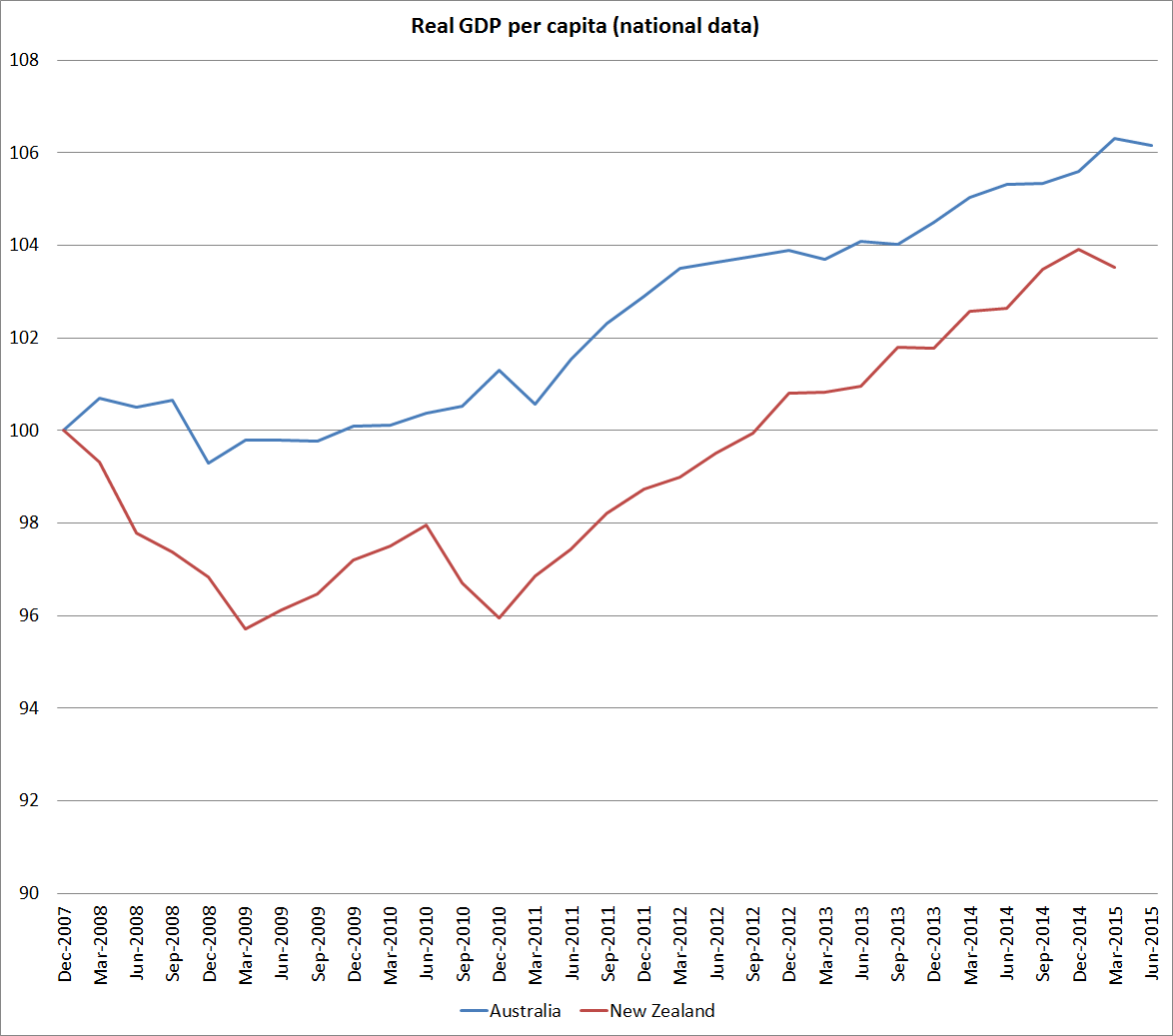
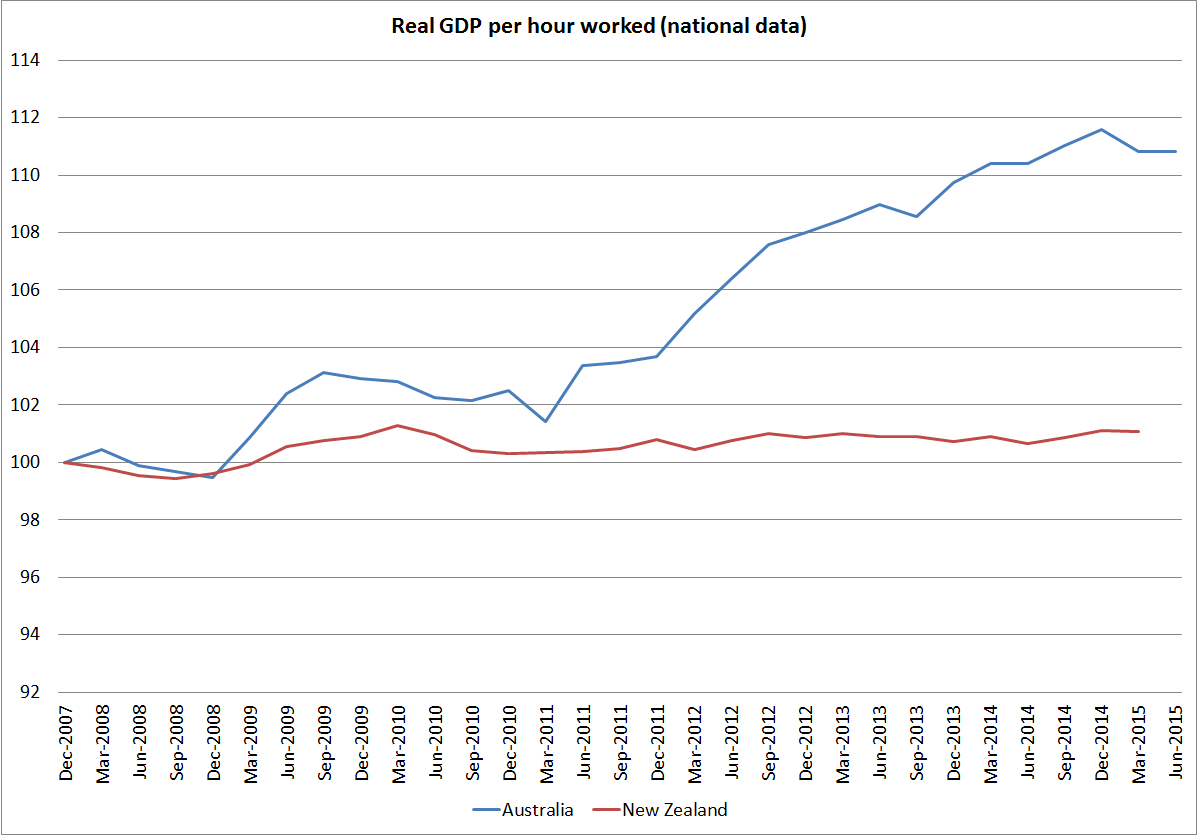
Fine words, but with no tangible results.  New Zealand has made no progress in closing gaps with Australia over the seven years John  Key has been Prime Minister –  not on GDP per capita, not on national income per capita, and not on productivity either.  If anything, we’ve drifted further backwards.  I put lots of charts in this post last week, but here are just a few reminders:

Real GDP per capita for the two countries, where we’ve done a little worse than Australia.

national real GDP pc

And here is real GDP per hour worked.

national real GDP phw

Of course, our Prime Minister has won three successive elections, the last two rather narrowly, and that must sound quite appealing to the backbenchers in marginal seats in the Liberal Party’s caucus.  But if Malcolm Turnbull is serious about economic reform –  which frankly seems unlikely –  he shouldn’t be looking across the Tasman for inspiration and example.

Housing, the Reserve Bank, and an advisory

In the wake of Thursday’s Monetary Policy Statement there has been a round of further comment on house prices and the risks around the housing market.  In fairness to the Reserve Bank, it wasn’t a focus of their document, and comments from the Governor and Deputy Governor seem to have been made in response to questions, at the press conference and at the Finance and Expenditure Committee.

I had been a little sceptical of the strength of the nationwide housing market, and pressures are clearly still concentrated in Auckland and, to a lesser extent, nearby cities.  But, equally, the overall level of activity appears to have picked up.  Here is my favourite timely chart, of per capita mortgage approvals.

mortgage approvals

Earlier in the year. mortgage approvals were running no faster than they were last year.  In the last couple of months the pace has clearly picked up.  That shouldn’t be surprising, as the interest rate increases last year have gradually been reversed, but it is worth bearing in mind not only that the rate of approvals is still below the decade average, but it is barely two-thirds the rate in the peak years of this series, 2005 and 2006.  And the mortgage approvals series does not go back far enough to capture 2003, the year when national house prices rose 23 per cent.  There is no nationwide house price boom.

Housing market activity has clearly picked up.  As it should have.  I don’t think I’ve seen any commentator make the (perhaps too obvious) point that cuts to official interest rates work by a combination of lowering the exchange rate, and encouraging more interest-sensitive expenditure.  In part, that is about bringing forward some spending from tomorrow to today.  But it is also about boosting the prices of long-lived fixed assets, which (in part) encourages people to build instead of buy.  If house prices hadn’t risen to some extent  – relative to some unobserved counterfactual –  in response to lower interest rates. there would probably be reason for concern. Real long-term interest rates have fallen by around 50 basis point since this time last year (15 year inflation indexed bond).

But, of course, this brings us back to the question of what is a fixed asset.  Houses are long-lived assets, but –  in principle –  a new house can be built quite quickly.  And lower interest rates actually reduce the cost of new building a bit (finance costs are non-trivial).  Land is in fixed supply, but unregulated land isn’t particularly valuable or expensive.   Good dairy land goes at perhaps $50000 per hectare.  Lower expected long-term interest rates should raise the unregulated market price of land – at these low interest rates, a 50 basis point change in long-term real interest rates might make quite a large difference, all else equal.  The unregulated price of land is a small component in the cost of a suburban house+land.  But the unregulated price isn’t what we observe.  Instead, what has driven land (and thus house+land) prices sky high is the interaction of two policies – high levels of inward immigration, mostly under direct government controls, in conjunction with tight land use restrictions.  The combination has been disastrous in Auckland.   Non-resident purchases probably haven’t helped either.  With much looser land use restrictions, house+land prices would be much less sensitive to demand pressures (whether from population or interest rates) than they are now.

The Reserve Bank talks of the Auckland market being in “dangerous” territory, but mostly that seems to be slightly inflammatory rhetoric more than the fruit of hard analysis.  Yes, house price to income ratios are higher than in most cities around the world.  And yes, that is a social and political scandal.  But it is largely the outcome of real forces –  not underlying economic ones, but mostly government policy-controlled ones.  They also aren’t, by contrast, the result of some speculative frenzied lending binge (unlike many of the boom-bust markets in the US last decade).  Of course, many property purchases need credit, but credit growth remains pretty subdued, and housing market activity (per capita) remains well below previous peaks. And the Reserve Bank has pointed to no evidence of a material deterioration in credit standards.  If that sort of deterioration is going on, it is surely incumbent on the Reserve Bank to illustrate the evidence (as, say, Waynes Byres recently surveyed the Australian evidence).   Moreover, banks operate on a nationwide basis, and as the Governor observed the other day, the “problem” is largely an Auckland one.  That suggests looking at Auckland-specific causes –  and the interaction of immigration policy and land use restriction policy is the most obvious one.

The Deputy Governor was quoted the other day as telling MPs that “it’s always very difficult to pick the top of any asset price cycle”.  Indeed, and nor is it the job of officials to do so.  But it is also very difficult to know what the equilibrium price of an asset is, especially when the market for that asset is so heavily distorted by policy interventions, in this case policy-driven population growth running head on into land use restrictions.  Auckland prices are very high, scandalously so, but there is nothing that guarantees –  or even offers a high degree of certainty – that real house prices will settle any lower over the longer-term.  I hope they do, and I’m sure most of those currently shut out of the Auckland market do, but this is not just (or even primarily) a market process.  The same goes for Sydney, or London, or Vancouver, or San Francisco.  All the Reserve Bank should be doing is monitoring lending standards, and  –  most importantly  – ensuring that banks have ample capital to cope with things going badly wrong.  They’ve done the second part of that job, and on their own numbers they (and the banks themselves) have done it well.  Beyond that, if they can add in-depth and considered research that sheds light on the housing issues that might be welcome –  although the research resources might be better spent on getting monetary policy right – but beyond that the housing market just isn’t their job.

Just briefly, I noticed a soft interview with the Governor in today’s Herald. It is a platform for the Governor to advance his (remarkably upbeat) case, rather than an occasion when the journalist posed any searching questions. Some of it is just misleading, or straight out wrong.  New Zealand’s economic performance in the last few years has been mediocre at best –  better, certainly, than many of the euro area countries, but generally underwhelming  – poor by historical standards, and no better than, say, the United States which was at the epicentre of the financial crisis.  There has been no per capita real income growth at all in the last 18 months, and real per capita GDP is not much higher than it was in 2007.  That isn’t (mostly) the Bank’s doing, but it isn’t a good performance either.  Oh, and the unemployment rate –  had I mentioned that before –  has hardly come down since the severe recession of 2008/09.

The Governor attempts to rebut some (currently straw man) critics.

Wheeler is keen to make the point that the bank is anything but robotic with its primary focus on inflation.

Critics, particularly on the political left, have called for the bank to broaden its outlook.

“Some people say … we don’t care about growth. But I think every central bank thinks quite deeply about how the economy is going, what’s happening to demand, to investment, to unemployment.”

Perhaps, but right at the moment –  and for the last five years –  a rather more “robotic” focus on actual inflation might have produced better outcomes than we’ve seen.  The Governor seems totally unbothered about his persistent inflation errors, or about the increase in the already high unemployment rate.  As I noted the other day, at present there are no nasty trade-offs between real activity and inflation.  Easier monetary policy would be likely to lower the exchange rate –  something the Governor calls for at every opportunity –  to boost economic activity, lower unemployment, and –  not incidentally –  get inflation averaging somewhat closer to the 2 per cent target midpoint that he agreed three years ago to deliver.

And finally an advisory.  There won’t be many posts here in the next few days, and none for several weeks from next Thursday.  We are taking the kids off to see museums and art galleries (and a few other things) in the United States, and to reintroduce two of them to the land of their birth.  Despite a suggestion from one reader, I won’t be blogging about the lead up to the presidential primaries, fascinating as those races always are, or anything at all.  I’ve been quite taken aback by the level of interest in this blog, and have really appreciated the many typically thoughtful comments and questions. I’ve also written much more than I had ever expected, or intended to (and especially more than I intended to about the Reserve Bank), but it has been fun.  As for the future, I have quite a large pile of topics I haven’t yet got to write about –  in some cases ones that were on the pile on 2 April when I left the Reserve Bank –  so I expect I’ll be back writing here once the rest of the family is back to school and work on 13 October.

The Labour Party spokesman and the Reserve Bank

I wrote this morning that I didn’t really understand why the current government was not willing to do something about reforming the governance of the Reserve Bank.  But it isn’t my only area of puzzlement around how politicians deal with Reserve Bank issues.

For the last day or so, I’ve been pondering the post-MPS statement put out by the (relatively) new Labour Party Finance spokesperson, Grant Robertson.  It continues a line he has run for some time, in which he lauds Graeme Wheeler for doing what must be done on monetary policy, and speaking the truth to power around the state of the economy and the housing market.  Wheeler as the active hero and Bill English as the neglectful spectator is the thrust of his story.

I understand that the point of Opposition is to become the government, and one does that by casting the current lot in a bad light.  But Grant Robertson’s approach doesn’t seem to be a particularly well-chosen way to do that.  Indeed, one could have some sympathy for the Minister of Finance.  He appointed Graeme Wheeler, and signed him up to a more specific inflation target than previously, with an explicit focus on the 2 per cent midpoint.  Three years on there is no sign of core inflation –  or headline –  being anywhere near 2 per cent.  There might be good reasons for that, but the Governor has failed to do well his primary function.  Believe the Governor and we’ll be back at 2 per cent next year, but then he said that last year, and the year before.  And it was the Governor who raised interest rates by a whole 100 basis points last year, when there was never a clear and compelling need for any rate increases, and now it is the Governor who is only grudgingly bringing them down again.  World dairy prices aren’t something the Governor can control, but the economy now would not be as weak as it seems to be,   and – not incidentally –  inflation would be nearer target if (a) interest rates had not been raised so much, and (b) if having been raised, they had been lowered more quickly.  As I noted yesterday, we are probably the only OECD country that has real interest rates higher than they were at the start of last year, and that is Graeme Wheeler’s doing (and that of his staff).  It certainly isn’t Bill English’s fault.  Does anyone actually think it is?

But there is still room to criticise the Minister of Finance.  The Bank’s Board is appointed by the Minister of Finance, and paid, to hold the Governor to account.  The Minister has made the odd frustrated noise in public, and is probably more frustrated in private.  But what is he doing about it?  Has he sought advice from Treasury, and let it be known that he was seeking such advice?  Has he sought advice from the Board, and let it be known that he was seeking such advice? Bill Birch did back in the 1990s when inflation was temporarily outside the top of the target range.  But there is no sign of either action this time.  And in his annual letter of expectation to the Governor earlier this year there was also no sign of any discontent or serious concern from the Minister, despite years of core inflation falling increasingly below target.    The Governor has a lot of power, but it is the Minister’s job (directly and through his agents) to hold the Governor to account.  To the extent that he fails to do so, he makes himself complicit in the Governor’s mistakes.    Perhaps it would be too geeky and “inside the Beltway” for the Opposition to make these points, but they would be more telling charges than praising the Governor as a way to make the government look bad.

Robertson also seems to laud Graeme Wheeler’s contribution to the housing debate, while curiously suggesting that a “housing market that threatens banking stability [it doesn’t]” is “beyond the remit of the Reserve Bank”.  If anything, the Reserve Bank’s contribution to the housing market debate is pretty disappointingly weak.  Wheeler has rushed in with a series of relatively ineffective, but quite distortionary and nastily redistributive, interventions, for which he has no real mandate, all founded on very poor quality analysis and non-existent research.  And all the while keeping secret any submissions that have been made on those proposals.  In terms of wider housing policy preferences, he and the Bank simply seem to fall in line with the preferences of the current government –  he likes things that were done in the Budget, and thinks there should be “more supply”, but offers no serious analysis of the role of policy-driven demand pressures, whether around tax or around immigration policy.  And having done stress tests which suggest a  pretty robust banking system, even in the face of very large adverse shocks, the Governor has been quite unable (certainly unwilling) to make a case for why his own interventions are appropriate, in terms of the statutory goals Parliament has given the Bank.  The Reserve Bank’s job is to keep the financial system sound.  It appears, on its own numbers, to have done that.  Beyond that, if it is going to make a useful contribution to a debate around housing, as a public agency, it needs to do so on the basis of much richer and more robust research than we’ve seen to date.  The Minister of Finance is responsible, on our behalf, for ensuring that they do rather better.  Again, the Labour Party could point this out.

We have a poor system for governing our, now extremely powerful, Reserve Bank.  The Labour Party could usefully make the case for change. They’ve toyed with it in the past, but seem uninterested now when the problems are more than just theoretical ones. Inflation is well away from target, and may drift further away, and all while the unemployment rate is rising. That is largely the Reserve Bank’s fault, but even in this area Robertson seems only interested in highlighting contrasts between the Reserve Bank’s latest projections and past government ones.   Labour might point out that it is the government’s job to hold the institution, and the incumbent Governor, to account, and to fix the systemic/institutional problems.  At present, it seems to be doing neither.