Loan to income limits, housing etc

I did a brief radio interview this morning on the (hardly surprising) news that the Reserve Bank had approached the Minister of Finance for initial discussions on the possibility of adding loan to income limits to the list of (so-called) macroprudential instruments the Reserve Bank could use.  Preparing for that prompted me to dig out the material on what has been done in the UK and Ireland.

It is worth remembering that the Reserve Bank does not need the Minister’s approval to impose loan to income limits.  Some years ago, Parliament amended the Reserve Bank Act in a way that seems to have given the Reserve Bank carte blanche to impose pretty much any controls it chooses, so long (in this case) as they can squeeze them under the heading of matters relating to

risk management systems and policies or proposed risk management systems and policies

This was the basis they used for the two rounds of LVR controls, and various amendments, to date.  In principle, controls could be challenged, on the basis that they were inconsistent with the statutory requirement to use the regulatory powers to promote the soundness and efficiency of the financial system.  But the reluctance of banks to take on the Reserve Bank openly –  the Bank always has ways of getting back at banks – and judicial deference on contentious technical matters effectively leaves the Governor free to do pretty much whatever he wants, at least as far as banks are concerned (the legislation gives him much less policy power over non-bank deposit takers, and none at all over lenders who don’t take deposits).

The memorandum of understanding with the Minister of Finance is non-binding, but ties the Bank’s hands to some extent.   The MOU contains an agreed list of the sorts of direct controls the Bank might use.  Legally the Bank can ignore that list.  Practically, it can’t.   But the Minister of Finance is also in something of a bind.  Since the government has been unwilling to do very much to deal with the fundamental factors driving house prices, it would risk accusations of complete dereliction of duty if the Governor came asking for the power to impose new direct controls and the Minister turned him down.  The controls might be daft, costly, and probably ineffective, but refusing the Governor’s request would be a gift to the Opposition (“do nothing Minister just doesn’t care; ignores sage Governor”, and so on).  So most probably, if the Governor wants loan to income limits added to the MOU list, they will be added.  It is still the Governor’s decision whether and how to use those powers, and if they go wrong, or prove unpopular, blame can be deflected to the Governor.  (Unlike the Minister, the Governor doesn’t have to front up in Parliament for question time each day, can’t really be sacked, and generally faces limited effective accountability –  ie questions with consequences.)

If and when loan to income restrictions are added to the list of permitted controls (not just when the Bank wants to deploy them), we should expect to see some rigorous and comprehensive analysis from the Reserve Bank, complemented by the Treasury’s advice to the Minister.  Something that showed signs of thinking hard about the possible pitfalls, and which addressed the strongest case sceptics might make would be particularly welcome from the Bank –  and novel.

Loan to income ratio limits have been applied recently in the UK and Ireland. I was interested to see a comment yesterday from Grant Robertson, Labour’s Finance spokesman, indicating that

his party could be willing to back central bank debt-to-income ratios, if they can be tailored to target investors.

However, Mr Robertson said it would not support a blanket debt-to-income ratio being introduced by the Reserve Bank as it would unfairly target first home buyers.

Presumably Robertson is unaware that in both the UK and Ireland loans to finance the purchase of rental properties (“buy to let” loans as they are known there) are explicitly excluded from the loan to income limits.  It is an instrument that, if used at all, is in effect targeted at first home buyers, usually the owner-occupiers who will borrow the largest amount relative to income (quite rationally, since they also have the longest remaining span of working life).

The fact that a few other countries adopt controls does not make them a sensible response in New Zealand.  But it is worth bearing in mind that the UK controls –  under which mortgage lenders cannot lend more than 15 per cent of their total new residential mortgages (by number) at loan to income ratios of 4.5 times or above – were explicitly envisaged as non-binding at the time they were imposed.  The Bank of England indicated that “most lenders operate within its new limit, so the measure will simply insure against potential risks to financial stability if mortgage lending standards loosen markedly in the future”.

Ireland is a little different, having come through an extreme house price boom and bust cycle, although even they noted that there was little sign that bank lending behavior was a problem in Ireland at present.  In Ireland, no more than 20 per cent of the euro value of all new housing loans for owner-occupied properties can have loan to gross income ratios in excess of 3.5.

In neither case is there a blanket ban on loans with high loan to income ratios.  Both countries have structured their limits as “speed limits” (as was done with the LVR limits here).  Presumably the same would be done here, if LTI limits are introduced.  Encouragingly, in both countries there is no differentiation by region, and our Reserve Bank should resist pressure for any regional differentiation here.

The controls are not easily compared across countries.  In one case, the limit is by number of loans, and in the other by value.  Both appear to use gross income in the denominator, but tax rates differ from country to country, and so the effective impact of the restrictions will differ for that reason alone.  Our Reserve Bank recently published a chart suggesting that around 35 per cent of new owner-occupier loans have a debt to income ratio greater than or equal to five, but since this data is the fruit of “private reporting”, and is described as “experimental and are subject to revision”, we have no way of knowing whether either the “debt” or “income” concepts they are using –  which may well differ by bank –  are even remotely comparable to those used in the UK or Irish regulation.
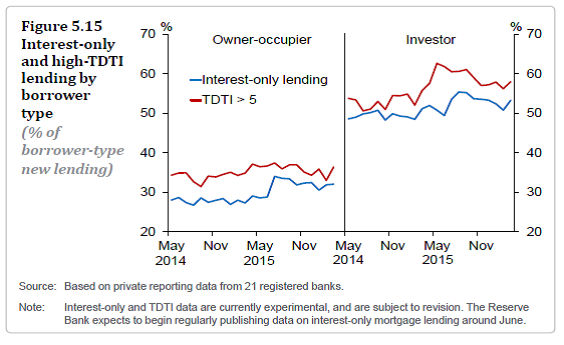
dti

(But it is worth noting that in the short run of experimental data, there is no sign of an explosion in the share of high debt to income lending.)

The income of a potential borrower is clearly one of things a prudent lender would take into account in deciding whether to lend money, and how much.  The same goes for the value of any collateral the borrower can pledge, any other conditions or covenants that are part of the loan contract, and as host of other factors.  But the fact that these considerations might be relevant to assessing the creditworthiness of the borrower does not mean they are things that should be regulated.  As the Irish central bank noted in its consultative document

An acknowledged weakness in the use of LTI as a guide to creditworthiness is the fact that income at the time of borrowing may not be a good guide to average income over the life of the mortgage or to the risk of unemployment. Lenders need to take this into account in their lending decisions and must not rely mechanically on LTI.

And yet LTI limits increase the likelihood that banks will manage to the rules –  breaches of which expose them to severe penalties –  rather than to the underlying credit risk  (where, all other factors aside) it is overall portfolio risk rather than the risk of an individual loan that probably matters a lot more –  especially for systemic soundness.  Curiously, an LTI limit risks making finance relatively more available to those borrowers with highly variable income –  borrow in a good year, and your loan might not be excess of the LTI threshold, and no one at the central bank cares much that in another year’s time your income might have halved.  It might be an unintended effect, but it won’t an unforeseeable one.

More generally, there is no good external benchmark for what an appropriate or prudent loan to income ratio should be.  At least with LVRs there is a certain logic in suggesting that, say, a loan in excess of the value of the property changes the character of loan (the top tranche is unsecured).  No one has any good basis for knowing whether a debt to income ratio (however either of those terms is defined) of 3 or 5, or 7 is unwise or excessively risky.

I don’t personally have a high appetite for debt – I’ve taken two mortgages in my life, both were about 2 times income, and both felt forbiddingly large at the time.  Then again, the interest rate on the second of those loans were something like 10 per cent.  But if, say, nominal mortgage interest rates were to settle at around 5 per cent –  not low by longer-term international historical standards –  then why would it be imprudent for a young couple aged 25 to take a 40 year mortgage at, say, six times their (age 25) income?  The upfront servicing burden would certainly be high, but twenty years hence even general wages increase (no ,movement up respective scales) would have halved the burden.  And why would it be imprudent for a bank to have a portfolio of mortgages which had some new mortgages at high LTIs and some well-aged mortgages with much lower LTIs?

(The same might go for investment property loans.  If someone is running a rental property business, the prudent ratio of debt to income –  whether wage income of the borrower or rental income – is likely to be much higher when rental yields are, say, 4 per cent than when they are 8 per cent.)

Don’t get me wrong.  There is something obscene about house prices in New Zealand –  and a bunch of similar countries with dysfunctional land supply markets. There is no reason why we can’t have house prices averaging perhaps 3 times income –  with mortgages to match –  but our policy choices have rigged the market, delivering absurdly high house prices.  If so, people need to be able to borrow at lot just to get a toe on the ladder.  Try to prohibit willing borrowers and willing lenders from agreeing such loans and you simply further skew policy in favour of the “haves”, and create an industry in getting round the controls.  There hasn’t been that much effort so far to get round the LVR controls –  through quite legal means, involving unregulated lenders –  but recall the Deputy Governor’s comments at the last FSR, that controls might now be with us for much longer than the Reserve Bank had first envisaged.  I’m not sure why the non-bank (and especially non deposit-taking) lenders have not been more active to date, but a further intensification of controls surely heightens the likelihood of larger scale use of alternative lenders.

Loan to value ratio controls haven’t solved, or materially alleviated, housing market pressures.  For all the rhetoric, not even the Reserve Bank’s modelling suggested they would. There is some short-term relief –  helping those not affected directly, at the cost of the more marginal potential borrowers –  but it doesn’t last.  There is no reason to think that loan to income ratio controls would be different. They tackle, rather ineffectually, symptoms rather than causes, and over time mostly alter who owns houses, not how much is paid for them.  The Reserve Bank will argue that even if the controls don’t change house prices, they still enhance financial stability, but there is not even any serious evidence of that. First, they have not shown any evidence that financial stability is threatened –  and their own tough stress tests keep delivering quite reassuring results –  and second, and perhaps as importantly, they have made no effort to analyse what risks banks will take on if controls prevent them lending as much on housing as they might like.  Banks are profit-maximizing businesses, and deprived (by regulation) of some opportunities they will surely seek out others.

Far better for the Reserve Bank to recognize that it has no mandate to control house prices (or even the growth of housing credit), and in any case it has no tools that will do much over time anyway.  Its responsibility is the overall soundness of the financial system.  If the risk weights on housing loans look wrong, let them make the case for higher weights and consult on that. If the overall capital ratios look too low, then again make the case.  Using those tools will do less damage to the efficiency of the financial system, and better secure the soundness of the system, that one new wave of direct controls after another.  At the current rate, Graeme Wheeler will be giving a good name to Walter Nash, the first person who imposed so many controls on our financial system. (I usually eschew references to Muldoon in this context, but over his full term he deregulated the financial system more than he reregulated it).

Of course, there is still no sign of those actually responsible for the house price debacle doing much about it.  I haven’t yet read the full proposed National Policy Statement, but the material I have read is full of central planner conceit, and seems unlikely to achieve very much.  And I find it seriously disconcerting –  if perhaps not overly surprising –  that the Ministry for the Environment released a supporting document yesterday on “International approaches to providing for business and housing needs” .  But this survey of international approaches drew exclusively on the UK and two Australian states (New South Wales and Victoria).  Since London, Sydney and Melbourne are some of the cities with the most dysfunctional housing markets in the world, indicated by price to income ratios similar to, or even higher than , Auckland’s, you have to wonder why MfE would look to those places for guidance or insight.  When the Productivity Commission report on land supply was released last year, I criticized them for a similar focus –  they’d visited various places, but not the functioning land supply markets of the US.

One might have hoped that government agencies, and ministers, who were serious introducing a well-functioning competitive urban land market might have devoted at least some serious analytical attention to the experiences of thriving cities in the US which manage to cope with rapidly rising populations with markets in which house price to income ratios fluctuate somewhere near 3.

Having said all this, I’m not very optimistic that the house price problems will be solved. I went to a good lecture yesterday on housing by the Chief Economist of Auckland Council, Chris Parker.  He has a lot of good analysis and ideas which I can’t discuss here –  he told us it was under Chatham House rules, under which we could say what was said, but not who said it, but he was the only speaker….. –  but I wanted to ask him the same question I’ve posed here previously: is there any example anywhere of a city or country that has materially unwound the thicket of planning controls once they were in place.  If not, perhaps we can be first.  But, if so, it doesn’t look as though we are getting there fast.

(Which does make the government’s continued indifference to the huge population growth, largely driven by immigration policy when there is no evidence that that population growth has been systematically benefiting New Zealanders, ever more inexcusable).



House prices and the Reserve Bank

House prices are not the responsibility of the Reserve Bank, any more than tomato prices are.

In its monetary policy, the Bank was charged by Parliament with maintaining a stable general level of prices.  In the Policy Targets Agreement, the Governor and the Minister of Finance agreed that, while the Bank should keep an eye on all sorts of price measures, for practical purposes the focus should be on keeping annual CPI inflation near 2 per cent.  The CPI includes rental costs and the cost of construction of new dwellings, but it does not include section prices or the prices of existing dwellings.  Parliament or the Minister could require the Bank to focus on some different index altogether –  there is nothing sacrosanct about the CPI, even as a measure of prices –  but they haven’t.  And the way the CPI treats housing is consistent with the Reserve Bank’s view as to how housing should be treated.

What about the financial regulatory side of the Bank’s responsibilities?  The Reserve Bank Act requires that the Bank exercise its regulatory powers over banks in ways that promote the soundness and efficiency of the financial system.  What matters is the overall health of the balance sheets of the financial system as a whole.  Loans secured on residential properties make up a fairly large proportion of bank balance sheets, which suggests that the Reserve Bank might reasonably want to understand the risks banks are carrying, and the buffers they have in place if things turn out less well than expected.  But it does not make house prices a policy responsibility of the Reserve Bank.

Perhaps one might make an exception to the statement if there were evidence that house prices increases were occurring primarily because of reckless lending by banks.  But even that is a higher standard than it might sound.  It doesn’t just mean that credit growth for housing might be running ahead of incomes –  one would expect that if other shocks and distortions (eg land supply or immigration) were putting upward pressure on house prices. If so, the younger generation will typically need to borrow more from older generations to get into a house, and the banks may be just the intermediaries in that process.  And even if the Reserve Bank suspected “recklessness” it would have to ask itself why, and what basis, its judgements were likely to be better than those of the banks.  After all, the Reserve Bank has nothing at stake, while the shareholders of banks have a great deal at stake (even if you think that governments would mostly bail-out creditors, shareholders usually lose a lot when things go wrong).

One might draw on past experience and international research.  But even then one has to do so carefully.  After all, as the Reserve Bank itself has highlighted, losses on residential mortgage portfolios have rarely played a central role in systemic financial crises –  and particularly not in countries with floating exchange rates (check) and with little or no direct government involvement in housing finance (check).  Very rapid housing turnover can be a sign of things going haywire –  although even then not necessarily of high risk to banks.  But in New Zealand, house sales per capita have remained well below what we saw in the previous boom, and mortgage approvals per capita also remain pretty subdued by pre 2008 levels.  And recall that in New Zealand, with the same banks we have now and the same incentives, the banking system did not get into trouble even after that boom.  During the 2008/09 recession, senior Reserve Bank and Treasury officials toured the world spreading reassuring words, and they were right to do so.

Perhaps too, the Bank might worry about the spillover from higher house prices into the rest of domestic demand.  But, in fact, over the last 25 years, despite huge increases in real house prices, the private consumption share of GDP has been essentially constant.

household C to GDP

That is largely what we should expect: after all, higher house prices don’t make New Zealand any better off, and the individuals who are better off must be offset by other individuals who are made worse off.  The Bank might also pay attention to high-level research suggesting that financial crises have typically been foreshadowed by big increases in debt to GDP ratios over relatively short periods (the few years just prior to the crisis).    But on that score, it is worth remembering that most countries that have had big increases in debt to GDP ratios have not had domestic financial crises (think of the UK, Canada, Australia and New Zealand for example).  And in New Zealand, household debt to GDP ratios have gone largely nowhere for eight years, after a huge increase in the previous 15 years.  Yes, there has been quite an increase in the last couple of years, but that is surely what one would expect when population pressures and land supply restrictions combine to push house prices up.  A higher level of credit is a typical endogenous response.    It is not, of itself, a danger signal regarding the soundness of the financial system.

This was all prompted by a piece I noticed on interest.co.nz which appeared under the heading “RBNZ has nowhere to hide from the housing market”, with the fuller heading  “Each new piece of housing-related data coming out at the moment is increasing the pressure on our central bank”.   If so, it is only because the Reserve Bank has chosen, with no good statutory justification, to put that pressure on itself.  Good central banks don’t need to “hide”.  The housing market is just another, albeit important, market.

The Reserve Bank has a relatively straightforward job. It is supposed to keep inflation near 2 per cent, which it has been failing to do.  And it is supposed to use its regulatory powers to promote the soundness and efficiency of the financial system.  There is no sign that the soundness of the system is threatened, and each new regulatory intervention impairs the efficiency of the financial system –  and provides, briefly, cheaper entry levels for those upon whom the Reserve Bank’s favour rests.

Here’s what I would expect the Reserve Bank to be doing.  They should be continually reviewing the reasonableness of the risk weights that they allow the banks to use in their capital modelling, and ensuring that they understand how different banks are assessing the same risk.  They should carry on with their programme of stress tests, which so far have shown very encouraging results in the face of very severe shock scenarios.  And then they should be leaving the responsibility for house prices and a dysfunctional housing supply market where it rightly belongs: with central and local government.  When the Reserve Bank intervenes not only does it compromise financial system efficiency, for little obvious gain on soundness, but it leaves observers with a sense that perhaps the real issues are different from what they are.  And it encourages banks to focus on managing regulatory limits rather than thinking hard about the risks they, and their shareholders, are taking on.

The Reserve Bank is not responsible for the current housing mess, and it cannot provide the solution –  not even partial or temporary solutions.  Responsibility rests with successive governments that bring in tens of thousands of non-New Zealanders each year into a system that is simply unable to generate effectively and cheaply a sufficient supply of houses.  And that isn’t a market failure, but yet another example of government failure.

And for those who worry that a lower OCR would simply push up house prices further, a reminder that one of the key ways in which monetary policy works is by raising the prices of long-lived assets – which encourages people to invest in producing more of them.  But perhaps too it is worth remembering that the real OCR has fallen by more than 600 basis points since 2008, and yet material real house price increases have only been seen in places with that fatal combination of substantial population pressures and a highly distorted land supply market.  Interest rates are low for a reason –  the economy would be even weaker and inflation lower if they were not.


Age discrimination and the next Governor

It is now June, which means it is only 15 months or so until Graeme Wheeler’s ill-starred term as Governor of the Reserve Bank ends.  Conversations begin to turn to the question of what happens next.

I’ve probably left many people unconvinced, but I still reckon there is a plausible case that the Governor of the Reserve Bank is the most powerful individual in New Zealand.  He exercises a lot of discretion with few checks and balances (perhaps especially in areas other than monetary policy) and there are no established appeal or review rights.  Many Cabinet ministers have lots of power, but they can be dismissed whenever the Prime Minister chooses.  The Prime Minister can be toppled by his or her own caucus with no notice or appeal (see Kevin Rudd, Julia Gillard and Tony Abbott –  or Jim Bolger and Geoffrey Palmer for that matter).  Judges make crucial, life-changing, decisions, but all lower court decisions are subject to appeal, and all higher courts sit as a panel of judges.  Of course, the Governor has power in only a specific range of areas, but as those areas include monetary policy and financial regulation, the effects of the Governor’s choices can be felt very widely.

A month or so ago, I wrote a couple of posts (here and here) about the curious democratic-deficit in the way in which the position of Governor is filled.  It is a choice Parliament made, but it is a very unusual one, whether considered against the models used for central banks/financial regulators abroad, or for other senior positions in the New Zealand government.  Even though the Governor wields so much power, the choice of who serves as Governor is not made by an (elected) Minister of Finance, but by the faceless, largely unaccountable, group of people who constitute the Board of the Reserve Bank.  The Minister technically makes the appointment, but he can only appoint someone recommended by the Board.  That makes the Board members the key players in the process.  Perhaps equally weirdly, the Minister gets to determine the Governor’s terms and conditions (he only has to consult the Board).  In a more reasonable assignment of roles and responsibilities, one might have thought the Minister should be able to appoint an appropriate person as Governor (as happens in most countries, including Australia), perhaps consulting the Board, and perhaps leave the Board to set the terms and conditions, perhaps in consultation with the Minister.

There are no confirmation hearings for either people appointed to the Board, or for a Governor-designate, even though between them these people will have considerable influence on the economy and financial system for years to come.  One might reasonably ask what expertise, let alone public mandate, Rod Carr, Keith Taylor, and the rest of them, have to make those sorts of selections, or why they are better placed to do so than an elected Minister.  Recall that appointing a Governor is not just akin to appointing a CEO of a government department –  who typically has little or no effective policy discretion – or the CEO of a private company.  It is about appointing a key policy (one might almost say “political”, albeit not in a partisan sense) player whose discretionary choices –  and they involve real and substantial discretion – are probably at least as significant as those of most Cabinet ministers, with the associated need to be at least as open and accountable as Cabinet ministers.   It seems like the sort of role that senior elected ministers, not faceless former finance sector executives and academic administrators, should be filling.

But unsatisfactory as the law is, it seems almost certain that it will be the law governing the next appointment of a Governor.

Someone who has paid closer attention to some of the details of those provisions than I have pointed out to me recently clause 46(1)(c) of the Reserve Bank Act.    Under the provision, no one can serve as Governor, or Deputy Governor, once they are aged 70 or over.

This provision is quite old.  The legislation was passed in 1989, and life expectancy has increased by perhaps five years since then.  In addition, New Zealand legislation passed since then has prohibited compulsory retirement ages, unless they are specifically provided for in statute (as this one is).  There is a similar statutory age limit for judges.

In a year when the race of the job of President of the United States seems set to be fought between one candidate who will turn 70 this month, and another who will turn 70 next year (who is in turn still being challenged by a sitting senator who is 74) it is a surprisingly low age limit.  Life expectancy has increased, but in fact it is almost 60 years since Walter Nash became our Prime Minister at age 75, and then left office at 78.

I’m not opposed on principle to having an age limit for the Governor.  If anything, as our law is currently written, the case might be stronger than  that for judges.  In respect of judges, the contrast is striking between our situation and that of the US Supreme Court, where judges often seem to hang on until death (as much as anything to manage succession risk), and where three of the current sitting judges are aged 77 and over.

It is, rightly, difficult to remove a sitting higher court judge even if that person’s physical and mental capabilities are evidently in serious decline.  In our system, it takes a vote of Parliament, in an address to the Governor-General.  Age limits help to protect against the indignity and awkwardness of such difficult and very public removals.   Then again, between the assignment of cases, appeal provisions, and the fact that appellate courts sit with a bench of judges, the damage a declining individual judge can do can be mitigated.

It is technically easier to remove a Governor of the Reserve Bank whose capacities were failing.  It requires only an Order-in-Council.  But in practice it would be no easier, and potentially much harder to manage in the interim.  A Governor in office has full powers to set monetary policy as he judges appropriate, and to make and vary a wide range of financial regulatory policy measures.  There is no one who can temporarily assign some of those powers to other officials, and there are no appeal rights.   And the Reserve Bank operates in the full glare of scrutiny by domestic and international markets.

But an age limit of 70 simply doesn’t seem to strike quite the right balance.  Ideally, the entire governance structure of the Reserve Bank will be revised, and if the Governor had just one vote (among say 5 or 7) on each of a Monetary Policy Committee and Financial Regulatory Committee then no age limit might be needed at all (there is none in Australia, or the United States –  Greenspan was 79 when he left office).  For now, serious consideration should be given to raising the age limit to at least 75.

As it happens, the age limit is unlikely to have been a binding consideration since the Act was passed. Don Brash left office at 61, and Alan Bollard was a similar age when he finished as Governor.  But Graeme Wheeler will, apparently, be 66 late next year.  That means he could not serve another five year term, even if he wanted one, or if the Board wanted to reappoint him.  He could, however, serve –  say –  a four year term, which might parallel the typical arrangements for government department chief executives (who typically get an initial five year appointment, and then often get a three year extension).

I hear on the grapevine that the Governor has already indicated to staff that he will not be seeking a second term.  If so, the issue is moot as it affects him.

But with more people staying longer in the workforce it might still be relevant to some of the people the Board could consider to fill the office of Governor.

For example, although it has now been 35 years since the position was filled by someone with a Reserve Bank background –  an extraordinary statistic that the Board might want to reflect on – former senior officials would no doubt be among those who might be thought of as candidates for Governor.  The Act not only requires that no one can be Governor or Deputy Governor once they turn 70, but it also requires that first terms as Governor must be for five years.

There are, for example, two current and four former Deputy Governors who are still professionally active.

Peter Nicholl was Deputy Governor in the 1990s, before going on to serve as Governor of the central bank of Bosnia.  He is still apparently professionally active on the international central banking consulting circuit. But he is 72, and so barred from serving as Governor here.

Murray Sherwin succeeded Nicholl as Deputy Governor.  He is now chair of the Productivity Commission, and in many ways could be a very good Governor if he was interested.  But it appears that he is turning 65, probably next year, and so the age-70 limit could be a constraint.

Grant Spencer is a current Deputy Governor, and will have served in that role for a decade by the time Wheeler’s term expires.  Spencer has considerable experience inside the Bank, as well as decade in relatively senior roles at ANZ, but also appears to turn 65 shortly (the first academic publication I could find dated back to 1974).

Three other current or former Deputy Governors don’t face the same issue.  Rod Carr, Adrian Orr, and Geoff Bascand are all in their 50s, and each has chief executive experience.

Where else might the Board look?  There are other senior ex Reserve Bankers, such as David Archer, former Assistant Governor and Chief Economist now in a senior role at the BIS, or Arthur Grimes.  Or if they were interested in plucking someone from an international agency, my first boss Andrew Tweedie is now the Director of Finance (not just a bean-counting job) at the International Monetary Fund.

There isn’t a strong tradition of academics moving directly into policy roles in New Zealand, and nor are there many academics working in policy-oriented research on monetary policy or financial regulation.  Then again, there are two academic administrators on the Board, either of whom might themselves be interested.

The Reserve Bank now has a major and active role as regulator and supervisor of financial institutions, and so some banking background might be a consideration the Board looks for.   There are few senior New Zealand bankers, and especially not ones with the capability to be, and to credibly front as, the single decision-maker on monetary policy.  Some of us used to worry that Mark Weldon’s friendship with the Prime Minister might have seen him succeed Alan Bollard, but perhaps the OCR leak debacle further reduces that risk.

What of public servants?  Iain Rennie, the outgoing State Services Commissioner, has a strong background in macro, and was for a time the Deputy Secretary of that part of Treasury.

Finding the right person should be quite challenging.  It is a big job, and also an unusual one.  The Bank itself isn’t a large organization, but it has quite a range of functions, where the Governor personally has a great deal of discretionary policy power.  And the Bank operates in an area where there is a huge amount of uncertainty.  Filling the role well needs management capability, it needs intellectual capacity, it needs good judgement, and it needs the self-confidence on the one hand, and the humility on the other, to recognize the uncertainties, to be willing and able to engage openly with alternative perspectives, and to acknowledge that –  being human –  from time to time the Governor will make mistakes.  Precisely because the power is so concentrated in one individual, inevitably the questioning and challenging will often focus on that individual.  The ability to embrace sustained scrutiny and work effectively in that spotlight isn’t a talent everyone has –  and nor is it needed for most roles.

From time to time, people talk about the possibility of appointing a non New Zealander as Governor.  I don’t think it is a viable or sensible option.  Think of how much political mileage there still is in New Zealand from bashing Australian banks.  How would people take to having an Australian setting our interest rates, and regulating those Australian (and other banks)?  I don’t think it is politically tenable, and neither –  given the extent of the discretion the Governor wields –  would it be desirable.  I wrote about this issue a while ago and concluded:

I think it would still be a mistake to go global.  Some aspects of the role could be done by any able person –  revitalising, for example, the Bank’s research and analysis across the range of its policy functions.  That is partly just about good second and third tier appointments, and partly about being a voracious customer for the insights that analysis throws up .  But the role also needs someone who understand the New Zealand economy, the New Zealand system of governance, and someone who understands the New Zealand financial system.  And it needs someone who is comfortable, and credible, in telling the Bank’s story – and sometimes it will be a controversial or difficult story –  to New Zealand audiences.  Plenty of people criticized Don Brash over the years, but few doubted that his heart was in this country, and that its best interests were his priority.  In a small country, with a foreign-dominated financial sector, a very powerful central bank, and ongoing controversy about the role of monetary policy and New Zealand’s economic performance, it is hard to imagine any foreign appointee successfully filling the bill.

Of course, it might be a little easier if the governance of the Bank was reformed.  For example, in a system in which the Governor was chief executive, but had no more voting rights on monetary policy or financial regulation policy matters than others members of the respective committees, the stakes are a little lower.  But even then, I think such governance reform more appropriately opens the way to the appointment, from time to time, of a foreign expert as a member of one or other of the voting committees.  Since the Bank of England’s nine-person Monetary Policy Committee was established by legislation almost 20 years ago it has not been uncommon to have a foreigner sitting on that committee. In a New Zealand context, supplementing local expertise with outside perspectives in that way could have some appeal – if New Zealand government board fees were sufficient to attract quality candidates –  but we are still likely to be best, in all but the most exceptional circumstances, to look for a Governor from home –  as we do when we choose ministers, judges, (and these days Governors-General), military chiefs and so on.

The appointment of the next Governor is further complicated by the timing.  The Governor’s term expires almost three years to the day since the last election.  In times past it wouldn’t have been a great problem –  there was a broad bipartisan consensus around the Reserve Bank.  Similarly, when the appointment of Phil Lowe was announced just a few days prior to the Australian election being called it wasn’t a problem: Labor and the Coalition don’t seem to have any material differences on the RBA.   But here all the Opposition parties are campaigning on a different approach to monetary policy.  We don’t know quite how different –  in 2014, Labour’s policy was marketed as quite different, but on closer examination it appeared pretty similar to the status quo –  and part of that would depend on the respective vote shares in a coalition that made up an alternative government.   If the government were to change, it would seem pretty unsatisfactory that an incoming government could find themselves lumbered with a Governor taking office on virtually the same day they did, for a term of five years, appointed by a Board appointed entirely by the outgoing government.  It shouldn’t matter that much, but such is the extent of the policy discretion the Governor has under current legislation, that it does.  Frankly, it should probably bother someone taking the job –  appointed, but not knowing what framework he or she will operate under.

People push back against this argument, noting that changes of government can happen in the middle of a Governor’s term.  And that is, of course, true.  But it is particularly stark when the new term would begin at virtually the same time a new government would be taking office, and when there are –  it appears –  more differences between major parties on the Reserve Bank Act than would have been the case in earlier decades.  There are no easy or comfortable ways to resolve this issue.  An early appointment keeps any announcement clear of the election campaign, but that isn’t really the issue.  Any new Governor has to be appointed for an initial term of five years.  The Acting Governor provisions of the Act can be used only to complete a Governor’s unfinished term.   I noted a while ago that one option might be to offer Graeme Wheeler a brief extension, allowing the longer-term appointment to be resolved once the make-up of the next government was clear.  Perhaps if there were a self-evidently outstanding single candidate for Governor, commanding respect on all sides of politics, it might also be less of an issue.

Under our current legislation these issues are inescapable from time to time.  A five year term will expire in an election year every 15 years, on normal cycles.  One could give the Governor a six year term, which would reduce the chance of the coincidence, but even then a snap election could bring the two dates into synch again.  Much better would be to move to a system that put much less weight on any one individual.  No other advanced country central bank/regulatory agency gives so much discretionary power to a single unelected individual.  We shouldn’t.

How has our population grown?

New Zealand’s population is estimated to have risen by 11.8 per cent in the last decade (much of it in the last three years). The starting point for that estimate is reasonably well-anchored: I used the population numbers for the March quarter of 2006, and the 2006 Census happened in that month. The end-point (March 2016) is only an SNZ estimate, which will be recalibrated after the next census.  But for now it is what we have.

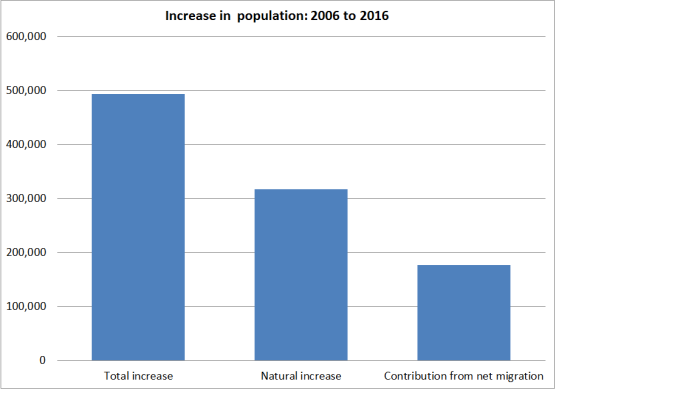
Here is the high-level breakdown of where the population growth came from.

population decomposition

Net migration accounts for about 35 per cent of the total increase.

But even at very high level, this chart somewhat misrepresents the picture.  Many migrants are of child-bearing age, and some of the natural increase will itself have resulted from the net migration flows of New Zealanders and foreigners (both those during this period, and those from earlier periods).

I’ve found it useful to think about the contribution of immigration policy to New Zealand’s population.  At the extreme, almost the entire non-Maori population of New Zealand ultimately exists as a result of  post-1840 immigration policy.

But even over more recent periods, one can distinguish –  at least conceptually – between the choices of New Zealand citizens to come and go (mostly go), and those of foreign citizens.  The choices of New Zealanders aren’t a matter of immigration policy at all.  We shouldn’t, and don’t, try to impede those flows.    By contrast, any foreign citizen living here requires the explicit permission of the New Zealand government.  Some will be permanent residents, others will have work visas, and some will be students.

Statistics New Zealand has data on permanent and long-term migration flows by citizenship.  But, as I’ve noted before, it is only indicative.  People change their minds and their plans.  New Zealanders planning to leave for a few months end up staying away for decades, and vice versa.  And the same happens for foreigners coming here –  some came intending to stay forever, but it just doesn’t work out and they leave.  Others come thinking it might just be something short-term, and they end up getting permission to stay longer.

Over the last decade, these statistics show a net 233000 New Zealand citizens leaving, and a net 440000 foreign citizens arriving.   That inflow of foreign citizens is equal to 89 per cent of the increase in the total population over that decade.

Actually, the contribution of non-citizen migration (the policy-controlled bit) might not be quite that large.  The net migration inflow in the chart above is 177000 people over the decade, and the gap between the citizen and non-citizen net PLT data over the same period is 207000 people.  We know the natural increase, and we have a reasonable fix on the population.  So maybe somewhat fewer New Zealanders actually stayed away than said they were intending too, and perhaps some of the non-citizens who intended to stay went home.    My hunch –  no more –  is that over this period more of the mismeasurement is around the NZ citizen flow (the Australian labour market has been tougher than most expected).   But if the mismeasurement is split evenly between the NZ citizen and foreign citizen data, the direct contribution of immigration policy to population growth over this period would still be around 85 per cent.  And the contribution to the birth rate of those non-citizen migrants is on top of that.

Then again, according to the arrival and departure cards, a net 228000 more people arrived in New Zealand in total than left between March 2006 and March 2016.  That is rather more than the 177000 net migrants implicit in the SNZ population estimates.  So perhaps we’ll find that the population has been growing even faster than SNZ thinks.  If so, the contribution of immigration policy might drop back to around 80 per cent over the decade.

There is plenty of imprecision in all of this. But what is fairly clear is that (a) New Zealand’s population has been growing much faster than the population of most OECD countries, and (b) that the overwhelming bulk of that growth is resulting from immigration policy choices (the scale of the influx of non-citizens).  Reasonable people can differ on the economic implications of those high rates of non-citizen immigration, but that the population would not have been growing rapidly at all without our unusually large non-citizen immigration programme shouldn’t really be in question.

Internationally, there is a variety of experiences of course.  Among advanced countries, one has relatively successful countries with sharply falling populations (Latvia and Lithuania are down more than 20 per cent in the last 25 years) and sharply rising populations (Singapore’s population is up over 80 per cent in that period), and both good and mediocre performers with quite rapid population growth (New Zealand and Australian population growth rates have been similar over 25 years, and Israel has also had about 80 per cent population growth and a productivity performance about as disappointing as New Zealand’s.  Population changes, even those directly associated with immigration, can be a response to domestic opportunities or available foreign ones. In some circumstances they might help strengthen per capita growth, and in other cases they might impede.  One needs to take a country by country approach.

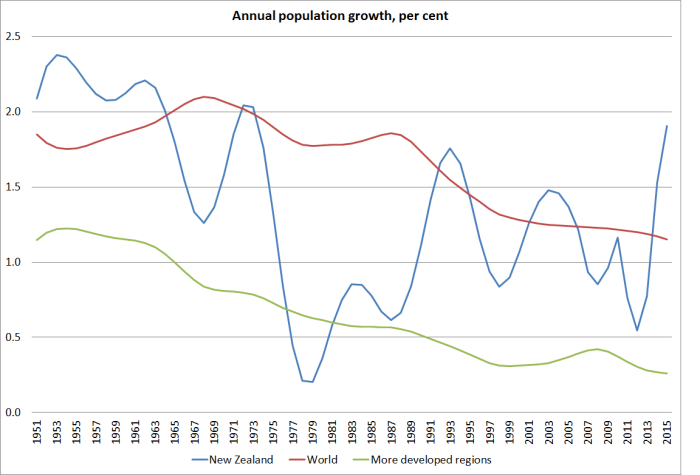
Taking a longer view, this chart is one I’ve used before.  It compares New Zealand’s population growth rate with those of advanced countries and the world as a whole (using UN data).

world population growth

Typically, our population growth rate has far-outstripped those of the advanced countries as a whole.  The exception was the period I referred to in my post on Saturday, between the mid 1970s and the late 1980s, when the large net outflow of New Zealanders was already well-established, but immigration policy was not aggressively pursuing a large inflow of foreign citizens, unlike the situation in the decades before and since.

Convergence…and not

I’ve been under the weather with a bad cold and wasn’t going to write anything today.  But pottering around various websites, I discovered that the Conference Board had last week released its annual update of labour productivity estimates, in PPP terms, for a wide range of countries.

Since my involvement with the 2025 Report some years ago I’ve been intrigued by developments in the eastern European countries, which laboured under Communist rule for decades until around 1990.  By 2009  when we wrote that report, the first ex-communist country had almost caught up to New Zealand’s real GDP per capita.

Older readers will recall the line Bob Jones made much of in the 1984 election campaign, in which he compared New Zealand’s economy in 1984 to a Polish shipyard.  The implication, of course, was that it was the heavy burden of protection and controls that were accounting for New Zealand’s disappointing economic performance.

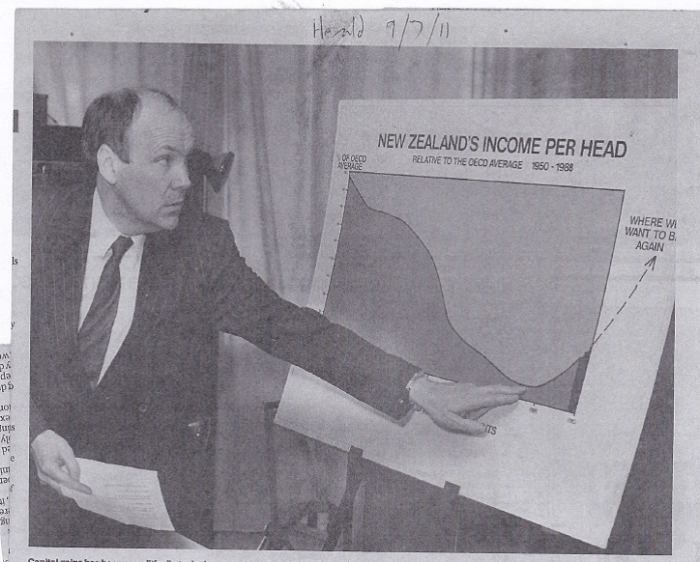
Of course, for all that was wrong with economic policy in New Zealand in the decades from the 1930s to 1980s, our economy was not remotely as distorted as those of the east European countries.    But in a sense the narratives were similar in the two countries: open up the economies to more international competition, and liberalise domestic markets in a context of secure property rights, and stabilize macro policy imbalances, and one should expect to see a lot of convergence, catching-up with the more successful market economies.  Here is an illustration of the sort of thing that was expected in New Zealand –  a 1989 photo (reproduced in the Herald a few years ago) of then Finance Minister David Caygill’s expectations/aspirations.

caygill 1989 expectations

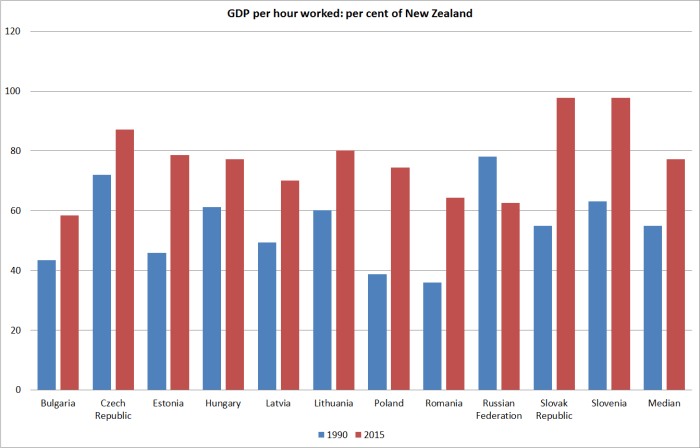
How have the eastern European countries got on?  The Conference Board has GDP per hour worked data for 11 eastern European countries back to 1990.  Here is how each of them has done relative to New Zealand in the 25 years from 1990 to 2015.

east europe convergence to NZ

The median eastern European country had GDP per hour worked 55 per cent of New Zealand’s in 1990, and that had increased to 77 per cent last year.  All except Russia gained material ground on New Zealand.

That might look unsurprising.  After all, these were very  badly distorted economies during the Communist era.

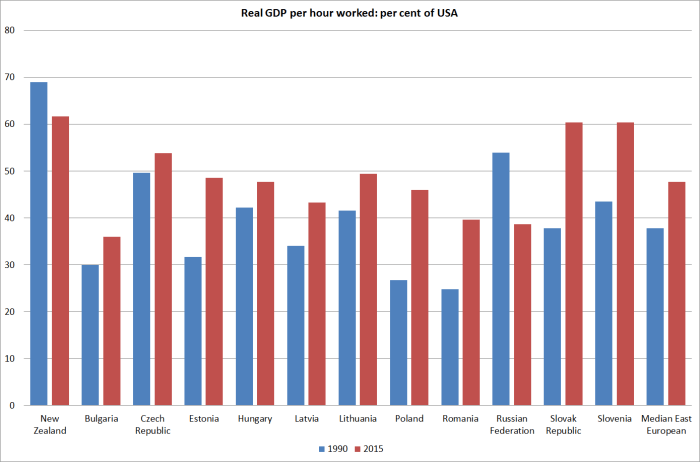
But, in fact, this chart materially flatters the extent of eastern European catch-up.  Here is the same chart showing these eastern European countries and New Zealand relative to US productivity levels.

east europe cf USA

In 25 years since the fall of Communist rule in eastern Europe, the median country of those 11 had increased labour productivity from only 38 per cent to 48 per cent of US levels.  Russia had lost ground relative to the US.  And so –  less dramatically –  has New Zealand.   (And the picture is much the same if one uses France and Germany as a benchmark, rather than the US.)

They were daft and damaging protectionist/statist policies we had in place during those decades – 20 TV factories indeed –  but they don’t look to have been a big part of the story in our relative decline.


The Herald’s wrongheaded call for an ever-bigger population

The Herald’s editorial today is headed “Population growth is powering NZ economy”.   It isn’t just a statement of the rather obvious, that a rapid growth in the population –  particularly unexpectedly rapid growth – boosts total GDP.    When there are more people, they all need to consume stuff, and they need houses, schools, shops, roads, offices etc.  And unexpected surges in the population boost demand more, in the short-term, than they do supply.    But they don’t do anything much to boost sustainable per capita real GDP.

That isn’t, of course, the Herald line.  Rather, channelling the Prime Minister, they assert that

The population increase is helping to generate the growth in the economy that puts New Zealand ahead of most other and larger economies at present, which in turn makes it a magnet for yet more migrants, as well as persuading more young New Zealanders to stay here.

There is so much wrong with this sentence, it is difficult to know where to start.  First, and repeating it slowly yet again, it is per capita economic growth that matters.  New Zealand has been doing quite badly on that score over the last year or so, even by comparison with other countries.  And as I illustrated yesterday, even on the Treasury’s own, optimistic-looking, numbers, we are expected to be only an average performer over the next four year.  Average isn’t necessarily bad, except that we are starting out so much poorer than most advanced countries, and not closing the gap.

And it isn’t as if jobs are abundant here either,  Our unemployment rate, at 5.7 per cent, is well above most estimates of the “natural” rate of unemployment, and not much below the median unemployment rate for OECD countries.    The number of residence approvals here is subject to a target, so even if there is increased demand from foreign citizens to move here, it only increases slightly the quality of the people we can take, not the total number.  Much of the variation results from two things.  The first is the inflow of students, probably influenced more by the policy change allowing most to work here while they study, rather than by the intrinsic strength of the New Zealand economy.  And the second is the flow –  mostly of New Zealand citizens –  to and from Australia.  Australia’s unemployment rate is also now quite high, at 5.7 per cent, and New Zealanders moving there don’t have access to the welfare safety net and associated entitlements they do at home.

The editorial goes on

The Government would not want to say this out loud, but clearly it is not controlling immigration as tightly as previous governments have done. This attitude undoubtedly comes from the Prime Minister and it is consistent with his disinclination to restrict foreign investment or even monitor its impact on the house market. He deeply believes the country is better off being open and connected to the world’s flows of capital, trade and people. The performance of the economy on his watch suggests he is right. Even the housing affordability is a cost of prosperity. If we want drastic steps taken to stop rising prices we need to be careful what we wish for.

With the exception of allowing students to work, the initial claim here is simply incorrect.  The residence approvals target is the same as it was under the previous government, and even student arrivals have not reached the peaks seen under the previous government.  As for the rest, no doubt it accurately reports the Prime Minister’s views –  he has repeated them often enough –  but there is no evidence to support it.  Productivity growth –  the foundation of sustained long-term prosperity –  has remained disappointingly weak.  And the immigration inflows have been overwhelmingly concentrated in Auckland, and yet the official data show that Auckland incomes are (a) lower relative to those in the rest of the country than we see in most advanced countries (comparing dominant cities and the rest of the country) and (b) that that gap has been narrowing.  Whatever the reason, the strategy is failing.

From there the editorial launches off into its own alternative universe

New Zealand’s desirable population size has always been a contentious subject, though not previously an urgent question. The increase since the turn of the century followed 25 years of static population figures as more people left than arrived.

Immigration policy was a notoriously capricious. Each time the economy dipped, governments would close the door. Now that we appear to have a rapidly growing population again, we need to be discussing how high we want it to go, and how it might be channelled to regions that most need it, and the houses and services it is going to need.

This country would benefit from many more people, and better preparation for their arrival.

There was a period from the mid 1970s to the late 1980s when New Zealand’s population growth was quite subdued.  But for the last 25 years –  not just since the turn of the century –  we have had one of the faster population growth rates of the OECD.  One doesn’t have to take a view on causation to note that people haven’t exactly been flocking to an economic success story.  Incomes here are presumably better than they were in the migrants’ home countries, but our productivity growth rate over that 25 years has been among the very slowest in the OECD.  Starting low, we’ve just drifted somewhat further behind.

I’m also not sure where the author gets the idea that New Zealand “immigration policy was notoriously capricious”.  Yes, there are constant changes at the margin, but to a large extent we’ve been running much the same immigration policy for 25 years now, through several recessions, and some pretty sharp ups and downs in the labour market.  Much the same could be said of the post-war decades, until the Labour government in 1974 closed down automatic access for British and Irish citizens –  and that wasn’t because the economy was doing badly, but just because they thought immigration should be less focused on traditional sources countries.

Of course, I thoroughly agree that we should be having a national debate about immigration policy.  Policy has long been premised, explicitly or otherwise, on the belief that New Zealand would be better, and more productive, if only there were more people.     But there is just no evidence for that proposition, and certainly not enough on which to rest such a large scale economic and social intervention as our immigration policy.  Big countries don’t grow faster than small ones.  When we had 1 million people, there were calls for many more people.  And when we had 2 million people.  And when we had 3 million people. And so on.  And for decades our relative incomes and productivity performance have been deteriorating.  New Zealanders have been getting poorer relative to their advanced country peers.  I’m not sure where the advocates think the critical threshold is where things might turn around –  but clearly 4.5 million people hasn’t been enough either.

The editorial writer talks of channeling people to “the regions”, which is almost certainly even more wrongheaded than bringing in large numbers in the first place.  We’ve seen that in the policy changes the government made last year: giving more points to people with job offers from the regions simply has the effect of lowering the average quality of the migrants we do get, who (on average) have not been terribly highly-skilled in the first place.

Instead of constantly championing the case for ever more people –  even at the cost of encouraging New Zealanders to leave Auckland (a weird way to help people at the bottom) – it is about time there was a serious conversation that stopped pretending everything was fine, and confronted the facts of New Zealand’s economic underperformance, and Auckland’s economic underperformance.  Doing so would force people to think harder about whether there was much realistic prospect of New Zealanders benefiting from an ever-increasing migration-fuelled population.  I’m not suggesting a population policy –  fertility and emigration choices of New Zealanders are their own affair –  rather, the abandonment of the implicit “big New Zealand” population policy we have had through successive governments.   Pretty much everyone accepts (and it is an uncontested OECD empirical result) that our distance from markets (and competitors) is a material penalty, making it harder to generate really high per capita incomes in New Zealand.  There is still no sign that New Zealand is getting much traction in products and markets that don’t rely largely on our natural resources –  and utilizing those natural resources in ever smarter ways simply does not need lots more people. Why penalize everyone more by rapidly increasing the population of a country with such a disadvantageous location?

The Herald is right that without the unexpected surge in immigration total GDP today would be lower than it is.  But without the surge in immigration over the last few years then, all else equal, our interest rates would also be lower, and our exchange rate would be lower.  And New Zealanders as a whole would be better off, because more firms would be better positioned to sell products and services into world markets at competitive prices.  But, probably more importantly in the long-run, our largely fixed stock of natural resources, found on not-very-propitiously-located remote islands, would be spread over rather fewer people.  As a country we’d be better off, and lower Auckland house prices –  no doubt still distorted by unnecessary land use restrictions –  would be a beneficial mark of that success.  As it happens, the regions  –  where the natural resources mostly are (pasture, forests, mines, seas, landscapes) –  would loom larger relative to Auckland, curiously the goal that the Herald’s editorialist seems to espouse.


Scattered thoughts on the Budget documents

A Budget from a government that seems to have no real sense of how strong sustained growth in productivity and living standards arises was perhaps never likely to produce anything of great interest.  The cheerleading for the, demonstrably failing, “ever bigger New Zealand” approach –  failing, that is, to generate any sign of better productivity growth, perhaps especially in Auckland –  and the questionable rhetoric about a more diversified New Zealand economy, was accompanied by yet more claims that somehow New Zealand’s economic performance is better than those of almost all our advanced country peers.  Meanwhile, oppressive taxes are raised on some of the poorest people in the country, to fund pouring more money into things like KiwiRail, regional research institutes, apprenticeships, and high-performance sport.

I heard some comments on Radio New Zealand this morning about “ideological” approaches to spending, and in particular about the share of GDP devoted to core Crown operating spending.  Since politics is about conflicting values and ideologies, I wasn’t sure what the problem was.  But in any case, the tables in the BEFU (Budget Economic and Fiscal Update) suggest that the government plans that its operating spending in the coming year will be 29.9 per cent of GDP.  As it happens, that is also the average share for the three June years 2015 to 2017.  The average share in the last three years of the previous government was 30.2 per cent.

In the last three years of the previous government, taxes were probably too high.  The core Crown residual cash surplus –  which some of smarter people at Treasury encouraged me to focus on when I worked there – averaged 1.5 per cent of GDP over those years, 2006 to 2008.  By contrast, even on yesterday’s numbers there is no sign of a residual cash surplus until the June 2019 year, and over the three years to June 2017, the average residual cash deficit is expected to be 1.1 per cent of GDP.

Through some combination of fiscal drag and continuing savage tax increases on tobacco, and perhaps some cyclical effects as well,  tax as a share of GDP which had fallen as low as 25 per cent in the year to June 2011 is now just under 28 per cent.

International comparisons of spending and tax levels are largely impossible just using Budget numbers.  Countries calculate things differently, and I recall a painful few days once when I was inside Treasury trying to get from the OECD how they translated our numbers into their numbers.

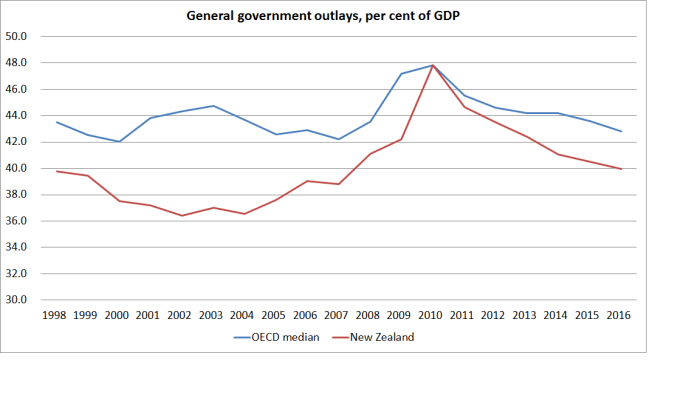
But here are the latest OECD numbers, which use “total outlays” (not just operating spending) and are not done on an accruals basis.  I’ve shown spending as a share of GDP for the median OECD country and for New Zealand.  There is nothing very unusual about the path in New Zealand.  In levels terms, spending as a share of GDP is a bit below the OECD median, but it is also a bit above the median for the other Anglo countries (only the UK is higher).

gen govt outlays 2016

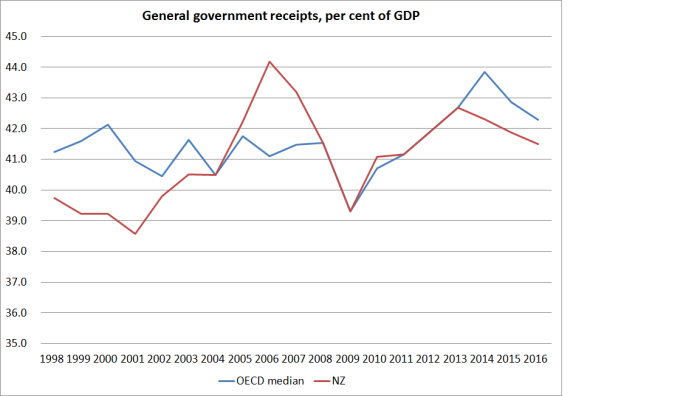
And here is the same chart for revenue.  Again, nothing stands out about New Zealand’s path.

gen govt receipts 2016

Of course, a notable difference is in the deficit/debt position.  We were better-positioned than most going into the recession, and eight years on we are also better-positioned than most.  In one sense that is a legacy of successive governments going back 30 years, but then legacies are only preserved if each successive government makes sensible decisions.

That is fiscal policy.  But in many ways it was the Treasury economic forecasts that accompanied, and underpinned, the fiscal numbers that got me most interested.  Several other economists have noted that they seem to err on the optimistic side.  That is my fear too.

But I was also interested in the starting point.  According to Treasury, we currently have a negative output gap of 0.9 per cent of GDP. That is a little larger than the estimated gap a year ago, and the gap is expected to just as large in a year’s time as it is now.  And that on the back of negative output gaps every year since the 2008/09 recession.

There is a lot of imprecision in these estimates.  But the idea that there is still excess capacity in the economy –  7 years on from the recession  – seems quite plausible.  After all, the unemployment rate is 5.7 per cent, and Treasury (quite plausibly) thinks a “natural” rate of unemployment (given the structural features of the labour market, the welfare system etc) is around 4.5 per cent.  That used to be the Reserve Bank’s long-term NAIRU estimate too.    And as we know, inflation has been very low, persistently undershooting the midpoint of the inflation target (after persistently overshooting the target for most of the previous two decades).  If Treasury is right, it is a pretty sorry commentary on the conduct of short-term macro policy in New Zealand.  And that, not to put too fine a point on it, has been Graeme Wheeler’s responsibility for the past four years.  I continue to be a bit surprised that the Opposition doesn’t point these things out.  People have been unnecessarily unemployed because of the choices/judgements of the Governor.

But in terms of the Budget, it is probably the projections from here that matter more.  Treasury expects real GDP growth rates to average 2.9 per cent over the next four years.  But it isn’t really clear how or why.

It doesn’t seem to be from the effects of macro policy. The fiscal impulse over the forecast period is estimated to be slightly contractionary.  And they seem to have allowed only one more cut in the OCR, but they recognize that inflation expectations have been falling, so real interest rates are going to be no lower than they were a couple of years ago before the ill-fated tightening cycle.  The exchange rate has come down quite a bit, and perhaps they are assuming some quite powerful lagged effects from that fall.  They assume some recovery in the terms of trade, but nothing as dramatic as the increase in dairy prices a few years ago.  And, on the other hand, the level of repair and rebuild activity in Christchurch –  a major impulse to demand for several years –  will be fading.

And then there is immigration. As everyone recognises, the unexpectedly large net immigration flows over the last few years have been a significant boost to total economic activity.    Treasury assumes –  fairly conventionally –  a sharp fall in met migration inflows, from 71000 in the June 2016 year, to only 19000 in the June 2018 year.  But there is no assumed change in immigration policy, and so the assumed change in net arrivals must all be endogenous to relative economic performance and opportunities.  And yet, they aren’t forecasting much of a pick-up in Australia.  To me, something doesn’t quite add up.  How are we going to get a sustained growth acceleration here –  producing per capita real GDP growth almost as fast as in the period from 1991 to 2007/08 (ie after the reforms and through the massive credit expansion) –  with a pretty sluggish world economy, and all with a substantial negative impulse coming from a sharp cut in the population growth rate?

There is so much uncertainty about medium-term forecasts, that any of these numbers could turn out right.  But they don’t look like the most plausible story to me –  and seem too reliant on just assuming that things finally come right.  If so, they don’t represent the most plausible basis for thinking about future fiscal policy options.  Frankly, I’d be a bit surprised if we ended up with incipient surpluses in the next few years any larger than the modest positive balances the government has right now.   I remain very skeptical of the case for keeping the New Zealand Superannuation Fund in existence, let alone putting more money into it at this late date.  But if my doubts about the macro outlook prove well-founded, then the date for resuming contributions –  already almost a decade on from the NZS eligibility age for the first baby-boomers –  will fortuitously be pushed further into the future.

Among the spin yesterday was the continuing claim from ministers and the Prime Minister that New Zealand’s economic performance is better  –  and will be better, on these Budget economic numbers – than that of most of our advanced country peers.  As I’ve pointed out numerous times before, our growth rate for total real GDP isn’t bad by international standards (while remaining weak by historical standards), but that almost entirely reflects the very rapid population growth.  Per capita growth has been very weak by international standards in the last 12 months or so.

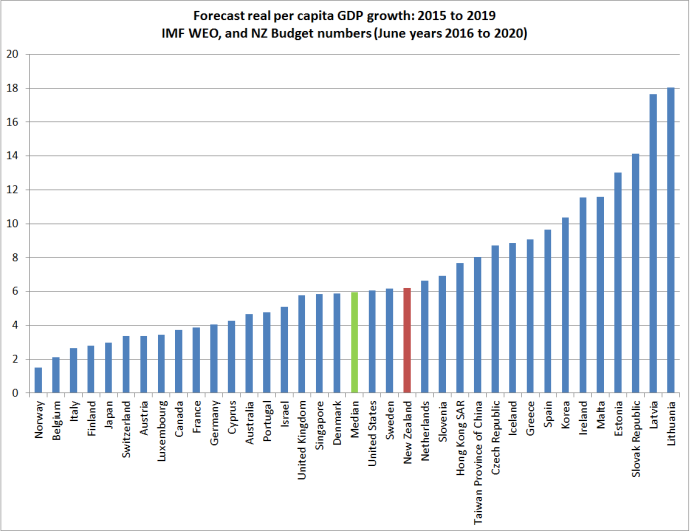
How about the outlook?  I downloaded the latest IMF WEO forecasts for advanced countries. Here is a chart showing forecast growth in real GDP per capita for the next four years (calendar 2019 over calender 2015). For New Zealand, I’ve used the Treasury BEFU forecasts for the four years to June 2020 – ie four years from now –  although as it happens the IMF forecasts for New Zealand aren’t much different.

imf weo gdp growth

On these numbers, New Zealand is doing not too badly.  Our forecast growth rates are very close to those of the median country, very similar to the US and UK (among G7 countries) and Sweden and Denmark (among countries nearer our size).  Which is fine in its way but (a) as I’ve noted, the New Zealand forecasts look rather optimistic, and (b) given our starting point, so much poorer than most of these countries, a successful economic strategy would have involved rather faster growth rates.

Slovakia, for example, might be an achievement to aspire to.  On these IMF numbers, between 2007 and 2021 Slovakia will have recorded almost 43 per cent growth in real per capita GDP, while we’ll have managed 15 per cent.   After decades of Communist rule, Slovakia started a long way behind New Zealand.  It has already matched our real GDP per hour worked, and looks likely to be moving past us.

We don’t have very much positive to write home about.


Nationbuilding in Nelson

Today is Budget day in New Zealand and so no one is probably much interested in reading about other economic stuff.  And after the ickiness and dysfunction of some of the stuff I dealt with in yesterday’s post, I wanted a change too.  After my post the other day about nationbuilding, a reader sent me a few links to pieces about the planned Nelson railway and cotton-mill, the economic case for which might, as he put it, be considered ‘thread-bare’.

For younger readers, this all happened a very long time ago.  In fact, I first recall reading about it in 1974 or 75.  I was a budding (very young) political junkie, and my grandfather  – a denizen of the “elite Glandovey Road” (Brian Easton’s term in The Nationbuilders)  – had been given a (distinctly unwanted) copy of Robert Muldoon’s first book, The Rise and Fall of a Young Turk, which he had passed on to me.   In that book, Muldoon recounts his role in a backbench rebellion that helped overturn this nationbuilding, or blatant electioneering, project.

In the 1950s Nelson appears to have been something of a backwater –  a rather pleasant one, no doubt, to judge from Geoffrey Palmer’s account of growing up there then, as the son of the local newspaper editor.  There had long been a hankering for a rail connection from Nelson to the main trunk line.  But the National government of the 1950s had actually been bold enough to close down the local railway line that had operated, wildly economically, for a long time.  As the 1957 election approached, Labour promised to build a railway line from Nelson to Blenheim, thus connecting with the main trunk line.  Labour took the seat in that election, and became government on a rather slim majority.

In March 1960, the Prime Minister went to Nelson to start the earthmoving machines on the new station.  As Muldoon puts it

The railway, of course, should normally have been commenced from the Blenheim end, which was the railhead, but the votes were in Nelson

Sir John Marshall’s memoirs –  he was the minister who had to deal with all after the 1960 change of government  – record of Nash

At the same time he announced –  rather prematurely, since no agreement had been signed –  that Nelson would also have a new cotton mill to provide freight for the railway and jobs for Nelsonians.

This announcement apparently went into quite some detail. Nash’s biographer, Keith Sinclair, records

The boards of the companies had not yet approved the project. Neither they nor the Department nor the Minister wanted the project announced. But Nash liked giving away presents.  At the railway ceremony he said that Nelson was to have a 4 million pound cotton spinning, weaving, and processing mill. Initially it would produce meat wraps, denim, drills, sheetings and the like.

The 1957-60 government had devoted a lot of effort to attracting foreign companies to manufacture here, to take advantage of the high protective barriers –  raised further by that government –  which made local production cheaper than importing finished product, if one could even get a licence to import the finished product.

The next election was approaching and initial negotiations for the cotton mill fell through, which left the government in something of a bind.  The government had to secure a deal, and did so “after talks between the company and the Department which lasted only a few days”.  Perhaps unsurprisingly, the deal proved to have a lot of loose drafting.

A British company would import cotton from Britain (in turn presumably imported from India or the US), and would be guaranteed 80 per cent of the New Zealand market for the first few years.  There was even talk of export markets developing.

As Sinclair records, “there was a public outcry”.  Most newspapers opposed it, as did many business groups.  Even the Manufacturers’ Federation couldn’t support the deal, as it had many clothing and textile manufacturers among its members.    As Sinclair records

“The cotton project was criticized on many grounds. For instance, it hindered the expansion of trade with Asia. To many conservatives and economists the whole concept of a state-guaranteed monopoly was anathema.  But probably more important was a feeling that there was something ludicrous about starting a cotton industry, based on imported cotton in New Zealand.”

Labour lost the 1960 election – doomed by the 1958 “Black Budget” rather than by industrial policy.  Labour’s share of the total vote dropped by 5.87 percentage points.  As Sinclair records, however

Labour’s biggest gain was in Nelson, were the vote rose 2.76 per cent. Apparently the cotton mill had pleased some people.

Shortly after the December election, even the feisty head of the union movement –  F P Walsh –  attacked the deal as the “best racket ever”.

The British company, Smith and Nephew, had moved fast once the deal was signed and within months had, in Marshall’s terms “lost no time in purchasing land, planning the mill, and letting contracts for plant and machinery”. [Could anyone move that fast with today’s planning and resource management laws?] so that things were well underway by the time the government changed.      Approached by the British company, the new government agreed that the contract the previous government had signed was binding and must be honoured.   They had badly misread public and business sentiment.

In Marshall’s words

Throughout the year 1961 these pressure groups grew in strength and vehemence.  As time went on others joined the fray: the Meat Board, the Constitutional Society, the Chambers of Commerce, the Plunket Society, the Social Credit Political League, and some branches of the National Party

We had the unusual spectacle of the Labour Opposition, which had signed the deal, and the National Government, who had confirmed it, standing side by side, with their backs to the wall, trying to defend it. No one else came to their aid.

Muldoon records that he first got involved when, as a first year backbencher out mowing his lawns one Saturday, he was accosted by a neighbour who owned a clothing factory.

“He asked me why we were permitting the Nelson cotton mill project to go ahead when it would cost New Zealand so much in dearer goods and lack of variety.”

He and some backbench colleagues started asking awkward parliamentary questions of ministers of their own government.  Not content with being fobbed off (including being told “importers should now deal with the Nelson mill”), Muldoon pursued the matter in a general debate, noting explicitly that responses from the Minister (Marshall, the Deputy Prime Minister) had not been satisfactory and highlighting a wide range of concerns about the project.  The backbench group concluded that the cotton mill deal was the worst of the “ten new monopolistic industries” set up by the previous government, and became determined to stop it before it went into production.

The controversy heightened further, with the British company seeking reassurances, officials arguing that the mill should proceed, but with Cabinet increasingly rankled by the backbench discontent.  Long caucus and Cabinet meetings ensued in early January 1962, with the Prime Minister telling caucus his personal view was that “For my part, I’d close it tomorrow”.  Some months earlier Smith and Nephew has indicated that they would be will to withdraw, subject to receiving reasonable compensation.   Cabinet finally accepted that proposal on the evening of 12 January 1962. Company representatives were summoned to the PM’s office and a deal was agreed in the early hours of the following morning.  Smith and Nephew was reimbursed for its actual costs, and the Crown took over the assets.  The planned Nelson-Blenheim railway project had by then already been abandoned.

Muldoon notes that he and his colleagues

had saved the right of choice for the consumer and scuppered a proposal that should never have been started. The final cost of buying out the contract was money well spent and has already been repaid many times over in economic terms.

Marshall notes

from this time on, the policies, plans and projects for industrial development became matters of much wider public interest and more critical community assessment. Secondly, we set in motion, through the new Tariff and Development Board, a complete review of the criteria for approving new industries.

The citizens of Nelson were rather less impressed. Geoffrey Palmer notes that

my father wrote strong editorials condemning the decision to stop the mill….The decision caused outrage in Nelson.

This piece from a contemporary publication captures some of the local mood, in words and pictures.  Labour retained the Nelson seat for many years.

All in all it seem like a fairly good outcome for the country.  Public and business opinion combine to resist a particularly egregious example of manufacturing protectionism and the advance of the Labour Party “manufacturing in depth” strategy.  And for all the later concerns some had about the FPP electoral system, stroppy backbenchers acting behind the scenes and in public made a real difference.

Then again, when the cotton mill building was completed it was sold to another protected business –  becoming an assembly plant for British Leyland for the next few decades.

It was a signal victory for its time –  marked in part by the space key figures give it in their later books.   The cotton mill was closed before it became a long-term drag on the economy.   But it isn’t that obvious that the quality of decision-making is much higher, and more rigorous, than it was in 1960 when Walter Nash kicked off this project.  These days perhaps it isn’t import protection that is at stake, but sports stadia, convention centres, “roads of national significance”, and –  perennially –  railway lines. I guess Project Palace isn’t quite at the level of the cotton mill but it isn’t clear why we need taxpayers’ money spent trying to identify how many hotels might, or might not, be needed, and marketing the opportunities to foreign investors.  Fortunately, we got rid of the Tourist Hotel Corporation some decades ago. It isn’t obvious what any market failure might be in the market for the provision of accommodation for overseas visitors.

Oh well, I guess one has to take wins where one finds them.

The OCR leak: some disclosures

Will I come to regret this post?  Probably not, but only time will tell.  It also may not be of wide general interest, but that is fine.

Regular readers will recall that I got caught up in the Reserve Bank’s OCR leak.  More specifically, gaping breaches in the Bank’s systems (a near-total reliance on trust) and an actual leak of the March OCR decision would not have come to their attention, and been addressed, if I had not passed on to them information that arrived unwanted in my email in-box on the morning of the release, which suggested the possibility of a leak.  Frankly, if anyone was the innocent party in the whole episode it was me.  I wasn’t the leaker, I wasn’t the major media organisation that failed to disclose the leak by its employees for several weeks, I didn’t even receive what information I had from the person who was the leaker, and I wasn’t the central bank that ran security systems that made such a leak astonishingly easy.

And so I was more than a little miffed to have the Governor of the Reserve Bank describe me and my conduct as irresponsible in his press release announcing the results of the inquiry –  an inquiry that would never have taken place if it had not been for my initiative in alerting the Bank to the issue.  What particularly irked me was that in the same statement the Governor (a) took no responsibility for the laxness of the Bank’s own systems, and (b) seemed to go out of his way to stress how helpful the media organisation, MediaWorks, had been.   It also puzzled me a little that there seemed to be no sanctions imposed by the Bank on the leakers – MediaWorks and its staff.

That prompted me to lodge a series of requests for information –  from the Bank itself, and from its Board (which is paid to operate at arms-length from the Bank to scrutinise the performance of the Governor and hold him to account).    The Bank has actually responded to one other OIA request in this area: the Taxpayers’ Union asked about the cost of the Deloitte inquiry, and was told a few weeks ago that the cost was $58952.28 (plus GST).  My OIA requests have been treated in a more typical Bank way –  not just extended for one month, but all the way out to 1 July, with talk of the possibility of charging.

However, I also sought from the Bank under the Privacy Act material relating to me that was held by the Bank and generated or obtained between the morning of the MPS release on 10 March and the day I lodged the request.  They didn’t respond in 20 working days, but it wasn’t that much after the initial deadline when I was sent a fairly large collection of material yesterday.  I had kept the request quite focused –  I wasn’t after copies of media reports, or out to embarrass junior people who were not involved in the leak investigation and might have been exchanging speculative emails.  All the material I obtained was comments from people directly involved, mostly people from the senior management group including the Governor.

I have tossed up about whether to release this material, and am doing so for two reasons.

The first is that I think it does shed useful light on how the Bank went about dealing with the information I provided to them, and the priors and presuppositions of key people involved.  It is only a partial view of course, and I hope in time the Official Information Act requests will provide some more clarity.  Unfortunately, the Bank has deliberately stalled the release of that information (which it can be onerous neither to collect/collate nor to review).

The second is more personal.  Various people wisely suggested that I separate my irritation at having been personally attacked by the Governor from the wider issues of how the Bank has dealt with the issues of the leak, MediaWorks involvement, lock-ups etc.   Some experienced former colleagues had even got in touch to suggest I must be misinterpreting things, and the Governor’s statement about irresponsibility couldn’t have been meant to include me.  And so I decided to write a private letter to the Governor, outlining my perspective on my involvement in the whole issue and, in light of those points, inviting him to explain, or reconsider, his public assertion that my conduct had been irresponsible.  If possible, dealing with such issues privately is generally likely to be more constructive.

It wasn’t long before I got a very terse response from the Governor confirming that he did indeed regard me as having behaved irresponsibly.  I didn’t do anything with that, other than to pass the message on to those optimistic former colleagues.

But then I received yesterday’s collection of documents.  Publishing them, together with my letter to the Governor and his reply, will enable people to form their own views.  I’m sure many will see what they want to see, and some of those inclined to support Graeme Wheeler more generally may agree with the views he, and his senior colleagues, expressed.   Anyone is entitled to his or her own view.

As for me, I have to live with my own conscience.  There would be nothing shameful in concluding that, with the benefit of hindsight, one might have done some things differently.  After all, the Governor himself –  who had much more time – has changed tack twice since the inquiry was released (from no penalties for MediaWorks to indefinite exclusion from press conferences, and from immediately discontinuing lock-ups to investigating the possibility of reinstating them).   I have asked myself some of the questions others have posed, but reading the material I received yesterday led me to conclude more strongly than previously that I had done the right thing –  not necessarily the things the Bank would have preferred, but those which best balanced the public interest and the protection of my own interests.

Here is the link to the material the Reserve Bank released.

OCR leak inquiry Privacy Act response from RB

My earlier posts on the leak and related issues are all here

And here is what I took from the newly-released material.

The first point I noted is that, with the exception of a brief email from John McDermott on the morning of the MPS release, in which he wrote to me “Thank you for letting me know”, no one (management or Board) seems to have considered, at any point in the subsequent six weeks, expressing appreciation to me for coming forward and passing on the information that I had.  One doesn’t try to do the right thing in the hope of being thanked for it, but it is a telling omission nonetheless.

The second point is that I was pleasantly surprised to learn that the Bank seemed to take the information seriously from the start.  By 11:30am on 10 March, Deputy Governor Geoff Bascand had asked the senior manager responsible for risk and audit to undertake an inquiry, noting (page 2) “we cannot be sure it is a leak as opposed to speculation but need to enquire into it with diligence and urgency on the assumption it is”.

That was fine, and he even noted that “in the first instance, he [Michael] is the messenger”.   But in the same email Bascand had already moved on to treating the information I had passed on as an “allegation”, and two of the three questions he expects answers to are about my conduct.

Somewhat surprisingly, in a world in which a “no surprises” policy is generally supposed to prevail between government agencies and the Minister’s office, it appears (page 4) that the Bank only decided to tell the Minister of Finance’s office about the possibility of a leak after I had made a brief mention of the information I received on my blog on the afternoon of the release (having advised the Bank some hours earlier that I was likely to mention it).  That looks like poor political management, but also tends to confirm the unease I felt at the time, that the issue might be hushed up if at all possible.

Geoff Bascand’s biases become increasingly apparent in one of the unguarded emails that requests like this throw up.  After they advised Bank staff of the situation late on 10 March, the head of HR emails Bascand with a brief expression of sympathy.  Bascand’s response is nothing at all about the possible vulnerability in the Bank’s own systems (he being the senior manager responsible for the Communications functions), the possibility of an actual leak, or anything of the sort, but is all about the messenger.

By this time, and perhaps reflecting his biases, it is becoming clear that Bascand has trouble with the meaning of the word “allegation”.  I have commented on this previously, but it is more stark in the light of the information in this release.  In his message to all Bank staff (page 5) late on the afternoon of 10 March the heading is “Allegation of leak information”, and in a five line email the word “allegation” is used twice.  Nowhere, by contrast, does he note something like “we have received information suggesting that information may have been leaked”.      To repeat, allegations are claims are that are made, something that (at least according to my Oxford dictionary) involves “to assert without proof”.

To repeat, at no time between 10 March and 14 April (the release of the short-form inquiry report) did I make any “allegations”.  All I did –  and the emails are in this batch, on page 1 –  was to pass on hard information that I had (an email) while stressing repeatedly that I had no idea whether it was the fruit of a leak, or something else.  At the time, as I’ve said before, I struggled to believe a leak was possible.

It took a while for the leak inquiry to get going.  I’ve covered previously the Bank’s approach to me to assist the inquiry –  an approach which was extremely professional and which carefully referred only to the “possibility of a leak”.  I talked to the Deloitte investigators a few days later.  I gave them a copy of the text of the email I had received, and we had an amicable conversation in which, inter alia, they indicated that the Bank was very grateful to me for having come forward.  At the time I took that at face value, and commented openly on my support for the process the Bank had put in place.  It is worth noting –  because it comes up later –  that the Deloitte investigators did not ask me who sent the email to me, and indicated that they would not expect that I would tell them.  I wrote a post following that meeting with the investigators, mentioning briefly the discussion we had had, but focusing mostly on structural changes that I thought were warranted (abandonment of lock-ups etc) regardless of whether or not there had been a leak on this occasion.

That post seemed to spark some media interest.  The documents contain an email to Mike Hannah (RB Head of Communications) from Hamish Rutherford of Fairfax (someone else who appears to have had trouble with the meaning of the word “allegations”) and over the next couple of days there was a flurry of media coverage, here and abroad, and some clarificatory posts from me (partly annoyed at the continued public use of the term “allegations” by media and Bank representatives).  That in turn sparked various emails among senior managers at the Bank.

Mike Hannah is the first (page 13).  Interestingly, he claims that he would have picked up and responded quickly to any email I had sent before 9am on 10 March.  If so, that is good to know now, although it wasn’t the impression I was under at the time.  But he also notes that the Bank would not necessarily have done anything differently: “we’d have watched the markets very carefully , and might have had to consider going early if we saw action”.  But as everyone recognises, there was nothing visible happening in markets.

Hannah also responds to my point that one reason I hadn’t contacted the Bank in the brief window before 9am was my unease about the Bank’s reaction if in fact it had not been cutting that morning.  He considers it a “flimsy” story, but in fact the tone of the senior management comments –  from him, Bascand and Wheeler – throughout these documents only confirms that was an entirely reasonable fear on my part.  One thing that is striking in these documents is the apparent total inability of such senior people to imagine themselves in someone else’s position with someone else’s (lack of) information. They knew there was a cut coming. I didn’t.

The Governor responded to Hannah (at 1:48 am –  perhaps he was travelling).  From the tone of his email he seems to regard the whole exercise as a “quest for publicity” by me, adding that “my sense is that he is digging himself into a hole” – I’m still not sure, from context, how.    He seems aggrieved (on which more later) that a former employee of the Bank would blog about the enquiry.  It is really quite a weird reaction: one might hope that the Governor would have been most concerned about getting to the bottom of the substantive issue, and would expect considerable public scrutiny at even the possibility that an OCR decision had been leaked.  Recall that by this point –  objections to the misuse of “allegations” apart –  I had been supportive –  in public and in private –  of the whole inquiry process the Bank had put in place.

The Governor forwarded that email to the chair of the Bank’s Board, Rod Carr.  Instead of keeping an appropriate distance from management, Carr weighs in suggesting that perhaps I was now feeling guilty, that my actions were not a “sign of good citizenship”, and that somehow advising them a few minutes earlier  –  see Hannah’s comments above –  might have protected “NZ’s reputation”.    To his credit, Carr does flag the possible need to abolish lock-ups.

A few days later, Mike Hannah reports to the Governor on his approaches to the attendees at the media lock-up.  Hannah remains reluctant to believe that any media person/body can be responsible –  even though I had told him by inference (on the first day) and told the Deloitte team directly a week earlier that the email I received had come from a person in a media organisation.    More generally, at this point, Hannah still seems reluctant to believe that there had been a leak at all –  perhaps understandably given that he ran the lock-ups –  noting of his conversations with journalists “it may all be humour, bluff, etc, but it may also reflect scepticism about Reddell’s credibility”.    Given Hannah’s reluctance to accept the possibilities, the Bank’s in-house counsel (one of the few to emerge creditably from these documents) had to go back to Deloitte (page 16/17) to confirm that I had in fact said the email came from a person in a media organisation.

The Deloitte report indicated that, finally, on 5 April, MediaWorks owned up to the fact that there had been a leak, and that their staff had been responsible.  Perhaps unsurprisingly, there is no email in the system from senior RB managers saying “gee, Michael’s information turned out to be about something real; just as well as he came forward”.

Instead, the documents skip forward to Sunday 10 April.  By then, the Bank had the draft Deloitte report and was providing comments on it, and drafting press releases.

Geoff Bascand had sent out an email expressing surprise that no (MediaWorks) names were named in the Deloitte report –  in particularly that the report did not name the person who had sent the email to me.  Hannah responds identifying his suppositions about who it was, and he indicated that his draft press releases included the name of the person he suspected.  He also noted that he  had “not yet included Reddell’s name” –  the operative word apparently being “yet”.  Reflecting the Bank’s cast of mind, he noted that this was “not to save him” but simply because he still wanted more information.  The next morning, Hannah emails senior colleagues indicating that the draft press release had been done by him and the Governor jointly.  He urges that the Bank needs to get Deloitte to ask MediaWorks for the name of the person who emailed me (even if just to confirm that they would not provide the information).

In response, Nick McBride points out that he would not expect MediaWorks would provide anything more, and urged that the Bank should avoid focusing on individuals, stressing “it is MediaWorks that is responsible”. He goes on to note that “there is also a strong basis for speculating that a journalist emailing from the lock-up was normal behaviour, for Mediaworks at least”.   Interesting, he notes that MediaWorks will be particularly reluctant “if it senses the Bank’s ‘no mercy’ approach and the lack of credit it is likely to get for its admission”.    Given that there were no sanctions imposed on MediaWorks in the 14 April announcement, and the statement went out of its way to praise the cooperation of MediaWorks, something must have changed between then and 14 April.

That same day  – Monday 11 April –  also saw an odd email exchange between the Bank and Deloitte.  The Bank asks for copies of all emails from MediaWorks, and in response is told that “the only other email correspondence that we had with MediaWorks was the email exchange about Mr Reddell’s phone number –  now attached for your reference” [although for some reason not included in the material the Bank released].  My phone number isn’t exactly a secret –  it is in the White Pages.  But that same exchange also confirms that what the Bank released on 14 April is not, despite the impression given in the Bank’s statement, the full Deloitte report at all.  Instead, it appears to be a “short form” “public version”.  Someone should probably request the full report.

The Governor himself was engaged in providing comments on the draft report.  His attitude is evident in the following exchange.  A manager in the audit area of the Bank advises senior management that he has asked that Deloitte delete the word “all” from a description of how I had “cooperated with all our inquiries”, since I had declined to name my source (despite never being asked to, either by the Bank or Deloitte).  Not content with that excision (which wouldn’t have bothered me) the Governor insists that they must delete “Mr Reddell cooperated with our enquiries”, noting “as he didn’t disclose everything that was necessary this therefore gives a misleading impression”.  The fact that the inquiry would never have occurred at all without my original initiative clearly escaped him.

The remaining emails relate to the period after the release of the (public version) of the inquiry report on 14 April.  There is the gratuitously nasty one from someone outside the Bank (page 25) but my interest is mostly in the stance of the Bank’s senior management and Board.

According to Mike Hannah, in an email to the Governor and Board chair, by now I am “obviously smarting from a well-aimed and deserved reprimand”, and am “irresponsible again” for suggesting that the lock-ups had had lax security.  Reading that did prompt me to wonder which senior manager oversaw the procedures for and administration of the lock-ups which had just been revealed to have been breached.

And then the ante starts getting raised further.  According to Geoff Bascand,

“nothing will satisfy Michael. He is a deeply aggrieved person.  Everything will be interpreted through his victim filter”.

I’m not sure where Bascand gets any of this from.  And a simple apology from the Governor for publically tarring me as “irresponsible” would satisfy me.  Bascand continues to seem to think I somehow regret leaving the Reserve Bank, when I had been quite clear for several years prior to doing so that I was keen to get out, and do as my mother had done for me, and be around for my growing children.    That had only become financially feasible by late 2014, and by then the (personally) optimal thing was to stick around long enough to collect a looming redundancy cheque, which is currently helping pay for house alterations.  As I said to John McDermott at the time, my only concern had been that the Bank might change its mind.

The Governor also weighs in (page 27) and we get here the fullest explanation of his view of my irresponsibility

I firmly believe Michaels behaviour was irresponsible in failing to inform the Bank immediately, in not informing Deloitte as to who contacted him and blogging continuously on the matter even when the investigation was underway. I believe the reasons he trotted out for his actions to Deloittes were extremely weak to say the least.


I also find all this rich from someone who worked in the Bank for a long time and I believe should have used much better judgement- also Michael has repeated denigrated the work of colleagues that he worked alongside for many years and I believe also he has been reckless in his criticism . I believe many of the points he makes are misplaced and can readily be countered by a competent economist.

Some of this was familiar ground (see his brief letter below), but much was not.  The suggestion that I  –  or presumably others  –  should not have written about the matter while his investigation was underway almost beggars belief.  His internal inquiry about a possible failure of internal process is not exactly on a par with a matter that might be sub judice because it is being dealt with in a court of law. This is a (potential and actual) systems breach in high profile powerful public agency.

Unfortunately, the Governor seems to have allowed his judgement on the specifics of the (possible) leak issue to have become clouded by his irritation at the scrutiny and challenges that I have posed to the Bank, and him in particular, over the previous year or so.   And the substance of his point seems wrong  – I have tried to be very careful, when being critical, to focus responsibility on the Governor (as the law does) and his senior managers, and not on the many able staff who work in the organisation.  I’m quite relaxed about the idea that the Governor will often disagree with my points of view   –  that is hardly surprising, and not really that different than it was when I was inside the organisation –  and, yes, reasonable people (including some other “competent economists”) will differ on many of these issues.  But none of that is, or should be, germane to the specific issue of the leak that (a) occurred on his watch, and (b) would not have come to light without my help.

Since I was interested in lowering the temperature on the personal aspects of this, I approached a friend of mine who is on the Board seeking some sense from him as to why the Governor’s stance towards me on this issue was reasonable.  Perhaps he was in an awkward position, but I was largely fobbed off with a “circle the wagons in defence of the Governor” attitude.  And so I wrote to the Governor, copied to the Board.

That letter is here.

Letter to Graeme Wheeler OCR leak press release

The Governor’s very brief response is here.

Graeme Wheeler Ltr to M Reddell April 2016

The final email in the set of documents that the Bank released is an email from the Governor to his senior colleagues and the Board chair, forwarding them a copy of the letter, with the terse observation “I find this letter quite extraordinary”.

Some readers will get to the end of all this and perhaps still think the issue at stake is that I should have got in touch with the Bank a little earlier than I did on 10 March.  A few commenters on earlier posts have argued that.

Contrary to the sense that pervades many of these emails among Reserve Bank senior managers and Board members, I owed the Reserve Bank nothing.   But I do feel some sense of residual loyalty to the organisation and so I did what I reasonably could, in a way that directly helped them uncover a serious leak (and subsequently amend their own procedures).    If anyone reading these emails thinks that, in my shoes, they’d have rushed to tell the Bank earlier, at risk of being scoffed at and ridiculed had the Bank not in fact been cutting that morning, well all I can say is that they have a thicker skin than I do.  Bascand and Wheeler would no doubt have been poised with some barbed turn of phrase about “there goes Michael again”, ready to tell others the story the next time I ran a post they disliked.

At one level, the attitudes in these emails don’t surprise me greatly –  although perhaps I’m a little  surprised that despite the OIA and the Privacy Act they wrote these things down.  And I’m a little relieved that none of them are from my own two previous bosses.  I don’t think they reflect well on the Bank, or its Board, but that is also something for others to judge.

Nationbuilding?

Whenever I hear the term “nationbuilding”, and particularly when calls come for this or that programme in the name of “nationbuilding” I shudder somewhat. I spent some time working in southern Africa in the 1990s, and after-effects of the disastrous “nationbuilding” programmes of people like Kenneth Kaunda and Julius Nyerere were already apparent.  Since then, the sheer awfulness of Hastings Banda and Robert Mugabe have also become increasingly obvious.   “Nationbuilding” has a ring of something post-colonial, whether in Africa or Latin America, and (to me) a ring of persistent failure.

New Zealand has had its share (perhaps more than its share) of “nationbuilders”, people who seek to use the power of the state and its (our) resources to pursue one or another vision of what the country could become. There was Julius Vogel with the massive debt-fuelled expansion.  And Sutch/Savage/Nash, financially fairly austere perhaps, but with a vision of an insulated New Zealand with a large manufacturing sector (those 22 TV factories). We’ve had NZ Steel and Tasman Pulp and Paper –  and the Raspberry Marketing Council.   We’ve had those who actively encouraged (and even subsidized) large-scale immigration.  We’ve had the Think Big strategy of Muldoon and Birch.  And latterly another wave (of decades-length) of large scale (supposedly) skills-based immigration, supposedly as a “critical economic enabler” –  as if somehow the people we have aren’t really “good enough” for those holding the levers of power.   And there are all sorts of other programmes that fly a bit further under the radar –  film subsidies for example, or grants to those who capture the imagination of bureaucrats –  or which simply never managed to command enough public support in time (the slightly younger Roger Douglas’s call for sixteen state-funded carpet factories).  Each of these programmes that has been implemented made a difference, but how many of them were for the good is, at very least, an open question (my provisional answer is none of them).   And if they weren’t good, there was almost no effective accountability for any of the designers.

I pulled off my bookshelf this morning Brian Easton’s 2001 book The Nationbuilders, 15 profiles of people Easton saw as having “shaped the New Zealand nation in the middle years of the twentieth century”.  They are mostly political and bureaucratic figures, or people whose contribution was around politics and policy.  None was particularly market-oriented (Coates and Muldoon appear, both from the activist ends of their respective centre-right parties).  One major business figure was profiled –  James Fletcher – but even his success was in no small measure down to the huge government construction projects.  Oh, and there was Dennis Glover, who founded Caxton Press.

Which is a somewhat longwinded introduction to an article in the Dominion-Post a few days ago in which Shamubeel Eaqub called for this week’s Budget to be a nation-building one.  It wasn’t simply a line in passing –  the phrase appears three times in a not-overly-long column.  In this case, “more public debt” is the call –  in this case to build houses (30s revisited), public transport, and “rail in critical infrastructure corridors” (1870s revisited).

He continues

The reality is that the current expenses or lost revenue could be easily redirected into debt repayment to fund some serious amounts of new investment.

If we raised a 100 year bond, as Ireland has done recently, we could probably borrow about $30b for every $1b in debt repayment. Incidentally we spend about $1b a year on accommodation assistance. Redirected to borrowings, we could perhaps build about 82,000 houses on existing Housing New Zealand land in Auckland.

Set aside for the moment the long track record of poor quality government capital investment –  not just here but abroad – and then consider a key difference between Ireland (and Belgium which also recently issued a 100 year government bond) and New Zealand.

First, both have very high levels of government debt (general government gross debt in excess of 100 per cent of GDP) and so the idea of locking in some of that debt for a very long time must seem quite attractive to the respective debt managers.  Neither country seems to be launching an expansionary fiscal policy with the proceeds.

And second, there is quite a difference between the price of Irish or Belgian debt, and that issued by the New Zealand government.   Belgium issued its 100 year bond at a nominal yield of 2.3 per cent.  Ireland issued its at 2.35 per cent.  The ECB has an inflation target of just under 2 per cent, and inflation in last 25 years has averaged 2.2 per cent in Ireland and 2.0 per cent in Belgium.   At most, a reasonable estimate of the expected real interest rate over 100 years is perhaps 0.5 per cent.   That should represent quite cheap borrowing (although whether it is really cheaper than a succession of 10 year bonds only time will tell).

What of New Zealand?  We don’t have a 100 year bond.  But the New Zealand government does issue quite long-term inflation indexed bonds. A bond with 14 years to maturity has a yield of around 1.82 per cent, and one with 19 years to maturity yields around 1.93 per cent.  The implied 5 year rate in 14 years time (ie the last 5 years of the 19 year bond) is around 2.2 per cent.  Who knows at what yield the New Zealand government could issue 100 year bonds (having taken all the inflation risk back on itself) but it seems unlikely that it would be less than 2.5 per cent.   That is a huge difference in likely real borrowing costs from those European sovereign issuers.  And yet Eaqub proposes we borrow to spend (“invest”) at those high yields, even though the real productivity performance of the New Zealand economy over decades has been far inferior to that of either Belgium or Ireland.   In our case, a 2.5 per cent real interest rate not only materially exceeds past and likely future productivity growth rates, it may even exceed the likely future rate of real GDP growth.

For the government to borrowing at 2.5 per cent real might look reasonably attractive if the benchmark is New Zealand interest rates over, say, the last 25 years.  But being in debt at all, as a government, should have been extremely unattractive during that period given how high New Zealand’s interest rates have been (and, laudably, successive governments markedly lowered our public indebtedness).  Perhaps a long-term real borrowing rate of around 2.5 per cent real might be borderline attractive if we could count on excellent governance and disciplines and an assurance that projects would be subject to rigorous cost-benefit analyses.  The track record on that score isn’t promising.

On a perhaps-related issue, Treasury last week released a series of blog posts on the financial return to the Crown from its investment in Air New Zealand, from the time of the Crown bailout in 2001.    As a purchaser of last resort (in late 2001, post 9/11, no one was keen on airline shares), the Crown should have got quite good entry levels.  And Air New Zealand remained listed on the stock exchange, with minority private interests throughout the subsequent 15 years, ensuring some level of ownership-based market discipline.  Air New Zealand is widely regarded as a very well-managed successful airline, and for now is riding the back of relatively low oil prices and an upsurge in inbound tourism.

Over the period since 2001, the nominal 10 year government bond rate has averaged 5.3 per cent.  And yet the internal rate of return the Treasury analyst calculated on the Crown’s investment has been 8.4 per cent per annum –  and much of that is unrealized, and dependent on the current, still relatively high, Air New Zealand share price.    Buy the entire equity index and I suspect few investors would regard a 3 percentage point equity risk premium as reasonable (from memory, historic market estimates are typically in a 4- 7 percentage point range).  But Air New Zealand is not as risky as the index as a whole –  it is far far more risky.  Government debt financed that Air New Zealand investment, and taxpayers don’t seem to have gotten a remotely adequate compensation for the risk they assumed, even in an industry with lots of competition and market disciplines.  It isn’t clear why advocates of large scale borrowing now – in a country with still quite high real long-term interest rates –  think they would do better in generating economic returns.

So-called “nationbuilding” projects have usually been a way of wasting (with a fairly high degree of confidence) the nation’s resources in pursuit of some politician’s or economist’s pet vision.  Government don’t –  or perhaps rather shouldn’t –  make nations, and in particular they certainly don’t make the wealth of nations.  That is down to individuals, firms, and the networks of society.  There is an important role for government –  and whatever government does needs to be done as well (or least badly) as possible – but “nationbuilding” as a call seems no more likely today to result in a good, high-yielding, projects, than it did in 1870 or 1980 or 1935 or……