Time to let the sunshine in

Former US Supreme Court Justice Louis Brandeis was the author of the famous line that sunshine is the best disinfectant, arguing for greater transparency in government agencies and the political process.   There is no perfect system, and probably no country reaches an ideal standard, but as governments around the world have become more intrusive and more powerful there have at least been some important counterbalances developed.  One of the most important has been the passing of freedom of information acts –  our own dating from 1982 –  which typically help move towards a presumption that information held by government agencies is accessible to citizens unless there is a compelling reason otherwise.  In making primary legislation (passing Acts of Parliament) Parliament now uses select committees much more extensively than was once the case and there is recognition, reflected now in established practice (Parliament itself not being subject to the OIA), that submissions to such committees, from people trying to influence our laws, should be made public on a timely basis.

The timely publication of submissions –  whether to, eg Productivity Commission enquiries, to local councils reviewing district plans, or to government regulatory agencies –  is increasingly becoming the norm.

There is, however, one notable blackspot in this generally positive story.  The Governor doesn’t invite public submissions on the OCR, but if you send him one anyway, it will be discoverable under the Official Information Act –  there is presumption in favour of release, unless there is a compelling specific ground not to.  But make a submission on a regulatory initiative –  where the Bank is required to consult, take submissions, and have regard to those submissions when the Governor makes his final decision – and anyone who wants to see that submission will face a barrage of obstructionism, some of it enabled by old legislation that simply hasn’t kept up with how the Bank’s extensive powers have evolved.

Last year, for example, various government agencies were doing things about housing.  The new brightline test and associated tax number provisions required parliamentary legislation.  All the submissions on these issues were published shortly after they were received.  The Reserve Bank put out proposals for a new round of LVR controls.  The Bank first refused absolutely to publish any of the submissions, even after the event, arguing that the summary of submissions that it wrote itself should be quite enough.  After several OIA requests, it finally backed down a little and agreed to release the submissions made by people who weren’t themselves regulated entities (ie those of people like me)-  but by then it was well after the decision had been made.

In their regulatory stocktake last year the Bank responded to several submissions and indicated that it would take another look at moving towards routine publication as the norm.  That sounded encouraging, but nothing was heard for many months, and then finally in May they released a consultative document on the publication of submissions on consultative documents.   By this time, they were clearly mostly interested in defending the status quo  –  publishing only their own, belated, summary of submissions.  That is apparent in the text, and also in the time they allowed for consultation: not seeking to change the status quo, they allowed almost three months for interested parties to make submissions.  By contrast, on stuff where they want change –  eg the latest LVR proposals –  three weeks’ consultation is deemed more than enough (“more than” since they are urging banks to apply the “spirit” of the new rules, even though the Bank has to be open to reaching a different view in light of submissions received).

My own submission on the consultation on the publication of submissions is here.

Submission to RBNZ consultation on publication of submissions Aug 2016

The Bank outlined two options

  • the status quo (summary of submissions and whatever they might eventually be forced to release under the OIA)
  • an alternative in which the Bank would publish all or part of submissions (timing of publication not clear) but only when submitters given their explicit consent.

The second option is not really a step forward at all.  The submissions the public need to be most worried about are those where submitters might refuse consent.  What, we might reasonably, wonder are they trying to hide –  wanting influence over our laws, without enabling the public to know what they are arguing.  This is particularly an issue in respect of regulated entities, where regulators can get all too solicitous of the interests of the regulated.  But it isn’t just regulated entities who should concern us.

The Reserve Bank’s stance seems to be a combination of genuine obstructiveness –  “rules and principles that apply elsewhere in government really shouldn’t apply to us” –   and some genuine legislative constraints.  Section 105 of the Reserve Bank Act –  and parallel provisions in other legislation the Bank operates under –  prohibits the Bank from releasing “information relating to the exercise, or possible exercise, of the powers conferred by this Part” of the Act (prudential regulatory and crisis management powers).  The Bank argues that they can –  but don’t want to –  release submissions from other interested observers, but simply cannot –  even if they wanted to –  release submissions on possible rule changes from regulated entities.

But here’s the thing: in section 105 there is no distinction drawn at all between information or views obtained from “regulated entities” and that from citizens more generally.  If the Reserve Bank really thinks these provisions apply to submissions on possible law changes (in this case, changes in banks’ conditions of registration), it cannot release any submissions at all.  But it can’t just pick and choose which it wants to release and which it does not.  They haven’t produced anything more than assertions in support of their interpretation.  One alternative possibility is that these provisions apply only to commercially confidential information –  which is in any case protected by the OIA, but which does not include an institution’s views on appropriate regulatory policy.

But there is a solution –  and really rather an easy one.  If section 105 really does constrain the Bank’s ability to be open and transparent, it is open to them to approach the Minister of Finance (and Treasury) and seek a simple change to the Act.  It should be easy enough to draft a short clause that provided that any submissions, from any party, on possible rule changes affecting all, or significant subset, of a class of regulated entities were not subject to section 105, and were fully subject to the provisions of the Official Information Act. Ideally, such a amendment would go a little further, and require all such submissions to be published on the Bank’s website on the day submissions close.  It is difficult to imagine who would oppose such an amendment.  Which opposition party is going to vote for greater bureaucratic secrecy? Perhaps some banks might object –  but these same banks know that when they make submissions to select committees or to other regulatory bodies those submissions will typically be published on a timely basis as a matter of routine.  If the Minister of Finance –  who seems strangely reluctant to touch the Reserve Bank Act –  wasn’t willing to make even this simple amendment, perhaps some backbencher with a serious commitment to open government could put such a provision in a draft bill in the members’ ballot.

I said that the legislative constraints mostly reflected old legislation that hadn’t kept pace with the changing role and powers of the Bank.  The section 105 provision dates back to 1987, a time when the Reserve Bank had very few supervisory or regulatory powers.  The older banks were established by their own acts of Parliament (rather than Reserve Bank registration) and these confidentiality provisions were, in effect, mostly about the ability of regulated entities to provide sensitive material to the Bank in an urgent and unfolding crisis situation.  Most people probably have little problem with protections of that sort –  although arguably the OIA provided them anyway.  There were no consultations on discretionary changes in regulatory policy, because there were no such changes.    LVR restrictions have really been the discretionary initiatives which have had the most pervasive effects – using conditions of banks’ ongoing registration as an instrument of short-term macroeconomic policy.  But the Reserve Bank did not even have the powers to impose LVR restrictions until an amendment to the Reserve Bank Act in 2003.  And even then, for a decade afterwards such powers weren’t used.

So if section 105 really protects the confidentiality of submissions on new regulatory initiatives, it is an unintended consequence. It is a most unfortunate one –  in an open society, lawmaking and the material lawmakers draw on, should be open to public scrutiny.  But it is also an easily remediable one.  It would be good to see the Reserve Bank re-think its stance, and approach the Minister of Finance seeking the sort of change I outlined above.   At present, foreign regulators have better access to the views of people maming submissions on our laws than our own citizens do.     And it is all the more important to fix this issue given that so much power in vested in a single unelected official –  who faces little or no effective accountability, and too little responsiveness to the concerns of citizens and voters. The Reserve Bank is a regulatory agency, not an institution warranting the deference and protections that, say, the Supreme Court might enjoy.

(An interesting example of where we really should have timely access to all submissions is highlighted by the article a couple of weeks ago from the ANZ’s Australian head of New Zealand operations, David Hisco.    Hisco argued that the new LVR restrictions should be even more onerous than what the Reserve Bank was proposing. But is he serious, or was he just wanting to convey the impression that he was a “banker who cared”?   There are not entirely-public-spirited reasons why bankers might favour tight restrictions on new business –  they might for example think they would be more temporary than higher capital requirements –  but at present we don’t even know whether Hisco is serious in his call for even tighter LVR controls.  His economics team didn’t seem very convinced even by what the Reserve Bank was proposing, but if he is really serious about the substance of his proposal, presumably it will be reflected in ANZ’s submission to the Reserve Bank this week or next, complete with supporting analysis.  If not, we can draw our own conclusions.  Either way, if the Reserve Bank has its way, we simply won’t be able to know.)

As this consultation itself (on the publication of submissions) is not about the exercise of powers under Part 5 of the Reserve Bank Act, I have lodged an OIA request for all submissions the Bank receives on it.



An economist for President?

My two young US citizens have been badgering me about the US election, and when I tell them I’m just glad I don’t have to choose this year, one says “but what if someone had a gun at your head and forced you to choose between Trump and Clinton?”.  Watching Trump’s convention address last week confirmed many of the reasons why I would not support him, and watching Clinton’s address yesterday had much the same effect for her.  Last week’s New Yorker had an interesting profile of the Libertarian Party candidate Gary Johnson, but the more I read about him the less appealing he also seems to be.   I’m still glad I don’t have to choose –  and, what’s more, get to live in a country that has had women as head of state for 128 years of its 176 year modern history.

About the same time I was reading the Johnson profile, I stumbled on “Kotlikoff for President“: prominent economist Laurence Kotlikoff (a professor at Boston University) is running for President, urging voters to give him –  and his running mate, another prominent economist, Ed Leamer (at UCLA) –  a write-in vote in this year’s presidential election.  Kotlikoff is perhaps best known for his push to ensure that governments are fully transparent about the nature of the intergenerational fiscal obligations they take on.

A quick skim through Kotlikoff’s campaign website confirms that there are many issues I disagree with him on – not limited to his banking reforms proposals, contained in his 2010 book. Jimmy Stewart is Dead: Ending the World’s Ongoing Financial Plague with Limited Purpose Banking which he presented, and I had a chance to discuss with him, when he visited New Zealand two or three years ago.  It wasn’t so much that I thought his proposal was wrong, as that I thought he was much too optimistic as to what difference it would make –  my typical reaction to monetary reform proposals.

But what really interested me in working through his economics material was his discussion on immigration and population issues, in particular the bolded passage.

Immigration

Immigration has been a major topic in the Republican Presidential debates. But the discussion has been remarkably disconnected from the facts. Notwithstanding the suggestion that illegal immigrants are overrunning our borders, there are and have been more illegal immigrants leaving our country than entering it. Indeed, over the last decade, roughly 1 million more illegal immigrants have left our country than have entered it. This is tribute, in large part, to our immense, decades-long effort to secure our borders. We still need to work extremely hard on border enforcement to eliminate illegal entry to our country. But we shouldn’t presume nothing has been accomplished.

The real issue with immigration is legal immigration. We are adding 1 million legal immigrants to the population each year. The great majority are unskilled. This isn’t hurting investment bankers or the software engineers at Google. This is hurting low-skilled U.S. workers. It’s the last thing we need if we are trying to restore our middle class.

Population Explosion

Legal immigration is also fueling a veritable population explosion. Unless we reduce legal immigration, our population will rise by one-third – over 100 million people – in just 45 years. That’s the current population of the Philippines. Most of these additional people will locate in the nation’s major cities. Driving in our major cities at peak hours is already a major challenge. With one-third more people, driving in our major cities may be like driving in Manila – an experience I don’t recommend.

Kotlikoff’s academic speciality is public finance, and Leamer specialises in trade and econometrics, but it was unusual to see  any such prominent academic economists speak up on the issue, expressing unease about the US immigration policy.  And recall that legal US immigration –  the bit Kotlikoff and Leamer focus on –  is one third the size, in per capita terms, of New Zealand’s non-citizen immigration programme.  The US grants around one million green cards a year –  every year roughly one new person for every three hundred already there. We aim to grant 45000 to 50000 residence approvals a year –   every year roughly one new person for every hundred already here.  In a single year, that difference might not sound like much.  Over even 20 years, it is enormous: over 20 years the US will have let in one person for every 15 already there, and we’ll have given the right to live here to one person for every five already here.

I’ve been reluctant to focus on the implications of immigration for wages.  My focus has been on the more macro perspectives: the potential impact on real interest rates, the real exchange rate, and tradables sector growth and investment prospects, in a country that has a modest savings rate and is constrained by its remoteness from the rest of the world.  I’ve also been a little uneasy about the wages story in aggregate in the short-term, since I read the evidence as suggesting that in aggregate immigration tends to boost demand more than it does supply in the short-term.  If anything, surprise immigration surges tend to lower the unemployment rate not raise it, at least in the short-term.

But the repeated (fallacious) insistence of business groups that large scale immigration eases skill shortages for the economy as a whole –  a proposition I dealt with here – eventually forced me to realise that at least in those occupational groupings where there is substantial immigration, that immigration simply must be holding down wages for New Zealanders in those sectors below what they would otherwise be.    The effect might be quite small at an economywide level, but if your sector can persuade the central planners in MBIE (and their Minister) to allow relatively easy recruitment of immigrant labour it simply must dampen the wage rate you as employer would otherwise have to pay.   If the available supply of labour diminishes, the typical response will be for the price to rise.

One could readily think of a number of occupational groupings that stood out when I looked last year at either residence approvals’ occupations or those getting Essential Skills work visas (and that is before starting on the sorts of role the people on working holiday visas tend to cluster in), such as

  • chefs
  • retail managers
  • dairy workers
  • aged care worker or nurse
  • restaurant or café managers
  • cook
  • truck driver

For each of these occupations, the alternative to a ready availability of immigrant labour must have involved, at least in part, higher wages.  Each firm would tend to pay higher wages to attract good people from other employers, and the industry as a whole will end up paying higher wages which will, over time, attract more locals into the industry.  Sympathetic as I am to aged care workers, it has always seemed that the heavy reliance –  as a deliberate matter of policy – on immigrant labour probably explains rather more about the pay differentials they complain about in pay-equity suits, rather than any sort of structural gender-based discrimination.

I understand why government politicians will want to deny these sorts of adverse wages effects. It is more puzzling why Opposition ones do  – especially Opposition parties with their roots in the trade union movement.  And even more so why most economists are at pains to try to deny any adverse effects on anyone.    Unless there are big productivity spillovers from the sheer presence of super-talented foreigners –  and in the New Zealand, most immigrants just aren’t super-talented (any more than most locals are), and no one has been able to find evidence of such spillover benefits at all – if there are any medium-term economic benefits from immigration at all they result from dampening the price of labour relative to the price of capital.  If labour is cheaper more projects are viable than would otherwise be the case.

In case anyone thinks this is just crazy stuff, there is a huge  formal literature on how immigration worked, and affected economic outcomes, in the first great modern age of immigration – the 50 to 70 years prior to World War One.   I’ve touched this in a previous post, referencing a piece by leading Irish economic historian (and professor at Oxford), Kevin O’Rourke.    Overnight, I stumbled on a new accessible essay by O’Rourke written prompted by the recent 100th anniversary of the Irish rising of 1916.  Here is what he has to say about the implication of emigration for wages.

Ireland was hardly the only country to experience mass emigration in the nineteenth century. If its emigration rates were particularly high, this was not due to a uniquely repressive environment (of either Irish or British origin). Irish wages were much lower than American wages, Ireland’s marital fertility rate was high, and there was a large stock of previous migrants to facilitate the transition to a new life in a New World. High emigration is precisely what would be predicted under such circumstances; the Irish were not unusually prone to emigrate, other things being equal.

And as was the case elsewhere, high emigration had a profound impact on the Irish economy, lowering the supply of workers competing for jobs, and raising wages. The wages of unskilled Irish building labourers rose from around 60 per cent of what their British counterparts were earning in the 1830s, to more than 90 per cent in the decade before World War I. Something similar happened in economies as superficially dissimilar as Italy and Norway, and in all three countries emigration was largely or entirely responsible for this wage convergence.

Irish wage convergence was emphatically not due to a superior Irish growth performance

This is just a standard non-contentious result in the modern literature about this historical period –  for anyone interested check out the writings of Hatton, Williamson and O’Rourke himself, for example. Emigration from Europe to the New World (including New Zealand) lowered wages here and raised them in the source countries. It greatly helped the process of income convergence –  although in New Zealand’s case, it took significant public subsidies to make even the high wages on offer here attractive to “enough” people.

There are occasional attempts to explain why the 19th and early 20th century experience might not be applicable today, but I’ve not found any of them even remotely persuasive. Instead,  most modern academic enthusiasts for high immigration to Western countries are either altogether unaware of the historical literature, or simply choose to ignore it.    That is particularly unfortunate –  one could think of worse descriptions –  in the New Zealand case, where since the 1970s we have had huge net emigration of New Zealanders and since the end of the 1980s huge policy-facilitated and promoted immigration of non-New Zealanders.  If it had just been the outflow of New Zealanders, the 19th and early 20th century experience might have led us to expect a substantial measure of income convergence between New Zealand and Australia (as outflows from Invercargill or Taihape helped keep factor returns in those places somewhat in touch with those in the rest of the country).  But if such a process had been incipiently at work, the policy programme to bring in so many non New Zealanders to a country no longer sufficiently attractive to its own would have worked to directly stymie the prospects of such convergence.   And yet in none of the MBIE or Treasury work on immigration I’ve seen has the historical convergence literature been applied to the New Zealand experience.  That seems like quite an omission.

It seems like a good year for Kotlikoff and Leamer to get some coverage for the issues they are promoting. I hope their sensible comments on the immigration policy issues do get some more attention.   And that as we approach our election next year –  with one of the largest controlled non-citizen immigration programmes anywhere in the world (and one of the worse long-term productivity performance –  we can have some thoughtful engagement with the costs and benefits of immigration, including the distributional ones, informed by the historical experience, as well as by the models of modern academic immigration enthusiasts.


Reviewing government assistance to business

The Australian Productivity Commission’s latest annual Trade and Assistance Review was released quite recently.  These, statutorily required, reviews contain

the Commission’s latest quantitative estimates of Australian Government assistance to industry

as well as useful discussion and analysis of key recent developments in the trade and industry assistance area.  As the Commission notes in the Foreword to this year’s report

Views inevitably differ on what constitutes industry assistance and whether it is warranted. Fundamental to these questions is transparency of measures. The annual Review seeks to identify government arrangements that may be construed as assistance, as well as their target, size, and nature. This information provides a basis for considered assessment of the benefits and costs of the arrangements.

Transparency  alone usually can’t stop daft policies being adopted or continued, but without good empirical estimates and disinterested analysis it is harder to push back against the special interests lobbying governments for this deal or that.  Such deals are almost invariably dressed up as being in the public interest, but perhaps rarely are.

The Commission highlights one particularly egregious example in this year report –  the decision to build the new submarine fleet in Australia  (characterized by many as marginal seat retention scheme  –  and the Cabinet minister most often mentioned did retain his seat at the recent election).  As the Productivity Commission’s report tartly observes

Paying more for local builds, without sufficient strategic defence and spillover benefits to offset the additional cost, diverts productive resources (labour, capital and land) away from relatively more efficient (less assisted) uses. It can also create a permanent expectation of more such high‑cost work, as the recent heavily promoted ‘valley of death’ in naval ship building exemplifies. Such distortion detracts from Australia’s capacity to maximise economic and social wellbeing from the community’s resources. The recent decision to build the new submarines locally at a reported 30 per cent cost premium, and a preference for using local steel, provides an illustrative example of how a local cost premium can deliver a very high rate of effective assistance for the defence contractor and the firms providing the major steel inputs (box 3.1). While based on hypothetical data, the example reveals that the effective rate of assistance provided by purchasing preferences can be higher than the peak historical levels recorded for the automotive and textiles, clothing and footwear industries prior to the significant economic reforms of protection. It is notable that this cost premium does not include any delays in deploying the new submarine capability.

Effective rates of protection, in 2016, higher than those provided to automotive, textile, clothing and footwear industries in the bad old days of high industry protection.

I wrote briefly about last year’s review, which included material which the Sydney Morning Herald described as scathing attack on preferential trade agreements of the sort that Australia (and New Zealand) governments have been enthusiastically signing.  The Australian Productivity Commission  –  a body strongly committed to open and competitive markets – has a well-established record of skepticism around the wider economic benefits of such deals.  Here is their box summarizing the issues and concerns.

Box 4.1           Conclusions in regard to the merits of trade agreement

The Commission has previously raised questions about the merits of trade agreements (including PC 2010, and the Trade & Assistance Review 2014‑15). The overall conclusions are as follows:

·       Multilateral trade reform offers potentially larger improvements in national and global welfare than a series of bilateral agreements. While the slow progress of the Doha Round of multilateral trade reform has accelerated preferential agreement making, the trade‑diverting effects of bilateral agreements should not be forgotten.

·       Australia gains more from reducing its own tariff barriers than from the tariff reductions of a bilateral trade agreement partner.

·       The benefits of increased merchandise trade emanating from bilateral trade agreements have been exaggerated.

·       Different and complex rules of origin in Australia’s preferential trade agreements are likely to impede competition and add to the costs of firms engaging in trade.

·       The nature and scope of negotiating remits should be assessed from a national structural reform perspective before entry into negotiations, rather than primarily for export opportunities. The text of proposed trade agreements should be made public and a rigorous analysis independent of the negotiating agency published with the final text.

·       The Australian Government should seek to avoid the inclusion of Investors‑State Dispute Settlement (ISDS) provisions in bilateral and regional trade agreements that grant foreign investors in Australia substantive or procedural rights greater than those enjoyed by Australian investors.

·       The history of Intellectual Property (IP) being addressed in preferential trade deals has resulted in more stringent arrangements than contained in the multilateral agreed Trade‑Related Aspects of Intellectual Property (TRIPS). Australia’s participation in international negotiations in relation to IP laws should focus on plurilateral or multilateral settings. Support for any measures to alter the extent and enforcement of IP rights should be informed by a robust economic analysis of the resultant benefits and costs.

It isn’t exactly the enthusiasm of New Zealand or Australian governments for deals such as TPP (although the Commission does not comment at any length on that specific deal).

One can always argue what value publications like these add – given the fondness for daft policies that governments continue to show. But given how badly the incentives are skewed against citizens, provisions that require officials to publish reports of this sort seem appropriate. Information is one of the few tools citizens have to push back.

In New Zealand, the Taxpayer’s Union has done sterling work in highlighting some of the cost of “corporate welfare”, but it might be a good part of improving New Zealand’s economic governance if provisions requiring an annual report of this sort were included somewhere in New Zealand legislation.  At very least, it would help to prompt something like the annual modest round of stories in the Australian media about just what governments are doing  –  and at what cost –  in this area.  In a small country, with a lightly-resourced media, we probably need such official reports even more than Australia does.

A couple of cartoons

I mentioned this morning that talk of slow and controlled adjustment down in house prices reminded me of a cartoon from the 1980s, contrasting the Douglas and Anderton approaches to economic reform.    Having dug around in my garage, here is the cartoon.

douglas

There are no totally easy or fail-safe ways to unwind the disaster that the New Zealand –  especially Auckland –  housing market has become.  But this is a clear example where the sooner it happens the better.  If house prices rose sharply one day and were reversed the next, almost no one suffers.  If prices rise sharply for six months and then fully reverse, a few people will have difficulty –  but the losses will be isolated and limited, posing no sort of systemic threat.  But if real house prices stay at current levels for the next 20 years, most of the housing stock will have been purchased (and borrowed against to finance) at today’s incredibly high prices.  There will have been a massive real wealth transfer to this generation of sellers (sellers, not owners).  And that transfer itself simply can’t be unwound no matter what happens to house prices.  If house prices were to fall now, there has still been quite a redistribution, but four years of turnover is quite different from 20 years of turnover.

In the Douglas-Anderton debates illustrated in the cartoon there were some real and legitimate choices about timing.  If one is stripping away industry protection, or substantially restructuring government agencies, there are some reasonable questions about how much notice one gives people to reorient their lives, and businesses, and find new options.  The protected industries were mostly pretty static, and a signal that protection would be stripped away over five years would call a halt to most new investment anyway.   The house price situation is different.  Even if prices go no higher from here –  the sort of the thing the government and Labour Party seem to want –  more and more people are getting caught in the web of paying (and borrowing) too much for houses with every passing month, just through normal housing turnover.  For each new borrowing family, that choice will affect their consumption options for the rest of their lives.

But lets take a deliberately extreme contrast: on the one hand, house prices fall 50 per cent tomorrow, and in the alternative scenario they fall 50 per cent steadily over the next five years.   Who would gain from the gradual adjustment?  There is no obvious gains to banks –  the debt is what it is, and at least conceptually they’d want to mark down the value of the collateral straightaway.  There is no obvious gain to existing owner-occupiers.  There is no  obvious gain to the economy as a whole –  indeed, arguably a climate of expected continuing falls in house prices might be worse for activity than a single sharp adjustment. Of course, there would be some winners and some losers –  the losers would be the people who for some reason simply had to buy a house in the next few years (they’d pay more than in the sudden adjustment scenario) and the winners are the few smart or lucky people who manage to offload their properties before the full adjustment occurred.  In fact, what we would see is turnover in the housing market dry up for several years, which would also make it more difficult for those who simply had to transact to do so.  Again, not an obvious social gain.

Sadly, it isn’t going to happen, but given the mess successive governments have created a 50 per cent fall in house prices tomorrow as a result of land use liberalisation would be one of the single best things that could happen –  and much better than the false promise of some sort of controlled gradual fall (such things just don’t happen). Sure, it wouldn’t be easy for some, but the number of people who will be adversely affected if the housing problems are ever really resolved grows by the day.

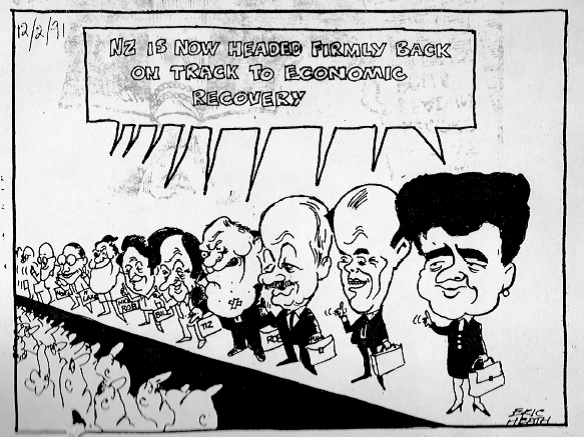
Changing tack, on the front cover of my cartoon collection I have this cartoon from early 1991.

richardson

For some years, I had it pinned to the wall in my office –  the sad procession of successive Ministers of Finance who for decades (this cartoon implies back to the 1950s) had promised that New Zealand’s decline would be reversed (made worse in this case in that Ruth Richardson must have said something along these lines in February 1991, just as the severe recession of that year was taking hold).      Since then, we’ve had Bill Birch, Winston Peters, Bill English, Michael Cullen, and Bill English again, and although we’ve had plenty of cyclical ups and downs, never at any time have we looked like successfully or sustainably reversing our relative economic decline.   It saddens me every time I look at this cartoon –  so many decades, so much failure.

Kudos to the Greens

I’m not usually much inclined to support the Green Party on anything –  their interest in reforming the governance of the Reserve Bank being an admirable exception.  And political courage on doing something about house prices –  and being honest about what making house and urban land more affordable means  – had seemed to be in really short supply from all across the political spectrum.  I’m not sure even the current ACT leader has been willing to openly suggest that if prices in Auckland fell 70 per cent it would only bring them into line with the price to income ratio of around 3 that has been a typical benchmark of affordability (happy to be corrected if I’m wrong on that).

And so I can only commend the Green Party for being willing to say it: house prices should fall, especially those in Auckland, and the fall needs to be large.

On Wednesday Turei, the Greens co-leader, put her neck out politically calling for house prices to be slashed, particularly in Auckland, where the average is knocking on $1 million.

She’s considering policy that house prices drop to about three to four times the median household income.

As the Stuff story puts it

Her party’s approach is not dissimilar from former Reserve Bank chief economist Arthur Grimes and former National and ACT leader Don Brash, who are calling for a 40 per cent drop and as much as a 60 per cent fall respectively.


Don Brash would probably describe himself as being on the right of New Zealand politics, while Grimes has always struck me as being (non-partisan but) a denizen of the mild centre-left.  This isn’t an ideological issue (at least on any traditional left-right spectrum) –  but one about facing facts, and prioritizing people who currently have little hope of ever being able to afford a house.  There is simply no excuse for that sort of systematic exclusion.

Turei says she’s doing work around what a policy would look like but she’s taking a lead from initiatives, such as Auckland Council chief economist Chris Parker’s report picked up by the council to aim for house prices five times the household income by 2030.
“We are saying it like it is. Most people believe house prices are far too high, most people believe house prices need to come down.”
The sad thing is the light that Turei’s comments shed on the leaders of our two largest parties.  We already know that the Prime Minister has dismissed the Grimes call as “crazy” –  not demanding, not uncomfortable for some, just crazy.   And as for the Labour Party.
But Little says the solution is stabilising house prices by cracking down on speculators, building more houses and lifting wages – not crashing the market.
So house prices should stay at these levels and in 40 or 50 years time wages might have caught up –  and our grandchildren might perhaps finally be again able to purchase a house at reasonable multiples to income?
No doubt both sides have been polling furiously on these sorts of issues –  trying to detect whether there is a tipping point in public opinion approaching.  As I’ve said before there is no doubt that sharp falls in prices could be uncomfortable for some.  But the potential unpleasantness is typically much overstated –  at least if a correction were to happen soon.  Most people haven’t entered the house market in the last  four or five years, and many of those who have will have envisaged paying off a mortgage over their working lives.  Our banking system is robust, and there is no chance of some repeat of the US 2008 financial crisis here.  But for some highly-leveraged investor purchasers, a sharp fall could mean a business failure.  That wouldn’t be pleasant for them, but it is in the nature of a market economy –  people take risks, many are rewarded, and others fail.  It is also in  the nature of unwinding distortionary controls that have skewed markets against ordinary people –  whether that is land use restrictions or in years past farm subsidies, import quotas or whatever.
The main point of this post is to praise the Greens.  But having done so, I would add that I’m much less convinced that they have the answers as to how to get prices down again
Turei says addressing the issue involves a capital gains tax, a state house building programme, both state houses being built and a state programme for building houses for sale, the unitary plan and supply.
And I’ve been puzzled for some time as to why a party that is concerned about the impact of people on the environment is so opposed to adjustments in immigration policy being part of the mix.
I also part company from them on timing

Any approach to bringing down house prices needs to be done in a controlled way and over a long period of time, she said.

I think that is exactly the wrong approach –  and the idea of “controlling” the pace of adjustment seems far-fetched.  Turei’s comments remind me of a cartoon –  which I might track down later in the day –  from the 1980s contrasting the Roger Douglas and Jim Anderton approaches to economic reform.  Dressed as surgeons, confronting a gangrenous limb, one advocates lopping off the entire limb in a single blow, while the other advocates removing tissue just a slither at a time.

The sooner house prices come down the easier the adjustment will be –  politically and economically.  The longer the current disaster goes on the larger the proportion of people who will have borrowed and entered the market on the basis of current high prices, and harder it will be, on both political and economic grounds, to secure the support for the necessary adjustments –  the more there will simply be a push to wait out the problems and leave affordable housing as a dream for a couple of generations hence.  That really would be a national failure (well, National and Labour).

A journalist asked me the other day for some comments on the housing market.  They don’t seem to have been used, so I’ll reproduce them here

Do you think the Auckland housing bubble will burst and why/ why not?
 
The best way to think about Auckland house prices is that they have reached their current outrageous levels because of the interaction of rapid population growth (mostly on account of immigration) and tight land use restrictions.   Whether prices, or price to income ratios, ever fall back very sharply mostly depends on what, if anything, governments do about alleviating those pressures.  Net immigration does ebb and flow, but around a very high annual target for the inflow of non-citizens.  There doesn’t seem to be much political appetite to change that target, and there also seems to be only limited appetite for really freeing up land use restrictions.  Allow any land within 100 kilometres of downtown Auckland to have even two storey houses built on it, and the price of urban land would quickly fall a very long way –  owners of land on the margins of the city will be keen to utilize the land as soon as possible, not as slowly as possible.  But far-reaching reform like that doesn’t seem that likely.  So, sadly, while we might see house prices fall back 10 or even 20 per cent in the next recession –  whenever that is –  it is difficult to be optimistic that price to income ratios will drop back to around 3 (where they should be) any decade soon.
If yes – any idea about when?
Forecasting is a mug’s game.  All that can really be said is “please, as soon as possible”.  The longer the eventual adjustment is delayed the more people –  owner-occupiers and investors –  who will caught having borrowed hugely to pay today’s massively distorted prices.  The longer prices stay at these, or even higher levels, the more difficult the economics and politics of ever making Auckland housing affordable again.
To all of which I’d add that I also have no problem with greater intensification, but these things should be decided by landowners, not by councillors, or hearings panels.  Assign property rights in the existing plan provisions to groups of homeowners –  say 500 house groups –  and let them trade changes in those rights.  Use collective action clauses – as are often used in modern bond contracts –  so that a vote of say 80 per cent of land owners in a neighbourhood would be enough to agree changes for that neighbourhood.  It might sound messy, but compared to the current situation it sounds like a path that would actually generate change –  and ensure that affected parties sort these things out in the market, without anguished arguments on Checkpoint about bureaucrats and judges deciding the fates of Panmure, Mission Bay, or wherever.


A former Prime Minister and Minister of Finance on immigration policy

A couple of weeks ago we had a family holiday in the Bay of Islands. It was almost 20 years since I’d been that far north, to a part of the country suffused with New Zealand history.  It is also a part of the country where some of tensions and divisions are still pretty visible. The visible divide between prosperous, heavily European, eastern towns, and the poorer browner inland areas is one example, but I was also struck by how often I saw the 1835 United Tribes flag flying.  In a country where flags are flown much less often than in, say, the United States, it was hard to miss.

As we looked over the historical sites and talked to the kids about New Zealand history, it had me wondering again, rather uneasily, about Maori perspectives on immigration in New Zealand history.  Scholars can debate quite what mix of factors led various Maori leaders to agree to sign the Treaty of Waitangi, or what they thought they meant in doing so.  But by some mix of consent and proclamation in and around 1840, the British government acquired control of New Zealand, and international recognition of that new possession.  At the time, the European population was probably no more than 2 per cent of the total population of New Zealand.

Mass European immigration wasn’t a specific article in the Treaty.  Many of the Maori leaders probably welcomed some immigration –  which had brought, for many, trade opportunities, education, Christianity and so on (as well as law and order problems etc).  But I don’t suppose anyone signing the Treaty, or probably anyone associated with establishing colonial government in New Zealand for that matter, really thought much about how the numbers would eventually turn out.

But whether it was foreseen or not, the numbers quickly changed.  Even by the mid 1850s, it is estimated that Europeans and Maori were roughly equal in number, and the immigration associated with the gold rushes further skewed the numbers towards European dominance, especially in the South Island.  Since then, of course, the numbers have swung ever further against Maori –  complicated by intermarriage.  Whatever benefits there might have been from the immigration, it is hard not to avoid a conclusion that it has created a society in which Maori are marginalized –  in important respects – in what had been for hundreds of years their own land.  Things Maori have more prominence now than they did when I was young, but the way things are done in New Zealand today isn’t primarily a reflection of Maori culture.  And, in a sense, that is inevitable –  countries reflect the cultures of the people who inhabit them –  but I can’t help wondering what that means to Maori.  Immigration changes societies, and in largely irreversible ways, whether intended or not.

My real focus today though is the history.  In the North Island in particular, the process wasn’t without tension.  There had been the Northern War of the mid 1840s, and then the North Island land wars of the 1860s and early 1870s.  These conflicts were enormously costly, and involved really large deployments of British military forces (in the 1860s apparently the British forces in New Zealand were the second largest British military deployment –  behind India –  anywhere in the world).  But by the end of the 1860s the British wanted out, and wanted the burden of defence and security to rest with the New Zealand government.  At the time, the colonial government could barely be said to have a secure hold on most of the North Island, at least outside the major towns.

It was around this time that the huge debt-funded immigration and public works programme was launched, driven by Julius Vogel.  It was a key event in New Zealand history, and features in all the histories and economic histories. The scale of the population inflows, and of the debt that was taken on in the process –  bringing in migrants and building railways and other public works –  swamps (proportionately) anything in more modern times.  The net migration inflow in 1874 –  the peak year –  was around 10 per cent of New Zealand’s total population at the time. Last year, our population increased by 2 per cent.

What isn’t much discussed is quite what drove the immigration and public works programme.  Earlier in the year I had seen a passing mention that in the leading biography of Vogel, the author –  Professor Raewyn Dalziel –   had suggested there was evidence that an active desire to change the population balance, “swamping” the Maori population in the troubled North Island in particular, was a key factor.  Having just come back from Northland, I decided to should look up the reference (p 105 for anyone interested).

In his own contemporary statement on the policy, which Dalziel quotes, Vogel had written

“The one chance of gaining adequate control was to introduce such a system of public works and workmen into the North Island as would 1st give protection in case of need 2nd occupy to some extent the natives 3rd open up communications 4th keep the natives in touch with the colonists….It was a matter of life and death to secure its adoption.”

Dalziel also draws from a lecture Vogel gave in London in 1893.  That was some time after the policy was introduced, but only six years after Vogel had ceased being Colonial Treasurer (Minister of Finance, in today’s terminology).  It is perhaps no different to listening today to Ruth Richardson explain the thinking behind the Fiscal Responsibility Act, or Bill Birch on the Employment Contracts Act.  Retrospectives are often tinged with the benefit of hindsight, but such reflections also often offer valuable insights on just what was shaping policy thinking.

Fortunately, Vogel’s lecture is available on-line here, as part of Victoria University’s Electronic Texts Collection.  I found it fascinating reading on numerous counts.

In discussing the immigration and public works programme, Vogel begins with the British government’s decision to transfer defence and security responsibility to the New Zealand government.

Mr. Gladstone euphemistically describes the sudden imperative withdrawal of the Imperial troops in 1870, at a time when war with the natives was proceeding on both sides of the North Island. There is a modern phrase which more aptly describes what took place. “Scuttled” is the word that would now be used. That the Colonists proved equal to the task they had to undertake was no excuse for the way in which the obligation was flung upon them in the midst of a double warfare existing at the time. I have always felt grateful to the Maoris for the way they behaved at this crisis. Had they been possessed of less generous instincts, they would have taken advantage of the position. The North Island was sparingly peopled, the Colonists of the Middle Island, by far the most wealthy and populous, were profoundly discontented with the onerous call which had been made on their resources, by expenditure which they comprehensively regarded as cast upon them to fulfil Imperial obligations contracted by the Treaty of Waitangi. The actual means of the Colony at the time were not large, and any attempt to raise a war-loan would have been scouted. The North Island was not only scantily populated, but much of the interior was almost impenetrable to Europeans, whilst the Maoris could go from end to end and from side to side of the Island with great ease. It took General Chute, with a considerable force, a long time to penetrate to New Plymouth from the Wellington Province, and his able performance of the task was regarded as a great feat. Had Te Kooti and Titokowaru, who were respectively at war with the Europeans on the east and west coasts, joined their forces, and other great chiefs combined with them, the issues would have been very grave. This risk the Colonists were left to confront whilst Downing Street exhibited the most stoical disregard of the consequences of its own previous acts, and of the responsibilities it had specially contracted.

The Public Works’ Policy.

The Government had but one resource, a policy of the utmost conciliation, until they could place themselves in a position of strength for the future. It was a most anxious period. The ‘Maoris were a fiery race, and any little dispute in any part of the Island might have occasioned a fierce and general war.

It has often been said and written that the Public Works’ Policy was the outcome of a speculative desire to obtain the expenditure of a large quantity of borrowed money for the gain that expenditure would bestow, leaving to chance subsequent consequences. I will tell you the real facts, and I think I may say there are only two or three men now living who can speak with equal authority. The Public Works’ Policy seemed to the Government the sole alternative to a war of extermination with the natives. It comprised the construction of railways and roads, and the introduction of a large number of European immigrants. The Government argued that if they could greatly increase the population of the North Island and open up the means of communication through the Island, and at the same time give employment to the Maoris, and make their lands really valuable, they would render impossible any future war on a large scale. They recognised that in point of humanitarianism there was no comparison between the peaceful and warlike alternatives. They considered also that, financially, it was infinitely preferable to spend large sums on permanent development, to expending equal, or probably larger amounts on issues of warfare.

…….

The Colonial Government dared not introduce the Public Works’ Policy as a measure to subjugate the natives to future peacefulness. To have done so would have involved the risk of exciting them to immediate hostility. The most that could be stated in that direction was contained in the following paragraph in the speech in which a declaration of the policy was made.

“I cannot close this branch of the subject without adverting to the effect which the promotion of railways and immigration must certainly have on the native question. The employment of numbers of well-paid natives on Public Works, to which in their present temper they will resort with avidity, the opening up of the country and its occupation by settlers, which will result from the construction of roads coupled with the balancing of the numbers of the two races by a large European immigration, will do more to put an end to hostilities, and to confirm peaceful relations than an army of ten thousand men.”

There was thus the necessity of bringing the measure forward on its merits, only as a colonising scheme. Pray do not think the Government had any doubt on the subject, but it was a bold departure for so small a community, and under ordinary circumstances it would probably have been proposed on a less ambitious and rapid scale. But the circumstances forbade anything of the kind. From what I have previously said it may be gathered that the South Island would not be willing to give its credit to benefit colonisation in the North Island without inducements applied to itself of a large character. Hence to really serve the North Island, it was necessary to frame the whole scheme on a scale sufficient to offer great advantage to the South Island.

What surprised me was that when I pulled other books off my shelves  –  political and economic histories of New Zealand –  there was almost no reference at all to this strand of argument.  There is plenty of discussion of the economic and fiscal impact of the immigration and public works programmes –  albeit nothing on what it might have done (good or ill) for per capita incomes in the longer-term –  but nothing at all on what seems to have a key motive for key figures in the government of the time, Vogel  –  former Premier and Colonial Treasurer – foremost among them.

I’m not sure why, but I can guess.  Among other things, it is pretty uncomfortable stuff for a European author –  or reader.  Conquest and displacement are, no doubt, the way of history, but it isn’t a comfortable thought about one’s own country, about events that are only 140 years or so in the past. It is a reminder of the fragility of many of the settler societies, and of how –  plausibly enough –  the New Zealand story could have ended quite differently.   Personally, I read it with a mix of conflicting thoughts and feelings: glad on the one hand that my own ancestors were all in the South Island, and  the comfort and familiarity of being part of a majority culture.  But on the other hand, more than a little uneasy about what it has all meant for the place of Maori in New Zealand –  and for all that the rest of us (rightly and reasonably) claim this place as home, it is the only home for Maori and their culture.

Quite plausibly, mass European immigration to New Zealand in the 19th century did raise per capita incomes here –  for Maori and for Europeans –  but it did so partly by operating on scale that substantially displaced the cultures and institutions that had been here previously.  Indeed, Vogel suggests that for the largest single wave of that migration, to do so was a matter of calculated government policy.

For many readers, there might be a “so what?” reaction to all this.  A family member’s response was “well that’s fine, but it happened and can’t be undone”.  And that is fine too – this isn’t directly about lessons for today, but for me anyway it prompts me to reflect afresh on how immigration –  and immigration policy – has shaped our country in the past, and in different ways continues to do so today.  And to wonder again about what it means for the relative and absolute place of Maori in New Zealand.

(On quite another matter, I was amused to see that the concept of value-added in exporting made the speeches of former Ministers of Finance even 120 years ago.  I’ve written here about how New Zealand performs pretty poorly on that score now.   Here is Vogel talking about value-added in exporting –  and the lowish proportion of imported inputs in New Zealand’s exports – back in 1893:

over the 40 years ending 1892 an exportation of articles produced in New Zealand equal to £14 annually per head of population. The United Kingdom prides itself on being a great exporting country. During the 16 years to the end of 1890, the annual value per head of population, of exports, the growth, or produce of the United Kingdom amounted to £6. 7s. 5d., against £14 per head in the case of New Zealand. But even this comparison does not give a full idea of the difference between the two countries. The New Zealand exports were entirely the growth and produce of the country, whilst one-half of the exports from the United Kingdom were merely preparations or manufactures of imports received from other countries.

For anyone with an interest in New Zealand history, Vogel’s lecture is fascinating stuff – an upbeat visionary politician’s take on what had been created in New Zealand over the previous 50 years, and what might yet be.)

Labour on New Zealand’s economy

It is probably only about 14 months until the next election.  We have a government that has presided over eight pretty-mediocre years of economic performance –  not all of it their fault, as there are global factors at work –  with no real idea what they should or could do to reverse New Zealand’s decades of staggering relative economic decline.  Often enough, it seems that the current government doesn’t even really care, so long as they can successfully persuade enough of the public that things aren’t too bad, or (worse) that our problems are actually marks of some sort of success.

Of course, our key economic agencies –  Treasury, MBIE, and the Productivity Commission –  show no real sign of offering the sort of quality advice that takes seriously the specifics of New Zealand’s situation and offers solutions that might make a material difference.  I’m not really sure why.  For them individually  –  and maybe for senior politicians too – perhaps it doesn’t matter very much.  For the upper tier of New Zealand, life is pretty comfortable.  And it isn’t always clear that politicians want hardheaded advice that seriously addresses New Zealand’s problems.  The Muldoon government wasn’t that keen on robust Treasury advice in the early 1980s either, but it didn’t stop the agency investing in capability and offering the best professional advice they could.

But this post is about politicians, and particularly about the Labour Party.  12 months out from an election, eight years since they last held office, at a time when no one would really claim the economic situation is particularly rosy, one might have hoped that the main Opposition party would be offering a pretty compelling alternative narrative: a diagnosis of what has gone wrong economically and the outlines of a rather different approach to policy.  I’m not suggesting that they should have all their policy detail published this early, but surely there should be enough to leave floating voters –  or potentially detachable voters –  with a sense that the main Opposition party was offering a different path, that would make a material difference?

I watched Grant Robertson’s interview on Q&A yesterday and was as unimpressed as ever.  There are occasional glimmers of recognition of some of the symptoms.  As he notes, per capita GDP growth has been very weak, and to the extent there is growth in total real GDP most of it is just based on the demand effects of a rapidly rising population.  He knows house prices are a problem, and I was pleased to see reference to the idea that house price to income ratios of around 3 might be a more normal level.  There was at least a hint that the economic performance of the non-metropolitan regions has left quite a lot to be desired –  although no apparent recognition that per capita incomes in Auckland have grown more slowly than those in the rest of the country for the last 15 years.  And last week he usefully drew attention to the very weak dairy price forecasts from the OECD.

But that was about it.  I heard two fairly specific proposals.  One  was to ban offshore buyers from the housing market. And the second was to revise the Reserve Bank’s monetary policy mandate.  Reasonable people can differ on the merits of a (non-resident) offshore buyers ban  –  and I happen to agree that we shouldn’t be ruling out even daft future policy options in preferential trade agreements that try to tie the hands of future Parliaments –  but it must be a pretty peripheral issue.  After all, Australia bans offshore buyers purchasing existing houses, and Sydney and Melbourne house prices are if anything more ruinous than those in Auckland.  And offshore buying seems unlikely to be a material phenomenon in the New Zealand second tier cities where price to income ratios are still far above 3.

And as for changing the Reserve Bank Act and the Policy Targets Agreement, it is all very well to say that the mandate is “broken”, but Labour has shown no signs of offering an alternative that would make any material difference to our real economic performance.  They offered a reasonably sophisticated attempt at a redraft in 2014.  I argued at the time inside the Bank, and subsequently, that the alternative wording –  while not necessarily objectionable –  would not have made any very material difference to the conduct of monetary policy, let alone to New Zealand’s longer-term economic performance.  As a readers know, I do think the Reserve Bank Act needs substantial reform, and I would probably favour some changes to the PTA and the related provisions of the Act, but they aren’t in any sense “the answer”.  I guess we’ll have to wait and see what specific proposals in this area Labour will campaign on in the next election.  But we should never expect that different monetary policy arrangements will make much difference to a nation’s longer-term prosperity.

What else was there in the interview?  There was talk of using government procurement policies to support New Zealand businesses –  which is probably illegal under our existing trade agreements, and in any case sounds mostly like old-fashioned protectionism, which rarely makes sense anywhere, and particularly not in a small country.  There was talk of investing in infrastructure and education.  Within limits, the infrastructure point is probably reasonable –  rapidly rising populations need more infrastructure –  but there was no hint of how this might lift trend productivity or per capita income performance.  As for education, it always sounds good to offer to spend (“invest”) more on it, but such proposals rarely seem to engage with the evidence suggesting returns to tertiary education in New Zealand are already among the lowest in any OECD country.  If anything, there are hints there of a possibility that too much is being spent, not too little –  at least if one thinks of education as an investment item, rather than just another part of consumption.

There was talk of “building wealth from the ground up”, and of “working with our farmers to get more value-added products” (as if, somehow, government officials and politicians are better able to make specific dairy product choices than their own managers and owners), but nothing remotely specific.  And there was not a single mention of the exchange rate –  even though ours has spent the last decade or so 20 per cent higher in real terms than in the previous decade.    And even on housing, where Labour has shifted ground in some important areas, Robertson was about as feeble as the rest of the political class –  he wants housing to be affordable, but doesn’t want house prices to fall.  It is easy enough to say “lets raise incomes and undermine those price to income ratios that way”, but it is just words without any suggestion of a strategy that would materially lift the rate of growth of per capita incomes.

Labour has been heard to suggest that something should be done about immigration.  Of course, I agree that something should be done, but I’ve been watching for months for any sense of how Labour is actually thinking about the issue.  The most I’ve seen has been occasional talk about “temporary pauses”, which mostly seems like a substitute for hard-headed thought or engagement with the issues.  It isn’t as if immigration policy is much different now than it has been in the past 15 years –  including the period when many of Robertson’s colleagues were ministers and he was ensconced in the Prime Minister’s office.   Chopping and changing immigration policy on the basis of this year’s pressures, or last year’s, doesn’t seem a particularly sensible approach –  there are lags in the system, and such short-term policy  reversals would create huge uncertainty for all parties concerned (potential immigrants and people here). And they simply can’t deal with the long-term challenges.  There is a respectable case that New Zealand’s high target levels of non-citizen immigration are good for New Zealanders.  But is that the case Labour wants to make, or isn’t it?  There is a respectable alternative argument that our approach was a not-unreasonable policy experiment that has failed.  Is that the case Labour wants to make?  We just don’t know.

I’ve been keeping an eye on the Labour Party’s website for some months –  and even, on occasion, trawling through the tweets of senior Labour Party economic spokespeople  –  to see what issues they are engaging on in public.  Robertson is the finance spokesperson so one might reasonably expect the most from him.  But there just hasn’t been much all year.  The flagship event was the Future of Work conference which, whatever one might think of it in a longer-term context, didn’t really seem to be addressing today’s issue, where labour force participation rates have been quite high and total employment growth has been faster than in almost any advanced economy.  The challenge for New Zealand hasn’t been finding enough jobs, but generating sufficiently high returns to the inputs of labour and capital to provide first world incomes for New Zealanders.  Robertson hasn’t been offering anything of real substance there.

Labour also has spokespeople on immigration and economic development, both apparently ranked in the upper half of Labour’s caucus.  I assumed –  or at least hoped –  I would find something from those people on how Labour’s thinking was developing.  Iain Lees-Galloway is the spokesperson on immigration, and since his leaders have talked on several occasions about how something should be done about immigration, I hoped to find something from him.   He seems to have put out 15 press releases this year, but only two of them look to have been around immigration issues –  dodgy dealings around Indian students and something about seasonal horticulture work.    Even if Labour doesn’t yet want to release the details of its policies, one might have hoped for a scene-setting speech on how Labour is thinking about immigration policy, costs and benefits etc etc, looking to shift the ground where the debate is taking place.  But there is simply no sign of anything of the sort. Perhaps lots of intense thinking and deliberations are taking place in private, but it really isn’t that long until the election.

David Clark is Labour’s economic development (including regional development) spokesperson.  According to the Labour website, he hasn’t put out a press release at all since April, and there is no sign in any of his statements this year as to how he or Labour are thinking about reversing New Zealand’s economic decline.   Perhaps a whole new wave of serious policy thinking and efforts at reframing the narrative are just about to be launched.  But I’m not really that hopeful.

I find it pretty depressing –  as if people (bureaucrats and politicians) have simply given up and decided that it is all too hard.    It is we and our kids who will pay the price of that failure.

The Reserve Bank’s update

I don’t have a great deal to say about the Reserve Bank’s statement this morning, which seemed to conform to my interpretation of the Governor’s “reaction function” over the last 12-18 months.  He really doesn’t want to cut interest rates at all –  after all, he keeps stressing just how “accommodative” monetary policy already is –  but he cares enough about the inflation target that if there is a heightened risk that inflation might stay below 1 per cent for too long then he will, reluctantly, act.

On process, I think the fact of today’s statement helps illustrate why the recent change in the Bank’s OCR announcements timetable is not particularly helpful.  On the old timetable, there would have been an OCR announcement itself this week or next.  Even though it is only now three weeks until the next MPS the Governor clearly felt things were important enough that he needed to make a signal now, rather than waiting until they had gone through the full forecasting process.

There has been a two month gap between the June and August MPSs.  But look ahead to the release calendar, and there is a three month gap between the November MPS and the February 2017 MPS, with no OCR reviews scheduled over that period.  Yes, we all know that New Zealand shuts down for a few weeks from late December to mid January, but a great deal can happen in three months at any time of the year.  Data keep on being published locally, commodity prices and exchange rate change daily, and the economies of the rest of the world keep on as normal.  Two months is often going to be too long between OCR reviews, but three months will usually be too long –  whether the Bank is in a tightening or an easing cycle.  It risks jerky OCR adjustments and miscommunications and misunderstandings (of which there have been more than enough recently anyway).

It was also a shame that the Bank chose to release its update this particular morning.  The Bank’s survey of expectations is an important input into the monetary policy process,  and especially the measures of medium-term inflation expectations.  But that survey was being taken yesterday and today, meaning that some respondents will have answered before the Governor’s statement and some after it.  That will, to some extent at least, muddy the waters when the expectations survey data are released on 2 August.

In terms of substance, I guess we should be thankful for small mercies.  The Bank is explicitly recognizing that it is getting harder to meet its inflation objective –  a target it has failed to achieve for years now.  But I remain rather uneasy about the heavy focus on the  exchange rate, and on tradables inflation.  Perhaps there is a little more reason than usual to focus on headline inflation –  and the impact of short-term fluctuations in tradables prices –  given that inflation has been so far below target for so long.  There is a real danger that people are coming to think of something around 1 per cent as a normal rate of inflation, not the 2 per cent the Bank has been mandated to focus on.  But in general, central banks are better advised to focus on core pressures on domestic non-tradables inflation –  something the Bank itself has often highlighted in the past.  Nothing of those sorts of ideas is apparent in today’s statement at all.  If anything, the Bank continues to assert that capacity pressures are ‘rising’ –  on what measures, or supported by what indicators, they don’t say.  And for all their apparently growing unease about the rest of the world they seem reasonably upbeat on domestic economic activity – even though there has been very little per capita GDP growth at all in the last year.

With trends in the underlying measures of inflation so low, I think OCR cuts are clearly warranted –  and have argued since mid last year that something nearer 1.5 per cent was warranted –  but the Bank’s continued reliance on headline inflation arguments suggests that they still “don’t really get it”.    The core trend in inflation remains too low to be consistent with the Bank’s target (and, not incidentally, the unemployment rate suggests ongoing excess capacity).  There has been some sign of stabilization in core inflation measures, and perhaps even a very slight increase, since the Bank finally realised it needed to be cutting rates not raising them, but there is a long way still to go.  And that would be so even if the TWI was at 72.     As a reminder, despite the persistently weak inflation rate –  surprising the Bank more than anyone –  the real level of the OCR is still no lower (and most likely actually higher) than it was two or three years ago before the Bank started its ill-judged and unnecessary tightening cycle.  New Zealand interest rates are typically well above those in the United States, but there is nothing in the relative cyclical performance of the two economies suggesting we need an OCR even 175 points above the US policy rate.

Of course, there is an alternative perspective.  In the Dominion-Post this morning, Pattrick Smellie asserts that “it’s not the Reserve Bank’s fault that monetary policy as we knew it is broken”.  He argues “how realistic is it to think that cutting rates further will revive domestic inflation when we’re importing the absence of inflation from the rest of the world?”  There are certainly some common global factors at work, but we need to recall that (a) most advanced countries have exhausted conventional monetary policy capacity, while we haven’t, and (b) New Zealand has had an inflation rate that has been undershooting the target by more than in the case in many –  not all –  other advanced economies (eg Australia, the US, or Norway).  It isn’t a case that the monetary policy model is broken in New Zealand, so much as that the Reserve Bank Governor has been reluctant to give it a try –  reluctant, that is, to do his job.  Put the OCR quickly to, say, 1.5 per cent and –  absent a big new adverse global shock –  I think we can be reasonably confident that future inflation would be tracking much closer to 2 per cent than seems likely (even to the Reserve Bank) on current policy.

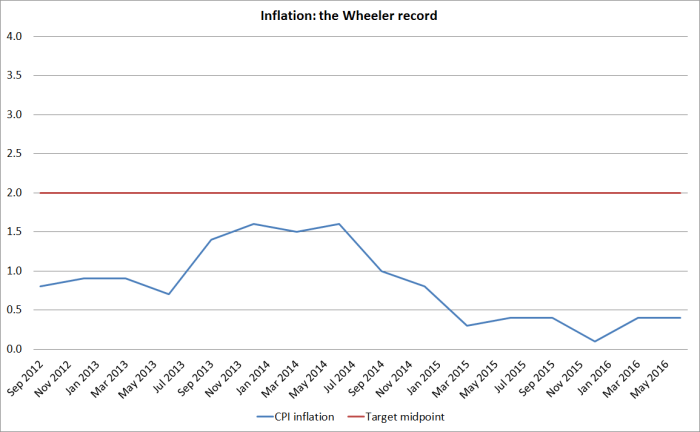
As a reminder, here is the New Zealand (headline) inflation outcomes over the current Governor’s term.

wheeler inflation

On current reckonings there is little chance of headline inflation even getting briefly to the target midpoint at any time in the Governor’s five year term.  Not a record to be proud of, especially as the Governor himself championed the case for a focus on the midpoint.


It is good to know there is diversity of views at ANZ

The Australian head of ANZ’s New Zealand business, David Hisco, was out last night with an article in the Herald headed Housing and New Zealand dollar overcooked.

Hisco is gung-ho on LVR limits.  Here are two of his list of “things that should be done”.

Heavily increase LVR limits for property investors. The Reserve Bank wants most property investors around the country to have 40 percent deposits in future. We think they should go harder and ask for 60 percent. Almost half of house sales in Auckland are to property investors. Taking them out of the market will be unpopular amongst investors but it may end up doing them a favour. Of course this would mean less business for us banks but right now the solution calls for everyone to adjust.

Voluntary tightening of lending criteria by banks. Since the GFC banks have been more conservative than ever on lending. But the current situation will see ANZ implement even tougher criteria for investment loans as house price inflation spreads from Auckland to other regions.

I have no problem at all if the management and Board of ANZ Bank want to adopt tighter lending standards.  They run a private business, in a competitive market, and must make their own choices about what risks are worth it, for their shareholders, to run.  Bureaucrats and politicians are fond of second-guessing those choices, and we all know that banks have made mistakes in the past –  as businesses in all sectors do –  but there is rarely much basis offered by the bureaucrats and politicians for thinking their assessments of what risks private lenders should run are better than those of the bankers.  Actually, Australasian bankers have had a pretty good record over many decades –  and when things did go wrong in the late 1980s, it had as much to do with bureaucrats and politicians as with bankers: repress an industry for decades by regulatory fiat, and inevitably it will take everyone a while to learn how to lend (and borrow) well in a much different environment.

It is the first of those paragraphs above that I have a problem with.  If Mr Hisco really thinks it would be imprudent –  they couldn’t make a positive expected risk-adjusted return from doing so –  to lend to anyone wanting to buy a potential rental property with an LVR over 40 per cent, he probably has the delegated authority to make that change himself.   Today.  He is paid a great deal of money by ANZ, and his board –  and superiors in Australia –  presumably think highly of his ability to manage the bank, including its credit risks   It simply doesn’t need a bunch of bureaucrats telling him to do his job.

But his paragraph seems stronger on the rhetorical flourishes than on the analysis.  After all, where have nationwide nominal house prices ever fallen by 60 per cent?  And even if they did fall 60 per cent –  or even more –  in Auckland to perhaps bring price to income ratios down to a more sensible 3 (rather than the current 10), such falls seem exceptionally unlikely in much of the rest of the country, where real house prices have barely changed in almost a decade.  Can bankers really not make money lending to landlords in Oamaru or Invercargill at LVRs of even 50 per cent?  If so, they must be a lot less good at their jobs than they would typically have us believe?  If so, one might reasonably hope for the emergence of new entrants to the new mortgage lending market – preferably non-bank lenders beyond the reach of the Reserve Bank’s controls.   One can always worry about extreme hypotheticals, but if one did no bank would ever lend money to anyone for anything –  which would rather defeat the point of setting up in business as a bank.

But I don’t suppose we will actually see ANZ move to ban all mortgages for residential investors with LVRs in excess of 40 per cent.  Instead, Hisco wants the Reserve Bank to do it for him.    That would enable him to tell his Board that he simply had no choice, and provide cover when profits fell below shareholder expectations.  That should be no way to run a business in a market economy –  although sadly too often it is.  It is good illustration of the distinction between pro-business and pro-market policies: the former too often involve politicians, bureaucrats and big business people in each other’s pockets, providing cover for actions that work against the interests of citizens.  We already see this  happening to some extent with the Reserve Bank and the banks: the Reserve Bank adamantly refuses to release submissions made by banks on its regulatory proposals.

If Hisco followed his own analysis and banned all investor mortages with LVRs above 40 per cent, no doubt ANZ would lose a lot of market share.  If Hisco was fundamentally right, and in another year or two house prices nationwide did fall 60 per cent, he’d be vindicated as presumably ANZ’s loan losses would be much lower than those of other banks who didn’t follow his lead (unless of course he’d taken the capital that would have funded investor mortgages and used it on something that proved even riskier, if currently less visible).  It is all very well to invoke the old Chuck Prince (ex Citi CEO) line about “while the music goes on one has to stay on the dance floor”.  But top executives are paid to be a bit ahead of the game in how they position their own businesses.  Of course, they aren’t always rewarded –  as often in life –  for being too far ahead, but nothing stops Hisco making his case to the Board and shareholders for pulling lending standards in even more than the Reserve Bank requires them to. If the shareholders decline, and in good conscience he cannot bring himself to undertake such lending, he could consider other career options.

As it happens, his own economics team doesn’t seem to agree with him.  Of course, they aren’t the people setting credit standards for the ANZ, but it was interesting to see their note on Tuesday shortly after the Reserve Bank had released its new proposals. It concluded.

To us, the case for requiring investors to have a 40% deposit is not overly
strong. This is particularly considering the RBNZ’s own stress tests and the fact that most investor lending was already done at sub-70 LVRs anyway.

There must be some interesting conversations going on at the ANZ.  It would be very interesting to see the ANZ submission on the Reserve Bank’s proposals, and if the Reserve Bank won’t release it, there is nothing to stop ANZ itself doing so.  I’ll be surprised if they do, and even more surprised if the submission recommends limiting all investors throughout the country to LVRs not in excess of 40 per cent.

Hisco seems to have some form as regards bold calls.  Digging around, I stumbled on this piece from October 2014, less than two years ago.  It was full of all sorts of calls for interventionist active government, but not a mention of LVR limits or bank lending standards.   Back then –  21 months ago, and not that much has changed since then –  it was all about supply.

The housing affordability issue is a housing supply issue, pure and simple. In 1974 there were 34,400 new homes built. Last year there were 15,000 – less than half. It’s no wonder houses doubled in price in under a decade in Auckland.

The solution is simple – urgently build more houses. To do that in places like Auckland we need to build more suburbs and allow intensification in existing areas.

In his latest piece, he hasn’t totally abandoned the supply arguments, but has rather markedly backtracked.  It doesn’t appear in his five point list of things we should do now, and there is just this

The Leader of the Opposition says we need to build more homes faster. That makes sense, too, if we have the resources and approvals to do it.

And yes I did notice his comments about immigration.   This is what he says about that item in his five point plan

Review immigration policies. Immigration has been great for New Zealand. We are a harmonious, diverse and inclusive society. But Auckland’s housing, roads, public transport and schools are struggling to cope. Let’s have an honest and sensible debate about immigration using facts rather than prejudice to see if we should push the pause button.

Debating using “facts rather than prejudice” seems a good idea in most areas of life, but his approach doesn’t really seem to offer much.    There is little evidence (“facts”) to suggest that immigration has been “great for New Zealand”, but on-off immigration policies seem about as undesirable as unpredictable regulation in any other area of life.


This is what good policy formulation looks like now?

I’ve now read the Reserve Bank’s consultation document on the latest iteration of their ever-extending, but highly unpredictable, LVR restrictions, and also the issue of the Bulletin they released yesterday Financial stability risks from housing market cycles.  Neither document seemed remotely convincing: just a series of the same old material, now twice-over lightly, that mostly doesn’t stand up to much scrutiny.  It was particularly striking that in the Governor’s mad rush to put yet more controls on banks and yet more potential borrowers, he never stops to reflect on any lessons from the fact that this is the third iteration (the Third Coming, as Gareth Vaughan puts it) of these controls in less than three years.  Does this not raise any questions in the Governor’s mind –  or those holding him to account –  about the Bank’s ability to set these sorts of controls effectively and provide a stable climate for private businesses and households?

But I’ve been tied up with other stuff today, and even on the Governor’s rushed timetable there are still a few days left to think harder about the Bank’s analysis.  (It is noteworthy that, despite the Bank’s commitment only a few months ago to longer consultative period, there is no attempt in the consultative documents to make a case for why action is so urgent that the new –  welcome –  standard is just tossed out the window.  Various critics suggest the Governor has bowed to political pressure, but I don’t believe that is the explanation).

So today I wanted to focus mostly, and quite briefly, on this table from the Bank’s consultative document.  As the Bank itself puts it, this table summarises the discussion “through the lens of a cost-benefit analysis”.

It looks like no cost-benefit analysis I’ve ever seen. I could commend to the Governor and his staff The Treasury’s guide to undertaking cost-benefit analysis.   Agencies simply cannot get away with calling a short list of possible costs and benefits, painted with the broadest possible brush and with not a number in sight, a cost-benefit “analysis”.  How could anyone look at a table like this and conclude with any confidence that what the Governor is proposing is in the national interest?  Perhaps he is right, but this table simply doesn’t show it.

Everyone knows there is a great deal of uncertainty about many of the possible costs and benefits, but one of the key arguments for disciplined  numerical cost-benefit analysis is that it forces agencies to write down numbers, make the case for those numbers, and illustrate the sensitivity of the resulting bottom line to a reasonable range of alternative assumptions.  Everyone knows bureaucrats and ministers game the system to help produce the outcomes they want, but the discipline of writing down the numbers is part of enabling others to scrutinize what is being proposed.  As a reminder, this is a consultative document –  a proposal for scrutiny and external comment –  and the Governor is legally required to have regard to submissions that are made. The law isn’t supposed to allow the Governor to simply rule by decree.

It is also striking that nowhere in the document, or anywhere in the cost-benefit so-called “analysis” is there any sense of the distributional implications of the proposed policy.  Who gains and who loses is often as important as the aggregate assessment of national costs and benefits? It isn’t clear that the Bank has given that any thought whatever.  That shouldn’t be good enough: Treasury, the Board, and  relevant parliamentary select committees should be questioning the Bank about the inadequacy of what it has rushed out yesterday.

What should be doubly disconcerting is that the Bank also shows no sign of having thought, in a disciplined way, about the distinction between private and social costs and benefits.  For example, take the very first “benefit”.    Loan losses are not a loss for the country as a whole, they are simply a redistribution of wealth among people within the economy.  Banks might be glad to have lower loan losses at some future date, but then banks –  private businesses accountable to their shareholders –  are able to adjust their lending practices themselves. Indeed recent evidence –  banks reining in, or cutting altogether, lending to offshore borrowers –  illustrates that they do just that.  What is that gives the Governor confidence that he is better able to make those judgements than the private businesses he is regulating?  We simply aren’t told –  even though this is his third attempt to get it right.

And why is a temporary reduction in house price inflation –  the second “benefit” –  a national gain.  Again, it redistributes gains/losses among players in the economy –  providing slightly cheaper entry levels in the near-term for those not directly affected by the controls, at the expense of those who are directly affected.   How do we value this alleged “gain”, especially if the fundamental distortions in the housing market –  yet more regulations –  aren’t changed.

I could go on.  There is, for example, no attempt to justify the proposition that it matters less if potential landlords are squeezed out of the market than if potential owner-occupiers are squeezed out.  And from a financial system efficiency perspective one could reasonably argue that an upsurge of non-bank lenders would  actually be a net gain, given that the controls are being put on at all.  But in any case, there is not a single number in sight.

These are highly intrusive controls, being imposed in a sweeping manner, and there simply isn’t much to underpin them.  Perhaps it won’t matter much to the Bank.  After all, the Prime Minister, the Labour Party Finance spokesperson, and even the former leader of the ACT Party seem to be in favour.   But citizens deserve much better quality policy formulation than what we have here.

I noted yesterday that it wasn’t clear quite why, even if one granted the need for some controls, we needed to effectively prohibit purchases of rental properties in places like Wanganui and Gisborne with LVRs above 60 per cent.  I half-hoped the consultative document might shed some light, but no.  Simply nothing.

As a reminder, real house prices in New Zealand as a whole are almost unchanged from the levels in 1987 –  and since those in Auckland are so much higher, those in the rest of the country  as a whole must be lower.

qv house prices since 2007 peak

We didn’t have a domestic financial crisis after 2007.  And I’m quite sure that anyone borrowing in those cities to the right of the chart, and anyone lending to them, is very conscious that house prices can go down as well as up.  The case for this regulatory imposition just isn’t made.

As ever, if the Bank is determined to rush ahead and do something more (perhaps on the  maxim that “something must be done by someone, and the Bank is ‘someone'”), the much less distortionary, and less knowledge-intensive, approach would be to increase capital requirements, either more generally or specifically on housing lending.  Doing so would provide bigger buffers, at minimal cost to banks and borrowers (since the financing structure shouldn’t materially affect the overall cost of capital).  The Governor talks complacently about longer-term reviews of capital requirements, but higher capital requirements could be imposed now.  I doubt there is a good economic case for doing so, but it is much less bad case than what we’ve been presented with in this latest consultative document.