Woodhouse on immigration

Bernard Hickey had an interesting article the other day, having talked to both the Minister of Immigration and the Minister of Finance about the growing calls for a rethink of immigration policy, and particularly about the high number of relatively lowly-skilled migrants that have been allowed in.   I’m still staggered that we grant immigration approval, even for temporary work visas, to any labourers, let alone 6500 of them.

The Ministers seem torn.  Woodhouse in particular often comes across, as Steve Joyce typically does, as a true believer.  Immigration is good and, if anything, more immigration would be better.  Of course, there is no evidence of these benefits to New Zealanders at an economywide level –  Ministers don’t produce any, and their advisers in MBIE and Treasury don’t either.  25 years of the current policy, and 70 years of high immigration since World War Two (with a brief exception between the mid 70s and the late 80s), and you’d think the advocates of the policy would have no real trouble demonstrating the benefits to New Zealanders of their policy, if they existed.  I know people still debate the merits of free trade (although most of the debate these days is about the non-trade aspects of preferential trade agreeements), but pretty much everyone welcomes the much cheaper cars, clothes, TVs etc that followed from the dismantling of import controls.  It was a clear gain for the overwhelming bulk of New Zealanders.

But there is simply nothing comparable for the succession of large scale immigration programmes New Zealand has run.  As a reminder, we’ve had one of the very largest planned immigration programmes anywhere, and one of the very worst productivity performances among advanced countries for decades.  The best case story must be that the immigration just stopped things getting worse, but no one has even been able to show that.  Of course, there is the hardy perennial of the wider range of ethnic restaurants.  But it is hard not to think that that is typical example where upper income people are capturing almost all the gains. I can’t imagine that people on the average wage or below eat out much at all.  Actually, with three hungry kids and a (good) single income, we don’t.

If Woodhouse and Joyce are true believers, there are signs of a bit of unease, and bet-hedging, going on.   Woodhouse repeatedly runs John Key’s line that the demand for immigrant workers is a “sign of success, not failure”, but when pushed on the possibility that –  as Treasury warned –  high levels of low-skilled immigration could be dampening wages for low-skilled New Zealanders, he accepts the warning but notes that in his view the “evidence is not clear yet”.   That isn’t exactly a ringing statement of confidence.  The Minister of Finance is similarly hesitant.  Perhaps even MBIE is beginning to have second thoughts?

The curious thing about the current debate is that on my reading of the international literature and evidence, no thoughtful advocate of large scale immigration really bothers to contest the idea that if you bring in lots of unskilled immigrants it will probably have some adverse effect on the wages of the native unskilled.  Those who are more enthusiastic will stress their view (their reading of the evidence) that the effect is pretty small, and might go on to argue that often recent immigrants aren’t actually competing with natives at all, but with the last-but-one cohort of earlier immigrants.  That competition is part of how the (claimed) wider national benefits of that sort of immigration (as distinct from the possible productivity spillovers from really highly-skilled and innovative people) arise –   it makes projects viable that otherwise wouldn’t have been.  Defenders of the New Zealand programme can reasonably point out that our immigration programme is less heavily weighted towards unskilled people than those of many other countries –  the US, with its focus on family-based immigration criteria, is a prime example –  but that unskilled (or modestly-skilled) component of our immigration can only benefit New Zealanders as a whole (and it may not do so even then)  if it changes relative prices –  making relatively unskilled labour relatively cheaper.    If it doesn’t do so, there is no point in having it at all  (at least on economic grounds –  the ostensible basis of the programme).

Ministers like Woodhouse and Joyce devote huge amounts of time to recounting stories of labour shortages in particular sectors, or regions, or firms and how they –  and their wise bureuacrats –  closely monitor emerging pressures etc, juggle and refine the approved occupational categories to match supply and demand.  It has all the overconfidence of a Soviet-era central planner –  and not a jot of faith in the markets, or indeed in their fellow New Zealanders.

Which is strange in a way since, in their former pre-politics lives, both Woodhouse and Joyce were private sector CEOs, operating medium-sized businesses.  Of course both were in domestically-oriented sectors (private hospital and radio respectively)  –  which is where the firms are who do tend to benefit from immigration, at the expense of the tradables sector.  But perhaps the business mindset comes through in this way: from any individual firm’s perspective, it would be worse off if it (in isolation) were not able to draw in immigrant labour.   Business CEOs aren’t paid to worry about the national economy, but about the best interests of their shareholders (and perhaps other direct stakeholders).  If my individual rest home  –  or dairy farm –  can’t import Filipino labour and competitors can. I’m in a much worse position.  In  a business with tight margins, it might even be enough to force me out of business.  But you simply can’t do –  as business people commenting on public policy often do –  and translate straight from an individual firm’s perspective to a whole economy perspective.

At an individual firm level, increased demand is, typically, a sign of success, and the need to take on more staff is, typically, too.  At a whole economy level, increased demand might simply be the result of high levels of immigration (foreigners coming, or New Zealanders not leaving because the Australian labour market isn’t that good).  We know –  and it has been the consensus view of New Zealand macroeconomists for decades –  that the short-term demand effects of an upsurge in immigration exceed the supply effects.  Why?  Because immigrants are people too: they need housing, schools, shops, offices, roads etc,  And each fully fitted out member of a modern economy needs physical capital equivalent to several years of additional labour supply.   And this is partly why it is hard to detect the wage effects of immigration –  in the short-run, immigration actually creates its own demand, supporting employment and activity.  It often takes time for any relative price changes to work through, and there is always lots of other stuff to complicate a reading of the data.

So the individual business person sees immigration as imperative (never pondering how other economies ever prospered without high levels of immigration) because s/he mostly sees the situation his or her specific firm faces right then (which is how markets do and should work). For a rest-home operator, advertising for staff at the prevailing wage might bring no suitable New Zealand applicants.  But why would it when immigration settings have allowed in lots of immigrant labour to the sector, typically from countries with much lower wages than New Zealand?  New Zealand wages in the rest-home sector get driven towards the minimum wage, and New Zealanders gravitate elsewhere.  It is individually-rational behavior all round.  The possibility of reducing access to immigrant labour will scare the individual rest home operator –  or even employers in the sector as a whole.  Where will we get labout from they ask?  New Zealanders won’t do the job. they will say.

In fact, New Zealanders won’t at the prevailing wage –  which both they, and employers, treat as given.  But it isn’t a given.  Pull back on the ability to bring in lowly-skilled immigrants and the market will adjust.  In the Hickey piece, Michael Woodhouse is quoted as worrying that shutting the door overnight would be “quite damaging”.  And perhaps it would be quite disruptive, but his is a straw man worry.  After all, these things can be phased. Give a year’s notice for example.   Halve the number of work visas next year, and halve it again the following year.  Pull down the number of residence approvals by 10000 a year for each of the next three years. I’ve got no problem with clear signaling of a reform path.

Recall the high levels of immigration create a lot of demand.  With a much lower targeted annual inflow, many fewer people will be required in sectors directly oriented to a rising population (not just construction, but all the projected employment growth in non-tradables sectors).  So when the rest-home, or the dairy farm –  or those firms employing immigrants labourers or clerks –  go looking for New Zealand staff, they probably will have to offer a bit more than they have been (especially in sectors that have been heavily reliant on immigrant labour), but they’ll also find more New Zealanders looking for work.  In the short-term higher wages offered by an individual firm help draw staff away from competitors in the same industry, but over time they will draw more people into the industry itself.  Will this undermine competitiveness of our tradable sector firms?  Well, no, because with a much lower rate of immigration we would finally see our interest rates converge to those in the rest of the advanced world –  and without population pressures, any house price responses would be pretty muted, to say the least –  and the exchange rate would be lower, probably quite a lot lower.  Because here is the thing, for all that ministers like to talk about tradables sector firms needing immigrant labour, once you take a whole economy perspective, tradables firms typically aren’t better off at all –  slightly cheaper immigrant labour (what the firm itself sees) only slightly offsets the adverse impact of the higher real exchange rate.  Almost all the gains have flowed to firms in the non-tradables sector, and not surprisingly our exports (share of GDP) have done poorly, and there has been no per capita growth in tradables sector output for 15 years now.

It is time Ministers started taking a whole of economy perspective on immigration, not the individual business CEO perspective they have been bringing to the issue (backed by their business supporters).  In passing, the other day, I noted that if one wanted to do something about work visa numbers, one could look at imposing a rule that said that, in most circumstances, no work visas would be granted for any position paying less than, say, $100000 per annum (perhaps phased in over two or three years).  I haven’t given the option a lot of detailed thought, but on the face of it, it looks very attractive.  And, frankly, if we did that I’d be a lot more relaxed about having a lot less central planning around work visas –  there might be little harm in allowing any firm to hire anyone in a job paying more than $100000 for a single, non-renewable, three year work visa.  It would be a lot more skills (and market) oriented than the current work visa system.  And to the extent that immigration did intensify wage competition it would be for people at the upper end of our income distribution rather than at the bottom end –  which seems rather less unappealing on social justice grounds.

Having said all that, I should reiterate that my own main area of focus is on the (high, but fairly stable) long-term residence approvals programme.  When I started working in this area around 2010, I took for granted the official rhetoric that our immigration was very skills-focused and built my arguments on that assumption.  The essence of my story –  that rapid immigration-fuelled population growth has put persistent pressure on real interest rates and the real exchange rate, skewing the economy away from business investment (especially in the tradables sector) and undermining productivity growth –  works on that assumption.  Since then, I’ve become more aware of just how modestly-skilled most of our immigrants are, and have also come to focus more on the heavy burden our remote physical location imposes in generating really high incomes for lots of people.  None of that story is much affected at all by short-term swings –  up or down –  in official net immigration numbers.

And so, while I welcome the current debate, which is raising some important issues, I am uneasy that with a few policy tweaks here and there, or a resumption of a larger outflow of New Zealanders to Australia (in many ways, that exodus is the defining feature of New Zealanders’ experience in the last 40 years), will remove the current vocal discontent, without ever having addressed the longer-term questions I’m raising about the possible links between our medium to long-term immigration programme and our disappointing poor longer-term economic performance.

On which note, readers might be interested in the latest issue of North and South magazine, which features 20 pages of immigration-related articles. Included in that is a fairly lengthy interview with me, where I try to keep the focus mostly on the medium-term issues –  the connection with our longer-term productivity performance.  The editor has chosen for her “Quote of the Issue” this line from me.

There’s just no evidence over 25 years –  indeed over the whole 70 years since WWII – that we’ve had gains for New Zealanders across the board from immigration.

Rereading the interview there are a few things I’d word differently –  and when I spoke to the journalist, I wasn’t really appreciating that she wanted to run pages of text verbatim – but it provides a reasonable flavour of some of the issues, and the political puzzles (why, for example, are the Green and Maori parties apparently so much on board with the status quo).

In one of other articles, this passage caught my eye.

Matthew Hooton admits he might have backed the wrong horse for the past two decades. …..he opined in the comments section of the Dim-Post blog site that he was reconsidering his long-held stance on immigration:  “There is also the argument on immigration that the liberal globalists (of which I count myself one) have spent at least 20 years arguing. ‘Immigration is good for you because it makes a country more cosmopolitan and internationally connected and also a moral duty, and if you are against it you are racist’.

“My regular use of this argument over many years (or at least one like it) was a reaction to the vile way Winston Peters raised the issue in the early 1990s……But it is a false argument.  Immigration is a choice. No country has to take anyone if they don’t want to….But for 20 years, no one in authority in New Zealand has really made the case for why immigration is good for us –  just if you’re agin it, you’re a racist, provincial xenophobe.  Yet as I look back over the last 25 years in New Zealand, I’m not sure that Peters was wrong on the substance of the issue.”

Hooton is a politics and PR guy, not someone with a strong economics orientation, and yet his natural home is on the (market) liberal right of politics.  At a time when the latest poll suggested that even 60 per cent of National voters think something needs to be done about immigration, I thought it was a telling acknowledgement of how the ground might be shifting on this (really large large scale government intervention) issue in New Zealand.  It isn’t even now a conventional left-right issue –  people of the centre-right orientation of Kerry McDonald and Don Brash are also calling for change. If anything, the fault lines now seem to fall along these lines: individual employers with a firm-level perspective, and academics/bureaucrats on one side.  The rest of New Zealand is considerably more skeptical as to quite what they are gaining from this programme that John Key, Steven Joyce, Michael Woodhouse and Bill English still seem ready –  perhaps ever more out on a limb –  to defend.


Norway and the kitchen sink

In their weekly commentary yesterday, the ANZ economics team offered some thoughts on monetary policy and inflation targeting as conducted in New Zealand.   Among their comments was a reaction to my post the other day about Norway’s success in keeping inflation (and inflation expectations) up.

We noted some comparing the inflation performance of New Zealand and Norway last week, with the latter managing to achieve its inflation target. The argument was that other central banks had achieved it through looser monetary policy so the RBNZ could too. It certainly may be possible to get inflation up by throwing the kitchen sink at it. But household debt in Norway has risen to nearly 230% of disposable income (and is one of the highest in the OECD); that’s an accident waiting to happen. Is the economic cost of CPI inflation being 0.4% versus an arbitrary magical 2% that dire an outcome when one considers the possible side effects of this ‘kitchen sink’ style approach?

As a reminder, here are the policy rates for Norway and New Zealand.

policy int rates nz and norway

I don’t want to put too much weight on Norway, but:

Norway’s approach doesn’t look like ‘the kitchen sink” to me.  It looks like what many/most other central banks have done.   As inflation pressures around the world proved much weaker than most had expected, Norway had more leeway than most (their policy interest rate still hasn’t got to zero, let alone the extreme lows of Switzerland (-0.75 per cent) or Sweden (-0.5 per cent).  They used that leeway, and it seems to have delivered results (inflation fluctuating around target).   By contrast, our Reserve Bank has been constantly reluctant to cut –  having only realized quite late in the piece that they really shouldn’t have been tightening.  As I noted the other day, had the Reserve Bank done nothing more than hold the OCR at 2.5 per cent for the whole time since Graeme Wheeler took office, it is likely that today New Zealand’s inflation rate would be nearer target, and there would be less reason to worry about inflation expectations.  Had they set the OCR at its current level –  2 per cent –  even a year ago, things would look less problematic on the inflation front than they are now.  I don’t accept the characterization that even cutting the OCR to 1 per cent now would be an over the top reaction.  After all, even at that level our nominal policy interest rate would still be materially higher than those in most of the rest of the advanced world (with the important exception of Australia, but then Australia has a higher inflation target than most countries do and so –  all else equal –  should really have slightly higher nominal interest rates).  And many of the advanced economies would have been grateful to have had any additional policy leeway they could have found.  They didn’t have it.  We do.

Am I wholly comfortable with the idea of policy rates at 1 per cent or less, here or in other countries?  No, I’m not.  There is a variety of factors that help explain why policy rates, and long bond rates, are so low –  notably changing demographics and deteriorating productivity growth, both of which weaken the demand for investment –  but I don’t think anyone fully has the answer.  And if you ask whether, over the next 30 years I expect real interest rates to be higher than they are now, I’d answer yes to that.  But that just isn’t (or shouldn’t be) the basis for setting policy rates now –  apart from anything else, we just don’t know much of this stuff with any confidence/certainty.

When central banks set policy rates they should be, more or less, responding to market forces (savings supply, investment demand) –  attempting to mimic what the market would do if governments had not given central banks the right to issue our money.  In the immediate wake of the 2008/09 recession, it was plausible to argue that central banks were holding short-term interest rates down.  Implied future long-term interest rates (freely traded in the market) didn’t come down much at all.  These days that argument no longer holds. In fact, yesterday 10 year government bond rates in New Zealand were actually below 90 day bank bill rates.

yield gap

If anything, on this measure, monetary policy has been tightening not loosening (not inconsistent with my earlier chart showing that the real OCR remains above where it was for most of the post-recession period, even as inflation continues to undershoot).  The last time this measure got above zero was in early 2015, just before the succession of OCR cuts began.

But ANZ appears to believe that the best argument against following Norway in doing what it takes to get inflation back to around target is that Norway’s household debt is among the very highest in the OECD.  In both my posts on Norway, I have pointed out that Norway has had very large house price increases and high household debt.  The Norwegian government has responded to any associated financial stability concerns, by accepting the central bank’s recommendation to impose a “countercyclical capital buffer” on banks –  a relatively non-distortionary measure that requires banks to temporarily hold a larger margin of capital, just in case.

But the Norwegian story is much less alarming than ANZ makes out.   First, while house prices in Norway are very high, here is house price inflation in Norway for the last decade or so.

norway house price inflation

Not great, but much lower than what we’ve been experiencing recently in New Zealand.

And what about household debt?  I presume the ANZ economics team have read Chris Hunt’s Reserve Bank Bulletin article explaining some of the many pitfalls in comparing household debt to disposable income ratios (this piece looking across Nordic countries is also useful)?

That partly reflects challenges in comparing the level of debt across countries.  There are several types of issues.  For example, many countries include the debt associated with unincorporated business activities (small business owners, owner operated farms and some lending associated with rental property) in household sector accounts, since getting good breakdowns can be difficult.  In New Zealand, farm lending and non–mortgage lending to small businesses is not part of household debt, while mortgage lending that finances small business should also be excluded. However, much of New Zealand’s rental property is held by small investors, and lending that finances (the business) of renting out residential property generally is included in the New Zealand measure of household debt.

The other important difference is the way that institutional differences, such as those in the tax system can affect the gross assets and liabilities on a household’s balance sheet across countries, even if the net wealth is the same for two households.  In the Netherlands, for example, interest deductibility for mortgages on owner occupied houses encourages borrowers to have interest only mortgages on the liability side of their balance sheet and, for example, tax-preferred insurance policies on the other side.  At some point, the asset is used to extinguish the liability, but for households with the same amount of wealth and income, both financial assets and financial liabilities will be higher in the Dutch system than they would in the New Zealand system.

In Norway, for example, interest on mortgages is tax-deductible, which is not the case (for owner-occupied houses) in New Zealand.  A country with a stronger tradition of occupation pension schemes, for example, will –  all else equal –  tend to see higher outstanding levels of household debt, and higher levels of pension assets on the other side of a household’s balance sheet.  And a country in which the government levies high rates of tax on individuals and returns the proceeds in high levels of public services (consumed by households) will, all else equal, have a much higher ratio of household debt to disposable income –  for no greater threat to financial stability –  than a country with a lower average tax rate and a lower flow of public services to households.  Last year, on OECD numbers, Norway’s government receipts were 55 per cent of GDP, while New Zealand’s were 42 per cent.    It makes a real difference: if we look instead at the ratio of household debt to GDP, Norway (currently 95 per cent) is actually slightly below New Zealand (currently 99 per cent).

In short, comparisons across time in individual countries are generally meaningful (since the institutional and tax features typically change only slowly), but comparisons across countries at any one period in time are fraught.  The Reserve Bank article rightly focuses on the former.

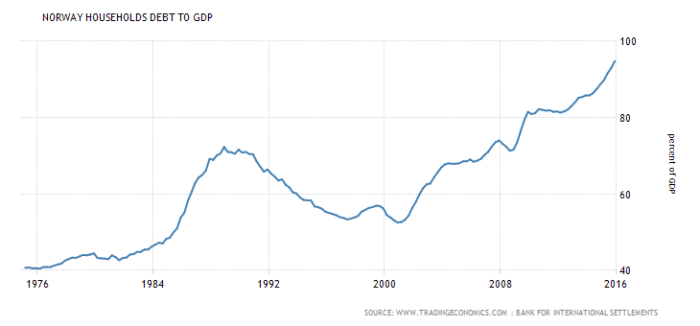
The Reserve Bank publishes household debt data back to 1990.  In 1990, household debt in New Zealand was 28 per cent of GDP.  That ratio is now 99 per cent of GDP.    Here is a long-term time series chart I found for Norway

norway-households-debt-to-gdp

Household debt to GDP in Norway was already around 70 per cent in 1990, and hasn’t been as low as 28 per cent any time in the 40 year history of this series.  If one looks just at, say, the years since 2007, Norway has had more of an increase than New Zealand has, but over a longer-run of time household debt here has increased by (materially) more than what they’ve experienced in Norway.

Of course, perhaps ANZ would like to now reverse the argument and suggest that we need to be even more cautious since we’ve run up much more debt (in change terms) than Norway.  But then they’d have to confront the stress tests (in New Zealand) and the judgements of the respective supervisors that both countries’ banking systems are sound.  Recall those New Zealand stress test results –  and the ANZ is the largest bank in New Zealand –  in which a 55 per cent fall in Auckland house prices and an increase in unemployment to 13 per cent wasn’t enough to severely impair the position of New Zealand banks.  If ANZ thinks that conclusion misrepresented their risks, a phone call to the Reserve Bank’s supervisors might be in order.

Arguing against doing what it takes to get inflation back to fluctuating around 2 per cent on the basis of household debt numbers just isn’t very compelling. And as I’ve noted before, most of the increase in household debt is in any case a reluctant endogenous response to higher house prices, themselves the outcome of land use restrictions colliding with immigration-driven population pressures.

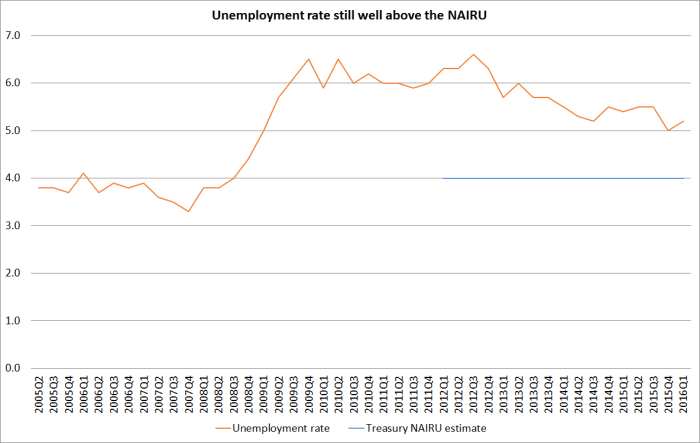
And that is before considering the other side effects of the current (“reluctant cutter”) policy approach the ANZ seems to be endorsing.  We’ll get another read on the unemployment rate tomorrow, but for now the unemployment rate of 5.2 per cent is well above any estimate of the NAIRU (including Treasury’s of around 4 per cent).  The unemployment rate has been above the NAIRU for seven years now, and almost by definition that gap is one that monetary policy could have done something about had the Reserve Bank chosen to.  There are well-documented long-term adverse implications for the individuals concerned if they are out of employment for long.  That is a rather more concrete cost –  seven years –  than the sort of ill-defined, but quite well protected against, risk around the level of household debt that ANZ worries about.  The Swedes ran policy for several years worrying about household debt risks, before they finally realized that Lars Svensson was right after all and began to cut rates aggressively.

There are distributional implications too. The “reluctant cutter” approach has left our (real and nominal) exchange rate higher than it needed to be –  consistent with meeting the inflation target. In the longer-term countries get and stay rich by finding products they can sell successfully to the rest of the world –  that is, after all, where most of the potential consumers are.  As a reminder, here is our export performance.

exports to gdp by govt

Another 100 basis points off the OCR wouldn’t transform this picture –  the long-term challenges are more about structural policy –  but in the last few years the trend has been in the wrong direction, and a misjudged stance of monetary policy has reinforced that.

There are some other things in the ANZ commentary that I agree with. I strongly endorse their call for a monthly CPI (a properly done one), and I was pleased to see their skepticism as to whether the large scale immigration programme is producing per capita income gains for New Zealanders. I might return to some of the questions about the best design of the monetary policy regime another day.

In the meantime,  for all of the ANZ’s economics team unease about the risks of housing debt, there is no sign of ANZ having published its submission on the Reserve Bank’s proposed new LVR controls.  So we still have no way of knowing whether their CEO was serious is his call for the LVR limits to be set even tighter than what the Reserve Bank is proposing.

The Reserve Bank wants most property investors around the country to have 40 percent deposits in future. We think they should go harder and ask for 60 percent.

I don’t suppose he was, but it would be interesting to see the economic arguments and evidence for such a proposal.

Making up stories as they go along?

Sometimes I wonder whether senior government figures, apparently determined to defend their immigration policy, just make up defences on the fly.

I wasn’t so much thinking of Steven Joyce’s assertions that I critiqued earlier in the week.  The Minister cited an apparently-reputable OECD report which shows that, on a particular (plausible) test measure, the skills level of the immigrant workforce in New Zealand are higher than those in the other OECD countries (included in the survey).  Of course, he omitted to mention two things from the same survey:

  • New Zealanders’ skill levels, on these OECD metrics, are already among the highest in the world, and
  • In every single country in the survey, including New Zealand, the skills levels of the average immigrant worker were below those of the average “native” worker.

But at least Joyce cited statistics that were reasonable when taken in isolation.  Of course, one might reasonably wonder where the evidence is that (a) shortage of skills is a major structural issue in New Zealand, and (b) that actual plausible immigration policies are able to ease those shortages, at a whole economy level.

John Key’s latest claims reach new levels of implausibility –  indeed, if one were oneself unemployed, one might well think them simply offensive.  Bernard Hickey reported the other day that in pushing back against calls for a review of immigration policy setting, the Prime Minister had said:

Key said he acknowledged high migration “put pressure on the system.”

“On the other side, we need these people in an environment where unemployment is 5.2% and where growth is still very, very strong. You’ve just got to be careful when you play around with these things that you don’t hamstring certain industries that need these workers,” Key said.

In the last year, per capita growth in real GDP has been less than 1 per cent.  In quite which state of small ambitions and diminished expectations that qualifies as “very very strong” growth is a bit beyond me.

per capita gdp

Even based on New Zealand’s own (internationally underwhelming) record, I’d have been looking for something more like 3 per cent per capita growth before I’d accept a description of New Zealand having “very very strong” growth.

But what really irked me was the suggestion that an unemployment rate of 5.2 per cent suggested that we needed lots of immigrants, as if the entire labour market were overheating.  Of course, even if it was overheating, we know that immigration adds more to overall demand pressures in the short-term than it does to supply.  But even accepting the Prime Minister’s story in its own term, by what possible criteria does he regard 5.2 per cent unemployment as low?

Wage inflation is low, and if anything surprising on the low side.  And his own Treasury only a few days previously had published a nice short note on the implications of the recent revision to the HLFS.   In that piece they succinctly noted

Treasury takes the view that the unemployment rate consistent with full employment (the non-accelerating inflation rate of unemployment or NAIRU) has also fallen over time, so that, as in Figure 4 above, it would be closer to 4.0% than our Budget Update estimate of 4.5%.  Our view is that while the data definition and published data have changed, people’s behaviour has not.

So the Treasury – the government’s principal macroeconomic adviser –  reckons that practical full employment is around 4 per cent.  We don’t know what the other main macroeconomic forecasting agency –  the Reserve Bank – thinks, as they didn’t give us anything on that in this week’s MPS.  But it would be surprising if their estimate was much different –  it had also been something like 4.5 per cent before the HLFS revisions.  There are reasonable grounds for thinking the NAIRU has been trending downward (I outlined some reasons here) –  and perhaps on this measure it might have been 4.5 per cent prior to the recession.

u and nairu

But there is no reason to think that at any time since the start of 2009 –  any time, that is, in the Prime Minister’s 7.5 years in office –  that the unemployment rate has been anywhere near the NAIRU.  We’ve not had anything remotely close to practical “full employment” (and recall that the “full employment” term is Treasury’s not mine).

So, given New Zealand’s relatively liberalized labour market, we’ve had excess unemployment  – more than the economy might need to sustain – for years now.  Those are real people, out there actively looking for work.

And as I showed the other day, our unemployment rate has fallen more slowly since the recession than typical other advanced economies. But somehow the Prime Minister seems to think that our unemployment rate is already so low that we need record numbers of new migrants.

There might be good arguments for a large scale immigration programme –  although it is hard to find them in the government’s flailing attempts to defend the system –  but our “low” unemployment rate just isn’t one of them.   And in case the Prime Minister is indifferent to an unemployment rate of 5.2 per cent, it is worth reminding him that over a 45 year working life, a 5.2 per cent unemployment rate is equivalent to every person spending 2.3 years unemployed –  out of work, and actively looking for a new job.  And yet the PM apparently thinks this is low unemployment. Talk about small ambitions.

Still on immigration, the FT’s Alphaville blog had a substantial piece yesterday on New Zealand’s immigration patterns, prompted by the Reserve Bank Deputy Governor’s recent suggestion that it might be time to look again at the parameters of the immigration programme (a stance, incidentally, not backed by the Governor in his press conference this week).  For foreign readers there was quite an extensive set of charts, although most of it will familiar to New Zealanders.  But what caught my eye was this line

Looking at all these facts, it’s hard to see how New Zealand’s migration policy could be modified to meaningfully reduce net inflows without draconian controls.

“These facts” means, of course, the significant variability in the net outflow of New Zealanders –  swings in that flow being often at least as large as swings in non-citizen numbers.  But this is simply dealing with a straw man. No one I know thinks that the net permanent and long-term migration flow could, or even should, be targeted, at least on an annual basis. New Zealanders will do what they want.  But as readers will know, the centerpiece on New Zealand’s immigration policy is the residence approvals programme, where we aim to hand out 45000 to 50000 approvals a year.  It requires no more than stroke of a ministerial pen to lower that target, and our points system helps ensure that if the target were lowered we would generally cut out the relatively less skilled applicants before the more highly-skilled applicants. We could, for example, cut the target to around 10000 to 15000 people per annum –  which would be similar to the residence approvals (per capita) granted each year in the US.  There might be good reasons not to make such a change all in one go, but even if we did it would hardly require ‘draconian controls’, just a recalibration of the dials, on a system set up to be managed against a numerical target

Of course, changing the residence approvals target wouldn’t immediately cut actual inflows – as most residence approvals are granted to people who first come on temporary visas – but it would make a material difference to actual inflows over time.  And (importantly, since markets work on expectations) it would make an immediate substantial change to expected future inflows, and the associated pressures (whether on heavily regulated urban land markets, or on real interest rates and the real exchange rate).   Exporters might, finally, have a chance to lift exports towards the government’s target.

The residence approvals programme –  the most stable part of the immigration system –  is my focus.  But if we wanted to do something about the record number of work visas granted, that wouldn’t be hard either –  impose a requirement that any job employing a non-resident must generally pay at least, say, $100000 per annum would keep the door open for those pockets of highly-skilled jobs where there is a strong case for short-term foreign labour – and it is those highly-skilled people who are asserted to offer the biggest gains to New Zealand – while easing the pressure on less-skilled New Zealanders’ wages.  Nothing very draconian about that either –  and probably the sort of system voters might think quite reasonable, unlike the most recent poll results (National voters as much as others) that suggest material unease about the current immigration arrangements.

Finally, Statistics New Zealand put out new population estimates yesterday trumpeting the increase in the population over the last year as the largest ever.   An annual increase of 2.1 per cent is certainly large, and rather recklessly so in my view.  But citing the absolute increase in the total number of people as the basis for a “largest ever increase” claim seems a bit too cute, and also rather meaningless. Most trending series have such “record increases” every few years.   Back in the 19th century, for example, the base level of New Zealand’s population was much lower.  In fact, here are the population growth rates pre 1914 from the (unofficial) annual estimates reported on SNZ’s own website.

popn growth pre 1914

Both the gold rushes and the Vogel immigration programme rather shade the most recent annual population growth rate.


It is quite possible to get inflation back up: Norway did

Six months or so ago I was getting a little frustrated by talk suggesting that low inflation was just one of those things. No one else, it was implied, was succeeding in meeting their inflation targets, and so we shouldn’t really be expecting the Reserve Bank of New Zealand to meet the target the Minister of Finance had set for them.

And so I wrote a short post about Norway.  It was a small advanced economy, which has had substantial issues around rising house prices and high household debt, and which had been hit by an even nastier terms of trade shock (falling oil prices) than New Zealand had faced.  Oh, and Norway has typically had lower policy interest rates than New Zealand (so perhaps less room for manoeuvre), and has a higher inflation target (2.5 per cent rather than 2 per cent).     Like New Zealand, they started raising policy rates again quite soon after the 2008/09 recession (and crisis conditions) ended, but they realized that wasn’t necessary and reversed themselves.  Unlike our Reserve Bank, they didn’t make same mistake twice.

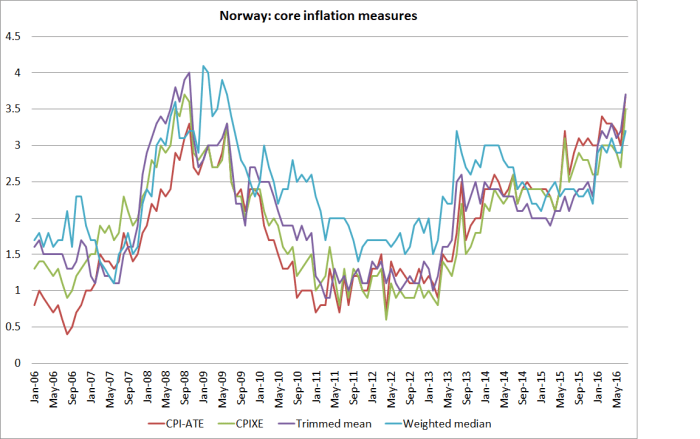
Norway also saw its inflation rate fall away quite sharply in the aftermath of the recession.  Here is the suite of core inflation measures that the Norges Bank itself highlights –  recall that the target is 2.5 per cent inflation.

norway core inflation

Inflation –  even core inflation – seems to be more variable in Norway than in New Zealand.  It was very low in 2011 and 2012, but has been trending back upwards for several years now.  When I wrote about Norway last in February, these core measures averaged 2.5 per cent.  Core inflation has increased further since then, now averaging 3.5 per cent (although the Norges Bank observes that they expect it to settle back nearer 2.5 per cent).

It isn’t as if Norway’s economy has been booming.  Indeed, Norway’s unemployment rate –  while still below New Zealand’s –  has risen quite markedly in the last few years.

No doubt there are lots of other detailed differences between the two countries’ experiences, but it seems to me that the biggest of them has been the New Zealand policy mistake –  promising to raise the OCR aggressively, then doing so, and only reluctantly reversing that mistake.   Here are two countries’ policy interest rates.

policy int rates nz and norway

Here are the BIS index measures of the two countries’ exchange rates.

nz and norway exch rates

In Norway, the central bank doesn’t anguish about tradables inflation being negative for years and outside their control.  Here is the chart from a recent Norges Bank MPS that I reproduced in February.
norway inflationAnd here are two-year ahead inflation expectations in the two countries –  the Reserve Bank survey for New Zealand, and a survey measure for Norway that I’ve taken from their MPS.
infl expecs nz and norway

It looks a lot like a story in which

(a) the Reserve Bank of New Zealand badly misread (actual and prospective) inflation pressures,

(b) leading them to raise the OCR when they should have been holding or cutting it,

(c) which drove the exchange rate up (the juicy prospects of high and rising NZ yields)

(d) and drove tradables inflation more persistently negative than it should have been

(e) all while the Reserve Bank only very slowly realized its error, never explicitly acknowledged it, and only very reluctant reversed the rate hike cycle,

(f) all of which understandably dampened expectations of future inflation  quite a long way, while still suggesting to people looking at NZD assets that if there was ever yield to be found anywhere in the OECD the RB woiuld do its utmost to make sure that place was New Zealand.

As a result, the exchange rate (while quite variable) stays high, inflation stays low, and inflation expectations are at constant risk of falling further.  All because the Governor (and his advisers) got things wrong, and refuse to convincingly change tack.  As I noted yesterday –  and as several others have now pointed out –  the Governor was given an easy opportunity to affirm that he’d do whatever it takes to get inflation back to target.  For whatever reason, he simply passed up the opportunity. People, probably quite rationally, think he will in fact be very reluctant to do what is needed.

Frankly, if Norway can get inflation back to (and even beyond) target, so can we. It is mostly a matter of (a) reading inflation pressures roughly correctly, and (b) really wanting to.  The Governor –  and his advisers –  have failed on both counts.

It isn’t always true, but sadly over the last few years it wouldn’t be wildly wrong to suggest that New Zealand outcomes would have been better over the Wheeler years if the Governor and his senior team had simply taken a holiday, and done nothing at all to the OCR for four years.  We’d have avoided the badly misjudged tightening cycle, and although the OCR would still be a bit higher now –  it was 2.5 per cent when Wheeler took office –  inflation expectations would almost certainly be higher, and so real interest rates would, most likely, be no higher at all.  That would have had the incidental benefit of leaving New Zealand more headroom against the risk of hitting the near-zero lower bound at some point.

Perhaps spurred on by criticism in various quarters that the Governor doesn’t make himself available for searching interviews, he seems to have established a pattern of talking to the Herald after the release of the MPS.  The latest sets of questions and answers is here.  It is all pretty soft-soap stuff, with no follow-ups or challenges, allowing the Governor to get away without even answering the question (as here, where he –  in customary style – injects a variety of interesting but not very relevant detail, while not dealing with central issue.)

Rate cuts are supposed to bring the currency down, this didn’t. What’s happened?

Since the June statement we’ve seen the Bank of Japan ease, Bank of England ease, we’ve seen the Reserve Bank of Australia ease. If you combine that with quantitative easing that is larger than at any other time – and it was pretty large in 2009 – and with negative interest rates in countries that account for a quarter of world output, you’re just in a phenomenal situation.

There is no doubt the world is in a puzzling situation, but the Bank –  and the Governor –  are paid to do a competent job, not to end up sounding as if it is all too hard and is someone else’s fault.  I’m sure his markets staff had advised him that the probability of the exchange rate rising yesterday was quite high –  if they didn’t, they certainly weren’t doing their job.  The Governor simply made a choice –  he is a reluctant cutter, and that became clear once again yesterday.

It is a shame that the Herald, given the privileged access, didn’t ask a few more questions such as:

  • Why didn’t you cut by 50 basis points, given that your own forecasts suggests further OCR cuts will be needed, and that on those forecasts it is still another two years until inflation gets back to target?
  • Why are you so apparently indifferent to an unemployment rate that has now been above any NAIRU estimate for seven years?
  • What plans and preparations are you putting in place to cope with the possibility that New Zealand finds itself exhausting the limits of conventional monetary policy?
  • Inflation was below 2 per cent when you took office, has not been near 2 per cent since then, and on your own forecasts won’t be back to 2 per cent until a year after your term ends.  You and the Minister put the 2 per cent midpoint explicitly in the PTA.  How would you assess your performance in respect of the Bank’s primary responsibility, monetary policy?

Perhaps 20 more terms in office will be enough?

The ever-ebullient Minister of Economic Development (and a great deal else beside) Steven Joyce was interviewed on TVNZ’s Q&A programme yesterday, defending the government’s economic record.  Despite the efforts of the interviewer to pin him down –  including on the rising degree of unease even among some of those one might think of as “elites” about immigration policy –  Joyce put up a pretty forceful defence, often citing the Prime Minister’s mantra that if New Zealand has challenges they are ‘quality problems” or “side-effects of success”.  If one didn’t have access to the facts, it might even have sounded persuasive.

I was tempted to devote a lengthy post to the Minister’s claims, but I have other stuff I really have to finish today.  So apart from noting in passing New Zealand’s continuing lousy productivity performance (see the chart in this post), I wanted to focus on just two of the areas the Minister covered.

The first was around the skills of immigrants.  In June the OECD released the results of a fascinating multi-country study of the skills level of workers.  It suggested that the skill levels of New Zealand workers –  over several dimensions – were pretty high.  I wrote about it at the time, and summarized the high-level findings this way

Looking across the three measures, by my reckoning only Finland, Japan, and perhaps Sweden do better than New Zealand.    Perhaps there is something very wrong with the way the survey is done, and it is badly mis-measuring things, but those aren’t usually the OECD’s vices.  For the time being, I think we can take it as reasonably solid data.

As I also noted, the survey also looked at the skill levels of non-native born workers.  In almost every country, including New Zealand, the skill levels of immigrants were below that of natives.  Of course, in every country there will be many very able immigrants, but these are averages across the full samples of native born workers and immigrants.  As I pointed out, if your country (New Zealand) already had among the very highest skill levels in the world, and immigrants had less good skills, it didn’t lend much support to the idea that we needed lots and lots of immigration to lift the productivity of New Zealand workers, and make up for deficient skill levels at home.

But none of that stopped Steven Joyce introducing this same report in support of the government’s immigration policy.  How did he manage that?  Well, he correctly pointed out that New Zealand’s immigration policy is more skills-focused than those of most countries.  Unlike most countries, we have almost complete control over who we let in –  there isn’t a material illegal immigration problem –  and unlike, say, the United States (where legal immigration is mostly family-focused) we have an explicit economic/skills focus.  We may not do it well –  my argument –  but we are less bad, on that score, than most.

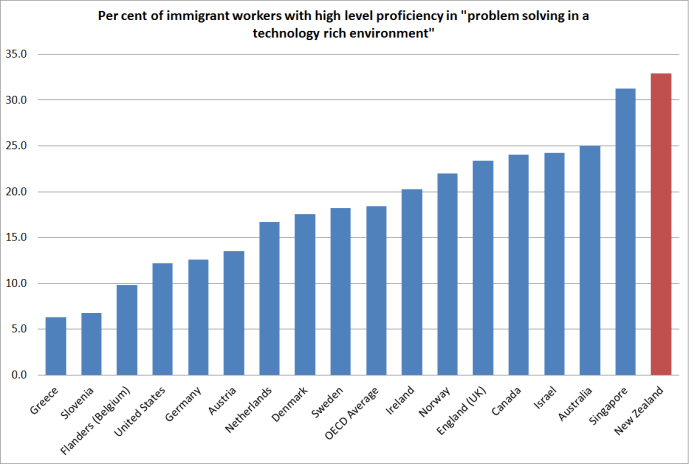
One might reasonably expect literacy skills of immigrant workers to lag behind those of natives –  after all, for many/most English isn’t their native language.  But the OECD survey also reports results for “problem solving proficiency in a technology-rich environment” (Figure 3.15 of the OECD report).  There are 28 countries/regions in the OECD study, but there is only data on the skill levels of immigrant workers for 17 of them (many of the other simply don’t have much immigration).

Here is the proportion of foreign-born workers with what the OECD calls relatively high level skills in this (problem-solving) area.

skills technology

New Zealand scores well here.  Our (really large scale) immigration programme seems to have done better in attracting people with these sorts of skills (and keeping out others) than most other countries have.

But remember that our overall workforce –  mostly native-born –  also has among the very highest level of skills of any of these countries. On this particular measure, we were top equal with Sweden.

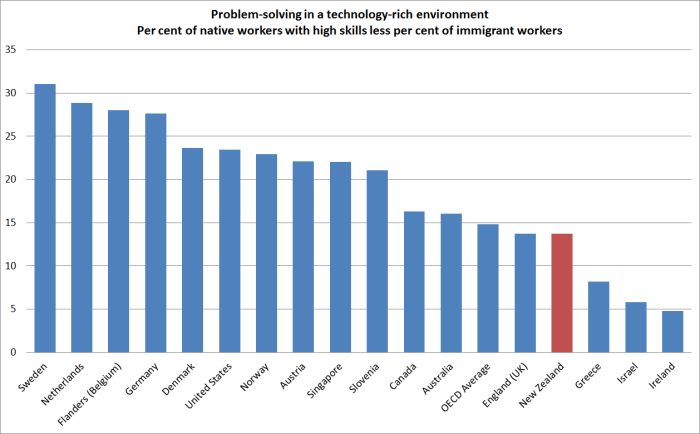
So here is the gap between the skill level of natives and the skill levels of immigrants (again, on this problem solving proficiency measure).

skills gap

New Zealand doesn’t do too badly –  although Israel and Ireland stand out as clearly better –  but in every single one of these countries the skill levels of the average immigrant worker are less than those of the average native worker.  And this in an area –  the use of technology –  where the Minister often likes to stress the importance of immigration.  We don’t have the problems of Sweden or the Netherlands, but these OECD data –  which the Minister himself quoted in support of his policy –  just do not support the claim that our immigration programmes have been boosting overall skill levels in New Zealand.  If anything, those programmes have been a net drag.  As I’ve repeated many times, I’m not suggesting immigration never could boost skill levels –  or that there are not many highly-skilled individual immigrants (as there are many highly skilled natives) –  but our skills-focused programme, on the scale the government continues to stick to, just isn’t achieving that goal.  Perhaps with annual target of 10000 to 15000 non-citizen migrants (per capita, the same sort of rate as the US has) we might do so.

The interviewer also attempted to push the Minister onto the back foot over the government’s target for the share of exports in GDP.  The goal, announced several years ago, was to lift exports as a share of GDP from around 30 per cent to around 40 per cent by 2025.  I thought the formal target was daft and dangerous, even while sympathizing with the intuition that motivated it – small countries get and stay successful by selling lots of stuff, competitively, in the rest of the world.

As the Minister fairly noted, the base level of exports got revised in one of SNZ’s long-term national accounts revisions.  But that does not change the fact that exports as a share of GDP have been going nowhere.  It is all very well to blame low dairy prices –  as Mr Joyce sought to –  but on other occasions he’d be telling us just how well tourism and export education sectors were doing right now.

Here is chart of exports to GDP, going back to the start of the quarterly national accounts data in 1987. This time, I’ve also shown the average export share for each of the last three governments.

exports to gdp by govt

Plenty of things cause fluctuations in the series, and not many of them are under the direct control of governments.  Nonetheless, the average export share of GDP is materially lower under this government than it was under the previous government, and the latest observations are below even that average. Since the start of 2009, exports have averaged 27.7 per cent of GDP.  Under the previous National government –  one that first took office more than 25 years ago, that average was 27.5 per cent.  The government’s goal was to lift the export share by 10 full percentage points, and there is now only nine years left until the target date.  On performance to date –  and policy to date – we might be waiting several more centuries to achieve that sort of goal.

It is time Mr Joyce and his colleagues faced the fact that they are simply failing on this count.  A rather different approach is needed –  one which permits/facilitates a sustainably lower real exchange rate, orienting the economy more strongly towards investment in the tradables sector, and enabling more able firms to grow (and locate here doing so) by successfully selling to the rest of the world.  As I’ve noted before, per capita output in that vital outward-oriented part of the economy hasn’t increased at all for 15 years now.  It seems unlikely that that sort of reorientation will occur, all else equal, while we continue to bring in, as a matter of policy, so many not-overly-highly-skilled non-citizen migrants each year.

And finally, the interviewer introduced my name to the discussion as one of those skeptical of some of the government’s claims.  Mr Joyce suggested that I was among those who had predicted a large balance of payments blowout, thus apparently undermining the credibility of my arguments.  Of course, economists are pretty hopeless forecasters, so when an economist offers a prediction about the future one should (a) always take it with a considerable pinch of salt, and (b) wonder if the economist recognizes his/her own unwarranted over-confidence.  But in this particular case, I didn’t even recognize the forecast.  Since I’ve spent the last four years –  both inside and outside the Reserve Bank –  arguing against interest rate increases and for interest rate cuts, it would be surprising if I had been worrying about the current account deficit blowing out.  Demand has been consistently weaker than it should have been –  inflation has been below target, and unemployment has lingered above the NAIRU.  Whatever I’ve warned about, I’m pretty sure it hasn’t been the current account of the balance of payments.

(UPDATE: And, as a reader notes, as banks’ dairy losses mount there will be an almost one-for-one temporary reduction in (mostly foreign-owned) banks’ profits, and thus in the current account deficit.   That won’t be a sign  of economic success either.)

Government consumption

Playing around in the consumption data yesterday prompted me to have a look at what had been happening with government consumption spending.  Government consumption, in the national accounts, isn’t the same as total government operating spending.  The latter includes transfers –  the huge amounts modern governments spend on direct payments to households, through the welfare and social insurance systems etc.  Government consumption parallels private consumption –  it is the stuff governments and their agencies (central and local) purchase directly (excluding capital spending, which is investment).    That includes stuff directly consumed by households but paid for by governments –  think of lots of health and education spending –  as well as stuff “consumed” collectively, or in some sense by governments themselves.  The cost of The Treasury, MFAT, the courts, or defence spending are examples of the latter.

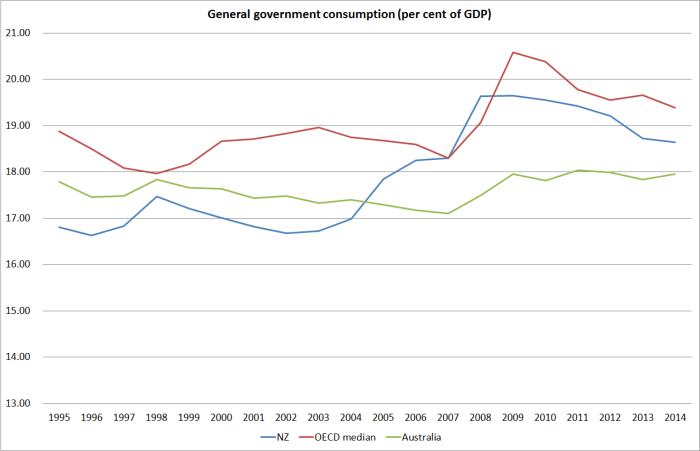
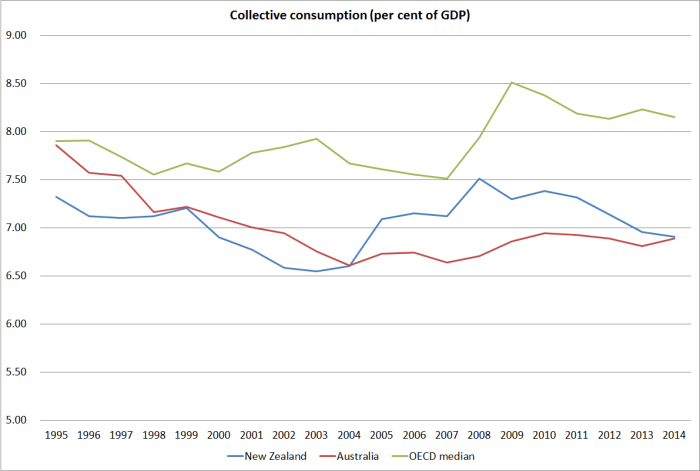
Take total government consumption spending first.  The OECD has data for all its member countries since 1995, so I’ve focused on that period.  Here is how New Zealand and Australia have done relative to the median OECD country over that period.

gen govt C aus nz

It is sobering to observe (a) how stable the government consumption share has been in Australia, and (b) how much government consumption as a share of GDP has increased since 1995.  We were consistently a bit below Australia, and in recent years we’ve been a bit above.  Australia may have more pressing fiscal problems right now than New Zealand does, but government consumption has been better held in check there than here.  That increase in government consumption spending will have contributed to the upward pressure on the real exchange rate (tending to raise non-tradables prices relative to tradables prices).

And here is the chart for all OECD countries, showing both the 2014 numbers and the average for the full period 1995 to 2014.

gen govt C oecd

A few things struck me.  There is, of course, a huge range across quite similarly successful countries –  Switzerland and the United States at one end, and the Netherlands, Sweden and Denmark at the other.  The same pattern shows up when one looks at total government spending.  But what struck me more forcefully this time was that while there was little change in the government consumption share of GDP among the countries in the middle of the chart –  say those from Australia to Canada – most of the countries with very high government consumption spending had been increasing that share further over the last 20 year (all seven of the countries furthest to the right).  And at the same time, the countries with the lowest government consumption shares had also been increasing that share (five of the seven countries furthest to the left).   Only a handful of countries had government consumption shares of GDP lower at the end of the period than the full period average –  and there wasn’t anything very obvious in common among those countries (eg Israel, Hungary, Portugal and Latvia).

As I noted earlier, total government consumption spending includes stuff individual households consume directly but the government pays for, as well as the more traditional stuff of government (policy advice, defence, law and order etc).  The latter is known by the national accountants as “collective consumption”.  Here are the same two charts as above, but this time just for collective consumption.

The New Zealand/Australia comparisons

collective C nz and aus

Trends here look quite a lot more favourable for New Zealand (and Australia even more so).  No doubt it helps how little we spend on defence, but I think it is generally accepted that – even if there are whole agencies that could be closed with no real loss – that the New Zealand core public sector is fairly lean.

And the OECD as a whole.

collective C oecd

Note that the countries at the right of this chart are quite different from those at the right of the total government consumption chart above.  The Nordic countries are actually towards the left of the chart –  Sweden, Denmark and Norway don’t spend much more running their governments than we or Australia do.  The big differences are in the individual consumption the government pays for   – be it childcare, health or education.  The countries to the right of this chart look a lot more like those which tend to spend a lot on defence –  those that really need to (Israel, and increasingly perhaps the Baltics,  as well as Greece and Turkey with their historic rivalries and suspicions).   It is interesting then how far to the left Korea is –  perhaps offset in part by US defence spending and security pledges?

There aren’t any very obvious patterns in the changes between the 1995 to 2014 average and the current level.  Overall, the OECD median has increased a little (as the earlier chart showed), but the increases don’t seem to be concentrated in low-spending countries, or high-spending countries, or countries that are militarily exposed, or countries that had strong fiscal positions.  And I can’t see such patterns for the countries that have been shrinking collective consumption either.

Reasonable people can differ on the appropriate role for government in income support, or provision of health and education, but this is collective consumption.  I’d be keen to learn a little more about how Switzerland manages to run such a successful and well-functioning country with collective consumption of only around 5 per cent of GDP.

Are we just pulling consumption forward?

I was having a discussion with someone the other day about interest rates, the OCR, and how we should think about what has been going on in recent years.  The person I was talking to was worried that, whatever short-term support lower interest rates might be providing to demand, activity and employment, it was at the expense of simply pulling forward consumption.  And (lifetime) income which is spent today can’t be spent again tomorrow.

My usual starting point in such discussions is to draw attention to the little-recognized fact that consumption as a share of GDP has been largely flat in New Zealand for decades.  There is some cyclical variability –  consumption is a bit more stable than income, so the ratio tends to rise in recessions, and falls back as the economy recovers –  but the trend has been almost dead flat.  Actually, GDP isn’t the best denominator, because GDP measures what is produced here, not what accrues to New Zealanders (the difference is mostly the income earned by foreigners on the relatively large negative NIIP position New Zealand has). GNI is a measure of the aggregate incomes of New Zealanders, and here I’ve shown the various components of consumption relative to GNI since 1987, when quarterly national accounts data are available from (but using four-quarter running totals)

First, private consumption (including non-profits)

pte consumption to gni

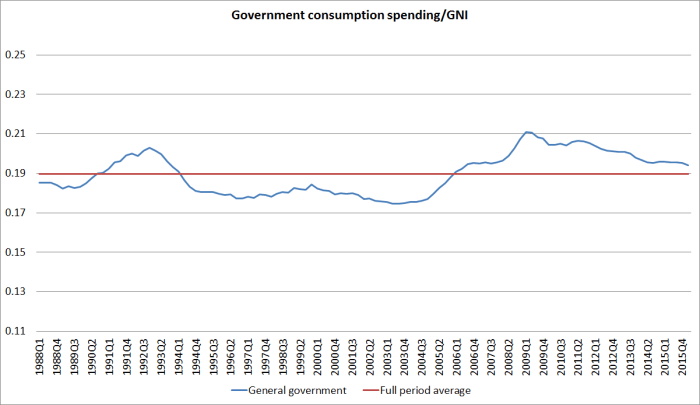
And then general government consumption

govt consumption to gni

And then total consumption

total consumption to GNI

I’ve shown full period averages for each.  The only component of consumption where the share of GNI is a bit above the long-term average is general government consumption, the bit that is least likely to be sensitive to changes in interest rates.

Of course, if interest rates had been kept arbitrarily higher then consumption as a share of GNI might well be weaker now than it actually is, but there is really isn’t any sign of a great consumption splurge –  a society desperately (over)spending now and thus increasingly likely to come a cropper later.    (And as I’ve noted previously there is also nothing in any of these charts to suggest some large average wealth effect from the sharp rise in real house prices in recent decades –  not surprisingly, since wealth is being transferred among New Zealanders, but no additional real wealth –  future purchasing power –  has been created in aggregate).

As we continued our discussion, the person I was talking to reminded me that the US picture has been somewhat different.

Here I draw on the OECD database, which has annual data for most of its members back to 1970. Here is total consumption (public + private) as a share of GDP for the United States, United Kingdom and New Zealand.

consumption us uk and nz

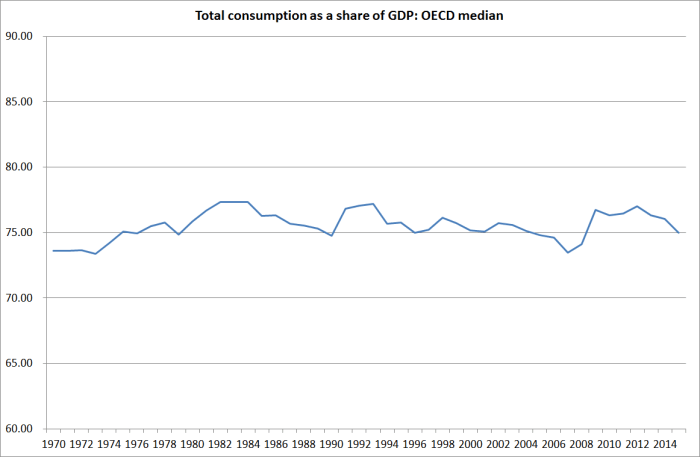
Even over the full 45 year period there is no upward trend in the consumption share in New Zealand.

And here, on the same scale, is the consumption share of GDP for the median OECD country.

oecd median consumption

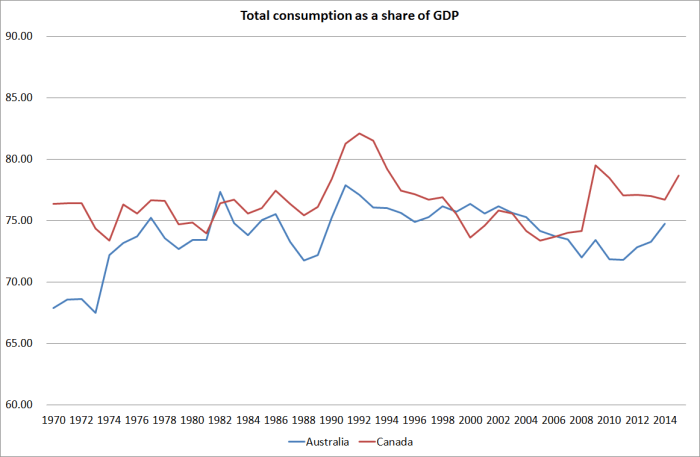
And here are Australia and Canada

consumption aus and canada

Like New Zealand, no trend in either country, at least (see Australia) since the mid 1970s.

And here is Actual Individual Consumption (private consumption plus the stuff the government purchases but individuals consume directly eg healthcare and education) as a per cent of GDP for New Zealand, Australia and Canada.

aic consumption

I’m not quite sure what was happening to this data in New Zealand around 1985, but again for the last thirty years there has been no upward trend in consumption as a share of income.

What does all this mean?  To be honest, I’m not quite sure.  After all, if population growth rates have been slowing, less of GDP needs to be devoted to investment and that might mean more is available for consumption.  But in the UK in particular, population growth rates have been somewhat faster in the last couple of decades than they had been previously.    And things like defence spending trends can also complicate the picture –  weapons system purchases are now part of investment, and we know in the US (and the UK) defence spending as a share of GDP is much lower than it was some decades ago.

I guess all I take from it is my original point. At least in New Zealand –  and in most of the OECD –  there is no sign that lower interest rates are resulting in a large scale bringing forward of consumption, for which at some point there must be payback.  But that shouldn’t be too surprising.  After all, interest rates are as low as they are for a good –  if ill-understood by anyone –  reason: in summary, because if they weren’t this low, consumption and investment spending would be even weaker.  That, in a market economy, is really all interest rates do: they balance desired savings and investment patterns.  Central banks that are too slow to adjust to changes in desired savings or investment patterns –  at any given interest rate –  can slow the adjustment, but in that respect a good central bank shouldn’t be trying to stand in the way of the sorts of real adjustments the private sector has underway,  A century or more ago Wicksell introduced the concept of a neutral or natural interest rate.  Those rates change over time, for reasons that aren’t always easy to recognize.  Markets don’t need a fully convincing analytical reason –  they just reflect the changing balance of demand and supply.  Central banks shouldn’t let the difficulty of finding a good explanation stand in the way of allowing what would be the market processes to work

But quite why consumption shares in the US and UK have risen so much is an interesting question –  to which I don’t have any good answers right now.


Wellington Airport: a factual high level summary

This morning’s Dominion-Post features a full page advert, notionally inviting people to make submissions on the resource consent application to extend the runway at Wellington Airport.

In fact, the advert is mainly an opportunity to tout the case for the hugely-expensive proposed extension –  in what must be one of the most expensive locations in the world in which one could add 300 metres to a runway (and still not comfortably meet international safety guidelines).  The pretty graphic highlights 20 Pacific Rim cities which planes could reach from Wellington –  without ever mentioning that the most likely outcome, if the project succeeds at all, is flights once or twice a week to one or two of them.

All one really needs to know about the proposal is that the owners of the airport think the project is sufficiently unattractive that there is no way they would proceed with the extension if it involved investing their own money.

The owners –  WIAL, majority-owned by Infratil – have been quite clear that the project will only proceed, even if it gets resource consent, if there is a massive public subsidy –  huge contributions from some combination of local, regional, and central government that would not be reflected in a commensurate ownership interest in the airport.  But there is no mention, at all, of this fact.

In a little note at the bottom of the advert  it is described as a “high level factual summary of some of key effects from the extension”.   I did spot the odd fact in the advert, but mostly it was boosterish opinions, clothed in consultants’ reports – and  all summarized in the huge alleged national benefit estimates.  I’m deeply unconvinced by the economic case for this airport runway extension –  the benefits appear to be overstated, and the discount rate used to evaluate them seems too low – but would have no real objection if private shareholders were paying for it.  But they aren’t.

I wrote a few posts about this proposal late last year, here, here, and here. Ian Harrison, at Tailrisk, has a nice piece here on the same issue.

I’m not making a submission.  As a matter of principle, I don’t think the Resource Management Act should be used to block business developments, unless there are compelling environmental grounds –  and I have no expertise in environmental issues, and am interested only to the extent Lyall Bay remains a pleasant spot for the family to swim.

The real debate should be around decisions new local and regional councilors consider making about injecting public subsidies to this operation (over and above what has already been spent). The quality of public sector investment spending is typically quite poor, and around the country airport investments (see eg Rotorua) are no exception.   As the local body elections are just weeks away, the focus needs to be on the attitude towards the project that each candidate takes.  So much money is involved, and attitudes to this project seem to reveal so much about candidates’ views on the role of local and regional government, that for me it will be a defining issue.  I will be seeking out candidates who are clearly opposed to spending public money on the extension.  In the huge field of mayoral candidates there appear to be a couple of options –  but their fine print needs checking out.  I haven’t yet done my research on the council and regional council candidates.  I encourage greater Wellington readers –  because although the Wellington City Council has been driving this, they’ll be looking for money from other local authorities in the region –  to prioritise this issue.

My fear is that once the election is over, there will be a behind-closed-doors process rushed through, with no rigorous evaluation of the economics of the project.  Cheer-leading from the local business community –  always keen on the sort of public subsidies and activities that don’t face the market test that keep Wellington afloat – reinforces the risk.

Surveyed expectations

The Reserve Bank’s quarterly survey of semi-expert opinion on the outlook for various macroeconomic variables was out the other day –  a bit earlier than usual, presumably because of the changes in the schedule of MPS releases.  This is a really rich survey, covering a wide range of variables, and has been running now for nearly 30 years.  But I noticed that the number of respondents is now down to only 52 (and on some questions there were fewer than 40 answers).  Once upon a time, if my memory isn’t failing me, there were nearer 200 respondents.

My impression is that the Bank’s aims have shifted over time: when the survey began in 1987 it was designed to capture the expectations of people making key transactional decisions in the economy.  There were always some economists, but quite a lot of effort went into getting business people and –  reflecting the much greater role of collective employment contracts then  – union officials to participate.   We even had large enough samples that we used to report responses separately for the different classes of respondents.  For some years, we ran a staff survey in parallel, which occasionally highlighted interesting differences between staff and external expectations for the same variables.    I’m not sure who is captured in the 52 respondents the survey now has, but I suspect economists must now make up quite a large proportion.  There isn’t necessarily anything wrong with that –  I suspect few people other than economists have explicit expectations for most macroeconomic variables (inflation might be an exception) and if they ever need such forecasts, they will typically draw on the numbers prepared by economists.  But it probably means the survey is drifting progressively ever closer to something like a consensus forecasts exercise of economists, rather than capturing how people are necessarily thinking in the wider economy.  It is broader than, say, the NZIER Consensus exercise, or than the pool of forecasters the Reserve Bank benchmarks its forecasts against (after all, it includes views of people like me who don’t prepare formal forecasts), but it is a similar class of exercise.

But what to make of the latest survey?  Only one thing really took me by surprise and that was that inflation expectations didn’t fall further.  I revised mine down, after having been stable for several quarters, and had expected the overall survey to show something similar.  After all, the June quarter CPI had surprised on the low side, the exchange rate had increased quite markedly and –  for what its worth –  the breakeven inflation rates derived from indexed and conventional government bonds had fallen further.  In fact, there was barely any change  –  if anything, a barely perceptible increase.

But it is worth remembering just how very weak these inflation expectations are.  The target midpoint –  which the Bank is required to focus on –  is 2 per cent, and last survey in 2014 was the last time two year ahead expectations were as high as 2 per cent.  And that was before the easing phase even got underway.  There have only been two quarters in the last four years when one year ahead expectations have been as high as 2 per cent.  Many of the deviations aren’t that large, but respondents really don’t believe the Bank will be delivering inflation fluctuating around 2 per cent.  That should trouble the Reserve Bank, and must trouble those paid to hold the Bank to account.  After all, actual inflation has been below 2 per cent for a long time now.

There is some short-term noise in the inflation expectations series, and there is some seasonality in the CPI.  But here is another way of looking at the data.   I’ve just averaged the last four observations for each of the four inflation expectations questions (this quarter, next quarter, year ahead, two years ahead) and annualized the two quarterly numbers. In the chart, I’ve shown them against the target midpoint, going all the way back to the end of 1991 –  which was when inflation dropped into the target range for the first time.

inflation expectations ann avg

That prompts several thoughts:

  • we’ve never previously seen all the measures below the midpoint. The last eighteen months or so really is different
  • we’ve never previously seen the two year expectations measures detach from all the other measures for so long,
  • when the shorter-term expectations often ran above the two year measure during the pre-2008 boom, it was the shorter-term measures that better aligned with (I’m hesitant to say “predicted”) what happened to the core inflation measures (the Bank’s own preferred, quite stable, measure peaked above 3 per cent).

The Reserve Bank might defend itself arguing that the fact that the two year expectations are still not too far below 2 per cent is reassuring –  “people trust us, despite the short-term variability”.   I don’t think that is a particularly safe interpretation –  especially when for the shorter-term horizons, about which respondents have much more information, expectations just keep on tracking very low.  Another common response from the Bank is to highlight exchange rate and oil price movements –  but most of the collapse in oil prices was 18 months ago now, and the current exchange rate is around the average for the Governor’s term to date.

A couple of other aspects of the survey caught my eye.  The first was the question about monetary conditions.  Here is what respondents said when asked about the conditions they expected a year from now.

mon conditions yr ahead.png

For seven surveys in a row, respondents have revised down their future expectations. This question has only been running since 1999, but that sort of run of downward revisions has no precedent –  not even during the 2008/09 recession.  Typically, the Bank raises or lowers the OCR and people seem to eventually expect policy to work and conditions to get back to normal. You can see that during 2008/09  –  by the June 2009 survey, respondents were already beginning to revise back up their future expectations.   But not –  yet –  this time.  I’d argue that isn’t surprising –  after all, the 2014 tightening cycle was a mistake, and even now with the OCR at 2.25 per cent, real policy interest rates are still higher than they were as that cycle was getting underway.  But perhaps there is another interpretation that is more favorable to the Bank?

I was also interested in the responses on expected 90 day interest rates –  a close proxy for the OCR.  Quarter ahead and year ahead expectations both fell by 10 basis points, but by next June the median respondent still thinks the 90 day rate will be 2.1 per cent.  That is probably consistent with the OCR at 1.85 per cent.  Respondents expect one more OCR cut –  most probably next week, according to the survey responses, but aren’t sure there will be anything much beyond that.  Perhaps more surprising, the lower quartile response for the year ahead was 2 per cent.  No one can tell the future with any great confidence, but I’d have thought there was rather more of a chance than that that the OCR might need to be cut to 1.5 per cent, or even below, to get inflation back nearer target.

It isn’t obvious how it is going to happen otherwise.  Respondents expect GDP growth to remain around 2.5 per cent.  And they don’t expect any material further reduction in the unemployment rate –  even though I see that Treasury has now revised its NAIRU estimate to 4 per cent –  and they expect only as very modest increase in nominal wage inflation (and of course those responses were completed before yesterday’s wages data).  It typically takes increased capacity pressure to get an acceleration in core inflation, and there is little or no sign of those sorts of pressures emerging in this survey.

So perhaps what we have is respondents reading the Governor much the way I do –  really reluctant to cut the OCR, but he will do so if events overwhelm him (his recent statement suggests next week’s MPS might be that time, if there hasn’t been another miscommunication or policy reversal).  But such a stance offers little chance of inflation getting sustainably back to around 2 per cent in the foreseeable future –  unless there is some really big unforeseen demand shock.

So those two year ahead survey expectations of inflation still look too high to me.   For many years, the ANZ’s survey of (non-expert) small and medium businesses had inflation expectations results above the Bank’s two year ahead survey.  Even those non-expert respondents now have (year ahead) expectations of only 1.49 per cent –  and that much larger survey has had an upside bias, over-predicting actual inflation, over the years.  I still feel pretty confident that the OCR will get to 1.5 per cent before too long –  but the sooner it is done, the less the risk of having to cut even further to restore practical confidence that future inflation will be averaging near the target the Bank has been set.  Sadly, with only 13 months of his term to go, it seems unlikely that Graeme Wheeler will ever preside over a 2 per cent inflation rate, let alone one that averages 2 per cent. But he can still set a better platform now for his successor.


Wellington…still growing sluggishly

There was an annoying story on the front page of the Dominion-Post this morning.  The online version of the story is headed “The big squeeze: Wellington’s population could almost double in the next 30 years”, a proposition which appears to be based on nothing more than compounding last year’s estimated population growth for the Wellington city area.  I suppose anything could happen.  The annual immigration target could be doubled or trebled, central government could go on a massive expansion path, or the private sector could discover hitherto untapped opportunities in Wellington.

But if Wellington has outstripped Dunedin over the years, it has hardly managed strong growth.  I went back to my 1913 New Zealand Official Yearbook.  Back then, greater Wellington made up 17 per cent of the total population of the 14 large urban areas (a group made up of the places that were largest then, and those which are largest now –  eg in 1913 Hamilton and Tauranga barely figured, while Gisborne and Timaru did).  Today, the population of greater Wellington (including Kapiti) is about 14 per cent of the population of those 14 urban areas.

population shares wgtn

More recently, SNZ reports estimated data for urban area populations from 1996 to 2015.  Over that period, even Wellington city’s population growth has only slightly exceeded population growth for the country as a whole  –  and been ever so slightly slower than population growth in Nelson.  Take the greater Wellington area and population growth has been slower than that in greater Christchurch, despite the massive disruption from the earthquakes.

population growth since 1996

I’m not sure that this should greatly surprise anyone.  Wellington has been helped by the growth of government (the regulatory state needs staff and it keeps growing, even if the tax share in GDP doesn’t) and by happening to have industries which it remains fashionable to subsidise (the film industry).  On the other hand, it has a somewhat bracing climate –  albeit one staunchly defended by some true Wellingtonians.    There have been some good market-driven businesses built here, but not many choose (and find it optimal) to stay in the longer-term.

Average GDP per capita in Wellington is higher than that in New Zealand as a whole –  no doubt reflecting some combination of the huge number of professional government and government-dependent roles, and the fact that Wellington tends to be attractive to young people not old ones (it is windy and not very warm).  The labour force participation rate in Wellington averages higher than those in, say, Auckland and Christchurch.  But over the 15 years for which we have regional GDP data, average per capita GDP in Wellington has been growing more slowly than that in the rest of the country (a similar story to Auckland).

wgtn regional GDP

So I don’t really see much chance that the population of Wellington – even just that of Wellington city –  is going to double over 30 years.   Even the Wellington City Council’s “chief city planner” (shouldn’t anyone from outside the old eastern-bloc be embarrassed to hold such a title?) acknowledges it is unlikely.

But the focus of the Stuff article was on the Wellington housing market.    Of course, since it is an article about local authorities perhaps it isn’t too surprising that the word “market” does not appear at all –  not once in a reasonably substantial article.  The Council’s British chief bureaucrat, Kevin Lavery, is quoted instead as saying

Lavery said the 15 people who find themselves sitting around the Wellington City Council table after October’s election will have some big decisions to make on the supply, quality and diversity of housing in the capital.

Which really sums up all that is wrong with our system of local government.  Councils and their officials simply should not be in the business of making decisions on the “supply, quality, or diversity” of housing in the city.  That is what we have –  or should have –  markets for.  They are the mechanisms through which private tastes and preferences are reflected and private businesses respond to that (actual and anticipated) demand.  We need local authorities to do things like pave the streets, manage the water and sewerage, provide parks, and perhaps even run libraries.  We don’t need them deciding what sort of houses people are living in and where   The problems –  including the affordability problems – mostly arise when officials and councillors get in the way.  Now if Mr Lavery had simply been noting that no one can really predict what future population growth rates will be, or where people and businesses will prefer to operate, and that Council rules need to be sufficiently minimalistic and flexible to enable housing supply to easily respond to emerging demand, I’d have applauded him.  But no, he doesn’t see a dominant role for the market, but for 15 elected individuals, with neither the expertise nor the incentives to get those decisions right –  and that is no criticism of them individually, no one has that knowledge.

But the “chief city planner” is worried.

The danger was that developers would concentrate more on packing people in than on good design. “We’re not out to generate developments and profit margins for developers. We’re building communities.”

Council bureaucrats are “building communities”?  The mindset is really quite starkly on display.  In market economies, profit margins are part of what makes people willing to take risks, and build businesses –  even develop new subdivisions or apartment blocks –  taking the risk that things might actually go badly wrong.  But “profit margins” seem anathema to the chief planner.  And “good design” seems mostly to be a mantra to impose the tastes of some on everyone, and raise costs of housing.  Again, why is it a matter for local government?

It isn’t just the bureaucrats. Here is our Mayor, presumably somewhat torn between her Green Party credentials (supposedly sceptical of population growth) and her local authority boosterism.

Wellington Mayor Celia Wade-Brown said she believed her council had done plenty during her six years in charge to set the city up for a population boom.

It had signed off on a number of special housing areas with the Government, and was actively consulting communities in several suburbs on potential medium-density housing rules.

Establishing an Urban Development Agency this year would also help increase the city’s housing stock and keep prices in check, she said. The agency will be able to buy and assemble land parcels, and partner with developers.

It is all about bureaucrats and politicians, not at all about empowering markets.  Nothing about respecting property rights or promoting market solutions –  just put your trust in the Mayor and Council staff.  I’m wryly amused by her references to SHAs. There are a few not far from here.  One –  on the site of an old church –  now has a few townhouses almost completed. A much larger one, not 200 metres from where I sit, remains as overgrown, dark, brooding, and undeveloped as ever.  I’m keen to see it developed – though I know many locals aren’t –  but there is simply no sign of any progress.

I guess the election is coming up and the incumbent isn’t well-positioned but when she can end with the observation that

“When our average house price is $560,000 and the Government considers $600,000 to be affordable in Auckland, then I think our city is looking pretty good.”

it is as if very small ambitions indeed have triumphed.

One only has to fly over Wellington to realise just how much land there is in both Wellington city, and the greater Wellington area.  No doubt, the development costs are higher than those for flat cities such as Hamilton, Palmerston North or Hastings.   But there is little excuse for average house prices of $560000 –  responsibility  for that mostly rests with the mayor, councillors and their legion of planners, aided and abetted by central governments that have allowed councils to have such powers.

The Productivity Commission’s draft report on a new urban land use policy framework is apparently due out next month.  They had a mandate to be ambitious in their proposals.  The Commission has so far shown a disconcerting enthusiasm for giving more powers to councils and governments, not fewer (they are bureaucrats themselves, so perhaps even if disappointing it shouldn’t be so surprising). I hope they take seriously the possibility of largely withdrawing the state (central and local) from the urban planning business.  There was a nice piece the other day from a US commentator, Justin Fox, marking the 100th anniversary of zoning in New York.

It also appears to have been the first set of land-use rules in the U.S. that (1) covered an entire city and (2) used the word “zone.”

That was 100 years ago Monday. So happy birthday, zoning! OK if we kill you now — or at least maim you?

There’s a thought. Put markets, and private contracts, back in the driver’s seat, and let local authorities respond to private sector developments, efficiently delivering the limited range of services we really need councils to provide.  Don’t “plan communities”, but provide services to ones that develop.  (And that doesn’t include airport runways.)