Weak productivity growth: can composition effects explain it?

One of the charts I’ve run a few times in the last few months has had a bit of extra coverage in the last few days.

real-gdp-phw-to-q2-2016

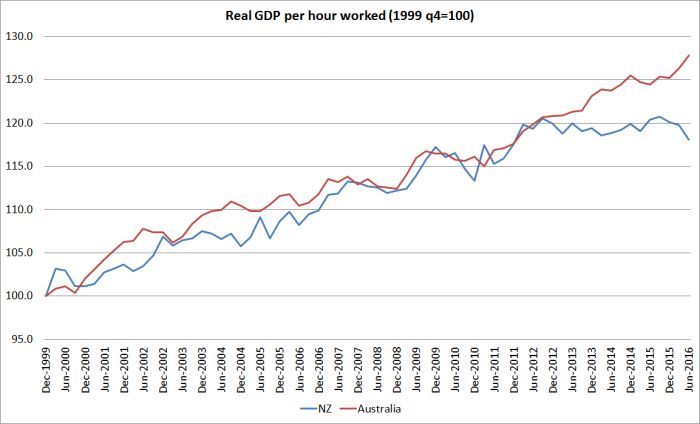
It is a pretty straightforward chart (although it would be a little easier if SNZ followed the practice of the ABS and reported the series routinely, rather than leaving it for people to calculate).  I simply averaged the expenditure and production measures of real GDP, and divided the results by the total number of hours worked (from the HLFS).  And real GDP per hour worked itself is a pretty standard measure of labour productivity.

The interest, of course, has been in the now four years or so of no growth in labour productivity.  On the face of it, it is a pretty poor performance and tends to act as something of a counterpoint to a focus by the government (and its business and media cheerleaders) on headline GDP numbers –  which are high largely because the population has been growing so rapidly, rather than because resources are being used more productively.  Productivity is, in the long run, almost everything when it comes to improving material living standards.

I would add a few caveats around the chart, some of which I’ve made here before.  The first is that the very final observation should be heavily discounted or ignored.  SNZ introduced a revised HLFS methodology in June, which has resulted in a step up in the number of hours recorded (perhaps by around 1 to 1.5 percentage points).  At some point that might be reflected in a slightly higher level of GDP, but for the moment there is just an inconsistency.  (And, of course, there is always some quarter to quarter volatility in the data too.)

The second caveat is the old warning that when a number looks particularly interesting it might well be wrong.  Four years of no productivity growth at all is not unprecedented here or abroad (on current data, for example, GDP per hour worked in the UK now is only around 2007 levels) but….these series are prone to revision, and while they could be revised either up or down, it shouldn’t greatly surprise us if the picture for 2012 to 2016 looks a bit different when we review the data a few years hence.

The big revisions tend to happen as a result of the annual national accounts.  Statistics New Zealand gets a lot more detailed data, produces full annual data once a year (including revisions to earlier years), and then updates the quarterly series that have already been published.  The annual data for the year to March 2016 are out later this month, and the revised quarterlies will presumably be available with the September quarter GDP release next month.  Expect changes (including in the chart above).

But for now, the data is as it is.  Bernard Hickey gave the chart some prominence, with the editorial comment “We’re just pumping more low wage workers in the economy and working more hours”, and observing “Jobs soaked up by net migration & more >65 yrs working”

That prompted Eric Crampton of the New Zealand Initiative, writing on his Offsetting Behaviour blog,  to produce a post asking whether compositional changes in the labour force might account for some or all of the weak productivity growth in recent years.  As he quite rightly notes, if a lot of very unskilled people started working lots more hours (in total), while higher skilled people worked the same number of hours, at the same real output, average real GDP per hour worked would fall even though no one individually was less productive.

First, Eric noted that the number of people on welfare benefits has fallen quite a bit over the last few years.  If –  as seems reasonable –  those people had been of below average productivity, that might tend to lower overall productivity somewhat.

But here is my problem with that story.

working-age-benefits

Working age beneficiary numbers have certainly fallen over the last few years, but they rose a lot during the recession.  There is seasonality in the data so I’ve only shown one observation per annum (June), but in June this year the share of the population of working age on welfare benefits was almost exactly equal to the share as the recession was getting underway in 2008.  People moving on and off benefits might affect average labour productivity to some extent, but absent any sign of an upward surge in productivity over, say, 2008 to 2010 it is difficult to believe this effect explains much of the recent absence of productivity growth.  (And, of course, the decline in beneficiary numbers doesn’t appear to have been in the faster than in the five years leading up to 2008).

Eric also includes a graph showing changing employment rates for different age cohorts, observing

The youngest workers are least productive. They hugely dropped out of the labour market with the changes to the youth minimum wage, but that decline’s since reversed a bit. There’s been a long trend growth in hours worked among older workers, but typical wage patterns over the lifecycle have wages flattening out from the early 50s or thereabouts. Big increases in employment rates among cohorts with lower than average productivity, or at points in the life cycle where wage profiles (and presumably productivity) flatten out, will both flatten or worsen GDP per hour worked.

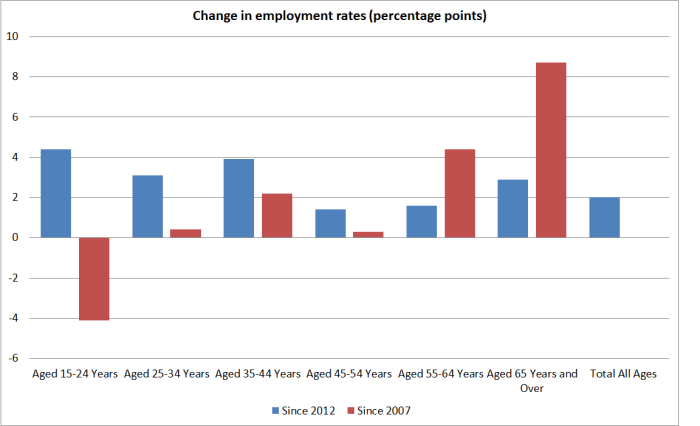
What to make of that?  Here is a chart of the changes in employment rates for each age group, both since 2012 (when productivity seems to have gone sideways) and since 2007, just before the last recession –  and it isn’t a misprint/error; we’ve had no change in the employment rate over the full period from 2007 to 2016.
employment-rates-by-age

Over the last four years, the least productive age group (15 to 24) had the largest increase in employment rates,  and the 65+ employment rate has kept on growing quite a bit.  But….employment rates for 25 to 44 years olds increased quite a lot too (more than the over 65s).    And if we take the full period (Sept 07 to Sept 16), we’ve had a big drop in the employment rate for the lowest productivity age group.  That fall was, of course, concentrated in the first half of the period, but there was no obvious corresponding surge in average productivity at that time (granting that one never knows the c0unterfactual).

And by New Zealand standards, there is nothing very obviously unusual going in the 65+ employment rates.  Between 2007 and 2016 the 65+ employment rate rose by 8.7 percentage points. In the previous nine years, it has risen by 8.1 percentage points.

Perhaps one could dig deeper (if the data existed) and the impression might change, but it isn’t obvious that the changing age composition of the workforce can explain four years of no labour productivity growth.

Sometimes people suggest that perhaps our labour market is performing so much better than those of other advanced countries which might in turn explain the poor productivity growth.   But here is a chart showing employment rates for New Zealand, Australia, and the median OECD country.

oecd-empl-rates

There might be something in the story relative to Australia over the last few years.  But comparing New Zealand with the OECD median, our employment rate fell about as much as that median did during the recession, and has rebounded only slightly more since.  Compare New Zealand and the typical employment rate just prior to the recession and almost half of OECD countries have had more of an increase than (the slight rise) New Zealand has had.

Eric also suggests that we need to think about the role of immigration

And, obviously, net migration’s increased over the last few years. New workers getting settled in New Zealand might take a bit to find their feet as well, while still being better off than they were before.

Just two thoughts.  First, around half the huge swing upwards in net inward migration has been the result of the sharp decline in the number of New Zealanders leaving.  They won’t have taken “a bit of time to find their feet”.    Second, for the other migrants, there might be something to the story (although there hasn’t been much variability in the number of actual residence approvals) through, for example, the increased number of foreign students working and people on working holiday visas.  But….the New Zealand Initiative and other business lobby groups can’t really have it both ways. They often tell us it is imperative that we have the sort of immigration policy we have now, because (for example) New Zealanders just can’t, or won’t, do the work (at a price firms can afford). There is a strong hint in that sort of argumentation that immigrants are on average actually quite highly productive relative to natives (even though the data show that for most immigrant groups it can take decades for the earnings to reach those of similarly qualified, similarly experienced New Zealanders).

I wouldn’t rule out the possibility that the compositional effects resulting from immigration are part of the explanation for the latest productivity slowdown (although we didn’t see something similar when Australia had its huge surge) but….if the Initiative is right about the general economic payoff to high immigration, we should be expecting a pretty big lift in average labour productivity (the more so to make up for four years of no growth) really quite soon.

One other lens on the composition issue is offered by our own official annual productivity data (for the “measured sector” rather than for the whole economy).   SNZ produces both labour productivity and multi-factor productivity estimates, and they also produce both series using both total hours worked and an estimate that attempts to adjust for the changing composition of the labour force.   The latter isn’t precise by any means, and won’t pick up all the sorts of issues that have been touched on in this post, or Eric’s, but they are just another angle on the question.  The MFP numbers are valuable because they help get round the question of whether, say, labour productivity is just poor because firms have substituted away from capital towards abundant labour.  Any such substitution would be less troubling if the result was showing strong MFP growth.

Unfortunately, the most recent data are for the year to March 2015.  In the labour productivity data, SNZ weren’t detecting any sign that a worsening average quality of the labour force was explaining the productivity slowdown – they reported much the same improvement in the average quality of the labour force as in earlier years.  And here is the MFP chart.

mfp-measured-sector

On this measure, of labour-quality adjusted MFP, there has been no productivity growth at all since around 2006.    There is some modest growth over 2012 to 2015 (a bit over 1 per cent over three years).

Where does all this leave us?

I remain a bit uneasy about the prospects the data could be revised, but then data revisions are always a risk.  But if the average real GDP per hour worked data are roughly right – and there really has been no average labour productivity growth for perhaps four years now –  I think we should be more inclined to believe that it is telling us something about overall economic underperformance, than that it is simply, or even largely, reflecting compositional changes in the labour force. To repeat:

  • the share of working age welfare benefit recipients has fallen gradually over the last few years, but then it rose in the previous few years, and there was no obvious associated productivity surge,
  • over the last few years the employment rates of the low productivity young age groups have risen, but not noticeably faster than those for, say, the rather large 25 to 44 age group.  Over 65s employment rates are rising more than those for other age groups, but that change has been underway for many years.  There was no obvious associated productivity surge (at least in the reported data) when youth employment rates dropped sharply.
  • there is nothing in cross-country comparative data suggesting employment rate changes here have been unusual, in ways that might help account for unusually weak productivity growth here.
  • compositional effects resulting from increased immigration of non-citizens (especially  working students and working holidaymakers) could be part of the story (averaging down real GDP per hour worked, even if no one individually is less productive), although it would be worth testing that story against other episodes in other countries.  If higher immigration is playing a role in dampening productivity growth, I suspect it isn’t mostly a compositional story, but one about overall pressures on domestic resources, which have contributed to holding up real interest rates (relative to those in other countries) and the real exchange rate.
  • and overall MFP growth –  whether SNZ estimated for the measured sector, with some labour composition effects accounted for, or the Conference Board’s estimates that I showed the other day – also seems to have been weak to non-existent.


Interest rates, supply restrictions, and house prices

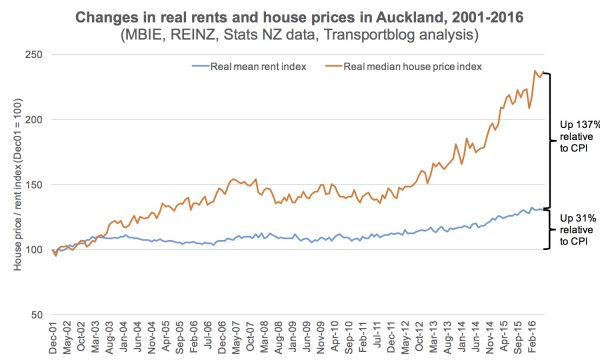
There was an interesting post from Peter Nunns on Transportblog the other day, attempting a bit of a back-of-the-envelope decomposition of how various factors, including land use restrictions, might have contributed to the rise in real Auckland house prices over the 15 years since the end of 2001.

Nunns starts his decomposition with the suggestion that:

One simple way to disentangle these factors is to look at the relationship between consumer prices, rents, and house prices:

  • When rents rise faster than general consumer prices, it indicates that housing supply is not keeping up with demand
  • When house prices rise faster than rents, it indicates that financial factors – eg mortgage interest rates and tax preferences for owning residential properties – are driving up prices.

and with this chart

nunns-1-auckland-real-house-prices-and-rents-2001-2016-chart-600x360

Disentangling the contribution of various factors isn’t easy.  A lot depends on what else one can reasonably hold constant.  Nunns seems to assume that holding real rents constant is a reasonable benchmark, and that we can then think about the change in net excess demand for accommodation by looking at deviations from that benchmark.   Thus, roughly, he suggests that a 31 per cent increase in house prices can be accounted for by supply shortfalls.

Over this period, I’m not at all convinced that is right.  Why?

Largely because of the big changes in long-term interest rates, which –  all else equal –  should have affected supply conditions in the rental market.  Specifically, when interest rates fall a long way it is a lot cheaper than previously to provide rental accommodation (the available returns on alternative assets having fallen so much).

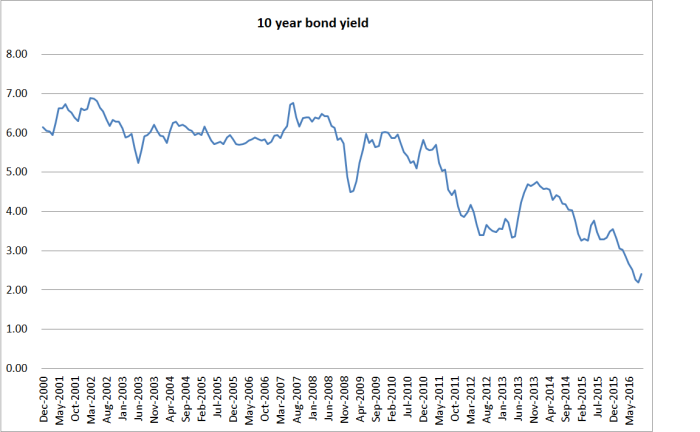
And what has happened to interest rates over this period?  Well, here is a chart of the 10 year bond rate since the end of 2000.

10-year-rate

There is always a bit of noise in the series, but long-term nominal government bond yields are now about 350-400 basis points lower than they were in 2001.  A little bit of that is falling inflation expectations (around 50 basis points according to the Reserve Bank survey).  But fortunately in 2001 we also had a 14 year government inflation-indexed bond outstanding, and we do so now as well.  In late 2001, that indexed bond yielded about 4.6 per cent, and the current yield is around 1.6 per cent.  Real long-term bond yields look to fallen by at least 300 basis points (and around two-thirds of that fall has taken place in just the last five years or so).

Short-term real interest rate haven’t fallen that much.  Short-term rates are more volatile, so here I use a two year moving average.

1st mortgage rate 6mth term deposit rate
   Dec 2001 7.99 5.86
  Sept 2016 6.14 3.59

Even on these measures, real interest rates have fallen by perhaps 1.5 percentage points.

In a well-functioning housing supply market, those sorts of falls in real interest rates might reasonably have been expected to be reflected in lower real rents.

Quite how much a fall one might have expected in such a market will depend on a variety of assumptions one makes.  But if landlords had been looking for an 8 per cent annual real return on rental properties back in 2001, then even a 2 percentage point fall in real interest rates, might readily have been consistent with a 25 per cent fall in real rents –  in a well-functioning housing market.  If real risk-free rates have fallen by more like 300 basis points –  as the indexed bond market suggests –  that would be consistent with more like a 40 per cent fall in the rental cost of long-term assets.

These are all illustrative hypotheticals. They assume that new assets can readily be generated.  But in a well-functioning housing markets, new houses can be readily generated.  New unimproved land can’t be (there is a given stock, only what it is used for can be changed).  But in well-functioning housing markets, the unimproved land component of a typical new house+land package will be quite low.  Think of dairy land prices at perhaps $50000 a hectare and you start to get the drift.  All else equal, in well-functioning housing supply markets, when interest rates fall unimproved land values should be expected to increase, but the value of land improvements and houses shouldn’t be much affected at all.

But even that story is a cautious one (biased to the upside).  After all, interest rates typically fall for a reason –  big trend falls don’t occur in isolation.  One such factor is low expected future returns (eg lower expected rates of productivity growth).   And interest rates are not a trivial factor in the cost of land improvements, associated infrastructure, and house building itself.  Again, all else equal, lower interest rates should lower the real cost of bringing new houses onto the market –  reinforcing the expected fall in real rentals.

Of course, this is so detached from the reality of Auckland (or New Zealand more generally) housing markets that it is difficult to even envisage such a scenario.  We have land use restrictions  –  which tend to produce high land prices and high rents –  and when those restrictions run head on into severe population pressures (especially unanticipated ones), it is hardly surprising that house and land and rental prices rise.  But when that clash (between land use rules and rising population) occurs at time when real interest rates have been falling a lot, looking at trends in rents can badly confuse the issue.

I’m not wedded to a story in which all the increase in real house prices in recent years is down to supply restrictions interacting with rapid population growth.  In his piece Nunns notes a couple of other possibilities

some other ‘financial’ explanations could include:

  • New Zealand’s tax treatment of residential property, and in particular investment properties – unlike many of the countries we ‘trade’ capital with, we don’t have any form of capital gains tax on property. All else equal, this means that we should expect structural inflows of cash into our housing market, driving up prices
  • The impact of ‘cashed-up’ buyers coming in without the need to borrow money to invest in properties – including, but not limited to, foreign buyers.

But….our tax treatment of investment properties has become less favourable not more favourable over the last few years  (reduced and then abolished depreciation provisions, the introduction of the PIE regime, lower maximum marginal tax rates.  If these arguments have force at all –  and they typically don’t when supply is responsive –  they should have worked in the direction of (modestly) lowering house prices over the last decade or so.

And while I suspect there is something to the “cashed-up foreign buyer” story, again any such demand only raises house prices when supply is unresponsive.  If supply is responsive –  which it would be without all the land use restrictions –  such demand would be just another export industry.

Of course, the common story is that lower interest rates have raised house prices.  And perhaps they have to some extent, but (a) recall that interest rates are lower for a reason, and real incomes now (ie the expected basis for servicing debt) are much lower than would probably have been expected a decade ago, and (b) lower real interest rates do not raise the equilibrium price of even a long-lived asset if that asset can be readily reproduced.  In well-functioning housing markets, houses can be, and unimproved land is a small part of the total cost.  If lower interest rates raise house prices, it is only to the extent that land use and building restrictions make it hard to bring new supply to market.  (As it happens, of course, in much of New Zealand real house prices are no higher than they were a decade ago when interest rates were near their peaks.)

To a first approximation, trend rises in real house prices are almost entirely due to supply constraints.  There can be all sorts of demand influences –  some government-driven, some not –  and it can be useful to identify them, but in well-functioning housing supply markets they don’t generate rising real house prices.

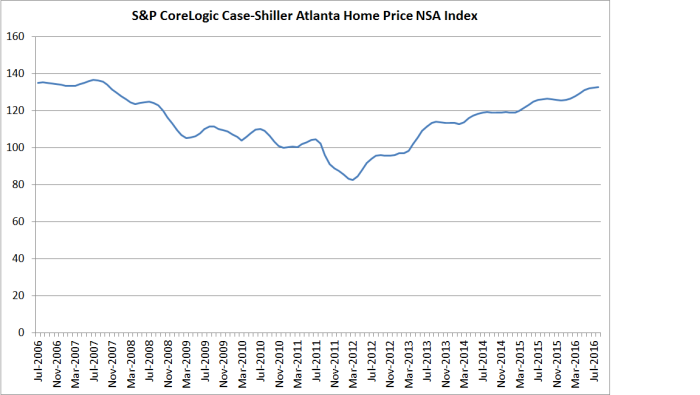
atlanta-2

As just one illustration, here is a chart of nominal house prices for Atlanta over the last decade. Atlanta has had rapid population growth, has experienced significant falls in real interest rates (like the rest of the US), is in a country with mortgage interest deductibility for owner occupiers, and is not obviously a worse safe-haven for Chinese money fleeing the weak property rights of China, and yet nominal house prices are no higher than they were in 2006.


What’s good for Australia is good for New Zealand

But that is not what the FTAlphaville blog would have its international readers believe.

It is always interesting when serious foreign media write about New Zealand.  Sometimes there are useful perspectives we just don’t see.  Then again, when they get things wrong about things you know about, it leaves me wondering about the coverage of things I don’t know so much about.

Yesterday, the Financial Times’s Alphaville blog ran a piece by Matthew Klein headed “What’s bad for Australia is good for New Zealand”.   Klein seems interested in New Zealand and has written a few other posts in recent months.  In this one he draws on a recent speech by Reserve Bank Assistant Governor, John McDermott, but what is wrong with this post is almost entirely the author’s own work.

He begins with this Reserve Bank chart of the Bank’s estimate of the rate of potential output growth for the last 15 years or so.

NZ-potential-output.png

Potential output estimates have changed quite a bit as we have moved through time (and actual past estimates have been revised to some extent).  The Bank published a useful paper on estimating potential output and the “output gap” a couple of years ago.   The biggest single factor explaining fluctuations in potential output growth over time has been swings in population growth –  very strong around 2003, very strong over the last year or two, and much more subdued in between.  Changes in trend productivity growth also matter, but they are harder to detect.   But that slowdown has been real –  population growth in the last year or two has been at least as fast as it was in the early 2000s and the Bank’s estimate of potential output growth is much lower than it was then.  And as Paul Krugman helpfully reminds if, if productivity isn’t everything, in the long run it is almost everything.

But Matthew Klein seems impressed by those 2.6 per cent potential output growth rates –  much stronger than they were a few years ago –  and seems unbothered whether that is the result of more people, or of more productive use of people (and other resources). The difference matters.

Klein’s story is that the Chinese (demand-driven) hard commodity boom was a terrible thing for New Zealand, and we are now reaping a windfall from the end of that boom.

China’s changing investment strategy has produced a windfall for New Zealand — through the unexpected channel of clobbering the Australian mining sector.

Now I suppose there could be some channels through which the end of that commodity boom might have helped New Zealand and New Zealanders.  We import some of those hard commodities too (although of course, we do export some and look what became of Solid Energy).  To the extent that slowing Chinese growth might have contributed to lower oil prices, we benefit from that.  But these aren’t at all the channels Klein has in mind.  On his telling, we have done well because Australia has done badly.  And that seems inherently unlikely given that Australia is the largest trading partner for New Zealand businesses, and the largest source of foreign investment in New Zealand.

But Klein’s story is one in which New Zealanders fled for greener pastures in Australia when commodity prices boomed, and stopped doing so when commodity prices fell.  He runs this chart.

nz-emigration-to-aus-vs-aus-usd-commod-prices

Note that (a) it shows only the flow of New Zealanders to Australia, not the net trans-Tasman flow, and (b) it shows only Australian commodity prices, not the relative Australia/New Zealand prices.

Here is a longer-term chart showing the relationship between the net trans-Tasman migration flow (NZ and Australian citizens) and the relative terms of trade (Australia’s divided by New Zealand’s).

transtasman-tot-and-migration

Over decades there have been big cyclical fluctuations in the net migration flow across the Tasman.    Allowing for the fact that our population is much larger now than it was, say, 25 years ago, the peaks and troughs don’t seem to have become larger than they were.   And most of the time, there haven’t been big changes in relative commodity prices to explain the migration fluctuations.

Generally, a better story explaining the trans-Tasman flows over recent decades would seem to be:

  • in typical years there is a fairly large net outflow from New Zealand to Australia (material living standards are simply higher there),
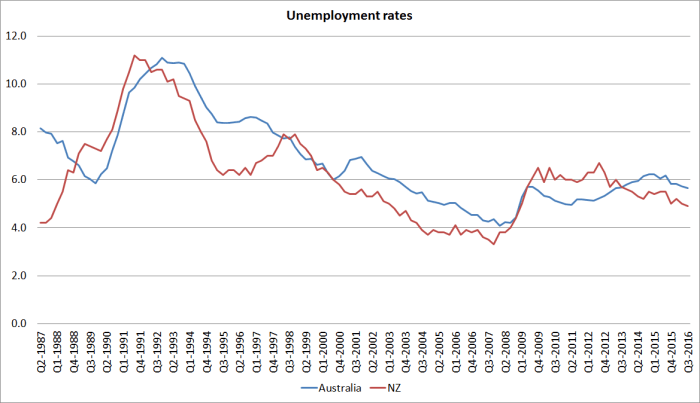
  • when unemployment rates in Australia are very low, the outflow is higher than usual, even if unemployment is low here (job search across the Tasman is easier than usual, and those wages are higher).  In 2007/08, for example, the unemployment rate in Australia was the lowest in decades, as it was in New Zealand, and New Zealanders still seized their opportunities,
  • when unemployment rates in Australia is very high that net flow dries up –  people are reluctant to leave existing jobs when the job search across the Tasman is likely to be longer and costlier (as we saw in 1991),
  • and when Australia’s unemployment rate is lower than New Zealand’s –  which doesn’t happen often – it again makes it very attractive for New Zealanders to go, especially if New Zealand’s unemployment rate is still on the high side.  The largest such gap in the last couple of decades was 2010 to 2012, which saw large scale outflows of New Zealanders resume.

Since then, of course, the unemployment rate in Australia has risen, and that in New Zealand has fallen. In both countries, unemployment is uncomfortably high, and above the respective estimated NAIRUs.  Perhaps it is a little surprising that the net outflow of New Zealanders has, for now, come back to around zero, but there has also been a lot more publicity in recent years about the relatively insecure position New Zealanders can find themselves in in Australia if things don’t go well.  But it would still be surprising if when both countries have unemployment rates are back at the respective NAIRUs there wasn’t typically a large net outflow of New Zealanders resuming.  After all, there has been no progress at all in closing the productivity gaps.

relative-u-rates


No doubt the hard commodity boom, and associated domestic investment boom, did contribute to the relatively low unemployment rate in Australia over 2010 to 2012.  But macro policy (especially monetary policy) also plays a big part in deviations of the unemployment rate from the level the underlying regulatory settings might deliver (the NAIRU).  In New Zealand, for example, the inflation outcomes quite clearly illustrate the monetary policy was tighter than it needed to be over that period.  Some of that was only clear in hindsight, and the earthquakes also muddied the water, but we didn’t simply have to live with such a high unemployment rate for so many years (which reinforced the incentive for New Zealanders to leave).

But, to stand back, perhaps the more important question to ask is why Klein thinks New Zealand is better off simply because the net outflow to Australia has temporarily ended.

After all, New Zealanders going to Australia presumably do so because they think the opportunities are better there (and most objective measures of material living standards suggest they are right).  If opportunities deteriorate in Australia –  cyclically or structurally –  that isn’t a gain for New Zealanders, but a loss.  Fewer of them are, for now, able to take advantage of the opportunities across the Tasman.  It would be different if there were New Zealand specific positive productivity or terms of trade shocks  that meant that prospects here were improving faster than they had been previously.  But there is just no sign of that: as just one indicator, there has been no growth at all in real GDP per hour worked in New Zealand for around four years.

Of course, it might count as a gain if there was some sort of community goal to simply increase New Zealand’s population as fast as possible.  One sees those sorts of arguments in various countries from time to time –  there was a particularly daft Canadian example the other day  – but unless New Zealand is gearing up to defend itself from a military invasion from Antartica, the only good case for pursuing a larger population is if doing so makes us economically better off (higher productivity and all that).  And there is simply no evidence it has, or does –  whether in past decades, or in the latest population surge.

And all this is before reverting to the point that New Zealand firms trade more with Australian firms and households than they do with those in any other country. Australia is New Zealand’s biggest export market.  And so when Australian income growth tails off rapidly, as it has in the last few years, it isn’t very propitious for New Zealand firms hoping to increase their sales in Australia.  Weaker income growth in target markets is generally thought to be bad for the sellers (and their country) not good.

Here is a chart showing the net migration outflows for a longer period.

net-migration-charts

I’ve shown a variety of measures of trans-Tasman flows, and one of all NZ citizen flows everywhere.  They are all highly-correlated, as trans-Tasman flows almost always dominate the overall movements of New Zealand citizens.  There have been three times in the nearly 40 years for which the citizenship data have been available when the net outflow of New Zealanders has temporarily abated:

  • around 1983, when Australia was in recession and its unemployment rate was over 10 per cent,
  • in 1991, when both countries had a severe recession and both countries’ unemployment rates peaked around 11 per cent,
  • and in the last couple of years.  It is unusual in that neither country has been in recession, but both countries have had unemployment rates above the respective NAIRUs, in both countries income growth is much weaker than it was (particularly so in Australia) and in both countries (as in much of the advanced world) productivity growth has disappointed (most especially in New Zealand).

Not one of those occasions could be considered good news stories for New Zealand or New Zealanders.  Over the last 40 years, net outflows of New Zealanders to Australia have been something of a release valve –  Australia gave them opportunities New Zealand could no longer provide.  Unless and until New Zealand really begins to turn itself around structurally, anything that disrupts that outflow is more likely to be bad for New Zealanders than good.

Klein concludes his piece thus

As long as New Zealand is capable of boosting domestic spending without relying too much on household borrowing, admittedly a nontrivial challenge, this puts the country in an enviable position compared to much of the rest of the rich world. Policymakers should enjoy it while they can.

Given that household credit has been growing at almost 9 per cent in the last year, mostly reflecting very rapid increases in already high house prices, and that there has been no productivity growth for years, all while the unemployment rate has lingered above the NAIRU, I’m not at all sure what Klein thinks policymakers should be enjoying.  Perhaps write-ups like his – while they last –  but there doesn’t seem to have been much in the story for New Zealanders in recent years.

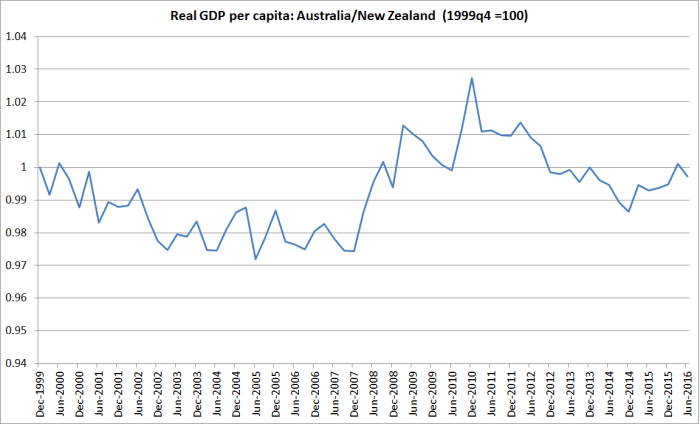
Here is the productivity growth comparison with Australia.  If anything, the latest relative deterioration seems to coincide with the end of the Australian commodities boom. I doubt that relationship is really causal, but it certainly doesn’t seem to help Klein’s story.

gdp-phw-nz-vs-aus

In general, what is good for the economy of our largest trade and investment partner will, almost always, be good for New Zealanders too.  That is how trade, and open markets, work.

NZ interest rates: why are they persistently higher than those abroad?

In my post yesterday, I noted (with illustrations) that looking back over at least the last 20 to 25 years:

…our interest rates (a) are and have been higher than those abroad, (b) this is so for short and long term interest rates, (c) is true even if we look just at small countries, and (d) is true in nominal or real interest rate terms.  And the gap(s) shows no sign of closing.

Not much about that is really controversial at all.  But quite why these gaps have been large and persistent is more contested.  It isn’t the sort of stuff the mainstream media focuses on –  they tend to be more interested in the historically low level of (New Zealand and foreign) interest rates –  but getting to the correct answer matters, not just analytically but in thinking about policy responses to New Zealand’s long-term economic underperformance.

In thinking about the issue, it is important to bear in mind a few things:

  • short and long term interest rates are related, and there can be information in the relationship between them,
  • short-term interest rates are set by the central bank in response to (perceived) domestic inflation pressures, and
  • interest rates in different countries are related at least in part, by expectations (implicit or explicit) about movements in the exchange rates between those two countries’ currencies.

Broadly speaking, I think there are three hypotheses that are canvassed when these issues are discussed in New Zealand (and there is a fourth, suggested by some recent literature, that a few commenters here have raised).

But first, lets clear away some of other possible answers.

The explanation isn’t domestic monetary policy.  Sometimes people have argued that (a) our target was more demanding than those in other countries, or (b) that our Reserve Bank was excessively “hawkish”, inclined to see inflation under every stone, and so holding short-term interest rates persistently higher than they need to be.  In fact, our inflation target is very similar to those in most other advanced countries.  The Reserve Bank makes mistakes – sometimes they even persist for a couple of years –  and sometimes gaps between our interest rates and those abroad are affected by those mistakes. But other central banks make mistakes too (all of them are human, with much same limitations).  And taking a longer-term perspective, on average over time our Reserve Bank actually delivered inflation outcomes a bit higher than the target they’d been given.  Given the target, monetary policy (pre-2008/09 was typically a little loose  (since then it has probably been a little tight).   All in all, differences in monetary policy conduct or targets just can’t explain those persistent differences in real interest rates.

There is another possibility that be cleared away even more quickly.  If a country had very strong persistent productivity growth it would tend to have higher interest rates than would be seen in other countries.  There would be lots of profitable investment opportunities in that high productivity growth country, lots of (expected) income growth to consume in anticipation of, and so on.  And over time, that high-productivity growth country could expect to see its real exchange rate rise.  Unfortunately, high productivity growth isn’t the story of New Zealand in the last few decades.  Indeed, more often rather the reverse.

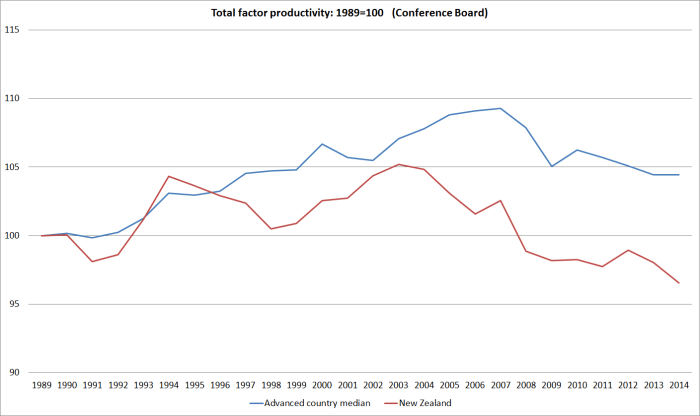
Here is a chart I haven’t shown for a while: total factor productivity for New Zealand and for a median of the large group of advanced countries for which the Conference Board has estimates back to 1989.

tfp-oct-16

Rapid productivity growth isn’t even close to a relevant story explaining New Zealand’s persistently high real interest rates.

There is another possible story which hasn’t really entered the mainstream of the New Zealand debate, but should be covered off for completeness.  It notes that New Zealand is a small country, with quite a volatile terms of trade, and that the currencies of such countries offer less good diversification opportunities, suggesting that anyone investing here would require a higher return than elsewhere.  It sounds initially plausible, but it has a number of problems.  The first is that our interest rates have been persistently higher than those in other not-large countries with their own currencies (I showed the chart against the median on Australia, Canada, Sweden, and Norway in the previous post).  And the second is that if this were an important channel, it would suggest that small countries face a higher cost of capital than large ones, which would limit the growth prospects of small countries.  But (badly as New Zealand specifically has done) there is no real sign that small countries typically grow (per capita, or per hour worked) more slowly than large ones.  At present, I don’t think it is a particularly strong candidate to explain New Zealand’s persistently high interest rates.  Apart from anything else, if this were the story, why would New Zealand have accumulated –  and maintained – such a large negative net international investment position (NIIP) (still among the largest of the OECD countries)?

Perhaps somewhat related, but from an older set of models, is the idea that New Zealand has some combination of persistently good investment opportunities, and modest national savings rates, and requiring foreign funding for such opportunities needs to pay a premium rate of return. It is nothing to do with specific New Zealand risks (small, volatile etc) simply that capital needs a premium to attract it away from home, no matter where home is.  Again, it sounds plausible, but runs into some problems.  Perhaps the most important is that this story cannot explain why the real exchange rate should also have been persistently high  (on a pure time series basis for at least the last decade, but relative to the growing productivity differentials for rather longer than that).   Typically, part of the way New Zealand might attract the foreign capital it needs is through some mix of a lower (than usual, or easily explainable) exchange rate, and higher interest rates: from a foreign investor’s perspective it is the total return that should matter, not just the interest rate.  Senior Reserve Bank people have, at times, sought to invoke this explanation as at least part of the story.

A more prominent explanation for New Zealand’s persistently high interest rates points to the large negative NIIP position and asserts that the explanation for high interest rates is pretty straightforward: lots of debt means lots of risk, and hence the need for a substantial risk premium on New Zealand interest rates.  Taken in isolation –  if someone told you only that a country had a large negative NIIP position this year –  it might sound plausible.  Once you think a bit more richly about the New Zealand experience it no longer works as a story.

First, our NIIP has been large (and negative) for a very long time now –  for at least the last 25 years, and over that time there has been no persistent tendency for the NIIP position to get better or worse.  By contrast, 20 years earlier than that New Zealand had almost no net foreign debt.  The heavy government borrowing of the 70s and 80s had markedly worsened the position.  It is quite plausible that foreign lenders might then have got very nervous and wanted a premium ex ante return to cover the risk. In fact, we know some (agents of) foreign investors got very nervous –  there was the threat of a double credit rating downgrade in early 1991.  But when lenders get very nervous, borrowers tend to change their behavior, voluntarily or otherwise, working off the debt and restoring their creditworthiness.   And in New Zealand, the government did exactly that –  running more than a decade of surpluses and restoring a pretty respectable government balance sheet.  But the large interest rate differential has persisted –  in a way that it did in no other advanced country (including those that went through much worse crises and threats or crises than anything New Zealand has seen in the last 25 years).

We also know that short-term interest rates are set by the Reserve Bank, in response to domestic inflation pressures. But long-term interest rates are set in the markets.  If investors had really been persistently uneasy about New Zealand’s NIIP position, we might not have seen it much in short-term interest rates, but should certainly have expected to see it in the longer-term interest rates. (That, after all, is what we see in various euro countries that have lapsed in and out of near-crisis conditions).   But one of the other features of the New Zealand experience is that over the last 25 years is that New Zealand’s long-term interest rates have been a bit lower relative to New Zealand’s short-term interest rates, than is typically seen in other countries.   In one obvious place one might look for direct evidence of such a risk premium, it just isn’t there.

yield-gap-2016In fact, on this measure we look a lot more like Norway –  which has a huge positive NIIP position (net foreign assets) and very little government debt.

And remember, too, the point I made earlier about the exchange rate.  When risk concerns about a country/currency rise, one of the first things one typically sees –  at least in a floating exchange rate country –  is a fall in the exchange rate.  It is a bit like how things work in equity markets.  When investors get uneasy about a company, or indeed a whole market, they only rarely succeed in getting higher dividends out of the company(ies) concerned.  If the companies were sufficiently profitable to support higher dividends the concerns probably wouldn’t have arisen in the first place.  Instead, what tends to happen is that share prices fall –  and they fall to the point where expected dividends, and the expected future price appreciations of the share(s) concerned, in combination leaves investors happy to hold those shares. In that process, an increased equity risk premium is built into the pricing.

At an economywide level,  if investors had had such concerns about the New Zealand economy and the accumulated net debt position, the most natural places to have seen it would have been in (a) higher long-term bond yields, and (b) a fall in the exchange rate (and perhaps a persistence of a surprisingly weak exchange rate). But we’ve seen neither in New Zealand.  Had we done so, presumably domestic demand would have weakened, and net exports would have increased.  The combined effects of those two shifts would have been to have reduced the negative NIIP position, and reduced whatever basis there had been for investors’ concerns.  Nothing in the New Zealand experience over the last 20 years or more squares with that sort of story.

And that is the really the problem with the most common stories used to explain New Zealand’s persistently high interest rates. They simply cannot explain the co-existence of high interest rates and a high exchange rate over long periods.

My alternative approach seeks to do so.

It involves looking at the stylized facts and suggesting that perhaps they point in the direction of an abundant supply of credit from abroad (perhaps something almost like the horizontal supply curve of the textbooks), combined with some factors that give rise to persistently strong demand for scarce domestic resources.  That in itself shouldn’t really be terribly controversial.  There are pleasing stories which, if true for New Zealand, would produce that sort of combination.  If New Zealand individuals and firms were generating a world-beating stream of new ideas and business opportunities, business investment would be strong, productivity growth would be strong, and a “strong demand meets ready supply” story would have everyone nodding approvingly.    But….we know that productivity growth has been persistently weak (there are good years and bad ones, but the trend story is pretty disappointing) and business investment has also been weak (in long-term cross-country comparisons).  And with that disappointing productivity growth, households also wouldn’t have been rationally consuming in expectation of even stronger future income growth than we see in most countries.

So I’ve suggested looking at “demand shocks” instead, and particularly those that might arise from outside the system (the private economy), focusing on activities/choices/initiatives of government.   Governments are not as responsive to market prices as the rest of us.

Again, there is nothing overly controversial about this idea in principle.  A big increase in domestic government spending on goods and services, for example, will tend to push up the real exchange rate, and quite possibly push up domestic interest rates as well. My favourite example is prisons.  Relative to a no-crime hypothetical, a government that finds itself needing to build more prisons, needs to get command of the resources to build those prisons, and then staff them.  Doing so will tend to bid up the price of domestic goods and services (including labour) –  and raising the price of non-tradables relative to tradables is one of the definitions of the real exchange rate.  Resources used for building and staffing prisons (and actually, the people imprisoned and no longer in the labour market) can no longer be available for generating tradable products.  The higher real exchange rate squeezes some of that production out.

But my specific version of the demand story looks at our immigration policy.  Government decisions on how many non-New Zealanders too admit each year –  themselves largely reached independently of the state of the New Zealand business cycle – can be presented, quite reasonably as a “demand shock”.   The net impact of additions to the population from outside the system –  births are conceptually a little different –  tends to boost demand more than it does supply in the first couple of years after the migrant arrives.  And if there was simply one wave of migrants –  as in some of the events studied in the literature –  the effects would wash through fairly quickly.  But in fact, we have a new large wave each year, and have had really ever year since around 1990 (immigration was being liberalized over several years around that time).    Each new migrant needs –  just as they did at time Belshaw was writing – quite a lot of new physical capital (houses, roads, schools, offices, factories etc) and they bring almost none of it with them.  Additional demand for those real resources has to be met by squeezing out other forms of demand –  and that is what persistently higher real interest rates and exchange rate tend to do.  The fuller version of my story was in a paper I wrote a few years ago for a Reserve Bank and Treasury forum on exchange rate issues.

Some people worry that I must be assuming some irrationality or market failure (crutches which, quite rightly, economists are wary of relying on).  But I’m not.  Recall that the active agent here is mostly a body outside the market: the government, which for whatever reason decided that it wanted to bring in 45000 to 50000 non-citizens per annum.  The people who come are presumably being quite rational.  The people whose firms respond to new fixed capital demands (and other requirements of a growing population) are being quite rational.  There is quite real new demand in front of them.  The central bank which raises interest rates, and the markets which push up longer-term interest rates, are also presumably being quite rational.  There is more demand pressure in the New Zealand economy. Perhaps the one area in the story that is a bit of a surprise is that long-term interest rates haven’t stayed up as high, relative to short-term interest rates, as we might expect.  I’m not sure why that is –  but it is a hard observable fact, present in the data without any need to torture it first.

My own hypothesis –  and it is pretty tentative –  is that few people in international markets really realise the importance of persistently high immigration in boosting demand.  And most of them –  quite rightly – operate with a mental model that envisages convergence with world real interest rates in the long haul.  If immigration policy were overhauled and drastically cut back, exactly that sort of long-term interest rate convergence would occur.  In a way, it might be just as well that many investors haven’t quite realized –  over many years –  how persistently large the gap between New Zealand and world interest rates would remain.  If they had (or even did today), the rational response would have been to bid the exchange rate quite a lot higher than it has actually been.  Investors  –  and international agency experts –  have often expected New Zealand’s exchange rate to come down, partly because they kept, mistakenly, expecting the interest rate convergence that never happened (yet).  Expectations drive pricing, and if people think the interest rate gap will remain larger for longer, relative expected returns on different assets are only roughly equalized if the exchange rate goes still higher now, so that it can fall further some time in the future.

Is my story the correct one?  I don’t know, but I’ve been running it now for six or seven years, and as the ideas have had more exposure I’ve not been presented with any counter-arguments or evidence that would undermine my sense that “repeated demand shocks” (largely resulting from our immigration policy) are a material part of the story for why our interest rates have remained so persistently high relative to those in the rest of the world.  It is a difficult story to test in a formal empirical way –  something that probably frustrates me as much as it does some of the sceptics –  partly because it isn’t some generalized global story about all immigration everywhere, but about how events and policy interventions have unfolded in his specific economy, with its own specific set of other stylized facts (including, for example, the modest national savings rate).

Like all hypotheses, mine is put out in part to prompt reactions, to identify holes in other stories, and to help prompt alternative, perhaps richer, stories. For now, however, I’m pretty confident that mine is the only one of the stories on offer that can reasonably account for the combination of:

  • persistently high (relative to other countries) real interest rates,
  • a persistently high real exchange rate,
  • long-term interest rates lower relative to short-term rates than is typically seen,
  • a high (almost entirely private) negative NIIP position,
  • all over a period where productivity growth has continued to lag behind that seen in most other advanced countries.

It might not be the whole story, but it feels a lot like a significant step towards such a story.

New Zealand interest rates: persistently higher than those abroad (Part One)

New Zealand’s interest rates have been higher than those in the rest of the advanced world for decades.  Making sense of why is one element –  I argue an important one –  in getting to the bottom of why New Zealand’s relative economic performance has been so poor, and in particular why we’ve made up no ground relative to most other advanced countries in the last 25 years or so.  Our productivity growth has been slower than that of most other advanced countries, and after a disastrous few decades we entered the 1990s already less well off than the typical advanced country.

If we had good comparable data for the earlier decades (say 1950s to 1970s), and market prices had been free to reflect underlying pressures, our interest rates would have been higher than those in the rest of the advanced world then too.  Instead, we made much greater use of direct controls (on imports, credit, foreign exchange flows) than most advanced countries did.  We don’t really get comparable interest data again until the mid 1980s.

When I say that our interest rates have been higher than those in other advanced countries, I really mean “real” interest rates.  Differences in inflation rates really complicate the picture at times in the past –  in the 1970s and 1980s for example, New Zealand had some of the highest inflation rates in the advanced world.   But over the last couple of decades, inflation rates have been much lower and much more stable, across time and across countries. I could spend a great deal of time constructing estimates of “real” interest rates, but none of them would be ideal (eg there are no consistent cross-country measures of inflation expectations) .   And so the charts I’m showing in this post, will use nominal interest rates.  Where relevant, I will mention changes in inflation targets, actual or implicit.

And when I say that our interest rates have been higher than those in other advanced countries, I don’t necessarily mean “in every single quarter, against every single country”, but on average over time (actually, in the overwhelming majority of quarters, against the overwhelming majority of countries).   New Zealand’s OCR actually got as low as the US federal funds rate target in 2000 (both were 6.5 per cent), but it didn’t last more than a few months.  Changes in inflation targets do make a bit of a difference: in the early 1990s for example, we were targeting 1 per cent inflation.  Australia didn’t have an explicit target at all for a while, and when they adopted one it was centred on 2.5 per cent.  So our nominal short-term rates were somewhat relative to theirs in the early 1990s.   Adjusting for (say) differences in inflation target, our policy rates have been higher than theirs throughout the last 20 years, with the exception of the peak of mining investment boom.

The point of this series of posts isn’t really to establish that our interest rates are, and have been, higher than those in other advanced countries.  No one seriously contests that.  But just to illustrate the point briefly, here are a couple of view ofs the long-term bond yield gap.

long-term-bond-yields-0ct-16

One line shows the gap between New Zealand and the median of the all the OECD countries for which there is data since 1990 (ie mostly excluding the eastern European countries), and the other is the gap between New Zealand and the median of Australia, Canada, Sweden and Norway, four not-large countries that control their own monetary policy.

The gap is larger than it was in the early 1990s –  when we had an unusually low inflation target –  and even if you take just the last 20 years (or even the last 10) there is no sign of the gap narrowing.  There are cyclical fluctuations, of course, but our long-term interest rates are well above those in other advanced countries (with mostly quite similar inflation targets).

And here is the same chart for short-term interest rates (again, OECD data).

short-term-int-rates-oct-16

Again, no sign of any convergence occurring.  Even the latest observations (on which almost no weight should be put –  rates fluctuate) aren’t much different from the averages for the last 20 years.

And since commenters sometimes highlight small countries, here is the short-term interest rate gap between New Zealand and the median of the seven smallest OECD countries that have their own monetary policy for the last 20 years (a period for which the OECD has data for all of them).

short-term-rates-small-oecd-oct-16

So our interest rates (a) are and have been higher than those abroad, (b) this is so for short and long term interest rates, (c) is true even if we look just at small countries, and (d) is true in nominal or real interest rate terms.  And the gap(s) shows no sign of closing.

But the really interesting question isn’t whether our interest rates are higher, but why.  That will be the focus of the next post.


Housing reform, the Corn Laws and possibilities for New Zealand

Brendon Harre, who writes interesting and thought-provoking pieces on housing (including contributing from time to time to the new Making New Zealand housing blog), had another stimulating article out this week, titled Housing affordability: Reform or Revolution .  Harre is strongly of the view that supply-side reform of the urban land market is critical to making home ownership affordable again, but is particularly interesting because he comes at the issues from a left wing perspective: the sheer injustice of the sorts of house price outcomes we (and so many other similar countries) have experienced in recent decades.  He fears that if reform doesn’t happen, extreme populist movements –  the modern “revolution”  – could.

In his latest article, Harre picks up on a point I’ve made several times previously.  I’ve argued that it is difficult to be optimistic about the supply-side reforms happening in New Zealand any time soon, partly because there are few or no known precedents of countries or regions/cities (and certainly not from among the Anglo countries) undoing restrictive land use regulations once they have been put in place.  He links to a post I did a few months ago suggesting that perhaps Tokyo might have been something of a counter-example, but essentially accepts the point that, thus far, there few modern examples of successful supply-side land use/housing reform.  In pondering why this might be, and how it might be changed, Harre suggests thinking about other cases from history in which policy reforms have finally overcome longstanding resistance, to free-up markets and bring prices down.

In a New Zealand context, he could have thought about the eventual removal of the sort of heavy import protection which for decades meant that New Zealand was a rare country where cars were not only very expensive, but often held their value over time.  Or of the removal of most agricultural industry support in the 1980s.

But on this occasion he looked at the movement that led, over decades, to the repeal of Corn Laws (which tended to hold up the price of wheat, benefiting landowners but at the cost of urban workers and industrialist) in the United Kingdom in 1846.    You can read the story for yourself, and I’m not an expert in the area (although the few books I pulled off my shelf suggested a different emphasis in a few areas), but the lessons Harre draws are

What are the lessons from the campaign for affordable food?

  • Achieving a strategic alignment of a broad cross-section of social groups is important
  • Acknowledging that moderate incremental reform can prevent future radical revolutions.
  • If traditional media does not report on your campaign create new media. The Economist newspaper was founded by the British businessman and banker James Wilson in 1843, to advance the repeal of the Corn Law.
  • Simple clear statements/images with a strong moral message are effective.

Harre ends on an optimistic note.

For New Zealand to become a fairer society, we should learn the lessons from earlier struggles for economic, social and political justice. If these lessons were applied to New Zealand’s housing crisis, in my opinion affordable housing could be easily solved.

I remain rather more skeptical.  As a technical matter, housing price scandals (here and abroad) are easily resolved.  But the challenges aren’t technical, they are political.

Harre draws hope from the recent Obama administration initiatives to encourage states, cities, counties etc to rethink their zoning rules

President Obama has chosen to address supply restrictions by releasing a Housing Development Toolkit, advising States and local jurisdictions on how to best manage urban planning to achieve affordable housing. Some US cities are very restrictive, so these reforms may cause a measurable downward price correction, but it is too early to tell. There are both supporters and detractors for the President’s approach, which if followed to its logical conclusion by going from advice to a command would remove some aspects of planning autonomy from local government control.

But…the US federal government has no responsibility for zoning and other local land use laws, the Obama administration is weeks from ending, and there seems little appetite in the places that matter in the US to make the sorts of land use liberalisations that many economists favour.  Of course, it is good to see the Administration (even an outgoing one) pick up the issue, but substantively it might matter not much more than, say in a New Zealand context, the ACT Party favouring such reform.  And housing affordability isn’t such an issue in the US, no doubt partly because if New York or San Francisco are “unaffordable” there are other big fast-growing cities people can move to without such regulatory burdens.

I’m not sure that reform is inevitable, even with a decades-long perspective.  After all, awful as the current system is, it could maintain an uneasy equilibrium in which more people involuntarily rent than used to, people buy homes much later in life than they used to with more debt, and then –  on average –  they reap a transfer back from their parents late in life.   I don’t favour such an outcome, but after several decades already of progressively more unaffordable home ownership for the relatively young, there is still no sign of this becoming some sort of moral crusade for justice, let alone efficiency.

Reverting to the Corn Law process briefly, my British economic history textbook records that

By 1846 the Anti-Corn Law League was the most powerful pressure group  England had known, and upon their techniques of mass meetings, travelling orators, hymns and catechisms a good deal of later Victorian  revivalist and temperance –  even trade union –  oratory was based.

Translated into the language and style of a different age, I don’t detect anything like that at present around land use regulation (outright homeless is a little different).

As Harre, and the economic historians note, the rising “ideology” of free trade played a part – though not necessarily a decisive part –  in getting the Corn Laws repealed.  There was an alignment between that belief system and the cause of “cheaper food for urban workers”.  But in New Zealand –  or Canada, or Australia, or the UK, or most of coastal USA –  is there any sign of that sort of ideological movement around housing, cities etc?  I don’t detect it.  There is no sign of the rhetoric of choice, freedom, flexibility etc assuming a dominant role –  among the public let alone among the elites.  The talk is still endlessly of smarter planning, and top down visions for what cities and other urban areas should be like –  our own Productivity Commission put its imprimatur recently on local authority desires to plan cities.  If there is ever talk of reform, it is of targeted specific interventions, not of getting planners out of the way, and allowing markets to work.  In my own suburb, there is currently a process underway –  hours and hours of meetings between “community representatives” and the Wellington City Council –  on a 10 year plan for the suburb –  and no one seems to find this strange, not 25 years on from the fall of European communism.

This isn’t intended to be a counsel of despair.  Things can change, but there doesn’t at present seem to be a pressing demand for change –  and particularly not for the sort of regulatory changes that would really make a major sustainable difference.  That means if change is really going to happen any time soon, someone –  some party –  is going to have to be willing to spend a lot of political or reputational capital on making initially unpopular change.  And that cost is only rising with each passing month in which more households – in Auckland and increasingly elsewhere –  take on debt at the new higher house prices.  Falling house prices don’t actually threaten most of those people –  servicing is the real issue –  but that doesn’t stop the prospect sounding pretty frightening.

One obstacles to getting comprehensive land use reform is fear in some circles –  particularly on the environmental left –  about what post-reform cities might look like.  Many talk disdainfully of “sprawl” –  as if there is something profoundly wrong about people in a small, lightly populated, country wanting a decent backyard for their kids to play in etc.  But even when the attitude isn’t disdainful, it is often fearful –  how far will Auckland stretch, and all those questions about roads and other infrastructure.  If Auckland really is going to grow by another million people those issues become a lot more pressing than otherwise.  People can, and do, come up with all sorts of smart solutions –  differential rates, MUDs etc-  and I’m quite sympathetic to all those arguments.  But they don’t really resonate with the wider public, and some visceral unease about “sprawl” (and even the loss of “prime agricultural land”) seems to.  It isn’t only the public: the Green Party is likely to be part of the next non-National government.

Which is partly why I think any successful sustainable package of land use reforms, particularly in New Zealand, should be accompanied by a commitment to much lower rates of non-citizen immigration for the foreseeable future.  As readers know, my main arguments about immigration policy aren’t about house prices –  which can be “fixed’ with proper supply side reforms –  but if one of the real barriers to land use liberalization is unease about population-driven “sprawl”, why not just take the policy-driven component of population growth out of the mix for a few decades?  It is not as if the proponents of immigration can show the real economic gains to New Zealanders from our immigration policy, and we know that GDP per capita in Auckland has been falling relative to that in the rest of the country, not rising.    There is no hard trade-off, only the scope for mutually reinforcing packages of reforms that might finally make a more liberal approach to urban land use possible in New Zealand, if some political leader (or coalition of parties) is really willing to take the risk.

Individual political leaders can make a real difference.  It would be great if one would stake a lot on urban land use reform, but anyone considering it needs to recognize the lack of precedents, the potential losers, and the worries and beliefs that underpin the durability of the current model here and abroad. And they probably need to find not only the right language to help frame repeal choices and options, but find a package of measures which helps allay – even if only in part, and for a time –  the sorts of concerns some have.  Plenty of the elites don’t really believe in choice and freedom  –  especially for other people –  but perhaps they might be a little more relaxed if they weren’t (reasonably or otherwise) worrying about the idea of an Auckland that stretched from Wellsford to Hamilton.

The Reserve Bank interest rate projections

The other day the Reserve Bank slipped out an advisory informing people that whereas they have previously published projections for the interest rate on 90 day bank bills, in future they will be publishing projections for the OCR itself.

The Reserve Bank has published economic projections since the early 1980s, and began publishing projections –  as distinct from simply technical assumptions –  for short-term interest rates in 1997.  Back then, we didn’t have a policy interest rate that the Reserve Bank set, and the 90 day bank bill rate was the most heavily-traded short-term interest rate and the most useful indicator of short-term money market conditions.

Somewhat belatedly (by international standards) we introduced the Official Cash Rate (OCR)  in March 1999.  The OCR wasn’t a rate that directly affected anyone outside the banking sector  – at the time it was introduced it wasn’t even a rate directly received or paid by anyone, simply the midpoint between the rate we paid banks on their deposits, and the rate we were willing to lend to banks on demand at.  But the OCR quickly established the expected quite tight relationship with rates that did affect firms and households in the real economy.  It was never a precise relationship –  one was for overnight money, one was for a 90 day term; one was for unsecured interbank lending and the other for almost risk-free transactions –  but it was close.

I don’t know recall whether we had much of a discussion at the time the OCR was introduced as to whether the projections should be published in terms of the OCR or the 90 day bill rate –  and there is no reference to the issue in the Bulletin article we wrote at the time.  But probably the view at the time (which I’d have endorsed) was that we should stick with the 90 day bill rate because (a) it was a rate that more directly affected real people, and (b) all our models were built in terms of the 90 day bill rate (and we had no time series of the OCR to re-estimate them).    After years of not directly controlling interest rates at all, we probably also liked the additional degree of ambiguity that the gap between the 90 day bill rate and the OCR provided in our communications.

Seventeen years on, it probably does make sense to switch over to using the OCR.  This post isn’t to disagree with the Bank’s change –  which, in the scheme of things, is a pretty minor matter.

But I was a bit puzzled by some of the reasoning the Bank advanced for making the change.   They mentioned two considerations.  The second one they list is fine

The publication of OCR projections as opposed to 90-day bank bill rate projections also brings the Bank into line with the practice of other central banks that publish expected policy paths.

Not many other central banks do publish short-term interest rate projections, but those that do use the policy rate itself, rather than some market rate closely linked to the policy rate.

But their main argument is that the relationship between the OCR and the 90 day bill rate (and perhaps, by implication, other rates that affect real economic activity and inflation) had changed or even broken down.

Historically the 90-day bank bill rate has provided a good gauge for the stance of monetary policy because it typically moves in a consistent manner with the OCR. Variations in the past have generally been temporary and experienced during periods of financial stress. More recently, regulatory changes in global financial markets have also been altering the relationship between the 90-day bank bill and OCR, complicating the Bank’s communication of the monetary policy outlook.

I knew things had gone a little haywire during the financial crisis –  relative to risk-free assets, yields on anything involving bank risk had gone much higher than usual.  But that was some years ago and –  frankly –  in the middle of a global crisis of that severity, projections are even less use than usual anyway.  But what about over the longer sweep of history, pre-crisis and more recently?  Here is a chart of the OCR and the 90 day bill rate.

ocr-and-90-s

And here is the gap between them.

90s-less-ocr

Not much looks to have changed.  If anything the gap is a bit less volatile since the 08/09 crisis, but that is probably mostly because the OCR itself has been less variable. That might change again at some point.

And it is worth noting that the relationship hasn’t changed materially even though what the OCR itself is has changed over the years.  It started out as the mid-rate between the Reserve Bank’s deposit and lending rates, but for the last decade or so it has been the deposit rate the Bank pays on (the bulk of) bank settlement account balances at the Reserve Bank.

Economic activity and inflation pressures aren’t directly affected by the OCR.  What matters more to firms and households are the rates they themselves receive and pay.  The Reserve Bank doesn’t publish very good data on those rates, but they do publish a number of long-running indicator series.

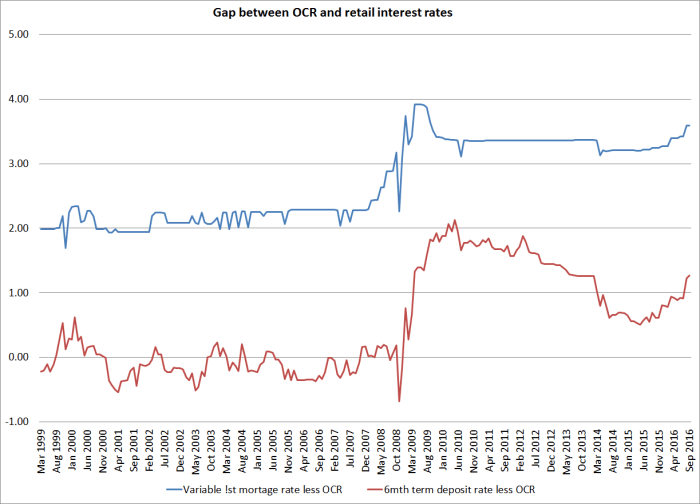
And there have been some significant changes in the relationships between wholesale interest rates and some of these key retail rates in the years since the financial stresses of 2008/09.    Here is the gap between the 90 day bank bill rate and (a) variable first mortgage rates, and (b) six month term deposit rates.

retail-wholesale-gap

Retail term deposits matter much more to banks now than they did, for some combination of regulatory and market reasons (and the cost of longer-term foreign wholesale funding –  not shown – influences just how eager banks are to pay up for term deposits).  As a result, both term deposit rates and floating mortgage rates are much higher, relative to 90 day bill rates, than they were in the pre-crisis years.  That is a major change that the Reserve Bank had to take into account (and consistently has).

But here is the same chart, except that this time I’ve used the gap between the OCR and the retail rates.

ocr-retail-gap

As you’d expect –  because the OCR and 90 day bill rates track so closely –  they tell almost exactly the same story.

I don’t doubt that, as they say

The Bank views publishing a projection for the OCR as a more transparent way of presenting the expected policy actions needed to achieve its inflation target.

But the gains will be small at best.  They will still be publishing smoothed quarterly projections, rather than specific projections for each OCR review –  the latter, which I’m not advocating, would take the transparency about policy rate expectations to the extreme.  And the Governor is still likely to be torn between times when he really wants to give a clear strong signal, and times when he is uncertain enough about the future, even a few months ahead, not to want to do so.

There is a reasonable case for the change the Bank is making, but –  contrary to what they suggest -the justification isn’t in any change in the relationship between 90 day bill rates and the OCR itself.  There hasn’t been one.   And if there have been problems with the Bank’s communications over the last few years –  and there have –  those problems have had very little, arguably nothing, to do with the precise short-term interest rate variable the Reserve Bank chooses to publish projections for.

In many respect, the bigger questions –  which everyone would grant are more important –  are whether

(a) the Reserve Bank should publish policy rate projections at all, and

(b) more radically, it (and other central banks) should publish economic projections at all.

I could devote entire, lengthy, posts to each, but won’t do so today.  My own view is that central banks shouldn’t publish policy rate projections –  most don’t –  and that if they publish economic projections at all, there is no value in projections for much more than a few quarters ahead.  The reason is really quite simple: central banks know almost nothing about the future (and neither, with any degree of confidence, does anyone else).

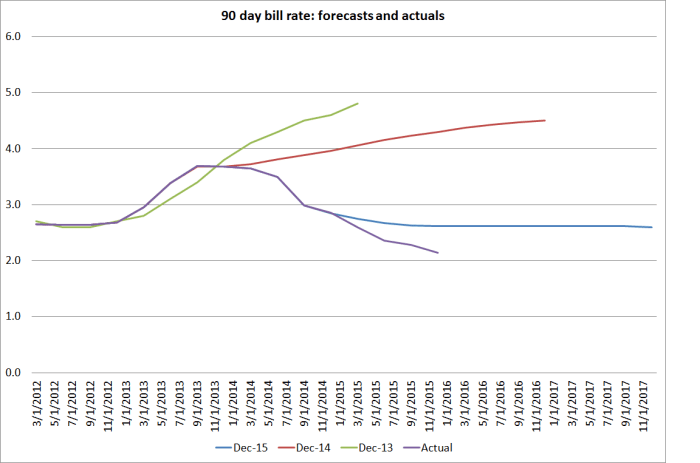
Here (purely illustratively) is the chart of 90 day bill rates, and Reserve Bank forecasts from each of the last three December MPSs.

90s-forecast-and-actual

These haven’t been uniquely difficult years. There was no domestic recession –  forecasters never pick recessions – the unemployment rate didn’t change very much, and if there were ups and downs in some of our export sectors it isn’t obvious that taken together things were much harder to read than usual.   And yet the Reserve Bank really had no idea where the OCR/90 day bill rate would be.  At times I’ve been quite critical of their specific misjudgements, but poor as some of those were, over long periods of time our Reserve Bank is probably no better or worse at medium-term forecasting than any of their peers.  It typically isn’t, and probably can’t, be done well.

A common defence is “oh, but we know the projections won’t be accurate, but at least we can give a sense of how we might react if (when) things turn out differently”.    But even that isn’t very persuasive. If they really think they can give us useful stable information about how they will react to changing circumstances, it should be enough to publish the model (s) they are using and the reaction function embedded in them.  As it is, I’m skeptical there is very much information in either those model reaction functions or in the published policy rate projections.  They might tell you how the Governor thinks now we would react in, say, 18 months time, but in truth he won’t know until he gets there –  partly because there will be a lot of contextual material not captured in today’s forecasts.  In the current New Zealand context, the medium-term forecasts are particularly useless –  the current PTA expires in only 11 months and, most probably, the current Governor will have retired and been replaced by then.  Different Governors will read the same data, and even the same PTA, differently.

Does it matter?  After all, if the policy rate projections –  beyond perhaps the next quarter –  have almost no useful (forecasting) information, perhaps they just do no harm?   I think they do do some harm, simply because resources are scarce and policymakers and their analytical staff have to choose where to focus their efforts. In my experience at the Bank, considerable time was devoted to trying to divine the future –  and haggle about the policy track that we would present.  Time spent on that, largely fruitless, task is time that couldn’t be spent making sense of what we already know, but don’t adequately understand: what has already happened (eg to core inflation) and why.  Central bankers –  and others –  whether here or abroad don’t have adequate answers to that, and without such answers attempts at projecting future policy rates etc are even more futile than usual.

When the Reserve Bank Board begins to turn their attention to choosing the next Governor, I’m sure they won’t be looking for a “soothsayer in chief” –  and they would be foolish to do so.  They will, I would expect, be looking for someone with the temperament and judgement to react wisely to events as they actually unfold, and to lead an organization as it does likewise.  It is hard to enough to do that, and even often to make sense of actual incoming (prone to revision) data, without maintaining the pretence that central banks –  or anyone else –  can read the future, and usefully tell us now where they think interest rates might be 12 or 18 months hence.


Experts: harness them, don’t let them set the course

There was interesting long article in The Guardian the other day by Sebastian Mallaby, the author of a new biography of Alan Greenspan, on “The cult of the expert – and how it collapsed”.  His focus is central banking, but his concerns range much wider. For Mallaby, the (alleged) “collapse” of this “cult” is something to lament.

Of course, when you are brought up the son of a former senior British ambassador, educated at Eton and Oxford, previously a columnist for the Financial Times and then the Washington Post, when you are married to the editor of The Economist, when your books are biographies of two prominent unelected figures – Greenspan and James Wolfensohn, former head of the World Bank –  and when your column is published in The Guardian –  house journal of the British left-liberal technocratic elite – such a lament might be seen as not much more than a piece of class advocacy.

But I’ve usually found Mallaby interesting, and this column – which is well worth reading – had me reflecting again on quite what I think experts should be for.  To get ahead of myself (and pre-empt a long post), my answer was “advice” and “execution”, but only rarely for “decisions”.  That is a quite different answer than the one Mallaby offers. For him, experts simply need to sharpen up their act, become a bit more politically savvy, and show that they deserve the power they have assumed.

Quite early in his article, Mallaby poses the question thus

No senator would have his child’s surgery performed by an amateur. So why would he not entrust experts with the economy?

That one seemed pretty straightforward to me.  When one of my kids needed surgery a few years ago, I wanted expert advice on the options, risks and implications, and I wanted an expert carrying out the surgery, but the decision to proceed with one option rather than another wasn’t the surgeon’s.  It was mine.  The doctor has some specialized knowledge and technical skills, on the sort of case he had probably seen hundreds of times before (and I’d seen not at all).  And if the doctor ended up doing a completely different procedure than the one I’d authorized, or botched the operation, I had specific remedies and complaints procedures I could follow.  I’m sure there are complex cases, and sometimes genuine debate among medical professionals about the best way to treat some conditions, but ultimately the decision to proceed or not is made by the patient (or parent/guardian).

The same might go for house renovations.  A good architect, and capable expert builders and other tradespeople, can together enable an outcome that I couldn’t deliver myself.  Most of us need, and value, expert advice, and expert execution, but the decision to renovate the house, and how far to go, is the customer’s.  It is about choices and preferences on the one hand, and advice from experts who actually usually know what they are doing on the other.

It isn’t clear to me that there are very many areas of public policy where arrangements should be much different.

There are plenty of areas where in the administration of policy we don’t want politicians to have a hands-on role.  It is one of the cornerstones of our system that rules and laws, once established, should be applied impartially, without fear or favour.  Whether it is Supreme Court judges interpreting and applying the laws, or clerks administering benefit eligibility rules in WINZ, we don’t want politicians –  or any other of the “powerful” – getting a better deal, and more favoured treatment, than anyone else.  It is an ideal, and it isn’t always perfectly realized, but it is an ideal that is important to keep before us in designing and monitoring systems.  But it isn’t mostly an issue about technical expertise, but about impartiality in deciding on the administration of the rules.

Setting the rules themselves is quite a different matter.  That is, in many respects, the essence of politics and political debate –  hard choices, conflicting interests, conflicting evidence, and sometimes conflicting values.

As Mallaby notes, central bank operational independence, especially around monetary policy, became something of a stalking horse for people with interests in many other fields of policy.

The key to the power of the central bankers – and the envy of all the other experts – lay precisely in their ability to escape political interference. Democratically elected leaders had given them a mission – to vanquish inflation – and then let them get on with it. To public-health experts, climate scientists and other members of the knowledge elite, this was the model of how things should be done. Experts had built Microsoft. Experts were sequencing the genome. Experts were laying fibre-optic cable beneath the great oceans.

He draws on the published thoughts of Alan Blinder, Princeton economist, who spent time as chairman of the Council of Economic Advisers, and as vice-chairman of the Federal Reserve.  As Mallaby tells it:

His argument reflected the contrast between his two jobs in Washington. At the White House, he had advised a brainy president on budget policy and much else, but turning policy wisdom into law had often proved impossible. Even when experts from both parties agreed what should be done, vested interests in Congress conspired to frustrate enlightened progress. At the Fed, by contrast, experts were gloriously empowered. They could debate the minutiae of the economy among themselves, then manoeuvre the growth rate this way or that, without deferring to anyone.

To Blinder, it was self-evident that the Fed model was superior – not only for the experts, but also in the eyes of the public.


…..Blinder advanced an alternative idea: the central-bank model of expert empowerment should be extended to other spheres of governance.

Blinder’s proposal was most clearly illustrated by tax policy. Experts from both political parties agreed that the tax system should be stripped of perverse incentives and loopholes. There was no compelling reason, for example, to encourage companies to finance themselves with debt rather than equity, yet the tax code allowed companies to make interest payments to their creditors tax-free, whereas dividend payments to shareholders were taxed twice over. The nation would be better off if Congress left the experts to fix such glitches rather than allowing politics to frustrate progress. Likewise, environmental targets, which balanced economic growth on the one hand and planetary preservation on the other, were surely best left to the scholars who understood how best to reconcile these duelling imperatives. Politicians who spent more of their time dialing for dollars than thinking carefully about policy were not up to these tasks. Better to hand them off to the technicians in white coats who knew what they were doing.

And yet, 20 years on, there is no sign that the public  –  really anywhere in the advanced western world –  wants to hand more policy-setting power over to technocrats and unelected officials.  (On other hand, the power grab by officials –  and even ministers averse to the involvement of legislatures –  goes on in almost every country; the administrative state keeps growing.)

The Reserve Bank of New Zealand Act gets a brief mention in Mallaby’s article.  In conception, it was perhaps the strongest possible case for delegating operational policy decision to officials (“experts” –  although none of the three decision-making Governors since 1989 would really have qualified as monetary policy experts when they were appointed).   It seems to me that three or four beliefs/propositions underpinned the case for handing over decision-making power around the conduct of monetary policy:

  • politicians had all the wrong incentives and would almost invariably postpone hard decisions, creating a bias towards inflation, and excessive economic variability,
  • it was relatively straightforward to specify the goal society wanted pursued with monetary policy (so officials weren’t being asked to make meaningful trade-offs, just “read the data, and do the right thing –  the latter according to the societal rule”)
  • it was relatively straightforward for able technocrats to make the right decision –  consistent with the societal rule.
  • holding officials to account was quite straightforward.

There is a small element of caricature in the way I’ve written that list, but I think it gets at the essential assumptions behind the monetary policy bits of the Reserve Bank Act.

Perhaps it was a reasonable story for ministers and officials to tell themselves in the early post-liberalization years.  But none of it bears much relationship to reality.

Perhaps politicians postpone hard decisions on monetary policy –  though it has never been clear to me why this should have been more of a problems in respect of monetary policy (where the lags are quite short) than in other areas of public life (where the lags are often long, and adverse consequences hard to pin down even years later).  And, of course, we’ve now spent the best part of decade grappling with inflation rather lower than most official targets suggest desirable.

And people pretty quickly realized that technical experts could disagree –  at times quite vociferously –  and that there was no very obvious reason to consistently favour one technical expert over another.  And there were/are real choices being made –  on things that matter to voters, such as how much to prioritise lingering unemployment gaps, and on things where it isn’t easy for society to write down in advance how it wants to technical experts to manage the tensions and trade-offs.  And there is no reason to think that “technical experts” are any better placed to decide those trade-offs (or less prone to be influenced by their own class or educational interests/biases) than the public as a whole through the political process.

And, largely as a result, effective accountability for central bankers is limited at best –  really only at the time of potential reappointment.  There are no complaints procedures or expert review and investigatory bodies.  And while the New Zealand case isn’t general, in our case not only is the power handed over to an unelected agency –  notionally ‘expert’ –  but it has been handed over to a single individual for many years at a time.  That isn’t done in other areas of public policy, even when policymaking powers have been delegated by Parliament.

A fundamental part of any proposal to delegating policymaking power to “experts” has to be that such “experts” really know what they are doing.  But the evidence for that, even as regards monetary policy is now pretty slender.  I certainly wouldn’t be hiring as builder or a surgeon someone who had as bad a track record as the world’s central bankers have had over the last decade or so.  That isn’t intended as a personal criticism of any of them, all of whom have no doubt sought to do their best.  But they’ve constantly misjudged inflation pressures, and not randomly but systematically.  I’m not even suggesting replacing them with another bunch of superior experts.  It is just that the limitations of our knowledge are simply too great.  Even if we could all agree that the only thing we wanted from our central banks, year in year out, was 2 per cent inflation, there is no expert consensus on how best to deliver it, and what expert consensus there is has a pretty poor track record.

And, of course, there is even less agreement in practice –  where society seems not just to want 2 per cent inflation, year in year out. In the current climate, some favour a more aggressive use of monetary policy, perhaps to use demand to soak up laid aside labour and prompt a resurgence in the supply side of the economy (Janet Yellen’s recent speech seemed to point a bit in that direction).  Others are quite content to put inflation targets somewhat on the backburner for a while, out of fear of incipient financial crises (in this part of world, both Graeme Wheeler and Phil Lowe) seem inclined to that sort of thinking.  In Sweden not long ago the monetary policy decision-making body was torn apart by the tension between these sorts of views.  There is no straightforward generally agreed analytical framework, revealed only to the “experts”, enabling them to make such decisions better than anyone else.

Thus, I was bit troubled when I read Phil Lowe’s first speech as Governor.  In it he notes some of these choices and trade-offs, but then falls back on the (non-statutory) concept of “the public interest” (the RBA’s statutory goals are much vaguer than those of the RBNZ, but “the public interest” doesn’t feature, at least not directly).

He notes

So when thinking about what type of variation in inflation is acceptable, it is natural for us to start by asking ourselves: what is in the public interest?

But

Granted, this can be hard to define and opinions can differ

And

This might all be less tightly defined than some people would like. But given the uncertainties in the world, something more prescriptive and mechanical is neither possible nor desirable. Inevitably, judgement has to be exercised. Successive governments have appointed nine dedicated Australians to the Reserve Bank Board to exercise that judgement in the public interest.

I have a lot of sympathy for the view that a “more prescriptive and mechanical” target for discretionary monetary policy isn’t really possible.  But if it isn’t possible, why should suppose that Lowe, his deputy, the Secretary to the Treasury, and the non-executive directors –  not one of whom ever faces an electoral test –  are best placed to work out what is in “the public interest”?  Better than the (somewhat dysfunctional) elected governments?    If there is going to be an operationally independent central bank, I think the Australian governance model is clearly superior to our own (though in turn probably inferior to the UK’s) but why would one delegate such discretionary powers at all?  One could no doubt mount an argument for lower, or higher, interest rates in Australia at present, even with a shared assessment of the outlook for inflation.  The differences will turn on preferences, values and –  frankly –  hunches.  They won’t turn on, say, the sort of solid track record of a surgeon who has done much the same operation hundreds of times before.  None of us –  central bankers, outside economists, politicians, the public –  have ever seen quite such conjunctions of economic circumstances before.

None of which is some call for rank populism.  As I said very early on in this post, there is a valuable role for experts in advice and execution.  We want capable people who know exactly what they are doing conducting the market operations that implement monetary policy.  And it is likely that economists and related experts can offer some useful advice on the options that societies face around monetary policy and the underperformance of economies in recent years.  But the “experts” just don’t know that much at present – that isn’t an accusation, it is a fairly neutral description of what one reads in speech after central bank speech.  And it isn’t a matter of shame, but of alignment.  We shouldn’t –  and generally don’t –  delegate policy decisions when the evidence base is weak and there are real and contested tradeoffs.

And all this has been about monetary policy, where perhaps once the case for delegation looked strongest.  Banking regulation is perhaps a clearer illustration of my point: we want people administering the rules without fear or favour, we need detailed expertise on specific instruments or institutions, and we need expert advice as input to policymaking.  But in setting policy there are real and inescapable choices, and there is little obvious reason to think decision-making on what the rules should be should be delegated to “experts”.  Take LVR policy as a recent New Zealand example: all the choices have distributional implications, there is little or no established body of knowledge of research, and in the end the decisions that have been made rest on little more than educated hunches, and about risks, costs and tradeoffs.  Perhaps they are the right hunches, but we have no way of knowing. It isn’t remotely like asking a doctor to use his expertise to reset a broken bone.  If the case for such policy is so strong, let the experts persuade the politicians –  who are elected, and can be unelected.

Mallaby is writing with two backdrops in mind.  The first is his recent biography of Greenspan, who appears as a hero in the story.  And the second is what he appears to regard as the “disaster” of Brexit and the Trump insurgency (even if the latter now appears unlikely to storm the citadel).  About Greenspan, you can read Mallaby’s argument for yourself.  I’m more inclined to the view, reflected in Peter Conti-Brown’s book that I wrote about earlier in the year, that Alan Greenspan is an argument for term limits for heads of central banks.  Over 19 years as head of the Federal Reserve he became such a dominant presence, including in the political debate, that (among other things) his views somewhat overshadowed the looming risks that eventually culminated in the 2008/09 crisis.  And frankly, no matter how able –  and Greenspan didn’t walk on water –  there is something amiss when a technocrat, never facing an election, wields that much power.

I was (and am) a Brexit supporter, so I can’t share Mallaby’s distaste for Michael Gove’s dismissal of “experts” in that debate.  How one’s country should be governed, in close association with which other countries, seem quintessentially like an issue on which the public might quite reasonably have a view.  To be sure, as always, there is a place for expert advice on the issues and implications of the various possible choices, but “experts” have interests too, and they are necessarily or always those of the wider public.  As I noted earlier in the year, in many cases the end of the British empire led to independent successor states that struggled economically.  Perhaps independence was a “sensible economic choice”, but in sense that is the point; people value different things, and perhaps put a premium in that case on self-government, even if at some economic cost.

Towards the end of his article, Mallaby notes

Democracy is strengthened, not weakened, when it harnesses experts.

And I agree.  But the operative word there is “harnessed”.  Experts have a valuable role as advisers and –  in policy matters often a different set of “experts”  –  as implementers.  Expert advice can help illuminate the costs and consequences of the choices and tradeoffs societies make –  whether relatively mundane ones around monetary policy, or more existential ones around decisions to go to war, to construct welfare states or whatever –  but “experts” are typically ill-equipped to make those decisions for us.  In fact, often enough, even what appears to be a consensus of expert opinion –  or establishment opinion (often the same thing) – is left in tatters by experience.  To end on a note more of politics than economics,  there was a column in the New York Times a few days ago

Almost every crisis that has come upon the West in the last 15 years has its roots in this establishmentarian type of folly. The Iraq War, which liberals prefer to remember as a conflict conjured by a neoconservative cabal, was actually the work of a bipartisan interventionist consensus, pushed hard by George W. Bush but embraced as well by a large slice of center-left opinion that included Tony Blair and more than half of Senate Democrats.

Likewise the financial crisis: Whether you blame financial-services deregulation or happy-go-lucky housing policy (or both), the policies that helped inflate and pop the bubble were embraced by both wings of the political establishment. Likewise with the euro, the European common currency, a terrible idea that only cranks and Little Englanders dared oppose until the Great Recession exposed it as a potentially economy-sinking folly.

Like most cults, the “cult of the expert” is more dangerous than Mallaby –  or most of the expert class – acknowledges.  And hotly contested political debate, messy as it often, wrong directions that it sometimes takes, are how we make the hard choices, the trade-offs, amid the inevitable uncertainty. Abandoning that model is akin to gutting our democracy of much of its substance.  So I still want an expert operating on my child, but I want parliaments making laws and setting taxes (not officials) and parliaments taking us to war (not generals).  And I increasingly wonder whether monetary policy decisions should be left to officials either –  no matter how technically able, and how many of them on the decisionmaking panel.


Eden Park advertisers and the NZ tradables sector

My wife and son were watching the rugby test on Saturday evening but, not being overly interested in rugby, I started paying attention to the companies that were advertising at the ground.

All Blacks tests are one of the international showcases of New Zealand, with a substantial overseas broadcast audience.  And that particular test was against the Wallabies, and Australia is the largest export market for New Zealand firms’ goods and services.

I can’t be sure I jotted down all the advertisers: I was dependent on the camera angles Sky showed and I wasn’t paying rapt attention to every second of the game.

But these were the companies/brands whose adverts I thought I spotted:

AIG,  Adidas, American Express, Ford, Mobil, Asteron Life, DeWalt, Stihl, KitKat, Gatorade, Kia

Kennards, Owens, Resene, ASB, Pacific Build Supply, Bedpost, Barfoot and Thompson, Drymix, Rebel Sport, G.J. Gardner, Steinlager, Air New Zealand, Mainfreight and Zestel Gum (yes, I had to look up that one) and Auckland (Council or a CCO).

So I noted 26 advertisers.  One was a local government agency.  Of the remaining 25, 11 were overseas firms/brands, selling into the New Zealand market and in other countries.

It was the other group of firms/brands that interested me.  Of them, as far as I could tell only two were New Zealand based internationally-oriented firms: Air New Zealand, and Mainfreight (which now has substantial overseas operations).  And Air New Zealand, while currently very successful, collapsed only 15 years ago, remains majority state-owned, and one assumes its continuing independent status largely depends on the heavily regulated nature of the international airline and landing rights market.

I gather there are some reasonable substantial exports of Steinlager, but then Steinlager is a product/brand now produced by a Japanese-owned company.

Perhaps on another occasion a rather different mix of companies would have been advertising, and the New Zealand based ones might have been a more outward-oriented group.  But in microcosm, it did seem to capture something of the strangely-imbalanced New Zealand economy, struggling to make inroads in international markets or against international competition.

That phenomenon is nicely illustrated by my regular chart showing tradables and non-tradables components of GDP (recall that primary production and manufacturing, and exports of services make up “tradables” –  and the rest of GDP is non-tradables).  It is only a rough indicator, but it seems to have told quite sensible, intuitively plausible, stories.

T and NT GDP oct 16.png

In per capita terms, tradables sector GDP is still lower than it was on average in the first eight years of the 2000s (prior to the recession). In fact, the peak in the series was way back in 2004q2.  There has been no sustained growth in average per capita tradables sector production for 15 years.

That shouldn’t really be very surprising.  With able people and fairly good institutions, still the main thing New Zealand has going for it, as location for internationally-oriented businesses, is the natural resources that are here.  And when the population increases as rapidly as it has in the last 15 years, with no major new natural resources to tap, and with sustained upward pressure on the real exchange rate, it is hardly surprising that there has been so little (per capita) tradables sector growth.

Or so few successful outward-oriented New Zealand firms to advertise to the world from Eden Park.


Does Australia really need “the English influence”?

I’ve been intrigued for some time by the way in which some Australian business and media leaders seem to think that New Zealand –  perhaps especially under the stewardship of the current government – is a model of governance and economic management to be emulated.  Indeed, when it suits, this idea even reaches all the way up to some politicians.  On the day of his successful party-room coup to topple Tony Abbott, Malcolm Turnbull declared

“John Key has been able to achieve very significant economic reforms in New Zealand by doing just that, by taking on and explaining complex issues and then making the case for them. And I, that is certainly something that I believe we should do and Julie [Bishop] and I are very keen to do that again.”

As I noted in a post at the time, the list of “very significant economic reforms” was so short I couldn’t think of any.

What puzzles me more is when senior New Zealand commentators buy into the same story.  Fran O’Sullivan’s column in the Herald yesterday, “Oz needs the English influence” seemed to do exactly that.  It is interesting to know how some influential Australians see the New Zealand story, but O’Sullivan seems to share the belief, noting that our economic performance is “something to skite about when it comes to transtasman rivalry”.

Of course, everyone knows Australia has its problems.  They still have a federal government budget deficit, and we don’t. The Prime Minister has changed so often in the last decade, it must almost look familiar to Italians. And in Wayne Swan and Joe Hockey, they’ve had a couple of Treasurers who didn’t command much respect.  And Australia is coming off the back of a massive mining investment boom –  in many respects a nice problem to have, and in contrast to the lack of much of market-led export-oriented business investment boom in New Zealand any time in recent decades.

And, of course, if the National-led governments of the last eight years have all been minority governments, John Key and Bill English mostly seem to have managed the politics quite adeptly: they are still in office, and look to have a reasonable chance of winning again next year.  And English is a thoughtful Minister of Finance, even if not one with much of an economic plan.

But one can always find thoughtful individual ministers –  I recall reading speeches by Craig Emerson, a minister in the Rudd/Gillard governments and a former senior public servant, and wishing we had ministers who could give such thoughtful and rigorous speeches.

And Federal systems, and bicameral Parliaments, are just harder to manage –  but not necessarily worse for it – than the New Zealand system.

My benchmark remains the numbers.  It is no secret that GDP per capita (and all variants on it) is much higher in Australia than in New Zealand.   That has been so for at least 40 years.  It is the reason why lots of New Zealanders move to Australia, and only a small number of Australians come to New Zealand.

But I guess that in thinking about the Australian Key-English admiration  the focus should really be on how the data have changed in the last few years.  Has the vaunted Key-English style and substance succeeded in changing direction, closing the gaps between New Zealand and Australia?  After all, John Key was once quite explicit that his goal was to close the income gap between New Zealand and Australia by 2025.

Here is the headline comparison, looking at real GDP per capita

gdp-pc-aus-vs-nz

On this measure, Australia was doing slightly less well than us during the previous boom.  They did much better than we did through the recession and the peak of the terms of trade boom.  And over the last few years, things have settled back again.  For the whole period –  this century to date –  New Zealand and Australian per capita GDP have grown at much the same rate.

New Zealand and Australian governments have almost no control over the respective terms of trade for their countries, and those series are quite volatile.  But if you dig into real per capita income measures (which take account of terms of trade fluctuations), New Zealand has done slightly better than Australia over the century to date.

But that seems to me to be about the absolute limit to the favourable story.

What about productivity growth, the foundation for sustained long-term prosperity?  Here is labour productivity

gdp-phw-nz-vs-aus

You can discount the very last New Zealand observation (on account of a break in the hours worked series, when SNZ updated the HLFS methodology).  But it isn’t exactly a picture which reflects well on New Zealand over the last few years (and especially the years when both countries have had centre-right governments).  In fact, the New Zealand numbers are so bad one half suspects SNZ might eventually revise some of the weakness away.  But in the meantime, no obvious advantage to New Zealand.

We’ve managed not to lose any more ground relative to Australia on GDP per capita. but only by working even more hours.    Here are Australia’s hours worked and population data

aus-popn-and-hours

And here is New Zealand, on exactly the same scale (and again, discount the very last hours observation).

nz-hours-and-popn

Of course, there is nothing wrong with working longer hours if that is what individuals choose, but for whole economies it isn’t usually a sustainable path to greater prosperity.  And while productivity gains are pure benefit, longer working hours –  especially with little or no productivity growth –  is mostly just a cost.

In some areas, New Zealand does typically do better than New Zealand.  Our labour market is less heavily regulated than Australia’s –  and much less subject to union corruption –  and, as a result, our unemployment rate is typically a bit lower than Australia’s.  Here are the two unemployment rates over the last few decades.

u-aus-and-nz

Right now, the gap between the two unemployment rates –  0.6 percentage points –  looks about normal.  But for much of the current government’s term what was striking was how high our unemployment rate lingered (and above Australia’s for several years).  It isn’t obvious that any special credit is due to the current New Zealand government.

But what about government finances?

It is certainly true that our central government has a modest surplus, while the Australian federal government is still in deficit.  But recall that Australia has a federal system, and the state budgets make  up quite a large proportion of overall government spending and revenue.  International agencies tend to focus on “general government” data –   central, state (where relevant) and local government.  Cyclical adjustment also matters.

Here is OECD’s latest estimates of the cyclically-adjusted general government estimates for the two countries.

net-lending-aus-and-nzAlmost indistinguishable not just now, but over most of the last 20 years.  I’m not sure I’m totally convinced, but that is the OECD’s read.  Again, nothing that particularly stands out to the credit of English/Key relative to Australia.
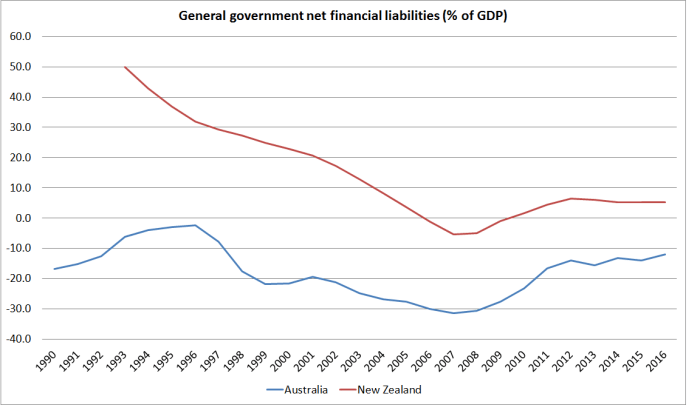
And here is the OECD data on government debt (net liabilities, across all three tiers of government) as a share of GDP.

gen govt net debt.png

New Zealand governments did a great job getting net debt down in the 90s and 00s, but  New Zealand’s net debt is still higher than Australia’s.  Since the last pre-recession year, 2007, Australia’s debt has increased more than New Zealand’s (share of GDP).  That probably is to the credit of Key/English, especially given some of the earthquake fiscal pressures, but on this measure, Australian governments’ net debt is still a bit less than ours was in 2007.

Business leaders also tend to believe –  as I do –  that, within limits, smaller government and lower taxes are conducive to better long-run productivity growth.  Stability in the share of GDP spent by government is also generally thought to matter (reducing uncertainty about future tax rates).

Here is general government spending as a share of GDP.

gen-govt-disbursements-aus-and-nz

Not only is Australian government expenditure lower as a share of GDP, but it is more stable.  And the gap between those two lines has not narrowed over the Key/English years; if anything it has widened.

And here is the picture of revenue

gen-govt-receipts-aus-nz

There isn’t much of a story about variability –  really big terms of trade fluctuations generate a lot of revenue volatility – but again Australian government revenue (mostly taxes) is consistently materially lower than that in New Zealand.

So I’m still a bit puzzled why the Australian business people and commentators seem so taken with the New Zealand story. There is (almost) nothing there. No serious reforms and (to the extent any disagrees with that assessment) no significant productivity growth. No sign of the gaps closing.   The size of government is bigger here, but then it has been for a long time.  And, more positively, the unemployment is a lot lower here, but again current numbers aren’t out of line with past patterns.

I presume much of it just comes down to two things:

  • whenever elites in any country are discontented with their own governments, it is easy to contrast them with some other group of politicians (whose own record is rarely examined closely) over the water,
  • the National-led government has been able to count (law changes it proposes mostly happen, and the details of the languishing RMA reforms are no doubt lost on opinion formers in Australia).  But then it is great deal easier to “count” here, where typically National needs one or two votes from parties it has longstanding confidence and supply agreements with.  It is just harder in Australia, between the role of the states, a governing bloc that is itself a coalition of the Liberal and National parties (National MPs having no say in who is Liberal leader and PM), and the Senate where it is rare for any party to be able to command a stable majority.

John Key and Bill English might be more successful politicians than Rudd, Gillard, Abbott, and Turnbull: the New Zealanders have won three elections, and the Australians have won only one each, and the first three have then been ousted by their own parties.

Perhaps that sort of political stability/political success has its own appeal in certain circles, but if we are judging political leaders by their fruit, there is still nothing much about the New Zealand economic story that should prompt any envy in the eyes of our trans-Tasman neighbours.  Sadly……still……after decades and decades.

Rugby might be another matter, but then I’m a cricket fan.