A transparent central bank? Not our one.

Readers may recall that on the day of the December Monetary Policy Statement I lodged a request for analytical papers the Bank had considered in recent months on the economic impact of immigration.  The background was (a) the Governor’s press conference endorsement of New Zealand immigration as “a good thing”, and (b) the explicit statement in the MPS that the Reserve Bank had changed its view of how immigration affects the short-term balance between supply and demand pressures.  As they stated in the key policy judgements chapter:

Record net immigration is adding materially to demand and to labour supply.  Given continued strong flows, we have revised up our projection for net immigration (see chapter 5).  Based on the cycle to date, we assume the future population boost and associated increases in the labour force will translate more quickly into supply potential than we have assumed in the past.

That has important implications for monetary policy.

But there was nothing in the rest of the document, or in the answers at the press conference, to explain this quite marked change of stance.  As I have pointed out, the new stance is not just different from their past view, but different from quite recent Bank published research, in which demand effects exceed supply effects in the short-term, meaning that all else equal the OCR tends to rise when net immigration does.

As I noted a couple of weeks ago, when the Bank extended my quite limited request, it had seemed at the time like a fairly simple request: show us the analysis you are using to back what represents quite an important change of view.

A short time ago, I received the Bank’s final response.  The heart of the response is here (I’ve highlighted the section in bold)

The Reserve Bank holds 20 documents within the scope of your request, which are all related to either the Monetary Policy Committee or the Governing Committee’s discussions of Monetary Policy.

The Act explicitly recognises, in section 4(c), that there are times when releasing information is against the public interest and provides for such circumstances with different types of reasons to withhold information. The Reserve Bank is withholding these 20 documents under the following grounds of the Act:

  • s6(e)(iv) – to prevent damaging the economy of New Zealand by disclosing prematurely decisions to change or continue government economic or financial policies relating to the stability, control, and adjustment of prices of goods and services, rents, and other costs;
  • s9(2)(g)(i) – to maintain the effective conduct of public affairs through the free and frank expression of opinions by or between officers and employees of any department or organisation in the course of their duty;

The papers about immigration that you’re seeking were prepared in the context of monetary policy discussions, including setting the Official Cash Rate and publishing the Monetary Policy Statement. As you are aware from your time working at the Bank and from your previous requests for information related to both the Monetary Policy Committee or the Governing Committee, the Reserve Bank considers that information provided to and discussed recently by policy committees in relation to setting the Official Cash Rate must be kept confidential in order to ensure that free and frank discussion occurs and that free and frank advice is provided to the Governor. The Bank considers that the need to maintain confidentiality abates over time as the economic cycle moves along, but that current and recent advice must remain confidential in order for the Bank to effectively perform its monetary policy function. Public disclosure of current and recent advice occurs, in summary form, via publication of the Monetary Policy Statement and associated news statement. The process of deciding what to publish in the Monetary Policy Statement recognises and balances the tension between disclosure and confidentiality.

Frankly, if they had told me that they had no papers within scope I might not have been unduly surprised.  Sometimes forecast assumptions are tweaked to produce the bottom line the Governor wants (always have been, probably always will be).

But to suggest that no paper on any aspect of immigration that went to the Monetary Policy Committee  at any time over the five months or so leading up to the Monetary Policy Statement can see the light of day, on principle, seems completely inconsistent with the statutory purposes and principles of the Official Information  Act –  designed to make information more available.  And there is no sign that the Bank has considered the papers one by one: it looks a lot like a blanket refusal.

As for the statutory provisions they quote:

  • section 6(e)(iv) simply cannot be used here. It refers to premature disclosure of decisions.  My request was for background analysis or research.
  • and the invocation of the “free and frank” provisions is also, at best, a stretch.  I didn’t ask for minutes or records of discussion at meetings.  I don’t even ask for individual pieces of OCR advice (the one page notes advisers submit), but for pieces of analysis –  prepared, most probably, in one or other of the sections in the Economics Department.  The material clearly exists.  It is official information.  We should be able to see it –  especially, when it has “important implications for monetary policy”.

As I’ve noted repeatedly there is a far higher degree of transparency (and timely transparency) around background papers feeding into the government’s Budget deliberations.

I noted recently that “the Reserve Bank constantly tries to convince us of how transparent it is.  As Deputy Governor, Geoff Bascand, put it in his first on-the-record speech

The Reserve Bank is deeply committed to transparency – of policy objectives, policy proposals, economic reasoning, and of our understanding of the economy, and of course of our policy actions and intent. Clear communication and strong public understanding make our policy actions more effective.

We are working to enhance the openness and effectiveness of our communications

Mine wasn’t a request for anything obscure.  It didn’t have a “gotcha” agenda –  though legally it doesn’t matter if it did. (And, if anything, their change of view happens to support my current view on monetary policy).   It was just a request to see the background papers that appear to have led to a large change of view, on an important part of how current shocks affect the economy and inflation pressures –  a change not elaborated on at all in the document they did make available, the Monetary Policy Statement.    To enable us to better appreciate, in Bascand’s words, their “economic reasoning, and…our understanding of the economy”.

The Bank simply isn’t very transparent at all.

I will pass on this response to the Office of the Ombudsman.

The cause of getting some insight into the Bank’s view of immigration is not, apparently, totally hopeless.  At the end of today’s email they did include this

The Bank holds other information that is not within the scope of your request but that nevertheless may help shed light on the Bank’s views about immigration. This material is currently being worked on with a view to publication and the Bank will inform you when it is available.

I’ll look forward to seeing that material when it eventually appears.  But, as they note, it isn’t within the scope of my request, or within the sort of 20 working day OIA timeframe.  It continues the Bank’s longstanding approach of acting as if the principles of the Official Information Act really don’t apply to them, and that as far as possible only things that the Bank has written for external publication should see the light of day, not “official information” as defined by Parliament.

 

Roger Partridge on immigration

I was going to spend the afternoon watching the cricket but….it seems less bad with my back to it.

The New Zealand Initiative describes itself  as

The New Zealand Initiative is a business group with a difference. We are a think tank that is a membership organisation; we are an association of business leaders that is also a research institute

According to a recent interview with the chairman

Currently we have 37 full fee-paying members, including ANZ Bank, ASB Bank, Air New Zealand, Chorus, Contact Energy, Deloitte, Deutsche Craigs, EY, First NZ Capital, Fletcher Building, Fonterra, Foodstuffs, Forsyth Barr, Freightways, Google, Heartland Bank, KiwiBank, Microsoft, PwC, SkyCity, Todd Corporation, Vero, Vodafone and Westpac.

The Initiative has produced some interesting material since they were formed a few years ago, and I often find what they write stimulating even when I don’t agree with them.

Like many, I’m signed up to receive the weekly newsletter.  It usually has two or three brief pieces from staff on something or other that has been in the news that week, often overlapping with work the Initiative has been doing.

This week’s newsletter was a bit different.   It has a piece from Roger Partridge, the chair of the Initiative, which can really only be described as a bit of a rant.  Under the heading Immigration Grows the Pie he gets underway wanting to close down debate

Sadly, our island state is not enough to stop a vocal minority chanting their own exaggerated anti-immigration claims. In recent times, calls to halt immigration have focused on Auckland’s overheated housing market. But, as economic conditions softened last year, back came the protectionist clichés about immigrants stealing Kiwi jobs.

As it happens, we do agree on one thing.  Partridge is responding to suggestions that immigration “takes away jobs”, and as I’ve argued for years, the demand effects of immigration typically exceed the supply effects in the short-run. In the short-term, if anything, immigration lowers unemployment, all else equal (also consistent with previous Reserve Bank research).  In the longer term, immigration probably doesn’t make much difference to unemployment rates –  labour market regulation, the welfare system etc determine that.  So I agree with Partridge that

In a market economy, the number of jobs is not static. More migrants create more jobs. They mean more teachers, more retail staff, more factory workers, and more managers. In fact, more of almost everything.

But that isn’t the real question –  it is one about whether New Zealanders, as a whole, benefit, in the form of higher incomes than they would otherwise earn.

Partridge then gets rather carried away with his enthusiasm

And that is not the end to the good news. Countless international studies have shown that increases in immigration not only tend to increase jobs, but also to increase the prosperity of the host nation. We benefit from their productive endeavours, their ingenuity and their diversity. And the more skilled the migrants, the greater the benefits.

That there are gains from immigration has received cross-party support in New Zealand since at least the 4th Labour Government. Let us hope the anti-immigration demagoguery falls on deaf ears. Going down that path we all lose.

The challenge is not keeping out the migrants; it is keeping out the bad ideas. Luckily, that does not need a wall, just clear thinking.

Well, we can debate the “countless international studies”.  As I’ve pointed previously, plenty of studies actually show that in the last great age of globalization, immigration actually narrowed income differentials –  incomes in the countries people were leaving rose relative to incomes in the countries they were coming to.  Economic success –  resulting from combination of better institutions, productivity shocks, or resources –  enabled countries to support immigrants at no undue cost to themselves, and relieved (just a bit) a burden on the source countries (Ireland, Sweden, Italy, UK etc).

But, actually, my reading of the literature and international experience on immigration is really an “it depends”.  Has immigration to Uruguay, Chile and Argentina benefited either side?  Most immigrants came from Spain and Italy, and the destination countries have Spanish-shaped institutions etc.  But income per head in all three Latin American settler countries is well below that in Italy and Spain –  two of the less successful Western European countries.  With hindsight, those immigrants probably should have stayed at home.

But our interest is surely New Zealand.  Can Partridge produce a single study –  let alone “countless” ones – that demonstrate that high rates of immigration have benefited New Zealand, whether in the post-war decades, or since the new National-Labour consensus developed at the end of the 1980s and early 1990s?

I’ve read pretty widely in the New Zealand literature and I’m not aware of any such studies.  MBIE and Treasury, in their advice to ministers on immigration can’t point to such studies.  Mai Chen’s recent taxpayer-supported  “superdiversity” report couldn’t.    There is a single paper around –  a modelling exercise from 2009 –  which purports to show such gains, but in fact it doesn’t. It can’t in fact  –  it is the sort of model that produces the answers you set it up to produce (something the authors recognize if not all the users).

There are simply no empirical studies demonstrating that one of the highest rates of immigration in the advanced world has actually produced any gains for New Zealanders as a whole (of course some gain, but many others lose, from (eg) the interaction of a distorted housing market and immigration policy, or the transfer between New Zealand diary workers and foreign ones).  Our productivity is lousy (total factor productivity included), and the tradables sector struggles to produce a much per capita as it was doing 10-15 years ago. Our own people keep leaving.  There is no simply evidence of any overall benefits for New Zealanders.  I’d be inclined to agree with Partridge that skilled (and innovative) immigrants would be better than the alternative,  but as I’ve illustrated previously  (and here) most of the immigrants we get aren’t particularly skilled at all.

Partridge is, of course, quite correct that

That there are gains from immigration has received cross-party support in New Zealand since at least the 4th Labour Government

The political and bureaucratic elites have been at one on that.  But there is simply no actual evidence, about specific developments in New Zealand in these few decades, that actually supports their belief about what our immigration policy would do for New Zealanders.    Perhaps it was a reasonable policy to adopt 25 years ago –  there was a lot of  belief that New Zealand was about to flourish, and perhaps there would be plenty of gains to share around.  But we haven’t flourished. We’ve languished, and it increasingly looks as though the migration policy was a misguided and perhaps quite damaging choice in our specific circumstances.

What New Zealand needs is some rigorous debate on the issues and evidence, not rather desperate attempts to simply rule any debate on immigration issues out of court.


Lessons from Mario Draghi

In two successive days last week, two heads of central banks gave speeches on monetary policy.   Graeme Wheeler’s speech was characterized by a rather desperate defensiveness –  attacking nameless critics for views that no one seems to hold, in an attempt to defend his (and the Bank’s) rather poor track record: a CPI inflation rate that hasn’t been at the midpoint of the target range for four years.

A commenter pointed me to ECB head Mario Draghi’s speech, given the following day, “How central banks meet the challenge of low inflation” .   It isn’t a perfect speech by any means –  the claim that “monetary integration in the euro area is both complete and secure” must just be one of those lines he has to use, regardless of the continuing severe stresses on the system.  It is a speech of two halves –  the second half is about the particular challenges of the euro area, but the first half is an excellent and authoritative discussion of how central banks generally should respond to low inflation.

Core inflation in each jurisdiction is quite similar: in 2015 CPI inflation ex food and energy was 1 per cent in the euro-area, and was 0.9 per cent in New Zealand.  If anything, New Zealand’s inflation target is a little higher than that for the euro-area: our Reserve Bank is required to focus on 2 per cent, while the ECB articulates its goal as keeping CPI inflation close to, but below, 2 per cent over the medium-term.

Draghi’s speech is well worth reading.  It is the speech of someone who has a deep belief in the power of monetary policy – that inflation is, over time, a monetary phenomenon, and that if inflation is persistently below whatever goal is set for the central bank it is the central bank’s responsibility to do something about it.    It is a refreshing speech, especially as the ECB is no doubt closer than it would like to the limits of conventional monetary policy (with the policy rate already below zero).    Draghi could have offered excuses, but instead it is robust call for monetary policy to simply do its job.

Draghi draws on the lessons of the 1970s, when central bankers often wanted to shift the responsibility for high inflation onto other structural forces.  He fully recognizes the wide range of shocks than can hit an economy (demography, technology etc), and the way some of them can persist, but  argues that monetary policy authorities are responsible for offsetting the effects of those shocks on inflation –  whether they are pushing upwards (as in the 1970s) or downwards (as at present).

… in a context of prolonged low inflation, monetary policy cannot be relaxed about a succession of supply shocks. Adopting a wait-and-see attitude and extending the policy horizon brings with it risks: namely a lasting de-anchoring of expectations leading to persistently weaker inflation. And if that were to happen, we would need a much more accommodative monetary policy to reverse it. Seen from that perspective, the risks of acting too late outweigh the risks of acting too early.

In sum, even when faced with protracted global shocks, it is still monetary policy that determines medium-term price stability. If we do not “surrender” to low inflation – and we certainly do not – in the steady state it will return to levels consistent with our objective. If on the other hand we capitulate to “inexorable disinflationary forces”, or invoke long periods of transition for inflation to come down, we will in fact only perpetuate disinflation.

This is the clear lesson of monetary history, especially the experience of the 1970s.

Nor does he offer up excuses of the sort that “inflation is low everywhere, so there isn’t much we can –  or perhaps should –  do about it”.

We now have plenty of evidence that, if we have the will to meet our objective, we have the instruments.

and

So there is no reason for central banks to resign their mandates simply because we are all being affected by global disinflation. In fact, if all central banks submit to that logic then it becomes self-fulfilling. If, on the other hand, we all act to deliver our mandates, then global disinflationary forces can eventually be tamed.

He even deals with the line of argument that easing monetary policy to get inflation back to target may do more harm than good.

Still, there are some that argue that even if central banks can lean against global disinflationary forces, in doing so they do more harm than good. In particular, expansionary monetary policies at home lead to the accumulation of excessive foreign currency debt or asset price bubbles abroad, especially in emerging markets. And when these financial imbalances eventually unwind, it weakens global growth and only adds to global disinflation.

To which his response is:

In fact, when central banks have pursued the alternative course – i.e. an unduly tight monetary policy in a nascent recovery – the track record has not been encouraging. Famously, the Fed began raising reserve requirements in 1936-37, partially due to fear of a renewed stock bubble, but had to reverse course the next year as the economy fell back into recession. That has also been the experience of some central banks in recent years: raising rates to offset financial stability risks has undermined the primary mandate, and ultimately required rates to stay lower for longer.

This suggests that the so-called “assignment problem” between monetary policy and financial stability at the domestic level should also apply at the global level. Monetary policy should not try to balance opposing objectives: it is optimal for all parties if it delivers its mandate. And if that creates financial stability concerns, they need to be addressed by other policies more suited to the task. And in fact there are several policy levers available.

Countries can improve their financial regulation and supervision to make their financial systems more resilient to external shocks. They can adjust their fiscal policies. They can adopt macro-prudential measures.

That is the sort of speech that Graeme Wheeler should have been giving last week – indeed, given how badly inflation has been undershooting the Reserve Bank’s target, he should have been giving it a year or two ago.  Instead, he drove up interest rates –  when his preferred measure of core inflation was even lower than it is now.  And even now that the OCR increases have reluctantly been fully reversed, we are left with real interest rates that are higher than they were two years ago, even as confidence in inflation getting back to target erodes further (and the terms of trade have fallen, the peak impulse from Christchurch has passed, and the global situation has materially worsened).

Chris Green, at First New Zealand Capital, had a commentary out late last week on the Governor’s speech.  I agreed with almost all of it.  But two lines particularly caught my eye:

“My sense is that the Governor is far more focused in defending his current position than objectively attempting to assess the optimal risk-adjusted monetary policy response”

and

“The perception that they give of a reasonably high hurdle before cutting rates would be more consistent with CPI out-turns around the top of the band, not having been below the midpoint for more than 5 years [I presume he means on the Bank’s preferred core measure] and not projected to get back there until the December quarter of 2017 –  at the earliest”.

Quite.   And one could add that the problem is compounded by the Governor’s reluctance to substantively engage with the issues –  rather than responding to straw men of his own imagining –  or indeed to open himself to sustained scrutiny from the media.

The Governor and his chief economist have been putting a lot of weight on inflation expectations measures recently, and suggesting that there is really nothing to worry about.  We’ll have a new round of inflation expectations data shortly, and I’ll come back to the topic then, but for now consider this chart, drawn from the Bank’s survey of household expectations.

household expecs Feb 16

People are asked whether they expect inflation to rise, fall or stay the same over the coming year.  The survey has been running for over 20 years, and in every single survey a net balance have reported expecting inflation to increase (suggesting that not much weight should be put on the absolute numerical value of the answer).  But what I wanted to highlight is that at present fewer people expect inflation to rise than at any time in the history of the series, with the exception of the depths of the recession in 2008/09.    But in March 2009, when only 20 per cent people expected inflation to rise over the coming year, the last annual inflation rate they’d seen was 3.4 per cent.  Of course –  in the middle of a recession, with plummeting oil prices –  they didn’t expect inflation to rise.  And they were right.  Annual inflation fell sharply.    The most recent observation in the survey was November 2015.  When those respondents completed the survey, the most recent annual inflation rate they’d seen was 0.4 per cent.  And still, not many (by historical standards) expected annual inflation to rise.   There is nothing to be complacent about in the inflation expectations data –  and even among more expert observers, medium-term inflation expectations are lower, relative to the target midpoint, than they have been since inflation targeting began.

It must almost be time for the Minister of Finance’s annual letter of expectations to the Governor.  As I noted last year, the persistent undershoot of the target has had little or no attention in  past year’s letters.  We must hope that this year’s is different.  The primary responsibility for the persistent undershoot of the target rests with the Governor, his chief economist, and his other senior advisers.  But the apparent passivity to date of those charged with holding the Governor to account –  the Minister of Finance, who set the target, and the Bank’s Board, paid to monitor the Governor’s pursuit of the target –  risks making them complicit in the failure.  After all, together they were responsible for the appointment of an individual as Governor who increasingly seems to lack the stature and qualities that the position demands.

Grant Robertson and a 21st century monetary policy

Grant Robertson  has a statement out today asserting that “Monetary Policy Must Get into 21st Century”.  Setting aside the fact that his party was in office for half the 21st century so far, had two reviews undertaken of the framework (one by Lars Svensson, an internationally-regarded expert, and one by the Finance and Expenditure Committee), and made no changes to the thrust of the framework (goals, powers, responsibilities etc), it really isn’t clear what Robertson wants.   He talks of wanting “modern tools”, but the tools our Reserve Bank uses are entirely normal.  Indeed, since the OCR was introduced to New Zealand only in March 1999, it must almost count as a 21st century tool.  Going into the last election, Labour did propose a (fairly weak) new tool, the variable Kiwisaver rate, but indications since have been that they were backing away from that.  So what alternative tools does Robertson now have in mind?

Robertson rightly points out that inflation has not been at 2 per cent –  the Bank’s target –  since the current Policy Targets Agreement was signed.  We didn’t have that problem previously –  inflation was, if anything, typically a bit above the mid-point of the target range.  That suggests the problem is not with the goal –  a medium-term focus on price stability  – but with the way the Reserve Bank has been handling incoming information.  Quite possibly the challenges they face have intensified in recent years, but despite having full policy flexibility –  never close to zero interest rates –  they haven’t handled them very well.  One might reasonably raise questions about that failure, and the failure of those charged with holding the Bank (and the Governor personally) to account (the Board and the Minister), but there is just no evidence that the target or the tools are the problem.

As I’ve said before, I’m not suggesting the way the Act is written is ideal, and if we started from scratch I would probably suggesting writing the goal a bit differently.  But doing so would be to help articulate why we aim for something like price stability over the medium-term.  It would be unlikely to make much difference at all to how policy was actually conducted.  That depends primarily on the Governor and the senior advisers he gathers around him.

Better monetary policy –  delivering better outcomes around 2 per cent inflation –  over the last few years would have narrowed the gap between New Zealand and world interest rates, which was (temporarily) unnecessarily widened by the Governor, but it wouldn’t have closed it.  That gap has been there for decades, and isn’t a reflection of how the Reserve Bank runs monetary policy.  There are things that governments can – and should – do that would sustainably close the gap, but (rightly) they aren’t things the Governor or the Reserve Bank has any power over.

A previous rant on much the same subject from a few months ago is here.


Some thoughts on the inflation data

Perhaps not surprisingly there has been a lot of coverage of yesterday’s CPI outcome –  an inflation rate of only 0.1 per cent for the year; materially lower than either the Reserve Bank (in its December MPS) and all other published forecasters had expected.

Quite what the numbers mean isn’t so clear-cut, and I’ll come back to that, but it is very low inflation.

Of course, this is an era of low inflation.  According to the OECD database, nine OECD countries had even lower inflation (or deflation) than we did last year –  eight of those countries have policy interest rates at zero (or even a bit below).

The media made much of our inflation rate being the lowest since 1999, but they probably missed the story.  After all, 1999 isn’t that long ago (and the target was lower then).  And in those days, the CPI included retail interest rates, and interest rates dropped by around 400 basis points in 1998.  All the experts thought that in a deregulated economy including interest rates in the CPI was daft –  apart from anything else, it meant that when the Reserve Bank tightened monetary policy, inflation temporarily went up.  So daft in fact that the Policy Targets Agreement in place at the time, signed by Winston Peters and Don Brash, set the target in terms of CPIX (ie the CPI excluding credit services).  In fact, the way the official CPI was calculated was changed shortly afterwards to essentially the approach used today.

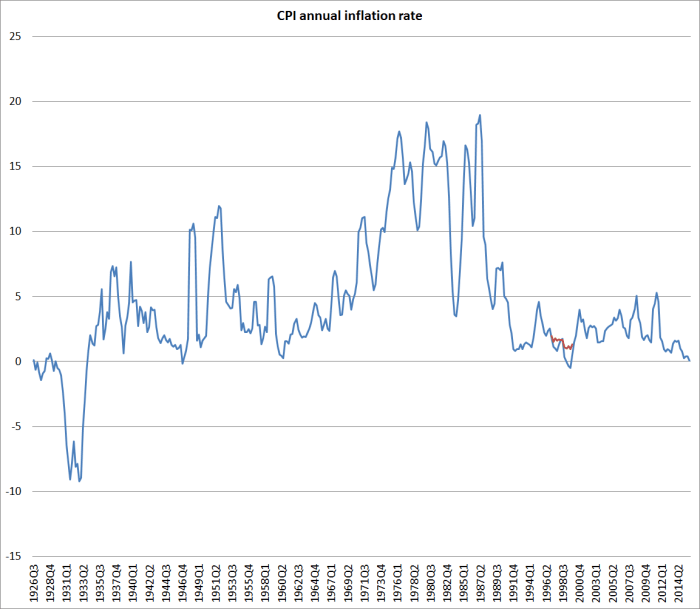
We don’t have a consistently compiled historical CPI in New Zealand (the way all sorts of things have been measured, but especially around housing, has changed materially over time, but then so –  for example –  has the extent of price controls, regulation etc).   But here is a chart using the official historical CPI all the way back to the 1920s, with an overlay (in red) of the CPIX inflation rate over 1997 to 1999.  At the trough, annual CPIX inflation was around 0.9 per cent –  not that much below the midpoint (1.5 per cent) of the then target range.

cpi inflation

Taking a longer horizon, annual CPI inflation got as low as 0.3 per cent in 1960 (I recall tracking this number down in the early days of inflation targeting and holding it out as something to aspire to, the last time New Zealand had managed ‘price stability’).  And since the Reserve Bank opened in 1934, the only time annual inflation has really been lower than it was in 2015 was in 1946, when the annual inflation rate briefly dipped to -0.2 per cent.  The lowest inflation rate for almost 70 years might have been more of a story.  “Lowest inflation since the Great Depression” would no doubt be a headline the Reserve Bank will be keen to avoid, but that too must be a non-trivial risk now.

Quite what to make of the inflation numbers is another matter.  Although the Reserve Bank has been playing up headline inflation in its recent statements, headline inflation shouldn’t be (and rarely is) the focus of monetary policy.  What matters more is the medium-term trend in inflation: as the PTA puts it

“the policy target shall be to keep future CPI inflation outcomes between 1 per cent and 3 per cent on average over the medium term, with a focus on keeping future average inflation near the 2 per cent target midpoint”

But it has been four years now since headline inflation was 2 per cent.  The Reserve Bank keeps telling us it is heading back there relatively soon, and has continued to be wrong.  Even before this latest surprise, they had been forecasting it would be another two years until inflation got back to 2 per cent.

If the weak inflation was all about petrol prices perhaps we could be relaxed –  whatever mix of supply and demand factors is lowering oil prices, taken in isolation it is a windfall real income gain to New Zealand consumers.   But CPI inflation excluding vehicle fuels was 0.5 per cent last year, down from 1.1 per cent in 2014.  Indeed, tradables inflation excluding vehicle fuels was -1.2 per cent in 2015, also a bit lower than the 0.9 per cent in 2014.

Over the last few years, a common explanation for New Zealand’s low inflation rate had been the rising exchange rate, which tends to lower tradables prices.  But the exchange rate peaked in July 2014, and in the December quarter 2015  (having already rebounded a little) it was 7 per cent lower than it had been in the December quarter of 2014.  Of course, some Reserve Bank research not long ago suggests that when the exchange rate has fallen previously the inflation rate itself has tended to fall –  presumably because the exchange rate falls don’t occur in a vacuum and are often associated with a weakening terms of trade and a weakening economy.

Government taxes and charges throw around the headline CPI –  for the last few years, large tobacco tax increases held headline inflation up, and more recently the cut in vehicle registration fees lowered the headline rate.  But in the last year, non-tradables inflation excluding government charges and tobacco and alcohol taxes was 1.8 per cent, exactly the same as overall non-tradables inflation.   Non-tradables prices tend to rise faster than tradables prices (think of labour intensive services) so with an inflation target on 2 per cent, one might normally be looking for a non-tradables inflation rate of perhaps 2.5 to 3 per cent.

What of the “core” measures of inflation?   Probably for good reason, the “ex food and energy” measures don’t get much focus in New Zealand.  But SNZ do report such a measure, and it recorded 0.9 per cent inflation last year, right at the bottom of the target range although barely changed from the 1.0 per cent in 2014.

The Reserve Bank reports four core inflation measures on its website.  None of them is close to 2 per cent, but the message from them in terms of recent trends isn’t that clear.  Two measures (the weighted median and the factor model) suggest little change in the core inflation rate over the last year.  One of them –  the trimmed mean –  suggests a material slowing in core inflation (indeed, in quarterly terms the trimmed mean –  which excludes the largest price changes in both directions – had its weakest quarter in 15 years of data).  But the fourth measure –  the sectoral core factor model –  actually suggests that core inflation has picked up quite noticeably over the last few quarters.  It is a pretty smooth series, and so an increase in inflation from 1.3 per cent to 1.6 per cent, especially when headline inflation is so weak, is worth paying attention to.

The sectoral core measure has been the Reserve Bank’s preferred measure of core inflation, and mine.  Frankly, I’m not sure what to make of it, although I take some comfort from the fact that the increase seems concentrated in tradables prices (the sectoral factor model separately identifies common factors among tradables and non-tradables prices and only then combines the two factors).  The tradables factor seems quite sensitive to exchange rate movements –  as one might expect –  but is not obviously something monetary policy should be responding to.    It is always important to think hard about data that go against one’s story, so I remain a bit uneasy about what the sectoral core measure is telling us (even recognizing that it has end-point problems, that mean recent estimates are sometimes subject to quite material revisions).

For the last nine months I’ve been arguing here (and had earlier been arguing the case internally) that monetary policy needs to be looser if future inflation is once again to fluctuate around 2 per cent –  the target the Governor and the Minister have agreed.  Somewhat belatedly, and grudgingly the Reserve Bank has cut the OCR, and it will take some time for the full lagged effects of those cuts to be seen.   Current core inflation –  whatever it is –  partly reflects the lagged effects of previous overly-tight policy.

In terms of future monetary policy, yesterday’s CPI results in isolation aren’t (or shouldn’t be) decisive.    They rarely are.  But equally there isn’t much reason in those data for anyone to be confident that inflation will relatively soon be fluctuating around 2 per cent.  That confidence matters –  as I noted earlier in the week, both financial markets and firms and households have been gradually lowering their expectations of future inflation .  If that becomes entrenched, it is harder to get inflation back up –  but the risks of trying more aggressively to do so are also diminished (people today simply aren’t looking for inflation under every stone, worried that some nasty inflation dynamic is just about to destroy everything they’ve worked for).

And context matters too.  As I explained in December, I thought the Reserve Bank’s case  that the economy and inflation would rebound over the next couple of years –  and hence no more OCR cuts were needed –  was unconvincing.  The intervening six weeks have done nothing to allay those concerns.  Over recent years there were some huge forces pushing up domestic demand –  strong terms of trade, the upswing in the Christchurch repair process, and the huge increase in net migration.  None of those factors seemed likely to be repeated.  Dairy prices seem to be lingering low, global economic uncertainty is rising, global growth projections are being revised downwards (even by that lagging indicator, the IMF) and just today US Treasury bond yields dropped back below 2 per cent.   Unease seems to be turning to fear, in a global climate where deflationary risks seem more real than those of any very substantial positive inflation.

In sum, the case for further OCR cuts in New Zealand now is pretty clear, and the risks (of materially or for long overshooting the inflation target) seem low.  Would doing so boost the property market?  Relative to some counterfactual, no doubt.  That is a feature not a bug.  Monetary policy works in part by increasing the value of long-lived assets, and encouraging people to produce more of them.  But what it would also do is lower the exchange rate, providing a buffer to more-embattled tradables sector producers (think dairy farmers) and increasing the expected returns to new investment in other areas of the tradables sector.

Who knows what the Governor and his advisers will make of the recent data flow.  In a more transparent central bank we could look forward to seeing the minutes of next week’s meetings, the alternative perspectives and arguments.  As it is, the Governor will tell us what he wants us to know in his OCR release next week, and perhaps in his speech the following week.

A slightly whimsical note to start the year

I spent the last couple of weeks in one of my favourite places in New Zealand –  Whakatane/Ohope.   The beaches are great and the surf is safe, and it is pretty warm even when (as it did too often) it rains.  The local paper – the Beacon – runs a bleakly fascinating crime column of the sort all papers once did –  not just the bare details of names and ages, but accounts of episodes of mundane violence and repeated lack of self-control that come before the District Court each week. They include reports of judge’s comments –  a judge who has been around for a long time but still hears explanations or excuses that flabbergast him.  For an insight into what is, fortunately, like another world it is hard to beat.

One afternoon last week, we dropped in to the local museum, which is rather well done on a small scale.  Among the display panels was one that took me by surprise.  I didn’t jot down the exact words, but it was along the lines of “until the 1950s, Whakatane’s port handled more cargo than Tauranga did”.   These days, picturesque Whakatane handles sports fishing and sightseeing trips to Whale and White islands and not much more, but I’m old enough to remember a few coastal ships in Whakatane in the late 60s and early 70s  And I knew that Tauranga had been a late developer  (in the 1951 census Tauranga and Mount Mauganui combined had fewer than 11000 people). But I still made a note to check out this claim when I got home.

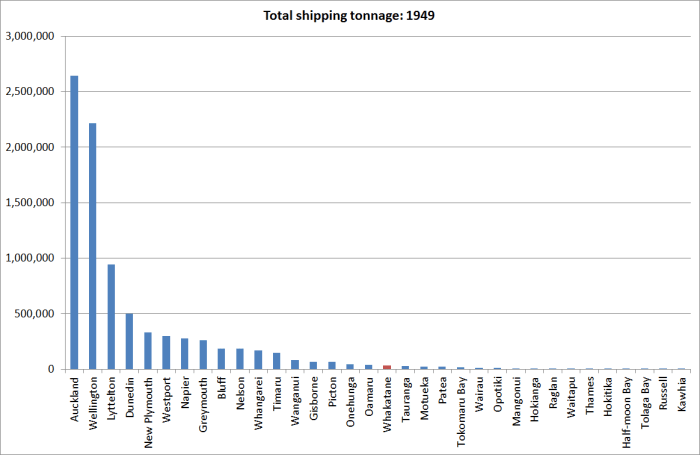
And sure enough, here is shipping data for 1949, from the 1950 New Zealand Official Yearbook.

total trade 1949

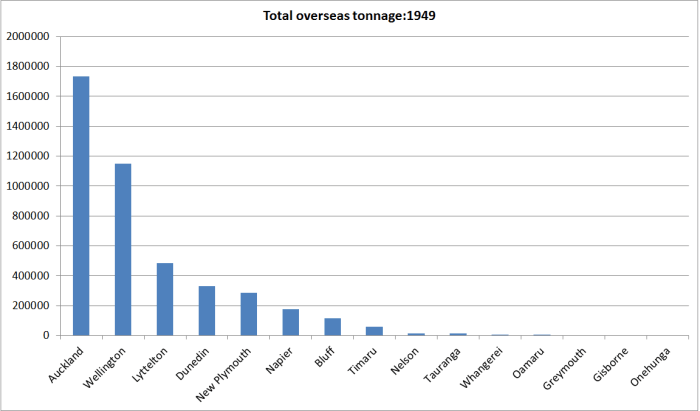
And sure enough, Whakatane then still had more shipping trade than Tauranga.  But I was also struck by how high Wellington stood, and by the prominence of Greymouth and Westport.  Bear in mind that in those days, coastal shipping was almost as important (even by volume transported) as overseas trade.  That explains Greymouth and Westport, in an economy heavily dependent on coal.  I wondered if the Wellington story was just about inter-island coastal shipping, but it isn’t.  Here are the overseas shipping volumes by port (sum of export and imports, in tons).

overseas tonnage 1949

Wellington was far and away the second largest port for overseas trade, with volumes almost two-thirds of those of Auckland.

And here, by contrast, is the value of merchandise trade by port for 2014.

total overseas trade 2014

Auckland remains the port handling the largest share of overseas trade, but now Tauranga is second (from 10th 65 years previously) while Wellington’s sea port did not much more overseas trade than New Plymouth. Wellington airport’s overseas freight trade narrowly edges out what SNZ reports as Parcel Post.

No doubt there is a variety of other factors going on.  Even as a coastal port, Whakatane with a shallow and difficult river bar  (and nearby Opotiki) couldn’t survive the advent of bigger ships and the removal of regulatory limits of road transport.  For Tauranga, the establishment of the Tasman mill at Kawerau, and the associated railway line to  the Mount, in the mid 1950s gave a significant boost to its trade.  And from the 1970s containerization focused foreign shipping trade in fewer and fewer ports.  But no doubt population changes matter as well.  The Tauranga urban area last year had a population of around 130000, and the combination of Auckland, Hamilton and Tauranga urban areas which had accounted for only around 20 per cent of the total population in 1951, were together almost 40 per cent of New Zealand’s total population last year.

As for Wellington, of course services exports are not in these data.  Then again, as a share of GDP services exports are barely higher than they were 20 years ago.

Bits and pieces

Having highlighted the Reserve Bank’s late Friday afternoon pre-Christmas release of the results of its “regulatory stocktake”, it will be interesting to see what other material government agencies slide out in the next few days, hoping for little or no sustained coverage.    I had a reply the other day to an Official Information Act request to Treasury, in which I’d asked about the basis for Treasury’s enthusiastic endorsement of TPP in the Joint Macroeconomic Declaration.  What they released wasn’t very interesting or useful (although if anyone wants it send me an email) but they did note “that the official government assessment of the final TPP agreement is contained in the National Interest Analysis, which will be publicly released soon”, which may also mean before Christmas.    That document should be interesting –  and hopefully it will get some coverage – although coming from those who negotiated the deal  it is no substitute for a serious independent analysis and evaluation carried out by, say, the Productivity Commission.

This morning’s Herald was a bit of a surprise.   The editorial ran under the heading “Rates rise may be first step to true recovery”.   Last week’s Fed Fund rate target increase is, according to our leading newspaper, “the first confirmation confidence is returning to at least one major economy since the global financial crisis”.

Of course, central banks don’t usually raise interest rates unless they think their own economies are doing reasonably well and that inflationary pressures might otherwise be about to start gathering.  Perhaps curiously, neither the word “inflation” nor the idea appeared in the Herald’s editorial at all.

But perhaps the leader-writers have forgotten about all those other advanced countries that have raised interest rates in the last six years, only to have to cut them again.  Central banks that have set out to tighten generally found that they had made a mistake (with the benefit of hindsight) and have had to reverse course.  And it isn’t just the tiddlers.  The ECB raised rates back to 2011, no doubt thinking that the crisis was behind them.  They were wrong.    Business, so we are told, is likely to draw confidence from the Fed’s action last week, and be more willing to invest.  It is an interesting nypothesis, but one which bears absolutely no relationship to what has been seen in the various countries that raised rates in recent years only to have to cut them again.  Investment rates around the advanced world remain low.  It gets tedious to keep mentioning New Zealand’s two policy reversals in the last six years –  but there is no sign that either of those ill-judged sets of tightenings did anything very positive for our economy.

Time will tell whether the Fed’s tightening last week was really warranted or desirable.  But even if it does prove to have been appropriate, it seems most unlikely that it will have been because higher interest rates and a higher exchange rate combine to give fresh impetus to the entrepreneurs and other investors in the United States.  Surely we deserve better analysis than the Herald provided today?

As I noted, investment remains pretty subdued around the advanced world.   New Zealand is no exception.

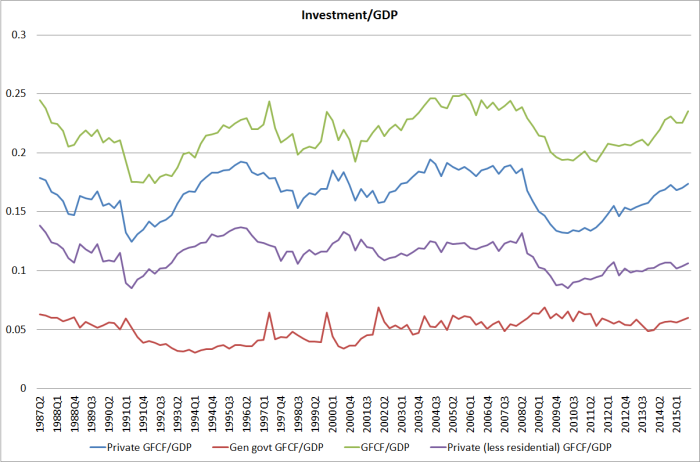
Here are a couple of charts drawn from last week’s national accounts release.  The first shows various cuts of gross fixed capital formation as a share of GDP: total, total private, total private excluding residential investment (ie a proxy for business investment) and general government.

nominal investment to gdp

With the exception of government investment, all of these series are well below their pre-recession peaks (typically in around 2006 and 2007).  In some respects that is really quite surprising.  New Zealand has had:

  • High average terms of trade, which should typically spark new investment to enable the economy to take full advantage,
  • The Christchurch repair and rebuild process (which doesn’t make us richer, but does add hugely to gross investment),
  • No serious domestic financial crisis to materially disrupt the credit allocation process, and
  • Much more rapid population growth than we had in the last few years prior to the recession.

New Zealand’s population is estimated to have grown at around 1 per cent in 2006 and 2007. By contrast, it is estimated to have increased by 1.95 per cent in the year to September 2015.  As I pointed out last week,  faster population growth rates would typically be expected to have big implications for investment, since the capital stock is around three times annual GDP.   More people require more capital, and getting that capital means a lot more investment.

For good or ill, government investment has remained quite strong, and will be boosted a bit further by last week’s announcement.  But my business investment proxy –  the purple line –  at around 10.5 per cent of GDP (and showing no sign of strengthening) is still two full percentage points lower than we saw through the later pre-recession years, when population growth rates were much lower than they are now.  And recall that even this measure includes the non-housing non-infrastructure rebuild expenditure.

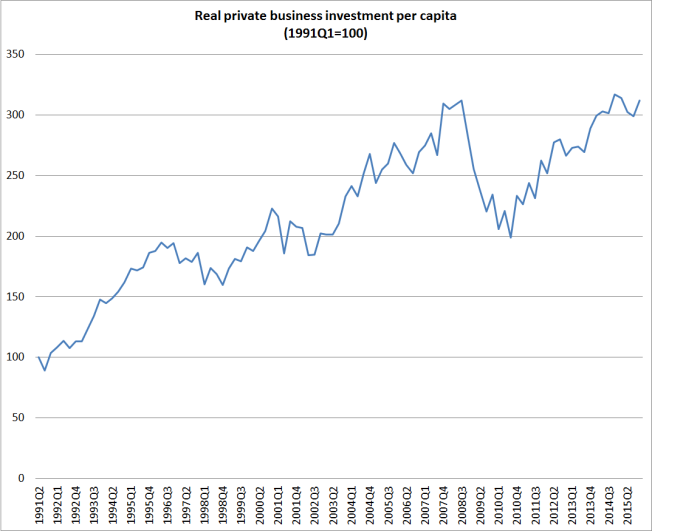
For analysis over time, I tend to focus on ratios of nominal investment to nominal GDP.  That is partly on the advice of Statistics New Zealand, who point out that deflator problems –  which are particularly serious for investment –  make ratios of real investment to real GDP quite problematic over time.  But for those with a hankering for real investment measures, here is real private investment (excluding residential investment) per capita.  Even now, this series has only just got back to pre-recessionary levels, eight years on.  And with the unexpected surge in the population, if everything was working well –  and especially if the Reserve Bank was right about supply effects of migration exceeding demand effects even in the short-term –  we should have expected to have seen this series at new highs.

business investment per capita

Businesses invest to the extent that the expected returns to investment look attractive. In New Zealand, at present, there just don’t seem to be that many projects that have been  passing that hurdle. Unfortunately, it isn’t obvious why things should be any better next year.


.

Weak expectations and accountability

The Reserve Bank released the results of its Survey of Expectations yesterday afternoon  – aggregated responses from 60 or so relatively informed participants.  For some reason, this quarter they have separated the release of the survey of household inflation expectations, which is now apparently not due until next week.

After the release of the previous results in August I wrote a post that provided a fairly downbeat assessment of the information in the two surveys, a little in contrast to the commentaries I saw at the time from market economists.

I’m a participant in the survey, and had actually revised many of my responses up a little from those I provided in August.  But my reading of the results suggests that the respondents as a group are about as downbeat as they were in August.  In particular, there is little sign of any sustained pick-up in inflation expected over the next year, despite the repeated Reserve Bank rhetoric.

This isn’t going to be a long post, but just a few highlights:

First, respondents expect the economy to do no more than limp along, beneath capacity, for the next two years.  The unemployment rate is expected to stay at or above 6 per cent throughout, and GDP growth of 2.2 per cent and 2.4 per cent is expected in next two years.  Those would be fine growth rates for Japan, with a slightly falling population, but New Zealand’s population growth was estimated at 1.9 per cent in the year to June 2015.   There doesn’t look to be much per capita growth envisaged by respondents, even with the lagged effects of monetary policy easing, unless respondents are expecting quite a sharp reduction in the net migration inflow.

Second, inflation expectations remain very subdued. Fortunately for the Reserve Bank, two-year ahead expectations have done no more than reverse last quarter’s slight bounce, and are still at 1.85 per cent.  But one year ahead expectations are only 1.5 per cent, and expectations for the second six months of the one year period (beyond the immediate “noise” of oil price fluctuations) are no higher than those for the first half.  In the whole period since the recession started in 2008 only once have those second six month expectations been materially lower than they are now,     Respondents still appear to loosely believe that the Reserve Bank is aiming for 2 per cent, but they aren’t seeing any signs that suggest the Reserve Bank will get it there soon.  Since the various core inflation measures are 1.5 per cent at most, at best they seem to envisage a continuing undershoot.

inflation expecs

Third, respondents don’t appear to expect much more of an OCR cut.  Even a year ahead, respondents expect the 90 day bill rate to be 2.79 per cent, probably not even consistent with a full expectation of the OCR being cut to 2.5 per cent.

However, the survey also asks respondents about their expectations for monetary conditions, both currently and a quarter ahead and a year ahead.  Each respondent can decide for themselves what counts for assessing monetary conditions –  the exchange rate, the OCR, equity prices, retail lending rates, LVR restrictions, or whatever.  Since the survey began in 1987 there have only been two quarters when respondents thought conditions were easier than they are now.  But typically when respondents think conditions are easier than neutral they don’t expect that state to last for long –  looking a year ahead they typically expect things to tighten.  For the last year or so that hasn’t been the case.  The extent of the extra easing isn’t large, but the fact that is expected at all in unusual.  It is not a sign of confidence that the Reserve Bank has yet got on top of things.   Expectations a year ahead are for looser conditions than they’ve expected at any time since this question was first asked in 1999.

expected mon con.png

The OCR is still 25 basis points higher than it was at the start of last year (as are the floating retail rates the Bank reports).  Over that period, inflation expectations (at least measured by this survey) have fallen by about half a percentage point.  Inflation expectations implied by the spread between indexed and conventional government bonds appear to have fallen a bit further (to only around 1.3 to 1.4 per cent).  So real short-term interest rates are at least 75 basis points higher than they were at the start of last year.  Why? For what?

Since that time, we’ve seen little or income growth, little real per capita GDP growth, the unemployment rate stop falling and start climbing, and inflation continue (on a core basis) to be well below the 2 per cent target midpoint (focal point) that the Governor explicitly signed up to only three years ago.

As I noted in my post yesterday about Stan Fischer’s speech, effective accountability in any area of life isn’t just about talk: it  has to imply that there is potential for adverse consequences for the independent decision-makers themselves. As in any area of life, a single mistake is usually not a safe signal of anything much.  But established patterns of error must raise more serious questions if the much-vaunted accountability is to have any real meaning.   This is looking quite like a repeated pattern of errors, compounded by a reluctance to acknowledge errors or to learn from past mistakes.

Some FSR omissions

Sometimes you read a document, particularly one that has interesting material in it, and react (positively and negatively) to what is in front of you.  It is harder to spot what isn’t there.

After my earlier post I went out, and as I walked the streets it struck me that I didn’t think I had seen any mention of credit standards in the Financial Stability Review.  I got home and checked.  Searching the whole document, none of these terms appeared:

“credit standards”

“lending standards”

“credit policies”

“lending polices”

In fairness, there was a brief mention of the difference between how much banks would lend thirty years ago ( in the 1980s when banks were really only just moving into housing lending) and now, but I don’t think that really fills the bill.

At one level that wasn’t too surprising –  I’ve highlighted previously how their Head of Financial Stability (and Deputy Governor) had managed to give a whole speech on housing and housing finance risks without mentioning bank lending standards.  But it was pretty disappointing nonetheless.  Bad loans collapse banks and financial systems.  Sometimes macroeconomic circumstances turn out quite differently than anyone could have expected and even what were objectively pretty good classes of loans can get into trouble.  But, mostly, the really bad losses arise from a climate in which lending standards have been pushed progressively lower and laxer.   Very aggressive lending on Irish property development springs to mind, and the policy-driven deterioration in US mortgage standards.

But if it is the sort of omission we have come to expect from the Reserve Bank, that doesn’t make it any more acceptable.  Surely we should expect our bank supervisors to have a good feel for trends in bank lending standards, and to be able to adduce evidence to support their view?  APRA manages to, so why not our Reserve Bank.  So far, they have given us no evidence of, say, a sustained deterioration, beyond the point of prudence, in the lending standards of our banks over, say, the last decade, or even just the last couple of years (the latter being the period in which they have adopted much more aggressive regulatory interventions).

Incidentally, I also checked and found that the phrases “credit to GDP” and “credit to GDP gap” did not appear –  even though I’m not aware of any systemic financial crisis which has not been preceded by a recent substantial increase in credit to GDP (increases 10 t0 15 years ago don’t count).  It was also a little surprising that the terms “exchange rate”, “real exchange rate” or “TWI” don’t seem to appear either, even though the thing that usually goes hand in hand with a sharp run-up in credit to GDP, in foreshadowing heightened risk of crisis, is a material appreciation in the real exchange rate.    In the period 2002 to 2007 we had both –  and the banks had much smaller (liquidity and capital) buffers –  and yet the banks still came through unscathed.

If the Bank can’t point to detailed prudential evidence (deteriorating lending standards) or adverse trends in the big macro indicators (rapidly rising debt etc), it is really difficult to be confident that their recent regulatory actions are necessary, and well-warranted bearing in the mind the costs to individuals and businesses, in promoting the soundness and the efficiency of New Zealand’s financial system.

Uneconomic school fairs

(This is something of a rant….but it is Saturday, and it doesn’t involve the Reserve Bank.)

Today was the annual fair at the school my daughters attend.  As I understand it, the Island Bay school fairs tend to raise around $25000.  I used to be quite impressed, until I thought about it and realised that it is a school of around 500 kids.  So the net proceeds are perhaps $55 a child.  We have two children there, so our “share” of the fundraising is perhaps $110.

We don’t usually get very involved in the fair.  But I’d donated perhaps $25 of ingredients a while ago for people making preserves, sweets etc.  And yesterday I made them a plate of chocolate marshmallow slice –  a slightly fiddly recipe and, between ingredients and time, that probably cost  at least $15.  My nine year old is on the School Council and was “coerced” into manning a stall.  She spent two and half hours doing that.  I’m not sure how to value her time, but it isn’t zero.

And because she was on the stall and they needed parent volunteers as well, we weakened and put in half an hour or so each (getting to and fro etc made that perhaps 45 minutes each in total).  How to value our time?  Well, the marginal cost has to be above the average cost, and one needs to think in after-tax terms.    $50 per hour seems very much towards the low end, but if we run with that, it was a donation of $75 between the two of us.

Oh, and then there was the money “wasted” at the fair –  a rare concession to “pester power”, such that the kids were allowed to buy their lunches at the fair.  Granting that there might have been some consumer surplus – fair lunch beats Dad’s lunch –  but across three kids, there is another “donation” of $10-15.

That adds up to a contribution of $125 from our family – costed at the low end of a possible range of estimates.   Had we just written a cheque for $110 to the school as an additional donation, we’d have been able to claim back a tax refund (as it would be a charitable donation) for a third of the amount.  So we spent $125 to provide the school $110, even though we could have provided the same benefit to the school for perhaps $73.  This can’t be an uncommon story. I might have costed our time a bit higher than the average parents would have, but this is a decile 10 school.  Parental time is scarce and valuable.

And plenty of people will have put in much more time and effort than we did –  the extensive advance organisation (emails at 11.11pm on Thursday night), and some people will have been there for three or four hours today alone.    Oh, and the distraction from education seems quite real too –  my daughter apparently spent a large chunk of yesterday at school making (very pretty) signs for her stall.

And, of course, quite a lot of the profit to the school didn’t come from parental input at all, but as donations from local businesses, which will have treated them as part of the respective business’s marketing budget.

Were there any offsetting gains to compensate for the wasted $52?  Well, it was nice to see the nine year old responsibly helping run the activity (but she has other involvements outside the home).  Perhaps some people get a warm fuzzy feeling from “doing something together for the community”. But this is a school.  We don’t apply this funding model to the local GP or, say, the supermarket   We write a cheque.  As a pro-defence conservative, the old liberal line about holding cake stalls to fund the air force once annoyed me a little, but…….they make a fair point.  Cake stalls to fund our education system?

Now I know that high decile schools are somewhat caught.  They are funded much less well than lower decile schools, and they are not allowed to charge fees.  They can ask for “donations”, and most parents pay them, but even at lower-end decile 10 areas (which is how I’d characterise Island Bay), the resistance will start to rise if the requested donation is raised too far.   But the economics of the current model just don’t seem to add up.  And while there are deadweight losses from taxes, from the less inefficient taxes they are not as large as the waste implied by my cost calculations above.

And that was going to be the end of the rant, until I actually went and helped out on the “catch a flamingo” game stall.  I came away feeling quite uncomfortable about it.  Children were being encouraged to pay $2 to toss three quoits, trying to get at least one of them over the necks of one of the several plastic flamingos pegged in the ground a couple of metres away.  And the prize?  A lollipop.

The Principal had been running the stall before I came on, and had made a unilateral decision to lower the price to $1.  And we’d both decided that for the littler kids who missed we’d give them a lollipop anyway.  But I reckon no more than one in eight of the children managed to get a quoit over a flamingo, so that in principle they were paying $8 for a lollipop.  When I got home I priced lollipops –  one could buy a big bag at 5 cents per lollipop and rather smaller bags at 10 cents a lollipop.

Of course, one can’t ignore the pleasure the children got from tossing a plastic ring at a plastic flamingo, but frankly it felt like a rip-off.  Oh, and not to mention the sugar.  I’m not a fanatic, but we never willingly allow our own children to have lollipops.  But if lollipops still sell at $8, those sugar taxes the zealots argue for will have to be quite high.

I’m sure there are plenty of stalls that offer a quite reasonable deal –  good baking at half or less the price one might pay in the local café, let alone Wishbone.  But this wasn’t one of them.  It felt a lot like exploitation frankly.  Willing buyers certainly, but…..

I’ve never been convinced of the case for financial literacy education in schools. This might almost have been enough to change my mind, except that it was the school itself that was engaging the kids in such a shockingly bad deal.  No teacher like experience I suppose…..

Next year, we’ll have only one child at this school.  I think I’ll just write a cheque.

I’m sure this is the sort of issue Eric Crampton could find a clever academic paper about.  A quick Google this morning showed up nothing, but just now I did find this old rant along similar lines from Deborah Russell.