No, Prime Minister

The Prime Minister was also on TV3’s The Nation last weekend.  Most of the interview was about immigration.

Late last year, I wrote about some earlier, probably rather off-the-cuff, remarks that Key had made about immigration, in which he described the recent high net migration inflows as a “time of great celebration”.

The TV3 interview was a rather more substantial occasion (The Nation isn’t exactly a mass market programme), and it was about the issues, not just an opportunity to attack his political opponents.  The Prime Minister will no doubt have been briefed for it by his own DPMC officials, and perhaps also by MBIE, the government department responsible for immigration (administration and policy).  And yet I was surprised just how insubstantial his answers were, and a little alarmed at the central planner’s mentality that they evinced.  On Radio New Zealand yesterday, Matthew Hooton described the current government as the most interventionist since the 1970s.  That mentality was fully on display in John Key’s interview.  I had to watch the interview again to be sure that I had correctly heard a Prime Minister from an avowedly centre-right party declare that there was an optimum number of (immigrant) truck drivers.

I was pleased to see that the interviewer kept the focus on the flows of non-New Zealand citizens.  New Zealand can’t, and shouldn’t try to, control the comings and goings of New Zealand citizens.  We can’t even, and shouldn’t try to, control the outflows of non-New Zealand citizens –  the people who come and, after a time, find that New Zealand isn’t quite right for them, or just find an even better opportunity somewhere else.    But every inflow of a non New Zealand citizen requires the approval of the New Zealand government  –  that is what immigration policy is about. (As a matter of policy, we allow any Australian citizens to move here without advance approval but (a) that is still a New Zealand policy choice, and (b) the numbers involved are pretty modest (over the last 40 years the annual net inflow of Australians has fluctuated between 0 and 3500)).

The Prime Minister, of course, was keen to emphasise the fall in the net outflow of New Zealanders.   In the data released yesterday, there was still a net outflow of 3890 New Zealanders to Australia over the last year.  That is, by the standards of recent decades, a small net outflow, but the people who know New Zealand best  –  New Zealanders –  are still choosing to leave rather than to return (and to a country where real per capita income has been falling for the last couple of years, and hasn’t grown in seven years).  That should be telling the Prime Minister something.

The interviewer kept trying to push the Prime Minister to name an “optimal number” for the inflow of non New Zealanders.  He consistently refused to do so, asserting that there was no limit to number of arrivals he would be happy with “so long as they add value to New Zealand”.  Oddly, neither he nor the interviewer mentioned that actual government policy is rather different.  After all, there is a target level for the number of residence approvals granted (45000 to 5000o per annum), that target is approved by Cabinet, and the target has not changed for quite a long time.   Despite all the fluctuations in the number of foreign students, or short-term workers, the residence approvals programme is the main way in which immigration policy boosts the population over time. Broadly speaking, I think it is a sensible way to run immigration policy –  we shouldn’t be playing around with the target each year in the light of immediate pressure, but setting some medium-term targets and reviewing them from time to time.    But there was simply no discussion as to whether 45000 to 50000 is the best target, or how we might know.  Why not, for example, 30000 per annum more?  Or fewer?

In fairness to the Prime Minister, there was also nothing explicit along the lines often found in MBIE documents, lauding New Zealand’s immigration policy as a “critical economic enabler” or a “key lever” in economic strategy.  But he didn’t seem far from that either, but with equally little evidence.  He asserts that immigration is a source of growth, without ever being quite clear what he had in mind.

Everyone recognizes that increases in immigration boost demand, and tend to boost total GDP.  Bur our real interest should be in per capita or per hour worked measures, whether of GDP or of national income –  and, to be even more specific, in what, if any, gains there are to those who were already here.  From an economic policy perspective, immigration makes sense if it makes those of us who were already here better off.  But despite running one of the largest immigration programmes in the advanced world, neither the Prime Minister, nor his advisers in MBIE and Treasury, have been able to produce any evidence that New Zealanders as a whole have been made better off.  In his interview, the Prime Minister didn’t even try to make the case, to (for example) outline the channels by which he believes New Zealanders are being made better off.  (And, in fairness, the interviewer didn’t push him to do so.)

Instead, the Prime Minister seemed reduced to assertions that the high rate of immigration is a “sign of success” or even “a badge of honour”, asserting that people don’t want to come to countries that aren’t doing well.

It is surprising that anyone takes that line of argument seriously.  At the grim extreme, Turkey, Lebanon and Jordan –  none of them terribly well-performing – have been very attractive places to non-natives in the last few years.   They are simply (much) less bad than Syria.  But more generally, immigrants tend to move from poorer countries to richer countries, and for all its disappointing performance over 60 years or more, New Zealand still offers higher incomes than most of the countries of the world.  That people want to come here simply reflects what we already know, that New Zealand is better off than most places.  It sheds no light at all on whether New Zealanders are benefiting from the large scale immigration programme run by successive governments.  And that should be the question we constantly ask.

It is not as if this is some unimportant question: if New Zealand’s productivity growth or per capita income growth was outstripping that of all its peers there might still be an interesting question as to what contribution immigration was making to that outperformance.  But only a handful of people would care much –  there would be plenty of prosperity to go round.  But we’ve kept on underperforming for decades, despite the allegedly productivity-enhancing immigration programme.

And yet the Prime Minister is adamant that “we need these people”.

I’m not entirely sure why.  There are plenty of people around to offer cynical explanations of anything and everything John Key does.  Perhaps there is merit to that –  as for most politicians –  when it comes to tactical choices.  But the large-scale immigration programme seems to be one of those things which he genuinely believes in.

No doubt it helps that his official advisers (Treasury and MBIE) keep telling him we benefit from the immigration programme, even if they don’t offer –  or even really try to offer – any evidence of those benefits.  That inclination is probably reinforced by the fact that the global elites among whom he moves treat the benefits of immigration as almost axiomatic.

And I don’t suppose he has ever seriously engaged with the fact that, despite its poor productivity record, New Zealand has had some of the highest real interest rates in the advanced world for at least the last 25 years, or the possible connection from that (and the associated high real exchange rate) to the weakness of business investment in New Zealand, and the failure to make any progress towards his own government’s (well-motivated but questionable) goal of markedly increasing the export share of GDP.

But I suspect that a significant part of why Key supports such a large immigration programme is because he buys into the skill shortages story.  It was the only story that he used in the TV3 interview.  Employers tell MBIE, and those taking surveys, that they can’t find staff locally, and that if they can’t find staff it will impede their ability to grow their business.  MBIE certainly believes the story –  as I wrote about a while ago, it suffuses their annual report on migration trends.

What I find remarkable in this document, as in other MBIE immigration work I’ve seen, is the absence of any sense of market processes, and how the market might sort these things out.  For example, if there are excellent opportunities here which New Zealanders are simply ignoring in their rush to get to Australia, surely we’d expect real wages to increase here?    If that happened, some of the opportunities might disappear.  Some New Zealanders might change their minds about going to Australia.  Some people might regard more training as worthwhile, to better equip themselves for those higher-paying opportunities.  Some will switch jobs from less rewarding ones, to the ones where the returns are now higher.  Some people might work harder or stay in the workforce longer.  But not one of these market mechanisms is even discussed.  And this from a key economic agency, implementing the policy of a vaguely centre-right government?  Does it not occur to them that “shortages” don’t happen in most markets, and when they do they are usually just a sign that the price has not adjusted.  Why does MBIE think that labour is different?

Although MBIE and the government seem to see immigration largely as a labour market phenomenon (“a critical economic enabler”), the price of labour  “wages”  appears only once in the entire document (purely descriptively).  “Price” does not appear at all.  In fact, “productivity” and “competition” each appear only once, in neither case in the context of an analytical sentence.  “Labour market” does appear repeatedly, but almost always only descriptively.  There is simply no sense, anywhere in the document, of a competitive market process at work.  If one were being unkind, one might think MBIE saw the role of government as being to ensure that the right pegs were in the right holes.

And that seemed to be how the Prime Minister saw it, as he talked of the need to juggle which occupations were on, and off, the approved list, and never once talking about market adjustments, changes in wages etc.  In fact, it was where the comment about the optimal number of immigrant truck drivers came in –  apparently truck drivers have recently been removed from the list.

From an individual employer level it all makes some sense. Importing a foreign worker really can relieve an individual firm’s shortages.  But it simply doesn’t do so economywide, and isn’t necessary anyway.  Markets and price/wage adjustments take care of reconciling supply and demand, in and across markets. One might have hoped that the Prime Minister of a centre-right government might, just once, have made that point.

When I make the point about market adjustment, I often get some sceptical comments –  higher wages, I’m told, would price producers out of the market.  But if we decided to have a much lower level of immigration a lot of things would change.  Some industries would shrink markedly.  We’d have a fairly flat population, so we’d probably have a much smaller construction sector, freeing up a lot of labour.  We’d have lower interest rates, and a lower real exchange rate.  Resources would, over time, shift from the non-tradables sector to the tradables sector, as more offshore opportunities became viable for smart New Zealand firms.  In some sub-sectors which have been favoured by immigration policy  –  dairy workers for examples –  wages might be expected to rise somewhat, to attract more New Zealanders into the industry.  But remember that the real exchange rate would be lower.    We simply don’t need government officials deciding which particular skills to import this year.

These arguments aren’t remotely new even in a New Zealand context.  In a chapter in the Oxford History of New Zealand in 1981, Victoria University economic historian Professor Gary Hawke wrote

“Ironically, the success with which full employment was pursued until the late 1960s led to frequent claims that labour was in short supply so that more immigrants were desirable. The output of an individual industrialist might indeed have been constrained by the unavailability of labour so that more migrants would have been beneficial to the firm, especially if the costs of migration could be shifted to taxpayers generally through government subsidies. But migrants also demanded goods and services, especially if they arrived in family groups or formed households soon after arrival and so required housing and social services such as schools and health services. The economy as a whole then remained just as “short of labour” after their arrival.”

But 35 years on Radio New Zealand was still leading its news bulletins last night with a story along the lines of “despite record net migration flows, employers claim skill shortages are as severe as ever”.  We simply shouldn’t be surprised.  Immigration simply does not ease skill shortages in the economy as a whole or, typically, ease pressure on resources. Across a range of colonies of settlement, Prof James Belich illustrated that point quite effectively in his 2009 book Replenishing the Earth.

If there are real gains to New Zealanders from large scale immigration –  and the onus really should be on the Prime Minister and other advocates to demonstrate those gains –  they simply don’t come that way.

Finally, Auckland. The Prime Minister was astonishingly upbeat in his story about Auckland, and dismissive of the implications for house prices.  Now, we can all accept that high immigration does not cause housing market problems, and serious affordability issues, when housing and land supply are only lightly regulated.  But that isn’t the New Zealand situation.  The government has been unwilling or unable to legislate to facilitate the sort of physical growth of Auckland that would have kept urban land (and house) prices in check.  Given that, it is quite reasonable to ascribe much of the rise in Auckland house prices to the immigration policy that the government can, but won’t, change.

But the Prime Minister simply falls back on “global city” arguments. He asserts that Auckland has “reinvented itself”, and now competes on a global stage with cities like Sydney, Dubai, London and so on.  According to the Prime Minister, young Aucklanders simply cannot expect house prices to come down again –  this is, we are told, the price of being a “global city”.

This is really nonsense on two counts.  The first, of course, is that there are plenty of successful fast-growing cities in the United States where real house prices have not risen materially at all, and where price to income ratios remain about as low as they were in New Zealand for decades.  As just two examples, Houston and Atlanta are both materially larger, fast-growing, by most counts more successful, and home to much more international business than Auckland is.   Yes, real house prices in Sydney and London and Auckland might not ever come down, but if so in each of them that is a direct result of government choices –  constraining the supply of urban land in the face of population pressure (in the New Zealand case, the population pressure itself mostly resulting from immigration policy choices).

But perhaps more concerning is that there is just no evidence of this Auckland economic success.  Auckland’s population has grown much faster than that of the rest of the country, and Auckland is much bigger than any other place in New Zealand.  According to the champions of the immigration programme, and of the application of agglomerationist ideas more generally, this should have seen Auckland’s economic performance pulling away from that of the rest of the country.  If anything, the data suggest that the opposite is happening.  I ran this chart, from the regional GDP data, a couple of weeks ago.

nom gdp pc akld vs rest

If Auckland has “reinvented itself” anywhere other than in the heads of the Auckland Council and government officials, it doesn’t look to have been for the better.

The regional GDP data aren’t an ideal measure by any means –  and they can be a bit cyclical, as in the short-term Auckland benefits from the initial boost to spending from high immigration flows, and suffers when immigration slows –  but once again there is just no sign of the gains (incremental or transformational) that the advocates of the immigration programme, as a key economic lever, would have been looking for.    International trade isn’t growing (share of GDP), productivity growth remains disappointing, our biggest and fast growing city is slipping relatively.  All we are left with is some large distributional effects: firms in the non-tradables sector do okay, but those in the tradables sector suffer (and others never even get started); those who own land in Auckland do well, while those who ever want to buy into that market suffer.  And so on.

There are plenty of year to year fluctuations in overall net migration numbers. They shouldn’t really be the focus, and even if they were there are distinct limits to what governments can do about them.  But we deserve a much more compelling case for how the large scale medium-term immigration programme is benefiting New Zealanders as a whole than the Prime Minister (or his officials and ministers) has given us.



The inquiry into the possible OCR leak

I see that Stuff has an article up about the Reserve Bank’s inquiry into the possible leak of the OCR decision.

Michael Reddell, a former senior economist at the Reserve Bank, who now runs a blog which has been sharply critical of the central bank, claims he was told that the official cash rate (OCR) would be cut an hour before the decision was announced.

The Reserve Bank has confirmed that following an allegation, it had launched an investigation.

“We are aware of an allegation that information may have been leaked ahead of the OCR announcement on 10 March,” a spokesman of the bank said.

There is no “claims” about it. I have given a copy of the email (minus the name of the sender) I received at 8:04am on the OCR release day to the Reserve Bank’s inquiry.  That email read as follows:

We have just heard that the Reserve Bank is cutting by 25 basis points.

I have been consistently clear that the email in its own right is not confirmation that a leak occurred,  but it is troubling nonetheless, and raises the serious possibility of a leak.  When I drew the matter to the attention of the Reserve Bank, they also expressed immediate concern and appropriately moved to initiate an inquiry.

When I first received the email, I was not sure what to make of it.  I checked the exchange rate pages and was relieved to find there had been no movement.  I also wasn’t sure whether to believe the report  –  after all, a cut was not widely expected that day.  Seeing no movement in the exchange rate, not being sure if the report was accurate (and not wanting to be scoffed at by the Bank if they weren’t in fact cutting), and knowing that the key Reserve Bank people would in any case  be in lock-ups, I did not pass on the information to the Reserve Bank (John McDermott and Mike Hannah) until shortly after 9am on MPS day.

I still fervently hope that the investigation is able firmly to conclude that no leak occurred.  Regardless of whether it did or not, the risk of leaks remains and the Bank would be wise to tighten up its procedures and further reduce the risks.


A period piece: the NZ financial sector following nuclear war

On Saturday one of the local churches was holding a garage sale.  My 9 year old likes such sales, searching out additions to her collection of small treasures.  But this sale also had several boxes of books they were giving away –  titles sufficiently obscure that no one, it was thought, would even pay a dollar or two for them. My family stocked up on books, and among our pile was a period piece, a report by the New Zealand Planning Council “New Zealand After Nuclear War”.

This report was published in 1987, funded from $125000 allocated by the then government from “reparations paid as a consequence of the sinking of the Rainbow Warrior in Auckland Harbour”.  It even, so I just discovered, got a mention in the New York Times.

The scenario the authors used was a pretty serious one –  a major nuclear war in the Northern Hemisphere, and a limited number of nuclear strikes, mostly on defence and communications related facilities, in Australia.  New Zealand isn’t directly involved in this war, but we hardly escape unscathed.  Apart from anything else, we were (and are) heavily dependent on foreign trade.  One of the aspects of the scenario is an electromagnetic pulse which, apparently, could have undermined (“instantly cripple”) computers, phones, electricity networks etc.

I haven’t read the full report, but the chapter that caught my eye –  in this age of stress tests –  was “Initial Impacts on the Financial Sector”.   The authors don’t seem to have consulted the Reserve Bank, but they did talk to Treasury, to at least one of the banks, and glancing through the list of acknowledgements I saw various names of people with banking or related backgrounds.

All the chapters are brief, but this was a serious attempt to think through the issues, albeit perhaps in way that assumed a degree of post-war resilience that doesn’t quite ring true.

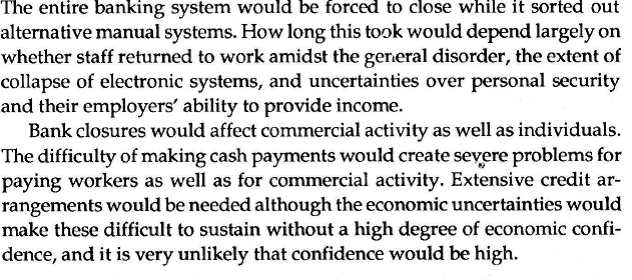
I was initially staggered at the suggestion that banks might need to shut for only a couple of days, as much because staff might be unsettled as for any other reasons

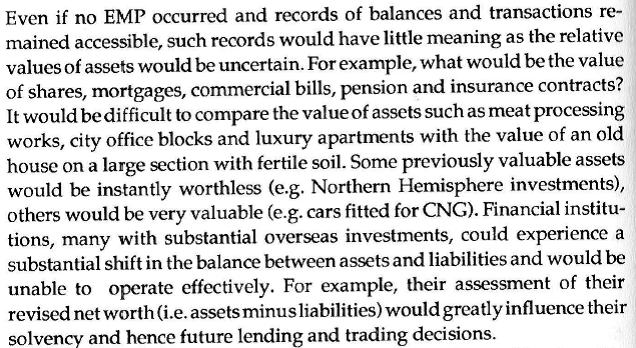
bank closure

But as I read on, the authors were very conscious of some of the other problems.  The risk, for example, that electronic records could be destroyed, or barely usable.

bank closure 2

And, in the longer-term even more importantly, the extreme uncertainty about asset values.

asset values

What, for example, would be a book full of dairy loans be worth in a world in which much of the population abroad had been wiped out?  Or, since this was 1987, what might loans to Judge, Equiticorp, Chase and so on have been worth.  Oh, but I forgot, not much anyway.

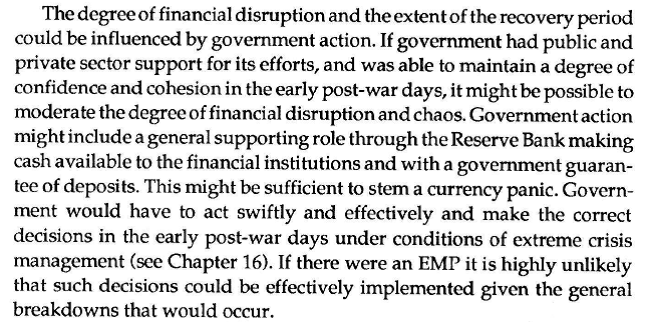
They see a considerable role for government support for the banking system.

govt support

And conclude, perhaps least plausibly, with the suggestion that pre-war planning might “moderate the adjustment process”

policyI

I don’t want to be particularly critical of this piece.  If from this distance the prospect of nuclear war seems less real than perhaps it did in the 1980s, it is still worth thinking these sorts of issues through, and people do what they can in the time they have –  in the case of this report, that was not overly much time.  And I spent quite a lot of time over the years in planning for some, rather less severe, contingencies –  Y2K, and as part of the wider government planning a decade or so ago around bird flu risks.  I led a team inside the Reserve Bank working on policy and banking system preparedness for bird flu.  As a result of that work two bankers’ reactions are seared in my brain: the senior manager at TSB, clearly unimpressed at having us visit, who turned around, and pointed out the window towards Mt Egmont and announced “we have more immediate risks we prepare for here”, and the head of risk at one of the major banks who told us very confidently, when we asked about rollover risks for offshore funding in the event of a global bird flu, that such markets could and would never seize up (this a mere two years before the crisis).

But there were still a few surprises about the report.  Perhaps because it was written only a couple of years after liberalization, there is not a single mention of the exchange rate, or interest rates, in the entire chapter.  These days, I’m sure people would put much greater attention on the panic and market chaos that would be likely to ensue as this (scenario) nuclear war was getting underway.  The aftermath might be truly awful, even in New Zealand, but the transition would be really pretty bad too.  The global financial panic in the first days of World War One was documented in a recent book, and bad as World War I turned out to be, no one had any sense of the scale of that disaster when extreme financial crisis nonetheless ensued.  Since the aftermath of nuclear conflict might be almost unknowably awful, if authorities were ever to think of contingency planning for remote events of this sort, it might be more productive to focus their efforts on the period in which hope is fading, fear is soaring, but the institutions and infrastructure have not yet been destroyed.

Credit pre-dates money, and relies on trust.  But in what could anyone trust in the sort of world the authors of this Planning Council report try to grapple with?


Some idling on the money supply

I don’t find aggregate measures of the money supply particularly enlightening, and usually when I focus on the money and credit aggregates at all it is on the credit side of things.  In a floating exchange rate system, credit growth tends to result in money creation, rather than vice versa.  Whether it results just in money creation, or in some mix of money and offshore financing, depends largely what people do as a result of whatever gave rise to the credit creation.

Cross-country monetary aggregate comparisons are also fraught.  Different countries measure the money supply in different ways, and the importance of the types of institutions whose liabilities are captured in the money supply measures differ from one country to another (banks are much less important in the US than in most other advanced countries).

All that said, I put a chart of money supply growth since 2007 in my post yesterday.  I did so simply to respond to a not-overly-well-considered claim by Kirk Hope that New Zealand had not relied on monetary policy, or money supply growth in particular, to the same extent as the other large industrial countries he cited.

Then I noticed that a few people had looked at the chart and concluded that New Zealand had had wildly rapid growth in its broad money supply, one observing that

One reason house-price inflation took off: QE.NZ. We may not have had QE officially, but compared to “New Zealand has had the second fastest rate of money supply growth” of all major developed countries – around half of which was borrowed into existence to buy houses.

So I thought I should do a slightly better chart.  After all, countries with faster population growth should probably expect faster money supply growth (they need more), and it makes sense to look at these things in real terms –  after all, Japan has had deflation over that period and Turkey has had rather high inflation.

For what it is worth the OECD has broad money supply data for 19 countries (including the euro area as a whole) and I added in the German data I used in the post yesterday.  For those countries, I got population data from the IMF and inflation data from the OECD, and calculated real money supply growth per capita for those countries between 2007 (just before the recession) and 2015.

And here is the resulting chart

broad money

I’m not sure I’d want to take much from it.  On this measure, and despite having had larger cuts in interest rates than all (?) of these countries since 2007, we’ve had rather moderate real per capita money supply growth (although still ahead of the UK, Japan and the euro-area of the dreaded QE).  It has been faster than underlying productivity growth to be sure, but not dramatically so.

Bank balance sheets just haven’t been growing very rapidly (in real per capita terms) over that period.  And much of the credit (and money supply) growth, I would argue, is the endogenous response to higher house prices, rather than some independent factor pushing house prices up.  The interaction of planning restrictions and population pressure have pushed real house (+land)prices in our biggest city up sharply, and unsurprisingly people need to take out larger loans than previously to purchase houses.  When they take out such loans, the stock of credit rises, and so does the stock of deposits (the money supply).  If, in aggregate, people treat higher house prices as new wealth and consume more then over time money supply growth will tend to lag behind credit (their spending will flow into a current account deficit, funded typically by bank foreign borrowing).  If, on the other hand, people in aggregate treat higher house prices as an additional cost, undermining their sense of well-being, the effect could be the other way around.  But just because credit/money rises we shouldn’t necessarily think of banks as the driving force in the process –  more an accommodating one, mostly responding to other structural (and perhaps speculative) forces.

Setting interest rates: no need to change the system

Andrew Little has moved on from wanting to “stiff-arm” banks over dairy foreclosures, to talking of the possibility of legislating to force banks (and other lenders?) to pass on in full any OCR changes.

It isn’t the oddest idea in the world – and personally I find the new talk of a Universal Basic Income, much as it has also been propounded by some  on the right, including Milton Friedman, rather more consequential, and worrying.  Many quite sensible countries set fixed exchange rates.

For 15 years in New Zealand –  1984 to 1999 –  we didn’t have a government agency setting interest rates at all.  For much of that time, many of us at the Reserve Bank thought that was only right and proper.  And when we first proposed an OCR-like system, many of the leading economics commentators and bank economists were pretty dismissive.  But in 1999 we simply concluded that –  like most of the rest of the advanced world –  it made more sense to set, or manage directly, an official interest rate.  And now that model is just taken for granted.

Of course, setting the OCR isn’t the same as setting the individual interest rates for each borrower, but I’m sure that if he gave it any thought that isn’t what Little means either.  Perhaps he just means that the Reserve Bank should be able to direct set some commercial bank base lending rate against which all other lending rates have to be calculated? It seems administratively cumbersome, and perhaps prone to being circumvented –  not unlike much other government regulation, including (for example) direct restrictions on mortgage lending of the sort once unknown in New Zealand but now imposed by the Reserve Bank and accommodated by the current government.  And it is not as if governments universally eschew price-setting in other markets either –  the government recently proudly announced an increase in the regulated minimum price for labour, talking of wanting to push that price (once just a market price) up as fast as possible.

One of the attractions of an OCR-type arrangement is that it is a fairly indirect instrument.  The Reserve Bank can put the OCR pretty much wherever it needs to to deliver on an inflation target.  That is an imprecise linkage, but it works pretty well (at least if the Reserve Bank is reading underlying inflation pressures correctly) and it does so without needing lots of direct controls or impinging very directly on anyone’s business or financial affairs.  The OCR is simply the rate the Reserve Bank pays on deposits banks (and any other settlement account holders) have at the Reserve Bank, and the rate at which the Reserve Bank will lend to banks on demand (against good quality collateral) is pegged to the OCR.   The amounts banks borrow from and deposit with the Reserve Bank aren’t that large : bank balance sheets total almost $500 billion, and bank deposits with the Reserve Bank are fairly stable, currently around $9 billion.  And yet changes in the rate paid on these balances, which don’t move around much, provide substantial and sufficient leverage (partly signaling, partly a change in pricing on one component of the balance sheet) for macroeconomic stabilization purposes.    It isn’t a mechanical connection, but it works.

A variety of other models might too, but the judgement has been –  not just here, but in other similar countries – that an indirect approach like the OCR is less intrusive and has fewer efficiency costs than the alternatives.

And it is not as if there is some obvious problem.  Here is a chart, drawn from data on the Reserve Bank website, showing floating residential mortgage interest rates and six month term deposit rates since 1965.  (It is an ugly chart because the mortgage rate data are monthly throughout, but the term deposit rates are quarterly until 1987).

retail interest rates

Largely, lending rates reflect deposit rates (and to some extent vice versa).   These aren’t perfectly representative indicators, just what we have.  But for the almost 30 years for which we have the full monthly data are available, the average spread between these two series was 2.45 percentage points, with a standard deviation of 0.6 percentage points.  The latest data are for February, and the spread was 2.49 percentage points.  One would expect spreads to move around a bit –  demand for individual products ebbs and flows, and the links between foreign funding markets and domestic term deposit markets aren’t instant or mechanical –  and they do, but there is no obvious or disconcerting trend.

Through the period since 1965 we have had all manner of regimes.  Direct controls on lending rates, direct controls on deposit rates, indirect controls on one, other or both, no controls at all, and then for the last 17 years direct control of the interest rates on one small component of bank balance sheets.  Go back far enough, and during the 1930s a conservative government legislated to lower all lending rates.  But it just isn’t obvious that there is any need to change the operating system now.

To a mere economist, it is a bit of a puzzle what Little is up to.  No doubt the Opposition needs to be seen to be offering alternative policies, but these issues (bank lending rates and dairy foreclosures) don’t seem like an area where there is a substantive policy issue (while there are many other areas of policy where the same could not be said, such as New Zealand’s continuing slow relative decline).  But there does seem to be quite a strain of anti-bank sentiment in New Zealand –  perhaps especially anti foreign banks, the same sentiment that gave us state-owned Kiwibank under the previous Labour-Alliance government.  Perhaps people on the left here are looking to the US and the striking degree of response Bernie Sanders is achieving for his populist message, much of which is centred on an anti Wall St message?


Retail interest rates and the OCR

Various media outlets over the last day or so have asked for my views on whether banks will, or should, pass through yesterday’s 25 basis point cut in the OCR into lower retail rates.

My bottom line was

“I think there will be political pressure on the banks to cut to some extent, but I’d be surprised if it [any cut in floating mortgage rates] was anything like 25 basis points.”

It didn’t even seem a terribly controversial point.

After all, the Reserve Bank had included this chart in the MPS yesterday

funding costs

And they could have included one of credit default swap spreads for Australasian banks (as per this one at interest.co.nz).

The Bank even commented in the MPS that:

the cost of funding through longer-term wholesale borrowing has risen with the pick-up in financial market volatility (figure 4.3). The increase in longer-term wholesale costs this year adds to the increasing trend since mid-2014, which reflects a mix of global regulatory changes, concerns about commodity markets and emerging economies, and broader financial sector risks. To date, strong domestic deposit growth has limited the need for New Zealand banks to borrow at these higher rates. However, acceleration in credit growth over the past year might increase banks’ reliance on higher-cost long-term wholesale funding, leading to higher New Zealand mortgage rates.

It has been a commonplace in the recent Australian discussion that unless the Australian cash rate is lowered higher mortgage rates seem quite likely because of the rising funding spreads.

And so I was slightly taken aback to see the Governor, and his offsiders, quoted as having told Parliament’s Finance and Expenditure Committee that

“I’d expect the floating rates to come down by 25 basis points,” Wheeler told the select committee.

and that

“Banks are only raising a relatively small share of their funding from overseas at this point in time. They’re continuing to see very strong deposit growth. Most of the credit expansion that’s going on has been funded through deposits,” Hodgetts said.

Central bank governors aren’t there to provide defensive cover for banks’ pricing choices, but neither should they be winning cheap popularity points in front of committees of politicians by calling for specific cuts in retail interest rates that don’t even look that well-warranted based on their own analysis (eg the MPS quote above).

Bernard Hodgetts, head of the Bank’s macro-financial stability group, argues that rising offshore funding costs aren’t really relevant because banks haven’t raised much money in those markets recently.  But surely he recognizes the distinction between average costs and marginal costs?    For the banking system as a whole, the place where they can raise additional funding –   much of which has to be for term, to satisfy core funding ratio (and internal management) requirements  – is the international wholesale markets.  And what banks would have to pay on those markets in turn affects what they are each willing to pay for domestic term deposits.

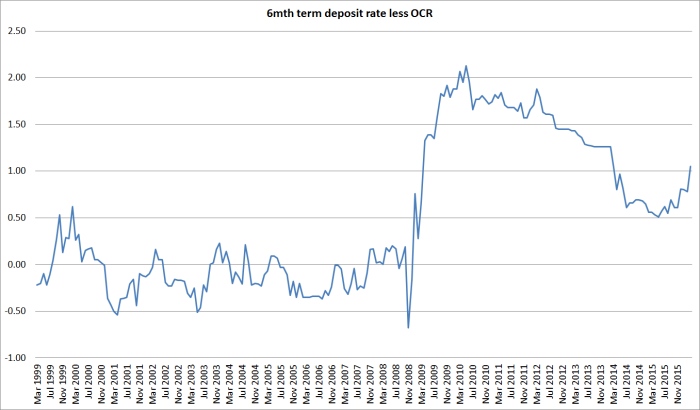
There isn’t a one-to-one mapping between rises in indicative offshore funding spreads and spreads of domestic terms deposits, but hereis a chart showing the gap between term deposit rates (the indicative six month rate on the RB website) and the OCR.

6mth TD less ocr

Unsurprisingly, it looks a lot like the indicative offshore funding spreads chart above.

And what about the relationship between floating mortgage rates and the OCR?  Here I’ve shown the gap between the floating first mortgage new customer housing rate and the OCR.  I’ve included yesterday’s OCR cut and assumed that banks eventually cut their floating mortgage rates by the 10 basis points the ANZ, the biggest bank, announced yesterday.

mortgage rates less ocr

The resulting gap doesn’t look particularly surprising.  The gap between mortgage rates and the OCR blew out during the 08/09 crisis when funding spreads and term deposit margins blew out. It came back from those peaks and has been fairly stable since –  narrowing a bit further a couple of years ago, when it looked as though funding spreads might continue to narrow (and when banks were trying to get loans on their books in face of the new LVR controls).  And now, perhaps, those spreads are widening out again –  as one might expect given the persistence of the rise in the offshore funding spreads.

All these points are really illustrative only.  I don’t have access to more precise data.  But as in any business, pricing involves some judgements.  Perhaps the political and customer pressures will mount and banks will find themselves having to pass more of yesterday’s OCR cut into lower retail lending rates than they would really like. But this is a repeated game.  Even the Reserve Bank expects one more OCR cut before too long, and many of the banks now expect at least one beyond that.  Over the course of the rest of the year, it seems likely that unless those international funding spreads start sustainably falling again, that retail interest rates will fall by less than the fall in the OCR.  It has happened before –  most notably in 2008/09 –  and will happen again.  And it works both ways: if funding spreads ever go back to pre-2008 levels, retail rates will fall further than (or rise less than) the OCR.  The Reserve Bank takes those factors into account when it sets and reviews the OCR every few weeks.

From my perspective, the prospect that retail rates might fall less than the OCR is neither good nor bad, it just is.  As in any business, costs are an important consideration in pricing, but retail mortgage banking is also a pretty competitive business.  Banks don’t need our sympathy, but we also don’t need populist anti-bank cheap shots.

The right answer for the Governor, asked by MPs whether banks would pass on the lower OCR, would surely have been something along the lines of  “That is up to them.  They operate in a competitive market, and they face a variety of cost pressures.  We’ll be keeping an eye on each stage of transmission mechanism –  between OCR changes and eventual changes in medium-term inflation –  and will adjust the OCR as required to deliver on the target set for us in the PTA”.

Immigration and productivity spillovers

In the run-up to the release this month of the new book by Julie Fry and Hayden Glass, which appears to focus on the potential for the immigration of highly-skilled people to contribute to lifting New Zealand’s long-term economic performance and the incomes of New Zealanders, I was doing a bit of reading around the issue.

At issue here is whether, or under what conditions, immigration to New Zealand of highly-skilled people can lift not only the average productivity of the workforce in New Zealand (that seems quite plausible in principle –  think of a tech company simply relocating a particular research lab, staff and all, to New Zealand), but whether something about the skills those people have can translate into lifting the skills, productivity, and performance of the people who were already here.  Those sorts of “spillovers” are really what we must be looking for if we are serious about running a skills-based immigration programme, as some sort of economic lever or, in the government’s words, a “critical economic enabler”.    We can think about this in the context of New Zealand’s own history.  European immigration to New Zealand in the 19th century brought people from the world’s (then) most advanced, innovative and economically successful society to a country where the indigenous population had been operating at a level not that much above subsistence.  It would be astonishing if the European immigration had not raised average incomes of the people living in New Zealand (ie including the immigrants).  But it would have been a pretty unsatisfactory programme if it had done nothing to lift the productivity, skills and income of the native New Zealanders.

Fry wrote an interesting working paper for the New Zealand Treasury a couple of years ago reviewing the arguments and evidence on the economic impact of (more recent)  immigration to New Zealand.  But when I went back and had a look at that paper I was a little surprised at how little focused discussion there was of mechanisms by which such productivity spillovers might occur –  whether in generating more new ideas, or in applying better the stock of knowledge already extant – and how that might (or might not) have played out in New Zealand.

I also had a look at the old Department of Labour’s 2009 research synthesis on the economic impact of immigration.  They had a nice discussion on the possible link between immigration and innovation.  As they note, for some types of migrants to the United States there is reason to think that such spillovers might be material

The main mechanism in the United States appears to be the education of foreign graduate students rather than skilled worker immigration. The United States is the global leader in academic research, so the country attracts the top foreign students from across the world (positive self-selection). These account for most doctoral graduates (but there appears to be no crowding out of the United States born from research universities) and many of these foreign born doctoral students work in research and development (R&D) sectors in the United States, leading to a positive correlation between concentrations of highly skilled migrants and concentrations of patent activity.

Unfortunately, as they note, there is little evidence of such gains or spillovers in the limited New Zealand research.  That might reflect the fact that our actual immigration programme has not been very highly skills oriented at all (something the data make pretty clear), which could perhaps be changed by altering the parameters of the immigration system. Or it might reflect some things about New Zealand that cannot easily be changed: we are small, and remote, relatively poor, and have universities which typically don’t rank highly as centres of research, in contrast to the United States which is not just the “global leader in academic research”, but large, wealthy and more centrally-located.   And despite the recent surge in New Zealand exports of education services, that hasn’t been centred on our universities (it is a welcome boost to exports, but not likely to be the basis of any productivity spillovers to New Zealanders).

George Borjas is a leading US academic researcher on the economics of immigration and had a very accessible post up the other day looking at the question of productivity spillovers, and highlighting a range of quite recent and fascinating studies on some “natural experiments”.  One of the cleanest such experiments was the purging by the Nazi regime in Germany of Jewish academics (and research students).

In 1933, shortly after it took power, the Nazi regime passed the Law for the Restoration of the Professional Civil Service, which mandated that all civil servants who were not of Aryan descent be immediately dismissed. That meant that Jewish professors like John von Neumann, Richard Courant, and Albert Einstein were fired from their university posts. Many of these stellar scientists found jobs abroad, particularly in the United States.

Researchers have been looking at what the impact of these dismissals, and relocations, was on the productivity of those around them.  That included the impact on the productivity (published research output) of the graduate students (PhD candidates) of those the dismissed academics had been working with, the impact on the output of former colleagues of those who had been dismissed, and the impact on the colleagues that dismissed academics found themselves working with later (in the case of those who subsequently took up US academic positions).

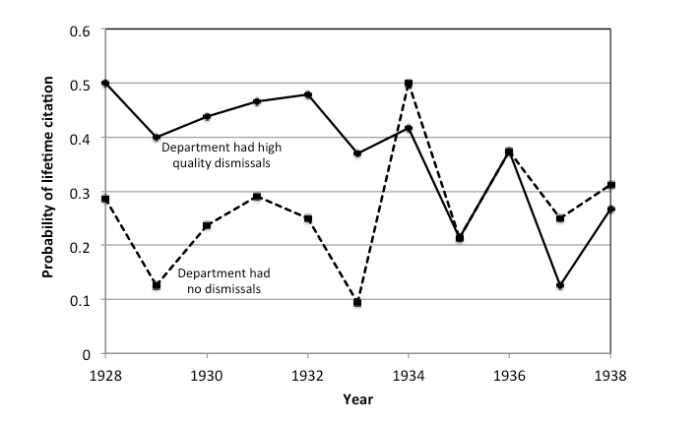
This is perhaps the starkest chart from Borgas’s post, drawn from this paper,  illustrating the lifetime impact on the graduate students left behind.

borjas chart

There are clear signs of a material adverse long-term impact (the mirror image of the sort of positive productivity spillovers those promoting a high-skills immigration programme are looking for).  PhD programme supervisors can matter hugely.    But any impact on the productivity of former colleagues was much less visible.

In another paper, recently published in the AER,  looking at the impact on innovation in the US from the relocation of these displaced Jewish scientists, the authors find that the new recruits did not increase the productivity of existing US inventors, but encouraged greater innovation in the US as a whole by attracting new researchers to their distinctive sub-fields of research.

Borgas sums up his take on this series of papers thus

My take from all this is very simple: At least in the experimental context, the evidence that high-skill immigrants produce beneficial spillovers is most convincing when the immigrants that make up the supply shock are really, really high-skill; when the number of such exceptional immigrants is sufficiently small relative to the market; and when those immigrants directly interact with the potential recipients of the spillovers.

Or as he put it in another of his own recent journal articles looking at the impact of the mass emigration of Soviet mathematicians following the fall of the Soviet Union

Knowledge spillovers, in effect, are like halos over the heads of the highest-quality knowledge producers, reflecting only on those who work directly with the stars

I found these papers fascinating in their own right (nerd that I am) but they also prompt thought about what we can actually hope for in a New Zealand context.  Even if we get past the sick-joke aspect of New Zealand’s  allegedly skills-based immigration, and the disproportionate number of chefs, aged care nurses, and café and shop managers, what could we really expect to be able to achieve with the best possible skills-based programme?

It would almost certainly be a much smaller programme.  And it would have to aggressively target the very best people – not be content with people who just happen to creep above a points-threshold, artificially boosted by a willingness to move to some of the more remote and less economically promising parts of the country.

But then one has to ask how realistic any of this is.    With all due respect to our green and pleasant, and moderately prosperous, land, why would the very best people want to come to New Zealand, let alone stay here?    We had our own stellar academic refuge from the Nazis –  Karl Popper taught at Canterbury for several years – but even he didn’t stay that long.  We have adequate, but not great, universities –  and there are many better in countries with many of the good things New Zealand can offer.  We have modest academic salaries.  We have small home markets, small networks of people working in possible similar areas, and if global markets in principle can be serviced from anywhere, evidence still suggests people tend to do it from closer rather than further away.  We seem to have almost nothing of what 1930s Britain or the US could offer to the displaced German academics –  or certainly nothing that a wide range of other countries couldn’t offer more of, more remuneratively.

But perhaps Fry and Glass can make a robust and more optimistic case.  I’ll look forward to the book, and will no doubt write about it here.


English on the PTA

Some interesting comments from Bill English on inflation and the Policy Targets Agreement appeared in the media over the weekend.

The lead comment was

Finance Minister Bill English says he’s willing to wait for next year’s review of the Reserve Bank’s policy targets agreement (PTA) to consider whether it is still appropriate in a global economy where inflationary pressures have dissipated.

That seems appropriate.  We have a statutory structure which provides normally for five-year PTAs.  That provides reliable guidance to the Reserve Bank and some predictability for the rest of us.  We don’t have to worry that whenever people get a little uncomfortable about the inflation numbers, the target will be revised up, or down, on the fly.  The Reserve Bank should just get on and meet the target, whatever it is at the time.

And, as it happens, it is only 18 months now until the Governor’s term expires.  (Of course, one of the downsides of the current structure is that the Governor will soon be making monetary policy decisions, the full effects of which on inflation will not be apparent until after his term has expired.)

The Minister also noted

English said he was reluctant to prejudge the outcome of the review, which would include advice from the Treasury, but noted he hadn’t seen any compelling argument that the agreement itself could change or any particularly coherent alternative.

I don’t myself favour material change to the PTA, although I think that coherent arguments can be made for a variety of possible alternative approaches.  I doubt that a different way of specifying the target would have made much difference either during the boom years when the Reserve Bank had monetary policy too loose, or over the last few years when policy has been too tight.  The mistakes and misjudgements over the years have been either forecasting ones, or ones reflecting the private preferences of the successive Reserve Bank Governors –  probably mostly some combination of the two.

The Minister goes on to note that

“I think they’re in some challenging territory. We’ve got an agreement in place and we’re happy that they’re acting consistent with the agreement. We are not trying to second guess the decisions the governor should make.

Again, if we are going to have an operationally independent central bank in respect of monetary policy, ministers generally shouldn’t be trying to “second guess” or put pressure on the Governor.  Except, that is, to fulfil the PTA – or “do his job”.

The New Zealand system is relatively unusual in providing such a prominent structured role for the Minister of Finance not just in setting a target for the Reserve Bank, and having  responsibility for ensuring that the Bank meets the target.   The Bank isn’t meeting the target, and has not done so for some years.

The Minister claims that the Bank is “acting consistent with” the PTA.  It is shame that the journalists behind the story didn’t ask the Minister more specifically what he meant.  I suspect the Governor really would like to see inflation a bit higher than it is, and core inflation (reflected in a range of measures) might still be just inside the target zone.  Of course, the forecasts always show inflation heading back towards 2 per cent, sometimes rather slowly.  It is just that actual inflation –  even stripping out oil prices, tobacco taxes, ACC levies and so on –  just hasn’t done so.  A proper assessment of the Governor’s performance would surely require not just a judgement about the Bank’s intentions, but about their competence and their actions.  If we delegate a major function of public policy to an unelected technocrat and his staff advisers, we should expect a very high level of technical capability to be on display.  Year after year of missing the target doesn’t suggest they have been meeting that standard.  They neither seem to adequately understand what is going on, nor to have been willing or able to adjust for their (widely shared) difficulties in how they run monetary policy.   When you market yourselves as the technical experts, backed by a high level of public resources, the performance standard has to be higher than if, say, a mere elected politician had been making the interest rate decisions.

In fact, I think what the whole experience is highlighting again is the unrealism around the Reserve Bank governance model.  The idea was to make a single individual responsible for a clear and specific target, and to dismiss that individual if he or she missed the target.  It was never a realistic approach, at least if one wanted a reasonably sensible monetary policy.  That had already become apparent under Don Brash’s term, but the point has been reinforced in the last decade.

Under Alan Bollard the Reserve Bank consistently ran with monetary policy that was too loose to be consistent with the PTA –  through a combination of technocratic forecasting errors, and gubernatorial preferences (a great deal of angst about the tradables sector).  There was no serious pressure on the Governor to operate in a way more consistent with the target, and if anything the political pressure –  at the height of one of the bigger booms in our modern history –  was for easier policy not tighter.  And yet the Minister of Finance was the one responsible for the Governor’s performance relative to the PTA.

And in recent years the Reserve Bank has undershot its target –  a failure made more obvious by the explicit addition of the midpoint reference to the PTA in 2012.  It has been some combination of technocratic forecasting errors and gubernatorial preferences (a great deal of angst about the Auckland housing market –  or on a bad day, about specific suburbs in Hamilton or Tauranga).   There has been no serious pressure on the Governor to operate in a way more consistent with the target –  not even, we are led to believe, from the Bank’s Board – even though the unemployment rate has lingered uncomfortably high and the growth performance of the economy, in per capita terms, has been poor at best.  The Minister of Finance is the one responsible for ensuring the Governor’s performance relative to the PTA, and yet (at least while the polls run strongly) the Minister has no obvious incentive to suggest there is anything wrong or disappointing about New Zealand’s economic performance.

My point here is not mainly to criticize the Minister.  I don’t think he  –  or his Board – is really operating as the Act envisaged, but mostly that is a reflection of the unrealism of the statutory provisions.  Our Act gives a huge amount of power to a single unelected individual on the assumption that a high level of effective accountability is possible.  History suggests it is not possible.  There is too much imprecision, and any concerns too quickly become personalized.   We would be better off with an alternative governance model –  a more internationally conventional one –  in which less emphasis was placed on the ability to dismiss an individual, or more emphasis was placed on spreading and sharing the power that is delegated to an unelected body.  It would be less ambitious than what we have now, but more realistic –  offering more ongoing effective scrutiny, with less high stakes emphasis on a single person (strengths, preferences, failures and so on).   In my model, we’d have a Monetary Policy Committee, appointed by the Minister of Finance, with members subject to hearings before the Finance and Expenditure Committee before taking up their position, serviced by technical experts from the staff of the Reserve Bank, with stronger effective statutory transparency provisions, and with the Secretary to the Treasury as an ex officio (perhaps non-voting) member, would be a much better way forward.  It would complement a Financial Policy Committee responsible for the regulatory and financial stability functions.

A model of this sort would not give us perfect monetary policy –  perfection is a useless standard in almost any area of public life –  but it would better reflect what we now understand about monetary policy, and effective accountability, than the current 1989 provisions do.

Finally, I noticed that the Minister talked about how the review of the PTA next year would ‘include advice from Treasury”.  That is all very well and good.  But the Policy Targets Agreement is the major instrument articulating how short-term macroeconomic management should be conducted in New Zealand over the following five years.  These reviews have typically been conducted with a totally unnecessary and inappropriate degree of secrecy, both before and after the event (recall the Reserve Bank’s refusal to release material relating to the 2012 PTA).  As I noted earlier, I don’t favour material changes in the PTA, but the Minister might be more likely to be exposed to arguments or evidence for a different approach if he opened up the process to wider input beyond just the Reserve Bank and the Treasury.  Governments and government agencies engage in public consultative processes on all manner of regulatory and related issues, most of which are no more important that the monetary policy regime.  If the Canadians can run a fairly open process, producing and scrutinizing relevant research, it isn’t obvious why we can’t.  As the current Policy Targets Agreement expires just more than three years since the last election –  and the political consensus around monetary policy is no longer strong –  the sooner such a process was got underway the more likely it is that it would produce something offering persuasive insights, rather than the merely partisan.


Immigration: political parties all seem pretty much on board

There is an interesting column on interest.co.nz today by David Hargreaves calling for the government to act to reduce the rate of immigration.  I’m generally quite sympathetic to his call, although much of his argument is focused on the shorter-term pressures that arise from large (and large fluctuations in) immigration flows, whereas my interest is primarily in the longer-term economic implications of high trend levels of non-citizen immigration.  But the column is headed “National is putting short-term expediency ahead of the country’s future”, and there I’m inclined to part company.

Yes, the National Party dominates the current government, and has supplied all the Ministers of Immigration since 2008.  But, by and large, they are following the same policy, apparently with same implicit beliefs about the benefits of immigration and of a larger population, that the Labour Party led government before them followed, and the National Party-led government before that.  Elite opinion in New Zealand has been strongly pro-immigration, presumably believing that it is in the interests of New Zealanders, for a long time.  What is at issue isn’t really “short-term expediency”, but long-term economic strategy and beliefs.

Elite opinion approves strongly of immigration, and is resistant even to any questioning of the approach, and yet those same people and institutions struggle to produce any evidence of the benefits.

The Secretary to the Treasury is very keen on immigration, and yet The Treasury doesn’t seem to have been able to find any evidence of benefits from New Zealand’s large scale immigration programme, and has been rather cautious about the extension of working holiday schemes.

MBIE and the Minister of Immigration continually runs the line that immigration in New Zealand is an “economic lever”, and yet when I asked for copies of their advice and analysis there wasn’t anything of substance there either.  There are assertions about possible benefits, and various theoretical arguments, but no evidence that New Zealanders have actually benefited from the evolving programme New Zealand has actually run.

The New Zealand Initiative think-tank seems keen on immigration, and yet when the chairman recently put out a piece on immigration, he subsequently acknowledged (see his comment in response to my piece) that there are no New Zealand studies that demonstrate the benefits to New Zealanders of New Zealand’s immigration programme.

Late last year, Mai Chen published a lengthy Superdiversity Stocktake report, some mix of immigration advocacy and marketing around how best to cope with the greater ethnic diversity that has developed in New Zealand over the last few years.  And yet, in the hundreds of pages, there was no evidence advanced that New Zealanders have been, or will be, made better off by the large scale immigration programme.  Chen referred to various papers supposedly showing benefits from diversity, but few adequately distinguished causal links and correlations, and several were not even dealing with ethnic diversity.  The one New Zealand paper cited –  a Department of Labour modelling exercise from a few years ago –  is generally accepted to be of the sort which generates benefits from immigration if first ones assumes benefits from immigration.  In other words, it simply does not shed light on the bigger question.  Here is a link to a recent commentary on the some of the articles Chen refers to.

So neither our leading government economic agencies, nor our academics, nor our think-tanks, nor immigration-advocacy groups have been able to show any material benefits from the large scale immigration programme, even after 25 years.  And yet the leading political parties for some reason continue to recite the mantras –   it is “critical economic enabler” we are told, but enabling what?

And while National and Labour are largely responsible, since they have led all governments in New Zealand for decades, most of the other parties don’t really seem that different.

Here is the Green Party policy.  It doesn’t get very specific, but also evinces no real discontent with the thrust of the immigration policy New Zealand has been running for 25 years.

New Zealand First often gets coverage for its comments on immigration.  They raise some concerns, some of which I think have merit, and others not.  But read the policy and it certainly doesn’t feel like a party advocating a far-reaching change of approach.

The Maori Party  apparently no longer has any references to immigration on its website (and there was nothing in the 2014 manifesto), but when I looked previously there was nothing suggesting any discontent (which has always puzzled me because, whatever the economic merits of immigration there is no doubt that each new wave weakens the relative political position of Maori in New Zealand).

United Future has an updated online manifesto, and its immigration policy (page 84) suggests no real discontent, and just suggests various tweaks at the margins.

And the final party in Parliament is ACT.  You might presume that they’d have been dead keen on immigration –  open markets in people as well as goods.    In fact, their website offers a curious mix.  On the one hand, the say

ACT is and always has been the pro-immigration party

But they must have had someone reading Reddell because a few sentences later they qualify this with

ACT is also committed to monitoring the emerging literature that suggests immigration may make the domestic population poorer through a process of capital widening

They have a whole page, which is fairly uniformly positive, but with that caveat.

It is quite remarkable that we’ve gone for 25 years with one of the largest scale planned migration programmes in the world, have no actual evidence of the benefits to New Zealanders of this programme, and all the time have continued our slow relative economic decline, and yet not one of the p0litical parties appears seriously uneasy about what is going on.  On the one hand, it is a testimony perhaps to the moderation of New Zealanders, and to the fact that we haven’t had lots of illegal immigration or Muslim immigration,  But as David Hargreaves notes in his interest.co.nz piece, our rate of immigration has been much more rapid than that of the United Kingdom, where it has become a major issue for debate (and over recent decades the UK economy has been materially more success than our own).

I was interested to see the generally left-leaning Bridget Williams Books has a new book out shortly, presumably next week,  in their BWB Texts series, on New Zealand’s immigration policy and practice.

Here is the publisher’s blurb.

Migration and the movement of people is one of the critical issues confronting the world’s nations in the twenty-first-century.

This book is about the economic contribution of migration to and from New Zealand, one of the most frequently discussed aspects of the debate. Can immigration, in economic terms, be more than a gap filler for the labour market and help as well with national economic transformation? And what is the evidence on the effect of migration not just on house prices but also on jobs, trade or broader economic performance?

Building on Sir Paul Callaghan’s vision of New Zealand as a place ‘where talent wants to live’, this book explores how we can attract skilled, creative and entrepreneurial people born in other countries, and whether our ‘seventeenth region’ – the more than 600,000 New Zealanders living abroad – can be a greater national asset.

It will be interesting to see what material, and arguments, the authors have to offer.   If it isn’t offering the evidence itself, perhaps it least it might contribute to a greater appetite for serious debate and analysis as to whether we, as New Zealanders, are benefiting from the evolving immigration programme in the way in which the elites seem to take for granted that we are.


Perspectives from the Christchurch economy

As New Zealand readers won’t be able to avoid knowing from the blanket media coverage, today is the fifth anniversary of the most destructive of the thousands of earthquakes that have hit Christchurch and its neighbouring areas since September 2010.

Christchurch is “home” to me. I haven’t lived there for decades, and don’t suppose I will again. But almost all my wider family live there, and my ancestors for 150 years or more have lived in and around Christchurch.   Many of my family were, and are, badly affected by the 22 February quake: my elderly parents managed to get down the damaged stairs of their multi-storey apartment block, but never even got inside the building again.  The church where they had been raised, and married, and where several generations had been buried from, lay in ruins.

otbc

On Friday, presumably to mark the anniversary, the Reserve Bank released an issue of the Bulletin looking at how the economy of Christchurch and the Canterbury region has fared in the years since the worst of the quakes  (it is billed as “The Canterbury rebuild five years on”, but is mostly about economic activity in Canterbury, of which of course the rebuild is a significant, if temporary, new part).  The article builds on an earlier one along much the same lines published in September 2012.

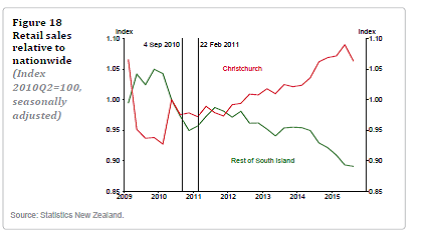
There is a range of interesting material in the article, as well as a few things that read oddly.  For example, the authors note on several occasions that “the bulk of commercial building reconstructions has yet to start”, which seems to defy the evidence of the senses (there has been a lot of building going on in and around the central city in the last year, public and private, and a lot of “for lease” signs on the new buildings), unless the Bank is much more optimistic than most people seem to be on just how large a CBD Christchurch is likely to have in the next decade or two.    And the authors include this chart, using SNZ data, suggesting that retail sales in Christchurch have been much stronger than in the rest of the country

chch retail sales

Which seems a little odd, since population growth has lagged behind that in the rest of the country.  Using the SNZ subnational population estimates, between June 2010 and June 2015 populations are estimated to have grown as follows:

New Zealand 5.60%
Canterbury regional council 3.30%
Christchurch city -2.30%
Christchurch city + Selwyn and Waimakariri 2.60%

Even allowing for the lower unemployment rate in Canterbury than in the rest of the country, it would seem surprising if retail sales per capita had grown so much more strongly than in the rest of the country (estimated retail sales 6 per cent faster –  see chart –  and population growth perhaps 2 to 3 percentage points slower.

But in commenting today, I didn’t want to focus on the fine details of a useful article.  Instead I wanted to comment briefly on three thoughts that struck me as I read.

First, in an article written by officials in a government agency, the authors are quite constrained in what they will have felt able to say about the rebuild process and the role of central government in it.  It is perhaps useful to read the Bank’s article alongside, say, the article in this week’s Listener.  And the Bank’s primary focus is, of course, on resource pressure issues, not the effectiveness or otherwise of the rebuild process.  But silence on some of these matters risks being read as endorsement.  I’ve noted already the comment about the commercial rebuild process, but if the authors are right that there is a lot more to come, perhaps it is worth pondering what role central government has played in  slowing down the process.  For example, the use of compulsory land acquisition powers, in pursuit of some official vision of what the city centre “should look like”, which will have contributed to much higher than necessary land prices in the central area.  Or the uncertainty which central government has created by promoting (almost certainly uneconomic) so-called anchor projects, and then making almost no progress on them –  leaving private investors considering projects that would sensibly locate close to the “anchor projects” in limbo.

Second, a couple of charts in the article prompt a “what might have been” thought about the entire economy.    Some have argued that the New Zealand economy would have performed much more poorly over recent years without the repair and rebuild process.  If anything, I think the opposite is true.  Right from the early days following the earthquakes, the Reserve Bank was focused on the size of the rebuild expenditure, and associated pressure on resources, that was to come over the following few years.  As probably the largest investment programme in New Zealand (share of GDP) since the Think Big projects in the early 1980s, and with a very domestic spending component to it, it was quite right for the Bank to focus on those issues and risks.  But, with the benefit of hindsight, I think that doing so helped leave the Bank more reluctant than it should have been to have cut the OCR as the record of persistently low inflation kept building up.  The sentiment was often along the lines of “it might be low right now, but it can’t last –  look at all those resources pressures to come in Christchurch in the next few years”.

If the economy had been fully employed, the repair and rebuild process would inevitably have had to “crowd out” some other economic activity –  most probably from the tradables sector.  In fact, we’ve had an underemployed economy throughout the last five years and could, with hindsight, have done with more demand, which would have generated more economy activity, less unemployment and a bit more wage and price inflation.  Without the spectre of the rebuild programme, there might have been more chance of it being allowed to happen.

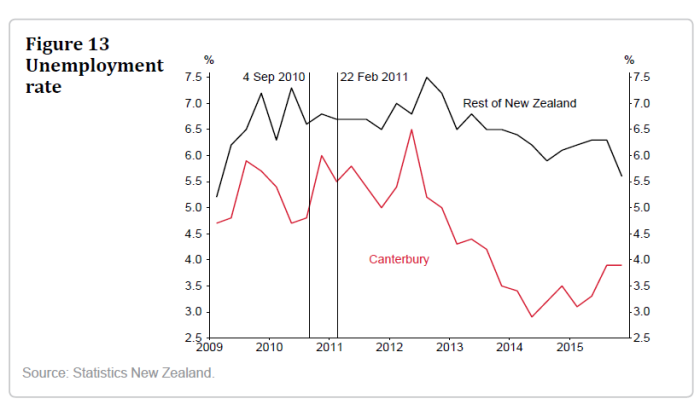
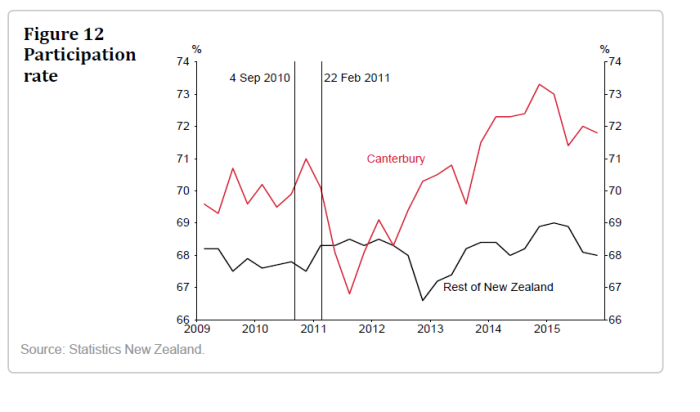
Part of what I’m talking about is captured in these two charts from the Bank’s article.

chch Uchch particThe labour market in Canterbury has been materially stronger than in the rest of New Zealand.  Even pre-quake, the participation rates were higher and the unemployment rates were lower (probably partly reflecting different demographics), but both gaps widened further in Canterbury’s favour as the demand/activity associated with the rebuild really got underway from 2013.
With a lower OCR over the last few years, and the associated lower exchange rate, the whole of New Zealand could have enjoyed a milder version of this sort of buoyant labour market.  The intense focused nature of the rebuild “shock” probably always meant that the Canterbury market, at peak, would be tighter than that in the rest of the country, but the rest of the country simply could have done materially better.  Demand makes a difference, and monetary policy can either hold back or stimulate demand.

Had the demand been there in the rest of the country to generate stronger labour market outcomes, there would have been inflation consequences. But that would have been a good thing, not a bad one.  Recall that inflation has been well below target for years.    And as the Bank notes

 In real terms, wages in Canterbury have increased by about 8 percent since the earthquakes, whereas wages outside of Canterbury have increased about 6 percent in real terms.

Hardly of a magnitude – 2 percentage points different in total over five years –  that, repeated nationwide, would have been sufficient to have blown the inflation rate back through the upper end of the target range.

One can’t simply mechanistically translate one region’s experience into that for a whole country,  but the simple comparisons outlined here point in the direction of what went wrong with monetary policy management in New Zealand in the last few years.  With a huge non-tradables demand shock (which, in macro terms, is what the rebuild represents) New Zealand should not have had any great difficulty keeping inflation up around target in recent years –  indeed, one could, if so inclined, have mounted an argument for it to have been a little higher for a few years, reflecting the intense one-off nature of the shock).

My final set of thoughts, rather more speculative, is around the longer-term health of the Christchurch economy.  The Bank repeatedly describes the Canterbury economy as being “resilient” (including in its press release) , but if anything I came away from the article more sobered and worried about the future of Christchurch than I had been.  In internal debates in the immediate wake of the earthquake, I was always one of those who pushed back against the idea that there would be a wholesale exodus from Christchurch, from which the city would never recover etc.  Apart from any other arguments, between risks of tsunamis, volcanoes, earthquakes, and floods where in New Zealand was really much safer in the longer-term?   And there hasn’t been such an exodus –  indeed, the population of greater Christchurch is higher it was in 2010.

But there always was Professor Ilan Noy’s work suggesting permanent adverse effects (population and economic activity) from past overseas natural disasters.  Noy is now at Victoria University and is listed as a co-author of the Reserve Bank’s article.

The Christchurch economy has historically drawn strength from a number of areas.  There was a large manufacturing sector, with a significant high-tech and export orientation.  That sector hasn’t been materially affected by the earthquake and subsequent rebuild process – but then the overall manufacturing sector (especially outside the construction-related bits) has been performing poorly (per capita manufacturing value-added is now only around 80 per cent of what it was in the early 2000s).   Christchurch has also built on the large rural hinterland –  which is still there, and probably more intensive than ever as vineyards (to the north) and dairy displace sheep.

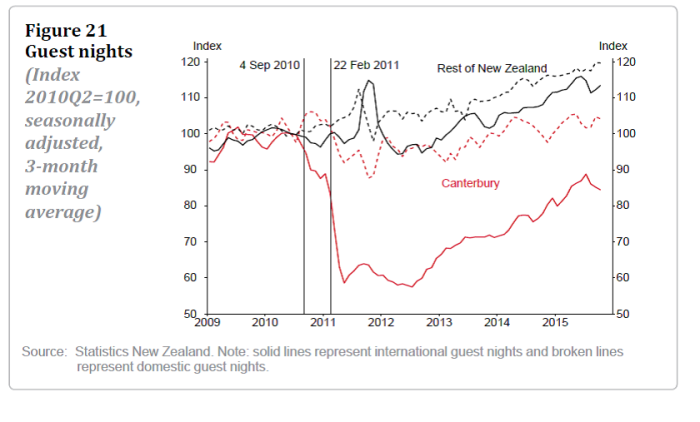
But Christchurch has also become a reasonably significant location for export education (one of the worst sets of fatalities was a English language school for foreign students) and some combination of tourist destination and gateway to the picturesque South Island. I’ve never been entirely confident that tourism is a robust basis for long-term high advanced country living standards (it isn’t tourism –  much more of it than New Zealand has – that makes France or the UK prosperous), but some of the charts in the article were sobering.

Guest nights

guest nightsInternational numbers are recovering, but there is a very long way to go.  Perhaps not too surprisingly (cause and effect) hotel capacity in Canterbury is only about 60 per cent of what it was.

Or international student numbers, where there has been no recovery at all (although I gather the picture for graduate students is a little more encouraging).

chch studentsThe chart for foreign fee-paying school students is even weaker.

The Bank ends its article noting

 In particular, activity in the tourism and education sectors remains markedly below pre-quake levels. Without increased activity in other sectors, the labour market in the region could see a reversal of the improvement that has occurred in recent years, leading to reduced participation, higher unemployment and outward migration.

No doubt activity in some of those tradable services sectors will recover further at some point, but how far and how quickly?  In some way’s Christchurch’s tradables sector plight probably isn’t a million miles out of line with the experience of much of the rest of provincial New Zealand, which has struggled to cope with the effects of a persistently high exchange rate, out of line with the longer-term real economic fundamentals.  In aggregate, economic activity in Christchurch has been held up by the repair and rebuild spending, but that won’t last for ever, and is no longer an impetus for growth (the volume of activity having now levelled off).  “Buoyant” might have been a better description than “resilient”.

Like many places in New Zealand, Christchurch is a nice place to live, but as the rebuild phase passes, there must be doubts about the ability of economic activity in the area to support high incomes for a growing population.  It is a concrete illustration of the more general need for a reorientation of policy in directions that would generate a lower real exchange rate –  a stronger competitive foundation –  for at least a decade, to help unwind the adverse effects of the last decade: successive non-tradables shocks, exacerbated by policy mistakes, resulting in an exchange rate too high, it appears, to support, much growth in the tradables sector.

As I noted, the Reserve Bank authors will have been constrained in what they could say.  The same constraints don’t apply to Professor Noy. Perhaps a journalist could consider approaching him, and inviting him to elaborate on his thoughts on the Canterbury economy and the apparent fragility of its rebuild-fuelled activity?