Avoiding upset to Beijing: the Wellington establishment

A week or so ago I wrote here about some comments made by Jason Young, the (then) acting director of the Contemporary China Research Centre, which is based at Victoria University.   Dr Young’s contribution appeared to be to claim that any New Zealand debate around the People’s Republic of China, including its activities in New Zealand, was some sort of “fact-free zone” –  while ignoring all the facts in plain sight –  and to lament the absence of better quality debate, while not himself seeking to add much to it.  It seemed like an attempt to play distraction.

As I noted in that post

The chair of CCRC is Tony Browne, former New Zealand Ambassador to the PRC, who also just happens to be the chair of the PRC-funded (and controlled) Confucius Institute at Victoria University (CCRC and the Confucius Institute seem to share an administrator as well).  The CCRC itself seeems to work hand-in-glove with MFAT……and its advisory board is largely made up of public servants (MFAT, MBIE, Treasury, NZTE, Asia New Zealand Foundation) plus the chair of Education NZ and the former chair of the New Zealand China Trade Association.

It didn’t seem like an organisation that was ever likely to say anything critical…..and in the unlikely event it did, there would be repercussions all round.

A day or two later, Stuff had an article on the Contemporary China Research Centre, prompted (it appeared) by some mix of those Jason Young comments I’d been writing about and the announcement that Jason Young had been confirmed as director of the CCRC.  Young was, as one might expect, championing his institution

Young said the debate around the role China played in New Zealand, and the wider region, was more complex than had been discussed in the recent media reports and academic articles in New Zealand.

“Sensationalist claims about extensive Chinese influence in New Zealand highlight the importance of the knowledge and understanding the Victoria University of Wellington-led New Zealand Contemporary China Research Centre (NZCCRC) brings to public debate,” he said.

“It is crucially important we have a New Zealand institute that can think about New Zealand interests and New Zealand needs and New Zealand values and New Zealand problems.

“Obviously, we can draw on what American, Australian and other scholars are saying, but there are unique elements that need to be addressed from a New Zealand perspective.”

The new head said the centre’s advantage was its independence, and ability to speak with “a New Zealand voice”.

At that point I began wondering how he could say all this with a straight face.   He doesn’t appear to have been misquoted or misrepresented either (I kept an eye on his Twitter feed and on the CCRC website and there were no corrections or clarifications) –  what Stuff quote him as saying appears to be what he believes.  Remarkable what one can come to believe when one’s job (and recent promotion) requires it.

To their credit, Stuff picked up the point about the close ties betwen the PRC-funded Confucius Institute at Victoria and the CCRC.

The centre shares a location, chairman, and administrator with the Confucius Institute, which is funded by the Chinese Government.

Chair Tony Browne told Stuff the institutes operated independently.

Rebecca Needham, director of the Confucius Institute at Victoria, said she wouldn’t stand for any political influence from the Chinese Government.

So let’s try to unpick this a bit, including the web that ties together MFAT, the CCRC, Tony Browne personally, the Confucius Institute and so on, in ways that make it exceedingly unlikely that the CCRC will ever be able to (or interested in) providing detached critical commentary on any threat posed by the PRC.   When he speaks, Dr Young is likely to be expressing his real views, but he’ll have been chosen for the role in no small part based on the inoffensiveness (to his patrons and sponsors, and their funders –  in Beijing and the Beehive) of his views.

Take the connection between the CCRC and the Victoria University Confucius Institute.  It isn’t just that they share a:

  • location
  • administrator
  • chairman

which seems quite a close tie, all things considered.  I went back the other day and read the Annual Reports of the CCRC, and this is what I found.

From the first report in 2009

12. Confucius Institutes. The Centre has supported and facilitated the working on the establishment of a Confucius Institute at Victoria University. Canterbury University is also establishing a Confucius Institute in Christchurch.

and from the 2010 Annual Report

confucius

That was Xi Jinping himself.

The two bodies seem to operate hand-in-glove.  It is hardly likely that the NZ CCRC –  chaired by Tony Browne –  will ever be publishing critical material on the PRC, which would make difficulty for, say, the Confucius Institute, chaired by the same Tony Browne, and funded by the government of the PRC to propadandise for the regime in our universities and schools.   Presumably not even Dr Young or Mr Browne would pretend that the CCRC could ever be a source of critical scrutiny of the Confucius Institute programme itself  (which has raised serious concerns in other countries, to the extent of a number of universities discontinuing the programme).    NZ CCRC and the PRC are partners in all but name (in addition to the various formal partnership arrangements CCRC has with PRC universities and government agencies).

What else do we learn about the CCRC?    From the 2017 Annual Report

The Centre has continued the successful partnership with the China Capable Public Sector Programme, managed and funded by the Ministry of Foreign Affairs and Trade for officials from across the public sector.

The Masterclass is an intensive five-day course on China designed and taught by the China Centre. It is exclusively for public sector workers and is delivered through a series of introductory talks and roundtables, followed by scenario-based activities. This year the Centre has put on two Masterclass events with excellent feedback.

It looks like a worthwhile programme, but it is also a significant business arrangement and financial arrangement with MFAT, who will be most unlikely to welcome anything that rocks the boat (and I’ve heard that MFAT/CCRC have been quite selective in which perspectives get presented at these courses). I don’t suppose CCRC would be running MFAT’s course for them had they ever openly made life difficult by casting doubt on the “never ever upset Beijing” line that seems to guide officials and ministers.

From that same annual report we also find

The Centre’s Executive Chair [Tony Browne] has continued in his role as a member of the Executive Board of the New Zealand China Council. He has also been appointed to the International Steering Committee of the Silk Road NGO Cooperation Network.

The China Council?  The (largely taxpayer-funded) advocacy group, on the board of which sit the chief executives of MFAT and NZTE, to champion the relationship with the PRC, apparently by never ever saying anything critical, and pooh-poohing anyone else who does.

As for the Silk Road NGO Cooperation Network, it appears to be another PRC government facilitated body.

Tony Browne, the former New Zealand Ambassador to Beijing, must be a busy man.   I remembered that I had met him once.   Among his many hats is that he is co-director of the China Advanced Leadership Programme, run by the Australia-New Zealand School of Government (itself a partnership involving various Australian universities and Victoria University).

The China Advanced Leadership Program (CALP) is an annual three-week program for Chinese officials, delivered in Australia and New Zealand. The aim of the program is to develop productive relationships between high level public officials of Australia, New Zealand and China.  The program has been operational since 2011 and is delivered across multiple Australian and New Zealand cities.  The program is made possible due to ANZSOG’s relationship with the Organization Department of the Chinese Communist Party.   

It must be a quite a revenue-generator for the universities concerned.

Who attends

Who are our participants?

Senior and emerging Chinese public officials from central and provincial governments – Up 25 senior officials in China are carefully selected by ANZSOG’s program partner, the Organization Department of the Central Committee of the Communist Party of China. The Organization Department occupies a unique role in the hierarchy of the Chinese government – it oversees appointments of all key positions within the administration. Previous delegations have included Vice-Ministers from the Central Government, Party Secretaries, City Mayors, and Directors-General.

All, quite explicitly, CCP members.

Who speaks?

Contributors

ANZSOG brings together the highest levels within government, business and academia in Australia. Previous contributors have included Prime Ministers and Deputy Prime Ministers of Australia, the Australian Minister for Foreign Affairs, the Governor-General of Australia, state Premiers, the Treasurer, former Prime Ministers, Chief Justice of Australia and other top political leadership, CEOs of federal and state government agencies, business and industry bodies. The program provides a world-class learning opportunity in Australia and New Zealand for senior Chinese officials. Past contributors include The Hon Susan Kiefel AC, The Rt Hon Jacinda Ardern, The Hon John Howard OM, AC, The Hon Bob Carr and The Hon John Brumby AO.

And me.  I don’t think Graeme Wheeler ever quite got the message about the PRC.  The organisers were keen to have him speak, and twice the job got passed down the line, ending up with me.    The day I last spoke, they’d also had John Key, Gerry Brownlee, Phil Goff and Iain Rennie speaking.  It is all taken very seriously.   (If anyone is interested, I got the Reserve Bank to release the text of my 2014 address, on the evolution of economic management in New Zealand over almost 200 years.  I think I avoided upsetting the visitors or being nauseatingly obsequious.)

You might suppose that being a partnership between numerous Australian universities and Victoria University, ANZSOG wasn’t of much moment in New Zealand.  In fact, the state and national governments are members.  And of the Board, three are New Zealanders –  in the chair is Peter Hughes, the current State Services Commissioner.  And what of ANZSOG’s ties with the PRC?  It isn’t just a commercial relationship involved in running that course.    Instead, ANZSOG lists as “affiliate partners” a small number of agencies including

Affiliate partners

It is all terribly cosy.  The presence of the Chinese Communist Party speaks for itself.  But CELAP describes itself as

China Executive Leadership Academy Pudong (CELAP), a Shanghai-based national institution, is funded by the central government and supervised by Organization Department of the CPC Central Committee.

Does it amount to much?  Probably not, but it is hardly a sign of governments ready to take a detached, and perhaps critical, approach to the PRC, or to foster such free and frank perspectives among their own public servants.

Reverting to the Victoria University Confucius Institute, the director Rebecca Needham was quoted in that Stuff article as saying that

she wouldn’t stand for any political influence from the Chinese Government.

And no doubt that is quite true as written.  But presumably she doesn’t count as “political influence” the sorts of prohibitions in these arrangements that, for example, screen the Mandarin language teaching assistants for their own political and religious soundness (Falun Gong need not apply)?   Perhaps, since she is a skilled and experienced bureaucrat, the “Chinese government” in that quote does not include the entity in the PRC that funds the Confucius Institute?  The Office of Chinese Language Council International (colloquially Hanban) apparently describes itself as a “non-government and non-profit organization”, but is chaired by a PRC vice-premier and reports to the PRC Ministry of Education.

Apparently, the directors of these Confucius Institutes are typically appointed by the host institution, not by anyone in the PRC.    And yet, when your institution is launched, here in Wellington, by Xi Jinping, when your institution depends on ongoing PRC funding, lets not be cute and suppose that anyone slightly risky –  or ever needing “political interference” to do the “right thing” –  would be appointed to the job.

And what of Ms Needham?  When I looked her up, it turns out that she was a long serving MFAT staffer, including a stint as New Zealand Consul-General in Guangzhou, leaving MFAT only a year or so ago.   Remarkably, despite serving now as the director of a PRC funded entity, devoted to the advancement of PRC interests in New Zealand, she is listed on the MFAT website as part of the “China Capable Public Sector Community of Practice”   which

brings together a core group of China experts from across the public sector who provide input and advice to the CCPS programme and connect people to share knowledge, learn, and collaborate around common concerns, problems, opportunities, or interests regarding New Zealand’s engagement with China.

The rest of the list is made up exclusively of current New Zealand public servants.   It looks like a good initiative, and the role of this “community of practice” is described as

The role of the CoP is to:

  • Act as a trusted advisor to agencies to inform strategic thinking, broad policy direction, and operational issues on China matters when invited
  • Provide advice and guidance on the New Zealand perspective and China context in the development and delivery of CCPS curriculum initiatives
  • Share knowledge and experience through participation in CCPS curriculum activities
  • Foster networks with China experts across the sector
  • Model a collaborative approach to develop a cross-sector mindset on China capability.

But Rebecca Needham works for an organisation funded by the government of the PRC, devoted to the advancement of various PRC interests in New Zealand.  Did MFAT not even recognise the potential for conflict, for differences of interest or views?

And, of course, Needham shares a location, an administrator, and a chairman with the Contemporary China Research Centre.

To repeat, no one should look to the New Zealand Contemporary China Research Centre for any independent perspectives on the PRC, or its relationship with New Zealand.   That will, presumably, serve the government and MFAT (and perhaps Beijing) well, but sadly it will also mean that even when the CCRC does put out good material, or host worthwhile workshops, that might offer some (fair) perspectives on Beijing, its contribution will be tainted by the knowledge that it would be most unlikely to ever offer anything on the other side.  The CCRC is neutralised by construction, and by appointments (chair, director, board members), by business dealings, and by association.

And thus we’ve heard nothing from it on, say, the presence in our Parliament of a former member of the Chinese military intelligence establishment, former (?) member of the CCP, close associate of the PRC Embassy and various United Front organisations, who misrepresented his past to voters, who acknowledges that he misrepresented his past to New Zealand immigration authorities at the encouragement of his former PRC masters.   None of those facts is in dispute.  And the silence, or attempts to play distraction, by the CCRC, the China Council, and so on is deafening, and sadly telling.

Off the top of the Governor’s head

From a post a couple of weeks ago, just after the release of the Reserve Bank’s Financial Stability Report.

In a similar vein, I noted a story on Newsroom this morning, reporting the Governor’s appearance at the Finance and Expenditure Committee yesterday.  He was reported thus

But he told the select committee he would much rather the Reserve Bank, as banking regulator, could trust banks and borrowers to be prudent.

“I would love to not have to be active in that space. If banks had true long-term horizons, if the consumers were fully aware and myopia didn’t exist across borrowers, all the different foibles that people have, then you wouldn’t need the regulatory imposts.”

Talk about “nanny state” –  the Governor wishes he could trust us.  I wish we could trust him and his colleagues.

But, more specifically, the Governor here asserts again that banks are too short-term in their operations, that borrowers are myopic, and we need Reserve Bank intervention (he was talking of LVR and DTI restrictions) to save us from ourselves.  Par for the course, the Governor offered no evidence for his proposition (and there was none advanced in the FSR), it just seems to be some sort of new gubernatorial whim (as Graeme Wheeler came with the scarring experience of living through the US crisis, in this case Orr comes with an NZSF perspective –  neither grounded in specific  analysis of the New Zealand banking system).  I’ve lodged an OIA request this morning for any Reserve Bank analysis in support of these propositions.

To the credit of the Reserve Bank, they seem to have started responding to OIA requests more promptly.  I got the Bank’s response this morning.  Here is what it says:

On 10 May you made an Official Information request seeking: 

copies of any research, analysis or related material generated by, or for, the Reserve Bank suggesting that New Zealand banks had inappropriately short lending horizons, and New Zealand borrowers suffered from “myopia”. 

Under the provisions of OIA section 18(e), which allows refusal of a request where the information is not held, the Reserve Bank is refusing your request.

The Governor’s view as expressed in the reported comment was formed without recourse to specific material produced by, or for, the Reserve Bank.

So there was no analysis in the FSR supporting his claim, and nothing the Bank had done –  not even apparently in the previous five years – that supported his claim about the need for Reserve Bank interventions (LVRs, DTIs etc) constraining New Zealand banks’ lending, and New Zealand households’ access to credit.

He appears to have just made it up.  It was a whim, a prejudice, a line that sounded good as he said it…….and this is the basis on which the Governor makes policy (singlehandedly) and testifies to Parliament.  In a way, it isn’t that surprising, given the criticisms people like Ian Harrison and I have levelled at the quality of the analysis used to support their actual and proposed regulatory interventions, but to hear it direct from the Bank is still pretty telling.


Gift receiving at the Reserve Bank

I was following up something this afternoon, and noticed that the Reserve Bank had posted an OIA response to someone inquiring about gifts accepted by staff.

There is almost two years of data, and the overall list isn’t that long.   I’ve been the recipient of all sorts of, mostly small, things over the years –  often from visiting central bankers or the like, but including the odd corporate box invite, dinners, and so on.   If anything, I’m a little surprised the Reserve Bank’s list isn’t longer –  in my days in the Financial Markets Department, corporate hospitality was part of relationship management, particular for our dealers.   The Bank must have tightened up: there is a surprisingly small number of cases of financial markets staff accepting hospitality etc.

But one element of the list really did catch my eye.  The Reserve Bank supervises banks, non-bank deposit-takers, and insurers: in doing so, it can have a big influence on the businesss of those institutions.    So one of the things that is very important is that the Reserve Bank’s supervisory staff keep a suitable distance from the institutions they are regulating.

On the gifts list, three banks operating in New Zealand showed up.  The first was BNZ, offering hospitality (twice) to Mark Perry, the Reserve Bank head of financial markets (and a former BNZ employee).   Mark won’t be involved in the supervisory or regulatory side of things.  The second was Bank Baroda, which presented a couple of books, which were passed on to the Reserve Bank library.

The bank that showed up most was ICBC.  It showed up seven times, on each occasion offering gifts to people with a direct involvement in bank regulation.   These ranged from a wall-hanging presented to the Governor by the bank chairman from China (not kept personally by the Governor), through to a box of food, cheese boards given to four staff, three note pads and a wireless mouse, a mobile power pack (again not kept by the individual) at the end of a supervisory meeting, and another wall-hanging presented to the Deputy Governor (not kept by him personally) by “ICBC Mr Wang Lin, Secretary of Party Discipline Committee”.

There was also another gift, accepted by the relevant staff, from a foreign bank at a meeting to discuss a possible application for bank registration.

I am not, repeat not, suggesting that any Reserve Bank official will have directly changed their stance on any matter to do with ICBC because of these fairly small gifts.  But appearances matter, and so does substance.   It is simply inappropriate for Reserve Bank staff to be accepting gifts from banks they regulate, no matter how small those gifts are.  Taken together such small gifts can foster an atmosphere that makes the regulator a little less willing to ask hard questions, or to confront problems, than they might need to be.

The Reserve Bank’s rules need to be tightened up and the banks concerned need to be reminded –  in the Governor’s words –  that these are New Zealand registered banks, no matter which country the bank concerned’s shareholders and owners happen to be based in.   Regulators simply shouldn’t be taking gifts from the regulated, not even as a matter of “courtesy”.


Don’t just avoid the politically awkward issues

When in late April the Productivity Commission released its draft report on a transition to a low emissions economy, I took them to task for completely (and presumably consciously and deliberately) ignoring the role of New Zealand’s immigration policy in driving up New Zealand’s emissions –  albeit they acknowledged that “population growth” was a factor.  Perhaps more importantly, they didn’t address at all the possibility that –  however we got to where we are today – cuts to the target rate of non-citizen immigration might offer a more cost-effective way –  less damaging to productivity and the living standards of New Zealand –  of meeting the sort of carbon reduction targets governments commit themselves to.    I suggested that they were playing politics, trying to keep onside with a new government.

That still seems the most plausible explanation for the complete silence.   If they thought my argument was wrong, or had some modelling suggesting that other abatement strategies offered lower-cost adjustment, they could readily have reported those arguments and any such evidence.   But they just stayed silent.

The only real justification for having a body like the Productivity Commission –  funded by your taxes and mine –  is that they are at sufficient arms-length from ministers, and don’t just play political games, to say the uncomfortable, or to address the politically unpalatable issues and options.  Having a longer-term focus, if they don’t get traction today, they might tomorrow.

We should hope that even government departments would do that –  offering the sort of free and frank advice that Chris Hipkins was calling for yesterday – but too often they just won’t (and as I saw that last year when I OIAed MfE and MBIE and found that they’d offered no advice or analysis at all on the immigration/emissions/low-cost abatement nexus).  But it is inexcusable when an independent body like the Productivity Commission just rolls over and takes the path of least resistance.  As I noted in a post when the draft report was released

In the short run that might make it more likely they get a hearing from the government. In the long run, that sort of approach to issues won’t stand them  –  or the cause of good policymaking and analysis in New Zealand, already enfeebled enough – in good stead.

As I’ve said before, convinced as I am of my own arguments, I’m not complaining that the Productivity Commission doesn’t reach the same conclusion I do.  My complaint is that they haven’t even been willing to address the issue, when they know that it makes a real difference.    Confront the issue, look at the evidence and arguments, analyse and test them, and reach your (well-supported) conclusions (and leave the goverment to decide policy, sensible or otherwise).    But don’t just pretend there is no issue: that is a betrayal of your mandate from Parliament.

Submissions on the draft low emissions report close tomorrow.  I put in a brief submission this afternoon.

Submission to Productivity Commission climate inquiry draft report

There isn’t much new in it, but I ended this way

There probably won’t be off-the-shelf modelling exercises from other countries you can simply look to in evaluating such options  [low target immigration options] (and you are now under self-imposed time constraints, having failed to consider the issue in your draft report).    But in a sense that is the point of this submission.  The issues facing New Zealand in meeting emissions reduction objectives are different from those facing many other countries and we need analysis that takes specific accounts of the issues, options, and constraints that New Zealand itself faces.

 In conclusion, I would urge the Commission to begin to take seriously the role that rapid immigration policy led population growth has played in explaining the growth in New Zealand emissions since 1990, and the possible role that modifications to our immigration policy could play in facilitating a reduction in emissions, consistent with current or possible alternative official targets.   No doubt technological advances will offer options for relatively painlessly reducing emissions to some extent.  But those options will be available to all countries.  As official agencies already recognise, New Zealand faces some specific challenges that are quite different to those other advanced countries will be dealing with.  We make it much harder for ourselves to meet the emissions targets our governments have committed to if we persist with such an unusually large non-citizen immigration programme.    The aim of a successful adjustment to a low-emissions economy is not to don a hair shirt and “feel the pain”.  The aim should be to make the adjustment with as small a net economic cost to New Zealanders – as small a drain on our future material living standards – as possible.  Lowering the immigration target looks like an instrument that needs to be seriously considered if that goal is to be successfully pursued.   In particular, you cannot legitimately ignore the issue –  in what looks disconcertingly like a reluctance to tackle controversial or politically awkward options –  and still lay claim to being the source of independent fearless advice and analysis that is really the only good argument for having the Productivity Commission in the first place.

Leaving them with the visual reminder of the cross-country correlation between population growth and growth in total emissions (which relationship exists even just for agricultural emissions)

total emissions

and that, in New Zealand, with birth rates well below replacement for several decades, immigration is increasingly the main reason why the population is still growing much at all.

And immigration doesn’t appear to be making New Zealanders better off (higher productivity) just…..more congested, with higher house prices, and with more emissions that other (themselves costly) tools have to be adopted to offset or abate.

Sir William and the rockstar economy

I don’t really want to revisit the questions of whether retired politicians and senior public servants should be given honours largely for just turning up and doing a (fairly reasonably remunerated) job, or even whether there are really 15 people per annum in this country deserving of knighthoods.  I touched on those issues in a post in January.

But two awards in yesterday’s list caught my eye.  The first was the knighthood to former Prime Minister and Minister of Finance Bill English, and in particular the descriptions of Bill English’s contribution.

There was the official citation, the words put out under the name of the Governor-General, but presumably supplied by the current Prime Minister and her department

As Finance Minister from 2008 until 2016, Mr English oversaw one of the fastest-growing economies in the developed world, steering New Zealand through the Global Financial Crisis and the Christchurch earthquakes and ensuring the Crown accounts were in a strong financial position.

And, even more incredibly, a story by Stuff political reporter Stacey Kirk in which she noted that the official citation had been expressed “rather dryly”, as if it didn’t do full justice to the man’s contribution, and going on to observe, without a trace of critical scepticism or irony,

More colourful commentary at the time would globally brand him the man responsible for New Zealand’s “Rockstar Economy” – the envy of government’s worldwide and a textbook example of how to pull a country out of recession.

From a sudden jump yesterday in the number of readers for an old post of mine from 2015 on the emptiness –  or worse –  of the “rockstar economy” claims, it seemed that at least a few others might have been a bit sceptical of Kirk’s column.

I’m not going to quibble about everything.  The Crown accounts were in a strong position when National took office in 2008, and were in a fairly strong position when they left office.  Net debt was higher when they left office than when they took office, but the deficits which were emerging in 2008 as the recession took hold –  recall that only a few months earlier in the 2008 Budget, Treasury’s best estimate was that the budget was still in (modest) surplus – were gone and the budget was back in surplus when National left office.

The terms of trade make a big difference to the government’s finances.  Here is Treasury’s chart from this year’s Budget, illustrating how much help our unusually high terms of trade have been in recent years.

cab with tot adj

It is a real gain, but it is an exogenous windfall, not something any government or politician could simply conjure up.

What about the official claim that Bill English was responsible for “steering New Zealand through the Global Financial Crisis”.   It has become part of established rhetoric, but it has never been clear to me –  and I was working at The Treasury at the time –  that there was anything of substance to it.    As ever, the biggest single contributors to getting New Zealand through this particular recession were (a) time, and (b) monetary policy.    The crisis phase in other countries had been brought to an end by about March 2009 –  initially as a result of extensive interventions in those countries (bailouts, fiscal stimulus, lower interest rates, and so on).  That took the pressure off the rest of us.  And our own, operationally independent, central bank had cut the OCR by 575 basis points by April 2009 (having begun to cut well before National took office in mid-November 2008), and some mix of the sharply lower interest rates, global risk aversion, and lower commodity prices had also lowered the exchange rate a lot.  The Reserve Bank also put in place various liquidity assistance measures, at its own initiative.

What role then did New Zealand politicians play in “steering us through”?  The previous Minister of Finance had put in place the deposit guarantee scheme, designed to minimise any risk of panicky runs on New Zealand institutions. I happened to think (having been closely involved) that was a good and necessary intervention, even if on important details the Minister departed from official advice, in turn increasing the later fiscal cost.  On taking office, the new Minister of Finance, Bill English, made no material changes to the scheme, and took no material steps to rectify its weaknesses.   Mr English did approve the (better-designed) wholesale guarantee scheme, designed to assist banks tap international wholesale funding markets in a period when those markets had largely seized up.  It didn’t end up being extensively used, but was also the right thing to have done at the time.

What else was there?  In the 2009 Budget –  delivered after the crisis phase abroad had passed –  a couple of rounds of tax cuts, promised in the 2008 election campaign (itself occurring in the midst of the crisis) were cancelled.  That was prudent –  given other fiscal choices the government had made –  but there wasn’t anything extraordinary or particularly courageous about it.   There was no discretionary fiscal stimulus undertaken in response to the crisis by either government –  or nor was it needed, given the scope monetary policy here had.

The truth of the international financial crisis of 2008/09 is that the New Zealand was largely an innocent bystander, caught in the backwash.  There wasn’t much governments could, or did, do about it, and – to a first approximation –  what they (Labour and then National) could do, they did.   Both supported an operationally independent Reserve Bank and it, largely, also did what it could do (if, arguably, a bit slow to get off the mark).  And then the storm passed and we started to recover, in a pretty faltering sort of way.

What about the other bit of that official citation, the claim that “as Finance Minister from 2008 until 2016, Mr English oversaw one of the fastest-growing economies in the developed world”?    Why does the current Prime Minister continue to buy into this sort of nonsense –  the myth  (no, sheer falsehood) of the “rockstar economy”?    To the extent the claim has any meaning at all, it simply reflects the much faster rate of population growth New Zealand experienced, especially in the last five years or so.   Over that five year period (2012 to 2017), New Zealand’s real GDP per capita increased at almost exactly the rate of the median OECD country.   Which is okay, I suppose, but nothing to write home about, especially once one remembers that we are poorer than most of these countries, and are supposed to have been trying to catch-up again.

But, one more time, let’s dig a little deeper.

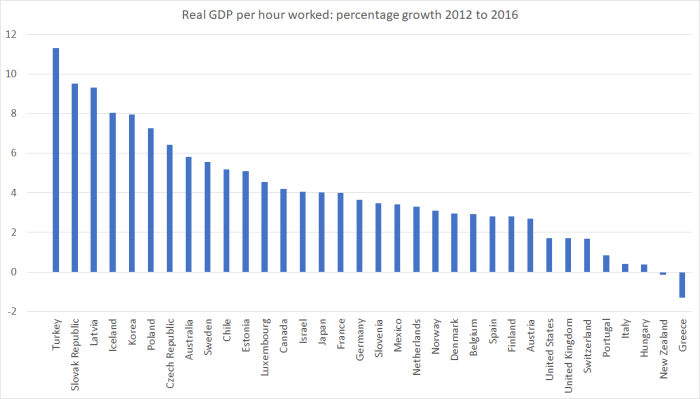
Productivity growth is the only sure foundation for sustained improvements in material living standards.  Over the full period 2007 (just prior to the recession) to 2016 (the last year for which there is data for all OECD countries), New Zealand experienced labour productivity growth basically equal to that of the median OECD country.  Again, perhaps not too bad, but no sign of any catching up.     What about the last four years, the period to which most of the “rockstar economy” claims related?

real gdp phw english

Spot New Zealand –  if you can –  down next to Greece.  And adding in 2017 –  for which we have data, but some other countries don’t yet –  would not improve the picture.  Our recent productivity record –   through the period presided over by Bill English (and John Key and Steven Joyce) –  has been really bad.

What that means is that, to the extent that real GDP per capita growth has been middling, it has all been achieved by more inputs (mostly –  since business investment is weak –  more hours worked), not smarter better ways of doing things, old and new.  Perhaps it really is a rockstar economy: a John Rowles or Cliff Richard one, belting out the same 1960s favourites over and over again?   Recall that, being a poor OECD country, New Zealanders work more hours per capita than most other advanced countries do.

And despite more hours worked, it isn’t even as if we were particularly good at keeping the economy fully-employed during the English tenure.  In this chart, I’ve standardised the unemployment rates of the G7 group of big advanced countries and of New Zealand so that both are equal to 100 in 2007q4, just prior to the recession.

U rates g7 and NZ

Our unemployment rate went up about as much as the G7 countries (as a group) did, but just haven’t come back down anywhere near as much.  For the G7 as a whole –  which includes such troubled places as Italy and France, and is mostly made of countries that exhausted conventional monetary policy capacity –  the unemployment rate is now lower than it was before the recession. But not in New Zealand.

Politicians don’t directly control the unemployment rate (or most of the other measures in this post), but it is pretty amenable to micro reforms, and (within limits) to monetary policy action.  Under Bill English’s oversight, minimum wages kept on being raised, and nothing was done about a Reserve Bank that consistently kept monetary policy too tight (evidenced by the persistent undershoot of the inflation target set by the same Minister of Finance).

And what about foreign trade as a share of GDP?  Successful economies tend, over time, to have a rising share of GDP accounted for by foreign trade (exports and imports).  Small countries that succeed tend to have much larger foreign trade shares (since abroad is where the potential markets –  and products –  mostly are).

Foreign trade as per cent of GDP
2007 2016
Exports New Zealand 29.3 25.8
OECD median 40.5 42.3
Imports New Zealand 29.1 25.5
OECD median 39.2 39

But from just prior to the recession to 2016 (again the last year for which there is a full set of comparable data), New Zealand’s foreign trade shares shrank, even as those of the median OECD country held steady (imports) or increased (exports).  Relative to our advanced country peers, our economy became more inward-focused.

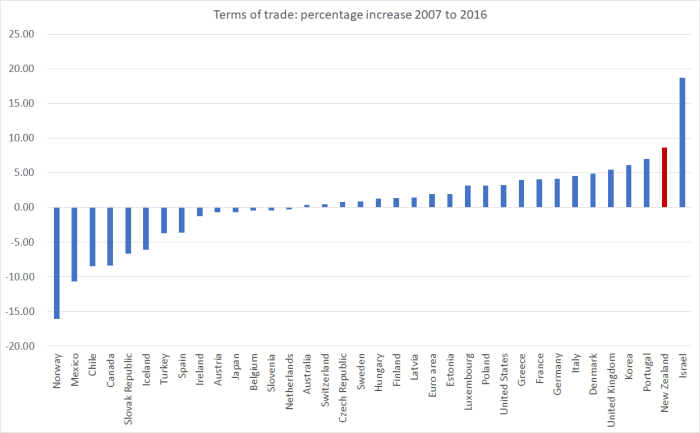
And that is despite the fact that we’ve had the second-largest increase in our terms of trade of any OECD country –  very different from the other commodity exporters (Norway, Mexico, Chile, Canada, and even Australia).

OECD TOT

Fortune favoured us, and we –  our political leaders, the long serving Minister of Finance foremost among them –  accomplished little with that good fortune.

Of course, not everything has been in New Zealand’s favour.  We didn’t have a material domestic financial crisis, we weren’t locked into a dysfunctional single currency, we went into the lean years with a healthy fiscal position, we had more space to adjust conventional monetary policy than almost any other advanced country, and we’ve enjoyed a strong terms of trade.  For enthusiasts for immigration, we’ve continued to draw in large numbers of permanent migrants, and have accelerated the inflow of temporary migrants.

But there were the earthquakes.  I’m not about to deny that they have held back economic performance, compelling resources to shift into domestically-oriented sectors, rebuilding (and inevitably/rightly so) rather than doing other things.  But even the earthquakes need to be kept in perspective: they were seven years ago now, and in wealth terms were more than paid for by the combination of offshore reinsurance and the lift in the terms of trade. There is still no sign of things turning round now –  of higher business investment, or a greater export orientation, of a recovery in productivity growth.  It is just, at best, a mediocre story.

And did I mention house prices?

real house prices OECD

There are, of course, some other black marks against Bill English.  There were the questions of integrity around the Todd Barclay affair.  There was the willingness to lead his party into an election with a candidate who’d been part of the PRC military intelligence operation, and a member of the Chinese Communist Party, all things hidden from the electorate, and then to go on defending the indefensible as it became clear that important elements of this past had also been withheld from the immigration authorities.

But, even on his own ground – the economy –  the record just doesn’t add up to much at all.

Oh, and as for the other top award that caught my eye yesterday, that was this astonishing one.  I’ll probably write about that elsewhere. [UPDATE: Here for anyone interested in this non-economics issue.]


A decade of real house prices

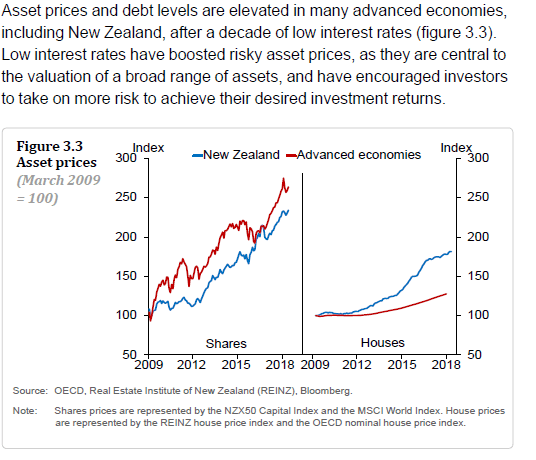
In their Financial Stability Report the other day, the Reserve Bank suggested that low interest rates are a significant part of the story as to why house prices have risen so much, and are so high. I showed this snippet in an earlier post.

fsr chart 1

Not only was there no sign of any analysis of the reasons why interest rates remain low –  they aren’t just some random variable delivered to us from on high, but arise from the interplay of real economic forces –  but they started their analysis from the trough of the financial crisis and (just to compound things) showed asset prices in nominal terms.

The Reserve Bank indicated that they were using the OECD house price index, so I had a look at that data.  Conveniently, the OECD presents the data in real terms, and they provide individual country data for most member states.

In this chart, I’ve shown three lines –  each starting from 2007q4, just prior to the international (and domestic) downturn beginning.   It wouldn’t materially change the chart if I started a year earlier (the peak in US house prices was 2006q4.   Here I’m showing real house prices for New Zealand, for the median of the 30 or so OECD countries for which there is complete data, and the OECD total series (the real equivalent of the line the Reserve Bank showed).

real house prices OECD

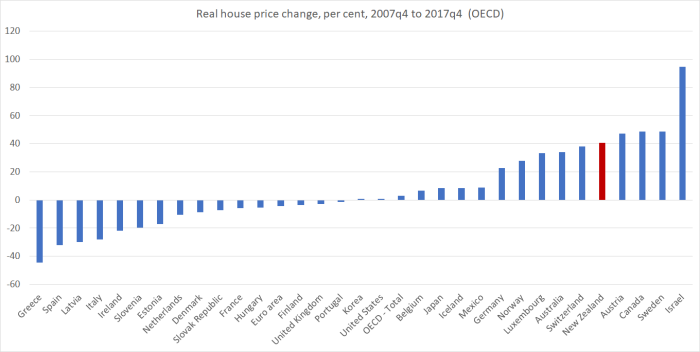
Over the full ten year period, real house prices in the advanced world as a whole have barely changed, while in New Zealand real house prices are now 40 per cent higher than they were at the previous peak (having already risen more than in the typical OECD country in the previous surge).   Not one of these countries –  well, there is a possible exception of Turkey, in the midst of a currency crisis at present –  has interest rates anywhere as high as they were 10 years earlier.

In this chart, I’ve just shown the individual country data.

real OECD house prices

New Zealand’s experience isn’t uniquely bad by any means, but it isn’t representative either.  It didn’t have to be this way, but it was a predictably awful outcome once one knew that land-use laws weren’t being materially altered, and the sheer scale of the population pressures government policy has contributed to.    The combination has been toxic, especially for young people who were already struggling to get into the market.

It isn’t even some sign of general success either.  Your eye might go to Greece and Spain at the far left of the chart.  But other countries to the left of us include, for example, the group of central and eastern European countries that I’ve written about previously, who’ve been catching-up and achieving consistently better productivity growth than New Zealand (the Czech Republic and Poland aren’t on the chart because the data for each doesn’t cover quite the full period –  but on the data we have both would also be well to the left of New Zealand).   Our house price debacle has been a disaster all of our own –  well, our central and local politicians’ –  making.  It just didn’t need to be that way.


Please Mr Orr, could we have some better analysis

In yesterday’s post, I was a bit critical of the relatively superficial analysis in much of the Reserve Bank’s Financial Stability Report.

Here is one example

fsr chart 1

A snippet which seems to contain three problems in just a few lines.  First, the Bank runs their asset price charts from the bottom of the international financial crisis and recession in 2009.  Of course, equity prices have risen strongly since then.  Second,  all these series are shown in nominal terms: in the case of OECD house prices (red line in the second panel) there will have been hardly any increase at all in real prices over the nine years.    And thirdly, they are attempting to argue that low interest rates have been a major causal influence on debt levels and asset prices without (a) looking back at whether trends are more pronounced this decade than they were in the previous –  higher interest rate –  decade (hint: they aren’t) and (b) without giving any apparent consideration to the reasons why interest rates might have been persistently low.  For a central bank, that really is inexcusable sloppiness.

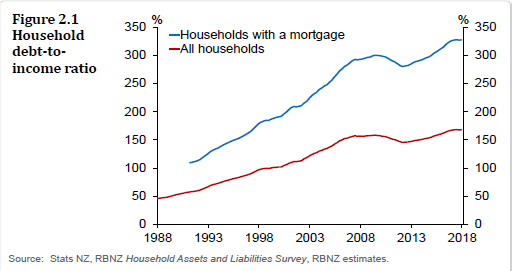
Take household debt, for example.  Here is the Reserve Bank’s chart

FSR chart 2

It is interesting to see the breakdown between households with a mortgage and the all-households number.   Perhaps even more interesting is the snippet they include in the text that “only 8 per cent of households own investment properties, but they account for 40 per cent of housing debt” (although it would be interesting, in turn, to know how that share has changed over, say, the last decade).

But what I’ve always found striking about charts like Figure 2.1 is how small the increase in household debt ratios has been over the last decade or so.   In the previous house price boom, household debt to income ratios rose much more sharply than they have in the most recent boom.  Among households with mortgages, the ratio rose by 90 percentage points of income from the cyclical low in real prices in mid 2001 to the peak, but that same ratio has risen by less since 30 percentage points from the previous peak to now.  On the more familiar metric –  total household debt to total household income –  the comparable numbers are 47 and 10 percentage points respectively.

Another way of looking at the data –  which I prefer, for various reasons including that all national income ultimately belongs to households –  is to look at the ratio of household debt to GDP.  Here is the chart of that series.

chart 3

Household debt as a share of GDP is lower now than it was a decade ago.   Even if you make allowance for the fact that the previous peak itself was during the recession (when GDP had dipped), the current ratio of household debt to GDP has barely changed since the previous peak in real house prices in mid 2007.  In many ways, this is extraordinary.

(And recall, of course, that banks’ housing loan portfolios came through the last recession –  a pretty serious recession, with a fall in nominal house prices –  unscathed.)

Here is the chart of real house prices (the QV index deflated by the CPI), expressed in log form.

chart 4

Real house prices are much higher than they were at the peak of the last cycle, and have risen by about 60 per cent from the 2011 low.

As the chart in log form illustrates, the percentage rate of increase in house prices has been less this time round than in the previous phase of the boom (2001 to 2007) when real prices rose by 87 per cent on this measure.

But that shouldn’t be any comfort.  If real house prices go from $250000 to $500000 in one period, and then from $500000 to $750000 in a subsquent period, the percentage increase is lower in the second period.  But if real incomes haven’t changed, one $250000 increase is just as burdensome as the other.

And that is pretty much what has happened with New Zealand house prices.  Relative to a base of 100 in mid-2001, real house prices increased by 84 percentage points from 2001 to mid 2007.   From mid 2011 to the present (Dec 2017 data being most recent) the increase, again relative to a base of mid-2001 prices, has been 94 percentage points.   Real incomes have increased a bit, to be sure, but actually the rate of increase (whether simple percentage increases, or relative to the 2001 base) in real GDP per capita was smaller in the more recent period.

None of that should be very surprising. In both periods we had really large, unexpected, population pressures, and in both periods we’ve had binding land use restrictions (not factors featuring in the Bank’s discussion).  Interest rates, of course, have been much lower in the second period than the first, but it doesn’t look as though one needs some exogenous interest rate story to explain another bout of house price increases of similar size to the one that happened when interest rates were a lot higher.

But it all leaves the debt to income (household income or GDP) charts a little puzzling.  As I’ve illustrated before –  and is pretty obvious with a moment’s reflection –  debt increases occur over a much longer period of time than house price increases do.  If house prices double today, the only people who will have been taking on more debt right now will have been the small minority of people transacting in houses in this particular short period. But now that house prices are higher, even if they rise no further, every new purchaser will be needing to finance the new higher prices.  Since the housing stock can take decades to turnover fully, the increase in the debt to income (or GDP) ratios can be expected to lag quite a bit behind house prices.

Here is a very simple stylised example of what I mean.  In this scenario, house prices have been unchanged for a long time, and debt stock is steady.  The aggregate debt to income ratio is about .5 (roughly what it was in New Zealand 30 years ago).  Now assume that some exogenous factor (call it “new land use regulation”) doubles house prices today.  Even if new entrants to the market borrow the same proportion of the purchase prices that their predecessors did when prices were low (on the same 25 year mortgages), it will take decades for the associated lift in the aggregate debt to income ratio to occur (35 years for even two-thirds of the adjustment to occur).

chart 5.png

And yet, in real world New Zealand, despite an equally big house price increase since 2011 as we saw from 2001 to 2007, there has been little or no increase in household debt ratios in the last decade (even though the aggregate ratios should still have been adjusting to the earlier price shock).

I’m not sure quite what the explanation is.  One explanation might be that (real) house prices have risen to such levels that a larger share of the houses are being purchased by more cashed-up buyers.  That would be consistent with the decline in the owner-occupation rate.  Perhaps regulatory financial repression is also playing a part –  successive waves of unprecedented LVR restrictions (grounded in gubernatorial whim rather than robust analysis) may have made some difference, not necessarily in a good way.   But it seems like an issue that we might have expected the Reserve Bank to explore in a document like an FSR.

Similarly, when the Reserve Bank talks up risk

The high level and concentration of household sector debt in New Zealand is the largest single vulnerability of the financial system. …..This risk has not changed materially since the last Report. Growth in household debt has slowed and house price inflation has stabilised, but significant vulnerabilities remain.

you might expect them to discuss:

  • the way rather similar levels of household debt performed in the last severe recession,
  • the Bank’s successive stress tests which suggest bank housing lending is not a systemic threat even under very severe (often unrealistically severe –  around unemployment) scenarios, and
  • their own capital requirements on banks, which are –  we are told –  calibrated to take account of the relative riskiness of different types of loans (even within an overall framework that has further increased capital requirements per unit of risk weighted assets).

But, as far as I could see, there was none of that in the document itself, and nothing of it in the Governor’s remarks at his press conference.    In the meantime, we have distortionary LVR controls kept in place –  on one man’s whim –  when, if anything, there appears to be less credit outstanding than one might reasonably have expected given the way other regulatory distortions have lifted house prices.

In a similar vein, I noted a story on Newsroom this morning, reporting the Governor’s appearance at the Finance and Expenditure Committee yesterday.  He was reported thus

But he told the select committee he would much rather the Reserve Bank, as banking regulator, could trust banks and borrowers to be prudent.

“I would love to not have to be active in that space. If banks had true long-term horizons, if the consumers were fully aware and myopia didn’t exist across borrowers, all the different foibles that people have, then you wouldn’t need the regulatory imposts.”

Talk about “nanny state” –  the Governor wishes he could trust us.  I wish we could trust him and his colleagues.

But, more specifically, the Governor here asserts again that banks are too short-term in their operations, that borrowers are myopic, and we need Reserve Bank intervention (he was talking of LVR and DTI restrictions) to save us from ourselves.  Par for the course, the Governor offered no evidence for his proposition (and there was none advanced in the FSR), it just seems to be some sort of new gubernatorial whim (as Graeme Wheeler came with the scarring experience of living through the US crisis, in this case Orr comes with an NZSF perspective –  neither grounded in specific  analysis of the New Zealand banking system).  I’ve lodged an OIA request this morning for any Reserve Bank analysis in support of these propositions.

I could have added, but overlooked doing so, a request for any evidence that – the private sector being inevitably flawed (by nature of being human) – that government regulators (also being human) can consistently improve on the outcomes of the market.  In a banking system (New Zealand, but Australia as well) where the only financial crisis in more than 100 years arose in the transition as heavy controls were being removed –  and neither the private sector nor the regulators really knew what they were doing –  you might suppose some presumption of responsibility and capability might be accorded to the private sector.  But not, it appears, by this Governor, or this Reserve Bank.  When a big ego and extensive statutory powers combine in a single person, the lack of serious supporting  analysis itself becomes a threat, including to the efficiency of the financial system.

Why are we gifting so much to farmers?

Despite announcing yesterday a plan that aims to eradicate mycoplasma bovis from New Zealand, there was no sign of the pro-active release of any background papers or analysis.   We don’t have copies of the relevant Cabinet papers, or the relevant advice from The Treasury or MPI.    Not that long ago, the incoming government talked of its commitment to open government, and now it plans to spend hundreds of millions of dollars of taxpayers’ money –  without, it appears, any additional legislation – without giving us, up front, any of the relevant papers.

Here is the extract from the Minister’s statement yesterday

The full cost of phased eradication over 10 years is projected at $886 million. Of this, $16 million is loss of production and is borne by farmers and $870 million is the cost of the response (including compensation to farmers). We expect to do most of the eradication work in 1-2 years.

Government will meet 68 per cent of this cost and DairyNZ and Beef+Lamb New Zealand will meet 32 per cent.

The alternative option was for long-term management. This was projected at $1.2 billion. Of this, $698 million is the loss of production borne by farmers and $520 million of response costs.

To not act at all is estimated to cost the industry $1.3 billion in lost production over 10 years, with ongoing productivity losses across our farming sector.

We don’t know how any of these numbers is calculated.  I’m not sure what the average price of cattle is, but even if it is $1500, compensation for the cull of 150000 cattle is a long way short of $870 million.  We also don’t know what reasonable probability to assign to the success of the eradication strategy.    That matters, a lot.

But what we can deduce is that given the choice between long-term management and eradication (or doing the nothing), the costs of which would be borne by the industry (farmers), while two-thirds of the cost of the eradication strategy is to be borne by taxpayers generally.    As there appear to be no foreign trade issues (and even if they were, they would be costs to the industry) or food safety issues, it isn’t clear why taxpayers should be expected to meet any material proportion of the costs, when all the benefits will accrue to industry themselves.  It has the feel of the classic line about people being keen, when they can, to socialise losses and capitalise gains.

I’m not unsympathetic to individual farmers (there are quite a few past or present dairy and beef farmers in my wider family) but why isn’t this just an industry issue, in which if the industry regard eradication as the appropriate option that strategy is funded by an appropriate levy collected, say, per head of cattle?   Most of the cattle aren’t any longer in small scale operations (even the average dairy herd size in now 400).  Between the stock and the land ($40000 a hectare, median farm perhaps 100 hectares) and the milking equipment, a typical dairy farm isn’t a small business and the typical owner isn’t poor by any means.  An increasing share of the cattle is in very large business operations.

$600 million here, $600 million there, and pretty soon you are talking serious money.   If there is public money to spend so liberally on health, I’d rather it was spent on human health.  I’m sure there are other pressing needs within the natural ambit of government.  And, of course, there is always the option of returning our own money to taxpayers in the form of lower taxes.

I also don’t purport to understand the politics of this.  Perhaps the government is dead keen not to alienate further the business community and “regional New Zealand”, but this appears to be almost wholly an industry issue, and I’m not sure that mending party political fences with elements of the business community is really a legitimate use of public money.

Perhaps there is a stronger wider public policy case to be made for this intervention?  But if so, it hasn’t been made to the public so far.  Instead, they are just taking our money and giving it to the farmers, to directly benefit the bottom lines of firms in that industry.

New Zealand’s establishment and the PRC

Two interviews on Radio New Zealand’s Morning Report this morning followed on from the news, reported in the local media on Saturday, of a US Congressional commission having held hearings on PRC influence in New Zealand politics (and that of various other countries).

I wrote about the testimony and related issues here.   As I noted in that post, it was pretty clear that the testimony, by a couple think-tank staffers (one former US Defense Department, one former CIA), was secondhand, reporting (sometimes in slightly garbled form) the work of Anne-Marie Brady in particular, and people like Australian journalist John Garnaut.  Of itself, that isn’t a criticism – in any inquiry of this sort, looking into a number of different countries and not in great depth, it makes a lot of sense to draw on the work of others closer to the specific country.   What was interesting about the US inquiry was that it was happening at all, and that the New Zealand situation was getting this degree of visibility, and that is was before a longstanding commission with representatives from both sides of politics.

On Morning Report, one of the think tank staffers, Peter Mattis was interviewed.    I’m not going to suggest it was an impressive performance, because it wasn’t.    He didn’t have a good command of the sources he was drawing on, and seemed unable to cite specific examples of the sorts of behaviours and developments here that concern him.  Painting with a broad brush risks getting dismissed with a broad brush, and that is more or less what happened –  Mattis’s weak answers (unfortunately) spoke for themselves, and the tone was also evident in the voice of the interviewer, Guyon Espiner.

But let’s have a look at what Mattis said in his testimony (from p114) to the Congressional commission, and see what (if any) of it is wrong, or has been satisfactorily refuted.

First point is that Australia and New Zealand both face substantial problems with interference by the Chinese Communist Party. In both cases, the CCP has gotten very close to or inside the political core, if you will, of both countries. The primary difference between the two has simply been their reaction.

The problems that are there include the narrowing of Chinese voices, the CCP’s essential monopolization of the media outlets, the takeover of community organizations, and in a sense denying the rights of Chinese Australians and Chinese New Zealanders to exercise the rights of freedom of association and freedom of speech in public forums. And this relates to the political systems of these countries primarily because if these are the–if CCP backed people are the heads of these Chinese community organizations in those two countries, and politicians use them as their sort of advisors or their guide to what the Chinese community is thinking, it means that they really essentially have a CCP firewall, if you will, between the political class in both countries and the Chinese communities that live within them.

Of the “political core”, well no one now disputes that National MP Jian Yang was (and probably is –  since in CCP terms, no one leaves without being expelled) a member of the Chinese Communist Party, which controls the PRC.  Jian Yang served for some years on Parliament’s foreign affairs committee, and accompanied the Prime Minister and trade minister on official visits to the PRC.   This was the same Jian Yang who now openly acknowledges that he misrepresented his past as part of the Chinese military intelligence system (and who has now gone to ground, not accepting any interview requests from the English language media for many months now).

And on the other side of politics is Raymond Huo, currently chair of Parliament’s Justice committee (dealing, for example, with electoral law).  Huo may not have the same questionable background as Jian Yang, but was –  so it is reported, and hasn’t been denied –  responsible for taking a slogan of Xi Jinping’s and using it as a centrepiece in Labour’s election campaign among ethnic Chinese voters last year.

Of both Jian Yang and Raymond Huo, former senior diplomat, and now trade consultant and lobbyist, Charles Finny was interviewed on TVNZ’s Q&A show last year. As I recounted it

Finny confirmed that he knew both Jian Yang and Raymond Huo, the latter less well.  He observed that he thought it was great that we had Chinese MPs, and had no problem with them being in our Parliament.  But then he went on to note that he was always very careful what he said to either man, because he knew that both of them were very close to the Chinese Embassy.

As for community organisations, Chinese language media, and so on, no one has attempted to refute the claims made about the situation both here and in Australia.  From everything I’ve read and heard, it would be pointless to attempt to do so. It is just the way things now are.

Mattis went on

There’s also the issue of what you might call a three-way transaction where retired officials or politicians take on consulting jobs, if you will, and when a company tries to open their business in China and open sort of different avenues where they need political support, the CCP side simply says, well, you need to pay so-and-so to open the doors for you and to arrange the meetings, and that way there is never a direct, direct CCP payoff to a Western consultant or person, but rather it’s done through the companies themselves so it’s a bit of a proof to the pudding of Lenin’s apocryphal comment that only a capitalist will pay for the rope that’s used to hang him.

To the extent he is referrring specifically to New Zealand, some of this seems a little overwrought (although there is the egregious case in Australia of Andrew Robb, the former Trade Minister who went straight from Parliament to a (NZ)$1m a year part-time job working for business interests with close connections to the Chinese state).  But even here, we have former senior politicians on the boards of PRC (government-controlled) banks, and a former Prime Minister serving on a PRC forum, focused on extending the Belt and Road Initiative, all while also serving on the board of the New Zealand government funded New Zealand China Council.

Mattis again

With respect to the reactions, in New Zealand, both the last prime minister, Bill English, and Jacinda Ardern, have denied that there’s a problem at all, and although the current prime minister has said that the attempts to intimidate and to steal materials from scholar AnneMarie Brady will be investigated, that’s a far cry from any sort of productive action when you have people who have lied on immigration forms that are now sitting as members of parliament.

That’s pretty much a statement of fact.   No party leader seems bothered by the presence in Parliament of a former member of the Chinese military foreign intelligence system (who has never once been heard to criticise the PRC), or even by the acknowledged fact that he misrepresented his past to get into New Zealand.

And from the subsequent interchange with members of the Commission

MR. MATTIS: The answer is yes, that’s precisely what I was implying, that it should be considered on an ongoing basis, and the way some of what was described to me is that, yes, some of these individuals had not, don’t have direct access to the product of NZSIS or the Ministry of Defense, but because they were close to the prime minister, in the case of Bill English, that anything on China that was briefed to Bill English was briefed to Mr. Yang Jian, and therefore it may not be sort of official day-to-day access, but in terms of the conversations, the briefings, it was entirely present within the system.

And I think because it has gotten very close to the political core, one of the major, one of the major fundraisers for Jacinda Ardern’s party has United Front links, that you have to say this is close enough to the central political core of the New Zealand system that we have to think about whether or not they take action and what kinds of action, what do they do to reduce the risk, because especially once, once it involves members of parliament, it requires the prime minister to make a decision themselves of whether or not there’s an investigation of them. If the prime minister is not going to make that decision, then nothing can happen below that.

I presume here that Mattis is relating (in somewhat garbled fashion) the claim that Jian Yang, when travelling with official delegations to the PRC, is likely to have had access to highly classified briefing material prepared for senior ministers –  material for which, were he not a member of Parliament, he would never have been granted access to (as, given his background, he would never have been granted a high level SIS security clearance recommendation).   I’m not sure if this claim  –  regarded Jian Yang’s past access –  has been confirmed, but I’m confident that no effort has been made to refute it.  And recall Charles Finny’s observation –  confirmed in numerous bits of photographic evidence, including on Jian Yang’s own website –  of how close Jian Yang is known to have been to the PRC embassy.

Here is Brady

Yang accompanied New Zealand PM John Key and his successor PM Bill English on trips to China and in meetings with senior Chinese leaders when they visited New Zealand. This role would have given him privileged access to New Zealand’s China policy briefing notes and positions. Under normal circumstances someone with Dr Yang’s military intelligence background in China would not have been given a New Zealand security clearance to work on foreign affairs. Elected MPs are not required to apply for security clearance.

And what of the fundraising aspects?  Note that Mattis did not –  contra the Herald headline –  suggest that the Chinese Communist Party was funding Labour.  His specific suggestion, channelling Brady, was

one of the major fundraisers for Jacinda Ardern’s party has United Front links

The Labour Party General Secretary and President claim no knowledge of what this refers to (Nigel Haworth went so far as to say Labour had no one working for them that fitted the description.   Anyone who has read Brady’s paper will recognise the reference to Labour MP (ie paid by the taxpayer) Raymond Huo.    Here is Brady

Even more so than Yang Jian, who until the recent controversy, was not often quoted in the New Zealand non-Chinese language media, the Labour Party’s ethnic Chinese MP, Raymond Huo霍建强 works very publicly with China’s united front organizations in New Zealand and promotes their policies in English and Chinese. Huo was a Member of Parliament from 2008 to 2014, then returned to Parliament again in 2017 when a list position became vacant. In 2009, at a meeting organized by the Peaceful Reunification of China Association of New Zealand to celebrate Tibetan Serf Liberation Day, Huo said that as a “person from China” (中国人) he would promote China’s Tibet policies to the New Zealand Parliament.

Huo works very closely with the PRC representatives in New Zealand. In 2014, at a meeting to discuss promotion of New Zealand’s Chinese Language Week (led by Huo and Johanna Coughlan) Huo said that “Advisors from Chinese communities will be duly appointed with close consultation with the Chinese diplomats and community leaders.” Huo also has close contacts with the Zhi Gong Party 致公党 (one of the eight minor parties under the control of the United Front Work Department). The Zhi Gong Party is a united front link to liaise with overseas Chinese communities, as demonstrated in a meeting between Zhi Gong Party leaders and Huo to promote the New Zealand OBOR Foundation and Think Tank.

It was Huo who made the decision to translate Labour’s 2017 election campaign slogan “Let’s do it” into a quote from Xi Jinping (撸起袖子加油干, which literally means “roll up your sleeves and work hard”)

and

During his successful campaign for the Auckland mayoralty, in 2016, former Labour leader and MP, Phil Goff received $366,115 from a charity auction and dinner for the Chinese community. The event was organized by Labour MP Raymond Huo. Tables sold for $1680 each. Because it was a charity auction Goff was not required to state who had given him donations, but one item hit the headlines. A signed copy of the Selected Works of Xi Jinping was sold to a bidder from China for $150,000.

I’m not aware that any of this has been refuted, even if Andrew Kirton and Nigel Haworth wish to attempt to plead ignorance.

(And to be clear, there is no suggestion that Labour operates much differently in this regard than National. I presume Mattis referred to Labour because they happen to be in office now.)

There is no suggestion in any of this that New Zealand electoral laws have been broken –  charity donations like that to the Goff campaign are not illegal.  But the suggestion Mattis made –  of close ties near the top of the political establishment –  appears to be on pretty safe ground.

Following the Mattis interview this morning, Morning Report also had on Labour Party President Nigel Haworth, who wasn’t exactly pushed very hard.      But why focus just on MPs raising funds for the party, when we could look at the role of party presidents, National and Labour, themselves.  From a post late last year.

A month or two ago, at the time of the 19th Communist Party Congress, it came to light through the Chinese media that the presidents of both the National and Labour parties had been sending warm greetings and congratulations.   This last weekend, the Labour Party went one step worse.

The Chinese Communist Party held a congress in Beijing for representatives of such political parties from around the world (300 from 120 countries) as it could gather to its embrace.    Most of them were from developing countries.  Nigel Haworth, the President of the New Zealand Labour Party, attended.   Here is how one Chinese media outlet reported the event.

The CPC in Dialogue with World Political Parties High Level Meeting was the first major multilateral diplomacy event hosted by China after the recently concluded 19th CPC National Congress.

It was also the first time the CPC held a high-level meeting with such a wide range of political parties from around the world…..

During the closing ceremony, Chinese State Councilor Yang Jiechi stressed that the meeting was a complete success with a broad consensus reached. He also said CPC leaders elaborated on the new guiding theory introduced by the 19th CPC National Congress.

“The innovative theoretical and practical outcomes of the 19th CPC National Congress not only have milestone significance for the development of China, but also provide good examples for the development of other countries, especially developing countries,” Yang said.

The Beijing Initiative issued after the meeting states that over the past five years, China has achieved historic transformations and the country is making new and greater contributions to the world.

It also highlighted that lasting peace, universal security, and common prosperity have increasingly become the aspiration of people worldwide, and it’s the unshakable responsibility and mission of political parties to steer the world in this direction.

“The most important thing between the 18th and 19th CPC party congress was the belt and road initiative,” according to the Russian Communist Party’s Dmitry Novikov. “And the most important thing about the initiative is the economic cooperation among various countries. Such cooperation leads to the promotion of relations in culture and politics.”

And the President of the New Zealand Labour Party was party to all of this.    In fact, not just a party to it, but someone who was willing to come out openly in praise of Xi Jinping.

Here he is, talking of Xi Jinping’s opening speech  (here and here)

“I think it is a very good speech. I think it is a very challenging speech. I think he is taking a very brave step, trying to lead the world and to think about the global challenges in a cooperative manner.  Historically we have wars and we have crisis, but he is posing a possibility of a different way of moving forward, a way based on collaboration and cooperation.  Making cooperation work is difficult, but he think that’s a better way for mankind. I think we all share that view.”

It is shameful.     Probably not even Peter Goodfellow would have gone quite that far –  if only because there might have been some (understandable) rebellion in the ranks if he had gone that public.

To which one could add that it appears that Peter Goodfellow and Jian Yang actually share business interests (and here) in promoting the PRC government’s Belt and Road Initiative.

To repeat, no one –  not Brady, not Mattis –  is suggesting that anything illegal is going on (except perhaps for the acknowledged and documented failure of Jian Yang to disclose his PRC intelligence past, apparently on PRC instructions, when entering the country). But they are suggesting a willed indifference to the nature of the PRC regime, and its activities threatening its own citizens (perhaps the least important issue for outsiders), threatening the interests of other countries that share our historic commitment to democracy and the rule of law, and its activities in New Zealand, at a political level and among New Zealand ethnic Chinese communities.    This isn’t just any other foreign government.  The United Front approach isn’t, for example, that of the British Council – the shameful sort of parallel that Guyon Espiner seemed to attempt to introduce in his interview with Nigel Haworth.

The (Beijing affiliated) New Zealand China Friendship Society also entered the fray.  Morning Report reported a text or tweet from their president suggesting that it was past time for a critical examination and review of Professor Brady’s paper.  I’m sure Professor Brady would welcome that –  it is how academe works –  and it has been nine months now since her paper was released, and I’ve not seen any serious attempt to refute or disprove any significant element of her paper.   Surely if she had just got the wrong end of the stick it would be easy to disprove? Perhaps the NZCFS would have asked someone to do so?  I had a look at their website, and found that their annual conference was being held this last weekend.  There was nothing on the conference programme suggesting any serious engagement with the issues.   Perhaps that would have been awkward for the sponsors.  Brady again:

The Xi administration’s strategy of working more with local governments for economic projects has now revitalized the CPAFFC, as well as the local equivalents they work with such as in New Zealand, the New Zealand-China Friendship Society (NZCFS). NZCFS, like their parent organization, went into decline from the 1980s on, and struggled to attract membership. Now thanks to significant support from both the PRC and the New Zealand government, a re-invigorated NZCFA is again promoting China’s interests, but this time it is an economic agenda—One Belt, One Road.

The Herald’s article on Saturday had some political reaction to the story.  Perhaps unsurprisingly, it was just another round of “nothing to see here” from both the Prime Minister and the Leader of Opposition.    In their never-ending pursuit of yet another trade deal –  serving the specific interests of a few influential business groups (including the universities) –  they sell New Zealanders, and our values, short, unbothered apparently  by the corruption of our own system. or the activities of the PRC regime.     And their craven stance –  never ever critical of anything the PRC do –  appears to have been ably represented this weekend by our Minister of Foreign Affairs.

When asked whether he would raise issues regarding the South China Sea, after China landed a bomber on one of the islands in the disputed territory, he said he expected the issue to come up, but said he would not do Chinese politicians and officials the “discourtesy” of airing New Zealand’s specific position on the matter via the media.

“The Chinese would not have any respect for me if I did that, and I do want them to respect me.”

(I wonder if he will ever tell us  –  citizens, voters, taxpayers – “New Zealand’s specific position on the matter”?)

One can only imagine that the PRC regime has about as much respect for Winston Peters (or Simon Bridges –  who wanted to sign us up for a “fusion of civilisations –  or Jacinda Ardern) as Hitler had for Neville Chamberlain.

Some scepticism about EU trade

Count me more than a little sceptical about the agreement the government and the EU are planning to negotiate over the next few years (should be EU itself survive long enough –  the latest threat being Italy).   It isn’t even clear how to describe the proposed deal.  Champions seem to like to talk of “free-trade agreements”, but of course this will be anything but on the trade side (no free trade in agriculture is in prospect), with lots of more regulatory stuff in the agreement as well, often in areas that are likely to impose additional burdens on economic activity or constrain the government’s future freedom of regulatory action.  Throw in some additional bureaucratic overhead in various areas, and perhaps the proposed agreement should just be called “Agreement between New Zealand and the EU on sundry matters”.  New Zealand officials and ministers have long been aggrieved that the EU wouldn’t negotiate such an agreement with New Zealand, so for them it is, no doubt, a win.  Whether it is much, if any, of a win for New Zealanders is another matter.

Peak hype seemed to be reached in Stacey Kirk’s column in the Dominion-Post this morning in which we are told

But a free trade deal with Europe has the potential to be transformative for the entire country, with the potential to grow this little rock-star economy even further.

That would be the “rock-star economy” that has had almost no productivity growth for the last five years, and where exports and imports as a share of GDP have been shrinking?

And when Kirk says “transformative”, it must just be intended to sound good.  A couple of paragraphs later, we read

But early estimates suggest an EU free trade agreement could add another $1b-$2b to New Zealand’s annual GDP over time, with a 10 to 22 per cent increase in trade volumes.

Since annual GDP is already around $280 billion, even on those numbers it is a gain of perhaps 0.5 per cent.  I know productivity gains have been in short supply in New Zealand recently, but on no measure is a 0.5 per cent gain (probably arising over 10-20 years) anything resembling “transformative”.

Government releases have noted that total two-way trade with the EU is around $20 billion at present ($22 billion in 2017). Of that, around $4.5 billion is with the UK, which is leaving the EU next year (and where the New Zealand and British governments plan to sign their own agreement).

But it is worth noting that we import a lot more from the EU than we export (exports are about two-thirds of imports).  That isn’t a problem at all, but it is a reminder that from a New Zealand perspective, this agreement isn’t about $22 billion of trade, but about $5.6 billion of exports to EU countries other than the UK.  Stacey Kirk tells us that “the cost of importing European goods would be significantly reduced”.  That doesn’t seem very likely as most of our tariffs are low already.  More importantly, if we wanted to achieve those particular gains (however large they are) we could do it tomorrow: just lift the tariffs we impose, and which tax our own people.

And what is it that New Zealand firms export to the EU?

Major goods exports $m 2017
Meat and edible offal           1,543
Fruit              649
Wine              562
Fish, crustaceans, and molluscs              233
Optical, medical, and measuring equipment              205
Major services exports
Travel services           2,369
      Business travel               91
      Education travel              209
      Other personal travel           2,069
Transportation services              437
Other business services              224

By far the largest items are “other personal travel” (holidays) and meat.    There are no tariffs (or quotas) on EU people holidaying here –  so no gains from the mooted agreement there –  and meat seems likely, on past EU form, to be a considerable sticking point, where any gains are small and quite a long time coming.   “Educational travel” also seems unlikely to offer any gains.

If we focus just on trade with the euro-area (the summary numbers SNZ provides –  and the biggest difference between the EU and the eurozone is the UK) personal travel and meat are still by far the biggest exports.

But, as already noted, it is just goods and services.  On Kirk’s telling

The final deal with include requirements around sustainability and climate change, labour standards and animal welfare.  Parker has already suggested that New Zealand might face barriers over whether its goods and deemed to be environmentally friendly or sustainable enough.

Intellectual property isn’t an area in which the EU is known for its liberal approach. Thus, in the same newspaper this morning, trade consultant/lobbyist and former MFAT staffer Charles Finny notes that

Patents for medicines, geographic indications (such as Parmesan cheese), data localisation rules and investment will all be difficult to resolve.  This will also be one of the first negotiations where New Zealand will be arguing for provisions on gender and indigenous issues.

What?  Finny points out that we have an indigenous chapter in the New Zealand agreement with Taiwan.   In it the two sides commit (p199) as follows

2. The Parties shall, through their coordinating authorities:

(a) hold at least one meeting each year for the planning of measures designed to enhance economic, cultural and people-to-people contacts between the indigenous peoples in the Separate Customs Territory of Taiwan, Penghu, Kinmen and Matsu and New Zealand’s Māori;

(b) promote and facilitate the exchange of experiences relating to indigenous peoples’ issues, including the following areas: economic and business development, tourism, natural resource development, artistic performances, agricultural production, culture, language promotion, education, human rights, land ownership issues, employment, social policy, biodiversity, sports and traditional medicine;

(c) promote and facilitate the development of direct contacts with or between academic institutions, non-governmental organisations, local government bodies and tribal authorities, to support these endeavours;

(d) promote indigenous personnel exchanges in academic, cultural and business exchanges through conferences on a rotation basis, including educators, cultural workers, language instructors, writers and artists, linguists, and ethnologists;

(e) promote stronger relationships between Māori exporters and importers in the Separate Customs Territory of Taiwan, Penghu, Kinmen and Matsu;

It might be mostly bumpf, but it all costs money, and involves the state going where it really has no business.  Then again, I don’t suppose the EU will be agreeing to recognise that rights and interests of the Catalans.

Perhaps too we’ll find everyone in New Zealand required to adopt something very like the incredibly onerous new data protection and privacy regime just coming into effect in the EU.  And for what?

Assessing any economic benefits depends a lot on the specific details of any agreement that might be reached (and ratified –  as the EU/Canada agreement illustrates, ratification is no sure thing in Europe).  But I noticed some results from a paper ,with an interesting discussion of the potential issues relevant to New Zealand and including some modelling, done a couple of years ago by some Lincoln University researchers.  I can’t speak to the quality of the modelling, so am just passing on what I read.

A scenario of full trade liberalisation between the EU and New Zealand was modelled. Whilst an unlikely outcome of the free trade negotiations between the EU and New Zealand, it is an important indicator of the most extreme potential economic outcomes of more likely moderate agreements. This scenario can be thought of as the upper-bounds of any trade agreement outcomes.

(remarkably, this scenario includes New Zealand removing remaining tariffs on milk powder imports)

And here is their summary of the modelling results (again, for a full liberalisation scenario)

Importantly these results show that for the agricultural commodities considered in the modelling exercise, total producer returns in both the EU and New Zealand are expected to increase, be it marginally. The most significant changes would be for apple production and returns in New Zealand which rise significantly, whilst sheep and wool returns are expected to drop slightly. Most other changes are marginal, although wine producers in New Zealand are expected to experience an increase in returns of almost 10 per cent even given a drop in production.

In another article in the last couple of days we read

Dairy Companies Association executive director Kimberly Crewther said New Zealand dairy exports to the EU were “highly constrained” and the elimination of all existing tariff barriers should be a priority.

“In 2017, just 9000 of the more than two million tonnes of butter consumed in the EU was imported. Maintaining this level of protection does not make sense when the EU is a competitive dairy exporter in its own right.”

A laudable goal –  indeed, getting to the crux of the issue – but I doubt anyone thinks it is going to happen.  This simply won’t be any sort of agreement providing for free-trade.

I would commend the government on its decision to exclude ISDS provisions from future agreements, and the Minister’s comment here

“At the start of negotiations, we’ll be releasing a package of information outlining our negotiating priorities for this agreement and how we will be engaging with New Zealanders as negotiations progress,” David Parker said.

suggests the beginnings of a more transparent approach.  But it is far from clear that there are net benefits to New Zealanders from the sort of deal the government is actually likely to conclude.  No doubt, some classes of firms will be a bit better off –  and those gains will be concentrated, so those interests will be vocal –  but there are many areas in which New Zealanders as a whole could find themselves potentially worse off, and with the potential for future governments to take a different stance constrained by an ever-more-complex web of international agreements.

I’m all for free trade.  Among an group of (genuine) market economies and democratic countries, I’d also have a pretty much open-slather approach to foreign investment.   New Zealanders would benefit from that. But we’d also benefit from retaining a freedom to regulate, or not, domestic activities according to our own analysis, and our own preferences.  And leaving citizens and governments in other countries free to govern themselves.   But that isn’t what is on offer in this agreement.  There is a risk that it is more about political symbolism –  the interests of politicians –  that of substance that benefits citizens as a whole.