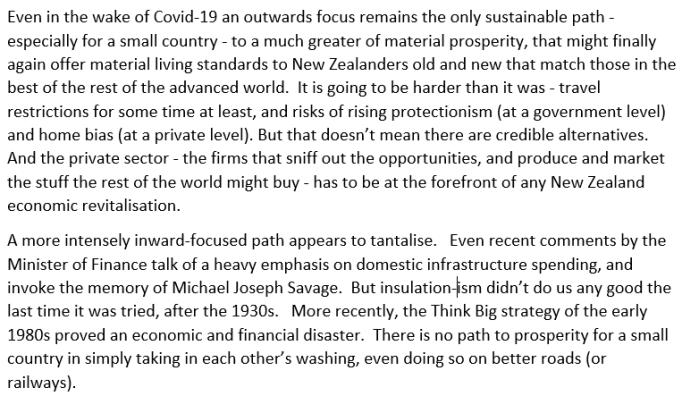
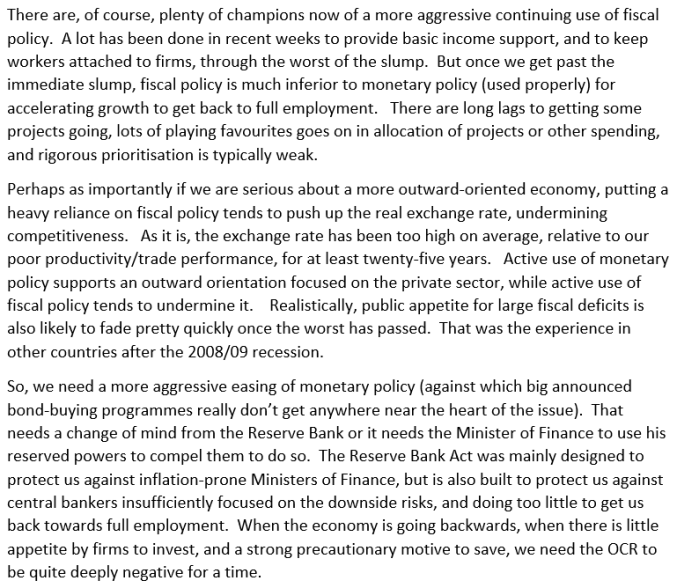
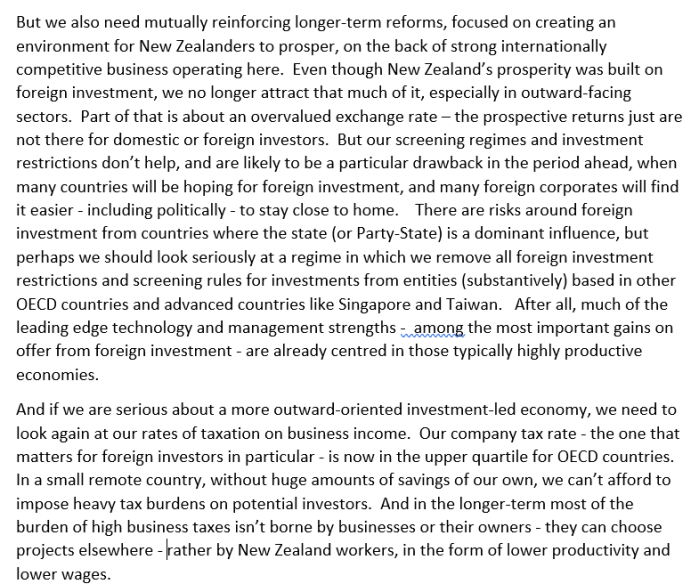
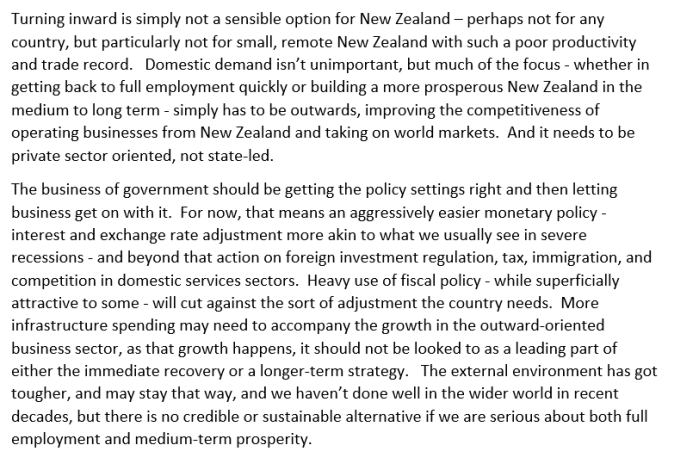
At the end of my post yesterday morning I noted briefly
Of course, if Labour’s approach is bad, at least (being the government) it is on the table. It is now less than two months until voting starts and we have no idea what National’s approach might be, but no reason to suppose it would be materially different or better.
Within a couple of hours we had a plan from National, or at least what Todd Muller describes as “the framework for the party’s Plan to create more jobs and a better economy”. Just like the Prime Minister, he has a five-point plan, outlined in a speech given in Christchurch yesterday. If you want the potted version there is even a one-page graphic.
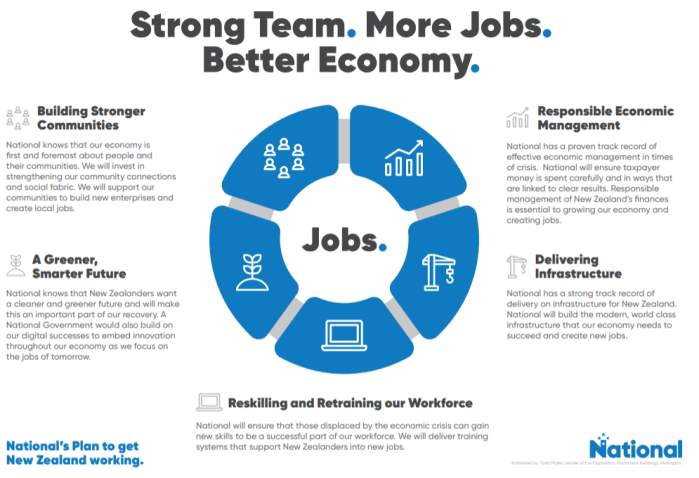
I was no more impressed than with Muller’s previous speech, although at least he has dropped the (historically ill-grounded) paeans to Michael Joseph Savage. There still seems to be a great deal of me-too-ism about it: we’ll be just like Labour only more competent. If he has values and a political philosophy, they seem to bear little or no relationship to those the National Party was built on. It is the sort of speech any (losing) centrist Labour Party leader could have given.
It is explicitly an economic speech, but there was no obvious economic framework, no sign that he or his advisers had thought hard about what has ailed the New Zealand economy for a long time, about how National might fix it, and how that might tie together with the immediate recovery needs (having been accused by one commenter yesterday of being an “armchair theorist”, here was my post-Covid note on such issues).
Anyway, to step through the speech. First, there was the flawed framing.
According to the Reserve Bank, New Zealand faces its worst economic downturn for 160 years. I don’t think the magnitude of that has yet sunk in to the public or the media. That’s partly because, these past few weeks, everyone has quite rightly been more preoccupied with the shambles at the border and in our quarantine centres. But, if the Reserve Bank is to be believed, ahead of us lies the greatest economic and jobs crisis that anyone in this room has ever known.
Even though the fall in the GDP in the month of April was absolutely huge – could we have measured it, perhaps 40 per cent – no one supposes that what lies ahead is worse than New Zealand’s experience of the Great Depression. Most likely, what we face is something more like, perhaps a bit worse than, the severity of the late 80s and early 90s. That’s quite bad enough.
And a scale of loss and dislocation that National, at least in this framework speech, appears to have no answer for.
Thus, we learn that they are quite happy with macro policy as it stands and don’t appear to think the Reserve Bank needs to be doing anything more (than the little they have done so far). And we get rather florid rhetoric on fiscal policy, supported by (it appears) nothing.
Since the Fiscal Responsibility Act, the economic and political debate in New Zealand has tended to be on the quantity of borrowing or debt repayment each year. These remain critically important. Getting back to fiscal surplus and then paying down debt to 20 per cent of GDP is necessary, not least because New Zealand will inevitably confront another natural, economic or health disaster in the next couple of decades or beyond. But just as important is to focus on the quality of spending.
Labour forecasts net core debt will reach 53.6 per cent of GDP in 2024 under their policies. That’s an eye-wateringly high level. We will work hard to try to keep it lower than that, which would put New Zealand in a better position to recover. But of far greater longer-term importance is that Labour projects that under its policies, but with a far stronger economic environment than we face today, net core debt will still be as high as 42 per cent by 2034. That means Labour intends a mere 11 per cent reduction in net core debt, over a decade. At that rate, we will not get back to the safe 20 per cent mark until perhaps the mid-2050s.
National does not regard Labour’s attitude as anything like prudent. It would leave an enormous debt, not so much to our children but to our grandchildren. And it would leave our children and grandchildren – and also ourselves – profoundly vulnerable were the global economic and strategic outlook anything other blissful for three successive decades. Covid-19, the trade war between the US and China and this city’s recent history all say that is not a safe bet.
There aren’t many specifics there but Muller is clear that National would be spending less (not necessarily a lot less, but less) than Labour, so that source of support for a faster demand recovery is apparently off the table. He plays up the debt numbers but never mentions the large assets (NZSF) on the other side, which mean that even the peak debt numbers would last year have put us among the less indebted half of the OECD. He never engages at all with the possibility that lower long-term interest rates might – just might – make a higher long-term debt ratio sensible. And, of course, there is no hint of when he expects to get back to 20 per cent of GDP, or on what sort of path.
(To be clear, I am not a fan of high levels of public debt, but on a proper measure we’d peak at around 40 per cent of GDP even on this government’s numbers. And like most rhetorical fiscal hawks in the current context, he offers no other path for a prompt return to full employment).
And then, of course, there is the question of how seriously to take the talk of future fiscal restraint. There was this, for example,
Let me tell you what that means in practice. In 2020/21 and 2021/22, my Government will not be scared of investing more in retraining, if we are confident it will genuinely improve productivity, lower unemployment, increase the tax take, reduce the cost of welfare and improve wellbeing over the following decade. My Government will not be scared of investing over the next decade more in the first 1000 days of life, if we are confident it will improve outcomes from the school system for a generation. Similarly, social housing and mental health. Nor will my Government be afraid of investing more in roads and public transport, if we are confident they will still be improving New Zealand’s productivity 50 or 100 years hence. And my Government will not be afraid to invest more in water storage or carbon-replacement technologies, if they will support higher living standards and greater wellbeing on an even longer timeframe.
It would be surprising if a public transport project now were boosting productivity 100 years hence, but you are left wondering what Muller wouldn’t be spending on.
Now, to be fair, he tells us there will be a series of major speeches outlining details of the five point plan. But the gist – what was in yesterday’s speech – wasn’t encouraging, Of their headings
Responsible Economic Management consisted of nothing but rhetoric. We can probably all agree that quality of spending matters, but there is little in National’s track record suggesting they’ve done much better on that in the past (just different specific waste) and – more importantly – no clue as to why we’d think they’d better in future. Labour has been spraying money at favoured entities in recent weeks, but which ones (specifically) is National opposing?
Delivering infrastructure had this promise
Before the end of this month, I will announce the biggest infrastructure package in this country’s history. It will include roads, rail, public transport, hospitals, schools and water.
My heart sank somewhat. A new and different Think Big? But lets see the specifics.
Muller boasts of delivery, but wasn’t it the previous National government that put in place the contracting structure for Transmission Gully. And I’m always a bit surprised at National using the Christchurch repair and rebuild process as a plus.
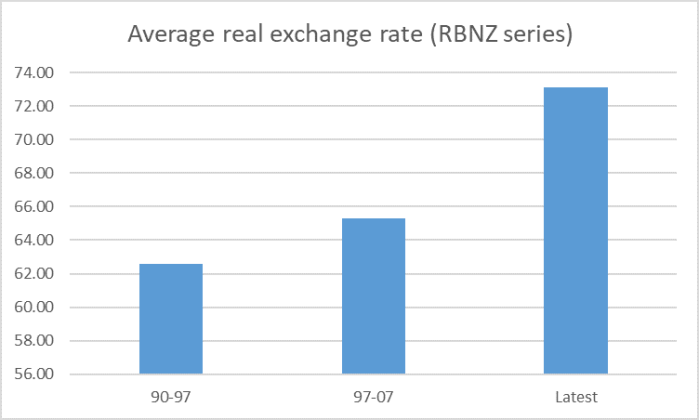
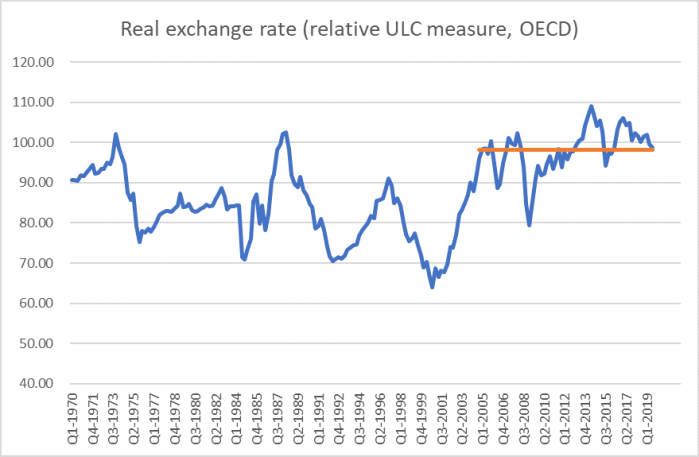
Reskilling and retraining our workers is flavour of the day (it was a big part of the PM’s speech the other day too), this time with rhetoric about capturing something called the “Creativity Wave” in the 2020s. But from a party offering no more macro stimulus to demand (see above), uninterested in our high real exchange rate, and (previously) opposed to fees-free it all has the feel of rhetoric and displacing headline unemployment figures at present. When there are jobs on offer, firms and individuals tend to invest in the skill development required.
A Greener, Smarter Future may be good political rhetoric, or the sort most Labour ministers could have delivered, but seems about as empty. This section concludes thus
National’s vision is of a post-Covid economy that is greener, smarter and better than the one we had before.
Sounds fine, but what (specifically) is the government’s role in getting there, and what is National proposing to do to give us some hope of achieving all this environmental stuff while also reversing the decades-long decline in relative productivity? Nothing was on offer in this speech.
And finally, there was
Building Stronger Communities. I’m sure Muller is genuine about some of this, but what of this gratuitous line
Every community needs strong community institutions to maintain and enhance their social capital. Many of those institutions were damaged a generation ago, and I don’t believe they have been repaired.
Another opportunity for Muller to have a go at the reforms instituted by the 4th Labour government and by his own mentor and former boss Jim Bolger? So the decline of churches, sport clubs, Scouts and Guides, marriage and so on is down the evil reforms of the 80s and 90s is it? If so, which of those reforms does he think specifically contributed and which is he proposing to undo? Of course, the answer to the latter question is “none of them”. It is just shallow opportunistic political rhetoric.
I don’t really disagree with Muller that
our opponent doesn’t believe in having a plan, hasn’t delivered on her promises, and has a track record of failure across the board.
But when he claims
Ladies and Gentlemen, in the end, I have a very simple message for you and all New Zealanders this election campaign: National has a plan to rebuild our communities and our economy, to get Kiwis back to work and to deal with the economic and jobs crisis.
There was nothing at all in the speech to lead any reasonable observer to think it was so. Perhaps those future “major speeches” will give us something concrete, as part of a serious well-thought-out strategy that links the immediate challenges with the longer-term deep-seated problems in the New Zealand economy. But on what we’ve seen so far, I wouldn’t be optimistic about that.






 croaking cassandra