Eden Park advertisers and the NZ tradables sector

My wife and son were watching the rugby test on Saturday evening but, not being overly interested in rugby, I started paying attention to the companies that were advertising at the ground.

All Blacks tests are one of the international showcases of New Zealand, with a substantial overseas broadcast audience.  And that particular test was against the Wallabies, and Australia is the largest export market for New Zealand firms’ goods and services.

I can’t be sure I jotted down all the advertisers: I was dependent on the camera angles Sky showed and I wasn’t paying rapt attention to every second of the game.

But these were the companies/brands whose adverts I thought I spotted:

AIG,  Adidas, American Express, Ford, Mobil, Asteron Life, DeWalt, Stihl, KitKat, Gatorade, Kia

Kennards, Owens, Resene, ASB, Pacific Build Supply, Bedpost, Barfoot and Thompson, Drymix, Rebel Sport, G.J. Gardner, Steinlager, Air New Zealand, Mainfreight and Zestel Gum (yes, I had to look up that one) and Auckland (Council or a CCO).

So I noted 26 advertisers.  One was a local government agency.  Of the remaining 25, 11 were overseas firms/brands, selling into the New Zealand market and in other countries.

It was the other group of firms/brands that interested me.  Of them, as far as I could tell only two were New Zealand based internationally-oriented firms: Air New Zealand, and Mainfreight (which now has substantial overseas operations).  And Air New Zealand, while currently very successful, collapsed only 15 years ago, remains majority state-owned, and one assumes its continuing independent status largely depends on the heavily regulated nature of the international airline and landing rights market.

I gather there are some reasonable substantial exports of Steinlager, but then Steinlager is a product/brand now produced by a Japanese-owned company.

Perhaps on another occasion a rather different mix of companies would have been advertising, and the New Zealand based ones might have been a more outward-oriented group.  But in microcosm, it did seem to capture something of the strangely-imbalanced New Zealand economy, struggling to make inroads in international markets or against international competition.

That phenomenon is nicely illustrated by my regular chart showing tradables and non-tradables components of GDP (recall that primary production and manufacturing, and exports of services make up “tradables” –  and the rest of GDP is non-tradables).  It is only a rough indicator, but it seems to have told quite sensible, intuitively plausible, stories.

T and NT GDP oct 16.png

In per capita terms, tradables sector GDP is still lower than it was on average in the first eight years of the 2000s (prior to the recession). In fact, the peak in the series was way back in 2004q2.  There has been no sustained growth in average per capita tradables sector production for 15 years.

That shouldn’t really be very surprising.  With able people and fairly good institutions, still the main thing New Zealand has going for it, as location for internationally-oriented businesses, is the natural resources that are here.  And when the population increases as rapidly as it has in the last 15 years, with no major new natural resources to tap, and with sustained upward pressure on the real exchange rate, it is hardly surprising that there has been so little (per capita) tradables sector growth.

Or so few successful outward-oriented New Zealand firms to advertise to the world from Eden Park.


Does Australia really need “the English influence”?

I’ve been intrigued for some time by the way in which some Australian business and media leaders seem to think that New Zealand –  perhaps especially under the stewardship of the current government – is a model of governance and economic management to be emulated.  Indeed, when it suits, this idea even reaches all the way up to some politicians.  On the day of his successful party-room coup to topple Tony Abbott, Malcolm Turnbull declared

“John Key has been able to achieve very significant economic reforms in New Zealand by doing just that, by taking on and explaining complex issues and then making the case for them. And I, that is certainly something that I believe we should do and Julie [Bishop] and I are very keen to do that again.”

As I noted in a post at the time, the list of “very significant economic reforms” was so short I couldn’t think of any.

What puzzles me more is when senior New Zealand commentators buy into the same story.  Fran O’Sullivan’s column in the Herald yesterday, “Oz needs the English influence” seemed to do exactly that.  It is interesting to know how some influential Australians see the New Zealand story, but O’Sullivan seems to share the belief, noting that our economic performance is “something to skite about when it comes to transtasman rivalry”.

Of course, everyone knows Australia has its problems.  They still have a federal government budget deficit, and we don’t. The Prime Minister has changed so often in the last decade, it must almost look familiar to Italians. And in Wayne Swan and Joe Hockey, they’ve had a couple of Treasurers who didn’t command much respect.  And Australia is coming off the back of a massive mining investment boom –  in many respects a nice problem to have, and in contrast to the lack of much of market-led export-oriented business investment boom in New Zealand any time in recent decades.

And, of course, if the National-led governments of the last eight years have all been minority governments, John Key and Bill English mostly seem to have managed the politics quite adeptly: they are still in office, and look to have a reasonable chance of winning again next year.  And English is a thoughtful Minister of Finance, even if not one with much of an economic plan.

But one can always find thoughtful individual ministers –  I recall reading speeches by Craig Emerson, a minister in the Rudd/Gillard governments and a former senior public servant, and wishing we had ministers who could give such thoughtful and rigorous speeches.

And Federal systems, and bicameral Parliaments, are just harder to manage –  but not necessarily worse for it – than the New Zealand system.

My benchmark remains the numbers.  It is no secret that GDP per capita (and all variants on it) is much higher in Australia than in New Zealand.   That has been so for at least 40 years.  It is the reason why lots of New Zealanders move to Australia, and only a small number of Australians come to New Zealand.

But I guess that in thinking about the Australian Key-English admiration  the focus should really be on how the data have changed in the last few years.  Has the vaunted Key-English style and substance succeeded in changing direction, closing the gaps between New Zealand and Australia?  After all, John Key was once quite explicit that his goal was to close the income gap between New Zealand and Australia by 2025.

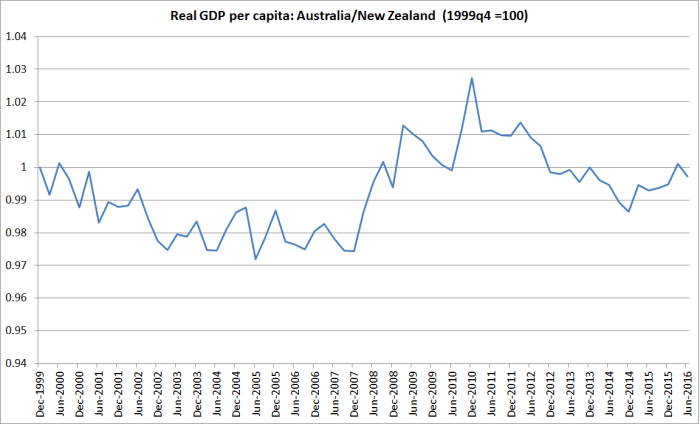
Here is the headline comparison, looking at real GDP per capita
gdp-pc-aus-vs-nz

On this measure, Australia was doing slightly less well than us during the previous boom.  They did much better than we did through the recession and the peak of the terms of trade boom.  And over the last few years, things have settled back again.  For the whole period –  this century to date –  New Zealand and Australian per capita GDP have grown at much the same rate.

New Zealand and Australian governments have almost no control over the respective terms of trade for their countries, and those series are quite volatile.  But if you dig into real per capita income measures (which take account of terms of trade fluctuations), New Zealand has done slightly better than Australia over the century to date.

But that seems to me to be about the absolute limit to the favourable story.

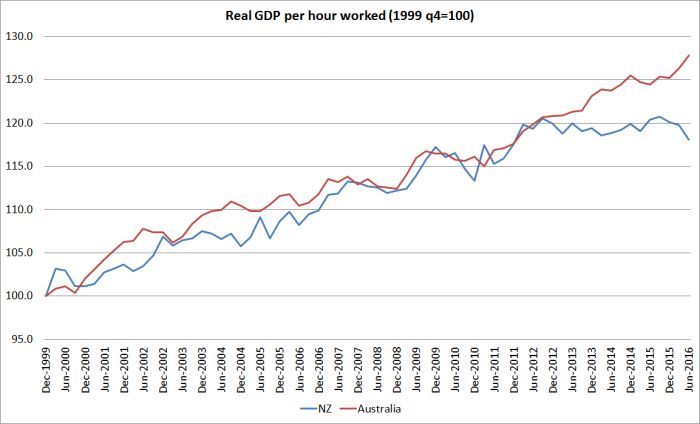
What about productivity growth, the foundation for sustained long-term prosperity?  Here is labour productivity
gdp-phw-nz-vs-aus

You can discount the very last New Zealand observation (on account of a break in the hours worked series, when SNZ updated the HLFS methodology).  But it isn’t exactly a picture which reflects well on New Zealand over the last few years (and especially the years when both countries have had centre-right governments).  In fact, the New Zealand numbers are so bad one half suspects SNZ might eventually revise some of the weakness away.  But in the meantime, no obvious advantage to New Zealand.

We’ve managed not to lose any more ground relative to Australia on GDP per capita. but only by working even more hours.    Here are Australia’s hours worked and population data
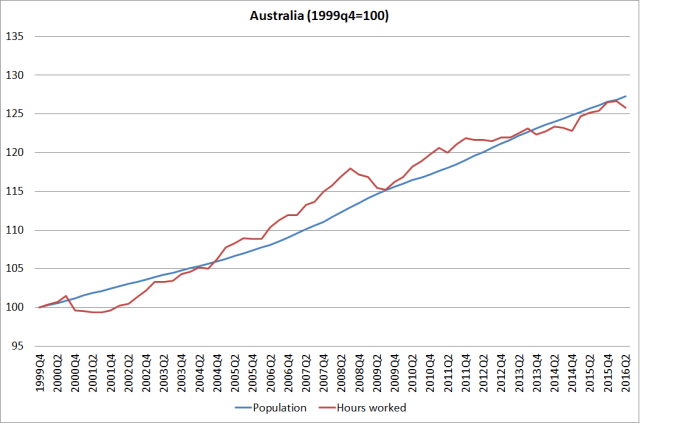
aus-popn-and-hours

And here is New Zealand, on exactly the same scale (and again, discount the very last hours observation).

nz-hours-and-popn

Of course, there is nothing wrong with working longer hours if that is what individuals choose, but for whole economies it isn’t usually a sustainable path to greater prosperity.  And while productivity gains are pure benefit, longer working hours –  especially with little or no productivity growth –  is mostly just a cost.

In some areas, New Zealand does typically do better than New Zealand.  Our labour market is less heavily regulated than Australia’s –  and much less subject to union corruption –  and, as a result, our unemployment rate is typically a bit lower than Australia’s.  Here are the two unemployment rates over the last few decades.

u-aus-and-nz

Right now, the gap between the two unemployment rates –  0.6 percentage points –  looks about normal.  But for much of the current government’s term what was striking was how high our unemployment rate lingered (and above Australia’s for several years).  It isn’t obvious that any special credit is due to the current New Zealand government.

But what about government finances?

It is certainly true that our central government has a modest surplus, while the Australian federal government is still in deficit.  But recall that Australia has a federal system, and the state budgets make  up quite a large proportion of overall government spending and revenue.  International agencies tend to focus on “general government” data –   central, state (where relevant) and local government.  Cyclical adjustment also matters.

Here is OECD’s latest estimates of the cyclically-adjusted general government estimates for the two countries.

net-lending-aus-and-nzAlmost indistinguishable not just now, but over most of the last 20 years.  I’m not sure I’m totally convinced, but that is the OECD’s read.  Again, nothing that particularly stands out to the credit of English/Key relative to Australia.

And here is the OECD data on government debt (net liabilities, across all three tiers of government) as a share of GDP.
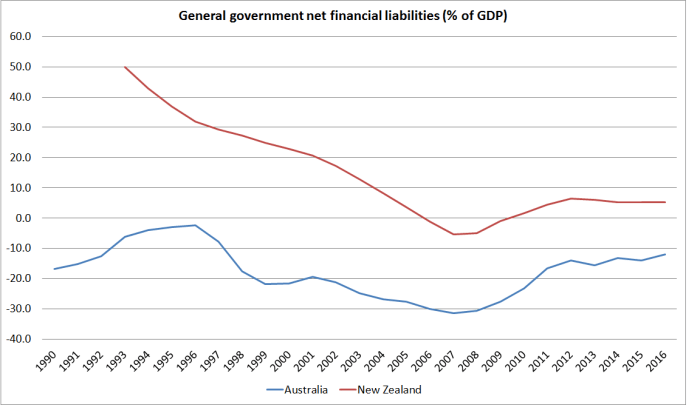
gen govt net debt.png

New Zealand governments did a great job getting net debt down in the 90s and 00s, but  New Zealand’s net debt is still higher than Australia’s.  Since the last pre-recession year, 2007, Australia’s debt has increased more than New Zealand’s (share of GDP).  That probably is to the credit of Key/English, especially given some of the earthquake fiscal pressures, but on this measure, Australian governments’ net debt is still a bit less than ours was in 2007.

Business leaders also tend to believe –  as I do –  that, within limits, smaller government and lower taxes are conducive to better long-run productivity growth.  Stability in the share of GDP spent by government is also generally thought to matter (reducing uncertainty about future tax rates).

Here is general government spending as a share of GDP.

gen-govt-disbursements-aus-and-nz

Not only is Australian government expenditure lower as a share of GDP, but it is more stable.  And the gap between those two lines has not narrowed over the Key/English years; if anything it has widened.

And here is the picture of revenue

gen-govt-receipts-aus-nz

There isn’t much of a story about variability –  really big terms of trade fluctuations generate a lot of revenue volatility – but again Australian government revenue (mostly taxes) is consistently materially lower than that in New Zealand.

So I’m still a bit puzzled why the Australian business people and commentators seem so taken with the New Zealand story. There is (almost) nothing there. No serious reforms and (to the extent any disagrees with that assessment) no significant productivity growth. No sign of the gaps closing.   The size of government is bigger here, but then it has been for a long time.  And, more positively, the unemployment is a lot lower here, but again current numbers aren’t out of line with past patterns.

I presume much of it just comes down to two things:

  • whenever elites in any country are discontented with their own governments, it is easy to contrast them with some other group of politicians (whose own record is rarely examined closely) over the water,
  • the National-led government has been able to count (law changes it proposes mostly happen, and the details of the languishing RMA reforms are no doubt lost on opinion formers in Australia).  But then it is great deal easier to “count” here, where typically National needs one or two votes from parties it has longstanding confidence and supply agreements with.  It is just harder in Australia, between the role of the states, a governing bloc that is itself a coalition of the Liberal and National parties (National MPs having no say in who is Liberal leader and PM), and the Senate where it is rare for any party to be able to command a stable majority.

John Key and Bill English might be more successful politicians than Rudd, Gillard, Abbott, and Turnbull: the New Zealanders have won three elections, and the Australians have won only one each, and the first three have then been ousted by their own parties.

Perhaps that sort of political stability/political success has its own appeal in certain circles, but if we are judging political leaders by their fruit, there is still nothing much about the New Zealand economic story that should prompt any envy in the eyes of our trans-Tasman neighbours.  Sadly……still……after decades and decades.

Rugby might be another matter, but then I’m a cricket fan.


Productivity growth: how have we been doing?

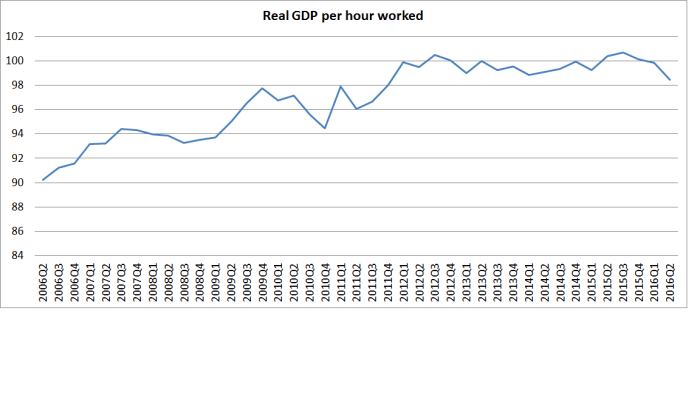
A few weeks ago I ran this chart, showing quarterly real GDP per hour worked for New Zealand for the last decade or so.  I used an average of production and expenditure GDP, and HLFS hours worked data.  The rather dismal picture was of no productivity growth at all for the last few years

real-gdp-phw-oct-2015

Comparable quarterly data isn’t readily available for a wide range of other countries, so for such comparisons one is forced back onto annual data from international databases such as the OECD’s.    And the international agencies take a while to get a full set of annual data –  thus, New Zealand’s annual national accounts for the year to March 2016 (used as the basis for the OECD’s 2015 annual numbers) won’t be released until next month.  We aren’t the only laggard –  for a third of the OECD countries there are only 2014 annual numbers available.

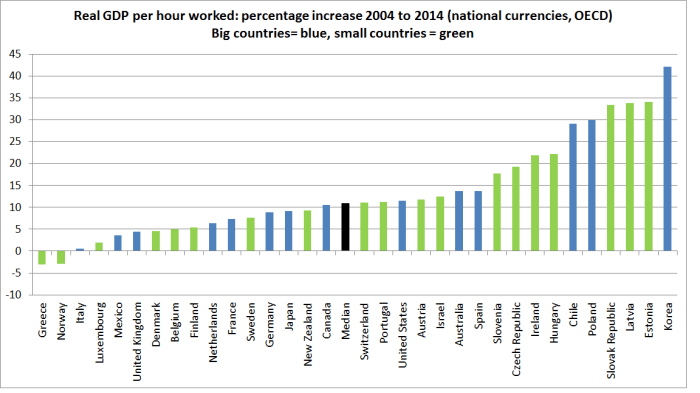
So how has our (labour) productivity growth compared with that of other OECD countries over, say, the decade to 2014?  Taking a decade is (like all such comparisons) a little arbitrary, but it should be long enough to largely eliminate the effects of year-to-year volatility.  And a comparison starting in 2004 and ending in 2014 means starting before the peak of the last boom, and ending when the worst of the 08/09 recession and the euro crisis was over (well, perhaps with the exception of Greece).

gdp-phw-oecd-oct-2016

I’ve highlighted New Zealand (in red) and the other Anglo countries (in green).  The median growth rate for this set of countries is a couple of observations to the right of New Zealand.   Note that I am using (real) national currency measures here.  If one wants to compare income or productivity levels across countries, one has to use PPP-adjusted measures.  But in comparing growth rates, the OECD recommend (sensibly) using national currency measures.

New Zealand’s performance hasn’t been notably bad by any means –  just a little below the median.  But then the goal has supposedly been to grow a bit faster than the other advanced countries, to close the large gap between productivity and incomes in New Zealand and those elsewhere in the OECD.  And in fairness, most of the countries to the far-right of the chart have lower levels of productivity than New Zealand –  so they are also trying (and succeeding in their case) in catching up.  But New Zealand couldn’t even quite match the productivity growth rates of the other Anglo countries –  traditional comparators.

Sometimes one detects a sense among people writing about New Zealand that small countries face a particular disadvantage, and that small countries couldn’t be expected to sustain as rapid income or productivity growth as large countries.   Taking a longer span of data, I had a look at that proposition in a post last year. There didn’t seem to be much, if any, support for the idea that big countries get rich faster.

But what about the last decade?

Here is same chart

real-gdp-phw-oecd-oct-16-big-vs-small

I’ve drawn the line no doubt a bit arbitrarily.  Netherlands has a population of around 17 million and it and all larger countries are “big”.  Other countries, with populations of 11 million or less are “small”.  If anything, the small countries have done slightly better than the large countries over this particular period, but the difference is not enough that I’d want to make anything of it.  But the message is still the same: New Zealand hasn’t done particularly well, and plenty of small countries have done better.

The OECD’s database goes back to 1970, but they only have full data for 21 countries (including New Zealand for that period).  Over the full period, we had the second slowest productivity growth of those 21 countries.

real-gdp-phw-1907-to-2014

And once again, the small countries and large countries are scattered either side of the median.

Over the last decade, we have actually grown very slightly faster than the median of these particular 21 countries. It has been our least bad decade since 1970.  But I wouldn’t take much comfort from that: (a) the difference was slight, (b) we grew a bit less rapidly than the whole OECD median, and (c) on our own more recent data (see first chart) we’ve had no productivity growth at all in recent years

Boosting exports: the exchange rate really matters

I noticed the other day a short piece on Treasury’s blog, written by one of their very able analysts, Mario di Maio, headed “How to get an export take-off“.  It appeared to be prompted by the government’s now long-standing target to raise the export share of GDP by 10 to 15 percentage points by 2025.  As I’ve noted before, the general sentiment behind the goal is probably broadly sensible –  successful economics typically trade more (imports and exports) with the rest of the world.  After all, the rest of the world is where the bulk of potential customers/suppliers are.  Of course, the problem with this particular goal is that (a) it doesn’t look as though it is going to achieve itself (good bureaucratic technique can include setting goals for things that were likely to happen anyway, and then claim the credit when they do), and (b) the government is doing absolutely nothing to bring about the sort of transformation of the economy that might reasonably be expected to lift the export (and import) share of GDP.  It is an old line, but no less true, that it is pretty crazy to keep on doing the same old thing, and expecting a different result.   So perhaps they don’t really expect a different result….and perhaps they don’t even care greatly, as by 2025 no doubt the government will have changed, perhaps more than once, and Key, Joyce and English will be doing something else (as Clark and Cullen –  who had similar vague aspirations –  are now).

The Treasury note is worth reading. It takes a quick look at some countries (all now advanced) that have achieved a 10 percentage point increase  in 10 years in the export share of GDP over the last 50 years or so.  The author finds 14 such countries, and has a quick look for any common factors.  Perhaps not surprisingly –  in a note of three pages of text – he doesn’t find many.  Indeed, he goes so far as to conclude

The diversity of the case studies cautions against drawing simple policy lessons from other countries for any New Zealand strategy to lift trade intensity. The diversity of approaches and circumstances means any single policy (or policy mix) would be misleading.

Personally, without a lot more background analysis –  and perhaps Treasury has done the analysis but just not published it – that seems too strong a conclusion.  If one were uncharitable, it could be seen as tending to avoid the real issues that specifically help explain New Zealand’s underperformance.  But perhaps that wasn’t the intention at all, and all they really mean is that we have to think hard about the specifics of New Zealand, and not simply latch onto one or other favoured overseas country as an example. If so, I agree.

I’m not going to use this post to pick at specific points in the Treasury note, but wanted to come at a similar issue in a slightly different way.

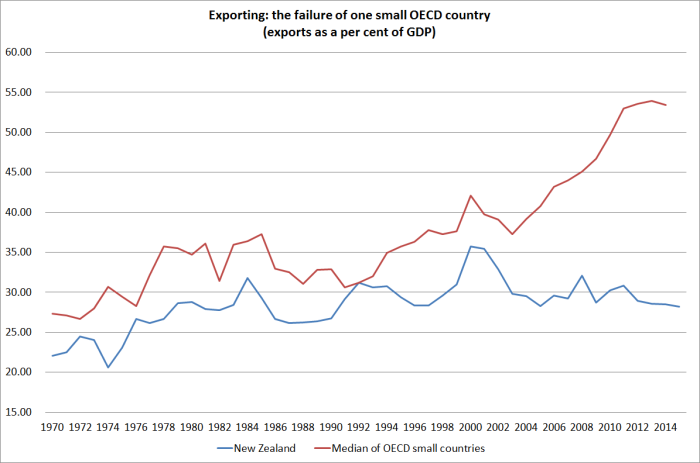
But first, lets remember quite how underwhelming New Zealand’s international trade performance has been.  This is a chart I ran a few months ago, comparing New Zealand and other small OECD countries since 1970.

exports small countries

The foreign trade share of GDP has gone basically sideways for almost 40 years.  It is hard –  but not impossible –  to get ahead with a performance like that.

I usually use OECD data –  as in the chart above –  but the Treasury piece used the World Bank data, which has some advantages in capturing a wider range of countries.  For some countries, and aggregates, they also have data going a bit further back.

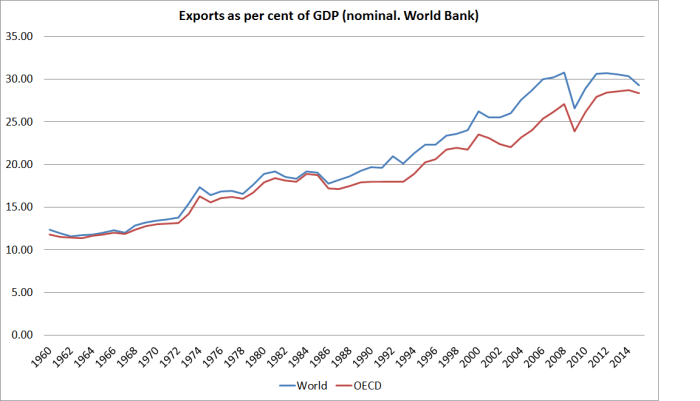
Here is the World Bank’s estimate of exports as a share of GDP, for the whole world and for the OECD, back to 1960.

exports-as-share-ofg-gdp-world

Over the 40 or so years when the export share of New Zealand’s GDP has barely changed, that for the OECD and the world as a whole has increased by between 10 and 15 percentage points.  The trend –  world, and advanced countries –  has been strongly upwards, and somehow we’ve managed to defy that trend.    Not all of that growth has been in export value-added, some has been the rise of global supply chains and the increased cross-border trade in componentry –  something that is never likely to be a feature of remote countries’ trade –  but that isn’t the bulk of the story by any means.

From the World Bank’s data, I picked out the advanced countries (OECD plus a few others), the emerging Asian countries, and Latin American countries (the latter mostly because they fascinate me, but also because they add a large number of countries that have underperformed for long periods).  The official New Zealand export data start in 1971, so I had a look at how the export shares of the countries I had data for had changed from 1971 to 1975 to 2011 to 2015.  Using five-yearly averages gets rid of some of the noise that arises from short-term exchange rate or commodity price fluctuations.  Data don’t go back that far for most of the former Communist countries of Eastern Europe, but I was still left with a sample of around 45 countries.

Over that period, New Zealand’s export share of GDP had increased by 5.9 percentage points.  Nine countries had had less growth in their export share than New Zealand.

Change in export share of GDP : 1971-75 to 2011-15  (percentage points)
Costa Rica 5.70
South Africa 5.00
Japan 4.80
Brazil 4.30
Guatemala 3.70
Israel 2.90
Norway 2.80
Colombia 2.50
El Salvador -3.50

Of those countries, only Norway could be counted as am unambiguous economic success story over that period.  All the others –  like New Zealand –  were underperformers at best.  One might make an exception for Japan –  until the late 1980s its economic performance was very strong – but then it is also worth remembering that at the start of the period exports as a share of GDP in Japan were only around 10 per cent of GDP (less than half of the export share in a small country like New Zealand).  Over the period since the early 1970s, Japan has increased the export share of GDP by almost 50 per cent (from around 10 per cent to around 15 per cent) while the increase from New Zealand has been only around 25 per cent.

The Norway experience is a reminder that a large export (and import) share of GDP is not a necessary conditions for a sustained acceleration in economic (and income) growth.  Then again, countries can’t count on discovering a huge new extremely valuable natural resource as a basis for improved prosperity.  Typically the path to prosperity involves firms finding products and services they can sell successfully to the rest of the world. We’ve failed on that count, and that shows no sign of changing.

Although Treasury seems to want to play down the importance of the real exchange rate, I think that in the New Zealand context it is much more important than they suggest.   One can never sensibly think of the real exchange rate is isolation from what else is going on in the economy.  A country with fast productivity growth might find that its export share of GDP is growing even as the real exchange rate is high or rising –  such is, say, the quality of the products or services firms in that country are selling.

But as everyone knows, New Zealand’s productivity performance over decades has been lousy, among the very worst in the advanced world.  Sure we have a few years from time to time when things don’t look too bad, but the multi-decade pattern of underperformance is clear and shows no sign of reversing.  Against that backdrop, it seems not just plausible –  but entirely reasonable –  to suggest that a real exchange rate that has been high or rising (rather than weak and falling) will, in the specific context of New Zealand, have been the main proximate contributor to the weak foreign trade performance (exports and imports).

I ran this chart recently.  It only goes back 20 years, but over longer periods the picture is much the same.  Our relative productivity performance deteriorated, but our exchange rate didn’t sustainably fall.

real exch rate

That sort of pattern typically happens only when some sort of domestic demand pressures keep holding up the real exchange rate (and domestic real interest rates).  In a country with a modest national savings rate, government policies that result in rapid population growth are an example of just such a pressure.   It is hard to foster an environment in which exporting is profitable/attractive when so much resource constantly needs to be devoted to meeting the (individually entirely reasonable) needs of a rapidly growing population.

Of course, “the exchange rate” can’t be fixed in isolation.  It is a symptom of what else has gone wrong with the policies of successive governments.  But like the old canary in a coal mine, the persistently strong exchange rate –  in a country of such persistently weak productivity growth –  is supposed to be a warning signal that something about economic policy is very wrong.

But why would we be surprised that nothing changes?  The Opposition appears to have no compelling analysis or ideas, and we have a government run by a Prime Minister who in a recent interview declared that

Where would chairing the UN Security Council rank in your career highlights?

Right up near the top

I guess when there have been eight years of no substantive economic reform, no progress in improving the relative performance of the New Zealand economy, no progress in reversing decades of relative economic decline –  just the pretence that somehow we are a global economic success story –  we shouldn’t be surprised that chairing an ineffective meeting of foreign officials and ministers, dealing with an intractable problem in a far-away land, counts as some sort of career highlight.

Young New Zealanders, facing unaffordable houses, and  the prospect of growing up in a country slowly drifting ever further behind, might perhaps have hoped for something rather more tangible rather closer to home.


Envy of the world, or middling at best?

Over the last couple of months I’ve lost track of the number of comments I’ve seen, from outlets that really should know better, suggesting that New Zealand’s economy at present is the envy of the world.  Radio New Zealand’s Checkpoint seems a particularly egregious offender, but that might just be because I often have it on while I’m making dinner.  But I’ve seen similar lines in the Herald, from Business New Zealand and a variety of other outlets.

The people running this line, when they aren’t just running propaganda, seem constantly to lose sight of just how much of our real GDP growth –  itself not that impressive by the standards of previous growth phases –  is accounted for by our very rapid population growth, in turn the result of our large (but fairly stable) inward immigration programme, and the reduction in the net outflow of New Zealanders.

Quarterly real per capita GDP data isn’t easily available for many countries, but the other day the IMF released its latest World Economic Outlook.  I had a look at how New Zealand is estimated to have performed over 2013 to 2016 relative to the IMF’s set of advanced countries.  Over this period, only two of these countries –  Israel and Luxembourg –  are estimated to have had faster population growth than New Zealand.

real-pc-gdp-growth-2013-to-2016-weo

Of course, we only have hard data to mid 2016, and even that will be subject to revision for some time.  But that is so for all these countries too.  Take the last three years together and New Zealand just doesn’t stand out.  It isn’t necessarily a bad performance (relative to other advanced countries over this period), but nothing much to write home about, absolutely or relatively.  And recall that we don’t exactly have the highest level of GDP per capita among these countries –  the aim, for decades, has been to catch up with the rest of the advanced world.  Over this three year period, we’ve made no progress at all.

We’ve had things working for and against us over that period.  The terms of trade have been high, but fell back quite a way from the peak, especially dairy.  We’ve had a significant boost to demand and activity from the Christchurch repair and rebuild process.  We’ve had a big (largely exogenous) boost to tourism, and a significant boost to export education.  We’ve had no constraints (other than self-imposed ones) on our ability to use monetary policy flexibly.  And we’ve had a massive boost to demand from the unexpected rapid growth in the population.  And yet, once again, we’ve made no progress in closing the gaps.

And, of course, our productivity performance in  recent years has been even worse.

real-gdp-phw-oct-2015No productivity growth at all in the last four years or so (even ignoring the last observation, where there is an unfortunate discontinuity in the HLFS hours worked series).
New Zealand the economic envy of the world?  I think not.

Chile: undermining the NBR editor’s own argument

Browsing on the NBR website yesterday morning, I noticed a headline: “Editor’s Insight: Migrant scaremongering will damage economy in long run”.   The headline didn’t exactly suggest fair and balanced reporting, but I don’t have an NBR subscription so didn’t pay it any more attention.

Later in the day someone showed me a copy of the text of the article.  In it, the editor of the NBR, Nevil Gibson, laments that

Hardly a day goes past when the anti-immigrant arguments aren’t being given the headlines and air time.  It has put government ministers on the backfoot as they attempt to justify New Zealand staying open for business.

Perhaps if there were evidence being produced of the benefits to New Zealanders of the large scale non-citizen immigration programme, that would be getting some air time too.  I’m sure ministers would be keen to use such evidence if it existed –  and the rest of us would be keen to see it.

Gibson singled out the interview with me in the latest North and South, noting of “the popular economic contention…that population growth has reduced per capita wealth, according to GDP figures”   that “these are quantitative but do not tell the full story of immigration benefits”.

Given that the non-citizen immigration programme is ostensibly driven by economic considerations –  recall MBIE’s phrase that it is a “critical economic enabler” –  I suspect most would settle for actually seeing evidence –  or even a compelling sense –  that per capita incomes of New Zealanders were rising over time as a result of the immigration programme.  But even Gibson seems to more or less accept that those benefits either don’t exist, or at least are hard to find.

Gibson devoted the final section of his article to a comparison between relatively high immigration countries –  New Zealand, Australia, and Canada, with passing reference to the much less open USA –  and Chile.

“Chile provides an example of an open economy like New Zealand’s but with a restrictive immigration policy.  It has fallen off the pace and Harvard-based Professor Ricardo Hausmann, a former planning minister in Venezuela, says the reason is the low proportion of foreign-born citizens”

Around 2 per cent of Chile’s population is foreign born, and the comparable figures for the other countries are New Zealand 28 per cent, Australia 27 per cent, and Canada 20 per cent.

Chile went through some pretty tough times in the 1970s and 1980s: very high inflation, military dictatorship, and severe financial crisis.  It was much more badly mismanaged than (then) heavily-protected New Zealand, even with the massive waste of resources that was Think Big, and a pretty bad financial crisis at the end of the 1980s.  And per capita incomes in New Zealand have always –  going back to first European settlement here –  been considerably higher than those in Chile.

But to read Gibson you’d expect to find that Chile was drifting ever further behind. Here is the relative productivity performance of the two countries, using the Conference Board’s estimates of real GDP per capita since the data begin in 1950.

chile and nz.png

On these estimates, 1990 was the best year for New Zealand relative to Chile.  We –  not Chile – have been in relative decline ever since.  As it happens, our current immigration programme has been in place since around 1990.

It isn’t just New Zealand.  Australia and Canada have also been losing a lot of ground relative to Chile, as has the United States.  Over the full 65 years, all those four high immigration countries have lost ground relative to Chile.

I’m not, repeat not, suggesting that the only factor explaining Chile’s pretty impressive productivity performance is the absence of a large non-citizen immigration policy.  Rather, I’d see it as an illustrative example of a point I’ve made many times previously: successful countries mostly make their own success, through the skills and talents of their people, the energy and dynamism of their firms,  the natural resource endowments they have, and the strength of their legal and cultural institutions.  Cargo cults –  “there is a better lot of people in other countries, if only we could get them here” – are not the answer.

Chile apparently hasn’t needed lots of foreign immigrants to put itself on a much better economic performance path.  And, by contrast, New Zealand –  in particular –  and Australia and Canada show few concrete signs of having benefited (and in particular of their citizens having benefited) from the large-scale non-citizen immigration programmes they’ve run for decades now.

So when Mr Gibson talks about a concern that lower non-citizen immigration might damage the economy in the long run, one has to wonder quite when he expects the tangible benefits for New Zealanders to show up.    It has been 71 years since World War Two ended and New Zealand restarted its large scale immigration programme (with an interruption between the mid 1970s and late 1980s).  We haven’t seen –  not even the advocates can’t point to –  the concrete economic benefits yet.  Perhaps I’m just an excessively cautious former bureaucrat, but I’ve rarely found the idea of just keeping on with a policy when, after several decades, there is no evidence of its benefits to New Zealanders a particularly attractive one.    It looks more like a pursuit of an “ideology”, without regard to the specific circumstances of our own country –  very remote, in an age when personal connections seem to matter more than ever, and strongly natural-resource based, suggesting little likelihood that lots more people would add much, if anything, to New Zealand’s medium-term productivity or per capita growth story.


Perhaps 20 more terms in office will be enough?

The ever-ebullient Minister of Economic Development (and a great deal else beside) Steven Joyce was interviewed on TVNZ’s Q&A programme yesterday, defending the government’s economic record.  Despite the efforts of the interviewer to pin him down –  including on the rising degree of unease even among some of those one might think of as “elites” about immigration policy –  Joyce put up a pretty forceful defence, often citing the Prime Minister’s mantra that if New Zealand has challenges they are ‘quality problems” or “side-effects of success”.  If one didn’t have access to the facts, it might even have sounded persuasive.

I was tempted to devote a lengthy post to the Minister’s claims, but I have other stuff I really have to finish today.  So apart from noting in passing New Zealand’s continuing lousy productivity performance (see the chart in this post), I wanted to focus on just two of the areas the Minister covered.

The first was around the skills of immigrants.  In June the OECD released the results of a fascinating multi-country study of the skills level of workers.  It suggested that the skill levels of New Zealand workers –  over several dimensions – were pretty high.  I wrote about it at the time, and summarized the high-level findings this way

Looking across the three measures, by my reckoning only Finland, Japan, and perhaps Sweden do better than New Zealand.    Perhaps there is something very wrong with the way the survey is done, and it is badly mis-measuring things, but those aren’t usually the OECD’s vices.  For the time being, I think we can take it as reasonably solid data.

As I also noted, the survey also looked at the skill levels of non-native born workers.  In almost every country, including New Zealand, the skill levels of immigrants were below that of natives.  Of course, in every country there will be many very able immigrants, but these are averages across the full samples of native born workers and immigrants.  As I pointed out, if your country (New Zealand) already had among the very highest skill levels in the world, and immigrants had less good skills, it didn’t lend much support to the idea that we needed lots and lots of immigration to lift the productivity of New Zealand workers, and make up for deficient skill levels at home.

But none of that stopped Steven Joyce introducing this same report in support of the government’s immigration policy.  How did he manage that?  Well, he correctly pointed out that New Zealand’s immigration policy is more skills-focused than those of most countries.  Unlike most countries, we have almost complete control over who we let in –  there isn’t a material illegal immigration problem –  and unlike, say, the United States (where legal immigration is mostly family-focused) we have an explicit economic/skills focus.  We may not do it well –  my argument –  but we are less bad, on that score, than most.

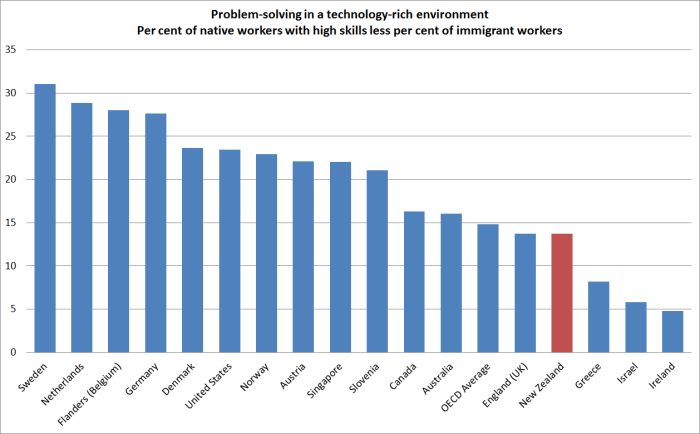
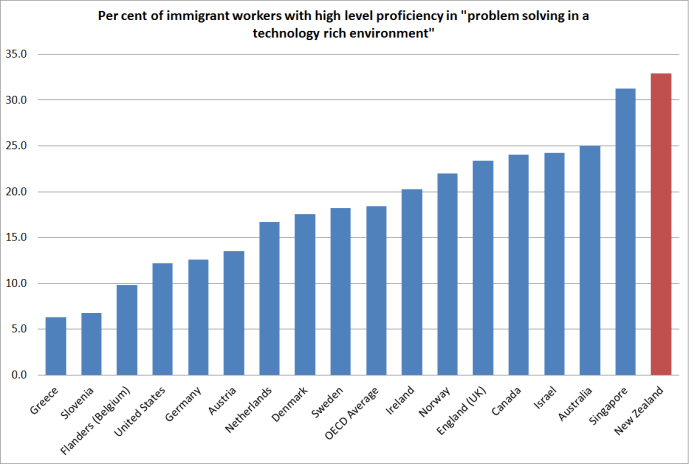
One might reasonably expect literacy skills of immigrant workers to lag behind those of natives –  after all, for many/most English isn’t their native language.  But the OECD survey also reports results for “problem solving proficiency in a technology-rich environment” (Figure 3.15 of the OECD report).  There are 28 countries/regions in the OECD study, but there is only data on the skill levels of immigrant workers for 17 of them (many of the other simply don’t have much immigration).

Here is the proportion of foreign-born workers with what the OECD calls relatively high level skills in this (problem-solving) area.

skills technology

New Zealand scores well here.  Our (really large scale) immigration programme seems to have done better in attracting people with these sorts of skills (and keeping out others) than most other countries have.

But remember that our overall workforce –  mostly native-born –  also has among the very highest level of skills of any of these countries. On this particular measure, we were top equal with Sweden.

So here is the gap between the skill level of natives and the skill levels of immigrants (again, on this problem solving proficiency measure).

skills gap

New Zealand doesn’t do too badly –  although Israel and Ireland stand out as clearly better –  but in every single one of these countries the skill levels of the average immigrant worker are less than those of the average native worker.  And this in an area –  the use of technology –  where the Minister often likes to stress the importance of immigration.  We don’t have the problems of Sweden or the Netherlands, but these OECD data –  which the Minister himself quoted in support of his policy –  just do not support the claim that our immigration programmes have been boosting overall skill levels in New Zealand.  If anything, those programmes have been a net drag.  As I’ve repeated many times, I’m not suggesting immigration never could boost skill levels –  or that there are not many highly-skilled individual immigrants (as there are many highly skilled natives) –  but our skills-focused programme, on the scale the government continues to stick to, just isn’t achieving that goal.  Perhaps with annual target of 10000 to 15000 non-citizen migrants (per capita, the same sort of rate as the US has) we might do so.

The interviewer also attempted to push the Minister onto the back foot over the government’s target for the share of exports in GDP.  The goal, announced several years ago, was to lift exports as a share of GDP from around 30 per cent to around 40 per cent by 2025.  I thought the formal target was daft and dangerous, even while sympathizing with the intuition that motivated it – small countries get and stay successful by selling lots of stuff, competitively, in the rest of the world.

As the Minister fairly noted, the base level of exports got revised in one of SNZ’s long-term national accounts revisions.  But that does not change the fact that exports as a share of GDP have been going nowhere.  It is all very well to blame low dairy prices –  as Mr Joyce sought to –  but on other occasions he’d be telling us just how well tourism and export education sectors were doing right now.

Here is chart of exports to GDP, going back to the start of the quarterly national accounts data in 1987. This time, I’ve also shown the average export share for each of the last three governments.

exports to gdp by govt

Plenty of things cause fluctuations in the series, and not many of them are under the direct control of governments.  Nonetheless, the average export share of GDP is materially lower under this government than it was under the previous government, and the latest observations are below even that average. Since the start of 2009, exports have averaged 27.7 per cent of GDP.  Under the previous National government –  one that first took office more than 25 years ago, that average was 27.5 per cent.  The government’s goal was to lift the export share by 10 full percentage points, and there is now only nine years left until the target date.  On performance to date –  and policy to date – we might be waiting several more centuries to achieve that sort of goal.

It is time Mr Joyce and his colleagues faced the fact that they are simply failing on this count.  A rather different approach is needed –  one which permits/facilitates a sustainably lower real exchange rate, orienting the economy more strongly towards investment in the tradables sector, and enabling more able firms to grow (and locate here doing so) by successfully selling to the rest of the world.  As I’ve noted before, per capita output in that vital outward-oriented part of the economy hasn’t increased at all for 15 years now.  It seems unlikely that that sort of reorientation will occur, all else equal, while we continue to bring in, as a matter of policy, so many not-overly-highly-skilled non-citizen migrants each year.

And finally, the interviewer introduced my name to the discussion as one of those skeptical of some of the government’s claims.  Mr Joyce suggested that I was among those who had predicted a large balance of payments blowout, thus apparently undermining the credibility of my arguments.  Of course, economists are pretty hopeless forecasters, so when an economist offers a prediction about the future one should (a) always take it with a considerable pinch of salt, and (b) wonder if the economist recognizes his/her own unwarranted over-confidence.  But in this particular case, I didn’t even recognize the forecast.  Since I’ve spent the last four years –  both inside and outside the Reserve Bank –  arguing against interest rate increases and for interest rate cuts, it would be surprising if I had been worrying about the current account deficit blowing out.  Demand has been consistently weaker than it should have been –  inflation has been below target, and unemployment has lingered above the NAIRU.  Whatever I’ve warned about, I’m pretty sure it hasn’t been the current account of the balance of payments.

(UPDATE: And, as a reader notes, as banks’ dairy losses mount there will be an almost one-for-one temporary reduction in (mostly foreign-owned) banks’ profits, and thus in the current account deficit.   That won’t be a sign  of economic success either.)

An economist for President?

My two young US citizens have been badgering me about the US election, and when I tell them I’m just glad I don’t have to choose this year, one says “but what if someone had a gun at your head and forced you to choose between Trump and Clinton?”.  Watching Trump’s convention address last week confirmed many of the reasons why I would not support him, and watching Clinton’s address yesterday had much the same effect for her.  Last week’s New Yorker had an interesting profile of the Libertarian Party candidate Gary Johnson, but the more I read about him the less appealing he also seems to be.   I’m still glad I don’t have to choose –  and, what’s more, get to live in a country that has had women as head of state for 128 years of its 176 year modern history.

About the same time I was reading the Johnson profile, I stumbled on “Kotlikoff for President“: prominent economist Laurence Kotlikoff (a professor at Boston University) is running for President, urging voters to give him –  and his running mate, another prominent economist, Ed Leamer (at UCLA) –  a write-in vote in this year’s presidential election.  Kotlikoff is perhaps best known for his push to ensure that governments are fully transparent about the nature of the intergenerational fiscal obligations they take on.

A quick skim through Kotlikoff’s campaign website confirms that there are many issues I disagree with him on – not limited to his banking reforms proposals, contained in his 2010 book. Jimmy Stewart is Dead: Ending the World’s Ongoing Financial Plague with Limited Purpose Banking which he presented, and I had a chance to discuss with him, when he visited New Zealand two or three years ago.  It wasn’t so much that I thought his proposal was wrong, as that I thought he was much too optimistic as to what difference it would make –  my typical reaction to monetary reform proposals.

But what really interested me in working through his economics material was his discussion on immigration and population issues, in particular the bolded passage.

Immigration

Immigration has been a major topic in the Republican Presidential debates. But the discussion has been remarkably disconnected from the facts. Notwithstanding the suggestion that illegal immigrants are overrunning our borders, there are and have been more illegal immigrants leaving our country than entering it. Indeed, over the last decade, roughly 1 million more illegal immigrants have left our country than have entered it. This is tribute, in large part, to our immense, decades-long effort to secure our borders. We still need to work extremely hard on border enforcement to eliminate illegal entry to our country. But we shouldn’t presume nothing has been accomplished.

The real issue with immigration is legal immigration. We are adding 1 million legal immigrants to the population each year. The great majority are unskilled. This isn’t hurting investment bankers or the software engineers at Google. This is hurting low-skilled U.S. workers. It’s the last thing we need if we are trying to restore our middle class.

Population Explosion

Legal immigration is also fueling a veritable population explosion. Unless we reduce legal immigration, our population will rise by one-third – over 100 million people – in just 45 years. That’s the current population of the Philippines. Most of these additional people will locate in the nation’s major cities. Driving in our major cities at peak hours is already a major challenge. With one-third more people, driving in our major cities may be like driving in Manila – an experience I don’t recommend.

Kotlikoff’s academic speciality is public finance, and Leamer specialises in trade and econometrics, but it was unusual to see  any such prominent academic economists speak up on the issue, expressing unease about the US immigration policy.  And recall that legal US immigration –  the bit Kotlikoff and Leamer focus on –  is one third the size, in per capita terms, of New Zealand’s non-citizen immigration programme.  The US grants around one million green cards a year –  every year roughly one new person for every three hundred already there. We aim to grant 45000 to 50000 residence approvals a year –   every year roughly one new person for every hundred already here.  In a single year, that difference might not sound like much.  Over even 20 years, it is enormous: over 20 years the US will have let in one person for every 15 already there, and we’ll have given the right to live here to one person for every five already here.

I’ve been reluctant to focus on the implications of immigration for wages.  My focus has been on the more macro perspectives: the potential impact on real interest rates, the real exchange rate, and tradables sector growth and investment prospects, in a country that has a modest savings rate and is constrained by its remoteness from the rest of the world.  I’ve also been a little uneasy about the wages story in aggregate in the short-term, since I read the evidence as suggesting that in aggregate immigration tends to boost demand more than it does supply in the short-term.  If anything, surprise immigration surges tend to lower the unemployment rate not raise it, at least in the short-term.

But the repeated (fallacious) insistence of business groups that large scale immigration eases skill shortages for the economy as a whole –  a proposition I dealt with here – eventually forced me to realise that at least in those occupational groupings where there is substantial immigration, that immigration simply must be holding down wages for New Zealanders in those sectors below what they would otherwise be.    The effect might be quite small at an economywide level, but if your sector can persuade the central planners in MBIE (and their Minister) to allow relatively easy recruitment of immigrant labour it simply must dampen the wage rate you as employer would otherwise have to pay.   If the available supply of labour diminishes, the typical response will be for the price to rise.

One could readily think of a number of occupational groupings that stood out when I looked last year at either residence approvals’ occupations or those getting Essential Skills work visas (and that is before starting on the sorts of role the people on working holiday visas tend to cluster in), such as

  • chefs
  • retail managers
  • dairy workers
  • aged care worker or nurse
  • restaurant or café managers
  • cook
  • truck driver

For each of these occupations, the alternative to a ready availability of immigrant labour must have involved, at least in part, higher wages.  Each firm would tend to pay higher wages to attract good people from other employers, and the industry as a whole will end up paying higher wages which will, over time, attract more locals into the industry.  Sympathetic as I am to aged care workers, it has always seemed that the heavy reliance –  as a deliberate matter of policy – on immigrant labour probably explains rather more about the pay differentials they complain about in pay-equity suits, rather than any sort of structural gender-based discrimination.

I understand why government politicians will want to deny these sorts of adverse wages effects. It is more puzzling why Opposition ones do  – especially Opposition parties with their roots in the trade union movement.  And even more so why most economists are at pains to try to deny any adverse effects on anyone.    Unless there are big productivity spillovers from the sheer presence of super-talented foreigners –  and in the New Zealand, most immigrants just aren’t super-talented (any more than most locals are), and no one has been able to find evidence of such spillover benefits at all – if there are any medium-term economic benefits from immigration at all they result from dampening the price of labour relative to the price of capital.  If labour is cheaper more projects are viable than would otherwise be the case.

In case anyone thinks this is just crazy stuff, there is a huge  formal literature on how immigration worked, and affected economic outcomes, in the first great modern age of immigration – the 50 to 70 years prior to World War One.   I’ve touched this in a previous post, referencing a piece by leading Irish economic historian (and professor at Oxford), Kevin O’Rourke.    Overnight, I stumbled on a new accessible essay by O’Rourke written prompted by the recent 100th anniversary of the Irish rising of 1916.  Here is what he has to say about the implication of emigration for wages.

Ireland was hardly the only country to experience mass emigration in the nineteenth century. If its emigration rates were particularly high, this was not due to a uniquely repressive environment (of either Irish or British origin). Irish wages were much lower than American wages, Ireland’s marital fertility rate was high, and there was a large stock of previous migrants to facilitate the transition to a new life in a New World. High emigration is precisely what would be predicted under such circumstances; the Irish were not unusually prone to emigrate, other things being equal.

And as was the case elsewhere, high emigration had a profound impact on the Irish economy, lowering the supply of workers competing for jobs, and raising wages. The wages of unskilled Irish building labourers rose from around 60 per cent of what their British counterparts were earning in the 1830s, to more than 90 per cent in the decade before World War I. Something similar happened in economies as superficially dissimilar as Italy and Norway, and in all three countries emigration was largely or entirely responsible for this wage convergence.

Irish wage convergence was emphatically not due to a superior Irish growth performance

This is just a standard non-contentious result in the modern literature about this historical period –  for anyone interested check out the writings of Hatton, Williamson and O’Rourke himself, for example. Emigration from Europe to the New World (including New Zealand) lowered wages here and raised them in the source countries. It greatly helped the process of income convergence –  although in New Zealand’s case, it took significant public subsidies to make even the high wages on offer here attractive to “enough” people.

There are occasional attempts to explain why the 19th and early 20th century experience might not be applicable today, but I’ve not found any of them even remotely persuasive. Instead,  most modern academic enthusiasts for high immigration to Western countries are either altogether unaware of the historical literature, or simply choose to ignore it.    That is particularly unfortunate –  one could think of worse descriptions –  in the New Zealand case, where since the 1970s we have had huge net emigration of New Zealanders and since the end of the 1980s huge policy-facilitated and promoted immigration of non-New Zealanders.  If it had just been the outflow of New Zealanders, the 19th and early 20th century experience might have led us to expect a substantial measure of income convergence between New Zealand and Australia (as outflows from Invercargill or Taihape helped keep factor returns in those places somewhat in touch with those in the rest of the country).  But if such a process had been incipiently at work, the policy programme to bring in so many non New Zealanders to a country no longer sufficiently attractive to its own would have worked to directly stymie the prospects of such convergence.   And yet in none of the MBIE or Treasury work on immigration I’ve seen has the historical convergence literature been applied to the New Zealand experience.  That seems like quite an omission.

It seems like a good year for Kotlikoff and Leamer to get some coverage for the issues they are promoting. I hope their sensible comments on the immigration policy issues do get some more attention.   And that as we approach our election next year –  with one of the largest controlled non-citizen immigration programmes anywhere in the world (and one of the worse long-term productivity performance –  we can have some thoughtful engagement with the costs and benefits of immigration, including the distributional ones, informed by the historical experience, as well as by the models of modern academic immigration enthusiasts.


A couple of cartoons

I mentioned this morning that talk of slow and controlled adjustment down in house prices reminded me of a cartoon from the 1980s, contrasting the Douglas and Anderton approaches to economic reform.    Having dug around in my garage, here is the cartoon.

douglas

There are no totally easy or fail-safe ways to unwind the disaster that the New Zealand –  especially Auckland –  housing market has become.  But this is a clear example where the sooner it happens the better.  If house prices rose sharply one day and were reversed the next, almost no one suffers.  If prices rise sharply for six months and then fully reverse, a few people will have difficulty –  but the losses will be isolated and limited, posing no sort of systemic threat.  But if real house prices stay at current levels for the next 20 years, most of the housing stock will have been purchased (and borrowed against to finance) at today’s incredibly high prices.  There will have been a massive real wealth transfer to this generation of sellers (sellers, not owners).  And that transfer itself simply can’t be unwound no matter what happens to house prices.  If house prices were to fall now, there has still been quite a redistribution, but four years of turnover is quite different from 20 years of turnover.

In the Douglas-Anderton debates illustrated in the cartoon there were some real and legitimate choices about timing.  If one is stripping away industry protection, or substantially restructuring government agencies, there are some reasonable questions about how much notice one gives people to reorient their lives, and businesses, and find new options.  The protected industries were mostly pretty static, and a signal that protection would be stripped away over five years would call a halt to most new investment anyway.   The house price situation is different.  Even if prices go no higher from here –  the sort of the thing the government and Labour Party seem to want –  more and more people are getting caught in the web of paying (and borrowing) too much for houses with every passing month, just through normal housing turnover.  For each new borrowing family, that choice will affect their consumption options for the rest of their lives.

But lets take a deliberately extreme contrast: on the one hand, house prices fall 50 per cent tomorrow, and in the alternative scenario they fall 50 per cent steadily over the next five years.   Who would gain from the gradual adjustment?  There is no obvious gains to banks –  the debt is what it is, and at least conceptually they’d want to mark down the value of the collateral straightaway.  There is no obvious gain to existing owner-occupiers.  There is no  obvious gain to the economy as a whole –  indeed, arguably a climate of expected continuing falls in house prices might be worse for activity than a single sharp adjustment. Of course, there would be some winners and some losers –  the losers would be the people who for some reason simply had to buy a house in the next few years (they’d pay more than in the sudden adjustment scenario) and the winners are the few smart or lucky people who manage to offload their properties before the full adjustment occurred.  In fact, what we would see is turnover in the housing market dry up for several years, which would also make it more difficult for those who simply had to transact to do so.  Again, not an obvious social gain.

Sadly, it isn’t going to happen, but given the mess successive governments have created a 50 per cent fall in house prices tomorrow as a result of land use liberalisation would be one of the single best things that could happen –  and much better than the false promise of some sort of controlled gradual fall (such things just don’t happen). Sure, it wouldn’t be easy for some, but the number of people who will be adversely affected if the housing problems are ever really resolved grows by the day.

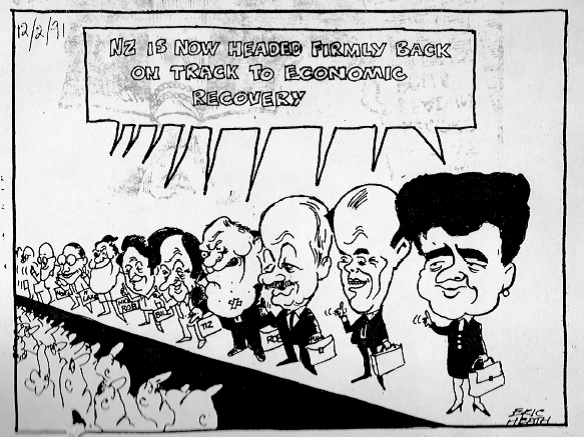
Changing tack, on the front cover of my cartoon collection I have this cartoon from early 1991.

richardson

For some years, I had it pinned to the wall in my office –  the sad procession of successive Ministers of Finance who for decades (this cartoon implies back to the 1950s) had promised that New Zealand’s decline would be reversed (made worse in this case in that Ruth Richardson must have said something along these lines in February 1991, just as the severe recession of that year was taking hold).      Since then, we’ve had Bill Birch, Winston Peters, Bill English, Michael Cullen, and Bill English again, and although we’ve had plenty of cyclical ups and downs, never at any time have we looked like successfully or sustainably reversing our relative economic decline.   It saddens me every time I look at this cartoon –  so many decades, so much failure.

Labour on New Zealand’s economy

It is probably only about 14 months until the next election.  We have a government that has presided over eight pretty-mediocre years of economic performance –  not all of it their fault, as there are global factors at work –  with no real idea what they should or could do to reverse New Zealand’s decades of staggering relative economic decline.  Often enough, it seems that the current government doesn’t even really care, so long as they can successfully persuade enough of the public that things aren’t too bad, or (worse) that our problems are actually marks of some sort of success.

Of course, our key economic agencies –  Treasury, MBIE, and the Productivity Commission –  show no real sign of offering the sort of quality advice that takes seriously the specifics of New Zealand’s situation and offers solutions that might make a material difference.  I’m not really sure why.  For them individually  –  and maybe for senior politicians too – perhaps it doesn’t matter very much.  For the upper tier of New Zealand, life is pretty comfortable.  And it isn’t always clear that politicians want hardheaded advice that seriously addresses New Zealand’s problems.  The Muldoon government wasn’t that keen on robust Treasury advice in the early 1980s either, but it didn’t stop the agency investing in capability and offering the best professional advice they could.

But this post is about politicians, and particularly about the Labour Party.  12 months out from an election, eight years since they last held office, at a time when no one would really claim the economic situation is particularly rosy, one might have hoped that the main Opposition party would be offering a pretty compelling alternative narrative: a diagnosis of what has gone wrong economically and the outlines of a rather different approach to policy.  I’m not suggesting that they should have all their policy detail published this early, but surely there should be enough to leave floating voters –  or potentially detachable voters –  with a sense that the main Opposition party was offering a different path, that would make a material difference?

I watched Grant Robertson’s interview on Q&A yesterday and was as unimpressed as ever.  There are occasional glimmers of recognition of some of the symptoms.  As he notes, per capita GDP growth has been very weak, and to the extent there is growth in total real GDP most of it is just based on the demand effects of a rapidly rising population.  He knows house prices are a problem, and I was pleased to see reference to the idea that house price to income ratios of around 3 might be a more normal level.  There was at least a hint that the economic performance of the non-metropolitan regions has left quite a lot to be desired –  although no apparent recognition that per capita incomes in Auckland have grown more slowly than those in the rest of the country for the last 15 years.  And last week he usefully drew attention to the very weak dairy price forecasts from the OECD.

But that was about it.  I heard two fairly specific proposals.  One  was to ban offshore buyers from the housing market. And the second was to revise the Reserve Bank’s monetary policy mandate.  Reasonable people can differ on the merits of a (non-resident) offshore buyers ban  –  and I happen to agree that we shouldn’t be ruling out even daft future policy options in preferential trade agreements that try to tie the hands of future Parliaments –  but it must be a pretty peripheral issue.  After all, Australia bans offshore buyers purchasing existing houses, and Sydney and Melbourne house prices are if anything more ruinous than those in Auckland.  And offshore buying seems unlikely to be a material phenomenon in the New Zealand second tier cities where price to income ratios are still far above 3.

And as for changing the Reserve Bank Act and the Policy Targets Agreement, it is all very well to say that the mandate is “broken”, but Labour has shown no signs of offering an alternative that would make any material difference to our real economic performance.  They offered a reasonably sophisticated attempt at a redraft in 2014.  I argued at the time inside the Bank, and subsequently, that the alternative wording –  while not necessarily objectionable –  would not have made any very material difference to the conduct of monetary policy, let alone to New Zealand’s longer-term economic performance.  As a readers know, I do think the Reserve Bank Act needs substantial reform, and I would probably favour some changes to the PTA and the related provisions of the Act, but they aren’t in any sense “the answer”.  I guess we’ll have to wait and see what specific proposals in this area Labour will campaign on in the next election.  But we should never expect that different monetary policy arrangements will make much difference to a nation’s longer-term prosperity.

What else was there in the interview?  There was talk of using government procurement policies to support New Zealand businesses –  which is probably illegal under our existing trade agreements, and in any case sounds mostly like old-fashioned protectionism, which rarely makes sense anywhere, and particularly not in a small country.  There was talk of investing in infrastructure and education.  Within limits, the infrastructure point is probably reasonable –  rapidly rising populations need more infrastructure –  but there was no hint of how this might lift trend productivity or per capita income performance.  As for education, it always sounds good to offer to spend (“invest”) more on it, but such proposals rarely seem to engage with the evidence suggesting returns to tertiary education in New Zealand are already among the lowest in any OECD country.  If anything, there are hints there of a possibility that too much is being spent, not too little –  at least if one thinks of education as an investment item, rather than just another part of consumption.

There was talk of “building wealth from the ground up”, and of “working with our farmers to get more value-added products” (as if, somehow, government officials and politicians are better able to make specific dairy product choices than their own managers and owners), but nothing remotely specific.  And there was not a single mention of the exchange rate –  even though ours has spent the last decade or so 20 per cent higher in real terms than in the previous decade.    And even on housing, where Labour has shifted ground in some important areas, Robertson was about as feeble as the rest of the political class –  he wants housing to be affordable, but doesn’t want house prices to fall.  It is easy enough to say “lets raise incomes and undermine those price to income ratios that way”, but it is just words without any suggestion of a strategy that would materially lift the rate of growth of per capita incomes.

Labour has been heard to suggest that something should be done about immigration.  Of course, I agree that something should be done, but I’ve been watching for months for any sense of how Labour is actually thinking about the issue.  The most I’ve seen has been occasional talk about “temporary pauses”, which mostly seems like a substitute for hard-headed thought or engagement with the issues.  It isn’t as if immigration policy is much different now than it has been in the past 15 years –  including the period when many of Robertson’s colleagues were ministers and he was ensconced in the Prime Minister’s office.   Chopping and changing immigration policy on the basis of this year’s pressures, or last year’s, doesn’t seem a particularly sensible approach –  there are lags in the system, and such short-term policy  reversals would create huge uncertainty for all parties concerned (potential immigrants and people here). And they simply can’t deal with the long-term challenges.  There is a respectable case that New Zealand’s high target levels of non-citizen immigration are good for New Zealanders.  But is that the case Labour wants to make, or isn’t it?  There is a respectable alternative argument that our approach was a not-unreasonable policy experiment that has failed.  Is that the case Labour wants to make?  We just don’t know.

I’ve been keeping an eye on the Labour Party’s website for some months –  and even, on occasion, trawling through the tweets of senior Labour Party economic spokespeople  –  to see what issues they are engaging on in public.  Robertson is the finance spokesperson so one might reasonably expect the most from him.  But there just hasn’t been much all year.  The flagship event was the Future of Work conference which, whatever one might think of it in a longer-term context, didn’t really seem to be addressing today’s issue, where labour force participation rates have been quite high and total employment growth has been faster than in almost any advanced economy.  The challenge for New Zealand hasn’t been finding enough jobs, but generating sufficiently high returns to the inputs of labour and capital to provide first world incomes for New Zealanders.  Robertson hasn’t been offering anything of real substance there.

Labour also has spokespeople on immigration and economic development, both apparently ranked in the upper half of Labour’s caucus.  I assumed –  or at least hoped –  I would find something from those people on how Labour’s thinking was developing.  Iain Lees-Galloway is the spokesperson on immigration, and since his leaders have talked on several occasions about how something should be done about immigration, I hoped to find something from him.   He seems to have put out 15 press releases this year, but only two of them look to have been around immigration issues –  dodgy dealings around Indian students and something about seasonal horticulture work.    Even if Labour doesn’t yet want to release the details of its policies, one might have hoped for a scene-setting speech on how Labour is thinking about immigration policy, costs and benefits etc etc, looking to shift the ground where the debate is taking place.  But there is simply no sign of anything of the sort. Perhaps lots of intense thinking and deliberations are taking place in private, but it really isn’t that long until the election.

David Clark is Labour’s economic development (including regional development) spokesperson.  According to the Labour website, he hasn’t put out a press release at all since April, and there is no sign in any of his statements this year as to how he or Labour are thinking about reversing New Zealand’s economic decline.   Perhaps a whole new wave of serious policy thinking and efforts at reframing the narrative are just about to be launched.  But I’m not really that hopeful.

I find it pretty depressing –  as if people (bureaucrats and politicians) have simply given up and decided that it is all too hard.    It is we and our kids who will pay the price of that failure.