Interesting that the Minister of Finance asked for advice

In September last year, former Bank of England Deputy Governor Sir Paul Tucker published a substantial discussion paper suggesting paying a sub-market, or zero, interest rate on some portion of the huge increase in bank deposits at the central bank that had resulted (primarily) for the large-scale asset purchase programmes central banks had been running (in the Bank of England’s case since the 2008/09 recession, but in some countries – including New Zealand and Australia – just since 2020).

In late October, I wrote about Tucker’s paper, and you will get the gist of my view from the title of that post, “A Bad Idea”. The Herald’s Jenee Tibshraeny picked up on that post and the following day ran an article on the Tucker tiering proposal, with sceptical quotes from several people including me. There was a difference of view in those quotes. As in my post, I argued that such an approach could be adopted without impeding the fight against inflation but should not be adopted, while others (as eminent as the former Deputy Governor, Grant Spencer) suggested that not only that it should not be done, but could not (ie would tend to undermine the drive to lower inflation).

The essence of my “it could be done” line was the same as Tucker’s: monetary policy operates at the margin, and so what matters for anti-inflationary purposes is that the marginal settlement cash balances receive the market rate, not that all of them do. There was precedent, in reverse, in several (but not all) countries that ran negative policy rates, where the central bank applied the negative rate only to marginal balances, while continuing to pay a higher rate on the bulk of balances (thus supporting bank profits, although the argument made at the time was that doing so would help support the monetary transmission mechanism).

So far, so geeky. But it turns out that after Tibshraeny’s first article, the Minister of Finance sought advice on the Tucker proposal, not just once but twice (first from The Treasury and then later from the Reserve Bank). In yesterday’s Herald, she reports on the two documents she got back from an Official Information Act request to the Minister. She was kind enough to provide me with a copy of the material she obtained.

The Treasury advice, dated 6 December 2022, does not explicitly say that it was in response to a request from the Minister, but it seems almost certain that it was. Treasury is unlikely to have put up advice off its own bat on a matter that is squarely a Reserve Bank operational responsibility without formally consulting with the Reserve Bank and including some report of the Reserve Bank’s views in its advice. We can assume the Minister asked Treasury for some thoughts, and Treasury responded a few weeks later with four substantive pages.

I don’t have too much problem with The Treasury’s advice on a line-by-line basis. Their “tentative” view was that some sort of tiering arrangement could be introduced without undermining the effectiveness of monetary policy.

There were a couple of interesting things in the note nonetheless. For example, it was good to have this in writing

and it was also interesting to read that “in previous discussions with the Bank they have indicated that they would consider introducing a zero-interest tier if the OCR were negative”.

Treasury highlighted that a zero-interest tier in the current environment (large settlement cash balances, fairly high OCR) would be in effect a tax on banks with settlement accounts.
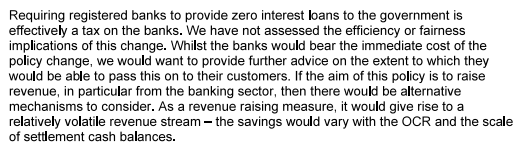
but strangely never engage with the question as to whether it would be appropriate for the Reserve Bank to impose such a tax (or whether they had in mind special legislation to override the Reserve Bank on this point).

They also note some potential reputational issues
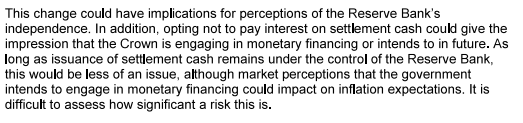
but could have added that these might be particularly an issue if New Zealand was to adopt such an approach in isolation (they neither mention, and nor have I seen, any indication any other authorities have seriously considered this option).

The Treasury note ends recommending not that the issue be closed down and taken no further, but that if the Minister wanted to “pursue this option” he should seek advice from the Reserve Bank and they offered to help draft a request for advice.

And so the Minister turned to the Reserve Bank for further advice, and on 2 February 2023 they provided him four pages of analysis (plus a full page Executive Summary which is more black and white than the substantive paper itself). The Bank seems pretty staunchly opposed to the tiering idea, but on occasions seems to overstate its case. And, remarkably, they never even attempt to engage on the question as to whether the market-rate remuneration of the large settlement cash balances created by their LSAP (and Funding for Lending) programmes are any sort of windfall gain to the banks (a key element of Tucker’s argument).

But much of what they say is reasonable. From the full paper

There is no real doubt that it can be done, and they draw comparisons between regimes in some other countries, more common in the past, where some (legally) required reserves were not remunerated at all.

I largely agree with them on this
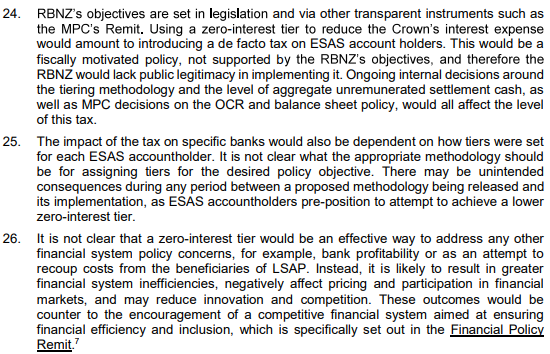
departing from them on that final sentence of paragraph 25 (any tier could, and sensibly would, be set on the basis on typical balances held prior to any announcement or consultation document), and in the first sentence of paragraph 26 (since, from the Bank’s perspective, benefits from the LSAP are supposed to be a good thing – the Governor repeatedly champions them – not bad).

The Bank attempts to play down the amounts at stake, suggesting any potential gains to the Crown (and thus, presumably, costs to those subject to the “tax) would be modest. But they include this
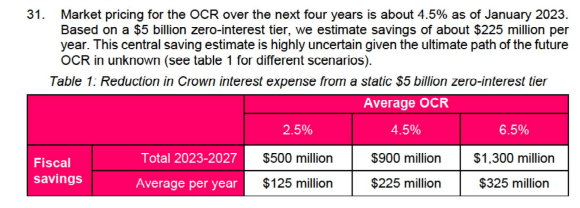
I guess when your MPC has thrown away $10bn of taxpayers’ money, $900m over four years doesn’t seem very much (and these calculations are materially biased to the low end of what could be raised without adversely affecting monetary policy) but…..$900m over four years buys a lot of operations, or teacher aids, or whatever things governments like spending money on.

It is also a bit surprising that although the Bank notes that such a tiering tax would be likely to be passed through to customers, they provide no substantive analysis as to how or to what extent, and thus what the likely incidence of such a tax would be. It isn’t that I disagree with the Bank, but the analysis isn’t likely to be very convincing to readers not already having the same view as them (tiering is a bad idea).

They make some other fair and important points, notably that hold a settlement account with the Reserve Bank would be likely to be less attractive if doing so was taxed, in turning providing an advantage to non-settlement account financial institutions (broader settlement account membership is generally a good thing, conducive to competition and efficiency). But then they over-egg the pudding. This line is from the Executive Summary – and draws on nothing in the body, so has the feel of something a senior person inserted at the last minute

One of the points commentators on central banks often have to make to less-specialist observers is that banks themselves have no control over the aggregate level of settlement cash balances. Individual bank choices – to lend or borrow more/less aggressively – affect an individual bank’s holdings but not the aggregate balances in the system. And thus banks cannot materially impede future LSAP-type operations since there is no reason why the Reserve Bank’s purchases need to be constrained only to entities that already hold settlement accounts at the Bank. If the Reserve Bank buys a billion dollars of NZ government bonds at premium prices from overseas investors/holders, the proceeeds will end up in NZ bank settlement accounts whether the local banks like it or not. Same goes for, say, large fiscal operations like the wage subsidy. What might be more accurate – and I made this point in my original post – is that a tiering model carried into the future might motivate local banks to lobby harder against renewed LSAPs. From a taxpayers’ perspective that would probably be a net benefit, but one can see why the Reserve Bank might have a different view.

While I don’t really disagree with the thrust of either the Reserve Bank or Treasury advice neither could really be considered incisive or decisive pieces. Perhaps the Bank’s piece was enough to persuade the Minister (although there is no indication in the OIA material or in Tibshraeny’s article that the Minister has abandoned interest). A tiering regime of the sort discussed in the RB/Tsy advice would be an opportunistic revenue grab, representing either an abuse of Reserve Bank power or a legislative override of monetary policy operational independence, with truly terrible signalling and precedent angles. It could be done – so could many many bad things – but it shouldn’t.

(If you want a typically-passionate opposing view, try Bernard Hickey’s column yesterday, from which I gather he has removed the paywall.)

Big mistakes were made. The LSAP was unnecessary, ill-considered, risky, and (as it turns out) very expensive. The Funding for Lending programme continued all the way through last year was almost incomprehensible (if cheaper and less risky). Mistakes have consequences and they need to be recognised and borne, not pave the way for still-worse compensatory fresh interventions.

I’m going to end repeating the last couple of paragraphs from my original post
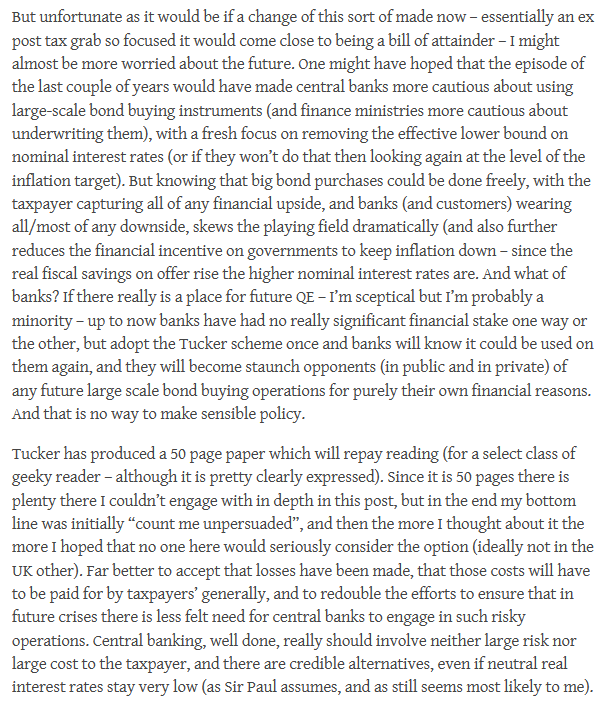
It is, perhaps, a little surprising that neither set of official advice shows any sign of engaging with Tucker’s paper itself, or with the author, a very well-regarded and experienced figure.
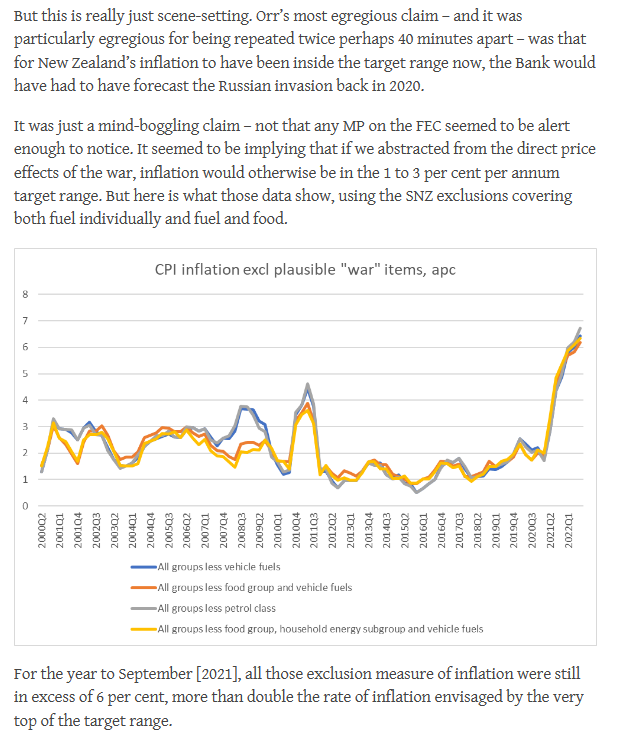
RB chief economist on inflation

It was something of a (perhaps minor) landmark event last Thursday when the Reserve Bank’s chief economist Paul Conway gave an on-the-record speech on inflation. It was only Conway’s second on-the-record speech (the first was on housing, something the Bank has little or no responsibility for) and thus only the second speech from a Reserve Bank chief economist for almost five years. Five years in which chief economists have become statutory decisionmakers (members of the MPC), in which monetary policymakers have dealt with a huge and expensive shock, and in which inflation – prime focus of central bank monetary policy – has been let run amok in ways never seen previously (arguably never envisaged) in the first 30 years of inflation targeting. And when (a) external MPC members are barred from research/analysis, and (b) barred from speaking or disinclined to do so, and (c) the chief economist’s own boss has no qualifications/background in economics or monetary policy, we should be able to look to the Bank’s chief economist for incisive and insightful analysis and perspectives on the macroeconomic dimensions of the Bank’s responsibilities. If not him then who?

Sadly, the answer to that seems to be no one at all.

There have been worse things from the Reserve Bank on monetary policy in recent years. The most egregious have been the (apparently) unscripted one-liners from the Governor. One could think of his claims – never backed by any analysis at all – that the economic gains from the LSAP programme were “multiples” of the $10.5bn (Treasury estimate) direct fiscal loss from the LSAP, or the preposterous spin he tried on Parliament’s Finance and Expenditure Committee just a few months ago

Not even arguable, just false.

There is nothing quite so egregious in Conway, mercifully (he is a more earnest, less flamboyant – or worse – character).

But what is there in his speech is far from the sort of standard we should expect from a senior policymaker addressing the biggest monetary policy failure in decades. And it is not as if his speech was delivered to a bunch of high schoolers or the Gisborne U3A (no offence to either) but to an (at least) expert-adjacent group at the ANZ-KangaNews New Zealand Capital Markets Forum.

The Bank’s PR people billed the speech this way

Item 3 is easy. The only thing the Bank can do is raise the OCR and hold it higher for long enough. Although Conway never acknowledges this, it is hard to be very confident in their view (or anyone else’s) on how high or how long might be required, not just because there are always new shocks, but because neither the MPC nor others really yet have a compelling story for why core inflation went so high so quickly.

So much of the speech is made up of plaintive pleas to the public to believe the MPC when they say they are serious, and to act accordingly, without giving us any basis to believe the MPC really knows what it is doing. After all, not much more than 18 months ago Conway’s predecessor was telling the Reserve Bank’s Board there was no hurry and no real need to worry, and their published forecasts were telling us they expected inflation would be almost bang in the middle of the target range by now. It would have been a bad (and costly) idea for people to have based their plans on those forecasts and the contemporaneous rhetoric. You might have hoped that if he really wanted to jawbone us, and have people take seriously his rhetoric, that the Bank’s chief economist (of all people) would be presenting persuasive analysis that they understand what they got wrong and reasons to think they are better now. But there is none of that in the speech, and it refers us to no serious supporting analysis or research either.

Instead there is lots of spin.

One of the most striking things in the speech was something that wasn’t there. Central bankers often, and rightly, pay a lot of attention to measures of core inflation. But in a major (rare) speech about inflation, there is but one (passing) mention of the term (or cognate terms), simply noting in the final few sentences that core inflation is about middle of the pack among OECD countries/economies.

Instead, we get a great deal about “the pandemic, the war, and floods”, which seems to be a slightly more sophisticated attempt at distraction than his boss’s claims quoted above.

No doubt, as Conway notes, the floods will put some pressure on resources over the next few years (particularly to the extent losses are covered by offshore reinsurers, as distinct from being net NZ wealth losses), as the 2010/11 and 2016 events did, and may result in some direct price pressures (some fruit and vegetable prices) in the next couple of quarters. But, thanks to New Zealand’s infrequent and badly lagging CPI, none of that is in the published inflation numbers yet.

What of the pandemic? It is clear that here Conway is not talking about the (with hindsight) gross macroeconomic mismanagement (the RB MPC being the last mover, and thus primarily responsible) that delivered us, several years on, really high core inflation, but the direct price effects of pandemic-driven supply chain disruptions several years ago. Some of those effects may have been material contributors to headline inflation back in 2020 and 2021, but it is now 2023, and if we could do a good decomposition (a good topic for some RB analysis) it seems likely that if anything the unwinding of those disruptions is probably holding headline inflation down a little now (eg global freight costs have fallen a lot). Perhaps he has in mind airfares – where capacity has been slow to return – but that is a good reason to look at, and cite, analytical core inflation measures.

And then there is “the war”. At the Reserve Bank, they are very keen on “the war” as distraction and cover.

We all know world oil prices shot up quite a bit in the immediate wake of Russian’s invasion last February. But not only are world oil prices now lower than they were (real and nominal terms) prior to the invasion, but New Zealand headline annual CPI inflation is still held down artificially at present by the kneejerk petrol excise “temporary” remission put on last March and still in place (strangely, Conway never mentions this). Where else might we find these “war” effects in New Zealand inflation? Wheat prices also rocketed upwards initially, but again they are lower now than they were at the start of last year. I guess fertiliser prices are still higher than they were, but it hardly seems likely to add up to much in NZ CPI inflation. Especially when we know – although Conway never mentions – that core inflation had already risen a lot, to quite unacceptably high levels, well before the invasion.

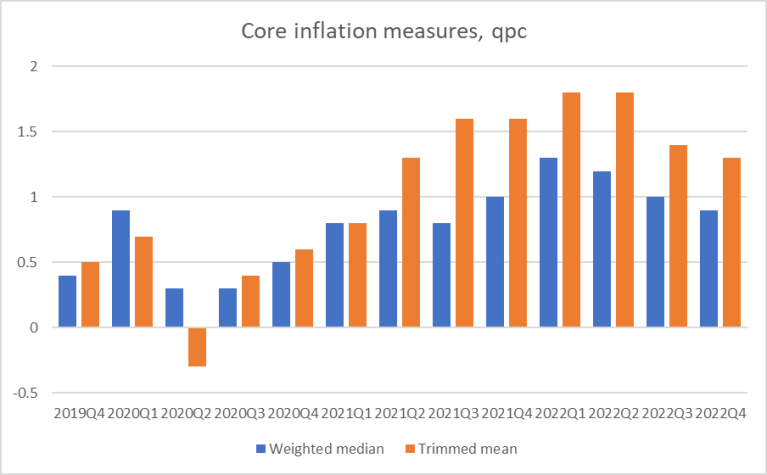
Conway does acknowledge that monetary policy should have started to tighten earlier (and doesn’t even fall back on the silly line he and Orr have previously used, that a slight difference in timing would have made only a slight difference to inflation – well of course, but the real problem, with hindsight, was not “slight” differences in timing), but engages in a fairly sustained effort to leave readers thinking there really was not an evident problem in 2021, just a few “one-offs”. But this is where analytical measures of core inflation come in. Trimmed mean and weighted median measures are pretty standard parts of many monetary policy analysts’ toolkits.

The big increase in quarterly core inflation took place in 2021.

The sectoral core factor model, like all models of its class, has end-point issues and estimates prone to revision, but the best guess now is that core inflation had already doubled (to in excess of 4 per cent) by the end of 2021.

But none of this mentioned at all in the speech. Nor is the fact that by late 2021 the unemployment rate – best simple measure of changes in excess capacity – was dropping rapidly to below levels anyone regarded as sustainable.

Many of these events took the Reserve Bank (and others by surprise), but they are the ones paid to get these things right. We live with the consequences when they don’t. But nowhere in the speech is there any acceptance of responsibility.

We also get attempts to suggest there is nothing the MPC can do about inflation sourced from abroad…….in a speech where the exchange rate gets no substantive (and only one formal) mention at all.

There is a chart in the speech which purports to illustrate the problem, showing tradables inflation as a share of headline inflation, without any acknowledgement that if tradables tend to average 0% and non-tradables 2.5 per cent (loosely the case pre-Covid) and then tradables average 2% and non-tradables 4.5% tradables would make up a larger share of headline inflation even though nothing about the relationship between tradables and non-tradables had changed at all. Yes, tradables inflation has increased relative to non-tradables but if we look at the core components of each the recent change isn’t unprecedented, tradables didn’t lead non-tradables, and (in any case) the Reserve Bank’s own past analysis has tradables as a typically fairly small component in the overall sectoral core inflation measure.

If – as happened – other countries run high inflation, the job of the Reserve Bank of New Zealand is to tighten monetary policy here to lean against importing that inflation. That will generally occur through a higher-than-otherwise nominal exchange rate.

I’m not going to spend any more time on the jawboning rhetoric. No doubt it feels good inside a central bank – I’ve run plenty of it in my time, in writing and in speeches – but it is really a distraction from the core issues (MPC responsibilities) and less persuasive now – when, with the best will in the world, the central bank has just messed up badly – than perhaps it might have been decades ago when we first trying to transition from high inflation to low inflation, with a newly-independent central bank.

Conway’s speech was made just a month on from the latest Monetary Policy Statement. In that flagship MPC document, there was a substantial four page section on “The International Dimension of Non-Tradables Inflation”. No doubt, the analysis in that section came from Conway’s own Economics Department. But in a flagship speech on inflation just a few weeks later there is no mention, not even a reference, to that analysis at all. In my MPS commentary (last few paras) I briefly identified a number of apparent weaknesses in the analysis. Perhaps on reflection Conway accepted the issues I had raised, but whatever the explanation it seems odd to have such analysis feature prominently one month and simply disappear from consideration the next.

These were two of the last three paragraphs of the speech (emphasis added)

At one level, it is hard to argue. It all sounds good. Except….where is the substance to back up the words? The Bank’s own published research output has slowed to a trickle, there is no serious analysis or insight in the speech, and we know that the Minister of Finance has reaffirmed only last year his commitment (in league with Orr and Quigley) to ban anyone with an active or even future interest in serious research or analysis from serving as external MPC members. Oh, and the Reserve Bank has the least-qualified deputy chief executive responsible for macroeconomic and monetary policy of any advanced country central bank (and probably most emerging and many developing countries as well). Nothing we’ve seen so far suggests any particular reason to treat these words as anything other than spin.

I was mildly hopeful (prone to naive optimism perhaps) when Conway was appointed. Perhaps things are about to change. There is, after all, a position on the MPC that comes vacant next week, currently held by someone who has no relevant subject expertise, who has never explained her views on monetary policy in four years in the job, and who was (so the papers confirm) pretty clearly appointed mostly because she was a woman. Replacing her with a more serious appointee, and overhauling the protocols in a way that encouraged or compelled externals to be individually accountable, would be a small start in the right direction. If Orr, Robertson, and Quigley were serious. I am not, however, holding my breath.

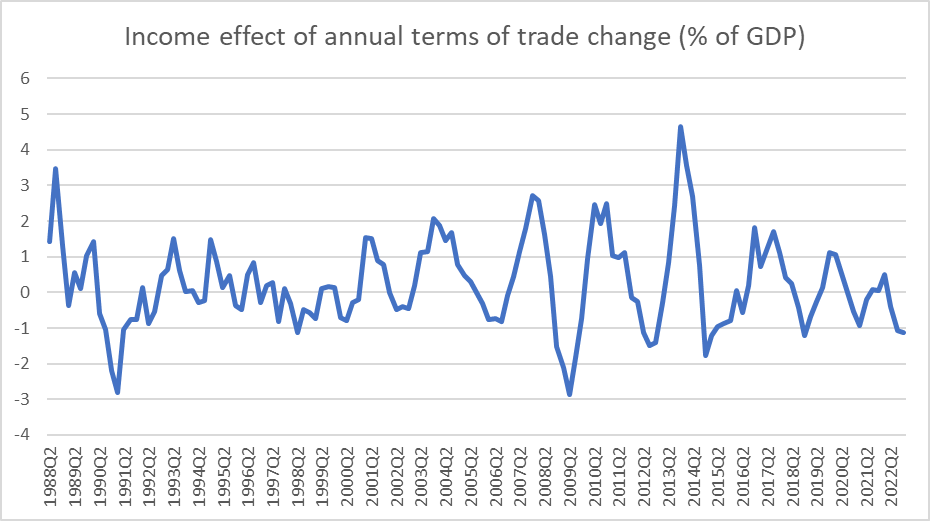
The contrast between Conway’s speech and those of his peers in other advanced central banks once again leaves the New Zealand institution looking well off the pace. Just the slides published for an ECB Board member’s talk yesterday have considerably more substance than Conway’s full speech (and she speaks often). I’ll leave you with this chart, inspired by one of Schnabel’s slides

Terms of trade fluctuations – “direct price effects of the war and the pandemic” – just aren’t a big macroeconomic issue in New Zealand.

New Zealand’s monetary policy mess

The New Zealand Initiative has a new report out this morning, written by Bryce Wilkinson, under the heading “Made by Government: New Zealand’s Monetary Policy Mess”. (Full disclosure: I provided fairly extensive detailed comments on an earlier draft.)

It is a curious report. There is a lot of detail that I agree with (and the report draws quite extensively on various criticisms I have made in recent years) but it ends up having the feel of a bit of a muddle.

(It is perhaps not helped by the Foreword from an Otago academic who seems wedded to a fiscal theory of the price level that doesn’t exactly command widespread support anywhere, and which would appear on the face of it to have predicted that New Zealand would have had one of the lowest inflation rates anywhere. His approach appears to absolve the Reserve Bank of responsibility for the high inflation: “the key reason why we have high inflation rates is fiscal policy and not monetary policy” and “even if the RBNZ had not made mistakes, I doubt that it could have avoided high inflation”.)

The title of the report is clearly supposed to suggest that what has gone on is primarily the government’s responsibility (and specifically that of the Minister of Finance). And there are plenty of things one might reasonably blame the Minister for:

  • changing the Bank’s statutory mandate (if you think this was a mistake, or mattered to macro outcomes, which I don’t)
  • reappointing Orr despite the opposition of the two main opposition political parties, having himself changed the law to explicitly require prior consultation with other parties in Parliament,
  • going along with the Orr/Quigley preference to prevent experts from serving as external MPC members (which still seems incredible, no matter how times one writes it),
  • appointing a weak Board with barely any subject expertise, the same board being primarily responsible for Governor and MPC appointments and for holding the MPC to account,
  • being indifferent to serious conflicts of interest in people he was appointing to the board,
  • prioritising a person’s sex in making key appointments,
  • for bloating the Bank’s budget, and
  • never once have shown any sign of unease about the massive losses the MPC-driven LSAP has run up, about the Orr operating style, or any urgency around better understanding what has gone on (you will search letters of expectation in vain for any suggestions from the Minister that, for example, more/better research capability and output might be appropriate, or that speeches more of the quality seen from other advanced country central banks might be appropriate)

and so on.  Robertson has been both an active and passive party in the serious decline in the quality of our central bank over recent years, and given that Orr has been reappointed and seems disinclined to acknowledge the validity of any criticisms, only the Minister of Finance –  current or future –  can make a start on fixing the institution.  Institutional decline –  and it isn’t just the Reserve Bank –  has been a growing problem in New Zealand, and the current government’s indifference has only seen the situation worsen: one might think too of the Productivity Commission.

But, for better or worse, when most people think of a “monetary mess” at present they probably primarily have in mind inflation.  And the way the report is structured it would seem that both the author and the Foreword writer also put a lot of emphasis on the bad inflation outcomes.  No doubt rightly so.

But there simply isn’t any compelling evidence, or really even any sustained argumentation that would stand scrutiny, that any or all of the many things one can criticise Robertson for really go anywhere towards explaining how badly things have gone with inflation (or even with the massive losses on the LSAP).  I’m not, of course, one of those who believe the Bank should escape blame –  that somehow for example (as per one of the Governor’s ludicrous attempts at distraction) we can blame it all instead on Putin or “supply chain disruptions”, as if they somehow explain the most overheated economy and labour market in decades.

But how confident can we really be that a better Reserve Bank –  on the sorts of dimensions the NZI report rightly draws attention to –  really would have made much macroeconomic difference?   As just a small example (and from a country with a similar pandemic experience) the report rightly draws attention to the better academic qualifications of the Governor and senior figures at the Reserve Bank of Australia.  But nothing about Australian inflation outcomes –  or LSAP losses for that matter –  suggests that the RBA has done even slightly better than the RBNZ in recent years.  If anything, I (the Bank’s “most persistent and prolific” critic, as the report puts it) reckon the RBA has done a little worse, even if there is a better class of people and some more thoughtful speeches.    One could extend the comparisons.  As I’ve highlighted here, New Zealand’s core inflation outcomes have been bad, but about middle of the pack among OECD countries/regions.   Fed Governors do lots of good speeches, the institution does lots of interesting research, experts are allowed to be decisionmakers, but…..core inflation outcomes are little or no better and the Fed was even slower than the RB to get started with serious tightening.  And so on, around most of the OECD.

There is –  as the report notes –  no absolute defence for Orr and the MPC in other countries’ inflation records. We have a floating exchange rate to allow us to set our own path on inflation, and just because other countries’ policymakers messed up should not absolve ours of responsibility.    But to me the evidence very strongly suggests that what happened over the last two to three years was that (a) central banks badly misunderstood what was going on around the macroeconomics of Covid, (b) so did almost all other forecasters, here and abroad, and (c) there isn’t much sign that central banks with better qualified more focused people or more open and contested policy processes did even slightly discernibly better than the others.   I wish it wasn’t so.  With all the many faults in the RBNZ system and personnel, it would be deeply satisfying to be able to tie bad outcomes to those choices (active and passive).  But I just don’t think one really can.    All those governance and style matters etc matter in their own right –  we want well-run, expert, open, engaged, accountable, learning institutions, especially ones so powerful.  And weak institutions are likely over time to produce worse outcomes in some episodes.  But there is little sign yet that this is one of those episodes.

And it is clear when one gets to his conclusion that Wilkinson more or less knows this, as he struggles to connect the very real concerns about the Bank, and what Robertson has initiated or abetted, with the most unfortunate macroeconomic/inflation outcomes.

I was going to say that it isn’t really clear either who the report is written for.  But in fact I think that is wrong, and that the primary intended audience is Nicola Willis, her boss, and her colleagues/advisers.    Thus we find this

Bryce 5

Talk about deferential and accommodating.

And the entire report ends this way

bryce 6

In terms of fixing the institution that seems largely right. It could be fixed, but it will need ministers/governments that care and that are willing to devote sustained attention to using the levers they have to gradually right the ship. As Bryce notes, many of these changes can’t be effected quickly, but mostly because the laws are deliberately (and appropriately) written to make it not easy for new governments of either stripe to make sudden or marked changes. That is helpful when the institution is working well, but quite an obstacle otherwise, and may – if a new government were to care enough – need legislative change.

(I wrote a post here last year with some thoughts on what a new government could and could not do.)

As you watch the interactions between Orr and Nicola Willis at FEC – in which Orr is routinely scornful and dismissive – you wonder how in decency he could possibly continue to serve under a National-led government, But perhaps if he were that sort of person – staying in his lane, acknowledging mistakes, open and engaging etc – the concerns would not exist in the first place. As it is, it would be hard (all but impossible under current law I’d say) to get him out if he wants to stay, and so reform efforts will need to go around him, including progressively replacing the Board with able people and ensuring that the external MPC members are both able and expected to be individually and publicly accountable for their own views and analysis. But do all that and we – and other countries – will still be at risk of really bad macro forecasting errors, and central banks unable to live up to their rhetoric, albeit we might hope for no repeats for another generation or two.

Central bank inadequacy and spin

Last Friday the Reserve Bank Governor, Adrian Orr, gave a keynote address to the Waikato Economics Forum. This event seems to have become part of the annual economic policy calendar, with Waikato University boasting that

The forum will bring together an outstanding lineup of top economists, business leaders and public sector officials, who will share their expertise on how we can address the major challenges facing our country today.

Sold that way, you might have thought that when a really senior and powerful public official turns up for a keynote address to an assembled economically literate audience he’d have delivered some fresh and interesting insights, going rather deeper than he might to, say, a provincial Rotary Club. Doubly so when in that official’s area of policy responsibility things have proved so challenging in the last few years, when so much taxpayers’ money has been lost, and when core inflation is so far outside the target range the government has set. It was just a couple of weeks after the latest Monetary Policy Statement, so would have been a great opportunity for the Governor to expand on the issues and shed light on how, and how rigorously and insightfully, he sees things .

Instead we got “Promoting economic wellbeing: Te Pūtea Matua optimisation challenges”, a title that held out little or no hope and offered less across a sprawling 12 pages of text. Attendees must have wondered whether it had really been worth getting out of bed early enough to hear the Governor at 7:40am. As for me, I read it twice, just to be sure.

Faced with major policy failures – and the core inflation outcomes cannot really be considered anything else, no matter how many allowances might be made – there is not a single fresh or interesting insight in the entire speech, In fact, it is the sort of address one of Orr’s junior staff could easily have given, as a “functions of the Reserve Bank” talk, to a Stage 2 university economics class.

Perhaps it would be one thing if (a) little or nothing interesting was going on in the economy or with inflation, or (b) if the Governor and other members of the Monetary Policy Committee were giving speeches on monetary policy matters every couple of weeks, although one might still – given the character of the audience – have reasonably expected more, including because good and thoughtful speeches offer insights into the quality and character of decisionmakers and their advisers. As it is, a great deal is going on, a great deal that has taken the Bank (and most others) by surprise, and that is still ill-understood (eg why did almost everyone get it wrong, what did we miss, what do we learn?), and serious speeches by MPC members on things to do with monetary policy, inflation etc are – unlike the situation in most other advanced countries – very rare. As far as I can see, the last serious monetary policy speech the Governor gave was to the Waikato forum a year ago, the chief economist has not given any speeches on monetary policy or inflation (nor, perhaps mercifully, has his boss), none of the external MPC members has ever given a speech on these topics or put their names to specific views or lines of analysis/reasoning/evidence, and the Deputy Governor’s last speech on monetary policy was 18 months ago, when the Bank was barely worried about inflation at all.

It is inexcusable in people who wield so much power, perhaps for good longer term but certainly for ill in the last couple of years. And it seems to speak of some combination of the utter arrogance Orr routinely displays when he does speak, and the probable absence of any fresh or interesting analysis in the entire institution. If they had such insights, such research, such analysis, surely they’d be wanting to impress us with it? But the Bank now publishes hardly any formal research and it is rare to find even an insightful chart in an MPS. If spin seems to be the order of the day, and it so often does (see below) they aren’t even very good at generating supporting material, let alone providing any serious accountability.

There really wasn’t much interesting in this keynote address at all, but I did want to highlight just a few of the spin lines.

On the straight economics there was this

Low and stable inflation is a necessary outcome for economic wellbeing in the longer term

I’m deeply committed to the case for price stability (ideally, an even lower inflation target than we have now) but this is simply overblown nonsense, which discredits the case for low and stable inflation. A more serious Reserve Bank in years gone by might, much more reasonably, have framed the point simply as “tolerating high inflation won’t make us any richer, and will come with all sorts of distortions and costs, and in the longer term if price stability doesn’t determine whether or not we are prosperous and productive, it is still the best limited contribution monetary policy can make.

Then there was the corporate spin

Looking ahead, in striving to be exceptional in our work,

Perhaps it is good to aim to be exceptional (although few people or institutions ever are), but…..the Orr Reserve Bank, when we get speeches like this, and few of his decisionmakers ever expose themselves to any sort of serious scrutiny, and when leading from the top the Governor is reluctant to ever express regret for anything he/they might have done, or failed to do. Great institutions – especially powerful public ones – acknowledge openly and learn from their mistakes.

I’ll skip the empty waffle about climate change (“we have a key part to play”) or the political posturing about the Treaty of Waitangi (which is apparently part of a “move from being a good to a great Central Bank” – who granted them even a rating of “good?)

At the end of the speech there is a section headed “Our research programme”, where Orr asserts

Te Pūtea Matua has a long tradition of pursuing policy-relevant research and as a full service central bank our research programme covers all three strands of work we are tasked to deliver.

It used to be true that the Bank had a strong record of policy-relevant research on things around monetary policy, inflation, and the cyclical behaviour of the economy. But no more – just check out how little research they’ve published in those areas in recent years, It has (sadly) never been true that the Bank has had any sort of sustained tradition in policy-relevant research around either its mushrooming financial regulatory and stability responsibilities (in fact, there were conscious decisions by successive Governors not to invest in such research), or its cash responsibilities, and there is no sign that has changed for the better. Instead, we just get spin like this.

And then in conclusion Orr asserts that

We are a learning institution and we enjoy collaboration.

Learning institutions engage, learning institutions aren’t prickly and defensive, learning institutions don’t just make stuff up, learning institutions don’t claim to regret nothing, learning organisations – especially amid the biggest surprises/policy failures in decades – don’t give keynote addresses like this. And collaborative institutions don’t engage in the sort of defensive abuse Orr is sadly all too well known for.

Learning organisations, agencies that are exceptional in their work, great central banks, don’t just make stuff up. Orr does.

The Herald’s Jenée Tibshraeny had a nice piece yesterday on just the latest example, from the question time after Orr’s Waikato speech. He was asked a question about central bank losses from things like the LSAP bond-buying programme (about 1.03 hrs into the video of the day), specifically citing the (recently newsworthy) losses the German central bank had been recording and disclosing. Instead of responding seriously and substantively, Orr blustered, attempting to imply that these were really just accounting issues (as if good record keeping doesn’t matter), muddying the waters by getting into questions about how much central bank equity matters, and condescendingly suggesting that while such issues “hurt the brain” people need to start exercising their brain, and “calm down”. The questioner himself clearly wasn’t satisfied, and asked a follow-up, but Orr simply talked out the clock, even suggesting (astonishingly) that the BIS – a bunch of technocrats in Basle – had explained it all for the public.

There are two points people like the BIS have made that are of course true, and as general points have never really been disputed by serious commentators and observers.

First, central banks don’t exist to maximise profit. They exist (in their monetary policy functions) to deliver low and stable inflation, and

Second, central banks can in principle function perfectly well with low, zero, or even negative equity (I spent a couple of years working for one that not only had negative equity but wasn’t even able to produce a proper balance sheet for a prolonged period).

But harping on those sorts of points is simply irrelevant in the face of the huge real losses to taxpayers that central banks have sustained in the last couple of years.

In New Zealand’s case, as it happens, the negative (or impaired) equity issue doesn’t even arise, since the Bank in advance wisely sought a government indemnity for any losses the LSAP might lead to. As a technical matter they didn’t need to – they could have run through all the equity the government had given them and recorded huge negative equity. Nothing about the Bank’s ability to function would have changed one iota, but some hard questions no doubt would have been asked, and Orr reasonably enough preferred to have any blame shared.

But none of that changes the fact that the MPC’s choices around the LSAP – signed off on by the Minister of Finance, with Treasury advice – have cost taxpayers in excess of $9 billion: not “just accounting issues” but real losses. That is what happens when a government agency (central bank) does a huge asset swap, transforming much of the government’s long-term fixed rate debt into effectively floating rate debt just before short-term rates rocket upwards. Had the LSAP programme never been launched – or even if it had been halted a few weeks in once bond markets had settled down from the US-led turbulence of March 2020 – taxpayers and the Crown would be that much better off, in real purchasing power terms. And none of Orr’s spin and distraction – and none of the BIS material – ever seriously engages with those real losses. Instead they respond to points that are not those serious critics are making.

And if one happens to think the LSAP made a meaningful economic difference – as Orr still seems to claim – then that only reinforces the point, since it added to the level of stimulus that helped deliver the core inflation, miles outside the target range, that central banks are now struggling to get under control and reverse. Better not to have had the real economic losses, and of course with hindsight we know the level of monetary stimulus was too large for far too long.

(As I’ve argued in numerous posts here over the last 3 years, I don’t believe the LSAP made much meaningful difference to anything – simply added huge risk, without any serious advance risk analysis, culminating in huge losses. I was encouraged to see in Tibshraeny’s article that the former Deputy Governor, Grant Spencer – able economist and former bank treasurer – seems to have the same view

“The main benefit was that it smoothed the disruption to the bond market that occurred in April/May 2020 when there was some real volatility in the bond market and bond rates spiked up,” Spencer said.

“After that, the rest of the purchases, I would say, had very little effect on the term structure of interest rates.”

Well quite. The initial intervention may not have been necessary but could have been highly profitable on a small scale. The latter purchases made no difference to short to medium interest rates (set by the OCR and expectations about it) and little to longer-term rates. Had they wanted short rates lower, the OCR could always have been cut by another 25 basis points, at no financial risk to taxpayers.

Orr seems to have backed away somewhat from a line he gave Tibshraeny in an interview last year, where he claimed that the macro benefits of the LSAP programme were “multiples” of the losses (and the Bank’s five-year monetary policy review last year provided no serious support for such claims) preferring now just to rely on bluster, distraction, and the hope that people will eventually get tired, or confused, and forget.

Orr’s comments on Friday reminded me that I’d heard that Orr had also been trying on the handwaving “it’s just an accounting issue” at FEC after the recent Monetary Policy Statement. I hadn’t listened in at the time and finally did so this morning.

If National Party members don’t always ask very good questions on this issue, at least they show no sign yet of being willing to let it go. In doing so, they bring out Orr at his prickly, blustering, and basically dishonest, worst.

Willis asked if it was not regrettable that there had been a direct fiscal cost from the LSAP programme of about $9bn. Orr’s response was a single word: No.

Willis followed up asking if he was really saying that these losses were justified. This time, she got a three word response “Yes, I do”.

Orr went on to state that he “100% stood by” the LSAP and its losses, getting a bit more expansive and asserting/reminding the Committee that central banks could operate with negative equity – as noted above, this is pure distraction in the NZ context since the Reserve Bank’s capital was not impaired at all (although taxpayers’ “equity interest” in the NZ government was) – and explicitly going on to assert that it was “an accounting issue not an economic one”. As applied to the LSAP, that is simply false, yet another outrageous attempt to mislead Parliament.

And he wasn’t finished. Willis asked if he was saying he had no regrets at all. His response? “Those were your words”, before falling back on his regrets for things he had no responsibility for – regrets Covid, regrets Ukraine, regrets Gabrielle, even passively regrets that New Zealanders are experiencing high inflation – but no regrets for any choices he made might have actually made, not ones that costs taxpayers $9 billion, and certainly not ones that led to core inflation of about 6 per cent and likely “need for” a recession. Spinning again, he repeated the line he is fond of that if they’d tightened one quarter earlier it would have made very little difference. No doubt so, but the big mistakes – perhaps pardonable, perhaps even understandable, but big mistakes nonetheless – weren’t about one quarter, but about fundamental misjudgements in 2020 and early 2021, on things Parliament has delegated Orr and his MPC responsibility for, as supposed technical experts. And yet they refuse to take any real responsibility, falling back on attempts to distract MPs and avoiding serious engagement with anyone else.

There has been a lot of focus in the last week or so on Rob Campbell’s mistakes, for which he has rightly paid a price and no longer hold Crown appointments.

But Orr managed to lose billions – having done no advance risk analysis, having talked rather negatively on bond-buying strategies only a few months prior to Covid – and delivered us very high core inflation, core inflation reflecting largely domestic demand imbalances well under Reserve Bank monetary policy influence, refuses to engage seriously, actively and repeatedly misrepresents things and misleads Parliament, and treats those to whom he is accountable with prickly disdain and no respect whatever, and yet keeps his job, and starts a second term later this month. It is a sad reflection on how degraded New Zealand politics and policymaking has become when accountability now appears to mean so little.

Really?

In the Sunday Star-Times yesterday there was a double-page spread in which various moderately prominent people (all apparently “leading speakers” at some “annual University of Waikato economic forum” this week were given 100 to 150 words to tell us “How can NZ build back following a string of serious economic and social setbacks”.

Most of the contributions were pretty underwhelming to say the least. To be fair, 150 words isn’t a lot, but real insight tends to shine through and there wasn’t much on offer in this selection. But then, who really cares much what the chief executive of the Criminal Cases Review Commission or the co-founder of an advertising agency think on such issues.

By contrast, Paul Conway is a statutory office-holder in an economic field. He is the (relatively new) chief economist of the Reserve Bank of New Zealand and in that capacity has been appointed by the Minister of Finance as an internal member of the decision-making Monetary Policy Committee. This was his contribution.

It was pretty bad. It is hard to argue with the first sentence, although the previous decades had not been an unbroken record of success and low inflation (check out core inflation measures over 2007 and 2008). But it was when I read the second sentence that I started to get concerned. What possible analytical or empirical basis is there for that claim?

For decades the Reserve Bank has told us (and rightly so) that there are no material long-run trade-offs between inflation and activity/unemployment/”prosperity”. That is so on the upside – you can’t buy sustained prosperity or lower unemployment by pursuing or settling for a higher inflation rate – but it is also largely true on the other side. Not only does lower inflation not create permanent adverse economic outcomes, but it is not a magic path towards materially better economic outcomes either. At best, and this is a line the Bank has also run for years, sustained and predictable low inflation, or price stability, may be conducive to the wider economy functioning a little better than otherwise, but any such effect is typically viewed as very small, and difficult to isolate statistically.

Unfortunately, Conway’s line has the feel of political spin, the sort of thing we might here these days from Luxon or Hipkins amid talk of a “cost of living crisis”. But, as the Reserve Bank MPC members should know only too well, real hits to economywide material living standards are not a consequence of general inflation but of supply shocks that (a) central bank can do nothing about, and (b) which would have been a thing, with adverse consequences for average living standards, even if the central bank’s MPC had done its job better over the last few years (Conway himself was not there when the mistakes were being made). As it happens, the process of actually getting inflation back down again will – on the Bank’s own forecasts – actually, and necessarily, involve some temporary losses of output and “prosperity”.

It was pretty poor from the chief economist of the central bank who (unlike his boss, the deputy chief executive responsible for macro matters and monetary policy) is a qualified and experienced economist.

Then we get the curious claim that monetary policy “is only part of the solution to reducing inflation”. Except that it isn’t. The way things are set, the Reserve Bank Monetary Policy Committee is responsible for keeping (core) inflation at or near the target midpoint, after taking into account all the other stuff that is going on, all the other policy initiatives here or abroad. Monetary policy isn’t the only influence on inflation, but it is given the job of delivering low inflation having factored in all those other influences. Thus, when the Canterbury earthquakes happened and there was a huge stimulus to demand over the next few years, it was still monetary policy (and monetary policy alone) that was responsible for delivering inflation near to target. We wouldn’t have wanted the repair and rebuild process slowed down just to have made the Reserve Bank’s job a bit easier. Same will go, on a smaller scale, for the repairs etc after the recent storms. Perhaps Conway or his colleagues think the government should be running a different fiscal policy, but as monetary policymakers it is really none of their business: fiscal policy and the central bank should normally each do their own jobs. As it is, Conway’s line gives aid and comfort to people talking up things like temporary petrol excise tax cuts as a way of helping ease inflation.

But bad as some of that stuff was it was the last three sentences that really struck me, including because Conway likes to talk about productivity (he was head of research at the Productivity Commission in that agency’s better day, and produced a range of interesting papers). We should all be able to agree that, in general, higher economywide productivity growth would be a good thing. People would be better off and individuals and governments would have more real choices.

But it isn’t a path to lower inflation, let alone lower interest rates, whether in the short or long run. And it isn’t clear why Conway appears to think otherwise.

In the short run, perhaps he has in his mind a model in which the Reserve Bank determines nominal GDP growth. If it did then, all else equal, the higher real economic activity was in any particular period then, mechanically, the lower inflation would be in that period. If higher productivity was an element in that higher real economic activity, and nothing else changed as a result, then higher productivity might be part of such a story. But the Reserve Bank does not control nominal GDP growth in that sort of mechanical sense, and if firms suddenly stumble on paths to higher productivity it is very likely nothing else will change as a result. Over the longer-term, higher rates of real GDP growth – and productivity growth – tend to be associated with higher, not lower, interest rates (a “good thing” in that context, as not only is there typically strong investment demand to take advantage of the productivity shocks and the opportunities they create, but also expected future incomes will be stronger and people will rationally want to lift consumption now in anticipation of those future gains). And if, as it appears may be the case, Conway is more focused on the short-term (“without the need for ongoing interest rate increases”) then it is really just magic fairy stuff, distracting from the (hard) choices the Reserve Bank has been having to make. Productivity growth isn’t just conjured out of the air at short notice to suit the cyclical preferences of central bankers.

It might have been better if Conway had declined to participate in this elite vox pop (after all, monetary policy really hasn’t much to offer, and we shouldn’t want to hear a central banker’s personal views on other policies) but if he was going to participate he really should have produced something better than what actually appeared. Yes, he didn’t have many words to play with, but the basic points aren’t hard to make quite simply. Whatever shocks, positive or negative, the economy experiences the Reserve Bank should be looking to provide a stable macroeconomic backdrop, and nothing monetary policy does can do more than take some of the rough edges off the worst of booms and busts while delivering a stable and predictable general level of prices. After the failures of recent years, that wouldn’t be nothing.

A couple of MPS thoughts

I don’t have very much I want to say about yesterday’s Reserve Bank Monetary Policy Statement – although “welcome back from the long holiday” might be in order. Oh, and I noticed a nice photo from my own neighbourhood on page 6 of the pdf.

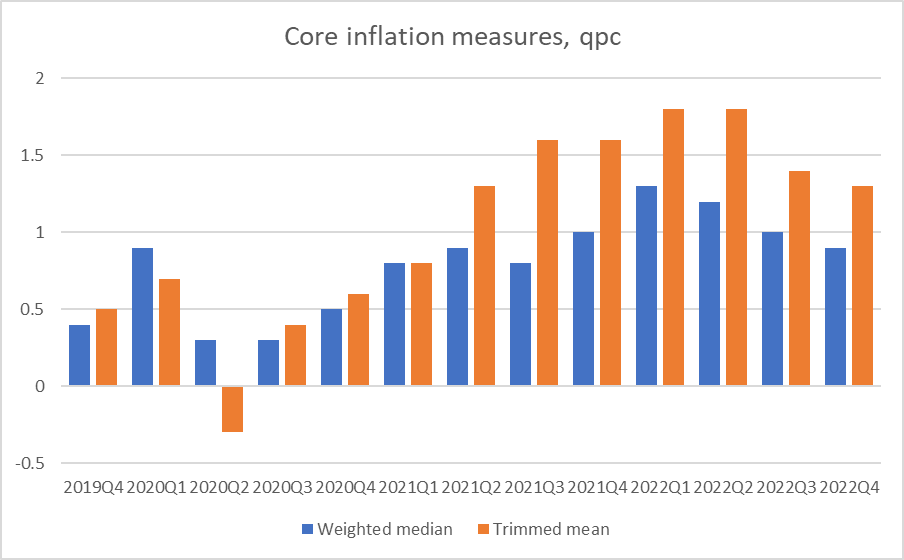
As so often, I continue to be a bit surprised by the fairly superficial analysis of inflation itself. Thus, they include a chart of various core inflation measures, but all as annual rates. Surely, surely, surely, a central bank Monetary Policy Committee, ostensibly forward looking, would want to be focused as much as possible on the very latest quarterly data. For example, this chart from my own post last month on inflation data.

It isn’t impossible that the “true” story is less encouraging than this quarterly series might appear to suggest, but I’d have hoped to hear/see the analysis why or why not from the Bank. As just one example, the data aren’t seasonally adjusted, but the RB is big enough and has enough clout with SNZ that they could either redo the series using seasonally adjusted data or get it done for them (or having looked into it concluded any difference was small enough it didn’t matter). As it is, even if there are some seasonality issues the Q4 numbers for both series were lower than for Q4 in 2021. It looks to be a somewhat encouraging story – still some way to go to get back to annual rates around 2 per cent – but better than it was, better than it might have been.

There is still no sign either – in the MPS or any of the other material the Bank has published in recent months – that the Bank has thought any deeper about what and why they (like many other people) got the inflation (and, thus, monetary policy) story so badly wrong over 2020 to 2022. The Governor was reported this morning as telling MPC that he didn’t think the inflation outcomes represented a “failure”. With hindsight, things might be partly understandable, perhaps even somewhat excusable, but against (a) the targets the government set for the Bank, and (b) the promises of central bankers over recent decades as to what they could deliver, it does not help the advancement of knowledge or understanding (although perhaps it helps MPC members sleep at night) to pretend what has happened has been anything other than a failure. I

I’m not taking a strong view on what the inflation outlook is, or even how much additional monetary policy restraint may (or may not) be needed, but the second point from the MPS that struck me was around their own story and how well it held together.

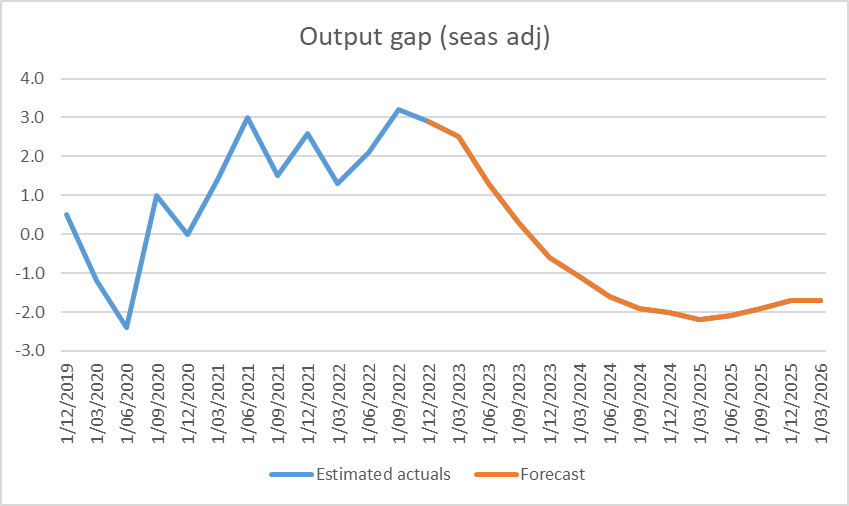
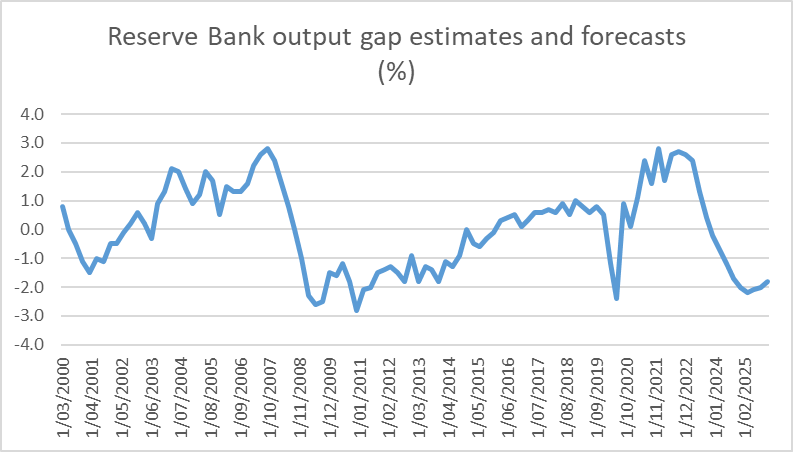
On their numbers, the output gap was estimated to have been 2.1 per cent of (potential) GDP in the June quarter last year, rising to a new peak of 3.2 per cent in the September quarter. Here are the estimates and forecasts

Their forecasts show that they expect the output gap to have averaged 2.7 per cent of (potential) GDP for the Dec and March quarters too. In other words, the period of maximum pressure on resources and of upward pressure on core domestic inflation includes right now (around the middle of the March quarter).

If so, core inflation (quarterly) should have been continuing to rise, something there is no sign of in the data. And a great deal turns on the June quarter, when they expect a sharp fall in the output gap as GDP growth itself turns negative. That is a fairly big call in itself (and of course, actual events will be messed up by post-cyclone repair activity).

But what of inflation? The Bank forecasts that by the December quarter of this year, headline quarterly CPI inflation will be down to only 0.6 per cent. There is some seasonality in the headline CPI numbers, and December inflation tends to be a bit lower as a result. But the difference looks fairly consistently to be only about 0.1 per cent, so that a seasonally adjusted forecast for the December quarter (measured as at mid November, nine months from now) is probably 0.7 per cent. That would be the least bad outcome since 2020, and in annualised terms back inside the target range. (And the December quarter numbers won’t have been thrown around by the end of the petrol excise tax cut or temporary fruit and veg effects of the cyclone). If they deliver that it will be a good, and welcome, outcome. If we apply the eyeballed seasonal factors to their remaining CPI forecasts, by the September quarter of next year, quarterly seasonally adjusted inflation is right back down to 0.5 per cent – slap bang in the middle of the target range.

But I’m left puzzled about two things. The first is that the Bank usually tells us that monetary policy takes 12-24 months to have its full effects on inflation. If so, then why on their story do we need further OCR increases from here when inflation 18 months hence is already back at target midpoint. And then, given that inflation is at the target midpoint 18 months from now, why is policy projected to be set in ways that deliver deeply negative output gaps (not narrowing rapidly at all) all the way out to March 2026? Perhaps there is a good and coherent story, but I can’t see what it is (and I don’t see it articulated in the document). Entrenched inflation expectations can’t really be the story, because as the Bank has often noticed medium to long term expectations have stayed reasonably subdued and shorter term surveys of inflation always tend to move a lot with headline inflation which is expected to be rapidly falling by this time next year.

(My own story would probably put more emphasis on the unemployment rate as an indicator of resource pressures. On the Bank’s (and SNZ”s) numbers, the unemployment rate troughed a year ago.)

The final aspect of the MPS I wanted to comment on was the brief section (4 pages from p30) on “The international dimension of non-tradables inflation”. It is good that they are attempting to include some background analysis in the document, although sometimes one can’t help thinking it might better have been put out first in an Analytical Note where all the i’s could dotted and t’s crossed, and the argumentation tested. We might reasonably wonder what the non-expert members of the MPC make of chapters like this, which they nonetheless own.

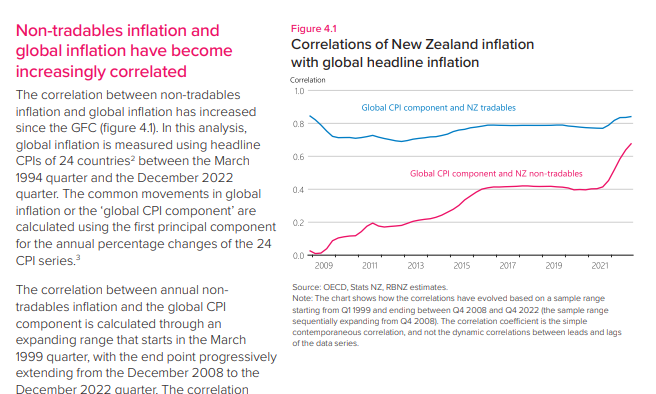
The centrepiece of the discussion is this chart, which looks quite eye-catching.

Count me a bit sceptical for three reasons. The first is that I am wary of a picture that starts at the absolute depth of a severe recession and would be interested to know what it would have looked like taken back another three or five years. Perhaps they didn’t do so because the treatment of housing changed (very materially) in 1999, when the dataset they used starts from, but one is left wondering. Second, end-point revisions are a significant issue with the techniques used to derive the global CPI component, and might be particularly so over the last year when headline inflation has been thrown around so differentially depending on (a) exposure to European wholesale gas prices and mitigating government measures. And then there is the question of the countries in the sample. Of the 24, 12 are part of the euro-area (or in Denmark’s case, tightly pegged to the euro) for which there is a single monetary policy. For these purposes, it is like using as half your sample individual US states or Japanese prefectures. I don’t understand why they chose those countries, or why (for example) Hungary is in but the Czech Republic and Poland (all with their own monetary policies) are out. Or why you’d include Luxumbourg – which has the euro as its currency – and not (similar-sized) Iceland with its own monetary policy. And since this is just using headline CPI inflation data why you’d use only these countries anyway and not a range of non-OECD countries with market economies and their own monetary policies. Perhaps it would make little difference, but we don’t know, and the Bank makes no effort to tell us or to explain their choices.

Now, to be honest, if you had asked me before seeing this section I would probably have said ‘yes, well given that a whole bunch of advanced economy central banks made similar mistakes I might expect to see a stronger than usual correlation between New Zealand non-tradables inflation and some sense of “advanced world core inflation”. And thus I wasn’t overly surprised by the right hand side of the chart above.

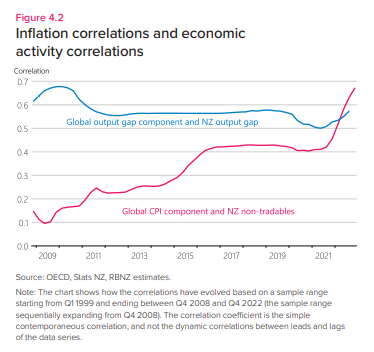
The Bank attempts to address that question, summarised in this chart, using the same period and same 24 countries as in the earlier one.

But count me a little sceptical. Almost every OECD country – including their 24 (with all the same issues around selection of countries) – had unemployment rates late last year at or very close to cyclical lows. As New Zealand did as well. But whereas the Reserve Bank estimates our output gap late last year was +2.7 per cent of potential GDP (and, by deduction, the Bank must be using their own estimate in this calculation) OECD output gap estimates have 12 of the Bank’s 24 countries running negative output gaps last year (they don’t even think New Zealand’s output gap was positive last year, despite abundant evidence of resource stresses here). Given the choice between fairly hard unemployment rate indicators and output gap estimates which are notorous for revisions, personally I’d be putting a lot more weight on the labour market indicators where (as the Governor himself has emphasised in the past) all his peers say they have the same issue of “labour shortages”. (The OECD no longer publishes “unemployment gap” estimates but they do publish “employment gap” estimates, and of the Bank’s 24 countries only a handful had (small) estimated negative employment gaps in 2022).

They end the special section with a paragraph “What does this mean for monetary policy?”. I didn’t find their story persuasive – that it would mean monetary policy was harder – but given how little confidence we can have in the charts, it isn’t worth spending more time on that discussion.

Reviewing the MPC’s Remit

Once upon a time the Reserve Bank’s monetary policy was guided by a Policy Targets Agreement reached between the Governor and the Minister of Finance. These days things are different. As one of the more sensible aspects of the 2018 legislative overhaul, the new Monetary Policy Committee now works to a Remit (current one here) determined ultimately solely by the Minister of Finance. That is the way things should be: if officials are free to implement policy, the policy goals should be set by those whom we elect, in this case the Minister of Finance. At times, the Minister may put daft things in the Remit – as the current one did a couple of years back with the house price references – but that is how our system of government works (as it should).

Another sensible aspect of those reforms was a requirement that every five years or so the Reserve Bank should provide advice to the Minister on the form and content of the Remit, and that the Bank should have to undertake public consultation in bringing together that advice. These provisions seem to have been quite influenced by the Canadian model, with the very big difference being that the Bank of Canada has typically generated a large volume of research in support of each quinquennial review whereas for the first review – underway at present – the Reserve Bank of New Zealand has generated none. That is, sadly, consistent with the dramatic decline in the research output, whether on monetary policy or financial stability functions, of the Orr-led Reserve Bank.

There have been two rounds of consultation. I wrote up and included a link to my submission on the first round here. The second stage of consultation invited submissions by today (although an email from the Bank today says that if you feel inclined they would be happy to receive submissions even on Monday).

It is January and I haven’t been particularly motivated to write about monetary policy. But I do approve in principle of the process of consultation on the Remit – and can only hope that future Governors make a more substantive and research-led fist of it – so thought I should probably make a submission on the second stage. It seems likely that neither the Governor nor the Minister are seeking any very material changes, but there are some longer term issues that need addressing – including dealing structurally with the near-zero effective lower bound on nominal interest rates – and there may be more scope for change on issues around the MPC Charter (which deals with MPC decision-making and communications), on which the Bank was also seeking views. So I got up this morning and spent a couple of hours on a fairly short submission. The full text is here

Comments on second round of Reserve Bank MPC remit review consultation

The first section has nothing that should be terribly controversial

Remit 1

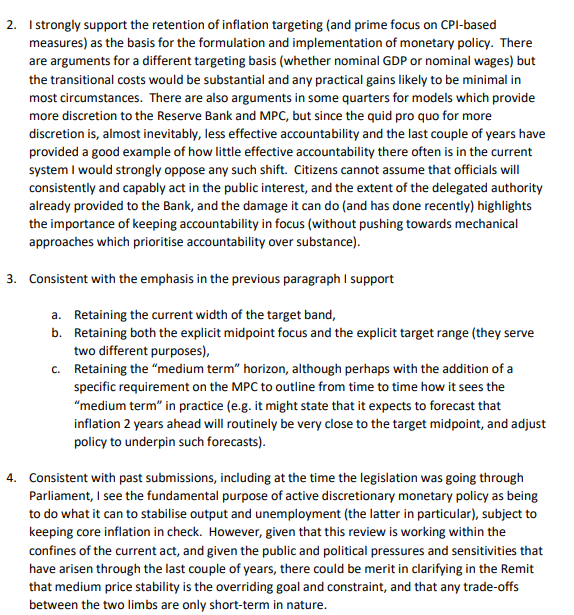
A longer-term concern of mine has been the failure of central banks, here and abroad, to deal effectively with the lower bound, itself existing only because of passive choices by successive generations of governments and central banks. It would be unwise to lower the inflation target without fixing the lower bound issue, but if that constraint was removed there would be little or no good reason not to return to a target centred closer to true zero CPI inflation

remit 2

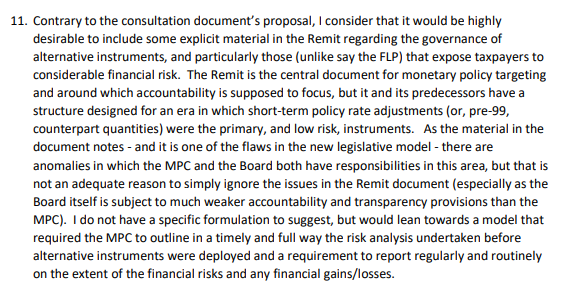
The consultation document addresses the question as to whether there should be text in the Remit around the governance of alternative policy instruments (like the – expensive and ineffective – LSAP). The Bank prefers not, but I reckon there is a pretty strong case, although the issue is complicated by the divided responsibilitities between the Bank’s Board – who know nothing about monetary policy – and the MPC. There is no easy solution, but the Remit is supposed to be the focal document for guiding monetary policy accountability.

remit 3

On the composition and strcuture of the MPC there are several significant matters that can only be dealt with by amending legislation (I hope National is open to making some fixes) but I took the opportunity to lament again the blackball the Governor, Board and Minister have in place preventing anyone with current expertise in monetary policy or macroeconomic research/analysis from serving as an external MPC member, a decision that among other things cements the Governor’s continued dominance of the system (the Governor himself having only limited depth and authoritative expertise in such matters). But my main comments were about matters that are directly dealt with in the Charter and in the culture that has developed around the operation of the MPC since it was established.

remit 4

If you felt inclined to make a late submission, the relevant email address is remit-review@rbnz.govt.nz

No contrition, not much sense of responsibility, and very little persuasive analysis

If you’d been given a great deal of delegated power and had messed up badly – not through any particular ill-intent, but perhaps you’d misjudged some important things or belatedly realised you didn’t have the knowledge to cope with an unexpected circumstance that you thought you had – and if you are anything like a normal decent person you would be extremely apologetic and quite contrite. Heck, borrow a friend’s car for the afternoon and come back with a dent in it – not even necessarily your fault – and most of us would be incredibly embarrassed and very apologetic. Bump into someone (literally) in the supermarket aisle and most of us will be quite apologetic – often enough proferring a “sorry” just in case, even if it is pretty clear it is the other person who knocked into us.

But the apparently sociopathic world of central banking seems to be different. The Reserve Bank (Governor and MPC) are delegated a great deal of power and influence. Back before the days of the MPC I used to describe the Governor as by far the most powerful unelected person in New Zealand (and more powerful individually than almost all elected people too). The powers – exercised for good or for ill – haven’t changed, they’ve just been (at least on paper) slightly diffused among a group of (mostly silent) people whose views we never quite know, and whose appointment is largely (effectively) controlled by the Govenor. (There was a nice piece in Stuff yesterday on the problems of the MPC, echoing many points made here over the years.)

It is not as if the Bank took on these powers reluctantly, or that the Governor had to have his arm twisted to do the job. The Bank championed the delegation (and reasonably enough) and every single member of the MPC took on the role – amply remunerated – entirely voluntarily. But they seem to have long since forgotten that counterpart to autonomy and operational independence that used to feature so prominently in all their literature, that great delegated power needs to be accompanied by serious accountability. Among decent people that would include evident contrition when things go wrong, no matter how good your intentions might have been, even if you thought you’d done just the best you personally could have.

The Auditor-General was reported yesterday raising concerns about the serious decline in standards of accountability in New Zealand public life. Whatever the situation elsewhere – and I have no reason to question the Auditor-General’s view – nowhere is it more evident than around the Reserve Bank, which exercises so much power with so few formal constraints. Much too little attention has been given to the fact that, having delegated them huge amounts of discretionary power to keep (core) inflation near 2 per cent, the Reserve Bank has messed up very badly over the last couple of years.

The issue here is not about intent or lack of goodwill, but about outcomes. When central banks were given operational autonomy it was on the implied promise that they’d deliver those sort of inflation outcomes, pretty much year in year out. The public wouldn’t need to worry about inflation because control of it – under a target set by elected politicians who would hold them to account – had been delegated to a specialist, notionally expert, agency, which would know what it was doing. 20 years ago the expectation on the Bank was fleshed out a little more: that they should do their job while avoiding unnecessary variability in interest rates, exchange rates, and output.

And what do we now have? Roughly 6 per cent core inflation, three years of annual headline inflation above the top of the target range, public doubts about just whether the Bank will deliver 2 per cent in future. Oh, and now the necessity (very belatedly acknowledged by the Bank yesterday) of a recession and a significant rise in unemployment to levels well beyond any sort of NAIRU to get inflation back in check. Add in the arbitrary wealth distributions – that no Parliament voted on – with the heavily indebted (including the government) benefiting from the unexpected surge of inflation the Reserve Bank has overseen, at the expense of those with financial savings. And the huge disruptions to lives and businesses from both the extremely overheated economy we’ve had for the last 12-18 months and the coming nasty shakeout. Oh, and that is not to mention more than in passing the $9.2 billion of LSAP losses the Reserve Bank up entirely unnecessarily (foreseeably).

It has not, to put it mildly, been the finest hour of the Reserve Bank. But there has been no a word of contrition – from the Governor or any of the rest of the Committee – and no real accountability at all (among other things, Orr and two of the MPC have been reappointed this year, with no sign of any searching scrutiny of their records or contributions).

Instead we just get lots of spin, and lightweight analysis. One of Orr’s favourite lines (repeated as I type at FEC this morning) is that the Reserve Bank was one of the very first central banks to tighten “by some considerable margin”, when in fact there were half a dozen OECD central banks that moved before our central bank did. We had claims from Orr a while ago that the macro benefits of the LSAP programme were “multiples” of those mark to market losses to taxpayers – a claim that quietly disappeared when they actually published their review of monetary policy. A few weeks ago Orr was telling Parliament that if it weren’t for the Ukraine war inflation would have been in the target range – notwithstanding the hard data showing core inflation was already very high well before the war – and then nothing more is heard of that claim when the MPS itself was published.

Yesterday we heard lots of bluster about workers, firms and households being enjoined to change their behaviour – even trying to damp down Christmas – as if inflation was the responsibility of the private sector, not the outcome of a succession of Bank choices and mistakes. But not a word from the Bank or Governor accepting any responsibility themselves.

To repeat, I don’t doubt that the Bank was well-intentioned throughout the last few years. Plenty of other people made similar mistakes in interpreting events. But it is the Reserve Bank and its MPC who are charged with – and paid for – the job of keeping the inflation rate and check. They’ve failed. Given that stuff-up they may now fix things up, but it is no consolation or offset to the initial huge series of mistakes. And not a word of contrition, barely even much acceptance of responsibility.

Which is a bit of a rant, but about a serious issue: with great power must go great responsibility, accountability….and a considerably degree of humility. Little or none has been evident here.

But what of the substance of the Monetary Policy Statement? Here I really had only three points.

The first is the glaring absence of any serious in-depth analysis of what has actually been going on with inflation, at a time of some of the biggest forecast errors – and revisions in the OCR outlook – we’ve seen for many years. For example, every chart seems to feature annual inflation, which is fine for headlines but tells you nothing about what has been happening within that one year period. What signs are there, for example, that quarterly core inflation might have peaked (or not) – eg some of the charts I included here? There seemed to be no disaggregated analysis at all, for example of the sort one economic analyst pointed to in comments here the other day. This from the organisation that is responsible for inflation, and which has by far the biggest team of macroeconomists in the country. We – and those paid to hold the Bank to account – really should expect better.

And almost equally absent was any persuasive supporting analysis for the really big lift in the forecast path of the OCR, now projected to peak at 5.5 per cent. My main point is not that I think they are wrong but that there is little or no recognition that having misread badly the last 2-3 years (in good company to be sure), there is little reason for them or us to have any particular confidence in their forecast view now. Models and sets of understandings that didn’t do well in preventing us getting into this mess probably haven’t suddenly become reliable for the getting out phase. But even granting that, the scale of the revision up seems disproportionate to the surprises in the new data of the last few months. It has the distinct feel of just another stab in the dark (but then I’ve been a long-term sceptic of the value of central bank OCR forecasts), with little engagement with either weakening forward indicators or the lags in the system (in the last 6 weeks the Bank has now increased the OCR by as much as it did in the first six months of the tightening cycle. With a recession already now finally in the forecasts based on what the MPC has already done (they don’t meet again until late February and the deepest forecast fall in GDP is in the quarter starting just 5 weeks later – the lags aren’t that short) they can’t really be very confident of how much more (if any) OCR action might be needed.

Finally, it is constantly worth bearing in mind the scale of the task. Core inflation has been running around 6 per cent and should be close to 2 per cent. That scale of reduction in core inflation hasn’t been needed/sought since around 1990. In 2007/08 inflation had got away on us to some extent, but a 1.5 percentage point reduction would have done the job of getting back to around 2 per cent. As Westpac pointed out in their commentary, the scale of the economic adjustment envisaged in these forecasts (change in estimated output gap) is very similar to what (the Bank now estimates) we experienced over 2008 to 2010.

The open question then is perhaps whether this sort of change in the output gap is likely to be sufficient: 13 years ago it delivered a 2 percentage point reduction in core inflation, but at present it looks as though we need a 4 percentage point reduction now. It isn’t obvious that other surrounding circumstances now will prove more propitious than then (eg for supply chains normalising now read the deep fall in world oil prices then).

Perhaps it will, perhaps it won’t, but you might have expected a rigorously analytical central bank and MPC to have attempted to shed some light on the issue. But once again they didn’t.

(My own money is probably on a deeper recession next year, here and abroad but……and it applies to me as much as to anyone else … if you got the last 2-3 years so wrong you have to be very modest in your claims to have the current and year-ahead story right.)

Long summer holidays for the MPC

The Reserve Bank’s Monetary Policy Committee has its final meeting for the year on Wednesday, and then they shut up shop. For a long time. The next scheduled announcement is not until 22 February, a full 13 weeks (3 months) away. Nice job if you can get it, and although I’m sure management and staff will still be working for much of the intervening period, the same is unlikely to be said for the three non-executive members, who are generously remunerated by the taxpayer, utterly invisible, and only need to show up when meetings are scheduled.

This strange schedule has been in place for quite a few years now, having been adopted at a time when the OCR wasn’t being moved much at all (and when the Bank was raising the OCR, it often proved to have been a mistake). But having been in place for a while does not make it any more defensible or sensible. In fact, last year’s three month summer break almost certainly was one factor in how slow the MPC was to get on with raising the OCR once they’d finally made a start. On no reading of the data (contemporary data that is) did it make sense for us to have ended 2021 with the OCR still lower, in nominal terms, than it had been just prior to Covid. And having experienced the issue last summer (when perhaps it caught them by surprise) there was no excuse for not resetting the schedule for this summer.

One can always mount defences (for almost anything I suppose). Monetary policy works with a lag, the OCR adjustments can be just as large as they have to be, perhaps there is a bit of a tradeoff between time doing analysis and time spent preparing for meetings. But none of it is very convincing in this context. And it is out of step with their peers.

Here is a table of the monetary policy announcements dates over November to February for a fairly wide range of OECD country central banks. None, not even Sweden and tiny Iceland, are taking as long a break as our MPC (and although I didn’t tot up all the northern hemisphere summer meeting dates, it didn’t look as though any took as long a break then as our MPC takes now). The median country has a longest gap of seven weeks between meetings over this period.

[UPDATE: In addition, the South Korean central bank meets on 24 Nov, 13 Jan, and 23 Feb]

There are substantive macroeconomic arguments for (and against) a 75 basis point OCR adjustment this week, but one of arguments some have advanced is that they really need to go 75 basis points this week because they don’t have another opportunity until late February. But whose fault is that? It is entirely an MPC choice. They have a very flexible instrument and just choose to tie their hands behind their backs to give themselves a very long summer break.

The whole situation is compounded by the inadequacies of New Zealand’s key bits of macroeconomic data. We now have the CPI and the unemployment rate for mid-August (the midpoint of the September quarter). Most OECD central banks already have October CPI data, almost all have September unemployment rate data (and several have October unemployment rate data), and three-quarters of OECD countries already have September quarter GDP data (a few even have monthly GDP estimates).

The combination of slow and inadequate data and widely-spaced summer meetings really isn’t good enough, especially at a time when there is so much (perhaps inevitable) uncertainty about the inflation situation and outlook. The inadequacies of our national macroeconomic statistics cannot be fixed in short order (not that the government shows any interest in doing so anyway). But how often, and when, the MPC meets is entirely at the Committee’s discretion, and easily altered with little or no disruption other than to the holiday plans of some appointed and (supposedly) accountable policymakers (people who not incidentially – and pardonably or otherwise – have done such a demonstrably poor job of their main responsibility, keeping core inflation in the target range, in recent times.

The MPC should be announcing on Wednesday (a) an extra OCR review for a few days after the CPI release in January, and (b) a commitment to revisit the meeting schedule for future years to bring the length of the long summer break back to (say) no longer than the one the RBA takes. If they don’t journalists at the press conference and MPs at FEC should be asking why not.

(Writing this post brought to mind memories of Orr 20+ years ago when the OCR was first introduced championing having only four reviews a year. The OCR then was new, inflation was low and stable. One hopes that sort of thinking no longer lurks in the back of the Governor’s mind.)

Reviewing monetary policy

Way back in 1990 Parliament formally handed over the general responsibility for implementing monetary policy to the Reserve Bank. The government has always had the lead in setting the objectives the Bank is required to work to, and has the power to hire and fire if the Bank doesn’t do its job adequately, but a great deal of discretion has rested with the Bank. With power is supposed to come responsibility, transparency, and accountability.

And every so often in the intervening period there have been reviews. The Bank has itself done several over the years, looking (roughly speaking) at each past business cycle and, distinctly, what role monetary policy has played. These have generally been published as articles in the Bank’s Bulletin. When I looked back, I even found Adrian Orr’s name on one of the policy review articles and mine on another. It was a good initiative by the Bank, intended as some mix of contribution to debate, offering insights that were useful to the Bank itself, and defensive cover (there has rarely been a time over those decades when some controversy or other has not swirled around the Bank and monetary policy).

There have also been a couple of (broader-ranging) independent reviews. Both had some partisan intent, but one was a more serious effort than the other. When the Labour-led government took office in 1999 they had promised an independent review, partly in reaction to their sense that we had messed up over the previous few years. A leading Swedish academic economist Lars Svensson, who had written quite a bit about inflation targeting, was commissioned to do the review (you can read the report here). And towards the end of that government’s term – monetary policy (and the exchange rate) again being in the spotlight – Parliament’s Finance and Expenditure Committee did a review.

When the monetary policy provisions of the Reserve Bank Act were overhauled a few years ago this requirement was added

It made sense to separate out this provision explicitly from that for Monetary Policy Statements (in fact, I recall arguing for such an amendment years ago) but the clause has an odd feature: MPSs (and the conduct of monetary policy itself) are the responsibility of the MPC, but these five-yearly longer-term reviews are the responsibility of “the Bank”. In the Act, the Bank’s Board is responsible for evaluating the performance of both management and the MPC, but the emphasis here does not seem to be on the Board. It seems pretty clear that this is management’s document, and of course management (mainly the Governor) dominates the MPC. Since the Board has no expertise whatever in monetary policy, it is pretty clear that the first of these reports, released last week, really was, in effect, the Governor reporting on himself.

And although plenty of people have made scathing comments about that, there isn’t anything necessarily wrong about a report of that sort. After all, it isn’t uncommon (although I always thought it odious and unfair given the evident power imbalance) for managers to ask staff to write about notes on their own performance, as part of an annual performance appraisal, before the manager adds his/her perspective. The insights an employee can offer about his or her own performance can often be quite revealing. And it isn’t as if the Bank’s own take on its performance is ever going to be the only relevant perspective (although, of course, the Governor has far more resources and information at his disposal than anyone else is going to have). The only real question is how good a job the Bank has done of its self-review and what we learn from the documents.

On which note, I remain rather sceptical about the case (National in particular is making) for an independent review specifically on the recent conduct of monetary policy. Some of those advocating such an inquiry come across as if what they have in mind is something more akin to a final court verdict on the Bank’s handling of affairs – one decisive report that resolve all the points of contention. That sort of finality is hardly ever on offer – scholars are still debating aspects of the handling of the Great Depression – and if there was ever a time when choice of reviewer would largely determine the broad thrust of the review’s conclusions this would be among them. Anyone (or group) with the expertise to do a serious review will already have put their views on record – not necessarily about the RBNZ specifically (if they were an overseas hire) but about the handling of the last few years by central banks generally. There is precedent: the Svensson review (mentioned above) was a serious effort, but the key decision was made right at the start when Michael Cullen agreed to appoint someone who was generally sympathetic to the RB rather than some other people, some of equal eminence if different backgrounds, who were less so. It would be no different this time around (with the best will in the world all round). A review might throw up a few useful points and suggestions, and would probably do no harm, but at this point the idea is mostly a substantive distraction. Conclusions about the Reserve Bank and about its stewardship are now more a matter for New Zealand expert observers and the New Zealand political process (ideally the two might engage). Ideally, we might see some New Zealand economics academics weighing in, although in matters macroeconomics most are notable mainly by their absence from the public square.

That is a somewhat longwinded introduction to some thoughts about the report the Bank came out with last week (120 pages of it, plus some comments from their overseas reviewers, and a couple of other background staff papers).

I didn’t think the report presented the Bank in a very good light at all. And that isn’t because they concluded that monetary policy could/should (they alternate between the two) have been tightened earlier. That took no insight whatever, when your primary target is keeping inflation near the middle of the target range and actual core inflation ends up miles outside the range. Blind Freddy could recognise that monetary policy should have been tightened earlier. When humans make decisions, mistakes will happen.

The rest of the conclusions of the report were mostly almost equally obvious and/or banal (eg several along the lines of “we should understand the economy better” Really?). And, of course, we had the Minister of Finance – not exactly a disinterested party – spinning the report as follows: “It is really important to note that the report does indicate that they got the big decisions right”. It should take no more than two seconds thought to realise that that is simply not true: were it so we would not now have core inflation so far outside the target range and (as the report itself does note) pretty widespread public doubts about how quickly inflation will be got down again. It would be much closer to the truth to say that the Reserve Bank – and, no doubt, many of their peers abroad – got most of the big decisions wrong. It has, after all, been the worst miss in the 32 years our Reserve Bank has been independent, and across many countries probably the worst miss in the modern era of operationally independent central banks (in most countries, after all, monetary policy in the great inflation of the 1970s was presided over by Ministers of Finance not central banks).

But there is no sense in the report at all of the scale of the mistake, no sense of contrition, and – perhaps most importantly in my view – no insight as to why those mistakes were made, and not even any sign of any curiosity about the issue. The focus is almost entirely defensive, and shows no sense of any self-critical reflection. There are no fresh analytical insights and (again) not even any effort to frame the questions that might in time lead to those insights. And no doubt that is just the way the Governor (who has repeatedly told us he had ‘no regrets’) would have liked it. And here we are reminded that this is very much the Orr Reserve Bank: the two senior managers most responsible for the review (the chief economist and his boss, the deputy chief executive responsible for monetary policy and macroeconomics) only joined the Bank this year, and so had no personal responsibility for the analysis, preparation and policy of 2020 and 2021 but still produced a report offering so little insight and so much spin. Silk, in particular, probably had no capacity to do more, but the occasional hope still lingered that perhaps Paul Conway, the new chief economist, might do better. But these were Orr’s hires, and it is widely recognised that Orr brooks no dissent, no challenge, and in his almost five years as Governor has never offered any material insight himself on monetary policy or cyclical economic developments. Even if they had no better analysis to offer – and perhaps they didn’t, so degraded does the Bank’s capabilities now seem – contrition could have taken them some way. But nothing in the report suggests they feel in their bones the shame of having delivered New Zealanders 6 per cent core inflation, with all the arbitrary unexpected wealth redistributions that go with that, let alone the inevitable economic disruption now involved in bringing inflation a long way back down again. It comes across as more like a game to them: how can we put ourselves in the least bad light possible with a mid-market not-very-demanding audience (all made more unserious as we realised that the Minister of Finance had made the decision a couple of months ago to reappoint Orr, not even waiting for the 120 pages of spin).

At this juncture, a good report would be most unlikely to have had all the answers. After all, similar questions exist in a whole bunch of other countries/central banks, and if the Reserve Bank has the biggest team of macroeconomists in New Zealand, there are many more globally (in central banks, academe, and beyond) but it doesn’t take having all the answers to recognise the questions, or the scale of the mistakes. In fact, answers usually require an openness to questions, even about your own performance, first. And there is none of that in the Bank’s report.

Thus, we get lame lines – of the sort Conway ran several times at Thursday’s press conference – that if the Bank had tightened a bit more a bit earlier it would have made only a marginal difference to annual inflation by now. And quite possibly that is so, but where is the questioning about what it would have taken – in terms of understanding the economy and the inflation process – to have kept core inflation inside the target range? What is it that they missed? (And when I say “they” of course I recognise that most everyone else, me included, also missed it and misunderstood it, but……central banks are charged by Parliaments with the job of keeping inflation at/near target, exercise huge discretion, carry all the prestige, and have big budgets for analytical purposes, so when central banks report on their performance, we should expect something much better than “well, we acted on the forecasts we had at the time and, with hindsight, those forecasts were (wildly) wrong”.) The question is why, what did they miss, and what have they learned that reduces the chances of future mistakes (including over the next year or two – if your model for how we got into this mess was so astray, why should the public have any confidence that you have the right model – understanding of the economy and inflation – for getting out of the mess? At the press conference the other day the Governor and the Board chair prattled on about being a “learning organisation” but you aren’t likely to have learned much if you never recognised the scale of the failure or shown any sign of digging deep in your thought, analysis, and willingness to engage in self-criticism. We – citizens – should have much more confidence in an organisation and chief executive will to do that sort of hard, uncomfortable, work than in one of the sort evident in last week’s report.

With hindsight one can make a pretty good case that no material monetary policy action was required at all in 2020. One might be more generous and say that by September/October 2020 with hindsight it was clear that what had been done was no longer needed. But that wasn’t the judgement the Reserve Bank came to at the time – and it is the Bank that has been tasked with getting these things right. Why? (And, of course, the same questions can be asked of other central banks and private forecasters, but the Reserve Bank is responsible for monetary policy and for inflation outcomes in this country.)

I may come back in subsequent posts to look at more detail at a number of specific aspects of the report (including a couple of genuinely interesting revelations) but at the big picture level the report does not even approach providing the sort of analysis and reflection the times and circumstances called for (in some easier times a report of this sort might have not been too bad, although you would always look for some serious research backing even then).

And if you think that I’m the only sceptic, I’d commend to you the comments from the former Deputy Governor of the Bank of Canada. On page after page – amid the politeness (and going along with distractions like the alleged role of the Russian invasion) – he highlights just how relatively weak the analysis in the report is, how many questions there still are, and a number of areas in which he thinks the Bank’s defensive spin is less than entirely convincing.

New Zealanders deserved better. That we did not get it in this report just highlights again that Orr is not really fit for the office he holds. In times like those of the last few years – with all the uncertainties – an openness to alternative perspectives, willingness to engage, willingness to self-critically reflect, and modelling a demand for analytical excellence are more important than ever.