Good in a few parts….pretty poor otherwise

There were some good aspects to yesterday’s Reserve Bank Monetary Policy Statement:

  • the Bank has abandoned its long-running over-optimism about future productivity growth and has thus revised down its estimates of potential (GDP) growth to more reasonable rates.  Nothing in the economic strategy –  this government or its predecessor –  seemed set to deliver better, and it is good that the central bank has stopped spinning candy floss numbers (at least on that count),
  • the Governor also seemed less effervescent, and perhaps consistent with the previous point there was little or no spin about just how well the economy was doing,
  • in the document there weren’t even further direct calls for more government spending/borrowing.  This change was defended on the grounds that the message had already been given, but I doubt that was all there is to explain the change (having said something once, even loudly, rarely discourages central banks from saying them again),
  • oh, and the folksy Maori salutations at the start of the main statement –  beloved by the tree-god Governor when it was his statement alone –  seem to have quietly disappeared.  Perhaps we might hope for the eventual quiet discontinuance of the cartoon version of the statement too?

But that was about all that could be said for it.

The document itself was weak on substance, building on consistently poor (largely non-existent) communications from the Bank.

You can tell that there are problems with communications when the Governor is reduced to repeating (numerous time in the parts of the press conference I saw) “we are trying to be as transparent as possible”.  He isn’t seriously trying, and certainly isn’t succeeding.  We’ve not yet had a serious speech on the economy and monetary policy from the Governor, after seven months we’ve heard not a word from four of the MPC members (including all the externals), background papers aren’t released even with a long lag, the MPS documents themselves offer ever-less insight or sense of how (or even whether) the MPC thinks in depth about the economy, and the Bank holds data close to its chest when it could release it more promptly (asked about this latter point yesterday the Governor did undertake to review their practice).

When two successive MPS OCR wrongfoot those paying closest attention to the data and to the Bank, it suggests the problem is with the Bank, not the observers.      It would be interesting to know what advice the Bank’s financial markets staff gave the MPC about the market movements that were likely to occur as a result of yesterday’s decision.

It was only a few weeks ago that the Assistant Governor, Christian Hawkesby, gave a speech on central bank communications, probably mostly trying to fend off criticism of how they’d done in August.    In that speech he highlighted –  and overstated, at least in practical terms –  the risks if central banks do what markets expect them to do

In this scenario there is a danger that markets end up paying too much attention to our communications for what we have said ‘we will do’, leaving no one left to analyse the incoming economic data for what ‘we should do’. As a central banker, I am far more interested in listening to what ‘we should do’.

And yet, yesterday’s MPS suggested that Hawkesby and his colleagues actually had no interest in that perspective either.   As I noted in yesterday’s post, the MPC has had available to it throughout its deliberations the results of the Bank’s survey of expectations, the macro views of several dozen informed observers of the New Zealand economy. I wrote about the results yesterday.  Those respondents expected the Bank to cut yesterday (and again next year) and even so they didn’t expect two-year ahead inflation to get above 1.8 per cent and expected no rebound in GDP growth either.    Implicit in those numbers (and consistent with the mandate given to the MPC by the government) is a pretty clear view that the Bank should have cut the OCR, and should probably do so again next year.  The Bank, apparently uninterested, chooses to ignore this weight of opinion and runs with its own idiosyncratic view that even with higher interest rates they were still get the growth rebound the outside observers couldn’t see (either three weeks ago when they completed the survey or –  judging by comments from market economists in the last day –  now).  In the end, the MPC is charged with making decisions, but having got things wrong –  below target inflation –  for the last decade, the onus is surely on them to explain why they (mostly non-experts themselves) are so willing to back an away-from-consensus call.   But they made no effort to.

In fact, if you started into the document without knowing the bottom line you’d think the case for easing yesterday was pretty unambiguous.  They told us that the economy had slowed and risk were to the downside, the world economy was slowing, inflation expectations were very low and/or falling and, of course, core inflation was below target.  And all that without even so much as a single mention –  in the entire document, includung the minutes –  of the apparently significant tightening in credit conditions respondents to their own credit conditions survey were foreshadowing, those same respondents having highlighted regulatory changes (ie most likely the coming big increases in minimum capital requirements) as a big issue.
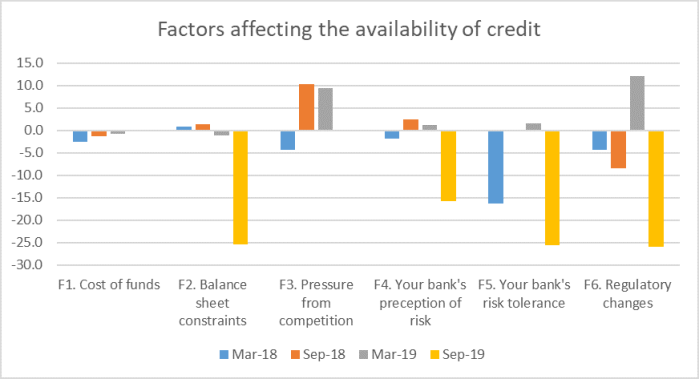
credit 4 Or perhaps the MPC is back to thinking that credit conditions really don’t matter at all?  Surely, either way it would be reasonable to explain their perspective.  Instead they seem to have simply ignored the issue (or tried to pretend the Governor’s whim wasn’t an issue –  I heard Hawkesby on the radio this morning saying they had in fact taken account of credit conditions issues, in which case the OCR decision is still more mystifying, and the absence of any reference in the official documents looks even worse).

One of the disappointing features of yesterday was that there were signs of the Wheeler Reserve Bank returning.   Under the former, not widely lamented, Governor we heard endlessly from the Bank about how stimulatory monetary conditions really were –  even as inflation just kept on falling below their forecasts.  There was a lot of that line yesterday.    As then, so now, the Bank does not have a good read on where the neutral interest rates are, and the best guide is really something like the rear-view mirror: all else equal, look at what is happening to demand (and early indicators like business activity measures) and inflation.   In the Wheeler years, there was also a strong tendency to constantly be focusing on the merest hint that something might be picking up, because of the strong belief (see above) that conditions were “highly stimulatory”.  It was all rather circular –  we think we are right because we think we are right.     There was quite a bit of that sort of flavour in yesterday’s statement too: both the forecast pick-up in growth (that few other observers appear to believe) and the repeated mysterious suggestions that inflation itself was picking up now.

In the MPS the Bank shows five core inflation measures, and also highlights as a preferred measure the (highly persistent and stable) sectoral core factor model measure

core infl nov 19

Across the wider suite of measures, there has been no lift since 2016.   And the sectoral core factor measure has been flat at 1.7 per cent for more than a year.  And core inflation is a lagging indicator in a climate where (to quote the Bank) the New Zealand economy has been slowing and the world economy has been slowing).

What about core non-tradables inflation?  The headline non-tradables inflation rate did rise recently.
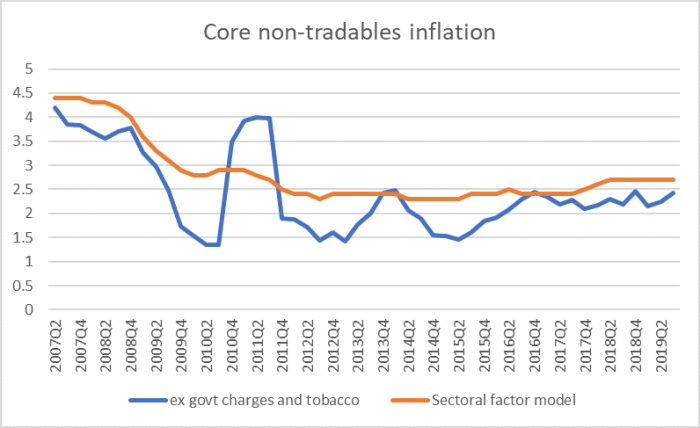
core infl NT.png

The blue line is an official SNZ series, while the orange line in an RB series.  Again, no sense of any pick-up in core domestic inflation pressures –  and nor, really, would one expect there to be in an economy where activity growth has slowed, unemployment has levelled out, confidence is low, policy uncertainty is quite high, and inflation expectations (remember them) are low.

In short, there was a (welcome and overdue) pick-up in inflation a couple of years ago, but there is no sign it is continuing.  And –  since the OCR cuts this year were against the backdrop of materially deteriorating fundamentals –  there isn’t much reason to expect further increases in inflation from here on current policy (perhaps especially not when credit conditions are tightening, and RB announcements are pushing up interest and exchange rates).

Incidentally, one line –  used several times yesterday – that you shouldn’t be fooled by was the one that “the projections were consistent with either choice –  a cut or leaving the OCR unchanged”.  Well, of course…….    Unless practice has changed very very markedly from the way things were when I was closely involved in these processes, the final projections track –  especially the interest rate track –  is tailored to be consistent with the policy options and messages the decisionmakers (in my day the Governor, these days –  at least on paper –  the MPC) want to send. If the MPC wasn’t clear in its own mind last week what it was finally going to do, they’d prudently have ensured that the final track was consistent with either option.  If they’d been clear but wanted to send a message that they’d been open to a possible cut, they have done the same thing.  There is no independent evidence or perspective in (the first few quarters) of that track.

I want to circle back to the claims around the (asserted) high degree of transparency.  One of the innovations in the new monetary policy governance model is the publication of the summary record of the meeting (aka “minutes).    These are typically a bit longer than the initial policy announcement statement itself, and do provide the opportunity to note a few issues there wouldn’t otherwise be room for.  But they are proving even less enlightening than one might have feared (given the way the Governor and the Minister got together to oppose a more genuinely open model, of the sort seen in central banks in places like the US, the UK, Japan, or Sweden).

Here are four examples from yesterday’s minutes.  First, fiscal policy

The Committee discussed the impact of fiscal stimulus on the economy. The members noted that fiscal stimulus could be greater than assumed. The members also discussed the potential delays in implementing approved spending and investment programmes.

So far, so banal.  As I noted earlier, in the official documents the Bank was back to staying in its line re fiscal policy (as the Governor said, “we take fiscal policy as announced and run on that basis” –  which is how things are supposed to work).   And yet this morning on Radio New Zealand Christian Hawkesby was heard stating that “we think more fiscal spending would be helpful in stimulating the economy”.     If that is the Committee view, why isn’t it in the MPS or the minutes, if it was substantively discussed why isn’t it in the minutes, and if it is true then – given that the, as the Governor said, the Bank takes fiscal policy as given – isn’t Hawkesby’s statement further evidence that they should in fact have cut the OCR yesterday (if they think the economy needs more stimlus, and they are responsible for deploying the primary counter-cyclical tool)?

Then, the work programme on how the Bank might handle reaching the limits of conventional monetary policy

The Committee noted the Bank’s work programme assessing alternative monetary policy tools in the New Zealand environment, as part of contingency planning for an unlikely scenario where additional monetary instruments are required.

A statement which tells readers precisely nothing (especially as it is now three months since the Governor told a press conference that the work then was “well-advanced”).  As it happens, reality seems a bit better than the minutes imply because when he was asked about this work programme yesterday and bringing it to light, the Governor revealed  that they will release a document on frameworks and principles in the new year, and will (he says) be keen on feedback and discussion.  That sounds more promising, but then where does the MPC fit into all this given the unrevealing comment from the minutes (and there are longstanding doubts about just who has power over any unconventional instruments –  whether the MPC will get much say at all)?

Then we are told they had a discussion on an important immediate policy issue

In terms of least regrets, the Committee discussed the relative benefits of inflation ending up in the upper half of the target range relative to being persistently below 2 percent.

But that’s it.  We are given no insight into the arguments deployed, the competing cases made, or the conclusion.  Given their OCR decision we are left to deduce that the Committee would be quite worried indeed about (core) inflation getting above 2 per cent.  But we are given no hint of why –  despite 10 years now below that midpoint.   And this is what the Governor calls being as transparent as possible?

And finally, the OCR decision itself

The Committee debated the costs and benefits of keeping the OCR at 1.0 percent versus reducing it to 0.75 percent. The Committee agreed that both actions were broadly consistent with the current OCR projection. The Committee agreed that the reduction in the OCR over the past year was transmitting through the economy and that it would take time to have its full effect.

And, again, that is it.  No hint of the competing arguments –  which could readily be done without identifying individuals –  and no hint of why they chose to come down where they did?  What were the key costs the Committee saw to cutting the OCR (especially when both market expectations and observer implict recommendations were to cut).  There is no insight into the current decision or, importantly given the absence of speeches etc, no insight into the reaction functions/loss functions members (individually or collectively are using).  It simply isn’t very transparent at all.    The mantra overnight “just watch the data, just watch the data” isn’t really much use at all –  especially when the MPC is going to run with such a non-consensus view of the data (and/or the risks around policy reactions).

It is all pretty underwhelming and confidence-draining.   The point isn’t that a huge amount macroeconomically hung on any specific OCR decision. Nor for now is the economy in cyclical crisis –  we aren’t in recession, inflation isn’t falling away sharply.   The concern is that we have a central bank led by pygmies (no offence to the central Africans).  Not one of the MPC members –  all of whom are probably pleasant people (even the Governor if people aren’t challenging him) –  command any great respect for their insight into the economy, their judgement or intellectual leadership, or for their willingness/ability to communicate a persuasive story or a sense that they themselves have a good and robust framework for thinking about the economy.   In the case of the Treasury observer – who gets to participate not vote – it might have been her first ever significant meeting on advanced economy macro issues, but in the end responsibility rests with the voting members.  They are failing us, corralled by the unconvincing Governor.    Having substantially surprised the market (deliberately and consciously so) two MPSin a row, and chosen to ignore consensus opinion on likely economic developments, you’d have thought we’d be hearing a lot from the MPC members –  minutes that clearly outlined the issues and judgements, speeches articulating mental models and perspectives on the New Zealand economy, wide-ranging interviews (of the sort senior Fed officials give).  Instead, we have weak official stories (the MPS), unrevealing minutes and –  seven months into the new model –  not a word in public from any of the external members nor from the Bank’s chief economist.

It isn’t good enough.  The Bank’s Board should be demanding better, as should the Minister of Finance (including when he comes to appoint new Board members and the Board chair in the next couple of months).   Transparency and communications aren’t about publishing forward tracks –  one of the Bank’s own recently-departed researchers published research last year suggesting they make little difference – but about open and honest engagement, laying out the uncertainties and (inevitable) differences of possible perspective in a business characterised by so much uncertainty.  How decisionmakers demonstrate that they handle uncertainty, competing narratives and even disagreement, is the sort of thing that helps build confidence, not rote publications (let alone poor, surprising, decisions) or Soviet-style phalanxes of grey bureaucrats all lined up with the Governor.

UPDATE:

You might think I sometimes put things fairly strongly (if often at considerable length).  I wouldn’t have wanted people to miss this comment on my post left by a banker. It was both strident and succinct.

conal


No big improvements expected

This afternoon brings the release of the Monetary Policy Committee’s latest Monetary Policy Statement and OCR decision.  Most commentators expect the Bank to cut the OCR by another 25 points.  I’m more focused on what they should do than on what they will do – the two can diverge for quite a while at times –  and I’ve been consistently clear that the OCR should be cut further.  If the MPC was wavering though, you’d have to suppose that they would want to avoid a second successive big surprise for markets which would –  rightly –  renew the focus on how poor their communications have been this year.

The last piece of data relevant to the decision was finally released by the Bank yesterday afternoon: their survey of the macroeconomic expectations of a few dozen supposedly somewhat-expert observers (of whom I’m one).   As I’ve noted already, this release once again gives the lie to the repeated Bank claims of how open and transparent they are: survey responses were due on 22 October, the Bank could easily have had them a couple of days later at most, and yet they held the information to themselves –  to no public benefit at all – until 12 November.  As for private benefits/costs, having the information in public on a timely basis might have spared poor Westpac from going out on a limb calling no change in the OCR, only to reverse themselves yesterday.   Market whipsawing, in the absence of data the Bank already had, serves no public benefit.

The expectations survey has been running, in one form or another (changing questions, big reductions in numbers surveyed) for more than 30 years now and provides a fairly rich array of data (although there are some important gaps –  eg immigration, the terms of trade – the Bank refuses to remedy).    We know that the surveyed expectations (mostly a quarter ahead, a year ahead, or two years ahead) aren’t in any sense accurate predictions about what actually happens in future.  But neither are the Reserve Bank’s forecasts (and that isn’t a criticism of anyone: forecasting is hard, shocks happen).   What they do provide is a useful read on how the somewhat-expert observer community sees things, in a reasonably internally consistent manner –  eg answers about GDP or unemployment are presumably done simultaneously with (recognising two-way influences) views on the future OCR or the future exchange rate.

The headline news –  well, only media coverage –  in yesterday’s release was the further fall in (mean) inflation expectations.  Two-year ahead expectations had fallen quite a lot in the previous survey, and there was no bounceback, just a further fall from 1.86 per cent to 1.81 per cent.   You wouldn’t want to make much of it –  dig just a little deeper and the median expectation didn’t change at all – but the absence of any bounce, especially coming on the back of the 50 point cut, explicitly linked to inflation expectations and a desire to keep them close to 2 per cent –  should still have disconcerted MPC members.

And these weren’t inflation expectations conditional on the OCR remaining at the current 1 per cent.  Instead respondents expect a 25 basis point cut today (median OCR expectation for the end of the year is 0.75 per cent) and a further cut next year.    And they still expect no recovery in medium-term inflation (and in financial markets themselves, the implied 10 year average inflation expectations –  the breakeven rate between indexed and nominal bonds – are still pretty close to 1 per cent, when the Bank’s target is 2 per cent).

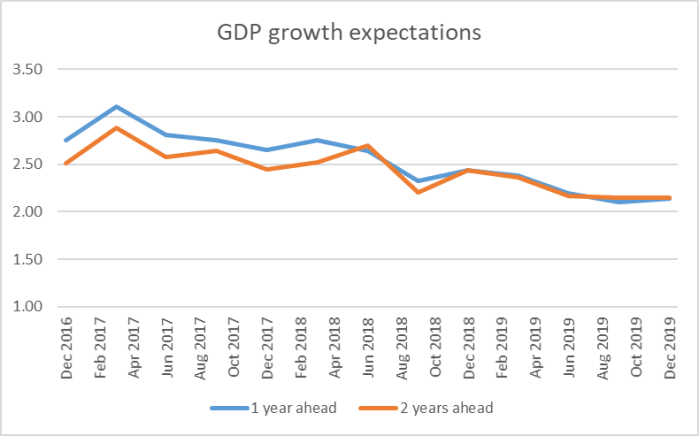
Consistent with this, there is no rebound expected in economic growth either, whether as a result of things already in train or of those further expected OCR cuts.

expecs 19.png

No respondents expected a recession, although the lowest individual expected 2 year ahead growth rate was as low as 0.6 per cent.

There wasn’t much sign of an expected strengthening in the labour market either (although those series have been volatile and the survey was taken before last week’s labour market data were published).

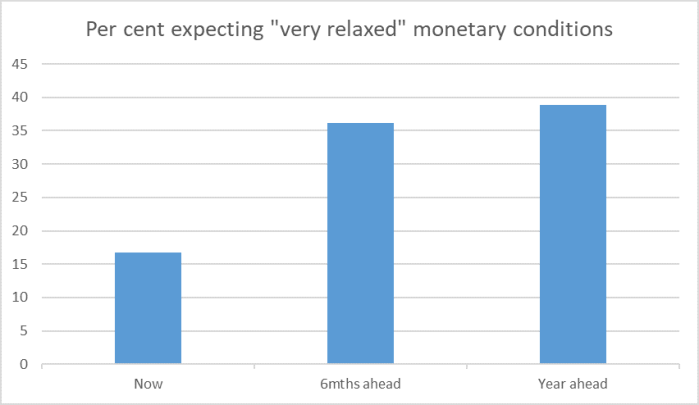
What about overall monetary conditions?  The survey asks about assessments –  on a seven step scale – as of now, and expectations for (on this occasion) the end of March and the end of September 2020 (the latter roughly a year ahead),   “Monetary conditions” isn’t defined –  it is up to each respondent to factor in things considered relevant.   What was striking this time was the sharp increase in the proportion of respondents expecting monetary conditions to become “very relaxed”

mon con nov 19.png

I was left wondering what weight respondents were giving to tightening credit conditions (this chart from the Bank’s credit conditions survey, also released after the expectations survey was done)

credit 2.png

But whatever went into those “monetary conditions” answers, they weren’t producing an expected rebound in either growth or inflation.

In a speech a couple of weeks ago the Bank’s Assistant Governor ran one of his boss’s frequent lines bemoaning the risks central banks face if they simply follow short-term market prices (since those prices themselves include market implicit expectations of what central banks will do).  It was  –  and is – a real but overstated point.   But it is also where surveys of macroeconomic expectations are relevant and useful, not subject to the same critique.   This pool of respondents –  with no better or worse information on average than the MPC – expressed not just expectations for the OCR but for overall monetary conditions, and for economic activity and inflation.  So they factored in what they expect the Reserve Bank to do, and are (in effect) feeding back a collective assessment that it really looks, at best, like barely enough.  Who knows why: perhaps expected adverse world developments, perhaps more initial weakness here, perhaps a weaker transmission mechanism, but the data (expectations) are there for all to see.

Against that backdrop the MPC would really have to produce a quite compelling alternative narrative to justify not cutting the OCR further now, perhaps especially when there isn’t another review until February.

(As I’ve noted before, there is a rich amount of data in this survey not open to the public.  For example, on the OCR expectations question at least one respondent expected the OCR to be zero by September and another for it to be 1.25 per cent. It would be fascinating to see the –  one hopes consistent –  forecasts of each of those respondents and the stories that underpin them.  Reminding ourselves of the sheer uncertainty of the future, and the possible stories that might underpin such alternative outcomes, can be a useful discipline.)

Credit conditions

Back in mid-2009, just as the first glimmers of recovery  from the severe recession were emerging, the Reserve Bank launched a credit conditions survey (of lending institutions).  It was a sensible enough initiative but, to be honest, I never paid much attention to it.  We knew conditions had got very tight during the recession and (at least in my remaining time at the Bank) the data weren’t that interesting –  of course credit conditions were easier than they’d been in the midst of that financial scare, and when there were changes shown they were for pretty obvious reasons (eg access to housing credit was reported as tightening when the Governor imposed LVR restrictions).   Also, the number of institutions covered was quite small, and one had to worry that results could be affected by who happened to fill out the form in a particular institution on a particular occasion (plus, when reporting to your prudential regulator incentives aren’t entirely straightforward).

There is a series of questions about:

  • observed loan demand (by class of loan),
  • expected loan demand,
  • observed credit availability,
  • expected credit availability, and (since early last year)
  • a series of factors potentially affecting the availability of credit.

That makes for lots of series.  I’m less interested in the demand side, which is largely going to reflect stuff we see captured in other data (eg housing turnover, business surveys etc).  But demand for new business loans does seem to have fallen away somewhat in recent years.

But what about the supply side?

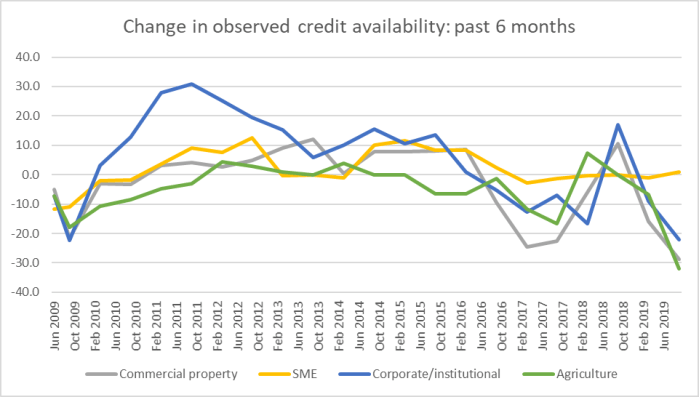
Here is observed credit availability over the last six months (the survey is six monthly) for the four business sectors (there was no particular change in availability to households).

credit 1

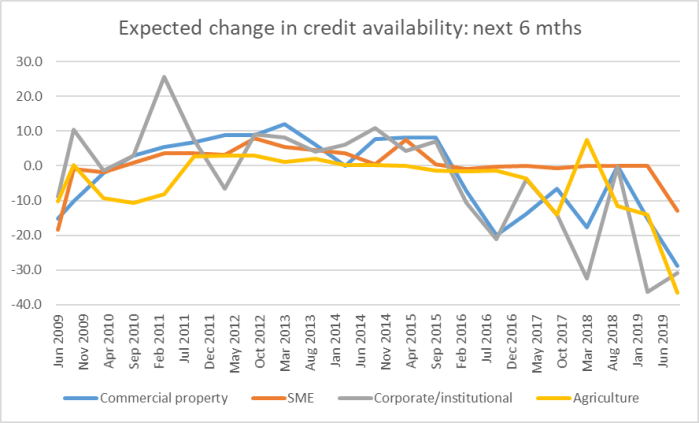
And here is what respondents expect (presumably from a position of knowledge, responsible for something around overall credit within their own institution).

credit 2.png

Yes, there is some idiosyncratic variability in the response at times, but in the ten year history of the series we’ve seen nothing like the tightening in expected conditions observed in the last few quarters, now across all the business classes (there is little movement on the mortgage and personal household lending categories).

It isn’t easy to know quite how much weight to put on these responses –  for a start, with only one incomplete cycle of observations, we have little idea of “normal” variability as economic conditions turn down.  But as the recent downturn is larger than the post-2009 upturn (coming off a pretty savage tightening in conditions) it doesn’t have the look of something that should be quickly glossed over.   It looks to represent a potentially quite material tightening in monetary and financial conditions.

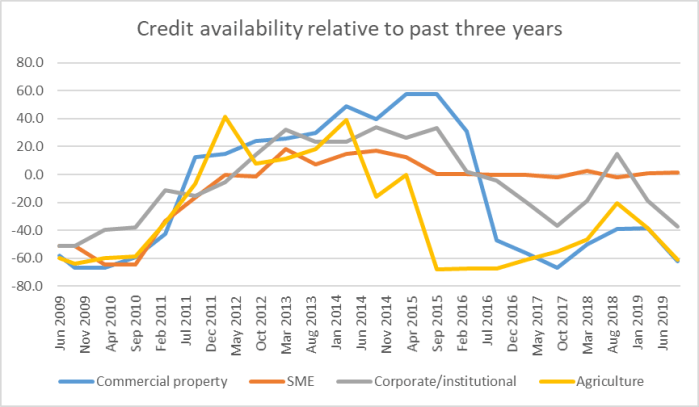
The other question they have about actual credit availability might also tend to confirm that unease.  Respondents are asked about how credit availability is now compared to the past three years (I guess to smooth through idiosyncratic influences on the past six months).  Here are the responses for the business sector loans (household was directly and materially affected by the waxing and waning of LVR restrictions, a policy intervention).

credit 3.png

Again interesting that there had been little movement re SMEs, but for the other three business categories the scores are getting back towards levels we saw just after the last recession.

Early last year the Reserve Bank did a welcome extension to the survey and started asking respondents about the influence of various specific factors that could reasonably influence credit availability.  Here are answers.

credit 4

Cost of funds hasn’t been an issue in changing credit availability (nor would you really expect it to be –  should affect price rather than availability), and neither has competitive pressure, but look at those four striking negative yellow bars.    Risk appetite among the lenders, risk capacity, and (distinctively) regulatory changes have all worked to (apparently materially) tightened credit conditions.

Sadly, here we reach the limits of the survey. It would be fascinating to be able to disentangle quite what is going on.  There is a quite plausible story that all three of the other negative yellow bars are primarily a reflection of the fourth, regulatory change (presumably the Governor’s capital whims).  Perhaps it isn’t so, and there are independent reassessments of risk and willingness to bear risk going on in head offices, whether here or in Australia, but whatever the precise combination of factors it is pretty likely that regulation is already weighing fairly heavily on credit availability in New Zealand. (I only qualify that claim a little because banks perhaps have an incentive to play up the issue, knowing that the Governor is about to make his final capital decisions, but I doubt that is more than a marginal factor here, given the small number of respondents and the ability of the Bank to query each).

You may recall the consultation document the Bank published almost a year ago on the Governor’s proposals to greatly increase capital requirements for locally-incorporated lenders.  You may not recall the discusssion of these sorts of effects, let alone the apparent differential sectoral effects.  That isn’t the fault of your memory.  There just was no discussion of those issues in the document.  Which seemed odd at the time, and even more extraordinary now.  It will be interesting to see how the Governor responds to these data in his two scheduled press conferences in the next few weeks (MPS and FSR).

While these data are clearly of some relevance to the bank capital debate, my main interest in them was in the more immediate issues around the appropriate stance of monetary policy and the setting of the OCR.   There appears to have been quite a sharp change in market sentiment/pricing and the views of some market economists this week on the chances of the Bank cutting the OCR on 13 November (the reasons for that change still aren’t fully clear, and one is left wondering if the Bank has been signalling –  by accident or design –  some change in its own view).

My interest is much less in what the Bank will do in the short-term, but in what they should do (which should, of course, make my commentary of interest to the Bank, given the Assistant Governor’s speech the other day, but…..).  “Will” and “should” eventually tend to converge, but it can take some considerable time for them to do so.

But if we grant that this credit conditions data is material the MPC did not have when they did their August forecasts, or made their slightly panicked last minute decision on a 50 basis point cut, and did not even have at the last OCR review, it really should be  colouring the projections they finalise next week (even if the variable might not feature in their formal models).  Add in own-activity business survey data that has shown no signs of rebounding since August, inflation expectations that have either fallen further (surveys) or remained very low (inflation bond breakevens), and a core inflation rate that remains consistently materially below the (focal) midpoint of the inflation target, the case for not cutting the OCR in November seems weak at best.  There isn’t another review opportunity until February, the world situation (if not one of sentiment spiralling downwards) seems no stronger substantively, and for a committee that was sufficiently rattled to do a 50 point cut only three months ago –  and not to have seen anything much improve since then –  to do nothing now would only further muddy the communications waters, leaving people even less clear about how the MPC thinks, or that there is a consistent and disciplined process at work, secreted away from the public/market spotlight.

(Bearing in mind that there is still some material local data to be released before 13 November) the risks around a further OCR cut in November at present look quite asymmetric.  As we drift closer to the next recession, and to the limits of conventional monetary policy, the very best thing that could possibly happen would be positive surprises on core inflation, spilling over into somewhat higher inflation expectations.  People are no longer convinced inflation will settle at 2 per cent or above. It would be better, for almost everyone (certainly for the management of the next downturn) if they were.   When credit conditions appear to be tightening quite materially –  and that even before the final decisions are announced –  getting that sort of outcome will be made harder than necessary if the Bank ends up setting on its hands, confusing messaging, all for what?  So that the Governor can get some perverse psychic satisfaction from surprising people again?   Unpredictability is not a desirable feature of public policy.


Monetary policy communications and the lack of transparency

The Reserve Bank’s Assistant Governor for monetary policy and financial markets, Christian Hawkesby, went off to Sydney earlier this week to talk to some investors about New Zealand monetary policy communications.  Hawkesby now has tenure and independence –  at least in principle – as a statutory officeholder, a member of the Monetary Policy Committee, appointed directly by the Minister of Finance.

It was perhaps telling that (a) the speech was delivered on a New Zealand public holiday, (b) the text wasn’t released for another 24 hours, and (c) we have no record of what Hawkesby actually said, including in response to questions.  That is no way to do monetary policy communications.

Perhaps while he was in Sydney Hawkesby dropped in on his peers at the Reserve Bank of Australia.   The RBA has about 45 speeches/presentations from senior managers showing on its Speeches page for 2019.   For all but three of them –  and none of those three on topics that appear market-sensitive –  there is video, audio or a Hansard transcript (several of the Governor’s appearances were to parliamentary committees).  It doesn’t seem to make any difference to the RBA whether the speeches etc are given overseas, out in the provinces in Australia, or in downtown Sydney or Melbourne: the standard they set for themselves is that when they say something, it is made generally available.    Anything else poses a risk –  actual or in appearances –  of unequal access to potentially market-moving, or just insightful, official information and perspectives.  That is just one aspect of communications on which the Reserve Bank of New Zealand falls a long way short of best practice.  There are 12 speeches from senior managers on the Reserve Bank of New Zealand’s Speeches page for 2019, and for only of them is there video footage (that a puff piece by the Governor –  which I wrote about here).

Hawkesby’s speech came in two parts.  The first was devoted to repeating longstanding Reserve Bank spin about how transparent it is, supplemented by some Orr-esque lines about how surprising the market is no bad thing (the second part was defensive play around the surprise August 50 bps OCR cut).  There were no fresh insights or arguments, which in itself was a bit disappointing from so senior a figure, relatively newly returned to the Bank  –  despite the relatively junior-sounding title, Hawkesby is, in effect (and in Wellington public service lingo) a deputy chief executive responsible for half the Bank’s core functions.  Anywhere else in the world he’d carry a Deputy Governor title.   Those are the standards his speeches should be held to.

The Reserve Bank (longstanding) main claim to being highly transparent is that it publishes a future track for the policy interest rate (the OCR) for a period two to three years ahead.  We were the first central bank to do so, in 1997.  As Hawkesby notes, despite 22 years experience, only a handful of other central banks  (four small advanced country ones) have followed our lead.  Reasonable people can debate whether publishing a forward interest rate track is the best way to do things (I’ve never been convinced myself) but when none of the world’s leading central banks have taken that path –  and all will, quite seriously, proclaim a commitment to transparency –  it probably isn’t something to put quite as much weight on as the Bank has done (through successive Governors/staff).

I’ve characterised the publication of the forward interest rate track as being highly transparent about something the Bank (now, at least formally, the MPC) knows almost nothing about.  Economic forecasting is a mug’s game, and there is little evidence that anyone can usefully forecast economic developments more than perhaps a quarter or two ahead….and yet, monetary policy works with a lag, so a medium-term OCR projections (for, say, 2.5 years ahead) implicitly requires –  to be meaningful – some intelligent view of inflation prospects perhaps four years hence.  No one can do it in a way that has any useful substantive information.

And if the Reserve Bank is pretty transparent about the stuff it knows almost nothing about –  and has to divert scarce resources to generating such tracks –  it is really quite strikingly non-transparent about the stuff it does know more about.  For example:

  • we have a Governor, clearly the most important player in the system, who has not yet given a particularly substantive speech on monetary policy, the economy, and inflation (which would otherwise offer insights on his thought processes, his mental models, his ability to process and analyse data etc),
  • we have a Chief Economist –  also a statutory appointee as member of the Monetary Policy Committee –  who has not given a speech or said a substantive word in public since he was appointed,
  • as above, the Bank isn’t particularly transparent around the speeches it does give (and especially around answers to questions),
  • we have three non-executive members of the Monetary Policy Committee from whom not a word has been heard since they were appointed.  We know nothing about how any of them think about the policy targets towards which they are working, about how economic developments are unfolding, or about the “reaction functions” they use  (and this is so even though the rules allow them to speak), and
  • the Bank is totally untransparent about the background analysis produced to support monetary policy decisionmaking.   The current government –  not naturally particularly transparent –  has adopted a practice of pro-active release of Cabinet papers, many Budget-related papers have long been pro-actively released, but ask for any background papers re monetary policy decisions –  even with quite a lag –  and the Bank will simply refuse (and, sadly, they have the ineffectual Ombudsmen –  over several appointees – wrapped around their little finger in clasping this taxpayer-funded analysis tightly to their chest).  Perhaps it is lawful, but it simply isn’t transparent.   (A few years ago, after many months of trying, I managed to get them to release background papers for an MPS from 10 years previously –  but no one supposes they would release such material from, say, two years ago.  If there is a decent argument for any confidentiality around this material, it could only credibly mounted for the period from one MPS to the next –  ie three months or so – at most.)

That isn’t good monetary policy transparency, nor is good open government (the latter not being a consideration that ever weighed much with the Bank).

Hawkesby attempts a defence of the Bank’s preferred practice, in which only the Governor speaks about monetary policy (no speeches of course, just MPS press conferences) and to the extent that underlings like Hawkesby speech they largely parrot the Governor.   This is the best he can manage

A third limitation of transparency is the noise that it can create – an example of this is how to capture the diversity of views of individual members of a committee tasked with setting interest rates.

An example of this is how to capture the diversity of views of individual members of a committee that sets interest rates. Each individual member regularly sharing their views on the economic and policy outlook can make it harder for financial markets to interpret the reaction function of the collective group. While I worked at the Bank of England, I always remember the head of communications bemoaning the cacophony of voices. More transparency around the perspectives of individual members could also create incentives for those individuals to hold on to a previously published position even as new information emerges, for fear of being seen as ‘conceding’ their position.

A paradox of these limitations is that greater transparency does not necessarily equate to increased clarity for market participants and the general public. Just because more information is available does not necessarily mean the audience will have a greater understanding of how and why central banks make decisions.

But there isn’t much there.  Of course Communications managers are keen on message discipline –  always have been, always will be –  and at the Bank of England management was long not very keen on the independence of the external MPC members anyway.  But isn’t it striking that whereas the Reserve Bank seems to believe that New Zealanders –  public, markets –  can’t cope with a diversity of views (about a highly uncertain business), the national central banks for the largest advanced economies –  the US, Japan, and the UK –  in fact do cope quite well with having MPC members explicitly voting against a majority view, or articulating a model or analytical insights a bit different from that of others on the relevant committee.   Sweden is a succesful small country example.  The ECB is a bit different –  and there are some reasons why, around minimising pressure on members to act for their own country’s national interests –  but even in the ECB there is plenty of open recognition of differences of view among the monetary policy decisionmakers.   It isn’t as if central bankers know from year to year –  often not from quarter to quarter –  what they are going to do: events happen, interpretations evolve, and particular hypotheses are openly challenged and scrutinised (including those of monetary policy decisionmakers, when we are allowed to see them).

So, no, the Reserve Bank of New Zealand really isn’t particularly transparent at all.  And the newly published minutes really represent not much of a step forward at all.

One of Hawkesby’s points is that the Bank is keen to learn from outsiders –  yes, even “bloggers”.

When private sector economists, analysts, commentators or bloggers don’t agree with our policy decisions or our projections for the economy, it can be an uncomfortable message to hear. But it is an invaluable exercise to test our assumptions and reasoning, even if we don’t agree with their conclusions, we inevitably learn something along the way and strengthen our analysis of the issues.

Good to know (although it is a bit to take seriously when we see how the Governor responds to challenge, criticism, or alternative perspectives on another of those highly complex and uncertain issues –  appropriate bank capital requirements).

But this line is really used to buttress a rather silly line the Governor has run on a few occasions about the (alleged) dangers of the markets paying too much attention to trying to guess what the Bank is up to, in turn (allegedly) reducing the information the Bank itself can get from market prices.   This is, we are told, one reason why it is just fine for the Bank to do things that take markets totally by surprise (notably, the 50 basis point OCR cut in August).

It really is a nonsense argument, even if he can find a couple of footnotes to attempt to buttress his case. In fact (and in effect) he more or less concedes later in the speech when he highlights things like falling medium to long-term inflation expectations (including from the indexed bond market –  a welcome Hawkesby innovation to have the Bank even acknowledge the indicator) that were concerning the MPC when they made their decision.  Almost certainly those indicators –  eg from 10 year bonds – would have been just as they were whether markets thought the Bank was going to cut 50 bps in one go, surprising almost everyone, or (say) spread the cuts over two 25 bps cuts.

I’m not one of those who think that monetary policy decisionmakers should always deliver on market expectations. But usually if market expectations are very wrong (not –  eg –  just 10 expected a cut, 12 expected no change) it is the fault of the monetary policy decisionmakers themselves.   In those circumstances, they add noise and volatility that is simply unnecessary and has no redeeming societal merit.

And as I noted at the time of the August MPS, the 50 point cut looked a lot like a rather rushed last minute decision, that wasn’t really supported by other the numbers (they themselves produced) or the MPS text.

And what makes it a bit more concerning is that it is pretty clear the Bank itself wasn’t intending to move by 50 basis points even a few days ago.  The projections they published yesterday were finalised on 1 August (last Thursday).   On those numbers, the projections for the OCR (quarterly average) were:

September quarter 2019    1.4 per cent

December quarter 2019     1.2 per cent

March quarter 2020            1.1 per cent

With the next OCR review in late September and the following one in md-November, those projections –  adopted by the whole MPC – clearly envisaged not getting to a 1 per cent OCR even by the end of the year.

The bulk of the Monetary Policy Statement itself is written in the same relatively relaxed style, with no hint of a change in policy approach, and thus no proper articulation of the reason for it, or (hence) for how we should think about how the Committee will react, in principle, at future OCR reviews.   The Bank has added to uncertainty around policy, not reduced it.    In a similar vein, there is a new two page Box A in the statement on “monetary policy strategy”, intended to run each quarter, which is so general as to add nothing to the state of understanding of what the MPC and the Bank are up to.

And you will look in vain for any real insight from the minutes of the MPC meeting.   We are told

The members debated the relative benefits of reducing the OCR by 25 basis points and communicating an easing bias, versus reducing the OCR by 50 basis points now. The Committee noted both options were consistent with the forward path in the projections. [a claim that demonstrably isn’t true –  see above] The Committee reached a consensus to cut the OCR by 50 basis points to 1.0 percent. They agreed that the larger initial monetary stimulus would best ensure the Committee continues to meet its inflation and employment objectives.

But nothing about the considerations Committee members took into account in belatedly lurching to a 50 point OCR cut, or how they think about the conventions and signalling around using 25 point moves vs 50 point moves (when things aren’t falling apart here –  and it was the Governor yesterday who announced, oddly, of New Zealand that “the country is in a great condition”).

That wasn’t good or effective monetary policy communications.  It wasn’t a transparent insight on how the Committee is operating, the sort of reaction functions members are using, their view of MPS reviews vs the other OCR reviews.    It was –  or came across as –  a lurch (even if, like me, you thought that the OCR needed to come down quite a bit, quite quickly).

I’m going to end with two more examples of a lack of serious transparency.  Near the end of his speech Hawkesby observes

There are plenty of communication challenges ahead, especially if monetary policy in New Zealand moves into a less conventional territory, and we end up adopting new tools and approaches.

These will need to be explained clearly to both financial markets and the people of New Zealand.

No doubt, but would be an open and transparent central bank, wanting to build and maintain confidence in (a) its potential instruments, and (b) its actual decisionmakers and their advisers want to be much more open than the Reserve Bank has actually been?  Wouldn’t discussion documents outlining potential issues and options be a good idea?  Wouldn’t seminars and workshops with outside experts and market participants be a good idea?  Apart from anything else, at least in principle (as the Assistant Governor said) the Bank learns something from such engagement, challenge, and critique and in the process improves its own understanding and analysis.  It isn’t as if anyone is suggesting they pre-commit to when particularly instruments might be used, so this stuff shouldn’t really be market-sensitive, but it is quite important, potentially to us all (and was we know the Bank’s own research capability has been gutted this year).  And it isn’t as if the Bank’s background analysis on other matters –  bank capital again –  should fill us with confidence and willingness to simply “trust us, we know what we are doing”.

And on a smaller note, the next Monetary Policy Statement  and OCR decision is on 13 November.  As the Assistant Governor highlighted, inflation expectations are quite a significant influence in Bank thinking at present (rightly or otherwise).  And yet the main inflation expectations series –  the two year ahead measure in the Bank’s own survey –  isn’t scheduled for release until 12 November.   I participate in that survey.   Responses were due by midday last Tuesday (22nd). It is an electronic survey and if the results are not already in the Bank’s hands, they assuredly could be (it is pretty simple survey with fewer than 100 respondents, taking a matter of hours to compile at most).  And yet the Bank is sitting on this information until the very last minute.  By the time we get it, their decision will have been all-but-finally made, their MPS document completely written. If they were really serious about the desire to listen and learn, from markets, commentators, nay even “bloggers”, they’d have made sure the information was compiled and published quickly, allowing the Bank itself to listen to the response of outsiders in processing the significance of such important (to them) economic data.

If they were really serious…..instead, they mostly seem interested in fending off critics and keeping to themselves the stuff they know, while distracting us with their transparency about the stuff they don’t know much about at all (and where most central banks have not thought it advisable to follow the New Zealand lead).


Disagreeing with Lord King

Mervyn King was successively chief economist, Deputy Governor and Governor of the Bank of England over 20+ years.  Now in private life, with all the honours the UK can bestow (as Lord King, and a Knight of the Garter). he periodically offers his thoughts –  lucidly, rigorously, and respectfully (a model, in that regard, for any central bank Governor) – on various economic policy issues.   There was. for example, his book The End of Alchemy a few years ago (which I wrote about here).  There is a new book, with another respected UK economist John Kay, due out early next year.

Over the weekend, at the IMF/World Bank Annual Meetings, King delivered the prestigious Per Jacobsson Lecture in Washington DC (video rather than lecture text).  His lecture has had quite a lot of media coverage (for example here), with an emphasis on the idea that we are “sleepwalking towards a new crisis” and with various ideas and emphases for reform.

There are things to agree with and to disagree with in the lecture. He is clearly right to be expressing concern about the likely economic and political consequences of any new severe downturn, with little conventional monetary policy capacity at the disposal of the authorities. If/when such a downturn happens it is going to be very difficult to navigate successfully.  That message needs to uttered loudly and often, to alert the public and (perhaps) galvanise some policymakers.

Where I’m rather more sceptical is around Lord King’s expressed enthusiasm for the idea that the disappointing growth performance over the last decade or so is primarily a problem of a shortfall of demand.  Of course, it is likely that there is a demand (and monetary policy) element to the story –  in most places, inflation has undershot targets and as central banks (and markets) have been repeatedly surprised by the fall in market interest rates, they’ve had a bias to hold policy rates higher than they probably should have been.

But King’s story is a much more radical one than that.

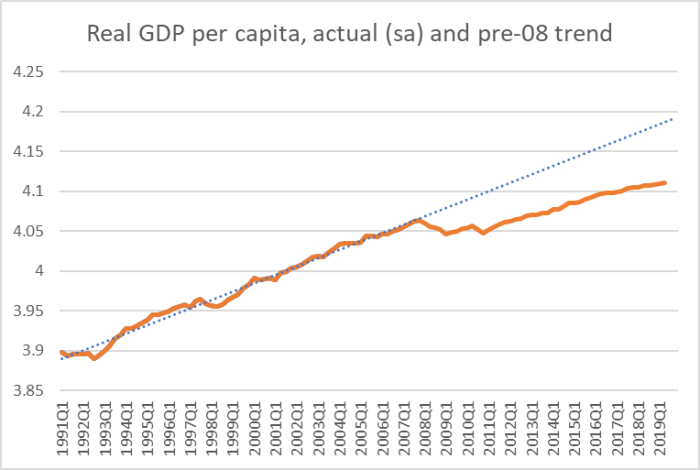
One of the ways he set up his story was by analogy with the last great period of macroeconomic disappointment, the Great Depression.   He notes that in most advanced countries now real per capita GDP is well below the level implied by the trend in the decades running up to 2008.  Here is a New Zealand version of the sort of chart he has in mind.

King NZ

And then he moves on to assert (a) that similar charts could have been produced in the mid-late 1930s, extrapolating trend growth in real per capita GDP for the 20th century up to the Depression and yet (b) by 1950 actuals had returned to the pre-Depression trend.  So, he argues, we should not jump too readily to the conclusion that what we are seeing now is fundamental, grounded in supply-side problems.  It might simply be an insufficiency of demand and with the right policies we too might find ourselves, 20 years on from the 2008/09 recession, back on the long-term trend line.

King’s story of the 1930s holds very well for the United States, where (for example) the unemployment rate was savagely high throughout the 1930s (a notable contrast to the situation today).   I’ll illustrate that in a moment. But it isn’t a story that generalised even then.  Here, for example, is UK real GDP per capita for the first half of the 20th century.

king uk.png

The first few decades of the 20th century hadn’t been great for the UK, but then the UK experience of the Great Depression was fairly mild and by 1937/38 the economy was running above the pre-Depression trend (and remained so all the way through to 1950).

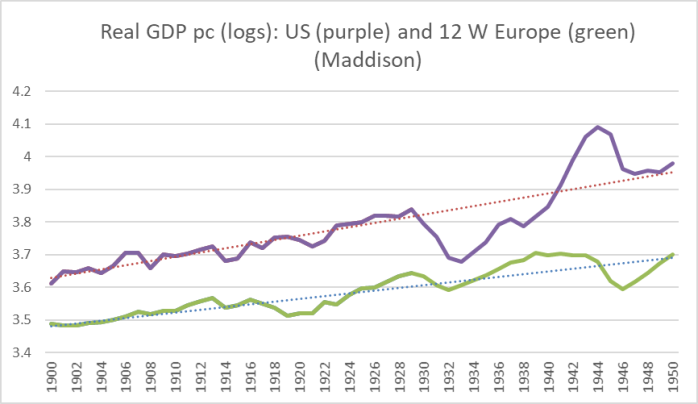
Rather than illustrates dozens of different countries, in this chart I’ve shown the situation for the US and for Maddison’s grouping of 12 larger Western European countries.

king us.png

You can see King’s point very starkly for the US, but for the Western Europe grouping it isn’t there at all – the picture is more like that for the UK (above).   (For what it is worth, New Zealand was also above the trend line by 1937/38 –  a overheating economy running towards a fresh crisis –  and Australia was a bit below its pre-Depression trend line.)

So the general story just doesn’t seem to stack up very well at all.  There were significant demand (and monetary issues) associated with the Great Depression, but mostly they were dealt with within a few years.  The US was the glaring outlier –  a country that then managed to have another pretty severe downturn in 1937/38 as a result of its own demand (mis)management choices.

As is now widely recognised, global productivity growth has slowed very substantially.  Here is one illustration, using the OECD’s multi-factor productivity data for 23 OECD countries (the “older” OECD countries –  none of the former eastern bloc OECD members are yet included).   I’ve calculated rolling 10 year average growth rates for each country and then taken the median of those growth rates.

king mfp

Being a median measure, you can tell that almost half these advanced countries had (typically slightly) negative annual average MFP growth over the last decade. In the decade to 2007 (say) only two did.

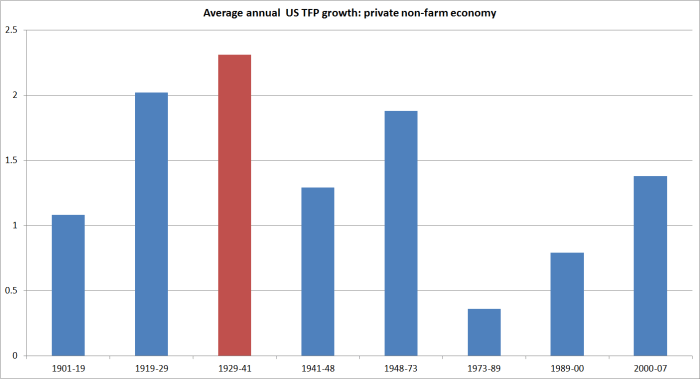
By contrast, here are leading economic historian Alexander Field’s estimates for multi/total factor productivity in the US in decades past.

The period when overall economic activity lagged behind trend so badly, which pretty much everyone agrees was largely down to demand shortfalls, was also the period of very strong underlying TFP growth.

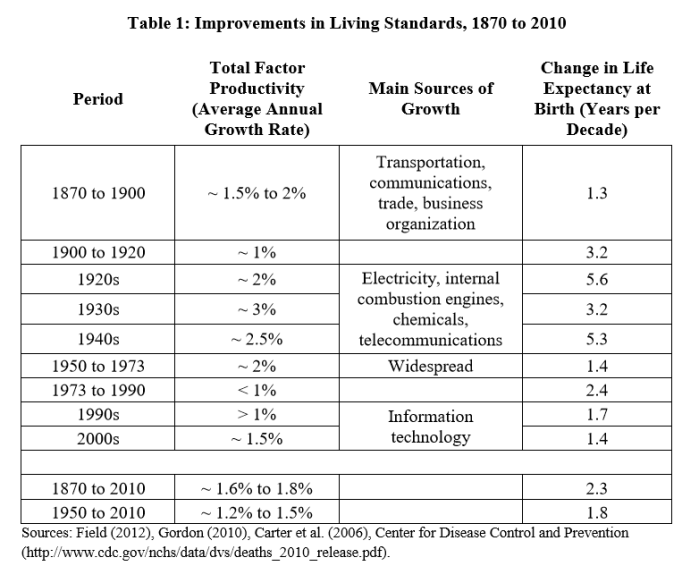
In a similar vein, here is table from a 2013 CBO report on TFP growth in historical perspective (which also draws on Field).

king us 2

Historical estimates get reworked, and I’ve seen some revisions to some of these numbers. But they don’t change the story of strong underlying TFP growth in the 1930s –  all it took was enough demand to translate those new possibilities into higher per capita GDP (back to the longer-term trend line in the charts above).

What about other countries?  Here is chart from a speech given a couple of years back by the Bank of England’s chief economist

king UK mfp.png

It is harder to read, but there is no sign of any slump in TFP growth in the 1930s there either (then again, as illustrated above, demand didn’t look to lag badly for long at all in the UK).

There is a story, that King also tried to tell, that somehow the incipient productivity gains now simply can’t be realised –  let alone translated into higher GDP per capita –  because the demand isn’t there and because of heightened policy and trade uncertainty.  But that doesn’t ring true either.  After all, equity markets have been strong, real borrowing costs have been low (unlike the 1930s), and –  if anything –  the IMF is worrying about corporate sector overborrowing and vulnerabilities associated with it.  That borrowing might not have been funding much new investment, but business credit conditions haven’t exactly been very tight for years now.

And as for uncertainty, yes we all now that the general policy and trade policy indexes are quite high at present, but (a) trade policy uncertainty has really only become a big issue since the start of 2017 and the economic underperformance was well in place before then, and (b) consider the 1930s…..the demise of the Gold Standard, ongoing sovereign debt defaults (including the US and the UK), Smoot-Hawley and all the associatred/subsequent trade protection, the rise of Hitler, Japan’s invasion of China, the growing fear of war.  I’d have thought all those made for much greater uncertainty than we see today, but even if you read things differently, it was hardly a decade that made for a stable and certain political or business climate.  And yet…..consider the realised TFP growth, consider (outside the US) the return to pre-1929 real GDP per capita pathways, contrast it with what we’ve seen in the last decade, and you should doubt that the 1930s provides much useful insight on our current situation.

I don’t have a compelling story for why the productivity slowdown has been so stark and sustaine among countries at or near the frontier.  But a demand-based story doesn’t yet seem very credible, and if such a case is to be made it is going to need to rest in argumentation, theory and evidence, based on something other than parallels with the 1930s.

(And, of course, whatever the frontier story none of it should be of much relevance to New Zealand, starting from average productivity levels so far behind those of the frontier economies.)

Expecting low inflation, and interest rates

The Reserve Bank Governor has been heard in recent months expressing concern about the possibility that inflation expectations –  what people think will happen, which in turn can influence how they act – will drift lower.   It might seem like a rather abstract concern, but there are real world consequences.  If everyone used to expect inflation would be 5 per cent and now expect it to be 2 per cent then, all else equal, nominal interest rates will have to be set 3 percentage points lower than previously just to get the same degree of monetary policy bite/stimulus.  All else equal, if inflation expectations –  the ones that genuine reflect behaviour –  are falling then real interest rates are rising.

Lower inflation expectations has been the trend in New Zealand for more than a decade now.  The Reserve Bank surveys households and perceptions of the current inflation rate and expectations of the future inflation rate are both quite a lot lower than they were prior to the last recession.  Term deposit rates are now perhaps 500 basis points lower than they were in 2007, but in real terms that reduction is perhaps no more than 300 to 350 basis points.  On the more-widely quoted survey the Bank does of somewhat-more-expert observers, medium-term inflation expectations are also about a full percentage point less than they were in 2007.   In those days we took as pretty normal inflation of around 2.5 per cent.  No one –  try some introspection on yourself –  thinks of that as a normal New Zealand inflation rate now.

Some of that reduction in inflation expectations hasn’t been unwelcome.   The Reserve Bank had tended to be rather too accommodating of inflation in in the top half of the target range (some mix of forecasting mistakes and a cast of mind that wasn’t too bothered) and the range itself had been pulled up a couple of times by governments.   Expectations –  of the sort that shape behaviour –  genuinely centred on the target midpoint, 2 per cent inflation, would be a “good thing”.  More recently, across the range of surveys, expectations look to have been drifting down again.   With nominal interest rates already so low, that isn’t a good thing.  For example, when one thinks of the extent of Reserve Bank OCR cuts this year, the moves look quite large : 75 basis points.

But here are the three retail interest rate series the Reserve Bank publishes, showing the changes since the end of last year (and December last year wasn’t some abnormal month, but roughly where rates had been all last year).

SME new overdraft rate                                   -37 basis points

New residential first mortgage rate              -59 basis points

Six month term deposit rate                           -47 basis points

Deduct say 15 or 20 points more for a decline in inflation expectations and you really aren’t looking at much of a decline in real short-term interest rates (facing firms and households) at all.   By contrast, a 20 year indexed government bond rate (ie a very long term real interest rate) –  set freely in the market –  has fallen by about 120 basis points.

What is striking about the Reserve Bank’s treatment of inflation expectations is that they hardly ever –  change the Governor, change the chief economist and still they choose to ignore it – refer to the market-based indicator of implied inflation expectations from the market for government bonds.     There are all sort of quibbles people can mount about the numbers, but the fact remains that it is the only market-based measure, reflecting actual choices and dollars, not just answers to a survey question.

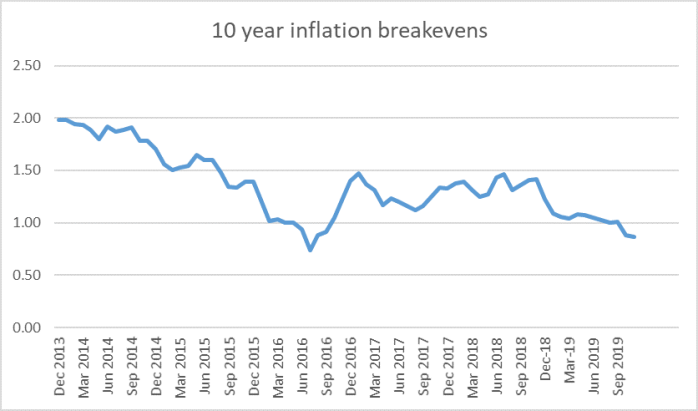
Here are latest inflation breakevens for New Zealand: the gap between the 10 year nominal government bond rate and a 10 year real government bond rate (linearly interpolated from the yields on 2025 and 2030 inflation-indexed government bond rates).  The last observation is the chart is yesterday’s data.

breakevens 0ct 19

It is old news that the last time these “breakevens” or implied inflation expectations were last at 2 per cent almost six year ago.  Not since then have financial markets been trading as if they believe the Reserve Bank will do its job over the coming 10 years.  This measure of expectations fell away sharply over 2014 to mid 2016, when the Bank was messing things up –  tightening when no tightening was necessary and then being grudging in their cuts (as Wheeler became ever more defensive).  There was something of a rebound, but it hasn’t lasted and since the end of last year the breakevens have been dropping away again.  Right now, markets are trading as if the average inflation rate over the next ten years could be as low as 0.87 per cent.  The OCR cuts this year have not been enough to stabilise, let alone reverse, the series.

Some of the patterns are global.  Here is the comparable US series

US breakevens oct 19

But the levels are national.  If current US breakevens should be uncomfortable for the Fed, at around 1.5 per cent they should be nothing like as troubling as the 0.9 per cent we have in New Zealand.    And, for once, going into any serious downturn our central bank has less conventional monetary policy leeway than the Fed does.

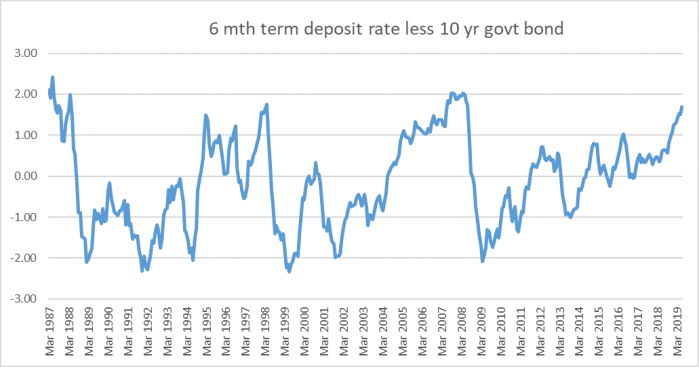
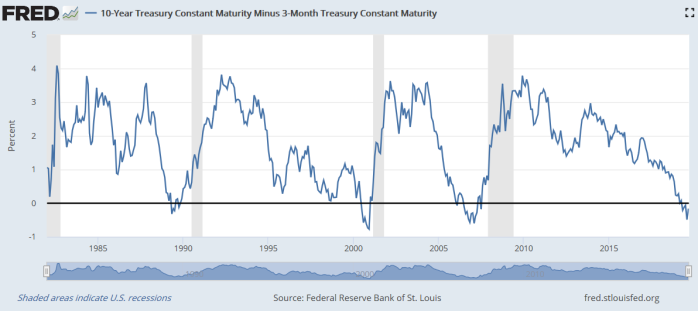
Throw in the slope of the yield curve – this chart from a few weeks ago, in which each time this variable has been at current levels it has been followed by a recession –  and there is a pretty good case for the Reserve Bank doing more than it has done.

nz yield curve 2.png

Inflation expectations have already been falling.  Given how little conventional policy room most central banks have –  and the distinct limits of unconventional policies – if there were to be a recession (here and/or abroad), few people then would rationally expect monetary policy to do its usual work.  A rational response would be for inflation expectations to fall away quite a bit further, driving real interest rates up (all else equal) at a time when the capacity for further nominal interest rate cuts is all but gone (unless/until governments finally do something about the effective lower bound).  That really would be a bad outcome.

In putting together this post, my eye was drawn to the array of current nominal New Zealand interest rates –  for any term at all now less than 1 per cent.  Here are some comparisons across a range of dates (12 years ago was in the months prior to the last recession –  and for anyone interested 30 years ago all the rates were in double figures).

Conventional government bonds
90 day bill 1 year 2 year 5 year 10 year
22 years ago 7.63 7.33 6.75 6.61 6.59
20 years ago 5.00 5.55 6.14 6.78 7.06
12 years ago 8.75 7.04 6.98 6.70 6.28
10 years ago 2.77 4.15 4.91 5.56
Five years ago 3.68 3.50 3.98 4.06
Current 1.04 0.78 0.69 0.76 0.99

Perhaps what is easy to lose sight of is that the steepest fall in New Zealand long-term actual and expected interest rates wasn’t in the wake of the last recession, but in the last five years (when our political parties squabbled over an allegedly healthy economy).

Whatever the Governor claims, these extraordinarily low interest rates are not normal by any standard, recent or historical.  And yet, at very least, they are necessary and unavoidable, in response to all else –  public and private –  going on in national and international economies.


A strikingly poor speech from the Governor

On Wednesday afternoon the Reserve Bank Monetary Policy Committee released their latest OCR decision.  It was, as predicted, no change in the OCR.  I don’t think it was the right decision on the substance (some background to that here) but at least it was in line with the Governor’s public comments following the previous surprise decision.

I didn’t have that much to say about the two pages (statement plus “minutes”) they released.  So just a few quick points:

  • in the statement the Bank continues to overstate the contribution of the “trade war” to the slowdown in global trade and global growth.  It is a convenient “newspaper headlines” story, but the way they use it suggests they haven’t thought much more deeply about the issues,
  • they talk up the prospects of economic recovery, based on the reduction in interest rates, but never seem to recognise that interest rates had been cut for a reason.  Unless the OCR is cut by more than any fall-away in economic fundamentals, you wouldn’t expect to see a rebound.  As I pointed out last week, actual cuts in variable retail rates lag well behind the fall in market-determined long-term rates,
  • there is something inappropriate about the Bank talking up the idea of fiscal stimulus three times in two pages (not that fiscal stimulus might be out of place in some circumstances, but it is entirely a matter for the elected government).  On the other hand, I guess we should be grateful that the Governor has stepped away from his August comment that “of course the government has to be spending more”.
  • it is interesting that, at least as written, the MPC appears not to have any bias on the direction of the next move in the OCR.   They are very widely expected to cut in November and cut again next year but there is nothing in this statement to lead one to think the MPC shares that view –  if anything, in the minutes we read that “some members”, with a cost-plus model of inflation apparently, believe there is “potential for rising labour and import costs to pass through to inflation more substantially over the medium-term”.   Their predecessors were hawking similar lines in 2015/16.

It is 18 months today since Adrian Orr took office at Governor of the Reserve Bank.  I’ve not infrequently bemoaned the fact that in that time Orr has not given a single substantive on-the-record speech on monetary policy or banking regulation/financial stability (the Bank’s two main areas of responsibility).  Yesterday Orr gave short speech to a corporate audience in Auckland, which dealt with both monetary policy and (in more abbreviated form) banking regulation.  I guess we should be thankful for small mercies.

Sadly, the contents of the speech suggest we have a Governor who simply makes stuff up whenever it suits him.  It is extraordinary in such a powerful public figure, one supposedly operating as an independent and judicious technical expert.  Much of it comes across as almost delusional –  perhaps welcome to his mates in the Beehive, but even they must sometimes wonder whether independent public institutions aren’t meant to be more than cheerleaders.

To take just a few examples of what I have in mind, start here

The good news for New Zealand, unlike many other OECD economies, is that our government’s books are in good shape and there is already a strong fiscal impulse underway from public spending and investment. 

There is no disputing the first half of the sentence.  It is to the credit of successive governments of both parties that government debt has been kept pretty low and stable over recent decades.  But what about that second claim, about the “strong fiscal impulse”?  Well, it simply isn’t supported by the facts at all.    This is from my post on last month’s Monetary Policy Statement when the Governor tried to run the same sort of line.

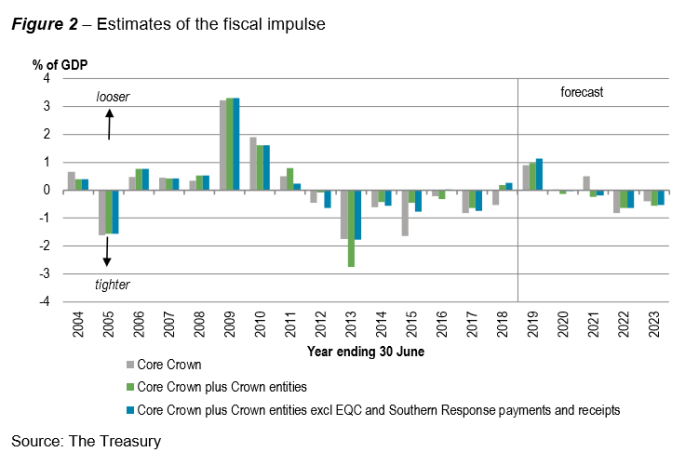
In fact, it prompted the perfectly reasonable question from Bernard Hickey about whether fiscal policy was actually very stimulatory at all.   The standard reference here is The Treasury’s fiscal impulse measure.  This is the chart from the Budget documents

fisc impulse.png

It isn’t a perfect measure by any means, and in particular one can argue about some of the historical numbers. In my experience, it is a pretty useful encapsulation of the fiscal impulse (boost to demand) for the forecast period. In fact, the measure was originally developed for the Reserve Bank –  which wanted to know how best to translate published forecast plans into estimated effects on domestic demand/activity.

And what do we see.  There was a moderately significant fiscal impulse in the year to June 2019.  That year ended six weeks ago.  For current and next June years, the net fiscal impulse is about zero, and beyond that –  which doesn’t mean much at this stage –  the impulse is moderately negative.    All using the government’s own budget numbers.  And consistent with this, operating revenue in 2023 is projected to be higher as a share of GDP than it is now, and operating expenses are projected to be lower (share of GDP) than they are now.    The Budget is projected to be in (fairly modest) surplus throughout.

And yet challenged on this, the Governor seemed to be just making things up when he claimed that we had a “very pro-active fiscal authority” and that “the foot is on the fiscal accelerator”.    It just isn’t.  Orr must know that (after all, he had Treasury’s Deputy Secretary for macro sitting as an observer in this MPS round).  One even felt a little sorry for the Bank’s chief economist spluttering to try to square the circle, but basically acknowledging that Hickey’s story was right, not the Governor’s.   Perhaps, you might wonder, the Bank thinks the fiscal impulse measure is materially misleading and has its own alternative analysis of the government’s announced fiscal plans. But that can’t be so either: there is no discussion of the issue in the Monetary Policy Statement.

(Incidentally, on Morning Report this morning Grant Robertson tried the same sort of line, only for the presenter to point out to him the fiscal impulse measure, reducing the Minister to spluttering “but we are spending more than the last lot”.  That is true, but the material overall fiscal boost was last year –  and growth and activity were insipid even then, inflation still undershooting the target.)

Was he being deliberately dishonest or simply making stuff up as he went protraying things as he’d like them to be?  You can be the judge, but neither alternative puts our central bank Governor in a good light.

Given that he has since had another 7 weeks to get his lines straight and yet repeats the same line, it looks even worse for him now.  As I said last month, if the Bank has an alternative take on the demand implications of fiscal policy it surely behooves them to lay it out for scrutiny, not just make idle claims inconsistent with their longstanding standard reference source the Treasury estimates).

Just as preposterous was this claim from the Governor

The low level of interest rates globally over recent years primarily reflects low and stable inflation rates – a deliberate and desired outcome of monetary policy.

Here the Governor was repeating much the same nonsense it is reported that he ran to Parliament last month

Over the weekend, I came across an account of the Governor’s appearance on Thursday before Parliament’s Finance and Expenditure Committee to talk about the Monetary Policy Statement and the interest rate decision. …. The Governor was reported as suggesting although neutral interest rates had dropped to a very low level, that MPs should be not too concerned as we are now simply back to the levels seen prior to the decades of high inflation in the 1970s and 1980s.

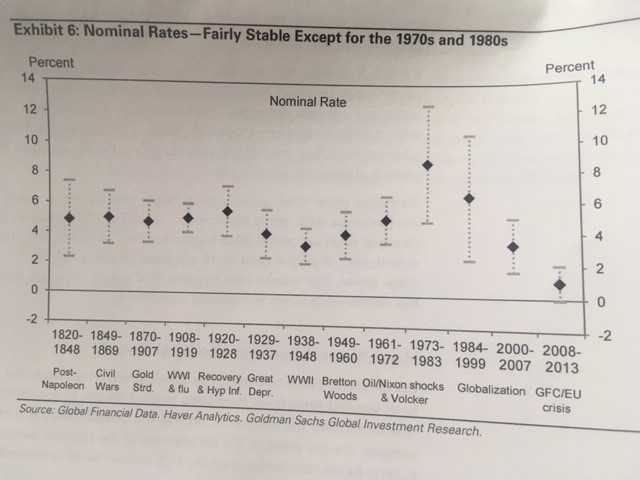
I’m not going to repeat the entire post I devoted to illustrating just how unusual global (and New Zealand) interest rates now are, both in nominal terms and (even more so in the long sweep of history) on real terms.  In centuries past there was little or no rational expectation of sustained inflation, while these days everyone agrees that medium to long-term inflation expectations are somewhere between 1 and 2 per cent.  The Governor may also have forgotten, in a New Zealand context, that the inflation target here is now materially higher than it was, say, 25 years ago.   Interest rates are, of course, far lower.  Here is just one chart from the earlier post, showing how unusual global interest rates were even five years ago (things are still more anomalous now, especially here).

As a final chart for now, here is another one from the old Goldman Sachs research note

GS short rates

In this chart, the authors aggregated data on 20 countries.  Through all the ups and downs of the 19th century and the first half of the 20th century –  when expected inflation mostly wasn’t a thing –  nominal interest rates across this wide range of countries averaged well above what we experience in almost every advanced country now.

Why does the Governor say this stuff?  Does he have no advisers left who are willing to tell him that what he says just isn’t so?

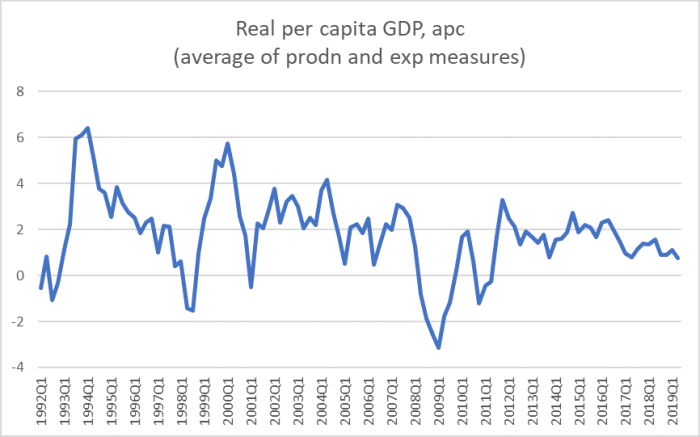
There are claims that the domestic economy still has “ongoing momentum” and that there is “strong demand for goods and services”.  These claims appear to be based the Governor’s interpretation of comments from the small group of firms the Bank went and visited recently.  Never mind the economywide measures, whether the range of business confidence and activity measures, or…..well, the national accounts.

pc GDP growth.png

He goes on repeatedly about how interest rates make it a great time to invest, as if he’d not given a thought to possible reasons why interest rates might be low (NB, it isn’t just because inflation came down again, see above).  He claims we have a “great environment to invest”, talks of “low hurdle rates for investing”, but seems not to recognise that in a climate of uncertainty, whether around policy (here or abroad) or the economic outlook, the option of simply waiting has considerable value, or thus that there is little reason to suppose that hurdle rates for investing have dropped much, if at all, in more recent times.

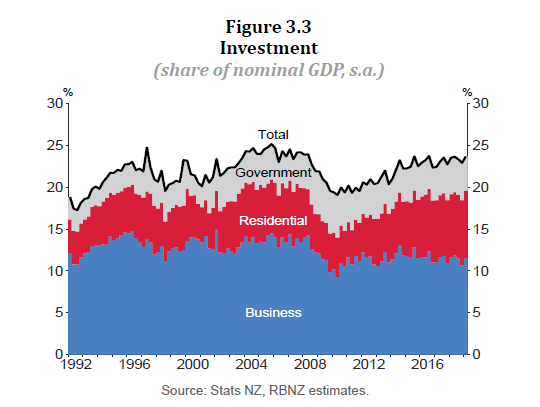
As a bureaucrat Orr is apparently convinced it is a great opportunity to invest and that profitable investment opportunities abound.  Experience suggests that people with a bottom line to meet disagree with him.  Here is the Bank’s own chart from the most recent MPS showing business investment as a share of GDP, with a few observations from me.

bus investment RB.png

As I’ve noted here repeatedly, business investment never recovered strongly from the last recession, and if anything (as share of GDP) has been falling back again in the last few years, even as population growth remained strong.

But despite the feeble business investment performance, the Bank expects business investment to recover from here.  There is no hint as to why they believe that is likely…. If there is any basis for their beliefs it seems to be little more than the repeated claim by the Governor and the Minister that it is “a great time to invest” in New Zealand.  But firms didn’t think so over the last five years –  even with unexpected population shocks –  and surely the reason the Bank is cutting the OCR has quite a bit to do with deteriorating conditions and investment prospects here and abroad?

But what do firms know?

Orr seems to more or less acknowledge the uncertainty issue, in these strange sentences, tinged with corporatist sentiments

However, there remains a loud call from all quarters of the country for leaders to better signal investment intent, and ensure we have the policy and goodwill to facilitate access to capital and resources to execute.

This call for investment-intent is to all collectively-owned (e.g., Iwi), Crown-owned (i.e., central and local government), and co-operatively owned (e.g., traditional primary sector) sectors. It is not just to traditional businesses, or any one party.

Easily said, harder to do without a clear desire to work together over an agreed horizon.

Or he could just have mentioned the major policy uncertainties.    Whatever your view on the merits of any of these issues (and I’m steering clear of expressing such views) mightn’t you think that uncertainty around the ETS, water quality policy, highly productive lands policy, the future of the RMA itself, whether any more significant roads will be built by a government apparently averse to them, bank capital regimes, the future of extractive industries might all be among the sorts of factors that might leave businesses and potential investors just a little wary, and pricing that uncertainty into their decisions around investment?

It all comes to a climax in this extraordinary claim in the Governor’s final paragraph (emphasis added).

In summary, we are not alone in the low interest rate environment, this is a global phenomenon. However, what we do have is more policy and business opportunities than most OECD economies and this is something that we need to take advantage of.

If by that he means that New Zealand productivity and per capita income rank far behind most of the OECD countries we used to like to compare ourselves to and that, at least in principle, those gaps could be closed, then I’m right with him.  But absolutely nothing about how policy has been run by successive governments for at least 25 years now has (so it appears from the evidence of hindsight) been consistent with closing those gaps: the productivity gaps in particular have just kept on widening and (though you would never know it from the Governor’s speech) we’ve had little or no productivity growth at all for the last five or more years.  Nothing about current policy suggests that record will improve in the next five years, and if anything one could mount a plausible argument that the measures adopted by the current government are heightening the risk of even worse (relative performance outcomes) in the next five.   Not only is this stuff well outside the Governor’s area of responsibility –  which is about macro and financial stabilisation –  but he either just doesn’t know what he is talking up or knowing better he just mouths such platitudes anyway.

Finally, there are several paragraphs in the speech about the Governor’s proposals to hugely increase the amount of capital locally-incorporated banks will need to have to back current balance sheets.    Notionally, there is process of consultation and deliberation going on at present. But when you read from the sole decisionmaker words like these,

Our proposals would see significant increases in shareholder capital in banks. With banks having more of their own ‘skin in the game’, the owners will sharpen their long-term customer focus, and it will reduce the chance of a bank failure and the cost on society as a whole should a bank fail. These outcomes are highly desirable for the long-term economic health of New Zealand, and should promote deeper and more liquid local equity and debt markets.

We finalise our decisions in early-December this year. Whatever our final decisions, we will be insisting on transition to higher capital at a sensible pace.

with all those “will”s, you get a pretty strong sense of pre-judgement.  That is, of course, what you’d expect when those proposals were based on very weak analysis –  numbers plucked out of the air at the last minute –  and when the Governor is prosecutor, judge, and jury in his own case, and where he knows that there are no effective appeal rights against his verdict as unelected unaccountable decisionmaker.

It really isn’t good enough.  Citizens should expect better.  The Bank’s Board is paid to hold the Governor to account, but they are almost worse than useless (they provide shadow without substance, suggesting there is scrutiny and accountability when there isn’t).  If the Minister of Finance were doing his job, or Parliament’s Finance and Expenditure Committee was doing its job, some pretty hard questions would be being asked about just what is going wrong at the Bank, and how such shallow –  and frankly embarrassing –  material is emerging from the mouth of such a powerful public figure.

Instead, no doubt, things will continue to drift, and the slow decline of New Zealand’s economic institutions –  hand in hand with the continuing decline in New Zealand’s relative economic performance – will continue.

But, you businesses out there really should be investing. This Governor tells you so.


Monetary policy and the yield curve slope

A month or so ago there was a great flurry of media coverage when the US interest rate yield curve “inverted”.  In this case, long-term government security interest rates (10-year government bond yield) moved below short-term government security interest rates (three month Treasury bill yield).   This was the sort of chart that sparked all the interest.

US yield curve

The grey bars are US recessions, and each time the long rate has been less than the short-term rate a recession has followed.   This chart only goes back to 1982 but it works back to at least the end of the 1960s.    There haven’t been any recessions not foreshadowed by this indicator, and there haven’t been times when the yield curve inverted and a recession did not come along subsequently (sometimes 12-18 months later).   Who knows what will happen this time.  It is, after all, a small sample (seven recessions, seven inversions since the late 1960s), and there is nothing sacrosanct (or theoretically-grounded) in using a 10 year bond rate.  Use the US 20 or 30 year government bond yields and right now the curve wouldn’t even be (quite) inverted.

But there are good reasons why changes in the slope of the yield curve might offer some information.  A long-term bond rate isn’t (usually) controlled by the central bank or government and might have a fair amount of information about what normal or neutral interest rates are in the economy in question. By contrast, short-term rates are either set directly or very heavily influenced by the authorities.    When the short-term rate is unusually far away from the long-term rate one might expect things to be happening to the economy, whether by accident or design.

Back in the day, when we were trying to get inflation down in New Zealand (late 80s, early 90s), the slope of the yield curve was for several years, off and on, a fairly important indicator for the Reserve Bank.  At times we even set internal indicative ranges for the slope of the yield curve (at the time, the relationship between 90 day commercial bill yields and five year government bond yields), and for a while even rashly set a line in the sand of not allowing the short-term rate to fall below the long-term rate.      We used this indicator because neither we nor anyone else had any idea what a neutral rate (nominal or real) would prove to be for New Zealand, newly liberalised and then post-crash, money supply and credit indicators didn’t seem to have much content, and we didn’t want to take a view on the level of the exchange rate either.  But whatever the longer-term interest rate was, if we ensured that short-term rates stayed well above that long-term rate, we seemed likely to be heading in the right direction –  exerting downward pressure on inflation and, over time, lowering future short-term rates as well.

But what about the New Zealand yield curve slope now?     Here is the closest New Zealand approximation to the US chart above, using 90 day bank bill yields and the 10 year (nominal) government bond yield.  I’ve shown it the other way around – 90 days less 10 years –  because that is the way we did it here (partly because of the long period, until 2008/09, when short-term interest rates were normally higher than long-term ones, rather different to the US situation).

nz yield curve 1

I can’t easily mark NZ recessions on the chart, but there were recessions beginning in 1987, 1991, 1998, and 2009, and each of them was preceded by this measure of the yield curve slope being positive,  But, for example, the slope was positive for four years in the 00s before there was a recession.    Against this backdrop, there isn’t really much to say about where we are right now (just slightly positive).   And take out whatever credit risk margin there is a bank bill yield (20 basis points perhaps?) and the slope of the curve would be dead flat.

But what about a couple of other possibilities.  Unlike the 90 day bill rate, term deposit rates  and bank lending rates directly affect economic agents in the wider economy, and as I’ve shown previously the relationship between the 90 day bill rate and term deposit (and floating mortgage) rates has changed a lot since 2008/09. margins

In this chart (constrained by data availability to start in 1987), I’ve taken the six month term deposit rate (from the RB website) and subtracted the 10 year government bond yield).

nz yield curve 2.png

That starts looking a bit more interesting.  The level of this variable –  even after the recent Reserve Bank OCR cuts –  is close to a level which has always been followed by a recession.   (It is a small sample of course; even smaller than in the original US chart).

What about the relationship between the floating residential first mortgage interest rate and the 10 year bond rate?  Here is the chart.

nz yield curve 3

The only times this indicator has been higher than the current level –  even after the recent OCR cuts are factored in, as they are in the last observation on the chart – have been followed by pretty unwelcome economic events (the 1991 recession wasn’t strongly foreshadowed by either this indicator or the previous one).

It is a small sample, of course, and there are no foolproof advance indicators.   But if I were in the Reserve Bank’s shoes right now, I would take these charts as yet further warning indicators.

On which count, it is perhaps worth keeping a chart like this in mind.

NZ yield curve 4

We’ve had 75 basis points of OCR cuts this year but only about 45 basis points of cuts in the indicative term deposit rate (latest observations from interest.co.nz).  It is not as if these retail interest rates are at some irreducible floor –  retail deposit rates in countries with much lower policy rates are also much lower than those now in New Zealand.  It is a reminder that, against a backdrop of a very sharp fall in New Zealand long-term interest rates (real and nominal) –  even after the recent rebound the current 10 year rate is still more than 100 basis points lower than it was in December –  monetary policy adjustments have been lagging behind.   Long-term risk-free rates have fallen, say, 110 basis points (almost all real), and short-term rates facing actual firms and households are down perhaps 40-60 points (floating mortgage rates nearer 60).

The Reserve Bank cannot (especially after a decade of persistent forecast errors) have any great confidence in any particular view of neutral interest rates for New Zealand.  With inflation still persistently below target and (as the Governor and Assistant Governor have recently highlighted) falling survey measures of inflation expectations, there isn’t a compelling case for the Bank to have lagged so far behind the market, allowing short-term rates to rise further relative to long-term rates.   The Governor has appeared to suggest that the Bank will only seriously look again at further OCR cuts at the next Monetary Policy Statement in November.  I reckon there is a much stronger case than is perhaps generally recognised for a cut at the next OCR review next week.


Monetary policy effectiveness

When commenting a couple of weeks ago on the Reserve Bank’s Monetary Policy Statement I observed that

there was some rhetoric from the Governor at his press conference that I quite liked, including the reaffirmation of the effectiveness of monetary policy

I’ve not seen any reason to doubt that monetary policy remains pretty effective for now (although the lower limits of conventional monetary policy are approaching), and if I’ve had a criticism of the Bank over the decade it is that it has been too reluctant to use monetary policy as it should be, transfixed as they long were by outdated views on the level of neutral interest rates and a consequent view (shared by many of their peers abroad) that with interest rates this low, inflation would surely rebound soon.  In short, central banks –  ours included –  materially overestimated the amount of monetary stimulus actually being provided.

In the wake of the Governor’s comments, I was interested to see that last Friday the Reserve Bank released a short Analytical Note reporting the work staff had done to underpin the Governor’s claim about effectiveness.  It was good to see, both because public agency transparency is a good thing in itself, and because on several occasions in the past it has turned out that bold claims the Governor had made in press conferences were backed by precisely no supporting analysis.

The summary of the work done in the published note reads as follows

We use three different models to evaluate monetary policy transmission. These models show that a 25 basis point cut in the Official Cash Rate (OCR) leads to an increase in inflation and GDP growth, and that this response is as big today as it was before the GFC. This implies that the recent OCR cuts by the Reserve Bank will lead to – all else equal – higher inflation and GDP growth, and help support maximum sustainable employment (MSE).

Using data since 1993 they estimate models up to the end of 2007 and then add new data quarter by quarter and see if there are any changes in the estimated effect of a monetary policy change on inflation and GDP growth.   The short answer –  on these measures –  is “not much”.  Here is their chart.

AN.png

In this exercise they are using the 90 day bill rate as the instrument of monetary policy (the OCR wasn’t introduced until 1999).   And they recognise that you cannnot simply look at what happens after the 90 day bill rate changes, because the bill rate changes (or OCR changes now) are often reflective of stuff going on in the economy or inflation.  Thus, in their words,

In order to disentangle the effect of monetary policy on the economy, our analysis uses modelling devices commonly known as monetary policy ‘shocks’. These shocks help isolate the effect of a move in the OCR that cannot be explained by the state of the economy.

Which is just fine, in principle, but then a great deal depends on how well the authors were able to identify the “shocks”.    And we don’t know the answer to that, including because they don’t show us the data (which quarterly changes do the models treat as “shocks”, and to what extent).

The authors note only two limitations to their work.  The first is the standard caveat: the models are linear and can’t easily cope with any non-linear behaviour.  The second –  really a ritual bow to their new statutory mandate –  is that they chose not to look at labour market effects, but as they note employment changes are pretty closely correlated to GDP changes so it isn’t much of a limitation at all.

Much as I’m pleased to see the paper published, and am inclined to share the Bank’s judgement about policy effectiveness, I think there several other limitations or caveats that leave me not really that convinced that the reported model results are as persuasive as the Bank would like to believe.

The first caveat is that we simply don’t have much data for the more recent period.   Here is a chart of short-term interest rates (data from the RB website) for the period being studied.

short-term rates

There was a great deal of volatility in the first six years of the period (pre-OCR), considerable variability in the subsequent decade, but since the crisis cuts came to end in April 2009, very little variability at all (from April 2009 to earlier this month the OCR had been in a range only 200 basis points wide).   The two tightening cycles the Bank inaugurated both had to be reversed in pretty short-order, before anything like the full effects (on inflation and GDP) of those policy changes could be seen.

Now, as I understand these models, you don’t need to have had an OCR change to have had a “monetary policy shock”: sometimes the data will have changed and the OCR will have been left unchanged, and the model will tell you that there is a “shock” there –  the OCR wasn’t changed when, in some sense, it perhaps should have been.   But that isn’t really very helpful, since almost always when the policymakers left the OCR unchanged they had in mind unchanged policy (as did markets and firms/households), and the empirical exercise is trying to deduce answers from what the models think of as policy mistakes, but policymakers at the time did not.    From a policymaker’s perspective, not much was done with monetary policy in the decade after 2009.  With a small sample, you simply can’t answer many questions.

The other caveat is that the Bank’s modelling uses the 90 day bill rate (more recently as proxy for the OCR).   That is fine –  it is very close to the instrument the Bank has direct control over.  But that isn’t the rate most people –  firms or households – transact at.  This chart shows the margins between the 90 day bill rate and the three retail rates for which the Bank publishes long time series.

margins

For most of the pre-recession period –  and particularly the first years of the OCR period –  the margins were very stable.   Through most of the 00s, you could look at monthly changes in floating mortgage rates, term deposit rates, business overdraft rates, the OCR, or 90 day bill rates and get almost exactly the same answer.   In that environment, a simple model with only a single interest rate made a lot of sense.  But the picture has been quite a bit different since then –  not just the levels change in these spreads during the crisis period itself, but even in the subsequent decade.   The OCR/90 day rate may still be a significant influence on the exchange rate –  not something mentioned in the Bank’s paper at all – but changes in it (including estimated “shocks” to it) seem unlikely to mean the same thing in respect of domestic borrowing, investment etc, as it did in the pre-2008 decade.

To repeat, I’m inclined to agree with the Bank that monetary policy remains pretty effective.   Perhaps what the Bank has done is the best that could be done for now. But I’m sceptical that these particular results should provide as much comfort as the Bank would appear to like us to take.     The authors end the paper this way

AN conclusion.png

Which, frankly, seems a bit glib and over-confident.   It is, after all, now almost a decade since core inflation was as high as 2 per cent –  the target midpoint the Bank was charged to focus on.   They might well be right about monetary policy being as effective as ever, but if I’d undershot my target for a decade I don’t think I’d be selling my wares under a “business as usual” slogan.  The important distinction is that, quite probably, monetary policy is as effective as ever, but using it well depends on the Bank’s understanding of the inflationary processes (ie decent backwards analysis and forecasting).  They didn’t do that very well for some considerable time.  Whether things have now improved –  moving on from “business as usual” –  remains at very least an open question.

As it happens, this morning the Bank released the text of a short speech by Assistant Governor, Christian Hawkesby, which also touched briefly on some of these issues.   He made reference to the research results in the Analytical Note (see above) but personally I found his less formal remarks resonated more:

Finally, it fits with recent experience that monetary policy does still have bite even in this low interest rate world.

In New Zealand, we lifted the Official Cash Rate by 100 basis points over the course of the first half of 2014 to head off an expected increase in inflationary pressure. When this did not arrive as expected, the tightening in monetary policy ended up being one factor that contributed to the slowing in the economy into 2015. Internationally, we have also seen the US Federal Reserve tighten monetary policy through to 2018, and this is one factor that has contributed to the moderation in US growth and inflationary pressure into 2019. These are ongoing examples of monetary policy continuing to play a key role in inflation dynamics.

To that, I would add the pick-up in New Zealand core inflation following the OCR cuts in 2015 and 2016.

I don’t want to say much else about Hawkesby’s speech, but there was some interesting commentary on the recent decision to cut the OCR by 50 points at once.    The bits that really caught my eye were this

As part of the assessment, our discussion also touched on the decline that had occurred in both survey measures of inflation expectations and market-based measures, such as nominal and inflation linked bonds in global markets

This was new: there was no mention of expectations derived from indexed bonds in either the MPC minutes or in the MPS itself – in fact, in discussing inflation expectations over the last five or more years, Bank officials have steadfastly refused to engage with those market-based indicators (currently suggesting 10 year average inflation expectations of about 1 per cent for New Zealand). I hope this isn’t the only time they engage.

And (emphasis added)

A key part of the final consensus decision to cut the OCR by 50 basis points to 1.0 percent was that the larger initial monetary stimulus would best ensure the Committee continues to meet its inflation and employment objectives. In particular, it would demonstrate our ongoing commitment to ensure inflation increases to the mid-point of the target. This commitment would support a lift in inflation expectations and thus an eventual impact on actual inflation.

Which was interesting both because the Bank has spent considerable effort over the last couple of years telling us that inflation expectations were now just fine (“firmly anchored at 2 per cent” became something of a catchphrase).   If you are using policy to try to lift inflation expectations –  as they should be, among other things –  it is a public acknowledgement that things were not quite as they should be.

I really hope that on this matter Hawkesby really is speaking for the MPC as a whole (there is no disclaimer on the speech suggesting they are just personal views).  All else equal, if inflation expectations (survey and market measures) don’t rise, it would provide underpinning for further cuts to the OCR, whether or not the local or global economic data deteriorate from here.


Reserve Bank MPS – part 2

This morning I wrote about the choice to cut by 50 basis points and the issues it raised, in context, about the Bank’s communications (non-existent speeches being only the most obvious omission).   In this post, I want to focus on a few other specific issues that came up in the Monetary Policy Statement itself or in the Governor’s press conference.

The first was around fiscal policy.  The Governor is clearly a big fan of the government spending more –  “of course the government has to be spending more”.   As a centre-left voter, I guess that is his personal prerogative, but it isn’t clear that it is his place to use his official office to weigh on highly political issues for which he is not charged with responsibility.  Imagine, if you will, that he was calling for cuts to government spending.  It would be equally inappropriate.

But, much as we shouldn’t just slide past the way he abuses the constraints on his office to advance personal causes, that wasn’t really what bothered me yesterday.   The much bigger concern was the way the Governor blatantly misrepresented the actual fiscal situation.  He claimed to be concerned only that the government wouldn’t be able to spend fast enough (given “capacity constraints”), which might reasonably have prompted a question of why, if government activity would be crowded out, he and his colleagues were slashing the OCR by 50 points in one go.

In fact, it prompted the perfectly reasonable question from Bernard Hickey about whether fiscal policy was actually very stimulatory at all.   The standard reference here is The Treasury’s fiscal impulse measure.  This is the chart from the Budget documents

fisc impulse.png

It isn’t a perfect measure by any means, and in particular one can argue about some of the historical numbers. In my experience, it is a pretty useful encapsulation of the fiscal impulse (boost to demand) for the forecast period. In fact, the measure was originally developed for the Reserve Bank –  which wanted to know how best to translate published forecast plans into estimated effects on domestic demand/activity.

And what do we see.  There was a moderately significant fiscal impulse in the year to June 2019.  That year ended six weeks ago.  For current and next June years, the net fiscal impulse is about zero, and beyond that –  which doesn’t mean much at this stage –  the impulse is moderately negative.    All using the government’s own budget numbers.  And consistent with this, operating revenue in 2023 is projected to be higher as a share of GDP than it is now, and operating expenses are projected to be lower (share of GDP) than they are now.    The Budget is projected to be in (fairly modest) surplus throughout.

And yet challenged on this, the Governor seemed to be just making things up when he claimed that we had a “very pro-active fiscal authority” and that “the foot is on the fiscal accelerator”.    It just isn’t.  Orr must know that (after all, he had Treasury’s Deputy Secretary for macro sitting as an observer in this MPS round).  One even felt a little sorry for the Bank’s chief economist spluttering to try to square the circle, but basically acknowledging that Hickey’s story was right, not the Governor’s.   Perhaps, you might wonder, the Bank thinks the fiscal impulse measure is materially misleading and has its own alternative analysis of the government’s announced fiscal plans. But that can’t be so either: there is no discussion of the issue in the Monetary Policy Statement.

(Incidentally, on Morning Report this morning Grant Robertson tried the same sort of line, only for the presenter to point out to him the fiscal impulse measure, reducing the Minister to spluttering “but we are spending more than the last lot”.  That is true, but the material overall fiscal boost was last year –  and growth and activity were insipid even then, inflation still undershooting the target.)

Was he being deliberately dishonest or simply making stuff up as he went protraying things as he’d like them to be?  You can be the judge, but neither alternative puts our central bank Governor in a good light.

Another joint act –  coordinated or not –  from the Minister and Governor was around investment.  As a nice change, the Bank included a chart of nominal investment as a share of nominal GDP (the approach favoured on this blog)

bus investment RB.png

As I’ve noted here repeatedly, business investment never recovered strongly from the last recession, and if anything (as share of GDP) has been falling back again in the lasdt few years, even as population growth remained strong.    It was good to see the Bank focus on the issue.

But despite the feeble business investment performance, the Bank expects business investment to recover from here.  There is no hint as to why they believe that is likely –  there is talk of more capacity pressure, and yet their output gap forecasts don’t change much from where we’ve been (on their reading) for the last couple of years.  If there is any basis for their beliefs it seems to be little more than the repeated claim by the Governor and the Minister that it is “a great time to invest” in New Zealand.  But firms didn’t think so over the last five years –  even with unexpected population shocks –  and surely the reason the Bank is cutting the OCR has quite a bit to do with deteriorating conditions and investment prospects here and abroad?  In a country that has had almost no productivity growth for the last five years, and with an exchange rate not forecast to change much from here over the forecast period, and with a deteriorating global backdrop (their own words were “global economic activity continues to weaken”) it seems little more than wishful thinking to expect a resurgence in business investment.

Ah yes, productivity, or the rather the lack of growth in it.   Here is my chart, using the two official GDP measures and the two official hours measures.

GDP phw mar 19

The orange line in the average for the last five years.  There is next to no aggregate productivity growth in New Zealand.

And yet somehow the Bank manages to conjure it up. They report a “trend labour productivity” growth variable, which they claim has grown steadily every year since 2012 (averaging perhaps 0.8 per cent per annum growth), and they forecast that productivity growth will continue –  and even accelerate a bit –  from here (averaging in excess of 1 per cent per annum growth).   It hasn’t happened, and it seems most unlikely to start now –  absent any big favourable change in policy or the big relative prices facing firms (eg the exchange rate).   The investment opportunities –  profitable ones –  just don’t seem to be there.   But I guess acknowledging that would upset the Governor’s spin about the “great condition” the country is in.

A wise person would then be very sceptical of the Bank’s  projections that economic growth picks up from here.  In fact, with net migration projected to continue to slow –  and with it population growth – it is hard to see why GDP growth over the next year should get even as high as 2 per cent (even assuming the rest of the world doesn’t fall into a hole).

My final point relates to the prospects for policy if the outlook continues to deteriorate.   I thought it was quite right for the Governor to note that when you are starting from here then, whatever your central forecast, it wouldn’t be too much of a surprise if the OCR were to need to be set at a negative rate at some stage in the next couple of years.  Forecasting just isn’t any more precise than that.

That degree of openness is welcome.  What is much less so is the Bank’s secrecy  –  and perhaps lack of straightforwardness/honesty – around possible options if the limits of conventional monetary policy are reached.    As the ANZ pointed out in a note this morning, just three weeks ago the Reserve Bank responded to an OIA request about unconventional tools by (a) stonewalling, and (b) claiming that the work “is at a very early stage”.  And yet yesterday, the Governor claimed they were “well-advanced” in their work.  Both simply can’t be true (bearing in mind that the last two weeks will have been taken up with this MPS).   Which is true I wonder?  Who were they trying to deceive?

But again, perhaps worse than playing fast and loose were two things that should bother people more.  The first is the way the Bank is keeping all this close to their chest.  Responding to that OIA they refused to release anything (“very early stage” or whatever) on the grounds that to release anything would prejudice the “substantial economic interests of New Zealand” –  one of those OIA grounds the Ombudsman simply doesn’t have the competence or confidence to challenge agencies on.  Yesterday, we were told it all had to be kept very confidential to the Bank, because it was “market-sensitive”.

I’m with the ANZ economists who in a useful note this morning (worth reading, but I can’t see on the website to link to) observed

Let’s hope that a possible plan for unconventional monetary policy is shared publically soon, so that financial market participants and households can be confident of a smooth rollout of extra stimulus. And with the recent cut to 1%, and an even lower OCR widely expected, the clock is ticking.

This isn’t like the situation the Fed faced in late 2008, rushing to make policy on the fly in the middle of crisis, deploying things almost as soon as they were dreamed up.   This is contingency planning.   No one (I imagine) is wanting the Reserve Bank to tell us exactly what conditions would trigger the use of which instrument (the Bank themselves won’t know anyway, and things will be event-specific) but it is highly desirable that the work on options that the Bank and Treasury are doing should be socialised more broadly, so that (a) it can be challenged and scrutinised (officials have no monopoly on wisdom) and (b) as the ANZ says, to help reinforce confidence –  including holding up inflation expectations –  going into any serious downturn.  The Governor tried to claim again yesterday that the Bank was highly transparent around monetary policy, but this is just another example of how they cling closely to anything of much value (as I’ve put it before, they are usually happy to tell us things they don’t know –  eg three year ahead macro forecasts –  but not what they do now, such as background analysis papers that feed into monetary policy, or detailed work on options if the nominal lower bound is reached).

Personally –  and here I might part company from the ANZ – I remain very uneasy about the potential for unconventional instruments. The Governor has consistently talked up the possibilities, but he has never shared any research or analysis to give us confidence about what difference such tools would make to macro outcomes (have I mentioned that he has given no speeches about monetary policy?).   As I’ve noted before just look at how slow the recoveries were in the countries that deployed these unconventional instruments –  not issues of underlying productivity growth, but simply closing output and unemployment gaps –  and you should be very sceptical too.   That is why I keep hammering the point –  in yesterday’s post again –  that the Bank, the Treasury, and the Minister should be doing work on making the lower bound less binding, and taking the public and markets with them to prepare the ground.  All indications are that they are doing nothing.  If that is not so, it would be very helpful if they told us –  it is, after all, official information and in this context the “substantial economic interests of New Zealand” are being jeopardised by them either not doing the work, or doing it and not telling us.

On which note, it is extraordinary that in an entire 52 page Monetary Policy Statement there is not a word about any of these issues and options.  The Governor is right to highlight that we could soon face negative policy rates (as ANZ points, yesterday one of the government indexed bonds almost traded negative – real yield), but he is remiss not to be engaging the public, markets, MPs, and other affected parties (firms and households) on how best to think about handling such an eventuality. “Trust us, we know what we are doing” is a mentality that was supposed to be consigned to history decades ago, but bureaucrats  –  including ones with a poor track record of achievement – will hoard their little secrets and (it seems) ministers will cover for them.  Grant Robertson promised that the reformed Reserve Bank would be more open and accountable. There is little sign of it so far.