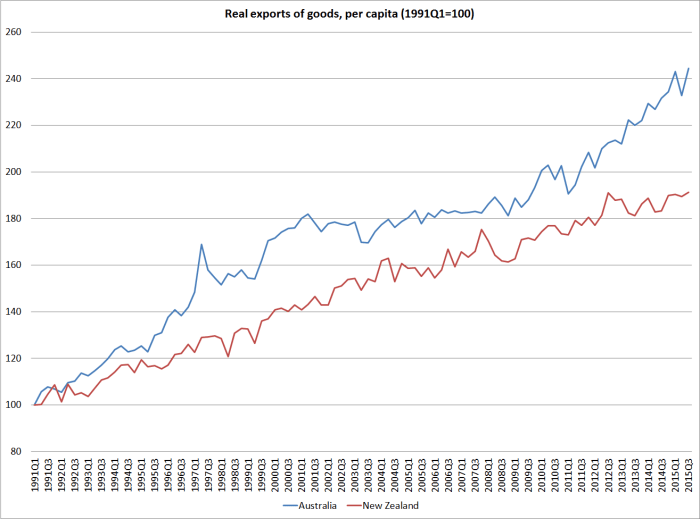
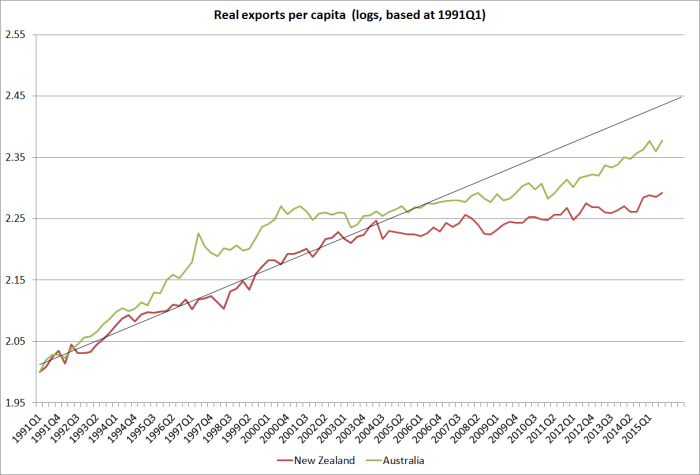
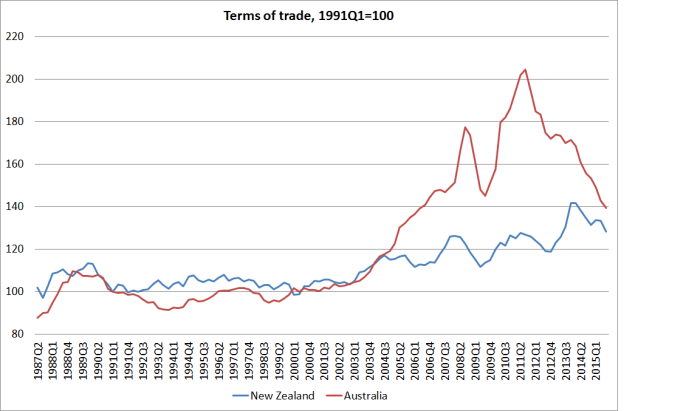
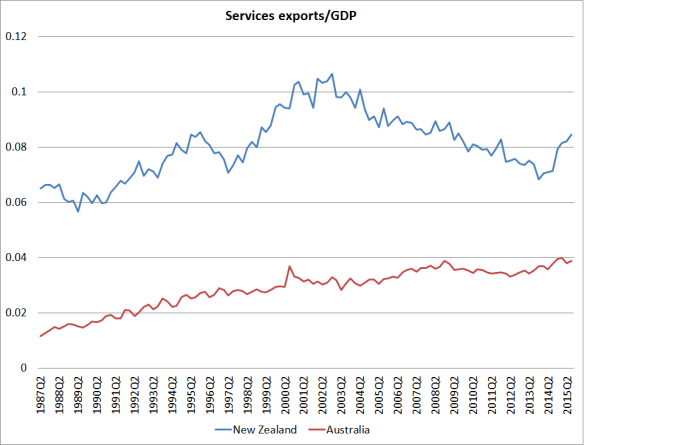
What’s good for Australia is good for New Zealand

But that is not what the FTAlphaville blog would have its international readers believe.

It is always interesting when serious foreign media write about New Zealand.  Sometimes there are useful perspectives we just don’t see.  Then again, when they get things wrong about things you know about, it leaves me wondering about the coverage of things I don’t know so much about.

Yesterday, the Financial Times’s Alphaville blog ran a piece by Matthew Klein headed “What’s bad for Australia is good for New Zealand”.   Klein seems interested in New Zealand and has written a few other posts in recent months.  In this one he draws on a recent speech by Reserve Bank Assistant Governor, John McDermott, but what is wrong with this post is almost entirely the author’s own work.

He begins with this Reserve Bank chart of the Bank’s estimate of the rate of potential output growth for the last 15 years or so.

NZ-potential-output.png

Potential output estimates have changed quite a bit as we have moved through time (and actual past estimates have been revised to some extent).  The Bank published a useful paper on estimating potential output and the “output gap” a couple of years ago.   The biggest single factor explaining fluctuations in potential output growth over time has been swings in population growth –  very strong around 2003, very strong over the last year or two, and much more subdued in between.  Changes in trend productivity growth also matter, but they are harder to detect.   But that slowdown has been real –  population growth in the last year or two has been at least as fast as it was in the early 2000s and the Bank’s estimate of potential output growth is much lower than it was then.  And as Paul Krugman helpfully reminds if, if productivity isn’t everything, in the long run it is almost everything.

But Matthew Klein seems impressed by those 2.6 per cent potential output growth rates –  much stronger than they were a few years ago –  and seems unbothered whether that is the result of more people, or of more productive use of people (and other resources). The difference matters.

Klein’s story is that the Chinese (demand-driven) hard commodity boom was a terrible thing for New Zealand, and we are now reaping a windfall from the end of that boom.

China’s changing investment strategy has produced a windfall for New Zealand — through the unexpected channel of clobbering the Australian mining sector.

Now I suppose there could be some channels through which the end of that commodity boom might have helped New Zealand and New Zealanders.  We import some of those hard commodities too (although of course, we do export some and look what became of Solid Energy).  To the extent that slowing Chinese growth might have contributed to lower oil prices, we benefit from that.  But these aren’t at all the channels Klein has in mind.  On his telling, we have done well because Australia has done badly.  And that seems inherently unlikely given that Australia is the largest trading partner for New Zealand businesses, and the largest source of foreign investment in New Zealand.

But Klein’s story is one in which New Zealanders fled for greener pastures in Australia when commodity prices boomed, and stopped doing so when commodity prices fell.  He runs this chart.

nz-emigration-to-aus-vs-aus-usd-commod-prices

Note that (a) it shows only the flow of New Zealanders to Australia, not the net trans-Tasman flow, and (b) it shows only Australian commodity prices, not the relative Australia/New Zealand prices.

Here is a longer-term chart showing the relationship between the net trans-Tasman migration flow (NZ and Australian citizens) and the relative terms of trade (Australia’s divided by New Zealand’s).

transtasman-tot-and-migration

Over decades there have been big cyclical fluctuations in the net migration flow across the Tasman.    Allowing for the fact that our population is much larger now than it was, say, 25 years ago, the peaks and troughs don’t seem to have become larger than they were.   And most of the time, there haven’t been big changes in relative commodity prices to explain the migration fluctuations.

Generally, a better story explaining the trans-Tasman flows over recent decades would seem to be:

  • in typical years there is a fairly large net outflow from New Zealand to Australia (material living standards are simply higher there),
  • when unemployment rates in Australia are very low, the outflow is higher than usual, even if unemployment is low here (job search across the Tasman is easier than usual, and those wages are higher).  In 2007/08, for example, the unemployment rate in Australia was the lowest in decades, as it was in New Zealand, and New Zealanders still seized their opportunities,
  • when unemployment rates in Australia is very high that net flow dries up –  people are reluctant to leave existing jobs when the job search across the Tasman is likely to be longer and costlier (as we saw in 1991),
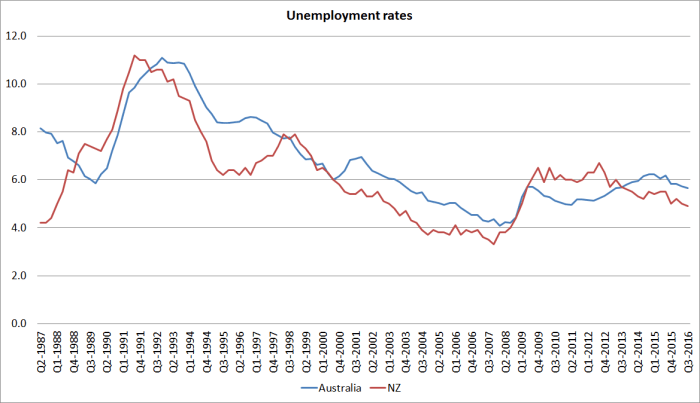
  • and when Australia’s unemployment rate is lower than New Zealand’s –  which doesn’t happen often – it again makes it very attractive for New Zealanders to go, especially if New Zealand’s unemployment rate is still on the high side.  The largest such gap in the last couple of decades was 2010 to 2012, which saw large scale outflows of New Zealanders resume.

Since then, of course, the unemployment rate in Australia has risen, and that in New Zealand has fallen. In both countries, unemployment is uncomfortably high, and above the respective estimated NAIRUs.  Perhaps it is a little surprising that the net outflow of New Zealanders has, for now, come back to around zero, but there has also been a lot more publicity in recent years about the relatively insecure position New Zealanders can find themselves in in Australia if things don’t go well.  But it would still be surprising if when both countries have unemployment rates are back at the respective NAIRUs there wasn’t typically a large net outflow of New Zealanders resuming.  After all, there has been no progress at all in closing the productivity gaps.
relative-u-rates


No doubt the hard commodity boom, and associated domestic investment boom, did contribute to the relatively low unemployment rate in Australia over 2010 to 2012.  But macro policy (especially monetary policy) also plays a big part in deviations of the unemployment rate from the level the underlying regulatory settings might deliver (the NAIRU).  In New Zealand, for example, the inflation outcomes quite clearly illustrate the monetary policy was tighter than it needed to be over that period.  Some of that was only clear in hindsight, and the earthquakes also muddied the water, but we didn’t simply have to live with such a high unemployment rate for so many years (which reinforced the incentive for New Zealanders to leave).

But, to stand back, perhaps the more important question to ask is why Klein thinks New Zealand is better off simply because the net outflow to Australia has temporarily ended.

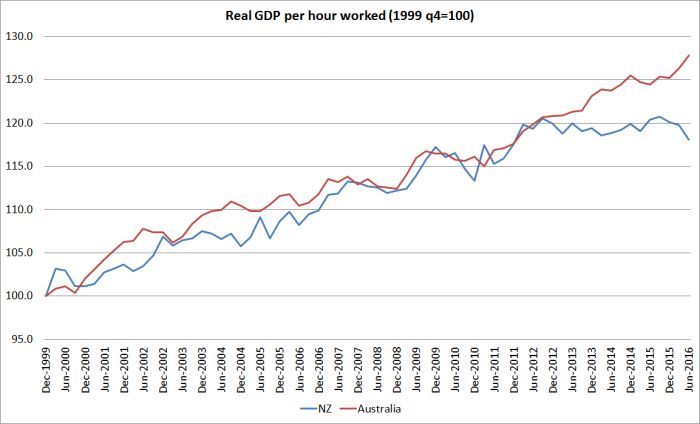
After all, New Zealanders going to Australia presumably do so because they think the opportunities are better there (and most objective measures of material living standards suggest they are right).  If opportunities deteriorate in Australia –  cyclically or structurally –  that isn’t a gain for New Zealanders, but a loss.  Fewer of them are, for now, able to take advantage of the opportunities across the Tasman.  It would be different if there were New Zealand specific positive productivity or terms of trade shocks  that meant that prospects here were improving faster than they had been previously.  But there is just no sign of that: as just one indicator, there has been no growth at all in real GDP per hour worked in New Zealand for around four years.

Of course, it might count as a gain if there was some sort of community goal to simply increase New Zealand’s population as fast as possible.  One sees those sorts of arguments in various countries from time to time –  there was a particularly daft Canadian example the other day  – but unless New Zealand is gearing up to defend itself from a military invasion from Antartica, the only good case for pursuing a larger population is if doing so makes us economically better off (higher productivity and all that).  And there is simply no evidence it has, or does –  whether in past decades, or in the latest population surge.

And all this is before reverting to the point that New Zealand firms trade more with Australian firms and households than they do with those in any other country. Australia is New Zealand’s biggest export market.  And so when Australian income growth tails off rapidly, as it has in the last few years, it isn’t very propitious for New Zealand firms hoping to increase their sales in Australia.  Weaker income growth in target markets is generally thought to be bad for the sellers (and their country) not good.

Here is a chart showing the net migration outflows for a longer period.

net-migration-charts

I’ve shown a variety of measures of trans-Tasman flows, and one of all NZ citizen flows everywhere.  They are all highly-correlated, as trans-Tasman flows almost always dominate the overall movements of New Zealand citizens.  There have been three times in the nearly 40 years for which the citizenship data have been available when the net outflow of New Zealanders has temporarily abated:

  • around 1983, when Australia was in recession and its unemployment rate was over 10 per cent,
  • in 1991, when both countries had a severe recession and both countries’ unemployment rates peaked around 11 per cent,
  • and in the last couple of years.  It is unusual in that neither country has been in recession, but both countries have had unemployment rates above the respective NAIRUs, in both countries income growth is much weaker than it was (particularly so in Australia) and in both countries (as in much of the advanced world) productivity growth has disappointed (most especially in New Zealand).

Not one of those occasions could be considered good news stories for New Zealand or New Zealanders.  Over the last 40 years, net outflows of New Zealanders to Australia have been something of a release valve –  Australia gave them opportunities New Zealand could no longer provide.  Unless and until New Zealand really begins to turn itself around structurally, anything that disrupts that outflow is more likely to be bad for New Zealanders than good.

Klein concludes his piece thus

As long as New Zealand is capable of boosting domestic spending without relying too much on household borrowing, admittedly a nontrivial challenge, this puts the country in an enviable position compared to much of the rest of the rich world. Policymakers should enjoy it while they can.

Given that household credit has been growing at almost 9 per cent in the last year, mostly reflecting very rapid increases in already high house prices, and that there has been no productivity growth for years, all while the unemployment rate has lingered above the NAIRU, I’m not at all sure what Klein thinks policymakers should be enjoying.  Perhaps write-ups like his – while they last –  but there doesn’t seem to have been much in the story for New Zealanders in recent years.

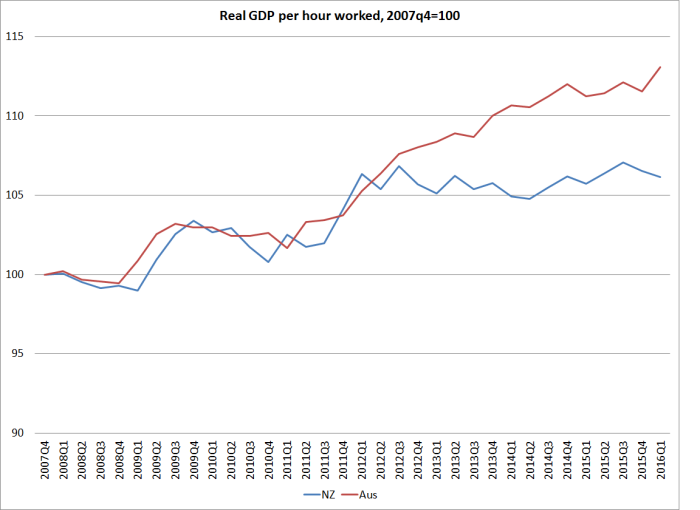
Here is the productivity growth comparison with Australia.  If anything, the latest relative deterioration seems to coincide with the end of the Australian commodities boom. I doubt that relationship is really causal, but it certainly doesn’t seem to help Klein’s story.
gdp-phw-nz-vs-aus

In general, what is good for the economy of our largest trade and investment partner will, almost always, be good for New Zealanders too.  That is how trade, and open markets, work.
Does Australia really need “the English influence”?

I’ve been intrigued for some time by the way in which some Australian business and media leaders seem to think that New Zealand –  perhaps especially under the stewardship of the current government – is a model of governance and economic management to be emulated.  Indeed, when it suits, this idea even reaches all the way up to some politicians.  On the day of his successful party-room coup to topple Tony Abbott, Malcolm Turnbull declared

“John Key has been able to achieve very significant economic reforms in New Zealand by doing just that, by taking on and explaining complex issues and then making the case for them. And I, that is certainly something that I believe we should do and Julie [Bishop] and I are very keen to do that again.”

As I noted in a post at the time, the list of “very significant economic reforms” was so short I couldn’t think of any.

What puzzles me more is when senior New Zealand commentators buy into the same story.  Fran O’Sullivan’s column in the Herald yesterday, “Oz needs the English influence” seemed to do exactly that.  It is interesting to know how some influential Australians see the New Zealand story, but O’Sullivan seems to share the belief, noting that our economic performance is “something to skite about when it comes to transtasman rivalry”.

Of course, everyone knows Australia has its problems.  They still have a federal government budget deficit, and we don’t. The Prime Minister has changed so often in the last decade, it must almost look familiar to Italians. And in Wayne Swan and Joe Hockey, they’ve had a couple of Treasurers who didn’t command much respect.  And Australia is coming off the back of a massive mining investment boom –  in many respects a nice problem to have, and in contrast to the lack of much of market-led export-oriented business investment boom in New Zealand any time in recent decades.

And, of course, if the National-led governments of the last eight years have all been minority governments, John Key and Bill English mostly seem to have managed the politics quite adeptly: they are still in office, and look to have a reasonable chance of winning again next year.  And English is a thoughtful Minister of Finance, even if not one with much of an economic plan.

But one can always find thoughtful individual ministers –  I recall reading speeches by Craig Emerson, a minister in the Rudd/Gillard governments and a former senior public servant, and wishing we had ministers who could give such thoughtful and rigorous speeches.

And Federal systems, and bicameral Parliaments, are just harder to manage –  but not necessarily worse for it – than the New Zealand system.

My benchmark remains the numbers.  It is no secret that GDP per capita (and all variants on it) is much higher in Australia than in New Zealand.   That has been so for at least 40 years.  It is the reason why lots of New Zealanders move to Australia, and only a small number of Australians come to New Zealand.

But I guess that in thinking about the Australian Key-English admiration  the focus should really be on how the data have changed in the last few years.  Has the vaunted Key-English style and substance succeeded in changing direction, closing the gaps between New Zealand and Australia?  After all, John Key was once quite explicit that his goal was to close the income gap between New Zealand and Australia by 2025.

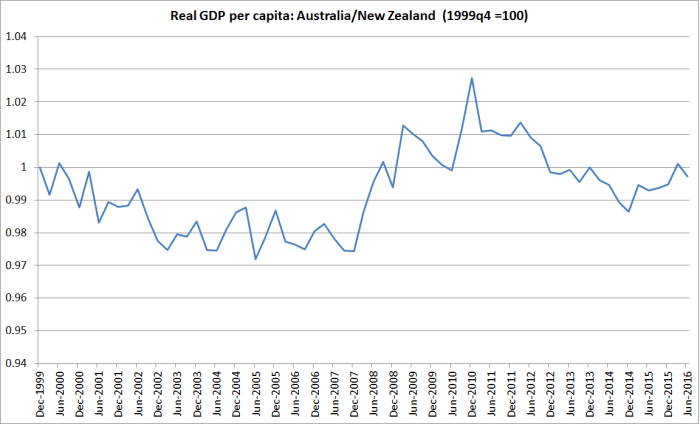
Here is the headline comparison, looking at real GDP per capita

gdp-pc-aus-vs-nz

On this measure, Australia was doing slightly less well than us during the previous boom.  They did much better than we did through the recession and the peak of the terms of trade boom.  And over the last few years, things have settled back again.  For the whole period –  this century to date –  New Zealand and Australian per capita GDP have grown at much the same rate.

New Zealand and Australian governments have almost no control over the respective terms of trade for their countries, and those series are quite volatile.  But if you dig into real per capita income measures (which take account of terms of trade fluctuations), New Zealand has done slightly better than Australia over the century to date.

But that seems to me to be about the absolute limit to the favourable story.

What about productivity growth, the foundation for sustained long-term prosperity?  Here is labour productivity

gdp-phw-nz-vs-aus

You can discount the very last New Zealand observation (on account of a break in the hours worked series, when SNZ updated the HLFS methodology).  But it isn’t exactly a picture which reflects well on New Zealand over the last few years (and especially the years when both countries have had centre-right governments).  In fact, the New Zealand numbers are so bad one half suspects SNZ might eventually revise some of the weakness away.  But in the meantime, no obvious advantage to New Zealand.

We’ve managed not to lose any more ground relative to Australia on GDP per capita. but only by working even more hours.    Here are Australia’s hours worked and population data

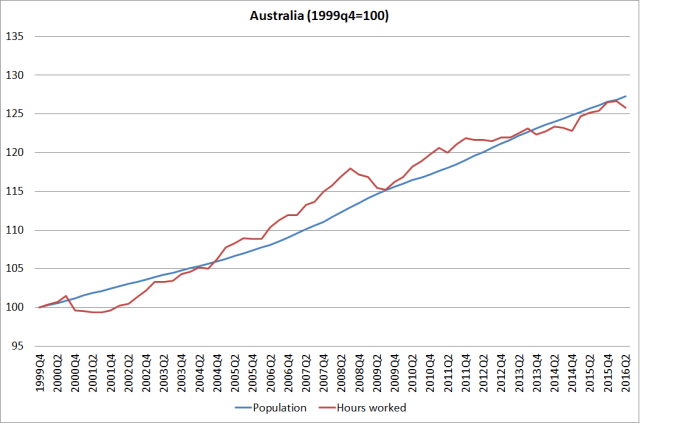
aus-popn-and-hours

And here is New Zealand, on exactly the same scale (and again, discount the very last hours observation).

nz-hours-and-popn

Of course, there is nothing wrong with working longer hours if that is what individuals choose, but for whole economies it isn’t usually a sustainable path to greater prosperity.  And while productivity gains are pure benefit, longer working hours –  especially with little or no productivity growth –  is mostly just a cost.

In some areas, New Zealand does typically do better than New Zealand.  Our labour market is less heavily regulated than Australia’s –  and much less subject to union corruption –  and, as a result, our unemployment rate is typically a bit lower than Australia’s.  Here are the two unemployment rates over the last few decades.

u-aus-and-nz

Right now, the gap between the two unemployment rates –  0.6 percentage points –  looks about normal.  But for much of the current government’s term what was striking was how high our unemployment rate lingered (and above Australia’s for several years).  It isn’t obvious that any special credit is due to the current New Zealand government.

But what about government finances?

It is certainly true that our central government has a modest surplus, while the Australian federal government is still in deficit.  But recall that Australia has a federal system, and the state budgets make  up quite a large proportion of overall government spending and revenue.  International agencies tend to focus on “general government” data –   central, state (where relevant) and local government.  Cyclical adjustment also matters.

Here is OECD’s latest estimates of the cyclically-adjusted general government estimates for the two countries.

net-lending-aus-and-nzAlmost indistinguishable not just now, but over most of the last 20 years.  I’m not sure I’m totally convinced, but that is the OECD’s read.  Again, nothing that particularly stands out to the credit of English/Key relative to Australia.
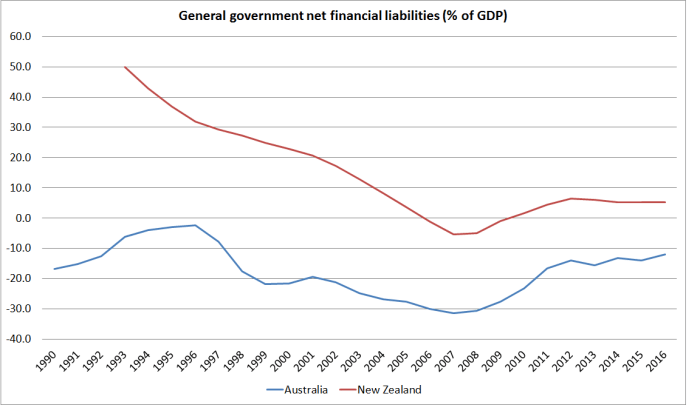
And here is the OECD data on government debt (net liabilities, across all three tiers of government) as a share of GDP.

gen govt net debt.png

New Zealand governments did a great job getting net debt down in the 90s and 00s, but  New Zealand’s net debt is still higher than Australia’s.  Since the last pre-recession year, 2007, Australia’s debt has increased more than New Zealand’s (share of GDP).  That probably is to the credit of Key/English, especially given some of the earthquake fiscal pressures, but on this measure, Australian governments’ net debt is still a bit less than ours was in 2007.

Business leaders also tend to believe –  as I do –  that, within limits, smaller government and lower taxes are conducive to better long-run productivity growth.  Stability in the share of GDP spent by government is also generally thought to matter (reducing uncertainty about future tax rates).

Here is general government spending as a share of GDP.

gen-govt-disbursements-aus-and-nz

Not only is Australian government expenditure lower as a share of GDP, but it is more stable.  And the gap between those two lines has not narrowed over the Key/English years; if anything it has widened.

And here is the picture of revenue

gen-govt-receipts-aus-nz

There isn’t much of a story about variability –  really big terms of trade fluctuations generate a lot of revenue volatility – but again Australian government revenue (mostly taxes) is consistently materially lower than that in New Zealand.

So I’m still a bit puzzled why the Australian business people and commentators seem so taken with the New Zealand story. There is (almost) nothing there. No serious reforms and (to the extent any disagrees with that assessment) no significant productivity growth. No sign of the gaps closing.   The size of government is bigger here, but then it has been for a long time.  And, more positively, the unemployment is a lot lower here, but again current numbers aren’t out of line with past patterns.

I presume much of it just comes down to two things:

  • whenever elites in any country are discontented with their own governments, it is easy to contrast them with some other group of politicians (whose own record is rarely examined closely) over the water,
  • the National-led government has been able to count (law changes it proposes mostly happen, and the details of the languishing RMA reforms are no doubt lost on opinion formers in Australia).  But then it is great deal easier to “count” here, where typically National needs one or two votes from parties it has longstanding confidence and supply agreements with.  It is just harder in Australia, between the role of the states, a governing bloc that is itself a coalition of the Liberal and National parties (National MPs having no say in who is Liberal leader and PM), and the Senate where it is rare for any party to be able to command a stable majority.

John Key and Bill English might be more successful politicians than Rudd, Gillard, Abbott, and Turnbull: the New Zealanders have won three elections, and the Australians have won only one each, and the first three have then been ousted by their own parties.

Perhaps that sort of political stability/political success has its own appeal in certain circles, but if we are judging political leaders by their fruit, there is still nothing much about the New Zealand economic story that should prompt any envy in the eyes of our trans-Tasman neighbours.  Sadly……still……after decades and decades.

Rugby might be another matter, but then I’m a cricket fan.


Tricontinental: revisiting the financial disasters of the 1980s

Browsing a few weeks ago in a secondhand bookshop in an obscure Northland village, I stumbled on Tricontinental: The Rise and Fall of a Merchant Bank, a  fascinating 1995 book documenting the utter disaster that Australia’s largest “merchant bank” –  by then wholly-owned by the State Bank of Victoria –  became in the late 1980s.  That failure was followed by a Royal Commission, helping to ensure that events around it –  including the failures of management, auditors, owners, politicians and regulators –  are better-documented (or more accessibly documented) than in most bank failures.

In both New Zealand and Australia, the mid-1980s was a period of great exuberance in banks and financial markets.  Controls that had been in place for decades were removed in pretty short-order (the changes were more far-reaching in New Zealand than in Australia, but Australia’s changes were large enough).  Exchange controls were removed, exchange rates were floated, interest rate controls were removed, new entrants to the financial system were allowed, and in both countries there were reforming (notionally) left-wing governments.  Brighter futures for all were in prospect.

Stock markets soared and those who were energetic and lucky quickly made themselves huge fortunes –  most of which had gone again only a few years later.  Debt paved the way, financing takeovers, often-questionable real investment projects (the Australasian commercial property glut followed) and (in Australia in particular) massive reshuffles of media holdings as the regulatory ground shifted.  Total credit –  and especially total business credit –  saw almost explosive growth.  Names like Bond, Holmes a Court, Brierley, Judge, Hawkins, Skase and so on dominated the business media.  There was even ridiculous talk of New Zealand firms having a comparative advantage in takeovers. The media were often enthralled by what was going on  –  it made for great stories –  and it was probably hard for politicians to resist either.  After all, a lot of political capital had been staked on those reforms, and associating with success tends to be much more attractive to politicians than the alternative.  On this side of the Tasman, the defining images of the period are probably (a) newly-listed goat farms, and (b) the way shares in the Fay/Richwhite entity rose and fell with the successes (and subsequent failure) of the New Zealand entry in the 1986/87 America’s Cup in Perth.

Much of what went on in those years ended very badly.  Many of the key business figures afterwards spent time in prison.  Many major corporates failed –  not in itself a bad thing –  and many banks did too.  On this side of the Tasman, the well-publicized disasters were the (predominantly government-owned) DFC and BNZ, and the less visible NZI Bank. In Australia, Westpac came under extreme stress, and the State Banks of Victoria and South Australia were the most visible calamities.  The State Bank of Victoria enabled Tricontinental –  and in turn Tricontinental did the lending that was enough to end its parent’s 150 year independent existence.

Tricontinental didn’t start (in 1969) as a government-owned entity.  Indeed, the name reflected the early spread shareholding –  stakes held by banks on three continents, dating from the pre-deregulation days when the best way for foreign banks to get into the Australian market had been through the merchant banking sector, which in turn was beyond the scope of many of the regulatory restrictions (eg on how short a term deposit could be) on banks.  It wasn’t wildly different here –  there had been huge disintermediation to the non-bank sector in the couple of decades prior to our deregulation.

But in the post-1984 ownership reshuffles, Tricontinental –  always a fairly aggressive, but fairly small, player –  became a wholly-owned subsidiary of the (Victorian government owned) State Bank of Victoria.  And in the same period, there was the rapid rise of Ian Johns, first as Tricontinental’s lending manager and then as CEO.  Johns was pretty young, had never (that I could see from the book) been through a serious economic downturn, but had the drive and aggression that enabled him to forge relationships and build a rapidly-growing lending business –  typically with emerging “entrepreneurs”, and generally not with the “big end of town”.  And if funding such a fast-growing lending book might have been a bit of an issue –  even in those heady days –  even that concern largely dissipated once Tricontinental came wholly under the wing of SBV –  one of the establishment institutions of Victoria, historically the financial centre of Australia.  SBV didn’t really even want to own Tricontinental in the long-term –  they thought they were dressing it up for a sale.  But in the meantime, there were next to no market disciplines, little or no regulatory discipline, and near non-existent self-discipline (including from the Board, the SBV Board, or SBV’s owners the Victorian government).

Reading the book, it was both staggering  and sadly familiar just how badly wrong things went.  Since 2008 I’ve read numerous books on the failures of individual institutions –  in Iceland, Ireland, the UK, the US, the Netherlands, past and present, as well as more general treatments of banking crises in these countries and Japan, Finland, Sweden, Norway.  There aren’t many new things under the sun, and Tricontinental wasn’t one of them.    In a way, it was a product of its time, but that doesn’t take away the responsibility of individuals and institutions.

Credit growth doesn’t just happen.  It needs people who want to borrow and people who are willing to lend.  In post-liberalization Australia (and New Zealand) there was no shortage of people with superficially plausible schemes who were willing borrow whatever anyone would lend.  Sadly, there were all too many people willing to lend –  attracted by some mix of the high fees, high credit spreads (Tricontinental apparently charged both), the mood the times, expectations of shareholders’ (everyone else is booking high profits, why not you?) –  and few people willing to say no.  Of course, those who had tried to say no might well have been shoved aside –  “get with the new world” –  but as far as one can tell from the book, hardly anyone ever tried to say no in Tricontinential/SBV.  The CEO drove the lending business, there was little robust internal credit analysis, the emphasis was on fast turnaround of proposals, and while Board approval was required for all major loans, often this was sought by couriering out papers to individual Board members’ and requiring consent within 24 hours  (and Board members weren’t just the glittering “great and good”; many look like the sort of people who would easily pass “fit and proper” tests).   Loans were collateralised, but the quality of security was typically poor (and often much worse than the not-overly-curious Board realized).  Internal guidelines –  eg on concentrated exposures –  were routinely ignored, and redefined to suit, and recordkeeping and reporting systems were grossly inadequate.  Auditors rarely asked hard questions –  and had they done so would no doubt have jeopardized their mandate –  and no one anywhere seems to have wanted to explore the possibility that things could go very badly wrong.  The Reserve Bank of Australia had few formal regulatory powers –  state banks were established under specific state legislation, and merchant banks weren’t generally supervised –  but hardly pushed to the limits its informal powers of persuasion or access.

After the 1987 sharemarket crash it all came a cropper.  Not on day one –  it took several years for the full scale of the disaster to become apparent (not that different from the situation here, where DFC only finally failed two years after the crash) –  but the fate was largely sealed then.  Share prices didn’t keep rising indefinitely.  Castles built in the air had their (lack of) foundations exposed.  And the value of collateral quickly dissipated.   Billions of dollars in loan losses were eventually recorded, destroying the parent, and (apparently) contributing in no small measure to the fall on the then Victorian Labor government.

As I noted, there was a Royal Commission inquiry into the failure –  itself embroiled in political controversy and legal challenges.  The authors of the book suggest that the Royal Commission bent over backwards to excuse many people, but no one seems to emerge that well from the episode.  It wasn’t, as the Commission reports, mostly about criminality or corruption (although Johns did go on to serve time in prison on not-closely-related offences), but was caused mostly:

..by ordinary human failings, such as the careless taking of risks while chasing high rewards (in a decade noted for its commercial greed), complacent belief in the reliability of others, lack of attention to detail, and arrogant self-confidence in decision-making –  all of which resulted in poor management and unsound business judgements.

They criticized Johns “arrogant self-confidence, lack of business acumen, naivety when dealing with well-known entrepreneurs, lack of candour at times amounting to deviousness, and unwillingness to admit error”, the CEO of SBV (who sat on the Tricontinental Board) (“he appears to have been weak when he should have been strong”),  the Board chair, the Reserve Bank, and the rest of the SBV and Tricontinental directors.

Listed entities, with market disciplines, fail from time to time.  In wild booms all too many get caught up to some extent in the excesses.  And not all bank failures should be considered bad things.  But it is difficult to escape the conclusion that government-owned banks are that much more prone to running into serious financial strife than others, perhaps particularly when they are run at arms-length in a more deregulated environment (it was hard for any bank to fail in 1960s New Zealand or Australia).  We saw it in New Zealand and Australia in the 1980s, and with the German landesbanks.  Perceptions of too-big-to-fail around state-sponsored entities like the US agencies go in the same direction. And it is why I have never been comfortable with Kiwibank –  and am only more uncomfortable if the planned reshuffling of ownership within the New Zealand state sector goes ahead.  Market discipline doesn’t work perfectly –  perfect isn’t a meaningful standard in human affairs –  but it seems considerably better than the alternative, lack of market discipline.  And, regulators being human, when market discipline is weak, regulators often aren’t much help anyway –  they breath the same air, and are exposed to same hopes and dreams as the rest of us.

For anyone interested in Australasian financial history, the Tricontinental book is fascinating. I went looking to see what happened afterwards to some of the key characters –  Johns after all was still quite young in the early 1990s – but Google failed me.  There just doesn’t seem to be much around. But the interest is probably mostly in reliving the atmosphere of the times, when so much damage was wrought so quickly on both sides of the Tasman.

It is also, though, a reminder, of how poorly served New Zealand is in financial history.  There is no comparable book about the DFC failure (although Christie Smith at the RBNZ did an interesting recent draft paper on it), nothing comparable on the BNZ failure, and there are no serious works of economic or financial history on the extraordinarily costly and disruptive banking and corporate period after 1984.  There are small individual contributions (and I learned a lot from some memoirs by Len Bayliss on his experiences as a BNZ director during the period), but no single work of reference to send people to.  There must be huge paper archives still around –  both those of the institutions concerned and those of the Treasury and the Reserve Bank –  and many of the players are still alive.  A book of the Tricontinental sort written 2o years ago could have been no more than a first draft of history.  At this distance, it is surely the opportunity for some more serious reflective historical analysis that would, among other things, secure the record for future reference.

Reflecting on these sorts of institutional failures, it got me wondering again about the sorts of climates in which the risks build up that culminate in bank failures. Alan Greenspan’s phrase “irrational exuberance” springs to mind.  There was plenty of exuberance in post-1984 New Zealand and Australia, with asset prices and credit rising extremely rapidly to match. Whole new paradigms for assessing, or ignoring, risk were championed.  And in the respective domestic economies, times felt good too –  in one headline indicator, New Zealand’s unemployment rate, in the midst of widespread economic restructuring, was around 4 per cent.  Those look like the sorts of climates that characterized most of the advanced country crises of recent decades –  Ireland recently, or Japan or the Nordics in the 1990s being the clearest examples.  By contrast, today’s New Zealand –  limping along with modest real per capita GDP growth, subdued confidence,  lingering unemployment, few new or significant credit providers just doesn’t seem to fit the bill (no matter much the combination of population pressures and land use restrictions) drive house prices up.  (I wrote a piece last year on the lack of parallels between now and 1987.)

Reviewing government assistance to business

The Australian Productivity Commission’s latest annual Trade and Assistance Review was released quite recently.  These, statutorily required, reviews contain

the Commission’s latest quantitative estimates of Australian Government assistance to industry

as well as useful discussion and analysis of key recent developments in the trade and industry assistance area.  As the Commission notes in the Foreword to this year’s report

Views inevitably differ on what constitutes industry assistance and whether it is warranted. Fundamental to these questions is transparency of measures. The annual Review seeks to identify government arrangements that may be construed as assistance, as well as their target, size, and nature. This information provides a basis for considered assessment of the benefits and costs of the arrangements.

Transparency  alone usually can’t stop daft policies being adopted or continued, but without good empirical estimates and disinterested analysis it is harder to push back against the special interests lobbying governments for this deal or that.  Such deals are almost invariably dressed up as being in the public interest, but perhaps rarely are.

The Commission highlights one particularly egregious example in this year report –  the decision to build the new submarine fleet in Australia  (characterized by many as marginal seat retention scheme  –  and the Cabinet minister most often mentioned did retain his seat at the recent election).  As the Productivity Commission’s report tartly observes

Paying more for local builds, without sufficient strategic defence and spillover benefits to offset the additional cost, diverts productive resources (labour, capital and land) away from relatively more efficient (less assisted) uses. It can also create a permanent expectation of more such high‑cost work, as the recent heavily promoted ‘valley of death’ in naval ship building exemplifies. Such distortion detracts from Australia’s capacity to maximise economic and social wellbeing from the community’s resources. The recent decision to build the new submarines locally at a reported 30 per cent cost premium, and a preference for using local steel, provides an illustrative example of how a local cost premium can deliver a very high rate of effective assistance for the defence contractor and the firms providing the major steel inputs (box 3.1). While based on hypothetical data, the example reveals that the effective rate of assistance provided by purchasing preferences can be higher than the peak historical levels recorded for the automotive and textiles, clothing and footwear industries prior to the significant economic reforms of protection. It is notable that this cost premium does not include any delays in deploying the new submarine capability.

Effective rates of protection, in 2016, higher than those provided to automotive, textile, clothing and footwear industries in the bad old days of high industry protection.

I wrote briefly about last year’s review, which included material which the Sydney Morning Herald described as scathing attack on preferential trade agreements of the sort that Australia (and New Zealand) governments have been enthusiastically signing.  The Australian Productivity Commission  –  a body strongly committed to open and competitive markets – has a well-established record of skepticism around the wider economic benefits of such deals.  Here is their box summarizing the issues and concerns.

Box 4.1           Conclusions in regard to the merits of trade agreement

The Commission has previously raised questions about the merits of trade agreements (including PC 2010, and the Trade & Assistance Review 2014‑15). The overall conclusions are as follows:

·       Multilateral trade reform offers potentially larger improvements in national and global welfare than a series of bilateral agreements. While the slow progress of the Doha Round of multilateral trade reform has accelerated preferential agreement making, the trade‑diverting effects of bilateral agreements should not be forgotten.

·       Australia gains more from reducing its own tariff barriers than from the tariff reductions of a bilateral trade agreement partner.

·       The benefits of increased merchandise trade emanating from bilateral trade agreements have been exaggerated.

·       Different and complex rules of origin in Australia’s preferential trade agreements are likely to impede competition and add to the costs of firms engaging in trade.

·       The nature and scope of negotiating remits should be assessed from a national structural reform perspective before entry into negotiations, rather than primarily for export opportunities. The text of proposed trade agreements should be made public and a rigorous analysis independent of the negotiating agency published with the final text.

·       The Australian Government should seek to avoid the inclusion of Investors‑State Dispute Settlement (ISDS) provisions in bilateral and regional trade agreements that grant foreign investors in Australia substantive or procedural rights greater than those enjoyed by Australian investors.

·       The history of Intellectual Property (IP) being addressed in preferential trade deals has resulted in more stringent arrangements than contained in the multilateral agreed Trade‑Related Aspects of Intellectual Property (TRIPS). Australia’s participation in international negotiations in relation to IP laws should focus on plurilateral or multilateral settings. Support for any measures to alter the extent and enforcement of IP rights should be informed by a robust economic analysis of the resultant benefits and costs.

It isn’t exactly the enthusiasm of New Zealand or Australian governments for deals such as TPP (although the Commission does not comment at any length on that specific deal).

One can always argue what value publications like these add – given the fondness for daft policies that governments continue to show. But given how badly the incentives are skewed against citizens, provisions that require officials to publish reports of this sort seem appropriate. Information is one of the few tools citizens have to push back.

In New Zealand, the Taxpayer’s Union has done sterling work in highlighting some of the cost of “corporate welfare”, but it might be a good part of improving New Zealand’s economic governance if provisions requiring an annual report of this sort were included somewhere in New Zealand legislation.  At very least, it would help to prompt something like the annual modest round of stories in the Australian media about just what governments are doing  –  and at what cost –  in this area.  In a small country, with a lightly-resourced media, we probably need such official reports even more than Australia does.

NZ and the UK: strongest performers in their blocs?

An article in yesterday’s Herald caught my eye. In a double-page feature on Brexit, it was headed “Options beyond the EU” and featured some comments from the former New Zealand Minister of Finance, Ruth Richardson.  I was a bit puzzled by the article, which didn’t really seen like a New Zealand article, but wasn’t attributed to any foreign newspaper or wire service.  When I checked it out, it turned out that it was a backgrounder that had run as part of a series in the Telegraph three months ago looking “at four non-EU economies to see if they could provide a model for Britain’s post-Brexit future”.  One was New Zealand.   (The Telegraph had gone so far as to described Richardson as  a”great economic reformer”, although the Herald quietly deleted the “great”.)

Several passages interested me:

Ruth Richardson, a former New Zealand finance minister and a great economic reformer, believes there is a clear parallel between the two nations, and the choice that each will face. “When Britain decided to become very closely connected [with the EU], Britain was regarded as the sick man of Europe,” she says, with the UK “almost on the brink of the International Monetary Fund dictating policy” to it. Similarly, “when New Zealand decided to explore closer economic relations with Australia, we were clearly the sick man of Australasia”.

However, Richardson says, “nations ought not to be trapped by historical perspective”. She believes that the arguments behind a once sensible decision may have shifted. As in business, decisions over a country’s political future should be made on the basis of what will work best in the here and now, Richardson says.

Both the UK and New Zealand have risen to become the strongest performer in each of their respective blocs, and the reasons to pivot towards emerging markets have become clear.

And

A pair of radical politicians helped New Zealand through this difficult period. Richardson was the finance minister in a Right-of-centre National party government from 1990 to 1993, and her efforts, combined with those of her predecessor, the Labour party’s Roger Douglas, transformed the economy from one at the bottom of the pile to something far more dynamic.

Shaun Goldfinch, a New Zealand-based academic, says that the country moved from being “one of the most hidebound economies outside the former communist bloc, to among the most liberal in the OECD”.

I wasn’t entirely sure that I recognize the pictures being drawn here.

In both cases, it is a picture of economies transformed –  the UK and New Zealand having ‘risen to become the strongest performer in each of their respective blocs’ (the EU and the CER respectively).

The UK entered the (then) EEC on 1 January 1973.  The initial six members of the EEC had been France, (West) Germany, Italy, Belgium, Netherlands, and Luxembourg.  I’m going to ignore Luxembourg in subsequent comparisons, and focus on the five reasonably large initial EEC economies.

For the UK the path to the EEC was pretty slow.  The first de Gaulle veto had occurred in 1963, and the second in 1967.    Over the 1960s, annual UK inflation  was around 1 percentage point above the median of the five EEC countries.  In 1972, just prior to joining the EEC, that gap was 1.4 percentage points.   Things got a lot worse in the following few years, but even then there was only one year –  1975 –  when the UK had the highest inflation rate of these six economies. Italy was typically worse.

And in the 1960s, real GDP per hour worked in the UK is estimated –  using the Conference Board data – to  have been almost exactly equal to that of the median country of the EEC-5.  Britain’s unemployment rate had been slightly below the median of the unemployment rates of those other European economies.

Of course, Britain had its challenges –  economic, and the psychological/political hurdles of the end of empire –  but it was hardly a basket case.

And nor has it, very obviously, gravitated to top of class since then

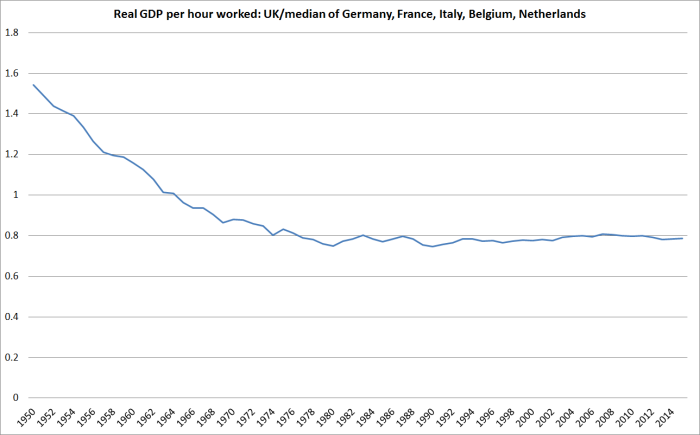
Here is real GDP per hour worked.

uk gdp phw

The decline in Britain’s GDP per hour worked, relative to those of the EEC-5, ended in around 1980.  And it has gone almost exactly sideways ever since.   Of these five European countries, Britain now only matches the real GDP per hour worked of Italy.  In the other four countries, labour productivity is around a quarter to a third higher than that in the UK.  Perhaps entering the EU staunched the decline, but there were probably a variety of other factors including financial liberalization (financial services being a huge chunk of British exports), the Thatcher reforms, and the end of the post-war catch-up phase.  But……Britain now has a lower level of labour productivity than all but one of these five European peers: it does no better than 80 per cent of the median of these other countries.  Not exactly a “top of class” performance.

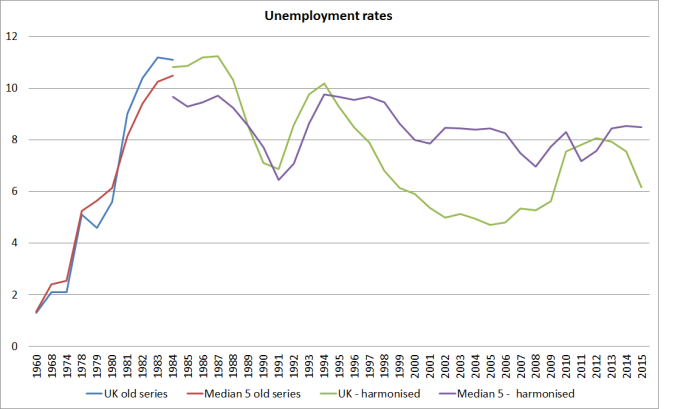
One area where they have done better is unemployment.  The following chart shows the UK unemployment rate and the median rate for the same five European countries.  It combines official current OECD data (on harmonized definitions) since 1983, and several years of earlier OECD data from their Historical Statistics: 1960-1988 publication.

uk unemployment rates

Over the last 20 years or so, the UK has clearly done materially better than these five European countries.  Each of the other five is in the euro, but that shouldn’t explain any difference given that these five countries include four of the larger euro-area economies.  But even among those other five countries, the Netherlands has typically had a lower unemployment rate than the UK’s –  although that isn’t so right now.

And what about the New Zealand/Australia comparisons.  Negotiations on the CER agreement began in 1979, and the agreement was signed in early 1983.  Given that there are only two countries in Australasia, I won’t dispute the description of New Zealand by then as the “sick man of Australasia”.  Our economy had been very severely hit by the post-1973 fall in the terms of trade.   The large outflow of New Zealanders to Australia really gathered pace in the 1970s.  Neither country was running macro policy –  or micro policy –  that well, but New Zealand was generally accepted to be lagging somewhat behind Australia.  We compounded the problems with the Think Big energy projects programme in the early 1980s, which temporarily boosted demand, but simply threw away some of the nation’s wealth.

But the story wasn’t totally bleak.  Our unemployment rate, while rising, had been consistently below that of Australia. And over the years when CER was being negotiated, New Zealand’s real GDP per hour worked was about 79 per cent of that of Australia –  alert readers might notice that that is about the same ratio as that between UK GDP per hour worked today and that of the EEC-5 (see chart above).

I’m not about to dispute that lots of worthwhile reforms were done here during the subsequent years.  And I think it is likely –  although hardly certain –  that CER was helpful to both countries (although trade diversion effects were probably material in some sectors).  And there are whole sectors of the economy where I think policy  in New Zealand could reasonably be judged better, at least in terms of encouraging resource utilization, than that of Australia.  The labour market is one of them –  we don’t need elections called on the ostensible grounds of breaking the power of corrupt trade unions.  I know some readers disagree, but I think our approach to retirement income policy is superior to Australia’s.  And I often like to mention that taxi industry, where deregulation has given us a much better outcome than Australia has.

But has it made us the strongest performer in our little two country bloc?  Not really.

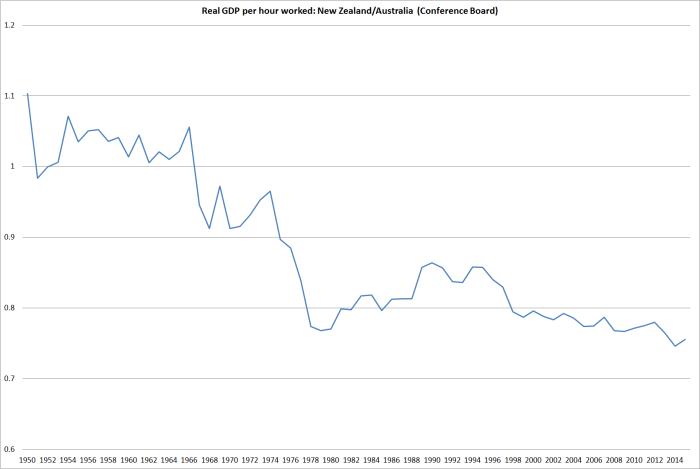
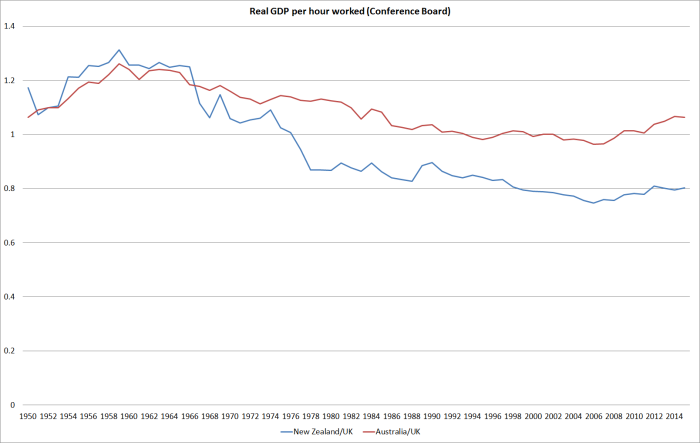
Take the real GDP per hour worked comparison, again from the Conference Board.

nz au real gdp phw

The late 1970s were a very bad period, as reflected in these data.  But on this measure things improved a bit of the 1980s –  partly no doubt the unsustainable boom that bust after 1987 –  before tailing off again.  Today, New Zealand’s GDP per hour worked is a little worse, relative to Australia’s, than it was when the CER negotiations got underway.  Perhaps the exam paper was upside down when that “best in class” grade was being awarded?  Of course, both countries are richer, and more open, than they were back then, but Australia has kept on doing a bit better than us.

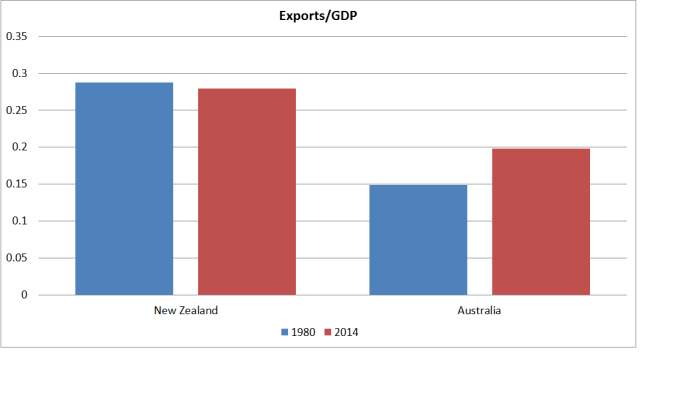
And a significant part of the liberalization and reform process in both countries was the opening to external trade (not just bilaterally).  Here is the data for exports as a share of GDP.

exports nz and ausNew Zealand’s export share of GDP hasn’t changed in 35 years.
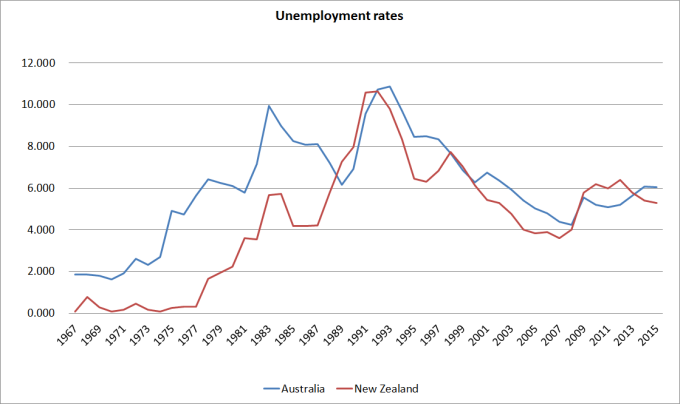
Of course, there are some area in which we do better –  and we have the distinct attractions (to New Zealanders at least) of no snakes or crocodiles.  As I noted earlier, the labour market tends to be one such area.  Here are the unemployment rates for the two countries back to the 1960s (prior to 1986 the New Zealand data are estimates, but good enough to be used by the OECD).  I have taken account of the revised data Statistics New Zealand published earlier this week.

u rates back to 60s

Our unemployment rate has been below that of Australia most years since 1967.  Only on two occasions was our unemployment rate higher – the first episode was in the wake of the post-1976 share and commercial property crash, and the second was in the couple of years after 2009 when Australian commodity prices –  and the associated business investment boom – were at their peak.  We should, of course, welcome the fact that our labour market typically generates less unemployment than Australia’s does, but it is worth mentioning that the gap in our favour is smaller than it was pre-liberalization.

No doubt our economy is rather more “dynamic” than it was –  although it is fair to wonder quite what that words mean specifically –  but it isn’t obviously much more successful., not even relative to Australia.  Compared with the late 70s, both countries now have low and stable inflation –  but their inflation rate is nearer target than ours.  Both countries have low levels of public debt, but in flow terms at present our government accounts are roughly balanced while theirs are still in deficit.    We have a slightly larger reliance on foreign capital (larger net IIP position as a share of GDP) than Australia does, but perhaps they have a slightly more compelling story about the new business investment (tradables sector) that capital has financed.  Both countries have seriously dysfunctional housing markets – it is hard to tell which of two bad performers is worse.  Oh, and New Zealanders are still (net) moving to Australia, not coming home again.

It is election day in Australia.  I was amused when Malcolm Turnbull became Prime Minister and talked about wanting to emulate New Zealand’s approach to economic reform.  In the intervening period, there hasn’t been much sign of reform in Australia –  any more than there had been in New Zealand –  but for all Australia’s challenges, it has still managed more productivity growth in recent years than New Zealand has.

real gdp phw nz and aus

As I noted earlier, the United Kingdom has hardly been a top-of-class performer in Europe in recent decades.  The sobering thing is that over the last few decades, Australia –  with all its newly developed mineral wealth –  has managed to do no better on the productivity front than just about keep pace with the UK.  New Zealand, of course, couldn’t even manage that.

real gdp phw nz aus uk

If Britain is searching for lessons and models in a post-referendum world, New Zealand might offer a model of good intentions.  As for outcomes, not so much.


.

A non-New Zealander as Governor?

The Australian newspaper ran an article yesterday on the appointment of a new Governor to the Reserve Bank of Australia.  Glenn Stevens’ term expires in September.  As it now March, I was a little surprised to read that

A spokesman for current Treasurer Scott Morrison said ….that the specific process for choosing the new governor was still under consideration.

But perhaps that just reflects the overwhelming expectation that the highly-regarded Deputy Governor, Phil Lowe, will get the job.

The Reserve Bank of Australia has had a long history of Governors appointed from within –  in its (fairly short) history, only one Governor was appointed from outside (Bernie Fraser who moved from being Secretary to the Treasury).  But the article explored the possibility that the Treasurer could look outside the Bank, or even abroad, for a replacement for Stevens.

Even allowing for the recent appointment of an expatriate Australian banker as Secretary to the Treasury, it seems pretty unlikely that the Treasurer would do much more than take a cursory look at possible candidates other than Lowe.   If the Reserve Bank of Australia has perhaps been inclined to be excessively upbeat in recent years, it is not obvious that the Bank’s conduct of affairs has been so egregiously wrong –  or upsetting to the government – that it would make sense to reach beyond the pretty deep bench of senior officials that the RBA has maintained over the years.

As the article notes, the appointment of a foreigner to a role as central bank Governor is not unknown –  Mark Carney at the Bank of England at present, and Stan Fischer at the Bank of Israel are two I can think of – but it isn’t at all common in stable and advanced countries.  (New Zealand’s former Deputy Governor Peter Nicholl served as head as Bosnia’s central bank in the aftermath of the civil war in the 1990s).

When inflation targeting was young, and there was a strong belief that it would be easy to hold a Governor to account, there was a view in some circles that it might even be best to get a foreigner as Governor –  after all, the world labout market was so much deeper than that here in New Zealand, and since it was all very technical and the target was well-specified, the only thing that really mattered was technical expertise (perhaps even more than good judgement).

But no one looks at it quite that way now.  It is widely accepted that central banks excess a considerable degree of discretion.  That is so whether they are inflation targeting, nominal GDP targeting, wage targeting –  in fact, anything other than a fixed exchange rate, or Friedman’s fixed money base target rule.  There is considerable discretion, limited effective accountability, and the discretion is in areas of activity that matter to many people (ie the entire economy and financial system).  In that sort of climate it seems reasonable that people would prefer to be governed, or administered, by people from their own country.  No matter how capable other candidates might be, we don’t consider allowing people from abroad to become MPs or Cabinet ministers –  at least not until they have lived here for a few years and become citizens themselves.  It isn’t that all New Zealanders, or all Australians or all Americans, share the same values or views, simply a slightly inchoate but deep-seated sense that we should govern ourselves.  Part of it perhaps is that in any of those roles –  senior political ones, or powerful independent bureaucrats – the ability to explain oneself to the citizenry is a key aspect of the job, and that involves the ability to draw on common reference points, shared experiences etc.

In the Reserve Bank of Australia case, one could mount an argument that these issues are less compelling.  After all, the Governor is chief executive of the Bank and chair of the Board, but he doesn’t get to appoint the Board, and he isn’t a single decision-maker.  Interest rate decisions – the main decisions the Reserve Bank of Australia makes – are made by an outside Board appointed by the elected government.  Even the Deputy Governor is directly appointed by the Treasurer and sits, as of right, on the Board.

But what about New Zealand?

Here the formal process for appointing a Governor is laid out in the Act. The Reserve Bank Board nominates a candidate, whom the Minister of Finance can accept or reject.  If the Minister rejects that nomination, the Board must come up with another one.  The process can go as many rounds as it takes, but at no point can the Minister just impose his or her preferred candidate.  Personally, I think that is a weakness of our system –  it is unusual to give the Minister of Finance so little so in the appointment of such a powerful official.  Ours is a system where, formally, all the powers vest in the Governor personally, so the Minister of Finance also has no say in the appointment of any of the other senior officials of the Bank.

And compared to most central banks, the Reserve Bank of New Zealand exercises a large amount of discretionary powers in a wide range of areas.  In addition to monetary policy, the Governor has considerable autonomy in setting prudential regulatory policy (and the application of that policy), in foreign exchange rate intervention, in payment system operations, and in the physical currency.  On each individual limb, other central banks can be found that do what our Reserve Bank does, but take as a whole it would be difficult to find any central bank which (a) covers so many functions, (b) has so many powers formally delegated to the Bank, and (c) where all those functions vest with a single individual, the Governor.  It is a role at least as powerful as that of most Cabinet ministers – partly because of the actual powers the Governor wields, and partly because of how much more difficult it is to get rid of a person if they mess up (compare, say, Judith Collins and Nick Smith, as two senior ministers in the current government to have been dismissed when they erred).

As the Reserve Bank Board and the Minister approach the end of Graeme Wheeler’s term next September, there must be a temptation to consider overseas candidates.  After all, the current deputy chief executive will be in his mid 60s, a similar age to Wheeler, and was passed over when he sought to become Governor last time.  None of the other internal senior managers look like outstanding candidates –  and it was 1982 when an internal candidate was last appointed Governor (itself a pretty internationally unusual statistic).  Outside the Bank, the list of plausible contenders in New Zealand doesn’t seem overly deep either – and for almost all the names I’ve heard suggested I can think of material arguments against.

But I think it would still be a mistake to go global.  Some aspects of the role could be done by any able person –  revitalising, for example, the Bank’s research and analysis across the range of its policy functions.  That is partly just about good second and third tier appointments, and partly about being a voracious customer for the insights that analysis throws up .  But the role also needs someone who understand the New Zealand economy, the New Zealand system of governance, and someone who understands the New Zealand financial system.  And it needs someone who is comfortable, and credible, in telling the Bank’s story – and sometimes it will be a controversial or difficult story –  to New Zealand audiences.  Plenty of people criticized Don Brash over the years, but few doubted that his heart was in this country, and that its best interests were his priority.  In a small country, with a foreign-dominated financial sector, a very powerful central bank, and ongoing controversy about the role of monetary policy and New Zealand’s economic performance, it is hard to imagine any foreign appointee successfully filling the bill.

Of course, it might be a little easier if the governance of the Bank was reformed.  For example, in a system in which the Governor was chief executive, but had no more voting rights on monetary policy or financial regulation policy matters than others members of the respective committees, the stakes are a little lower.  But even then, I think such governance reform more appropriately opens the way to the appointment, from time to time, of a foreign expert as a member of one or other of the voting committees.  Since the Bank of England’s nine-person Monetary Policy Committee was established by legislation almost 20 years ago it has not been uncommon to have a foreigner sitting on that committee. In a New Zealand context, supplementing local expertise with outside perspectives in that way could have some appeal – if New Zealand government board fees were sufficient to attract quality candidates –  but we are still likely to be best, in all but the most exceptional circumstances, to look for a Governor from home –  as we do when we choose ministers, judges, (and these days Governors-General), military chiefs and so on.

As I’ve noted before, the next gubernatorial appointment is in any case complicated by the timing of next year’s election.  Graeme Wheeler’s term expires just beyond three years since the last election, and most of the opposition parties have been campaigning on changes to the monetary policy framework.  If they are serious about reforms, they are also likely to revisit the governance arrangements, to shift towards a model that is (a) more internationally conventional, and (b) more in line with how we govern other independent government agencies in New Zealand.  The current government would no doubt be within its legal rights to make an early appointment for the whole of a new five year term (having obtained a suitable recommendation from the Bank’s Board –  all of whom have been appointed, or reappointed, by the current Governor).  But given the timing it would seem an inappropriate use of power, that could materially complicate relations between the Bank and a future government.  Somewhat reluctantly, I think Graeme Wheeler should be asked to stay on for an additional year or so, allowing whichever party forms the next government to appoint a Governor to work with whatever model of monetary policy and central bank governance emerges from the electoral process.

Immigration the source of Australia’s prosperity?

Late last year, veteran Australia journalist and author George Megalogenis’s new book Australia’s Second Chance was published.  Despite the single economic market, it is often hard to become aware of new Australian books, and not always easy to get hold of them either.  Somehow I stumbled on a reference to this book and read it a few weeks ago.

Megalogenis appears to be highly-regarded by the liberal-left in Australia, at least judging from the reviews of his previous book (which was launched by Prime Minister Julia Gillard) that are quoted on the inside cover of this one.   Wikipedia says he once was once married to the woman who is now Labour premier of Queensland and, whether because of that or despite it, he appears to have it in for Queensland –  not helped, it seems, by the large number of New Zealanders living there.

It is a well-written easily-read book, and for those who don’t know too many details of Australian history since 1788 it is full of interesting facts.  It is just a shame that the thesis that shapes the book is almost certainly almost totally wrong.

Megalogenis argues that immigration is what has made Australia rich, and is what will make it richer still in future –  if only the naysayers, sceptics, racists etc just get out of the way, and let Australia fulfil its manifest destiny.

You may think I am over-egging his story, but here are some lines from the last page of the book

Australia matters more than most nations because it remains a settlement with potential.  Our unique strengths…..come with a burden.  The rest of the world expects Australia to succeed, given our small population and resource endowment.  Our previous eras of poor performance were punished so severely because the world believed we had let it down.  This is the pragmatic argument for openness, because history tells us the alternative is an isolated belittled Australia.  A globally minded Australia will continue to thrive, because the world will project its best self on us.

and a page or two earlier, concludes that Australia’s

standard of living depends on the migrant

The test for Australia now, we are told, is “to keep them coming”.

It is really a very odd argument.

As one person I mentioned the book’s thesis to noted, in one sense it is clearly true.  Had there been no immigration to Australia since 1788, it seems most unlikely that per capita incomes of Australians would anything like as high as they are today.  They aren’t in, say, Botswana or Mongolia.

Then again, as far as we can tell from the historical estimates that are available, Australia’s per capita incomes were the highest in the world in about 1890.  Australia has not matched that performance in the 125 years since.

According to Megalogenis, Australia’s success has rested on repeated waves of immigrants, and when the flow slowed times were not typically good for Australians.  Mostly, it is a story that seems to reverse cause and effect.    Migrants are attracted to economic success and opportunities.  In the 19th  century it was hugely expensive to immigrate to Australia (or New Zealand) and people did so in large numbers either when someone else paid them to do (assisted migration) or when really good new opportunities (large expected income gains) opened up.

Early European Australia was a penal colony, hugely heavily subsidized by Britain, with few export opportunities and not particularly attractive as a place to relocate to (the total European population in 1820 was 33000).  The first big natural resource shock was the discovery of the natural pasturelands in western New South Wales in the 1820s.  In 1830, Australian wool accounted for 8 per cent of British wool imports (German states had been the dominant supplier), but by 1850 Australia accounted for more than half of a fast-growing market.  The associated income growth markedly boosted both the Australian colonies ability to support themselves, and to support a much larger population at the sort of living standards (or better) they might have been used to at home.

The gold rushes of the 1850s (and sustained high gold production for several subsequent decades) had a similar effect.   Whole new incomes could be generated in Australia, supporting high living standards (and associated imports) for a larger population.  Immigrants flooded in  –  as they did later to New Zealand in our gold rushes. Australian exports as a share of GDP rose to around 40 per cent –  a level never achieved since.  But there is nothing in the economic histories to suggest that the immigrants created the prosperity. Rather, the prosperity made Australia (and especially Victoria) attractive to immigrants.  Since the typical immigrants was a single male, content with a pretty rough standard of accommodation – so there weren’t huge initial capital stock requirements –  the standard result in Australian economic histories is that the huge inflow of immigrants dampened wages in Australia (relative to a counterfactual in which the gold discoveries had to be exploited only by people already there).

After a final gold rush in Western Australia in the 1890s, there were no great natural resource discoveries in Australia for decades.  Agricultural productivity gains continued to lift farm output –  and refrigerated shipping and new dairy technologies assisted Australia, although to a lesser extent than New Zealand –  but the best land was already taken.  Perhaps unsurprisingly, these weren’t great decades for remote Australia.  By global standards, it remained a rich and successful country, but no longer at the forefront-  indeed, on some of best measures around there wasn’t much per capita growth from 1890 until World War Two. Perhaps unsurprisingly, the rate of population growth wasn’t as rapid – European migrants weren’t quite so keen on coming as they had been (and, as in other settler countries, Asian migration was severely restricted).  For the first half of the 20th century, Australia was much like New Zealand –  an agricultural exporter, primarily to the United Kingdom.  Overall, the two countries generated rather similar living standards  –  and still had some of the faster rates of population increase anywhere in the advanced world.

Minerals began to come back to prominence in Australia from the 1960s.  Australia stopped doing stupid stuff to itself-  bans on iron ore exports were lifted, prospecting rights were improved etc –  and some combination of new discoveries and new opportunities (the rise of Asia) provided a whole new, increasingly large, income stream for Australia.  New foreign income opportunities support higher consumption demands from an existing population, and can sustain a higher population.  Mineral exports from Australia had been 1 per cent of total exports in 1951.  They were 18 per cent in 1974, 28 per cent in 1989, and 55 per cent in 2009.  And exports as a share of GDP were materially higher than they had been in the 1950s and 1960s.  New Zealand, of course, has had nothing similar (some argue that there is plenty of mineral potential, but if laws make it difficult or impossible to exploit, it doesn’t matter much whether the enthusiasts are right or wrong).

But, contrary to Megalogenis’s thesis, there is just nothing in the data to support the idea that the rapid (immigration-fuelled) population growth has been the basis for strong per capita income growth (over decades).  Rather it is the rapid total income growth –  particularly associated with mineral developments over the last 40 to 50 years –  that has enabled Australia to support pretty good incomes for a growing number of people.  Again, we in New Zealand had nothing similar on the income side, and so overall returns (eg GDP per hour worked) available to the growing number of people have continued to languish.

Now, to be clear, this is not some crude story in which physical resources inevitably make a country rich.  There are so many counter-examples I’m not going even going to attempt to list them.  But new physical resource discoveries, when combined with capable people, and strong institutions, have proved able to generate high per capita incomes for people in places where one might not otherwise have expected such good outcomes.  Norway is one example –  balancing all three components of that mix..  With more emphasis on the resources than the human capital or institutions, Brunei or Kuwait are other examples (or Equatorial Guinea and Gabon).   Australia is closer to the Norwegian end of the story –  the same North European combination of people and institutions, that have made for the most prosperous settled societies in history, augmented abundant natural resources (but spread over considerably more people than Norway).  Australia doesn’t seem like the sort of location that, natural resources apart, would easily generate top tier incomes –  never in its history has it looked like developing seriously internationally competitive manufacturing or services industries based in Australia.

Readers may be skeptical of the story I’ve been telling.  But don’t take my word for it.  Most of it (and most of the data I’ve quoted) is based on one of my favourite economics books Why Australia Prospered,  published in the prestigious Princeton Economic History of the Western World series, and written by the recently-retired leading Australian economic historian Ian McLean.  The value of the book is partly that he explicitly considers Australia through a comparative lens, looking at other settler economoies, including New Zealand.   I reread it after I’d read Megalogenis, and his story is essentially the one outlined in the previous paragraph.  There is no sense, anywhere in the entire book, that anytime in the entire modern history of Australia immigration has been an enabler –  allowing Australia to lift its per capita income above what it would otherwise have been.

And what of that bastion of careful economic analysis, the Australian Productivity Commission?  They produced a big report 10 years ago, that concluded that there were probably few or no benefits to Australians from modern immigration inflows.  And late last year, in response to another government request for a report on immigration, they produced another lengthy draft report.  I’d seen a few media reports suggesting that they had reached a positive conclusion on the benefits from immigration, but when I dug into the chapter on the economywide impacts of immigration (from p 263), I found that in their baseline scenario productivity growth and wages were lower in the scenario in which current immigration levels continued than in a scenario without immigration.  The differences are very small, and my only point here is that there is little or no support for the sort immigration-boosterism reflected in a book like Megalogenis’s.  The Productivity Commission do run an alternative more positive scenario – but essentially it amounts to “what if we just assume that skilled immigration materially boosts productivity growth”.  If one assumes gains going into the analysis, one gets gains out the other end.

Over the broad sweep of modern history Australia and New Zealand have had pretty similar approaches to immigration. And they’ve had similar institutions, and similar sorts of capable people.   In neither case is there any evidence that continued high rates of immigration have done anything to lift either country’s longer-term economic performance.  Rather successful economies successfully absorbed more people at little cost to their own people.  The big difference between the two countries in the last 100 years has been the discovery and exploitation of the vast mineral resources in Australia. That has enabled Australia to continue to offer fairly high incomes to a lot more people –  including many New Zealanders.  Without the new opportunities, products or markets, New Zealand has struggled to cope with its population growth, and continues to drift further behind the rest of the advanced world –  putting more people into a place with few natural advantages.

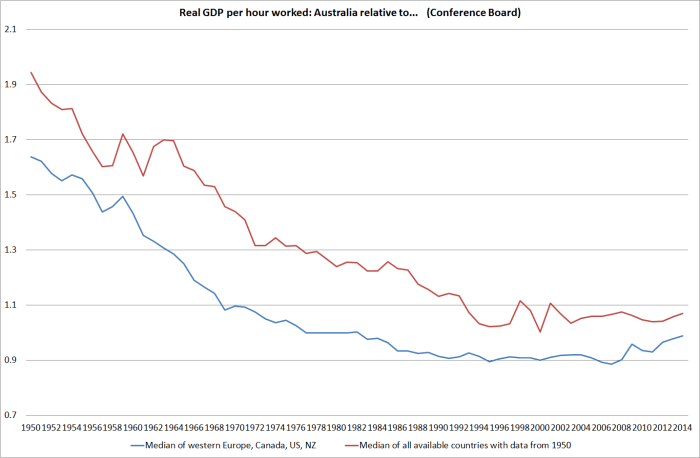
I described Australian incomes as “fairly high”.   And yet for all its huge natural resources, Australia’s real GDP per hour worked –  while a lot better than New Zealand’s – is no higher than the median of advanced countries.  For decades it fell relative to other advanced countries, and even over the last 20 years has done little better than hold its own.

aus real gdp phw relative

As a topic for another day,  might its people also have been better off without such rapid immigration-fuelled population growth?


Natural resources and economic performance: Anthony Trollope’s observation

The great Victorian novelist Anthony Trollope (and senior public servant in the British Post Office) visited Australia and New Zealand in 1871 and 1872.  His son had become a New South Wales sheep farmer, so the trip was partly about family, and partly an income-earning opportunity to write a book about the Antipodean colonies.

Much of the material from the New Zealand leg of the trip –  two months travelling from Bluff to Auckland –  was reproduced in With Anthony Trollope in New Zealand 1872, edited by A H Reed, and published in 1969.  I read the book over the weekend (having dipped into it, and found some quotes on railways and the incentives facing officials and politicians, here).

In 1872, it was only 32 years on from the Treaty of Waitangi  –  as close as 1984 is today to 2016.  All the New Zealand and Australian colonies were young –  it was only 84 years since the Sydney penal colony –  and whenever I read about the period I’m struck by how rapidly development occurred in many of these places.

By 1872 New Zealand had already been through some turbulent times.  The 1860s had brought the South Island gold rushes, and the huge influx of miners, but they were also the time of the worst of the land wars in the North Island –  where the burden on manpower and government finances was so severe that one sometimes wonders why the British government persevered. Trollope records contemporary British estimates that the New Zealand “wars with the Maoris…have been declared by competent authorities at home to have cost England twelve millions [and] have cost that colony nearly four millions and a half”.   Nominal GDP for New Zealand is estimated to have been only £4.4m in 1859 and £16 million by 1870.    Fortunately for the New Zealand taxpayer, Britain bore most of the fiscal cost.

One of the issues often debated is the role of natural resources in explaining the wealth of nations.  Natural resources alone don’t make a country prosperous –  think Bolivia, Angola or Iran –  but it can help a lot, especially in a country with a fairly small population –  think Equatorial Guinea, Kuwait or Brunei.  The natural resources have always been there, but it takes technology, management. and capital to utilize them, and really bad governance can impede all of that, and see any gains rapidly dissipated.  Among advanced countries, I think there is little doubt that Norway (in particular) and Australia would not have reached their current living standards without the natural resource endowments their people and institutions have enabled those countries to tap.  I’m going to come back to the case of Australia in the next few days.

Trollope was writing about the situation in 1872, and he included an interesting couple of paragraphs (pp38-39) about what we might term a “natural experiment” –  contrasting the performance of the province of Otago (which at the time had its own provincial government, with quite extensive powers) with that of the colony of Western Australia.

I will quote a few words from a printed dispatch respecting Otago, sent home by Sir George Bowen, the Governor of the colony, in 1871 – “after the lapse of only twenty-three years” –  from the first settlement of the province, – “I find from official statistics that the population of Otago approaches nearly to 70000, that the public revenue, ordinary and territorial, actually raised thereon exceeds  £520,000; that the number of acres farmed is above a million; that the number of horses exceeds 20000; of horned cattle 110.000; and of sheep 4,000,000.  The progress achieved in all the other elements of material prosperity is equally remarkable; while the Provincial Council has made noble provision for primary, secondary, and industrial schools; for hospitals and benevolent asylums; for athenaeums and schools of art; and for the new university which is to be opened in Dunedin in next year”.  I found this to be all true.  The schools, hospitals and reading-rooms, and university, were all there, and in useful operation; – so that life in the province may be said to be a happy life, and one in which men and women may and do have food to eat, and clothes to wear, books to read, and education to enable them to read the books.

The province is now twenty four years old…. Poor Western Australia is forty-five years old, and, with a territory so large, that an Otago could be take from one of its corners without being missed, it has only 25,000 inhabitants, and less than one million sheep, –  sheep being  more decidedly the staple of Western Australia than of Otago. I do not know that British colonists have ever succeeded more quickly or more thoroughly than they have in Otago.  They have had a good climate, good soil, and mineral wealth; and they have not had convicts, nor has the land been wasted by great grants…  And in Western Australia gold has not been found.  I know no two offshoots from Great Britain which show a greater contrast”

Western Australia was settled a little before Otago, and was materially closer to Britain (making it cheaper to immigrate to).  The cultural backgrounds of the settlers were very similar, and both operated under British law and institutions.  And yet Otago had prospered and Western Australia had underperformed.  There seems little real doubt that natural resource discoveries –  gold primarily – was the difference at the time.

Natural resources very rarely make a country or region rich forever –  usually only human skills and capability do that.  The South Island gold didn’t last long, on any scale, and in time Western Australia would become a major exporter of mineral products –  which couldn’t readily be exploited with 1860s technology.  Today, partly as a result, Western Australia has around 2.5 million people, and the Otago and Southland regional council areas (roughly the old Otago Province) have around 270000 people.

One last post for the year

I wasn’t planning to write anything of substance today, but after my post yesterday an Australian reader pointed me in the direction of the Australian volume data on exports of services.

So here are two charts: one showing per capita exports of goods for New Zealand and Australia since 1991 (when the New Zealand quarterly population series begins) and the other showing services exports.

services x

In both countries, services export volumes have been fairly moribund for at least the last decade.  Tourism and education exports are the largest components of services exports, and both appear to be quite sensitive to the exchange rate.  But it is interesting that over the full period, real per capita services exports have grown at about the same rate in the two countries (a slightly different picture than in the nominal chart I showed yesterday).

goods x

The goods export picture is very different.  As I pointed out yesterday, total exports per capita have grown materially faster in Australia than in New Zealand. The difference is concentrated in goods exports.  Since 1991, real goods exports per capita from New Zealand have risen by 91 per cent, but those from Australia have risen by 144 per cent.

I’m not about to launch into a lengthy discussion of why, or what it means, but it is hard to get ahead –  or in New Zealand’s case to catch-up or even end the relative decline – when a country’s firms appear to have found it so difficult, and unremunerative, to increase their sales to the rest of the world.

This is my last post for the year.  Writing this blog has been a fascinating and rewarding experience, and I’m grateful to all those who have visited and read my stuff this year, and to those who have taken the time to comment.   Writing things down sharpens one’s own thinking, and I’ve enjoyed engaging with the ideas and people.   I’ll resume blogging at some stage in mid-January.

In the meantime, enjoy the summer break and Christmas celebrations.  For Christians, it is the festival celebration of a stunning truth: that God become man, in the form of a vulnerable child, to reconcile mankind to God.

In the beginning was the Word, and the Word was with God, and the Word was God.

And the Word was made flesh, and dwelt among us, (and we beheld his glory, the glory as of the only begotten of the Father,) full of grace and truth.


Exports: some trans-Tasman comparisons

One last post prompted  by the quarterly national accounts release last week.

I’ve shown charts highlighting how weak our per capita income growth has been, and how the volume of business investment per capita has only just got back to near pre-recessionary levels.

But what about exports?  In many respects they are the longer-term life blood of our economy –  the success New Zealand firms have in selling in the rest of the world shapes, over time, what we can afford to buy from the rest of the world.  And for a very small country, the rest of the world is most of the potential market.   I highlighted last week how little growth there has been in New Zealand’s export share of GDP over decades.

Real per capita exports in the September 2015 quarter were 8.5 per cent higher than they had been in December 2007, just prior to the recession.  In some ways, that doesn’t seem too bad –  plenty of components of GDP have been weaker.

But here are real per capita exports for both New Zealand and Australia since the start of 1991.  The starting point is determined simply by when the SNZ quarterly population series for New Zealand begins.

exports real pc

The trend line shows the trend in New Zealand per capita exports from the start of the series to the end of 2003.  There is a visible fall in the trend rate of growth of exports after that point, but it also coincides with the sharp rise in New Zealand’s real exchange rate which has not been sustainably reversed since then.

What about the comparison to Australia?  Australia achieved faster growth in real per capita exports in the first decade (around 1 per cent per annum faster).    Australia’s real exports per capita then went sideways for a number of years (and more or less moved parallel to ours over perhaps 2002 to 2012) before once again growing materially faster than New Zealand’s exports over the last few years.  Over the whole period since 1991, Australia’s exports per capita have risen 21.8 per cent faster than New Zealand’s.

One story sometimes told is that if the terms of trade rises then a country doesn’t need to export as much (by volume) –  if prices do the work, real resources can be used for other purposes (economic life is about consumption, not exports –  which are just a means to an end).  A higher exchange rate, on the back of the stronger terms of trade, redistributes resources away from the export sector.

Even if there is something to this point in principle, in practice it doesn’t look as though it explains much of the difference between the New Zealand and Australian performance.    After all, Australia had a much bigger terms of trade surge than New Zealand did.  Even now,  whether we count from 1991 or from when the terms of trade started moving up strongly (around 2003/04) Australia has had a stronger terms of trade than we have.

tot nz and aus

Of course, Australia is still in the midst of an adjustment:  exports are growing quite strongly on the back of the huge investment boom in the resources sector.   But, on the other hand, the global prices of the commodities Australia exports are still falling, taking the terms of trade with it.  If the terms of trade continue to fall much further, and stay low, some (much?) of that Australian investment might yet be regretted by the firms that undertook it –  and might not, with hindsight, have helped Australia much.   Only time will tell.

But lest anyone think Australia’s strong export performance is just about the resources sector, I found the chart comparing services exports in the two countries sobering (this reverts to nominal ratios to GDP because I couldn’t quickly find volume data for Australian services exports).  New Zealand –  the smaller country –  still has a higher foreign trade share of GDP.  But despite the way the terms of trade boosted the exchange rates in both countries (making for tough conditions for exporters of non commodity goods and services), services exports in Australia are now around the historic peak.  But in New Zealand –  despite the impressive surge in the last few quarters – services exports as a share of GDP are now barely 80 per cent of the previous peak.

services exports nz and aus

Not a particularly cheery note for the approaching Christmas season, but then in the church’s year it is still Advent, a solemn season of reflection, preparation, and self-examination.  So perhaps not so inappropriate after all.