Affordability is in the eye of the beholder

Silly and meaningless as the category “affordable housing” is, perhaps this  –  which my wife spotted last night – must be what Nick Smith had in mind when he claimed that affordability was in the eye of the beholder?

$990,000, and supposedly aiming at first home buyers……

What have our governments brought us to?

http://www.trademe.co.nz/property/residential-property-for-sale/auction-1338386026.htm

Attention First Home Buyers

  • Asking price: $990,000
  • Listed: Thu 1 Jun, 10:20 am
  • Watchlist

Listing #: 1338386026

Location: 12 Quadrant Road
Onehunga
Auckland City
Auckland
Rooms: 3 bedrooms, 1 bathroom
Property type: House
Land area: 663m2
Price: Asking price $990,000
Parking: 2 offstreet carparks
Open home times:
Sat 8 Jul, 1pm – 1:30pm
Sun 9 Jul, 1pm – 1:30pm

Switzerland as our example – again

A month or two back, the New Zealand Initiative arranged a study tour (Go Swiss) for members (and a friendly journalist), “to learn more about their success story”.

I’ve written about this a few times, mostly because I’m genuinely perplexed that the smart people who run the Initiative really seem to think that Switzerland is much of an example for us, or even these days that much of a “success story”.

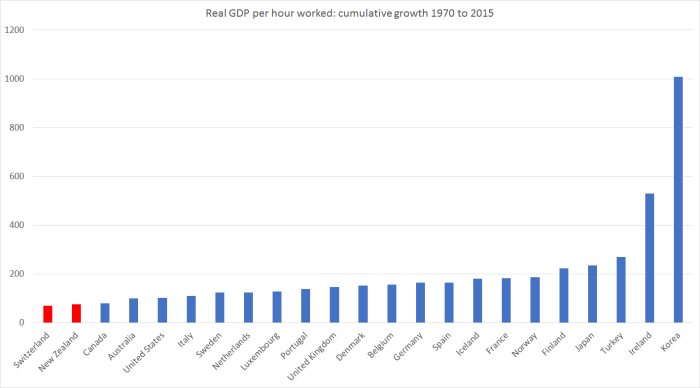
Sure, Switzerland is richer and more productive than we are.  Most advanced countries are.  But productivity levels in Switzerland now lag behind those of the leading OECD countries.  And over the last 45 years or so, Switzerland has had the lowest rate of productivity growth of any of the OECD countries for which there is a full run of data.  Just a little worse even than New Zealand.

switz 70 to 15

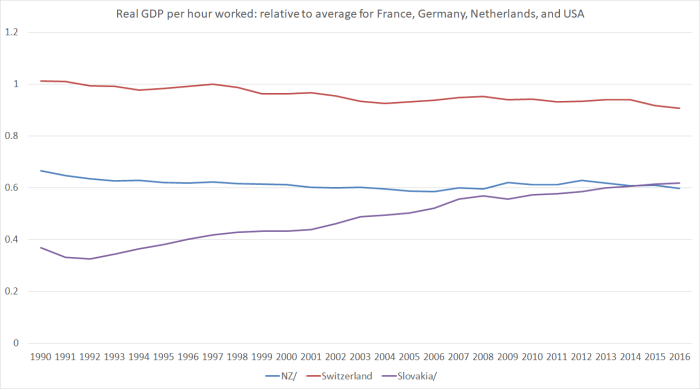
If I were sponsoring a study tour to places that had put in really strong performances in recent times, the Czech Republic, Slovenia or Slovakia look like they might be rather stronger contenders.     They’ve been catching up quite rapidly, not drifting back in the pack.       The Slovakia picture looks particularly impressive.  Here is the Conference Board data on real GDP per hour worked for each of New Zealand, Switzerland and Slovakia, relative to the average for France, Germany, Netherlands, and the United States (four of the higher productivity large OECD countries).

slovakia

Of course, New Zealand Initiative members are free to take their holidays wherever they like.   But it becomes of somewhat wider interest when they return trying to proselytise.

A few weeks ago the Herald’s Fran O’Sullivan provided a vehicle for some of that, relaying some rather questionable stories about the Swiss labour market (which does, among other things, feature a low youth unemployment rate), while ignoring such potentially relevant features as the absence of a generalised minimum wage in Switzerland.   Somewhat surprisingly, from a bunch of leading business people, Switzerland’s much lower company tax rate also wasn’t mentioned.  Then again, neither was its poor long-term productivity growth performance.

Sometimes the Initiative has been directly purveying the material.  Their chairman, Roger Partridge, had a piece in the Initiative’s newsletter recently extolling the contrasts between Italy and the Ticino, the Italian region of Switzerland.  “The secret to Swiss success”, so we are told, is down to “can solve”, reputedly the approach adopted by Swiss officials and politicians.    Now doing better than Italy isn’t such a great boast these days, but actually as the chart above shows, over the last 45 years Switzerland has done worse than Italy –  at least on productivity.  And then there are some of the summary indicators: on the World Bank’s ease of doing business index (not, of course, a perfect indicator of the state of regulation), Switzerland beats Italy by a substantial margin.  But Switzerland comes in at number 31.  New Zealand is number 1.

But what prompted this post was the editorial in the business section of this week’s Sunday Star-Times.   It doesn’t appear to be on the Stuff website, but if you go to this link to one of Initiative director Oliver Hartwich’s tweets, you can read an image of the whole piece.

Do you fancy living your lives more like the Swiss?…..It means entering into a radical experiment which could turn this country into another Switzerland.  A country with a high wage economy that manufactures and exports quality products, welcomes thousands of immigrants without any problems and has a fast and efficient public transport system

And, once again, we are told that

the ‘big picture” answer, according to the NZI, is in Switzerland’s decentralisation, where more than 2000 local councils have their own tax-raising powers.  Their argument is that it leads to greater pro-activity in devising strategies to attract business investment and power growth.

So, again, that would be the OECD country with the worst long-term productivity growth record?

And the other strand of the answer is, it is claimed, the education system.

Education is a dual system, which sees 80 per cent of young people enter vocational training, with only the remainder going to university.  But there is no stigma in that,

Then again, this is the OECD country with the worst productivity growth record over the last 45 years.  And, as OECD data I highlighted in the earlier post showed, actually a larger proportion of Swss 25-34 year olds have completed tertiary qualifications than in (a) most OECD countries, and (b) New Zealand.

One business leader is quoting waxing lyrical

As Fraser Whineray, boss of Mercury, said:  “an aluminium welder can be earning $150000 a year and living in a village like Queenstown”

I had no idea how much aluminium welders earn here, but this website suggests about $22.75 an hour.  That’s a bit under $50000 a year and given that Swiss GDP per capita is not even double New Zealand’s you’d have to be a little sceptical about that $150000 number (and this site offers some Swiss numbers).

But, picturesque as Switzerland is, what about the housing situation?

According to the New Zealand Initiative, as channelled by the Sunday Star-Times

Swiss house prices haven’t changed for three decades (inflation included) –  houses are still affordable compared to salaries.

The first part of that sentence is quite correct.    Real house prices (having had various ups and downs) haven’t changed much in 30 years.    But they were eye-wateringly expensive 30 years ago, and they still are today.   At the level of anecdote, I recall doing a course at the Swiss National Bank in 1990 and being told by our guides that prices in the capital Berne were so high that only senior managers at the central bank owned their own houses.

Good statistical data appears to be harder to come by: Switzerland is not, for example, in Demographia’s annual collection of house prices to median income data.   I stumbled across one website that offers data (of what quality I”m not sure) on rents and house prices in all sorts of cities.   Here is what they suggested for price to income ratios in various Swiss cities.

Zurich                                         9.5

Basle                                            9.2

Geneva                                       10.5

Lucerne                                      9.0

Berne                                        12.3

Whole country                       10.4

From what I could see, actual house prices don’t look any more “affordable” than those here (although, of course, interest rates are lower).  And, consistent with that, residential mortgage debt as a share of GDP is materially higher than that in New Zealand, in fact one of the highest ratios anywhere.

Oh, and how about home ownership rates?  Ours have been slipping, something that makes a lot of people uncomfortable (except a few –  economists mostly? –  who seem to have a vision that we’d be somehow better off if even more of us rented).  This chart is a subset of a table I found.  I’m sure not all the numbers are strictly comparable, and they are all for slightly different years, but I think most people will take New Zealand’s poor outcome over Switzerland’s any day.

home ownership

And, of course, none of this New Zealand Initiative material ever mentions the rather considerable advantages of location Switzerland enjoys –  at the heart of one of the wealthiest and most productive regions on earth, in an age when proximity and location seem to matter more than ever.    Or that, when international agencies look at Switzerland, one of the things they highlight most is the need for reforms to lift productivity growth.  The latest OECD report on Switzerland highlighted how relatively poor Switzerland’s productivity growth had been.  The press release for that report was headed “Focus on lifting productivity to guarantee future prosperity”, and part of the text read

The main objective has to be raising productivity, which will remain the key to boosting growth and maintaining a high quality of life and well-being.  The Survey suggests that Switzerland launch a new reform agenda to boost productivity, including renewed efforts to add flexibility to labour and product markets, improve public-sector efficiency, education and the business environment, and boost competition.  Increasing competition in the telecoms and energy sectors, including the privatisation of Swisscom, will be critical.

As I’ve said repeatedly, in many respects it would be nice to enjoy the material living standards the Swiss do, but……they are slipping backwards, and there is little sign that there is anything very systematic about how Switzerland does things that offers positive lessons for us, whether in beginning to reverse our dreadful productivity performance, or reverse our housing market disaster.

The mystery is why the New Zealand Initiative thinks otherwise.

But on a lighter note, I did find something from Switzerland that New Zealand could emulate.    I know Eric Crampton was one of those a bit upset about the loss of the rugby sevens tournament from Wellington.  Well, how about replacing it with office chair racing?  We spotted this on the BBC news the other night, and there is video footage here.  As the New Zealand capital of office workers, what better place than Wellington for a New Zealand leg of this sport.   Bowen Street looks as though it would offer a nice gradient, ending right in front of Parliament perhaps.  Think of the promotional opportunities.   It probably wouldn’t even take $5m of public money to get it going.


Donald Trump & lessons from NZ’s economic boom of 1996-2001

Late last week I was scrolling through a story about the IMF’s latest comments on the US economic outlook, short-term and more medium-term.   As the story reminded readers

The Trump administration says its economic platform — including cutting corporate and ­income taxes, boosting infrastructure spending and reducing regulations — will push growth up to a sustained rate of 3-4 per cent a year and cut unhealthy government debt levels.

At present, the Federal Reserve’s FOMC members collectively think potential GDP growth rates in the US are a touch under 2 per cent per annum.

The IMF has just finished its Article IV “mission” to the US (the US Treasury and the Fed being each a few blocks’ walk from the IMF), and released the team’s Concluding Remarks.   The Fund is, understandably, (more than) a bit sceptical about prospects for such an acceleration in the rate of growth of potential output.  But they are international public servants, and the US has a lot of clout on the Fund’s Board –  and, what is more, the Administration is currently looking to cut back US funding of various international organisations.

So the IMF can’t just come out and talk about the unlikelihood of any sort of large-scale acceleration of potential economic growth because of (a) a fundamentally unserious President, with little interest in policy and no apparent ability to deliver on an agenda anyway, or (b) a US Congress which has, if anything, (and on a bipartisan basis) lower approval ratings than the President, or (c) the corrupting influence of vested interests.  Instead, the Fund has to fall back on fairly bloodless technocratic arguments and illustrations.   But one thing they should be able to bring to the table is authoritative use of perspectives from other countries –  the Fund, after all, undertakes monitoring and surveillance of virtually every country’s economy, other than North Korea.

And whereas I’ve never seen a chart in the IMF’s Concluding Remarks for New Zealand, there were five in last week’s US document, four of which looked quite useful.  A couple even found their way into the Wall St Journal, and given how little attention the IMF’s view on the US usually get in the US, that probably counts as success.

Little old New Zealand was even singled out in one of the charts.

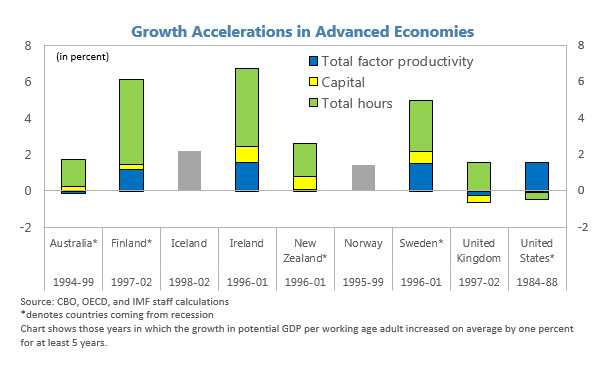
IMF growth accelerations

Looking at advanced countries since 1980, the IMF found this smallish sample of cases where countries had achieved at least a one percentage point lift in potential output growth (per working age adult) that lasted at least five years.    On this chart, New Zealand’s experience over 1996 to 2001 looked pretty impressive –  fourth best seen among IMF advanced countries in the last 35 years.

But it was a bit puzzling.   I sat around the Reserve Bank’s Monetary Policy Committee table right through that period, and “startingly impressive economic performance” wasn’t one of the descriptions that came easily to mind.     Even though the Fund’s asterisk describes us as “coming from recession” during that period, it was actually one that began at the end of a (pretty strong) four or five year recovery, encompassed another mild recession, as well as some chaotic monetary policy, an odd mix of fiscal policy, and towards the end of the period, increased marginal tax rates and a considerable slump in business confidence.    Through quite a bit of volatility, interest rates and the exchange rate fell a long way.

But perhaps I’d missed something, through getting too close to the short-term ups and downs.  So I dug out the data and had a look.

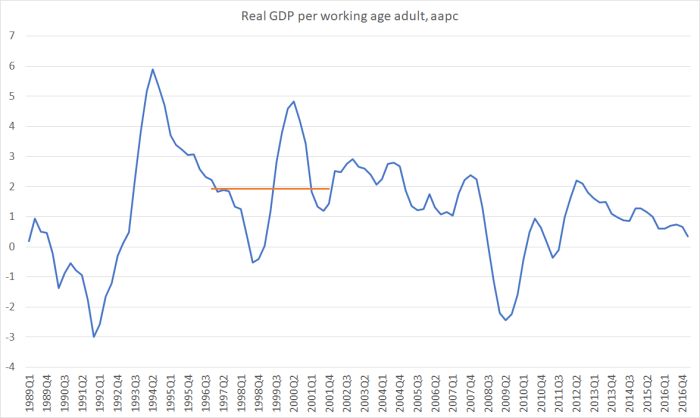
Perhaps if the IMF had had a quick look at this chart first, they’d just have left New Zealand off the chart (I’ve used the average of our two GDP measures, and the official HLFS working age population data).

Real GDP per WAP

Nothing stands out about that 1996-2001 period (average growth for which is highlighted in orange).  By our standards. it wasn’t a bad period, but it wasn’t obviously one I’d be wanting to send other countries’ officials and ministers to learn from.  There was no acceleration in real growth, let alone a sustained one.

But I had read carefully the labels on the IMF chart, and they were using “potential output growth” (per working age adult).  The problem with “potential output” growth is that it isn’t directly observable, and even years later it often hard to get a reliable handle on.

The OECD publishes estimates of potential output growth for its member countries including New Zealand.  And one can back out IMF estimates of potential output growth because they publish output gap estimates (actual growth adjusted for the change in the output gap is potential output growth).   Adjusting both for growth in the working age population produced this chart.

potential growthThere isn’t anything startling about 1996 itself, but at least on these measures potential output growth in the late 1990s was estimated to have been stronger than before or since.

So over the period the IMF highlights, actual real GDP growth (per working age person)wasn’t anything out of the ordinary, but the international agencies think that potential growth (per working age adult)  was pretty impressive  –  more of an acceleration than seen almost anywhere in the advanced world in modern times.

One possible reconciliation could be that New Zealand went into a severe recession during this period, leaving lots of excess capacity (but lots of underlying potential growth, as trend productivity grows rapidly).  It does happen –  it was part of the story of the US in the 1930s for example.

But that certainly doesn’t look to have been the story here.

Labour util

The unemployment rate was a bit lower in 2001 than it had been in 2006, and the labour force participation rate was a bit higher.

Another way to try to make sense of what was going on is to look at:

  • growth in the capital stock (per working age person)
  • growth in multi-factor productivity,
  • growth in hours worked per working age person, and
  • growth in labour productivity (real GDP per hour worked).

Here is the growth of the real capital stock per working age person, shown in two different ways –  the total capital stock, and the capital stock excluding residential dwellings.

cap stock

The period from 1996 to 2001 certainly saw stronger growth in the capital stock (per person) than in the previous period, and thus there is something to the IMF point about growth in potential during this period being somewhat influenced by the previous recession.    But even on this measure, nothing really stood out about the period.  Growth in the capital stock was no faster than it had been at the end of the previous boom, and was lower than we experienced in the last few years prior to the 2008/09 recession.

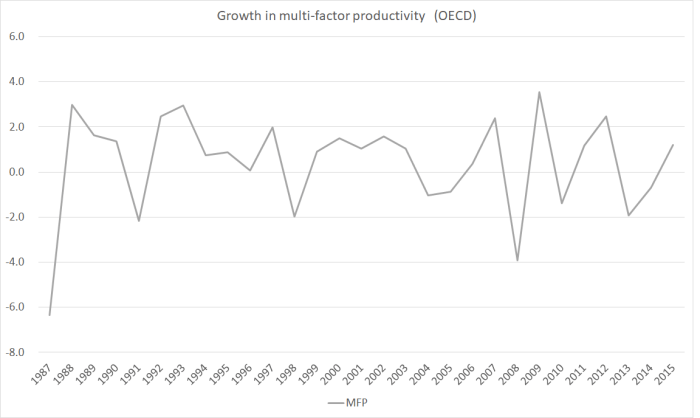
What about multi-factor productivity growth?   Measured properly, this is stuff everyone is after –  more outputs for the same inputs.    This is annual growth in the OECD’s measure of MFP.

MFP growth

Nothing stands out about the 1996 to 2001 period (consistent with the IMF chart itself, in which the contribution of MFP growth is all but invisible).

Here is (HLFS) hours worked per working age person.

hours worked

Again, nothing stands out about the 1996 to 2001 period.  There had been a big contribution in the previous few years, as demand recovered, drawing more labour back into employment, but by the period the IMF is focusing on there is nothing notable.

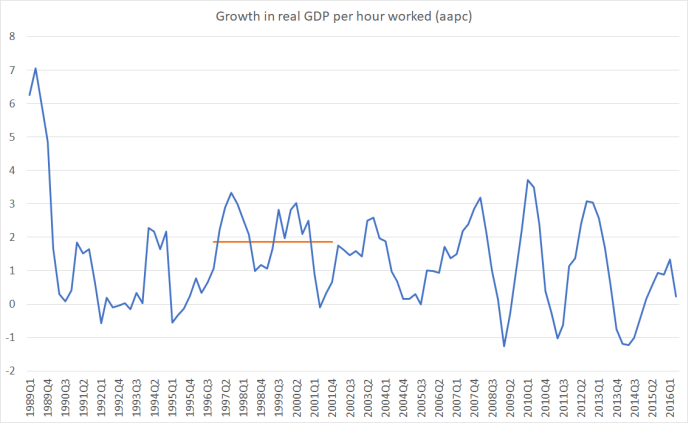
And, finally, what about labour productivity (growth in real GDP per hour worked)?    Here, at last, perhaps there is something to the IMF story.

IMF GDP phw

Using the average of the two real GDP measures, labour productivity growth actually was a bit faster in this period than in, say, the five year windows either side.     Even by New Zealand standards (among the weakest productivity growth in the OECD over 45 years) it is not that strong a performance, but the recovery in investment growth (see capital stock chart above) must have made a helpful difference for a time.

I got to the end of all this reassured that I hadn’t in fact missed any great lift in New Zealand’s economic performance over 1996 to 2001.  People are simply better to look at our actual experience, rather than the IMF or OECD estimates of unobserved “potential”.  Perhaps the other country examples the IMF cited work better?

I don’t suppose Donald Trump will be taking any notice of the IMF’s analysis or advice,  but if any minions do pay some attention to the IMF piece, the Fund’s use of the New Zealand case won’t do anything to lift anyone’s confidence that the IMF really has anything very compelling to offer.   Sadly, they didn’t have much useful to offer us either (here and here).


Who did Iain Rennie consult?

I’ve written a couple of times about the review former State Services Commissioner Iain Rennie has been conducting, at the request of the Minister of Finance, into two aspects of the governance of the Reserve Bank:

  • whether something like the existing internal committee in which the Governor makes his OCR decisions should be formalised in legislation, and
  • whether the Reserve Bank should remain the “owner” of the various pieces of legislation (RB Act, as well as the insurance and non-bank legislation) it operates under.

An earlier OIA request from a journalist saw The Treasury refuse to release the terms of reference for the report, but they did release the terms of engagement.  I wrote about that here.    We learned from that release that the report had been delivered to Treasury in mid-April.    We also learned that

In completing the work, the author will engage with an agreed set of domestic and international experts.

and

The key deliverable is a report, which will be peer reviewed by a panel of international experts.

I was interested to know who these experts were, and lodged an OIA request with Treasury.  No doubt, they could readily have responded in a day or so, but after four weeks they did finally respond yesterday.

Anyway, this was the list of “agreed domestic and international experts”.

experts

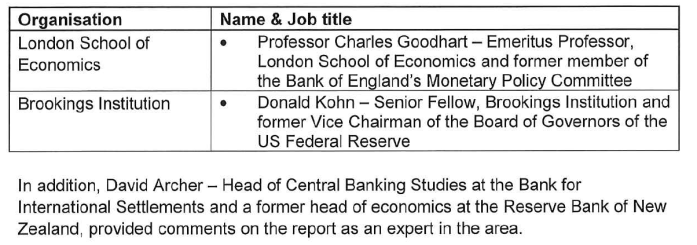
and this was the list of reviewers

reviewers

It is a curious list in many ways.    Setting aside the SSC people, of whom I know nothing but who are presumably knowledgeable on issues of governance of New Zealand public sector institutions, not a single one of the central bank experts (first list) has any experience of, or exposure to New Zealand (let alone actually being a New Zealander).

And Rennie, with Treasury’s agreement, appears to have consulted only current serving central bankers.   No doubt several will have had useful perspectives to offer on their own central banks’ experiences.  But the world of central bankers is a fairly clubby (or collegial) one, and you would have to think it unlikely that Rennie would have heard anything from these people that would cast doubt on how the arrangements their New Zealand peers operated under were working.   And among those current central bankers only one (Poloz, the Canadian Governor) has any stature in his own right; the others appear to be “corporate bureaucrats”, able no doubt to pass on information about how things work in their own central banks, but not self-evidently qualifying as “international experts” on central bank governance etc.

One might have supposed that any number of other people (even from abroad) could have provided valuable perspectives and insights.  For example, retired Governors and former members of decisionmaking committees, who are freer to speak their mind.   Lars Svensson, the leading academic and former monetary policy board member, wrote a review of our Reserve Bank in 2001 for our then-government.   Having had extensive experience as an insider since then, and retaining an interest in New Zealand, he would have seemed like a natural person for Rennie to have consulted.    In fact, there is not one academic on the list.   Not, for example, Alan Blinder, former vice-chair of the Fed and author of academic work on decisionmaking by committee.   There are no private economists on the list.  Not, for example, Willem Buiter now chief economist of Citibank and a former academic and member of the Bank of England’s Monetary Policy Committee.  And no one from abroad with, say, a Treasury perspective, or the perspective of a Minister.  Bernie Fraser, for example, had been both Governor of the Reserve Bank of Australia, and Secretary to the (Australian) Treasury.

And not a single person from New Zealand made the expert list?  Not Arthur Grimes, who was heavily involved in the design of the current system and later chair of the Reserve Bank Board.  Not Don Brash, who was Governor under the current system for 12 years.  Not thoughtful former Board members such as (for example) Hugh Fletcher.  Not people who had been involved from a Treasury perspective (especially in the years since Rennie himself left Treasury).  And, of course, no one who has written on the issues domestically.

You might, incidentally, be wondering why people from the Bank of Canada and the Bank of Israel top the list of experts.  That is likely to be because Canada is the only other advanced country central bank with the Governor as (formally) single decisionmaker (Canada has quite old central banking legislation, and the Bank of Canada has much narrower responsibilities than our Reserve Bank).  And until relatively recently, Israel also had the Governor as a single decisionmaker, before the legislation was overhauled and a mixed committee (internals and externals) took over the monetary policy decisionmaking role.  The Israeli experience should be interesting, but again you have to wonder why Rennie didn’t consult Stan Fischer, former Governor of the Bank of Israel, and now vice-chair of the Federal Reserve.

What of the international peer reviewers?  There were three, and each will have been likely to have added something in commenting on Rennie’s draft.    But, again, there is a distinctly “let’s keep this inside the club” feel to it all.   Goodhart, for example, is a respected academic economist, and former staff member and Monetary Policy Committee member at the Bank of England.    But he is now rather elderly, and has had a very strong relationship with the Reserve Bank of New Zealand over the years –   including as guest speaker at the (rather extravagant) 50th anniversary celebrations of the Bank, and then someone used as an expert witness  by the Bank at the parliamentary select committee when the current Reserve Bank Act –  governance and all – was being legislated (rather controversially) in 1989.

Donald Kohn is pretty highly-respected in international central banking circles.  So much so that Treasury omit to note in their description that, having retired from a career at the Federal Reserve, he is now a member of the Bank of England Financial Policy Committee, so still entirely within the central banking club.  He has visited the Reserve Bank and, from memory, wrote up his experiences pretty positively.

The final reviewer is David Archer, former Assistant Governor and Head of Economics at the Reserve Bank (and sometimes mentioned on lists of potential future Governors). He now holds a senior position at the Bank for International Settlements, a body owned by central banks (including ours) which describes itself thus

The mission of the BIS is to serve central banks in their pursuit of monetary and financial stability, to foster international cooperation in those areas and to act as a bank for central banks.

I worked with David closely over a long period, and he was usually pretty willing to speak his mind.  He certainly knew the Reserve Bank well –  at least in the days before financial regulation became so important, and before the Reserve Bank moved more back into the mainstream of central government as a major regulatory institution –  but you have to wonder quite how free he will have felt to offer views the Reserve Bank might be uncomfortable with – the Governor visits the BIS pretty frequently –  especially as those views will themselves presumably be discoverable in time.

So the offshore people consulted, or used as reviewers, seem as though they will have been a rather partial perspective on the issues at hand. No doubt, all provided some useful information and perspectives, but you can’t help thinking there could have been a lot more there if Rennie had sought it.  Then again, as State Services Commissioner his reputation was hardly that of someone keen on open government.  What is perhaps more troubling is that The Treasury was okay with all this.

Despite this published list, you have to wonder who else Rennie in fact consulted.  Why I do suppose there was anyone else?  Because, somewhat by chance, I also yesterday got a response from the Reserve Bank to an Official Information Act request for minutes of the Reserve Bank Board.

In the minutes of the Board meeting held on 30 March this appears

Rennie board

There follows almost three pages recording the details of the Board’s discussion with Rennie (and his supporting Treasury staff). every single word withheld (on somewhat questionable grounds).    Nothing else ever gets three pages of text in the Board minutes –  in fact, the process for appointing a new Governor is still not being minuted at all, even in this latest set of releases.

I don’t have any particular problem with Rennie consulting with the Bank’s Board.  They are likely to have some useful experiential perspectives to offer, but if the discussion covered almost three pages of minutes and –  according to Treasury –  no one else in New Zealand with any familiarity with central banking issues was consulted, it does all have the feel of an insiders’ job.  Perhaps that is what Steven Joyce wanted.  It isn’t what the situation requires.    Meanwhile, one can only hope that the report itself, along with the terms of reference, will be released before too long.

New Zealand isn’t the only country looking at these issues.  The Norwegian government just this week released an independent report they had commissioned looking at the future governance and mandate of their own central bank.  The summary report is very easy to read, and includes specific draft amendments to the law to give effect to the report’s recommendations.  Among those recommendations is a streamlined system of governance, with proposals for a monetary policy committee (40 per cent of whose members would be externals appointed by the government), and for a separate Board to which the Governor would be responsible in his role as chief executive of the Bank.    We can only hope that the completed Rennie report will be as clear and crisp.


Best small central bank?

Earlier this week the Reserve Bank published a Statement of Intent for the next three years (starting tomorrow).     The preparation and publication of these documents is now a statutory requirement.  All manner of government agencies have to produce them.  In principle, such statements are part of a democratic accountability process.  In practice, they are mostly bureaucratic hoop-juumping exercises, containing very little that is both new and valuable, and one has to wonder if anyone in, say, Treasury has ever done a proper cost-benefit analysis to assess whether citizens are really getting value for money.

I haven’t put myself through the pain of reading any other agency’s Statement of Intent, so I have no idea whether the Reserve Bank’s SoI is better or worse than the average.  But on this particular occasion, the Reserve Bank’s effort is almost certainly more pointless than average.   The new SoI covers the three years to June 2020, and yet the Governor –  chief executive and sole decisionmaker at the bank, by statute, will be gone in three months’ time, and his deputy will follow him out the door a few months later.    Whatever the merits of Graeme Wheeler’s views on the priorities for the Bank over the next few years, they are really no more than (a) descriptions of what the Bank is doing at present, and (b) advisory opinions which his successor can simply ignore if s/he chooses.   When Cabinet ministers talk about the government’s plans for next year, there is at least (say) a 50/50 chance their party will be in office to carry those things through.  Graeme Wheeler won’t be.    Governance models shouldn’t be devised to fit bureaucratic practice and preferences, but an SoI might make a little more sense if the Bank were governed by a Board, the members of which don’t all change at one time (as most crown entities and similar agencies are).

I’m not going to bore myself, or you, with a detailed commentary on the SoI, but a couple of things did catch my eye (as well as an error on p34).

The first, perhaps trivial, one was under “People and culture”.   There we read

Embed the Bank’s high-performance culture

The Bank has largely established its high-performance frameworks. The priority now is to deliver stronger management performance and greater staff engagement. This will be achieved through the greater empowerment and skill development of staff, and accountability for results by managers.

Whatever a “high-performance framework” is, it doesn’t yet seem to be delivering results.  After almost five years as Governor, the most that appears to be able to be said is that the “frameworks” are in place, but the outcomes –  “stronger management performance and greater staff engagement” –  apparently are not.    Perhaps the Board will feel prompted to comment on that in their Annual Report on the Governor’s performance?

The second point I noted was something missing.  Whether in the list of strategic priorities for the next few years, or the list of what the Economics Department is working on this year, there is nothing at all about preparing for the next recession.     That is so even though the OCR is now 1.75 per cent, years into this growth phase.     They simply don’t seem to be taking seriously the limitations of conventional monetary policy, even though our central bank (and Treasury) have been forewarned and have had much more time than most to prepare.       It is an abdication of responsibility, and citizens (not central bankers) are the ones who risk paying the price.    There is no hint of looking again at the inflation target, or looking at whether  levels-targets might provide greater resilience, and no hint of any work looking at easing or removing the technological constraints that cause the near-zero lower bound on nominal interest rates, and which arise from the Bank’s statutory monopoly on note issuance.

The third point I noted was this

Policy Target Agreement renewal and governance review: engage effectively with external agencies on the upcoming renewal of the agreement and the review of the Bank’s monetary policy governance framework.

Unfortunately, there is no suggestion of engaging with the public on issues around the next PTA (unlike, say, the appproach taken in Canada), and no suggestion of any serious research programme around the appropriate specification of the target(s).    I was modestly encouraged to see the reference to “the review” of the monetary policy framework.  It suggests that the Reserve Bank has some work actively underway in this area, perhaps to complement or react to the, as yet unpublished, Rennie review.  On the other hand, nowhere in the SoI is there any recognition that the decisionmaking issues are at least as important around financial regulation (because there is nothing like the PTA to constrain gubernatorial choices and whims), and no suggestion of any review of the question Rennie was also asked to look at, as to whether the Bank should retain primary responsibility for advice on its own legislation (an unusual arrangements for an entity that isn’t a core government department).

The fourth item I noticed was something mentioned in the Minister of Finance’s annual Letter of Expectation to the Governor, also published this week.    In that, mostly, rather pedestrian letter, in which the Minister seems unbothered about the Governor’s repeated failure to keep core inflation close to target, the Minister does make a request

I expect the Statement of Intent to refer to the Bank’s plans to take forward its regulatory stewardship responsibilities over the coming years.

Regulatory stewardship has specific bureaucratic meaning.  From Treasury’s website

Regulatory stewardship is a responsibility of government regulatory agencies.  It involves them adopting a whole-of-system, lifecycle view of regulation, and taking a proactive, collaborative approach, to the monitoring and care of the regulatory system(s) within which they have policy or operational responsibilities.

If that sounds wordy and bureaucratic to you (as it does to me), there is a separate document –  only seven pages long –  outlining government expectations of regulatory agencies.    I liked this bit.

The government expects any regulatory system to be an asset for New Zealanders, not a liability.

By that we mean a regulatory system should deliver, over time, a stream of benefits or positive outcomes in excess of its costs or negative outcomes. We should not introduce a new regulatory system or system component unless we are satisfied it will deliver net benefits for New Zealanders. Similarly, we should seek to remove or redesign an existing regulatory system or system component if it is no longer delivering obvious net benefits.

But despite the Minister of Finance’s explicit request, there appears to be almost nothing in the Reserve Bank SoI on the Bank’s regulatory stewardship responsibilities.   At the end of a list of 12 initiatives in the regulatory area, suggesting it was added late after the Minister’s request, there is this

develop plans to take forward the Bank’s regulatory stewardship
responsibilities over the coming years.

But they currently appear to have no developed sense of how the Bank, as a major regulator (operating to considerable extent on what is, in effect, the whim of an individual), should operate in a way consistent with regulatory stewardship guidelines first put in place some years ago.  Consistent with that, the “success measures” they list bear little relationship to anything in the statement of expectations of good regulatory practice.   And, as far I can I could see, there was no suggestion anywhere of looking to get rid of redundant, or excessively costly, regulation.  The mindset doesn’t seem to encompass that possibility,

But in many ways what most interested me, and surprised me a little, was the Governor’s statement that the Bank’s vision is “of being the best small central bank”.    It was a line one used to hear from the Governor from time to time when I worked at the Bank (somewhere I think I still have a copy of a paper that attempted to elaborate the vision), but it hasn’t been seen much outside the Bank, and if I’d given the matter any thought at all I guess I’d have assumed the goal had been quietly dropped.   Apparently not.

As an aspiration, it is one that has always puzzled me.

It is good to aim high I suppose, but isn’t it really for the owners to decide how high they want the Reserve Bank to aim? Then it is the manager’s responsibility to deliver.  I’ve not seen the Minister ask the Reserve Bank to be the “best small central bank”.    That isn’t just an idle point, because the ability to be the best will depend, at least in part, on the resources society chooses to make available to the Reserve Bank.  There are some gold-plated, extremely well-resourced, central banks around, particularly in countries that are richer than New Zealand.   I suspect New Zealand probably skimps a little on spending on quite a few core government functions including the Reserve Bank (but I’m probably somewhat biased, having spent my life as a bureaucrat), but that is a choice.    If we asked of the Reserve Bank what we ask of it now, but made available twice as many resources, we should expect better results.   As it is, there are limitations to what we should expect from 240 FTEs, covering a really wide range of responsibilities (the Swedish central bank, for example, appears to have about 40 per cent more staff, for a materially narrower range of responsibilities).

And then I’ve been a bit mystified as to who the Governor proposes to benchmark the Reserve Bank against.    I was pretty sure the Reserve Bank of New Zealand excelled relative to, say, the Bank of Papua New Guinea or the Reserve Bank of Fiji.  But they are much poorer countries.   And so I tried to make a list of advanced country small central banks.     There was Norway, Sweden, Israel and the Czech Republic and then the list started to thin out rather quickly.    There was Iceland of course, but the population of Iceland is about 330000; in relation to our 4.8 million that is about how we compared with the UK.  The Bank of England is demonstrably better than our Reserve Bank, and on many dimensions our central bank really should do better than Iceland’s.   Of course, there are lots of small countries in the euro, but individually they don’t have much clout, and can’t really be meaningfully compared against central banks of countries that make policy for themselves.      There was also Singapore and Hungary  –  not too different in population from New Zealand, but neither are from countries  that represent liberal democracy at its finest.

Unfortunately I couldn’t think of a single dimension on which I would regard the Reserve Bank of New Zealand as being better than the Norwegian or Swedish central banks.  (The Swedish central bank is so transparent they even published the details of their staff engagement survey, in English, so that we know that 73 per cent of staff consider the Riksbank “close to being a perfect employer”).  Perhaps we  shouldn’t be surprised.  Norway, in particular, is much richer than us.  What of the Israeli or Czech central banks?  They are countries more similar to us in GDP per capita.  It is hard for outsiders to evaluate, but from what I’ve read of those central banks, and what I could find on their websites –  whether around governance, transparency, policy, or the range and depth of research – it wasn’t obvious why one would think our Reserve Bank was doing better.

Given that the Governor has now restated the vision of having the Reserve Bank as the best small central bank, I assume he must have some benchmark comparators in mind, and assume they must have done some work to assess how they compare.  Since I assume any such documents would be readily to hand, I’ve lodged a request for them.

I’m not sure that “best small central bank” is the appropriate aim.   But we should want an excellent one.  At present, unfortunately, we are a long way from that (not in all cases for reasons under the control of the Governor).  One could think of:

  • a governance model that is out of step with both international practice, and with New Zealand practice for other governent agencies.  Far too much vests in one person, no matter how good that person may be,
  • a Board, which exists (at least on paper) to hold the Governor and Bank to account, and yet which is practice seems to see its role primarily as providing cover for the Governor,
  • serious monetary policy misjudgements (eg 2014) and while misjudgements are an inevitable part of the game, very little evidence of self-critical scrutiny and evaluation,
  • an approach to transparency which emphasises what the Bank wants us to know, not what citizens might reasonably need to hold a powerful agency to account,
  • relatedly, an obstructive approach to compliance with the Official Information Act,
  • little or no published research or analysis on major areas of the Bank’s discretionary policy activities (prudential regulation),
  • infrequent, and mostly unenlightening, speeches,
  • and an approach to criticism that appears to have been exemplified recently in the sustained (apparently somewhat successful) campaign by the Governor and his senior staff to “silence” (materially alter and content and tone) of commentary by a leading economist who happens to work for an institution the Reserve Bank regulates.   Was that the collective wisdom of the much-vaunted Governing Committee working well?

It is the sort of list that candidates applying to become the next Governor –  applications close a week from now –  should be reflecting on pretty carefully.   We deserve something considerably better than we are getting.

Of course, it isn’t that the Reserve Bank is necessarily much different than many of our other policy agencies and institutions.  A very senior figure observed to me recently that the climate for good policymaking was now worse in New Zealand than that person had ever known it.  There may be isolated exceptions, but around too much of official Wellington there seems to be an unwillingness to ask hard questions or do hard analysis, or put up difficult options,  Instead, the incentives seem to reward a desire to simply go along, and fit in, or devise schemes that look good for some quick publicity, however little merit they have longer term.  And all the while our economic performance continues to disappoint,  But no one seems to much care, so long as the minister of the day is happy.  And there is little sign that ministers –  or their opposition counterparts –  care, or want anything much different.

I was reading yesterday an article about the current global political malaise.   Near the end was a quote from Edmund Burke, writing about the government of George III.  He wrote

“it was soon discovered that the forms of free, and the ends of an arbitrary Government, were things not altogether incompatible”

In some ways, it isn’t so unlike modern New Zealand.  On paper, many of our institutional arrangements look strong  –  thus, for example, the Reserve Bank can repeatedly boast how transparent it is –  but in too many cases the substance has been emptied out, and just the forms are left behind.


A question for the Minister of Education

I usually don’t pay much attention to the output of the Ministry of Education or its ministers.  I often fear that if I did it would turn out to be about as disconcerting as MBIE’s output.   I focus on getting my own kids through the school system with as little enduring damage as possible  (one of the real joys of being a stay-at-home parent is the time to counter the “indoctrination” that comes from, say, fourth form social studies teachers).

Every time I walk past the Ministry of Education’s head office in Wellington, their slogan or motto emblazoned across the front of the building gets my goat.  It reads

“Lifting aspiration and raising educational achievement for every New Zealander”

It must have sounded good to the bureaucrats and their PR people, but frankly it is the sort of slogan that shouldn’t be seen outside an authoritarian state –  Singapore, Turkey or the like.   Ideally it wouldn’t be seen even there.

I don’t particularly want to have my “educational achievement” raised, and certainly not by the government and its ministry.  As it happens, I’m always keen to learn and am a voracious reader.  Many people aren’t.   But, either way, what business is that of the government?    My “aspirations”, such as they are, are my own, and also no business of the ministry or the government.   The Ministry would, only can only assume, have strongly disapproved of St Paul, who wrote that “for I have learned, in whatsoever state I am, therewith to be content”.

If one took it seriously, it is the stuff of a mindset that sees citizens as a resource of the state, owing it to the state to get with the programme (whatever it is).    Many ministers must be able to see the slogan from their Beehive office windows: does it never occur to them that they are from the National Party?  Among National’s values are, supposedly

  • Individual freedom and choice
  • Personal Responsibility
  • Competitive enterprise and reward for achievement
  • Limited government
  • Strong families and caring communities

I’m pretty sure that list doesn’t really fit that well with the Ministry of Education trying to lift your aspirations or achievements.  Come to think of it, the ACT leader is a Parliamentary Under-Secretary to the Minister of Education, and as a party they claim to be even more strongly in favour of limited government.

Do government departments need slogans at all?  Perhaps “administer our legislation and advise the Minister of Education” doesn’t have quite the same ring to it, but it is what officialdom is really supposed to be doing.

That quote has been annoying me for a while, but this post was prompted by news that the Minister of Education has announced that “computational thinking” and “designing and developing digital outcomes” will become compulsory parts of the national school curriculum from next year.     Perhaps there is a good case for adding those items to the curriculum (I’m frankly a bit sceptical –  apart from anything else, in ye olden days when I went through school we didn’t teach typing to everyone).  But I looked through the Minister’s speech announcing this change, and have read newspaper articles on it, and listened to other media stories.  And in all of that material, I’ve seen not a hint of what the Minister wants schools to stop teaching, or teach less of.

I’m sure there aren’t many economists in the Ministry of Education, but the idea of constrained optimisation shouldn’t be too difficult to grasp, even for Cabinet ministers.   It is easy to add new items that sound or feel good, but there are only so many hours in the day, so many weeks in the school year (and I’m not one of those who thinks that year should be lengthened).    Perhaps there is room for increased productivity in schools, but there isn’t any suggestion that that is the answer either.  It feels a lot like an initiative that will squeeze other stuff out, and we’ll never quite know what, but the Minister concerned and her officials will long since have moved on by then.  But surely the Minister should be able to tell us what she wants schools teaching less of?   Because it is a real choice, and something will be lost, either consciously and deliberately or by default.

I think I’ll always remember the evening, shortly after our oldest child started school, when the then Principal of the local school –  a vocal union advocate for teachers, staunch opponent of National Standards, and prone to somewhat convoluted prose (I often thought he must have been angling for a job at the Ministry) – declaimed that he had no interest in teaching specific knowledge because pretty much everything he had learnt at school had been superseded.   I’m a history buff, and I kept asking myself whether somehow Dick Seddon, Michael Joseph Savage, Sid Holland or Keith Holyoake were no longer significant figures in our history?  Or did World War Two, or the Russian Revolution no longer take place?  Is gravity no longer a force?  Does Shakespeare no longer influence our language and cultural reference points?

It is old ground, but worth repeating. It is all very well to teach general problem-solving and analysis skills, but without context, without specific structured knowledge, those skills aren’t really that much use at all.    And so when the Minister says that schools must teach “designing and developing digital outcomes”, which

“is about understanding that digital systems and applications are created for humans by humans, and developing knowledge and skills in using different digital technologies to create digital content across a range of digital media”

I can’t help thinking that rather better use might be made of the time the Minister wants to devote to matters digital. For example, in teaching New Zealand history, in the context of the history of western civilisation (or even global history), than preparing to use Facebook or whatever newly trendy medium is around a few years hence.    And if there are more resources to train teachers,  I’d suggest some be devoted to improving teachers’ own communications skills.  The local principal (a new one) recently began her newsletter this way

Last week I began a conversation about dispositional ways of being.

I still have no idea what it meant.

C S Lewis, professor of English at Cambridge, once wrote a letter, replying to a young American fan, offering five guidelines for good writing.    Thanks to the wonders of the internet, it is freely available to all our teachers, and to Ministry of Education bureaucrats as well.    George Orwell offered similarly sound advice.

UPDATE: I put the text of the Minister’s speech into Readable.io, which provides statistical measures of readability.  It came back with this summary

RATING: D

Your average sentence length is too high. Try to shorten or split up some of your long sentences.
You are using too many long words. Try replacing some of them with shorter alternatives.

On the Flesch-Kincaid grade, the speech came out with a score of 13.1, apparently as hard to read as a typical US law.    Ernest Hemingway, apparently, managed a score of 4, and the website observes that a document needs to have a score of 8 to be readable by most people.   It would seem a reasonable benchmark for a Minister of Education to aim for.


Who has been getting residence visas?

Someone called Keith Ng (who is apparently quite pro-immigration), has gone to the effort of downloading some of MBIE’s (not at all user-friendly) visa approvals data and formatting it in a reasonably readily usable way.  The resulting spreadsheet is here.   I was particularly interested in the analysis by occupation, and particularly that for those granted residence here.  (He has provided the data for work visas as well, but it conflates all sort of work visa types, short and long term, and isn’t that informative as it stands –  I suspect that 30000+ tour guide visas in the last seven years or so mostly captures a lot of people who are here for very short periods of time.)

In their annual Migration Trends and Outlook publication MBIE do provide a table of the occupations of the principal applicants for skilled migrant category residence visas.  But, unlike most of their tables, there is no time series provided.  In 2015/16 –  the latest publication –  these were the top 10 occupations.

Chef 860
Retail Manager (General) 675
Cafe or Restaurant Manager 598
Registered Nurse (Aged Care) 520
ICT Customer Support Officer 372
Software Engineer 323
Carpenter 281
Developer Programmer 267
Baker 213
ICT Support Technicians nec 206

I was a bit curious how many chefs there were in New Zealand in total.  At the last census, there were only 16218.

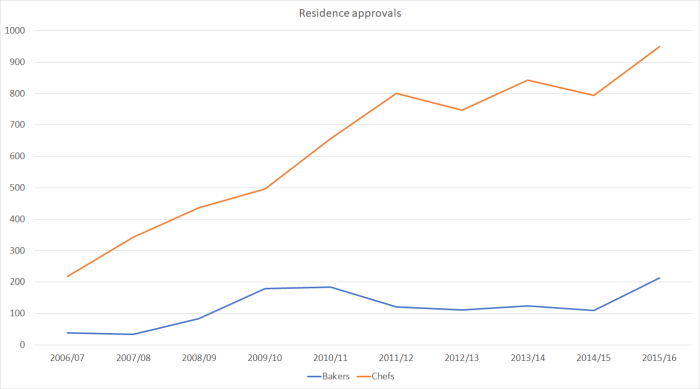
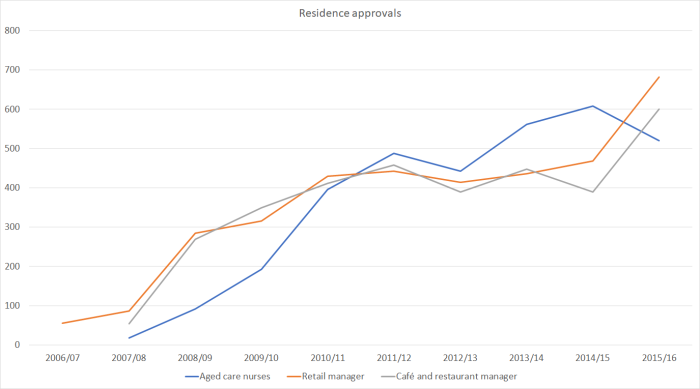
But Ng’s table enables one to easily look at the main occupations of people being granted residence over the last decade or so.  He presents the data for  each of the years 2006/7 to the present, with only partial data for the incomplete (June) year 2016/17.  Here are the occupations with more than 1000 approvals over the decade.

Occupations of approved residence visas applicants: 2006/07 to present
Chef 6729
Retail Manager (General) 3765
Registered Nurse (Aged Care) 3609
Cafe or Restaurant Manager 3585
ICT Customer Support Officer 1993
Software Engineer 1943
University Lecturer 1789
Secondary School Teacher 1656
ICT Support Technicians nec 1439
Registered Nurse (Medical) 1393
Developer Programmer 1338
Baker 1294
Carpenter 1214
Early Childhood (Pre-primary School) Teacher 1192
Accountant (General) 1191
Office Manager 1145
Motor Mechanic (General) 1080

And this is the most skilled half of the people who are granted residence (others get in on non-skilled bases –  family, refugees, Pacific Access etc).

The list is quite dominated by the first few entries, and those occupations don’t stand out as occupations of exceptional skill, even though MBIE used to like to tell us that our immigration policy was a “critical economic enabler”.    And remember that this is about people getting residence, not about work visas which, notionally at least, are supposed to partly reflect specific temporary areas of skills shortages (and, hence, where one might expect bunching in particular occupations, but where the particular occupation would change over time).

The large numbers of aged care nurses (and there are many more, and aged care workers, in the work visa numbers) stands in striking contrast to the recent pay equity settlement. In that settlement, the government concluded that employees in the sector were so badly paid that a direct government intervention was needed to drive up the wages.  I don’t usually focus much on the arguments about whether immigration lowers wages –  my focus is more on overall economic performance –  and I’m not (at all) a fan of “pay equity” interventions, but it is hard to look at these two things and not conclude that there is a certain incoherence about policy.   Had fewer aged care workers from abroad been granted visas, it seems likely that market wages in that sector would have been rather higher.

Of course, among the occupations on that list are some that seem genuinely quite highly-skilled.  My eye was caught by the number of university lecturers and “developer programmers”.

The number of developer programmers getting residence visas has increased from almost nothing, and at an even faster rate than the (presumably) rather less skilled ICT Customer Support Officers.

res approvals IT

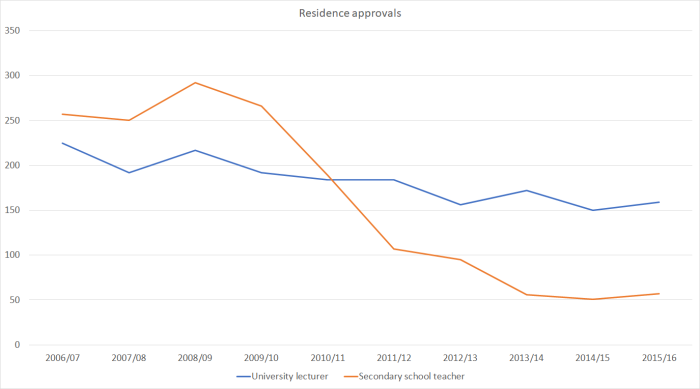
On the other hand, rather fewer university lecturers (and secondary school teachers) have been getting residence.

res approvals teachers

How early childhood teachers qualify at all is a bit beyond me.

And just in case you, charitably, supposed that some of the less skilled occupations were becoming less important over time, here are the food-preparation ones on my list.

res approvals food

And here are the trends in the remaining top five roles

res approvals other

If there is a serious economic strategy behind all this, it is pretty hard to spot.  No wonder the government was casting around for other ideas when they ran into the Monahan brothers and came up with the global impact visas.  But just because something different needed to be done, didn’t make  “just anything” –  especially something with a rather hip or with-it feel to it –  a sensible thing to do.

The only really compelling story that makes much sense of the residence approvals numbers is official (political and bureaucratic) determination to drive up the population.  If that is the goal, I guess one can’t be very picky and we get a bunch of modestly-skilled people coming.  But there isn’t much sign that driving up the population has been a successful economic strategy anywhere –  unless, of course, one counts survival as a precondition, which partly motivates the Israeli policy of open doors to any Jews –  particularly not in places that remain heavily dependent on what they can do with fixed natural resources.    Sometimes rapid population growth can be a complement to economic success –  people will be keen to come and there might be plenty of prosperity to go round.  But New Zealand’s policy –  and Australia’s actually –  continues to put the cart before the horse, as if drawing more people here will somehow conjure up great new higher-productivity opportunities for them and for us.     But there is simply no basis –  and certainly not in New Zealand’s experience –  for such a belief.


Global impact visas

Almost two years ago, in July 2015, the government announced that it was planning to introduce a new visa class.

Mr Woodhouse says the Government is also considering a new Global Impact Visa to attract high-impact entrepreneurs, investors and start-up teams to launch global ventures from New Zealand.

At the time, I noted

The Global Impact Visa idea sounds superficially promising. But my impression from the Pathways Conference last week was that existing entrepreneur visa schemes had not worked particularly well.  It will be interesting to see the analysis behind this proposal, including an assessment of how the risks around it will be managed and overcome.  I remain a little sceptical of the attraction of New Zealand to “younger, highly talented, successful and well-connected entrepreneurs from places like Silicon Valley”.  The flow of people in that sector would seem more naturally to be in other direction.  I hope it is not an example of the old derogatory adage used about Britons working in Hong Kong:  FILTH  (“failed in London, try Hong Kong”).

But since then I’d paid no more attention to the Global Impact Visa, until my son pointed out a large article in last Saturday’s Dominion-Post.   And it seems that I had missed the first part of what was actually a two-part series on the new visa, and the role two wealthy young Americans appear to be playing in determining who gets these visas.

The second article is really focused on the new visa scheme itself.  It begins this way

They’re young, rich, Silicon Valley idealists who want to change the world from New Zealand. How did the Monahan brothers come to influence our immigration policy – and what’s in it for us? In part two of our series, we look at how the Americans convinced Immigration NZ they should be the ones to pick the best entrepreneurial brains to come here.

In it there is lots of high-profile publicity for Nigel Bickle, the public servant who runs the Immigration New Zealand division of MBIE.  Bickle was last noted on this blog after he appeared on Nigel Latta’s advocacy TV programme championing large scale immigration thus

Bickle  –  that “front-line service delivery expert” –  argues that we need lots of immigration because a country “can’t get wealthy trading with ourselves”.  There seemed to be quite a bit of confusion there.  Of course, small countries (in particular) need to trade internationally, but that tells one simply nothing about the case for (or against) large scale immigration.  As it happens, and as I’ve pointed out before, most countries –  and especially most countries of our sort of size (population) –  export and import a much larger per cent of their GDP than New Zealand does.

Under the Global Impact Visa scheme (approved by Cabinet as a four year pilot), up to 400 visas (plus spouses/partners and families) will be granted.   As MBIE puts it

The policy is designed to attract those with the drive and capability to launch global ventures from New Zealand who may not be able to qualify for other visa categories. They will have the combination of drive, risk appetite and global connections which enables them to launch or significantly contribute to successful innovation-based ventures in New Zealand.

After three years, whether the ventures work out or not, recipients of global impact visas will be able to apply for residence visas.

Legally, of course, only government agencies can grant visas.  But MBIE will be granting these visas only to people who are recommended by their private sector partner, the Edmund Hillary Fellowship  (EHF).  EHF is itself a joint venture, again as MBIE puts it

between the Hillary Institute for International Leadership, a not-for-profit organisation that identifies and celebrates mid-career leaders from around the world; and Kiwi Connect, an organisation promoting and connecting high-impact entrepreneurship in New Zealand.

It isn’t quite clear what a non-profit that “identifies and celebrate mid-career leaders from around the world” has to bring to either (a) New Zealand immigration policy, or (b) New Zealand policies around innovation and technology, especially when this particular programme seems to be mostly fairly oriented towards young people (“early in their wealth cycle”).  It looks a lot like they just offer access to the Hillary name.

As for KiwiConnect, it doesn’t really seem to exist any more.  Their website says

Kiwi Connect originally set out to be a bridge between New Zealand and the world for impact-driven talent to be able to engage with the NZ startup and business ecosystem. We have succeeded in that mission with the creation of the Edmund Hillary Fellowship, and consequently have put Kiwi Connect into hibernation to focus our team’s efforts 100% on delivering a world-class Fellowship programme.

You can read their burble, on their transition, here.

We also identified that the ecosystem growth wasn’t matched with the necessary level of global connectivity for New Zealand to be internationally competitive. This connectivity is important in turning size and distance from what has been a disadvantage in more traditional industries, to a new advantage for innovation.

Since founding Kiwi Connect, we have focused on filling the gap to connect New Zealand with world-class talent, impact capital, and cutting edge innovation, so that NZ can create a critical mass of entrepreneurial activity within a thriving ecosystem. We started with more questions than answers, facilitating multi-disciplinary, global conversations on what it will take for New Zealand to lead in innovation.

It is a certainly a novel proposition that distance and remoteness will not just be overcome, but might apparently be “a new advantage for innovation”.    One would hope MBIE rigorously evaluated that propostion.

Anyway, the Edmund Hillary Fellowship it now is.

The Edmund Hillary Fellowship (EHF) is a global platform that brings together the best of humankind’s creative potential and entrepreneurial spirit in New Zealand, to create a lasting positive impact for the world.

They are being paid quite a lot of public money ($4m) to get the global impact visa programme going and, according to their website, the first visa approvals are expected to be granted next month.

The Fellowship has a very useful set of FAQs on their website, which I’m drawing from here.

What is it?

The Edmund Hillary Fellowship (EHF) is an end-to-end programme that gives impact-driven entrepreneurs, investors and startup teams a platform to incubate positive impact ventures from Aotearoa New Zealand, and contribute towards a thriving innovation ecosystem in the country. EHF offers exclusive access to Immigration New Zealand’s new Global Impact Visa.

Who is it for?

EHF is for entrepreneurs and investors who are innovating in the industry or sector they operate within, with the ambition to build or support globally scalable ventures to solve significant challenges and influence the course of humanity. This programme is for individuals who align with our values, and who have the skills, capabilities, relentless drive and desire to leverage the unique opportunities New Zealand offers, and make game-changing impact on the world.

Which is where things start getting a little troubling.  Little old New Zealand, keen to develop its “innovation eco-system”, actually puts official weight and money behind a focus on influencing the “course of humanity” and drawing people who will “make game-changing impact on the world”.    If the Monahan brothers, or any else, want to pursue such dreams, I wouldn’t want to stop them –  I’m sure we could all think of ways in which the world could be a better place.  But this is almost “on another planet” stuff, with no sign in any of the published material as to how they think this might actually come to something, let alone offer something worthwhile for the citizens of New Zealand.

They go on

What are the personal qualities you are looking for in candidates?

Model Fellows are highly capable and motivated individuals who view the problems in the world as opportunities to significantly improve it. They are big-picture thinkers at the top of their game, who are able to unpack complex problems to understand all the angles, and come up with holistic solutions that connect the dots. They have unwavering passion, relentless drive, and the ability to execute with excellence. Edmund Hillary Fellows also take advantage of the unique opportunities that New Zealand offers.

Walking on water looks as though it might almost qualify one.   But one has to wonder whether even Bill Gates would have qualified.

After all, when asked about proposed “impact” they write

What do you mean by impact?

We define “impact” as solving problems of significance to humanity in a way that creates positive lasting economic, social and environmental value.

All three at once.  It is a tall order.  Did Microsoft or Google, let alone Facebook, create “economic, social, and environmental value”?

And it doesn’t seem very likely that any card-carrying conservative would qualify for this programme.  Perhaps you noted earlier that the Fellowship is looking for people who “align with our values”.    Here are their values.

The first marker of the left-liberal orientation is the repeated use of “Aotearoa New Zealand”.  It might be old-fashioned and conservative to make the point, but the country is actually called New Zealand.

Much of the rest is the sort of babble that probably appears on any agency’s “values statement”.  But these ones caught my eye from the longer list.

Simplicity inspires us.

We value collaboration over competition to help raise the tide for all.

We strive to act with care for people and land, and to improve intergenerational wellbeing through creativity and entrepreneurship.

Our work is not about us but about those we serve. We actively strive to be better versions of ourselves

and while they talk about how “We love challenging assumptions”  a bit further down the page we read that their person described as “Candidate Attraction Lead”

believes that startups will solve the world’s problems only when they represent the diversity of the world’s people.

Perhaps she is right –  although actually for the last few hundred years most really useful innovations have come from a handful of cultures and countries –  I suspect she might not welcome a candidate challenging that proposition.

And this stuff matters because it isn’t just about getting accepted into the Edmund Hillary Fellowship in the first place.  To get a residence visa, you have to stay on good terms with the programme for three years.   I suspect there are many people who could genuinely make quite a difference, who would struggle to put up with the globalist waffle, and what social pressure goes with it, for three years.    Being able to put on a good front looks a highly valuable skill in this context.

And if you don’t already get the sense of what part of the political spectrum these people are coming from, I refer you back to the first of those Dominion-Post articles.   Take their annual innovation festival held near Wellington.

Every February since 2014, an eclectic bunch of people from around the world have descended on Whitemans Valley, an easy 30-minute drive from downtown Wellington, for a week-long “eco-innovation” festival called New Frontiers, a kind of techie’s version of Nevada’s Burning Man.

Think yoga, yurts, giant domes, composting toilets, campfires, more yoga, drum circles, dancing, vegan food and talking – lots of talking.

Guests have included film director James Cameron, Immigration NZ head Nigel Bickle, Conservation Department director-general Lou Sanson, regional mayors, US digital artist Android Jones and dating site guru Eben Pagan, poets, painters and inventors, as well as curious locals. It’s either a beautiful gathering of like minded thinkers or a weird cult, depending on your point of view. “There’s some freaky looking punters down there camping out in their domes, doing yoga and singing Kumbaya to the moon,” one local says.

Mike O’Donnell, a tech investor formerly of TradeMe who attended last year’s festival, was impressed by the diverse range of people and open exchange of ideas.
“They’re kind of 21st Century cyber hippies,” he says. “It’s a little bit overwhelming, but it’s quite cool. It’s a combination of 60s values, together with sustainable business models, truckloads of vegetarian food and exotic fruit juices.”

and then of the sorts of view championed

Matthew [Monahan] nominates Charles Eisenstein, who has spoken at New Frontiers, as his favourite author. That’s instructive of the brothers’ world outlook – Eisenstein is known as a proponent of “degrowth”, a movement based on “ecological economics” that rejects consumerism and capitalism.

Brian [Monahnan] raps about building a culture “not based on commerce, but on kindness”.

The brothers gave $4m to set up their non-profit Namaste Foundation, which has gifted money to everything from Black Lives Matter to climate change groups.

The Monahans’ philosophy is, of course, the polar opposite of Trumpism.
​”I’m definitely not a Trump supporter,” Matthew says. “I think the environmental challenges we have ahead of us are real. They are really giant problems that require all hands on deck.”

Doesn’t give a strong sense of a place with the Edmund Hillary Fellowship for, say, the large number of Americans with a different take on the world, politics and so on.

And all this is even aside from the bigger challenges a programme of this sort faces.    Adverse selection, notably.  Groucho Marx once famously remarked that he wouldn’t care to join a club that would have him as a member.  Realistically, why should we think that anyone who applies for this programme, to come and live in relatively poor remote (albeit non-Trumpian) New Zealand, is really likely to be the sort of person who can build a business that would “change the world”?        Take just the other OECD countries: every single one of them (even Chile) is closer to “the world” (markets, suppliers, knowledge clusters etc) than we are.   Most put on a pretty good show of democracy and the rule of law.   Quite a few have English as their first language –  and, of those, all look more attractive places in most respects than New Zealand does, for such transformative businesses (even Trump will be gone in, at most, seven years and seven months).   There  are isolated areas in which our regulatory provisions may be world-leading, but looking across the range of policy settings, we don’t really stand out.    And, frankly,  clusters of industries –  be it in Silicon Valley in tech, or London in finance, or wherever, exist for a reason.  The economics of agglomeration are real.

And when even venture capitalists, with their own money on the line, expect that relatively few of their investments will really pay off, why should we suppose that the Edmund Hillary Fellowship will manage even that sort of performance?  Is there any reason to suppose that they will successfully identify any people who will really turn out to “change the world”, or even add much sustained value to New Zealand?  Where are the focused incentives?   Perhaps there is such a basis, but it isn’t clear what it is.

As I noted a couple of years ago when the programme was first mooted, it would be “interesting to see the analysis behind this proposal, including an assessment of how the risks around it will be managed and overcome”.    As it happens, the government pro-actively released the Cabinet paper from last April on the proposed new programme.

But there was very little there.  There was no Regulatory Impact Statement, and although there is lots of talk about the scheme could be scaled up even before the pilot finished if the programme is “more successful than foreseen”, there is not a single indicator or marker in the entire paper that would have given Ministers (or now us, as citizens) any basis for knowing what counts as success, let alone whether any actual success is more than was foreseen.

There is lots of detail about the programme –  and the choice between MBIE running something directly or going with a private sector partner –  but almost no supporting analysis of the substance.   In putting the paper forward, the Minister of Immigration never touches at all on the incentive or potential adverse selection issues and risks.  There is lots of talk of the Business Growth Agenda, and aspirations to have New Zealand as an “innovation hub” (whatever that is), but nothing at all robust or rigorous on what MBIE thinks holds us back.   There is also really nothing on how a handful of people, focused on “changing the world” are really likely to favourably affect the economic performance of New Zealand and New Zealanders, including (in their strange words),  meeting “the entrepreneurial needs of New Zealand”.   Apart from anything else, if the rare one succeeds, are they likely to stay?

One’s confidence isn’t greatly enhanced when the Dominion-Post reports that one of the first proposals (and remember EHF provided this to the Dominion-Post, so they presumably thought it was one of the leading propositions) was “research into legal innovations that might arise from the recent granting of “person” status to the Whanganui River”.  World-changing?  Productivity-enhancing?

As the Dominion-Post article notes, there is plenty of disquiet about some aspects of the scheme in the immigration community.  Some of that may just be sour grapes and business rivalries –  the Monahans got the ear of the government when the critics didn’t.

I don’t have anything against the Monahans, although their much-vaunted respect for all seemed to run into a roadblock when they bought into Whitemans Valley –  named for a pioneer 1840s farming family –  and thought it was both a terribly amusing and  unsettling name, and decided to refer to the place as Aroha Valley instead.  But it isn’t hard, reading the MBIE material and the EHF material, to conclude that a bunch of idealistic, probably well-intentioned, Americans, ran into a government that wanted to look like it was “doing something” innovative, and out popped a programme with little hard-headed rigorous analysis to back it, not that much prospect of success, but which was good for some feel-good headlines for a while (note that back in 2015 even my initial comment was guardedly positive).

On the government’s side it looks a lot like another play from the MBIE “smart active government” playbook, which very rarely (and not surprisingly) seems to come to anything much.   I dug out a few articles last night about assistance to Sovereign Yachts –  lauded by a then Minister for Economic Development.  And there was a Simon Collins Herald article from 2003 on the “benefits of a helping hand” from the government

Most spectacularly, support for business and regional development jumped from $14.2 million to $100.5 million.

In the year to last June, Industry NZ handed out $7 million to 89 companies to help “significant expansion”, did business appraisals for 252 firms and helped 38 of them raise capital.

It gave $1.5 million in total to 15 business incubators and brought together 22 “clusters” ranging from organics to software.

It put $10.4 million into regional strategies, including $2 million each for four big projects – a technology park at Hamilton, forestry training in Rotorua, food processing research in Napier and wine research in Marlborough.

It gave a $500,000 “guarantee of assistance” to the American company Jack Links to build a meat snack factory in Mangere, another $500,000 to US company Media Lab for a research centre in Wellington and $50,000 to Hit Lab, a joint venture between Washington and Canterbury Universities.

Trade NZ’s investment arm helped expatriate yacht-builder Allen Jones set up in Whangarei, and this year gave $1.5 million to computer giant EDS to install call centres and researchers in Auckland and Wellington.

Less successfully, Industry NZ and Technology NZ promised $1.6 million to the Ericsson-Synergy software joint venture which closed late last year, and helped Sovereign Yachts to get land at Hobsonville, only to see it lay off staff last February.

Meanwhile, our productivity performance remained as weak as ever, and our tradables sector has been under even more pressure.  Why, one wonders, should this latest clever-sounding programme be so much different?  Why, for example, are the incentives right?

 There is a real reluctance in MBIE, and apparently among Ministers, to believe in New Zealanders.  OECD data tells us that New Zealanders are, on average, among the most skilled people, including in problem-solving skills, in the OECD.  And so many New Zealanders do impressively well abroad.      But still the cargo cult mentality seems to hold sway.  Nigel Bickle –  service delivery expert, in charge of Immigration New Zealand –  provides the concluding quote to the Dominion-Post series.  Matthew Monahan is quoted thus:
“Probably the best summation is the kaupapa set by Nigel [Bickle] at the outset,” he says. “Go get the world’s best people New Zealand needs to prosper.”

Plenty of foreigners have done well in New Zealand, and no doubt will continue to do so.  But New Zealand has the people to prosper –  the skills, the drive, the energy –  as it did 100 years ago.  Successful countries mostly make their own success, from their own people, institutions and cultures.   It isn’t clear why Michael Woodhouse, Bill English, and –  for that matter –  Nigel Bickle seem to think the answer lies in people over the water.


Immigration and New Zealand’s economic performance

That was the subject of last night’s Law and Economics Association seminar.    Eric Crampton (from the New Zealand Initiative) and I each spoke, and a good discussion followed.    The LEANZ flyer captured the essence of our own different approaches

Our speakers have differing views on the subject:

According to Michael Reddell, for most of the last 70 years successive governments have promoted large scale inflows of non-New Zealand citizens. Through various channels, this helps explain why New Zealand has been the worst performing advanced country economy in the world over that time – before and after the 1980s economic reforms. Located on remote islands, in an age when personal connections are more important than ever, that performance is unlikely to improve much, whatever else we do, until the government gets out of the business of trying to drive up our population, against the revealed preferences and insights of New Zealanders. We can provide top-notch incomes here – as we did in the decades up to World War Two – but probably only for a modest number of people.

Eric Crampton on the other hand says: It’s easy to scapegoat immigrants for all of the world’s problems – and many do. Proving immigrants do any harm at all is substantially more difficult. The New Zealand Initiative’s 2017 report on immigration looked to the data on immigration and found it difficult to reconcile popular fears about immigration with the data. As best we are able to tell, immigrants have lower crime rates than native-born New Zealanders; the children of immigrants are more likely than Kiwis to pursue higher education; and, immigrants integrate remarkably well into New Zealand society. Arguments that immigrants are to blame for slow productivity growth in New Zealand are inconsistent with either the international evidence of the effects of immigration on wages, and with what New Zealand evidence exists. And where the benefits of agglomeration seem to be increasing, restricting immigration against the revealed preferences of migrants, of those selling or renting them houses, and of those employing them, is likely to do rather more harm than good.

Eric’s presentation (here) was largely based around the Initiative’s advocacy piece on immigration published earlier in the year, which I responded to in a series of posts (collected here).    The text that I spoke from was under the title Distance still matters hugely: an economist’s case for much-reduced non-citizen immigration to New Zealand.  We engage pretty amicably, and I’m still grateful for Eric’s post about this blog in its early days, in which he noted

Michael believes that too high[a rate] of immigration has been substantially detrimental for New Zealand, where I’m rather pro-immigration. But his is the anti-immigration case worth taking seriously.

But in many respects, we were probably talking about different aspects of the issues.   When he focused on New Zealand, the points Eric made mostly weren’t ones I disagreed with.  We have been relatively successful in integrating large numbers of migrants, and migrants to New Zealand have been more skilled than those to most other advanced OECD countries.  Migrants don’t commit crimes at higher rates than natives: if anything, given the prior screening, probably at lower rates.   We both agree that housing supply and land use laws need fixing – although I’m more pessimistic than he is, because I’ve not been able to find a single example of a place that has successfully unwound such a regulatory morass.  But much of his story seemed to be on the one hand an acknowledgement that there isn’t much specific New Zealand research on the economic impact of our immigration, and on the other an empassioned call for us therefore to simply follow the “international consensus” and international evidence on the issue, because he could see no reason why our situation would be different than that of other advanced countries.

By contrast, my presentation was really devoted to making the case –  grounded in New Zealand’s economic history and experience – that New Zealand’s situation (and Australia’s for that matter) really is different than that of most advanced countries.    Along the way, I suggested that the overseas evidence is less persuasive than it is often made out to be.   After discussing the 19th century migration experiences, where the economic literature is pretty clear that migration contributed to “factor price equalisation”  –  lowering wage growth in the land-rich settlement countries, and raising it in the European countries the migrants left –  I turned to the literature on the more recent experience.

There are two broad classes of empirical literature on the more-recent experience (in addition to the model-based papers in which the models in practice generate the results researchers calibrate them to produce):

  • Studies of how wages behave in different places within a country depending on the differing migration experiences of those places, and
  • Studies that attempt to estimate real GDP per capita (or productivity) effects from a multi-country sample.

There are lots of studies in the first category, and not many in the second.   And almost all are bedevilled by problems including the difficulty of attempting to identify genuinely independent changes in immigration (if a region is booming and that attracts lots of migrants, higher wages may be associated with higher immigration without being caused by it, and vice versa).

I’ve never found the wage studies very useful for the sorts of overall economic performance questions I’m mainly interested in.  Precisely because they are focused on different regions within a country, they take as given wider economic conditions in that country (including its interest rates and real exchange rates).  They can’t shed any very direct light on what happens at the level of an entire country – the level at which immigration policy is typically set –  at least if a country has its own interest rates.  I’ve argued, in a New Zealand context, that repeated large migration inflows tend to drive up real interest rates and exchange rates, crowding out business investment especially that in tradables sectors.    In the short-term, it is quite plausible that immigration will boost wages –  the short-term demand effects (building etc) exceed the supply effects –  but in the longer-term that same immigration may well hold back the overall rate of productivity growth for the country as a whole.

There really aren’t many cross-country empirical studies looking at the effects on real GDP per capita (let alone attempting to break out the effects on natives vs those on the immigrants themselves, or looking at superior measures such as NNI per capita).   Those that exist tend to produce what look like large positive effects.  So large in fact that they simply aren’t very plausible, at least if you come from a country that has actually experienced large scale migration.   In one recent IMF paper, discussed in their flagship World Economic Outlook last year, an increase in the migrant share of the population of around 1 percentage point appeared to boost per capita GDP by around 2 percentage points.   As I noted, if that were so it suggested that if 10 per cent of the French and British populations swapped countries – in which case the migrant share in each country would still be lower than those in NZ and Australia –  both countries could expect a huge lift in per capita GDP (perhaps 20 per cent).   Nordic countries could catch up with Norway in GDP per capita simply by swapping populations between, say, Denmark and Sweden.

And countries that were seeking to reverse decades of relative economic decline could reverse that performance by bringing in lots of migrants.  Except, of course, that that more or less described New Zealand.  Over the last 25 years we’ve had lots of policy-induced non-citizen immigration (and many of the migrants aren’t that lowly-skilled by international standards).  And we’ve made no progress catching up with the other advanced countries; in fact we’ve gone on having some of the lowest productivity growth anywhere.  As it happens, Israel –  with more migrants again than we had –  had similarly dismal productivity growth.

I could go on.  For example, a country like Ireland certainly experienced a huge surge in productivity, but it was half a decade before the real surge in immigration started.    And, the way the model is specified, the per capita GDP gains are sustained only if the migrant share of the population remains permanently high –  if the migrant share dropped back so would the level of GDP per capita.  None of it rings true.  It speaks of models that, with the best will in the world, are simply mis-specified, and haven’t at all captured the role of exogenous policy choices around immigration.

But the thrust of my story was that New Zealand (and Australia) were different because their prosperity has, since first settlement, rested substantially on the ability of smart people, with good institutions, to make the most of fixed natural resources.   And our prosperity still rests on those fixed natural resources –  whereas that is no longer the case in most advanced economies – because it seems to still be very hard for many successful international businesses to develop and mature based in New Zealand (or Australia) when based on other than location-specific natural resources.  Our services exports, for example, are still lower as a share of GDP than they were 15 years ago, and represent a small share of GDP by advanced country standards (even with subsidies to the film industry (direct) or the export education industry (indirect)).

Of course, really energetic and smart people –  NZers and immigrants –  will start businesses here that seek to tap global markets (often going straight to the world, not starting with the domestic market).  But experience suggests that for all those talents and ideas, it is (a) harder to base and build such businesses here than in many other places, and (b) even among those that succeed, in time most will be even more valuable and more successful based somewhere nearer the markets, supplier, knowledge networks etc.   Mostly, it looks as though remote places will successfully specialise in production of things that are location-specific.   Gold or oil are where they are.  They aren’t in London or San Francisco.  Or Auckland.   Much the same could no doubt be said for hydro power, or good dairy or sheep land.

Heavy reliance on fixed factors (land and associated resources) doesn’t doom a country to underperformance.  But it does mean that if your country’s population is going to grow faster than that in other countries that are much less reliant on fixed natural resources, one needs a faster rate of underlying productivity growth just to keep up with the income growth in other countries.  Either that, or new mineral discoveries (always there but not previously recognised).   We’ve managed neither.

Against this backdrop, I concluded

Specifically, now we need deep sustained cuts in our immigration programme.  I’ve argued for 10000 to 15000 residence approvals a year.  Doing that wouldn’t be terribly radical – we’d actually be putting ourselves more in the mainstream of international experience with immigration policy.  Doing so would allow a rebalancing of our economy, and help us to meet pressing environmental challenges,  in ways that would offer a credible promise of materially higher living standards for, say, 4.5 million New Zealanders.     After 25 years –  perhaps even 70  –  when things have just gotten worse for New Zealanders relative to their peers in other advanced countries,  it is past time to abandon the failed experiment  –  and radical experiment, not mainstream orthodoxy, it is –  of large scale non-citizen immigration.     A population growing as fast as ours is, driven up by government fiat when private choices are mostly running the other way (birth rates below replacements, net outflows of New Zealanders), in a location so remote, just doesn’t make a lot of sense.

In the discussion that followed, there was quite a lot of what seemed to me like wishful thinking, and a reluctance to accept the apparent limitations of our location.  I can understand that reluctance.  In the past I’ve been there myself – I’ve just this morning re-read the text I wrote some years ago for the 2025 Taskforce’s report on why distance was overstated as a constraint.   I think Eric and I both accept that, if anything, personal connections are becoming ever more important (certainly than say 100 years ago, and perhaps even than 30 years ago).  Perhaps one day, technology really will markedly ease those constraints  –  eg the possibilities that might arise from mooted six hour flights to San Francisco instead of twelve.   As I responded to a questioner, if those ideas about the death of distance were being articulated in 1990, when New Zealand was just opening up, I’d probably have found them plausible.  But we’ve seen no evidence of it being enough –  no acceleration in (relative) productivity growth, no surge in city-based exports, really no nothing.

Eric also suggested that reliance on natural resources was a dangerous strategy, because of the potential over future decades for things like meat-substitutes to develop.  They may well.  And perhaps Ukraine (say) will get its act together, and a remote agricultural producer will be at even more of a disadvantage.  I don’t have any expertise in those areas, but even if they are a possibility that we may have to face, so what?  If the advantages/industries that have made New Zealand relatively prosperous were to go into further decline, it would be even more worrisome (for future living standards) if our policymakers had gone out on a limb and imported even more people.    Because there is simply no evidence, despite all the hopes, and all the high-flown bureaucratic words, that an Auckland-based alternative economic future is coming to anything very promising.  Auckland’s GDP per capita isn’t much above the New Zealand average –  unlike the situation in places (think London or New York) where service-based international industries now predominate –  and that margin has been shrinking further.   When the economic opportunities in places go into relative decline people rationally leave those places.  It is the way things work within countries.  There is no particular reason for it to be any different between countries (see for example, the huge outflow of New Zealanders to Australia in the last 40 years or so).

I have sought to advance a narrative to explain as many as possible of the stylised facts of New Zealand’s underperformance, including

·        There is still no sign of any labour productivity convergence (if anything, on average, real GDP per hour worked is falling slowly further behind),

·        Total factor productivity is hard to measure, but on the measure there are we’ve kept on doing very badly there too,

·        We’ve had 25 years of the highest average real interest rates in the OECD  (which could be a good thing if we had lots of productivity growth, but we haven’t)

·        Not unrelatedly, even though our productivity has slipped behind over decades, our real exchange rate hasn’t adjusted downwards in the way that standard theory would teach,

·        We’ve had weak business investment (bottom quartile of OECD countries, even though population growth has been in the top quartile), even though we started with low levels of capital, and

·        We are still experiencing weak growth in exports (unlike most countries, we’ve seen no growth in exports/GDP for 25 years or more) and weak growth in the tradables sector of the economy (in per capita terms, no growth at all this century.

·        Among those exports, there is little sign of any sustained move beyond reliance on natural resource based exports.

·        Oh, and our one half-decent sized city, Auckland, has experienced declining GDP per capita, relative to the national average, over the 16 years for which we have the data.

Eric’s response last night was that there were many alternative narratives to explain our dismal long-term productivity performance.  But, in fact, whether in their full report earlier in the year, or in discussion last night, the Initiative hasn’t really sought to outline a credible alternative story.   In practice, any alternative seems to amount to “well, it would, or could well have been, worse without the large-scale immigration”.  Perhaps it could have been. but surely it would be helpful to offer a story about the channels through which those worse outcomes could have come about, and how those channels are consistent with the indicators we’ve actually seen?

I ended the text I spoke from with an appendix setting out the key elements of how I’d change our immigration policy.  Much of it will be more or less familiar to regular readers, but for the record here is the list.

Appendix

Some specifics of how I would overhaul New Zealand’s immigration policy:

  1. Cut the residence approvals planning range to an annual 10000 to 15000, perhaps phased in over two or three years
  2. Discontinue the various Pacific access categories that provide preferential access to residence approvals to people who would not otherwise qualify.
  3. Allow residence approvals for parents only where the New Zealand citizen children have purchased an insurance policy from a robust insurance company that will cover future superannuation, health and rest home costs.
  4. Amend the points system to:
    • Remove the additional points offered for jobs outside Auckland
    • Remove the additional points allowed for New Zealand academic qualifications
  5. Remove the existing rights of foreign students to work in New Zealand while studying here. An exception might be made for Masters or PhD students doing tutoring.
  6. Institute work visa provisions that are:
    • Capped in length of time (a single maximum term of three years, with at least a year overseas before any return on a subsequent work visa).
    • Subject to a fee, of perhaps $20000 per annum or 20 per cent of the employee’s annual income (whichever is greater).

I argue that this sort of approach would take more seriously the constraints of location, and offer much better prospects for lifting the productivity and living standards of something like the existing population of New Zealanders.  Much of modern economics doesn’t pay much attention to fixed natural resources, and economics of location (at least in a cross-country sense).  That is understandable –  they aren’t the big issues for most other advanced countries (UK, USA, Belgium, Switzerland and so on).  What is less readily pardonable is the willingness of our own political leaders, and supporting bureaucrats, to give so little attention to those factors and what they mean for our prospects.  Firms, families, and societies all manage within constraints.  Our governments do so when it comes to managing their own financial accounts.  But otherwise, they seem free to just pretend that we are in a different situation than we are actually are, to persist with a modern Think Big that, decades on, still shows no sign of working out well for New Zealanders as a whole.   Quite why New Zealanders allow ourselves to be carried along, when the evidence is against it, is something of a mystery.

Towards an engaging Governor

There won’t be a post here on Monday, but yesterday something caught my eye in the email inbox (and I’m not very much of a rugby fan).

This was the advisory from the Reserve Bank

Text of a speech by Head of Communications and Board Secretary, Mike Hannah, entitled “Engaging with our stakeholders to promote understanding, accountability and dialogue” will be published on the Reserve Bank website at 8:30am on Tuesday 27 June

It reminded me of an earlier piece by Hannah a couple of years ago.  It was a Bulletin  article published in May 2015 under the title Being an engaging central bank.  It didn’t seem to attract much attention at the time, although I wrote about it.  Hannah used the article as, among other things, a platform to highlight how active its engagement was and how transparent it was.  I highlighted then some of the many areas in which the Reserve Bank is well off the pace in respect of transparency, particularly around monetary policy.

When Hannah wrote his previous article things must have seemed to be going quite well for the Bank, at around the half-way mark of the Governor’s five year term.   The article presented and drew on a survey of external stakeholders about the Bank’s external engagement, that had been done in the second half of 2014.    The OCR increases were then well underway, and they and most of the people they regarded as domestic stakeholders still probably thought the Bank was doing the right thing.  The Bank used the article to talk up a more active programme of public speaking.   And just a couple of months previously Central Banking magazine had named the Reserve Bank of New Zealand as central bank of the year, citing various things to their credit including having been “the first advanced economy central bank to raise interest rates in the current cycle”.   (Oops)   Graeme Wheeler must have been feeling rather pleased.  According to the survey, most “stakeholders” were also reasonably happy with the Reserve Bank’s communication.

It will be interesting to see what Hannah has to say on Tuesday.  But it is a little surprising that he is doing such an on-the-record speech when the Governor has less than three months to run on his term.  It can’t, one would think, be outlining a new approach  – surely anything of that sort would be a matter for the new permanent Governor next year?   So we can only assume it will be an explanation and defence of the current approach.  If so, given the embattled state of the Bank it is a bit of a surprise that they leave it to a relatively junior member of the senior management group to make the case rather than, say, Hannah’s boss Deputy Governor Geoff Bascand, or indeed the Governor himself.

However they choose to engage, speeches clearly seem to have gone out of fashion again.  The Governor gave five on-the-record speeches in 2013, and seven in 2014.  Things seemed to be going well then.    But in 2015 and 2016 he gave only three on-the-record speeches each year, and in the first half of this year (ending next week) he will have given only one speech.    The pattern is pretty similar for his Deputy Chief Executive, Grant Spencer who is being appointed (questionably legally) Acting Governor for six months after Wheeler leaves.  He has also given only a single speech this year.

What is a relevant comparative benchmark?   Well, Phil Lowe, Governor of the Reserve Bank of Australia will have given six on-the-record speeches in the first half of this year.  His deputy, Guy Debelle, who is particularly active on international foreign exchange regulatory matters, will have given eleven speeches in the first half of this year.    The Reserve Bank of Australia, it will be recalled, covers a lot less ground than our central bank, not being responsible for the supervisions of banks, non-bank deposit-takers or insurance companies.    For most of the RBA senior management speeches, there is also a webcast or audio/video material, something our Reserve Bank doesn’t do.

Here are the numbers for the Governor of each of the other Anglo country central banks, and those of two other small inflation targeters.  Of those central banks, only the Bank of England has at least as wide a range of responsibilities as our central bank,

Governor speeches, first half 2017
UK 8
Ireland 8
Norway 7
USA 5
Canada 4
Sweden 2

What is striking in some of these central banks is the number, and range, of the speeches done by other senior managers.   Our central bank – smaller than most of course – will have done four on-the-record speeches in total in the first half of this year.

However the Reserve Bank engages, it isn’t through media interviews either.  The Governor now seems to give a soft interview to the Herald the day after a Monetary Policy Statement, but that seems to be it.  In almost five years he has given not a single searching interview to any media outlet.  Perhaps that is not so unusual internationally, but the Governor here wields personally an unusually large amount of power, and the Bank has been rather active (interest rates up and down, and more and more regulatory interventions) in the last few years.  Doing citizens the courtesy of a sustained interview once in a while –  an interview that is more than advertorial – would seem the least a Governor could do.  The Governor is said to be uncomfortable with the media.  In a role such as his that should really be disqualifying.

Of course, we now know that the Governor doesn’t much like criticism either.  In fact, one of the ways he engages (was that to promote “understanding”, “accountability” or “dialogue”?) is to send his senior managers out to try to whip critics into submission.  And when that doesn’t work, he sends threatening letters to the chief executive of a bank he regulates, calling for the critic concerned to be censored, to end the risk of upset to the Governor.  Perhaps Hannah will be able to offer some statistics on the frequency of “engagements” of this sort?   Perhaps he could offer some thoughts on the legitimacy of such engagements (after all, the Governor hasn’t been willing to front up in public)?  And on the effectiveness of them?  Does he judge that they have enhanced the Bank’s standing, and public/stakeholder confidence in the institution?

We also know another way the Reserve Bank was engaging, but is no longer.  Under Hannah’s stewardship the Reserve Bank was for years running lock-ups for journalists and analysts just prior to the release of MPSs and FSRs.  Unfortunately, they took that engagement so far that the procedures they used were so lax that people in the lock-ups could simply email highly confidential market sensitive stuff back to their offices (or indeed to anyone else).   That came to a crunching end when, somewhat by accident, I became aware that something of the sort seemed to have actually happened: MediaWorks staff in the lockup had been emailing things back to their office (who knows how many times before?) and on this occasion someone in their office passed the early information on to me (I was to be a guest on their show later that day).    In response, the Governor’s idea of engagement was to (a) largely whitewash MediaWorks, while (b) attacking me as irresponsible, even though I was the person who had brought to their attention what turned out to be both an actual leak and a serious weakness in their procedures.  Perhaps there will be some reflections on that sort of engagement?   Probably not though.

We’ll see what Hannah has to say on Tuesday. But in many respects it doesn’t much matter now.  The embattled Wheeler will be gone in three months, and Spencer  – probably not really the problem –  will be gone in nine.   The challenge for the new permanent Governor –  and something the Board and the Minister should be looking for in identifying potential appointees –  is to move towards much greater openness and effective open engagement.   There are so many fronts on which reform is overdue that it could make a post in itself.

So many other central banks are now so much further ahead of our central bank in this area (as well as others).  In most of them the whole institution has rather less power in the whole institution than is here concentrated in a single individual.  It is a shame, as the Reserve Bank could once reasonably have been said to be in the forefront of openness, transparency and honest engagement.  Now it is quite a laggard in this and other areas, with pre-existing institutional weaknesses reinforced by the problems of a thin-skinned insular and embattled Governor.  An engaging Governor would be a huge step forward towards a more engaging, open and accountable and central bank.  Whoever is Minister of Finance when the appointment is made should insist on it.